Author: Chris Kodo

  • Davido offers ‘brilliant but needy’ Ghanaian student full university scholarship

    Nigerian Afrobeat superstar David Adeleke popularly known as Davido in showbiz circles, has extended a helping hand to a brilliant but needy Ghanaian Senior High School (SHS) graduate, Suleyman Morro.

    The West African Senior School Certificate Examination (WASSCE) result of Morro, a graduate of Sunyani SHS, went viral on social media after he scored 8As. It turned out that he was unable to continue to the tertiary level due to a lack of finances.

    This caught the attention of the Nigerian artiste, who mounted a search for Morro, whose story had been shared widely online.

    “Please locate him for me,” Davido tweeted.

    With the help of netizens, young Suleyman Morro was found.

    Giving an update on the situation, Davido said he had offered Morro a 5-year maximum fully-funded scholarship at his father’s institution, the Adeleke University in southwestern Nigeria.

    Additionally, Suleyman Morro will have other benefits, including accommodation and allowance during his study.

    “We have contacted Suleyman who lives in Ghana and he has been given a full 4/5 year scholarship to Adeleke university.. accommodation and allowance included ! God bless y’all.. #wrblo” Davido tweeted.

    Source: ghanaweb.com

  • National Cathedral fundraiser: Diana Hamilton only received something for fuel Management

    The management of award-winning gospel artiste, Diana Hamilton, have disclosed that she did not make financial demands to event organizers for her performance during the National Cathedral Fundraiser in Kumasi a few years back.

    In an interview with Metro TV, David Ennin, the gospel artiste’s manager, indicated they were given an undisclosed amount of money for ‘fuel’.

    He explained that the money given was occasioned by the delay of the program.

    “Diana performed in Kumasi when they did the Ashanti Regional one (National Cathedral fundraiser). We have a category of appreciation for artistes.

    “When you say artistes were paid, does it mean that the artist charged or they were appreciated because as far as I know, we didn’t charge.

    “I think they appreciated us, but that one I can’t disclose [the amount], and it was not anything that is close to any charge. That one we didn’t charge. Diana Hamilton performed, but she didn’t charge. But I quite remember; I think they gave something for what she did.

    “We stayed for long because the program delayed and so after everything, I think they gave something for our fuel and whatever. That is what I can say. But on authority, we didn’t charge because the was no negotiation,” he said.

    There have been multiple media reports alleging that artistes who performed at the fundraiser were paid GH₵30,000 each.

    The conversation has become topical as a result of another gospel artiste Sonnie Badu coming out to debunk reports that he received $50,000 for his performance during the National Cathedral fundraiser in the US.

    This was after a Twitter user had asked him to clear the air regarding the rumour which was being circulated.

    “Wow, thanks for alerting me, I was not given a dime .. not even a seat for me and my team. We stood outside,” Sonnie Badu responded to the tweet.


    Source: ghanaweb.com

  • Speaker directs 2 committees to probe COVID-19 spend

    The Speaker of Parliament, Alban Sumana Kingsford Bagbin has directed two committees of Parliament to investigate the COVID-19 expenditure incurred by the government since the outbreak of the pandemic in 2020.

    The Committees on Finance and Health are to submit their report to the House in the first week of the next meeting of the House in October, this year.

    The two committees are also to probe the receipt and application of COVID-19 funds by the government.

    Mr. Bagbin gave the directives on the floor of Parliament Wednesday, after the Minister of Finance, Ken Ofori-Atta had appeared before the House to give account of how the COVID-19 money was expended since the outbreak of the pandemic in 2020 in the country.

    The ruling by the Speaker followed calls by the Minority group in Parliament for the House to set up an ad hoc committee to probe the utilisation of the COVID-19 money by the government.

    Source: Graphic

  • Covid-19 expenditure: 16 questions by MPs and Ofori-Attas responses in Parliament today

    With the Finance Minister Ken Ofori Atta appearing before Parliament today, he is expected to answer some 16 questions filed by some lawmakers.

    Aside from a statement on how government expended funds meant to fight against Covid-19, Mr Ofori-Atta will also have to respond to the 16 questions.

    Urgent Question 1. Godfred Seidu Jasaw (Wa East): To ask the Finance Minister when the Ministry will issue financial clearance to the Ministry of Food and Agriculture to clear the large debt owed partners and suppliers to ensure the availability of subsidised fertilizer in this farming season.

    Response

    At the end of 2021, an amount of ¢86.31 million was outstanding, under the PFJ programme. This amount has now been released to MOFA for payment. This year, MOFA has requested an amount of ¢485.90 million for payment under the PFJ programme. An amount of ¢278.57 million has subsequently been released to MOFA.

    The Ministry of Finance has over the last five years (2017-2021) made budgetary provisions to enable the Ministry of Food and Agriculture (MOFA) to allocate funds to cover all its programmes and projects, including the Planting for Food and Jobs (PFJ) programme.

    During this period, there has been, a cumulative release of ¢2.47 billion to the Ministry of Food and Agriculture to pay for commitments under this programme.

    Urgent Question 2. Sheila Bartels (Ablekuma North): To ask the Minister for Finance what is the current status of funding for the construction of Phase Two of the Tema Motorway, which has been highlighted as a major issue for commuters

    Response

    The Government of Ghana completed Phase I of the Tema Motorway Interchange (Tiers one and two) with the grant support of JPY6.259 billion from the Japanese Government and was commissioned by the President on 15th June 2020.

    I am pleased to inform this House that government has completed negotiations with the Japanese Government for additional grant funding of JPY3.765 billion for Phase II which covers the design and construction of the third tier of the interchange. The procurement process for the selection of the contractor is scheduled to be completed next week.


    Source: Myjoyonline

  • 30 per cent cut in expenditures will help bolster cedi Ofori-Atta

    The Minister of Finance, Ken Ofori-Atta, has assured Parliament that the government and the Bank of Ghana (BoG) are on top of efforts to slowdown the depreciation of the cedi against its major counterparts.

    Mr Ofori-Atta said the 30 per cent in public spending this year was meant to augment policies by the central bank to strengthen the currency and reduce the rate at which it was losing its value against the likes of the US dolla, the euro and the British pound.

    The minister, thus assured Parliament today that the pace of depreciation would slowdown in the coming days as the measures begin to make impact.

    He was answering a question the Member of Parliament for Bongo, Mr Edward Abambire Bawa on the fortunes of the currency.

    The MP had filed an urgent question in the House, demanding answers on what the Finance Ministry is doing to slow down the increases of petroleum product prices at pumps with respect to imposed taxes and levies on the petroleum products and the depreciation of the Cedi.

    Making his appearance today, Wednesday, Mr Ofori-Atta said: “Speaker, the Bank of Ghana is leading the interventions to contain the depreciation of the Cedi.

    “The Ministry of Finance is complementing this effort through its fiscal consolidation measures and real sector interventions.

    “The implementation of the 30 per cent cut in expenditures and other expenditure measures approved by Cabinet are all helping to reduce the fiscal deficit and thereby reduce the pressures on the exchange rate,” he said.

    He added that the government was undertaking real sector interventions, including the Ghana CARES programme, to support imports substitution of products such as poultry and rice.

    This, he said would help to reduce the foreign exchange pressures from the imports of those products.

    Source: graphic.com.gh


  • Theres no data inconsistencies, GH¢12.04bn spent on COVID-19 [UPDATED]so far Ofori-Atta

    The Minister of Finance, Ken Ofori-Atta, has said that the government has spent about GH¢12.04 billion to contain the spread and mitigate the effects of the COVID-19 pandemic on lives and properties.

    Mr Ofori-Atta said the amount was expended between March 2020, when the pandemic struck Ghana, and May 2022.

    He also dismissed concerns that there were inconsistencies in the COVID-19 expenditures, stating that whatever was mobilised and spent had been documented and well accounted for.

    The minister was answering questions on how much Ghana mobilised in resources to fight the pandemic and how much was actually spent.

    “I wish to dispel the notion that there have been some inconsistencies in government data on COVID-19,” he said, noting that the expenditure captured by President Nana Addo Dankwa Akufo-Addo in his earlier presentation to the nation was in tandem with records at the ministry.

    He thus urged the public to dismiss the rumours on data inconsistencies, as the funds were prudently used to protect lives and mitigate the effects of the pandemic on the economy.

    Source: graphics.com.gh

  • Government is committed to stabilizing the cedi Ken Ofori-Atta

    Minister for Finance, Ken Ofori-Atta has assured that government remains committed to implementing measures to address the perennial depreciation of the Ghana cedi against its major trading partners.

    The Minister gave the assurance when he responded to a question posed to him in Parliament by the Member of Parliament (MP) for Bongo Constituency, Edward Abambire on Wednesday, June 22, 2022.

    According to the Minister, government has so far implemented a 30% cut in expenditures as part of measures to reduce the fiscal deficit, noting that this is geared toward helping reduce the pressures on the exchange rate.

    “Government is complementing efforts to keep the cedi afloat through its fiscal consolidation measures and real sector interventions. The implementation of the 30% cut in expenditures and other expenditure measures approved by Cabinet are all helping to reduce the fiscal deficit and thereby reduce the pressures on the exchange rate,” he said.

    He said, in addition, government is undertaking real sector interventions including the Ghana CARES programme to support import substitution of products such as poultry, rice, and other essential commodities thereby reducing foreign exchange pressures from the imports of those products.

    Mr. Ofori-Atta said government is also arranging to raise about US$1.0 billion to support the 2022 Budget and foreign exchange reserves.

    This forex inflow he explained is expected to improve the supply of the foreign currency and the stability of the local currency.

    Source: graphics.com.gh

  • Ghanaian economy grew by 3.3% in first quarter of 2022

    Ghana’s economy grew by 3.3% in quarter one of 2022 compared to the same period in 2021, the Ghana Statistical Service said on Wednesday.

    The Government Statistician, Prof. Samuel Kobina Annim announced the provisional real Gross Domestic Product (GDP) in volume terms said growth was driven by Information and Communication (1.0%), Crops and Cocoa (0.9%), Transport and Storage (0.4%), Manufacturing (0.3%) and Trade: Repair of Vehicles, Household goods (0.3%).

    When seasonally adjusted, Ghana’s real GDP increased by 0.9% in quarter one (January to March) of 2022; 1.0 percentage points lower than what was recorded in quarter four (October to December) of 2021.

    The Services sector remains the largest sector of the economy with a 45percent share of GDP. The GDP share of Industry and Agriculture were 32percent and 23percent respectively.

    Main sub-sectors of expansion

    Prof Annim said the main sectors with more than 10 percent expansion in quarter one of 2022 are Information and Communication (26.6%); Fishing (26.1%); Water Supply, Sewerage, Waste Management & Remediation Activities (25.4%) and Electricity (15.9%).

    Contracted sub-sectors sectors

    He also mentioned that seven sub-sectors led by Professional, Administrative & Support Service activities (-12.8%) and Public Administration, Defense and Social Security (-9.8%) contracted.

    The remaining sectors that contracted during the period were Real Estate (-2.6%), Construction (-2.6%), Education (2.0%), Health and Social Work (-1.0) and Forestry & Logging (-0.1%).

    Nominal quarterly GDP

    Prof Annim said the GDP estimate at current prices in purchaser’s value for the first quarter of 2022 was GH¢139,390.0 million compared to GH¢115,691.6 million in the first quarter of 2021.

    The non-oil GDP (GDP without Oil and Gas) estimate at current prices for the 1st quarter of 2022 was GH¢131,025.2 million compared to GH¢111,105.1 million in the first quarter of 2021.

    Source: www.graphics.com.gh

  • Henry Quartey leads soldiers to pull down all private properties on 200 acres of CSIR land

    Greater Accra Regional Minister Henry Quartey has said, “On Wednesday, June 22, 2022, I led members of the Regional Security Council (REGSEC) to undertake a demolition exercise on 200 acres of fenced land belonging to the State under the care of Council for Scientific and Industrial Research (CSRI)”.

    In a post on Facebook, he said, “Out of the over 1,300 acres of CSIR land, over 900 acres have been encroached on, with the remaining 200 being sold out by unknown persons”.

    Mr. Quartey said, “I have urged occupants of the over 900 acres of land to get assistance from the Lands Commission to assist them to get executive instruments, in other to be able to register their properties in their names since none of them has documents or permits after over 20 years of building”.

    “I admonished the REGSEC team to demolish everything to ground zero, i.e. all existing and new spring-up buildings within the 200 acres of the fenced land should be demolished”, Mr. Quartey added.

    Source: ghanaweb.com

  • 7 feared dead as overspeeding driver veers into pedestrians at Caprice

    About seven persons are feared dead in a road accident that occurred at Caprice near Kwame Nkrumah Circle in Accra.

    The accident is said to have occurred on Monday, June 20, 2022, at about 10 pm.

    A Toyota Corolla with registration number GB 222 19 heading towards Circle from the Nsawam stretch Adomonline.com lost control.

    The driver said to be overspeeding, lost control of the vehicle while attempting to manoeuvre his way after driving in the wrong way.

    According to eyewitness accounts, the driver veered off the road and climbed a nearby pavement crashing into a woman and her child.

    The occupants of the vehicle, including a police officer, were trapped in the car which was mangled from the impact.

    It had to take the combined effort of emergency responders, including police, fire, and emergency medical personnel to cut up the mangled car and remove the bodies which were trapped in the car.

    Source: myinfo.com.gh

  • No cholera in Accra – GHS

    The Greater Accra Region, the hotbed of cholera outbreaks in Ghana, has not recorded any case of the disease since the outset of the rains, the Regional Health Directorate has revealed.

    The Regional Director of Health, Dr Charity Sarpong, said in an interview that it was due to a number of measures that had been put in place over the years.

    The measures, she said, included education and awareness creation at the community and district levels on the need to wash hands regularly and also keep surroundings clean.

    She said although the region was noted as a hotspot for cholera, especially during the rainy season, it was yet to record any cholera case even though the rains had set in.

    Cholera, a bacterial disease causing severe diarrhoea and dehydration, has killed hundreds of people over the years in the Greater Accra Region.

    It is usually spread in water and could be fatal, if not treated right away.

    Key symptoms are diarrhoea leading to dehydration. Rarely, shock and seizures may occur in severe cases.

    Statistics

    Between 2014 and 2015, Ghana experienced one of its worse cholera outbreaks.

    By the end of January 2015, when the outbreak was contained, over 28,000 cases with 243 deaths had been recorded in all the then 10 regions of the country.

    The Greater Accra Region was the worst affected, recording almost 98 per cent of all the cases.

    In other years, according to statistics from the Ghana Health Service (GHS), 9,542 cholera cases with 100 deaths were recorded in 2010 across the country; 10,628 cases with 105 deaths were recorded in 2011; 28,975 cases with 243 deaths in 2014; 618 cases with five deaths in 2015, and 150 cases in 2016.

    Besides, between 1998 and 2017, epidemiological surveillance reported 82,754 cholera cases in the country, with 519 deaths.

    Risk factors

    Dr Sarpong stated that over the years, poor sanitation, open defecation, and the lack of safe drinking water were some of the risk factors that predisposed communities and people to the outbreaks.

    She said community sensitisation to the risk factors had helped to contain the possible outbreak in the region, while the GHS had integrated disease surveillance response into its system to be able to pick diseases that could create epidemic for quick response.

    Dr Sarpong called on the public to continue to practise good hygiene protocols such as hand washing, keeping houses and surroundings clean, eating hot foods, among others.

    She also called on stakeholders, including the media, to help in educating the communities so that they would be aware of the need to keep cholera at bay.

    She said through all these, the GHS was also strengthening early detection and rapid response systems in tackling cholera while hospitals had been adequately prepared to handle cholera cases to prevent an outbreak.


  • Obuasi residents protest over worsening unemployment rate

    Scores of inhabitants within the mining town of Obuasi and other surrounding communities in the Ashanti Region are marching through major streets in the area to demonstrate over what they describe as the worsening unemployment situation in the area.

    The protestors, who are mainly the youth, are also calling on the management of Anglogold Ashanti Obuasi mine to release lands for them to mine on, since they accuse the company of not employing residents.

    The organizers of the demonstration say, as part of their protest, they will be petitioning the management of Anglogold Ashanti Obuasi mine over the matter.

    There is a heavy security presence as a number of police officers drawn from the Obuasi district command and the regional police are escorting the protestors.

    Source: Citinews

  • Finance Minister expected in Parliament today

    The Minister for Finance, Ken Ofori Atta, is expected to appear before Parliament later today to answer 16 questions from different Members of the house.

    He is also expected to deliver a statement on how government funds have been utilised in the fight against Covid-19.

    His absence from Parliament last Thursday caused the Speaker to place a moratorium on business from the ministry until all outstanding obligations to Parliament are fulfilled.

    A 75 million Euro facility for a COVID-19 response programme was suspended pending the delivery of the account statement to the House by the Finance Minister.

    The Minister was scheduled to answer questions and deliver an important statement on the floor last Thursday before he put in a late request for the session to be postponed.

    The Majority Leader, Osei Kyei-Mensah-Bonsu came to the defence of the Minister following the postponement saying Mr. Ofori-Atta was yet to go over the responses to the question he was expected to deliver in Parliament.

    “He pleaded that he should see them [the questions] first, read them and appreciate what the technical people have brought  and if there are any other matters to be added on he does so becomes to this House so that he will be able to give a comprehensive response.”

    The Majority Leader also stressed that Mr. Ofori-Atta was not running away from the questions.

    “For anybody to jump to the conclusion that the minister is running away from responsibility, I shudder to think of how that is coming about.”

    Source: Citinews


  • GJA Elections Committee Chairman resigns 3 days to election

    The Chairman of the Elections Committee of the Ghana Journalists Association (GJA) has resigned barely three days to the national executive elections.

    Osei Kwadwo Adow Esq. announced his resignation on Monday, June 20 through a letter to the outgone President of the Association, Roland Affail Monney.

    In the letter, Osei Kwadwo Adow Esq. said “my reasons are personal”.

    Meanwhile, Roland Affail Monney has told JoyNews that the Chairman has been asked through a letter to resume his position as the date for the election is near.

    “The decision by Lawyer Osei Kwadwo Adow Esq. to resign has come close to the election and the implications will be dire if he goes ahead with the resignation.

    “We were compelled by reality to persuade him to rescind his decision and I am inclined to believe that Lawyer Osei Kwadwo will come back and resume his position as Chairman of the Elections Committee,” he said.

    Dr. Monney added that after personally contacting the resigned chairman, he is convinced the latter will resume his position as the Chairman of the Elections Committee.

    However, Lawyer Osei Kwadwo Adow told JoyNews that he has not yet received any letter requesting him to rescind his decision.

    The GJA Elections Committee in May announced that the long awaited national and regional elections will be held simultaneously on Friday, June 24, 2022, at all designated polling centres across the country.

    A press release issued by the Association said the finalisation of the election date follows the successful resolution of petitions submitted before the GJA Elections Adjudication Committee (EDAC).

    Aspirants for the Presidential position are; Albert Kwabena Dwumfuor of Atinka Media Village, Gayheart Mensah, a Media Consultant and Dave Agbenu, Editor of Ghanaian Times.

    Linda Asante-Agyei of the Ghana News Agency (GNA) is the only candidate for the Vice Presidential position.

    Audrey Dekalu of the GNA is contesting for the position of a Treasurer, Kofi Yeboah and Akwasi Agyeman of the Multimedia Group are vying for the position of the General Secretary.

    For the position of the Organising Secretary, Mary Mensah, the Foreign Editor of the Graphic Communications Group Limited and Dominic Hlordze of the Ghana Broadcasting Corporation are the aspirants.

    Rebecca Ekpe of the GBC and Caesar Abagali of the GNA are the candidates for the Public Affairs position.

  • Nana Ama McBrown’s absence from her show attributed to ill health

    In May this year, the host of United Showbiz, Nana Ama McBrown clarified that she hasn’t been sacked from United Television (UTV) as reported by some blogs.

    She explained that her absence from her show had nothing to do with dismissal and urged fans to ignore such rumours including one that claimed she had welcomed twins.

    “I have not been sacked, no! I have not been sacked. We are family. UTV is home, they are family. I have not been sacked, no, no. I won’t say I can’t be sacked, who am I? It is a home, my family,” she stated in a video published on her YouTube channel.

    Fast forward to June 21, a delegation from the media house visited the actress and presenter to see how she was faring and also offered prayers for “quick recovery”. This confirmed that she was rather on sick leave.

    A member of the delegation thanked God for Nana Ama’s life and prayed for a full recovery that will enable her to return to host her show following months of absence.

    The actress looked hale and hearty as she exchanged pleasantries with the team led by Fadda Dickson at her residence in Accra.

    Source: ghanaweb.com

  • I never took $50,000 for performance at National Cathedral fundraiser – Sonnie Badu

    Sonnie Badu has broken silence on the 50,000 dollars he reportedly charged for a ‘brief’ musical performance during the launch of the National Cathedral fundraising campaign held in the United States in February 2019.

    The Ghanaian musician has denied taking a dime from organizers.

    According to Sonnie who responded to the claim in a tweet, he never demanded payment for his service. He again highlighted the poor reception at the fundraising event where none of his team, including himself, was offered a seat.

    “Wow, thanks for alerting me. I was not given a dime …not even a seat for me and my team. We stood outside,” read his response to a Twitter user who wanted clarification on the amount he took for his musical performance.

    Reacting to the singer’s statement, the Member of Parliament for Ningo Prampram and a member of the National Democratic Congress, Sam Nartey George, called out the Nana Addo administration and the National Cathedral Board for fund misappropriation and embezzlement.

    “They claimed to have paid SONNIE BADU $50,000 for a song ministration at the launch in the US. Now he has come out to say he was not given a dime and not even a seat was offered to him and his team. So who took the $50,000? Surely the Trustees do NOT know about this! Again, they claimed to have paid GHS30,000 to each of the gospel artistes who ministered at the launch here in Accra. Can those artistes also confirm if they received these monies?” parts of Sam George’s Facebook read.


    The fundraiser for the construction of the National Cathedral project was held at the Museum of the Bible in Washington DC back in 2019. The event was attended by President Nana Addo Dankwa Akufo-Addo and other dignitaries.


    Source: ghanaweb.com

  • The surprising benefits of fingers that wrinkle in water

    Spend more than a few minutes soaking in a bath or paddling around a swimming pool and your fingers will undergo a dramatic transformation. Where there were once delicate whorls of lightly ridged epidermis, engorged folds of ugly pruned skin will now be found.

    This striking change is familiar yet also baffling. Only the skin on our fingers and toes wrinkle when immersed in water, while other body parts such as our forearms, torso, legs and face remain no more crinkled than before they were submerged.

    This water-induced wrinkling of skin on our fingertips and toes has occupied the thoughts and work of scientists for decades. Most have puzzled over what causes this puckering in the first place, but more recently the question of why, and what purpose it may serve, has attracted the attention of researchers. Perhaps more intriguing still, however, is what our shriveled fingers can reveal about our own health.

    It takes around 3.5 minutes in warm water  40C (104F) is considered the optimal temperature for your fingertips to begin wrinkling, while in cooler temperatures of about 20C (68F) it can take up to 10 minutes. Most studies have found it takes around 30 minutes of soaking time to reach maximum wrinklage, however.

    Fingertip wrinkling was commonly thought to be a passive response where the upper layers of the skin swelled as water flooded into the cells via a process known as osmosis  where water molecules move across a membrane to equalise the concentration of the solutions on either side. But as long ago as 1935, scientists have suspected there is more to the process than this.

    Doctors studying patients with injuries that had severed the median nerve one of the main nerves that run down the arm to the hand found that their fingers did not wrinkle. Among its many roles, the median nerve helps to control so-called sympathetic activities such as sweating and the constriction of blood vessels. Their discovery suggested that the water-induced wrinkling of fingertips was in fact controlled by the nervous system.

    The skin on our feet and hands shrivel and wrinkle in the bath, while other parts of our body do not undergo the same transformation (Credit: Andrii Biletskyi/Alamy)
    The skin on our feet and hands shrivel and wrinkle in the bath, while other parts of our body do not undergo the same transformation

    The skin on our feet and hands shrivel and wrinkle in the bath, while other parts of our body do not undergo the same transformation (Credit: Andrii Biletskyi/Alamy)

    Later studies by doctors in the 1970s provided further evidence of this, and they proposed using the immersion of the hands in water as a simple bedside test to assess nerve damage that might affect the regulation of unconscious processes such as blood flow.

    Then in 2003, neurologists Einar Wilder-Smith and Adeline Chow, who were working at the National University Hospital in Singapore at the time, took measurements of blood circulation in the hands of volunteers as they soaked them in water. They found that as the skin on the volunteers’ fingertips began to wrinkle, there was a significant drop in blood flow in the fingers.

    When they applied a local anesthetic cream that caused the blood vessels in the fingers of healthy volunteers to temporarily constrict, they found it produced similar levels of wrinkling as water immersion.

    “It makes sense when you look at your fingers when they go wrinkly,” says Nick Davis, a neuroscientist and psychologist at Manchester Metropolitan University, who has studied fingertip wrinkling. “The finger pads go pale and that is because the blood supply is being constricted away from the surface.”

    Wilder-Smith and his colleagues proposed that when our hands are immersed in water, the sweat ducts in our fingers open up to allow water in, which leads to an imbalance in the salts in our skin. This change in the salt balance triggers the firing of nerve fibres in the fingers, leading to the blood vessels around the sweat ducts to constrict. This in turn causes a loss of volume in the fleshy area of the fingertip, which pulls the overlying skin downwards so that it distorts into wrinkles. The pattern of the wrinkles depends on the way the outermost layer of skin the epidermis is anchored to the layers beneath it.

    You might also like:

    There have also been suggestions that the outer layers of skin may also swell a little to enhance the wrinkling. By osmosis alone, however, our skin would need to swell by 20% to achieve the wrinkles we see in our fingers, which would leave them hideously enlarged. But when the upper layers of skin swell slightly and the lower levels shrink at the same time, the wrinkling becomes pronounced far sooner, says Pablo Saez Viñas, a biomechanical engineer at the Technical University of Catalonia, who has used computer modelling to examine the mechanism.

    “You need both to have normal levels of wrinkles,” he says. “If you don’t have that neurological response, which happens in some individuals, wrinkles are inhibited.”

    But if wrinkling is controlled by our nerves, it means our bodies are actively reacting to being in water. “That means it is happening for a reason,” says Davis. “And that means it could be giving us an advantage.”

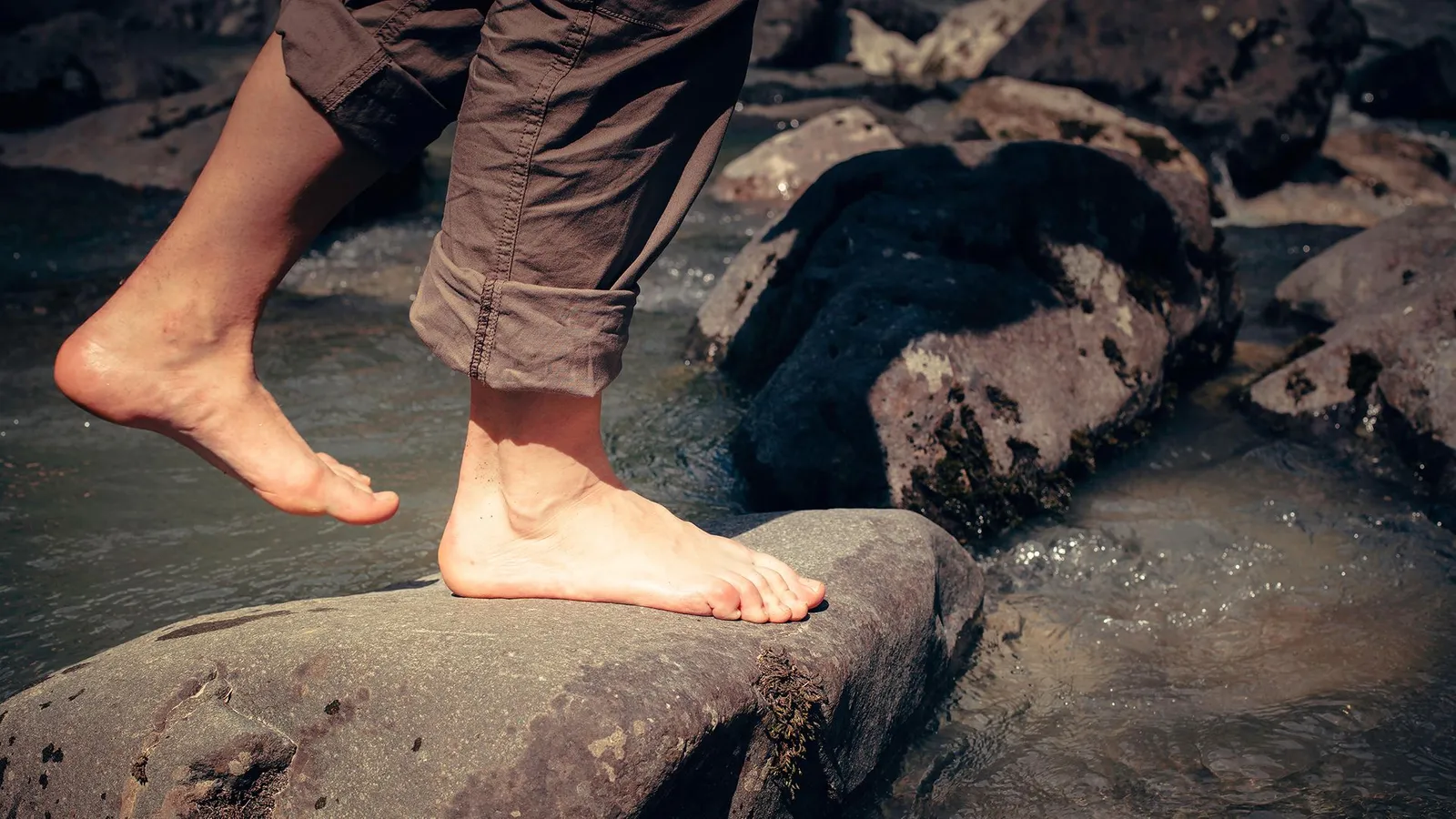
    Water-induced wrinkles may have given our ancestors better grip when walking on wet rocks or foraging for shellfish (Credit: Alamy)
    Water-induced wrinkles may have given our ancestors better grip when walking on wet rocks or foraging for shellfish

    It was a question from one of his children during a bath about why their fingers had gone wrinkly that recently led Davis to dig into what this advantage could be. With the help of 500 volunteers who visited the Science Museum in London during 2020, Davis measured how much force they needed to use to grip a plastic object. Perhaps unsurprisingly, those with dry, unwrinkled hands needed to use less force than people whose hands were wet so their grip on the object was better. But when they submerged their hands in a water bath for a few minutes to turn their hands wrinkly, the grip force fell between the two even though their hands were still wet.

    “The results were amazingly clear,” says Davis. “The wrinkling increased the amount of friction between the fingers and the object. What is particularly interesting is that our fingers are sensitive to this change in the surface friction and we use this information to apply less force to grip an object securely.”

    The object that Davis’ volunteers were gripping weighed less than a couple of coins, so the amount of grip required was small. But when performing more arduous tasks in a wet environment, this difference in friction could become more important.

    “If you don’t have to squeeze as hard to grip something, the muscles in your hands get less tired and so you can do it for longer,” he says.

    His findings match those by other researchers who have found that the wrinkling of our fingertips makes it easier for us to handle wet objects. In 2013, a team of neuroscientists at Newcastle University in the UK asked volunteers to transfer glass marbles of varying sizes and fishing weights from one container to another. In one case the objects were dry, and in the other they were at the bottom of a container filled with water. It took 17% longer for the participants to transfer the submerged objects with unwrinkled fingers than when they were dry. But when their fingers were wrinkled, they could transfer the submerged marbles and weights 12% quicker than when their fingers were wet and unwrinkled. Interestingly, there was no difference in transferring the dry objects with wrinkled or unwrinkled fingers.

    There are other baffling mysteries women take longer to develop wrinkles than men do

    Some scientists have suggested that the wrinkles on our fingertips and toes may act like rain treads on tyres or the soles of shoes. The channels produced by the wrinkles help to squeeze water away from the point of contact between the fingers and an object.

    This suggests that humans may have evolved fingertip and toe wrinkling at some point in our past to help us grip wet objects and surfaces.

    “Since it seems to give better grip under water, I would assume that it has to do with either locomotion in very wet conditions or potentially with manipulating objects under water,” says Tom Smulders, an evolutionary neuroscientist at Newcastle University who led the 2013 study. It could have given our ancestors a key advantage when it came to walking over wet rocks or gripping branches, for example. Alternatively, it could have helped us when catching or foraging for food such as shellfish.

    “The latter would imply it is unique to humans, whereas if it’s the former, we would expect it to happen in other primates as well,” says Smulders. Finger wrinkling has yet to be observed in our closest relatives in the primate world such as chimpanzees, but the fingers of Japanese macaque monkeys, which are known to bath for long periods in hot water, have been seen to also wrinkle after they have been submerged in water. But the lack of evidence in other primates does not mean it doesn’t happen, it may simply be because no-one has looked closely enough yet, says Smulders. “We don’t know the answer to this question yet.”

    There are some other interesting clues about when this adaptation may have appeared in our species. Fingertip wrinkling is less pronounced in saltwater and takes longer than it does in freshwater. This is probably because the salt gradient between the skin and surrounding environment is lower in saltwater, and so the salt imbalance that triggers the nerve fibres is less dramatic. So, it could be an adaptation that helped our ancestors live in freshwater environments rather than along coastlines.

    But there are no firm answers, and some believe it could just be a coincidental physiological response with no adaptive function.

    Only one other primate has so far been found to have water-induced wrinkling of the fingers  Japanese macaques (Credit: Benjamin Torode/Getty Images)
    Only one other primate has so far been found to have water-induced wrinkling of the fingers

    Only one other primate has so far been found to have water-induced wrinkling of the fingers Japanese macaques (Credit: Benjamin Torode/Getty Images)

    Strangely there are other baffling mysteries  women take longer to develop wrinkles than men do, for example. And why exactly does our skin return to its normal state normally after 10-20 minutes  if there is no clear disadvantage to our grip on dry objects of having wrinkly fingertips? Surely if having wrinkly fingers can improve our grip in the wet, but not harm it when dry, why would our fingertips not be permanently wrinkly?

    One reason for that could be the change in sensation the wrinkling also causes. Our fingertips are packed with nerves, and the pruning of our skin changes the way we feel things we touch (although one study has shown it does not affect our ability to discriminate between objects based on touch).

    “Some people have a real aversion to it because picking something up with wrinkly fingers feels weird,” says Davis. “It could be because the balance of skin receptors have changed position, but there could be a psychological dimension too. It would be fun to investigate why. There could be other things we can do less well with wrinkly fingers.”

    But the wrinkling of our fingers and toes in water can reveal key information about our health in surprising ways too. Wrinkles take longer to form in people with skin conditions like psoriasis and vitiligo, for example. Patients with cystic fibrosis experience excessive wrinkling of their palms as well as their fingers, and this has even been noticed in people who are genetic carriers of the disease. Patients suffering from type 2 diabetes also sometimes show markedly decreased levels of skin wrinkling when their hands are placed in water. Similarly reduced wrinkling has been seen in people who have suffered heart failure, perhaps due to some disruption in the control of their cardiovascular system.

    Unsymmetrical wrinkling of the fingers where one hand wrinkles less than the other despite the same immersion time has even been suggested as an early sign of Parkinson’s disease as it indicates the sympathetic nervous system is not functioning correctly on one side of the body.

    So, while the question of why our fingers and toes began wrinkling in water in the first place remains open, our pruney digits are proving useful to doctors in other surprising ways.

    Source: bbc.com

  • GMA, nurses blame vaccine hesitancy, relaxed protocol: As COVID-19 numbers rise again

    The Ghana Medical Association (GMA) and the Ghana Registered Nurses and Midwives Association (GRNMA) have attributed the surge in local COVID-19 infections to the high vaccine hesitancy and abandonment of the safety protocol.

    Active local COVID-19 cases that reduced to 20 a few months ago rose to 1,064 as of June 13, 2022, and to 1,255 as of yesterday[June 20, 2022], with eight severe cases and one critical case.

    At a joint news conference in Accra yesterday by the two associations on their perspectives on vaccine hesitancy, the President of the GMA, Dr Frank Serebour, said the observance of the safety protocol and the vaccination had been the combined game changer and the foundation for the successes in controlling COVID-19 infections in the country.

    That, however, was being threatened by vaccine hesitancy and non-adherence to the safety protocols, he said.

    Dr Serebour underscored the need for the public to return to strict adherence to the safety protocol, particularly the wearing of face masks in crowded places or enclosed places with other occupants.

    He also appealed to persons eligible for COVID-19 vaccines and booster doses to get the jabs.

    He reiterated that the vaccines deployed locally and internationally were safe and effective, providing adequate but varying levels of protection.

    “That is the only way to keep the pandemic abated, prevent a fifth wave and a possible return to COVID-19 restrictions,” he stressed.

    Hesitancy data

    Dr Serebour bemoaned the high percentage of vaccine hesitancy among health workers, in particular, saying it had a ripple effect on the public.

    “COVID-19 vaccine hesitancy remains a challenge for vaccine uptake in Ghana despite some gains made. The partnership for evidence-based response to COVID-19 report puts the overall vaccine hesitancy in Ghana at an average of 30 per cent, with people under 25 years leading the hesitancy score.

    “Data from the Ghana Health Service (GHS) also indicates that 35 districts out of the 260 have less than 25 per cent of the eligible population vaccinated for COVID-19.

    He reiterated that the vaccines deployed locally and internationally were safe and effective, providing adequate but varying levels of protection.

    “That is the only way to keep the pandemic abated, prevent a fifth wave and a possible return to COVID-19 restrictions,” he stressed.

    Hesitancy data

    Dr Serebour bemoaned the high percentage of vaccine hesitancy among health workers, in particular, saying it had a ripple effect on the public.

    “COVID-19 vaccine hesitancy remains a challenge for vaccine uptake in Ghana despite some gains made. The partnership for evidence-based response to COVID-19 report puts the overall vaccine hesitancy in Ghana at an average of 30 per cent, with people under 25 years leading the hesitancy score.

    “Data from the Ghana Health Service (GHS) also indicates that 35 districts out of the 260 have less than 25 per cent of the eligible population vaccinated for COVID-19.

    “Among health workers, it is estimated that 40 per cent have not received the second doses of vaccination, and less than one per cent have received booster doses.

    “We see these developments as worrying, especially concerning health workers. This is because health workers, particularly doctors, nurses and midwives, are not only on the frontline of care, but remain the most trusted sources of information and access to vaccination,” he said.

    Action

    Dr Serebour said for that reason, the GMA, GRNMA and the Health Promotion Division of the GHS had come together to address the vaccine hesitancy among healthcare workers and the public.

    He said they planned to transform about 2,000 health workers into vaccination champions and build their capacity in risk communication and community engagement to address issues of disinformation and misinformation regarding COVID-19 vaccination.

    “We also will be collecting data on the reasons underpinning hesitancy among health workers to understand and address the concerns and misunderstandings that exist,” he said.

    The President of the GRNMA, Perpetual Ofori-Ampofo, called on stakeholders, especially the media, traditional and religious leaders, and youth groups to encourage and advocate vaccine uptake.

    Health promotion

    The Director of the Health Promotion Division of the GHS, Dr Dacosta Aboagye, said the GHS, in partnership with key stakeholders, was increasing public education on vaccine uptake and the safety protocols.

    He said if the public failed to get vaccinated and to adhere to the safety protocol and cases continued to surge, the state could be forced to impose restrictions.

    “We beg you to get vaccinated. The disease is still with us. We appeal to the media to sustain their public education drive,” he said.

  • Road accidents claim 1,140 lives in 5 months

    National Road Safety Authority (NRSA), has revealed that a total number of 1,140 people have been killed by road accidents from January to May, 2022

    In an interview with the Daily Graphic, the acting Director-General of the NRSA, David Osafo Adonteng, disclosed that on the average, Ghana loses more than four lives in a day.

    Bemoaning the number of cases recorded this year, he disclosed that the number of deaths recorded in the last five months have slightly reduced compared to the same period last year.

    In the year 2021, 1,250 persons were killed. He says the figures indicate that the number of individuals killed in road traffic accidents have reduced by 8.8 %.

    The number of injured persons within the period under review also decreased by 4.98 percent as the authority recorded 6,620 injured cases this year, compared to 6,967 injured cases in 2021.

    In general, the recorded cases of road carnages in the first quarter of 2022 decreased by four percent.

    Mr Osafo Adonteng ascribed the percentage decrease in road accident cases to sensitisation by his outfit and the media.

    “Drivers were advised and educated on the dangers of road indiscipline, and we can all see the impact it has made,” he said.

    He said although the number of crashes have decreased, the fatalities rate is alarming, hence sensitisation program should be intensified.

    Mr Adonteng further encouraged motorists to adhere to road traffic regulations and standards at all times.

    “It is motivating us and strengthening our thoughts that if we do it collectively, comprehensively and vigorously, we will get the intended result of reducing road crashes.”

  • Ankaful Prison flooded

    Following three days of torrential rainfall, the Ankaful Maximum Security Prison located in the suburb of Cape Coast in the Central Region, has reportedly been flooded.

    The rains which started at the wee hours of Friday night through to Saturday dawn, destroyed properties worth thousands of Ghana cedi at the prison.

    About 70 prison officers and their families were displaced after their bungalows got flooded.

    According to reports, a prison officer, Senior Chief Officer Lutterodt, lost his life while assisting other prisons officers to rescue residents to safety.

    The tragedy witnessed at the Ankaful Prison has left many prison officers and inmates in despair.

    Meanwhile, the Director-General of the National Disaster Management Organisation (NADMO), Eric Nana Agyemang-Prempeh, says residents in Akanful and its environs whose houses were affected by flooding over the weekend have been relocated

    Relief Items have also been given to the victims.

    The Director-General of the Ghana Prisons Service, Isaac Egyir, who visited the Ankaful Camp Prison to ascertain the extent of damage, has also assured that the service would take the appropriate action to support the affected officers.

    Other affected communities

    Several communities along the Ankaful Prison environs were also hit by the heavy downpour.

    The affected communities included Ankaful Fie, Ntranoa, Amissano, Nkontrodu, Peace and Bethel Avenues.

    Abee, Simiw and Abrem were the other towns affected by the torrential rains.

    Residents living in these communities were rendered homeless after more than 100 houses in the Komenda Edina Eguafo Abirem municipality were submerged.

    The residence of the Chief Executive Officer of the EXIM Bank, Mr Lawrence Kwabena Agyinsem, was terribly hit as he lost at least two cars to the floods after his wall was pulled down by the fast-moving water.

    Road infrastructure damaged

    A greater portion of the bridge linking Cape Coast and Twifo Praso was completely swallowed by the floods last Saturday.

    The road was split into two when a section completely caved in, rendering the route inaccessible for motorists plying the roads.

    Commuters and residents were seen stranded at both sides of the road.

    In a swift response, the Roads Ministry on Sunday, June 19, deployed constructors to the affected areas to ensure that roads and bridges are repaired without delay.

    Meanwhile, a Senior Meteorologist at the Marine Unit of the Ghana Meteorological Agency, Mr Adom Derkye, has hinted that Ghana will continue to experience rainfall till November 2022.

    According to him, in August, the rains will reduce but rise in September and then end in November.

    Source: The Independent Ghana

  • Islamic SHS shooting: Parliament to receive Defense and Interior Committees report on Tuesday

    The Parliamentary Select Committee on Defense and Interior will on Tuesday, July 21, present its report on the clash between students of Islamic School in Kumasi and the Ghana Police service to Parliament.

    Speaking to Citinews, the Vice-Chair of the committee and MP for Mfantseman, Ophelia Hayford, noted that the committee will meet and deliberate on the issues today, July 20, before putting out the report.

    “On Tuesday, we will present our report to the Speaker. All things being equal, if we are able to put it together, we will then present it to Parliament as directed by the Speaker.”

    A delegation of MPs on the Defense committee embarked on a trip to the Islamic SHS upon the directive of the Speaker of Parliament Alban Bagbin to probe the June 13th incident where police fired tear gas at protesting students, leading to the injury of over 30 students.

    On that faithful Monday, some students took to the streets to register their displeasure over the increase in pedestrian knockdowns involving students and teachers of the school.

    The rift between the Police and students of the Islamic school ensued when students who were demanding the construction of speed rumps blocked the Abrepo Junction-Barekese, thereby causing vehicular and human traffic for more than an hour.

    In an attempt to disperse the demonstrating students and ease vehicular movement, the Police allegedly opened tear gas.

    Assessing the issue, the Chairman of the committee Mr Agyapong has noted that the failure of the urban roads Director to fix speed ramps on the roads led to the clash between students and the police officers.

    He stated that management of the school since 2010 had written to the director to provide speed ramps on the roads to minimize road accidents but their plea fell on deaf ears.

    “We have evidence that the school has written to the Ashanti Regional Urban Roads Director since 2010, the last one was September 2021 and nothing has been done, people are dying, people get injured, damage to their cars and all the letters paid no heed.”

    According to the Assin Central lawmaker, the clash could have been avoided if the urban roads had paid heed to the demands of the school authorities to install speed ramps on their roads.

    Mr Kennedy Agyapong has, therefore, called for the dismissal of the urban roads chief executive in the Ashanti region

    “Honourable Amoako-Atta, if you are watching, you should immediately fire the Urban Roads Chief Executive who was there in 2021, because the letter was written in August, in September and still nothing has been done. And it goes all the way to January 25th, 2012”.


    Source: The Independent Ghana

  • How I met Hollywood actor Ghost Jupitar discloses

    Ghanaian dancehall artiste, Jupitar has disclosed that he met American Hollywood actor turn rapper, Omari Hardwick popularly known as “Ghost” on the popular social media platform, Instagram.

    In an exclusive interview with Universe Entertainment, on June 20, the “Eternity” hit maker stated that the American actor has been a friend for a year after “Ghost” reached out to him on the social media platform.

    He mentioned this after the Hollywood actor, featured him on his “Fearless” Season 1 album.

    “Omari has been a friend for a year. He reach out to me on Instagram saying he was a big fan. We were initially communicating as friends when I told him I liked the character he played in the seasonal movie Power, and we then exchange number and decided to feature ourselves in our respective albums, which he featured me on his fearless album he released recently,” Jupitar said.

    He further revealed that he is working on a new album that will feature some American artists. He said the collaboration has been facilitated by Omari.

    “He has introduced me to a whole lot of American artists, and top producers if you have studied Jupiter for the past years, you will know that I am an unpredictable artiste, so hopefully by the end of the year my fans should be expecting rainbow colors in my album” he added.

    Omari Hardwick on Saturday, June 18, 2022, did a private album listening on his album “fearless” season 1. The rapper is, however yet to release the album on various music platforms.

    Source: ghanaweb.com

  • Jennifer Lopez introduces one of her twins with gender neutral pronouns

    Jennifer Lopez and her child Emme Maribel Muñiz, 14, are being praised for a recent duet, but not because of the music.

    The pair who last made headlines for performing together when Lopez co-headlined the Super Bowl LIV Pepsi halftime show in 2020 took to the stage recently at the LA Dodgers Blue Diamond Gala.

    Lopez introduced Emme using the gender-neutral pronouns they and them.

    “The last time we performed together was in a big stadium like this,” Lopez said in a video of the moment shared by TikTok user @christinathesupermom. “And I ask them to sing with me all the time and they won’t.”

    “So this is a very special occasion. They are very, very busy, booked, and pricey,” Lopez went on to say. “They cost me when they come out. But they’re worth every single penny because they’re my favorite duet partner of all time.”
    Emme then appeared on stage, carrying a rainbow microphone to sing Christina Perri’s hit, “A Thousand Years.”

    Lopez shares Emme and twin brother Max with her ex-husband, singer, and actor Marc Anthony.

    CNN has reached out to Lopez for comment.

    Source: ghanaweb.com

  • MzVee to unleash ’10 Thirty’ album with star-studded lineup

    MzVee has been one of the last women standing in the music industry with her exhilarating style of music, and she is set to release her fifth studio album titled “10 Thirty”.

    According to MzVee, the title of the album “10 Thirty” connotes her 10-year span in the music industry as she turns 30 years on June 23, 2022.

    The album features some of the best musical talents from the African continent, including Tiwa Savage, Bella Shmurda, Yemi Alade, Stonebwoy, Kofi Kinaata, Kwesi Arthur, and Tanzanian superstar Harmonize.

    Speaking at an album listening session in Accra, MzVee revealed that her 10-year stay in the music industry had seen numerous challenges, especially coming from a very strict home.

    “That switch from being a church girl to being a musician was very difficult for me, and I had to take time off to rethink my career and bounce back very strongly.

    “It has been such a ride and a rollercoaster in my 10-year spell in the industry. I have met lots of good people and bad people pretending to be good people. 

    “One of my memorable moments was when I featured Zeal of VVIP fame on my first solo song and also got to hear my music played on radio back in 2012,” she said.

    Speaking about her yet-to-be-released album, MzVee was very elated to drop her fifth album, having dropped her last one in 2020.

    She noted that the album was a mix of Dancehall, Afrobeats and Afro-pop and recruited artistes who fit a particular genre and was hopeful the album would make waves across the globe.

    “I recorded over 50 songs and it was narrowed down to 10 songs. I wrote some of the songs and this album is a very special one. I can’t wait for my fans to hear it, “she said.

    The much-awaited album would be released on June 23, 2022, which would be available across all streaming platforms, with a musical concert billed for June 25, 2022.

    Source: ghanaweb.com

  • Patrice Lumumba: Why Belgium is returning a Congolese hero’s golden tooth

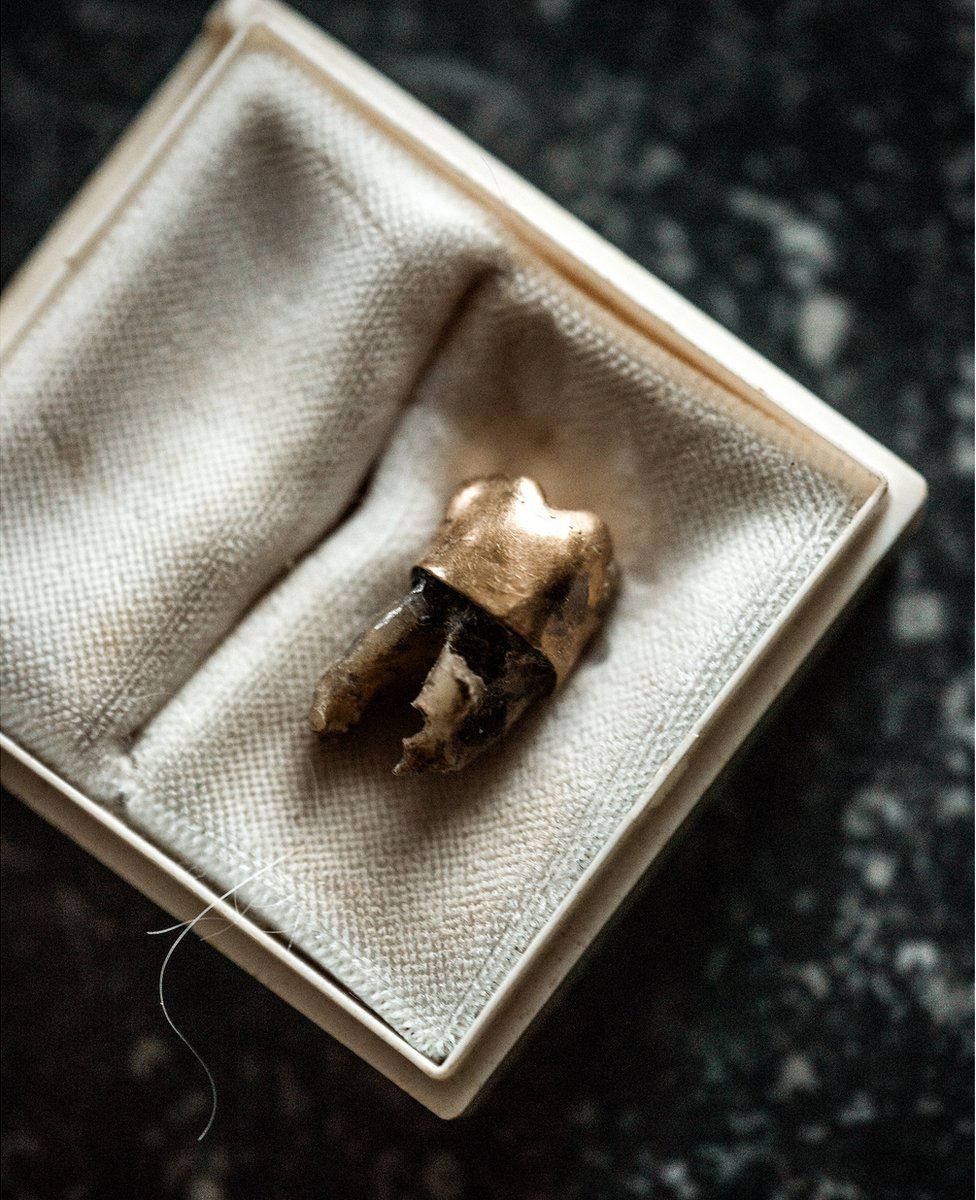
    A gold-crowned tooth is all that remains of assassinated Congolese independence hero Patrice Lumumba.

    Shot dead by a firing squad in 1961 with the tacit backing of former colonial power Belgium, his body was then buried in a shallow grave, dug up, transported 200km (125 miles), interred again, exhumed and then hacked to pieces and finally dissolved in acid.

    The Belgian police commissioner, Gerard Soete, who oversaw and participated in the destruction of the remains took the tooth, he later admitted.

    He also talked about a second tooth and two of the corpse’s fingers, but these have not been found.

    The tooth has now been returned to the family at a ceremony in Brussels.

    Soete’s impulse to pocket the body parts echoed the behaviour of European colonial officials down the decades who took remains back home as macabre mementoes.

    But it also served as a final humiliation of a man that Belgium considered an enemy.

    Soete, appearing in a documentary in 1999, described the tooth and fingers he took as “a type of hunting trophy”. The language suggests that for the Belgian policeman, Lumumba – who was revered across the continent as a leading voice of African liberation – was less than human.

    For Lumumba’s daughter, Juliana, the question is whether the perpetrators were human.

    “What amount of hatred must you have to do that?” she asks.

    “This is a reminder of what happened with the Nazis, taking pieces of people – and that’s a crime against humanity,” she told the BBC.

    Picture of a tooth in a display box
    Gerard Soete’s daughter showed the tooth, in a padded box, to a photographer in 2016

    Lumumba had risen to become prime minister at the age of 34. Elected in the final days of colonial rule, he headed the cabinet of the newly independent nation.

    In June 1960, at the handover of power, Belgian King Baudouin praised the colonial administration and spoke about his ancestor, Léopold II, as the “civiliser” of the country.

    There was no mention of the millions who died or were brutalised under his reign when he ruled what was then known as the Congo Free State as his personal property.

    This failure to acknowledge the past foreshadowed years of denial in Belgium, which it has only now begun to come to terms with.

    Lumumba was not so reticent.

    In an address that was not scheduled on the official programme, the prime minister spoke about the violence and degradation that the Congolese had suffered.

    In devastating rhetoric, interrupted by rounds of applause and a standing ovation when he concluded, he described “the humiliating slavery that was imposed on us by force”.

    The Belgians were stunned, according to academic Ludo De Witte, who wrote a ground-breaking account of the assassination.

    Never before had a black African dared to speak like this in front of Europeans. The prime minister, who De Witte says had been described as an illiterate thief in the Belgian press, was seen as having humiliated the king and other Belgian officials.

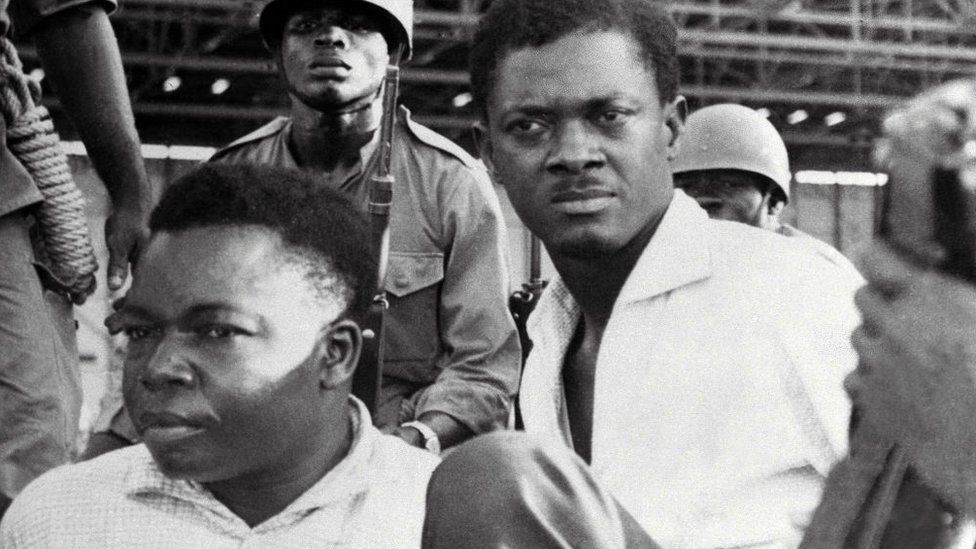
    A picture taken in December 1960, shows soldiers guarding Patrice Lumumba (R), Prime Minister of then Congo-Kinshasa, and Joseph Okito (L), vice-president of the Senate, upon their arrest in Leopoldville (now Kinshasa)
    Patrice Lumumba (R) and ally Joseph Okito (L) were arrested in December 1960

    Some have said that with his speech Lumumba signed his own death warrant, but his murder the following year was also wrapped up in Cold War manoeuvres and a Belgian desire to maintain control.

    The Americans also plotted his death because of a possible pivot towards the Soviet Union and his uncompromising anti-colonialism, while a British official wrote a memo suggesting that killing him was an option.

    Nevertheless, there seemed to be a personal element to the way Lumumba was vilified and pursued.

    The total destruction of the body, as well as a way to get rid of the evidence, seems like an effort to obliterate Lumumba from the memory. There would be no memorial, making it almost possible to deny that he existed at all. It was not enough just to bury him.

    But he is still remembered.

    Not least by his daughter Juliana – a prime mover in the campaign to get the tooth returned home, who went to Brussels to receive it.

    She lets out a warm chuckle as she recalls her childhood memories. As the youngest, and the only girl in the family, she says she was very close to her father.

    Ms Lumumba was “less than five” when he became prime minister. She remembers being allowed to be in his office “just sitting and looking at my father when he was working. For me it was daddy.”

    But she recognises that her father “belongs to the country, because he died for Congo… and for his own values and convictions of the dignity of the African person”.

    She acknowledges that the handing over of the tooth in Belgium and bringing it back to the Democratic Republic of Congo is symbolic “because what remains is not really enough. But he has to come back to his country where his blood was shed.”

    The tooth will be taken around the vast country before being buried in the capital.

    For years, though, the Lumumba family did not know exactly what had happened to their father as official silence surrounded the circumstances of his death.

    Lumumba’s journey from prime minister to victim of assassination took less than seven months.

    Shortly after independence, the country was hit by a secessionist crisis as the mineral-rich south-eastern Katanga province declared that it was splitting off from the rest of the country.

    In the political chaos that followed, Belgian troops were sent in on the grounds that they would protect Belgian nationals, but they also helped support the Katangan administration, which was seen as more sympathetic.

    Lumumba himself was dismissed as prime minster by the president and just over a week later army chief of staff Col Joseph Mobutu seized power.

    Lumumba was then placed under house arrest, escaped and re-arrested in December 1960, before being held in the west of the country.

    His presence there was seen as a possible source of instability and the Belgian government encouraged his transfer to Katanga.

    During the flight there on 16 January 1961 he was assaulted. He was also beaten on arrival as the Katangan leaders pondered what to do with him.

    ‘No trace left’

    Eventually it was decided that he would face a firing squad and on 17 January he was shot, along with two allies.

    This is when police commissioner Soete stepped in. Realising that the bodies could be discovered, a decision was taken “to make them disappear once and for all! There must be no trace left,” according to testimony quoted in De Witte’s book The Assassination of Lumumba.

    Armed with saws, sulphuric acid, face masks and whisky, Soete then led a team to move, destroy and dispose of the remains. It was a process that he was later to describe as travelling “to the depths of hell”.

    But it was not until nearly 40 years later, in 1999, that he publicly acknowledged that he was involved and that he still actually had a tooth in his possession. He said he had got rid of the other body parts he took.

    Ms Lumumba sighs deeply when she recalls hearing that there was a part of her father that still existed.

    “You can understand what I felt about that,” she says, her voice full of emotion.

    It is not known what Soete did with the tooth when it was in his possession. A photograph shows it in a padded box, but whether it was on display is not clear.

    But it did remain in his family.

    It resurfaced in 2016 when Soete’s daughter, Godelieve, gave an interview to Belgian magazine Humo, published just before the 55th anniversary of Lumumba’s killing.

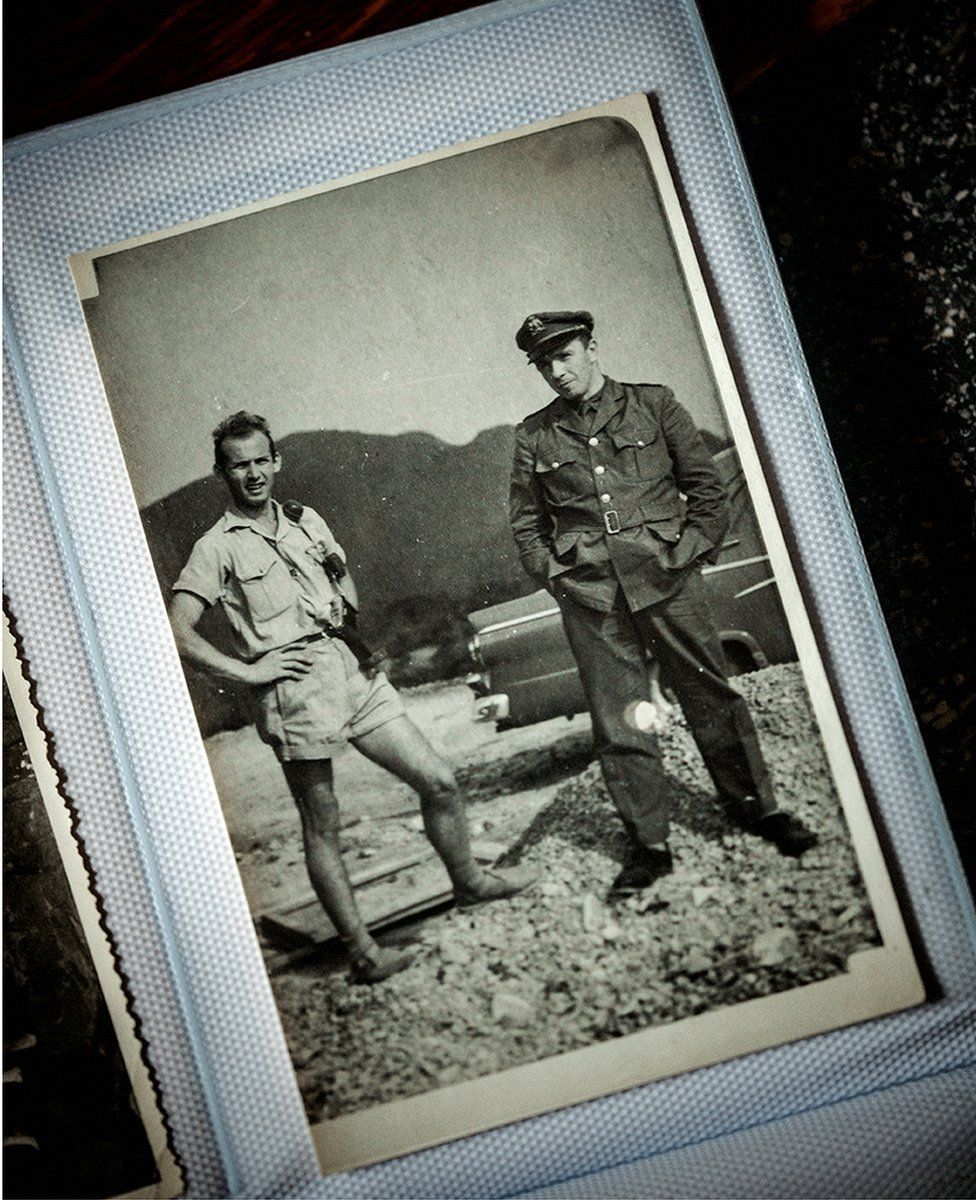
    Black and white photo pf two men standing - one in uniform
    A picture in Godelieve Soete’s photo album shows her father, Gerard, on the right with his brother, Michel, who also took part in the destruction of the bodies 

    She spoke about her “poor daddy” who had to suffer with the knowledge of what he did. Ms Soete also thought her family should get an apology for the order the Belgian authorities gave her father.

    She said he had kept a private archive and though after his death in 2000 a lot was thrown away, she “was able to save interesting things”.

    Among those things was the tooth that she brought out to show the interviewer and photographer.

    It was then seized by the Belgian police after De Witte filed a complaint and following a four-year legal battle, a court ruled that it should be returned to the Lumumba family.

    As part of the campaign to get it back, Ms Lumumba wrote a moving and poetic open letter to King Philippe.

    “Why, after his terrible murder, have Lumumba’s remains been condemned to remain a soul forever wandering, without a grave to shelter his eternal rest?” she asked.

    With the return of the tooth, the former prime minister will have a final resting place in a special mausoleum in the capital, Kinshasa.

    “This is what we usually do in our culture, we like to bury our dead,” said Congolese historian and the country’s UN ambassador, Georges Nzongola-Ntalaja.

    “It is a comfort for the family and the people of the Congo because Lumumba is our hero and we would like to give him a decent burial.”

    Despite the burial there is still a need to reckon with the past.

    De Witte’s book, which shattered years of official silence, led to the creation in 1999 of a parliamentary inquiry charged with determining the “exact circumstances of the assassination… and the possible involvement of Belgian politicians”.

    In its conclusions two years later it wrote that the “norms of international politically correct thinking were different” in the 1960s. Nevertheless, despite not uncovering a document ordering the murder of Lumumba, the inquiry found that certain members of the government “were morally responsible for circumstances leading to the death”.

    ‘Need to know our past’

    The Belgian foreign minister at the time, Louis Michel, then expressed “apologies” and “profound and sincere” regrets to the Lumumba family and the Congolese people.

    Prof Nzongola-Ntalaja, speaking to the BBC in a personal capacity, does not believe Belgium has fully accepted its role in the killing. “Belgium refuses to take responsibility for something which they know they did – so it is not totally satisfactory,” he said.

    Belgian prosecutors are treating the murder as a war crime but 10 of the 12 suspects identified have died and, a decade in, the investigation is moving very slowly.

    The handover of the tooth will be another element in the process towards reconciliation between Belgium and DR Congo over the colonial era and Lumumba’s death.

    “It’s a step – and we need to go further,” his daughter says.

    But she also argues that there needs to be some reckoning on the Congolese side, as some of her compatriots were also involved in her father’s death.

    “We have to accept our history – the good and the bad of it.”

    And in a flourish worthy of the former prime minster, she says “we need to know our past, to build our future and to live in the present”.

    The burial of the tooth – planned to coincide with the 61st anniversary of Lumumba’s famous independence-day speech – will offer an opportunity to revisit that past.

    Source: BBC

  • Cheapest electricity cost: Ghana ranked 1st, 9th in West Africa, Africa

    According to Global Petrol Prices. Com, the country is also ranked 27th in the world.

    The rankings are coming at a time when the utility tariff providers in the country are making a case for increase in utility tariffs.

    The world average price of electricity is pegged at $0.133 per kilowatt/hour (kWh) for household users and $0.124 per kWh for business users.

    In Ghana, the cost of electricity per kilowatt/hour for household is $0.046 cents which is less than a dollar.

    The situation is similar to that of business consumers, though countries in the region have cheaper cost for electricity bill.

    This clearly shows that the cost of electricity in the country for household, compared to other countries on the continent is very low.

    That goes to buttress the point by the utility tariff providers for an imminent increase in electricity and water bills. Whilst the Electricity Company of Ghana is requesting for 148% increase in electricity tariff, covering 2019 and 2022, Ghana Water Company Limited is demanding for an increase of 334% in water tariff.

    Meanwhile, Sudan has the cheapest electricity tariff in Africa and the World for household.

    It is followed by Libya and Zimbabwe in 2nd and 3rd positions respectively.

    RANKING OF COUNTRIES WITH CHEAPEST COST OF ELECTRICITY IN AFRICA FOR HOUSEHOLD CONSUMERS

    COUNTRY COST($) 100 cents =$1 RANKING
    Sudan 0.002 1st
    Libya 0.004 2nd
    Ethiopia 0.007 3rd
    Zimbabwe 0.013 4th
    Angola 0.027 5th
    Zambia 0.033 6th
    Algeria 0.036 7th
    Egypt 0.044 8th
    Ghana 0.046 9th
    Nigeria 0.057 10th
    Tunisia 0.068 11th
    Cameroon 0.080 12th
    DR Congo 0.083 13th
    Tanzania 0.098 14th
    Botswana 0.103 15th
    USA 0.159 16th
    UK 0.265 17th
    China 0.083 18th

    Source : myinfo.com.gh

  • 3 Interchanges for Accra-Tema motorway — Roads Minister

    The government is to construct three interchanges and a number of footbridges for pedestrian crossings on the Accra-Tema motorway.

    This is to ensure the safety of motorists and pedestrians who use the motorway and communities along the route.

    The Minister of Roads and Highways, Kwasi Amoako-Attah, made this known in Parliament last Friday.

    It was in response to a question by the National Democratic Congress (NDC) Member of Parliament (MP) for Buem, Kofi Adams, to know the urgent steps the Ministry of Roads and Highways was taking to improve the safety of motorists on the Accra-Tema motorway and the communities along that route.

    Motorway expansion

    Responding to the question, Mr Amoako-Attah, who is also MP for Atiwa East, said there were plans to also expand the existing four lane motorway into a 10 lane.

    This, he said, would comprise four lane freeway (access control), three urban highways, three interchanges and a number of footbridges for pedestrian crossings.

    He said all the safety measures for motorists and pedestrians have been incorporated into the designs for the expansion works on the motorway.

    He stated further that the urban highways and the interchanges to be constructed would serve the communities along the road.

    Mr Amoako-Attah said currently, the Mobile Maintenance Unit II of the Ghana Highway Authority was also patching potholes on the Accra-Tema Motorway with Portland Cement Premix concrete.

    He said the Lakplaku Bridge that was closed to traffic for rehabilitation works has since been opened to traffic last Friday, saying all formed part of efforts by the government to ensure safety on the motorway.

    Makango-Salaga road

    Responding to another question by the NDC MP for Salaga South, Zuwera Mohammed Ibrahimah, as to when the Makango-Salaga and other roads under construction in her area would be completed to ease the transportation challenges of the people, Mr Amoako-Attah said the progress of work on the Makango-Salaga road to date was 25 per cent.

    He said the Makango-Salaga road was being constructed under the contract titled ” Rehabilitation of Tamale-Salaga-Makango which was 52 kilometres long.

    He said the project commenced on January 21, 2021 and was expected to be completed by January 20, 2023.

    Other roads

    On the Abromase-Akamade, Abromase-Kigbatito, Steel Bridge-Sarikingonakura, Abromase-Kijawu Battor, Salaga-Dagoubia and Takpu-Silmunchu feeder roads within the Salaga and Akamade enclave in the East Gonja Municipality in the Savannah Region, Mr Amoako-Attah said some of the roads were partially engineered while others were in poor surface conditions.

    He said currently there was no programme on any of the above mentioned roads .

    Mr Amoako-Attah, however, said engineering design and condition surveys had been carried out on the roads for upgrading interventions.

    He stated that the procurement and execution of the interventions would be considered under the 2023 budget.

    Japekrom-Kwameoseikrom

    On when the contractor working on the Japekrom to Kwameoseikrom road will return to site after abandoning the road project for several months, a question by the MP for Jaman South, Williams Okofo-Dateh, the Roads and Highways Minister, said the Department of Feeder Roads would carry out a reassessment of the contractor’s capacity.

    This, he said, was to find out if the contractor had the capacity to execute the works so that the future of the contract could be determined.

    He said the contractor before abandoning the work had undertaken a number of works which included clearing, formation, construction of U-drains and pipe culverts.

    Mr Amoako-Attah said the upgrading of the Japekrom-Kwameoseikrom which was 18.6 Kilometres commenced on November 18,2016, and was expected to be completed on November 18, 2018.

    He stated that the contractor had achieved only 30 per cent of works and cited payment challenges as the reason for the delay.

    Source: www.graphic.com.gh

  • Ed Sheeran crowned UK’s most-played artist of 2021 – and also wins accolade for most-played single

    Ed Sheeran was the most-played artist of 2021 in the UK, and also claimed the year’s most played single with Bad Habits.

    It is the second time he has claimed both accolades, previously achieving the double in 2017 with the release of his album Divide and hit single Shape Of You.

    Adele is the only other artist to have topped both charts in the same year, with Rolling In The Deep and the popularity of her album 21 in 2011.

    It is the fourth time in five years that the 31-year-old pop superstar has been the UK’s most-played artist, having been temporarily dethroned in 2020 by Dua Lipa.

    The annual charts are compiled by music licensing company Phonographic Performance Limited (PPL) from music usage and airplay data from radio stations and television channels as well as public performance locations.

    The most played tracks of 2021

    1. Bad Habits Ed Sheeran

    2. By Your Side Calvin Harris featuring Tom Grennan

    3. Little Bit Of Love Tom Grennan

    4. Blinding Lights The Weeknd

    5. Higher Power Coldplay

    6. All You Ever Wanted Rag’n’Bone Man

    7. Heartbreak Anthem Galantis, David Guetta and Little Mix

    8. Starstruck Years & Years

    9. Midnight Sky Miley Cyrus

    10. Bed Joel Corry, Raye and David Guetta

    Tom Grennan crowned a breakout year by claiming both the second and third most-played tracks of 2021, with By Your Side with Calvin Harris and Little Bit Of Love, respectively.

    The Weeknd’s Blinding Lights was the fourth most-played track, demonstrating staying power having originally been released in November 2019.

    The fifth most-played track of 2021 was Higher Power by Coldplay.

    The second most-played artist of the year was David Guetta, with Dua Lipa in third.

    Little Mix, who recently went on hiatus, claimed fourth place after consistently appearing in the top 10 for the past five years.

    Coldplay were the fifth most-played act.

    The most played artists of 2021

    1. Ed Sheeran

    2. David Guetta

    3. Dua Lipa

    4. Little Mix

    5. Coldplay

    6. The Weeknd

    7. Justin Bieber

    8. Calvin Harris

    9. Taylor Swift

    10. Pink

    Peter Leathem, chief executive of PPL, said: “Congratulations to Ed Sheeran for having the UK’s most-played track of 2021 and being the UK’s most-played artist of 2021.

    “His chart-topping success over the last five years is a testament to not only the quality of his output but also the strength of UK music at a time when the global music landscape is more competitive than ever.”

    Source : news.sky.com

  • How do you survive in this economy with GH¢300, GH¢500 as monthly salary? – Berla Mundi quizzes

    Ghanaian media personality and host of TV3 New Day morning show, Berlinda Addardey, popularly known as Berla Mundi, has questioned how Ghanaians earning 500cedis or low are coping in the current economic situation.

    At the moment, the world is facing an economic crisis, and Ghana as a country is no exception.

    President of the Republic, Nana Addo Dankwa Akufo-Addo, his Vice, Dr. Mahamudu Bawumia, and some bigwigs in this administration have all admitted we are not in good times. To some, the current economic hardships have been attributed the impacts of the COVID-19 pandemic and the Russia-Ukraine conflict.

    One of the many fields that have been badly affected by the global financial crisis is the petroleum sector, bringing a lot of pressure on the ordinary Ghanaian.

    Taking to Twitter to solidarize with the people, Berla Mundi questioned how Ghanaians who receive as low as GHs300 or GHs500 are surviving in this situation.

    “So people who earn about ghc300-ghc500 a month, how do they survive in this economy?” She tweeted.

    Her tweet has seen a lot of comments from Twitter users who say indeed they are facing unbearable hardships under President Akufo-Addo’s government.


    Source: ghanaweb.com

  • I sing like a Nigerian because they are taking over music in Africa Lasmid

    Fast-rising Ghanaian musician, Lasmid Owusu Nathaniel known in showbiz circles as Lasmid has indicated that he sings like a Nigerian because they are taking over the music space in Africa.

    Speaking in an interview with Sammy Kay on the Go online show, the highly spiritual signee disclosed that sounding Nigerian is personally a good thing for him.

    According to him, there is a plus in learning the ways of people to overtake them or do better than them hence he feels it’s a good thing to sound like Nigerian to hit the global market.
    The former MTN hitmaker winner is already topping chats with his recently release banging single titled “Friday Night”.

    Source: ghanaweb.com

  • I’m baffled as to why the Executive is silent on Adwoa Safo’s absence Ricketts-Hagan

    Kweku George Ricketts-Hagan, ranking member on the Privileges Committee of Parliament has said he is completely baffled as to why the Executive arm of government has refused to take a decision against Gender Minister Sarah Adwoa Safo after months of abandoning her ministerial duties and staying outside of Ghana.

    Speaking on the KeyPoints show on TV3 Saturday, he said, “What baffles me is that; let’s take the parliamentary role of Hon. Adwoa Safo out of the whole thing, supposing she was just a Minister appointed by the President; we know in our constitution if you can’t do the work resign, fine, but what would have been the procedure at the Executive end in dealing with this matter?”

    He continued, “The Executive is silent on this, it’s as if now the Executive is waiting for Parliament to bring some finality to this for them to be able to act, and I find it quite baffling.”

    He added, “So I’m saying if she wasn’t a Member of Parliament, what are the laid downs? Because the Executive don’t have Privileges Committee or Privileges Ministry, maybe they should think of having one in the future.

    He quizzed, “I’m really wondering what’s going on at that end, but it’s been going on for some time now. I would like to know what sort of excuse leave if any, that the honourable has submitted to the Executive which I’m not privy to?”

    Mr. Ricketts-Hagan made these comments on the back of the failure of the embattled Dome-Kwabenya MP to appear before the Privileges Committee of Parliament.

    Ms Safo is among three legislators who have been dragged before the Privileges Committee to answer questions about their long absence from the House.

    She was summoned through the media after failed attempts to reach her.

    Chairman of the committee, Hon. Joseph Osei Owusu directed that the summons be published publicly as she had been unreachable.

    The Privileges Committee has been tasked by the Speaker of Parliament, Mr. Alban Bagbin, to engage Adwoa Safo, Kennedy Agyapong and Henry Quartey over complaints of chronic absenteeism brought against them.

    Meanwhile, Adwoa Safo had explained in a previous interview she granted Joy News, that she was in the United States and had not been served any invitation from the committee.

    Source: Ghanaweb

  • Government settles GH¢553.5m debt owed Nigerian Gas Company

    Deputy Minister of Energy, William Owuraku Aidoo, has noted that government has settled its legacy debt owed Nigerian Gas Company Limited (N-Gas).

    According to him, government, through his outfit, paid off the GH¢553,452,668 in three tranches.

    William Owuraku Aidoo indicated that this settlement comes after the Volta River Authority (VRA) improved its balance sheets.

    The Nigerian Gas Company Limited has over the years supplied Ghana with natural gas to help sustain the energy sector.

    This, the Deputy Energy Minister said has helped ameliorate the power crisis in the country.

    While speaking on the floor of parliament on Friday, June 17, 2022, William Owuraku Aidoo said, “I would like to point out that, subsequently, VRA has been able to pay its obligations to N-Gas as and when it falls due…VRA is able to pay for its obligation to N-Gas for the supply of natural gas from Nigeria. I will say that it has gone a long way in ameliorating the power situation in Ghana thereby preventing dumsor.”

    “VRA under the able leadership of Antwi Darkwa has improved remarkably on their balance sheet and as a result they are able to pay for gas supply to Ghana as and when it falls due. VRA is doing a very good job in polishing its balance sheet thereby being able to pay for its bills,” he added.

    Background

    The accumulation of debt owed N-Gas started in 2014 due to the inability of VRA to pay the company.

    According to Graphic.com.gh report, government in 2017 instituted strategic intervention programmes such as ESLA to pay in tranches this legacy debt.

    Ghana at the Committee of Ministers meeting in Lome, Togo, in December 2020 made a commitment to settle the debt by end of this year.


    Source: Ghanaweb

  • Prison officer washed away by floodwater, body yet to be retrieved

    A prison officer has been washed away by floodwaters while he was rescuing residents from being washed away along the Cape Coast-Elmina Highway in the Komenda Edina Eguafo Abraim Municipality of the Central Region.

    The body of the said officer whose name has not been given is yet to be retrieved.

    The incident happened Saturday morning, June, 18 when over 30 prison officers from the Ankaful Prison had been deployed to the area to rescue residents who had been inundated with floodwater.

    Information gathered by Kasapa News, Yaw Boagyan revealed that the prison officers were retrieving materials being washed away from the rooms of the residents when unfortunately the officer was swept away.

    In an interview, the Central Regional NADMO Director Mr. Joe Donkor confirmed the incident, adding that efforts are underway to retrieve the body.

    Source: Ghanaweb

  • Road crashes reduced by 4% for the first quarter of this year NRSA

    Recorded road carnages in the first quarter of 2022 has seen a slight decrease of about four percent.

    Data sighted by The Independent Ghana from the National Road Safety Authority (NRSA) showed that from January to May this year, a number of 6,472 cases of road traffic accidents were reported while road accidents, within the same period last was 6,789.

    Comparing the data of 2022 and 2021, the country has witnessed a decline of 4.67 % in road traffic accidents.

    NRSA also confirmed that a total of 1,140 lives were lost to road crashes from January to May this year while 1,250 persons were killed within the same period last year.

    The figures indicate that the number of individuals killed in road traffic accidents from January to May this year has reduced by 8.8 %.

    The number of injured persons within the period under review also decreased by 4.98 percent as the Authority recorded 6,620 injured cases this year, compared to 6,967 injured cases in 2021.

    The Greater Accra Region recorded the highest road crashes and fatalities among the 16 regions in Ghana.

    The aforementioned region recorded 2735 crashes representing 42 percent to the number of crashes recorded from January to May this year.

    The Ashanti Region came second with 1496 cases which translate into 23 percent.

    The Eastern, Central, Western and Volta regions recorded the third, fourth and fifth highest cases respectively .

    Acting Director-General of the National Road Safety Authority, Ing. David Osafo Adonteng, attributed the reduction of road crashes to sensitization and media advocacy on road safety measures.

    Source: The Independent Ghana

  • Haruna Iddrisu wants Agric Minister summoned over state of poultry industry

    The Minority Leader, Haruna Iddrisu is demanding the urgent summoning of the Minister for Food and Agriculture over the state of the poultry industry in the country.

    According to him, the scarcity of ingredients like maize for poultry feed and other teething challenges is gradually crippling the sector.

    The ongoing war in Ukraine has left Ghana and the rest of the world short of important grains.

    President Nana Akufo-Addo has publicly expressed concern about the shortage of fertiliser and its relationship with the production of grains.

    Speaking on the floor of Parliament on Friday, June 17, 2022, Mr. Iddrisu bemoaned the current state of the poultry industry and underscored the need for urgent action.

    “There is a seeming problem with the poultry industry in Ghana. Poultry farmers have difficulty accessing what they call poultry feed,” the Minority Leader said.

    He noted that the closure of some poultry-related businesses because of some difficulties had come to his attention.

    “We are already an unacceptable net importer of poultry when we have the capacity and capability to produce the poultry that we need,” Mr. Iddrisu said.

    He noted further that the poultry industry “remains a major source of employment apart from satisfying the protein needs of Ghanaians.”

    In 2021, chicken imports were estimated at 350,000 metric tonnes.

    According to forecasts for 2022, imports of chicken could rise to 400,000 metric tonnes.

    Source: Citinews

  • SOHO/Luna Bar is going to JAM 🔥this Sunday , Dont miss out!  

    If you like to live by the phrase “work hard, play hard,” then SOHO/Luna Bar is the place for you to be this  Sunday.

    Relax this weekend in a setting with great music and a warm, inviting atmosphere. The SOHO bar and Luna roof top bar at Marina Mall Airport City, will be hosting the Sunset Brunch, on 19th June,2022 at exactly 12 noon. Come on over and enjoy yourself with that special person, and have some fun!

    After a long and stressful week, it time to unwind, relax and party hard.

    Come and vibe to some hip-hop, Afrobeats, and Amapiano tunes spun by AD DJ, EFF, Baylor, and Babs at this First Class event. Jonny Stone will be the day’s master of ceremonies.


  • Johnson offers fresh training for Ukrainian troops

    We’re getting updates from the UK side now, after Prime Minister Boris Johnson made another surprise visit to Kyiv to meet his Ukrainian counterpart Volodymyr Zelensky.

    Johnson offered to launch a major training operation for Ukrainian forces, a statement from Downing Street says.

    This claims to have the potential to train up to 10,000 soldiers every four months, which could “fundamentally change the equation of the war”.

    The proposal would see Ukrainian troops trained in other countries for a period of three weeks each – learning “battle-winning skills” as well as medical training, cyber-security, and counter-explosive tactics.

    The statement says the ambition would be to rebuild and increase Kyiv’s resistance against the Russian invasion.

    Johnson is quoted telling the people of Ukraine that the UK is with them until they “ultimately prevail”.

    Source: BBC

  • Oil slumps 5% on recession concerns, U.S. gasoline price drop

    NEW YORK, June 17 Oil prices tumbled about 5% to a three-week low on Friday, led by a slump in U.S. gasoline futures, as interest rate hikes from major central banks fuelled worries about a sharp economic slowdown.

    Brent futures fell $5.85, or 4.9%, to $113.96 a barrel by 11:02 a.m. EDT (1502 GMT), while U.S. West Texas Intermediate (WTI) crude fell $6.66, or 5.7%, to $110.93.

    For the week, Brent was on track for its first weekly dip in five weeks, and WTI was on track for its first decline in eight weeks as concerns grow that interest rate hikes could cause a recession.

    Those fears helped pressure U.S. gasoline futures down by over 7% with analysts worrying high gasoline prices will start impacting demand for the fuel.

    Automobile group AAA said the price of diesel at the pump hit a record high $5.798 per gallon on Friday, while the price of gasoline hit its record of $5.016 earlier in the week.

    Global central bankers, who shared the limelight for skirting a pandemic-driven depression with quick action two years ago, are now stumbling through the aftermath as they try to quell an inflation surge none predicted or have been able to forestall.

    “The influence of the macro environment has started to take over from oil specific fundamentals in recent days,” said Investec’s head of commodities Callum Macpherson.

    The U.S. Federal Reserve and the European Central Bank both have enough credibility to engineer a reduction in inflation without causing a deep recession like the last time the U.S. central bank battled such fast-rising prices, St. Louis Fed President James Bullard said.

    But with the Fed expected to keep raising interest rates, open interest in WTI futures on the New York Mercantile Exchange fell on Thursday to its lowest since May 2016 as investors cut back on risky assets like commodities.

    The global oil market continues to show signs of “turbulence”, Russian Deputy Prime Minister Alexander Novak said, blaming the uncertainties over oil production recovery in Libya, Iran and Venezuela and a lack of energy infrastructure.

    Much of that turbulence, however, was due to Russia’s actions since its invasion of Ukraine on Feb. 24.

    Italy may declare a heightened “state of alert” on natural gas next week if Russia continues to curb its supplies, two government sources said after energy company reported a shortfall in flows from Moscow for the third day in a row.

    The European Union’s executive, meanwhile, recommended that Ukraine and Moldova become candidates for membership, a milestone in their potential path from former Soviet republics to developed economies in the world’s largest trading bloc.

    Source: www.reuters.com

  • Liverpools Sadio Mane to join Bayern Munich in £35m deal

    Liverpool have agreed to a 41m euro (£35.1m) deal to sell Sadio Mane to Bundesliga champions Bayern Munich.

    The Reds will get a fixed 32m euros (£27.4m) with an additional 6m euros based on appearances and 3m euros based on individual and team achievements.

    The forward was approaching the final year of his contract with the Reds, who turned down two bids from Bayern before accepting their latest offer.

    The 30-year-old joined Liverpool from Southampton in 2016.

    Source: BBC

  • Police arrest 3 soldiers, accomplice for robbery

    The Ghana Police Service has arrested three military personnel and one other accomplice in connection with a robbery incident at Nsakina near Amasaman on June 4, 2022.

    The suspects, № 208183 G/CPL. Yinsabilik Gabriel, № 280252 G/L/CP Elikem Adams, № 209016 L/CPL. Asiedu Stanley and Malik, their accomplice,  were arrested following a Police investigation into the robbery.

    The Police report indicates that the four suspects scaled a wall into the residence of the complainant and robbed him and his friends of 8 different mobile phones.

    The suspects also forcibly made them transfer an amount of ¢850 to a registered MTN number, bearing the name Gabriel Yinsabilik.

    Preliminary investigation led to the identification of the three military personnel, who were arrested by the Military Police and handed over to the Amasaman District CID.

    The three military suspects have since been cautioned and released to the Military Police while investigation continues.

    Meanwhile, their accomplice, Malik, confessed to the crime during interrogation

  • Robbery claim against 3 soldiers false Ghana Armed Forces

    The Ghana Armed Forces (GAF) has dismissed reports that three of its personnel have been arrested for robbery offenses.

    In a statement to debunk the reports, GAF said the allegation of robbery has not been established against the three soldiers, hence it is premature for such a conclusion to be drawn by the public.

    Referencing a story by The Chronicle which announced the arrest of the soldiers for robbery, the Armed Forces explained that a Nigerian national had reported the soldiers to the Amasaman Police station for alleged extortion, seizure of phones and forced entry into a premise at Nsakina.

    The statement further said that based on the report against the soldiers, there was a joint investigation by the Military Police and the Civil Police into the matter.

    Subsequently, the “Military Police escorted the three soldiers to the Amasaman Police Station where they were compelled to avail themselves for their photographs to be taken as part of a routine investigation process.”

    Robbery claim against 3 soldiers false - Ghana Armed Forces

    GAF said preliminary investigations by the Military Police indicate that one of the soldiers had claimed he had monitored suspicious movements in the house occupied by the Nigerian.

    Together with his colleagues, they proceeded to the house and after being ushered in by one of the occupants, they noticed some Nigerians busily working on laptops.

    According to the statement, the leader of the group in the house denied any involvement in cyber fraud or any criminal activity and offered to report any such activity to the security services.

    The story circulating noted that the soldiers scaled a wall into the residence of the complainant and robbed him and his friends of 8 different mobile phones and forcibly made them transfer an amount of ¢850 to a registered MTN number, bearing the name Gabriel Yinsabilik.

    GAF proceeded that the alleged extortion and seizure of phones are still been investigated by the Military Police and the Civil Police for the truth to be ascertained.

    “It is therefore unclear the motive of the haste in releasing such information with pictures into the public domain on a yet to be determined matter,” portions of the statement read.

    GAF noted that it does not condone any criminal act by its personnel and would not shield any soldier engaged in such activities.

    The Armed Forces, however, urged “the media and other stakeholders follow due process for the veracity of claims to be made to ensure accurate information is published.”


    Source: Myjoyonline

  • Eight million Australians urged to turn off lights

    Australia’s energy minister has urged households in New South Wales – a state that includes the country’s biggest city Sydney – to switch off their lights in the face of an energy crisis.

    Chris Bowen says people should not use electricity for two hours every evening if they “have a choice”.

    However, he added he was “confident” that blackouts could be avoided.

    It comes after Australia’s main wholesale electricity market was suspended because of a surge in prices.

    Mr Bowen asked people living in New South Wales to conserve as much power as possible.

    “If you have a choice about when to run certain items, don’t run them from 6 to 8 [in the evening],” he said during a televised media conference in Canberra.

    Why is there a crisis?

    Australia is one of the world’s biggest exporters of coal and liquefied natural gas but has been struggling with a power crisis since last month. Three quarters of the country’s electricity is still generated using coal. It has long been accused of not doing enough to cut its emissions by investing in renewables.

    In recent weeks, Australia has felt the impact of disruptions to coal supplies, outages at several coal-fired power plants and soaring global energy prices.

    Flooding earlier this year hit some coal mines in New South Wales and Queensland, while technical issues have cut production at two mines that supply the market’s biggest coal-fired station in New South Wales.

    Around a quarter of Australia’s coal-fired electricity generating capacity is currently out of service due to unexpected outages and scheduled maintenance.

    Some electricity producers have seen their costs soar as global coal and gas prices have jumped due to sanctions on Russia over its invasion of Ukraine.

    Meanwhile, demand for energy has jumped amid a cold snap and as Australia’s economy opens up after Covid-19 restrictions were eased.

    All of this has helped drive up power prices on the wholesale market to above the A$300 (£173; $210) per megawatt hour price cap set by the market’s regulator, the Australian Energy Market Operator (Aemo).

    However, that cap was below the cost of production for several generators, who decided to withhold capacity.

    On Wednesday, Aemo took the unprecedented step of suspending the market and said it would set prices directly and compensate generators for the shortfall.

    It also asked consumers in New South Wales to “temporarily reduce their energy usage”.

    What happens next?

    Aemo has not given a timeline on when the suspension would be lifted. It said in a statement, “The price cap will remain until cumulative wholesale electricity prices fall below the cumulative price threshold.”

    “Aemo, as the national power system operator, will continue to monitor the situation and provide further updates should conditions change,” it added.

    On Thursday, Australia’s biggest electricity producer AGL Energy said it expected to be able to supply more power to businesses and consumers in the coming days.

    It has three units that have been out of service at its coal-fired plant in Bayswater, New South Wales.

    They are among several planned and unplanned outages that have helped cause the power crisis.

    AGL said that one of the units should return to service on Thursday, while another will come back online by Saturday.

    Meanwhile, Australia’s new Prime Minister Anthony Albanese said the crisis would be raised at a meeting with state premiers which starts on Thursday.

    Lynne Chester, an energy expert from the University of Sydney, told the BBC that policymakers have been aware of the risks of ageing generators for decades.

    “The sector’s regulators and policy makers have ignored the escalating capacity constraints of aging generation assets, fired by fossil fuels, that dominate the sector,” Prof Chester said.

    Source: www.bbc.com

  • Absenteeism in Parliament: Zoom link sent to Adwoa Safo Privileges Committee

    The Privileges Committee of Parliament has sent a Zoom link to the embattled MP for Dome-Kwabenya Constituency, Sarah Adwoa Safo, to question her over her absence from parliament for more than 15 days after several attempts to get her to return from the United States of America had proved futile.
    According to the Privileges Committee, this is in addition to the publication of the invitation for the embattled MP to appear before the Committee.

    Ranking Member of the Committee, George Kweku Ritchett- Hagan made this disclosure after the Committee’s sitting in Parliament on Wednesday, June 15, 2022.

    He explained that the link had been sent to the MP, who is also the Minister of Gender and Social Protection, but she has not responded to the link.

    He was hopeful that the MP would respond to the link to enable the Committee to question her on July 6, 2022.

    The Committee is probing the protracted absenteeism of Ms. Safo as well as two other MPs of the majority caucus, Mr. Kennedy Agyapong and Henry Quartey.

    In a recent interview, Adwoa Safo said she was not aware she had been invited or served a notice of appearance by parliament in connection with her previously scheduled appearance before the Privileges Committee on Friday, May 27 2022.
    “I am not aware such a thing has been given to me”, she told Accra-based Joy News on Thursday, adding: “I am just hearing it from you.”

    “As we speak, I don’t know that I have been invited,” she stressed.

    “I have to be served,” she added.

    The Minister of Gender, Child and Social Protection said she would only return home from the United States when her sick son was declared fit and healthy.

    Source: ghanaweb.com

  • China will support Russia on security, Xi tells Putin in birthday call

    Chinese leader Xi Jinping reiterated his support for Moscow on “sovereignty and security” matters in a call with counterpart Vladimir Putin on Wednesday, upholding his backing for the countries’ partnership despite the global backlash against Russia’s invasion of Ukraine.

    Speaking on his 69th birthday, Xi also pledged to deepen strategic coordination between the two countries, according to China’s Foreign Ministry.

    A separate readout from the Kremlin said the two leaders stressed their countries’ relations were “at an all-time high” and reaffirmed their commitment to “consistently deepen the comprehensive partnership.”

    The call is thought to be the second time the two have spoken since Russia invaded Ukraine. They last spoke just days after Moscow launched what it insists on calling a “special military operation.”

    China, too, has refrained from referring to Russia’s actions as an invasion and has walked a fine line on the issue. It has portrayed itself as calling for peace and upholding the global order while refusing to denounce Russia’s actions. It has also used its state media apparatus to mimic Kremlin lines blaming the United States and NATO for the crisis.

    During Wednesday’s call, Xi stressed China had always “independently assessed the situation” in Ukraine and called for “all parties” to push for a “proper settlement of the Ukraine crisis” echoing language he used in a March call with US President Joe Biden.

    China is “willing to continue to play its role” in promoting a “proper solution” to Ukraine, he said.

    The Kremlin’s summary of the call took this position a step further, saying: “the President of China noted the legitimacy of Russia’s actions to protect fundamental national interests in the face of challenges to its security created by external forces.”

    China’s lack of censure for Russia’s war in Ukraine has further strained Beijing’s tense relationship with the US and its allies.

    US officials have repeatedly called on countries to condemn Russia’s actions and warned their Chinese counterparts against aiding Moscow. During the March call between Xi and Biden, the US President spelled out consequences if China gave material support, following US intelligence that Moscow asked Beijing for military assistance a claim both deny.

    Trade ties

    Wednesday’s call was also a chance for Putin and Xi to check in on a growing trade relationship.

    Earlier this year, weeks before the Russian invasion, the two leaders in a face-to-face meeting said their countries had a “no limits” partnership and pledged to boost trade.

    “Since the beginning of this year, bilateral relations have maintained a sound development momentum in the face of global turbulence and transformations,” Xi said in the Wednesday call.

    “The Chinese side stands ready to work with the Russian side to push for the steady and long-term development of practical bilateral cooperation,” Xi said, pointing to the “steady progress” of their trade ties and the opening last week of the first cross-border highway bridge over the Amur River.

    The two agreed to expand cooperation in energy, finance, manufacturing, and other areas, “taking into account the global economic situation that has become more complicated due to the illegitimate sanctions policy pursued by the West,” the Kremlin readout said.

    The two countries also pledged to work together to strengthen communication and coordination in international bodies such as the United Nations where the two often vote as a bloc.

    “China is also willing to work with Russia to promote solidarity and cooperation among emerging market countries … and push for the development of the international order and global governance towards a more just and reasonable direction,” Xi said, in a comment that hit on the countries’ shared aim of pushing back against what they view as the global hegemony of the United States.

    Birthday greetings

    The call was not the first time that Xi and Putin two strongmen drawn together by mutual distrust of the West have had engagements on each others’ birthdays.

    In 2013, Xi presented Putin with a birthday cake and the two drank vodka together to mark the Russian leader’s 61st birthday during a conference in Indonesia. Xi later celebrated his 66th birthday during a 2019 summit in Tajikistan with Putin, who surprised him with ice cream, cake, and champagne.

    Their personal relationship, in which Xi has described Putin as his “best and bosom friend” is also thought to bolster the dynamics of their strengthening rapport on the national level.

    In its summary of the two leaders’ latest call, the Kremlin noted the conversation was held in a “traditionally warm and friendly atmosphere.”

    Source: Ghanaweb

  • Plague: Ancient teeth reveal where Black Death began, researchers say

    Researchers believe they have discovered the origins of the Black Death, more than 600 years after it killed tens of millions in Europe, Asia and north Africa.

    The mid-14th Century health catastrophe is one of the most significant disease episodes in human history.

    But despite years of research, scientists had been unable to pinpoint where the bubonic plague began.

    Now analysis suggests it was in Kyrgyzstan, central Asia, in the 1330s.

    A research team from the University of Stirling in Scotland and Germany’s Max Planck Institute and University of Tubingen analyzed ancient DNA samples from the teeth of skeletons in cemeteries near Lake Issyk Kul, in Kyrgyzstan.

    They chose the area after noting a significant spike in burials there in 1338 and 1339.

    Dr Maria Spyrou, a researcher at the University of Tubingen, said the team sequenced DNA from seven skeletons.

    They analyzed the teeth because, according to Dr Spyrou, they contain many blood vessels and give researchers “high chances of detecting blood-borne pathogens that may have caused the deaths of the individuals”.


    The research team were able to find the plague bacterium, Yersinia pestis, in three of them.

    Dr Philip Slavin, a historian at the University of Stirling, said of the discovery: “Our study puts to rest one of the biggest and most fascinating questions in history and determines when and where the single most notorious and infamous killer of humans began.”

    The research does have some limitations – including the small sample size.

    Dr Michael Knapp from the University of Otago in New Zealand, who was not involved in the work, praised it as “really valuable”, but noted: “Data from far more individuals, times and regions… would really help clarify what the data presented here really means.”

    The researchers’ work was published in the journal Nature, titled “The source of the Black Death in fourteenth-century central Eurasia”.

    line

    What is bubonic plague?

    Plague is a potentially lethal infectious disease that is caused by bacteria called Yersinia pestis that live in some animals – mainly rodents – and their fleas.

    Bubonic plague is the most common form of the disease that people can get. The name comes from the symptoms it causes – painful, swollen lymph nodes or ‘buboes’ in the groin or armpit.

    From 2010 to 2015, there were 3,248 cases reported worldwide, including 584 deaths.

    Historically, it has also been called the Black Death, in reference to the gangrenous blackening and death of body parts, such as the fingers and toes, that can happen with the illness.

    line
  • Fuel price hikes: Ghana owns only 18% of its crude oil produced daily – NPA

    Ghana owns only 27,000 barrels, representing 18 per cent of the 150,000 barrels of crude oil produced in the country daily.

    This is woefully less than the 96,000 barrels of crude oil the country consumes daily and does not have any significant influence on the continuous increase in prices of petroleum products locally.

    Mr Abass Tasunti, the Head of Economic Regulation, National Petroleum Authority (NPA), said global factors including geopolitics, wars, natural disasters and political unrest were affecting issues of demand and supply, creating shortages and directly influencing prices of petroleum products locally.

    “The price of petroleum products is not determined by crude oil only, but the price of the petroleum products is done through the formula and the key drivers of the prices of petroleum products is what happens on the World Market just like we are seeing right now including the shortage, supply and demand and these directly affect our prices here,” he said.

    Mr Tasunti was speaking in Bolgatanga, Upper East Region, at a media engagement on the quality and pricing formula of petroleum products, organised by the NPA.

    Currently, petrol and diesel are on the average sold at some pump stations at GH₵10.10 and GH₵12.20 per litre, respectively and it was expected to increase in the coming days considering the sanctions on Russia which supplied about 40 per cent of the world crude oil.

    Mr Tasunti said the NPA was not responsible for the determination of prices of petroleum products and indicated that although the revenue accrued from the export of the 27,000 barrels of the crude could be used to cushion consumers in the form of subsidies, such a move was not sustainable.

    He said: “The job of the NPA as a regulator is to ensure that consumers and suppliers get value for money, so we do not determine the prices but make sure that the price is done according to the formula.”

    Mr Saeed Ubeidalah Kutia, the Head of Control, Quality Assurance Directorate, NPA, stated that Ghana had the highest standard of petroleum quality in West Africa and reiterated the commitment of the NPA to continue to deploy the Petroleum Products Marking Scheme to reduce adulteration of petroleum products.

    “For instance, before the PPMC commenced in 2013, a survey was done, and the adulteration level was around 35 per cent but immediately after the policy started the adulteration rate went down to around 1.89 per cent and currently we are doing around 1.59 per cent. It has never been 100 per cent anywhere but it is about keeping it as low as you can.

    He encouraged consumers to report to the Authority any suspected adulteration of petroleum products for investigation and action, adding that if it were established that that damage had been caused as a result of the adulteration, compensation would be paid to the victim.

    Mrs Alpha Welbeck, the Director, Economic Regulation and Planning, NPA, noted that the engagement with the media was to demystify the misconceptions surrounding the operations of the NPA, particularly regarding the quality and pricing of petroleum products.

    Mrs Welbeck said transparency was of importance to the Authority and noted that the move was to equip the media practitioners drawn from the Upper East Region to better educate the public on the causes of hikes in prices, deregulation and quality of petroleum products.

    Source: ghanaweb.com

  • Bawumia launches bank-wide mobile money service, GhanaPay

    On Wednesday June 15, 2022, the Vice President Dr. Mahamudu Bawumia launched the GhanaPay Mobile Money Service.

    The service is said to operate like the existing mobile money service but with additional banking services.

    The Ghanapay service can be accessed by every individual who uses a mobile phone, with or without a traditional bank account.

    Speaking at the launch, Vice President Bawumia described the introduction of the GhanaPay mobile money service as another groundbreaking initiative.

    Bawumia launches bank-wide mobile money service, GhanaPay

    He intimated that the introduction of Ghanapay forms part of the government’s vision for financial inclusion to all Ghanaians through digital banking.

    “One of the biggest challenges that we faced as a country was the huge unbanked population. For a long time, over 70 percent of the adult population was unbanked. However, thanks to reforms in the payment channels, we have significantly reduced the unbanked population.”

    “It is heartwarming to know that the banking sector is increasingly looking for ways to extend financial inclusion to all Ghanaians. It is clear that the entire economy is being transformed to what I want to call from analogue to digital. The benefits of this transformation, which is literally sweeping across every sector of the economy, are enormous and we can readily see and experience some of the benefits,” he added.

    Bawumia launches bank-wide mobile money service, GhanaPay

    Dr Bawumia commended banks and other stakeholders for coming together to introduce the GhanaPay.

    “Let me therefore, commend the Ghana Association of Banks, GhIPSS and all institutions that from the very beginning, believed in this vision and have supported it all through to this point”

    “I am particularly excited that the banks have closed their ranks and come together to introduce a shared electronic wallet, which has been christened GhanaPay. I see this as a huge avenue for banks to rapidly bring more people into the banking space.”

    Bawumia launches bank-wide mobile money service, GhanaPay

    What is Ghanapay

    GhanaPay is a mobile money service provided by universal banks, rural banks, and savings and loans companies to individuals and businesses. It is like any mobile money service, but with additional banking services designed for your financial freedom.

    How to register

    Option 1: SELF REGISTRATION
    Dial *707# or download the GhanaPay App from Google or Apple store. Enter information about yourself and select a bank you wish to own a wallet with. Walk into a branch of the bank you selected to validate your Ghana Card to complete registration. You will receive an SMS to confirm your registration.

    Option 2: BANK BRANCH
    Walk into any bank branch of your choice. Ask to be registered for a GhanaPay mobile money wallet. Provide your personal details along with your Ghana Card. When the process is completed, you will receive an SMS to confirm your registration.

    Option 3: DESIGNATED AGENT (LOCATION)
    You can go to specially designated GhanaPay Agents to register for a GhanaPay mobile money wallet with a valid Ghana card, just like in a bank branch.

    Source: The Independent Ghana


  • Islamic School shooting: What kind of people are we recruiting into the police service? Antwi-Danso

    International Security Analyst, Dr. Vladimir Antwi-Danso, has expressed concern about the frequency by which harmless civilian protests have become chaotic because of the actions of the security apparatus in the country.

    Dr. Antwi-Danso indicated that this behaviour of security personnel needlessly attacking civilians who are protesting has become one too many and raises questions about the recruitment processes of security agencies in Ghana, 3newroom.com reports.

    He added that the security agency should, as a matter of urgency, review their recruitment processes as well as their training methodologies.

    “It is rather very unfortunate that year in, year out, virtually consistently, crowd control always turns awry.

    “There will be demonstrations, there will be riots, but unfortunately, most of our rioting ends up with police confrontation; it is bad. Recrafting the training methodologies is also important.

    “What kind of people are we recruiting into the Police service or any other service? What kind of training are we giving them? Because crowd control, crowd dispersal and crisis management is a science, we need to learn it,” he said.

    Dr. Antwi-Danso, also the Dean of the Ghana Armed Forces Command and Staff College (GAFCSC), made these remarks reacting to reports of personnel of the police shooting into a crowd of Islamic Senior High School (SHS) students who were protesting.

    The students, on Monday, June 13, 2022, embarked on a protest to register their displeasure over recurrent pedestrian knockdowns involving students on the road in front of the school.

    The protest led to heavy traffic on the road in front of the school, and police were subsequently called on to disperse the protesting students.

    In their bid to disperse the students, the police reportedly fired gunshots which they have clarified were warning shots and not live bullets like was earlier reported.

    Gunshots at Kumasi Islamic SHS as police allegedly fire live bullets, students unconscious.

    Source: Ghanaweb

  • Biden announces new $1 bln in weapons for Ukraine

    President Joe Biden on Wednesday announced a fresh infusion of $1 billion in weapons for Ukraine that includes anti-ship rocket systems, artillery rockets, howitzers and ammunition.

    In a phone call with Ukraine President Volodymyr Zelenskiy, Biden said he told the embattled leader about the new weaponry.

    “I informed President Zelenskiy that the United States is providing another $1 billion in security assistance for Ukraine, including additional artillery and coastal defense weapons, as well as ammunition for the artillery and advanced rocket systems,” Biden said in a statement after the 41-minute call.

    The president also announced an additional $225 million in humanitarian assistance to help people in Ukraine, including by supplying safe drinking water, critical medical supplies and healthcare, food, shelter, and cash for families to purchase essential items.

    The latest weapons packages for Ukraine include 18 howitzers, 36,000 rounds of ammunition for them, two Harpoon coastal defense systems, artillery rockets, secure radios, thousands of night vision devices and funding for training, the Pentagon said.

    The aid packages, which come as U.S. Defense Secretary Lloyd Austin is meeting with allies in Brussels, were split into two categories: transfer of excess defense articles from U.S. stocks and other weapons being funded by the Ukraine Security Assistance Initiative (USAI), a separate congressionally authorized program.

    Russia’s U.N. Ambassador Vassily Nebenzia on Wednesday accused Western countries of “fighting a proxy war with Russia,” telling reporters: “I would like to say to the Western countries supplying weaponry to Ukraine the blood of civilians is on your hands.”

    Ukraine is pressing the United States and other Western nations for speedy deliveries of weapons in the face of increased pressure from Russian forces in the eastern Donbass region.

    Oleksandra Ustinova, a member of the Ukrainian Parliament, told reporters at an event organized by the German Marshall Fund: “We need all these weapons to be concentrated in a moment to defeat the Russians, not just keep coming every two or three weeks.”

    In May, the Biden administration announced a plan to give Ukraine M142 High Mobility Artillery Rocket Systems after receiving assurances from Kyiv that it would not use them to hit targets inside Russian territory. Biden imposed the condition to try to avoid escalating the Ukraine war.

    The rocket artillery in this aid package would have the same range as previous U.S. rocket shipments and is funded using Presidential Drawdown Authority, or PDA, in which the president can authorize the transfer of articles and services from U.S. stocks without congressional approval in response to an emergency, said a source who spoke on condition of anonymity.

    For the first time, the United States is sending ground-based Harpoon launchers. In May, Reuters reported the U.S. was working on potential solutions that included pulling a launcher off of a U.S. ship to help provide Harpoon missile launch capability to Ukraine.

    Harpoons made by Boeing Co (BA.N) cost about $1.5 million per missile, according to experts and industry executives.

    Source: www.reuters.com

  • Ukraine needs strong signal from EU, Macron says ahead of possible visit

    President Emmanuel Macron voiced a tougher line on Russia on Wednesday and said Europe needed to send a strong signal to Ukraine as he sought to assuage concerns in Kyiv and among some European allies over his previous stance towards Moscow.

    Macron arrived in Romania on Tuesday for a three-day trip to Ukraine’s eastern neighbors including Moldova, before possibly heading to Kyiv on Thursday on a visit with German Chancellor Olaf Scholz, Italian Prime Minister Mario Draghi and Romanian President Klaus Iohannis, two diplomatic sources said

    • Macron insists Paris will do everything to stop Russia
    • Macron sees NATO troops in Romania, supports Moldova
    • Scholz, Draghi, Iohannis may join Macron in Kyiv visit

    CONSTANTA, Romania, June 15 (Reuters) – President Emmanuel Macron voiced a tougher line on Russia on Wednesday and said Europe needed to send a strong signal to Ukraine as he sought to assuage concerns in Kyiv and among some European allies over his previous stance towards Moscow.

    Macron arrived in Romania on Tuesday for a three-day trip to Ukraine’s eastern neighbors including Moldova, before possibly heading to Kyiv on Thursday on a visit with German Chancellor Olaf Scholz, Italian Prime Minister Mario Draghi and Romanian President Klaus Iohannis, two diplomatic sources said.

    The symbolic visit would come a day before the European Commission makes a recommendation on Ukraine’s status as an EU candidate, something the biggest European nations have been lukewarm about and are set to discuss at a leaders’ summit on June 23-24.

    We are at a point when we (Europeans) need to send clear political signals, us Europeans, towards Ukraine and its people when it is resisting heroically,” Macron said, without giving details.

    The French leader has been criticized by Ukraine and eastern European allies for what they perceive as his ambiguous backing for Ukraine in the war against Russia.

    French officials have in recent days sought to strengthen the public messaging, while Macron appeared to take a tougher line on Tuesday evening when he was with his troops.

    “We will do everything to stop Russia’s war forces, to help the Ukrainians and their army and continue to negotiate,” he told French and NATO troops at a military base in Romania.

    Macron has in recent weeks repeatedly said it was vital not to “humiliate” Russia so a diplomatic solution could be found when fighting ended and he has continued to keep communication channels open with the Kremlin open, riling more hawkish allies.

    We share a continent. Geography is stubborn and at the end of it, Russia is there. It was there yesterday, it’s there today and will be there tomorrow,” he told reporters.

    France leads a NATO battle group in Romania of about 800 troops, including 500 French troops alongside others from the Netherlands and Belgium. Paris has also deployed a surface-to air missile system.

    Macron heads to Moldova later on Wednesday to support a country many fear could be drawn into the conflict in neighboring Ukraine.

    The focus may turn to Kyiv on Thursday, with diplomatic sources saying the European leaders may head to Ukraine’s capital.

    Macron declined to comment on “logistical matters”, but said it was important to hold new talks with Ukraine on military, financial matters and issues related to exporting grains from the country.

    Romania’s Iohannis said support should include offering Ukraine candidate status in the European Union.

    Source: www.reuters.com