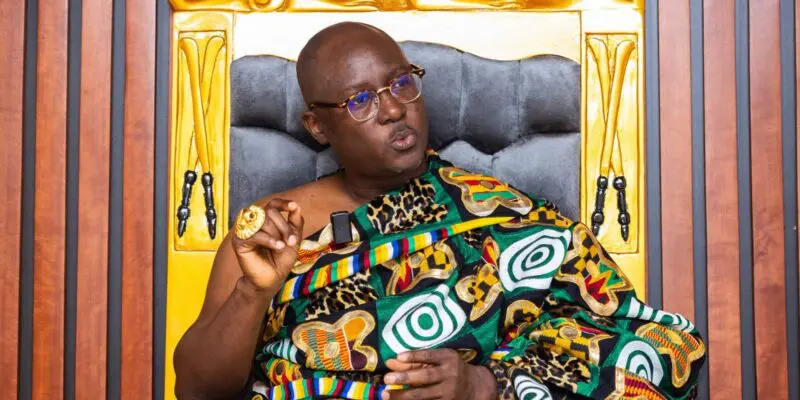
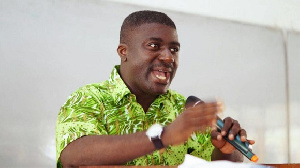
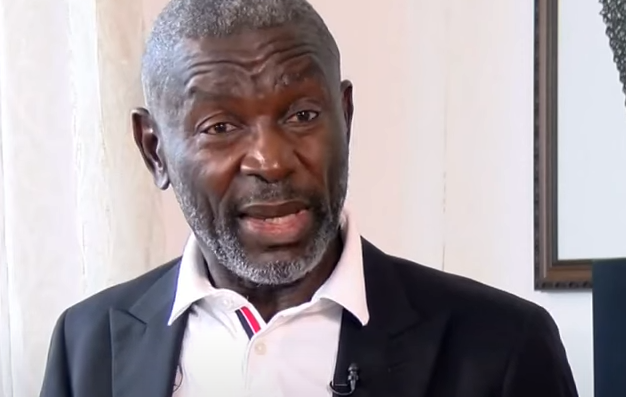
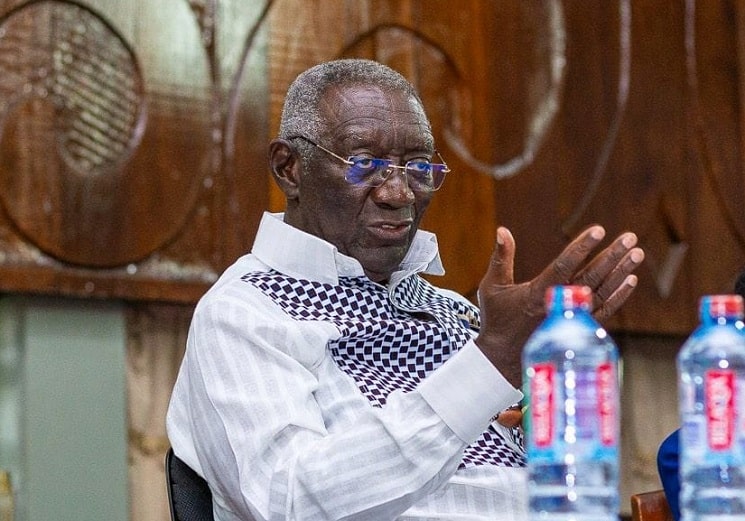
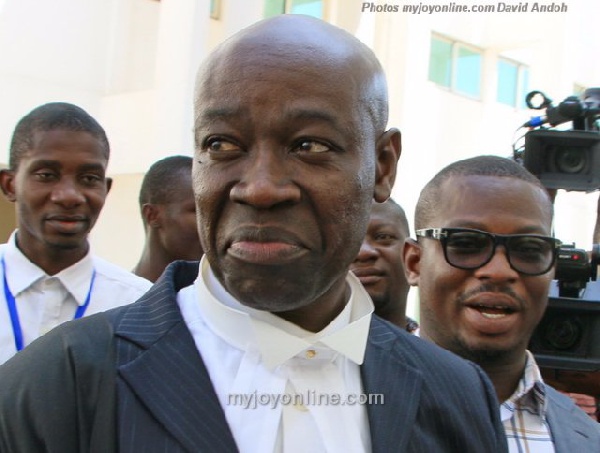
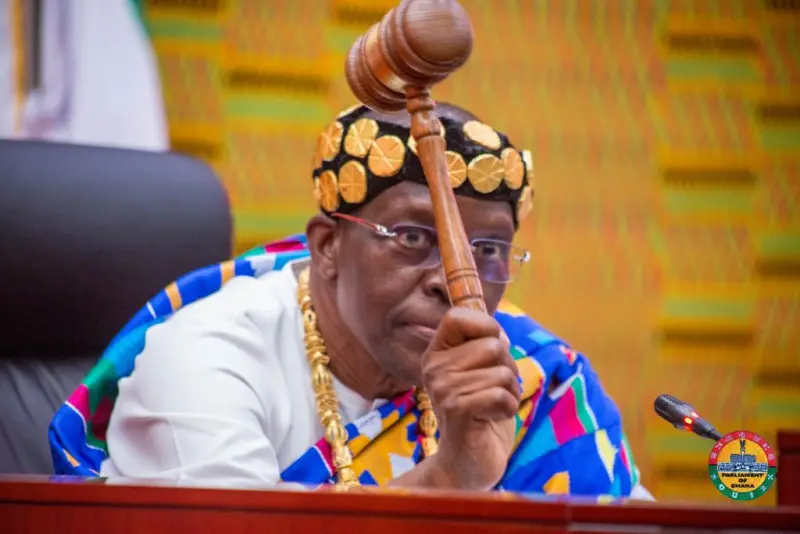
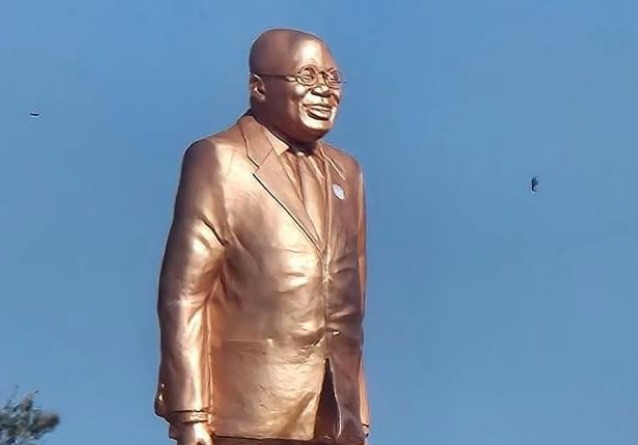
The Kwahu Traditional Council has destooled Daasebre Akuamoah Agyepong II from his position as Kwahumanhene, citing misconduct as the reason behind the destoolment.
The decision arose from allegations of financial impropriety during his time as Chairman of the Agricultural Development Bank’s board.
He was accused of extorting money from a bank customer, an accusation that ultimately led to his resignation from the board.
Confirming the development, Kwahumanhemaa Nana Adwoa Gyamfuah II stated that Daasebre Akuamoah Agyepong II’s actions had damaged the council’s reputation significantly.
Nana Adwoa Gyamfuah II also outlined the customary procedures for leadership transitions, saying, “We have destooled Eugene Kwasi Boadi Asante (Daasebre Akuamoah Agyepong II). The traditional council frowns on chiefs who do not rule in truth. He has brought reputational damage to Kwahuman. He cannot serve as the Chief of Kwahu again.”
“In Akan tradition, if a chief passes on, the queen mother enstools a new chief in consultation with Kingmakers. If a queen mother passed on too, the Chief together with the Kingmakers enstool a new queen mother. That is an Akan Tradition.”
The Kwahumanhemaa added that the council has begun the process to enstool a new Kwahumanhene.
In the interim, the Abetifihene, Nana Asiedu Agyemang III, has assumed the role of acting president of the Kwahu Traditional Council.
“The traditional Council met on Wednesday, November 13. All the Chiefs and Queen mothers, twenty in number formed a quorum to take a decision.
“We all agreed and informed every member of the traditional council of the decision taken. We also performed rites, calling on the gods for us to be able to enstool a new chief who will be of help to Kwahuman.”
In preparation for the December 7 elections, visually impaired voters in the Ahafo region have undergone training to learn how to properly use the Tactile Jacket, a device provided by the Electoral Commission (EC) to assist them in voting.
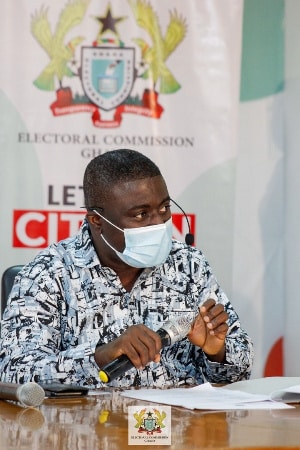
The Asunafo North Municipal Director of the EC, Mr. Gideon Yeboah, explained that the training aimed to educate first-time voters in particular on how to effectively use the Tactile Jacket, ensuring they can vote properly on Election Day.
The EC’s Municipal Directorate organized the session, which also provided important information on the voting process to help the participants navigate the election system.
Speaking to the Ghana News Agency (GNA) in Goaso, the regional capital, Mr. Yeboah urged caregivers to assist the visually impaired voters and accompany them to the polling stations on Election Day to ensure they vote promptly.
By using the Tactile Jacket, visually impaired voters will be able to identify and select their preferred candidates with ease.
“We are assuring them of the availability of the tactile ballot to enable them to cast their votes for their chosen candidates,” Mr. Yeboah stated.
Ahafo Regional Secretary of the Ghana Blind Union (GBU), Mr. Kwaku Atibilla, thanked the EC for the training initiative and urged the Commission to make sure the Tactile Jackets are accessible at all polling stations in the region, ensuring no voter is excluded.
From January to September 2024, the Ghana National Fire Service (GNFS) recorded a 3.17% increase in fire outbreaks across the country, compared to the same period in 2023.
This year, 4,650 fire cases were reported, up from 4,507 in 2023. Domestic fires were the primary cause, often triggered by electrical issues, improper handling of Liquefied Petroleum Gas (LPG), careless burning of trash and bushes, and the wrong use of open flames like mosquito coils, candles, and lighters.
In an interview with Joy News on November 18, 2024, Assistant Division Officer Alex King Nartey from the GNFS Public Affairs Department stressed that while fire cases have risen, it should not be viewed as alarming but rather as an indication of increased public awareness and reporting.
“Relatively, they (fire outbreaks) have gone up, but it is not to create a gloomy picture. It is rather to talk about how our education has gone down. People initially didn’t know our emergency numbers so a lot of these fires went unreported.
He also pointed out that the spike in fire cases, particularly in the Greater Accra Region, can be attributed to rapid urbanisation.
“So, people are getting our numbers and calling, that is why. The figure doesn’t pose an alarming threat. Now, if you see a layperson out there, out of 5 persons, I am sure 3 will be able to give our emergency numbers. So, the figures will automatically go up,” he noted.
Nartey called for greater public involvement in supporting the GNFS to tackle the rising fire incidents in the country.
A total of 9,394 Ghanaians are currently enrolled in U.S. universities for the 2023-2024 academic year, marking a new record.
This statistic was revealed in the 2024 Open Doors Report, which was published by the U.S. Embassy in Accra. According to the embassy, Ghana ranks 18th among the top 25 countries contributing international students to the United States in 2024.
The report highlights a significant 45.2% increase from the previous year, setting a new all-time high for the number of Ghanaians studying in the U.S. The total number of students has risen sharply, reflecting growing interest in education abroad.
In particular, Ghana holds the 9th spot for sending graduate students to the U.S., with 6,337 individuals pursuing graduate degrees this year, which marks a 54% rise from the previous academic year.
Additionally, Ghanaian students secured nearly $9.2 million in scholarships, funding their studies across more than 680 institutions nationwide.
“Ghanaian students earned nearly $9.2 million in scholarships to more than 680 higher educational institutions in all 50 U.S. states,” the embassy wrote.
The report further reveals a general rise in the number of graduate students, with a 13% increase from 50,199 in 2022-2023 to 56,199 in 2023-2024.
An independent presidential candidate, Alan Kyerematen, has revealed his instrumental role in crafting the policies of former President John Agyekum Kufuor’s administration, asserting that he was responsible for 70 percent of the initiatives implemented during that era.
Speaking in an interview with Oyerepa TV on November 18, 2024, Kyerematen questioned the basis of Kufuor’s endorsement of Dr. Mahamudu Bawumia as the ideal candidate to lead Ghana.
He challenged Kufuor to provide concrete evidence of Bawumia’s achievements that merit such a declaration.
“How long has the former President known Dr. Bawumia? Where did he bring Bawumia from? What work has Bawumia done that he is saying that he is the best person to lead this country?
“I am challenging former President Kufuor to tell us what work Bawumia has done. He was the one that brought him into politics, so he should tell us that. What work was Bawumia doing previously? He should tell us that. He is judging the presidential candidates, according to Kufuor, he first met Bawumia when he delivered a presentation somewhere. Fast forward, he joined politics,” he stated.
He further criticized the former president’s endorsement, pointing out that Kufuor had introduced Bawumia into politics but has yet to highlight any substantial accomplishments by him.
“Before I became a Minister, he (Kufuor) knew my worth. Now he wants to publicly declare that he doesn’t know Alan’s worth and the work I did?
“Kufuor used to say that during his tenure, 70 percent of his policies or even more were from me; he has said this openly. So, I am sad people are attacking him for endorsing Bawumia,” he stated.
Reflecting on his own contributions, Kyerematen expressed disappointment over the lack of recognition.
Mr Kyerematen’s comments come in response to Kufuor’s recent appeal to Ghanaians to vote for Bawumia, the flagbearer of the New Patriotic Party (NPP), in the upcoming elections.
Kufuor had described Bawumia as a key figure in the global digital economy whose expertise could drive Ghana’s development and economic transformation.
Challenging this endorsement, Mr Kyerematen called for leadership choices to be grounded in proven achievements and real impact, urging Ghanaians to demand accountability from those seeking their votes.
A tragic fire in Atonsu Bokuro, within the Asokwa Municipality of the Ashanti Region, has resulted in the death of a teenager and significant property damage.
The fire, which began around 8:30 a.m. on Monday, November 18, destroyed nine rooms and ruined several belongings.
The victim, 17-year-old Jerry, was reportedly asleep when the fire broke out.
Despite efforts from the Ghana National Fire Service to control the flames, Asokwa Municipal Fire Commander Bernard Nyemi-Tei highlighted that the team faced considerable difficulties in accessing the building during the rescue operation.
The body of the deceased has been taken to the morgue by the Ghana Police Service.
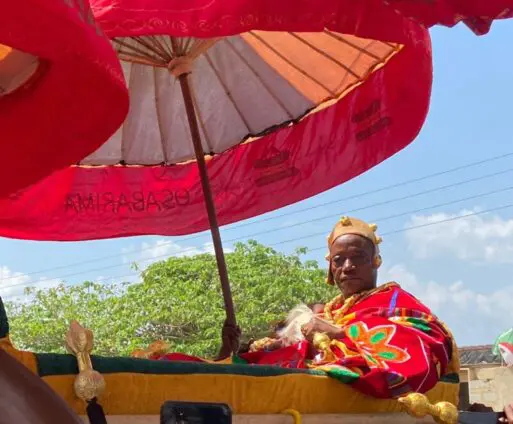
The Chief of Akyem Muoso, Osabarima Dr. Owusu Beyeeman, has urged Ghanaians to place greater value on human life and work to protect the lives of others.
He expressed dismay at the ongoing bloodshed linked to chieftaincy and political power struggles, calling for an immediate end to such violence.
The chief highlighted that both the United Nations Universal Declaration of Human Rights and Ghana’s own laws guarantee the fundamental right to life.
He emphasized that all individuals are born free and equal in dignity, and it is critical to respect and protect these rights.
Speaking during a Durbar of chiefs and people of Akyem Muoso to celebrate his first anniversary as Chief, Osabarima Beyeeman shared his thoughts on the violent chieftaincy dispute that had plagued the area before his installation.
Reflecting on the destruction caused by the conflict, he added, “Akyem Muoso nearly collapsed due to a chieftaincy dispute, the spilling of blood and all the chaos was needless. Who are you going to rule over when you’re done killing your own people? The Chieftaincy dispute here and everywhere in the country doesn’t help, if we don’t avoid conflicts, our States will collapse one day,” Osabarima Beyeeman said.
He called for an end to these disruptive conflicts, warning that such divisions could eventually lead to the collapse of the nation if left unresolved.
Describing his own rise to the chieftaincy, Osabarima Beyeeman admitted that becoming a chief was never part of his personal plans.
However, he accepted the nomination by the kingmakers to help heal the community, which had been torn apart by disputes.
“I had a plan for my life, becoming a chief was never a part of my plans. But sometimes, God uses us for his own purpose. The voice of the people is the voice of God so I had to accept my nomination by the Kingmakers and gear up to do the will of God,” Osabarima explained.
Grateful for the support of the Muoso people, Osabarima Beyeeman credited their collective efforts for the peace and unity that has taken root in the town since his appointment.
He emphasized the importance of peace for national progress, noting that in the one year since becoming chief, the town has made significant strides forward.
The chief proudly highlighted key achievements under his leadership, including the construction of a state-of-the-art police station in Muoso, which aims to improve security and curb crime.
He also mentioned several educational improvements, such as the rehabilitation of school buildings, rewiring classrooms, and boosting the town’s BECE pass rate from 32% to over 70%.
Osabarima Beyeeman has also provided support to needy students, offering uniforms, books, and supplies to ensure they can succeed in school.
He has promised to assist students who gain admission to Senior High Schools with necessary items for their boarding experience.
Professor Kwame Gyan, a senior lawyer and law lecturer at the University of Ghana, commended Osabarima Dr. Owusu Beyeeman for his leadership and dedication to peace and development in Akyem Muoso.
He described the chief’s accomplishments as impressive and deserving of continued support.
The founder of the New Force Movement, Nana Kwame Bediako(Cheddar), has emphasized that his organization is not a political party but a movement aimed at transforming the future of Ghana.
During his ongoing presidential campaign, Bediako has ramped up his efforts, touring all the regions of the country to share his vision.
His most recent visit was to Swedru in the Central Region as part of his “276 Tour,”
“276 Tour” of the Central Region over the weekend, Mr Bediako, popularly known as Cheddar, visited Swedru, where he told his supporters, “I do not represent any political party; neither is New Force a political party. It is a powerful movement aimed at dismantling the political system that has caused hardship, economic decline, and sleepless nights for Ghanaians.”
Bediako made it clear that he wanted Ghanaians to remember him not for his “T-shirts” but for the messages he carries.
He urged citizens to vote for him in the upcoming December elections, highlighting the need for change.
Reflecting on Ghana’s developmental struggles, Bediako criticized the leadership of successive governments, stating that only Dr. Kwame Nkrumah had truly advanced the country.
He warned that without making informed choices in the upcoming elections, Ghanaians, especially the youth, would continue to face hardship with no hope for the future.
Bediako also criticized the current administration, accusing it of prioritizing foreign interests over those of the Ghanaian people, particularly when it comes to the nation’s natural resources, such as gold and cocoa.
He made similar statements during a visit to Winneba, where he discussed his vision for industrializing Ghana and creating jobs for the unemployed.
He expressed concern over the future of Ghanaian youth after education, urging the public to unite for “a new Ghana, a new revolution, and a new independence.”
Bediako called on the youth to reject the current leadership, which he believes has failed them, leaving them with no jobs and no future.
He urged Ghanaians, especially the youth, to be wary of the current leadership and not fall for their deception, “who have failed the people, leaving them with no jobs, no future, and no hope despite years spent in institutions and organisations”.
Bediako urged Ghanaians to reject empty promises from political parties and take bold steps to secure a better future. If elected president, he pledged to focus on industrializing the country, creating jobs, and improving the standard of living for all Ghanaians.
Researchers from Ghana, Nigeria, and the United States have made a significant discovery regarding kidney disease in West African populations, which was published in the New England Journal of Medicine.
The study highlights a key genetic factor contributing to the condition.
The research, conducted by the Human Health and Heredity in Africa (H3Africa) Kidney Disease Research Network, analyzed data from 8,355 participants in Ghana and Nigeria, with Ghanaians representing 36.7% of the group.
This study is one of the largest of its kind focused on kidney disease in African populations.
The findings pointed to variants in the Apolipoprotein L1 (APOL1) gene, which was initially protective against sleeping sickness (Trypanosomiasis) but now increases the risk of chronic kidney disease.
Lead researcher Dr. Dwomoa Adu from the University of Ghana Medical School shared that nearly a third of the Ghanaians studied (29.7%) had two copies of the gene, while 43.7% had one.
“Almost a third of Ghanaians studied had two copies of the gene (29.7 percent) and 43.7 percent had one copy of the gene.
Compared with patients with no gene, one copy of the gene increased the risk of kidney failure by 18 percent almost by a fifth, and two copies of the APOL1 gene increased the risk of kidney disease by a quarter (25 percent),” he added.
He noted that having one copy of the gene increased the risk of kidney failure by 18%, and two copies raised it by 25%.
The research team, which included Professors Ojo and Salako, along with Ghanaian experts Dr. Charlotte Osafo and Professor Vincent Boima from the University of Ghana Medical School, Professor Sampson Antwi and the late Professor Jacob Plange-Rhule from Kwame Nkrumah University of Science and Technology (KNUST), and Professors Alexander Nyarko and Anita Ghansah from the Noguchi Memorial Institute for Medical Research, played a crucial role in the study.
Dr. Adu explained that the gene’s impact is comparable to the sickle cell gene, which protected against malaria but can cause other health issues.
“In this way the gene is like the sickle cell gene that protected people against malaria but can cause crises.”
This research emphasizes an evolutionary trade-off between survival advantages in the past and present health risks. The findings could have far-reaching effects beyond West Africa, particularly for populations of African descent worldwide, offering new insights into kidney disease treatment and management.
The study was funded by the National Human Genome Research Institute, the National Institute of Diabetes and Digestive and Kidney Diseases, and the National Institutes of Health in the United States. About the H3Africa Kidney Disease Research Network
H3Africa, a joint initiative co-funded by the NIH and the Wellcome Trust since 2010, aims to advance genetic research across Africa. The initiative enables African scientists to investigate the genetic and environmental factors influencing diseases such as malaria, tuberculosis, and kidney disease, among others.
Deputy Chairperson of the Electoral Commission (EC) in charge of Corporate Services, Dr. Bossman Asare, has announced that Joana Gyan Cudjoe will feature on the ballot for the December 2024 parliamentary elections.
This development follows the Sekondi High Court’s decision on November 11, 2024, to lift an earlier injunction that had prevented her candidacy.
Speaking on GHOne TV on Monday, November 18, 2024, Dr. Asare explained that the EC initially disqualified Gyan from contesting the Amenfi Central seat due to the High Court’s injunction.
However, with the latest court ruling clearing her path, the commission will proceed with the necessary adjustments to reinstate her candidacy.
“The EC’s position has always been that she was disqualified because of the injunction so once the injunction has been removed, the commission will take the necessary action. The road has been paved for her to be on the ballot,” he said.
Dr. Bossman Asare emphasized that the Electoral Commission acted within the law by disqualifying Joana Gyan from contesting the Amenfi Central parliamentary elections.
He further clarified that the EC was a party to the High Court injunction and would have faced contempt charges if it had failed to comply with the court’s ruling.
“There was an injunction and it was the duty of the political party and the candidate to ensure the injunction was removed. Our position at the EC was that we cannot recognise a candidate who has been injuncted. Those who filed the injunction added the EC were part of the process and so if we had accepted the candidate for the parliamentary election at that particular time, it would mean the EC would be going against the laws of the country.
“We would have been in contempt of court if we had gone against the ruling of the High Court barring Gyan from presenting herself as the parliamentary candidate. I believe we did the right thing,” he said.
Background
The Sekondi High Court, on November 11, 2024, overturned an injunction that had previously barred Joana Gyan Cudjoe from contesting as a parliamentary candidate.
The issue began when a group of dissatisfied individuals filed a lawsuit, resulting in an interlocutory injunction that temporarily prohibited Joana Gyan from standing as a candidate, despite her decisive win in the May 13, 2023, parliamentary primaries.
In response, the National Democratic Congress (NDC) nullified the May 2023 election results and held fresh primaries on September 8, 2024, where Joana Gyan once again emerged victorious under the supervision of the Electoral Commission (EC).
The NDC maintained that the September primaries superseded the annulled May election, solidifying Joana Gyan Cudjoe’s legitimacy as the candidate. However, the EC disqualified her, citing the injunction tied to the voided May 2023 election as the reason for their action.
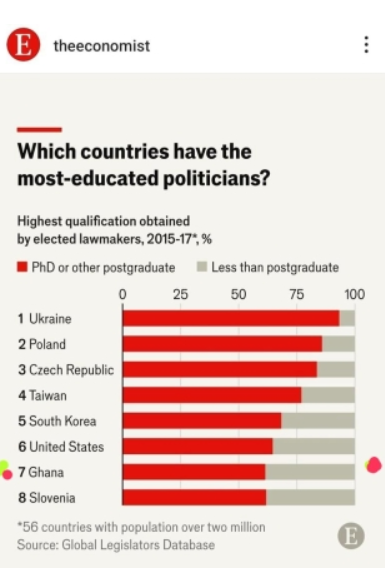
Ghana is ranked seventh in a global list of countries with the most educated politicians, according to a report analyzing the educational backgrounds of lawmakers.
This ranking is based on two studies conducted by researchers from global universities, using data from 2015, 2017, and 2023.
The analysis, drawn from a Global Legislators Database, focused on 56 countries with populations exceeding two million.
It examined the highest qualifications of elected lawmakers between 2015 and 2017, categorizing their education levels from PhDs and other postgraduate degrees to those with less education than a postgraduate.
Ukraine tops the list, followed by Poland in second place and the Czech Republic in third. Taiwan is ranked fourth, with South Korea fifth, and the United States sixth. Ghana holds the seventh position, with Slovenia ranked eighth.
The findings, published by The Economist, provide insights into the educational qualifications of national parliamentarians. Political scientists have long tracked the age and gender demographics of elected officials but have found it more challenging to compare other characteristics like education.
However, recent datasets have made it easier to analyze the educational backgrounds of politicians across various countries.
The first study, involving researchers from six universities, collected data on nearly 20,000 parliamentarians from 97 countries between 2015 and 2017. The study revealed that 78% of parliamentarians held at least a bachelor’s degree, with 40% possessing postgraduate degrees.
These figures far exceed the average education levels among the general population, with wealthier nations averaging 35% education, and poorer countries at 15%.
Ukraine has the highest proportion of legislators with postgraduate degrees, including a significant number holding doctorates.
This trend is supported by Ukraine’s presidential history, where all presidents except Volodymyr Zelenskyy have claimed doctoral degrees. South Korea also stands out, with nearly a third of its legislators holding doctorates, and the United States follows closely with over two-thirds of its lawmakers holding postgraduate degrees.
In contrast, some countries like Italy, Norway, and the UK have a larger share of parliamentarians with only secondary education.
For instance, Sir Lindsay Hoyle became Speaker of the UK House of Commons without a university degree, while Italian politicians like Luigi Di Maio and Matteo Salvini did not complete their university education.
The second study, published in 2023, focused on 6,000 legislators from nearly 30 countries and highlighted regional trends.
In North and Latin America, most legislators hold law degrees, while Nordic countries tend to elect those with backgrounds in social sciences like economics. The UK stands out for electing many lawmakers with degrees in arts and humanities.
However, studies on whether highly educated politicians perform better than their peers have shown mixed results. A 2015 study on the U.S. Congress found no significant differences in the performance of degree holders versus those without.
Similarly, a study in Spain found no notable improvement in mayors’ performance in areas like unemployment reduction or city development, despite having degrees.
Moreover, research has shown that the most educated politicians do not necessarily have a better track record in elections, often losing at the same rate as less formally educated candidates.
Still, obtaining a degree has become a significant barrier to entry for aspiring politicians, as it has become increasingly difficult for individuals without degrees to secure a place on the ballot.
While national legislatures have become younger and slightly more gender-balanced, they are also becoming more elite, raising concerns that the growing educational divide could disconnect elected officials from the populations they represent.
This shift might have consequences, as those with higher education often have different priorities than the general electorate, potentially affecting voter engagement and representation.
The National Democratic Congress (NDC) has issued an apology to former President John Agyekum Kufuor after one of its communicators, Dela Edem, made comments the party has deemed disrespectful to the respected statesman.
In a statement released on Sunday, November 17, 2024, the NDC’s National Communications Officer, Sammy Gyamfi, condemned Edem’s remarks as “unsavoury and distasteful,” and expressed regret over the incident.
The party acknowledged that Edem had apologized to the former president, and it voiced its support for his apology.
“The attention of the National Communications Bureau of the National Democratic Congress (NDC) has been drawn to some unfortunate comments attributed to one of its members, Comrade Dela Edem, and directed at the person of former President and elderly statesman, H.E. John Agyekum Kufuor.
The NDC reaffirmed its respect for the elderly and hoped the apology would put the matter to rest. The party also called on its communicators to focus on issues as they continue to campaign.
“The said comments are unsavoury and distasteful. It is therefore refreshing to note that our comrade in question has duly retracted his statements and rendered an unqualified apology to the elderly statesman,” parts of the statement shared on social media read.
It added, “The NDC adds its voice to the apology that has been rendered and hopes that this retraction and apology bring closure to the matter.”
The party reaffirmed its commitment to respecting the elderly in society.
Additionally, it called on its communicators to prioritize issue-focused campaigns when sharing the party’s vision with Ghanaians.
“The NDC as a party accords utmost respect to the elderly in our society and honour to our statesmen.
“The party strongly advises all communicators to remain focused on propagating the transformational policies of the visionary nation-builder, H.E. John Dramani Mahama, and the NDC for a resounding victory on December 7, 2024,” it added.
Dela Edem’s remarks:
While speaking on Accra-based TV XYZ, Dela Edem made some inappropriate comments about former President John Agyekum Kufuor following an interview in which Kufuor encouraged Ghanaians to vote for Dr. Mahamudu Bawumia.
“Let me say something to President Kufuor. He should be careful; I expect him to stay in his lane. He should enjoy his retirement with the riches he had from being president. He is in a wheelchair as payment for his sins as president,” he said.
Despite being urged by the host, Mugabe Maase, to retract his statements, Dela Edem stood by his words and expressed no regrets, claiming he firmly believed in what he had said.
His remarks were met with widespread public condemnation, as many felt he had unjustly attacked a man who had not provoked him.
His Apology:
In a social media post, Dela Edem later apologized for the offensive and disrespectful comments directed at the former president.
Acknowledging the error in his earlier statements, which he had refused to retract on television, he admitted his mistake after facing significant public backlash.
“I sincerely render an unqualified apology to President Kufuor for the comments I made in reference to his ‘wheelchair’. Thank you!”
The Judicial Service of Ghana has dismissed claims that Chief Justice Gertrude Torkornoo and the Supreme Court are intentionally postponing the cases filed against Speaker of Parliament, Alban Bagbin, concerning the Human Sexual Rights and Family Values Act, also known as the anti-gay bill.
In response to a petition urging the Supreme Court to speed up the hearings, the Judicial Service clarified that the delay is due to the parties involved not filing the required documents.
According to the Supreme Court Rules of 1996 (CJ 16), the parties must submit their statements of case within the set deadlines before the court can proceed with the hearing.
“For the Supreme Court to hear any case, the parties are required to file their respective pleadings in the form of a statement of case within the timelines provided for by the Supreme Court Rules, 1996 (CJ 16).
“As the two communications issued earlier stated, Parliament and the parties have not complied with the requirements that allow a trial of the case raised by the Plaintiffs,” the statement from the Judicial Service is quoted to have indicated.
The Judicial Service further explained that both Parliament and the involved parties have not fulfilled the necessary steps to allow the case to move forward. It has urged all concerned parties to submit their pleadings so that the Supreme Court can begin considering the case.
On February 28, 2024, Ghana’s Parliament passed the Promotion of Human Sexual Rights and Family Values Bill, widely known as the Anti-LGBTQ+ Bill.
The bill, which is awaiting approval from President Nana Addo Dankwa Akufo-Addo, criminalizes same-sex relationships and the advocacy or funding of LGBTQ+ causes.
Offenders could face imprisonment for periods ranging from six months to three years, while those who promote or finance such activities could face sentences of up to five years.
For the bill to become law, it requires presidential assent, which must occur within seven days. If the President does not sign it, Parliament can still pass it into law with a two-thirds majority vote.
However, the President’s office has instructed Parliament not to send the bill for assent until the ongoing legal cases in the Supreme Court have been settled.
The Inspector-General of Police, Dr. George Akuffo Dampare, has reiterated that the Ghana Police Service will uphold neutrality and professionalism in the upcoming December 7, 2024 elections.
He stressed that the police force is unbiased and will enforce the law without partiality.
In his remarks at the opening of a new, state-of-the-art police station in Akyem Muoso, Eastern Region, the IGP issued a clear warning to potential troublemakers, assuring that the police will not allow anyone or any group to jeopardize the country’s peace at any stage of the election process.
“The Ghana Police Service is for the country and its people. We do not belong to any side in the elections; we are here to serve the people and to protect you. So we will remain neutral and professional during the elections and beyond,” the IGP said.
However, he cautioned Ghanaians not to let themselves be manipulated into actions that could destabilize the country’s security.
“We all, as Ghanaians, have a role to play in ensuring the security of our country. Just as the police will play its role and responsibility in protecting the people and ensuring that everyone is safe, we call on everyone not to allow themselves to be used for violence or to create tension in your community.”
Accompanied by members of the Police Management Board, the IGP also inaugurated two additional police stations at Moseaso and Abekoase in the Eastern Region, bringing the total number of new stations launched to three.
During the commissioning events, both the chiefs and residents of the communities expressed their gratitude to the police administration for its ongoing commitment to improving the image of the Police Service and strengthening the fight against crime across the nation.
The Deputy Chairman of the Electoral Commission (EC) in charge of Corporate Services, Dr. Bossman Asare, has warned voters not to vote for the then presidential candidate of the Ghana Freedom Party (GFP).
Akua Donkor passed away at the Greater Accra Regional Hospital (Ridge Hospital) while receiving treatment. The cause of her death has not been disclosed. She was 72 years old.
During a forum in Accra on November 15, 2024 the deputy chairman explained that the EC, in agreement with all political parties, decided to leave Akua Donkor’s name on the ballot due to time and financial constraints related to the elections.
This decision, however, does not change the fact that voting for Akua Donkor will result in an annulled vote.
The event, focused on the impacts of election monetization, was organized by the Ghana Anti-Corruption Coalition (GACC), in collaboration with the Ghana Integrity Initiative (GII), the Ghana Centre for Democratic Development (CDD-Ghana), and with support from USAID through the International Foundation for Electoral Systems (IFES).
“Monitoring Campaign, Abuse of Incumbency, and Vote Buying for Comprehensive Party and Campaign Financing Reform in Ghana,” in Accra on November 15, 2024, he added that voting for Akua Donkor will be counted as annulled.
“We discussed with the parties that the time is very short, and we have printed over 90% of the ballot papers. Considering the time, it is very short.
“You know we have our senior lawyers… and when you look at our constitution, I don’t think the presidential elections can be postponed. Our presidential elections, the way it is structured, the last day I think you can have the presidential and parliamentary elections is on December 7.
“So now, all of us, our role is to tell people that, although Madam Akua Donkor’s face is on the ballot paper, don’t vote for Madam Akua Donkor because when you vote, your ballot will not be counted; it will be annulled,” he said.
“So please, I know you love Madam Akua Donkor, but this is not the time to show the love. The time to show love is… there are twelve people vying for the presidency; identify one of them. So, the Commission will continue to do sensitisation that although she is there, she is not part of it… let me answer: what if Madam Akua Donkor wins… We don’t think she will win.”
Executive Secretary of the Ghana Anti-Corruption Coalition (GACC), Beauty Emefa Nartey, raised concerns about the use of inducements to sway voters.
She emphasized that politicians, having taken citizens for granted, frequently resort to bribing voters to influence their choices during elections.
“We can make Ghana better. In other countries that are doing better, it is the citizens who are making it possible. And I like what Dr. Bossman said, that we have to demand our democracy, and because we have failed to demand accountability, politicians have taken us for granted, and they will come to us with 5 cedis and 10 cedis.
“And the one that baffles me is Maggi and ‘Bentoa’, like how? Even if you want to sell yourself so low, must it be Maggi and Bentoa? I am not encouraging vote buying, so whatever money is being placed, it is not democracy.”
The founder and former CEO of the now-defunct UT Bank, Prince Kofi Amoabeng, has criticized the general behavior of Ghanaians, pointing out certain negative traits within the population.
Speaking during an interview on the Compass Show, Amoabeng remarked, “Generally, Ghanaians are not good people, let’s accept it. Sometimes we are evil, we hate people for no reason, we are jealous of people, we are not honest when dealing with people, wherever. We like corruption, we have been corrupted, and we get into all sorts of things”.
He then drew a parallel between his observation and a biblical narrative, suggesting that people with such negative qualities often receive bad leaders as a form of divine punishment.
“When a people are that bad, God will not build them up. The only way for God to punish them is to give them a bad leader who will make sure that things don’t happen for them. Because you see, the Israelites were in bondage for over 435 years, I hear if you read the Bible. So God looked at them, so-called God’s people, 435 years yet, and he sat somewhere and said, ‘You guys, learn some lessons,’ before he bailed them out and took them to the Promised Land. That is in the Bible.
Amoabeng further emphasized that when people fail to live in alignment with moral and divine expectations, they must face difficult lessons. In his view, a poor leader is often the means by which these lessons are delivered.
“But I believe when the people are not doing what is right and what is pleasing to their creator, the creator will not just dote on them. He needs them to learn bitter lessons, and the way to learn bitter lessons is to give them a leader who will make sure things are bitter for them,” he stated.
UT Bank, which Kofi Amoateng founded, had its banking license revoked by the Bank of Ghana in August 2017, as part of a broader regulatory cleanup of the financial sector, which saw several banks closed due to insolvency.
🚨ICYMI🇬🇭🗣️: “Generally, Ghanaians are not good people; when people are that bad God will not bail them out. The only way for God to punish them is to give them a bad leader…” – Kofi Amoabeng, Former UT Bank CEO – 📹: The Compass Show
Former President John Agyekum Kufuor has voiced unwavering support for the New Patriotic Party (NPP) presidential candidate, Dr. Mahamudu Bawumia, expressing confidence in his ability to revitalize Ghana’s economy if elected in the upcoming December elections.
Speaking with journalists on Sunday, November 17, Kufuor highlighted Bawumia’s exceptional skills in economic management, referencing his significant contribution during Kufuor’s tenure.
He pointed to Bawumia’s role in working closely with the Bank of Ghana, under Governor Dr. Paul Acquah, to stabilize the Ghanaian currency during a period of economic difficulty.
“Given the current global circumstances, I firmly believe that Ghana’s economy will experience significant improvement if Bawumia is elected as President. With divine guidance, he is capable of delivering on this promise, and I encourage you to support his candidacy.
“I have observed his remarkable abilities in economic enhancement during my tenure, as he was integral to the Bank of Ghana’s team under Governor Dr. Paul Acquah, contributing to the revival of the currency.”
With global economic challenges mounting, Kufuor emphasized that Bawumia’s leadership would provide the right solutions for Ghana’s economic growth.
Urging Ghanaians to support Bawumia’s candidacy, Kufuor stressed the importance of a decisive vote to ensure the country’s economic future remains in capable hands. His endorsement of Bawumia reinforces the confidence that the former president has in his potential to lead the country toward a prosperous and stable future.
Former President of Ghana, John Agyekum Kufuor, has shared his resolve to complete his constitutionally mandated term in office to prevent the country from experiencing another military takeover.
Speaking in a recent interview with morning show hosts at his residence, Kufuor explained how his personal experience with military rule shaped his determination to ensure a peaceful and democratic transition of power.
Kufuor, who served as president from 2001 to 2009, expressed that his tenure was marked by a strong commitment to national development across various sectors.
However, he made it clear that one of his main priorities was ensuring Ghana’s political stability and avoiding a return to military governance.
“I had experienced military rule and did not like the consequences of military rule. So, while I was president, I worked hard to ensure that my tenure was over, and I handed over smoothly to the next president of the country. I did everything within my reach to ensure that the country does not return to military rule,” he said.
The former president emphasized that, during his time in office, he worked tirelessly to ensure that his constitutional mandate was fulfilled and that the democratic processes of the country were respected.
Kufuor’s dedication to a peaceful handover process was rooted in his deep understanding of the fragility of democracy and the need to protect it at all costs. His efforts were instrumental in the successful transition of power following the 2008 elections, setting an example for future leaders in Ghana and across Africa.
In his closing remarks, Kufuor reaffirmed his belief that the stability of Ghana’s democratic system required active participation and vigilance from all political leaders.
Through his reflections, Kufuor’s words serve as a reminder of the importance of safeguarding democracy and the peace that Ghana has worked hard to achieve over the years.
His leadership during a critical time in the country’s history remains a testament to the strength and resilience of Ghana’s democratic system.
Former President of Ghana, John Agyekum Kufuor, has opened up about the role of voter apathy and internal divisions within the New Patriotic Party (NPP) in the party’s loss during the 2008 general elections.
Reflecting on the election results, Kufuor expressed his disappointment that the NPP failed to secure a victory, blaming the party’s internal fractures for its defeat.
Speaking to morning show hosts at his residence, Kufuor highlighted how some party chairmen worked against certain Members of Parliament, leading them to contest as independents.
“Some chairmen connived to remove some Members of Parliament, and these persons contested as independents, and that affected us greatly. We lost, I think, eighteen seats, and that did not help us as a political party.
“If we want to win the election and continue the great policies to ensure continuity, we must vote massively for a first-round win. It was worrying that we lost in 2008. We won the first round but lost the second round. At that time, most people who did not vote realized they had to vote; it was too late.
The former president stressed that the key to winning future elections and ensuring the continuity of successful policies is a strong voter turnout.
He recalled the tense 2008 election, in which the NPP won the first round but lost in the second round.
“The NDC came with a different vision, and so some of the things we started were left to rot because they did not believe in our policies. We planned to dualize the Accra and Kumasi roads, but it did not see the light of day.
“We took an interest-free loan from the Chinese to dualize the road and construct the Nsawam bypass; we constructed the Suhum road to Apedwa, but the ones that were left when we left power, the NDC did not touch them and did nothing about them,” he said.
The former president concluded with a stark warning about the dangers of voter apathy.
“So during elections, if you say you won’t vote, the others will vote, so please avoid voter apathy and vote massively so that your party can win. If you don’t vote, you will be left in slavery,” he said.
Kufuor also reflected on the NDC’s approach after their victory in 2008, which he claimed led to the abandonment of several policies and projects initiated by the NPP.
Kufuor’s comments come at a crucial time as the country prepares for another round of elections, with political leaders and citizens alike being urged to turn out in full force to secure the nation’s progress.
On Thursday, November 21, 2024, the government will inaugurate over 80 educational projects across all 16 regions of the country.
This initiative is designed to improve access to quality education by offering modern facilities tailored to the varied needs of Ghanaian students.
A statement from the Ministry of Education indicates that President Akufo-Addo will spearhead the nationwide event, with simultaneous ceremonies taking place at district and regional levels.
Vice President Dr. Mahamudu Bawumia and Education Minister Dr. Yaw Osei Adutwum will join the President to officiate the events, which will be broadcast live on major TV stations and social media platforms for nationwide participation.
The projects encompass a broad range of educational levels, from basic schools to senior high schools and technical institutions. These include STEM-oriented schools, E-blocks, and kindergarten facilities to support early childhood education.
Key projects include the Kpasenkpe Model STEM SHS in the West Mamprusi District, the Accra STEM Academy in La-Nkwantanang-Madina, and the Awaso Model STEM SHS in Bibiani-Anhwiaso-Bekwai. Additionally, basic education facilities such as a 12-unit classroom block at Salem D/A Basic in Atwima Mponua and kindergarten blocks in communities like Fremasi DA Primary in Assin South are part of the initiative.
“These projects reflect the government’s commitment to improving the quality of education and ensuring that every Ghanaian child has access to a conducive learning environment”.
“We encourage all Ghanaians to join this celebration of progress in education,” the statement added.
Former President John Agyekum Kufuor has appealed to Ghanaians to support Dr. Mahamudu Bawumia in the December elections, expressing confidence in his leadership to drive the nation’s progress.
During a live broadcast with top journalists, Kufuor responded to a question from Kwame Adinkra of Pure FM about why he believes Bawumia is the right choice for Ghana’s presidency.
Speaking calmly but with conviction, Kufuor praised Bawumia’s achievements as an economist and his tenure as Vice President under Nana Akufo-Addo’s administration.
“Dr. Bawumia’s understanding of economics and his innovative policies have made him stand out. His leadership ideologies align with the aspirations of every Ghanaian. I firmly believe he has what it takes to elevate this country,” Kufuor stated.
The former president clarified that his endorsement was entirely his own decision, not influenced by Bawumia.
Kufuor also urged Ghanaians to participate actively in the elections, stressing the importance of high voter turnout to ensure every voice is heard.
“He hasn’t made me a spokesperson or lobbied me to speak for him. My advice is grounded in my own observations of the political landscape and my faith in his abilities,” Kufuor explained.
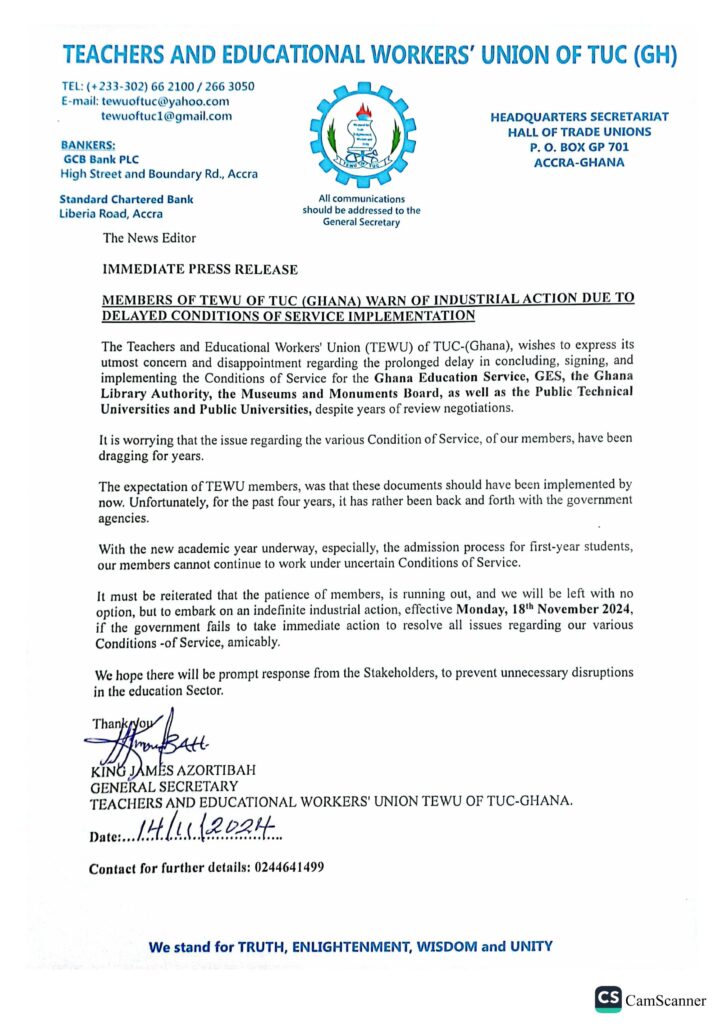
The Teachers and Educational Workers Union of the Trades Union Congress (TEWU-TUC) will commence a nationwide strike today, Monday, November 18, to protest the government’s inaction on addressing their long-standing concerns about conditions of service.
TEWU-TUC expressed frustration with the government’s prolonged delays in finalizing and implementing revised conditions of service for employees under the Ghana Education Service (GES), the Ghana Library Authority, the Museums and Monuments Board, and Public Technical and Traditional Universities.
Negotiations for these revisions, the union highlighted, have dragged on for several years without resolution, leaving members increasingly dissatisfied.
The union insists the situation has become untenable, with industrial action now deemed the only effective way to demand progress. TEWU-TUC argues that the unresolved issues are detrimental to the well-being of its members and the smooth functioning of these vital institutions.
To address the matter, the National Labour Commission (NLC) has called for a meeting on Wednesday, November 20, 2024. The session will involve TEWU-TUC and other stakeholders, aiming to mediate and work toward resolving the union’s concerns.
Meanwhile, the strike is expected to disrupt services in the affected sectors. TEWU-TUC has emphasized that their industrial action will continue until the government adequately addresses their grievances. They are urging swift action to finalize and implement the revised conditions of service.
The National Chairman of the New Patriotic Party (NPP), Stephen Ntim, has outlined plans for a future NPP government to establish a cashew processing facility in the Dormaa enclave of the Bono Region.
This initiative, he said, would foster industrialization and drive economic growth. Under the leadership of Dr. Mahamudu Bawumia, the next NPP government will focus on enhancing Ghana’s export capacity and reducing the nation’s dependency on imports.
Ntim stressed that the proposed cashew factory would contribute significantly to local economic development in the district, stimulate value addition in agriculture, and create jobs, promoting long-term growth for Dormaa and surrounding areas.
He made these remarks during a meeting with cashew farmers in the region, which has a strong tradition of cashew farming, with many households actively involved in agriculture. Currently, Ntim is leading a team of senior NPP officials to campaign for support in the Bono, Bono East, Ahafo, and Ashanti regions.
“The establishment of a cashew factory within the enclave will also promote overall economic development at the district level.
“It will further mark a significant step towards value addition in the agricultural sector, promoting economic growth, job creation, and sustainable development within the Dormaa enclave and beyond,” Stephen Ntim added.
The Member of Parliament for Adaklu, Kwame Agbodza, has highlighted significant infrastructure development in the education sector within his constituency during his three-year tenure.
He believes these improvements will play a key role in shaping the district’s future, especially considering its previous status as one of the country’s poorest and least developed areas.
In an interview with Myjoyonline.com, Mr Agbodza shared that 43 new classroom blocks have been built across various schools in the district, with a focus on replacing under-three classrooms and dilapidated structures.
“I completed the first classroom block before I became a Member of Parliament in 2012. I can now count about 41 individual school buildings since 2012. That is a lot of additions to what we came to meet”, he said.
He credited much of the success to Pencils of Promise, which sponsored many of the projects under an agreement where he contributed 30% of the construction costs.
Mr Agbodza also acknowledged the role of NGOs like Adanu in supporting these efforts.
While he praised the government’s contributions, he expressed concern over several government-funded projects, such as a three-unit classroom block at the Adaklu Seva District Assembly Basic School, which have been left unfinished.
He pointed out the lack of teacher accommodation and the reluctance of educators to accept postings in rural areas as major challenges for the district’s educational development.
To address this, Agbodza proposed building teacher housing to ensure educators live close to the schools.
Additionally, he established the Adaklu Teachers Pride Award to encourage teachers and staff, motivating them to continue their hard work and dedication.
The NDC’s presidential candidate, John Dramani Mahama, has supported his proposal to eliminate the National Food Buffer Stock Company’s involvement in supplying food to Senior High Schools (SHSs).
This is a key part of his broader plan to reassess the Free SHS policy.
Mahama’s remarks come in response to allegations raised by the Member of Parliament for North Tongu, Samuel Okudzeto Ablakwa, who accused the National Food Buffer Stock company of distributing 22,000 bags of expired and repackaged rice to SHSs across the country in February 2024.
Mr Ablakwa further claimed that the distribution was conducted in collaboration with a company called Lamens Investments Africa Limited.
Speaking during a campaign event in Asawinso, Western North region, Mahama explained that the decentralization of food distribution is key to improving the system.
He said, “I know you have heard that some expired and repackaged bags of rice have been distributed by the National Buffer Stock to various SHSs across the country for our kids to eat.
“That is why we say we won’t buy foodstuff for the schools. The money for the food will be given to the schools directly to make such purchases”.
Private legal practitioner Martin Kpebu has strongly criticized President Akufo-Addo’s administration, describing it as marked by severe shortcomings in governance.
Appearing on Joy FM’s Super Morning Show on Friday, Kpebu linked the country’s ongoing challenges to a combination of constitutional flaws and leadership failures.
He argued that the president’s governance has deepened Ghana’s development struggles.
“We didn’t write the law well; let’s accept that, and we can redraft. After all, we all agree that this constitution is our biggest headache. It is the cause of our underdevelopment because it has weakened all our institutions, most especially when we get very bad leaders like Akufo-Addo,” he said on Friday, November 15.
While recognizing that past governments have had their issues, Kpebu stressed that Akufo-Addo’s leadership is unprecedented in its failures. “No previous administration has reached the low point that Akufo-Addo has set,” he remarked.
Mr Kpebu’s criticism comes amid widespread dissatisfaction over the state of the country’s economy.
The Ghanaian cedi continues to lose value against major currencies, severely impacting citizens’ purchasing power.
Inflation remains high, and many are struggling with the rising cost of living. Youth unemployment, which hit 13.9% in 2022 according to the World Bank, further exacerbates the economic strain.
The issue of illegal mining, or galamsey, remains another pressing concern. Despite government promises to tackle the problem, the devastation of the environment continues, and corruption within the sector has deepened public mistrust in state institutions.
In light of these issues, Kpebu emphasized the urgent need for constitutional reforms.
“I know the previous governments have not been good, but Akufo-Addo’s governance is the worst of them all.
“Akufo-Addo’s level of poor governance is at a dizzying height, and we have never seen any of its kind,” he stressed.
“We all agree that we need to work on this constitution; it has too many problems,” he stated.
The National Democratic Congress (NDC) flagbearer, John Dramani Mahama, has pledged to establish public universities in country’s newly created regions if his party wins the 2024 elections.
Addressing chiefs and supporters in Nkatieso, Juaboso Constituency in the Western North Region, Mahama stressed the need for equitable access to higher education nationwide.
He asserted that every region should have at least one public university to bridge educational gaps across the country.
“When you look at our manifesto, every region must have a public university. So, during our tenure, the then Brong Ahafo Region didn’t have a public university, the same was the case in the Volta Region. We put up the University of Development Studies (UDS).
“We also put up the University of Allied Sciences in the Volta Region. The University of Environment in the Eastern Region too was put up by the NDC.
“We have divided the regions, and we want to put up universities in all six new regions or campuses of universities.
He further noted that under his administration, the NDC laid the groundwork for university development in underserved regions and intends to extend this to all six newly created regions.
Dr. Mahamudu Bawumia’s campaign team has made it clear that they will not be influenced by prophecies regarding the outcome of the December 7 general elections.
This comes after several pastors, during a recent meeting with National Democratic Congress (NDC) flagbearer John Dramani Mahama, claimed he would win the 2024 elections.
In an interview with Citi News, Anthony Karbo, a senior aide to Dr. Bawumia, dismissed these claims, stating that they regard such statements as mere predictions rather than divine revelations.
Karbo further emphasized that the campaign is focused on its strategic plans and voter engagement, rather than being swayed by external commentary.
He also referred to the 2020 U.S. elections, pointing out how several prophets predicted Kamala Harris’s victory but were proven wrong, questioning the reliability of such prophecies.
“I find those prophecies to be predictions. I don’t understand why prophecies are prevalent in Africa. I don’t understand it. Nobody talks about prophecies in other jurisdictions like China, America, Germany, and London. Those prophecies are only in Africa.
“We saw and heard prophets who said Kamala Harris was going to win, and what happened? What would have happened if we chose to believe in them? What would have happened because people said there was no way Donald Trump would ever be president?”
The Institute of Progressive Governance (IPG), a policy think tank, has called on former President John Dramani Mahama to stop misleading the public by suggesting that unemployment was lower during his tenure compared to Akufo-Addo’s.
Referring to data from the Ghana Statistical Service and the World Bank, IPG emphasized that the unemployment situation today is actually more favorable than it was during Mr. Mahama’s time in office.
IPG also pointed out that the International Labour Organization (ILO) defines unemployment as those aged 15 and over who have not worked in the reference week, are available to work, and are actively seeking employment. This definition, according to the think tank, is used internationally to enable meaningful comparisons of unemployment rates between countries.
The think tank continued, “Unemployment rate is mathematically defined as the total number of the unemployed divided by the labour force and multiplied by 100%. Using this estimation with the data from the World Bank, the unemployment rate increased from 4.9% in 2006 to 5.4% in 2010. While the unemployment rate declined considerably to 2.2% in 2013, it unfortunately went up to 6.8% in 2015, the highest in over a decade!
“Even though President Mahama left the unemployment rate at 5.2% in 2016, the 6.8% unemployment rate registered under him as a president in 2015 still remains the highest since 2005! The average unemployment rate under Mr. Mahama as the president (from 2013 to 2016) is 4.65%!
IPG further outlined that under President Akufo-Addo, the highest recorded unemployment rate was 3.4% in 2017.
This figure slightly decreased to 3.3% in 2018 and 2019. However, in 2020, it rose back to 3.3%, maintaining this level through 2021.
A notable decline to 3.1% occurred in 2022, which continued into 2023. As a result, the average unemployment rate for the period from 2017 to 2023 is 3.24%.
“It is therefore misleading for Mr. John Mahama to tell Ghanaians that unemployment rates recorded under Akufo-Addo are worse than those recorded under him as a president of Ghana. Mr. Mahama’s average unemployment rate of 4.65% is higher than Nana Akuffo Addo’s 3.24%!” IPG opined.
The think tank pointed out that in its latest surveys, the Ghana Statistical Service has applied a more expansive definition of unemployment to determine the country’s unemployment rates.
“This definition relaxes the ILO’s condition of job chasing. The estimation is reasonable because Ghana’s hugely informal economy does not encourage job seekers to write applications or move from one office to the other in search of jobs. In reality, while many Ghanaian job seekers are not seeking jobs, most of them are available and ready to work. While this measure provides a close reality to Ghana’s unemployment situation, it cannot be used to compare to the unemployment situations in other countries. It is purely for internal policy purposes, and IPG commends Ghana Statistical Service for providing such additional information on the unemployment situation in the country”, they stated.
“Indeed, by using the broad measure of the unemployment rate, Ghana’s unemployment rate increased from 13.3% during the first quarter of 2022 to 14.9% in the third quarter of 2023 (see Ghana Statistical Service Report, February 2024, page 6).
“This does not mean that the unemployment rate of 5.2% (a narrow measure in 2016) left by Mr. Mahama is what has increased to 14.9% in 2023! No! That is wrong and misleading! Using the ILO’s measure (narrow measure), Ghana’s unemployment rate has declined from 5.2% in 2016 to 3.1% at the end of the third quarter of 2023,” IPG suggested.
In conclusion, IPG advised the campaign team of NDC to help Mr. John Dramani Mahama understand and appreciate technical issues before going public with them”, they added.
“The world would not take him seriously if he gets such elementary issues wrong!” IPG cautioned.
In conclusion, IPG recommended that the NDC campaign team guide Mr. John Dramani Mahama in understanding technical matters before addressing them publicly.
“The world would not take him seriously if he gets such elementary issues wrong!” IPG cautioned.
The presidential candidate for the Liberal Party of Ghana (LPG), Mr. Kofi Akpaloo, has expressed concern over the late Madam Akua Donkor’s photo appearing on the presidential election ballot for December 7, 2024.
He described it as unfortunate and reiterated his call for the Electoral Commission to issue new ballot papers excluding her photo, as she represented the Ghana Freedom Party (GFP).
Speaking in an interview on Nyankonton Mu Nsem on Rainbow Radio 87.5FM, Mr. Akpaloo dismissed the argument that reprinting the ballots would incur additional costs for the country.
He emphasized that preserving Akua Donkor’s image on the ballot could potentially influence the results of the election.
The LPG presidential candidate further noted that if a new candidate had been officially approved to take her place, the Electoral Commission would have had no choice but to print new ballots.
“Including Akua Donkor’s picture on the ballot paper will cause problems. Given that Akua Donkor is no longer alive, how will her votes be counted in the presidential polls, which are calculated by percentage?
Should votes cast for her be nullified or counted? We recommend the EC reprint ballot papers excluding Akua Donkor’s picture to prevent a losing candidate from contesting the results based on percentage discrepancies.”
Will we vote and count votes for a ghost? Those who claim this would be expensive have no idea what they are saying. Why are we rushing around and refusing to do what is right? The best way to deal with this is to exclude her from the ballot. These are some of the things we should not encourage, especially as we litigate every aspect of our electoral processes.
Whatever the case may be, we are going to spend money, so we should do the right thing and print a new ballot without her photo. Is this how we will handle the situation if someone from the NDC or NPP dies? We should not deal with this with our emotions but with the law.”
The New Patriotic Party’s (NPP) flagbearer, Dr. Mahamudu Bawumia, has revealed an ambitious plan to empower one million young people with digital skills, beginning with 5,000 youth from Kwadaso Constituency.
This initiative, which aims to bridge the digital skills gap, was announced at a constituency connect event held in Kwadaso.
At the event, Dr. Bawumia outlined how the initiative would provide training in skills such as coding, enabling participants to work remotely for global companies.
He highlighted the importance of equipping the youth with relevant digital skills in a world that is rapidly moving towards technology-driven opportunities.
“The youth need skills. We’ve introduced technical and vocational training, but they also need digital skills, as the world has shifted to digital.
He stressed that digital skills are not limited to those with formal education, making the program accessible even for school dropouts.
Bawumia emphasized that young people in Kwadaso could start working for companies in countries such as the US, Canada, and Singapore, all from their local communities.
“From right here in Kwadaso, one can work for companies in the US, Canada, and Singapore. Even school dropouts can be trained.
“My goal is to have at least one million people trained in digital skills, starting with five thousand youth from Kwadaso Constituency. This way, they can stay here and still work internationally”
The initiative is set to kick off in Kwadaso, with plans to expand and train one million youth across the country.
Dr. Bawumia described the policy as a game changer that would open up global employment opportunities for the youth, fostering economic growth and self-sufficiency.
As the global economy continues to embrace digital transformation, Dr. Bawumia’s vision is to ensure that Ghana’s youth are well-equipped to take advantage of the expanding digital job market, both locally and internationally.
The Ghana Chamber of Telecommunications has revealed that telecommunications companies contributed GHS 9.83 billion in taxes and other payments to the national coffers in 2023, representing a significant increase from the GHS 6.5 billion paid in 2022.
This boost to national revenue marks a 50% rise year-on-year.
The figures, outlined in the Transparency Initiative Report, were jointly published by the Ghana Chamber of Telecommunications and the Electronic Money Issuers Chamber of Ghana.
In addition to financial contributions, the sector generated 2,464 direct jobs in 2023, a slight decline from the 2,600 jobs created in the previous year.
At the report launch in Accra, CEO of the Ghana Chamber of Telecommunications, Ing. Dr. Kenneth Ashigbey, emphasized the sector’s ongoing commitment to economic development.
He acknowledged the challenges faced but reaffirmed the telecom industry’s critical role in Ghana’s economic growth.
Dr. Ashigbey noted, “If you put together the total taxes that we bear and other remittances that we made to other government agencies, the total is GHS 9.8 in 2023. And this contribution forms about 7.4 per cent of government total revenue”.
He also assured that efforts are underway to make data more affordable for Ghanaians, as the country ranks just behind Mauritius in this area on the continent.
The report, which includes data from leading telecom companies such as AT, MTN, Vodafone, ATC, Helios, Comsys, CSquared, Ericsson, and Huawei, highlights the sector’s vital economic and social contributions to Ghana’s development.
The Supreme Court of Ghana has ruled in favor of Majority Leader Alexander Afenyo-Markin, overturning Speaker Alban Bagbin’s decision to declare four parliamentary seats vacant.
In a 5-2 ruling delivered by a seven-member panel led by Chief Justice Gertrude Torkornoo, the court clarified that an MP’s seat is deemed vacant when they change parties within Parliament and continue to serve under the new affiliation.
However, two justices dissented. Justice Lovelace-Johnson argued that the High Court, rather than the Supreme Court, has exclusive jurisdiction over matters concerning the vacation of parliamentary seats.
“It is my opinion that in relation to a matter relating to the vacation or otherwise of a parliamentary seat, a plaintiff has no choice in the matter. He has to go to the High Court. The jurisdiction of the High Court is exclusive.
“I am satisfied that the high court is the proper forum for this matter but the plaintiff having his writ in the Supreme Court, the jurisdiction of this court has not been properly invoked. I, therefore, see no need to go into the merits or otherwise of the other issues raised in the memoranda of issues. The action is accordingly dismissed,” she stated.
Justice Tanko Amadu voiced his strong disagreement with the majority decision, labeling it an “aberration” to established judicial practices.
“I do not hasten to proclaim that I have apprehended with despair the majority’s conclusion in this suit, but I state, with utmost deference to the Hon. Chief Justice and the rest of my brethren in the majority that, not only do I fundamentally disagree with their conclusion, I, with all due respect, also find the decision an aberration to the established and accepted a judicial position of this court which with profound respect.
“I hope in no distant future the resultant usurpation of the constitutional prerogative of the High Court incidental to the majority decision will be reversed,” the court held.
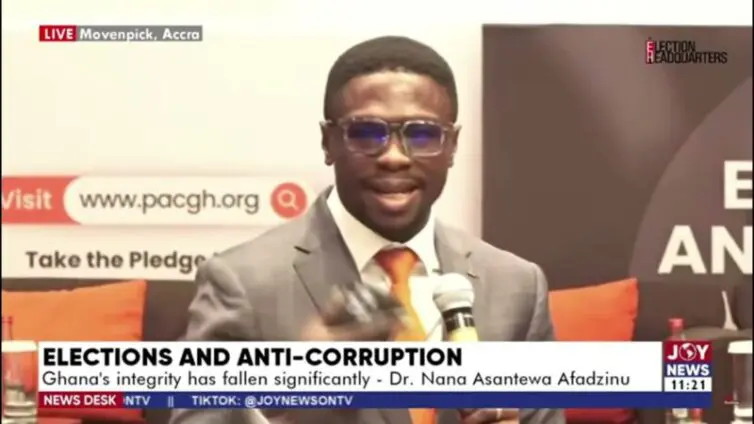
The Director of Strategy, Evaluation, and Communication at the Office of the Special Prosecutor (OSP), Samuel Appiah Darko, has raised concerns about the inadequacy of Ghana’s current legal framework in the fight against corruption.
During a forum in Accra on November 14, he stressed the need for stronger, more efficient anti-corruption laws to tackle the issue effectively.
While Ghana has numerous laws, Appiah Darko pointed out that their lack of effectiveness in addressing corruption remains a major challenge.
“Ghana is a country with many laws, but they are not efficient,” he remarked.
He also expressed skepticism about the proposed Conduct of Public Officers’ Bill, which he feels, if enacted in its current form, would fail to make any significant impact on corruption. According to him, the bill could end up being a “white elephant.”
One critical flaw he identified in the bill was its failure to set clear limits on the acceptance of gifts by public officers.
In contrast to countries like the UK, where MPs are restricted from accepting gifts over £300, the bill in its current state does not provide similar specific guidelines, making it fragmented and ineffective in tackling corruption.
Global Chairman of Group Nduom (GN), Dr. Papa Kwesi Nduom, has urged Ghanaians to vote for political parties that prioritize investing in local businesses to foster economic growth, create jobs, and drive expansion.
He believes that a self-sufficient economy can only be achieved by consistently supporting indigenous businesses to compete in both regional and global markets.
Dr. Nduom shared these views during an interview with the Ghana News Agency at the inauguration of a new three-classroom block for the Abayee community, located in the Komenda-Edina-Eguafo-Abrem Municipality of the Central Region.
The facility, equipped with essential amenities like restrooms, fans, desks, chairs, windows, and secure doors, aims to enhance the learning environment for local students.
He pointed out that the purpose of politics should be to uplift the people, not to destroy businesses, which could lead to unemployment and negative long-term effects.
Dr. Nduom stressed that fostering a robust local business sector is key to reducing unemployment, promoting economic autonomy, preserving cultural heritage, increasing exports, and ensuring the country’s future prosperity.
He also called for a peaceful electoral period, urging Ghanaians to rise above violence and divisive rhetoric, and work together for the development of their communities.
Before the new classroom block was constructed, students were forced to use adult restroom facilities, an issue that had long posed a challenge.
The newly built structure also provides a safer space for extracurricular activities, improving the overall learning experience for students.
The school, which serves 600 students, was originally established 65 years ago through community efforts, promoting a sense of ownership among the residents.
Over time, the facilities became overcrowded and deteriorated, with broken furniture and inadequate infrastructure affecting the learning process. Additionally, students were required to bring chairs from home, causing further disruption.
Providing quality education has always been a priority for Dr. Nduom, his family, and Group Nduom.
He stressed the importance of creating an environment where children can receive quality education during their early years, as these formative years are crucial for developing cognitive, social, and emotional skills essential for long-term success.
Dr. Nduom also mentioned ongoing community development initiatives such as teachers’ housing, street lighting, water systems, and educational materials. He promised to ensure the building’s maintenance and ensure timely payments for nursery teachers.
Madam Grace Acquah, the Headteacher of the school, expressed deep gratitude to Dr. Nduom, stating that the new facility would help boost enrollment, reduce absenteeism, and prevent students from having to bring chairs from home.
“We extend our sincere appreciation to you, Dr Nduom. This will eliminate the practice of pupils having to bring chairs to school daily.
“The children are delighted, and we are all pleased,” she added.
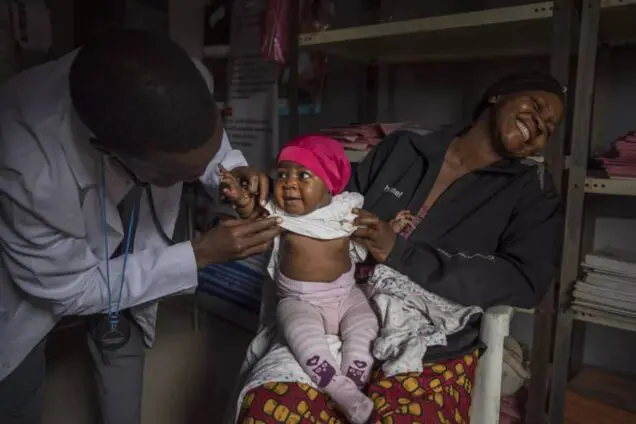
Pneumonia remains the leading infectious cause of death among children globally, according to the United Nations International Children’s Emergency Fund (UNICEF).
Every year, it claims over 725,000 lives of children under five, with 190,000 of these deaths occurring in newborns who are particularly vulnerable.
UNICEF reports that a child dies from pneumonia every 43 seconds, and all of these deaths are preventable. The organization has expressed outrage over the fact that many children lack access to the vital health services and treatments that could save them.
The recent UNICEF publication calls for urgent actions to prevent pneumonia-related deaths, change the course of the disease, and protect every child. One of the primary steps is to prioritize and strengthen routine immunization, especially for Pneumococcal (PCV), Measles, and Diphtheria-Tetanus-Pertussis (DTP) vaccines, aiming to increase their coverage to over 90%.
This will help ensure that children are protected from pneumonia.
The organization also highlighted the importance of improving basic oxygen access for children suffering from severe pneumonia, stressing that no child should be left struggling to breathe.
Additionally, UNICEF emphasized the need to invest in the treatment of severe acute malnutrition, which contributes to pneumonia deaths. The need for better-trained health workers and improved healthcare infrastructure was also stressed to ensure essential services are within reach of families.
Pneumonia, which affects the lungs and is caused by various pathogens such as bacteria, viruses, or fungi, presents with symptoms like fever, coughing, and breathing difficulties.
Children with pneumonia may show rapid breathing or chest retractions. It is highly contagious, spreading through airborne particles or bodily fluids.
Diagnosis of pneumonia involves physical examination, often checking for abnormal breathing patterns. In areas with limited healthcare resources, health workers may rely on measuring the child’s breathing rate to identify pneumonia. In more advanced settings, tests such as chest x-rays and blood tests are used.
Treatment for pneumonia depends on its cause. In many developing nations, bacterial pneumonia is the most prevalent form, and it can typically be treated with inexpensive antibiotics. Oxygen therapy is crucial for severe cases, especially for children and newborns, whose lungs struggle to provide enough oxygen to their bodies.
However, access to oxygen is limited in many low-resource countries, often available only in higher-level health facilities or hospitals. The COVID-19 pandemic has exacerbated this issue by straining already weak healthcare systems.
Prevention of pneumonia can be achieved through measures such as early breastfeeding, vaccination, access to clean water, good nutrition, and reducing exposure to air pollution. Research has shown that improved hygiene practices, like washing hands with soap, can also reduce the risk of pneumonia.
Despite the availability of vaccines like the Pneumococcal (PCV) vaccine, 40% of children worldwide remain unprotected. Other vaccines, such as those for Diphtheria-Tetanus-Pertussis, Measles, and Haemophilus Influenzae type B (Hib), also offer protection against pneumonia.
Sub-Saharan Africa and Asia have the highest rates of pneumonia-related child deaths, particularly in the poorest regions where the most disadvantaged children suffer the most.
The legal representative of the Speaker of Parliament, Thaddeus Sory, has argued that the Supreme Court of Ghana did not issue any specific directive to nullify the Speaker’s declaration that four parliamentary seats were vacant.
On November 12, 2024, the Supreme Court ruled 5-2 that the Speaker’s decision to declare vacant the seats of four MPs who filed to contest the 2024 elections as independents or with different parties was unconstitutional.
In response to the ruling, which was made public on Thursday, Sory took to Facebook to explain that the case filed by Majority Leader Alexander Afenyo-Markin did not seek to annul the Speaker’s declaration.
This is because the declaration had not been made at the time the original complaint was filed. He stated that if the plaintiff intended to challenge the Speaker’s statement, the complaint should have been formally amended to include it.
Sory further emphasized that the court, in its ruling, acknowledged that the plaintiff did not update the case to include the Speaker’s declaration.
Despite this, the court proceeded to consider the new information. Justice Asare Darko, who authored the lead judgment, admitted that the court should not have addressed the Speaker’s statement due to the lack of formal legal action.
Regarding the court’s orders, Sory clarified that the final ruling did not invalidate the Speaker’s decision.
Instead, the court disagreed with the Speaker’s interpretation of the law but did not issue any orders against him.
He pointed out that this rendered the earlier temporary order against the Speaker ineffective and no final order was given for Parliament to recognize the MPs impacted by the Speaker’s declaration.
Supreme Court Justice Amadu Tanko, one of two judges who dissented in the 5:2 majority decision involving Efutu MP Alexander Afenyo-Markin and Speaker of Parliament Alban Bagbin, has cast doubt on the durability of the ruling. He predicts that the decision could be overturned soon.
Justice Tanko remarked,“I do not hasten to proclaim that, I have apprehended with despair the majority’s conclusion in this suit but I state, with utmost deference to the Hon. Chief Justice and the rest of my brethren in the majority that, not only do I fundamentally disagree with their conclusion, I, with all due respect, also find the decision an aberration to the established and accepted judicial position of this court which with profound respect, I hope in no distant future the resultant usurpation of the constitutional prerogative of the High Court incidental to the majority decision will be reversed.”
The core of Justice Tanko’s dissent lies in his interpretation of constitutional boundaries, particularly regarding the Supreme Court’s jurisdiction in cases explicitly designated to the High Court.
He highlighted Article 99 of Ghana’s 1992 Constitution, which gives the High Court exclusive authority to rule on parliamentary seat vacancies.
Justice Tanko contended that even when constitutional issues require enforcement or interpretation, the Supreme Court cannot assume jurisdiction over matters explicitly assigned to other courts.
He explained that while Article 130 grants the Supreme Court jurisdiction over constitutional interpretation, Article 99 specifically entrusts the determination of parliamentary seat vacancies to the High Court.
He further argued that allowing the Supreme Court to decide on such issues effectively overrides the High Court’s authority, which the Constitution does not permit.
Supporting his position, Justice Tanko invoked the legal principle of generalia specialibus non derogant (general rules do not override specific rules), asserting that Article 99’s specific provision must take precedence over the broader provisions of Article 130.
Justice Tanko also referred to precedent, including the Parliamentary Election for Wulensi Constituency case, which reaffirmed the High Court’s jurisdiction in similar disputes. He concluded that the majority decision not only contradicts established legal principles but is also unlikely to stand the test of time.
“The conclusion I have arrived at should in no way be construed as suggesting that the Supreme Court is not the appropriate forum vested with jurisdiction to interpret and/or enforce the Constitution in appropriate circumstances. The point which I unequivocally emphasise is that, it is the same Constitution, 1992 which vested exclusive power in the Supreme Court in matters of interpretation and enforcement of its provisions which also designed the mechanism for this court to assume jurisdiction. Thus, although this court has a general jurisdiction to interpret and enforce provisions of the constitution, there are situations, such as in the instant case where the procedure adopted in invoking this court’s interpretative and enforcement jurisdiction has deprived the court of the power to exercise that jurisdiction. This particular action clearly demonstrates more than any other case I have confronted in constitutional law jurisprudence the failure by a party to comply with mandatory constitutional provisions in invoking jurisdiction and it is destined to fail. The above statement is supported by the recent decision of this very court in OWUSU-MENSAH VS. NAPTEX & ORS [2017-2020] 2 SCGLR 708 at 711. ’” A court might have jurisdiction to entertain a cause or matter but the procedure invoking its jurisdiction might deny the court the jurisdiction. That would occur where a statute had specially laid down the procedure for redress.”’
The Electoral Commission (EC) of Ghana has firmly denied recent claims that public trust in its operations is eroding ahead of the upcoming December 7 general elections.
This response follows a recent Afrobarometer survey by the Ghana Centre for Democratic Development (CDD-Ghana), which raised concerns among some Ghanaians regarding the Commission’s neutrality. The report highlighted a perception that confidence in the EC’s independence may be waning, leading to doubts about its ability to conduct unbiased elections.
Dr. Eric Bossman Asare, the EC’s Deputy Chairperson, addressed these concerns in a media interview, dismissing them as unfounded. He assured the public that the EC remains committed to conducting credible and transparent elections, emphasizing that the Commission’s priority is to uphold electoral integrity.
To further demonstrate the EC’s commitment to fairness, Dr. Asare outlined various steps implemented to strengthen the electoral process. He cited the introduction of biometric verification systems, comprehensive training for polling staff, and enhanced oversight at polling stations as initiatives intended to guarantee an impartial election.
Additionally, Dr. Asare emphasized Ghana’s strong reputation in Africa for conducting quality elections, asserting, “You talk about the quality of elections in Africa; Ghana is one of the best on the continent,” he stated, emphasising the country’s consistent track record in managing democratic processes effectively.
In response to calls for a forensic audit referenced in the Afrobarometer report, Dr. Asare pointed to a publicly broadcast EC meeting held to demonstrate transparency, reassuring Ghanaians that the Commission has “nothing to hide.”
Dr. Asare encouraged citizens to trust the EC’s proven record of managing elections without significant controversy. Reaffirming the measures in place to ensure electoral integrity, he promised that every vote would be accurately counted, underscoring the EC’s dedication to maintaining public trust.
A total of four hundred and seven (407) public libraries are expected to be constructed in the next six years in adherence to the 2018–2030 strategic plan that seeks to support the country’s educational growth and development.
Speaking to Joy News, CEO of GhLA, Hayford Siaw, revealed that this initiative stems from the government’s vision to significantly expand the network of public libraries, ensuring that more communities, especially those in undeserved areas, have access to modern library facilities.
According to him, presently Ghana can boast of one hundred and thirty-three (133) public libraries.
He added that out of the total libraries the incumbent government has built seventy-two(72).
“In 1981, we had 36 public libraries. Fast forward to 2017, and we have increased the network of public libraries to 61. The government, within the framework of the 2018–2030 strategic plan, which proposed we should have about 540 libraries by 2030, decided to implement an aggressive strategy to expand our reach.
“Today, we have added 72 new libraries to the network, so we are now managing 133 libraries under the Ghana Library Authority,” he said.
Mr. Siaw highlighted a substantial growth in public library resources, noting that book collections have surged from under 400,000 to nearly 2 million volumes.
“Books on the shelves, which had once dwindled to fewer than 400,000, now approach 2 million in our public libraries,” he remarked. He stated that to keep up with digital advancements, the GhLA has also launched a mobile app, offering virtual library services for increased accessibility.
In addition, the Authority has provided over 1,000 computers to libraries across the country and expanded internet access to almost half of its branches, as part of the government’s digital transformation initiative.
The CEO also shared that library visits have significantly increased under his tenure, with annual visits growing from approximately 350,000 in 2016 and 2017 to nearly 1.8 million today.
According to Mr. Siaw, 80% of these visitors are children under 18, with the remaining 20% comprising adults.
“We have procured over 1,000 computers, which we have distributed across most of our libraries nationwide. Under the Ghana government’s digital strategy, we have also expanded internet connectivity to almost half of the libraries we manage across the country. “Originally founded in 1949 under the Gold Coast Ordinance CAP 118, the Ghana Library Authority later evolved from the Ghana Library Board, which was restructured in 1998 with the passage of Act 562.
“We used to record around 350,000 visits annually in 2016 and 2017, but today we are almost at 1.8 million visits annually. This means that many more people are visiting the libraries and using the resources,” Mr Siaw stated.
Meanwhile, Mr Siaw has stressed the importance of well-equipped public libraries to support the government’s free education initiatives, underscoring the administration’s commitment to this critical objective.
The Ghana Library Authority was initially established in 1949 under the Gold Coast Ordinance CAP 118, officially taking effect in January 1950.
This ordinance was later revised as the Ghana Library Board Act of 1970 (Act 327). Act 327 underwent further amendments through Act 562 in 1998, resulting in the transition of the Ghana Library Board into what is now known as the Ghana Library Authority.
The Electoral Commission (EC) has announced that the distribution of ballot papers for the December 7 general elections will commence today, Thursday, November 14.
In a statement, the General Secretaries of all political parties, Samuel Tettey, Deputy Chairman for Operations at the EC, confirmed that the final stages of preparations are now underway.
The distribution of ballot materials to regional locations will be carried out under strict security measures.
“We bring you warm greetings from the Electoral Commission… [and] inform you that the transportation of ballot papers to the various regions will start tomorrow,” Mr. Tettey noted in the letter, dated November 13, as quoted by graphic.com.gh.
This marks the culmination of a month-long effort by the EC, which included completing voter registration, finalizing polling station assignments, and training election officers.
The ballot papers will be securely stored in police facilities across the regions until election day, at which point they will be handed over to election officials in the presence of party representatives to ensure transparency and fairness.
The EC has reiterated its commitment to ensuring the integrity of the electoral process, stressing that comprehensive security measures are in place to safeguard the ballot papers from tampering or unauthorized access.
The Teachers and Educational Workers’ Union (TEWU) of the Trade Union Congress-Ghana (TUC) has threatened to go on strike due to ongoing frustration over the prolonged delay in finalizing and implementing Conditions of Service agreements for its members across various educational bodies.
These include the Ghana Education Service (GES), Ghana Library Authority (GhLA), Museums and Monuments Board, Public Technical Universities, and Public Universities.
TEWU revealed that negotiations regarding these service conditions have been ongoing for several years without a resolution.
In a statement, the union expressed deep dissatisfaction with the government’s failure to conclude the process, despite years of deliberations and reviews.
The union pointed out that many of its members had expected an agreement by now, but instead, they have faced continuous delays and bureaucratic hurdles for the past four years.
With the new academic year underway, TEWU noted that its members, particularly those involved in the admission process for first-year students, are facing growing uncertainties regarding their service conditions.
As a result, the union warned that its members’ patience is running out. If the government fails to act promptly, an indefinite strike will commence on November 18, 2024.
TEWU has called on relevant stakeholders to take urgent action to address the matter, urging them to resolve the issue and avoid further disruptions in the education sector.
The union emphasized the critical need for a swift and effective response from authorities to maintain stability in educational institutions across the country.
The Chief Executive Officer (CEO) of the Ghana Library Authority (GhLA), Hayford Siaw, has revealed that the number of public libraries in Ghana has grown from 36 in 1981 to 133 in 2024.
In an interview with Benjamin Akakpo on the Joy News AM Show on Thursday, November 14, Mr. Siaw explained that access to library services was limited in the late 1980s when the country only had 36 libraries.
However, recent years have seen significant progress in expanding the network of public libraries.
He highlighted that by 2017, the number of libraries had risen to 61. Following the launch of a 2018-2030 strategic plan, the government set a target to increase the number of libraries to 540 by 2030, a goal that has already resulted in the addition of 72 more libraries, bringing the current total to 133.
Mr. Siaw also pointed out that the number of books in public libraries has grown significantly. From fewer than 400,000 books in the past, the current total now stands at nearly 2 million.
“Books on the shelves, which had declined to fewer than 400,000, now total almost 2 million books in our public libraries,” he added.
To keep pace with digital trends, the Authority has introduced a mobile app that allows people to access virtual library services.
In addition, the GhLA has distributed over 1,000 computers to libraries nationwide and expanded internet connectivity to nearly half of its locations as part of the government’s digitalization efforts.
The CEO further revealed that library visits have soared under his leadership. Annual visits, which were about 350,000 in 2016 and 2017, have now risen to nearly 1.8 million. He emphasized that 80% of library users are children under 18, while the remaining 20% are adults.
“We have procured over 1,000 computers, which we have distributed across most of our libraries nationwide. Under the Ghana government’s digital strategy, we have also expanded internet connectivity to almost half of the libraries we manage across the country.”
Originally founded in 1949 under the Gold Coast Ordinance CAP 118, the Ghana Library Authority later evolved from the Ghana Library Board, which was restructured in 1998 with the passage of Act 562.
“We used to record around 350,000 visits annually in 2016 and 2017, but today we are almost at 1.8 million visits annually. This means that many more people are visiting the libraries and using the resources,” Siaw said.
The Ministry of Roads and Highways has promised commuters that traffic congestion around the Flower Pot Flyover will ease by Friday, November 15.
In a Thursday interview with Caleb Kudah on the Citi Breakfast Show, the Ministry’s Public Relations Officer, Ahmed Nasir Yartey, stated that efforts are underway to reduce the congestion, with significant improvements expected by Monday, November 18.
He reassured the public that both the government and the contractor are working diligently to speed up the project, although some tasks, like applying asphalt, must be done during the day.
“We would like to appeal to the general public to bear with us, especially with the Flower Pot Flyover, hopefully by close of day tomorrow [Friday, November 14] we should be seeing some ease in the traffic [situation] and by Monday, I am sure the traffic situation there will be extremely better
“Although the contractors are working day and night, you cannot do some of the job, especially the asphaltic finishing. We cannot do it at night, you need to do it during the day so that you can assess the work that is ongoing and so the work that we can do at night is done at night and the one that cannot be done at night is done during the day.
While contractors are working day and night, Mr. Yartey pointed out that certain tasks require daylight to ensure proper assessment, particularly asphalt work.
The Ministry also called for continued patience from the public. Mr. Yartey advised drivers to avoid the Flower Pot Flyover area if possible, as the lack of diversion options makes it difficult to find alternative routes.
These statements come in response to complaints from commuters who reported spending over two hours stuck in traffic along the route.
A fire broke out early Thursday morning at Circle Odawna in Accra, destroying more than 15 buildings.
The Ghana National Fire Service (GNFS) responded promptly, containing the flames before they could reach a nearby warehouse or affect over 200 other structures.
Eyewitnesses indicated that the fire started near the site of a recent blaze that had already damaged several wooden structures in the vicinity.
The GNFS is investigating the cause of the fire and has advised local residents and business owners to adhere to fire safety guidelines to help prevent future incidents in this high-risk area.
The Ghana Library Authority (GLA) has reiterated that the government is fully committed to improving the nation’s educational sector, with plans to build more libraries.
According to Hayford Siaw, the Authority’s Chief Executive Officer, the government remains focused on advancing education across the country.
During an interview with Citi News following the groundbreaking ceremony for a new library in Asofan, Ga North Municipality, Mr. Siaw emphasized the need for well-equipped public libraries to bolster the government’s free education initiatives, highlighting the administration’s dedication to this important cause.
“A library is the university for all and so it is exciting for us that we can bring our services to the doorstep of the people living in Ghana. This is an established priority for the government, that the government wants to promote learning, and we want to promote free education for the people of Ghana.
“For free education to be successful, there is a need to equip our public libraries so that they can be accessible to the Ghanaian people. I believe that you know, Ghanaians will have confidence and faith in Dr. Mahamudu Bawumia’s social policies for education.”
Prof. Titus Beyuo, the National Democratic Congress (NDC) Parliamentary Candidate for Lambussie, has criticized the Akufo-Addo administration over the growing migration of nurses and doctors abroad.
In an interview on Channel One TV’s The Point of View with Bernard Avle, Prof. Beyuo attributed the exodus of healthcare professionals to the government’s poor management of the health sector and inadequate compensation, which he claims are pushing workers to seek better opportunities overseas.
He pointed out that the brain drain in the healthcare sector has worsened under the current government, with many professionals losing faith in Ghana’s economic prospects.
Prof. Beyuo expressed hope that a change in government during the 2024 elections could restore confidence and help retain medical talent in the country.
He reassured the public that the NDC is committed to implementing policies aimed at strengthening the economy and providing adequate incentives for doctors and nurses to remain in Ghana.
“Brain drain has become worse under this government and has taken a different dimension. And our government in waiting [NDC] is mindful of this because if you check, Brian Drain earlier was in pursuit of higher academic qualifications, and people wanted to go and specialise.
“Currently, the people exiting this country as health workers, are the most experienced specialists, consultants with higher levels, and very qualified staff. The reason is this, people have lost hope in this country.
“There’s a case of hopelessness and despondency, I’m telling you that a change in government alone will restore some confidence in people who will want to stay. A change in government from NPP to NDC alone will restore some confidence in our economy and will lead to people wanting to stay.
“Our government intend to introduce an ethical migration policy where people who will leave for these countries will have a planning system with our partner countries and the World Health Organisation and the country will be compensated for these people leaving.
“We also have a motivation package for our nurses and doctors. We’re promising equitable distribution of health workers across the country.”
The NDC Director of Communications for the Western Region, Mr. Richard Ted Mensah,has announced the party’s intention to relocate and repackage President Akufo-Addo’s statue from its current position at the Effia-Nkwanta Regional Hospital in Sekondi to Kyebi, the President’s hometown in the Eastern Region.
He explained that the statue has caused discomfort among some residents of Effia-Nkwanta, who feel it generates more dissatisfaction than pride.
Mensah also criticized the placement of the statue in a dusty area, believing it undermines the President’s image. He suggested that the surrounding roads should have been paved before the statue’s installation. Relocating the statue to Kyebi, he argued, would provide a more fitting tribute to the President.
“The statue would serve a greater purpose in Kyebi, where it would be more appreciated,” he stated.
He emphasized that relocating the statue to Kyebi would give it greater significance, as it would be more appreciated there, and noted that the next NDC administration would make this a priority.
Mr. Mensah also pointed out that, despite being Ghana’s resource hub, the Western Region continues to grapple with poor infrastructure and worsening roads—issues he believes deserve more immediate attention.
These remarks were made during an interview he gave on Monday to Mac-Jerry Osei Agyemang on Neat FM, an Accra-based radio station.
Consolidated Bank Ghana (CBG) has reassured customers that the temporary suspension of its foreign exchange license will not impact its main banking services.
The bank emphasized that all branches and digital services are fully functional and encouraged customers to remain at ease.
The Bank of Ghana (BoG) issued a one-month suspension on CBG’s forex license, starting November 26, citing repeated breaches of market regulations.
In a statement, CBG noted it is actively collaborating with the BoG to resolve the issues and aims to have its license reinstated by the end of the suspension period.
“We want to reassure our valued customers that this suspension does not impact on CBG’s normal banking operations. Except for foreign exchange products and services, all our branches and digital platforms will continue providing customers with our full range of services. We fully expect to restore foreign exchange products after our engagement with the Bank of Ghana”, the statement mentioned.
CBG expressed regret for any inconvenience resulting from the suspension and reiterated its commitment to maintaining high standards of operational compliance.
The Central Bank indicated that CBG’s license could be reinstated after the one-month suspension, provided the bank establishes effective controls to ensure compliance with foreign exchange regulations.
Additionally, the BoG reminded all participants in the forex market of the necessity to strictly adhere to all relevant regulations and guidelines.
Legal practitioner Jonathan Amable has petitioned the Supreme Court to impose an immediate injunction on government borrowing through treasury bills.
The application seeks to prevent the government and its representatives from issuing treasury bills to fund operations, citing the absence of parliamentary approval for such actions, which he argues violates the 1992 Constitution.
In his writ, Amable contends that without this prohibition, the government’s borrowing will continue to harm the economy. The Attorney General of Ghana is named as the defendant, and the suit also accuses the Ministry of Finance and Bank of Ghana of unconstitutional actions in the issuance of treasury bills.
Amable’s application highlights the risk of economic fallout, noting that if the borrowing contracts are deemed unconstitutional, they may be voided, jeopardizing the investments of banks, microfinance institutions, insurance companies, pension funds, and everyday Ghanaians. This, he argues, endangers the stability of the financial sector and the public’s invested capital.
The suit references Section 30 of the Bank of Ghana Act, 2002 (Act 612), and Section 61 of the Public Financial Management Act, both of which require parliamentary oversight on government borrowing via treasury bills and debt instruments.
Amable’s request targets only new borrowing transactions and does not aim to prevent the government from meeting obligations on existing debt, provided repayment funds are not drawn from new, unapproved borrowing.
“That the consequence of the relevant borrowing contracts being conducted without the requisite parliamentary approval makes them liable to be declared void for unconstitutionality and such a consequence will be made more dire by the fact that the holders of the offending debt instruments include banks, savings and loans companies micro-finance companies, asset management companies, insurance companies, pension funds and ordinary Ghanaians. Accordingly, the unconstitutional conduct of the state potentially jeopardises the entire Ghanaian financial sector and hard-earned capital of the investing public”, the application read in part.