Tag: Bank of Ghana

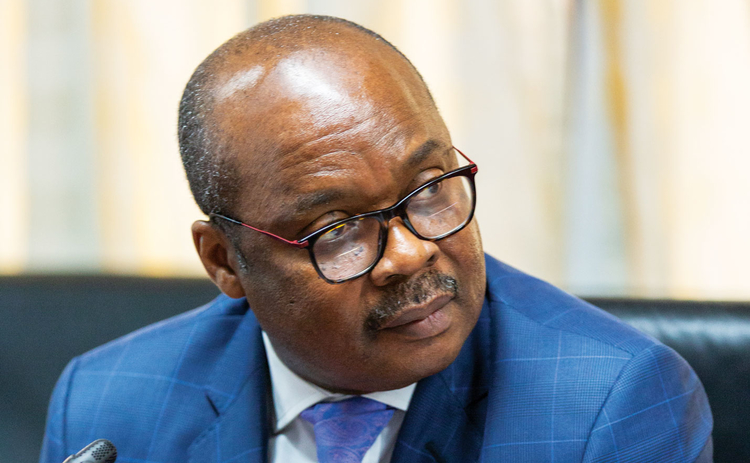
  • Bank of Ghana’s policy rate no longer influences markets – Prof. Bokpin

    Bank of Ghana’s policy rate no longer influences markets – Prof. Bokpin

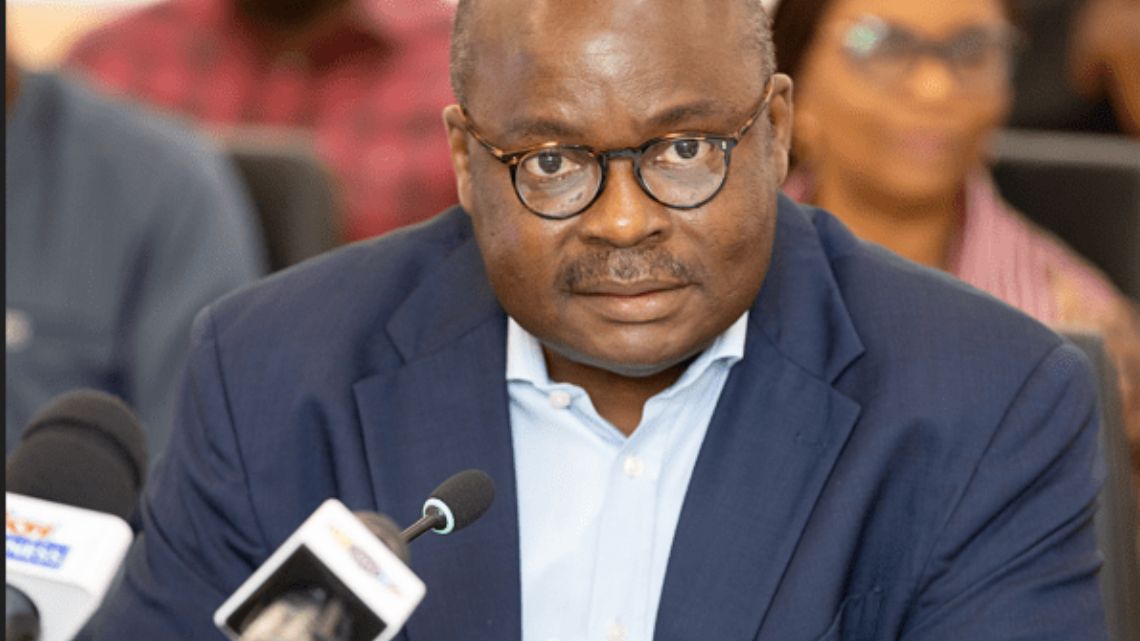
    Economist Professor Godfred Bokpin has indicated that the Bank of Ghana’s policy rate no longer influences market behaviour, arguing that borrowing costs remain artificially high despite falling inflation.

    Speaking on Joy FM’s Super Morning Show on March 19, Prof. Bokpin observed that headline inflation has dropped to just 3.3%, while the Bank of Ghana maintains a policy rate of 14%, a level he says is far removed from market realities.

    “You cannot have inflation as low as 3.3% and have your policy rate at 14%. It has lost its signalling power in the market,” he said bluntly.

    The economist explained that although a rate cut is widely expected, the more pressing issue is the central bank’s lag in responding to economic trends. He highlighted the unusual situation in which the Government of Ghana is borrowing short-term from the market at rates lower than the Bank’s own policy corridor.

    “If the Central Bank believes that the economic turnaround evidenced by low inflation is systematic and predictable, their policy rate should have been in single digits by now,” Prof. Bokpin added.

    Ghana’s headline inflation of 3.3% represents a steep decline from the hyperinflationary peaks of over 50% recorded in 2022 and 2023. The Bank of Ghana’s medium-term target for inflation ranges between 6% and 10%, indicating that current inflation is already below the lower bound.

    Prof. Bokpin further noted that the Bank of Ghana itself acknowledged in a recent Monetary Policy Committee release that disinflation had proceeded faster than expected, reinforcing the disconnect between the policy rate and prevailing economic conditions.

    The economist’s comments follow remarks by President John Mahama, who asserted that Ghana’s economy remains resilient enough to withstand shocks from the ongoing Israel–US–Iran conflict.

    Prof. Bokpin emphasised that unless the Bank of Ghana adjusts its policy rate to align with current economic realities, distortions in credit pricing could persist, potentially slowing investment and broader economic activity.

    Dr. Johnson Asiama, has sought to reassure stakeholders that the central bank’s recent 150-basis-point reduction in its policy rate to 14 percent will not threaten the country’s economic stability, even as tensions in the Middle East continue to affect global markets.

    Speaking to the press after Wednesday’s Monetary Policy Committee (MPC) meeting, Dr. Asiama emphasised that the decision to lower the Monetary Policy Rate to 14% was grounded in Ghana’s improving macroeconomic fundamentals and does not endanger the nation’s growth trajectory.

    “The adjustment of 150 basis points in our policy rate does not pose a risk to the economy,” Dr. Asiama said. “Our inflation trajectory remains sound, and our policy stance continues to support both price stability and sustainable growth regardless of disruptions originating from the Middle East.”

    His reassurance comes amid international concern that the ongoing conflict in the Middle East has pushed up oil prices and created fresh uncertainty in global inflation, pressures that have complicated central bank decisions around the world.

    Dr. Asiama noted that while external geopolitical shocks may impact trade and financial conditions, Ghana’s economy remains resilient.

    “While we remain mindful of external risks, including those from distant conflict zones, the recent policy decision reflects a careful balance one that safeguards domestic stability while supporting economic activity.”

    He further underscored that the Bank of Ghana will maintain close observation of international developments and adjust policy measures as needed to preserve economic stability.

    “Our focus is on ensuring that the economy continues on a stable path. That requires both vigilance in the face of global uncertainties and confidence in the progress we have achieved,” the Governor added.

    Meanwhile, the Ghana Union of Traders Association (GUTA) has voiced frustration over the sustained high interest rates charged by commercial banks, despite reductions in the central bank’s policy rate.

    GUTA noted that lending rates between 22% and 24% are disproportionately high and do not reflect the current monetary stance of the Bank of Ghana.

    During discussions with the Minority Caucus on Thursday, March 19, GUTA President Clement Boateng urged the central bank to enforce stricter measures to ensure banks lower their interest rates.

    “Ghana’s banks continue to lend at double-digit rates. As the policy rate comes down, I expect the regulator to ensure commercial banks follow suit so that the business community and private sector can access affordable credit to expand their operations,” he said.

    He further raised issues with the present VAT system, pointing out that commercial lending has not been responsive to policy rate adjustments.

    “Just yesterday, the policy rate, which is 5%, was again reduced, yet lending rates remain around 14%. This situation is not ideal for businesses,” he added.

  • Bank of Ghana recapitalisation process begins with gov’t support

    Bank of Ghana recapitalisation process begins with gov’t support

    Steps have been initiated by the government to recapitalise the central bank, with a bond already issued to support the process, according to the Governor of the Bank of Ghana, Johnson Pandit Asiama.

    He explained that the government, as the majority shareholder of the central bank, is legally required to restore its capital base.

    “Government has given us a bond to kick-start the recapitalisation process. Government is the main shareholder, and the law mandates the government to recapitalise the Bank of Ghana, and there is an Memoranda of Understanding to that effect,” he stated.

    This recapitalisation drive comes after the impact of the Domestic Debt Exchange Programme, which resulted in losses on the central bank’s holdings of government securities and weakened its balance sheet. The programme was part of broader fiscal and monetary reforms aimed at stabilising the economy.

    Dr Asiama noted that issuing the bond forms part of a coordinated strategy between the central bank and government to gradually rebuild capital buffers and maintain financial strength.

    He assured that in spite of the setbacks, the central bank remains focused on its core responsibility of ensuring macroeconomic stability.

    “We will continue to meet our mandate of price and exchange rate stability,” he emphasised.

    He also indicated that recent policy decisions, including a 150 basis points reduction in the policy rate to 14 percent, signal increasing confidence in the country’s economic recovery.

    According to him, declining inflationary pressures, relative stability in the exchange rate, and stronger external sector performance have created the conditions for such adjustments.

    The Bank further reported gains within the financial sector, noting an increase in total industry assets and a decline in non-performing loans due to a reduction in impaired loan stock. However, lending to the private sector remains weak, underscoring the need for continued policy measures to boost credit growth.

    Overall, the recapitalisation initiative is expected to strengthen the Bank of Ghana’s capacity to sustain recent economic progress, promote financial sector stability, and improve the effectiveness of monetary policy in supporting growth.

    Last year, the Bank of Ghana assured that banks facing financial shortfalls will follow procedures to raise the needed funds to remain stable.

    This came at a time when the economy had outperformed expectations, with broad gains delivering positive spillover effects to the banking sector.

    In its January 2025 Monetary Policy Report, the central bank said it would closely monitor banks to ensure they address the issue of bad loans, which could threaten the stability of the industry.

    The report also noted that better economic conditions should make it easier for businesses and households to repay their debts, helping to reduce the number of bad loans.

    At the same time, loans to the private sector are gradually recovering to levels seen before the economic challenges of 2022.

    The value of private sector loans grew by 26.3% in December 2024, compared to 10.7% growth in December 2023.

    Adjusted for inflation, this represents a modest 2.0% increase, a significant improvement from the 10.2% decline recorded the previous year.

    In 2025, banks invested more in treasury bills than in 2024. This is according to the Bank of Ghana’s January 2026 Monetary Policy Report.

    According to the BoG, its share increased from 40.3% in December 2024 to 62.3% in December 2025, whereas the share of long-term securities declined from 59.3% in December 2024 to 37.2% in December 2025, marking a 37.3% year-on-year decline.

    This was in line with the growth moderation recorded during the reference period. The report also stressed that the share of equity investments remained negligible but increased marginally from 0.4% percent in December 2024 to 0.5% in December 2025.

    Meanwhile, the share of deposits in banks’ liabilities and shareholders’ funds decreased to 72.8% in December 2025 from 75.1% in December 2024, reflecting the slowdown in deposit growth in 2025.

    The increase in borrowings, however, translated into an increased share of 8.5% in December 2025 from 7.6% in December 2024.

    The proportion of shareholders’ funds in banks’ total funding also improved to 13.1% in December 2025 from 10.8% a year earlier, while the share of other liabilities declined from 6.3% to 5.4% during the same comparative period.

    Investor interest and confidence in government treasuries remain high as the treasury bill auction exceeds the target by over 60%.

    In auction results posted by the Bank of Ghana, the government accepted GH¢12.8 billion in bids at the latest auction, above its GH¢9.8 billion target, although investors submitted bids worth GH¢15.9 billion.

    The reports also show that the majority of investors preferred the 364-day (one-year) treasury bill, for which they offered about GH¢7.4 billion, making up nearly half of all the money investors offered.

    Out of this amount, the government accepted just over GH¢5.0 billion.

    Also, for the 182-day (six-month) treasury bill, investors offered about GH¢4.29 billion, and the government accepted almost all of it, around GH¢4.28 billion.

    For the 91-day (three-month) bill, investors offered about GH¢4.1 billion, of which the government accepted about GH¢3.4 billion.

    On the other hand, interest rates continued to rise at the longer end of the yield curve.

    The yield on the 91-day bill remained at 11.19%.

    That of the 182-day bill, however, went up to 12.66% from 12.64% the previous week.

    Additionally, the yield on the 364-day bill increased by eight basis points to 13.06%.

    Meanwhile, the iversubscription has been a trend in the last few months.Government saw another significant oversubscription in its primary T-bill auction, the Bank of Ghana (BoG) announced, following its August 1 auction last year.

    This comes after demand surged 42.07 percent above the target.

  • Ghana’s public debt falls to GH¢641 billion but dollar value rises

    Ghana’s public debt falls to GH¢641 billion but dollar value rises

    Ghana’s public finances recorded a notable turnaround at the end of 2025, with the country’s total public debt falling to GH¢641 billion in December, according to the latest data from the Bank of Ghana.

    This represents a slight drop from GH¢644.6 billion in November 2025, but a more significant decline from GH¢726.7 billion recorded in December 2024. Overall, the public debt stock reduced by GH¢82.1 billion over the year, bringing the debt-to-GDP ratio down sharply from 61.8 percent to 45.3 percent.

    While the figures show improvement in cedi terms, the situation looks different when measured in US dollars as Ghana’s total debt increased to $61.3 billion in December 2025, up from $49.4 billion a year earlier.

    This increase is largely due to exchange rate movements, with the cedi weakening to about GH¢10.45 to the dollar. Despite this, the lower debt-to-GDP ratio suggests the economy is gradually stabilising.

    Domestic vs External Debt

    A closer look at the debt shows contrasting trends:

    External debt fell significantly in cedi terms to GH¢307.2 billion, down from GH¢416.8 billion in December 2024.

    Domestic debt, however, increased to GH¢333.8 billion, reflecting the government’s growing reliance on local borrowing.

    Additionally, government revenue strengthened toward the end of the year, reaching 16.1 percent of GDP in December 2025, up from 13.4 percent in November. Tax revenue remained the main source, contributing 13.1 percent of GDP.

    At the same time, government spending was kept at 16.1 percent of GDP, slightly lower than the previous year as capital spending remained low at 1.4 percent of GDP.

    As a result, the fiscal deficit narrowed to 3.1 percent of GDP, down from 5.2 percent in 2024. The government also recorded a primary surplus of 0.5 percent of GDP, meaning it generated more revenue than it spent before interest payments.

    What this means for government and citizens

    For the government, the drop in debt and improved fiscal balance provide some breathing room. It reduces pressure on public finances and may make it easier to borrow at better rates or invest in key sectors.

    For citizens and the business community, the impact is more gradual but important as lower debt and tighter fiscal discipline can help stabilise the economy, support the cedi, and reduce inflation over time.

    However, continued reliance on domestic borrowing and limited capital spending may affect job creation and infrastructure development in the short term.

    Overall, the recent data points to early signs of economic recovery, although sustaining these gains will depend on consistent revenue growth, controlled spending, and broader economic expansion.

    Source: GhanaWeb

  • BoG warns Middle East tensions may derail inflation progress

    BoG warns Middle East tensions may derail inflation progress

    The Governor of the Bank of Ghana (BoG), Dr. Johnson Asiama, has warned that despite recent improvements in the country’s macroeconomic indicators, Ghana could face economic pressures if tensions in the Middle East intensify.

    He gave the caution at the opening of the 129th meeting of the Monetary Policy Committee (MPC), Dr Asiama on Monday, March 16. Dr Johnson Asiama said the caution stems from tensions affecting key global energy and shipping routes, potentially causing volatility in global oil markets.

    He added “Geopolitical uncertainty tends to support gold prices. Given the importance of gold in our export earnings, this could improve our trade balance”.


    The ongoing tensions have been linked to the death of Iran’s Supreme Leader, Ayatollah Ali Khamenei. Ayatollah Ali Khamenei was reportedly killed in strikes by the Unites States (U.S.) and Israel. This development significantly impacting travelers from Ghana to Asia, Europe, and North America, as Dubai is a major transit hub connecting travelers through the United Arab Emirates.

    Ghana, being one of the dependents of the global oil supply, stakeholders began to express concerns about a possible shortage of fuel across the country. However, the Corporate Affairs Officer of the Tema Oil Refinery (TOR), Godwin Mahama Ayaba, during an appearance on March 11, indicated that Ghana is unlikely to experience fuel shortages despite rising tensions in the Middle East, citing the country’s diversified sources of petroleum imports and growing local refining capacity.

    According to him, the NPA recently issued a statement indicating that the situation in the Middle East will not lead to shortages of petroleum products in the country.

    “The National Petroleum Authority, which is the regulator, some three to four hours ago issued an official statement assuring all of us that as for shortage, there is no way the Iran–Israel conflict is going to affect us,” he said.

    Mr Ayaba explained that Ghana’s fuel import structure significantly reduces the risk of supply disruption because the country imports most of its finished petroleum products from Europe.

    “Ghana largely imports from two different areas: Europe and the Arabian region. Where we import most is Europe,” he noted.

    “We import about 80 per cent of our finished petroleum products from Europe and about 20 per cent from the Arabian region, where this conflict may have an impact.”

    While acknowledging that the Middle East tensions could affect that 20 per cent supply, he said Ghana’s domestic refining capacity is expected to fill the gap.

    “So we are likely to lose that 20 per cent, but with TOR coming on stream, we will be able to block that gap,” he said.

    Mr Ayaba revealed that the refinery is currently producing about 28,000 barrels and expects output to increase significantly after ongoing upgrades.

    “Currently, we are producing about 28,000 barrels. After the tie-in, we will move to about 45,000 and further move to 60,000,” he explained.

    He added that increased output from other refineries in the country will also contribute to stabilising supply.

    “Sentuo is doing around 36,000 to 40,000 barrels a day, Akwaaba is doing somewhere less than 10,000, and Platon is around a little below 3,000,” he stated.

    “Together, all these companies will be able to block that 20 per cent that would have come from the Arabian region.”

    Mr Ayaba emphasised that Ghana will still maintain the bulk of its imports from Europe, further ensuring supply stability.

    “We will still have the 80 per cent from Europe coming in,” he said.

    He therefore urged the public not to panic, reiterating the assurances provided by the National Petroleum Authority.

    “I will add my voice to the official communiqué from the NPA that we should rest assured that we are not going to record fuel shortages,” he stated.

    Meanwhile, in a separate interview about 3 days ago, Mr Ayaba revealed that TOR is eyeing a sixty-one (61%) percent increase in its production capacity as part of renewed efforts to strengthen operations and improve output at the facility.

    Currently, the refinery seeks to expand its crude distillation capability from 28,000 barrels per stream day to 45,000 barrels per stream day.

    Speaking during an interview on Citi FM’s Eyewitness News on Monday, March 9, he stated that,

    “The refinery is currently undertaking technical processes aimed at expanding its processing capability from 28,000 barrels per stream day to 45,000 barrels per stream day. This represents a sixty-one percent increase in capacity, and it forms part of our broader plans to revitalise operations and enhance TOR’s contribution to Ghana’s petroleum sector.”

    He continued that, the planned increase will be achieved through the integration of an additional processing unit, known as the F61 unit, which will operate alongside the existing F1 unit.

    Both units will be connected to the refinery’s crude distillation system to improve overall efficiency and output.

    Mr Mahama also noted that engineers are currently carrying out some temporary technical steps to connect a new unit to the refinery’s main processing system, which is expected to increase the refinery’s output from the current level.

    The refinery is presently operating under a tolling arrangement, a system in which private companies supply crude oil to the facility for processing.

    Under this arrangement, the refinery refines the crude and charges a processing fee, while the refined petroleum products are returned to the companies that provided the crude.He explained that under the tolling system, the refinery does not control the marketing or distribution of the finished products, as those decisions are taken by the crude oil suppliers.

    Mr Ayaba added that while the refinery’s current nameplate capacity stands at 28,000 barrels per stream day, the introduction of the F61 unit will push output to 45,000 barrels per stream day.

    He further indicated that management is also considering plans to expand capacity to about 60,000 barrels per stream day in the medium term.

    After several years of inactivity, the management of Tema Oil Refinery announced the resumption of operations. The resumption was possible following the completion of extensive Turnaround Maintenance (TAM) works on the refinery’s Crude Distillation Unit (CDU). Maintenance works began on August 1 and on October 30 in 2025. This information was contained in a press statement released by the management on Saturday, December 27.

    TOR’s resumption was expected to boost energy security, industrial growth and national development, potentially saving Ghana up to $10.2 billion in oil import bills annually.

  • Heavy dependence on net interest income raises risk for banks –  BoG

    Heavy dependence on net interest income raises risk for banks –  BoG

    The Governor of the Bank of Ghana, Dr Johnson Asiama, has warned that banks face growing vulnerabilities if they continue to depend heavily on net interest income as their primary source of earnings.

    Speaking to chief executives and senior executives of commercial banks in Accra on February 18, 2026, Dr Asiama acknowledged that interest income remains fundamental to banking. He cautioned, however, that an imbalance in revenue structure could expose institutions to avoidable shocks.

    “There is nothing inherently problematic about net interest income. However, a high dependence on it increases sensitivity to interest rate cycles and sovereign exposure dynamics.”

    His remarks come as Ghana’s monetary landscape steadily returns to stability, a development that is narrowing spreads and pushing down yields on government securities — instruments that have traditionally delivered strong returns for banks.

    Dr Asiama indicated that a stabilising rate environment is expected to squeeze profit margins, requiring financial institutions to reassess how they generate income.

    “As margins compress in a normalizing rate environment, earnings resilience will increasingly depend on diversification, particularly through transactional banking, trade services, payments, treasury activities, and other fee-based income streams that are less balance-sheet intensive.”

    The Governor’s comments reflect a broader regulatory direction aimed at reducing concentration risks, particularly those linked to sovereign instruments, while encouraging banks to build stronger non-interest revenue streams.

    The meeting forms part of the central bank’s ongoing supervisory engagements designed to reinforce financial stability and position Ghana’s banking sector to withstand shifting macroeconomic conditions.

    African banks are expected to experience their strongest loan growth by the end of 2026, driven by rising demand from businesses and individuals, as well as reduced government borrowing, according to UK-based Fitch Solutions.

    The firm noted in its article “Sub-Saharan Africa Banking Key Themes For 2026: Banks Navigate Easing Cycles And Consolidation Trends” that “loan growth will accelerate across SSA’s largest banking sectors and the region will experience the strongest growth rate by year-end. This acceleration reflects pent-up demand, improving economic growth prospects and a reduction in government crowding out as fiscal consolidation efforts ramp up and sovereigns look for alternative sources of financing.”

    In recent years, many banking sectors in Sub-Saharan Africa increased their holdings of government securities, attracted by high yields. In some markets, government bonds now account for 20-35% of bank assets, up from 10-15% before the pandemic.

    As policy rates fall and bond yields decline, Fitch said banks will face pressure to redirect capital toward private-sector lending to maintain returns. “This transition will be positive for businesses and the economy as more credit becomes available to support growth initiatives,” the firm added.

    The shift is expected to be particularly pronounced in markets where governments are pursuing fiscal consolidation, reducing domestic borrowing requirements. Across the region, central banks have also moved toward more accommodative monetary policy. Since February 2025, major central banks have either cut policy rates or held them steady, a trend Fitch expects to continue through 2026.

    Ghanaian banks are set to benefit from the end of the Domestic Debt Exchange Programme (DDEP) and the restoration of capital buffers. However, Fitch cautioned that a high level of non-performing loans, which stood at 9.5% in October 2025, may limit profitability going forward.

    Fitch concluded that while loan growth is set to accelerate across most markets, banks will need to carefully manage risks associated with bad loans and capital allocation.

    Last year, Fitch Solutions projected an annual Gross Domestic Product (GDP) growth to edge up from 5.8% in 2025 to 5.9% in 2026.

    According to the UK-based firm, “We expect annual GDP to edge up from 5.8% this year to 5.9% in 2026 as easing price pressures lift private consumption, tempered by fiscal consolidation, slow credit pass-through and a firmer cedi.”

    Fitch noted that the slight increase in growth is a result of easing price pressures boosting private consumption, even as fiscal tightening and slower credit pass-through limit the pace of expansion.

    The firm’s November 2025 Sub-Saharan Africa Outlook also highlighted robust economic performance this year, with Ghana recording a 6.3% year-on-year growth in the second quarter. This was up from a revised 5.7% in the same period in 2024 and was driven by household consumption, fixed investment, and a significant drop in inflation.

    The services sector, encompassing finance, insurance, trade, and education, saw remarkable growth of 9.9% in the quarter compared to just 2% a year earlier, underscoring the sector’s contribution to the country’s economic resilience.

    Fitch’s projection signals cautious optimism for Ghana’s economy as it balances fiscal discipline with measures to sustain private sector growth.

    In November, Fitch Solutions projected that the Bank of Ghana (BoG) would lower its monetary policy rate to 16.50% by the end of 2026, driven by sustained currency stability and a continued drop in inflation.

    At the 2026 PricewaterhouseCoopers (PwC) Post-Budget Forum in Accra, Mike Kruiniger, an Assistant Director at Fitch Solutions, explained that Ghana’s improving macroeconomic outlook creates room for further monetary easing in the year ahead.

    “Rates have remained elevated, but the Bank of Ghana launched a decisive easing cycle this summer, cutting by 650 basis points so far — the fastest monetary easing cycle globally this year,” he said.

    According to him, inflation’s return to the central bank’s target range, combined with firm foreign exchange inflows and a stable currency, provides the basis for Fitch’s projection that the policy rate will ease to 16.50 percent by the end of 2026.

    Ghana’s relatively stable cedi, easing inflation, and robust agricultural performance have earned the country an upgrade in growth by UK-based financial analytics firm, Fitch Solutions.

    Fitch, in its September 2025 Monthly Outlook report, lifted its economic growth forecast for the country from 4.2% to 4.9%, citing signs of renewed macroeconomic stability driven by easing inflation, a relatively stable cedi, and resilient agricultural performance.

    Highlighting the challenges the economy is still grappling with, such as tight fiscal consolidation, elevated interest rates, and stagnant oil output, the report said Ghana’s economy remains firmly on a recovery path.

    The upgrade follows a strong performance in Ghana’s agricultural sector, which boosted the economy’s growth in the first quarter of the year. Between January and March, Ghana’s Gross Domestic Product (GDP) grew by 5.3%, compared to 4.7% recorded during the same period last year.

    Fitch believes this growth will continue into 2026, predicting the economy will expand by around 5.0%. This improvement is expected to come from lower inflation (prices rising more slowly), possible interest rate cuts, and more government spending as Ghana’s IMF-supported program comes to an end.

  • Ghana’s crude oil earnings fall from US$369.25m to US$198.25m in H2 2025 – BoG

    Ghana’s crude oil earnings fall from US$369.25m to US$198.25m in H2 2025 – BoG

    The Bank of Ghana has reported a decline in Ghana’s crude oil earnings in the second half of 2025, according to the latest Ghana Petroleum Funds report.

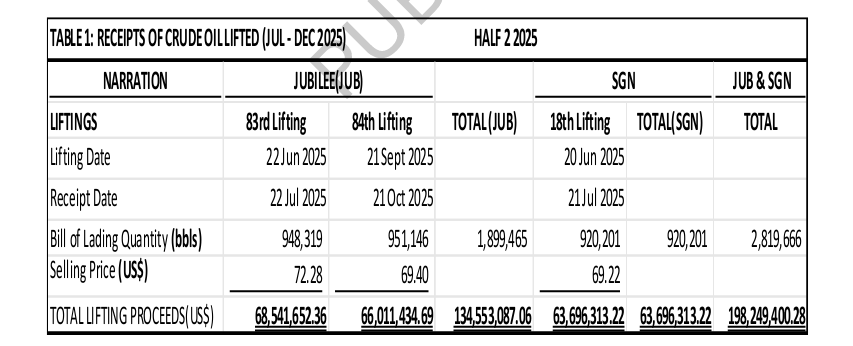
    The semi-annual report showed that receipts from crude oil liftings between July and December 2025 fell to US$198.25 million, down from US$369.25 million recorded over the same period in 2024.

    Data in the report indicated that proceeds from the 83rd and 84th crude oil liftings from the Jubilee field amounted to US$134.55 million, compared with US$144.20 million earned from the 81st and 82nd liftings in the second half of 2024.

    Receipts from the Sankofa Gye-Nyame Field also declined, with the 18th lifting generating US$63.70 million, lower than the US$68.54 million recorded from the 16th lifting in the corresponding period of 2024.

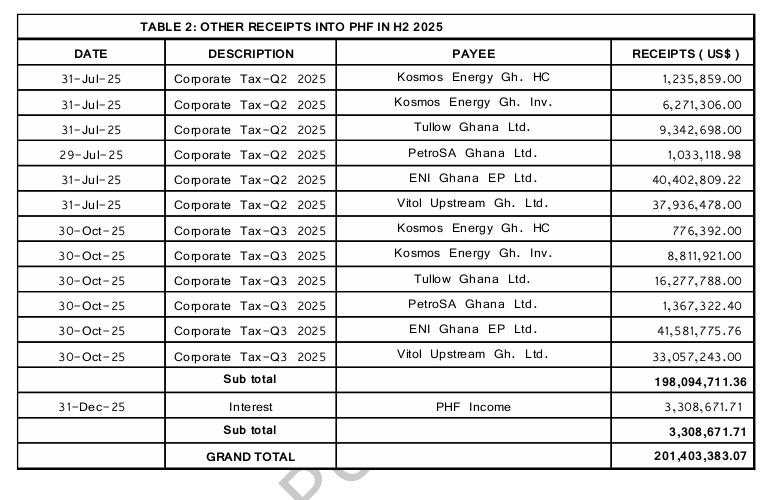
    “During the period under review, a total amount of US$201.40 million was received as other income for corporate income tax and Petroleum Holding Fund interest. The amounts received comprise US$198.09 million for corporate income tax and US$3.31 million for Petroleum Holding Fund interest”, the report said.

    The report noted that total inflows into the Petroleum Holding Fund for the second half of 2025 amounted to US$399.65 million, made up of US$198.25 million from crude oil liftings and US$201.40 million from other income sources.

    It further disclosed that total disbursements from the Petroleum Holding Fund during the period reached US$493.40 million. This included US$134.55 million from the 83rd and 84th Jubilee liftings, US$63.70 million from the 18th lifting at the Sankofa Gye-Nyame Field, and US$295.15 million from other income.

    The Petroleum Holding Fund and the Ghana Petroleum Funds were established under the Petroleum Revenue Management Act, 2011 (Act 815), as amended by Acts 893 and 1138.

    Under Sections 28(1) and (2) of the Petroleum Revenue Management Act, the Bank of Ghana is mandated to report on the performance and operations of the Petroleum Holding Fund and the Ghana Petroleum Funds for the second half of the year ended December 31, 2025.

    Meanwhile, President John Dramani Mahama’s pledge to revive Ghana’s premier crude oil processing facility, the Team Oil Refinery (TOR) has been fulfilled.

    After several years of inactivity, management of Tema Oil Refinery has announced the resumption of operations. The resumption has become possible following the completion of extensive Turnaround Maintenance (TAM) works on the refinery’s Crude Distillation Unit (CDU). Maintenance works on began on August 1 and October 30 this year. This information was contained in a press statement released by the management on Saturday December 27.

    TOR’s resumption is expected to boost energy security, industrial growth and national development, potentially saving Ghana up to $10.2 billion in oil import bills annually.

    Tema Oil Refinery halted its operations in 2018 citing lack of crude oil which serves as a raw material in maintaining the refinery. Other factors that influenced the closure include broken equipment, piled debt, among others.

    Addressing party delegates in 2023, President Mahama assured the creation of jobs through the revamping of the refinery.

    He pledged to revive the Oil Refinery to its former glory which he claimed was collapsed by the then Akufo-Addo government.

    “Since we (NDC) left office, TOR has never processed crude oil again. I remember before we left office, we sent to TOR the first batch of Ghanaian crude oil from our own oil fields for TOR to process. That oil sat there for several years, eventually, they discounted the oil and sold it out without processing it. I can assure you, when NDC comes back, TOR will stand on its feet again”, he noted.

    In June, this year, Managing Director of TOR Mr. Edmond Kombat has revealed refinery operations will commence in October.

    He informed the Parliamentary Committee on Energy on Sunday, June 22, when he briefed the committee on the leadership’s mandate, work plans for the year 2025, and their operational challenges.

    The engagement forms part of the committee’s oversight responsibility of the agencies under the Ministry of Energy and Green Transition.

    In his submission, Mr. Edmond Kombat indicated that TOR will continue with the gantry and terminal upgrade.

    He noted that the current leadership will also complete ongoing projects commenced by the previous administration as well as work on their debt and financial restructuring as well as retooling of their laboratory.

    He noted that the refinery was wallowing in debt worth $517 million after being inactive for the past four years. The current debt is as of December 2024.

    The Managing Director said: “There were times that the Ministry of Finance in the past had given some funds to TOR and some of it, for example, was grants and then when they entered into the agreement with the IMF, the IMF asked them to reclassify it as debt.

    “So, those things have accumulated to that amount of money and I think the last time TOR traded, some of the trades were not hedged,” he said.

    “We are doing that verification and once we do that verification and authentication of what we have been able to bring down, that will be communicated publicly,” Mr. Edmond Kombat.

    According to him, for the past 6 months, TOR had not audited its financial accounts.

    The Managing Director made a special appeal to the parliamentary committee to help them resolve some of their challenges.

    They include restructuring of their debts with the ESLA receivables, converting GOG debts into equity,reinstating the TOR portion of the ESLA Levy, allowing TOR to participate in the primary distribution margin, and giving TOR a representation on the Laycan Committee, among others.

  • Understanding the exchange rate and Bank of Ghana’s role

    Understanding the exchange rate and Bank of Ghana’s role

    A common explanation for movements in the cedi is that the Bank of Ghana (BoG) “supplies dollars ” to influence the exchange rate. This phrase appears in commentary almost every week, yet it creates a misleading picture of how the exchange rate actually works.

    The basic fact is straightforward: the Bank of Ghana does not create U.S. dollars — it creates cedis.
    So when the Bank sells dollars on the market, it is not increasing the true supply of dollars in the economy. It is simply transferring part of its existing reserves to commercial banks in exchange for cedis.

    And here is the part that really matters: those cedis are removed from circulation.
    When the Bank sells USD, the amount of cedi liquidity in the system falls. With fewer cedis available, banks and businesses have less capacity to demand extra foreign currency. The pressure on the dollar eases not because more dollars suddenly exist, but because fewer cedis are chasing those dollars.

    This is the actual mechanism behind exchange-rate movements in Ghana and the BoG’s role.

    The idea that the cedi strengthens because the Bank “supplies more dollars” focuses on the wrong side of the market. It directs attention to the dollar when the decisive factor is the supply of cedis. The Bank of Ghana influences the exchange rate primarily by tightening or loosening cedi liquidity — not by expanding the supply of foreign currency.

    The data from 2025 makes this crystal clear. During the year, the growth of key monetary aggregates slowed dramatically. Reserve money growth, which was rising at over 60 per cent in March, fell into negative territory by September. Growth in total liquidity (M2+) also dropped sharply, falling from above 30 per cent early in the year to single digits by October. In simple terms, the supply of cedis was being squeezed.

    At the same time, the cedi appreciated strongly. The exchange rate moved from about 14.1 Ghana cedis to the dollar in April to around 10.5–11.4 between August and October — a gain of roughly 30 to 40 per cent. The timing was not a coincidence. As cedi liquidity tightened, demand for dollars eased, and the currency strengthened.

    This episode illustrates a broader lesson: exchange-rate stability in Ghana depends far more on domestic monetary conditions than on how many dollars the central bank can inject into the market. When the Bank tightens liquidity, the cedi firms; when liquidity expands too quickly, pressure on the exchange rate returns.

    In short, the phrase “BoG supplies dollars” survives because it reflects what traders see during FX auctions, but it misses the deeper truth. The central bank does not strengthen the cedi by supplying dollars. It strengthens the cedi by withdrawing cedis, which reduces demand for foreign currency.
    Understanding this distinction leads to a clearer view of exchange-rate dynamics — and ultimately, to better policy discussions.

    DISCLAIMER: Independentghana.com will not be liable for any inaccuracies contained in this article. The views expressed in the article are solely those of the author and do not reflect those of The Independent Ghana

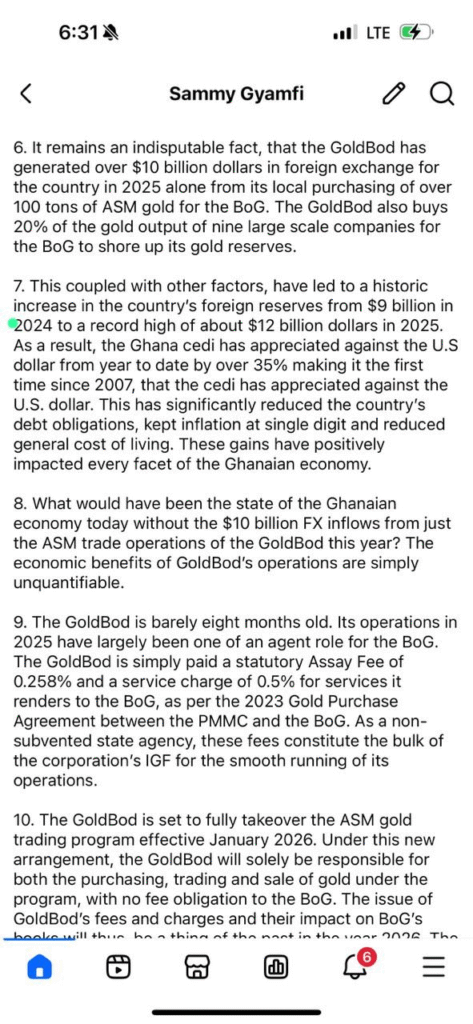
  • GoldBod to fully take over ASM Gold Trading Programme from January 2026 – Sammy Gyamfi

    GoldBod to fully take over ASM Gold Trading Programme from January 2026 – Sammy Gyamfi

    The Ghana Gold Board (GoldBod) will assume full control of Ghana’s Artisanal and Small-Scale Mining (ASM) gold trading programme from January 2026, effectively taking over the purchasing, trading and sale of gold under the scheme.

    This was announced by the Chief Executive Officer, Sammy Gyamfi, in a statement shared on Facebook on December 24 2025.

    Under the new arrangement, GoldBod will operate independently, with no obligation to pay fees to the Bank of Ghana (BoG). This, Mr Gyamfi said, will bring to an end concerns about the impact of GoldBod’s fees and charges on the central bank’s financial records.

    “The GoldBod is set to fully takeover the ASM gold trading program effective January 2026. Under this new arrangement, the GoldBod will solely be responsible for both the purchasing, trading and sale of gold under the program, with no fee obligation to the BoG,” he stated.

    He explained that the transition would resolve long-standing issues linked to the accounting treatment of GoldBod-related charges on the BoG’s books, stressing that such matters would no longer arise from 2026.

    “The issue of GoldBod’s fees and charges and their impact on BoG’s books will thus, be a thing of the past in the year 2026,” Mr Gyamfi added.

    According to him, GoldBod is prepared to take on the expanded responsibility, having received revolving seed trade capital from the government to support its operations. He expressed confidence that the institution would use the funds effectively to generate positive returns for the country.

    “The GoldBod is ready to embrace this new challenge and use its revolving seed trade capital allocated to it by government to deliver positive returns for the Ghanaian people,” he said.

    Mr Gyamfi expressed optimism about the outlook of the sector under the new framework, describing the reforms as a step toward improved management of Ghana’s gold resources.

    Meanwhile, Mr Gyamfi has rejected the International Monetary Fund’s (IMF) report suggesting that the Bank of Ghana incurred losses of about 214 million dollars under the Gold-for-Reserves programme 

    He described the claims as inaccurate, adding that the IMF’s assertions are based on misconceptions and an inaccurate understanding of GoldBod’s operational framework.

    He wrote, “First and foremost, the Ghana Gold Board has made no losses. Rather, the GoldBod has made significant profit/surplus under its gold trading programs in the year 2025. Financial statements of the GoldBod (unaudited) published on its website bear this fact out and indicate that the institution is set to declare income surplus of not less than GH600 million for the year 2025.

    “The GoldBod has this year been responsible for only the local purchasing, assay and export of gold for the Bank of Ghana (BOG). The selling or trading of gold purchased by GoldBod to off-takers lies in the exclusive domain of the BoG.”

    The GoldBod, he added, is not aware of any loss of $214 million incurred by the Bank of Ghana under the Gold-for-Reserves Programme on account of “GoldBod offtaker fees,” noting that the financials of the Gold-for-Reserves and Gold-for-Forex programmes of the Bank of Ghana for the year 2025 are yet to be audited.

    According to him, for the record, there is nothing like “GoldBod offtaker fees” under the ASM gold trading programme, stressing that the assertion is incorrect. He explained that per its 2025 operations, the GoldBod does not deal with off-takers, neither does it charge any off-taker fees. All off-take agreements, he noted, are signed and implemented by the Bank of Ghana. Under these off-take agreements, discounts covering freight, insurance, refining charges, among others, are granted by the Bank of Ghana to off-takers.

    “The only fees the GoldBod takes from the BOG is a statutory Assay Fee of 0.25% and a Service Charge of 0.5%. These fees are not new. In fact, they were inherited by the GoldBod from a 2023 Gold Purchase Agreement between the BOG and the defunct PMMC,” he stated.

    In November, the Ghana Gold Board made significant strides in its operations during the third quarter of 2025, particularly in gold collection and export, reserve building, and regulatory compliance among miners.

    Its latest report shows that small-scale miners handed over 26,153.98 kilograms of gold, valued at approximately US$2.76 billion.

    According to the Chief Executive Officer of the Board, Sammy Gyamfi, “The Ghana Gold Board continued to demonstrate strong institutional performance and sectoral leadership during the third quarter of its operational year (July–September 2025). The period was marked by steady progress in regulatory enforcement, gold aggregation and export, licensing and compliance, and inter-agency collaboration aimed at formalizing Ghana’s gold value chain.”

    “The GoldBod’s operational and financial performance reflects its growing institutional maturity and alignment with the objectives of the Ghana Gold Board Act, 2025 (Act 1140), which mandates it to regulate, promote, and ensure transparency in the purchase, assay, and export of gold and other precious minerals,” Sammy Gyamfi stated.

    This growth, according to the institution, demonstrates that more small-scale miners are operating formally and under improved supervision.

    GoldBod also purchased 119.78 kilograms of gold from large mining companies to support the Bank of Ghana’s reserves, valued at approximately US$11.82 million. This forms part of the government’s broader strategy to strengthen Ghana’s gold reserves and support the economy.

    The Ghana Gold Board (GoldBod) also reported strong export figures for both small-scale and large-scale miners. Small-scale miners exported 25,780.60 kilograms of gold, valued at about US$2.71 billion, while large-scale miners exported 24,911.21 kilograms, worth US$2.43 billion.

    According to the Board, these exports underscore the continued importance of mining in revenue generation and foreign exchange inflows into the country.

    The report further highlighted progress under the new tiered licensing system, which aims to streamline operations and ensure compliance across the sector.

    During the period, a total of 577 licences were processed, comprising 432 Tier 2 licences, 123 Tier 1 licences, and 22 self-financed aggregator licences. Two licences were suspended, while several others were revoked for non-compliance, demonstrating GoldBod’s commitment to sanitising the sector.

  • Ghana’s policy rate to ease to 16.5% by 2026 – Fitch predicts

    Ghana’s policy rate to ease to 16.5% by 2026 – Fitch predicts

    Fitch Solutions projects that the Bank of Ghana (BoG) will lower its monetary policy rate to 16.50% by the end of 2026, driven by sustained currency stability and a continued drop in inflation.

    At the 2026 PricewaterhouseCoopers (PwC) Post-Budget Forum in Accra, Mike Kruiniger, an Assistant Director at Fitch Solutions, explained that Ghana’s improving macroeconomic outlook creates room for further monetary easing in the year ahead.

    “Rates have remained elevated, but the Bank of Ghana launched a decisive easing cycle this summer, cutting by 650 basis points so far — the fastest monetary easing cycle globally this year,” he said.

    According to him, inflation’s return to the central bank’s target range, combined with firm foreign exchange inflows and a stable currency, provides the basis for Fitch’s projection that the policy rate will ease to 16.50 percent by the end of 2026.

    Ghana’s relatively stable cedi, easing inflation, and robust agricultural performance have earned the country an upgrade in growth by UK-based financial analytics firm, Fitch Solutions.

    Fitch, in its September 2025 Monthly Outlook report, lifted its economic growth forecast for the country from 4.2% to 4.9%, citing signs of renewed macroeconomic stability driven by easing inflation, a relatively stable cedi, and resilient agricultural performance.

    Highlighting the challenges the economy is still grappling with, such as tight fiscal consolidation, elevated interest rates, and stagnant oil output, the report said Ghana’s economy remains firmly on a recovery path.

    The upgrade follows a strong performance in Ghana’s agricultural sector, which boosted the economy’s growth in the first quarter of the year. Between January and March, Ghana’s Gross Domestic Product (GDP) grew by 5.3%, compared to 4.7% recorded during the same period last year.

    Fitch believes this growth will continue into 2026, predicting the economy will expand by around 5.0%. This improvement is expected to come from lower inflation (prices rising more slowly), possible interest rate cuts, and more government spending as Ghana’s IMF-supported program comes to an end.

    However, new data from the Ghana Statistical Service (GSS) show that growth slowed down a bit in July 2025 to 4.5%, compared to 8.3% at the same time last year. Even so, agriculture remained the strongest part of the economy, growing by 8.0%—much higher than the 2.4% growth seen in July 2024.

    Inflation for September 2025 dropped to 9.4% from 11.5% in August, according to the Ghana Statistical Service (GSS).

    This marks the ninth month in a row of decline since October 2021. GSS attributed the latest development to the slowdown in food price increases. As of June, the country recorded a 13.7% rate—a 4.7 percentage point decline from the 18.4% reported in May.

    Food inflation fell by 6.5 percentage points to 16.3%, down from 22.8% in May, whereas non-food inflation dropped by 3 percentage points to 11.4%.

    The Upper West Region recorded the highest regional inflation of 32.3%, largely due to food inflation and utilities. The Bono Region recorded the lowest, at 8.4%.

    On a regional level, the Upper West Region once again recorded the highest inflation at 24.8%, though this was down from 32.3% in June. This figure is more than twice the national average of 12.1%. In contrast, the Central Region posted the lowest rate at 7.7%.

    Before the release of GSS’s recent data, economic research firm IC Research projected that Ghana’s inflation rate would experience a significant decline, dropping to 16% by the end of June. According to IC Research, the projected improvement was partly driven by the appreciation of the local currency and a reduction in fuel prices, both of which were easing inflationary pressures.

    “The June 2025 Consumer Price Index (CPI) data window recorded a 29.5% month-on-month and 35.3% year-on-year appreciation of the Ghanaian cedi against the US dollar. This exerted downward pressure on prices of imported items, with notable declines in petroleum prices and transport fares. The announced 15.0% reduction in commercial transport fares will continue to restrain transport inflation, with downward spillovers for other items.

    “Additionally, we estimate that the lower transport cost likely eased the month-on-month pressure observed for vegetables and tubers last month, potentially sustaining food disinflation in June 2025. Consequently, we forecast a 240-basis-point decline in the June 2025 annual inflation to 16.0%, with the month-on-month rate at 0.8%,” IC Research added.

  • BoG registers 100 crypto firms, sets up new office to regulate virtual assets

    BoG registers 100 crypto firms, sets up new office to regulate virtual assets

    More than 100 companies dealing in cryptocurrency have now been registered by the Bank of Ghana under a new policy to regulate the growing digital money space in the country.

    In a document released on November 5, 2025, the Bank said this is Ghana’s first official framework for guiding the use of virtual assets like Bitcoin, tokens, and other digital financial services.

    “The Bank recognizes that virtual assets can no longer remain outside Ghana’s financial regulatory remit,” the document stated.

    According to the Bank, a registration exercise conducted in July 2025 identified over 100 companies providing services such as exchange, wallet management, brokerage, and investment advisory to a user base of more than three million Ghanaians.

    To strengthen supervision, the bank explained it will establish a Virtual Assets Regulatory Office (VARO) to oversee the sector.

    This VARO, it clarified, will act as a link between government oversight and the virtual assets industry, and work with agencies such as the Securities and Exchange Commission (SEC), the Financial Intelligence Centre (FIC), the Ghana Revenue Authority (GRA), and the National Communications Authority (NCA).

    The Bank also wants to start a national programme to teach people about crypto, working together with the Securities and Exchange Commission and the Ministry of Education.

    The programme will help people understand crypto better, especially young people, since they are the biggest users of it in Ghana.

    Ghana is designing its crypto rules to match global standards from big international bodies like the IMF and FATF.

    This makes Ghana one of the few African countries that is creating proper laws for crypto while still encouraging new ideas in the digital space.

    Months ago, the Bank of Ghana (BoG) drew the attention of the general public to Money Transfer Organisations (MTOS) operating within the Remittance and the Ghana Forex Market without approval.

    These MTOs include ACE MONEY TRANSFER, REMIT UNION, REMIT HOME, ROZE REMIT, MONTY GLOBAL.

    The other five are NAIRAGRAM, I-TRANSFER, HURUPAY, EVERSEND and IZI SEND.

    The public, banks, Dedicated Electronic Money Issuer (DEMI) and Enhanced Payment Service Providers (EPSP) have been cautioned to desist from dealing with any of these institutions.

    Approved MTOs have been entreated to terminate their foreign exchange flows through their partner institutions only and to adhere strictly to all the guidelines in respect of their operations.

    Section 3.1 of the Foreign Exchange Act, 2006 Act 723, states that “a person shall not engage in the business of dealing in foreign exchange without a licence issued under this Act.”

    Further, section 15.3 of the Foreign Exchange Act states, “each transfer of foreign exchange to or from Ghana shall be made through a person licensed to carry out the business of money transfers or any other authorised dealer.”

    All market players have been instructed to comply with the directives.

    “Non-compliance will result in severe sanctions including the withdrawal of the licence of the institution in breach,” the BoG added.

    Earlier this month, the Bank of Ghana (BoG) blew the alarm on the operations of Yellow Card Financial Inc., an unapproved digital payment platform.

    According to the central bank in a statement dated June 11, the unlicensed entity is actively promoting itself as a provider of digital payment services, cryptocurrency trading, and cross-border remittance solutions.

    The platform purports to enable users to make payments, send and receive electronic money and stable coins across borders, as well as convert stable coins into local currency.

    These activities, the central bank says, require appropriate licensing from the Bank of Ghana.

    The Bank of Ghana has also discovered that YellowPay is engaged in an ongoing collaboration with HanyPay, an entity that claims to be licensed by the Africa Diaspora Central Bank (ADCB).

    This partnership reportedly seeks to develop and integrate a new stable coin, AKL Lumi, into the global financial ecosystem.

    According to the central bank, this development raises significant regulatory concerns, as HanyPay is neither licensed nor authorized to operate within the jurisdiction of Ghana.

    In 2022, Bank of Ghana (BoG) reiterated its cautionary stance toward the use and trade of cryptocurrencies within its jurisdiction, both to the institutions it licenses and to the general public, citing obvious current risks that it believes, if unchecked, could endanger the country’s financial sector.

    This came after the watchdog reviewed “many regulatory and global standards-setting agencies across multiple jurisdictions” and monitored developments throughout the world to establish a strong “institutional grasp” of important ideas in the developing field of digital finance.

    the central bank’s president

    This was revealed by Dr. Ernest Addison during his remarks at the 2022 Annual Bankers’ Dinner, commonly known as the Governor’s Day, which was held in his honor by the Chartered Institute of Bankers (CIB).

    “The Bank still stands by its cautionary statement to the public on the dangers associated with crypto transactions as contained in several notices in the past. Interested parties need to be wary about potential losses that could occur when trading in crypto. The Bank stands by its earlier directives and the notices issued on March 9 2022, that all licenced institutions should refrain from facilitating crypto transactions via their platforms or agent outlets,” he emphasised.

    In the afore-cited directive, and a similar one issued in 2018, the financial sector regulator stated clearly that cryptocurrencies – the most popular being Bitcoin (BCT) – remain unregulated under any laws in the country, and as such do not have any safeguards since they are not backed by guarantees.

    The Governor however added that his outfit will not impose an outright ban on cryptocurrencies, as it considers such a line of action futile due to the decentralised and borderless nature of the asset class.

    He also stated that the BoG will continue to keenly monitor happenings in the space and allow for the development of crypto and blockchain-leaning products within the confines of its regulatory sandbox, even as it works with other regulators toward a possible regulatory framework.

    “In all of these, the clearest takeaway for the Bank is the fact that cryptocurrencies are digital assets and not currency; and inasmuch as crypto is associated with other key risks including volatility, cyber theft, loss of funds with a potential threat to financial stability, an outright ban has proven ineffective mainly due to its decentralised and borderless nature.

    “Consequently, the Bank intends to continue allowing blockchain in our regulatory sandbox as the first step while we continue to examine a comprehensive regulatory framework for the digital asset industry,” Dr. Addison continued.

  • Govt expenditure falls short of target by 14% between Jan-July 2025 – BoG

    Govt expenditure falls short of target by 14% between Jan-July 2025 – BoG

    A recent report by the Bank of Ghana (BoG) has indicated that the government spent less than it had budgeted for between January and July.


    According to the Bank of Ghana’s September 2025 Monetary Policy Report, the government spent GH¢131.1 billion, which is less than the planned amount of GH¢152.6 billion.

    Thus, government spending accounted for 9.4% of GDP, falling short of the target of 10.9%.


    The report noted that the government spending was 14.1% below target but 9.3% higher than the same period in the previous year. The BoG report attributed the gains to tighter fiscal discipline and improved expenditure control.

    The report indicated that, except for compensation of employees, all major spending categories came in below target. Salaries and wages for public sector workers recorded GH¢44.9 billion from the projected amount. Spending on infrastructure and development projects was GH¢10 billion, much lower than what was expected.

    In September, Ghana’s public debt stock rose by GH¢15.8 billion in July 2025, bringing the overall debt to GH¢628.8 billion, which is equivalent to $59.9 billion.


    According to the BoG, the rise is equal to 44.9% of the country’s total economic output. This follows three consecutive months of declines and is partly attributed to the earlier appreciation of the Ghanaian cedi. Ghana recorded GH¢613 billion in June and GH¢769.4 billion in March.


    The fluctuations in the figures during that period were largely influenced by changes in the exchange rate of the cedi.
    Ghana’s external debt stayed mostly unchanged in July at $29.0 billion. However, domestic debt climbed to GH¢323.7 billion, or 23.1% of GDP, from GH¢312.7 billion in the previous month.


    The Bank of Ghana also announced a 6.3% Gross Domestic Product (GDP) growth in the second quarter of 2025. While acknowledging global financial pressures at the 126th Monetary Policy Committee (MPC) meeting held on September 15, BoG Governor Johnson Pandit Asiama stated that Ghana has seen a 1.0% increase in GDP from the previous 5.3% in the first quarter.


    “Ghana’s recovery is gaining momentum even as the global environment remains uncertain. Worldwide, growth is easing, and financial conditions are still tight amid trade tensions and geopolitical risks; yet domestically, improved fundamentals have strengthened confidence in our outlook.
    “Real activity has firmed. Provisional data show GDP growth accelerated to 6.3 percent in Q2 2025, led by services and agriculture, with non-oil GDP expanding by 7.8 percent,” Dr. Asiama stated.


    According to him, some short-term economic measurements, also known as high-frequency indicators, show that the economy is still growing. Among these, the Bank of Ghana’s Composite Index of Economic Activity was 6.1% higher in July than a year earlier.


    “High-frequency indicators confirm this momentum: the Bank’s Composite Index of Economic Activity was up 6.1 percent year-on-year in July, and recent PMI readings alongside our business and consumer surveys point to improving sentiment,” he added.


    In his update, he also touched on inflation, stating that it fell from 12.1% in July to 11.5% in August, marking a 0.6 percentage point drop in just one month, the eighth consecutive month of decline, and the lowest inflation rate since October 2021.

    He added that, even though there was a decline in remittance inflows, the cedi remains one of the strongest-performing currencies globally.“On the price front, headline inflation fell further to 11.5 percent in August, its lowest since October 2021, supported by a tight monetary stance, fiscal consolidation, and better food supplies; core measures and expectations continue to re-anchor.

    “External buffers have strengthened. For the first eight months of the year, Ghana recorded a trade surplus of US$6.2 billion, underpinned by robust gold exports and higher cocoa receipts. Gross international reserves stood at US$10.7 billion in August, covering about 4½ months of imports.

    “Despite seasonal pressures and a moderation in remittance inflows in recent weeks, the cedi remains among the strongest currencies globally year-to-date, appreciating by about 21 per cent as of September 12.
    “It now ranks alongside high performers such as the Russian ruble, Swedish krona, Norwegian krone, Swiss franc, Euro, and British pound. This outperformance reflects prudent monetary policy, effective liquidity management, fiscal consolidation, and increased foreign exchange inflows,” he stressed.


    The Bank of Ghana in late July projected that inflation was likely to decline further and fall within the medium-term target range of 6 to 10 percent during the third quarter of 2025, ahead of earlier expectations.


    According to a statement released by the Chairman of the Monetary Policy Committee (MPC) and Governor of the Bank of Ghana, Dr. Johnson Asiama, on July 30, 2025, macroeconomic conditions had significantly improved, inflation expectations were broadly anchored, external buffers were strengthened, and confidence in the economy was returning.


    “The July forecast also shows that headline inflation is expected to decline further in the third quarter of 2025 and trend within the medium-term target of 8±2 percent by the end of 2025, earlier than initial projections,” the statement indicated.


    It further explained that the external sector outlook was positive, anchored on favourable commodity prices and improved remittance inflows, despite the resumption of external debt service.


    The statement added that the cedi has further strengthened against major trading currencies on the back of strong external sector performance and increased reserve accumulation.


    Meanwhile, the BoG cautioned that there are upside risks to the inflation outlook, including potential supply chain challenges from global trade tensions and upward adjustments in utility tariffs. This notwithstanding, the central bank maintained that the impact of these risks on inflation is expected to be offset by an appropriately tight monetary policy stance and continued fiscal consolidation.

    The IMF has projected a decrease in global inflation while predicting slower 2025 economic growth in the U.S. and other regions. The Bretton Woods institution attributed this anticipated improvement to the debt restructuring programme implemented by the previous government, noting its positive impact in placing the country on a path toward debt sustainability.


    During the IMF press briefing held on September 11 in Washington, D.C., Director of Communications Julie Kozack responded to a journalist’s question on Ghana’s debt sustainability and the impact of the restructuring agreement.

    She explained that Ghana’s “debt service indicators” have improved significantly because of the restructuring.
    According to her, this development provides the country with greater space to recover economically and channel resources into key investments.

    “The recent restructuring agreement has significantly improved debt service indicators for Ghana, and that has created more space for economic recovery and also much-needed investments in the economy,” she stated.


    Kozack added that IMF research indicates Ghana’s public debt will decline from 82% of GDP in 2022 to around 60% in 2025, describing the trend as a “fairly steep reduction” that demonstrates progress toward fiscal stability.


    “According to our latest assessment, public debt is expected to fall fairly sharply from 82% in 2022. We estimate or project that it will reach 60% of GDP in 2025. That is a fairly steep reduction in public debt and marks a significant step toward durably restoring fiscal sustainability,” she said.

  • Inflation expected to hit 8% target by December – BoG

    Inflation expected to hit 8% target by December – BoG

    The Bank of Ghana has projected that headline inflation will fall within its medium-term target of 8 ± 2% by the end of 2025.

    The Central Bank attributed this expected decline to tighter monetary policy, the strengthening of the cedi, and continued fiscal consolidation efforts.

    It added that supply-side pressures have eased, resulting in lower food and overall inflation, with risks now tilted to the downside.

    Nonetheless, the Bank warned that some upward risks persist, including supply chain disruptions, global trade tensions, a 2.5% increase in utility tariffs, and a new 1.0% energy levy on ex-pump prices, which could push inflation up.

    Looking ahead, the Bank expects exchange rate stability to continue, supported by a stronger external sector and a buildup of international reserves that have exceeded program targets under the IMF’s Extended Credit Facility.

    It noted that a tight monetary policy stance, fiscal discipline, and stable crude oil prices are likely to cushion the economy against inflationary pressures.

    Meanwhile, Inflation dropped to 9.4% in September 2025, marking the ninth consecutive monthly decline, driven mainly by a fall in food prices.

    Ghana Statistical Service attributed the development to the slowdown in food price increases. As of June, the country recorded a 13.7 percent rate, a 4.7 percent decline from the 18.4 percent rate reported in May.

    Food inflation fell by 6.5 percentage points to 16.3 percent, down from 22.8 percent in May, whereas non-food inflation dropped by 3 percentage points to 11.4 percent.

    The Upper West Region recorded the highest regional inflation of 32.3%, largely due to food inflation and utilities. The Bono region recorded the lowest of 8.4%.

    On a regional level, the Upper West Region once again recorded the highest inflation at 24.8%, though this was down from 32.3% in June. This figure is more than twice the national average of 12.1%. In contrast, the Central Region posted the lowest rate at 7.7%.

    Before the release of GSS’s recent data, an economic research firm, IC Research, projected that Ghana’s inflation rate would experience a significant decline, dropping to 16% by the end of June.According to IC Research, the projected improvement is partly driven by the appreciation of the local currency and a reduction in fuel prices, both of which are easing inflationary pressures.

    “The June 2025 CP [Consumer Price Index]I data window recorded a 29.5% month-on-month and 35.3% year-on-year appreciation of the Ghanaian cedi against the US dollar. This exerted downward pressure on prices of imported items, with notable declines in petroleum prices and transport fares.The announced 15.0% reduction in commercial transport fares will continue to restrain transport inflation with downside spillovers for other items.

    “Additionally, we estimate that the lower transport cost likely eased the month-on-month pressure observed for vegetables & tubers last month, potentially sustaining food disinflation in June [2025]. Consequently, we forecast a 240 basis points decline in the June 2025 annual inflation to 16.0% with the month-on-month rate at 0.8%”, IC Research added.

    Ghana ended the year 2024 with 23.8% inflation. In January 2025, inflation slightly declined to 23.5%. And since then, it has continued to ease. In February, inflation declined to 23.1%; it saw another decrease in March to 22.4% and declined again in April to 21.2%.

    Due to the consistent decline in the inflation rate and recorded progress with other macroeconomic variables, the Bank of Ghana’s (BoG) Monetary Policy Committee has reduced the monetary policy rate from 28 percent to 25 percent.

    Governor of the Bank of Ghana, Dr Johnson Asiama, noted that the deceleration was underpinned by the tight monetary policy stance, fiscal consolidation, easing food supply constraints, as well as the strong recovery of the cedi.

    In line with the easing underlying inflation pressures, the Bank’s main core inflation measure, which excludes energy and utility items, has declined markedly.

    “Similarly, inflation expectations by banks, consumers, and businesses are broadly anchored,” he added.

    He further revealed that “growth in monetary aggregates remained subdued during the first half of the year, primarily due to the tight monetary policy stance, strong liquidity management, and reduced government borrowing.”

    “In line with the disinflation process and easing inflation expectations, interest rates at the short end of the money market have declined sharply, and in turn, reduced the cost of government borrowing”.

    According to Dr Asiama, data on budget execution indicated a strong commitment to fiscal consolidation as expenditures adjusted within set targets to accommodate the revenue shortfalls during the first half of 2025.

    As a result, the overall fiscal deficit on a commitment basis was 0.7 percent of GDP, outperforming the budget target of 1.8 percent of GDP.

    “The external sector has improved markedly, with a record current account surplus of US$3.4 billion in the first half of 2025, supported mainly by higher prices and increased production volumes of gold and cocoa.

    “The current account surplus, together with the outturns in the capital and financial accounts, culminated in an overall balance of payment surplus of US$2.2 billion, significantly higher than the US$588.5 million recorded in June 2024. On this score, Gross International Reserves stood at US$11.1 billion at end-June 2025, equivalent to 4.8 months of import of goods and services, compared to US$8.9 billion (4.0 months of import cover) as at end-December 2024,” he added.

    Overall, the Committee noted that macroeconomic conditions have significantly improved, “inflation expectations are broadly anchored, external buffers have strengthened, and confidence in the economy is returning.”

    The cedi has rebounded strongly against the major trading currencies. The cedi has recorded a remarkable turnaround in the first six months of 2025, appreciating by 42.6% against the US dollar.

    The cedi also appreciated by 30.3% against the British pound and 25.6% against the euro during the same period. Meanwhile, the Bank of Ghana has projected that inflation is likely to decline further and fall within the medium-term target range of 6 to 10 percent during the third quarter of 2025, ahead of earlier expectations.

    “The July forecast also shows that headline inflation is expected to decline further in the third quarter of 2025 and trend within the medium-term target of 8±2 percent by the end of 2025, earlier than initial projections,” the Governor noted.

  • GSA to set up taskforce to ensure exchange rate compliance 

    GSA to set up taskforce to ensure exchange rate compliance 

    The Ghana Shippers’ Authority has announced plans to establish a task force to ensure exchange rate compliance. This was announced by the Chief Executive Officer of the Authority, Professor Ransford Gyampo, on Tuesday August 12, 2025

    Last month, the Bank of Ghana (BoG) announced its guidelines on the application for exchange rates for players in the shipping industry in the country following consultations with stakeholders.

    In the statement, the guidelines direct the publication of daily exchange rates used for invoicing on their website and/or at their premises. Prior to the issuance of invoices or payment, the published rate is to be made available to customers and clearly communicated.

    The invoices are to clearly indicate the currency of the service, applied exchange rate, date of application, and final amount in Ghana cedis or United States dollars.

    “Exchange rates must be market-reflective of their commercial bank rates which is expected to be benchmarked to the Bank of Ghana’s published interbank exchange rate and not arbitrarily determined,” the statement signed by Secretary at the Bank of Ghana, Ms Sandra Thompson, added.

    The guidelines came into effect on 22nd July, 2025, and according to the Central Bank, they will remain in force until otherwise amended or revoked. These guidelines aim to ensure transparency, consistency, and alignment with regulatory frameworks in foreign exchange pricing for services offered at the ports.

    With regard to disputes relating to exchange rate application, the Bank of Ghana has entreated customers to lodge a formal complaint with the service provider. Unresolved complaints may be escalated to the Ghana Shippers’ Authority (GSA), the central bank noted. The central bank noted that “all industry players must comply with the Foreign Exchange Act, 2006 (Act 723) and related notices,” as “non-compliance may result in administrative sanctions.”

    The Ghana Shippers’ Authority, over a week ago, announced that it was engaging the Bank of Ghana on a complaint it had received from some shippers and freight forwarders with regard to the arbitrary application of foreign exchange rates by some shipping lines.

    The Authority only engaged the central bank—the regulator of the forex space, the shipping lines, and the complainants—to receive an official directive from the Bank of Ghana to prohibit the illegal act upon the findings of an investigation it conducted into the matter in pursuit of a fair outcome. The meeting was held on Tuesday, July 15, 2025, and the conclusive resolution of the challenge that has been issued by the central bank has been published by the Ghana Shippers’ Authority for the attention and benefit of all stakeholders. 

    Meanwhile, the Authority has sought the input of stakeholders in the shipping and logistics sector in drafting a Legislative Instrument (L.I.) that will aid the enforcement of Act 1122 (2024), to fortify the execution of its mandate. These include the regulators of transport modes by which international trade is undertaken, service providers, terminal operators, and shipping lines.

    The GSA has revealed its commitment to ensure that enforcement of the law “would remain without fear or favour, whilst upholding its mutually beneficial essence for the utmost good of Ghana and her people.”

    “The Ghana Shippers’ Authority hereby reassures the general public that, it remains committed to serving the interests of all stakeholders in the shipping and logistics sector, and beyond that, GSA is particularly focused on positioning Ghana as the preferred hub in international trade. These objectives remain the guiding principles in our operations and will be upheld at all times,” the Authority revealed on its website.

    In a related event, the Ghana Shippers’ Authority has clarified its mandate and ongoing interventions to ensure a conducive shipping and logistics ecosystem for all players in the sector. This stemmed from an article that sought to know about the extent of the effectiveness of the GSA Act, 2024 (Act 1122) since its passage by Parliament on 29th July 2024 and assent by the then President of the Republic of Ghana on 17th October 2024.

    The GSA noted that the passage of Act 1122 (2024), which marked a significant milestone in the growth of the country’s trade sector, transformed the Authority from an advocacy institution to a regulatory authority.

    “The shift reflected a broader national commitment to foster inclusive, transparent, and cost-effective governance of the sector. Under the new law, shipping service providers—including shipping lines, freight forwarders, terminal operators, and clearing agents—are required to submit all proposed charges, fees, and tariffs to the GSA for review and approval prior to their implementation,” the Authority noted.

    According to the Ghana Shippers’ Authority, it has carried out its mandate in several instances, such as engaging shipping lines as well as ground handlers who operate at the Kotoka International Airport (KIA) over submitting their charges for review and approval. According to the GSA, these stakeholders were compliant with the law.

    “GSA has adopted an inquisitorial rather than adversarial approach to enforcing its Act. In this regard, thorough investigations into complaints, claims and assertions have informed the decisions and actions taken in response to shipper complaints. Active engagements of the stakeholders involved to grant a hearing to each side have been employed to ensure that the outcomes of interventions aid progress rather than stagnation or retrogression,” the Authority added. The GSA emphasised that its role as a regulator is not aimed at stifling businesses and international trade.

    In an unrelated event, the Ghana Shippers’ Authority has called on agencies operating at the country’s port to desist from engaging in siloed operations. The Authority has recommended a collaborative approach that is to reduce cost, ensure efficiency, and improve the country’s international trade reputation.

    In June, Deputy Chief Executive Officer of the GSA, Sylvia Asana Dauda Owu, who made the call at the maiden Southern Zonal Stakeholder Committee Meeting for 2025, noted that it was imperative to boost round-the-clock operations and enhance competitiveness.

    “The clarion call is for every institution to stop working in silos and start acting with awareness of how their respective roles impact the broader ecosystem,” she said.

    According to her, the shipping and logistics industry, which is a highly intricate ecosystem, functions effectively when all sector players, including regulatory and security agencies, terminal operators, freight forwarders, and shipping lines, take notice of their coordinated and interdependent efforts.

  • Ghana’s total exports surges to $13.8 billion as of June 2025

    Ghana’s total exports surges to $13.8 billion as of June 2025

    Data from the Bank of Ghana’s Summary of Macroeconomic and Financial Data reports an increase in the value of the country’s total exports as against total imports, leading to a trade surplus of $5.57 billion.

    As of June 2025, Ghana’s total exports reached $13.8 billion, a monthly gain of over $2.3 billion from the $11.54 billion recorded in May 2025. In June, gold exports surged to $8.39 billion, cocoa exports reached $2.32 billion, and oil exports rose to $1.36 billion. Other exports were valued at $1.88 billion. In May, the value of exported gold stood at $6.85 billion, cocoa at $2.01 billion, oil at $1.09 billion, and other exports at $1.59 billion.

    With regard to total imports for June 2025, the value stood at $8.23 billion. The value of imported oil stood at $2.59 billion and non-oil imports at $5.64 billion. In May, Ghana recorded relatively less for imported goods. Imports reached $6.68 billion, with oil imports at $2.11 billion and non-oil imports at $4.57 billion. The trade surplus for the month of May stood at $4.85 billion.

    As of March 2025, total exports stood at $7.03 billion. Gold exports generated $3.73 billion, cocoa exports stood at $1.59 billion, oil exports raked in $780.2 million, and other exports at $924.9 million. However, imports for that totaled $3.73 billion, with oil at $1.27 billion and non-oil at $2.46 billion. A trade balance of $3.29 billion was reported.

    In April 2025, exports rose to $9.26 billion, largely from increased gold exports at $5.25 billion, cocoa exports at $1.85 billion, oil exports at $908.5 million, and other exports at $1.25 billion. Total imports grew to USD 5.13 billion, with oil at $1.68 billion and non-oil at $3.45 billion. A trade surplus of $4.12 billion was reported.

    Per the report, Gross International Reserves (GIR) increased steadily, from $5.99 billion in March 2024 to $11.22 billion by June 2025. Import cover improved from 2.7 months in early 2024 to 4.8 months in June 2025. The net international reserves (NIR) also expanded from $3.86 billion in March 2024 to $8.88 billion by mid-2025.

    Private transfers (remittances) maintained strong growth, reaching $3.93 billion by June 2025, compared to $1.79 billion in March 2024—more than doubling within the 15-month period.

    Meanwhile, the current account balance swung from a deficit of -$117.6 million in March 2024 to a surplus of $3.43 billion in June 2025. The financial account, which was negative in early 2024 (-$287 million), turned positive to $1.6 billion in May and $1.59 billion in June 2025.

    Per the data provided by the Bank of Ghana, it can be reported that the country’s external sector developments show sustained improvements in 2025 compared to the same period in 2024. Key indicators such as exports, imports, current account balance, and international reserves showed growing trade activity and improved external sector stability.

  • Monetary policy rate reduced to 25% due to improved macroeconomic conditions

    Monetary policy rate reduced to 25% due to improved macroeconomic conditions

    The Bank of Ghana’s (BoG) Monetary Policy Committee has reduced the monetary policy rate from 28 percent to 25 percent.

    At a press conference held on Wednesday, July 30, the Governor of the Bank of Ghana, Dr Johnson Asiama, said, “the Committee, by a majority decision, voted to lower the Monetary Policy Rate by 300 basis points to 25.0 percent. Looking ahead, the Committee will continue to assess incoming data and likely reduce the policy rate further, should the disinflation trend continue. The Committee remains committed to the price stability mandate, while creating conditions for inclusive and sustainable growth.”

    Since the last MPC meeting, the Monetary Policy Committee revealed that headline inflation has declined further to 13.7 percent in June 2025 from 18.4 percent in May, the lowest reading since December 2021.

    “The deceleration was underpinned by the tight monetary policy stance, fiscal consolidation, easing food supply constraints, as well as the strong recovery of the cedi. In line with the easing underlying inflation pressures, the Bank’s main core inflation measure, which excludes energy and utility items, has declined markedly. Similarly, inflation expectations by banks, consumers, and businesses are broadly anchored,” the Governor explained.

    He further revealed that “growth in monetary aggregates remained subdued during the first half of the year, primarily due to the tight monetary policy stance, strong liquidity management, and reduced government borrowing.”

    “In line with the disinflation process and easing inflation expectations, interest rates at the short end of the money market have declined sharply, and in turn, reduced the cost of government borrowing,” the BoG Governor added.

    According to Dr Asiama, data on budget execution indicated a strong commitment to fiscal consolidation as expenditures adjusted within set targets to accommodate the revenue shortfalls during the first half of 2025.

    As a result, the overall fiscal deficit on commitment basis was 0.7 percent of GDP, outperforming the budget target of 1.8 percent of GDP.

    “The external sector has improved markedly, with a record current account surplus of US$3.4 billion in the first half of 2025, supported mainly by higher prices and increased production volumes of gold and cocoa. The current account surplus, together with the outturns in the capital and financial accounts, culminated in an overall balance of payment surplus of US$2.2 billion, significantly higher than the US$588.5 million recorded in June 2024. On this score, Gross International Reserves stood at US$11.1 billion at end-June 2025, equivalent to 4.8 months of import of goods and services, compared to US$8.9 billion (4.0 months of import cover) as at end-December 2024,” he added.

    Overall, the Committee noted that macroeconomic conditions have significantly improved, “inflation expectations are broadly anchored, external buffers have strengthened, and confidence in the economy is returning.”

    The Bank of Ghana’s Monetary Policy Committee (MPC) on July 21 commenced its 125th regular meeting to review the measures put in place to ensure the country’s economic growth.

    At the 124th Monetary Policy Committee (MPC) meetings held from 21 to 23 May 2025, the Committee, by a unanimous decision, maintained the Monetary Policy Rate (MPR) at 28.0 percent to check the country’s inflation rate. In addition to the policy rate decision, the Bank also announced an amendment to the Dynamic Cash Reserve Ratio (CRR), with effect from 5 June 2025. 

    With the amendment, all banks will be required to maintain the CRR in their respective currencies. This means foreign currency reserves for foreign currency deposits and domestic currency reserves for domestic currency deposits.

    The Committee revealed that global economic developments in the first four months of the year were characterised by low growth prospects, unsynchronised disinflation outcomes, and restrictive global financial conditions.

    On the domestic front, the Bank’s high-frequency real sector indicators point to a sustained pickup in economic activity. The updated Composite Index of Economic Activity increased by 2.3 percent year-on-year in March 2025, compared with 1.0 percent over the same period last year.

    Headline inflation has declined consecutively and stands at 13.7 percent as of June 2025. The external sector has continued to improve, with a record provisional current account surplus of US$2.1

    billion in the first quarter of 2025. Gross International Reserves (GIR) amounted to US$10.7 billion in April 2025, equivalent to 4.7 months of import of goods and services.

    The cedi has rebounded strongly against the major trading currencies. The cedi has recorded a remarkable turnaround in the first six months of 2025, appreciating by 42.6% against the US dollar. The cedi also appreciated by 30.3% against the British pound and 25.6% against the euro during the same period.

    Ahead of today’s meeting, the International Monetary Fund (IMF) has entreated the central bank to maintain a tight monetary policy stance to stabilize the gains chalked up in reducing inflation.

    Speaking at a press briefing in Washington, IMF Communications Director Julie Kozack said, “Going forward, it will be important for monetary policy to remain sufficiently tight, consistent with bringing inflation down to the Bank of Ghana’s target range of 8 percent, plus or minus 2 percentage points.”

    “Ghana has made good progress since the beginning of the program in reducing inflation. Inflation was extremely high at the end of 2022 at 54%. It has now come down substantially to 14% at the end of June 2025,” Kozack added.

    Macroeconomic performance in first half of 2025

    The government’s macroeconomic targets for the year 2025 are as follows: overall real Gross Domestic Product (GDP) growth of at least 4.0%, non-oil real GDP growth of at least 4.8%, end-year inflation rate of 11.9%, primary balance on commitment basis at a surplus of 1.5% of GDP, and gross International Reserves covering not less than three months of imports.

    Presenting the 2025 mid-year budget review on the floor of Parliament on Thursday, July 24, the Minister for Finance, Dr Cassiel Ato Forson, indicated that the first half of 2025 has demonstrated the government’s commitment to economic recovery.

    He noted that through prudent fiscal management, sound monetary policy, effective structural reforms and strategic investments, the government is laying a solid foundation for sustainable growth and shared prosperity.

    In the first quarter of 2025, the economy expanded by 5.3%, up from 4.9% in the same period of 2024, marking the highest first-quarter growth since 2020. The agriculture sector led this growth with a remarkable 6.6% increase, about three times the growth in first quarter of 2024. The agriculture sector growth contributed 26.4% of the overall first quarter growth. The fishing sub-sector grew the most at 16.4%. The services sector, constituting the largest share of the economy at 46.8%, grew by 5.9% and contributed 47.9% to the overall first quarter growth, with Information and Communication Technology (ICT) leading the growth in the sector at 13.1%.

    Industry grew by 3.4% in the first quarter of 2025, contributing 20.6% to the overall first quarter growth.

    Manufacturing also posted an impressive growth of 6.6%. Non-oil GDP growth also picked up strongly, growing at 6.8% in the first quarter of 2025 compared to the growth rate of 4.3% in the same period in 2024.

    The non-oil GDP growth is the highest since 2018. It is expected that with the introduction of the 24-Hour Economy Policy, the Big Push Programme and the Agriculture for Economic Transformation Programme, the GDP growth will be sustained and possibly exceed the targeted rate of 4% for 2025.

    Inflationary pressures have eased significantly, and according to the Finance Minister, the drastic fall in inflation “is not by chance or sheer luck but as a result of hard work and deliberate policies.”

    He revealed consumer price inflation has reduced from 23.8% in December 2024 to 13.7% in June 2025, representing a 10.1 percentage point decline. Similarly, producer price inflation saw a sharp decline from

    26.1% in December 2024 to 5.9% in June 2025, representing a steep decline of 20.2 percentage points in six months.

    Food inflation declined from 27.8% in December 2024 to 16.3 percent in June 2025, representing an encouraging 11.5 percentage point reduction. Non-Food inflation also declined from 20.3% in December 2024 to 11.4% in June 2025, representing an 8.9 percentage point reduction.

    Inflation for locally produced goods and services declined from 26.4% in December 2024 to 14% in June 2025. Inflation for imported items decreased from 18.0% in December 2024 to 12.5% in June 2025.

    The minister remarked that “these improvements are reflective of the effective fiscal consolidation, tight monetary policy, strong central bank reserves and the appreciation of the cedi. Mr. Speaker, with this trend, we are focused and determined to achieve our end-December 2025 inflation target of 11.9% ahead of schedule.”

  • BoG’s operating loss drops by 28% to GH¢9.49bn in 2024

    BoG’s operating loss drops by 28% to GH¢9.49bn in 2024

    The Bank of Ghana (BoG) has reported an operating loss of GH¢9.49 billion for the 2024 financial year, reflecting a 28.27 percent reduction from the GH¢13.23 billion operating loss recorded in 2023.

    Key drivers of the operating loss include the cost of open market operations, GH¢8.60 billion; revaluation and exchange differences (losses) totaling GH¢3.49 billion; exchange losses of GH¢1.82 billion on the government’s Gold for-Oil (G4O) programme and currency issue expenses of GH¢1.01 billion for 2024, from GH¢0.69 billion in 2023.

    Also, the modification to the choice of accounting treatment of foreign exchange gains and losses resulting from revaluation of the bank’s assets and liabilities in gold, special drawing rights, and foreign securities resulted in the 2024 operating loss. 

    As of 31 December 2024, the Bank had committed seed capital amounting to GH¢44.69 billion towards the G40 programme. In view of the losses sustained, the bank has withdrawn from the program following the Board of Directors’ approval at its meeting held on March 13, 2025.

    Despite the loss, the central bank indicated in a statement that this marks a net gain of GH¢4 billion compared to the previous year’s financials, which recorded a total loss of GH¢9.19 billion.

    The Bank of Ghana’s total assets also grew from GH¢140.41 billion in 2023 to GH¢215.06 billion in 2024, representing a 53.19% increase.

    Summarizing the year’s performance, the Bank of Ghana stated that the 2024 financial year saw improvements in the bank’s financial performance and position.

    This, the bank says, was evidenced in the reported loss for the year of GH¢9.49 billion and the GH¢4.02 billion enhancement in its equity position to close the year at a negative value of GH¢61.32 billion.

    The central bank recorded a negative GH¢65.34 billion equity position in 2023, revealing an improvement of GH¢4.02 billion last year.

    The policy solvency outcome for 2024 is consistent with the view held in 2023 that the Bank will continue to operate efficiently and effectively on a going concern basis and achieve its policy mandates, despite the significant loss recorded at the time. 

    “From a macroeconomic perspective, as macroeconomic conditions continue to improve and inflation declines towards the medium-term target, interest rates will also decline, and as a result, the cost of Open Market Operation will reduce.”

    “A decline in inflation will support exchange rate stabilization. The two major expenditures items cost of open market operations and revaluation losses arising out of exchange rate valuation which have historically constituted over (68.67 percent) of the total operating expenses will reduce and further improve the financial position of the Bank of Ghana,” the Report and Financial Statements 31 December 2024 read.

    A central bank is said to be policy solvent when it is able to generate enough realized income to cover costs associated with the conduct of monetary policy operations.

    The release of the 2024 financial statement in accordance with Section 58(1b) of the Bank of Ghana Act, 2002 (Act 612) as amended, according to the BoG, demonstrates its adherence to statutory requirements and ongoing dedication to transparency, accountability, and sound financial management.

    It added, “The bank is committed to maintaining price and financial stability and creating an enabling environment for businesses and individuals to thrive.”

    The Bank of Ghana posted losses totaling GH¢60.81 billion for the 2022 financial year. This was compared to a profit of GH¢1.23 billion recorded in the 2021 financial year.

    The losses were as a result of the government’s domestic debt restructuring activities, the depreciation of the local currency, and others.

    The BoG’s audited financial statement for 2022 indicated that the total liabilities of the central bank and its subsidiaries exceeded its total assets by GHS54.52 billion.

  • Over-the-counter cash withdrawals in foreign currency still allowed – BoG clarifies

    Over-the-counter cash withdrawals in foreign currency still allowed – BoG clarifies

    The Bank of Ghana (BoG) has clarified that over-the-counter (OTC) cash withdrawals in foreign currency from Foreign Exchange Accounts (FEA) and Foreign Currency Accounts (FCA) are allowed.

    This clarification comes after a board member of the central bank, Isaac Adongo, noted that the central bank is set to introduce a number of measures to quell the magnitude of over-the-counter US dollar withdrawals.

    Isaac Adongo noted that this measure, coming at a time when the cedi is recording a significant amount of appreciation against major foreign currencies, forms part of the bank’s role to regulate the use of the legal tender.

    Speaking in an interview on JoyNews’ PM Express, he said; “If you put your dollars in the bank account, it is okay. We are happy with that; you can only get dollars if indeed you are going to use them for a dollar-denominated transaction.”

    The Member of Parliament of Bolgatanga Central added; “When you request dollars, we’ll provide cedis instead.”

    However, the BoG has noted in a press statement dated May 15 that “the Bank has not contemplated reviewing these existing measures.”

    The central bank has also announced that it has capped the forex purchases for travel outside Ghana by non-FEA and non-FCA account holders at US$10,000 or its equivalent per person per trip.

    “This must be supported by a valid passport, visa, and confirmed travel ticket as indicated in BOG Notice No. BG/GOV/SEC/2014/09
    Cheques and cheque books may continue to be issued on FEA and FCA accounts,” the statement added.

    The Ghana cedi has been recognized by Bloomberg as the world’s best-performing currency, having appreciated nearly 16% against the US dollar since April.

    The average interbank rates used by commercial banks for transactions at the close of business, 14th May, show the US dollar buying at GH₵12.44 and selling at GH₵12.45. The British pound is buying at GH₵16.55 and selling at GH₵16.57. The euro is currently being bought at GH₵13.95 and sold at GH₵13.96.

    Following the appreciation of the cedi, there have been calls by stakeholders for traders to revise the prices of the goods and services to reflect the gains.

  • “As long as I am Governor no revoked banking licenses are wiil be reinstated – Dr. Addison

    “As long as I am Governor no revoked banking licenses are wiil be reinstated – Dr. Addison

    Governor of the Bank of Ghana, Dr. Ernest Addison, has made it clear that the banking licenses that were revoked during the financial sector reforms of 2017–2019 will not be restored as long as he is in office.

    In an interview with JoyNews on January 2, 2025, Dr. Addison responded to calls for the reinstatement of the revoked licenses, declaring, “As long as I am Governor, none of those licenses will be reinstated.”

    His comments addressed inquiries about whether the incoming government might consider reinstating the licenses following appeals from shareholders of the affected banks.

    Dr. Addison emphasized that the license revocations were based on thorough assessments of the banks’ operations, which revealed significant issues, including risky investments and poor management of depositor funds.

    “These shareholders treated depositors’ money as their own, using it to fund personal businesses or invest in brick-and-mortar projects that were not liquid enough to make resources available when depositors needed their funds,” Dr. Addison stated.

    During the financial reforms, the Bank of Ghana revoked the licenses of nine universal banks, 347 microfinance companies, 39 microcredit companies, 23 savings and loans firms, and eight finance houses.

    Some of these companies were merged to form Consolidated Bank Ghana (CBG).

    Dr. Addison emphasized that the failed institutions showed poor management, which broke the fundamental rules of banking.

    “When I give you a banking license, I am giving you permission to take people’s money, not to treat it as your private property,” he added, reiterating that protecting depositors and preserving financial stability are the central bank’s core responsibilities.

    Dr. Addison further noted, “These are not numbers we generated ourselves,” referencing data from Ghana’s Statistical Service to highlight the beneficial effects of the reforms on the financial industry.

    He warned that reinstating the revoked licenses would jeopardize the stability of the industry and criticized efforts to downplay the necessity of the reforms.

    “A banking license is a special instrument, and the responsibilities it comes with must be taken seriously,” he concluded.

  • Bank of Ghana issues new lending rules for financial institutions

    Bank of Ghana issues new lending rules for financial institutions

    The Bank of Ghana has issued the Large Exposures Directive for Banks, Savings and Loans, Finance Houses and Financial Holding Companies.

    The objectives of the directive are to limit the maximum loss that Regulated Financial Institutions (RFIs) can incur in the event of the sudden failure of a counterparty or a group of connected counterparties to a level that does not endanger the RFI’s solvency; Provide direction to RFIs on regulatory requirements in order to eliminate any ambiguities in the interpretation of the rules related to limits on financial exposures; among others.

    Section 92 (2)(a) of Act 930 states that the Bank of Ghana may issue directives to provide for the lending limits on credits extended to insiders and the limitations for advances or credit facilities to a single borrower.
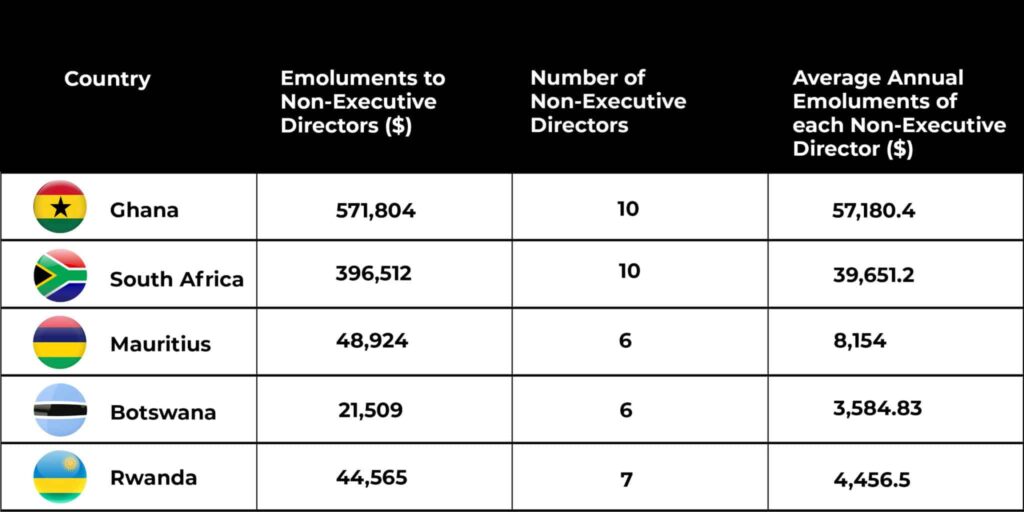
    Section 77 (1) of Act 930 provides that the BoG may, in respect of a prudential limit prescribed under this Act, impose a stricter limit for banks, specialised deposit-taking institutions or financial holding companies or a class of specialised deposit-taking institutions or a particular bank, specialised deposit-taking institution or financial holding company for the period that the Bank of Ghana considers appropriate.

    The effective implementation date of the directive shall be January 1, 2026.

    RFIs are expected to conduct impact assessments prior to the implementation date and where there are non-compliance with the requirements of this directive, submit a credible Board-approved plan acceptable to the BoG by June 30, 2025 detailing the manner RFIs propose to achieve compliance.

    The submitted plan shall include the proposed time frame within which it proposes to become fully compliant with this Directive which shall not, in any event, exceed six (6) months from the required submission date.

    This directive is applicable to all RFIs’ exposures to single counterparties and groups of connected counterparties irrespective of their performance or the quality of any pledged collateral.

  • BoG suspends CBG’s foreign exchange trading licence for a month

    BoG suspends CBG’s foreign exchange trading licence for a month

    The Bank of Ghana (BoG) has announced the suspension of the Foreign Exchange Trading Licence of Consolidated Bank Ghana (CBG), effective from 26th November 2024.

    The suspension, which will last for one month, was issued under section 11 (2) of the Foreign Exchange Act, 2006 (Act 723).

    According to the Bank of Ghana, the suspension was enforced following multiple breaches by CBG of the foreign exchange market regulations, including the Updated Guidelines for Inward Remittance Service for Payment Service Providers, issued in November 2023. The breaches also relate to violations of the Anti-Money Laundering/Combating the Financing of Terrorism & the Proliferation of Weapons of Mass Destruction (AML/CFT&P) Act, as well as the Accountable Institutions Guideline, dated December 2022.

    The licence will be restored after the suspension period if the Bank of Ghana is satisfied that CBG has implemented effective controls to ensure compliance with foreign exchange market regulations.

    For customers, this suspension means limited access to essential foreign exchange services. During this period, CBG will not be able to handle any currency exchange transactions, including buying or selling foreign currencies. This restriction impacts customers who may need to convert their cedi accounts into foreign currencies like the dollar or pound for travel, business, or international payments.

    The Bank of Ghana has entreated all foreign exchange market players to adhere strictly to forex market regulations and guidelines to maintain market stability and compliance.

  • Liquidity risk well-contained in banking industry – Bank of Ghana

    Liquidity risk well-contained in banking industry – Bank of Ghana

    The Bank of Ghana has disclosed that liquidity risks in the banking sector are manageable, contingent on the liquidity of Government of Ghana (GoG) bonds.

    Central Bank stress tests indicate that, with a liquid GoG bonds market, most banks could withstand daily deposit withdrawals between 1.0% and 4.0% over a 30-day period.

    However, if the GoG bond market becomes illiquid, most banks would struggle to sustain withdrawals beyond 1.0% of deposits per day over the same period.

    The banking sector is strong enough to handle possible interest rate hikes.

    A stress test (a kind of financial simulation) indicates that if interest rates were to rise by 16 percentage points over the next year, banks would still remain stable, though their capital adequacy ratio (a key measure of financial health) would drop from 13.85% to 11.57%.

    Interestingly, the report also notes that if interest rates were to fall sharply, the banking sector might actually become more stable. This is because banks’ liabilities (what they owe) would adjust faster than their assets (what they own), which could improve their financial standing. Therefore, a gradual drop in interest rates is expected to make the banking sector even stronger financially.

    Exchange Rate Risk
    The Bank of Ghana observed that exchange rate changes have little effect on the banking sector’s solvency.

    According to test results, a sharp fluctuation in the Ghana cedi’s value against the US dollar would likely have minimal impact on banks’ financial stability. This outcome is attributed to existing restrictions on the Net Open Position (NOP) within the banking sector.

  • Calm down, BoG has enough dollar reserves – Finance Minister to business

    Calm down, BoG has enough dollar reserves – Finance Minister to business

    Finance Minister Dr. Mohammed Amin Adam has provided assurance to businesses and market stakeholders, emphasizing that the Bank of Ghana (BoG) possesses ample dollar reserves to satisfy market needs.

    “We should look at the current reserve position of the Bank of Ghana, and that should give everyone some comfort about its ability to meet market demand,” Dr Amin Adam stated.

    He said this during a press briefing in Washington, D.C., held alongside the Annual IMF and World Bank meetings.

    “I can tell you that the Bank of Ghana has accumulated significant reserves to meet the demand,” he added.

    Bank of Ghana figures show that Ghana’s international reserves climbed to $7.5 billion as of the close of August 2024.

    Expected Inflows

    The finance minister revealed that Ghana anticipates a December inflow of $360 million from the IMF, pending approval of the third program review.

    “That should bring in some foreign exchange,” he noted.

    Additionally, the World Bank is expected to disburse $300 million to Ghana under its Development Policy Operations (DPO) Series, further bolstering the country’s foreign currency reserves.

    “In addition to what the Bank of Ghana already has, these expected inflows should help in stabilising the cedi going forward,” Dr Amin Adam remarked, addressing concerns about recent fluctuations in forex markets.

    The assurance comes at a time when some forex bureaus are reportedly selling the dollar above GHS17, despite data provided to the Bank of Ghana showing transactions under GHS16.

    Pressure on the Cedi: Contributing Factors

    The Ghanaian cedi has faced mounting pressure over the past month, following a period of relative stability.

    Market analysts attribute this volatility to a spike in dollar demand, as businesses prepare to finance imports ahead of the Christmas season.

    Some commercial banks report that businesses are also rushing to restock for next year, fearing a depreciation of the cedi in the coming months.

    Additional market pressures stem from speculation and concerns surrounding the upcoming December elections, which have increased demand for foreign currency, as well as the activities of speculators aiming to capitalise on uncertainties.

    Bank of Ghana’s Role and Measures

    The Bank of Ghana has actively intervened in the market to meet dollar demand, selling foreign currency through its dollar auction program.

    It has specifically targeted Bulk Oil Distribution Firms and conducted weekly auctions for commercial banks to ensure a steady supply.

    Furthermore, the Central Bank has implemented additional measures to stabilise the cedi, which it describes as part of a broader strategy to manage market uncertainty and minimise the negative impact on the currency’s value.

  • BoG’s eCedi grabs innovation in digital currency design award

    BoG’s eCedi grabs innovation in digital currency design award

    The Bank of Ghana (BoG) has won the prestigious Innovation in Digital Currency Design for Financial Inclusion award for its eCedi at the 2024 Payment, Innovation and Technology Week, organized by Currency Research.

    The Central Bank received the award in recognition of the eCedi’s innovative design, which demonstrated key elements such as governance, accessibility (both online and offline), interoperability, and infrastructure—all aimed at enhancing financial inclusion.

    In addition to these technical achievements, the BoG was lauded for its ecosystem engagement approach, which included the involvement of banks and payment service providers during the eCedi pilot.

    The eCedi Hackathon, where the public was invited to present their innovative ideas using the digital currency, and the live trial at the 3iAfrica Summit Digital Village, where participants made real-time payments for goods and services using the eCedi, were also key highlights that contributed to the award.

    The 2024 Payment, Innovation and Technology Week was held in London, United Kingdom, and focused on digital currency trends and Artificial Intelligence (AI) applications for central banks. Currency Research, the organizer, is an independent global leader in premium conferences and consultancy services for central banks, regulators, and payment operators, fostering discussions that drive global change in the realms of cash and payments.

  • Value of mobile money transactions surges by GHC744bn

    Value of mobile money transactions surges by GHC744bn

    The total value of mobile money transactions in Ghana surged by a remarkable GH¢744 billion, hitting GH¢1.775 trillion in the first eight months of 2024, according to data from the Bank of Ghana.

    This figure represents a significant rise compared to the GH¢1.031 trillion recorded during the same period in 2023.

    This impressive growth in mobile money transactions highlights the increasing adoption of digital payments and provides an opportunity to deepen financial inclusion in the country. However, it also raises questions about why the government isn’t generating substantial revenue from the Electronic Transaction Levy (E-Levy).

    The Bank of Ghana’s September 2024 Summary of Economic and Financial Data detailed the month-by-month performance of mobile money transactions. In January 2024, the value of transactions stood at GH¢198.4 billion, slightly dropping to GH¢195.8 billion in February. The downward trend continued in March, with transactions dipping to GH¢181.9 billion.

    However, the tide turned in April 2024, with mobile money transactions jumping to GH¢203.0 billion. The upward momentum continued in May 2024, with a rise to GH¢234.3 billion, although June saw a slight dip to GH¢224.0 billion.

    By July 2024, transactions had surged to GH¢264.9 billion, reaching GH¢273.6 billion in August 2024, marking a consistent increase in the latter months.

    This growth underscores the vital role mobile money plays in Ghana’s economy, but it also raises concerns about maximizing the potential revenue from the sector through initiatives like the E-Levy.

  • Bank of Ghana’s July 2024  report reveals surge in non-performing loans

    Bank of Ghana’s July 2024 report reveals surge in non-performing loans

    The Monetary Policy Report for July from the Bank of Ghana highlights a significant increase in the banking sector’s Non-Performing Loans (NPL) ratio, which rose to 24.2% in June 2024, up from 18.7% in June 2023.

    Even when considering only fully provisioned loans, the NPL ratio rose to 10.8% in June 2024 from 7.8%, indicating a broader issue with non-performing loans across various categories.

    This uptick in the NPL ratio is attributed to a faster increase in the NPL stock compared to the overall loan growth. Specifically, the NPL stock surged by 49.4% to GH¢20.4 billion in June 2024, compared to GH¢13.7 billion the previous year, reflecting declines in both domestic and foreign currency loans.

    The private sector remains the largest contributor to the NPLs, holding a slightly increased share of 95.6% in June 2024, up from 95.5% a year prior. Conversely, the public sector’s share fell to 4.4% from 4.5%.

    The agriculture, forestry, and fishing sector experienced the highest NPL ratio at 56.4%, up from 30.0% a year ago. This was followed by the transportation, storage, and communication sector, which saw its NPL ratio rise to 49.1% from 22.1%.

    The construction sector’s NPL ratio increased to 36.8% from 32.8%, while the electricity, water, and gas sector’s ratio grew to 20.6% from 7.8%. The commerce and finance sector’s NPL ratio remained stable at 20.2%.

    The mining and quarrying sector had the lowest NPL ratio at 13.7% in June 2024, up slightly from 12.7% the previous year.

  • Why BoG vows to maintain tight monetary policy

    Why BoG vows to maintain tight monetary policy

    The Bank of Ghana has affirmed its dedication to sustaining a stringent monetary policy until inflation shows a consistent downward trend.

    In a statement to the International Monetary Fund, the Central Bank emphasized that its monetary policy is focused on returning inflation to its medium-term target of 8% ± 2%.

    “Our policy decisions will continue to be data-dependent to ensure a fast-paced and orderly disinflation path towards the inflation target; the BoG stands ready to adjust the policy stance to ensure inflation evolves as envisaged under our monetary policy consultation clause (TMU Section II)”.

    “We are committed to continue absorbing excess liquidity and making sure our policy rate is fully transmitted to the market. In doing so, we will review the increased reliance on reserve requirements and the new tiering framework to ensure they deliver on their objectives”, it further explained.

    The Central Bank stated that it aims to strengthen its inflation targeting framework by upgrading its Forecast and Policy Analysis System (FPAS), improving macroeconomic data collection, including the BoG inflation expectations survey, enhancing analytical capabilities, and refining its monetary policy communication.

    The Bank also plans to restore official international reserves to a minimum of three months of import cover by the end of the program.

    “As the difficulties affecting the cocoa sector hamper its ability to accumulate reserves and that payments to IPPs [Independent Power Producers] are larger than previously expected, coupled with the uncertainty about the timing of the debt restructuring, we are also requesting a modification of the QPC to add an asymmetric adjustor on debt service on instruments arising from the restructuring of bondholders’ and commercial creditor’s claims”.

    In light of the reserve accumulation goal and existing challenges, the Bank will stick to a gross foreign exchange intervention budget.

    In July 2024, the Monetary Policy Committee of the Bank of Ghana maintained the policy rate at 29.0% for the third consecutive time.

  • Bank of Ghana unveils unified foreign exchange platform

    Bank of Ghana unveils unified foreign exchange platform

    The Bank of Ghana (BoG) has introduced a centralized foreign exchange trading platform.

    In a statement issued by Sandra Thompson, Secretary to the Bank of Ghana, it was clarified that this initiative supports the bank’s objective of preserving the integrity and advancement of the financial system.

    Effective August 1, 2024, all licensed Foreign Exchange Bureaux must utilize this platform for handling foreign currency transactions.

    “This initiative marks a milestone in the Bank’s efforts to ensure safe and sound operations of the foreign exchange business. The platform will improve oversight for Directors and Management of bureaux and enhance the Bank’s monitoring and supervision of their operations in compliance with the Foreign Exchange Act, 2006 (Act 723) and the Anti-Money Laundering Act, (Act 1044), as amended, and other relevant notices and enactments,” the BoG stated.

    The statement emphasised that all foreign currency transactions must be conducted through Bank of Ghana licensed dealers, including licensed Foreign Exchange Bureaux, and must be carried out on the new trading platform.

    Read the statement below:

  • Cedi falls 19.6% against the US Dollar as of July 2024 – BoG

    Cedi falls 19.6% against the US Dollar as of July 2024 – BoG

    As of July 2024, the Ghana cedi has experienced a depreciation of approximately 19.6% relative to the US dollar on the interbank forex market, as reported by the Bank of Ghana (BoG).

    This is a slightly smaller decline compared to the 21% drop observed in the retail market.

    The Bank of Ghana’s July 2024 Summary of Financial and Economic Data highlights that the cedi’s value fell by 7.7% against the dollar in March 2024, followed by a 10.5% decrease in April.

    The cedi then continued its downward trend with a 15.9% depreciation in June and an 18.6% drop in July.

    On the retail market, the cedi is currently trading at an average of GH¢15.60 per dollar, whereas the interbank rate stands at GH¢14.78 per dollar.

    In relation to the British pound, the cedi has depreciated by 20.8%, with the current exchange rate at GH¢19.10. It has also fallen by 18.4% against the euro, with a rate of GH¢16.09.

    Recently, the cedi has shown signs of stabilization against the dollar, buoyed by increased corporate demand and market anticipation of a potential rate cut by the US Federal Reserve, which has contributed to a weakening of the American dollar.

  • 29% policy rate maintained by BoG following 119th meeting

    29% policy rate maintained by BoG following 119th meeting

    The Monetary Policy Committee of the Bank of Ghana has opted to hold the policy rate steady at 29% after its 119th regular meeting.

    This decision represents the third time in a row that the BoG has kept the policy rate at 29% this year.

    Central Bank Governor Dr. Ernest Addison pointed out that inflation risks are skewed towards the upward direction.

    “On domestic price developments, there is some uncertainty regarding the inflation path for the year, given recent exchange rate pressures, upward adjustment in utility tariffs and increases in ex-pump fuel prices,” the governor said.

    “The above developments have resulted in a slightly elevated inflation profile for the year. Even though inflation is expected to remain within the target year band, the risks are tilted slightly on the upside. This will require maintaining the strong monetary policy stance supported by strong fiscal consiolidation efforts including remaining vigilant to ensure that the end year inflation objectives are achieved,” he explained.

  • BoG to keep monetary policy rate at 29%

    BoG to keep monetary policy rate at 29%

    For the third straight time, the Bank of Ghana (BoG) has decided to keep the Monetary Policy Rate at 29 percent.

    The Monetary Policy Rate is the key interest rate set by the Central Bank, determining the rate at which commercial banks borrow from it. This rate is crucial for influencing short-term interest rates and managing the money supply in the economy.

    Consequently, the reference rate for commercial bank lending remains unchanged at 29 percent.

    Following the 119th committee meeting on Friday, BoG Governor Dr. Ernest Addison announced the decision to maintain the rate.

    He explained that while core inflation measures and expectations are trending downward, caution is warranted due to ongoing uncertainties in macroeconomic indicators.

    “”GDP growth outturn for the first quarter of 2024 was stronger than expected. Economic activity remained resilient in the context of a generally tight policy stance. This is shown by the latest GDP data released by the Ghana Statistical Service and the subsequent upward revision of growth estimates. Similarly, high-frequency indicators of economic activity, which are more recent, suggest stronger growth outcomes.

    “Consumer and business confidence sentiments softened, driven by the rapid exchange rate depreciation observed in May and high food prices in June 2024. As the exchange rate stabilises and macroeconomic stability takes hold, the reversal of these sentiments will further help support economic activity.”

    “Even though inflation is expected to remain within the target year path, the risks are tilted slightly on the upside. This will require maintaining a strong monetary policy stance supported by strong fiscal consolidation efforts, including remaining vigilant to ensure that the end-year inflation objectives are achieved.

    “Given these considerations, the Committee decided to maintain the policy rate at 29 percent,” he stated.

  • BoG vindicated in UniCredit licence revocation by Supreme Court

    BoG vindicated in UniCredit licence revocation by Supreme Court

    The Supreme Court of Ghana has upheld the Bank of Ghana‘s (BoG) decision to revoke UniCredit Ghana Limited’s operating license, reversing an earlier appellate court ruling.

    The Supreme Court, in a unanimous verdict, supported the High Court’s earlier decision, confirming that the BoG acted within its legal authority. The panel, consisting of Chief Justice Gertrude Araba Esaaba Sackey Torkornoo and Justices Mariama Owusu, Prof. Henrietta Joy Abena Nyarko Mensa-Bonsu, Ernest Yao Gaewu, and Yaw Darko Asare, agreed that the BoG’s actions were justified in declaring UniCredit insolvent and revoking its license.

    Background on the Case

    The BoG declared UniCredit insolvent on August 16, 2019, due to its failure to meet financial requirements set under section 123 of the Banks and Specialised Deposit Taking Institutions Act of 2016 (Act 930). This prompted Hoda Holdings Ltd., the major shareholder in UniCredit, to challenge the decision in court, claiming that UniCredit had not received a fair hearing.

    The High Court, led by Justice Gifty Agyei Addo, ruled in favor of the BoG on March 18, 2021. The court concluded that the BoG had given UniCredit sufficient opportunity to address its financial shortcomings before proceeding with the license revocation, and that this action was lawful under Act 930.

    Appeal and Supreme Court Judgment

    Dissatisfied with this outcome, Hoda Holdings appealed to the Court of Appeal, which on July 7, 2022, reversed the High Court’s decision. The appellate court found that the BoG had not fully complied with the procedural requirements specified in section 16(3&4) of Act 930, thereby denying UniCredit a fair hearing. This ruling favored Hoda Holdings.

    The BoG contested this decision, leading to the Supreme Court’s involvement. The highest court’s ruling reinstated the High Court’s judgment, affirming that the BoG had adhered to proper procedures and had acted within its rights. Chief Justice Sackey Torkornoo stated that the BoG had given UniCredit ample chances to rectify its issues, and the license revocation was carried out in accordance with legal standards.

    Impact and Reactions

    This decision reinforces the BoG’s role in regulating and stabilizing the financial sector. The ruling validates the BoG’s enforcement of banking regulations and underscores its commitment to maintaining financial stability in Ghana.

    The BoG expressed contentment with the outcome, emphasizing its commitment to regulatory adherence. Meanwhile, Hoda Holdings acknowledged the Supreme Court’s decision but expressed their ongoing concerns regarding the case.

    The verdict concludes a lengthy legal process and sets a significant precedent for the interpretation and enforcement of banking regulations in Ghana, highlighting the importance of regulatory compliance and judicial oversight in financial matters.

  • Second phase of Minority’s #OccupyBoGProtest to take off on July 30

    Second phase of Minority’s #OccupyBoGProtest to take off on July 30

    The Minority caucus in Parliament has formally informed the Ghana Police Service of their plans to stage a protest demanding the resignation of the Governor of the Bank of Ghana (BoG), Dr. Ernest Addison, and his two deputies.

    Mahama Ayariga, Member of Parliament for Bawku Central, sent a letter to the Greater Accra Regional Police command outlining their grievances and intentions.

    The protest is scheduled for Tuesday, July 30, 2024, from 8 am to 6 pm in Accra, Greater Accra Region.

    Starting at Obra Spot in Kwame Nkrumah Circle, the demonstrators will march through Adabraka to Kingsway and culminate at the Bank of Ghana headquarters.

    The protest is centered around concerns regarding the ongoing construction of the BoG’s new headquarters in North Ridge.

    “The Governor of the Central Bank and his board continue to engage in wasteful spending on the new Bank of Ghana Corporate head office building and refuse to answer questions on the latest cost of the building which, we are told, has now further escalated to over Two Hundred and Seventy Million United States Dollars (USD$270 million) from its original estimated cost of USD81,882,640.00.

    “The Governor again has embarked on the construction of a new house for the Governor himself at a speculated cost of Forty Million United States Dollars (USD$40million) and has refused to disclose to us the actual cost when the Minority wrote to him requesting the information on the cost of the Governor’s house under construction.”

    The caucus members organized a comparable protest on October 3, 2023, in response to the Bank’s reported GH¢60.81 billion loss in the 2022 fiscal year.

    “Governor Addison has acted illegally in printing money for government without recourse to Parliament and similarly wrote off about GH¢48.4 billion of government debt. After the BoG recorded a colossal loss of over GH¢60.8 billion and negative equity of over GH¢55 billion we concluded that the bank has become insolvent. This is now confirmed by the BoG request for recapitalization by Central Government,” the Minority’s letter added.

  • BoG board members paid over GHC5m as allowance in 2022 – Report

    BoG board members paid over GHC5m as allowance in 2022 – Report

    Each of the 10 board members of the Bank of Ghana (BoG) received GH¢510,000 in allowances last two years, as reported in the central bank’s 2022 audited annual report and financial statement.

    This occurred despite the board presiding over a GH¢60 billion unprecedented loss.

    According to the report, “fees and allowances paid to non-executive directors during the year amounted to GH¢5.10 million.”

    In the year when the central bank recorded its worst performance in recent history, each board member received an average of GH¢42,500 monthly, totaling GHC510,000 annually—a 60.9% increase compared to 2021.

    In addition to the governor and his two deputies, these 10 board members constitute the governing board of the bank, as mandated by the Bank of Ghana Act, 2002 (Act 612).

    The Board is entrusted with formulating policies critical to achieving the bank’s objectives and provides strategic direction on its operations.

    It convenes at least once every two months to deliberate on matters within its statutory responsibilities and those referred to it.

    But who were these board members?

    The Bank of Ghana (BoG) released its full-year 2022 audited financial statements on July 28, 2023, which drew widespread criticism due to the substantial loss reported.

    According to the financial statements, the bank recorded a total loss of GH¢60 billion.

    This figure has unfortunately been subject to politicization, with GH¢53.1 billion of the losses attributed directly to the government’s domestic debt restructuring exercises (phase 1 and II), as clarified by the BoG.

    In terms of compensation, Ghana’s non-executive directors at the central bank receive some of the highest emoluments on the continent.

    On average, they are compensated more favorably than their counterparts in South Africa, Botswana, Mauritius, and Rwanda.

    Annual emoluments received by non-executive board members in Ghana, South Africa, Mauritius, Botswana, and Rwanda in 2022 exemplify this trend.

    In Kenya, Uganda, and Zambia, where the compensations of executive directors are combined with those of non-executive directors, Ghana’s figures remain competitive. However, Nigeria and Sierra Leone compensate their central bank directors at significantly higher rates.

    The Fourth Estate converted the GH¢5.1 million received by the BoG’s non-executive board members into U.S. dollars for seamless comparison with other African countries. Using the average exchange rate of ¢8.9191 per dollar in 2022, they facilitated a clear understanding of these comparisons.

    Before 2020, the BoG’s annual reports typically consolidated the emoluments of non-executive and executive directors, making it challenging to ascertain the specific amounts paid to non-executive directors.

    However, the 2020 annual report disclosed that the board of directors received GH¢1.96 million in 2019. Since then, the emoluments of non-executive directors have steadily increased. By 2020, their fees and allowances had risen by GH¢670,000, and during the COVID-19 pandemic in 2021, these figures escalated from GH¢2.63 million to GH¢3.17 million.

    By 2022, amid significant losses incurred by the bank, these emoluments surged to GH¢5.10 million. Concurrently, the BoG’s top management, including the Governor, his deputies, and senior executives, received GH¢16.79 million in short-term employee benefits. This marked a nearly quadruple increase from the GH¢4.49 million recorded in 2017.

    During this period of rising fees and allowances, particularly in 2021, Finance Minister Ken Ofori-Atta urged Ghanaians to bear the burden and collaborate to revive the economy.

    In April 2022, the government implemented a 30% salary reduction for all its top appointees as part of austerity measures to address the country’s financial challenges.

    Additionally, stringent measures were imposed, including restrictions on foreign travel except for essential statutory purposes, a 50% decrease in expenditures related to meetings and conferences, and a halving of fuel coupon allocations.

    “We have decided also to continue with the policy of a 30 % cut in the salaries of political office holders including the President, Vice President, Ministers, Deputy Ministers, MMDCEs, and SOE appointees in 2023,” he said.

    During his October address on the state of the economy, President Nana Akufo-Addo reiterated this policy, stating, “We have also decided to maintain a 30% salary cut for political office holders, including the President, Vice President, Ministers, Deputy Ministers, MMDCEs, and SOE appointees in 2023.”

    Members of the Council of State also voluntarily agreed to reduce their monthly allowances by 20% until the year’s end in response to the country’s economic challenges.

    However, it seems that these austerity measures did not extend to the central bank.

    The Bank of Ghana has faced intense scrutiny since revealing its significant financial loss. Since August 2023, the Minority in Parliament has demanded the resignation of Governor Dr. Ernest Addison and his two deputies, blaming them for what they call financial mismanagement.

    “We are resolved to embark on popular action to occupy the Central Bank and drive out the team of inept, callous, and criminal mis-managers of the finances of this country and save the Bank of Ghana. The March to Ensure Accountability will begin in 21 days if the Governor of the Bank of Ghana does not do the needful and pack bag and baggage out of that sacred institution that he has so desecrated. Dr Ernest Addison Must Go! There has to be an end to impunity and it is now,” the Minority Leader, Dr Cassiel Ato Forson, said.

    When the Governor and his deputies refused to resign, the Minority staged a demonstration. However, Dr. Addison reportedly informed Central Banking, an international business website, that he had no plans to resign. He characterized the Minority’s protests as “completely unnecessary.”

    “The Minority in Parliament has numerous channels in civilized societies to voice their grievances, not through street demonstrations like hooligans,” Dr. Addison remarked.

    Nevertheless, Bright Simons, Honorary Vice President of IMANI Africa, described the scale of the chaos caused by Ghana’s central bank managers as “the scope of the mess” created by the managers of Ghana’s apex bank as “eye-popping from a historical point of view.”

  • Crisis: Bank of Ghana goes in bankruptcy

    Crisis: Bank of Ghana goes in bankruptcy

    The Minority in Parliament has accused the management of the Bank of Ghana (BoG) of engaging in illegal activities.

    The caucus claims the said activities relate to the writing-off of around GH¢48 billion in government debt.

    The Minority claims that the situation has led to the insolvency of the central bank.

    Dr. Cassiel Ato Forson, the Minority Leader, levelled the allegations while concluding a debate on the State of the Nation Address delivered by the president recently.

    “The Bank of Ghana is now bankrupt and exists merely in name. In 2022, the Central Bank recorded a colossal loss of over GH¢60.8 billion and a negative equity of over GH¢55 billion.”

    “The Governor of the Bank of Ghana and his two deputies illegally and excessively printed money to finance the government’s over-bloated expenditures.”

    “Mr Speaker, the Governor of the Bank of Ghana and his two deputies, without recourse to Parliament, wrote off about GH¢48.4 billion of government debt.”

    “These are the cardinal sins for which the Governor and his two deputies must be held accountable, however long it takes,” he said.

  • Interest rates remains unchanged despite 19.47% oversubscription in treasury bills

    Interest rates remains unchanged despite 19.47% oversubscription in treasury bills

    Government witnessed a 19.4% oversubscription in its treasury bills auction, indicating a renewed demand for short-term instruments.

    As per the Bank of Ghana’s auction outcomes, interest rates have maintained stability.

    The auction generated GH¢5.256 billion from the sale of these brief financial instruments.

    The majority of the tenders were for the 91-day T-bills, with GH¢3.39 billion—representing 64.67% of the total—being offered.

    All offers were accepted for the 91-day T-bills.

    Similarly, GH¢1.689 billion was collected from the 182-day bills, with all bids received being approved.

    Regarding the 364-day bills, GH¢167.05 million worth of bids were submitted, all of which were accepted.

    Meanwhile, interest rates remained constant throughout the yield curve.

    The yield on the 91-day bill stayed at 25.03%.

    The yield on the 182-day bill was recorded at 26.93%, slightly higher than the previous week’s 26.91%.

    As for the 364-day bill, the interest rate stood at 27.92%, a marginal increase from the previous week’s 27.90%.

    SECURITIESBIDS TENDERED (GH¢)BIDS ACCEPTED (GH¢)
    91 Day Bill3.399bn3.399bn
    182 Day Bill1.689bn1.689bn
    364 Day Bill167.05mn167.05mn
    TotalGH¢5.256bn
    TargetGH¢4.40bn 
  • BoG allocated GHS675.4m for currency printing in 2023 – Report

    BoG allocated GHS675.4m for currency printing in 2023 – Report

    The Bank of Ghana allocated GH¢675.4 million for currency printing in 2023, marking a 107.4% surge compared to the GH¢325.64 million expenditure in 2022, as detailed in its 2023 Annual Report and Financial Statement.

    Additionally, the report highlighted that the Central Bank expended GH¢7.32 million on other currency management operations in 2023, compared to GH¢6.54 million in 2022.

    Agency fees amounted to GH¢6.136 million in 2023, up from GH¢4.75 million in the previous year, resulting in a total currency issuance expense of GH¢688.87 million in 2023.

    GH¢44.55bn were in circulation in 2023

    In total, GH¢44.55 billion circulated in 2023, contrasting with approximately GH¢36.07 billion in 2022.

    Regarding currency deposits in various denominations, GH¢29.7 billion were in cedis, GH¢16.9 billion in dollars, GH¢988 million in pounds, and GH¢4.68 billion in euros. Other currencies totaled around GH¢25.45 million.

    As for specific notes in circulation, GH¢12.32 billion worth of GH¢200 notes circulated in 2023, compared to GH¢9.87 billion in the previous year.

    For the GH¢100 note, GH¢14.57 billion circulated in 2023, compared to GH¢8.69 billion in 2022.

    In 2023, the circulation of GH¢50, GH¢20, and GH¢10 notes amounted to GH¢8.06 billion, GH¢5.06 billion, and GH¢2.46 billion, respectively.

    On the other hand, GH¢1.09 billion, GH¢31.6 million, and GH¢11.27 million worth of GH¢5, GH¢2, and GH¢1 notes were in circulation in 2023.

    Regarding coins, GH¢231.02 million worth of GH¢2 coins circulated in 2023, compared to GH¢207.49 million worth of GH¢1 coins.

    As for the 50 pesewa, 20 pesewa, and 10 pesewa coins, GH¢253.56 million, GH¢120.99 million, and GH¢54.64 million were in circulation last year.

  • Private sector contributions to SSNIT reach an all-time high of GH¢395.34 million in March 2024

    Private sector contributions to SSNIT reach an all-time high of GH¢395.34 million in March 2024

    Private sector contributions to the Social Security and National Insurance Trust (SSNIT) in March 2024 hit an all-time peak of GH¢395.34 million, as reported in the Bank of Ghana’s Summary of Economic and Financial Data for May 2024.

    This marked a rise from the GH¢334.18 million recorded in November 2023.

    The data from the Bank of Ghana (BOG) indicates a positive trend in private sector contributions, with expectations for continued growth throughout the remainder of the year.

    This development gains significance in light of recent controversies surrounding the sale of SSNIT’s hotels to Agric Minister Bryan Acheampong.

  • BOG demands list of all persons, institutions interested in acquiring shares of SG Ghana

    BOG demands list of all persons, institutions interested in acquiring shares of SG Ghana

    Governor of the Bank of Ghana (BoG), Dr. Ernest Addison has announced that the central bank will require a comprehensive list of individuals and organizations interested in acquiring shares of Societe Generale (SG) Ghana.

    Initial reports indicated that SG Group in France, which owns 60.22% of SG Ghana, is planning to sell its shares and leave the country as part of a strategic move.

    During a press briefing to announce the policy rate, Dr. Addison responded to inquiries on the matter, stating that the Bank of Ghana has formally informed SG Bank through its subsidiary in Cote D’Ivoire to provide his office with all forthcoming plans regarding share sales.

    “I have engaged with their Cote D’Ivoire office and emphasized our desire not to be caught off guard. While we’ve heard rumblings, we want a comprehensive list of potential share buyers. I’ve communicated these concerns to their Cote D’Ivoire office, and we anticipate a response soon,” he remarked.

    He clarified that the Bank of Ghana has not received any official communication from SG and is thus taking proactive measures by reaching out to the bank.

    “We haven’t received official confirmation from SG, either from their headquarters or their Accra office. Our aim is to ascertain the list of potential share purchasers, and we’ve expressed this concern. Hopefully, we’ll receive a response from the group soon,” he reiterated.

    Background information reveals that Hakim Ouzzani, the Managing Director of SG Ghana, previously stated that the news of the bank exiting the Ghanaian market did not originate from the Group Head Office in France. This statement was made during the Bank’s Annual General Meeting in Accra, after which Ouzzani declined further questions.

    In a report by Fitch Ratings, it was projected that SG’s departure from Africa would create opportunities for pan-African banks to expand, either organically or through mergers and acquisitions. Despite potential short-term challenges, this move was expected to foster competition and benefit local banking sectors.

    SG has recently announced the sale of Societe Generale Marocaine de Banques (SGMB) and its subsidiaries to the Moroccan conglomerate Saham Group, following a trend of African divestments by French banks in recent years.

    The exit of highly rated foreign shareholders, such as SG, can pose challenges for divested subsidiaries in terms of credit ratings and access to global financial systems. However, this shift also presents opportunities for local and regional banks in Africa to grow and compete with established institutions.

    As French banks refocus on more mature markets in Europe, their reduced presence in African banking is viewed as slightly positive, aligning with their risk strategies and regulatory environments.

  • Black market dealer reveals deep secret affecting cedi depreciation

    Black market dealer reveals deep secret affecting cedi depreciation

    An illegal foreign exchange dealer operating in the black market under the pseudonym Abdullai Mohammed in a recent interview on Adom TV’s Big Agenda show pointed fingers at certain banks in the country for the consistent depreciation of the cedi against the dollar.

    According to Mohammed, some banks are dissatisfied with the approved rates set by the Bank of Ghana (BoG) due to their reduced profits.

    Allegedly, these banks collaborate with black market dealers to inflate profit margins, contributing to the currency’s devaluation.

    Expressing concern over the lack of oversight, Mohammed highlighted the prevalence of dollar shortages in banks juxtaposed with ample availability in the black market.

    He claimed that many bank employees maintain relationships with black market agents to sell dollars for additional profit.

    The Ghana Federation of Traders, comprising eight trade groups, has joined the discourse by urging the government to slash the exchange rate from GH¢15 to GH¢10.

    They’ve warned of potential protests if corrective measures are not promptly implemented, citing the adverse effects of currency depreciation on their businesses.

    Contrary to expectations, Mohammed revealed that black market dealers are also adversely affected and advocate for measures to stabilize the cedi.

    He proposed that reducing the rates would deter banks from utilizing black market agents, encouraging more people to engage in forex trading through formal banking channels.

  • Development Bank Ghana, BoG allocate $100m to MSMEs

    Development Bank Ghana, BoG allocate $100m to MSMEs

    The Bank of Ghana (BoG) and Development Bank Ghana (DBG), in partnership with digital partner Proxtera and with support from the Monetary Authority of Singapore (MAS), have announced an ambitious target of US$100 million to be funneled into the Ghanaian MSME ecosystem through the Ghana Integrated Financial Eco-system (GIFE).

    This announcement was made during the ongoing sessions of the 3i Africa Summit, marked by a signing ceremony between DBG and Proxtera.

    The collaboration aims to accelerate the distribution of up to 1.83 billion Ghanaian Cedis through the fully digital infrastructure established by the GIFE program.

    GIFE, which was launched at the 2022 edition of the Singapore Fintech Festival and operationalized in the first half of 2023 with the Consolidated Bank of Ghana as its pilot financial institution partner, is a digital platform designed to empower MSMEs.

    It offers a comprehensive suite of services, including financial literacy, the creation of trusted credentials using the global Universal Trusted Credentials framework, access to working capital, and facilitation of cross-border trade with Asia and the ASEAN region.

    Saurav Bhattacharyya, CEO of Proxtera, expressed pride in supporting GIFE as a founding partner, highlighting Proxtera’s commitment to leveraging trusted credentials and digital infrastructure to propel Ghanaian MSMEs onto the global stage of digital cross-border trade and financial networks.

    K Duker, CEO of DBG, hailed the partnership as a pivotal moment in DBG’s mission to provide sustainable finance solutions to Ghanaian businesses, particularly MSMEs.

    He emphasized the critical role of MSMEs in Ghana’s economy and expressed optimism that the GIFE program would catalyze their growth and contribute to the country’s economic resilience and prosperity.

    Dr. Ernest K.Y. Addison, Governor of the Bank of Ghana, reiterated the central bank’s commitment to exploring innovative financing models and enhancing MSME contributions to economic growth, in alignment with the broader economic transformation goals of the Ghanaian government.

    Mr. Sopnendu Mohanty, Chief FinTech Officer at MAS, emphasized the importance of the GIFE program in fostering collaboration between central banks and emerging markets, noting its potential to revolutionize financial inclusion through smarter data-driven support mechanisms tailored to the needs of MSMEs and financial institutions.

    ”As the GIFE programme gathers momentum, stakeholders anticipate significant strides in enhancing the resilience, competitiveness, and international reach of Ghanaian MSMEs, positioning them for sustained growth and prosperity in the global marketplace

  • BoG spent GHS6bn on its employees in 6 years – Report 

    BoG spent GHS6bn on its employees in 6 years – Report 

    A recent report from JoyNews has revealed that the Bank of Ghana (BoG), allocated a substantial 6 billion Ghanaian Cedis toward employee costs spanning from 2017 to 2022.

    The report dived into the workforce statistics of the Bank of Ghana, noting that the total staff count, including directors, stands at 2,215 individuals.

    Analysis of the data unveiled a steady increase in BoG’s expenditure on staff salaries and benefits over the years. In 2017, the bank allocated 596.2 million Ghanaian Cedis for employee costs, witnessing a notable surge from the previous year.

    By 2018, this figure climbed to 697.3 million Ghanaian Cedis and further escalated to 809.8 million Ghanaian Cedis in 2019.

    The onset of the Covid-19 pandemic brought about unprecedented financial challenges, evident in the bank’s expenditure.

    During this period, BoG’s spending on personnel costs exceeded the billion-mark, totaling more than 1 billion Ghanaian Cedis.

    “The research team, we have been looking at the Bank of Ghana’s (BoG) financial statement, their audited statement right from 2017 to 2022 and we have found out that some interesting revelation in there and just like you captured in your intro. If you look as of 2022  Bank of Ghana’s staff number in terms of their staff plus their directors we are talking about 2, 215 workers.

    “Now what has become the bone of contention has been the amount the bank spent on their personnel. So we have been looking at how much BoG spent on their staff plus their directors. We looked at the data from 2017 BoG spent GH592.200,000.00 Ghana cedis on their personnel cost. In 2016 this number rose to 697.300,000.00 Ghana Cedis then crossed to 809.800,000.00. Then we have our first billion during the Covid season where BoG spent more than 1 billion Ghana Cedis on personnel costs,” a member of Joy News’ research team disclosed.

    The significant allocation of funds toward employee expenses has sparked discussions regarding fiscal prudence and resource management within the Bank of Ghana.

    Critics have raised concerns over the sustainability of such expenditure patterns, especially considering evolving economic dynamics and the imperative for efficient resource allocation.

    Meanwhile, Togbe Afede XIV, the Agbogbomefia of the Asogli State, has alleged that the Bank of Ghana allocated a substantial amount of GH₵1.62 billion (£147.27 million at the 2022 average cedi-pound exchange rate) for the salaries of its 2,203 employees.

    Drawing comparisons between the Bank of Ghana and the Bank of England (BOE), Togbe Afede XIV highlighted a significant disparity. While the BoG pays an average of £66,851 per employee, the BOE pays substantially higher at £95,829 per employee.

    Furthermore, Togbe Afede XIV pointed out a distinct difference in the financial circumstances of the staff. Unlike the staff of the Bank of England, who do not owe loans to their employer, BoG staff carry an average debt of GH₵566,046 (£51,459) per employee as of the end of 2022.

    Expressing concern over the considerable sum of staff loans, totaling GH₵1.247 billion, with an average indebtedness of GH₵566,046 per employee, Togbe Afede XIV argued that such a financial burden should not be overlooked, especially amidst the current economic challenges faced by the country.

    In light of these revelations, Togbe Afede XIV urged a reassessment of the remuneration structure within the Bank of Ghana, emphasizing the necessity for equitable compensation practices aligned with prevailing economic realities and aimed at promoting financial stability for both the institution and its employees.

    “It is difficult to believe how some BoG’s operating incomes and expenses compare with those of the Bank of England (BOE). For example, BOG spent GH₵1.62 billion (£147.27 million at the 2022 average cedi-pound exchange rate) on its 2,203 employees, that is, £66,851 per employee, about 38x Ghana’s GDP per capita.

    “BOE on the other hand, with an average labour force of 4,675 per their 2021-22 financial report, spent £448 million, that is, £95,829 per employee, about 2.6x UK’s GDP per capita. Unlike BOE staff who do not receive loans from their employer, BOG staff owe the bank GH₵566,046 (£51,459) on average or per employee as at the end of 2022.”

    “The Bank’s personnel costs amounted to GH₵1.62 billion. With a total of 2,203 employees, this equals an average remuneration of a colossal GH₵735,361 per employee in 2022 or GH₵61,280 monthly per employee, including several allowances. These employees also had staff loans amounting to GH₵1.247 billion, an average of GH₵566,046 per head,” an excerpt of his piece said.

  • Bank of Ghana debunks fake reports on introducing 1% cybersecurity levy

    Bank of Ghana debunks fake reports on introducing 1% cybersecurity levy

    The Bank of Ghana (BoG) has rebutted rumors circulating on social media alleging its intention to implement a one percent cybersecurity levy, purportedly in response to increased cyber threats.

    The central bank clarified that these reports are unfounded and urged the public to disregard them.

    In the meantime, Dr. Ernest Addison, the Governor of the Bank of Ghana, emphasized the institution’s readiness to take stern action against entities found in violation of regulations.

    Asserting its regulatory role, Dr. Addison stated that the Bank of Ghana is dedicated to maintaining a vigilant approach in overseeing all financial institutions operating in Ghana.

    Despite this commitment, Dr. Addison noted persistent breaches by banks, which undermine efforts to uphold the safety and integrity of the banking system. These breaches encompass various forms of financial misconduct, such as money laundering, fraud, terrorist financing, corruption, market manipulation, insider dealings, and cybercrime.

    “As the regulator, the Bank of Ghana is fully committed to remain vigilant in its oversight operations of all financial institutions in Ghana. Notwithstanding this, Banks have continued to breach guidelines that have been set to ensure that our banking system remains safe and sound and free from all facets of financial crime including money laundering, fraud, terrorist financing, corruption, market manipulation, insider dealings and cybercrime,” he said.

    “Let me note that, to protect depositors, while ensuring the stability and soundness of the banking system, the Bank of Ghana will continue to be vigilant to ensure that banks comply with regulatory requirements and guidelines to build trust and confidence in our financial institutions,” he said at an event for Name change Galla Dinner for FBN Bank, in Accra on Thursday May 2.

    He added that the operations and services within the banking sector are swiftly changing, propelled by advancements in financial technology.

    According to him, the rise of fintech companies in the financial landscape, along with their introduction of creative financial products and services, has revitalized the integration and spread of technology across all aspects of banking operations. This, in turn, has bolstered efforts towards achieving financial inclusion goals.

  • BOG governor pledges commitment to safeguard financial institutions against financial crime

    BOG governor pledges commitment to safeguard financial institutions against financial crime

    Governor of the Bank of Ghana (BoG), Dr. Ernest Addison has reiterated the central bank’s commitment to maintaining a vigilant stance in overseeing all financial institutions in Ghana.

    Despite this assurance, Dr. Addison highlighted ongoing breaches of guidelines aimed at ensuring the safety and integrity of the banking system, including issues like money laundering, fraud, terrorist financing, corruption, market manipulation, insider dealings, and cybercrime.

    Dr. Addison noted that the BoG has recently imposed sanctions and penalties on several banks due to such breaches, emphasizing the need to protect depositors and ensure the stability of the banking sector.

    Speaking at an event in Accra, he emphasized the importance of regulatory compliance to foster trust and confidence in financial institutions.

    “Let me note that, to protect depositors, while ensuring the stability and soundness of the banking system, the Bank of Ghana will continue to be vigilant to ensure that banks comply with regulatory requirements and guidelines to build trust and confidence in our financial institutions,” he said at an event for Name change Galla Dinner for FBN Bank, in Accra on Thursday May 2.

    Furthermore, Dr. Addison acknowledged the rapid evolution of the banking sector, driven by advancements in financial technology (fintech).

    He praised fintechs for delivering innovative products and services, which have contributed to the expansion of financial inclusion and the adoption of technology across banking operations.

    See statement below:

  • IMF urged to maintain zero-interest-rate loans for Ghana, other low-income countries

    IMF urged to maintain zero-interest-rate loans for Ghana, other low-income countries

    Governor of the Bank of Ghana (BoG), Dr. Ernest Addison, has urged the International Monetary Fund (IMF) to maintain its zero-interest-rate loans for Ghana and other low-income countries (LICs) via the Poverty Reduction and Growth Trust (PRGT).

    During the 2024 African Consultative Group (ACG) meeting at the ongoing IMF/World Bank Group Spring Meetings in Washington, US, Dr. Addison stressed the necessity of continuing concessional financing for LICs.

    He emphasized that such financing would complement monetary policies, aiding in curbing inflationary pressures and bolstering economic recovery and resilience in low-income nations.

    Furthermore, Dr. Addison advocated for replenishing the Catastrophe Containment and Relief (CCRT) resources to provide grant support to vulnerable members in regions prone to shocks.

    He reiterated the call for improvements to the G20 Common Framework and utilizing the Global Sovereign Debt Roundtable (GSDR) to facilitate transparent and fair debt resolution, including debt cancellation for the most vulnerable members.

    Dr. Addison underscored the importance of better coordination between the IMF’s LICs facilities review and the World Bank’s IDA21 replenishment efforts to offer comprehensive support to LICs.

    Encouraging African governments to boost domestic financing, Dr. Addison highlighted its necessity amid ongoing economic recovery and resilience efforts on the continent.

    He stressed that while African countries confront multifaceted challenges and a sluggish post-pandemic recovery, relying solely on domestic adjustment policies without adequate financing would yield limited outcomes.

  • Bank of Ghana committed to IMF program amid election challenges

    Bank of Ghana committed to IMF program amid election challenges


    The Bank of Ghana reaffirms its dedication to executing a fruitful IMF-supported program, especially amidst an election period, without encountering setbacks.

    Dr. Ernest Addison, the Governor, acknowledged Ghana’s historical challenges in effectively implementing an IMF-ECF program during election years. However, both the government and the central bank are determined to alter this pattern.

    During a joint press conference involving the IMF, the finance ministry, and the BoG on April 13, 2024, Dr. Addison emphasized this commitment.

    “We recognize the importance of continued macroeconomic stability and an early return to the capital markets, and we will remain committed to ensure that programme implementation stays firm.”

    Across Ghana’s history, election years have typically seen elevated spending as political parties vie for electoral success.

    However, this increased expenditure has notably affected the economy, leading to a downturn, particularly following the 2020 general election.

    Meanwhile, Minister of Finance, Dr. Amin Adam, has provided assurance that despite the current election year, the government remains committed to adhering to the International Monetary Fund’s Post-COVID-19 Programme for Economic Growth (PC-PEG) and the World Bank-supported Development Policy Operations.

  • I never called NDC MPs hooligans – BoG Governor

    I never called NDC MPs hooligans – BoG Governor

    The Governor of the Bank of Ghana (BoG), Dr. Ernest Addison, has denied allegations that he referred to members of Ghana’s Parliament Minority Caucus as ‘hooligans.’

    In October 2023, reports emerged alleging that the governor had disparaged MPs from the National Democratic Congress (NDC) who staged a protest demanding his removal due to his handling of the central bank’s affairs.

    He was quoted as saying in an interview with Central Banking,”Why did the minority fail to use other channels to get their grievances across but parade on the streets like hooligans?”

    However, Dr. Addison has firmly denied making such statements.

    He clarified his position during his appearance before the Public Accounts Committee (PAC) in Parliament on Monday, April 8, 2024.

    According to reports from citinewsroom.com, Dr. Addison emphasized that there is no recorded evidence of him making such remarks. He asserted that his words were misrepresented by the media outlet that conducted the interview.

    Furthermore, he stressed that such derogatory remarks are not in line with his character.
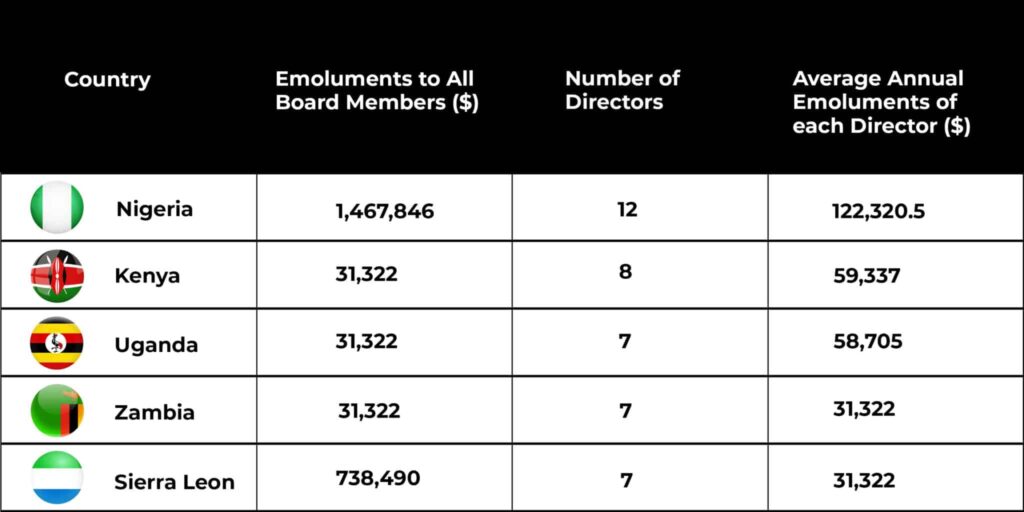
    “This is what I am coming to say that those who know me and know my character… you have not heard a single word of a recorded message with me describing parliamentarians in that manner.
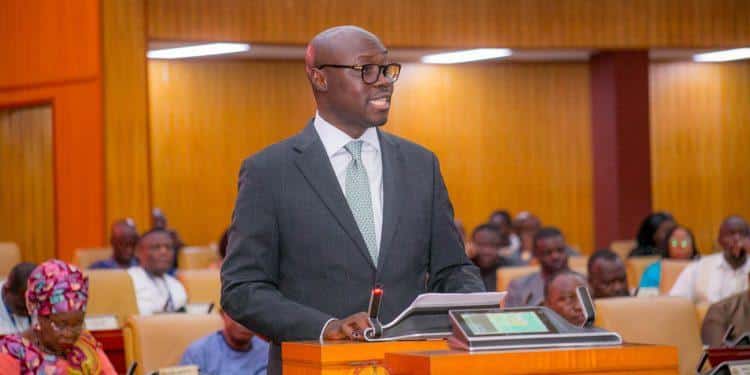
    “This was some foreign journalist’s description of the conversation we had and I disowned it,” he is quoted to have said.

  • I never used the word “hooligans” against NDC MPs – BoG Governor

    I never used the word “hooligans” against NDC MPs – BoG Governor

    Governor of the Bank of Ghana (BoG), Dr. Ernest Addison, has clarified remarks attributed to him during the #OccupyBoG protest in October last year.

    Dr. Addison stated that the term “hooligans” was not used by him but was instead attributed to him by a foreign media house that initially covered the story.

    During his appearance before the Public Accounts Committee (PAC) in Parliament on Monday, April 8, 2024, Dr. Ernest Addison clarified that the term “hooliganism” was an interpretation by the media house and not an accurate representation of his words.

    “This is what I am coming to say that those who know me and know my character…you have not heard a single word of a recorded message with me describing parliamentarians in that manner. This was some foreign journalist’s description of the conversation we had and I disowned it,” he stated.

    The #OccupyBoG demonstration, which took place in October 2023, involved a coalition of minority parliamentarians, NDC supporters, and various interest groups.

    They were demanding the resignations of Dr. Addison and his deputies over allegations of economic mismanagement and unauthorized currency printing.

    Dr. Addison had responded to the protest by referring to the demonstrators as “hooligans” and stating that neither he nor his deputies would resign.

    However, in an interview with the international business website Central Banking, he later characterized the NDC-led protest as “completely unnecessary.”

  • Dr. Joseph O. France appointed advisor of UMB bank to monitor its recapitalization efforts

    Dr. Joseph O. France appointed advisor of UMB bank to monitor its recapitalization efforts

    Bank of Ghana has appointed an advisor in the person of Dr. Joseph O. France to oversee the recapitalization efforts of Universal Merchant Bank Limited, commencing from March 25, 2024.

    According to a statement released by the Central Bank, Dr. France will offer guidance to UMB’s management in supervising the implementation of governance reforms agreed upon by UMB and the Bank of Ghana.

    This appointment aligns with section 101(1) of the Banks and Specialised Deposit-Taking Institutions Act, 2016 (Act 930).

    “The Advisor will be at post at UMB until otherwise advised by the Bank of Ghana and will furnish the Bank of Ghana with a status report on the bank as frequently as the Bank of Ghana may require,” the statement said.

    “It is important to note that an Advisor, unlike an Official Administrator, does not take over the powers, responsibilities, and duties of the bank’s shareholders, directors, or management. Under Act 930, the Advisor may attend meetings of the Board of Directors or Committees of the bank without voting at such meetings,” it added.

    Nonetheless, the BoG gave UMB’s clients and depositors the reassurance that the financial institution is still operational and run by the management group of UMB.

    The Central Bank went on to say that it is still dedicated to fostering a stable and resilient banking industry that continues to enjoy the public’s trust.

  • World Bank’s $300m financial support hits BoG’s account

    World Bank’s $300m financial support hits BoG’s account

    The $300 million World Bank facility earmarked for various projects in 2024 has finally been transferred to the Bank of Ghana’s (BoG) account.

    Ghana fulfilled all necessary conditions, including securing approvals from Cabinet and Parliament, to facilitate this transfer. According to Joy Business, the funds were transferred on the morning of March 27, 2024.

    The BoG is now expected to convert the dollars into cedis and distribute the equivalent amount to government agencies and ministries.

    The foreign exchange component of this facility is expected to bolster the international reserves of the Bank of Ghana. Data from the BoG indicates that its Gross International Reserves exceeded $6 billion by the end of February 2024.

    Finance Minister Dr. Mohammed Amin Adam recently stated during a media engagement that the government anticipates receiving around $1.2 billion from development partners before the year ends. This disbursement is crucial for expediting infrastructure projects outlined in the 2023 Budget that were delayed due to the late arrival of donor support.

    Originally scheduled for disbursement late last year, the World Bank’s release of this facility was delayed as Ghana struggled to reach an agreement with its bilateral creditors, hampering the approval process for the $300 million loan.

    This inflow is expected to curb the depreciation of the cedi by signaling to the international market that the Central Bank is better equipped to stabilize the local currency.

    The $300 million Development Policy Financing, the initial tranche of a three-part series, is aimed at crisis response and resilience-building in Ghana. Its primary objectives include restoring fiscal sustainability, enhancing financial sector stability and private sector development, improving energy sector financial management, and bolstering social and climate resilience.

    This disbursement is expected to enhance domestic revenue mobilization, control expenditures, ensure financial sector stability, facilitate private investment, stabilize the energy sector financially and operationally, fortify the country’s social protection system, and integrate climate adaptation and mitigation into policies.

    Background:
    This disbursement is part of the overall financial support from Ghana’s donors as part of the IMF program secured by the country in May 2023. The IMF has already provided approximately $1.2 billion to Ghana under the FUND program.

    According to the World Bank, this initial tranche of the Resilient Recovery Development Policy Financing is a crucial contribution from the Bank’s International Development Association. It is designed to assist Ghana in its economic recovery and promote resilient and inclusive growth.

    The World Bank approved this facility in January 2024 following an agreement in principle by the Official Creditors’ Committee under the G20 Common Framework on the key parameters of Ghana’s proposed debt restructuring. This agreement aligns with the Joint World Bank-International Monetary Fund Debt Sustainability Framework, marking a significant step toward restoring debt sustainability.