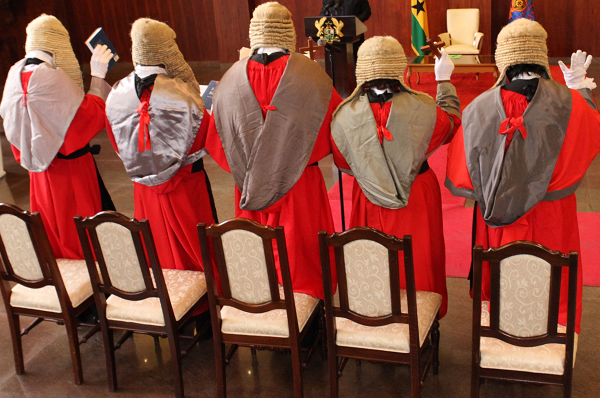
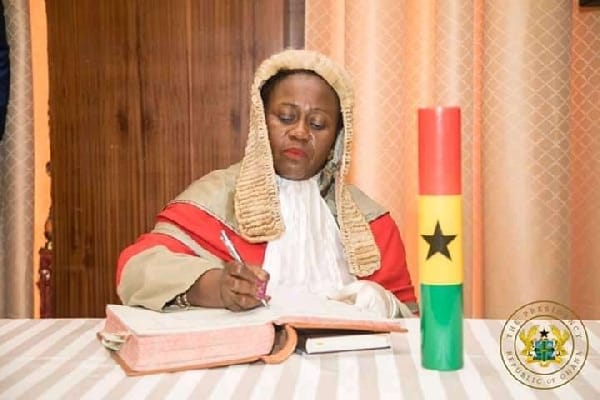
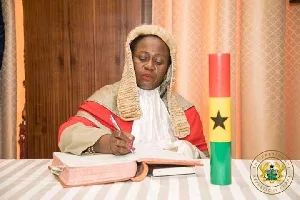
On Friday, August 1, Chief Justice Paul Baffoe-Bonnie issued administrative warrants at the start of the legal vacation period, which runs from August 1 to September 30.
The warrants directed High Court judges to continue sitting during the recess to hear designated criminal cases, including those involving Kwabena Adu-Boahen, former Director-General of the National Signals Bureau (NSB), and Hanan Abdul-Wahab, former Chief Executive Officer of the National Food and Buffer Stock Company (NAFCO).
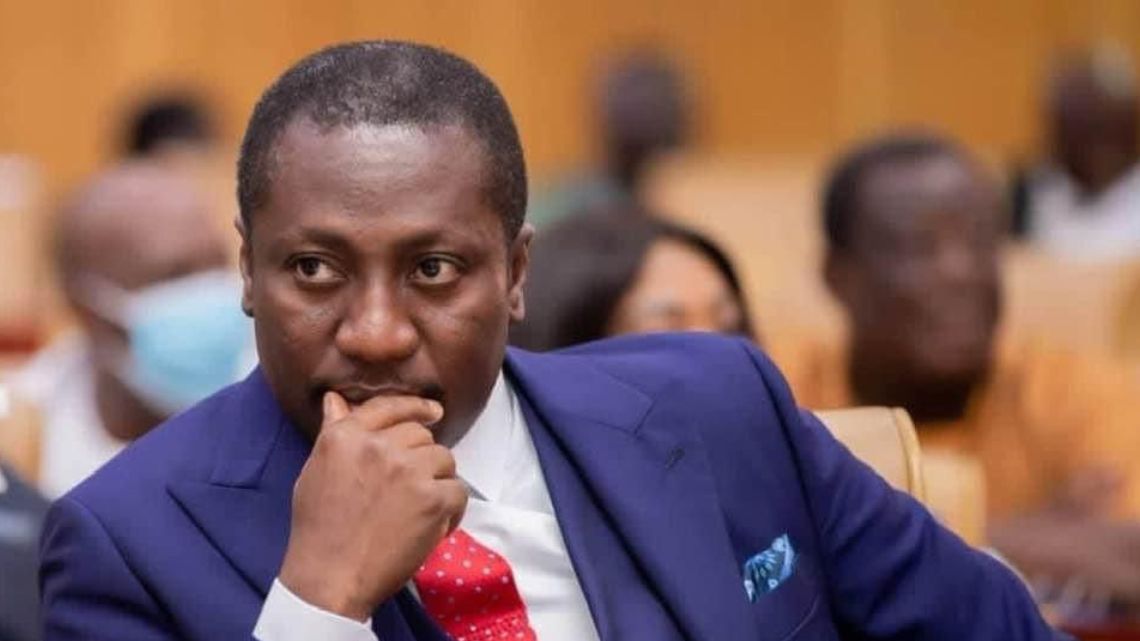
The directive stirred discontent among a section of the public, particularly the Minority in Parliament, prompting Ofoase-Ayirebi Member of Parliament, Kojo Oppong Nkrumah, to challenge the decision to continue hearing selected criminal cases during the vacation.
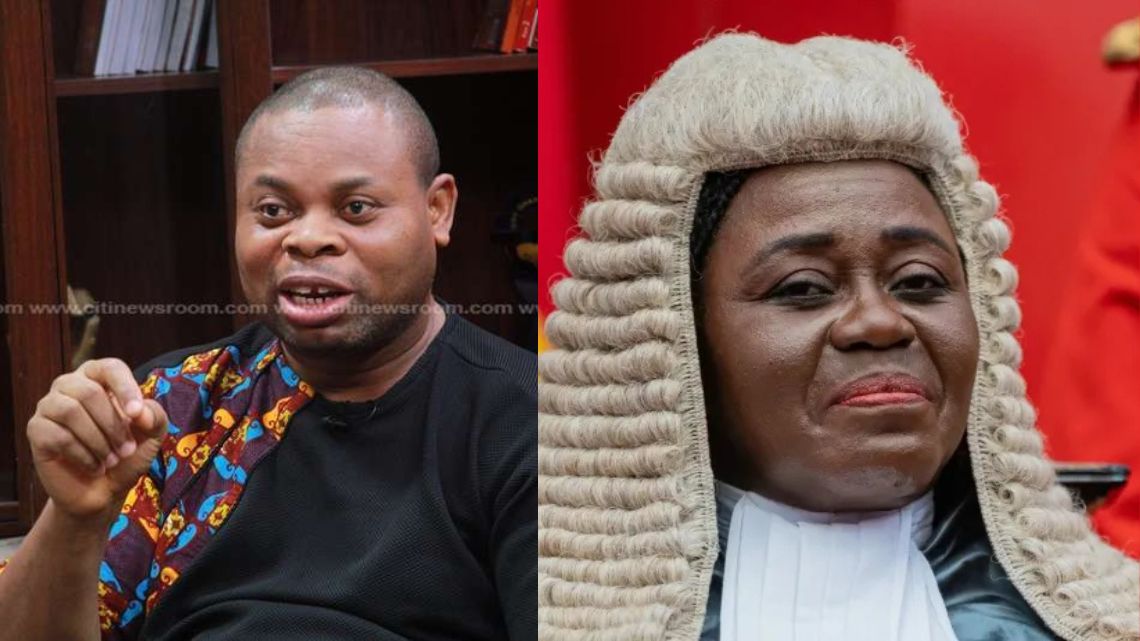
Speaking in court on Thursday, counsel for Mr Oppong Nkrumah, Frank Davies, maintained that the Attorney General (AG) should not represent the Chief Justice, arguing that the Chief Justice, having been named as a defendant, ought to have separate legal representation.
The court had earlier rejected the argument challenging the Attorney General’s representation of the Chief Justice.
Mr Davies said allowing the Attorney General, an arm of the Executive, to represent the head of the Judiciary raised concerns about the constitutional principle of separation of powers.
“The Chief Justice heads an independent organ of the state, the judiciary. We have the judiciary, the legislature, and the executive. They are supposed to be independent organs of the state,” he said.
He, however, said his legal team would take guidance from the court’s ruling and focus on the substantive constitutional challenge.
Fair trial concerns
At the centre of the case is an argument that the continued hearing of criminal cases during the legal vacation could affect the accused persons’ constitutional right to a fair trial and representation by lawyers of their choice.
Mr Davies stressed that his client was not seeking to prevent the criminal cases from being heard.
“We are not saying that they should not be tried. What we are saying is that the continued trial of the cases in the legal vacation offends their right to fair representation and lawyers of their own choice,” he said.
According to him, lawyers representing the accused persons had informed the courts that they were unable to attend proceedings during the legal vacation.
Mr Davies said the longstanding practice was for criminal trials to continue during the legal vacation only where the lawyers involved agreed to it, after which the judge would obtain a warrant from the Chief Justice to proceed with the case.
However, in the cases of Adu-Boahen and Wahab, this has become an exception as despite the lawyers’ communication of their unavailability, the trial has been directed to hold.
“If it is the case that there can be trials during the vacation, why is it that it is only those selected cases which are being tried?” he asked.
Remarks by His Lordship, the Chief Justice, at the congress of the Senior Staff Association of the Judicial Service of Ghana must bring firm clarity to one issue in the ongoing, rather needless, legal vacation debate. That aspect largely confirms the administrative realities outlined in Parts 2 and 3 of this series.
To active practitioners, the CJ’s comments reinforce a fundamental procedural truth: the authority to grant an adjournment rests exclusively within the judicial discretion of the presiding judge, not the CJ. Unless a special warrant explicitly commands a judge to conduct daily trial sittings during the recess, standard administrative warrants issued by the CJ are simply the routine, annual authorisations enabling designated vacation courts to sit.
Because these general warrants cover entire dockets, as evidenced by the June roster designating 11 or so High Courts in Accra, demanding their total withdrawal is misplaced. These courts must remain operational to attend to urgent interlocutory matters and their own underlying dockets, on the availability of counsel as is the long-established practice.
Instead, the proper forum for counsel seeking relief is before the trial judge. Historically, vacation judges have exercised their discretion to indulge counsel who are unavailable due to the recess, planned travel, or professional engagements.
I have just received copied correspondence from a colleague in a matter where I had filed a vacation application (not that urgent). Having travelled, my colleague requested an adjournment to October. In line with the long-standing practice, his absence will not be treated as willful default, and the court will honour his request.
The mechanism for accommodating lawyers during recess already exists within the judge’s discretion. The law and convention remain clear: administrative warrants keep the lights on for emergency justice, but judicial discretion ensures that counsel’s right to a statutory rest is respected.
You may want to read Parts 1, 2, 3 of this series to better appreciate this final part in context.
Join me on my weekly legal clinic on Joynews every Sunday @ 2pm.
The President of the Honourable, in a letter to the Chief Justice dated August 10, 2024, and the Ghana Bar Association (GBA), in a letter to the Chief Justice dated August 10, 2024, make two claims. The first claim is that a vacation Judge does not take proceedings on the substance of the case or conduct trials during the legal vacation. More particularly, the President said:
“This notwithstanding, the Judiciary, with the consent of other stakeholders have by convention over the years, agreed to certain courts being designated as Vacation Courts to handle any emergencies arising during the vacation, usually interlocutory matters and never trials.”
The President’s second claim is that the decision, if any, to take proceedings on the substance of the case during the legal vacation lies with the lawyers in the case (and not the bench). More particularly, the President stated as follows:
“However, the overriding consideration in any matter brought before a Vacation Judge has always been the willingness/availability of Counsel to appear before the Court in any matter slated for conduct during the vacation. In other words, Counsel are not under any compulsion whatsoever to appear before a Vacation Court.”
Neither of the two claims is supported by law, rules, practice, or optimal reason. I will explain. However, not before I give a brief background to the conversation:
Nature of Court Proceedings
A court case entails two types of proceedings. They are (1) proceedings on the substantive matter, and (2) proceedings on interlocutory matters. Proceedings on the substantive matter entail proceedings that are capable of finally determining the case. It often includes trials and hearings on the merits of cases. Interlocutory proceedings, on the other hand, involve motions and summons which do not determine the matter finally. Kindly note this down.
The tradition of law practice (as well as the dictate of the civil procedure rules) is that the superior courts scale down significantly on work in the months of August and September. This is known as the “summer vacations” or “the long legal vacation”. In some jurisdictions, it is informally called “Judges’ vacation”. It is never called “lawyers’ vacation” anywhere in the world.
The key point here, however, is that the courts scale down on work significantly – they do not shut down. To continue operating partially, some judges – a few of them – are allowed to work over the vacation period. The person who determines which judge works over the vacation is the administrative head of the courts – in this case, the Honourable Chief Justice and, of course, together with the inherent judicial power of a judge to manage and control his court’s work. One thing is, however, clear – a lawyer or a body of them do not determine that. Kindly note this, too, down.
The Chief Justice allows a Judge to work in the vacation by issuing what we call a “warrant” to the Judge. The Chief Justice’s warrant to a Judge to sit during the legal vacation allows the judge – known as a ‘vacation Judge’ – to hear two kinds of cases. The kinds of cases are (1) cases in his own court, and (2) cases in the courts of other judges who are on vacation. Note this, too, down.
In respect of cases in his own court, a vacation Judge is allowed to take both interlocutory proceedings and substantive proceedings. In respect of cases from other courts, however, a vacation Judge is allowed to take interlocutory proceedings only. This is based on the law and the understanding that it is only a substantive Judge (not a holding Judge) who could determine a case finally.
Now, I turn back to the GBA President’s claims of allegations on court proceedings during the legal vacation.
The Power over Court Proceedings
Contrary to the GBA President’s claim, the power to decide whether to take proceedings on the substance of a case during a legal vacation is for the bench, not for the bar. This is why:
A lawyer’s primary duty is, in fact, to his client – not to the client of another lawyer. If allowed to determine how justice is administered in the courts, a lawyer will decisively make decisions which will promote his client’s interest over the interest of another lawyer’s client. In fact, this is the only reason courts and judges exist – to balance the interests of litigants. It is, therefore, fundamentally disturbing to suggest, as the GBA President has suggested, that “the overriding consideration in any matter brought before a Vacation Judge has always been the willingness/availability of Counsel to appear before the Court in any matter slated for conduct during the vacation.”
Let us, for a minute, turn to England, where the practice of legal vacation originates. There, it is emphatically the decision of the bench to determine how to run the courts, both in term-time and during vacations. The Civil Procedure Rules Practice Direction 2F regulates the English High Court’s vacation work. There, one will notice that the Practice Direction is filled with phrases like “if the senior judge of that Division determines …”, “if the Court is satisfied …”, “as the Court may direct”, “Subject to the discretion of the Judge”, etc.
This has always been the case in Ghana, too. As we have known it, it is the Chief Justice who determines when and where a Court should work. She may, as we have come to know it, upon a warrant, determine and direct that a Judge sits even on weekends. We are also aware that Courts have customarily conducted trials over legal vacation. Nowhere, either in England or in Ghana, is a lawyer or a body of them given the power to determine how court proceedings should go. Thus, one is not particularly certain where the GBA President gets the alleged tradition of this version of legal vacation practice from.
Trials During the Vacations
Contrary to the GBA President’s claim, vacation Judges take proceedings on the substance of the case and do conduct trials during the legal vacation. Here is why:
As stated above, a vacation Judge takes both interlocutory and substantive proceedings on cases in his own court. The reason for this is that a vacation Judge is entitled to and does, eventually, take his share of the vacation but in term-time. When he does, another Judge – a term Judge – takes his (the legal vacation Judge’s) cases.
As in the case of vacation, a term Judge too will – when the vacation Judge goes on leave – take only interlocutory proceedings on cases from the court of the Judge who is now on vacation. Under such circumstances, too, substantive proceedings on cases from the vacation Judge will be on hold until the vacation Judge returns from leave. This is for the same reason and law that only a substantive Judge (not a holding Judge) could determine a case finally.
The net effect of this arrangement is that cases in the vacation Judge’s courts do not suffer disproportionate delays simply because he has served as a vacation Judge. This has been the practice in our court. So, again, one is not particularly clear what the GBA President grounds the allegation that courts “never” conduct trials during legal vacations on.
Conclusion
Law practice is a difficult job. It drains you, both physically, mentally and emotionally. Many lawyers end up securing for themselves serious physical, behavioural and mental illnesses from law practice. Some manage life, sadly, with indulgences and addictions. Legal vacations, thus, may be a good opportunity for lawyers – who are either unwilling or, for any reason, unable to take control of their lives – to get that well-deserved rest. It is for this reason that many Judges accommodate the pleas of lawyers to scale down work during judges’ vacation. This accommodation is, however, always upon request, on a case-by-case basis, and is subject to the consideration of the Judge who, for the time being, is conducting a case.
What the GBA President’s proposition in her letter to the Honourable Chief Justice seeks to do is grave. It seeks to move the power to manage and control court proceedings and to do justice from the hands of the Judge into the hands of a lawyer. This has a severe and far-reaching policy implication for justice administration in Ghana. On the face of it alone, it distorts the very reason courts exist. If one adds to it the fact that the claim is also not backed by law, rules, practice or optimal reason, then the matter gets even more unhealthy.
Now, a lawyer who wishes to take a rest during legal vacation knows exactly what to do. He attends proceedings and makes a plea to the Judge for accommodation. The Judge will, in turn, consider the plea and, in the interest of justice, either grant the request (either wholly or in part) or refuse it altogether. What a professional lawyer is not entitled to do, and cannot do is to, in vacuo, beforehand, declare that he will not attend proceedings at all.
DISCLAIMER: Independentghana.com will not be liable for any inaccuracies contained in this article. The views expressed in the article are solely those of the author and do not reflect those of The Independent
The Ghana Bar Association (GBA) has opposed Chief Justice Paul Baffoe-Bonnie’s decision to allow court proceedings to continue despite the legal vacation, which runs from September 1 to September 30. This information was contained in a letter addressed to Chief Justice Paul Baffoe-Bonnie on Monday, August 10.
According to the Association, counsel are not under any compulsion to appear before a vacation court. It added that the legal vacation is intended to give judges, lawyers and judicial staff a necessary break from the demanding court calendar.
“Counsels are not under any compulsion whatsoever to appear before a Vacation Court. Once Counsel in a matter indicates their unavailability to attend Court during the vacation, even though the Court may have listed their case, it cannot proceed with the case in any way if Counsel on either side or on both sides indicate their inability to proceed with the scheduled matter in Court during the vacation,” part of the letter read.
The Association’s position adds to objections from counsel for former National Buffer Stock Company (NAFCO) Chief Executive Officer Hanan Abdul-Wahab, his wife, Faiza Seidu Wuni, and Kwabena Adu-Boahen, who have opposed the Court’s decision to continue the trial while the courts are on vacation.
The objection comes after the Chief Justice directed Justice Francis Achibonga, who is handling the two separate cases, to adjourn proceedings to 11 and 12 August.
According to a separate letter from the lawyers addressed to the Chief Justice, proceeding with the trial would hinder their clients’ right to a fair defence.
The lawyers, including former Attorney General Godfred Yeboah Dame, representing Abdul-Wahab, and Samuel Atta Akyea, representing Adu-Boahen, have urged the Chief Justice to halt proceedings scheduled during the judiciary’s legal vacation.
Lawyer Dame, in the letter, indicated that “the warrant for Justice Achibonga to commence the hearing of the instant criminal matter, without the consent of the parties in the matter, is thus most irregular and contrary to law. There is no urgency to this matter as the accused persons were arraigned before the court only on 5th May 2026, after earlier charges were withdrawn by the Republic through no fault of the accused.
“Respectfully, we, of Messrs. Dame & Partners, having worked throughout the legal year and cooperated for the conduct of the instant criminal matter, are not in the position to attend court in the vacation for the conduct of the trial”.
Samuel Atta Akyea, lawyer for Kwabena Adu-Boahen has stated that, the Chief Justice’s directive will disrupt their personal schedules.
Part of the letter read, “these unprecedented criminal justice delivery arrangements as we consider the Judiciary as the last bastion of refuge in our constitutional democracy. We accordingly and respectfully pray that your directive be reconsidered, the warrant withdrawn and the hearing days vacated with the matter adjourned to abide term-time in a manner consistent with the treatment afforded other pending cases”
The letter added, “Indeed, your directive will throw in disarray all the private personal engagements and travel plans of the members of our law firm”.
The defendants, who served during the New Patriotic Party (NPP) administration, are standing trial for causing financial loss to the state.,
The Minister of Government Communications, Felix Kwakye Ofosu, has clarified that the removal of former Chief Justice Gertrude Araba Esaaba Sackey Torkornoo played no role in the resignation of former Chief Justice Sophia Akuffo from Ghana’s Council of State.
While speaking during a Government Accountability Series held in Accra on Monday, June 15, Kwakye Ofosu called on the public to disregard the speculations the resignation letter submitted by the former Chief Justice does not state so.
“The former Chief Justice is known for being outspoken and highly principled. When she disagreed with the DDEP, she went on a public manifestation and demonstrated. If she had resigned as a result of Torkornoo’s removal, she would have stated, or she would have found some means to let you know.
“And so it is most unfair to ascribe motives to her when she has not communicated same. Government, as a matter of record, has not received any communication from her in respect of that. She didn’t say that in her letter of resignation.”
News of former Chief Justice Sophia Akuffo’s resignation from Ghana’s Council of State made waves on Sunday, June 14. According to the report, Justice Akuffo stopped attending Council of State meetings, and when voting was held on whether a prima facie case had been established against then Chief Justice Gertrude Torkornoo.
Out of the 31-member Council, only Sophia Akufo abstained from voting, and she did not publicly explain the reasons behind her decision.
Later in 2025, she reportedly submitted her resignation. Although the circumstances surrounding her resignation remain unclear, sources indicate that the former Chief Justice stopped attending Council meetings following the decision relating to the removal process involving former Chief Justice Gertrude Torkornoo.
Justice Akuffo served as Chief Justice of Ghana from 2017 to 2020. The Council of State is a constitutional advisory body that provides counsel to the President on national governance and policy matters.
Its membership comprises elected and appointed representatives drawn from across the country. Former Chief Justice Sophia Akuffo was sworn in alongside 30 distinguished individuals as members of Ghana’s Council of State on February 18, 2025.
The inauguration ceremony, presided over by President John Dramani Mahama, took place at the Jubilee House in Accra on Tuesday, February 18, 2025.
Leading the Council as its chairman is Edward Doe Adjaho, former Speaker of Parliament, who was tasked to play a guiding role in deliberations as the advisory body supports the President in national governance.
President Mahama, addressing the newly inducted members, urged them to actively demonstrate their significance in national decision-making.
He emphasised the need for the Council to address growing public scepticism regarding its role and relevance in Ghana’s governance structure.
The 31-member Council comprises experts from diverse fields, including law, business, academia, and civil society, bringing a wealth of knowledge and experience to the advisory body.
Their primary responsibility is to offer informed counsel to the President on crucial national matters. Dignitaries from various sectors, including government officials, members of the diplomatic corps, and representatives from civil society, attended the swearing-in ceremony, underscoring the importance of the Council’s mandate in shaping the nation’s governance framework.
The Office of the Chief Justice has announced that March 16-20 will be observed as a week of Alternative Dispute Resolution (ADR) nationwide.
This was announced in a formal statement dated March 13 and directed all courts across the country to observe it as such as part of activities for the legal year term under the theme, Adoption of Innovation and Technology to enhance access to Justice Delivery through Alternative Dispute Resolution (ADR)”
“We wish to bring to the attention of the general public that the Chief Justice of Ghana, His Lordship Justice Paul Baffoe-Bonnie, has declared Monday 16th to Friday 20th March, 2026, as ADR Week for this Legal Year Term….” parts of the statement read.
The statement outlines two main reasons behind the week-long exercise. It explained that the exercise is to educate the general public on what ADR is and what benefits they stand to gain from it, and also offers quick resolutions of cases, particularly for the poor and vulnerable.
“The rationale for the ADR Week is to allow the ADR Directorate of the Judicial Service to engage the general public on the presence of ADR within the court system, its importance in seeking justice, and how to take advantage of such an important process for meaningful access to justice, especially for the poor and the vulnerable. It is also to afford court users whose cases are pending before the courts the opportunity of using ADR during the week under what we call the “Mass Mediation Exercise”, the statement added.
According to the Head of Judiciary, “One Hundred and Thirty-Eight (138) Courts nationwide, comprising Thirty-Five (35) Circuit Courts and One Hundred and Three (103) District Courts, shall participate by devoting the whole week to the settlement of court cases with ADR across the country”.
Also, “There will be a Press Briefing at the High Court, Sunyani, in the Bono Region, on Monday, 16th March, 2026, at 10:00 am prompt, to mark the official opening of the ADR Week”, where the Honourable Chief Justice of the Republic of Ghana will address the media.
Consequently, all members of the public are urged to fully participate in the exercise to make it successful.
“The Bar, court users, the media, and the public are therefore encouraged to participate fully and cooperate with the Judicial Service to make this Legal Year Term’s ADR Week
a success. Alternative Dispute Resolution (ADR) has been adopted by the Judicial Service of Ghana as part of its adjudication process, dubbed “Court-Connected ADR”. This programme aims to ensure that access to justice in Ghana is made easier, cheaper, non- adversarial, expeditious, and flexible to all, particularly the underprivileged and vulnerable.
“Pursuant to this, the Chief Justice, in a policy directive on the Court-Connected ADR Programme, has instituted an ADR Week which is to be celebrated every Legal Year Term thrice, to allow parties to settle their cases through mediation and to run programmes and activities to create awareness of the availability of ADR as a complement to the adjudication process in the courts.” the statement closed.
ADR and Ghana’s constitution
The exercise is governed by the Alternative Dispute Resolution Act, 2010 (Act 795). It is Ghana’s main law governing arbitration, mediation, and other non-court dispute resolution methods. It establishes clear rules for how ADR should be conducted, the powers of arbitrators and mediators, and how agreements reached through ADR can be enforced.
The Act details several ADR mechanisms, including arbitration, mediation, customary arbitration, and the institutional framework
The Chief Justice, Paul Baffoe-Bonnie, has concluded that petitions seeking the removal of the Electoral Commissioner, Jean Mensa, her deputies, and the Special Prosecutor have no basis.
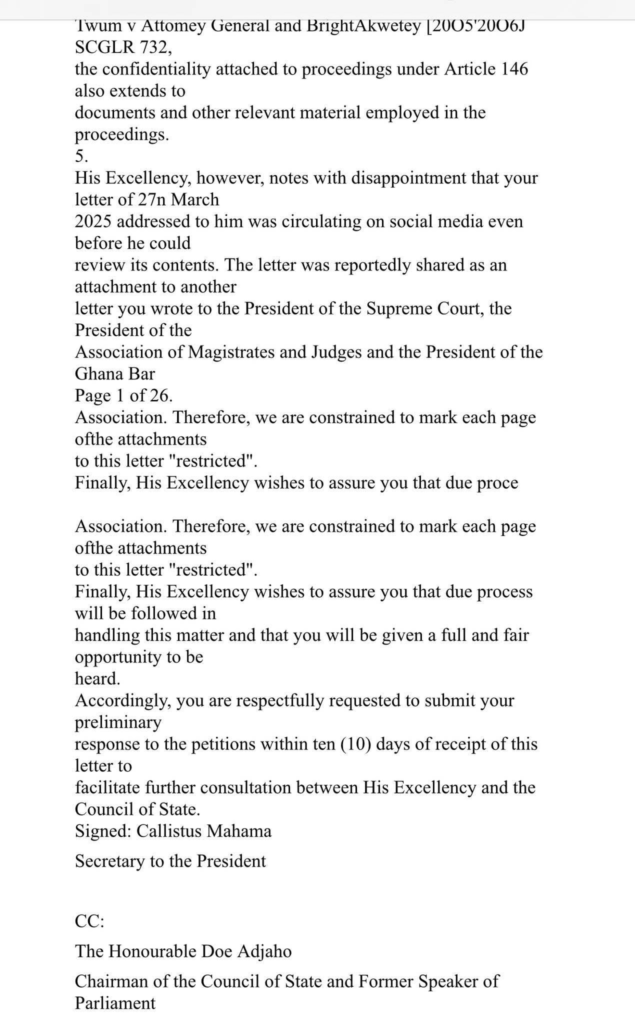
This was contained in a letter dated January 26, 2026 by the Chief Justice to President John Dramani Mahama. According to the Chief Justice
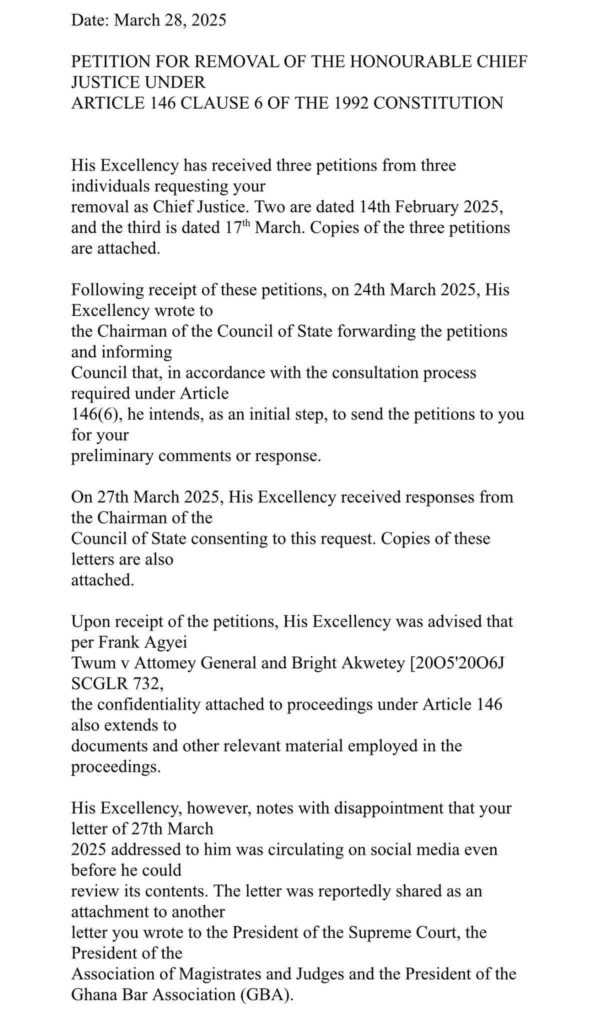
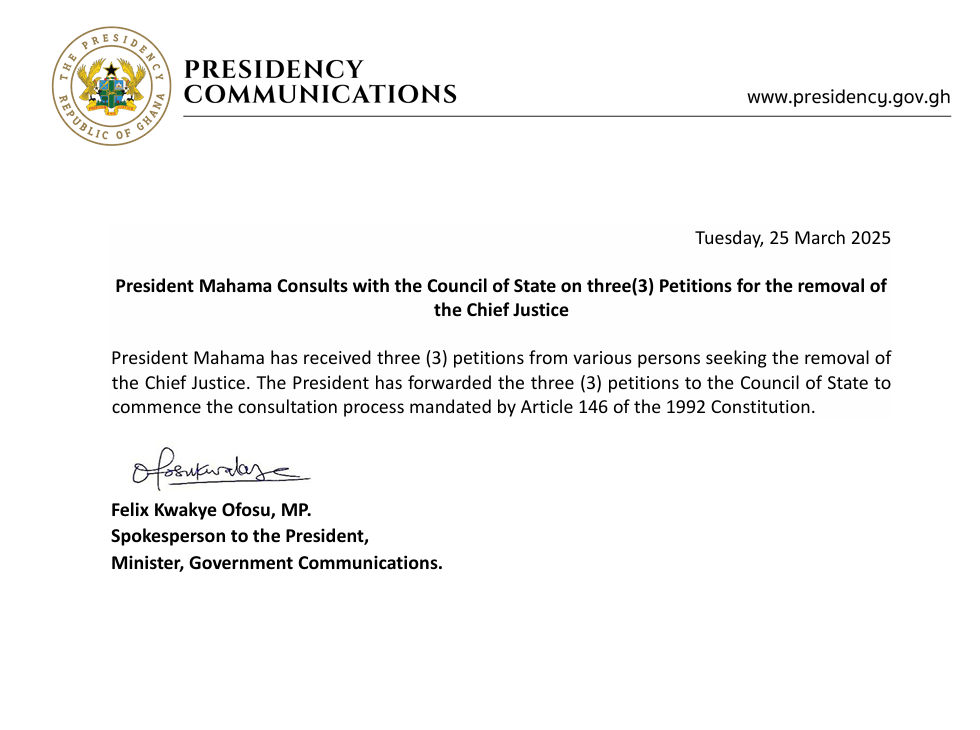
In 2025, the presidency revealed that it had referred seven petitions calling for the removal of the Chairperson of the Electoral Commission Jean Mensa and her Deputies, as well as three separate petitions seeking the removal of the Special Prosecutor Kissi Agyebeng, to the Chief Justice for further investigation.
However, according to the Chief Justice, the petitions lack sufficient grounds for further investigations or their removal.
In 2025, President Mahama ten separate petitions, with seven targeted at EC Chair Jean Mensa and her two deputies, Dr Bossman Eric Asare and Samuel Tettey. Among the 12 counts of stated misbehaviour are allegations of cronyism, abuse of office, and gross incompetence.
The petition, submitted by a staff member of the Electoral Commission, Joseph Blankson Adumadzie, emphasised that the credibility of Ghana’s electoral system is at stake due to the alleged illegal actions of the officials.
According to a statement issued on Monday, November 24, by the petitioner, Article 146 of the 1992 Constitution provides the basis for requesting the removal of public officials, particularly those serving in independent constitutional bodies.
Also private citizens have cited various forms of misconduct as grounds for their call for the removal of the Special Prosecutor Kissi Agyebeng.The group has reportedly accused the Special Prosecutor of abusing the powers of his office and demonstrating incompetence.
The former Chief Justice, Gertrude Torkornoo, faced a similar challenge and was later replaced by President Mahama after an investigative committee found the allegations levelled against her to be valid.
The Chief Justice was earlier suspended by President Mahama on Tuesday, April 22, after a prima facie case was established, following separate petitions calling for her removal.
A series of petitions was filed against Chief Justice Torkornoo, beginning with one from a group known as Shining Stars of Ghana.
The group alleged she violated Article 144 of the Constitution by personally recommending judges for promotion to the Supreme Court and further claimed she ruled on a case involving the Speaker of Parliament without granting him a hearing, despite his refusal to respond to the suit.
Another petition, filed by a police officer who is also a lawyer, accused the Chief Justice of manipulating evidence and abusing her authority, following an incident during a Supreme Court session where he was reportedly reprimanded, arrested, and detained.
However, court records suggest the lawyer’s conduct during proceedings prompted a unanimous caution from the bench, not just the Chief Justice.
The third petition, submitted by a private individual, listed 21 alleged misconducts and four claims of incompetence. Among the accusations was the misuse of public funds—specifically, that she spent over GH¢261,000 and $30,000 on a family trip abroad in 2023 and misused an additional GH¢75,580 and $14,000 during another foreign assignment without proper accountability.
Subsequent reports indicate two more petitions were added, intensifying pressure on the judiciary. Chief Justice Gertrude Torkornoo, in her written response to President Mahama, strongly denied allegations of misconduct and abuse of office brought against her by a senior police officer, describing them as baseless and lacking grounds for her removal from office.
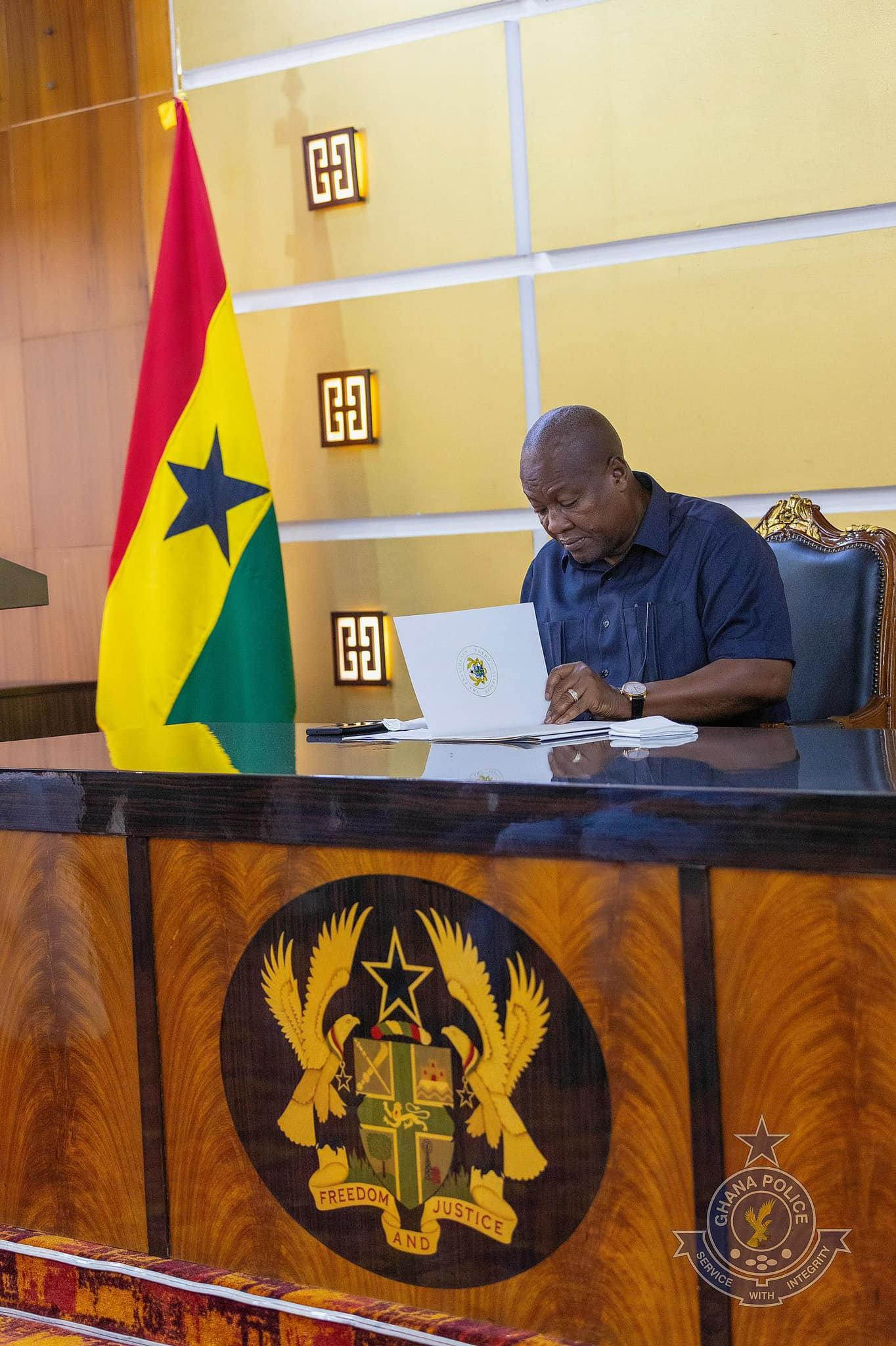
Meanwhile, President John Dramani Mahama has sworn in Justice Paul Baffoe-Bonnie as Ghana’s Chief Justice. The swearing-in ceremony occurred on Monday, November 18, at the presidency. His swearing-in comes after Parliament, following several deliberations, approved his nomination.
The Speaker of Parliament, Alban Bagbin, confirmed his approval on Thursday, November 11, during the 15th Sitting of the 3rd meeting.
“This Honorable house has accordingly approved the nomination of Justice Paul Baffoe-Bonnie as Chief Justice of the Republic, in accordance with Article 114 clause 1 of the 1992 Constitution respectively.
“I will want to take this opportunity to, on behalf of the House congratulate the nominee on his approval by Parliament. I urge the nominee to take all that has happened right up from the day of the nomination up to his prior approval by Parliament into consideration in his tenure of office. Once again congratulations,” he added.
Parliament concluded his nomination after a headcount, where the Majority in Parliament counted 163 and the Minority 69. On Monday, November 10, Justice Paul Baffoe-Bonnie appeared before the Appointments Committee of Parliament for his vetting.
In October, President John Dramani Mahama submitted Justice Baffoe-Bonnie’s name to the Council of State for consideration in accordance with Article 144(1) of the Constitution, which requires the President to act in consultation with the Council of State and with Parliament’s approval when appointing a Chief Justice.
Justice Baffoe-Bonnie, the most senior member of the Supreme Court, was appointed to the apex court in June 2008 by then-President John Agyekum Kufuor. He studied law at the University of Ghana and was called to the Bar in 1983.
His judicial career spans roles as a Circuit Court Judge in Kumasi, a High Court Judge at Duayaw Nkwanta, and a Court of Appeal Judge before his elevation to the Supreme Court.
Born on December 26, 1956, in Goaso, Justice Baffoe-Bonnie had his secondary education at Konongo Odumase Secondary School before pursuing law at the University of Ghana and the Ghana Law School.
However, speaking on the floor of Parliament on Friday, November 7, Minority Leader Alexander Afenyo-Markin said it would be inappropriate to proceed with the vetting of Acting Chief Justice Paul Baffoe-Bonnie while the former Chief Justice awaits a court verdict on her pending lawsuit.
In October, Gertrude Torkornoo initiated legal action to prevent the vetting and appointment of Justice Baffoe-Bonnie as Ghana’s next Chief Justice. She is seeking the nullification of all activities carried out by the Justice Gabriel Scott Pwamang Committee, which was set up under Article 146 to review petitions seeking her removal from office.
She wanted the court to overturn all proceedings undertaken by the said Committee and to declare the Presidential Warrant authorizing her dismissal as unlawful and without legal effect.
The legal move came as Parliament’s Appointments Committee prepared to vet Justice Baffoe-Bonnie for the top judicial position.
Afenyo-Markin emphasized that commencing the vetting of the appointed CJ would breach judicial propriety. According to him, given the ongoing disputes surrounding the revocation of the former Chief Justice from office, proceeding with the vetting process could undermine Articles 125 and 127 of the Constitution.
“Proceeding to vet a new person to fill that office will be rendering the application of justice. We are not into blows; we are here to argue law and for you to determine. This kind of attack, ‘it will happen, it will happen,’ is inappropriate. They should take it easy,” Afenyo-Markin said.
Article 125 gives judicial power only to the courts and not to Parliament or the Executive. Article 127, on the other hand, requires all other state institutions not to interfere with the Judiciary’s work but to protect its independence.
The Economic Community of West African States (ECOWAS) Court will not give a ruling that will restore Gertrude Torkonoo to her position as Ghana’s Chief Justice.
Speaking to the media on Wednesday, November 19, he noted that instead, the government will be directed to compensate her for violating her rights.
“At this stage, what I feel is that the ECOWAS Court will not rule regarding her ability to come back to the position of Chief Justice, or even as a member of the Chief Justice . But it is likely to find a case of violation of her rights. “It is possible she might win one of those grounds, and the government may be asked to compensate for the rights that were violated. But it wouldn’t be about removing the currently installed Chief Justice and bringing her back,” he added.
On Wednesday, November 19, the Deputy Attorney General, Justice Srem Sai, disclosed that the former Chief Justice Gertrude Torkornoo’s application seeking interim measures to halt the work of the committee that investigated her removal from office has been dismissed by the ECOWAS Court of Justice.
According to him, the Court noted that the application did not satisfy the criteria for a grant of interim measures. He added, “The ECOWAS Court has, this morning, dismissed Mrs Justice Gertrude Torkornoo’s application for interim measures. The Court stated that the application did not satisfy the criteria for a grant of interim measures. More particularly, the Court held that.
“The Applicant’s own conduct defeats her claim of imminent and irreparable harm. The Court is, therefore, satisfied that the Applicant has not demonstrated the existence of imminent or exceptional circumstance that will justify the urgency of the application filed almost 3 months after the act complained of.”
The Court concluded that the former Chief Justice failed “to meet the requirement of urgency, the Court finds no basis to assess the remaining criteria for provisional measures, same being cumulative. The request for provisional measures as outlined by the Applicant, same not substantiated, is therefore dismissed.”
In August, the legal team of former Chief Justice Gertrude Torkornoo revealed plans to sue the Committee of Inquiry that recommended their client’s removal from office.
Speaking to the media on Saturday, September 6, Gertrude Torkornoo’s lead counsel and former Attorney-General, Nii Ayikoi Otoo, indicated that the court process will grant Gertrude Torkornoo the opportunity to clear her name.
“This is an option we are looking for to get the records straight. When Dr. Danquah went to court to talk about Re and Akoto, and that there was the abuse of a fundamental human right, people did not take him seriously. But today, people are praising him for having fought that good fight. So, we will go to court at the right time,” Mr. Otoo said.
President John Dramani Mahama announced the removal of the Chief Justice from office on Monday, September 1, after receiving recommendations from the committee probing petitions seeking the removal of Chief Justice Gertrude Araba Esaaba Sackey Torkornoo. Having violated Article 146 (9), as mentioned in the Committee’s report and recommendations, President Mahama dismissed Madam Torkonoo not only from her position as Chief Justice but also as a Supreme Court Judge.
In a statement dated September 1, the Presidency justified the dismissal of Gertrude Torkonoo as in accordance with Article 146 (9) of the 1992 Constitution.
“NOW THEREFORE, KNOW YE ALL MEN that I, JOHN DRAMANI MAHAMA, President of the Republic of Ghana, in pursuance of the said Article 146(9), do hereby REMOVE the said Chief Justice, Justice Gertrude Araba Esaaba Sackey Torkornoo, from the office of Chief Justice and Justice of the Supreme Court, with effect from the date hereof,” parts of the statement noted.
According to Article 146 (9), “A Justice of a Superior Court or a Chairman of a Regional Tribunal shall not be removed from office except for stated misbehaviour or incompetence or on grounds of inability to perform the functions of his office arising from infirmity of body or mind.”
In the case of Madam Torkonoo (Esq), the committee found her guilty of stated misbehaviour, including unlawful expenditure of public funds, abuse of discretionary power, and interference in judicial appointments. These findings were tied not just to her role as Chief Justice, but also to her conduct as a Justice of the Supreme Court.
Therefore, the committee recommended her complete removal from both roles, and President Mahama was constitutionally obligated to act on that recommendation.
Outlining the charges against the Chief Justice on unlawful expenditure of public funds, the Committee’s report suggested that, “In the opinion of the committee, the travel expenses which the Chief Justice heaped on the Judicial Service when she travelled on holidays in September 2023, first to Tanzania with her husband and second, to the United States of America with her daughter, together with the payment of per diem to the spouse and daughter of the Chief Justice, constituted unlawful expenditure of public funds.”
“Those acts… constitute avoidable and reckless dissipation of public funds and, in the view of the committee, to have been occasioned by the overall head of the Judiciary and the Judicial Service, whose duty is to guard public resources allocated by the Government, is caught within the spectrum of stated misbehaviour.”
According to the Committee, she abused her powers as a Chief Justice in the transfer of one Mr Baiden, adding, “The committee also stated without fear or favour that the Chief Justice unjustifiably breached the provisions in Article 295 (a) and (b) of the Constitution, 1992, in the way and manner that she transferred Mr. Baiden. It said her conduct amounted to misbehaviour.”
On interference in judicial appointments, the Committee highlighted the Chief Justice’s deliberate actions of bypassing the designated system of selecting Supreme Court Judges. Hence, the Committee labelled her conduct as unacceptable and counted it as misconduct.
“Justice Torkornoo… cannot lay claim to ignorance of the nomination process and procedure, notwithstanding the fact that the process and procedure are not spelt out in the Constitution but case law”“Therefore, to seek, wittingly, to outwit this known process and procedure for appointing Supreme Court Justices amounts to misbehaviour in the eyes of the Committee and the Committee finds it as such,” excerpts of the Committee report read.
The committee, chaired by Supreme Court Justice Gabriel Scott Pwamang, includes Justice Samuel Kwame Adibu Asiedu, former Auditor-General Daniel Yaw Domelevo, Major Flora Bazwaanura Dalugo of the Ghana Armed Forces, and Professor James Sefah Dzisah of the University of Ghana.
In July, an application for review regarding an ‘abuse of court processes’ by the former Chief Justice was dismissed by the Human Rights Division of the Accra High Court.
The court, presided over by Justice Amoako on Thursday, July 31, revealed that several claims, such as illegal composition of the committee and wrongful conduct of adversarial proceedings, were already before the Supreme Court. Justice Amoako argued that relitigating these issues would result in duplication of litigation and abuse of court processes. As such, such claims were dismissed.
The judge also dismissed reliefs such as an order of certiorari to quash the committee’s proceedings and nullify its sittings on the basis that the Chief Justice did not receive a fair hearing, on jurisdictional grounds.
The judicial review application filed on June 9 this year sought nine reliefs, which included a series of declarations that the Article 146 committee set up to probe her removal from office had acted unlawfully. She wanted the court to prevent the committee from proceeding with its work without providing her with authenticated copies of the petitions seeking her removal and the subsequent responses.
The Chief Justice notes that the president’s purported prima facie determination contained no reasons or justification and was entirely devoid of the elements of judicial or quasi-judicial reasoning expected under the Constitution.
As the proceedings of the Article 146 committee are to be held in-camera in accordance with Article 146(8) of the Constitution, the court noted that it could not inquire into matters raised by the suspended Chief Justice.
In response, Justice Gertrude Torkornoo proceeded to the ECOWAS Community Court in Abuja, Nigeria, seeking compensation worth $10 million over her suspension from office by His Excellency President John Dramani Mahama. This forms part of the 10 reliefs being requested.
The Chief Justice’s recent suit follows several unsuccessful cases at the Supreme Court this year after her suspension.
The former Chief Justice wanted the court to ensure she continues to enjoy the paraphernalia and entitlements of her office as the Chief Justice of Ghana pending the hearing and determination of the case. The measures are: “That the Republic of Ghana suspend the disciplinary removal from office as Chief Justice process against the Applicant, pending the hearing and determination of the complaint on the merits.” “That Ghana refrains from taking any other measures that may harm the rights claimed by the Applicant and/or aggravate or extend the dispute submitted to the Court, or compromise the implementation of any decision that the Court may render.”
“Given the urgency of the situation, the Applicant respectfully requests the Court to hold a hearing on this request as soon as possible, and that the President of the Court ask Ghana to act in order to allow any order that the Court may issue on the Request for Assignment of Precautionary Measures to have its appropriate effect.”
The other reliefs are as follows: “A declaration that the panel instituted by the Respondent (Ghana) to investigate and determine the allegations of misconduct against the Applicant was not constituted to guarantee its independence and impartiality and as such has violated the Applicant’s human right to fair hearing guaranteed by Article 7 of the African Charter on Human and Peoples’ Rights.”
“A declaration that the purported suspension of the Applicant as the Chief Justice of the Republic of Ghana by the President of the Respondent State on 22 April 2025, constitutes a violation of her human right to fair, equitable and satisfactory conditions guaranteed by Article 15 of the African Charter on Human and Peoples’ Rights.”
“A declaration that the purported suspension of the Applicant as the Chief Justice of the Republic of Ghana by the President of the Respondent State on 22 April 2025 has exposed her to public ridicule and odium locally and internationally and the said act constitutes a violation of her human right to dignity guaranteed by Article 5 of the African Charter on Human and Peoples’ Rights.”
“A declaration that by subjecting the Applicant to an illegal and unfair investigation and trial since April 2025, the Respondent has inflicted injuries on her professional standing and image, thereby exposing her and her family to immeasurable public ridicule.”
“An order to the Respondent Republic to act immediately to prescribe the rule of procedure to govern the investigation of allegations of misconduct against the Chief Justice of the Republic of Ghana in conformity with the right to fair hearing guaranteed by the Constitution of Ghana and the African Charter on Human and Peoples’ Rights.”
“An order directing the Respondent to immediately lift the suspension and restore the Applicant to full office until the conclusion of fair constitutional proceedings.”
“An order restraining the Respondent from continuing with the purported inquiry for the removal of the Applicant as the Chief Justice of the Republic of Ghana in its current form, until it conforms to fair hearing guarantees.”
“An award of USD 10 million as compensation for moral and reputational damages suffered by the Applicant as a result of her illegal suspension and unfair investigation, and lastly, ‘Any other relief(s) as the Honourable Court deems just.’”
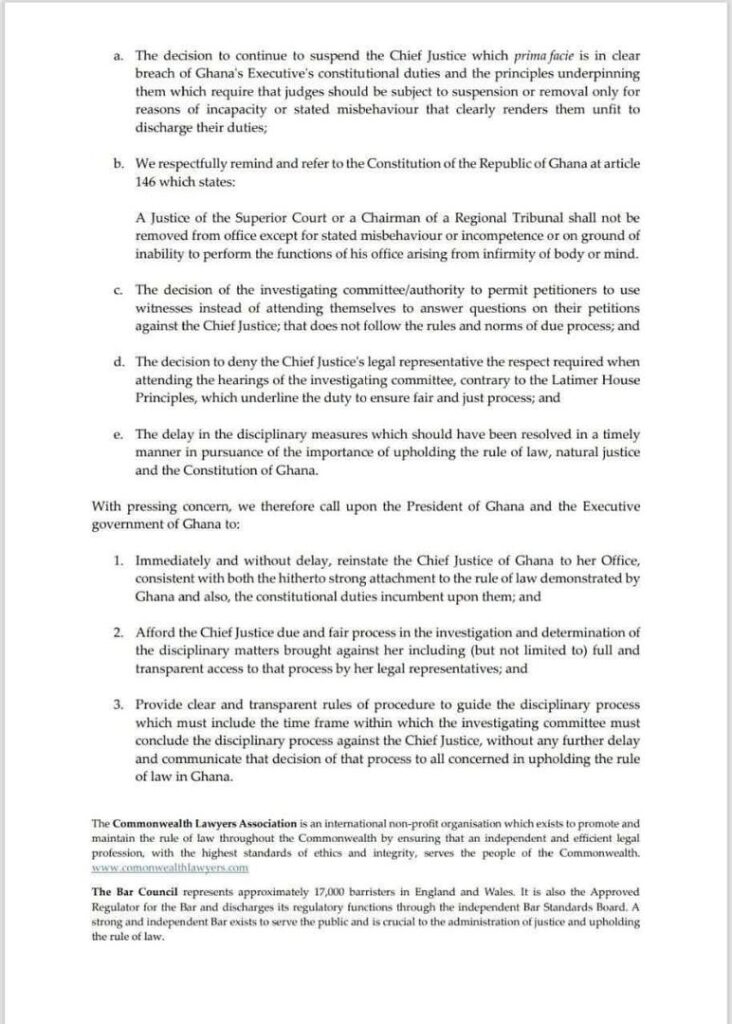
On Thursday, August 14, the Bar Council of England and Wales and the Commonwealth Lawyers Association called for the immediate reinstatement of Ghana’s Chief Justice by President John Dramani Mahama and the Executive arm of government.
“Immediately and without delay, reinstate the Chief Justice of Ghana to her Office, consistent with both the hitherto strong attachment to the rule of law demonstrated by Ghana and also the constitutional duties incumbent upon it.
“And afford the Chief Justice due and fair process in the investigation and determination of the disciplinary matters brought against her, including but not limited to full and transparent access to that process by her legal representatives,” the group demanded in a joint statement issued on August 14.
Additionally, the group asked the government for a proper and impartial investigation of the disciplinary charges against her, with her lawyers given full and transparent access to the proceedings. Also, both groups demanded the establishment of transparent procedural rules to guide the disciplinary process, including a definite timeframe within which the investigative committee must conclude its work and communicate its decision.
President John Dramani Mahama has officially sworn in Justice Paul Baffoe-Bonnie as the new Chief Justice.
Justice Baffoe-Bonnie was officially sworn into office on Monday, November 17, 2025, at a ceremony held at the Jubilee House.
He is now mandated to occupy the seat of the former Chief Justice Gertrude Torkonoo, who was dismissed by the President.
The ceremony was attended by high-ranking dignitaries, including the Vice President, members of the Council of State, the Attorney-General and Minister for Justice, the leadership of Parliament, and a full complement of Supreme Court Justices, alongside the new Chief Justice’s immediate family.
President Mahama, in his address, hailed Justice Baffoe-Bonnie’s valuable experience and commitment to the rule of law, urging him to prioritise judicial independence and the accelerated disposition of cases.
Accepting the mantle of leadership, the new Chief Justice took the prescribed oaths and immediately outlined his vision for the third arm of government, centred on comprehensive institutional reform.
A Distinguished Career of Service and Scholarship
Justice Baffoe-Bonnie’s rise to the apex of the Judiciary is the culmination of a distinguished career.
Educated at the University of Ghana School of Law and receiving a specialised Master of Laws (LL.M.) in Constitutional Theory from Oxford University, he has built a reputation as a scholar and a fearless jurist.
Key Career Highlights and Data:
Judicial Tenure: Appointed to the High Court in 1993, the Court of Appeal in 2005, and the Supreme Court in 2012.
Legal Specialization: Widely recognised for his expertise in Constitutional Law and Human Rights Jurisprudence.
Supreme Court Contribution: Authored 87 majority opinions on the Supreme Court, with a notable focus on land ownership disputes and electoral petitions.
His appointment is expected to bring a stabilising influence to the Judiciary, offering steady leadership grounded in decades of practical experience and deep legal scholarship.
The nation now looks to the new Chief Justice to drive the necessary reforms that will ensure timely and accessible justice for all citizens.
Parliament after several deliberations, approved the nomination of Justice Paul Baffoe-Bonnie as Ghana’s Chief Justice.
The Speaker of Parliament, Alban Bagbin, confirmed his approval on Thursday, November 11, during the 15th Sitting of the 3rd meeting.
“This Honorable House has accordingly approved the nomination of Justice Paul Baffoe-Bonnie as Chief Justice of the Republic, in accordance with Article 114 clause 1 of the 1992 Constitution respectively.
“I will want to take this opportunity to, on behalf of the House, congratulate the nominee on his approval by Parliament. I urge the nominee to take all that has happened right up from the day of the nomination up to his prior approval by Parliament into consideration in his tenure of office. Once again, congratulations,” he added.
Parliament concluded his nomination after a headcount, with the Majority in Parliament counting 163 and the Minority 69.
On Monday, November 10, Justice Paul Baffoe-Bonnie appeared before the Appointments Committee of Parliament for his vetting.
In October, President John Dramani Mahama submitted Justice Baffoe-Bonnie’s name to the Council of State for consideration in accordance with Article 144(1) of the Constitution, which requires the President to act in consultation with the Council of State and with Parliament’s approval when appointing a Chief Justice.
Justice Baffoe-Bonnie, the most senior member of the Supreme Court, was appointed to the apex court in June 2008 by then-President John Agyekum Kufuor. He studied law at the University of Ghana and was called to the Bar in 1983. His judicial career spans roles as a Circuit Court Judge in Kumasi, a High Court Judge at Duayaw Nkwanta, and a Court of Appeal Judge before his elevation to the Supreme Court.
Born on December 26, 1956, in Goaso, Justice Baffoe-Bonnie had his secondary education at Konongo Odumase Secondary School before pursuing law at the University of Ghana and the Ghana Law School.
However, speaking on the floor of Parliament on Friday, November 7, Minority Leader Alexander Afenyo-Markin said it would be inappropriate to proceed with the vetting of Acting Chief Justice Paul Baffoe-Bonnie while the former Chief Justice awaits a court verdict on her pending lawsuit.
In October, Gertrude Torkornoo initiated legal action to prevent the vetting and appointment of Justice Baffoe-Bonnie as Ghana’s next Chief Justice. She is seeking the nullification of all activities carried out by the Justice Gabriel Scott Pwamang Committee, which was set up under Article 146 to review petitions seeking her removal from office.
She further wants the court to overturn all proceedings undertaken by the said Committee and to declare the Presidential Warrant authorizing her dismissal as unlawful and without legal effect. The legal move came as Parliament’s Appointments Committee prepared to vet Justice Baffoe-Bonnie for the top judicial position.
Afenyo-Markin emphasized that commencing the vetting of the appointed CJ would breach judicial propriety. According to him, given the ongoing disputes surrounding the revocation of the former Chief Justice from office, proceeding with the vetting process could undermine Articles 125 and 127 of the Constitution.
“Proceeding to vet a new person to fill that office will be rendering the application of justice. We are not into blows; we are here to argue law and for you to determine. This kind of attack, ‘it will happen, it will happen,’ is inappropriate. They should take it easy,” Afenyo-Markin said.
Article 125 gives judicial power only to the courts and not to Parliament or the Executive. Article 127, on the other hand, requires all other state institutions not to interfere with the Judiciary’s work but to protect its independence.
But the Speaker of Parliament, Alban Bagbin, dismissed the motion presented by the Minority caucus. According to him, granting such a request would create a dangerous precedent, explaining that “any litigant could hold Parliament hostage—that is, file a case and freeze the work of Parliament and its committees.”
He ruled that “there is no constitutional or standing order basis for Parliament to halt the process simply because there are pending cases in court. The motion is inadmissible and has been returned to the sponsor, the Minority Leader, Honorable Alexander Afenyo-Markin, as stated clearly by our Standing Orders.”
The five-member committee, backed by Article 146, concluded its investigations last month and recommended the Chief Justice’s removal from office. Acting on the committee’s recommendations, President Mahama relieved Justice Gertrude Torkornoo of her duties with immediate effect on Monday, September 1.
The Chief Justice was earlier suspended by President Mahama on Tuesday, April 22, after a prima facie case was established following multiple petitions calling for her removal.
Among the petitions was one filed by a group known as Shining Stars of Ghana, alleging that she violated Article 144 of the Constitution by personally recommending judges for promotion to the Supreme Court. The group also claimed she ruled on a case involving the Speaker of Parliament without granting him a hearing, despite his refusal to respond to the suit.
Another petition from a police officer who is also a lawyer accused the Chief Justice of manipulating evidence and abusing her authority during a Supreme Court session where he was reportedly reprimanded, arrested, and detained. Court records, however, show that the lawyer’s conduct during proceedings prompted a unanimous caution from the bench, not just from the Chief Justice.
A third petition, submitted by a private individual, listed 21 alleged misconducts and four claims of incompetence, including the misuse of public funds—specifically, spending over GH¢261,000 and $30,000 on a family trip abroad in 2023, and misusing an additional GH¢75,580 and $14,000 during another foreign assignment without proper accountability.
Subsequent reports indicate that two more petitions were later filed, intensifying pressure on the Judiciary.
Chief Justice Gertrude Torkornoo, in her written response to President Mahama, strongly denied allegations of misconduct and abuse of office, describing them as baseless and lacking grounds for her removal.
In July, an application for review filed by the embattled Chief Justice at the Human Rights Division of the Accra High Court was dismissed. The court, presided over by Justice Amoako on Thursday, July 31, ruled that several claims—such as the illegal composition of the committee and wrongful conduct of proceedings—were already before the Supreme Court.
Justice Amoako stated that relitigating these issues would result in duplication and abuse of court processes and therefore dismissed the case.
The Chief Justice’s judicial review application, filed on June 9, sought nine reliefs, including declarations that the Article 146 Committee acted unlawfully and violated her right to a fair hearing.
As the Article 146 Committee’s proceedings are held in camera in accordance with Article 146(8) of the Constitution, the court noted that it could not inquire into certain matters raised by the suspended Chief Justice.
Following these developments, Justice Gertrude Torkornoo proceeded to the ECOWAS Community Court in Abuja, Nigeria, seeking $10 million in compensation over her suspension. Her application includes 10 reliefs, among them a request for precautionary measures ensuring she continues to enjoy the entitlements of her office pending the final determination of the case.
Meanwhile, government spokesperson Felix Kwakye Ofosu has refuted Justice Torkornoo’s claims, insisting that her suspension aligns with the Constitution.
On Thursday, August 14, the Bar Council of England and Wales and the Commonwealth Lawyers Association jointly called for the immediate reinstatement of Ghana’s Chief Justice by President Mahama and the Executive arm of government.
“Immediately and without delay, reinstate the Chief Justice of Ghana to her office, consistent with both the hitherto strong attachment to the rule of law demonstrated by Ghana and the constitutional duties incumbent upon them,” the statement said.
The groups further urged a fair and transparent investigation into the disciplinary charges against her and the establishment of clear procedural rules with a definite timeframe for the Committee’s work.
President John Dramani Mahama has sworn in Justice Paul Baffoe-Bonnie as Ghana’s Chief Justice. The swearing-in ceremony occurred on Monday, November 18, at the presidency.
His swearing-in comes after Parliament, following several deliberations, approved his nomination. The Speaker of Parliament, Alban Bagbin, confirmed his approval on Thursday, November 11, during the 15th Sitting of the 3rd meeting.
“This Honorable house has accordingly approved the nomination of Justice Paul Baffoe-Bonnie as Chief Justice of the Republic, in accordance with Article 114 clause 1 of the 1992 Constitution respectively.
“I will want to take this opportunity to, on behalf of the House congratulate the nominee on his approval by Parliament. I urge the nominee to take all that has happened right up from the day of the nomination up to his prior approval by Parliament into consideration in his tenure of office. Once again congratulations,” he added.
Watch the livestream here:
Parliament concluded his nomination after a headcount, where the Majority in Parliament counted 163 and the Minority 69.
On Monday, November 10, Justice Paul Baffoe-Bonnie appeared before the Appointments Committee of Parliament for his vetting.
In October, President John Dramani Mahama submitted Justice Baffoe-Bonnie’s name to the Council of State for consideration in accordance with Article 144(1) of the Constitution, which requires the President to act in consultation with the Council of State and with Parliament’s approval when appointing a Chief Justice.
Justice Baffoe-Bonnie, the most senior member of the Supreme Court, was appointed to the apex court in June 2008 by then-President John Agyekum Kufuor. He studied law at the University of Ghana and was called to the Bar in 1983. His judicial career spans roles as a Circuit Court Judge in Kumasi, a High Court Judge at Duayaw Nkwanta, and a Court of Appeal Judge before his elevation to the Supreme Court.
Born on December 26, 1956, in Goaso, Justice Baffoe-Bonnie had his secondary education at Konongo Odumase Secondary School before pursuing law at the University of Ghana and the Ghana Law School.
However, speaking on the floor of Parliament on Friday, November 7, Minority Leader Alexander Afenyo-Markin said it would be inappropriate to proceed with the vetting of Acting Chief Justice Paul Baffoe-Bonnie while the former Chief Justice awaits a court verdict on her pending lawsuit.
In October, Gertrude Torkornoo initiated legal action to prevent the vetting and appointment of Justice Baffoe-Bonnie as Ghana’s next Chief Justice. She is seeking the nullification of all activities carried out by the Justice Gabriel Scott Pwamang Committee, which was set up under Article 146 to review petitions seeking her removal from office.
She further wants the court to overturn all proceedings undertaken by the said Committee and to declare the Presidential Warrant authorizing her dismissal as unlawful and without legal effect. The legal move came as Parliament’s Appointments Committee prepared to vet Justice Baffoe-Bonnie for the top judicial position.
Afenyo-Markin emphasized that commencing the vetting of the appointed CJ would breach judicial propriety. According to him, given the ongoing disputes surrounding the revocation of the former Chief Justice from office, proceeding with the vetting process could undermine Articles 125 and 127 of the Constitution.
“Proceeding to vet a new person to fill that office will be rendering the application of justice. We are not into blows; we are here to argue law and for you to determine. This kind of attack, ‘it will happen, it will happen,’ is inappropriate. They should take it easy,” Afenyo-Markin said.
Article 125 gives judicial power only to the courts and not to Parliament or the Executive. Article 127, on the other hand, requires all other state institutions not to interfere with the Judiciary’s work but to protect its independence.
But the Speaker of Parliament, Alban Bagbin, dismissed the motion presented by the Minority caucus. According to him, granting such a request would create a dangerous precedent, explaining that “any litigant could hold Parliament hostage—that is, file a case and freeze the work of Parliament and its committees.”
He ruled that “there is no constitutional or standing order basis for Parliament to halt the process simply because there are pending cases in court. The motion is inadmissible and has been returned to the sponsor, the Minority Leader, Honorable Alexander Afenyo-Markin, as stated clearly by our Standing Orders.”
The five-member committee, backed by Article 146, concluded its investigations last month and recommended the Chief Justice’s removal from office. Acting on the committee’s recommendations, President Mahama relieved Justice Gertrude Torkornoo of her duties with immediate effect on Monday, September 1.
The Chief Justice was earlier suspended by President Mahama on Tuesday, April 22, after a prima facie case was established following multiple petitions calling for her removal.
Among the petitions was one filed by a group known as Shining Stars of Ghana, alleging that she violated Article 144 of the Constitution by personally recommending judges for promotion to the Supreme Court. The group also claimed she ruled on a case involving the Speaker of Parliament without granting him a hearing, despite his refusal to respond to the suit.
Another petition from a police officer who is also a lawyer accused the Chief Justice of manipulating evidence and abusing her authority during a Supreme Court session where he was reportedly reprimanded, arrested, and detained.
Court records, however, show that the lawyer’s conduct during proceedings prompted a unanimous caution from the bench, not just from the Chief Justice.
A third petition, submitted by a private individual, listed 21 alleged misconducts and four claims of incompetence, including the misuse of public funds—specifically, spending over GH¢261,000 and $30,000 on a family trip abroad in 2023, and misusing an additional GH¢75,580 and $14,000 during another foreign assignment without proper accountability.
Subsequent reports indicate that two more petitions were later filed, intensifying pressure on the Judiciary.
Chief Justice Gertrude Torkornoo, in her written response to President Mahama, strongly denied allegations of misconduct and abuse of office, describing them as baseless and lacking grounds for her removal.
In July, an application for review filed by the embattled Chief Justice at the Human Rights Division of the Accra High Court was dismissed. The court, presided over by Justice Amoako on Thursday, July 31, ruled that several claims—such as the illegal composition of the committee and wrongful conduct of proceedings—were already before the Supreme Court.
Justice Amoako stated that relitigating these issues would result in duplication and abuse of court processes and therefore dismissed the case.
The Chief Justice’s judicial review application, filed on June 9, sought nine reliefs, including declarations that the Article 146 Committee acted unlawfully and violated her right to a fair hearing.
As the Article 146 Committee’s proceedings are held in camera in accordance with Article 146(8) of the Constitution, the court noted that it could not inquire into certain matters raised by the suspended Chief Justice.
Following these developments, Justice Gertrude Torkornoo proceeded to the ECOWAS Community Court in Abuja, Nigeria, seeking $10 million in compensation over her suspension.
Her application includes 10 reliefs, among them a request for precautionary measures ensuring she continues to enjoy the entitlements of her office pending the final determination of the case.
Meanwhile, government spokesperson Felix Kwakye Ofosu has refuted Justice Torkornoo’s claims, insisting that her suspension aligns with the Constitution.
On Thursday, August 14, the Bar Council of England and Wales and the Commonwealth Lawyers Association jointly called for the immediate reinstatement of Ghana’s Chief Justice by President Mahama and the Executive arm of government.
“Immediately and without delay, reinstate the Chief Justice of Ghana to her office, consistent with both the hitherto strong attachment to the rule of law demonstrated by Ghana and the constitutional duties incumbent upon them,” the statement said.
The groups further urged a fair and transparent investigation into the disciplinary charges against her and the establishment of clear procedural rules with a definite timeframe for the Committee’s work.
Justice Paul Baffoe-Bonnie will officially be sworn in by President John Dramani Mahama today, Monday, November 17, as Ghana’s Chief Justice. His swearing-in comes after Parliament, following several deliberations, approved his nomination.
The Speaker of Parliament, Alban Bagbin, confirmed his approval on Thursday, November 11, during the 15th Sitting of the 3rd meeting.
“This Honorable house has accordingly approved the nomination of Justice Paul Baffoe-Bonnie as Chief Justice of the Republic, in accordance with Article 114 clause 1 of the 1992 Constitution respectively.
“I will want to take this opportunity to, on behalf of the House congratulate the nominee on his approval by Parliament. I urge the nominee to take all that has happened right up from the day of the nomination up to his prior approval by Parliament into consideration in his tenure of office. Once again congratulations,” he added.
Parliament concluded his nomination after a headcount, where the Majority in Parliament counted 163 and the Minority 69.
On Monday, November 10, Justice Paul Baffoe-Bonnie appeared before the Appointments Committee of Parliament for his vetting.
In October, President John Dramani Mahama submitted Justice Baffoe-Bonnie’s name to the Council of State for consideration in accordance with Article 144(1) of the Constitution, which requires the President to act in consultation with the Council of State and with Parliament’s approval when appointing a Chief Justice.
Justice Baffoe-Bonnie, the most senior member of the Supreme Court, was appointed to the apex court in June 2008 by then-President John Agyekum Kufuor. He studied law at the University of Ghana and was called to the Bar in 1983. His judicial career spans roles as a Circuit Court Judge in Kumasi, a High Court Judge at Duayaw Nkwanta, and a Court of Appeal Judge before his elevation to the Supreme Court.
Born on December 26, 1956, in Goaso, Justice Baffoe-Bonnie had his secondary education at Konongo Odumase Secondary School before pursuing law at the University of Ghana and the Ghana Law School.
However, speaking on the floor of Parliament on Friday, November 7, Minority Leader Alexander Afenyo-Markin said it would be inappropriate to proceed with the vetting of Acting Chief Justice Paul Baffoe-Bonnie while the former Chief Justice awaits a court verdict on her pending lawsuit.
In October, Gertrude Torkornoo initiated legal action to prevent the vetting and appointment of Justice Baffoe-Bonnie as Ghana’s next Chief Justice. She is seeking the nullification of all activities carried out by the Justice Gabriel Scott Pwamang Committee, which was set up under Article 146 to review petitions seeking her removal from office.
She further wants the court to overturn all proceedings undertaken by the said Committee and to declare the Presidential Warrant authorizing her dismissal as unlawful and without legal effect. The legal move came as Parliament’s Appointments Committee prepared to vet Justice Baffoe-Bonnie for the top judicial position.
Afenyo-Markin emphasized that commencing the vetting of the appointed CJ would breach judicial propriety. According to him, given the ongoing disputes surrounding the revocation of the former Chief Justice from office, proceeding with the vetting process could undermine Articles 125 and 127 of the Constitution.
“Proceeding to vet a new person to fill that office will be rendering the application of justice. We are not into blows; we are here to argue law and for you to determine. This kind of attack, ‘it will happen, it will happen,’ is inappropriate. They should take it easy,” Afenyo-Markin said.
Article 125 gives judicial power only to the courts and not to Parliament or the Executive. Article 127, on the other hand, requires all other state institutions not to interfere with the Judiciary’s work but to protect its independence.
But the Speaker of Parliament, Alban Bagbin, dismissed the motion presented by the Minority caucus. According to him, granting such a request would create a dangerous precedent, explaining that “any litigant could hold Parliament hostage—that is, file a case and freeze the work of Parliament and its committees.”
He ruled that “there is no constitutional or standing order basis for Parliament to halt the process simply because there are pending cases in court. The motion is inadmissible and has been returned to the sponsor, the Minority Leader, Honorable Alexander Afenyo-Markin, as stated clearly by our Standing Orders.”
The five-member committee, backed by Article 146, concluded its investigations last month and recommended the Chief Justice’s removal from office. Acting on the committee’s recommendations, President Mahama relieved Justice Gertrude Torkornoo of her duties with immediate effect on Monday, September 1.
The Chief Justice was earlier suspended by President Mahama on Tuesday, April 22, after a prima facie case was established following multiple petitions calling for her removal.
Among the petitions was one filed by a group known as Shining Stars of Ghana, alleging that she violated Article 144 of the Constitution by personally recommending judges for promotion to the Supreme Court. The group also claimed she ruled on a case involving the Speaker of Parliament without granting him a hearing, despite his refusal to respond to the suit.
Another petition from a police officer who is also a lawyer accused the Chief Justice of manipulating evidence and abusing her authority during a Supreme Court session where he was reportedly reprimanded, arrested, and detained.
Court records, however, show that the lawyer’s conduct during proceedings prompted a unanimous caution from the bench, not just from the Chief Justice.
A third petition, submitted by a private individual, listed 21 alleged misconducts and four claims of incompetence, including the misuse of public funds—specifically, spending over GH¢261,000 and $30,000 on a family trip abroad in 2023, and misusing an additional GH¢75,580 and $14,000 during another foreign assignment without proper accountability.
Subsequent reports indicate that two more petitions were later filed, intensifying pressure on the Judiciary.
Chief Justice Gertrude Torkornoo, in her written response to President Mahama, strongly denied allegations of misconduct and abuse of office, describing them as baseless and lacking grounds for her removal.
In July, an application for review filed by the embattled Chief Justice at the Human Rights Division of the Accra High Court was dismissed. The court, presided over by Justice Amoako on Thursday, July 31, ruled that several claims—such as the illegal composition of the committee and wrongful conduct of proceedings—were already before the Supreme Court.
Justice Amoako stated that relitigating these issues would result in duplication and abuse of court processes and therefore dismissed the case.
The Chief Justice’s judicial review application, filed on June 9, sought nine reliefs, including declarations that the Article 146 Committee acted unlawfully and violated her right to a fair hearing.
As the Article 146 Committee’s proceedings are held in camera in accordance with Article 146(8) of the Constitution, the court noted that it could not inquire into certain matters raised by the suspended Chief Justice.
Following these developments, Justice Gertrude Torkornoo proceeded to the ECOWAS Community Court in Abuja, Nigeria, seeking $10 million in compensation over her suspension.
Her application includes 10 reliefs, among them a request for precautionary measures ensuring she continues to enjoy the entitlements of her office pending the final determination of the case.
Meanwhile, government spokesperson Felix Kwakye Ofosu has refuted Justice Torkornoo’s claims, insisting that her suspension aligns with the Constitution.
On Thursday, August 14, the Bar Council of England and Wales and the Commonwealth Lawyers Association jointly called for the immediate reinstatement of Ghana’s Chief Justice by President Mahama and the Executive arm of government.
“Immediately and without delay, reinstate the Chief Justice of Ghana to her office, consistent with both the hitherto strong attachment to the rule of law demonstrated by Ghana and the constitutional duties incumbent upon them,” the statement said.
The groups further urged a fair and transparent investigation into the disciplinary charges against her and the establishment of clear procedural rules with a definite timeframe for the Committee’s work.
Parliament has, after several deliberations, approved the nomination of Justice Paul Baffoe-Bonnie as Ghana’s Chief Justice.
The Speaker of Parliament, Alban Bagbin, confirmed his approval on Thursday, November 11, during the 15th Sitting of the 3rd meeting.
“This Honorable house has accordingly approved the nomination of Justice Paul Baffoe-Bonnie as Chief Justice of the Republic, in accordance with Article 114 clause 1 of the 1992 Constitution respectively.
“I will want to take this opportunity to, on behalf of the House congratulate the nominee on his approval by Parliament. I urge the nominee to take all that has happened right up from the day of the nomination up to his prior approval by Parliament into consideration in his tenure of office. Once again congratulations,” he added.
Parliament concluded his nomination after a headcount, where the Majority in Parliament counted 163 and the Minority 69.
On Monday, November 10, Justice Paul Baffoe-Bonnie appeared before the Appointments Committee of Parliament for his vetting.
In October, President John Dramani Mahama submitted Justice Baffoe-Bonnie’s name to the Council of State for consideration in accordance with Article 144(1) of the Constitution, which requires the President to act in consultation with the Council of State and with Parliament’s approval when appointing a Chief Justice.
Justice Baffoe-Bonnie, the most senior member of the Supreme Court, was appointed to the apex court in June 2008 by then-President John Agyekum Kufuor. He studied law at the University of Ghana and was called to the Bar in 1983. His judicial career spans roles as a Circuit Court Judge in Kumasi, a High Court Judge at Duayaw Nkwanta, and a Court of Appeal Judge before his elevation to the Supreme Court.
Born on December 26, 1956, in Goaso, Justice Baffoe-Bonnie had his secondary education at Konongo Odumase Secondary School before pursuing law at the University of Ghana and the Ghana Law School.
However, speaking on the floor of Parliament on Friday, November 7, Minority Leader Alexander Afenyo-Markin said it would be inappropriate to proceed with the vetting of Acting Chief Justice Paul Baffoe-Bonnie while the former Chief Justice awaits a court verdict on her pending lawsuit.
In October, Gertrude Torkornoo initiated legal action to prevent the vetting and appointment of Justice Baffoe-Bonnie as Ghana’s next Chief Justice. She is seeking the nullification of all activities carried out by the Justice Gabriel Scott Pwamang Committee, which was set up under Article 146 to review petitions seeking her removal from office.
She further wants the court to overturn all proceedings undertaken by the said Committee and to declare the Presidential Warrant authorizing her dismissal as unlawful and without legal effect. The legal move came as Parliament’s Appointments Committee prepared to vet Justice Baffoe-Bonnie for the top judicial position.
Afenyo-Markin emphasized that commencing the vetting of the appointed CJ would breach judicial propriety. According to him, given the ongoing disputes surrounding the revocation of the former Chief Justice from office, proceeding with the vetting process could undermine Articles 125 and 127 of the Constitution.
“Proceeding to vet a new person to fill that office will be rendering the application of justice. We are not into blows; we are here to argue law and for you to determine. This kind of attack, ‘it will happen, it will happen,’ is inappropriate. They should take it easy,” Afenyo-Markin said.
Article 125 gives judicial power only to the courts and not to Parliament or the Executive. Article 127, on the other hand, requires all other state institutions not to interfere with the Judiciary’s work but to protect its independence.
But the Speaker of Parliament, Alban Bagbin, dismissed the motion presented by the Minority caucus. According to him, granting such a request would create a dangerous precedent, explaining that “any litigant could hold Parliament hostage—that is, file a case and freeze the work of Parliament and its committees.”
He ruled that “there is no constitutional or standing order basis for Parliament to halt the process simply because there are pending cases in court. The motion is inadmissible and has been returned to the sponsor, the Minority Leader, Honorable Alexander Afenyo-Markin, as stated clearly by our Standing Orders.”
The five-member committee, backed by Article 146, concluded its investigations last month and recommended the Chief Justice’s removal from office. Acting on the committee’s recommendations, President Mahama relieved Justice Gertrude Torkornoo of her duties with immediate effect on Monday, September 1.
The Chief Justice was earlier suspended by President Mahama on Tuesday, April 22, after a prima facie case was established following multiple petitions calling for her removal.
Among the petitions was one filed by a group known as Shining Stars of Ghana, alleging that she violated Article 144 of the Constitution by personally recommending judges for promotion to the Supreme Court. The group also claimed she ruled on a case involving the Speaker of Parliament without granting him a hearing, despite his refusal to respond to the suit.
Another petition from a police officer who is also a lawyer accused the Chief Justice of manipulating evidence and abusing her authority during a Supreme Court session where he was reportedly reprimanded, arrested, and detained.
Court records, however, show that the lawyer’s conduct during proceedings prompted a unanimous caution from the bench, not just from the Chief Justice.
A third petition, submitted by a private individual, listed 21 alleged misconducts and four claims of incompetence, including the misuse of public funds—specifically, spending over GH¢261,000 and $30,000 on a family trip abroad in 2023, and misusing an additional GH¢75,580 and $14,000 during another foreign assignment without proper accountability.
Subsequent reports indicate that two more petitions were later filed, intensifying pressure on the Judiciary.
Chief Justice Gertrude Torkornoo, in her written response to President Mahama, strongly denied allegations of misconduct and abuse of office, describing them as baseless and lacking grounds for her removal.
In July, an application for review filed by the embattled Chief Justice at the Human Rights Division of the Accra High Court was dismissed. The court, presided over by Justice Amoako on Thursday, July 31, ruled that several claims—such as the illegal composition of the committee and wrongful conduct of proceedings—were already before the Supreme Court.
Justice Amoako stated that relitigating these issues would result in duplication and abuse of court processes and therefore dismissed the case.
The Chief Justice’s judicial review application, filed on June 9, sought nine reliefs, including declarations that the Article 146 Committee acted unlawfully and violated her right to a fair hearing.
As the Article 146 Committee’s proceedings are held in camera in accordance with Article 146(8) of the Constitution, the court noted that it could not inquire into certain matters raised by the suspended Chief Justice.
Following these developments, Justice Gertrude Torkornoo proceeded to the ECOWAS Community Court in Abuja, Nigeria, seeking $10 million in compensation over her suspension.
Her application includes 10 reliefs, among them a request for precautionary measures ensuring she continues to enjoy the entitlements of her office pending the final determination of the case.
Meanwhile, government spokesperson Felix Kwakye Ofosu has refuted Justice Torkornoo’s claims, insisting that her suspension aligns with the Constitution.
On Thursday, August 14, the Bar Council of England and Wales and the Commonwealth Lawyers Association jointly called for the immediate reinstatement of Ghana’s Chief Justice by President Mahama and the Executive arm of government.
“Immediately and without delay, reinstate the Chief Justice of Ghana to her office, consistent with both the hitherto strong attachment to the rule of law demonstrated by Ghana and the constitutional duties incumbent upon them,” the statement said.
The groups further urged a fair and transparent investigation into the disciplinary charges against her and the establishment of clear procedural rules with a definite timeframe for the Committee’s work.
One of the leading contenders for the NPP’s National Chairmanship, John Boadu, has warned Parliament not to downplay the Chief Justice nominee, Justice Paul Baffoe-Bonnie’s, remarks on notorious criminal Atta Ayi’s prison sentence.
In 2005, Justice Paul gave Atta Ayi a 70-year prison sentence, convicting Atta Ayi of multiple counts of robbery and conspiracy to rob.
Twenty years later, he addressed the issue, citing it as an example in response to a question about sentencing guidelines and recent concerns over lengthy sentences for minor, non-violent offences during his appearance before Parliament’s Appointments Committee for his appointment as Chief Justice nominee.
According to him, the unusually lengthy sentence he gave Atta Ayi was to ensure the safety of his family; a shorter sentence could have allowed the criminal to target them after his release. emphasised that while sentencing guidelines provide a framework, judges must sometimes exercise discretion to address the broader context of a case, including public safety and the protection of vulnerable parties.
“The judges and magistrates, they are trained, they have sentencing guidelines,” he said. “But sometimes they have to go beyond it. In my youthful days, I gave somebody 70 years, Atta Ayi.
“I gave him 70 years. And what I told myself was that if Atta Ayi was given 30 years and he comes back, my family will be the first he will attack. So by the time he comes back after 70 years, I will be dead and gone,” he said lightheartedly to laughter in the audience,” he noted.
NPP’s aspiring Chairman is not content with the Justice’s answer, raising concerns about his reputation as the soon-to-be highest judicial officer in Ghana and his impartiality in future cases.
During an appearance on Asempa FM’s Ekosii Sen, Mr Boadu said Justice Baffoe-Bonnie’s remarks about the 70-year jail sentence handed to notorious armed robber Ataa Ayi were “unfortunate”.
Speaking and raising concerns about his impartiality in future rulings.
“What the Chief Justice nominee said was absolutely wrong. Such statements from someone expected to uphold justice are troubling,” he stated.
He further questioned whether Justice Baffoe-Bonnie could remain neutral in cases involving his personal or political interests.
“If a case that affects his personal interest comes before him, can we expect a fair trial?” he asked.
Consequently, he has admonished Parliament to take up the matter, highlighting the need for lawmakers to protect the rights of citizens and uphold judicial independence.
“The parliamentarians who vetted him have an honourable duty to protect the liberty of our people. This should not be about personal interest; it affects the government as a whole. If a case comes to him that involves his personal interests, can we really expect a fair trial? If my case goes before him, I would be fearful because if our political views do not align, he may try to favour his personal interests,” he added.
Background
Ataa Ayi, who was described by the police as the nation’s most notorious bandit,t had a high price tag placed on his head by the police. His whereabouts before he was captured prompted the largest manhunt in the nation’s crime history, with expensive billboards bearing his portrait mounted in five of the ten regions of the country. Ataa Ayi was arrested in his hideout in the Teshie Tsui Bleo, a suburb of Accra.
His girlfriend, suspected to be an accomplice, was also arrested in the raid.
Before his arrest, the police had been on his heels for months. His deputy, Emmanuel Tetteh, also known as Mpata, was also arrested. It was believed that information provided by Mpata might have helped to track down the elusive Ataa Ayi.
According to police, Ataa Ayi was the brain behind most of the brutal armed robberies in Accra. He and members of his gang were alleged to have, at gunpoint, stolen money, cars, jewellery and other valuables from various people in the national capital. He was also alleged to have shot several people who resisted his attacks.
Meanwhile, during the vetting, the Minority Caucus staged a walkout during the vetting process of the Chief Justice nominee.
This unfolded after the Minority leader, Alexander Afenyo-Markin, led his colleagues in raising issues against the nomination and also the processes that led to the removal of Gertrude Torkornoo as Chief Justice.
“We vote to reject the nominee. The Majority can proceed with the questions; we do not intend to proceed with any question. We are, however, registering in the strongest terms that we reject the nomination, and the records should reflect that the report of this committee be a majority report,” their leader, Alexander Afenyo-Markin, said during the vetting process.
In response, the Chair of the Committee, Bernard Ahiafor, said, “We thank you very much, we wish you well.”
Tension flared between Majority Leader Mahama Ayariga and Minority Leader Alexander Afenyo-Markin during the vetting session for the Chief Justice nominee.
Alexander Afenyo-Markin, the Minority Leader, insisted that his caucus reserves the right to refer to Justice Paul Baffoe-Bonnie as the contested Chief Justice nominee.
The opposition New Patriotic Party (NPP) has raised strong objections to Parliament’s decision to continue with the vetting of Chief Justice nominee Justice Paul Baffoe-Bonnie, calling it a violation of constitutional principles, the rule of law, and a situation that presents a conflict of interest.
In a statement issued on November 10 and signed by General Secretary Justin Frimpong Kodua, the party maintained that the vetting should have been put on hold until cases filed by former Chief Justice Gertrude Torkonoo were fully addressed.
According to the NPP, seven substantive legal actions related to the matter are currently pending before Ghana’s Supreme Court, the High Court, and the ECOWAS Court of Justice.
Baffoe-Bonnie was nominated by President John Dramani Mahama in accordance with constitutional provisions following the removal of the former Chief Justice Gertrude Torkornoo from office.
The vetting will assess his qualifications, judicial experience and overall suitability for the role before the committee submits its report to the plenary for consideration.
This comes despite Minority Members of Parliament filing a motion seeking to halt the vetting of Justice Baffoe-Bonnie.
In a statement dated October 29, 2025, the Minority indicated that the vetting process should be suspended until all pending suits and applications concerning former Chief Justice Gertrude Torkornoo have been heard and determined.
The Minority, citing Articles 110(1), 125–127, 144(1) and 146 of the 1992 Constitution and relevant Standing Orders, urged Parliament to suspend the Appointments Committee’s vetting and any plenary debate or approval processes.
The motion cited cases including the ECOWAS Court suit, the Supreme Court and the High Court applications.
“That this Honourable House, having regard to Articles 110(1), 125-127, 144(1) and 146 of the 1992 Constitution and Standing Orders 57(1)-(3), 93, 103(f), 216 and 217, resolves to suspend forthwith all further proceedings, both at the Appointments Committee and at Plenary, on the nomination of Justice Paul Baffoe-Bonnie as Chief Justice until all pending suits and applications directly bearing on the removal of Her Ladyship Justice Gertrude Araba Esaaba Sackey Torkornoo (including ECOWAS Court Suit No. ECW/CCJ/APP/32/25 on provisional measures, multiple Supreme Court proceedings, and High Court applications) are finally determined or withdrawn,” the statement said.
Speaker of Parliament, Alban Bagbin, has dismissed a motion presented by the Minority caucus calling for a halt in the vetting of Acting Chief Justice, Paul Baffoe-Bonnie.
According to the Speaker, granting such a request by the Minority would create a dangerous precedent, explaining that “any litigant could hold Parliament hostage, that is, file a case and freeze the work of Parliament and its committees.”
He ruled that “there is no constitutional or standing order basis for Parliament to halt the process simply because there are pending cases in court. The motion is inadmissible and has been returned to the sponsor, the Minority Leader, Honorable Alexander Afenyo-Markin, as stated clearly by our Standing Orders.”
Speaking on the floor of Parliament on Friday, November 7, the Minority Leader, Alexander Kwamena Afenyo-Markin, argued that it would be inappropriate to proceed with the vetting while former Chief Justice, Gertrude Torkornoo, awaits the verdict on her lawsuit presented to the court.
In October, Gertrude Torkornoo initiated a legal action seeking to prevent the vetting and appointment of Justice Baffoe-Bonnie as Ghana’s next Chief Justice. She is asking the court to nullify all activities carried out by the Justice Gabriel Scott Pwamang Committee, which was set up under Article 146 to review petitions seeking her removal from office.
She further wants the court to overturn all proceedings undertaken by the Committee and to declare the Presidential Warrant authorising her dismissal as unlawful and without legal effect. Her legal challenge came at a time when Parliament’s Appointments Committee was preparing to vet Justice Baffoe-Bonnie for the top judicial position.
Addressing the floor on Friday, November 7, Afenyo-Markin emphasised that commencing the vetting of the Acting Chief Justice would breach judicial propriety. According to him, given the ongoing disputes over the revocation of the former Chief Justice’s appointment, proceeding with the vetting process could undermine Articles 125 and 127 of the Constitution.
“Proceeding to vet a new person to fill that office will be rendering the application of justice. We are not into blows; we are here to argue law and for you to determine. This kind of attack, ‘it will happen, it will happen,’ is inappropriate. They should take it easy,” Afenyo-Markin said.
Article 125 vests judicial power solely in the courts, not in Parliament or the Executive. Article 127, on the other hand, requires all other state institutions to refrain from interfering with the Judiciary’s work and to protect its independence.
The lawsuit follows Chief Justice Torkornoo’s dismissal from office on September 1, 2025, by President John Mahama, after a constitutionally mandated committee found her guilty of misconduct and stated misbehaviour under Article 146.
The investigation, carried out in consultation with the Council of State, concluded that Justice Torkornoo had violated constitutional requirements, including the misuse of public funds, and therefore recommended her removal.
Justice Baffoe-Bonnie has been serving as Acting Chief Justice since April 22, 2025, following Torkornoo’s suspension. He was later nominated by the President in September to assume the substantive position.
His nomination aligns with Article 144(6) of the 1992 Constitution, which provides that: “Where the office of Chief Justice is vacant, or where the Chief Justice is for any reason unable to perform the functions of his office—(a) until a person has been appointed to, and has assumed the functions of, that office; or (b) until the person holding that office has resumed the functions of that office; as the case may be, those functions shall be performed by the most senior of the Justices of the Supreme Court.”
Appointed to the nation’s highest court in June 2008 by former President John Agyekum Kufuor, Justice Baffoe-Bonnie has served for over a decade, earning distinction as a seasoned judicial figure and now stepping into a critical leadership role during a sensitive period for the judiciary.
The change in leadership came after President John Dramani Mahama ordered the suspension of Chief Justice Gertrude Torkornoo following the submission of multiple petitions against her, prompting a formal inquiry into her conduct.
A statement signed by the Minister of Government Communications, Felix Kwakye Ofosu, and released on Tuesday, April 22, explained that the President’s decision was based on advice from the Council of State, in accordance with Article 146(6) of the Constitution.
The statement noted that: “There is a prima facie case for the Chief Justice to respond to.”
Following the development, a five-member committee was formed to assess the allegations contained in the petitions. The committee was chaired by Justice Gabriel Scott Pwamang of the Supreme Court, with members including Justice Samuel Kwame Adibu-Asiedu, Daniel Yaw Domelevo (former Auditor-General), Major Flora Bazwaanura Dalugo of the Ghana Armed Forces, and Professor James Sefah Dzisah of the University of Ghana.
The committee was tasked with conducting a thorough review to determine the merit of the claims and recommend appropriate action in line with constitutional procedures.
The five-member committee, backed by Article 146, concluded its investigations last month and recommended the Chief Justice’s removal from office. Acting on the committee’s recommendations, President Mahama relieved Justice Gertrude Torkornoo of her duties with immediate effect on Monday, September 1.
The Chief Justice was earlier suspended by President Mahama on Tuesday, April 22, after a prima facie case was established following multiple petitions calling for her removal.
Among the petitions was one filed by a group known as Shining Stars of Ghana, alleging that she violated Article 144 of the Constitution by personally recommending judges for promotion to the Supreme Court. The group also claimed she ruled on a case involving the Speaker of Parliament without granting him a hearing, despite his refusal to respond to the suit.
Another petition from a police officer who is also a lawyer accused the Chief Justice of manipulating evidence and abusing her authority during a Supreme Court session where he was reportedly reprimanded, arrested, and detained.
Court records, however, show that the lawyer’s conduct during proceedings prompted a unanimous caution from the bench, not just from the Chief Justice.
A third petition, submitted by a private individual, listed 21 alleged misconducts and four claims of incompetence, including the misuse of public funds — specifically, spending over GH¢261,000 and $30,000 on a family trip abroad in 2023 and misusing an additional GH¢75,580 and $14,000 during another foreign assignment without proper accountability.
Subsequent reports indicate that two more petitions were later filed, intensifying pressure on the judiciary.
Chief Justice Gertrude Torkornoo, in her written response to President Mahama, strongly denied allegations of misconduct and abuse of office, describing them as baseless and lacking grounds for her removal.
In July, an application for review filed by the embattled Chief Justice at the Human Rights Division of the Accra High Court was dismissed. The court, presided over by Justice Amoako on Thursday, July 31, ruled that several claims—such as the illegal composition of the committee and wrongful conduct of proceedings—were already before the Supreme Court.
Justice Amoako stated that relitigating these issues would result in duplication and abuse of court processes, and therefore dismissed the case.
The Chief Justice’s judicial review application, filed on June 9, sought nine reliefs, including declarations that the Article 146 committee acted unlawfully and violated her right to a fair hearing.
As the Article 146 committee’s proceedings are held in camera in accordance with Article 146(8) of the Constitution, the court noted it could not inquire into certain matters raised by the suspended Chief Justice.
Following these developments, Justice Gertrude Torkornoo proceeded to the ECOWAS Community Court in Abuja, Nigeria, seeking $10 million in compensation over her suspension.
Her application includes 10 reliefs, among them a request for precautionary measures ensuring she continues to enjoy the entitlements of her office pending final determination of the case.
Meanwhile, government spokesperson Felix Kwakye Ofosu has refuted Justice Torkornoo’s claims, insisting that her suspension aligns with the Constitution.
On Thursday, August 14, the Bar Council of England and Wales and the Commonwealth Lawyers Association jointly called for the immediate reinstatement of Ghana’s Chief Justice by President Mahama and the Executive arm of government.
“Immediately and without delay, reinstate the Chief Justice of Ghana to her office, consistent with both the hitherto strong attachment to the rule of law demonstrated by Ghana and the constitutional duties incumbent upon them,” the statement said.
The groups further urged a fair and transparent investigation into the disciplinary charges against her and the establishment of clear procedural rules with a definite timeframe for the committee’s work.
However, Attorney General Dr. Dominic Ayine has emphasised that his office can only act after the committee concludes its work and submits its report to the President. “The suspension will, therefore, remain in effect until the inquiry committee completes its work and submits its report, to which His Excellency the President will adhere,” he stated.
Minority Leader, Alexander Afenyo-Markin, has said that it would be inappropriate to proceed with the vetting of Acting Chief Justice, Paul Baffoe-Bonnie, while former Chief Justice, Gertrude Torkornoo, awaits the court’s verdict on her pending lawsuit.
In October, Gertrude Torkornoo initiated a court action to prevent the vetting and appointment of Justice Baffoe-Bonnie as Ghana’s next Chief Justice. She is asking for the nullification of all activities carried out by the Justice Gabriel Scott Pwamang Committee, which was set up under Article 146 to review petitions seeking her removal from office.
She further wants the court to overturn all proceedings undertaken by the said Committee and to declare the Presidential Warrant authorizing her dismissal as unlawful and without legal effect. The legal move came as Parliament’s Appointments Committee readied to vet Justice Baffoe-Bonnie for the top judicial position.
Addressing the floor on Friday, November 7, the Minority emphasized that commencing the appointed CJ’s vetting would breach judicial propriety. According to him, given the ongoing disputes over the revocation of the former Chief Justice from office, proceeding with the vetting process could undermine Articles 125 and 127 of the Constitution.
“Proceeding to vet a new person to fill that office will be rendering the application of justice. We are not into blows; we are here to argue law and for you to determine. This kind of attack, ‘it will happen, it will happen,’ is inappropriate. They should take it easy,” Afenyo-Markin said.
Article 125 gives judicial power only to the courts and not to Parliament or the Executive. Article 127, on the other hand, requires all other state institutions not to interfere with the Judiciary’s work but to protect its independence.
The lawsuit follows her dismissal from office on September 1, this year, by President John Mahama, after a constitutionally mandated committee found her guilty of misconduct and stated misbehaviour under Article 146.
That investigation, carried out in consultation with the Council of State, concluded that Justice Torkonoo had violated constitutional requirements, including the misuse of public funds, and therefore recommended her removal.
Justice Baffoe-Bonnie has been serving as Acting Chief Justice since April 22, 2025, after Torkonoo’s suspension, and was later nominated by the President in September to assume the substantive position.
His elevation was in line with Article 144(6) of the 1992 Constitution, which provides that:
“Where the office of Chief Justice is vacant, or where the Chief Justice is for any reason unable to perform the functions of his office –(a) until a person has been appointed to, and has assumed the functions of, that office; or(b) until the person, holding that office has resumed the functions of that office;as the case may be, those functions shall be performed by the most senior of the Justices of the Supreme Court.”
Appointed to the nation’s highest court in June 2008 by former President John Agyekum Kufuor, Justice Baffoe-Bonnie has served for over a decade, earning distinction as a seasoned judicial figure and now stepping into a critical leadership role during a sensitive period for the judiciary.
Suspension of the Chief Justice
The change in leadership came after President John Dramani Mahama ordered the suspension of Chief Justice Gertrude Torkornoo. This action followed the submission of multiple petitions against her, prompting a formal inquiry into her conduct.
A statement signed by the Minister of Government Communications, Felix Kwakye Ofosu, and released on Tuesday, April 22, explained that the President’s decision was based on advice from the Council of State, in accordance with Article 146(6) of the Constitution.
The statement noted that:”There is a prima facie case for the Chief Justice to respond to.”
Investigation Committee Formed
In light of the development, a five-member committee has been formed to assess the allegations contained in the petitions. The committee was chaired by Justice Gabriel Scott Pwamang, also of the Supreme Court.
Other members include, Justice Samuel Kwame Adibu-Asiedu, Supreme Court Justice, Daniel Yaw Domelevo, Former Auditor-General, Major Flora Bazwaanura Dalugo, Ghana Armed Forces, and Professor James Sefah Dzisah, Associate Professor, University of Ghana
The committee was tasked with conducting a thorough review to determine the merit of the claims and recommend the next steps in accordance with constitutional procedures.
The five-member committee, backed by Article 146, concluded its investigations last month and recommended that the Chief Justice be removed from office. The President upon the recommendations received from the committee on Monday, September 1 relieved the suspended Chief Justice Getrude Tokornoo of her duties with immediate effect.
The Chief Justice was earlier suspended by President Mahama on Tuesday, April 22, after a prima facie case was established, following separate petitions calling for her removal.
A series of petitions filed against Chief Justice Torkornoo, beginning with one from a group known as Shining Stars of Ghana.
The group alleges she violated Article 144 of the Constitution by personally recommending judges for promotion to the Supreme Court, and further claims she ruled on a case involving the Speaker of Parliament without granting him a hearing, despite his refusal to respond to the suit.
A series of petitions filed against Chief Justice Torkornoo, beginning with one from a group known as Shining Stars of Ghana. The group alleges she violated Article 144 of the Constitution by personally recommending judges for promotion to the Supreme Court, and further claims she ruled on a case involving the Speaker of Parliament without granting him a hearing, despite his refusal to respond to the suit.
The group alleges she violated Article 144 of the Constitution by personally recommending judges for promotion to the Supreme Court, and further claims she ruled on a case involving the Speaker of Parliament without granting him a hearing, despite his refusal to respond to the suit.
Another petition from a police officer who is also a lawyer accuses the Chief Justice of manipulating evidence and abusing her authority, following an incident during a Supreme Court session where he was reportedly reprimanded, arrested, and detained.
However, court records suggest the lawyer’s conduct during proceedings prompted a unanimous caution from the bench, not just the Chief Justice.
A third petition, submitted by a private individual, lists 21 alleged misconducts and four claims of incompetence. Among the accusations is the misuse of public funds—specifically, that she spent over GH¢261,000 and $30,000 on a family trip abroad in 2023 and misused an additional GH¢75,580 and $14,000 during another foreign assignment without proper accountability.
Subsequent reports indicate two more petitions have been added to the list, intensifying pressure on the judiciary.
Chief Justice Gertrude Torkornoo, in her written response to President Mahama, strongly denied allegations of misconduct and abuse of office brought against her by a senior police officer, describing them as baseless and lacking grounds for her removal from office.
In July, an application for review regarding an ‘abuse of court processes’ by the embattled Chief Justice, Justice Gertrude Torkornoo, was dismissed by the Human Rights Division of the Accra High Court.
The court presided over by Justice Amoako on Thursday, July 31, revealed that several claims, such as illegal composition of the committee and wrongful conduct of adversarial proceedings, were already before the Supreme Court.
Justice Amoako argued that relitigating these issues would result in duplication of litigation and abuse of court processes. As such, such claims were dismissed.
The judge also dismissed reliefs such as an order of certiorari to quash the committee’s proceedings and nullify its sittings on the basis that the Chief Justice did not receive a fair hearing, on jurisdictional grounds.
The judicial review application filed on June 9 this year sought nine reliefs, which included a series of declarations that the Article 146 committee set up to probe her removal from office had acted unlawfully.
She wanted the court to prevent the committee from proceeding with its work without providing her with authenticated copies of the petitions seeking her removal and the subsequent responses.
The Chief Justice notes that the president’s purported prima facie determination contained no reasons or justification and was entirely devoid of the elements of judicial or quasi-judicial reasoning expected under the Constitution.
As the proceedings of the Article 146 committee are to be held in-camera in accordance with Article 146(8) of the Constitution, the court noted that it could not inquire into matters raised by the suspended Chief Justice.
In response, Justice Gertrude Torkornoo proceeded to the ECOWAS Community Court in Abuja, Nigeria, seeking compensation worth $10 million over her suspension from office by His Excellency President John Dramani Mahama.
This forms part of 10 reliefs being requested. The Chief Justice’s recent suit follows several unsuccessful cases at the Supreme Court this year after her suspension.
The suspended Chief Justice wants the court to ensure she continues to enjoy the paraphernalia and entitlements of her office as the Chief Justice of Ghana pending the hearing and determination of the case.
The measures are;“That the Republic of Ghana suspend the disciplinary/ removal from office as Chief Justice process against the Applicant, pending the hearing and determination of the complaint on the merits.”
“That Ghana refrains from taking any other measures that may harm the rights claimed by the Applicant and /or aggravate or extend the dispute submitted to the Court, or compromise the implementation of any decision that the Court may render.”
“Given the urgency of the situation, the Applicant respectfully requests the Court to hold a hearing on this request as soon as possible, and that the President of the Court ask Ghana to act in order to allow any order that the Court may issue on the Request for Assignment of Precautionary Measures to have its appropriate effect.”
The other reliefs are as follows;
“A declaration that the panel instituted by the Respondent (Ghana) to investigate and determine the allegations of misconduct against the Applicant was not constituted to guarantee its independence and impartiality and as such has violated the Applicant’s human right to fair hearing guaranteed by Article 7 of the African Charter on Human and Peoples’ Rights.”
“A declaration that the purported suspension of the Applicant as the Chief Justice of the Republic of Ghana by the President of the Respondent State on 22 April 2025, constitutes a violation of her human right to fair equitable and satisfactory conditions guaranteed by Article 15 of the African Charter on Human and Peoples’ Rights.”
“A declaration that the purported suspension of the Applicant as the Chief Justice of the Republic of Ghana by the President of the Respondent State on 22 April 2025 has exposed her to public ridicule and odium locally and internationally and the said act constitutes a violation of her human right to dignity guaranteed by Article 5 of the African Charter on Human and Peoples’ Rights.”
“A declaration that by subjecting the Applicant to an illegal and unfair investigation and trial since April 2025, the Respondent has inflicted injuries on her professional standing and image, thereby ‘exposing her and her family to immeasurable public ridicule.”
“An order to the Respondent Republic to act immediately to prescribe the rule of procedure to govern the investigation of allegations of misconduct against the Chief Justice of the Republic of Ghana in conformity with the right to fair hearing guaranteed by the Constitution of Ghana and the African Charter on Human and Peoples’ Rights.”
“An order directing the Respondent to immediately lift the suspension and restore the Applicant to full office until the conclusion of fair constitutional proceedings.”
“An order restraining the Respondent from continuing with the purported inquiry for the removal of the Applicant as the Chief Justice of the Republic of Ghana in its current form, until it conforms to fair hearing guarantees.”
“An award of USD 10 million as compensation for moral and reputational damages suffered by the Applicant as a result of her illegal suspension and unfair investigation, and lastly, “Any other relief(s) as the Honourable Court deems just.”
The suspended Chief Justice wants the court to ensure she continues to enjoy the paraphernalia and entitlements of her office as the Chief Justice of Ghana pending the hearing and determination of the case. The applicant has also requested the ECOWAS Court to assign four precautionary measures to the country.Meanwhile, the government’s spokesperson, Felix Kwakye Ofosu, has refuted claims made by Justice Torkornoo, noting that the Chief Justice’s suspension aligns with the constitution.
On Thursday, August 14, the Bar Council of England and Wales and the Commonwealth Lawyers Association called for the immediate reinstatement of Ghana’s Chief Justice by President John Dramani Mahama and the Executive arm of government.
“Immediately and without delay, reinstate the Chief Justice of Ghana to her Office. consistent with both the hitherto strong attachment to the rule of law demonstrated by Ghana and also, the constitutional duties incumbent upon them.
“And afford the Chief justice due and fair process in the investigation and determination of the disciplinary matters brought against her, including but not limited to full and transparent access to that process by her legal representatives,” the group demanded in a joint statement issued on August 14.
Additionally, the group asked the government for a proper and impartial investigation of the disciplinary charges against her, with her lawyers given full and transparent access to the proceedings.
Also both groups demanded the establishment of transparent procedural rules to guide the disciplinary process, including a definite timeframe within which the investigative committee must conclude its work and communicate its decision.
However, Attorney General Dr. Dominic Ayine has emphasised that his outfit can only intervene after the committee concludes its work and submits a report to President John Dramani Mahama.“The suspension will, therefore, remain in effect until the inquiry committee completes its work and submits its report, to which His Excellency, the President will adhere,” he said.
The Majority Chief Whip, Rockson-Nelson Dafeamekpor, has commended President John Dramani Mahama for relieving Chief Justice (CJ) Gertrude Araba Esaaba Sackey Torkornoo of her duties.
Speaking to the media on Monday, September 1, the Majority Chief Whip he shot down claims that the National Democratic Congress’ (NDC) government had ulterior motives behind the CJ’s removal.
According to him, the government acted rightfully in accordance to Ghana’s 1992 Constitution, therefore cannot be accused of any wrongdoing in the Chief Justice’s removal.
“It’s absolutely incorrect for Hassan Tampuli [Gushegu MP], and some others, to suggest, however whimsical that it is, that the grounds underpining these petitions that went before the Article 146 Committee were whimsical and frivolous. There were no frivolities at all,” he pointed out.
On Monday, September 1, a press statement issued by the presidency and signed by the Spokesperson to the President, Felix Kwakye Ofosu, indicated that her dismissal is in accordance with Article 146(9) of the 1992 Constitution.
President Mahama, on Tuesday, April 22, suspended the Chief Justice after a prima facie case was established, following separate petitions calling for her removal.
However, the new development comes shortly after President John Dramani Mahama officially received recommendations from the committee probing petitions seeking the removal of Chief Justice Gertrude Araba Esaaba Sackey Torkornoo, Monday, September 1.
According to the statement, the Article 146 Committee of Inquiry found that the grounds of stated misbehaviour under Article 146(1) had been established and recommended her removal from office.
“President John Dramani Mahama has, in accordance with Article 146(9) of the 1992 Constitution, removed the Chief Justice, Her Ladyship Justice Gertrude Araba Esaaba Sackey Torkonoo, from office with immediate effect.
“This follows receipt of the report of the Committee constituted under Article 146(6) to inquire into a petition submitted by a Ghanaian citizen, Mr Daniel Ofori. After considering the petition and the evidence, the Committee found that the grounds of stated misbehaviour under Article 146(1) had been established and recommended her removal from office. Under Article 146(9), the President is required to act in accordance with the committee’s recommendation,” parts of the statement read.
The committee, chaired by Supreme Court Justice Gabriel Scott Pwamang and includes Justice Samuel Kwame Adibu Asiedu, former Auditor-General Daniel Yaw Domelevo, Major Flora Bazwaanura Dalugo of the Ghana Armed Forces, and Professor James Sefah Dzisah of the University of Ghana.
In July, an application for review regarding an ‘abuse of court processes’ by the embattled Chief Justice, Justice Gertrude Torkornoo, was dismissed by the Human Rights Division of the Accra High Court.
The court presided over by Justice Amoako on Thursday, July 31, revealed that several claims, such as illegal composition of the committee and wrongful conduct of adversarial proceedings, were already before the Supreme Court.
Justice Amoako argued that relitigating these issues would result in duplication of litigation and abuse of court processes. As such, such claims were dismissed.
The judge also dismissed reliefs such as an order of certiorari to quash the committee’s proceedings and nullify its sittings on the basis that the Chief Justice did not receive a fair hearing, on jurisdictional grounds.
The judicial review application filed on June 9 this year sought nine reliefs, which included a series of declarations that the Article 146 committee set up to probe her removal from office had acted unlawfully.
She wanted the court to prevent the committee from proceeding with its work without providing her with authenticated copies of the petitions seeking her removal and the subsequent responses.
The Chief Justice notes that the president’s purported prima facie determination contained no reasons or justification and was entirely devoid of the elements of judicial or quasi-judicial reasoning expected under the Constitution.
As the proceedings of the Article 146 committee are to be held in-camera in accordance with Article 146(8) of the Constitution, the court noted that it could not inquire into matters raised by the suspended Chief Justice.
In response, Justice Gertrude Torkornoo proceeded to the ECOWAS Community Court in Abuja, Nigeria, seeking compensation worth $10 million over her suspension from office by His Excellency President John Dramani Mahama.
This forms part of the 10 reliefs being requested. The Chief Justice’s recent suit follows several unsuccessful cases at the Supreme Court this year after her suspension.
The suspended Chief Justice wants the court to ensure she continues to enjoy the paraphernalia and entitlements of her office as the Chief Justice of Ghana pending the hearing and determination of the case.
The measures are: “That the Republic of Ghana suspend the disciplinary/ removal from office as Chief Justice process against the Applicant, pending the hearing and determination of the complaint on the merits.”
“That Ghana refrains from taking any other measures that may harm the rights claimed by the Applicant and /or aggravate or extend the dispute submitted to the Court, or compromise the implementation of any decision that the Court may render.”
“Given the urgency of the situation, the Applicant respectfully requests the Court to hold a hearing on this request as soon as possible, and that the President of the Court ask Ghana to act in order to allow any order that the Court may issue on the Request for Assignment of Precautionary Measures to have its appropriate effect.”
The other reliefs are as follows: “A declaration that the panel instituted by the Respondent (Ghana) to investigate and determine the allegations of misconduct against the Applicant was not constituted to guarantee its independence and impartiality and as such has violated the Applicant’s human right to fair hearing guaranteed by Article 7 of the African Charter on Human and Peoples’ Rights.”
“A declaration that the purported suspension of the Applicant as the Chief Justice of the Republic of Ghana by the President of the Respondent State on 22 April 2025, constitutes a violation of her human right to fair, equitable, and satisfactory conditions guaranteed by Article 15 of the African Charter on Human and Peoples’ Rights.”
“A declaration that the purported suspension of the Applicant as the Chief Justice of the Republic of Ghana by the President of the Respondent State on 22 April 2025 has exposed her to public ridicule and odium locally and internationally and the said act constitutes a violation of her human right to dignity guaranteed by Article 5 of the African Charter on Human and Peoples’ Rights.”
“A declaration that by subjecting the Applicant to an illegal and unfair investigation and trial since April 2025, the Respondent has inflicted injuries on her professional standing and image, thereby ‘exposing her and her family to immeasurable public ridicule.”
“An order to the Respondent Republic to act immediately to prescribe the rule of procedure to govern the investigation of allegations of misconduct against the Chief Justice of the Republic of Ghana in conformity with the right to fair hearing guaranteed by the Constitution of Ghana and the African Charter on Human and Peoples’ Rights.”
“An order directing the Respondent to immediately lift the suspension and restore the Applicant to full office until the conclusion of fair constitutional proceedings.”
“An order restraining the Respondent from continuing with the purported inquiry for the removal of the Applicant as the Chief Justice of the Republic of Ghana in its current form, until it conforms to fair hearing guarantees.”
“An award of USD 10 million as compensation for moral and reputational damages suffered by the Applicant as a result of her illegal suspension and unfair investigation, and lastly, “Any other relief(s) as the Honourable Court deems just.”
The suspended Chief Justice wants the court to ensure she continues to enjoy the paraphernalia and entitlements of her office as the Chief Justice of Ghana pending the hearing and determination of the case.
The applicant has also requested the ECOWAS Court to assign four precautionary measures to the country. Meanwhile, the government’s spokesperson, Felix Kwakye Ofosu, has refuted claims made by Justice Torkornoo, noting that the Chief Justice’s suspension aligns with the constitution.
On Thursday, August 14, the Bar Council of England and Wales and the Commonwealth Lawyers Association called for the immediate reinstatement of Ghana’s Chief Justice by President John Dramani Mahama and the Executive arm of government.
“Immediately and without delay, reinstate the Chief Justice of Ghana to her Office. consistent with both the hitherto strong attachment to the rule of law demonstrated by Ghana and also, the constitutional duties incumbent upon them.
“And afford the Chief justice due and fair process in the investigation and determination of the disciplinary matters brought against her, including but not limited to full and transparent access to that process by her legal representatives,” the group demanded in a joint statement issued on August 14.
Additionally, the group asked the government for a proper and impartial investigation of the disciplinary charges against her, with her lawyers given full and transparent access to the proceedings.
Also both groups, demanded the establishment of transparent procedural rules to guide the disciplinary process, including a definite timeframe within which the investigative committee must conclude its work and communicate its decision.
In response, the Attorney General (A-G), Dr. Dominic Ayine emphasised that his outfit can only intervene after the committee concludes its work and submits a report to President John Dramani Mahama.
“The suspension will, therefore, remain in effect until the inquiry committee completes its work and submits its report, to which His Excellency, the President will adhere,” he said.
The Bar Council of England and Wales and the Commonwealth Lawyers Association have called for the immediate reinstatement of Ghana’s Chief Justice, Her Ladyship Justice Gertrude by President John Dramani Mahama and the Executive arm of government.
“Immediately and without delay, reinstate the Chief Justice of Ghana to her Office. consistent with both the hitherto strong attachment to the rule of law demonstrated by Ghana and also, the constitutional duties incumbent upon them; and
“Afford the Chief justice due and fair process in the investigation and determination of the disciplinary matters brought against her including but not limited to) full and transparent access to that process by her legal representatives,” the group demanded in a joint statement issued on August 14.
The group has further asked the government for a proper and impartial investigation of the disciplinary charges against her, with her lawyers given full and transparent access to the proceedings.
In addition to the demands by both groups, is the establishment of transparent procedural rules to guide the disciplinary process, including a definite timeframe within which the investigative committee must conclude its work and communicate its decision.
The Ghana Bar Association (GBA) has also called for the immediate revocation of Chief Justice Gertrude Torkornoo’s suspension, deeming it unconstitutional and lacking a legal basis under Ghana’s 1992 Constitution.
The Association described the move as “flawed” and emphasized that the suspension violated constitutional protocols.
In a statement dated April 26, the GBA stated, “The Ghana Bar Association calls for the immediate revocation of the suspension of the Chief Justice as it considers the suspension to be unconstitutional.”
The GBA pointed out that the suspension was carried out without any published Constitutional Instrument, Statutory Instrument, or regulation governing the exercise of presidential discretion, which goes against Article 296 of the Constitution. “The suspension was carried out without any published Constitutional Instrument, Statutory Instrument, or regulation governing the exercise of that presidential discretion, in violation of Article 296 of the Constitution,” the GBA’s statement read.
The Association further called for the government to enact clear and comprehensive regulations to guide processes under Article 146, which covers the impeachment or removal of Superior Court justices. “We urge the government to immediately enact clear and comprehensive regulations to guide all processes under Article 146,” the statement noted.
Additionally, the GBA demanded the President release the full decision that establishes a prima facie case against Chief Justice Torkornoo, aligning with established precedent and promoting fairness and transparency. “The GBA also called on the President to release the full decision establishing a prima facie case against Chief Justice Torkornoo,” the statement read.
The Bar Association also condemned prejudicial and politically motivated commentary surrounding the suspension, warning that such remarks risk eroding public trust in the judiciary. “The GBA condemns what it describes as prejudicial and politically motivated commentary surrounding the matter, warning that such statements risk eroding public trust in the judiciary,” the statement added.
In response to these developments, the GBA reaffirmed its commitment to defending the judicial process from undue interference and unjustifiable attacks. “The Association affirms its commitment to safeguarding the sanctity of the judicial process and resolves to take all appropriate legal measures to protect the Judiciary from undue interference or unjustifiable attacks,” the statement concluded.
The suspension has sparked widespread debate, with many waiting to see how the Presidency responds to the GBA’s demands and how the situation will unfold in the coming days.
Chief Justice Gertrude Araba Esaaba Sackey Torkornoo has been suspended by President John Dramani Mahama after a preliminary determination indicated grounds for a formal probe into her conduct.
The suspension, announced on Tuesday, April 22, follows the establishment of a prima facie case based on three separate petitions calling for her removal. The action is in accordance with Article 146(6) of Ghana’s 1992 Constitution and comes after consultations with the Council of State.
Although the details of the petitions remain undisclosed, the situation has generated intense discussion among legal and political observers, with concerns raised over the implications for judicial accountability and institutional trust.
Chief Justice Torkornoo, who was officially notified and given a 10-day window to respond to the allegations, submitted her defense on April 7. Following a review of her response and further consultation, the presidency concluded that the case merited further investigation.
A five-member committee has been constituted to carry out the inquiry. It is chaired by Supreme Court Justice Gabriel Scott Pwamang and includes Justice Samuel Kwame Adibu Asiedu, former Auditor-General Daniel Yaw Domelevo, Major Flora Bazwaanura Dalugo of the Ghana Armed Forces, and Professor James Sefah Dzisah of the University of Ghana.
Per constitutional provisions under Article 146(10), the President, acting on the advice of the Council of State, has signed a warrant for her immediate suspension while investigations proceed.
Justice Torkornoo was appointed as Ghana’s 15th Chief Justice in June 2023, succeeding Justice Kwasi Anin-Yeboah. Her appointment marked her as the third woman to serve in the role in Ghana’s history.
Professor Sharif Mahmud Khalid, Economic Adviser to the Vice President, has explained the relevance of holding in-camera proceedings regarding Chief Justice Gertrude Torkornoo’s suspension.
Speaking to JoyNews on Saturday, May 24, he noted that such a move will safeguard the dignity of the Chief Justice’s office.
According to him, conducting a closed-door engagement will prevent unnecessary public spectacle and protect the integrity of the judicial system.
“While transparency is important in any democracy, certain constitutional processes require confidentiality to ensure fairness and preserve institutional integrity,” Prof. Khalid noted, urging Ghanaians to trust the legal process.
A series of petitions have been filed against Chief Justice Torkornoo, beginning with one from a group known as Shining Stars of Ghana.
The group alleges she violated Article 144 of the Constitution by personally recommending judges for promotion to the Supreme Court, and further claims she ruled on a case involving the Speaker of Parliament without granting him a hearing, despite his refusal to respond to the suit.
Another petition from a police officer who is also a lawyer accuses the Chief Justice of manipulating evidence and abusing her authority, following an incident during a Supreme Court session where he was reportedly reprimanded, arrested, and detained. However, court records suggest the lawyer’s conduct during proceedings prompted a unanimous caution from the bench, not just the Chief Justice.
A third petition, submitted by a private individual, lists 21 alleged misconducts and four claims of incompetence. Among the accusations is the misuse of public funds—specifically, that she spent over GH¢261,000 and $30,000 on a family trip abroad in 2023 and misused an additional GH¢75,580 and $14,000 during another foreign assignment without proper accountability.
Subsequent reports indicate two more petitions have been added to the list, intensifying pressure on the judiciary.
Chief Justice Gertrude Torkornoo, in her written response to President Mahama, strongly denied allegations of misconduct and abuse of office brought against her by senior police officer describing them as baseless and lacking grounds for her removal from office.
A five-member committee has been formed to investigate the matter. The committee is chaired by Supreme Court Justice Gabriel Scott Pwamang, and includes Justice Samuel Kwame Adibu-Asiedu, former Auditor-General Daniel Yaw Domelevo, Major Flora Bazwaanura Dalugo of the Ghana Armed Forces, and Associate Professor James Sefah Dzisah of the University of Ghana.
Legal matters arising
Member of Parliament for Old Tafo, Ekow Vincent Assafuah, has moved to challenge the suspension of Chief Justice Gertrude Torkornoo, filing an application at the Supreme Court to injunct the presidential decision.
The notice of motion, dated April 24, is a direct response to President John Dramani Mahama’s April 22 suspension of the Chief Justice, which was carried out in line with Article 146(6) of the 1992 Constitution after consultations with the Council of State and a determination that a prima facie case existed.
According to Mr Assafuah, the process that led to the Chief Justice’s suspension violated constitutional provisions, as she was not informed of the petitions nor given an opportunity to respond before the President engaged the Council of State.
He further described the actions taken thus far, including the formation of an investigative committee, as “a farce and the product of a pre-conceived orchestration to unconstitutionally remove the Chief Justice from office.”
Ekow Vincent Assafuah filed an injunction application to halt the process for the removal of the Chief Justice; however, this application was also dismissed by the Supreme Court on May 6.
The second interlocutory injunction application challenging the process for the removal of Chief Justice Gertrude Torkonoo from office has been thrown out by the apex court.The Supreme Court, by a 4 to 1 majority decision, deemed the application by a private citizen, Theodore Kofi Atta-Quartey, unmeritorious on Wednesday, May 21.
The five-member panel comprised Justices Paul Baffoe-Bonnie (Presiding), Issifu Omoro Tanko Amadu, Yonny Kulendi, Henry Anthony Kwofie, and Yaw Asare Darko. Justice Yaw Asare Darko was the only one who disagreed with the majority’s opinion.
Justice Torkornoo heads to court
Suspended Chief Justice Gertrude Torkornoo has headed to the Supreme Court to prevent the committee set up by President John Mahama to probe the petitions seeking her removal from office.
She is also requesting the apex court to halt her suspension issued by the President under Article 146(10) of the Constitution until a final determination is made on the matter.
On Wednesday, May 21, her legal team at Dame and Partners filed an interlocutory injunction application.
The defendants per the writ, are Attorney-General Dr Dominic Ayine, Justice Gabriel Scott Pwamang, Justice Samuel Kwame Adibu-Asiedu, Daniel Yao Domelovo, Major Flora Bazwaanura Dalugo, and Professor James Sefah Dzisah.
The plaintiff has prayed the apex court to restrain the committee from proceeding with any further inquiry as well as prevent Justice Gabriel Scott Pwamang, the acting Chief Justice, from participating in the process.
Experts react to Torkornoo’s suit
A former Director of the Ghana School of Law, Kwaku Ansa-Asare, believes that Justice Torkornoo should have first sought counsel from the Judicial Council before heading to the apex court.
“The Judicial Council has been established to aid successive Chief Justices to behave themselves. So if an incumbent Chief Justice has a problem, her first port of call should be to seek counsel. I don’t think that has been done,” he said.
Director of Legal Affairs for the National Democratic Congress (NDC), Godwin Edudzi Tameklo, described the suspended Chief Justice’s move as interesting.
“I’m happy that the suspended Chief Justice is going to have the benefit of how the justice system works. Just like any one of us, her leadership may need the benefits of the very justice she, together with others, over the years, delivered to people,” he said while engagaing the media in an interview.
Minority Leader Alexander Afenyo-Markin has met with the Ghana Police Service to support investigations into a reported confrontation involving a police officer during the “Save the Judiciary” demonstration on Monday, May 5.
The Ghana Police Service confirmed that the Criminal Investigations Department (CID) has opened an inquiry into allegations that the Effutu MP assaulted a uniformed officer at the entrance to Parliament House.
This development follows a formal request submitted by the CID to the Speaker of Parliament, Alban Bagbin, who subsequently instructed Mr Afenyo-Markin to cooperate with law enforcement officials.
In compliance with the Speaker’s directive, the Minority Leader appeared before the Police on Wednesday, May 7, to provide his version of the events.
The case has since expanded, as the Police disclosed that a second investigation is underway based on a counter-complaint filed by Mr Afenyo-Markin himself. According to the MP, he was not the aggressor but rather the victim of assault by the same officer involved.
Detailing the incident, Mr Afenyo-Markin stated that while leading protestors to Parliament to submit a petition calling for stronger judicial independence, he was unexpectedly attacked by an officer identified as Constable Forson.
“The blow left me momentarily dazed and struggling to breathe,” he recounted.
He added that he was quickly assisted by parliamentary security personnel and demonstrators nearby, and taken to a rest area before continuing with the petition presentation.
The plaintiff in the case filed against the processes triggered by the President for the removal of the Chief Justice, Hon. Vincent Ekow Assafuah, Member of Parliament for the Old Tafo Constituency in the Ashanti Region, has filed a statement of case in support of the writ issued by him on 27th March.
In a comprehensive 42-page submission filed on his behalf on 9th April, by his counsel, former Attorney-General and Minister for Justice Godfred Yeboah Dame, the plaintiff argues for the Supreme Court to declare as null, void, and of no effect all steps taken by the President in consultation with the Council of State for the removal of the Chief Justice, Gertrude Araba Esaba Torkornoo.
Mr. Dame refers to the constitutional history of Ghana from 1957 on provisions to protect the judiciary from what he describes as “undue interference with the independence of the judiciary and protection of the security of tenure of judges” and also examines the legal regime and practice of various jurisdictions from around the world. He concludes that the Supreme Court ought to exercise its powers of “judicial review under articles 2(1) and 130(1) to nullify all steps taken purportedly to remove the Chief Justice from office as prayed for in the writ of summons”.
The plaintiff submits in his statement of case that the right to be notified of charge(s) levelled against one and to be heard on same is a fundamental and inalienable right enshrined in the Constitution, 1992.
That right, according to plaintiff, “assumes greater significance in the context of quasi-judicial proceedings. The process of determining the existence or otherwise of a prima facie case in a petition for the removal of the Chief Justice is a quasi-judicial one performed by the President in consultation with the Council of State”.
In the view of the plaintiff, following the presentation of a petition to the President for the removal of the Chief Justice, the Chief Justice is entitled to receive a copy of the petition and to be notified about the contents thereof.
“The Chief Justice, upon a true and proper interpretation of the Constitution, is entitled to deliver his or her responses to allegations contained in the petition which will be a basis for consultation between the President and the Council of State on whether a prima facie case is disclosed by the petition”, Mr. Godfred Dame submitted to the Supreme Court.
Counsel for the plaintiff contends that a notification of the Chief Justice and the grant of an opportunity to deliver a response to allegations contained in a petition are not only procedural rights but substantive due process designed to protect the institution of the judiciary from abuse and undue interference and must therefore be strictly observed.
Effect of President’s press release and subsequent measures
Counsel for the plaintiff notes that a purported step to furnish the Chief Justice with a copy of the petition and request his or her answers after the consultation process with the Council of State has begun violates the constitutional requirements of due process anticipated by articles 23 and 296 as stated above. Such a step further shows bad faith and should not be condoned by the Court.
“Respectfully, there is no justifiable reason for the President to “commence the consultation process mandated by Article 146 of the Constitution”, and announce it to the world before coming back to ask the Chief Justice for her responses. This is unfair and violates due process. It is outstandingly bad, shocking and egregiously unfair for the President to announce a trigger of the removal processes of the Chief Justice under article 146 to the whole world, when he has not even extended the courtesy of informing the Chief Justice about a receipt of the petition(s) in question.
What could explain the unbridled zeal of the President to trigger Article 146 and commence consultation with the Council of State as announced by his Spokesperson to the world when he had not informed the Chief Justice or given her a copy? What kind of consultation had the President actually commenced with the Council of State? Was it consultation to form a committee, or a consultation to make a prima facie determination? These questions arise from the press release by the President”, Mr. Dame quipped in the statement of case filed on behalf of the plaintiff.
Having regard to the history of this country for some political administrations in the past to control the Judiciary through removal processes, the Court ought to insist on a strict compliance with the procedural requirements anticipated by the letter and spirit of articles 23, 146 and 296 in the processes for an attempt to remove the Chief Justice, and declare any step taken in violation of the provisions null, void and of no effect”, counsel for plaintiff submitted.
Constitutional history of Ghana
Examining the strength of Ghana’s history of protection of judges, as can be seen in the various constitutions the nation has had since independence, Mr. Dame noted that the 1957 and 1960 Constitutions presented the weakest regime for protection of the security of judges.
On this account, “the President in 1963 dismissed the Chief Justice. This was supported by the votes of two-thirds of the Assembly in a Parliament dominated by one political party – a situation very similar to the circumstances Ghana finds itself in now as a country”, he submitted.
This experience calls for stronger measures to protect the independence of the Judiciary and the tenure of judges, particularly, the head of the Judiciary, the Chief Justice.
Practice in foreign jurisdictions
Regarding the practice in other jurisdictions, counsel for the plaintiff, Godfred Yeboah Dame noted that “all advanced legal systems stipulate a rigorous and elaborate procedure for the removal of a judge of a superior court. The procedures do not consider such exercises lightly and are calculated at protecting judges from abusive tendencies to compromise the independence of the Judiciary – a necessary organ for the running of any heathy society. Even when the legal framework is as scanty and sketchy as Ghana’s, practice has ensured that it is only through an elaborate and rigorous mechanism that the removal of a superior court judge may be effected. It is even more so in the case of the Head of the Judiciary – the Chief Justice”.
Counsel concluded his submissions by stating that a failure by the President to notify the Chief Justice about allegations contained in a petition filed against him or her before consulting the Council of State on same, results in a violation of a substantive right impinging on an abuse of the Head of the Judiciary, shows complete bad faith and renders the process null, void and of no effect.
The hearing of an application seeking to halt the ongoing process for determining a prima facie case regarding petitions for the removal of the Chief Justice has been adjourned indefinitely by the Supreme Court.
The adjournment followed the absence of the Attorney General, who had secured prior permission from the Chief Justice. The Attorney General had requested that all cases involving his office be postponed from April 7 to April 10, citing a mandatory training workshop for lawyers at the Attorney General’s Department.
In court, two state attorneys — including a former Personal Assistant to Godfred Dame during his tenure as Attorney General — appeared and formally requested an adjournment as a courtesy to the court.
However, Godfred Yeboah Dame, representing Vincent Ekow Asafuah, the plaintiff in the matter, expressed surprise at the absence of Attorney General Dr. Dominic Ayine and his deputy, Dr. Justice Srem-Sai, especially considering the significance of the case.
Dame subsequently requested the court to adjourn the hearing to Monday, April 14.
The plaintiff is seeking a Supreme Court declaration that the President’s decision to proceed with the establishment of a prima facie case against the Chief Justice is unconstitutional.
Meanwhile, Chief Justice Gertrude Torkornoo has presented her initial response to President John Mahama regarding petitions that call for her removal from office over alleged misconduct.
Her submission comes just as the 10-day period granted for her to reply to the petitions ended on Monday, April 7.
Chief Justice Gertrude Torkornoo has presented her initial response to President John Mahama regarding petitions that call for her removal from office.
Her submission comes just as the 10-day period granted for her to reply to the petitions ends today, Monday, April 7.
These petitions, which were sent to the President in early March, have drawn widespread public interest and stirred legal and constitutional discussions about the correct process for handling such cases.
Last week, Justice Torkornoo wrote to the President requesting copies of the petitions and asked for an additional seven days to respond, citing the need for due process and fairness.
Her response has now been officially submitted to both the President and the Council of State and will be reviewed as part of the consultation process outlined under Article 146(6) of the 1992 Constitution.
This marks a significant step that may lead to the establishment of a committee to investigate the allegations made against her.
Meanwhile, the Supreme Court will, on April 9, hear a case brought by Old Tafo MP Vincent Ekow Assafuah. The suit challenges the President’s authority to initiate removal proceedings without first informing the Chief Justice, raising questions about the legality of the process.
This legal challenge adds further complexity, as it questions whether proper notification procedures were followed in the case against Justice Torkornoo.
The removal of a Chief Justice is guided by Article 146 of the Constitution, which allows for such action only in cases of stated misconduct, incompetence, or an inability to carry out official duties due to physical or mental incapacity.
Key Provisions of Article 146 Regarding Removal:
Article 146(1): A Justice of the Superior Court or a Chairman of a Regional Tribunal can only be removed from office for misbehaviour, incompetence, or inability to perform their duties due to infirmity.
Article 146(2): The removal process must follow the specific procedures outlined in the article.
Article 146(3): If the President receives a petition for the removal of a Justice, other than the Chief Justice, the petition is referred to the Chief Justice for a determination of whether there is a prima facie case.
Article 146(4): If the Chief Justice finds a prima facie case, a committee is formed to investigate the complaint. This committee consists of three Justices or Chairpersons of Regional Tribunals and two other individuals, not members of the Council of State or Parliament.
Article 146(5): The committee investigates the complaint and submits its recommendations to the Chief Justice, who forwards them to the President.
Article 146(6): For the removal of the Chief Justice, the President, in consultation with the Council of State, forms a committee of two Supreme Court Justices and three non-lawyers to investigate and recommend whether the Chief Justice should be removed.
Article 146(7): The committee will inquire into the petition and make its recommendation to the President.
Article 146(8): All proceedings under this article must be conducted in camera, and the person against whom the petition is made is entitled to be heard in their defence.
Article 146(9): The President must act in accordance with the recommendations of the committee.
Article 146(10): The President may suspend the Chief Justice or any other Justice during the process, following advice from the Council of State or the Judicial Council.
The outcome of the consultation with the Council of State, the Supreme Court’s hearing of the suit, and the actions taken by the President will determine the next steps in this unfolding situation.
As the process moves forward, the nation remains attentive to how the constitutional provisions will be applied and what consequences may arise from the ongoing petitions.
President John Dramani Mahama has expressed disappointment over the circulation of a letter from Chief Justice Gertrude Torkornoo on social media before he had the chance to review its contents.
The Chief Justice had formally written to the President requesting copies of the petitions submitted for her removal from office. In her letter, dated March 27, 2025, she asked for at least seven days to respond before any Committee of Inquiry was constituted to probe the matter.
“I am by this letter humbly and respectfully asking His Excellency the President and eminent members of the Council of State to forward the petition against me to me, and allow me at least seven days after receipt of same, to provide my response to you, which response can then form part of the material that you conduct the consultations anticipated under 146(6) before the possible setting up of a Committee of Inquiry under Article 146(7),” Justice Torkornoo stated.
Her request followed President Mahama’s decision to forward three petitions calling for her removal to the Council of State for further action. However, the Chief Justice later noted that she had yet to receive copies of the petitions despite their submission to the Council of State two days prior.
Responding to the Chief Justice’s concerns, the Executive Secretary to the President, Calistus Mahama, outlined the sequence of events leading up to the transmission of the petitions.
“His Excellency has received three petitions from three individuals requesting your removal as Chief Justice. Two are dated 14th February 2025, and the third is dated 17th March 2025. Copies of the three petitions are attached,” he wrote.
He further detailed that on March 24, 2025, the President forwarded the petitions to the Chairman of the Council of State, notifying them of his intention to send the documents to the Chief Justice for preliminary comments or a response.
“On 27th March 2025, His Excellency received responses from the Chairman of the Council of State consenting to this request. Copies of these letters are also attached,” the Executive Secretary added.
However, the President’s concern was primarily focused on the premature circulation of the Chief Justice’s letter in the public domain.
“His Excellency, however, notes with disappointment that your letter of 27th March 2025 addressed to him was circulating on social media even before he could review its contents. The letter was reportedly shared as an attachment to another letter you wrote to the President of the Supreme Court, the President of the Association of Magistrates and Judges, and the President of the Ghana Bar Association,” Calistus Mahama stated in his response.
Citing legal precedent, the Executive Secretary further noted that confidentiality was essential to proceedings under Article 146.
“Upon receipt of the petitions, His Excellency was advised that per Frank Agyei Twum v Attorney General and Bright Akwetey [2005-2006] SCGLR 732, the confidentiality attached to proceedings under Article 146 also extends to documents and other relevant material employed in the proceedings.”
President Mahama has assured the Chief Justice of due process in handling the petitions and is expected to proceed with consultations before any further action is taken.
President John Dramani Mahama has instructed Chief Justice Gertrude Torkonoo ten days to issue an initial reply to three petitions calling for her dismissal.
This follows Chief Justice Torkonoo’s formal request to the president for copies of the petitions filed against her.
“In light of this, you are kindly required to submit your preliminary response within ten (10) days of receiving this letter to facilitate further consultations between His Excellency and the Council of State.”
In a letter to the Chief Justice, President Mahama expressed concern over the premature circulation of her request on social media before he had a chance to review it.
“His Excellency, however, notes with disappointment that your letter of 27th March 2025 addressed to him was circulating on social media even before he could review its contents. The letter was reportedly shared as an attachment to another letter you wrote to the President of the Supreme Court, the President of the Association of Magistrates and Judges and the President of the Ghana Bar Association (GBA).”
The petitions have sparked intense debate within legal and political circles, questioning the Chief Justice’s conduct and suitability to remain in office.
While the details of the allegations remain undisclosed, the case is emerging as a significant legal and constitutional challenge.
With time running out, the Chief Justice must submit her response within the given deadline or face potential consequences that could impact her role.
Legal experts suggest that her reply will play a crucial role in determining whether a formal inquiry into the petitions will be initiated.
Chief Justice Gertrude Sackey Torkornoo has formally requested copies of the petitions submitted to President John Dramani Mahama that seek her removal from office.
In a letter addressed to the President on Thursday, March 27, she sought access to the documents to allow her to respond appropriately.
Her request comes after President Mahama began consultations with the Council of State following the receipt of three petitions calling for her removal.
The Chief Justice’s appeal coincides with a lawsuit filed at the Supreme Court by Vincent Assafuah, the New Patriotic Party MP for Old Tafo. The suit challenges the process being followed in handling the petitions.
The plaintiff, represented by former Attorney-General Godfred Dame, argues that the Chief Justice must be notified of the petitions and given an opportunity to respond before the President consults the Council of State.
Minister for Government Communications, Felix Kwakye Ofosu, confirmed that the petitions have been forwarded to the Council of State in line with Article 146 of the 1992 Constitution.
Although the exact details of the petitions have not been disclosed, the process marks the initial stage of a constitutional procedure that could have significant implications for Ghana’s judiciary.
The Council of State is expected to assess the petitions and provide guidance to the President on the appropriate steps to take.
In her letter, Chief Justice Torkornoo emphasized the importance of being given a fair chance to respond before any further action is taken.
“I am by this letter humbly and respectfully asking His Excellency the President and eminent members of the Council of State to forward the petitions against me to me, and allow me at least seven days after receipt of same, to provide my response to you, which response can then form part of the material that you conduct the consultations anticipated under 146 (6), before the possible setting up of a Committee of Inquiry under Article 146 (7),” she stated.
Chief Justice Gertrude Sackey Torkornoo has formally requested copies of petitions submitted to President John Dramani Mahama, which seek her removal from office.
In a letter dated Thursday, March 27, she appealed to the President for access to these documents, stating that she needs them to provide an informed response.
Her request follows President Mahama’s decision to consult the Council of State after receiving three petitions calling for her removal.
At the same time, Vincent Assafuah, the New Patriotic Party (NPP) Member of Parliament for Old Tafo, has taken legal action at the Supreme Court, challenging the process being used to handle the petitions.
Represented by former Attorney-General Godfred Dame, Assafuah argues that the Chief Justice must be given an opportunity to respond to the allegations before the President initiates consultations with the Council of State.
Minister for Government Communications, Felix Kwakye Ofosu, has confirmed that three petitions regarding the potential removal of the Chief Justice have been submitted to the Council of State, in accordance with Article 146 of the 1992 Constitution.
Although the specific allegations remain undisclosed, this marks the initial phase of a constitutional process that could have far-reaching implications for Ghana’s judiciary. The Council of State is now tasked with reviewing the petitions and advising the President on the appropriate course of action.
Meanwhile, Chief Justice Torkornoo has formally written to the President, requesting a fair opportunity to respond to the allegations before any further steps are taken.
“I am by this letter humbly and respectfully asking His Excellency the President and eminent members of the Council of State to forward the petitions against me to me, and allow me at least seven days after receipt of same, to provide my response to you, which response can then form part of the material that you conduct the consultations anticipated under 146 (6), before the possible setting up of a Committee of Inquiry under Article 146 (7),” she stated.
Old Tafo Member of Parliament Vincent Ekow Assafuah has filed a lawsuit at the Supreme Court, challenging the procedural legitimacy of President John Mahama’s actions regarding the possible removal of the Chief Justice.
The suit, filed through his legal counsel, former Attorney-General Godfred Yeboah Dame, argues that the President’s approach violates constitutional provisions meant to safeguard judicial independence.
Invoking the Supreme Court’s original jurisdiction under Article 2(1)(b) of the 1992 Constitution, Assafuah is seeking a series of declarations clarifying the proper procedure for initiating the removal of a Chief Justice. Central to his argument is the claim that the President is required to inform the Chief Justice and solicit their comments before engaging the Council of State on any removal petition.
His suit contends that the failure to notify the Chief Justice before beginning consultations with the Council of State constitutes a constitutional breach. It further asserts that such an omission undermines the judiciary’s security of tenure and independence, as enshrined in Articles 127(1) and (2) of the Constitution. Additionally, the lawsuit claims that bypassing the Chief Justice in the process denies them the right to a fair hearing, rendering any resulting decisions procedurally flawed.
Assafuah is asking the court to declare that any attempt to remove the Chief Justice without following due process is unconstitutional and void. He is also requesting any additional reliefs the Supreme Court may deem appropriate.
The case is expected to be heard in the coming weeks, with the Attorney-General required to respond within fourteen days of being served.
President John Mahama has initiated consultations with the Council of State following the submission of three petitions calling for the removal of Chief Justice Gertrude Sackey Torkornoo.
Minister for Government Communications, Felix Kwakye Ofosu, confirmed in a statement that the petitions have been referred to the Council of State in accordance with Article 146 of the 1992 Constitution.
Although the specifics of the petitions remain undisclosed, this move marks the commencement of a constitutional process that could bring significant shifts within Ghana’s judiciary.
The Council of State is now tasked with reviewing the petitions and advising the President on the appropriate course of action as outlined in the constitution.
In a related development earlier this year, former President Nana Akufo-Addo rejected a petition seeking to remove Chief Justice Torkornoo. After consultations with the Council of State, he determined that the petition, submitted by Prof. Stephen Kwaku Asare, lacked merit and did not establish a prima facie case for further investigation.
The petition alleged misconduct and incompetence on the part of Chief Justice Torkornoo, citing issues such as panel reconstitution, issuance of practice directions, and constitutional violations. However, after review, the petition was dismissed due to insufficient evidence.
The procedure for the removal of the Chief Justice is governed by Article 146 of the 1992 Constitution. According to the constitutional provisions:
Article 146 – Removal Of Justices Of Superior Courts And Chairmen Of Regional Tribunals
1) A Justice of the Superior Court or a Chairman of a Regional Tribunal shall not be removed from office except for stated misbehaviour or incompetence or on ground of inability to perform the functions of his office arising from infirmity of Body or mind.
(2) A Justice of the Superior Court of Judicature or a Chairman of a Regional Tribunal may only be removed in accordance with the procedure specified in this article.
(3) If the President receives a petition for the removal of a Justice of a Superior Court other than the Chief Justice or for the removal of the Chairman of a Regional Tribunal, he shall refer the petition to the Chief Justice, who shall determine whether there is a prima facie case.
(4) Where the Chief Justice decides that there is a prima facie case, he shall set up a committee consisting of three Justices of the Superior Courts or Chairmen of the Regional Tribunals or both, appointed by the Judicial Council and two other persons who are not members of the Council of State, nor members of Parliament, nor lawyers, and who shall be appointed by the Chief Justice on the advice of the Council of State.
(5) The committee appointed under clause (4) of this article shall investigate the complaint and shall make its recommendations to the Chief Justice who shall forward them to the President.
(6) Where the petition is for the removal of the Chief Justice, the President shall, acting in consultation with the Council of State, appoint a committee consisting of two Justices of the Supreme Court, one of whom shall be appointed chairman by the President, and three other persons who are not members of the Council of State, nor members of Parliament, nor lawyers.
(7) The committee appointed under clause (6) of this article shall inquire into the petition and recommend to the President whether the Chief Justice ought to be removed from office.
(8) All proceedings under this article shall be held in camera, and the Justice or Chairman against whom the petition is made is entitled to be heard in his defence by himself or by a lawyer or other expert of his choice.
(9) The President shall, in each case, act in accordance with the recommendations of the committee.
(10) Where a petition has been referred to a committee under this article, the President may-
(a) in the case of the Chief Justice, acting in accordance with the advice of the Council of State, by warrant signed by him, suspend the Chief Justice;
(b) in the case of any other Justice of a Superior Court or of a Chairman of a Regional Tribunal, acting in accordance with the advice of the Judicial Council, suspend that Justice or that Chairman of a Regional Tribunal.
(11) The President may, at any time, revoke a suspension under this article.
Attorney-General (AG) and Minister of Justice, Dr. Dominic Ayine, has nominated three individuals to serve on the General Legal Council in accordance with Section 1(2) of the Legal Profession Act, 1960, and Paragraph 2(1)(d) of the First Schedule to the Act.
A statement from the Office of the Attorney-General and Ministry of Justice announced the selection of Francis-Xavier Sosu, Member of Parliament for Madina; Clara Beeri Kasser-Tee, a lecturer at the University of Ghana School of Law; and Dr. Abdul-Bassit Aziz Bamba, a senior lecturer at the same institution.
These nominees have been chosen to bring their legal expertise to the Council, which is responsible for regulating legal education and upholding professional standards within the legal profession.
The statement also confirmed that President John Dramani Mahama has been officially informed of the nominations. Additionally, the Chief Justice, Gertrude Torkornoo, was assured of the Attorney-General’s full commitment to the process.
About nominees
Clara Beeri Kasser-Tee is a distinguished lawyer and law lecturer at the University of Ghana School of Law. She is the founder and head of Kasser Law Firm and has made significant contributions to legal education, political and institutional development in Ghana. Clara is known for her expertise in Oil and Gas Law, Environmental Law, and Taxation, and has developed innovative concepts to improve tax collection in Ghana. She is also a respected public figure, often engaging with the media and the Ghana Revenue Authority on national issues.
Francis-Xavier Sosu is a human rights lawyer and politician, currently serving as the Member of Parliament for the Madina Constituency. He is a member of the National Democratic Congress (NDC) and has a strong background in sociology, law, and economic policy management. Sosu is known for his advocacy for human rights and legal reforms, including his successful efforts to abolish capital punishment in Ghana. His journey from a challenging childhood to becoming a prominent lawyer and politician is a testament to his resilience and dedication to justice.
Dr. Abdul-Bassit Aziz Bamba is a senior lecturer at the University of Ghana School of Law, where he teaches courses on Constitutional Law, Human Rights Law, and International Commercial Arbitration. He holds advanced degrees from Harvard Law School and has extensive experience in legal practice and consulting. Dr. Bamba has worked with various international organizations and has published extensively on topics such as criminal law, constitutional law, and human rights. His academic and professional achievements make him a valuable asset to the General Legal Council.
A former Rector of the Ghana Institute of Management and Public Administration (GIMPA), Professor Stephen Adei, has expressed his opposition to calls for the removal of the Chief Justice, Gertrude Torkornoo.
According to him, it will be disastrous if President-elect John Dramani Mahama decides to make such a move.
He said this in an interview on Accra-based TV3, stating Ghanaians will pay a heavy price if Justice Torkornoo is removed.
“It would be disastrous if Mr Mahama removes the Chief Justice. Such a move would consolidate a very bad practice that will not augur well for the future of this country. We must resist the temptation to politicise every aspect of governance, especially our judiciary,” he stated.
Professor Adei added that, the Chief Justice must be allowed to operate devoid of political interference.
He further emphasised the need for political leaders to prioritise institutional integrity over partisan considerations.
“The Chief Justice must not work well with Akufo-Addo or Mahama but must be seen in upholding the law and therefore if she is not upholding the law, then you go through the justification and impeachment, everything list. But we cannot use a political motivation and decision to remove a Chief Justice,” he added.
Chief Justice Gertrude Sackey Torkornoo has announced plans to expand Justice Clubs across the regions of Ghana in 2025 as part of efforts to promote the rule of law, legality, and justice among young people.
Speaking at the 2024 Enhanced Chief Justice’s Mentoring Programme in Accra on Wednesday, she highlighted the Judiciary’s commitment to deepening public engagement and making its work accessible through purposeful interactions.
“Next year, we will be on the road to inaugurate more Justice Clubs in the regions of Ghana,” she said.
The mentoring programme, themed “I Pledge Myself to the Service of Ghana,” brought together students from six schools with established Justice Clubs—St. Mary’s Senior High School, Accra High School, Presbyterian Boys’ Senior High School, SOS Hermann Gmeiner International College, Chemu Senior High Technical School, and Tema Senior High School. Other participating groups included the Orange Girls (Kayayei) and the United Nations Youth Association.
Chief Justice Torkornoo emphasized that Justice Clubs are designed to positively influence schools, families, and communities by instilling values of law, legality, and justice, while also boosting the confidence of young people. She encouraged students to participate in clubs and societies, noting that these activities promote ethical values, leadership skills, and resilience.
“The rationale behind the proposal to introduce Justice Clubs into schools and communities is to deepen understanding of the rule of law, legality, and justice, thereby promoting those fundamental principles throughout the nation,” she said.
Touching on the theme, the Chief Justice underscored the importance of service to the nation, urging students to embrace their ability to contribute meaningfully to Ghana’s development.
“We are one nation, one people, and have one destiny. We must build this nation ourselves and enjoy it ourselves. But we can only do so if we all contribute to equipping each other with what we have for the task,” she said.
Mrs. Efua Ghartey, President of the Ghana Bar Association (GBA), encouraged contributions to building a just, equitable, and prosperous society, describing the legal profession as a calling that extends beyond courtrooms.
“Lawyers are architects of justice, guides of human rights, and agents of social change… Lawyers have been at the forefront of national progress,” she said.
Veteran lawyer Sam Okudzeto advised the students to embrace humility and learn from experienced superiors while adopting technology in their legal education. Justice Eric Kyei Baffour, a Court of Appeal Judge, urged students to seek divine guidance, believe in their abilities, and work hard to achieve their aspirations.
The programme concluded with participants observing court proceedings and engaging with judges and lawyers from both the Superior and Lower Courts, offering them firsthand insights into the workings of the judiciary.
He made these remarks while expressing his discontent with recent court decisions and voicing sharp criticism of Ghana’s judiciary.
On his part, “Frankly speaking, my reading of the judiciary, unfortunately, in this particular case and a few of the cases, they have become like a playground for politicians; I think it’s a disappointment. I hope that they will redeem themselves quickly and the Chief Justice should put her house in order, ” he said during an appearance on Channel One TV’s The Big Issue on November 13, 2024.
His remarks came in response to the Supreme Court’s ruling that overturned Speaker Alban Bagbin’s declaration of four parliamentary seats as vacant.
Cudjoe accused the judiciary of exhibiting political bias, claiming it is increasingly being used as a tool for political agendas.
He expressed serious concerns about what he perceives as a lack of impartiality in judicial rulings and called on Chief Justice Gertrude Torkornoo to uphold the judiciary’s credibility and ensure fairness in future judgements.
“The real issue has to do with the way we do our politics in this part of our world.
Frankly speaking, it is not right to have almost 70% of the populace of the country say you are biassed. It is not fair. It’s not pretty at all, and I think I’m part of that 70%. Maybe I’m on top of the 70% right now,” he noted.
On Tuesday, November 12, the Supreme Court overturned Speaker of Parliament Alban Bagbin’s decision to declare four parliamentary seats vacant. The ruling came in response to a legal challenge filed by Majority Leader Alexander Afenyo-Markin.
In a detailed judgement delivered on Thursday, November 14, five of the justices sided with the Majority Leader, stating that a parliamentary seat can only be declared vacant if a Member of Parliament (MP) switches political parties while retaining their seat. The Court further clarified that the Speaker’s directive would not take effect during the current parliamentary term.
However, the ruling was not unanimous. Two justices dissented, arguing that theSupreme Court lacked the authority to adjudicate the matter. Their stance highlighted differing interpretations of the Court’s jurisdiction on such issues.
Former Special Prosecutor Martin Amidu has criticized Chief Justice Gertrude Torkornoo over her decision to close courts in the Upper East Region due to security concerns in Bawku and surrounding areas.
In a statement issued on Sunday, November 10, 2024, Amidu expressed frustration, saying that the Chief Justice’s actions show a lack of understanding of Ghana’s geography and history.
He stated, “The conduct of the Chief Justice in closing those courts on spurious grounds demonstrated her lack of high moral character and proven integrity to have been entrusted with the exercise of the administrative and supervisory powers vested in her under Article 125 of the 1992 Constitution.”
Amidu went on to question the Chief Justice’s ability to lead, saying, “A Chief Justice of any country who does not know the history and geography of her country and acts discriminatorily, unfairly, and without candour in the performance of her administrative and supervisory functions is clearly unfit to be the head of the administration of an independent judiciary.”
He pointed out that the court closures extended to areas far from Bawku, such as Bolgatanga, Zebilla, and Garu, which were not directly affected by the security situation. “Her decision included courts in locations like Bolgatanga, Zebilla, and Garu, which Amidu argued were neither geographically close to Bawku nor relevant to the security advisories.”
Amidu also questioned why similar closures had not been imposed on other areas facing security concerns, citing curfews in towns across the country. “The website of the Ministry of the Interior, where I was once also the Minister, shows that between the end of September 2024 and the end of October 2024, the Minister for the Interior imposed curfews on ten towns and their environs,” he said. “I am not aware that the Chief Justice closed down the courts in those townships and their environs as a result of the curfew declarations.”
The former Special Prosecutor criticized the Chief Justice’s response to public backlash, noting her order to reopen four courts without any explanation. He suggested that her actions were politically motivated, driven by loyalty to the executive branch rather than upholding the judiciary’s independence. “The cumulative effect of the perceptions she has created… might have been one of the reasons that contributed to the significant decline in the rating of the standing of the nation’s judiciary,” he added, referring to a report by the Mo Ibrahim Foundation.
Amidu called for reforms to restore public confidence in the judiciary and proposed changes to limit the Chief Justice’s administrative powers. “The only proposal which in my considered view would salvage the wanton abuse of the administrative and supervisory powers vested in the Chief Justice under the 1992 Constitution is to curb those powers by a constitutional amendment,” he said. He suggested that Artificial Intelligence (AI) could be used to assist in appointing judges, assessing their performance, and making administrative decisions to prevent bias.
Speaker of Parliament Alban Bagbin has stated that there is no constitutional crisis in the country as alleged by the Judicial arm of government.
He made this known during a media briefing today in preparation for Parliament’s upcoming session on Thursday, November 7.
“I want to start this presser by disabusing and setting the minds of Ghanaians at ease. There is no constitutional crisis in this country,” he said.
Chief Justice Gertrude Torkornoo last week described the parliamentary dispute concerning four seats declared vacant by the Speaker as a constitutional crisis that necessitates urgent resolution.
During court proceedings on Wednesday, October 30 she expressed concern about what she views as a delay in the judicial process related to this issue, urging the Speaker’s lawyer, Thaddeus Sory, to take prompt action.
She questioned Sory on why he had not submitted the necessary documents for Speaker Alban Bagbin by the stipulated deadline of October 30, 2024.
“This is a constitutional crisis; we’re living in a country where Parliament is not sitting. What is going on?” she quizzed.
Meanwhile, the Supreme Court has dismissed an application by Alban Bagbin, who sought to overturn a ruling that suspended his declaration concerning four parliamentarians.
This followed an initial suit filed by Effutu MP Alexander Afenyo-Markin, challenging the Speaker’s declaration. Bagbin’s legal team argued that the apex court lacked jurisdiction in the matter, among other arguments. However, after hearing from all parties, including the Attorney General, the Supreme Court upheld its earlier ruling, deeming the Speaker’s appeal to be without merit.
Former Attorney General Martin Amidu has strongly criticized the Ghana Bar Association (GBA) for its unreserved endorsement of the Chief Justice’s, Getrude Torkonoo’s, decision to close courts in Bolgatanga.
In a recent article, Mr Amidu described the GBA’s support as “dangerous for our Constitution, democracy, and the rule of law,” cautioning that unwavering loyalty to administrative decisions could erode judicial independence.
Mr Amidu questioned the Chief Justice’s motivations, suggesting that such decisions should be grounded in independent judgment rather than influenced by the National Security Council.
He highlighted the need for transparency, especially as elections approach, urging that administrative actions affecting court access should be scrutinized.
Mr Amidu also raised concerns over the unprecedented nature of the closures in Bolgatanga and surrounding areas, criticizing it as detrimental to citizens’ rights.
He argued that the Chief Justice’s rationale for the closures citing regional security concerns—was misguided, noting that Bolgatanga has not been directly impacted by the Bawku conflict.
Martin Amidu
He further emphasized the potential legal risks posed by the court suspensions, especially with elections imminent, arguing it limits citizens’ access to justice and could delay the judicial review of election-related cases. Amidu called for parliamentary oversight on the closures, underscoring that such decisions should involve input from local legal stakeholders to protect public access to the justice system.
“We the People demand Parliamentary oversight of the administrative decision…to close the High Court in Bolgatanga and its environs,” he stated.
Chief Justice Gertrude Sackey Torkornoo has directed the closure of seven courts in Bawku and its neighbouring areas amid recent unrest in the region.
The directive affects the High Court and Circuit Court in Bolgatanga, as well as District Courts in Bolgatanga, Zuarungu, Zebilla, Garu, and Bongo.
This measure comes as tensions rise due to the presence of Seidu Abagre, who was installed as Bawku Naba in February 2023, though his title lacks official legal recognition. His installation has sparked heightened hostilities among rival groups, leading to multiple clashes and resulting in the loss of 16 lives.
A statement from the Judicial Secretary on October 29 emphasizes that the closures are intended to protect the well-being of judges, staff, lawyers, and court users. Court registrars have been instructed to secure court assets, while staff are urged to take necessary precautions for their safety until operations can resume.
Bawku is currently under heavy security due to increased tensions as many residents do not feel safe and are staying indoors, according to reports by local media.
This latest resurgence of conflict follows the return of Alhaji Seidu, an exiled rival chief, whose presence in Bawku has revived tensions. The violence has already claimed eight lives and has added to the hundreds of casualties and extensive property destruction witnessed over the years.
In a bid to prevent further escalation, authorities have imposed a curfew on the area, underscoring the urgent need for a peaceful settlement.
Ghana’s Attorney-General and Minister for Justice, Godfred Yeboah Dame, has urged Chief Justice Gertrude Torkornoo to direct judges overseeing illegal mining, commonly known as ‘galamsey,’ cases to deliver their rulings within a month of the cases being brought to court.
Mr. Dame believes that such a directive would play a crucial role in addressing the ongoing environmental degradation caused by unregulated miners and unauthorized companies operating in Ghana’s forest reserves and water bodies.
Addressing the Annual Conference of the Association of Magistrates and Judges of Ghana, held at the La Beach Hotel on Wednesday, October 2, the Attorney-General expressed his concerns about the slow pace of prosecuting galamsey cases. He warned that these delays were worsening the destruction of the country’s natural resources.
“One category of cases whose speed of resolution by our courts, I often lament is the trial of illegal mining cases,” he stated. “It is beyond argument that the form of illegal mining known as ‘galamsey’ continues to wreak incalculable damage to our forest reserves and river bodies. A major setback to the struggle against galamsey is the rate of adjudication and punishment of offenders.”
In a direct appeal to the Chief Justice, Mr. Dame said: “Your ladyship, I therefore respectfully call on you to direct all judges sitting on galamsey cases to conclude the cases, the hearing of which has started, within one month from the commencement of the legal year on 10th October 2024.”
The Attorney-General also called on politicians to refrain from encouraging illegal mining through their public statements and actions. He condemned any calls for leniency or amnesty for those engaged in galamsey, stressing that such individuals should face the full force of the law.
“Politicians must also desist from encouraging galamsey through their rhetoric and actions,” Mr. Dame remarked. “Those who preach amnesty for galamsey offenders must be rejected. There should be no place for the grant of amnesty for such crimes in our body politic as the lives of citizens and the future of our nation are at risk.”
The Attorney-General’s remarks come amid growing public pressure on the government to hold accountable Municipal and District Chief Executives under whose watch illegal mining activities continue. One of the prominent voices calling for such action is Kenneth Ashigbey, Convener of the Media Coalition against Galamsey.
Illegal mining remains a significant challenge in Ghana, with disastrous effects on water bodies and the environment. Despite various government interventions, including the deployment of security forces to combat the menace, galamsey persists.
In response to the worsening situation, President Akufo-Addo recently established a five-member ad hoc ministerial committee to engage stakeholders and reassess the government’s efforts to tackle illegal mining.
Amid the reassessment, calls for more drastic measures, including a nationwide ban on small-scale mining and the declaration of a state of emergency, have gained traction. However, government officials have pushed back on these demands, citing the economic contributions of small-scale gold mining to the country’s economy.
JUSAG is advocating for these adjustments to be included in the November 2024 budget, aiming for implementation by January 2025.
The association stressed the importance of avoiding a repeat of the indefinite strike from the 2022/2023 legal year due to unsatisfactory service conditions.
Samuel Afotey Otu, JUSAG’s National President, highlighted during the 2024 Annual Judicial Service Outreach and Staff Durbar in Kumasi the need for timely action on their proposal.
“My Lady, this year, JUSAG has tabled a proposal for review of salaries and related allowances to be implemented in January 2025.
“I am aware of the speed with which the Judicial Council, which you chair, referred the matter to a committee for consideration,” Mr Otu stated.
“This is a demonstration of your determination not to repeat the mistakes of the past.
“My Lady, having toured the country, we could see visibly frustrated faces of staff who are anxious and despondent about the implication of the December general elections on the salaries review,” he pointed out.
“The budget will be read in November 2024.
“Best fiscal practice requires that approvals for reviews of salaries are completed on time, to be incorporated into the budget for consideration by Parliament in November 2024 for implementation in January 2025,” he stated.
Otu acknowledged the prompt action by the Judicial Council, which has already referred the proposal to a committee.
He emphasized the importance of integrating these changes into the upcoming budget to ensure smooth implementation without delays that could lead to industrial actions, particularly given the election year’s sensitivities.
The President of JUSAG also praised Chief Justice Gertrude Sackey Torkornoo and the council for their efforts in finalizing the Judicial Service Regulation (CI), which will guide their operations. “You have made it your priority, and we trust that the process will be completed and your name will be written in gold ink on the hearts of the employees of the Judicial Service of Ghana and JUSAG as a whole,” Mr Otu stated.
Otu expressed confidence that this will positively impact JUSAG members and secure their respect.
Additionally, Otu called for a revision of the staff durbar’s structure.
He suggested that the current format, where staff first discuss issues among themselves before hearing from the Chief Justice, might not effectively serve its purpose.
He urged for a restructuring to facilitate more direct and constructive communication between staff and the Chief Justice.
Addressing the theme of the 2024 durbar, “Building the Pillars of Justice Delivery through Leadership, Innovation and Technology,” Otu commended the Chief Justice’s vision.
He noted that embracing technology is crucial for modernizing justice delivery, citing the progress of the e-justice project and the need for all staff to develop digital skills.
Otu also called for the reinstatement of staff who have been wrongfully dismissed, stressing the psychological impact of delayed appeals.
He urged the Chief Justice and the Judicial Council to address these pending cases promptly to avoid further distress among staff.
Overall, Otu’s remarks highlighted the critical need for timely action on salary reviews, effective communication channels, and embracing technological advancements to improve the judiciary’s efficiency and staff well-being.
Chief Justice, Her Ladyship Gertrude Araba Esaaba Torkornoo, has expressed serious concern over the rising number of legal practitioners being reported to the General Legal Council’s (GLC) Disciplinary Committee for unethical conduct.
Speaking at the 2024/2025 Annual General Conference of the Ghana Bar Association, she warned against the growing trend of lawyers prioritizing wealth accumulation over ethical standards, a shift she described as alarming.
In her address, Justice Torkornoo lamented that an increasing number of lawyers are facing disciplinary actions for failing to uphold professional ethics, particularly in their dealings with clients.
“I must also, very unhappily, refer to the consistently increasing numbers of lawyers that are referred to the Disciplinary Committee of the General Legal Council for unethical practices against their clients,” she stated.
The Chief Justice emphasized that the legal profession should not be viewed as a fast track to wealth, but rather as a noble calling that requires integrity, dedication, and a strong moral compass. She criticized the notion that becoming a lawyer guarantees early financial success, urging practitioners to see their roles as guardians of the law first and foremost.
“There seems to be an untoward notion that the law is the root of becoming rich early. However, as officers and guardians of law, I implore lawyers to appreciate their sacred role and reduce the treatment of the law only as an avenue for wealth creation,” she stressed.
In response to these concerns, Justice Torkornoo revealed that the General Legal Council is working closely with the Council of Law Deans to introduce a stronger focus on legal ethics within law school curricula. This, she believes, will instill ethical principles in young lawyers from the outset of their training.
“The General Legal Council is actively working, engaging the Council of Law Deans, concerning the mainstreaming of the study of legal ethics at the faculty level,” she disclosed.
Justice Torkornoo concluded by urging lawyers to reflect on the critical role they play in society and to prioritize integrity over financial motives.
A new road traffic Legislative Instrument (L.I.) has sparked debate in Parliament, as it excludes the Speaker of Parliament and the Chief Justice from the list of high-ranking public officials permitted to use a siren and motorcade in their official vehicles.
This omission was highlighted by former Minority Leader Haruna Iddrisu after the L.I. was laid before Parliament.
Expressing his concerns, Iddrisu emphasized the significance of the Speaker’s role in the nation’s governance structure, arguing that it is inappropriate for such a high-ranking official to be excluded from this privilege.
“Without personalising it, it is not Alban Sumana Bagbin. It is the Speaker of Ghana’s Parliament, and he is not entitled to a motorcade or a police siren? In my view, Mr. Speaker, it is wrong for the number three to be out of this privilege,” Mr Iddrisu remarked.
He further noted the exclusion of the Chief Justice from the Motor Traffic Regulation, stressing the importance of recognizing the four key personalities in the Republic: the President, the Vice President, the Speaker, and the Chief Justice.
The Legislative Instrument had been previously withdrawn following public backlash over a proposal to grant Members of Parliament (MPs) similar privileges.
Majority Leader Alexander Afenyo-Markin also expressed his concern over the exclusion, suggesting that it could hinder MPs in performing their duties effectively. “Politicians are always in a rush to save their heads when there is a crisis, but sometimes we can have a collective fall. We know the challenges we face coming from home and going to our constituencies,” he said.
Afenyo-Markin questioned the self-restraint imposed on MPs, pointing out the necessity for politicians to handle public criticism and defend their positions.
“We belittle ourselves. You are a politician, and you cannot take public bashing and go and explain to the public? Even you have MPs criticising Article 71 benefits that they have benefitted from, and we hear them on radio, and they continue to benefit? We have to take our democracy a little more seriously,” he argued.
Meanwhile, Speaker Alban Bagbin urged MPs to be assertive and to stand firm in defending their positions.
He emphasized the leadership role that MPs and the President are elected to fulfill, stating, “Today, when you are talking about a major democracy and spineless Parliament, leadership matters. You must be prepared to take responsibility and defend your positions. If the people knew like you, they will not elect you to lead them, and so they expect you to lead them and be able to persuade them that you are doing so in their interest.”
Bagbin underscored the importance of leadership, reminding MPs of their duty to improve the conditions of the people they represent: “There are only two people elected on December 7 every election year, and they are the President and the MP, and the two of you are to lead the people to make their condition better.”
Ningo-Prampram Member of Parliament, Sam Nartey George, has called out Chief Justice Gertrude Torkornoo for what he describes as the arbitrary and capricious handling of the ongoing legal challenge surrounding the anti-LGBTQ bill.
Addressing the media, Sam George did not mince words, accusing the Chief Justice of abusing her authority under Article 296 of the Constitution.
He expressed his disappointment with how long the case has been drawn out.
“It is an abuse of her powers under Article 296 of the constitution. She is acting arbitrarily, capriciously, and maliciously. We will take her on for that,” Sam George declared.
Initially, supporters of the anti-LGBTQ bill had planned a protest for August 21, 2024, to express their dissatisfaction with the Supreme Court’s delay. However, the demonstration has been rescheduled to September 21, 2024.
Sponsors of the anti-LGBTQ bill are set to protest against the Chief Justice on September 17 over the 'indefinite' adjournment of the case.
Lead sponsor Sam George the Chief Justice has become an impediment in the justice delivery of the case by putting article 106 on hold. pic.twitter.com/O6w4Y4utpU
The controversy stems from the court’s postponement of its decision on the injunction applications filed by Broadcast Journalist Richard Dela Sky and Researcher Dr. Amanda Odoi.
The pair seeks to prevent the bill from being forwarded to the President. The Chief Justice, who presides over a five-member panel, has stated that the court will issue its ruling on the injunction applications together with its final judgment, indicating that an expedited trial is in the best interest of justice.
Public interest has surged as the Supreme Court navigates legal arguments from both sides. Richard Dela Sky’s challenge questions the bill’s constitutionality, suggesting it infringes on fundamental rights enshrined in the 1992 Constitution.
Meanwhile, Dr. Amanda Odoi’s concerns center on the bill’s lack of a fiscal impact analysis, raising potential conflicts with Article 108 of the Constitution.
In defense of Parliament’s actions, Attorney-General Godfred Yeboah Dame argued that the Speaker of Parliament acted within his constitutional authority when transmitting the bill to the President, asserting that no additional fiscal evaluation was necessary beyond what the bill itself mandates.
Thaddeus Sory, representing the Speaker of Parliament, echoed similar sentiments, asserting that the legislative process is still ongoing and therefore not subject to premature interference by the Supreme Court. He contended that until the President signs the bill into law, it remains outside the court’s jurisdiction.
The Promotion of Proper Human Sexual Rights and Ghanaian Family Values Bill, commonly referred to as the anti-LGBTQ bill, was passed by Parliament on February 28, 2024, after a three-year-long journey through legislative processes. However, it remains in legal limbo until the court resolves the ongoing case and clears the way for its potential signing into law.
Chief Justice, Gertrude Torkonoo, has inaugurated 12 specialized courts aimed at handling small claims and debt recovery cases.
Of these new courts, eight are located in the Greater Accra Region and four in the Ashanti Region.
The establishment of these courts follows a notable increase in small claims filed at district courts in Ghana, largely due to the volume of cases from Bills MicroCredit.
Justice Torkonoo revealed that over 70% of the cases filed by Bills MicroCredit involved claims under GHC 5,000.
This surge has significantly increased the workload of district courts, which were already facing challenges with the court shift system implemented by the Judicial Service.
To address this issue, the Judicial Service, with support from Bills MicroCredit, has set up these small claims and debt recovery courts. These courts will operate every weekday afternoon and on Saturdays.
“For the Greater Accra Region, District Court, Ashaiman, District Court, Teshie, District Court, Kasoa and District Court, La, will operate as the Saturday courts while District Court, Weija, District Court, Sowutuom, District Court ‘2’, Adenta and District Court, Gbese will operate as the weekday afternoon courts,” Chief Justice Torkonoo noted during the opening of the courts.
At the La District Court’s opening, Chief Justice Torkonoo thanked Bills MicroCredit for their support in establishing the new courts.
CEO of Bills MicroCredit, Richard Quaye, emphasized the benefits of these courts for their business.
He noted that his company has filed 30,000 cases nationwide and highlighted the challenges of managing the large volume of defaulters.
‘One significant challenge we have faced is the sheer volume of defaulters resulting in our need to resort to the courts for recovery — over 30,000 — filed by our company seeking expedited hearings.
“The establishment of the new Small Claims Court will greatly alleviate the burden on our judicial system, ensuring that cases are resolved more quickly and efficiently,” Richard Quaye said at the opening of the courts.
Chief Justice Gertrude Torkonoohas inaugurated 12 special courts dedicated to handling small claims and debt recovery cases, with eight located in the Greater Accra Region and four in the Ashanti Region.
This initiative was prompted by a significant increase in small claims cases at the district courts, largely due to filings by Bills MicroCredit.
Justice Esaaba Torkonoo highlighted that over 70% of these cases involved claims of less than GHC 5,000. The surge in cases overwhelmed the district courts, undermining the Judicial Service’s shift system.
To address this, the Judicial Service, with support from Bills MicroCredit, established these specialized courts. They will operate every weekday afternoon and on Saturdays to manage the caseload effectively.
“For the Greater Accra Region, District Court, Ashaiman, District Court, Teshie, District Court, Kasoa and District Court, La, will operate as the Saturday courts while District Court, Weija, District Court, Sowutuom, District Court ‘2’, Adenta and District Court, Gbese will operate as the weekday afternoon courts,” Chief Justice Torkonoo noted during the opening of the courts.
During the opening of the new courts at the La District Courts, the Chief Justice expressed gratitude to Bills MicroCredit for their support in establishing these 12 special courts.
Richard Quaye, the CEO of Bills MicroCredit, remarked that these courts would significantly benefit their business operations, noting that they have already filed 30,000 cases nationwide.
‘One significant challenge we have faced is the sheer volume of defaulters resulting in our need to resort to the courts for recovery — over 30,000 — filed by our company seeking expedited hearings.
“The establishment of the new Small Claims Court will greatly alleviate the burden on our judicial system, ensuring that cases are resolved more quickly and efficiently,” Richard Quaye said at the opening of the courts.
Lead advocate for the anti-LGBTQ bill, Samuel Nartey George, is calling on Chief Justice Gertrude Araba Esaaba Sackey Torkornoo to hasten the judicial process that has delayed the bill’s transmission to President Akufo-Addo for approval.
The Supreme Court has postponed its ruling on injunction applications by Dr. Amanda Odoi and Broadcast Journalist Richard Sky, which aim to block the bill’s transmission, opting to issue the ruling on the same day as the final judgment.
In an interview with Citi News, Ningo-Prampram MP Samuel Nartey George emphasized the need for the Chief Justice to expedite the case to reach a prompt resolution.
“Even during vacation, the court sits and hears matters of great importance and national importance that require urgency. The court can sit during the vacation. And so that is what we are demanding, that this matter is a critical matter,” George stated.
He further criticized the delay, noting, “The matter has been pending since March. Other cases that came after this were of equal importance, and she disposed of them expeditiously.”
George questioned the Chief Justice’s slow handling of the case, saying, “So why is the Chief Justice behaving at a snail’s pace or acting at a snail’s pace in this? It is contrary to the Chief Justice’s own religious belief that she espouses on the altar of the ICGC in Tema. It is also contrary to the traditional authority she comes under in the Central Region. And so the Chief Justice must act expeditiously in pursuit of what she professes.”
Supporters of the anti-LGBTQ bill have announced plans to protest against the Chief Justice on August 21, 2024, due to what they consider a delay in forwarding the bill to the President.
The Supreme Court postponed its decision on the injunction requests from Dr. Amanda Odoi and Broadcast Journalist Richard Sky concerning the bill’s transmission to the President, choosing instead to deliver the ruling on the same day as the final judgment.
Samuel Nartey George, the lead sponsor of the anti-LGBTQ bill, made this statement during a visit with some minority members to the National Chief Imam and the Acting President of the Osu Traditional Council.
He promised a peaceful demonstration to ensure the bill reaches the President for approval.
“We want to do a peaceful march on the 21st of August to the Chief Justice because right now it is not the president that is holding it. It is the Chief Justice. She is the one who is preventing parliament from sending it to the president.”
“…The people of Ghana just want her to do what we pay her salary for.Hear the case and give a judgement…If you don’t give a judgement, we are all hanging in the air,” he stated.
Former Chief Justice, Sophia Akuffo, has criticized the recent botched sale of SSNIT shares in hotels as indicative of a broader problem in Ghana.
She claims that those responsible for managing state institutions often intentionally deplete and sell assets among themselves, a practice detrimental to the country’s interests.
In a TV3 interview, Madam Akuffo expressed that she was unsurprised by SSNIT’s justifications, noting that such practices have long been prevalent in the public sector.
“Of course, SSNIT will justify it because they have run down the hotels, and just like in the public sector, a lot of public properties have been run down just so that the value will be run down, and always at the end of some cycle or the other, they do sweetheart deals and do this distribution among themselves. SSNIT can say I have defamed them, but I don’t care.”
Sophia Akuffo explained why the attempt to sell SSNIT shares to Rock City Hotel, owned by Minister of Food and Agriculture Bryan Acheampong, was fraught with conflict of interest and detrimental to the country’s interests.
“Yes, of course, because conflict of interest is conflict of interest. You can’t be the judge and the jury, you can’t be the lawyer and the judge, you can’t be the litigant, and after you have given your evidence and everything, your lawyer has done his submission, and it is time to determine the outcome, and now you are going to sit among the jury and you want to be part of that.”
“Conflict of interest is not defined by the individual. Sometimes a conflict of interest, when you are managing standards, it is part of the performance standards. When you are managing ethical standards, sometimes it is simply perception.
“Will a reasonable man in the street, if you were to tell them of this, what will they say about it? If here, you can surmise that they will say it smells, then it smells. When you are a public person, just because there is no law that says you cannot do it does not mean you should do it. Even in the Bible, it says I can do all things, but not all things are good.”
It is worth noting that on Friday, July 12, SSNIT’s board of directors announced the cancellation of its plan to sell shares in the Labadi Beach, La Palm, Ridge Royal, and Elmina Beach hotels located in the Greater Accra and Central regions.
“The Board and management of Social Security and National Insurance Trust (SSNIT) wish to inform the public that the process to divest 60% of SSNIT’s stake in the hotels has been terminated,” Board Chair of SSNIT Elizabeth Akua Ohene said in the statement.
The National Democratic Congress (NDC) has called for the resignation of Chief Justice Gertrude Araba Torkornoo, accusing her of pursuing a “self-seeking” agenda in the recent recommendation of judges to the Supreme Court.
This demand was made by the party’s National Communications Officer, Sammy Adu Gyamfi, who criticized the Chief Justice’s actions as unconstitutional and detrimental to the national interest.
Speaking on JoyNews’ PM Express, Adu Gyamfi highlighted procedural flaws in Chief Justice Torkornoo’s approach but emphasized that the underlying issue is her alleged intent to influence the judiciary with personal preferences.
“What she has done is totally wrong, it was totally uncalled for, it is unconstitutional and I think she must eat humble pie, concede this fact, and make amends. But beyond the procedural flaws for me is the whole agenda and intention behind the action,” he stated.
Adu Gyamfi further elaborated that if the Chief Justice had merely requested an increase in the number of Supreme Court justices to expedite pending cases, procedural lapses might be forgivable.
However, her actions go beyond this, as she proposed specific judges to the President, raising concerns about her motivations.
“That, for me, borders on her intents and agenda she has. It shows that this CJ is not interested in having more justices on the Supreme Court, but actually has her own preference of friends, allies, or people in the judiciary that she thinks should be appointed to the Supreme Court. That is problematic because that brings up these issues of conflict of interest,” Adu Gyamfi remarked.
He expressed further concern over the Chief Justice’s dual role as the Chairperson of the Judicial Council, which advises the President on judicial appointments.
He argued that this position should not be used to influence the President’s choices based on personal preferences, stating, “That should tell you clearly, that the main motivation for the CJ is not what we are being told or for the speedy determination of matters before the Supreme Court but to have the preferences of this Chief Justice appointed onto the Supreme Court. And that is why, for me, I think this is reason enough for this chief justice to resign.”
In a letter dated May 30, 2024, addressed to President Nana Akufo-Addo, Chief Justice Torkornoo recommended the appointment of five judges to the Supreme Court: Justice Angelina Mensah Homiah, Justice Eric Kyei Baffour, Justice Edward Amoako Asante, Justice Cyra Pamela C.A. Koranteng, and Justice Afia Asare Botwe.
The NDC has accused both the President and the Chief Justice of conspiring to protect current government officials from future accountability.
On July 4, NDC General Secretary Fifi Kwetey expressed concerns over the nomination of the five justices, describing it as unjust and lacking transparency. He called for the decision to be challenged, emphasizing the need for fairness in the judicial appointment process.
In response, the Majority in Parliament, represented by Alex Afenyo-Markin, defended the Chief Justice’s proposal to increase the number of Supreme Court judges to 20.
Afenyo-Markin insisted that the recommendation is within legal boundaries and that no laws were violated in the Chief Justice’s actions.
As this controversy unfolds, the call for the Chief Justice’s resignation by Sammy Adu Gyamfi underscores the ongoing
Majority caucus in Parliament has defended the Chief Justice’s recommendation to increase the number of Justices on the Supreme Court bench, asserting that no illegality was committed.
In a press briefing at Parliament House on Monday, July 8, Majority Leader Alexander Afenyo-Markin stated that the Chief Justice Gertrude Torkornoo’s suggestion was justified given the overwhelming number of cases pending before the apex court.
“The Chief Justice has not done anything illegal, immoral nor unconstitutional in respect of her recommendation for the need to increase the number of justices at the Supreme Court,” he said.
In a letter addressed to the President, the Chief Justice recommended the appointment of Justices Afia Serwah Asare-Botwe, Cyra Pamela Koranteng, Eric Kyei Baffour, Edward Amoako Asante, and Angelina Mensah Homiah, all currently serving on the Court of Appeal, to the Supreme Court bench.
She argued that this expansion would help the court manage the large number of pending cases.
Majority Leader Alexander Afenyo-Markin, speaking at Parliament House on Monday, July 8, stated that the Chief Justice’s proposal to increase the number of Supreme Court justices to 20 was aimed at improving the efficiency and effectiveness of justice delivery.
He countered claims that the Chief Justice lacked the authority to make such a proposal, citing Article 125(4) of the Constitution, which grants the Chief Justice inherent powers as the head of the Judiciary to make such recommendations.
“The Chief Justice shall subject to this constitution, be head of the judiciary, and shall be responsible for the administration and supervision of the judiciary,” he quoted article 125 (5).
“When somebody is in charge of the management of a body, he is able to determine how to run the place efficiently and what will make the work of that institution to be properly done and to make proposals within the context of the law,” he said.
Touching on what the law says on the composition of the Supreme Court, Mr Afenyo-Markin quoted Article 128 (1) of the Constitution which provides that “The Supreme Court shall consist of the Chief Justice and not less than nine other Justices of the Supreme Court.”
He argued that the framers of the Constitution, in their wisdom, gave a minimum sealing in anticipation that there could be the possibility in the future to increase the number of Justices at the apex that.
“That is why they did not provide for upper sealing; so, if you read this and juxtapose against article 125 (4) clearly you cannot argue that any increase in the number of judges at the Supreme Court above 10 is unconstitutional or that the CJ is wrong in making such suggestion or proposal,” he said.
The Majority Leader addressed critiques surrounding the Chief Justice’s proposal, emphasizing that critics overlooked the detailed justification provided in her analysis. He clarified that the Chief Justice did not simply forward a proposal without substantiation but presented compelling arguments to support it.
Regarding consultations, he noted that the Ghana Bar Association and other stakeholders were consulted, with the Bar Association expressing agreement in principle to the proposal to expand the court.
On the timing of the appointment, Mr. Afenyo-Markin stressed that the Judiciary, entrusted with the constitutional duty to administer justice, operates independently of the country’s electoral schedule.
“The impression these critics try to create is that all that the Supreme Court does is to determine political cases but I can tell on authority that the political cases that go to the SC may not even be up to two per cent of the cases that they deal with.
“So, the narrow path taken by these critics to create the impression about the timing of the proposal is neither here nor there. In any event, to what use or benefit will it be to the President to pack the court or do last minute appointments,” he said.
Of all the current judges at the Supreme Court, the Leader said there were two justices – Justice Paul Baffoe Bonney and Justice Gabriel Pwamang – who were not appointed by the President.
“As astute politician as the President is known to be, I do not think that he will want to trigger a debate in the public domain to poison the atmosphere. He will not do that,” he said.
The Majority in Parliament has rallied behind Chief Justice Gertrude Araba Torkornoo’s proposal to expand the Supreme Court’s bench to 20 judges.
This move comes in response to the Chief Justice’s submission of five judges for nomination to President Akufo-Addo, citing the escalating caseload faced by the judiciary.
The proposal has sparked criticism from the opposition National Democratic Congress (NDC), which has labeled it as unlawful.
However, Majority Leader Alexander Afenyo-Markin has vehemently defended the Chief Justice’s authority to make such recommendations, asserting that it falls well within the legal frameworks.
Addressing journalists in Accra on Monday, Afenyo-Markin stated, “We’ve become aware that the chief justice has mooted a proposal to expand the supreme court to 20 judges for efficiency and effectiveness. Some people are saying that the Chief Justice does not have such a mandate to do so. We disagree and would say that per article 125 (4) of the constitution, there are some inherent powers provided for in this provision that allow the Chief Justice as a chief executive and head of the judiciary to make such proposals.”
He further elaborated, “The framers of our constitution in their wisdom gave us a minimum ceiling. What did they anticipate? The anticipation was that there could be a possibility in future to increase the number. That is why they did not provide for an upper ceiling… So if you read this and juxtapose it against the 125, 125, 4 that I earlier referred to, clearly you cannot argue that any increase in the number of judges at the Supreme Court above 10 is unconstitutional or that the chief justice is wrong in making such a suggestion or proposal.”
Afenyo-Markin emphasized the Chief Justice’s role in overseeing the judiciary’s administration and stressed her prerogative to propose measures aimed at enhancing operational efficiency within the bounds of the law.
Chief Justice Gertrude Sackey Torkornoo has designated July 15 to 19, 2024, as Alternative Dispute Resolution (ADR) Week nationwide.
This will be the second of three ADR observances held annually, with the others occurring in March and November.
A press release signed by Alex Nartey, National Coordinator of ADR, announced, “The rationale for the ADR week is to afford the ADR Directorate of the Judicial Service the opportunity to inform the citizenry of the presence of ADR within the court system, its importance in seeking justice, and how to take advantage of such an important process for meaningful access to justice, especially for the poor and the vulnerable,” it added.
The release explained, “It is also to afford court users whose cases are pending before the courts the benefit of using ADR during the week under the ‘Mass Mediation Exercise.’”
The theme for the week is “Building the Pillars of Justice through Alternative Dispute Resolution (ADR).”
It also stated, “The week will allow court users with pending cases to benefit from ADR through the ‘Mass Mediation Exercise.’”
A total of 138 courts, including 35 Circuit Courts and 103 District Courts, will participate by dedicating the entire week to resolving court cases via ADR across the country.
Throughout the week, judges, magistrates, and ADR officials will conduct courtroom education sessions to enhance public understanding of ADR.
The Bar (lawyers), disputants, media, and the general public are encouraged to participate fully and cooperate with the Judicial Service to ensure the success of this Legal Year Term’s ADR Week.
The release concluded by noting that ADR has been integrated into the adjudication process of the Judicial Service of Ghana as “Court-Connected ADR.”