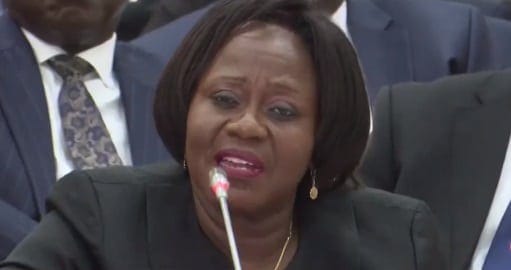
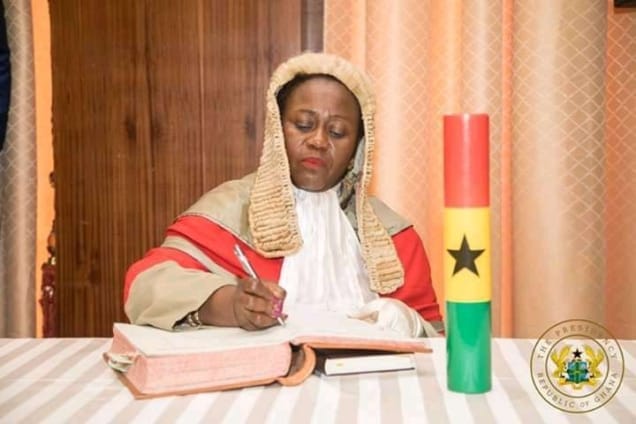
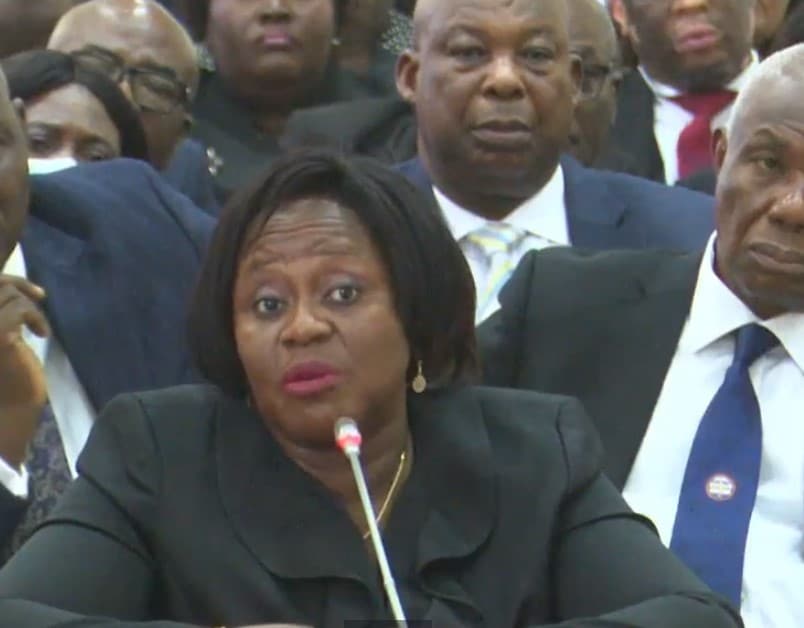
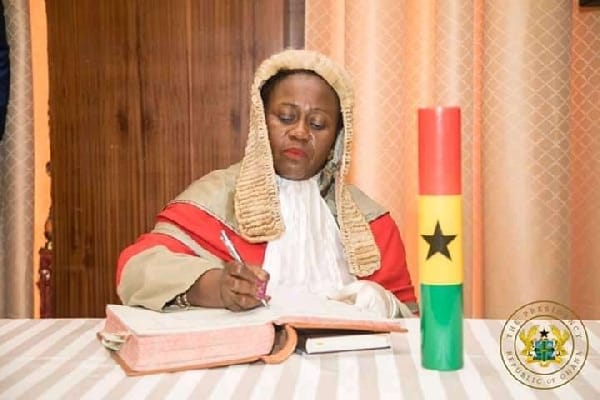
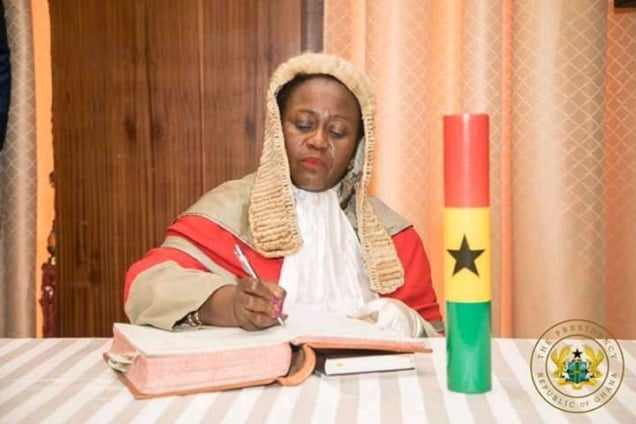
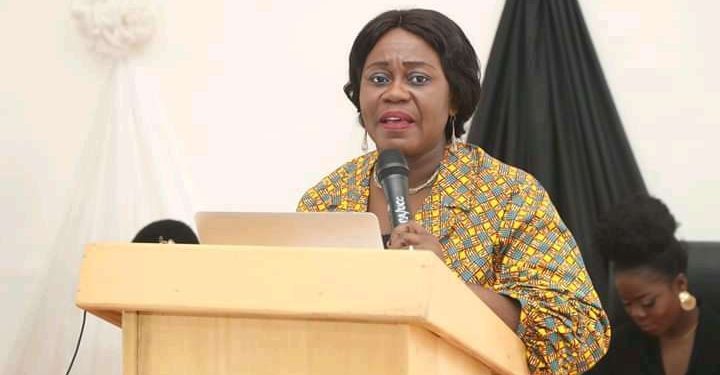
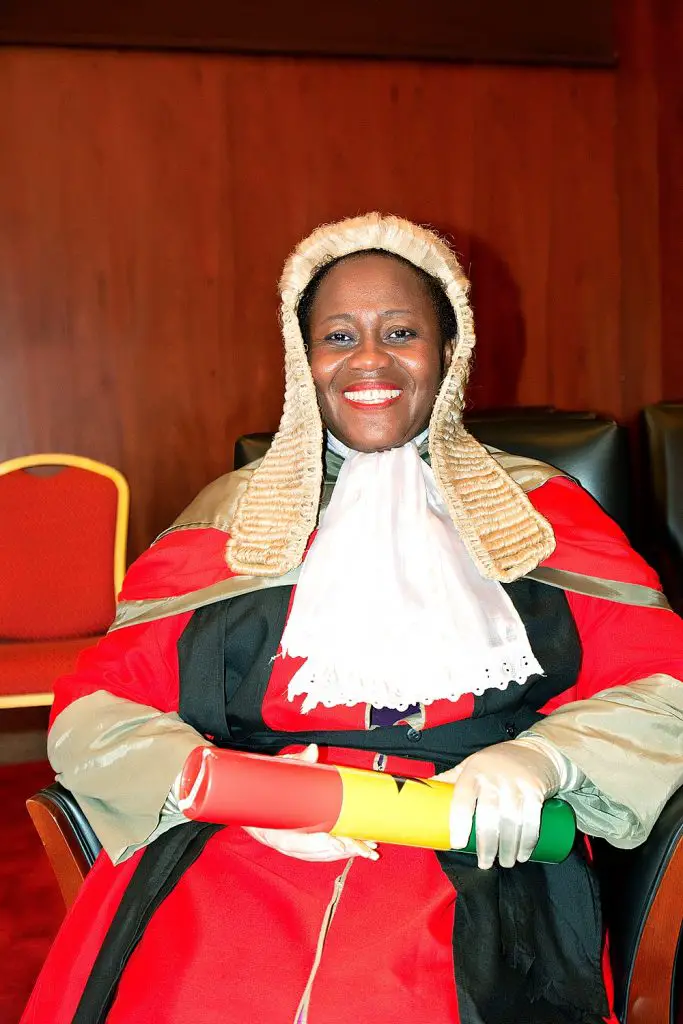
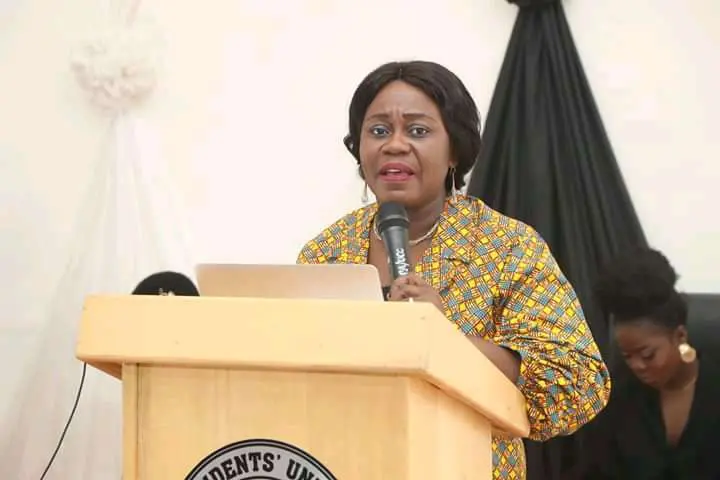
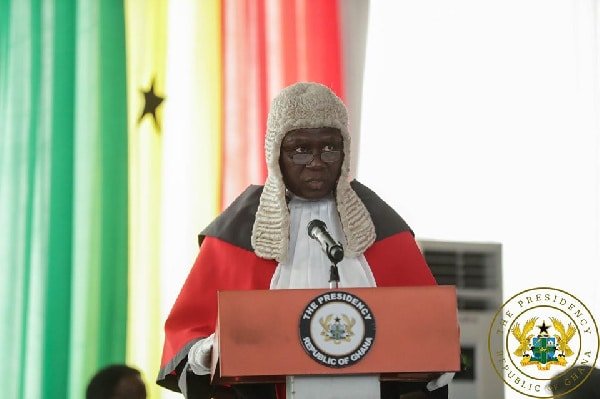
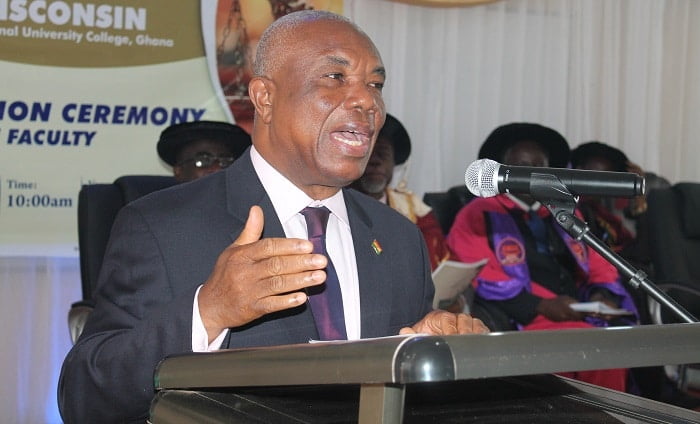
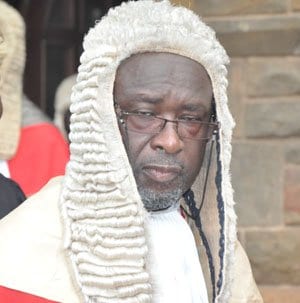
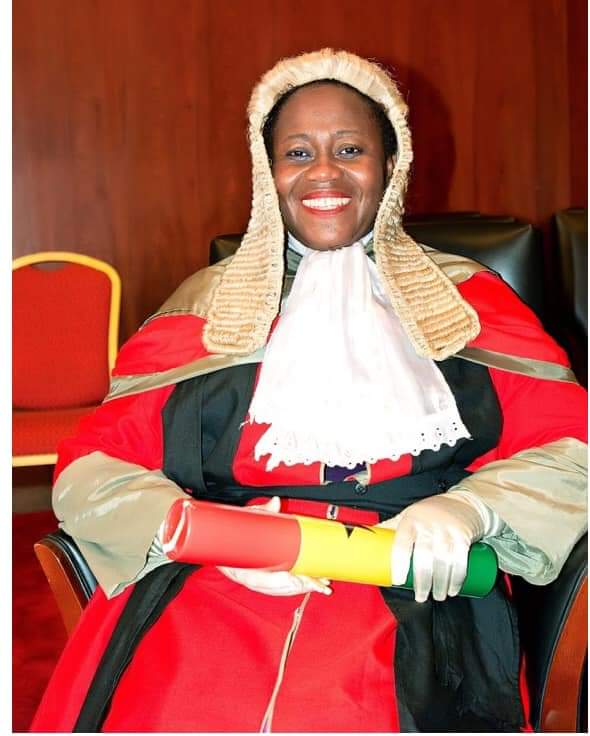
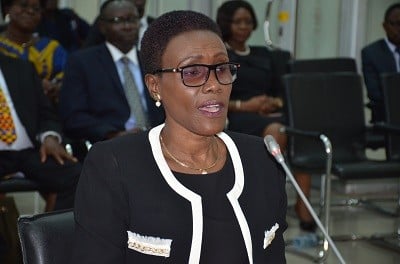
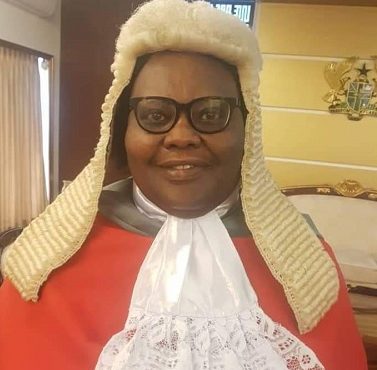
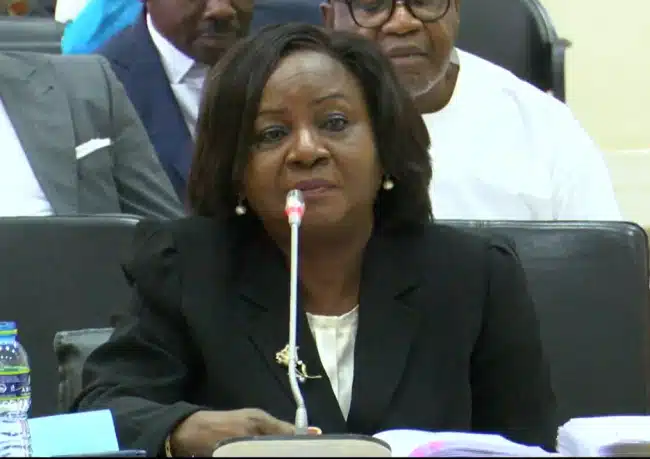
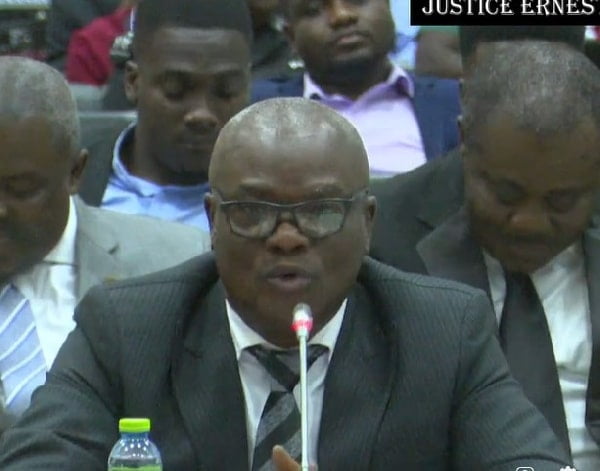
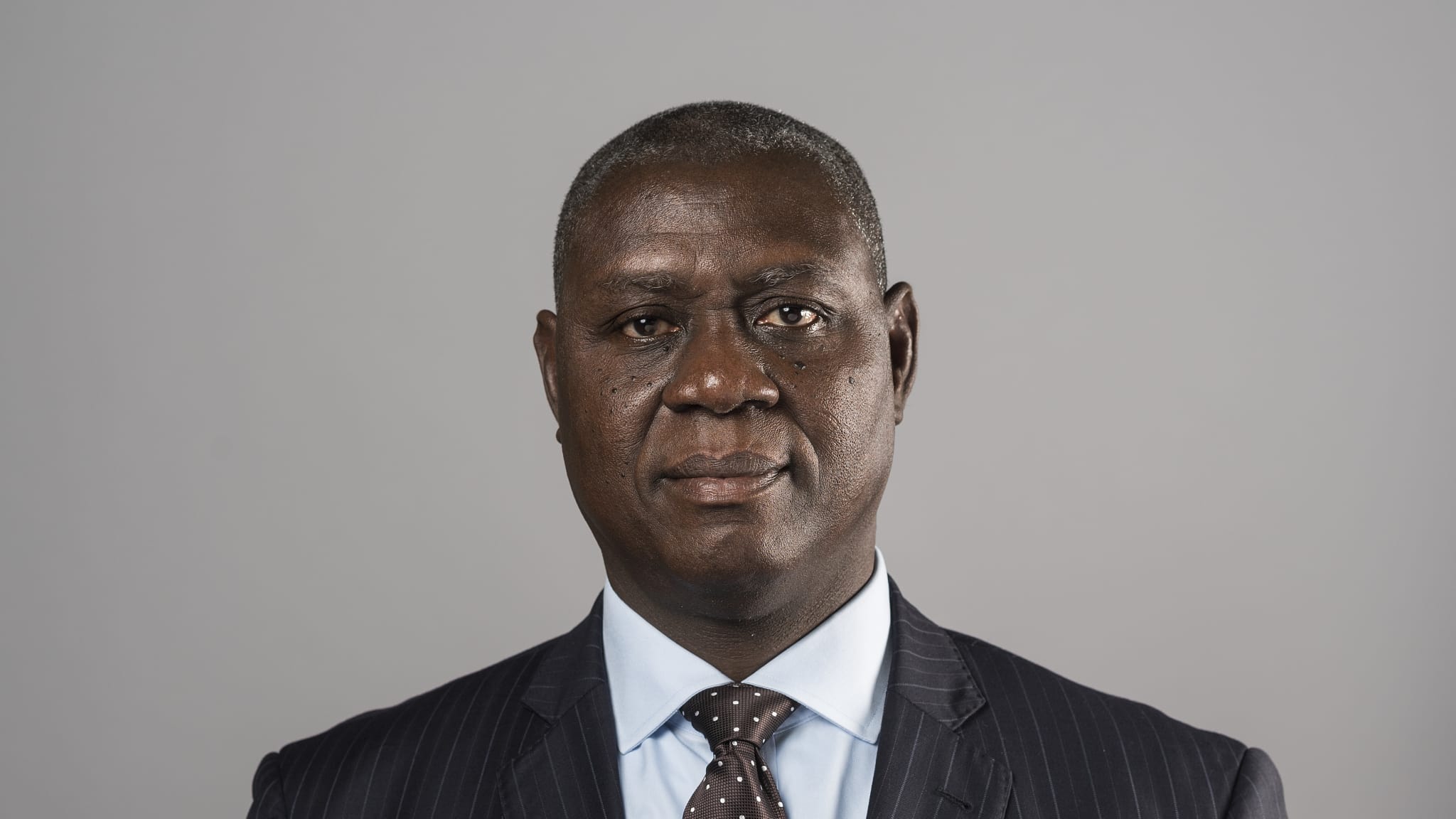
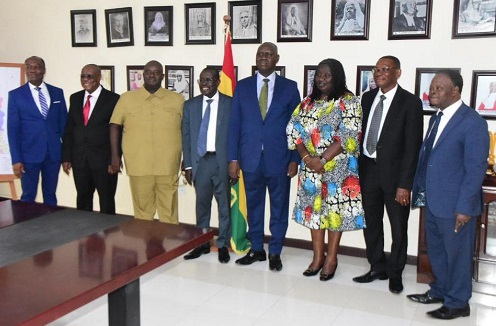
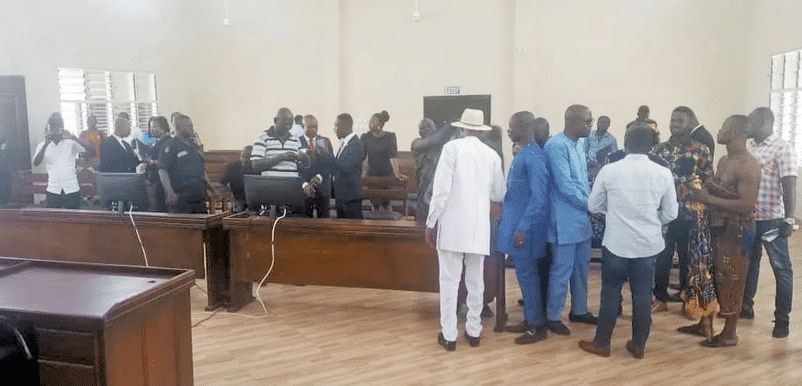
The nominee for Chief Justice, Justice Gertrude Araba Esabaa Torkornoo, has warned the public against the practice of offering money to certain individuals to be provided to judges in order to influence their rulings.
She said the supposed monies on many occasions actually do not go to the judges but end up in the pockets of the said individuals who collect them.
Answering a question during her vetting today [Friday, May 26, 2023] by the Appointments Committee of Parliament, Justice Torkornoo, said the perception that judges can be influenced withmoney is alien to the legal profession and should not be tolerated by the public.
For her, some individuals have created a market where they milk unsuspecting people whose cases are before courts that when monies are given to judges, it will help to influence the cause of justice in their favour.
Giving an analogy to support her conviction that judges do not take money to determine cases, Justice Torkornoo said nine out of 10 people who take money under the guise of taking it to a judge to influence judgement end up pocking them.
“Don’t give money to people to be taken to judges,” she said, explaining that the reason people lose cases in courts are that their lawyers sometimes do not follow right procedures to argue their cases out.
“There is a whole market; we call it judicial predators. It’s a whole predatory group around our function and that is something that we constantly try to address in our study of ethics both for judges and staff,” she noted.
Justice Torkornooexpressed the worry that unfortunately some people have bought into the idea that when monies are paid to judges, they will rule in their favour.
“It is unfortunate that, that perception has prevailed… Our work is extremely technical, sometimes people lose cases because they didn’t abide with rules of courts; they didn’t abide the rules of evidence; they didn’t abide with substantive law precepts… and so they lose the case and they don’t understand. The law is difficult that is why law school is difficult and so when people lose cases, they tend to wonder why they lost and then they come up with all sorts of notions,” she explained.
Justice Torkornoo has, therefore, promised to engage the public to deepen understanding on how the law works so that they will understand how cases are determined.
The contender for Chief Justice, Justice Gertrude Torkornoo, has dispelled the impression that the judiciary uses contempt summons to frighten those who oppose it.
Rather, she said contempt summons are a tool the court uses to protect the sanctity of the judiciary.
According to her, this is to prevent the bastardisation of the judiciary.
“The issuing of contempt summons has always been a tool that has been used by courts to ensure that the dignity of the court is not scandalized.
The [Supreme] Court is one out of 400 courts, and it is the ultimate voice, so whenever the court acts, whether it is the High Court, Court of Appeal, or Supreme Court, it is to ensure that the Justice system is not scandalized,” Justice Torkornoo said on Friday, May 26, when she appeared before the Appointments Committee of Parliament.
On Thursday, May 25, the Supreme Court issued contempt summons to a former parliamentary candidate aspirant of the opposition National Democratic Congress, Dr. Michael Kpessa-Whyte.
He has been asked to explain why he should not be held in contempt of the court.
In a Twitter post, Dr. Kpessa-Whytereferred to the Supreme Court as a “Stupid Court”.
In the said tweet, the lecturer also criticised the current state of Ghana’s judiciary, accusing it of partisanship and lacking common sense.
Dr. Kpessa-Whyte’s tweets came shortly after the Supreme Court ordered Parliament to remove the name of NDC MP James Gyakye Quayson from its records due to procedural breaches during his nomination and election in 2020.
However, Dr. Michael Kpessa-Whyte has apologised for his comments.
According to the lecturer, he did not intend to “insult” the apex court when he wrote on social media that the court was being turned into a stupid court.
In a press statement he issued on Thursday, May 25, Dr. Kpessa-Whyte thus issued an unqualified apology to the judiciary.
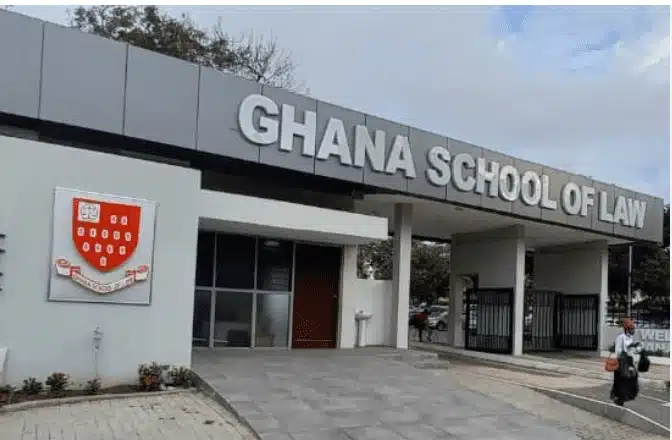
The nominee for Chief Justice, Gertrude Torkornoo, has stated that individuals who work and study law at the same time have a difficult time learning.
She said they are having a struggle with the ability to engage the law and pass the examinations due to interference with work.
Speaking during her vetting by the Appointments Committee of Parliament on Friday, May 26, she said “now, many people in law school are working and I think that affects their ability to really engage with the law and pass the exams.
“If you recall, in the last six months at least a thousand people have been called to the bar, the last major call had 860 or so people being called to the bar.
“We had a mini call a few weeks ago, almost 200 people. A mini call having 200 people, that is unpreceded so they are coming out and they are going in but I think the journey is a struggle for working people.”
Justice Gertrude Torkonoo, who has been nominated by President Akufo-Addo to assume the position of Chief Justice will be vetted by Parliament today.
The Supreme Court judge is set to replace the recently retired Chief Justice Kwasi Anin Yeboah.
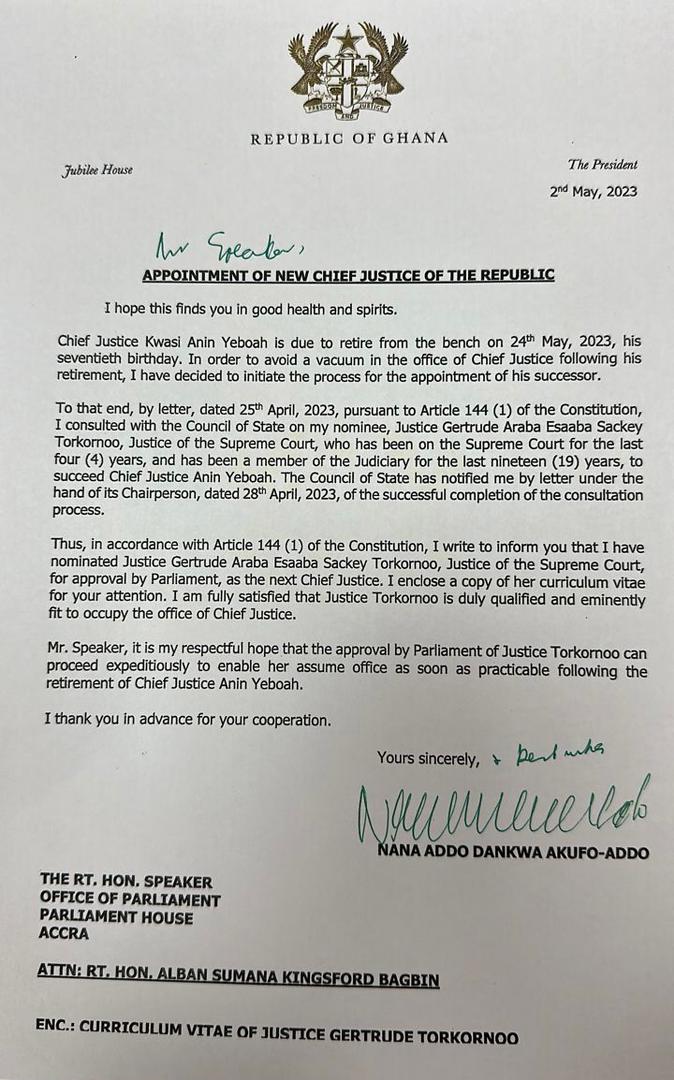
President Akufo-Addo officially communicated his decision to Parliament in April and urged for a prompt approval of Justice Gertrude Torkonoo’s appointment.
The President’s objective is to prevent any potential gap or vacuum in leadership following the retirement of Chief Justice Kwasi Anin Yeboah.
“Chief Justice Kwasi Anin Yeboah is due to retire from the bench on May 24, 2023, his seventieth birthday. In order to avoid a vacuum and ensure that a new Chief Justice is immediately in office after his retirement.
“I have decided to begin the process of appointment now. Article 144 (1) of the constitution, which governs the appointment of a Chief Justice, requires that I consult with the Council of State before seeking the approval Parliament.
“Consequently, I am nominating Justice Gertrude Araba Esaaba Torkornoo, a member of the Supreme Court, as the new Chief Justice. I hereby enclose a copy of her curriculum vitae for your attention,” excerpts of the letter said.
Justice Mrs Torkornoo per this nomination, will be vetted by Parliament and approve her nomination or otherwise.
She will become the third female Chief Justice in the history of Ghana after Justices Georgina Theodora Wood and Sophia Akuffo.
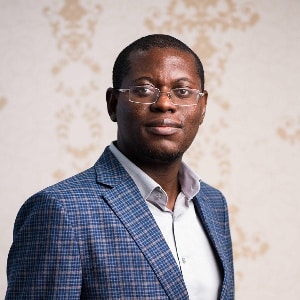
Vice president of IMANI Africa, Bright Simons, has expressed worry over the diminished power of the Judiciary in checking the actions of the president and his appointees.
Mr Simons remarked that the expectations for the new Chief Justice of Ghana, who will be replacing Justice Kwasi Anin Yeboah following his retirement, have been set disappointingly low.
He stated, “Whether fair or not, the Ghanaian Judiciary in the last few years saw its reputation for checking abuse of power by the Executive sink to its lowest level in the 4th Republic. The bar has thus been set very low for the new Chief Justice.”
In a separate tweet, Simons advocated for a judicial system that empowers citizens in the country. This response was prompted by a GhanaWeb publication announcing the appointment of Justice Jones Dotse as the Acting Chief Justice (CJ) after Chief Justice Anim Yeboah’s retirement on May 24, 2023, without returning to the bench.
In an earlier tweet, Simons called for a more citizen-empowering judicial in the country.
His call was contained in a tweet to a GhanaWeb publication that announced the appointment of Justice Jones Dotse as Acting Chief Justice (CJ) after Chief Justice Anim Yeboah retired on May 24, 2023, and did not return to the bench.
Whether fair or not, the Ghanaian Judiciary in the last few years saw its reputation for checking abuse of power by the Executive sink to its lowest level in the 4th Republic. The bar has thus been set very low for the new Chief Justice. https://t.co/MkZIBD1kJK
In a tweet, he wrote “Ghana’s Chief Justice retires. The activist CSOs I work with recall his rejection of our amicus brief against the EC’s decision to refuse birth certs as proof of citizenship. His reason?”
He continued by adding “We had been criticizing the EC on the radio. We look forward to a more citizen-empowering judiciary.”
Background:
President Nana Addo Dankwa Akufo-Addo nominated a Supreme Court judge, Gertrude Torkornoo, as the next Chief Justice of Ghana.
The president indicated that it is important that he begins the processes for the replacement of the outgoing Chief Justice Kwasi Anin Yeboah now, so as not to create any vacuum.
If approved by the Parliament of Ghana, Justice Torkornoo will be the third appointment to the office of Chief Justice since Akufo-Addo became president in 2017.
She will also be the third female Chief Justice in the history of Ghana, following in the footsteps of Justices Georgina Theodora Wood and Sophia Akuffo.
Justice Jones Dotse has assumed the role of Acting Chief Justice following the retirement of Justice Kwasi Anin Yeboah, who served as a judge for 21 years.
The transition took place today, Wednesday, May 24, 2023, in accordance with Article 144 (6) of the 1992 Constitution. graphiconline.com reports.
This article states that when the position of Chief Justice is vacant or the Chief Justice is unable to perform their duties, the most senior Justice of the Supreme Court shall act as Chief Justice until a substantive Chief Justice is appointed.
Justice Dotse, being the most senior Justice on the Supreme Court bench, has taken on the responsibility of Acting Chief Justice.
He will continue in this role until Parliament approves the nomination of Justice Gertrude Esaaba Sackey Torkornoo as the substantive Chief Justice.
Justice Torkornoo is scheduled to appear before the Appointment Committee of Parliament on Friday, May 26, for vetting.
Serving as a judge for 21 years, with three of those years as the Head of the Judiciary, Chief Justice Kwasi Anin-Yeboah has officially retired from active service today.
As per the constitutional provisions outlined in Article 144 (6) of the 1992 Constitution, Justice Jones Dotse, the most senior Justice on the Supreme Court bench, has assumed the role of Acting Chief Justice following Justice Anin-Yeboah’s retirement.
Justice Dotse will fulfill the duties of Acting Chief Justice until the nomination of Justice Gertrude Esaaba Sackey Torkornoo as the substantive Chief Justice is approved by Parliament.
Justice Torkornoo is scheduled to undergo vetting by the Appointment Committee of Parliament on Friday, May 26.
Chief Justice Kwasi Anin-Yeboah
Justice Anin-Yeboah Profile
Justice Anin Yeboah was born at Toase in the Ashanti Region in May 1953.
He attended Amaniampong Secondary School and Apam Secondary School and then moved to the University of Ghana and the Ghana School of Law, where he graduated in 1981.
He served as an Assistant State Attorney at the Attorney-General’s Office in Koforidua, where he was elected the Eastern Regional President of the Ghana Bar Association (GBA).
He also served as a justice of the High Court between 2002 and 2003 and the Court of Appeal from 2003 to 2008, until his elevation to the Supreme Court by Former President John Agyekum Kufuor.
Justice Anin Yeboah was also the Chairman of the Appeals Committee of the Ghana Football Association from 2004 to 2008 and rose to become a member of the Adjudicatory Chamber of FIFA.
In May 2017, he was appointed Chairman of the Disciplinary Committee of the 67th FIFA Congress in Bahrain and was also Chairman of the FIFA Ethics Committee.
Justice Anin-Yeboah was appointed to the Supreme Court by former President Kufuor in June 2008.
TheGeneral Legal Council has issued a statement refuting recent media reports suggesting that lawyers will soon be obligated to take exams in order to renew their licenses.
The statement, dated May 8, 2023, clarified that the reports were based on a misinterpretation of remarks made by the Chief Justice during the enrollment ceremony for 196 new lawyers on May 5, 2023.
The Council quoted a portion of the Chief Justice’s speech in its statement.
“Lawyers in the country will soon be mandated to complete a minimum of a 12-hour professional development programme in a year before the renewal of their license.
This is to help broaden their knowledge and contribute to their growth in the profession.
In line with that, plans were far advanced to make the programme, which was enshrined in the Legal Profession (Professional Conduct and Etiquette) Rules, 2020 (Legislative Instrument 2423) a prerequisite for the issuance of a practicing license to all lawyers under the Legal Profession Bill which would soon be made law,” the Council noted that reports were published which sought to suggest that lawyers will soon be required to write an exam.
In the statement, the Council noted that the portion of the speech by the Chief Justice in no way suggests that any such initiative will be introduced, rather it said, there will be a ‘Continuing Professional Development’ programme, which is a standard requirement in some jurisdictions around the world.
“There was no mention of Lawyers being required to write examinations at all before a renewal of License and indeed no such amendment to the Law is about to be made,” portions of the statement read.
The Speaker of Parliament, Alban Bagbin, has been entreated by President Nana Addo Dankwa Akufo-Addo to expedite the appointment of Justice Gertrude Torkonoo as the new Chief Justice.
The President emphasized in a letter to the Speaker that this is being done to prevent a vacancy in the Chief Justice’s position upon Justice Kwasi Anin Yeboah’s retirement as the departing head of the judiciary.
“It is my respectful hope that the approval by Parliament of Justice Torkonoo can proceed expeditiously to enable her assume office as soon as practicable following the retirement of Chief Justice Anin Yeboah”, parts of the letter read.
Last week, the President nominated Gertrude Araba Esabaa Torkornoo, a Justice of the Supreme Court, as the next Chief Justice of Ghana.
Her nomination is subject to approval by Parliament.
When approved by Parliament, Justice Torkornoo will replace Justice Kwasi Anin Yeboah, who retires as Chief Justice on May 24, this year, when he reaches the mandatory retirement age of 70 for justices of the Court of Appeal and the Supreme Court.
In a letter to the Council of State, President Akufo-Addo said Justice Torkornoo who has been “on the Supreme Court for the last four (4) and has been a member of the Judiciary for the last nineteen (19) years is duly qualified and eminently fit to discharge the functions of Chief Justice.”
Justice Torkornoo will become the third female Chief Justice in history, following the footsteps of Justices Georgina Theodora Wood and Sophia Akuffo.
Justice Torkornoo will be President Akufo-Addo’s third appointment to the office of Chief Justice since he assumed office in January 2017.
Already, the Judicial Service Staff Association of Ghana (JUSAG) has massively endorsed the nomination of Justice Gertrude Torkornoo as the incoming Chief Justice.
JUSAG wants Justice Torkornoo, whose nomination is subject to Parliamentary approval, to outrank current Chief Justice Anin Yeboah as the best Chief Justice with the issues of labour at heart.
Chief Justice Justice Anin Yeboah has urged the Judicial Service employees to carry out their responsibilities with fairness and honesty.
Speaking during the opening of two court buildings in the Central Region’s Gomoa Central and Agona East, the Chief Justice said that because they serve as ambassadors for the court, the staff’s work has a significant impact on whether or not the service has a positive or negative reputation.
“I urge the staff of the Judicial Service, whose work will give meaning to the construction of this court to see themselves as ambassadors of the service and of the very concept of justice delivery.
“This would impose on them a responsibility, to be honest, fair and transparent in all their dealings with the public who come to seek justice,” he said.
The district court will expedite the process of finding justice, according to Justice Anin Yeboah.
The Gomoa Central and Agona East court is one of more than a hundred courthouses being erected throughout the nation to speed up the administration of justice in those locations.
Meanwhile, the Chief Justice is set to retire in May this year as he turns 70.
Former Director of the Ghana School of Law, Kwaku Ansa-Asare, has said that no Chief Justice can transform the country’s legal education system.
According to him, it is not their job to do so as legal education is the domain of legal educators and not the Chief Justice.
Speaking on JoyNews’ PM Express, he explained that the core mandate of the Chief Justice is to superintend over the justice delivery system and the judicial service rather than meddle in how legal education is carried out in the country.
“No Chief Justice will be able to reform legal education in this country. It is not their job. Chief Justices are there to superintend justice delivery systems from the corridors of the judicial service and the judiciary. Legal education is not part and parcel of judicial activism,” he stated.
He noted that the problem with Ghana’s legal education system is the fact that it has been merged with the justice delivery system rather than it being treated as part of the general education system.
“Elsewhere you have legal education as a separate and distinct thing from the justice delivery system. They are not cut out for legal education. So we’re better off leaving legal education in the hands of legal educators, period!
“So believe you me no Chief Justice – if I have to cast my vote I’ll cast my vote for none of them. Because I don’t expect any of them, be it Yonny Kulendi or Gertrude Torkonoo to come and reshape the legal environment. It’s not possible.
“So I have always held the view thatGhanaas a nation will be better off if legal education is entrusted in the hands of those who are trained to be legal educators and are therefore [in] the legal education environment.
“Apart from that, what I can say in this regard is if anybody should tell you that either Justice Gertrude Torkonoo or Yonny Kulendi as Chief Justice or whatever will undertake any reform in legal education I do not think the person is speaking truth,” he argued.
The Supreme Court JusticeGertrude Torkornoo has said that the vision and purpose statements of an organization are not sufficient to ensure productivity at work.
Delivering a lecture at the University of Professional Studies in Accra (UPSA), attended by fellow judges, academicians, industry players and students, Justice Torkornoo highlighted effective communication, enforcement of Law, Technology and Ethical values are some of the key strategies that implemented properly can lead to higher productivity at the workplace.
Speaking on the topic, ‘Harnessing Good work ethics for Higher productivity’, the newly nominated Chief Justice said workers must find the right balance and coordinate properly between these strategies to help organisations achieve higher productivity among workers.
“For workplaces to be distinctively productive, a crisp and discernible element in the vision of any organisation must be reiterated consistently and clearly for all teams and kept at the foreview of all stakeholders. Mission and Vision statements must go beyond being documents that are assumed to be read.
“Communication increases understanding and understanding increases cooperation and collaboration. Communication increases learning and learning increases the capacity to achieve. It does not matter that communication is with regard to the most technical subject so long as it is presented in a clear, simple manner no technical subject need be considered as complicated for any member of a team in an institution.”
Justice Torkornoo was on Wednesday, April 26, nominated by President Akufo-Addo as the next Chief Justice of Ghana.
Justice Torkornoo will replace Justice Kwasi Anin Yeboah, who retires as Chief Justice on May 24, this year, when he reaches the mandatory retirement age of 70 for justices of the Court of Appeal and the Supreme Court.
She will become the third female Chief Justice in history, following the footsteps of Justices Georgina Theodora Wood and Sophia Akuffo.
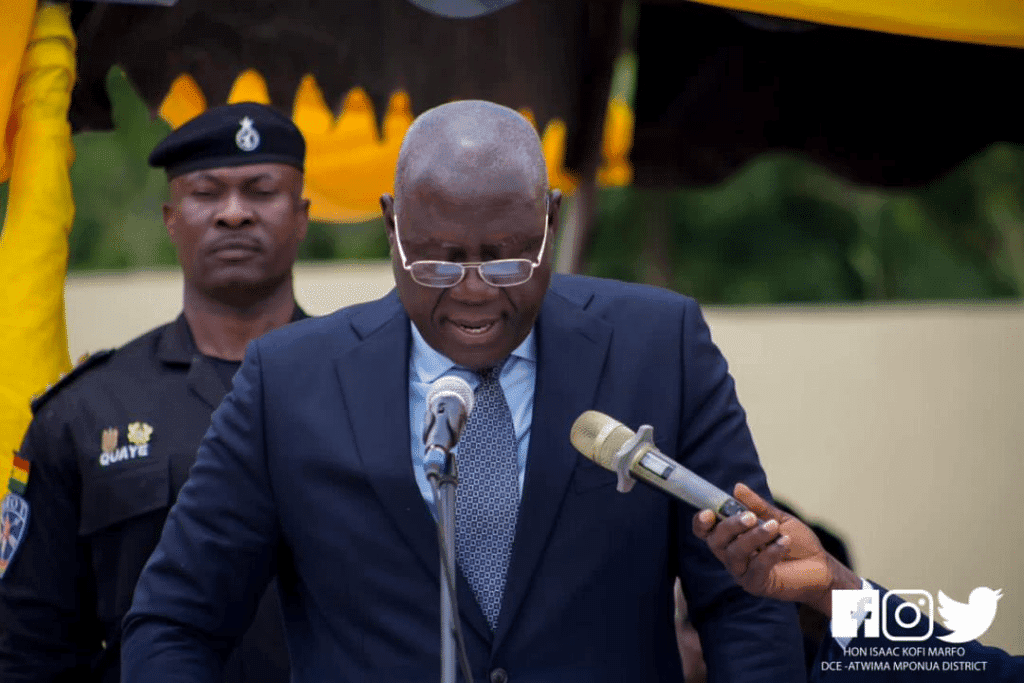
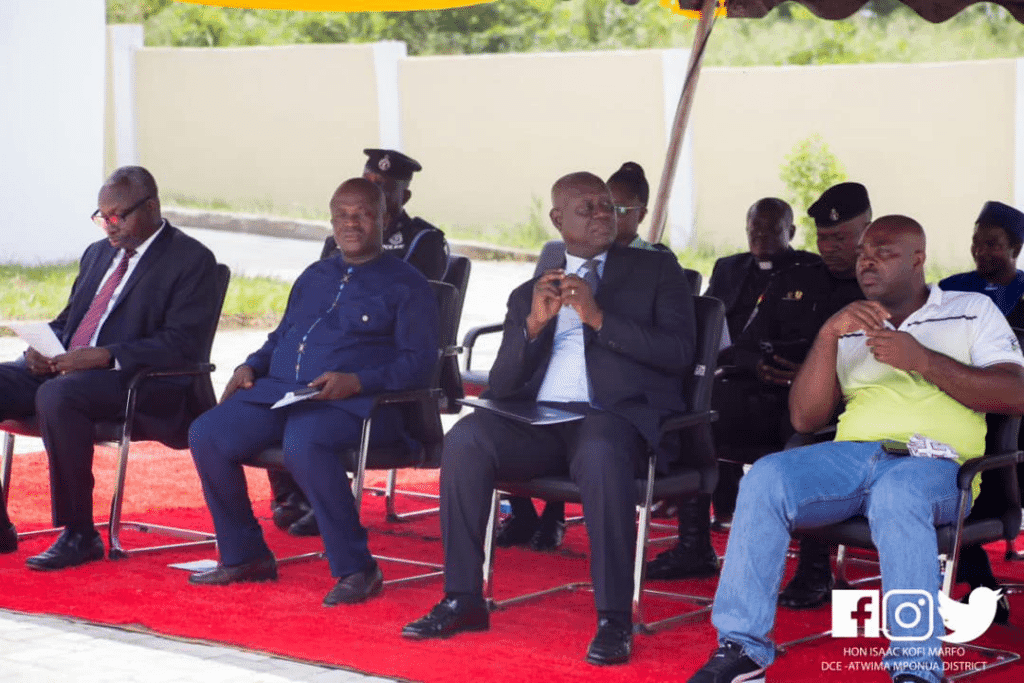
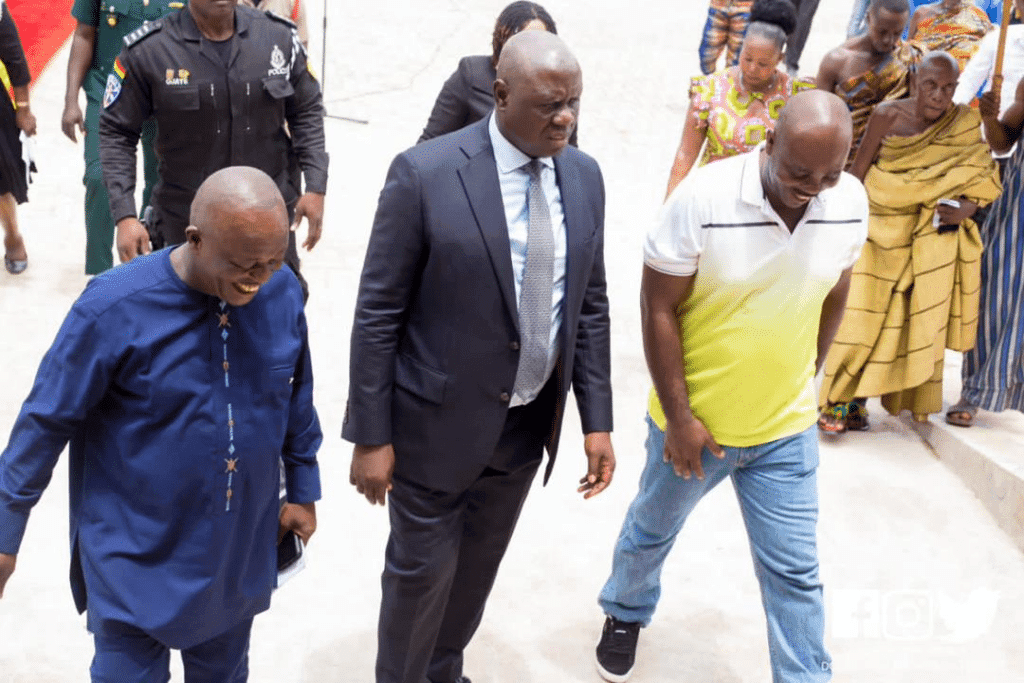
Atwima Mponua has benefited from the Chief Justice of the Republic of Ghana’s ambition to make access to the courts fair and appropriate for all.
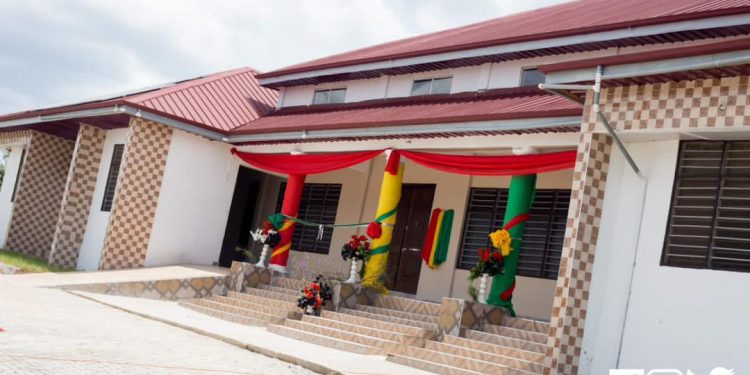
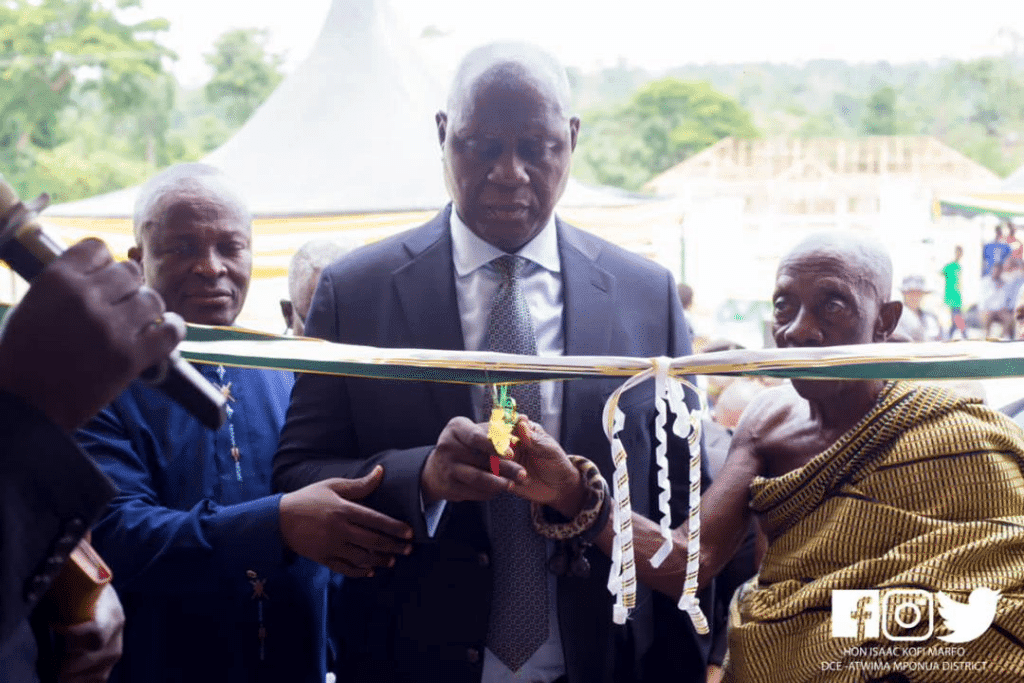
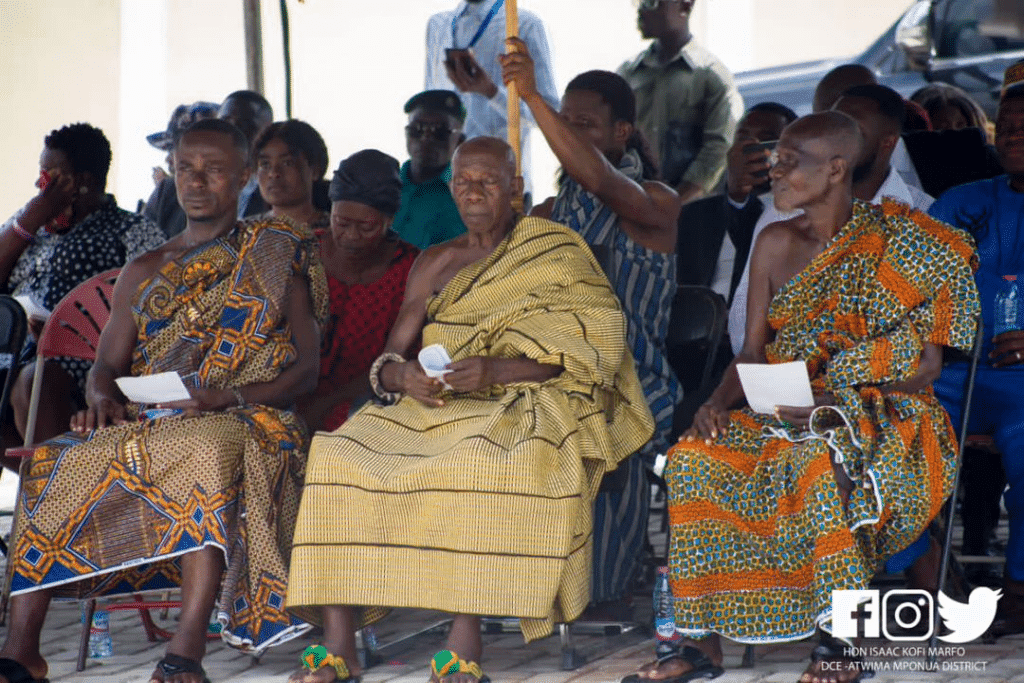
On the 25th day of April 2023, the Nyinahin court building was commissioned by the Chief Justice, the Member of Parliament, the District Chief Executive and Nananom of the Nyinahin traditional council within the District.
Giving his welcome address, the DCE of the Atwima Mponua Assembly, Isaac Kofi Marfo extolled the feat of the judicial honcho.He called on the resident judge to make maintenance her priority and dispense Justice to all without fear or favour.
Nana Oti Boadua II, the Akwamuhene who was at the program in the stead of his overlord, Nana Ampene Boateng Twum II, was happy about this turnkey project.
He noted that this court edifice will even give a good ambience for justice administration. He commended the government for giving Mponua its fair share of the national cake.
Mr. Isaac Kwame Asiamah, the Member of Parliament for the constituency called on the Chief Justice, to elevate the status to a circuit court.He noted that, Mponua has a vast land with an immense population, and some cases must be settled here without travelling to other jurisdictions.
In addition, the legislator pleaded with Manhyia and Otumfuo Osei Tutu II, to honour Justice Anin Yeboah for pitching Asanteman to a higher pedigree.
“I am pleading with Otumfuo Osei Tutu to honour such a great son of the land; a Ghanaian who has served as the Chairman of the Disciplinary Committee of FIFA is a great achievement,” he posited.
In addition, he thanked the NPP government for projects like Agenda 111, the Law Court, Nursing training and a Stadium.Delivering his keynote address, His Lordship Anin Yeboah told the gathering that, such edifice befits justice delivery.
He advised that, people should use other dispute resolution methods which are less aggressive, less time-consuming and less expensive to get matters resolved.
He maintained, the axiom, ‘Justice delayed is Justice denied’ is a threat to justice delivery and admonished all stakeholders for a swift delivery system that exudes contentment.
Furthermore, he called on all to exercise good candour and seek appellate judgement if they believe the lower courts have erred in their judgements and not to take matters into their hands and act on emotions.
He thanked the Chiefs for availing the parcel of land for the project; he also commended the DCE and his staff for playing a supervisory role from scratch till completion.
The commissioning was done, and the keys were handed over to the registrar of the court for the commencement of their duties.
In attendance were Justice Boakye Yiadom, the northern sector judicial secretary, district security chiefs, the clergy and heads of departments within the district.
Report coming in is that Her Ladyship Justice Gertrude Torkornoo has been shortlisted to take over the position of Chief Justice after Justice Kwasi Anin Yeboah retires.
These are unconfirmed reports as President Akufo-Addo is yet to officially communicate his appointment.
Chief Justice Anin-Yeboah is expected to retire from office as he turns 70. A new Chief Justice will be appointed by President Akufo-Addo to steer the helm of affairs from May 24, 2023.
Should the new Chief Justice be Her Ladyship Justice Gertrude Torkornoo as reported, she will become the third female Chief Justice in the history of Ghana, following the footsteps of Justices Georgina Theodora Wood and Sophia Akuffo.
Profile ofHer Ladyship Justice Gertrude Torkornoo
Justice Gertrude Torkornoo who turns 62 in September this year completed her Professional course in law at the Ghana School of Law in 1986.
After law school in 1986, Justice Gertrude Torkornoo did her national service with the International Federation of Women Lawyers (FIDA) Legal Aid Center in Accra.
Her pupillage was with Fugar & Co, where she went on to become an Associate and later, a Director of the firm. In January 1997, she set up Sozo Law Consult and became the Managing Partner.
After 18 years of law practice, Justice Torkornoo was invited to join the judiciary in 2004 as a Justice of the High Court of Ghana.
In October 2012, she was promoted to the Court of Appeal and rose to become a Justice of the Supreme Court, the apex court, in 2019 after her appointment by President Akufo-Addo.
She is well known for being one of the Supreme Court judges who presided over the 2020 presidential petition case between John Dramani Mahama and the Electoral Commission and Nana Addo Dankwa Akufo-Addo.
She holds an LLM in Intellectual Property Law from Golden Gate University, San Francisco, USA and a Postgraduate Diploma (PGD) in International Law and Organizations from the then International Institute of Social Studies, the Hague, Netherlands.
Chief Justice Anin-Yeboah is expected to retire from office in a month and two weeks’ time as he turns 70.
A new Chief Justice will be appointed by President Akufo-Addo to steer the helm of affairs from May 24, 2023.
It is currently unknown who Akufo-Addo will go for to replace Justice Anin Yeboah, whom he appointed in December 2019 to take over from Justice Sophia A.B. Akuffo.
However, it is expected that he selects one of the 15 other Justices of the Supreme Court to be Ghana’s 15th Chief Justice.
Below are the 15 Justices likely to be appointed Chief Justice:
His Lordship Justice Jones Dotse
Justice Jones Dotse earned a law degree from the University of Ghana in 1976, and in 1978, was later awarded a BL in Law from the Ghana School of Law. He was called to the Bar in November 1978.
After three years as a state attorney, he spent 20 years in private practice. Justice Dotse served in a variety of capacities during this time while working as a lawyer, eventually reaching to the post of president of the Volta Region Bar Association. Additionally, he had a specialty in Alternative Dispute Resolution (ADR).
In 2002, he was appointed to the Bench as a High Court Judge where he served for seven years. In 2008, he was appointed as Justice of the Supreme Court of The Gambia, a position he still occupies. That same year, he was in 2008 elevated to the Supreme Court of Ghana.
He has had extensive international exposure through short courses and conferences by association with the International Bar Association (IBA),· Commonwealth Judicial Education Institute (CJEI) Halifax, Canada, Special Judicial Faculty Training of the National Judicial Institute of Canada, Ottawa, and the International Visitor Programme of the United States of America.
Born in June 1953, Justice Jones Dotse turns 70, making him an unlikely substitute.
His Lordship Justice Paul Baffoe Bonnie
Justice Paul Baffoe Bonnie was called to the bar in 1981. He held the positions of High Court Judge in Duayaw Nkwanta and Circuit Court Judge in Kumasi. He was an Appeals Court judge before President John Kufuor appointed him to the Supreme Court in June 2008.
Paul Kwadwo Baffoe-Bonnie was on the Supreme Court panel of judges that rejected the New Patriotic Party’s request to annul roughly four million votes from the 2012 general election in Ghana because of allegations of fraud.
Justice Paul Baffoe Bonnie, born in December 1956, turns 67 this year.
His Lordship Justice Gabriel Pwamang
Justice Gabriel Scott Pwamang born August 1960, became a Supreme Court judge on June 29, 2015. He was nominated by former President John Dramani Mahama based on the recommendation of the Judicial Council of Ghana.
His appointment was delayed as the council of the Ghana Bar Association filed a suit to seek clarification on the appointments as other recommended judges were not appointed by the president. The process was further protracted when a member of the General Legal Council lodged a complaint against him challenging his appointment.
The complaint was later withdrawn and Pwamang was sworn into office on 29 June 2015.Prior to his Supreme Court judge role, he was a private legal practitioner and the managing partner of Pwamang and Associates. He was a member of the People’s National Convention once serving as the party’s general secretary.
His Lordship Justice Nene Abayaateye Ofoe Amegatcher
70-year-old Justice Nene Abayaateye Ofoe Amegatcher was called to the Ghana Bar in November 1980.
Nene Abayateye worked at the Nana Sarpong Ahenkorah and Company Law Firm as a Private Legal Practitioner from 1980 to 1989 while still teaching at Accra Polytechnic.
From 1987 to 1989, and from 1993 to 1995, Justice Amegatcher served as Bar Association Secretary for the Greater-Accra Region, and the Assistant Secretary of the Ghana Bar Association respectively.
In 2018, he was appointed as a Supreme Court judge by President Akufo-Addo. He is also unlikely to be offered the position.
His Lordship Justice Prof. Nii Ashie Kotey
Justice Nii Ashie Kotey was also appointed a Supreme Court judge in 2018 by President Akufo-Addo.
After obtaining his Ph.D. and LL.M from the University of London he enrolled at the Ghana School of Law and was subsequently called to the bar after completing his studies in 1982.
Before appointed a Supreme Court Judge, the 69-year-old who turns 70 in October this year worked as a lecturer at the University of Ghana from 1981. While at the university, he served as the dean of the university’s Faculty of Law and acting director of the Ghana School of Law. He also served as the Chief Executive of the Forestry Commission of Ghana from 2007 to 2009.
Her Ladyship Justice Mariama Owusu
Justice Mariama Owusu was called to the Ghana Bar in 1981 after completing her professional law examination. In Ghana, she continued into private practice with Totoe Legal Services, and Justice Owusu was appointed to the court as a district magistrate in 1990.
She got her appointment as a district court judge two years later (in 1992), and she served in that capacity for eight years before being appointed as a High Court Judge in 2000.
From 2003 to 2005, Justice Mariama served as a Supervising High Court Judge for Sunyani. Additionally, she was chosen to serve as a Judge for the Court of Appeal in 2006.
The 69-year-old served as a Court of Appeal Judge for 13 years until she was nominated by Nana Addo Dankwa Akufo-Addo in December 2019 to serve as a Judge in the Supreme Court.
Her Ladyship Justice Avril Lovelace Johnson
From 1988 to 1989, Justice Avril worked as an assistant state attorney in the attorney general’s office in Koforidua and Accra.
Before being appointed as a Justice for the Accra and Tema High Courts, Lovelace-Johnson spent eight years as a District Magistrate after being appointed to that position in 1994.
Until she was appointed a Court of Appeal Justice in 2012, she also worked as the Justice for the Accra and Tema High Courts for ten years.
Prior to that, she served The Gambia from 2005 to 2009 as a Justice of the High Court and an additional Court of Appeal Justice, both positions held by the Commonwealth Secretariat in London.
On December 17, 2019, Lovelace-Johnson, 62, was promoted to a Supreme Court Judge after a rigorous nomination and vetting process.
Her Ladyship Justice Gertrude Torkornoo
Justice Gertrude Torkornoo who turns 62 in September completed her Professional course in law at the Ghana School of Law in 1986.
She holds an LLM in Intellectual Property Law from Golden Gate University, San Francisco, USA and a Postgraduate Diploma (PGD) in International Law and Organizations from the then International Institute of Social Studies, the Hague, Netherlands.
After law school in 1986, Justice Gertrude Torkornoo did her national service with the International Federation of Women Lawyers (FIDA) Legal Aid Center in Accra. Her pupillage was with Fugar & Co, where she went on to become an Associate and later, a Director of the firm. In January 1997, she set up Sozo Law Consult and became the Managing Partner.
After 18 years of law practice, Justice Torkornoo was invited to join the judiciary in 2004 as a Justice of the High Court of Ghana. In October 2012, she was promoted to the Court of Appeal and rose to become a Justice of the Supreme Court, the apex court, in 2019 after her appointment by President Akufo-Addo.
She is well known for being one of the Supreme Court judges who presided over the 2020 presidential petition case between John Dramani Mahama and the Electoral Commission and Nana Addo Dankwa Akufo-Addo.
His Lordship Justice Issifu Omoro Tanko Amadu
Justice Issifu Omoro Tanko Amadu worked as a lawyer in Nigeria for 19 years after gaining some practical experience with Azinyo Chambers located in Accra.
He then founded his own firm and became the Principal of Amadu & Co. in 1997 and after the Senior Partner Amadu, Ansah-Obiri & Co.
Later, he was appointed the Justice of the High Court between 2008 and 2012. He became an Appeal court judge in 2012.
The 64-year-old was sworn-in as a Supreme Court Judge in May 2020 after his nomination by President Akufo-Addo, becoming the first Muslim to serve on Ghana’s apex court.
Her Ladyship Justice Prof. Henrietta Joy Abena Nyarko Mensa-Bonsu
Justice Prof. Henrietta Joy Abena Nyarko Mensa-Bonsu who turns 65 in October obtained a Master of Laws (LLM) in 1985.
She became a full law lecturer at the University of Ghana in 2002, and in 2003 was elected as a fellow into the Ghana Academy of Arts and Sciences. She was elected President of the Academy in 2019.
Mensa-Bonsu was nominated by President Akufo-Addo for consideration for appointment to the bench of the Supreme Court of Ghana. She was sworn-in on May 26, 2020.
His Lordship Justice Emmanuel Yonny Kulendi
Justice Emmanuel Yonny Kulendi earned a bachelor of law degree in 1992. In 1994, he obtained a barrister-at-law at the Ghana School of Law.
He holds a master of arts degree in International Security and Civil-Military Relations from the Naval Postgraduate School in Monterey, California, United States.
Kulendi is a Fellow of the inaugural class of the Africa Leadership Initiative-West Africa and a member of the Aspen Global Leadership Network. He also served as an examiner at the Ghana School of Law.
In March 2020, the 59-year-old was nominated by President Akufo-Addo to be made a Justice of the Supreme Court. He was approved by Parliament and was sworn into office on Tuesday 26 May 2020.
Her Ladyship Justice Barbara F. Ackah Yensu
In 1981, the 68-year-old was called to the bar. She later entered private practice working with companies such as Lynes Quarshie-Idun & Co., National Investment Bank (NIB), among others.
Ackah-Yensu was sworn in as a Justice of the High Court of Ghana on Tuesday, September 16, 2003. Up until 2005, when she was moved to the Commercial Court, she was posted in the Tema High Court. She remained in that position up to her appointment as Justice of the Appeals Court of Ghana in October 2012.
On July 4, 2022, the president proposed Ackah-Yensu as a candidate for the Supreme Court on the recommendation of the Judicial Council and after consulting with the Council of State. Following approval from Parliament, she was sworn into office by President Akufo-Addo in December 2022.
His Lordship Justice Samuel Kwame Adibu-Asiedu
Justice Samuel Kwame Adibu-Asiedu who turns 65 years in October was called to the bar in 1992. He later had his post-tertiary National Service at Legal Aid/Oyirifie Chambers in Koforidua.
As a legal officer, he began working for the Commission on Human Rights and Administrative Justice (CHRAJ) in 1994. He began his employment with the Ghanaian Judicial Service in 1996 as a magistrate and held that position until 2002, when he was promoted to Circuit Court judge.
In 2006, he was appointed a justice of the High Court and began sitting in Accra’s Fast Track (Automated) High Court and Commercial Court.
He worked in this capacity until 2019 when he was appointed justice of the Court of Appeal of Ghana. While serving on the bench of Appeals Court, he worked as a Senior Lecturer of the Ghana School of Law from 2020 until his appointment to the Supreme Court bench in 2022.
His Lordship Justice George Kingsley Koomson
The 60-year-old graduated with an LLB in 1987 from the University of Ghana. In October 1989, he obtained his Bar qualification from the Ghana School of Law.
Justice Koomson joined the Attorney General’s department as an Assistant State Attorney in November 1990. In 1994, he was promoted to the position of State Attorney and later transferred to the Drafting Division of the Attorney General’s Department. He however resigned from the position after six months and entered private practice with Michel’s Barton and Partners until 2000 when he was appointed a circuit judge.
In March 2008, he was appointed a High Court Judge. Five years later, he was appointed to the Accra Commercial Court. He served in the Accra Commercial Court until August 2020 when he was appointed as a justice of the Appeals Court of Ghana
Justice Koomson was nominated by President Akufo-Addo in consultation with the Judicial Council and the Council of State for the Supreme Court on 4 July 2022.
He was sworn into office as justice of the Supreme Court of Ghana on 5 April 2023 by the president.
His Lordship Justice Ernest Yao Gaewu
Justice Ernest Yao Gaewu studied law at the University of Ghana in 1995. He then proceeded to the Ghana School of Law and was called to the bar in 2000.
Gaewu, after completing his legal education, worked at Mawulorm Chambers in the Volta Region. After working in private practice for about two decades, Gaewu was appointed justice of the High Court.
From that position, he received nomination from President Akufo-Addo for the Supreme Court in July 2022.
He was later sworn into office as Justice of the Supreme Court on April 5, 2023.
Justice Anin Yeboah, Ghana’s Chief Justice, has tasked the personnel of the Judiciary Service with carrying out their jobs with diligence and professionalism in order to give hope to the helpless who depend on the courts.
Speaking during the commissioning of theKasoa High Court, Justice Anin Yeboah underscored the need to have decent courts across the country to help in the resolution of disputes and therefore, admonished the judicial staff to be professional in their dealings.
“I urge the staff to exhibit a high level of professionalism in the discharge of their duties and I will want to remind them that most clients who patronise our services are often physically and emotionally distressed and they will need comfort and help as they turn to the courts for justice.”
The Chief Justice also warned the staff against vices such as extortion and urged the public to report any judicial officer who indulges in the act for onward action to be taken.
“Harassments of all forms including the threat and extortion of money from people who come to the court for redress is the cruellest way of treating our own people and I urge the public to stand firm and refuse to yield to the unsanctioned demands of judicial officers and don’t be afraid to report such judicial officers for actions to be taken against them.”
He further disclosed that the Kasoa District Court will later this year be retooled to serve as a child-friendly gender-based court to handle domestic violence cases which are on the rise within the Kasoa enclave.
He said the courts could only be invited to enforce the law on any labour matter when the National Labour Commission (NLC) plays it part by ensuring the laid down procedures were employed during adjudication of labour disputes.
• Justice Kwasi Anin Yeboah (middle) with executives of the commission Photo: Seth Osabukle
The Chief Justice said these on Thursday when the NLC paid a courtesy call on him in his office in Accra.
Justice Yeboah noted that there would not be the need for the high court to reopen a case if the right procedures were taken by the NLC.
But in the event the high court reopens a case after the right procedures were adopted, the Chief Justice said the NLC could appeal the decision of the high court at the Supreme Court.
The Chief Justice said that the decision of the Supreme Court which was the highest court of the land, then became binding on the high court.
Justice Yeboah said that centralisation of institutions and the failure to use administrative tribunals in resolving labour disputes remained a challenge.
The Chief Justice advised the NLC to engage good lawyers who were capable of pursuing cases from the high court to the Supreme Court.
For his part, Justice Kwabena Asuman-Adu, the chairman of the NLC, described the judiciary as an important stakeholder in labour matters.
He stressed the need to engage the judiciary as they were the first point of call whenever there was a labour dispute.
Justice Asuman-Adu, who is a retired high court judge told the Ghanaian Times in an interview that the NLC considers training recorders- those who record proceedings during adjudication and transcribe the recordings as a priority.
Touching on centralisation, Justice Asuman-Adu said the NLC had committees who sit in only three out of the 16 regions.
The NLC Chairman mentioned Takoradi, Kumasi, and Tema as the regions where NLC committees sit and added that the NLC was in the process of setting another committee in Sunyani, and would set more in all the regions if it got the necessary financial support.
The Chief Justice, Justice Kwasi Anin Yeboah, has inaugurated a modern magistrate court complex for the people of Atwima-Kwanwoma District, at Twedie.
The facility was built by the Government through the Ministry of Local Government and Rural Development with the District Assemblies Common Fund Secretariat.
Justice Anin Yeboah, speaking at the ceremony, said the construction of the court complex was in fulfilment of the strategic vision of the judicial service to enhance access to quality justice delivery in the area and in the whole country.
It is also part of the frantic efforts to address the deplorable state of physical infrastructure which has impeded justice delivery in the country over the years.
“The people of this beautiful country deserve better, likewise the judges and lawyers and other stakeholders who serve our judicial needs and that is the reason government is embarking on massive infrastructure projects in the judicial sector,” he stated.
Justice Anin Yeboah said the Government was committed to improving the working environment of the judiciary and the construction of new and modern court facilities across the country was a significant demonstration of that commitment.
He commended the government for giving special attention to the infrastructural development in the judicial service and called on the workers to exhibit high maintenance culture to prolong the lifespan of the buildings.
Mr Prince Karikari, District Chief Executive for Atwima-Kwanwoma, commended the Chief Justice for his commitment to improve justice delivery system across the country by building and inaugurating court facilities to increase access to many people.
He said the people in the area were grateful to the government and the judicial service for bringing justice delivery to their doorstep.
Mr Karikari called on the people in the area to be law abiding and conduct themselves well while taking advantage of the court system to seek redress.
They have pleaded not guilty to the charges and are on a GH¢300,000.00 self-recognizance bail each.
Justice Clemence Honyenuga officially retired as a Supreme Court judgeon September 4, 2022, when he attained the mandatory retirement age of 70 for superior court judges.
On July 28, before the court rose for the two-month legal vacation, Justice Honyenuga announced that he will return to the case, even on retirement.
“In pursuance to Article 144 (11) of the constitution, 1992, the Chief Justice has granted me a limited time to conclude this case. In the circumstances, this court shall in addition [to Monday, Wednesday and Thursday] sit on Tuesdays at 11 am for early disposal of this four-year-old case,” Justice Honyenuga said in July.
On Monday, November 14, counsel for Dr. Opuni, Samuel Codjoe moved a motion, heard by Justice Honyenuga himself, asking him to stay off the case because he is on retirement. The lawyer also pointed out that the Chief Justice acted unconstitutionally when he asked the retired judge to continue hearing the case.
The lawyer decided to rely on Article 144 (11), as stated by Justice Honyenuga, to make his case that what the Chief Justice did was unconstitutional.
“It is our position that since your order is binding, the Chief Justice’s order is unconstitutional. Since we came back from vacation, we have come to this court not less than three different occasions and this order given on 28th July has never been questioned or set aside by this court.”
Justice Honyenuga promptly drew the attention of the counsel for Dr. Opuni that the article he, the judge, quoted was in error.
“This was an error. You are also an officer of the court, you know it was an error,” the judge interjected.
Retired Justice Honyenuga then took the opportunity, for the first time, to read out the letter from the Chief Justice granting him extension. He therefore pointed out that the correct article he should have cited on July 28 was Article 139 (1c).
But lawyer Codjoe insisted, “my lord it is not an error, we are submitting that the Chief Justice engaged in an unconstitutional act when he purported to extend the tenure of your lordship under Article 144 (11).”
The lawyer also made reference to Attorney General’s affidavit in opposition to his motion, which in paragraphs 3 and 4 stated that “your extension is under Article 144 (11)”.
Mr. Codjoe further argued, “My lord the second leg is that the power to extend the tenure of a Supreme Court judge is not exercised by the Chief Justice who is not the appointing authority. The fact that the Chief Justice is not the appointing authority of a Supreme Court judge, such as your lordship, is contained in 144(2).
“My lord, the only person who can grant extension of your tenure as contained in Article 145 is the president and not the Chief Justice.”
He stressed, “it is only the person who has the power to appoint who can grant extension. The Chief Justice has no power to appoint a Supreme Court judge.”
Lawyer Codjoe although conceded that the Chief Justice is the administrative head of the judiciary, “My lord under Article 297, it is clear that it’s only the person who has the power to appoint who can grant an extension as contained in 145 (4) … The CJ cannot grant an extension of the tenure of the judge who has attained a mandatory constitutional retirement age”.
He therefore stressed, “when therefore the CJ gave the warrant, even if it is not under Article 144 (11), he acted unconstitutionally, he usurped the powers of the president”.
Director of Public Prosecution Yvonne Attakora Obuobisa opposed the application, noting that it has no basis in law.
She argued that the Chief Justice has the power under the constitution to grant the extension to Justice Honyenuga to sit for a limited period of time
“My lord the power of the Chief Justice to do so is found in Article 139 (1c).”
She also cited Article 145 (1, 2 and 4) and argued, “my lord in a very simple term, this means your lordship on attaining the age of 70, you may continue in office for a period not exceeding six months…”
Yvonne Attakora Obuobisa stated, “There is no confusion about the fact that it is the president who appoints the chief justice, the Supreme Court, the Court of Appeal and high court judges. Article 144 deals with such appointments and 146 deals with their removal from office.
“In Articles 144 and 146 the drafters of the constitution clearly said it is the president who appoints and removes justices of the superior court. Nowhere in Article 139 or 145(4) is the president mentioned.”
She, therefore, urged the court to dismiss the application.
Justice Honyenuga subsequently dismissed the application. He stated that the Chief Justice as the administrative head of the judiciary has the power under the constitution to grant an extension to a retiring judge.
“The argument that it is the president who appoints and therefore it is the president who should grant the extension is neither here nor there,” the judged ruled.
The case has been adjourned to November 16 for continuation.
The prosecuted former COCOBOD Chief Executive, Dr. Stephen Kwabena Opuni, has challenged the authority of the trial Judge, Clemence Honyenuga, to hear the charges against him.
His Lordship Honyenuga was expected to have retired last September but had a six-month extension from the Chief Justice.
This extension by the Chief Justice, lawyers for Dr. Opuni argued, is unconstitutional and a usurpation of the powers of the President of the Republic.
They maintained that “the power to extend the tenure of a Supreme Court judge is not exercised by the Chief Justice, who is not the appointing authority.”
“The only person who can grant an extension to the tenure of your lordship as contained in article 145(4) is the President and not the Chief Justice”, Samuel Cudjoe argued.
Notwithstanding that the Chief Justice is the administrative head of the Judiciary, Mr Cudjoe submitted that the Chief Justice “cannot grant an extension to the tenure of a judge who has attained the mandatory constitutional retirement age.”
This position was, however, sharply contested by the Director of Public Prosecutions (DPP), Yvonne Atakora Obuobisa, who described it as baseless in law.
“It is our case that the CJ has power under the 1992 Constitution to grant power to a Justice of the Superior Court to sit for a limited period of time”, she submitted.
Relying on articles 139(c) and 145(2)(a) and (4), the DPP argued that the Chief Justice not only had the authority to appoint Judges to Courts but to also give such limited extension to Judges due for retirement to enable them to complete cases commenced under them before their retirement age.
“In very simple terms, this means that your lordship on attaining the age of 70 years may continue in office for a period not exceeding six (6) months in relation to the case of Republic v Stephen Opuni, Seidu Agongo and Agricult Ghana Ltd. that was commenced before you prior to your attainment of the age of 70.”
The DPP thus submitted that the question of who has the authority to grant the extension had been clearly answered by the Constitutional provisions cited.
Therefore, “no ambiguity or confusion as to whether it is the President or the Chief Justice who grants an extension to a Judge previously determining a case to continue with that matter for a limited period” could be raised.
The High Court presided by His Lordship Clemence Honyenuga dismissed the application and adjourned the case to November 16, 2022, for continuation.
“The Chief Justice as the Administrative Head of the Judiciary has the power under the Constitution to grant an extension to a retiring Judge.”
Chief Justice Kwasi Anin Yeboah has called for a ban on the acquisition of licenses by small-scale miners in the country. This, he said, will promote sanity in the country.
His Lordship, Justice Baffoe-Bonney, who relayed the message on behalf of the Chief Justice, called for a complete stop to the issuance of licenses to small-scale mining companies. He urged licensed surveyors to master digitalization and adapt to changing times to remain relevant in the Association.
The Chief Justice noted some “lazy” licensed surveyors contribute to the rising land litigation issues the country is dealing with.
According to him, these roadside surveyors, who work without ethical standards, only sign plans for paltry amounts without thinking about the adverse effects of their actions.
“I believe that for now, we should stop issuing licenses either for small-scale legitimate mining companies. It is difficult to know who is a legitimate miner and who is a “galamseyer”. Apart from the Obuasi, Prestea, the recognized Gold miners, for now, everybody should be banned so that we can have some sanity”.
He added that the oath sworn by some licensed surveyors had become mere rhetoric.
Chief Justice Kwasi Anin-Yeboah said this at the 4th Seminar and Annual General Meeting of Licensed Surveyors Association of Ghana.
“Permit me to talk about the ethical standards that we are fast losing out on some licensed surveyors. The oath sword and same imprinted on plans before signing has remained mere rhetoric. I am very convinced, and it is my considered view that, if licensed surveyors appraise themselves with all the processes in the field, they shall append their signatures on true work done on the ground.
His Lordship Chief Justice Anin-Yeboah also called for a strong collaboration between LiSAG and the judiciary to ensure a better working relationship.
“I will call on LiSAG to deepen their collaboration with the judiciary. I know you have begun some engagements, and I urge you to design capacity-building workshops to train judges on the rudiments of your practice and the changing phase you so espouse.
“The changing phase also means a new way of working with the judiciary to ensure sanity in land registration since the cadastral plan is one of the foremost documents to be relied on for the transactions.
“We are ready to assign some of the licensed surveyors to our courts so that they can assist the judges understand the plans or maps before hearing and, in some cases, conduct an independent survey for contesting parties.”
President of The License Surveyors Association of Ghana, LISAG, Samuel Larbi Darko, has cautioned land buyers in seeking the services of unlicensed individuals who pose as professional surveyors in the demarcation of lands and property. According to him, background checks from the lands commission or the License Association should be made on surveyors before any contract is made.
This he said will ensure the protection of a contractor in case of a breach of law. He bemoaned the high cost of instrumentation and duties and called on government to support in financing of the Association.
The event was held on the theme: “The Changing Phase of Cadastral Surveying for Effective Land Management”.
Mr Larbi-Darko said before one engaged a surveyor to map out a land, the individual needed to ensure that the surveyor was licensed and registered to do a professional job.
He stressed that that had become necessary due to the activities of “quack’ and unregistered surveyors in the system, whose unprofessional conduct was affecting the reputation and integrity of the profession.
The Licensed Surveyors Association of Ghana, LISAG, was initially thought of to address the welfare needs of its members. The Association came to being formally on the 14th of September, 2005, during a meeting at the headquarters of the then survey department in Accra. The licensed surveyor’s Association of Ghana has gone through a number of phases in its development as an Association.
It has gained a lot of recognition due to its public position on issues of land management and its collaboration with the Land Commission. The Association, which started off as a welfare body for its members, has now morphed into an Association that is championing the national agenda.
The Association has not had a change of leadership since its inception and only organized its first-ever elections at the last Annual General Meeting held in October 2021. Numbers have since grown to almost two hundred members, and with an innovative policy that is helping the course of its members.
The Vice President of the international federation of surveys, Kwame Tenadu Snr, charged members of the Association to show commitment in the execution of their duties to make the association work. He advised them to prioritize digitalization to ensure efficiency in their duties.
The head of decentralized services/ office of the local government services, Dr. Nana Ato Arthur, indicated that the activities of unqualified individuals posing as Licensed surveyors are negatively affecting land mapping in the various districts of the country. He charged stakeholders in the Association to be vigilant and report defaulters to face the full rigours of the law.
He also urged the Association to collaborate with the Metropolitan, Municipal and District Assemblies (MMDAs) to ensure proper land demarcation at the local level.
“The activities of unqualified individuals have negatively affected the mapping processes within the districts. I wish to therefore charge all stakeholders to look out for such persons in an effort for them to face the full rigours of the law. I am told that some people get away with contentious plans through the connivance of professional licensed surveyors. This attitude is not professional. I, therefore, call on licensed surveyors not to append signatures on any fraudulent plans. Let us rise to a higher calling and ensure the highest ethical standard”.
He said land management was a major challenge the MMDAs faced, hence the need to collaborate with them to ensure proper land mapping and usage.
Licensed Surveyors are a body of authorized Surveyors poised to undertake the demarcation and survey of land for the preparation of cadastral plans on behalf of the Director Survey and mapping division of the Lands Commission.
Supreme Court judge nominee, Justice Barbara Frances Ackah-Yensu, has acknowledged that some Ghanaians have lost trust in the country’s justice delivery system.
Speaking during her vetting at Parliament on Tuesday, October 18, Justice Ackah-Yensu, who is currently an Appeals Court judge, however, noted that, the situation is not as bad as some persons are asserting.
The Supreme Court judge nominee made these remarks while answering a question on ex-President John Dramani Mahama’s view that Ghanaians have lost trust in the judiciary.
Ex-President Mahama, at a forum held for lawyers of the National Democratic Congress on August 28, lamented that the judiciary has a ‘broken image under the leadership of the current Chief Justice.
He said that Ghanaians have lost trust in the judiciary, owing to some of its unanimous decisions, a situation he explains as dangerous to the country’s democracy.
He stated that it would only take a new Chief Justice to chart a path to regaining public trust in the judiciary.
“There is therefore an urgent need for the Ghanaian judiciary to work to win the trust and confidence of the citizenry and erase the widely held perception of hostility and political bias in legal proceedings at the highest courts of the land.
“Unfortunately, we have no hope that the current leadership of our judiciary can lead such a process of change. We can only hope that a new Chief Justice will lead a process to repair the broken image that our judiciary has acquired over the last few years,” Mahama said.
But, Justice Barbara Frances Ackah-Yensu intimates that the former president’s view is wrong.
“I am aware of some loss in trust and confidence but from where I am sitting as a judicial officer, I can confidently say that it is not true, with all due respect, that generally, the populace is losing trust,” she said.
Justice Kwasi Anin Yeboah, Chief Justice, says service to Ghana can be rendered by all and not only those in certain positions.
He said Ghana would be great if the citizenry collectively worked hard to build it.
The Chief Justice was addressing pupils and students at the 2022 edition of the CJ mentoring programme held at the Supreme Court in Accra.
The beneficiary schools included the EP Church School, Martyrs of Uganda School, Adjen Kotoku Senior High School (SHS), Amasaman SHS, Akropong School for the Blind and Morning Star International School.
Dubbed, “I pledge myself to the service of Ghana”, the programme also had 20 head porters or “kayayei” on it.
Justice Yeboah encouraged participants to see themselves as capable of doing the same for Ghana.
In helping to build the nation, remember to keep the norms and values of the society as that would differentiate you from the others, he said
He advised them to ensure that they did not deviate from the laws of the land as the society was founded on law.
He said the exposure would open their eyes to some aspects of the law that would guide them in any profession they choose if they did not pursue law.
In a speech read on her behalf by Mrs Barbara Oteng Gyasi, Chair of the Minerals Commission, the First Lady asked the students to be committed and aspire for excellence in a bid to make Ghana a better place.
Mrs Rebecca Akuffo-Addo said as future leaders, they had to know Ghana’s challenges, brace themselves and be problem solvers.
Be role models Ghana needs, there is no success without preparation, studying hard and being people of integrity to make a positive impact on the country, she said.
Reverend John Ntim Fordjour, Deputy Minister of Education, said the Ministry would reform the curriculum for learners to acquire skills and raise a productive workforce with morals and virtues.
He said their service to the nation must be paramount no matter the career path they chose.
Justice Margaret Welbourne, Chairperson for the programme, said the occasion would give participants the chance to interact with legal professionals, and induce in them virtues of service, adding that they would be given the opportunity to observe court proceedings.
This, she said, would help them gain a better understanding of issues and help them make informed decisions, especially those who want to read law.
Ms Kathleen Addy, Chairperson of the National Commission for Civic Education urged the pupils and students to use their time profitably, adding that they should take advantage of social media to enhance learning.
Also in attendance were justices of the Supreme Court, Court of Appeal, academia, and the President of the Ghana Bar Association, among other stakeholders.
The programme, supported by the UNFPA (United Nations Fund for Population Activities) is supporting head porters to go to school and possibly pursue law, thus, it has since brought on board the porters to the mentorship Programme since 2015.
The Chief Justice, Kwasi Anin-Yeboah has announced the judges residential complex in Kumasi in the Ashanti region is going to be commissioned next week Monday.
The Chief Justice said this when he was speaking during a meeting with the leadership of Judicial Service Staff association of Ghana in Accra on Tuesday October 11.
Explaining why he appeared late at the meeting, he said “Please accept my apology for not being here on time. Indeed, yesterday I was unable to come to work because I had to attend to more pressing matter in Kumasi and I came just this morning. As some of you may be aware, we are going to commission the residential complex in Kumasi on Monday and we have invited some of the Directors to be with us.
“So, I had to spend the whole time with the consultant, the contractors, and the regional Minister.”
In April last year, President Akufo-Addo cut sod for the construction of 20 residential facilities for Court of Appeal judges in Kumasi.
Supported by the Asantehene, Otumfuo Osei Tutu II, and the Chief Justice, Justice Kwasi Anin Yeboah, President Akufo-Addo cut the sod to signify the beginning of construction works for the accommodation facilities.
“With the collaboration of the Ministry of Local Government and the District Assembly Common Fund, 20 townhouses and a guesthouse are being built to be used as permanent residences for Court of Appeal Judges based in Kumasi, who will be mandated to handle cases in the northern part of the country,” Mr Akufo-Addo said.
The Chief Justice, Justice Kwasi Anin Yeboah, has assured the public that the judiciary will continue to adopt technology in order to expand access to justice delivery.
In a message at a special church service to usher in the new legal year last Saturday, the Chief Justice said the COVID-19 pandemic showed the importance of technology, with the judiciary adopting many digital tools in order to serve the public, while at the same time, avoiding the spread of the virus in courtrooms.
Justice Anin Yeboah said the judiciary had already started utilising technology in its operations before the pandemic, and would continue to aggressively pursue that to improve access to justice delivery.
Technological drive
The Chief Justice mentioned some of the technological initiatives as the automation of High Courts in Accra under the e-Justice project, the e-Judgement system and the national digitisation project, which was digitising court documents in selected courts across the country.
“Today, with the use of teleconferencing equipment that we have procured, we are able to organise virtual hearings in some of our courts, with incalculable benefits for speed and convenience to all who have to interact with the justice system,” Justice Anin Yeboah said.
However, the Chief Justice said in spite of the technological drive, justice delivery would only improve if all the stakeholders in the justice delivery system performed their duties diligently as ascribed by law.
“Let us remember that the justice system rests on our daily actions and so we should endeavour to place those actions in the best possible light,” Justice Anin Yeboah indicated.
New legal year
The 65th legal year, which commences today and ends on July 31, next year, is the calendar period during which the judiciary fully operates.
In August and September, majority of judges go on vacation, with a few judges staying on call to work in order for the wheel or justice not to grind to a halt.
The 65th legal year is on the theme “Improving Access to Justice in a pandemic through the use of technology.”
Last Saturday’s church service at the Cathedral Church of the Most Holy Trinity of the Anglican Church in Accra was the first church service to mark a new legal year since the COVID-19 pandemic struck in 2020.
Aside from the Chief Justice, other justices of the superior courts, the Attorney-General and Minister of Justice, Godfred Yeboah Dame, the President of the Ghana Bar Association, Yaw Boafo, and the Director of the Ghana School of Law, Yaw Oppong, also attended the church service.
Expectation
The Attorney-General, in an interview with the Daily Graphic, said his expectation of the new legal year was for the judiciary to continue to dispense justice efficiently as it always did, with emphasis on fairness, justice and the rule of law.
“Lawyers must also play their part. Sound advocacy is what enables judges to deliver justice in a manner required by law. The duty is not only on the judges but lawyers also play a major role,” Mr Dame said.
Sermon
Delivering the sermon, Archbishop Emeritus of the West African Province of the Anglican Church, Most Rev. Dr Robert Garshong Allotey Okine, advised judges and officers of the law to uphold integrity and not sacrifice it for expediency.
“Do not fail to do what you know is right. Again, be consistent in your utterances and actions. Inconsistencies are major problems facing our society. Let your yes be yes, and your no be no,” Most Rev. Okine said.
He also urged judges to refrain from all forms of corruption that would affect their duties and derail the effective administration of justice.
The trial of the former Chief Executive Officer of the Ghana Cocoa Board, Dr Stephen Opuni, and businessman and philanthropist, Mr Seidu Agongo, resumes on Monday, 3 October 2022, after a two-month legal break.
Trial judge Justice Clemence Honyenuga has six months to continue in service, having clocked the constitutionally mandatory retirement age of 70 years for Supreme Court judges on 4 September 2022.
The extra period is pursuant to Article 145(4) of the 1992 Constitution, which grants superior court judges that concession to wind up active cases and hand them over before proceeding on retirement.
Prior to the legal break, Justice Honyenuga, who is also a chief in the Volta Region, had said that Chief Justice, Kwasi Anin-Yeboah, had given him some time to conclude the case.
The Supreme Court judge, who has been sitting on the case as an additional High Court judge, told the court on Thursday, 28 July 2022: “In pursuant to Article 112(2) of the Constitution, 1992, the Chief Justice has granted me a limited time to conclude this case”.
“In the circumstances, this court shall, in addition, sit on Tuesdays at 11 am for early disposal of this four-year-old case”, he added, before adjourning the matter to Monday, 3 October 2022 “, at 10 am for continuation”.
As the case returns next month, it enters critical mode and raises public interest in how things will pan out, especially as Justice Honyenuga was once prohibited from the case by the Supreme Court, which declared him incapable of being impartial on the matter after the defence team had accused him of bias.
The 3-2 decision was, however, subsequently overturned by the same Supreme Court after the state filed for a review, thus, restoring Justice Honyenuga on the case.
Ruling
The landmark 3-2 majority decision was made by the apex court on 28 July 2021.
That case was heard by Justices Jones Dotse, A.M Dordzie, Amadu Tanko, Lovelace Johnson and Gabriel Pwamang after the lawyers of Dr Opuni had complained of Justice Honyenuga’s likelihood of bias against their client after the judge had rejected some documents submitted as evidence that inured to the advantage of the accused persons.
Justice Gabriel Pwamang, who wrote the lead judgment, concluded as follows:
“A reasonably well-informed observer, taking account of the exclusion of the exhibits that appear to favour the accused person and the pronouncements made by the judge which connote that the 2nd and 3rd accused persons have defrauded Cocobod and it would not have happened but for the applicant [Dr Opuni] herein deliberately and knowingly facilitating it and that by that he has caused financial loss to the state, would come to the conclusion that the judge would not be impartial in the consideration of any defence the accused person has to put forward,” the majority decision read.
The majority noted: “The test is an objective one based on the principle that not only must justice be done, but it must be seen to be done. As the authorities say, bias is so insidious that the judge himself may not even be aware that he has a bias in the matter under consideration”.
“It is for the reasons explained above that I hereby grant the prayer for prohibition in order that justice will be seen to be done in this case. Therefore, in conclusion, the application succeeds on both counts and is accordingly granted as prayed.”
Attorney General Godfred Dame, however, filed a review application against Justice Honyenuga’s prohibition, which led to the same apex court overturning its earlier decision, thus, restoring Justice Honyenuga to the case.
The review application was heard by an enhanced panel with Justices Gertrude Torkonoo and Prof Ashie Kotey as additional Justices to the original panel.
Mr Dame had argued: “The decision of the ordinary bench contained fundamental and grave errors”, which, in his view, “manifestly resulted in a substantial miscarriage of justice”.
In the AG’s view, “The decision to prohibit the trial judge must be on the basis of only compelling circumstances which shows indisputable bias on the part of the judge, and not on account of matters complained by the respondent [Dr. Opuni]”.
While arguing against the Attorney General’s review application against the Supreme Court Justice’s removal, Dr Opuni’s counsel, Mr Sam Cudjoe, told the apex court: “He [Justice Honyenuga] had made his mind and was going through the rituals while waiting to pronounce sentence”.
Dr Opuni alleged that his right to be heard fairly had been breached by the judge, aside from a demonstration of bias.
The allegations flowed from Justice Honyenuga’s ruling on a submission of no case application.
Dr Opuni’s lawyers contended that the judge committed an error of law when he rejected some documents submitted as evidence.
Since March 2018, Dr Opuni and Mr Agongo, as well as Agricult Ghana Limited, an agrochemical company owned by the latter, have been facing 27 charges, including defrauding by false pretences, willfully causing financial loss to the state, corruption by public officers and contravention of the Public Procurement Act, in the purchase of Lithovit liquid fertiliser between 2014 and 2016.
They have pleaded not guilty to the charges and are on a GH¢300,000.00 self-recognisance bail each.
The Chief Justice, Kwasi Anin-Yeboah is urging judges and magistrates not to be influenced by public criticisms in discharging their duty.
“Yours is to dispense justice and to uphold the rule of law irrespective of public clamour,” the Chief Justice said.
The judiciary has come under criticism in recent times, with President Akufo-Addo describing it as unwarranted attacks which must be condemned.
At the 2022 General Meeting of the Association of Magistrates and Judges, Justice Anin-Yeboah also said criticism of the judiciary must be constructive.
“As the saying goes, you will not value what you have unless you lose it. On this line, the consequence of losing what you have, in terms of our justice system, will be unthinkable.”
Deputy Attorney General, Alfred Tuah-Yeboah who attended the event attributed the recent attacks on the Judiciary to what he describes as a distorted coverage of court proceedings by some media firms.
He thus urged the media to collaborate with the judiciary to ensure fair reportage.
“This collaboration will undoubtedly ensure that accurate and fair information is made available to the consuming public.”
“Public perceptions of the judiciary are often coloured by misunderstandings of decisions and judgments of the court,” Mr. Tuah-Yeboah said.
Judges and magistrates are being urged not to let public criticism affect how they carry out their responsibilities by Chief Justice Kwasi Anin-Yeboah.
“Yours is to dispense justice and to uphold the rule of law irrespective of public clamour,” the Chief Justice said.
The judiciary has come under criticism in recent times, with President Akufo-Addo describing it as unwarranted attacks which must be condemned.
At the 2022 General Meeting of the Association of Magistrates and Judges, Justice Anin-Yeboah also said criticism of the judiciary must be constructive.
“As the saying goes, you will not value what you have unless you lose it. On this line, the consequence of losing what you have, in terms of our justice system, will be unthinkable.”
Deputy Attorney General, Alfred Tuah-Yeboah who attended the event attributed the recent attacks on the Judiciary to what he describes as a distorted coverage of court proceedings by some media firms.
He thus urged the media to collaborate with the judiciary to ensure fair reportage.
“This collaboration will undoubtedly ensure that accurate and fair information is made available to the consuming public.”
“Public perceptions of the judiciary are often coloured by misunderstandings of decisions and judgments of the court,” Mr. Tuah-Yeboah said.
Dear Mirror Lawyer, what is deportation? Is it possible for a Ghanaian be deported from his own country?
George Sampson, Tema
Dear George, Deportation is the removal of a foreign national to his or her country of citizenship or permanent residency for reasons such as illegal entry, serious criminal behaviour, overstaying the permissible entry visa duration, breach of the conditions of the visa, potential threat to the public welfare or otherwise for other reasons lost their legal status to remain in the country.
In Ghana, the law governing deportation is the Immigration Act, 2000 Act 573. Section 35 provides that a foreign national is liable for deportation if:
(a) A Court recommendation for the deportation of the foreign national is effective after conviction for an offence punishable by a term of imprisonment exceeding three months with or without a fine and on an appeal against the conviction, the Appellate Court has upheld the recommendation; or an appeal has not been brought within the time allowed for appeal but the recommendation was made by the High Court, or an inferior court and has been approved by the Chief Justice and a report made in writing to the Minister, or
(b) The foreign national has been found by a Court to be destitute or without means of support, or to be of unsound mind or mentally handicapped, or is a prohibited immigrant, or is in Ghana without a valid permit, or any of the conditions on which the permit was granted has been broken, or
(c) The presence in Ghana of the foreign national is in the opinion of the Minister not conducive to the public good. An order deporting a person liable for deportation is made by the Minister of Interior by executive instrument, and may be made subject to such conditions imposed by the Minister including deporting the dependents of the person liable to be deported.
Once the deportation order is made, a person to be deported shall leave Ghana in accordance with the requirements of the deportation order and shall so long as the deportation order is in force remain out of Ghana.
In the case of Balogun v. Minister of Interior [1959] GLR 452, four men issued a writ as co-plaintiffs against the Minister of the Interior on March 16, 1959, claiming declarations that the Deportation Orders made against them were null and void on the ground that each plaintiff respectively was a citizen of Ghana.
The first plaintiff claimed that he was born in Ghana, and that his mother was also born in Ghana. The second plaintiff claimed that he was born in Ejisu in Ashanti, and that his mother was a native of Kintampo in Brong Ahafo. The third plaintiff claimed that he was born in Ghana, and that his mother Ayishetu was a native of Gambaga.
The fourth plaintiff claimed that he was born in Ghana and that his father, Mallam Imoru, was also born in Ghana. Ollennu J (as he then was) found that it is not denied by the Ministry that by virtue of the places where the plaintiffs and their parents and grand-parents were born as proved, the plaintiffs were citizens of the United Kingdom and the colonies or British protected persons immediately before the commencement of the Ghana Nationality and Citizenship Act, and must by virtue of section four sub-section (1) of that Act each be a citizen of Ghana.
There is the further evidence in respect of three of the plaintiffs that at the time of their deportation they were registered in Ghana as voters entitled to elect members to Municipal Councils and to
Parliament, and that in the case of the first plaintiff he had stood as a candidate for election to the Accra Municipal Council immediately before his deportation.
On the basis of those findings, Ollennu J held that the uncontroverted evidence on the record leads to the irresistible conclusion that each of the four plaintiffs is a citizen of Ghana, and that the deportation of each of them is prohibited by section three sub-section (1) of the Deportation Act (No. 14 of 1957), which provides, “No citizen of Ghana shall be liable to deportation under this Act.”. He further declared the deportation orders L.N. 333, L.N. 336, L.N. 338 and L.N. 339 made on October 17, 1958 respectively against the four plaintiffs null and void.
The law is clear that it is only a foreign national who is subject to a deportation order. Foreign national is defined in the law to be a person who is not a citizen of Ghana. It follows that a citizen of Ghana cannot be deported from his own country.
A citizen can only be exiled from his own country based on an applicable law. Currently we do not have any law that permits a Ghanaian citizen to be exiled from the country. A citizen can, however, opt to go into self-imposed exile.
Source: Graphic
DISCLAIMER: Independentghana.com will not be liable for any inaccuracies contained in this article. The views expressed in the article are solely those of the author(s) and do not reflect those of The Independent Ghana
In order to offer junior lawyers an opportunity to learn from their seniors in court, the Chief Justice, Kwasi Anin Yeboah, has tasked trial court judges to adhere to the age-old tradition of calling cases of senior lawyers first.
He explained that this practice will enrich the legal experience beyond what is taught in chambers and other places of work.
His directive comes after his attention was drawn to fact that trial court judges have not been observing this practice in court.
This was contained in a circular sighted by myjoyonline.com.
See the details here:
To all trial court judges:
Observing age-old traditions of the BAR in calling cases in court
The Legal Profession, as we know, is steeped in traditions and ceremonies.
One of the traditions observed is the practice of calling cases of persons whose names are on the roll of Lawyers, in order of seniority of enrolment, notwithstanding the notion of equality at the Bar.
This practice, among other benefits, affords the young Lawyer the opportunity to learn from Seniors to whom they would not ordinarily be exposed to; thus, enriching the whole legal training experience beyond what is taught in Chambers and other places of work.
It has recently been drawn to my attention, that some Trial Court Judges are not observing this practice in court.
Whilst the right to call a case out of turn is not absolute and is exercisable subject to the convenience of the court, for the reasons mentioned above, I would request all Trial Court Judges to strictly adhere to this age-old tradition and resort to inviting applications from Seniors first.
Public advocacy group, FixTheCountry Movement say their petition for the removal of the Electoral Commissioner and her two deputies, have been acknowledged by the President and the Chief Justice accordingly.
In a statement circulated on Tuesday, the group disclosed that since their petition has been welcomed by the appropriate quarters, they are waiting for the next line of action, in accordance with law.
“Earlier today, 18 January 2022, we the 46 Ghanaians who petitioned the Chief Justice, through the President, initiating processes for the impeachment of the Chair and Deputies of the Electoral Commission in the connection of the disenfranchisement of the people of Santrokofi, Lolobi, Akpafu and Likpe, received responding letters from the Offices of the President and of the Chief Justice.
Through his letter, the President has acknowledged receipt of the petition and confirmed that it has forwarded the petition to the Chief Justice to commence the process for impeaching the impugned officers of the Electoral Commission.
For his part, the Chief Justice in his letter, informed the petitioners that he has initiated the impeachment process and has accordingly informed the impugned officers of the Electoral Commission of this stepâ€, the statement said.
It will be recalled that on January 10, the FixTheCountry Movement, announced that they had filed a petition for the removal of the EC Chairperson, Jean Mensa and her two deputies; Dr Bossman Eric Asare and Samuel Tettey.
In a statement signed by the lead petitioner, Oliver Barker-Vormawor, the group said their petition is due to the disenfranchisement of residents of Santrokofi, Akpafu, Lolobi and Likpe (SALL) in the 2020 Parliamentary elections.
To this effect, the group presented a 24-paged petition with 19 appendixes to the President, Nana Addo Dankwa Akufo-Addo. The petition was undersigned by a total of 46 individuals comprising lawyers, academics, students, public and private sector employees, unemployed and homeless Ghanaians, cutting across all political persuasions and ethnicity.
The petitioners also explained that their petition was in connection with the intentional denial of the right to vote of the people of Santrokofi, Akpafu, Lolobi and Likpe in the 2020 general parliamentary elections. Adding that, “the actions of the impugned officials, if considered in context and in light of their preceding and subsequent conduct, meets the threshold of stated misbehavior and, or incompetence as required under Article 146 of the 1992 Constitution for the removal of these officialsâ€.
A week after submitting their petition, the group has disclosed that their petition has been noted pending further processes. Regarding the next line of action, the group said they are looking forward to “the full impeachment phase of the process before the 5-member Committee that will soon and subsequently be established by the Chief Justiceâ€.
Meanwhile, the petitioners have indicated that they cannot disclose the full contents of their petition due to previous rulings by the Supreme Court, which bars them from revealing same. According to them, even though they are compelled to comply with the directive of the apex court, they find it “bizarreâ€.
“The Supreme Court has in a string of decisions held that the contents of a petition brought under Article 146 of the Constitution cannot be made public in order to protect the privacy interests of the Article 146 office holders. While the Petitioners find it bizarre that the Supreme Court will aid public office holders to assert non-existent personal privacy interests in grave matters of public interest and in connection with the performance of their official duties, they have reticently agreed to embargo the release of the full content of the petition, and the correspondences received for the meantimeâ€, the statement concluded.
There has been a new twist in the case of defamation brought against the Member of Parliament for Assin Central, Kennedy Agyapong, by ace undercover investigative journalist, Anas Aremeyaw Anas, after the Chief Justice admitted the request of one party for a choice of a judge to continue the hearing of the case.
Kennedy Agyapong had written to the CJ, Kwasi Anin-Yeboah, requesting that judge Eric Baah be retained in the defamation case after a substantive judge had been put on the case, stating timing and knowledge of the case for their choice.
According to a 3news.com report, the New Patriotic Party (NPP) lawmaker had apparently written to the Chief Justice, through his lawyers, to have Justice Eric Baah, who had earlier been put on the case in a substantive capacity, to rather be retained on the case currently running at the High Court.
The lawyers for Kennedy Agyapong had argued that Justice Gifty Addo, the substantive judge on the case after Justice Daniel Mensah (the Dormaahene), who initially started handling the case in 2018 but was in 2020 transferred to Tema, was not qualified enough to handle it.
After his transfer, Justice Baah, a Court of Appeal judge, who had sat on the case as an additional High Court Judge, took over but temporarily until Justice Gifty Addo was brought in.
The report added that unhappy with this decision, and on the blind of the other party in the case, lawyers for the defendant, wrote to the Chief Justice to request that Justice Baah is rather maintained on the case.
“I am aware that a new Judge has been posted to the High Court, General Jurisdiction Division 2. It will take some time for the record of proceedings to be put together for the new Judge. She will need further time to study the record to familiarize herself with it to enable her effectively continue it. She also does not have the benefit of the demanour of the witnesses so far,†the request to the CJ stated in part.
This request was eventually granted, with the lawyers for the complainant, Anas Aremeyaw Anas, only finding out after they went to court for a sitting.
The presidency has issued a response to a petition filed by the Alliance for Social Equity and Public Accountability (ASEPA) seeking the removal of the of the Chief Justice, Kwasi Anin-Yeboah over a $5million bribery allegation leveled against him by private legal practitioner, Akwasi Afrifa.
In a statement signed by the Executive Secretary to the president, Nana Asante Bediatuo, the president said steps had already been instituted to determine the removal or otherwise of the Chief Justice.
“I write to acknowledge receipt of your undated petition in respect of the above subject matter and to inform you that the President of the Republic has, in accordance with Article 146 (6) of the Constitution, commenced the appropriate processes subsequent to being petitioned for the removal of the Chief Justiceâ€, the statement quoted by Citi FM read.
ASEPA in a petitioned last month, called on the president to activate provisions of the Article 146 of the 1992 constitution to begin impeachment proceedings against Kwasi Anin-Yeboah.
Reacting to the letter by the presidency, Mensah Thompson, the Executive Director of ASEPA said that the president is only applying the law where the it should be.
He however indicated that he is not satisfied with the letter though he admits it is a step in the right direction.
“I think this is quite delightful, just as we expected the President to do. There is nothing unusual about this because the constitution is very clear about what the processes are and the President is supposed to act as a conveyor belt when he receives such petitions,†he told Citi News.
“It is a giant step towards our expectations because we want to get to the bottom of the matter and the processes must go on. If the processes are fair and transparent and the facts arrive, we will be satisfied with whatever outcome.â€
Meanwhile, the Chief Justice, Kwasi Anin-Yeboah has denied the allegations and referred the case to the Criminal Investigations Department of the Police and Disciplinary Committee of the General Legal Council.
“His Lordship is saddened that, without any shred of evidence, his name has been dragged into this sordid and potentially criminal matter. His Lordship confirms that he does not know the plaintiff and has not met or seen him anywhere, except in the courtroom when he rises to announce his name when his case is called. His Lordship asserts that he has had no personal interaction either with the plaintiff or his lawyer on this matter or in any other matter,†the Chief Justice said in the petition.
Member of Parliament for Madina, Francis-Xavier Sosu has called on Chief Justice Kwasi Anin-Yeboah to step aside to allow for a probe into a US$5million bribery allegation leveled against him.
According to the lawmaker, doing so has become imperative due to the sensitive nature of the institution he heads.
He made the submission in a Facebook post before repeating same on a local radio station on Monday, July 12: “The position of Chief Justice is one of trust and a very honourable position that must not in any way be undermined. The CJ stands for justice, fairness and it is based on his actions that all judges take inspiration.
“If you go to the Supreme Court, he is the head, so if a huge matter as this and it is not coming from just anyone but a lawyer who claims his client made those pronouncements, then there is the need for a probe.
“And if this probe must take place, if the accused remains in his role, the probe become untenable… that is why we need to take the issue seriously and to investigate and bring finality,†he submitted.
He indicated, there are several anti-corruption institutions that have the mandate and capacity to look into the issue citing among others the Office of the Special Prosecutor and CHRAJ.
“This is why we have Office of the Special Prosecutor, this is why there is EOCO and CHRAJ, all of them are anti-corruption agencies that must take this matter very seriously,†he added.
Chief Justice calls for CID probe
The Chief Justice on Monday, July 12, officially wrote to the Criminal Investigations Department of the Ghana Police Service to investigate the allegation of bribery made against him.
A private legal practitioner, one Kwasi Afrifa in response to a petition filed against him by a client alleged that the said client had told him about a US$5million bribe request from the CJ in a case he was presiding over.
“He further informed me that the Chief Justice had demanded a bribe of US$5,000,000 for a successful outcome to his case and that he had already paid US$500,000 to the Chief Justice,” lawyer Afrifa alleged in response to his client’s petition. The client has since denied this claim in a statement.
In his letter through the Judicial Service to the police CID, the CJ denied having anything to do with the potentially criminal matter and denied taking money to influence any decision.
“His Lordship the Chief Justice is saddened that without any shred of evidence, his name has been dragged into this sordid and potentially criminal matter.
“His Lordship further asserts that he has not demanded or received any money from any person to influence any decision,†the letter said.
The Chief Justice, Kwasi Anin Yeboah, has received copies of the 2020 Transitional Handing-Over Notes at a brief ceremony in Accra.
The presentation, which was made by the Director of Administration, at the Office of the Administrator-General, Alhaji Atchulo Yakubu, is in fulfilment of Section 7 (1) of the Presidential (Transition) Act, 2012 (Act 845).
The Act mandates the Administrator-General to make available to the Chief Justice copies of the handing-over notes covering the term of office (7th January 2017 6th January 2021) of the President as the Executive Authority under Article 58 of the Constitution.
The handing-over notes, which are in both hard and soft copies focus on the policies and programmes of the Office of the President and the Vice President, Ministries, Departments and Agencies (MDAs) and Regional Ministers, Metropolitan, Municipal and District Chief Executives (MMDCEs).
It also provides an inventory of all State assets such as vehicles, buildings, and equipment, as well as liabilities.
Making the presentation to the Chief Justice, Alhaji Atchulo Yakubu, noted that the handing-over notes could serve as useful reference material for the Chief Justice on the policies and programmes of the current administration over the last four years.
Receiving the handing over notes, the Chief Justice commended the Office of the Administrator-General for fulfilling its mandate under the law.
Apart from the Chief Justice, the Office of the Administrator-General is mandated under the Act to present copies of the 2020 Transitional Handing-Over Notes to the Speaker of Parliament, the Council of State and Public Records, and the Archives Administration Department (PRAAD).
Present at the ceremony were the Judicial Secretary, Her Ladyship Justice Cynthia Pamela Addo, the Acting Director of Human Resource, Mr. Frederick Baidoo, and some officials of the Office of the Administrator-General.
Mr Justice Kwasi Anin-Yeboah, the Chief Justice and Professor Aaron Mike Oquaye, the Speaker of Parliament, Monday signed the book of condolence for the late former President Jerry John Rawlings.
Mr Haruna Iddrisu, the Minority Leader in Parliament, Mrs Akosua Frema Osei-Opare, the Chief of Staff at the Presidency; Mr Alan John Kwadwo Kyerematen, the Minister of Trade and Industry, Mr Sam Okudzeto, a Member of the Council of State; and Mr Samuel Kofi Mills, the son of late President Professor John Evans Atta Mills also signed the book.
Madam Amina J. Mohammed, Deputy Secretary-General of the United Nations and Chair of the United Nations Sustainable Development Group, also led a team of high powered delegation from the UN to pay tribute to Mr Rawlings.
Members of the UN delegation included; Dr Mohamed Ibn Chambas, the Special Representative of the Secretary-General and Head of the United Nations Office for West Africa and the Sahel (UNOWA); Madam Hanna Serwaa Tetteh, the Special Representative of the Secretary-General to the African Union and Head of the United Nations Office to the African Union; and Mr Charles Abani, UN Resident Coordinator in Ghana.
The late former President Jerry John Rawlings died on Thursday, November 12, at age 73 after a short illness.
Details reaching The Herald, suggest that the deadly Coronavirus pandemic, has hit Ghana’s Judicial Service, with some senior judges and their staff in isolation and receiving treatment.
The Chief Justice, Kwasi Anin Yeboah, is mentioned as one of the Supreme Court judges, who has tested positive for the disease.
He is reported to have handed over all his official duties to Justice Jones Dotse and gone into treatment. He was not at work on Monday and yesterday, and will not be available for today.
Other members of the Chief Justice’s family, are also reported to have tested positive of the virus.
Reports are that, there have been series of the COVID-19 tests at the superior courts, including the Court of Appeal and Supreme Court, during which some tested positive of the virus.
Additional information available to this paper is that, some courtrooms and offices located within the law complex building in Accra, have been closed.
The Lands Court and the Human Rights Court Registry, The Herald was told, are among the places closed down as a result of the virus.
Additional information available to This paper is that, some of the judges are currently on admission at the University of Ghana Medical Centre (UGMC) in Legon.
It is not yet clear, if Justice Dotse, can empanel Supreme Court judges presently to hear a case.
The courts in Malawi have issued two separate orders stopping the government from sending the country’s Chief Justice Andrew Nyirenda on leave pending retirement.
By law, judges in Malawi have to retire when they reach 65, but Mr Nyirenda will only turn 65 at the end of next year.
The government said that seeing as he had accumulated so many leave days – more than he had time left to serve – he should step down now.
But the courts have tried to put a stop to this.
Malawi’s courts and the presidency have been on a collision course since judges nullified President Peter Mutharika’s re-election last year and ordered fresh presidential elections, which will now be held on 23 June.
Mr Mutharika is facing a stiff challenge from opposition leader Lazarus Chakwera who is heading a coalition of nine opposition political parties.
His Lordship Justice Akwasi Anin-Yeboah has given an assurance that more court buildings will be constructed during his tenure as Chief Justice (CJ).
According to him, he has carefully analyzed and realized that the number of courts in the country is not enough to promote the justice delivery system.
In this regard, the CJ has said he has made it his personal policy to ensure that more modern court buildings are constructed to boost justice delivery.
According to him, the justice delivery system in the country will experience massive transformation when more court buildings are built in the various districts.
Justice Anin-Yeboah made the announcement when he cut the tape to open a modern court complex faculty at Akropong in the Atwima Nwabiagya North District.
The traditional leaders at Akropong provided the land, and the Atwima Nwabiagya North District Assembly offered some support to put up the court building.
He lauded the Akropong chiefs and the district assembly for a good job done and entreated other chiefs and assemblies to learn from them.
“Our revered chiefs should provide lands for court buildings, and the various assemblies should also offer logistical support,†the CJ said.
He stated that “access to justice delivery is key to help maintain law and order and also accelerate national development, so we need more courts.â€
Justice Anin-Yeboah said he was thrilled with the imposing court building at Akropong, giving an assurance that the court would be upgraded to a circuit court soon.
The Ashanti Regional Minister, Simon Osei-Mensah, on his part, admonished the managers and users of the new court to take good care of it, so it would last long.
The Member of Parliament (MP) for the area, Benito Owusu-Bio, in his succinct remarks, said government was committed to promoting justice for all, thereby leading to national growth.
The District Chief Executive (DCE) for Atwima Nwabiagya North, Rebecca Yeboah, stated that bringing justice delivery on the doorstep of the ordinary Ghanaian was key to development.
Nana Sarfo Kantanka, Chief of Akropong; Nana Amoapim Brenya I, Chief of Barekese; and Kaleem Abdallah, the Atwima Nwabiagya North District Coordinating Director, were there.
A petition filed by Executive Director of the Alliance for Social Equity and Public Accountability (ASEPA), against the Chief Justice (CJ) on the declaration of assets and liabilities has been dismissed by the Commission for Human Rights and Administrative Justice (CHRAJ).
Mensah Thompson believes Justice Kwasi Anin Yeboah since his assumption of the role as an Appeals court judge in 2008 and a judge of the Supreme Court left his assets undeclared contrary to the dictates of the Constitution.
Following preliminary investigations, CHRAJ found “as a fact that the respondent has complied with Article 286 of the constitution by declaring his assets and liabilities to the Auditor-General.â€
But the Commission also took into account the fact that Justice Kwasi Anin Yeboah had “declared his assets and liabilities at the time the allegations were made and having satisfied the conditions for holding that office then, all be it a late submission, what should be the appropriate action that the commissioner should take in respect of the results of the investigation?â€
CHRAJ, therefore, dismissed the complaint “as overtaking, unsubstantiated, and not made out†on the basis that Justice Anin Yeboah has “complied with Article 286, the appropriate action in the circumstances.â€
The Commission on Human Rights and Administrative Justice (CHRAJ) has dismissed the petition a private citizen, Mensah Thompson filed against the Chief Justice, Justice Kwasi Anin Yeboah on the declaration of assets and liabilities.
Mr Mensah Thompson, who is the Executive Director of the Alliance for Social Equity and Public Accountability (ASEPA) had argued that Justice Anin Yeboah did not declare his assets and liabilities as required by law when he became a Court of Appeal judge and subsequently a judge on the Supreme Court bench.
His complaint to CHRAJ was that Parliamentary approval of Justice Anin Yeboah as the Chief Justice prior to his vetting and approval by Parliament would have gone contrary to Article 286 of the 1992 constitution because he did not disclose his assets and liabilities as required by the 1992 constitution.
He argued that Justice Anin Yeboah had been a Justice of the Court of Appeal since 2008 and was required under the constitution of Ghana, to have declared his assets and liabilities but contended he did not do so.
But CHRAJ after investigating the matter in its report said the following:
Findings
At the end of the preliminary investigations the commission finds as a fact that the respondent has complied with Article 286 of the constitution by declaring his assets and liabilities to the Auditor-General.
Decision
Having found out that the respondent had declared his assets and liabilities at the time the allegations were made and having satisfied the conditions for holding that office then, all be it a late submission, what should be the appropriate action that the commissioner should take in respect of the results of the investigation?
The commission is of the considered view that having found that the respondent has complied with Article 286, the appropriate action in the circumstances would be to dismiss the complaint as overtaking, unsubstantiated, and not made out. The complaint is accordingly dismissed.
We must add however that the commission recognises that the schedule of a Justice of a Supreme Court and other high-ranking public officials can be very demanding and could sometimes accession lapses in some areas of their work. However, that is not to excuse a person indefinitely from his or her duty under the law.
The Commission for Human Rights and Administrative Justice (CHRAJ) has dismissed the petition brought against Chief Justice, Anin-Yeboah by Mr Mensah Thompson the Executive Director for the Alliance for Social Equity and Public Accountability (ASEPA).
Mr Thompson in his complaint filed at CHRAJ said Parliamentary approval of Justice Anin Yeboah will go contrary to article 286 of the 1992 constitution because he had refused to disclose his assets and liabilities as required by the 1992 constitution.
But CHRAJ after investigating the matter in its report said the following:
Findings
At the end of the preliminary investigations the commission finds as a fact that the respondent has complied with article 286 of the constitution by declaring his assets and liabilities to the auditor general.
Decision
Having found out that the respondent had declared his assets and liabilities at the time the allegations were made and having satisfied the conditions for holding that office then, all be it a late submission, what should be the appropriate action that the commissioner should take in respect of the results of the investigation?
The commission is of the considered view that having found that the respondent has complied with article 286, the appropriate action in the circumstances would be to dismiss the compliant as overtaking, unsubstantiated and not made out. The compliant is accordingly dismissed.
We must add however that the commission recognises that the schedule of a Justice of a Supreme Court and other high-ranking public officials can be very demanding and could sometimes accession lapses in some areas of their work. However, that is not to excuse a person indefinitely from his or her duty under the law.
The Chief Justice, Justice Anim Yeboah, has reiterated that the measures adopted to prevent the spread of the COVID-19 in the courts across the country are still holding despite the lifting of the partial lockdown in selected parts of the country.
He said the measures were aimed at decongesting the courts in order to observe the advised social distancing protocols.
A release issued to the Ghana News Agency said the arrangements outlined in previous statements issued on March 16 and 20, to prevent the spread of COVID-19 in the courts across the country would continue.
It said the courts would practice strict case management techniques such that only parties and witnesses in cases listed to be heard on particular dates and fixed times would be allowed into the court room to avoid large gatherings.
It asked judges and magistrates to adjourn cases to specific times on given dates, to limit the number of people that would be allowed into the court room, hear cases which were extreme urgency, and as far as possible exercised great restraint in remanding accused persons, in order to avoid overcrowding in the prisons and police cells.
The release said cause lists should also be reduced drastically for few cases to be listed for hearing.
It said judges and magistrates should also dispense with the appearance of convicted and remand prisoners where possible; and in criminal appeals, the courts where possible, should dispense with the appearance of appellants who are in prison custody.
The Chief Justice has designated 28 courts to deal with cases of violations that may arise from the partial lockdown directives.
Kwesi Anin Yeboah has among others directed some courts in the Greater Accra and Greater Kumasi area to focus mainly on “breaches arising from the restriction orders and other criminal matters.â€
In a press release Monday, he also ordered registrars to adjourn all cases listed during the period of the partial lockdown to dates in May and June 2020.
“The Supreme Court and Court of Appeal will be available to handle urgent cases as may be determined by the Chief Justice during this period,†the release said.
It also highlighted a certain category of support staff will be required to continue working to augment the efforts of these designated courts.
These include Registrars, cashiers, court clerks, interpreters, recorders and bailiffs. All other staff according to the Chief Justice are to apply for their leave during the period.
His statement follows the deployment of security personnel to vantage points across the country to see to the adherence of the lockdown protocols announced by the President in parts of Accra, Tema and Kumasi.
The two-week period which kicks in today is geared towards curbing the spread of coronavirus and will see the restriction of movement by people who offer non-essential services.
Chief Justice Kwasi Anin-Yeboah is restricting access to the courts.
He says only litigants, their lawyers as well as witnesses who are to testify in the case scheduled for a particular day should have access to court rooms as the authorities take steps to limit the spread of the deadly Coronavirus.
The Chief Justice in a statement directed judges and magistrates to practice “strict case management techniques such that only parties and witnesses in cases listed to be heard on particular dates would be allowed into the courtroom to avoid large gatherings.â€
This comes at the back of a directive by President Akufo-Addo for measures to be put in place by institutions to combat the spread of the Coronavirus which has been declared a pandemic.
Six cases have been confirmed in the country as of March 15.
The directive by the CJ particularly affects convicts and accused persons who are on remand as judges and magistrates have been directed to suspend the hearing of cases involving the movement of convicted and remand prisoners from prisons to the courts.
The courts are, however, to hear cases of convicts who are appealing their cases. “In criminal appeals, the courts should dispense with the appearance of the appellants who are in prison custody,†the statement indicated.
The directive also enjoins judges and magistrates to only hear cases which are of extreme urgency and “as far as possible, exercise great restraints in remanding accused persons in order to avoid overcrowding the prisons and the police cells.â€
It said, “Judges and magistrates should endeavour to adjourn cases to specific times on given dates, to limit the number of people that will be allowed into the courtroom. Cause list should be reduced drastically for few cases to be listed for hearing.â€
The statement added that hand sanitizers were being provided for court users and arrangements` were being made to have the courtrooms regularly disinfected.â€
Justice Kwasi Anin Yeboah, Chief Justice of Ghana, has said the introduction of e-technology into the trial process has eased prosecution of transnational crime cases with access to videos and footages.
“The advent of E-technology also meant that nationally there is the ability to conduct trials and take evidence by video link, flash drives, CCTV footage, emails, VCD, DVD etc,†he said.
He said this in his key note address read on his behalf by Justice Nene Abayatie Offei Amegatcher of the Supreme Court Ghana at the opening of the Second Annual Attorney Generals Alliance- Africa (AGA-Africa) Conference in Accra.
The two-day conference held under the theme: “Tackling the Reality of Transnational Crime in Africa,†brought together stakeholders to address modern trends in transnational crime and ways to tackle such crimes across the borders.
He said Ghana’s legislative arsenal was adapting to deal with transnational crimes, with the latest effort being the Anti Money Laundering Bill to improve on the current Anti Money Laundering Act 2008 (Act 749).
He said adherence to a uniform regime in legislation and ensuring that domestic legislation was responsive to the ever changing face of transnational crime, ratification of international conventions aimed at fighting the menace of transnational crime would deepen cooperation between state parties and crime fighting agencies.
Additionally, he said, the adoption of a unified vision and approach were some of the practical initiatives to be taken by African states in dealing with the spectre of transnational crime.
He said transnational organized crimes were cross border in nature which covered illicit activities such as cybercrime, drug trafficking, environmental crime, smuggling of cultural artifacts, wild life, crime and weapons trafficking.
Mr Godfred Yeboah Odame, Deputy Attorney General Ghana, said technology has generally transformed life around the world and its benefits were not lost on criminal organizations.
“It has resulted in what I term organised criminal exploitation of digital technology,†he said.
Additionally, he said, contemporary transnational criminals have taken advantage of globalization, trade liberalization and new technologies to perpetrate diverse crimes to move money, goods, services and people instantaneously for purposes of committing violence and other crimes, even for political ends.
He said globalisation has facilitated international trade through the widespread deregulation the world has seen since the 1980s, which has allowed illicit actors to launder the proceeds of crime more easily.
He said it was noted long ago by the leaders of the G8 in a statement issued in 1998 in Birmingham, that, “globalization has been accompanied by a dramatic increase in transnational crimeâ€.
He said this did not pose a threat to only citizens and their communities but undermined the democratic world economic basis of societies through the investment of illegal money by international cartels, corruption, a weakening of institutions and loss of confidence in the rule of law.
He said the financial crimes, corruption and its related offences- money laundering and illicit financial flows constitute the most serious and urgent transnational offences Africa was encountering.
Madam Karen White, Executive Director, AGA-Africa, said AGA-Africa Alliance Partnership collaborated with African Justice and Law Enforcement agencies and other state and non-state actors to share knowledge and experience in the fight against transnational crimes.
She said they were currently working with justice and law enforcement bodies such as the Office of the Attorney General, Department of Public Prosecutions, Solicitors General, the Police, academic bodies and other transnational actors on the continent.
Chief Justice Kwasi Anin Yeboah, Tuesday, urged the public and the Bar to report members of the Judiciary or court staff who make unlawful demands in the discharge of their official duties to the Complaints Unit of the Judicial Service.
“No person is required to pay monies before executing bail for suspects; and you must demand receipts for every payment. When monies are paid to a beneficiary, no court staff is to keep such monies,†he warned
He also admonished magistrates and court officials to exhibit a high sense of professionalism.
The Chief Justice said these, in a speech read on his behalf, by Justice Samuel K. Marful Sau, a Supreme Court Judge, at the commissioning of a modern district court at Sowutuom in the Ga Central Municipal Assembly.
“This building symbolises the Rule of Law and as such, the sitting Magistrate is expected to dispense justice without fear or favour, affection or ill will,†the Chief Justice declared.
It will serve about 10 communities, including Awoshie, Anyaa, Santa Maria and Kwashiebu and currently those travelling to Weija and Amasaman to seek justice.
The construction of the edifice, which has offices for the recorder, registrar, cashier, bailiff and cells for males and females, among other facilities, began in  2015.
Additionally, the Ga Central Municipal Assembly has also provided a decent residential accommodation for the assigned Magistrate.
Chief Justice Yeboah also entreated litigants and the Bar to patronise the Alternative Dispute Resolution Programme, connected to the Courts.
“There is no denying the fact that Alternative Dispute Resolution has proven to be speedy, cheaper and less laborious, as compared to the formal adversarial traditional court system,†he emphasised.
Commending the Ga Central Municipal Assembly (GCMA) and all the stakeholders behind the building of the court, he reminded other local assemblies of their obligation to continue to provide courtrooms for persons who sought justice at the district level so that their constitutional rights would not be denied.
In was in line with this that some court buildings in the Greater Accra Region were closed down to be given the necessary facelift to operate in a conducive working environment.
Mr. Justice Boakye Yiadom, Deputy Judicial Secretary, said additional staff would be posted to the Court, while the Magistrate, who presided over the Amasaman Court, would sit on cases as his additional responsibility.
Dr. Emmanuel Lamptey, Municipal Chief Executive (MCE), said the commissioning of the court had led to the achievement of another milestone for local government and justice delivery.
Dr. Lamptey explained that the first phase of the project was completed in June 2016 and the second phase in June 2019.
He expressed optimism that the court would fast track cases, especially sanitation-related ones and those of default in the payment of rates.
There was a moot court to give the gathering a feel of what to expect.
Chief Justice nominee, Anin-Yeboah in a reaction to a petition brought against him at CHRAJ said he has declared his assets.
Appearing before the Appointments Committee of Parliament on Monday, Justice Anin-Yeboah dismissed claims that he has not declared his assets since his appointment to the apex court.
According to him, he has declared his assets in accordance with the law.
“When we went to the Supreme Court, the Chief Justice insisted and we complied, and I have also submitted one to the Auditor General..”
Clearing the issues being raised in the public domain about the petition sent to CHRAJ by a private citizen, Chairman of the Appointments Committee Joseph Osei-Owusu said, “I think for the record I need to clarify this, there has been so much publication of the petition before CHRAJ for which reason it is not expected that this public hearing will come on, let me put it on record that the Supreme Court has decided that nobody can interfere with the proceeding of parliament, now whatever is before CHRAJ and what they do there has nothing to do with what we do here…”
CHRAJ petitioned over Anin-Yeboah’s nomination as CJ
The Commission of Human Rights and Administrative Justice (CHRAJ) has been petitioned over the nomination of Justice Anin Yeboah as Chief Justice.
A private citizen, Mensah Thompson in his complaint filed at CHRAJ said Parliamentary approval of Justice Anin Yeboah will go contrary to article 286 of the 1992 constitution because he has refused to disclose his assets and liabilities as required by the 1992 constitution.
He has also petitioned the Speaker of Parliament over the nomination of the newly nominated Supreme Court Judge.
Mr. Thompson argued that Justice Anin Yeboah, prior to his nomination as the Chief Justice, had been a Justice of the court of appeal and was required under the constitution to have declared his assets and liabilities.
“The basis of my petition is that I have filed a complaint against the nominee with the Commission of Human Rights and Administrative Justice (CHRAJ) under article 286 of the 1992 constitution for non-disclosure of assets and liabilities. I have attached to this petition my letter to CHRAJ and the acknowledgment of receipt for your attention.â€
“The approval has been a Justice of the Court of Appeal since 2008 and was required under the constitution of Ghana which is the highest law of the land, to have declared his assets and liabilities.â€
Article 286 of the constitution of Ghana states that: “A person who holds a public office mentioned in clause (5) of this Article shall submit to the Auditor-General a written declaration of all property or assets owned by or liabilities owed by, him whether directly or indirectly.â€
The Chief Justice, Sophia Akuffo, has said innocent persons have been on the wrong end of justice delivery due to the inability of actors in the criminal justice sector to be time-conscious.
She said none of the various actors in the criminal justice sector can be exempted from this practice of delay and that the investigator, who comes to the court to ask for more time, the prosecutors, the judicial officers, and lawyers are all to be blamed for that.
She said every delay on the part of any officer is a punishment to the person at the receiving end, and such a delay had the propensity to occasion negative repercussions for the person.
The CJ made this known when the Punctuality Ghana Foundation called on her to endorse a campaign against lack of punctuality among Ghanaians, especially those who work in the public sector.
“… because somebody, a lawyer or the party, was late and has missed the boat for so long that there is nothing that the law permits the court to do to put the actor back before it and all we have to do is struck it out because we will not even have the competence to deal with it
“For example, the interminable delays that often attend criminal trials and endanger the individual liberties of criminal suspects on remand can be traced directly, in part, to this phenomenon. The various actors in the criminal justice sector who are not immune to this unsavory practice are collectively culpable for this sad state of affairs.
Admittedly, punctuality is not an issue only for the public service. It has eaten deep into the very fiber of our nation, but it is safe to assume that the canker is particularly prevalent in the public service. There is enough literature to confirm that, and I am in no doubt that the majority of us gathered here to have our own personal experiences to share in this regard.
“Our repugnant and reprehensible attitude towards time must change drastically if the public service is to provide the leadership that is required to drive national development. We seem oblivious of the fact that time is a valuable, non-renewable resource that is irrecoverable when lost. If time is money, then have we paused to reflect for a moment on how much we lose as a nation each day as a result of our individual and collective tardiness at the workplace?â€.