Tag: China

  • Frustration is rising over Covid drug shortages in China

    Frustration is rising over Covid drug shortages in China

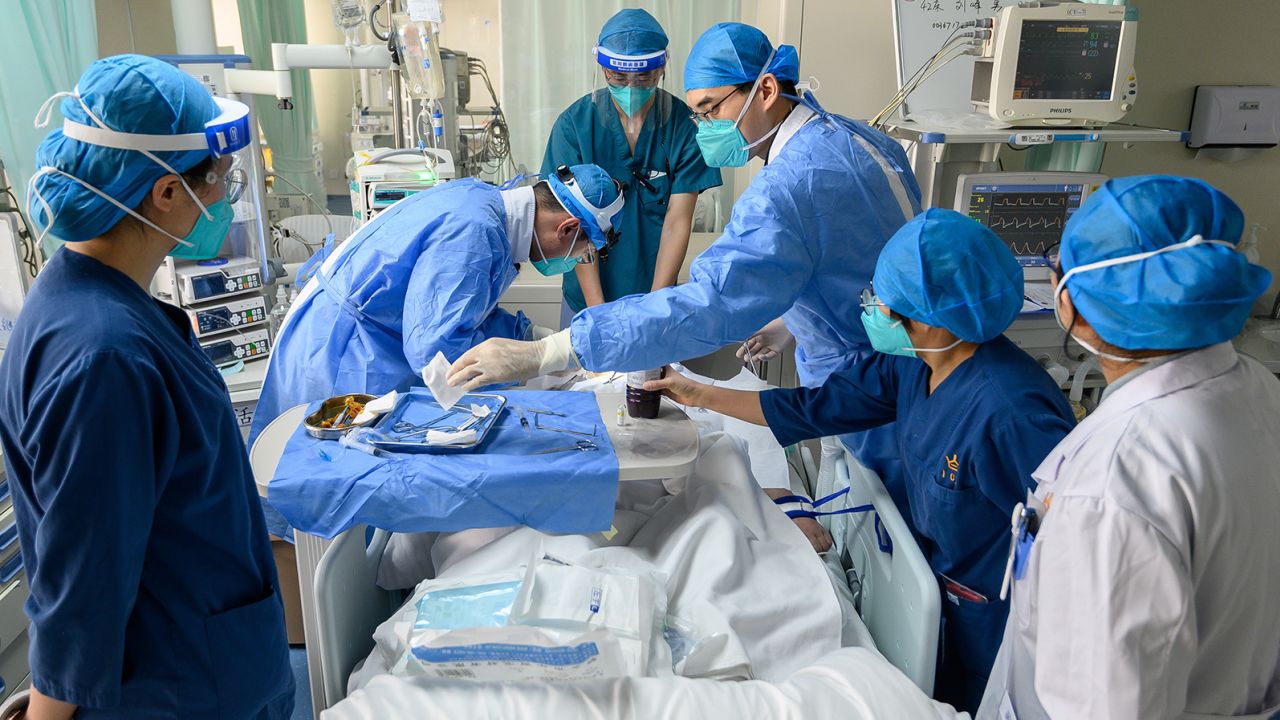
    As Jo Wang, an event planner in Beijing, watched her family members fall ill with Covid-19 one by one late last month she had a single goal: find antiviral pills to protect her elderly grandfather when his turn came.

    After three days of trying and failing to purchase a box of Pfizer’s Paxlovid on an e-commerce platform, she got lucky, scoring the Covid treatment via an official channel on the fourth day and receiving it by mail on the sixth. But Wang, who was breaking the rules by seeking the prescription proactively – before her grandfather fell ill – was also wracked with guilt.

    “I felt really bad at that time … you don’t know how many days it will take to buy this medicine, it is completely unknown. And you don’t know how long the people in your family can hold on,” she said, stressing her fear that if she waited until the 92-year-old fell ill, it would be too late to get the pills, which are most effective early in the illness. “It’s a very desperate situation.”

    Wang is not the only resident scrambling to secure Western medications as a wave of Covid-19 overwhelms China, driving up demand for treatment – especially for the country’s large undervaccinated elderly population.

    In recent weeks, many have turned to the black market where hawkers claim to sell Covid treatments ranging from illegal imports of Indian-made generics of Pfizer’s Paxlovid and Merck’s molnupiravir to the bonafide product –up to nearly eight times the market price.

    Rising frustration over the shortages wascompounded by an announcement Sunday that the government had failed to reach an agreement with Pfizer to include Paxlovid under its national insurance plan, with officials saying the price asked was too high. That decision could mean that after March 31, the drug will only be available to those who can afford to pay full price, with current rates reportedly around 1,900 yuan ($280) per course.

    Paxlovid has been shown to reduce the risk of death and hospitalization in high risk patients when used soon afterthe onset of symptoms. Last February, the drug, widely used in developed countries, became the first oral pill specifically for Covid to be authorized in China.

    China did agree to cover two other treatments used for Covid-19 in the latest talks – the traditional Chinese medicine Qingfei Paidu and the homegrown antiviral pill Azvudine. There is limited data on how well Azvudine protects against severe disease.

    The pricing pitfall and shortages, nearly a year after the pill was first authorized and months after Pfizer tapped a domestic drugmaker for local production, showthe challenges facing China as its governmentgrapples with demand for treatments for its population of 1.4 billion after abruptly dropping its Covid controls last month.

    Currently, Pfizer’s imported pill is available in community hospitals in some cities, including Beijing, Shanghai, Tianjin and Guangzhou, according to state media. It is also sold on several e-commerce platforms, where there is some suggestion in local reports that supply constraints are easing.

    But there are questions about how broadly the pills will be distributed across China and if there is sufficient medical resources to prescribe them – an urgent issue as the outbreak shifts from urban hubs to smaller cities and rural China. Experts say procurement appears to be decentralized, with the pills more readily available at hospitals in better resourced major cities and tougher to find elsewhere.

    On Monday, Pfizer’s CEO Albert Bourla said the company had ramped up exports, sending millions of courses of Paxlovid to China in the past couple weeks, and was working with its domestic partner Zhejiang Huahai to manufacture Chinese-made Paxlovid in the first half of this year, according to Reuters.

    But Bourla, speaking at a conference in San Francisco, also quashed hopes the company might reach a deal with China for domestic drugmakers to produce a generic version of the drug to be sold in-country – denying a January 6 Reuters report that such an arrangement was being discussed.

    US-based Merck, known as MSD internationally, on Wednesday said on its WeChat account that it would take legal action against some manufacturers that are supplying unauthorized versions of its Covid drug. The company said it would also partner with domestic firm Sinopharm to supply China with its pill, which is sold under the brand name Lagevrio. Neither Western firm currently holds a patent for the drugs in China, according to a WHO-affiliated database, though both have filed for one.

    But as the immediate shortages – and issues of cost – play out in one of the world’s largest generic drug-producing countries, they also throw the spotlight on global issues related to intellectual property rights, according to experts who examine access to medicines.

    Two Chinese companies slated to manufacture generic versions of Paxlovid have already submitted their products for evaluation by the World Health Organization (WHO), according to the WHO-affiliated Medicines Patent Pool (MPP) – a signal that they are ready to begin producing the medicine.

    Those companies, Zhejiang Huahai and Apeloa Pharmaceutical, along with two others in China, were granted sublicenses in 2022 to make the full generic pill to supply 95 lower and middle income markets – not including China – under an earlier deal between Pfizer and the MPP, an organization that facilitates access to treatments for people in poorer countries.

    “At the scale of the health crisis taking place (in China), the most logical next step (would be) that these licenses are expanded to include allowing domestic supply in China, including from other producers (in the region),” said Ellen ‘t Hoen, a former executive director of the MPP and current head of the Medicines Law & Policy project.

    However, if the drug developer was unwilling to take that step – as Bourla indicated Pfizer was on Monday – there are measures China could take, such as pledging to protect companies that make generic supplies or importing generics from elsewhere, using legal measures allowed under the World Trade Organization rules during health emergencies, ‘t Hoen said.

    That potential has been discussed in public forums in China. Commentators there point out the country has no track record of using these flexibilities, which are often employed with caution by countries, given their potential to irk foreign pharmaceutical companies and the countries where they are based.

    In China’s case, concerns about impacting the local economy – in which foreign pharmaceutical firms are major employers – was likely a key reason for the government’s reticence to use such measures, said Yanzhong Huang, a senior fellow for global health at the Council on Foreign Relations in New York.

    Beijing this month called on authorities to enhance oversight of online sales of drugs and crack down on price gouging, false advertising and the infringement of intellectual property.

    China may be hoping that more domestic antiviral pills in development are able to fill the void. Throughout the pandemic, its regulators have largely opted for homegrown tools to confront the virus – with Beijing yet to approve a foreign Covid vaccine.

    Health officials have recently sought to assure the public about affordable access to treatments and downplay the potential impact of the government’s failure to include Paxlovid in its national insurance scheme. A top health official on Wednesday said that hundreds of pills to alleviate Covid symptoms were already covered by insurance and new viral treatments were in the pipeline.

    State-run nationalist tabloid Global Times on Monday ran an opinion piece blaming “US capital forces” for China’s inability to cut a deal with Pfizer to include the pills in the national insurance.

    “During the past days, a growing number of US politicians and media outlets have been making shrill ‘warnings’ about the epidemic in China … If they do care about it, why don’t Pfizer drop some pursuit of the profit, and cooperate with China with a little more sincerity?” said the article.

    Bourlaon Monday said talks broke off after China had asked for a lower price than Pfizer is charging for most lower middle income countries.

    In a separate statement to CNN, Pfizer declined to comment on what price it had offered, but said: the company “will continue to collaborate with the Chinese government and all relevant stakeholders to secure an adequate supply of Paxlovid in China” and remained “committed to fulfilling the Covid-19 treatment needs of Chinese patients.”

    But for those who have been grappling with the immediate problems of gaining access to medicines for themselves and their families, like Wang in Beijing, there is a feeling – for now anyway – that the system isn’t working.

    “It’s cruel … no matter how we feel, there’s nothing we can do,” she said. “It’s not the case that your effort or expectation can make the situation better.”
  • China has 900 million cases of COVID, according to a study

    China has 900 million cases of COVID, according to a study

     A study by Peking University study shows that , as of 11 January, about 900 million people in China had been infected coronavirus

    According to the report, the virus is present in 64% of the nation’s population.

    The provinces with the highest infection rates are Gansu (91%), Yunnan (84%), and Qinghai (80%), in that order.

    A leading Chinese epidemiologist has also issued a warning that cases will rise during the lunar new year in rural China.

    The peak of China’s Covid wave is expected to last two to three months, added Zeng Guang, ex-head of the Chinese Center for Disease Control.

    Hundreds of millions of Chinese are travelling to their hometowns – many for the first time since the pandemic began – ahead of the lunar new year on 23 January.

    China has stopped providing daily Covid statistics since abandoning zero-Covid.

    But hospitals in big cities – where healthcare facilities are better and more easily accessible – have become crowded with Covid patients as the virus has spread through the country.

    Speaking at an event earlier this month, Mr Zeng said it was “time to focus on the rural areas”, in remarks reported in the Caixin news outlet.

    Many elderly, sick and disabled in the countryside were already being left behind in terms of Covid treatment, he added.

    China’s central Henan province is the only province to have given details of infection rates – earlier this month a health official there said nearly 90% of the population had had Covid, with similar rates seen in urban and rural areas.

    However government officials say many provinces and cities have passed the peak of infections.

    The Lunar New Year holidays in China, which officially start on January 21, involve the world’s largest annual migration of people.

    Some two billion trips are expected to be made in total, and tens of millions of people have already traveled.

    Last month, China abruptly abandoned its zero Covid policies. It also reopened its borders on Sunday.

    Official data shows five or fewer deaths a day over the past month, numbers which are inconsistent with the long queues seen at funeral homes and reports of deaths on social media.

    In December Chinese officials said they planned to issue monthly rather than daily updates on the Covid situation in the country.

    The World Health Organisation (WHO) said China, which stopped reporting COVID fatalities on Tuesday, was heavily underreporting Covid deaths.

    In response, Foreign Ministry spokesman Wang Wenbin stressed again at a regular press briefing on Thursday that Beijing has been sharing Covid data in “a timely, open and transparent manner in accordance with the law”, having held technical exchanges with the WHO over the past month.

    International health experts have predicted at least a million COVID-related deaths in China this year. Beijing has officially reported just over 5,000 deaths since the pandemic began, one of the lowest death rates in the world.

    Source: BBC.com

  • China: Guangzhou driver causes five deaths after driving into crowds

    China: Guangzhou driver causes five deaths after driving into crowds

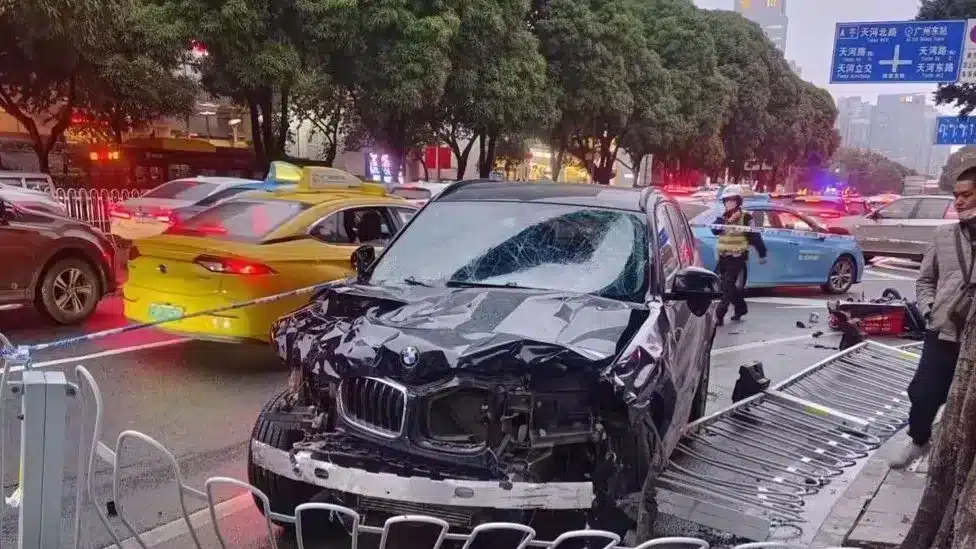
    A man who rammed his car into pedestrians in Guangzhou, killing five people and injuring 13, has been detained by Chinese police.

    Widespread public outrage over the incident has led many to accuse the man of deliberately picking on people.

    Soon after the collision, the driver is seen in videos posted online getting out of the vehicle and flinging bills into the air.

    The 22-year-old man is being held by police, who have also opened an investigation.

    In the southern city of 19 million people, the accident happened on Wednesday during the evening rush hour at a busy intersection.

    “He deliberately drove into the people who were waiting for the traffic light. He rammed the car into them maliciously. After that, he made a U-turn and hit people again,” an eyewitness told local outlet Hongxin News.

    “He wasn’t driving too quickly, but some people couldn’t run away in time because they wouldn’t have known he was hitting people deliberately.”

    The man also reportedly drove into a traffic police officer and his motorcycle, but the officer managed to escape.

    One widely circulated clip shows a young girl lying on the ground at the scene of the incident, while a woman said to be her mother is seen by her side wailing.

    Another eyewitness described the chaos of the aftermath on Weibo, the Chinese version of Twitter. The person said that an hour after the incident, the site was still filled with ambulances and traffic police “and they had not moved all the injured and the bodies from the scene”.

    “The scene was too tragic and I couldn’t bear seeing it. I felt so sad that I wanted to throw up whenever I heard the siren of the ambulance,” the person said.

    The incident has sparked public anger, with many expressing sorrow that it happened in the lead-up to Chinese New Year, a time for family reunions.

    “The victims could be a girl who dressed up meticulously to go on a date… It could be a food deliveryman who earned five yuan after rushing an order. It could be a father who wanted to go home and have dinner with children. It could be a child who was happily shopping,” one Weibo user wrote.

    Many noted that the man drove a luxury car and had thrown money into the air, and asked if he came from a rich and powerful family.

    The incident quickly became a trending topic on Weibo on Wednesday, but it later disappeared from the “hot searches” list, leading users to accuse the platform of censorship.

    There have been similar recent incidents. In February 2022, a driver ploughed a mini truck into people in the southern province of Fujian, killing three and injuring nine.

    Earlier this week, a hotel guest in Shanghai deliberately drove his car into the lobby following an argument with staff. Nobody was injured in that incident.

    Source: BBC.com
  • Tech giants’ pivot out of China can usher in a human rights reset

    Tech giants’ pivot out of China can usher in a human rights reset

    For companies like Apple, decoupling from China can be an opportunity to improve their human rights record.

    In late November, protests erupted in a factory manufacturing Apple products in the Chinese city of Zhengzhou amid workers’ discontent about pay. Footage and images from the site showed police beating protesters and arresting them.

    The turmoil in Zhengzhou was the latest in a series of challenges that have delayed the manufacturing of Apple products in China and led to the company accelerating its plans to move its production elsewhere.

    Other tech giants are seeking to do the same, concerned about tensions between the US and China and COVID-19-related shutdowns imposed by the Chinese authorities.

    As these companies start to relocate their operations, they have the chance to account for their human rights record in the communist country. For years, they have bowed to state policies that restrict the fundamental freedoms of Chinese citizens.

    These companies have to review their human rights records in authoritarian states and commit not to make the same mistakes in the countries where they will relocate their production or grow their markets. It is time for tech companies to undertake a human rights reset.

    Compliance with censorship

    Apple, the world’s richest company, has made a significant profit in China, which has also left it vulnerable to pressure from the local authorities to act against its stated human rights commitments. While the size of its production has been politically and economically important to the Chinese government, which in theory would have given the company leverage to oppose such rights abuses, Apple has been seemingly unwilling to push back in meaningful ways.

    The company has complied with repressive legislation, such as the Cybersecurity Law and others, which require tech companies, among others, to monitor and report politically sensitive content, store Chinese users’ data in China and provide the authorities with access to it.

    Apple has also engaged in censorship, deleting tens of thousands of apps from its Chinese App Store, including encryption and circumvention tools, such as VPNs needed to hop over the Great Firewall of China.

    Most recently, in November, Apple limited the parameters for wireless filesharing on its app AirDrop after its use by anti-government protesters in China. The changes allow the option “share with everyone” to be active for just 10 minutes before it switches back to “contacts only”, effectively eliminating its utility during protests.

    Apple is not alone. Microsoft, another US-based tech giant, has also been compliant with the repressive policies of the Chinese government.

    Following the implementation of the Cybersecurity Law, the company partnered with the state-owned China Electronics Technology Group to develop a version of its Windows operating system specifically for Chinese government users. This has raised concerns about the company giving backdoor access to its software to the Chinese government.

    Microsoft is also a member of the Internet Society of China and as such has made a pledge to block websites that offend the Chinese censors.

    After most services offered by Google were blocked in China in 2010, Microsoft’s Bing has been the only major foreign search engine that works without a VPN. Surely, compliance with Beijing’s censorship demands helps keep it that way.

    Similarly, LinkedIn, which Microsoft acquired in 2016, was the only big foreign social networking site available in China, after Twitter, Facebook, and YouTube were blocked in 2009. In late 2021, LinkedIn had over 57 million users, making China its third largest market after the United States and India. In exchange for access to this sizeable userbase, LinkedIn too was expected to play the censorship game.

    The platform geoblocked content belonging to high-profile human rights defenders, such as Zhou Fengsuo, journalists like Bethany Allen-Ebrahimian, and corporate investigator Peter Humphrey, along with the posts of millions of Chinese users deemed “sensitive”.

    Despite its record of compliance, in March 2021 the Cyberspace Administration of China rebuked LinkedIn for not censoring enough. Finally, in October 2021, Microsoft announced it was shutting down LinkedIn services in China due to a “significantly more challenging operating environment and greater compliance requirements”.

    Clearly, the cost of tech companies doing business in China’s enormous market, whether producing or selling products and services, has long been to abandon their responsibilities to respect human rights. But it shouldn’t be this way.

    A human rights reset

    As big tech companies prepare to reduce their reliance on production in China, they have an opportunity to set new standards for human rights.

    Apple is looking to shift its supply chain to India and Vietnam. But both of these countries are known to engage in severe censorship as well.

    India leads the world in internet shutdowns, responsible for 106 of 182 shutdowns documented last year by the #KeepItOn Coalition. In recent years, the Indian authorities have enacted legislation that pressures tech companies to over-censor and retain user data to hand over to the government. It now looks to threaten end-to-end encryption.

    India has ordered platforms to take down content it didn’t want and warned of severe penalties for noncompliance, including threatening Twitter staff with up to seven years imprisonment. Earlier this year, Twitter sued the government for such “overbroad and arbitrary” regulations.

    It is also concerning that Apple is expanding into Vietnam, which ranks among the five worst internet freedom abusers in the world, according to US-based pro-democracy organisation Freedom House.

    Like China, Vietnam’s Cybersecurity Law requires tech companies to comply with data localisation, actively censor content, and make user data available to the authorities. In November, its government announced plans for new rules that would require platforms to remove offending content within 24 hours.

    Vietnam has also shown that it will hold tech companies financially hostage until they comply with its digital diktats. In 2020, following months of government-backed bandwidth throttling to drastically slow down its services, Facebook, which makes about $1bn a year in the country, agreed to increase censorship of “anti-state” content on its platform.

    With such repressive policies in place in both India and Vietnam, Apple faces the risk of repeating the same mistakes it made in China unless it changes its approach to dealing with government pressure.

    The company and other tech giants doing business with repressive states should heed their responsibilities under the UN Guiding Principles on Business and Human Rights (UNGPs) to address any adverse human rights impacts their activities may have, including on the rights to privacy, freedom of expression, and access to information online.

    They should resist government orders to arbitrarily restrict freedom of expression and implement labour protections in their supply chains.

    They should be fully transparent about how they negotiate market access and licensing agreements with governments and make such documents publicly available to empower independent oversight.

    Companies should have a robust policy on how they will adhere to their human rights responsibilities in the face of government pressure and hold open consultations with civil society to establish clear benchmarks and red lines.

    Companies must commit to independent human rights impact assessments, which should be revised as conditions change, and be publicly available.

    Shareholder groups in these companies should also impress upon corporate leadership the importance of compliance with their human rights responsibilities.

    Tech companies can and should do business without hurting human rights. Having a positive human rights record could be just as profitable as bowing down to repressive state policies.

    DISCLAIMER: Independentghana.com will not be liable for any inaccuracies contained in this article. The views expressed in the article are solely those of the author’s, and do not reflect those of The Independent Ghana

    Source: Aljazeera.com

  • China bans travel from South Korea and Japan due to COVID regulations

    China bans travel from South Korea and Japan due to COVID regulations

    Japan and South Korea no longer receive short-term visas from China in response for Covid travel restrictions on Chinese citizens.

    Visas for South Koreans entering China as tourists have been suspended, Beijing’s embassy in Seoul said.

    Japanese media reported China was imposing similar measures there.

    It’s a tit-for-tat move which Beijing says will remain in place until “discriminatory” entry restrictions against China are lifted.

    Last week, South Korea stopped issuing tourist visas for those coming from China, which the Chinese foreign ministry called “unacceptable” and “unscientific”.

    Reacting to China’s latest move, South Korea’s foreign ministry told the BBC that its policy towards arrivals from China was “in accordance with scientific and objective evidence”.

    Japan meanwhile is currently allowing Chinese visitors into the country, provided they test negative for Covid.

    According to South Korea’s Disease Control and Prevention Agency, around a third of all arrivals from China tested positive for Covid prior to the visa restrictions being put in place.

    The curbs are supposed to last at least until the end of the month, which would give scientists time to analyse for any potential new variants coming from China.

    “There’s no transparency at the moment in China about any monitoring for new variants. If a new variant comes from China, it would be a very difficult situation for the whole world,” Professor Kim Woo Joo, an infectious diseases expert at Korea University and a government adviser, told the BBC.

    “It would also be a disaster for the Korean healthcare system. We currently have a lot of hospitalisations and deaths already and our elderly people are also under-vaccinated. This is what we are worried about.”

    At the moment, only a small number of business or diplomatic travellers from China are being allowed into South Korea. They must test negative before departure and also on arrival.

    One Chinese man who tested positive escaped from a bus taking him to a quarantine hotel near the airport. Two days later he was caught by police in a hotel in Seoul.

    At Seoul’s Incheon International airport, the only South Korean airport still allowing flights from China, arrivals are met by military personnel in personal protective equipment.

    The BBC managed to speak to some of them as they were escorted to the airport testing centre.

    “Personally, I think it’s okay. I have been through much worse during this pandemic,” said William, a businessman from Shanghai. “As a traveller I just try to comply with the policies are much as possible.”

    But another passenger disagreed.

    “In my mind it’s not scientific at all,” says Emily, who arrived from Hong Kong. She, like those coming from mainland China, was required to test.

    “I feel like it’s a little bit unfair on this side. They must feel really unsafe, I suppose.”

    Many South Koreans support the idea of protecting their country from the China’s coronavirus surge, but not all are convinced that the decision to limit travel is a purely medical one.

    “There is a political element to it and the relationship between the two countries isn’t a good one. A lot of Korean people hold a lot of animosity blaming China for the coronavirus,” said Jinsun, who was heading to Abu Dhabi.

    Another woman going on her honeymoon to Paris said South Korea might not have implemented such rules if the country concerned wasn’t China.

    “But then again, whatever we did, China would have a problem with it,” she said.

    Source: BBC

  • Thailand back down on COVID vaccination rule for visitors

    Thailand back down on COVID vaccination rule for visitors

    Checking vaccinations is inconvenient, according to the health minister, and a panel of health experts has agreed to withdraw the new rule.

    Thailand has revoked an entry policy announced two days ago that required visitors to show proof of a COVID-19 vaccination, according to the country’s health minister, citing adequate immunization levels in China and globally.

    Anutin Charnvirakul said on Monday that checking evidence of vaccinations was inconvenient, and that a panel of health experts had agreed to withdraw the new rule, which was announced on Saturday by aviation authorities ahead of an expected influx of visitors from China, where COVID cases have surged.

    Charnvirakul said those not vaccinated would also be granted entry without restriction.

    “Showing proof of vaccination would be cumbersome and inconvenient, and so the group’s decision is that it is unnecessary,” Anutin told reporters.

    Tourism Authority of Thailand Governor Yuthasak Supasorn said there had been discussions over entry requirements but the issue had been resolved.

    One of Asia’s most popular travel destinations, Thailand is enjoying an influx of visitors during its first peak season since the removal last year of tight entry restrictions that had caused its tourism sector to collapse.

    In November, it recorded 1.75 million visitors, quadruple the number for the whole of last year when flights and foreign arrivals were limited.

    Visitors from China

    Chinese visitors have been crucial for Thailand, accounting for about a quarter of its annual visitors before the pandemic. Anutin said the government was now expecting seven to 10 million Chinese visitors, compared with an earlier estimate of five million.

    The first flight from China arrived in Thailand on Monday, the first of a group of 3,465 passengers expected on the first day.

    “We’re very excited to come back to Thailand. We have been waiting for three years already,” said Wang Zhenyin.

    “Before the start of COVID, we came here every year. And this time I take my family to come here.”

    Passengers from China's Xiamen arrive at Bangkok’s Suvarnabhumi airport after China reopens its borders amid the coronavirus disease (COVID-19) pandemic, in Bangkok, Thailand, January 9, 2023
    Thailand’s tourism authority is expecting arrival numbers for last year to have exceeded 11.5 million [Athit Perawongmetha/Reuters]

    On Sunday, Beijing lifted a mandatory quarantine for arrivals from abroad imposed when the pandemic began three years ago. The move is expected to unleash large pent-up demand for outbound travel.

    But so far, few flights have been restored. On Monday, a check of arrivals at regional airports found only a handful of flights coming from China. The largest share was travelling to South Korea.

    The about-face on the vaccine rule follows similar policy U-turns by Thailand during the pandemic that have caused widespread confusion among travellers about its entry requirements.

    Thailand will still require foreigners to show evidence of health insurance coverage for COVID if their next destination requires a negative pre-entry test, Charnvirakul said.

    Thailand’s tourism authority is expecting arrival numbers for last year to have exceeded 11.5 million, just over a quarter of the record of nearly 40 million in pre-pandemic 2019, who spent about 1.91 trillion baht ($55.2bn).

    Source: Aljazeera.com
  • China Covid: Over 88 million people in Henan infected, according to official

    China Covid: Over 88 million people in Henan infected, according to official

    Local health officials say, nearly 90% of people in Henan, China’s third most populous province, are now infected with Covid.

    Kan Quancheng, a provincial official, revealed the figure, which amounts to approximately 88.5 million people, at a press conference.

    After abandoning zero-Covid policies in December, China is dealing with an unprecedented surge in cases.

    The move came in response to rare protests against lockdowns, quarantines, and mass testing.

    Mr Kan did not provide a timeline for when all of the infections occurred, but given that China’s previous zero-Covid policy kept cases to a minimum, the vast majority of Henan’s infections are likely to have occurred in the last few weeks.

    He said visits to fever clinics in Henan province peaked on 19 December “after which it showed a continuous downward trend”.

    The Henan provincial figures are in stark contrast to Covid figures from the central government

    According to official data, just 120,000 people in the country of 1.4 billion have been infected and 30 died since the shift in Covid policy.

    Meanwhile on Sunday, authorities reported three Covid deaths in mainland China, one more than the day before.

    However, with the definition of Covid deaths narrowed and mass testing no longer compulsory, government data is no longer reflective of the true scale of the outbreak.

    Other local and provincial officials have also been providing very different data to that from the central government. On Christmas Eve, a senior health official in the port city of Qingdao reported that half a million people were being infected each day. Those case figures were swiftly removed from news reports.

    Meanwhile Chinese health officials said they would not include Pfizer’s antiviral Covid medicine Paxlovid in its basic medical insurance schemes as a result of the high price quoted by the US firm.

    The drug, temporarily covered by China’s broad healthcare insurance scheme until 31 March, has seen a sharp increase in demand since China’s Covid cases surged last month.

    Pfizer would continue to collaborate with the Chinese government and all relevant stakeholders to “secure and adequate supply” of the medicine in China, the company said in a statement.

    On Sunday, Beijing also lifted mandatory quarantine for all international arrivals and opened its border with Hong Kong.

    In the first wave of pre-holiday travel, official data showed that 34.7 million people travelled domestically on Saturday. This represented an increase of more than a third compared to last year, according to state media.

    Infections are expected to soar as the country celebrates Lunar New Year later this month, with millions expected to travel from big cities to visit older relatives in the countryside.

    Overall, more than two billion individual journeys are expected to take place, officials have said.

    Source: BBC.com

  • COVID-19: China reopens borders after three years of closure

    COVID-19: China reopens borders after three years of closure

    For the first time since placing limits on overseas travel in March 2020, China has reopened its borders to travelers from outside.

    As the nation fights a surge in cases, there will be no longer be a requirement for incoming travelers to quarantine, marking a dramatic shift in the Covid policy.

    They will still demand documentation of a PCR test that was negative and performed within 48 hours of the trip.

    Many people who are ready to reunite with family have welcomed the move.

    In the upcoming weeks, 400,000 individuals from Hong Kong are anticipated to fly into locations like Beijing and Xiamen, where there would be lengthy lines for flights.

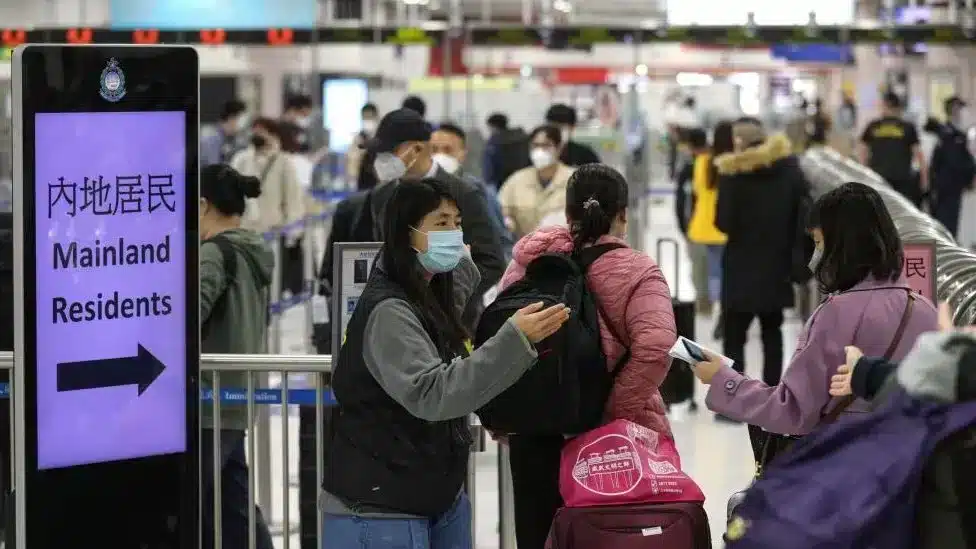
    On Sunday, double decker coaches packed with travellers arrived at the Hong Kong-Zhuhai-Macau Bridge to catch buses to the Guangdong province – among them were college students returning home.

    One man told the BBC he hadn’t seen his extended family in five years and couldn’t hold back his excitement having just bought a ticket back to China.

    A woman told news agency Reuters she had not seen her parents in years – despite one of them suffering from colon cancer – and said she was “so, so happy”.

    The country’s reopening comes at the start of “chun yun”, the first period of Lunar New Year travel. Before the pandemic it was the largest annual worldwide migration of people returning home to spend time with family.

    Two billion trips are expected to be made this Lunar New Year, double the number that travelled last year.

    Li Hua, who travelled from the UK to China – where her family lives – for the festival said it had been “too long” since she had returned, “I’m so happy to be back, and breathe Chinese air. So happy, so happy”.

    However, other people worry that expanding the borders will increase the spread of Covid-19.

    At the Hong Kong-Zhuhai-Macau Bridge, some local bus drivers told the BBC that they are concerned they might contract the virus from arriving travelers and that their employers should give them better protection.

    China had one of the strongest Covid health rules over the past three years, which resulted in repeated lockdowns, frequent testing procedures, and a substantial impact on the country’s economy.

    Following widespread demonstrations around the nation in response to a fire in a high-rise building in the Xinjiang province that left 10 people dead, the government recently reversed course on that policy. Although authorities disputed this, many Chinese believed that the long-standing Covid restrictions were a factor in the deaths.

    Hospitals and crematoriums have reportedly been overcrowded since China abandoned the main tenets of its Covid zero policy, but the nation has stopped disclosing its case numbers and only announced two deaths on Saturday.

    The Chinese government deleted more than 1,000 social media accounts on the same day for criticizing how it handled the outbreak.

    The anticipated surge in cases and travel out of China has prompted many countries – including the UK – to impose requirements for a negative COVID-19 test on people arriving from China, drawing the ire of the Chinese government.

  • China to open border with Hong Kong after years of tight control

    China to open border with Hong Kong after years of tight control

    The Chinese government announced on Thursday that it will reopen its border with Hong Kong on January 8, nearly three years after it was largely shut in an effort to contain the spread of Covid.

    Up to 60,000 Hong Kong residents will be able to cross the border into the mainland as a gradual reopening of border control points begins, Hong Kong leader John Lee told media on Thursday following an announcement from Beijing.

    The shift will eliminate what had been a mandatory quarantine for travelers from Hong Kong to the mainland. All travelers will be required to test negative for Covid via a PCR test within 48 hours prior to crossing, and passenger quotas apply to travel in both directions.

    The announced reopening falls on the same day China will drop quarantine requirements for international arrivals and scrap a number of Covid restrictions on airlines in place since the start of the pandemic.

    The changes come amid Beijing’s sudden dismantling of its stifling Covid controls, following nationwide protests. The apparent reopening of the mainland comes after three years of self-imposed global isolation, during which efforts to resume regular transit with Hong Kong were repeatedly delayed.

    Most of previously bustling border crossings between Hong Kong and mainland China had been shut since early 2020, placing a heavy burden on families and businesses with ties on both sides.

    The quota includes 50,000 people to travel via three land checkpoints, while the remaining 10,000 are for people traveling via the Hong Kong International Airport, two ferry piers and the Hong Kong-Zhuhai-Macau Bridge.

    The cap does not apply to Hong Kong residents traveling back to Hong Kong from the mainland, nor mainland Chinese traveling back to the mainland from Hong Kong, Lee said.

    In addition to testing, advance bookings will also be required for some travel.

    According to a statement from China’s State Council, flights from Hong Kong and neighboring Macau to mainland China will resume and caps on passenger capacities will be lifted; the number of flights will increase in a “phased and orderly” fashion, the statement said.

    Land and maritime border control points between mainland China and Hong Kong and Macao will also resume in a “phased and orderly” manner.

    China will also resume issuing tourist and business visas for mainland Chinese residents traveling to Hong Kong, the statement added.

  • China Covid: Celebrity deaths spark fears over death toll

    China Covid: Celebrity deaths spark fears over death toll

    The growing number of Chinese public figures whose deaths are being made public is prompting people to question the official Covid death toll.

    The death of Chu Lanlan, a 40-year-old opera singer, last month came as a shock to many, given how young she was.

    Her family said they were saddened by her “abrupt departure”, but did not give details of the cause of her death.

    China scrapped its strict zero-Covid policy in December and has seen a rapid surge of infections and deaths.

    There are reports of hospitals and crematoria becoming overwhelmed.

    But the country has stopped publishing daily cases data, and has announced only 22 Covid deaths since December, using its own strict criteria.

    Now only those who die from respiratory illnesses such as pneumonia are counted.

    On Wednesday the World Health Organization (WHO) warned that China was under-representing the true impact of Covid in the country – in particular deaths.

    But the deaths of Chu Lanlan and others is sparking speculation about greater losses than those reported on official accounts.

    According to the specialist news website Operawire, Chu Lanlan was a soprano who specialised in Peking Opera – a theatrical art in which performers use speech, song, dance and combat movements to tell stories – and was also involved in charitable causes.

    On New Year’s Day news of the death of actor Gong Jintang devastated many Chinese internet users.

    Gong Jintang
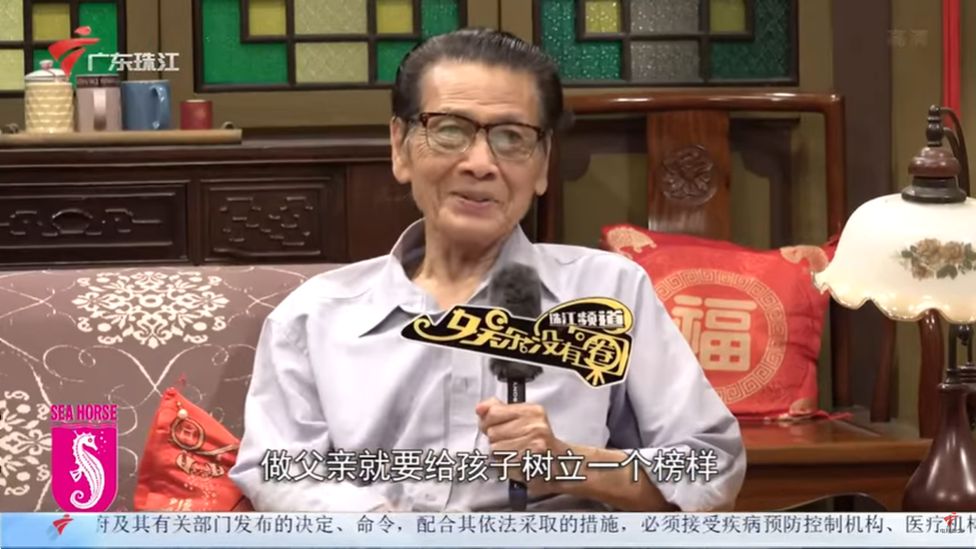
    Image caption, Gong Jintang was known for his performance in the country’s longest-running TV series, In-Laws, Out-laws.

    Gong, 83, was known to many households for his performance in the country’s longest-running TV series, In-Laws, Out-laws. His portrait of Father Kang had captivated fans for more than two decades since the show first aired in 2000.

    The cause of his death is unclear, but many social media users linked it to the recent deaths of other older people.

    “Please god, please treat the elderly better,” his co-star Hu Yanfen wrote on Chinese social media platform Weibo.

    “R.I.P Father Kang. This wave have really claimed many elders’ lives, let’s make sure we protect the elderly in our families,” one user wrote on Weibo.

    Acclaimed scriptwriter Ni Zhen was also among recent deaths. The 84-year-old was famous for his work on the 1991 film Raise the Red Lantern, which is widely considered to be one of the best Chinese films by critics.

    Meanwhile Hu Fuming, a former journalist and retired professor of Nanjing University, died on 2 January at the age of 87.

    He was the main author of a famous commentary published in 1978 that marked the start of the China’s “Boluan Fanzheng” period – a time of eliminating chaos and returning to normal after the upheaval of the Cultural Revolution under the country’s first Communist leader Mao Zedong.

    Hu Fuming
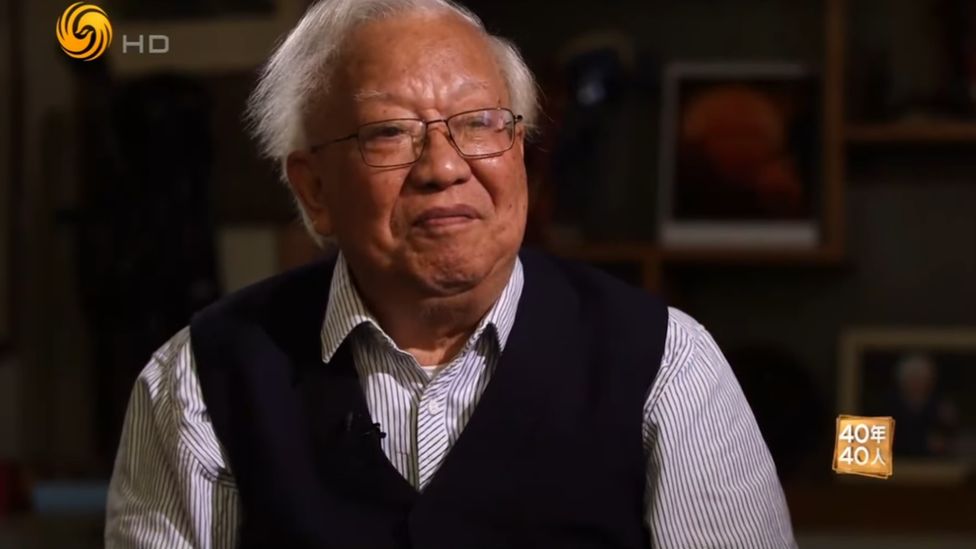
    Image caption, Hu Fuming was a well known scholar and author

    According to a tally by Chinese media, 16 scientists from the country’s top science and engineering academies died between 21 and 26 December.

    None of these deaths were linked to Covid in their obituaries, but that hasn’t prevented speculation online.

    “Did he also die of ‘bad flu’?” one of the top-rated comments under news of Mr Ni’s death said.

    “Even if you trawl through the whole internet you can’t find any reference to his cause of death,” said another internet user.

    But there was also criticism of demonstrators who took to the streets in November in rare political protests calling for the end of leader Xi Jinping’s zero-Covid policy.

    “Are those people happy now, seeing old people… now paving the way for their freedom?” asked one social media user.

    Mr Xi appeared to refer obliquely to the protests in his New Year’s address, saying it was natural in such a big country for people to have different opinions.

    But he urged people to come together and show unity as China entered a “new phase” in its approach to Covid.

    The Chinese authorities are aware of the widespread scepticism although they continue to play down the severity of this wave of Covid sweeping the country.

    In an interview with state TV, the director of Beijing’s Institute of Respiratory Diseases admitted the number of deaths of elderly people so far this winter was “definitely more” than in past years, while also stressing that critical cases remained a minority of the overall number of Covid cases.

    This week the People’s Daily, the Communist Party’s official newspaper, urged citizens to work towards a “final victory” over Covid and dismissed criticism of the previous zero-Covid policy.

  • China, Philippines agree on a peaceful resolution of South China Sea solution

    China, Philippines agree on a peaceful resolution of South China Sea solution

    During their meeting in Beijing, Xi and Marcos decided to settle their differences regarding the South China Sea “through peaceful means.”

    According to a joint statement from the two nations, China and the Philippines have decided to establish a direct communication channel on the South China Sea to settle disputes over the disputed waterway “through peaceful means”.

    The deal was reached on Thursday, a day after Philippine President Ferdinand Marcos Jr. met with Chinese President Xi Jinping in Beijing. The two leaders were trying to patch up their strained relationship as a result of Manila’s decision to request an arbitration ruling in 2016 regarding China’s sweeping claims in the South China Sea.

    Beijing has disagreed with the tribunal’s decision that China’s claims are invalid.

    Since then, Manila has continued to raise concerns over reported Chinese construction activities on islands in the South China Sea – as well as the transformation of disputed reefs into artificial islands – and “swarming” by Beijing’s vessels in the disputed waters, which are rich in oil, gas and fishery resources.

    The joint statement on Thursday said Xi and Marcos had an “in-depth and candid exchange of views on the situation in the South China Sea” and “emphasized that maritime issues do not comprise the sum-total of relations between the two countries”.

    The two leaders also “agreed to appropriately manage differences through peaceful means”.

    Both countries reaffirmed the importance of maintaining peace and stability as well as freedom of navigation and overflight in the South China Sea, and establish “a direct communication mechanism” between their foreign ministries, the statement added.

    Marcos’s three-day trip to Beijing, his first official visit to China as president, comes as the country re-emerges from a self-imposed border shutdown since the pandemic started in 2020 which has disrupted trade and hurt its economy.

    The Philippine president is the first foreign leader hosted by China in 2023, and this “speaks volumes about the close ties” between the two countries, Xi told Marcos, according to China’s official Xinhua news agency.

    In a video address released by his office on Wednesday, Marcos said both sides discussed “what we can do to move forward, to avoid possible mistakes, misunderstandings that could trigger a bigger problem than what we already have”.

    Marcos also said he made the case for Filipino fishermen who have been denied access to their traditional areas of operation by China’s navy and coastguard.

    “The president promised that we would find a compromise and find a solution that will be beneficial so that our fishermen might be able to fish again in their natural fishing grounds,” he said.

    The joint statement added that the coastguards of China and the Philippines would meet “as soon as possible” to discuss “pragmatic cooperation”, and that the two countries will hold an annual dialogue on security.

    It said both sides also agreed to resume talks on oil and gas exploration in the South China Sea and discussed cooperation on areas including solar, wind, electric vehicles and nuclear power.

    On the economic front, China agreed to import more goods from the Philippines with the aim for bilateral trade to revert to or surpass pre-pandemic levels. The two sides are finalising rules for imports of fruits from the Philippines, which Marcos said would start to balance the trade.

    Both sides also promised to boost tourist numbers and flights between both capitals, the statement said. Last year, only about 9,500 Chinese visited the Philippines, down from about 1.6 million before the pandemic.

    Source: Aljazeera.com
  • China-Taiwan: Worry as Taiwanese military device is being  repaired in China

    China-Taiwan: Worry as Taiwanese military device is being repaired in China

    A device used by the military for its missiles that was sent to China for repair has prompted calls for tighter security in Taiwan.

    A launch measurement optical instrument for Taiwan’s Hsiung-Feng III anti-ship missiles was sent to its European manufacturer.

    Then, according to Taiwanese media, it was returned to Taiwan from the eastern Chinese province of Shandong.

    Beijing increased military activity near the island last year.

    China sees Taiwan as part of its territory and has vowed to unify to it by force if necessary. Self-ruled Taiwan sees itself as distinct from the mainland.

    President Tsai Ing-wen has announced new plans to bolster Taiwan’s defence in the event of an attack from Beijing, including extending mandatory military service from four months to one year.

    In a statement, Taiwanese missile developer the National Chung-Shan Institute of Science and Technology said the device had been shipped to Switzerland by the company that had originally supplied it to the Taiwanese military.

    From there it was diverted for repair at the manufacturer’s Asia maintenance centre in the Chinese city of Qingdao, it said.

    The institute said it had removed memory cards before sending it to Europe and had also run information security checks on the device after its return and had no concerns over possible information leaks.

    Dr Su Tzu-yun from Taiwan’s Institute of Defence Security Research said the optical devices were not direct missile components but said Taiwan had to be more careful anyway.

    “Taiwan must be more strict and careful in its contract management,” he said. “Of course we would not want such equipment to be sent to China for repair.”

    The tool, a theodolite, is used to measure precise geographical location for missile launches as well as the angle and direction of the launchers, Dr Su said.

    “It’s like when you buy a computer, it’s a device you put on the desk to go with the machine,” he said.

    He suggested that the manufacturer had not been aware the devices, purchased by a supplier in Taiwan, had subsequently been used for military purposes.

    It is not the first time concerns over the security of Taiwan’s missile programme have been raised. Last year, three people at two Taiwanese suppliers were sentenced to between four and 10 years in prison for using products from China to fake missile compartments supposedly to be made by US manufacturers.

  • Global recession: Third of world in recession this year, IMF head cautions

    Global recession: Third of world in recession this year, IMF head cautions

    The International Monetary Fund’s (IMF) chief says this year will see a third of the world’s economy in a recession.

    As the economies of the US, EU, and China slow, 2023 will be “tougher” than last year, according to Kristalina Georgieva.

    The global economy is currently being weighed down by the conflict in Ukraine, rising prices, higher interest rates, and the spread of Covid in China.

    The IMF revised down its forecast for 2023 global economic growth in October.

    “We expect one third of the world economy to be in recession,” Ms Georgieva said on the CBS news programme Face the Nation.

    “Even countries that are not in recession, it would feel like they for hundreds of millions of people,” she added.

    Katrina Ell, an economist at Moody’s Analytics in Sydney, gave the BBC her assessment of the world economy.

    “While our baseline avoids a global recession over the next year, the odds of one are uncomfortably high. Europe, however, will not escape recession, and the US is teetering on the verge,” she said.

    The IMF cut its outlook for global economic growth in 2023 in October, due to the war in Ukraine as well as higher interest rates as central banks around the world attempt to rein in rising prices.

    Since then, China has scrapped its “zero-COVID” policy and started to reopen its economy, even as coronavirus infections have spread rapidly in the country.

    Ms Georgieva warned that China, the world’s second-largest economy, would face a difficult start to 2023.

    “For the next couple of months, it would be tough for China, and the impact on Chinese growth would be negative, the impact on the region will be negative, the impact on global growth will be negative,” she said.

    The IMF is an international organization with 190 member countries. They work together to try to stabilize the global economy. One of its key roles is to act as an early economic warning system.

    Ms Georgieva’s comments will be alarming for people around the world, not least in Asia which endured a difficult year in 2022.

    Inflation has been steadily rising across the region, largely because of the war in Ukraine, while higher interest rates have also hit households and business.

    Figures released over the weekend pointed to weakness in the Chinese economy at the end of 2022.

    The official purchasing managers’ index (PMI) for December showed that China’s factory activity shrank for the third month in a row and at the fastest rate in almost three years as coronavirus infections spread in the country’s factories.

    In the same month home prices in 100 cities fell for the sixth month in a row, according to a survey by one of the country’s largest independent property research firms, China Index Academy.

    On Saturday, in his first public comments since the change in policy, President Xi Jinping called for more effort and unity as China entered what he called a “new phase.”

    The downturn in the US also means there is less demand for the products that are made in China and other Asian countries including Thailand and Vietnam.

    Higher interest rates also make borrowing more expensive – so for both these reasons companies may choose not to invest in expanding their businesses.

    The lack of growth can trigger investors to pull money out of an economy and so countries, especially poorer ones, have less cash to pay for crucial imports like food and energy.

    In these kinds of slowdowns, a currency can lose value against those of more prosperous economies, compounding the issue.

    The impact of higher interest rates on loans affects economies at the government level too – especially emerging markets, which may struggle to repay their debts.

    For decades, the Asia-Pacific region has depended on China as a major trading partner and for economic support in times of crisis.

    Now Asian economies are facing the lasting economic effects of how China has handled the pandemic.

    The manufacture of products such as Tesla electric cars and Apple iPhones may get back on track as Beijing ends zero-Covid.

    But renewed demand for commodities like oil and iron ore is likely to further increase prices just as inflation appeared to have peaked.

    “China’s relaxed domestic Covid restrictions are not a silver bullet. The transition will be bumpy and a source of volatility at least through the March quarter,” Ms Ell said.

    Bill Blaine, strategist and head of alternative assets at Shard Capital, described the IMF’s warning as “a good wake up and smell the coffee moment”.

    “Even though labour markets around the world are fairly strong, the kind of jobs being created are not necessarily high paying and we’re going to have a recession, we are not going to see interest rates fall as rapidly as the markets think,” he told BBC Radio 4’s Today programme.

    “That’s going to create a whole series of consequences that will keep markets on tenterhooks for at least the first half of 2023.”

    Source: BBC.com

  • China accuses US of ‘slander, hype’ after aircraft clash

    China accuses US of ‘slander, hype’ after aircraft clash

    Following a collision between a Chinese jet and a US plane over the South China Sea, the defence ministry claims that the US twisted the facts.

    Following a collision between a Chinese fighter jet and an American surveillance plane over the disputed South China Sea, China’s defense ministry accused the United States of breaking international law and engaging in “slander and sensationalism.”

    The announcement was made late on Saturday, days after the US military asserted that on December 21, a Chinese J-11 fighter jet flew within 6 meters (20 feet) of a US RC-135 aircraft, causing the latter to do evasive maneuvers to avoid a collision.

    But Tian Julin, a spokesperson for China’s defence ministry, said the US Indo-Pacific Command had distorted facts about the incident and that it was the US aircraft that had engaged in “dangerous maneuvers” against the Chinese jet.

    Tian said the US aircraft was conducting intentional close-in reconnaissance on China’s southern coastline when the People’s Liberation Army sent fighter jets to track and monitor the plane.

    Despite multiple warnings from the Chinese side, the US aircraft suddenly altered its flight stance in a “dangerous approach movement, which seriously compromised the flight safety of the Chinese military aircraft,” he said.

    The defence ministry also released a video of the incident, which it said showed the US aircraft manoeuvring towards the Chinese jet.

    “The United States deliberately misleads public opinion … in an attempt to confuse the international audience,” Tian said.

    “We solemnly request the US side to restrain the actions of frontline naval and air forces, strictly abide by related international laws and agreements, and prevent accidents in the sea and the air.”

    China claims almost the entire South China Sea as its sovereign territory, but parts of it are contested by Vietnam, the Philippines, Malaysia, Taiwan and Brunei.

    Trillions of dollars in trade flow every year through the waterway, which also contains rich fishing grounds and gas fields.

    US military planes and ships routinely carry out surveillance operations and travel through the region, moves that China says are not good for peace.

    Relations between the US and China have been tense, with friction rising between the world’s two largest economies over a range of issues, including Beijing’s human rights record and its claims over the self-ruled island of Taiwan.

    Source:Aljazeera.com

  • Covid-19: Morocco forbids planes from China

    Covid-19: Morocco forbids planes from China

    In an effort to prevent a potential fresh wave of coronavirus infections, Morocco said on Saturday that is imposing a travel ban on people from China.

    A foreign affairs ministry statement said the restrictions would be extended to all people arriving from China regardless of their nationality.

    The ban will come into force “from 3 January and until further notice”, the statement added.

    China ended its strict Covid-19 restrictions in December, leading to a spike in cases. With some of the best vaccination rates in the world, Beijing says most of the cases after the reopening have been mild.

    Chinese authorities also announced that the their borders would reopen for inbound and outbound travel starting January 8th, with travelers needing only to present negative PCR tests.

    France, Italy, Spain and the United Kingdom, like the United States and South Korea, have also announced they would impose a Covid test on travellers coming from China.

    Source: African News

  • Covid in China: People rush to book travel as borders finally reopen


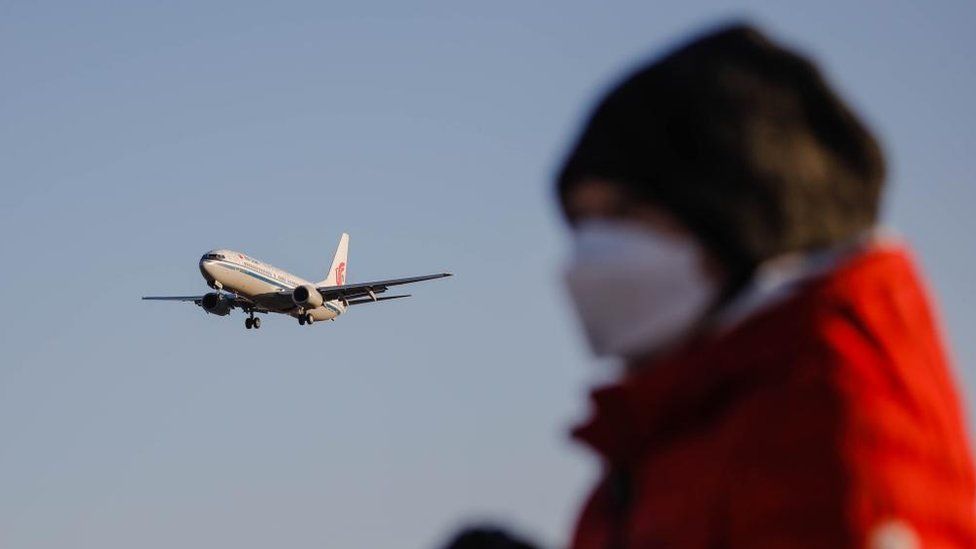
    A person is pictured wearing a mask in front of a passenger airplane landing in Beijing, China

    Chinese people have rushed to book overseas travel after Beijing announced it would reopen its borders next month.

    Passport applications for Chinese citizens wishing to travel internationally will resume from 8 January, the immigration administration said.

    It follows an announcement on Monday that ended almost three years of strict quarantine rules for arrivals.

    Travel sites have since reported a spike in traffic.

    But Chinese tourists will not have unfettered access to all countries.

    Officials in the US are considering new restrictions on travellers from China due to concerns about a surge in cases and a lack of transparency from the Chinese government.

    “There are mounting concerns in the international community on the ongoing Covid-19 surges in China and the lack of transparent data, including viral genomic sequence data,” US officials said in a statement quoted by news agencies.

    “Without this data, it is becoming increasingly difficult for public health officials to ensure that they will be able to identify any potential new variants and take prompt measures to reduce the spread.”

    Japan – one of the most popular destinations for Chinese travellers – has announced that all travellers from China must show a negative Covid test on arrival, or quarantine for seven days, because of the surge in cases there.

    India has also said travellers from China (as well as some other countries) must show a negative Covid test when they arrive – though this was announced before Beijing’s easing of restrictions.

    The easing of travel rules in China – the last part of the country’s zero-Covid policy – comes as the country battles a new wave of infections.

    Resentment against the government’s policy – which sparked rare public protests against President Xi Jinping in November – led to a relaxation of Covid restrictions across the country.

    But an increase in Covid cases followed, with reports of hospitals overwhelmed and a shortage of drugs.

    The announcement on outbound travel on Tuesday came after Monday’s news, which axed quarantine rules for travellers arriving in China. It also scrapped a cap on the daily number of flights.

    On the same day, the National Health Commission announced that Covid would be formally downgraded to a Class B infectious disease on 8 January.

    Before the relaxation of travel rules, people were strongly discouraged from travelling abroad. The sale of outbound group and package travel was banned, according to marketing solutions company Dragon Trail International.

    Within half an hour of Monday’s notice that China’s borders would reopen, data from travel site Trip.com – cited in Chinese media – showed searches for popular destinations had increased ten-fold year-on-year.

    Macau, Hong Kong, Japan, Thailand and South Korea were the most popular destinations.

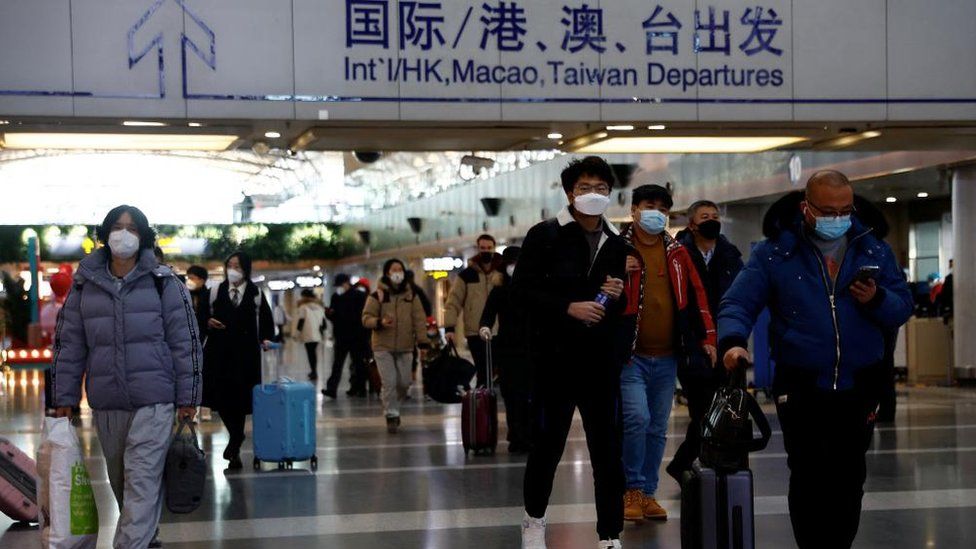
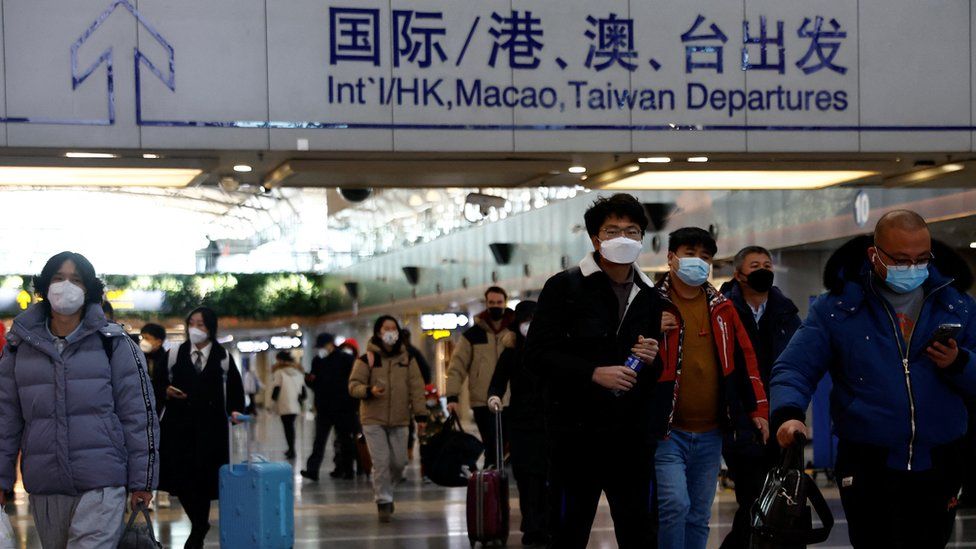
    Travellers walk with their luggage at Beijing Capital International Airport

    In addition, Chinese travel agency Qunar saw flight enquiries on its website increase seven-fold within the first 15 minutes after the announcement, the China Daily reports.

    Before the pandemic, the number of outbound tourists from China stood at 155 million in 2019, according to Statista. This number dropped to 20 million in 2020.

    This year, some people in China will hope to visit family and loved ones during Chinese New Year, which begins on 22 January.

    But inside China, there has been a mixed reaction.

    “I’m happy about it but also speechless. If we’re doing this [reopening] anyway – why did I have to suffer all the daily Covid tests and lockdowns this year?” said Rachel Liu, who lives in Shanghai.

    She said she had endured three months of lockdown in April – but nearly everyone in her family had become infected in recent weeks.

    She said her parents, grandparents and partner – living across three different cities in Xi’an, Shanghai and Hangzhou – had all come down with fever last week.

    Many have also expressed concern online about borders reopening as Covid cases peak.

    “Why can’t we wait until this wave passes to open up? The medical workers are already worn out, and old people won’t survive two infections in one month,” read one top-liked comment on Weibo.

    People in cities like Beijing and Shanghai, which experience chilly temperatures in the winter, say they’re running out of flu and cold medicine.

    It’s feared that hundreds of deaths may be going unreported as crematoriums are overwhelmed.

    In the capital, Beijing, authorities say they are planning to distribute the Pfizer tablets, Paxlovid, in order to try to reduce the severity of infections. But health centres contacted by The Global Times on Monday said the drug had yet to be delivered.

    On Monday, President Xi issued his first remarks on the changes, calling on officials to do what was “feasible” to save lives.

    China’s about-turn has put Mr Xi in a tough spot. He was the driving force behind zero-Covid, which many blamed for restricting people’s lives excessively and crippling the economy.

    But having abandoned it, analysts say he now has to take responsibility for the huge wave of infections and hospital admissions. Many have questioned why the country was not better prepared.

  • Covid in China: US imposes Covid testing for visitors from China


    Travellers at Beijing Capital International Airport
    Image caption, China is starting to reopen borders after three years

    The US has become the latest country to impose Covid testing on visitors from China, after Beijing announced it would reopen borders next week.

    Italy, Japan, Taiwan and India also announced mandatory tests, but Australia and UK said there were no new rules for travellers from China.

    After three years of being closed to the world, China will let people travel more freely from 8 January.

    But the country’s ongoing Covid surge has sparked wariness.

    China is reporting about 5,000 cases a day, but analysts say such numbers are vastly undercounted – and the daily case load may be closer to a million. Hospitals are overwhelmed and residents are struggling to find basic medicines, according to reports.

    On Wednesday, the US said a lack of “adequate and transparent” Covid data in China had contributed to the decision to require Covid tests from 5 January for travellers entering the country from China, Hong Kong and Macau.

    The US Centers for Disease Control and Prevention said this was needed “to help slow the spread of the virus as we work to identify… any potential new variants that may emerge”.

    But Beijing’s foreign ministry on Wednesday had said coronavirus rules should only be instated on a “scientific” basis and accused Western countries and media of “hyping up” the situation.

    Some people reacted angrily on China’s censored social media.

    “I thought all of the foreign countries had opened up. Isn’t this racism?” read one comment that was liked 3,000 times on Weibo. The US has said testing is required of anyone coming from China, or via a third country, regardless of nationality.

    But others said they understood the reason for the conditions: “This is nothing compared to all the restrictions we had for people coming into China,” one user wrote.

    Beijing only announced on Monday its decision to end quarantine for arrivals – effectively reopening travel in and out of the country for the first time since March 2020. Until this week, anyone entering China had to undergo quarantine in state facilities.

    Before the pandemic, China had been the world’s largest outbound tourism market. But it’s unclear how many Chinese people will travel abroad after 8 January given that the number of flights are limited, and many citizens need to renew their passports.

    The international community’s reaction has varied with the UK and Australia saying they were monitoring China’s Covid situation but were not planning on announcing new testing requirements.

    Others have moved swiftly to announce restrictions:

    • In Japan, from Friday, travellers from China will be tested for Covid upon arrival. Those who test positive will have to quarantine for up to seven days. The number of flights to and from China will also be restricted
    • In India, people travelling from China and four other Asian countries must produce a negative Covid test before arriving. Positive passengers will also be put in quarantine
    • Taiwan says people arriving on flights from China, as well as by boat at two islands, will have to take Covid tests on arrival from 1 January to 31 January. Those who test positive will be able to isolate at home
    • Meanwhile Malaysia has put additional tracking and surveillance measures in place
    • Italy has also imposed mandatory Covid testing on travellers from China

    The European Commission said its health security committee would convene on Thursday to discuss “possible measures for a coordinated EU approach” to China’s Covid surge.

    But Italy, an EU member state and an epicentre of the virus in late 2019 and 2020, said it was moving first to “ensure the surveillance and identification” of any new variants of the virus.

    Flights arriving in Milan this week were already testing passengers from China. Authorities found 52% of passengers were infected with Covid on one flight that landed on 26 December.

    Initial tests of Covid-positive travellers arriving from China showed that 15 of them had Omicron variants that were already present in Italy, Prime Minister Giorgia Meloni said. She described the news as quite reassuring.

    Italy is one of 26 European countries in the border-free Schengen zone and Ms Meloni is calling for EU-wide testing of Chinese passengers, arguing that Italy’s own measures might otherwise be ineffective.

    China’s foreign ministry said on Wednesday that “currently the development of China’s epidemic situation is overall predictable and under control”.

    However, the true toll of daily cases and deaths in China is unknown as officials have stopped requiring cases to be reported, and changed classifications for Covid deaths. On Sunday, officials said they would also stop releasing daily case counts.

    “The infection surge in China is on expected lines,” Dr Chandrakant Lahariya, an Indian epidemiologist and health systems specialist told the BBC in a recent interview.

    “If you have a susceptible population that is not exposed to the virus, cases will rise. Nothing has changed for the rest of the world.”

    China’s decision to reopen its borders marks the end of the country’s controversial zero-Covid policy, which President Xi Jinping had personally endorsed.

    Even as the rest of the world transitioned to living with the virus, Beijing insisted on an eradication policy involving mass testing and stringent lockdowns.

    The economy took a hit and people grew both exhausted and angry – in November, the frustration spilled onto the streets in rare protests against Mr Xi and his government. Week later, Beijing began to roll back the restrictions.

    Source: BBC

  • Hong Kong to scrap almost all its Covid rules

    Hong Kong is dropping almost all its Covid restrictions this week, following a similar move by mainland China.

    From Thursday, people arriving in the city – a special administrative region of China – will no longer have to do mandatory PCR tests.

    The vaccine pass system will also be scrapped – but compulsory masks in public places will continue.

    It is a dramatic move by the city, which once had some of the toughest restrictions in the world.

    Also being scrapped from Thursday is the rule that limits the number of people allowed to gather outside to 12.

    This was increased from four people in October as part of measures to begin reopening the city.

    Hong Kong’s leader, John Lee, cited high vaccine rates as one of the reasons for lifting restrictions.

    According to government figures, 93% of the population have had two vaccine does, while more than 83% have received three.

    Unlike mainland China, which has developed its own vaccines, Hong Kong has also used mRNA vaccines – including the BioNTech jab made in Germany – that have been shown to be more effective.

    “Hong Kong has a sufficient amount of medicine to fight Covid, and healthcare workers have gained rich experience in facing the pandemic,” Mr Lee said on Wednesday.

    “The society has established a relatively extensive and overall anti-epidemic barrier.”
    Mr Lee added that instead of the vaccine pass, which has limited access to public places for unvaccinated since it was introduced in February, the city would take “more targeted measures” – including promoting vaccination for the elderly and children.

    More than 11,000 people have died with Covid in Hong Kong, according to official numbers, from more than 2.5m cases.

    Since the pandemic began, the city has largely followed mainland China’s lead in efforts to tackle the virus, including attempts to eliminate it with a “zero-Covid” strategy.

    This has been criticised by some residents and business owners – who said the policy damaged Hong Kong’s economy and international standing.

    The scrapping of the Hong Kong’s Covid restrictions comes weeks after mainland China made a similar move following landmark protests against the strict controls.

    On Monday and Tuesday, Beijing announced further plans to ease travel restrictions. Hong Kong has said that it will fully reopen its borders with the rest of China before mid-January.

    The mainland is currently experiencing a surge in cases, with reports suggesting hospitals are overwhelmed and elderly people are dying.

    Hong Kong is part of China and is governed by the “one country, two systems” principle, but Beijing has tightened control in recent years.

  • China Covid: US considers restrictions on Chinese arrivals

    The US is considering imposing new Covid restrictions on Chinese arrivals, after Beijing announced it would reopen its borders next month.

    American officials say this is due to a lack of transparency surrounding the virus in China, as cases surge.

    Japan, Malaysia and Taiwan – worried at importing Covid cases – have already outlined tighter measures for Chinese travellers, including negative tests.

    Beijing has said Covid rules should be brought in on a “scientific” basis.

    India is also stepping up measures for Chinese arrivals, but this was announced before Beijing said it would relax its strict border policy.

    Passport applications for Chinese citizens wishing to travel internationally will resume from 8 January, the country’s immigration authorities have said.

    Travel sites have reported a spike in traffic, leaving some countries fearful over the potential spread of Covid.

    “There are mounting concerns in the international community on the ongoing Covid-19 surges in China and the lack of transparent data, including viral genomic sequence data,” US officials said in a statement quoted by news agencies.

    Wang Wenbin, China’s foreign minister spokesperson, subsequently accused Western countries and media of “hyping up” and “distorting China’s Covid policy adjustments”.

    He said China believed all countries’ Covid responses should be “science-based and proportionate”, and should “not affect normal people-to-people exchange”.

    Mr Wang called for “joint efforts to ensure safe cross-border travel, maintain stability of global industrial supply chains and promote economic recovery and growth”.

    The true toll of daily cases and deaths in China is unknown because officials have stopped releasing this data. Reports say hospitals are overwhelmed and elderly people are dying.

    Last week, Beijing reported about 4,000 new Covid infections each day and few deaths.

    Before the relaxation of travel rules, people were strongly discouraged from travelling abroad. The sale of outbound group and package travel was banned, according to marketing solutions company Dragon Trail International.

    Within half an hour of Monday’s notice that China’s borders would reopen, data from travel site Trip.com – cited in Chinese media – showed searches for popular destinations had increased ten-fold on last year.

    Macau, Hong Kong, Japan, Thailand and South Korea were the most popular destinations.

    Separately on Wednesday, Hong Kong’s leader John Lee announced that his city was scrapping the last of its Covid rules almost immediately – apart from the wearing of face masks, which will remain compulsory.

    “The city has reached a relatively high vaccination rate which builds an anti-epidemic barrier,” Mr Lee told a media briefing.

    The US still requires international travellers to show proof of being fully vaccinated against Covid on entering the country.

    The website for the Centres for Disease Control and Prevention (CDC) also recommends that anyone travelling to the US gets a Covid test beforehand and has their result to hand – but this is not a legal obligation.

    In their statement, the unnamed US officials added they were “following the science and advice of public health experts” and “consulting with partners”.

    China’s loosening of travel measures – the last part of the country’s controversial zero-Covid policy – follows weeks of unrest which saw people take to the streets in rare protests against President Xi Jinping and his government.

  • China ends Covid quarantine for travellers in January

    China will scrap quarantine for travellers from 8 January, officials said, marking the last major shift from the country’s zero-Covid policy.

    After three years of closed borders, this will effectively reopen the country to those with work and study visas, or seeking to visit family.

    But it comes as China struggles with the virus’ ferocious spread in the wake of restrictions being lifted.

    Reports say hospitals are overwhelmed and elderly people are dying.

    The true toll – daily case counts and deaths – is currently unknown because officials have stopped releasing Covid data.

    Beijing had reported about 4,000 new Covid infections each day last week and few deaths.

    On Sunday it said it would stop publishing case numbers altogether. But British health data firm Airfinity estimated China was experiencing more than a million infections and 5,000 deaths a day, according to Reuters.

    China is the last major economy in the world to move to “living with Covid” after three years of lockdowns, closed borders and mandatory quarantine for Covid cases and contacts.

    The so-called zero-Covid approach battered the economy and made citizens weary of restrictions and repeated tests. Resentment against the policy exploded into rare public protests against President Xi Jinping in November, which led to authorities dropping Covid rules just a few weeks later.

    Closed borders remain the last major restriction. Since March 2020, anyone entering China has had to undergo mandatory quarantine at a state facility – for up to three weeks at a time. That was recently reduced to five days.

    But on Monday the National Health Commission announced that Covid would be formally downgraded to a Class B infectious disease on 8 January.

    That meant quarantine would be axed – although incoming travellers will still need to take a PCR test – and a cap on the daily number of flights allowed into China would also be scrapped.

    Authorities said they would also “optimise” visa arrangements for foreigners wishing to come to China for work and study, as well as family visits and reunions.

    It’s unclear if that includes tourist visas, but officials said a pilot programme would begin for international cruise ships.

    The new rules have been welcomed by many Chinese who will now be able to travel overseas again. The country’s top online travel agencies reported a spike in traffic within hours of the announcement.

    But many have also expressed anger over the sudden freedom after years of control.

    “I’m happy about it but also speechless. If we’re doing this [reopening] anyway – why did I have to suffer all the daily Covid tests and lockdowns this year?” said Rachel Liu, who lives in Shanghai.

    She said she had endured three months of lockdown in April, but nearly everyone in her family had become infected with the virus in recent weeks.

    She said her parents, grandparents and partner – living across three different cities in Xi’an, Shanghai and Hangzhou – had all come down with fever last week.

    China ends Covid quarantine for travellers in January
    Hospitals – like this one in Shanghai – are under strain in this Covid wave

    Many have also expressed concern online about borders reopening as Covid cases peak in China.

    “Why can’t we wait until this wave passes to open up? The medical workers are already worn out, and old people won’t survive two infections in one month,” read one top-liked comment on Weibo.

    People in cities like Beijing and Shanghai, which experience chilly temperatures in the winter, say they’re running out of flu and cold medicine and scrounging for medical help for sick relatives. It’s feared that hundreds of deaths may be going unreported as crematoriums are overwhelmed.

    On Monday, President Xi issued his first remarks on the changes, calling on officials to do what was “feasible” to save lives. State media quoted him saying the country faced a new situation with pandemic control, and needed a more targeted response.

    China’s about-turn on how it manages the pandemic has put Mr Xi in a tough spot, analysts say. He was the driving force behind zero-Covid, which many blamed for restricting people’s lives excessively and crippling the economy.

    But having abandoned it, analysts say he now has to take responsibility for the huge wave of infections and hospital admissions. Many have questioned why the country was not better prepared.

  • Beijing expects COVID surge as mutation risks concern experts

    Beijing faces a surge in severe COVID-19 cases over the next two weeks, a respiratory expert in China has said, amid global concerns over possible mutations and knock-on effects for the world economy after the recent surprise lifting of China’s strict zero-COVID policies.

    The easing of restrictions across China has coincided with a jump in infections experts say will likely gather pace through the winter, with some projections even suggesting China could face more than a million deaths next year, the Reuters news agency has reported.

    “We must act quickly and prepare fever clinics, emergency and severe treatment resources,” Wang Guangfa, a respiratory expert from Peking University First Hospital, told the country’s state-run Global Times on Tuesday.

    Wang said hospitals should expand ICU beds as a priority and that the COVID-19 peak will likely last until the end of China’s Spring Festival, which will fall on January 22.

    COVID-19 cases will then fall off and life should gradually return to normal around the end of February and the beginning of March, Wang said.

    After the peak, people must not let their guard down, Wang added, describing the “dire consequences” if the virus were again to transfer between humans and animals.

    “The current COVID-19 strain may be less virulent, but it may not go the same way on animals. Maybe it seems less severe for animals but at some point, the virus can still jump to humans, with dire consequences,” Wang said.

    Following widespread protests in China earlier this month, the country of 1.4bn people started dismantling its “zero-COVID” lockdowns and testing, which had largely kept the virus away for three years at great economic and psychological costs.

    Narrow definition of COVID-19 deaths

    China, which uses a narrow definition of what can be classified as COVID fatalities, reported no new COVID deaths for December 20, compared with five the previous day.

    The nation’s overall fatalities since the pandemic began were revised to 5,241 after removing one death in Beijing.

    Amid doubts over China’s very low COVID death toll by global standards, China’s National Health Commission (NHC) on Tuesday clarified that only deaths caused by pneumonia and respiratory failure after contracting the virus are classified as COVID deaths.

    A heart attack or cardiovascular disease causing death in an infected person will not get that classification.

    Benjamin Mazer, an assistant professor of pathology at Johns Hopkins University, said China’s classification system would miss “a lot of cases”, especially as people who are vaccinated, including with the Chinese shots, are less likely to die of pneumonia.

    Blood clots and sepsis – an extreme response to infection – have caused countless deaths among COVID patients around the world.

    “It doesn’t make sense to apply this sort of March 2020 mindset where it’s only COVID pneumonia that can kill you, when we know that in the post-vaccine era, there’s all sorts of medical complications,” Mazer said.

    The NHC also played down concerns raised by the United States and some epidemiologists over the potential for the virus to mutate in China, saying the possibility of new strains that are more pathogenic is low.

    Several leading scientists and World Health Organization advisors said it may be too early to declare the end of the global COVID pandemic emergency phase because of a potentially devastating wave to come in China.

    The US said on Tuesday that it stands ready to assist China with its outbreak, warning an uncontrolled spread in the world’s second-largest economy may have implications for global growth.

    The full effects of ditching “zero-COVID” remain highly uncertain given China’s patchy vaccine coverage, fragile health system and lack of clarity about the real extent of infections as cases start to surge.

    Some hospitals in China have already become inundated with patients and some cities are dealing with medicine and blood shortages as pharmacy shelves are stripped bare and crematoriums are overwhelmed in the wake of the lift of years of lockdowns, quarantines and mass testing.

    From the country’s northeast to its southwest, crematorium workers have told Agence France-Presse that they are struggling to keep up with a surge in deaths.

    Beijing last week admitted the scale of the outbreak has become “impossible” to track following the end of mandatory mass testing.


    Source: Aljazeera.com 


  • China Covid: Country records five deaths under new counting method

    In light of uncertainty regarding the true scope of the disease’s effects, China has described how it counts Covid-19 deaths.

    According to the statement, the number only accounts for fatal respiratory conditions like pneumonia.

    Only five Covid deaths were reported officially on Tuesday, two on Monday, and none in the two weeks prior.

    The method of counting contravenes World Health Organization (WHO) recommendations, and as a result, the number of deaths is much lower than in many other nations.

    According to the WHO, countries use various testing and reporting procedures for Covid-19 deaths, making cross-national comparisons challenging.

    It is why many countries record Covid-19 deaths as excess mortality – how many more people died than would normally be expected based on death figures before the pandemic hit.

    These calculations also take into account deaths which were not directly because of Covid but were caused by its knock-on effects – including people being unable to access hospitals for the care they require.

    By contrast, China has strict criteria for confirming Covid-19 cases, which include evidence in patients of lung damage caused by the virus. This must be confirmed in a scan.

    But, the country is currently experiencing a surge in cases since the lifting of its most severe restrictions earlier this month.

    Official figures show a relatively low number of new daily cases and deaths. This has led to fears the numbers are an underestimate due to a recent reduction in Covid testing.

    In a bid to address the concerns the State Council held a news conference on Tuesday.

    Infectious disease expert Prof Wang Gui-qiang clarified that only pneumonia and respiratory failure caused by the coronavirus were counted as Covid deaths.

    Deaths caused by underlying diseases are not included in the official count, state-owned China News Service reported.

    Strict lockdowns are said to account for China’s official death toll staying so low since the start of the pandemic – the official figure is just over 5,200.

    This is equal to only three Covid deaths in every million in China, compared with 3,000 per million in the US and 2,400 per million in the UK.

    China has faced challenges with vaccines being used and particularly getting them to the most vulnerable people.

    Overall, China says more than 90% of its population has been fully vaccinated. However, less than half of people aged 80 and over have received three doses of vaccine. Elderly people are more likely to suffer severe Covid symptoms.

    China has developed and produced its own vaccines, which have been shown to be less effective at protecting people against serious Covid illness and death than the mRNA vaccines used in much of the rest of the world.

    Prof Wang’s comments come as hospitals in the capital Beijing and in other cities struggle to cope with the latest Covid surge.

    The latest wave has also hit postal and catering services hard.

    Meanwhile, China’s largest city, Shanghai, has ordered most of its schools to take classes online as cases soar.


  • ‘Wrong and dangerous’ : North Korea blasts Japan’s military buildup, says it would take action

    The foreign ministry of North Korea calls Japan’s new $320 billion security strategy “wrong and dangerous” and vows to respond.

    Japan’s planned military buildup has been denounced by North Korea, which also promised to take action against Tokyo for making the “wrong and dangerous choice” to expand its defence industry.

    The statement on Tuesday from North Korea’s foreign ministry comes just days after Japan unveiled a new $320bn security strategy that outlined plans for Japan’s military to mount “counter-strike capabilities”, and to respond to the threats posed by China, Russia and North Korea.

    Japan’s sweeping, five-year military strategy will see the country become the world’s third-largest military spender after the United States and China.

    Japan’s new security strategy effectively formalises a “new aggression policy” and fundamentally changes East Asia’s security environment, a spokesperson for Pyongyang’s foreign ministry said in a report published by North Korea’s official Korean Central News Agency (KCNA).

    In response to Japan’s move to “realise unjust and excessive ambition”, North Korea “will continue to show how concerned and displeased we are with practical action,” the spokesperson said.

    They also blasted the US for “exalting and instigating Japan’s rearmament and re-invasion plan,” adding that Washington had no right to raise issue with Pyongyang’s efforts to bolster its own defences.

    North Korea’s efforts to upgrade military capabilities have included a record number of ballistic missile launches this year, including missiles capable of carrying nuclear payloads and with varying ranges that could reach the US mainland and allies South Korea and Japan.

    On Sunday, North Korea fired two projectiles that it said were were tests of its first military reconnaissance satellite and released low-resolution, black-and-white photos that showed a view from space of the South Korean capital, Seoul, and the nearby city of Incheon.


    Some analysts in South Korea said the images were too crude to be satellite photos, while the South Korean military maintained that Sunday’s launches were of two medium-range ballistic missiles.

    North Korea hit back at that criticism on Tuesday, with Kim Yo Jong, the powerful sister of North Korean leader Kim Jong Un, saying it was “inappropriate and hasty” to assess her country’s satellite capabilities from those two photos alone.

    Pyongyang’s efforts to develop a spy satellite were a “pressing priority directly linked to our security,” she said in a statement carried by the KCNA, adding that additional sanctions on her country would not stop such technological developments.

    She went on to dismiss the South Korean government’s assessment that North Korea still has key remaining technological hurdles to overcome for functioning intercontinental ballistic missiles (ICBMs) that can reach the US mainland – such as the ability to protect its warheads from the harsh conditions of atmospheric re-entry.

    She questioned how North Korea could have received data from warheads until they landed at targeted areas in the ocean in previous launches if the country truly lacked re-entry technology.

    “I think it’s better for them to stop talking nonsense, behave carefully and think twice,” she said.

    Kim Yo Jong also suggested North Korea might fire an ICBM at a normal trajectory instead of the lofted and steep angles that it currently uses to avoid neighbouring countries.

    A full range ICBM test could be considered as a much bigger provocation to the US as the weapon would fly toward the Pacific Ocean.

    “I can clear up their doubt about it,” she said.

    “They will immediately recognise it in case we launch an ICBM in the way of real angle firing straight off.”


    Source: Aljazeera.com 


  • S Jaishankar: As tensions rise along the China border, India beefs up its military

    The country has increased troop deployment along a contentious border with China to an unprecedented level, according to India’s foreign minister.

    S. Jaishankar continued by saying that India wouldn’t permit China to “unilaterally change” the current situation at the border.

    Days prior to his remarks, Chinese and Indian forces engaged in combat in a flashpoint region along the border in the state of Arunachal Pradesh.

    According to India, Chinese troops’ “encroachment” was the reason why the conflict started.

    China’s foreign ministry has said that according to their knowledge, the situation on the border was “generally stable” and the two sides were maintaining dialogue on the issue.

    India and China share a disputed 3,440km (2,100 mile) long de facto border – called the Line of Actual Control, or LAC – which is poorly demarcated. Soldiers on either side come face to face at many points, and tensions sometimes escalate into skirmishes or clashes.

    Both sides have been trying to de-escalate since a violent brawl in June 2020 in the Galwan Valley in the Ladakh region much further to the west – 20 Indian soldiers and at least four Chinese soldiers died in the battle.

    The latest flare-up – the first in more than a year – occurred on 9 December, and resulted in minor injuries to a few soldiers. Both sides immediately disengaged from the area, the Indian army said.

    Mr Jaishankar was answering questions about the incident while speaking at an event organised by media company India Today on Monday.

    “Today, you have a deployment of the Indian Army on China border that we never had. It is done to counter Chinese aggression. The Indian Army today is deployed to counter any attempt to unilaterally change LAC,” he said.

    China hasn’t responded to the comments yet.

    The latest clash had led to a political uproar in India last week, with opposition parties walking out of parliament after their demand for an immediate discussion of the border situation was denied.

    Rahul Gandhi, leader of India’s main opposition Congress party, has accused the government of ignoring the threat from China, and alleged that the country’s forces were “thrashing” Indian soldiers at the border.

    Speaking in parliament on Monday, Mr Jaishankar said that Mr Gandhi’s words “disrespected” Indian soldiers and denied that the government was indifferent to the situation.

    “If we were indifferent to China, who sent the Indian Army to the border? If we were indifferent to China, why are we pressurising China for de-escalation and disengagement today?” he said.


  • COP15: Nations reach ‘historic’ deal to protect nature

    In a “historic” accord designed to maintain biodiversity, nations have committed to protect a third of the world by 2030.

    There will also be targets for protecting vital ecosystems such as rainforests and wetlands and the rights of indigenous peoples.

    The agreement at the COP15 UN biodiversity summit in Montreal, Canada, came early on Monday morning.

    The summit had been moved from China and postponed due to Covid.

    China, which was still in charge of the meeting, brought down the gavel on the deal despite a last minute objection from the Democratic Republic of Congo.

    The main points of the agreement include:

    • Maintaining, enhancing and restoring ecosystems, including halting species extinction and maintaining genetic diversity
    • “Sustainable use” of biodiversity – essentially ensuring that species and habitats can provide the services they provide for humanity, such as food and clean water
    • Ensuring that the benefits of resources from nature, like medicines that come from plants, are shared fairly and equally and that indigenous peoples’ rights are protected
    • Paying for and putting resources into biodiversity: Ensuring that money and conservation efforts get to where they are needed.

    The summit in Montreal had been regarded as a “last chance” to put nature on a path to recovery. Throughout the talks there was division over the strength of ambition and how to finance the plans.

    One big sticking point was over how to fund conservation efforts in the parts of the globe that harbour some of the world’s most outstanding biodiversity.

    Biodiversity refers to all the Earth’s living things and the way they are connected in a complex web of life that sustains the planet.


    Lady birdImage source, Getty Images
    Image caption,

    Biodiversity includes all living things, big and small, and the way they fit together in a web of life

    A new text of the agreement was released by China on Sunday.

    Delegates convened a full session of the summit early on Monday morning after hours of delays, but then agreed to the text quickly.

    The president of COP 15, Minister Huang Runqui, declared the deal approved despite objections from the Democratic Republic of Congo, which said it couldn’t back the deal.

    Georgina Chandler, senior international policy advisor for the Royal Society for the Protection of Birds said people and nature should both be better off thanks to the deal struck in Montreal.

    “Now it’s done, governments, companies and communities need to figure out how they’ll help make these commitments a reality.”

    Sue Lieberman of the Wildlife Conservation Society said the agreement was a compromise, and although it had several good and hard-fought elements, it could have gone further “to truly transform our relationship with nature and stop our destruction of ecosystems, habitats and species”.

    The agreement follows days of intense negotiations. On Saturday, ministers made impassioned speeches about the need to agree on clear goals to put nature on a path to recovery by the end of the decade.

    “Nature is our ship. We must ensure it stays afloat,” said EU Commissioner for Environment, Oceans and Fisheries, Virginijus Sinkevicius.

    Colombia’s environment minister, Susana Muhamed, drew applause when she called for ambition in protecting the planet for the good of all. “Nature does not have boundaries,” she said.

    Source: BBC

  • Woman deceives and defrauds friend for 12 years by posing as her online boyfriend

    A Chinese woman has been arrested for allegedly pretending to be a man on social media and tricking her own friend into falling in love with her and sending her money.

    Shanghai police recently announced that it had cracked one of the most bizarre online romance scams ever. The victim, a middle-aged woman, had been scammed for 12 years by someone posing as a well-known TV news anchor on social media and defrauded around 2 million yuan ($290,000) over that period of time. The craziest part of the story is that the scammer turned out to be a good female friend of the victim who had come up with the plan as payback for something the victim’s mother had said when they were very young.

    The fraudster, identified only as Ms. Yu, admitted her guilt and told investigators that everything had started 12 years ago. She and the victim, Ms. Li, had been friends for a very long time, and their parents also knew each other. One day, Li’s mother jokingly told Li that she would have trouble finding a husband because she wasn’t very pretty and her family didn’t have too good a financial situation.

    It was a cruel thing to say to a young girl, and Yu really took it to heart. The more she thought about what the woman had said, the more she wanted to take revenge, so she came up with a plan. If she would find it hard to find love, then so would her friend Li…

    Years after being insulted by her friend’s mother, Ms. Yu approached the same woman to brag about being friends with a well-known TV news anchor who just happened to be single and in search of a suitable wife. As expected, the woman pleaded with her to match him up with her daughter, and Yu’s plan was set in motion.

    The conniving woman started creating fake social media profiles of the news anchor and approached Ms. Li pretending to be this charming, successful man. She knew her friend better than almost anyone else, what she liked and didn’t like, her passions, her romantic expectations, so they hit it off. The only problem was keeping the relationship online.

    Every time Ms. Li asked to meet her online boyfriend in person, he would find an excuse. He was either too busy with work, away on business, sick, or simply too tired to meet her. But he continued to charm her and declare his love, which was apparently enough to keep Li interested.

    The defrauding wasn’t originally part of Yu’s plan, but by 2018 she had fallen on hard times and was in desperate need of money. Knowing that her friend was head-over-heeld about the online persona she had created, he started asking her for financial assistance, inventing all kinds of pretexts. Once she got Li to pay up once, she was hooked and continued to use her charms to bleed her dry.

    Despite getting on her feet financially, Yu continued to ask her friend for money, pleading, lying, and even threatening to break off the relationship whenever Li asked too many questions or appeared reluctant to cough up the money. Whenever her friend complained about the situation, she always encouraged her to do whatever it took for love, claiming that the news anchor was worth it.

    Earlier this year, after Li spent all her savings and started racking up debt, things became more complicated for Yu. Her friend came to her asking for help with contacting the news anchor, finally expressing concerns that something was wrong. Li wanted to confront him and ask for all the money back, and despite Yu’s best efforts to dissuade her she had made up her mind.

    Sensing that her scam was finally at an end, Yu told her friend everything, how she had lied about knowing the news anchor, created the fake profiles, and how she defrauded her over several years. It’s unclear if she hoped that her friend wouldn’t go to the police, or if she just wanted to see the look on her face when she learned the truth.

    Ms. Yu was arrested after her friend filed a complaint, and an investigation, in this case, is still ongoing. The whole story sounds like the plot of a movie, and there are some details that don’t add up, like how the victim sent 2 million yuan to someone she had never actually met, or how she went 12 years without actually meeting her online boyfriend. Still, most of the details come from the Shanghai police department, so there must be some truth to it…

    Source: Complex.com

  • Hong Kong: Tiananmen vigil activist conviction overturned

    The conviction of an activist who attempted to organise a vigil in Tiananmen Square last year has been overturned by Hong Kong‘s highest court because police misconduct was discovered.

    Attorney Chow Hang-tung, who was imprisoned in January, will continue to be held in custody as she is charged with two additional offences under the city’s national security law.

    But on Wednesday, she was successful in appealing her “unauthorised assembly” conviction.

    The police’s decision to forbid the vigil was ruled invalid by a judge.

    Since 2020, Tiananmen vigils have been prohibited by Hong Kong authorities, who have cited COVID restrictions as the cause.

    The city used to be one of the only sites on Chinese territory where authorities allowed tributes.

    Ms Chow was arrested in June 2021 for “inciting” the public to take part in that year’s vigil. She had led the Hong Kong Alliance, a group which had organised the annual demonstrations and that year she posted articles on social media and on news sites urging Hong Kongers to turn out or light a candle in tribute.

    At her trial in January this year, she was jailed for encouraging the assembly in breach of Covid laws.

    Magistrate Amy Chan said she had been “self righteous” in “completely disregarding the law to think that the freedom of assembly was more important than public health”.

    However a High Court judge on Wednesday found police had not properly explored the options for how the demonstration could have gone ahead in a Covid-safe manner.

    Judge Judianna Barnes said police “did not seriously consider” other health measures, thus ignoring a requirement in the law that public meetings should not be banned if they can be safely facilitated.

    The ruling could have legal implications for other Hong Kongers jailed for taking part in Tiananmen vigils. They include the pro-democracy tycoon Jimmy Lai, who was sentenced to 13 months for the alleged offence a year ago. Mr Lai was jailed for nearly six years on fraud charges earlier this month and faces the prospect of life behind bars due to a separate trial on national security charges, which is due to begin next September.

    Ms Chow and other human rights advocates have long argued that Covid restrictions were just an excuse for Hong Kong authorities to ban commemorations of the Tiananmen protests – a heavily censored and highly sensitive topic in mainland China.

    In previous years thousands of people gathered to remember the victims of the crackdown on 4 June 1989, when the Chinese military attacked pro-democracy protesters camped in Beijing’s Tiananmen Square, killing an unknown number of civilians.

    However China has asserted its rule over Hong Kong since major protests in 2019 protesting against Beijing’s influence and the rolling back of civil rights in the city.

    Since then public commemoration of the Tiananmen protests has been targeted by the authorities. Last year monuments marking the event were removed from university campuses and a museum was also shut down.

  • China COVID surge: Chinese are panic buying canned yellow peaches

    An unprecedented wave of Covid cases in China has sparked panic buying of fever medicines, pain killers, and even home remedies such as canned peaches, leading to shortages online and in stores.

    Authorities said Wednesday they had detected 2,249 symptomatic Covid-19 cases nationally through nucleic acid testing, 20% of which were detected in the capital Beijing. CNN reporting from the city indicates the case count in the Chinese capital could be much higher than recorded.

    Demand for fever and cold medicines, such as Tylenol and Advil, is surging nationally as people rush to stockpile drugs amid fears they may contract the virus.

    Canned yellow peaches, considered a particularly nutritious delicacy in many parts of China, have been snapped up by people looking for ways to fight Covid. The product is currently sold out on many online shops.

    Its sudden surge in popularity prompted Dalian Leasun Food, one of the country’s largest canned food manufacturers, to clarify in a Weibo post that canned yellow peaches don’t have any medicinal effect.

    “Canned yellow peaches ≠ medicines!” the company said in the post published Friday. “There is enough supply, so there is no need to panic. There is no rush to buy.”

    The People’s Daily, the mouthpiece of the Communist Party, also tried to set the record straight. It published a long Weibo post on Sunday urging the public not to stockpile the peaches, calling them “useless in alleviating symptoms of illness.”

    Authorities also pleaded with the public not to stockpile medical supplies. On Monday, the Beijing city government warned residents that it was facing “great pressure” to meet demand for drug and medical services because of panic buying and an influx of patients at clinics.

    It urged the public not to hoard drugs or call emergency services if they have no symptoms.

    Stock frenzy

    The rising demand and shortage of supply of Covid remedies have fueled bets on drugmakers.

    Shares of Hong Kong-listed Xinhua Pharmaceutical, China’s largest manufacturer of ibuprofen, have gained 60% in the past five days. The stock has so far jumped by 147% in the first two weeks of this month.

    “Our company’s production lines are operating at full capacity, and we are working overtime to produce urgently needed medicines, such as ibuprofen tablets,” Xinhua Pharmaceutical said Monday.

    Ibuprofen is an anti-inflammatory drug used to treat pain and fever. It is also known as Advil, Brufen, or Fenbid.

    The drug shortage has spread from mainland China to Hong Kong, a special administrative region which has a separate system of local government. On Sunday, the city’s health chief urged the public to refrain from panic buying cold medicines they do not need and urged residents “not to overact.”

    In some Hong Kong drugstores, fever drugs such as Panadol, the local brand name for Tylenol, have sold out. Most of the buyers were sending the medicines to their families and friends in the mainland, sales representatives told CNN.

    Shares of Shenzhen-listed Guizhou Bailing Group Pharmaceuticals, known for making cough syrup, have gained 21% this week and risen 51% so far this month. Yiling Pharmaceutical, the sole producer of Lianhua Qingwen, a traditional Chinese medicine recommended by the government for treating Covid, has also jumped more than 30% in the past month.

    Even providers of funeral services and burial plots have gotten a huge boost. Shares in Hong Kong-traded Fu Shou Yuan International, China’s largest burial service company, have soared more than 50% since last month.

    There is “strong pent-up demand for burial plots” in 2023, analysts from Citi Group said in a recent research report, adding that they’ve noticed increasing investor interest in the sector.

    They cited the existence of hundreds of thousands of cremated remains, which are being temporarily stored in government facilities awaiting burial. Lockdowns across much of the country have halted funeral services, they said.

  • Taiwan reports the largest-ever incursion by Chinese bombers

    Taiwan’s Defense Ministry announced Tuesday that China has sent a record 18 nuclear-capable H-6 bomber aircraft into Taiwan’s air defence zone as Beijing continues to increase strain on the autonomous island.

    According to Taiwan’s Defense Ministry, a total of 21 Chinese warplanes were sent into Taiwan’s southwest air defence identification zone (also known as an ADIZ) in the 24-hour period between Monday morning and Tuesday morning.

    According to the ministry, it kept an eye on the situation and tracked the Chinese aircraft using both its fighter jets and land-based missile systems.

    Since Taipei started publishing daily data on Chinese fighter incursions in 2020, the flights mark the highest number of H-6 sorties in a 24-hour period.

    An ADIZ is unilaterally imposed and distinct from sovereign airspace, which is defined under international law as extending 12 nautical miles from a territory’s shoreline.

    China’s ruling Chinese Communist Party views Taiwan – a democratically governed island of 24 million – as part of its territory, despite having never controlled it. It has long vowed to “reunify” the island with the Chinese mainland, by force if necessary.

    Tensions surrounding Taiwan have increased markedly this year. A visit to the island by United States House Speaker Nancy Pelosi in August prompted Chinese fury and an immediate flurry of military exercises.

    Since then, Beijing has stepped up military pressure tactics on the island, sending fighter jets across the median line of the Taiwan Strait, the body of water separating Taiwan and China.

    For decades, the median line had served as an informal demarcation line between the two, with military incursions across it being rare.

    In November, US President Joe Biden met Chinese leader Xi Jinping in-person for the first time during his presidency at the G20 summit in Indonesia. Afterward, Biden described the three-hour meeting as “open and candid,” and cast doubt on an imminent invasion of Taiwan.

    Formal bilateral talks on climate cooperation are expected to resume as well as part of a broader set of agreements between Biden and Xi – with China having previously halted talks as part of retaliation for Pelosi’s visit to Taiwan.

    Source: CNN.com 

  • China dump virus tracking app, braces for the impact of Covid

    As it dismantles large parts of its repressive zero-Covid policy, China is readying for an unprecedented wave of Covid-19 cases, with a leading expert warning that Omicron variants were “spreading rapidly” and signs of an outbreak rattling the country’s capital.

    Authorities announced Monday that the “mobile itinerary card” health tracking function would be deactivated the following day.

    The system, which is distinct from the health code scanning system still required in a limited number of places in China, used people’s cell phone data to track their travel history in the previous 14 days in an attempt to identify those who had visited a city designated by authorities as “high-risk.”

    It had been a point of contention for many Chinese people, including due to concerns around data collection and its use by local governments to ban entry to those who have visited a city with a “high-risk zone,” even if they did not go to those areas within that city.

    But as the scrapping of parts of the zero-Covid infrastructure come apace, there are questions about how the country’s health system will handle a mass outbreak.

    Throughout the weekend, some businesses were closed in Beijing, and city streets were largely deserted, as residents either fell ill or feared catching the virus. The biggest public crowds seen were outside of pharmacies and Covid-19 testing booths.

    Media outlet China Youth Daily documented hours-long lines at a clinic in central Beijing on Friday, and cited unnamed experts calling for residents not to visit hospitals unless necessary.

    Health workers in the capital were also grappling with a surge in emergency calls, including from many Covid-positive residents with mild or no symptoms, with a hospital official on Saturday appealing to residents in such cases not to call the city’s 911-like emergency services line and tie up resources needed by the seriously ill.

    The daily volume of emergency calls had surged from its usual 5,000 to more than 30,000 in recent days, Chen Zhi, chief physician of the Beijing Emergency Center said, according to official media.

    Covid was “spreading rapidly” driven by highly transmissible Omicron variants in China, a top Covid-19 expert, Zhong Nanshan, said in an interview published by state media Saturday.

    “No matter how strong the prevention and control is, it will be difficult to completely cut off the transmission chain,” Zhong, who has been a key public voice since the earliest days of the pandemic in 2020, was quoted saying by Xinhua.

    Changes, and concerns

    The rapid rollback of testing nationwide and the shift by many people to use antigen tests at home has also made it difficult to gauge the extent of the spread, with official data now appearing meaningless.

    Authorities recorded 8,626 Covid-19 cases across China on Sunday, down from the previous day’s count of 10,597 and from the high of more than 40,000 daily cases late last month. CNN reporting from Beijing indicates the case count in the Chinese capital could be much higher than recorded.

    One note seen on a residential building in Beijing is indicative of the larger situation, reading: “Due to the severe epidemic situation in recent days, the number of employees who can come to work is seriously insufficient, and the normal operation of the apartment has been greatly affected and challenged.”

    Posters used for health code scanning and barriers used for health screening are seen dismantled at Nanjing South railway station on Friday in Nanjing, China.
    Posters used for health code scanning and barriers used for health screening are seen dismantled at Nanjing South railway station on Friday in Nanjing, China. Yifan Ding/Getty Images

    The country is only days out from a major relaxation of its longstanding zero-Covid measures, which came as a head-spinning change for many Chinese living under the government’s stringent controls and fed a longstanding narrative about the deadliness of Covid-19.

    Last Wednesday, top health officials made a sweeping rollback of the mass testing, centralized quarantine, and health code tracking rules that it had relied on to control viral spread. Some aspects of those measures, such as health code use in designated places and central quarantine of severe cases, as well as home isolation of cases, remain.

    Outside experts have warned that China may be underprepared to handle the expected surge of cases, after the surprise move to lift its measures in the wake of nationwide protests against the policy, growing case numbers and rising economic costs.

    While Omicron may cause relatively milder disease compared to earlier variants, even a small number of serious cases could have a significant impact on the health system in a country of 1.4 billion.

    Zhong, in the state media interview, said the government’s top priority now should be booster shots, particularly for the elderly and others most at risk, especially with China’s Lunar New Year coming up next month – a peak travel time where urban residents visit elderly relatives and return to rural hometowns.

    Health authorities on Sunday ordered improvements in medical capabilities in rural areas by the end of the month.

    Measures to be undertaken include increasing ICU wards and beds, enhancing medical staff for intensive care and setting up more clinics for fevers, China’s National Health Commission said in a statement.

    ‘Over-hyping’

    Meanwhile, experts have warned a lack of experience with the virus – and years of state media coverage focusing on its dangers and impact overseas, before a recent shift in tone – could push those who are not in critical need to seek medical care, further overwhelming systems.

    Bob Li, a graduate student in Beijing, who tested positive for the virus on Friday said he wasn’t afraid of the virus, but his mother, who lives in the countryside, stayed up all night worrying about him. “She finds the virus a very, very scary thing,” Li said.

    “I think most people in rural China may have some misunderstandings about the virus, which may come from the overhyping of this virus by the state in the past two years. This is one of the reasons why people are so afraid,” he said, adding that he still supports the government’s careful treatment of Covid-19 during the pandemic.

    There are clear efforts to tamp down on public concern about Covid-19 – and its knock-on effects, like panic buying of medications.

    China’s market watchdog said on Friday that there was a “temporary shortage” of some “hot-selling” drugs and vowed to crackdown on price gouging, while major online retailer JD.com last week said it was taking steps to ensure stable supplies after sales for certain medications surged 18 times that week over the same period in October.

    A hashtag trending on China’s heavily moderated social media platform Weibo over the weekend featured a state media interview with a Beijing doctor saying people who tested positive for Covid-19 but had no or mild symptoms did not need to take medication to recover.

    “People with asymptomatic inflections do not need medication at all. It is enough to rest at home, maintain a good mood and physical condition,” Li Tongzeng, chief infectious disease physician at Beijing You An Hospital, said in an interview linked to a hashtag viewed more than 370 million times since Friday.

  • China, Saudi presidents pledge “new era” in Chinese-Arab relations

    Saudi Crown Prince Mohammed bin Salman welcomed Chinese President Xi Jinping with a glamorous reception in Riyadh on Thursday, as the two countries make preparations for a series of summits that will mark an “epoch-making milestone” in Chinese-Arab relations.

    Saudi state television broadcast a grand ceremony in which bin Salman, the kingdom’s de facto ruler known as MBS, received the Chinese leader at Al-Yamamah Palace. The premises were adorned with Chinese and Saudi Arabian flags, and members of the Saudi Royal Guard lined up with swords and played music.

    In contrast to US President Joe Biden’s visit to Saudi Arabia earlier this year, the two leaders smiled warmly and posed for photos.

    Shortly afterwards, China and Saudi Arabia signed a comprehensive strategic partnership agreement that includes a number of deals and memoranda of understanding, including on hydrogen energy, on coordination between the kingdom’s Vision 2030 and China’s Belt and Road Initiative, and with regards to direct investment, reported the official Saudi Press Agency (SPA), without providing details.

    Xi landed in the capital Riyadh on Wednesday, where he was received by Saudi Prince Faisal bin Bandar bin Abdulaziz, Governor of Riyadh Region, and Prince Faisal bin Farhan bin Abdullah, Minister of Foreign Affairs. Saudi military jets accompanied the Chinese president’s aircraft, a purple carpet was rolled out upon his arrival and canons were fired.

    US President Joe Biden’s welcome is widely perceived to have been less glamorous. The American president was received in July by the governor of Mecca and the Saudi ambassador to the US in the Red Sea port city of Jeddah. Biden met MBS in Jeddah, where they exchanged a fist-bump that made global headlines and defined what ultimately became a frigid visit.

    The official welcoming ceremony for the Chinese president at the Palace of Yamamah in Riyadh on Thursday.
    The official welcoming ceremony for the Chinese president at the Palace of Yamamah in Riyadh on Thursday. Royal Court of Saudi Arabia/Anadolu Agency/Getty Images

    Bin Salman welcomes the Chinese leader to Riyadh.
    Bin Salman welcomes the Chinese leader to Riyadh. Saudi Press Agency/Reuters

    Saudi and Chinese state media have this week been keen to promote the close ties shared by their governments. Saudi state TV replayed clips of past meetings between Chinese and Saudi officials, narrating the two countries’ warm relationship, which they say spans more than eight decades.

    In a signed article published Thursday in the Saudi newspaper Al Riyadh, Xi said that his visit to the kingdom this week “will usher in a new era in China’s relations with the Arab world, with Arab states of the Gulf and with Saudi Arabia.”

    “The Arab world is an important member of the developing world and a key force for upholding international fairness and justice,” Xi wrote, adding that “the Arab people value independence, oppose external interference, stand up to power politics and high-handedness, and always seek to make progress.”

    Saudi Crown Prince Mohammed bin Salman fist bumps US President Joe Biden upon his arrival at Al Salman Palace, in Jeddah in July.
    Saudi Crown Prince Mohammed bin Salman fist bumps US President Joe Biden upon his arrival at Al Salman Palace, in Jeddah in July. Bandar Algaloud/Courtesy of Saudi Royal Court/Handout/Reuters

    In the article titled “Carrying Forward Our Millenia-old Friendship and Jointly Creating a Better Future,” Xi said that China and Arab states will “continue to hold high the banner of non-interference in internal affairs, firmly support each other in safeguarding sovereignty and territorial integrity, and jointly uphold international fairness and justice,” in a nod to US diplomacy, whose ties with the Saudis have crumbled over OPEC’s decision to slash crude oil supply.

    Saudi Arabia’s energy minister also stressed that Saudi-Chinese relations are “witnessing a qualitative leap” and that the kingdom “will remain China’s credible and reliable partner” with regards to oil, SPA reported.

    The Chinese foreign ministry said Wednesday that the China-Arab States Summit “will be an epoch-making milestone in the history of China-Arab relations,” and that “President Xi’s state visit to Saudi Arabia will elevate the China-Saudi Arabia comprehensive strategic partnership to a new height.”

    On Wednesday, Saudi and Chinese companies signed 34 investment deals covering several sectors, reported SPA, including in the fields of green energy, information technology, cloud services, transportation, logistics, medical industries, housing and construction.

    No monetary value was announced for the deals, but SPA previously reported that the two countries are expected to sign deals worth more than $29 billion during this week’s visit.

    Xi’s visit to Saudi Arabia comes amid frayed ties between the two countries and Washington, which harbors a number of grievances towards the two states over oil production, human rights and other issues.

    While China and Saudi Arabia’s friendship has blossomed over the decades, they seem to have become closer as both find themselves in precarious positions in regard to the US.

    The White House said it was “not a surprise” that Xi is traveling around the world and to the Middle East. “We’re mindful of the influence that China is trying to grow around the world,” said John Kirby, the strategic communications coordinator at the US National Security Council.

  • Skinny woman breaks four ribs while coughing

    A young Chinese woman recently ended up in the hospital with multiple broken ribs after a coughing fit caused by eating spicy food.

    If you’ve ever eaten something spicy, you already know that it can cause a bit of coughing. What you probably didn’t know is that in extreme cases, spicy food-induced coughing can actually cause bone fractures. Case in point a Chinese woman from Shanghai, who, because of being too skinny and having poorly-developed musculature, broke no less than four ribs while coughing because of spicy food.

    The woman, surnamed Huang, told doctors in her native city of Shanghai that she was eating spicy food which, at one point, caused her to start coughing. During a particularly strained cough, the young woman allegedly heard a sharp crack from her chest area, and immediately began to experience pain when breathing and trying to speak.

    “At first, I thought it was a stroke or something, I didn’t expect it to hurt this badly,” Huang said. “I couldn’t even walk.”

    Ms. Huang managed to get to a local hospital, where a CT scan revealed that she had four fractured ribs. After hearing the woman’s story about her coughing, doctors conducted a bone density test that came out normal. Upon examining the woman and conducting more tests, a thoracic surgeon concluded that the bone fractures had been caused by her poor musculature.

    “Your ribs can be seen clearly under your skin. There is no muscle to support the bone, so it’s easy for your ribs to get fractured when coughing,” the doctor reportedly told Huang, adding that unless she does something about it, she is likely to suffer similar fractures in the future.

    The young woman said that she stands 171cm tall and weighs just 57kg, and admitted to having an extremely thin upper body.

    She now needs to rest and spend a month with a medicinal corset wrapped around her torso, but after that, she plans to put on some weight and increase her muscle mass.

    Source: Oddity Central

  • Apple is ready to leave China as Covid protests delay iPhones past Christmas

    When Apple’s manufacturing hub in Zhengzhou, China, temporarily shut down in November, it was clear Apple needed to rethink its supply chain.

    The shutdown, which could reportedly result in a shortage of 6 million iPhone 14 Pro and Pro Max units, means wait times are now stretching past the holiday season. On Saturday, the WSJ reported that Apple was accelerating the expansion of its manufacturing base outside of China.

    But any shift out of China won’t be quick, with over 35% of factories supplying Apple currently located in China. Some estimates say it will take until the end of the decade to move 10% of Apple’s iPhone manufacturing out of the country. Moreover, what would happen to Apple’s generous hardware margins as it attempts to leave China is unclear.

    Breaking up is hard to do

    While Apple sources its chips from several factories in India, Vietnam, and China, the largest supplier is the Chinese Foxconn factory that shut down after protests over China’s “zero Covid” policy.

    Apple began making plans to move more of its production outside of China in May this year after experiencing one bout of supply chain delays following shutdowns due to the zero-Covid policy and protests surrounding it.

    Wedbush analyst Dan Ives said in an analyst note that zero Covid policy is the last straw for the company.

    “The reality is that Apple is extremely limited in their options for the holiday season and are at the mercy of China’s zero-Covid policy,” Ives said. “Now it’s the painful waiting game to see what ramped production looks like over the next week for Apple to ease some iPhone shortages that are building globally.”

    But any move will take time. Ives and Wedbush estimated it would take until 2025 or 2026 for 50% of Apple’s iPhone production to move to India and Vietnam if Apple moved “aggressively.”

    In a September report, Bloomberg Intelligence was even more pessimistic, saying it would take eight years, or until 2030, to move 10% of Apple’s production capacity out of China in a best-case scenario, or 20% if Apple moved more aggressively. Bloomberg Intelligence estimates that 98% of iPhones are assembled in China, thanks to the supply chain Apple has built over the past 20 years.

    Based on Insider’s analysis of Apple’s fiscal year 2021 Supplier List, which catalogs the 191 suppliers in 744 locations, Apple has 262 suppliers in mainland China, comprising 35.2% of all listed suppliers. (In addition, it has 71 in Taiwan, and US-China tensions could also hamper Taiwanese production.)

    Apple’s list only includes supplier locations and does not specify manufacturing capacity.

    Currently, there are 28 Apple suppliers in Vietnam, or 3.8% of total listed by Apple. India has just 11, or 1.5%. According to the Wall Street Journal, Apple wants to bring its iPhone production to 40% to 45% in India and increase manufacturing of Airpods, laptops, and Apple Watches from Vietnam.

    However, both countries need more reliable infrastructure, per the WSJ. Vietnam’s population is considerably smaller than China, and Apple faces challenges navigating India’s bureaucracy.

    Onshoring iPhone production?There is another alternative: The US, which has 84 locations supplying Apple already.

    On Tuesday, TSMC announced it’s investing $40 billion to open two chip fabrication plants in Arizona that could eventually produce 600,000 advanced chips per year. Tim Cook tweeted that the factory “marks a new era of advanced manufacturing in the U.S. — and we are proud to become the site’s largest customer.”
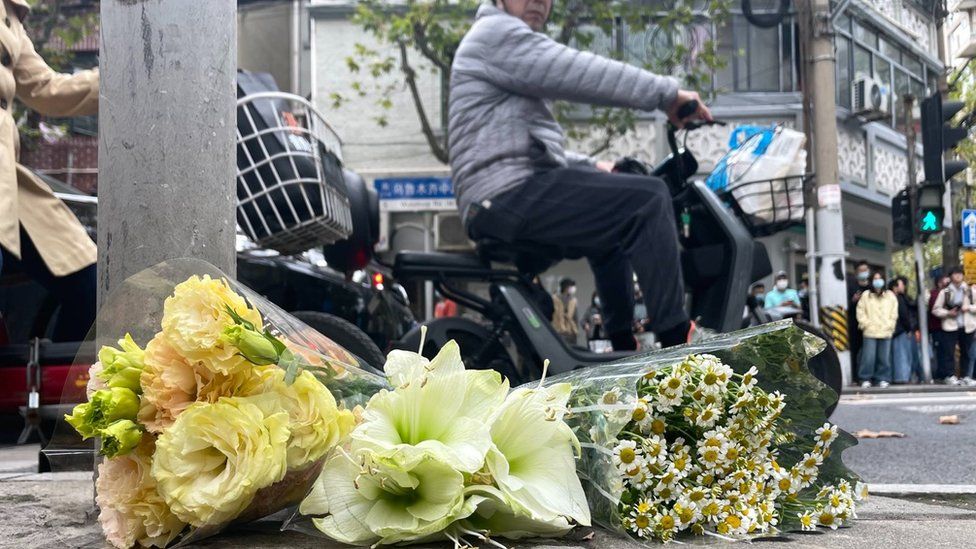
    Bloomberg reported TSMC will start making 4-nanometer chips in its planned Arizona plant at the urging of companies like Apple. TSMC also said it wants to make more advanced 3-nanometer chips in a second planned factory.

    However, TSMC’s 4-nanometer chip plant won’t begin production until 2024, and its 3-nanometer chip plant won’t open until 2026. Even once opened, ramping up production in a new plant takes several years as the factory works out its kinks and slowly builds up its workforce. And TSMC estimates chips made in the US would cost 50% more than those made in Taiwan.

    If Apple wants to rely less on China, it can do it. The world’s most valuable company is a sharp and savvy supply chain operator. Before Tim Cook took over at Apple, he spent a decade managing its logistics — including shutting down Apple-owned factories and replacing them with contractors that make up Apple’s modern supply chain.

    Shifting away from China would require Apple to sacrifice time and money on a long-term project involving hundreds of moving parts. Last quarter, Apple maintained 43% gross margins, one of the reasons its stock has stayed relatively more resilient than its Big Tech peers. Swapping out the largest part of its supply chain would inevitably introduce inefficiencies that would shrink those margins.

    Apple is also big enough to take the hit — it just needs to wait things out. The question is, would investors?

    Next on Business Insider

    Scientists tested 12 bottled waters they bought in Pretoria. Three were toxic.

  • Chinese express feelings to Dr Li Wenliang, the Chinese COVID martyr

    They started writing to him shortly after officials announced that key components of zero-Covid would be abandoned.

    Thousands rushed to China’s hero doctor’s social media account to inform him of the news. They poured their hearts out to him, as if they were at the graveside of a family elder.

    “On the train, I suddenly remembered you and burst into tears. Dr Li, it’s over now, it’s dawn. Thank you,” said one.

    Another wrote: “I’ve come to see you and let you know – the dust has settled. We’re reopening.”

    Dr Li Wenliang was the 33-year-old ophthalmologist who’d been among the first to warn people about a new novel coronavirus in Wuhan – the central Chinese city where the first case was detected at the end of 2019.

    He was punished by Chinese authorities for spreading “false statements” and later died from Covid as he battled to save patients. His death prompted public grief and anger.

    What followed was zero-Covid – Xi Jinping’s campaign to completely eradicate the virus in China. Leaders held it up as a triumph as hospitals elsewhere were overwhelmed. But over time it became a nightmare as restrictions dragged on while other countries reopened following successful vaccination drives.

    So after Wednesday’s announcement that many of the most coercive parts of China’s policy were being scrapped, Dr Li’s page became a “wailing wall” for exhausted, burnt-out people to reflect.

    From Guangdong in the south to Yunnan and Sichuan further west, people expressed relief and hope but also grief and loss.

    “My most youthful college years all disappeared in the pandemic. During that time I went from bright to depressed to helpless,” one user wrote.

    “It’s a lie to say there was no impact for three years, it’s a lie to say that it doesn’t matter and no one cares.”


    China’s zero-Covid policy kept the country’s death rate low. The country has officially reported around 5,200 deaths in the pandemic while the US has recorded over one million.

    But zero-Covid exacted a punishing toll in other ways. There were sudden lockdowns that saw some people struggle to get enough food. People with Covid were separated from family and forced into centralised quarantine. Restrictions banned travel and gatherings. Livelihoods suffered.

    On Dr Li’s wall, many questioned what their sacrifice and hardship had been for.

    “I took the subway this morning and for the first time did not have to look at the health code,” wrote one user from Sichuan.

    “Some people say the epidemic has only started now after three years of hard work. So was it a waste of time? What of all those who paid a huge price, and even their lives for it?”

    Another wrote that if he had defied Covid orders only last week, he would have been arrested and hauled off to jail.

    “If someone had said to loosen restrictions one month earlier, they would have been punished. Dr Li is not the first, nor will he be the last,” one user wrote.

    The loosening of restrictions follows the most widespread protests seen in China for decades.

    Some on Wednesday referenced those actions on Dr Li’s page. “We shouted and fought, but fortunately everything will end,” one person wrote.

    Others expressed trepidation for China’s elderly population, who have relatively low rates of vaccination.

    “Dr Li, the real test of the three-year epidemic has begun. The epidemic is not as serious as yours, but I am exhausted,” one person wrote.

    Another asked: “Dr Li, here I come to you again. Our city has been released from lockdown. Many people are shouting that the epidemic is finally over after three years.

    “But is it really over?”


  • Amnesty International Canada target of a Chinese associated cyberattack

    According to the rights group, it is publicising the attack to raise awareness of the dangers that civil society faces.

    Amnesty International’s Canadian office says its English-language unit was the target of a “sophisticated” hacking attempt that it believes is associated with China.

    The digital security breach was discovered on October 5 when suspicious activity was detected on Amnesty’s IT infrastructure, according to a statement issued by Amnesty International Canada on Monday.

    It also stated that it took immediate action to protect the systems and investigate the source of the attack.

    “As an organization advocating for human rights globally, we are very aware that we may be the target of state-sponsored attempts to disrupt or surveil our work. These will not intimidate us and the security and privacy of our activists, staff, donors, and stakeholders remain our utmost priority,” Ketty Nivyabandi, secretary general of Amnesty International Canada, said in a statement.

    The preliminary results of the investigation indicated the breach was perpetrated using tools and techniques associated with specific advanced persistent threat groups (APTs), Amnesty said.

    Forensic experts with international cybersecurity firm Secureworks later established that “a threat group sponsored or tasked by the Chinese state” was probably behind the attack.

    The forensic audit’s conclusion is based “on the nature of the targeted information as well as the observed tools and behaviors, which are consistent with those associated with Chinese cyberespionage threat groups,” it added.

    A report released in August by cybersecurity firm Recorded Future said a hacking group known as RedAlpha, suspected of acting on behalf of the Chinese government, had conducted a years-long espionage campaign against numerous governments, think tanks, news agencies and nongovernmental organisations (NGOs), including Amnesty.

    Last year, the United States, United Kingdom and their allies accused actors affiliated with the Chinese government of a cyberattack on Microsoft Exchange, and blamed the Chinese government for a broad array of “malicious cyber activities”.

    Amnesty said it had decided to speak publicly about the attack as a warning to other human rights defenders on the rising threat of digital security breaches to their work

    “This case of cyberespionage speaks to the increasingly dangerous context which activists, journalists, and civil society alike must navigate today,” Nivyabandi said. “Our work to investigate and denounce these acts has never been more critical and relevant. We will continue to shine a light on human rights violations wherever they occur and to denounce the use of digital surveillance by governments to stifle human rights.”

    Amnesty said no evidence had been found that any donor or membership data had been taken.


  • Jiang Zemin: China bids farewell to its former leader

    Former Chinese President Jiang Zemin was honoured with a state memorial service in Beijing.

    Jiang, who took power following the 1989 Tiananmen Square protest crackdown, will be remembered for guiding the country through a decade of burgeoning economic growth and prosperity.

    He oversaw significant events such as China’s admission to the World Trade Organization and the British handover of Hong Kong to the Chinese.

    According to the Chinese Communist Party, he died last Wednesday of leukaemia and multiple organ failures. He was 96.

    President Xi Jinping delivered the eulogy in a near hour-long ceremony in the Great Hall of the People, where he “Comrade Jiang’s” decisive leadership.

    “He had the extraordinary courage to make bold decisions and the great courage to carry out theoretical innovation at critical moments,” he told a packed hall of dignitaries in black suits.

    Mourners obvservce 3 minutes of respect outside Jiang's former home in Yangzhou
    IMAGE SOURCE,GETTY IMAGES Image caption, Mourners observed three minutes of silence outside Jiang’s former home in Yangzhou, in Jiangsu province

    Pedestrians and police guards stand to attention for a three-minute silence in Shanghai
    IMAGE SOURCE,REUTERS Image caption, Some people on Shanghai’s streets also observed the silence. However observers said that life largely went on as normal

    covid workers observe the silence
    IMAGE SOURCE,GETTY IMAGES Image caption, Covid testing workers held a silence in Bazhou in China’s western Xinjiang region

    Students at a Hong Kong school at an assembly memorialising Jiang Zemin
    IMAGE SOURCE,EPA Image caption, In Hong Kong, students observed a silence at school assemblies

    Chinese soldiers frogmarch as they carry Jiang Zemin's glass coffin off a place arriving from Shanghai
    IMAGE SOURCE,XINHUA Image caption, Jiang died in Shanghai. On Monday, a plane carrying his glass coffin arrived in Beijing for the formalities

    Chinese leaders pay their final respects to Jiang Zemin at the Chinese PLA General Hospital in Beijing, China on Monday 5/12
    IMAGE SOURCE,XINHUA Image caption, Chinese President Xi Jinping and other party leaders paid their final respects to Jiang in a smaller ceremony at a Beijing hospital on Monday. He was cremated later that day.

  • BYD of China says it will begin selling EVs in Japan by early 2023

    The world’s largest EV manufacturer intends to launch the ATTO 3 sports utility vehicle in Japan in January.BYD Co’s Japanese division has announced that it will begin selling its first battery electric vehicles (BEVs) in the country early next year, as the world’s largest EV manufacturer accelerates its plan to sell or make its vehicles available in major markets.

    BYD, in which Berkshire Hathaway has a stake, has announced that it will launch an electric sports utility vehicle, the ATTO 3, in Japan on January 31. The car will cost 4.4 million yen ($32,735) and has a cruising distance of 485km (301 miles).

    In comparison, Nissan Motor Co’s electric Leaf standard model has a cruising range of 322km (200 miles) and costs about 3.7 million yen ($27,496).

    BYD’s Japan chapter is planning to introduce two more models by the end of 2023 and more than 100 dealerships in Japan by the end of 2025, the company said.

    Gasoline-electric hybrid models remain more popular than BEVs in Japan. However, the share of battery-driven vehicles is expected to grow, partly due to non-Japanese automakers like BYD and Volkswagen making their way into the market.

    BYD’s Japan division is planning to set up tentative retailers in 22 cities starting late January but is eager to cover all 47 prefectures, said Atsuki Tofukuji, BYD Auto Japan Inc chief executive.

    “We hope that we can make our presence felt little by little as we work toward carbon neutrality and as our customers demand a variety of choices,” he said.

    Japanese automakers have recently been criticised by activists and green investors, who accuse them of not embracing BEVs fast enough.

    Toyota Motor Corp began selling its first mass-produced fully electric vehicle, the bZ4X, in May as lease-only in its domestic market, charging 106,700 yen ($792.28) per month for the first four years in a 10-year contract. However, it was forced to recall the model less than two months later due to safety concerns. It began producing again in October.

    Just a year into its $38bn EV plan, Toyota is already considering starting again to better compete in a market growing beyond the automaker’s projections, Reuters reported in October.

  • After a six-month mission, Chinese astronauts have returned to Earth

    After a six-month mission aboard China’s space station, three Chinese astronauts have returned to Earth.

    They launched into space on June 5 to oversee the final stages of the Tiangong space station’s construction, which was completed in November.

    On Sunday, the crew of the Shenzhou-14 spacecraft landed in China’s autonomous region of Inner Mongolia.

    The mission was declared a “complete success” by China’s space agency.

    In audio broadcast by state broadcaster CCTV, Commander Chen Dong and teammates Liu Yang and Cai Xuzhe said they were feeling fine after landing.

    Staff at the landing site assisted the crew as they exited the exit capsule, which landed shortly after 20:00 local time, about nine hours after docking with the space station.

    Ms Yang, China’s first female astronaut, said she had an unforgettable memory in the space station and “is excited to return to the motherland,” Xinhua state news agency reported.

    While in space, the three astronauts oversaw the arrival of the second and third modules for Tiangong and carried out three spacewalks to check and test the new facilities.

    Chinese astronaut Liu Yang waving as officials assist her from the capsule of the Shenzhou-14 spacecraft after landing in China's Inner Mongolia
    IMAGE SOURCE,GETTY IMAGES Image caption, Liu Yang, who took part in the mission, is China’s first female astronaut

    A new crew of three Chinese astronauts arrived at the space station to make its first in-orbit crew handover on Wednesday.

    The new crew lifted off in the Shenzhou-15 spacecraft from the Jiuquan Satellite Launch Centre in the Gobi Desert in north-west China.

    They will live on the station for six months. It will be the second permanently inhabited space outpost, after the Nasa-led International Space Station from which China was excluded in 2011.

    It is the last of 11 missions required to assemble the station that is expected to operate for around a decade and run experiments in near-zero gravity.

    The new crew will focus on installing equipment and facilities around the space station, a spokesperson for the China Manned Space Administration said.

    China is only the third country in history to have put both astronauts into space and to build a space station, after the Soviet Union and the US.

    Citizens watch TV news showing the Chinese astronaut crew completing the first in-orbit handover in Fuyang City, Anhui Province, China, December 3, 2022.
    IMAGE SOURCE,GETTY IMAGES Image caption, Chinese astronauts completed the first in-orbit handover at the Tiangong space station

    Tiangong space station, or “Heavenly Palace”, is China’s new permanent space station. The country has previously launched two temporary trial space stations, named as Tiangong-1 and Tiangong-2.

    Over the next decade of the Tiangong’s operation, it is expected China will launch two crewed missions to the station each year.

    China has opened the selection process for astronauts for future missions to applicants from the “special administrative regions” of Macau and Hong Kong, who have previously been excluded.

    China put its first satellite into orbit in 1970 – as it went through massive disruptions caused by the Cultural Revolution.

    In the past 10 years, China has launched more than 200 rockets.

    It has already sent an unmanned mission to the Moon, called Chang’e 5, to collect and return rock samples. It planted a Chinese flag on the lunar surface – which was deliberately bigger than previous US flags.

  • China prompts ease in Covid policy after mass protests

    Despite high daily case numbers, China has signalled a shift in its Covid stance by moving to relax some virus restrictions.

    On Thursday, dozens of districts in Shanghai and Guangzhou, both of which have seen an increase in cases, were released from lockdown.

    The country’s vice-premier also declared that it was in a “new situation.”

    It comes as China faces widespread opposition to its zero-Covid policy.

    The unrest was triggered by a fire in a high-rise block in the western Xinjiang region that killed 10 people last week. Many Chinese believe long-running Covid restrictions in the city contributed to the deaths, although the authorities deny this.

    It led to days of widespread protests across various cities, which have since ebbed amid heavy a heavy police presence.

    Restrictions in major cities like Guangzhou were abrupted lifted on Wednesday, hours after the city saw violent protests that resulted in clashes between police and protesters.

    A community in the capital Beijing also allowed Covid cases with mild symptoms to isolate at home, according to a Reuters report – a far cry from protocols earlier this year which saw entire buildings and communities locked down, sometimes as a result of just one positive case.

    Other major cities like Shanghai and Chongqing also saw some rules relaxed.

    It comes as one of China’s most senior pandemic officials, vice-premier Sun Chunlan, said the virus’ ability to cause disease was weakening.

    “The country is facing a new situation and new tasks in epidemic prevention and control as the pathogenicity of the Omicron virus weakens, more people are vaccinated and experience in containing the virus is accumulated,” she said, according to a Reuters report.

    This comes in stark contrast to an earlier message from authorities that the country needed to maintain a strict zero-Covid policy.

    Former state media editor Hu Xijin, who now offers pro-Communist Party comments on Twitter, insisted the moves showed China was now “speeding up to cast aside large-scale lockdowns”.

    Following the lifting of lockdown measures in many parts of Guangzhou, Lijin Hong, an associate professor at Sun Yat-sen University, said it would “take a while for the city to recover. Yet is is awesome to see Guangzhou city again.”

    China has in recent days recorded its highest number of daily Covid cases since the pandemic began – with more than 36,000 cases recorded on Wednesday.

    However, the numbers are still tiny for a country of 1.4 billion people and officially just over 5,200 have died since the pandemic began.

    That equates to three Covid deaths in every million in China, compared with 3,000 per million in the US and 2,400 per million in the UK, although direct comparisons between countries are difficult.

  • China eases COVID policy after mass protests

    Although there are many everyday cases, China has indicated a change in its COVID position as it moves to relax some viral prohibitions.

    On Thursday, lockdown restrictions were lifted in dozens of neighborhoods in Shanghai and Guangzhou, areas that had experienced an increase in instances.

    The vice-premier of the nation also declared that the nation was in a “new position.”

    It happens as China experiences widespread demonstrations against its zero-COVID policy.

    Ten people were murdered in a high-rise building fire in western Xinjiang last week, which is what started the disturbance. Although the officials dispute this, many Chinese think that the city’s long-standing COVID prohibitions played a role in the fatalities.

    It sparked days of sizable protests in numerous cities, which have subsequently subsided amidst a strong police presence.

    On Wednesday, restrictions in big cities like Guangzhou were quickly relaxed after the city experienced violent rallies that led to fights between protestors and police.

    A community in the capital Beijing also allowed COVID cases with mild symptoms to isolate at home, according to a Reuters report – a far cry from protocols earlier this year which saw entire buildings and communities locked down, sometimes as a result of just one positive case.

    Other major cities like Shanghai and Chongqing also saw some rules relaxed.

    It comes as one of China’s most senior pandemic officials, vice-premier Sun Chunlan, said the virus’ ability to cause disease was weakening.

    “The country is facing a new situation and new tasks in epidemic prevention and control as the pathogenicity of the Omicron virus weakens, more people are vaccinated and experience in containing the virus is accumulated,” she said, according to a Reuters report.

    This comes in stark contrast to an earlier message from authorities that the country needed to maintain a strict zero-Covid policy.

    Former state media editor Hu Xijin, who now offers pro-Communist Party commentary on Twitter, insisted the moves showed China was now “speeding up to cast aside large-scale lockdowns”.

    Following the lifting of lockdown measures in many parts of Guangzhou, Lijin Hong, an associate professor at Sun Yat-sen University, said it would “take a while for the city to recover. Yet is is awesome to see Guangzhou city again.”

    China has in recent days recorded its highest number of daily Covid cases since the pandemic began – with more than 36,000 cases recorded on Wednesday.

    However, the numbers are still tiny for a country of 1.4 billion people and officially just over 5,200 have died since the pandemic began.

    That equates to three Covid deaths in every million in China, compared with 3,000 per million in the US and 2,400 per million in the UK, although direct comparisons between countries are difficult.

  • Former Chinese leader Jiang Zemin, dies at 96

    Jiang Zemin, China’s former leader who came to power following the Tiananmen Square protests, died at the age of 96.

    On Wednesday, he died shortly after 12:00 p.m. local time (04:00 GMT), according to state media.

    Jiang presided over a period when China opened up on a grand scale and experienced rapid growth.

    His death comes at a time when China is witnessing some of the most serious protests since Tiananmen Square, with many demonstrating against Covid restrictions.

    According to a Chinese Communist Party statement, he died from leukaemia and multiple organ failure.

    It added that he was recognised “as an outstanding leader with high prestige” and “a long-tested Communist fighter”.


    State media outlets, including the Global Times and the Xinhua news agency, turned their websites black and white in tribute.

    Jiang rose to power after the bloody 1989 crackdown on protestors in and around Beijing’s Tiananmen Square, which led to China being ostracised internationally.

    The event sparked a bitter power struggle at the top of the Communist Party between hard-line reactionaries and reformers.

    It led to Jiang, who had originally been seen as a plodding bureaucrat, being elevated to high office. He was chosen as a compromise leader, in the hope he would unify hardliners and more liberal elements.

    Under his stewardship, a formidable economy was forged, the Communists tightened their grip on power, and China took its place at the top table of world powers.

    He oversaw the peaceful handover of Hong Kong in 1997, and China’s entry into the World Trade Organization in 2001 which intertwined the country with the global economy.

    But political reforms were also put to one side and he crushed internal dissent while pursuing a hardline stance on Taiwan. He was criticised for the heavy-handed crackdown on the religious sect Falun Gong in 1999, which was seen as a threat to the Communist Party.


    He was also keen to ensure that his position within the Communist Party was secure, and came up with his own political ideology – the Three Represents theory – in an attempt to modernise the party.

    During his time in power, Jiang sought to strengthen ties with the US, visiting the country several times and offering then-president George W Bush co-operation in Washington’s “war on terror” following the 9/11 attacks.

    In a country not known for its flamboyant leaders, he was seen as having a more colourful personality than his successors. He memorably crooned Elvis Presley at a global summit, and went for a swim off the Hawaiian coast.

    In his later years he withdrew from government and was rarely seen in public. But even as he became less conspicuous, online he became an unlikely subject of viral internet memes.

    Many Chinese affectionately caricaturised his signature large spectacles, and likened his appearance to a toad. Young fans called themselves “toad worshippers”.

    Jiang’s successors as president, Hu Jintao – who was conspicuously removed from the CCP conference last month – and Xi Jinping, are scheduled to attend his funeral, according to a letter released by the state backed Global Times.

    But the letter added that foreign leaders and governments will not be invited to the event. The funeral committee said the decision was in keeping with what it called “China’s practice”.

  • UK summons Chinese ambassador after arrest of BBC journalist

    The United Kingdom has summoned the Chinese ambassador in London for a rebuke after the arrest and alleged assault of a BBC journalist covering protests against Beijing’s zero-COVID-19 policy.

    Zheng Zeguang was called in to the foreign office on Tuesday after the incident involving Ed Lawrence in Shanghai, which Foreign Secretary James Cleverly called “deeply disturbing”.

    “It is incredibly important that we protect media freedom,” Cleverly told reporters at a NATO meeting in Romania, confirming Zheng had been summoned.

    “It’s incredibly important that journalists are able to go about their business unmolested and without fear of attack,” the foreign minister said.

    Lawrence was hauled away by police on Sunday evening while filming a protest against COVID restrictions, one of many that have rocked China in recent days.

    The BBC said he was assaulted by police before being released several hours later.

    China hit back against British criticism of the journalist’s treatment and Downing Street’s urging that police show respect towards the COVID protesters.

    “The UK side is in no position to pass judgement on China’s COVID policy or other internal affairs,” an embassy spokesperson said before Zheng was summoned, noting Britain’s high pandemic death rate.

    The government in London this month also expressed concern over reports that Beijing has been operating undeclared police outposts in foreign countries, including Britain.

    A senior Chinese diplomat was summoned to the foreign office last month after his consulate colleagues in Manchester in northwest England were accused of beating up a Hong Kong pro-democracy protester.

    The incidents have fuelled political pressure on the new government of Prime Minister Rishi Sunak to get tough with China.

    But Sunak is treading a fine line between defending freedoms and antagonising the world’s second-biggest economy.

    In a speech on Monday, he described the “golden era” of UK-China relations declared by former Prime Minister David Cameron as “over”.

    But Sunak also called for “robust pragmatism” in dealing with Britain’s competitors, disappointing critics who want him to go further in confronting Beijing.

    Changes on the business front

    Separately on Tuesday, the UK removed the Chinese nuclear firm CGN from construction of its new Sizewell C nuclear power station, which will now be built only with French commercial partner EDF.

    That decision was taken after UK government departments were ordered last week to stop installing Chinese-made surveillance cameras at “sensitive sites”.

    The week before, a Chinese company was ordered to sell most of its majority stake in Britain’s biggest semiconductor maker, Newport Wafer Fab.

    A spokesman for Sunak declined to say if national security factors drove the decision on CGN.

    But he told reporters: “Certainly we think it’s right that the UK has more energy security, energy independence.”

    Source: Aljazeera.com 

  • Rishi Sunak: Golden era of UK-China relations is over

    Rishi Sunak has declared that the so-called “golden era” of relations with China is over, vowing to “evolve” the UK’s approach to the country.

    Mr Sunak said in his first foreign policy speech that the previous decade’s closer economic ties were “naive.”

    The prime minister stated that the UK must replace wishful thinking with “robust pragmatism” in dealing with competitors.

    However, he cautioned against “Cold War rhetoric,” adding that China’s global importance could not be overlooked.

    Since taking office last month, Mr Sunak has faced pressure from Tory backbenchers to toughen the UK’s stance on China.

    His speech, at the Lord Mayor’s Banquet in London, comes after protests in China over the weekend against the country’s strict Covid lockdown laws.

    Police have made several arrests, and a BBC journalist was detained while covering a protest in Shanghai on Sunday. He was beaten and kicked by the police during his arrest and held for several hours before being released.

    Mr Sunak told the audience of business leaders and foreign policy experts that, in the face of the protests, China had “chosen to crack down further, including by assaulting a BBC journalist”.

    “We recognise China poses a systemic challenge to our values and interests, a challenge that grows more acute as it moves towards even greater authoritarianism,” he said.

    He added that the “golden era” of UK-China relations was “over”, along with the “naïve idea” that more trade with the West would lead to Chinese political reform.

    The phrase “golden era” is associated with closer economic ties under former Prime Minister David Cameron – but relations between London and Beijing have since deteriorated.

    However, Mr Sunak stressed that “we cannot simply ignore China’s significance in world affairs – to global economic stability or issues like climate change”.

    He added that the UK would work with allies including the US, Canada, Australia, and Japan to “manage this sharpening competition, including with diplomacy and engagement”.

    “It means standing up to our competitors, not with grand rhetoric but with robust pragmatism,” he added.

    Mr Sunak and Chinese President Xi Jinping were set to meet for the first time at the G20 summit in Indonesia earlier this month, but the encounter was cancelled following a missile blast in Poland.

    Mr Sunak’s predecessor Liz Truss was reportedly planning to re-categorise China as a “threat” to the UK as part of a review of its foreign policy.

    In his speech, Mr Sunak echoed the phrase used in the review – that China is a “systemic challenge”. He said there would be more details of the review in the new year.

    The truth is, right now, we don’t know in practical terms what this new approach will actually amount to.

    Mr Sunak is promising more detail in what is known as the Integrated Review – which will set out the UK’s national security and foreign policy – in the new year.

    But we know already how China is now described: a “systemic challenge”.

    The government hopes that people will understand that international relations, like any human relations, are complex and nuanced; that a binary approach, as they see it, would not be in the UK’s interests.

    But for the prime minister’s critics, failing to describe Beijing as a “threat” is a big mistake.

    But the “robust pragmatism” line in the speech was criticised by former Conservative Party leader Iain Duncan Smith, who is one of a number of backbenchers pushing for a tougher line.

    Reacting to a preview of the speech, he wrote in the Daily Express that China had become a “clear and present threat to us and our allies”.

    “I wonder if robust pragmatism now sounds more and more like appeasement,” he added.

    Labour’s shadow foreign secretary David Lammy called the speech “thin as gruel”, accusing the government of “flip-flopping its rhetoric on China”.

    Nigel Inkster, senior China advisor at foreign affairs think tank the International Institute for Strategic Studies, told BBC Radio 4’s Today programme he did not think the China-UK golden age “was ever real and substantial”.

    He said: “It attempted to focus on economic relations with China while putting geopolitics to one side, and experience shows you simply can’t do that.

    “China in its present form is here to stay for the foreseeable future, and I think the Marxist-Leninist dialogue is only going to increase so we are going to have to learn to get used to this.”

    Elsewhere in his speech, Mr Sunak promised to continue support for Ukraine, adding: “We will stand with Ukraine for as long as it takes.”

    He promised to “maintain or increase” British military aid to the country next year, and provide new air support to protect civilians and critical infrastructure.

    China's President Xi Jinping and former prime minister David Cameron drink a pint of beer during his state visit to the UK in 2015
    IMAGE SOURCE,GETTY IMAGES Image caption, China’s President Xi Jinping and former prime minister David Cameron drink a beer together during his state visit to the UK in 2015

    Mr Sunak visited Ukrainian President Volodymyr Zelensky earlier this month, in his first visit to Kyiv since entering Downing Street.

    During the visit, he announced the UK would supply Ukraine with additional anti-aircraft guns and radars, and increase the training offer to Ukraine’s armed forces.

    President Zelensky’s wife, Olena Zelenska, made her own visit to London on Monday where she spoke about sexual violence allegedly being perpetrated by Russian troops in Ukraine.

  • What demands are circulating on social media?

    Alongside the people gathering in the streets, a major element of protest in China inevitably takes place on social media – which is heavily censored.

    But the “Great Firewall” – as the vast regime of automated and human censors is called by some – is by no means flawless, and protest posts do make it through and circulate before being restricted.

    BBC News has seen examples of some images with lists of demands being sent around social media. Some of the demands include calls to:

    • Abolish pandemic monitoring measures such as mandatory mass testing and digital health codes for work and travel
    • Reverse the policy of closing schools, restaurants, shops or other businesses in the name of preventing Covid spreading
    • Correctly publicize the danger of the virus “without exaggeration or alarmist talk”
    • Apologise for “unreasonable” and “unscientific” epidemic prevention strategies
    • Investigate and prosecute local government officials, testing companies and others involved in Covid restrictions over allegations of corruption, negligence and abuse of power


    Source: BBC.com 

  • State media silent on protests

    State media, a mouthpiece for the ruling Chinese Communist Party – has made no mention of the protests.

    However, the English-language edition of the Global Times has published an article taking aim at Western media for allegedly fanning discontent around China’s zero-Covid policy.

    Quoting an academic at Fudan University, it writes: “Due to ideological differences, it has become almost an instinct of Western countries and media to criticize communist governments with an aim to subvert the latter with color revolutions”.

    But in what some may interpret as an indirect response to the protests, it also writes that the country’s Covid measures “are never static” and “are under constant adjustment”.

    Xinhua news agency also emphasizes the need to prioritise the welfare of the people when implementing Covid policies, while the China Daily says local administrations are being urged to “rectify Covid control malpractices”.

    Source: BBC.com 

  • Asian stocks fall as China’s covid cases rise

    Angry protests across China have compounded the financial sector’s fears of rising Covid cases and the continuation of Beijing’s strict “zero-Covid” policy.

    Stocks: Hong Kong’s Hang Seng shed 4% as markets opened on Monday. China’s CSI 300 index is down more than 2%. Stocks in Australia, South Korea and Japan were also experiencing losses.

    Oil: Oil suffered its lowest level of the year. Benchmark brent crude is down 2% at $81.70 per barrel. West Texas Intermediate was down 2.5% at $74.36 per barrel.

    Futures: The Nasdaq and S&P 500 futures were also down, a hint that US markets could follow Asia’s lead later in the trading day.

    Currency: China’s onshore yuan weakens to 7.23 against the US dollar in early trading, the weakest level since 10 November.

    As we’ve reported, China is seeing record case numbers at the moment, and many analysts are concerned about China’s shrinking economy.

    China’s National Bureau of Statistics reported profits fell 3.0% in the first 10 months of 2022 compared to the previous year.

    Source: BBC.com 

  • Why is China still trying to achieve zero Covid?

    Unlike other countries, which have accepted they will have to live with the disease to a certain extent, China is following a policy it calls “dynamic zero” – taking dynamic action wherever Covid-19 flares up in order to eradicate it.

    China’s government argues that this policy saves lives, because uncontrolled outbreaks would put many vulnerable people at risk, such as the elderly.

    Strict lockdowns mean China’s death toll has stayed low ever since the start of the pandemic – the official figure is now just over 5,200.

    This reported figure equates to three Covid deaths in every million in China, compared with 3,000 per million in the US and 2,400 per million in the UK.

    Source: BBC

  • In Hong Kong, sympathy and a dash of bitterness

    There have been two very small events in Hong Kong to support the demonstrations in China.

    Two mainland Chinese students held flowers and gave out leaflets at the University of Hong Kong (HKU). The leaflets asked others to express condolences to the victims of a fire in Urumqi, the western Chinese city that has been under Covid restrictions since August. Police took their details and then let them go.

    Meanwhile about a dozen students gathered and lit candles at the Hong Kong University of Science and Technology (HKUST).

    “Well done, classmates,” said Avery Ng, former chairman of the radical pro-democracy party, League of Social Democrats.

    Comments on social media showed a mixed reaction – Hong Kong saw months of clashes between anti-government protesters and police in 2019 but Beijing has largely quelled the unrest by imposing a controversial national security law.

    “Let mainlanders experience for themselves what it’s like when you can’t express yourselves freely,” said one user.

    Under Hong Kong’s Basic Law the territory enjoys rights including freedom of assembly and freedom of speech, which do not exist on the mainland. But Beijing’s national security law has limited those rights.

    Source: BBC

  • Protests in China grow after the Urumqi fire

    Protests in China against Covid restrictions appear to have accelerated in the aftermath of a fire that killed ten people in an apartment building in Urumqi.

    Thousands of people marched through Shanghai’s streets to remember the victims and protest the restrictions. Many people were heard calling for President Xi Jinping’s resignation.

    At least three people were seen being bundled into police cars, according to the BBC.

    The lockdown of apartment buildings has been blamed for the deaths in the fire.

    While Chinese authorities deny it was the cause, officials in Urumqi did issue an unusual apology late on Friday, and pledged to “restore order” by phasing out restrictions.

    ‘Xi Jinping, step down’

    At the protest in Shanghai – China’s biggest city and a global financial hub – some people were seen lighting candles and laying flowers for the victims.

    Others were heard shouting slogans such as “Xi Jinping, step down” and “Communist party, step down”. Some also held blank white banners.

    Such demands are an unusual sight within China, where any direct criticism of the government and the president can result in harsh penalties.

    One protester told the BBC that he felt “shocked and a bit excited” to see people out on the streets, calling it the first time he’d seen such large-scale dissent in China.

    He said lockdowns made him feel “sad, angry and hopeless”, and had left him unable to see his unwell mother, who was undergoing cancer treatment.

    A female demonstrator told the BBC police officers were asked how they felt about the protests, and the answer was “the same as you”. But, she said, “they wear their uniforms so they’re doing their job.”

    Others gave accounts of violence, with one protester telling the Associated Press news agency one of his friends had been beaten by police at the scene, while two others had been pepper sprayed.

    Police in Shanghai

    Flowers
    Image caption, People have been leaving flowers beneath the street sign for Urumqi Road – but police have been gathering them up

    Though the situation in the area had calmed by Sunday morning, the BBC saw a heightened police presence in the area of the protest, with several dozen police officers, private security guards and plain-clothed police officers on the streets.

    Elsewhere, photos and videos emerged online of students holding vigils for the Urumqi fire victims and launching protests at universities in Beijing and Nanjing.

    Hundreds of people took part in one such demonstration in Tsinghua University in the capital, one student told the AFP news agency.

    The group held up blank sheets of paper – an act which has become a symbol of defiance against Chinese censorship – and were filmed chanting songs in support of freedom and democracy.

    Videos of the protests are difficult to independently verify, but many of them show an unusually explicit and outspoken criticism of the government and its leader.

  • Huawei, ZTE, other Chinese telecom manufacturers banned by US citing ‘national security’

    The United States Federal Communications Commission (FCC) has announced it is banning telecommunications and video surveillance equipment from prominent Chinese brands, including Huawei and ZTE, citing an “unacceptable risk to national security”.

    The five-member FCC said on Friday it had voted unanimously to adopt new rules that will block the importation or sale of the targeted products.

    “Our unanimous decision represents the first time in the FCC’s history that we have voted to prohibit the authorization of communications and electronic equipment based on national security considerations,” FCC Commissioner Brendan Carr said in a statement on Friday.

    He added that the move had “broad, bipartisan backing” among the US congressional leadership.

    US security officials have warned that equipment from Chinese brands such as Huawei could be used to interfere with fifth-generation (5G) wireless networks and collect sensitive information.

    The ban is the latest move in a years-long push “to keep US networks secure” by identifying and prohibiting devices deemed to be security threats, the FCC said.

    Friday’s initiative also includes a ban on Hytera Communications, the Hangzhou Hikvision Digital Technology Company, and the Dahua Technology Company.

    Huawei declined to provide comment to the Reuters news agency. ZTE, Dahua, Hikvision, and Hytera did not immediately respond to requests for comment.

    Huawei and the Chinese government have long denied allegations of espionage and denounced US sanctions against Chinese technologies.

    But in 2019, then-US President Donald Trump signed into law the Secure and Trusted Communications Networks Act, which established criteria to identify communications services Washington deemed could pose a risk to national security.

    The services that were designated threats under that law were then subject to the Secure Equipment Act of 2021, signed by President Joe Biden.

    That act created the groundwork for Friday’s announcement. It directed the FCC to “adopt rules clarifying that it will no longer review or issue new equipment licenses” to those companies.

    At the time, Florida Senator Marco Rubio hailed Biden’s decision.

    “The Chinese Communist Party will stop at nothing to exploit our laws and undermine our national security,” he said in a statement. “This legislation fixes a dangerous loophole in our law, curtailing their efforts to worm their way into our telecommunications networks.”

    One of the largest manufacturers of telecommunications equipment in the world, Huawei has had an embattled relationship with the US and its allies, facing some of the heaviest sanctions ever placed on a single company in the US.

    Huawei executive Meng Wanzhou was arrested and detained for nearly three years in Canada following allegations by the US Justice Department that she attempted to violate sanctions by trying to conduct business dealings with Iran.

    She was indicted on bank and wire fraud charges and faced US extradition proceedings in a Canadian court, sparking a diplomatic crisis between Canada, the US, and China. Meng was released and returned to China in 2021.

    Earlier this year, Canada joined the US in banning Huawei from 5G wireless networks.

    Another FCC commissioner, Geoffrey Starks, described Friday’s ban as a preventive measure that would pay dividends in the future.

    “By stopping equipment identified as a threat to the United States from entering our markets, we significantly decrease the risk that it can be used against us,” Starks said in a statement. “We also lower the possibility that we’ll need to rip and replace that equipment in the future. Ultimately, if it can’t get authorized, it can’t be deployed.”