Tag: China

  • China rocked by Covid lockdown protests after deadly fire

    Videos shared on social media in China have appeared to show fresh protests against Covid restrictions, after an apartment block fire killed 10 people.

    People in Urumqi are seen confronting officials, breaking down a barrier and shouting “end the Covid lockdown”.

    Infections have hit new highs in China in spite of a tough zero-Covid policy.

    Authorities in Urumqi have now promised to phase out restrictions – though deny that these stopped people escaping Thursday’s fire.

    Restrictions have been in place in the city – capital of the western Xinjiang region – since early August.

    The BBC was told by one resident in the aftermath of the incident that people living in the fire-hit compound had been largely prevented from leaving their homes.

    That has been disputed by Chinese state media. However, Urumqi authorities did issue an unusual apology late on Friday – vowing to punish anyone who had deserted their duty.

    Footage shared on Friday night showed residents, many of them in face masks, gathering after dark on the city streets.

    They were seen chanting, pumping their firsts and arguing with officials. The location was verified by the Reuters news agency.

    One demonstrator shouts through a megaphone, and in another clip, a crowd breaks through a barrier policed by city workers wearing protective gear.

    Live streams monitored by the BBC on Friday night also appeared to show protesters gathered on the steps of a city government building.

    China rocked by Covid lockdown protests after deadly fire
    Footage showed demonstrators marching through the streets, pumping their fists and chanting for an end to lockdowns

    The internet is heavily censored in China, and references to the Urumqi protests had largely been taken down by Saturday morning.

    Local media said Thursday’s deadly blaze at the Urumqi apartment block – which also injured nine people – appeared to have been caused by a fault with an electrical extension.

    Online posts have suggested that firefighting efforts were hindered by Covid restrictions.

    This has been denied by city officials, who sought to blame parked vehicles for stopping firefighters’ access to the burning building.

    In a press conference on Saturday morning, they announced a phased easing of lockdown conditions in parts of Urumqi deemed low-risk.

    They did not refer to the demonstrations, but said that Covid cases in the community had been largely cleared and that “order” would be restored to the lives of the city’s residents.

    Large-scale, disruptive protests are rare in China, although there has been mounting public dissent aimed at Beijing’s zero-Covid strategy.

    This is the last policy of its kind among the world’s major economies, and is partly due to the country’s relatively low vaccination levels and an effort to protect elderly people.

    Snap lockdowns have caused anger across the country – and Covid restrictions more broadly have trigged recent violent protests from Zhengzhou to Guangzhou.

    In spite of the stringent measures, China’s case numbers this week hit all-time records since the pandemic began.

    The Xinjiang region is home to many Uyghurs, against whom the Chinese government has been accused of committing numerous human rights abuses – something it denies.

    Source: BCC
  • China wishes to cooperate with North Korea for peace, Xi tells Kim – KCNA

    Kim receives a message from Xi as North Korea conducts an unprecedented number of missile launches.

    According to the official Korean Central News Agency, Chinese President Xi Jinping has informed North Korean leader Kim Jong Un that Beijing is eager to cooperate with Pyongyang for world peace and stability (KCNA).

    The revelation on Saturday came days after North Korea conducted one of its most powerful ICBM tests, saying it would use its own nuclear weapons to counter any perceived nuclear threats from the United States.

    North Korea has conducted a record-breaking blitz of missile launches in recent weeks and fears have grown that it is building up to a seventh nuclear test, its first since 2017.

    In his message to Kim, Xi said Beijing was ready to work together for “peace, stability, development, and prosperity of the region and the world”, KCNA reported.

    Xi said he was willing to collaborate with Pyongyang as “changes in the world, times, and history are taking place in unprecedented ways”, KCNA said, quoting from the message it said was received in response to congratulations from Kim after the Chinese Communist Party Congress last month handed Xi a third term.

    Days before North Korea’s ICBM launch, Xi met on the sidelines of a G20 summit in Bali with US President Joe Biden, who voiced confidence that Beijing does not want to see a further escalation by Pyongyang.

    Washington has said it wants China, Pyongyang’s most important ally and economic benefactor, to use its influence to help rein in North Korea.

    The November 18 missile launch appeared to be Pyongyang’s newest ICBM with the potential range to hit the US mainland.

    The United Nations Security Council convened an open meeting over the launch, with the US, the United Kingdom, France, and India among 14 nations to “strongly condemn” Pyongyang’s actions.

    But a Western diplomat told the AFP news agency that China and Russia had chosen not to put their names to Monday’s statement.

    Earlier this month, the US had accused Beijing and Moscow of protecting Pyongyang from further punishment.

    Pyongyang is already under multiple sets of international sanctions over its nuclear and ballistic missile programmes, and China accounts for more than 90 percent of the impoverished country’s bilateral trade.


  • Chinese Wolf Whisperer looks after 320 wolves

    A 26-year-old animal lover from China has been taking care of over 300 wolves at a wildlife rescue station in the country’s Inner Mongolia region.

    Ever since he was a child, Wang Nan was fascinated by the unity and bonds of wolves as a species, so when he got a chance to work with his favorite animals as an adult, he jumped at the opportunity.

    In 2015, he started working at an animal rescue reserve in Xilinhot, Inner Mongolia, taking care of injured wild wolves, feeding them, breeding them, and slowly earning their trust. Over the years, his pack of wolves grew to around 320 animals, including young pups, who seem to consider him their friend.

    In a short video that recently went viral on Chinese social media, Wang explains that he spends every day with the wolves, playing with them, feeding them and that he considers the animals his most loyal friends.

    Even though many of them came to the wildlife rescue station as wild wolves, they gradually accepted Wang Nan and now consider him one of their own.

    they gradually accepted Wang Nan and now consider him one of their own.

    The 26-year-old man admitted that he suffered injuries during his years of trying to get close to the wolves, the most severe of which was a bite that required 30 stitches. He considers the injury a worthy price to pay, as the wolf that bit him eventually allowed him to get close, pet him and even started playing with him.

    Wang Nan said that his 320 wolves are everything to him and that he hopes to grow old taking care of them.

    Interestingly, Wang Nan’s story is reminiscent of another Chinese wolf whisperer we featured a while back.

    In 2016, we wrote about “The Wolf King“, a businessman who was raising 150 wolves from 8 different species in a valley that had become known as Wild Wolf Valley.

    Source: Oddity Central

  • Parents punish child who watches too much TV by making him watch more TV

    A viral video of a Chinese couple recently sparked controversy online after the couple punished their child for watching too much television by making him stay up all night watching TV.

    It’s a problem most modern parents – myself included – deal with at some point. Kids today love looking at screens, be they big or small, and unless you do something about it, they become little addicts.

    And it’s up to parents to either prevent that from happening or manage screen time to ensure they actually do something else. Anyway, this story is about a couple of parents who decided that more TV was actually the way to wean their son off watching TV. So they made him stay up all night watching whatever he wanted.

    Before going out, the couple, who hail from China’s Hunan province, reportedly asked their 8-year-old son to finish his homework and be in bed at 8:30. But when they returned later that night they found him on the sofa watching TV even though it was passed his bedtime. They also learned that he had not done his homework, so they decided to teach him a lesson.

    According to the home CCTV footage that recently went viral on Chinese social media, the events unfolded on the night of November 11. When the parents came home, the boy can be seen going into the bedroom, but upon checking the TV and his notebooks, the couple quickly realize what’s going on and drag him back into the living room.

    The boy actually gets more than the verbal scolding he was probably expecting. Instead of sending him back to his room and saving his punishment for the following days, his parents actually turn on the TV and tell him to keep watching his favorite programs. He actually looks relaxed at first, but as the hours go by, you can see him struggle to stay awake.

    This form of punishment has attracted the parents a fair bit of criticism online, with some calling it a form of abuse. The video shows the boy repeatedly trying to go to his room to sleep, only to be turned back by his mother and made to watch more TV. At around 2 a.m., he can be seen crying and pleading with his mother to be allowed to sleep, but to no avail.

    More than once, the boy can be seen falling asleep on the couch, only to be nudged awake by his mother or father and forced to watch more television. According to the CCTV timestamp, the boy was only allowed to finally go to sleep at around 5 in the morning.

    Source: Oddity Central

  • Foxconn: iPhone maker apologises following massive protests at China plant

    A day after its iPhone factory in China was rocked by angry protests, Apple supplier Foxconn apologised for a “technical error” in its payment systems.

    Hundreds of workers were seen marching at the world’s largest iPhone factory in Zhengzhou, with complaints about Covid restrictions and claims of unpaid wages.

    Workers were beaten by police, according to those who were livestreaming the protests.

    According to one Foxconn employee, the situation has since been resolved.

    The factory was locked down last month due to rising Covid cases, prompting some workers to break out and go home. The company then hired new employees with the promise of large bonuses.

    But one worker said these contracts were changed so they “could not get the subsidy promised“, adding that they were quarantined without food.

    On Thursday, Foxconn released a statement saying a “technical error occurred during the onboarding process”, adding that the pay of new recruits was “the same as agreed [in the] official recruitment posters”.

    The firm said it was in constant communication with the affected employees about the the pay and bonuses and was doing its best “to actively solve the concerns and reasonable demands of employees”.

    A worker also told the BBC on Thursday that he had since received 8,000 yuan ($1,120; £926) and was set to receive another 2,000 yuan. He added that there were no more protesters and that he and his colleagues would return to the Foxconn factory.

    The Zhengzhou plant employs more than 200,000 people, making Apple devices including the iPhone 14 Pro and Pro Max.

    Separately on Thursday, authorities ordered the city to go into lockdown, saying people would not be able to leave the area unless they had a negative Covid test – affecting more than six million people in the city.

    It came as China recorded its highest number of daily Covid cases since the pandemic began, with the country seeing a wave of outbreaks with several major cities like Beijing and Guangzhou affected.

    The International Monetary Fund (IMF) has called on China to recalibrate its zero-Covid strategy as its economic growth shrinks.

    The world’s second largest economy has seen its gross domestic product (GDP) fall by 2.6% in the three months to the end of June from the previous quarter.

    “Although the zero-Covid strategy has become nimbler over time, the combination of more contagious Covid variants and persistent gaps in vaccinations have led to the need for more frequent lockdowns, weighing on consumption and private investment, including in housing,” the IMF said.

    The global financial organisation also called on Beijing to vaccinate more people and offer further relief to its crisis-hit property sector.

    However, some analysts believe the IMF’s guidance will not convince China to change its policies.

    “Given that China is unlikely to be going to the IMF for help, it doesn’t really matter whether they pay attention to this statement or not,” Simon Baptist, global chief economist of The Economist Intelligence Unit, told the BBC.

  • Zero-Covid China questions: Is World Cup on another planet?

    The World Cup has received a lot of attention in Chinese state media this week, but the matches are fueling frustrations that people in the country are being left out of the festivities.

    Aside from China’s men’s national team failing to qualify, scenes of maskless celebrations and raucous gatherings in Qatar have irritated viewers, who have been discouraged from gathering to watch the games.

    Many people have used the World Cup to express their displeasure with China’s current policies. To prevent the virus from spreading, the country maintains a zero-Covid policy, in which entire communities are shut down over single cases of the virus.

    China is currently experiencing its worst outbreak in six months, and localised lockdowns have surged over the last couple of weeks. In the past 24 hours, China has recorded more than 28,000 new cases; these are in every single provincial-level region.

    Football is very popular in China. President Xi Jinping is known for being a lover of the sport, and he has spoken previously of it being a dream for the country to win the World Cup .

    As a result, matches are being shown on national broadcaster CCTV, and state media have sought to amplify China’s “presence”. The Global Times has reported on how China-made products “ranging from buses to the [Lusail] stadium, and even air conditioning units are well represented at the event”.

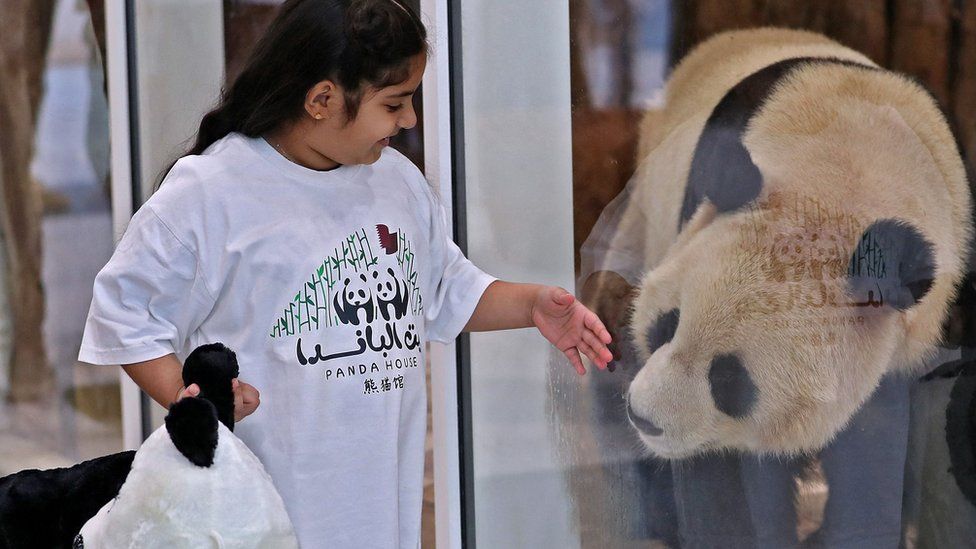
    Leading outlets such as CCTV have also promoted the presence of Chinese flagbearers at the opening ceremony, and how two giant pandas arrived in Qatar to “meet” visitors arriving for the event.

    A child interacting with a Chinese giant panda through glass
    IMAGE SOURCE,GETTY IMAGES Image caption, A child plays with one of the Chinese giant pandas given to Qatar to mark the start of the World Cup

    But it is evident that Covid-19 has put a damper on the celebrations. In major cities, outbreaks have resulted in non-essential businesses once again closing, and people being urged to limit their movements.

    With no bars to go to, the Global Times newspaper says some fans are “choosing to watch the games at home with their families”. Others have also reportedly taken to camping sites.

    Flights between Qatar and China also remain severely limited for those hoping to watch the event in person.

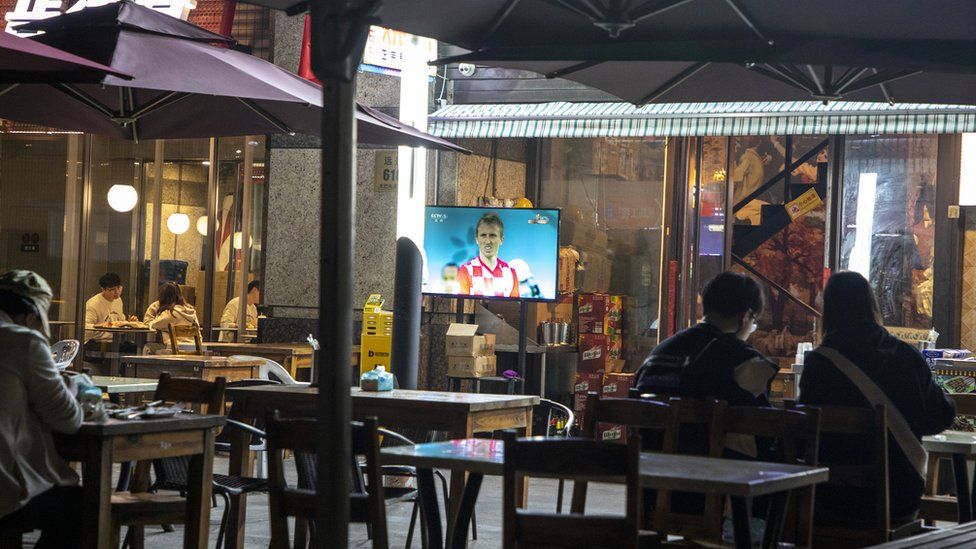
    People in Shanghai sitting in a near-empty pub watching a screen showing Croatian footballer Luka Modric
    IMAGE SOURCE,GETTY IMAGES Image caption, This was the scene in a sparsely filled pub in Shanghai while the World Cup was being shown

    Many are feeling acute isolation watching this year’s event.

    An open letter questioning the country’s continued zero-Covid policies and asking if China was “on the same planet” as Qatar quickly spread on mobile messenger WeChat on Tuesday, before being censored.

    Comments on the Twitter-like Weibo social network are rife from viewers who speak about how watching this year’s matches is making them feel divided from the rest of the world.

    Some speak of their perception that it is “weird” to see hundreds of thousands of people gathering, without wearing masks or needing to show evidence of a recent Covid-19 test. “There are no separate seats so people can maintain social distance, and there is nobody dressed in white and blue [medical] garb on the sidelines. This planet has become really divided.”

    “On one side of the world, there is the carnival that is the World Cup, on the other are rules not to visit public places for five days,” one says.

    Some say they have had difficulty explaining to their children why the scenes from the World Cup are so different to those people face at home.

    There are many in China, though, who have been critical of countries overseas opening up while the World Health Organization still calls the Covid-19 virus an “acute global emergency”.

    However, there is no end in sight to China’s existing measures. This week, the National Health Commission spokesman “warned against any slacking in epidemic prevention and control” and urged “more resolute and decisive measures” to bring cases under control.

    Local governments in major cities have reintroduced mass testing and travel restrictions and ultimately delivered a message that people should try to stay at home.

    But after three years of such measures, people are frustrated, resulting in protests in the last month in both the cities of Guangzhou and Zhengzhou.

  • Zero-Covid China asks: Is World Cup on another planet?


    Chinese state media have given huge attention to the World Cup this week, but the matches are fuelling frustrations that people in the country are being left out of the celebrations.

    On top of China’s men’s national team not qualifying for the event, scenes of maskless celebrations and raucous gatherings in Qatar have irritated viewers, who have been discouraged from gathering to watch the games.

    Many have used the World Cup to complain online about China’s existing strategies. The country maintains a zero-Covid policy, where entire communities are locked down over single cases of the virus, in order to prevent it from spreading.

    China is currently experiencing its worst outbreak in six months, and localised lockdowns have surged over the last couple of weeks. In the past 24 hours, China has recorded more than 28,000 new cases; these are in every single provincial-level region.

    Football is very popular in China. President Xi Jinping is known for being a lover of the sport, and he has spoken previously of it being a dream for the country to win the World Cup.

    As a result, matches are being shown on national broadcaster CCTV, and state media have sought to amplify China’s “presence”. The Global Times has reported on how China-made products “ranging from buses to the [Lusail] stadium, and even air conditioning units are well represented at the event”.

    Leading outlets such as CCTV have also promoted the presence of Chinese flagbearers at the opening ceremony, and how two giant pandas arrived in Qatar to “meet” visitors arriving for the event.

    A child interacting with a Chinese giant panda through glassImage source, Getty Images
    Image caption, A child plays with one of the Chinese giant pandas given to Qatar to mark the start of the World Cup

    But it is evident that Covid-19 has put a damper on the celebrations. In major cities, outbreaks have resulted in non-essential businesses once again closing, and people being urged to limit their movements.

    With no bars to go to, the Global Times newspaper says some fans are “choosing to watch the games at home with their families”. Others have also reportedly taken to camping sites.

    Flights between Qatar and China also remain severely limited for those hoping to watch the event in person.

    People in Shanghai sitting in a near-empty pub watching a screen showing Croatian footballer Luka ModricImage source, Getty Images
    Image caption, This was the scene in a sparsely filled pub in Shanghai for the opening ceremony of the tournament

    Many are feeling acute isolation watching this year’s event.

    An open letter questioning the country’s continued zero-Covid policies and asking if China was “on the same planet” as Qatar quickly spread on mobile messenger WeChat on Tuesday, before being censored.

    Comments on the Twitter-like Weibo social network are rife from viewers who speak about how watching this year’s matches is making them feel divided from the rest of the world.

    Some speak of their perception that it is “weird” to see hundreds of thousands of people gathering, without wearing masks or needing to show evidence of a recent Covid-19 test. “There are no separate seats so people can maintain social distance, and there is nobody dressed in white and blue [medical] garb on the sidelines. This planet has become really divided.”

    “On one side of the world, there is the carnival that is the World Cup, on the other are rules not to visit public places for five days,” one says.

    Some say they have had difficulty explaining to their children why the scenes from the World Cup are so different to those people face at home.

    There are many in China, though, who have been critical of countries overseas opening up while the World Health Organization still calls the Covid-19 virus an “acute global emergency”.

    However, there is no end in sight to China’s existing measures. This week, the National Health Commission spokesman “warned against any slacking in epidemic prevention and control” and urged “more resolute and decisive measures” to bring cases under control.

    Local governments in major cities have reintroduced mass testing and travel restrictions and ultimately delivered a message that people should try to stay at home.

    But after three years of such measures, people are frustrated, resulting in protests in the last month in both the cities of Guangzhou and Zhengzhou.


    Source: BBC

  • China Covid: Record number of cases as virus surges nationwide

    China has recorded its highest number of daily Covid cases since the pandemic began, despite stringent measures designed to eliminate the virus.

    There are outbreaks with several major cities including the capital Beijing and southern trade hub Guangzhou.

    On Wednesday, the country recorded 31,527 cases – higher than the about 28,000 peak recorded in April, when its largest city Shanghai was locked down.

    It comes as strict lockdowns continue to spark episodes of unrest.

    China’s zero-Covid policy has saved lives in the country of 1.4 billion people but also dealt a punishing blow to the economy and ordinary people’s lives.

    However the rising wave of cases also comes weeks after the country slightly relaxed some of its Covid restrictions.

    It cut quarantine for close contacts from seven days in a state facility to five days and three days at home, and stopped recording secondary contacts which allowed many more people to avoid having to quarantine.

    Officials have also sought to avoid enforcing blanket lockdowns of the kind endured by Shanghai earlier this year.

    But faced with a renewed surge in cases in Beijing, as well as the first deaths from the virus in months, officials have already implemented some restrictions in several districts, with shops, schools and restaurants closed.

    The central city of Zhengzhou is also to enforce an effective lockdown for 6 million residents from Friday, officials announced.

    It follows violent protests at a vast industrial complex belonging to iPhone manufacturer Foxconn. The firm has apologised for a “technical error” in its payment systems.

    Media caption, WATCH: Chinese protesters clash with riot police at giant iPhone factory

    Other stories of suffering and desperation have also been shared online where they’ve fuelled public resentment.

    China is the last major economy still pursuing a Covid eradication process with mass testing and lockdown rules.

    However virus cases are now being recorded in 31 provinces.

    President Xi Jinping has said strict curbs are needed to protect the country’s large elderly population. However vaccination levels are lower than other developed nations, and only half of people aged over 80 have their primary vaccinations.

    While China is seeing an increase in infections now, the rate is still far lower than many other advanced economies at their pandemic peak.

    China’s official death toll has remained low at just over 5,200 deaths since the pandemic began.

    That equates to three Covid deaths in every million in China, compared with 3,000 per million in the US and 2,400 per million in the UK.


    Source: BBC

  • Factory fire kills 38 people in central China – State media reports

    A fire at a factory in central China killed dozens of people on Monday, November 21, 2022, according to Chinese state media, the latest in a string of fatal industrial accidents to hit the country in recent years.

    State run-newspaper Henan Daily reported Tuesday that two people previously reported missing had been found dead following the blaze at the factory in Anyang, Henan province, bringing the death toll to 38.

    Two others were being treated for minor injuries, state broadcaster CCTV reported Tuesday.

    Police have detained an unspecified number of suspects in connection with the blaze, which took firefighters nearly seven hours to put out, according to CCTV.

    According to preliminary findings, the fire was caused by violations of electrical welding protocols, Henan Daily reported, citing authorities.

    China has seen a spate of industrial accidents in recent years that have left scores dead, raising concerns about public safety.

    In 2015, at least 173 people died after a series of explosions at a chemical warehouse in the northern port city of Tianjin.

    Last October, at least three people were killed and more than 30 injured in a powerful explosion at a restaurant in the north-eastern city of Shenyang. The gas explosion took place in a mixed-use residential and commercial building.

    And in June this year, at least one person was killed after a fire broke out at a petrochemical complex in Shanghai.


    Source:

  • Millionaire gone bankrupt is paying $6.4 million debt by selling sausages on the street

    A bankrupt former millionaire in China has been making news headlines for his plan to pay a debt of 46 million yuan ($6.4 million) by selling grilled sausages at a street food stall.

    Not too long ago, Tang Jian, a restauranteur in the Chinese city of Hangzhou, was considered one of the most successful businessmen in all of Zhejiang Province. By the age of 36, he already owned a chain of restaurants and had amassed an enviable fortune. But in 2005, Tang decided to invest a sizeable portion of his money into a completely new industry and things started going horribly wrong for him. Now at 52, the former millionaire finds himself over $6 million in debt, but he is working hard to repay every single cent by selling grilled sausages on the street.

    When he started investing in his new landscape engineering business, Tang Jian was convinced it would surpass his restaurant empire, and he simply wouldn’t listen to anyone who told him otherwise. Even though the project was bleeding money, he kept pouring investments into it, and when he finally realized his mistake, it was already too late.

    Even after selling off all his restaurants, his houses, and cars, Tang was still 46 million yuan in debt and had no choice but to declare bankruptcy. But instead of buckling under the pressure of having to repay all that money, he decided to go back to his roots and start selling quality food.

    He didn’t have the money to open a new restaurant, so he settled for a street food stall that he operates himself. He sells grilled sausages and is confident that the humble venture will help him pay off his debt. His redemption story has struck a chord with average Chinese people who appreciated his resilience and positive outlook on life.

    “We are born with nothing. Why be scared of starting all over again?” Tang asked rhetorically in a recent interview. “We have to keep learning to face difficulties calmly and to march ahead with courage.”

    “Each of us lives a challenging life and encounters many difficulties, but we must hold on to a spirit of never being defeated,” the 52-year-old businessman added.

    Tang’s story and a video of him operating his sausage stall on a street in Zhejiang went viral earlier this month, inspiring many to find strength in the face of adversity. After all, if a former millionaire $6.4 million in debt could have a positive attitude, surely they could too.

    Source: Oddity Central

  • China factory blaze kills 38

    A fire at a factory in the Chinese city of Anyang in Henan province has killed 38 people, state media People’s Daily reported on Tuesday.

    The fire started at 16:22 local time (08:22 GMT) on Monday at Kaixinda Trading in the city’s “high-tech” district, and was completely extinguished around 11pm, according to local government’s release.


    The notice also said police had detained a suspect.

    Two other people have been hospitalised for minor injuries.


    Source: BBC

  • Zimbabwe to open new Chinese-built parliament

    Zimbabwe’s President Emmerson Mnangagwa will on Wednesday formally open a new 650-seat parliament in the capital, Harare, that was funded by China.

    President Mnangagwa will use the occasion to deliver a state of the nation address, the state-run Herald newspaper reports quoting the clerk of parliament.

    The finance minister will on the next day present the 2023 national budget, the newspaper adds.

    China funded the project as a gift to Zimbabwe. It houses the national assembly and the senate.

    A Chinese company was behind the construction.

  • 50-year-old man goes viral for smoking while running marathons

    A Chinese man recently went viral on social media after he was photographed lighting up and smoking several tobacco cigarettes while running a marathon.

    At this point, I think everyone can agree that smoking tobacco isn’t the healthiest thing you can do. But it’s one thing to light up in the comfort of your own home while enjoying a cup of coffee, or on a cigarette break at work, and quite another while running a 42-kilometer marathon. So when photos of a man in his 50’s casually smoking while taking part in the Xin’anjiang Marathon last week went viral, everyone was curious to know his story.

    Unfortunately, not much is known about the man, apart from the fact that he is known as “Uncle Chen” among fellow runners, who also confirmed his habit of smoking while running. According to anecdotal reports on social media, Uncle Chen has been spotted at other marathons in the last few years, including the Xiamen Marathon, Lishui Ultra Marathon and Lhasa Half Marathon.

    After some photos of the man smoking while running went viral on Weibo, the organizers of the Xin’anjiang Marathon in Jiande City also shared his certificate of achievement, which not only proved that he took part in the event, but also that he ran the 42.195 km in a respectable 3 hours, 28 minutes and 45 seconds, ranking 515th out of thousands of runners.

    Once the story went viral, photos of Uncle Chen smoking while running the 2018 Guangzhou Marathon also surfaced online, and runners attested to having spotted him at events in 2019 as well.

    “Running is good for your health, smoking is bad for your health. Do they cancel each other out?” one person asked in a comment, while another wondered whether Uncle Chen smokes during marathons because nicotine acts as a stimulant. I think it’s fair to say that there are better-suited stimulants available.”

    Smoking is no joke though, and you don’t have to take my word for it, just as the COPD Athlete.

    Source: Complex.com

  • Man shocked to discover he had been living with bullet stuck in neck for 77 Years

    A 95-year-old Chinese war veteran recently discovered he had been living for almost eight decades with a bullet lodged in his neck.

    After suffering a fall from the balcony of his house in Shandong, China, Zhao He didn’t report any symptoms to his worried family. He didn’t feel any pain, but after a while, the World War 2 veteran did start to feel a slight discomfort in his neck, so his son decided to take him to the hospital for a checkup. After hearing about his fall, doctors recommended an X-ray, to ensure that he hadn’t suffered serious damage to his neck. Only instead of a fracture, the X-ray revealed a foreign object in the man’s neck, which would later be identified as an old bullet.

    The 95-year-old man told doctors that he had joined the Chinese army as a teenager and fought through two wars – against the Japanese invaders during World War 2 (1931-1945) and on the side of North Korea during the Korean War (1950-1953). He suffered multiple injuries during his time in the army, but he did not remember anything about taking a bullet to the neck.

    “He was injured while carrying a wounded comrade across a river during one of the battles. There is shrapnel in other parts of his body as well,” the man’s son-in-law, Wang, said.

    Zhao himself estimates that the bullet had been in his neck since 1944, when he was hit by a bullet while crossing a river. The bullet allegedly went in through the left side of the nose, perforating his upper jaw and knocking out for of his teeth before becoming lodged in his neck. This is just his hunch, though.

    After examining the X-rays, doctors told Zhao He and his family that the bullet was close to some major blood vessels and that since it hadn’t caused him any problems, it was best to leave it in. The war veteran agreed.

    “I’ve been healthy all these years so there is no reason to change things now,” Zhao he said.

    Source: Oddity Central

  • Oil dips near 2-month lows as supply concerns ease

    Oil prices hovered near two-month lows on Monday as supply fears receded while concerns over China’s fuel demand and rising interest rates weighed on prices.

    Brent crude futures for January had slipped 28 cents, or 0.3%, to $87.34 a barrel by 0103 GMT after settling at their lowest since Sept. 27.

    U.S. West Texas Intermediate (WTI) crude futures for December were at $80 a barrel, down 8 cents, ahead of the contract’s expiry later on Monday. The more active January contract fell 21 cents to $79.90 a barrel.

    Both benchmarks closed Friday at their lowest since Sept. 27, extending losses for a second week, with Brent down 9% and WTI 10% lower.

    The front-month Brent crude futures spread narrowed sharply last week while WTI flipped into a contango, reflecting dwindling supply concerns.

    Tight crude supplies in Europe have eased as refiners have piled up stocks ahead of the Dec. 5 European Union embargo on Russian crude, putting pressure on physical crude markets across Europe, Africa and the United States.

    The EU’s energy policy chief told Reuters the EU expected to have its regulations completed in time for the introduction of a G7 plan to cap the price of Russian crude on Dec. 5.

    RBC Capital analyst Mike Tran said the weak December WTI contract expiration indicated paper market selling rather than true physical market softness.

    “Tight global inventories do not support the traditional surplus of barrels rationale for contango,” he said in a note.

    While North Sea and West African spot market indicators are far from strong, they are also not suggesting signs of distress, he added.

    Diesel markets remained tight, with Europe and the United States competing for barrels. While China nearly doubled its diesel exports in October from a year earlier to 1.06 million tonnes, the volume was well below September’s 1.73 million tonnes.

    Demand in the world’s top crude importer remains bogged down by COVID-19 restrictions while expectations of further interest rate rises elsewhere have elevated the greenback, making dollar-denominated commodities more expensive for investors.

  • Mali in West Africa was the richest Empire on Earth in the 14th century

    Some of the richest men in the world today are tech billionaires and business leaders from the West and China. However, the title of “richest man who ever lived” goes to a little-known ancient ruler from a part of the world that is more often associated with poverty than with unimaginable wealth.

    Mansa Musa was the king of the large Mali Empire in 1312. He took the throne when his predecessor, Abu-Bakr 11, who Mansa Musa had been a deputy for, went missing while looking for the edge of the Atlantic Ocean.

    Musa took over as leader during a hard time when European countries were being destroyed by never-ending civil wars and a lack of resources. The Mali Empire, on the other hand, was thriving because it had a lot of gold and salt and other natural resources.

    Under this leader, the empire grew to cover a large part of West Africa, from the Atlantic coast to Timbuktu, a trading center in the middle of the country, and even some parts of the Sahara. Just like the area he controlled grew, so did his money and wealth.

    The rest of the world didn’t fully understand how much wealth King Musa controlled in his land until 1324. Musa was a religious Muslim who lived in a kingdom where most of the people were also Muslims. He went on pilgrimage to Mecca, but he didn’t go alone.

    Musa went to the Holy Land with a caravan of tens of thousands of soldiers, slaves, and heralds. They were all dressed in expensive Persian silk and carried golden staffs. Even though there is a lot of disagreement about how many people were in his group, the convoy that went with him was a big deal. It included camels and horses carrying hundreds of pounds of gold.

    This show of wealth caught the attention of the people who lived in the areas he traveled through, since such a large caravan would be hard to miss. When he went through Egypt, he had an effect on the people that would last for more than a decade.

    When he got to Cairo, the capital of Egypt, and was forced to meet with al-Malik al-Nusar, the ruler of Cairo, his true character was shown. Ancient historian Shihab al-detailed Umari’s writings say that Musa was met in Cairo by a junior official of al-Nasir, who invited him to meet with other royals. Musa turned down the offer, saying he was just on his way to the holy land to make a pilgrimage.

    His reason became clear as time went on. He didn’t want to see the sultan because he would have to kiss the ground and the sultan’s hand. After much doubt and persuasion, he finally agreed to the meeting.

    During the meeting, Musa still wouldn’t kiss the sultan’s feet, and things didn’t go well until he gave in to tradition and kissed the sultan’s feet. But because he was in Egypt, he shared his huge wealth with the people who lived there. He also bought from local traders and gave them gold in exchange.

    Then, news of Musa’s wealth spread to all parts of the world, not just in Africa. Even after he had died, which was between 1332 and 1337. By the end of the 14th century, Musa was shown on the Catalan Atlas of 1375, which was an important tool for sailors in medieval Europe. Abraham Cresques, a famous Spanish cartographer, made the atlas. In it, Musa was shown sitting on a golden throne with a golden sceptre, crown, and gold nugget in his hand.

    From the huge amount of natural resources he controlled to the growth and development of the communities he left behind, Musa was a true legend whose wealth dwarfs that of today’s billionaires. Even by today’s standards, it’s hard to say what his wealth was like.


    Source: theafricanhistory.com

  • ‘China poses a systemic challenge’ to UK, Sunak says

    Rishi Sunak has said he is “hopeful” he will be able to meet with China’s President Xi Jinping at the G20 summit in Bali as he described how the county posed a “systemic challenge” to the UK.

    Speaking to Sky’s political editor Beth Rigby, the prime minister said it was important to “engage” with the Chinese leader to try and tackle “shared challenges”.

    He said: “I’m very clear that China poses a systemic challenge to both our values and our interests, and it represents the single biggest threat to our economic security.

    “And that’s why it’s right that we take the steps that are necessary to protect ourselves against a threat or a challenge.”

    Asked if he would be able to have a collaborative relationship with President Xi, he added: “I think our approach to China is one that is very similar to our allies, whether it’s America or Australia and Canada.

    “I think it’s an indisputable fact of the global economy that China is a big part of it.

    “And if we want to solve big global challenges like public health, like Russia and Ukraine, fixing the global economy or indeed climate change, it’s important to have a dialogue and to engage with China.”

    Source: BBC.com 

  • China zero Covid: Violent protests in Guangzhou put curbs under strain

    Crowds of residents in Guangzhou, southern China’s industrial metropolis, escaped a mandatory lockdown and clashed with police, as rage over strict coronavirus controls erupted.

    Some are seen overturning a police vehicle and tearing down Covid control barriers in dramatic footage. Riot squads have been dispatched to the area.

    It comes on the heels of Guangzhou’s worst Covid outbreak since the pandemic began.

    In the face of dismal economic data, China’s zero-covid policy is under severe strain.

    Tensions had been building in the city’s Haizhu District, which is under stay-at-home orders.

    The area is home to many poorer itinerant labourers. They have complained of not being paid if they are unable to turn up for work, and of food shortages and skyrocketing prices while living under Covid control measures.

    For several nights, they’d been tussling with the white-clad Covid prevention enforcement officials, and then overnight on Monday the anger suddenly exploded onto the streets of Guangzhou with a mass act of defiance.

    Again, unsubstantiated rumours have played a role. Stories have spread that the testing companies are faking PCR results to artificially boost the number of infections in order to make more money.

    In the north of the country, the coronavirus rumour mill is also building pressure.

    Officials in Hebei Province announced that the city of Shijiazhuang would halt mass testing. But this led to speculation that the population was going to be used, guinea-pig-style, to monitor what would happen if the virus was allowed to spread unchecked.

    Discussion of this has appeared on social media platforms under the hashtag #ShijiazhuangCovidprevention.

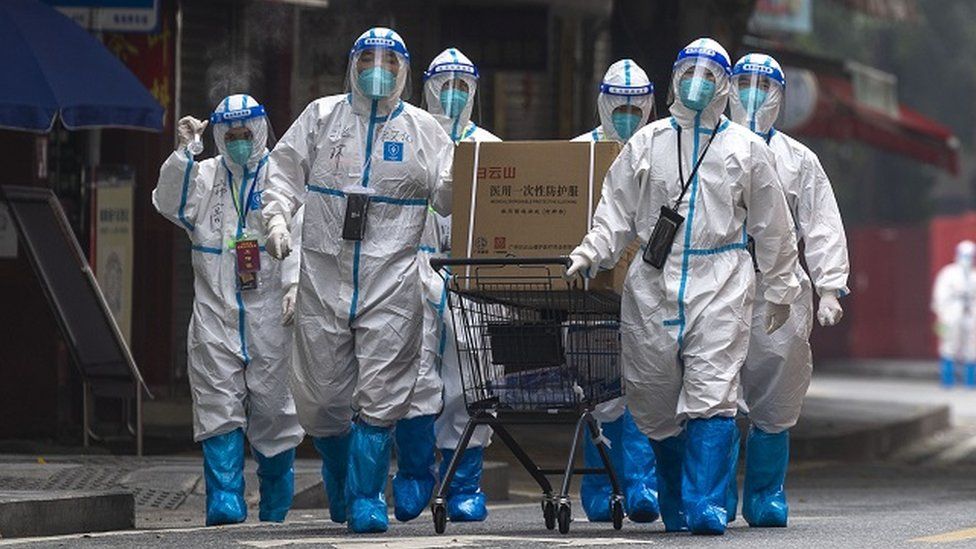
    Workers in PPE walk by a residential block under COVID-19 lockdown in Guangzhou in south China's Guangdong province on Thursday, November 10, 2022.
    IMAGE SOURCE,GETTY IMAGES Image caption, Guangzhou has been under lockdown after a recent spurt in Covid cases

    Many panicking locals have stockpiled Chinese medicines which are said to help with Covid infection. Supplies in the city are said to have virtually run out for the moment.

    A similar viral rumour led to the mass breakout of workers at the Foxconn complex in the central city of Zhengzhou two weeks ago, which has hit the global supply of Apple iPhones.

    Local governments across China are struggling to maintain a zero-Covid approach without trashing their economies. The latest official factory output and retails sales figures show the crushing impact of the pandemic and the government’s policy response to it.

    There are no provinces at all which have reported zero cases in recent days.

    Around 20 million people in the heart of western China’s mega city of Chongqing have been placed under a type of lockdown being referred to ironically by people as “voluntary static management”. This is because, though there has been no official announcement, they’ve been told to remain indoors by community officials.

    Online there have been jokes that the Chongqing government didn’t want to announce a mass lockdown on the same day that measures easing zero-Covid rules across China were revealed.

    Because Covid amelioration still dominates life here, even a small shift in the way it is being administered can cause consternation and panic.

    At the beginning of this week, officials in Beijing’s Chaoyang district decided to close many of the street-side testing booths and move them into housing compounds. There was a sudden cut in the number of PCR stations. The problem is that many office buildings require a daily result, or you can’t enter.

    So at the booths that were open, the queues were enormous.

    From the workers stuck in Tibet who protested to leave Lhasa, to the lockdown of the entire region of Xinjiang, zero-Covid is not going smoothly.

    A series of changes announced last week slightly toning down the rules were seen as a sign that more easing was possible down the road. But even if the government is considering this, it may not be soon enough.

  • Global population: Numbers reach eight billion – as projections reveal where is growing the fastest

    Despite the fact that there are more people on Earth than ever before because we are living longer lives, population growth is at its slowest rate since 1950, according to UN data.

    According to UN Population Division projections, the world’s eighth billionth resident was born today.

    The global population has grown to eight billion people, three times the size it was in 1950, and while there are more people on Earth than ever before because we are living longer lives, population growth is slowing to its slowest rate in more than 70 years.

    The global population growth rate will be less than 1% in 2020. This is largely due to a lower birth rate, with women having fewer children as a result of widespread contraception and improved education and mobility opportunities for women and girls.

    The global population is also getting older – 10% are aged over 65, and this will increase to 16% by 2050.

    By 2050 the number of over-65s will be twice that of those under five.

    Where is it growing the fastest?

    The two fastest-growing regions in the world are East and Southeast Asia, home to 2.3 billion people, and central and South Asia, which has 2.1 billion people.

    China and India are the joint-most populated countries in the world, with 1.4 billion people each.

    Based on UN projections, India will surpass China for the first time next year.

    Religious ceremony in Mumbai, India on 31 October
    Image:The population of India is expected to surpass that of China next year

    More than half of the projected increase up to 2050 will be concentrated in eight countries: the Democratic Republic of the Congo, Egypt, Ethiopia, India, Nigeria, Pakistan, the Philippines and Tanzania.

    Countries in sub-Saharan Africa are expected to contribute more than half of the increase anticipated through 2050.

    The biggest increases will come specifically from the Democratic Republic of Congo and Tanzania, with both populations doubling in the next 30 years.

    Elsewhere in Africa, the biggest surges will be in Nigeria, Ethiopia and Egypt.

    In Asia outside India and China, the biggest growth will happen in Pakistan and the Philippines.

    More generally, 46 of the least-developed countries in the world will have the fastest-growing populations between now and 2050.

    Most of this growth (two-thirds) will be driven by what has already happened – and the youthful structure of the population.

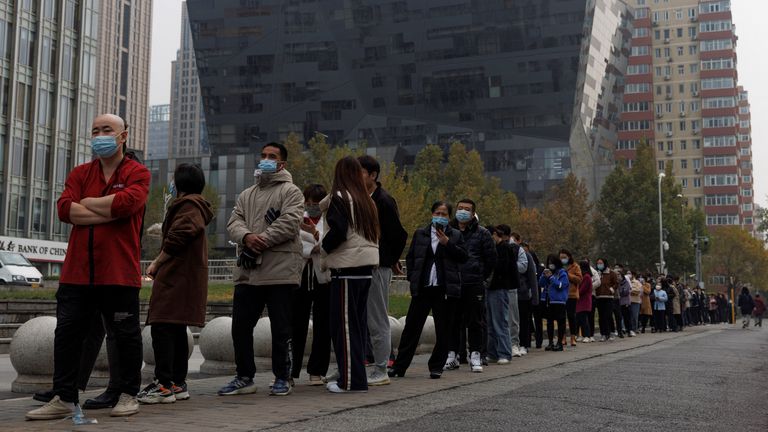
    People queue for COVID testing in Beijing, China on 9 November
    Image:China has been the most populous country since records began

    Where is the population shrinking?

    The world population is growing more slowly than it has in decades due to long periods of low fertility.

    More than two-thirds of people live in countries where women have 2.1 children or fewer.

    This is roughly the level that would produce zero growth worldwide.

    The population of 61 countries will decrease by 1% or more between now and 2050 – either due to decreased birth rates or increased levels of migration.

    The war in Ukraine is having a huge impact on its population size – with projections showing it will have lost more than 20% of its population by 2050.

    Four other central and eastern European countries – Bulgaria, Latvia, Lithuania and Serbia – will experience similar population decreases in the next three decades.


    COVID decreases life expectancy

    Overall life expectancy fell from 72.8 before the pandemic in 2019 to 71 last year.

    COVID’s impact was not the same for every region, however.

    Central and southern Asia, Latin America and the Caribbean were hit the most – with life expectancy decreasing by around three years.

    But in Australia and New Zealand, which both shut their borders and pursued a “zero COVID” policy for most of the pandemic, life expectancy increased by 1.2 years due to a decreased risk of dying from other causes during successive lockdowns.

    Coronavirus may have resulted in some short-term reductions in pregnancies, but there was no evidence of an overall decline, UN experts said.

    What’s next?

    The global population will continue to grow – to around 8.5 billion people by 2030 and 9.7 billion by 2050.

    It will start to peak at around 10.4 billion people in the 2080s and remain at that level until 2100.

    After that, trends are uncertain.

    Australia, New Zealand, the rest of Oceania, North Africa and Western Asia will still be growing in population by the end of this century.

    But the rest of the world, including Europe and North America, will have reached their peak and started to decline before the year 2100.

    Antonio Guterres, the UN secretary-general, said of the eight billion milestone: “This is an occasion to celebrate our diversity, recognise our common humanity and marvel at advancements in health that have extended lifespans and dramatically reduced maternal and child mortality rates.”

    But he added: “At the same time, it is a reminder of our shared responsibility to care for our planet and a moment to reflect on where we still fall short of our commitments to one another.”

  • G20 currently less than sum of parts – Analyst

    Analyst James Crabtree of the Institute of Strategic Studies has been telling the BBC’s Karishma Vaswani about what would constitute success for the summit.

    “This is the body that came together in 2008 and 2009, and was the focal point of getting the world out of the global financial crisis. Now we have comparably complex challenges,” he said.

    “So inflation, food insecurity, the climate transition, a whole host of issues… but because the United States and China and Russia are unable to cooperate with one another, then any progress on those issues is going to be incremental at best. So you have a body that is now much less than the sum of its parts,” he said.

    However, he adds that there will some success – and opportunities created – as a result of the summit.

    “The fact that Xi and Biden [are meeting], or Xi to meet Australian President Albanese… these are not insignificant things. So I think the success will simply be that some of the leaders will talk to one another, and maybe there’ll be tiny bits of progress on the broader G20 agenda in areas like climate change.”

    The fact that the meeting is happening at all, is another success in itself, he adds.

    “When the Ukraine invasion happened, people worried that this entire G20 would collapse… that there simply wouldn’t be able to be a meeting because of the disagreements,” he said.

    Source: BBC

  • Hong Kong enraged after a protest song replaces the China anthem at a match

    During the 2019 mass protests, the slogan ‘Glory to Hong Kong’ was nearly banned in Chinese territory.

    The Hong Kong government has condemned the organisers of a rugby tournament in South Korea after a democracy protest song was played before the territory’s team played a match instead of the Chinese national anthem.

    The players appeared perplexed in a video shared on social media as the song Glory to Hong Kong was played ahead of the Asia Rugby Sevens Series final instead of the Chinese national anthem.

    The Hong Kong government “strongly deplores and opposes the playing of a song closely associated with violent protests and the ‘independence’ movement as the National Anthem of the People’s Republic of China,” it said in a statement.

    “The National Anthem is a symbol of our country. The organiser of the tournament has a duty to ensure that the National Anthem receives the respect it warranted,” a government spokesperson said.

    Glory to Hong Kong was written by an anonymous composer and became an anthem for the pro-democracy movement during protests in 2019, which attracted huge crowds but became increasingly violent as the months dragged on.

    The organisers of the tournament in Incheon, South Korea, issued an apology and played the Chinese anthem after the match, which was won by the Hong Kong team.

    Hong Kong authorities said they had ordered the city’s rugby union body to conduct an investigation and convey its “strong objection” to tournament organiser Asia Rugby.

    In a separate statement, Hong Kong Rugby Union expressed its “extreme dissatisfaction” with what had happened.

    The organisation’s preliminary investigation found that the Chinese anthem had been given to the organisers by the team’s coach, and the protest song had been played by mistake.

    “Whilst we accept this was a case of human error, it was nevertheless not acceptable,” the HKRU said.

    The Chinese national anthem, March of the Volunteers, has been played at international events where Hong Kong has competed since the British handed the territory back to China in 1997.

    Playing Glory to Hong Kong in the territory is now all but illegal after Beijing imposed a national security law on Hong Kong that rights groups say has “decimated” dissent. It is also considered unlawful under Hong Kong’s sedition law, according to the South China Morning Post.

    In September, a harmonica player who played the tune to a crowd commemorating Britain’s Queen Elizabeth II was arrested.

  • What’s going on with Taiwan?

    As we’ve been reporting, one of the main items expected to be on the agenda for the Chinese and American leaders during their ongoing talks is the thorny topic of Taiwan.

    The key thing to understand here is that there’s a debate over the status of the island.

    China views Taiwan as a renegade province which is destined to one day be reunited with the mainland – by force if needed.

    However, Taiwan has many characteristics of an independent state. It’s a self-ruled democracy, and people there see themselves as being separate from Beijing – whether or not independence is ever officially declared.

    The United States has long tried to walk a tightrope. Officially, it only recognises the government in Beijing. However, President Biden has repeatedly said the US would defend Taiwan if Beijing’s troops ever invaded. The White House has always looked to walk back his comments.

    Tensions have been building recently – and peaked in August when Nancy Pelosi, the speaker of the US House of Representatives, visited Taiwan. China responded with large-scale military drills nearby.

    Source: BBC.com 

  • Expert: Talks are good for PR, but hold some promise too

    As the sun sets in Bali, Xi and Biden remain ensconced in the Mulia hotel, their meeting approaching the two-hour mark.

    Officials in the United States do not believe it will last much longer. However, with Biden’s press conference scheduled for 21:30 local time (13:30 GMT), it is clear that they are also prepared for talks to last longer if necessary.

    The two are believed to be discussing Taiwan, global economic security, North Korea, and Russia’s invasion of Ukraine. The US also hopes that the meeting will ease tensions that have risen since US House Speaker Nancy Pelosi’s visit to Taiwan in August.

    He says it was this method that “played an important role in diplomatic ice-breaking during the Cold War years” – a reference to tension between the US and its allies and the Soviet Union and its allies during the mid-20th Century.

    However, “these talks did not necessarily happen at the level of heads of state,” Landry points out.

  • The sun sets as Xi and Biden negotiate

    As the sun sets in Bali, Xi and Biden remain ensconced in the Mulia hotel, their meeting approaching the two-hour mark.

    Officials in the United States do not believe it will last much longer. However, with Biden’s press conference scheduled for 21:30 local time (13:30 GMT), it is clear that they are also prepared for talks to last longer if necessary.

    The two are believed to be discussing Taiwan, global economic security, North Korea, and Russia’s invasion of Ukraine. The US also hopes that the meeting will ease tensions that have risen since US House Speaker Nancy Pelosi’s visit to Taiwan in August.

    Biden and US officials have gone to great pains to clearly signal this aim of conciliation in recent days. Biden has stressed repeatedly that the US does not want conflict with Xi, and he told Xi earlier that the US and China must show they “can manage our differences, prevent competition from becoming anything ever near conflict, and to find ways to work together”.

    Biden also said he was “committed to keeping the lines of communication open between you and me personally” as well as their governments across the board, and that the world expected their two countries to play a role in addressing climate challenges and food shortages.

    Xi appears to be on the same page. He acknowledged the China-US relationship was in “such a situation” that it has caused concern, “and it is not what the international community expects of us”.

    “We need to chart the right course for the China-US relationship,” he told Biden, given that “the world has come to a crossroads”.

    Both leaders have basically acknowledged they know what’s fully at stake here, and signalled to the global community that they will act responsibly. We will soon find out what they’ve agreed on – and the path they have set for the rest of us.

  • China and Australia leaders to meet for first time since 2016


    Reporters have been briefed by a US official on Chinese Premier Li Keqiang’s remarks regarding Russia’s invasion of Ukraine at the East Asia Summit in Cambodia on Sunday.

    The US official said Li spoke at length about China’s views on the war, and condemned the “irresponsibility of nuclear threats”. Putin has repeatedly hinted at a readiness to use nuclear weapons.

    The unnamed US official said that despite China’s allyship with Russia there was clear “discomfort in Beijing” over Russia’s rhetoric.


    “I think it is also undeniable that China is probably both surprised and even a little embarrassed by the conduct of the Russian military operations,” the US official said.

    Meanwhile the Financial Times quotes a Chinese official as saying that Putin did not tell Xi that Russia was about to invade Ukraine when the two leaders met in February to seal a “friendship without limits”.

    “Putin didn’t tell Xi the truth,” the unnamed Chinese official told the newspaper.

    Russian President Vladimir Putin is unlikely to attend the G20, but the war and its global impact are a major concern at the summit.

    Source: BBC

  • China a bit embarrassed by Russia – US official

    A US official has been briefing reporters on Chinese Premier Li Keqiang’s comments about Russia’s invasion of Ukraine at the East Asia Summit in Cambodia on Sunday.

    The US official said Li spoke at length about China’s views on the war, and condemned the “irresponsibility of nuclear threats”. Putin has repeatedly hinted at a readiness to use nuclear weapons.

    The unnamed US official said that despite China’s allyship with Russia there was clear “discomfort in Beijing” over Russia’s rhetoric.

    “I think it is also undeniable that China is probably both surprised and even a little embarrassed by the conduct of the Russian military operations,” the US official said.

    Meanwhile the Financial Times quotes a Chinese official as saying that Putin did not tell Xi that Russia was about to invade Ukraine when the two leaders met in February to seal a “friendship without limits”.

    “Putin didn’t tell Xi the truth,” the unnamed Chinese official told the newspaper.

    Russian President Vladimir Putin is unlikely to attend the G20, but the war and its global impact are a major concern at the summit.

    Source: BBC

  • The US wants to play in China’s backyard

    Nowhere has Xi Jinping’s assertive foreign policy had a greater impact than in South East Asia, China’s strategic backyard.

    But as Beijing’s power has grown, so has Washington’s unease – and now after years of see-sawing, the US is trying engage with the region again.

    When he attends the annual summit of the Association of South East Asian Nations or Asean this week in Cambodia, President Joe Biden becomes the first US leader to make that trip since 2017. He was there virtually last year too. And then he goes to Indonesia, another important player in the region, where he is scheduled to meet Chinese leader Xi Jinping before they both attend the G20 meeting.

    But the US is now operating in a more treacherous diplomatic environment than in the past.

    Asean, once considered essential for diplomacy in the Asia-Pacific, has struggled to remain effective in an increasingly polarised world. It has fashioned itself as a zone of peace and neutrality, where its 10 member states seek consensus, avoid criticising each other and feel free to engage different powers. Its small and weak secretariat, and lack of any process for enforcing decisions on members, reflects this mindset.

    This worked well while there was a broad, US-led global consensus that championed trade and growth. But China’s arrival on the global market and growing influence from the early 2000s coincided with diminishing US interest, as it focussed on the Middle East.

    China embarked on a charm offensive in the region, following former leader Deng Xiaoping’s mantra “hide your strength, bide your time”. But under Mr Xi, now in power for 10 years, China’s strength was no longer hidden.

    In the last decade, China’s occupation and military development of reef islands in the South China Sea has brought it into direct conflict with other claimants, particularly Vietnam and the Philippines. Attempts by Asean to get China to agree to a “code of conduct” in the disputed areas have gone nowhere. Beijing has simply stalled negotiations for 20 years. It has also dismissed an international court ruling in 2016 that its claims are invalid.

    It has been just as evasive on problems caused by its large-scale damming of the Mekong River.

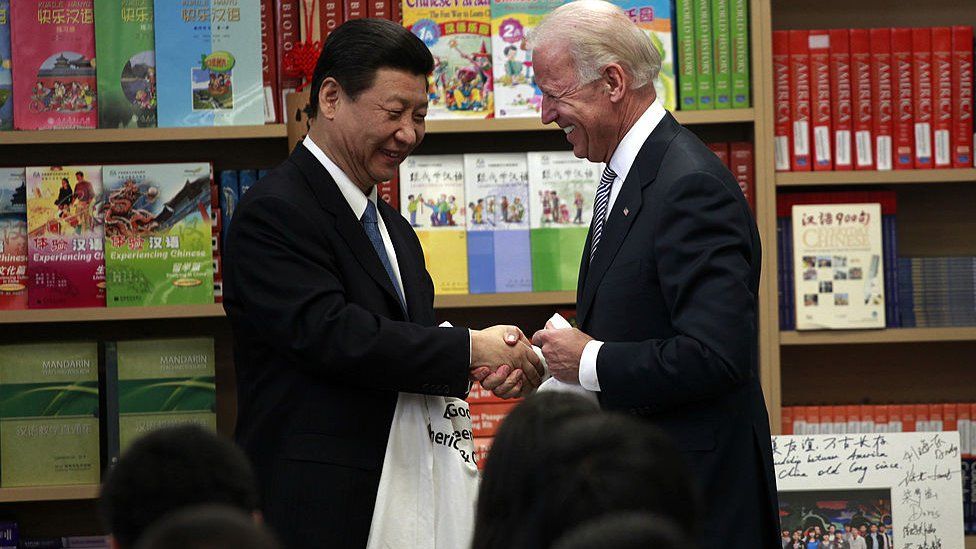
    Vice President Joe Biden (R) and Chinese Vice President Xi Jinping shake hands after receiving gifts and answering students questions in a Mandrin language class at International Studies Learning Center February 16, 2012 in South Gate, CaliforniaImage source, Getty Images
    Image caption, Mr Xi with Mr Biden in 2012, when the latter was the US vice-president

    But the countries that make up Asean are in a sticky position. First, China is so important economically, and so powerful militarily, that few dare confront it openly.

    Even in Vietnam, which went to war with China only 43 years ago and where anti-China sentiment runs high, the ruling communist party is cautious when dealing with its giant neighbour. They share a long border, China is Vietnam’s largest trading partner, and a vital link in the supply chain that fuels its world-beating exports.

    Second, China has effectively destroyed Asean unity by picking off smaller states, such as Laos and Cambodia, which are now so dependent on Beijing’s largesse they are more or less client states. This was clear even in 2012, when Cambodia last took the rotating Asean chair, and blocked a final statement critical of Beijing’s position in the South China Sea.

    While wariness of China might sound like good news for the US, the truth is South East Asian countries have also become disenchanted with Washington.

    They see it as an unreliable partner, too preoccupied with human rights and democracy. The US forced the region to accept hugely unpopular and tough economic measures after the 1997 Asian financial crash, disengaged almost completely during President George Bush’s war on terror, and has since flipped from President Obama’s much-hyped “pivot” to Asia, to President Trump’s narrow approach to what he called unfair Asian trading practices.

    The US focus today on the Quad alliance with Japan, India and Australia has also weakened Asean, leaving it feeling stuck between two powerful sides. And Washington’s willingness to challenge China in Asia frightens them because they have a great deal to lose from a superpower confrontation.

    For all its overtures, no US administration has been willing to pursue free trade agreements – and that has certainly soured the deal for what is perhaps the most trade-dependent region in the world.

    A relationship with China, on the other hand, has already led to the world’s largest trading bloc linking Asean, China, Japan, South Korea, Australia and New Zealand.

    Even Indonesia, the largest Asean state and with the region’s most China-sceptic foreign policy, has under President Joko Widodo eagerly sought Chinese investment, loans and technology.

    The US can draw comfort from the knowledge that Asean will still engage other powers as much as possible – as a counterweight to China. And China is unlikely ever to have close military allies here, in the way the US does in Japan and Australia.

    But all Asean countries – to varying degrees – now accept that China will be the dominant power in this region and one that is unwilling to make concessions where its own interests are at stake.

    The question for Mr Biden: is it too late for the US to reshape alliances in China’s backyard?


    Source: BBC

  • Trudeau accuses China of “aggressive” election meddling

    Prime Minister Justin Trudeau of Canada has accused China of attempting to meddle in the country’s elections.

    Mr. Trudeau accused China of engaging in “aggressive games” with democracies and targeting Canadian institutions.

    It comes as local media reports that Canadian intelligence discovered a “secret network” of Beijing-backed candidates in recent elections.

    China reportedly supported at least 11 candidates in the 2019 federal elections, according to officials who spoke with Mr Trudeau.

    A Chinese foreign ministry spokesman said it has “no interest” in Canada’s internal affairs.

    Citing unnamed intelligence officials, local broadcaster Global News reported that Beijing had directed funds to the candidates and that Chinese operatives had acted as campaign advisers to many candidates.

    In one case, funding of C$250,000 (£160,000) was directed through the office of an Ontario-based provincial MP.

    The operation, which was reportedly directed from China’s consulate in Toronto, also sought to place operatives within the offices of serving MPs in an attempt to influence policy, the outlet alleged.

    And efforts were also made to “co-opt and corrupt” former Canadian officials in a bid to gain influence within political circles.


    The attempted interference is believed to have targeted both major political parties – Mr Trudeau’s Liberal party and the opposition Conservative party. However, it is unclear whether the operation was successful.

    “We have taken significant measures to strengthen the integrity of our elections processes and our systems, and will continue to invest in the fight against election interference, against foreign interference of our democracies and institutions,” Mr Trudeau told reporters on Monday.

    “Unfortunately, we’re seeing countries, state actors from around the world, whether it’s China or others, are continuing to play aggressive games with our institutions, with our democracies,” he added.

    Chinese foreign ministry spokesman Zhao Lijian said China has no interest in meddling in Canadian elections.

    “State-to-state relations can only be built on mutual respect, equality and mutual benefit,” he told a press briefing.

    “Canada should stop making remarks that hurt China-Canada relations,” he added.

    The reports come after authorities said they were investigating accusations that China had opened unofficial “police” stations on Canadian soil.

    Last month, Royal Canadian Mounted Police said they were investigating reports of “criminal activity in relation to so-called ‘police’ stations”, which have also been reported in a number of European countries.

    Several EU states, including Ireland and the Netherlands, have already ordered China to close the police posts, which have reportedly been used to pressure opponents of the government to return to China and face criminal charges.

    Dutch media found evidence that the so-called overseas service stations, which promise to provide diplomatic services, were being used to try to silence Chinese dissidents in Europe.

  • China has 6-month high in infections, despite COVID strategy

    Despite growing public dissatisfaction with the policy and its economic costs, the world’s most populous country has pledged to stick to its hardline zero-COVID policy.

    Despite growing public dissatisfaction with the policy and its economic costs, the world’s most populous country has pledged to stick to its hardline zero-COVID policy.

    China has reported the most new COVID-19 infections in six months, a day after health officials said they would maintain strict coronavirus controls.

    The National Health Commission reported 4,420 new locally transmitted COVID-19 infections in China on Saturday, the most since May 6 and an increase from 3,659 new local cases the day before.

    Despite having extremely low case numbers by global standards nearly three years into the pandemic, China has maintained a zero-COVID strategy that includes lockdowns, quarantines, frequent testing, and a drastic reduction in inbound travel.

    Despite having extremely low case numbers by global standards nearly three years into the pandemic, China has maintained a zero-COVID strategy that includes lockdowns, quarantines, frequent testing, and a drastic reduction in inbound travel.

    At a news conference on Saturday, health officials reiterated their commitment to the “dynamic clearing” approach to COVID cases as soon as they emerge.

    People wear masks at a coffeehouse as the outbreak of coronavirus disease (COVID-19) continues in Beijing, China November 5, 2022
    Analysts say they do not expect a significant easing of restrictions to begin until after China’s annual parliamentary session in March [File: Thomas Peter/Reuteurs

    China’s anti-COVID measures are “completely correct, as well as the most economical and effective”, said disease control official Hu Xiang. “We should adhere to the principle of putting people and lives first, and the broader strategy of preventing imports from outside and internal rebounds.”

    The world’s most populous country has pledged to stick to its hardline zero-COVID policy despite growing public frustration with it and its toll on the economy.

    President Xi Jinping has said little other than to reiterate the validity of his policy that has made China a global outlier as much of the world tries to coexist with the virus.

    Chinese stocks soared last week on rumours of a possible easing of the COVID curbs and media reports that some tweaks to policy could be coming soon.

    However, many analysts say they do not expect significant easing to begin until after China’s annual parliamentary session in March.

    Goldman Sachs analysts said Saturday’s announcement showed “the government still needs to keep its zero-COVID policy until all preparations are done”.

    This may take a few months, in our view,” they wrote, saying their “baseline” expectation was for a reopening in the April-June quarter.

    Participants wait before the Beijing Marathon
    Participants wait before the Beijing Marathon, the first in two years [Tingshu Wang/Reuters]

    The southern city of Guangzhou continued to report rising infections, with 66 new locally transmitted symptomatic and 1,259 asymptomatic cases, compared with 111 symptomatic and 635 asymptomatic cases a day before, authorities in the city of nearly 19 million people said.

    China’s capital Beijing reported 43 symptomatic and six asymptomatic cases, compared with 37 symptomatic and five asymptomatic cases the previous day.

    Nevertheless, about 30,000 runners, some wearing face masks, took part on a chilly and smoggy Sunday in the first Beijing Marathon since 2019.

    Runners went past Tiananmen Square as they completed the race through the streets and highways of the Chinese capital.

    The mood appeared festive, with some participants wearing colourful wigs, carrying flags, or high-fiving youngsters on the sidelines.

    It was the first major sporting event in the Chinese capital since the Winter Olympics in February.


  • Apple: iPhone shipments delayed due to China Covid lockdown

    Do you want to buy the new iPhone 14 Pro or iPhone Pro Max? Apple says you can expect longer wait times for new products.

    The tech behemoth announced that its Chinese assembly plant is now operating at a significantly reduced capacity.

    On November 2, officials shut down a district that houses Foxconn’s iPhone factory, the world’s largest, for seven days.

    Apple’s announcement comes as China reaffirms its commitment to zero Covid.

    “As we have done throughout the COVID-19 pandemic, we are prioritising the health and safety of the workers in our supply chain,” said a statement from Apple, which launched its new iPhone line in September.

    “We continue to see strong demand for iPhone 14 Pro and iPhone 14 Pro Max models. However, we now expect lower iPhone 14 Pro and iPhone 14 Pro Max shipments than we previously anticipated and customers will experience longer wait times to receive their new products.”


    The announcement will likely disappoint investors who were hoping China would lift its Covid restrictions in the near future. Chinese stock markets rose sharply on Friday on the back of rumours of an end to Covid lockdowns.

    Beijing’s unyielding approach to arresting the spread of the virus has come at a huge economic cost. But the country’s leader Xi Jinping, who has personally endorsed the policy, has given no indication that it will ease soon.

    The latest figures show the world’s second-largest economy struggling to cope with prolonged challenges posed by persistent Covid restrictions, a property slump and the risk of a global recession.

    China trade figures released on Monday showed its imports and exports contracted unexpectedly in October. It is the first slump since May 2020. Outbound shipments for the month dropped 0.3% from a year earlier which is in stark contrast to a 5.7% gain in September. It was the worst performance since May 2020.

    The country reported 5,643 new Covid infections on Sunday, its highest daily tally in six months. Zhengzhou, where the Foxconn factory is located, is the capital of Henan province in central China and is home to about 10 million people. It recorded 3,683 cases and 22 deaths on Monday.

    Cases were also detected inside the factory, prompting a sudden shutdown that led to workers fleeing the premises. On Monday, the company started a recruitment drive at its Zhengzhou plant. It is offering workers who left the plant between 10 October and 5 November a one-time bonus of 500 yuan (US$69; GBP£60.88) if they return to work.

    It is also offering a pay increase of 30 yuan an hour, according to a statement posted on its recruitment WeChat account.

    Foxconn, the world’s largest contract electronic maker, has revised down its fourth quarter outlook due to China’s Covid control measures. The fourth quarter is usually a busy time for the tech company as demand for electronics rises ahead of the year-end holiday season in the West.

    The Taiwan-based company said they are working with the Henan provincial government “to stamp out the pandemic and resume production to its full capacity as quickly as possible”.

    Foxconn, formally known as Hon Hai Precision Industry, accounts for 70% of iPhone shipments globally.

  • Looming China-Taiwan conflict will have a greater effect on Ghana just like Russia-Ukraine war – Oppong-Nkrumah warns

    Minister of Information, Kojo Oppong-Nkrumah, has warned of a possible “third problem” that can worsen the country’s economy despite the dire effect of the Russia-Ukraine war which the government has identified as a prime cause of Ghana’s economic crisis.

    Mr Oppong-Nkrumah expressed his disappointment in the Ghanaian media over the lack of attention on China’s possible takeover of Taiwan which is a matter of concern to other countries.

    Instead, there are calls for the president, Nana Addo Dankwa Akufo-Addo to accept the blame and apologize to Ghanaians for the economic crisis under his government.

    Key personalities in the country including Broadcaster Nana Aba Anamoah called on Akufo-Addo to apologize to the good people of Ghana during his State address on the economy on October 30 but reacting to these calls on Asempa FM, Mr Oppong Nkrumah explained that the ‘mess’ was not created by the government. He was quick to once again cite the effect of the Russia-Ukraine war on the global economy.

    “The president admitted that we are in crisis. There was a part in his speech where he noted that we can’t take lightly the situation despite the global crisis…some people were expecting something different and let’s not reduce the conversation to that. They wanted to hear the president take the blame and apologise.

    “There is a third problem coming, do you know that China has extended the tenure of office for president Xi Jinping? They have extended it by an extra five years…his attempt to annex Taiwan. If indeed China carries on with its plans, its case will be similar to Russia-Ukraine. Can you imagine the damage, especially with the increase in crude oil prices? If indeed China attacks Taiwan, what will be the implication?” he quizzed.

    The Minister sounding the alarm added: “News outlets in other countries are analyzing the implication this possible attack will have on them but in our case, we haven’t taken a look at it but when it happens and we spell out the implications they will say it is pure fabrications but these are the realities in the world we live in. It is therefore not a matter of the president accepting blame because that’s not the matter of fact.”

    The Chinese are seeking full control of the Taiwan island which was historically under their control back in the 17th Century.

    China’s president, Xi Jinping is seeking a “reunification” with Taiwan. The use of force in fulfilling this takeover has not been ruled out according to reports.

    Source: Ghanaweb


  • Scholz in China advocates for economic ties ‘as equals’

    During Chancellor Olaf Scholz’s visit to China, China’s Xi Jinping urged deeper economic cooperation with Germany.

    Following the Chinese leader’s consolidation of power, the trip has sparked controversy in Germany and concern throughout Europe.

    Mr Scholz mentioned “economic ties as equals, with reciprocity.”

    President Xi stated that the two countries should collaborate during “times of change and turmoil.”

    The chancellor’s visit – the first by a G7 leader since the coronavirus pandemic – follows an extraordinary and bitter row within the Berlin government.

    It had emerged that a Chinese company was poised to buy a significant stake in a part of the port of Hamburg. No fewer than six government ministers reacted furiously.

    The deal, they argued, would give China significant influence over critical German infrastructure. Germany’s security services also urged caution.

    But the German chancellor appeared insistent the deal should go ahead. He reportedly pushed through an agreement, albeit one that limited the size and influence of the stake, reducing it to 24.9%.

    No-one is quite sure why he seemed so determined. A former mayor of Hamburg, Mr Scholz remains close to the city authorities who argued that the deal represented vital investment.

    But plenty of other commentators suspect an ulterior motive; that Olaf Scholz did not want to turn up in Beijing without a “gift” for Xi Jinping.

    That has raised both eyebrows and concerns.

    Olaf Scholz

    Reuters
    We will seek co-operation where it lies in our mutual interest, but we will not ignore controversies… When I travel to Beijing as German chancellor, I do so also as a European
    Chancellor Olaf Scholz
    In Frankfurter Allgemeine Zeitung
    1px transparent line

    As has the chancellor’s decision to take with him a delegation of German business executives. That was standard practice for his predecessor, Angela Merkel, who pursued a policy of “Change through Trade”, believing that economic ties could influence political relations with countries like China and Russia.

    The chancellor’s visit comes hard on the heels of the National Congress of the Chinese Communist Party, at which President Xi tightened his grip on power and raised concerns in the West about his intentions towards Taiwan.

    “The signal that’s being sent is that we want to extend and intensify our economic co-operation – that must be questioned,” says Felix Banazsak, a politician from the Green Party, a partner in Mr Scholz’s coalition government.

    The Greens have long sought a tougher line on China. Just a few days ago the party’s foreign minister, Annalena Baerbock, sternly and publicly reminded him that his government came to power promising to readjust its China strategy.

    Mr Banazsak says his country must learn from its previous dependence on Russian energy: “We must make ourselves as independent as possible from individual states, particularly if these are states which do not share our values.”

    But Olaf Scholz will be painfully aware of the complexity and depth of his country’s ties with China, which remains Germany’s largest trading partner, although Germany imports more than it exports.

    More than a million German jobs depend on that relationship. Take as an example car giant Daimler, which sells more than a third of its vehicles in China.

    A quality inspector makes the final inspection of a Daimler axle housing before packing it for export at the Daimler axle housing production plant in Qingdao, Shandong Province, China, January 20, 2022
    IMAGE SOURCE,GETTY IMAGES Image caption, German company Daimler is expanding its resources in China

    In the first half of this year, German businesses invested more in China than ever before. Chemical company BASF has just opened a new plant in south China and expects to invest €10bn (£8.6bn; $9.9bn) in the site by the end of this decade.

    On the eve of the visit, the head of the German Automotive Industry Association pointed to Germany’s reliance on China for raw materials and warned that “de-coupling” would be an economic and geo-strategic mistake.

    Her counterpart at the Association of Small and Medium Businesses also advised against a sudden change in course, saying “the advice can only be not to smash any Chinese porcelain now”.

    Chancellor Scholz is spending less than 12 hours in Beijing. His aim, he said ahead of his journey, was to find out how much co-operation was still possible – because “the world needs China” in the fight against the global pandemic and climate change.

    “If China is changing, then our approach to China must change,” he said.

    Many in Berlin and beyond will be looking for evidence of that Mr Scholz’s response to a shifting China may yet come to be the defining test of his chancellorship.

    Scholz trip ruffles feathers in Europe

    Germany is the EU’s most powerful economy and arguably most influential member, so what it says and does matters.

    I once suggested former Angela Merkel could be viewed at times like a European Donald Trump for the way she tended to put Germany first.

    Wider EU concerns were ignored in favour of lucrative German energy and trade contracts with Russia and China. She demanded EU austerity measures for Mediterranean member states during the eurozone crisis to protect German taxpayers from incurring shared debt.

    Olaf Scholz is Mrs Merkel’s successor in far more than just name, in the minds of many EU leaders.

    His massive aid package to help German businesses with high energy prices is viewed as giving them an unfair competitive advantage on the European single market.

    And his trip to China, announced but not co-ordinated with others in the EU, has ruffled feathers Europe-wide. France’s Emmanuel Macron recently warned Mr Scholz he risked becoming isolated.

    As Europe, and Germany first and foremost, weans itself off its dependency on Russian gas, the question is this: Is Berlin, blinded by the prospect of business deals, binding itself too close to China?

    French President Emmanuel Macron has been pushing for years for the EU to become less beholden to Beijing. Critics accused him of protectionism.

    But after global supply-chain breakdowns during the Covid-19 pandemic, the “weaponisation” of energy imports/exports after Russia’s invasion of Ukraine and Donald Trump’s presidency, it became clear Europe should no longer rely so heavily on the US in terms of security.

    With Mr Macron’s insistence on the continent becoming more cohesive and self-reliant, diversifying its trade partners began to seem sensible to Brussels. Olaf Scholz is viewed as worryingly out of step.

  • Pwalugu dam project facing financial challenges – Bawumia

    Vice President, Dr. Mahamudu Bawumia, has admitted that the long delay in the construction of the Pwalugu Multipurpose dam project is as a result of financial constraints.

    Speaking at the launch of the Northern Development Authority’s five-year strategic plan in Tamale, Dr. Bawumia said government will look for funds to construct the dam.

    “Even though the project is facing financial challenges, we are determined to find the resources to complete the construction of the dam.”

    Sod was cut for the construction of the Pwalugu Multipurpose dam project in 2020 and was to be funded with a Sydohydro facility of $993 million.

    The project awarded to China Power International group was scheduled for completion four years after the sod cutting.

    The project was aimed at addressing the perennial flooding associated with the spillage of the Bagre dam from neighbouring Burkina-Faso and also providing 60MW and 50MW of hydro and solar electricity respectively.

    But physical construction of the project at Kurugu in the North East Region is yet to commence after two years and ten months into the project execution period.

    Last week, peasant farmers in the Northern part of the country demonstrated over the delay in the construction of the dam.

    The farmers expressed fears that the project had been abandoned and called for a probe into it.

    Source: Citi News

  • Nearly 2,000 Twitter accounts reportedly linked to China deleted ahead of US midterms

    Twitter has deleted around 2,000 accounts that were supposedly a part of three China-based operations seeking to influence the US midterm elections, Washington Post reported. They were playing up polarising topics, as per data on several foreign influence operations released by Twitter. The tweets these accounts posted were picking up on extreme American ideologies and amplifying them.

    Some of these accounts were active until as recently as last month and a few of them are supposedly based in the US. Twitter has not attributed these accounts and their activity to any specific countries.

    “The disclosure by Twitter adds to what is known about China-based efforts to influence American audiences by mimicking the strategies Russia-based operatives used to stoke cultural and political tensions during the 2016 election,” the researchers who analyzed the data wrote.

    With the US midterms just a week away, reports suggest that Chinese and pro-China operations have been trying to create commotion in the country’s political scene. A poll done by the Cybersecurity 202’s Network group of experts says that cybersecurity experts are much more concerned about China influencing the 2022 midterms than they were in 2020.

    The FBI and Meta have also reported similar cases in the run up to the elections. The federal investigative agency warned that what seemed like Chinese government-affiliated hackers have scanned their systems, something usually done before the actual hacking happens.

    In September, Meta announced that it took down a China-based operation targetted at US politics ahead of the midterms.

    However, the traction and engagement that the Twitter accounts received by much more. “Ultra MAGA BELLA Hot Babe” and “Salome Cliff”, two of the many suspected accounts, had thousands of followers.

    The accounts were removed for violating the rules of the platform, manipulation and spam, the company said.

    Pro-Chinese accounts aren’t the only ones trying to play a role in the US politics.

    An Iran-based network amassed nearly 25,000 followers and millions of likes which dealt with “interspersed liberal, anti-Trump messaging with harsh anti-Israel slogans,” the Washington Post wrote.

    One of the accounts posed as an advocacy group and even endorsed candidates standing in the local races. It was a moderator on a Reddit discussion board which has over 100,000 subscribers.

    The development comes at a time when the world’s richest man Elon Musk took hold of the reins of the platform. It went through a stormy period before the deal was finalised and things at the company are expected to undergo even more changes.

    The social media platform has its first job cut out, to police misinformation ahead of next week’s midterms.


    Source: wionews.com

  • Russia says it is committed to preventing nuclear war

    Russia says it is fully committed to preventing nuclear war, stating that avoiding conflict between the world’s nuclear powers is its first priority.

    “We fully reaffirm our commitment to the joint statement of the five nuclear-weapon states leaders on the prevention of nuclear war and the avoidance of an arms race from January 3, 2022,” the Russian foreign ministry said in a statement.

    That statement by Russia, the United States, China, the United Kingdom, and France said they agreed “a nuclear war cannot be won”.

    Source: Aljazeera.com


  • Xi Jinping assures Pakistani Prime Minister Nawaz Sharif of China’s support

    During a two-day visit to Beijing, Prime Minister Shehbaz Sharif met with top Chinese leaders.

    President Xi Jinping stated that China will continue to assist Pakistan in stabilising its economy while hosting Pakistani Prime Minister Shehbaz Sharif for talks.

    On Wednesday, the leaders met at Beijing’s Great Hall of the People, the final day of Sharif’s two-day visit to China, his first since taking office in April.

    Xi said the two neighbours should boost collaboration in the development of the China-Pakistan Economic Corridor (CPEC), a $60bn infrastructure project, as well as speed up work on building the Gwadar seaport in Pakistan’s Balochistan province, according to Chinese state media.

    For his part, Sharif thanked Xi for China’s “invaluable assistance to Pakistan’s relief and rehabilitation work” in the aftermath of recent floods, which killed more than 1,700 people and affected some 33 million.

    A statement released by his office said the leaders spoke about various projects of “strategic importance”, including work on the CPEC and the construction of a railway line.

    Sharif said Pakistan drew inspiration from China’s socioeconomic development and national resolve for progress and prosperity, the statement added, noting that the prime minister had extended an invitation to Xi for a visit to Pakistan, which was accepted.

    Later on Wednesday, Sharif also met his Chinese counterpart, Li Keqiang.

    The relationship between historical allies Pakistan and China have only grown stronger during the past decade, a period in which Islamabad’s ties with Washington gradually cooled.

    Balanced approach

    Muhammad Faisal, an Islamabad-based foreign policy analyst and a close observer of Pakistan-China ties, said Sharif’s visit was an important marker for Pakistan as it seeks to maintain a balanced approach in the face of the escalating strategic competition between China and the United States, which has direct implications for the regional order in South Asia.

    He said he expected issues related to Afghanistan and India, which has emerged as Pakistan and China’s biggest regional rival, to have topped the agenda in the leaders’ talks.

    Andrew Small, the author of The China-Pakistan Axis, says that Islamabad needed to tread carefully while maintaining stable relations with both Beijing and Washington.

    “It is trying to reconcile the deepening of ties with China with the opportunity to reset relations with the US after the withdrawal from Afghanistan, all in the context of intensifying Sino-US rivalry. Normally US-Pakistan and China-Pakistan relations have been able to coexist happily – now there are pressures from both sides,” he told Al Jazeera.

    Pakistan’s dependence on China for its financial and defence needs has increased over the years – but this has come at a cost.

    Pakistan owes nearly $30bn – or 23 percent of its total external debt – to China.

    US Secretary of State Antony Blinken raised the issue during a meeting with Pakistani foreign minister Bilawal Bhutto in September, urging Islamabad to discuss debt relief and payment restructuring with Beijing.

    “The visit is taking place at a time when Pakistan is facing serious economic challenges, multiplied by the recent flooding in the country. If Pakistan manages to achieve guarantees of rescheduling of debt and rolling over of deposits, it could be a landmark achievement of this visit,” Fazal ur Rahman, director of the Pakistan Institute of China Studies at the University of Sargodha, told Al Jazeera.

    Small also said the issue of debt would be closely watched in the US.

    “The real question in Washington [is] about whether Pakistan will fix some of its debt issues directly with China, or expect other actors to do the heavy lifting,” he added.

    Security incidents

    China’s growing presence in Pakistan has coincided with an increase in the number of attacks against Chinese nationals and installations, especially in the country’s restive southern region.

    Many of the Chinese infrastructure projects are situated in the resource-rich province of Balochistan, which is also Pakistan’s most impoverished region and home to a long-running armed campaign by fighters.

    Three Chinese citizens were killed in a suicide attack in Karachi in April. Pakistan’s largest city saw another attack in September in which three more Chinese-Pakistani citizens, who worked as dentists and had lived in the country for decades, were killed.

    Rahman said a stable and secure Pakistan was in China’s strategic and regional interests.

    “However, one should keep in mind that Pakistan will be going for elections, so the Chinese may not agree to any long-term commitments with the incumbent regime,” he added.

    Small noted that China was “uncertain about the political landscape in Pakistan – and there’s not much the visit can do on that front.

    “The Chinese government likes Shehbaz Sharif and this government generally, but they will be waiting to see whether things settle before making any really major new commitments.”


  • Brazil election: Bolsonaro supporters block roads after poll defeat

    Lorry drivers in Brazil loyal to President Jair Bolsonaro have blocked roads across the country, after his poll defeat to leftist rival Lula.

    Blockages were reported in all but two states, causing considerable disruption and affecting food supply chains.

    With all the votes counted, Lula had 50.9% of the valid votes against Mr Bolsonaro‘s 49.1% in Sunday’s run-off.

    The incumbent far-right president has neither conceded defeat nor challenged the results that divided the nation.

    There are concerns that the outgoing president could complicate the two-month transition period before Lula (full name Luíz Inácio Lula da Silva), a former president, is due to be sworn in on 1 January 2023.

    Pro-Bolsonaro lorry drivers started setting up roadblocks across the vast country soon after the election results were announced.

    By Monday night, the federal highway police reported 342 such incidents, with the biggest protests going on in the country’s south. Some of the blockages were later cleared by police.

    Many lorry drivers have benefited from lower diesel costs during the Bolsonaro administration.

    Jair Bolsonaro. Photo: 30 October 2022
    Jair Bolsonaro is yet to publicly comment on the election results

    Supreme Court judge Alexandre de Moraes on Monday ordered the police to disperse the roadblocks immediately.

    He warned that all those still blocking the roads on Tuesday would be each fined 100,000 Brazilian reals (£16,700: $19,300) per hour.

    Mr Bolsonaro, 67, is said to have gone to sleep after he narrowly lost to his arch rival.

    Combative statements from Mr Bolsonaro in the past – such as that “only God” could remove him from office – mean there is a tense wait for him to appear in public. Before the election, he had repeatedly cast unfounded doubts on the voting system.

    In his victory speech soon after the results were made public, Lula, 77, touched on the political rift running through Brazil which further deepened during a bitterly fought and often acrimonious election campaign.

    “This country needs peace and unity. This population doesn’t want to fight anymore,” he said, promising to govern for all Brazilians and not just for those who had voted for him.

    Congratulations have poured in from across the world, including from the leaders of the UK, China, France, India and Russia. US President Biden said the win came “following free, fair and credible elections”.

    It is a stunning comeback for Lula, a politician who could not run in the last presidential election in 2018 because he was in jail and banned from standing for office.

  • China passes new women’s protection law, revamped for first time in decades

     China passed legislation on Sunday aimed at giving women more protection against gender discrimination and sexual harassment, days after the bill was submitted to the country‘s top legislature after a third revision and extensive public input.


     Reporting by Kevin Yao and Farah Master; Editing by Kenneth Maxwell

    A surfer takes some air off a wave while surfing after sunset in Cardiff, California, U.S., January 7, 2020. REUTERS/Mike Blake TPX IMAGES OF THE DAY

     Source: Reuters.com

  • China accused of setting up illegal police stations in the Netherlands

    The Chinese government is accused of setting up at least two unregistered “police stations” in the Netherlands.

    The Dutch media discovered evidence that “overseas service stations,” which promise diplomatic services, are being used to silence Chinese dissidents in Europe.

    The existence of the unofficial police outposts, according to a spokeswoman for the Dutch foreign ministry, is illegal.

    The Chinese embassy says it is not aware of their existence.

    The investigation was sparked by a report entitled Chinese Transnational Policing Gone Wild, by the Spain-based NGO Safeguard Defenders.

    According to the organisation, the public security bureaus from two Chinese provinces had established 54 “overseas police service centres” across five continents and 21 countries. Most of them are in Europe, including nine in Spain and four in Italy. In the UK, it found two in London and one in Glasgow.

    The units were ostensibly created to tackle transnational crime and conduct administrative duties, such as the renewal of Chinese drivers’ licences. But, according to Safeguard Defenders, in reality, they carry out “persuasion operations”, aimed at coercing those suspected of speaking out against the Chinese regime to return home.

    RTL News and the investigative journalism platform Follow the Money shared the story of Wang Jingyu, a Chinese dissident who said he was being pursued by Chinese police in the Netherlands.

    Speaking in English, Wang told Dutch journalists he received a phone call earlier this year from someone claiming to be from one such station. During the conversation, he said he was urged to return to China to “sort out my problems. And to think about my parents”.

    Since then, he described a systematic campaign of harassment and intimidation, which he believes is being orchestrated by Chinese government agents.

    In response to the revelations, the Chinese embassy told RTL News it was not aware of the existence of such police stations.

    Dutch foreign ministry spokeswoman Maxime Hovenkamp told the BBC: “The Dutch government wasn’t made aware of these operations through the diplomatic channels with the Chinese government. That is illegal.”

    She said it would have to investigate and decide the appropriate response. “It is very worrying a Chinese national has apparently been subjected to intimidation and harassment here in the Netherlands. Police are looking into options to offer him protection,” she added.

    Services such as passport renewals or visa requests are usually handled by an embassy or consulate. Diplomatic rules apply in these locations, as laid out in the Vienna Convention, of which both the Netherlands and China are signatories.

    Policing outposts like the ones China is accused of running could violate the territorial integrity of a host country by circumventing national jurisdictions and the protections afforded under domestic law.

    Safeguard Defenders said China’s policing tactics were “problematic” as they targeted suspects without firmly establishing links to crime or adhering to due process in host countries.

    This is primarily done by coercing or making threats against the family members of alleged fugitives, as a method to “persuade” them to return home, the organization said.

    On 2 September, a national Anti-Telecom and Online Fraud Law were adopted in China, establishing a claim of extraterritorial jurisdiction over all Chinese nationals worldwide suspected of these types of fraud.

    In theory, the new legislation – in tandem with Chinese police units on foreign soil – leaves dissidents with nowhere to hide.

    The pressure is now on the Dutch government to ensure critics of the Chinese government who are granted asylum can be protected, and that in the Netherlands, Dutch law prevails.


  • Chinese yuan falling due to concerns about Xi’s third term

    The Chinese yuan fell to its lowest level in nearly 15 years on Tuesday as investors fled Chinese assets amid concerns about Xi Jinping’s dramatic move to consolidate power in a major reshuffle of Communist Party leaders.

    On the tightly controlled domestic market, the yuan dropped sharply, hitting the weakest level since late 2007. It was last down 0.6% at around 7.3 per dollar. The currency has lost 15% against the US dollar this year.

    In trading outside of mainland China, the yuan briefly plunged to around 7.36 per dollar early Tuesday, the lowest level on record, according to Refinitiv, which has data going back to 2010. It later pared losses, trading at 7.33 by 3:35 p.m. Hong Kong time (3.35 a.m. ET).

    The currency was pegged at 8.28 to the US dollar for years until 2005 when China moved to a “managed floating exchange rate.” It then appreciated steadily, climbing to a peak of nearly 6.01 in 2014.

    The declines came alongside a historic market rout for Chinese assets worldwide. On Monday, Chinese stocks plummeted in Hong Kong and New York, wiping out billions of dollars in market value. Hong Kong’s benchmark Hang Seng (HSI) Index closed down 6.4%.

    The Nasdaq Golden Dragon China Index, which tracks many popular Chinese companies listed on Wall Street, dived more than 14%. On Tuesday, the Hang Seng (HSI) slipped further and was down 0.2% in afternoon trading.

    The huge sell-offs came just days after the ruling Communist Party unveiled its new leadership for the next five years. In addition to securing an unprecedented third term as party chief, Xi packed key positions with staunch loyalists.

    A number of senior officials who have backed market reforms and opening up the economy were missing from the new top team, stirring concerns about the future direction of the country and its relations with the United States.

    International investors spooked by the outcome of the leadership reshuffle dumped Chinese assets despite the release of stronger-than-expected Chinese GDP data on Monday. They’re worried that Xi’s tightening grip on power will lead to the continuation of Beijing’s existing policies and further dent the economy, which despite the rebound last quarter is still growing way below the official 5.5% target for this year.


  • Ministry of Defence: Ex-UK pilots being enticed to assist the Chinese military

    Former British military pilots are allegedly being recruited to China with substantial sums of money in order to pass on their experience to the Chinese military.

    Up to 30 former British military pilots are said to have gone to China to teach members of the People’s Liberation Army.

    The United Kingdom has issued an intelligence notice warning former military pilots not to serve in the Chinese military.

    Attempts to headhunt pilots are ongoing and had been ramping up recently, western officials say.

    A spokesperson from the Ministry of Defence said the training ​and the recruiting of pilots do not breach any current UK law but officials in the UK and other countries are trying to deter the activity.

    “It is a lucrative package that is being offered to people,” said one western official. “Money is a strong motivator.” Some of the packages are thought to be as much as £237,911 ($270,000).

    The retired British pilots are being used to help understand the way in which Western planes and pilots operate, information that could be vital in the event of any conflict, such as over Taiwan.

    “They are a very attractive body of people to then pass on that knowledge,” a Western official said. “It’s taking Western pilots of great experience to help develop Chinese military air force tactics and capabilities.”

    The UK first became aware of a small number of cases of former military pilots being recruited in 2019 which were dealt with on a case-by-case basis. The Covid-19 pandemic slowed attempts down when travel to China was almost impossible but the attempts have now increased, leading to this alert.

    “We’ve seen it ramp up significantly,” a western official said in a briefing to journalists. “It is an ongoing issue.” Current serving personnel is being targeted but none are thought to have accepted.

    The pilots have experience on fast jets and helicopters and come from across the military and not just the Royal Air Force. They have flown Typhoons, Jaguars, Harriers, and Tornados.

    F-35 pilots are not thought to be involved although China is thought to be interested in them. Some of the pilots are in their late 50s and left the military some time ago. Pilots of other allied nations have also been targeted.

    Officials said they are being recruited through intermediary head-hunters and cited a particular flying academy based in South Africa as being involved.

    There is no evidence that any pilots have broken the Official Secrets Act or that they have committed any crime. The aim of the alert is to try and deter activity and inform current staff and industry partners and also remind personnel of their obligations to protect sensitive information.

    “We are taking decisive steps to stop Chinese recruitment schemes attempting to headhunt serving and former UK Armed Forces pilots to train People’s Liberation Army personnel in the People’s Republic of China,” an MoD spokesperson said.

    “All serving and former personnel are already subject to the Official Secrets Act, and we are reviewing the use of confidentiality contracts and non-disclosure agreements across Defence, while the new National Security Bill will create additional tools to tackle contemporary security challenges – including this one.”


  • Hong Kong protester beaten after being dragged into Manchester Chinese consulate grounds

    On Sunday, a pro-democracy activist from Hong Kong was dragged into the grounds of the Chinese consulate in Manchester and beaten.

    Unidentified men stormed the consulate and forced a man inside the compound before he was able to flee with the assistance of police and other demonstrators.

    The protester told the BBC: “They dragged me inside, they beat me up”.

    A consulate spokesperson said protesters had displayed an insulting portrait of China’s president.

    The Foreign Office said it was urgently seeking clarity on the incident. Greater Manchester Police has launched an investigation.

    Speaking after the incident, the protester, called Bob, told BBC Chinese that “mainlanders” – people from mainland China, as opposed to Hong Kong – came out of the consulate and destroyed their posters.

    “As we tried to stop them, they dragged me inside, they beat me up,” he said, adding that he was then pulled out by the UK police.

    “It’s ridiculous. They [the attackers] shouldn’t have done that. We are supposed to have the freedom to say whatever we want here [in the UK].”

    After the incident, the crowd remained angry. Protesters shouted at the men from the consulate and the British police, arguing they could have done more.

    Consulate staff had previously asked the protesters to move to the opposite side of the street.

    There were two police officers at the protest, but several more appeared within minutes of the altercation beginning.

    They gathered at the gates of the compound trying to break up the fighting and move protesters back.

    One police officer entered the consulate grounds and pulled the man who had been dragged inside back out.

    At least eight men – some of whom were wearing helmets and protective vests – then returned to the consulate building.

    The consulate is on UK soil, but cannot be entered without consent. Any offense committed on diplomatic premises is subject to UK law, but employees may hold diplomatic immunity.

    Reacting on Twitter, former Conservative leader Iain Duncan Smith said the UK government should demand a full apology from the Chinese ambassador, and that those involved should be sent back to China.

    The demonstrators were protesting as the Communist Party congress began in Beijing.

    President Xi Jinping, who is set to secure a third term in power, said he had turned the situation in Hong Kong from “chaos to governance”, referring to China’s suppression of pro-democracy protests there.

    A spokesperson for the consulate said the protesters had “hung an insulting portrait of the Chinese president at the main entrance”.

    “This would be intolerable and unacceptable for any diplomatic and consular missions of any country. Therefore, we condemn this deplorable act with strong indignation and firm opposition,” the spokesperson added.

    A spokesperson said Greater Manchester Police was aware of the incident.

    “Officers were present and responded immediately to defuse the situation,” they said.

    “Enquiries are ongoing at this time to understand the full circumstances.”


  • Xi Jinping: From Communist Party princeling to President of China

    At the 20th Communist Party Congress later this month, Xi Jinping will begin a historic third term.

    Given that China’s leaders opted in 2018 to remove the two-term limit in place since the 1990s, Mr. Xi will basically be able to stay in power indefinitely.

    Under Mr Xi’s rule since 2012, China has become more authoritarian at home, cracking down on dissent, critics, and even influential billionaires and businesses. Some have described him as “the most authoritarian leader since Chairman Mao”.

    Under his rule, China has established “re-education” camps in Xinjiang that have been accused of human rights abuses against Uyghurs and other minority ethnic groups. It has tightened its grip on Hong Kong and vowed to “reunite” with Taiwan, by force if necessary.

    In a clear sign of his influence, the Communist Party voted in 2017 to write his philosophy – called “Xi Jinping Thought on Socialism with Chinese Characteristics for the New Era” – into its constitution. Only party founders Mao Zedong and Deng Xiaoping, the leader who introduced economic reforms in the 1980s, have made it into the all-important fundamental law of the land.

    Princeling, peasant, president

    Born in Beijing in 1953, Xi Jinping is the son of revolutionary veteran Xi Zhongxun, one of the Communist Party’s founding fathers and a former vice-premier.

    Because of his illustrious roots, Mr Xi is considered a “princeling” – a child of elite senior officials who have risen up the ranks.

    But his family’s fortunes took a dramatic turn when his father was imprisoned in 1962. A deeply suspicious Mao, fearing a rebellion in party ranks, ordered a purge of potential rivals. Then in 1966 came the so-called Cultural Revolution when millions were branded as enemies of Chinese culture, sparking violent attacks across the country.

    Mr Xi’s family suffered too. His half-sister – his father’s first daughter through an earlier marriage – was persecuted to death, according to official accounts, though a historian familiar with the party elite said she had probably taken her own life under duress, according to a New York Times report.

    A young Xi was pulled out of a school attended by children of the political elite. Eventually, at 15, he left Beijing and was sent to the countryside for “re-education” and hard labour in the remote and poor north-eastern village of Liangjiahe for seven years.

    But far from turning against the Communist Party, Mr Xi embraced it. He tried to join several times but was rebuffed because of his father’s standing.

    He was finally accepted in 1974, starting out in Hebei province, then occupying ever more senior roles as he slowly made his way to the top.

    In 1989, at the age of 35, he was party chief in the city of Ningde in southern Fujian province when protests demanding greater political freedom began in Beijing’s Tiananmen Square.

    The province was far from the capital but Mr Xi, along with other party officials, reportedly scrambled to contain local offshoots of the massive demonstrations underway in Beijing.

    The protests – an echo of a rift within Communist Party ranks – and the bloody crackdown that ended them have effectively now been scrubbed from the country’s history books and public record. China even lost the bid to host the 2000 Olympics because of the abuses in Tiananmen Square. Estimates of the number killed range from hundreds to many thousands.

    Almost two decades later, however, Mr Xi was put in charge of the 2008 Summer Olympics in Beijing. China was keen to show it had moved on and was a worthy host – and it appeared to be working, with the Games symbolising China’s rise as a growing power.

    As for Mr Xi, his increasing profile in the party propelled him to its top decision-making body, the Politburo Standing Committee, and in 2012 he was picked as China’s president.

    Chinese President Xi Jinping and his wife, Peng Liyuan attend the welcoming banquet for the BRICS Summit, in Xiamen, China 4 September 2017.
    IMAGE SOURCE, REUTERS Image caption, Mr Xi’s wife, Peng Liyuan (right), is a famous folk singer in China

    Mr Xi and his wife, Peng Liyuan, a famous singer, have been heavily featured in state media as China’s First Couple.

    This is a contrast from previous presidential couples, where the first lady has traditionally kept a lower profile.

    The couple has a daughter, Xi Mingze, but not much is known about her apart from the fact that she studied at Harvard University.

    Other family members and their overseas business dealings have been the subject of scrutiny in the international press.

    China Dream

    Mr Xi has vigorously pursued what he has called a “great rejuvenation of the Chinese nation” with his China Dream vision.

    Under him, the world’s second-largest economy has enacted reform to combat slowing growth, such as cutting down bloated state-owned industries and reducing pollution, as well as the multi-billion dollar One Belt One Road infrastructure project aimed at expanding China’s global trade links.

    The country has become more assertive on the global stage, from its growing forcefulness in the South China Sea to its exercise of soft power by pumping billions of dollars into Asian and African investments.

    Some of this economic growth, however, which in past decades has increased meteorically – has now slowed substantially, worsened by the Chinese leader’s uncompromising “zero-Covid” strategy that has locked out the rest of the world since the pandemic.

    The country’s once-booming property market is in a deep slump and the outlook for the global economy has weakened sharply in recent months.

    A bitter and damaging trade war with the US shows no sign of ending.

    ‘Most authoritarian leader since Mao’

    Since reaching top office, Mr Xi has overseen a wide-reaching corruption crackdown extending to the highest echelons of the party. Critics have portrayed it as a political purge.

    Under his rule, China has also seen increasing clampdowns on freedoms.

    In Xinjiang province, human rights groups believe the government has detained more than a million Muslim Uyghurs over the past few years in what the state defines as “re-education” camps. China denies accusations from the US and others that it is committing genocide there.

    Beijing’s grip over Hong Kong, too, has grown under Mr Xi.

    Protesters in Causeway Bay in 2019
    IMAGE SOURCE, EPA Image caption, Thousands turned out in Hong Kong to take part in protests against a planned extradition law

    Mr Xi put an end to pro-democracy protests in 2020 by signing the National Security Law, a sweeping edict that gives Beijing powers to reshape life in the former British colony, criminalizing what it calls secession, subversion, and collusion with foreign forces, with the maximum sentence of life in prison.

    The law has led to mass arrests of prominent pro-democracy activists and politicians, as well as the closure of prominent news outlets including Apple Daily and Stand News.

    Under Mr Xi’s leadership, China has also intensified its focus on the self-ruled island of Taiwan, vowing “reunification” and threatening to use military force to prevent any move towards formal independence there.

    Given China’s power and influence, the world will be watching Mr Xi as he embarks on his third term as president. With no heir apparent, the 69-year-old is arguably the most powerful leader China has had since the death of Mao Zedong in the 1970s.


  • The ‘world’s smallest chicken’ is taking the Chinese pet scene by storm

    Rutin chicken, a domestic hybrid dubbed ‘the world’s smallest chicken’ has become incredibly popular in China lately, fueling a veritable pet craze.

    Technically, the rutin in chicken is not a chicken. It is a cross between a quail and a partridge, but people have dubbed it the “world’s smallest chicken” and the nickname stuck. To be fair, it fits too, as the birds are about the size of an average human fist and weigh only about 50 grams. They are super cute as well, and their size makes them suitable for relatively small enclosures that come with lights, plants, stairs, and even dollhouse-like sleeping quarters.

    Rutin chickens get their name from rutin, or vitamin P, a flavonoid found in citrus fruits and several other plants, but also in the eggs of this adorable bird. And speaking of eggs, the birds are apparently very productive egg layers, which only adds to their popularity. However, rutin eggs are even smaller than quail ones and comparable to the size of a five-cent coin. Luckily, the birds lay eggs for about 300 days out of a year.

    Although much more suitable to apartment conditions than actual chickens, thanks to their small size, rutin chickens do require more maintenance than cats and dogs. For one, the temperature is really important, with recommended temperatures ranging from 20 to 30 degrees Celsius for adult chickens, and from 35 to 38 degrees for chicks.

    Smell is also an issue with chickens, and rutins are no exception. Luckily, there are solutions available in the form of herbal litter – rice husk, wood chips, tea stalks, sawn wood, soy flour – combined with biological ferment to form a fermentation bed that can automatically decompose the rutin chicken poop.

    The popularity of rutin chicken in China has skyrocketed in recent years, with a simple search on Douyin (TikTok) turning up thousands of videos from enthusiasts. Many of them feature lavish terrariums complete with heat lamps and all sorts of amenities for the birds, while others focus on the animals or the daily ritual of collecting their eggs.


    Mini-chickens are widely available on online shopping platforms like Taobao, with many snatching them up simply because they are the trendiest pets money can buy.

    As for the real world’s smallest chicken, that title goes to the pompous-looking Serama breed.

    Source: Oddity Central

  • More shutdowns coming – GRA warns defaulting malls, shops after closure of Palace, others

    The Ghana Revenue Authority (GRA) has issued a word of caution to companies that are yet to enroll on a Certified Invoicing System for the administration of Value Added Tax (VAT) in Ghana, following the amendment of the VAT Act 870.

    The Authority, in the past days has closed some major shopping malls including Palace and China mall branches.

    This comes after the GRA began an exercise to ensure compliance by some 50 selected tax-paying companies to be enrolled on the Certified Invoicing System.

    The move, according to the GRA, is necessary to help improve Ghana’s domestic tax mobilization efforts.

    According to the Deputy Commissioner, Operations-DTRD, Kwesi Eghan, the China and Palace malls are part of the 50 selected tax-paying companies which have failed to comply with the GRA’s requirements.

    Mr. Eghan further went on to caution other companies who he noted have also duly been informed about the system and the need to enroll, to do so before the law catches up with them.

    “For the 50 people we are talking about, if you have not yet enrolled, we plead with you to do so before the enforcement officers get to your businesses otherwise we will close your shops until you follow due process, he said while speaking in an interview with the UTV.

    Mr. Eghan indicated despite these companies having been informed about the deadline for enrolment on the system – October 12, 2022, only 25 out of the 50 entities have so far complied.

    “We want to improve compliance. We are more interested in collaboration than chasing businesses to pay their taxes. But we have no option at this moment than to move swiftly to ensure the right thing is done,” he said in an interview with the media.

    Meanwhile, Kwesi Eghan has noted that the GRA hopes to enrol 600 large taxpayers into the system in its first implementation phase, which is expected to end in December 2023.

    He added that by 2024, all taxpayers would have been fully integrated into the platform.


  • Crocodile Crawling – Bizarre back relief exercise takes China by storm

    Thousands of people in China are taking up “crocodile crawling” classes, a weird type of back relief exercise inspired by the movement of a crocodile.

    Multiple news outlets in China have been reporting on a new health trend with dozens of people joining large groups and moving around on all fours. Viral videos shot in large cities like Xiangshan and Changsha show long lines of people all dressed the same and wearing industrial gloves to protect their hands as they slowly move around on their hands and feet. The movement is supposed to strengthen back muscles and relieve back pain if practiced regularly, for a long enough period of time.

    Zhu Zhengliang, a new practitioner of crocodile crawling, recently told China’s state-run China Central Television (CCTV) that he took up the new exercise because he had heard that it helped relieve back pain.

    The man’s claims were backed up by Li Wei, the head of the “Crocodile Walk” group in Xiangshan, who said that he had struggled with spine problems in the past, but after practicing crocodile crawling for about 8 months, the pain disappeared.

    “It looks similar to doing push-ups and moving forward at the same time,” said Chen Xin, an orthopedic surgeon at the Peking University 3rd Hospital in Beijing. “It will reduce the pressure on the intervertebral disc and help improve peripheral strength.”

    However, Xin warned that crocodile crawling doesn’t look suitable for people suffering from diabetes, high blood pressure or heart disease, because “the exercise raises blood pressure quickly and puts more pressure on the heart than walking”.


    This is only the latest bizarre exercise to come out of China. In the past, we featured neck hanging, which is literally hanging by the neck to treat back pain, and even iron shoe training, walking with 150 kg of iron attached to your feet.

    Source: Oddity Central

  • The world’s highest ATM sits atop a 4,693-meter-tall Mountaintop

    The highest-altitude cash machine in the world is located at the Khunjerab Pass border between China and Pakistan, at an elevation of 4,693 meters.

    Over the past few decades, the ATM has become one of the world’s most ubiquitous pieces of technology, but you wouldn’t expect to see one while trekking through the snow-covered mountains of Pakistan, now would you? And yet, the Khunjerab Pass border pass in Pakistan’s northern Gilgit-Baltistan province is home to the world’s highest fully-functional ATM. Installed by the National Bank of Pakistan (NBP) in 2016, the solar- and wind-powered cash machine is a truly unusual sight to behold in such an isolated place as Khunjerab Pass, the highest paved border crossing in the world.

    As you can imagine, being located at 4,693 meters above sea level in the middle of nowhere means that the world’s highest ATM isn’t exactly the busiest. It mostly serves the border guards who pick their monthly salaries from it, a handful of locals, and the few people who cross the border through the pass. That said, around 4 to 5 million rupees ($18,350 – $23,000) is withdrawn from the machine every couple of weeks.

    A National Bank of Pakistan spokesperson told the BBC that it usually takes a person between two and two and a half hours to reach the world’s highest ATM when it needs emergency repairs. That is actually not bad at all, considering its extreme location. Despite its low volume in transactions, the bank takes this machine seriously because of the people who rely on it.

    “They might be insignificant in numbers, but they often reside in the huge park itself and don’t have any other medium to transfer their salaries to loved ones and family,” Zahid Hussain said.

    Source: Oddity Central 

  • China’s Communist Party Congress: A really simple guide

    China’s ruling Communist Party is expected to hand a third five-year term to Xi Jinping, arguably the most powerful Chinese leader since Mao Zedong in the 1970s.

    The decision – which comes after a two-term limit was abolished in 2018 – would further tighten his grip on China.

    It is possible that Mr Xi, 69, will remain in power for the rest of his life.

    The historic move is due at a Communist Party Congress in Beijing beginning on 16 October – one of the most important meetings in the party’s history.

    Xi Jinping currently holds three top positions

    • As General Secretary, he is the chief of China’s Communist Party.
    • As president, he is China’s head of state.
    • As Chairman of China’s Central Military Commission, he commands the country’s armed forces.

    He is also referred to as Paramount or Supreme leader.

    Graphic showing China's leadership. Updated 12 Oct.

    Mr Xi is likely to retain the first two titles, party General Secretary and Central Military Commission chairman at the party congress – which takes place every five years – and the presidency at the annual National People’s Congress in Spring 2023.

    What happens at the Congress?

    Some 2,300 delegates will gather in Tiananmen Square’s Great Hall of the People for about a week.

    About 200 of them will be selected to join the party’s central committee, plus around 170 alternate members.

    The central committee will elect 25 people to the party’s Politburo.

    And the Politburo will appoint the members of the Politburo standing committee.

    These are the elite of the elite.

    There are currently seven members, including the party’s General Secretary Xi Jinping.

    They are all men.

    China's top leadership. Updated 12 Oct.

    Not all of the action takes place at the congress itself.

    The central committee is expected to meet the day after the main congress ends.

    Why is it important?

    Mr Xi will lead the world’s second-largest economy and one of its biggest military forces.

    Some analysts say he is likely to push China towards a more authoritarian political stance in a third five-year term.

    “China under Xi is moving in a totalitarian direction,” says Professor Steve Tsang of London University’s School of Oriental and African Studies (SOAS).

    “China under Mao was a totalitarian system. We’re not there yet, but we’re moving in that direction.”

    Professor Tsang says the Congress could see changes to the party’s constitution, with “Xi Jinping thought” being further enshrined as the party’s guiding philosophy.

    “Xi Jinping thought” is Mr Xi’s brand of Chinese socialism, an assertively nationalist philosophy that is highly sceptical of private business.

    Under his leadership, the Chinese authorities have cracked down on powerful companies in several sectors of the economy.

    “If that happens, they’ll effectively make him a dictator,” Prof Tsang says.

    China’s top leadership team, to be unveiled at the congress, will set a huge range of policies.

    Any hint of China’s future direction will be followed closely around the world, particularly on the key challenges: economic, political, diplomatic, and environmental.

    China’s economic challenge

    China’s economy has boomed in recent decades.

    But it now faces serious economic disruption from Covid lockdowns, rising prices, and a major property crisis.

    Growing fears of a global recession triggered by the war in Ukraine have also damaged confidence.

    Economic growth under Mr Xi’s leadership is lower than under previous presidents Jiang Zemin and Hu Jintao.

    Chart showing GDP growth since 2000

    Some analysts say the legitimacy of the communist government rests heavily on its ability to deliver higher incomes and good jobs for Chinese workers.

    So bad economic performance in the next five years could spell serious political trouble for Mr Xi.

    The congress will set the stage for a shake-up of key economic roles including central bank governor and premier.

    Zero Covid

    China’s zero Covid approaches to the pandemic is one of Xi’s landmark policies.

    While much of the world has been returning to normal, China’s authorities have intensified their efforts to contain outbreaks, with strict lockdowns, mass testing, and lengthy quarantines.

    Reports say that more than 70 cities including Shenzen and Chengdu have been under full or partial lockdown measures in recent weeks, with tens of millions of residents affected, huge numbers of businesses disrupted, and reports of public discontent.

    Medical staff testing residents in Guiyang, Guizhou Province, China, 12 September.
    IMAGE SOURCE,GETTY IMAGES Image caption, Medical staff testing residents in Guiyang, Guizhou Province

    Mr Xi has vowed to “resolutely fight against any words and acts that distort, doubt or deny” his Covid policy.

    A major outbreak in the run-up to the Congress, or during the meeting itself, risks damaging Mr Xi’s image of competence.

    Some observers say the party may use Congress to declare victory over the pandemic and end the zero Covid policy.

    Alternatively, the party may argue that China – unlike other countries – values people’s lives more than the economy, in which case the policy will continue.

    Taiwan and the West

    Mr Xi has also favoured a hardline approach to relations with the West, particularly over Taiwan.

    A visit to Taiwan by the Speaker of the US House of Representatives in August prompted China to launch military exercises, including live missile firing, around the island.

    China sees Taiwan as a breakaway province that will eventually be under Beijing’s control. Taiwan sees itself as distinct from the mainland.

    Mr Xi has said “reunification” with Taiwan “must be fulfilled” by 2049, the centenary of the People’s Republic – and has not ruled out the possible use of force to achieve this.

    Security experts say that a Chinese takeover of Taiwan would shatter US power in the western Pacific Ocean and beyond.

    Taiwan is of huge strategic importance to the West, part of the so-called “first island chain”, which includes a list of territories that have been allied to the US for decades.

    DISCLAIMER: Independentghana.com will not be liable for any inaccuracies contained in this article. The views expressed in the article are solely those of the author’s and do not reflect those of The Independent Ghana

    Source: bbc.com

  • Taiwan: In the line of fire

    The invasion of Ukraine has been an aggressive play by an expansionist neighbour and led to global condemnation of the Russians. But it has also got some asking – could Taiwan be next?

    Could we see another victim of an ambitious power trying to increase its global clout?

    The self-governing island, formed by nationalists who managed to escape the grip of Communist China, has long been the target of Beijing. The Chinese government has always viewed it as a breakaway province it must ultimately re-unify.

    Until now, the manpower, money, and influence that it would require has kept China at bay. But some fear President Xi, eyeing an unprecedented third term, now has the ability and the ambition to do something drastic in a bid to carve out his legacy.

    After speaking to a wide cast of characters in Taiwan, that still seems an unlikely scenario in the immediate future – even amongst the most anxious and invested parties we heard from.

    It would be hugely risky – an enormous logistical undertaking that could easily destabilise China’s relationship with others in the region.

    And if China was watching as closely as some suspect, surely Ukraine is a deeply cautionary tale. Nevertheless, Russia’s exploits have highlighted how fragile peace is when you’re dealing with an unpredictable power.

    America has also played a big part in the escalating tension. Nancy Pelosi’s visit in August was diplomatically explosive.

    China was so infuriated by the US House Speaker touching down in what it views as Chinese territory, that Beijing embarked on its biggest-ever military drills around Taiwan.

    Many on the island now claim that almost daily incursions into its skies and waters are the new normal.

    In Central Taiwan, we witnessed a military drill – up to 400 soldiers working in searing heat, firing Howitzers. Taiwan insists these exercises are not a reaction to any recent moves by China, but it is also a little more real.

    President Tsai, who we followed on the campaign trail, certainly isn’t capitulating – far from it.

    At rehearsals for National Day, where Taiwan flexed its military muscle, the theme was a strong nod to national security. “Protect soil, guard country,” the banners read.

    We met civilians preparing for the worst, building survival kits at home. There’s been a huge spike in people attending self-defence and first aid courses recently. We heard from others trying to improve shelters.

    Then there are the cyber warriors taking on fake news. Drones are the latest threat. Taiwan thinks they represent psychological warfare, a “grey zone” tactic it must confront.

    But unpicking propaganda, verifying footage and working out where drones came from, who’s flying them and where they’re landing, is very difficult.

    And it’s easy to misread the dynamics.

    Kinmen Island, where China is easily visible, has been described as akin to Korea’s DMZ. But it doesn’t feel like a place with a bunker mentality. In fact we also met lots of people who really enjoy living so close to the mainland. Until the pandemic, they’d love to take a 30-minute ferry over to shop there.

    Chinese tourists in turn would come to Kinmen to watch historic re-enactments of darker days, when Kinmen was under bombardment by the Chinese.

    Now, it’s more a conflict curiosity shop than an anxious outpost. Many share a language and cultural affinity with mainlanders.

    On a cliff edge on one of Kinmen’s islands sits a 3 storey high wall of speakers. It looks out over a narrow strip of water to China, just two kilometres away at its narrowest point.

    Housed in concrete, the tower used to blast songs and propaganda messages across the sea. Today, it still plays a song by Tawainese pop idol, Teresa Teng, but the volume is much lower these days.

    It’s become a tourist attraction on the island, a place for snapping selfies and remembering a darker time when the island was under attack from China.

    Kinmen is Taiwan’s literal frontline.

    Roy Chen has come with his wife, Vicky, and a group of friends to celebrate his 40th birthday. He was in the army for 18 months and is prepared to fight again for his country, if China invaded Taiwan.

    “We don’t really care about the history between China and Taiwan. It happened a very long time ago”, he says. “Taiwan is Taiwan, China is China. It’s different countries.” 

    “If China really wants to get Taiwan, it’s easy. But he cannot get our people, our hearts, our spirit”.

    Roy’s friend, Nina Wu, agrees. “We fight for our freedom and we love our people and the country.” she says. “We don’t want to become a part of China.”

    In a humid warehouse south of Taipei, four men in military fatigues and body armour are poised to attack.

    Peering through the sights of their airsoft rifles, they exchange hand signals and quick glances before kicking a door open and firing.

    These men aren’t soldiers. They’re just practising military skills with replica guns. Skills that Ping-yu Lin, 38, hopes he will never need.

    He thinks everybody needs to be prepared for an attack from China “in their own way”, and that an attack could happen in “three to five years”.

    “After the Ukraine war, we start to think it’s rising, the threat is rising. And some of us are starting to prepare ourselves. Compared with China we are small. And we need more friends, more allies.”

    Ping-yu is a father of three and worries about Taiwan’s future. He believes there’s a lot at stake if China were to invade.

    “Taiwan will lose everything in our democracy and our society, our property, our lives… in the current climate we can’t take peace for granted.”

    In the glaring heat of an autumn day, it’s a welcome relief to step inside the gloom of the Zhaishan tunnels.

    We walk along the edge of the subterranean channels, looking down into the clear green waters.

    The cold war era caves were built by hand to shelter ships from Chinese view.

    For 56-year-old Hsi-Tein Lee, they were home for more than a year.

    He joined Taiwan’s army when he was 18, in the 1980’s.

    “The tension between Taiwan and China was at a high level.” he tells us. “As a kid under 20, I was very nervous and scared. I was worried that the war would break out at any time, and I had to sacrifice my life to the country. I was terrified.”

    Hsi-Tein doesn’t miss those days, and has no desire to return to them.

    “Everybody thinks that Taiwan and China should keep the peace” he says. “It’s good that people enjoy freedom. It’s not wise to promote Taiwanese independence or to provoke China’s armed forces.”

    The start of the war in Ukraine had a massive impact on many Taiwanese. The reality of a neighbour invading has prompted many to consider a future conflict on their shores.

    Enoch Wu wants to prepare civilians for any disaster, whether that’s an earthquake – or war.  Frontline Alliance runs emergency response training and since the start of the war in Ukraine, their classes are packed.

    “One of the biggest lessons from Ukraine is that our world can be turned upside down just like that” he tells us.

    “You know, people don’t appreciate how incredibly fragile peace is, and especially when you live next to a volatile ruler, a dictatorship who can act on a whim to attack and invade another country, an autocratic government that is not accountable to its people or to the international community.”

    The 41-year-old believes that Taiwan has been living under an “existential threat” from China for decades. He says his parents fought for democracy in Taiwan, and now their children have to protect it.

    “We are unfortunately facing our biggest generational challenge of national survival”, he says. “It’s up to us now to maintain and protect this way of life.”

    Enoch Wu is concerned about the Chinese military build up and is calling for a NATO-style collective security agreement.

    “China took over the South China Sea, rock by rock, and now it’s militarised.. They’ve never hid their intentions. And I think we need to not be naive.”

    In Taipei, you get the sense it is now forged its own identity and the horse feels like it’s well and truly bolted. In the past, some saw the economic appeal of China.

    Now you get a sense of a gaping gulf between the two societies. Gay marriage is legal in Taiwan and many young people we spoke to, including those about to embark on military service, believe there’s no going back. They’re proud of Taiwan – they see it as a progressive nation with an increasingly distinct character.

    They weren’t preoccupied with worries about war. But it’s everything in between that concerns others – the multitude of ways China could and likely will try to exert its influence.

    And there is plenty it could do to derail the path Taiwan has set for itself – without a full-scale invasion.

    DISCLAIMER: Independentghana.com will not be liable for any inaccuracies contained in this article. The views expressed in the article are solely those of the author’s and do not reflect those of The Independent Ghana

    Source: SkyNews, Cordelia Lynch and Rachel Thompson 


  • US ramps up curbs on chip sales to China

    The US is introducing further measures to restrict sales of computer chip technology to China in a bid to hobble the country’s military advances.

    Under new rules, the US said it would bar US firms from selling certain chips used for supercomputing and artificial intelligence to Chinese companies.

    The restrictions also target sales from foreign firms that use US equipment.

    The US is engaged in an arms race with China over control of the supply of semiconductors.

    The sweeping new measures will make it harder for China to obtain advanced chips for cutting-edge technologies.

    Alan Estevez, undersecretary at the US Commerce Department announced the rules, saying his intention was to ensure the US was doing everything it could to prevent “sensitive technologies with military applications” from being acquired by China.

    “The threat environment is always changing and we are updating our policies today to make sure we’re addressing the challenges,” he said.

    As news of the plans for new restrictions emerged in recent weeks, Beijing criticised the measures and said the US should stop treating Chinese firms unfairly.

    The US has previously barred sales of technology to specific Chinese companies, such as Huawei, on national security grounds. But these measures go much further, with many of the measures aimed at preventing foreign firms from selling advanced semiconductors to China, or providing China with the tools to make advanced chips.

    Jim Lewis, a technology and cybersecurity expert at the Center for Strategic and International Studies, in Washington DC said the measures would “set the Chinese back years”.

    US officials said they hoped that other governments would join them in making similar restrictions, conceding that the controls would lose effectiveness and could hurt US companies’ standing in the market without international collaboration.

    The Semiconductor Industry Association, which represents chipmakers, said it was studying the regulations. It urged the United States to implement the rules “in a targeted way” and called for collaboration internationally to “help level the playing field”.

    The measures come as the US pours billions of dollars into its domestic chip industry, moves aimed at boosting US competitiveness.