Photos and videos of people walking futuristic robot dogs instead of actual canines have been going viral in China lately, signaling a trend among the younger generations.
Robotic dogs inspired by the impressive creations of Boston Dynamics have been available on Chinese shopping platforms for a while now, but they’ve only recently started actually becoming popular. Although they are sometimes being described as soulless machines that can never compare to real dogs who love their owners unconditionally, there is no denying the advantages of robot pets, and judging by the increasing number of people spotted walking their robot dogs in China lately, they may one day rival the animals they emulate.
‘Why would anyone get a robot dog as a pet?’ you may ask yourself. Well, they don’t require any food, you don’t have to clean up after them, and you don’t have to spend time with them if you don’t have to. As a happy dog owner myself, I understand that that is all part of the pet-owning experience, but there are people who just want a hassle-free companion, and even though robot pooches aren’t perfect, they are easier maintenance.
According to several Chinese news outlets, the vast majority of robot dogs spotted in the streets of Chinese cities like Shanghai and Beijing are domestically produced and have a number of built-in features like “following”, rolling, sitting, running, and carrying weights of up to 5 kilograms. A camera in the dog’s head allows it to identify and bypass obstacles and even recognize its owner.
Prices for Chinese robot dogs reportedly vary between 15,000 ($2,100) and 100,000 yuan ($14,000) depending on build quality, built-in features, and battery life. The latter is a major deal-breaker for a lot of people, as the average battery life for this type of product is about 45 minutes.
Robot dogs are just starting to see real adoption among Chinese consumers, but manufacturers are confident that in the near future the market for their products will be worth billions of dollars.
Founder of the United Progressive Party (UPP), Akwasi Addai Odike, has labelled the menace of illegal mining activity popularly known as galamsey as an ‘environmental terrorism’ which is far worse than the coup d’état in neighbouring Burkina Faso.
In an interview on Accra based Okay on October 3, he lamented that generations yet unborn will bear the brunt of the havoc galamsey activities are causing.
He accused the Asian powerhouse, China, of being responsible for the destruction because it wants to economically colonize the country.
He described China as ‘satanic people’ who were bent on crippling economies by taking over a country’s main source of revenue or completely destroying it.
In the case of Ghana, he said China was destroying the country’s cocoa bean as a result of the Asian country’s venture into the same space.
“Our cocoa which used to be of high quality and the backbone of the economy is now being rejected by foreign countries as a result of cyanide in the bean. China has committed to colonizing Africa. When they come into your country, it is either they take over what generates wealth for the country or they destroy it.
“China is destroying the cocoa industry because it is now cultivating some. They were the ones who informed the international community that Ghana’s cocoa contains cyanide meanwhile they brought it. If you look at their conduct and that of Aisha Huang, it is clear they want to bring the country’s economy to its knees in order to take over economically and be dependent on them.
“Chinese are the most satanic and evil people. If I become president, I won’t tolerate them except those who are bringing serious and viable business into the country,” an unhappy Odike said.
He added that “if you look at the number of Chinese nationals who have been arrested and shown on TV, it is only a minimum of three who are languishing in prison”.
Information Minister Kojo Oppong-Nkrumah recently warned that Ghana cocoa and coffee could be banned from the EU under new rules.
He said however that measures are being put in place to avert the ban on Ghana’s biggest foreign exchange earner.
“In Europe, there is a new legislation that could soon make Ghanaian cocoa and coffee unexportable to many international markets.
“The Ghana Embassy in Belgium under the leadership of Ambassador Sena Boateng has moved swiftly to bring this to the attention of the Government of Ghana. It has also commenced work on realigning Ghanaian and European interests in cocoa and coffee,” parts of the post shared on Facebook read.
Background
The conversation on galamsey resurfaced following the rearrest of Chinese galamsey kingpin Aisha Huangand her accomplices.
She has been remanded into police custody as she faces her prosecution. Again, many civil society organizations have expressed concerns over the heavy pollution of water bodies which has compelled the Ghana Water Company Limited to threaten to shut down mining communities.
Pressure group, Occupy Ghana, has urged President Akufo-Addo to declare a state of emergency in mining areas as the country wage war on illegal activity.
The President, it will be recalled placed his presidency on the line in the galamsey 2017 however many hold the view that the fight has not been a success as a result of the discoloured nature of water bodies and some top officials found complicit in the fight.
Nana Akufo-Addo opines that he paid a political price for his fight as he lost votes and in some cases, NPP MPs were unseated in mining areas.
Lecturer at the Department of Dance Studies, School of Performing Arts, University of Ghana, Dr. Terry Kweku Ofosu, says colonization has led to Africans appreciating their culture less.
“Unfortunately for us, I say very passionately we were damaged by the colonialists so they actually made us repudiate our traditional dance performances. So, in fact even within Christianity you were not allowed to wear cloth and Ephraim Amu was sacked from the church premises for wearing cloth. Imagine if the church was disgusted by the wearing of cloth then how much our traditional dance and all that.”
Dr. Terry Kweku Ofosu made this revelation in an interview with e.tv Ghana’s Fati Shaibu Ali on a special Made In Ghana discussion on the topic; “Passing on the Ghanaian Heritage through Dance”.
As a lecturer, Dr. Ofosu more often than not experiences first hand mockery of students of performing arts who are labeled ‘dondologists’. “These people although Ghanaians have been damaged and that has been transferred from one person to another and it is just sad. Most Ghanaians will prefer for their children to learn ballet dance as they assign prestige to it but these same people will frown on their children learning our traditional dance.”
Citing China as a country which cherishes tradition and has imbued that in its citizens, he shared the country’s dragon dance has been instituted and treated with passion.
“Our psyche is so damaged that we don’t want or like what belongs to us. But what does not belong to us we rush in for that sadly,” he reiterated.
Subscribe to be notified whenever a new post is published. We promise to be discrete.
A Chinese national who allegedly slashed the throat of his Ghanaian employee at Kweikuma, a community in the Sekondi-Takoradi municipality of the Western Region is set to make a court appearance today.
Police preliminary investigation indicates that the suspect, Xue Hue, on September 28, 2022, allegedly attacked the victim, who is a mason with Paulichenda Engineering, a construction company at Kweikuma, with a knife inflicting a cut on his neck.
The Police in a statement said Hue was arrested “for using an offensive weapon to cause harm” and will be put before court on September 30, 2022, to face justice.
The victim has since been treated and discharged.
Read the entire police statement below;
POLICE ARREST CHINESE NATIONAL FOR CAUSING HARM TO A CO-WORKER AT TAKORADI
The Police have arrested a Chinese national for using an offensive weapon to cause harm to his Ghanaian co-worker at a construction site at Kweikuma suburb of Takoradi, in the Western Region.
Preliminary investigation indicates that the suspect, Xue Hue, on September 28, 2022, allegedly attacked the victim, who is a mason with a construction company at Kweikuma, with a knife inflicting a cut on his neck.
The victim has since been treated and discharged.
Meanwhile, the suspect is in custody assisting investigation and will be put before court on September 30, 2022, to face justice.
To commemorate the 50th anniversary of the normalizationof diplomatic relations, Japanese Prime Minister Fumio Kishida and Chinese President Xi Jinping had a phone conversation. Relations between the two nations have historically been tense.
Both nations have strong trading connections.
China and Japan’s respective presidents emphasized the need to move relations in a constructive direction on the occasion of the 50th anniversary of established diplomatic relations between the two countries.
Chinese President Xi Jinping and Japanese Prime Minister Fumio Kishida spoke on the phone on Thursday.
Xi told Kishida that he attached “great importance” to the development of China-Japan ties and that he was willing to expand the relationship, reported China’s state channel CCTV.
“Japan and China share a great responsibility to achieve peace and prosperity in the region and world. In view of the next 50 years … I hope to work with you to build constructive and stable Japan-China relations” Kishida told Xi.
There was no formal event to celebrate the occasion. However, messages from both leaders were read out at an event in Tokyo backed by the government and the Chinese embassy.
What have China-Japan ties been like?
China and Japan have had strained relations due to multiple issues, including disputed islands and regional influence.
Japan is concerned by Chinese activity around the disputed Tokyo-controlled Senkaku Islands, which Beijing claims and calls the Diaoyus.
After US House of Representatives Speaker Nancy Pelosi’s visit to Taiwan, Beijing launched missiles near Taiwan into Japan’s exclusive economic zone, heightening tensions.
The war in Ukraine also has Japan and China on opposing sides.
However, the world’s second and third largest economies are key trade partners. China is Japan’s largest trading partner and Japan is China’s second-largest partner, after the United States.
“I believe what we decided 50 years ago is that Japan and China do not fight and that we cooperate with each other to build relations of peace and stability,” former Japanese Prime MinisterYasuo Fukuda said at the Tokyo event with 850 business executives and politicians.
“We need to recollect the ties that were agreed upon 50 years ago and pour our full energy into maintaining those relations for another 50, 100 years. There just can be no other way,” he said.
At a clinic in Karachi, Pakistan’s southern port city, an armed assailant posing as a dental patient killed one guyand hurt two more.
They had run the local dentistry practise for 40 years and were all dual citizens of Pakistan and China.
The attacker, who was in his early 30s, “didn’t hurt Pakistanis” in the assault on Wednesday, according to detectives.
The suspect managed to escape with the help of an accomplice on a motorbike.
Police have identified the victims as Ronald Chow, who worked as an assistant to dentist Richard Hu, 74, and his wife Margaret, 72.
According to local media, the couple were wounded in the shooting and are being treated in hospital.
No one has claimed responsibility for the attack, and the motive is not known.
However, it is not the first attack on Chinese citizens in the south Asian country.
In the most recently last April, three Chinese language teachers, and their Pakistani driver were killed in an alleged suicide bombing in Karachi, near the city’s Confucius Institute.
The separatist Baloch Liberation Army – which opposes Chinese investment in Pakistan for not benefiting locals – said it attacked the vehicle.
China is heavily involved in large infrastructure projects across Pakistan, including in resource-rich Balochistan province – the country’s poorest region, and home to a long-running insurgency.
The province – which neighbours Karachi – is being transformed by major Chinese infrastructure projects on the China-Pakistan Economic Corridor, a network of roads, railways, and pipelines between the two countries which forms part of Beijing’s ambitious Belt and Road initiative.
Wednesday’s attack has been condemned by Pakistan’s Interior Minister Rana Sanaullah, who said such incidents were “intolerable”.
Built on mutual trust for development, bilateral trade volume between Ghana and China peaked at US$9.57billion in 2021 from US$6.67billion in 2017, the Chinese Ambassador to Ghana, Lu Kun has disclosed.
Representing a 12 per cent year-on-year increase, China’s direct investment also increased by US$15 million, making Ghana, China’s largest trading partner in Africa.
The Chinese Ambassador disclosed this at a durbar to commission a 22-km Cape Coast inner city road infrastructure funded by the Chinese government through the Sinohydro agreement.
He attributed the steady rise in trade and investments to the strong demand for Chinese products by Ghanaians as well as measures put in place by both countries to leverage the long-standing relations.
The Vice-President, Dr Mohamudu Bawumia, together with Mr Kwasi Amoako Atta, Roads and Highways Minister joined the chiefs of the Area to commission the road project aimed at expanding access to ease traffic and accelerate development.
Elated by the increasing trade volumes between China and Ghana, the Ambassador said: “These are not just numbers, but a symbol of China-Ghana friendship we value and cherish.”
“The China-Ghana ties have been kept on a sound momentum of high-level bilateral exchanges and ever-increasing trust built on mutual strong conviction for development.
“The decades of solid relations remain a springboard for a win-win China-Ghana cooperation hinged on consolidating bilateral traditional friendship, deepening pragmatic cooperation, and broad consensus building on issues of mutual concern,” he stated.
The Chinese Ambassador indicated that China and Ghana have always supported each other on issues concerning their core and major interests, keeping close cooperation in the international and regional arena and thus safeguarding the relationship.
Through that, Mr Kun said the Chinese government had financed, partnered, and executed several critical national projects relating to the economic growth and the livelihood of people in Ghana.
Key among them are the National Theatre, office complexes of the Foreign Ministry and Defence Ministry, the University of Health and Allied Sciences in Ho and the Cape Coast Sports Stadium.
Others are the Atuabo Gas Processing Project, Bui Dam, and Kpong Water Supply Expansion Project, Asogli Power Plant, and Africa World Airline (AWA) which have played a key role in resolving the power shortage and promoting the interconnection of the sub-region.
Lately, the Chinese equipment and technologies have accelerated the pace of integration with local enterprises and capital, bringing into being several local star enterprises and adding fuel to the enthusiasm for Ghana’s cooperation with China.
On people-to-people exchanges, he said cultural exchanges were close and ever-increasing on mutual understanding, as wood sculpture, music, and dance, among other forms of tourists, enjoyed high popularity among Chinese tourists.
Mrs Justina Marigold Assan said the completion of roads was key to the region’s investment drive to become the preferred investment destination in the country.
She said the Region remained the most preferred destination in Ghana’s quest to continuously attract investment from the Diaspora.
Meanwhile on Wednesday, major stock market indexes across Asia fell sharply.
Hong Kong‘s Hang Seng index closed 3.4% lower, Japan’s benchmark Nikkei index closed 1.5% lower and the Kospi in South Korea ended the day down by 2.4%.
Many investors see the dollar as a safe place to put their money in times of trouble.
That has helped to drive up its value against other currencies, including the British pound – which hit an all-time low against the dollar on Monday.
Also on Wednesday, the dollar reached a fresh 20-year high against a closely-watched group of leading global currencies.
The yuan’s slide is yet another example of a currency weakening as a result of the strong dollar.
It is also about the very different paths China and the United States are taking in response to economic issues at home.
The PBOC has been easing interest rates to revive growth in an economy ravaged by Covid lockdowns, while the US Federal Reserve is moving aggressively in the opposite direction as it tries to control inflation.
Such a divergence is not wholly problematic, Joseph Capurso, head of international and sustainable economics at the Commonwealth Bank of Australia told the BBC.
The fall in the currency’s value can actually be helpful for exporters within China, he said, because it would make their goods cheaper and so could increase demand.
That said, exports only make up 20% of the Chinese economy these days, so a weak yuan will not turn around fundamental weakness domestically largely caused by Beijing’s zero-Covid strategy and a property crisis, said Mr Capurso.
A weaker currency can also lead to investors pulling their money out of the country and uncertainty in financial markets – something Chinese officials will want to avoid with the Communist Party Congress coming up next month.
The yuan’s fall has caused weakness in other currencies of developed economies in the region, including the Australian and Singapore dollar as well as the South Korean won.
Last week, the Bank of Japan intervened to support the yen for the first time since 1998, after the currency weakened against the dollar.
Asia’s emerging markets are vulnerable too – as they sell raw materials and components to China’s factories and so have increasingly become dependent on the yuan.
Washington has in the past accused China of intentionally devaluing its currency to keep exports cheap and imports from the US expensive.
While the strong dollar has rattled world markets, it is unlikely to deter the Fed from continuing to raise rates.
“The strong dollar is working for the US market,” Dimitri Zabelin at the London School of Economics’ foreign policy think-tank said.
“It will be a consideration but it will not weigh as heavy as domestic concern about inflation.”
China’s central bank has been trying to slow the yuan’s slide by making it more expensive to bet against the currency. The People’s Bank of China (PBOC) also cut how much foreign currency banks have to hold.
The government in Berlin wants to reduce dependence on the country’s most important trading partner. But German businesses are not convinced.
The Port of Hamburg, Germany’s biggest seaport, is considered the country’s gateway to the world. But above all, it is a gateway to China, which is the port’s largest customer. In the first half of 2022 alone, more than 1.3 million containers from China arrived here.
Now, Chinese shipping giant COSCO wants to take a 35% stake in the harbor, and its operators would like that, too. They say this would make the container terminal a prime transshipment hub in Europe for the world’s largest shipping company. But the Economy Ministry in Berlin has reservations and may not approve COSCO’s investment in the Hamburg Port. The dispute over COSCO’s involvement illustrates how rethinking ties with China impacts the German economy.
Germany’s dependence on Russian gas has proved to be a weak point following Russia’s invasion of Ukraine. This realization has led the government to revisit the country’s relationship with China as well. Some 5,000 German companies operate in China today.
How to deal with an autocracy that has been Germany’s largest trading partner for years? How to deal with the country that EU documents refer to as a “partner,” a “competitor” and “strategic rival” — with the balance shifting toward the latter?
‘End of naivety’
German Economy Minister and Vice-Chancellor, Robert Habeck from the Green Party, has already announced a “more robust trade policy” toward China. “The time of naivety toward China is over,” Habeck declared in mid-September after a meeting of G7 economy ministers.
Back in May, Habeck denied the VW Group guarantees for investments in China. That came as a shock: For decades, German companies’ business in China had been backed by guarantees on both investments and exports.
“In the near future, if German companies want to invest, if they trade with China, they are likely to do so at their own risk and will no longer be able to rely on government guarantees and safeguards,” says China expert Tim Rühlig of the German Council on Foreign Relations (DGAP). He sees a change of course: the German government “no longer wants to provide incentives for German companies to expand business in China,” Rühling tells DW in an interview.
But that does not stop them from doing so anyway. According to a study by Jürgen Matthes, an economist with the German Economic Institute (IW), the German industry invested around €10 billion in China in the first half of this year alone — a record figure.
Car manufacturers and chemical companies in particular are continuing to seek a foothold in the Chinese market. According to a study published by the Rhodium Group in mid-September, the four German industrial giants — carmakers VW, BMW, Mercedes and chemical company BASF — alone account for a third of European direct investment in China.
Volkswagen is one of the major German investors in China
Or is the dependence overestimated?
80% of European investments are made by just 10 large European companies, according to Jörg Wuttke, president of the European Chamber of Commerce in China. “The others are not leaving China, but are currently interested in other countries for new investments and are also thinking about diversification,” Wuttke observes.
Europe’s top ten companies, however, are heavily reliant on China, he warns, pointing to dependence on China for imports of rare-earth elements, preliminary products for the pharmaceutical industry, and photovoltaic systems. But dependence on China is fundamentally different from reliance on Russian energy, he says: “We have a pipeline with oil and gas from Russia. But from China, we have a ‘pipeline’ with toys, furniture, sports equipment, clothing, and shoes. Most of those products — I would say 90% of them — are easily replicable elsewhere.”
Around 3% of German jobs depend on exports to China, economist Matthes points out. “That’s over 1 million jobs. That is a considerable number, but over 45 million people are employed in Germany today,” he says, and concludes: “On a macroeconomic level, the dependence on China as an export market is relevant, but it’s not as huge as media reports often make it out to be.”
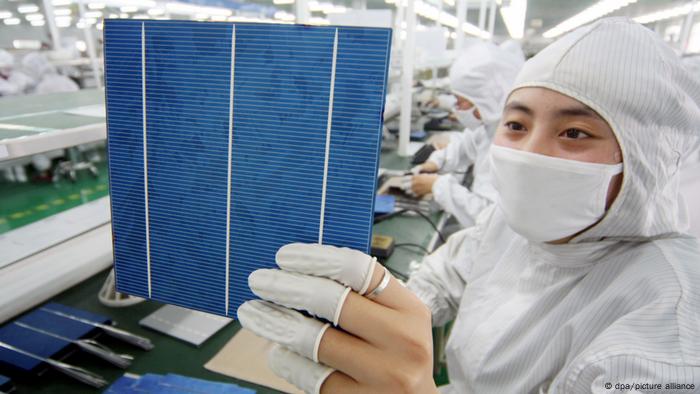
Important for the energy transition: Solar cells from China
Pressure from the Green Party
Nevertheless, within Germany’s new center-left coalition government of Social Democrats (SPD), neoliberal Free Democrats (FDP), and environmentalist Greens, the latter in particular are putting pressure on companies to rethink their ties with China.
At the beginning of September, Foreign Minister Annalena Baerbock told business leaders: “We can’t afford to just hope that things won’t be so bad after all with these autocratic regimes.” The Green Party politician, who stands for “a values-based and feminist foreign policy,” announced the development of a new China strategy as part of a new National Security Strategy. “It is important to the German government and to me personally that we transfer what we have learned from our dependence on Russia to our new China strategy,” she says.
The Economy Ministry is considering ways to encourage companies to turn to other Asian countries, instead of China. Government investment and export guarantees are being reappraised. The government-owned KfW Bank is to examine whether it could scale back its China program and instead offer more loans for business in countries including Indonesia.
Last year, the Federation of German Industries (BDI) was already debating rules for foreign trade policy cooperation with autocracies. It suggested a “concept of responsible coexistence in foreign economic policy and clear boundaries for any cooperation.”
For many managers, however, the change of course in the Economy Ministry goes too far.
“Government support and protection of German companies’ business in China must remain, in principle,” Friedolin Strack, chief executive of the Asia-Pacific Committee of German Business (APA), told the news agency Reuters.
Chinese investments should be welcome in Germany and Europe, he insisted. Whether this should also apply to the specific case of COSCO’s entry into the Hamburg Port, however, Strack did not want to say.
A man who orchestrated a savage assault on four women who were eating at a Chinese restaurant has been given a 24-year prison term.
In June, in the northeastern city of Tangshan, Chen Jizhi was convicted of the attack that started when one of the ladies rejected his advances.
Another 27 men were convicted over the violence, in which they used bottles, chairs, and fists to beat the women.
The surveillance video went viral, sparking debate about gender violence in China.
After the attack, two of the women spent time in intensive care, while the other two women were seen in photos covered in blood, although their injuries were initially classed by police as only “minor”.
A report released soon after the assault found the handling of the case by the local deputy director of district police and other officers had been “slow and improper”.
Chinese authorities censored online debate about attacks on women, and tried to paint the assault as a gang crime, correspondents say.
The viciousness of the attack sparked outrage and heated debate on social media, taking up one of the most-discussed topics on Weibo, a popular social media platform in China.
After a 17-day search following an earthquake in southwest China, a man was found alive in the mountains.
On September5, a 6.6-magnitude earthquake that struck Sichuan province killed 93 people and injured over 400 others.
Gan Yu stayed behind to help others at the hydropower plant where he was on duty, but then struggled to escape through the rough terrain as he had lost his glasses, local media reported.
He was found alive but injured by a local villager on Wednesday.
Mr Gan and his colleague Luo Yong stayed behind at the Wandong hydropower plant on 5 September to give first aid to injured colleagues and to help prevent flooding by releasing water from a dam.
They then attempted to leave, walking for about 20km (12 miles) in the mountains aroundthe plant.
But Mr Gan, who is severely short-sighted and had lost his glasses in the quake, struggled to navigate the terrain, state-owned China National Radio (CNR) reported.
Rescuers were searching the area for survivors, and the two men tried unsuccessfully to signal for help.
“We took our clothes off, strung them on tree branches, and waved them around,” Mr Luo told CNR.
Eventually, Mr Luo went to look for help, leaving Mr Gan with a makeshift bed of moss and bamboo leaves and some wild fruit and bamboo shoots to eat.
Mr Luo was found on 8 September after using fire to attract the rescuers’ attention. But by the time his former companion’s shelter was found three days later, Mr Gan was no longer there.
Rescuers discovered only discarded clothing and believed he may have died of hypothermia.
This week a farmer who lives near the plant joined the search, using his local knowledge. After a few hours, he heard Mr Gan’s cries and found him under trees.
Rescuers later reached the scene and flew Mr Gan to a hospital, where he was treated for broken bones.
The former justice minister of ChinaFu Zhenghua, who led multiple anti-corruption campaigns, has been imprisoned for bribery.
In July, Fu pleaded guilty to collecting 117 million yuan ($14.7 million; $16.5 million) in gifts and cash.
Chinese media reported he’d received a suspended death sentence to be commuted to a life sentence in two years.
His conviction comes amid a sudden crackdown on officials ahead of a key Communist Party congress next month.
China’s ruling party holds the event once every five years and this time President Xi Jinping is expected to be given a historic third term and consolidate his hold on power.
Fu’s jailing follows the sentencing of three former police chiefs this week. All four men are not only accused of corruption but also of being disloyal to Mr Xi.
They are all alleged to have been part of a corrupt political circle led by another ex-security figurehead, Sun Lijun, who is currently awaiting his sentence.
Fu was China’s justice minister from 2018 to 2020, after a career where he worked his way up from being a policeman to the deputy head of China’s Ministry of Public Security.
He led several high-profile investigations into corrupt politicians – including a probe that broughtdown Zhou Yongkang, one of the most powerful officials in recent years to be convicted of bribery.
In October last year, the party’s internal watchdog announced it was investigating Fu for “serious violations of discipline and national laws”.
He was dismissed from public office and then in March this year expelled from the Community Party. He was arrested a month later on corruption charges.
Prosecutors said he took advantage of his authority to seek gains for others and himself on business contracts, official positions, and even legal cases.
A Chinese couple who abandoned their daughter when she was only a toddler, suddenly reappeared in her life decades later when they learned she was well off, to ask her for a home for her brother.
Zhang was only 2 years old when her parents decided they couldn’t raise her anymore and placed her in the care of her brother’s sister. They had little to no other interaction with her ever since, and the now 29-year-old woman always considered her aunt’s family her biological one. It was for this reason that she recently used part of her savings to help her cousin, who she considers her brother, buy an apartment. However, she never anticipated that her generosity would suddenly make her biological parents come knocking, asking her to buy an apartment for her biological brother as well.
The Shandong Business Daily reported that Zhang’s biological parents, who also live in Guangzhou, demanded that she take care of their son, whom they had kept, despite their financial difficulties. When the young woman refused, they filed a lawsuit with a local court asking for 500,000 yuan ($72,000) in “parental maintenance.”
The Chinese court recently issued a controversial verdict that sparked outrage on Chinese social media. It ruled that, while Zhang had no obligation to gift property to her adult biological brother or otherwise help him financially, she was legally required to support her parents.
Filial piety is a big deal in China, and the law clearly states that all adult children have a legal obligation to offer support to their biological parents, regardless of whether they fulfilled their duties as parents. Basically, if they gave you life, you need to support them when you grow up if their income does not cover the needs of daily life. In this particular case, the court ruled that Zhang needed to negotiate with her biological parents and settle on an amount to pay as maintenance.
The verdict sparked outrage online, with the vast majority of comments being critical to Zhang’s parents.
“Are they vampires? The father sucked up the blood of his sister, and now he and his wife want to drain the blood from their daughter,” one person wrote.
“It’s so lucky that Zhang didn’t grow up in her family of origin. Horrible!” someone else commented.
Anger and criticism over China’s unrelenting zero-Covid policy has erupted after a bus transporting resident to a coronavirus quarantine facility crashed on Sunday, killing 27 people.
According to authorities, the bus was carrying 47 people from Guiyang, the capital of Guizhou province, to a remote county 155 miles (249 kilometers) away, when it overturned on a mountainous stretch of highway and rolled into a ditch at around 2:40 a.m.
It is unclear why a quarantine bus would take people on winding mountain roads after midnight. China’s transport regulation prohibits long-distance coaches from operating between 2 a.m. and 5 a.m.
A photo widely circulated on social media shows the bus driving at night, with the driver wearing a full hazmat suit that left only his eyes uncovered. Other photos and videos show the bus being towed by a truck, its top crushed, and a hazmat suited worker spraying disinfectant on it. While CNN cannot independently verify the photos and videos, the bus license plate in the images matches the plate number reported by authorities.
Survivors of the crash are now receiving treatment in hospital, according to authorities.
News about the deaths sparked a huge outcry on Chinese social media, with many questioning the increasingly over-the-top implementation of China’s zero-Covid policy, which relies on snap lockdowns, mass testing and extensive quarantining measures to curb outbreaks.
Stringent and prolonged lockdowns have recently sparked outcries in cities ranging from Guiyang, Chengdu to Jinan, as well as the regions of Xinjiang and Tibet.
“What makes you think that you won’t be on that late-night bus one day?” read a viral comment, which garnered more than 250,000 likes before it was censored.
“We’re all on the bus. We just haven’t crashed yet,” another comment said.
Chinese censors rushed to cover the outrage. Many state media postings about the accident have closed the comment section, and search results appeared to be filtered. A related hashtag attracted more than 450 million views as of Sunday evening, but only posts from official government and media accounts were shown.
A Guizhou resident who said her friend was killed on the bus took to Weibo to demand the Guiyang government to be held accountable. Her posts were widely shared, drawing an outpouring of anger and sympathy. The user declined CNN’s interview requests and later hid her posts.
Guizhou officials are under huge pressure to contain even small-scale Covid outbreaks in the lead up to the 20th Party Congress, where Chinese leader Xi Jinping is expected to secure a norm-breaking third term in power.
Guizhou reported 712 infections for Saturday, accounting for 70% of new cases nationwide. Nine local officials in Guiyang have already been suspended this month for failing to implement Covid policies properly.
On Saturday, Guiyang officials vowed to “fight a decisive battle” to eliminate community transmission. In zero-Covid China, a solution commonly used by local authorities is to bus entire buildings or communities of residents out of the city to quarantine elsewhere.
In Guiyang, which was placed under a lockdown earlier this month, authorities prepared 20 buses and 40 drivers to transport close contacts of Covid cases to other cities, the state-run Guiyang Evening Paper reported. As of Saturday, more than 7,000 people had been transferred, and nearly 3,000 were waiting to be bused out.
According to government data, only two people have died of Covid in Guizhou, a province of 38 million people, since the beginning of the pandemic.
A bus transporting residents to a COVID-19 quarantine facility in China has been involved in a fatal accident.
Twenty-seven individuals have lost their lives as a result, with 20 others sustaining injury.
The incident occurred when a coach overturned on a motorway in the south-western province of Guizhou.
The accident sparked anger online from those critical of Beijing’s “zero-COVID” policy.
The strict policy involves mass testing and tracking. Those who test positive and their close contacts have to isolate at home or in a quarantine facility.
Just a handful of cases can spark a city-wide lockdown.
There is no word on the cause of the crash which occurred early on Sunday morning.
According to Chinese regulations, passenger buses are not allowed to drive on the highway between the hours of 02:00 and 05:00. However, the accident occurred at 02:40 local time Sunday (18:40 GMT Saturday) after the bus departed shortly after midnight, indicating the bus had violated regulation.
A woman who claimed she was the daughter of one of the victims took to social media, where she wrote a note saying she could “not accept” her mother’s death.
“My mom stayed at home for half a month. She didn’t go anywhere apart from going out for PCR tests… but she suddenly got taken to quarantine and died.”
Online, some described their own unpleasant experiences of being bussed to quarantine facilities.
One said that dozens of passengers were squeezed into one bus for 12 hours at a stretch without being allowed to eat, go to the bathroom, open the windows or turn on the air-conditioning until their arrival at the quarantine hotel.
Another comment asked, “When will all of this stop?”
While the rest of the world is trying to live with COVID, China is the only major economy still prioritising the fight against the virus above almost everything else.
Only two people have died from COVID in Guizhou province since the pandemic struck almost three years ago.
Guizhou is currently experiencing a spike in infections. The province recorded 712 new cases on Saturday – about 70% of the total for China.
The incident comes in the run-up to the Communist Party’s five-yearly congress in October, with discussion around the country’s COVID policy expected to be on the agenda.
In the capital Beijing, more than 21 million residents are required to queue for PCR tests every three days to access public buildings and even corner shops.
The United States has traditionally adhered to a strategy of “strategic ambiguity” and has not been explicit about how it would react to an attack in terms of military force.
In his clearest remarks to date on the subject, US President Joe Biden stated US military would defend Taiwan in the case of a Chinese invasion.
Asked in a TV interview whether America would defend the self-ruled island, claimed by China, he replied bluntly: “Yes, if in fact, there was an unprecedented attack.”
The US has long stuck to a policy of “strategic ambiguity” and has not made clear whether it would respond
militarily, to an attack.
Asked to clarify if he meant that, unlike in Ukraine, US forces would defend Taiwan from Chinese invasion, Mr Biden again replied: “Yes.”
The CBS 60 Minutes interview showed a president appearing to go beyond long-standing US policy onTaiwan, which states a commitment to a One-China policy, in which Washington officially recognises Beijing and not Taipei.
Biden’s remarks are sure to anger Beijing, which was enraged by a visit to Taiwan by US House speaker Nancy Pelosi back in August.
That visit prompted China to conduct its largest-ever military exercises around Taiwan.
Chinese President Xi Jinping has vowed to bring democratically-governed Taiwan under Beijing’s control and has
not ruled out the use of force.
Asked last October if the United States would come to the defence of Taiwan, the president said: “Yes, we have a commitment to do that,” but a White House spokesperson said he was not, in fact, announcing any change in US policy – and some experts denounced the comment as a “gaffe”.
Wu Zunyou, the head of the Chinese Center for Disease Control and Prevention’s (CDC) epidemiology department, issued a warning against “skin-to-skin contact with foreigners” in a post on Weibo.
The message sparked debate, with some calling it racist.
Comments on the original post have since been disabled from the platform.
“In order to prevent possible monkeypox infection and as part of our healthy lifestyle, it is recommended that 1) you do not have direct skin-to-skin contact with foreigners,” said Mr Wu on his Weibo page on Saturday.
In addition, Mr Wu also called for locals to avoid skin-to-skin contact with recent travelers who had returned from abroad in the last three weeks, and with strangers.
He posted the comments a day after the southwestern city of Chongqing reported its first case of monkeypox in an individual who arrived from abroad. It is not clear if the individual was a Chinese citizen or a foreigner.
“This is very inappropriate [to say]. At the start of the pandemic, some foreigners stood up and [defended us] by saying that Chinese people are not viruses,” wrote one commenter.
“How racist is this? What about the ones like me who have been living in China for almost ten years? We haven’t seen our families in like 3-4 years due to borders being closed,” wrote another user on Weibo, who appeared to be a foreigner.
China has imposed some of the world’s toughest Covid measures since the start of the pandemic, which have included snap lockdowns, border closures, mandatory testing, and travel restrictions.
The monkeypox virus, which is transmitted through close contact with infected people, animals, or contaminated materials, usually causes symptoms such as fever, headache, and rashes.
Around 90 countries where monkeypox is not considered endemic have reported outbreaks of the viral disease, which the World Health Organization has declared a global health emergency.
There have been more than 60,000 confirmed cases and some non-endemic countries have reported their first related deaths.
A day after China recorded its first monkeypox infection, locals have been entreated to desist from touching foreigners.
In a post on Weibo, the chief epidemiologist at the Chinese Centre for Disease Control and Prevention (CDC) Wu Zunyou advised against “skin-to-skin contact with foreigners”.
“In order to prevent possible monkeypox infection and as part of our healthy lifestyle, it is recommended that 1) you do not have direct skin-to-skin contact with foreigners,” said Mr Wu on his Weibo page on Saturday.
In addition, Mr Wu also called for locals to avoid skin-to-skin contact with recent travellers who had returned from abroad in the last three weeks, and with strangers.
He posted the comments a day after the southwestern city of Chongqing reported its first case of monkeypox in an individual who arrived from abroad. It is not clear if the individual was a Chinese citizen or a foreigner.
The post from the top Chinese health official has drawn controversy, with some labelling it as racist.
Comments on the original post have since been disabled from the platform.
“This is very inappropriate [to say]. At the start of the pandemic, some foreigners stood up and [defended us] by saying that Chinese people are not viruses,” wrote one commenter.
“How racist is this? What about the ones like me who have been living in China for almost ten years? We haven’t seen our families in like 3-4 years due to borders being closed,” wrote another user on Weibo, who appeared to be a foreigner.
China has imposed some of the world’s toughest COVIDmeasures since the start of the pandemic, which have included snap lockdowns, border closures, mandatory testing and travel restrictions.
The monkeypox virus, which is transmitted through close contact with infected people, animals or contaminated materials, usually causes symptoms such as fever, headache and rashes.
Around 90 countries where monkeypox is not considered endemic have reported outbreaks of the viral disease, which the World Health Organization has declared a global health emergency.
There have been more than 60,000 confirmed cases and some non-endemic countries have reported their first related deaths.
United States President, Joe Biden, has reaffirmed his pledge to defend Taiwan in the event of an attack by China.
When asked whether US troops would defend the island during an CBS interview, Mr Biden said: “Yes, if in fact, there was an unprecedented attack.”
His remarks, however, prompted the White House to clarify that the official US policy – which doesn’t commit to military action on Taiwan – had not changed.
Mr Biden’s comments, his clearest yet in pledging US military intervention, seemingly run counter to Washington’s stance of “strategic ambiguity” – it does not commit to defending Taiwan, but also does not rule out the option.
In Sunday’s interview Mr Biden also reiterated that the US was not encouraging Taiwan independence.
“There’s a One China policy and Taiwan makes their own judgements on their independence. We are not moving, not encouraging their being independent – that’s their decision,” he said.
Taiwan responded to Mr Biden’s remarks on Monday by welcoming the “US government’s rock-solid security commitment to Taiwan”. Taipei said it would continue to deepen its “close security partnership” with Washington.
However, Beijing said it “deplores and firmly opposes” Mr Biden’s pledge of action.
The foreign ministry said it had lodged “stern representations” with Washington over the remarks, broadcast in a CBS 60 Minutes interview on Sunday.
Taiwan is a self-ruled island off the coast of eastern China that Beijing claims as part of its territory.
Washington has always walked a diplomatic tightrope over the issue.
On the one hand it adheres to the One China policy, a cornerstone of its relationship with Beijing. Under this policy, the US acknowledges that there is only one Chinese government, and has formal ties with Beijing rather than Taiwan.
But it also maintains close relations with Taiwan and sells arms to it under the Taiwan Relations Act, which states that the US must provide the island with the means to defend itself.
Only earlier this month, the US agreed to sell $1.1bn (£955m) in weaponry and missile defence to Taiwan, provoking anger from China.
This is the third time since October last year that President Biden has gone further than the official stance.
In May, speaking in Japan on his first tour of Asia as president, he said “Yes” when asked if the US would defend Taiwan.
The White House had quickly issued a follow up saying there was no departure from long-standing US policy.
This time too the White House issued a statement, downplaying the president’s comments: “The President has said this before, including in Tokyo earlier this year. He also made clear then that our Taiwan policy hasn’t changed. That remains true.”
Beijing has previously condemned such comments from Mr Biden promising US military action.
“Taiwan is an inalienable part of China’s territory… The Taiwan question is purely China’s internal affair that brooks no foreign interference,” a foreign ministry spokesman had said in May in response to Mr Biden’s remarks in Japan.
Tensions between US and China – especially over Taiwan – have ramped up after US House Speaker Nancy Pelosi made a controversial visit to the island in August – a trip Mr Biden had said was “not a good idea”.
Beijing responded with a five-day military blockade around Taiwan. The US claims China shot missiles over the island, but Beijing did not confirm this. Taiwan said the missiles China fired flew high into the atmosphere and posed no threat.
Elsewhere in the pre-recorded interview, Mr Biden also warned Russia not to use chemical or tactical nuclear weapons in the war in Ukraine.
On Friday, a large fire broke out in a 42-story skyscraper in the Hunan province city of Changsha in central China.
The fire was out and there were no confirmed casualties as of 4:20 p.m. local time (4:20 a.m. ET), according to Chinese state television CCTV.
A fire that started in the China Telecom Building in the city’s Furong District was reported to the Hunan fire department at around 3:48 p.m. local time, according to a statement on its official Weibo account.
Changsha Fire and Rescue dispatched 36 fire engines and 280 firefighters to the scene, the statement said.
After a preliminary investigation, it found the outer wall of the building was on fire, it said.
Social media videos circulating Friday showed flames engulfing the skyscraper, which, according to the fire department, is 218 meters (715 feet) tall.
It has been reported that a Chinese government delegation has been banned from attending the lying-in-state of Queen Elizabeth II.
House of Commons Speaker Sir Lindsay Hoyle refused a request for access to Westminster Hall due to Chinese sanctions against five MPs and two peers, Politico first reported.
Last year, Chinaimposed travel bans and asset freezes on nine Britons – including seven parliamentarians – for accusing Beijing of mistreating Uighur Muslims.
That led to China’s ambassador to the UK being banned from Parliament – a move which has now been extended to a delegation that wanted to pay their respects at Queen Elizabeth’s lying-in-state.
UK-China relations are already strained and this ban is unlikely to help.
However, China’s vice-president is expected to attend Monday’s state funeral which will be held across the road from Parliament at Westminster Abbey.
According to the parliamentary rule book Erskine May, in 1965 Queen Elizabeth II consented that control of Westminster Hall would be shared between the Lord Great Chamberlain – who is appointed by the monarch – and the speakers of both the Commons and the Lords.
There is no specific mention regarding control of access for an occasion such as a lying-in-state, but when it comes to “invitations to foreign dignitaries to address both Houses in Westminster Hall” these are “ordinarily” issued by the agreement of all three.
Last September, Sir Lindsay and Lord’s Speaker Lord McFall told China’s ambassador to the UK he could not come to Parliament because of Beijing’s sanctions.
At the time that ban was criticised by the Chinese government as “despicable and cowardly”.
On Thursday, the group of seven MPs and peers, including former Tory ministers Iain Duncan Smith and Tim Loughton, urged the Foreign Secretary to withdraw an invitation to President Xi of China to attend the Queen’s funeral.
They said it would be “wholly inappropriate” for the Chinese government to be represented, given its human rights record.
Mr Laughton told BBC News: “You cannot have a Golden Age, normal relations, with a country that has now been exposed as committing the sorts of atrocities it has, not least the genocide against the Uighurs, the oppression going on in Tibet for the last 60/70 years, and now what we see going on in Hong Kong as well.”
Several Western countries have imposed sanctions on officials in China following rights abuse allegations against the mostly Muslim Uighur minority group.
China has detained Uighurs at camps in the north-west region of Xinjiang, where allegations of torture, forced labour and sexual abuse have emerged.
It has denied the allegations of abuse, claiming the camps are “re-education” facilities used to combat terrorism.
China’s President Xi Jinping is on the guest list for the state funeral but is not thought likely to attend.
British officials expect the country will instead be represented by Vice President Wang Qishan.
A Downing Street spokesman said it was a convention that countries with which the UK has diplomatic relations should be invited to state funerals.
Queen Elizabeth is set to lie in state there until her funeral on Monday.
Tech companies in the United States of America (USA) that receive funding from the state will be barred from building “advanced technology” facilities in China for 10 years.
US Commerce Secretary Gina Raimondo made this known when she revealed a $50bn (£43bn) plan aimed at building up the local semiconductor industry.
“We’re going to be implementing the guardrails to ensure those who receive CHIPS funds cannot compromise national security… they’re not allowed to use this money to invest in China, they can’t develop leading-edge technologies in China…. for a period of ten years,” Gina Raimondo while explaining the US Chips and Science Act.
She added that “companies who receive the money can only expand their mature node factories in China to serve the Chinese market.”
This comes at a time when business groups have pushed for more government support in an effort to reduce reliance on China.
They are faced with a global microchip shortage which has slowed production.
The US and China are locked in a long-running dispute over trade and technology.
In August, US President Joe Biden had signed a law committing $280bn (£232bn) to high tech manufacturing and scientific research, amid fears that the US is losing its technological edge to China.
The investments include tax breaks for companies that build computer chip manufacturing plants in the US.
The US currently produces roughly 10% of the global supply of semiconductors, which are key to everything from cars to mobile phones, down from nearly 40% in 1990.
The Chinese Embassy in Washington had opposed the semiconductor bill, calling it reminiscent of a “Cold War mentality.”
Some US chipmakers are already experiencing the impact of Washington’s crackdown on selling US technology to China. Earlier this month, Nvidia and AMD were told by US officials to stop the sale of artificial intelligence chips to China.
Dan Ives of Wedbush Securities called the restrictions a “gut punch” for Nvidia.
“This is really a shot across the bow at China and it’s really going to fan those flames in terms of geopolitical (tensions),” Mr Ives had told the BBC.
Following the Biden administration‘s approval of more than $1.1 billion in arms sales to Taiwan, China has warned the United States that it will take “countermeasures.”
China is “firmly opposed” to the sales, which “seriously imperil China-US ties and peace and stability across the Taiwan Strait,” according to Liu Pengyu, spokesman for the Chinese embassy, who also urged Washington to “immediately rescind” them.
Liu’s comments on Twitter came after the Biden administration on Friday formally notified Congress of the proposed sales, which include up to 60 anti-ship missiles and up to 100 air-to-air missiles.
The State Department said the sales are in line with a longstanding US policy of providing defensive weapons to the island and described the “swift provision” of such arms as being “essential for Taiwan’s security.”
China, however, has accused the US of interfering in what it sees as its internal affairs.
China’s Communist Party claims Taiwan, a self-governing democracy, as part of its territory — despite never having governed it — and has long vowed to “reunify” the island with the Chinese mainland, by force if necessary.
“The US interferes in China’s internal affairs and undermines China’s sovereignty and security interests by selling arms to Taiwan,” Liu tweeted.
“It sends the wrong signals to ‘Taiwan independence’ separatist forces and severely jeopardizes China-US relations and peace and stability across the Taiwan Strait,” Liu said.
He called on the US to “honor its commitments to the one-China principle” and ended his series of tweets by saying Taiwan is “an inalienable part of the Chinese territory” and warned China will “resolutely take legitimate and necessary counter-measures.”
US-China tensions have spiked since House Speaker Nancy Pelosi visited Taiwan last month.
Taiwan said Saturday it “highly welcomes” the latest arms sales and thanked the US government for “continuing to implement its security commitments to Taiwan.”
“In response to China’s recent continuous military provocations and unilateral changes in the status quo and creating crises, Taiwan’s determination to defend itself is extremely firm,” Taiwan’s Ministry of Foreign Affairs said in a statement Saturday.
“This batch of arms sales includes a large number of various types of missiles that are needed to strengthen Taiwan’s self-defense, which fully demonstrates that the great importance the US government attaches to Taiwan’s defense needs, assisting our country to obtain the equipment needed for defense in a timely manner and to enhance our national defense capabilities.”
In an incident that underscored the heightened tensions, Taiwan’s military shot down a drone hovering over one of its island outposts just off the Chinese coast on Thursday.
A day earlier, Taiwan said it had warned off drones hovering over three of the islands it occupies off the coast of the Chinese port city of Xiamen.
The planned agreement comprises an anti-ship and anti-air missile tracking radar system.
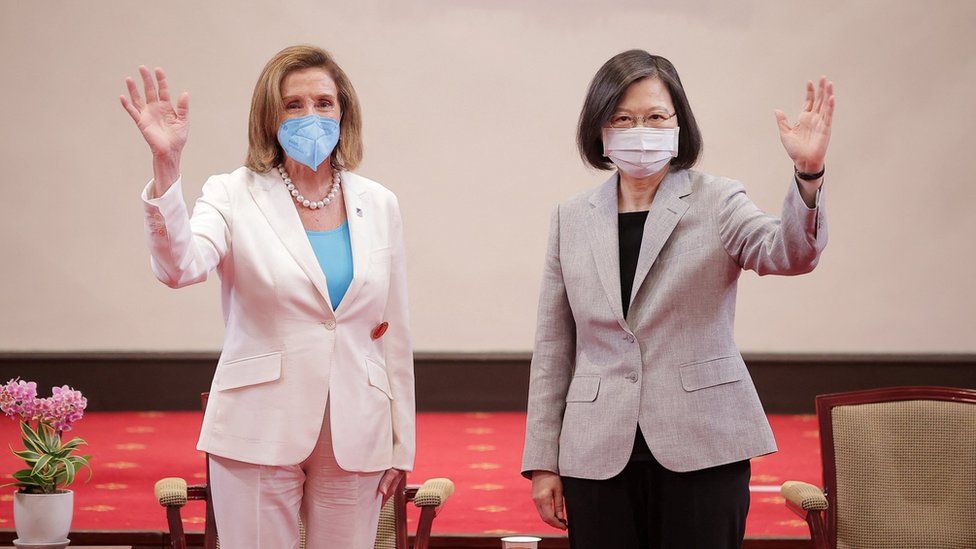
It follows the speaker of the US House of Representatives,  Nancy Pelosi, who visited Taipei last month as the highest-ranking US official to do so in the previous 25 years.
The Chinese embassy in Washington called on the US to revoke the deal or face “counter-measures”.
Spokesman Liu Pengyu said the deal “severely jeopardises” relations between Washington and Beijing.
“China will resolutely take legitimate and necessary counter-measures in light of the development of the situation,” he added.
Beijing sees the self-ruled island as a part of its territory and insists it should be unified with the mainland, by force if necessary.
The US arms sale agreed on Friday still needs to be voted on by the strongly pro-Taiwan US Congress.
The package includes a $655m radar warning system and $355m for 60 Harpoon missiles, which are capable of sinking ships.
It includes $85.6m for Sidewinder surface-to-air and air-to-air missiles, according to the Pentagon’s Defense Security Cooperation Agency.
A spokesperson for the Department of State said the deal was “essential for Taiwan’s security”, and called on Beijing “to cease its military, diplomatic and economic pressure against Taiwan and instead engage in meaningful dialogue”.
“These proposed sales are routine cases to support Taiwan’s continuing efforts to modernize its armed forces and to maintain a credible defensive capability,” the spokesperson said.
The Pentagon last month created a task force to help streamline the sale of American weaponry to foreign allies, the Wall Street Journal reported on Friday.
US lawmakers say that orders placed by Taiwan years ago have gone unfulfilled. Among the backlog are Harpoon and Stinger missiles, which have been sent to Ukraine instead, according to Defense News.
Photos of empty supermarket shelves and Chengdu residents scrambling to hoard groceries went viral on social media with the order given only six hours before taking effect.
China is the last large economy wedded to a zero-COVID policy, stamping out virus flare-ups with snap shutdowns, mass testing, and lengthy quarantines.
Chengdu, in the southwest, became the latest city to announce a shutdown, saying in an official notice residents must “stay home in principle†from 6pm (10:00 GMT) on Thursday to combat a new wave of infections.
Each household will be allowed to send one person out to buy groceries and essential goods per day, provided they have tested negative in the previous 24 hours, it said.
All residents will be tested for the virus by Sunday, and it urged them not to leave the city unless “absolutely necessaryâ€.
“The current state of epidemic control is abnormal, complex and grim,†the announcement said, adding the measures aimed to “decisively arrest the spread of the outbreak and guarantee the health of all citizensâ€.
Chengdu recorded 157 new local infections on Thursday, of which 51 displayed no symptoms, the city government said in a separate notice.
Children in at least 10 cities and provinces across China face disruptions to their new academic year as pandemic controls force schools to switch to online learning, according to a report in state-affiliated media.
Xining, the capital of western Qinghai province and home to 2.5 million people, rolled out a mass-testing drive and told residents in its main urban area to work from home for three days.
China has stuck to its zero-tolerance virus strategy despite concern the approach is stifling its economy.
Last month, travellers in the southern island province of Hainan protested after more than 80,000 tourists were stranded in a resort city because of a COVID-19 flare-up
Following an epidemic of COVID-19 cases, officials in Chengdu, a city in southwest China, have announced a lockdown of its 21.2 million citizens and four days of citywide testing.
Residents of Chengdu must “remain home in principle” starting at 6 p.m. Thursday, according to a statement from city officials, non-essential workers are being requested to work from home to help fight a fresh wave of diseases. If a household can present a negative test result within the last 24 hours, they will be permitted to send one person each day to go shopping for essentials.
The statement went on to say all residents would be tested for the infection between Thursday and Sunday. They were urged to not leave the city unless “absolutely necessary.”
It was not clear how long the lockdown would last. The Reuters news agency reported most of the restrictions were intended to last a few days at this point, although two provincial cities in northern China extended curbs slightly beyond initial plans.
Similar measures have seen millions of people confined to their homes in the northeastern city of Dalian, as well as Shijiazhuang, the capital of Hebei province that borders the capital city, Beijing.
State media report the economic center of Shenzhen, the most populous district in Baoan, and tech hub Nanshan, suspended large events and indoor entertainment for a few days and ordered stricter checks of digital health credentials for people entering residential compounds.
China’s state media reported Wednesday the restrictions will affect the start of the new school year in at least 10 cities as pandemic controls force schools to switch to measures like online learning.
China’s state-run news outlet China Daily reports, citing Chengdu’s Health Commission, that as of Wednesday there were 665 confirmed cases and 293 asymptomatic carriers under treatment or medical observation.
A little after noon on Thursday, a drone was seen flying over the waters near Lion Islet, a small island in the Kinmen County grouping that is governed by Taiwan and is located about 4 kilometers (2.5 miles) from the coast of Xiamen, China.
The Kinmen Defense Command, a branch of Taiwan’s Ministry of National Defense, said the drone was shot down after warning flares failed to drive it away.
This is the latest in a string of similar incidents to have taken place near the offshore group of islands.
On Tuesday, Taiwanese soldiers fired flares at three unidentified drones that flew near Kinmen and warning shots at one that re-entered the area.
It is not clear who is flying the drones, though China’s Ministry of Foreign Affairs said on Thursday it was “not aware of the situation” and that it was “pointless for (Taiwan) to exaggerate the tension.”
After Tuesday’s incident, Taiwan’s President Tsai Ing-wen said she had ordered the Defense Ministry to take “forceful countermeasures” against what she said were Chinese grey zone warfare tactics.
On Wednesday, Taiwan’s Ministry of National Defense reinforced that message at an international press conference called in response to Chinese military exercises in August, saying it will “act in accordance with operational orders to exercise our rights of self-defense.”
Tensions between Taiwan and mainland China have been raised since a visit by US Speaker Nancy Pelosi to Taipei in August. China’s Communist Party claims Taiwan, a self-governing democracy, as part of its territory despite never having governed it and has long vowed to “reunify” the island with the Chinese mainland, by force if necessary.
China responded to Pelosi’s trip by ordering days worth of military drills around Taiwan.
On Monday, asked about reports of private drones flying in the Kinmen area, a spokesperson for China’s Ministry of Foreign Affairs responded: “Chinese drones flying over China’s territory — what’s there to be surprised at?”
In a long-awaited assessment examining charges of abuse in the province of Xinjiang, the UN has charged China with “serious human rights abuses.”
China has pleaded with the UN to withhold the report, referring to it as a “farce” orchestrated by Western powers.
According to the report, China disputes allegations of abuse against Uyghur Muslims and other ethnic minorities.
But investigators said they found “credible evidence” of torture possibly amounting to “crimes against humanity”.
The report was released on Michelle Bachelet’s final day on the job after four years as the UN’s high commissioner for human rights. Her term has been dominated by accusations of abuse against the Uyghurs.
Her team’s report accused China of using vague national security laws to clamp down on the rights of minorities and establishing “systems of arbitrary detention”.
It said prisoners had been subjected to “patterns of ill-treatment” which included “incidents of sexual and gender-based violence”.
Others, they said, faced forced medical treatment and “discriminatory enforcement of family planning and birth control policies”.
The UN recommended that China immediately takes steps to release “all individuals arbitrarily deprived of their liberty” and suggested that some of Beijing’s actions could amount to the “commission of international crimes, including crimes against humanity”.
While the UN said it could not be sure how many people have been held by the government, human rights groups estimate that more than a million people have been detained at camps in the Xinjiang region, in north-west China.
“Despite the Chinese government’s strenuous denials, the UN has now officially recognized that horrific crimes are occurring,” Uyghur Human Rights Project Executive Director Omer Kanat said.
The long-standing accusations have prompted protests around the world, including this one in Jakarta in January
There are about 12 million Uyghurs, mostly Muslim, living in Xinjiang. The UN said non-Muslim members may have also been affected by the issues in the report.
The US and lawmakers in several other countries have previously denounced China’s actions in Xinjiang as a genocide, but the UN stopped short of making the accusation.
Beijing – which saw the report in advance – denies allegations of abuse and argued that the camps are a tool to fight terrorism.
China has always insisted that Uyghur militants are waging a violent campaign for an independent state, but it is accused of exaggerating the threat in order to justify the repression of the Uyghurs.
Its delegation to the UN human rights council in Geneva on Thursday rejected the findings of the report, which it said “smeared and slandered China” and interfered in the country’s internal affairs.
“This so-called ‘assessment’ is a politicised document that ignores the facts, and fully exposes the intention of the US, Western countries and anti-China forces to use human rights as a political tool,” it said in a lengthy statement.
The ball is now in the global community’s court. Already, Uyghur rights activists are calling for a commission of inquiry to be set up, and asking businesses around the world to cut all ties with anyone abetting the Chinese government in its handling of the Uyghurs.
Whether increased international pressure will result in concrete change is debatable. Beijing has doubled down on its stance, denying that atrocities have taken place and insisting it is a victim of a Western-led smear campaign. It says Xinjiang is now socially stable and economically developed and has even called it “the greatest human rights achievement”.
The UN report is no doubt embarrassing, further chipping away at China’s insistence that it is a responsible member of the international community.
But this investigation is just the latest in a long series of damning reports that Beijing has summarily dismissed.
Domestic pressure is also unlikely. The issue of Uyghur human rights abuses has never been a top concern for many in China, mostly because it has long been a taboo topic and heavily censored – as of Thursday afternoon, the UN report had yet to be mentioned in Chinese mainstream media or social media platforms.
The fate of the Uyghurs depends on when the Chinese government decides it has fully vanquished what it sees as the threat of terrorism and radicalism in the community.
It is anyone’s guess when it will reach that conclusion – if ever.
But publication was delayed several times, leading to accusations by some Western human rights groups that Beijing was urging her to bury damaging findings in the report.
Last week she admitted that she was under “tremendous pressure to publish or not to publish” the report. But she defended the delay, arguing that seeking dialogue with Beijing over the report did not mean she was “turning a blind eye” to its contents.
Amnesty International condemned “the inexcusable delay” in publishing the findings.
Tom Tugendhat, chair of the UK’s foreign affairs select committee, said the findings of the report represented an “extremely serious charge” and rejected Beijing’s argument that the allegations were stoking anti-Chinese sentiment.
Earlier this year, the BBC obtained leaked files that revealed an organized system of mass rape, sexual abuse, and torture of Uyghur Muslims at a network of camps.
The Xinjiang Police Files were passed to the BBC and revealed targeting of the community on orders leading all the way up to Chinese leader, Xi Jinping.
China has unveiled 19 new measures to shore up its economy and “secure drinking water” supply as the country continues to struggle with its worst heatwave in 60 years and rigid Covld lockdowns.
The new measures announced by China’s cabinet on Wednesday amount to more than 1 trillion yuan ($146 billion) in funding to improve infrastructure, ease power shortages, and tackle drought, including money to secure rice production.
“The current economic recovery has a weak foundation,” the statement said, adding that the new funding was aimed at stabilizing the economy. Premier Li Keqiang hosted the cabinet meeting.
Beijing has tried to boost investment and consumption in the world’s second largest economy more than once this year. In May, the government announced 33 measures to revive growth.
Despite these interventions, the Chinese economy has deteriorated in recent months because of Covid lockdowns and a deepening property downturn. Analysts are also concerned about the impact China’s record-breaking heatwave and drought will have on growth. Already, several international businesses, including Tesla (TSLA) and Toyota (TM), have faced disruption at factories due to power outages.
Several major investment banks, including Goldman Sachs and Nomura, downgraded China’s economic growth forecasts for 2022 to 3% or under, as the heatwave hit industrial heartlands. This is way below 5.5% growth target that the Chinese government had set earlier this year.
With the central bank’s support, state development banks can lend out $44 billion to finance infrastructure projects, the statement said. That’s on top of $161 billion already committed in June.
Local governments will also be permitted to issue $73 billion in debt to fund the building of roads, railways, airports, affordable housing and energy projects. That’s in addition to 3.5 trillion yuan ($511 billion) of bonds they were given permission to issue for the same purposes earlier this year.
China’s No.2 admits economic recovery is at ‘most difficult point’
Li also urged all government departments to “do a better job” in battling the drought and mitigating its impacts. He called for more wells to be drilled, and more drought-resistant water sources to be developed, in addition to seeding clouds, which China resorted to earlier this month to bring more rainfall to the Yangtze River.
“Priority should be given to ensuring people’s drinking water, and to transport and deliver the water when necessary,” Li added.
The central government will also take 10 billion yuan ($1.5 billion) out of its reserve fund for drought relief, focusing on securing rice production during the key mid-season harvest for rice in the southern region.
“[We should] do everything possible to ensure agricultural irrigation water and help farmers fight the drought and protect their autumn crops,” Li said.
The government will support research into measures to promote a “bumper harvest” for late-season rice in the fall, he added.
China turns back to coal as record heatwave causes power shortages
Analysts weren’t optimistic about the impact of the new economic stimulus on the economy.
“These measures could help offset the sharp contraction in government revenue and support infrastructure investment growth to some degree in coming months,” said Goldman Sachs analysts in a note late Wednesday.
But they still expect overall growth to remain sluggish during the rest of this year, “barring major policy easing measures,” as a “very weak” property sector and headwinds from Covid lockdowns will continue to drag on the economy.
Trouble in the property sector — which accounts for as much as 30% of China’s GDP and was already suffering from a prolonged cash crunch — is exerting significant pressure.
The crisis has snowballed since sprawling developer Evergrande defaulted on its debt last year. Property prices have been falling, as have sales of new homes. Angry homebuyers across the country have threatened to stop paying their mortgages on unfinished homes, jolting markets and prompting businesses and authorities to take action to defuse the crisis.
Nomura analysts said the new stimulus measures wouldn’t be a “game changer.”
“The zero Covid policy continues consuming a large amount of local governments’ fiscal resources,” they said, adding that he property sector is “still in deep trouble.”
The Republican governor of the US state of Indiana began a visit to Taiwan Monday. The trip comes on the heels of a high-profile visit from US House Speaker Nancy Pelosi.
Holcomb’s visit comes at a tense moment for Taiwan, China and the US
Eric Holcomb, the Republican governor of the US state of Indiana, began a four-day visit to Taiwan Monday.
Holcomb met with Taiwan’s President Tsai Ing-wen who told him the US and Taiwan are key security and economic allies.
“Taiwan has been confronted by military threats from China, in and around the Taiwan Strait,” Tsai told Holcomb during the meeting at her office in Taipei.
“At this moment, democratic allies must stand together and boost cooperation across all areas,” Tsai added.
The focus of Holcomb’s visit is on economic exchange, particularly in the critical area of semiconductors.
His is the third high-profile visit from US politicians in recent weeks, and like the others, it will likely draw rebukes and condemnation from Beijing.
What is the backdrop to Holcomb’s visit?
Holcomb’s visit comes at a tense moment for Taiwan, China and the US after House Speaker Nancy Pelosi visited Taiwan earlier this month.
Pelosi was the highest-level member of the US government to visit Taiwan, which Beijing views as part of its territory, in 25 years.
Taiwan rejects Beijing’s territorial claims and remains democratic and self-governing.
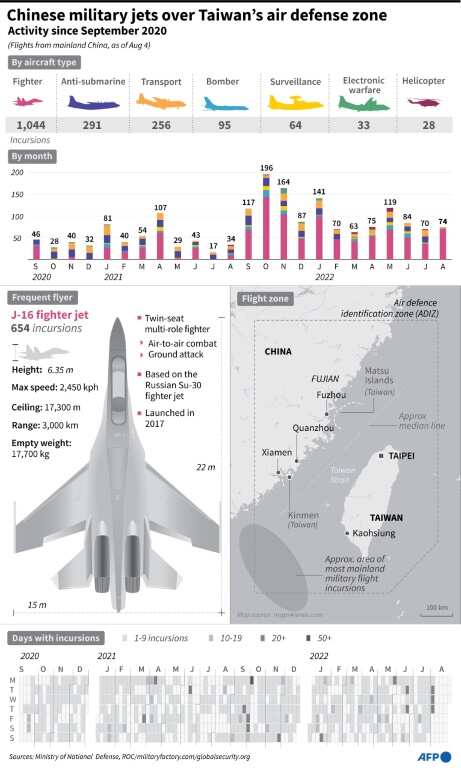
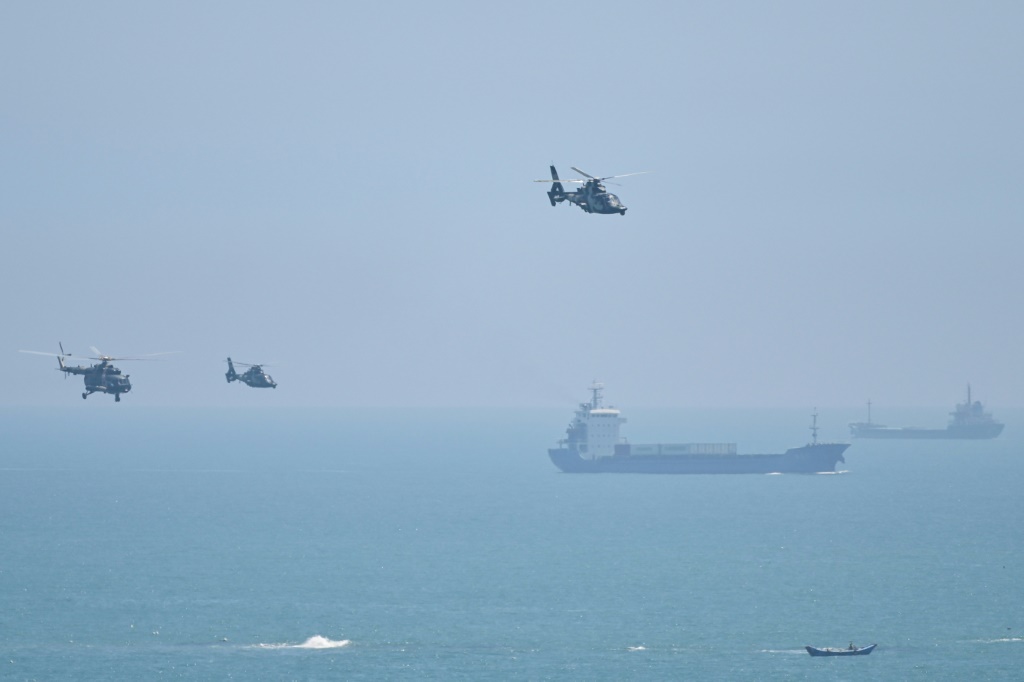
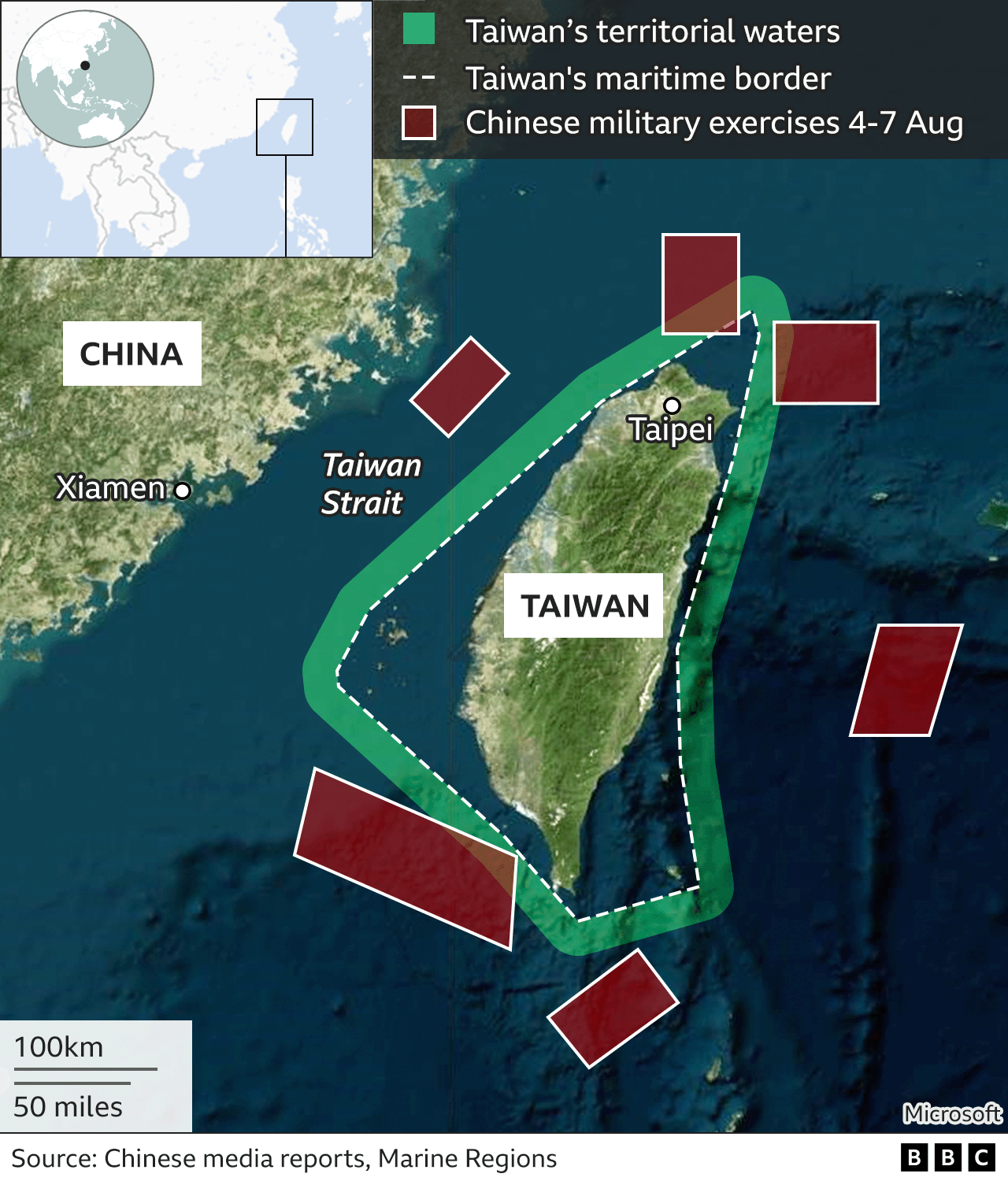
China’s People’s Liberation Army  held several days of snap exercises following Pelosi’s visit, forcing Taipei to reroute and cancel flights. Chinese warplanes were also sent to probe across the Strait of Taiwan.
China also reacted with visa bans and sanctions on Taiwanese figures, though the effects are unclear.
Beijing accuses the US of encouraging the island’s independence through the sale of weapons and engagement between US politicians and the island’s government.
U.S. Air Force Secretary Frank Kendall said on Friday that China‘s actions around Taiwan increase the level of risk and he hoped that China’s behavior returns to the norms that were established before.
China, which claims democratically governed Taiwan as its own territory, has been staging military exercises this month to show its anger about a visit to Taipei of U.S. House Speaker Nancy Pelosi, blaming Washington for the tension.
Kendall, speaking to reporters on a teleconference from the U.S. Pacific territory of Guam as part of a trip to the region that will also take in Australia and Japan, said: “We are living in a dangerous time”.
Referring to China’s drills around Taiwan, which included firing missiles over the island and repeatedly crossing the median line of the Taiwan Strait, normally an unofficial barrier, he said Beijing was being very provocative.
“The military activities that China engaged in during the time of the speaker’s visit increased the level of risk and they violated a number of norms, crossing the line was one, firing into the exclusive economic zone of Japan was another, and firing over Taiwan itself was another,” Kendall said.
Japan said five of the missiles China fired landed in its economic zone.
“These are not actions that are designed to promote peace and stability in the region, they are very provocative and they increase the level of risk,” he said.
While Kendall declined to comment directly on the details of China’s crossing of the median line, he said China had overreacted to Pelosi’s trip.
“I would hope that their behavior returns to the norms that were established before,” he said.
China says Taiwan is the most sensitive and important issue in its ties with the United States, and that it has a right to ensure its security and defend its territorial integrity.
Taiwan’s government says that as the People’s Republic of China has never ruled Taiwan is has no right to claim it or decide its future, which can only be set by the island’s 23 million people.
Chinese President Xi Jinping has been overseeing an impressive military modernization programme, including developing stealth fighters and aircraft carriers, alarming many of its neighbors and the United States.
“I am concerned, I think it’s clear to say the United States is concerned, about China’s modernization programmes, and we’re also concerned about its behavior in the region,” Kendall said.
China is facing a record-breaking heat wave, and the country sounded off its first national drought alert late Thursday as parts of the Yangtze river have run dry.
Several regions are battling severe conditions, including mass power outages carried out by authorities, who have also urged businesses and residents to conserve energy.
These conditions have had a direct effect on the country’s economy. Supplier offices for huge corporations like Toyota and Apple have been ordered shut, as the government has asked most factories to halt production until the end of this week for planned power outages.
The poultry market in the country has been affected as hens are rejecting their feed and producing fewer eggs due to the extreme weather, a report said, citing AFP. As the grip of these extreme weather situations tightens on China, one of the leading economists from the country foreshadows the economy’s crumble, which could last many months.
Dan Wang, the chief economist of Hang Seng Bank, said Thursday that China’s heatwave “is a dire situation,” adding it could probably last for the next “two to three months easily,” CNBC’s Squawk Box Asia reported.
“It will affect those big energy-intensive industries and it will have [a] knock-on effect throughout the economy and even to the global supply chain,” she said. “We already see a slowdown in production in the steel industry, in chemical industry, in fertilizer industry.”
“Those are very important things when it comes to construction, to agriculture and also to manufacturing in general,” Wang added.
She also predicted the losses incurred to China’s GDP growth will surpass that caused by 2021’s power outages.
“Last year, as we have estimated, the power shortage period has caused China about a 0.6% point of GDP growth. This year we think this number will be a lot higher… I would say 1.5% point lower,” Wang said.
Outlining the predicted full scope of losses, Wang said, “Right now, we are giving 4% of GDP growth for the full year. If the current situation continues, then I have to say the growth rate is probably below [3%]”.
According to China’s emergency ministry late Thursday, severe weather conditions have caused direct economic losses amounting to $400 million in July alone.
A Chinese-Canadian billionaire has been sentenced to 13 years in prison in China and his company fined more than $8bn (£6.7bn).
Xiao Jianhua and his company Tomorrow Holdings were charged with embezzlement and bribery, a court in Shanghai said.
Xiao – one of China’s richest people – was last seen being whisked away from a luxury hotel in Hong Kong in 2017.
There had been no official word from him since, until the Canadian embassy said in July he would be facing trial.
The trial was said to have started on 4 July.
Xiao and his firm were found guilty of “illegally absorbing public deposits, breaching trust in the use of entrusted property… [and] illegal use of funds,” a statement from the Shanghai court quoted by AFP said. It also said Tomorrow Holdings was guilty of the “crime of bribery”.
It added that Xiao and his firm had “severely violated the financial management order” and “hurt state financial security”.
The court said Xiao and his company had pleaded guilty and had cooperated with authorities and so their punishment was mitigated.
Asked on Friday about Xiao’s right to access Canadian consular services as a Canadian citizen, China’s foreign ministry said China did not recognise dual citizenship and so Xiao was not entitled to such rights.
Xiao reportedly had close connections to the upper echelons of the ruling Communist Party, including to President Xi Jinping’s family.
By 2016, his net worth had grown to an estimated $6bn (£4.7bn) according to Hurun Report, a ranking of China’s wealthiest people.
What happened to Xiao Jianhua?
In 2017, Xiao was whisked away from the Four Seasons Hotel in Hong Kong, where he was understood to have been living at the time.
His family filed a missing person’s report with Hong Kong authorities after he disappeared, but withdrew it a day later, saying they had “regained contact” with Xiao.
Hong Kong police said surveillance footage at the scene showed Xiao did not leave the hotel under duress, but refused to release the footage.
Xiao later issued a statement that was run on the front page of a popular newspaper saying he was receiving medical treatment abroad. He also praised the “rule of law” in China and said that he had not been kidnapped and taken to the Chinese mainland.
His company also released statements on his behalf saying he was fine, though these were later removed.
Chinese planes are firing rods into the sky to bring more rainfall to its crucial Yangtze River, which has dried up in parts, as swaths of the nation fall into drought and grapple with the worst heat wave on record.
Several regions on the Yangtze have launched weather modification programs, but with cloud cover too thin, operations in some drought-ravaged parts of the river’s basin have remained on standby.
The Ministry of Water Resources said in a notice on Wednesday that drought throughout the Yangtze river basin was “adversely affecting drinking water security of rural people and livestock, and the growth of crops.”
On Wednesday, central China’s Hubei province became the latest to announce it would seed clouds, using silver iodide rods to induce rainfall.
At least 4.2 million people in Hubei have been affected by a severe drought since June, Hubei’s Provincial Emergency Management Department said Tuesday. More than 150,000 people there have difficulties accessing drinking water, and nearly 400,000 hectares of crops have been damaged because of high temperatures and drought.
The Yangtze is just one of many rivers and lakes across the northern hemisphere that are drying up and shrinking amid relentless heat and low rainfall, including Lake Mead in the US and the Rhine River in Germany. These extreme weather conditions have been supercharged by the human-induced climate crisis, driven by burning fossil fuels.
Communities often rely on these bodies of water for economic activity and governments are having to intervene with adaptation measures and relief funds, costing huge amounts of money.
China is deploying such funds and developing new supply sources to deal with the impacts on crops and livestock. Some livestock has been temporarily relocated to other regions, the Ministry of Finance said earlier this week, adding it would issue 300 million yuan ($44.30 million) in disaster relief.
To boost downstream supplies, the Three Gorges Dam, China’s biggest hydropower project, will also increase water discharges by 500 million cubic meters over the next 10 days, the Ministry of Water Resources said Tuesday.
The heat also forced authorities in the southwestern province of Sichuan — home to around 84 million people and a key manufacturing hub — to order the shutdown of all factories for six days this week to ease a power shortage.
A senior US military officer has stated that China’s decision to launch missiles over Taiwan must be disputed.
Vice Admiral Karl Thomas, commander of the Seventh Fleet, described China’s actions as “a gorilla in the room” if they weren’t stopped.
This month, Beijing conducted military exercises around the autonomous island, though it did not confirm whether any missiles actually flew over it.
After US lawmaker Nancy Pelosi visited Taiwan in August, tensions skyrocketed.
Beijing, which asserts sovereignty over the island, was incensed by her high-profile visit.
Tuesday’s comments by Vice Admiral Thomas are significant, Based in Yokosuka, Japan, the Seventh Fleet is the largest forward-Âdeployed fleet in the US Navy, with some 50 to 70 vessels and submarines – and is a key part of its military presence in the region.
“It’s very important that we contest this type of thing. I know that the gorilla in the room is launching missiles over Taiwan,” Vice Admiral Thomas told reporters in Singapore. “It’s irresponsible to launch missiles over Taiwan into international waters.
“If you don’t challenge it… all of a sudden it can become just like the islands in the South China Sea [that] have now become military outposts. They now are full functioning military outposts that have missiles on them, large runways, hangers, radars, listening posts.”
China’s decision to conduct nearly a week of military drills in the waters around Taiwan disrupted major shipping and aerial routes – a move the island said effectively amounted to a blockade. It also accused Beijing of using the drills as practice for an invasion.
Taiwan said the missiles China fired flew high into the atmosphere and posed no threat. Its defense ministry did not disclose the trajectory of the missiles, citing intelligence concerns.
The US and other allies have stepped up naval crossings in the Taiwan Strait and the South China Sea, another area of strategic importance to Beijing, to emphasize that these are international waters.
While the US has official diplomatic relations with China and not Taiwan, it maintains a special relationship with the island, which includes selling weapons for defense – an arrangement that has long troubled China.
In recent years it has also become yet another flashpoint between Washington and Beijing as tensions between the two soured.
The majority of Asian markets increased on Monday as investors cheered evidence of declining US inflation; however, Hong Kong and Shanghai declined as statistics indicated that China’s economy was suffering due to the Covid-19 limitations.
The markets have been worried that additional hikes of a comparable magnitude could stifle economic recovery after two straight increases in borrowing costs by the Federal Reserve of three-quarters of a percentage point.
Last week’s indicators of improved inflation statistics have sparked discussion about whether the Fed may change course more rapidly from its current stance of moving aggressively to raise interest rates.
“We’re definitely heading in a better direction,” Kristina Hooper, Invesco chief global market strategist, told Bloomberg Television.
“It looks like we are passed peak for inflation. The problem is inflation is still very, very high.”
Wall Street ended Friday on a positive note after consumer and producer price data indicated a meaningful cooling in inflation.
The optimistic mood carried over to Asia, with Tokyo climbing one percent as GDP data showed the Japanese economy recovering after the government lifted Covid-19 curbs on businesses.
Sydney rose 0.5 percent and Taipei was up 0.7 percent. Wellington, Manila, and Kuala Lumpur also saw gains. Seoul and Mumbai were closed for holidays.
Among the few losers, Hong Kong and Shanghai fell as Chinese economic figures came in weaker than analysts’ expectations.
China unexpectedly cut key interest rates as a raft of data released Monday indicated the world’s second-largest economy was struggling with virus restrictions and a slumping property market.
The figures showed China’s industrial production and retail sales growth for July came in lower than expected. Industrial production was up 3.8 percent year-on-year, but down from 3.9 percent in June and below Bloomberg economists’ forecasts of a 4.3 percent increase.
“The risk of stagflation in the world economy is rising, and the foundation for domestic economic recovery is not yet solid,” China’s National Bureau of Statistics warned.
Beijing’s rigid adherence to a zero-Covid strategy has held back economic recovery as snap lockdowns and long quarantines batter business activity and a recovery in consumption.
“July’s economic data is very alarming,” Raymond Yeung, Greater China economist at Australia & New Zealand Banking Group, told Bloomberg.
“The Covid-zero policy continues to hit the service sector and dampen household consumption.”
Oil was lower in Asian trade, with WTI down one percent at $91.20 while Brent was off 0.9 percent at $97.25.
Customers at an Ikea branch in Shanghai fled in panic on Saturday after local health officials ordered the business to close down after a Covid-19 case’s close contact was found there.
CNN has reached out to Ikea’s press office in Shanghai for comment.
In a press briefing Sunday, Zhao Dandan, deputy director of the Shanghai Health Commission, said the “store and affected area” would be under “closed loop” management for two days. People inside the loop must undergo two days of quarantine and five days of health surveillance.
On Monday, city health authorities reported six locally transmitted Covid-19 cases in Shanghai, of which five were asymptomatic.
Shanghai, China’s financial capital and home to 25 million people, was locked down for two months earlier this year, leading to widespread public anger as residents reported difficulties in ordering daily essentials including food and medicine.
The lockdown was imposed under China’s rigid zero-Covid policy, which relies on mass testing, extensive quarantines, and even confinement of entire cities to stamp out any resurgence of the virus.
They came for a beach holiday. Now they’re trapped in China’s latest Covid lockdown
Relying on mobile technology and big data, the Chinese government uses a color-based “health code” system to control people’s movements and curb the spread of the virus.
People in many Chinese cities must present a green health QR code to ride public transport and enter venues including shopping malls, gyms, and restaurants. The system logs their whereabouts and whether they have been in contact with a confirmed Covid-19 case — those whose health codes turn red face almost certain confinement to quarantine facilities.
Snap lockdowns have become common in the country, with the public growing increasingly frustrated with the stringent rules as the economy struggles to adapt to the disruption.
A new virus, Langya henipavirus (LayV), has found its way into eastern China and infected 35 people.
The Shandong and Henan provinces are the affected regions. Infected persons are showing symptoms such as fever, fatigue and a cough.
Scientists report that those infected may have contracted the virus from animals. Researchers detected the virus predominantly in shrews.
LayV was found in 27% of shrews tested, suggesting the mole-like mammals may be “natural reservoirs” for the virus. About 5% of dogs and 2% of goats also tested positive for it.
Currently, there is no evidence so far LayV can be transmitted among humans.
Langya henipavirus (LayV) was described in a letter written by researchers from China, Singapore and Australia and published in the New England Journal of Medicine this month.
One of the researchers, Wang Linfa from the Duke-NUS Medical School in Singapore, told China’s state-run Global Times that the cases of LayV found so far have not been fatal or very serious, so there is “no need to panic”.
However, Mr Wang said, there is still a need to be alert as many viruses that exist in nature have unpredictable results when they infect humans.
Taiwan’s Center for Disease Control said on Sunday it was paying “close attention” to the development of LayV.
LayV is a type of henipavirus, a category of zoonotic viruses which can jump from animals to humans.
Zoonotic viruses are very common but have attracted more attention since the start of the Covid pandemic.
The US Center for Disease Control and Prevention said scientists estimate that three out of every four new or emerging infectious diseases in people come from animals.
The United Nations had previously warned the world will see more of such diseases with increased exploitation of wildlife and climate change.
Some zoonotic viruses can be potentially fatal to humans. These include the Nipah virus which has periodic outbreaks among animals and humans in Asia, and the Hendra virus which was first detected in horses in Australia.
Other related henipaviruses have also been found in shrews, as well as bats and rodents.
US politician Nancy Pelosi’s visit has set off fresh tensions between self-ruled Taiwan and China, which claims the island as part of its territory. BBC correspondents weigh in on the significance of China’s main response – its live-fire military drills around the island – and how the two sides see them
The hardliners at the top of the Chinese Communist Party would likely be pleased with the results of Nancy Pelosi’s visit. They took advantage of the window Ms. Pelosi provided.
Now, a number of harsher military actions in the vicinity of Taiwan are considered “acceptable”.
These actions, like shooting missiles over the island, have come to be regarded as “legitimate” by the international community not because they were sanctioned but rather because Beijing got away with them.
Each time the People’s Liberation Army (PLA) flies fighter jets closer – or in greater numbers – across the Taiwan Strait, this becomes the new standard.
What’s more, the very idea that mainland China might one day attack Taiwan to seize the territory by force is now being considered a likely possibility by many more Chinese people.
Again, this is seen as a win for those who want it to happen.
Other, more peaceful strategies for achieving what China’s Foreign Minister Wang Yi described as Taiwan’s “return to the motherland” are not being discussed currently – or certainly not in any detail.
A side benefit of this grand, live-fire show by the PLA has also been to accelerate the belief globally that China’s military rise is unstoppable – this may possibly intimidate South East Asian neighbors which have rival claims to the South China Sea.
These vast military exercises would have taken some planning. It is hard to imagine that the generals conceived of them, all of a sudden when it was leaked that Ms. Pelosi was planning to visit.
What seems more likely is that they had the plans ready and pulled them out of the drawer because the opportunity presented itself.
As one laughing nationalist in Beijing put it when he was interviewed in the street last week, “Thanks comrade Pelosi”!
IMAGE SOURCE, REUTERS
Image caption,
US House Speaker Nancy Pelosi met Taiwan President Tsai Ing-wen during her visit
It would be dangerous though if the Chinese government became too caught up in its own belligerent rhetoric and started convincing itself that seizing and holding Taiwan could be relatively easy – rather than a tough, bloody, catastrophic event.
Some analysts even think that these war games have assisted the Taiwanese and US military in preparing defense strategies to ward off any attack from the mainland.
But the exercises were not enough for President Xi Jinping’s government. On Friday night the foreign ministry announced that China was suspending cooperation with the US on cross-border crime, including narcotics, and maritime safety; and that all high-level US-China military dialogue were to be paused.
American media has also reported that calls from the US Defense Secretary, Lloyd Austin, and General Mark Milley, chairman of the joint chiefs of staff, have gone unanswered from the Chinese side.
Crucially, Beijing has suspended climate change cooperation with Washington. The world’s largest carbon emitters are not talking.
Tensions have certainly increased following Ms. Pelosi’s visit, but Mr. Xi’s government seems to like it that way – at least for now.
A war of words
Rupert Wingfield-Hayes, Taiwan
For the last few days, much of the attention has been on the military fireworks going on around Taiwan. But equally important are the words from Beijing that have accompanied the drills.
China’s foreign minister Wang Yi has pointed to a small group of Taiwanese politicians whom he has labeled the “Taiwan separatist forces”.
At the top of this list is Taiwan’s President Tsai Ing-wen. She has been singled out for special opprobrium. Minister Wang called her an “unworthy descendant of the Chinese nation” – in other words, a traitor.
The aim is to try and separate the mass of Taiwanese people, who Beijing says are not the enemy, from the small “clique” it claims is trying to tear Taiwan away from the motherland.
The problem for Beijing is this version of Taiwan is completely at odds with reality. Recent polls show an overwhelming majority of Taiwanese oppose any sort of unification with China, and a large and growing majority consider themselves “Taiwanese” and not “Chinese”.
According to Wang Yi – this is because Tsai Ing-wen’s government has been going “all out to promote de-Sinicisation” and trying to create “two Chinas” or “one China, one Taiwan”.
IMAGE SOURCE,EPA
Image caption,
A majority of Taiwanese oppose unification with China, according to recent polls
That is why we’ve heard the Chinese ambassador to France saying that after Taiwan is “reunified” with China, Taiwanese people “will need re-education”. According to him, they have been “brainwashed” into believing they are not Chinese.
Again, this is completely at odds with reality. Taiwan is an open society where people are free to read what they want, think what they want, and vote for who they like.
The question now is: what impact will all of this have?
Beijing’s objective is to frighten the Taiwanese into voting against President Tsai’s party in the next election in 2024. They would like to see the more-China-friendly KMT (Kuomintang) back in power.
China is also making direct threats to Taiwanese business leaders, many of whom have large investments in the Chinese mainland. They’re being told they need to “choose the right side”.
Beijing has tried these sorts of tactics before, and they have not been very successful. A lot of Taiwanese businesses will be hurt by Beijing’s sanctions, particularly its fruit farmers. The tourist industry is already being hurt by China’s embargo on mainland tourists coming to Taiwan.
But if the evidence of the last few days is anything to go by, Taiwanese attitudes towards Beijing look set to harden further.
Taiwan has accused China of using these drills as practice for an invasion of the island.
However, the US, along with Australia and Japan, have condemned the drills. They believe their objective is to change the current state in the Taiwan Strait thus – the body of water between the mainland and the island.
Washington has also condemned Beijing for breaking off cooperation with the US in a number of areas including climate change in retaliation for Ms. Pelosi’s visit.
Beijing sees Taiwan as a breakaway province that it can claim by force, if necessary.
But Taiwan is a self-ruled island that sees itself as distinct from China.
Any hint of recognition of this by world leaders, however, enrages China.
The renewed activity around Taiwan comes after Chinese maritime authorities announced that drills would also take place in other locations.
In the Yellow Sea – located between China and the Korean peninsula – new daily military drills were due to start from Saturday until the middle of August, and include live-fire exercises.
In addition, a month-long military operation in one area of the Bohai sea – north of the Yellow Sea – started on Saturday.
Beijing is expected to continue military drills in the air and seas around Taiwan until Sunday
The United States has accused Beijing of “provocative” and “irresponsible” actions after Taiwan said China rehearsed an attack on the island.
Taiwan said it responded to the Chinese drills, now in their fourth day, by deploying aircraft and ships on Sunday.
The heightened tensions follow a trip to Taiwan by a US delegation led by senior Democrat Nancy Pelosi.
China views the visit as a challenge to its claims of sovereignty over Taiwan, which sees itself as distinct.
China said Friday it was ending cooperation with the United States on a litany of key issues including climate change, anti-drug efforts and military talks, as relations between the two superpowers nosedive over the island of Taiwan.
Beijing has reacted furiously to a visit by US House Speaker Nancy Pelosi to the island, which it claims as its territory and has vowed to retake, by force if necessary.
It has since Thursday encircled the self-ruled, democratic island with a series of huge military drills that have been roundly condemned by the United Statesand other Western allies.
And Friday saw its foreign ministry hit back further against the United States, suspending talks and cooperation on multiple agreements between the two — including on fighting climate change.
The world’s two largest polluters last year pledged to work together to accelerate climate action this decade, and vowed to meet regularly to “address the climate crisis”.
But that deal looks shaky as relations sink to some of their lowest levels in years, as do agreements on everything from talks on military matters to anti-drug cooperation.
Graphic charting recent Chinese military plane flights over Taiwan’s air defence identification zone, according to the island’s ministry of defense announcements via Twitter.. Photo: John SAEKI / AFP
Source: AFP
Pelosi — who was also hit with sanctions by Beijing for the visit — has defended her trip to Taiwan, saying Friday that Washington would “not allow” China to isolate the island.
Taiwan has also condemned Beijing’s furious response to the visit, with premier Su Tseng-chang calling for allies to push for de-escalation.
“(We) didn’t expect that the evil neighbour next door would show off its power at our door and arbitrarily jeopardise the busiest waterways in the world with its military exercises,” he told reporters.
‘Our motherland is powerful’
Beijing has said its military exercises will continue until midday Sunday, and Taipei reported that Chinese fighter jets and ships crossed the “median line” that runs down the Taiwan Strait on Friday morning.
“As of 11 am, multiple batches of Chinese warplanes and warships conducted exercises around the Taiwan Strait and crossed the median line of the strait,” Taipei’s defence ministry said in a statement.
AFP journalists on the Chinese island of Pingtan saw a fighter jet flying overhead, prompting tourists to snap photos as it flew along the coast.
China’s drills involved a “conventional missile firepower assault” in waters to the east of Taiwan, the Chinese military said.. Photo: Hector RETAMAL / AFP
Source: AFP
A Chinese military vessel was also visible sailing through the Taiwan Strait, they added.
China’s drills involved a “conventional missile firepower assault” in waters to the east of Taiwan, the Chinese military said.
And state broadcaster CCTV reported that Chinese missiles had flown directly over Taiwan — a major escalation if officially confirmed.
On the Chinese island of Pingtan, local tourists proudly extolled their country’s military might against its much smaller neighbour.
“Our motherland is powerful. We are not afraid of having war with Taiwan, the US or any country in the world,” Liu, a 40-year-old tourist from Zhejiang province, told AFP.
“We hope to unify Taiwan soon. We are not scared of anyone,” he added.
“Our country is powerful. We don’t want to start a war, but we are not afraid of others.”
‘Significant escalation’
China’s ruling Communist Party views Taiwan as part of its territory and has vowed to one day take it, by force if necessary.
But the scale and intensity of the drills have triggered outrage in the United States and other democracies.
“These provocative actions are a significant escalation,” Blinken said after talks with Southeast Asian foreign ministers in Phnom Penh.
“The fact is, the speaker’s visit was peaceful. There is no justification for this extreme, disproportionate and escalatory military response,” he added.
Japan lodged a formal diplomatic complaint against Beijing, with five of China’s missiles believed to have landed in its exclusive economic zone.
And Australia — which has a troubled relationship with China, its largest trading partner — condemned the drills as “disproportionate and destabilising”.
The manoeuvres are taking place along some of the world’s busiest shipping routes, used to disseminate the global supply of vital semiconductors and electronic equipment produced in East Asia.
Embattled Chinese property giant Evergrande has cancelled a contract to build a football stadium in a southern city in return for 5.52 billion yuan ($818 million), it said in a filing.
The real estate behemoth has been involved in restructuring negotiations after racking up $300 billion in liabilities in the wake of Beijing’s crackdown on excessive debt and rampant speculation in the property sector.
Last week, the company failed to meet a self-imposed deadline to publish a preliminary restructuring proposal, although it said it has made positive progress. In a filing to the Hong Kong stock exchange late Thursday, Evergrande said “the group’s liquidity issue has adversely affected the development of and construction on the land” in Guangzhou.
Evergrande entered a contract with the city’s authorities in 2020 for use of the land, designated for sports and industrial purposes.
The contract allowed for commercial and sports uses of the land for 40 years, as well as other business uses for 50 years, the filing said.
Evergrande had started construction, including the building of the Guangzhou Evergrande Football Stadium, which was set to have at least 80,000 seats, it said.
The latest refund will enter a project escrow account designated by the government and will be used to settle debts relating to the deal, Evergrande said.
“It is expected that the group will record a loss of approximately 1.255 billion” yuan over the total book value of the land along with buildings, structures and other items at the site after deducting the refund, Evergrande said.
Evergrande, one of China’s biggest developers, has scrambled to offload assets in recent months, with chairman Hui Ka Yan paying off some of its debts using his personal wealth.
It has also found a potential buyer for its Hong Kong headquarters, according to earlier media reports.
Its troubles are emblematic of the problems rippling across China’s massive property sector, with smaller companies also defaulting on loans and others struggling to raise cash.
Cash-strapped developers have increasingly struggled to deliver projects on time, sparking mortgage boycotts from angry homebuyers in many cities.
China is kicking off its biggest-ever military exercises in the seas around Taiwan following US politician Nancy Pelosi’s visit.
The live fire drills began at 12:00 local time (04:00 GMT) and in several areas were due to take place within 12 miles of the island.
Taiwan said China was trying to change the status quo in the region.
Ms. Pelosi made a brief but controversial visit to Taiwan, which China regards as a breakaway province.
The drills are Beijing’s main response, although it has also blocked some trade with the island.
The exercises are due to take place in busy waterways and will include long-range live ammunition shooting, Beijing says.
Taiwan says it amounts to a sea and air blockade while the USsaid the drills were irresponsible and could spiral out of control.
Analyst Bonnie Lin told the BBC that the Taiwanese military would react cautiously but there was still a risk of confrontation.
“For example, if China decides to fly planes over Taiwan’s airspace, there is a chance that Taiwan might try to intercept them. And we could see a mid-air collision, we could see a lot of different scenarios playing out,” she said.
Taiwan said it scrambled jets to warn off Chinese warplanes on Wednesday and its military fired flares to drive away unidentified aircraft over the Kinmen islands, located close to the mainland.
Several ministries have suffered cyber-attacks in recent days, the Taiwanese government said.
Taiwan has also asked ships to take different routes and is negotiating with Japan and the Philippines to find alternative aviation routes.
Japan has also expressed concern to China over the areas covered by the military drills, which it says overlaps with its exclusive economic zone (EEZ).
In response, Chinese government spokeswoman Hua Chunying said Beijing did not accept the “so-called” Japan EEZ.
On Wednesday, China detained a suspected Taiwanese separatist in the coastal Zhejiang province on suspicion of endangering national security, according to local media reports.
Meanwhile, China’s Ambassador to France Lu Shayetold French TV that after “reunification” with Taiwan, Beijing would focus on “re-education”.
China has previously used the term “re-education” to refer to its detention of mostly-Muslim minorities in its north-western Xinjiang region, where human rights groups say more than a million people have been incarcerated.
These drills are unprecedented
In the Taiwanese capital, the situation remains calm but Taiwan is being forced to reroute a huge amount of air and sea traffic around the exclusion zones declared by Beijing.
Meanwhile a US aircraft that can track ballistic missiles in flight has taken off from Japan and is heading towards Taiwan.
Analysts say one scenario is that China is preparing to fire ballistic missiles – to splash down in the exclusion zones, very close to Taiwan’s coast. That is what China did back in 1996, the last time tensions between Beijing and Taipei got this bad. But this time the exclusion zones are much closer to Taiwan.
There is also concern that one of the exclusion zones is to the east of Taiwan in the Pacific ocean. Analysts say it is possible China is preparing to fly a missile over the top of Taiwan – to splash down in that zone. That would be considered a major violation of Taiwan’s airspace.
Mrs Pelosi, the most senior US politician to visit Taiwan in 25 years, made the trip as part of a wider Asian tour.
China had warned her not to travel to the island.
Accusing the US of “violating China’s sovereignty under the guise of so-called democracy”, Chinese Foreign Minister Wang Yi said: “Those who play with fire will not come to a good end and those who offend China will be punished.”
In a statement after the visit, Ms. Pelosi said China cannot “prevent world leaders or anyone from traveling to Taiwan to pay respect to its flourishing democracy, to highlight its many successes and to reaffirm our commitment to continued collaboration”.
After leaving Taiwan, Ms. Pelosi traveled to South Korea, where she met her counterpart Kim Jin-pyo. She is due to visit the Joint Security Area near the border between the two Koreas, patrolled by the US-led UN command and North Korea.
The US walks a diplomatic tightrope with its Taiwan policy. On the one hand, it abides by the “One China” policy, which recognizes only one Chinese government, giving it formal ties with Beijing and not Taiwan.
On the other, it maintains a “robust unofficial” relationship with the island, which includes selling weapons for Taiwan to defend itself.
Chinahas fired missiles near Taiwan as part of huge military drills following a visit by senior US politician Nancy Pelosi to the island.
Taiwan said China launched 11 ballistic missiles into waters around Taiwan’s north-east and south-west coasts.
Japan said five Chinese missiles landed in its waters as well, calling for an “immediate stop” to the exercises.
China saw the visit, by the US house speaker Mrs Pelosi, as a challenge to its claims of sovereignty over Taiwan.
It sees Taiwan as a breakaway province that will eventually be brought under its control – by force if necessary.
The US, for its part, does not officially recognise Taiwan, which has for all practical purposes been independent since 1950. However, Washington maintains a strong relationship with the island – which includes selling weapons for Taiwan to defend itself.
“The exercises focus on key training sessions including joint blockade, sea target assault, strike on ground targets, airspace control operation,” the Chinese military’s Eastern Theater Command said in a statement.
Ms Pelosi’s brief visit to Taiwan on Wednesday fuelled tensions, with Chinese Foreign Minister Wang Yi describing it as “manic, irresponsible and irrational”. She is the most senior US politician to visit the island in 25 years.
China responded by conducting an unprecedented launch of ballistic missiles and the military drills just off the Taiwanese coast.
Taiwan’s defence ministry said it had activated its defence systems and was monitoring the situation.
Taiwan’s ministry of foreign affairs accused China of “following the example of North Korea in wilfully test-firing missiles into waters near other countries”.
North Korea – a strong ally of China’s – has been accused of igniting tensions in the region by repeatedly launching missile tests in recent months.
On Thursday, Japan voiced its strong protest over the Chinese missile launches.
“We strongly condemn the act as it is a serious issue concerning Japan’s security and the safety of Japanese people,” Japanese Defence Minister Nobuo Kishi said.
China’s missile launches are causing disruption to shipping lanes and flights to and from Taiwan.
Ships have been forced to re-route, with days-long disruptions expected to have an impact on supply chains with delays to global shipping.
More than 50 international flights from Taiwan’s Taoyuan International Airport have been cancelled.
US House Speaker Nancy Pelosi said on Wednesday, August 2 2022 said China will not “stand in the way” of people visiting Taiwan. She was speaking at a joint conference in Taipei with Taiwan’s President Tsai Ing-wen
“I just hope that it’s really clear that while China has stood in the way of Taiwan participating and going to certain meetings, that they understand that they will not stand in the way of people coming to Taiwan,”.
Pelosi said the US congressional delegation’s visit to the self-ruled democratic island was a “show of friendship and support,” but also a source of learning and collaboration, after referencing previous trips made by US legislators.
Pelosi reiterated the US’ support for Taiwan, again saying they had come to send an “unequivocal message—America stands with Taiwan.”
“We have to show the world, and that is one of the purposes of our trip, the success of the people of Taiwan,” Pelosi said, pointing to the courage of the Taiwanese people to uphold democracy.
“We want Taiwan to always have freedom with security, and we’re not backing away from that,” Pelosi said.
Friends who know I am in Taiwan have been sending me increasingly alarming messages – “I hope you have your flak jacket with you!” “Does your hotel have a bomb shelter?”
They’ve seen the fire-breathing rhetoric coming from Chinese state media, most notably the Global Times, and have concluded that Nancy Pelosi’s visit to Taiwan could end very badly.
Indeed some very eminent US-based China scholars have said the same, calling the visit “reckless” and warning against “pushing Beijing into a corner”.
That’s not how it’s viewed here.
Freddy Lim is a one-time heavy metal singer, and now a ruling party MP. These days Freddy sports a short haircut and a smart shirt, but tattoos still peek out from beneath his neatly pressed cuffs.
“There is a basic principle that we welcome high-level politicians like Nancy Pelosi coming to Taiwan. It’s very important. It is not a provocation against China. It is welcoming a friend in a normal way, just like any other country,” he told the BBC.
This is something all the main political parties in Taiwan agree on.
Charles Chen is an MP for the opposition KMT (Kuomintang) party and a former presidential spokesman.
“I think this time if Speaker Pelosi can come to Taiwan, it will be a crucial time for the United States to show support to Taiwan, to Taiwan’s democracy,” he said.
From Taiwan’s point of view, the arrival here of the third most powerful politician in the US carries huge symbolic significance. It also serves to normalize such high-level visits, which Taiwan would like to see a lot more of (the last one was 25 years ago).
IMAGE SOURCE, HANDOUT
Image caption,
Taiwan showed off its firepower last week – but it has fallen behind China
But by itself, Nancy Pelosi’s visit does not change the fundamental calculus – that Taiwan’s status as a free and democratic society is in jeopardy.
There is a growing realization that China’s threats to “reunifying the island, by force if necessary” are real, and that China now vastly outmatches Taiwan in military capability.
Last week Taiwan showed off its military power in a five-day extravaganza of live fire drills and air and naval maneuvers called Han Kuang 38.
To the casual observer, it was an impressive show of modern military might. To specialists, it showed just how far Taiwan has fallen behind China.
Its tanks, artillery, and fighter jets are old, its navy ships lack the most modern radar and missile systems and it has no modern submarines.
There’s little doubt that in a head-to-head fight, China would win. But what would trigger a Chinese attack? For Beijing, the red line has traditionally been a formal declaration of independence by Taiwan.
Mr. Chen says the current government of President Tsai Ing-wen and her Democratic Progressive Party (DPP)has been getting dangerously close to that.
“The condition for Beijing to attack Taiwan may be that it believes Taiwan is going independent and there’s no way to draw back,” he says.
“So, if in the next presidential election the DPP candidate wins again, then maybe Beijing will make a decision to make an early attack on Taiwan to prevent it from going independent.”
That is a rather self-serving argument from a party that is desperate to get back into power. But it does illustrate the deep dividing line in Taiwan politics.
On one side is the KMT, which wants to assure Beijing that Taiwan will not change the status quo. On the other are those like Freddy Lim, who believe placating China has failed and that the only answer is for Taiwan to have a stronger defense.
“We have tried to appease China for decades. And it just proves we cannot appease them,” he says.
IMAGE SOURCE,EPA
Image caption,
Taiwanese run for bomb shelters in an air defense drill earlier this month
“After the Ukraine war, the polls clearly show that Taiwanese people support having a stronger defense… Especially the younger generation shows a strong will to defend our own country.”
Mr. Lim is right that the Ukraine war has had a big impact here.
Last weekend at a disused factory building half an hour outside Taipei, I watched around 30 young men and women learning basic gun skills. The weapons are powered by compressed air, but otherwise are identical to the real thing. The training company is run by Max Chiang.
“Since February the numbers joining has jumped by 50% and the number of women joining is now 40-50% of some classes,” he tells me.
“People have begun to realize the reality that a stronger country could invade a smaller neighboring country. They’ve seen what happened in Ukraine and it shows what could happen here.”
Image caption,
Defense trainer Max Chiang says sign-ups to his class have jumped by 50%
In a building next door, a more advanced group is going through street fighting scenarios. This group is in full camouflage, with body armor, helmets, and radio communications gear.
At a table loading her gun is Lisa Hsueh.
“If our tensions with China lead to war, I’ll stand up to protect myself and my family. That is the reason that I learned to use a gun,” she says.
“Women like me don’t go fight at the front line. But if a war breaks out, we will be able to protect ourselves in our homes.”
I ask her why she believes it was important to be ready to fight for Taiwan.
“I cherish our freedom. We live in a democratic country. So, these are our basic rights. And we must uphold these values,” she answers.
“China is a country without democratic rights. So I feel blessed to have grown up in Taiwan.”
Before the arrival of photography, the Western imagination of China was based on paintings, written travelogues and dispatches from a seemingly far-off land.
From the 1850s, however, a band of pioneering Western photographers sought to capture the country’s landscapes, cities and people, captivating audiences back home and sparking a homegrown photography movement in the process.
Among them were the Italian Felice Beato, who arrived in China in the 1850s to document Anglo-French exploits in the Second Opium War, and Scottish photographer John Thompson, whose journey up the Min River offered people in the West a rare look into the country’s remote interior.
These are just some of the figures whose work features in a 15,000-strong photo collection amassed by New York antiquarian and collector Stephan Loewentheil. His 19th-century images span street scenes, tradespeople, rural life and architecture, showing — in unprecedented detail — everything from blind beggars to camel caravans on the Silk Road.
A rare book dealer by trade, Loewentheil has spent the last three decades acquiring the pictures from auctions and collectors, both in and outside China. They form what he claims to be the world’s largest private collection of early Chinese photography. (And given the number of artworks and artifacts lost in the country’s turbulent 20th century — during Mao’s Cultural Revolution, in particular — the claim is entirely reasonable.)
In 2018, he put 120 of the prints on display in Beijing for the first time. The exhibition’s scope ran from the 1850s, the very genesis of paper photographs in China, until the 1880s. It featured examples of the earliest forms of photography, such as albumen print, which uses egg whites to bind chemicals to paper, and the “wet plate” process, in which negatives were processed on glass plates in a portable dark room.
These technological developments heralded the birth of commercial photography in China, as they allowed images to be quickly replicated and spread for the very first time.
“People wanted to bring back great images that they could sell in other places,” said Loewentheil. “People who traveled there, everyone from diplomats and businessmen to missionaries, all wanted to bring home a record of this beautiful culture of China that was so unique.
“Some of them had a market back home, but immediately they found a Chinese love for photography and they developed a strong market inside the country. Chinese photographers (then) picked up on that, and served both markets.”
Chinese pioneers
Despite the prominent role of foreigners in early Chinese photography, Loewentheil’s collection also recognizes the achievements of the country’s own practitioners.
Some purchased cameras from departing Westerners looking to sell their cumbersome equipment, while others took advantage of Chinese innovation in the field, such as mathematician Zou Boqi, who used foreign-made products to design his own glass plate camera.
Having first arrived in port cities, photography spread throughout China in the latter half of the 19th century. This led to the creation of commercial studios specializing in portraits of individuals and families, with many of the pictures later hand-colored by trained painters.
Pioneering figures, like Lai Afong, produced portraits, landscapes and cityscapes that were, in Loewentheil’s eyes, equal in quality to those of their Western contemporaries.
“There is an equality in Chinese photography, and of Chinese photographers, that is not sufficiently known in China,” the collector said. “Some of the very earliest Chinese photographers were brilliant.”
Instead of copying their foreign forebears, China’s photographers were often inspired by their own artistic traditions. Portraits, for instance, were treated more like paintings in their composition and use of light, Loewentheil said. Sitters were often pictured facing the camera, straight on and wearing little or no expression, with early portraits appearing to “simulate painted Chinese ancestor portraits.”
Images of architecture, meanwhile, embraced the surrounding nature rather than focusing on the buildings in isolation, another divergence from the Western tradition.
“Very often, when we have an unidentified photographer, we have a pretty good idea of whether they’re Chinese or Western,” Loewentheil added.
Preservers of history
Beyond their artistic value, Loewentheil’s images also appear to be of academic interest, with his 2018 exhibition taking place at Beijing’s Tsinghua University, one of China’s leading colleges.
The arrival of foreign technology, including cameras, during the 19th century was just one of the radical changes that would bring the imperial era to an end (China became a republic in 1912 following a four-month revolution). As such, photos from the time capture a world that would quickly disappear from sight.
Take, for instance, the work of Englishman Thomas Child, an engineer who documented the intricacies of China’s traditional architecture. His pictures of Beijing’s Summer Palace, which was subsequently burned down by English and French invaders, offer an invaluable record of its lost architecture.
“Photography is the greatest preserver of history,” Loewentheil said. “For many years, the written word was the way that history was transmitted. But the earliest photography preserves culture in China, and elsewhere, as it had been for many hundreds of years because it was simultaneous with the technological revolutions that were to change everything.”
The architect charged with bringing China’s former capital back to life
And while Loewentheil has made a business of collecting, he maintains that the images have been brought together for posterity’s sake. He sees himself as the custodian of a historical archive — one that should eventually return to its birthplace — and he is currently digitizing the collection with a view to creating an online repository for historians and researchers.
“We really want this to be an asset to the Chinese people, and we’re open to academics or intellectuals who want to study (the photos),” he said.
“My hope is that the collection will end up in China. It’s not for sale, but from a cultural, intellectually honest perspective: It’s something that doesn’t belong with me.”
China‘s top leadership has gone quiet on the growth targets it had set for the year, as the world’s second-largest economy continues to battle a largely self-inflicted economic slowdown.
In early March, China’s government had said that the country would target gross domestic product growth of about 5.5% this year.
While that would be China’s lowest official target for economic growth in three decades, economists have said that it is looking increasingly impossible to reach.
Over the last few months, the Chinese economy has been hammered by rigid Covid lockdowns, a crackdown on the private sector, and an intensifying property crisis.
Growth slowed to only 0.4% in the second quarter, while youth unemploymentsoared to an all-time high.
Now, the country’s leadership has fallen silent on growth targets altogether. At a key meeting of top leaders on Thursday, no mention of GDP targets was made, and analysts have said that this is a sign that the government thinks it might not be able to meet its goals after all.
Instead, the country will now “strive to achieve the best possible results,” according to a statement after the Politburo — China’s top decision-making body — convened Thursday to assess the latest status of the economy and set the policy tone for the second half.
The government will also focus on stabilizing employment and prices, the statement added.
The meeting was chaired by President Xi Jinping and attended by other members of the Politburo. The group of 25 top officials oversees the ruling Communist Party.
The tone of this meeting was in sharp contrast to the previous Politburo meeting in April when policymakers vowed to “strive to meet economic and social targets” for this year.
“Given China only grew 2.5% in the first half, the original [annual] target of around 5.5% is too high,” said Larry Hu, chief China economist at Macquarie Capital, in a report late Thursday.
“In today’s meeting, policymakers used the new phrase: ‘strive to achieve the best result.’ It means that they no longer view 5.5%, or even 5% as achievable for this year,” he added.
Betty Wang, a senior China economist at ANZ, also said Friday that policymakers are “prepared to miss the growth target.”
No flexibility on zero Covid
Despite slowing growth, the top leadership didn’t suggest flexibility on the zero-Covid policy at the meeting, which is a major drag on China’s economy.
The policy has a particular “political significance,” the Politburo statement said.
Analysts now think that China will adhere to its rigid Covid strategy till next year.
“The Politburo vowed to stick with the zero-Covid strategy, and for the first time it explicitly mentioned politics is a particularly important factor to consider when handling the relationship between Covid controls and socio-economic development,” said Nomura analysts in a report on Thursday.
Chinese President Xi Jinping (bottom) is applauded by members of the government as he arrives for the closing session of the Chinese People’s Political Consultative Conference (CPPCC) at the Great Hall of the People on March 10, 2022, in Beijing, China.
China’s week-long annual political gathering, known as the Two Sessions, convenes the nation’s leaders and lawmakers to set the government’s agenda for domestic economic and social development for the next year.
“This lends support to our view that Beijing will maintain zero-Covid strategy, at least until March 2023, when the current political reshuffle is fully completed,” they added.
Nomura added that it expects China to grow at 3.3% in 2022.
The Communist Party will undergo a leadership reshuffle at its 20th party congress this fall. President Xi Jinping is expected to seek a historic third term in power at the meeting. If successful, he would be re-elected as the president in the parliamentary session in March 2023.
Property crisis and financial risks
However, policymakers on Thursday acknowledged the economy is facing significant challenges and called on greater efforts to tackle a recent mortgage crisis.
In recent weeks, thousands of disgruntled homebuyers have threatened to stop paying mortgages for unfinished homes if construction is not completed in time.
The boycott came as a growing number of projects have been delayed or stalled by a cash crunch among property developers.
“[We] must stabilize the real estate market,” the Politburo statement said.
It emphasized that local governments should take the responsibility to ensure pre-sold homes are completed and delivered to homebuyers.
China scrambles to defuse alarm over mortgage boycotts and banks runs
“In other words, it’s not very likely for the central government to set up a mega fund to buy out the majority of unfinished projects,” Hu from Macquarie Capital said.
The Politburo also discussed efforts to maintain the overall stability of the financial system, resolve risks related to local rural banks, and severely crack down on financial crimes.
In recent weeks, massive protests have erupted across central China, as thousands of depositors couldn’t access their savings at several rural banks in Henan and Anhui provinces.
In the wake of the protests, local authorities have agreed to start refunding some bank customers whose accounts have been frozen for months.