The coronavirus pandemic is forcing the US Supreme Court to adopt some extraordinary changes.
Over the next two weeks, America’s highest court will hear court arguments over the phone for the first time in its history. Audio from the proceedings will also be live-streamed.
Most lawyers will be making their cases from the comfort of their homes – though the government’s lawyers will be in the office of the Solicitor General, a few blocks from the court.
And in a nod to formality, they’ll wear their usual formal attire during the proceedings.
Several high-profile cases are scheduled to go ahead, including one about President Trump’s financial records.
The Nightingale Hospital in London is being “stood down” in the coming days.
The Abu Dhabi-owned ExCeL Centre in London’s Docklands was turned into a field hospital for coronavirus patients and opened on 3 April by Prince Charles via video link, a week after he had tested positive for Covid-19.
The BBC understands there are fewer than 20 patients being treated there at the moment and once they’ve been discharged, the UK government has confirmed that the 4,000-bed hospital will be placed on standby with staff and some equipment redeployed and redistributed.
In a briefing to staff, Charles Knight, chief executive of the new hospital, said: “Thanks to the determination and sacrifice of Londoners in following the expert advice to stay home and save lives we have not had to expand the Nightingale’s capacity beyond the first ward.”
Mr Knight added that the hospital would be “placed on standby, ready to resume operations as and when needed in the weeks and potentially months to come”.
Iran on Monday reopened mosques in parts of the country deemed at low risk from the novel coronavirus as it announced another 74 deaths from the disease.
Health ministry spokesman Kianoush Jahanpour said the new fatalities brought to 6,277 the total number officially recorded in Iran since it reported its first cases in mid-February.
That was a jump in deaths compared with 47 on Sunday, which was the lowest daily count that Iran has recorded in 55 days.
Another 1,223 cases of COVID-19 infections were recorded in the past 24 hours, Jahanpour said, raising the total to 98,647.
Mosques were allowed to reopen to worshippers in 132, or around a third, of Iran’s administrative divisions which are considered low-risk.
The country has started using a colour-coded system of “white”, “yellow” and “red” for different areas to classify the virus risk.
Worshippers have to enter mosques with masks and gloves, can only stay for half an hour during prayer times and must use their personal items, said the health ministry.
Mosques must also refrain from offering food and drinks, offer hand sanitisers and disinfect all surfaces, it said in a statement published by ISNA news agency.
According to Jahanpour, 79,397 of those hospitalised with the disease since Iran reported its first cases in mid-February have been discharged, while 2,676 are in critical condition.
He declared that Iran was among “top five countries in the world” with the highest number of recoveries, without elaborating.
Experts and officials both in Iran and abroad have cast doubts over the country’s COVID-19 figures, saying the real number of cases could be much higher than reported.
The recent mass deaths reported in Nigeria’s Kano state have been linked to coronavirus by the head of the presidential task force.
Nasiru Sani Gwarzo told journalists that samples taken from bodies that were yet to be buried turned positive.
He said initial mapping showed that the virus may have spread as people visited the sick and attended burials.
“It is necessary for people of Kano to wake up from their slumber… this is a serious issue,” he was quoted as saying by local media.
The mysterious deaths were first mentioned by grave diggers who noticed an increase in burials at the cemetery. The Kano state government initially linked the deaths to underlying medical conditions.
The country has 2,558 confirmed cases of the virus, with Kano the second leading in the number of cases after the commercial city of Lagos.
Greece has always prided itself on its sunny weather, beaches and islands. And anyone familiar with the coast of Croatia will know that finding towel room on its increasingly crowded beaches is a challenge.
But the coronavirus pandemic threatens to ruin the summer season, so vital to the economies of both countries, even though they moved fast to stop the spread. Their proximity to Italy concentrated minds, as Covid-19 started spreading rapidly.
How did they react?
Croatia was on alert soon after news of the Covid-19 epidemic emerged from China.
The Institute of Public Health had published guidelines even before the arrival of a busload of tourists from Wuhan in late January.
Local media raised concerns that Chinese workers constructing the Peljesac Bridge on the Dalmatian coast might have returned from virus-affected areas in China.
In Greece, too, the government moved well before the virus reached its shores, as it saw infections spread in Italy. An ad-hoc scientific committee was set up with top epidemiologists, virologists and infectious disease experts.
Some accused the government in Athens of not just entrusting the handling of the pandemic to scientists, but of handing over responsibility too.
When did lockdown start?
The first confirmed Croatian case came on 25 February, almost a month after Italy and the UK. It involved a man who had been in Milan six days earlier to see the now-notorious Champions League match between Atalanta and Valencia.
The match has been linked to one of Italy’s biggest outbreaks – in Bergamo, where Atalanta are based.
The first confirmed case in Greece was recorded a day later than Croatia, on 26 February. And both countries reacted swiftly.
Greek Prime Minister Kyriakos Mitsotakis imposed tighter restrictions over a period of weeks and it was made clear that no exceptions could be made:
Greeks have since been allowed out of their homes only for essential work, buying food or walking the dog.
It became more difficult to enter Croatia immediately after its first case. Although an EU member, it is not yet part of the Schengen border-free area. So, despite protests from neighbouring Slovenia, it had no compunction about imposing “health checks” at border crossings.
By the end of February, a border queue of freight traffic stretched back for miles.
Restrictions tightened rapidly. Within two weeks, arrivals from 18 countries would find themselves confined to quarantine or self-isolation if they entered Croatia.
There were internal measures to match. Most commercial and cultural activity had ceased by mid-March. And on 23 March people were confined to their neighbourhoods unless they obtained an “e-pass” to travel.
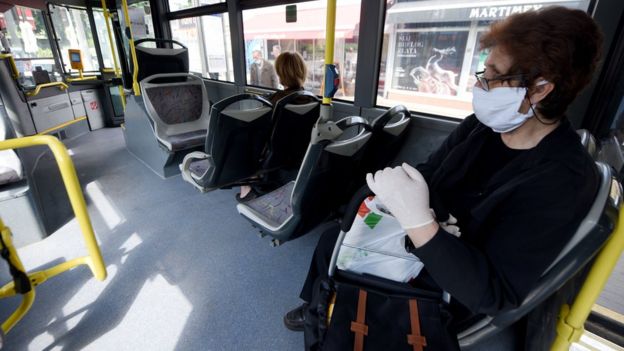
Image copyrightGETTY IMAGESImage captionPublic transport has now resumed and shops have reopened as Croatia loosens its lockdown
Greek enforcement was strict too. More than 60,000 fines were issued for violating the lockdown which, according to Greek police, totalled €9,247,800 (£8.1m).
All this seems to have restricted the spread of Covid-19. Croatia’s death rate currently stands at 18 per million, while Greece’s stands at 13 per million.
How Greece handled Easter
One of the biggest challenges facing the Greek government came from the country’s religious tradition. According to Greek Orthodox ritual, priests offer holy communion using the same spoon.
Media captionGreek film directors confined by the pandemic made 10 short films in their homes
The Church of Greece’s leadership insisted for days that diseases could not be contracted from communion, which represents the blood and body of Jesus. Doctors and scientists immediately called on the Church to listen to science.
The prime minister intervened with an emotional, televised speech. “Personally, in recent days I felt the need to invoke my faith in order to draw strength and stand up to the challenges,” said Mr Mitsotakis. However, he said he had to “listen to scientists”. “What applies to public gatherings will also apply to churches.”
As a result, and with only a handful of hiccups, all church Easter liturgies took place behind closed doors.
Can they rescue summer?
Now Croatia and Greece are moving to a gradual easing of those restrictions.
For Croatia the problem is no longer how to keep foreigners out, but to bring them back in. About half of Croatia’s 20 million annual visitors arrive in July and August and tourism is responsible for at least a fifth of its economic output.
Those are the crucial months for Greece’s tourist industry too. This year’s motto, says Tourism Minister Haris Theocharis, is that Greece is coronavirus-safe.
The Greek economy had only just begun to recover from an eight-year financial crisis when the lockdown was imposed.
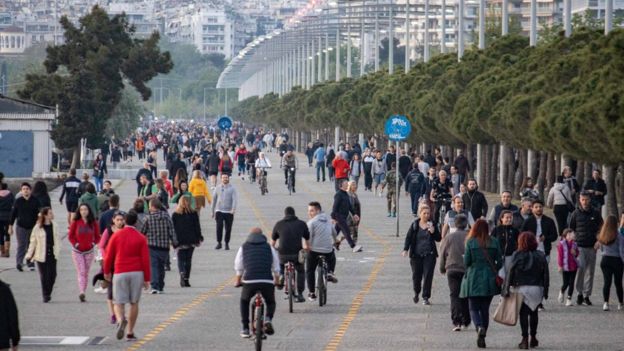
Image copyrightGETTY IMAGESImage captionGreeks have been able to get out and about again in the past week as the lockdown is eased
Tourism accounts for approximately 25% of Greek GDP and one in five jobs, so a new crisis is looming: 65% of Greek hoteliers say bankruptcy of their business is either “likely” or “most likely”, according to a study by the Hellenic Chamber of Hotels.
Greek scientists are working on health requirements for visitors, the tourism minister says. “The basic principles behind the new rules are that social distancing will be required, and that more frequent and different kinds of cleaning procedures are to be followed.”
In other words, hotel staff will be tested regularly to ensure tourists and Greeks themselves are protected.
Why Croatia needs open borders
Croatia needs co-operation from its neighbours, Slovenia in particular.
Slovenians rank second only to Germans in terms of the number of nights they spend in Croatia. If you travel by road from Northern Europe you have to cross Slovenia to reach the beaches of Istria, Dalmatia and the Kvarner Gulf.
The two countries’ tourism ministers met in Zagreb last week to sketch out a plan to allow Slovenians to travel across Croatia’s borders by the end of this month, with other nationalities following in June.
Czech travel agencies are keen to establish a “corona corridor” enabling quarantine-free travel to the coast, a plan warmly received by Croatia’s prime minister, Andrej Plenkovic. A survey in Austria too has indicated that people are still hoping to bask in the Croatian sun.
Uncertainty over air travel
With big questions over when holiday flights will resume, Greece too is initially looking for tourists who can reach the country by road.
It is currently focused on getting the EU to set common rules that would allow people to travel for holidays.
But if there is no consensus, Greece is prepared to go it alone, in order to “open up our economic activity as soon as possible and in a health-wise manner”, says Mr Theocharis.
“We will first see domestic tourism, then tourists from neighbouring countries, and then middle-distance countries and long-distance ones. Travelling by road will be safer initially than flying and we’ll see that kind of tourists earlier.”
Traditional markets like Germany, the UK and the US may well be replaced by countries that are both closer and have not been hit hard by the pandemic.
This may seem like an odd time to be thinking about holidays. But these are both countries with tourism-reliant economies and, having acted swiftly and thoroughly, a successful summer could be seen as a fitting reward.
Four alleged fraudsters are being tried in France, accused of conducting fake police checks on people’s permits to leave home during the lockdown.
The woman and three men allegedly posed as officers and robbed victims after asking them to produce the official form people must carry away from home.
It is believed they stole €25,000 (£22,000; $27,000).
The four, who are all Iranian nationals, are being tried as France prepares to ease its lockdown curbs.
ince 17 March, people across the country have only been allowed to leave their homes to go to work, shop, exercise, seek care or conduct urgent family business.
While out, they are required to carry a certificate stating the reason for their trip.
Police say the gang impersonated officers and approached people wearing face masks. After asking to see their victims’ forms, they allegedly searched bags and took whatever cash or valuables they could find.
In an interview with France Info radio, Police Commissioner Nathan Bauer said the suspects “did not speak very good French” and targeted foreigners.
He added that police had identified seven victims, and that €12,000 had been stolen from one of them.
The four are to be tried in the city of Meaux, east of Paris.
The coronavirus outbreak has been linked to about 25,000 deaths in France. But with falling numbers of new fatalities and cases, the government has announced plans to lift some restrictions from 11 May.
As Italy begins to ease its lockdown measures, residents in some of Naples’ poorest neighbourhoods share their stories of how the global pandemic has left scars on their city.
Takeaways and parks are reopening, small funerals can resume and some businesses are restarting.
But the shutdown has left deep wounds in a country with already serious economic problems.
Mark Lowen has been speaking to people whose lives have been changed.
People in Uganda have contributed a total of about $6m (£4.8m) to help the government finance the provision of cars and medical supplies, to support efforts to fight coronavirus.
Many African countries have weak and underfunded health systems but Uganda is relying on preventing the spread of the pandemic by drawing on lessons learned from containing outbreaks like Ebola.
Covid-19 threatens not only people’s health, but the national lockdown has caused food insecurity and that shortage of basic supplies prompted ordinary Ugandans to start giving food donations.
The efforts to provide food were commended by President Yoweri Museveni which then encouraged donations of money, vehicles and medical equipment such as protective clothing needed by doctors and nurses.
Ordinary citizens and companies have given the government more than 50 4×4 cars and ambulances, which the authorities now intend to expand into an emergency fleet of 1,300 vehicles, spread around the country.
As the money donated increases so the extra funds will be used to purchase more vehicles.
US President Donald Trump on Sunday struck out at former President George W. Bush, who in a video called for compassion and solidarity over the coronavirus pandemic.
Bush, like Trump, a member of the Republican Party, drew a parallel between the COVID-19 crisis and the September 11, 2001 attack in a clip posted Saturday by the George W. Bush Presidential Center.
The Al-Qaeda led terror attacks took place just months after Bush arrived in the White House.
“Following 9/11 I saw a great nation rise as one to honor the brave, to grieve with the grieving, and to embrace unavoidable new duties,†Bush said, with archive images playing in the background.
Bush, 73, said he was convinced that the “spirit of sacrifice†has not disappeared, and called for compassion as the United States struggles to quell the novel coronavirus.
“Let us remember how small our differences are in the face of this shared threat,†said Bush. “In the final analysis we are not partisan combatants, we are human beings.â€
Bush added that Americans should “remember that empathy and simple kindness are essential, powerful tools of national recovery.â€
As someone who is regularly criticized for his lack of empathy, Trump may have felt targeted.
Early Sunday, Trump responded, by apparently quoting a co-anchor from the “Fox and Friends†show on Fox News.
“Oh, by the way, I appreciate the message from former President Bush, but where was he during impeachment calling for putting partisanship aside,†Trump wrote, quoting the co-anchor.
Trump then added in his own voice: “He was nowhere to be found in speaking up against the greatest Hoax in American history!â€
The number of confirmed coronavirus cases worldwide surpassed 3.5 million on Monday, with three-quarters of them in Europe and the United States, an AFP tally based on official sources showed.
At least 3,500,517 infections and 246,893 deaths have been recorded globally. Europe is the continent most affected by more than 1.5 million cases and over 143,000 fatalities.
The United States has registered more than 1.1 million cases and 67,000 deaths.
The numbers around the world reflect only a fraction of the real figures as many countries test only serious cases.
Millions of schoolchildren in Vietnam returned to class on Monday after the country reported its 17th straight day of no domestically transmitted coronavirus infections.
The decision to reopen schools came after the Southeast Asian nation eased social distancing measures at the end of April, with experts pointing to a decisive response involving mass quarantines and expansive contact tracing for its apparent success in containing the disease.
At a school in western Hanoi, secondary level students calmly lined up to have their temperatures checked before filing into classrooms for the first time in more than three months.
“I am very happy and excited because it’s boring being at home,” said 11-year-old Pham Anh Kiet.
“I feel safe when I wear a mask and have my temperature checked, I am not afraid of being infected with the virus,” he added, before grabbing a classmate for a quick catch up.
Tran Dang Ngoc Anh, 12, said she’d missed her friends and teachers and was happy to be back, despite being a little apprehensive about wearing “stuffy masks in classrooms”.
There are around 22 million school-age children and university students across Vietnam. After being sent home in late January, some kids returned last week but others, including primary school and kindergarten pupils will have to wait it out a further week.
Universities have begun opening one by one.
Vietnam has recorded just 271 virus cases and zero deaths, according to official tallies on Sunday. It has been more than two weeks since the country reported a domestically transmitted infection.
But far from letting their guard down, authorities are enforcing strict social distancing measures in schools, with pupils ordered to stay 1.5 metres apart at all times. Everyone must wear masks.
Nguyen Xuan Khang, a headteacher in Hanoi, admitted it would be difficult to keep the little ones in line.
“When it’s break time, the young ones… they are very active, it will be hard to help them maintain a distance,” he said.
“But no problem, we have to accept that. All the parents give the kids masks, and we also bought 10,000 masks to give to the children. We have put a lot of hand sanitizer in the toilets.”
Sun loungers separated by plexiglass. Blood tests and sanitiser spray-downs before flights.
These might sound extreme, but they are real measures some in the travel industry are looking at to keep holidaymakers feeling safe and comfortable in a post-lockdown world.
It’s too early to say when international travel might restart again – Argentina, for example, has extended flight bans until September and a UK minister has said he won’t be booking a summer holiday anytime soon.
But what will overseas trips look like when they’re able to be taken again?
Here’s what you might expect.
The airport
Many airports, including in London, have already introduced measures to cater for essential travellers based on government guidelines – so they might sound familiar.
These include between one and two-metre distancing at all times (excluding people who live together), hand sanitisers distributed throughout the airport and efforts to spread passengers more evenly across terminals.
In the US, the Transport Security Administration (TSA) says travellers should wash their hands for 20 seconds – in accordance with official guidelines – before and after the security screening process.
But, at Hong Kong International Airport, testing is under way on a full-body disinfectant device. This, the airport says, can sanitise users within 40 seconds, using sprays that kill bacteria and viruses on skin and clothing.
The airport is also trialling autonomous cleaning robots that move around killing microbes by zapping them with ultraviolet light. Similar robots have been tested in makeshift hospital rooms.
Airports that have electronic check-in kiosks are encouraging passengers to use them where possible to avoid unnecessary interaction.
Most will display posters that explain guidance measures and instructions throughout their buildings.
James Thornton, chief executive of Intrepid travel group, says the process of passing through airports is likely to take longer because of stricter checks.
“Just as taking out liquids and devices before going through machines has become the norm, so too will new social distancing guidelines,” he says, adding: “It’s possible we’ll see the introduction of an immunity passport.”
Earlier this year, several airports announced they were introducing “thermal detection screening” in efforts to prevent the further spread of the virus overseas.
However, the procedure divided experts on its effectiveness, as some people are said to be asymptomatic, and many airports will not be introducing it.
Some have gone further, though, with Emirates offering passengers rapid Covid-19 blood tests prior to boarding at Dubai airport terminals. Emirates says the tests produce results within 10 minutes.
On the plane
As you take your seat, you’ll have to picture the usual smiles from the flight attendants, who will most likely be wearing masks.
You might choose to smile back, but you’ll probably be wearing one, too – as more and more countries recommend their use.
Your mind, meanwhile, should be at ease in the knowledge that most major airlines will have stepped up their cleaning and sanitation procedures, leaving your tray table, seat rest and safety belt suitably disinfected.
If you’ve booked your flight with Korean Air, don’t be alarmed if people appear in the aisle wearing full personal protective equipment (PPE), as the airline says it plans to issue cabin crew with gowns, gloves and eye masks.
This might be as good a time as any to appreciate that you won’t be sharing either of your armrests, as most airlines have said that flights will not be fully booked and middle seats will be kept empty (at least to begin with).
An airline pilot for Tui, who asked to be named only as Christian, said that while spreading passengers on a plane made sense in respect of distancing guidelines, it could prove “hugely prohibitive” and costly.
“Losing a third of seats means either that airlines fly at a loss, or we go back to the good old days when a Paris to Nice return ticket used to cost £1,000 (€1,145; $1,245) in today’s money.”
Christian says countries that rely heavily on tourism are already contacting operators. “I believe that we will see a small restart of flights to selected destinations towards the end of the season.”
At your destination
How does an Italian beach holiday sound? Well, you could find yourself weaving between tall sheets of plexiglass used to separate sun loungers as you look for a shady spot in the sand.
“I’ve seen drawings,” says Ulf Sonntag of the Institute for Tourism Research in Northern Europe, “they are seriously considering this as an idea in Italy.”
Britain will trial a new coronavirus tracing programme next week on the Isle of Wight, just off the south coast of England, cabinet minister Michael Gove said on Sunday as the government looks at how to minimise the risk of a second wave of infection.
Suffering one of the worst death tolls in Europe from COVID-19, Britain is confident that the peak of the virus has passed and is now looking at how to restart its shuttered economy and ease social restrictions on citizens.
“This week we will be piloting new test, track and trace procedures on the Isle of Wight with a view to having that in place more widely later this month,†Gove told a news conference.
A mass testing system along with the ability to trace people who have been in contact with those who test positive are seen as crucial to preventing a second spike and facilitating the relaxation of a lockdown which has lasted almost six weeks.
Gove said the system being trialled next week would include asking citizens on the island to download a smartphone app as well as traditional ways of tracing those who have come into contact with a patient who has tested positive.
“We will be able to make sure that people who are suffering from the virus … they and their contacts can be encouraged to stay at home, so that we can limit the potential of any outbreak,†Gove said.
Russia has recorded 10,633 new coronavirus infections in the past 24 hours, the highest daily rise since the outbreak began in the country.
The increase brings Russia’s total number of coronavirus cases to 134,686, the seventh highest tally in the world.
But Russia’s mortality rate remains low relative to other countries, such as the US, Italy and Spain.
On Sunday, a further 58 coronavirus-related deaths were announced, bringing the total to 1,280 in Russia.
Moscow has been hit particularly hard by the virus, leaving its healthcare system struggling to cope.
Moscow’s mayor Sergei Sobyanin on Saturday cautioned against complacency, saying the capital was not past the peak of its coronavirus epidemic.
The mayor said around 2% of residents in the city – around 250,000 people – had tested positive for coronavirus. On Sunday, Moscow’s total number of cases jumped by 5,948 to a total of 68,606.
A strict lockdown has been imposed in Moscow, where its 12 million residents have been ordered to stay at home with few exceptions.
Russian President Vladimir Putin has said situation remains “very serious”, warning Russians to brace for a “gruelling phase of the pandemic” in the weeks ahead.
Earlier in the week Russian Prime Minister, Mikhail Mishustin, confirmed he had been diagnosed with Covid-19, the first senior minister in the country to do so.
Mr Mishustin, who was appointed as PM in January, was still being treated in hospital on Sunday. His spokesman said he was feeling fine, enabling him to work from hospital.
On Friday, Russia’s housing minister, Vladimir Yakushev, became the second senior minister to be confirmed to have Covid-19.
Russia puts big rise down to testing The number of confirmed coronavirus cases here is rising steadily each day. The Russian authorities put that down to a big increase in testing – over 40,000 people a day, in Moscow alone.
They also say up to half of the new cases are people without symptoms – including those detected through screening, like healthcare workers.
Still, the virus is spreading more quickly now in Russia’s regions – where hospital facilities are far worse than in the capital and where medics have been complaining they don’t have the masks and protective clothing to keep them safe.
And even here, in Moscow, some 1,700 people are being admitted to hospital each day, increasing the strain on the system.
Coronavirus crisis tests Putin’s grip on power
Putin admits PPE shortage as lockdown extended President Putin has extended a nationwide non-working period until 11 May, saying “the peak is not behind us”.
Beyond that, the president said his government will consider gradually lifting coronavirus restrictions from 12 May, depending on the region.
Last week, Mr Putin admitted there was a shortage of protective kit for medics on the frontline of the coronavirus crisis.
Dozens of New Yorkers were fined for violating coronavirus social distancing guidelines as they flocked to the city’s beaches and parks to enjoy balmy weekend weather, police said Sunday.
NYPD Commissioner Dermot Shea told reporters that officers had issued 51 summonses on Saturday, mostly for social distance violations, as temperatures in America’s COVID-19 epicenter registered upwards of 70 degrees Fahrenheit (21 degrees Celsius).
Residents of the Big Apple, which has been shut down since mid-March, are allowed outside to exercise providing they maintain six-feet (two meters) of distance and wear a mask when around others.
New Yorkers can be fined up to $1000 for violating the orders, which many did as they descended on popular spots like Manhattan’s Central Park and Rockaway Beach in Queens following a largely rainy week.
Shea said tickets were issued to 43 people in parks and eight others elsewhere as New York leaders warned residents not to spark a second wave of infections.
Governor Andrew Cuomo said he appreciated residents were bored but that they should not take “false comfort” from falling COVID-19 cases or from seeing other states reopen.
He insisted that the outbreak — which has killed almost 20,000 people statewide — was far from over.
“How people cannot wear masks is disrespectful. It’s disrespectful to the nurses, the doctors, the people who have been frontline workers, the transit workers.
“You wear the mask not for yourself — you wear the mask for me,” he added.
Cuomo reported 280 new deaths from COVID-19 in New York state in the last 24 hours, down from 289 the day before.
More than 700 New Yorkers were dying daily at the peak of the outbreak last Month.
Cuomo announced that new cases and intubations continued to fall.
As India reels from the effects of a nationwide lockdown, here are three heartwarming stories of people going the extra mile to help someone out, or cheer them up.
“You’ve made my day!”
India has been in lockdown since 25 March. Many people are stuck at home alone, leaving the elderly especially feeling lonely and cut-off from family and friends.
So Karan Puri, an elderly resident of Panchkula, a town in the northern state of Haryana, was in for a pleasant surprise when the police came knocking at his door recently.
In a video that has since been shared widely, Mr Puri can be seen striding towards the gate, saying, “I am Karan Puri, I live alone and I am a senior citizen.”
But what happens next leaves him stumped. “Happy birthday to you!” As the police officers sing, Mr Puri doubles over in surprise, asking them how they know. He says his children are away and he starts to tear up.
The police tell him there is no need to feel lonely because they are like his family too, before producing a birthday hat and a cake, which Mr Puri then cuts while the officers resume singing.
“Thank you!” he tells them at one point. “You’ve made my day.”
A meal for two
Doctors in India, like elsewhere, are on the front lines fighting the pandemic, and they are often working around the clock.
“The anxiety and stress levels at work are immense,” said Kaushik Barua, a 30-year-old critical care resident at a private hospital in the Indian capital, Delhi.
Mr Barua spoke to the Humans of Delhi blog, which was inspired by Humans of New York.
“But through this tough journey, I have had the help of one truly kind soul,” he said.
His landlord, Rohit Suri, has been cooking him meals every day, so he has a plate of hot food waiting for him when he returns home, exhausted, from work.
The two men have become good friends, as Mr Suri also lives alone.
“I’m glad I could capture our moment of camaraderie this morning,” says Dr Barua of the selfie that has made it to the popular blog. And, as you can see, they are social distancing in this “Vitamin D selfie”, as Mr Barua and Mr Suri refer to it.
Dr Barua says he feels especially lucky and grateful because one of his friends, who is also a doctor, was asked by her landlord to vacate her home. Several doctors and nurses in India have complained of this, saying landlords and neighbours were afraid of contracting the virus from them.
“Mr Suri has been a remarkable human being, the kind that the world needs in such times,” Mr Barua said.
Boris Johnson has revealed “contingency plans” were made while he was seriously ill in hospital with coronavirus.
In an interview with the Sun on Sunday, the PM says he was given “litres and litres of oxygen” to keep him alive.
He says his week in London’s St Thomas’ Hospital left him driven by a desire to both stop others suffering and to get the UK “back on its feet”.
Earlier, his fiancee, Carrie Symonds, revealed they had named their baby boy Wilfred Lawrie Nicholas Johnson.
The names are a tribute to their grandfathers and two doctors who treated Mr Johnson while he was in the hospital with coronavirus, Ms Symonds wrote in an Instagram post.
The boy was born on Wednesday, just weeks after Mr Johnson’s discharge from intensive care.
In his newspaper interview, the prime minister describes being wired up to monitors and finding the “indicators kept going in the wrong direction”.
“It was a tough old moment, I won’t deny it,” he’s quoted as saying, adding that he kept asking himself: “How am I going to get out of this?”
Mr Johnson had been diagnosed with coronavirus on March 26 and was admitted to hospital 10 days later. The following day, he was moved to intensive care.
“It was hard to believe that in just a few days my health had deteriorated to this extent,” the prime minister tells the Sun on Sunday.
“The doctors had all sorts of arrangements for what to do if things went badly wrong.”
His recovery, he says, was down to “wonderful, wonderful nursing”.
Mr Johnson says he felt “lucky”, given so many others were still suffering, adding: “And so if you ask me, ‘Am I driven by a desire to stop other people suffering?’ Yes, I absolutely am.
“But I am also driven by an overwhelming desire to get our country as a whole back on its feet, healthy again, going forward in a way that we can and I’m very confident we’ll get there.”
Fewer patients hospitalised
The total number of reported coronavirus-related deaths in the UK now stands at 28,131 – an increase of 621 on Friday’s figure.
However, England’s deputy chief medical officer Dr Jenny Harries said the number of people being treated in hospitals for the virus had fallen by 13% over the past week.
On Saturday, the government pledged £76m to support vulnerable children, victims of domestic violence and modern slavery, who were “trapped” at home during the lockdown.
The announcement followed reports of a “surge” in violence in the weeks since the lockdown was introduced.
Three people have tested positive for coronavirus at Cologne and will be placed into a 14-day quarantine, the Bundesliga club said Friday in a potential blow to hopes of restarting the German football season this month.
“Cologne had the entire team and coaching staff, along with the backroom staff, tested on Thursday for COVID-19. Three people tested positive, all are symptom free,” the club said in a statement on its website.
“After an assessment of the cases by the responsible health authorities, the three people who tested positive will go into a 14-day quarantine at home.
“Cologne will not confirm any names out of respect for the privacy of those affected.”
The club said it would continue to train in preparation for the campaign to resume, with further tests to be carried out as part of the league’s health and safety protocol.
“We now see in everyday life that our concept recognises and reduces risks at an early stage,” said Tim Meyer, head of the German league’s medical task force.
“We are convinced that with our concept, we can enable players to practice their profession with the best possible protection against infection.”
The Bundesliga had set a target return date of May 9 but still needs permission from the German government.
A delay on the decision this week meant a resumption would not be possible before May 16.
A final decision is expected next Wednesday.
The German league confirmed Thursday that clubs had started testing players for the virus as part of plans to get the season up and running again.
It has been suspended since March 13.
Clubs returned to training at the start of April while adhering to social distancing guidelines and games would be played behind closed doors, with large-scale public events banned in Germany until August 31.
Borussia Dortmund chief executive Hans-Joachim Watzke warned last weekend that “the entire Bundesliga will go down” unless the league restarts.
Germany’s top clubs are desperate for the season to be completed by June 30 in order to claim an instalment of television money worth 300 million euros ($325 million).
A return in May would make the Bundesliga the first top league in Europe to resume as Germany cautiously eases lockdown measures.
Nevertheless, there is heated debate about whether the Bundesliga should resume amid the pandemic which has so far claimed the lives of more than 6,000 people in Germany.
Paris Saint-Germain were declared Ligue 1 champions on Thursday after French Prime Minister Edouard Philippe announced sport could not resume in France before September.
A European Parliament building in Brussels is housing 100 homeless women – many of them victims of domestic abuse – who have been severely affected by Belgium’s coronavirus lockdown.
The Helmut Kohl building, an office block in the city centre, opened its doors to them on Wednesday.
Offices have been turned into bedrooms, each for one or two women. They also get meals and medical care there.
Samusocial, a charity, says the crisis has increased domestic abuse cases.
The parliament, based in the Belgian capital, teamed up with Samusocial to run the facility, which is much-needed because social distancing has forced many women’s shelters to close.
The Brussels authorities are also providing emergency accommodation for homeless people in some hotels.
The European Parliament’s buildings are mostly empty. Sessions are now attended only by a few MEPs in the chamber, with others joining by video link.
The monthly full session in Strasbourg, eastern France, has been suspended until July. For years the Brussels-Strasbourg shuttle has been criticised, including by MEPs themselves, as a waste of EU money.
Parliament President David Sassoli, who toured the Helmut Kohl facility, said “this emergency affects all of us” and “in Brussels there is a lot of pain now”.
“I think this crisis should push all of us, the institutions included, to set a good example.”
Protesters marched in several cities across California on Friday demanding the easing of restrictions due to the coronavirus outbreak and denouncing Governor Gavin Newsom’s decision to shut down some beaches.
The protests were taking place in at least 11 cities, including the capital Sacramento as well as San Francisco, Los Angeles and San Diego.
Some of the demonstrators waved American flags and carried signs that read “Freedom is Essential,” “Open Our Churches” or “Gruesome Newsom,” while voicing anger at stay-at-home rules put in place to slow the spread of the virus.
Most of the protesters did not wear any face coverings or follow social distancing guidelines.
In Huntington Beach, about 35 miles (55 kilometers) south of Los Angeles, some 700 people rallied downtown to denounce Newsom’s order to shut local beaches from Friday in order to avoid a repeat of last weekend when crowds flocked to the shoreline.
“It was the straw that broke the camel’s back,” protestor Monica Beilhard said, referring to the beach shutdown.
“It was uncalled for, unnecessary and people out here are making that known,” she added. “And we’re also very much saying enough is enough, we have the right to work… and it’s time for the governor to allow the healthy to be able to get back to business.”
Officials in Huntington Beach and nearby towns have vowed to fight the beach closure order by taking the matter to court on grounds it is unconstitutional.
“We believe the governor’s order is unconstitutional, vague and ambiguous,” said Huntington Beach City Attorney Michael Gates. “He doesn’t have a rational basis for this. What he seeks is a remedy to something that wasn’t a problem in the first place.”
Newsom, who like other governors across the country is facing mounting pressure to lift restrictions, especially as the weather warms up, has vowed not to bow to pressure and insists that his order was driven by public health concerns.
He told journalists at his Friday news conference that he empathized with protesters but urged them to continue to obey the stay-at-home order.
He also appealed to them to wear masks and practice social distancing while demonstrating.
“This disease doesn’t know if you’re a protester — Democrat, Republican, or if you support the election of one candidate or the ouster of another,” he said. “It just knows one thing, and that is its host.
“Just protect yourself, protect your family… and the people you’re protesting with.”
Russian Prime Minister Mikhail Mishustin says he has been diagnosed with coronavirus.
His positive test came on the same day that Russia recorded a record 7,099 cases, taking the total number of infections above 100,000.
Mr Mishustin was given the role of prime minister in January and has been actively involved in Russia’s handling of the epidemic.
Russian TV showed him telling President Vladimir Putin of his diagnosis.
“I have just learned that the test on the coronavirus I took was positive,” the prime minister said during the video call.
Mr Mishustin suggested that First Deputy Prime Minister Andrei Belousov should take his place and Mr Putin agreed. Mr Mishustin will now go into self-isolation.
Despite the sharp rise in cases, the Moscow-based coronavirus headquarters says 1,073 people in Russia have now died of coronavirus, a relatively low number for Russia’s size.
Presidential spokesman Dmitry Peskov says Russia’s reaction to the pandemic has enabled it to avoid an “Italian scenario”.
Los Angeles is offering free coronavirus tests to all residents, regardless of whether they are displaying any symptoms.
Mayor Eric Garcetti made the announcement just hours after Los Angeles County reported its largest daily increase in new Covid-19 cases.
Until now, only essential workers and those displaying symptoms could receive tests due to a scarcity of kits.
It comes as California is expected to close all beaches across the state.
Los Angeles County currently accounts for almost half of California’s confirmed coronavirus cases. The state has so far reported over 48,000 cases and more than 1,900 deaths.
On Thursday, Mr Garcetti urged all of the city’s residents to get swabbed after earlier tweeting that “LA is now the first major city in America to offer free Covid-19 testing”.
Meanwhile, California Governor Gavin Newsom is expected to sign an executive order to close all beaches and parks in the state after large crowds packed public spaces over the weekend.
While some of California’s beaches have been closed for weeks, others have remained open with social distancing rules in place.
Mr Newsom recently said that he was just weeks away from lifting some restrictions. But the recent images of crowded beaches in the most populous US state led to a warning from the Democratic governor that the behaviour of some Californians threatened to undo weeks of work to restrict the spread of Covid-19.
“We can’t see images like we saw, particularly on Saturday, in Newport Beach,” the governor said on Monday, adding: “The virus doesn’t take the weekend off because it’s a beautiful sunny day around our coasts.”
Australia’s vast Northern Territory will become the first in the nation to move out of lockdown on Friday with the lifting of major restrictions.
Group limits will be removed for weddings, funerals and sport while parks and pools will also open.
Australia’s least populated territory – which counted 28 cases – says it will ease all lockdown measures by June.
The rest of the nation is also beginning to open up after success in containing the virus.
The most-populous state, New South Wales, which includes Sydney, will allow some socialisation to resume on Friday, with households allowed to have two adult visitors at a time.
There are currently around 6,700 cases nationally, but in recent weeks the daily increase rate has dropped to under 1% compared to more than 25% in mid-March.
Australia had “pretty much crushed” its virus curve, said deputy chief medical officer Paul Kelly on Friday.
However, both federal and state authorities say they will be cautious in lifting restrictions. Prime Minister Scott Morrison has urged citizens to download a contact-tracing app to make the process safer.
What are the changes in the NT?
The territory has reported zero new infections for more than three weeks now.
“Because we are the safest place in Australia, we can do this before the rest of Australia,” said NT Chief Minister Michael Gunner in the state capital, Darwin, on Thursday.
Locals must maintain a 1.5m (5ft) distance from others, but from Friday they can visit parks and swimming holes and play non-contact sport.
In mid-May, restaurants and pubs will be able to open for dining while gyms, nail salons and libraries will also resume service. All other restrictions will be removed in early June.
Summarising the changes, Mr Gunner described it as: “May 15 date night, June 5 Sunday sesh [pub drinking session]”.
However he said opening state borders would happen “dead last” to prevent any chance of a second wave. Officials will also keep an existing travel ban to the dozens of vulnerable Aboriginal communities in the outback.
What’s happening in the other states?
Victoria, the second most-populous state, says it will stick with its restrictions until 11 May, saying the situation remained “very fragile” despite low numbers.
However NSW – the state with the highest number of reported cases – began allowing household visits on Friday and has already re-opened beaches.
Movement restrictions have also eased in several states – including Queensland, Western Australia and South Australia – which have all reported no community transmission and zero new cases on several days this week.
On Thursday, the Australian Capital Territory – which holds the nation’s capital Canberra – also announced it had no more known active cases.
Gun-toting protesters against Michigan’s coronavirus lockdown have rallied in the state capitol building.
Hundreds of demonstrators, a few of them armed, gathered in Lansing and many did not wear masks or socially distance.
Police checked their temperatures before some were allowed into the capitol, where lawmakers were debating.
Governor Gretchen Whitmer, a Democrat, extended her stay-at-home mandate earlier this month until 15 May.
Michigan has been hard hit by the coronavirus, with 3,788 deaths.
More than 41,000 infections have been recorded across the Midwestern state, mostly in the Detroit metro area.
Thursday’s protest, dubbed the “American Patriot Rally”, was organised by Michigan United for Liberty. It called for state businesses to reopen on 1 May in violation of state orders.
It is legal to bear firearms inside the statehouse, and several demonstrators were openly carrying guns in the Senate gallery.
But some armed protesters reportedly tried to enter the floor of the chamber, and were blocked by state police and sergeants-at-arms.
One state senator said several of her colleagues wore bulletproof vests.
Footage of protesters outside the building showed them chanting “Let us in!”, “Let us work” and “This is the people’s house, you cannot lock us out”.
“The virus is here,” one demonstrator, Joni George, told the Associated Press. “It’s going to be here… It’s time to let people go back to work. That’s all there is to it.”
The rally is believed to have been the largest of its type since one on 15 April when Michigan protesters sat in their cars in order to create traffic around the statehouse.
President Donald Trump threw his support behind demonstrators at the time, tweeting “LIBERATE MICHIGAN”. Some critics said his tweets were an attempt to foment insurrection.
On Thursday, the Republican-controlled legislature refused Governor Whitmer’s request to extend her emergency orders.
They also cleared the way for her to be sued over her handling of the pandemic. She hit back that she does not need legislative authorisation for the extension.
On Wednesday, the governor accused Republicans of treating the virus like a “political problem”, rather than “a public health crisis”.
Many US states – including Georgia, Oklahoma and South Carolina – have taken steps to loosen virus mitigation restrictions.
On Wednesday, a Michigan court ruled that the governor’s lockdown orders were not unconstitutional, as five state residents had claimed in a lawsuit against the governor.
“Although the Court is painfully aware of the difficulties of living under the restrictions of these executive orders, those difficulties are temporary, while to those who contract the virus and cannot recover (and to their family members and friends), it is all too permanent,” Michigan Court of Claims Judge Christopher M Murray wrote in a ruling.
Directly above me, men with rifles yelling at us. Some of my colleagues who own bullet proof vests are wearing them. I have never appreciated our Sergeants-at-Arms more than today. #milegpic.twitter.com/voOZpPYWOs
— Senator Dayna Polehanki (@SenPolehanki) April 30, 2020
More than seven million children in Afghanistan are at risk of hunger as food prices soar due to the coronavirus pandemic, a report warns.
A Save the Children spokesman said the country faced a “perfect storm of hunger, disease and death” unless the international community took action.
The charity said a third of the population, which includes 7.3 million children, was facing food shortages.
The UN recently included Afghanistan in a list of countries at risk of famine.
The organisation’s World Food Programme (WFP) warned the world was facing a “hunger pandemic”.
Afghanistan has suffered almost two decades of war since US-led forces ousted the Taliban in 2001, leaving it with a fractured and impoverished healthcare system.
As cases of coronavirus spread, the government imposed a lockdown in the capital, Kabul, at the end of March and other provinces quickly followed. Movement other than shopping for basic necessities is severely restricted and travelling between cities is banned.
What does the report say?
Save the Children said the price of food was rising just at the time when children needed adequate daily nutrition to help strengthen their immune systems.
Even before the pandemic it was estimated that more than five million Afghan children needed some form of humanitarian support. Latest UN surveys indicate that about two million children aged under five face extreme hunger.
Citing figures from the WFP, the report said the price of wheat flour and cooking oil in Afghanistan’s main city markets had risen by up to 23% in the past month as demand outstripped supply. The cost of rice, sugar and pulses had increased by between 7%-12%.
Coupled with rising prices, the wages of daily labourers are falling as the lockdown caused work to dry up.
“A large portion of the Afghan workforce relies on the informal sector, with no safety nets when work is scarce,” the report says.
With just 0.3 doctors per 1,000 people, Afghanistan’s sick and malnourished children are less likely to receive the life-saving treatment they need to survive, Save the Children warned.
Timothy Bishop, the charity’s country director in Afghanistan, said that for many Afghans the biggest impact of the pandemic would not be the virus itself, but the hunger caused by lockdown measures and a breakdown in supply lines.
“We are deeply concerned that this pandemic will lead to a perfect storm of hunger, disease and death in Afghanistan unless the world takes action now,” he said.
“We are facing the very real risk that children could die from starvation. What we need is for the international community to urgently fly in food supplies to be distributed to some of the most vulnerable communities in the country. We also urge the Afghan government to facilitate the rapid distribution of food, despite the nationwide lockdown.”
He added: “Afghan children have suffered enough. Most have known nothing but conflict in their lives. We cannot allow Covid-19 to further rob them of their futures.”
Coronavirus cases in Russia surged past 100,000 on Thursday as the country recorded its largest daily increase, after officials warned infections had not yet peaked and extended lockdown measures.
A spike of 7,099 confirmed infections in the last 24 hours brought Russia’s total to 106,498 cases and 1,073 deaths from the virus, the government’s coronavirus information site said in a daily update.
With the number of cases increasing by several thousand each day, Russia is now leading European countries in registering new infections.
President Vladimir Putin said the country’s coronavirus response had shown that “we are together, we are a united country”.
“Battling the threat of the coronavirus is a real test of our humanity,” he said in a teleconference with volunteers and charity workers from various regions.
Russia’s coronavirus death rate remains relatively low and Kremlin spokesman Dmitry Peskov said the country’s actions had helped it avoid the catastrophic “Italian scenario”.
Russia’s success was down to “tough self-isolation decisions” and government measures “which convinced people to stay at home,” Peskov told the RTVI television channel.
He also said Russia had quickly and efficiently increased the number of available hospital beds.
The virus has spread to all 85 regions of the country, with Moscow the epicentre with around half the total cases.
Russia recently surpassed Iran and China in the number of confirmed infections and is now eighth in the world in virus cases, according to an AFP tally.
The country has carried out nearly 3.5 million virus tests, health officials said, and is ranked 19th in the world for the number of coronavirus deaths.
Situation ‘very difficult’
Putin warned this week that the situation remained “very difficult”, saying Russia had managed to slow the spread of the epidemic but cautioning that “this should not reassure us”.
Medics in Russia have complained of shortages of protective equipment and testing kits and hospital staff are becoming increasingly concerned with deaths in the medical community.
Medics and trade union representatives have told AFP that the problem is particularly severe outside of Moscow where staff are at an even greater risk of infection.
The Kremlin this week extended until May 11 a “non-working” period when Russians would stay at home but still receive their salaries as part of sweeping efforts to contain the virus.
Yet the measure has brought uncertainty to the economy and business owners struggling to pay full salaries to employees while shutting their doors to customers.
The government has been phasing in anti-crisis measures, such as loan payment deferrals or cheap loans, but there is concern that Russians are unable to access the support.
Despite the steady increase in cases, Putin said that Russia may begin to gradually lift different quarantine regimes throughout the country from mid-May.
Prime Minister Mikhail Mishustin on Wednesday extended a ban on entry for foreigners into the country, which was due to expire Thursday, until “the fight against the infection is over and the epidemic situation has improved.”
The pandemic has thwarted several major political events for the Kremlin this year, with Putin postponing a massive military parade on May 9 commemorating the 75th anniversary of victory in World War II. Many world leaders had been due to attend.
The Kremlin also postponed an April 22 vote on landmark constitutional reforms, which would have paved the way for Putin, 67, to potentially stay in power until 2036.
France is encouraging people to cycle to keep pollution levels low once lockdown restrictions end.
Under the €20 million (£17m; $21.7m) scheme, everyone will be eligible for bike repairs of up to €50 at registered mechanics.
The funding will also help pay for cycle training and temporary parking spaces.
Nations worldwide are grappling with ways to change urban transport in light of the coronavirus.
Emergency planners in London fear the Tube will not be able to cope once lockdown is lifted. A report seen by the BBC says that social distancing rules would reduce capacity to 15% of normal levels, and 12% on buses.
Moreover, pollution levels have dropped worldwide, and many are seeking to keep those levels low.
On Thursday the International Energy Agency (IEA) forecast a 6% drop in energy demand for the year – it said this would lead to a drop in carbon dioxide emissions of 8%, six times larger than the biggest fall in 2009 which followed the financial crash.
What are the proposals?
Elisabeth Borne, Minister for Ecological Transition, said the move was aimed at reducing driving when commuting or for short journeys to keep air pollution levels down once restrictions are lifted.
In normal times, 60% of journeys made in France are less than 5 kilometres [3 miles] – making bicycles “a real transport solution”, she said.
France has announced plans to slowly wind down its restrictions from 11 May. Latest figures on Wednesday showed a recorded death toll of 24,087, with close to 130,000 confirmed cases.
Ms Borne announced the scheme in association with the Federation of Bicycle Users (FUB) on Wednesday.
They will register a network of more than 3,000 repairmen on the FUB website who will agree to fix any bike for up to €50, such as changing tyres or old chains.
Citizens will not receive a printed cheque, but will go to these registered mechanics who will then be reimbursed by the state. People will have to pay any additional costs out of their own pockets.
The rest of the funding will go towards temporary bike racks and cycling training and refresher courses. Local governments are also being encouraged to lay down bike lanes across the country.
What are European cities doing?
The French capital Paris is barring private cars from one of its major central roads, the Rue de Rivoli, which will instead have separate lanes for bicycles and for buses, taxis, emergency vehicles and certain deliveries.
The measures will remain in place for the duration of the pandemic but should they prove successful they will be made permanent, Mayor Anne Hidalgo said on Thursday.
Paris is also aiming to create cycle routes along the paths of its three busiest Metro lines, she said.
The aim was to prevent the city being “swamped by cars, synonymous with pollution”, she was quoted by Le Monde newspaper as saying.
The Belgian capital Brussels on Wednesday announced the creation of 40km of additional cycle paths to ensure fewer people use public transport as restrictions are relaxed.
And the Italian city of Milan, which is in the worst-affected region of Lombardy, has begun reallocating space on some of its major roads for walking and cycling.
It is widening pavements, adding 35km of cycle lanes and encouraging the use of scooters as a way of pushing alternatives to car use. The Milan subway’s capacity is to be reduced by up to 30% to ensure all passengers are able to stay a metre away from each other.
And in the German capital Berlin, the authorities have temporarily widened some cycle lanes.
Belgium has promised every resident a protective mask from next week, when the country begins to phase out coronavirus lockdown measures.
With just days to go many doubt the authorities will hit their target, but town mayors like Yves Kinnard are taking matters into their own hands.
From Monday, when Belgium begins to ease its lockdown, anyone taking public transport will need to cover their mouth and nose.
Commercial supplies of face masks have been unpredictable and time is running out, so Kinnard plans to supply the 3,500 members of his community himself.
The 55-year-old mayor in the small eastern town of Lincent has assigned 15,000 euros ($16,300) from the municipal budget to order masks.
Belgian firm YTS received the order for 3,500 masks on April 10 and now they have arrived, shortly before some workers and businesses will go back to work.
First, though, the masks must be distributed door-to-door before the May 1 long weekend.
Kinnard has secured the assistance of fellow elected officials and he used his official car to ferry the order 65 kilometres (40 miles) from the plant in Nivelles.
More that 7,500 Belgians have died in the outbreak, one of the world’s highest per capita fatality rates in a population of 11.5 million.
Local producers
And there has been media skepticism about the capacity of Prime Minister Sophie Wilmes’ government to deliver on its “promise without a strategy”, as one outlet put it.
On April 24, she outlined a cautious plan to end the lockdown while enforcing some continued social distancing rules to head off a second wave of cases.
She promised that “each citizen would have at least a cloth mask” the simple barrier defences often being sewn together by volunteers and off-duty tailors.
She put no deadline on the vow, and sceptics noted that Belgium has already fallen foul of shortages in medical masks and been let down by some foreign suppliers.
This in turn has led to a number of initiatives by firms, individuals and local governments to fill the gaps, such that from YTS in Nivelles.
The firm usually prints on textiles for restaurants and hotels, and had polyester to hand to relaunch as a mask-maker.
“We called the team, and increased from seven to 15 employees,” said Alexandre De Clerq, the manager. “We rethought the entire logistics chain.”
YTS has now established the ability to produce 2,000 masks per day and has partnered with other workshops to share technique and make six times more.Belgium has promised every resident a protective mask from next week, when the country begins to phase out coronavirus lockdown measures.
With just days to go many doubt the authorities will hit their target, but town mayors like Yves Kinnard are taking matters into their own hands.
From Monday, when Belgium begins to ease its lockdown, anyone taking public transport will need to cover their mouth and nose.
Commercial supplies of face masks have been unpredictable and time is running out, so Kinnard plans to supply the 3,500 members of his community himself.
The 55-year-old mayor in the small eastern town of Lincent has assigned 15,000 euros ($16,300) from the municipal budget to order masks.
Belgian firm YTS received the order for 3,500 masks on April 10 and now they have arrived, shortly before some workers and businesses will go back to work.
First, though, the masks must be distributed door-to-door before the May 1 long weekend.
Kinnard has secured the assistance of fellow elected officials and he used his official car to ferry the order 65 kilometres (40 miles) from the plant in Nivelles.
More that 7,500 Belgians have died in the outbreak, one of the world’s highest per capita fatality rates in a population of 11.5 million.
Local producers
And there has been media skepticism about the capacity of Prime Minister Sophie Wilmes’ government to deliver on its “promise without a strategy”, as one outlet put it.
On April 24, she outlined a cautious plan to end the lockdown while enforcing some continued social distancing rules to head off a second wave of cases.
She promised that “each citizen would have at least a cloth mask” the simple barrier defences often being sewn together by volunteers and off-duty tailors.
She put no deadline on the vow, and sceptics noted that Belgium has already fallen foul of shortages in medical masks and been let down by some foreign suppliers.
This in turn has led to a number of initiatives by firms, individuals and local governments to fill the gaps, such that from YTS in Nivelles.
The firm usually prints on textiles for restaurants and hotels, and had polyester to hand to relaunch as a mask-maker.
“We called the team, and increased from seven to 15 employees,” said Alexandre De Clerq, the manager. “We rethought the entire logistics chain.”
YTS has now established the ability to produce 2,000 masks per day and has partnered with other workshops to share technique and make six times more.#
Improved air quality in Europe due to lockdowns to combat the coronavirus pandemic has delivered health benefits equivalent to avoiding 11,300 premature deaths, according to a study published on Thursday.
Researchers extrapolated the likely impact on diseases caused or made worse by air pollution, which has fallen dramatically as hundreds of millions of people have stayed at home over the past month.
“You could compare it to everyone in Europe stopping smoking for a month,” said Lauri Myllyvirta, lead analyst at the Helsinki-based Centre for Research on Energy and Clean Air (CREA), which conducted the study.
“Our analysis highlights the tremendous benefits for public health and quality of life that could be achieved by rapidly reducing fossil fuels in a sustained and sustainable way.”
The benefits in Germany, the United Kingdom and Italy exceeded the equivalent of more than 1,500 premature deaths in each country.
The average European citizen was exposed to nitrogen dioxide levels 37 percent below what would normally have been expected in the 30 days that ended on April 24, CREA said.
The gas is mostly produced from road transport.
Exposure to particulate matter, generated by transport, industry and coal-fired heating, was 12 percent below normal levels, according to the study, which covered 21 European countries.
If sustained, a drop in pollution of this scale could lead to 1.3 million fewer days of absence from work and 6,000 fewer new cases of asthma in children, CREA said.
At the same time, the researchers noted that prolonged exposure to dirty air prior to the pandemic could have caused or exacerbated diabetes, lung disease, heart disease and cancer – all conditions that increase the risk of death for COVID-19 patients.
“There is an overlap between conditions associated with air pollution and those that have increased the risk of dying from COVID-19,” said Sara De Matteis, a professor at Italy’s Cagliari University and member of the European Respiratory Society’s environmental health committee.
Air pollution causes more than 400,000 annual premature deaths in the 27-member European Union and the UK, according to the EU environment agency.
“The impacts are the same or bigger in many other parts of the world,” said Myllyvirta.
In China, NO2 and PM2.5 levels declined by 25 percent and 40 percent, respectively, during the most stringent period of lockdown, with an even sharper fall in Hubei province, where the global pandemic began.
Worldwide air pollution shortens lives by nearly three years on average, and causes 8.8 million premature deaths annually, according to a study last month.
The World Health Organization (WHO) calculates 4.2 million deaths, but has underestimated the impact on cardiovascular disease, recent research has shown.
The mayor of Liverpool fears restarting the Premier League could lead to the “farcical” situation of fans congregating in large groups outside Anfield despite the Coronavirus crisis.
When the Premier League was postponed on March 13, runaway leaders Liverpool were just two wins from clinching the title.
Premier League chiefs still hope to complete the season but their “Project Restart” plan has come under fire from current and former players, who think it is too soon to resume while the virus is still a major problem.
Matches would be played behind closed doors but Liverpool mayor Joe Anderson said he did not believe that would be enough to stop fans from gathering.
He highlighted the potential issue of fans ignoring social-distancing guidelines to celebrate Liverpool’s first English title in 30 years.
“Even if it was behind closed doors, there would be many thousands of people who would turn up outside Anfield,” Anderson told BBC Sport on Thursday.
“There’s not many people who would respect what we were saying and stay away from the ground. A lot of people would come to celebrate so I think it’s a non-starter.”
There have been reports that the remaining 92 Premier League fixtures could be staged at approved neutral venues that are well-positioned to limit the virus spread.
But Anderson is concerned that Anfield would act as a magnet for supporters when Liverpool matches were played, even if the team were elsewhere.
“Even then, I guess that a lot of people would turn up outside Anfield to celebrate and I understand the police’s concerns around that, so there’s a real difficulty here for us,” he said.
“I think it would be really difficult for the police to keep people apart and maintain social distancing if they were going to celebrate outside Anfield. It would be farcical.”
Anderson added: “I think the best thing to do is to actually end the season.
“It isn’t just about Liverpool — they’ve clearly won the league — they deserve it, they should be crowned league champions.
“The bottom line is, though, this is about health and safety and people’s lives.”
Dozens of bodies have been found stored in moving lorries in New York, authorities say, after passersby complained of the smell.
The Andrew T Cleckley Funeral Home in Brooklyn had rented trucks and put about 50 corpses inside with ice.
One official quoted anonymously in the New York Times said the home’s freezer had stopped working.
Police were called to the scene and sealed off the area. A refrigerated truck later arrived.
Workers in protective suits were later seen moving bodies.
It is unclear if these were victims of the coronavirus. But officials and funeral homes have struggled to cope with the huge numbers of dead in New York, the worst-affected state in the US.
More than 18,000 people have died in New York City alone, according to Johns Hopkins University data. As a whole, the US has more than one million confirmed cases of coronavirus, more than any other country.
“They had dead bodies in the vans and trucks,” the owner of the building next door told the New York Times. “They were on top of each other in body bags… all of [the vehicles] were packed.”
Eric Adams, the Borough President of Brooklyn, went to the scene after the funeral home complaint emerged.
“While this situation is under investigation, we should not have what we have right now, with trucks lining the streets filled with bodies,” he later told the New York Daily News.
Mr Adams said they were alerted by “people who walked by who saw some leakage and detected an odour coming from a truck.”
By law, funeral directors must keep bodies in safe conditions that prevent infection before they are buried or cremated. The home has since been cited by health officials.
In separate news, New York City Mayor Bill de Blasio apologized after criticizing a gathering at a Jewish funeral – comments some said were anti-Semitic.
Mourners had gathered in large numbers to mourn the passing of a rabbi in Williamsburg.
“If in my passion and in my emotion I said something that was hurtful, I’m sorry about that,” Mr de Blasio said.
“I have no regrets about calling out this danger and saying we’re going to deal with it very, very aggressively.”
Boris Johnson has chaired a cabinet meeting and will later lead the daily coronavirus briefing for the first time since his return to work.
No 10 said the PM, whose fiancee gave birth on Wednesday, will update the UK on the “fight against this disease and the steps we are taking to defeat it”.
But political editor Laura Kuenssberg said he was unlikely to give “chapter and verse” on lifting the restrictions.
No 10 also faces the deadline for its target of 100,000 daily virus tests.
Health Secretary Matt Hancock pledged to reach the goal by the end of April. The latest figures show it reached just over 52,000 coronavirus tests on Tuesday.
A scientist advising the government on testing, Prof John Newton, said he is “pretty confident” the government will hit the target but warned there will be a lag in the data.
He said it would not be clear whether the target had been reached until the end of the week.
However, Justice Minister Robert Buckland admitted the target might not be met by the end of April.
The government’s chief scientific adviser Sir Patrick Vallance and chief medical officer Prof Chris Whitty will appear alongside the prime minister at Thursday’s briefing.
Mr. Johnson, who has just recovered from Covid-19, returned to work in Downing Street this week but missed Prime Minister’s Questions on Wednesday following the birth of his son with his fiancee Carrie Symonds.
The death toll in Iran from the coronavirus surged to 6,028 as 71 new deaths were reported, state media said on Thursday.
A total of 983 more people tested positive for COVID-19 in the past 24 hours, bringing the total infections to 94,640, Iran’s state broadcaster reported, citing a statement by the Health Ministry spokesman Kianoush Jahanpour.
Jahanpour said 75,103 people have recovered so far and been discharged from hospitals, while 2,976 patients are in critical condition.
A total of 463,295 tests have been conducted in the country, he added.
In Iran, one of the Middle Eastern countries hardest hit by the pandemic, COVID-19 was first detected in the city of Qom on Feb. 19, and then spread throughout the country.
The government refrained from imposing a total lockdown as seen in many other countries, but extended closure of educational institutions and banned cultural, religious, and sports gatherings.
Authorities, meanwhile, have in phases since April 11 allowed the reopening of businesses which have been closed as part of measures to contain the spread of the virus. The state also plans to reopen mosques in parts of the country that have been consistently free of the virus.
After originating in China last December, the coronavirus has spread to at least 185 countries and regions. Europe and the US are currently the worst-hit regions.
The pandemic has killed nearly 228,000 people, with total infections exceeding 3.2 million, while more than 983,500 have recovered so far, according to figures compiled by Johns Hopkins University in the US.
The United States recorded 2,502 coronavirus deaths in the past 24 hours, according to the latest real-time tally on Wednesday reported by Johns Hopkins University.
After two days of a relative easing in the toll on Sunday and Monday, the numbers have spiked again the past two days.
At least 60,853 people have now died in the country, according to the Baltimore-based university
British Airways is set to cut up to 12,000 jobs from its 42,000-strong workforce due to a collapse in business because of the coronavirus pandemic.
The airline’s parent company, IAG, said it needed to impose a “restructuring and redundancy programme” until demand for air travel returns to 2019 levels.
The pilots’ union Balpa said it was “devastated” at the news and vowed to fight “every single” job cut.
IAG also owns Spanish airline Iberia and Ireland’s Aer Lingus.
In a statement, IAG said: “The proposals remain subject to consultation, but it is likely that they will affect most of British Airways’ employees and may result in the redundancy of up to 12,000 of them.”
The company said it will take several years for air travel to return to pre-virus levels, a warning that has been echoed by airlines across the world.
Alongside IAG’s statement, BA chief executive Alex Cruz wrote in a letter to staff: “In the last few weeks, the outlook for the aviation industry has worsened further and we must take action now. We are a strong, well-managed business that has faced into, and overcome, many crises in our hundred-year history.
“We must overcome this crisis ourselves, too. There is no government bailout standing by for BA and we cannot expect the taxpayer to offset salaries indefinitely… We will see some airlines go out of business.”
About 4,500 pilots and 16,000 cabin crew work for BA, which has already put almost 23,000 staff on furlough.
Balpa’s general secretary Brian Strutton said: “This has come as a bolt out of the blue from an airline that said it was wealthy enough to weather the Covid storm and declined any government support.
“Balpa does not accept that a case has been made for these job losses and we will be fighting to save every single one.”
Global impact
Also on Tuesday, IAG revealed the impact of the virus outbreak on group revenues. In the first three months of 2020 revenues fell 13% to €4.6bn (£4bn). Worse is to come warned Stephen Gunning, IAG’s chief financial officer.
Airlines across the world have warned they face a fight for survival.
In the UK, EasyJet has laid off its 4,000 UK-based cabin crew for two months. And Sir Richard Branson has appealed to the government to help bail out his Virgin Atlantic airline with a loan thought to be up to £500m.
Elsewhere, Qantas has put 20,000 staff on leave, while Air Canada has done the same for about 15,200 employees. Norwegian Air has said it could run out of cash by mid-May. At American Airlines, about 4,800 pilots have agreed to take short-term leave on reduced pay and more than 700 are taking early retirement.
We know the aviation industry is in the throes of an unprecedented crisis. But the announcement from IAG is chilling nonetheless – and not only because of the number of jobs at stake. That’s because the company is saying explicitly that it expects the recovery in the industry to be a very slow one, with passenger demand not reaching 2019 levels for “several years”.
The airline can survive on its financial reserves for the moment – and take advantage of the government’s job retention scheme to furlough employees for a short period. Government support of this kind is very short term. With a quick recovery it might be enough to save a large number of jobs.
Yet the prospect of that happening is deeply uncertain. It’s not clear when countries will remove travel restrictions, under what conditions people will be able to fly – or even if they’ll want to.
IAG has now made it clear it’s expecting the industry to look very different in future to what was the norm until just a few weeks ago, and is taking action accordingly. But unions will disagree, and the company may find itself accused of over-reacting – or even of taking advantage of the crisis in order to reduce its cost base.
Boeing announced sweeping cost-cutting measures Wednesday as it reported a first-quarter loss of $641 million after suffering a damaging hit to the airline business from the coronavirus pandemic.
The aerospace giant plans to reduce its workforce by 10 percent through voluntary and involuntary layoffs, Chief Executive David Calhoun said in a message to employees that accompanied an earnings release.
Boeing also will slash production of its main commercial planes, including the 787 and 777.
“The aviation industry will take years to return to the levels of traffic we saw just a few months ago,” Calhoun said. “We have to prepare for that.”
Calhoun said the job cuts would be deeper — more than 15 percent — in the commercial airplane and services divisions, as compared with defense and space systems, where business has been more stable.
The company had 160,000 employees prior to the announcement, putting the downsizing at about 16,000 jobs.
The quarterly loss of $641 million compared to profits of $2.1 billion in the same three-month period a year ago. Revenues fell 26.2 percent to $16.9 billion.
And total debt at the end of the quarter had swelled to $38.9 billion, up from $27.3 billion at the end of December.
Calhoun said the belt-tightening was needed to maintain adequate liquidity at a time when revenues are depressed, adding that the company is “exploring potential government funding options” in the wake of the COVID-19 crisis.
Shares rallied following the announcements, including Boeing’s statement that it “will be able to obtain sufficient liquidity to fund its operations.”
Potential US government aid
Boeing has previously called for $60 billion in government support for the US aerospace industry. The federal CARES Act stimulus package included $17 billion aimed at the company.
Calhoun said the company would weigh potential support from the US Treasury against private sources, noting that credit markets have improved since the CARES Act was passed and as the Fed moves to inject cash into the system.
“We’re going to evaluate all these options,” Calhoun said Wednesday in an interview with CNBC.
“We need liquidity.”
Executives also said the company hopes to maintain its investment-grade credit rating.
Late Wednesday, S&P again downgraded the company’s credit ratings one notch, citing a bigger cash outflow than previously expected.
However, Boeing, which was also downgraded in December and March, is still investment grade under the S&P rubric.
Factors in the first-quarter loss included “abnormal production costs” connected to the temporary suspension of Washington state manufacturing operations due to COVID-19 and the suspension of production of the 737 MAX, which has been grounded worldwide for more than a year following two deadly crashes.
Boeing said the pandemic has hit demand for new planes and services, with airlines delaying purchases of jets, slowing delivery schedules and deferring elective maintenance.
The company this year will cut production of the 787 to 10 a month from 14, and gradually reduce that to seven a month by 2022. It also will trim output of the 777 and lower its targets for the 737 MAX.
“We have done a tremendous job of increasing our production rates and services offerings in recent years,” Calhoun said.
“But the sharp reduction in our demand for our products and services over the next several years simply won’t support the higher levels of output.”
Job cuts
Regarding the job cuts, the company notified 70,000 workers they were eligible for voluntary departures.
Calhoun said involuntary departures are “likely,” but the outcome will depend on how many workers step forward within the next few weeks.
“We are hoping to get a reasonably large number out of that for no other reasons than to minimize the number of involuntary” job cuts, Calhoun said.
Calhoun told CNBC the company has made progress with regulators on the MAX, but that “there is still a mountain of documents that have to be completed.”
The jet has been grounded since March 2019 following two crashes that killed 346 people.
On a conference call with analysts, Calhoun said the company expects to resume MAX deliveries in the third quarter. Boeing currently has some 450 MAX planes in storage.
Calhoun said MAX customers have varied in their preference for delivery, with some seeking to push back and others wanting the plane as soon as possible.
The CEO expects the coronavirus crisis to prompt more airlines to retire older planes and seek newer models that, like the MAX, are more fuel-efficient.
Boeing’s share price jumped 5.9 percent to close at $139.
France’s gross domestic product contracted 5.8 percent in the first quarter and is officially in a recession, mainly because of the coronavirus lockdown imposed since mid-March, the national statistics agency said Thursday.
The drop is the biggest since quarterly GDP evaluations began in 1949, exceeding the third quarter 1.6 percent drop in 2009 and the 5.3 percent contraction in the second quarter of 1968, the agency said.
Following the 0.1 percent French GDP fall in the last quarter of 2019, the result confirms that France is in a recession.
The drop in activity “is mainly linked to the stop in non-essential activities as part of the lockdown imposed from mid-March”, the agency said.
The evaluation falls in line with that of France’s central bank, which in early April estimated a contraction of around six percent in the first quarter.
US President Donald Trump has said China “will do anything they can” to make him lose his re-election bid, stepping up his criticism of Beijing amid the coronavirus pandemic.
In a White House interview with Reuters news agency, he said Beijing faced a “lot” of possible consequence from the US for the outbreak.
He said China should have let the world know about the contagion much sooner.
Mr Trump himself is often accused of not doing enough to tackle the crisis.
The coronavirus has ravaged a formerly humming US economy that had been the president’s main selling point for his re-election campaign in November.
Mr Trump, who has waged a trade war with China, offered no specifics about how he might act against Beijing.
He told Reuters: “There are many things I can do. We’re looking for what happened.”
Mr Trump added: “China will do anything they can to have me lose this race.”
The Republican president said he believes Beijing wants his likely Democratic challenger Joe Biden to win in November’s election.
Mr Trump also said he is sceptical of data indicating Mr Biden would win.
“I don’t believe the polls,” the president said. “I believe the people of this country are smart. And I don’t think that they will put a man in who’s incompetent.”
US media reported earlier in the day that Mr Trump had erupted at political advisers last Friday evening about internal polling that showed him losing in critical states.
His aides have doubts about whether Mr Trump will win crucial battlegrounds such as Florida, Wisconsin and Arizona, while some of his re-election team have all but given up hope of success in Michigan, according to the Associated Press news agency.
“I’m not losing to Joe Biden,” Mr Trump reportedly said, inserting an expletive, during a conference call with campaign officials.
The US president also reportedly snapped at his campaign manager, Brad Parscale, who had called in from Florida.
He cursed at Mr Parscale and at one point mentioned suing him, according to CNN and the Washington Post, though it is unclear how serious was his threat of legal action.
The body behind the Oscars has changed its rules so films that debut on streaming or video on demand services are eligible for next year’s awards.
The Academy of Motion Picture Arts and Sciences’ current rules say films can only enter if they have been shown in a Los Angeles cinema for at least a week.
But with cinemas shut during the coronavirus crisis, organisers said a “temporary” exception was necessary.
Many film releases have been delayed, with others going straight to digital.
“The Academy firmly believes there is no greater way to experience the magic of movies than to see them in a theatre,” said Academy president David Rubin and chief executive Dawn Hudson.
“Nonetheless, the historically tragic Covid-19 pandemic necessitates this temporary exception to our awards eligibility rules.”
The Academy said the exemption would end when cinemas reopen.
In recent years, the Oscars have admitted films made by streaming services like Netflix and Amazon – but only if they have also had a cinema release.
What the pandemic will mean for the Oscars?
The way the Oscars were going to celebrate the films of 2020 was always going to be different. Now we know a little more about how that’s going to work. But the uncertainty about how cinemas will operate will still play a part in the mix of movies that will be competing.
In some cases, the studios are choosing to simply delay the release of Academy Award hopefuls until next year in order to stand a better chance of turning a profit when the cinemas are more likely to be operating normally. For example, the big screen adaptation of Lin-Manuel Miranda’s Broadway musical In The Heights has moved from June this year to June 2021.
And while others are currently aiming at a release this year – like Christopher Nolan’s mind-bending drama Tenet and Steven Spielberg’s West Side Story – that could still change in the coming months. Especially if, when cinemas do reopen widely, there are large scale restrictions on audience sizes for a significant period.
At the same time, smaller budget independent movies might find that adjusting their plans from a theatrical release to a digital one before the end of the year works better financially for them than a long delay. The streaming giants like Netflix are likely to be the least affected.
So the 2021 Oscars could see a different balance of fewer studio movies and more independent films, with the streamers continuing to make strong advances. But the uncertainty about the rest of the year, and the possibility of the Academy Awards making further changes such as amending the eligibility period, means that right now no one can be sure exactly what the next Oscars will look like.
The rule change comes amid an escalating row about how films are released.
Universal Pictures recently launched Trolls World Tour online and brought forward the on-demand release date of some other titles.
The movie studio has since suggested this policy will continue after cinemas reopen, prompting one major chain to say it would ban its films in its cinemas.
Such a boycott would have an impact on such future Universal releases as Fast & Furious 9 and James Bond film No Time to Die.
They are both among the blockbusters that have had their scheduled releases put back as a result of the pandemic.
Before the current upheaval, studios waited 90 days after a cinema opening to release their films digitally.
Universal has arguably led the way in changing this model by recently bringing forward the VOD releases of such titles as Emma, The Hunt and The Invisible Man.
Recent UK releases like Military Wives and Misbehaviour have also been released digitally much earlier than would have normally been the case.
Meanwhile, as well as changing its rules to accommodate streamed films, the Academy has also decided to merge its two sound awards into a single category.
From 2021, there will be a single award for best sound instead of separate awards for sound mixing and sound editing.
The 93rd Academy Awards will be held in Los Angeles on 28 February 2021.
The Mirror’s Dan Bloom asks whether deaths in care homes may have been avoided if more rigorous testing and screening had been carried out and residents who were discharged from hospital had been routinely tested before 16 April.
Mr Raab says the government will learn lessons from this unique and unprecedented public health crisis, including for care homes.
He says the objective has been to monitor and manage the “ebb and flow” of the transmission of the virus in care homes.
Prof Doyle says it is an interesting question. She suggests a high mortality rate in care homes was to be expected given that over-75s were particularly vulnerable to high doses of the virus.
However, she says a future review of the handling of the crisis will look at the “structure of care homes”.
For three decades, Abdul Malabari has been an undertaker for unclaimed bodies. But he never thought he would have to bury people whose families wanted to say goodbye but couldn’t because of Covid-19. BBC Gujarati’s Shaili Bhatt reports.
“My work has no fixed timings,” says the 51-year-old undertaker. “As soon as we get a call, we proceed with the kit.”
Every time someone dies of coronavirus in Surat – in India’s western state of Gujarat – officials call Mr Malabari. So far the city has recorded 19 deaths, and 244 active cases. There are 3,548 in Gujarat.
“In such difficult times, Abdul bhai [brother] has been of great help,” says Ashish Naik, Surat’s deputy commissioner.
Mr Malabari says this is his job, and so he agreed to do it, despite the risk. His team now eat and sleep at the office of their charities, to protect their families from infection.
It is not the first time Mr Malabari has gone above and beyond for people he does not know. It was his compassion for a stranger three decades ago – when a different disease was snaking its way through the population – which led to his work today.
The stranger’s name was Sakina, and she was suffering from HIV. Her husband and son had brought her to hospital, but then disappeared. Efforts to track them down after her death proved fruitless.
And so, she had been lying in the morgue for a month. Local officials were desperate, and put an appeal out for a Muslim volunteer who would take on her burial.
Mr Malabari, then just 21, was touched by the advert and decided to help. He contacted the only organisation in Surat that was burying unclaimed bodies, but they told him the man who did the job was travelling so they would have to wait for him to return.
A woman in Argentina has written to authorities to support the release of her son’s killer from prison during the coronavirus pandemic, recognizing that his asthma puts him at risk.
Silvia Ontivero had earlier contacted magistrates in February, urging the killer’s parole request be rejected.
However, she said the current crisis had made her think again.
“I have had rage. I have had hate. But I have never wished him dead,” she wrote in an open letter.
On Tuesday, Argentina’s President Alberto Fernández endorsed a plan to protect prisoners by moving them to house arrest where possible.
There have been riots in prisons across the country in recent weeks, amid fears that the virus could spread quickly within the overcrowded and poorly sanitised spaces.
The president’s decision has caused controversy, with some fearing justice is being undone, while others insist the releases should be more widespread.
Image copyrightGETTY IMAGES Image caption Prisoners rioted at Villa Devoto prison in Buenos Aires this week after its first Covid-19 case was diagnosed Silvia Ontivero’s son, Alejo Hunau, was murdered in the Andean city of Mendoza in 2004.
Diego Arduino was sentenced to 16 years for the crime.
In a hearing on Tuesday, Judge Mariana Gardey said Arduino was one of 400 prisoners in the Mendoza region considered at risk because of underlying health conditions.
In an open letter released to the local press, Mrs Ontivero said she had thought long and hard, and come to support the idea of house arrest.
“We are talking about something different now. A pandemic. There is overcrowding in prisons and I can imagine the fear that people inside are feeling,” she wrote.
She also told the TN news site that keeping him in prison would be a death sentence, which was something she had always been against.
Mrs Ontivero was a political prisoner for seven years during the country’s military dictatorship, which lasted from 1976 until 1983.
She has previously said her incarceration gave her time to reflect and she wanted to be sure Arduino had enough time to do the same, and make himself a better man, which is why she had opposed an early release.
Her son was a journalist and adviser to the government of Mendoza
He was killed in his apartment, having been struck by a wine bottle.
On Monday, a riot broke out at a prison in the Peruvian capital, Lima, leaving nine people dead. Prison authorities said it was an attempt by the inmates to “facilitate a mass breakout” after two prisoners died of Covid-19.
UN Human Rights High Commissioner Michelle Bachelet, the former president of Chile, has called sanitary conditions in Latin American prisons “deplorable” and called for releases of less dangerous inmates.
Chile and Colombia have released thousands of prisoners because of the pandemic. Last week, Mexico’s Senate approved a measure to take similar steps.
El Salvador, however, has taken a hardline approach, insisting convicted gangsters are taking advantage of the pandemic.
On Wednesday, there was further controversy in Argentina, after Carlos Capdevila, a doctor convicted of crimes against humanity, was among those to be granted house arrest.
A judge said the 70-year-old prisoner, who worked at the notorious Esma detention centre during the dictatorship, was at risk from Covid-19 because of “high blood pressure, prostate cancer and motor difficulties”.
Now even dogs have to roll over for the coronavirus.
The Centers for Disease Control and Prevention is telling pet owners that their furry family members need to follow the same social-distancing rules as everyone else during the COVID-19 pandemic — including keeping away from their other four-legged friends.
“Treat pets as you would other human family members — do not let pets interact with people or animals outside the household,†the agency said in an advisory. “If a person inside the household becomes sick, isolate that person from everyone else, including pets.â€
The organization is also advising pet owners to avoid dog parks or public places where a large number of people and dogs gather.
The advice comes after reports of animals becoming infected after having contact with a person with the virus.
The first known case of any animal coming down with the virus in the US was a 4-year-old Malayan tiger at the Bronx Zoo named Nadia, who is believed to have been infected by a zookeeper, it was reported earlier this month.
However, while there are some cases of human-to-animal transition, the CDC stressed there is no evidence that animals play a significant role in spreading the virus to humans.
“The first infections were thought to be linked to a live animal market, but the virus is now primarily spreading from person to person … Based on the limited information available to date, the risk of animals spreading COVID-19 to people is considered to be low,†the CDC said.
The US economy suffered its most severe contraction in more than a decade in the first quarter of the year, as the country introduced lockdowns to slow the spread of coronavirus.
The world’s largest economy sank at an annual rate of 4.8%, according to official figures released on Wednesday.
It marked the first contraction since 2014, ending a record expansion.
But the figures do not reflect the full crisis, since many of the restrictions were not put in place until March.
Sine then, more than 26 million people in the US have filed for unemployment, and the US has seen historic declines in business activity and consumer confidence. Forecasters expect growth to contract 30% or more in the three months to June.
“This is off the rails, unprecedented,” said Mark Zandi, chief economist at Moody’s Analytics. “The economy has just been flattened.”
The contraction in the US economy is part of a global slowdown as a result of the coronavirus pandemic.
In China, where restrictions were in place for much of the quarter, the economy shrank by 6.8% – its first quarterly contraction since record-keeping began in 1992.
And on Wednesday, Germany said its economy could shrink by a record 6.3% this year.
“We will experience the worst recession in the history of the federal republic” founded in 1949, Economy Minister Peter Altmaier said.
Consumer hit
Before the coronavirus knocked the global economy off course, the US economy was expected to grow about 2% this year.
But by mid April, more than 95% of the country was was in some form of lockdown. Although some states have started to remove the orders, they remain in place in many others, including major economic engines such as New York and California.
Many companies have warned of significant hits related to the pandemic as they share quarterly results with investors.
On Tuesday, General Electric said its revenues had fallen 8% in the first quarter, while Boeing – already in crisis after fatal crashes of its 737 Max plane – reported a 48% revenue fall, and said it planned to reduce output and cut jobs.
“The Covid-19 pandemic is affecting every aspect of our business, including airline customer demand, production continuity and supply chain stability,” chief executive Dave Calhoun said.
The Commerce Department said consumer spending – which accounts for about two thirds of the US economy – dropped 7.6% in the first three months of the year.
Spending on food services and accommodation plummeted more than 70%, while clothing and footwear purchases were down more than 40%.
Health spending also plunged – despite the virus – as concerns about infection prompted doctors to postpone routine treatments and other medical care.
The economic pain in the US is expected to be even more severe in the April-June period, but economists say even the estimate for the first quarter is likely to be revised lower, as the government receives more data.
“It’s very difficult to gauge the depth of the decline,” Mr Zandi said. “We won’t really know the extent of the economic damage for years.”
The US has responded to the economic crisis with more than $3tn in new spending.
The central bank has also mounted a significant intervention. Policymakers there are expected to speak about those efforts on Wednesday.
Former Western Region FA Chairman, Kojo Yankah has called on the leadership of Ghana Football Association to share the FIFA Convid-19 fund among stakeholders.
FIFA is set to pay each member association $500,000 to cover administrative and operational costs.
Spokesperson of the association Henry Asante Twum during the week stated emphatically that, the money from FIFA is for the FA and not clubs.
This have generated a lot of argument in the country as to whether clubs will benefit from the money or not.
But the former Executive council member of the FA has called on the domestic football governing body to share the money across board.
“I will suggest to the Ghana FA to share the money across board. Clubs, GFA itself and other stakeholders must get some because the $500,000 can do a lot of thingsâ€
“The coronavirus has affected everyone so I will urge the football association to assist stakeholders when the money comes†he told Happy FM.
The Ghana Football Association has until May 5, 2020, to make a decision on the status of the 2019/ 2020 league season.
The decision has become necessary following the abrupt suspension of the league due to the outbreak of the Coronavirus pandemic in the country.
Football governing body on the continent, Confederation of African Football, CAF, has directed, in a letter written to all General Secretaries of Football Administrations in the member nations, that a determination of the league status should be decided by May 5, 2020.
UEFA is yet to decide the status of the UCL but some member countries have either suspended their leagues or made plans to resume.
Belgium, France and the Netherlands have all been forced to end their seasons because of the suspension of sporting activities in the respective countries by the government.
Britain, Germany and Italy, some of the hardest-hit countries of the pandemic have, however, initiated talks to resume their seasons though concrete dates are yet to be announced.
To make appropriate plans for football on the continent and draw a timetable to guide football activities in Africa, CAF says, “In view of the current circumstances, we would like to enquire about the current situation of your national leagues/ National cup (ranking, number of pending matches etc…) as well as the strategies you intend to apply to finalise those competitions be it through completion or annulment
“We would appreciate receiving a reply by the 5th of May 2020, in order to enable us to design a plan for the organisation of our interclub competitions during the next season,†the statement added.
The suspension of the league season has come as deadly blow to the clubs in the Ghana Premier League as clubs were just recovering from a 2-year break following the dissolution of the FA.
This was as a result of an investigative piece that uncovered alleged cases of corruption and malfeasance by the administration at the time.
The arrival of more than 200 Cuban medics in South Africa to help battle coronavirus has received mixed reactions, with some of the sharpest criticism coming from the South African Medical Association (Sama).
The organisation, which represents about 16,000 health workers, says it welcomes extra hands but says unemployed local medics should have been given priority.
“There are many unemployed doctors in South Africa and many community service medical officers have still not been placed. In addition, many private practitioners have indicated their willingness to assist,†IOL news quotes Sama head Angelique Coetzee as saying.
There have also been raised eyebrows about a Business Live article saying it is going to cost taxpayers 440m rand ($24m; £19m) to have the Cubans in the country for a year.
The team of Cuban medics include family physicians, epidemiologists, biotechnology experts and health-care technology engineers who are being deployed across the country.
Health Minister Zweli Mkhize has sought to play down the concerns, saying no jobs would be threatened.
“We welcome them and we want to assure everyone that they will not take anyone’s posts and they will be working alongside South Africans. There should not be anyone that feels that they are a threat to [local employment],” Mr Mkhize said.
He added that the Cuban medics were particularly experienced in community medicine.
Cuba is also believed to be one of the leaders in using biotechnology in disease prevention and has expertise in handling infectious diseases.
South African officials say they requested Cuba’s help to try and prevent an escalation of coronavirus infections as has been seen in Europe and the US.
South Africa currently has nearly 5,000 confirmed cases, the highest in Africa – with 93 deaths – and its health system, particularly state hospitals, is already overstretched.
Cuba and South Africa have close ties and the Caribbean island was instrumental in the fight against white-minority rule in South Africa, which did not end until 1994 when anti-apartheid leader Nelson Mandela was elected president.
Since then Cuban doctors been working in some of the most rural parts of South Africa, including at the height of the HIV pandemic.
Former Ghana Football Association (GFA) Executive Council member, Kojo Yankah, has urged the FA to extend support to the various stakeholders from the stimulus package to come from FIFA.
The GFA is set to receive $500,000 from the world governing body as a stimulus package due to the coronavirus pandemic.
Some clubs have called on the FA to extend some support to them when the FIFA money arrives.
According to the former Western Regional Football Association chairman, the Ghana FA should extend support to the referees, match commissioners and clubs when they receive the money from FIFA.
“The clubs must be given some of the money. They should also pay referees and match commissioners who are owed”, he told Happy FM.
“The Covid-19 has affected everybody and this is money from FIFA. If everybody will get a penny they will appreciate itâ€, he added.
All lorry drivers crossing over the border into Uganda will not be allowed to carry passengers in their vehicles or to sleep in hotels or other people’s homes as part of new measures to prevent the spread of coronavirus.
Ugandan President Yoweri Museveni made announcement after more than 20 of drivers entering the country from Kenya tested positive for Covid-19, the respiratory illness caused by the virus.
Mandatory testing for Covid-19 for lorry drivers began earlier this week has been causing huge traffic jams on the border between Kenya and Uganda.
The route from the Kenyan port city of Mombasa is vital for transporting food, medicine and other essential goods to Uganda, Rwanda, South Sudan and the east of the Democratic Republic of Congo.
President Museveni said stopping cargo traffic altogether would be suicidal.
He also spoke out against growing hostility towards truck drivers by some Ugandans who worry they could be transmitting the disease.
But he acknowledged that the group posed a real threat and compared the situation to the Aids scourge of the 1980s and 1990s when lorry drivers in the region transmitted HIV in towns and cities they travelled through.
FIFA has proposed that teams should be allowed to make up to five substitutions per match, instead of the usual three, as a temporary measure to help cope with potential fixture congestion in the aftermath of the novel coronavirus outbreak.
Football has been at a standstill since mid-March but many leagues and federations are still hoping to complete the season but to do so they would have to cram fixtures into a shorter period than usual once play re-starts.
The proposal for more substitutes would have to be approved by soccer’s rule-making organisation IFAB and the final decision would rest with competition organisers, the sport’s global governing body said in an emailed statement to Reuters.
”One concern in this regard is that the higher-than-normal frequency of matches may increase the risk of potential injuries due to a resulting player overload,” FIFA added.
”Each team would now be given the possibility to use up to five substitutions during the match, with the possibility of an additional substitution remaining during extra time, where relevant,” it explained.
FIFA added that the substitutions would have to be made in a maximum of three slots plus the halftime interval.