Tag: Coronavirus

  • Coronavirus: John Paintsil urges Ghanaians to stay home

    Former Black Stars defender John Paintsil who represented Ghana at the FIFA World Cup with a good display has added his voice on GTV Sports Plus on the fight against the coronavirus.

    According to the ex-player, the disease is real and has killed many people.

    He urged Ghanaians, especially people who live in the local communities not to have hard ears, but do as ordered by the President of the nation, Nana Akuffo Addo and stay at home.

    Paintsil featured for Berekum Arsenal, Liberty Professionals, Maccabi Tel Aviv, Hapoel Tel Aviv, West Ham United, Fulham, Leicester City, Santos, Maritzburg United during his illustrious career.

    Paintsil was a member of Ghana Under 21 team who were runner-up in the FIFA World Youth Championship in Argentina in 2001 and played for the senior team in the African Cup of Nations in Mali in 2002 and Egypt in 2006.

    He was also a member of the Ghana 2004 Olympics football team who exited in the first round in Greece, having finished in third place in Group B. Paintsil played in all the matches of Ghana’s national team in the 2006 World Cup finals, where Ghana were beaten by Brazil in the second round.

    He was a member of the Ghanaian 2010 World Cup team that reached the quarter-finals in South Africa before losing to Uruguay. He played in all five games.

    Other ex-football stars who are in the campaign are Laryea Kingson and goalkeeper Sammy Adjei who spoke in Ga language to get down to the people.

    Sammy Adjei said the fact that one has not seen the virus does not make him or her not to believe as the Covid-19 is real and has killed many people all over the world.

    He urged Ghanaians to stay at home in order not to attract the coronavirus.

    Source: Ghana Soccernet

  • Weeks after virus scare, British PM becomes father again

    British Prime Minister Boris Johnson on Wednesday became a father again when his partner Carrie Symonds gave birth to a healthy baby boy, just weeks after he himself was hospitalised with coronavirus.

    The news came as a surprise, as Symonds, 32, was not thought to be due for several weeks, but both she and the baby were said to be doing “very well”.

    Messages of congratulations poured in from across the political spectrum for the couple, who have in recent weeks been confronted with the realities of the global coronavirus outbreak up close.

    Johnson, 55, only returned to work on Monday after being hospitalised with COVID-19, including three nights in intensive care during which he later said “things could have gone either way”.

    Symonds, a former head of communications for the Conservative party, also reported having symptoms of the virus, although she recovered at home.

    “The prime minister and Ms Symonds are thrilled to announce the birth of a healthy baby boy at a London hospital earlier this morning,” a spokesman for the couple said.

    “Both mother and baby are doing very well.”

    Johnson is reported to have attended the birth at an unnamed state-run National Health Service (NHS) hospital in London.

    The prime minister has at least five other children, including four with his second wife, Marina Wheeler, from whom he split in 2018.

    He also had a daughter as a result of an extra-marital affair while he was mayor of London, according to a 2013 court case.

    Johnson and Symonds, who announced in February that they were engaged, last year became the first unmarried couple to live in Downing Street.

    However, the new baby will not be the first – former prime ministers Tony Blair and David Cameron both became fathers while in office.

    ‘Some good news’

    Johnson is the most high-profile world leader to contract COVID-19, and Britain is among the worst hit countries in the global pandemic, with more than 21,000 deaths so far.

    But that figure was expected to rise further, as the government begins reporting both deaths in hospital and the wider community, particularly care homes.

    The prime minister, who is under pressure to ease lockdown restrictions, spent two weeks recovering from coronavirus at his countryside retreat of Chequers, before returning to work on Monday.

    There had been some speculation about his health after aides refused to say if he would attend the weekly prime minister’s questions in parliament on Wednesday.

    Foreign Secretary Dominic Raab, who deputised for Johnson during his illness, is now expected to step in.

    The speaker of the lower House of Commons, Lindsay Hoyle, was among the first to congratulate the new parents.

    “Such happy news amid so much uncertainty; 2020 is certainly a year they will never forget,” he said.

    Finance minister Rishi Sunak, who has an office next door to Johnson, said it was “great to hear Downing Street is getting a new resident”.

    Scottish First Minister Nicola Sturgeon sent her congratulations and good wishes to the couple and “the wee one”, tweeting: “Some good news.”

    Environmental campaigner

    Symonds worked on Johnson’s re-election campaign when he was mayor of London, and later rose to become communications chief at the Conservatives.

    She left to work for an ocean conservation charity, and uses her Twitter account to speak out against animal cruelty and plastic pollution.

    Since the couple began publicly dating in early 2019, she has kept a low profile.

    There was a brief controversy when, during Johnson’s campaign for the Conservative leadership last year, police were called to the couple’s south London home after alleged reports of a loud argument.

    She moved into Downing Street when he took office in July, but kept out of the campaign for the December general election, in which Johnson secured the Conservatives’ best result since the 1980s.

    In February the couple announced they were engaged and were expecting a baby “in the early summer”.

    Source: france24.com

  • Hundreds of Moroccan inmates test positive for virus

    Some 313 coronavirus cases have been reported in Moroccan jails following mass testing for Covid-19.

    The authorities say Ouarzazate prison in central Morocco recorded 303 cases, while 10 other cases were in Oudaya prison in Marrakesh and Ksar Kebir prison in the north-west.

    Most of the cases involved prisoners, but a small number of prison warders were also diagnosed.

    The mass testing started after one person in Ouarzazate prison tested positive last week.

    The authorities say they have isolated all positive cases and all warders have been issued with protective gear.

    There are nearly 80,000 inmates in Moroccan prisons. In early April, more than 5,654 inmates were pardoned by the king to reduce the risk of spreading the virus in notoriously overcrowded prisons.

    Morocco has 4,252 confirmed cases of coronavirus, including 165 deaths.

    Source: bbc.com

  • Kenya airport cleaners ‘fired’ and left stranded

    A video of Kenyan airport cleaners who were allegedly fired on Tuesday night has caused anger online.

    The workers said they had reported for their night shift at Jomo Kenyatta International Airport in the capital, Nairobi, but after about four hours were asked to surrender their security passes before being kicked out of the building.

    They said no explanation was given for their dismissal and were just told to return home.

    But as it was past curfew, which has been imposed as part of coronavirus restrictions, they had to spend the night out in the cold.

    The cleaners, who said they are employed by the Colnet cleaning company, have asked the government to intervene.

    The BBC has asked Colnet for comment and the firm said it would reply later in the day.

    In a video shared on Twitter one of the cleaners explained how she would be unable to fend for her children:


    At the moment only cargo flights are permitted to land at Jomo Kenyatta International Airport, a major transport hub in the region, because of restrictions imposed to stop the spread of coronavirus.

    Source: bbc.com

  • Hunger ‘could double’ in East Africa because of virus

    The United Nations food agency has warned that the number of people who risk going hungry in East Africa could double in the next three months as a result of coronavirus.

    The World Food Programme said 43 million people risk lacking access to food in nine countries. They are Ethiopia, Kenya, Rwanda, Burundi, Djibouti, Eritrea, Somalia and South Sudan and Uganda.

    It said that, although the number of confirmed cases was relatively low compared with elsewhere in the world, the economic effect of the virus is already being felt.

    There have been more than 33,000 confirmed cases on the continent, and nearly 1,500 confirmed deaths.

    Source: bbc.com

  • Huge rallies spark fear of virus spike in Burundi

    Images of thousands of people mingling at political rallies in Burundi on Monday have sparked concerns that coronavirus infections could soar.

    Olivier Manzi, a specialist in infectious diseases, says large gatherings of this nature risk accelerating the spread of the virus.

    Official World Health Organization advice during the pandemic is for people to observe social distancing to prevent the virus from spreading.

    Another is to regularly wash your hands.

    Burundi’s electoral commission did provide buckets and soap at the ruling party rally in Gitega and the main opposition’s event in Ngozi province.

    But “the numbers of people are too big to get enough water to wash or sanitise every hand,” one participant in told the BBC on Tuesday during the second day of campaigns in Kirundo province.

    Burundi’s government has closed its borders to try and stop the spread of the virus, only letting in cargo lorries.

    Within the country, people have been advised to wash their hands regularly and avoiding shaking hands when greeting someone. Apart from this, the rest of life goes on as normal.

    The country has recorded 14 cases of Covid-19, one of whom died.

    Burundi’s government has insisted elections should go ahead on May 20 regardless of the pandemic.

    Source: bbc.com

  • Uganda denies sending back coronavirus positive truck drivers

    Uganda’s health minister has denied that the country repatriated 14 truck drivers who tested positive for coronavirus.

    The minister, Jane Aceng, said only one driver was repatriated and that 13 others left on their own.

    On Monday, director general of health services, Dr Henry Mwebesa announced that 14 drivers returned to their countries.

    The announcement triggered reactions from Kenyans and Tanzanians online prompting the minister to clarify that 13 of the drivers left Uganda of their own accord:

    Source: bbc.com


  • Cameroonian bishop denies finding cure for virus

    The Archbishop of Cameroon’s commercial capital, Douala, has denied reports that he has found a cure for Covid-19 but said he has been “studying plants for a long time”.

    Local media reported last week that Samuel Kleda had been offering a free treatment “based on plants he says he knows”.

    Archbishop Kleda told Cameroon’s Equinox TV that “taking into account the symptoms of people who are presented as infected with coronavirus, I apply recipes made from plants. I apply this treatment to them. They respond positively, that is, they feel better”.

    He however warned that he did not say he “found a cure for coronavirus. That I did not say”.

    The World Health Organization says it does not recommend “self-medication with any medicines… as a prevention or cure for Covid-19” and there is no proof that these can work.

    International trials are under way to find an effective treatment, it adds.

    After South Africa, Cameroon has the highest number of coronavirus cases in sub-Saharan Africa. Some 1,705 people have tested positive, 58 of whom have died.

    Source: bbc.com

  • Algeria extends lockdown measures until May 14

    Algeria on Monday extended until 14 May the containment measures to curb the spread of the new coronavirus, after authorising the reopening of some businesses during the Ramadan period.

    Prime Minister Abdelaziz Djerad has “renewed for an additional period of 15 days, namely from 30 April to 14 May, the current containment measures as well as all preventive measures,” his outfit said in a statement.

    Mr. Djerad called on his compatriots to “continue to observe conscientiously and rigorously, the measures of hygiene, social distancing and protection,” according to the statement.

    On Saturday, the prime minister had ordered the reopening of several businesses, including hairdressing salons, bakeries and clothing and shoe shops, in order to “reduce the economic and social impact of the health crisis”.

    In addition, since the beginning on Friday of the fasting month of Ramadan, the authorities have relaxed the curfew decreed in several regions of the country because of the epidemic.

    In the wilaya (prefecture) of Blida, near Algiers, where the first cases of new coronavirus were recorded, the total confinement has been lifted, giving way to a curfew from 14H00 to 07H00 local (13H00 to 06H00 GMT).

    And in the nine wilayas most affected by the pandemic, including Algiers, curfews have been reduced by two hours.

    According to official figures, 432 deaths have been recorded so far in Algeria. A total of 3,517 cases have been officially reported.

    Algeria with a population of 44 million is the African country with the highest number of Covid-19 deaths.

    Source: africanews.com

  • Uganda moves to curb virus spread by truck drivers

    Ugandan President Yoweri Museveni has announced new measures to control the spread of the coronavirus by lorry drivers after more than 20 entering the country from Kenya tested positive.

    The drivers won’t be allowed to carry passengers or to sleep in hotels or other people’s homes.

    Mandatory testing for Covid-19 has already caused huge traffic jams on the border between Kenya and Uganda.

    The route from the Kenyan port city of Mombasa is vital for transporting food, medicine and other essential goods to Uganda, Rwanda, South Sudan and the east of the Democratic Republic of Congo.

    President Museveni said stopping cargo traffic altogether would be suicidal.

    He also spoke out against growing hostility towards truck drivers by some Ugandans who worry they could be transmitting the disease in the country.

    But he acknowledged that the group posed a real threat and compared the situation to the Aids scourge of the 1980s and 90s when lorry drivers in the region transmitted HIV in towns and cities they travelled through.

    Source: bbc.com

  • Coronavirus: France mandates masks for schools and transport

    France will make face masks compulsory on public transport and in secondary schools when it starts easing its coronavirus lockdown on 11 May, Prime Minister Edouard Philippe has said.

    Schools will resume classes gradually, starting with kindergartens and primary schools.

    Middle schools in districts with milder outbreaks may follow from 18 May, and high schools at the end of the month.

    Shops and markets will also reopen from 11 May, but not bars and restaurants.

    Stores will have the right to ask shoppers to wear masks, and should ensure they remain a metre (3ft) apart, the prime minister said.

    Face masks will also be compulsory in school for children aged over 11.

    In a relief to many, the French will be able to go outside again without a certificate confirming their intentions, and public gatherings of up to 10 people will be allowed. Crèches will also reopen – but with a maximum of 10 children in each group.

    France has suffered one of the highest Covid-19 death rates in Europe, along with the UK, Italy and Spain.

    On Tuesday the number of people who have died with the virus rose by 367 to 23,660, the country’s health ministry said. Some 129,859 people have been infected.

    Hospital admissions and the number of patients in intensive care have been falling, however, giving cause for cautious optimism.

    Addressing parliament, Mr Philippe said the lockdown had saved an estimated 62,000 lives in France in a month, but that it was time to ease measures to avoid an economic collapse.

    “We will have to learn to live with the virus,” he said, until a vaccine or effective treatment is available.

    He summed up France’s priorities as “protect, test, isolate”.

    Parliament was scheduled to vote on the government’s proposed measures after a debate. Only 75 of almost 600 French MPs were allowed into the chamber for reasons of social distancing, with others voting by proxy.

    Will the lockdown definitely be lifted? Mr Philippe stressed that France must take strict precautions to avoid a second wave of coronavirus infections.

    “The risk of a second wave, which would strike a weakened hospital fabric, which would impose a ‘re-confinement’, which would ruin the efforts and sacrifices made during these eight weeks, is a serious risk,” he said.

    The lockdown will not be eased on 11 May if new cases don’t stay below 3,000 a day, he added.

    France has seen about 2,162 new cases a day on average over the past two weeks.

    The government has set a target to carry out at least 700,000 coronavirus tests per week from 11 May, the prime minister said, and will cover the cost of testing.

    “Once a person has tested positive, we will begin to identify and test all those, symptomatic or not, who have had close contact with them. All these contact cases will be tested and will be asked to isolate themselves,” he said.

    Mr Philippe said that where possible, people should keep working from home beyond 11 May

    Source: bbc.com

  • Maradona hopes ‘Hand of God’ can end pandemic

    Argentine football legend Maradona says he hopes the “Hand of God” can beat the coronavirus pandemic after fate helped the club he coaches avoid relegation.

    Maradona’s La Plata-based Gimnasia side were saved from dropping out of the Argentine top-flight after the league was restructured because of the pandemic.

    The 59-year-old famously used his hand to score against England in the 1986 World Cup, labelling the act as the Hand of God.

    “This happened to us [Gimnasia] and many people are calling it a new Hand of God,” he said.

    “I am asking for that hand to do away with the pandemic so people can get back to living their lives, with health and happiness.”

    Source: bbc.com

  • Coronavirus: Trump orders meatpacking plants to stay open

    US President Donald Trump has ordered meat processing plants to stay open to protect the nation’s food supply amid the coronavirus pandemic.

    He invoked a Korean War-era law to mandate that the plants continue to function, amid industry warnings of strain on the supply chain.

    An estimated 3,300 US meatpacking workers have been diagnosed with coronavirus and 20 have died.

    The UN last month warned the emergency threatened global food supply chains.

    Twenty-two US meatpacking plants across the American Midwest have closed during the outbreak.

    They include slaughterhouses owned by the nation’s biggest poultry, pork and beef producers, such as Smithfield Foods, Tyson Foods, Cargill and JBS USA.

    What does the White House say?

    “Such closures threaten the continued functioning of the national meat and poultry supply chain, undermining critical infrastructure during the national emergency,” says Tuesday evening’s executive order, invoking the 1950 Defense Production Act.

    “Given the high volume of meat and poultry processed by many facilities, any unnecessary closures can quickly have a large effect on the food supply chain.”

    The order designates the meatpacking plants as part of critical infrastructure in the US.

    A White House official told US media it will work with the Department of Labor to issue guidance for vulnerable workers, such as over-65s and those with chronic health conditions, to stay at home.

    Source: bbc.com

  • CAF sets May 5 as the deadline for member nations to decide on league

    The Confederation of African Football (CAF), has asked the Ghana Football Association (GFA) to inform them of their final decision concerning the suspended 2019-20 Ghana Premier League (GPL) season.

    The continental football governing body in a letter to member Association wants to know from all member associations whether they are willing to continue the season or scrap it and has, therefore, set May 5, 2020, as a deadline for all countries.

    This follows the Coronavirus pandemic, which has led to the suspension of all football activities in the world including Ghana.

    The GFA suspended the GPL indefinitely following the pandemic and the subsequent ban on all social activities including football by the government.

    Source: GNA

  • Suspension of football is hurting Kotoko financially – Kennedy Boakye Ansah

    Communications Director of Asante Kotoko Kennedy Boakye Ansah says the suspension of football activities due to the Coronavirus pandemic is hurting the finance of the Porcupine Warriors.

    The Coronavirus pandemic which has brought the world to its knees halted the 2019/20 Ghana Premier League season due to the ban on all social gatherings by President Nana Akufo-Addo.

    This action taken by the President has wrecked the main source of revenue(the gate proceeds) for clubs in the country.

    In an interview with Citi FM, Kenndy Ansah said though the club has some sponsorship packages, it is still not enough to take care of the financial needs of Asante Kotoko.

    “Kotoko, like any other Ghanaian club, has been feeling the strain for some time especially when our major source of revenue is from the gates.”

    “We are a bit lucky to have some sponsorship but even that can only take care of about 30 to 40 percent of our monthly expenditure. So we have to find other means of mobilising funds to run the club.

    He added that though they are being supported financially by the Executive Chairman of the club, he hopes that the fight against coronavirus will end soon for football to bounce back.

    “We have had some great support from the Executive Chairman, Dr. Kwame Kyei. In these times, it is not easy for all the clubs but we will survive.

    “The situation is under control but the only thing we want is to overcome the current pandemic so our football comes back.”

    Source: www.ghanaweb.com

  • GFA Medical Committee to introduce health certificates for players

    Ghana Football Association Medical Team chairman Dr Baba Adams says the committee will issue health certificates to players in the country.

    Adams will be meeting with other members on the committee; Dr. Kofi Ablorh and Dr. Percy Annan on Tuesday, 28 April, 2020 after which the issue will be finalized.

    They will discuss various issues including the Coronavirus pandemic and its related matters.

    “The players license and the Health certificate will be implemented today which will help the players for a healthy life,” Dr Adams told Kumasi-based Ashh FM.

    “GFA has printed the forms long time but wasn’t implemented so will implement it today after the meeting.”

    Source: Ghana Soccernet

  • Futures jump with focus on earnings, easing lockdowns

    U.S. stock index futures climbed higher on Tuesday ahead of the next round of quarterly earnings reports, with investors also keenly looking at the safety of reopening economies hit hard by the coronavirus-induced shutdowns.

    Wall Street kicked off the week on a strong note Monday as several U.S. states allowed businesses to reopen after a near-total halt in activity to contain the outbreak.

    Powered by a raft of U.S. monetary and fiscal stimulus, all three major stock indexes are now within 20% of their record closing highs, but analysts warn of further losses as economic data foreshadows a deep global recession.

    Consumer confidence figures for April due later in the day are expected to slide further from near three-year lows hit in March, as widespread production halts put millions of Americans out of work.

    Investors are also waiting for a two-day Federal Reserve policy meeting that kicks off on Tuesday, although expectations are low for more central bank easing at this time.

    Southwest Airlines (LUV.N) jump-started first-quarter reports for the day with its first quarterly loss in nine years, but shares rose 3.4% as it said its average daily cash burn will slow in the second quarter.

    Drugmakers Merck & Co (MRK.N) and Pfizer Inc (PFE.N) and industrial conglomerate 3M Co (MMM.N) are also scheduled to report results before the bell, while Google parent Alphabet Inc (GOOGL.O), Ford Motor Co (F.N) and Starbucks Corp (SBUX.O) are among the high profile companies reporting after markets close.

    At 05:41 a.m. EDT, Dow e-minis 1YMcv1 were up 283 points, or 1.18%, S&P 500 e-minis EScv1 were up 30 points, or 1.05% and Nasdaq 100 e-minis NQcv1 were up 98.25 points, or 1.11%.

    SPDR S&P 500 ETFs (SPY.P) rose 1.07%.

    The S&P 500 index .SPX closed up 1.47% at 2,878.48? on Monday.

    Source: reuters.com

  • Premier League hopeful of June 8 restart as training centres reopen

    Premier League clubs will meet on Friday to discuss plans to resume the 2019-20 campaign in June.

    The English top flight, which has been suspended since mid-March because of the spread of the coronavirus, could be back in action as early as June 8 to have the season concluded by the end of July.

    UK Secretary for Digital, Culture, Media and Sport, Oliver Dowden, says that he is working with clubs to bring the league back next month.

    He said during parliamentary questions: “I personally have been in talks with the Premier League with a view to getting football up and running as soon as possible in order to support the whole football community.

    “But, of course, any such moves would have to be consistent with public health guidance.”

    The timeline being proposed would mean clubs would have to be back in full training by May 18 and some top-flight teams are already easing their way back.

    On Monday, Arsenal, Everton and West Ham allowed players to return to their training grounds , but warned that they must continue to abide by social distancing guidelines.

    Meanwhile, Tottenham are set to reopen parts of their training ground for the senior squad as of Tuesday.

    Matches will likely have to be played behind closed doors initially, a likelihood being explored by most countries looking to conclude the 2019-20 season.

    The English Football League (EFL) has pledged to have rigorous coronavirus testing in place before games can be played again and insisted the return must not affect key workers.

    The Bundesliga is aiming to kick off again on May 9 pending government approval, according to CEO Christian Seifert , but the German police union has warned that even matches behind closed doors would attract “irresponsible” crowds outside stadiums .

    The Polish government has approved a five-step plan to bring the Ekstraklasa back by May 29 , while in Italy, players will be allowed to start training individually from May 4 .

    Spanish health minister Salvador Illa has resisted laying out a timeframe but suggested La Liga will not return before the summer .

    Elsewhere, FIFA is willing to allow teams to make five substitutes in each match in an effort to minimise the risk of injury as the season will have to be concluded in a tight schedule.

    Source: goal.com

  • France lockdown ‘has saved 62,000 lives in a month’

    Prime Minister Édouard Philippe says the country’s lockdown measures in place have saved 62,000 lives over the space of a month.

    Mr Philippe is currently outlining the government’s plan to gradually ease the restrictions from 11 May. The plan will later be voted on by lawmakers.

    Nearly 23,300 coronavirus-related deaths have been recorded in France, along with 165,842 confirmed cases.

    Source: bbc.com

  • Coronavirus: ‘One billion’ could become infected worldwide – Report

    One billion people could become infected with the coronavirus worldwide unless vulnerable countries are given urgent help, an aid group has warned.

    The International Rescue Committee (IRC) said financial and humanitarian aid was needed to help slow the global spread of the virus.

    It said “fragile countries” such as Afghanistan and Syria needed “urgent funding” to avoid a major outbreak.

    “There remains a small window of time to mount a robust response,” it warned.

    There have been more than three million confirmed cases of Covid-19 worldwide with more than 200,000 deaths, according to Johns Hopkins University in the US.

    The IRC’s report, which is based on models and data from the World Health Organization (WHO) and Imperial College London, estimated there could be between 500 million and one billion infections globally.

    It also said there could be more than three million deaths across dozens of conflict-affected and unstable countries.

    “These numbers should serve as a wake-up call,” said the head of the IRC, David Miliband.

    “The full, devastating and disproportionate weight of this pandemic has yet to be felt in the world’s most fragile and war-torn countries,” he added. “The key now is for donors to urgently put flexible funding behind frontline efforts.

    “Governments must work together to remove any impediment to humanitarian assistance.”

    The US-based group, which responds to humanitarian crises around the world, said factors such as household size, population density, healthcare capacity and pre-existing conflicts could all increase the risk of major outbreaks developing.

    Many countries in the developing world have low official infection rates or death tolls – but the actual numbers are believed to be much higher.

    Caroline Seguin, who manages programmes in Yemen for the medical charity Doctors Without Borders (MSF), said the organisation believed people there were already dying from Covid 19 – just not in hospitals.

    “We are convinced that there is local transmission ongoing but the capacity of testing is very, very low,” she told the BBC.

    Ms Seguin said Yemen, which was referenced in the IRC report as being particularly vulnerable to coronavirus, said the country had been weakened by recent outbreaks of cholera and measles.

    “The health system is collapsing… and for sure the ministry of health is not able to cope with this disease,” she said.

    A major issue facing developing or unstable countries is a lack of suitable medical equipment for treating patients with Covid-19.

    In Afghanistan and Pakistan, there are fewer than ten ventilators for every one million people. In Nigeria, that figure is even more stark at 0.8 ventilators per million.

    For context, Italy, which has one of the highest death tolls from the virus in the world, had 80 ventilators per one million people at the start of the crisis.

    Source: bbc.com

  • Hearts of Oak players receive full salaries as pay-cut debate swirls

    Hearts of Oak players have received their outstanding salaries for March amid calls for pay cuts in the wake of the suspension of the Ghana Premier League due to the coronavirus pandemic.

    There have been suggestions in the media earlier in the week that the Phobians might consider a slash on salaries to cushion the side against a possible financial crisis.

    However, sportsnetgh.com reports that Hearts playing body and the technical team received full salaries on Monday without any form of deductions.

    In addition, they are expected to receive April salaries on Wednesday, April 29 as the Board has subsequently released cheque for the April salaries.

    The Ghana Premier League has been on a break since Match 15.

    Source: footballmadeinghana.com

  • UN warns of ‘excessive force’ in Covid-19 response

    The United Nations Human Rights Office has warned countries against using excessive force during the Covid-19 pandemic.

    The agency urged governments to “recognize that the threat is a virus, not people”.

    South Africa, Kenya, Uganda and Rwanda are among countries where security forces have used repressive measures to enforce restrictions to movement.

    The UN Human Rights Commissioner Michelle Bachelet said countries should not use emergency powers as a weapon to quash dissent and control the population.

    She said shooting, detaining or abusing people for breaking curfew because they are desperately searching for food is unacceptable and unlawful.

    The UN body she heads said more than 17,000 South Africans have been arrested as a result of Covid-19 restrictions.

    In Kenya, 27 human rights organisations have written an open letter to the government demanding that it stops punishing curfew offenders by forcefully sending them into quarantine centres.

    About 32,100 coronavirus cases have been reported in 52 African countries, with 1,428 deaths and 9,741 recoveries.

    Source: bbc.com

  • Trump angers China by warning US may seek damages over virus

    US President Donald Trump suggested he may seek damages from China over the coronavirus pandemic which began in the Chinese city of Wuhan and spread around the world, prompting a furious response from Beijing on Tuesday.

    Beijing and Washington have clashed repeatedly over the outbreak as tensions have soared between the world’s two biggest economic powers.

    “We are not happy with China,” Trump said at a White House briefing Monday. “We are not happy with that whole situation because we believe it could have been stopped at the source.

    “It could have been stopped quickly and it wouldn’t have spread all over the world,” he said, saying there were many options to “hold them accountable”.

    Trump was asked about a recent German newspaper editorial which called on China to pay Germany $165 billion in reparations because of economic damage due to the virus.

    Asked if the US would consider doing the same, Trump said “we can do something much easier than that.”

    “Germany is looking at things, we are looking at things,” he said. “We haven’t determined the final amount yet,” Trump said.

    In Beijing, a foreign ministry spokesman on Tuesday accused US politicians of “telling barefaced lies”, without naming Trump specifically, and of ignoring their “own serious problems”.

    “American politicians have repeatedly ignored the truth and have been telling barefaced lies,” Geng Shuang told reporters at a regular press briefing.

    “They have only one objective: shirk their responsibility for their own poor epidemic prevention and control measures, and divert public attention.”

    Geng said US politicians should “reflect on their own problems and find ways to contain the outbreak as quickly as possible.”

    Tensions and doubt

    There have been nearly a million infections with more than 56,000 coronavirus-related deaths in the United States and the pandemic has shut down huge swathes of the economy.

    In China, the outbreak seems to be under control with no new deaths reported for 13 straight days and the toll standing at 4,633, although several countries have cast doubt over whether the numbers are accurate.

    Trump and his Secretary of State Mike Pompeo angered Beijing last month by repeatedly referring to “the Chinese virus” when discussing the COVID-19 outbreak, although they later appeared to drop the term.

    But a foreign ministry spokesman in Beijing later suggested that it was the US military which brought the virus to Wuhan, prompting angry claims from Trump that China was spreading misinformation.

    Since then the US president has repeatedly attacked China’s lack of transparency and the slowness of its initial response to the outbreak.

    Claims from the US that the virus actually originated in a virology institute in Wuhan with a high-security bio-safety laboratory have also been angrily refuted in China.

    Source: france24.com

  • UK raises alarm over virus-related syndrome in children

    Britain’s health minister said Tuesday he was “very worried” at signs of a coronavirus-related syndrome emerging in children but stressed it needed more research and remained very rare.

    The state-run National Health Service (NHS) issued an alert at the weekend about a small number of children presenting an unusual set of symptoms, including abdominal pain and inflammation around the heart.

    They have required admission to intensive care, according to a report in the Health Service Journal.

    “I’m very worried about the early signs that in rare cases, there is an impact of an auto-immune response in children that causes a significant disease,” Health Secretary Matt Hancock told LBC radio.

    He added: “It’s a new disease that we think may be caused by coronavirus and the COVID-19 virus.”

    But Hancock said that while some of the children who have this new disease tested positive for the virus, others had not.

    “We’re doing a lot of research now. What I would also stress is that it is rare. Although it is very significant for those children who do get it, the number of cases is small,” he said.

    The Guardian newspaper reported that there had been at least 12 cases.

    According to the Paediatric Intensive Care Society, the NHS alert warned of common overlapping features of toxic shock syndrome (TSS) and atypical Kawasaki disease and blood parameters consistent with severe COVID-19.

    TSS is a serious illness associated with infections while Kawasaki causes blood vessels to become inflamed and is mostly found in children under the age of five.

    The national medical director for NHS England, Stephen Powis, said on Monday it was “too early to say” whether the new disease was linked to coronavirus but the issue was being looked into urgently.

    England’s chief medical officer, Chris Whitty, said it was “entirely plausible” that it was linked to COVID-19.

    Children have died from coronavirus but serious complications are rare.

    “Evidence from throughout the world shows us that children appear to be the part of the population least affected by this infection,” said Russell Viner, president of the Royal College of Paediatrics and Child Health.

    But he added: “New diseases may present in ways that surprise us, and clinicians need to be made aware of any emerging evidence of particular symptoms or of underlying conditions which could make a patient more vulnerable to the virus.”

    Source: france24.com

  • Coronavirus: Top NYC doctor takes her own life

    A top New York City doctor who was on the front line of the US fight against coronavirus has taken her own life.

    Dr Lorna Breen, who was medical director of the emergency department at New York-Presbyterian Allen Hospital in Manhattan, died of self-inflicted injuries on Sunday, police said.

    The 49-year-old’s father, Dr Philip Breen, told the New York Times: “She tried to do her job and it killed her.”

    New York accounts for 17,500 out of America’s coronavirus 56,000 deaths.

    The elder Dr Breen said his daughter had had no history of mental illness. She died in Charlottesville, Virginia, where she had been staying with her family.

    Lorna Breen herself had fallen ill with the coronavirus during the course of her work and returned to the job after about a week-and-a-half of recuperating, said her father.

    The hospital had sent her home again, before her family “intervened” to bring her to Charlottesville, said her father.

    He said that when they last spoke, his daughter had seemed “detached” and told him how Covid-19 patients were dying before they could even be removed from ambulances. Dozens of patients have succumbed to coronavirus at the 200-bed hospital in Manhattan.

    “She was truly in the trenches on the front line,” her father told the Times.

    “Make sure she’s praised as a hero. She’s a casualty just as much as anyone else who has died.”

    According to the newspaper, Dr Lorna Breen was a devout Christian who was very close to her family. She was an avid skier who also enjoyed salsa dancing. She volunteered once a week at a home for old people.

    New York-Presbyterian Allen Hospital said in a statement: “Dr Breen is a hero who brought the highest ideals of medicine to the challenging front lines of the emergency department.”

    In a press release confirming her death, the Charlottesville Police Department also described Dr Breen as a “hero”.

    The police department said that after a call for help on 26 April, Dr Breen was taken to a local hospital for treatment “where she later succumbed to self-inflicted injuries”.

    Police chief RaShall Brackney said in a statement: “Frontline healthcare professionals and first responders are not immune to the mental or physical effects of the current pandemic.

    “On a daily basis,” she added, “these professionals operate under the most stressful of circumstances, and the coronavirus has introduced additional stressors.”

    New York state has recorded almost a third of the country’s nearly one million confirmed Covid-19 cases.

    On Monday, New York Governor Andrew Cuomo said random antibody tests indicated that a quarter of New York City (24.7%) – America’s most populous city with 8.3 million people – had been infected with coronavirus.

    Source: bbc.com

  • Coronavirus: Schools start reopening in China’s biggest cities

    Older students in China’s biggest cities are starting to return to school following the coronavirus outbreak.

    Shanghai welcomed back pupils in their final years of middle and high school, while Beijing allowed students preparing for China’s university entrance exam in July to return.

    Schools in other parts of China re-opened several weeks ago.

    Wuhan, the city where the outbreak began late last year, is set to reopen high schools on 6 May.

    The country says it has largely curbed the spread of the disease. China has reported an increase of just 26 confirmed cases since Friday, bringing the total number to 82,830. All coronavirus patients in Wuhan have now been discharged, Beijing says.

    However, there are still fears of a possible second wave of infection, and social distancing measures are being strictly enforced, with students wearing masks and sitting at a distance from each other.

    In Beijing on Monday, some students were met by people wearing full hazmat suits. The Ministry of Education said the capital’s returning pupils would have their temperatures taken on arrival at school gates and must show that they have a “green” code on an app which calculates their risk before being allowed back to class.

    Beijing has still got some of the country’s strictest restrictions in place, including making new arrivals to the city spend two weeks in quarantine.

    In Hangzhou, one headmaster was taking no risks with his young charges. Pictures emerged of the pupils at Yangzheng Primary School wearing specially adapted hats to make sure they didn’t forget to keep their distance:

    Source: bbc.com

  • Coronavirus: Germans don compulsory masks as lockdown eases

    Germans have started wearing facemasks outside the home as new rules come into force to curb the spread of coronavirus.

    The use of cloth masks is now mandatory on public transport and, in most regions, within shops.

    The rules vary among the 16 German states – Bavaria being the strictest, while in Berlin shoppers do not have to wear masks.

    But the authorities are moving very cautiously in easing the lockdown.

    Across the world countries are coming up with their own guidance on mask-wearing. However, the World Health Organization (WHO) advice suggests people should wear protective masks only if they are sick and showing symptoms, or if they are caring for people suspected to have Covid-19.

    It says masks are not recommended for the general public because they can be contaminated by coughs and sneezes, and might offer a false sense of security.

    German media report that mask-wearing is now required in school corridors and when children go on breaks, but not in the classroom. Students sit in class spaced apart and there is more frequent cleaning with disinfectant.

    Students preparing for their school leaving exams are also back in class. Most German schoolchildren are still at home under lockdown.

    The German authorities require mask-wearing at stations and on buses and trains, but not yet on long-distance trains.

    Home-made cloth masks are acceptable; people are not expected to wear hospital-style intensive care masks. These are now on sale in station vending machines and at markets.

    Monday also saw some further easing of the lockdowns in the Czech Republic and Switzerland, while Italy has set out a detailed plan for easing its lockdown which remains one of the strictest in Europe.

    Source: bbc.com

  • Hearts of Oak deny meeting players over pay cut

    Ghana Premier League giants, Accra Hearts of Oak have refuted claims of meeting players on their salary structure amid coronavirus crisis.

    There has been a talk for players to slash their salaries in order to save clubs from collapsing during these difficult times.

    Rumour had it that, management of the club have put the proposals before the players to consider but the club spokesperson, Opare Addo has denied holding talk with their charges on pay cut.

    “Within the week I read stories that we have met with the players on salary cut. I can say on authority that, Hearts of Oak have not introduced or discussed pay cut with the players. It is not true” he said.

    Most clubs in the Ghana Premier League have been hit by the Coronavirus pandemic crisis which has led to the suspension of all football activities.

    Source: footballmadeinghana.com

  • France reports record monthly rise in benefit claims

    French authorities have registered a record monthly rise in the number of people seeking unemployment benefits.

    The number of claimants rose by 7% to just over 246,000 – the highest since records began in 1996.

    Over 3.7 million people are registered for benefits in France, and more than 10 million people have been temporarily laid off from work due to the coronavirus outbreak.

    Source: bbc.com

  • Coronavirus: New Zealand claims no community cases as lockdown eases

    New Zealand says it has stopped community transmission of Covid-19, effectively eliminating the virus.

    With new cases in single figures for several days – one on Sunday – Prime Minister Jacinda Ardern said the virus was “currently” eliminated.

    But officials have warned against complacency, saying it does not mean a total end to new coronavirus cases.

    The news came hours before New Zealand moved out of its toughest level of social restrictions.

    From Tuesday, some non-essential business, healthcare and education activity will be able to resume.

    Most people will still be required to remain at home at all times and avoid all social interactions.

    “We are opening up the economy, but we’re not opening up people’s social lives,” Ms Ardern said at the daily government briefing.

    New Zealand has reported fewer than 1,500 confirmed or probable cases of coronavirus and 19 deaths.

    New Zealand’s Director-General of Health, Ashley Bloomfield, said the low number of new cases in recent days “does give us confidence that we have achieved our goal of elimination”.

    He warned that “elimination” did not mean there would be no new cases “but it does mean we know where our cases are coming from”.

    Ms Ardern said there was “no widespread undetected community transmission in New Zealand”, adding: “We have won that battle.”

    But she said the country “must remain vigilant if we are to keep it that way”.

    How did New Zealand respond to the virus? The country brought in some of the toughest restrictions in the world on travel and activity early on in the pandemic, when it only had a few dozen cases.

    It closed its borders, started enforcing quarantine of all arrivals in the country, brought in a stringent lockdown and mounted an extensive testing and contact tracing operation.

    Beaches, waterfronts and playgrounds were shut on 26 March, as were offices and schools. Bars and restaurants were also closed, including for takeaway and delivery.

    Ms Ardern said modelling indicated New Zealand could have had more than 1,000 cases a day if it had not brought in the lockdown so early.

    She said the country could never know how bad it would have been but that “through our cumulative actions we have avoided the worst”.

    New Zealand’s remote location and easily sealable borders played in its favour when the virus broke out, experts say.

    But the government has also been praised for the clarity of its messaging throughout the crisis.

    At midnight local time (12:00 GMT on Monday), New Zealand moved from Level Four lockdown to Level Three. That means most businesses will be able to reopen – including restaurants for takeaways – but not those involving face-to-face contact.

    New Zealanders are being told to stick to their “bubble” – a small group of close friends or family – and to stay 2m (6ft) away from people.

    Mass gatherings are still banned, shopping centres remain closed and most children will remain away from school. New Zealand’s border will remain closed.

    What’s happening in Australia? In Australia, the rise in infections has also slowed considerably in recent weeks. There were just 16 new cases recorded on Sunday.

    Much like in New Zealand, its government has been praised for its response to the crisis and opinion polls show that trust in the country’s leadership has risen.

    Restrictions are easing in some areas, with some states planning to relax social distancing rules to permit larger outdoor gatherings this week.

    In Queensland from Saturday, people will be free to go shopping for clothes, have a picnic in the park or go for a swim at the beach as long as it is within a 40-minute drive from home.

    Western Australia is also joining South Australia in expanding the national two-person limit on gatherings to 10 people.

    However, most Australians are still required to stay at home unless they have essential work, shopping or exercise reasons to go out.

    More than a million Australians also downloaded a coronavirus contact tracing app within hours of it being released by the government.

    Users of the app will be notified if they have had more than 15 minutes of close contact with another user who tests positive for Covid-19.

    There are reports that Australia and New Zealand are considering opening up travel between them but no decision has been made.

    Source: bbc.com

  • Coronavirus: Boris Johnson says this is moment of maximum risk

    The UK is at the moment of maximum risk in the coronavirus outbreak, Boris Johnson has said, as he urged people not to lose patience with the lockdown.

    Speaking outside No 10 for the first time since recovering from the virus, Mr Johnson said “we are now beginning to turn the tide” on the disease.

    But he said he refused to “throw away” the public’s “effort and sacrifice” and relax the lockdown too soon.

    More details on any changes will be given in the “coming days”, he added.

    On Tuesday at 11:00 BST, a minute’s silence will be held to commemorate key workers who have died with the virus. Mr Johnson and Scottish First Minister Nicola Sturgeon have both invited the country to take part.

    The latest government figures brought the total number of people who have died with the virus in UK hospitals to 20,732, after a further 413 were announced on Sunday.

    Figures released separately on Monday – which differ slightly from the government’s daily figures because of the timeframe they cover – show a further 329 people have died in England, 13 in Scotland and eight in Wales.

    ‘Invisible mugger’ The PM returned to Downing Street on Sunday after more than three weeks off sick.

    Mr Johnson apologised for being “away from my desk for much longer than I would’ve liked” and thanked his colleagues who stood in for him – as well as the public for their “sheer grit and guts”.

    In the speech on Monday morning, Mr Johnson said he understood concerns from business owners who were impatient to end the lockdown.

    But ending it too soon could lead to a second spike in cases and cause more deaths, “economic disaster” and restrictions being reintroduced, he said.

    “I ask you to contain your impatience,” Mr Johnson added.

    He said there were “real signs now that we are passing through the peak” – including with fewer hospital admissions and fewer Covid-19 patients in intensive care.

    And comparing the outbreak to someone being attacked, Mr Johnson said: “If this virus were a physical assailant, an unexpected and invisible mugger – which I can tell you from personal experience, it is – then this is the moment when we have begun together to wrestle it to the floor.

    “And so it follows that this is the moment of opportunity, this is the moment when we can press home our advantage, it is also the moment of maximum risk.

    “I know there will be many people looking at our apparent success, and beginning to wonder whether now is the time to go easy on those social distancing measures.”

    Mr Johnson said the UK has “so far collectively shielded our NHS” and “flattened the peak” – but he could not yet say when or which restrictions would be lifted to ease lockdown.

    Once the UK is meeting the five tests for easing restrictions – including a consistent fall in the death rate and making sure the NHS can cope – “then that will be the time to move on to the second phase” in the fight against the outbreak, he said.

    But he added: “We simply cannot spell out now how fast or slow, or even when those changes will be made though. Clearly, the government will be saying much more about this in the coming days.”

    A Downing Street spokesman said there could be more on how the government will judge the country’s ability to “move forward” by the end of the week.

    Speaking at the Scottish government’s daily briefing, Ms Sturgeon said it was “not the time to throw caution to the wind” and lift lockdown measures – although there had been “real signs of progress”.

    Source: bbc.com

  • Iran plans to reopen mosques in areas free of coronavirus

    Iran plans to reopen mosques in parts of the country that have been consistently free of the coronavirus outbreak as restrictions on Iranians gradually ease.

    Iran, one of the Middle Eastern countries hardest hit by the pandemic, will be divided up into white, yellow, and red regions based on the number of infections and deaths, President Hassan Rouhani said, according to the presidency’s website.

    Activities in each region will be restricted accordingly, so an area that has been consistently free of infections or deaths will be labeled white and mosques could be reopened and Friday prayers resumed, Rouhani said on Sunday.

    He said the label given to any region in the country could change and he did not specify when the color-coding program would come into force.

    Deputy Health Minister Iraj Harirchi said in an interview with state TV that 116 counties in the country could be considered white at the moment and 134 yellow.

    Battered economy

    Iranians have returned to shops, bazaars, and parks over the past week as the country eases coronavirus restrictions, with the daily increase in the death toll below 100 since April 14.

    The death toll rose by 60 over the past 24 hours to 5,710, with 90,481 confirmed cases, Health Ministry spokesman Kianush Jahanpur told state TV.

    Seeking a balance between protecting public health and shielding an economy already battered by sanctions, the government has refrained from imposing the kind of wholesale lockdowns on cities seen in many other countries.

    But it has extended closures of schools and universities and banned cultural, religious, and sport gatherings.

    Iranian Foreign Minister Mohammad Javad Zarif had a phone call with United Arab Emirates Foreign Minister Abdullah bin Zayed Al Nahyan on Sunday and discussed the battle against the spread of the coronavirus and regional developments, along with passing on a congratulatory message for the beginning of the holy month of Ramadan.

    Source: Aljazeera

  • Trump blames press for furor over disinfectant comments

    The furor over President Donald Trump’s toxic suggestion that the coronavirus might be treated with an injection of disinfectant mounted Sunday as the President avoided the briefing room and one of his top medical advisers insisted his remarks were misinterpreted.

    After several days in which state public health officials have rushed to issue urgent warnings to Americans about the dangers of ingesting disinfectants, Dr. Deborah Birx, the White House coronavirus response coordinator, sidestepped the opportunity to amplify that message Sunday.

    Asked by CNN’s Jake Tapper what the American people should know about disinfectants and the human body, she instead defended the President’s tendency to muse aloud about his ideas as he processes new information, and suggested that the media had missed the point of the White House presentation.

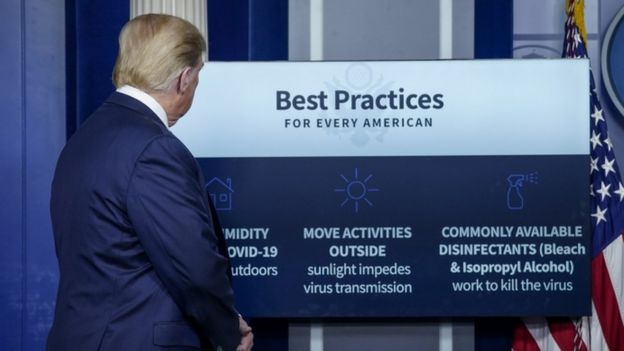
    Birx noted that when Trump made the remark Thursday, he was engaged in a “dialogue” with William Bryan, the acting head of science at the Department of Homeland Security, about a study detailing the use of light and disinfectants to help kill the coronavirus on surfaces.

    “I think I’ve made it clear that this was a musing, as you described,” Birx told Tapper on “State of the Union” Sunday, dodging a question about whether she’s bothered by having to spend time discussing the President’s comments, by criticizing “the news cycle.”

    “I think we’re missing the bigger pieces of what we need to be doing as an American people to continue to protect one another,” Birx said. “We should be having that dialogue about asymptomatics. We should be having that dialogue about this unique clotting that we’re seeing.”

    Bruised by the avalanche of negative coverage and reprimands from public health experts, Trump retreated into the recesses of the White House this weekend, emerging only on Twitter where he aired his grievances about his press coverage. He took no questions at his briefing Friday and in a departure from recent weeks, there was no White House press conference Saturday and none scheduled for Sunday.

    Two officials said Sunday the White House is planning more economy-focused events in the coming days and weeks, as Axios first reported. That could include more roundtables with CEOs and workers meant to highlight efforts to spur an economic recovery.

    Aides believe Trump is better positioned to drive an economic message rather than a health one, officials said, a fact they feel was proven true after this week’s disinfectant disaster. The events could also provide a venue for the President to continue engaging with the media — through Oval Office or Cabinet Room sprays — without continuing the daily briefings.

    The President’s absence from the podium may be the best medicine for Americans at a time when some states are beginning to reopen and residents are looking for guidance from scientists and medical experts about whether it is safe to venture from their homes.

    For weeks now as aides and allies have urged Trump to stop doing daily briefings, the President has commandeered the microphone, dispensing self-congratulatory assessments of his administration’s handling of the pandemic rifled with inaccuracies. He has downplayed the desperate shortages in personal protective equipment and Covid-19 testing equipment. He has railed at state officials who don’t seem sufficiently grateful to him and snapped at reporters for “nasty questions” and unflattering news coverage.

    Instead of focusing on scientific guidance from doctors and experts, under Trump’s control have been more political than informative, often taking on the braggadocios tone of the President’s rallies. The imbalance of self-promotion and facts has led to worries among Democrats about the fact that former Vice President Joe Biden, his presumptive Democratic rival, has no equivalent platform.

    While Trump does share the microphone with his medical advisers like Birx, Dr. Anthony Fauci, Food and Drug Administration Commissioner Dr. Stephen Hahn, the President’s own statements about the coronavirus at the podium have been threaded with falsehoods and errors, often stoking confusion that has to be cleared up later by his team.

    On Thursday, Trump veered into dangerous territory as he questioned whether it would be possible to kill the coronavirus by streaming light into the body or through a shot of disinfectant.

    With aides clearly concerned that contradicting him might lead to their exits during a pandemic, no one corrected him in that moment. On Thursday in the midst of Trump’s tangent about disinfectant, Birx stared hard at the floor, briefly telling him when he asked, that she’d never heard of sun or heat as a coronavirus treatment.

    The consequences were serious: in the past few days state officials and disinfectant manufacturers repeatedly warned Americans about the dangers of using chemicals or household cleaners in any other manner than what is printed on the label.

    During a Saturday afternoon briefing, Illinois Public Health Director Dr. Ngozi Ezike reported a significant increase in calls to poison control, including, she said, someone who tried using a detergent-based solution like a sinus rinse and another person who gargled with a bleach and mouthwash mixture in an effort to kill germs.

    “Injecting, ingesting, snorting household cleaners is dangerous,” Ezike warned. “It is not advised and can be deadly.”

    Trump’s controversial comments offered an opening to Biden, who weighed in on Twitter: “I can’t believe I have to say this,” Biden tweeted Friday, but please don’t drink bleach.”

    Democratic House Speaker Nancy Pelosi on Sunday likened the President’s suggestion to “embalming,” telling Tapper on CNN’s “State of the Union,” “We spend a lot of time on what the President said, when, and — disinfectant in the body. You know what they call that? They call that embalming. That’s the medical term.”

    Maryland Gov. Larry Hogan, a Republican, said on CBS’ “Face the Nation” Sunday that his state’s poison control hotline has now received “hundred of calls” from people “asking about injecting or ingesting these disinfectants.”

    “I think it is critical that the President of the United States — when people are really scared and in the middle of this worldwide pandemic — that in these press conferences, that we really get the facts out there,” Hogan told CBS.

    Shifting explanations from the White House

    In the midst of shifting explanations from the White House about the context of Trump’s remarks in Thursday evening’s briefing, the President hinted Saturday that his days at the briefing room podium might be coming to an end.

    In one tweet, Trump questioned the value of holding White House press briefings, saying they are “not worth the time & effort” if the media is going to just ask “nothing but hostile questions.” Trump also noted the “record ratings” for his appearances.

    In a subsequent tweet, he tried to rewrite the narrative about his own early skepticism about the origins and potential spread of Covid-19.

    “I never said the pandemic was a Hoax! Who would say such a thing?” Trump tweeted Saturday. “I said that the Do Nothing Democrats, together with their Mainstream Media partners, are the Hoax. They have been called out & embarrassed on this, even admitting they were wrong, but continue to spread the lie!”

    As CNN has reported, Trump used the term hoax when he compared Democratic criticism of the administration’s response to the virus to their efforts to impeach him: “This is their new hoax,” he said at a February 28 rally in South Carolina.

    Trump continued to try to shift blame to reporters for misunderstanding him throughout the weekend.

    During a Friday bill signing ceremony in the Oval Office, Trump insisted he had made the comments sarcastically to reporters, even though there was no hint of sarcasm in his Thursday delivery.

    “I was asking a very sarcastic question to the reporters in the room about disinfectant on the inside. But it does kill it, and it would kill it on the hands, and that would make things much better. That was done in the form of a sarcastic question to the reporters,” Trump said Friday.

    White House press secretary Kayleigh McEnany told reporters the President’s remarks were simply taken out of context.

    On Saturday, Trump continued the debate, curiously quibbling with the fact that reporters had recounted his back-and-forth with Birx about the effect of heat, sun and light on the coronavirus, asserting that he was speaking to “our Laboratory expert, not Deborah, about sunlight etc. & Coronavirus.”

    Shortly before Trump’s Thursday remarks, he had been briefed by Bryan, who had presented findings from a study about whether the spread of coronavirus could be slowed by warmer weather.

    Bryan summarized the study in the briefing room, also discussing how ultraviolet rays and disinfectants, including bleach and alcohol, may shorten the life of the virus. (Bryan does not have a medical background and is not a scientist.)

    That seemed to carry Trump’s train of thought toward the notion that disinfectant might be used inside the body: “I see the disinfectant, where it knocks it out in a minute. One minute. Is there a way we can do something like that, by injection inside or almost a cleaning?” Trump said Thursday during the briefing. “Because you see it gets on the lungs and does a tremendous number on the lungs.”

    On “State of the Union” Sunday, Birx said the President “understood” after he turned to her during Thursday’s briefing, asked about the impact of the light and heat on coronavirus, “that it was not [used] as a treatment.”
    She said what got lost in the debate was that the “study was critically important for the American people.”

    “We had an MIT study just from a few weeks ago that suggests when people are talking and singing, aerosolized virus could be moving forward. What this study showed for the first time is that sunlight can impact that aerosolization outside,” Birx told Tapper.

    “This is why we asked them to do it. We’re trying to understand why people should be wearing masks,” Birx added. “You’re wearing masks because you could have asymptomatic infection and you will decrease your transmission to others. I think the half-life in the sunlight is very important as we move forward to really understand how we can effectively create decontaminations in different environments.”

    McEnany pushed back on reporters’ questions Saturday over whether the White House was sending mixed messages about the context of the President’s suggestion.

    “Taking a sarcastic comment and running with negative headlines is the definition of taking something out of context, so I believe those answers are very much in sync,” she told reporters at the White House.

    McEnany would not say whether the President plans to dial back his participation in the coronavirus task force briefings after his abrupt departure from the briefing room Friday.

    “I leave that to the President,” she said. “That’s entirely his decision, but I believe the President is at his best when he’s speaking directly to the American people.”

    When asked why he did not take questions Friday, she noted that “the President has taken questions for 49 briefings since the end of February.”

    Source: cnn.com

  • Merkel faces growing criticism over German virus strategy

    German Chancellor Angela Merkel has been praised at home and abroad for her reaction to the coronavirus crisis, but as voices of discontent grow louder, support for the government’s strategy could be on the wane.

    Though Germany began to lift lockdown measures last week, Merkel has urged caution and slammed growing impatience to shake off the curbs on public life introduced a month ago to slow contagion.

    The measures have proved successful so far, with Germany maintaining a mortality rate of just 3.7 percent in the pandemic, far lower than major European neighbours.

    The restrictions have also met with public approval. Almost three quarters of the population said they supported them in a Kantar poll published Friday.

    In full-blown crisis just a few months ago, Merkel’s CDU/CSU conservative alliance has meanwhile rebounded in the polls, jumping ten points in the last two weeks to 38 percent.

    ‘Life and death’

    Yet the mood could be about to change.

    Wolfgang Schaeuble, an elder statesman of German politics and current president of the Bundestag lower house, warned that extended restrictions would impinge on fundamental citizens’ rights.

    “When I hear that protecting lives should come above everything else, I don’t think that is absolutely true,” he told Berlin daily Der Tagesspiegel on Sunday.

    Merkel also provoked the ire of regional leaders when she suggested last week that they had been too eager to relax restrictions.

    Armin Laschet, state premier for Germany’s most populous region North-Rhine Westphalia and a candidate to succeed Merkel as CDU leader, protested that the discussion over how to lift lockdown measures was “appropriate”.

    “It is of course still a question of life and death,” he told public broadcaster ARD on Sunday night.

    Yet he insisted that the negative effects of lockdown must also be “weighed up”, pointing in particular to children “who have had to stay at home for the last six weeks”.

    He also attacked what he saw as the pessimistic predictions of some medical experts, pointing out that “40 percent of intensive care beds are empty” in his state.

    Germany’s most popular newspaper Bild echoed Laschet’s words in a scathing editorial on Monday, accusing Merkel of being “stubborn, pig-headed and bossy”.

    ‘End of national unity’

    Largely muted in the crisis until now, Germany’s opposition parties are also beginning to grow more critical of the government’s course.

    The Greens, still the highest polling opposition party despite a recent slump, have urged more caution. On Sunday, co-leader Annalena Baerbock slammed plans to allow Bundesliga football to resume without spectators from next month.

    The leader of the liberal FDP Christian Lindner warned that consensus over coronavirus measures was breaking down, declaring the “end of national unity”.

    His party’s concern over both the fate of small and medium-sized businesses, as well as the erosion of civil liberties, is also shared by more extreme groups.

    Far left and far right protesters have assembled in Berlin every Saturday in recent weeks, calling for “democratic resistance” against what they claim are authoritarian and unconstitutional coronavirus restrictions.

    Police arrested around 100 of an estimated 1,000 protesters last Saturday and a further demonstration is planned for May 1.

    The far-right AfD, Germany’s largest opposition party by number of MPs, has also declared its opposition to lockdown.

    “The absolute shutdown was avoidable and (the government) is now missing a chance to end it,” claimed AfD lawmaker Sebastian Muenzenmaier, adding that “all shops must be opened: give the people back their liberty!”.

    Weekly newspaper Die Zeit warned the AfD could “profit from the long term consequences” of the virus such as mass unemployment.

    Source: france24.com

  • Italy’s bishops attack Conte for extending ban on mass

    Prime Minister Giuseppe Conte came under attack on Monday from Italy’s Catholic bishops and even some of his own cabinet members for refusing to reintroduce mass once the coronavirus lockdown is lifted.

    Conte has unveiled a gradual easing of restrictions that will restore some semblance of former life starting on May 4.

    The Mediterranean country’s official death toll of 26,664 is Europe’s highest and second globally only to the United States.

    But the number of infections has been ebbing and scientists believe the contagion rate is low enough to gradually get back to work.

    Conte has allowed Italians to take strolls in parks and go jogging starting next Monday.

    More stores will reopen and restaurants will resume takeout service.

    Even museums will unlock their gates on May 18 in an effort to draw back tourists and help out Italy’s devastated hotel and services industry.

    But there will still be no mass and attendance at funerals will be limited to 15 people.

    Conte and Health Minister Roberto Speranza agreed with a scientific committee conclusion that “the elderly in the parish are too frail to risk”, La Repubblica daily wrote.

    The bishops are livid.

    “We cannot accept to see the freedom of worship compromised,” the Italian Episcopal Conference of the country’s top bishops said in a statement.

    “Why on earth, with proper precautions, can you go to a museum but not to mass?”

    Powerful enemies

    The Corriere della Sera newspaper said the bishops had been lobbying Conte to allow Sunday mass services that would be limited to about 20 people.

    They also urged up to 15 people to be permitted to attend weddings and baptisms.

    But Conte only allowed broader access to funerals and promised to look into how other religious curbs can be relaxed in the coming weeks.

    “I understand that freedom of worship is a fundamental people’s right,” Conte told the nation on Sunday.

    “I understand your suffering. But we must continue discussing this further with the scientific committee.”

    Italy’s Family Minister Elena Bonetti called Conte’s decision “incomprehensible”.

    “It is up to politicians to protect the country’s wellbeing, and religious freedom is among our fundamental rights,” the minister said.

    La Repubblica daily warned that Conte was developing powerful enemies at a critical juncture.

    Italy’s competing political forces had appeared to put aside their squabbles as the nation entered what was widely regarded as its gravest emergency since World War II.

    But Conte has been coming under growing criticism and pressure from regional leaders and political opponents as he decides which industries to open up first.

    “This is the (bishops’) first open conflict with the prime minister,” La Repubblica noted.

    “There is a battle being waged over everything.”

    Source: france24.com

  • ‘Project Restart’: Premier League ramps up plans for resuming season

    Plans to resume the Premier League season will step up this week in what has been labelled “Project Restart”.

    Arsenal and Brighton have opened their training grounds to players for individual workouts on Monday.

    The league is hopeful of a potential 8 June restart and finishing at the end of July to fit in with Uefa’s European competition plans. This would require full training to begin by 18 May.

    Top-flight clubs will meet on Friday to discuss options for the restart.

    The Premier League has been suspended since 13 March because of the coronavirus pandemic and all clubs remain committed to playing this season’s 92 remaining fixtures.

    All games are expected to be held behind closed doors and the league is considering making some available free-to-air.

    One issue under debate on Friday will be what “approved stadiums” will be used and whether that will be a limited number of grounds or neutral venues.

    However, a return to action still depends on the government’s five tests being met, especially an increase in testing, and meeting social distancing guidelines.

    It also hinges on the conclusions reached by regular cross-sport meetings of senior medical officials discussing the health protocols for competing behind closed doors, which are set to start this week.

    The BBC reported on Saturday how the government has plans for a series of these meetings to help elite sport resume.

    The move was described by a source close to the plans as a “quickening of the pace” and intended to help sport resume “within weeks”, if progress was made.

    More than 20,000 people in the UK have died with coronavirus.

    On Sunday, Foreign Secretary Dominic Raab said it would be “difficult” for amateur sport to return this summer due to the “level and scale of interaction” but that professional sport may be able to return “because of the scale of testing” that could be introduced.

    Clubs in Germany’s Bundesliga have already returned to training and the top-flight season is ready to restart on 9 May if given the go-ahead by the government.

    In Italy, Serie A sides can return to individual training on 4 May and team training on 18 May after the Italian prime minister announced the first steps in lifting the country’s coronavirus lockdown.

    World players’ union Fifpro says the return of football risks sending a “bad signal”.

    “There is a huge logistical and medical/scientific question about testing and protocols but also a social one,” said secretary-general Jonas Baer-Hoffmann.

    “We need guidance and protocols on how to return in a healthy and safe manner. Football is a contact sport and we feel very high protection standards are required.

    “Are we sending the right message to society, and are we encouraging a healthy return to normal life? Or are we sending a bad signal that football has different rules to the rest of the world?”

    Source: bbc.com

  • Moise Kean: Everton set to discipline striker for lockdown breach

    Everton striker Moise Kean is set to be disciplined by the club after being filmed at a house party in breach of government coronavirus guidelines.

    The Daily Star Sunday reported that Italian Kean, 20, filmed himself at the party in his apartment.

    It is likely that Kean will face a fine after Everton said they were “appalled” by the incident.

    As of 27 April, more than 20,000 people have died from coronavirus in the United Kingdom.

    Prime Minister Boris Johnson said on Monday the country was at a moment of “maximum risk” and that he could not determine when lockdown measures would be lifted.

    Kean joined Everton in August for £25.1m from Juventus but has scored only once in 26 appearances.

    The striker was dropped from the squad for a game at Southampton in November by then manager Marco Silva after being late for a team meeting for the second time.

    His latest discipline breach comes after several other Premier League players also ignored social distancing measures.

    Aston Villa captain Jack Grealish was pictured at the scene of a car accident, after going to “see a friend”. He apologised and said he was “deeply embarrassed”.

    Kyle Walker is waiting on any disciplinary action from Manchester City after reportedly breaking lockdown rules by hosting a party involving two sex workers.

    Tottenham’s Serge Aurier and Moussa Sissoko apologised for training together, while manager Jose Mourinho “accepted his actions were not in line with protocol” after being pictured holding a one-on-one training session in a park with midfielder Tanguy Ndombele.

    Chelsea midfielder Mason Mount was pictured having a kickabout with West Ham’s Declan Rice despite Mount testing positive for coronavirus and being told to self-isolate for 14 days.

    Source: bbc.com

  • Russias coronavirus cases rise to 87,147

    Russia reported 6,198 new confirmed coronavirus cases on Monday versus 6,361 on the previous day, which took the national tally of infections to 87,147.

    The Russian coronavirus crisis response centre said that 50 more deaths of coronavirus patients were confirmed in the last 24 hours.

    In the number of confirmed coronavirus cases, Russia surpassed mainland China, which reported the total of 82,830 cases on Monday.

    Source: reuters.com

  • Coronavirus: Students return to class in Shanghai and Beijing

    Tens of thousands of students returned to school in Shanghai and Beijing Monday after months of closures intended to curb the spread of the coronavirus, as China’s major cities gradually return to normality.

    Shanghai students in their final year of middle and high school returned to classrooms, while only high-school seniors in Beijing were allowed back on campus to prepare for the all-important “gaokao” university entrance exam.

    China has largely curbed the spread of the deadly disease, but is still on high alert with growing fears of imported cases and a second wave of domestic infections in the northeast.

    Teenager Meng Xianghao said he was taking extra precautions on his first day back at Beijing’s Chenjinglun High School.

    “I brought masks, garbage bags and disinfectant,” Meng, who had just taken the subway for the first time in months, told AFP as children in masks and uniform tracksuits filed past police and officials to enter the school.

    “I’m glad, it’s been too long since I’ve seen my classmates,” said 18-year-old student Hang Huan. “I’ve missed them a lot.”

    A tent set up at the entrance was staffed by a person in a white hazmat suit, while a man wearing a container of disinfectant on his back sprayed the ground by the school gates.

    Across the country, schools that have been closed or online-only since January began gradually reopening last month, while virus epicentre Wuhan is set to reopen its high schools on May 6.

    Students in the capital will have their temperatures measured at school gates and must show a “green” health code on a special app that calculates a person’s infection risk, according to China’s Ministry of Education.

    The ministry said some schools in Beijing had rehearsed the reopening with mock “students” in advance.

    Welcome speeches

    Footage from the Communist Party-run Beijing Daily showed some of the city’s 49,000 high-school seniors in classrooms Monday, wearing masks at desks which were spaced evenly apart as teachers welcomed them back with speeches.

    A screen at the front showed a photo of Chinese President Xi Jinping, as the teacher talked to the class about the significance of overcoming the COVID-19 pandemic.

    In some cafeterias, students are assigned fixed seating spots spaced at least one metre apart.

    Beijing still has strict measures in place to prevent a fresh outbreak, requiring visitors to the city to pass stringent testing requirements and complete lengthy quarantine periods.

    In Shanghai, some schools have set aside special rooms for isolating students with “abnormal temperatures,” the ministry said.

    Beijing student Xiao Shuhan told AFP he thought some form of social distancing would continue even as classmates and friends reunite.

    “We’ll no longer put our arms around each other’s shoulders,” he said.

    The long absence from classrooms has added to the pressure on final-year students preparing for the high-stakes “gaokao” exams, which is the only route to Chinese universities and notoriously difficult.

    “At school there’s a certain atmosphere for learning and at home there is not,” said Wang Yuchen, a 17-year-old student.

    China said in March that it would postpone the exams by one month to July this year.

    Source: france24.com

  • Coronavirus: Italy’s PM outlines lockdown easing measures

    Italy has outlined plans to ease the strict restrictions imposed seven weeks ago to curb the spread of the coronavirus as it recorded its lowest daily death toll since mid-March.

    Prime Minister Giuseppe Conte said curbs would be relaxed from 4 May, with people being allowed to visit their relatives in small numbers, in masks.

    Parks will reopen, but schools will not restart classes until September.

    Italy has reported 26,644 virus-related deaths, Europe’s highest official toll.

    The country recorded 260 new deaths on Sunday, the lowest daily figure since 14 March. It has confirmed 197,675 cases of the virus, according to data from Johns Hopkins University, which is tracking the disease globally.

    The number of cases has been falling, and authorities now believe Italy’s contagion rate – the number of people each person with the virus infects – is low enough to justify a cautious easing of curbs.

    What has been announced?

    Speaking on television, Mr Conte outlined how the country would begin “Phase Two” of lifting its coronavirus lockdown. The measures include:

    People will be allowed to move around their own regions – but not between different regions

    Funerals are set to resume, but with a maximum of 15 people attending, and ideally to be carried out outdoors

    Individual athletes can resume training, and people can do sports not only in the vicinity of their homes but in wider areas

    Bars and restaurants will reopen for takeaway service from 4 May (not just delivery as now), but food must be consumed at home or in an office

    Hairdressers, beauty salons, bars and restaurants are expected to reopen for dine-in service from 1 June

    More retail shops not already opened under the earliest easing measures will reopen on 18 May – along with museums and libraries

    Sports teams will also be able to hold group training from 18 May

    There was no announcement on the possibility of Italy’s premier football league Serie A resuming, even behind closed doors.

    Mr Conte stressed that social distancing measures would need to continue for months to come, and said church services would remain banned. He urged people to stay a metre (3ft) away from each other.

    “If we do not respect the precautions the curve will go up, the deaths will increase, and we will have irreversible damage to our economy,” the prime minister said. “If you love Italy, keep your distance.”

    Source: bbc.com

  • FC Nordsjaelland coach outlines training program for Kudus Mohammed after covid-19 break

    FC Nordsjaelland deputy coach Frank Hjortebjerg has provided a detailed training program for Ghana midfielder Kudus Mohammed and his teammates after resuming full session on Monday.

    The Wild Tigers resumed training on Monday after the Danish government lifted its lockdown necessitated by the coronavirus crisis.

    The training was in full compliance with the guidelines of the authorities and the Divisional Association as it was done in groups without any close contact in the exercises.

    “For example, if you start from an offensive player like Kudus [Mohammed]. He has been training to get down the field where a midfielder or defender hits him with a pass in the space where we would like to find him. Then there may be a lay-off or some combination with another player before practicing his run in the field in the field. And then of course, some finishing training comes from there. Many different types of kicks.”

    “So there are a lot of play patterns and templates where the players are in positions where there is naturally distance between each other. Then we avoid duels and contact. And it is a type of training that we can easily take with us when one day we are allowed to play in a more real battle picture. We also did not put all attackers in one group or all backs in one group. It is very mixed so there are different types in each group,” Hjortebjerg told the club’s website.

    Source: Ghana Soccernet

  • ‘Immunity passports’ against Coronavirus premature – WHO

    The World Health Organisation (WHO), has stated that there is not enough evidence about the effectiveness of antibodies-mediated immunity to guarantee the accuracy of an “immunity passport” or “risk-free certificate,” for the COVID-19.

    It stated that as of April 24, 2020, no study had evaluated whether the presence of antibodies to SARS-CoV-2 conferred immunity to subsequent infections by the virus in humans or not.

    The WHO was reacting to suggestions by some governments that the detection of antibodies to the SARS-CoV-2, the virus that causes COVID-19, could serve as the basis for the issuance of an “immunity passport” or “risk-free certificate”.

    This certificate they propose, would enable individuals to travel or to return to work assuming they were protected against re-infection.

    However, the WHO in its scientific brief, released on Friday, April 24, said there was currently no evidence that people who had recovered from COVID-19 and had antibodies were protected from a second infection.

    Considering the measurement of antibodies specific to COVID-19, the brief said the development of immunity to a pathogen through natural infection was a multi-step process that typically took place over one to two weeks.

    This, it noted, could cause people who assumed that they were immune to a second infection – because they had received a positive test result – to ignore public health advice.

    The use of such certificates may, therefore, increase the risks of continued transmission of infections.

    The WHO said, it had, therefore, published guidance on adjusting public health and social measures for the next phase of the COVID-19 response.

    It was still reviewing the evidence on antibody response to SARS-CoV-2 infection, adding that most of these studies showed that people who had recovered from infection had antibodies to the virus.

    “However, some of these people had very low levels of neutralizing antibodies in their blood, suggesting that cellular immunity may also be critical for recovery,” it said.

    It also explained that the body responded to a viral infection immediately with a non-specific innate response in which macrophages, neutrophils, and dendritic cells slowed the progress of virus and may even prevent it from causing symptoms.

    This non-specific response, it said, was followed by an adaptive response where the body made antibodies, which were proteins called immunoglobulins that specifically bound to the virus.

    It explained that the body also made T-cells that recognised and eliminated other cells infected with the virus, and termed this as “cellular immunity”.

    “This combined adaptive response may clear the virus from the body, and if the response is strong enough, may prevent progression to severe illness or re-infection by the same virus,” it explained.

    Laboratory tests that detected antibodies to SARS-CoV-2 in people, including rapid immunodiagnostic tests, needed further validation to determine their accuracy and reliability, it explained.

    “Inaccurate immunodiagnostic tests may falsely categorise people in two: ways – The first, may falsely label people who have been infected as negative, while those who have not been infected could falsely be labelled as positive, with both errors having serious consequences that would affect control efforts”.

    These tests also needed to accurately distinguish between past infections from SARS-CoV-2 and those caused by the known set of the six human coronaviruses, four of which caused the common cold and circulated widely.

    The other two viruses are responsible for Middle East Respiratory Syndrome and Severe Acute Respiratory Syndrome.

    The WHO said people infected by any one of these viruses may produce antibodies that cross-reacted with antibodies produced in response to infection with SARS-CoV-2.

    It said many countries were now testing for SARS-CoV-2 antibodies at the population level or in specific groups, such as health workers, close contacts of known cases, or within households.


    Source: GNA 

  • Coronavirus has affected my movements – Bernard Tekpetey

    Fortuna Dusseldorf striker Bernard Tekpetey has admitted that the coronavirus has affected his normal routines and has been forced to postpone activities because of it.

    The Black Meteors forward has been in Germany since the pandemic began and has been allowed to train with the rest of his teammates as they prepare for the return of the Bundesliga on May 9th.

    In an interview with Joy News, the 22-year-old revealed how much the disease has affected his plans.

    “It has changed a lot of things including my movements, a lot of meeting schedules and things I had to postpone due to this virus. I think it has changed a lot of things as well.”

    Source: footballghana.com

  • Israel further eases virus measures for shops, restaurants

    The Israeli government Friday approved new steps to ease its lockdown measures for retail and service businesses, in the hope of reinvigorating the collapsing economy.

    While malls will remain closed, all other shops will be allowed to reopen if they follow strict measures such as limiting the number of customers on the premises, a joint statement from the prime minister’s office and the finance and health ministries said.

    Wearing face masks in public became mandatory earlier this month, and will also be required in stores.

    Hairdressers and beauty salons will be permitted to reopen with client limits, while restaurants and cafes, which over the past weeks have been delivery-only, can start selling takeaway.

    Less than a week ago, Israeli authorities announced the reopening of certain shops including hardware stores.

    The new measures will come into effect at midnight Saturday and will apply until May 3, the statement said.

    Also Friday, the government voted to provide support worth eight billion shekels (over $2.2 billion) to the self-employed and to small businesses.

    Israel announced its first case of the novel coronavirus on February 21, and has since officially declared more than 14,800 cases, including 193 deaths.

    The country took rapid measures to impose social distancing and has been in lockdown for weeks.

    A poll published Friday in Maariv newspaper found 60 percent of Israelis surveyed had a favourable view of Prime Minister Benjamin Netanyahu’s actions to prevent the spread of the virus.

    But the same percentage thought his handling of the economy was poor.

    Before the coronavirus crisis, Israel had an unemployment rate of around 3.4 percent, but that has jumped to around 25 percent since the shutdown.

    Source: france24.com

  • Coronavirus: UK follows Ghana’s example as they get ready to use drones for medical supplies

    Ghana’ innovative decision to use drones to deliver PPEs and samples for testing in the fight against the Coronavirus is fast getting international recognition as Britain has announced it will use drones for COVID-19 medical deliveries from next week.

    Government has employed the services of the Zipline Drones to deliver urgent medical essentials, especially samples from remote communities to designated testing centres to help in the fight against the Coronavirus.

    Earlier this week, the TIME magazine reported that Ghana is the first country in the world to employ this innovation since COVID-19 broke out, and also revealed America’s intention to urgently consider using the drones.

    Britain is now the latest state to announce its readiness to use the drones in its charge on the Coronavirus.

    At its daily COVID-19 press briefing, Sky News reported that British Transport Secretary Grant Shaps announced that drones are being trialed to deliver medical supplies to help Britain’s response against the Coronavirus.

    The trial, according to the Transport Secretary, will begin next week and it will carry supplies to St Mary’s Hospital on the Isle Of Wight.

    Considering the urgency of the situation and Britain’s quest to immediately employ the drones service, the Transport Secretary said he had “fast-tracked” the trials following a £28m awarded by the government earlier this year to Southampton and Portsmouth councils to carry out drone operations as part of a wider trial.

    Before the outbreak of the Coronavirus, Ghana had been employing drones to deliver urgent medical supplies to remote communities since the Zipline Service was launched by Vice President Dr. Mahamudu Bawumia last year.

    The introduction of the drones was criticised by the opposition NDC who said the service was not needed in the country.

    Events, especially during the outbreak of the Coronavirus pandemic, have however proved that the government was even ahead of many developed countries in the world.

    Ghana has two main drone stations at Omenako in the Eastern Region and Mampong in the Ashanti Region.

    Works are also nearing completion for the third and forth zones at Kukua near Walewale, in the North East Region and Sefwi Wiawso in the Western North Region.


    Source: www.ghanaweb.com

  • Coronavirus: US death toll passes 50,000

    The US virus death toll has surpassed 50,000, according to data from Johns Hopkins University, in what is the world’s deadliest Covid-19 outbreak.

    More than 3,000 deaths came in the last 24 hours, and there are now over 870,000 confirmed cases nationwide.

    But the US still has a lower mortality rate than most European nations based on current case counts, as the White House task force has emphasised.

    The grim news comes as parts of the US reopen after weeks of lockdown.

    Some hair salons, bowling alleys and other businesses are opening on Friday in Georgia, Alaska and Oklahoma.

    The US has by far the highest death toll and case count in the world.

    However, it has a population of 330 million, much higher than other worst affected countries such as Spain and Italy.

    Dr Deborah Birx, an expert on the White House Covid-19 task force, has said the country has “one of the lowest mortality rates in the entire world”.

    On a per capita basis, the reported US death rate of 1.4 is lower than Spain, Italy, France, Belgium and the UK.

    The US is top of the grim league table for reported coronavirus deaths, but that’s not the whole picture.

    Part of the reason is population – many countries in Europe have reported more deaths per head of population than the US and Europe as a whole has reported more deaths overall.

    But beware of comparing huge countries in this way.

    The picture in New York is very different to the picture in the rest of the US and the same goes for other countries.

    Italy really has two epidemics – one in the north of the country that overran healthcare and another down south that is much less advanced.

    Death rates also depend on how you count – France’s and Belgium’s figures include suspected Covid cases, making their figures look a lot worse.

    Presentational grey line

    Recent steep rises in the daily US death toll are also partly due to the inclusion of “probable” virus deaths.

    The US Centers for Disease Control on 14 April said their case counts would include both confirmed and probable cases and deaths.

    A probable Covid-19 death is one that meets clinical and epidemiological criteria but has not been confirmed by testing.

    It is also important to note that many mild Covid-19 cases remain unreported, so the death rate from confirmed cases is not the same as the disease’s overall death rate.

    Testing efforts are key to tracking the actual mortality and spread of the disease.

    Vice-President Mike Pence, the taskforce leader, said the US has conducted 4.9 million tests thus far, and is working with governors to expand testing.

    The $484bn economic stimulus bill, passed yesterday by Congress, also includes funding for testing expansion.

    The US is top of the grim league table for reported coronavirus deaths, but that’s not the whole picture.

    Part of the reason is population – many countries in Europe have reported more deaths per head of population than the US and Europe as a whole has reported more deaths overall.

    But beware of comparing huge countries in this way.

    The picture in New York is very different to the picture in the rest of the US and the same goes for other countries.

    Italy really has two epidemics – one in the north of the country that overran healthcare and another down south that is much less advanced.

    Death rates also depend on how you count – France’s and Belgium’s figures include suspected Covid cases, making their figures look a lot worse.

    Presentational grey line

    Recent steep rises in the daily US death toll are also partly due to the inclusion of “probable” virus deaths.

    The US Centers for Disease Control on 14 April said their case counts would include both confirmed and probable cases and deaths.

    A probable Covid-19 death is one that meets clinical and epidemiological criteria but has not been confirmed by testing.

    It is also important to note that many mild Covid-19 cases remain unreported, so the death rate from confirmed cases is not the same as the disease’s overall death rate.

    Testing efforts are key to tracking the actual mortality and spread of the disease.

    Vice-President Mike Pence, the taskforce leader, said the US has conducted 4.9 million tests thus far, and is working with governors to expand testing.

    The $484bn economic stimulus bill, passed yesterday by Congress, also includes funding for testing expansion.

    Source: bbc.com

  • Coronavirus: Outcry after Trump suggests injecting disinfectant as treatment

    US President Donald Trump has been lambasted by the medical community after suggesting research into whether coronavirus might be treated by injecting disinfectant into the body.

    He also appeared to propose irradiating patients’ bodies with UV light, an idea dismissed by a doctor at the briefing.

    Another of his officials had moments earlier said sunlight and disinfectant were known to kill the infection.

    Disinfectants are hazardous substances and can be poisonous if ingested.

    Even external exposure can be dangerous to the skin, eyes and respiratory system.

    What did President Trump say?

    During Thursday’s White House coronavirus task force briefing, an official presented the results of US government research that indicated coronavirus appeared to weaken more quickly when exposed to sunlight and heat.

    The study also showed bleach could kill the virus in saliva or respiratory fluids within five minutes and isopropyl alcohol could kill it even more quickly.

    Donald Trump with a list of possible Covid-19 treatments at the White House briefing, 23 April 2020

    William Bryan, acting head of the US Department of Homeland Security’s Science and Technology Directorate, outlined the findings at the news conference.

    While noting the research should be treated with caution, Mr Trump suggested further research in that area.

    “So, supposing we hit the body with a tremendous – whether it’s ultraviolet or just very powerful light,” the president said, turning to Dr Deborah Birx, the White House coronavirus response co-ordinator, “and I think you said that hasn’t been checked but you’re going to test it.

    “And then I said, supposing you brought the light inside of the body, which you can do either through the skin or in some other way. And I think you said you’re going to test that too. Sounds interesting,” the president continued.

    “And then I see the disinfectant where it knocks it out in a minute. One minute. And is there a way we can do something like that, by injection inside or almost a cleaning?

    “So it’d be interesting to check that.”

    Pointing to his head, Mr Trump went on: “I’m not a doctor. But I’m, like, a person that has a good you-know-what.”

    He turned again to Dr Birx and asked if she had ever heard of using “the heat and the light” to treat coronavirus.

    “Not as a treatment,” Dr Birx said. “I mean, certainly, fever is a good thing. When you have a fever, it helps your body respond. But I’ve not seen heat or light.”

    “I think it’s a great thing to look at,” Mr Trump said.

    Disinfectants don’t work inside the body

    Analysis by Rachel Schraer, BBC health reporter

    Using a disinfectant can kill viruses on surfaces. It’s a very good idea to keep clean the things you touch, using products with anti-microbial properties – for example, substances with a high alcohol content.

    There is also some evidence that, in general, viruses on surfaces die more quickly when directly exposed to sunlight. But we don’t know how much or how long they have to be exposed for UV light to have an effect, so you’re far safer just washing your hands and surfaces and trying not to touch your face.

    Crucially, this is only about infected objects and surfaces – not about what happens once the virus is inside your body.

    One of the main ways of catching the virus is by breathing in droplets expelled by an infected person, mainly by sneezing and coughing. The virus very quickly begins to multiply and spread, eventually reaching the lungs.

    Not only does consuming or injecting disinfectant risk poisoning and death, it’s not even likely to be effective.

    Equally, by the time the virus has taken hold inside your body, no amount of UV light on your skin is going to make a difference.

    And since UV radiation damages the skin, using it to kill the virus could be a case of – to borrow a well-worn phrase – the cure being worse than the disease.

    Presentational grey line

    What’s the reaction been to Trump’s comments?

    Doctors warned the president’s idea could have fatal results.

    Pulmonologist Dr Vin Gupta told NBC News: “This notion of injecting or ingesting any type of cleansing product into the body is irresponsible and it’s dangerous.

    “It’s a common method that people utilise when they want to kill themselves.”

    Kashif Mahmood, a doctor in Charleston, West Virginia, tweeted: “As a physician, I can’t recommend injecting disinfectant into the lungs or using UV radiation inside the body to treat Covid-19.

    “Don’t take medical advice from Trump.”

    John Balmes, a pulmonologist at Zuckerberg San Francisco General Hospital, warned that even breathing fumes from bleach could cause severe health problems.

    He told Bloomberg News: “Inhaling chlorine bleach would be absolutely the worst thing for the lungs. The airway and lungs are not made to be exposed to even an aerosol of disinfectant.

    “Not even a low dilution of bleach or isopropyl alcohol is safe. It’s a totally ridiculous concept.”

    Mr Trump has previously hyped a malaria medication, hydroxycloroquine, as a possible treatment for coronavirus, though he has stopped touting that drug recently.

    This week a study of coronavirus patients in a US government-run hospital for military veterans found more deaths among those treated with hydroxychloroquine than those treated with standard care.

    Reacting to the president’s remarks on Thursday evening, Joe Biden, his likely Democratic challenger in November’s White House election, tweeted: “UV light? Injecting disinfectant? Here’s an idea, Mr President: more tests. Now. And protective equipment for actual medical professionals.”

    What’s the US government’s advice?

    Only this week, the US Centers for Disease Control and Prevention warned Americans to be careful with cleaning products as sales of household disinfectants soar amid the pandemic.

    “Calls to poison centres increased sharply at the beginning of March 2020 for exposures to both cleaners and disinfectants,” found the agency’s weekly morbidity and mortality report.

    The US Food and Drug Administration has warned against ingesting disinfectants, citing the sale of bogus miracle cures that contain bleach and purport to treat everything from autism to Aids and hepatitis.

    The agency’s website says: “The FDA has received reports of consumers who have suffered from severe vomiting, severe diarrhoea, life-threatening low blood pressure caused by dehydration, and acute liver failure after drinking these products.”

    Last week a federal judge secured a temporary injunction against one organisation, known as the Genesis II Church of Health and Healing, for marketing a product equivalent to industrial bleach as a remedy for coronavirus.

    Source: bbc.com


  • Coronavirus: Disinfectant firm warns after Trump comments

    A leading disinfectant producer has issued a strong warning not to use its products on the human body after Donald Trump suggested they could potentially be used to treat coronavirus.

    Reckitt Benckiser, which owns Lysol and Dettol, said “under no circumstance” should its products be injected or ingested.

    President Trump faces a backlash over his comments at a briefing on Thursday.

    Disinfectants are hazardous substances and can be poisonous if ingested.

    Even external exposure can be dangerous to the skin, eyes and respiratory system.

    Mr Trump’s comments have been heavily criticised by doctors and have generated a huge online response. They have provoked hundreds of thousands of comments and caused well-known cleaning brands to trend on social media.

    Reckitt Benckiser, which also owns the brands Vanish and Cillit Bang, said its products should not be administered “through injection, ingestion or any other route”.

    “Our disinfectant and hygiene products should only be used as intended and in line with usage guidelines. Please read the label and safety information,” the company said in a statement.
    What did President Trump say?

    During Thursday’s White House coronavirus task force briefing, an official presented the results of US government research that indicated coronavirus appeared to weaken faster when exposed to sunlight and heat.

    The study also showed bleach could kill the virus in saliva or respiratory fluids within five minutes, and isopropyl alcohol could kill it even more quickly.

    Mr Trump then hypothesised about the possibility of using a “tremendous ultraviolet” or “just very powerful light” on or even inside the body as a potential treatment.

    Trump’s claims fact-checked
    The fake health advice you should ignore
    Will coronavirus go away in the summer?

    “And then I see the disinfectant where it knocks it out in a minute. One minute,” he said. “And is there a way we can do something like that, by injection inside or almost a cleaning?

    “Because you see it gets in the lungs and does a tremendous number on them, so it’d be interesting to check that,” he said.

    In a statement, the White House press secretary said the president had “repeatedly” told Americans to consult doctors about coronavirus treatment.

    “Leave it to the media to irresponsibly take President Trump out of context and run with negative headlines,” Kayleigh McEnany said.

    His comments have dominated social media platforms like Twitter and Reddit since Thursday night.

    Many compared his idea to a dangerous viral trend in 2018 where people ate Tide laundry detergent pods.

    Lysol, which is one of the America’s best known cleaning brands, has been named in tweets at least 125,000 times since the White House news conference.

    Owners Reckitt Benckiser said they issued their statement on Friday “due to recent speculation and social media activity”.
    What’s the medical reaction been?

    Doctors warned that the president’s suggestion could have fatal results.

    “This notion of injecting or ingesting any type of cleansing product into the body is irresponsible and it’s dangerous,” Dr Vin Gupta, a pulmonologist and global health policy expert, told NBC news. “It’s a common method that people utilise when they want to kill themselves.”

    “Inhaling chlorine bleach would be absolutely the worst thing for the lungs,” pulmonologist John Balmes told Bloomberg News. “The airway and lungs are not made to be exposed to even an aerosol of disinfectant.

    “Not even a low dilution of bleach or isopropyl alcohol is safe. It’s a totally ridiculous concept.”

    This is not the first time that Mr Trump’s medical advice has generated controversy and criticism.

    He has previously hyped a malaria medication, hydroxychloroquin, despite a lack of clinical evidence it helps treat Covid-19 and some concerns it can even be detrimental.
    Poisoning and death risks

    Analysis by Rachel Schraer, BBC health reporter

    Using a disinfectant can kill viruses on surfaces. It’s a very good idea to keep clean the things you touch, using products with anti-microbial properties – for example, substances with a high alcohol content.

    There is also some evidence that, in general, viruses on surfaces die more quickly when directly exposed to sunlight. But we don’t know how much or how long they have to be exposed for UV light to have an effect, so you’re far safer just washing your hands and surfaces and trying not to touch your face.

    Crucially, this is only about infected objects and surfaces – not about what happens once the virus is inside your body.

    One of the main ways of catching the virus is by breathing in droplets expelled by an infected person, mainly by sneezing and coughing. The virus very quickly begins to multiply and spread, eventually reaching the lungs.

    Not only does consuming or injecting disinfectant risk poisoning and death, it’s not even likely to be effective.

    Equally, by the time the virus has taken hold inside your body, no amount of UV light on your skin is going to make a difference.

    And since UV radiation damages the skin, using it to kill the virus could be a case of – to borrow a well-worn phrase – the cure being worse than the disease.

    Earlier this week, the US Centers for Disease Control and Prevention warned Americans to be careful with cleaning products as sales of household disinfectants soar amid the pandemic.

    “Calls to poison centres increased sharply at the beginning of March 2020 for exposures to both cleaners and disinfectants,” the agency’s weekly morbidity and mortality report found.

    The US Food and Drug Administration has also warned against ingesting disinfectants, citing the sale of bogus miracle cures that contain bleach and purport to treat everything from autism to Aids and hepatitis.

    Last week, a federal judge secured a temporary injunction against one organisation, known as the Genesis II Church of Health and Healing, for marketing one of these products as a potential coronavirus cure.

    Source: bbc.com

  • Fortnite’s Travis Scott virtual concert watched by millions

    More than 12 million players logged in for Fortnite’s concert featuring Travis Scott, with reviewers calling it “stunning” and “spectacular”.

    It included a skyscraper-sized version of Scott teleporting across the landscape as he performed his songs.

    Fortnite is one the world’s most popular games, attracting millions of young players from across the globe.

    Scott used the opportunity to reveal a new song, while players celebrated the event with themed in-game items.

    The award-winning artist has sold tens of millions of records in his career, and was due to perform at the world-famous Coachella music festival this summer before it was postponed.

    Those who missed the digital debut, however, can catch “encore” performances at the weekend.

    A digital version of Scott performed a fully-animated, scripted 10-minute set – shorter than a concert performance.

    As Scott moved from song to song, his virtual avatar changed – first into a cyborg, then a fluorescent spaceman.

    The landscape shifted and crumbled around players on an enormous scale.

    After it was over, Scott tweeted: “Honestly today was one of the most inspiring days. Love every single one of you guys.”

    Source: bbc.com

  • I have improved at Real Mallorca – Ghana midfielder Iddrisu Baba

    Ghana midfielder, Iddrisu Baba says he is impressed with his form and numbers in the Spanish Premier La Liga.

    Baba made his debut for Real Mallorca on April 27, 2019, where he replaced Salva Sevilla in the 88th minute against Málaga CF.

    Now, the 24-year-old is enjoying a forced break from soccer due to the Coronavirus outbreak and has time to reflect.

    “I think I have improved if I look at the number of games I have played,” he says in an interview with Play Red.

    “I think that says a lot. Comparing this season with last season, this has been excellent. If I want to be a part of this team all the time, I have to do more than I am doing now. Every season there are new talents, so you should be there as the competition progresses.

    “I would like to thank Vicente Moreno enormously for the credibility and confidence he has given me, but I think there is still room for improvement.

    “It really is my first season and I am still trying to get used to everything. I think there is still room for improvement, so I would like to thank you.

    “As for the rest, I have to try harder if I want to maintain or go beyond the level of confidence that has given me,” he added.

    Source: footballghana.com