Tag: finance minister

  • Finance Minister unveils national policy designed to build external reserves

    Finance Minister unveils national policy designed to build external reserves

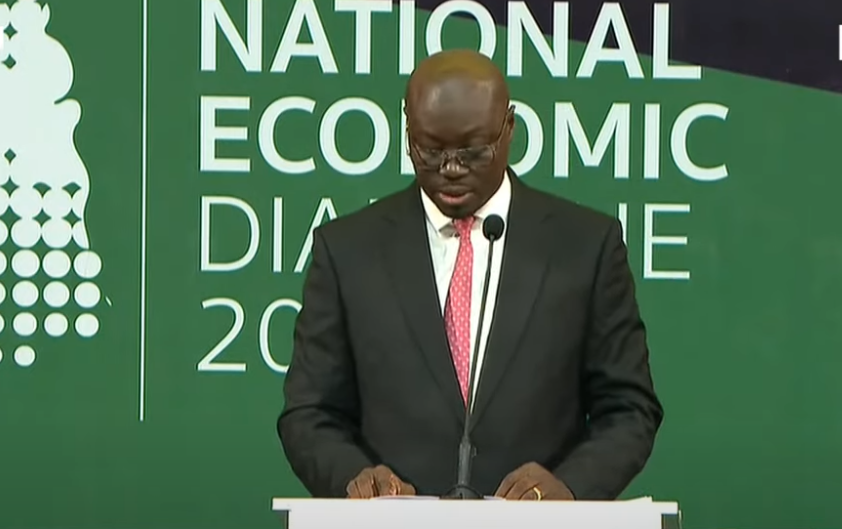
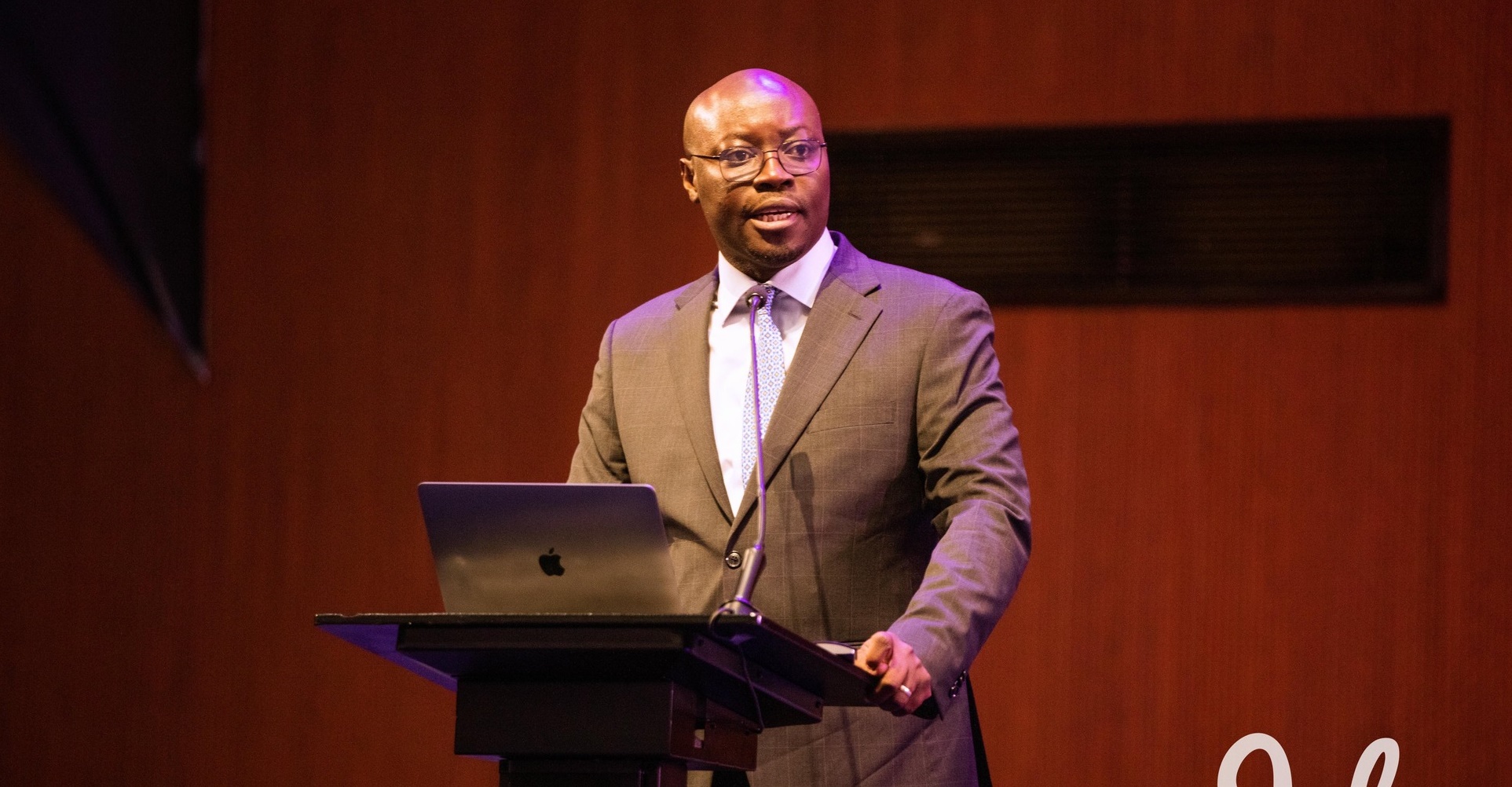
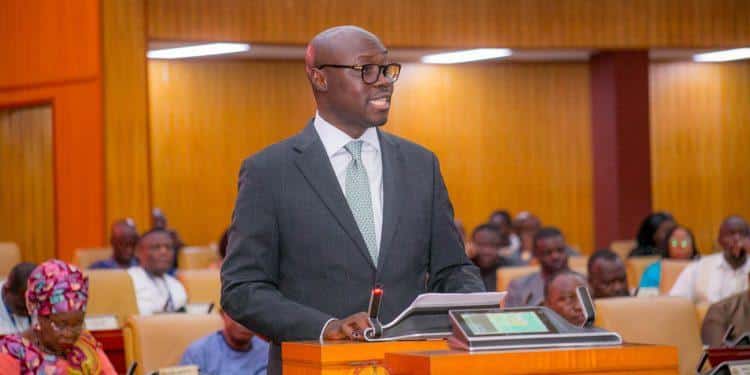
    The Minister of Finance, Dr Cassiel Ato Forson, has unveiled Ghana’s first-ever comprehensive national policy specifically designed to deliberately and sustainably build the country’s external reserves and secure long-term macroeconomic stability.

    Presenting the Ghana Accelerated National Reserve Accumulation Policy (GANRAP) (2026–2028) to Parliament, the minister described the initiative as a historic and strategic shift in how Ghana manages its external buffers, moving away from costly borrowing and short-term reserve-building measures toward a structured, gold-backed and reform-driven accumulation framework.

    Strong Economic Foundation
    Dr Forson told Parliament that the policy builds on the decisive macroeconomic turnaround achieved in 2025 following the 2022–2023 crisis.

    Key indicators at the end of 2025 included:

    • Real GDP growth averaging 6.1% in the first three quarters of 2025
    • Inflation declining sharply from 23.8% in 2024 to 5.4% and further to 3.8% in January 2026.
    • The 91-day Treasury bill rate falling from 27.7% at end-2024 to 6.4% in February 2026
    • Public debt declining from 61.8% of GDP to 45.3%
    • Gross international reserves rising to US$13.8 billion, equivalent to 5.7 months of import cover, up from 4.0 months in 2024.

    Despite these gains, the Minister cautioned that the traditional benchmark of three months of import cover is no longer sufficient in today’s volatile global environment.

    Target: 15 Months of Import Cover by 2028
    Under GANRAP, the government is targeting an ambitious increase in reserves to the equivalent of 15 months of import cover by end-2028.

    The policy sets intermediate milestones of:
    • 8.6 months by end-2026
    • 11.8 months by end-2027
    • 15 months by end-2028

    The Minister described the target as the creation of an “economic war chest” to shield Ghana against commodity price shocks, global financing volatility, geopolitical tensions and climate-related disruptions.

    Gold as the Strategic Anchor
    Central to the policy is a deliberate gold-backed reserve accumulation strategy anchored on the Ghana Gold Board Act, 2025 (Act 1140), which mandates the Ghana Gold Board to generate foreign exchange and support gold reserve accumulation by the Bank of Ghana.

    The government has set an operational weekly gold purchase target of approximately 3.02 tonnes.

    This will be achieved through:
    • Acquisition of at least 2.45 tonnes weekly from the Artisanal Small-Scale Mining (ASM) sector
    • Invocation of pre-emption rights to secure a minimum of 0.57 tonnes weekly from the large-scale mining sector.

    The gold acquired will be refined, added to Ghana’s physical reserves, and may only be sold with prior approval of Cabinet and Parliament.

    Ending Costly Borrowing for Reserves
    The Minister noted that between 2017 and 2024, Ghana relied heavily on Eurobonds, swaps, sale-and-buy-back transactions and commercial bank borrowing to build reserves at significant cost.

    From 2022 to 2024 alone, the Bank of Ghana accumulated US$5.65 billion in reserves through swaps and related transactions at a cost of US$1.16 billion in interest.

    Additionally, Eurobond borrowings between 2018 and 2021 to support reserve build-up cost taxpayers about US$2.5 billion in interest payments alone, with Ghana still servicing these debts.

    Dr Forson stressed that borrowing to accumulate reserves is unsustainable and contributed to the 2022 debt distress.

    In contrast, he revealed that in 2025 alone, the Ghana Gold Board generated approximately US$10 billion in foreign exchange at a cost of US$214 million, significantly lower than the cost of comparable borrowing.

    Broader Structural Reforms
    Beyond gold, the policy integrates structural reforms aimed at expanding foreign exchange inflows and reducing persistent outflows.

    These include:
    • Scaling up non-traditional exports
    • Revitalising cocoa productivity
    • Implementing the National Policy on Integrated Oil Palm Development
    • Accelerating new oil field developments such as Pecan
    • Conserving foreign exchange through a Gas-to-Power Transformation Policy

    The Minister emphasised that maintaining fiscal discipline and sustaining a primary surplus remain critical to protecting the gains achieved.

    Safeguarding Ghana’s Future
    Dr. Forson concluded by urging Parliament to support what he described as a historic and forward-looking policy framework designed to strengthen Ghana’s first line of defence against external shocks.

    The overarching objective, he said, is to build a resilient reserve management system that safeguards macroeconomic stability, sustains investor confidence, improves living standards and secures lasting prosperity for future generations.

    With the unveiling of GANRAP, Ghana becomes one of the few African countries to adopt a structured, legislatively anchored national reserve accumulation strategy driven primarily by domestic resource mobilisation rather than external borrowing.

    Source: GhanaWeb

  • U.S. court to review legal basis for Ofori-Atta’s extradition

    U.S. court to review legal basis for Ofori-Atta’s extradition

    The United States (U.S.) court will today, Thursday, February 19, decide whether to extradite the former Finance Minister, Ken Ofori‑Atta, to Ghana.

    The court will give its verdict after reviewing the legal documents and evidence submitted by Ghanaian authorities to support their extradition request.


    According to an immigration judge at the Arlington Immigration Court in Virginia, David A. Gardey the court today’s bond hearing is necessary as the “cannot act on assertions without proof”.


    On January 20, a closed-door court session to consider Ofori-Atta’s bail application was brought to a halt after his lawyers demanded that the court first verify the legality and completeness of Ghana’s extradition request before any decision on his release could be made.


    He has remained in detention since his arrest on 6 January by the U.S. Immigration and Customs Enforcement (ICE).


    Consequently, his lawyers requested bail so that he could be released while his case is pending. However, this was rejected by the government lawyers over his extradition links, though the judge, David A. Gardey, didn’t make any final decision on the extradition but noted that no documents were shown in court to prove that an extradition request had actually been submitted.


    “The court cannot act on assertions without proof,” the judge indicated, directing the federal government to file any evidence of an extradition request on or before February 19, 2026.


    The case has been adjourned to Thursday, April 27, at 1 pm, when the tribunal is expected to hear both the bail application and any documents the government may submit. Until then, Mr Ofori-Atta will remain in ICE detention.


    His detention was first announced on January 7 by his Ghanaian legal representatives, Minkah-Premo, Osei-Bonsu, Bruce-Cathline & Partners (MPOBB), who said he had been taken into custody a day earlier over concerns about his immigration status.


    “The United States Immigration and Customs Enforcement (ICE), as of January 6, 2026, detained the former Minister for Finance, Mr Ken Ofori-Atta, regarding the status of his current stay in the United States,” the firm said in a public notice signed by Justice Kusi-Minkah Premo, Esq.

    According to the lawyers, Mr Ofori-Atta has a pending petition for adjustment of status, a legal process that allows individuals to remain in the US beyond the validity of their visa.


    “Under US law, a change of status by this method is common,” the statement added, stressing that the former minister is “a law-abiding person” and is fully cooperating with ICE.


    Official records from the US Department of Homeland Security indicate that Mr Ofori-Atta is currently being held at the Caroline Detention Facility in Bowling Green, Virginia.


    The development has attracted attention in Ghana, especially given Mr Ofori-Atta’s recent legal and medical history.


    On January 7, Ken Ofori-Atta’s lawyers, Menka-Premo, Osei-Bonsu, Bruce-Cathline and Partners issued a statement confirming their client’s arrest by US Immigration and Customs Enforcement (ICE) over his immigration status.


    While it was widely reported that he had been detained for overstaying his visa term, the Attorney General’s Department has clarified that his visa was revoked in June last year and he was given up to November 29 to leave the USA; however, he ignored the order, leading to his detention by ICE.


    “ICE will not come for you unless you have visa issues; that is what has happened. In June 2025, his visa was revoked; it’s not an expiration of the Visa. The information we have is that his visa was revoked. So he has been living in America without a visa,” he said on the KeyPoints on TV3 Saturday, January 10.


    According to reports, a US visa can be revoked if the holder becomes ineligible for it. This can happen if they violate their status, commit fraud, or otherwise fall under a ground of inadmissibility.


    Dr Srem-Sai also mentioned that Ghanaian authorities collaborated with the US law enforcement agencies on Ken’s arrest.


    “We are keenly involved in this matter. We collaborate with law enforcement agencies in this matter,” he said on the Key Points on TV3 Saturday, January 10.


    Mr Ofori-Atta has been on Ghana’s wanted list for months now, and all efforts to bring him down to Ghana appear to have proven futile.
    Ofori-Atta continues to be a central figure in a legal battle, despite his current health condition. He appeared on Interpol’s website for “using public office for profit” after being declared wanted by the Office of the Special Prosecutor (OSP). This followed his failure to appear before the OSP on Monday, June 2.
    His lawyers are said to have formally communicated the development to the OSP and the Human Rights Court, submitting medical reports that detail his current condition and outline scheduled surgical procedures. The OSP, during an engagement with the press on Tuesday, June 3, noted the failure of the former minister to inform the OSP of changes in medical procedures that were to have happened in March of this year.
    “He has failed to show any medical report that shows he is a medical risk. We want him physically, and we insist on it,” the OSP said, while noting that Mr Ofori-Atta cannot indicate the mode of investigation. “His conduct is totally unacceptable. We will no longer tolerate him,” the OSP noted.
    Later, the legal representatives of the former finance minister informed the OSP that their client is currently undergoing medical treatment in the United States and is unable to honour an invitation for questioning. Ofori-Atta then assured the OSP of his commitment to appearing for questioning on a fixed date, which influenced the OSP’s decision to temporarily take his name off the wanted list in March.
    However, the office stressed that he is legally obligated to show up on June 2. Failure to do so would result in an Interpol Red Notice being issued and extradition proceedings being initiated in any country where he may be located.
    Ken Ofori-Atta then took legal steps to block the OSP from re-declaring him wanted. His lawsuit argues that the agency’s actions are baseless and unjustified. Ofori-Atta has dismissed allegations of financial misconduct and corruption, insisting that he has been cooperating with investigators through his legal representatives.
    In his court filing, he contends that the OSP’s actions have inflicted serious harm on his reputation and personal life. He is seeking a legal injunction to prevent further declarations against him until the case is fully resolved.
    The Human Rights Court adjourned to June 18 for a ruling on the motion filed by the former finance minister, seeking to restrain the OSP from declaring him wanted, among other reliefs. In February, the OSP declared Ofori-Atta wanted for causing financial loss to the state in several dealings.
    These dealings include contractual arrangements between Strategic Mobilisation Ghana Limited (SML) and the Ghana Revenue Authority, aimed at enhancing revenue assurance in the downstream petroleum sector, upstream petroleum production, and the minerals and metals resource value chain.
    They also include the termination of a distribution, loss reduction, and associated network improvement project contract between the Electricity Company of Ghana Limited and Beijing Xiao Chen Technology BXC. Other issues involve the procurement of contractors, materials, and activities, as well as payments related to the National Cathedral project.
    Additionally, activities and payments connected to a contract awarded by the Ministry of Health-initially commenced by the Ministry for Special Development Initiative -to service Ghana Auto Group Limited for the purchase, after-sales service, and maintenance of 307 Mercedes-Benz Sprinter 304 5 CDI ambulances for the National Ambulance Service are included.
    Finally, payments from and utilisation of the tax refund account of the Ghana Revenue Authority were also cited.

  • Cocoa Producer Price now GHS41,392 per tonne – Finance Minister announces

    Cocoa Producer Price now GHS41,392 per tonne – Finance Minister announces

     A new producer price for cocoa has been announced by government with the aim of stabilising the sector and supporting farmers.

    Finance Minister Dr Cassiel Ato Forson, while addressing the Press on Thursday, February 12, explained that the decision was influenced by prevailing circumstances within the international cocoa trade.

    “As a result of that, the PPRC thereby announces that effective today, Thursday 12th February 2026, the new producer price for the remainder of the 2025–2026 crop season will now be 41,392 Ghana Cedis per ton and 2,587 Ghana Cedis per bag,” he said.

    The new price approved by the  Producer Price Review Committee (PPRC) will take effect from Today Thursday, February 12, with the revised price translating to GH¢2,587 per bag.

    This development comes in the aftermath of an emergency Cabinet meeting convened by President John Dramani Mahama On Wednesday, February 11, 2026 to address thousands of cocoa farmers across the country who have been left unpaid for months, with some struggling to afford even basic meals.

    The Finance Minister disclosed that the Government has directed the Ghana Cocoa Board (COCOBOD) to commence immediate payment to all affected cocoa farmers who are owed money

    The Finance Minister revealed that the Cabinet has approved comprehensive reforms to guarantee fair prices to cocoa farmers, secure the financial viability of the cocoa sector, and ensure the long-term sustainability of the industry.

    “To bring relief to unpaid cocoa farmers, Cabinet has accordingly directed the Ghana Cocoa Board to commence immediate payment of all affected cocoa farmers,” he added.

    The Ghana Cocoa Board (COCOBOD) is dealing with about 50,000 metric tonnes of cocoa that remain unsold at the ports, while Licensed Buying Companies (LBCs) are owed roughly GH¢2.04 billion ($185 million) by the regulator.

    Several farmers have gone without payment since November 2025, compelling many to cut down on meals, pull their children out of school, and neglect routine farm upkeep. The situation has further escalated, with reports indicating that some farmers have held purchasing clerks over unpaid cocoa transactions.

    The delays in payment have been attributed to several issues, including the loss of international financial support, a disparity between Ghana’s farmgate pricing and the sharp drop in global cocoa prices, as well as inherited forward sales agreements signed when prices were significantly lower.

    Under the planned reforms, the government intends to submit a new Cocoa Board bill to Parliament aimed at introducing an automatic system for adjusting producer prices.

    The draft legislation seeks to synchronise cocoa producer prices with global market price trends, currency exchange fluctuations, and other essential indicators.

    Importantly, the proposed bill will ensure that cocoa farmers receive no less than 70% of the gross FOB (Free on Board) price.

    “Cabinet has therefore decided on the following reforms to guarantee a fair price to the cocoa farmer, secure the financial viability of the cocoa sector, and ensure the long-term sustainability of the cocoa industry,” Dr Ato Forson stated.

    In May 2025, COCOBOD CEO Dr. Randy Abbey expressed deep concern over the limited results achieved from a major cocoa rehabilitation initiative, despite the significant financial investment it received.

    He revealed that although $263 million was borrowed to restore 156,000 hectares of cocoa farms damaged by disease, only 40,000 hectares had been rehabilitated when he took over leadership.

    “If we had successfully done this 156,000 hectares, it would have contributed up to 200,000 tonnes to our production; we took all this money, and all we have to show is just 40,000 hectares completed,” he said, speaking to farmers in Nkawie in the Ashanti Region.

    The rehabilitation program was introduced after nearly 40 percent of cocoa farms were found to be infected, prompting urgent intervention by COCOBOD’s previous administration—a move Dr. Abbey said was well-intentioned.

    However, he added that the project later received an additional GHS700 million, and he questioned how the funds were applied, given the modest progress achieved. He disclosed that the matter is now under scrutiny by the relevant investigative institutions.

    “There are agencies responsible for the investigation of these things. I am saddened by what has happened because it was the golden opportunity to turn things around in the sector,” he noted.

    To reverse the trend and bolster production, Dr. Abbey said COCOBOD was focused on rehabilitating 21,000 hectares of abandoned cocoa farms at the time.

    He affirmed his personal commitment to seeing it through, stating, “We have left some in the bush, and that is what I am trying to go and work on them and be able to hand them over so we can add them to the productive stock of farms we have.”He also mentioned that the new management inherited road contracts worth GHS21 billion and debt of GHS4.4 billion, posing additional challenges to the sector’s recovery.

  • $750m loan dispute between Ghana and Afreximbank settled after 3 years – Finance Minister announces

    $750m loan dispute between Ghana and Afreximbank settled after 3 years – Finance Minister announces

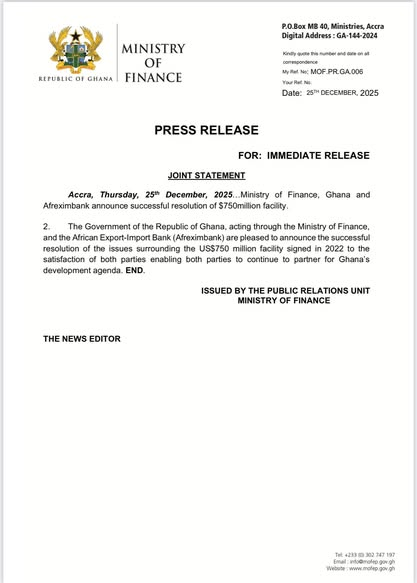
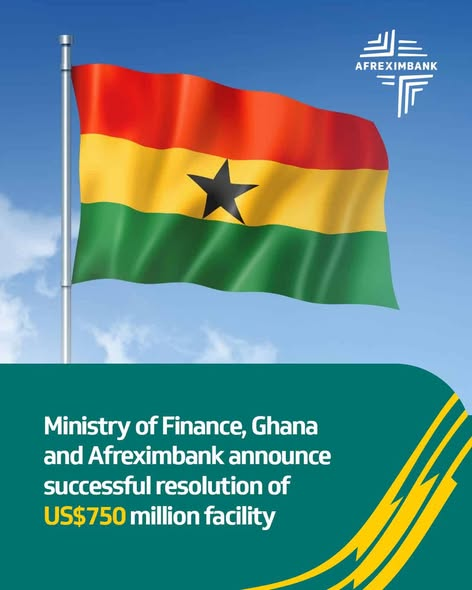
    Ghana’s financial engagements have received a boost following confirmation from the Ministry of Finance that outstanding concerns surrounding Afreximbank’s $750 million facility have been settled.

    In a joint statement posted on Facebook, the Ministry of Finance said matters connected to the $750 million facilities signed in 2022 had been addressed, “with satisfaction of both parties enabling both parties to continue to partner for Ghana’s development agenda.”

    Background

    Parliament gave the green light to the Loan Facility Agreement between the Government of Ghana, represented by the Ministry of Finance, and the African Export-Import Bank (Afreximbank) on July 20, 2022, during its 31st sitting of the Second Meeting of the Second Session.

    The move came as Ghana faced challenges securing funds from the capital market, following downgrades by all major ratings agencies.

    The facility was released in three tranches—two in US dollars and one in euros—amounting to US$187 million, €193 million, and US$332 million.

    The government is set to enjoy a three-year grace period for repayment. The US$187 million and €193 million tranches carry a seven-year tenor, while the US$332 million tranche has a ten-year tenor.

    Sources indicate that the government executed the facility agreement in August, meeting all conditions for disbursement.

    The utilisation request was signed that same month, and SWIFT confirmation of the successful transfer of funds into designated Bank of Ghana accounts was received on August 25, 2022.

    Disagreements and concerns

    The Government of Ghana’s move to include Afreximbank’s debts in a wider commercial debt restructuring plan, prompted by its IMF-supported bailout, was met with resistance from Afreximbank.

    The bank contended that its debts should be treated similarly to Ghana’s obligations to the IMF and the World Bank.

    Ghana, however, maintained that Afreximbank is not a multilateral institution and therefore should not be exempt from the restructuring. Afreximbank countered, asserting that it qualifies as a multilateral institution and should be protected from debt reductions.

    This disagreement played a role in Fitch’s downgrade of Afreximbank’s credit rating in June 2025 to just above junk status, citing the uncertainty arising from the debt situations of both Ghana and Zambia.

    Nevertheless, government officials, speaking at a meeting in Abuja, informed JOYBUSINESS that progress had been made toward settling the dispute.

    The joint statement, however, did not disclose the specific terms of the resolution reached between Ghana and Afreximbank.

    In October, Government has announced its fifth bilateral restructuring agreement with the Kingdom of Spain as the latest.

    This was announced by the Finance Minister Cassiel Ato Forson on Wednesday October 8 after signing the agreement with Spain’s Ambassador to Ghana, H.E. Ángel Lossada Torres-Quevedo. 

    “On behalf of the Republic of Ghana, I signed a Bilateral Debt Restructuring Agreement with the Kingdom of Spain, represented by their Ambassador to Ghana, H.E. Ángel Lossada Torres-Quevedo.  To date, we have concluded five bilateral restructuring agreements with France, Finland, the United Kingdom, China EXIM Bank, and now Spain, “ He shared on his X page.

    Adding that this signing marks another important milestone in Ghana’s debt restructuring journey. 

    Mr Ato Forson is optimistic that Ghana will complete the process and close this challenging chapter in our economic management history by the end of this year, considering valuable lessons learnt from this experience. 

    He said, government is determined to maintain sound fiscal discipline and never again “allow ourselves to reach such unsustainable levels of debt.”

    “I remain confident that the measures we are implementing will safeguard our recovery and strengthen Ghana’s resilience,” Ato Forson expressed.

    On behalf of the Government and people of Ghana, Ato Forson expressed deep appreciation to Spain for their cooperation, understanding, and unwavering support throughout this process.

    Meanwhile, the government formally signed a bilateral debt restructuring agreement with the United Kingdom (UK) as part of efforts with the External Creditor Committee to unlock funds for  ‘The Big Push’ initiative and other government programs.

    Taking to the X platform on Wednesday, September 24, the Finance Minister Dr. Cassiel Ato Forson revealed that the  US$256 million deal signed between the two countries is a key step in managing Ghana’s debt better.“On behalf of the Republic of Ghana, I signed a Bilateral Debt Restructuring Agreement with the United Kingdom, represented by His Majesty’s Trade Commissioner for Africa, Mr. John Humphrey. The agreement covers about US$256 million and represents another important step in Ghana’s debt restructuring efforts,” he wrote.

    According to the Finance Minister, the UK’s participation will motivate other lenders to act fast and finalize their part of the debt restructuring.

  • Ghana to lose over GHS2bn revenue in 2026 due to removal of COVID-19 levy – Economist

    Ghana to lose over GHS2bn revenue in 2026 due to removal of COVID-19 levy – Economist

    The abolition of the COVID-19 Levy and removal of key taxes in the 2026 budget, as announced by Finance Minister Cassiel Ato Forson, is expected to create a significant revenue gap for the economy in 2026.

    According to Economist, Dr Adu Owusu Sarkodie on Joy News’ PM Express Business Edition, the government is placing its hope on compliance at a time when it has already abolished the E-Levy, which was fetching the government around 2 billion over a little over GH¢2 billion

    Adding that, the betting tax, which brought in “roughly about ¢300 billion,” has also been abolished.

    However, the most severe hit to government revenue comes from the removal of the COVID-19 levy, which was expected to bring in about ¢3 billion next year.

    “Covid-19 was giving us almost the same amount as the total royalties from oil and gas. This year, total royalties from oil and gas are estimated to be ¢2.9 billion. Covid-19 levy will be giving us ¢2.8 billion,” he stated.

    Finance Minister Cassiel Ato Forson has warned that removing the COVID-19 levy, on top of the ¢2 billion E-Levy, could slash government revenue by about ¢5 billion. He noted, however, that the government believes it can still raise funds by widening the tax base.

    “When you increase the base, if more people are paying, it’s better than a few people paying higher rates,” Dr. Sarkodie explained, highlighting the strategy shaping the fiscal outlook.

    The National Democratic Congress (NDC) government has honoured a promise it made before assuming office. In line with this, the government has officially scrapped the COVID-19 Health Recovery Levy introduced during the pandemic era.

    Introduced on 31 March 2021 under Act 1068 during the tenure of former President Nana Addo Dankwa Akufo-Addo, the levy applied a 1% charge on the supply of goods and services in Ghana, excluding certain items. and on imports of goods and services. According to the New Patriotic Party (NPP), the levy was intended to help the government raise funds to fight the pandemic and support recovery efforts.

    However, presenting the 2026 Budget Statement and Economic Policy to Parliament on Thursday, November 11, Finance Minister Cassiel Ato Forson disclosed that the government has abolished the levy with immediate effect.

    According to him, the move will save individuals and businesses GH₵3.7 billion in taxes, money that can instead be invested back into their businesses or personal ventures.

    The Finance Minister further added that, after months of detailed analysis and broad consultations with stakeholders, the Ministry has completed the design of a modernised Ghana Value Added Tax (VAT) system fit for the country’s economic transformation agenda.

    He mentioned that if approved by Parliament, the VAT reforms will make Ghana’s tax system more equitable, transparent, and business-friendly. “As the new VAT reforms will do the following, we will abolish the COVID-19 Health Recovery Levy, Mr Speaker; we will abolish the decoupling of GetFund and National Insurance Levies from the VAT tax base. The current VAT rate will be reduced from 21.9% to 20%,” he revealed.

    “In the 2025 budget, in the mid-year fiscal policy review, government made a firm promise to reform Ghana’s Value Added Tax (VAT) system to make it fairer, simpler, and more efficient. We pledged to remove distortions, address the cascading effects inherited in the VAT system, strengthen compliance, and create a tax regime that supports both businesses and fiscal stability. These distortions have negatively impacted overall welfare, increasing the deadweight loss in the economy and reducing VAT compliance.

    “Today, Mr Speaker, I am proud to report to this House that we have finally delivered on that promise. After months of detailed analysis and broad consultations with stakeholders, we have completed the design of a modernised VAT system fit for Ghana’s economic transformation agenda. Government is therefore submitting to this House today, for approval, a bold package of VAT reforms that will make our tax system more equitable, transparent, and business-friendly.

    “The new VAT reforms will do the following: we will abolish the COVID-19 Health Recovery Levy. We will abolish the decoupling of GetFund and National Insurance Levies from the VAT tax base. We will abolish VAT on the recognition of minerals. We will reduce the effective VAT rate from 21.9% to 20%. We will raise the VAT registration threshold from GH₵200,000 to GH₵750,000.

    “We will extend VAT zero rating on the supply of local manufacturing textiles to 2028. Mr Speaker, for emphasis, we promised to abolish the COVID Levy, and with the support of this House, I am proud to say that today, the COVID Levy is accordingly abolished. By abolishing the COVID-19 Levy, the government is putting GH₵3.7 billion in the pockets of individuals and businesses in 2026 alone,” he added.

    While delivering the 2025 Mid-Year Budget Statement to Parliament on Thursday, July 24, the Finance Minister assured Ghanaians that the VAT Act was undergoing a series of reforms to eliminate successive charges that increased the cost of goods and services. As such, the COVID-19 Levy, Ghana Education Trust Fund (GETFund), and National Health Insurance Scheme (NHIS) levies assented to by former President Akufo-Addo during the NPP-led government will be scrapped next year.

    He noted that his ministry would conclude the review process by the end of September, adding that the new bill would then be submitted to Parliament in October to be included in the 2026 Budget Statement. The new development is aimed at reducing financial burdens on Ghanaians, thus improving economic conditions. The current VAT flat-rate scheme, the minister asserts, should be replaced with a unified VAT rate for all businesses.

    Additionally, the VAT registration threshold will also be raised, a measure expected to exempt small and micro enterprises from registering for and paying VAT, as well as to encourage growth in the informal sector.

    To ensure compliance and transparency, the government plans to roll out fiscal electronic devices such as e-invoicing systems and electronic cash registers. Furthermore, public education campaigns and awareness programs will be implemented.

    “Rt. Hon. Speaker, the Ministry of Finance hopes to complete this process by September 2025, prepare a new VAT bill by October 2025, and submit it to Parliament as part of the 2026 Budget Statement. Mr Speaker, I would like to reassure Ghanaians that under the reforms, at a minimum, the COVID-19 levy will be abolished, the effective VAT rate will be reduced, and the punitive cascading effect of the GETFund and NHIS levies will be removed.

    “VAT flat rates will be removed, and a unified VAT rate will be implemented; the VAT registration threshold will be increased to exempt small and micro businesses; and compliance will be improved through public education, awareness creation, and the introduction of fiscal electronic devices,” he said.

    Earlier this year, President John Dramani Mahama’s administration repealed the betting tax, emissions tax, and other levies. The Electronic Transaction Levy (E-Levy), introduced in 2022, imposed a 1.5% tax on electronic transactions. Although it was later reduced to 1%, the levy remained unpopular, drawing criticism from businesses, consumers, and political stakeholders who argued that it stifled digital transactions and disproportionately affected low-income earners. Many contended that it placed an unnecessary burden on citizens.

    The removal of this tax was a core pledge in the NDC’s manifesto, aimed at reducing the cost of living and encouraging business expansion. With the repeal bill now signed into law, many Ghanaians can breathe a sigh of relief.

    Supporters of the repeal argue that eliminating these levies will promote digital transactions, stimulate economic activity, and improve disposable income for households and businesses.

  • PLAYBACK: Finance Minister presents 2026 budget to Parliament

    PLAYBACK: Finance Minister presents 2026 budget to Parliament

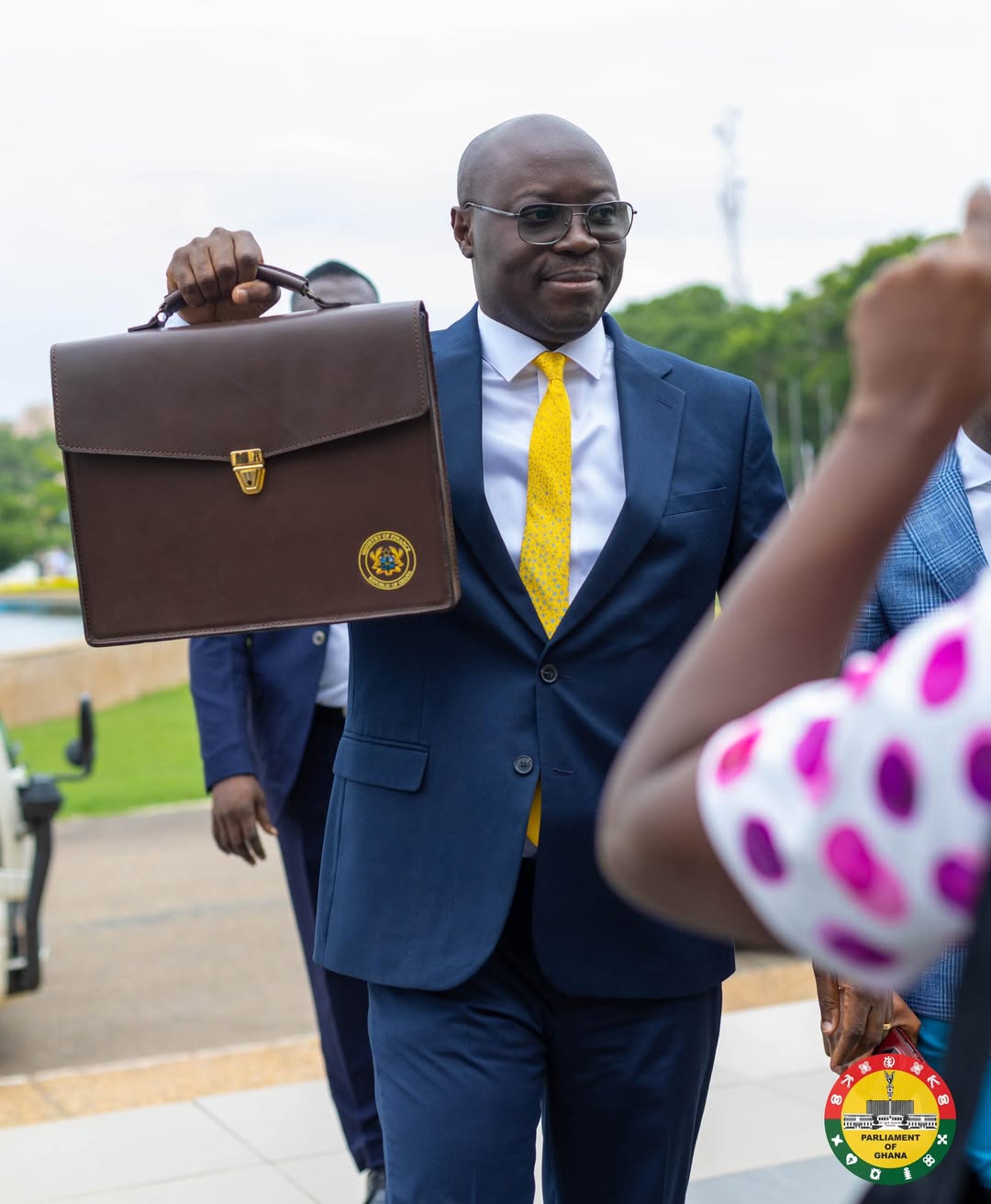
    Finance Minister Dr. Cassiel Ato Forson appeared before Parliament on Thursday, November 13, to present the 2026 Budget Statement and Economic Policy.

    The budget reading outlined strategies for economic growth, job creation, and post-International Monetary Fund (IMF) management.

    Earlier, Finance Minister Dr. Ato Forson announced plans to present the budget in October, but the date was later changed to allow for broader consultations and public input. Under the Public Financial Management Act, the Finance Minister is mandated to present the national budget to Parliament not later than November 15 each year.

    The 2026 Budget is expected to introduce tax reforms, including a reduction of VAT from 22% to 20%, and a review of levies such as the COVID-19 levy. With Ghana set to exit the IMF programme in May 2026, the budget will be crucial for ensuring fiscal stability.

    Dr. Forson maintains that growth targets and fiscal policies remain unchanged as inflation continues to fall, reaching 9.4% in September 2025 — the first single-digit rate since 2021.

    Watch livestream here:

    The presentation of the year-ahead budget is in accordance with the Public Financial Management Act, 2016 (Act 921) of Ghana, which was passed by Parliament and assented to on August 25, 2016.

    The Act governs how public funds are managed across all government entities.

    The Act mandates that the Finance Minister, acting on behalf of the President, lay before Parliament, not later than November 15 of each financial year, estimates of the revenues and expenditures of the government.

    According to some analysts, the 2025 Budget largely followed the same plans, ideas, and policies set up by the erstwhile government.In July this year, the Finance Minister, Dr. Ato Forson, mentioned that the Mahama-led administration would present its 2026 Budget and Economic Statement to Parliament in October 2025, instead of November 2025.

    With this, Parliament would have about an additional month to debate the 2026 Budget before the House goes on recess in late December. He noted that the new timeline for the presentation would aid thorough deliberation, allowing room for alterations before the budget comes into force at the beginning of 2026.

    “We are aiming to present the 2026 budget to Parliament by the end of October 2025. Preparations are already underway. We want to avoid the delays and uncertainties of the past. This government is committed to proper planning and transparency,” he disclosed during an appearance on a special edition of PM EXPRESS with host Evans Mensah on July 24.

    However, the Finance Ministry later announced in a statement in August that November 15 would be the new date for the budget presentation. In the same statement, it requested inputs from the general public to be considered in the 2026–2029 National Budget. The inputs, the Ministry said, were to be submitted electronically to bdru@mofep.gov.gh

    This call was in line with the government’s responsiveness to the needs of the Ghanaian citizenry to deepen citizens’ participation in the budget process, as well as implement inclusive policies.

    Consequently, the Finance Ministry has reportedly completed several rounds of stakeholder engagements and industry consultations to finalise the policies and programs that will feature in the 2026 Budget.

    In earlier interviews, Dr Forson has listed economic growth, development and job creation, particularly for Ghana’s ballooning youth and deepening unemployment crisis, as the main focus of the 2026 Budget.

    Sources also suggest that the Finance Minister is set to introduce new policy measures aimed at reforming the tax system and improving revenue mobilisation.

    According to the Commissioner-General of the Ghana Revenue Authority (GRA), Anthony Sarpong, the 2026 Budget will include a review of the Value Added Tax (VAT), with the effective rate expected to be reduced from 22% to 20%.

    This adjustment is part of ongoing reforms to simplify the VAT structure and make it more business-friendly.Additionally, Dr Forson is expected to review several tax levies, including the COVID-19 levy, as part of efforts to ease the tax burden on businesses and households.

    With Ghana set to exit the IMF programme in May 2026, attention will also be on how the Finance Minister plans to manage the economy in the post-programme period.

    The 2026 Budget will, therefore, be one of the government’s most significant economic policy documents, setting the tone for fiscal management and growth strategy after the IMF programme.

    Another key area of interest for industry players and economists will be how Dr Ato Forson intends to manage the fiscal deficit and expenditure in 2026 while maintaining macroeconomic stability.

    During the mid-year budget review, the Finance Minister announced the abolition of certain levies, including the e-levy, betting tax, and emissions levy, and provided projections for the country’s growth and other key indicators. He insisted that the government would stick to what was announced earlier this year. “We are not changing course. The growth target, the fiscal deficit, and the inflation target—all of it remains as announced in the 2025 Budget. We are sticking to it.” “The economy is responding well. We’ve seen 5.3% GDP growth in Q1, inflation is falling, and the cedi is stable. So there’s no need to revise the framework.”

    His comments came a few weeks after the Ghana Statistical Service (GSS) announced the sixth consecutive reduction in the inflation rate this year so far. According to GSS, as of June, the country recorded a 13.7 percent rate, a 4.7 percent decline from the 18.4 percent rate reported in May.

    This is also the lowest rate recorded since February 2022 at the time. Government Statistician Dr Alhassan Iddrisu, following the release of data on July 2, noted that the reduction in the rate was due to the decline in prices of foodstuffs and other items.

    Subsequently, Ghana has recorded a single-digit inflation with September 2025’s falling to 9.4%, marking the country’s first return to single-digit inflation since August 2021.

  • Ato Forson presents 2026 budget today

    Ato Forson presents 2026 budget today

    Finance Minister Dr. Cassiel Ato Forson will today, Thursday, November 13, present the 2026 Budget Statement and Economic Policy to Parliament.

    The budget reading will outline strategies for economic growth, job creation, and post-International Monetary Fund (IMF) management.


    Earlier, Finance Minister Dr. Ato Forson announced plans to present the budget in October, but the date was later changed to allow for broader consultations and public input. Under the Public Financial Management Act, the Finance Minister is mandated to present the national budget to Parliament not later than November 15 each year.


    The 2026 Budget is expected to introduce tax reforms, including a reduction of VAT from 22% to 20%, and a review of levies such as the COVID-19 levy. With Ghana set to exit the IMF programme in May 2026, the budget will be crucial for ensuring fiscal stability.

    Dr. Forson maintains that growth targets and fiscal policies remain unchanged as inflation continues to fall, reaching 9.4% in September 2025 — the first single-digit rate since 2021.


    The presentation of the year-ahead budget is in accordance with the Public Financial Management Act, 2016 (Act 921) of Ghana, which was passed by Parliament and assented to on August 25, 2016.

    The Act governs how public funds are managed across all government entities.

    The Act mandates that the Finance Minister, acting on behalf of the President, lay before Parliament, not later than November 15 of each financial year, estimates of the revenues and expenditures of the government.

    According to some analysts, the 2025 Budget largely followed the same plans, ideas, and policies set up by the erstwhile government.
    In July this year, the Finance Minister, Dr. Ato Forson, mentioned that the Mahama-led administration would present its 2026 Budget and Economic Statement to Parliament in October 2025, instead of November 2025.

    With this, Parliament would have about an additional month to debate the 2026 Budget before the House goes on recess in late December. He noted that the new timeline for the presentation would aid thorough deliberation, allowing room for alterations before the budget comes into force at the beginning of 2026.


    “We are aiming to present the 2026 budget to Parliament by the end of October 2025. Preparations are already underway. We want to avoid the delays and uncertainties of the past. This government is committed to proper planning and transparency,” he disclosed during an appearance on a special edition of PM EXPRESS with host Evans Mensah on July 24.


    However, the Finance Ministry later announced in a statement in August that November 15 would be the new date for the budget presentation. In the same statement, it requested inputs from the general public to be considered in the 2026–2029 National Budget. The inputs, the Ministry said, were to be submitted electronically to bdru@mofep.gov.gh

    This call was in line with the government’s responsiveness to the needs of the Ghanaian citizenry to deepen citizens’ participation in the budget process, as well as implement inclusive policies.

    Consequently, the Finance Ministry has reportedly completed several rounds of stakeholder engagements and industry consultations to finalise the policies and programs that will feature in the 2026 Budget.

    In earlier interviews, Dr Forson has listed economic growth, development and job creation, particularly for Ghana’s ballooning youth and deepening unemployment crisis, as the main focus of the 2026 Budget.

    Sources also suggest that the Finance Minister is set to introduce new policy measures aimed at reforming the tax system and improving revenue mobilisation.

    According to the Commissioner-General of the Ghana Revenue Authority (GRA), Anthony Sarpong, the 2026 Budget will include a review of the Value Added Tax (VAT), with the effective rate expected to be reduced from 22% to 20%.

    This adjustment is part of ongoing reforms to simplify the VAT structure and make it more business-friendly.Additionally, Dr Forson is expected to review several tax levies, including the COVID-19 levy, as part of efforts to ease the tax burden on businesses and households.

    With Ghana set to exit the IMF programme in May 2026, attention will also be on how the Finance Minister plans to manage the economy in the post-programme period.

    The 2026 Budget will, therefore, be one of the government’s most significant economic policy documents, setting the tone for fiscal management and growth strategy after the IMF programme.

    Another key area of interest for industry players and economists will be how Dr Ato Forson intends to manage the fiscal deficit and expenditure in 2026 while maintaining macroeconomic stability.

    During the mid-year budget review, the Finance Minister announced the abolition of certain levies, including the e-levy, betting tax, and emissions levy, and provided projections for the country’s growth and other key indicators. He insisted that the government would stick to what was announced earlier this year. “We are not changing course. The growth target, the fiscal deficit, and the inflation target—all of it remains as announced in the 2025 Budget. We are sticking to it.” “The economy is responding well. We’ve seen 5.3% GDP growth in Q1, inflation is falling, and the cedi is stable. So there’s no need to revise the framework.”

    His comments came a few weeks after the Ghana Statistical Service (GSS) announced the sixth consecutive reduction in the inflation rate this year so far. According to GSS, as of June, the country recorded a 13.7 percent rate, a 4.7 percent decline from the 18.4 percent rate reported in May.

    This is also the lowest rate recorded since February 2022 at the time. Government Statistician Dr Alhassan Iddrisu, following the release of data on July 2, noted that the reduction in the rate was due to the decline in prices of foodstuffs and other items.

    Subsequently, Ghana has recorded a single-digit inflation with September 2025’s falling to 9.4%, marking the country’s first return to single-digit inflation since August 2021.

  • New teachers’ 13-month salary arrears to feature in 2026 Budget – Dep. Finance Minister

    New teachers’ 13-month salary arrears to feature in 2026 Budget – Dep. Finance Minister

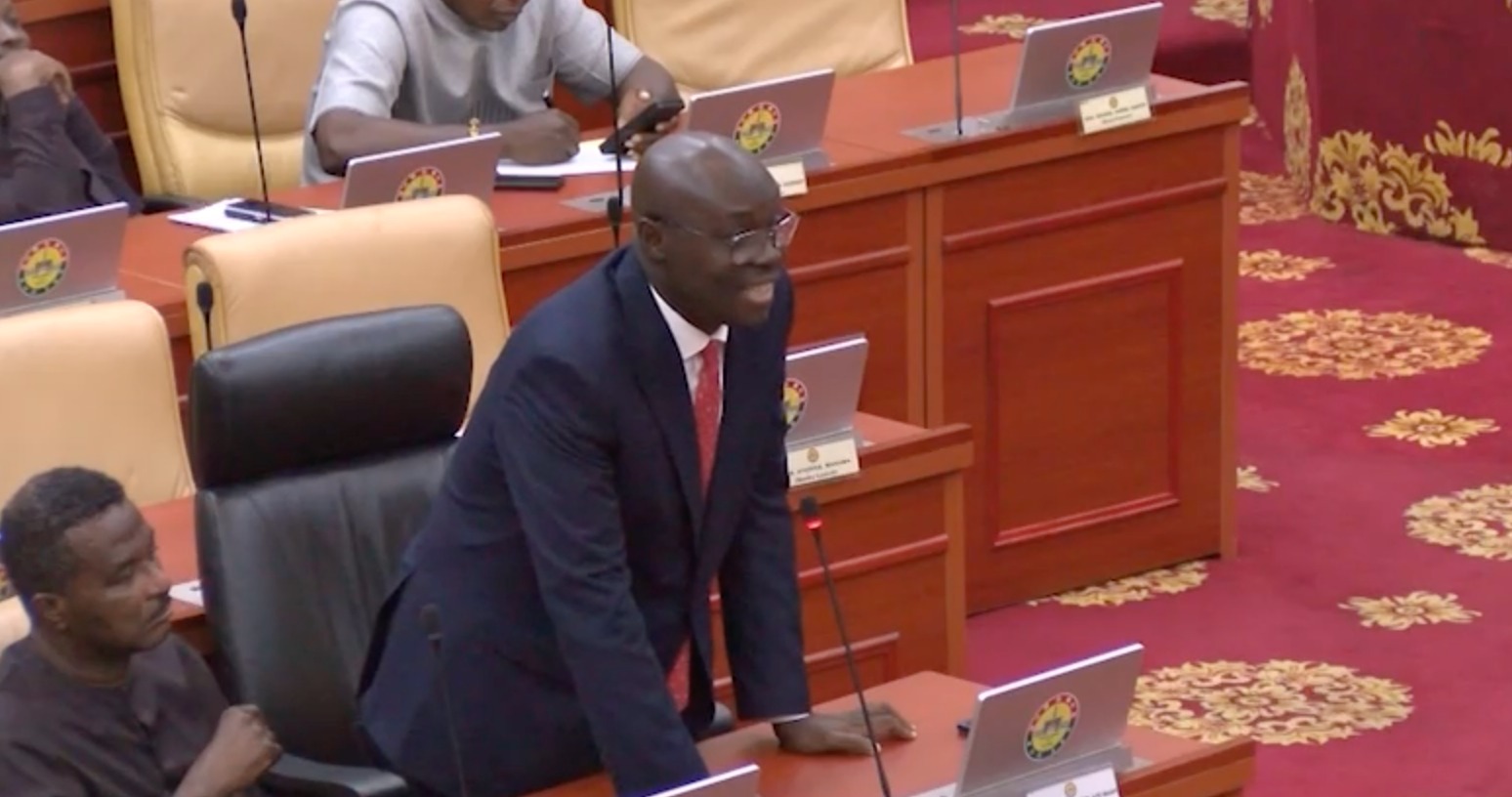
    Deputy Finance Minister Thomas Nyarko Ampem has urged the coalition of unpaid teachers to exercise patience, as the government has taken steps in addressing their displeasure.

    Addressing the aggrieved Newly Posted Teachers group on Tuesday, September 30, the Deputy Finance Minister disclosed that the government will include funds to settle their 13-month salary arrears in next year’s budget.


    “I was a teacher, and I was posted to teach, and I was not paid for 8 months. I can relate perfectly well with all of you. The Finance Minister [Dr Ato Forson] says he sympathises with you, and he has briefed President John Dramani Mahama, and he has been given the green light to make sure he fixes your problem.


    He added, “The Finance Minister will present the next budget, and he will make provision for all of you to be catered for; you should be very happy that your problem will be fixed; that is the good news. You will be paid.”

    On Tuesday, September 30, comprising graduates from Colleges of Education and universitiessubmitted their petition to the Finance Ministry, which calls on the government to clear debts owed them.


    The group initially declared their intention to hit the streets over salaries owed them on Tuesday, September 23. However, speaking to Citi News, the group’s Lead Convener, Simon Kofi Nartey, noted that the Ministry of Education and other relevant authorities are yet to respond to their earlier petitions, thus rescheduling the protest to September 30.


    Simon Kofi Nartey called on the government to settle their 12 months and 8 months, respectively within the given ultimatum. According to him, the group will have no option than to hit the streets if the government does not treat their demands with urgency.


    “It is rather unfortunate that as we speak, nothing has been done about the concerns we raised at our press conference. We have no option but to take to the streets to let Ghanaians know what is happening. We have already met with the Greater Accra Regional Police Command and agreed on September 30 for the demonstration,” he said.


    In August, the Ghana Education Service (GES) announced that qualified teachers and officers can now apply for promotion to higher ranks within the service. The ranks for which applications have been opened include Deputy Director, Assistant Director I, Assistant Director II, and Principal Superintendent.


    Applicants who meet the eligibility requirements are encouraged to submit their applications before the deadline on Friday, September 5, 2025. Application forms can be obtained from the Ghana Education Service’s website or by scanning the QR code provided online.


    Applicants have been advised to attach a clear and legible passport-sized photograph in JPEG, JPG, or PNG format, along with their last promotion, appointment, or upgrading letter, and their highest academic certificate when applying for promotion.


    The GES has emphasized that, except for the passport-sized photograph, all other documents must be in PDF format. This was contained in a press statement issued by the Ghana Education Service.


    “An applicant should upload the following documents: passport-size photograph (in jpeg, jpg, or png format), last promotion or appointment or upgrading letter, highest academic certificate used for applying for the promotion.

    “All documents uploaded MUST be in PDF (except the passport picture) and should be clear and legible. Application window opens from Monday, 18th August to Friday, 5th September 2025. SCAN TO APPLY,” parts of the statement read.


    In detailing the eligibility criteria, the Service indicated that applicants for the Deputy Director rank must have held the position of Assistant Director I in or before 2020 and must have remained active in the service.


    Applicants for Assistant Director I must have been promoted to the rank of Assistant Director II in or before 2020 and remained continuously at the post.


    Similarly, applicants for Assistant Director II should have been promoted to the rank of Principal Superintendent in or before 2020 and must have been consistently at post since then. For the Principal Superintendent rank, applicants must have attained the position of Senior Superintendent I in 2020 or earlier.


    “Deputy Director: An applicant should have been promoted to the rank of Assistant Director I in or before 2020 and should have been continuously at post since date (except for the periods of approved leave of absence).


    “Assistant Director I: An applicant should have been promoted to the rank of Assistant Director II in or before 2020 and should have been continuously at post since date (except for the periods of approved leave of absence).


    “Assistant Director II: An applicant should have been promoted to the rank of Principal Superintendent in or before 2020 and should have been continuously at post since date (except for the periods of approved leave of absence).


    Principal Superintendent: An applicant should have been promoted to the rank of Senior Superintendent I on or before 2020 and should have been continuously at post since that date (except for the periods of approved leave of absence).

    An applicant who has obtained an approved undergraduate degree will be automatically placed on this rank,” the statement added.
    Additionally, applicants who wish to apply with Master’s or Doctorate degrees must ensure their certificates are in courses recognized by the GES.


    “For the avoidance of doubt, applicants who wish to rely on Master’s/Doctorate degrees to join the interviews out of turn should note the following: Master’s/PhD programme should be on the approved GES course of study,” it added.


    Additionally, applicants who wish to apply with Master’s/Doctorate degrees must ensure their certificates are in courses recognized by the GES and should have been acquired before their most recent promotion.


    “The Master’s/PhD certificate should not have been obtained before the previous promotion. Applicants who wish to use the Master’s/PhD certificate for ADI, ADII, and Deputy Director promotion should have obtained their certificate in or before 2022,” it concluded.


    Meanwhile, the Service continues to grapple with unresolved issues concerning newly trained teachers. On Monday, June 23, over 100 aggrieved teachers picketed at the GES headquarters in Accra, demanding the payment of several months of unpaid salaries.


    The intended peaceful protest turned chaotic, prompting police intervention. However, the teachers refused to disperse. The group’s spokesperson, Eric Darfuor, explained to the media that their decision to protest stemmed from unmet assurances by the GES that their outstanding salaries would be paid by the end of July.


    “The PRO said there has been an official communiqué from GES, so we have suspended our picketing for now, and we are hoping to receive our salaries by the end of July. The PRO said they are at the final stage of resolving our issue, so very soon we will receive our salary.


    “So we are waiting and waiting for the very soon, by the end of July, so when the time is due, and we do not hear anything from them, we will come back again stronger.”


    Defiant, the protesting teachers have vowed to intensify their actions. “We’ll be here overnight so that by morning, we can go to the Finance Ministry and then proceed to Parliament,” one protest leader said.


    “When MPs arrive, we’ll let them know what the government is putting us through. All we ask is for our staff IDs and the money owed to us.” In response, the Ghana Education Service (GES) has stated that it is working to resolve months of unpaid salaries and other concerns raised by newly posted teachers.

    This was revealed in a press release issued by the GES Public Relations Officer, Daniel Fenyi, on Tuesday, June 24.


    According to the Service, it has formally requested an extension of the expired financial clearance from the Ministry of Finance to enable the payment of outstanding salaries and the issuance of staff IDs.


    Out of the 12,807 graduates recruited from the Colleges of Education last year, about 2,113 are yet to receive their salaries due to the expiration of financial clearance. The Service has attributed this situation to inconsistencies in the affected teachers’ Ghana Card details, SSNIT numbers, and cases of self-reposting.


    Additionally, the GES disclosed that it has set up a technical committee to resolve the anomalies. In the meantime, the Service has called for calm, assuring teachers of its commitment to addressing the matter.

    “The present GES Management, upon assuming office, immediately undertook a nationwide staff validation exercise from 7th-14th March 2025 to confirm the genuinely recruited teachers and clean up recruitment anomalies.


    “It is important to note that significant progress has already been made. The Service assures all affected staff that every effort is being made to rectify the situation and ensure that all genuinely recruited teachers receive their due remuneration,” parts of the statement read.


    In a related development, the Office of the Special Prosecutor (OSP) has disclosed that it is investigating suspected corruption and corruption-related offences linked to the large-scale sale of appointment letters to prospective teachers and the laundering of proceeds from the unlawful enterprise.
  • Finance Minister ends recent engagement with China over debt restructuring

    Finance Minister ends recent engagement with China over debt restructuring

    The government of Ghana has brought to an end the series of engagements with China geared towards enhancing the debt restructuring efforts.

    Minister for Finance, Dr Cassiel Ato Forson, who described the meetings as helpful and a big step forward in solving the country’s debt problems, revealed this information in a post on social media on Tuesday, July 1.

    According to him, these talks are part of the government’s efforts to fix the economy, reduce the country’s debt burden, and ensure that the lives of ordinary Ghanaians are protected.

    Dr. Forson added that the progress made in China puts Ghana in a stronger position to complete this difficult process and build a more stable and inclusive economy.

    In April this year, the sector minister announced Ghana’s preparedness to conclude bilateral agreements for the restructuring of its $5.1 billion official bilateral debt by June, a goal that Finance Minister Dr. Cassiel Ato Forson had described as “ambitious.”

    This followed the signing of a Memorandum of Understanding (MoU) with the Official Creditor Committee (OCC) on January 28.

    This information is outlined in the 2025 Budget Statement and Economic Policy, which highlights Ghana’s fiscal strategies, including debt restructuring efforts aimed at stabilizing the economy.

    Highlighting the importance of this process, the Finance Minister stated, “We look forward to the support of this august House in achieving this objective within the established timeframe.”

    The agreement formalizes the key terms of the restructuring, which were outlined in an Agreement in Principle (AIP) reached on January 12, 2024. It includes an extension of debt service repayments and provides approximately $2.8 billion in debt relief. Additionally, the MoU establishes a cut-off date of December 31, 2022, and imposes limits on disbursements during Ghana’s IMF-supported program from 2023 to 2026.

    The signing of the MoU paves the way for negotiations with individual OCC member countries. As part of the process, Ghana has commenced data reconciliation and validation exercises with several creditors in preparation for the bilateral agreements.

    In addition to official bilateral debt restructuring, the government is engaging commercial creditors, including Chinese commercial lenders, plurilateral institutions, and private banks, to restructure approximately $2.7 billion in commercial debt. Discussions on draft Non-Disclosure Agreements (NDAs) are already underway, with a financial proposal for restructuring expected to be presented soon.

    Furthermore, Ghana’s Domestic Debt Exchange Programme (DDEP), launched in December 2022, has significantly influenced the domestic debt market. The government has relied on short-term securities to finance the budget, raising GH¢45.4 billion in net proceeds from treasury bill issuances.

    The government remains committed to honoring its debt obligations, having successfully paid GH¢19.0 billion in DDEP bond coupons in 2024 and an additional GH¢9.5 billion in February 2025. The Finance Ministry believes these efforts, coupled with effective engagement with market participants, will enhance transparency, restore investor confidence, and stabilize the financial market.

    The 2025 Budget Statement also notes an improvement in investor sentiment, reflected in declining interest rates on treasury bills. By the end of December 2024, the 91-day, 182-day, and 364-day treasury bill rates stood at 28.04%, 28.68%, and 30.07%, respectively—lower than the corresponding rates in 2023.

    The government has also updated its 2024 Debt Sustainability Analysis (DSA) to align with the revised medium-term fiscal framework and the third IMF Review macro-framework. The DSA assessed Ghana’s public debt distress by evaluating macro-fiscal developments and agreements reached with the OCC and Eurobond holders. It examined Ghana’s solvency and liquidity status, considering current and future debt service obligations and their impact on the country’s debt dynamics in the medium- to long-term.

    According to the analysis, Ghana’s external and public debt risk rating remains at ‘high risk’ of debt distress. The Present Value (PV) of the total debt-to-GDP ratio and the external debt service-to-revenue ratio are still above DSA thresholds in the near term but are projected to return to sustainable levels by 2028.

    Beyond bilateral debt, Ghana is actively engaging commercial creditors, including Chinese commercial lenders, plurilateral institutions, and private banks, to restructure approximately $2.7 billion in commercial debt. Discussions on draft Non-Disclosure Agreements (NDAs) are underway, with a financial proposal for restructuring expected to be presented soon.

    Additionally, the Domestic Debt Exchange Programme (DDEP), launched in December 2022, continues to impact Ghana’s debt landscape. In 2024, the government honored DDEP bond coupon payments totaling GH¢19.0 billion, including GH¢12.1 billion in cash payments and GH¢6.9 billion in payment-in-kind (PIK) payments. In February 2025, the fourth coupon payment of GH¢9.5 billion (including GH¢3.5 billion in PIK payments) was successfully honored. To finance the budget, the government issued short-term securities, raising GH¢45.4 billion in net proceeds from treasury bill issuances.

    Ghana’s domestic debt market has shown signs of improvement, with a gradual decline in interest rates due to improved investor confidence. By the end of December 2024, the 91-day, 182-day, and 364-day treasury bill rates stood at 28.04%, 28.68%, and 30.07%, respectively—lower than the corresponding rates in 2023, which were 29.36%, 31.95%, and 32.49%.

    The government remains committed to ensuring effective communication with market participants, increasing transparency, and restoring investor confidence, which will be crucial in sustaining economic stability.

  • Finance Minister establishes compliance desk to implement new PFM Act

    Finance Minister establishes compliance desk to implement new PFM Act

    A Compliance Desk within the Finance Ministry to monitor and enforce adherence to the newly upgraded Public Financial Management (PFM) Act, 2025, has been established by the Minister for Finance, Dr. Cassiel Ato Forson.

    This initiative is designed to address fiscal indiscipline and ensure effective implementation of the upgraded regulations.

    Dr. Forson made this announcement during a meeting with the World Bank Africa team, led by Vice President Ousmane Diagana, following the successful National Economic Dialogue, which received strong support from the World Bank.

    The Minister emphasized the need to tackle fiscal inefficiencies, particularly among entities awarding contracts without obtaining the necessary commencement certificates, a practice that has resulted in budgetary shortfalls.

    A key amendment to the PFM Act now grants the Ministry of Finance the authority to issue commencement authorisations, signaling a shift in fiscal oversight.

    To further enhance compliance, the Ministry has established the Compliance Desk, which will monitor and evaluate whether ministries, departments, and other covered entities fully adhere to the new law. The desk will also maintain a Compliance League Table to publicly rank institutions based on their financial regulation adherence.

    Dr. Forson warned that persistent non-compliance would result in sanctions, reaffirming the government’s commitment to transparency and accountability in public finance.

    “We are determined to ensure that every programme we implement delivers maximum efficiency and impact,” he stated. “This is how we build a disciplined and prosperous Ghana.”

  • Govt to mandate state agencies to buy local goods and boost local industry — Finance Minister

    Govt to mandate state agencies to buy local goods and boost local industry — Finance Minister

    The Government of Ghana is set to introduce a new policy requiring all state agencies to procure certain essential goods exclusively from local producers, in a bold move to boost the country’s industrial sector, create jobs, and reduce dependency on imports.

    Finance Minister, Dr. Cassiel Ato Forson, announced the initiative during a meeting with the leadership of the Association of Ghana Industries (AGI), stressing that no country can truly develop without a strong industrial base.
    He revealed that the government will soon publish a list of essential items that all public sector agencies will be required to source locally.

    “To support our local industries, the government will soon publish a list of items that all public sector agencies must procure locally. This will ensure that government procurement serves as a tool to develop our industries. Going forward, any government procurement from outside Ghana will require special approval from the Office of the President,” he stated.

    The President of the Association of Ghana Industries (AGI), Dr. Humphrey Ayim-Darke, lauded the government’s initiative, describing it as a timely intervention that would revitalise the Ghanaian industrial sector. He pledged AGI’s readiness to collaborate closely with the government to ensure the success of the policy.

    The upcoming policy forms part of broader government efforts to restructure the economy, strengthen the manufacturing sector, and achieve sustainable economic growth.

    The Finance Minister further hinted at the establishment of a Local Content Compliance Unit within the Ministry of Finance. This unit, he said, will be responsible for monitoring and ensuring that ministries, departments, and agencies adhere strictly to the new local procurement policy.

    He urged local manufacturers to ramp up production quality and capacity to meet the expected surge in demand, assuring them of government support through incentives, access to finance, and improved infrastructure.

    Dr. Forson also underscored the urgent need to tackle smuggling, which he said is crippling local businesses. He explained that the government has identified key smuggling routes and will deploy a combined strategy involving enhanced border security, stricter enforcement, and collaboration with neighbouring countries to curb the menace.

  • Finance Minister tweets “it’s finished” after Mahama’s assent to e-levy repeal bill

    Finance Minister tweets “it’s finished” after Mahama’s assent to e-levy repeal bill

    Finance Minister Dr. Cassiel Ato Forson has succinctly celebrated the abolition of the Electronic Transfer Levy (E-Levy) and other taxes, tweeting “It is finished” after President John Dramani Mahama signed the repeal bill into law.

    This move marks a significant milestone in the government’s efforts to ease the financial burden on Ghanaians and foster economic growth.

    The repealed taxes include the betting tax, emissions tax, and other levies. The E-Levy, introduced in 2022, had imposed a 1.5% tax on electronic transactions, sparking widespread criticism from the public and business community. Many argued that it stifled digital transactions and placed an unnecessary burden on citizens.

    The removal of these taxes was a core pledge in the National Democratic Congress (NDC)’s manifesto, aimed at reducing the cost of living and encouraging business expansion. With the repeal bill now signed into law, many Ghanaians are celebrating the move as a step towards financial relief.

    Supporters of the repeal argue that eliminating these levies will promote digital transactions, stimulate economic activity, and improve disposable income for households and businesses. The Finance Minister’s tweet suggests that the government is committed to fulfilling its campaign promises and easing the financial burden on citizens.

  • Finance Minister vows to secure GETFund support for Swesco’s teacher accommodation

    Finance Minister vows to secure GETFund support for Swesco’s teacher accommodation

    Finance Minister Dr. Cassiel Ato Forson has pledged to secure financial support from the Ghana Education Trust Fund (GETFund) to address teacher accommodation shortages at Swedru Secondary School (Swesco).

    Speaking as the guest of honour at the school’s 66th-anniversary celebration on Saturday, March 22, Dr. Forson acknowledged the dire need for improved housing for teachers. He assured the school’s leadership that he would push for GETFund intervention to resolve the challenge.

    “One of the challenges I observed here, and the headmistress also confirmed, is accommodation for teachers. Headmistress, I have heard your concern, I will talk to GETFund to complete the teacher accommodation,” he stated.

    Beyond addressing housing concerns, Dr. Forson also committed to enhancing healthcare facilities at Swesco. He announced his personal decision to fund the refurbishment of the school’s infirmary, promising to provide essential medical supplies and beds to improve student healthcare.

    “Headmistress, the school’s infirmary—I will personally support its completion. I will also provide beds and other medical equipment,” he assured.

    Encouraging students to stay committed to their studies, Dr. Forson emphasized the role of education in shaping their future, urging them to strive for academic excellence and contribute positively to society.

  • I haven’t  sanctioned any $1.7m procurement deal – Ato Forson

    I haven’t sanctioned any $1.7m procurement deal – Ato Forson

    Finance Minister Dr. Cassiel Ato Forson has refuted claims circulating on social media that he approved a $1.7 million single-source procurement contract for the Ministry of Finance.

    In a Facebook post, Dr. Ato Forson described the allegation as false and urged the public to disregard it.

    “My attention has been drawn to yet another baseless and misleading claim circulating about an alleged $1.7 million single-source procurement contract approved by me. This claim is completely false and should be disregarded,” he stated.

    The Minister emphasized that since assuming office, he has not authorized any procurement, reaffirming his commitment to transparency and responsible economic management.

    Similarly, the Public Procurement Authority (PPA) has distanced itself from the alleged approval, stating that it has not granted any such clearance to the Ministry of Finance.

    “It has come to the attention of the PPA that a letter circulating on social media purports to grant single-source approvals to the Ministry of Finance for the engagement of Ostec Limited in respect of the implementation of Middleware and Oracle Business Intelligence Enterprise Edition with data warehouse.

    The Authority would like to clarify that it has not granted any such approvals. We therefore entreat the general public to ignore the said letters in circulation,” the PPA stated.

    The allegations have sparked public discussions on government procurement processes. However, with both the Finance Minister and the PPA denying any involvement, the claims remain unverified.

  • We will fix the economy with discipline, transparency – Finance Minister

    We will fix the economy with discipline, transparency – Finance Minister

    Ghana’s economic recovery will demand sacrifices, discipline, and honesty from all stakeholders, Finance Minister Dr. Cassiel Ato Forson has said. 

    Presenting the 2025 Budget Statement to Parliament on Tuesday, he acknowledged the deep financial challenges facing the country but assured that the government is committed to taking bold measures to turn things around.

    Dr. Forson stressed that restoring stability requires a responsible approach, starting with the government itself. He maintained that truthfulness and transparency would be central to the administration’s efforts to rebuild the economy.

    “Rt. Honorable Speaker, it is what it is. The state of our economy is troubling, but we will fix it. We will fix it, but Mr. Speaker, it will require some sacrifices, truthfulness, transparency, and discipline. We will take strong measures to confront the situation head-on. The sacrifice must come from all stakeholders, beginning with the government,” he stated.

    He blamed the country’s economic distress on excessive debt, financial sector obligations, and what he described as reckless spending by the previous New Patriotic Party (NPP) administration. He argued that these factors had derailed fiscal consolidation efforts, even under the International Monetary Fund (IMF) programme introduced in 2023.

    “Mr. Speaker, hands on heart, we inherited an economy in deep crisis. Mr. Speaker, an economy hit with debt… and financial sector payments. Re-commitment control and reckless spending have reversed the progress made in fiscal consolidation even under the IMF programme that commenced in the year 2023,” he said.

    Despite efforts to stabilize the economy through the IMF-backed programme, Dr. Forson admitted that the nation remains in financial distress. He noted that while some progress had been made, the burden of economic mismanagement continues to weigh heavily on Ghanaians, especially domestic bondholders, external creditors, and taxpayers.

    “Mr. Speaker, notwithstanding the gains made under the IMF-supported programme that was to be achieved through the painful sacrifice of domestic bondholders, external creditors, and taxpayers, the economy remains in distress,” he added.

    Ghana’s economic landscape entering 2025 has been a mix of progress and persistent challenges. The cedi, which struggled against major trading currencies in 2024, recorded a 2.06% depreciation against the US dollar, British pound, and euro in January, according to the Bank of Ghana. This marked an improvement compared to December 2024, when the cedi depreciated by 19.2% against the dollar, 17.8% against the pound, and 13.7% against the euro.

    Inflation has also shown a slight decline, dropping to 23.1% in February 2025 from 23.5% in January. However, the rate remains well above the central bank’s target range of 6% to 10%.

    As part of the government’s broader economic plan, several key macroeconomic targets have been set for the 2025 fiscal year. The government aims to achieve a real GDP growth rate of at least 4.0%, with non-oil real GDP growth projected at 4.8%.

    Inflation is expected to drop further to 11.9% by the end of the year. Additionally, the government is targeting a primary balance surplus of 1.5% of GDP, while maintaining gross international reserves sufficient to cover at least three months of imports.

    Dr. Forson assured Parliament and the public that with the right policies and a commitment to responsible governance, the government is determined to navigate Ghana out of its current economic turmoil.

  • Cocoa production has dropped by 50 percent in the last 3 years – Finance Minister

    Cocoa production has dropped by 50 percent in the last 3 years – Finance Minister

    Ghana’s cocoa industry has experienced a sharp decline, with production dropping by 50% over the past three years, raising concerns about the country’s economic stability and export commitments.

    Finance Minister Dr. Cassiel Ato Forson made this revelation while presenting the 2025 Budget Statement to Parliament on March 11. He highlighted the challenges facing the sector, particularly its inability to meet international supply demands.

    Dr. Forson disclosed that during the 2023/2024 crop season, the Ghana Cocoa Board (COCOBOD) was unable to deliver 330,000 tonnes of cocoa required to fulfill contractual agreements.

    “This under-supply has been rolled over for subsequent supply by the new administration,” he stated, emphasizing the impact of the production shortfall on Ghana’s export commitments.

    He further stressed the need for urgent policy interventions to revive the sector, noting that cocoa remains a pillar of Ghana’s economy.

    “Cocoa production has dropped by nearly 50% over the past three years,” he told Parliament, acknowledging the mounting concerns of industry stakeholders.

    To address the crisis, Dr. Forson assured lawmakers that the government is committed to implementing strategies aimed at boosting productivity and ensuring the stability of cocoa exports.

  • We will need to sacrifice, be disciplined, honest to fix the economy – Finance Minister

    We will need to sacrifice, be disciplined, honest to fix the economy – Finance Minister

    Finance Minister Cassiel Ato Forson has pledged that the ruling National Democratic Congress (NDC) government will fix the “economic crisis” inherited from the Akufo-Addo administration.

    Presenting the much-anticipated 2025 Budget Statement to Parliament on Tuesday, Dr. Forson revealed that the Mahama administration has already initiated bold measures to restore Ghana’s economy.

    He emphasized that the government will tackle the crisis with a commitment to sacrifice, discipline, and transparency, ensuring a responsible approach to economic recovery.


    Dr. Forson assured that the revitalization efforts will begin within the government, with all stakeholders playing a role in rebuilding the nation’s financial stability.

    “RT Honorable Speaker it is what it is, the state of our economy is troubling but we will fix it.We will fix it but Mr Speaker it will require some sacrifices, truthfulness, transparency and discipline. We will take strong measures to confront the situation head on. The sacrifice must come from all stakeholders beginning with the government.

    According to him, the economy is in a dire state due to excessive debt, financial sector obligations, and unchecked expenditures by the opposition New Patriotic Party (NPP).


    “Mr Speaker hands on heart we inherited an economy in deep crisis, Mr Speaker, an economy had hit with debt,.. and financial sector payments. Re-commitment control and reckless spending have reversed the progress made in physical consolidation even under the IMF programme that commenced in the year 2023.

    Despite the measures introduced under the IMF-supported programme, the Finance Minister noted that economic distress persists.
    He attributed this to the heavy sacrifices made by domestic bondholders, external creditors, and taxpayers, emphasizing that the nation is still grappling with the consequences of past mismanagement.

    “Mr Speaker notwithstanding the gains made under the IMF supported programme that was to achieve through the painful sacrifice of Domestic Bondholders external creditors and taxpayers the economy remains in distress,” he added.

  • Full Speech: 2025 budget by Finance Minister

    Full Speech: 2025 budget by Finance Minister

    Finance Minister Dr. Cassiel Ato Forson presented the 2025 Budget Statement and Economic Policy to Parliament on March 11, 2025. This budget marks the first comprehensive financial roadmap under President John Dramani Mahama’s administration.

    Dr. Forson outlined bold policy measures aimed at stabilizing the economy, fostering growth, and addressing the nation’s fiscal challenges.

    The presentation was made in accordance with Article 179 of the 1992 Constitution and Section 21 (3) of the Public Financial Management Act, 2016 (Act 921).

    Find below the full statement.

  • Finance Minister presents 2025 budget statement tomorrow

    Finance Minister presents 2025 budget statement tomorrow

    Minister of Finance Dr. Cassiel Ato Baah Forson is set to present the Budget Statement and Economic Policy of the government for the year to Parliament tomorrow, Tuesday, March 11.

    The presentation, in accordance with Article 179 of the 1992 Constitution, was announced last Friday by Deputy Majority Leader Kweku Ricketts-Hagan during the presentation of the Business Statement for the ninth week, ending Friday, March 14.

    “Mr. Speaker, the minister responsible for finance, on the authority of the President of the Republic, will present to this House the Budget Statement and Economic Policy of the Government of Ghana for the year ending December 31, 2025, in accordance with Article 179 of the 1992 Constitution, tomorrow, Tuesday, March 11, 2025,” he stated.

    He urged Members of Parliament (MPs) to take note of the date and ensure their attendance.

    Additionally, Mr. Ricketts-Hagan, the National Democratic Congress (NDC) MP for Cape Coast South, emphasized the need for the Ministry of Finance, along with other ministries and agencies, to promptly submit their sectoral estimates to Parliament for review and approval.

    “Mr. Speaker, in view of the presentation of the budget, a post-budget workshop will be scheduled for the participation of all MPs. The venue and time will be communicated in due course,” the Deputy Majority Leader stated.

    The budget is expected to provide a detailed assessment of the economy and outline policy measures aimed at steering Ghana’s economic transformation in line with President John Dramani Mahama’s vision.

    Speaking to the media after the government’s first Cabinet meeting held last week Friday, Minister for Government Communications Felix Kwakye Ofosu disclosed that the policies to be included in the budget are based on recommendations from the National Economic Dialogue held on March 3 and 4.

    Mr. Kwakye Ofosu further indicated that the initial Cabinet meeting primarily focused on setting key performance benchmarks for ministers. Discussions also covered security briefings, the roadmap for the 24-hour economy initiative, strategies for agricultural transformation, and an assessment of the current economic landscape.

    Ahead of the budget presentation, there have been calls for the removal of draconian taxes that are impeding business growth.

    According to the business statement for the upcoming week, 30 questions have been scheduled for responses from seven ministers appearing before Parliament. Out of these, 29 will be oral questions, while one has been categorized as urgent.

    The ministers expected to appear before the House include those responsible for Energy and Green Transition; Local Government, Chieftaincy, and Religious Affairs; Gender, Children, and Social Protection; Lands and Natural Resources; Health; Foreign Affairs; and Roads and Highways.

    Additionally, the Government Statistician will engage Members of Parliament on Ghana’s statistical products, with a focus on digital platforms.

  • Finance Minister to present 2025 budget on March 11

    Finance Minister to present 2025 budget on March 11

    Finance Minister Dr. Cassiel Ato Baah Forson is set to present the government’s Business Statement and Economic Policy for the 2025 fiscal year to Parliament on Tuesday, March 11.

    His presentation, mandated by Article 179 of the 1992 Constitution, will outline key economic plans and strategies for the year ending December 31, 2025.

    The announcement was made on Friday by Deputy Majority Leader Kweku Ricketts-Hagan while presenting the Business Statement for the ninth week, which runs until Friday, March 14.

    “Mr Speaker, the minister responsible for finance on the authority of the President of the republic would present to this house the budget statement and economic policy of the government of Ghana for the year ending December 31, 2025, in accordance with Article 179 of the 1992 constitution on Tuesday March 11, 2025,” he said.

    He urged Members of Parliament (MPs) to take note and be present in the House on the said date.

    Mr Ricketts-Hagan, also the National Democratic Congress (NDC) MP for Cape Coast South, also urged the ministry of finance and other ministries as well as bodies to submit their sectoral estimates to Parliament on time for the consideration and approval of the House.

    “Mr Speaker, in view of the presentation of the budget, a post-budget workshop will be scheduled for the participation of all MPs.

    “The venue and time will be communicated in due course,” the Deputy Majority told the House.

    The upcoming budget is expected to present a comprehensive analysis of Ghana’s economy and outline key policy measures aimed at driving economic transformation in line with President John Dramani Mahama’s vision.

    Speaking to the media after the government’s first Cabinet meeting, Minister for Government Communications, Felix Kwakye Ofosu, emphasized that the budget’s proposals will be shaped by insights gathered from the National Economic Dialogue held on March 3 and 4, 2025.

    “The Presidential Advisor on the 24-hour Economy, Mr Gossie Tandoh, proceeded with preparations for the full rollout of President Mahama’s primary policy to transform Ghana.

    “The Finance Minister, Dr Cassiel Ato Forson, also informed the Cabinet that the economic situation is dire. The figures are even worse than we had known before the elections,” he said.

    Felix Kwakye Ofosu revealed that the first Cabinet meeting primarily focused on setting performance benchmarks for ministers. Discussions covered key areas such as national security, the implementation strategy for the 24-hour economy policy, agricultural transformation, and the overall state of the economy.

    According to the Business Statement for the upcoming parliamentary week, seven ministers are scheduled to appear before the House to respond to 30 questions. Of these, 29 will be oral, while one will require an urgent response.

    Ministers expected to engage Parliament include those responsible for Energy and Green Transition; Local Government, Chieftaincy, and Religious Affairs; Gender, Children, and Social Protection; Lands and Natural Resources; Health; Foreign Affairs; and Roads and Highways.

    Additionally, a Committee of the Whole Meeting has been scheduled to allow the Government Statistician to brief MPs on Ghana’s statistical products, with a focus on digital platforms.

  • 2025 budget: Finance Minister visits, engages market women and kayayei ahead of presentation

    2025 budget: Finance Minister visits, engages market women and kayayei ahead of presentation

    Finance Minister Dr. Cassiel Ato Forson on March 7 wrapped up a meaningful discussion with market women, head porters (kayayei), and traders at Makola Market.

    The engagement allowed him to hear firsthand their concerns and expectations ahead of the 2025 Budget presentation scheduled for Tuesday, March 11.

    Expressing appreciation for the interaction, Dr. Forson described it as a privilege, recognizing the crucial contribution of these hardworking individuals to Ghana’s economic growth.

    “It was a privilege to interact with these hardworking Ghanaians who break their backs daily to support our economy,” he stated, highlighting their contributions to the country’s commercial sector.

    The conversation focused on the economic difficulties facing small-scale traders, such as rising inflation, taxation burdens, and limited access to credit.

    Dr. Forson assured them that their concerns would play a key role in shaping policies for the upcoming budget, emphasizing that their insights are essential in guiding the nation’s economic strategy.

    Their expectations ahead of Budget 2025 will help shape our shared future,” he affirmed.

  • Ghana’s economic crisis isn’t over – Finance Minister

    Ghana’s economic crisis isn’t over – Finance Minister

    Finance Minister Dr. Cassiel Ato Forson has cautioned that Ghana’s economic challenges are far from over, stressing the need for tough decisions to secure long-term stability.

    Addressing participants at the National Economic Dialogue on March 3 at the Accra International Conference Centre, he outlined the hardships Ghanaians have endured, including severe currency depreciation, hyperinflation, steep tax hikes, and rising costs of fuel, electricity, and interest rates.

    “Fellow countrymen and women, the economic crisis is not over. We still have difficult decisions to make to ensure long-term stability,” he stated.

    The two-day forum is aimed at diagnosing the country’s economic difficulties and developing sustainable solutions.

    President John Dramani Mahama is set to deliver the keynote address on the theme “Resetting Ghana: Building the Economy We Want Together.” The dialogue is part of a broader strategy to engage citizens in shaping policies and fostering collaboration among key stakeholders.

    The event has brought together representatives from the private sector, academia, civil society organizations, and public policy institutions. Discussions are expected to focus on macroeconomic stability, economic transformation, infrastructure development, structural reforms, private sector growth, governance, and anti-corruption measures.

    Participants are expected to propose actionable steps that will drive economic recovery and resilience in the long term.

  • Finance Minister to present first budget to Parliament on March 11

    Finance Minister to present first budget to Parliament on March 11

    Finance Minister, Dr. Cassiel Ato Forson, is set to present his inaugural budget to Parliament on Tuesday, March 11, 2025.

    This budget will provide an overview of the economy and propose policies aimed at realigning and transforming Ghana’s economic path in line with President John Mahama’s vision.

    During a media briefing after the government’s first Cabinet meeting, Minister for Government Communications, Felix Kwakye Ofosu, announced the presentation.

    He mentioned that the budget’s policies would be influenced by recommendations from the National Economic Dialogue, which is scheduled for March 3 and 4, 2025.

    “The Presidential Advisor on the 24-hour Economy, Mr. Gossie Tandoh, has proceeded with preparations for the full rollout of President Mahama’s primary policy to transform Ghana,” Kwakye Ofosu noted.

    He further mentioned that Dr. Ato Forson briefed the Cabinet on the economy’s dire state, which has worsened since the pre-election assessments.

    The inaugural Cabinet meeting primarily concentrated on establishing performance benchmarks for ministers. It also included discussions on security updates, the implementation plan for the 24-hour economy policy, the agricultural transformation strategy, and the current economic situation.

  • Don’t hesitate to maintain taxes you promised to scrap to save the economy – Economist to Finance Minister

    Don’t hesitate to maintain taxes you promised to scrap to save the economy – Economist to Finance Minister

    Economist Dr. Priscilla Twumasi Baffour has urged the government to reconsider its pledge to abolish certain taxes if doing so would threaten Ghana’s economic stability.

    Speaking on Joy News’ PM Express Business Edition on Thursday, February 13, she emphasized that while tax cuts may be politically attractive, they must be weighed against the country’s fiscal health to prevent further economic distress.

    “It’s a difficult period, and I believe that there is nothing wrong if the government, I mean, the finance minister, comes out to say that we promised X, Y, and Z, but this is the reality—it is not possible,” she stated.

    Dr. Baffour cautioned that hastily eliminating multiple taxes without a clear plan to compensate for lost revenue could push the economy into deeper instability. She warned that such a move could have dire consequences for businesses and individuals alike.

    “The risk to businesses and Ghanaians as a whole is that if the trajectory that the economy is currently on switches and we enter into another phase of turbulence, it will be quite disastrous for everybody. It affects people in terms of standards of living. Fixed-income earners really struggle with high inflation and all that,” she explained.

    Acknowledging the political implications of maintaining taxes, Dr. Baffour stressed that economic stability should take precedence. She advised that the government has the flexibility to adjust its stance in light of economic realities.

    “Initially, it would mean some political cost, but I think that the government has a lot of room at the moment, and it should not be hasty in taking out all the taxes that it promised to remove if indeed it’s very difficult to make up for it,” she advised.

    Reflecting on past policies, she noted that the government’s previous attempts to shift focus from taxation to production by scrapping so-called “nuisance taxes” were well-intended but did not yield immediate economic growth.

    “The whole idea of, for example, taking out a lot of taxes, nuisance taxes as we heard some time ago, is the fact that you want to de-emphasize taxation and look at production. But the reality is that in our context, growth is quite difficult. It takes quite some time to be able to observe a given substantial level of growth,” she remarked.

    Her remarks come as the government faces pressure to fulfill campaign promises on tax relief while simultaneously managing economic recovery from high debt, inflation, and revenue shortfalls. Dr. Baffour’s perspective serves as a reminder that maintaining a stable economic environment should take precedence over short-term political gains.

  • Prioritise economic health over political promises – Economist warns govt over proposed tax cuts

    Prioritise economic health over political promises – Economist warns govt over proposed tax cuts

    Economist Dr. Priscilla Twumasi Baffour has cautioned the government against hastily eliminating taxes it pledged to scrap if such actions could undermine national revenue.

    Speaking on Joy News’ PM Express Business Edition on Thursday, February 13, she emphasized that while tax cuts may be politically popular, economic considerations should take priority to prevent further strain on Ghana’s already fragile fiscal position.

    “It’s a difficult period, and I believe that there is nothing wrong if the government, I mean, the finance minister, comes out to say that we promised X, Y, and Z, but this is the reality—it is not possible,” she stated.

    According to her, the government still enjoys goodwill from Ghanaians, and instead of hastily scrapping multiple taxes, it should focus on what is economically practical.

    Dr Baffour cautioned that if the economy’s current trajectory shifts into further instability due to revenue shortfalls, the consequences would be disastrous.

    “The risk to businesses and Ghanaians as a whole is that if the trajectory that the economy is currently on switches and we enter into another phase of turbulence, it will be quite disastrous for everybody.

    “It affects people in terms of standards of living. Fixed-income earners really struggle with high inflation and all that,” she explained.

    She acknowledged that keeping some of the taxes in place might come at a political cost, but stressed that economic stability must be the priority.

    “Initially, it would mean some political cost, but I think that the government has a lot of room at the moment, and it should not be hasty in taking out all the taxes that it promised to remove if indeed it’s very difficult to make up for it,” she advised.

    Referencing past policies, Dr Baffour noted that the motivation behind removing what were once called “nuisance taxes” was to shift focus from taxation to production.

    However, she pointed out that economic growth in Ghana takes time and cannot immediately compensate for lost tax revenue.

    “The whole idea of, for example, taking out a lot of taxes, nuisance taxes as we heard some time ago, is the fact that you want to de-emphasize taxation and look at production.

    “But the reality is that in our context, growth is quite difficult. It takes quite some time to be able to observe a given substantial level of growth,” she remarked.

    Her remarks come amid mounting pressure on the government to deliver on its campaign pledge of tax cuts while navigating the challenges of economic recovery. The country continues to grapple with the effects of high debt, inflation, and revenue deficits.

    Dr. Baffour’s warning underscores the need for a balanced approach—while tax reductions may offer short-term relief to businesses and individuals, the overarching priority should be fostering a stable and resilient economy.

  • Exceed your target to reduce govt borrowing – Finance Minister charges GRA

    Exceed your target to reduce govt borrowing – Finance Minister charges GRA

    Finance Minister Dr. Cassiel Ato Baah Forson has urged the Ghana Revenue Authority (GRA) to surpass its revenue targets to help reduce the government’s reliance on borrowing.

    Speaking during a visit to the GRA as part of a series of engagements aimed at addressing key revenue and public expenditure issues, Dr. Forson emphasized the importance of domestic resource mobilization in light of limited access to international borrowing markets.

    “Without revenue, there’s little you can do,” Dr. Forson remarked. He pointed out that Ghana currently has no access to Eurobond markets, domestic bonds, or commercial bank loans, leaving Treasury bills and multilateral loans as the only available financing options. “This means we have to focus more on domestic resource mobilization rather than borrowing externally,” he stressed.

    While acknowledging the GRA’s success in exceeding its 2024 revenue target by raising GH₵153.5 billion—GH₵7.5 billion above the initial target—Dr. Forson urged the agency to set even higher goals for 2025. “Achieving your target will not be enough; you have to exceed it so that we can reduce borrowing. The space to borrow is simply not there,” he said.

    The GRA’s performance in 2024, which saw a 5.3% increase in revenue compared to the target, reflects a nominal growth of 35% from 2023. Additionally, with the introduction of levies such as the Sanitation Debt Recovery Levy and Energy Sector Debt, total revenue collection reached GH₵157.9 billion.

    As part of Ghana’s fiscal consolidation efforts under the International Monetary Fund (IMF) program, Dr. Forson reminded the GRA that they are obligated to raise additional tax revenue equivalent to 0.6% of the GDP.

    “This agreement is between the government of Ghana and the IMF, not political parties, so we are obligated to meet this target. I urge you to find innovative ways to achieve this,” he added.

    The Acting Commissioner General of the GRA, Anthony Kwasi Sarpong, responded by emphasizing the importance of teamwork in achieving the agency’s targets. “I may have two hands and one head, but together with the entire GRA team, we can overcome any challenges,” Mr. Sarpong said, reaffirming the institution’s commitment to revenue generation.

    In a separate meeting with the Controller and Accountant General’s Department (CAGD), Dr. Forson discussed the need for expenditure quality in managing public funds. He explained that while the Ministry of Finance sets expenditure priorities, the CAGD must ensure compliance with the law.

    “Your role is to ensure that whatever we direct you to pay is carefully reviewed. If it aligns with the law, proceed with payment. But the quality of expenditure is the prerogative of the Ministry of Finance,” Dr. Forson stated.

    The Controller and Accountant General, Kwasi Agyei, expressed appreciation for Dr. Forson’s leadership and reiterated the CAGD’s commitment to transparency.

    “Our mandate, as outlined in the Public Financial Management (PFM) Act, is to ensure transparency in transactions and proper management of funds,” he said.

    However, Mr. Agyei also acknowledged the need for further system upgrades to maintain public trust, which he stressed is critical to the success of Ghana’s financial management. “Declining public trust in the management of public funds is a growing concern across Africa. While Ghana has not yet reached a critical point, we must act now to sustain confidence in our financial systems,” he warned.

  • Ghana’s Gross International Reserves improves to $7.92 billion – BoG

    Ghana’s Gross International Reserves improves to $7.92 billion – BoG

    Ghana’s Gross International Reserves (GIR) saw an increase, climbing from $7.83 billion in September 2024 to $7.92 billion in November, according to data released by the Bank of Ghana (BoG).

    The BoG highlighted that from January to the end of September 2024, the country managed to accumulate reserves amounting to $1.91 billion. This brought the reserves to $7.83 billion, equivalent to 3.5 months of import cover, and further growth pushed the figure to $7.92 billion by November.

    The Bank noted that this significant growth in reserves has strengthened Ghana’s external financial position considerably in 2024. The announcement followed the 121st regular meeting of the Monetary Policy Committee (MPC).

    But on its website, the Finance Ministry, in an article dated December 4, reported Ghana’s external reserves improved to $7.7 billion in November. This information was announced by Dr. Mohammed Amin Adam at a Monthly Press briefing where he highlighted Ghana’s restored macroeconomic stability and accelerated growth.

    According to the Bank of Ghana (BoG), the improved external position was supported by a higher current account surplus and a reduction in net financial outflows, leading to a strong external reserves build-up.

    “The current account surplus increased to $2.2 billion in the first nine months of the year, compared with a surplus of $912 million over the corresponding period in 2023,” the Central Bank revealed.

    It said the strong current account surplus was supported by increased gold and crude oil exports as well as robust remittance inflows.

    “This development, together with a lower net outflow of $414 million in the capital and financial account (relative to a net outflow of $1.4 billion in 2023), contributed to an improved balance of payments position in the first three quarters of the year,” the statement indicated.

    Gold exports significantly contributed to this total, with a value of $9,551.1 million, maintaining its position as the country’s top export earner. Cocoa exports also demonstrated resilience, with October 2024 figures amounting to $1,150.8 million.

    Similarly, oil exports were robust, standing at $3,331.3 million, driven by higher global oil prices and consistent production levels. Other exports, encompassing non-traditional goods, reached $2,450.1 million in October.

  • Finance Minister blames Parliament for failure to complete IPPs debt restructuring agreement

    Finance Minister blames Parliament for failure to complete IPPs debt restructuring agreement

    The Minister of Finance, Dr. Mohammed Amin Adam, has attributed delays in finalizing the debt restructuring agreement with some Independent Power Producers (IPPs) to the ongoing parliamentary impasse.

    Speaking during the Finance Ministry’s monthly economic briefing, Dr. Amin Adam explained that while three IPPs—AKSA, Asogli, and Zenit—have either signed or are close to signing agreements, the process has stalled for Cen Power and Amandi. He noted that these agreements require parliamentary approval to proceed.

    “We concluded negotiations with the Independent Power Producers and some of them have signed off. For example, AKSA has signed off, and Asogli and Zenit are also about to sign off. What is outstanding is the one with Cen Power and Amandi because those two PPAs are required to go to parliament for parliamentary approval,” he said.

    Parliament was adjourned indefinitely following a Majority-led suit challenging the Speaker’s decision to declare four seats vacant, effectively halting legislative activities. Dr. Amin Adam expressed concern over the impasse, stating, “We all know the story with parliament. Until parliament returns and approves those two PPAs, they will remain outstanding.”

    Despite the challenges, the Minister emphasized that the government has fulfilled its commitments to the IPPs. “Meanwhile, for government, we have met our side of the obligation,” he stressed. “We have done everything, we haven’t missed a dollar. While we wait for parliament to approve those restructuring PPAs, I can say that we have been very religious with our side of the bargain,” he added.

    The agreements with the IPPs are critical to averting potential power shutdowns, as some producers had earlier threatened to halt operations over unpaid debts. However, the unresolved parliamentary situation continues to hinder the process, raising concerns about the timely resolution of the restructuring efforts.

    Meanwhile, Parliament will resume on December 16, after the elections to address critical matters and ensure a seamless transition to the 9th Parliament of the Fourth Republic.

  • GHS 12bn invested in Free SHS Program to develop human capital – Finance Minister justifies govt spending

    GHS 12bn invested in Free SHS Program to develop human capital – Finance Minister justifies govt spending

    Free Senior High School (SHS) program has cost the government over GH¢12 billion since its launch in 2017.

    This initiative was designed to eliminate financial barriers to secondary education, benefiting over 5.7 million students in public schools and aiming to build a skilled workforce to support national industries.

    Speaking at the 13th AGI Ghana Industry and Quality Awards in Accra, Finance Minister Dr. Mohammed Amin Adam highlighted that the substantial investment in education is expected to yield significant long-term benefits for the nation.

    “The spending on the free SHS is not by accident but by international means because the 5.7 million Ghanaian children will bring returns one day. The skills these young people have acquired will bring huge returns into the economy in the near future,” he added.

    The Association of Ghana Industries (AGI) instituted the annual AGI Ghana Industry and Quality Awards to reward companies and industries in different areas of business performance.

    This year’s event was held on the theme “Navigating the uncertainties of our business landscape to sustain productivity.”

    It was organised in partnership with the Ghana Standards Authority (GSA) with support from other corporate entities.

    A total of eight categories and 23 sector awards were given to companies excelling in industry and innovation over the past year. Nestlé Ghana Ltd. was honoured as the Overall Best Industrial Company of the Year.

    Among the other notable winners were Petrosol Platinum Energy Ltd, Softcare FM Manufacturing Company, Pioneer Business Investment Services, Enterprise Computing Ltd, Sesa Recycling Ltd, Ahodwo Farms, and Crocodile Matchets Ltd.

  • Govt withdraws tax collectors allegedly harassing businesses – Finance Minister

    Govt withdraws tax collectors allegedly harassing businesses – Finance Minister

    Finance Minister Dr. Mohammed Amin Adam has announced that the government has withdrawn Ghana Revenue Authority (GRA) officials allegedly harassing businesses as part of efforts to improve the investment climate in Ghana.

    This move follows concerns raised by members of the French business community regarding undue pressure from tax collectors.

    Addressing the French Chamber of Commerce at the Annual Cocktail event and the launch of the France-Ghana Economic Report 2023-2024, held at the French Ambassador’s residence in Accra, Dr. Amin Adam reassured French businesses of the government’s commitment to addressing their concerns and fostering a more favorable business environment.

    “I want to appeal to you to continue to stay in Ghana because we are addressing all the issues that you have raised with me,” he said, noting that actions had been taken to withdraw GRA officials accused of harassing businesses.

    “Issues relating to taxes and harassment of businesses by tax collectors, you will notice, have been resolved. We’ve had to withdraw all the tax collectors who were allegedly harassing businesses from those centres of operation, and so you won’t see them anymore,” he added.

    The GRA has faced repeated criticism for what some perceive as aggressive tax collection tactics. In March, New Patriotic Party Flagbearer Dr. Mahamudu Bawumia expressed concern that GRA’s high targets for tax officers lead to harassment of businesses.

    “They are harassing businesses. That harassment is coming from the sort of targets that are created at their office. They are setting unrealistic targets… so you come up with all sorts of stuff,” Dr. Bawumia said.

    Echoing similar sentiments, Alhassan Andani, former Chief Executive Officer of Stanbic Bank, recently likened the GRA’s approach to “a terrorist organization,” claiming the authority’s tactics often put undue pressure on businesses.

    “I know a number of organizations, when GRA gets into their space, it’s as if they deliberately do it to wriggle people’s arms to take money,” he remarked.

    Businesses in Ghana are currently grappling with high inflation, cedi depreciation, and multiple tax obligations, which continue to strain their operations. The GRA, tasked with ensuring compliance with tax laws, is under pressure to secure a stable revenue flow for the government amid these economic challenges.

  • Finance Minister admits to harassment of French businesses by tax collectors

    Finance Minister admits to harassment of French businesses by tax collectors

    Finance Minister Dr. Mohammed Amin Adam has acknowledged that some French businesses operating in Ghana have experienced undue harassment from Ghana Revenue Authority (GRA) officials.

    Speaking at the Annual Cocktail event with the French business community and the launch of the France-Ghana Economic Report 2023-2024, held at the French Ambassador’s residence in Accra, Dr. Amin Adam reassured the French Chamber of Commerce members that the government is working to resolve concerns surrounding the business climate in Ghana.

    He emphasized that recent steps have been implemented to ease the pressure on foreign investors.

    “I want to appeal to you to continue to stay in Ghana because we are addressing all the issues that you have raised with me,” Dr. Amin Adam said. He specifically addressed concerns over tax-related challenges, assuring attendees that action had been taken to withdraw GRA officials accused of harassing businesses.

    “Issues relating to taxes and harassment of businesses by tax collectors, you will notice, have been resolved. We’ve had to withdraw all the tax collectors who were allegedly harassing businesses from those centres of operation, and so you won’t see them anymore,” he added.

    The Finance Minister’s remarks aimed to reassure the French business community, highlighting that the government is dedicated to fostering a business-friendly environment and remains committed to sustaining foreign investments in Ghana.

  • Calm down, BoG has enough dollar reserves – Finance Minister to business

    Calm down, BoG has enough dollar reserves – Finance Minister to business

    Finance Minister Dr. Mohammed Amin Adam has provided assurance to businesses and market stakeholders, emphasizing that the Bank of Ghana (BoG) possesses ample dollar reserves to satisfy market needs.

    “We should look at the current reserve position of the Bank of Ghana, and that should give everyone some comfort about its ability to meet market demand,” Dr Amin Adam stated.

    He said this during a press briefing in Washington, D.C., held alongside the Annual IMF and World Bank meetings.

    “I can tell you that the Bank of Ghana has accumulated significant reserves to meet the demand,” he added.

    Bank of Ghana figures show that Ghana’s international reserves climbed to $7.5 billion as of the close of August 2024.

    Expected Inflows

    The finance minister revealed that Ghana anticipates a December inflow of $360 million from the IMF, pending approval of the third program review.

    “That should bring in some foreign exchange,” he noted.

    Additionally, the World Bank is expected to disburse $300 million to Ghana under its Development Policy Operations (DPO) Series, further bolstering the country’s foreign currency reserves.

    “In addition to what the Bank of Ghana already has, these expected inflows should help in stabilising the cedi going forward,” Dr Amin Adam remarked, addressing concerns about recent fluctuations in forex markets.

    The assurance comes at a time when some forex bureaus are reportedly selling the dollar above GHS17, despite data provided to the Bank of Ghana showing transactions under GHS16.

    Pressure on the Cedi: Contributing Factors

    The Ghanaian cedi has faced mounting pressure over the past month, following a period of relative stability.

    Market analysts attribute this volatility to a spike in dollar demand, as businesses prepare to finance imports ahead of the Christmas season.

    Some commercial banks report that businesses are also rushing to restock for next year, fearing a depreciation of the cedi in the coming months.

    Additional market pressures stem from speculation and concerns surrounding the upcoming December elections, which have increased demand for foreign currency, as well as the activities of speculators aiming to capitalise on uncertainties.

    Bank of Ghana’s Role and Measures

    The Bank of Ghana has actively intervened in the market to meet dollar demand, selling foreign currency through its dollar auction program.

    It has specifically targeted Bulk Oil Distribution Firms and conducted weekly auctions for commercial banks to ensure a steady supply.

    Furthermore, the Central Bank has implemented additional measures to stabilise the cedi, which it describes as part of a broader strategy to manage market uncertainty and minimise the negative impact on the currency’s value.

  • BoG has accumulated significant reserves to meet dollar  demand – Finance Minister

    BoG has accumulated significant reserves to meet dollar demand – Finance Minister

    The Finance Minister, Dr. Mohammed Amin Adam, has assured businesses and market stakeholders that the Bank of Ghana (BoG) has accumulated significant dollar reserves to meet market demand.

    Speaking at a press briefing in Washington, D.C. during the Annual IMF and World Bank meetings, Dr. Amin Adam emphasized that the current reserve levels should reassure those concerned about foreign exchange availability.

    “We should look at the current reserve position of the Bank of Ghana, and that should give everyone some comfort about its ability to meet market demand,” he stated. By the end of August 2024, Ghana’s international reserves reached $7.5 billion, according to BoG data.

    Dr. Amin Adam also highlighted expected inflows that could further stabilize the cedi. Ghana anticipates a $360 million disbursement from the IMF in December, pending the approval of the third program review. Additionally, a $300 million disbursement from the World Bank under its Development Policy Operations (DPO) Series is expected, further boosting foreign currency reserves.

    “These expected inflows, in addition to what the Bank of Ghana already has, should help in stabilising the cedi going forward,” the finance minister remarked, addressing recent concerns over forex fluctuations.

    The cedi has recently come under pressure, with some forex bureaus reportedly selling the dollar above GHS17, despite BoG’s data indicating rates below GHS16. Analysts attribute this volatility to increased dollar demand as businesses prepare to finance Christmas imports and restock for next year, fearing potential depreciation. Speculation surrounding the upcoming December elections has also driven up foreign currency demand.

    In response, the BoG has actively intervened to meet dollar demand through its dollar auction program, targeting Bulk Oil Distribution Firms and conducting weekly auctions for commercial banks to maintain a steady supply. These measures form part of a broader strategy by the BoG to stabilize the cedi and manage market uncertainty, aiming to minimize the currency’s depreciation amidst fluctuating market dynamics.

  • Govt yet to reach an agreement with IPPs – Sunon Asogli

    Govt yet to reach an agreement with IPPs – Sunon Asogli

    Independent power producer (IPPs), Sunon Asogli Power (Ghana) Limited has responded to allegations from the government regarding its recent decision to shut down its 560-megawatt power plant, following criticism from Finance Minister Dr. Mohammed Amin Adam.

    In a statement released on October 16, the company explained that the closure was a necessary response to the Electricity Company of Ghana’s (ECG) significant unpaid debt of $259 million, which does not include fuel costs, as of September 2024. The mounting debt has put substantial financial pressure on Sunon Asogli, making it challenging to sustain regular operations.

    As a result of the plant’s shutdown, many areas in Ghana have faced extensive power outages, leading to unreliable electricity supply for communities.

    In light of these disruptions, the government has acted swiftly to initiate negotiations with Sunon Asogli to restore stability to the national electricity grid.

    Sunon Asogli clarified that the shutdown was driven by rising operational costs and a lack of sufficient working capital, rather than bad faith.

    CEO of the Independent Power Producers’ Association, Dr. Elikplim Apetorgbor, voiced support for Sunon Asogli, asserting that the government’s failure to meet its financial obligations left the company with limited options.

    The leadership at Sunon Asogli remains committed to finding a mutually beneficial solution to the debt issue while ensuring a reliable power supply for the nation.

    “I am not aware when we have agreed to sign restructuring terms with anyone. We are still negotiating. No one goes into a negotiation to lose. It is always a win-win affair. And he [Amin Adam] has always maintained a position that if you will not accept this, I am not going to pay you. And even if we are signing, what it means is that we have reached a meeting point. But to the best of my knowledge, there is nothing like that. We are not there yet.

    “He [the Finance Minister] has promised countless times to make payment to Sunon Asogli but he has not honoured those obligations or those promises. But today he’s saying that somebody is acting in bad faith. What is worse than that? You owe me about $259 million.

    “Give me $60 million out of that for us to negotiate about the $2 million. And you are saying this is bad faith. We are faced with a challenge. We lack the working capital to resume operation or to continue operation.”

  • Finance Minister slams Sunon Asogli over shutdown due to ECG debt

    Finance Minister slams Sunon Asogli over shutdown due to ECG debt

    Finance Minister has criticised Sunon Asogli Power for what he termed “bad faith” in the company’s decision to cease operations due to a $259 million debt owed by the Electricity Company of Ghana (ECG).

    Dr. Mohammed Amin Adam noted that the government was in the midst of negotiating a debt repayment agreement when Sunon Asogli altered its position on the payment terms, further complicating the resolution process.

    “We were working on an agreement to address the debt, but Sunon Asogli later revised their demands on payment terms, making it difficult for us to proceed,” the Finance Minister stated.

    Difficult Negotiations with Sunon Asogli

    Dr Mohammed Amin Adam shared that during an initial payment round to independent power producers, the Ministry of Finance allocated $30 million to Sunon Asogli.

    Later, the company requested an additional $30 million, but the ministry did not agree to this request at the time.

    During further negotiations, ECG proposed adding the additional $30 million as part of the settlement, but Sunon Asogli refused to sign the agreement until payment was made.

    “They insisted we pay first before they would sign,” Dr. Amin explained.

    “Later, they demanded $60 million, threatening to shut down if this amount wasn’t paid.”

    The Finance Minister described the move as unfair and urged caution, stating, “We shouldn’t feel pressured just because it’s an election year.

    “People sometimes act as if Ghana doesn’t know its rights, especially as we approach elections.”

    Debt Restructuring for Independent Power Producers

    The Finance Minister announced that Sunon Asogli Power has now agreed to sign a settlement agreement regarding the restructuring of debt owed to independent power producers (IPPs).

    He noted the government’s progress in restructuring debts owed to IPPs such as Karpower, CENIT Energy, Sunon Asogli, and Aksa, and mentioned that two of these—CENIT and Aksa—have already finalised debt restructuring agreements.

    On October 16, Sunon Asogli Power initiated a shutdown over ECG’s outstanding debt of $259 million.

    The company pointed out that, unlike other IPPs, it had not invoiced ECG for idle capacity charges; however, its debt increased by 23% from January to September 2024, with only 22.6% of invoices paid in that period.

    The Finance Minister reassured the public that the shutdown has not affected Ghana’s power supply due to the country’s robust reserve capacity.

    “Ghana has multiple power plants generating electricity, and despite the shutdown, we didn’t face a crisis,” Dr Amin noted, adding that the country maintains a surplus in power supply.

  • Ghana posts 2.4% fiscal deficit in first 7 months of 2024 – BoG

    Ghana posts 2.4% fiscal deficit in first 7 months of 2024 – BoG

    Provisional data on budget execution from January to July 2024 indicates that Ghana recorded an overall fiscal deficit of 2.4 percent of GDP, surpassing the budget target of 2.8 percent of GDP.

    The deficit, amounting to GH¢24.8 billion, was financed through both domestic and foreign sources, with GH¢24.2 billion sourced domestically and GH¢17.4 billion from international financing.

    The primary balance for the period reflects a deficit of GH¢3.8 billion, equivalent to 0.4 percent of GDP, slightly above the primary deficit target of GH¢3.5 billion (0.3 percent of GDP).

    According to the 2024 National Budget Statement, the aggregate fiscal deficit, including grants, increased to 6.1 percent of GDP in 2022, up from 6.5 percent in 2021. Excluding grants, the deficit rose to 5.8 percent of GDP in 2022 from 5.0 percent in the previous year. This deterioration in the fiscal position occurred amidst rising debt servicing costs due to hikes in domestic and external interest rates, as well as increased transfers and relief supports aimed at cushioning the population against the surging cost of living.

    The overall commitment basis fiscal deficit is projected to moderate from an estimated 4.6 percent of GDP in 2023 to 4.9 percent of GDP in 2024, with a further reduction expected to 2.4 percent of GDP by 2027. Similarly, the overall cash basis fiscal deficit is expected to improve from an estimated 5.3 percent of GDP in 2023 to 6.0 percent of GDP in 2024, and subsequently to 3.3 percent of GDP by 2027.

    In terms of external payments, Ghana’s position remained strong in the first eight months of the year. The trade balance recorded a provisional surplus of US$2.78 billion, a significant increase from the surplus of US$1.66 billion recorded during the same period in 2023. This surplus was primarily driven by increases in gold and crude oil exports, which surged by 22.3 percent to US$12.92 billion in total exports. Notably, gold exports rose by 62.2 percent to US$7.27 billion, while crude oil exports increased by 16.7 percent to US$2.77 billion.

    In contrast, cocoa exports, including both beans and products, fell by 42.7 percent to US$917.8 million as of August 2024, largely due to challenges posed by extreme weather conditions. The total imports bill also increased by 14.0 percent to US$10.14 billion during the same period. Oil imports accounted for US$3.0 billion, an increase of 3.6 percent, while non-oil imports rose by 19.0 percent to US$7.1 billion.

    The buildup of international reserves continued into August 2024, with gross international reserves increasing by US$1.58 billion to reach US$7.50 billion at the end of the month, providing 3.4 months of import cover. Net international reserves also saw a boost, increasing by US$1.73 billion to US$4.92 billion at the end of August 2024. This higher accumulation in gross international reserves was primarily attributed to the strong performance of the domestic gold purchase program.

    Ghana’s fiscal and external performance indicates a mixed yet improving outlook as the nation navigates economic challenges while striving for sustainability and growth.

  • Govt preparing to introduce a proposal aimed at adjusting its external debt – Finance Minister

    Govt preparing to introduce a proposal aimed at adjusting its external debt – Finance Minister

    Finance Minister Dr. Mohammed Amin Adam has revealed that the government will soon introduce an exchange offer to bondholders, marking a pivotal moment in the process of restructuring external debt.

    He noted that the exchange offer aligns with the terms provisionally agreed upon with bondholders on June 24th, which include key concessions from them.

    This move, according to the Minister, is designed to ensure an equitable distribution of the debt burden among domestic, official, and commercial external creditors.

    He made this announcement during a monthly press briefing on Ghana’s economy, where he outlined the latest developments in the government’s external debt restructuring efforts.

    Dr. Amin explained that the exchange will be available for 21 days, and the government is relying on strong participation from the bondholder community, both internationally and domestically.

    Under the exchange offer, investors have two options: one offering no nominal haircut with lower interest rates, and another providing a 37 percent nominal haircut but with higher interest rates.

    The Minister emphasized that the bond exchange is expected to save Ghana US$4.4 billion in debt servicing costs and lead to the cancellation of US$4.7 billion throughout the duration of the International Monetary Fund (IMF) programme.

    He added that these measures could help reduce Ghana’s debt-to-GDP ratio to 55 percent by 2028, aligning with the country’s debt reduction goals.

    The Minister also mentioned that progress in the external debt restructuring would help restore Ghana’s standing in international markets.

    However, he disclosed that the government has taken measures to ensure the completion of key infrastructure projects affected by the debt restructuring process.

    “Our efforts have enabled us to complete the Prempeh (I) International Airport, the Afari Military Hospital in Kumasi, as well as the Yakubu Tali International Airport in Tamale. 23. This week, the President cut sod for the Accra-Tema Motorway redevelopment project. Two (2) days ago, I also visited the Kasoa-Winneba Road, which is being fully funded from the national budget. Like many of you who ply that road, I am very impressed with the progress of work on this critical road,“ he said.

    Dr. Amin asserted that the government was working with development partners to implement the Economic Roads Improvement Programme, which includes the Accra-Kumasi Road.

    According to him, this is part of a broader strategy to open up the country for trade, tourism, and regional integration.

  • Ghana’s debt reaches GHS761bn due to cedi depreciation – Finance Minister

    Ghana’s debt reaches GHS761bn due to cedi depreciation – Finance Minister

    Ghana’s provisional nominal central government debt reached GH¢761.1 billion (US$51.1 billion) by July 31, 2024, according to Finance Minister Dr. Mohammed Amin Adam.

    This represents a nominal increase from the previous debt of GH¢587.7 billion, which was equivalent to US$53.5 billion.

    Dr. Adam shared these figures during the monthly Economic Update at the Finance Ministry in Accra on Thursday.

    He explained that the rise in the debt figure in cedi terms and the decline in US dollar terms are largely due to the depreciation of the cedi.

    “As of July 31, 2024, Ghana’s provisional nominal central government debt stood at GH¢761.1 billion, equivalent to US$51.1 billion. This represents a nominal increase from the previous amount of GH¢587.7 billion, equivalent to US$53.5 billion.”

    “The increase in cedi terms and decrease in US dollar terms is attributed to a combination of factors, including cedi depreciation, disbursements from multilateral institutions, and domestic financing of the budget,” he stated.

  • Cedi depreciated by 21.5% against the dollar as of August 25 – Amin Adam

    Cedi depreciated by 21.5% against the dollar as of August 25 – Amin Adam

    The Ghanaian cedi has depreciated by 21.5% against the US dollar as of August 25, 2024, according to the Minister for Finance, Dr. Mohammed Amin Adam. This development comes despite efforts to stabilize the currency through various economic measures.

    During a press engagement on Thursday, August 29, 2024, Dr. Amin Adam provided an update on the cedi’s performance and other key economic indicators. He highlighted that although the cedi has experienced depreciation, there have been improvements compared to previous years.

    For instance, the depreciation rate moderated to 27.8% in December 2023, down from 54% in November 2022. Additionally, the cedi’s depreciation rate in the first quarter of 2024 was 7.7%, significantly lower than the 22.1% recorded in the same period of 2023.

    “The cedi cumulatively depreciated by 18.6% against the US dollar at the end of June 2024, compared to 22% in the same period in 2023,” Dr. Amin Adam explained.

    He further noted that the month-on-month depreciation rate showed signs of improvement, decreasing from 6.1% in May 2024 to 3.1% in June 2024, and further to 2.1% in July 2024.

    “If this trend continues, I can assure you that our cedi will continue to hold against the major currencies,” he added.

    The Finance Minister attributed the cedi’s relative stability to several factors, including the Bank of Ghana’s monetary policies, strong fiscal consolidation, the Gold for Oil programme, and the Bank of Ghana’s gold for reserves initiative.

    Other contributing measures include the centralised platform for foreign exchange bureaus, implementation of the dynamic cash reserve ratio to absorb excess liquidity, revised regulations on advanced payments of imports, and positive market sentiments following the disbursement of the third tranche of the IMF extended credit facility.

    In addition to the cedi’s performance, Dr. Amin Adam also discussed the country’s inflation trends, particularly in relation to imported goods. Imported inflation, which refers to the increase in prices of goods and services brought into the country due to factors such as exchange rates and global market conditions, declined by 1.9 percentage points to 15.6% in July 2024, down from 17.5% in June 2024.

    This reduction in imported inflation contributed to the overall decline in Ghana’s inflation rate, which dropped to 20.9% in July from 22.8% in June 2024.

    The Finance Minister noted that the decline in food and non-food prices played a significant role in the overall inflation decrease. Food inflation fell by 2.5 percentage points to 21.5% in July, while non-food inflation declined by 1.1 percentage points to 20.5% during the same period.

  • Govt to spend about GHS500m on addressing drought in Northern Ghana

    Govt to spend about GHS500m on addressing drought in Northern Ghana

    At the Mid-Year Budget Review, Finance Minister, Dr. Mohammed Amin Adam sought Parliament’s approval to withdraw GH₵500 million from the Contingency Fund.

    This request is part of the government’s emergency response to the looming food insecurity crisis, driven by a severe dry spell affecting eight regions of Ghana.

    The appeal comes shortly after President Akufo-Addo directed the Finance Ministry to secure an GH₵8 billion relief package to support farmers severely impacted by the ongoing drought.

    In a letter to Parliament’s Finance Committee, Dr. Amin Adam explained that with only four months left in the fiscal year, the unplanned nature of the GH₵8.36 billion expenditure, due to “force majeure,” makes it impossible to fully cover this amount through reallocations within the existing 2024 Budget.

    Consequently, he requested the Finance Committee’s approval to withdraw GH₵500 million from the Contingency Fund, citing constitutional and legislative provisions, including Article 177(1) of the 1992 Constitution, Section 36(1) of the Public Financial Management Act, 2016 (Act 921), and Section 227(1) of Parliament’s Standing Orders.

    This sum will be supplemented by additional resources mobilized from Development Partners and by realigning certain aspects of the 2024 Budget.

    The Ministry emphasized that the National Emergency Response Programme, supported by these funds, will enable the government to implement critical measures to mitigate the crisis.

    In a letter to Parliament’s Finance Committee, the Minister indicated that “considering that we are eight (8) months into the implementation of the 2024 Budget and the proposed interventions are unplanned expenditure occasioned by a “force majeure”, Government cannot fund the request of GH¢8.36 billion solely from a reallocation of existing budget lines in the 2024 Budget.”

    In response to the situation, the government has already imposed an immediate ban on the export of key grains such as maize, rice, and soybeans.

    During an August 26 press briefing, the Minister for Food and Agriculture, Bryan Acheampong, stressed that this ban is necessary to ensure the availability of these essential crops on the domestic market.

    This decision follows alarming reports indicating that 435,872 farmers have already suffered losses estimated at GH₵3.5 billion due to the prolonged dry conditions.

  • Cedi depreciation to worsen if food import becomes an option – Finance Minister

    Cedi depreciation to worsen if food import becomes an option – Finance Minister

    Finance Minister Dr. Mohammed Amin Adam has warned of a possible increase in foreign exchange demand if Ghana is forced to import food to address shortages caused by the ongoing drought in Northern Ghana.

    During a press conference in Accra on Monday, August 26, Dr. Amin Adam expressed cautious optimism about making significant strides in securing the nation’s food supply.

    However, he acknowledged that resorting to food imports to meet market needs could have adverse effects on the economy.

    He also noted that discussions with Agriculture Minister Bryan Acheampong on the best strategies for sourcing food to stabilise the markets and provide necessary relief have not yet taken place.

    “I’m very optimistic that we will make significant progress, but we also know that our inflation basket is dominated by food inflation. When you see food shortages and their effect on prices, you should expect that inflation will respond.

    He added, “And will respond in a way that you do not want. Then we are also talking about bringing in food for the markets and also providing food relief. I’m yet to discuss with the minister how we are going to source the food, he may be running away from mentioning imports.

    But we already import a lot of our food. And so, one other way that the economy may be affected is from the perspective of foreign exchange.

    “People are complaining the cedi is getting weaker against the dollar, the rate is higher against the dollar. And so, if you are going to bring in more food to support what we already have, you need to back it with forex. And therefore, the demand for the dollar will certainly increase.

    Relative to what we anticipated if we didn’t have to meet the additional food requirements, some of which may come through inputs.”

    He emphasized that the drought would have far-reaching consequences, impacting the economy in various ways.

    “In different ways, the economy is going to be affected.”

    Northern Ghana is currently grappling with a severe drought that has sparked widespread concerns about food security and the livelihood of thousands of farmers.

    The region has been without rain for over two months, with the extended dry spell stunting crop growth and leaving farmers with little hope for a successful harvest.

  • Pay us with money from IMF – IPPs tell Finance Minister

    Pay us with money from IMF – IPPs tell Finance Minister

    The Chamber for Independent Power Generators is calling on the Minister of Finance, Dr. Mohammed Amin-Adam, to urgently expedite the disbursement of funds from the International Monetary Fund (IMF) to the Independent Power Producers (IPPs).

    In a statement signed by the Chamber’s Chief Executive Officer, Dr. Elikplim Apetorgbor, the Chamber expressed concern that, despite the announcement of the IMF funds being released over a month ago, there has been no visible action or commitment towards allocating these funds to the IPPs.

    The Chamber highlighted that this delay has greatly impeded the ongoing, extended re-negotiations with the IPPs concerning the settlement of legacy arrears.

    “Despite your announcement of the IMF cash release over a month ago, there has been no demonstrable commitment or action taken towards disbursing these funds to the IPPs. Your continuous delay is becoming unbearable and frustrating,” the statement read.

    It further emphasized the need to resolve these financial obligations promptly to ensure a stable and reliable power supply, noting that the government currently owes its members approximately $2.0 billion.

    The Chamber underscored that the timely release of the funds is essential for maintaining the trust and cooperation of the IPPs.

    It concluded by urging the Minister of Finance to take immediate steps to settle the debt and finalize negotiations with the IPPs, stressing the importance of this action for the continuity and stability of the nation’s power supply.

  • AGI impeding crackdown on companies fueling exchange rate instability – Amin Adam

    AGI impeding crackdown on companies fueling exchange rate instability – Amin Adam

    Finance Minister Dr. Mohammed Amin Adam has criticized the Association of Ghana Industries (AGI) for obstructing government initiatives aimed at addressing the role of certain companies in the ongoing exchange rate fluctuations.

    The Minister pointed out that specific companies within the industrial sector have been identified as major contributors to these volatilities, with their actions exacerbating the instability of the local currency.

    During a recent engagement with the AGI, Dr. Amin Adam highlighted the need for manufacturing companies to cease practices that undermine the stability of the cedi.

    He warned that the government might soon be compelled to take action against these companies to ensure the stabilization of the currency.

    “While we have commendable corporate citizens, we also have those whose practices are harmful. For instance, some companies sell products, collect payments in cedi, then convert the cash to dollars and hoard it in banks, worsening our forex challenges. If we begin to crack down on this behavior, the AGI might accuse us of targeting their members,” the Minister cautioned.

    He provided an example to underscore his point: “One company deposited $50 million in a bank without holding any cedi. This single action caused the Cedi to depreciate by 2 points—when the rate was at 13 cedis to the dollar, it jumped to about 15 cedis due to this deposit. These practices are damaging our currency.”

    In response, AGI’s Chief Executive Officer, Seth Twum Akwaboah, expressed the association’s commitment to ethical standards, affirming that AGI would not defend any member found guilty of such activities. He assured that the association would investigate the claims and hold any culpable members accountable.

    “As an association, we operate with high ethical standards, and if any member is involved in these practices, we will expose and deal with them severely. While we were unaware of these specific instances, I do not doubt the Minister’s assertions,” Akwaboah stated.

    He further urged AGI members to adhere to best practices, adding, “In any community, there are always a few bad actors. Our member companies must stop engaging in such practices. If caught, AGI will not defend you—this is a firm assurance. However, we also need to understand the circumstances that led to such actions.”

    The AGI also took the opportunity to outline several critical challenges that must be addressed to better support industries across the country.

  • The new Finance Minister lied – Fourth Estate exposes

    The new Finance Minister lied – Fourth Estate exposes


    A report by an investigative media house, Fourth Estate, has rubbished the Finance Minister’s claim that government has made significant progress in some water projects initiated in 2020 in the Northern parts of Ghana.

    The Finance Minister, Dr. Amin Adam, while reading the 2024 budget in Parliament, indicated that Water Supply Projects in Wenchi, Sekondi-Takoradi, Keta, Yendi, Tamale, Damongo, Sunyani, and Techiman are at various stages of completion.

    “The following are at various stages of completion: Wenchi Water Supply Project, Sekondi-Takoradi Water Supply Project, Keta Water Supply project, Yendi Water Supply Project, Tamale Water Supply, Damango Water Supply, Sunyani Water Supply and Techiman Water Supply Project,” he added.

    However in its later expose, Fourth Estate has revealed that residents in these areas are still grappling with severe water shortages despite the launch of the water supply project.

    A mother of four from Tamale, Ayisha Danlaadi, shared with The Fourth Estate how the persistent water crisis has affected her family. She often has to travel four kilometers to a neighboring village just to collect water.

    This daily struggle has forced her children to either arrive late to school or miss classes entirely.

    Ayisha who reflected on the unfulfilled promises that once brought hope stated that “the situation became critical and we travelled to the next village which is about four kilometres away for water”.

    “If anyone had told them in 2020 that four years down the line, they’d be so desperate for water to have to dig deep into the earth for it, the people of Changnaayili would have laughed it off: 2020 was a year of hope, optimism and a lot of promises.”

    Accessing water; a basic necessity remains a daunting task in these areas, comparable to the difficulty of mining rare minerals. Despite promises of new water infrastructure, the situation on the ground has barely improved.

    The little water they manage to gather after long journeys is usually dirty and muddy, requiring them to resort to makeshift purification methods.

    Another resident of Tamale, Hamza Mohammed, explained that he uses potassium alum to treat the water he collects from a nearby village.

    Facing unrelenting water scarcity, the residents of Changnaayili, near Tamale, decided to take matters into their own hands.

    They dug a massive pit, the size of a football field and around 10 meters deep, until they reached the water table. Although the water they extracted is still muddy, it’s better than having none at all.

    This water now serves as their main source for drinking, cooking, and bathing.

    In 2020, President Akufo-Addo visited these areas to launch water projects, promising significant benefits for the local communities.

    The $223 million Tamale water project was expected to produce 29.7 million gallons per day, effectively tripling the city’s current water supply. Yet, four years later, the project has yet to deliver any water.

    In Yendi, the water supply project, funded by a $30 million loan from the India Exim Bank, was meant to provide 15,000 cubic meters of water daily.

    The President assured the people of Yendi that this would mark the beginning of extensive infrastructure development. However, the project has not commenced.

    “This will be, by far, the biggest water project in the five northern regions, and the second biggest in the history of our country,” he announced during the sod-cutting ceremony on July 29, 2020, in Tamale.

    Similarly, in Damongo, a $49 million water project was promised, with the President stating it would serve 68,000 residents.

    Spokesperson for the Chief of Damongo, Alhaji Abu Mahama Salange, voiced his frustration, noting that despite repeated promises, the project remains unstarted.

    Yendi residents continue to rely on boreholes for drinking water, but seasonal changes and the effects of climate change—such as droughts and unpredictable rainfall—have worsened the water situation, threatening the community’s access to safe water.

    This delay in progress also jeopardizes Ghana’s efforts to meet the United Nations Sustainable Development Goal of providing universal access to safe and affordable drinking water by 2030.

    Secretary to the Overlord of Dagbon, Alhaji Abdul-Raman Mohammed, disclosed that numerous follow-ups with the government have yielded no results, leaving Yendi’s water needs unmet.

    In the meantime, Vice President, Dr. Mahamudu Bawumia, in October 2023, launched a World Bank-funded initiative aimed at providing essential infrastructure, including water, to northern regions. Despite these announcements, tangible progress on water projects remains elusive.

    The Managing Director of the Ghana Water Company Limited (GWCL), Dr. Clifford Braimah, attributed the delays to debt restructuring, which discouraged banks from releasing funds for the water projects in Tamale, Yendi, and Damongo.

    As a result, these projects were stalled, as banks hesitated to provide loans under uncertain financial conditions.

    In July 2024, Finance Minister Dr. Mohammed Amin Adam inaccurately reported to Parliament that these water projects were at various stages of completion, sparking widespread frustration and demands for greater transparency from the government.

    While the GWCL is working on temporary solutions, such as borehole construction and treatment plants, residents of Changnaayili and other northern communities are still waiting for the clean water government promised.

  • The economy has grown by $20bn under Akufo-Addo’s government – Finance Minister

    The economy has grown by $20bn under Akufo-Addo’s government – Finance Minister

    Minister for Finance, Dr. Mohammed Amin Adam, has announced that Ghana’s economy has expanded by $20 billion under the Akufo-Addo/Bawumia Administration as of December 2023.

    Speaking at the Greater Accra Regional Town Hall meeting in Accra, Dr. Amin Adam explained that the economy, which was valued at $64 billion in 2013 under Mahama’s administration, had decreased to $56 billion by 2016. However, it had risen to $76 billion by 2023, reflecting significant nominal growth.

    The Finance Minister highlighted the government’s tough economic decisions amid global crises such as the COVID-19 pandemic and the Russia-Ukraine war, which have begun yielding positive results.

    He noted, “The economy is now turning the corner.”

    One of the key measures cited by Dr. Amin Adam was the Domestic Debt Exchange Programme (DDEP), which achieved 95% participation from local bondholders.

    Additionally, the government negotiated with external bilateral creditors to secure $2.8 billion in debt service relief, granting Ghana a grace period until 2026 with reduced interest rates.

    Dr. Amin Adam also pointed out the $3.4 billion trade surplus recorded in 2023 under the current administration, compared to the $1.8 billion trade deficit in 2016 under the Mahama-led government.

    The town hall meeting, organized by the Ministry of Information in collaboration with the Regional Coordinating Council, aimed to showcase the government’s infrastructural projects and social interventions in the Greater Accra Region.

    It provided an opportunity for all 29 District, Municipal, and Metropolitan Assemblies (MMDAs) to exhibit key projects implemented since 2017. The event also allowed journalists and the public to ask questions and seek clarifications from government officials.

    Discussing inflation, Dr. Amin Adam reported a significant drop from 54% in 2022 to 22% as of June 2023, attributing the surge in inflation to global economic challenges rather than domestic mismanagement.

    He projected that inflation would decrease further to 15% by the end of the year and promised to bring it down to a single digit by 2025 if given the mandate in the upcoming December 7 election.

    Dr. Amin Adam also highlighted the increase in exports due to the ‘One District, One Factory’ initiative, with 169 factories currently operational.

    Minister of Information, Ms. Fatimatu Abubakar, in her welcome remarks, stated that similar town hall meetings would be held across all 16 regions until November.

  • Forgive us! – Finance Minister Dr Amin apologizes to Ghanaians for hardship

    Forgive us! – Finance Minister Dr Amin apologizes to Ghanaians for hardship

    Minister of Finance, Dr. Mohammed Amin Adam, has rendered an unqualified apology to Ghanaians for the hardships caused by the Domestic Debt Exchange Programme (DDEP).

    On 5th December 2022, the Government of Ghana launched Ghana’s Domestic Debt Exchange programme, an invitation for the voluntary exchange of approximately GHS137 billion of the domestic notes and bonds of the Republic, including E.S.L.A. and Daakye bonds, for a package of New Bonds to be issued by the Republic.

    During a town hall meeting in Accra on Tuesday, August 6, 2024, Dr. Amin Adam explained that the DDEP was a necessary requirement set by the International Monetary Fund (IMF) to stabilize the economy. He emphasized that it was never the government’s intention to impose hardships on the citizens.

    “We decided to restructure our debts because it was one of the requirements by the IMF. We started with the Domestic Debt Exchange Programme, the DDEP was a very successful programme, achieving 95% participation. And on this note, I would like to appeal to the people of Ghana to forgive us, forgive us.”

    This apology follows advice from Assin Central Member of Parliament, Kennedy Agyapong, who urged members of the ruling New Patriotic Party (NPP) to acknowledge their economic management mistakes and apologize to the public.

    Dr. Amin Adam acknowledged the difficulties caused by the programme but highlighted its essential role in ensuring the country’s long-term financial health.

    He expressed gratitude to Ghanaians for their support and resilience during this challenging period, emphasizing that their sacrifices were crucial for the economic recovery being witnessed.

    “It is never the intention of any government to impose hardships on its people. More so, the NPP government has demonstrated that we want to reduce the burden on the Ghanaian people.”

    “It was a necessary, very important decision at the time, that if we had avoided it, our economy would not recover as it has recovered today. The decisions we made, and all the support you gave us during the DDEP have contributed largely to the recovery our economy is seeing today.”

    Dr. Amin Adam reassured the public of the government’s commitment to mitigating the negative impacts of the DDEP and working towards sustained economic growth.

    He called for continued cooperation from the citizens, promising that the collective efforts would lead to better economic stability.

    “This is why I want to appeal to you to forgive us. But also to thank you on behalf of the president for the sacrifices, for the efforts that you all have made participating in the DDEP that saved our economy,” the Finance Minister concluded.

  • Finance Minister to attend first-ever national sales executives summit in Accra

    Finance Minister to attend first-ever national sales executives summit in Accra

    Finance Minister Dr. Mohammed Amin Adam will attend the first-ever National Sales Leaders Conference (NSLC) as the special guest of honor on August 14th and 15th.

    This event, to be held at the Accra International Conference Centre, will also include Deputy Minister for Trade and Industry Michael Kofi Okyere Baafi; CEO of MGA Consulting Ghana Limited, Michael Abbiw; President of the Chartered Institute of Marketing Ghana, Dr. Daniel Kasser Tee; along with various business executives and industry leaders.

    The NSLC will highlight innovations in sales, strategies for revenue growth, sustainable sales practices, and sales leadership.

    Participants will engage in keynote sessions, seminars, panel discussions, and workshops addressing critical sales challenges across different sectors.

    These activities are intended to help sales leaders remain competitive, expand their professional networks, and boost their organization’s brand recognition and credibility, ultimately driving revenue growth.

    Organized by CorEvents Solutions and MGA Consulting Ghana Limited in collaboration with the Chartered Institute of Marketing Ghana, the NSLC aims to ignite a national conversation on the crucial role of sales within organizations and its impact on the Ghanaian economy.

    The conference, themed “Sales Unbleached: The Role of Sales in Sustained Organizational Revenue Growth and Economic Development,” emphasizes the importance of effective sales strategies in achieving economic success.

    Organizations are urged to take advantage of this conference to equip their sales teams with modern technologies and strategies that can revolutionize their operations.

  • Ghana generated $1.81bn for exporting more in first half of 2024 – Finance Minister

    Ghana generated $1.81bn for exporting more in first half of 2024 – Finance Minister

    Finance Minister Dr. Mohammed Amin Adam has indicated that for the first half of 2024, the trade balance (economic measure that represents the difference between the value of a country’s exports and imports of goods and services) recorded a provisional surplus of US$1.81 billion.

    According to the Finance Minister, this was the result of a larger increase in exports which outweighed the increase in imports.

    This is higher than the outturn of US$1.60 billion recorded in the corresponding period of 2023.

    He made this information known to the entire country when he delivered the 2024 Mid-Year Budget Review on the floor of Parliament on Tuesday, July 2023.

    The improved trade surplus resulted in larger current account surplus of US$1.28 billion (1.5 percent of GDP) in the first half of 2024.

    “This compares with a Current account surplus of US863.0 million (1.1 percent of GDP), registered in the same period a year ago,” Dr Amin further revealed to the House.

    He also noted that developments in Ghana’s external sector in 2023 was marked by a general reduction in external payments, resulting in a Current account surplus and reduced Capital & Financial account outflow.

    “Consequently, the overall Balance of Payments recorded a surplus of US$461.6 million. The current account improved to a surplus of US$1.41 billion, driven by a strong growth in remittances as the reforms in the Fintech ecosystem started to yield positive results,” he added.

  • FULL TEXT: Where Ghana’s economy is heading to in 2024

    FULL TEXT: Where Ghana’s economy is heading to in 2024

    On Tuesday, July 23, Finance Minister Mohammed Amin Adam delivered the 2024 mid-year budget review to Parliament.

    During his presentation, Dr. Amin Adam reassured that the government remains committed to adhering to its budgetary allocations despite the ongoing economic challenges.

    He expressed optimism about the country’s efforts to manage the budget deficit, enhance revenue generation, and control expenditures.

    Dr. Amin Adam reiterated the administration’s dedication to maintaining fiscal discipline and ensuring budgetary control.

    Here is a detailed report on the progress and challenges facing the Ghanaian economy in 2023 and the first half of 2024.

  • GHC5.4bn spent on LEAP and school feeding programmes – Finance Minister

    GHC5.4bn spent on LEAP and school feeding programmes – Finance Minister

    Finance Minister Dr. Mohammed Amin Adam, has revealed that the government has disbursed 5.4 billion Ghana Cedis to support Livelihood Empowerment Against Poverty (LEAP), School Feeding programme, Capitation Grant and NHIS since January, 2024.

    He noted that the aim of this disbursement was to to reduce the burden on the vulnerable in our country.

    The minister made this information known when he delivered the 2024 Mid-Year Budget Review in Parliament on Tuesday, July 2023.

    “We have spent about 1.5 billion Ghana Cedis to support 1,488,575 students under the Free SHS programme between January and June this year,” he added.

    LEAP

    Payment for the 89th LEAP cycle (covering January and February 2024) commenced nationwide on Monday, July 1, 2024.

    During a press briefing in Accra, Dakoa Newman, the Minister for Gender, Children, and Social Protection, highlighted that the increased funds reflect a doubling of the initial cash grants for beneficiary households.

    She outlined the new amounts: GH¢256 for one-member households (up from GH¢128), GH¢304 for two-member households (up from GH¢152), GH¢352 for three-member households (up from GH¢176), and GH¢424 for four-member households (up from GH¢212).

    Meanwhile, the Livelihood Empowerment Against Poverty (LEAP) Management Secretariat paid out cash grants totaling GH¢84,480 to 44 beneficiaries who had passed away, according to the Auditor General’s report.

    The report also stated that beneficiaries who were no longer eligible for the program received payments totaling GH¢396,620.

    A government-run social protection program called LEAP seeks to lessen economic and social hardship by giving cash grants to extremely poor and vulnerable households.

    “We found that LMS paid cash grants to caregivers of deceased beneficiaries in one-member households, resulting in payments to 44 deceased beneficiaries amounting to GH¢84,480.”

    “We also noted that LMS did not conduct reassessments of LEAP as required. Despite identifying positive impacts of the programme, LMS failed to graduate or exit beneficiaries even when their socioeconomic status had improved. This led to payments of GH¢396,620 to beneficiaries who no longer qualify to be on the programme,” he stated.

    On August 8, 2023, Johnson Akuamoah Asiedu, the Auditor General, sent a transmittal letter to the Speaker of Parliament containing this information.

    The Auditor General noted that the audit, which covered the years 2017 to 2022, was carried out at the LMS and five districts spread across three regions from February to October 2022.

    He also emphasized that LMS had violated fund utilisation guidelines, which meant that more money was spent on program administration than was allowed. This resulted in GH¢15,369,309.97 in overspending, endangering the program’s viability. Furthermore, MOGCSP failed to keep accurate records of the money spent.

    He proposed that in order to increase accountability, MOGCSP should improve its record-keeping procedures.

    School feeding

    The Ghana School Feeding Programme (GSFP) has announced that the proposed GHS1.50 increase per beneficiary pupil will be implemented with the payment for the second term of the 2023/2024 academic year.

    This adjustment, as detailed in the government’s 2024 Budget and Financial Statement, will come into effect for the second term.

    In a statement released on Friday, July 5, 2024, the GSFP assured all caterers across the 16 regions that the National Secretariat is diligently working with the sector ministry to ensure the timely release of funds by the Controller and Accountant General’s Department to clear outstanding arrears at the new approved rate.

    The statement clarified that the recent payment for the first term was based on the “grant of GHS1.20 per pupil as captured under the 2023 budget.”

    It emphasized that any deviation from this approved rate for the first term would have been “extremely challenging.”

    “All caterers are kindly requested to exercise a little more patience as we finalize the processes for the second term payment,” the statement read.