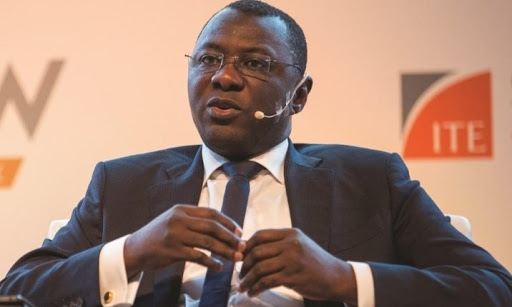
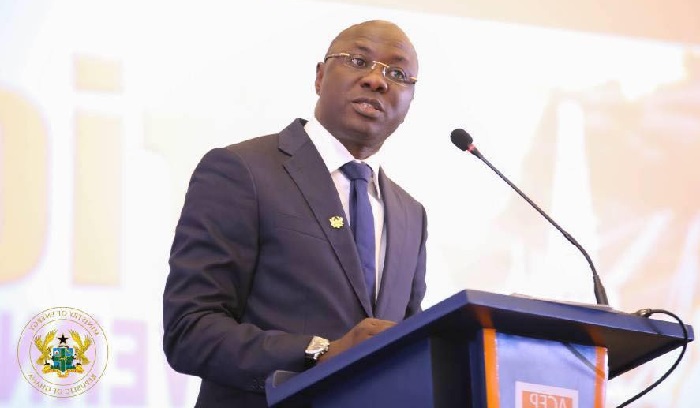
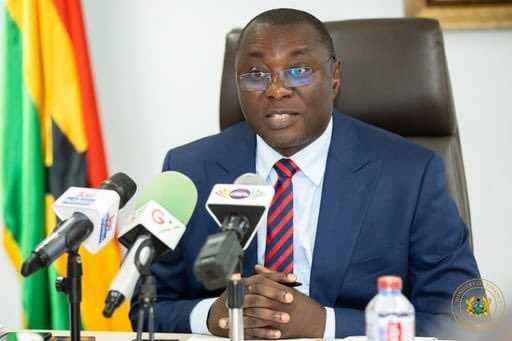
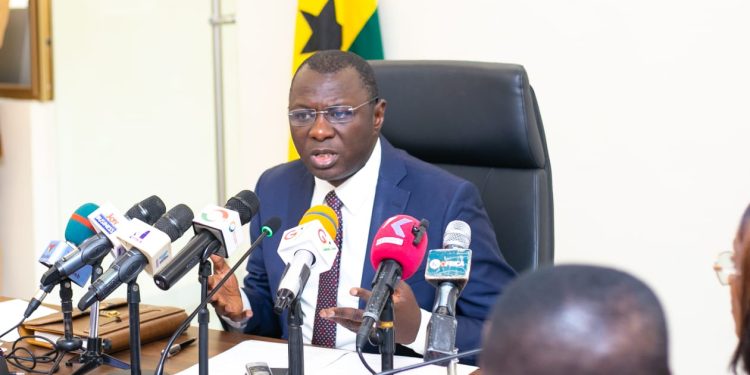
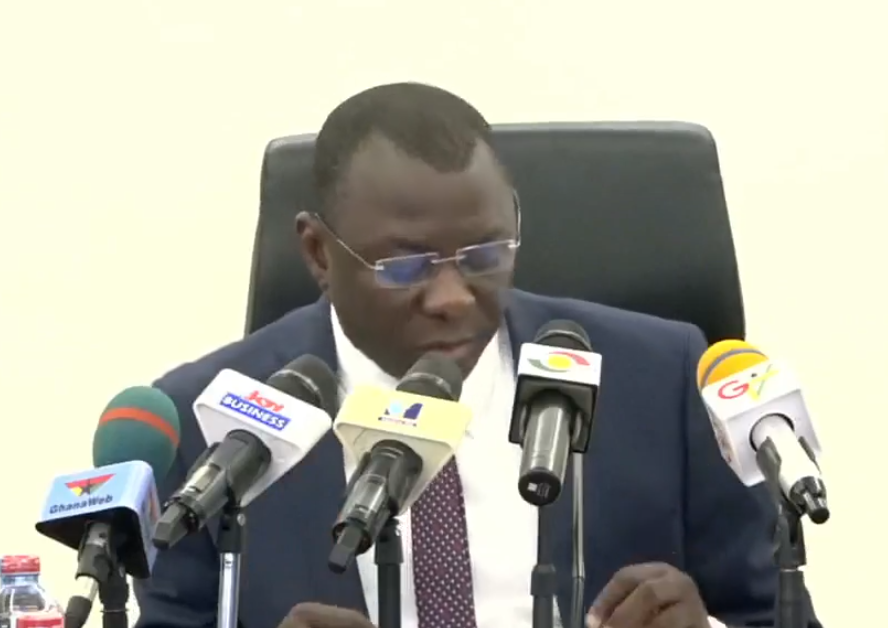
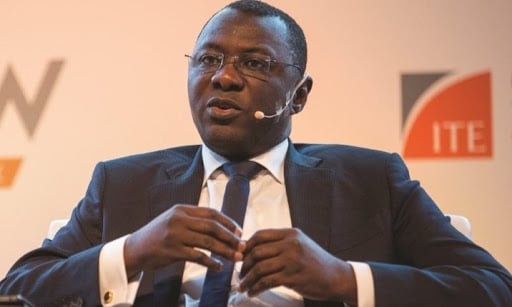
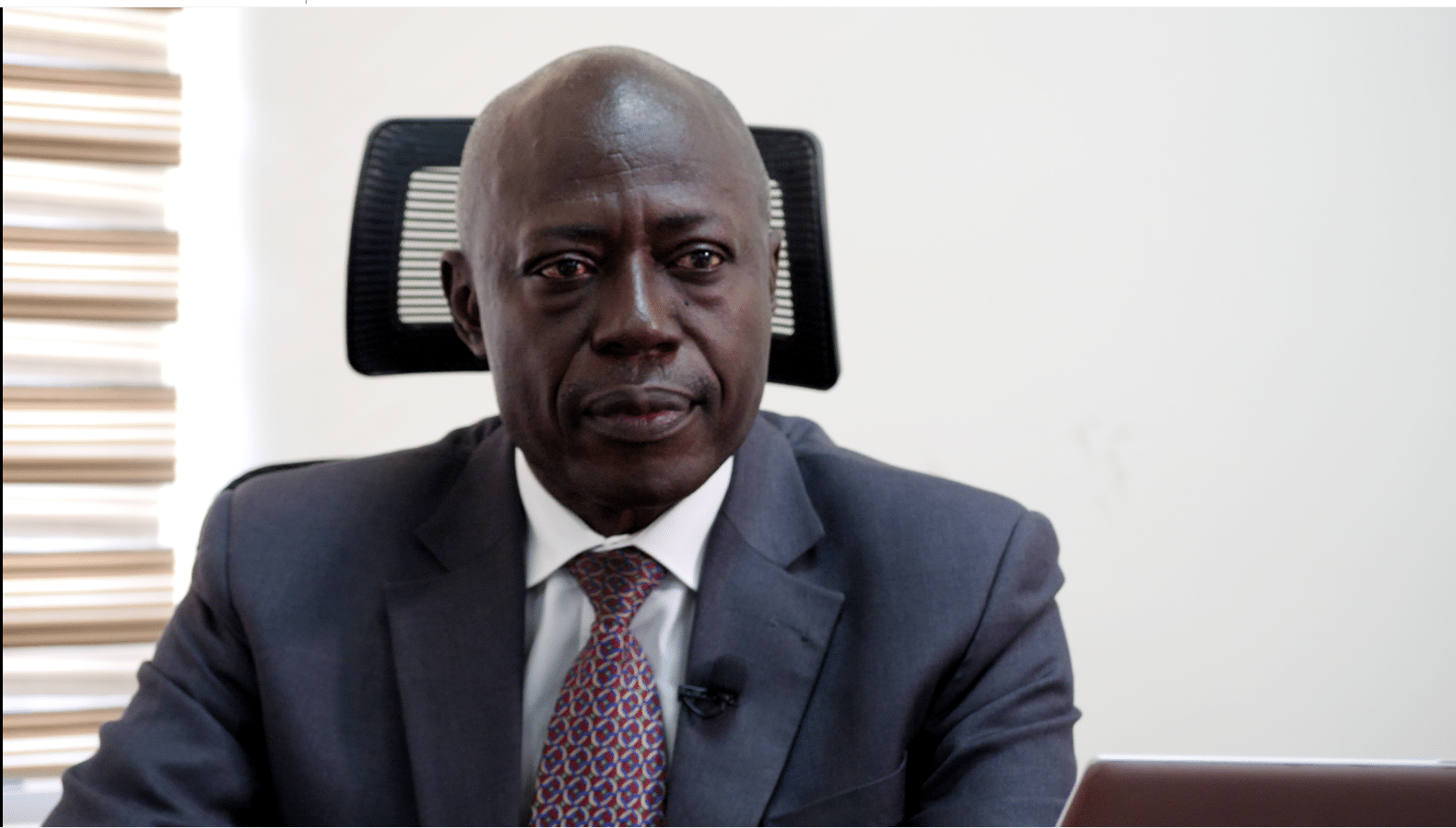
Finance Minister Dr. Mohammed Amin Adam has indicated that for the first half of 2024, the trade balance (economic measure that represents the difference between the value of a country’s exports and imports of goods and services) recorded a provisional surplus of US$1.81 billion.
According to the Finance Minister, this was the result of a larger increase in exports which outweighed the increase in imports.
This is higher than the outturn of US$1.60 billion recorded in the corresponding period of 2023.
He made this information known to the entire country when he delivered the 2024 Mid-Year Budget Review on the floor of Parliament on Tuesday, July 2023.
The improved trade surplus resulted in larger current account surplus of US$1.28 billion (1.5 percent of GDP) in the first half of 2024.
“This compares with a Current account surplus of US863.0 million (1.1 percent of GDP), registered in the same period a year ago,” Dr Amin further revealed to the House.
He also noted that developments in Ghana’s external sector in 2023 was marked by a general reduction in external payments, resulting in a Current account surplus and reduced Capital & Financial account outflow.
“Consequently, the overall Balance of Payments recorded a surplus of US$461.6 million. The current account improved to a surplus of US$1.41 billion, driven by a strong growth in remittances as the reforms in the Fintech ecosystem started to yield positive results,” he added.
On Tuesday, July 23, Finance Minister Mohammed Amin Adam delivered the 2024 mid-year budget review to Parliament.
During his presentation, Dr. Amin Adam reassured that the government remains committed to adhering to its budgetary allocations despite the ongoing economic challenges.
He expressed optimism about the country’s efforts to manage the budget deficit, enhance revenue generation, and control expenditures.
Dr. Amin Adam reiterated the administration’s dedication to maintaining fiscal discipline and ensuring budgetary control.
Here is a detailed report on the progress and challenges facing the Ghanaian economy in 2023 and the first half of 2024.
Finance Minister Dr. Mohammed Amin Adam, has revealed that the government has disbursed 5.4 billion Ghana Cedis to support Livelihood Empowerment Against Poverty (LEAP), School Feeding programme, Capitation Grant and NHIS since January, 2024.
He noted that the aim of this disbursement was to to reduce the burden on the vulnerable in our country.
The minister made this information known when he delivered the 2024 Mid-Year Budget Review in Parliament on Tuesday, July 2023.
“We have spent about 1.5 billion Ghana Cedis to support 1,488,575 students under the Free SHS programme between January and June this year,” he added.
LEAP
Payment for the 89th LEAP cycle (covering January and February 2024) commenced nationwide on Monday, July 1, 2024.
During a press briefing in Accra, Dakoa Newman, the Minister for Gender, Children, and Social Protection, highlighted that the increased funds reflect a doubling of the initial cash grants for beneficiary households.
She outlined the new amounts: GH¢256 for one-member households (up from GH¢128), GH¢304 for two-member households (up from GH¢152), GH¢352 for three-member households (up from GH¢176), and GH¢424 for four-member households (up from GH¢212).
Meanwhile, the Livelihood Empowerment Against Poverty (LEAP) Management Secretariat paid out cash grants totaling GH¢84,480 to 44 beneficiaries who had passed away, according to the Auditor General’s report.
The report also stated that beneficiaries who were no longer eligible for the program received payments totaling GH¢396,620.
A government-run social protection program called LEAP seeks to lessen economic and social hardship by giving cash grants to extremely poor and vulnerable households.
“We found that LMS paid cash grants to caregivers of deceased beneficiaries in one-member households, resulting in payments to 44 deceased beneficiaries amounting to GH¢84,480.”
“We also noted that LMS did not conduct reassessments of LEAP as required. Despite identifying positive impacts of the programme, LMS failed to graduate or exit beneficiaries even when their socioeconomic status had improved. This led to payments of GH¢396,620 to beneficiaries who no longer qualify to be on the programme,” he stated.
On August 8, 2023, Johnson Akuamoah Asiedu, the Auditor General, sent a transmittal letter to the Speaker of Parliament containing this information.
The Auditor General noted that the audit, which covered the years 2017 to 2022, was carried out at the LMS and five districts spread across three regions from February to October 2022.
He also emphasized that LMS had violated fund utilisation guidelines, which meant that more money was spent on program administration than was allowed. This resulted in GH¢15,369,309.97 in overspending, endangering the program’s viability. Furthermore, MOGCSP failed to keep accurate records of the money spent.
He proposed that in order to increase accountability, MOGCSP should improve its record-keeping procedures.
School feeding
The Ghana School Feeding Programme (GSFP) has announced that the proposed GHS1.50 increase per beneficiary pupil will be implemented with the payment for the second term of the 2023/2024 academic year.
This adjustment, as detailed in the government’s 2024 Budget and Financial Statement, will come into effect for the second term.
In a statement released on Friday, July 5, 2024, the GSFP assured all caterers across the 16 regions that the National Secretariat is diligently working with the sector ministry to ensure the timely release of funds by the Controller and Accountant General’s Department to clear outstanding arrears at the new approved rate.
The statement clarified that the recent payment for the first term was based on the “grant of GHS1.20 per pupil as captured under the 2023 budget.”
It emphasized that any deviation from this approved rate for the first term would have been “extremely challenging.”
“All caterers are kindly requested to exercise a little more patience as we finalize the processes for the second term payment,” the statement read.
Finance Minister Dr. Mohammed Amin Adam, has revealed that the government has invested almost GHC10 billion in the road sector since January, 2024 to enhance transportation and spur growth.
He made this information known to the entire country when he delivered the 2024 Mid-Year Budget Review on the floor of Parliament on Tuesday, July 2023.
“I can also confirm that Government has secured equipment to complement the efforts of our local authorities in improving community roads nationwide,” he added.
President Akufo-Addo has asserted that his administration has surpassed the combined road infrastructure achievements of the Mills/Mahama era.
Speaking at the sod-cutting ceremony for the dualization of the Anwiankwanta-Ahenema Kokoben Road on Monday, July 15, Akufo-Addo emphasized the scale of road development during his presidency.
“We have completed 12,830 kilometres of roads since 2017, a stark contrast to the 4,636 kilometres achieved from 2009 to 2016,” President Akufo-Addo stated, highlighting the extensive roadworks including asphalt overlays, new constructions, bridges, and ongoing interchange projects.
“The progress made sets a high standard and serves as a blueprint for what can be achieved with dedication and strategic planning. Successive governments must ensure sustained investment in infrastructure to address the road deficit and meet the evolving needs of our rapidly growing population,” the president said.
Meanwhile, the Chiefs of Hwidiem in the Asutifi South District and Kenyasi Number 1 and 2 in the Ahafo Region have issued a firm ultimatum to the government, demanding the swift resumption of work on the Hwidiem-Kenyasi road.
At a press conference in Kenyasi, the Chiefs voiced their frustration over the ongoing delays in road repairs, which they argue are severely affecting their communities.
The contractor, Kofi Job, has been given a strict deadline to resume work or face repercussions.
The Chiefs have warned that if their demands are not addressed by August 6, 2024, they will stage a large-scale demonstration.
Nana Agyemang, representing the three communities, criticized the government’s lack of response despite repeated appeals for urgent intervention regarding the deteriorating road conditions.
“The road continues to worsen with no intervention from the authorities. We urge all citizens to join us in the upcoming demonstration.
“While we are committed to resolving this issue peacefully, we may have no choice but to continue with protests until the roads are fixed. We hope that the government and other stakeholders will heed our call and take immediate action,” he added.
This marks Dr. Amin Adam’s debut budget presentation since his appointment to the role in February 2024.
The presentation of the budget review adheres to Section 28 of the Public Financial Management Act, 2016 (Act 921), which mandates an update on the government’s fiscal performance and revised financial projections halfway through the fiscal year.
Finance Minister Dr. Mohammed Amin Adam has urged Saudi investors to help raise $12 billion over the next three years.
He emphasized that this funding is crucial for restoring the country to its pre-COVID economic state.
The request was presented at a significant meeting with the Arab Bank for Economic Development in Africa (BADEA), themed ‘Ghana: Unleashing Opportunities through Strategic Investments’.
Dr. Adam highlighted the importance of foreign investment in Ghana’s post-COVID recovery efforts, stating: “If you can help us raise US$12billion over the next three years to finance our recovery and finance our growth to the pre-COVID era, you will have your names written in golden ink as sustainable partners of Ghana”.
The minister emphasized the government’s dedication to social programs, pointing out substantial increases in funding across different sectors.
He mentioned that the budget for the Livelihood Empowerment Against Poverty (LEAP) program has risen from GH¢49 million in 2016 to nearly GH¢500 million now.
Similarly, the school feeding program has expanded from serving 1.6 million children in 2016 to reaching 4 million children today.
Healthcare funding has also grown significantly, with the National Health Insurance Scheme budget increasing from GH¢1.1 billion in 2016 to an anticipated GH¢6.5 billion this year.
Dr. Adam highlighted that these funding increases demonstrate the government’s commitment to fostering inclusive growth.
Finance MinisterDr. Mohammed Amin Adam acknowledged the challenges and unexpected shocks faced by the Ghanaian economy, emphasizing its resilience amid global economic uncertainties.
He highlighted the government’s effective strategies in economic recovery, which have surpassed initial expectations for growth.
Addressing stakeholders at a session on 2024 budget implementation with bankers, Dr. Amin Adam underscored the importance of collaborative efforts for sustainable economic progress.
He called for transparent and inclusive policies, inviting input to address current economic issues and explore innovative solutions.
Highlighting the upcoming SME Growth and Opportunity Programme, scheduled for launch on July 16th, Dr. Amin Adam emphasized the pivotal role of SMEs in driving economic revival.
He announced plans for the Development Bank Ghana to allocate approximately GHS 1.4 billion through the financial sector to support SMEs.
Additionally, partnerships with entities like the IFC aim to secure a $400 million package to bridge financing gaps for SMEs in the medium term.
“Our economy is at a pivotal juncture, and it is imperative that we work together to ensure sustainable growth and prosperity for all. This meeting is a testament to our commitment to transparency, inclusivity, and shared responsibility in shaping our economic policies.
“Today, we will discuss key strategies and policies that will impact our economy. We aim to address current economic issues and explore innovative solutions through your inputs. Your insights and feedback are invaluable, and I encourage open and constructive dialogue throughout our discussions,” he said while speaking at a stakeholders’ engagement on the 2024 budget implementation with bankers.
He added “We are living in a time of rapid change and uncertainty, but also of great potential. By leveraging our collective expertise and resources, we can create a resilient and dynamic economy that benefits every citizen.
This requires us to be bold in our vision, pragmatic in our approach, and united in our efforts. To that end, Ladies and Gentlemen, the Government has set its sights on creating a viable SME ecosystem that ensures businesses with high-growth potential are given the technical capacity and financing support to scale and rapidly create impact.”
“The Development Bank Ghana as part of the programme is looking to channel close to GHS 1.4 billion through the financial sector for onward lending to viable SMEs. Development partners such as the IFC are also looking to structure a $400 million package to complement this financial support and ensure we can close the financing gap for our SMEs over the medium term.”
Ranking Member on the Finance Committee of Parliament, Isaac Adongo, has responded emphatically to criticisms from Finance Minister Dr. Amin Adam regarding his recent comments on the dollar exchange rate.
Adongo clarified that his advice to businesses regarding purchasing dollars was aimed at providing truthful information to Ghanaians.
Dr. Amin Adam had previously criticized Adongo during a joint press conference with officials from the Bank of Ghana and the IMF.
The Finance Minister expressed concerns over speculative actions affecting the stability of the cedi and cautioned against actions that could exacerbate currency challenges.
In a counter-statement, Adongo disputed the characterization of his advice as speculative, asserting that his remarks were grounded in factual observations.
He defended his stance during an interview with Citi FM, reiterating that he does not engage in speculation but rather offers honest and accurate information.
“What did I say that is not true?” Adongo questioned, pointing out the fluctuation in the dollar exchange rate following recent economic measures. He emphasized that his advice aimed to guide businesses in making informed decisions amid economic uncertainties.
“So, if you needed dollars to do your business, by all means, you should go ahead and buy them. How is that unpatriotic?” Adongo challenged, highlighting the practical considerations for businesses in managing their financial operations.
Adongo further pressed the Finance Minister with a rhetorical question: “Will you give businessmen additional money to buy dollar when the rate increases?”
He underscored the practical impact of exchange rate fluctuations on business operations and questioned the adequacy of governmental measures in supporting businesses amidst economic challenges.
Finance Minister Amin Adam has made claims that efforts and policies by the current government has successfully revitalized and improved the country’s economic situation.
The Minister’s statement likely aims to reassure citizens and stakeholders that the government is effectively managing the economy.
Implying that various economic indicators, such as GDP growth, employment rates, and investor confidence, have shown significant improvement.
Despite the finance minister’s remarks, the rising prices of food, services, and petrol, along with poor salaries, paint a different picture.
Finance Minister, Dr. Mohammed Amin Adam has reiterated the government’s commitment to fiscal discipline and responsible spending, ensuring economic policies remain steady despite the approaching 2024 elections.
With a focus on tightening expenditure and preventing policy setbacks, the government aims to uphold economic stability and foster continued growth.
Speaking at a joint press conference with the International Monetary Fund (IMF) on Monday, July 1, 2024, he emphasized, “Despite the fact that 2024 is an election year, we are committed to enhancing domestic revenue mobilization and tightening expenditure commitment controls to avoid policy slippages.”
Dr. Amin Adam further affirmed the government’s dedication to maintaining macroeconomic policy adjustments aimed at achieving comprehensive restoration of stability and supporting a resilient economy for sustainable growth and development.
“We are committed to sustaining our macroeconomic policy adjustment and reforms to fully restore macroeconomic stability and debt sustainability while fostering a sustainable increase in economic growth and poverty reduction,” he assured.
Ghana’s Finance Minister, Dr Mohammed Amin Adam, has delivered optimistic news about the country’s economic trajectory, highlighting resilient growth and positive indicators during the first quarter of 2024.
Speaking at a press briefing on Monday, Dr Adam underscored the robustness of Ghana’s economic recovery, noting that growth has surpassed initial projections.
He attributed this strong performance to ongoing stability in the macroeconomic environment, supported by the government’s steadfast adherence to the IMF-supported program.
Industry emerged as a frontrunner in driving economic growth, achieving a notable 6.8% increase, followed by agriculture at 4.1% and services at 3.3%. Dr Adam highlighted that these sectoral performances contributed to Ghana’s highest GDP growth rate since the fourth quarter of 2020.
The Finance Minister reiterated the government’s commitment to sustaining macroeconomic stability and fostering sustainable growth.
He emphasized that the IMF‘s approval of the second review of Ghana’s US$3 billion, 36-month Extended Credit Facility (ECF) Arrangement in May 2023 was pivotal. This approval facilitated an immediate disbursement of approximately $360 million, bringing Ghana’s total disbursements under the arrangement to about $1.6 billion.
Dr Adam further announced that the third tranche of the IMF’s disbursement, amounting to $360 million, was expected to be received on Monday, July 1, 2024. This financial injection underscores international confidence in Ghana’s economic reforms and governance.
Looking ahead, Dr Adam expressed confidence in Ghana’s economic prospects for the remainder of the year, citing the positive momentum observed in various sectors. He affirmed the government’s dedication to enhancing economic policies that support inclusive growth and development across the country.
The Minister of Finance, Dr Mohammed Anim Adam is scheduled to appear before Parliament on Wednesday, July 3, 2024, to address an urgent question posed by Deputy Majority Leader Patricia Appiagyei regarding the expenditure of the National Cathedral project.
Majority Leader Alexander Afenyo-Markin has stated that the Minister will be required to provide detailed information on the project’s expenditures and confirm whether a value-for-money audit has been conducted.
Deputy Majority Leader Appiagyei has emphasized the importance of the Minister’s appearance to ensure transparency in the use of public funds for the National Cathedral.
The Minister is expected to furnish comprehensive financial details of the project and clarify whether a value-for-money audit has been conducted to ensure accountability and transparency.
Majority Leader Afenyo-Markin announced these proceedings on the floor of Parliament on Friday, June 28, 2024.
Ahead of the Finance Minister’s appearance, the Minority is pressing for broader accountability measures from the government.
Samuel Okudzeto Ablakwa, MP for North Tongu Constituency, has urged the Speaker to enforce the House’s decision to establish a bipartisan committee to investigate the issues surrounding the project.
Finance Minister, Dr. Mohammed Amin Adam, has confidently announced that Ghana’s economy is set for a strong recovery this year, despite recent challenges.
He highlighted that the economy is surpassing expectations, demonstrating robust growth rates that have surprised international organizations like the IMF and World Bank.
For instance, Ghana exceeded growth projections of 1.5% last year, achieving 2.9%, and surpassed this year’s forecasted growth of 3.1% with an impressive 4.7% growth in the first quarter.
“This year, our economy is going to surprise the world.
Dr. Amin Adam emphasized, “I can tell you that this economy is rebounding strongly. We are rebounding strongly, and it is surprising the world, even the IMF, the World Bank. They are all surprised. Last year, they projected our economy would grow at 1.5%, but we grew at 2.9%. In the first quarter of this year, they projected we would grow at 3.1%, but we grew at 4.7%,” Dr. Amin Adam said during a Town Hall meeting held in the UK over the weekend.
He further stated, “This economy will grow, and it will grow faster than everyone thinks.”
Addressing concerns about the Ghana cedi’s depreciation against the US dollar, he assured that measures are in place for the cedi to strengthen, aiming for a comeback after a challenging period where it depreciated by 20.1% in 2024.
Currently trading at approximately GH¢15.50 per dollar in major forex bureaus, the finance minister remains optimistic about the currency’s future performance.
According to the Karaga Member of Parliament, the government has restructured $5.1 billion in debt with these creditors and has also finalized the restructuring of $13.1 billion with Eurobond holders.
Speaking at a UK Town Hall meeting, Dr. Amin Adam emphasized that these efforts have led to savings of $8 billion for the country.
“Last two weeks, we concluded negotiations with the official creditors, and we have agreed to restructure 5.1 billion dollars, I am telling you that the government is good in negotiations and of this amount, we are going to make savings of $2 billion.”
“As I speak to you, tomorrow morning, there will be an announcement that we have also concluded our negotiations with the Eurobond Holders of $3.1 billion and ladies and gentlemen when we announce it, please read the details. We have negotiated a good deal for Ghana and that is $8 billion,” he said.
“Ideally, government should not be held responsible for the investment decisions of individuals, but this government is so caring.
“Mistakes were made and people were not well-informed, and they didn’t know who to consult to be advised, but we also know that the people who are affected are suffering, and we have heard that some people have died and others had to commit suicide.”
“This government is so caring that in the first place, we granted some bailout to all the affected and I want to tell you again that the President has directed that we do another bailout.So between now and October, we will release ¢1.5 billion to the affected people.”
The government recently secured a deal with bilateral creditors to delay interest payments and postpone the maturity date of restructured debt.
To meet its IMF target, Ghana, with an economy valued at $77 billion, must reduce its debt to 55% of GDP by 2028, down from a projected 109% before restructuring began.
The current agreement with bondholders would leave the debt slightly above this target. However, Ghana’s economy performed better than expected in 2023, growing by 2.9% compared to the IMF’s initial target of 1.5%.
This improved performance means a revised Debt Sustainability Analysis (DSA) can accommodate the bondholder agreement, according to Finance Minister Dr. Mohammed Amin Adam.
Ghana started its debt restructuring efforts over a year ago as part of an IMF deal, reaching a preliminary agreement in January to restructure $5.4 billion in obligations under the Group of 20 Common Framework for Debt Treatment. This set the stage for restructuring Eurobond debt.
The government has made significant progress on the new terms for paying the $13 billion owed to creditors, and is now getting close to reaching an agreement with holders of Eurobonds regarding debt restructuring.
This happened as a result of the International Monetary Fund’s (IMF) rejection of the suggested terms due to their inconsistency with its program, which aims to achieve sustainable debt levels by 2028.
On the fringes of the Africa Development Bank’s recently concluded Annual General Meeting in Nairobi, Kenya, Finance Minister Dr. Mohammed Amin Adam spoke about these developments.
“We are also close to ending our negotiations with the Eurobond holders. This year the figures we are seeing already show that we are likely to perform better than what was projected for the year,” he said.
“And this is as the result of the increasing investment in agriculture and industrialization but we are also launching a new programme: a SME growth and opportunity programme that will mobilize resources to increase financing to SMEs,” he added.
The Bank of Ghana reported that during the first four months of 2024, the Gross International Reserves position remained strong.
The Gross International Reserves reached a record high of $6.59 billion in April 2024, which is equal to 3.0 months’ worth of import cover.
Comparing this to the $5.91 billion (2.7 months of import cover) reported at the end of December 2023, there has been a noticeable rise.
Furthermore, as of the end of December 2023, the Gross International Reserves—which do not include petroleum or encumbered assets—had increased significantly to $4.32 billion from $3.66 billion.
Minister of Finance, Dr. Mohammed Amin Adam, has urged the investor community to aid Ghana in accelerating its economic recovery, which is currently showing signs of improvement.
Ghana’s Gross Domestic Product (GDP) grew by 2.9 percent in 2023, surpassing the 1.5 percent forecast under the ongoing International Monetary Fund (IMF) programme.
“Inflation is trending downwards from the 54 per cent in 2022 to 25 per cent today and it is expected to go to 15 per cent by the end of the year and the interest rate has also gone down,” he said.
The Minister highlighted that these factors, combined with the government’s commitment to fiscal prudence despite the 2024 election year, created a favorable environment for investors to contribute to the economy’s accelerated recovery.
Dr. Amin Adam was addressing some Rand Merchant Bank investors on the sidelines of the 2024 African Development Bank (AfDB) Annual Meetings in Nairobi, Kenya.
He said the government had stepped up measures to ease the country’s business climate, adding that “the growth we are looking at requires sustainable investment and that is why we continue to count on your esteemed partnership.”
The Finance Minister stated that the government had launched targeted programs to support Small and Medium Enterprises (SMEs), which are essential for job creation and significantly contribute to the country’s GDP.
He mentioned that these support systems include access to finance, market opportunities, digital marketing, and managerial expertise.
The Minister was accompanied by the second Deputy Governor of the Bank of Ghana, Mrs. Elsie Addo Awadzi, along with officials from the Ministry of Finance and the Ghana Investment Infrastructure Fund.
Recently, the government established a new monthly stakeholder dialogue with both local and foreign businesses to expedite making business processes in Ghana more conducive.
This initiative aims to address the concerns of both local and foreign businesses in the country, enabling them to thrive and contribute more to government revenue through the payment of appropriate taxes.
The Minister of Finance, Dr. Mohammed Amin Adam, has announced that the government is poised to receive funds to recommence various stalled projects nationwide.
These funds are anticipated following the signing of a Memorandum of Understanding (MoU) with the country’s Official Creditors.
Speaking at a press briefing on Friday, May 24, Dr. Amin Adam elaborated that the MoU’s signing would signify the conclusion of negotiations with the Official Creditors.
He further explained that subsequent to this, bilateral agreements would promptly be executed with each Official Creditors Committee (OCC) member, as they finance diverse projects within Ghana.
“We will then immediately sign bilateral agreements with each of the OCC members, because they have different projects which they are funding in Ghana,” he said.
“What it also means is that disbursements will start to flow in towards these projects and we should see the contractors going back to site to continue the projects – some include major road projects,” he added.
Additionally, the Minister highlighted that the MoU’s signing would alleviate the country’s financial burden by extending the maturity, thereby allowing funds initially allocated for debt servicing to be redirected towards financing other developmental endeavors.
During the briefing, Dr. Amin Adam disclosed that Ghana had received the draft MoU from its Official Creditors Committee on Thursday, May 23, and was anticipating its review and subsequent signing.
The signing of the MoU holds significant importance for Ghana in securing its third tranche of US$360 million from the International Monetary Fund (IMF). This follows the attainment of a Staff Level Agreement with the Fund’s Mission Team in April this year. These efforts are part of the government’s initiative to restructure approximately US$13 billion in external debt to meet debt sustainability criteria under the ongoing Extended Credit Facility (ECF) program.
The IMF Executive Board is slated to convene next month (June) to review the second review and approve the country’s third tranche, facilitating the disbursement of US$360 million.
The signing of the MoU, coupled with the disbursement of the US$360 million, holds crucial implications for stabilizing the country’s currency, particularly against major trading partners like the Dollar.
Professor Godfred Alufar Bokpin, an Economist at the University of Ghana, underscored the significance of the MoU signing, stating that it would restore confidence in the economy and potentially stabilize the currency.
Meanwhile, at a recent second quarter CEOs Breakfast Meeting, Dr. Stephen Amoah, a Deputy Finance Minister, advocated for increased patronage of domestic tourism and hospitality centers. He emphasized that high patronage of domestic tourism would bolster the country’s economy by retaining money within the country and consequently mitigating the depreciation of the Cedi.
Finance Minister, Dr. Mohammed Amin Adam has indicated that the depreciation of the Cedi has been considerably stabilized from November 2022 to December 2023 and is showing signs of modest appreciation against the Dollar in 2024.
During his monthly economic briefing, the minister highlighted that the exchange rate has seen significant stabilization, with the depreciation of the Cedi against the US Dollar reducing by half from 54.2% at the end of November 2022 to 27.8% at the end of December 2023.
He also mentioned that the Cedi is expected to strengthen in the medium term following the completion of the domestic debt exchange program.
“But for recent pressures we are seeing on exchange rate movements, the exchange rate has been largely stabilised with the depreciation of the cedi against the US Dollar halving from 54.2% at the end of Nov 2022 to 27.8% at the end of Dec 2023.
“The Cedi’s stability has continued into 2024, with a cumulative depreciation of 14.2% as of 20th May 2024, compared to 20.7% recorded in the same period in 2023. We expect the cedi’s stability to improve into the medium-term as we complete debt restructuring, make more progress on fiscal consolidation, and improve our reserves over the medium-term.”
He further addressed the current pressures in the Cedi which he attributed to the “strengthening of the US Dollar against major trading currencies”
“The recent pressures we are observing on the cedi is largely on the back of the strengthening of the US Dollar against major trading currencies, seasonal forex demand including elevated demand from corporate institutions, payment to contractors and to IPPs, high Cedi liquidity and speculation.”
The Finance Minister outlined several measures, including enhancing revenue mobilization and securing World Bank loans, among others, that the government is undertaking to strengthen the Cedi against major trading currencies.
The depreciation of the Cedi has prompted calls from various trade groups, including GUTA and Organized Labour, for urgent measures to address the decline.
The Chief Executive Officer of the Ghana Chamber of Construction Industry, Emmanuel Cherry, has stated that he is unaware of the GH₵49 billion that Finance Minister Dr. Amin Adams claimed has been released to contractors.
During a press briefing on Friday, Dr. Amin Adams explained that the current depreciation of the cedi was partly due to payments of approximately GH₵49 billion to contractors and $400 million to Independent Power Producers (IPPs), which contributed to speculative dollar accumulation.
“We have paid contractors. I want to say that the complaints of no money and no money, and no money, we don’t hear that anymore because we have paid and paid contractors. As of now, to date I think we have spent some GH₵49 billion. Same time last year, we did GH₵41 billion and so this demonstrates there’s a lot of cedi liquidity in the market and we have seen some people looking for US dollars to buy with the cedis that we have put out there.
“And so these are some of the reasons including the payment to IPPs (Independent Power Producers). You will recall that we started negotiating with them as a result of which we had to make a bullet, one-off payment amounting to some $400 million and so they all put pressure on the cedi,” Dr Adam said.
However, Mr. Cherry stated that, to his knowledge, no such amount had been issued to the chamber for any construction work.
He expressed surprise at the Finance Minister’s claim, insisting it came as a shock to him.
“In the roads and the building sector, if we should lump together the amount the minister has mentioned now, I don’t know where exactly he is getting his figures from. So it is something that has hit us as a shock and a surprise,” he said on Joy FM’s Top Story on May 24.
The CEO explained that the chamber was unaware of the mentioned amount and added that they would investigate the matter.
“But as industry players we are also bent on doing our further checks into the books and to find out what exactly is the minster driving to. Because if it is about roads and that of building it is very outrageous for us to say that the Minister of Finance will come out and dangle these figures into the public space.”
Mr Cherry added that if the minister’s claim was true, contractors would still be on site.
“If the minister claims that such an amount of money has been paid to the contractors then why are contractors not on site? Why have they moved from site? Why are they not working? That is the question we need to ask ourselves because as we speak today, road fund, government is owing contractors GH₵6 billion as we speak today.
“The GOG, five-point-something billion. Cocobod has paid some GH₵1 billion this month and we are hoping that they will continue. So therefore their portfolio also reduces a little bit. We are looking at barely GH₵4 billion in total.
“So in fact the debt portfolio that you and I’ve been talking about, it is not up to that magnitude. Which means there is another leg of construction that is going on that the minister is trying to speak to that we don’t know. We need to interrogate the books properly and come out with the accurate figures accordingly because this is very outrageous to us,” he added.
Finance Minister, Dr. Mohammed Amin Adam, has outlined the government’s successful attainment of several key fiscal targets within the framework of the International Monetary Fund-supported program.
These achievements encompass significant milestones such as zero Central Bank borrowing, maintaining a ceiling of GH¢4.3 billion for the primary deficit on a commitment basis, ensuring zero accumulation of external debt payments, and adhering to a non-concessional borrowing limit of $66.2 million in present value terms.
Moreover, by the conclusion of December 2023, the government had met its indicative targets, including securing a minimum of GH¢114.19 billion for non-oil public revenue and allocating at least GH¢4.07 billion for social spending.
Addressing reporters at the Monthly Press Briefing, Dr. Amin Adam emphasized that ongoing assessments were being conducted regarding the indicative target of maintaining a ceiling of zero net change in the stock of payables of the central government and payables to the Independent Power Producers (IPPs).
These assessments are slated to be finalized ahead of the IMF Executive Board meeting for the 2nd Review.
Furthermore, Dr. Adam highlighted the implementation of structural reforms as part of the IMF-supported program’s second review. These reforms encompass the expansion of the GIFMIS infrastructure to include over 280 IGF-reliant institutions and the publication of the final report of the first quarterly audit of the Electricity Company of Ghana’s single account on the Public Utilities and Regulatory Commission’s website.
“The positive results of the first and second reviews of the implementation of the IMF-supported Programme testify that we are achieving the Programme’s objective of restoring macroeconomic stability and debt sustainability, building resilience through the implementation of strong and wide-ranging structural reforms, and laying the foundations for stronger and more inclusive growth, while protecting the poor and vulnerable. We are now seeing signs of macroeconomic stability and economic recovery”, he added.
Growth turned out to be more resilient and robust in 2023 than initially programmed as Gross Domestic Product grew by 2.9% compared to the original projection of 1.5% and the revised projection of 2.3%.
Headline inflation also declined by 31 percentage points from 54.1% at the end of 2022 to 23.2% at the end of Dec 2023 before inching up slightly to 25.8% in March 2024 due largely to base effect.
Finance Minister Dr. Mohammed Amin Adam has indicated that the Ministry of Finance is collaborating with the Bank of Ghana (BoG) to implement measures aimed at addressing the depreciation of the cedi.
These measures include accelerating the fiscal consolidation process through spending rationalization and enhanced revenue mobilization, intensifying the gold-for-oil program, and deploying appropriate foreign exchange interventions by the Bank of Ghana.
Additional strategies involve reinforcing the gold for reserve program, disbursing the third tranche under the second review of the International Monetary Fund-supported PC-PEG after the IMF Executive Board’s approval in June 2024, and securing funds from ongoing projects, including a $150 million World Bank loan.
Furthermore, an expected disbursement of $300 million under the World Bank DPO2 is anticipated in the third quarter of 2024.
Dr. Amin Adam highlighted the positive impact of the fiscal consolidation program, noting that the primary balance on a commitment basis improved by about 4 percentage points, resulting in a deficit of 0.3% of Gross Domestic Product (GDP) by the end of 2023.
Preliminary fiscal data for the first quarter of 2024 indicated that the primary balance (on a commitment basis) was a deficit of 0.6% of GDP, compared to the target deficit of 0.2% of GDP.
This shortfall was mainly attributed to delays in implementing some of the 2024 revenue measures approved for the budget.
In light of these developments, Dr. Amin Adam reassured Ghanaians that the measures being taken would stabilize the cedi and maintain a healthy supply of foreign exchange, eliminating the need for any rush to buy forex.
Finance Minister Dr. Mohammed Amin Adam has assured Ghanaians that there is sufficient foreign exchange supply.
He is therefore urging the public not to panic and rush into purchasing forex.
Dr. Amin Adam emphasized that the Ministry of Finance is collaborating with the Bank of Ghana to implement measures aimed at addressing the depreciation of the cedi. ‘
These measures include accelerating the fiscal consolidation process through spending rationalization and enhanced revenue mobilization, intensifying the gold-for-oil program, and deploying appropriate foreign exchange interventions by the Bank of Ghana.
Additional strategies involve reinforcing the gold for reserve program, disbursing the third tranche under the second review of the International Monetary Fund-supported PC-PEG after the IMF Executive Board’s approval in June 2024, and securing funds from ongoing projects, including a $150 million World Bank loan. Furthermore, an expected disbursement of $300 million under the World Bank DPO2 is anticipated in the third quarter of 2024.
Dr. Amin Adam highlighted the positive impact of the fiscal consolidation program, noting that the primary balance on a commitment basis improved by about 4 percentage points, resulting in a deficit of 0.3% of Gross Domestic Product (GDP) by the end of 2023.
Preliminary fiscal data for the first quarter of 2024 indicated that the primary balance (on a commitment basis) was a deficit of 0.6% of GDP, compared to the target deficit of 0.2% of GDP.
This shortfall was mainly attributed to delays in implementing some of the 2024 revenue measures approved for the budget.
In light of these developments, Dr. Amin Adam reassured Ghanaians that the measures being taken would stabilize the cedi and maintain a healthy supply of foreign exchange, eliminating the need for any rush to buy forex.
“We wish to assure Ghanaians that there is enough foreign exchange supply. Hence, there is no need to rush and buy forex”, the Minister said.
Finance Minister, Dr. Mohammed Amin Adam, has responded to concerns about the recent depreciation of the Ghanaian cedi, stating that despite recent pressures, the currency remains strong.
Dr. Amin made these remarks in light of the cedi’s performance against the US dollar, noting that while there has been a noticeable depreciation, the currency’s stability has been maintained.
He pointed out that the cedi’s depreciation against the US dollar has halved from 54% in November 2022 to 27.8% by the end of December 2023.
The minister highlighted that the cedi’s stability has continued into 2024, with a cumulative depreciation of 14.2% as of May 20, 2024, compared to 20.7% recorded in the same period in 2023.
Engaging the press on Friday on the state of the economy, the Minister said, “People may see the cedi depreciating fast recently. Based on that comparison, we can say that the cedi is still strong.”
The Chamber of Petroleum Consumers (COPEC) has alerted the public to anticipate higher fuel prices at the pumps in the coming weeks due to the depreciation of the cedi.
This warning follows increases in fuel prices by some oil marketing companies, despite earlier projections that prices would decline from mid-May. The companies have attributed the price hikes to uncertainties in the exchange rate market.
As of May 22, at a Forex bureau located in Accra, the dollar was purchased at a rate of GH15.00 and sold at GH15.30.
Against the Pound Sterling, the Cedi stood at a buying rate of GH17.6437 and a selling rate of GH17.6628.
In another forex bureau in Accra, the pound sterling was bought at GH18.50 and sold at GH19.20.
For the Euro, the rate showed a buying price of GH15.0608 and a selling price of GH15.0745.
At a different forex bureau in Accra, the Euro was acquired at GH15.85 and sold at GH16.45.
Finance Minister, Dr. Mohammed Amin Adam, has announced that Ghana’s Gross International Reserves have reached $6.2 billion, covering 2.7 months of import cover as of the end of February 2024.
This marks an improvement from $5.9 billion recorded in the corresponding period of 2022.
Dr. Amin, while engaging the media on Friday on the current state of the economy, further stated that Ghana’s Gross International Reserves are expected to continue improving, reaching a level that covers 4.4 months of import cover in the medium term.
This improvement is anticipated to be supported by external inflows from institutions such as the IMF, World Bank, and other development partners.
The minister highlighted various initiatives contributing to this positive trend, including the government’s Oil for Gold programme, the Bank of Ghana’s Gold for Reserve programme, and the Cocoa syndicated funds.
Despite recent pressures on the exchange rate, Dr. Amin noted that the cedi has shown stability, with the depreciation against the US dollar decreasing from 54% in November 2022 to 27.8% by the end of December 2023.
He further added that the cedi’s stability has persisted into 2024, with a cumulative depreciation of 14.2% as of May 20, 2024, compared to 20.7% recorded in the same period in 2023.
While acknowledging recent concerns about the cedi’s depreciation, Dr. Amin emphasized that the currency remains strong when compared to previous rates of depreciation.
“People may see the cedi depreciating fast recently. Based on that comparison, we can say that the cedi is still strong,” he said.
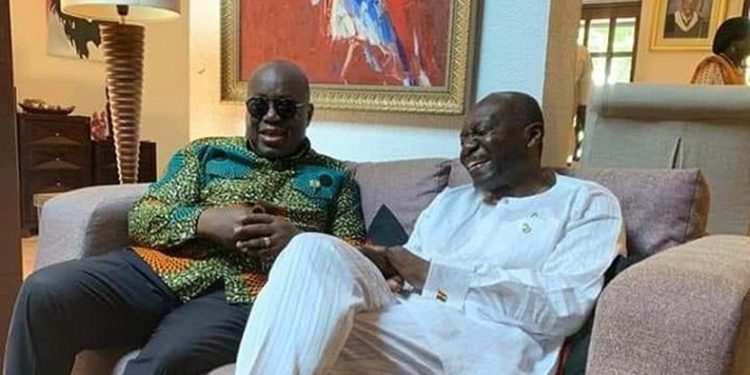
Former Finance Minister Ken Ofori-Atta has revealed why he remained resilient in the face of calls for his resignation.
According to Mr Ofori-Atta, he decided to focus on solving economic issues and not be deterred by public pressure since it is impossible to receive the needed support from all Ghanaians.
He said, “With our work, you don’t expect everyone to love you, and I was focused on crossing the Jordan with the whole community. So if some people dislike you, it’s fine. Recently, the numbers show that we went through a very difficult patch and we have turned the corner. I am hopeful that God will lead us to the right way so that in the 2024 elections, we [NPP] shall prevail Mr. Ofori-Atta in a media interview.”
Mr. Ofori-Atta faced scrutiny during his tenure, with members of the Minority Caucus in Parliament petitioning President Akufo-Addo to remove him due to economic challenges.
However, it wasn’t until February 14, 2024, during a ministerial reshuffle, that he was replaced by Dr. Mohammed Amin Adam.
Mr. Ofori-Atta holds the record as the longest-serving Finance Minister in the 4th Republic.
Reflecting on the prospects of the New Patriotic Party (NPP) in the upcoming elections, he expressed optimism, attributing his confidence to the economic progress achieved under the party’s leadership.
Finance Minister Dr. Mohammed Amin Adam has expressed confidence that the anticipated $1.2 billion from development partners will provide substantial support to the local currency against major trading currencies.
He emphasized that the disbursements from key development partners like the International Monetary Fund (IMF), the World Bank, and the African Development Bank (AfDB) will play a significant role in enhancing the stability of the local currency.
Dr. Amin Adam made these remarks during the Finance Ministry’s inaugural monthly press briefing held on Tuesday, March 26, in Accra. He attributed the recent depreciation of the Ghana cedi to a combination of domestic and international factors, noting that the currency is currently trading at GH¢12.8 to a dollar.
According to the minister, international factors, particularly the strength of the United States dollar against major trading currencies, have contributed to the depreciation of the local currency.
In addition to international factors, Dr. Amin Adam identified local factors exacerbating the depreciation, including payments by the energy and corporate sectors, as well as delays in the disbursement of the cocoa loan, which have intensified pressure on the local currency.
Despite these challenges, the minister highlighted various interventions that have helped mitigate the impact of depreciation. These interventions include inflows from remittances, contributions from mining companies, and the Bank of Ghana’s (BoG) local gold purchases.
Dr. Amin reiterated that the planned disbursements for ongoing infrastructure projects will further reinforce the local currency, providing additional support to stabilize it.
“To further stabilise the currency, we are expecting a total disbursement of about $1.2 billion from our Development Partners namely the IMF, the World Bank, and the African Development Bank before the end of 2024,” he assured.
Onua TV morning show host, Captain Smart has alleged that the former deputy finance minister, John Kumah was conscious of the fact that he had been subjected to poisoning through food.
During an episode of his show, Captain Smart stated that John Kumah had to travel to India in a bid to seek medical attention as the poison was gradually deteriorating his health.
According to him, Ashanti Regional Chairman, Bernrad Bosiako Antwi also known as Wontumi together with the late John Kumah were together poisoned through food at an occasion.
However, Wontumi, per Captain Smart’s account, started reacting to the poison after he had consumed the food whereas John Kumah looked well.
As such, John Kumah and his entourage were not bothered as he was not portraying any sign of reacting to the food served him.
Captain Smart claimed that John Kumah was intentionally poisoned because of his political ambitions, stating that he represented a threat to certain party leaders.
“John Kumah and some top officials who met the agenda of the meeting discussed how fast John Kumah was rising to a level such that no one could stop him. Ask Chairman Wontumi if he didn’t eat the same poisoned food as John Kumah? When those with John Kumah saw that Wontumi was reacting to the poisoned food and John Kumah wasn’t they thought John Kumah was okay”.
“Yesterday, people said I made a lot of allegations but today I will speak more. John Kumah was intentionally poisoned and he is aware. I can tell you the date and time John Kumah went to India to seek medical treatment.John Kumah really suffered. This issue of poisoning when did it start in NPP? Hon Appiah-Kubi was poisoned, it took a doctor at Akwei to save Appiah-Kubi. They wanted to poison him because he is allergic to bribe taking,”he added.
He mentioned that the former leader of the Majority Caucus, Osei-Kyei-Mensah in parliament has escaped the evil plans of these maleficent actors within the party.
He alleged that having observed the schemes and tactics of the sinister figures, Osei Kyei-Mensah- Bonsu carries his water with him wherever he finds himself.
Captain Smart further noted that, after their unsuccessful attempt to eliminate Osei Kyei-Mensah-Bonsu through poisoning, the malevolent individuals redirected their focus towards the Member of Parliament (MP), Asante-Akim North Constituency, Hon. Andy Appiah Kubi and successfully poisoned him.
Captain Smart’s comments come in the death of John Kumah who passed away on Thursday, March 7, 2024.
According to reports, he collapsed in his office and was swiftly transported to a hospital for medical treatment. Subsequently, due to a decline in his condition, he was flown out of the country.
The cause of his death is currently unknown and has taken the country by shock.
The Member of Parliament for Ejisu in the Ashanti Region, Dr. Kumah, was known for his diverse roles as a Lawyer, Entrepreneur, and dedicated Politician.
He is survived by Apostle Mrs. Lilian Kumah, and six children.
Parliament has suspended proceedings following news of the demise of the Deputy Finance Minister and Member of Parliament (MP) for Ejisu John Kumah.
According to JoyNews Kweku Asante, the Speaker of Parliament, Rt.Hon. Alban Bagbin, slammed into his chair after the news of the minister’s death broke to him.
He called for a ten-minute suspension of the house.
he later moved for the adjournment of the house for what he described as “good reasons.” Parliament is set to reconvene tomorrow, Friday, March 8, 2024, at 10pm to continue debate on the State of the Nation Address (SONA).
The family of the late Minister has yet to officially confirm his demise; however, according to reports, he collapsed in his office and was swiftly transported to a hospital for medical treatment.
Subsequently, due to a decline in his condition, he was flown out of the country.
While it is alleged that the minister was still receiving treatment and recuperating from a poison attack, the cause of his death is currently unknown and has taken the country by surprise.
Dr. Kumah, theMember of Parliament for Ejisu in the Ashanti Region, was known for his diverse roles as a Lawyer, Entrepreneur, and dedicated politician.
He is survived by Apostle Mrs. Lilian Kumah, and six children.
Deputy Finance Minister, Dr. John Kumah, passed away on Thursday, March 7, 2024.
Reports indicate that he collapsed in his office and was promptly rushed to a hospital for medical attention.
His condition later deteriorated, leading to his evacuation out of the country. Dr John Kumah, aged 45, served as the Member of Parliament for Ejisu in the Ashanti Region.
Below is his profile.
Hon. Dr. John Ampontuah Kumah, the current Member of Parliament for Ejisu, in the Ashanti Region, is a Lawyer and an Entrepreneur with over fifteen (15) years’ experience in leadership, creativity, innovation and resourcefulness in creating jobs, and supporting youth development.
As the first Chief Executive Officer for the National Entrepreneurship and Innovation Programme (NEIP), he successfully positioned the NEIP as the enabler of the Entrepreneurship Ecosystem in Ghana. Under his leadership, the programme trained 7,000 startups in 2018 under the Presidential Business Support Programme and supported 1,350 beneficiaries with funds.
Prior to working for government, Hon. Kumah was the founding member and Managing Partner of Aduaprokye Chambers, a law firm. He also worked as the founder of Majak Associates Ltd, a building and construction company.
In November 2020, Hon. Dr. John Ampontuah Kumah received a Doctorate in Business Innovation from the Swiss Business School in Switzerland. Before then, he had acquired a Masters in Applied Business Research, at the same Business School in 2019.
His rich educational background includes a Post Graduate Diploma in Applied Business Research in 2019 at Nobel International Business School (NIBS). In 2009, he had an Executive Masters degree in Business Administration (Finance), from the Ghana Institute of Management and Public Administration (GIMPA).
It all began at the University of Ghana, where he earned a Bachelor of Arts degree in Economics with Philosophy, a Bachelor of Art Degree (Law) LLB in 2011 and a Professional Law Certificate from the Ghana School of Law in 2013. He was admitted to the Ghana Bar in 2013.
As an Entrepreneur by birth, a Lawyer by Profession, a Politician by Choice, a Preacher by Divine Calling, he sees none of these as an accident, but a call to serve humanity.
He is a family man with six children, and married to Apostle Mrs. Lilian Kumah.
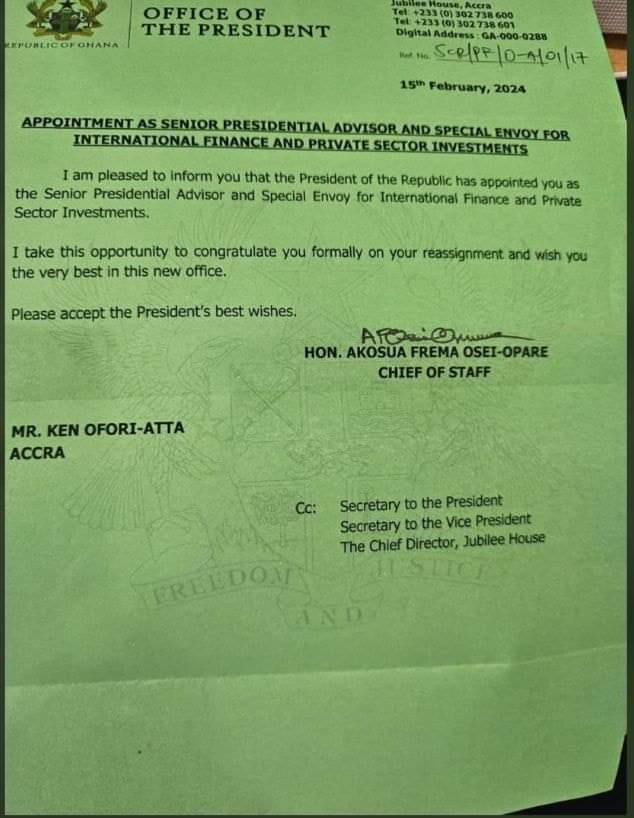
Former Minister of Finance, Ken Ofori-Atta, has been appointed by President Akufo-Addo to the position of Senior Presidential Advisor and Special Envoy for International Finance and Private Sector Investments.
Having been relieved of his duties as Finance Minister on February 14, with Mohammed Amin Adam taking up the role, Mr. Ofori-Atta received congratulations from Chief of Staff Akosua Frema Osei-Opare.
In a statement dated February 15, she announced his new appointment, expressing pleasure and extending formal congratulations.
“I am pleased to inform you that the President of the Republic has appointed you as the Senior Presidential Advisor and Special Envoy for International Finance and Private Sector Investments.
“I take this opportunity to congratulate you formally on your reassignment and wish you the very best in this new office,” she stated.
Finance Minister- designate, Mohammed Amin Adam has reconfirmed the government’s commitment to restart and successfully conclude halted infrastructure projects in the Ashanti Region.
Dr. Amin Adam is presently on an official visit to the Ashanti Region, where he extended a courtesy call to the Asantehene, Otumfuo Osei Tutu II, and the Ashanti Regional Minister.
Emphasizing the Ashanti Region’s crucial role in Ghana’s economic development, the Minister articulated the government’s dedication to implementing vital projects. Notable among these are the Kumasi International Airport, the Kejetia Redevelopment Market, and the Mother and Baby Unit at the Komfo Anokye Teaching Hospital.
“The other one that will request of you which I was discussing with your predecessor, we have a road construction from a place called Ahenema-Kokoben on the Obuasi road up to Ahenema-Kokoben which was awarded to Kofi Job initially, and later they have to change the drawings. And after the change of drawings you know definitely the estimate ballooned and according to the road minister, the road minister said he needed financial clearance from the Minister of Finance, so I’ll plead you worked on that one for us.”
Acknowledging the challenges that impeded project completion, he underscored the need for prompt action.
Mr. Amin Adam stated, “But you are also aware that we have faced some challenges, as a result we had to stall for some time, but you also know that His Excellency the President is determined to make sure that these projects are completed for the benefit of our people.”
The Ashanti Regional Minister, Simon Osei Mensah, appealed to the Finance Minister to address the conclusion of unfinished and suspended projects, particularly mentioning the Kumasi International Airport and the Ahenema-Kokoben and Anhwiankwanta road project.
He requested financial clearance for the road project and sought the Finance Minister’s intervention. “The other one that will request of you which I was discussing with your predecessor, we have a road construction from a place called Ahenema-Kokoben on the Obuasi road up to Ahenema-Kokoben which was awarded to Kofi Job initially, and later they have to change the drawings. And after the change of drawings you know definitely the estimate ballooned and according to the road minister, the road minister said he needed financial clearance from the Minister of Finance, so I’ll plead you worked on that one for us.”
The Finance Minister is scheduled to inspect the various projects in the region to gather firsthand information about their current status and challenges.
Outgoing Finance Minister Ken Ofori-Atta has expressed his commitment to the prudent management of resources allocated during his tenure.
He aimed to bolster economic growth, enhance social welfare, and facilitate infrastructural development.
In a letter of appreciation issued on Wednesday, February 14, Mr. Ofori-Atta emphasized the importance of safeguarding vulnerable segments of society through implemented initiatives. He noted that these efforts have led to significant progress and contributed to an improved quality of life for Ghanaians.
“We reminded ourselves that we had only two fishes and five loaves for the monumental task ahead while ensuring a deliberateness of the preferential options for the poor and promoting private sector productivity. Since March 2020, our four (4) budgets, however have focused on protecting lives, preserving livelihoods and recovering from the impact of the, that truly once-in-a- lifetime apocalyptic pandemic, COVID-19, as well as geopolitical upheavals. Indeed, amidst these poly-crises, we at MoF stood strong as the Midwives of the Republic to help ease the pain on our Fellow Citizens.
“Through prudent financial management and strategic allocation of resources, we have pursued initiatives aimed at boosting economic growth, promoting social welfare, and expanding infrastructural development. As a result of these efforts, our country has experienced remarkable progress.”
He also expressed confidence in his successor, Dr. Mohammed Amin Adam, urging Ministry of Finance staff to support him.
Mr Ofori-Atta thanked the staff for their service and commitment, encouraging them to uphold professionalism, ethics, efficiency, and responsiveness.
He emphasized his vision for a Ghana Beyond Aid and described Dr. Amin Adam as a smart, humble, and inclusive leader, stressing the importance of collective effort for a successful tenure.
“The future is here with us as we are blessed with a new leader, Dr Mohammed Amin Adam, who replaced the venerable Charles Adu Boahen and has been with us through some of the most difficult times. Let us all circle the wagons and ensure a blazing success for his stewardship.
“We all know him as a smart, humble and inclusive leader. Let me state with all humility that nothing would honour me and the ‘Office of the Minister’ more than for you to work with renewed diligence to guide Hon. Amin and our nation to the successful execution of the IMF-ECF programme to promote economic growth and transformation.
“Once again, I thank you for your tireless service and commitment to excellence. It has been my utmost honour and a rare privilege to serve alongside each, and every one of you. I pray that you continue to be resolute, dedicated, unwavering and committed to the work of the Republic and care for the finances of the State.”
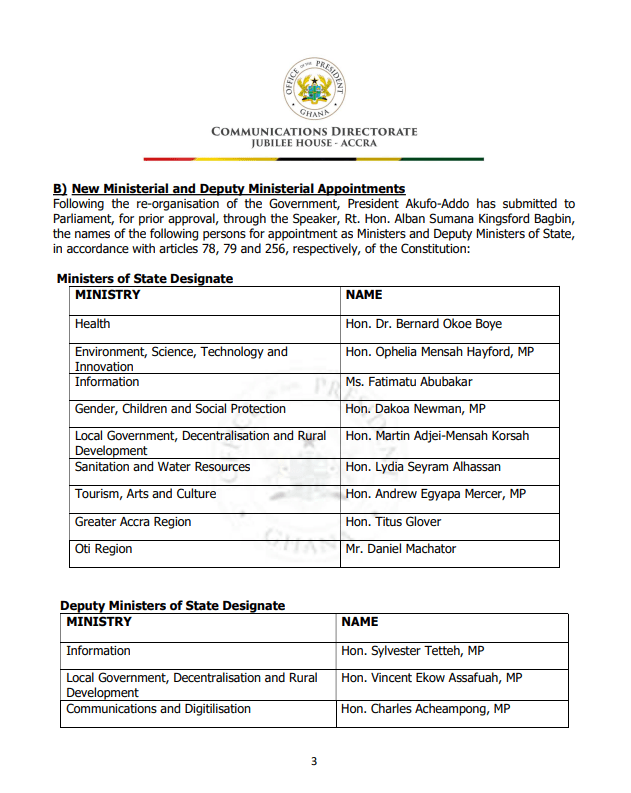
President Akufo-Addo appointed Dr. Mohammed Amin Adam as the new Finance Minister on February 14, replacing Ken Ofori-Atta, who served in the position for seven years. The appointment was part of a ministerial reshuffle announced on the same day.
Despite facing challenges and calls for his dismissal from some members of Parliament, Ken Ofori-Atta served as Ghana’s longest-serving finance minister.
In October 2022, around 80 NPP MPs demanded his resignation due to the country’s struggling economy, with similar calls from the NDC parliamentary caucus in February 2023.
However, President Akufo-Addo rejected these calls, urging Parliament to wait until discussions with the IMF were concluded.
Member of Parliament for Tamale Central, Ibrahim Murtala Muhammed, has advised the new Finance Minister, Dr. Mohammed Amin Adam, to exercise caution and refrain from getting entangled in the issues created by the former Finance Minister, Ken Ofori-Atta.
Muhammed warns that a day of accountability will come for Ofori-Atta, and Dr. Amin Adam should avoid becoming implicated in the problems left behind.
“My advice to my senior brother is that he should be careful… Ken Ofori has created a lot of mess, he has created a lot of holes. If Dr. Amin Adam doesn’t take the time, he will come and own that mess. If he owns that mess and the day of accountability comes …the law will not mind about the justification he would provide, that he was not there when these were created,” Muhammed stated on the Key Points on TV3 Saturday, February 17.
President Akufo-Addo removed Finance Minister Ken Ofori-Atta from his position, along with several other ministers. Muhammed emphasizes the potential repercussions of inheriting the challenges left by Ofori-Atta and advises Dr. Amin Adam to exercise caution in his new role.
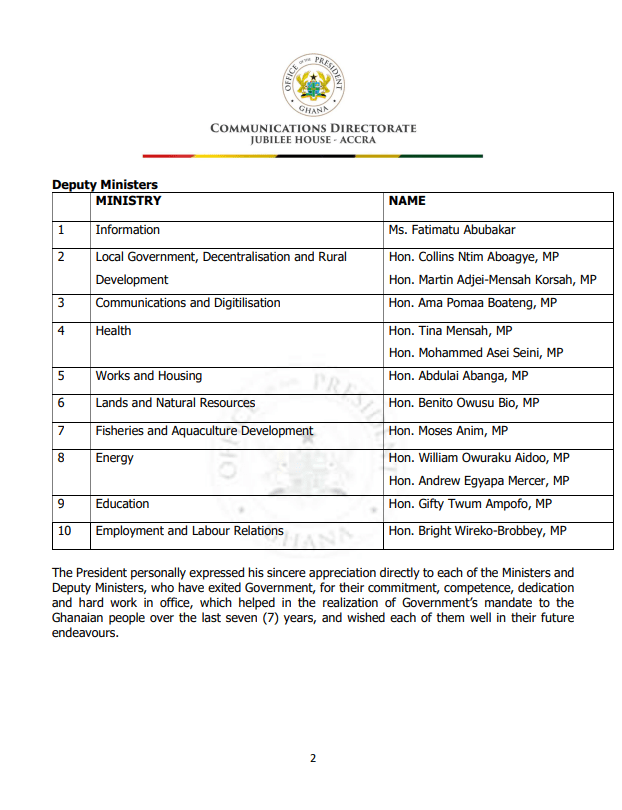
The reshuffling also involved the reassignment of ministers to different portfolios, with President Akufo-Addo expressing gratitude to the departing ministers for their dedication and hard work during their tenure.
Professor Ransford Gyampo from the University of Ghana expressed dissatisfaction with the recent ministerial reshuffle conducted by President Akufo-Addo, describing it as a ‘last-minute’ decision.
Speaking on TV3’s Key Points on Saturday, February 17, Professor Gyampo criticized the timing of the changes, stating that it did not align with any conceptual frameworks of reshuffling, and he was not pleased with the outcome.
According to him, the removal of Ken Ofori-Atta as Finance Minister, Prof Gyampo noted the difficulty in assigning blame or praise due to the last-minute nature of the change.
He emphasized the importance of the timing of reshuffling, saying, “If you refuse reshuffling, it means you are pampering incompetence. The periodization of reshuffling is more important than the frequency.”
“It doesn’t satisfy any of the conceptual frameworks of reshuffling. I have not been happy with it.”
He added “If you refuse reshuffling, it means you are pampering incompetence. The periodization of reshuffling is more important than the frequency.”
Regarding the removal of Mr Ofori-Atta as Finance Minister, Prof Gyampo said ” If you do this last-minute change it becomes difficult, now who do we apportion the blame and who do we praise? Even though I also called for the removal of Ofori-Atta I think he should been allowed to stay, because he has spoilt things already. This reshuffle is more partisan in direction than nation building.”
Despite having called for Ofori-Atta’s removal, he suggested that the Finance Minister should have been allowed to stay, as the reshuffle seemed more partisan than focused on nation-building.
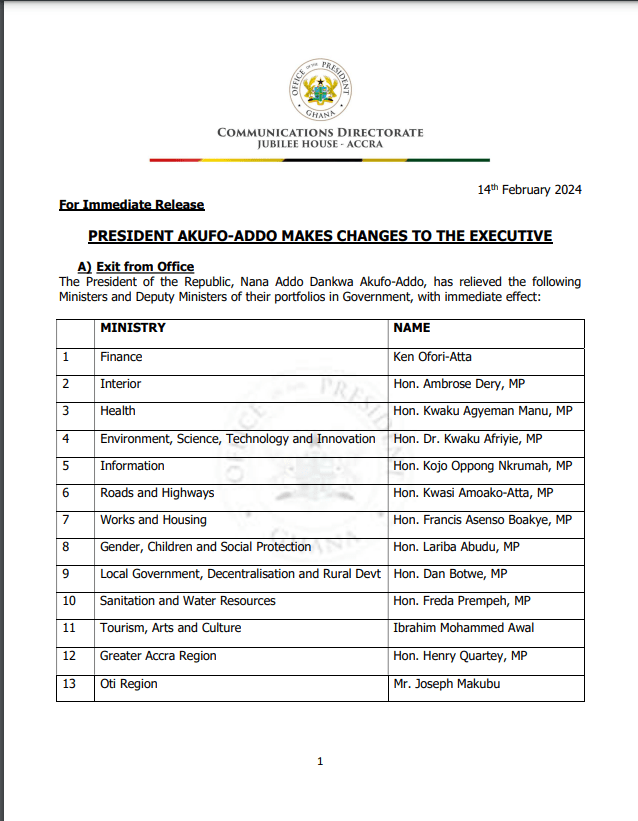
President Akufo-Addo relieved Finance Minister Ken Ofori-Atta of his portfolio along with several other ministers, including Kojo Oppong Nkrumah, Francis Asenso Boakye, Kwaku Agyemang Manu, Kwasi Amoako Attah, Hon. Dr. Kwaku Afriyie, Hon. Lariba Abudu, Hon. Dan Botwe, Hon. Freda Prempeh, Ibrahim Mohammed Awal, Hon. Henry Quartey, and Mr. Joseph Makubu. Kojo Oppong Nkrumah and Asenso-Boakye were reassigned to Works and Housing and Roads and Highways, respectively.
The reshuffle, announced by the Director of Communications at the Presidency Eugene Arhin on February 14, acknowledged the contributions of the outgoing ministers and wished them well in their future endeavors.
Renowned broadcast journalist Nana Aba Anamoah has labelled the recently Finance Minister, Ken Ofori-Atta, as the “worst finance minister Ghana has ever had.”
Expressing her dissatisfaction, Anamoah accused Ofori-Atta of betraying the trust of President Nana Addo Dankwa Akufo-Addo, asserting that his departure was long overdue.
Anamoah, who had earlier predicted Ofori-Atta’s dismissal in a tweet, welcomed the news with enthusiasm, asserting, “I am so happy that man is gone.”
Despite considering the move a reassignment, she emphasised that Ofori-Atta’s tenure had adversely affected the President’s legacy, deeming him responsible for significant shortcomings in the country’s financial management.
Highlighting the severity of her criticism, Anamoah declared, “He has messed up the President’s legacy, that’s what that man has done.”
Additionally, she asserted that Ofori-Atta should have resigned much earlier, citing his alleged supervision of various instances of corruption and mismanagement.
In conclusion, Nana Aba Anamoah expressed her relief at Ofori-Atta’s departure, acknowledging that while some may argue it’s “too little too late,” she sees it as a positive development for the nation.
“ I am so happy that man is gone, I am so happy because. I am telling you on authority that the man is not happy about it is a reassignment, I see it as a dismissal but Ken Ofori-Atta is the worst Minister Ghana has ever had, he is the worst finance minister this country has had. He has messed up the President’s legacy, that’s what that man has done.
“Ken Ofori-Atta should have resigned long ago, he has supervised so much rot and I am so glad that he has gone, I mean some will say too little too late, it’s good it came,” Nana Aba Anamoah stated.
The presidency released a list of ministers relieved of their positions in government in a reshuffle announced on Wednesday morning.
In a statement dated February 14, 2024, signed and issued by the Director of Communications at the Presidency, Eugene Arhin, it was announced that the changes were with immediate effect.
Ken Ofori-Atta, Minister of Finance, was among those replaced, according to a statement released on Wednesday by the communications directorate of Accra’s Jubilee House.
Director of Business Operations at Dalex Finance, Mr. Joe Jackson, has voiced doubt regarding the Finance Minister-designate’s ability to tackle the nation’s economic hurdles within a limited timeframe.
While acknowledging the appointee’s expertise as a proficient economist, Mr. Jackson cast uncertainty on the impact he could have at this late stage.
Speaking in an interview with Accra-based UTV, Mr. Jackson expressed concern that the new minister might not instigate significant changes to mitigate the ongoing economic downturn.
He highlighted apprehensions about the possibility of Mohammed Amin Adam, the minister-designate, presenting a new budget, noting that the budget had already been put forth by the previous minister who grappled with economic challenges.
Despite acknowledging the minister-designate’s commendable track record in pro-poor economics, Mr. Jackson contended that, given the current circumstances, there may be constraints on what he can accomplish.
He questioned whether the appointee could introduce alternative strategies to alleviate the prevailing economic conditions.
The financial expert voiced skepticism about the minister-designate’s ability to remedy the situation, underscoring the nation’s challenges and stressing the necessity for innovative approaches to tackle them.
Newly appointed Finance Minister, Dr. Mohammed Amin Adam, has pledged to facilitate the implementation of a faceless assessment system by theGhana Revenue Authority (GRA).
He emphasised that this anonymous evaluation procedure will bolster the efficiency of revenue collection, thereby fortifying the nation’s financial standing and facilitating the attainment of its expenditure objectives.
Speaking in an interview on the Citi Breakfast Show, Adam Amin said, “We have heard that people are being harassed. All these are going to be streamlined so that you have a friendly approach and we will also get the GRA to introduce a faceless assessment system to ensure that we maximise revenue collection…and to be able to meet our expenditure target.”
Amin Adam also vowed to ‘aggressively’ pursue revenue collection by taking the initial step to visit various market areas and revenue centres to motivate GRA personnel further to keep up their revenue collection efforts.
“Revenue collection will be pursued aggressively, So you are going to see me moving around the revenue centres, the ports, the airport and the market areas to encourage the staff of GRA to collect more revenue but also to institute a friendly approach to collecting revenue,” he noted. Following a reshuffle by President Nana Addo Dankwa Akufo-Addo on February 14, 2024, Dr. Mohammed Amin Adam assumed the role of Finance Minister.
He has committed to adhering to the government’s policies and initiatives as delineated in the 2024 budget.
Finance Minister-designate Mohammed Amin Adam has affirmed his commitment to actively pursue revenue mobilization, aiming to strengthen the country’s finances to meet expenditure goals.
Dr. Amin Adam emphasized his dedication to collaborating closely with revenue mobilization agencies to enhance the country’s revenue streams.
During an interview with Citi FM on Thursday, February 15, he highlighted the significance of establishing robust financial foundations to address economic challenges faced by citizens and ensure sustainable development.
Adam stated, “Revenue collection will be pursued aggressively. So you are going to see me moving around the revenue centers, the ports, the airport, and the market areas to encourage the staff of GRA to collect more revenue but also to institute a friendly approach to collecting revenue.”
He added, “We have heard that people are being harassed; all these are going to be streamlined so that you have a friendly approach, and also we will get the GRA to introduce a faceless assessment system to ensure that we maximize revenue collection…and to be able to meet our expenditure target.”
President Akufo-Addo nominated Dr. Mohammed Amin Adam as the new Finance Minister, succeeding Ken Ofori-Atta, who served in the position for seven years. The announcement was part of the latest ministerial reshuffle released on Wednesday, February 14.
Despite facing challenges and calls for dismissal from some members of Ghana’s Parliament, Ken Ofori-Atta held the position as Ghana’s longest-serving finance minister. Calls for his resignation were made by around 80 NPP MPs on October 25, 2022, and echoed by the NDC parliamentary caucus in February 2023. However, President Akufo-Addo rejected these calls, urging Parliament to wait until discussions with the IMF concluded.
Gabby Asare Otchere-Darko, the senior partner and co-founder of Africa Legal Associates (ALA), has commended President Akufo-Addo’s decision to appoint Dr. Mohammed Amin Adam as the replacement for Ken Ofori-Atta.
Otchere-Darko praised Dr. Amin Adam as both humble and competent, making him a suitable successor to his former boss.
In a post on X (formerly Twitter), Mr. Otchere-Darko emphasized that President Akufo-Addo’s choice could not have been better for the Finance Ministry.
“Congratulations to Amin Adam. Ghana’s President couldn’t have found a more prepared, competent, humble and conscious, personable replacement to take control of the country’s finances than you. Reactions from the public suggest strong approval.”
Congratulations to Amin Adam. Ghana’s President couldn’t have found a more prepared, competent, humble and politically-conscious, personable replacement to take control of the country’s finances than you. Reactions from the public suggest strong approval. https://t.co/1jT4pelxvx
President Akufo-Addo has nominated Dr. Mohammed Amin Adam as the new Finance Minister, replacing Ken Ofori-Atta, who served in the position for seven years. The announcement was part of the latest ministerial reshuffle released by President Akufo-Addo on Wednesday, February 14.
Despite facing significant challenges and calls for his dismissal from some members of Ghana’s Parliament, Ken Ofori-Atta served as Ghana’s longest-serving finance minister.
On October 25, 2022, around 80 NPP MPs demanded Ofori-Atta’s resignation due to the country’s struggling economy. Similar calls were echoed by the NDC parliamentary caucus in February 2023.
However, President Akufo-Addo rejected these calls for resignation, urging Parliament to wait until discussions with the IMF concluded.
Dean of the University of Cape Coast (UCC) Business School, Professor John Gatsi, emphasized that Dr. Mohammed Amin Adam, the newly nominated Finance Minister, is constrained to continue with existing economic programs.
According to Prof. Gatsi, considering the limited time remaining for the current government’s term and the approval of the 2024 budget, the new Minister-nominee would have minimal scope to enact significant transformations in the Ghanaian economy, which is grappling with challenges.
Ghana is presently engaged in implementing a $3 billion loan program with the International Monetary Fund (IMF). This initiative aims to restore macroeconomic stability and debt sustainability while establishing a foundation for stronger and more inclusive growth.
“What you cannot do in seven years, you cannot do in 10 months, and even in the 10 months, we’re only going to see governance from now to June. From there, everyone will be actively involved in political campaigns,” Prof Gatsi said.
“He [Dr Amin Adam has been involved in the preparation of the budget, and IMF discussions, so he’s not new to the Fund. The replacement is just a continuation, nothing will change,” the Economist said.
He explained that though the 2024 budget review presented an opportunity for some economic decisions to be made, “that will not bring any change – he [the new Minister] will only continue to drive the vehicle.”
“The reshuffle has come late; it’s not in response to the calls by Ghanaians nor the 98 Parliamentarians, but in response to the Party, therefore, meant for political gains,” he stated.
Prof Gatsi noted that such political decision had been made because some people “are tired and would not commit themselves to vigorous campaigning and resource mobilisation [in the 2024 elections].”
Hence, the reshuffle, including that of the Ministry of Finance, aimed to make way for new individuals, many of whom are expected to exert significant effort and allocate financial resources towards campaigning in hopes of receiving future favors, he noted.
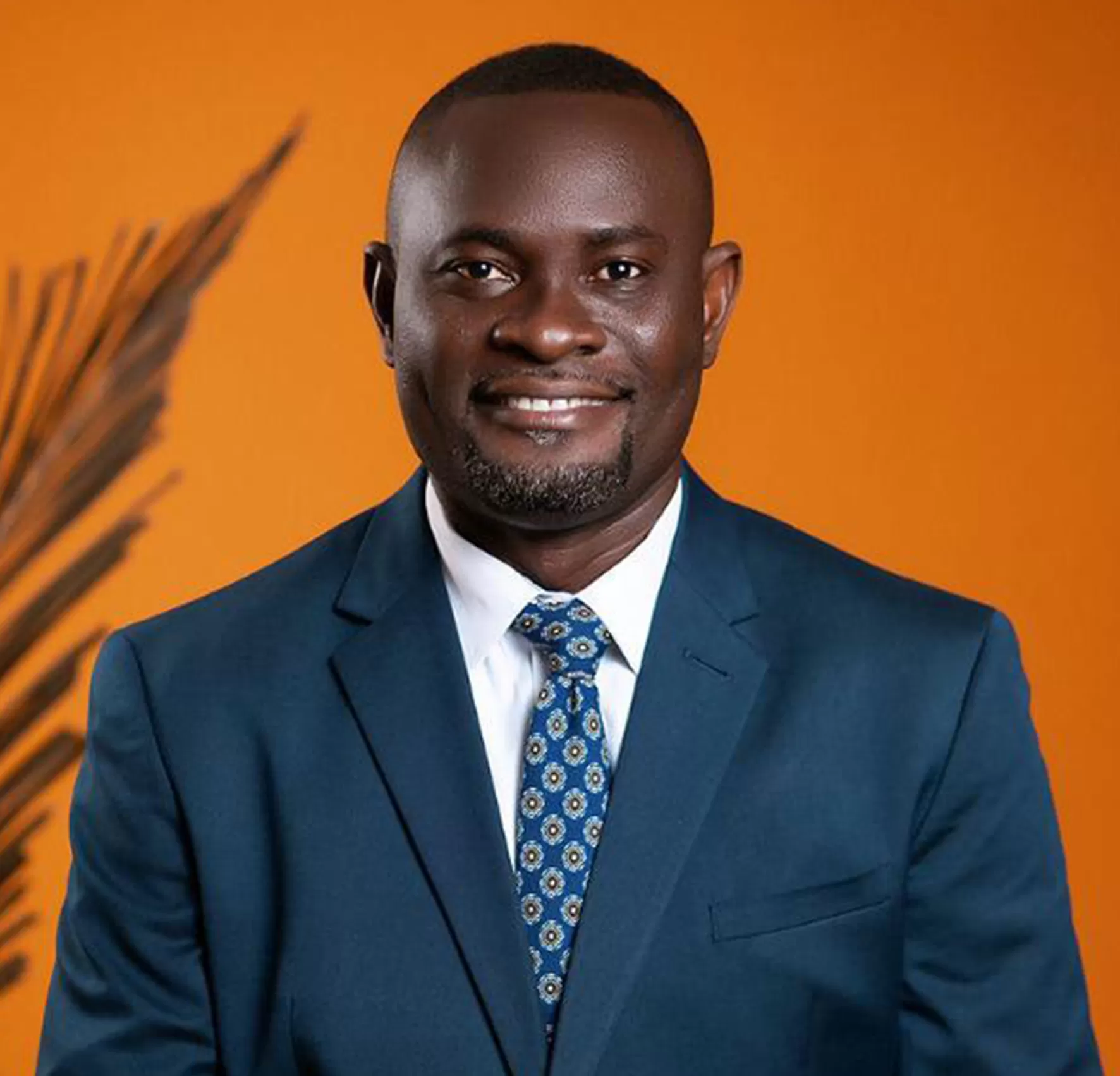
Dr. Mohammed Amin Adam, previously a Minister of State at the Finance Ministry, has been nominated as the Finance Minister designate, replacing Mr. Ken Ofori-Atta, who has held the position since 2017.
His appointment comes at a critical juncture as Ghana is currently implementing a $3 billion loan program with the International Monetary Fund (IMF) to address the challenges facing the country’s economy.
The post-COVID-19 pandemic period has posed severe challenges to Ghana’s economy, with some individuals resorting to lengthy commutes to work due to inflationary pressures.
While recent data from the Ghana Statistical Service and the initial review of the IMF program indicate some signs of recovery, it is acknowledged that more needs to be done.
Macroeconomic improvements have yet to translate into significant improvements at the micro level, where individuals would see enhancements in their incomes and daily lives, and businesses would experience greater ease in operations.
The Bolgatanga Central Member of Parliament, Isaac Adongo, has characterized President Akufo-Addo’s decision to replace Ken Ofori-Atta as Finance Minister as a mere façade.
Window dressing, in this context, refers to the act of making something appear deceptively attractive or favorable, creating an impression that may not align with reality.
President Akufo-Addo executed a significant ministerial reshuffle on Wednesday, February 14, affecting a total of 13 current ministers of state, including 10 cabinet ministers and two regional ministers.
Ken Ofori-Atta, the former Finance Minister, was replaced by Mohammed Amin Adam, the Minister of State at the Finance Ministry.
However, reports suggest that Ofori-Atta has been appointed as the Presidential Advisor on the economy.
In an interview with Umaru Sanda Amadu on Eyewitness News on Citi FM, Mr. Adongo expressed skepticism, stating that although he acknowledged the competence of Mr. Adam, the rearrangement appeared superficial.
According to him, the President’s move essentially means that Amin Adam, in his new role, would have limited influence as Ofori-Atta still holds sway and could potentially veto any policy proposals.
Adongo characterized the situation as the President giving Amin Adam a role with one hand while simultaneously placing the ousted Ofori-Atta in a position to influence crucial decisions.
“This is clearly window dressing. If you follow events and watch critically what has happened, I do not doubt the competence and the abilities of Dr. Mohammed Amin. He was my former colleague on the Finance Committee, my senior at school. I have a very good respect for him, except to say that they have given him the job in one hand and taken it with the right.”
“Because now he is the Minister and they have appointed the very person they are removing as the Senior Presidential Advisor on the Economy what that simply means is that for Mohammed Amin to get any policy through in cabinet or through executive approval of the president, the president has to go and consult Ken Ofori Atta. And so technically it means that Mohammed Amin cannot do anything if Ofori-Atta is not in agreement because he would advise the president against it,” he stated.
Founding President and Chief Executive Officer of IMANI Centre for Policy and Education, Franklin Cudjoe, has noted that Ken Ofori-Atta’s removal as Finance Minister does not necessarily prevent him from taking key decisions that affect the country’s economy.
According to Mr Cudjoe, reports from Asaase Radio indicate that former Finance Minister Ken Ofori-Atta is set to assume the role of Senior Presidential Advisor on the Economy and will also serve as the President’s Special Envoy on International Investment and the Capital Markets.
In a Facebook post, Mr Cudjoe noted that Mr Ofori-Atta’s appointment, if proved to be true, will help him obtain authority that exceeds that of the Finance Minister.
“The former finance minister Ken Ofori-Atta is to be appointed as the senior presidential advisor on the economy. He will also serve as the president’s special envoy on international investment and the capital markets, according to Asaase News sources in the Office of the President.”
“Meaning he will be in charge of negotiating most big deals.. he is now bigger than MoF……,” he wrote.
This revelation comes directly from sources within the Office of the President, adding a new chapter to Ofori-Atta‘s distinguished career. As the former Finance Minister, he held the position for an impressive seven years, making him the longest-serving finance minister in Ghana’s Fourth Republic.
As Ofori-Atta steps into his new advisory roles, Kwaku Afriyie, the former Minister of Environment, Science, Technology, and Innovation, is also slated to become an advisor. According to Asaase’s sources, Afriyie will take on the crucial role of President Akufo-Addo’s Special Envoy on Climate.
The reshuffling of roles within the government signals a strategic move, with Mohammed Amin Adam, the current Minister of State at the Ministry of Finance, assuming the position of the substantive Minister for Finance.
This transition is expected to be seamless, ensuring continuity in the government’s debt restructuring negotiations with private creditors and for Ghana’s second review under its extended credit facility (ECF) arrangements with the International Monetary Fund.
The developments do not end here, as sources from the Office of the President hint at further significant changes, possibly announced later today. The morning’s press release from Jubilee House primarily focused on ministerial appointments presented to the Speaker of Parliament, with consequential matters regarding appointees.
Inside sources at Jubilee House anticipate the potential reshuffling of the Majority leadership in Parliament, a move that might be officially disclosed following a scheduled National Executive Committee meeting of the New Patriotic Party(NPP)on Monday.
This suggests a broader restructuring within the government’s leadership, marking a pivotal moment for Ghana’s political landscape. This is happening some nine months to Ghana’s next general election.
Finance Minister Ken Ofori-Atta has announced that the anticipated $600 million second tranche of the International Monetary Fund (IMF) bailout package, expected next week, will be allocated for specific programs outlined in the 2024 Budget.
The IMF’s Executive Board is scheduled to convene on January 19, 2024, in Washington DC, USA, to conduct Ghana’s first review under the Fund program.
Upon approval by the board, the $600 million is set to be disbursed to Ghana within the following three working days. Mr Ofori-Atta emphasized that Ghana has fulfilled all the necessary requirements to secure the funding.
“We are very optimistic that Ghana will pass this review when the Executive Board of the IMF meets on January 19, 2024”, he expressed hope in an engagement with Joy Business.
The initially scheduled meeting for Friday, January 19, 2024, faced postponements due to challenges in Ghana securing necessary “financing assurance” from bilateral creditors via the official creditor committee on debt restructuring.
The board had rescheduled the meeting multiple times since November 2023, and it was eventually moved from January 18 to January 19, 2024. This adjustment allowed the board three working days to review documents submitted by the IMF staff.
Despite the earlier hurdles, the board proceeded with the meeting after Ghana reached an agreement with bilateral creditors on restructuring approximately $5.4 billion in debts. The board is expected to release a staff report detailing Ghana’s program status and government performance over the past month.
Finance Minister Ofori-Atta is optimistic that the “possible disbursement” of funds will unlock additional support from Ghana’s donors.
The World Bank Board is set to convene on January 25, 2024, to approve the disbursement of around $550 million. Of this, $300 million will be allocated to various projects in the budget, while $250 million will contribute to the Ghana Stability Fund, supporting institutions affected by the Domestic Debt Exchange Programme.
By the end of January 2024, Ghana anticipates securing over $1.1 billion from the IMF and World Bank to bolster its economy.
Member of Parliament for Akim Abuakwa South, Samuel Atta Akyea, has entreated Finance Minister Ken Ofori-Atta to step down from his position, expressing the belief his resignation would bring peace to the country.
Mr Atta-Akyea underscored the need for self-reflection on Ofori-Atta’s part, urging him to consider stepping down for his personal well-being and the overall benefit of the ruling New Patriotic Party (NPP).
During an interview with Citi TV on Tuesday, January 16, the lawmaker from Abuakwa South appealed to the Finance Minister to prioritize the nation’s interests and contemplate resigning from his position.
“For me, what is very frightening is the fact that you have a whole army of people saying look you’ve had enough…I think that that could be a way for him to relax. Look at all the burdens on one man. So it is his individual decision to make as to whether he should go or he should continue.”
“He should look at himself and look at the troubles that everybody believes, I mean when he is not there then the nation will have peace…He should save himself and save the government and have his peace because he needs it,” Mr Atta Akyea said.
Member of Parliament for Abuakwa South, Samuel Atta Akyea (R)
Calls for the resignation of Finance Minister Ken Ofori-Atta have been growing for several months, primarily from within the New Patriotic Party (NPP).
The opposition National Democratic Congress (NDC) has been particularly vocal, consistently holding the Finance Minister responsible for the prevailing fiscal challenges.
In response to these demands, Finance Minister Ken Ofori-Atta expressed deep emotional distress and disappointment. Calls for his dismissal or resignation were met with a strong commitment to remain in office during an exclusive interview with GTV on Sunday, August 6, 2023.
Despite feeling battered and broken by the protests, Ofori-Atta underscored his dedication to a singular duty – to continue serving his beloved country in its efforts to recover from economic challenges.
He emphasized that such challenging times demand bold and courageous individuals who are willing to stay on and fight for the nation’s well-being.
“In the period of censure, in which Parliament then voted against it, but more importantly, you were in a situation where you were battered and broken.”
“And do not leave a ship at that time, and given the urgency of ensuring the IMF programme will get through, for me it was a duty to serve, and there was no running away from it,” Mr Ofori-Atta said.
Finance Minister Ken Ofori-Atta, along with other government officials, is scheduled to visit China on January 23 with the aim of restructuring Ghana’s $5.4 billion bilateral debt, a significant portion of which is owed to China.
China, along with France, co-chairs Ghana’s Official Creditor Committee. The agreement reached with this committee is crucial for accessing additional funds from a $3 billion International Monetary Fund (IMF) bailout package.
Simultaneously, Ghana will resume discussions with its international bondholders next week, building on the momentum generated by a recent deal to restructure $5.4 billion of bilateral debt. The country seeks to continue talks after engaging with Eurobond holders in October 2023.
Restructuring negotiations last year was a “very difficult, painful process,” but Ghana has “built pretty good momentum”, Mr. Ofori-Atta told Reuters.
The IMF board is scheduled to convene on Friday, January 19, 2024, to decide on a $600 million disbursement as part of Ghana’s bailout program. Approval from the IMF would open the door for funding from other multilateral lenders.
Additionally, the World Bank is expected to make a decision on providing $550 million in funding on January 25, 2024, according to Finance Minister Ken Ofori-Atta.
Ghana is actively engaged in restructuring its debts under the Common Framework, a G20-established process designed during the COVID-19 pandemic to address debt challenges.
The country, facing a default in December 2022, is working to restructure around $20 billion of its external debt, which stood at approximately $30 billion at the end of 2022.
Finance Minister Ken Ofori-Atta has announced that stalled infrastructure projects across Ghana, funded by donors, are set to resume in the coming weeks.
The restart is based on agreements reached with Ghana’s bilateral creditors regarding the restructuring of the country’s debt.
Ofori-Atta shared this information on PM EXPRESS BUSINESS EDITION with host George Wiafe, scheduled to air on Thursday, January 18, 2024.
The Finance Minister explained that as negotiations with donors progress, some will begin disbursing necessary funds for the halted projects.
A Memorandum of Understanding is expected to be signed with bilateral creditors in the coming days after reaching a deal on debt restructuring.
“Some of these donors have demonstrated their commitment to support the economy once issues around these debt restructuring are resolved” the Finance Minister added.
Ofori-Atta highlighted the commitment of some donors to support Ghana’s economy once debt restructuring matters are resolved.
The Finance Minister addressed concerns from certain donors, such as China, regarding the cutoff date for debt restructuring, noting that an agreement was reached with the Paris Club and China, setting December 2022 as the cutoff date.
Regarding the International Monetary Fund (IMF) program, Ofori-Atta shared that Ghana has fulfilled requirements for the first review, anticipating a disbursement of about $600 million to the Bank of Ghana next week.
He revealed that the second tranche of the IMF cash would be directed toward projects outlined in the budget, indicating a shift from previous programs where all funds were focused on balancing payments.
Ofori-Atta emphasized that the incoming funds would enhance the Bank of Ghana’s reserves, stabilizing the Ghana cedis. He expressed optimism about similar responses from other donors, contributing significantly to the country’s economic recovery.
The Finance Minister concluded by assuring that the government would maintain fiscal discipline during an election year, completing necessary actions for economic stability.
Minister of Finance, Ken Ofori-Atta, has quashed rumors of his resignation from the position within the governing New Patriotic Party (NPP) administration.
Speculations circulated on Monday, December 18, suggesting his departure from the role of Minister of Finance and Economic Planning.
In a tweet shared via the X handle of the Office of the Finance Minister, Ofori-Atta, who participated in a thanksgiving event with ministry staff, hinted at his readiness to continue leading the Ministry of Finance into 2024.
“I am assured that the Lord will continue to lead and guide us in 2024. Our testimony is indeed victory on every side! Humbled to be leading the brilliant and resilient TeamMoF,” read the post.
Ken Ofori-Atta, who recently presented the last budget of the Akufo-Addo administration in November, received a guard of honor from Ministry of Finance staff.
As the longest-serving finance minister in the 4th Republic of Ghana, he has faced criticism from members of the governing NPP and the public for the management of the Ghanaian economy, currently under an IMF program.
“Today I joined the staff of @MoF_Ghana in thanksgiving for God’s mercy & preservation in 2023. I am assured that the Lord will continue to lead and guide us in 2024. Our testimony is indeed victory on every side! Humbled to be leading the brilliant and resilient #TeamMoF #Nissi.”
Today I joined the staff of @MoF_Ghana in thanksgiving for God’s mercy & preservation in 2023. I am assured that the Lord will continue to lead and guide us in 2024. Our testimony is indeed victory on every side! Humbled to be leading the brilliant and resilient #TeamMoF#Nissipic.twitter.com/hQb652Whbh
— Office of the Finance Minister-Ghana (@oofmghana) December 19, 2023
Despite earlier reports suggesting his resignation, Finance Minister Ken Ofori-Atta seems poised to continue leading the Ministry of Finance in 2024.
During a thanksgiving event with the Ministry of Finance staff in 2023, Mr. Ofori-Atta expressed gratitude for God’s mercy and preservation. He conveyed his belief that the Lord would continue to lead and guide the country in the coming year.
“I’m assure that the Lord will continue to lead and guide us in 2024. Our testimony is indeed victory on every side! Humbled to be leading the brilliant and resilient staff of Ministry of Finance,” the sector minister said.
In the face of economic challenges stemming from debt exchange and the impact of the COVID-19 pandemic, Finance Minister Mr. Ken Ofori-Atta is positioned to spearhead a turnaround aimed at fostering productivity, prosperity, and employment.
Mr. Ofori-Atta consistently emphasizes that the government has successfully ‘turned the corner,’ highlighting achievements such as a notable reduction in inflation from 54% in December 2022 to 26.4% in November 2023, a stabilized exchange rate, and a significant decrease in the government fiscal deficit.
Following the post-COVID-19 period, the Minister initiated the ¢100 billion GhanaCARES (Obaatanpa) program, representing a four-year ‘clinical structural focus’ aligned with President Akufo-Addo’s transformation agenda. This program aims to expedite the government’s digitalization agenda, enhance efficiency in public service delivery, revitalize the housing and construction industry to address housing deficits, create job opportunities, and position Ghana as a regional hub.
The early stages of the GhanaCARES “Obaatan Pa” Programme are already showing promising results, with Mr. Ofori-Atta at the forefront of efforts to revolutionize Ghana’s rice sector through the implementation of the Harnessing Agricultural Productivity and Prosperity for Youth (HAPPY) Programme.
As a crucial component of the revitalization efforts, Mr. Ofori-Atta spearheaded the establishment of “YouBanC” under the ambitious ¢100 billion GhanaCARES ‘Obaatanpa’ Programme.
“Our strategy to place the private sector at the heart of this endeavour is to accelerate competitive import substitution and export expansion to generate sustainable jobs for our teeming youth (under 35 years), who make up about 71% of the population”, Mr. Ofori-Atta stated.
In a control room in Tema in the Greater Accra Region, officials of Strategic Mobilisation Ghana Limited (SML) tried to convince The Fourth Estate of its wild claims that it had helped to save Ghana billions of cedis that would have been lost in the downstream petroleum sector but for its intervention.
The company also tried to justify why it receives up to GH₵24 million monthly payments from the government of Ghana in a questionable contract it signed with the Ministry of Finance and the Ghana Revenue Authority (GRA).
A year-long investigation by Evans Aziamor-Mensah, Adwoa Adobea-Owusu and Manasseh Azure Awuni of The Fourth Estate, however, revealed that the company, with the help of a section of Ghana’s media, had made false and unsubstantiated claims of its operations that have served as the basis for the payment it received. It appears the Ministry of Finance and the GRA were aware the claims were false, for some officials of the GRA said they had confronted the company about its claims of savings and volumes on two separate occasions.
(Left)A picture of the false claim that SML made and (right) a picture of the disappeared claim on its website.
A few hours after the reporters confronted the management of SML with the findings of the investigation and asked for a response, the major services it claimed to render to the government disappeared from the company’s website.
The investigation also uncovered that at a time players in the downstream petroleum sector were questioning the relevance of SML’s involvement, the Minister of Finance, Ken Ofori Atta, initiated a more outrageous deal that would entitle the company to over $100 million every year for the next 10 years.
In the first of this series, we focus on a 2019 contract the Government of Ghana signed with SML. The contract was signed at a time when superior and comprehensive measures had already been introduced by the government in 2018 to curtail losses in the downstream petroleum sector.
SML admits false claim of services it renders to the GRA
Managing Director of SML Ghana, Christian Sottie
SML Ghana started what it calls “revenue assurance” services to the GRA in the downstream petroleum sector in June 2020. The downstream sector is responsible for the refining, distribution, and retail of oil and gas products. The Managing Director of the company, Christian Tetteh Sottie, said SML was an offshoot of a timber company he would not name.
Online records, however, link SML to Evans Timbers Limited. The CEO of SML, Evans Adusei, is also the CEO of Evans Timbers GH, a company that won a defamation case against The Informer newspaper in 2014. In that case, Justice Uuter Paul Dery, who was later dismissed by the Judicial Service of Ghana for bribery and corruption, ruled that the newspaper could not substantiate its claim that Evans Timbers GH used its political connections with Chief of Staff Kojo Mpiani to undertake dubious transactions.
SML registration details at the Office of the Registrar of Companies
Information The Fourth Estate obtained from the Office of the Registrar of Companies shows that Evans Adusei is the sole shareholder of SML. Also, Evans Adusei and his daughter, Esther Adusei, are the directors of the company. SML’s principal activities are “general trading and services, import and export of general goods and audit service activities.”
The Managing Director of SML, Christian Tetteh Sottie, was Ghana’s Controller and Accountant-General from 2005-2009 and is currently a board member of the Internal Audit Agency. He was once an Assistant Commissioner at the GRA.
In 2019, when the GRA entered into an agreement with SML Ghana, Mr. Sottie was the Technical Advisor to the Commissioner General of the GRA. Mr. Sottie left his job as the Technical Advisor to the GRA Commissioner General in the same year to manage SML Ghana in 2020 when the company started implementing its contract with the GRA.
The GRA has been the only customer of SML Ghana since its establishment, according to Mr. Sottie. This means at the time the company was handpicked for the contract through the single source procurement method, it had no prior experience in the services it claimed to have expertise.
A procurement expert and consultant, Kobina Ata-Bedu, says the contract raises questions about a possible breach of Ghana’s procurement laws. He questions the basis for which a company that had no prior experience in the services being procured was single sourced for the contract.
To justify its contract and why it has been paid hundreds of millions of cedis by the government of Ghana, SML falsely claimed that it was rendering a wide range of services that had stopped malfeasance in the downstream petroleum sector.
On its website, SML stated: “The SML Digitalisation of downstream petroleum product measurement has stem(sic) the tide of under-reporting, diversion and dilution of fuel products and general non-compliance in the petroleum industry sector.”
As part of this investigation, The Fourth Estate team spent months interrogating the systems put in place by the Government of Ghana through its sector agencies and third-party contractors to curtail the anomalies SML Ghana claimed to be tackling. The team had rare access to the National Command Centre of the National Petroleum Authority (NPA), where we interviewed officials of the NPA and private sector service providers.
Third-party companies working with the NPA were responsible for checking dilution, diversion, under-declaration and other anomalies in the sector. The Customs Division of the GRA also has officials at the depots and various entry points to ensure that all petroleum products that enter the country are properly accounted for. They do this with independent monitors who police the processes for the owners of petroleum products at various points of the product chain.
The Fourth Estate team also toured some fuel depots in the country and interviewed depot operators as well as oil marketing companies and officials of the GRA. The evidence gathered showed that SML’s claim that it was checking diversion, dilution and under-declaration was completely false.
Our investigation revealed that the introduction of the Enterprise Relational Database Management System (ERDMS) in 2018 had curtailed the continuous operations of oil marketing companies that owed the government in taxes and margins and did not pay within the stipulated time. This was confirmed by the GRA and NPA.
The NPA and GRA said the ERDMS had curtailed under-reporting and other anomalies in the downstream petroleum sector.
A company called Rock Africa was also engaged by the NPA to electronically monitor the tankers that load petroleum products at the depots. The electronic seals send signals to the NPA Command Centre if a truck discharges products outside the fuel station it is supposed to discharge.
This, according to the NPA, curtails the diversion of tax-free petroleum products that are declared as exports to landlocked West African countries but sold in Ghana.
Another company, Nationwide Technologies Limited, had been engaged to undertake fuel marking, which tackles the problem of dilution and the smuggling of petroleum products into the country.
Our investigation showed that the problems that occasioned revenue leakages in the sector were being tackled by different companies to the satisfaction of state authorities, but SML was not one of them. SML, regulatory authorities, and independent operators in the sector could not establish any of the problems SML was solving.
Mr. Sottie also admitted to The Fourth Estate that SML was not into checking underreporting or anomalies in the downstream sector.
“We don’t go into that,” he said when we asked whether SML had “ever detected or identified any issues of under declaration.”
Despite evidence to the contrary, SML made false claims on its website about resolving the problems “under-reporting, diversion and dilution of fuel products and general non-compliance in the petroleum industry sector.”
Officials of the Petroleum Division of the GRA expressed shock when The Fourth Estate team mentioned the listed services SML claimed to provide. SML was contracted to render the services to the GRA.
The GRA officials, led by the Head of Petroleum, Meshack Kwame Danso, were present when we visited SML to confront the company with our findings. Before we started our interview, the GRA officials said SML needed to clear the air on the stated service before we began our interview.
The Company’s Managing Director, Christian Sottie, said SML did not state anywhere that the company was providing services that checked under-declaration, dilution, and diversion of petroleum products. When we pointed out the claims to the management of SML from the company’s website, Mr. Sottie said the information was put on the website in error.
“Oh no, we are not involved in diversion. We are only at the depots. If the thing [petroleum product] is lifted, we don’t know if [it is diverted],” Mr. Sottie said.
He added: “It is GRA, Customs, that will determine where it goes, and they will follow up. We are not capable. We don’t have men outside.”
A few hours after our meeting, the claim of providing services that checked dilution, diversion and under-declaration disappeared from the website of SML.
Executive Director for Africa Centre for Energy Policy, Benjamin Boakye
The Executive Director of the Africa Centre for Energy Policy, Benjamin Boakye, told The Fourth Estate that players in the industry were surprised when the government awarded a contract to SML. He said solutions to most problems in the sector had already been provided and they wondered what SML was coming to do.
Mr. Boakye said the remaining problems in the sector were not at the depots, where SML was stationed to monitor. By problems, Mr Boakye was referring to the non-payment of taxes and margins by OMCs after the sale of products. Even at the depots, the GRA confirmed to The Fourth Estate that it was practically impossible to lose products—and by extension, revenue to the state—even if there were no electronic systems in place.
False Claim of Saving Ghana GH₵3 billion
The false claim by SML made it to the headlines and front pages of newspapers, including the state-owned Daily Graphic. When the company was confronted with evidence, it denied ever claiming to save Ghana GH₵3 billion
The Fourth Estate also confronted the Managing Director of SML Ghana with the figures the company churned out as savings Ghana made in the downstream petroleum sector because of its operations.
First was the claim SML made in March 2021 that it had saved Ghana over GH₵1 billion in revenue because of its services.
The company started its operations in 2020. From the revenue figures we obtained from the GRA, the difference in the total revenue from the downstream petroleum sector between 2019 and 2020 was GH₵800 million.
So, if all the incremental revenue in the sector were attributed to the company’s operations, it would still fall short of the GH₵1 billion it claimed to have saved Ghana.
In February 2023, SML Ghana made a more audacious claim that became the banner headline in Ghana’s biggest newspaper, the state-owned Daily Graphic. The story also received wide coverage in major media outlets in Ghana. In its report to the media, the company claimed its operations had helped to save Ghana GH₵3 billion.
Finance Minister, Ken Ofori-Atta, was the first to claim that the SML contract had resolved the problems that caused “two to three billion cedis losses” in the downstream petroleum sector
The Minister of Finance, Ken Ofori-Atta, was the first to mention billions of losses in the sector, which SML Ghana was going to save. When he commissioned the operations of SML in 2020, Mr. Ofori-Atta claimed that, by engaging SML, the government had eliminated the problems which existed prior to the entry of SML and “it was about two to three billion cedis of losses”.
“We are really excited about this change where we can now determine and get the exact revenues we want,” Ken Ofori-Atta said.
SML Ghana admitted it did not perform the services it listed on its website as curtailing irregularities in the sector and deleted them from its website after we confronted its management.
But even if the company was carrying out those services and all the incremental revenue within the period of its operations was credited to its efforts, the figure would have been GH₵2.4 billion cedis and not the GH₵3 billion it claimed to have saved.
When we put these facts to the managing director, he said he did not know about the GH₵3 billion savings.
“What I want is the agreement from here that the figures are not accurate and that we cannot say that your intervention saved GH₵3 billion,” The Fourth Estate’s Manasseh Azure Awuni insisted that Mr. Sottie should admit the false claim, which was still on the website of the company even while the interview was taking place.
“I have told you that [in terms of the] GH₵3 billion, I am not aware [of it] because when we were told about the publication, we even called the journalist … I think he [journalist] picked it out of context,” Mr. Sotie responded. “I can’t remember the GHS 3 billion. I remember the GHc 1 billion.”
MANASSEH: But the GH₵3 billion was from your outfit?
MR SOTTIE: Yes, you remember when you were talking, I was still speaking about GH₵1 billion. Because, after one year, that was the statement I put out.
MANASSEH: So, who put the GH₵3 billion out?
[The IT Systems Engineer of SML Ghana, Prince Sarpong, interrupts the interview and whispers into Mr. Sottie’s ears].
MR SARPONG: It was a mistake because if you look at other publications, it was just a consultation between GRA and SML. I did the presentation, and I was giving them the expected revenue. Our system can generate expected revenue, so what we did was not even the accurate figure because only GRA can give accurate figures. So, that is a caption by journalists.
MANASSEH: The problem here is that if the journalist made a mistake, it is also on your website this morning even as we speak [in July 2023]. This has been there since February [2023]. So, if a journalist makes a mistake and reports something I did not say, and I put that same thing on my website, then it means an endorsement.
MR SOTTIE: As for me, I don’t know about any website matters.
The Managing Director of SML, Christian Sottie, denied knowledge of the GHc3 billion savings and claimed the media misreported SML. But the story is still on the website of SML.
When asked how much SML was paid for its services in the downstream sector, Mr. Sottie said he did not know. The GRA has not responded to our Right to Information request for the contract and payments made to SML. We sent letters to the GRA in July and November 2023 but neither letter has been acknowledged. The Ministry of Finance is also yet to respond to our request for information sent in November.
Sources close to the Ministry of Finance have, however, revealed that payments to SML are done monthly. Payment details sighted by The Fourth Estate show that SML receives up to GH₵24 million a month for its contract in the downstream sector alone, a figure that may rise when the company finishes the extended contract to undertake tank gauging at the depots.
With the current figures, the company receives at least GH₵240 million for services whose value it could not show when we asked.
“SML Ghana is essentially a plugin into the revenue stream of the state taking money for no job done because what they are supposed to be doing is already being done. It’s just people finding ways to hive off some of our revenues into private pockets and the reasonable thing to do is to cancel that contract,” Benjamin Boakye said of the contract.
Is SML Responsible for Revenue Increment in the Downstream Petroleum Sector?
An official of the National Petroleum Authority explains to The Fourth Estate team how the ERDMS makes it impossible for oil marketing companies owing the government to trade
While SML Ghana claimed its activities resulted in revenue increases—which it interpreted as savings for Ghana—in the downstream petroleum sector, the GRA told The Fourth Estate that revenue increments in the sector are due to two factors.
One of the factors, according to the GRA, is an increase in the volumes of petroleum products imported and consumed in the country. As the economy grows and more people buy vehicles, industries and other economic activities that are fueled by petroleum products also increase. The volumes of petroleum products, therefore, grow naturally from year to year.
“It is not only the volume increase that gives us an increase in revenue. Sometimes, within the period, there are changes in [tax] rates. The tax is on specifics. It’s on volumes so as the rate changes, … as the volume increases, the revenue will naturally grow,” Napoleon Simons of the Policy and Programs Unit of the GRA told The Fourth Estate.
SML Ghana admitted to The Fourth Estate that it does not import petroleum products and its operations have not added a litre of petroleum product to the volumes.
Since SML started its operations, the government of Ghana has increased tax rates twice and added new taxes on petroleum products, according to the GRA. This means more revenue for the government, and a company that played no role in either of the two variables cannot take credit for revenue increment and purported savings for the state.
The GRA and NPA said revenue losses in the sector occurred when oil marketing companies lifted petroleum products from the depots and absconded with taxes. Some OMCs also claimed that the petroleum products were meant for sale in other West African countries and, therefore, were not supposed to attract tax, but they turned around to sell them in the country. The state regulatory institutions have put in measures to track and stop these practices and SML Ghana is not involved in any of these systems.
The measures put in place before SML Ghana was contracted were said to be adequate according to players in the industry and state regulators.
The CEO of the NPA, Dr. Mustapha Hamid, said the ERDMS installed by the NPA and linked to the GRA’s system “allows us to disable people from operating or lifting petroleum products once they are found to be in default of whatever statutory margins or taxes or levies that they haven’t lived up to. So, the absence of the ERDMS at that time where things were done manually and so on was perhaps some of the regulatory challenges. But since that system was installed, a lot of that has been stemmed.”
Sukhwinder Singh, the manager of the Accra Plains Depot Limited, said there was no problem with the ERDMS. He said it ensured “hundred percent” efficiency and transparency.
The ERDMS was introduced in 2018 a year before SML was engaged. Officials of the GRA said the ERDMS resolved the loss of revenues that occurred when the process was manual. Apart from helping to track volumes, the ERDMS ensures that the trading and transportation of petroleum products are done on a digitized platform that has the GRA, NPA, oil marketing companies and bulk oil distributors on board. An oil marketing company that is indebted to the government in taxes and margins is automatically disabled on the ERDMS from loading petroleum products anywhere in the country.
Head of Petroleum Downstream, GRA, Samson Anim
“Once we are able to track whatever is happening on the ERDMS to ICUMS [Integrated Customs Management System], by and large, you would have tracked all your volumes. And once you are able to track your volumes, you are likely to get your taxes right,” said Samson Anim, the head of GRA’s downstream petroleum sector.
The Managing Director of SML Ghana, however, said his company had taken credit for revenue increment in the sector because its operations may have deterred those diverting and under-declaring fuel products.
When asked to name at least one instance in which SML Ghana detected anomalies in the sector or by any sector through his company’s work, Mr Sotie said there was none.
This was in addition to his earlier admission that the company did not perform any of the functions aimed at curbing the anomalies—under declaration, diversion and dilution of petroleum products.
Refusal of Information on contracts and payments
When The Fourth Estate asked the Managing Director of SML Ghana how much his company was paid by the government for its services, he claimed he did not know.
The GRA officials we interviewed for this story also said they could not give us the cost and copies of the contract when we asked. They said they did not have the authorisation to disclose such information and suggested that we write to the Commissioner General of the GRA for that information.
In July 2023, we wrote to the Commissioner General of the GRA but have since not received any response.
The Fourth Estate has also written to the Ministry of Finance, which jointly signed the contract, but we have not received any response to our questions.
The Right to Information Law, under which we made the request considers it a refusal if the institution or agency fails to respond after 14 days.
What SML Currently Does
SML Ghana says its ultrasound metres at the fuel depots across the country record volumes of petroleum products lifted at the loading gantries. The GRA, however, does not use the SML figures for revenue collection.
SML Ghana has metres attached to pipelines at the fuel depots, which record the volumes of products that flow through the pipelines to the loading gantries and give SML real-time records of the volumes that go through the pipelines.
Operators in the industry say the real-time readings at the depots mean nothing because taxes or revenues are not collected in real time. They are collected only after the fuel product is lifted and sold.
Besides, the Ghana Revenue Authority and the National Petroleum Authority do not use SML’s figures to collect taxes or margins on petroleum products.
The gantries are where fuel tankers of the OMCs load petroleum products. The readings of these metres at the gantries determine the volumes of products that leave every fuel depot at the end of each day. These recordings at the gantries are the ones used for tax purposes and not the SML Ghana readings.
SML Ghana also scans the Waybills that GRA officials receive at the fuel depots, which are intended for later reference should an issue arise with an oil marketing company’s indebtedness and there’s the need for a reference.
Sources within the GRA told The Fourth Estate that their officials can scan these documents if they are given the scanners, equipment and resources given to SML through the contract. The sources say GRA does not need a third-party company to scan documents GRA officials collect as part of their work at the depots.
The Executive Director of ACEP told The Fourth Estate, “A very flamboyant GRA with a lot of people packed there who are supposed to deliver the same service. And we assume suddenly that they cannot deliver that function and we need the private sector to be able to do that. I think perhaps, it’s time to evaluate some of these arrangements and save ourselves some money.”
Why GRA Uses “More Accurate” Metres for Revenue, not SML Readings.
The metres at the loading gantries are more accurate than the SML metres. Readings of these metres are the figures the GRA and NPA use for calculating taxes and margins. SML has admitted these metres are more accurate than the SML metres.
SML Ghana has explained to The Fourth Estate that its ultrasound metres are not intrusive, so they are less accurate than the other metres.
Hamdan Abubakari, the Head of Engineering at SML Ghana told The Fourth Estate that contact metres at the loading gantries of the depots, which are calibrated and certified by the Ghana Standards Authority every six months, take more accurate readings than the SML metres, which are non-contact metres installed outside the pipes.
“The contact metres are always the best,” Mr. Abubakari of SML, emphasised why the SML metres are not as accurate as the ones at the loading gantries.
He said those metres are more accurate because they get the actual amount of fuel that flows through the pipelines and are loaded. The SML metres, he said, are external and use sound technology to take measurements.
The recording from metres at the loading gantries, according to the GRA, is captured on ERDMS, an electronic platform for transacting business in the entire supply chain process within the petroleum chain industry. This platform has the NPA, GRA, bulk distribution companies (BDCs) and (OMCs) on board to ensure transparency, facilitation, and tracking of transactions.
The ERDMS is connected to the Integrated Customs Management System (ICUMS). Taxes and revenues from the sector are calculated from the volumes that go through the ERDMS and customs.
None of that involves the figures churned out by SML through its “revenue assurance” services.
At all the depots, GRA officials measure the volumes of petroleum products in the tanks before the beginning of work at the end of each day’s business. The GRA has custody of the seals to valves of every tank, and, until the designated GRA officials open, no depot in Ghana can load petroleum products.
These and other rigorous measures make the role of SML irrelevant in the sector, according to some operators of the depots who want to remain anonymous.
Duplication of Roles
The management of SML also told The Fourth Estate that the scope of its contract had been expanded to include the tank gauging at the depots. With this service, the company said it was in the process of installing an automatic tank gauging system that would show the quantity of fuel in the tanks at the depots.
Apart from the fact that the GRA gauges the volumes of products in the tank at the beginning and end of business every day, some of the depots have already installed tank gauging systems. When The Fourth Estate team visited Chase Petroleum, one of the biggest fuel depots in Ghana, we saw the metres, whose measurement corresponded with the recording of the GRA officials stationed at the depots.
NPA CEO, Dr. Mustapha Abdul-Hamid, said they consider SML Ghana’s decision to undertake automatic tank gauging “potentially duplicitous.”
The Chief Executive of the NPA, Dr. Mustapha Hamid, told The Fourth Estate that some management members of the NPA had raised concerns about possible duplication of roles when they learned that SML Ghana had been contracted to undertake automatic tank gauging.
“Potentially, we consider it duplicitous. However, we have agreed to meet with them [SML] to understand the real rationale for which they also want to do an automatic tank gauging system,” Dr. Hamid told The Fourth Estate.
The NPA has a system that tracks the lifting and transportation of fuel products from the depots to the tanks of the oil marketing companies. With that system, the NPA can tell the volumes of petroleum products in all the fuel stations across Ghana at any given time.
The authority says it was already in the process of extending it to the depots to have an end-to-end system and wonders why another company was engaged to do the same thing.
The GRA further added that even without the other electronic systems put in place, it would be almost impossible to lose petroleum products at the depots, where SML has its metres. Officials of the GRA explained that many players with different roles and interests are present every time to police the products at every point.
A Senior Revenue Officer (SRO) of the GRA at the Tema Oil Refinery(TOR) Collection, Naomi Chartey, told The Fourth Estate that it is impossible to steal fuel products due to measures that had been put in place by the NPA and the GRA.
“The product is owned by the BDC [Bulk Distribution Companies], so the BDC must be in the known. Customs must be in the known, and for most of the depots, access to the depots is controlled by us. We have national security at the depots. We have NPA reps at the depots. So, by the time you are done [compromising all the players to dupe the system], you will realise that exercise is not even lucrative. Even when there are no systems, it is virtually impossible and we haven’t had such a case ever since,” Ms Chartey said.
Cancel SML’s contract
The Executive Director of ACEP, Ben Boakye, said the SML Ghana contract is only a duplication of roles being performed by the NPA, the GRA and other third-party companies in the sector. He, therefore, demands a cancellation of the contract.
When asked if he would have advised the GRA Commissioner to contract SML for this revenue assurance services if he were still the technical advisor, Mr Sottie said he could not answer.
Finance Minister, Ken Ofori-Atta, has expressed the country’s openness to any new cut-off date proposed by external creditors for the restructuring of Ghana’s external debt, especially with China.
He emphasized the importance of concluding the debt restructuring exercise to allow Ghana to access the $600 million credit facility under the International Monetary Fund’s second tranche bailout package.
China, a major creditor to Ghana, has suggested a March 2020 cut-off date for all loans given to Ghana, deviating from the initially agreed-upon date of December 2022, causing delays in Ghana’s meeting with the IMF Board for the next tranche of $600 million.
“The issue is for the membership of the Official Creditor Committee to get comfortable. We hope that by the end of next week, we will have what we need so that the Fund Board can sit”, he said.
The Finance Minister highlighted that the involved parties are aiming for a level of debt restructuring that won’t significantly impact their future operations.
“Everybody is looking at the comparability of treatment in there and China and France certainly are co-chairs, so they have a good impact on what will happen, but we should be okay,” he said.
Previously, Dr. Ato Forson, the Minority Leader, claimed that the negotiation had encountered challenges, and the upcoming $600 million package is in a state of uncertainty.
“Mr. Speaker, it will interest you to know that there is a deadlock in the negotiation between Ghana and the International Official Creditors Committee (OCC) made up of China and the Paris Club 50. There is a major disagreement on the cut-off point, regarding the external debt that must be excluded from the restructuring. Mr. Speaker, I do not need to sound the alarm that at this point, Ghana is between a rock and a hard place.”
Prior to this, the Finance Minister expressed confidence that the International Monetary Fund (IMF) board would give approval for the second tranche of the country’s deal with the Fund by the year’s end.
“My deep sense is that we will get whatever is appropriate for the Fund Board to be able to make their decision in November. I am confident about it. And yes, we did meet with the officials from Paris Club and there was pretty positive assurance”, he said.
Despite the Minority’s assertion that the 2024 budget and economic statement haven’t been passed, Finance Minister Ken Ofori-Atta and the Majority in Parliament maintain that the approval process was successfully concluded.
This disagreement stems from the Speaker Alban Bagbin’s declaration of a voice vote in favor of the majority.
During the approval process on Wednesday, November 29, 2023, the Majority caucus staged a walkout in Parliament. Following the conclusion of the budget debate, the Speaker of Parliament initiated a voice vote to determine the approval or rejection of the policy document.
The Minority MPs contested the Speaker’s ruling, claiming that the 2024 budget had received majority approval through the voice vote and insisted on a headcount. This decision led to dissatisfaction among the Majority MPs, prompting them to walk out of the parliamentary session.
The Majority MPs argue that the Speaker had already ruled in their favor during the voice vote, rendering the subsequent headcount unnecessary in their view.
Addressing journalists after the walkout by the Majority, the Finance Minister said, “At the end of the day, the Speaker put it to vote twice, and he declared that the ‘ayes’ have it. That means the budget, in my view, has been passed. Later, there was a challenge, which has not been resolved. So far as I know and believe, we have the 2024 budget passed until such time that they resolve whatever they want to resolve.”
The Majority Leader, Osei Kyei-Mensah-Bonsu, who expressed fury about the Speaker’s actions, pointed out, “You were all there; you heard the Speaker loud and clear. Why should a Speaker beat such a hasty retreat from what he has said? In this case, he said the ‘ayes’ have it. Then you have the Speaker making a sudden U-turn that he didn’t add that the ‘ayes’ have it. He just expressed an opinion. And that’s most unfortunate. So, we think that the proper thing should be done.”
“We agreed to the headcount; what was he waiting for? For good about 30 minutes, he was not doing anything. What kind of attitude is this? That is why we left the chamber. Five MPs of the Minority were not here, so all that he was doing was to buy more time to enable them to find a way into the chamber.”