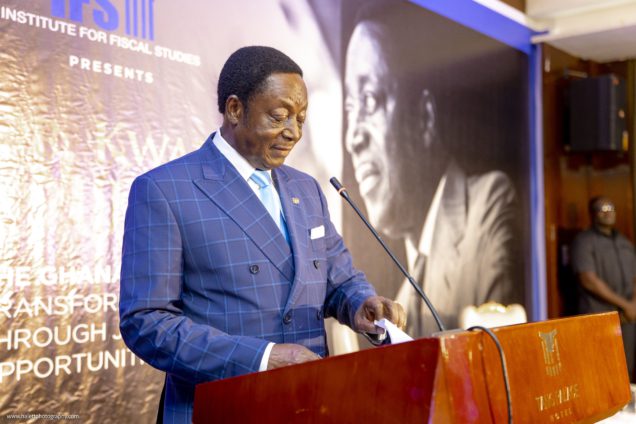
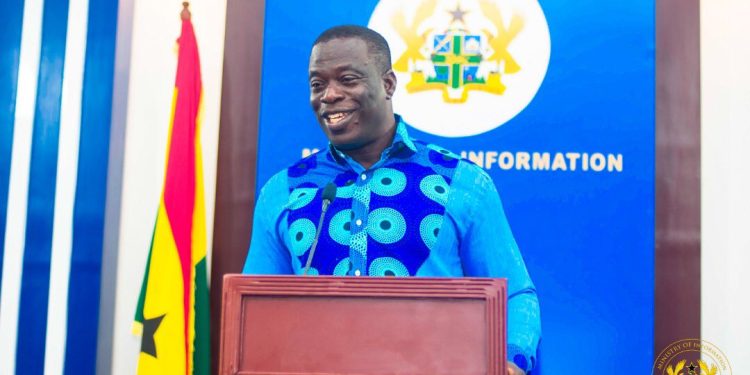
An Aide to former President John Mahama, Felix Kwakye Ofosu has ridiculed former Finance Minister, Dr Kwabena Duffuor over his decision to contest in the National Democratic Congress (NDC) flagbearership race.
This follows the picking of nomination forms on Thursday on his behalf by the Ashanti Regional Women’s Organiser, Gloria Huze, who led a delegation to the party headquarters.
Commenting on the development in an interview on Joy FM’s Top Story on Thursday, Mr Felix Kwakye Ofosu said although the John Mahama campaign team has enormous respect for Dr Duffour, “the truth is that Dr Duffuor flagbearership is such a wild fantasy.”
For this reason, the former Deputy Information Minister expressed his astonishment that “it is being tabled as a serious opposition” to ex president Mahama.
Explaining the reason for his statement, Mr. Kwakye Ofosu asserted that Dr Duffuor does not stand the chance of becoming the NDC flagbearer.
“Not that he is not quality material, he is by every stretch of the imagination, but there is a much better candidate in the shape of former President Mahama who can guarantee the NDC victory in 2024,” he added.
He went on to say that the general election in 2024 is not one to be trifled with, therefore the need for the party to put their best foot forward, adding that “President Mahama as far as the NDC is concerned, is the best candidate we can present for that election for many reasons.”
The MinorityCaucus in Parliament has again attacked Finance Minister Ken Ofori-Atta in light of the difficulties he is having trying to revive the Ghana’s economy.
The Minority also reiterated its call for the resignation or removal of the Finance Minister from office.
“We reiterate our call for the dismissal of the Finance Minister, Ken Ofori-Attawhose gross incompetence in managing our economy has assumed legendary status. The President must spare Ghanaians the agony of waking up tomorrow to see Ken Ofori-Atta still in charge of the economy,” the Minority Leader, Dr. Cassiel Ato Forson said.
Mr. Forson took the swipe at Ofori-Atta during a press conference on Monday, February 20, 2023, ahead of the vetting of newly appointed ministerial nominees.
He made the remark while calling on the president to reduce his government size.
The Minority Caucus also called on the President, Nana Addo Dankwa Akufo-Addo, to merge some ministries.
The Minority Caucus wants the Ministry of Food and Agriculture merged with the Fisheries Ministry and the Chieftaincy Ministry merged with the Tourism Ministry. The Minority is also calling for the Sanitation and the Local Government Ministry to be merged to help reduce the size of the government.
The caucus also wants the Information and Communication ministries to be merged and the Transport and Railways ministries also merged.
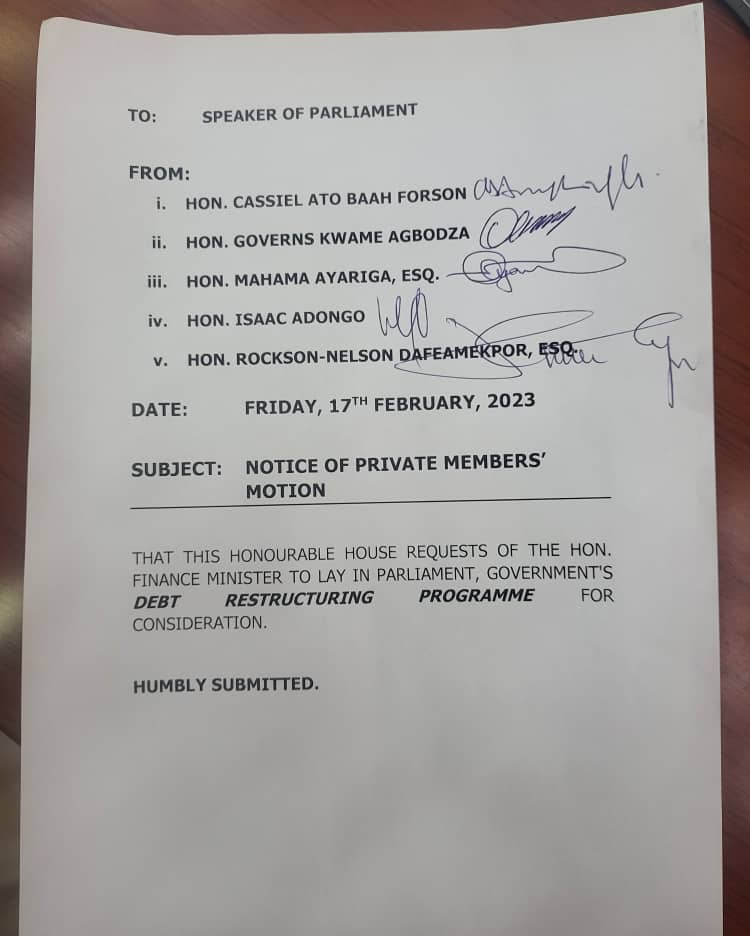
In an effort to push the Finance Minister, Ken Ofori-Atta, to submit the Domestic Debt Exchange Programme (DDEP) for approval to Parliament, the Minority has submitted a private members’ motion.
The NDC MPs are asking that the whole government’s debt restructuring package be brought before the House for additional discussion in a motion filed on Friday, February 17.
They hold the opinion that in their capacity as Ghanaians’ representatives, they must necessarily contribute to the program.
Already, the Minority Leader, Dr Cassiel Ato Forson has said his side will also file a motion to compel government to exempt individual bondholders from the programme.
Speaking in an interview with JoyNews on Thursday, the Ajumako Enyan Essiam legislator said they will do whatever is possible to ensure investors are protected.
“Our intention today was to serve notice that tomorrow the NDC Minority will be filing a motion to compel the government to exempt individual bondholders and pension funds and pensioners from the domestic debt exchange.”
Dr Ato Forson explained that the decision to file the motion is to ensure that an issuer exemption is granted to bondholders who had faith in the NDC government to invest in risk-free bonds.
This, he asserted, is because “the Constitution is clear that before you go for a loan, the terms and conditions must be approved by Parliament.”
Following an economic downturn and difficulties in servicing its debt, the government implemented the domestic debt exchange programme to give itself more time to meet its fiscal obligations.
However, the programme upon its announcement faced stiff opposition from groups and individuals.
Without the debt exchange programme, the government warned that the nation’s economy would collapse.
Ghana is currently requesting a $3 billion bailout from the IMF to bolster the struggling national economy.
Before the Bretton Woods institution’s board would evaluate Ghana’s request, one of the requirements is the domestic debt restructuring scheme.
A staff-level agreement between Ghana and the IMF was achieved in December, opening the door for the $3 billion rescue.
Member of Parliament for Bolgatanga Central Constituency Isaac Adongo, has asked the Finance Minister, Ken Ofori-Atta, to resign.
The lawmaker said this while Ken Ofori Atta was speaking on the floor of Parliament, where he had been summoned to explain the Domestic Debt Exchange Programme (DDEP).
Ofori-Atta’s appearance in Parliament comes after Speaker Alban Bagbin directed the Business Committee of the House to drag Ofori-Atta to the House to answer questions on the programme.
Speaking after Ofori-Atta’s address, Isaac Adongo, Member of Parliament for Bolgatanga Central Constituency, demanded the immediate resignation of Mr. Ofori-Atta before going out of the House.
He insisted that Finance Minister has failed woefully in the discharge of his duty.
According to Adongo, the Finance Minister has increased the risk of government bonds while continuing to quote the Holy Bible to conceal his incompetence.
He cautioned Ghanaians to beware of public officers who do not demand payment for their service, alluding to the no-salary arrangement for Mr Ofori-Atta.
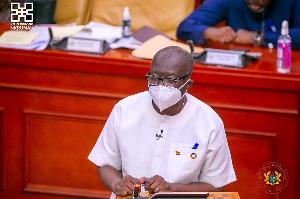
Minister for Finance Ken Ofori-Atta also refuted claims that he has neglected the pensioners who have been picketing to protest their inclusion in the Domestic Debt Exchange Programme (DDEP).
“The government is committed to the wellbeing of our senior citizens and pensioners. The government will honour their coupon payments and maturing principles.
“I have met with them on three occasions, where I explained the terms of the new bonds. “I subsequently wrote to their convener to let him know that all pensioners who did not participate in the bond offerings are exempt,” Ken Ofori-Atta told Parliament.
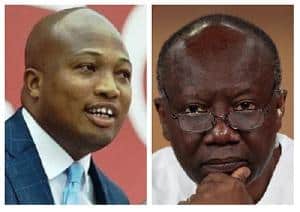
The representative for North Tongu, Samuel Okudzeto Ablakwa, has criticized Finance Minister, Ken Ofori-Atta for urging retirees to participate in the government’s Domestic Debt Exchange Program (DDEP).
Ofori-Atta, while addressing pensioner bondholders who were picketing over the involvement of their bonds in the programme, said to the pensioner in Twi, ‘boa me na meboa wo’ which means ‘help me so that I can help you”.
Reacting to the minister’s remarks on the floor of Parliament, on Thursday, the North Tongu MP said that Ofori-Atta was rather telling the pensioners that they should help him so that he can bury them.
“What is so annoying when the finance minister met then (the pensioners), all he (the finance minister) had to tell was that ‘boa me na me nboa wo’.
“You are actually doing ‘boa me na me nsie wo’ and you are saying ‘boa me na me nboa wo’… you are taking money from them, people’s hard-earned investments and their life savings and then you add insult to injury.
“Apart from quoting wrong scriptures, scriptures that don’t align with the times, you are adding ‘boa me na me nboa wo’. Let the records reflect that what the minister is actually doing is ‘boa me na me nsie wo’,” he said.
Finance Minister, Ken Ofori Atta, has reiterated that the current state of Ghana’s debt is due to the lingering effects of the Covid-19 pandemic and the Russia–Ukraine war.
This, he said, has been exacerbated by the high macroeconomic instability experienced in 2022, occasioned by downgrades by rating agencies as well as the consequential pressures on government finances due to the actions of non-resident investors and the delayed passage of our revenue bills.
Addressing Parliament today on the status of the Domestic Debt Exchange, the Finance Minister said “this situation is further compounded by the comparatively low levels of domestic revenue collected by government. In 2022, tax to GDP was just about 12.6%; woefully below the SSA average of 18% and insufficient enough to meet pressures on the public purse”.
Following the inception of negotiations with the International Monetary Fund, Mr. Ofori-Atta, said t was agreed that Ghana would have to address its economic challenges on three fronts – embark on fiscal consolidation, undertake debt operations and secure financing assurances from development partners.
He continued that “as I have indicated earlier, the domestic debt exchange programme was to alleviate the debt burden while minimising its impact on investors and the financial sector. Participation in the programme has always been “Voluntary”. The details of the domestic debt exchange are outlined in the Exchange Memorandum, and the subsequent amendments have been publicly available”
The coverage of the Exchange includes all locally issued bonds and notes of government as well as ESLA Plc and Daakye Plc bonds. Based on the results of the audit of the public debt, government excluded Treasury-bills and Pension Funds from the exchange.
Out of the total ¢97,749,624,691 eligible bonds were tendered, ¢82,994,510,128 was successfully tendered.
This accounted for about 85% of outstanding eligible amounts and met the target of 80% as expressed in the Memorandum of Exchange.
“Government is however mindful that the Gh¢82,994,510,128 bonds that were successfully tendered represents 64% of the outstanding debt stock of Gh¢130billion at the end of December, 2022”, Mr. Ofori-Atta.
Frank Annoh-Dompreh, a member of parliament for Nsawam-Adoagyiri, believes Ken Ofori-Atta, the finance minister, can jumpstart Ghana’s economy.
The MP claims that requests from some of his parliamentary colleagues that the president fire the finance minister will do more to stall the government’s efforts to revive the economy.
Annoh-Dompreh stated during an interview on Badwam on Adom TV that the finance minister should be permitted to continue working as he revitalizes the Ghanaian economy.
“I think we are making progress. The times dictate that we should be at peace with each other. Before I say anything it means I have spoken to people. Now it appears things are getting better so we have to keep things running,” the Majority Chief Whip said.
His statement comes on the back of a call by the Member of Parliament for Asante Akim North, Andy Appiah-Kubi for President Nana Addo Dankwa Akufo-Addo to honour his promise to fire Ken Ofori-Atta.
Ofori-Atta was untouched in a recent ministerial shakeup that saw Akufo-Addo nominate seven persons for ministerial and deputy positions in his government.
Annoh-Dompreh also called on the NPP in parliament to unite in breaking the 8 in the 2024 election by allowing the finance minister to retain his office.
“We are ready to break the 8 but we need unity among ourselves, “he said.
The majority chief Whip who has openly declared his support for the Vice President believes the majority in parliament should look at the larger picture of the 2024 general election, though he respects the views of those calling for the removal of the finance minister.
The assertions of Annoh-Dompreh have been shared by some members of the majority who are confident the finance minister should be allowed the fix the economy rather than replace him.
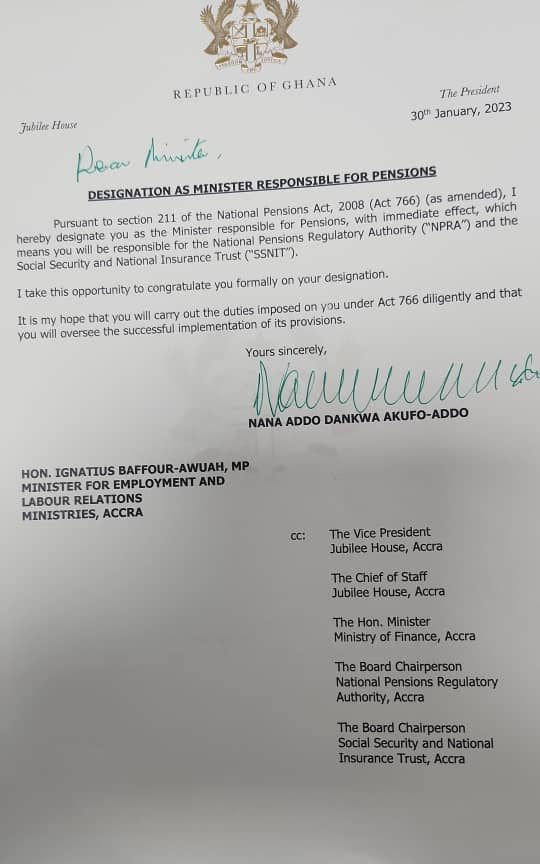
In an exclusive interview with Citi News shortly after he made the disclosure before the Public Accounts Committee (PAC) in Parliament, he said the role handed him is not new and has always existed per law.
The Minister added that he had already been doing that but the President Akufo-Addo had to make it official.
The announcement of the designation, previously under the purview of the Finance Minister, has been misconstrued by observers as a creation of an entirely fresh Ministry by the government.
“I appeared before the [Public Accounts] Committee and the chairman asked me which Minister is responsible for SSNIT and I read the letter to him. So, it’s not any new thing. I still remain the Minister for Employment except that I have additional responsibility with oversight of pensions. That’s the simple terms of reference to see over SSNIT and National Pensions Regulatory Authority as my agencies for policy directives”, Mr. Baffour-Awuah told Citi News‘ Umaru Sanda Amadu.
The appointment which is in accordance with section 211 of the National Pensions Act 2008 (ACT 766) will see the minister steering the affairs of the National Pensions Regulatory Authority (NPRA) and the Social Security and National Insurance Trust (SSNIT) effective January 30, 2023.
“The law says that the President has to designate a specific Minister for pensions. So that is what he has exactly done just that to a greater extent, I was playing that particular role, but I had not been officially designated as Minister responsible.”
“It’s just been more official. To be very honest, hitherto, it was under the Minister of Finance. So I am surprised by the publications because this was just to clear a point by the Committee”, he added.
The deadline for the government’s domestic debt exchange programme has been extended to January 31.
This has been done to increase stakeholder involvement in the policy proposal.
In a tweet posted on Monday, the Office of the Finance Minister noted that the deadline had been extended until the end of the month in order to give the government more time to build consensus for the program’s successful execution.
“Building consensus is key to a successful economic recovery for Ghana.
“Pending further stakeholder engagement with institutional and individual investors, recently invited to join the debt exchange programme, government is extending the expiration of the DDE to Jan 31, 2023”, the tweet said.
Building consensus is key to a successful economic recovery for Ghana. Pending further stakeholder engagement with institutional and individual investors, recently invited to join the debt exchange programme, government is extending the expiration of the DDE to Jan 31, 2023.
— Office of the Finance Minister-Ghana (@oofmghana) January 16, 2023
Businessmen and economist, Dr Kofi Amoah, has urged persons and institutions who have been affected by the government’s debt exchange programme to fight the injustice and raw deal that has been handed them.
According to Dr Amoah, it is unconscionable that one of the supposed safest investments – government instruments- can go so horribly wrong that a debt exchange programme has to be instituted.
In a tweet shared on his personal and verified page this week, Dr Amoah said the consequence of the exchange programme is far-reaching and damning. “Ghanaians must not sit and accept financial injustice from their govt. Everywhere in the world, investing in govt financial instruments is considered the safest investment with the assured payback of investors’ funds.”
Explaining further when contacted by GhanaWeb, the former president of the GFA Normalization Committee said there is a danger of eroding the savings culture of many Ghanaians due to this debt exchange programme.
“Ghana cannot become an outlier in this globally recognized comfort zone unless we want to be counted among the failed and misgoverned countries of the world. There are far-reaching negative consequences for such behaviour.
Govt must choose paying its debt to haemorrhaging individual bondholders over spending billions on some ill-conceived, unsustainable projects calculated to win some legacy points for politicians and their political parties.”
He urged right-thinking Ghanaians to join those affected by this policy to fight against this policy which he says would be detrimental to many people and households. “When they come for me in the day and you say nothing because it’s not you, they may come for you in the thick of night and no one can see or come to your aid”.
The Habit of Robbing Individuals’ Hard-earned Money to Finance Over-bloated, corruption-laden projects Must be Halted
Support Lawyer Kpebu in assisting people get their money taken with force by govt
Govt debts are supposed to be the safest everywhere???????? https://t.co/VLh1JMm9fS
— CitizenKofi (@amoah_citizen) January 10, 2023
Debt Exchange
On December 5, 2022, the Government of Ghana launched Ghana’s Domestic Debt Exchange programme, an invitation for the voluntary exchange of approximately GHS137 billion of the domestic notes and bonds of the Republic, including E.S.L.A. and Daakye bonds, for a package of New Bonds to be issued by the Republic.
In a statement released after the announcement of the debt exchange, the finance minister, Ken Ofori Atta explained why the policy has become imperative.
“The objective is to reduce the excessive burden created by our debt on our economy and reach the debt sustainability targets defined by the IMF staff for the period through 2028 and beyond. In particular, to restore debt sustainability, we plan to reduce our total public debt-to-GDP ratio to 55% in present value terms.”
In 2023, Finance Minister Ken Ofori-Atta anticipates a significant economic recovery.
He is thus, pleading with Parliament to assist the government by approving the Appropriations Bill for the Fiscal Year 2023.
Giving an update on the economy, “We also urge Parliament to support in particular new revenue measures outlined in the 2023 budget which aim to improve revenue mobilization. We cannot afford to repeat the mistakes of 2022.”
“2023 must be our “comeback” year. A year in which we put in place stronger foundations that would allow us to change our country for the better and in a way that is enduring, inclusive and transformational,” he added.
Mr. Ofori-Atta pointed out that the ensuing years will focus on building an entrepreneurial and export driven economy.
He also added that Ghana cannot afford to lose this essential economic momentum as it moves toward stability, predictability, and prosperity.
Mr Ofori-Atta All Ghanaians were asked by him to cooperate with the administration and support the numerous initiatives being carried out to jump-start the country’s economic recovery in a decisive, audacious, and brave manner.
“Above all, I urge us all to maintain an unshakeable sense of optimism about Ghana in the days and years ahead. Indeed, “the LORD is the Lifter of our heads” (Psalm 3:4), as we all witness a new confidence in our currency and the prospects of the certainty of an IMF Board approval of our Staff Level Agreement”.
The member of parliament for Builsa South, Dr. Clement Apaak, has requested that Finance Minister, Ken Ofori-Atta be transparent about the exact cost of implementing the Free SHS policy.
He thus wants Mr Ofori-Atta to report to Ghanaians the same figure he gave to the IMF as the cost of the Free Senior High School policy.
Mr. Ofori-Atta has stated that FSHS policy and other social intervention policies of the government will not be affected by the Staff-Level Agreement agreed on with the International Monetary Fund.
Addressing the media in Accra on December 13, 2022, the Finance Minister indicated that various education programmes including the FSHS will not be cancelled as part of the IMF support programme.
The Minister further stated that the government will be embarking on a review of the FSHS for efficiency.
However, the Finance Minister has been accused of giving different figures regarding the actual amount spent on the flagship programme from 2017 to 2021.
In view of this, the Builsa South lawmaker is requesting Mr. Ofori-Atta to begin his so-called review by discussing the actual figures he mentioned to the IMF.
“Start the review by telling us what figure you (Ken Ofori-Atta) reported to the International Monetary Fund (IMF) as cost of implementing Free Senior High School (FSHS) from 2017-2021.
“Is it the 7.62B you reported in the 2021 Mid-Year budget or the 5.3B he reported in the 2022 Mid-Year budget or both?” the MP queried in a tweet on December 14, 2022.
Different Figures Reported As Cost of Free SHS In 5 Years To Parliament And Matters Arising
As it is already known publicly, the NDC in Parliament has filed a motion, sponsored by Hon. Mohammed Mubarak Muntaka and 128 of us – to pass a vote of censure on the Finance Minister, Ken Ofori-Atta; in accordance with Article 82 of the 1992 constitution of the Republic of Ghana.
This historic motion, slated to be moved on Thursday, November 10th, 2022, is composed of seven specific charges levelled against Ken Ofori-Atta. Thus, the purpose of this article, is to provide a specific example of conduct by the Finance Minister which is deliberately dishonest and disrespectful to Parliament, for which sanctions, are justified. I will illuminate my case with figures Mr. Ofori-Atta presented to Parliament in 2021 and 2022 as total cost of funding Free SHS in five years, from 2017-2021. The difference between the cost in five years, reported as GH¢7.62 billion in the 2021 Mid-Year Review Budget and the reported cost for same period, GH¢5.3 billion in the 2022 Mid-Year Review Budget is GH¢2.32 billion. This is and remains problematic. I provide details below.
On Wednesday July 21, 2021, Ken Ofori-Atta, in response to a question as to whether government had taken a loan to fund the implementation of the Free SHS policy I asked, said the following in answer: “Mr Speaker, government has taken no loan to specifically finance the Free SHS policy. The Free SHS has since its inception been financed from the Annual Budget Funding Amount (ABFA) and from the Government of Ghana (GoG) funding sources. Over the five years, a total amount of GH¢7.62 billion has been allocated to implement the Free SHS programme. Out of this amount, GH¢4.18 billion was sourced from GoG, representing 54.76 percent, while the balance of GH¢ 3.44 billion representing 45.24 percent, came from ABFA.” This answer is captured in the Parliamentary Debates, Official Report, on Wednesday 21st July 2021, Fourth Series Vol.113 No.32, column 040-041.
A few days later, Ken Ofori-Atta presented the Mid-Year Fiscal Policy Review of the 2021 Budget Statement and Economic Policy of the Government of Ghana, to Parliament on Thursday, 29th July, 2021. He repeated what he said in response to my Parliamentary question. In paragraph 284 on pages 49-50, he said: “Mr. Speaker, the Free SHS School Policy has since its inception been financed from the Annual Budget Funding Amount (ABFA) and Government of Ghana (GoG) funding sources. Over the five years, a total amount of GH¢7.62 billion has been allocated to implement the Free SHS Programme. Out of this amount, GH¢4.18 billion was sourced from GoG, representing 54.76 percent, while the balance of GH¢3.44 billion, representing 45.24 percent, came from ABFA.”
Given, that he repeated the response to my question in the Mid-Year Review Budget of 2021; that “GH¢7.62 billion had been spent to implement the Free SHS programme,” and a further breakdown of “GH¢4.18 billion (54.76%) from GOG sources and GH¢3.44 billion (45.24%) from ABFA,” it came as a shock that he strangely reported GH¢5.3 billion as the total investment made to implement the same Free SHS for the same period, from 2017-2021, in the 2022 Mid-Year Review Budget.
For the avoidance of doubt, Ken Ofori-Atta presented the Mid-Year Fiscal Policy Review of the 2022 Budget Statement and Economic Policy of the Government of Ghana to Parliament on Monday, 25th July, 2022. In paragraph 466 on page 90 of the official statement, Ken Ofori-Atta is quoted as follows: “Mr. Speaker, we have invested in the future of our children through the Free SHS where GH¢5.3 billion has been spent to enable 1,261,495 student have access to secondary education.”
The suddenly less and unexplained cost of funding the Free SHS policy was also verbally stated by Ken Ofori-Atta, during his 2022 Mid-Year Budget Review Speech on Monday, 25th July, 2022. The video recording of his speech captures him vocalise the following, under Free SHS Programme. In paragraph 60 on page 17, Ken Ofori-Atta said: “Mr. Speaker, we have placed human capital development at the core of our national transformation efforts since 2017. We have invested GH¢5.3 billion to enable 1,261,495 Ghanaian children access secondary education under the Free SHS programme at the end of 2021 to improve access to education.”
This unexplained reporting of a far less cost of implementing the Free SHS programme in five years as captured in official Parliamentary records, and documents made available by Ken Ofori-Atta himself to Parliament, offends Parliament in every way, shape and form. How can the Minister report GH¢7.62 billion as the total cost of Free SHS in five years, provide a breakdown in nominal (GH¢4.18 billion GOG and GH¢3.44 billion ABFA) and in percentage terms (54.76% GOG and 45.24% ABFA) in reply to my question, repeat same in the 2021 Mid-Year Review Budget, suddenly, without explanation, report a generic GH¢5.3 billion as the cost incurred in implementing the same Free SHS programme in five years in the 2022 Mid-Year Review Budget Statement and as contained in his 2022 Mid-Year Budget Review speech?
Reporting vastly different figures of GH¢7.62 billion and GH¢5.3 billion as cost of the same programme, Free SHS, for the same period, 2017-2021, a difference of GH¢2.32 billion to Parliament, is questionable. If the earlier figures reported in 2021 were in error, the proper thing to do was to withdraw the GH¢7.62 billion reported, explain what occasioned the error, apologise and seek leave of Parliament to amend to the correct figure, since records of the house already captured GH¢7.62 billion a year earlier as cost of Free SHS in five years. This was not, and still has not been done. So, as it stands, Parliamentary records have both GH¢7.62 billion and GH¢5.3 billion as the cost of Free SHS from 2017 to 2021. This can not be allowed to go unchallenged.
Though I have filed questions to the Minister of Finance seeking an explanation to this questionable and contradictory reported cost of Free SHS in five years, it is necessary to share this specific example with Ghanaians to further justify why Ken Ofori-Atta must be censured. Like the other infractions we have presented as charges against Ken Ofori-Atta, it is certain that the different figures, GH¢7.62 billion and GH¢5.3 billion respectively, were deliberate, to deceive Parliament and to conceal the truth. This and other such deliberate dishonesty in reporting to the people through Parliament must attract the most severe sanctions. Indeed, Ken Must Go!
Dr. Clement Abas Apaak
M.P, Builsa South and Deputy Ranking Member On Education Committee of Parliament
The domestic debt exchange deadline has been extended from December 19 to December 30, with a settlement date of January 6, 2023, according to a statement from the Ministry of Finance.
The Ministry claims that the extension is in response to input from the financial industry over the requirement to get internal and Executive Board clearances, which are required considerations for their participation in the exchange.
“The extension also affords Government of Ghana the opportunity to consider suggestions made by all stakeholders with the aim of adjusting certain measures acceptable within the constraints of the Debt Sustainability Analysis,” it added.
The extension comes in response to criticism of the debt exchange program’s structure from participants in the financial sector.
Critics claim that because the financial sector bears the bulk of the burden, the system is biased in favor of the government.
The Ministry declared that it is trying to rework the debt exchange offer with the Bank of Ghana, other financial sector authorities (SEC, NPRA, and NIC), as well as its advisors, including input from various institutions and the Unions.
“We believe this extension will provide enough time for the necessary consultations and analysis to be completed to meet the expectations of local and foreign institutional bondholders while preserving the integrity of the Debt Sustainability Analysis and the Staff Level Agreement,” it concluded.
Road Tolls in Ghana have been cancelled in November 2021 as part of the policy measures announced by the government under the 2022 Budget.
However, the government has reintroduced it. Finance Minister, Ken Ofori-Atta announced the reintroduction in the 2023 budget presented to Parliament as one of the revenue measures to make money for Ghana’s needs.
In the eyes of Kwaku Sintim-Misa, this move by the government only proves the people in charge are disorganized and clueless of what they are up to.
“So, basically, I thought that the whole thing was muddled with confusion. Number one, it shouldn’t have been canceled at all; number two, they just decided to bring it back. Why are you bringing it back?” he said.
In an interview with GhanaWeb, KSM added that the reason the government is reintroducing road tolls should be adequately explained.
“Are you bringing it back because you made a mistake canceling it in the first place? So just address Ghanaian people and tell us, ‘Listen, Ghanaian people, it was an error canceling this thing, we made a mistake and are trying to reverse it. We’re going to bring it back and when we bring it back we are going to make it more digital, we are going to do this, we are going to do that, to improve it,” KSM said.
KSM fuerher lambasted the government for initially cancelling of the road tolls. “To cancel paying road tolls in Ghana, I thought it was very unfortunate, especially if you’re going to use the road tolls to actually help improve the state of roads, then you need to collect road tolls even if Ghanaians will not understand the importance of road tolls. This is where you can come out and state clearly that we need to improve our road tolls. We need a road coming from Accra to Kumasi, these things don’t just happen,” he said.
“They come from the tolls that we pay. Even if they thought that road tolls were not as effective and it was not collecting as much, then we need to sit down and actually come up with a strategy of how best we can get the road tolls to work. Because there is no question in my mind that they (road tolls) are needed, especially in a country that is economically harder with raising revenue,” KSM emphasized.
The IMF board will then negotiate and presumably adopt a program for the nation after that.
A settlement between Ghana and the Fund could be achieved shortly, given the cedi’s value has been rising recently versus the US dollar.
As a significant step toward achieving an agreement with the IMF to launch a program, the administration has started restructuring the nation’s debt as of Monday, December 5. Domestic debt served as the program’s foundation.
Since December 1, an IMF delegation has been in Ghana to continue discussions with Ghanaian authorities about the country’s post-COVID-19 economic growth program and related policies and reforms that could be financed by a new IMF lending arrangement. The delegation is led by Stéphane Roudet, Mission Chief for Ghana.
In July 2022, Ghana requested assistance from the IMF once more so that it could pay its debts to the rest of the globe and repair the soundness of its public finances.
It is the second time in the past three years, and 17th since independence in 1957 that Ghana has turned to the IMF for help.
Speaker of Ghana Parliament, Alban Bagbin has disclosed that it is his wish to live longer in order to see things as he had once been told.
In his closing remarks after the censure vote to remove Finance Minister Ken Ofori-Atta had been lost by the Minority because the number of Members of Parliament (MPs) did not meet the two-thirds vote requirement, he narrated a story told him by a senior statesman.
According to him, it is his prayer to live long in order to see things though he was not specific on which on the particular things he was talking about.
He narrated: “One senior statesman, I actually refer to him as an elder statesman told me a story that when they were in school, a gentleman used to visit them and whiles walking on the streets he would be repeating one statement and I quote ‘if we don’t die early we will see things’
“I have been praying to God to allow me not to die early so that I can see things. I am not yet old but I have started seeing things,” he said.
It would be recalled that the Minority caucus filed a motion of censure against the Finance Minister, accusing him of mismanagement of the economy, financial recklessness, conflict of interest, gross mismanagement of the economy.
An eight-member ad-hoc committee set up by the Speaker to probe the motion brought against the Finance Minister presented its report to Parliament on November 25, 2022 but it was debated and voted upon yesterday, December 8.
The Majority staged a walk out rubbishing the allegations levelled against the Finance Minister causing the vote to be lost.
The Minority in Parliament has failed to remove Finance Minister, Ken Ofori-Atta, from office despite casting a secret ballot voting.
Speaker of Parliament, Alban Bagbin, has indicated that the secret voting exercise executed by a one-sided Parliament to ensure a vote of censure against Ken Ofori-Atta is wasted.
The Minority in Parliament went ahead to cast their secret ballot on Thursday, after the Majority staged a walk-out.
The Majority led by Osei Kyei-Mensah-Bonsu walked out of the chamber during a heated debate after they pointed out that the censure motion is unfair. The said 80 NPP MPs who are against a Finance Ministry headed by Ken Ofori-Atta were among the legislators who walked out.
Despite their absence, the Minority went ahead with the secret balloting.
After voting, Speaker told the House that the voting exercise is “loss” because it fails to uphold Article 82 (1) of the 1992 constitution which states that “1. Parliament may, by a resolution supported by the votes of not less than two-thirds of all the members of Parliament, pass a vote of censure on a Minister of State.”
In Parliament were 136 MPs on the Minority side. 136 votes supported the censure of the Finance Minister.
However, per the law, Parliament needs at least 184 MPs out of the 274 MPs, which is two-thirds of the MPs to pass a vote of censure on a Minister of State.
A one sided Parliament is casting their ballot to decide whether the Finance Minister, Ken Ofori-Atta, should be removed from post or not.
On Thursday, the House commenced debate on the censure motion filed against Mr Ofori-Atta by the Minority.
It was a heated debate, as the Minority insisted that the Finance Minister is unfit to steer the affairs of the economy. The Majority argued otherwise.
Mr Ofori-Atta, who was also in Parliament, likened his censure motion to a crucifixion, arguing that he has done no wrong.
Displeased by the position of the Minority MPs, the NPP MPs staged a walkout, including the 80 MPs who are said to be against Mr Ofori-Atta still being in office.
However, Speaker Alban Bagbin has permitted the House to engage in a secret ballot.
Article 82 of the 1992 constitution states that “1. Parliament may, by a resolution supported by the votes of not less than two-thirds of all the members of Parliament, pass a vote of censure on a Minister of State.
2. A motion for the resolution referred to in clause (1) of this article shall not be moved in Parliament unless a. seven days’ notice has been given of the motion; and b. the notice for the motion has been signed by not less than one-third of all the members of Parliament;
3. The motion shall be debated in Parliament within fourteen days after the receipt by the Speaker of the notice for the motion.
4. A Minister of State in respect of whom a vote of censure is debated under clause (3) of this article is entitled, during the debate, to be heard in his defence.
5. Where a vote of censure is passed against a Minister under this article the President may, unless the Minister resigns his office, revoke his appointment as a
Minister.
6. For the avoidance of doubt this article applies to a Deputy Minister as it applies to a Minister of State.”
Editor of the Custodian Newspaper, Awudu Mahama, has criticized Ministers who travelled to Qatar for the World Cup, rather than staying in the country to review the 2023 budget.
According to him, these ministers should have been in the country taking notes and addressing specific sector budgetary issues raised by Finance Minister Ken Ofori-Atta.
“I have serious issues with ministers who went to the World Cup. After the budget has been read, we expect every minister to come and take notes on their sectors as addressed in the budget. But instead of being there to take notes and review the budget, these ministers go to the World Cup, especially at a time where Ghanaians are agitated and the economy is in bad shape,” he told Samuel Eshun during the Editors’ Take Discussion on the Happy Morning Show.
Awudu Mahama was peeved these Ministers ignored the tension within the majority caucus to go watch the World Cup. “I wasn’t happy when ministers after the budget was read went to the World Cup, especially with the tension amongst the majority caucus. So, if a minister, you stay away from the budget, do you expect the MP who is already agitated to take your actions lightly?”
On Thursday, November 24, the embattled Finance Minister Ken Ofori-Atta presented the government’s economic programme to Parliament for the 2023 fiscal year.
Amongst the highlights of the budget were the revision of the E-levy from the current 1.5% to 1%, plus an increment of the VAT rate from 12.5% to 15%.
After the budget presentation, some ministers and MPs travelled to watch the tournament rather than deliberate the 2023 budget.
The Deputy Majority Leader, Alexander Afenyo-Markin, has described the censure motion against the Finance Minister, Ken Ofori-Atta, as a failed attempt by the Minority caucus in Parliament.
According to Mr. Afenyo-Markin, the Majority will not in any way support any political motion for the removal of Mr. Ofori-Atta.
He said the Majority will be exempted from any secret ballot against the Finance Minister, warning the Minority caucus not to tickle themselves of getting the numbers to secure a win.
The National Democratic Congress (NDC) Member of Parliament (MP) for Tamale South in the Northern Region, Haruna Iddrisu said, “if those courageous 98 gallant NPP MPs or Majority MPs cooperate, we will be very successful in getting a new Finance Minister for Ghana and exiting Ken Ofori-Atta”
But responding to Mr. Iddrisu on the floor of Parliament, the Deputy Majority Leader, said, “the motion has already failed and who told you that you are going to get any support from this side? We have told you that it is a political motion, and we will not support you, as we made it clear. Mr. Speaker, the Minority should not be under any impression that in any so-called secret ballot you are going to have somebody to support you as you do not have the numbers”.
The Minority caucus in Parliament brought a censure of motion against the Finance Minister, accusing him of conflict of interest, gross mismanagement of the economy amongst others.
Some New Patriotic Party (NPP) members of Parliament who are also calling for the removal of the Finance Minister have called on the President, Nana Addo Dankwa Akufo-Addo, to respect the roadmap agreed upon.
There was an agreement for the NPP MPs not to boycott the 2023 budget presentation, and that the necessary thing will be done after its read.
Finance Minister, Ken Ofori-Atta, has announced that existing domestic bonds will be exchanged for a set of four new bonds.
Bonds as of December 1, 2022, that are due for payment will not be paid until at least five years from now.
This is because the new set of four bonds matures in 2027, 2029, 2032 and 2037, the Finance Minister said when he addressed Ghanaians on December 4, 2022.
The interest on these bonds differs as bonds in 2024 will attract an annual coupon of 5%, and that of 2025 will provide 10% interest until maturity.
“Coupon payments will be semi-annual,” the Finance Minister revealed.
Bonds in 2023 will however attract no interest.
According to Mr Ofori-Atta, the adjustment made is as a result of a debt operation programme Ghana would be taking as part of its arrangement with the International Monetary Fund (IMF).
“The broad contours of the Debt Sustainability Analysis has been concluded and I am here this evening to provide some details on Ghana’s Domestic Exchange which will be launched tomorrow,” he said.
He assured that government worked hard to minimize the impact of the domestic debt exchange on investors holding government bonds.
Following government’s intervention, he announced that Treasury Bills would be exempted in the country’s domestic debt exchange and will be paid the full value of their investments on maturity.
“There will be no haircut on the principal of bonds” and “Individual holders of bonds will not be affected,” the Minister added.
On October 30, President Akufo-Addo while addressing Ghanaians on the state of the economy pledged that there would be no haircut on investment.
Mr Ofori-Atta explained that haircut has been taken off the table since “government recognises that our financial institutions hold a substantial proportion of these bonds.”
Meanwhile, the Bank of Ghana, Securities & Exchange Commission, National Insurance Commission and the National Pensions Regulatory Commission will ensure that the impact of the debt operation on the financial institution is minimised.
On the other hand, government is establishing a Financial Stability Fund (FSF) to help provide liquidity support to banks, pension funds, and insurance companies, among others to ensure they are able to meet their obligations to their clients.
Reacting to the news, Vice President of policy think tank IMANI Africa, Bright Simons, stated that Ghana has unilaterally announced a default.
“First time since 1982. In certain like-for-like respects though it is the first since the 1972 commercial loan default,” he tweeted.
He, however, questioned whether the way forward for Ghana with regard to addressing its debt would be a smooth or rough ride.
The minority in parliament has raised concerns over seeming failure of the Finance Minister, Ken Ofori-Atta to make an appearance for the 2023 budget debate.
At the time the Speaker gave the guidelines for the commencement of the debate, the Deputy Minority Whip, Ibrahim Ahmed said there was a need for him to be present in the chamber as he needs to take note of their input.
“Mr Speaker, conspicuously missing on the floor is the mover of the motion and it Is not for nothing that the constitution says the finance minister can lay the budget on the floor on behalf of the president. So, you can’t just move the motion and remain there. It is appropriate that the minister must be here, Mr Speaker if he is not ready to do the job, he should let the house know. He must be here to hear our input.”
Ranking Member of the Finance Committee, Ato Forson said this is becoming quite characteristic of the finance minister. He therefore urged that the house should not debate on the budget until their input is considered by the finance minister.
Speaking on the matter, the majority leader said the constitution does not provide any where that the economic policy and the budget statement should be submitted to this house by the Minister of Finance.
Osei Kyei-Mensah-Bonsu also said that the president can choose any minister to lay the budget before the house and the minister is not obligated to speak to it.
He however stated that the finance minister had given prior notice that he would be absent from the country but indicated the availability of the two-deputy ministers to take note of suggestions.
The amount is a record highfor EOCO compared to an average of about five million Ghana cedis in previous years
The executive director of the Economic and Organised Crime Office (EOCO) COP Maame Yaa Tiwaa Addo-Danquah has said her outfit will step up its effort in recovering monies due the state from next year.
The assurance comes after Finance Minister Ken Ofori-Atta announced that EOCO retrieved GHC27.55 million from proceeds of crime; monies that would have been lost to the state in 10 months.
The amount is a record high for EOCO compared to an average of about five million Ghana cedis in previous years.
Speaking on the achievement, the EOCO boss said she was grateful to her management team and all officers of EOCO who made this great feat possible.
COP Addo-Danquah said EOCO will also improve on its recoveries, sensitisation programmes on cybercrimes, gaming and its outreach programmes to markets, communitiesand religious institutions in the coming days.
Business development consultant Kwame Okyere Darko has described the 2023 budget as the most disrespectful budget by any government in the history of Ghana.
According to him, the measure proposed by Finance Minister Ken Ofori-Atta to reduce the government’s expenditures is an insult to the people of Ghana.
“This is the most disrespectful budget ever. When we were experiencing dumsor, the president acknowledged it any time he speaks because he had some respect for Ghanaians.
“For the past few months, Ghanaians have been complaining about the expenditure of the government, they have been saying that the government should cut down costs because it is the main cause of the challenges the country is facing.
“And when he (the finance minister) come to tell us about the government reducing expenditure he said the government is coming to change the number plate of land cruisers.
“This government does not respect us. This particular leadership of the NPP, they don’t take us for anything,” he said in Twi in an XYZ TV interview monitored by GhanaWeb.
Kwame Okyere Darko made these remarks in response to Finance Minister Ken Ofori-Atta’s announcement that the use of V8 and V6 vehicles by government officials will cease in January 2023 as a cost-cutting measure.
The finance minister made the revelation when he presented the 2023 budget in parliament on November 24, 2022.
He said, “A ban on the use of V8s/V6s or its equivalent except for cross-country travel. All government vehicles would be registered with GV green number plates from January 2023.”
He also said, “there will be a limited budgetary allocation for the purchase of vehicles. For the avoidance of doubt, the purchase of new vehicles shall be restricted to locally assembled vehicles.”
“Only essential official foreign travel across government including SOEs shall be allowed. No official foreign travel shall be allowed for board members…Accordingly, all government institutions should submit a travel plan for the year 2023 in mid-December of all expected travels to the Chief of Staff,” he added.
Government has defended its decision to privatise the Saglemi Housing Project.
According to the deputy Finance Minister, John Kumah, the decision is the best, given the current circumstances.
Speaking on Saturday, November 26, 2022, during Newsfile, he
explained that “the project is no longer affordable per the arrangement that has happened to it because if you divide $200 million by 10,000, you are going to get it at $10,000, and they reviewed it to 1,500 (housing units) which makes
it up (from) $40,000 to $50,000 per unit. So how affordable can
that be?”
“So in the present circumstances, the best option is to bring the
private sector in,” he said.
He, however, assured the citizenry that the government will be transparent in choosing a buyer.
The Saglemi Housing Project was initiated by the erstwhile Mahama Administration.
It was originally meant to be a 10,000 residential unit later
reviewed as a 5,000 unit facility to address the country’s housing
deficit.
However, after the Mahama administration left office, the project was abandoned and left to rot, despite various assurances by the current administration to complete it.
Government initially blamed its failure to complete it on lack of
financial resources.
In the latest development, the government, through the Works
and Housing Minister, Francis Asenso Boakye announced plans to privatise the project.
“Government has decided to – Explore the possibility of selling the Saglemi Housing Project, covering the 1,506 housing units, at the current value to a private sector entity to complete and sell the housing units to the public, at no further cost to the State,” Mr
Asenso-Boakye said at a press briefing in Accra.
“In furtherance of the above, and to facilitate the processes, a Technical Working Team has been set-up, comprising professionals and experts to oversee and spearhead all engagements required for the completion of the project.
This is being done with the goal of ensuring transparency and accountability, while guaranteeing value for money in the completion of the project,” he added.
Subsequently, the Minority in Parliament issued a caution to the
government to rescind its decision.
Minority Spokesperson for Works and Housing, Vincent Oppong
Asamoah argued that the project is viable therefore, “government should be compelled to look for funds to complete the project instead of privatisation.”
Speaker of Parliament, Alban Bagbin believes that Finance Minister Ken Ofori-Atta will take a cue from the ordeal suffered over the past few weeks.
Between a censure motion from the Minority and a decision by the Majority to kick him out of office, Mr Bagbin is sure that Ken Ofori-Atta has picked lessons for the future.
Ghana is currently at the doors of the International Monetary Fund (IMF) for a possible $3 billion bailout amidst intensifying hardship, skyrocketing fuel prices, a rising cost of living and a depreciating cedi.
Ghanaians are reeling under this condition and have been calling for a pragmatic solution.
The Minority MPs insist that Ken Ofori-Atta, in this regard, has lost his grip on the country’s economy and must be axed.
Beyond that, majority of NPP MPs in the House are pushing for his removal, triggering crunch-time interventions from the party caucus and President Akufo-Addo.
With all these developments, the Speaker says Ken Ofori-Atta has learnt in a hard and unprecedented way.
“As he sits here, he has learned a bitter lesson. It is uncommon to come across members of your own party rise up in Parliament against your own minister. It’s uncommon,” he said on Sunday .
Members of Parliament will this week debate the 2023 budget statement presented last week and the Speaker of Parliament has a warning for government.
He cautioned government against using sheer bravado to push through their revenue measures, instead he thinks dialogue with the opposition may yield a common ground.
The Speaker says anything other than this will lead to acrimony and conflicts which will not augur well for the economy.
Meanwhile, the House awaits the report from the committee that probed the motion to subject Mr Ofori-Atta to a vote of censure.
The recovered amount which covers a period of ten months is almost double of what was recovered between 2019 and 2021.
According to official figures available, EOCO in 2019 recovered only GH¢4,301,262.79, GH¢4,365,129.69 for 2020, and GH¢6,142,984.01 for 2021.
Speaking to the development on the floor of parliament last Thursday, the Finance Minister said “ Mr. Speaker, the Office, through the Economic and Organized Crime Office (EOCO), recovered an amount of GH¢27.55 million (being GH¢11.14 million direct recovery into the Consolidated Fund and GH¢16.41 million indirect recovery to other institutions) from the proceeds of crime as at end September, 2022”
According to him, the office also investigated 490 cases out of which 19 are being prosecuted.
“Mr. Speaker, EOCO investigated 490 cases out of which 19 are being prosecuted at various courts. The Office secured one court conviction, and five cases were dismissed. In addition, the Office carried out 55 sensitisation programmes on cybercrimes, 55 on gaming, three outreach programmes on human trafficking and irregular migration. In 2023, EOCO anticipates investigating 450 cases, out of which over 50 cases will be prosecuted. The Office plans to carry out 60 sensitisation programmes on cybercrimes, 55 on gaming, and five outreach”
A renowned labour consultant has accused the finance minister of creating needless fear and panic among the teeming unemployed with his freeze on all government employment as contained in the Thursday budget statement to the Legislature
Mr Antwi Boasiako Sekyere said what the minister said was not apt.
He explained that there cannot be a freeze on employment when every year people retire and need to be replaced.
“Every year, scores of people are needed to fill vacant positions in the teaching sector as well as the nursing sector and the security sector,” he explained.
The former Deputy Minister for Manpower and Labour Relations in the National Democratic Congress (NDC) argued against the minister’s claims while speaking in an interview on the Accra 100.5 FM’s midday news on Friday, November 25, 2022.
He said what will be at play with Ghana getting a deal from the International Monetary Fund (IMF) is the employment in some of the State-Owned Enterprises (SOEs), adding that some of these SOEs have as many as three deputies who draw salaries and allowances from the consolidated fund.
He said the IMF will not allow this to happen as part of the austerity measures when a deal is reached with the fund.
“Under NDC, we went for an IMF deal but recruited to fill positions but the New Patriotic Party in opposition accused the government of not employing because of the IMF deal when they know that was not the case,” he said.
To reduce public expenditure, the government has put a freeze on recruitment in the public sector beginning next year, 2023.
This is part of some 13 measures announced by the Finance Minister Ken Ofori-Atta in the 2023 budget statement presented in Parliament on Thursday, 24 November 2022.
These measures according to the finance minister are cabinet directives.
The 13 measures are listed below:
1. All MDAs, MMDAs and SOEs are directed to reduce fuel allocations to Political Appointees and heads of MDAs, MMDAs and SOEs by 50%. This directive applies to all methods of fuel allocation including coupons, electronic cards, chit systems, and fuel depots. Accordingly, 50% of the previous year’s (2022) budget allocation for fuel shall be earmarked for official business pertaining to MDAs, MMDAs and SOES;
2. A ban on the use of V8s/V6s or its equivalent except for cross-country travel. All government vehicles would be registered with GV green number plates from January 2023;
3. Limited budgetary allocation for the purchase of vehicles. For the avoidance of doubt, purchase of new vehicles shall be restricted to locally assembled vehicles;
4. Only essential official foreign travel across government including SOEs shall be allowed. No official foreign travel shall be allowed for board members. Accordingly, all government institutions should submit a travel plan for the year 2023 by mid-December of all expected travels to the Chief of Staff;
5. As far as possible, meetings and workshops should be done within the official environment or government facilities;
6. Government-sponsored external training and Staff Development activities at the Office of the President, Ministries and SOEs must be put on hold for the 2023 financial year;
7. Reduction of expenditure on appointments including salary freezes together with suspension of certain allowances like housing, utilities and clothing, etc.;
8. A freeze on new tax waivers for foreign companies and review of tax exemptions for free zone, mining, oil and gas companies;
9. A hiring freeze for civil and public servants
10. No new government agencies shall be established in 2023;
11. There shall be no hampers for 2022;
12. There shall be no printing of diaries, notepads, calendars and other promotional merchandise by MDAs, MMDAs and SOEs for 2024;
13. All non-critical projects must be suspended for 2023 Financi
Ghana’s local currency has lost 53.8% of its value against major currencies since the beginning of this year, according to Finance Minister Ken Ofori-Atta.
While presenting the 2023 budget statement in Parliament on Thursday, Ken Ofori-Atta revealed how certain economic activities this year in particular have contributed to the cedi’s depreciation.
He cited the rise in demand for foreign currency as one of the causes of the cedi’s depreciation.
“The demand for foreign exchange to support our unbridled demand for imports undermines and weakens the value of the cedi. This contributed to the depreciation of the Cedi which has lost about 53.8% of its value since the beginning of this year, compared to the average 7% annual depreciation of the Cedi between 2017 and 2021,” he mentioned.
Between 2017 and 2021, the annual depreciation of the cedi stood at 7 percent.
Among major trading currencies, the Ghana cedi has fared worse against the United States dollar.
In October this year, the value of the dollar against the cedi rose to GH¢16 from GH¢6.8 in January this year.
Information from the Bank of Ghana reveals that as of November 23, 2022, a dollar was trading at GH¢13.11. Interbank rates pegged a pound at GH¢15.78, and traded a euro at GH¢13.59.
At the forex bureaus, a dollar is sold at GH¢14, while a pound and euro are sold at GH¢17 and GH15 respectively.
Due to the depreciation of the cedi, there has been an incessant hike in fuel prices, which has resulted in an increase in transport fares.
The high cost of transportation has translated to a rise in the cost of goods and services in the country.
Meanwhile, the government has introduced some measures to curb the depreciation of the cedi.
The Central Bank has been working with the mining firms, international oil companies, and their bankers to purchase all foreign exchange arising from the voluntary repatriation.
The TUC thinks the ruling is unjust because the government vowed not to do it.
In his presentation of the 2023 budget statement on Thursday, Finance Minister Ken Ofori-Atta highlighted the government’s decision as one of several steps to rein in the spiraling public spending.
“I am really disappointed about the freeze of employment in the civil and public services in 2023, because this is something that the TUC has spoken about it all this while. When the IMF team came to this country, we had the opportunity to meet with them and one of the issues we raised with them is about the freeze of employment that always becomes their conditionality anytime they access their programme, we were assured that that was not going to happen,” he stated.
Mr. Ansah noted that the TUC will discuss this issue with its Social Welfare Committee and respond appropriately.
Meanwhile, government has introduced a number of measures to cut its expenditure for the year 2023.
Below is the full text of implementation of the Cabinet directives on expenditure measures
Mr Speaker, as a first step toward expenditure rationalisation, Government has approved the following directives which take effect from January 2023:
• All MDAs, MMDAs and SOEs are directed to reduce fuel allocations to Political Appointees and heads of MDAs, MMDAs and SOEs by 50%. This directive applies to all methods of fuel allocation including coupons, electronic cards, chit systems, and fuel depots. Accordingly, 50% of the previous year’s (2022) budget allocation for fuel shall be earmarked for official business pertaining to MDAs, MMDAs and SOES;
• A ban on the use of V8s/V6s or its equivalent except for cross-country travel. All government vehicles would be registered with GV green number plates from January 2023;
• Limited budgetary allocation for the purchase of vehicles. For the avoidance of doubt, the purchase of new vehicles shall be restricted to locally assembled vehicles;
• Only essential official foreign travel across government including SOEs shall be allowed. No official foreign travel shall be allowed for board members.
Accordingly, all government institutions should submit a travel plan for the year 2023 by mid-December of all expected travels to the Chief of Staff;
• As far as possible, meetings and workshops should be done within the official environment or government facilities;
• Government-sponsored external training and Staff Development activities at the Office of the President, Ministries and SOEs must be put on hold for the 2023 financial year;
• Reduction of expenditure on appointments including salary freezes together with suspension of certain allowances like housing, utilities and clothing, etc.;
• A freeze on new tax waivers for foreign companies and review of tax exemptions for the free zone, mining, oil and gas companies;
• A hiring freeze for civil and public servants
• No new government agencies shall be established in 2023;
• There shall be no hampers for 2022;
• There shall be no printing of diaries, notepads, calendars and other promotional merchandise by MDAs, MMDAs and SOEs for 2024;
• All non-critical projects must be suspended for the 2023 Financial year.
The 8-member ad-hoc committee that probed allegations in a censure motion brought against Finance Minister, Ken Ofori Atta, has presented its report to Parliament.
This comes after the committee’s request for more time from the Speaker of Parliament, Alban Bagbin to finalise its report after the conclusion of public hearings last Friday.
The committee probed allegations of unconstitutional withdrawal of funds from the consolidated fund for the National Cathedral project, gross mismanagement of the economy, and financial recklessnesses leading to the collapse of the Ghana Cedi as the basis for a censure motion against the Finance Minister by the Minority in Parliament.
The Committee although was unable to conclude its work within the seven-day period offered by the Speaker, it has presented its report to the plenary with the Chairman of the Committee expected to move the motion for a debate on it.
On October 25, 2022, the Minority in Parliament filed a censure motion against the Finance Minister, Ken Ofori-Atta.
This occurred at the same time that the Majority MPs, numbering around 80, held a press conference to demand the removal of the Finance Minister and the then Minister of State in charge of Finance at the Ministry of Finance, Charles Adu Boahen, for their inability to manage the economy.
However, the NPP MPs failed to support the NDC MPs in their quest.
According to them, although they want the Finance Minister out, they would do that on their own terms.
They insisted that the Minority had their own parochial interest.
Samuel Okudzeto Ablakwa, a representative for North Tongu, has questioned the government’s intention to raise the Value-Added Tax (VAT).
On Thursday, November 24, 2022, the Finance Minister, Ken Ofori-Atta, announced an increase in the VAT rate for the next year presenting the 2023 Budget Statement and Economic Policy in parliament.
But reacting to the announcement in a Facebook post, the opposition MP wondered how the current event is occurring under the presidency of Nana Addo Dankwa Akufo-Addo, who led a protest against VAT when it was introduced in 1995.
“Who could ever have imagined or predicted that Nana Addo Dankwa Akufo-Addo who led the fatal 1995 Kumepreko demonstration against the introduction of VAT under President Rawlings which tragically claimed the lives of Ahunu Ahonga & 5 others would today be increasing VAT by 2.5%,” he wondered.
The increase in VAT will enable the government to raise money to finance initiatives like road development, according to the minister of finance.
“Mr. Speaker, the demand for roads has become the cry of many communities in the country. Unfortunately, with the current economic difficulties and the absence of dedicated source of funding for road construction, it is difficult to meet these demands. In that regard we are proposing the implementation of new revenue measures. The major one is an increase in the VAT rate by 2.5 percentage points,” the minister said.
In 1995, Nana Akufo-Addo and other members of the New Patriotic Party led what is described as Ghana’s largest demonstration in history.
Five protesters were killed during a protest against the then-government of Jerry John Rawlings’ decision to introduce VAT. Unidentified assailants fired into the crowd of protestors.
The Finance Minister Ken Ofori-Atta was excellent in the delivery of the 2023 budget statement.
He described the presentation as ‘fantastic, excellent.”
Kamal Deen further said that the government acknowledges that times are hard for Ghanaians hence, drastic measures taken in the 2023 budget statement.
Speaking on the Big Issue with Roland Walker on TV3 Friday November 25 while discussing the budget presentation, he said regarding the embargo placed on employment into the public and civil service that it means “those who have reached retirement age must go for them to be replaced.”
He added “drastic measures needed to be introduced, times are are hard, we have had the president acknowledging that fact, Finance Minister acknowledging, Vice President acknowledging that we are not in normal times.”
The Minister of Finance Ken Ofori-Atta announced in the 2023 budget a freeze on employment into the civil and public service.
He also said there shall be no new government agencies established in 2023.
He said these while presenting the budget in Parliament on Thursday November 23.
Mr Ofori-Atta said as a first step toward expenditure rationalisation, government has approved a number of directives which takes effect from January, 2023.
These are “All Ministries, Departments and Agencies (MDAs), Metropolitan, Municipal and District Assemblies (MMDAs) and State-Owned-Enterprises (SOEs) are directed to reduce fuel allocations to Political Appointees and heads of MDAs, MMDAs and SOEs by 50%. This directive applies to all methods of fuel allocation including coupons, electronic cards, chit system, and fuel depots. Accordingly, 50% of the previous years (2022) budget allocation for fuel shall be earmarked for official business pertaining to MDAs, MMDAs and SOEs;
“A ban on the use of V8s/V6s or its equivalent except for cross country travel. All
government vehicles would be registered with GV green number plates from
January 2023; Limited budgetary allocation for the purchase of vehicles. For the avoidance of doubt, purchase of new vehicles shall be restricted to locally assembled vehicles;
“Only essential official foreign travel across government including SOEs shall be
allowed. No official foreign travel shall be allowed for board members.”
The Finance Minister added “Accordingly, all government institutions should submit a travel plan for the year 2023 by mid-December of all expected travels to the Chief of Staff; As far as possible, meetings and workshops should be done within the official environment or government facilities; Government sponsored external training and Staff Development activities at the Office of the President, Ministries and SOEs must be put on hold for the 2023 financial year; Reduction of expenditure on appointments including salary freezes together with suspension of certain allowances like housing, utilities and clothing, etc.;
“A freeze on new tax waivers for foreign companies and review of tax exemptions for free zone, mining, oil and gas companies; A hiring freeze for civil and public servants, No new government agencies shall be established in 2023; There shall be no hampers for 2022; There shall be no printing of diaries, notepads, calendars and other promotional, merchandise by MDAs, MMDAs and SOEs for 2024; All non-critical project must be suspended for 2023 Financial year.”
Government through the Finance Minister, Ken Ofori-Atta has announced some 13 measures to rationalise public expenditure.
According to him, these measures are Cabinet directives that are expected to take effect from January 2023.
This comes on the back of several calls by some sections of the public for the government to cut down its expenditure to salvage the economy.
Currently, Ghana’s economy is under pressure, resulting in higher living costs and galloping inflation.
Presenting the 2023 Budget in Parliament on Thursday, Mr Ofori-Atta stated that the measures are “a first step towards expenditure rationalisation.”
The 13 measures are listed below:
All MDAs, MMDAs and SOEs are directed to reduce fuel allocations to Political Appointees and heads of MDAs, MMDAs and SOEs by 50%. This directive applies to all methods of fuel allocation including coupons, electronic cards, chit systems, and fuel depots. Accordingly, 50% of the previous year’s (2022) budget allocation for fuel shall be earmarked for official business pertaining to MDAs, MMDAs and SOES;
2. A ban on the use of V8s/V6s or its equivalent except for cross-country travel. All government vehicles would be registered with GV green number plates from January 2023;
3. Limited budgetary allocation for the purchase of vehicles. For the avoidance of doubt, purchase of new vehicles shall be restricted to locally assembled vehicles;
4. Only essential official foreign travel across government including SOEs shall be allowed. No official foreign travel shall be allowed for board members. Accordingly, all government institutions should submit a travel plan for the year 2023 by mid-December of all expected travels to the Chief of Staff;
5. As far as possible, meetings and workshops should be done within the official environment or government facilities;
6. Government-sponsored external training and Staff Development activities at the Office of the President, Ministries and SOEs must be put on hold for the 2023 financial year;
7. Reduction of expenditure on appointments including salary freezes together with suspension of certain allowances like housing, utilities and clothing, etc.;
8. A freeze on new tax waivers for foreign companies and review of tax exemptions for free zone, mining, oil and gas companies;
9. A hiring freeze for civil and public servants
10. No new government agencies shall be established in 2023;
11. There shall be no hampers for 2022;
12. There shall be no printing of diaries, notepads, calendars and other promotional merchandise by MDAs, MMDAs and SOEs for 2024;
13. All non-critical projects must be suspended for 2023 Financial year.
This information was announced by Finance Minister, Ken Ofori-Atta, when he presented the 2022 budget statement in Parliament on Thursday.
Prior to increase, VAT – standard rate was at the rate of 12.5%, National Health Insurance Levy (NHIL), 2.50%, Ghana Education Trust Fund (GFL), 2.50%, 1% COVID-19 Levy, 1%, (VAT) on NHIL and GFL and 1% COVID-19 Levy was 0.75%.
From 19.25%, VAT will now hit 21.75%.
“Mr. Speaker, the demand for roads has become the cry of many communities in the country. Unfortunately, with the current economic difficulties and the absence of dedicated source of funding for road construction, it is difficult to meet these demands. In that regard we are proposing the implementation of new revenue measures,” he said.
According to him, the increase in VAT is expected to yield GHc2.70 billion which will be used to augment funding for the road infrastructure development.
“This will be complemented by a major compliance programme to ensure that we derive the maximum yields from existing revenue handles,” he added.
Finance Minister, Ken Ofori-Atta presented the 2023 Annual Budget Statement and Economic Policy of Government to Parliament today.
This is being carried out by the Finance Minister on behalf of the President, Nana Addo Dankwa Akufo-Addo in accordance with Article 179 of the 1992 Constitution and section 21 of the Public Financial Management Act, 2016 (Act 921)
The budget according to the Ministry of Finance will focus on government’s strategies to restore and stabilize the macro economy, build resilience and promote inclusive growth and value creation.
The Ministry also said it will feature updates on Ghana’s engagement with the IMF for an IMF-supported Programme; year-to-date macro-fiscal performance of the economy; the YouStart initiative under the Ghana CARES Programme; climate action strategies; fiscal measures and debt management strategies to ensure fiscal and debt sustainability and promote growth.
Member of Parliament for Bortianor-Ngleshie-Amanfro, Sylvester Tetteh, has urged the general public not to doubt the resolve of the majority caucus to get Finance Minister Ken Ofori-Atta removed from office.
According to him, the entire caucus has now decided that the minister will be removed after he has completed the initial stage of negotiations with the International Monetary Fund (IMF), presented the 2023 budget, and seen to the completion of the appropriation bill for the budget as the president has requested.
Speaking on Good Morning Ghana, monitored by GhanaWeb, Sylvester Tetteh added that Ofori-Atta, by his public pronouncements, has shown that he is not willing to step down, but the caucus will ensure that he is removed after he completes these three things.
“So, people should not be so much worried about the position and integrity of the majority caucus calling for Ken Ofori-Atta (to be sacked). Of course, there are two players in this, the president asking him to leave or he, himself, voluntarily resigning.
“His public posturing and everything suggests that he will not resign. He has clearly indicated he won’t go anywhere. He has not even heard the cry of the majority Members of Parliament, to say the least.
“I’m a Member of Parliament here today, and we don’t even have a budget brief to make an input. So, I’m going to sit in the chamber and open the budget for the first time,” he said.
Meanwhile, the minority leader, Haruna Iddrisu, has expressed disappointment over the decision of the majority not to support the minority in the impeachment of the finance minister, Ken Ofori-Atta.
According to him, even though the majority failed to support them, the minority will not abandon the censorship motion.
Speaking to the media in parliament, he said President Nana Addo Dankwa Akufo-Addo also indicated that Akufo-Addo does not respect public opinion.
“…President Akufo-Addo will go down in history under the fourth republic as the president who most disrespected public opinion because as far as we are concerned public opinion is not supportive and favourable to the continuous stay in office of Ken Ofori-Atta. We feel led down and we feel betrayed by the majority caucus who have shown no wits in supporting us with our impeachment process within the letter and spirit of Article 82 of the 1992 constitution we are not abandoning our censorship motion,” he said.
The past few weeks must have been among the most difficult for you. You have not only contended with your political opposition but, ironically, with members of your party over none other than, undoubtedly, one of your foremost confidants and trusted lieutenants.
The ask for the head of Ken Ofori-Atta, in your case, may be akin to the ask for a part of your soul. We may love or hate you, but for sure, we can’t take this from you: You don’t take loyalty to your team lightly. The demand of the 98 or so NPP MPs for the Finance Minister to go, despite the many overtures you have made to appease them, seems to suggest that the exit of Ken Ofori Atta (KOA) has become almost inevitable.
Maintaining and superintending this deadlock will make the country ungovernable. History will not be kind to us if we have no lessons to learn from the executive-parliament impasse of the 3rd Republic. I hold nothing against KOA. I believe he has done his bit and run his race, but Ghana is bigger than us all. We must be humble about our reality if we can’t change its tide.
Unsurprisingly, the political hawks in your party have lined up in pursuit of his position or to influence his replacement. I can understand the politics. Unfortunately, the dire situation we find ourselves in as an economy and to a material extent, as a country, transcends the party politicking characteristic of our
time.
Mr. President, the value of our Euro bonds, for example, has fallen by over 60% in barely a year and same can be said of the value of our Cedi. Respectfully, this sudden drop for any financial market is catastrophic. It is inspired by a loss of confidence in government policy and information credibility on the local and
international financial markets.
In simple terms, the market does not trust what government says it has done or intends to do. We have simply lost fiscal credibility and it is tied to the political frame of the leadership of the financial sector. Any competent analyst will tell you that the market wants the head of KOAmore than the politicians. The market holds him responsible (whether fairly or unfairly) for failing to hold the fiscal line and marshal the discipline required for our debt sustainability. Making E-levy so central to fiscal policy only for its forecasting to woefully fail as well as the debt ratios and his anti-IMF stubbornness did him and us no good.
To make matters worse, inflation and the depreciation of the currency have migrated macro-economic jargons from their obscure place of academic speak to the very present reality of the average Ghanaian. In other words, we can feel it in our pockets. Ghanaians describe this in three Akan words: “Kurom Ay3 Hye”.
Unfortunately, in such times, it is the Finance Minister the people see and think of. Mr. President, your appointment (if you will have to make one) of the next Finance Minister will easily be the most important decision you will be making on the economy as you wrap up your tenure in office.
Your decision must be inspired by Ghana’s economic recovery and not your party’s electoral viability in 2024. Mr. President, it is time to think about the next generation and not the next election. It is time for patriotic leadership.
With fiscal credibility lost, the market does not just need an IMF. It needs credible fiscal leadership even more. Your appointment of the next Finance Minister must be purely hinged on competence and financial market credibility. Having said this, the out-and-out politician in your party and overt party sympathizer will not inspire the credibility the market seeks.
To be blunt, none of your current MPs and Ministers can offer what this market needs. The market will not have tolerance for an appointee who is likely
to sacrifice fiscal discipline for party political considerations in an election year when fiscal recklessness is often the name of the game.
It is time for a technocratic and meritocratic appointment of one truly respected and accepted by the financial markets and across the political divide. I highly recommend you consult key stakeholders in the local and international markets (Banks, fund managers, Multilateral agencies, etc.) in your shortlisting
and considerations. The following names I find worth considering:
1. Dr. Maxwell Opoku Afari – First Deputy Governor, BoG
2. Mr. Albert Essien – Former Ecobank Group CEO
3. Mr. Simon Dornoo – Former President of GAB and current Chairman, ESLA PLC
4. Dr. Paul Acquah – Former Governor, BoG
5. Dr. Abdallah Ali-Nakyea – Tax Policy Expert, Lawyer, Economist & Lecturer
As the size of government remains one of concern, there is no doubt that the Ministry of Finance should lead the way in its resizing. I recommend the following for consideration as the replacement for the Minister of State for Finance:
1. Mr. Kwamena Asomaning – CEO, Stanbic Bank Ghana Limited
2. Mansa Nettey – CEO, Standard Chartered Bank Ghana
3. Alex Emmanuel Asiedu – Head of Investments, Africa Region, Standard Bank
4. Prof. Festus Ebo Turkson – Economist & Lecturer, University of Ghana
5. Josephine Anan-Ankomah – Group Executive- Commercial, Ecobank Group
Your Excellency, the above names are just to give tangibility to the concept advised. I believe there are other equally competent candidates you may consider, but I, nonetheless, urge you to consider the guiding principle expatiated above – put the national interest above all else. Uneasy lies the head that wears the crown.
Your current position is truly not envied. I have often said the presidency is easily the loneliest job in the world. Almost everyone, including your conjugants, is in pursuit of your influence for their private gain. You still will have to make a call!
A call for legacy, or a call for politicking? As Captain Planet, my favourite cartoon character, would say: “The power is yours!”
DISCLAIMER: Independentghana.com will not be liable for any inaccuracies contained in this article. The views expressed in the article are solely those of the author(s) and do not reflect those of The Independent Ghana.
Founder of the Danquah Institute think tank, Gabby Asare Otchere-Darko, says Ghana’s economic crisis could worsen should the 2023 Budget not be passed on time.
According to Mr Otchere-Darko, the budget to be presented on Thursday, November 24, cannot suffer the fate of the previous one, referring to the 2022 Budget that saw a long debate and a protracted procedure.
He argued that failure to pass the budget could derail the progress made with the International Monetary Fund (IMF) for a bailout.
Thursday’s 2022 budget is crucial. It can’t suffer a fate similar to the 2022 budget and its revenue measures. It could completely derail negotiations with the Fund if not passed. Critical to this are its revenue generation measures. We plead the NDC joins NPP in this for Ghana.
Private legal practitioner and a member of the governing New Patriotic Party (NPP) has called on the Minority to support Mr Ofori-Atta.
Meanwhile, the Majority in Parliament has rescinded its decision to be absent from the Chamber when Finance Minister, Ken Ofori-Atta, presents the 2023 budget and economic statement.
The Majority’s earlier position was that Mr Ofori-Atta could no longer be the face that represents the economy, thus should be replaced.
As part of measures to ensure the president accepts their request, some 98 NPP MPs threatened to boycott the budget reading.
On November 22, 2022, the leadership of the NPP engaged the Caucus to find an amicable resolution to the impasse.
After deliberation, the party’s leadership resolved that the President will act on the earlier demands of the MPs after the 2023 budget has been read and appropriated.
In view of this, the Majority Caucus has decided that its members will attend to all government business in the house, particularly, the 2023 Budget Statement and Economic Policy and all related matters.
The investigative journalist who is the founder of Tiger Eye P.I is urging CHRAJ to look into allegations that the private companies of Finance Minister, Ken Ofori-Atta and former Minister of State at the Finance Ministry, Charles Adu Boahen, benefitted from loans and bonds entered into by Ghana.
Earlier, Mr. Ken Ofori-Atta had been accused of employing the services of a company he co-founded, Data Bank Financial Services – as advisors for some of Ghana’s international loan transactions.
While Black Star Brokerage, a company belonging to Charles Adu Boahen has also been accused of benefitting from transactions on government bond issuance.
Both companies have allegedly been acting as financial advisors and Bond Market Specialists to the Ministry of Finance.
Confirming the development to JoyNews, CHRAJ Commissioner, Joseph Whittalsaid the Commission has received an official complaint from the Tiger Eye PI team and is assessing the materials presented to it.
“The allegations are that there is conflict of interest in terms of their official duties as public officers and the companies in which they have interest in terms of government bonds and so the case is going through the standard process of assessment in order to make sure that it meets procedural requirement under the Commission’s regulation as well as whether it is really within the mandate of the Commission. Based on that, we will then decide what next steps to take,” Mr. Whittal said.
Meanwhile, the Office of the Special Prosecutor has also commenced investigations into the same corruption allegations levelled against Charles Adu Boahen in an exposé after President Akufo-Addo’s referral of the matter to the Office.
Background
The Member of Parliament for Bolgatanga Central, Isaac Adongo in 2018 accused Ken Ofori-Atta of conflict of interest following the appointment of Databank Financial Services as transaction advisors to the Ministry and the Bank of Ghana (BoG) in the issuance of government bonds.
The MP in a letter titled: ‘Databank must be withdrawn as TA to Ministry of Finance,’ said industry watchers and well-meaning Ghanaians needed to be “concerned” about the development, “especially given the things that unfolded at the Ministry of Finance with regard to public bond issuance since the assumption into office of Mr Ofori-Atta.
“It lends credence to growing disquiet in the financial sector that family and friends are having a better part of government-related businesses, not track record, competence and clout,” he stated.
According to him, Barclays Bank, Ghana, Standard Chartered Bank, Ghana and Strategic African Securities (SAS) used to be the book runners for the BoG. However, he said Databank was replaced with SAS given the relationship between the Finance Minister and Databank.
“It is disgusting to note that Databank, which is the baby of the current Finance Minister, is now a book runner at the Bank of Ghana (BoG). It is instructive to note that the presence of Databank in the Transactions Advisor team puts the Minister of Finance in a potential conflict of interest situation,” he mentioned.
Mr. Charles Adu Boahen while appearing before the Parliament’s Appointment Committee in 2021, said he was no longer involved in the running of Black Star Brokerage, which he owns. Mr Adu-Boahen said he had resigned from the company in 2017 and had since not engaged in any of its activities.
“As I mentioned earlier, I resigned from the board and the management of Black Star Brokerage in 2017. I have no role and do not participate in its business dealings,” he stated.
Meanwhile, the Ministry of Finance dismissed such claims that Databank and Black Star Brokerage were handpicked by the Finance Ministry and the Bank of Ghana to act as Bond Market Specialists for government bond issuance, hence benefiting from those transactions.
In a statement, the Ministry said, it is incorrect the claim that these two firms have been appointed as advisors to the Ministry of Finance (MoF).
“The selection of the Primary Dealers [PDs] and Bond Market Specialists [BMSs] is an automatic process based on market performance and historical secondary market trading activity which is publicly available and cannot be manipulated by the Ministry of Finance [MoF] or the Bank of Ghana [BoG]”.
“Since 1996, the Ministry of Finance with the Bank of Ghana has developed and implemented various policies which affect the issuance and trading of Government of Ghana debt securities (Treasuries and Bonds). The ultimate objectives of these policies are to develop an efficient fixed income market, strengthen the capacity of local institutions and deepen financial intermediation”, it added.
Furthermore, it pointed out that Databank and Black Star Brokerage are two out of nine firms that have been selected by BoG/MoF as Bond Market Specialists and not Advisors to MoF.
The Majority in Parliament has rescinded its decision to be absent from the Chamber when Finance Minister, Ken Ofori-Atta, presents the 2023 budget and economic statement.
Mr Ofori-Atta is scheduled to present the 2023 budget tomorrow, November 24.
The Majority’s earlier position was that Mr Ofori-Atta could no longer be the face that represents the economy, thus should be replaced.
As part of measures to ensure the president accepts their request, some 98 NPP MPs threatened to boycott the budget reading.
Their actions prompted an intervention by the ruling New Patriotic Party. The leadership of the NPP on November 22 engaged the Caucus to find an amicable resolution to the impasse.
According to an NPP communique signed by the Majority Chief Whip, Frank Annoh-Dompreh, and the NPP General Secretary, Justin Kodua Frimpong, “the Leadership of the Parliamentary group and the Leadership of the Party counseled the Honourable Members of the Parliamentary Party to resort to the Caucus communications channels and, to the largest extent possible, work together as one Caucus unit,”
The statement also stated that the Party has resolved that the President will act on the earlier demands of the MPs after the 2023 budget has been read and appropriated.
The leadership of the Caucus has therefore entreated its members to attend to all government business in the house, particularly, the 2023 Budget Statement and Economic Policy and all related matters.
A leading member of the New Patriotic Party (NPP) Gabby Otchere-Darko has pleaded with the National Democratic Congress (NDC) Members of Parliament to support in approving the yet-to-be delivered 2023 budget statement after its presentation.
He indicated that the the 2023 budget is crucial.
“It can’t suffer a fate similar to the 2022 budget and its revenue measures. It could completely derail negotiations with the Fund if not passed. Critical to this are its revenue generation measures. We plead the NDC joins NPP in this for Ghana,” he tweeted.
Thursday’s 2022 budget is crucial. It can’t suffer a fate similar to the 2022 budget and its revenue measures. It could completely derail negotiations with the Fund if not passed. Critical to this are its revenue generation measures. We plead the NDC joins NPP in this for Ghana.
Already, some aggrieved lawmakers on the side of the government threatened to boycott the presentation if Mr Ofori-Atta is the one assigned to present the document.
Member of Parliament for Asanti-Akyem North Kwame Andy Appiah-Kubi earlier served notice that the aggrieved MPs won’t be in Parliament to support the budget if Mr Ofori-Atta is the one to present the document.
The MPs believe that a new face should replace the Finance Minister due to the current economic challenges.
He told journalists that “We’ve gone back to (our demand for the President to) sack him now and therefore should the budget be presented under the stamp of the Finance Minister, we’ll not participate because as far as we’re concerned we’re never going to do business with him.
“And if we’re not going to do business with him, he does not participate in any process from the Presidency to the House. We will not participate in deliberations too.”
But at a crunch meeting in Accra on Tuesday November 22, the leadership of the party and the Majority group in Parliament in a statement co-signed by Majority Chief Whip Frank Annoh-Dompreh and General Secretary of the NPP, Justin Kodua Frimpong, said “In the meantime, the leadership of the Parliamentary Group and the leadership of the party counselled the Honourbale Members of Parliamentary party to respect to the caucus communications channel , and to the largest extent possible, work together as one caucus unit. .
“Leadership of the party in this regard call upon the Members of Parliament to attend to all Government Business in the House including in particular the 2023 budget statement and economic policy and all connected matters.”
GhanaWeb has gathered that Ken Ofori-Atta, the embattled Finance Minister, will be meeting an empty Parliament when he appears on November 24, to read the 2023 budget statement.
According to sources, both majority and minority MPs are likely not to be present on the day of the budget presentation, which will make it impossible for the minister to present the budget to the House because there will be a lack of quorum as required by the Constitution.
Ken Ofori-Atta had already indicated that he was going to present the budget despite some NPP MPs and the Minority MPs wanting him out of office.
The minister after facing censure committee on Friday told an Accra-based Joy News that Ghanaians should expect him to present the budget on November 24.
When he was quizzed by journalists that will he go to Parliament to present the 2023 budget, he responded, “yeah, expect so. That seems to be a weird question.”
Ken Ofori-Atta further stated that he has not heard officially that some NPP MPs have indicated boycotting his budget presentation.
“I don’t know; I haven’t heard that officially…,” Ofori-Atta stressed.
The 98 NPP MPs insist that they will boycott the budget presentation if the minister appears before the House.
“We’ve gone back to (our demand for the President to) sack him now and therefore should the budget be presented under the stamp of the Finance Minister, we’ll not participate because as far as we’re concerned we’re never going to do business with him,”
The Asante Akim North MP further explained on JoyNews’ PM Express programme on Tuesday, November 15, 2022, that they will only participate in the budget presentation and appropriation if the President appoints someone else other than Ken Ofori-Atta to present the budget.
“We’re not saying we won’t do the President’s business. We’re saying we won’t do President’s business through Ofori-Atta. So if anybody else comes with President’s business, we’ll participate,” Appiah-Kubi said.
Investigative Journalist, Anas Aremeyaw Anashas petitioned the Commission on Human Rights and Administrative Justice (CHRAJ) to investigate Finance Minister, Ken Ofori-Atta.
CHRAJ Commissioner, Joseph Whittal confirmed to the media that the Commission has received an official complaint from the Tiger Eye PI team on a conflict of interest situation involving Ken Ofori-Atta and Former Minister of State, Charles Adu Boahen.
Tiger Eye PI in its petition alleged that the duo have engaged in conflict of interest in the use of their companies in relation to the purchase of government bonds while executing their duties as state officials.
“The allegations are that there is conflict of interest in terms of their official duties as public officers and the companies in which they have interest in terms of government bonds and so the case is going through the standard process of assessment in order to make sure that it meets procedural requirement under the Commission’s regulation as well as whether it is really within the mandate of the Commission. Based on that, we will then decide what next steps to take,” Whittal said.
It will be recalled that Charles Adu Boahen was dismissed for alleged influence peddling in the latest expose, ‘Galamsey Economy’ by Anas.
Mr. Adu Boahen has however, denied being involved in any corrupt activity and said the documentary sought to entrap him.
Already, the Minority in Parliament has also accused the Finance Minister of conflict of interest as part of the justification for the censure motion against him.
During the Committee hearing, lawyers for Ken Ofori-Atta argued that any allegation of conflict of interest can only be investigated and within the purview of CHRAJ and therefore prayed for the Committee to strike out that allegation.
If CHRAJ finds it worth investigating, the accused persons would be required to appear before the antigraft institution to answer some questions in relation to the petition filed.
Mr. Ken Ofori-Atta is currently facing a censure motion by the Minority to remove him from office while 98 of the NPP MPs have declared a vote of no confidence in his ability to deliver on the mandate of Finance Minister.
As part of the demand for ken Ofori-Atta to be sacked, the Minority said the Minister’s incompetence has resulted in the current poor state of the economy.
A former Minister of Trade and Industry, Dan Abodakpi, has described as remarkable the contributions of Former Finance Minister, Professor Kwesi Botchwey.
According to him, the former Finance Minister will always be remembered as the Minister who changed the country’s economic fortunes.
Prof. Botchwey served in the Rawlings government under the Provisional National Defence Council (PNDC) regime from 1982 to 1991 and the National Democratic Congress (NDC) civilian regime as the Secretary for Finance and Minister of Finance and Economic Planning from 1992 to 1995, making him the longest-serving finance minister.
Commenting after hearing the death of the former statesman, Dan Abodakpi said Ghana has truly lost an illustrious son.
Dan Abodakpi described the news as shocking and doubting because he was with the late Prof. Botchwey about three weeks ago at a Council of Elders meeting.
“The news of his passing has hit me like a big blow because it is just about three weeks ago that we met at the Council of Elders Meeting of the Party. So when I read the information on my WhatsApp, I was very doubtful.”
He added that the late Prof. Botchwey has duly paid his dues to both his party and country and his contributions towards the development of the country were impactful.
“When there was some controversy over the introduction of the Value Added Tax (VAT), Kwesi was a very hardworking individual, a team player, somebody who believes deeply in the values of the revolution and did his best to make sure that the goals and objectives of the 31 December Revolution were realized.”
“When we transitioned into democracy, he was an active participant in that process and, while working at the Ministry of Finance, did whatever he could to help us navigate some of the rough waters. Personally, I have lost a friend, I have lost a great ideological partner and this country has lost a great son.”
Professor Kwesi Botchwey was a member and Chairman of IMF‘s Group of Independent Experts who conducted the first-ever external evaluation of the Enhanced Structural Adjustment Facility, an advisor to the UNDP’s UN Special Initiative on Africa, and an advisor to the European Centre for Development Policy Management (ECDPM).
Finance Minister Ken Ofori-Atta has categorically denied dishonestly misreporting economic data to Parliament.
The allegation of deliberately misreporting economic data to parliament is completely not true, he said, responding to a censure motion filed by the Minority.
Contrary to the position of others that the ministry did not reflect the Finsec payments and the energy sector IPP payments in the fiscal framework, he emphasized – with the Budget document as evidence – that these payments were reflected in the fiscal framework.
The Minority based their accusation of deliberately misreporting economic data to parliament on grounds that the financial sector clean-up and energy sector Independent Power Producers (IPP) payments were excluded from public debt.
According to the Minority, by treating these debts differently the fiscal deficit is reduced to make economic indicators look good.
He said the ministry included the energy sector Independent Power Producers (IPP) payments in the ‘amortisation’ line in the Fiscal Framework during 2018-2021.
Energy Sector Excess Capacity payments of GH¢17billion relate to a legacy of take or pay contracts that saddled the country’s economy with annual excess capacity charges of close to US$1billion.
Government had to pay around US$500million a year in excess capacity charges for power the previous administration negotiated – which the country did not need and does not use.
Similarly, he said the financial sector clean-up costs were included in the fiscal framework annually for the period 2018 to 2021 to reflect the issuance of bonds to cover the non-cash costs.
Government directly spent GH¢25billion to save the banking and SDI sector – preventing a near-collapse of the financial sector; saving close to 5,400 direct jobs and 12,000 indirect jobs; and ensuring that 4.6 million depositors were protected.
Mr. Ofori-Atta explained that these are extra-ordinary payment items which need not be mixed-up with traditional fiscal operations
He explained that these are largely bonds, and capturing them above the line will imply recognising their payments now and again when they fall due in the future – a possible double counting.
The Finance Minister stated that the Energy sector IPP payments were reflected in the fiscal framework as part of the Amortisation line under the Financing part of the fiscal table.
He noted that these are debts of State Owned Enterprises (SOEs) that have been assumed by government and are largely contingent liabilities that have crystalised for payment.
Ofori-Atta said the Finsec bailout exercise is largely completed, and therefore ceases to be an extraordinary budget item
On the other hand, he said IPPs payments are expected to be made over the medium-term; and given that they have become explicit contingent liabilities, appropriately budgeting for them “above the line” ensures resources are duly allocated for their settlement
He stated the ministry agreed with the Finance Committee of Parliament in 2021 that going forward from 2022, both the Energy IPP payments and Finsec payments will be treated “above the line” in the fiscal framework for the following reasons.
According to him, the agreed style of reporting to the International Monetary Fund (IMF) was to show a deficit including the Finsec clean-up and another one excluding it.
According to him, under this government there have been significant improvements in the accurate reporting of public finances; and Ghanaians are enjoying greater accountability and transparency in management of the public purse than during any other period before.
Ghanaians will recall that in support of data presented by the Ministry of Finance in May 2020, Dr. Albert Touna Mama – the then-country representative of the IMF – came on Joy FM’s News File Programme to state that there was no misrepresentation of data by government as was being alleged. Dr Touna Mama said government was not the one that presented the figures which the IMF published in its statements.
He explained that the difference in figures was as the result of a difference in methodology of calculation, adding that the figure in fiscal deficit in their statement was a figure they generated themselves from the data government presented to them – having added financial and energy sector payments in line with their methodology, which is different from government’s methodology.
Ken Ofori-Atta, the embattled finance minister is optimistic that Ghana will come out strongly from the current economic crisis caused mainly by external factors.
According to him, Ghana, as a nation, is being tested by these current economic challenges and this is the time the country requires a united and concerted response to the crisis.
“I implore our chiefs, elders and churches to take the mantle and speak a common language. Let us all work as one country to support labour negotiations, find a solution to the impasse in Parliament and rise above witch-hunting and entrapment,” Ken Ofori-Atta told the 8-member committee that was investigating the allegations made by the Minority against him, on Friday, November 18.
He added that these are not ennobling and progressive for a society seeking transformation.
“Ghana is a resilient country. Ghana has faced economic challenges since its independence. Ghana has always come through each of them stronger and better than before.
“God willing, we shall come out of these difficult times too. Ghana, will, and must rise again,” Ofori-Atta noted.
Censure Motion
The minority moved a censure motion to get the Finance minister out of office on the following grounds
-Despicable conflict of interest ensuring that he directly benefits from Ghana’s economic woes as his companies receive commissions and other unethical contractual advantages, particularly from Ghana’s debt overhang.
-Unconstitutional withdrawals from the Consolidated Fund in blatant contravention of Article 178 of the 1992 -Constitution, supposedly for the construction of the President’s Cathedral:
-Illegal payment of oil revenues into offshore accounts, in flagrant violation of Article 176 of the 1992 Constitution:
-Deliberate and dishonest misreporting of economic data to Parliament 5. Fiscal recklessness leading to the crash of the Ghana Cedi which is currently the worst-performing currency in the world:
-Alarming incompetence and frightening ineptitude, resulting in the collapse of the Ghanaian economy and an excruciating cost of living crisis;
-Gross mismanagement of the Ghanaian economy which has occasioned untold and unprecedented hardship.
Gabby Asare Otchere-Darko, a member of the governing NPP, has paid a glowing tribute to the late Finance Minister, Professor Kwesi Botchwey.
In a tweet, the NPP stalwart indicated the deceased NDC cadre’s leadership and commitment to the structural changes to the country’s economy in the late 80s were remarkable.
He said, Professor Botchwey’s deeds some decades ago, are still having an impact currently.
“Former finance minister Kwesi Botchwey is dead – his leadership and commitment to the structural changes to our economy in the late 80s were critical and the impact still with us today.
“May he rest in perpetual peace”, Gabby Asare Otchere-Darko tweeted.
Kwesi Botchwey died at the age of 78 after a short illness at the Korle Bu Teaching Hospital in Accra on Saturday, November 19.
As part of his political career, he served in the Rawlings’ Provisional National Defence Council (PNDC) – military regime – and the National Democratic Congress (NDC) – civilian regime – as the Secretary for Finance and Minister of Finance and Economic Planning respectively.
He was described as the longest-serving finance minister in Ghana’s history.
Prof Botchwey attended Presbyterian Boys’ Secondary School before proceeding to the University of Ghana to pursue an LLB. He was at Yale Law School for his LLM and graduated from the University of Michigan Law School with his doctorate.
Prof. Kwesi Botchwey served as an advisor to World Bank on the 1997 World Development Report.
He had vast expertise in economic management as he was a member and Chairman of IMF‘s Group of Independent Experts who conducted the first-ever external evaluation of the Enhanced Structural Adjustment Facility under the Fund.
Meanwhile, tributes continue to pour in for the late scholar, especially from his close associates and sympathizers of the National Democratic Congress.
Former finance minister Kwesi Botchwey is dead – his leadership and commitment to the structural changes to our economy in the late 80s were critical and the impact still with us todqy. May he rest in perpetual peace. https://t.co/iRYmXlUfQW
Private legal practitioner Martin Kpebu has commended the 8-member committee investigating the Finance Minister Ken Ofori-Atta for the work done so far.
In his view, Mr Ofori-Atta has been exposed by proceedings at the committee.
“The Committee’s work is commendable though it is not in the form or shape we wanted,” he said on the Key Points on TV3 Saturday November 19
He added “the exciting thing is that the minority kept the issues. It is satisfactory although some issues. Now Ofori-Atta can’t sleep, he will vomit the money.”
During proceedings on Friday November 18, Mr Ken Ofori-Atta said he does not believe that the allegations made by the Minority in Parliament for his removal from have any weight.
He told the ad hoc committee that the proponents’ allegations do not have “weight for censure.”
Mr Ofori-Atta said the allegations leveled against him were false and went on to debunk each of them.
On the allegation of deliberate misreporting of economic data to Parliament, he said it is completely not true.
“Since I took office in 2017, I have served the country with integrity and honesty.
“Under my leadership at the Ministry of Finance, there have been significant improvements in the accurate reporting of public finances.
“Today, under President Nana Akufo-Addo, Ghanaians are enjoying greater accountability and transparency in the management of the public purse than any other period under the Fourth Republic.”
He said since 2017, the government has complied with the reporting provisions in the Public Financial Management Act 2016 (Act 921), including Budget Implementation report, Fiscal Reports, Public Debt Report, Petroleum Revenue Management Reports, ESLA report, etc.
On the issue of not including the financial sector clean up cost and the energy sector IPP payments in the deficit, the Finance Minister said contrary to the position of others, they were clearly stated.
“I want to emphasize, with the Budget document as evidence, that these payments were reflected in the fiscal framework.”
“Energy sector IPP payments were treated as “amortisation” and the non-cash financial sector clean-up payments were reflected in the “memo item” (Refer to Appendix 2A of the Fiscal Tables in the relevant Annual Budget),” the minister said.
READ ALSO: US, Ghana launch seed sector workshop
Ghanaians will recall that in support of data presented by the Ministry of Finance, in May 2020, Dr Albert Touna Mama, the then country representative of the IMF, came on Joy FM’s News File Programme to state that there was no misrepresentation of data by the government as was being alleged. Dr Touna Mama said government was not the one that presented the figures that the IMF published in its statements.
He explained that the difference in figures was as a result of a difference in the methodology of calculation, adding that the figure in fiscal deficit in their statement was a figure they generated themselves from the data government presented to them, having added financial and energy sector payments in line with their methodology, which is different from government’s methodology.
The Ghana National Petroleum Corporation (GNPC) has exonerated the Minister of Finance, Ken Ofori-Atta, of any wrongdoing in the payment of U$100.7 million into an offshore account in relation to petroleum funds from Jubilee Oil Holdings Limited (JOHL), a subsidiary of the Corporation.
“As far as JOHL is concerned, the finance minister is not responsible for their revenues. We have to, at the end of the day, submit our financials (to the Ministry) and pay our taxes to the Ghana Revenue Authority (GRA) and in 2021 JOHL paid 17 million to GRA in taxes,” a Deputy Chief Executive of the Corporation, Joseph Dadzie said.
He made this known yesterday at the day-two sitting of the eight-member Adhoc Committee constituted by parliament to probe grounds on which the minority wants the finance minister removed from office.
The Minority had claimed that the finance minister made illegal payment of oil revenues into offshore accounts in flagrant disregard for the Petroleum Revenue Management Act.
Their claim was anchored on a report by the Public Interest Accountability Committee (PIAC) in 2021 that the Ministry of Finance paid the amount into the offshore account illegally.
Appearing earlier before the Committee yesterday, Vice President of the PIAC, Nasir Alfa Mohammed, insisted that the payment of the amount was illegal.
He thinks that the right account to receive the money from the sale of 900 barrels of crude from the Jubilee Field as lifted by JOHL was the Petroleum Holding Fund and not the company’s offshore account.
But Mr Dadzie said the PIAC has misread the law.
“We disagree with PIAC that revenues from the liftings should have been paid into the Petroleum Holding Fund. JOHL is a hundred per cent subsidiary of GNPC and registered under the Companies Act and for that reason, hundred per cent of the revenues cannot be paid into the Petroleum Holding Fund.
“The company must operate and if at the end of the day it declares profit, and the directors decide that dividends must be paid, that money is paid to GNPC and subsequently into the Petroleum Holding Fund,” Mr Dadzie stated.
He explained that when the original owners of the block in Jubilee, Anadarko, decided to sell their share, GNPC approached to purchase seven per cent which it got for US$164.7 million but due to delays in the finalisation of the agreement, Anadarko decided to set up JOHL to curve out the seven per cent for GNPC.
“When we were ready, we had to buy JOHL so the structure of the transaction wasn’t a GNPC structure. It was a structure that was defined by the seller,” he said.
To this end, he said, when Tullow bought that particular lifting, it paid the money into JOHL’s Cayman Islands account.
The funding of the purchase, he said was done by the Ministry of Finance through a loan; a funding agreement which did not receive parliamentary approval though same was included in the Corporation’s work programme for the year 2021 as submitted to Parliament.
Pressed if the Finance Minister could be held liable for the payment, Mr Dadzie reiterated that “We believe that JOHL is governed by the Companies Act and not by the Petroleum Revenue Management Act and for that matter, the finance minister cannot be held responsible” albeit no illegality in the payment of the amount into the offshore account.
The Finance Minister, Ken Ofori-Atta, is expected to appear before the Committee today with his defence to the seven grounds for which the Minority wants him censured.