Tag: inflation

  • Ghana’s inflation currently stands at 23.1%

    Ghana’s inflation currently stands at 23.1%

    Inflation for May 2024 has seen a substantial decline, dropping to 23.1% from 25.0% in April 2024, marking a 1.9 percentage point reduction.

    The Ghana Statistical Service attributes this overall decrease to a reduction in food inflation, which fell to 22.6% from 26.8% the previous month.

    Conversely, non-food inflation experienced a slight increase, rising to 23.6% in May 2024 from 23.5% in April 2024. Inflation rates for both locally produced and imported items also decreased, with locally produced items falling to 24.7% and imported items to 19.6%.

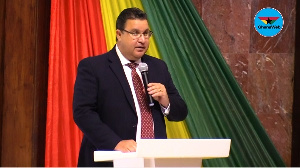
    Addressing journalists in Accra, Government Statistician Professor Samuel Kobina Annim emphasized the need for policymakers to address transportation costs, which saw a month-on-month inflation rate of 10.5%, rather than focusing solely on food inflation as the main driver of the overall inflation rate.

    “In this case what I want the media and policymakers to engage is not food inflation but in this case, transport where we are seeing month-on-month transport inflation of 10.5% when overall month-on-month is 3.2% and we all do appreciate how transport permits across the other items that we have in the basket for the competition.

    “So the conversation that I really wish will be on the table going forward is how do we ensure that the consistent but slow increases in prices of food at other points would slow down and possibly see reduction going forward.”

  • Krom ay3 shi! – Minority leader ‘cries out’ over exorbitant food prices on the market

    Krom ay3 shi! – Minority leader ‘cries out’ over exorbitant food prices on the market

    The Minority Leader, Dr Cassiel Ato Forson, has raised concerns over the alarming trends in food prices, which have skyrocketed since the beginning of the year.

    According to him, the recent report from the World Food Programme (WFP) for March 2024 has revealed that more than one million Ghanaians are likely to face food insecurity between now and August due to rising food prices.

    This, he says, is increasingly dire.

    “Mr. Speaker, the projections and statistics on the food situation in Ghana are grim. For instance, the price of a bucket of tomatoes has seen a dramatic increase of 140%, going from GHS75 at the start of the year to GHS180 currently. Similarly, the cost of a crate of tomatoes has surged by over 360%, rising from GHS1,500 in January to GHS7,000 in June. The price of a sack of onions nearly doubled in just one week, jumping from GHS600 to GHS1,050.

    In addition, a sack of kokonte, which was sold for GHS900 in December 2023, now sells for GHS1,100, marking a 22.2% increase in just five months. The price of a tuber of yam has increased by 20%, from GHS25 in December 2023 to GHS30 currently. Even a 5kg bag of rice, which sold for GHS170 in December 2023, now costs GHS185, reflecting an approximate 9% rise.

    He pointed out that this phenomenon is particularly noticeable with popular local foods.

    “I am sure those of you who have bought Ga Kenkey or Nkran dokon lately, will appreciate the food shrinkflation that I am talking about.”

    The Minority Leader summed up the situation by stating “Mr. Speaker, kurom ay3 hye. Times are very hard! Ghanaians are suffering!”

  • Inflation predicted to drop to 21% in May 2024 and to 17% by year’s end

    Inflation predicted to drop to 21% in May 2024 and to 17% by year’s end


    In May 2024, inflation is projected to decrease to a level of 21% and is anticipated to conclude the year at approximately 17%.

    GCB Capital attributes this to base effects.

    Nevertheless, it voiced apprehension regarding the expected transmission of the ongoing depreciation of the cedi and its delayed repercussions, stating, “The secondary effects continue to pose an upward risk to the short-term forecast.”

    “We have also seen the multiple upward adjustments in ex-pump petroleum prices, which result in transport fare hikes, and its full pass-through to general prices is yet to come. With the quarterly utility tariff adjustment still to come amidst the general macroeconomic uncertainties, the risk of near-term inflation is quite pronounced, requiring a continuously tight monetary policy stance to anchor inflation expectations and the disinflation process”.

    In April 2024, inflation declined to 25.0% from 25.8% in March 2024.

    Consequently, the Monetary Policy Committee (MPC) upheld an appropriately stringent monetary policy stance in light of the emerging upward risks to inflation stemming from currency pressures, recent increases in transportation fares, and their potential delayed impact on inflation.

    The Committee noted that its latest projections indicate a somewhat elevated inflation trajectory, attributed to the recent series of cedi depreciations and hikes in transportation fares.

    However, it anticipates the disinflationary trend to persist overall, forecasting headline inflation to fall within the monetary policy consultative range of 13% to 17% by the end of 2024. This projection hinges on maintaining the rigorous monetary policy stance, which includes assertive liquidity management measures.

    GCB Capital concluded that “The decision is consistent with our expectations and the consensus market view as the upside risks to inflation are evident”.

  • It’s better to borrow from loan sharks than from banks in Ghana – Franklin Cudjoe

    It’s better to borrow from loan sharks than from banks in Ghana – Franklin Cudjoe

    The savings culture of most Ghanaians has taken a hit due to ongoing economic challenges such as a depreciating local currency, high interest rates, and surging inflation.

    These challenges are impacting Ghanaians of all age groups, severely limiting investment opportunities due to steep interest rates for borrowing in both the public and private sectors.

    In response to the high interest rates, the Founding President of the policy think-tank, IMANI Africa, has proposed an unconventional solution.

    He suggests that borrowing from loan sharks may be a more viable option than borrowing from banks with excessively high interest rates.

    Franklin Cudjoe, in a post shared on X on May 22, also criticized President Akufo-Addo’s recent remarks about his legacy, suggesting that it falls short of being enviable during his 7-and-a-half-year tenure in office.

    “Borrowing from loan sharks may be more favorable than borrowing from banks in Ghana. 55% interest rates and Nana Addo says he has left an enviable legacy?” Franklin Cudjoe wrote.

    Businesses, particularly in the private sector, have expressed concern over the high interest rates and have constantly asked the government and Central Bank to enact policies aimed at lowering lending interest rates.

    The private sector, which frequently depends on loans for business operations, has been pushed out as a result of this circumstance.

  • Ghana’s inflation falls to 25% in April

    Ghana’s inflation falls to 25% in April

    Inflation for April 2024 has marginally decreased to 25% from the 25.8% recorded in March 2024, indicating a 0.8% slowdown in the inflation rate for the month.

    The Ghana Statistical Service (GSS) attributes the overall drop in inflation to a decrease in food inflation, which reached 26.8%, the lowest in 13 months, along with non-food inflation, which stood at 23.5%.

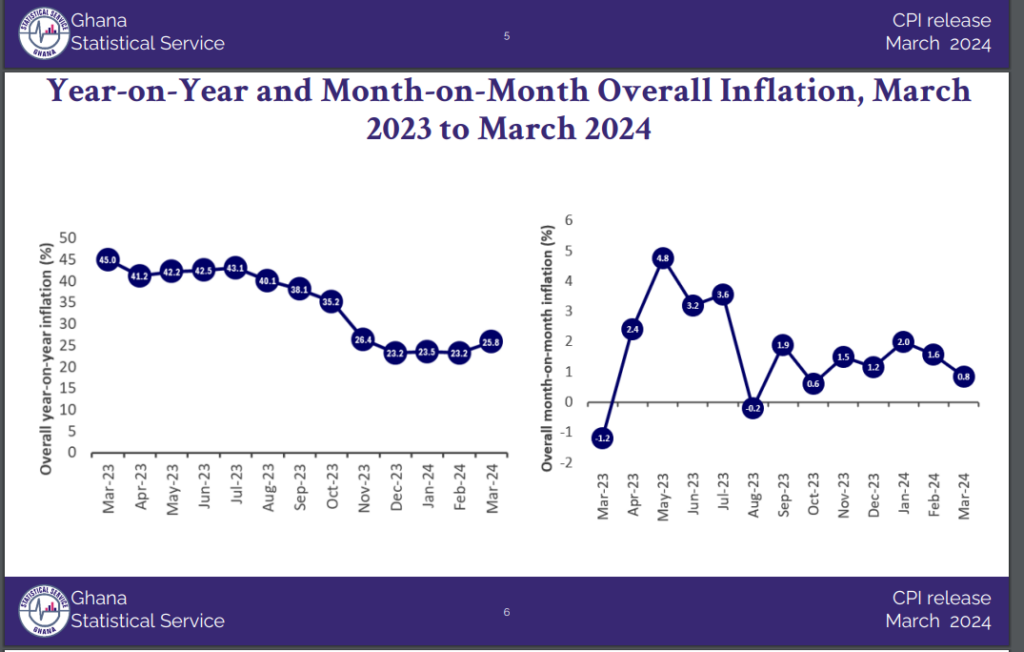
    In March 2024, Ghana’s consumer inflation rose to a four-month high of 25.8% year-on-year, up from 23.2% the previous month, significantly exceeding the central bank’s target band of 6% to 10%.

    The chief statistician, Samuel Kobina Annim, attributed the sharper rise in inflation to a depreciating currency, which led to higher costs for imported goods. He made these remarks in the capital, Accra, on Wednesday.

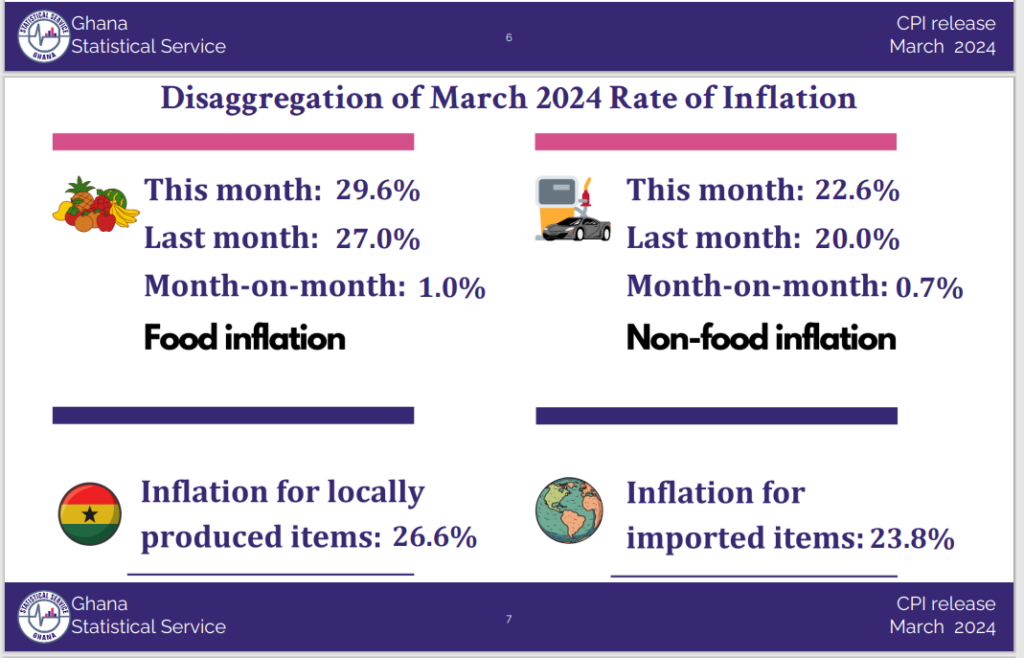
    Both food (29.6% vs 27% in February) and non-food product prices (22.6% vs 20%) increased, particularly fuels. The Ghanaian cedi has depreciated by nearly 11% against the US dollar since the beginning of the year due to a stronger dollar, a decrease in cocoa output, and delays in debt restructuring.

    The cedi’s depreciation against the dollar, about 11% so far this year, has made it the fourth worst-performing currency among those tracked by Bloomberg.

  • Ghana on track to reach 8% single-digit inflation rate by 2025 – IMF

    Ghana on track to reach 8% single-digit inflation rate by 2025 – IMF

    The International Monetary Fund (IMF) foresees Ghana ending 2025 with single-digit inflation, estimating it at 8%, in line with the government’s objectives.

    Ghana aims to reduce its end-year inflation from 23% to 15% in 2024, further plummeting to single digits by 2025.

    Although Ghana last achieved single-digit inflation in 2021, subsequent years witnessed a drastic rise, hitting a 22-year high of 54.1% despite a targeted rate of 31.9%.

    However, the IMF’s World Economic Outlook Report at the ongoing IMF/World Bank Spring Meetings paints a promising picture.

    This 8% projection credits the robust measures and progress achieved under the IMF program.

    The Bank of Ghana commits to staying within its 2024 end-year target band of 15%, plus or minus two percent, while expecting the disinflation trend to persist, mitigating underlying inflation risks through stringent monetary policies.

    Furthermore, the IMF predicts a robust 4.4% growth for Ghana in 2025, a marked improvement from the 2.8% forecast for 2024. Nevertheless, it anticipates a -2.2% decline in Ghana’s current account balance, reflecting trade and financial activities.

    Despite this setback, the IMF maintains an optimistic outlook, expecting a substantial economic rebound for Ghana in the coming years.

  • Ghana to end 2025 with 8% inflation rate – IMF projects

    Ghana to end 2025 with 8% inflation rate – IMF projects

    The International Monetary Fund (IMF) is projecting that Ghana will achieve single-digit inflation by the end of 2025, with an end-of-year inflation rate of 8 percent.

    The IMF’s Economic Outlook Report also forecasts an end-of-year inflation rate of 15 percent for 2024, which is consistent with the Bank of Ghana’s inflation projection for the same year, according to a JoyBusiness report.

    The projection is based on the measures implemented by the government under the IMF program and the Bank of Ghana’s commitment to maintaining tight monetary measures to address inflation pressures.

    However, there have been no official reasons provided by the IMF for this projection.

    The Bank of Ghana has set an inflation target of 15 percent “Plus 2 or Minus two” for 2024, meaning inflation could range from 13 percent to 17 percent by the end of the year.

    However, there are concerns about whether the government will meet its 15 percent target as projected in the 2024 Budget, especially with recent increases in the prices of petroleum products and the potential hike in transport fares.

    Despite these concerns, Bank of Ghana Governor Dr. Ernest Addison expects inflation to decrease in the coming months, stating that the Bank has no intention of revising its end-of-year target.

    Ghana last recorded single-digit inflation in July 2021. If the IMF’s projection is accurate, Ghana could return to single-digit inflation by the end of 2025.

    Before April 2020, inflation had remained stable at 7.8 percent for three months. However, the onset of the COVID-19 pandemic led to a spike in inflation, reaching 10.6 percent in April before declining to 9.8 percent in November 2020.

    As of March 2024, Ghana’s inflation stood at 25.8 percent, compared to 45.0 percent in March 2023.

  • 25.8% inflation rate in March won’t disrupt disinflation trend – Analyst

    25.8% inflation rate in March won’t disrupt disinflation trend – Analyst

    Head of Research at GBC Capital, Courage Boti, has described the recent surge in inflation in March as “not surprising” and assures that it does not pose a significant threat to the ongoing trend of disinflation.

    Data from the Ghana Statistical Services (GSS) indicates that consumer inflation soared to 25.8 percent in March 2024, the highest level since November of the previous year.

    This increase, up from 23.2 percent in February 2024, is attributed largely to base drift effects resulting from a sharp price decline in March 2023.

    Despite the uptick, Mr Boti remains unfazed, stating, “It is an increase but I am not surprised. My expectation was 26 percent. Will this be a trend that continues? Admittedly, there are upside risks to inflation, but from April we should begin to see a return to the path of disinflation. The exchange rate, petroleum price and impending transportation price hikes will serve to moderate the pace of disinflation but we expect that without any significant shocks. The general trend is that there will be a continuous decline in inflation”.

    He anticipates a return to the disinflation path from April onwards, citing factors such as exchange rate stability, petroleum price moderation, and anticipated transportation price adjustments.

    Boti projects that inflation will close the year at under 20 percent, attributing this to factors such as adherence to fiscal discipline under the International Monetary Fund (IMF) program and a potential decrease in liquidity and Treasury bill yields due to recent cash reserve requirements by the Bank of Ghana.

    Government Statistician, Professor Samuel Kobbina Annim, while acknowledging the broad-based nature of the inflation surge, particularly in food prices, emphasizes that the increase cannot solely be attributed to imported food.

    Both food and non-food prices experienced a 2.6 percentage point increase in March, indicating widespread inflationary pressures.

    Market analysts had anticipated the rise in inflation, citing ongoing cedi weakness and recent hikes in ex-pump petroleum prices as contributing factors. Despite this, the month-on-month inflation rate declined from 1.6 percent in February to 0.8 percent in March, suggesting potential easing of underlying inflationary pressures.

    GCB Capital maintains its end-2024 inflation forecast at 16.5 percent ±1 percent, expecting the disinflation trend to resume from April 2024.

    “If you look at the food that is imported, out of the 176 items that recorded price changes higher than 25.8 percent, we had 15.9 percent of the food that is imported relative to food that is local, which constituted 23.3 percent.

    “So one cannot argue that imported food is driving the 29.6 percent that we are seeing in March 2024, because we are equally seeing that local food constituted about 41 of the 176 items that recorded price changes higher than 25.8 percent,” he said.

    “What is coming to us for the first time in a while is a division like health that hitherto we would hardly find it as a division that will record a rate of inflation higher than the overall rate of inflation,” Prof. Annim observed.

    “But we are now seeing health coming up as one of the six divisions that are pointing to the higher rate of inflation.”

    “We, however, flag the simmering cedi depreciation amid immediate liquidity concerns and its potential pass through to ex-pump fuel prices in the wake of the lingering crude oil supply concerns due to geopolitics as an immediate upside risk to inflation through the transport channel and general market prices,” said GCB Capital in its March review of the inflation data.

    “What we need to pay emphasis, what we need to pay attention to is year-on-year and month-on-month inflation moving in different directions as we rightly saw for the second time; we are seeing a dip in month-on-month inflation,” Prof. Annim explained.

    “All this would have implications in the coming months in terms of how the month-on-month inflation would feed into the year-on-year inflation.”

    The data revealed that both food and non-food prices saw a 2.6 percentage point increase in March, suggesting broad-based inflationary pressures. Notably, the health sector emerged as one of the six divisions recording inflation rates higher than the national average.

    However, analysts remain cautious about potential fiscal overruns leading up to the 2024 election, which could pose an upside risk to inflation in the latter part of the year.

  • GCB Capital predicts 1.0% inflation decline in April 2024

    GCB Capital predicts 1.0% inflation decline in April 2024


    A Research Group, known as GCB Capital predicts that inflation will go down again in April 2024 after going up in March, which was the highest in four months.

    The group indicates that inflation will drop by 1.0% in April 2024, but it will still be higher than it was in February 2024. They say this drop is mainly because of lower food prices.

    In March 2024, inflation went up to 25.8%, which was a big increase. GCB Capital thinks this increase is temporary, but there are still risks that inflation could go up more, especially because of higher petrol prices and possible increases in transport fares.

    They also say that if the price of Brent crude oil goes up to $100 per barrel, it could make petrol prices go up too, which would increase inflation.

    Additionally, because there is not enough foreign money coming into the country and the local currency is losing value, this could also make inflation go up in the future.

  • March records 2.6% increase in inflation rate

    March records 2.6% increase in inflation rate

    In March 2024, inflation surged to 25.8%, up from February’s 23.2%, representing a 2.6% increase.

    This indicates a 25.8% increase in the general price level compared to March 2023. Non-food inflation rose by 22.6%, while food inflation reached 29.6%.

    Locally produced items saw a 26.6% increase, while imported items rose by 23.8%. The main drivers of this inflation hike were food and non-alcoholic beverages, as well as transport.

    Government spokesperson Prof. Samuel Kobina Annim stated in a press briefing that this increase represents a 2.6 percentage point surge.

  • Ghana’s inflation surges from 23.2% in February to 25.8% in March

    Ghana’s inflation surges from 23.2% in February to 25.8% in March


    In Ghana, inflationary pressures increased from 23.2 percent in February to 25.8 percent in March of this year, as reported by the Ghana Statistical Service.

    The rise is attributed to the depreciation of the cedi, which has elevated the prices of imports, along with escalating costs of fuel products and food items for consumers.

    Stay tuned for further updates…

  • 15 countries with highest inflation rates globally

    15 countries with highest inflation rates globally


    Inflation, a widely discussed economic concept worldwide, refers to the increase in prices over a specific period. It reflects the overall rise in the cost of living or the price escalation of particular goods and services.

    Whether observing the surge in grocery prices or the rise in housing expenses, inflation indicates the extent to which purchasing power diminishes over time, typically measured on an annual basis.

    Government agencies utilize various methods to measure inflation, often relying on consumer price indices (CPIs) to monitor changes in the cost of a predetermined basket of goods and services.

    The CPI basket typically includes items commonly purchased by households, with housing expenses frequently being the largest component.

    By comparing the cost of this basket over time, relative to a base year, analysts calculate the consumer price inflation rate, a widely recognized measure for tracking inflation.

    Core consumer inflation, a subset of this analysis, focuses on persistent inflation trends by excluding government-regulated prices and the more volatile costs of items like food and energy.

    Core inflation provides policymakers with valuable insights into underlying economic trends, free from temporary supply disruptions or seasonal fluctuations.

    For a broader view of inflation, economists turn to indices like the GDP deflator, which encompasses a wider range of economic activities beyond consumer spending.

    High inflation drivers

    High inflation often stems from loose monetary policies, where an excessive increase in the money supply outpaces economic growth, eroding currency value and driving up prices—a principle known as the quantity theory of money.

    Additionally, supply or demand shocks can fuel inflationary pressures.
    Supply disruptions, like natural disasters or spikes in production costs, can trigger “cost-push” inflation, while demand surges or expansionary fiscal and monetary policies may lead to “demand-pull” inflation by straining production capacity.

    Nairametrics has compiled a list of the top 15 countries with the highest inflation rates in the world as at February 2024.

    15. Myanmar Inflation rate: 28.58%

    Myanmar’s inflation rate surged to 28% in the second quarter of 2023, up from 27.5% in the previous quarter. Over the period from 1998 to 2023, the country’s inflation averaged 13.16%. Notably, it hit an all-time high of 54.02% in the fourth quarter of 2002 and reached a record low of -1.09% in the fourth quarter of 2011.

    14. Cuba Inflation rate: 31.34%

    Cuba’s annual inflation rate declined to a 18-month low of 31.34% in December 2023, down from 31.78% in November and 34.13% in the preceding month. The country’s inflation rate averaged 28.14% from 2005 to 2023. Notably, it peaked at 77.3% in December 2021 and hit a record low of 0.8% in December 2008.

    Nigeria Inflation rate: 31.7%

    In February 2024, Nigeria witnessed a surge in its annual inflation rate, reaching a new high not seen since 1996, at 31.7%. This marked an increase from 29.9% recorded in January and surpassed market expectations of 31%.

    The spike was primarily attributed to the removal of oil subsidies and the devaluation of the Nigerian naira. Following the liberalisation of the foreign exchange market in June 2023, the naira depreciated by 69% by mid-February 2024. Consequently, import costs surged, profoundly impacting Nigeria’s import-dependent economy.

    Malawi Inflation rate: 33.5%

    In February 2024, Malawi’s annual inflation rate stood at 33.5%, showing a decrease from the 35% reported in January 2024. Notably, food and non-food inflation rates were recorded at 42% and 22.1%, respectively.

    Egypt Inflation rate: 35.7%

    In February 2024, Egypt’s annual urban inflation rate surged for the first time in five months, reaching 35.7%. This marked a notable increase from January’s 12-month low of 29.8% and exceeded forecasts of 25.1%.

    It represented the highest inflation rate since October, driven by steep increases in food prices by 50.9%, transport by 17.6%, and housing by 10%. The rise followed the government’s decision to hike Cairo metro ticket prices by up to 20% in January, along with increases in internet services by 33% and electricity prices by 26%.

    Iran Inflation rate: 35.8%

    In February 2024, Iran’s point-to-point inflation rate declined to 35.8% from 38.5% in the previous month. This decrease marked the lowest inflation rate since April 2022. Notably, food prices experienced the smallest increase since September 2020, rising by 31.6% compared to 38.9% in January.

    Congo Inflation rate: 46.8%

    The inflation rate in Congo rose to 46.8% in December 2023, up from 45.8% in November of the same year. The average inflation rate in Congo from 1999 to 2023 stood at 23.22%. Congo experienced its highest inflation rate of 511.21% in December 2000 and its lowest of 1.35% in April 2013.

    Sierra Leone Inflation rate: 47.42%

    In January 2024, the inflation rate in Sierra Leone dropped to 47.42% from 52.16% in December 2023. Over the period from 1986 to 2024, the average inflation rate in Sierra Leone was 28.14%. Sierra Leone’s highest inflation rate of 255.56% was recorded in April 1987, while its lowest was -21.76% in January 2000.

    Zimbabwe Inflation rate: 47.6%

    In February 2024, Zimbabwe’s annual inflation rate surged for the fourth consecutive month, reaching 47.6%, the highest level in over a year, up from 34.8% in the previous month. This increase in inflation is primarily attributed to the ongoing depreciation of the Zimbabwean dollar against the US dollar.

    Sudan Inflation rate: 63.3%

    Sudan’s inflation rate declined to 63.3% in February 2023 from 83.6% in January of the same year. The average inflation rate in Sudan from 1971 to 2023 stood at 69.5%, with the highest recorded at 422.78% in July 2021 and the lowest at -1% in December 1979.

    Turkey Inflation rate: 67.07%

    In February 2024, Turkey’s annual inflation rate climbed to 67.07%, up from 64.86% in the preceding month, surpassing market expectations of 65.74%. This marked the highest level since November 2022, primarily fuelled by a significant increase in the minimum wage and government tax adjustments.

    Venezuela Inflation rate: 75.9%

    In February 2024, Venezuela’s inflation rate declined to 75.9% from 107.4% in January of the same year. Venezuela’s inflation rate has averaged 3605.78% since 1973, with a record high of 344509.5% in February 2019 and a record low of 3.22% in February 1973.

    Lebanon Inflation rate: 123%

    In February 2024, Lebanon experienced a decrease in its annual inflation rate, which fell to 123.2% from 177.3% in the previous month. This decline marked the lowest inflation rate since December 2022. The reduction was primarily attributed to softer increases in housing and transport prices, while food prices saw the smallest rise in nearly four years.

    Syria Inflation rate: 140%

    Syria’s inflation rate dropped to 139.6% December 2023 from144.6% in November of the same year. Over the period from 1957 to 2023, the average inflation rate stood at 16.09%. The highest recorded inflation rate was 188.4% in March 2021, while the lowest was -31.05% in September 2014.

    Argentina Inflation rate: 276%

    In February 2024, Argentina’s inflation rate rose to 276.2% from 254.2% in January of the same year. Over the period from 1944 to 2024, the average inflation rate stood at 189.97%. The highest recorded inflation rate was 20262.8% in March 1990, while the lowest was -7% in February 1954.
  • Keep reducing inflation, making progress in debt restructuring – IMF tells Ghana

    Keep reducing inflation, making progress in debt restructuring – IMF tells Ghana

    The International Monetary Fund (IMF) has emphasized the importance of fiscal prudence and economic reforms for Ghana’s long-term prosperity.

    Managing Director of IMF, Kristalina Georgieva, highlighted the need to build on the progress achieved under the three-year, three billion-dollar extended credit facility. She emphasized the importance of promoting inclusive growth through these measures.

    “Your growth is better expected, your inflation is lower than expected, the progress in debt restructuring has been faster than expected and now the task is to cement what has been achieved and do it with the unity of this country”.

    During a meeting with President Akufo-Addo, Madam Georgieva acknowledged the strength of Ghana’s economy but cautioned the government to remain vigilant to maintain the ongoing recovery.

    “It is the year to bring confidence in Ghana domestically and internationally at the level it was before. It is possible because we are seeing a world slightly better, so the economic attributes are better, and the critical resource of money will go where confidence in the capacity to perform is highest. So Ghana can be in this place, as it was before. We need to stay the course, Ghana has achieved in a short time of the programme – good indicators”, she stressed.

    President Akufo-Addo highlighted the positive outcomes of Ghana’s decision to seek a balance of payment support from the International Monetary Fund (IMF).

    He credited the recent decline in inflation and the stability of the local currency to the IMF support programme, expressing satisfaction with the results of the bailout.

    The President emphasized that despite challenging economic circumstances, the decision to seek IMF support in July 2022 had proven beneficial and contributed to a noticeable turnaround in Ghana’s economy.

    “The dire circumstances in which we were at the time that we took that very difficult decision and where we are today is a very clear testimony that our decision to seek your support is a decision that was correct, and we have had some benefits from it”, the President pointed out.

  • Inflation decreased to 23.2% in February 2024 – GSS

    Inflation decreased to 23.2% in February 2024 – GSS

    Recent statistics from the Ghana Statistical Service (GSS) reveals a downturn in inflation, with the February rate reaching 23.2%.

    This marks a decline of 0.3 percentage points from January’s recorded rate of 23.5%.

    During a press conference held in Accra on Wednesday, Government Statistician Prof. Samuel Kobina Anim provided a comprehensive breakdown of the data.

    He explained that the 23.2% figure indicates an overall increase in the prices of both goods and services.

    “The February rate of inflation fell to 23.2 percent. This year-on-year inflation signifies that over a one-year period, prices of goods and services have gone up by 23.2 percent.

    “This figure is a reversal of the marginal increase we recorded in the month of January 2024, when the slowdown that we have successfully recorded for the last seven months saw a marginal increase to 23.5 percent. In reverse, we have turned around this increase for January 2024 to a reverse of 23.2 percent.”

    According to the Consumer Price Index data released by the GSS, food inflation stands at 27.0% while non-food inflation stands at 20.0%.

    “From a food and non-food inflation perspective, food inflation for February 2024 stood at 27.0 percent and non-food inflation for the month of February 2024 stood at 20.0 percent.”

  • BoG forecasts inflation decline to 13-17% by 2024, targeting 6-10% by 2025

    BoG forecasts inflation decline to 13-17% by 2024, targeting 6-10% by 2025

    The Bank of Ghana foresees a further decrease in headline inflation, expected to fall within the range of 13-17% by the end of 2024, gradually returning to the medium-term target range of 6-10% by 2025, unless unforeseen disruptions occur.

    As outlined in the January 2024 Monetary Policy Report, the ongoing disinflation process is anticipated to persist, with clear indications that the existing macroeconomic framework, backed by the International Monetary Fund-Economic Credit Facility program, is yielding positive outcomes.

    While the report highlights potential risks to the inflation outlook, particularly related to geopolitical tensions and their potential impact on commodities markets, particularly international crude oil prices, the Bank of Ghana emphasizes that all indicators of core inflation are declining, signaling a sustained alleviation of underlying inflationary pressures.

    Improved foreign exchange inflows from IMF-ECF disbursements, the cocoa syndicated loan, and expected funding from the World Bank are expected to bolster forex inflows.

    Furthermore, initiatives such as the Gold for Reserves program, repatriation of foreign exchange from mining and oil companies, and reduced debt service payments are projected to bolster reserve accumulation and promote exchange rate stability, further aiding the disinflation process.

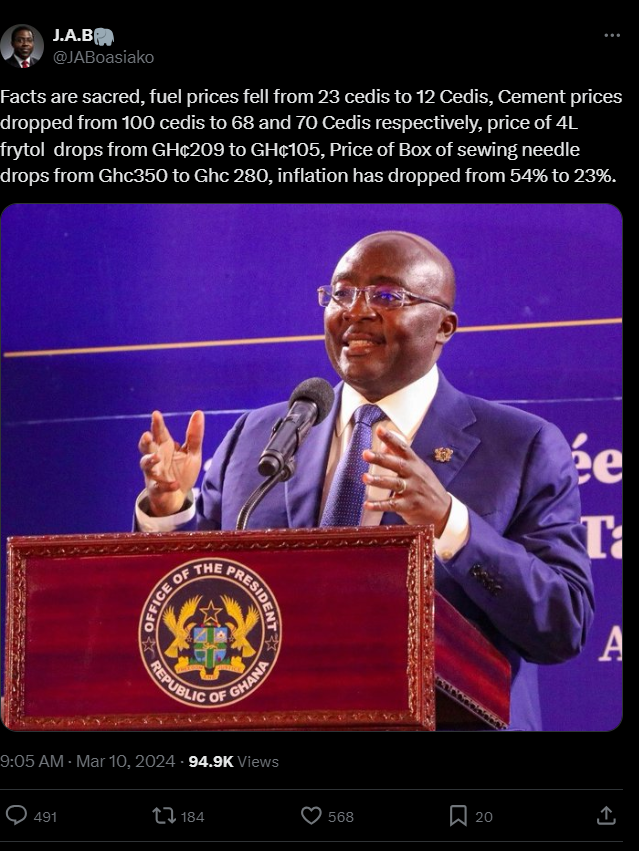
  • Facts are sacred; the economy is in good hands – X user

    Facts are sacred; the economy is in good hands – X user

    X-user, Kweku Bosiako claims a positive shift in the economic landscape, asserting that the prices of goods and services have reverted to standard figures.

    On Twitter’s X-platform, Bosiako provided examples, highlighting significant reductions such as fuel prices dropping from 23 cedis to 12 cedis and cement prices decreasing from 100 cedis to 68 and 70 cedis.

    According to his observations, Ghana’s inflation has notably decreased from 54% to 23%. Bosiako confidently asserts, “Facts are sacred,” underscoring the encouraging trend of economic normalization.

    “Facts are sacred, fuel prices fell from 23 cedis to 12 Cedis, Cement prices dropped from 100 cedis to 68 and 70 Cedis respectively, price of 4L frytol  drops from GH¢209 to GH¢105, Price of Box of sewing needle drops from Ghc350 to Ghc 280, inflation has dropped from 54% to 23%,” Kweku Bosiako stated.

    The economic revelations by Kweku Bosiako have stirred conversations and generated optimism among the public.

    See tweet below:

  • Such a joke! Togbe Afede XIV blasts BoG’s 1% policy rate cut

    Recent reduction of the monetary policy rate by 1 percent [from 30% to 29%] by the Bank of Ghana (BoG) has been criticised by Togbe Afede XIV, the Agbogbomefia of Asogli State, who described it as a joke.

    The Central Bank’s Monetary Policy Committee made this decision during its first meeting of the year on January 29, 2024, following a review of economic developments in the country.

    According to Dr. Ernest Addison, the Governor of the Bank of Ghana, the decision was influenced by a decline in core inflation figures and various factors supporting the disinflation process.

    However, Togbe Afede XIV strongly opposes the Central Bank’s decision, questioning the actual impact of the 1 percent rate reduction on lending rates, inflation, exchange rates, or overall economic growth.

    In a write-up sighted by GhanaWeb Business, the economist wrote, “I wonder whether they have determined the correlation between interest rates, inflation, and exchange rates in our country.”

    “The hesitant 1% rate cut to 29% is particularly surprising given their expectation that headline inflation would “ease to 15%±2% by the end of 2024 and gradually trend back to within the medium-term target range of 8%±2% by 2025.”

    I do not see the relationship between the expected or target 15%±2% inflation and the high 29% monetary policy rate. It gives the impression that our top economists do not believe in themselves or their own forecasts,” he explained.

    Togbe Afede XIV also voiced concerns regarding the credibility of Central Bank officials and economic managers, suggesting that their recent assertion of “emerging recovery” contradicts previous statements indicating the economy had “turned the corner.”

    While acknowledging the complexity of interactions among macroeconomic variables, Togbe Afede XIV emphasised that the Central Bank’s policy rate and open market operations should ideally influence the inflation rate.

    “But BOG officials still have a fixation on headline or year-on-year inflation, and so they cannot depart from their reactionary monetary policy approach, which responds to what has transpired, that is, past one-year price changes, instead of their expectation of inflation (15%±2% this year).

    So, the 1% reduction in the policy rate appears to be a reaction to the 3.2% fall in headline inflation in December to 23.2%, from 26.4% % in November,” Togbe Afede XIV emphasised.

  • Producer Price Inflation slightly rises to 17.4% in January 2024

    Producer Price Inflation slightly rises to 17.4% in January 2024

    In January 2024, the Producer Price Inflation (PPI) edged up to 17.4%, a modest increase from the 16.6% recorded in December 2023. This signifies a year-on-year rise of 0.8 percentage points compared to the previous month.

    The month-on-month change in PPI between December 2023 and January 2024 stood at 1.7%.

    PPI reflects the average prices of goods and services received by domestic producers for their production activities.

    Data from the Ghana Statistical Service indicates that sectors like electricity and gas, construction, mining and quarrying, and accommodation and food services recorded rates surpassing the national average.

    Conversely, manufacturing activity reported the lowest rate at 9.7% in January 2024.
    Meanwhile, the services sector experienced a slight dip of 0.7%, registering a rate of 16.9% in January 2024.
    Additionally, inflation for January 2024 ticked up marginally from 23.2% to 23.5%.

  • Don’t expect to spend the same money you did two years ago – Hawa Koomson on economy

    Don’t expect to spend the same money you did two years ago – Hawa Koomson on economy

    Minister of Fisheries and Aquaculture, Mavis Hawa Koomson, has weighed in on the current economic landscape, cautioning against expectations of spending the same amount of money as in previous years.

    During a recent interview on Onua FM’s morning show, Yɛn Nsɛmpa, Koomson emphasized the need to adapt to changing circumstances in the face of rising costs.

    “Food is expensive but it is available,” Koomson stated. “Don’t expect that last year you were able to purchase cassava for Gh50, you can do same this year. No, that is not how it works. The world is progressing.”

    The minister pointed out that evolving tastes and preferences contribute to changes in spending habits. She explained that if individuals were spending a certain amount of money on food two or three years ago, they should not expect to spend the same amount today.

    “So what you were spending 2 or 3 years ago, you should not expect to be spending the same thing this year,” Koomson remarked. “It shows that you are not progressing. Because your taste has changed.”

    Hawa Koomson used the example of preparing fufu with fish, stating that if Gh50 could cover the cost in the past, adding beef or goat meat to the meal would naturally come with an additional cost.

    The minister’s comments come amid concerns about the rising cost of living in Ghana, with many grappling with the impact of inflation and other economic challenges.

  • February and March to see 26.0% rise in Ghana’s inflation

    February and March to see 26.0% rise in Ghana’s inflation

    GCB Capital has predicted that inflation in Ghana could rise further in February and March 2024, reaching within the 26.0% bracket.

    This projection follows a marginal increase in year-on-year inflation to 23.5% in January 2024, up from 23.2% in December 2023, primarily due to unfavorable base drift.

    The report from GCB Capital suggests that inflation will return to a path of disinflation from April 2024, with an expectation of headline inflation falling below 20.0% from May 2024.

    The end-of-year outlook for 2024 is pegged at 16.5% ±1%, assuming all other factors remain constant.

    Despite the positive outlook, GCB Capital acknowledges potential risks to inflation, including cedi depreciation and its potential pass-through effects.

    The report also highlights the risk of unrestrained expenditure in the lead-up to the 2024 elections, which could reignite demand-driven price pressures around the peak of the political season.

    The ongoing IMF program is noted as providing a foreign exchange liquidity cushion, but uncertainties remain concerning its long-term impact on inflation.

  • Ghana Statistical Service reports increase in January 2024 inflation

    Ghana Statistical Service reports increase in January 2024 inflation

    Recent data released by the Ghana Statistical Service reveals a slight uptick in inflation, reaching 23.5 percent in January 2024.

    This marks a reversal from five consecutive months of decline. On February 14, 2024, Government Statistician Samuel Kobina Annim announced the year-on-year inflation rose from 23.2 percent in December.

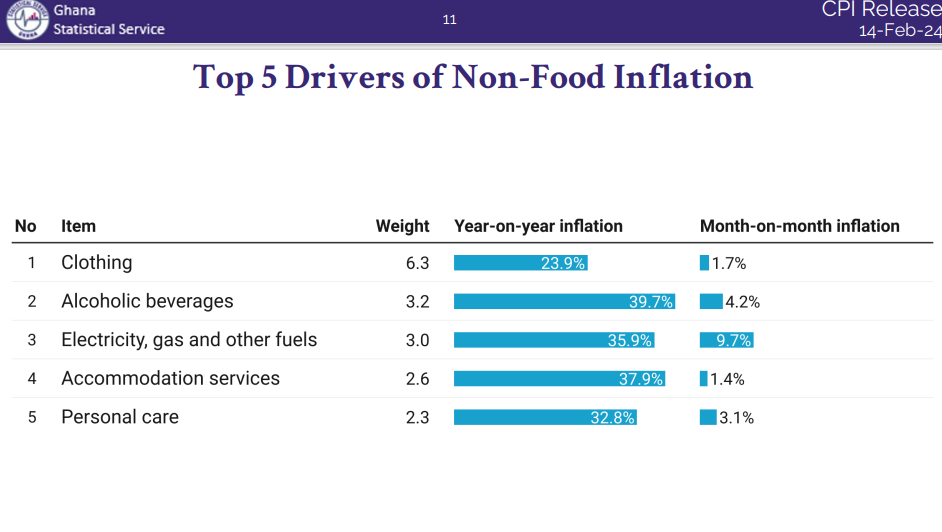
    Attributed primarily to a significant surge in non-food items like housing, clothing, and transport, the increase in year-on-year inflation is highlighted in a Graphic Online report.

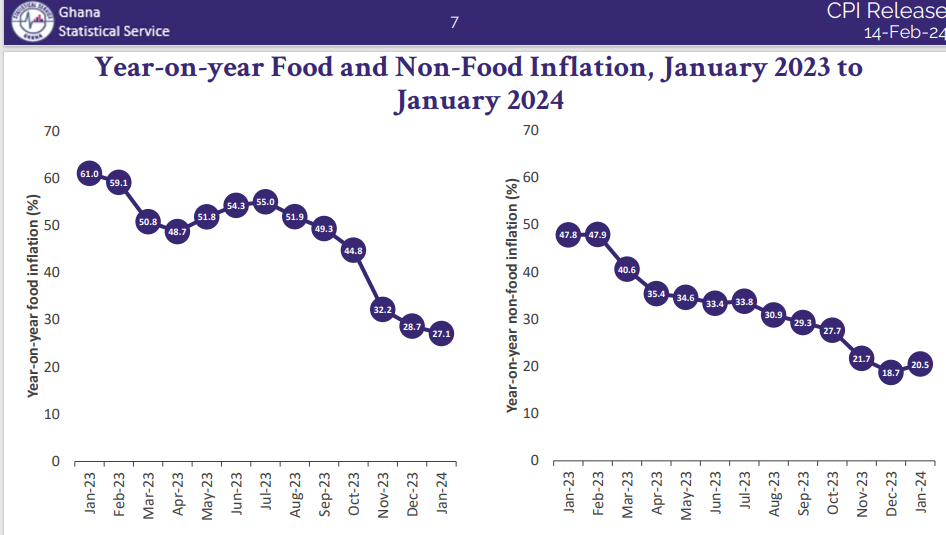
    Inflation outside of food increased from 18.7 percent in December 2023 to 20.5 percent in January 2024. But food inflation did continue to decline, if only slightly, from 28.7 percent in December 2023 to 27.1 percent in January 2024.

    Food inflation was estimated to be 1.6 percent month-over-month, while non-food inflation was estimated to be 2.4 percent. Inflation rates in seven divisions have been found to be higher than the national average.

    These include Restaurants and Accommodation Services (29.2 percent), Personal Care, Social Protection, and Miscellaneous Goods and Services (32.0 percent), and Alcoholic Beverages, Tobacco, and Narcotics (38.5 percent).

    Ten of the fifteen Sub-Classes with food inflation rates recorded rates higher than the overall food inflation rate of 28.7 percent; the highest rates were recorded by Cocoa Drinks (73.5 percent) and Tea and related products (71.2 percent).

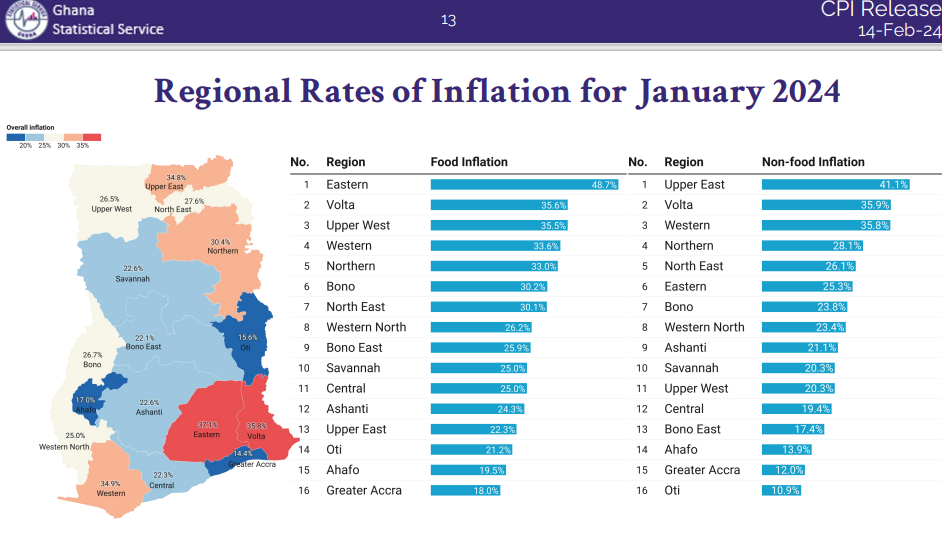
    Food prices were the main cause of the Eastern Region’s 37.1 percent inflation rate, which was highest, and the Greater Accra Region’s 18 percent inflation rate was lowest.

  • Inflation marginally increases to 23.5% in January

    Inflation marginally increases to 23.5% in January

    Ghana’s inflation rate experienced a slight increase from 23.2% to 23.5% in January 2024, reversing the declining trend seen from July to December 2023.

    This uptick is primarily due to higher non-food inflation drivers like accommodation, electricity, and clothing. However, food inflation continued to decrease during this period.

    The unexpected rise comes shortly after the Central Bank reduced its monetary policy stance by 100 basis points in response to the previous downward trend in inflation.

    Comparing January 2024 to January 2023, the general price level was 23.5% higher. Month-on-month inflation between December 2023 and January 2024 was 2.0%.

    Regionally, the Eastern Region had the highest inflation rate at 37.1%, driven by food prices. In contrast, the Greater Accra Region had the lowest inflation rate at 18%.

  • Highest inflation, haircut on people’s investment, others, makes Akufo-Addo’s govt worse than Mahama’s – Jinapor

    Highest inflation, haircut on people’s investment, others, makes Akufo-Addo’s govt worse than Mahama’s – Jinapor

    Member of Parliament for Yapei-Kusawgu, John Jinapor, has staunchly defended the previous John Mahama administration, arguing that it outperformed the current Akufo-Addo/Bawumia government.

    In his capacity as the Ranking Member on Parliament’s Mines and Energy Committee, Jinapor emphasized the unprecedented hardships faced by Ghanaians under the current regime, describing them as unparalleled in the nation’s history.

    Pointing to rising taxes, increasing living expenses, and investor losses as clear indicators, Jinapor insisted that the New Patriotic Party (NPP) could not refute his assertions.

    During an appearance on Metro TV on Tuesday, February 6, the former Deputy Power Minister urged Ghanaians to hold the NPP accountable in the upcoming December polls.

    Jinapor dismissed efforts by the NPP and its supporters to absolve Vice President Dr. Mahamudu Bawumia of the government’s shortcomings, stating that such attempts were futile.

    “Mahama administration is 10 times better than this administration and the facts are there to support it. Highest inflation, haircut on people’s investment, high cost of living and all the Ghanaian people are witnessing under this incompetent Akufo-Addo are facts,” he said.

  • Report forecasts decline in inflation to 22.4% for January 2024

    Report forecasts decline in inflation to 22.4% for January 2024

    Ghana is expected to experience a decrease in inflation, dropping from 23.4 percent in December 2023 to a projected rate of 22.4 percent in January 2024.

    In their latest report on Ghana, research firm IC Research has disclosed that the country’s inflation is anticipated to decrease, with projections indicating a decline from 23.4 percent in December 2023 to 22.4 percent in January 2024.

    The research firm attributed the foreign exchange out-turn recorded from late December 2023 to early January 2024 as a factor expected to perpetuate price pressures within the inflation basket.

    “Our forecast shows a modest decline in the annual inflation rate to 22.4% y/y in January 2024 as the improved FX out-turn in late December 2023 into early January 2024 sustains the lid on price pressures,” the firm projected.

    It further added that local energy prices are expected to remain stable at the pumps on the back of downward bias in the January 2024 Consumer Price Index (CPI) window relative to the same period in 2023.

    The research firm also predicts that a reduction in electricity tariffs implemented in December 2023 will help support the disinflation process in January 2024.

    “We also anticipate the lagged impact of the lower electricity tariff implemented last month to sustain the disinflation in January 2024. However, the authorities have signalled the introduction of VAT [Value Added Tax] on residential use of electricity above lifeline consumers (>30kWh) with effect from January 1, 2024,” IC Research said.

    The firm, however, pointed out that the new taxes introduced in the 2024 budget of the government will weaken the pace of disinflation in early 2024 while the Bank of Ghana is expected to remain cautious on the timing of policy rate cuts.

  • January 2024 inflation to hit to 22.4% – Report

    January 2024 inflation to hit to 22.4% – Report

    In its latest report, IC Research predicts a decline in inflation to 22.4% in January 2024 from the December 2023 figure of 23.4%.

    The research firm attributes this anticipated decrease to improved foreign exchange outcomes in late December 2023 and early January 2024, which are expected to mitigate upward price pressures.

    “Our forecast shows a modest decline in the annual inflation rate to 22.4% y/y in January 2024 as the improved FX outturn in late December 2023 into early January 2024 sustains the lid on price pressures”.

    The report notes that domestic energy prices exhibited stability with a downward bias during the January 2024 Consumer Price Index window compared to the same period in 2023.

    Additionally, IC Research expects the lagged impact of the recently implemented lower electricity tariff to contribute to the disinflation trend in January 2024.

    However, the report cautions that the introduction of Value Added Tax (VAT) on residential electricity usage above the lifeline threshold (>30kWh) from January 1, 2024, coupled with new taxes outlined in the 2024 budget, may weaken the pace of disinflation in early 2024.

    This, in turn, could make the Bank of Ghana exercise caution in deciding when to initiate cuts in the policy rate.

    The report highlights a significant drop in headline inflation to 23.2% in December 2023, marking a 320 basis points decrease.

    This outcome surpassed market expectations and the 25.4% outer band of the lower limit specified in the International Monetary Fund (IMF) program target.

    The report acknowledges that the end-2023 annual inflation rate significantly outperformed projections, experiencing a cumulative decline of 30.9 percentage points within a 12-month cycle, following its peak at 54.1% in December 2022.

  • IMF forecasts 15.0% year-end inflation for 2024, anticipates 8.0% for 2025 

    IMF forecasts 15.0% year-end inflation for 2024, anticipates 8.0% for 2025 

    The International Monetary Fund (IMF) has forecasted a 15% year-end inflation rate for 2024, signaling potential economic dynamics and challenges ahead.

    The IMF is extending its forecast, foreseeing an 8.0% year-end inflation rate not only for 2025 but also for the subsequent years 2026 and 2027. This outlook shapes expectations for the medium-term economic landscape, guiding attention to potential trends and considerations.

    This implies a deceleration in the upward trajectory of prices for goods and services, with a notable slowdown expected in the current year and a more significant reduction anticipated over the next three years.

    The revelation was captured in the Fund’s latest document dubbed “Ghana: Selected Economic and Financial Indicators, 2022–28”.

    Year-on-year inflation fell significantly by 30.4 percentage points in 2023 to 23.2% in December 2023. In January 2023, Ghana’s inflation rate stood at 53.6%.

    According to the figures from the Ghana Statistical Service, food inflation drove down the overall inflation with a rate of 28.7% in December 2023, compared with 32.2% in November 2023. The non-food inflation also went down to 18.7% in December 2023 from 21.7% in November 2023.

    Inflation for locally produced items stood at 23.8% in December 2023, whilst inflation for imported items was 21.9%.

    Six divisions recorded inflation rates higher than the national average.

    They were Alcoholic Beverages, Tobacco and Narcotics (38.2%); Personal Care, Social Protection and Miscellaneous Goods and Services (31.1%); Food and Non-Alcoholic Beverages (28.7%); Restaurants and Accommodation Services (28.0%); Furnishings, Household Equipment and Routine Household Maintenance (26.9%) and Recreation, Sports and Culture (24.9%).

  • Measures are in place to reduce inflation and enhance economic growth in 2024 – BoG Governor

    Measures are in place to reduce inflation and enhance economic growth in 2024 – BoG Governor

    Governor of the Bank of Ghana, Dr. Ernest Addison, stated that the Central Bank is on track to significantly reduce inflation and that his organization expects it to ease even further.

    He claims that this is supported by maintaining the application of sensible policies until inflation expectations are firmly fixed on the single-digit target.

    “In this regard, the Bank of Ghana will continue to monitor both domestic and external developments and respond appropriately to ensure that the downward inflation trajectory observed in recent months is sustained without undermining growth. The 2023 experience of a strong reduction in inflation and stronger growth is instructive”, the Governor disclosed at a meeting involving the Country Representative of the International Monetary Fund and the Minister of Finance, Ken Ofori-Atta.

    “During our last interaction, I had stressed on steadfast commitment from all sides and the Bank of Ghana (BoG) will work on delivering its mandate on price and financial stability. The recent trends in inflation that the economy has witnessed in the course of 2023 suggest that we are on course”, he added.

    One year ago, in January 2023, inflation stood at approximately 54%. However, due to robust and innovative policies, stringent monetary conditions, and a relatively stable exchange rate, the Governor highlighted that inflation has been reduced by more than half by the close of 2023, currently standing at 23.0%.

    The Governor further emphasized that several factors have contributed to this disinflationary trend. These factors include the consistent monetary policy stance maintained throughout 2023, the stability of crude oil prices resulting in steady fuel prices and a positive impact on transportation costs, a comparatively stable exchange rate environment, increased foreign exchange reserves through the gold for reserve program, and favorable climatic conditions positively affecting the food supply chain process.

    IMF programme and beyond

    He added that with a successful conclusion of the first review of the IMF Programme, “we need to begin to think of the second review of the programme and beyond”.

    While tentative indications point to sound implementation of policies through to December 2023, he stressed that vigilance and commitment will be needed in 2024 to undertake all the structural reforms envisaged under the programme.

    “Implementation of these reforms to ensure the economy functions well will be critical”, he concluded.

  • Govt makes 46.7% oversubscription in T-bills auction

    Govt makes 46.7% oversubscription in T-bills auction

    Treasury bills auction oversubscribed by 46.7%, easing interest rates. This followed declining inflation and Ghana’s debt restructuring agreement.

    Yields on bills decreased: 91-day to 29.03%, 182-day to 31.51%, 364-day to 32.08%. Government recorded 46.7% oversubscription, raising GH¢3.86 billion cedis.

    Short-term instrument demand surged, with 73.4% for the three-month bill. All bids for the 182-day bill (GH¢840.48 million) were accepted.

    One-year bill saw all GH¢185.04 million bids accepted.

    SECURITIESBIDS TENDERED (GH¢)BIDS ACCEPTED (GH¢)
    91 Day Bill2.837 billion2.837 billion
    182 Day Bill840.48 million839.32 million
    364 Day Bill185.04 million185.04 million
       
    Total3.863 billion3.861 billion
    Target2.632 billion 
       

    DISCLAIMER: The Views, Comments, Opinions, Contributions and Statements made by Readers and Contributors on this platform do not necessarily represent the views or policy of Multimedia Group Limited.

  • Let’s make inflation drop to a single digit – Ofori-Atta urges BoG

    Let’s make inflation drop to a single digit – Ofori-Atta urges BoG

    Finance Minister Ken Ofori-Atta has lauded the successful collaboration between the Treasury and the Bank of Ghana, resulting in a significant reduction in inflation from a peak of 54.1% to 26.4%.

    Speaking at the Bank of Ghana’s End-of-Year Cocktail, Ofori-Atta expressed pride in the collective effort to reset the financial architecture.

    Despite facing challenges over the past three years, he emphasized that the country has turned the corner toward a more resilient and transformed economy.

    “Together, we have strived to reset our financial architecture”.

    “And despite the challenges over the last three years, I am proud that we have ‘turned the corner’ toward a more robust and transformed economy”, he added.

    Mr Ofori-Atta said: “Indeed, amidst these trials, our united front in managing the Bank of Ghana’s balance sheet has been nothing short of heroic.”

    “More importantly, the Ghana Statistical Services (GSS) reported that inflation has slowed down to 26.4% in November 2023 from 35.2% in October 2023”, he pointed out, adding: “In effect, the Bank and the Treasury’s collaborative efforts have halved inflation (from 54.1% in December 2022) in under 12 months”.

    The Finance Minister acknowledged the heroic efforts in managing the Bank of Ghana’s balance sheet amidst trials.

    He highlighted the positive impact of the collaborative efforts, stating that inflation has halved from 54.1% in December 2022 to 26.4% in November 2023, as reported by the Ghana Statistical Service.

    While welcoming the news of slowing inflation, Mr Ofori-Atta acknowledged that many people still face severe cost-of-living pressures.

    He emphasized the need to stay the course and continue working towards reducing inflation to single digits as quickly as possible.

    Looking ahead to 2024, the Finance Minister called for pushing boundaries, working with equanimity, and dispelling any sense of nihilism.

    He expressed confidence that, despite the ongoing journey, Ghana will not only prevail but also move towards a more prosperous future with economic freedom and social mobility for all.

  • Recent inflation drop vindicates us – BoG Governor

    Recent inflation drop vindicates us – BoG Governor

    Bank of Ghana Governor, Dr. Ernest Addison, remarked that the policy mix under Ghana’s IMF-supported PC-PEG program is showing positive outcomes.

    He highlighted that headline inflation, which peaked at 54.1 percent in December 2022, has decreased to 35.2 percent in October 2023 and further dropped to 26.4 percent in November 2023.

    Dr. Addison made these observations while delivering remarks at the end-of-year cocktail event held by the Bank of Ghana in Accra on December 14, 2023.

    “I kept on reminding people that inflation was at 12.7% in December 2021 and what we saw in 2022 should not be used to judge us.”

    “As you are aware there has been considerable noise from our detractors who have celebrated the high inflation recorded in 2022. Today we are vindicated that inflation in 2022 was just a blip and we are quickly returning to where we were before the crisis,” he added.

  • IC research predicts 27.3% inflation to conclude 2023

    IC research predicts 27.3% inflation to conclude 2023

    IC Research has it that, inflation for the year 2023 is projected to conclude at around 27.3% +/- 1.0, exceeding the government’s upper target of 31.4% and central target of 29.4%.

    The research report highlights expectations for a hastening pace of disinflation in the second half of 2023, attributed to favorable base effects, reduced food prices, decreased impact of earlier tax hikes, and a slowdown in the depreciation of the cedi post-January 2023.

    IC Research attributes this trend to a suitably tight monetary policy stance, including the discontinuation of Central Bank financing for the Treasury’s budget deficit.

    The report anticipates a cumulative decline to 35.2% in October 2023, with a potential full-year closure at 27.3% +/- 1.0 percentage points.

    The declining momentum is envisioned to persist into 2024, supported by the prevailing tight monetary stance and the ongoing IMF program as key policy anchors.

    However, the report foresees a temporary upside deviation in March 2024 due to an unfavorable base drift effect. From May to July 2024, favorable base effects are expected to outweigh seasonal food price shocks, exerting downward pressure on headline inflation in the second half of 2023.

    In October 2023, year-on-year inflation decreased to 35.2% from September’s 38.1%, primarily attributed to a marginal drop in food inflation.

    Food inflation stood at 44.8%, while non-food inflation was at 27.7%. Additionally, locally produced items experienced inflation of 34.4%, while imported items recorded 34.4%, down from 37.4% in the previous month, according to data from the Ghana Statistical Service.

  • Ghana sees about 10% decline in inflation

    Ghana sees about 10% decline in inflation

    Ghana has witnessed a continued decline in its inflation rate for the fourth consecutive month, reaching 26.4% in November. 

    This marks a notable 8.8-percentage-point decrease from the 35.2% recorded in October 2023. 

    The month-on-month reduction of 8.8% stands as the most significant drop in the past 13 months in the country, primarily attributed to a decrease in food inflation. 

    Notably, items such as fish, other seafood, water, and soft drinks experienced deflation during this period.

    According to the recently released Consumer Price Index (CPI) data on December 14, year-on-year food inflation was reported at 32.2%, while non-food inflation stood at 21.7%. 

    Professor Samuel Kobina Annim, the Government Statistician, emphasised the regional disparities in inflation rates, pointing out that the national inflation rate’s 19-month low was influenced by base-effect comparisons.

    Breaking down the regional data, the Western region recorded the highest inflation rate at 39.8%, while the Greater Accra region registered the lowest inflation rate at 19.8%. 

    The overall trend suggests positive economic development with a significant decline in inflation rates, particularly in the food sector, contributing to the nation’s economic stability.

    Since 2022, Ghana has grappled with persistently high inflation, primarily attributed to the effects of the COVID-19 pandemic, the devaluation of the cedi, rising fuel costs, and supply shocks in the agricultural sector.

    Ghana  experienced a peak in its inflation rate, reaching an alarming 53.6% in January 2023, positioning it as the second-highest in Africa, following Zimbabwe.

    Throughout the majority of 2023, Ghana’s inflation rate consistently hovered above 40%, reflecting the economic challenges it faced. 

    However, there was a noteworthy shift in August 2023, when the inflation rate began to decline. 

    This change marked a significant turning point, indicating potential improvements in the economic landscape and efforts to address the factors contributing to high inflation.

  • Ghana’s inflation rate decreases from 35.2% to 26.4% as at Nov, 2023

    Ghana’s inflation rate decreases from 35.2% to 26.4% as at Nov, 2023

    The rate of inflation in Ghana for the month of November of this year dropped considerably from 35.2 percent in October 2023 to 26.4 percent.

    The Ghana Statistical Service recently released data for the period ending December 14, 2023, which supports this.

    More soon…

  • Ghana’s inflation further declines; November records 26.4% rate

    Ghana’s inflation further declines; November records 26.4% rate

    For the fourth consecutive time, inflation has decreased, registering a rate of 26.4% in November.

    This marks a significant 8.8 percentage point reduction from the 35.2% recorded in October 2023.

    The Consumer Price Index (CPI) data, released on December 14, indicates that year-on-year food inflation stood at 32.2%, while non-food inflation was at 21.7%.

    Government Statistician, Professor Samuel Kobina Annim, highlighted that the Western region recorded the highest inflation rate at 39.8%, while the Greater Accra region recorded the lowest inflation rate at 19.8%.

    “From a Food and non-food perspective, we saw a 10.4 percentage rate difference with food inflation of 32. 2 inflation relative to 21. 7 for November 2023. The decline in food inflation was massive to non-food inflation with food inflation dropping by 12.6 Percent while non-food inflation dropped to 6. 0 percent.”

    “From the locally produced items and imported items perspective, we recorded a 1.0 percentage point as we continue to see the dominance of imported items inflation recording a relatively higher inflation of 21. 7 percent relative to locally produced items of 26.1 percent for November,” he added.

    Earlier, research institution IC Research anticipated a decrease in inflation, possibly falling below 29.0% in November 2023.

  • Ghana’s inflation projected to decline to 29% in November

    Ghana’s inflation projected to decline to 29% in November

    Research institution IC Research is anticipating a decrease in inflation, possibly falling below 29.0% in November 2023. This projection suggests the potential for restoring a positive real rate within the next month.

    IC Research believes that the decision of the Monetary Policy Committee of the Bank of Ghana to maintain the policy rate aligns with their views on the near-term outlook for the policy rate.

    This is based on the observation that both core and headline inflation remained above the upper target as of October 2023.

    The institution further opines that maintaining a positive real policy rate is essential for the authorities to achieve a sufficiently tight monetary policy stance.

    “The MPC’s “hold” decision firmly aligns with our views on the near-term outlook for the policy rate as both core and headline inflation remain at over 3.5 the upper target of 10.0% as of October 2023. Furthermore, we opine that the authorities require a positive real policy rate to achieve a sufficiently tight monetary policy stance. Our forecast decline in inflation, potentially below 29.0% in November 2023, makes it possible to restore a positive real rate within the next month at the 30.0% nominal policy rate”.

    According to IC Research, it draws two main implications from the additional monetary policy measures. “Firstly, the unified reset CRR [Cash Reserve Ratio] of 15.0% translates into a 300bps [basis points] hike in the CRR on foreign currency deposits (to be held in local currency) and 100bps hike in the CRR on local currency deposits. Secondly, the directive for banks to hold CRR on foreign currency deposits in local currency reserves will increase demand for GHS-denominated cash balances as the Central Bank mops up interbank local currency liquidity”.

    The research asserts that the increase in the Cash Reserve Ratio (CRR) is intended to alleviate the interest burden on the Bank of Ghana. This is because, unlike Central Bank securities, cash reserves do not generate interest. The research suggests that commercial banks may have been prioritizing high-yielding Bank of Ghana bills over expanding their loan portfolios.


    In October 2023, inflation in Ghana decreased to 35.2%, down from the 38.1% recorded in September 2023. According to data from the Ghana Statistical Service (GSS), this decline in the overall inflation rate can be attributed to a slight decrease in food inflation.

    During this period, food inflation was reported at 44.8%, while non-food inflation stood at 27.7%. Additionally, inflation for locally produced items was 34.4%, and imported items recorded a rate of 34.4%, down from 37.4% in the previous month.

  • Bank of Ghana implements new monetary policy measure to manage inflation

    Bank of Ghana implements new monetary policy measure to manage inflation

    The Monetary Policy Committee (MPC) of the Bank of Ghana (BoG) has implemented an additional monetary policy measure aimed at absorbing excess capital from the market to regulate inflation.

    Currently, inflation has shown a decline, reaching 35.2 percent after peaking at 54.2 percent in December of the previous year.

    The new measure, effective as of November 30, 2023, involves the consolidation of the currency holding for the Cash Reserve Ratio requirement on both foreign currency-denominated deposits and domestic currency deposits for banks.

    Furthermore, a new unified Cash Reserve Ratio has been introduced for total deposits (both cedi and foreign currency), with the requirement that it be held in cedis.

    “This measure is to reinforce the bank’s liquidity management operations to address excess structural liquidity conditions in the market and provide additional impetus to the disinflation pro­cess,” Dr Addison, the Governor of the BoG, disclosed this during a news conference at the 115th regular meeting of the MPC in Accra.

    He clarified that the Cash Reserve Ratio requirement for foreign currency-denominated deposits and domestic currency deposits of banks was being adjusted to 15 percent.

    Dr. Addison assured that the Committee would persist in observing changes within the banking sector and utilizing additional policy instruments when necessary to uphold stability.

    The Governor articulated that this new directive would contribute to further reducing inflation and withdrawing surplus liquidity from the market.

    Dr. Addison revealed that each of the 23 universal banks had presented recapitalization plans to the BoG. He stated that both the Banking Supervision Department and the MPC had scrutinized these plans and found them to be credible.

    “We are quite hopeful that within the next two years most of the banks would have capital­ised and be able to meet the cap­ital adequacy threshold without reliefs,” adding, “Right now they are meeting those capital thresh­old with regulatory reliefs.”

    Dr. Addison clarified that the expenditure of GH¢25 billion for the banking sector cleanup did not exclusively benefit banks; rather, some of the funds were allocated to the Savings and Loans as well as the Microfinance sectors.

    He noted that certain Savings and Loans and Microfinance institutions lacked tangible assets for the government to sell, hindering the reimbursement of individuals with locked-up funds in those entities.

    Regarding the Bank of Ghana’s E-Cedi initiative aimed at promoting a cash-lite economy, Dr. Addison mentioned that the program would not be implemented in the upcoming year.

    He explained that the initiative would be rolled out once the ongoing macroeconomic changes were addressed to ensure the program’s objectives were not compromised.

  • Monthly inflation drops from 38.1% in September to 35.2% in October 2023

    Monthly inflation drops from 38.1% in September to 35.2% in October 2023

    The Ghana Statistical Service has reported a continuous decline in the country’s monthly inflation for the third consecutive time, falling from 38.1% in September to 35.2% in October 2023.

    The decrease is attributed to a decline in the general price levels of food items during this period. Professor Kobina Annim, the Government Statistician, noted that this recent trend suggests a move towards a disinflation path.

  • Unlocking income opportunities: The Power of high interest rates in savings, investments

    Unlocking income opportunities: The Power of high interest rates in savings, investments

    The significance of wise financial planning and astute saving techniques increases in an unstable economic environment.

    First National Bank’s Head of Retail Banking, Akweley Laryea, claims that high inflation causes money’s value to fluctuate like sand under our feet, which has an impact on interest rates and living expenses.

    “Despite this, it’s encouraging to see many individuals and families continuing to explore ways to save”, says Akweley.

    The significance of wise financial planning and astute saving techniques increases in an unstable economic environment. First National Bank’s Head of Retail Banking, Akweley Laryea, claims that high inflation causes money’s value to fluctuate like sand under our feet, which has an impact on interest rates and living expenses.

    “During high inflation and market volatility, people who keep their savings will not lose value unless they decide to withdraw the cash. Interest on savings may be lower compared to the inflation rate, but the value of their savings is steady and does not lose any value.”

    Saving money isn’t a one-size-fits-all endeavor. The right approach to saving depends on your unique circumstances and goals. That’s why it’s essential to consider a variety of options to meet your individual or family’s financial needs.

    One option is a savings account, which provides flexibility and easy access to your money when you need it. While savings accounts typically offer lower interest rates than fixed-term accounts, they serve as a valuable tool for building an emergency fund.

    On the other hand, if you’re looking for higher guaranteed returns on your investment and can forgo immediate access to your funds, a fixed-term investment like fixed deposits may be the ideal choice. Fixed deposits lock your money in for a specific period, usually ranging from 1 to 60 months, depending on your preferences. At maturity, you’ll receive your principal along with the accrued interest.

    For those seeking a middle ground between fixed-term and flexible savings accounts, a flexible fixed investment account, such as the First National Bank Flexi-Fixed Investment Account, offers an attractive compromise. This account allows you to earn substantial returns on your fixed-term investment while retaining access to your funds in case of emergencies.

    It permits withdrawals up to a certain limit and even enables you to top up your fixed investment using the bank’s digital channels.

    Suppose you prefer gradual growth and higher interest rates as your savings increase. In that case, a Notice Deposit investment may be the right choice for you. The First National Bank 32-day Interest Plus account is designed to help your money grow over time.

    The longer your funds stay with the bank, the higher the interest rate becomes after 32 days and further increases after 64 days. Adding more funds to your account rewards you with higher interest rates, speeding up the growth of your savings. When you’re ready to withdraw your funds, simply notify the bank.

    These diverse savings options ensure that you can select the solution that aligns best with your financial goals and unique circumstances.

    “You don’t need to halt or pause saving or investing because of a temporary economic difficulty. Saving during higher interest rate periods increases the income you earn over this time. The earlier you begin saving, the more you give yourself a better chance to grow your savings and be better off over the long term” concludes Akweley.

  • Inflation could reach 30% by December – Stears warns

    Inflation could reach 30% by December – Stears warns

    While unveiling its Pan-African inflation forecasts, the data-driven insights provider made a noteworthy announcement.

    According to their projections, Nigeria’s annual inflation rate is expected to steadily increase, reaching approximately 30 percent by the end of the year, a level not seen since the country’s modern democratic era.

    Stears revealed that these forecasts rely on reliable econometric tools that take into account a wide range of factors influencing inflation, encompassing both general and country-specific dynamics.

    Fadekemi Abiru, Head of Insights at Stears, stated, “In September, we observed a substantial rise in the exchange rate premium, which represents the difference between official and parallel exchange rates, reaching 25.2 percent, a significant increase from the previous month of August.”

    “We expect this gap to keep widening and exerting further inflationary pressures unless we see significant dollar inflows into the economy. We have also had heavy and prolonged rainy season, which has affected harvests. Following the recent release of Nigeria’s September 2023 inflation data, the country’s forecasts have been prioritised, with Kenya’s projections scheduled for early November and forecasts for other African nations coming in early 2024.”

    The company emphasized that its forecasts are intended to provide guidance for businesses, professionals, and policymakers when making pricing, investment, and policy decisions in the short to medium term. They specified that these inflation forecasts encompass the period from October 2023 to December 2024 and encompass both average and year-end predictions for both 2023 and 2024.

    Nigeria currently grapples with one of the highest inflation rates globally, and between January and May 2023, an estimated four million individuals were pushed into poverty due to the deteriorating cost of living.

    According to the World Bank, the removal of fuel subsidies, as well as the devaluation and unification of the exchange rate system, are expected to sustain inflationary pressures in the country in the near future, further eroding the purchasing power of the average Nigerian.

    In its recent Africa Pulse report, the World Bank noted, “The incoming Tinubu administration implemented a series of reforms that included the removal of fuel subsidies and the devaluation and unification of the exchange rate system.

    “Petroleum prices have more than tripled since the subsidies were lifted at the end of May. The naira has weakened by nearly 40 percent against the US dollar since the mid-June devaluation. Although these measures are intended to improve the fiscal and external accounts of the nation, their inflationary effects in the near term can erode the purchasing power of households and weigh on economic activity.”

    The World Bank has projected a 25 percent inflation rate for 2023, but the country’s current inflation rate is far higher.

  • Inflation will continue to decline – BoG

    Inflation will continue to decline – BoG

    The Bank of Ghana anticipates that the ongoing disinflation process will persist, ultimately leading to a return of headline inflation to the target within the medium-term.

    Nevertheless, the bank advises vigilance regarding potential risks to this disinflation path, such as heightened utility tariffs and fluctuations in commodity prices, with a particular focus on the volatility of crude oil prices.

    “The disinflation process is expected to continue to ensure that headline inflation returns to target in the medium-term. However, risks to the disinflation path include increased utility tariffs and volatility in commodity prices, especially, crude oil prices”.

    “These risks to the inflation outlook will be moderated by the tight monetary policy, relative stability in the local currency, and some base drift effects”, it said in the September 2023 Monetary Policy Report.

    The Central Bank further stated that headline inflation has seen a cumulative decrease of 14.0% since its peak at 54.1% in December 2022.

    Additionally, non-food inflation has significantly dropped by nearly 20%, indicating the overall effectiveness of monetary policy.

    “All the Banks’ measures of core inflation are on a downward trend, indicating continued easing of underlying inflationary pressures. In addition, one-year ahead survey-based inflation expectations seem well anchored”.

    Inflation in September 2023 decreased to 38.1% from the August 2023 figure of 40.1%, as reported by the Ghana Statistical Service.

    The data reveals that both food and non-food inflation experienced reductions. Food inflation dropped to 49.4% from the previous 51.9% recorded in August 2023, while non-food inflation decreased to 29.3% from the 30.9% recorded in August 2023.

  • 2022 inflation triggered increase in extreme poverty among Ghanaians – World Bank

    2022 inflation triggered increase in extreme poverty among Ghanaians – World Bank

    The Country Director of the World Bank, Pierre Laporte, has revealed the adverse effects of soaring inflation in 2022 on the overall living standards, particularly among vulnerable segments of the population.

    He noted that the prevalence of extreme poverty among Ghanaians had risen since the previous year, with over a quarter of the population currently living on GH¢24 daily, equivalent to less than two dollars.

    The recent surge in inflation in Ghana has significantly eroded the purchasing power of affected households, primarily due to the fact that their incomes have not kept pace with the rising inflation.

    “It is expected that the current economic woes the country has endured may have pushed many more Ghanaians into poverty, and food insecurity worsened by the last quarter of 2022 when inflation was at its peak,” Mr Laporte said on October 18 at a ceremony to mark End Poverty Day at the World Bank Office in Accra.

    The programme was under the theme: “Delivering growth to people through better jobs in Ghana”.

    The way forward

    Regarding how the government can achieve a turnaround in the current situation, he advocated for the implementation of structural reforms to strengthen initiatives aimed at long-term economic growth and consolidation.

    “Bolstering long-term growth prospects will require policies that support investment and human capital development, as well as buttressing resilience and crisis preparedness, especially in agriculture and food systems,” he said.

    “Well targeted investments,” he submitted could create better jobs, reduce income inequality and boost productivity.

    “Jobs and employment are the surest way to reduce poverty and inequality. Impact is further multiplied in communities and across generations if we purposefully empower women and girls, and young people,” he stressed.

    The World Bank, he said, was evolving its vision and mission in response to a succession of global crises that had upended development progress.

    “The World Bank is transforming through the urgency of a new playbook which focuses on enhancing and modernising our financing capacity, delivery model and efficiency of delivery, among others, to drive inclusive development that does not come at the cost of the vulnerable on the planet, leading to better quality of life and jobs for people,” he said.

  • Inflation will be reduced to 15% by end of 2024 – Akufo-Addo

    Inflation will be reduced to 15% by end of 2024 – Akufo-Addo

    By the end of 2024, President Nana Addo Dankwa Akufo-Addo has promised that the government will make every effort to bring inflation down to 15%.

    He also expressed hope about the possibility that inflation will decline by the end of 2023.

    As of September 2023, the current inflation rate is 38.1 percent.

    The President said this during a meeting at Jubilee House with the Christian Council of Ghana.

    “The signs are becoming clearer and clearer, the very high rate of inflation that we suffered last year is coming down. By the end of this year, we will be looking at 26.7 percent. By the end of next year, we will bring it down to 15. We have to go down to the single digits,” he stated.

    Earlier this week, the President mentioned that despite the nation’s present difficulties, Ghana still has the second-largest economy in West Africa.

    Speaking on October 16, 2023, at the presidential breakfast meeting on finance for agriculture and agribusiness in Accra, the president urged banks to expand their lending to the private sector.

    He said “The poor credit culture is something we need to look at very seriously in Ghana. To hear the statement that the level of credit that has come from our financial system to our price sector is one of the lowest in West Africa is also a very disturbing phenomenon. We are lower than Senegal, Cote d’Ivoire, and others, all of this is against the background that we are still the second biggest economy in West Africa.”

    He noted that although Ghana’s credentials are often forgotten in the continent, the country would fare better if the present rate of credit rose even little.

    Akufo-Addo added “There is a tendency for a lot of people to forget that in spite of all the challenges before the Ghanaian economy, we are the second biggest economy in West Africa. Even with that situation if the amount of money that goes from the banks to the private sector is the lowest in West Africa, my mind boggles, that if these figures were to rise a little bit the transformation that it would bring to our GDP growth, so we need to look at that.”

  • We are looking at 26.7% inflation by end of 2023 – Akufo-Addo

    We are looking at 26.7% inflation by end of 2023 – Akufo-Addo

    President Akufo-Addo has expressed optimism about a decline in the country’s inflation rate by the end of 2023.

    He conveyed that the government is implementing measures to rejuvenate the economy and curb inflation during a meeting with the Christian Council of Ghana at the Jubilee House.

    His government is working to ensure the country ends the year with an inflation rate of 26.7 percent.

    “The signs are becoming clearer and clearer, the very high rate of inflation that we suffered last year is coming down. By the end of this year, we will be looking at 26.7 percent.”

    “By the end of next year, we will bring it down to 15. We have to go down to the single digits,” he stated.

    In September 2023, the inflation rate declined, decreasing to 38.1% from the August 2023 figure of 40.1%, according to statistics provided by the Ghana Statistical Service (GSS).

    The data revealed that both food and non-food categories experienced decreases in inflation. Food inflation retreated from 51.9% in August 2023 to 49.4%, while non-food inflation also saw a decline from 30.9% to 29.3% during the same period.

    Furthermore, the inflation rate for domestically produced items stood at 37.3%, while imported products carried a slightly higher inflation rate of 39.9%.

    For a more short-term perspective, the month-on-month inflation between August 2023 and September 2023 was recorded at 1.9%, indicating a relatively stable inflation trend in the near future.

    Professor Samuel Kobina Annim, the Government Statistician, attributed the decline in inflation to the stringent monetary policy measures implemented by the Bank of Ghana.

    Four specific divisions recorded inflation rates higher than the national average, which included:

    1. Alcoholic Beverages, Tobacco, and Narcotics at 49.4%.
    2. Food and Non-Alcoholic Beverages at 49.4%.
    3. Personal Care, Social Protection, and Miscellaneous Goods and Services at 49.2%.
    4. Furnishings, Household Equipment, and Routine Household Maintenance at an unusually high 544.9%.
  • Inflation rate in Nigeria at 26.72%

    Inflation rate in Nigeria at 26.72%

    The inflation rate in Nigeria has increased to 26.72 percent, up 0.92 percent from 25.80 percent the previous month.

    This was announced on Monday by the National Bureau of Statistics in its most recent Consumer Price Index data for September 2023. It was distributed over NBS’s X handle.

    The elimination of gasoline subsidies and the depreciation of the official currency rate, both of which had a significant impact on consumer prices, are mostly to blame for the increase in inflation.

    According to the statement, “September 2023 saw an increase in the headline inflation rate from 25.80% in August to 26.72% in September.

    “ Looking at the movement, the September 2023 headline inflation rate showed an increase of 0.92 percentage points when compared to the August 2023 headline inflation rate.

    “On a year-on-year basis, the headline inflation rate was 5.94 per cent points higher compared to the rate recorded in September 2022, which was 20.77 per cent.

    ” This shows that the headline inflation rate (year-on-year basis) increased in September 2023 when compared to the same month in the preceding year (i.e., September 2022).”

  • September sees inflation fall to 38.1%

    September sees inflation fall to 38.1%

    In September 2023, the inflation rate declined, decreasing to 38.1% from the August 2023 figure of 40.1%, according to statistics provided by the Ghana Statistical Service (GSS).

    The data revealed that both food and non-food categories experienced decreases in inflation. Food inflation retreated from 51.9% in August 2023 to 49.4%, while non-food inflation also saw a decline from 30.9% to 29.3% during the same period.

    Furthermore, the inflation rate for domestically produced items stood at 37.3%, while imported products carried a slightly higher inflation rate of 39.9%.

    For a more short-term perspective, the month-on-month inflation between August 2023 and September 2023 was recorded at 1.9%, indicating a relatively stable inflation trend in the near future.

    Professor Samuel Kobina Annim, the Government Statistician, attributed the decline in inflation to the stringent monetary policy measures implemented by the Bank of Ghana.

    Four specific divisions recorded inflation rates higher than the national average, which included:

    1. Alcoholic Beverages, Tobacco, and Narcotics at 49.4%.
    2. Food and Non-Alcoholic Beverages at 49.4%.
    3. Personal Care, Social Protection, and Miscellaneous Goods and Services at 49.2%.
    4. Furnishings, Household Equipment, and Routine Household Maintenance at an unusually high 544.9%.

    Within the realm of food inflation, nine out of 15 sub-classes registered inflation rates exceeding the overall food inflation rate of 49.4%. Notable categories include Tea and related products at 117.1%, Cocoa at 80.0%, Fish and other seafood at 56.9%, and Milk, other dairy products, and eggs at 54.0%.

    At the regional level, the North East region recorded the highest inflation rate at 54.4%, while the Ashanti region reported the lowest at 31.2%. The Greater Accra region fell in between with an inflation rate of 33.9%.

  • August Producer Price Inflation rate drops to 28.3%

    August Producer Price Inflation rate drops to 28.3%

    In August 2023, the Producer Price inflation rate saw a notable decrease, falling from the 32.9% recorded in July to 28.3%, marking a 4.6% point reduction.

    Breaking down the sectors, the Industry sector experienced a modest decline, decreasing by 0.6% to reach 30.6% in August.

    Meanwhile, in the construction sector, there was an increase of 6.8%, leading to a rate of 24.6% for the same month.

    In contrast, the Services sector maintained a steady rate of 15%.

    The Government Statistician, in a released statement, attributed this overall decrease to specific sectors. Electricity and gas recorded the highest rate at 68.3%, followed by Transportation and storage at 37.3%.

    The Mining and Quarrying sub-sector, on the other hand, saw a slight decline of 0.3 percentage points, resulting in a rate of 32.8% in August 2023.

    Accommodation and food recorded an inflation rate of 27.0%, while the Manufacturing sub-sector experienced a 1.0 percentage point decline, settling at 23.5%.

    Additionally, the Water Supply, Sewerage, and Waste Management Sub-sector registered an inflation rate of 38.1%, and Information and Communication recorded a rate of 11.0%.

  • FGN Savings Bond prices decreases by 14.4% due to inflation

    FGN Savings Bond prices decreases by 14.4% due to inflation

    There are signs of waning investor interest in the FGN Savings Bond, with the subscription value decreasing by 14.4% to N8.8 billion Year-on-Year (YoY) by the end of August 31, 2023. This decline is attributed to factors such as the rising inflation rate.

    In comparison, the subscription value was N10.287 billion for the same period ending August 31, 2022. Data from the Debt Management Office (DMO) also indicates a 26.9% decrease in bond allotments, with 4689 allotments in the eight-month period ending August 2023, compared to 6413 in the corresponding period of 2022.

    Market experts and stakeholders point to the declining performance of the bond, citing reduced purchasing power due to the sharp increase in inflation, which reached an all-time high of 25.8% in August 2023. Vanguard’s investigation reveals that the value of transactions has been volatile throughout this year.

    Commenting on the situation, Victor Chiazor,    analyst and Head of Research and Investment at Fidelity Securities Limited, said: “The reduced investors’ interest in FGN Savings Bond does not come as a surprise to many given the continuous rise in inflation rate that does not match with the Minimum Rediscount Rate, MRR, and increased volatility being experienced in the equities market.

    “The low disposable income of investors is a major factor that could also be responsible for the low appetite as there are other viable options like equities.

    “Recall the massive flow of investment into the FGN Savings Bond when the equities market was bearish and activities around the market were flat.

    “However, with this season we have seen a higher level of volatility in the equities market and if this momentum is sustained we will continue to see reduced investment in the FGN savings bond for the rest of the year, except the government significantly increases the interest rate to levels that becomes more attractive to the market.”

    Commenting, analyst and Vice Executive Chairman, Highcap Securities Limited, David Adonri, said: “Concerning the decline in subscription for FGN Savings Bond, the dwindling disposable income of retail investors who are target of the product may be responsible. Yield on Savings Bond is also not competitive when compared to orthodox FGN Bonds or SUKUK.”

    Commenting as well, analyst and Managing Director, APT Securities said: “The good performance of the equities market could have led to the low level of investment in the FGN Savings Bond as more investors divested to stocks. Also, the rise in inflation to 25.8 % makes investment into FGN Savings Bond with negative returns reduced. With upsurge of the stock market there is likely hope of further decline in FGN Savings Bond.”

  • IC Research predicts downward trend in Ghana’s inflation

    IC Research predicts downward trend in Ghana’s inflation

    Inflation is expected to decline in the upcoming months unless unexpected events disrupt the situation.

    IC Research attributes this anticipated decrease to a steady exchange rate and the approaching food harvest season.

    “We believe the resumption of artisanal fishing supported the supply of fish stock in August 2023 after the closed season ended on July 31, 2023. We also believe the soothing effects of an improved exchange rate combined with the onset of crops and fish harvest as well as the diminishing impact of recent taxes dragged down inflation in August 2023”, it stated in a report dubbed “Ghana’s August 2023 Inflation: Coming in from the cold”.

    After experiencing three consecutive months of increases, consumer price inflation took a surprising and relieving downturn in August 2023, which has bolstered analysts’ confidence in easing price pressures in the upcoming months.

    In an unexpected turn, headline inflation dropped by 300 basis points to 40.1% year-on-year in August 2023, primarily driven by a decrease in both food and non-food inflation rates.

    “In our view, the decline in both food and non-food inflation rates also reflects the calming effects of an improved exchange rate observed during the August 2023 CPI data window”, IC Research pointed out.

    “Our analysis of the FX [foreign exchange] dynamics revealed a gain of 1.3% for the Ghanaian cedi against the US dollar during the August price data window (versus a 7.3% depreciation in the same period last year). Unsurprisingly, inflation for imported items (36.2% year-on-year) came in below inflation for locally produced items (42.4% year-on-year), for the first time since March 2022”.

    On a month-on-month basis, the report stated that the Ghanaian cedi was also stronger in the August CPI window.

    “We believe the soothing effects of an improved exchange rate combined with the onset of crops and fish harvest as well as the diminishing impact of recent tax hikes to churn out a deflation of 0.2% month-on-month in August 2023”, it mentioned.

  • GSS records fall in inflation for August, rate currently at 40.1%

    GSS records fall in inflation for August, rate currently at 40.1%

    In August 2023, the year-on-year inflation rate saw a decrease to 40.1 percent, down from the 43.1 percent recorded in July 2033, according to the Ghana Statistical Service (GSS).

    Food inflation also experienced a decline, dropping to 51.9 percent from the previous month’s figure of 55.0 percent.

    Remarkably, for the first time this year, the inflation rate for imported goods was lower than that for locally produced items. Imported products registered an inflation rate of 36.2 percent, while locally produced items recorded 42.4 percent.

    The announcement was made by the government statistician, Professor Samuel Kobina Annim during a press briefing.

    He clarified that the 40.1 percent figure signifies that in August 2023, the overall price level was 40.1 percent higher than it was in August 2022.

    Expanding on the specifics, Prof. Annim noted that the food inflation rate for August, at 51.9 percent, marked a decrease of 0.427 percent compared to the preceding month’s food inflation of 55 percent.

    “Non food inflation was 30.9 percent compared to last month’s non-food inflation of 33.8 percent”, he said.

    In July 2023, the year-on-year inflation witnessed a slight increase, climbing to 43.1% from the previous month’s 42.2%, as indicated by data from the Ghana Statistical Service (GSS).

    The overall inflationary pressure was primarily driven by a notable increase in Food and Non-Alcoholic Beverages Inflation, which surged to 55.0%.

    Conversely, Non-Food Inflation stood at 38.3% in the same period.

    In terms of regional disparities, the North East Region posted the highest inflation rate at 64.0%, whereas the Greater Accra Region recorded the lowest inflation at 31.8%.

    In recent times, Government statistician, Prof. Samuel Kobina Annim, has counseled decision-makers to critically examine the issues causing the rise in food inflation.

    He emphasized that compared to non-food inflation, food inflation has regularly increased by around 20 percentage points.

  • Nigeria’s govt to distribute food among poor citizens

    Nigeria’s govt to distribute food among poor citizens

    The Nigerian government has granted approval for the allocation of 5 billion naira ($6.5 million; £5.1 million) to each of the country’s 36 states and the federal capital city. This funding is earmarked for procuring food items intended for distribution among the impoverished.

    Governor Babagana Zulum of the north-western Borno state shared this information with the media following a National Economic Council meeting held at the presidential villa in Abuja, the capital.

    This decision is part of a broader strategy to alleviate the mounting cost of living, a consequence of President Bola Tinubu’s decision to eliminate fuel subsidies after assuming power in May.

    Subsequent to the subsidy removal, fuel prices have escalated by 200%, while food prices have more than doubled. These developments prompted the president to declare a state of emergency concerning food insecurity last month. He also announced measures aimed at enhancing food security, bolstering small businesses, fortifying manufacturing, and establishing affordable transport options.

    President Tinubu emphasized that the removal of subsidies facilitated the government in saving over 1 trillion naira ($1.2 billion).