Afriyie Barnieh struck the first goal for Ghana from the spot after a barren first half.
Seidu Suraj later doubled the lead to seal a convincing victory with four minutes to end the game.
In the second leg at the MKO Abiola Stadium in Abuja on September 3, 2022, Ghana will need a draw, a win, or avoid losing by a 3-goal margin to qualify for the tournament that will be hosted in Algeria.
Below is the 22-man squad for the second leg
GOALKEEPERS
Danlad Ibrahim Asante Kotoko
Stephen Kwaku Great Olympics
Abdulai Iddrisu — Bechem United
DEFENDERS
Konadu Yiadom Hearts of Oak
Mohammed Alhassan Hearts of Oak
Samuel Osei Kuffuor Bechem United
Augustine Randolph — Karela United
Emmanuel Siaw — FC Samartex 1996
Dennis Korsah — Hearts of Oak
Henry Ansu — Berekum Chelsea
MIDFIELDERS
Dominic Nsobila Accra Lions
Razak Kasim Great Olympics
Umar Bashiru — Karela United
Maxwell Arthur Dreams FC
Suraj Seidu Hearts of Oak
Gladson Awako – Hearts of Oak
FORWARDS
Evans Osei Owusu Tema Youth
Jonah Atuquaye Legon Cities
Daniel Afriyie Barnieh Hearts of Oak
Agyenim Boateng Mensah Dreams FC
Maxwell Abbey Quaye — Unattached
David Abagna Sanda — Real Tamale United
The chairman of the state oil corporation NNPC Ltd stated on Tuesday that every section of Nigerian society is involved in the theft of millions of barrels, adding that makeshift pipes and stolen fuel have even been discovered in churches and mosques.
Large-scale pipeline theft has slowed down exports, forced some businesses to halt production, and destroyed the economy of the nation.
NNPC chief Mele Kyari said he was not accusing institutions, including the government, but at virtually every level of Nigerian society, individuals were siphoning off a total of around 200,000 barrels per day (bpd) from what is typically Africa’s largest exporter.
Kyari said Nigeria was building a “national reserve company” that would run the pipelines on a commercial basis and would be able to manage theft and other issues differently.
“Some of the pipelines and some of the products that we found are actually in churches and in mosques,” Kyari said, adding this meant those complicit included “members of the communities, members of the religious leaders and also, most likely, government officials”.
It was not immediately clear if the government had found crude oil, in addition to fuel, in those places.
The impact on exports is a reduction of 700,000 bpd, Kyari said, because theft had forced at least 700 “lock-ins” of oil production.
Kyari said some of the pipeline taps were so sophisticated that they ran for 3-4 kilometers and would have involved cranes, industrial equipment, and at least 40 workers.
NNPC has engaged companies, including those owned by ex-militants, to stem theft, and Kyari said the nation’s anti-graft agency was also following the cash and would prosecute those involved.
A Nigerian judge on Monday rejected a request by the federal government to extradite a suspended police chief to the United States to face charges linked to fraud.
Commissioner Abba Kyari has denied involvement in what a U.S. indictment describes as an elaborate scheme to defraud a Qatari businessperson of more than $1 million, masterminded by a Nigerian celebrity fraudster known as “Hushpuppi”.
Kyari has denied any wrongdoing.
He is in prison awaiting trial on separate charges of alleged criminal conspiracy, official corruption and tampering with exhibits after his arrest by the local drug enforcement agency in February.
On Monday, High Court Judge Inyang Ekwo said Kyari could not be extradited because of that trial in Nigeria and handing him over to the United States would breach the country’s extradition law.
“By that fact, it (the extradition request) is incompetent, it is equally bereft of merit and ought to be dismissed and I make an order dismissing this case,” Ekwo said in a ruling.
The Minister of Justice and Attorney General Abubakar Malami could not be reached for comment.
Kyari was one of six people indicted over the alleged fraudulent scheme last year, according to a statement from the U.S. Attorney’s Office, Central District of California.
Nigeria has long struggled to control the problem of financial scams, often perpetrated by email.
Nigeria‘s north-eastern Borno state government has launched an ambitious school enrolment programme for thousands of children displaced by the Boko Haram jihadist insurgency.
The state governor, Babagana Zulum, launched the initiative in Monguno town where victims of the conflict have been staying in camps after being displaced from their communities.
Some 7,000 children were registered to primary and junior secondary schools in the first phase of the programme on Sunday and Monday, his spokesman told the BBC.
The authorities say many of the beneficiaries are children orphaned by the violence. They say the project is targeting more than 20,000 children across the state.
The insurgency, which began in 2009, has killed tens of thousands of people and displaced millions of others in north-eastern Nigeria and several neighbouring countries.
It forced many children to abandon schools and others could not be enrolled at all. Learning institutions have also been destroyed.
The authorities however say they are making efforts to ensure children are back to class by building new schools and sponsoring their education.
The announced suspension of 53 radio and television stations has provoked a storm of reactions in Nigeria.
The chairman of the National Broadcasting Commission (NBC), however, insists that this measure has “nothing political”.
At a press conference in Abuja last Friday, he explained that the broadcasters concerned had not renewed their licences in time.
He said they owed more than six million euros in total. He gave them 24 hours to pay up or stop broadcasting.
Faced with heavy criticism, the National Broadcasting Commission finally decided to give more time to the media concerned, which are still broadcasting for the time being.
To prevent their closure, two organisations on Wednesday filed a lawsuit, arguing that such action would be an impediment to freedom of expression and information for millions of Nigerians.
His visit was meant to commemorate and pay tribute to aid workers killed in the line of duty. He urges the sector to pay particular attention to “emerging issues” including “the increasing number of orphans and widows.
“World Humanitarian Day is commemorated every year on the 19th of August to pay tribute to humanitarian workers killed and injured in the course of their work, to honor all the aid and health workers who continue despite the odds to provide life-saving support and protection to people most in need,” said Babagana Umara Zulum, the Governor of Borno state.
According to the country’s Humanitarian Minister Sadiya Farouq, “since 2016 35 aid workers have died, 72 (have been) wounded and 28 kidnapped.
The jihadist violence has killed over 40,000 people and displaced around two million from their homes in the northeast since 2009, according to the UN.
Boko Haram and rival ISWAP are notorious for kidnapping women, children and aid workers.
They have been engaged in a 12-year-old conflict that has killed more than 40,000 people and displaced around two million.
Nigeria’s aviation ministry says it is “working hard” to release trapped funds to the Emirates airline after the carrier suspended flights to Nigeria beginning from next month.
Emirates announced in a statement Thursday that it has put a hold on flight operations in and out of Nigeria due to its inability to repatriate funds from the West African country.
The airline said there has been “no progress” in reaching Nigerian authorities for a solution.
“Emirates has tried every avenue to address our ongoing challenges in repatriating funds from Nigeria and have made considerable efforts to initiate dialogue with the relevant authorities for their urgent intervention to help find a viable solution. Regrettable there has been no progress,” Emirates said in a statement.
The decision comes after Emirates announced last month of flights it would reduce flights to Nigeria’s commercial capital Lagos, the carrier said it could not access its funds amounting to $85 million withheld in the country. The stuck funds had been rising by over $10 million every month, the airline said in a letter addressed to Nigeria’s Aviation Minister Hadi Sirika.
Recent torrential rain has caused flooding in Northern Nigeria and has killed about fifty people and displaced many, according to reports from the executive secretary of the State Emergency Management Agency (SEMA) for Jigawa State, Sani Yusuf.
According to Sani Yusuf, executive secretary of the State Emergency Management Agency (SEMA) for Jigawa State, at least 50 people have died, and “many” have been relocated as a result of recent severe rains that triggered floods in northern Nigeria.
“When you go around [Jigawa State], we lost about 50 people to the flood,” Yusuf told reporters on camera Sunday from the city of Dutse, which was broadcast by local media.
Nigeria’s Federal Minister of Humanitarian Affairs Sadiya Farouq also visited Jigawa State recently to distribute relief materials, the federal ministry tweeted.
“This incident is particularly sad because it has become perennial. This is causing serious damage to schools, houses, and the livelihood of the people,” Farouq told reporters on camera.
Farouq said Nigeria’s President Muhammadu Buhari has directed the Ministry of Humanitarian Affairs and Disaster Management to activate National Emergency Management Agency to provide the necessary support to those affected by the floods.
The floods come after days of severe thunderstorms which have prompted flash flooding warnings from the Nigerian Meteorological Agency.
Many parts of Jigawa are vulnerable to flooding after rainstorms. Earlier in August, around seven people died and dozens of buildings were destroyed following flooding from heavy rains in seven districts in the northeastern Nigerian state.
Last year, more than 120 families were displaced in the state’s Guri district when their homes were submerged by floods after a heavy downpour.
“Desilting a river is not a solution to flooding, it’s a temporary solution, it takes a lot of money. If all the budgets of the federal government and Jigawa State are combined to desilt River Hadejia, we cannot achieve it,” Adamu said, adding that: “There are no short-term measures to stop flooding but we can mitigate and do early warning.”
Ghana’s Black Galaxies will play Nigeria in the last round of 2023 CHAN qualifications between August 26-28, 2022.
To advance to the next round, the home-based national team defeated Benin in the preliminary round.
Ghana beat Benin 3-0 in the first leg at the Cape Coast Sports Stadium before winning 1-0 in the second game at Port Novo.
Daniel Afriyie Barnie of Hearts of Oak was the standout performer in both matches, scoring two goals to assist the Black Galaxies get closer to qualifying for the CHAN competition.
The transition committee chairman of Nnewi North Local Government Area, Hon Mbazulike Iloka, has been suspended by Anambra State Governor Prof. Chukwuma Soludo due to the circumstances surrounding the death of his wife on Sunday morning.
Chidiebere, Iloka’s wife, is reported to have slouched and passed away on Sunday morning after preparing her husband breakfast.
People who are familiar with the pair, however, insist that the LG Chairman may have killed his wife since he has a history of repeatedly beating her.
It is reported that a huge wound was discovered on her head as signs of violence were also found on her body. This has led to a public outcry over her death.
In a letter of suspension, which was signed by Anambra State Commissioner for Local Government, Chieftaincy and Community Affair, Tony Collins Nwabunwanne, the chairman was asked to hand it over to the head of Local Government administration, to avoid interfering in the investigation.
The letter read: “Following the sad news of the death of your wife, late Mrs. Chidiebere Iloka on 7th August 2022, there has been a massive outcry over the circumstances leading to her death, including alleged possible homicide.
“While you are presumed innocent until the completion of investigations, it has become imperative that you step aside to allow unfettered investigation and justice.
“Consequently, you are directed to step aside and to hand over the affairs of the local government to the head of local government administration, not later than 12th August 2022, until further notice.â€
Nigerian security forces say they have arrested four suspects in the attack on a Catholic church in June that killed 40 people. Authorities blamed the massacre on the militant group Islamic State West Africa Province or ISWAP.
Nigeria’s Defense Staff Chief Gen. Lucky Irabor disclosed the arrests on August 9 in Abuja during a media briefing.
He said joint security agents on August 1 arrested four terrorists who allegedly took part in the June church shooting in the town of Owo, in southwest Nigeria. The suspects, including the alleged mastermind of the attack, were arrested in Kogi State, which is close to Nigeria’s capital.
Men heavily armed with guns and explosives invaded the St. Francis Catholic Church on June 5, killing 40 worshippers and wounding 80.
Irabor also said officials have arrested a high-profile militant who escaped from an Abuja prison last month during a jailbreak, for which ISWAP claimed responsibility.
Irabor said the suspects could not be brought in front of reporters because of ongoing investigations.
“We’ve done quite a lot, and it’s my pleasure to let you know that starting with the Owo church attack, we have arrested those behind that dastardly act,” Irabor said.
The local governor in Ondo State, Rotimi Akeredolu, said authorities are continuing to search for the remaining perpetrators.
He responded to the announcement and said, “We have known for a while, but we needed not to come out with it because more work is still ongoing.”
Abuja resident Jethro Titus hailed the police for catching the suspects.
“Kudos to our security agency for being able to capture those people who killed innocent souls,” Titus said. “I think what should be done to them is … they should face the law.”
“I’m not going to follow what Irabor said. I know the country we’re in,” Olajide said. “Why were they not paraded? The fact that he’s chief of defense doesn’t mean whatever he says is the gospel truth.”
Nigeria is struggling to contain an Islamist insurgency in the northeast and a wave of criminal activity, especially kidnappings for ransom, mostly in the northwest.
President of the Republic of Ghana, Nana Akufo-Addo, has denied reports indicating that he has pledged support for Peter Obi ahead of Nigeria’s 2023 elections.
Per the said report making rounds, President Akufo-Addo allegedly entreated Nigerians to give Peter Obi a chance and seek treatment for his health.
But in a Twitter post on August 9, President Akufo-Addo described the article as “completely false and mischievous”.
He wrote “My attention has been drawn to a disturbing post making the rounds on social media, where it is alleged I have written to the 2023 presidential candidate of the APC, Asiwaju Bola Tinubu, to give Peter Obi a chance and seek treatment for his health. This is completely false and mischievous, with no iota of truth whatsoever in it.”
My attention has been drawn to a disturbing post making the rounds on social media, where it is alleged I have written to the 2023 presidential candidate of the APC, Asiwaju Bola Tinubu, to “give Peter Obi a chance and seek treatment for his healthâ€. 1/3 pic.twitter.com/qdDkyNNbtz
According to the President, he has not put pen to paper to express such demands and neither will he do so in the near future.
He argued that Ghana and Nigeria boast of decades of cordial, strong and brotherly relations, thus “I am not going to be the one to interfere in the internal affairs and politics of Nigeria.”
Peter Obi is vying for the presidency on a Labour Party ticket. Nigerians will elect a new president in February 2023 to take over from Muhammadu Buhari.
The Nigeria squad are still waiting for the country’s football federation (NFF) and Sports Ministry to settle outstanding debts from last month’s Women’s Africa Cup of Nations (Wafcon) and other training camps.
Each player is owed over $10,000, which includes win bonuses for their three victories en route to the semi-finals in Morocco.
The Super Falcons boycotted training before their third-place play-off against Zambia, on 22 July, over the non-payment of both bonuses and allowances.
The NFF insists the money will be paid soon, but one member of the squad said the players have been “told different lies”.
“They said the money had been approved and will get to us in a few days’ time – that was before the game against Zambia,” the player told BBC Sport Africa.
“It’s now gone from that to ridiculous excuses like wrong account numbers to network issues. The lies and disrespect clearly shows that they love to treat the women’s team like the unwanted child.
“The Sports Ministry was always quick to celebrate our success with big statements, but since this money problem started they’ve been very quiet.
“Imagine if one of their own daughters was playing for Nigeria – would they treat her like that?”
BBC Sport Africa has contacted both the NFF and the Sports Ministry for comment.
Daily allowances while the team was in Morocco, totalling $2,800, and money for a pre-tournament camp in Abuja have been paid to the squad.
But along with their win bonuses in North Africa, Super Falcons players are yet to receive sums relating to trips to Austria and Canada as well as a bonus for beating Ivory Coast over two legs to qualify for the Wafcon finals.
Some players had feared they would not be paid after the tournament, but cut short their protest and finished fourth after losing 1-0 to the Copper Queens.
“The players should be getting the money this week because it’s been processed,” an NFF official told BBC Sport Africa on Wednesday.
Nigeria, nine-time African champions, qualified for the 2023 Women’s World Cup by reaching the last four of this year’s Wafcon, before then losing to hosts Morocco on penalties.
Deja vu for Super Falcons
It is not the first time players of Africa’s most successful women’s side have protested over unpaid bonuses, with the Super Falcons involved in sit-in protests in hotels twice before at previous Wafcons.
The first came in South Africa in 2004 after the West Africans won the title, with another in 2016 in Abuja after claiming their eighth continental crown in Cameroon.
At the 2019 Women’s World Cup in France, the players staged another sit-in protest over unpaid salaries and bonuses after their round of 16 elimination by Germany.
Each Nigeria player in Morocco is entitled to a $100 daily allowance and $6,000 for their two wins in the group stage.
Following a recent payment review, the players can also expect $5,000 for their quarter-final victory, but they missed out on proposed payments of $7,000 and $10,000 for potential victories in the semi-final and final respectively.
Ghana thrashed the West African side 4-0 on aggregate to set up a crunch tie against Nigeria. After eliminating Benin with a dominant performance over the two legs, Awako said the team is not done yet.
“We are not done yet. We will continue to prepare well and do what we are supposed to do so that we can give Nigeria tough competition.”
Black Galaxies skipper, Gladson Awako has said the team has switched to focus on their game against Nigeria in the next round of the 2023 Championship of African Nation after eliminating Benin.
Ghana thrashed the West African side 4-0 on aggregate to set up a crunch tie against Nigeria. After eliminating Benin with a dominant performance over the two legs, Awako said the team is not done yet.
“We are not done yet. We will continue to prepare well and do what we are supposed to do so that we can give Nigeria tough competition.”
Awako has aimed at qualifying for the tournament at the expense of fierce West African rival Nigeria.
“Everyone knows how Ghana and Nigeria game is. We have to prepare well so that we can beat them to progress into the competition.â€
The first leg of the Nigeria tie will be played in Ghana on August 26/28, with the second leg scheduled for September 1/2.
The 2023 CHAN tournament will be hosted in Algeria. Ghana will be hoping to qualify for the tournament for the first time since 2014.
Ghana have made three appearances in the tournament, finishing runners-up twice.
Awako has aimed at qualifying for the tournament at the expense of fierce West African rival Nigeria.
“Everyone knows how Ghana and Nigeria game is. We have to prepare well so that we can beat them to progress into the competition.â€
The first leg of the Nigeria tie will be played in Ghana on August 26/28, with the second leg scheduled for September 1/2.
The 2023 CHAN tournament will be hosted in Algeria. Ghana will be hoping to qualify for the tournament for the first time since 2014.
Ghana have made three appearances in the tournament, finishing runners-up twice.
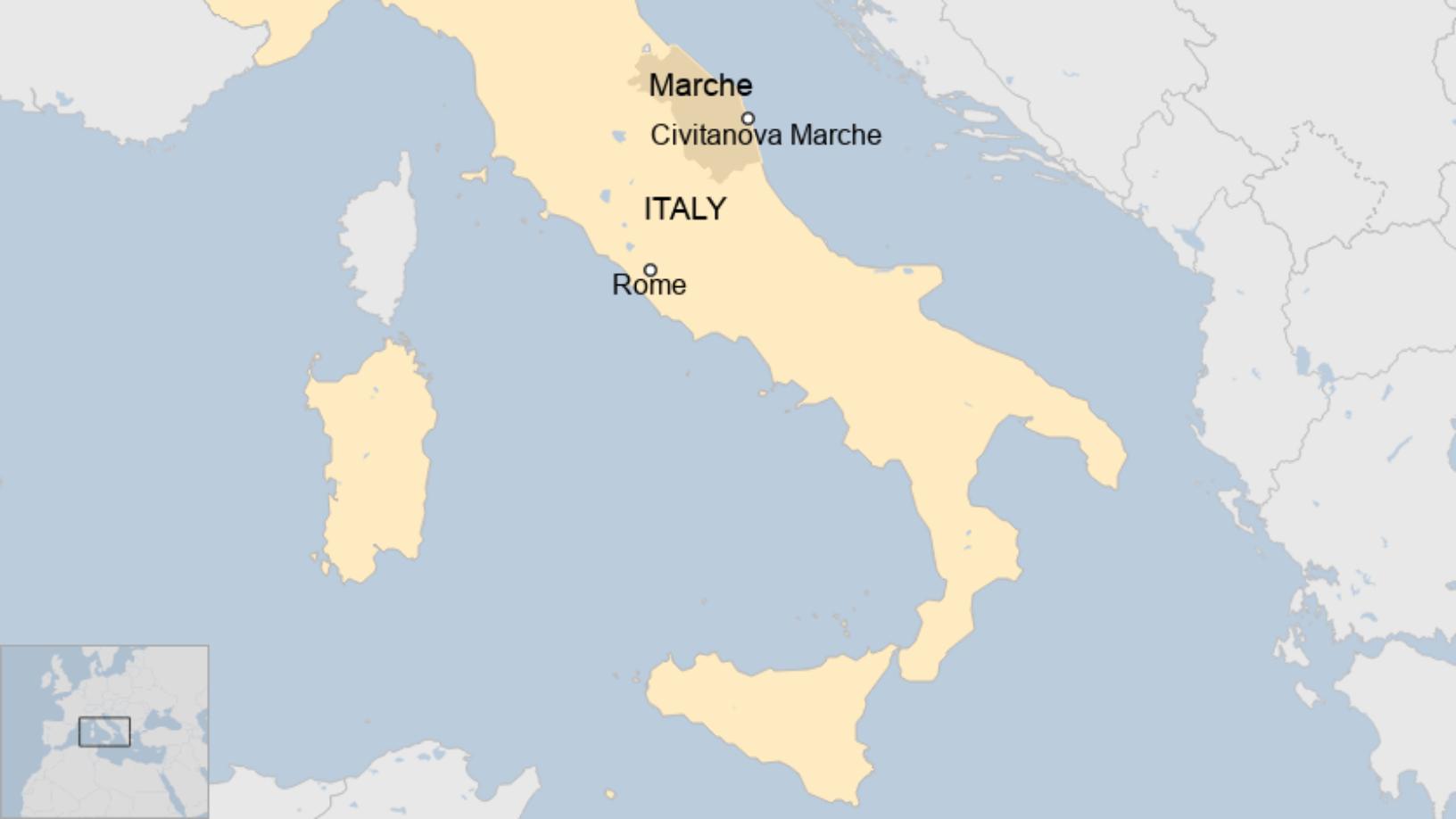
The death of a migrant who was attacked in broad daylight in central Italy has sparked outrage.
The assault on the Nigerian street trader by another man in Civitanova Marche town centre was captured on video on Friday.
The recording, reportedly made by onlookers without any attempt to intervene, shows the victim being held to the ground by a white man.
A 32-year-old Italian has been arrested on suspicion of murder and robbery.
The video of the attack – which has been widely circulated on Italian news websites and social media – has shocked the community, with many highlighting the “indifference” of witnesses.
The circumstances of the incident are unclear.
Call for justice
The victim has been named as Alika Ogorchukwu, a married father of two. His wife, named as Charity Oriachi, could not contain her tears as she told media how she was shown the body of her husband lying on the ground.
On Saturday hundreds of people from the local Nigerian community took to the streets of Civitanova Marche, in Marche region, to demand justice.
The attack has also been condemned by Italian politicians.
Enrico Letta, the leader of the left-wing Democratic Party, said what happened was “dismaying”.
“Unheard of ferocity. Widespread indifference. There can be no justification,” he wrote in a tweet.
Right-wing leader Matteo Salvini also expressed outrage over the death, saying “security has no colour” and “needs to return to being a right.”
Nigeria’s inflation rate has continued to soar, accelerating to 18.60% in June according to the latest Consumer Price Index report by the National Bureau of Statistics (NBS).
According to the CPI report which was seen by Business Insider Africa, the inflation rate increased by 1.82% month-on-month, jumping past the 17.71% that was reported in May.
“In June 2022, the inflation rate increased to 18.60 percent on a year-on-year basis. This is 0.84 percent points higher compared to the rate recorded in June 2021, which is 17.75 percent. This means that the headline inflation rate increased in the month of June 2022 when compared to the same month in the previous year (i.e., June 2021). Increases were recorded in all COICOP divisions that yielded the Headline index,” said a part of the report.
The report further revealed that food inflation accelerated to 20.6% in June 2022 from 19.5% in May 2022. The jump was due mainly to increases in the prices of different staples and essential food items.
“The composite food index rose to 20.60 percent in June 2022 on a year-on-year basis; the rate of changes in average price level declined by 1.23 percent compared to 21.83 percent in June 2021. The rate of changes in food prices compared to the same period last year was higher due to higher foods prices volatility caused by COVID 19. This rise in the food index was caused by increases in prices of Bread and cereals, Food products Potatoes, yam, and other tubers, Meat, Fish, Oil and fat, and Wine.”
Urban inflation also rose to 19.09% in June, marking a 0.74% increase when compared to 18.35% that was recorded in June 2021. Similarly, rural inflation rose to 18.13% in June, marking a 0.97% increase compared to 17.16% recorded in June 2021.
Like most African countries, Nigeria has been grappling with an inflation problem that keeps getting worse, exacerbated by many unfavorable internal and external factors. Some of these factors include the ongoing war in Ukraine and the forex crisis. Earlier this week, the International Monetary Fund (IMF) warned that these factors are pushing many African countries to the brink of economic collapse.
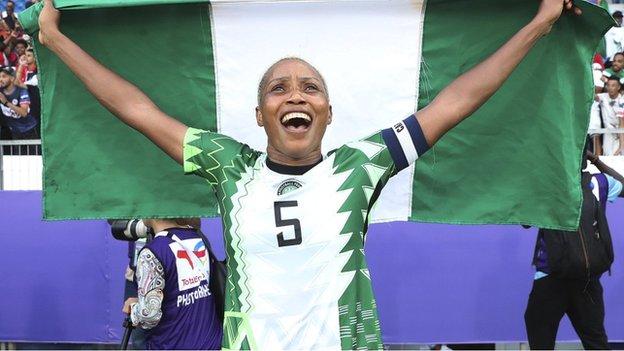
Reigning African champions Nigeria qualified for a ninth Women’s World Cup in a row when beating Cameroon 1-0 in the quarter-finals of the Women’s Africa Cup of Nations (Wafcon) in Casablanca.
Rasheedat Ajibade’s 57th-minute header ensured Nigeriawill meet hosts Morocco in Monday’s late semi-final and that their Wafcon winning streak against Cameroon continues.
In Thursday’s late game, South Africa sealed their return to the Women’s World Cup after a narrow 1-0 win over Tunisia in the Moroccan capital Rabat.
Jermaine Seopesenwe finished in expert fashion after 14 minutes but South Africa wasted good chances only to limp over the line after VAR checked a possible Tunisia penalty in stoppage time.
Rwandan referee Salima Mukansanga, who will referee at the men’s World Cup this year and made history earlier this year when becoming the first woman to referee a men’s Nations Cup match, pointed for a goal-kick, which VAR agreed with only after a nervy delay.
By then, South Africa – who will play Zambia in Monday’s first semi-final – should have been out of sight with Noxolo Cesane the biggest culprit when blazing over after a fine Linda Motlhalo run just before the hour.
Banyana Banyana missed Thembi Kgatlana, the 2018 Wafcon top scorer ruled out of the tournament on Monday with injury, while Nigeria also made it through with their star player, Asisat Oshoala, set to play no further part.
Making their debuts, Morocco and Zambia will join Banyana Banyana, whose tournament bow came in 2019, and the Super Falcons in next year’s 32-team finals in Australia and New Zealand.
Two more African sides could join them there, but will need to navigate a ten-team intercontinental play-off in New Zealand next February when the final three qualifiers will be decided.
Sunday’s crunch repechage ties pit Senegal against Tunisia, in Casablanca, and Botswana against Cameroon, in Rabat.
Super Falcons maintain edge
Nigeria and Cameroonhave met at each of the past nine tournaments, with the Super Falcons winning three finals and four semis while the Indomitable Lionesses’ sole win was in a third-play play-off in 2012.
Cameroon have failed to score against the nine-time champions at Wafcon since, including in their semi-final defeat last time out in 2018, and they seldom threatened Nigeria goalkeeper Chiamaka Nnadozie in a match of few clear-cut openings.
Former Cameroon male legends such as Samuel Eto’o, who now heads up the country’s federation, and Geremi Njitap were in attendance in a Stade Mohammed V whose sparse attendance was atoned for by some lively support.
Nigeria captain Onome Ebi could become the first African to play at six World Cups
After the break, Ifeoma Onumonu’s cross was headed home by Atletico Madrid’s Ajebade, who moves joint top of the scoring charts with three, forcing the Indomitable Lionesses to find a rare Wafcon goal against Nigeria to stay in contention.
Yet Cameroon’s key players Njoya Ajara Njout and skipper Gabrielle Onguene failed to trouble the Nigerian backline and coach Gabriel Zabo will hope they can do more when the team enters a repechage tie on Sunday.
The clash against Botswana now represents the last chance for Cameroon, who made their Women’s World Cup debut in 2019, to reach next year’s finals in Australia and New Zealand.
Despite their African record of eight previous trips to the World Cup, Nigeria have only progressed past the group stage twice – firstly, when reaching the quarter-finals in 1999 and then in 2019, after the tournament had expanded to 24 teams four years earlier.
Nigeria captain Onome Ebi, 39, played at the finals for the first time in 2003 and has not missed one since, so becoming the first African to play in five Women’s World Cups.
American coach Randy Waldrum, meanwhile, has tried to improve Nigeria’s level by lining up some high-profile friendlies, including two against sixth-placed Canada before the tournament, ending in a defeat and draw for his side.
He will need his side to overcome a crunch Rabat clash against a host nation in good form to have a chance of arriving at the World Cup as African champions again.
The emergency services in Nigeria say they have now recovered 17 bodies after a passenger boat capsized on a waterway in the commercial capital, Lagos.
Four bodies were recovered on Saturday and a further thirteen on Sunday.
The inland waterways authority said the boat had set sail on Friday later than the rules permitted and that the tide carried the vessel towards a barge, causing it to overturn.
The accident came only three days after another passenger boat capsized in the same waters, reportedly drowning two people.
Boat accidents are common on Nigerian waterways mainly because of overcrowding and poor maintenance.
Police in Nigeria have rescued 77 people, including children, from a church where they were confined in the south-western state of Ondo.
Some of them are believed to have been there for months.
A police spokesperson said many of them had been told to expect the Second Coming of Jesus Christ in April and had abandoned school to witness the event.
The raidcame after a mother complained her children were missing and she thought they were in the church.
Police say they are investigating suspected mass abduction after the raid on the Whole Bible Believers Church in the Valentino area of Ondo Town.
The pastor of the Pentecostalchurch, David Anifowoshe, and his deputy have been arrested, while the victims have been taken into the care of the authorities.
“Preliminary investigation revealed that one Pastor Josiah Peter Asumosa, an assistant pastor in the church, was the one who told the members that Rapture will take place in April, but later said it has been changed to September 2022 and told the young members to obey only their parents in the Lord,” said police press officer Funmilayo Odunlami.
In all, police rescued 26 children, eight teenagers and 43 adults, she added.
The Second Coming is a Christian belief in the return of Jesus Christ after his Biblical ascension to Heaven. Rapture is the idea that Christian believers will be taken to Heaven at the Second Coming.
Anxiety has been high among Christians in the state since a deadly attack on another church.
At least 50 people were killed in a mass shooting and bomb attack at St Francis Catholic church in the town of Owo on 6 June.
Federal authorities suspect the Islamic State West Africa Province of carrying out the massacre.
The group was seen through security at Lagos airport before being taken away to a facility and were not allowed contact with the public or journalists at the airport.
Earlier this month, the European Court of Human Rights (ECtHR) cancelled the first flight due to take asylum seekers from the UK to Rwanda.
The flight was part of the Rwanda asylum plan, announced by the UK government in April, that sees some asylum seekers given a one-way ticket to Rwanda to claim asylum there instead.
The government said the scheme would discourage others from crossing the English Channel.
🇬🇧âœðŸ½ðŸ‡³ðŸ‡¬ Our new landmark agreement with Nigeria will increase the deportation of dangerous foreign criminals to make our streets & country safer.
And take the fight to the criminal people smugglers together to tackle illegal migration.
Nnamdi Kanu, who heads a banned separatist group in Nigeria, has been denied bail by a court for the second time in as many months.
The Indigenous People of Biafra (Ipob) leader is awaiting trial on terrorism and treason charges, which he denies.
Mr Kanu, who holds a British passport, was arrested in Kenya a year ago and extradited to Nigeria – where he is in custody of the secret police.
Rejecting his latest bid, trial judge Binta Nyako said Mr Kanu had failed to give a satisfactory reason for breaching previous bail conditions imposed on him in 2017.
She insisted that the suit was a gross abuse of the court process and an attempt to continue to litigate on issues that have already been ruled on.
The case has been adjourned until November 14.
Ipob wants a group of states in south-eastern Nigeria, made up mainly of people from the Igbo ethnic group, to break away and form the independent nation of Biafra.
Nigerian authorities in the north-western Zamfara state have called on locals to arm themselves against criminal gangs in an attempt to deal with the increasing numbers of kidnappings and violent attacks.
The Zamfara governor said he would issue hundreds of guns to those without training and directed the commissioner of police to issue licences.
The authorities in Zamfara state say locals will first need to register before getting a weapon.
Asking citizens to arm themselves against violent threats is always going to be controversial. But the local government believes that arming civilians will help deal with rising levels of insecurity in the area.
In other measures, the governor of Zamfara has also ordered the closure of markets in three districts, banned the use of motorcycles and sales of petroleum products.
A shoot-to-kill order has been given to anyone found using a motorcycle in these areas.
Nigeria is struggling to curb a deadly wave of kidnappings for ransom by armed gangs in the northern part of the country.
The gangs often target unprotected rural communities, schools and motorists on highways.
A second Nigerian politician has been beheaded by abductors in the south-east of the country, the authorities say.
Police in Anambra state say the decapitated body of a former local MP, Nelson Achukwu, was found two weeks after he had been kidnapped by gunmen for a second time.
On both occasions, his family is reported to have paid a ransom for his safe return.
Deputy Minister of Energy,William Owuraku Aidoo, has noted that government has settled its legacy debt owed Nigerian Gas Company Limited (N-Gas).
According to him, government, through his outfit, paid off the GH¢553,452,668 in three tranches.
WilliamOwuraku Aidoo indicated that this settlement comes after the Volta River Authority (VRA) improved its balance sheets.
The Nigerian Gas Company Limited has over the years supplied Ghana with natural gas to help sustain the energy sector.
This, the Deputy Energy Minister said has helped ameliorate the power crisis in the country.
While speaking on the floor of parliament on Friday, June 17, 2022, William Owuraku Aidoo said, “I would like to point out that, subsequently, VRA has been able to pay its obligations to N-Gas as and when it falls due…VRA is able to pay for its obligation to N-Gas for the supply of natural gas from Nigeria. I will say that it has gone a long way in ameliorating the power situation in Ghana thereby preventing dumsor.â€
“VRA under the able leadership of Antwi Darkwa has improved remarkably on their balance sheet and as a result they are able to pay for gas supply to Ghana as and when it falls due. VRA is doing a very good job in polishing its balance sheet thereby being able to pay for its bills,†he added.
Background
The accumulation of debt owed N-Gas started in 2014 due to the inability of VRA to pay the company.
According to Graphic.com.gh report, government in 2017 instituted strategic intervention programmes such as ESLA to pay in tranches this legacy debt.
Ghana at the Committee of Ministers meeting in Lome, Togo, in December 2020 made a commitment to settle the debt by end of this year.
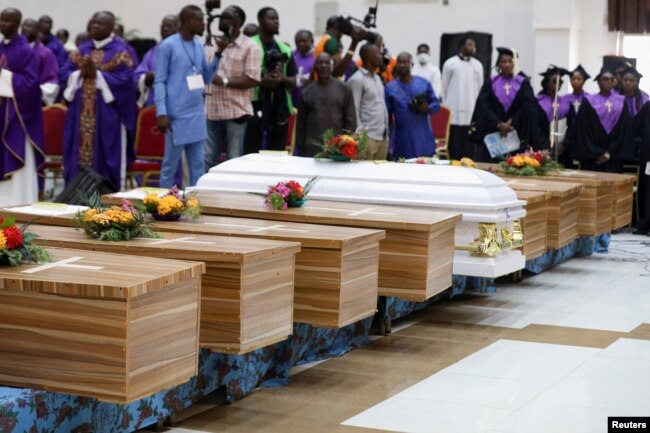
A mass funeral service is to take place in south-western Nigeria later for victims of the shooting earlier this month at a Catholic church in the district of Owo.
At least 40 worshippers were killed and dozens of others wounded when gunmen opened fire at the church.
Most of the dead were the bread winners for their families. Four were children.
The Nigerian government said the extremist group known as Islamic State West Africa Province carried out the attack.
A grieving community is struggling to understand what happened, and with no arrests, questions remain about whether the perpetrators will be brought to justice.
The funeral service will take place in a nearby hotel, with increased security, as the church is still not operational.
After the service, the families will collect the bodies and finally lay them to rest.
Nigerian security forces are struggling to contain deadly attacks across the country by jihadists, kidnappers and suspected secessionists.
The London-Lagos biker, Kunle Adeyanju, has been conferred the Are Aniyikaiye of Offa Land in his state of origin, Kwara State, Nigeria.
Adeyanju announced the reception of the chieftaincy title conferred on him by the Olofa of Offa on his verified Twitter page on Monday.
The member of Rotary Club International wrote, “I was conferred the chieftaincy title of Are Aniyikaiye of Offa Land, by his majesty the Olofa of Offa. So when next you see me, please call me Chief Kunle.â€
Adeyanju, who embarked on a London-to-Lagos journey on a motorbike to raise money #EndPolio campaign, arrived in Nigeria on May 29 after 40 days.
The heroic biker who has been recounting his experiences on his 12,000km journey has been applauded for his adventure locally and internally.
Speaking on why he embarked on the journey and its outcome, Adeyanju said, “Doing this was basically to achieve two purposes of raising awareness of end polio message by seeing how we can see the level of vaccines acceptance. The second objective was to raise funds.
“For me, the two had been accomplished because everybody is now aware of polio. Polio has got a renewed drive as we have the vaccines to end the virus.
“I am very happy that the message has taken a global dimension.â€
I was conferred the chieftaincy title of Are Aniyikaiye of Offa Land, by his majesty the Olofa of Offa.
A Nigerian man who has been hailed a “hero” for risking his life by driving a burning fuel tanker away from a densely populated suburban area in Warri Delta State has recounted to the BBC the scary ordeal.
“‘There was just one thought on my mind and that was to plunge the burning tanker into a river nearby’,” Ejiro Otarigho said.
”My [assistant] was the one who alerted me to the fact that our tanker was on fire. It was a scary ball of fire,” he continued.
Mr Ejiro said he had just offloaded some of the contents of the tanker and was heading towards another point when tragedy struck.
With no time to waste, he told his assistant to get off and he sped off in the burning tanker amidst shrieks of fear and dismay from onlookers.
In the dangerous incident, any slight error of judgement from Mr Otarigho or, a sudden explosion, could have resulted in total disaster.
“My intention was to drive to the river. When I got there the car steering got stuck and I couldn’t move any further,” he recounted.
“I said if I drive straight, the truck may fall and that may cause another problem. So I just have to park in the open space.”
Mr Otarigho finally got the tanker to safety and onlookers can be seen in one of the videos dragging him away.
Mr Otarigho is safe and sound save for some smoke inhalation and a few bruises.
Tanker fire accidents are common in Nigeria and many lives have been lost with accompanying damage to properties.
The UN in Nigeria said it “strongly condemns the brutal attacks on worshippers”, according to a statement by the UN secretary general’s spokesman on behalf of the UN’s Resident Coordinator for Nigeria, Mattias Schmale.
Mr Schmale appealed for calm and called for the attack perpetrators to be brought to justice.
The attack overshadowed a meeting of Nigeria’s governing party, which has begun the process of choosing a candidate for next year’s presidential election.
President Muhammadu Buhari cannot run again, having served two terms.
Police found him at the scene with severe burns and took him to hospital, but he died of his injuries.
BBC Abuja reporter Chris Ewokor says there appears to be a rise in mob violence in Nigeria.
Two weeks ago, at least five people were killed in violent clashes between commercial motorbike operators and traders in a suburb of Abuja.
A few days earlier, mob violence led to the death of a 38-year-old sound engineer in the country’s commercial hub, Lagos.
Human rights campaigners say the frequent cases of mob violence are fuelled by deep-rooted impunity and a lack of confidence in the criminal justice system.
It occurs mostly in remote areas, near tropical rainforests.
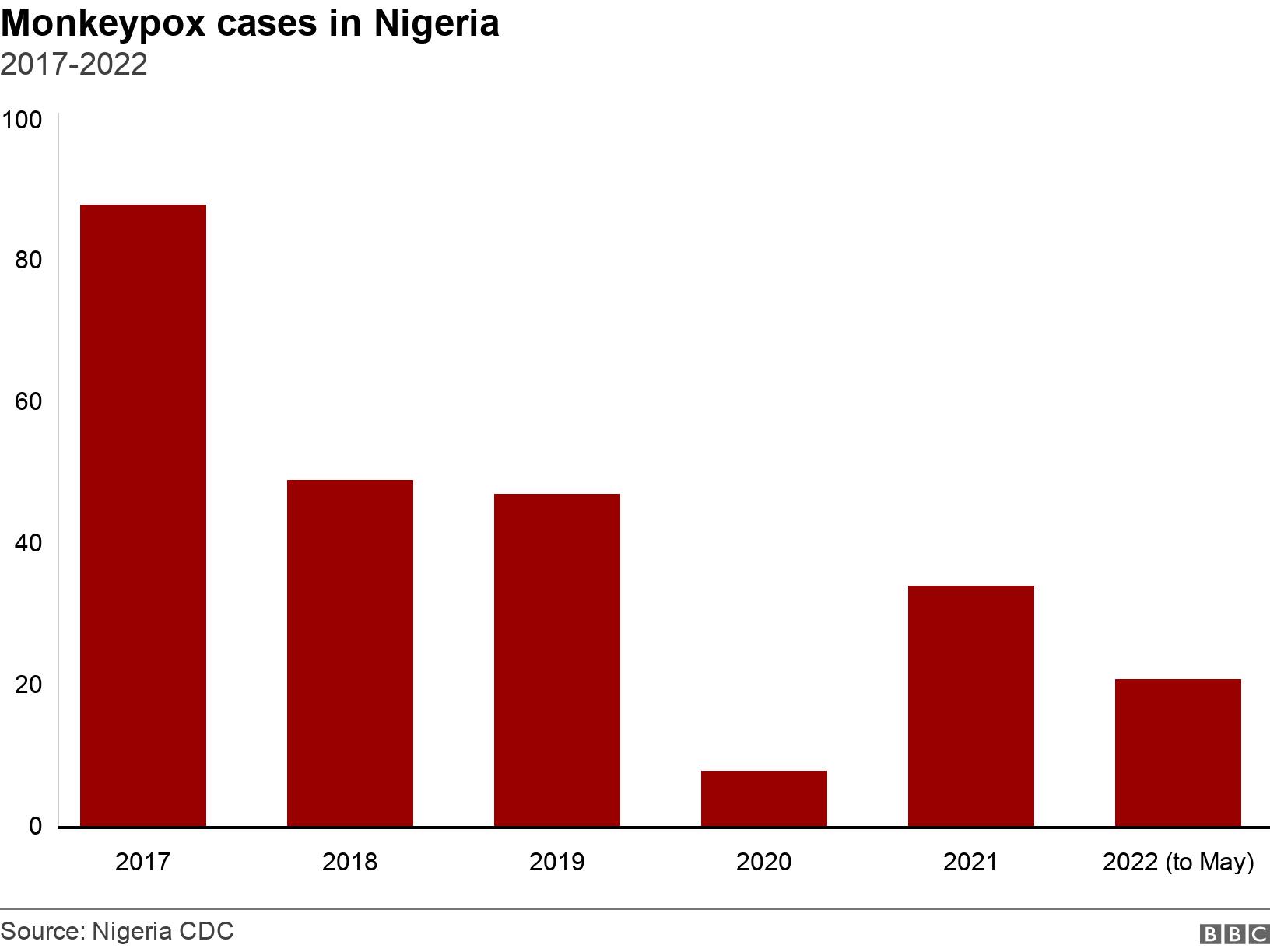
The country has had sporadic cases since an outbreak in 2017. The virus was found mainly in the south of the country but, since 2020, it has spread to central, eastern and northern areas, the World Health Organization says.
Out of the 21 confirmed cases this year, there has been one reported death of a person who had underlying conditions. But earlier this week the health authorities said “there has been no evidence of any new or unusual transmission of the virus, nor changes in its clinical manifestation documented”.
Scientists are struggling to explain a recent rise in monkeypox cases in Europe, which have not been linked to travel to the African countries where it is endemic. But there are suggestions the virus has been spreading from person to person for some time undetected.
Monkeypox can be spread when someone is in close contact with an infected person. The virus can enter the body through broken skin, the respiratory tract or through the eyes, nose or mouth.
Those infected in the UK have been advised to avoid having sex while they have symptoms.
The animals that can pass on the virus are infected rodents, including rats and squirrels. According to health experts, this can happen if someone is bitten or touches an infected animal.
Bushmeat refers to any wild animal that is killed for consumption, including antelopes, chimpanzees, fruit bats, rats, porcupines and snakes.
In some remote areas of Nigeria it is a vital source of food, while in others it has become a delicacy.
There are many bushmeat markets in Nigeria and it is unclear how the ban will be implemented.
The ministry of agriculture also directed vets and its other officials to increase surveillance aimed at detecting any possible cases of monkeypox in animals.
Operators of zoos, parks, conservation areas and recreational centres were reminded to make sure there was no contact between animals and humans/
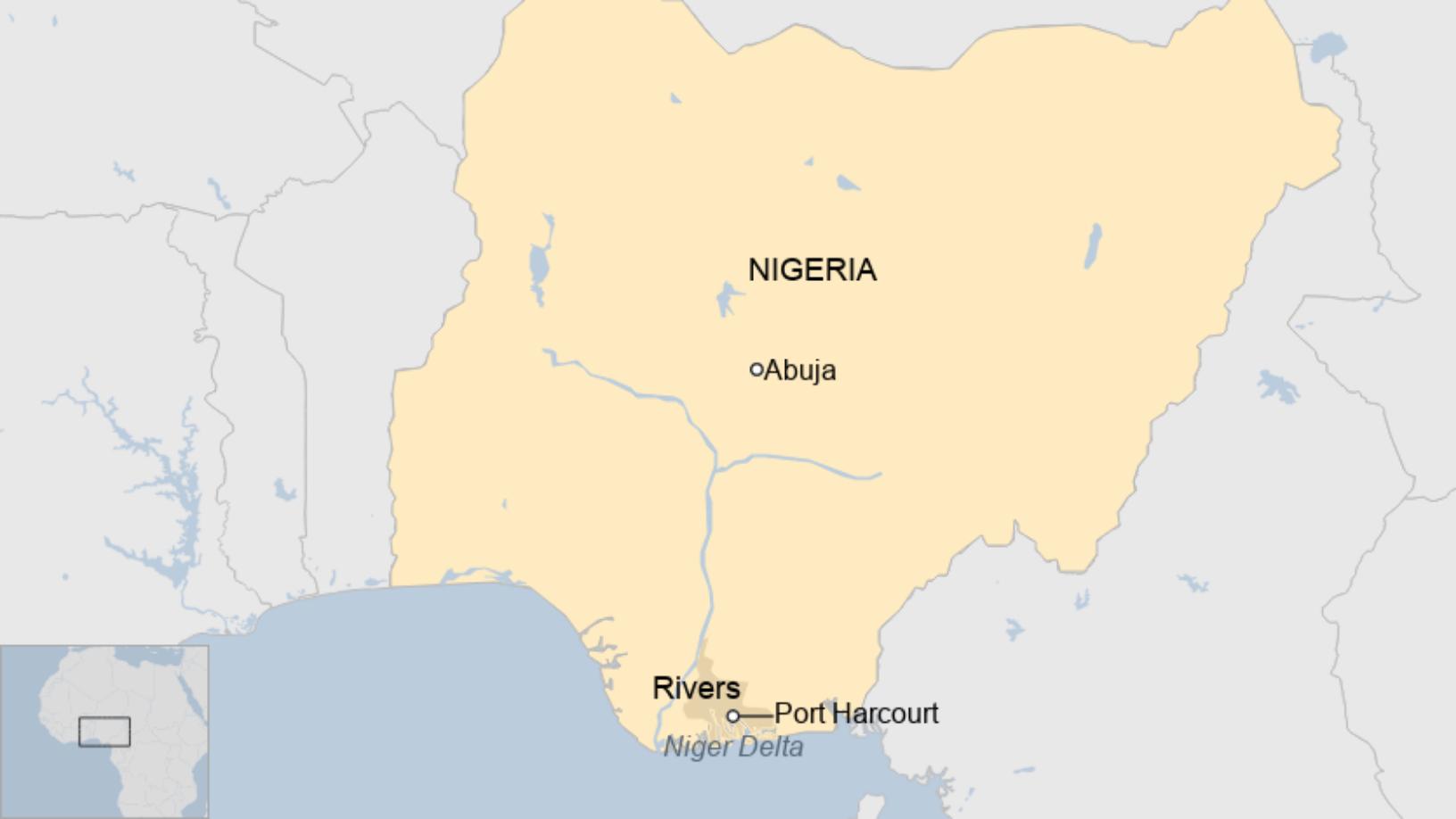
More than 30 people were killed and others injured when a stampede broke out at a church event in the southeastern Nigerian city of Port Harcourt on Saturday, according to police and security officials.
Most of the casualties were children.
The incident took place at a local polo club, where the nearby Kings Assembly Church had organized a gift donation drive, according to Olufemi Ayodele, a regional spokesman for Nigeria’s Civil Defense Corps.
“During the process of distributing the gift items, there was a stampede due to overcrowding,” he said. “Casualties were children mostly.”
The drive had not yet started when the stampedetook place, said Grace Woyengikuro Iringe-Koko, a spokeswoman for the state police.
Woyengikuro Iringe-Koko said the crowd forced their way into the venue, despite the fact that the gate was closed, resulting in the deadly charge.
Thirty-one people have been confirmed dead, Woyengikuro Iringe-Koko said. Seven injured people were hospitalized after the incident, she added.
The head of the Methodist Church in Nigeria, Samuel Kanu, has been freed after being abducted on Sunday, a church official confirmed to the BBC.
He was travelling with two other priests on a highway in the south-eastern state of Abia when they were kidnapped, police told the BBC.
It is unclear how they were freed, but separatist groups frequently carry out abductions in the region.
His release has led to jubilation in Nigeria’s Christian community.
Soon after the news of the abduction came out, members of the Methodist Church in the country started hourly chain-prayers for the release of Dr Kanu and the other priests.
“His Eminence, Samuel Kanu, is a peace-loving Christian leader” whose abduction “came as a shock”, the Very Rev Nosakhare Nosayaba of Abuja’s Methodist Cathedral of Unity told the BBC after his kidnapping.
Kidnappings, often for ransom, are common in many parts of Nigeria.
There has also been a resurgence of attacks by armed gangs, including Islamist militant groups in the north, as the country prepares for a general election next year.
Much of the unrest in Nigeria’s south-east region stems from separatists who are demanding a breakaway state.
The government blames the Indigenous People of Biafra (Ipob) movement for many attacks in the region, which Ipob denies. But the group continues to enforce sit-at-home orders on Mondays, which are usually preceded by attacks on Sunday evenings to scare people into complying.
However, it is not known who abducted the clergymen on Sunday, who were said to be gunmen. A number of recent violent attacks in the country also remain unsolved.
Last week, two Roman Catholic priests were kidnapped in the north-western state of Katsina and are still being held in captivity. Gunmen burgled the rectory of a church to abduct the clergymen and two others.
A local MP was also kidnapped by unknown gunmen recently. His headless body was later found.
In April, a male and a female soldier who hoped to get married were beheaded when they travelled to the region to inform their relatives about their planned wedding.
In a separate incident on Sunday morning, two people were abducted when gunmen entered their home in Lafia, Nasarawa state, near the capital, Abuja. One person was shot dead during the attack.
Kidnappings, often for ransom, are common in many parts of Nigeria.
There has also been a resurgence of attacks by armed gangs, including Islamist militant groups in the north, as the country prepares for a general election next year.
Much of the unrest in Nigeria’s south-east region stems from separatists who are demanding a breakaway state.
The government blames the Indigenous People of Biafra (Ipob)movement for many attacks in the region, which Ipob denies. But the group continues to enforce sit-at-home orders on Mondays, which are usually preceded by attacks on Sunday evenings to scare people into complying.
However it is not known who abducted the clergymen on Sunday, and a number of recent violent attacks in the country remain unsolved.
Recently a local MP was kidnapped by unknown gunmen. His headless body was later found.
In April, a male and a female soldier who hoped to get married were beheaded when they travelled to the region to inform their relatives about their planned wedding.
In a separate incident on Sunday morning, two people were abducted when gunmen entered their home in Lafia, Nasarawa state, near the capital Abuja. One person was shot dead during the attack.
Witnesses told the AFP news agency there was frantic pushing and some were trampled underfoot when people trying to reach the entrance were forced back.
“They were telling people ‘Go back, go back, go back,’” Chisom Nwachukwu said. “Some people that were pushing from backwards were marching on those people.”
Security and emergency services were called to the scene to try to bring the situation under control. Some of the injured are being treated at Port Harcourt’s military hospital.
The King’s Assembly Church said it was “deeply saddened” by the incident, and was reviewing its safety and crowd management procedures.
It started the annual charity in 2014 but said this year’s “turnout, build up and the attendant circumstances were absolutely unanticipated”, and that attendees started gathering before security teams for the event were on site.
Rivers state police commissioner, Eboka Friday, has called on religious and charity groups to “ensure they work with the police for security and crowd control” in organising such programmes in the future.
In addition to the police investigation, a regional government committee will be formed to look into the circumstances of Saturday’s incident, says Rivers state governor Nyesom Wike.
Nigeria has seen several similar tragedies in recent years, including an aid agency food programme in Borno state last year where seven women were trampled to death.
Port Harcourt is the main oil hub in Nigeria, but despite the country’s oil wealth about 40% of Nigerians live below the poverty line.
More than 30 people are reported to be missing in the north-eastern Nigerian state of Borno after being attacked by suspected militants at the weekend.
Witnesses said the victims from the town of Rann were fired on by gunmen on motorbikes when they went into the bush to fetch firewood.
It’s not clear who carried out the attack, but both Boko Haram and another militant group linked to the Islamic State have been waging an insurgency in the region.
Nigerian security forces have not yet commented on the raid.
Police in Nigeria are investigating the beheading of a local MP in the south-eastern state of Anambra barely a week after gunmen kidnapped him along with an aide.
The discovery of Okechukwu Okoye’s mutilated body over the weekend has sparked outrage.
Anambra’s state governor Charles Soludo described the killing as gruesome, barbaric and shocking.
He announced a reward for information leading to the killers’ capture.
It’s not clear who was behind the attack.
Officials have blamed a banned separatist group for increasing violence in the region.
The Indigenous People of Biafra, which is campaigning for a breakaway state, has denied involvement in recent attacks.
Its leader, Nnamdi Kanu, is standing trial for terrorism and treason-related charges which he has denied.
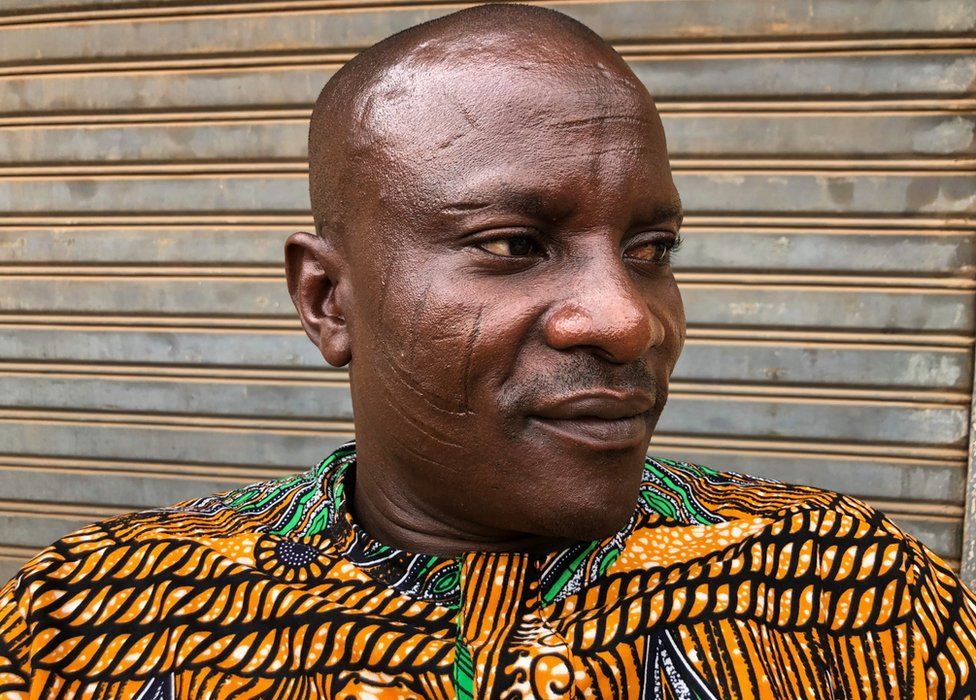
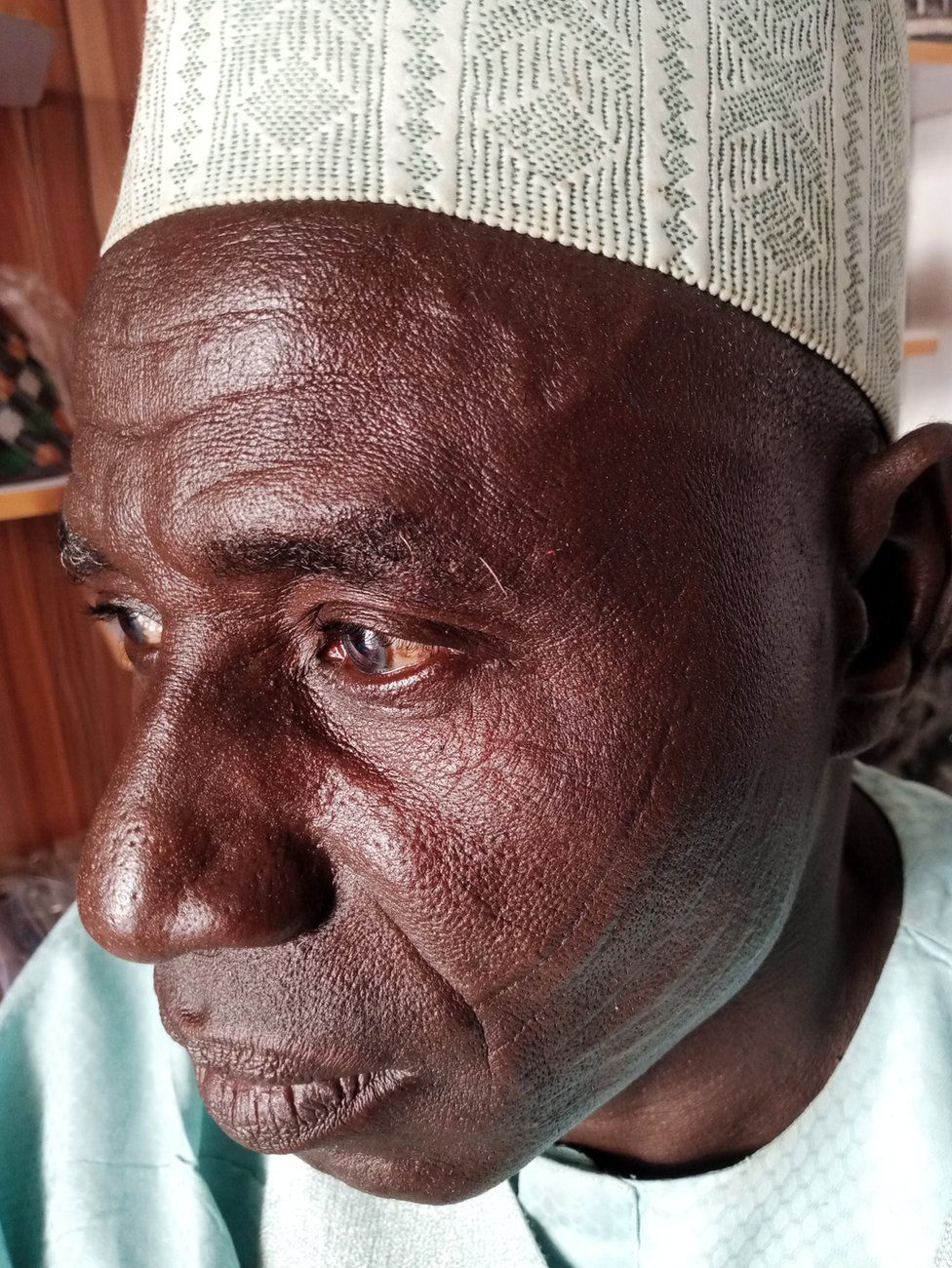
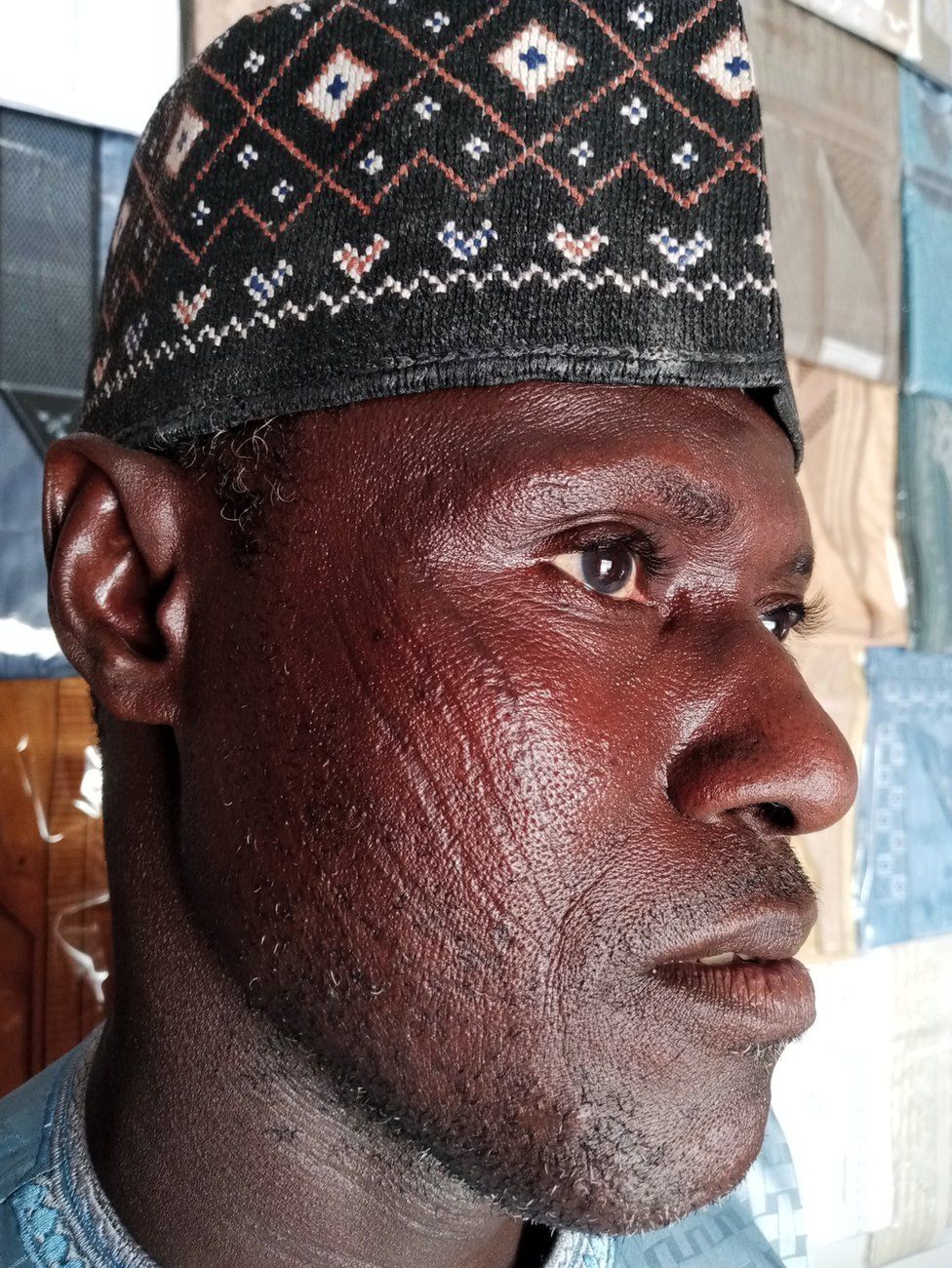
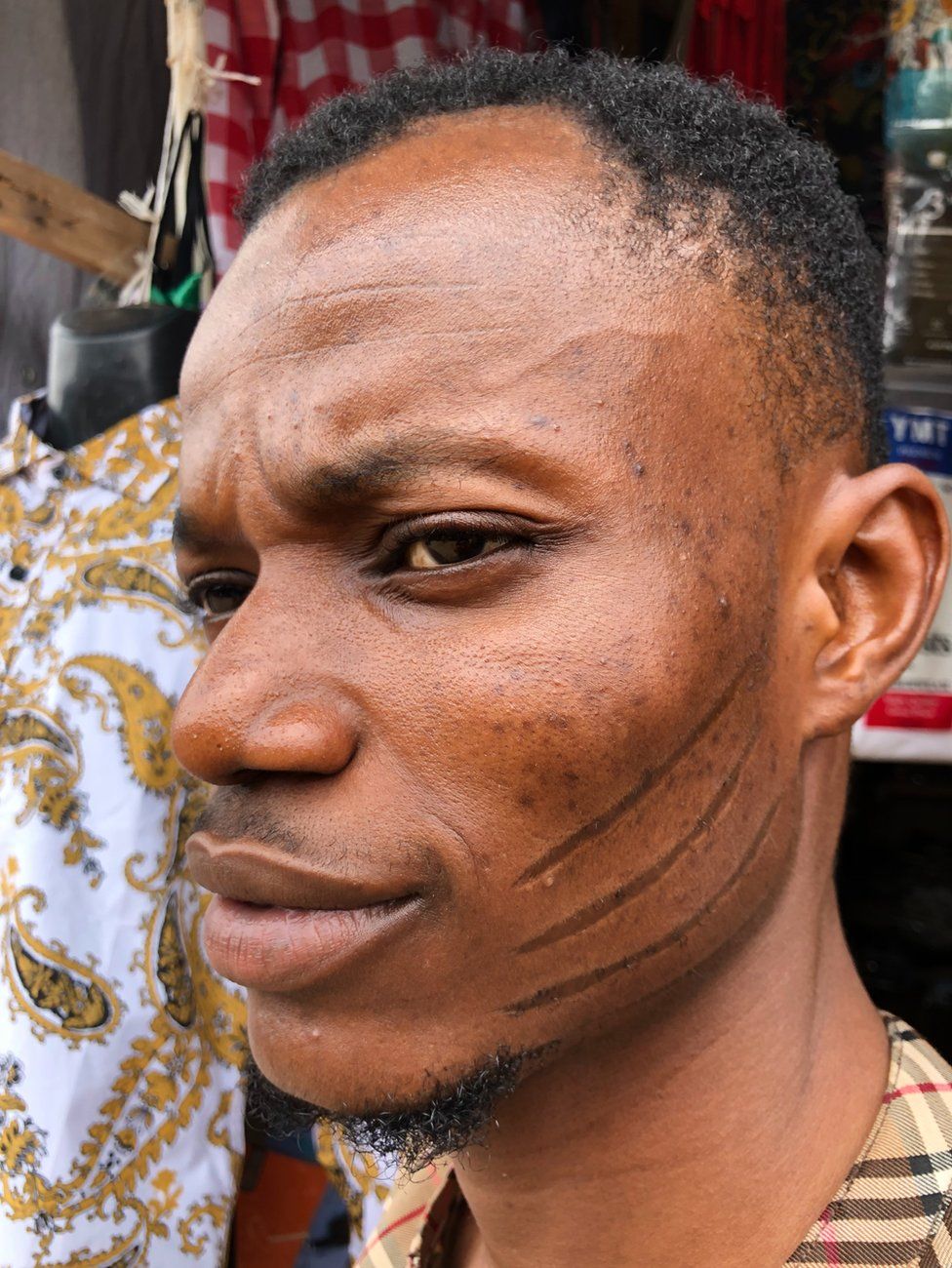
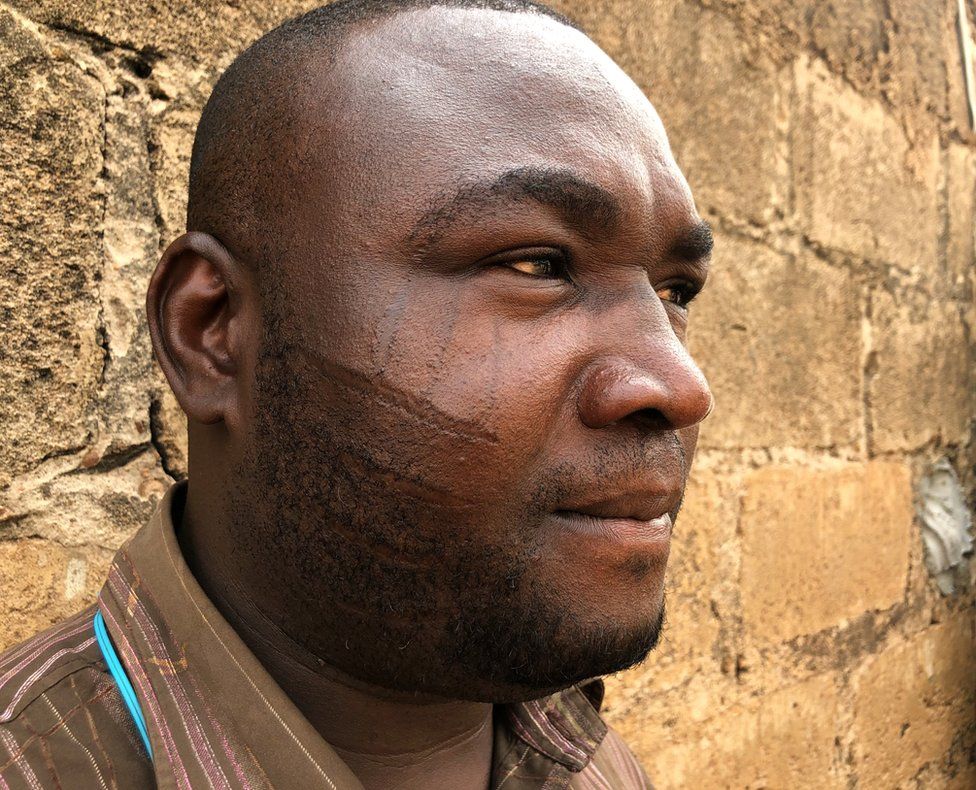
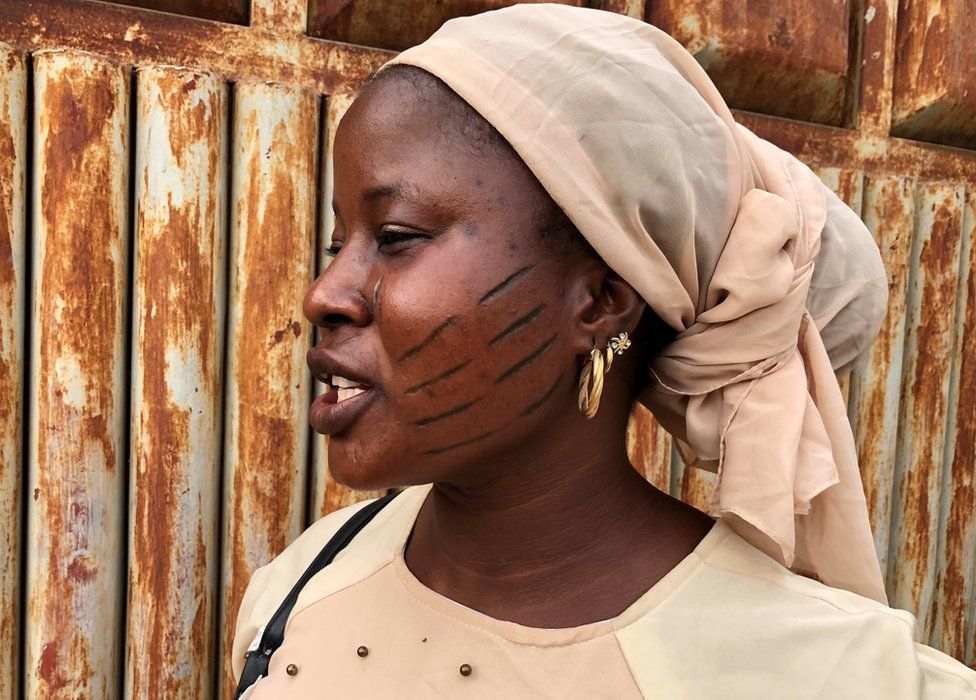
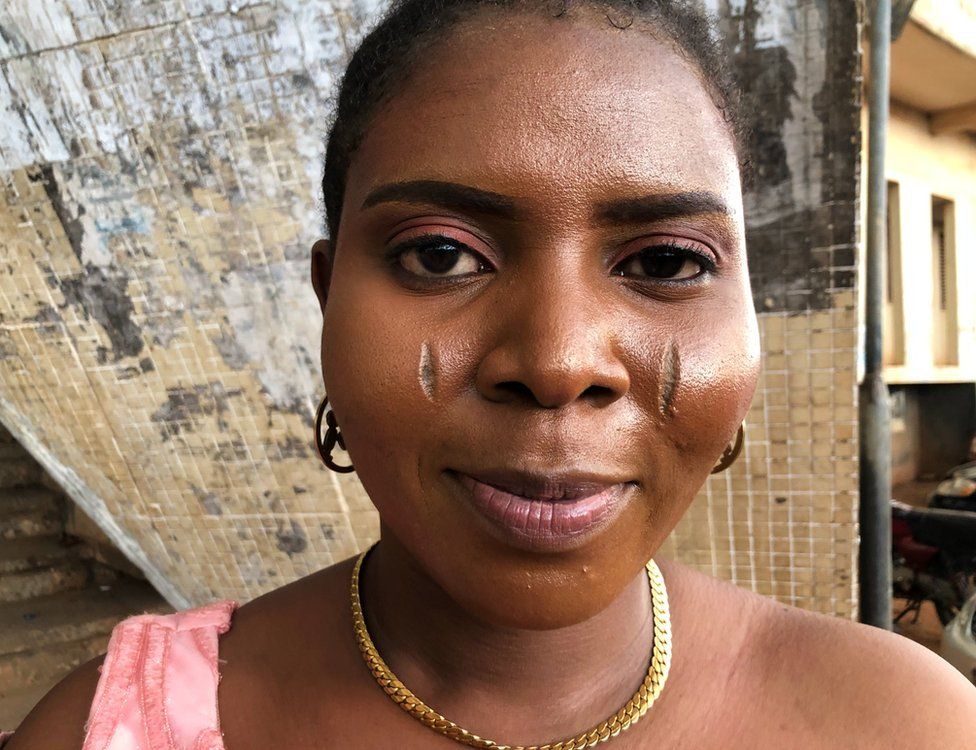
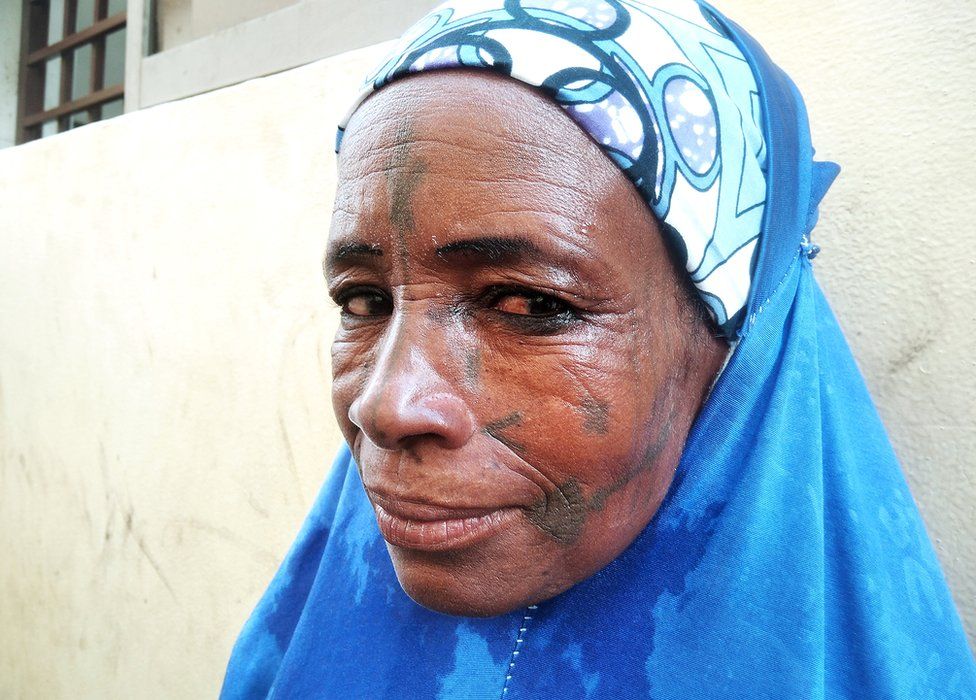
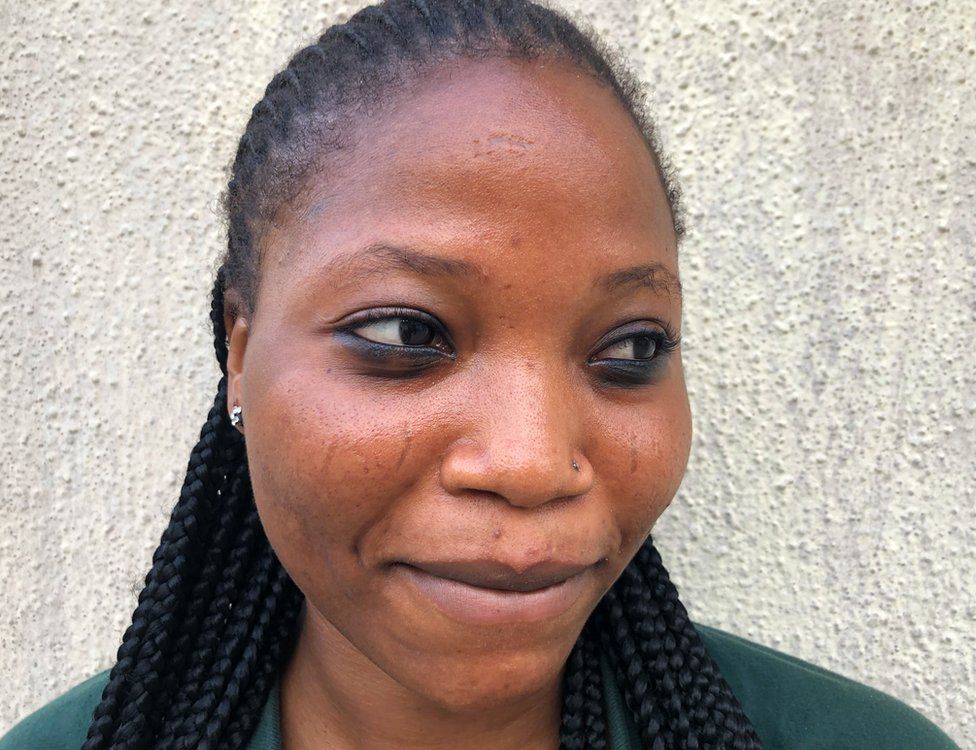
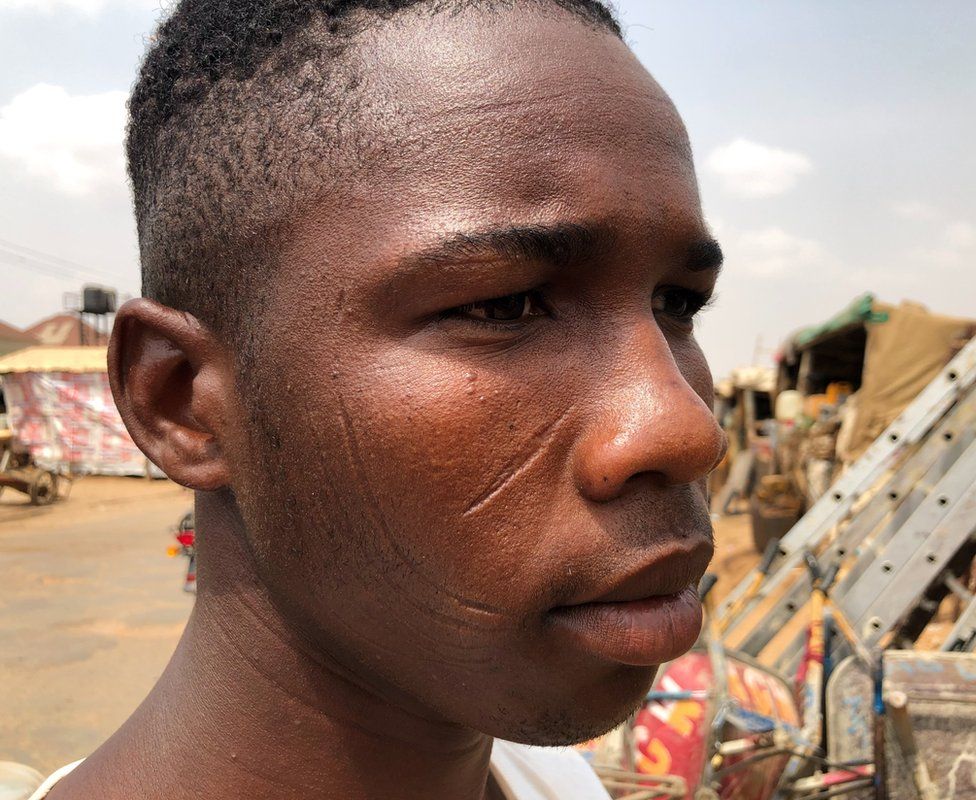
Facial scarification was once popular across Nigeria.
Deep cuts, usually on both cheeks or the forehead, were carved on children by families and communities, mostly as a mark of identity.
The marks also held stories of pain, reincarnations and beauty.
The practice, however, has been fading away since a federal law banned all forms of child mutilation in 2003.
So the current bearers of facial marks are the last generation – their facial stripes as varied as Nigeria’s many ethnic groups.
The 15 slashes on the face of Inaolaji Akeem (above) identify him as someone from the Owu kingdom in Nigeria’s south-western Ogun state.
Mr Akeem is royal-born, so he has long stripes on his face.
“It is like a football jersey,” he quips, adding that they made him popular in the local market.
On a serious note, Mr Akeem says he regards the scars as sacred, and does not believe people should mark their faces just for beautification.
This need for identification through facial marks was also strong in northern Nigeria, especially among the Gobir people of Sokoto state.
Ibrahim Makkuwana’s ancestors, pastoralists from Gubur in present-day Sokoto, did not have facial marks. But, he said, as they moved around looking for farming land, “they fought many battles and conquered many places”.
They then decided to make distinctive marks on their cheeks, “akin to the ones their animals had, which would help them in identifying their kinsmen during battles”, Mr Makkuwana says.
“That was the origin of our marks,” he tells the BBC.
But there is also a distinction between the Gobirawas.
Those with six scars on one cheek and seven on the other have both parents from royalty. Those with six marks on both sides have only their mothers from the royal family.
Then there are the children of butchers, with nine scars on one side and 11 on the other, while those with five and six marks on either side trace their lineage to hunters.
As for fishermen, they have distinct marks drawn up to their ears.
Meanwhile, among the Yorubas and Igbos of southern Nigeria, some marks are linked to life and death.
There was a belief in their communities that some children were destined to die before puberty.
Known as Abiku and Ogbanje respectively by the two ethnic groups, these children were believed, by the Yoruba, to belong to a coven of demons living in large iroko and baobab trees.
It was common for women to lose several children at a young age in succession, and it was thought it was the same child, reappearing again and again to torment their mother.
Such children were then marked to make them unrecognisable to their spirit mates so they would stay alive.
Many of these infant deaths are now known to be caused by sickle cell anaemia, an inherited disorder common among black people.
Yakub Lawal in Ibadan in south-western Oyo state, was marked as an Abiku.
“This is not my first sojourn to earth, I have been here before,” he says.
“I died thrice, and on my fourth return I was given these marks to stop me from returning to the spirit world,” he adds.
Closely related to stories of the Abiku and Ogbanje are those whose marks are in memory of a departed family member or one who has been “reborn”.
Olawale Fatunbi’s four horizontal and three vertical marks were inscribed by his grandmother, who said he was a reincarnation of her late husband, who had those facial scars.
But Mr Fatunbi wishes he didn’t have them.
“I don’t really like them because I see it as child abuse but it is our culture,” he says.
With 16 marks on her face, it is hard to miss Khafiat Adeleke. Even harder to miss is the huge signboard at her shop in Ibadan, where she has taken the moniker, Mejo Mejo (Eight Eight) – to represent the scars on her cheeks.
“People call me Mejo Mejo from here to Lagos.
“My grandmother gave them to me because I am an only child,” she says.
Some scars are for beauty.
Foluke Akinyemi was marked as a child, a deep gorge on each cheek supervised by her dad at the hands of a local circumciser, who also did facial scarring.
“My father made a decision to give me a mark just for the sake of it and because he thought it was beautiful.
“It makes me stand out and I thank my parents for giving it to me,” she says.
Ms Akinyemi’s story is similar to that of Ramatu Ishyaku from Bauchi, north-east Nigeria, who has tiny whisker-like lacerations on both sides of her mouth.
“It is for beauty,” she says, adding that she also tattooed her face at about the same time.
As a girl, the whisker-like markings and tattoos were popular in her village and she and her friends went to the local barber to have them, she adds.
The marks on the face of Taiwo, who only gave her first name, are now fading but the memory of why she was carved still lingers.
When her twin sister died within weeks of her birth, Taiwo became ill and a traditional healer recommended marking her face to prevent her from joining her twin.
She became better within days of the scarification, she says, but that has not made her love the marks on her face.
“It makes you look different from anyone else – I’d rather not have any marks on my face,” she said.
There are also those like Murtala Mohammed in Abuja who don’t know the story behind their marks.
“Almost everyone in my village in Niger state had one, so I never bothered to ask,” he says.
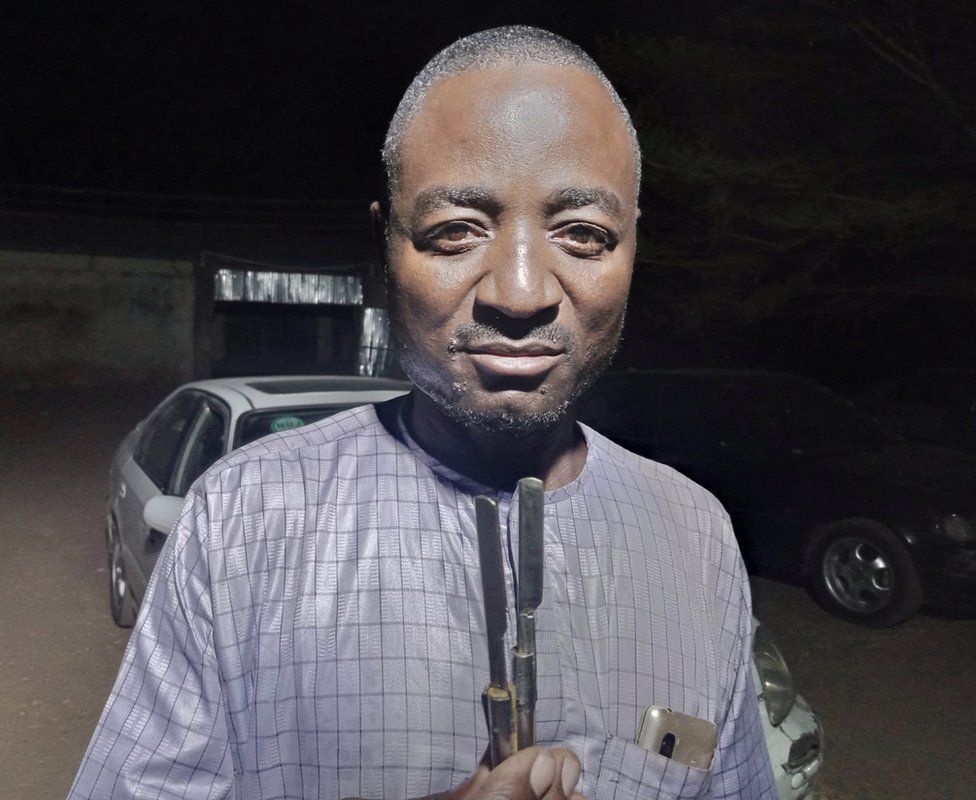
Facial marks were inscribed by local circumcisers and barbers like Umar Wanzam using sharp blades.
He describes it as a painful experience done without anaesthetics.
Most of those like Mr Akeem, who were marked as children, agree it was right to stop facial scarification.
He did not pass on the tradition to his children even before it was outlawed.
“I love the marks but they belong to a different time and age,” he says.
The Nigerian police have arrested two men suspected of being behind the high-profile kidnapping of two dozen students in April 2021 in northwestern Nigeria, and the murder of five of them.
“They have both confessed to the abduction of the students from the University of Greenfield, Kaduna State, and the murder of five students before the payment of ransom and the release of the other students,” police spokesman Olumuyiwa Adejobi said in a statement on Wednesday evening.
The two suspects, Aminu Lawal known as “Kano” and Murtala Dawu known as “Mugala”, who was involved in several kidnapping cases, will be brought to justice at the end of the investigation, Adejobi said.
In April 2021, gunmen stormed Greenfield University in Kaduna, abducting about 20 students and killing a staff member.
A few days after the attack, the kidnappers executed five hostages to force the families and the authorities to pay a ransom, which was later obtained.
The remaining 14 students were released after 40 days in captivity.
Heavily armed criminal gangs, known as “bandits”, have been increasing their attacks in north-western and central Nigeria, looting, kidnapping and killing many villagers.
Last year, the “bandits” particularly targeted schools and universities to kidnap students en masse for ransom from their parents and the authorities.
In all, about 1,500 students were abducted in 2021 by armed men, according to Unicef. While most of the young hostages have since been released for ransom, some still remain in captivity in the forests, where armed groups hide.
At least seven soldiers have been killed and two others missing in Nigeria in an ambush by gunmen while on patrol in the eastern state of Taraba, two military sources said on Wednesday.
The attack occurred on Tuesday night when troops from the 93 Battalion came under heavy fire in the village of Tati in the Takum local government area of Taraba. A brigadier general and his aide were missing after the attack, the sources said as reported by Reuters.
“Right now a search and rescue operation is ongoing,” said an army source from the 93 battalions who spoke to the media on condition of anonymity.
Officials of the army are yet to comment on the attack.
Taraba suffered two separate bombings last month that were claimed by Islamic State militants and killed at least three people and injured more than 30.
Nigeria has for over a decade contended with an Islamist insurgency that has targeted communities and security forces in northern parts of the country.
The Islamic State group has published a video which it says shows the execution of 20 Christian civilians in north-eastern Nigeria’s Borno state.
Speaking in the Hausa language, one of the masked militants who was brandishing a knife said it was to avenge the killing of the group’s leaders in the Middle East earlier this year.
The BBC has not been able to verify the contents of the video or where the footage was shot.
It was published on an IS-linked news outlet and shows three groups of captives in civilian clothes.
The authorities have not yet commented on the video.
The IS militants, which operate in the Lake Chad region under the name Islamic State West Africa Province (Iswap), along with another Islamist militant group, Boko Haram, have recently suffered huge losses as a result of attacks by a multi-national military force.
Such military campaigns in the past have usually been followed by propaganda videos from the extremist groups.
The Nigeria Customs Service says it intercepted over 1,000 bags of poisonous rice in Ogun.
Customs disclosed this on Thursday in a press briefing, saying the parboiled rice was smuggled into the country through the Benin Republic.
The Acting Comptroller, FoU, Zone A, Hussein Ejibunu, said the rice was produced in India
“After seizing the smuggled rice, we called NAFDAC (National Agency for Food and Drug Administration and Control) to conduct laboratory analysis and it was gathered that the rice named SIMBA which consists of Led substances that is poisonous to the body was produced in India,†Ejibunu said.
Similarly, in December 2016, Nigerian customs confiscated 2.5 tonnes of “plastic rice” smuggled into the country by unscrupulous businessmen.
According to the agency, the fake rice, said to be sticky after being boiled, was intended to be sold during the festive season.
Incidentally, rice is the most popular staple food in Nigeria.
The deaths of more than 100 people following an explosion at an illegal oil refinery in southern Nigeria has thrown a spotlight on the lucrative world of illicit refining, which the BBC’s Mayeni Jones and Josephine Casserly have been investigating.
Hours by car, motorbike and on foot brought us to a remote illegal oil refinery – a site recently raided and shut down by the authorities.
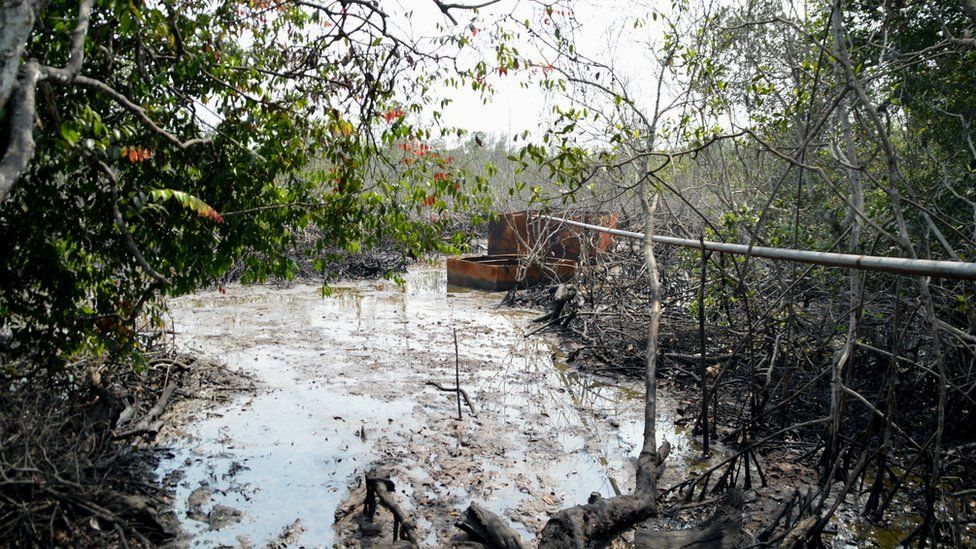
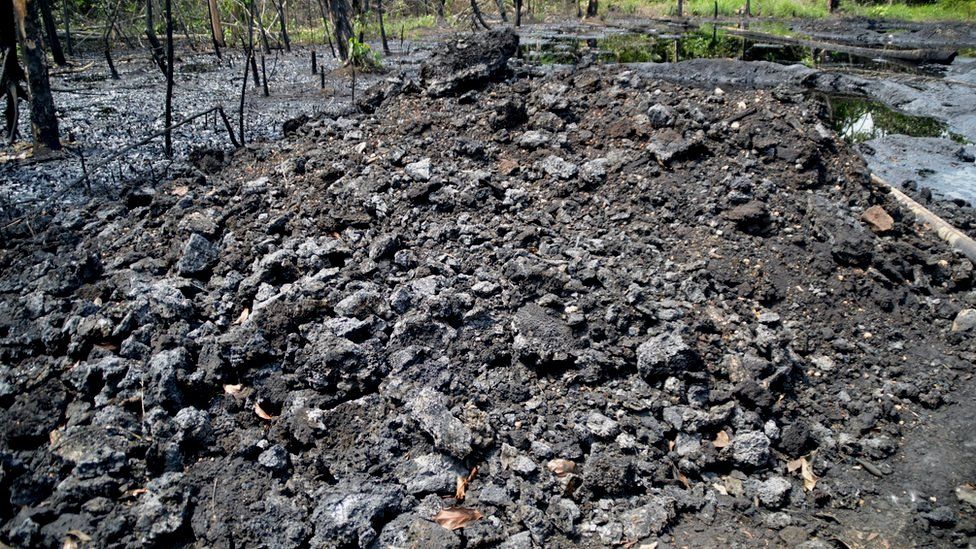
The smell of oil hits the nostrils first before anything is visible. Then, the lush green vegetation falls away and we arrive at a blackened clearing.
There are puddles of oil on the floor, with burnt, black tree trunks rising from them. The earth is so charred it looks like the scene of a volcanic eruption.
Image source, Fyneface Dumnamene/BBC Image caption, The illegal oil refineries are hidden in the creeks of the Niger Delta
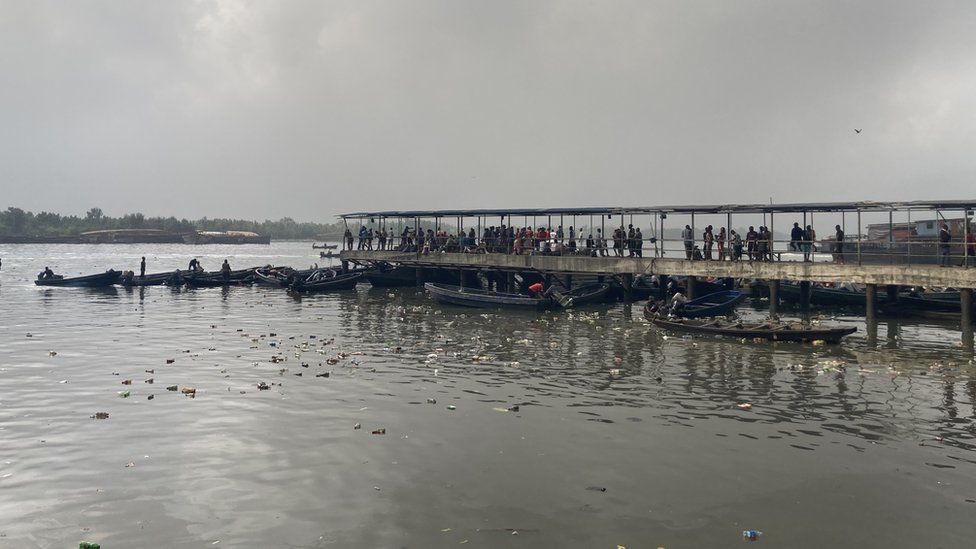
This is part of a creek in the Niger Delta, a dense network of waterways in southern Nigeria.
An oil slick glimmers on the water and what must once have been mangroves is now a tangle of bare, grey branches, their roots tinted with oil.
We are accompanied by local politician, Chidi Lloyd, and his team, who explain how stolen crude oil was brought here by boat.
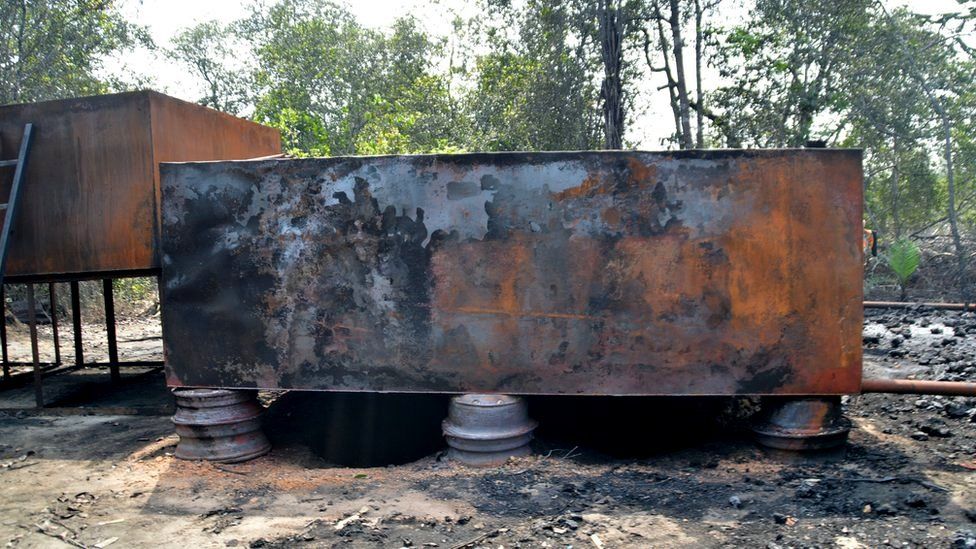
In the middle of the clearing are two big, rusting metal cauldrons where crude oil was refined or “cooked”.
Image source, Fyneface Dumnamene/BBC Image caption, The illicit refineries are at the centre of a complex criminal network
A fire is lit in a pit under the cauldron and the crude oil is heated and condensed into different petroleum products from kerosene to diesel. The heated oil is then funnelled into a cooling chamber.
But this process does not always go to plan – and when it fails, it causes explosions, which can be deadly, such as the one last Friday.
The large death toll reflects how illegal oil refining has become such a huge employer in Niger Delta over the last decade – in a country where unemployment is soaring.
Workers camp out at refineries like this for weeks at a time, often working at night for those behind a highly organised enterprise that involves technical, logistical and financial expertise.
The government estimates that over the last year, more than $3bn (£2.4bn) of oil was stolen. This crude oil, which is siphoned off from official pipelines and then refined in the bush, is sold on the black market in Nigeria or exported.
Soot v ‘starvation’
The pollution caused by these refineries is not only felt in the immediate vicinity.
The gas produced in oil extraction is often burnt off, instead of re-used, in an air-polluting practice called gas flaring. But it is not only informal refineries that do this – even though it is against the law – oil companies are at it too.
Image caption, The water in the creeks has been blackened by the oil
But as the illegal oil business has been growing, gas flaring has intensified and air pollution has worsened.
It is immediately apparent driving into Port Harcourt, the major city in the Niger Delta.
A thick black cloud of soot hangs in the air, sometimes it is so dense that is impossible to see anything beyond 30m (100ft).
A night spent sleeping in the city can leave a black residue around the nose, despite having the windows closed. A doctor at a local hospital says he is seeing increasing numbers of patients with respiratory problems linked to the pollution.
But some, like Osaja who lives in a lavish mansion in the city and asked us not to use his real name, think this is a price worth paying.
In his soft voice he tells us that he runs two illegal refineries and is involved in supplying stolen oil, as well as refining and selling it.
His collection of luxury sports cars and swimming pool hint at his wealth.
“Is it not better you live in a polluted environment than you die of starvation? If you are hungry will you smell anything?
“If the reason for the pollution is generating enough funds for everybody to live, you’ll even forget that there’s pollution,” he says.
‘Modern-day Robin Hood’
Some of those who have failed to find jobs elsewhere agree.
A photographer in his 30s tell us how he started doing jobs at a refinery in the bush when he could not find enough work.
He “cooked” the crude oil – which produces a lot of smoke that the workers inhale. He said when it went wrong and explosions occurred they would run into the creek, but that did not always bring safety as if there was oil on the water it would catch fire.
The dangers involved convinced him to stop.
Image source, Fyneface Dumnamene/BBC Image caption, The illegal refineries have destroyed the land and the waterways close by
But a computer science graduate, who got involved in the industry after struggling to find professional work, is less worried about safety issues – even as a woman out on the creeks.
She is in her 40s, with long hair and silver earrings, and uses her boat to transport drums of oil to and from the refineries: “I’m a riverine woman, it’s not so difficult for us.”
Those involved in the illicit trade told us if the government intends to crack down on illegal refineries – as Rivers state Governor Ezenwo Nyesom Wike is doing – something needs to be done about providing jobs.
They also think the illicit trade will not be easy to stop given how many sections of society are involved, including law enforcement.
Osaja says he regularly pays bribes to protect his refineries from being raided: “Everybody is involved. It’s organised crime.”
Meanwhile the police are investigating allegations from the Rivers state governor that a senior officer is operating an illegal refinery.
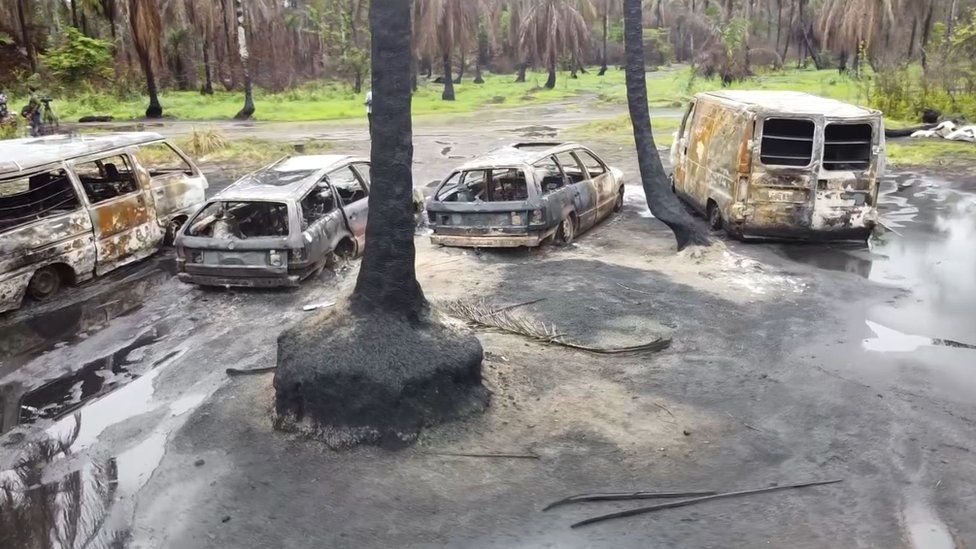
Image source, Arise TV Image caption, The burnt-out remains of vehicles were all that was left after last week’s fire at an illegal refinery in Imo state
For Osaja, illegal refining is not just about making money. He sees himself as a Robin Hood figure, stealing from the oil companies to give to the people.
His home village has been a very productive location for oil companies, but the local people are still impoverished, lacking basic amenities, he says.
“We have seen so much injustice. What is going to the local community? Nothing! Zero!
“This is our property. This is my own and you are taking it, what are you giving to me? So now everybody has tasted the black gold [and] how useful it is to the society.”
Nigerians have been warned that sharing images of child pornography is an offence that carries a 14-year jail term after a video alleged to involve schoolchildren went viral.
Students from a prestigious school were on a trip to Dubai last month when the alleged incident was filmed.
The mother of a 10-year-old says her daughter was coerced to participate.
Lagos state government has ordered the school’s closure so the “alleged sexual violence case” can be investigated.
In a video posted on social media, the mother alleges her daughter was drugged by the male students and accused the school authorities of a cover-up.
Chrisland Schools, which runs several private primary and secondary schools in Lagos, has denied any wrong-doing, saying it takes its duty of care seriously and would co-operate with any inquiry.
According to the school, it was a game of “Truth or Dare” that involved five out of 76 students attending the World School Games between 8 and 14 March.
It said it had informed their parents of the “misconduct” and the students had been reprimanded in accordance with the school’s regulations.
But the mother of the 10-year-old says she was not told the severity of what happened at first, only finding out later when another parent alerted her to the footage, which has since been widely shared on social media.
When she questioned her daughter, she found out the girl had been told not to speak about what had happened: “My daughter was dying in silence and she couldn’t speak.”
She had now been suspended from the school, the mother said.
“To crown it all, because we have started confronting them and started telling them we are aware of what happened, they now sent her a suspension letter.”
According to Lagos state laws, it is illegal for minors to engage in sex and the authorities said it was ensuring that adequate medical and psychological support would be provided.
Any image showing sexually explicit conduct involving a child – including “producing, distributing, receiving or possessing” one – was an offence liable to a sentence of 14 years, the Lagos state government said.
A motorcade of former Nigerian President Goodluck Jonathan was involved in a road crash in the capital, Abuja.
The Wednesday evening accident claimed the lives of two policemen attached to him.
His spokesman Ikechukwu Eze told the BBC that the former president was not personally affected in the accident.
Mr Eze said it was only the vehicle carrying the policemen that skidded off the road when the driver lost control.
It occurred when Mr Jonathan, who is a special envoy of the regional bloc Ecowas, was leaving the Nnamdi Azikiwe International Airport to his residence in the city.
Mr Jonathan has expressed deep sadness over the death of the two police officers, the spokesman said in a statement.
Two other policemen sustained injuries in the crash and were taken to a hospital for medical attention.
The Kaduna State government in northern Nigeria confirmed reports of an attack on a train shuttling between the state and the capital Abuja, late Monday, March 28, 2022,.
Local media outlets reported that gunmen had abducted an unknown number of passengers from the train which at the time was within the Kaduna state jurisdiction.
The BBC Africa LIVE page reports that the gang mined the track between the capital Abuja and Kaduna city and forced the evening train to a halt.
Many of the nearly 1000 passengers on board took shelter as shots were fired. One man is reported to have been killed after the gunmen boarded the train, the report added.
Samuel Aruwan, spokesman for the Kaduna State government said in a statement that security forces had intervened – fought off the gunmen and taken those injured to hospital.
Travel by train has been gaining increased popularity in Africa’s most populous nation given the rising insecurity along the critical road artery connecting the center to the north.
Attacks on the road had led to kidnappings for ransom and instances where hostages were killed.
The latest attack, however is the second to hit the rail network in a period of six months.
The Muhammadu Buhari government has been priding itself in massive improvement in the area of expanding the country’s rail network but insecurity remains a major challenge in connecting parts of the country.
This stems from the uncomfortable manner in which the Super Eagles of Nigeria were welcomed at the Kumasi Airport.
In a video shared by Nigerian journalist Colin Udoh, the players were left with no other option but to jump off their plane because there was no Passenger Boarding Bridge (PBB).
The National Sports Authority(NSA) has reserved 2,000 tickets for Nigerian fans who would want to attend the Super Eagles‘ World Cup qualifier against Ghana at the Baba Yara Sports Stadium. Â
Per FIFA regulations, the home team is to grant 5% of the stadium capacity for the traveling fans. Â
Therefore, the Communications Director for NSA, Charles Amofa, has said although Nigeria requested 10,000 tickets, Ghana will give them 2000 which is in accordance with the FIFA rules.Â
“Our Nigerian brothers who want to watch the game on Friday made a request. They wanted 10,000 that was Cape Coast Stadium. But at Baba Yara, the full capacity is 40,000 so what the Ministry of Youth and Sports has done is that the CAF requirement is 5% of the full capacity so that will be a number of 2,000. With that, the E-ticketing team will block that number for our Nigerian brothers to come and with the game,” he told Peace FM. Â
The match was initially set to be played at the 20,000-seater capacity Cape Coast Stadium but was moved to Baba Yara Stadium in Kumasi after Nigeria expressed concerns about the poor state of the Cape Coast pitch. Â
The match which will be played on March 25, 2022, is 7 days away from the kickoff with the Super Eagles expected to land in Ghana on Wednesday, March 23.
The National Identification Authority (NIA) has disclosed that another Nigerian called Usman Emmanuel has been prosecuted for posing as a Ghanaian to register for the GhanaCard.
According to the NIA, Usman Emmanuel after presenting a valid Ghanaian Birth Certificate successfully went through the registration process and was left with the collection of the GhanaCard.
In a statement issued, the NIA added that its Regional Registration Officer for the Ashanti Region suspected that Usman Emmanuel was not a Ghanaian when he came to collect his card and reported him to the police.
“The suspect was arraigned before the Asokore Mampong District Magistrate Court and was charged with the offence of falsely providing information about himself contrary to section 17 (C) of the National Identification Authority Act 707 (Act 2006).”
“At the end of the trial, the court found him guilty of the offence and was sentenced to a fine of 250 penalty units, equivalent to GHC 3,000.00 or in default 6 months imprisonment,” the statement by the NIA read.
In January 2022, the Adjabeng District Court in Accra sentenced a Nigerian Olu Olarusi Toyin Tracy and a Ghanaian accomplice Yvette Mensah, to a fine of 300 penalty units (GHS 3,600) each, for providing false information to the NIA.
The Madina District Court also sentenced a Nigerian and resident of Lapaz, a suburb of Accra, Derick Armstrong, to four months imprisonment for falsely representing himself as a Ghanaian in an effort to register for the GhanaCard.