Daughter of former United States (US) president, Donald Trump, Tiffany, and her fiancé, Michael Boulos, are allegedly set to wed on 12 November, 2022.
According to sources, the upcoming bride, Tiffany Trump, and her Nigerian-born fiancé, Michael Boulos, will host their opulent nuptials at Donald Trump’s Palm Beach estate in Florida with 500 guests expected.
“There has been a lot of planning and a lot of staging. This is Tiffany’s big moment, and it will be lavish. It is going to be a huge and beautiful affair,” the source said.
The couple got engaged on January 19, 2021, at the White House rose garden a few hours to the end of Trump’s tenure as US president.
Boulos was said to have engaged Tiffany with a 13-carat emerald-cut diamond from Dubai, worth $1.2 million.
Michael Boulos’ background
Boulos was raised in Lagos although he is of Lebanese and French descent.
Per reports, he moved to Nigeria at a young age where his family’s business is based and while in Nigeria, he studied at the American International School of Lagos.
He is the son of Massad, the Chief Executive Officer of SCOA Nigeria, and his mother, Sarah, is the founder of the Society for the Performing Arts in Nigeria.
According to a ‘Page Six’ report, Boulos was studying project management at City University of London when he met Tiffany, a law student at Georgetown, while she was on vacation in Mykonos, Greece, with Lindsay Lohan in 2018.
Daughter of former United States (US) president, Donald Trump, and her fiancé, Michael Boulos, are reportedly set to tie the knot on November 12, 2022.
The bride-to-be, Tiffany Trump, and her Nigerian-bred fiancé, Michael Boulos, according to reports, will hold their lavish wedding at Donald Trump’s palm beach in Florida with an expected 500 guests.
“There has been a lot of planning and a lot of staging. This is Tiffany’s big moment, and it will be lavish. It is going to be a huge and beautiful affair,” the source said.
The couple got engaged on January 19, 2021, at the White House rose garden a few hours to the end of Trump’s tenure as US president.
Boulos was said to have engaged Tiffany with a 13-carat emerald-cut diamond from Dubai, worth $1.2 million.
Michael Boulos’ background
Boulos was raised in Lagos although he is of Lebanese and French descent.
Per reports, he moved to Nigeria at a young age where his family’s business is based and while in Nigeria, he studied at the American International School of Lagos.
He is the son of Massad, the Chief Executive Officer of SCOA Nigeria, and his mother, Sarah, is the founder of the Society for the Performing Arts in Nigeria.
According to a ‘Page Six’ report, Boulos was studying project management at City University of London when he met Tiffany, a law student at Georgetown, while she was on vacation in Mykonos, Greece, with Lindsay Lohan in 2018.
The delegation of Super Eagles of Nigeria arrived San Jose, capital of Costa Rica on Sunday evening ahead of Thursday’s international friendly match between both countries.
The contingent led by NFF Executive Committee Member, Otunba Sunday Dele-Ajayi touched down at Juan Santamaria International Airport aboard Copa Airlines via Panama City at 10:30pm Local time (5:30am on Monday in Nigeria).
A playing squad of 18 players, two coaches and other team officials travelled with the team for the friendly game lined up for the Super Eagles by Nigeria Football Federation. The Nigerian delegation was received by an official of the Costa Rica Football Federation.
The Super Eagles are lodged at Real Intercontinental Hotel, San Jose as they prepared for their first training session ahead of the big match, to which they were invited as part of major activities to send forth the Los Ticos to the FIFA World Cup finals in Qatar.
The game, scheduled for the National Stadium in San Jose, will kick off at 8pm Costa Rica time on Wednesday, 9th November (which is 3am, 10th November in Nigeria).
The cause of the explosion at Onitsha market, one of West Africa’s largest outdoor markets, is unknown.
According to a witness and an official, at least four people were killed and a dozen others were injured in a blast at a popular market in Nigeria’s southeastern state of Anambra.
Emeka Umeagbalasi, the head of the civil society group Intersociety and a witness to the incident on Tuesday, said the blast occurred in a section of the market that sells chemicals, resulting in a fire that razed shops in the Onitsha market, one of West Africa’s largest outdoor markets.
“[F]our people died and scores (were) injured,” Umeagbalasi said.
Onitsha South local government area Chairman Emeka Orji confirmed the death toll to reporters, adding that at least 12 people were injured as they stampeded to leave the market.
The cause of the blast was not immediately known.
Anambra state police spokesman said the casualty figure was unknown but the situation was under control.
The state emergency management agency said it was investigating.
Anambra is one of the five states in the southeast of the country where violence, which authorities blame on separatist groups, is rising among youths who cite historicalmarginalisation.
A clash between two cult groups in the Ahoada Area of Rivers State, Nigeria, last weekend has led to the death of five individuals.
Chukwujeku Kingsley, 36, and Chibuike ThankGod, 23, are among the deceased. The remaining three deceased are yet to be identified.
A police report from the Rivers State Police Command noted that the struggle between the Icelanders and Greenlanders factions was due to a struggle for dominance.
Meanwhile, patrol teams have been mobilised to the area to restore calmness.
In May 2022, three persons were reportedly shot dead in Ibaa community, Emohua Local Government Area of Rivers State in a cult clash.
The cultists, suspected to be Icelanders confraternity members invaded the Mgbuesa Village in Ibaa, killing the victims who were alleged to be members of Deygbam, a rival cult group.
Rivers State Police Command spokesperson Grace Iringe-Koko
An Accra Circuit Court heard testimony from a 28-year-old Nigerian who attempted to rob a woman of the GHC12,000 she withdrew from a bank in the African Union Village.
Godfrey Caleb Chukwuebuka Nnwaiu, charged with attempt to commit crime to wit robbery, pleaded not guilty.
Mr. Jerry Avenorgbo, who represented the accused, prayed the court to admit his client to bail because the matter, as presented by the prosecution, was not what took place.
Defence Counsel said the accused was not going to interfere with police investigations and he had people who would stand surety for him when granted bail.
Counsel disagreed with the prosecution’s assertion that the accused would commit further offences when granted bail.
“You are not Jesus to see the future and you cannot therefore say that the accused was going to commit further crimes when granted bail, kindly do away with that illusion, this is not part of the law.”
Prosecution led by Chief Inspector Isaac Anquandah who held brief for Inspector Princess Tetteh Boafo said the accused was a flight risk and could commit more offences when granted bail.
The court presided over by Mrs Susana Eduful, admitted accused to bail in the sum of GHC50,000 with three sureties, two of whom are to be direct relatives earning not less than GHS2,500 a month.
Prosecution was ordered by the Court to file disclosures for Case Management Conference.
The matter has been adjourned to December 14.
The prosecution case was that the complainant (name withheld) is a private cook at Au Village, Cantonment in Accra. The accused is a trader residing at Kasoa.
On October 26, this year, the Police received intelligence to the effect that a suspected robber had been arrested by some bystanders after he attempted to rob the complainant of cash in the sum of GHC12,000 and attempted to bolt with the booty.
Prosecution said the Police motorbike patrol team were dispatched to the scene and apprehended the accused person.
The prosecutor said investigations revealed that the complainant had arrived in a taxi from Ecobank, Airport branch and she was crossing the road to her workplace at the AU Village after purchasing vegetables.
The prosecution said a motorbike with registration number M-20-GR-2940 with the accused as a pillion rider crossed the complainant and demanded that she handed over a polythene bag containing money to him.
The prosecutor said the complainant refused the demand from the complainant and a struggle ensued, which led to the complainant throwing the money into the middle of the road.
The accused jumped off the motorbike and rushed to pick up the money and attempted to bolt.
Luck, however, eluded the accused when some witnesses in the case, seized him and handed him over to the Police.
In Nigeria’s Kano State, two Tiktok celebrities were convicted guilty of defaming the governor, Abdullahi Umar Ganduje.
The magistrate’s court also found them of engaging in actions that could disturb public peace.
The sentence included offering a public apology to the governor, being given 20 lashes each, an order to sweep the court premises for a month to pay a fine of 10,000 naira ($23) each.
The two, Mubarak Isa Muhammad, alias Unique Pikin, and Nazifi Muhammad Bala mocked the governor in skits that accused Ganduje of land grabbing, corruption and dozing off in public.
A BBC Africa LIVE report said, they were found guilty on Monday of defaming Kano state governor Abdullahi Ganduje in a comedy video they recorded and shared on TikTok and Facebook.
They pleaded guilty and asked for leniency, with their lawyer stating that they would not appeal the ruling.
With an Afro-futurism theme, Nollywood stars dressed up taking inspiration from numerous African culture and Black Panther’s fictional Wakanda.
The cast of the Black Panther sequel, including Lupita Nyong’o, Letitia Wright, Danai Gurira, Winston Duke, Tenoch Huerta and Director Ryan Coogler, was present at the event.
Black Panther: Wakanda Forever will hit theatres on November 11.
After refusing to consent to an operation at a London hospital, a 21-year-old man raised red flags.
A judge has announced that Nigeria’s former deputy Senate president will stand trial in the United Kingdom in January for alleged organ harvesting.
Ike Ekweremadu, 60, is accused of bringing a man from Nigeria to have a kidney removed with his wife, Beatrice, 56, their daughter, Sonia, 25, and a doctor.
The 21-year-old man is said to have raised the alarm after refusing to consent to the surgery after preliminary tests at London’s Royal Free Hospital.
The BBC reported that the Ekweremadu family allegedly treated the man like a slave before he ran away and went to Staines police station in Surrey.
Ekweremadu is a senator for the opposition Peoples Democratic Party for Enugu State in southeast Nigeria.
In six months since emerging as the winner of the seventh season of popular Nigerian music reality TV show, Nigerian Idol, Progress Chukwuyem has been basking in the euphoria of his coronation as one of the winners of one of Nigeria’s most storied music competitions.
In addition to that, the 21-year-old singer has been staking a claim for himself as a musician to watch out for in his own rights, performing back-to-back shows and releasing a single titled ‘Lift Me Up’.
‘Lift Me Up’, released on the back of his Nigerian Idol win found the singer suavely contemplating the doubts that plagued him before his win and what direction his life might take in light of his momentous win. Produced by Dreybeatz, the song saw him showcase the pruned vocal textures and silky voice that powered him to his win.
Progress’ next song, ‘Jo’ is a hard reset on all that has come before as the singer flings himself into the territory of Afro-pop with an Afrobeat-inspired track that channels euphoric joy. Atop a skittering instrumental spun again by Dreybeatz, Progress summons his listeners to the dancefloor with his stylish voice and dulcet flow, while reasserting his presence as a bonafide breakout star.
The singer, according to those close to him, mulls the idea of dropping a debut project early next year, a move that will hopefully stamp him as a legitimate success story from the Nigerian Idol music reality show.
Glencore is facing fines in millions of dollars for a series of corruption offences in which it used a private plane to fly money to bribe officials in different African governments.
In June, a division of the FTSE 100 commodities behemoth admitted to paying many bribes to get access to oil supplies.
Following the filing of a number of charges by the Serious Fraud Office, it was the first time a firm had ever been found guilty of bribery under UK law (SFO).
Glencore may face fines of over £243 million, and the SFO is requesting the highest confiscation order ever against a British business of £93.4 million, as well as £4.5 million in fees.
At today’s sentence hearing at Southwark Crown Court in London, the exact sum will be decided.
Glencore’s attorney stated on Wednesday at a hearing that the company “unconditionally regrets the harm caused.”
However, prosecuting attorney Alexandra Healy asserted that “corruption was pervasive inside the enterprise” and that “offering of bribes was an accepted method of conducting business for the company.”
After a protracted inquiry, it was discovered that Glencore’s London-based oil trading department paid bribes totaling more than £24 million to get privileged access to cargoes in South Sudan, Nigeria, Cameroon, the Ivory Coast, and Nigeria.
The investigation discovered that a Glencore agent in Nigeria took over £3.6 million from a slush fund and often used a private plane to fly the money to Cameroon to bribe authorities, among a long list of other offences.
Agents, executives, and dealers for Glencore were so casual that they frequently addressed one another as “senorita” and “bro,” even when talking about bribery.
Another agent received £870,000 in 2011 to pay bribes to Equatorial Guinean authorities in exchange for access to oil cargo, and the company reportedly approved £5,000 in “hotel charges” for the agent during a trip to London.
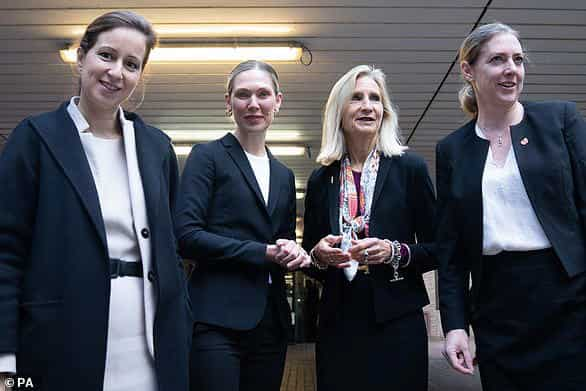
A top SFO team comprised entirely of women led the Glencore inquiry.
Photo credits: The Guardian
These included, (above) from left to right: Sara Chouraqui, joint head of fraud, bribery and corruption and Victoria Jacobson, the prosecutor for Operation Azoth – codename for the Glencore probe – as well as department director Lisa Osofsky and case controller Liz Collery.
A Glencore official made a request for approximately £700,000 from the business’ Swiss cash desk the same year, purportedly for “establishing an office in South Sudan” soon after the country gained independence.
Human rights organizations say that authorities are “harming hundreds of thousands… to advance a dubious government development agenda.”
According to Human Rights Watch, more than 200,000 Nigerians displaced by long-running violence are struggling for food and shelter after authorities in the northeast closed some of the camps they were living in and stopped aid.
Borno state, the epicenter of the Boko Haram conflict, announced in October 2021 that it would close all camps housing thousands of internally displaced people and return some of them to their communities. It cited increased security and the need to wean displaced people off humanitarian aid.
In a report released on Wednesday, Human Rights Watch said people removed from the camps were struggling to meet their most basic needs, including food and shelter, in the places where they had returned or resettled.
More than 140,000 people had been removed from eight camps in Borno while food aid to two more camps had been stopped as of August this year, Human Rights Watch said. Those two camps hold more than 74,000 people and will close this year.
“The Borno state government is harming hundreds of thousands of displaced people already living in precarious conditions to advance a dubious government development agenda to wean people off humanitarian aid,” Anietie Ewang, Nigeria researcher at Human Rights Watch, said in the report.
“By forcing people from camps without creating viable alternatives for support, the government is worsening their suffering and deepeningtheir vulnerability,” she said.
Borno state commissioner for information Babakura Abba Jato told Reuters he could not immediately comment on the report.
The state government says some areas formerly occupied by Boko Haram fighters are now safe for citizens to return to, and it has rebuilt some communities although aid groups say they remain vulnerable to attacks.
Some of the camps and settlements for displaced people have been hit by a cholera outbreak, and children have been the worst hit.
Last month, about 2,000 people started moving into a new residential complex in Ngarannam that had been rebuilt by the United Nations and the state government.
Ngarannam, 50km (31 miles) south of Borno’s capital, Maiduguri, was overrun by Boko Haram in 2015.
Nigeria have well and truly made their mark on the Fifa U-17 Women’s World Cup India 2022™.
For their first time in their history, the Africans clinched a place on the podium with a thrilling win over Germany in the match for third place. It came on penalties after the two sides had played out a hugely entertaining 3-3 draw in normal time.
The furthest the Nigerians had progressed at the U-17 world finals before now was the quarterfinals, a stage they reached in 2010, 2012, and 2014. Their record-breaking India 2022 campaign included wins over New Zealand and Chile in the group phase, followed by a penalty-shootout defeat of the USA in the last eight.
Opeyemi Ajakaye, Amina Bello, and Edidiong Etim were the scorers as Nigeria surged into a 3-0 lead in normal time, only for Germany to peg them back with goals from Jella Veit, Paulina Bartz, and Loreen Bender to force a penalty shootout.
Paulina Platner, Bender, and Bartz all missed the spot for the reigning European champions. And though Germany keeper Eve Boettcher saved from Tumininu Adeshina, it was not enough to stop Nigeria from edging the shootout 3-2.
Nigeria use its weapons well
With 20 minutes of the match gone, Ajakaye showed her pace down the right flank, latching on to a fine pass from Taiwo Afolabi, surging into the box, and firing off a shot that Boettcher could not keep out.
Nigeria then showed their set-piece skills to make it 2-0. Miracle Usani, who has excelled throughout the tournament, floated a corner onto the head of the unmarked Bello, who nodded home with aplomb.
The African side’s third also came from a corner, this time taken by Adeshina. Germany’s defense was unable to clear, giving Etim the opportunity to volley the ball past Boettcher.
Germany began their fightback from another dead-ball situation, with Veit getting on the end of a well-flighted free-kick from the left to head in. Veit had a hand in Germany’s second, sending a cross into the box that Laila Portella laid off for Bartz to score from close range.
The equalizer came on the stroke of full-time. When Mathilde Janzen’s curling long-range effort came back off the bar, Bender was there to hook the ball into the net with an acrobatic overhead kick.
Despite Boettcher’s save from Adeshina in the resulting shootout, misses by Platner, Bender, and Bartz gave the Nigerians a 3-2 win on penalties and the best finish they have ever achieved in the competition.
“I’m very happy. I gave my all for the team and I gave my all to keep the ball out. My team is so important to me. We practiced penalties together and I focused very hard so I could save them.” Nigeria goalkeeper Faith Omilana
Nigeria’s President Muhammadu Buhari has summoned heads of security agencies for a meeting on Monday in the capital, Abuja, following terror alerts issued recently by several Western countries.
In a statement, the presidency said the meeting was aimed at reviewing and strengthening the security network across the country.
Last week the UK and US had warned that Islamist militants were likely to target government facilities, places of worship and schools in Abuja and its environs.
The US went further to approve the evacuation of its citizens and non- essential staff. The alerts sparked public anxiety and tension across the country.
Meanwhile reports say a top leader of one jihadist group, Iswap, has been arrested and some militants killed as they attempted to free some of their detained leaders being held at a camp in central Niger state.
The militants were reportedly killed by Nigerian troops after they ran into military ambush in New Bussa, Niger state.
The State Department has ordered that non-emergency US embassy employees and their families leave Abuja, Nigeria, “due to the heightened risk of terrorist attacks there.”
In addition, the department issued a “Level 3” travel advisory for the entire country, urging people to “reconsider travel to Nigeria due to crime, terrorism, civil unrest, kidnapping, and maritime crime.”
The State Department authorised the departure of non-emergency US government employees and family members earlier this week, after previously warning of planned terror attacks in Nigeria’s capital Abuja.
“Targets may include, but are not limited to, government buildings, places of worship, schools, markets, shopping malls, hotels, bars, restaurants, athletic gatherings, transport terminals, law enforcement facilities, and international organizations,” its October 23 advisory said of the alleged plots.
In an updated travel advisory issued Thursday, the State Department flagged 15 other Nigerian states in its “Do Not Travel” list due to risks ranging from terrorism to kidnapping and criminal activities perpetrated at sea.
In a similar advisory to British nationals, the UK government advised against nonessential travel to the Nigerian capital, while warning against all travel to 12 Nigerian states.
A popular Abuja mall closed its doors Thursday for the protection of staff and customers, its management said, adding that it was reviewing the security situation in consultation with authorities.
Nigeria’s police chief, Usman Alkali Baba, said there were “no imminent threats” in the country’s Federal Capital Territory.
“The Inspector General of Police, therefore, allays the fear of residents in the FCT and admonishes them to go about their lawful businesses and normal social lives/engagements as all hands are on deck to nip any security threat in the bud and respond to distress calls promptly,” a statement by his office said Thursday.
“The IGP similarly reiterates the commitment of the Nigeria Police to eliminating all threats, as well as protection of lives and property of all residents of the country,” the statement added.
Insurgency has remained rife in northeastern Nigeria, even as the country also struggles to contain motorbike riding gangs known locally as ‘bandits’ who carry out deadly attacks on communities in the northwestern region.
Nigeria also grapples with widespread kidnappings for ransom and maritime crimes in its southern region.
Hundreds of prisoners were broken free in a prison raid in the country’s capital in July. According to authorities, all inmates linked to Boko Haram escaped during the attack.
The Islamic State group claimed responsibility for the raid.
Cypriot police fired tear gas Friday after a fire broke out in an overcrowded migrant reception centre amid clashes sparked by an argument between different nationalities, officers said.
One person needed hospital treatment after being injured at the Pournara camp for migrants, on the edge of the capitalNicosia.
People hurled rocks and objects at each other, forcing many to flee in panic, and firefighters rushed to extinguish a blaze that sent billowing smoke into the sky. Tensions later “calmed”, a police said.
Chief of police Stelios Papatheodorou blamed the violence on overcrowding at centre, which holds more than double its original 800 capacity.
“Police are doing everything possible to protect the area and those residing in the camp,” said Papatheodorou.
Cypriot news outlet Philenews said clashes broke between asylum seekers from Democratic Republic of Congo and Nigeria, two of the largest migrant groups in Cyprus.
European Union member Cyprus says it is on the frontline of the bloc’s irregular migration flows, and last year reported the highest number of asylum applicants per population.
The small EU state has lobbied Brussels to take action over the “disproportionate” numbers of asylum seekers it receives.
New asylum applications multiplied to over 13,000 last year in Greek Cypriot-administered southern Cyprus, with its population of 850,000.
In March, a report by the Cypriot children’s rights commissioner described chronic overcrowding, woeful bathroom facilities and reports of meagre food rations in the Pournara camp, prompting officials to vow to work to improve conditions.
Thursday, October 27, marked the birthday of Nigerian rapper, songwriter and actor, Falz.
He is a talented Nigerian rapper and founder of Bahd Guy Records. Falz holds an LLB degree with honours.
Without a doubt, the 32-year-old qualified lawyer-artist has contributed his quota to the entertainment industry in Nigeria.
Below are seven things to know about Falz:
1. Folarin Falana is Falz’s real name
Falz was born Folani Falana on October 27, 1990, and hailed from Lagos state, Nigeria.
2. He is the son of Temi Falana and Femi Falana
He was born to Temi Falana, a Nigerian human rights activist and lawyer and Femi Falana, who is also a legal practitioner and women’s rights activist.
3. He graduated from the Nigeria Law School in Abuja, Nigeria
Following his parents’ footsteps, Falzattended the Nigeria Law School in Abuja and entered the University of Reading after graduating and earning an LLB with honours.
4. He formed a group called ‘The School Boys’ while in Secondary school
With his passion for music, he formed an all-boy group called “The School Boys” during his secondary school years. He released “Shakara,” a compilation mixtape, in 2009 while still a student.
5. He shot into the music scene in 2009
He began his professional music career in 2009 after releasing his single “Marry Me”, which featured Yemi Alade and Poe.
In 2015, the single won him a nomination for the “Best Collaboration of the Year” category at the Nigeria Entertainment Awards.
He calls his style of music’ Wahzup Music’, which is a mix of hip-hop with old-school sound and funny lyrics.
6. Falz won a couple of awards in the movie industry
He won the “Best Actor in a Comedy Series” at the 2016 Africa Magic Viewer’s Choice Awards for his role in Jenifa’s Diary. He also won “Best Supporting Actor”, his second award in the movie industry for the role he played in ‘New Money’.
7. His stage name
Falz the Bahd Guy emerged from Falz, a short form of his last name, Falana while the Bahd Guy is an acronym for “Brilliant And Highly Distinct”.
The United States has ordered some diplomatic staff and their relatives to leave Nigeria’s capital, Abuja, citing the risk of terror attacks.
The American embassy in Abuja has advised US citizens not to travel to the city.
It hasn’t given any details of the potential threat.
On Wednesday the US made a similar warning for South Africa, saying people in Sandton – a wealthy neighbourhood in Johannesburg – should stay away from crowded areas this weekend.
President Cyril Ramaphosa said it was “unfortunate” that Washington hadn’t spoken to his government before making the announcement.
Nigeria will need to invest up to $425 billion in mixed energy sources in order to attain stability by the year 2060, a new report has found.
The report entitled Nigeria Leading Africa to Net Zero”, was released today by the global technology group, Wartsila and made available to Vanguard in Abuja.
In the new report, the technology company provides a comprehensive roadmap on how the country should proceed to build a 100% renewable energy power system by 2060.
Watsila said, “As Nigeria seeks to take the lead in climate action whilst meeting the nation’s growing energy needs and secure universal access to electricity for its population, the need to build a data-driven and cost-effective energy strategy becomes crucial.
“Using advanced energy system modelling techniques, Wärtsilä’s analysts have outlined the most cost-effective power system that can be built in Nigeria year after year to reach net zero by 2060.
According to Wärtsilä’s report, the optimal power system will consist of 1,200 GW of renewable energy capacity and require a total of 283 GW of energy storage and 34 GW of engine-based power plants for grid balancing purposes.
The research shows that investing in renewable energy and flexibility from gas engines and energy storage is the best way to reduce energy costs, increase energy access and improve grid reliability.
“With this strategy, the cost of electricity generation is predicted to drop by 74% by 2060 compared to 2022 levels, and carbon emissions will drop to zero.
“This in-depth energy modelling exercise also reveals the key role that Nigeria’s domestic gas will play to enable a smooth energy transition. Nigeria’s vast domestic gas reserves can be mobilised as an inexpensive bridging fuel, to power balancing engines in support of intermittent renewable energy generation, until gas engine power plants begin to be converted to run purely on green hydrogen starting in the early forties.
“If the power system expansion roadmap presented to the report is successfully implemented, by 2060 Nigeria’s power system will be fully decarbonised and able to meet the energy needs of our country’s rapidly growing population.
“The key components of our power system will be renewables, supported energy storage technologies, together with grid-balancing engines that have been converted to run on green hydrogen.
” As early as 2032, Nigeria can reach universal access to electricity, and the inefficient, expensive, and polluting diesel generators still widely used today will be ancient history.”, said Wale Yusuff, Managing Director of Wärtsilä in Nigeria.
‘”However, delivering on this ambitious plan will require enormous investments, estimated at $18.7 Billion until 2030 and $425 Billion until 2060.
“Attracting that level of investment is possible, but not without significant policy reforms.
” Despite the many government efforts to implement an increasingly strong legal framework, project developers and sponsors must still navigate a very complex and uncertain system that adds excessive investment risk.”, warned Wale Yusuff.
‘With its huge gas reserves and high renewable energy potential, Nigeria has all the natural resources necessary to lead the country to a successful energy transition.
” If the country can improve its power transmission infrastructure, develop a sound policy framework, and deploy a data-driven power expansion plan based on renewable energy and flexibility; it will take a giant step towards its goal of securing universal access to affordable, reliable and fully decarbonised electricity,” the report suggested.
The Federal High Court sitting in Umuahia, Abia State capitalon Wednesday denied the Nigerian government’s application to transfer the suit filed against it by the detained leader of the Indigenous People of Biafra (IPOB), Nnamdi Kanu, to the Federal Capital Territory, Abuja.
Recall that Kanu through his Special Counsel, Aloy Ejimakor, had sued the Nigerian government, challenging his abduction and extraordinary rendition from Kenya.
The IPOB leader in the suit among other things is praying for the court to order his return to Kenya where he was abducted or UK where he resides.
The Nigerian government had through its counsel, Simon Enoch of the Federal Ministry of Justice, in adopting his written addresses on Tuesday had prayed the court to dismiss the suit claiming that it is an abuse of court processes.
He further argued that the matter had already been decided by the Abia State High Court, and further claimed that Kanu had earlier jumped bail before his re-arrest in Kenya.
The federal government also applied that the case be transferred to Abuja.
But on Wednesday morning, the presiding Judge, Justice Evelyn Anyadike, denied the Federal government’s application to transfer the suit to Abuja. The judge ruled that “Umuahia has the jurisdiction to hear and determine the suit”.
Confirming the court’s decision on his Twitter page, Kanu’s lawyer, Aloy Ejimakor stated that “Federal High Court, Umuahia denies Federal government’s application to transfer the ‘extraordinary rendition’ suit to Abuja, and rules that “Umuahia has the jurisdiction to hear and determine the suit”. Reading of the rest of the judgment continues.”
He added that “Court denies federal govt’s second preliminary objection to its jurisdiction based on Res Judicata. The Court rules that the Abia State High Court judgment of Jan 19, 2022 was specific to the 2017 military invasion, not the 2021 extraordinary rendition.”
In an interview with YouTuber One Ghana TV, Esther disclosed she was abused in her marriage.
She added that her son was diagnosed with a hole in his heart during that period.
“You know, my child I gave birth to in Dutchland, some people turned it around and said I had given my child to another man, and the person perpetrating those lies was someone close to me. The person was creating an impression.
“My situation would have turned out just like the lady who died in Nigeria, Osinachi’s death. So I had to quit. I had to quit because God has given us brains and sense. You have to apply it,” she divulged.
Esther also disclosed that when she left her marriage, her ex-husband made up stories that shocked her to the extent that she couldn’t defend herself until this day.
“It is not about what people are saying or doing, but then you need to think and say, where are things headed? I think I can die. So you have to quit and if you quit, it won’t make the person happy, so they will have to frame stories to tarnish your image when you know nothing about it. Since I am not good at talking too much, I had to keep quiet. That was what happened,” she explained.
She added that God has favoured each and everybody with intelligence when confronted with difficulty, but not stay in it and endure.
The ‘Onyame Ye Nyame’ artiste in 2012 disclosed that her former husband, Rev. Ahenkan Bonsu, used her as a punching bag during their four years of marriage.
On April 8, 2022, Nigerian gospel artiste, Osinachi Nwachukwu, known for her popular song ‘Ekwueme’ passed on after her husband allegedly kicked her in the chest multiple times.
Nigeria’s experience in power outages as a result of inadequacy in generation further increased the interest in the nuclear option in the country’s quest to diversify its power generation options, Director, Centre for Energy Research and Training (CERT), Ahmadu Bello University, Prof. S.A. Jonah has said.
Prof. Jonah was speaking on Monday at the opening ceremony of a five-day IAEA-AFRA regional course on demonstration of conditioning operation and storage of Disused Sealed Radioactive Sources (DSRS) for managers, scientists and technicians of nuclear wastes at the research centre.
The objective of the training course is to train local experts and facility operators to acquire sufficient capacity to carry out the handling and conditioning operation under the supervision of IAEA experts.
This involves demonstration on how to characterize, condition and repackage disused sealed radioactive sources (DSRS); and the specific purpose is to provide the practical know-how as well as the hands-on experience to the participants.
Prof. Jonah, who noted that the use of sealed radioactive sources in Nigeria had witnessed an upward surge in health, industrial and petroleum sectors of the economy, explained that globally the interest in nuclear power was also growing to meet the demand for electricity while reducing their carbon dioxide emissions.
“It may be the only source of reliable base load energy for the future, especially with the discovery of substantial amount of uranium in sea water, as well as the fusion reactor technology.
“Therefore, as we continue our march into peaceful applications of nuclear energy in Nigeria and with the successful hosting of this training course at CERT, I would like to assure everyone that we will not rest on our oars in the delivery of peaceful applications of nuclear science and technology to Nigerians as enshrined in our Statute”, he said.
Jonah, a professor of nuclear and reactor physicist, further said that the management of nuclear and radiological materials in a professional manner was very critical for sustainability and socio-economic development of African sub-region.
He said that the training course was to have taken place much earlier than now, but for some unforeseen circumstances, especially COVID-19 pandemic, stressing that the hosting of the training workshop would mark the beginning of more IAEA hosted activities at CERT.
While welcoming the IAEA team of experts led by Miss Vivian Pereira Campos and participants from AFRA countries – Ghana, Ethiopia and Nigeria, Prof. Jonah also said that Nigeria ranked top among countries ready to host training course on the demonstration of conditioning operation under the Project RAF9062.
This, he further explained, was because quite a number of spent radioactive sources had been generated from various practices using radioactive sources, and many of these sources were presently stored in the waste management facility at CERT.
In his remarks, the Chairman and Chief Executive Officer of the Nigeria Atomic Energy Commission (NAEC), Prof. Yusuf A. Ahmed, acknowledged the various supports the International Atomic Energy Agency (IAEA) had been providing to Member States through regional and international projects for handling and conditioning of disused sealed radioactive sources.
The conditioning process, which must follow an established procedure, according to him, was carried out to limit the risk of exposure of disused sealed radioactive sources to people and environment.
Prof. Ahmed, who was represented at the occasion by Prof. A.A. Mati of Centre for Energy Research and Training, Ahmadu Bello University, Zaria, also stressed that Nigeria recognized that a long term commitment to the peaceful, safe and secure use of nuclear technology was based on a sustainable organizational, regulatory, social, technological and economic infrastructure development.
He said that this was in addition to the formulation of deliberate policies and implementation to ensure the safe operation of the nuclear installations throughout their entire life cycle.
Also speaking, the Vice-Chancellor, Ahmadu Bello University, Prof. Kabiru Bala, who declared the training workshop open, said that the University would continue to support CERT as a Centre of Excellence in promoting education and training with regards to nuclear science and technology in the country.
The Vice-Chancellor expressed the University’s immense appreciation to IAEA for its support to CERT in particular and Nigeria in general through the provision of training and research facilities for over three decades.
“In furtherance of this endeavor, only last month, the IAEA and ABU signed an agreement to participate in the Internet Laboratory Project (IRL) on the sideline of the 66th IAEA General Conference”, he said.
This, according to him, was to enhance the teaching and practical applications of nuclear reactor physics in Ahmadu Bello University and other Nigerian universities, which hitherto were limited to theoretical concepts.
Miss Vivian Pereira Campos, who led the IAEA team of experts to the training course, gave an overview of the programme, saying that the essence of the workshop was to provide the participants with requisite skills and techniques to carryout the conditioning operation in the future without guidance and supervision.
Goodwill messages were delivered at the occasion by the Secretary, IAEA-AFRA Management Committee and Deputy Dean, Faculty of Life Sciences, Ahmadu Bello University, Prof. Maryam Aminu; Prof. Sunday Adeyemi Adewuyi, who represented the Chief Medical Director, Ahmadu Bello University Teaching Hospital; and Malam Abdullahi Saleh Na’Allah, who stood in for the Director-General of the Nigerian Nuclear Regulatory Authority (NNRA).
Some of the personalities present at the opening ceremony of the training course included Course Director, Nigeria Atomic Energy Commission, Mr. Emmanuel C. Akueche; and representatives of the Nigeria Defence Academy (NDA) and Nigerian College of Aviation Technology (NCAT), Air Commodore A.I. Hanidu and Malam Nasir Mu’azu, respectively.
Flooding is not unusual in Nigeria’s massive, population-dense cities. But this year’s floods are reportedly the country’s worst in a decade. They’ve killed more than 600 people, displaced 1.4 million residents and destroyed 89,348 houses and 70,566 hectares of farmland and crops.
The severe flooding has had a significant impact on some states in the south of the country, including Anambra, Delta, Rivers, Cross River and Bayelsa. Adamawa, Gombe, Jigawa, parts of Kaduna, Kogi, Niger, Benue and Nasarawa in the country’s north have also been hit hard.
This year’s rainfall has been higher than usual in both the south and the north. The volume of rainfall has exacerbated the effects of the annual release of excess water from Cameroon’s Lagdo Dam. The dam is on the Benue river, which runs through Nigeria.
Over the years, the government has taken several measures to mitigate and manage the effects of floods. These include providing food, warm clothes and temporary shelter for flood victims. The Nigerian Meteorological Agency has also developed early warning systems and the federal government established the Ministry of Humanitarian Affairs, Disaster Management and Social Development in 2019 to coordinate disaster risk reduction activities.
These measures have not helped, especially as flooding is now an annual occurrence. In fact there is some eviden that the effects of floods have worsened in recent years due to a lack of coordination among various government agencies.
In previous research I established that many factors contribute to flooding in Nigerian cities. These include poor drainage systems, the indiscriminate dumping of refuse and haphazard physical developments. Climate change plays a role, too; research shows that climatic shifts are increasing the intensity and frequency of storm systems in Africa. The recent Intergovernmental Panel on Climate Change report also predicted an upward trend in extreme rainfall events for sub–Saharan African communities.
Given these realities, how do residents cope? In a recently published article I examined the flood resilience strategies of residents in Nigeria’s Kaduna metropolis. Kaduna is the capital city of Kaduna State, and the former political capital of northern Nigeria. The city’s southern area is flood-prone and is among those hit by the recent floods.
I found that households’ ability to prevent, cope with and reduce flood risks is determined by their income, housing, transport, drainage and road facilities.
My hope is that this study will provide information that could be useful to policy makers to make Nigerian cities safer and more resilient to floods.
Household resilience
I interviewed residents from 357 households – ranging from low to high income – and found that they employed various tactics to survive the floods. Across the study area, strategies were similar in that they were reactive rather than anticipatory. This is because adequate flood preparedness requires collaborative efforts from government and other relevant stakeholders, including households. Such efforts did not exist.
In high income areas, I heard how community members raised funds to clear drains and waterways and to repair and replace damaged bridges. Some community leaders also sought to educate residents about flood preparedness through public dialogue and religious institutions.
In the low and medium income communities, sandbags were used to keep some floodwaters at bay. People also temporarily moved away from their homes when there was flooding, shifting what they could of their belongings and properties to higher ground. They sought financial and accommodation support from civil society organisations, government and nongovernmental agencies.
When I asked residents about what motivated them to move to safe places, respondents in all income brackets said their main concern was “keeping the family unit together”.
My results show that household resilience strategies are typically short-term in nature, regardless of income brackets. They also failed to effectively help households offset impacts such as loss of jobs and displacements due to flooding.
Way forward
Inadequate support from government leaves residents largely to their own devices when it comes to flood mitigation.
In my view, the Nigerian government at all levels must engage residents, and other relevant stakeholders, to implement both short and long-term solutions. These must be designed to reduce and overcome the impacts of flooding in Nigerian cities.
The starting point is the sensitisation of residents and businesses located in high-risk areas. They need to know what to do in times of flooding to minimise the negative effects. Similarly, all stakeholders’ roles, obligations and responsibilities before, during and after flooding need to be clearly identified and tied to specific government agencies for further support.
In addition, the federal government must collaborate with state governments to ensure that appropriate environmental and development control laws are strictly enforced.
This will prevent new development on wetlands and floodplains and ensure that new development follows flood-resilient standards when building in coastal areas.
Residents also need to embrace a collaborative approach to handling flood issues. This should be done through knowledge sharing and coordinated efforts to help them advance their local coping strategies. Social learning is one key aspect that households should embrace to communicate, share experiences, ideas and resources and plan collective action.
The United States Embassy yesterday issued a security alert on the elevated risk of terror attacks in Abuja, the Nigerian capital.
Following US Embassy’s terror warning, the British High Commission also issued an advisory to its staff on movement while also announcing reduced services.
According to reports, other European countries, are reducing services and will be attending only to critical needs.
In a swift reaction, the Department of State Services (DSS) called for calm, saying necessary precautions are being taken to secure the Federal Capital Territory (FCT) and other parts of Nigeria.
According to a statement from the embassy in Abuja, targets of the terrorist attack may include government buildings, places of worship, schools, markets, shopping malls, hotels, bars, restaurants, athletic gatherings, transport terminals, law enforcement facilities, and international organisations.
The British High Commission in a statement announced that: “On Monday 24 October, British High Commission Abuja (BHC) will be open for Business Critical staff only. ALL colleagues wishing to travel to BHC should seek authorisation from Line Manager/ Block Leads, and in advance of travel.”
On the same day, BHC Abuja UKB parents are advised strongly not to send children to schools.
The latest alert followed an intelligence report in September about possible attacks on military facilities in Nigeria. One of the targets was the Nigerian Army School of Artillery, Kachia, which houses the country’s second-largest ammunition dump, after Ikeja Cantonment.
The report had said the terrorists planned to mop up enough firepower to stage a takeover of Abuja.
It was dark. Everything was dark. And the water level rose, even higher. This time, Fortune Lawrence resigned herself to flee with her 8 children on a makeshift boat, far from her house ravaged by the floods.
It has been two weeks since the 50-year-old and her “pikin” (“children” in Nigerian pidgin) fled the deadliest floods of the decade in Africa’s most populous country.
The family is now living in deplorable conditions in a crowded school near Ahoada, Rivers State, in southeast Nigeria.
According to records, more than 1,000 people have taken refuge in the classrooms of this makeshift IDP camp.
“I was afraid to die,” says Ms. Lawrence, surrounded by about 20 children, in the middle of a classroom.
“Here, we have nothing. Not enough food, no diapers or mosquito nets. We need help,” she says, her features drawn.
According to the authorities, the floods have killed more than 600 people and displaced 1.3 million since June across the country. In the memory of Nigerians, confirmed by the weather agencies, the rise in water this year is particularly meteoric. Much more than in 2012 and 2020.
Today, the South East is the most affected region.
In Rivers State, here and there, many crowded camps for displaced people are hosting those who were able to flee.
The others have stayed in the submerged villages and are sleeping where they can, in trees for example,” says Obed Onyekachi, referring to several members of his family.
“It was impossible for them to come here. And how many others, swallowed by the waters, are missing?”, asks the 32-year-old man, rage in his voice.
“The crops were destroyed. We have lost hope. Famine is coming.”
“Contaminated water”
Without a boat, moving from one state to another is impossible. The supply of food is laborious.
On the main road to the west, the current overturned a tanker. Several people died at this point, according to local residents.
Some people are still trying to cross on foot, with water up to their waist.
“I’ve been stuck on the road for seven days. We don’t know how long it will last. Everything is devastated”, laments Alamin Mohamed, 25 years old, who hopes to be able to cross soon by motorcycle.
The crowded boats, made of wood and, for the lucky ones, motorized, are shuttling back and forth. No one wears a life jacket.
On the right bank, the roof of a church protrudes from the dark waters, brushed by high-voltage electric cables.
The representative of the UN Food and Agriculture Organization (FAO) in Nigeria, Fred Kafeero, warned that the flooding increased the risk of diseases such as cholera.
At Ihuike Primary School, most of the students are sleeping on the floor, huddled together. Each classroom houses about 50 people.
A team of student volunteers cleans the premises and divides the meager food supplies sent by local authorities.
One of them, with a “Ekpeye students” T-shirt on his shoulders, worries about the risk of epidemics and infections.
“We need a clean environment. We pay attention to everything but we are exhausted,” he said, speaking on condition of anonymity.
A network of illegal oil pipelines being unearthed in Nigeria’s Niger Delta region has revealed the extent of oil theft in the country, astounding even the most cynical about Nigeria’s obscure but hugely lucrative oil industry.
In Delta state, thieves built their own 4km- (2.5 mile) long pipeline through the heavily guarded creeks to the Atlantic Ocean. There, barges and vessels blatantly loaded the stolen oil from a 24-foot rig visible from miles on the open waters.
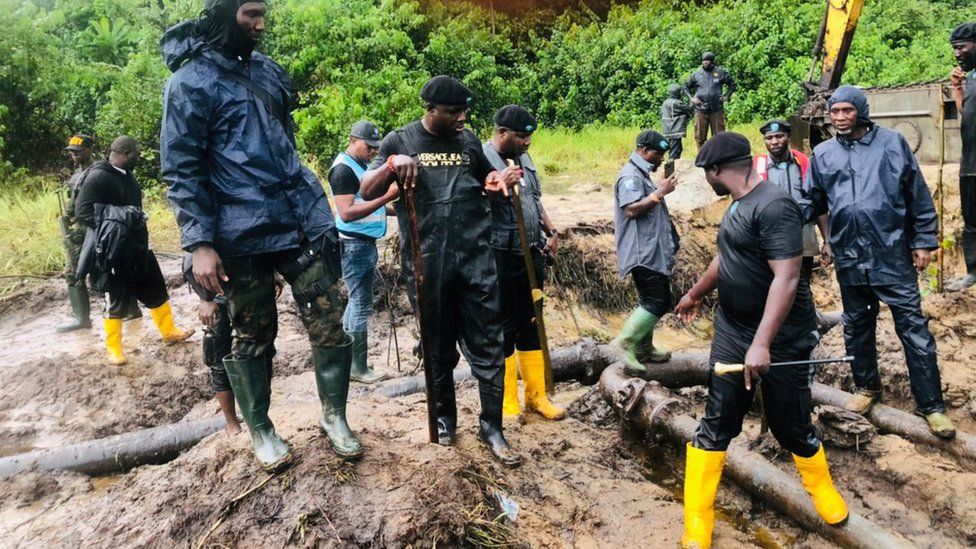
“It was a professional job,” said the head of the Nigerian National Petroleum Company Limited (NNPCL), Mele Kyari, wading through the swamps as he retraced the slick path during a televised visit to the scene.
Crude oil is Nigeria’s main export but production, and revenue, has been dwindling for years because of thieves, authorities say. Oil production fell from 2.5 million barrels per day in 2011 to just over a million in July 2022, according to the regulator.
Authorities say more than $3.3bn (£2.9bn) has been lost to crude oil theft since last year and at a time when other oil producers are having a petrodollars splurge, Nigeria can’t even meet its production quota. And it is not that the country can afford to lose money to thieves, it is gripped by widespread poverty and heavily indebted.
Many are saying that the recent discovery of the illegal pipelines confirms long-held suspicions of massive corruption in the sector where there is little transparency.
Nigeria’s oil industry has a documented history of corruption, from an unending fuel subsidy scheme where no-one actually knows how much is imported, to the shadowy allotment of oil exploration blocks.
That the heist was discovered by a private security firm and not the authorities has also added to the anger.
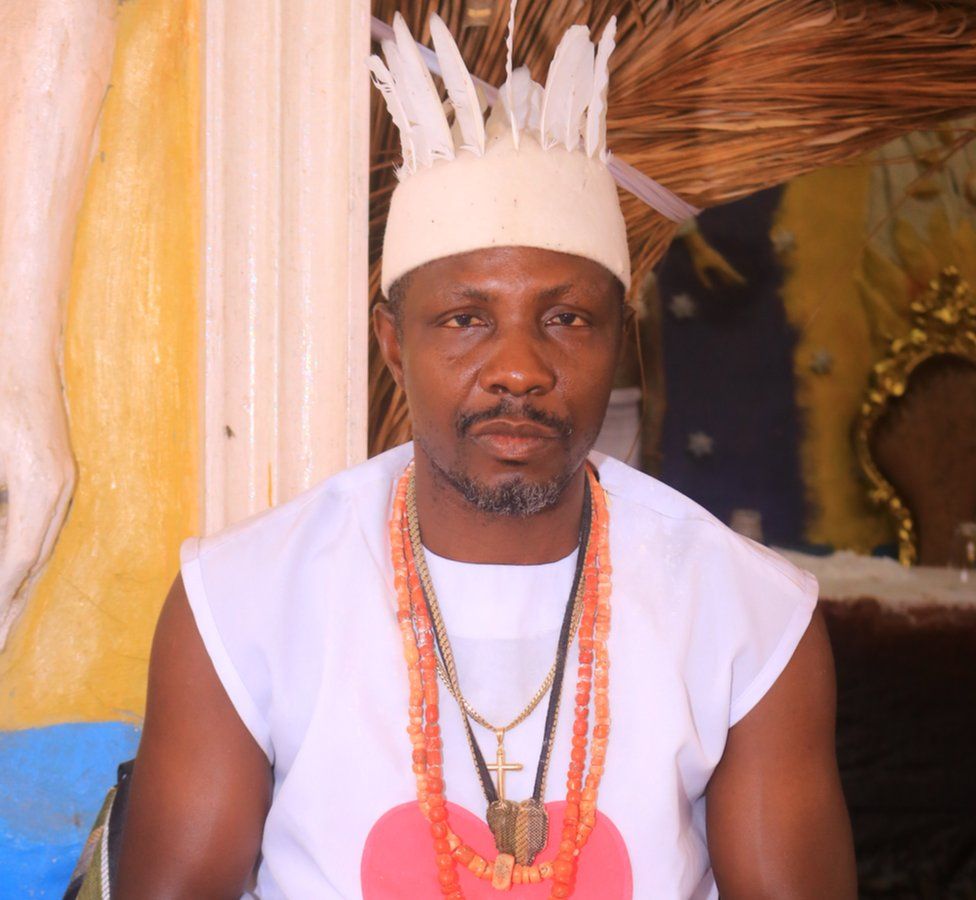
But Government Ekpemupolo, known as Tompolo, is no ordinary private security contractor.
The 51-year-old chief from Gbaramatu kingdom in oil-rich Delta state was in the past involved in blowing up the very oil pipelines he is now guarding after a controversial 48bn naira ($110m; £98m) contract from the government at the end of August.
He is arguably Nigeria’s richest ex oil-militant, was once the country’s most wanted man, and at one point even sold the country a fleet of warships.
He also knows the geography of the Niger Delta, the oil wells and official pipelines, so many believe his comments about the identity of the thieves.
“Many of the security people are involved because there is no way you can load a vessel without settling [bribing] the security people in that region,” he told Channels TV.
He also suggested that much of the oil was stolen from precisely those areas where there were army and navy checkpoints.
The military has not responded to these allegations, but it is unlikely they will openly contradict a man they have gone into partnership with to crack down on oil theft.
Lucky Irabor, Nigeria’s defence chief, who was part of the retinue that toured the oily trail of the thieves, escorted by Tompolo’s men, said it was an “eye-opener” and promised an investigation.
But it is not the first time Nigeria’s security agencies, especially the top brass of the army and navy, are being fingered over oil theft.
In January, Nyesom Wike, the governor of neighbouring Rivers state, said a police superintendent was involved in oil theft in the Emuoha area of the state and wanted him kicked out.
In 2019, Mr Wike also accused a high-ranking army commander of engaging in massive oil theft in the state, which was denied.
That corruption on this scale happened directly under President Muhammadu Buhari, who also doubles as Nigeria’s Petroleum Minister, has undermined his stance on fighting corruption, said Salaudeen Hashim of CLEEN Foundation, an anti-corruption NGO.
Mr Buhari was elected on a promise of fighting corruption in 2015, but many question how effective his administration has been.
“The extent of the ongoing oil theft might not even be fully known until this administration leaves office in May,” one analyst told the BBC.
Since independence in 1960, Nigeria has been ruled intermittently by military officers who seize power through coups, leaving behind a rot of corruption financed through the vast oil and gas industry in the Niger Delta.
Postings to the region, to protect oil installations, are considered lucrative by both senior security figures and the rank and file, who lobby and pay bribes to get them, said Mr Hashim.
“Once there, it is a race to the bottom to accumulate illegal wealth,” he added.
The recent burning of a vessel seized on allegations of carrying 650,000 litres of stolen crude oil in Delta state has also raised eyebrows.
Many questioned why security operatives were so swift to destroy the evidence – part of Tompolo’s recent success – but Nigeria’s defence chief said as the seized ship was smuggling stolen oil, no investigation was needed.
Tompolo’s motivation for the crackdown on crude-oil theft has left many bewildered. He is getting paid for it, and has spoken glowingly of his love for Nigeria and the Niger Delta environment, but this is the same Tompolo, many say, who blew up oil pipelines in the past.
As one expert pointed out, the illegal oil pipelines being unearthed by Mr Tompolo have so far been in Delta state, where he wields enormous power.
It is unlikely that anyone would have peacefully operated such facilities in his territory for years without his knowledge, they said.
In the past there have been deadly clashes between security forces and armed militants operating in the region but things have been relatively calm for years, and many say underneath that is an agreement by both sides not to interfere with the other’s “business”.
The only losers, it would seem, are law-abiding Nigerians, and perhaps, the oil firms. Not that they will get much sympathy in the country.
Torgbui Honu II, a professor of spiritualism, has called on Africans at home and in the diaspora not to lose sight of the beautiful culture that was bequeathed to them by their forefathers.
Togbui made the comments at the launch of the maiden edition of the “Ghana Culture Meets Nigeria Culture,” an event aimed at promoting Africa’s culture and tradition.
The event was held at the National Theatre on Friday, October 22, 2022, under the theme “Promoting African Culture & Tradition.”
Speaking to the media on the sideline of the event, the communicator for Africa Spiritual Affairs said the event is earmarked to celebrate the rich culture shared between Nigeria, Ghana and other African countries.
He noted that with the impact of westernization, it was important to project efficiently the beautiful culture of not only Ghana and Nigeria but the continent at large.
“This project was launched due to the diversity of the Nigerian and Ghanaian cultures and what we can preserve for the new generation. Recently we heard of Naija jollof and Ghana jollof, Nigerian music and Ghana music, so we thought it wise that why can’t we bring the two cultures together because our culture is our heritage, it is our posterity, it is our pride.
He added: “All we are doing here is sensitize and bring awareness to everybody that our culture is beautiful, wonderful challenging the people who say our culture is evil.”
The Acting President of the All Nigerian Community (ANC), Chief Dr. Bayor Albert Asaolu commended the organizers while noting that the Nigerians in Ghana will be included in the subsequent editions should it be held in Ghana.
“I will link to commend the organizer of this event. He has done something unique that no one has ever done before. This is a cultural event that will unite Ghana and Nigeria more and let our children know more about our culture which is a very good innovation.”
“It is high time that we Africans begin to know our roots and cherish our culture so that we know that it is a good thing God has given unto us.”
He added: “I will ensure the next edition is attended by all Nigerians in Ghana as well as Ghanaians themselves”.
On his part, Chief Akintola Bolanle, the former Public Relations Officer of the All Nigerian Community (ANC) and the current Assistant General Secretary, the All Nigerian Community urged both the Nigerian and Ghanaian governments to revive the love for the local culture.
“I personally was moved when I was watching the culture of Ghana. I was highly impressed and it took my mind back to the old days when I was younger. We need to begin to train our children with the culture. We have to go back to the drawing board so our children will not cost us in the future because they won’t be any legacy.”
“I will also use this opportunity to send a message to the Nigerian government to revive our history as part of the academic program in school.”
“I will call on the government both Nigerian and Ghanaian to ensure they take culture as a political priority so that we don’t lose our focus.”
The event was attended by several dignitaries from the Nigerian community in Ghana, Yoruba Community in Ghana and other cultural groups.
Nigeria beat the United States 4-3 on penalties to reach the semi-finals of the Under-17 Women’s World Cup for the first time following a 1-1 draw.
Omamuzo Edafe scored the deciding spot kick to end a tense shoot-out in Navi Mumbai.
Kick-off was delayed for almost two hours because of a thunderstorm, and Edafe gave the West Africans the lead from the spot in the 26th minute after Ella Emri committed a foul in the box.
Amalia Villarreal levelled for the Americans with a deflected shot shortly before the break.
USA, who finished runners-up at the maiden tournament in 2008, and Nigeria both failed to find a winner in the second half which took the game to penalties.
A dramatic shoot-out saw Emri shoot wide in the second round of penalties to hand Nigeria an early advantage.
Miracle Usani saw her effort saved in the following round, but was allowed a retake because USA keeper Valentina Amaral had strayed off her line and was able to net at the second attempt.
Comfort Folorunsho sent her effort over the bar in the fourth round of penalties to give the USA hope but Nigeria keeper Linda Jiwuaku, who had come on as an injury-time substitute, then saved from Riley Jackson.
That allowed Edafe to calmly slot home to send the Flamingos into their maiden semi-final.
Nigeria, who have taken part in all but the 2018 edition of the U17 World Cup finals, will face the winner of Saturday’s game between Colombia and African other representative Tanzania in the semi-finals on 26 October.
Reality star Alexandra Asogwa well known as Alex Unusual has shared a status report of her colleagues as they bury their friend Rico Swavey today.
In the late hours of yesterday, Big Brother Naija stars, loved ones and family organized a night of tribute on Wednesday in honor of the late singer.
In a lengthy post shared by the best friend of Rico Swavey, Alex Unusual, she gave a report of how her other BBNija colleagues as she described the situation as unbearable.
She wrote on her page…
“It’s past 1 am, You would have wanted us all to be happy. We will stay happy for you. This world is stressful anyway . You can rest now my fresh boy.
You came into our lives, taught us to smile and you left. I’ll understand all this soon I hope.
Today is a remembrance of a day Nigeria failed a lot of us. We bury you today 20th October. God gives us strength . I’ll love you forever Rico
Koko won’t stop crying. She says her chest burns inside.
Anto just can’t understand it, Ahneeka is lost, Princess is confused, Vandora has never been so confused her whole life, Nina is yet to believe she won’t see you again, Ifu is traumatized,
Ceec is hurting, Bam Bam won’t stop crying.
I would have said boys will be boys but I’m not sure they can be boys for now. Tobi is a wreck, I’m tired of consoling him so do something, Leo keeps trying to be strong for everyone, Miracle is speechless, Lolu keeps crying like a baby it’s like we’ll have to call him, Angel is keeping a strong face dying inside, K brule is too pissed to express himself, he keeps turning pink,
Deeone keeps trying to console everyone but I’m not sure he is ok, Bitto is really down,
Teddy is in denial and you? please give me the status report Rico.
Oh, I almost forgot Alex. Alex can’t feel anymore. She’s been laughing at what I don’t know.
I’m giving you a status report, I’ll let you know when things change if they ever do.
Mum, dad, and everyone is looking ok but I can’t tell you that they are. A lot of things are wrong but we’ll stay happy for you. #ricoswavey“.
The son of Afrobeat legend Fela Kuti spoke of his father’s bravery in using “music as a weapon” ahead of an immersive exhibition opening at the Paris Philharmonic on Thursday.
“Instead of picking up a gun, music was the only tool he had. It was a weapon to use against authority, against colonisation and corrupt African governments,” said Femi Kuti, 60, himself a hugely successful musician.
The Paris Philharmonic is paying homage to Fela Kuti by recreating the atmosphere of his sweaty, politically-charged nightclub in Nigeria, The Shrine, that became a beacon for global stars in the 1970s including Stevie Wonder and Paul McCartney.
Kuti died from AIDS complications in 1997, but his pioneering work remains as potent as ever, frequently cited by today’s stars such as or Flea from Red Hot Chili Peppers, or Beyonce and Jay-Z who sampled his hit “Zombie” on “Homecoming Live”.
“I’m not surprised. Great people like Miles Davis already talked about Fela,” said Femi Kuti of his father’scontinued popularity. “Afrobeat was the basic element of hip-hop, it’s where hip-hop got its sauce from.”
Fela’s politics have also remained potent.
“When we started working on this exhibition project, the Black Lives Matter movement emerged and Fela’s fight in the 70s and 80s found resonance there,” said Alexandre Girard-Muscagorry, one of the curators of the immersive exhibition.
Kuti was harassed throughout much of his life by the military authorities in Nigeria for his relentless criticism of their corruption and violent misrule.
There was a particularly vicious reaction after he refused to take part in an official music festival in 1977, instead organising a parallel event that became much more popular and attracted international stars including Stevie Wonder.
– ‘Out of Africa’ –
Soldiers responded to his counter-festival by burning down his home and pushing his mother out of a first-floor window, causing injuries which led to her death a year later, Femi Kuti said.
“He was a voice for the voiceless, the only opponent who was brave enough to tackle the hardcore military dictators at that time and he paid a very high price,” said Femi Kuti.
But it was ultimately the genius of his music that made him so popular, creating something entirely new with its mix of free-jazz, soul, funk and Yoruba.
McCartney was one of many inspired to come to The Shrine in Lagos, where he recorded his album “Band on the Run”.
“Fela came out of Africa with this incredible sound that caught the ears of everybody,” said his son.
“To use this music as a political weapon and message — that caught the attention of the world and especially France, maybe because of the connection to its own rebellions.”
Established in May 2020, the DSSI expired at the end of December 2021.
The DSSI, put together by the International Monetary Fund (IMF) and World Bank offered countries an opportunity to freeze debt servicing, whiles they concentrate on using their minimum funds to deal with other commitments.
Mr. Malpass was responding to questions at a programme in Washington DC, on suggestions that the Bretton Wood institutions are not doing enough to help cancel the debts of some African countries in distress.
But reacting to the question, he pointed out that Ghana and Nigeria failed to apply for the DSSI, which would have provided some financial space for the repayment of loans.
“Kristalina (IMF Boss) and I were talking yesterday with the Group about the Common Framework. If countries could have a situation where the common framework clause allow the country to have a standstill on debt, that would help the country choose their path forward on debts restructuring. That would mean they would get a break on debt repayment while they work on debt restructuring,” he explained.
Mr. Malpass stated that such initiatives are designed to help reduce the impact of economic hardship on developing countries.
He, however pointed out that some developing countries refused to take advantage of the initiative to minimise the impact of the current global hardship on their citizens.
“Nigeria and Ghana both, did not ask for the common framework treatment”, he said, adding that the situation has made it difficult for such countries to overcome the negative impact of current global economic hardship on trade and currencies of developing countries.
Debt to GDP to hit 90.7% – IMF
The International Monetary Fund (IMF) had already projected that Ghana will end 2022 with a debt-to-Gross Domestic Product of 90.7%.
This was captured in its Fiscal Outlook Report released on the sidelines of the on-going IMF/World Bank Annual meetings in Washington DC, USA.
The report, also forecasts that the debt–to-GDP could reduce to 87.8% in 2023.
According to the IMF, revenue expressed as a ratio of GDP could also hit 14.1% at the end of 2022.
It will subsequently increase to 14.7% in 2023 and 15.4% in 2024”, the report said, classifying Ghana as a Low Income Developing Country.
Gunmen have carried out a deadly attack on a hospital in central Nigeria, abducting a number of staff, as well as patients and relatives.
The governor of Niger state, Sani Bello, condemned the raid on Gulu general hospital in the Lapai area as callous and inhuman.
There’s no official word on the number of people involved in the attack staged in the early hours of Tuesday, but a resident told the BBC that three people had died and about 20 had been kidnapped.
Niger is one of the states badly affected by a sustained wave of abductions and killings by armed gangs.
Gunmen have carried out a deadly attack on a hospital in central Nigeria, abducting a number of staff, as well as patients and relatives.
The governor of Niger state, Sani Bello, condemned the raid on Gulu general hospital in the Lapai area as callous and inhuman.
There’s no official word on the number of people involved in the attack staged in the early hours of Tuesday, but a resident told the BBC that three people had died and about 20 had been kidnapped.
Niger is one of the states badly affected by a sustained wave of abductions and killings by armed gangs.
Nigerian officials have urged Indian authorities to safeguard the safety of Nigerian students studying in the country.
Fighting broke out between Nigerian and Indian students at Delhi’s GD Goenka University last weekend, sparked by a football match dispute.
Footage of the clash has been shared on Twitter.
Nigerian students are being attacked in a University Campus near Delhi – 30,000 Nigerian students come to study in India paying money, 50,000 Indians live in Nigeria to make money. pic.twitter.com/K9u9Vn1PhM
The incident at the university’s Gurugram campus forced more than 80 Nigerians to flee and take refuge at the country’s embassy.
The chairwoman of the Nigerians in Diaspora Commission, Abike Dabiri-Erewa, said: “a few injuries” had been recorded during the violence.
But Mrs Dabiri added that “calm” had been restored and that the Nigerian students have since returned to the campus after a meeting between officials of the two nations.
In a tweet, the Nigerian representative also said the country’s embassy had got a “written commitment by the Indian authorities to protect” Nigerian students.
She also advised that any students who felt “threatened” should report to the diplomatic mission of Nigeria.
The Indian authorities said they are investigating the incident – including reviewing CCTV footage of the violence, according to local media.
Thousands of African students – many of them Nigerians – are studying at several Indian universities.
But there have often been tensions between the locals and Africans.
Local media report that last month some Indian students had protested against African students praying on a football pitch, insisting that they should instead do so inside their hostels.
Nigeria LNG, a liquefied natural gas-producing company has declared force majeure because of widespread flooding that has disrupted supply, its spokesman said on Monday.
The company said all of its upstream gas suppliers had declared force majeure, forcing it to make the declaration as well.
“The notice by the gas suppliers was a result of high flood water levels in their operational areas, leading to a shut-in of gas production which has caused significant disruption of gas supply to NLNG,” spokesperson Andy Odeh said.
Odeh added that NLNG was “determining the extent of the disruption and would try to mitigate the impact of the force majeure”. Flooding in the west African giant nation has killed more than 600 people, displaced 1.4 million and destroyed roads and farmlands. Officials have warned that the situation could continue into November.
According to Refinitiv data, supply had already been limited due to prolific oil theft that has slashed output from what is typically Africa’s largest exporter. Roughly 18 cargoes had been exported in September.
Ninety per cent of Nigeria’sforeign exchange and about half of the country’s budget are derived from the export of fossil fuels. However, organised theft and infrastructural challenges have for years led to a loss of the majority of its oil revenues, forcing the nation to keep taking out loans to service its hefty budget.
Reacting to the latest development, Portugal’s oil and gas company Galp Energia said on Monday it may face additional sourcing disruptions.
Galp Energia said in a statement it had received a notice from Nigeria LNG (NLNG), its main natural gas supplier, about the force majeure but said “no information was provided to support an assessment of potential impacts”.
Last week, the government had said “it could face gas supply challenges this winter, if Nigeria does not deliver all the liquefied natural gas (LNG) volumes due to its country”.
The Nigerian anti-drug agencyhas apologised to a man in the central state of Plateau after its officers accidentally searched his home while looking for a suspected drug dealer.
Armed operatives of the National Drug Law Enforcement Agency (NDLEA) arrested Alyasa’u Idris after breaking into his home in a predawn raid on Thursday.
But it turned out to be the wrong target.
Mr Idris, 42, said he initially thought his house was being attacked by kidnappers because kidnappings for ransom are rampant in the country. He then hid inside the ceiling but was pulled out by the officers who broke into the ceiling, he said.
The incident happened in the town of Yelwan-Shendam.
The officers interrogated the man after taking him away – but they then realised he was not the person they were looking for.
He said upon returning home after being released, he found his 500,000 Naira ($1,145; £1,010) was missing.
Mr Idris, a mattress dealer, told the BBC that his entire family was traumatised by the experience and that all his four wives were taken to hospital because of the psychological impact.
A spokesperson for the anti-drug agency Femi Babafemitold the BBC that its officers had immediately apologized to the man after realizing it was a case of mistaken identity.
Mr Babafemi said the victim should write a formal complaint to the agency for investigation on the claims of missing money and demand for compensation.
Nineteen of the Sub-Saharan Africa region’s 35 low-income countries are in debt distress or at high risk of distress, the International Monetary Fund (IMF) has stated in its October 2022 Regional Outlook Report.
Out of the other 10 countries in the region, the Fund said three have faced spreads of more than 1,000 basis points at some point over the past six months. The three are Angola, Nigeria and Gabon.
The Fund however did not mention the names of the 16 countries. But, those with a ratio of high debt-to-Gross Domestic Product (GDP) are expected to be part of the countries that are in debt distress or at high risk of distress.
On public debt, the Fund said the regional indebtedness is now approaching levels last seen in the early 2000s before the impact of the Heavily Indebted Poor Countries Initiative, though with a different composition.
“About half of the countries are expected to undertake some consolidation this year—regionwide deficits are projected to narrow by about ½ percent of Gross Domestic Product (GDP) after a larger consolidation of about 1¼ percent in 2021, bringing average debt at end-2022 down to around 55% of GDP. Approximately one-third of the region’s economies now have debt levels above 70% of GDP”.
Global financial conditions becoming less forgiving
The Fund also said the global financial conditions are set to become less forgiving, saying, much of the current debt has been contracted during a period of historically low-interest rates.
“Looking ahead, as global policy rates normalize, financial conditions will continue to tighten, adding to external borrowing costs and weighing on sub-Sahara Africa’s debt dynamics. Over the next few years, already-high interest payments are projected to increase as a proportion of revenue, exceeding 50% in some cases and far surpassing the burdens seen in other regions”.
Furthermore, the Fund said as global conditions tighten, borrowing costs may also become more volatile, explaining “as with other emerging markets, sub-Saharan African borrowers are subject to sudden changes in market sentiment, particularly those perceived at greater risk.
During the most recent turmoil, for example, the Fund stressed that sovereign spreads fluctuated widely, disrupting the plans of some countries that had aimed to issue during the year.
Some 600 people were confirmed dead Sunday, the Nigerian minister for Humanitarian Affairs, Disaster Management and Social Development announced during a media briefing.
2,407 persons have been injured, a total of 2.5 million people have been affected and 82,053 houses houses have been completely damaged.
Minister Sadiya Umar Farouq called on the “State governments, local government councils and Communities to prepare for more flooding by evacuating people living on flood plains to high grounds, provide tents and relief materials, fresh water as well as medical supplies for a possible outbreak of water-borne disease”.
Since the end of July, the West African country has been grappling with a wave of flooding.
So far, floods have affected 31 of Nigeria’s 36 states.
Many roads and other key infrastructure were destroyed.
The federal government announced last week it had started delivery of food items to disaster-stricken communities.
Why so much flooding?
In addition to a harsh rainy season and overflowing rivers, floods were also caused by the release of water from several damns (the process was meant to prevent excessive flooding).
The release of excess water from Cameroon’s Lagdo dam was for instance blamed.
Nigerian minister for Humanitarian Affairs, Disaster Management and Social Development announced that the permanent Secretary of the Ministry Dr Nasir Sani Gwarzo, was “to lead a delegation to Cameroon next month, to discuss the periodic opening of the Lagdo dam with the authorities”.
According to the minister, “metrological Agencies are warning that [Editor’s note: southern] States like Anambra, Delta, Cross River, Rivers, and Bayelsa are still at risk of experiencing floods up till the end of November.”
The World Food Programme and the UN’s Food and Agriculture Organization said last month that Nigeria was among six countries facing a high risk of catastrophic levels of hunger. So far, 332,327 hectares of farmland have been destroyed sparking food-security fears.
The three judges in the Nigerian appeal court agreed unanimously to dismiss the allegations.
The Court of Appeal in Nigeria has dismissed the government’s terrorist charges against separatist leader Nnamdi Kanu, in a unanimous judgment by all three judges hearing the case.
On Thursday, the lead judge dismissed a seven-count charge of terrorism against Kanu and discharged him, saying a lower court had no jurisdiction to try the case and that Kanu was abducted and extraordinarily extradited to Nigeria.
“In view of the fact that the trial court lacks jurisdiction to hear this case because the process of extradition of the appellant from Kenya to Nigeria was unlawful since the due process was not followed, this appeal succeeds,” the lead judge, Justice Oludotun Adefope Okojie, said.
“Consequently, the appellant is therefore discharged,” she said.
In April, Nigeria’s High Court ruled that Kanu should stand trial.
He leads the Indigenous People of Biafra (IPOB), which campaigns for the secession of southeastern Nigeria where the majority are of Igbo ethnicity.
Nigerian authorities have labelled IPOB a ‘terrorist’ organisation.
A spokesperson for Nigeria’s attorney general said the government was considering its legal options following Thursday’s ruling but said the charges Kanu faced before he disappeared while on bail in April 2017 “remain valid issues for judicial determination”.
Kanu denied the charges of terrorism and knowingly broadcasting falsehoods, which are linked to social media posts he issued between 2018 and last year.
His lawyers argued that he could not receive a fair trial because he was forcefully extradited from Kenya to Nigeria. Kenya has declined to say if it played a role in Kanu’s return.
An attempt by Igbo separatists to secede as the Republic of Biafra in 1967 — the year that Kanu was born — triggered a three-year civil war that killed more than one million people.
Since Kanu’s trials began in Abuja, IPOB has ordered residents of the southeast to “sit at home”, a form of civil disobedience to show solidarity with Kanu.
The IPOB campaign has crippled small businesses and routinely disrupted other economic activity in the five states of the region.
A Nigerianseparatist leader accused of terrorism and instigating violence in the country’s southeast was acquitted Thursday by a local court, his lawyer told The Associated Press.
The Nigerian Court of Appeal dismissed the government-filed charges against Nnamdi Kanu in Abuja, the nation’s capital, after a jury faulted the legality of the case against him, according to Ifeanyi Ejiofor, his lawyer. Kanu is yet to be released from custody.
The Indigenous People of Biafra separatist group that Kanu leads has been pressing for the southeast region to break away from the West African nation and become independent. But the Nigerian government said he uses the group known as IPOB to instigate violence, leading to the deaths of many in the country’s southeast.
Kanu had been facing trial for alleged treason and terrorism but escaped Nigeria in 2017 while on bail. He was rearrested in June last year and brought back to Nigeria from an undisclosed country.
The separatist leader, who also holds British citizenship, pleaded not guilty at the resumption of his trial which his group has said is being used to stifle his secessionist campaign. The campaign reminds many of the short-lived Republic of Biafra that fought and lost a civil war from 1967 to 1970 to become independent from Nigeria. An estimated 1 million people died in the war, many of starvation.
After he was acquitted, Emma Powerful, a spokesman for the Biafra group, told the AP, “Our next target is to ensure that Biafra liberation is materialized and no human being can stop it.”
Kanu’s trial reechoed allegations of marginalization in Nigeria’s southeast region made up of the Igbos, Nigeria’s third-largest ethnic group who are mainly Christians. Nigeria’s more than 200 million people are almost evenly divided between Christians and Muslims.
Amid the calls for a referendum, the IPOB secessionist group became more violent, authorities and experts have said. The formation of the Eastern Security Network, its paramilitary arm, in December 2020 coincided with a spike in criminal attacks in the region.
IPOB has also been outlawed as a terrorist organization by Nigerian authorities. Many of the group’s members have been arrested. A jailbreak in Imo state led to the escape of nearly 2,000 inmates earlier this year.
Lecturers in Nigeria’s universities have suspended their strike which began eight months ago.
They were demanding better funding for universities, more facilities and an improved pay system among other issues.
Several rounds of talks with the government had failed to resolve the dispute. Last month a court ordered the lecturers to end the strike but their union appealed against the decision.
However, in the early hours of Friday, the Academic Staff Union of Universities (Asuu) announced the suspension of the strike after a meeting of its leaders overnight.
Union vice-president Chris Piwuna confirmed the suspension of the strike to the BBC.
The conditions for the suspension are not immediately clear.
The union has now asked its members to resume work on Monday next week.
Earlier this week the union gave the clearest indication to end the strike after a meeting with key leaders of Nigeria’s parliament.
The eight-month industrial action was one of the longest strikes by university lecturers in Nigeria. It disrupted academic activities in the country’s public universities, affecting around two million students.
The suspension of the strike comes as a huge relief to the students after months of anxious waiting.
Nigeria’s Appeal Court has dropped all charges against separatist leader Nnamdi Kanu after ruling that he had been illegally arrested abroad.
The court also ruled that his extradition had been illegal.
The ruling by a panel of three judges is seen as a major blow to the government which had detained Mr Kanu on various treason and terrorism-related charges.
He leads the banned indigenous People of Biafra (Ipob) group.
Ipob is campaigning for the creation of an independent state in south-eastern Nigeria.
Mr Kanu – who holds a UK passport – fled Nigeria in 2017 before he was seized and brought back in 2021.
His 2021 arrest abroad was illegal because extradition protocol was not followed, the court said.
Kenya has not commented on whether it played a role in Mr Kanu’s deportation to Nigeria.
The Appeal Court also ruled the Federal High Court did not have the jurisdiction to try Mr Kanu.
He initially faced 15 charges, but eight had previously been dropped.
He was originally arrested in 2015 but he fled Nigeria in 2017 while out on bail. He had previously denied any wrongdoing.
Ipob wants a group of states in the south-east of the country, largely inhabited by members of the Igbo ethnic group, to break away from Nigeria and form an independent nation called Biafra.
In 1967 Igbo leaders declared independence for the state of Biafra, but after a civil war, which led to the deaths of up to a million people, the secessionist rebellion was defeated.
But the idea of Biafra has never gone away and despite the arrests of his members, Mr Kanu’s movement has seen a recent swell in its numbers.
Nigeria’s government has signed an agreement with US technology giant Microsoft to train five million people in digital technology.
Minister of Communication and Digital Economy Isa Ali Pantami said the agreement would boost “job creation and economic development”.
Prof Pantami described the initiative as “amazing and also very huge”.
He told the BBC it would start immediately, and run for five years.
The deal was signed on the sidelines of an IT exhibition in Dubai on Wednesday, with a Microsoft representative saying the company was willing to work with the Nigerian government to provide “economic opportunities” for young people.
Microsoft and the government have been in talks for more than a year about the project.
Nigeria is Africa’s most populous country and biggest economy.
It has a largely young population of more than 200 million. But unemployment is high and the education sector is struggling. The government says it is trying to make the economy digitally oriented.
Prof Pantami also said that Nigeria would continue to provide an “enabling environment” for Microsoft and other companies to operate in the country by ensuring that regulatory measures were “developmental and flexible”.
The World Bank has disclosed that it sanctioned seven Nigerian firms and individuals for corruption during its 2022 fiscal year.
This disclosure was made in the bank’s latest Fiscal Year 2022, which covered July 1, 2021, to June 30, 2022, in the Sanctions System Annual Report.
The sanction list contained three Nigerians and four Nigerian companies who were found guilty of corruption of necessary investigations by the Washington-based bank.
Out of the four companies, two were sanctioned by the African Development Bank, but recognised by other multilateral organizations, including the World Bank under the cross-debarment policy.
A particular Mr Salihu Tijani was blacklisted for three years and two months, while Mr Isah Kantigi was blacklisted for five years.
The third Nigerian, Amin Moussalli, was blacklisted for two years and 10 months, with additional conditional non-debarment (which means the individual is eligible to participate in the bank’s operations) for one year and six months.
The two companies blacklisted by the World Bank were AIM Consultants Limited for two years and two months, and SoftTech IT Solutions and Services Ltd for four years and two months.
The other two firms blacklisted by AfDB but recognised by the World Bank under the cross-debarment policy were Sargittarius Nigeria Limited and Sargittarius Henan Water Conservancy Engineering Ltd for two years and six months each.
The report further disclosed that two Nigerians and two Nigerian firms had been removed from the blacklist after complying with the bank’s conditions.
The Nigerians were Mr. Elie Abou-Ghazaleh and Mr. Fadi Abou-Ghazaleh, while the firms were Abou Ghazaleh Contracting Nigeria Ltd. and Quick Projects Limited.
In his remark in the report, the World Bank Group President, David Malpass, said that corruption could damage the bank’s efforts in financing projects.
He said, “At a moment when every available resource must be deployed for maximum impact, these ill effects of corruption can be especially damaging. For this reason, it is important to recognize the role of the Bank Group’s sanction system, which plays a significant part in our institution’s efforts to maintain oversight and accountability for the financing we provide.
“The offices that comprise the sanctions system—the Integrity Vice Presidency, the Office of Suspension and Debarment, and the Sanctions Board and its Secretariat—work together to send a clear message: corruption has no place in development.”
In total, he said that the bank debarred or otherwise sanctioned 35 firms and individuals.
At the same time, 22 entities had met their conditions for release from sanctions, making them eligible to again participate in projects financed by the bank.
The PUNCH had earlier reported that the World Bank had blacklisted 18 Nigerian individuals and firms for engaging in corrupt practices, fraud, and collusive practices in its 2021 fiscal year.
In another PUNCH report, it was disclosed that the AfDB blacklisted at least 40 Nigerian firms and individuals for engaging in corrupt practices, fraud, and collusive practices between 2017 and 2021.
The AfDB said the firms and individuals were debarred “for coercive, collusive, corrupt, fraudulent, or obstructive practices under its sanctions system or adopted under the Agreement for Mutual Enforcement of Debarment Decisions from other global lenders.”
Hundreds of Nigerians held demonstrations in the capital Abuja to protest against the “illegal” slaughter of donkeys by Chinese nationals, local media report.
They said the killing of donkeys had continued despite an order by the government to stop the menace.
The civil society groups that organised the protests accused the agriculture minister of allowing foreign nationals to engage in the donkey trade.
A bill to regulate the regulate donkey business is currently being considered in parliament.
Last month, Nigeria’s customs service intercepted 7,000 donkey penises at an airport in the commercial hub, Lagos, that were headed to China.
Donkey parts are in demand in China for use in traditional medicine.
Yoruba group, Afenifere, has intensified calls for the South-West security outfit, Amotekun, to bear arms, following the increasing cases of kidnapping and attacks on farms and farmers in the Southwest, Southeast and other parts of Nigeria.
This is as the organisation on Tuesday condemned, in strong terms, last Saturday’s attack on a farm in Ipapo, Oke Ogun in Oyo State as well as other kidnappings that had been going on in Osun, Kwara, Enugu and Kaduna states.
In a statement by its National Publicity Secretary, Mr. Jare Ajayi, Afenifere noted that the circumstances surrounding the Saturday attack and how the hoodlums were able to escape with their victims were further justifications for allowing security outfits set up by state governments to be equipped with necessary weapons.
Afenifere said, “Were Amotekun operatives to have equal arms, the attackers would not have escaped as Amotekun officials were able to prevent the terrorists from causing greater damage even with the limited weapons we carried. Were we to be allowed to carry sophisticated weapons that our assignment demands, the hoodlums would have met their Waterloo.”
According to the organisation, “Questions can also be raised on how those bandits got the army uniforms and the sophisticated weapons they wield.
“It is on record that a lot of calls have gone to the federal government to allow states that are so desired to set up state and community police with all the necessary paraphernalia to enable them to maintain security in their respective domains.
“Among advocates of such calls were Afenifere, Governor Rotimi Akeredolu of Ondo State and Governor Samuel Ortom of Benue State. Southern Governors’ Forum earlier in the year also backed the call for state police. President Muhammadu Buhari-led administration has however turned a deaf ear to the calls.
“Last month, Governor Akeredolu and Afenifere openly protested the denial of South West Governors’ requests to arm their security outfit, Amotekun, with AK 47 rifles while conceding the same to the Katsina State Government.
“Were Amotekun to be allowed to carry needed weapons, bandits would think it twice before they contemplate coming to Yorubaland.
“Our governors and our leaders in Yorubaland are aware of the possible attacks, but we are helpless in a way because of the handicap placed on our path by the federal government through its refusal to allow our state governments to put up requisite security structures.”
Afenifere further insisted that the Nigerian government’s continued refusal to arm states’ security outfits “Is not only against the federal spirit of the country’s constitution, but it is also detrimental to the overall peace of the country.
“Some of the steps to be taken to immediately allow states to set up their police forces; decentralise security apparatus; equip and motivate security agencies; stop treating bandits and terrorists with kid gloves and finally allow true federalism so that states and local governments can devise appropriate measures to deal with the challenges facing them in all areas of human endeavour.
“As we write this, residents of Onibueja in Egbedore local government of Osun are living in fear following handwritten letters pasted in parts of the community by suspected armed robbers notifying the people of their intention to come and raid them within the month, according to the Baale (Head) of the community, Najeemdeen Alabi.
“The situation on the ground does not seem to support the assurance being given by Mr President. Thus, the government needs to do more.”
23 looted artefacts have been delivered back to Nigeria by the United States.
A Nigerian delegation received the Benin Bronzes during a ceremony on Tuesday in Washington.
Nigeria’s Minister of Information and Culture Lai Mohammed, who received the artefacts, hailed the US and its institutions for the repatriation of the “highly-cherished” cultural artworks.
“These artefacts are intrinsic to the culture that produced them. A people ought not to be denied the works of their forebears. It is in the light of this that we are delighted with today’s repatriation,” he said.
The information ministry said the returned artefacts “comprise 21 from the Smithsonian and one each from the National Gallery of Arts and the Rhode Island School of Design”.
The repatriation is part of a bilateral cultural property agreement to prevent illegal imports into the US of some categories of Nigerian artefacts.
Lonnie G. Bunch III, the secretary of the Smithsonian, said the institution was “humbled and honoured to play a small role in transferring ownership of the artworks to Nigeria”, based on ethical consideration.
The items were among thousands of artworks known as the Benin Bronzes stolen from the Benin Kingdom in present-day Nigeria by British colonialists in 1897.
The items were then distributed to various museums and institutions across Europe and the US.
Nigeria is set to receive more such artefacts from The Netherlands, the UK, and Germany.
The West African country says it will soon launch an international traveling exhibition with the artefacts ”in a manner that will win more friends and promote greater goodwill for Nigeria and the ethnic groups that produced [them]”.
Seventy-six people have died as their boat capsized while they tried to flee dangerously high floodwaters that have inundated swathes of southern Nigeria.
The boat, carrying more than 80 people, capsized in the southeastern state of Anambra on Friday, as people desperately tried to escape floods that had risen as high as rooftops.
Recent flooding in the area had displaced up to 600,000 people, according to the country’s National Emergency Management Agency (NEMA).
Nigeria’s flood crisis has been disastrous this year, killing at least 300 people and affecting more than half a million people, NEMA said last month. NEMA warned of more catastrophic flooding for states located along the courses of rivers Nigerand Benue, explaining that three of Nigeria’s overfilled reservoirs were expected to overflow.
The Anambra tragedy follows the devastating aftermath of a flood that swept through swaths of neighboring north-central Kogi state a week ago, leaving buildings submerged under water that rose to levels not seen in a decade, according to officials of the Kogi Red Cross Society.
At least six people, including a toddler, were reported to have died in Kogi’s worst-hit Ibaji district, which the state Governor Yahaya Bello said was “100% underwater.”
Bello described the flooding as a “humanitarian tragedy” in an October 1 address.
Kogi is located around 200 kilometers from Nigeria’s capital, Abuja. Kogi’s capital, Lokoja, is the meeting point for West Africa’s largest rivers, the Niger and Benue.
“As the two major rivers meet in Lokoja, they overwhelmed the banks of the Lower Niger river, hence the inundation,” environmentalist Simi Adeodun told CNN.
“Not only Lokoja is inundated right now, but most of the riparian communities along the fringes of River Benue in Nasarawa State … and River Niger traversing the boundary between Kwara and Niger states are also submerged.” he said.
The Kogi Red Cross Society said: “Many people have been rendered homeless in Lokoja … as houses were submerged by flood,” adding that some major roads in the capital city had been submerged.
“The roads served as a link between North Central and Southern parts of the country,” it said. “And many passengers were stranded.”
The Red Cross told CNN some of the deceased in Ibaji also lost their lives in a separate boat accident as they canoed through flood waters.
Bello said that nine areas along the Niger and Benue were affected.
“Ibaji [district] is almost 100% under water while the rest range from 30% up … We therefore have a serious and humanitarian tragedy on our hands, but I wish to assure every person, family and community which has been affected that they are not alone and that help is coming,” he said.
Some travelers said they were trapped for more than a day in flooded areas.
Okeke Grace Eche told CNN of her experience traveling from Lokoja to Abuja at the height of the flooding on October 3.
“It was the most terrifying two nights of my life,” she says of a two-day ordeal for a trip that would normally take only a few hours.
Eche arrived at Lokoja at 4 pm on Monday (October 3), and told CNN she “noticed a long queue of trailers, and vans conveying heavy equipment and animals.”
“I had hoped that it was normal traffic caused by a fallen trailer but we were not ready for the nights that followed,” she said.
“I spent my first night in the middle of bushes … I saw first-hand, houses, filling stations, vast land submerged, women, children, and their husbands building makeshift paper bag houses along the road,” she told CNN.
In many parts of the north-central state, locals are taxiing across their flooded communities in canoes.
Abdullahi Abubakar, an official of the Red Cross in Kogi is worried that the use of canoes may lead to more fatal accidents.
“It is dangerous, especially for those who don’t know how to swim,” Abubakar told CNN.
Abubakar said many displaced people were taking shelter in the homes of relatives and good Samaritans in neighboring towns unaffected by the flood, which he added was gradually receding.
Kogi Governor Bello, who visited ravaged communities by canoe, said he was working to reduce the impact of the flood while urging those affected to relocate to designated camps for displaced persons in the state.
According to NEMA, the release of excess water from a dam in neighboring Cameroon was bound to “complicate”” Nigeria’s already disastrous flood crisis.
“The Lagdo dam operators in the Republic of Cameroun have commenced the release of excess water from the reservoir by 13th September, 2022. We are aware that the released water cascades down to Nigeria through River Benue and its tributaries thereby inundating communities that have already been impacted by heavy precipitation,” NEMA said in a statement on September 19.
“The released water complicates the situation further downstream as Nigeria’s inland reservoirs … are also expected to overflow between now and October ending,” it stated, adding that: “This will have serious consequences on frontline states and communities along the courses of rivers Niger and Benue.”
Kogi and Anambra were among 13 Nigerian states predicted to be overrun by “the combined waters of rivers Niger and Benue as they empty into the region,” NEMA said.
Many communities in Kogi are now underwater.
Flooding in Kogi this year had a more severe impact on communities than what was recorded during the last major flooding in 2012, Abubakar told CNN.
According to Nigeria’s National Inland Waterways Authority, the 2012 flood rose to the level of 12.84 meters while the latest flooding was gauged at 13.22 meters.
But Kogi is not the only state reeling from the devastating impact of the latest flood.
In neighboring Nasarawa state, which is also grappling with flood water cascading down the River Benue, farmers are counting their losses from ravaged farmlands.
In northeastern Adamawa, more people are dying from flood-related incidents, NEMA said. Around 37 people have died during the current rainy season and more than 170,000 displaced, the agency stated.
Many parts of Nigeria are prone to yearly floods with coastal cities like Lagos even more vulnerable to seasonal flooding.
Climate activists are intensifying the call for climate finance to address Nigeria’s climate crisis.
Nigerian authorities are heeding this call as the country joins its African counterparts to seek an expansion of climate financing ahead of next month’s COP27 climate summit in Egypt.
A 28-year-old lady identified as Amelia Pounds has unfortunately died whiles undergoing a liposuction surgery.
Plastic Surgery, Liposuction, cosmetic surgery, collagen injections, BBL (Brazilian Butt Lift), etc are some of the professional terms used to describe the process of going under the knife to enhance one’s body parts.
From what we gathered, the beautiful young lady happens to be a socialite and businesswoman from Nigeria. According to reports, Amelia died in New Delhi, India as a result of complications following the liposuction surgery.