Russiahas become China’s biggest supplier of oil as the country sold discounted crude to Beijing amid sanctions over the Ukraine war.
Imports of Russian oil rose by 55% from a year earlier to a record level in May, displacing Saudi Arabia as China’s biggest provider.
China has ramped up purchases of Russian oil despite demand dampened by Covid curbs and a slowing economy.
In February, China and Russia declared their friendship had “no limits”.
And Chinese companies, including state refining giant Sinopec and state-run Zhenhua Oil, have increased their purchases of Russian crude in recent months after being offered heavy discounts as buyers in Europe and the US shunned Russian energy in line with sanctions over its war on Ukraine.
The imports into China, which include supplies pumped through the East Siberia Pacific Ocean pipeline and shipments by sea, totalled nearly 8.42m tonnes last month, according to data from the Chinese General Administration of Customs.
That pushed Saudi Arabia – formerly China’s biggest source of crude oil – into second place with 7.82m tonnes.
In March, the US and UK said they would ban Russian oil, while the European Union has been working towards ending its reliance on Russian gas, as the West steps up the economic response to the invasion of Ukraine.
At the time, US President Joe Biden said the move targeted “the main artery of Russia’s economy”.
Energy exports are a vital source of revenue for Russia but the move is also likely to impact Western consumers.
Last week, a report by the Centre for Research on Energy and Clean Air think tank said Russia earned almost $100bn (£82bn) in revenue from fossil fuel exports in the first 100 days of the country’s invasion of Ukraine, despite a fall in exports in May.
The European Union made up 61% of these imports, worth approximately $59bn.
Overall, exports of Russian oil and gas are falling and Moscow’s revenue from energy sales has also declined from a peak of well over $1bn a day in March.
But revenues still exceeded the cost of the Ukraine war during the first 100 days – with the CREA estimating that Russia is spending around $876m per day on the invasion.
Monday’s figures also showed that China imported 260,000 tonnes of Iranian crude oil last month, its third shipment of Iran oil since last December.
China has continued to buy Iranian oil despite US sanctions on Tehran.
The West must prepare to continue supporting Ukraine in a war lasting for years, Nato’s chiefhas warned.
Secretary-General Jens Stoltenberg said the costs of war were high, but the price of letting Moscow achieve its military goals was even greater.
His comments came as UK Prime Minister Boris Johnson also warned of the need to brace for a longer-term conflict.
Both Mr Stoltenberg and Mr Johnson said sending more weapons would make a victory for Ukraine more likely.
“We must prepare for the fact that it could take years. We must not let up in supporting Ukraine,” the Nato chief said in an interview with German newspaper Bild.
“Even if the costs are high, not only for military support, also because of rising energy and food prices.”
The Western military alliance chief said that supplying Ukraine with more modern weapons would increase its chances of being able to liberate the country’s eastern Donbas region, much of which is currently under Russian control.
For the last few months Russian and Ukrainian forces have battled for control of territory in the country’s east – with Moscow making slow advances in recent weeks.
Writing in the Sunday Times, British Prime Minister Boris Johnson accused Russia’s Vladimir Putin of resorting to a “campaign of attrition” and “trying to grind down Ukraine by sheer brutality.”
“I’m afraid we need to steel ourselves for a long war,” he wrote. “Time is the vital factor. Everything will depend on whether Ukraine can strengthen its ability to defend its soil faster than Russia can renew its capacity to attack.”
The prime minister, who visited Ukraine’s capital on Friday, said supplies of weapons, equipment, ammunition, and training to Kyiv needed to outpace Moscow’s efforts to rearm itself.
Ukrainian officials have spoken bluntly in recent days about the need to boost the supply of heavy weapons to the country if Russian forces there are to be defeated.
On Wednesday the country’s Defence Minister, Oleksiy Resnikov, met some 50 countries in the Ukraine Defence Contact Group in Brussels to ask for more arms and ammunition.
The country’s Western allies have so far offered it major weapons supplies but Ukraine says it has only received a fraction of what it needs to defend itself and is asking for heavier arms.
Russian officials often criticise Nato military support for Ukraine and in an interview last week with the BBC the country’s Foreign Minister, Sergei Lavrov, cited the prospect of Ukraine joining the Western alliance as a reason for the invasion in the first place.
“We declared a special military operation because we had absolutely no other way of explaining to the West that dragging Ukraine into Nato was a criminal act,” Mr Lavrov told the BBC.
Ukraine is not a member of Nato and although it has expressed a wish to join there is no timeframe for this.
The sanctions imposed by the West on Russia after its invasion of Ukraine are “mad and thoughtless”, President Vladimir Putin has said.
Speaking at a forum in St Petersburg, he said “the economic blitzkrieg against Russia had no chance of succeeding from the very beginning”.
He said the restrictions were “more harmful” to those who imposed them.
Western nations have been seeking to strike a balance between punishing Russia and protecting their economies.
But speaking at the annual St Petersburg International Economic Forum, President Putin claimed the EU could lose more than $400bn (£326bn) because of its sanctions against Russia.
He said inflation was increasing across the 27-member bloc and the real interests of people in Europe were being sidelined – but did not explain what that meant.
However, Mr Putin’s own officials have warned that the Russian economy is suffering serious damage from the sanctions. Central Bank Governor Elvira Nabiullina said on Thursday that “15% of the country’s GDP” was threatened by the international response.
Ms Nabiullina also seemed gloomy about the prospects of any imminent recovery, telling delegates at a conference in St Petersburg that “it’s obvious to everyone that it won’t be as it was before”.
“External conditions have changed for a long time indeed, if not forever,” she said.
On Friday, the head of the country’s largest lender, Sberbank, warned that it could take more than a decade for Russia’s economy to return to 2021 levels.
But Mr Putin sought to strike an optimistic tone and also implored Russia’s major businesses to keep working in the country, amid reports that an increasing number of business owners were refocusing their efforts on overseas operations.
“Invest here. It’s safer in your own house. Those who didn’t want to listen to this have lost millions abroad,” Mr Putin said.
The 69-year-old leader also addressed fears of a global food crisis triggered by the continuing war in Ukraine, claiming that Russia was capable of significantly increasing its exports of grain and fertilisers. Grain exports alone could rise to some 50 million tonnes, he said.
Ukraine is one of the world’s top grain producers along with Russia, but has been unable to send supplies abroad because of a blockade of its Black Sea ports.
On Friday, fierce fighting continued in Ukraine’s eastern city of Severodonetsk.
Capturing Severodonetsk – and its twin city of Lysychansk – has for weeks been the key target for Russian troops.
The three European leaders are now visiting Irpin, a town near Kyiv which Russian troops brutally occupied at the beginning of the war.
Emmanuel Macron, Olaf Scholz and Mario Draghi are being briefed on what went on in the city, and work being done to get life back to normal.
“It’s a heroic city, marked by the stigmata of barbarism,” Macron tells reporters.
Irpin is on the doorstep of Kyiv, and in early March Russian troops intent on conquering the capital took hold of the town.
Its blown-up bridge and river crossing became known internationally as a risky escape route from next-door Bucha, the scene of many of Russia’s alleged war crimes.
In Irpin itself, the bodies of 290 civilian victims were found.
Thousands of civilians are trapped in the Ukrainian city of Severodonetsk with essential supplies running out, the United Nations is warning.
Many of them are sheltering in bunkers beneath the city’s Azot chemical plant.
The last bridge leading out of the city was destroyed in fighting earlier this week – effectively trapping its 12,000 remaining residents inside.
For weeks capturing Severodonetsk has been a top military goal for Russia, which now controls most of the city.
“The lack of water and sanitation is a big worry. It’s a huge concern for us because people cannot survive for long without water,” spokesperson for the UN’s Humanitarian Affairs office Saviano Abreu told the BBC.
Mr Abreu added that food supplies and health provisions were also running out in Severodonetsk, which is in Ukraine’s eastern Luhansk region.
The UN is hoping to provide aid to those trapped in the city, but continued fighting means its agencies cannot get access or assurances to safely reach the civilians still there, including women, children and the elderly.
The warning followed Russian promises to open a humanitarian corridor earlier on Wednesday to evacuate civilians trapped beneath the Azot plant.
But so far there has been no confirmation that the planned safe route – which would have evacuated civilians into Russian-controlled territory to the city’s north – had actually gone ahead.
On Wednesday a pro-Russian separatist official accused Ukrainian forces of “completely thwarting” the evacuation of civilians trapped in the chemical plant.
“At Azot, militants are trying to disrupt the evacuation! From the territory of the plant, the militants have begun firing from a mortar and a tank,” Rodion Miroshnik, the “ambassador” to Moscow of the self-proclaimed Luhansk People’s Republic, said on Telegram.
The BBC has not been able to verify this claim.
Russian media outlets also blamed Ukrainian forces for the fact that civilians were trapped alongside its fighters in the plant – accusing them of using local residents as “human shields”.
Gazprom-owned NTV suggested there may be as many as 1,200 people, including children, trapped underneath the plant.
While civilians took shelter below the Azot complex, Russian and Ukrainian forces battled for control of the city above ground.
Capturing Severodonetsk would give Moscow command over almost all the Luhansk region, much of which is controlled by Russian-backed separatists.
In an update posted on Telegram the city’s mayor said that Ukraine was still in control of Severodonetsk’s eastern district.
“Efforts are being made to push the enemy back towards the city centre. It’s a permanent situation with partial success and tactical retreat in places,” Oleksandr Stryuk said.
US basketball star Brittney Griner — who has been held in Russia since February on accusations of drug smuggling – will remain in Russian custody through at least July 2, after a Russian court extended her detention, Russian state news agency TASS reported Tuesday.
Griner, 31, has been officially classified as “wrongfully detained,” a US State Department official told CNN in May.
Supporters, including Griner’s family and the WNBA, have vigorously advocated for her release, with some expressing concerns Russia would use Griner as a political pawn amid tensions over Russia’s invasion of Ukraine.
Griner was arrested at a Moscow airport in February, when Russian authorities claimed she had cannabis oil in her luggage and accused her of smuggling significant amounts of a narcotic substance, an offense punishable by up to 10 years in prison. The two-time Olympic gold medalist and star of the WNBA’s Phoenix Mercury plays in Russia during that league’s offseason.
Griner’s detention has been extended repeatedly. A Russian court announced in March it had extended her pretrial detention until mid-May. Last month, Griner’s detention was extended once again until June 18, TASS reported at the time.
“Our position for some time on this has been very clear: Brittney Griner should not be detained. She should not be detained for a single day longer,” State Department spokesperson Ned Price said Tuesday.
The State Department learned of the news through Russian state media reports, Price said. The US last had consular access to Griner last month, he told reporters.
Griner’s case is being handled by the office of the US Special Presidential Envoy for Hostage Affairs, a State Department official confirmed to CNN last month. The office leads the government’s diplomatic efforts to secure the release of Americans wrongfully detained abroad and played a major role in securing the release of US citizen Trevor Reed in a late April prisoner swap with Russia.
In a statement late Tuesday, Griner’s agent said it was clear the player was being used as a “political pawn.”
“Her detention is inhumane and unacceptable. She has not had a single phone call in her 117 days of wrongful detention,” said Lindsay Kagawa Colas, who called on President Joe Biden and Vice President Kamala Harris to “act with urgency and do whatever it takes to bring Brittney home immediately.”
Teammates ‘want her back home’
News of Griner’s detention being extended comes a day after State Department officials — including those from the hostage affairs office –Â briefed her teammates on Griner’s situation and efforts to bring her home.
“We are on Day 116 since BG has been wrongfully detained,” Mercury head coach Vanessa Nygaard said, adding, “She’s our teammate, she’s an American and we want her back home.”
For star guard Diana Taurasi, the State Department’s announcement that Griner’s detention was wrongful signaled to the team that officials are taking the situation seriously, she said Monday.
“It’s something that we’ve all talked about intimately as a group, and now knowing the State Department at the highest level — from US President Joe Biden to the team that is working on bringing back all Americans who are wrongfully detained — gives us a lot of confidence that they’re working on it,” Taurasi said.
“Anything that we can do on our side to amplify and to put BG first will be our No. 1 priority,” she said.
Separately, Reed — an American veteran who spent nearly three years in a Russian prison – has filed a petition with the United Nations declaring Russia violated international law with his detention and poor treatment, he told CNN Tuesday.
Holding Russia accountable will “force Russia to end this practice for all Americans that they’re holding there,” including Griner and Paul Whelan, Reed told CNN.
Whelan, a US citizen and former Marine, was detained at a Moscow hotel in 2018 and arrested on espionage charges, which he has denied.
CNN has reached out to the UN and Russia’s Permanent Mission to the UN for comment on Reed’s petition.
Russia has killed hundreds of civilians in the north-eastern Ukrainian city of Kharkiv using indiscriminate shelling and widely-banned cluster munitions, according to new research by Amnesty International.
Amnesty said it had found evidence of Russian forces repeatedly using 9N210/9N235 cluster bombs, as well as “scatterable” munitions – rockets that eject smaller mines that explode later at timed intervals.
The BBC visited five separate impact sites in residential neighbourhoods in Kharkiv and saw evidence of a distinctive, symmetrical spalling effect associated with cluster munitions. We showed images from the sites to three weapons experts, who all said the impacts were consistent with the controversial weapons.
“Those impacts are from cluster munitions, it’s a classic signature,” said Mark Hizney, a senior researcher in the arms division of Human Rights Watch, a campaign group.
“And in one image you can see a remnant of a stabiliser fin from one of the submunitions,” he said.
CCTV footage passed to the BBC by a resident at one of the sites showed successive clustered detonations – “a very strong indicator of submunitions from a cluster weapon,” said Hamish de Bretton Gordon, a former British Army colonel and Cambridge University weapons expert.
Image caption, The spalling pattern created by cluster bomb impacts, seen in a Kharkiv residential neighbourhood (Joel Gunter/BBC)
Cluster munitions are controversial because they detonate in the air and release a cluster of smaller bombs which fall indiscriminately over a wide area, potentially putting civilians at risk.
The smaller bombs also often fail to detonate on impact, posing a threat for years to come. More than 120 countries have signed a treaty prohibiting the use of the weapons – though neither Russia or Ukraine are signatories.
At the site of one apparent cluster munition strike in Kharkiv, around a housing estate and playground in the Industrialnyi neighbourhood, the spalling effect was visible around three separate impacts on three sides of a playground.
Ivan Litvynyenko’s wife Oksana was badly wounded in the strike and later died.
Litvynyenko, 40, told the BBC the couple was walking through the playground with their five-year-old daughter when the munitions hit. Their 14-year-old son was inside their apartment.
“Suddenly I saw a flash and I heard the first explosion,” Litvynyenko said. “I grabbed my daughter and pressed her to a tree. My wife was about five metres away and she just dropped.”
Image caption, An impact site next to a playground where Ivan Litvynyenko’s wife was hit by shrapnel. (Joel Gunter/BBC)
Oksana, 41, was hit by shrapnel that penetrated her back, chest and abdomen, puncturing her lungs and damaging her spine.
She was in intensive care for two months, until Sunday, when she died from complications from her injuries and diabetes, Litvynyenko said.
“Doctors operated on her several times but her body could not survive it,” he said, speaking just hours after her death.
Describing the strike, Litvynyenko said he saw a “series of explosions, lots of bombs one after another”.
Two other residents who were inside their apartments at the time of the strike told the BBC they heard successive detonations when the attack happened. “You could hear explosions over several minutes,” said Danya Volynets, 26.
“When we came outside I could see the burning cars. It looked like everything was on fire.”
Tetiana Ahayeva, a 53-year-old nurse, was standing in front of her building when the munitions hit. “There was a sudden sound of firecrackers everywhere, lots of them, all over,” she told Amnesty.
“We dropped to the ground and tried to find cover. Our neighbour’s son, a 16-year-old boy called Artem Shevchenko, was killed on the spot. He had a hole 1cm wide in his chest. His father had a shattered hip and a shrapnel wound in his leg.”
Image caption, Oksana Litvynyenko with her daughter. Oksana was badly wounded in April and died on Sunday. (Family handout)
Doctors at a central Kharkiv hospital said that among the victims brought in after the playground strike they saw penetrating wounds to the abdomen, chest and back, and they collected metal fragments which matched the types of pellets found in 9N210/9N235 cluster munitions.
According to Amnesty, the strike on the Industrialnyi neighbourhood killed at least nine civilians and wounded 35, detonating over an area of 700 square metres.
At another residential building, in Kharkiv’s Haribaldi Street area, a munition landed in the entranceway to the building, killing two elderly women and gravely wounding another. The tell-tale spalling effect could be seen around the doorway and on the path nearby.
“There was a series of explosions one after another,” said resident Nadia Kravchuk, 61. “I came out and saw a woman lying here face down and another other woman lying here, and next to them was Lena, who lost both her legs. She was crying out, ‘I have lost my leg.’”
Tetiana Bielova and Olena Sorokina were sitting on a bench outside when a munition detonated nearby.
They got up to enter the building but a second munition landed right in the entranceway, killing Bielova and another woman called Tetiana who was with them. Sorokina lost both her legs in the blast.
Image caption, Nadia Kravchuk looks down at damage from a munition that killed two of her neighbours (Joel Gunter/BBC)
In total, over two weeks’ field research, Amnesty investigated 41 strikes in Kharkiv in which at least 62 civilians were killed and 196 wounded, the charity said. They found evidence of cluster munitions and unguided rockets killing people who were shopping, queuing for food aid, or simply walking down the street.
“These weapons should never be used,” Donatella Rovera, Amnesty’s senior crisis response adviser, told the BBC. “They cannot be pinpointed. They are area weapons. And they have a devastating effect and cause a lot of civilian death and injury.”
Use of the weapons was “tantamount to deliberately targeting civilians,” Rovera said. “Russia cannot claim it does not know the effect of these types of weapons,” she said. “And the decision to use them shows absolute disregard for civilian life.”
Russia has previously denied using cluster munitions in Ukraine and insisted that Russian forces have only struck military targets.
Russia’s UN ambassador has stormed out of a UN Security Council meeting after the European Council president blamed Russia’s invasion of Ukraine for causing a global food crisis.
Charles Michel said Russia was using food supplies as a “stealth missile” against the developing world, forcing people into poverty.
The Russian envoy Vassily Nebenzia accused Mr Michel of spreading lies.
Ukraine is a large exporter of cooking oil as well as cereals such as maize and wheat. Russia also exports vast amounts of grains as well as fertiliser. The lack of these exports has caused the price of alternatives to soar.
“Mr Ambassador of the Russian Federation, let’s be honest, the Kremlin is using food supplies as a stealth missile against developing countries,” Mr Michel said during the Security Council meeting in New York.
“The dramatic consequences of Russia’s war are spilling over across the globe, and this is driving up food prices, pushing people into poverty, and destabilising entire regions.
“Russia is solely responsible for this food crisis.”
He added that he had seen for himself the millions of tons of grain stuck in the Ukrainian port of Odesa because of a naval blockade enforced by Russia.
Mr Michel also accused Russia of stealing grain and preventing crop planting and harvesting in Ukraine because of its military activities there.
His comments led to Mr Nebenzia storming out. As he left, Mr Michel addressed him directly: “You may leave the room, maybe it’s easier not to listen to the truth”.
Mr Nebenzia told Reuters he couldn’t stay because of “the lies that Charles Michel came here to distribute”.
In a separate meeting, US Secretary of State Antony Blinken also said Russia was preventing Ukrainian grain exports from leaving the country and accused Russian forces of destroying Ukrainian agricultural infrastructure.
Speaking during a virtual roundtable with philanthropists, non-governmental organisations and private sector entities, Mr Blinken said: “There’s somewhere around 20 million tons of wheat that’s trapped in silos near Odesa, and in ships literally filled with grain that are stuck in the Odesa port because of this Russian blockade.”
Like Mr Michel, he said there were credible reports that Russia was “pilfering” Ukraine’s grain to sell for its own profit.
Russian state media has confirmed the death of one of Moscow’s top generals during heavy fighting in Ukraine’s eastern Donbas region.
Maj Gen Roman Kutuzov was killed leading an assault on a Ukrainian settlement in the region, a reporter with the state-owned Rossiya 1 said.
Alexander Sladkov said Gen Kutuzov had been commanding troops from the self-declared Donetsk People’s Republic.
Russia’s defence ministry has not commented on the reports.
“The general had led soldiers into attack, as if there are not enough colonels,” Mr Sladkov wrote on the Telegram social media app. “On the other hand, Roman was the same commander as everyone else, albeit a higher rank.”
Ukraine’s military also confirmed the killing of Gen Kutuzov, without offering further details about the circumstances.
His death comes as rumours circulated on social media that a second senior officer, Lt Gen Roman Berdnikov, commander of the 29th Army, was also killed in fighting over the weekend. The BBC cannot independently verify the claims.
Russian commanders have been increasingly forced to the front in an attempt to drive forward the invasion and Moscow has confirmed the deaths of three senior generals.
Kyiv claims to have killed 12 generals and Western intelligence officials say at least seven senior commanders have been killed.
But there has been confusion over reports of the deaths of several other Russian officers. Three generals that Ukrainian forces claimed to have killed have subsequently been reported to be alive.
In March, Ukrainian forces said Maj Gen Vitaly Gerasimov had been killed outside the country’s second city of Kharkiv. However, on 23 May Russian state media said he had been awarded a state honour and dismissed reports of his death.
Another commander, Maj Gen Magomed Tushaev, also appeared to be still alive and periodically appears in videos posted to social media.
And on 18 March, Kyiv alleged that Lt Gen Andrey Mordvichev had been killed in an airstrike in the Kherson region. However, he later appeared in a video meeting with Chechen leader Ramzan Kadyrov and on 30 May BBC Russia confirmed that he was still alive.
The deaths of generals are rarely officially acknowledged in Russia. In the case of Maj Gen Vladimir Frolov, no information about his death had appeared in state media prior to his funeral in St Petersburg in April.
Russia lists military deaths as state secrets even in times of peace and has not updated its official casualty figures in Ukraine since 25 March, when it said that 1,351 Russian soldiers had been killed since President Vladimir Putin launched his invasion of Ukraine on 24 February.
In March, an official within President Volodymyr Zelensky’s inner circle told the Wall Street journal that a team of Ukrainian military intelligence officers had been tasked with locating and targeting Russia’s officer class.
“They look for high profile generals, pilots, artillery commanders,” the official said. They added that the officers were then targeted either with sniper fire or artillery.
Lt Gen Yakov Rezantsev was reportedly killed by a Ukrainian strike on the Chornobaivka airbase near the city of Kherson.
He was promoted to lieutenant general last year, and was commander of the 49th combined army of Russia’s southern military district.
He is said to have taken part in Russia’s military operation in Syria.
Maj Gen Oleg Mityaev reportedly died somewhere near the city of Mariupol, a city in south-east Ukraine which was the scene of a protracted Russian siege.
The nationalist Azov regiment claimed to have killed him.
He was a commander of the Russian army’s 150th motorised rifle division, a relatively new unit formed in 2016, and based in the Rostov region close to the Ukrainian border.
Ukraine claims that the unit was created in order to take part in the conflict in separatist-controlled areas of eastern Ukraine, although Russia denies that its military was involved in fighting there.
Maj Gen Andrei Kolesnikov, of the 29th combined army, was killed in fighting on 11 March, according to official Ukrainian sources.
The circumstances of his death were not given.
After Kolesnikov became the third Russian general reportedly killed in Ukraine, one western official told the Press Association that the Russian army may be suffering from low morale, which is why high-ranking military officers are moving closer to the front line.
Maj Gen Andrey Sukhovetsky, a deputy commander at the same unit as Gerasimov, was reportedly killed by a sniper on 3 March.
Like Gerasimov, Sukhovetsky was part of Russia’s military operations in Crimea and in Syria.
Unlike the other generals, Sukhovetsky’s death was reported in the Russian media and Russian President Vladimir Putin confirmed in a speech that a general had died in Ukraine.
African countries are innocent victims of the war in Ukraine and Russia should help ease their suffering, the head of the African Unionhas told Vladimir Putin at a meeting in Russia.
After talks in Sochi, Macky Sall said the Russian leader had promised to ease the export of cereals and fertiliser, but gave no details.
Mr Putin denied Moscow was preventing Ukrainian ports from exporting grain.
Over 40% of wheat consumed in Africa usually comes from Russia and Ukraine.
But Ukraine’s ports in the Black Sea have been largely blocked for exports since the conflict began. Kyiv and its allies blame Moscow for blockading the ports, which Ukraine has mined to prevent a Russian amphibious assault.
“Failure to open those ports will result in famine,” the UN’s crisis coordinator Amin Awad said in Geneva.
The war has exacerbated already existing shortages in Africa caused by bad harvests and insecurity.
Food prices have shot up across the continent since Russia invaded Ukraine 100 days ago, pushing huge numbers towards hunger.
The head of the World Food Programme, Mike Dunford, said more than 80 million people were acutely food insecure, acutely hungry in Africa – up from about 50 million people this time last year.
Chad has declared a national food emergency. A third of the population needs food aid, according to the UN and the government has appealed for international assistance.
Mr Sall, who is Senegal’s president, told Mr Putin he should be “aware that our countries, even if they are far from the theatre [of action], are victims of this economic crisis”.
He said he was also pleading on behalf of other countries in Asia, the Middle East and Latin America.
Mr Putin said Russia was ready to guarantee the safe export of Ukrainian grain via ports on the Azov and Black seas it controls. He said the best solution would be to lift sanctions on Belarus, a close Russian ally, so the grain could be shipped that way.
Some analysts argue the Kremlin is hoping that a looming food crisis will put political pressure on the West by provoking big new refugee flows towards Europe from food-insecure countries in the Middle East and Africa.
Before Friday’s meeting, Mr Putin said he was always on the side of Africa, but didn’t explicitly mention the continent’s food crisis.
Like many African countries, Senegal has avoided taking sides in the conflict and the Senegalese leader also said food supplies should be “outside” the West’s sanctions on Russia. He said he had made this point when he spoke to the European Council earlier in the week.
Last Friday, US President Joe Biden dismissed the idea that the West bore responsibility for the global price rises.
“This is a Putin price hike. Putin’s war has raised the price of food because Ukraine and Russia are two of the world’s major bread baskets for wheat and corn, the basic product for so many foods around the world,” he said.
Ukraine’s President Zelensky has said his country has “no intention of attacking Russia”.
In an interview with conservative US TV channel Newsmax, the Ukrainian leader insisted the artillery would be used solely for self-defence.
“We are not interested in the Russian Federation. We are not fighting on their territory like they do with us,” Zelensky told Newsmax’s Rob Schmitt.
Meanwhile, US President Joe Bidenhas agreed to send Ukraine more advanced rocket systems.
This is in the hope that more artillery power will level the playing field between the two sides and make a diplomatic solution to bring the war to an end more likely.
But the US has agreed to provide the precision-guided missiles, which can reach targets as far as 70km (45 miles), only after gaining assurances that the weapons would not be used to attack targets inside Russia.
The US will send Ukraine more advanced rocket systems to help it defend itself, President Biden has announced.
The weapons, long requested by Ukraine, are to help it strike enemy forces more precisely from a longer distance.
Until now, the US had refused the request out of fear the weapons could be used against targets in Russia.
But on Wednesday, Mr Biden said the lethal aid would strengthen Kyiv’s negotiating position against Russia and make a diplomatic solution more likely.
Writing in the New York Times, he said: “That is why I’ve decided that we will provide the Ukrainians with more advanced rocket systems and munitions that will enable them to more precisely strike key targets on the battlefield in Ukraine.”
This is a fine balancing act for Mr Biden, as providing more powerful weapons could risk drawing the US and its Nato allies into direct conflict with Russia.
New weaponry will include the M142 High Mobility Artillery Rocket System (HIMARS), a senior White House official said – although he did not specify how many of them would be supplied.
The systems can launch multiple precision-guided missiles at targets as far as 70km (45 miles) away – far further than the artillery that Ukraine currently has. They are also believed to be more accurate than their Russian equivalents.
IMAGE SOURCE, GETTY IMAGES
Image caption, A US-made M142 HIMARS rocket launcher takes part in military exercises last year
Last month, Ukraine‘s army chief said that getting the HIMARS units would be “crucial” in allowing it to counter Russian missile attacks.
The US expects Ukraine to deploy the weapons in the eastern Donbas region, where the fighting is most intense, and where they can be used to strike Russian artillery units and forces targeting Ukrainian towns.
White House officials agreed to provide the rockets, they said, only after gaining assurances from President Volodomyr Zelensky that the weapons would not be used to attack targets inside Russia.
“We are not going to send to Ukraine rocket systems that can strike into Russia,” Mr Biden wrote on Wednesday.
Mr Zelenskyconfirmed this in an interview for US network Newsmax.
“We’re not interested in what is happening in Russia,” he said. “We’re only interested in our own territory in Ukraine.”
IMAGE SOURCE, GETTY IMAGES
Image caption,
Pro-Russian ‘DPR’ forces fire a rocket targeting Ukrainian positions in Yasynuvata, Donetsk
The latest rockets will be the centrepiece of a $700m (£556m) support package for Ukraine that will be formally unveiled on Wednesday, White House officials said.
Helicopters, anti-tank weapons, tactical vehicles and spare parts are to be included in what will be the 11th package of military aid approved by the US for Ukraine since the invasion began in February.
In Wednesday’s article, Mr Biden wrote that the US’s goal was simply to see a “democratic, independent, sovereign” Ukraine, not to oust Mr Putin from his role as Russian president or to seek broader conflict with Moscow.
He blamed Russia’s continued aggression for the stalling of peace efforts, adding that the US would never put pressure on Ukraine to concede any of its territory in return for an end to the conflict.
Directly addressing the risk of nuclear weapons being used in Ukraine, Mr Biden said “we currently see no indication” of this being Russia’s intention – but warned that doing so would be unacceptable and bring with it “severe consequences”.
Soon after Mr Biden’s piece was published, Russian military officials announced that the country’s nuclear forces were holding drills in Ivanovo province near Moscow, Interfax news agency reported.
Previously Russian Foreign Minister Sergei Lavrov has accused the West of “pumping up the Ukrainian nationalists with weapons” and said that any cargo of arms bound for Ukraine would become a legitimate target for Moscow.
The ministry has said that Nato countries are “playing with fire” by sending weapons to Ukraine.
Meanwhile in Ukraine, fighting is continuing in the eastern Donbas region.
On Tuesday, the governor of Luhansk said that one of Ukraine’s last holdouts in the region – the eastern city of Severodonetsk – was now mostly under Moscow’s control.
Russian forces now occupy almost all of Luhansk and are focusing on seizing neighbouring Donetsk, the two regions which collectively make up Donbas.
European Union leaders have agreed on a plan to block more than two-thirds of Russian oil imports.
The ban will only affect oil that arrives by sea but not pipeline oil, following opposition from Hungary.
European Council chief Charles Michel said the deal cut off a huge source of financing for the Russian war machine.
It is part of a sixth package of sanctions approved at a summit in Brussels, which all 27 member states have had to agree on.
Russia currently supplies 27% of the EU’s imported oil and 40% of its gas. The EU pays Russia around €400bn ($430bn, £341bn) a year in return.
So far, no sanctions on Russian gas exports to the EU have been put in place, although plans to open a new gas pipeline from Russia to Germany have been frozen.
EU members spent hours struggling to resolve their differences over the ban on Russian oil imports, with Hungary its main opponent.
The compromise followed weeks of wrangling until it was agreed there would be “a temporary exemption for oil that comes through pipelines to the EU”, Mr Michel told reporters.
Because of this, the immediate sanctions will affect only Russian oil being transported into the EU over sea – two-thirds of the total imported from Russia.
But in practice, European Commission President Ursula von der Leyen said the scope of the ban would be wider, because Germany and Poland have volunteered to wind down their own pipeline imports by the end of this year.
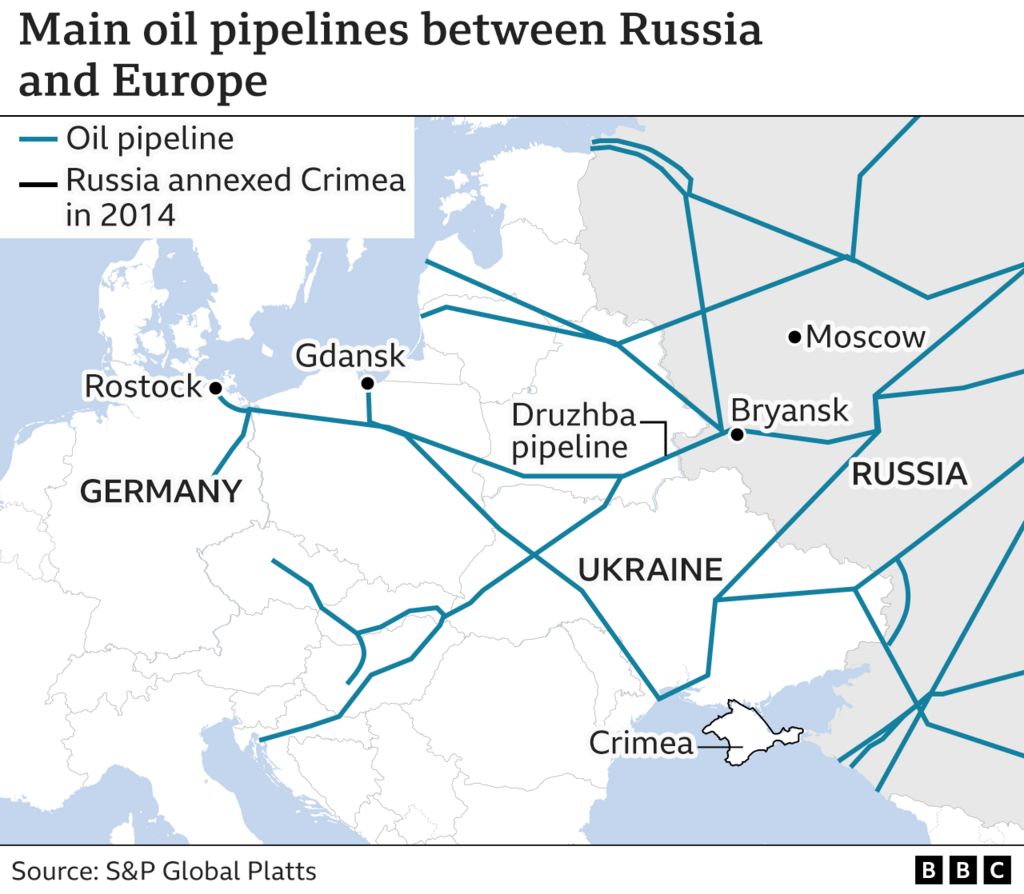
“Left over is around 10-11% that is covered by the southern Druzhba,” Ms Von der Leyen said, referring to the Russian pipeline supplying oil to Hungary, Slovakia and the Czech Republic.
The European Council will revisit this exemption “as soon as possible”, she added.
The ban on Russian oil imports was initially proposed by the European Commission – which develops laws for member states – a month ago.
But resistance, notably from Hungary, which imports 65% of its oil from Russia through pipelines, held up the EU’s troubled latest round of sanctions.
Hungarian Prime Minister Victor Orban declared the agreement a victory for his country.
“We succeeded in defeating the proposal of the European Council which would have forbidden Hungary from using Russian oil,” he said in a Facebook video.
Other landlocked countries, such as Slovakia and the Czech Republic, also asked for more time due to their dependence on Russian oil. Bulgaria, already cut off from Russian gas by Gazprom, had likewise sought opt-outs.
The cost of living crisis being felt across Europe has not helped either. Sky-rocketing energy prices – among other things – have curtailed some EU countries’ appetite for sanctions which could also hurt their own economies.
The “liberation” of eastern Ukraine’s Donbas region is an “unconditional priority” for Russia, Foreign Minister Sergei Lavrov has said in an interview.
Defending Russia’s ongoing military operation more than three months after it invaded, he said again it was aimed at “demilitarising” its neighbour.
He repeated the Kremlin’s widely ridiculed line that Russia is fighting a “neo-Nazi regime”.
The man who has dominated Russia for more than two decades turns 70 in October.
Noting that President Putin regularly appeared in public, Mr Lavrov told TF1: “I don’t think that sane people can see in this person signs of some kind of illness or ailment.”
The head of the World Bank has warned that Russia’s invasion of Ukraine could cause a global recession as the price of food, energy and fertiliser jump.
He also said that a series of coronavirus lockdowns in China is adding to concerns about a slowdown.
His comments are the latest warning over the rising risk that the world economy may be set to contract.
“As we look at the global GDP… it’s hard right now to see how we avoid a recession,” Mr Malpass said, without giving a specific forecast.
“The idea of energy prices doubling is enough to trigger a recession by itself,” he added.
Last month, the World Bankcut its global economic growth forecast for this year by almost a full percentage point, to 3.2%.
GDP, or Gross Domestic Product, is a measure of economic growth. It is one of the most important ways of measuring how well, or badly, an economy is performing and is closely watched by economists and central banks.
It helps businesses to judge when to expand and recruit more workers or invest less and cut their workforces.
Governments also use it to guide decisions on everything from tax and spending. It is a key gauge, along with inflation, for central banks when considering whether or not to raise or lower interest rates.
Mr Malpass also said that many European countries were still too dependent on Russia for oil and gas.
That’s even as Western nations push ahead with plans to reduce their dependence on Russian energy.
He also told a virtual event organised by the US Chamber of Commerce that moves by Russia to cut gas supplies could cause a “substantial slowdown” in the region.
He said higher energy prices were already weighing on Germany, which is the biggest economy in Europe and the fourth largest in the world.
Developing countries are also being affected by shortages of fertiliser, food and energy, Mr Malpass said.
Mr Malpass also raised concerns about lockdowns in some of China’s major cities – including the financial, manufacturing and shipping hub of Shanghai – which he said are “still having ramifications or slowdown impacts on the world”.
“China was already going through some contraction of real estate, so the forecast of China’s growth before Russia’s invasion had already softened substantially for 2022,” he said.
“Then the waves of Covid caused lockdowns which further reduced growth expectations for China,” he added.
Also on Wednesday, China’s premier Li Keqiang said the world’s second largest economy had been hit harder by the latest round of lockdowns than it had been at the start of the pandemic in 2020.
He also called for more action by officials to restart factories after lockdowns.
“Progress is not satisfactory,” Mr Li said. “Some provinces are reporting that only 30% of businesses have reopened… the ratio must be raised to 80% within a short period of time.”
Full or partial lockdowns were imposed in dozens of Chinese cities in March and April, including a long shutdown of Shanghai.
The measures have led to a sharp slowdown in economic activity across the country.
In recent weeks, official figures have shown that large parts of economy have been impacted, from manufacturers to retailers.
The US is cutting off another financial route for Russia to pay its international debts, a move that could push the country closer to default.
The US Treasury Department said it would end a waiver that had allowed US bondholders to accept payments, tightening sanctions imposed over the war in Ukraine.
Russia, which is rich from its oil and gas supplies, has the funds to pay.
It has already signalled plans to contest any declaration of default.
The country has almost $2 billion worth of payments that will be due up to the end of the year on its international bonds.
While the new rules only apply to people in the US, they will make it difficult for Russia to make payments elsewhere given the role of US banks in the global financial system.
The US had already barred Russia from using US banks to transfer payments.
In comments last week, US Treasury Secretary Janet Yellen warned the waiver for investors was likely to expire. She said the exemption had been intended to allow an “orderly transition”.
Analysts have said they do not expect major ramifications from the move outside of Russia, with IMF chief Kristalina Georgieva saying in March that exposure to the holdings was “not systemically relevant”.
Russia’s debtwas already downgraded to”junk status” by major ratings agencies in March, a move that disqualifies it from purchases by major investors, making it difficult for Russia to raise money on international markets.
Professor Philip Nichols of the Wharton School at the University of Pennsylvania said it’s not clear what Western holders of Russian bonds have done in the weeks since the invasion, whether rushing to offload them or holding on in hopes the situation will eventually normalise.
A default would mark the first time Russia has failed to pay its government debt since 1998 – the economic crisis at the end of then President Yeltsin’s term in office.
It would likely trigger a court case, opening up Russia to recovery proceedings from creditors.
Inside Russia, any impact would be felt only over the long term as part of the country’s wider economic isolation, Prof Nichols said.
“Russia just has a lot of oil and gas and that translates into a lot of money, but in the long-run, this is part of a web of instruments that are designed to make it far, far more difficult for Russia to wage war on its neighbours,” he said.
“It’s going to be really interesting to see what happens,” Prof Nichols said.
Melitopol, according to the US-based Institute for the Study of War, is an area where partisan warfare has been active since at least the middle of March.
Ukraine’s Military Intelligence Directorate has reported that from 20 March to 12 April “partisans eliminated 70 Russian soldiers during their night patrol”.
These groups are continuing to carry out attacks.
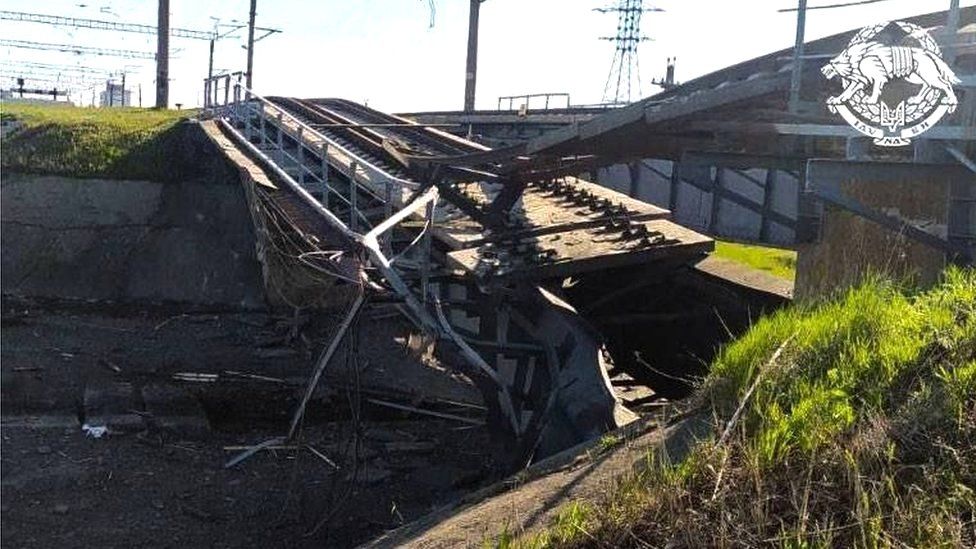
Last Wednesday a Russian armoured train was reportedly derailed. Days earlier, two Russian soldiers were found dead in the street. Last month a bridge near Melitopol – used to deliver supplies to the Russian army – was blown up.
IMAGE SOURCE, UKRAINIAN SPECIAL OPERATION FORCE
Image caption, The destroyed bridge near Melitopol that Russian forces used to transport supplies
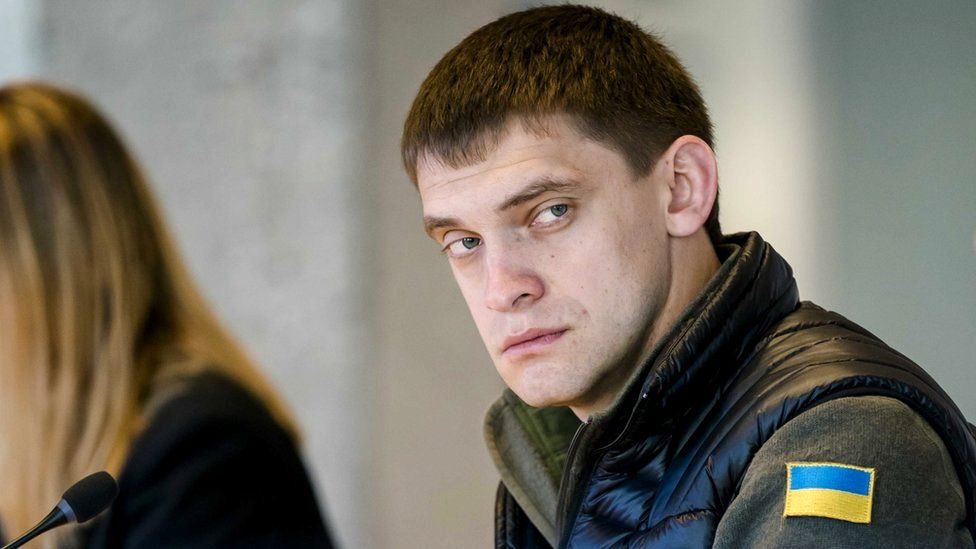
Ivan Fedorov, the mayor of Melitopol, says these attacks were organised by partisan groups. “It’s the job of our partisans, our secret services and our soldiers. They do this job together,” he tells the BBC.
Mr Fedorov himself was abducted by Russian forces and later released as part of a prisoner exchange.
The Russians are desperately trying to crush all resistance. They are searching houses and detaining people, residents say, often at random.
On 29 April, armed men in military uniform with white armbands – the marking used by Russian soldiers – abducted Boris Kleshev, the head of a local fire brigade in Melitopol.
For two weeks his relatives heard nothing about his whereabouts. A few days ago, a pro-Russian Telegram channel posted a video showing Mr Kleshev and other Ukrainian men admitting that they were sharing information on Russian movements with the Ukrainian military.
Mr Kleshev was speaking with a low voice, clearly under duress. But even if it looked like a forced confession, those who made the video were unlikely to have cared – their aim is to break the resistance spreading through Melitopol.
These resistance groups, however, are only a small part of the movement.
“Ninety per cent of Melitopol residents are now partisans and they resist in their own way,” says Svitlana Zalizetska, a local journalist.
“Some people just stare at the Russian soldiers with hatred. Others sing patriotic songs at night. Some people hang posters in the street with Ukrainian flags,” she says, adding that some also pass on information about Russian military movements.
IMAGE SOURCE, REUTERS
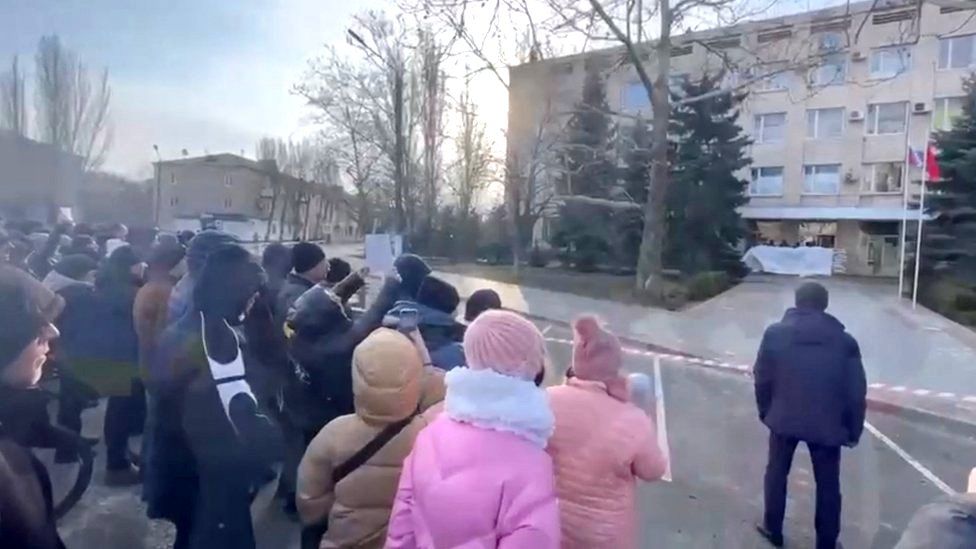
Image caption, Crowds gathered outside the regional administration building in Melitopol when the city’s mayor was reportedly abducted
At the start of the invasion in February, Melitopol residents organised mass protests against the Russian army’s presence. People regularly took to the streets with Ukrainian flags, chanting: “Melitopol is Ukraine.”
“Russian forces were truly shocked to see that the local population was not happy to see them. Those soldiers really believed that they were liberators,” says Iryna (not her real name), who lives in Melitopol.
A few weeks after the invasion, police from Rosgvardia – Russia’s national guard – arrived to crack down on the protests. They started dispersing crowds and detaining activists.
But Russian troops appear to understand that defeating the resistance here requires more than just stopping the rallies.
Unlike other regions occupied by Russian forces, the military in Melitopol have been trying to win people’s hearts and minds. “We have the brand of ‘polite people’”, Iryna jokes, referring to the term used to describe Russian soldiers when Moscow annexed Crimea in 2014.
“These are ordinary guys who look like us and try to be nice,” she explains. “They help elderly women and show that they care about people. But they can’t realise that it was them who created all these troubles and that our people didn’t beg for help before.”
In order to create a perception of normality, the Russian forces try to silence anyone who openly opposes them.
IMAGE SOURCE, EPA
Image caption, Mayor of Melitopol Ivan Fedorov was detained by Russian forces in March
Svitlana Zalizetska, who used to run a popular news website, was pressured to co-operate with the new authorities appointed by the Russian military. She refused. When the mayor, Mr Fedorov, was abducted, Svitlana realised she could be next. She later escaped into territory controlled by Ukrainian forces.
Then, Russian officers started threatening her family. “First they wanted to destroy the website. They failed,” she says. “Then they tried to capture me. They failed again. Then they detained my father and took him hostage to make me come back, and gain control over the website.”
Only when she publicly acknowledged that she no longer owned the website and stopped writing for it, they released her father.
The Russian army is mobilising resources to change the pro-Ukrainian views of the population in Melitopol. They desperately want to get schools, shops and businesses to reopen with the aim of presenting Russian rule as a positive step.
And the longer the occupation lasts, the harder it is for people to resist. Some residents, with no funds left to feed their families, are returning to work – even if it implies supporting the new Russian regime.
“If they are physically killing Ukrainians in Mariupol, here they’re trying to break our souls,” says Iryna. “But they will fail.”
The world is “navigating a dark hour in our shared history” with Russia’s invasion of Ukraine, US President Joe Biden told key Asian allies.
The war has now become a “global issue” underscoring the importance of defending international order, he said.
Japanese PM Fumio Kishida also echoed his comments, saying that a similar invasion should not happen in Asia.
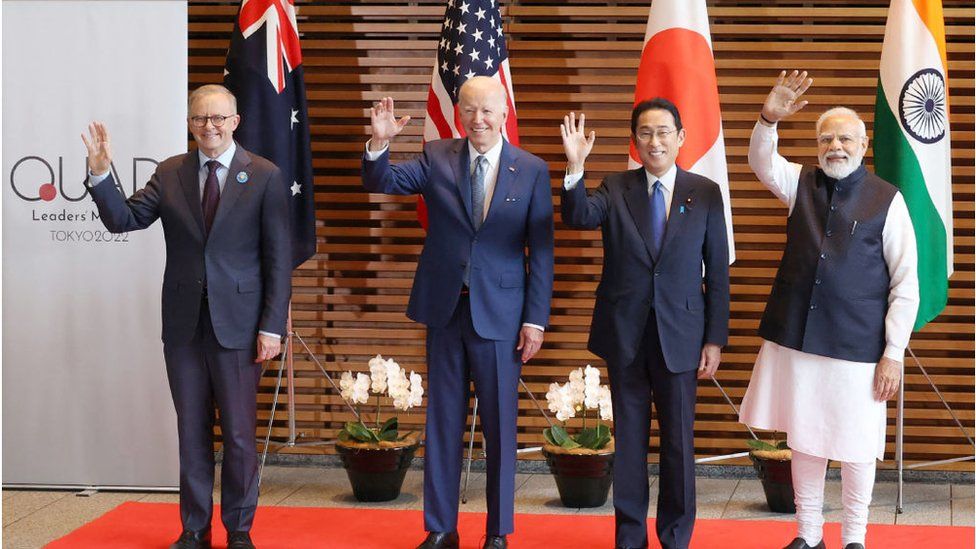
Mr Bidenis meeting the leaders of Japan, Australia and India in Tokyo in his first visit to Asia as president.
The four countries known collectively as the Quad are discussing security and economic concerns including China’s growing influence in the region – and differences over the Russian invasion.
Mr Biden’s comments come a day after he warned China that it was “flirting with danger” over Taiwan, and vowed to protect Taiwan militarily if China attacked, appearing to contradict a long-standing US policy on the issue.
In his opening remarks at Tuesday’s summit, Mr Biden said their meeting was about “democracies versus autocracies, and we have to make sure that we deliver”.
The Ukraine war, he said, “is going to affect all parts of the world” as Russia’s blockade of Ukraine grain exports worsens a global food crisis.
Mr Biden promised the US would work with allies to lead the global response, reiterating their commitment to defend international order and sovereignty “regardless of where they were violated in the world” and remaining a “strong and enduring partner” in the Indo-Pacific region.
While Quad leaders will be looking to present a united front, there are differences.
India is the only Quad member so far that has refused to directly criticise Russia for the invasion. In his opening remarks at Tuesday’s summit, Indian PM Narendra Modi did not mention the issue.
Australia’s new PM Anthony Albanese meanwhile emphasised his country’s commitment to regional security and climate change.
What is the Quad – and why is China a concern?
Formally referred to as the Quadrilateral Security Dialogue, the Quad began as a loose grouping of countries following the 2004 Indian Ocean tsunami that banded together to provide humanitarian and disaster assistance. The group fell dormant before it was resuscitated in 2017.
IMAGE SOURCE, GETTY IMAGES
Image caption, Australia’s Anthony Albanese, US’ Joe Biden, Japan’s Fumio Kishida and India’s Narendra Modi met on Tuesday
Since then however, the top leaders have gathered for the fourth time – they have already met once in Washington last September and twice virtually – in less than two years.
Analysts say the steady decline in each Quad nation’s bilateral ties with China in the past few years appears to have given the grouping more impetus.
There has been mounting discomfort with China’s growing assertiveness in the region, with ongoing maritime disputes between China and several countries, and a land boundary conflict with India.
Beijing’s heavy investment in strengthening its navy and its recent security pact with the Solomon Islands has stoked fears in Australia, while Japan has become increasingly wary of what it calls routine “incursions” from the Chinese navy in its waters.
In a move to preserve US interests in the region, Mr Biden unveiled the Indo-Pacific Economic Framework for Prosperity (IPEF) on Monday – a new US-led trade pact aiming to promote regional growth that includes 13 countries, mostly in Asia.
US Commerce Secretary Gina Raimondo called it an “important turning point in restoring US economic leadership in the region” that would provide countries “an alternative to China’s approach”.
Officials said it would set standards in the areas of trade, supply chains, clean energy and infrastructure, and tax and anti-corruption.
A court in Ukraine has jailed a Russian tank commander for life for killing a civilian at the first war crimes trial since the invasion.
Captured soldier Sgt Vadim Shishimarin was convicted of killing Oleksandr Shelipov, 62, in the north-eastern village of Chupakhivka on 28 February.
He admitted shooting Mr Shelipov but said he had been acting on orders and asked forgiveness of the man’s widow.
Many other alleged war crimes are being investigated by Ukraine.
And in a conflict where the deliberate targeting of civilians has become one of the defining features, Monday’s outcome sets a significant legal precedent.
Moscow has always denied its troops have targeted civilians, despite a wealth of evidence to the contrary, while Ukraine says more than 11,000 crimes may have occurred.
Ukraine, however, is likely to bring more cases like this to unpick Moscow’s blanket denials.
This sentencing is unlikely to lead to an immediate change in tactics from the invading forces, but it does bring Oleksandr Shelipov’s widow Kateryna Shelipova justice.
Imposing the life sentence, Judge Serhiy Agafonov said Shishimarin, 21, had carried out a “criminal order” by a soldier of higher rank.
“Given that the crime committed is a crime against peace, security, humanity and the international legal order… the court does not see the possibility of imposing a [shorter] sentence of imprisonment,” he said.
His lawyer said an appeal would be lodged against the verdict.
The Kremlin’s response is already in motion, with laws being drafted and courts being set up in Russia to try some Ukrainian prisoners as war criminals.
This suggests both countries could soon find themselves in a legal tit-for-tat while the conflict rages on.
IMAGE SOURCE, EPA
Image caption, ‘What did my husband do to you?’ widow Kateryna Shelipova asked the Russian soldier during the trial
Shishimarin served in Russia’s Kantemirovskaya tank division. At the time of the killing, he and other soldiers were travelling in a car they had seized after their convoy came under attack and they became separated from their unit.
When they spotted Mr Shelipov, he was speaking on his phone, Shishimarin told the court. He said he was told to shoot him with an assault rifle.
His defence lawyer told the court on Friday that Shishimarin had only fired after twice refusing to carry out the order to shoot and that only one out of three to four rounds had hit the man.
He said Shishimarin fired the rounds out of fear for his own safety and he questioned whether the defendant had intended to kill.
In one dramatic moment, the victim’s widow Kateryna Shelipova confronted Shishimarin. “Tell me please, why did you [Russians] come here? To protect us?” she asked, citing Russian President Vladimir Putin’s justification for the invasion of Ukraine.
“Protect us from whom? Did you protect me from my husband, whom you killed?”
The soldier had no answer to that. Asking forgiveness of the widow earlier, he said: “But I understand you won’t be able to forgive me.”
Ms Shelipova told the BBC: “I feel very sorry for him but for a crime like that – I can’t forgive him.”
Since President Putin sent Russian troops into Ukraine on 24 February, at least 3,838 civilians have been killed and 4,351 injured, according to the UN.
Earlier this month, the BBC obtained CCTV footage of the killing of two civilians in cold blood allegedly by Russian soldiers, a case now being investigated by prosecutors as a suspected war crime.
Ukrainehas extended martial law for three months until 23 August.
President Volodymyr Zelensky first signed the decree, along with a general military mobilisation call, on 24 February and since then has extended it for a month on two occasions.
On Sunday, Ukraine’s parliament voted by an absolute majority for a third extension as Russiacontinues to focus its offensive on the eastern Donbas region.
Zelensky’s representative at the Constitutional Court, Fedir Venislavskyy, said the decision to extend it for 90 days this time is because a “counter-offensive takes more time than defence”.
Under martial law, Ukrainian men aged 18-60 are banned from leaving the country unless they have special exemptions.
After winning the English Premier League title for the fourth time with his club Manchester City, Ukrainian footballer Oleksandr Zinchenko has said he found it hard to even think about football after Russia invaded Ukraine in February.
Speaking to Sky Sports after draping the Ukrainian flag around the Premier League trophy, an emotional Zinchenko called it an unforgettable moment.
“I’m so proud to be Ukrainian,” he said. “I would love to one day bring this title to Ukraine, for all Ukrainian people, because they deserve it.”
Zinchenko said the time since the invasion began was the “toughest period in my life”.
In an interview with BBC Sport’s Gary Lineker soon after the start of the war, the Manchester City defender said he could not count the number of times he had cried since Russia’s invasion began.
Ukraine may be losing between 50-100 lives in the east every day, President Volodymyr Zelensky says.
He made this known during a press briefing on Sunday.
He said those killed were defending Ukraine in “the most difficult directionâ€.
Zelensky did not elaborate further but the comments appear to be a reference to military losses and are a sign of how fierce the fighting is in the east.
Russian forces have stepped up their attempts to capture cities in the eastern Donbas region, with a focus on the city of Severodonetsk.
Russia’s death toll equals that of Afghan conflict
In its latest intelligence update, the UK’s Ministry of Defence (MOD) says that in the first three months of the war, Russiais likely to have suffered a similar death toll to that seen by the Soviet Union during its nine-year war in Afghanistan.
The high casualty rate – seen in the Donbas offensive – can be explained by a combination of poor low-level tactics, limited air cover, lack of flexibility and “a command approach which is prepared to reinforce failure”.
The MoD predicts those casualties, as they continue to rise, will become more apparent to the Russian public, and “public dissatisfaction with the war and a willingness to voice it may grow”.
It is a pointed reference. The Soviet Union lost at least 15,000 soldiers in the Afghan conflict trying to prop up a communist government. The war became a bloody stalemate, and is viewed as a factor in the collapse of the Soviet Union.
The war in Ukraine can only be resolved through “diplomacy”, President Volodymyr Zelensky has said.
Speaking on national TV, he suggested his country could be victorious against Russia on the battlefield.
However, he added that the war could only come to a conclusive halt “at the negotiating table”.
Meanwhile, heavy fighting is taking place in and around Severodonetsk, as Russian forces step up efforts to seize the whole of the Luhansk region.
The end of fighting in the southern port city of Mariupol has freed up Russian troops for redeployment elsewhere and allowed them to intensify their onslaught in the east.
Local governor Serhiy Haidai said the Russians were “destroying” Severodonetsk as they gradually surrounded it.
Writing on the messaging app Telegram, he said Ukrainian troops had repelled 11 attacks on the frontline – with eight tanks among the Russian vehicles destroyed. There was no independent confirmation of the claims.
BBC correspondent James Waterhouse said Russia had increased its artillery and air strikes as well as missile attacks – gaining ground mile by mile in Luhansk while the Ukrainians are forced to retreat.
In his TV address, Mr Zelensky said the conflict “will be bloody, there will be fighting, but it will only definitively end through diplomacy”.
But he indicated this would not be easy, as neither side wanted to give anything up.
On Tuesday, Kyiv’s lead negotiator, Mykhaylo Podolyak, said talks were on hold.
The following day, Kremlin spokesman Dmitry Peskov accused Kyiv authorities of not wanting to continue talks to end hostilities.
Russian news agencies say the last meeting happened nearly a month ago, on 22 April.
With no end in sight to the fighting, the US is sending more military, economic and humanitarian aid.
On Saturday, President Joe Biden signed a bill to provide a package for Ukraine worth nearly $40bn (£32bn), the White House said.
The money represents the largest programme of American assistance since Russia launched its invasion in February.
The bill, which will funnel support to Ukraine for about the next five months, includes some $6bn budgeted for armoured vehicles and air defences.
President Zelensky tweeted his gratitude, saying military aid was “needed more than ever”.
It also emerged on Saturday that President Biden is one of over 900 US citizens who have been indefinitely banned from entering Russia.
The list also includes Secretary of State Antony Blinken, CIA chief William Burns and hundreds of members of Congress.
In another development, Russia has switched off its gas supply to Finland after it refused Moscow’s demand to pay for fuel in Russian roubles.
Russia has declared victory in its months-long battle to conquer Mariupol.
Last night, Moscow said the port city had been “completely liberated” after the last fighters defending the Azovstal metal works surrendered.
Friday’s evacuation marks the end of the most destructive siege of the war, with Mariupol now in complete ruins.
It said 531 Ukrainian troops had left the site. “The underground facilities of the enterprise, where the militants were hiding, came under the full control of the Russian armed forces,” it added in a statement.
Ukrainian President Volodymyr Zelensky said the site’s last remaining defenders had been given permission to leave.
“Today the boys received a clear signal from the military command that they can get out and save their lives,” he told a Ukrainian television channel.
According to Moscow officials, a total of 2,439 Ukrainian fighters have now surrendered from the steel works in recent days.
Moscow has released no information about where the soldiers who left last night are being evacuated to, but previous buses have been sent to Russian-controlled territories.
US officials are considering arming the Ukrainian military with advanced anti-ship missiles, the Reuters news agency has reported.
Citing Biden administration officials, the report says the White House could offer Kyiv Boeing Harpoon and Naval Strike missiles with which to target the Russian Black Fleet, which is currently blockading Ukrainian ports.
UK defence officialshave said that around 20 Russian Navy vessels, including submarines, are active in the region.
Officials are said to believe the arms could help force Russian ships away from Ukrainian territory and allow shipments of grain and other agricultural products to resume.
But the missiles, which cost around $1.5m (£1.2m) per round and have a range of 300km, are mainly sea based missiles, meaning Ukraine could face difficulty firing it from shore.
Sweden and Finland have the “full, total and complete backing” of the US in their decision to apply for Nato membership, President Joe Biden says.
Both countries submitted their applications to be part of the Western defence alliance this week, marking a major shift in European geopolitics.
To join the alliance, the two nations need the support of all 30 Nato member states.
But the move by the Nordic nationshas been opposed by Turkey.
Speaking alongside Swedish Prime Minister Magdalena Andersson and Finnish President Sauli Niinisto at the White House on Thursday, Mr Biden called Sweden and Finland’s applications “a watershed moment in European security”.
“New members joining Nato is not a threat to any nation,” he said. The president added that having two new members in the “high north” would “enhance the security of our allies and deepen our security co-operation across the board”.
Russia has repeatedly said it sees Nato as a threat and has warned of “consequences” if the block proceeds with its expansion plans.
Turkey has accused both Sweden and Finland of hosting suspected militants from the Kurdistan Workers’ Party (PKK), a group it views as a terrorist organisation.
However, both Nato Secretary-General Jens Stoltenberg and British Defence Minister Ben Wallace have expressed confidence that these concerns will eventually be addressed.
Mr Biden’s comments came as the US Senate voted to approve a new $40bn (£32bn) bill to provide military and humanitarian aid to Ukraine. It is the biggest emergency aid package so far for Ukraine.
The bill – which was passed by the House of Representatives with broad bipartisan support on 10 May – was expected to be passed earlier this week, but was blocked by Kentucky Republican Rand Paul over a dispute about spending oversight.
But the Republican’s Senate leader Mitch McConnell dismissed these concerns and told reporters that Congress had a “moral responsibility” to support “a sovereign democracy’s self-defence”.
“Anyone concerned about the cost of supporting a Ukrainian victory should consider the much larger cost should Ukraine lose,” Mr McConnell said.
Last week, Defence Secretary Lloyd Austin and Secretary of State Antony Blinken urged Congress to approve the package and warned that the US military only had enough funds to send weapons to Kyiv until 19 May.
Ukraine’s President Volodymyr Zelensky praised the aid package as “a significant US contribution to the restoration of peace and security in Ukraine, Europe and the world”.
The package brings the total US aid delivered to Ukraine to more than $50bn, including $6bn for security assistance such as training, equipment, weapons and support.
Another $8.7bn will be allocated to replenish stocks of US equipment already sent to Ukraine.
Russia’s invasion of Ukraine could soon cause a global food crisis that may last for years, the UN has warned.
Secretary-General Antonio Guterres said the war had worsened food insecurity in poorer nations due to rising prices.
Some countries could face long-term famines if Ukraine’s exports are not restored to pre-war levels, he added.
The conflict has cut-off supplies from Ukraine’s ports, which once exported vast amounts of cooking oil as well as cereals such as maize and wheat.
This has reduced the global supply and caused the price of alternatives to soar. Global food prices are almost 30% higher than the same time last year, according to the UN.
Speaking in New York on Wednesday, Mr Guterres said the conflict – combined with the effects of climate change and the pandemic – “threatens to tip tens of millions of people over the edge into food insecurity followed by malnutrition, mass hunger and famine”.
“There is enough food in our world now if we act together. But unless we solve this problem today, we face the spectre of global food shortage in the coming months,” he added.
He warned that the only effective solution to the crisis was reintegrating Ukraine’s food production, as well as fertiliser produced by both Russia and Belarus, back into the global market.
More than 900 Ukrainian fighterswho had been holed up in Mariupol’s Azovstal steel plant have been taken to a prison colony in Russian-controlled territory, Moscow has said.
Ukraine ordered troops there to stand down as part of a deal struck by both sides, as it attempts to save their lives. Food and water supplies have reportedly been scarce in the plant for several weeks.
A Russian foreign ministry spokesperson, Maria Zakharova, said on Wednesday that 959 Ukrainian service personnel had surrendered since Tuesday. Of those, 51 were being treated for their injuries and the remainder had been sent to a former prison colony in the town of Olenivka in a Russian-controlled area of the Donetsk region.
The defence ministry in Kyiv said it was hoping for an “exchange procedure… to repatriate these Ukrainian heroes as quickly as possible”, according to AFP.
Their fate remains unclear, with Kremlin spokesman Dmitry Peskov refusing to say whether they would be treated as criminals or prisoners of war.
Ukraine’s defence ministry pledged to do “everything necessary” to rescue those still in the sprawling network of tunnels and bunkers under the steel plant, but admitted there was no military option available.
The Czech government has approved a programme to help citizens of Russia and Belarus who have fled persecution in their home countries.
The programme, called Civil Society, will make it easier for the Czech authorities to grant visas to Russians and Belarussians if they can show they face persecution for opposing undemocratic regimes at home.
Independent journalists and academics were likely to be among those who could take advantage of the programme, foreign minister Jan Lipavsky said.
Belarussian opposition leader Sviatlana Tsikhanouskaya recently appealed to the Czech authorities on a trip to Prague to provide protection for activists forced to flee Belarus.
A 21-year-old Russian soldier has pleaded guilty to killing an unarmed civilian, in the first war crimes trial in Ukraine since the war started.
Vadim Shishimarin admitted shooting a 62-year-old man a few days after the invasion began. He faces life in jail.
The prisoner was brought into the tiny Kyiv courtroom in handcuffs, flanked by heavily armed guards. He looked nervous, and kept his head bowed.
Just a couple of metres from him, the widow of the man killed was sitting.
She wiped tears from her eyes as the soldier entered court, then sat with hands clasped as the prosecutor set out his case, describing the moment Kateryna’s husband was shot in the head.
“Do you accept your guilt?” the judge asked. “Yes,” Shishimarin replied.
“Totally?” “Yes,” he replied quietly from behind the glass of his grey metal-and-glass cage.
He and four other soldiers stole a car, and as they travelled near Chupakhivka, they encountered the 62-year-old on a bicycle, they said.
According to prosecutors, Shishimarinwas ordered to kill the civilian and used a Kalashnikov assault rifle to do so.
The Kremlin said earlier it was not informed about the case.
Shishimarin’s trial was adjourned shortly after the civilian’s widow heard for the first time the Russian soldier admit to the murder. This high profile hearing will restart on Thursday in a larger courtroom.
Kateryna, the 62 year-old’s widow, told the BBC how she was coping, before she left the court for the day.
“I feel very sorry for him [Shishimarin],” she said. “But for a crime like that – I can’t forgive him.”
The country’s chief prosecutor Iryna Venediktova tweeted: “By this first trial, we are sending a clear signal that every perpetrator, every person who ordered or assisted in the commission of crimes in Ukraine shall not avoid responsibility,”
Moscow has denied its troops have targeted civilians, but investigators have been collecting evidence of possible war crimes to bring before the International Criminal Court (ICC) in The Hague.
The ICC is sending a team of 42 investigators, forensics experts and support staff to Ukraine. Meanwhile, Ukraine has also set up a team to preserve evidence to enable future prosecutions.
Russian energy supplier RAO Nordic says it will suspend deliveries of electricity to Finland from Saturday, citing problems with payments.
The company said it had not been paid for previous deliveries.
The Finnish grid operator said Russia provided only a small percentage of the country’s electricity and that it could be replaced from alternative sources.
On Thursday, Russiathreatened to take “retaliatory steps” after Finland said it planned to join Nato.
Finland shares a 1,300-km (810-mile) border with Russia, and has previously stayed out of Nato to avoid antagonising its eastern neighbour. However, since Russia’s invasion of Ukraine there has been a surge in public support for Nato membership.
On Sunday Finland is expected to formally announce its plan to join.
The decision by Rao Nordic has not been explicitly tied to Finland’s decision.
The Russian state-owned firm said: “This situation is exceptional and happened for the first time in over twenty years of our trading history”.
Neither Rao Nordic nor the grid operator in Finland, Fingrid, explained what was behind the payment difficulties.
Last month Russia cut supplies of gas to Bulgaria and Poland after they refused to comply with a demand to pay in roubles, a change they said would contravene western sanctions.
This week Russia’s Gazprom announced it would stop supplying gas via the Polish part of the Yamal-Europe pipeline.
Fingrid said it did not expect electricity shortages as a result of the shut off, as only around 10% of Finland’s electricity is supplied from Russia.
“The lack of electricity import from Russia will be compensated by importing more electricity from Sweden and by generating more electricity in Finland,” said Reima Päivinen, senior vice president of power system operations at Fingrid.
Demand is also decreasing as the weather gets warmer, while a significant amount of extra wind power generation is expected to come on stream. A new nuclear power station, expected to open this summer, would more than make up for the lost supplies from Russia, Fingrid added.
Since Russian forces were pushed back from Kyiv at the end of March, the bodies of more than 1,000 civilians have been discovered in the Bucha region – many hastily buried in shallow graves.
The BBC’s Sarah Rainsford has been investigating what happened at a children’s summer camp – now being treated as a crime scene.
*This report contains material some readers will find disturbing*
It is easy to miss the killing spot at first in the gloom. But in a cold, damp basement on the edge of the woods that made Bucha a popular get-away spot before the war, five Ukrainian men were forced to their knees and shot in the head.
To the right of the entrance, there are stones coated in blood that has turned dark red. Lying among that is a blue woollen hat with an exit hole in one side and its rim soaked in blood. In the wall, I counted at least a dozen bullet holes.
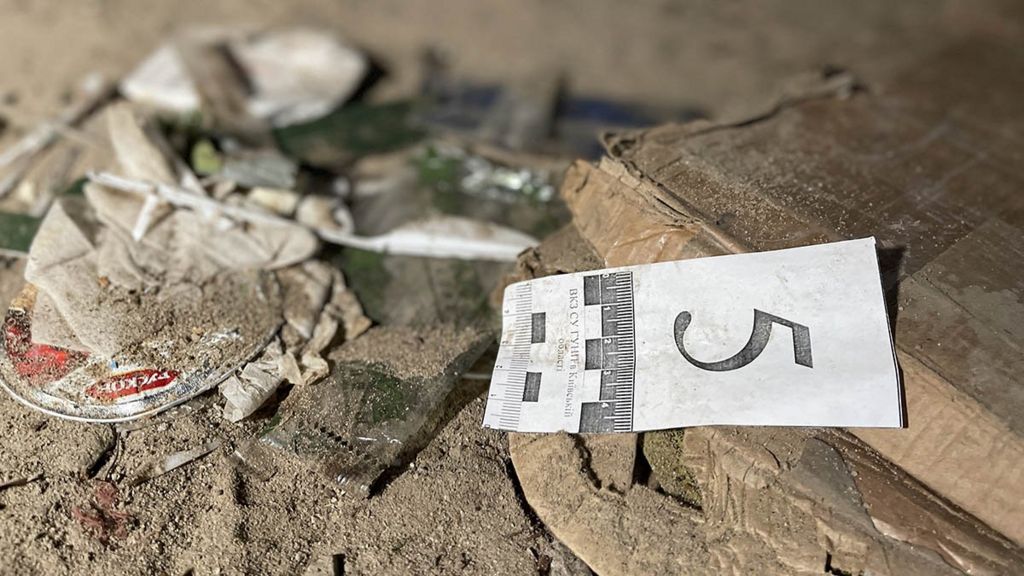
Image caption, A marker left by a forensics team in the basement
A couple of steps away are the remains of a Russian military ration pack – an open can of rice porridge with beef and an empty packet of crackers. A name daubed in graffiti on a wall is a reminder that the scene is a children’s camp. But when Russian troops moved into Bucha, just outside the capital, in early March, Camp Radiant became an execution ground.
The story of the summer camp killings is chilling but so is this detail: more than 1,000 civilians were killed in the Bucha region during a month under Russian occupation, but most did not die from shrapnel or shelling. More than 650 were shot dead by Russian soldiers.
Now Ukraine is searching for their killers.
Volodymyr Boichenko lived in Hostemel, just up the road from Bucha and near the airfield where the first Russian forces landed to try to overthrow Ukraine’s government. When his sister Aliona Mykytiuk decided to flee before the fighting reached her, she pleaded with Volodymyr to join her. He was a civilian, not a soldier, but he wanted to stay and help. So he spent the days searching Hostemel for food and water to bring to neighbours, including children, who were trapped in their cellars by the constant shelling and Russian airstrikes.
A chatty 34-year-old, who had travelled the world in the merchant navy, Volodymyr phoned his family from Hostemel most days to reassure them he was safe. Aliona would wait nervously for his brief calls: she knew he had to move to higher ground to get a connection and if the shelling was heavy it was impossible to leave the bomb shelter. As supplies ran low, she urged her brother to try to escape but by then the roads were blocked.
IMAGE SOURCE, BOICHENKO FAMILY
Image caption, Volodymyr Boichenko had travelled the world
The last time Aliona heard from him was on 8 March. Volodymyr wasn’t the demonstrative type, but that day he told his sister not to worry about him. “He said ‘I really love you,’ and that was so painful to hear,” Aliona sobs, rubbing her eyes hard but unable to stop the tears. “There was fear in his voice.”
Four days later, Volodymyr was spotted by neighbours close to Promenystyi, as it’s known here, or Camp Radiant. Then he disappeared.
In March, the fighting around Kyiv was intense and the small town of Bucha was at the epicentre. The withdrawal of Russian troops in early April revealed scenes that shocked the world: the bodies of residents slumped in the streets where they’d been shot.
Moscow tells anyone who will listen that the killings were staged, an idea that is as twisted as it is patently false. Determined to hold those responsible to account, Ukrainian investigators are busy collecting the hard evidence on territory now back under their control.
“We don’t know what Putin’s plans are, so we are working as quickly as possible in case he drops a bomb and destroys all the proof,” says Kyiv regional police chief, Andrii Niebytov.
That evidence includes a field full of civilian cars pierced with multiple bullet holes, now piled up on the edge of Bucha. They are vehicles that were shot at when families tried to flee. One still has a length of white cloth at the window, hung to show the soldiers that its occupants were no threat. Step too close, and you catch the sickly smell of death.
Image caption, A white flag did not prevent this car from being attacked
When the bodies beneath Camp Radiant were discovered on 4 April, Volodymyr Boichenko was among them. Aliona had spent weeks frantically calling hospitals and morgues. That day she was sent a photograph to identify. She knew it was her brother before it had even downloaded.
“I hate them with every cell of my being,” Aliona cries, about Volodymyr’s killers. “I know that’s wrong to say about people, but they are not human. There was not one patch on those men’s bodies that was not beaten.”
Image caption, Volodymyr’s sister Aliona, with her cousin Ilona
The five men had been found crouching on their knees, heads down and hands bound behind their backs.
“We know they had been tortured,” the police chief told the BBC. “The Russian army has crossed the line of how war is conducted. They were not fighting the military in Ukraine, they were kidnapping and torturing the civilian population.”
Neither the Prosecutor’s Office nor the SBU security service will disclose details of ongoing investigations, but some Russian military were so careless at covering their tracks that there are likely to be considerable clues to work with. Ukrainian territorial defence units have even discovered lists of soldiers at some abandoned positions. One appears to be part of a rota for litter duty, another includes passport details and mobile phone numbers.
Image caption, Kyiv regional police chief, Andrii Niebytov, is working fast to gather evidence
With such a vast volume of work – more than 11,000 potential war crimes cases registered so far – Ukraine’s security services have called on more digitally savvy civilians for help.
“I feel some call of duty,” said Dmytro Replianchuk, a journalist at slidstvo.info who worked to expose corruption within Ukraine’s law enforcement bodies before the war. Now he’s joined forces with prosecutors, scouring the internet for extra data to help catch suspected war criminals.
“I understand it will be so hard and a lot of cases won’t be solved. But in these weeks, it’s important to find as much information as possible,” Dmytro explained.
We found one potential clue among the litter at Camp Radiant – the wrapping from a parcel sent by a woman named Ksyukha to a Russian soldier whose own name and military unit are clearly marked. Unit 6720 is based in Rubtsovsk, in the Altai region of Siberia. It has been linked to Bucha before when soldiers from the town were caught on CCTV sending giant packages to relatives full of goods that they had looted from Ukrainian homes.
Image caption, A parcel addressed to a Russian soldier – the name has been blurred
We can’t be sure yet whether soldiers from Rubtsovsk were based at the children’s camp, or were there when the men were killed. The police first need to establish a more precise time of death.
“We are working on it, but it’s not a quick thing,” Mr Niebytov explains. “But that camp was a headquarters so there would have been a commander. The soldiers could not have executed anyone without the commander’s knowledge. So we will first find the organisers and then look for the implementers.”
Across the road from Camp Radiant, behind a church spattered with shrapnel damage, a corner of Bucha is slowly showing renewed signs of life. Young boys run around the yard, while a man fixes sheets of wood to windows shattered when the town was being shelled, constantly. And a little shop has just reopened to serve others now trickling back to begin their own repairs.
Image caption, Fresh graves are still being dug in Bucha
As neighbours cross paths, they discuss the days when Russian tanks rolled into their town, the soldiers who would shoot wildly and those who roamed the streets drunk, breaking into homes and stealing from them. And they remember the local man who escaped to their block of flats from the summer camp opposite, and who they had sheltered despite the risk.
Viktor Sytnytskyi didn’t know Camp Radiant before, but all the details he gives match up. He’s now in western Ukraine and told me his story over the phone, calling from his car so he wouldn’t upset his mother.
It was early March when Viktor was grabbed by Russian soldiers on the street. They tied his hands and pulled his hat down over his eyes, then dragged him to a cellar that he’s sure was on the grounds of the children’s camp.
Image caption, Camp Radiant is decorated with mosaics of happy children playing – now it’s a crime scene
There, the Russians poured water over his legs so he would freeze, and they held a gun to his head.
“They kept saying, ‘Where’s the fascists? Where’s the troops? Where’s Zelensky? One of them mentioned Putin so I said something rude and he hit me,” Viktor recalls.
He remembers being angry at his captors as well as terrified. He had worked in Moscow in the past with men from Siberia and was horrified that Russians could now treat him with such brutality. Even more so, when one of the soldiers revealed that he, too, was from Siberia.
Viktor told him he was sad things had come to this.
“The sad thing is that our grandfathers fought together against the Nazis and now you’re the fascists,” was the Russian’s angry reply.
“He told me: ‘You have until the morning to remember what you’ve seen, and if not, you’ll be shot.’”
That night, Viktor got lucky. There was heavy shelling and when he realised his captors were no longer guarding him, he ran for his life.
“I calculated that I had more chance of surviving under shelling than if I stayed in that cellar. They’d already put the gun to my head. What would it cost them to pull the trigger?”
From a common grave beneath the children’s camp, Volodymyr Boichenko has now been given a proper burial beneath the cherry blossom in the old cemetery of Bucha.
After his funeral, Aliona says she finally saw her brother’s face in her dreams again, as if he were comforting her.
But she still has many questions. The cross on Volodymyr’s grave is marked only with his birthday, not the date of his death, because the family have no idea when he was shot.
They may never know, unless the Russian commander who took over Camp Radiant can be found.
Like everyone in Bucha, though, they do know that civilians are not only caught up in this war. They are being targeted – by Russian soldiers who either don’t know the rules of war, or don’t care.
Photographs by Sarah Rainsford unless otherwise marked
Additional reporting: Daria Sipigina, Mariana Matveichuk and Tony Brown
Ukraine is preparing for a new Russian push in the eastern Donbas region, President Volodymyr Zelensky says.
Since failing to take Kyiv at the beginning of the invasion in late February, control of Donbas has become one of Moscow’s main objectives.
“We are preparing for new attempts by Russia to attack in Donbas, to somehow intensify its movement in the south of Ukraine,” President Zelensky said in his nightly address.
“The occupiers still do not want to admit that they are in a dead-end and their so-called ‘special operation’ has already gone bankrupt,” he added.
He once again called on the West to impose an oil embargo on Russia.
“We are also working to strengthen sanctions on Russia. Partners need to make decisions that limit Russia’s ties to the world every week,” he said.
“The occupiers must feel the rising cost of war for them, feel it constantly.”
Ukraine has started its first war crimes trial since the beginning of Russia’s invasion, with a 21-year-old soldier appearing in the dock accused of killing an unarmed civilian.
Vadim Shishimarin appeared at a preliminary hearing in Kyiv. He faces life in prison if convicted.
Ukraine says it has identified thousands of potential war crimes committed by Russia.
Russia has denied targeting civilians and made no comment on the trial.
Prosecutors say Mr Shishimarin was driving in a stolen vehicle with other soldiers in the north-eastern Sumy region when they encountered a 62-year-old cyclist using a phone.
He was ordered to shoot the civilian to stop them from telling Ukrainian defenders about their location, according to the prosecutors.
It is not clear how he was captured or what the nature of the evidence against him is.
Mr Shishimarin spoke to confirm basic details such as his name. He is yet to enter a plea, and the trial will reconvene next week.
Hundreds of bodies have been found in regions previously occupied by Russia.
Some of Ukraine’s allies, such as the UK and US, have joined the country in accusing Russia of carrying out genocide.
After the hearing, state prosecutor Andriy Synyuk told Reuters: “This is the first case today. But soon there will be a lot of these cases.”
When Leonid Pliats and his boss were shot in the back by Russian soldiers, the killing was captured on CCTV cameras in clear and terrible detail. The footage, which was obtained by the BBC, is now being investigated by Ukrainian prosecutors as a suspected war crime.
It was the height of the fighting around Kyiv and the main roads into the capital were a battlefield, including around the bicycle shop where Leonid worked as a security guard.
But this was no firefight: the video clearly shows heavily armed Russian soldiers shooting the two unarmed Ukrainians and then looting the business.
We have pieced together the full sequence of events, matching what was recorded on multiple CCTV cameras around the site with the testimony of people Leonid phoned that day, as well as the Ukrainian volunteer fighters who tried to rescue him.
The Russians arrive in a stolen van daubed with the V sign used by Russian forces and the words Tank Spetsnaz in black paint. They wear Russian military uniform and approach with their guns up, fingers on the triggers.
Leonid walks towards the soldiers with his hands up to show he’s unarmed and no threat.
Image caption, The Russian soldiers had not realised they were being filmed
The Russians initially talk to him and his boss through the fence. There is no audio on the footage but the men seem calm, they even smoke. Then the Ukrainians turn away and the soldiers start to leave.
Suddenly they turn back, crouch then shoot the two men multiple times in their backs.
One is killed outright but somehow Leonid manages to stagger to his feet. He even ties his belt around his thigh to slow the blood, then stumbles to his cabin where he begins to call for help.
Vasyl Podlevskyi spoke to his friend twice that day, as he sat bleeding heavily.
Leonid told him the soldiers claimed they don’t kill civilians, then they shot him.
“I said can you at least bandage yourself up? And he told me, Vasya, I barely crawled here. Everything hurts so much. I feel really bad,” Vasyl remembers the call.
“So I told him to hang in there and started phoning the territorial defence.”
The men he called used to sell air conditioning before the war.
Image caption, There has been fierce fighting on the outskirts of Ukraine’s capital
Now volunteer fighters, Sasha and Kostya show me video on their mobile phones of Russian tanks rolling past their positions. Their job was to send real-time information on Russian movements to Ukraine’s military positions up the road.
When Leonid Pliats was injured they were tasked with crossing the dangerous E40 highway to try to save him. Even today, the road is littered with the burned-out carcasses of Russian tanks, a reminder of the intensity of the fighting.
As the security guard lay bleeding, Russian troops were still on site.
On the CCTV you see them shooting their way into rooms, stealing bicycles and even a scooter and lolling around in the director’s office, drinking his whisky, and rifling through his cupboards.
Outnumbered and only lightly armed, Sasha and Kostya were forced to wait although they realised that Leonid was dying.
“We talked to him on the phone, we tried to calm him. We told him, it’s ok. Everything will be ok. You’ll survive,” Sasha tells me they did their best to comfort him.
“We said we were on our way. Maybe that helped him. Maybe. But unfortunately, by the time we made it, he was dead.”
Even as they collected the two men’s bodies, the volunteer fighters had to take cover as a Russian tank rolled past.
There is ample evidence against the men responsible for these killings. We have studied the video in minute detail and the Russian soldier who we believe was one of the killers is clearly visible, his face uncovered.
Image caption, Leonid was 65 when he died
It is a long time before his friends realise they are being filmed and smash one of the security cameras.
We showed the footage to the chief of police for Kyiv region and he told us the bodies of 37 civilians, all of them shot dead, were found along the road to Ukraine’s capital after Russian forces were pushed back.
The Prosecutor’s office confirms that it is now investigating the killing of Leonid and his colleague as a possible war crime: one of more than 10,000 cases they have registered.
“My Dad was not a military man at all. He was a pensioner. They killed a 65-year-old. What for?” Leonid’s daughter, Yulia Androshchuk, wants to know.
She is abroad and hasn’t even been able to bury her father yet because of the war.
“I’m not so much furious as full of grief – and fear. These damn Russians are so out of control, I’m afraid of what they might do next,” she told me.
Yulia hopes those responsible will stand trial someday, somehow. For now, she wants people to know exactly what happened to her father and for the brutality to stop.
Russia has been expanding its influence in Africa in recent years and after the invasion of Ukraine, it will be expecting its new-found allies to provide support, or at least remain neutral, in international bodies such as the UN.
From Libya to Mali, Sudan, the Central African Republic (CAR), Mozambique and elsewhere, Russia has been getting more involved – often militarily with help fighting rebels or jihadist militants.
At the UN Security Council, Kenya, currently a non-permanent member, made its opposition to Russian action in Ukraine very clear.
But there has not yet been a loud chorus from other countries backing Kenya’s position. The continental body, the African Union, expressed “extreme concern” about what was going on, but was muted in its criticism of Russia.
South Africa, which is a partner of Russia in the Brics group, has called on the country to withdraw its forces from Ukraine but said it still held out hope for a negotiated solution.
And on Wednesday the deputy leader of the Sudanese junta, Mohamed Hamdan “Hemeti” Dagolo, led a delegation to Moscow in a sign of closer ties between the two countries.
A monument to the Russian military has been put up in the capital of the Central African Republic
One of the clearest examples of how alliances have been shifting in Africa came just a week before Russia’s attack on Ukraine with the ending of French involvement in fighting jihadists in Mali.
Mali’s Prime Minister Choguel Maiga confirmed, in an interview with France24, that his country has signed military co-operation agreements with Russia. But he denied that the controversial Russian private military company, the Wagner Group, was involved.
This Russian help in Mali, along with a reported offer to the military government in Burkina Faso, fits a pattern over the past five years where Russia has intensified steps to increase its influence in Africa, both official and informal.
As the renewed Russia-Africa engagement gained momentum, a 2019 summit in the southern Russian city of Sochi was attended by delegates from more than 50 African countries, including 43 heads of state.
President Vladimir Putin addressed the leaders, appealing to a history of backing liberation movements and pledging to boost trade and investment.
The 2019 Sochi summit drew almost all of Africa’s heads of state
But there has also been another kind of presence: the opaque provision of security to governments in a number of African countries, in the form of training, intelligence and equipment, as well as involvement of Russian mercenaries in local conflicts.
As Mr Putin indicated, there are historic ties stretching back to the days of the USSR, Russia’s predecessor, when Africa was one of several spheres of competition between it and the US.
But from the collapse of the USSR in 1991 to the early part of the last decade, as Russia went through a period of transition, relations with Africa were not top of the agenda.
Then, regaining superpower status became a foreign policy priority for the Russian president.
New export markets
In 2014, following Russia’s annexation of the Ukrainian peninsula of Crimea and the international sanctions which followed, there came a sharp deterioration in relations with the US and the European Union.
Faced with the threat of international isolation, Moscow started the search for new allies.
“As a result of sanctions, Russia needed to look for new markets for its exports,” said Irina Abramova, director of the Africa Institute at the Russian National Academy of Sciences.
But it was more than markets that Russia was after – it also wanted increased global influence.
In 2014 it got involved in Syria’s civil war, backing President Bashar al-Assad in part to highlight the mess the West was making and show how Russia could fix it.
From Syria it later moved on to the African continent.
Irina Filatova, an honorary professor of the University of KwaZulu-Natal in South Africa, says Russia’s key task in Africa was to discredit Western influence, in much the same way as in Syria.
It wanted to show that the Europeans, for example, had failed to contain the jihadist threat in the Sahel.
It did this through a dual policy in Africa, combining official military instructors working in some countries, and informal agencies, such as the Wagner Group, fighting in a number of others.
Mercenaries
The CAR was the first African country where Russian mercenaries from the Wagner Group appeared in 2017.Â
Allegations of atrocities carried out by the mercenaries have become common, but Russia has consistently denied that any of its citizens were involved in war crimes or violence against civilians.
Russian mercenaries have also been active in Libya, Sudan, Mozambique and Mali, with varied levels of success.
In another sign of the growing significance of the continent, Africa has become a key market for Russia’s arms industry. Almost half of all the arms coming into Africa come from Russia, according to the country’s state arms export agency.
The main importers are Algeria and Egypt, but there have been new markets in Nigeria, Tanzania and Cameroon.
UN votes
But there is also a prize for closer ties on the diplomatic front.
Africa, in total, has more than a quarter of the votes at the UN General Assembly, and can be a powerful collective voice in other international bodies.
A 2021 report on perspectives of Africa-Russia co-operation, published by Moscow’s Higher School of Economics, pointed out that African countries have tended to be neutral when it comes to Russia’s actions in the past.
“None of the African countries introduced any sanctions against Russia [after 2014]. In the voting in the UN on Ukraine-related issues, most countries of the continent express a neutral position,” the report said.
With the invasion of Ukraine, if that neutral stance continues, or if it is translated into more vocal support, then Russia’s efforts over the past few years could be seen to have paid off.
Russian missiles and rockets have hit the the cultural heart of Ukraine’s second city in what officials said was a deadly and “barbaric” attack.
An opera house, concert hall and government offices were hit in Freedom Square, in the centre of the north-eastern city, Kharkiv.
At least 20 people, including a child were injured, but authorities are still trying to clarify if anyone was killed.
The attack came as Ukraine’s president said Russia was committing war crimes.
“Russian forces have today cruelly targeted Kharkiv with artillery fire,” Mr Zelensky said. “This is a peaceful place, peaceful suburbs… The Russians knew where they were shooting…,” he said.
Video footage showed a missile hitting the local government building and exploding, causing a massive fireball.
Kharkiv has been bombed heavily for days now. Ukraine’s government accuses Russia of trying to lay siege to Kharkiv and other cities, including the capital Kyiv, where a huge Russian armoured convoy is approaching.
Ukraine’s Foreign Minister Dmytro Kuleba said the world must do more to punish Russia for the “barbaric” attack on Freedom Square and residential neighbourhoods, accusing the Russian President Vladimir Putin of committing “more war crimes out of fury, murders innocent civilians”.
The sixth day of Russia’s invasion of Ukraine has seen continued attacks on several fronts, but the Russian advance has reportedly been slowed by Ukrainian resistance.
People in the southern city of Kherson say it is now surrounded, and the mayor of Mariupol, a port city also in the south of Ukraine said it had been fired upon overnight.
Meanwhile new satellite images showed a 40-mile (64km) long Russian military convoy snaking its way toward the capital, Kyiv, where air raid sirens were again ringing out on Tuesday morning.
The convoy – which has appeared to slow in the last 24 hours – includes armoured vehicles, tanks, artillery and logistical vehicles, and is said to be less than 18 miles (30km) from Kyiv.
Kherson surrounded
The mayor of Kherson said Russian forces had set up checkpoints surrounding the city, which has a population of some 300,000 people, and is located in the south, near to Moscow-controlled Crimea.
But Mayor Igor Kolykhayev said defiantly on Facebook that the city “has been and will stay Ukrainian”.
A journalist in the city, Alena Panina told broadcaster Ukraine 24 that “the city is actually surrounded, there are a lot of Russian soldiers and military equipment on all sides, they set up checkpoints at the exits.”
There was still electricity, water, and heating in Kherson but said it was getting difficult to bring food into the city because it is stored in warehouses on Kherson’s outskirts, she added.
Mariupol
Also in the south, there were strong words from the mayor of the strategically located port city of Mariupol, who said the city had been under constant shelling.
“Russian Nazis seek the genocide of the Ukrainian nation,” Vadym Boychenko told Ukrainian 24 News. “We will fight until the last bullet… If they run out, we will use our teeth against the enemy that is moving towards Mariupol.”
Russian-backed separatist leader, Denis Pushilin, has said his forces will aim to encircle Mariupol on Tuesday, the Russian state-owned RIA Novosti news agency reported.
Investigation into war crimes
Claims that Russia is committing war crimes are mounting, with Ukraine’s president, local government officials, and Amnesty International saying the attacks on residential districts need to be investigated.
Russia has previously denied targeting residential areas, but the International Criminal Court (ICC) – which examines war crimes – is looking to open an investigation.
Chief prosecutor Karim Khan still needs the approval of ICC judges to begin work, but for now has asked his team to start collecting evidence of abuses, such as attacks on civilians.
Mr Khan said his investigation would look into alleged crimes arising from the fighting, as well as violations dating back to the initial Russian invasion in 2014. However any Russian nationals accused of committing war crimes, crimes against humanity or genocide in Ukraine, would have to be extradited by the Kremlin before standing trial in The Hague.
More than half a million people across Ukraine have fled their homes to escape the fighting, according to the United Nations, and more than 130 civilians have been killed in Ukraine since Thursday, including 13 children.
On Monday, envoys for Russia and Ukraine held talks at the Belarus border on Monday, but they reached no agreements other than a commitment to meet again in the next few days.
Mr Zelensky has also called for the West to consider a no-fly zone over Ukraine – something Washington has so far ruled out over fears it could draw the US into a direct conflict with Russia.
Hong Kong (CNN Business) — China has relaxed restrictions on imports of Russian wheat, a move that could address food security concerns in the world’s second largest economy and ease the impact of Western sanctions on Russia.The decisionto allow imports of wheat from all regions of Russia was made during Russian President Vladimir Putin’s visit to Beijing earlier this month, but the details were only announced by China’s customs administration this week.
Russia is the world’s top producer of wheat. Previously, China had restricted wheat imports from Russia due to concerns about the presence of dwarf bunt fungus — a disease that can cause severe loss of yield for wheat and other crops — in some parts of the country.China has refused to condemn Russia’s attack on Ukraine, instead repeating calls for parties to “exercise restraint” and accusing the United States of “fueling fire” in the region
The agreement is the latest in a series of deals between Russia and China, and according to experts, it helps both nations. It helps Beijing secure food supplies at a time when global food prices are already near 10-year highs. Wheat futures jumped by about 5% on the Chicago Board of Trade on Thursday after Russia attacked Ukraine, as the two countries account for about a third of global supply. Futures pulled back a little on Friday, but are still up 12% this week.
Enter your email to receive CNN’s nightcap newsletter.
close dialogFood security is a key priorityfor Chinese President Xi Jinping, who has called for increasing agricultural production and diversifying imports.
The agreement also provides Russia with a secure buyer at a time when exports to other countries might be complicated by financial sanctions or other disruption.
“Uncertainty around potential sanctions is beginning to create a potential supply shock,” analysts from Goldman Sachs wrote Thursday in a research report.
“In our view, until the uncertainty around the rapidly escalating situation is resolved, commodity price risk remains skewed to the upside, with further escalation likely to send European natural gas, wheat, corn and oil prices higher from already-elevated levels,” they said.
China will likely be “the benefactor” of Russian commodities as other countries pare back on Russian imports, they added.
The analysts expect Russian commodities and raw materials to be “redirected to China” if the demand from the rest of the world drops significantly on further escalation of geopolitical tensions.
China’s decision has not gone down well with other countries.
On Friday, Australian Prime Minister Morrison slammed China over its “lack of a strong response.”
“At a time when the world was seeking to put additional sanctions on Russia, they have eased restrictions on the trade of Russian wheat into China…and that is simply unacceptable,” he said at a press conference.
(CNN) — As the world comes to terms with Russia launching a military attack on Ukraine, attention turns to how the international community will respond and how far it will go in punishing Vladimir Putin.
German Chancellor Olaf Scholz called the attack a “reckless act by President Putin” and a “terrible day for Ukraine and a dark day for Europe.” He added that the EU, G7 and NATO would coordinate closely on Thursday.
European Union Commission President Ursula von der Leyen called Russia’s actions a “barbaric attack” and said she will present EU member states with “massive and strategic” sanctions against Russia for approval later today. “These sanctions are designed to take a heavy toll on the Kremlin’s interests and their ability to finance war. And we know that millions of Russians do not want war,” she added. British Prime Minister Boris Johnson is also expected to announce a fresh package of sanctions. He tweeted on Thursday morning that Russia’s actions were “a catastrophe for our continent.”Â
French President Emmanuel Macron, who has led many of the diplomatic efforts to deescalate, reacted by saying “France stands in solidarity with Ukraine. It stands with Ukrainians and is working with its partners and allies to end the war.”
While Europe has largely stood united, there has been a notable silence from Hungarian leader Viktor Orban, who has a close relationship with Putin and has behind the scenes been accused of disrupting Europe’s unity in response to the crisis.
Enter your email to sign up for CNN’s “Meanwhile in China” Newsletter.
close dialogOutside of Europe, US President Joe Biden warned of incoming “consequences the United States and our Allies and partners will impose on Russia for this needless act of aggression against Ukraine and global peace and security.”
NATO and European security sources have previously told CNN that the US has been coordinating the unified response to the crisis and will likely take the lead today as the International community is expected to dramatically increase sanctions on Russia.
Western allies around the world have also committed to work with their partners in response to Russia. Japanese Prime Minister Fumio Kishida has said the “situation is tense. We will continue to work in collaboration with the international community, including the G7 nations.”
European Commission President Ursula von der Leyen speaks during a press statement on Russia’s attack on Ukraine, in Brussels on February 24, 2022, ahead of a EU special summit called to respond to the attacks.Â
Australian Prime Minister Scott Morrison has said Ukraine has his country’s “unwavering support.”
In Africa, the response was muted with only a handful of governments on the continent speaking out in the aftermath of the attacks.
“The Nigerian position is that dialogue should be prioritized over force,” a spokesman for President Muhammadu Buhari told CNN Thursday.
South Africa said the ongoing crisis “could have regional and global ramifications” if allowed to deteriorate.”All parties have much to gain from a negotiated outcome and much to lose from unnecessary and violent conflict,” the country’s Minister of International Relations and Cooperation, Dr Naledi Pandor, said in a statement.
Uncomfortably for Putin, China has not expressed particular support for Russia. China is Putin’s only major ally and has in recent years developed a close relationship with Russia, supporting it at the UN.
However, China has thus far refused to criticize Russia and said it would begin importing Russian wheat, a move that could ease the impact of Western sanctions on Russia.
China’s ambassador to the UN, Zhang Jun, only went so far as saying all parties needed “stay cool headed and rational,” he added that it was “especially important at the moment to avoid fueling tensions.”Governments all over the world are currently holding meetings to discuss how far sanctions should go against Russia in response to this huge escalation. A first wave of sanctions came from the US, EU and UK on Tuesday, though they were limited in scope and criticized for not going very far. It is very likely that fresh sanctions will go further and will target Russia’s broad economy in a less compromising manner, possibly going so far as hitting Putin’s personal wealth directly.
Russia has sharply criticized statements by UN Secretary-General, António Guterres, on the situation in embattled eastern Ukraine.
“To our great regret, Guterres bowed to pressure from the West and made several statements on the events in eastern Ukraine that do not correspond to his status and powers under the UN Charter,” Russia’s Foreign Minister, Sergei Lavrov, said on Wednesday.
Guterres has to maintain neutrality and is “always obliged to advocate direct dialogue between conflict states,” Lavrov said.
Guterres had condemned Russia on Tuesday for the escalation in the Ukraine conflict and called for respect for international law.
“When troops of one country enter the territory of another country without its consent, they are not impartial peacekeepers, they are not peacekeepers at all,” Guterres said in New York in a rare open criticism of a UN veto power.
Russia is “very concerned” about increased shelling in eastern Ukraine, according to Foreign Minister Sergei Lavrov.
Weapons are being used that are banned under the Minsk peace plan, Lavrov said in Moscow on Friday. The Organization for Security and Co-operation in Europe (OSCE) also noted increased violations of the agreed ceasefire.
Ukrainian government troops, equipped with weapons and ammunition by the West, are facing Russian-backed separatists there. The sides blame each other for the flare-up of violence.
Lavrov accused the Ukrainian government of sabotaging the Minsk peace plan. At a meeting with his Greek counterpart Nikos Dendias in Moscow, he criticized the OSCE for not naming Kiev as the initiator of the violence. Shooting is also taking place from the separatist areas.
In an interview with Russian state television, Lavrov once again said that Moscow had no plans to invade Ukraine. It was Western “propaganda, fake news and made-up,” he said. “The main thing is that the authors of these fakes believe in what they say themselves. They like that,” Lavrov said. “It evokes a laugh.”
Twenty-eight students were taken into custody by Russian police during a photography exhibition at a park in St Petersburg, according to the human rights portal ovdinfo.org.
The young people were taken to the police station on Saturday night and held for hours; two of them had to stay overnight.
The reason for the detentions given by police officers was that they had allegedly received complaints. Participants reported that officers were particularly interested in two works that dealt with the Orthodox church as well as the Russian police.
It was not clear if the students will now face punishment.
The officers’ actions were criticized by activists as disproportionate. The magazine Doxa quoted one participant as saying that the exhibition wasn’t a political event.
“Broadly speaking, the people were having a picnic and hanging up their photos there,” the magazine quoted them as saying.
Thousands of people flocked Bangui’s main stadium to attend the premiere of a Russian-Central African production.
The “Tourist” focuses on the role of military contractors dispatched by Moscow to train Bangui’s security forces – in pacifying the country torn apart by years of fighting.
“I must tell you that during the work of the Russian inspectors, they were able to train the Central African Army very well. They displayed their combat capability,” said Alexandre Ivanov who represented the head of the instructors at the event.
President Faustin-Archange Touadera’s government largely relies on Russian fighters and a 12,000 strong UN peacekeeping force for protection from dozens of armed groups that roam the vast country.
Russian influence in CAR
The film is a further sign of the deepening ties between Russia and the Central African Republic, which have become the envy of former colonial ruler France.
In 2020, Facebook said it had removed hundreds of French and Russian accounts it accused of running disinformation campaigns in the African country.
In 2017, Russia secured an exemption from the United Nations, despite an existing arms embargo, to deliver weapons to the CAR.
President Touadera had argued successfully that the arms were denied to protect civilians.
In July 2018, President Vladimir Putin sent the first Russian military advisers and mercenaries to Bangui to train Central African soldiers and protect top government officials.
The events have jolted Paris which is concerned about its waning influence in the troubled country.
Russian opposition politician Alexei Navalny was poisoned with Novichok nerve agent, the German government has said.
Toxicology tests had shown “unequivocal proof” of a chemical nerve agent from the Novichok group, it said.
Mr Navalny was airlifted to Berlin for treatment after falling ill during a flight in Russia’s Siberia region last month. He has been in a coma since.
His team say he was poisoned on the orders of President Vladimir Putin. The Kremlin has dismissed the allegation.
The German government said it condemned the attack in the strongest terms and called for Russia to urgently provide an explanation.
“It is a disturbing development that Alexei Navalny was the victim of a chemical nerve agent in Russia,” it said.
Chancellor Angela Merkel has met senior ministers to discuss the next steps, the statement said.
The Kremlin said it had not received any information from Germany that Mr Navalny had been poisoned using a Novichok nerve agent, Russia’s Tass news agency reported.
The German government said it would inform the EU and Nato military alliance of its findings.
“[The federal government] will discuss an appropriate joint response with the partners in the light of the Russian response,” it said.
Mr Navalny’s wife Yulia Navalnaya and Russia’s ambassador to Germany would also be informed of the findings, the statement said.
What happened to Navalny?
Mr Navalny fell ill on a flight from Tomsk to Moscow. His supporters suspect poison was placed in a cup of tea at Tomsk airport.
The Kremlin says Russian doctors administered atropine – which can be used to treat the effects of nerve agents – but found no evidence of poisoning.
Mrs Navalnaya said she feared Russian doctors had delayed his transfer as authorities were trying to wait for evidence of any chemical substance to disappear.
The name Novichok means “newcomer” in Russian, and applies to a group of advanced nerve agents developed by the Soviet Union in the 1970s and 1980s.
Novichok agents have similar effects to other nerve agents – they act by blocking messages from the nerves to the muscles, causing a collapse of many bodily functions.
While some Novichok agents are liquids, others are thought to exist in solid form. This means they can be dispersed as an ultra-fine powder.
Novichoks were designed to be more toxic than other chemical weapons, so some versions begin to take effect rapidly – in the order of 30 seconds to two minutes.
In 2018 an ex-Russian spy, his daughter and a couple were poisoned with a Novichok agent in the British city of Salisbury. Russian suspects identified in the case are alleged to have smeared the nerve agent on the door handle of Sergei Skripal’s home.
What is the Salisbury poisoning’s legacy?
The attack left Mr Skripal and his daughter Yulia critically ill. Dawn Sturgess, 44, was later exposed to the same nerve agent and died in hospital.
Who is Navalny?
Mr Navalny is an anti-corruption campaigner who has led nationwide protests against the Russian authorities. He has called Mr Putin’s party a place of “crooks and thieves” that is “sucking the blood out of Russia”.
However, he has been banned from standing against Mr Putin in elections because of a conviction for embezzlement. He denies the crime, saying his legal troubles are Kremlin reprisals for his fierce criticism.
There have been a number of previous attacks on high-profile critics or opponents of President Putin, including politicians, intelligence officers and journalists. The Kremlin has always denied involvement.
Russian opposition figure Alexei Navalny is unconscious in hospital suffering from suspected poisoning, his spokeswoman has said.
The anti-corruption campaigner fell ill during a flight and the plane made an emergency landing in Omsk, where doctors said he was in a coma and they were trying to save his life.
His team suspects something was put in his tea at an airport cafe.
The Kremlin said that it wished Mr Navalny a “speedy recovery”.
Mr Navalny, 44, has for years been among President Vladimir Putin’s staunchest critics.
In June he described a vote on constitutional reforms as a “coup” and a “violation of the constitution”. The reforms allow Mr Putin to serve another two terms in office, after the four terms he has already had.
British Foreign Secretary Dominic Raab said he was “deeply concerned” by the reports Mr Navalny had been poisoned, and sent his thoughts to him and his family.
Health officials in Kenya have said they will engage Russia over its COVID-19 vaccine, radio station Capital FM reports.
This is after Russia became the first country in the world to officially register its vaccine. But experts have raised concerns about the speed of Russia’s work, suggesting that researchers might be cutting corners.
“We definitely will plug in and work with Russia to ensure that the vaccine is safe before we use it,†health chief administrative secretary Mercy Mwangangi is quoted as telling a media briefing on Tuesday.
She said the Kenyan government will follow protocols through its foreign ministry.
Kenya has so far confirmed 27,425 coronavirus cases.
The UK and US have accused Russia of launching a weapon-like projectile from a satellite in space.
In a statement, the head of the UK’s space directorate said: “We are concerned by the manner in which Russia tested one of its satellites by launching a projectile with the characteristics of a weapon.”
The statement said actions like this “threaten the peaceful use of space”.
The US said it has evidence of the test.
In his statement, Air Vice Marshal Harvey Smyth, head of the UK’s space directorate, said: “Actions like this threaten the peaceful use of space and risk causing debris that could pose a threat to satellites and the space systems on which the world depends.
“We call on Russia to avoid any further such testing. We also urge Russia to continue to work constructively with the UK and other partners to encourage responsible behavior in space.”
It is the first time the UK has made accusations about Russian test-firing in space, the BBC’s defense correspondent Jonathan Beale said.
The incident will heighten concerns of a new arms race in space, he added, saying other nations are also investigating technologies that could be used as weapons in space.
The US said the Russian satellite system was the same one it raised concerns about in 2018 and earlier this year when the US accused it of maneuvering close to an American satellite.
On this latest incident, Gen Jay Raymond, who heads US space command, said there was evidence “that Russia conducted a non-destructive test of a space-based anti-satellite weapon”.
He said Russia “injected a new object into orbit” from a satellite.
Gen Raymond added; “This is further evidence of Russia’s continuing efforts to develop and test space-based systems and [is] consistent with the Kremlin’s published military doctrine to employ weapons that hold US and allied space assets at risk.”
Ghanaian striker Joel Fameye took a knee after scoring in his final game of the season for FC Orenburg in the Russian top-flight.
The 23-year-old scored the only goal as FC Orenburg ended a difficult season with a win. They beat Dynamo Moscow 1-0 away from home.
The result though impressive count for nothing as Orenburg were relegated prior to the match.
Fameyeh scored a brilliant header from a difficult angle. In celebrating his goal, he took a knee in a show of support for the Black Lives Matter movement.
The former WA All Stars attacker was booed by the home supporters as he knelt and raised his right fist to the heavens.
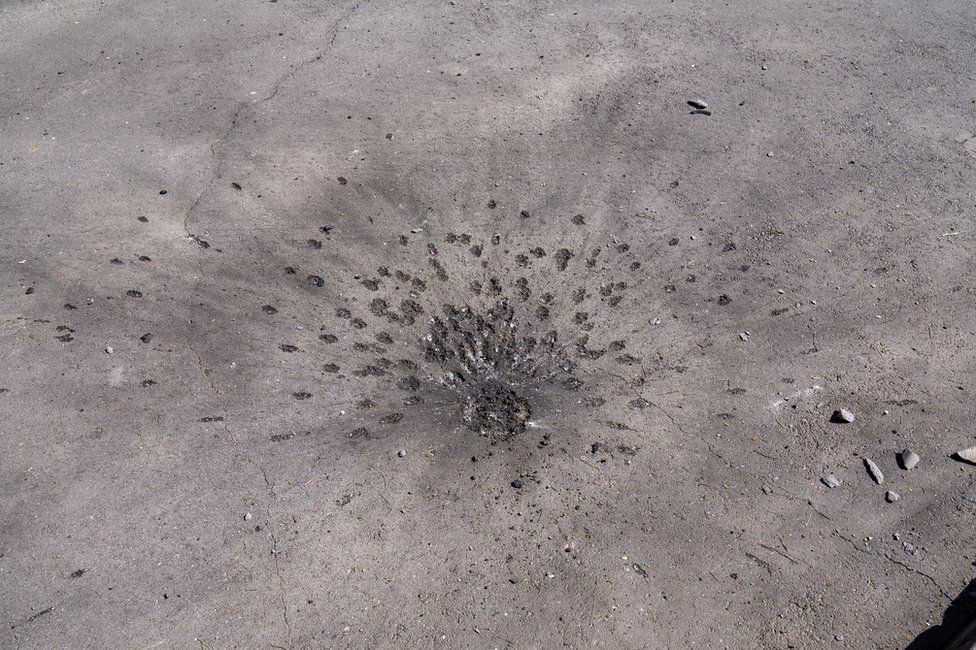
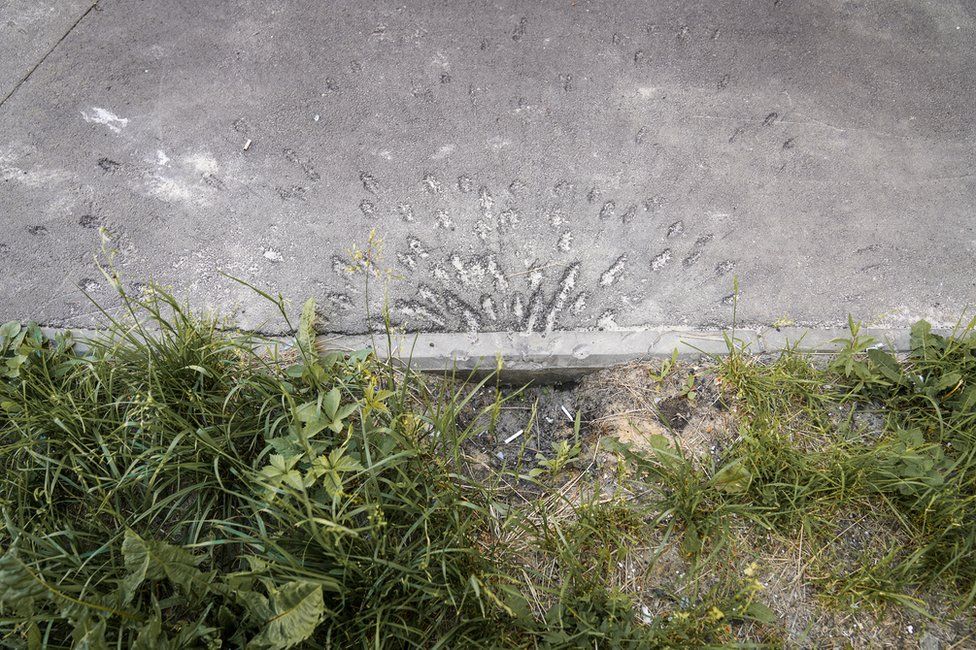
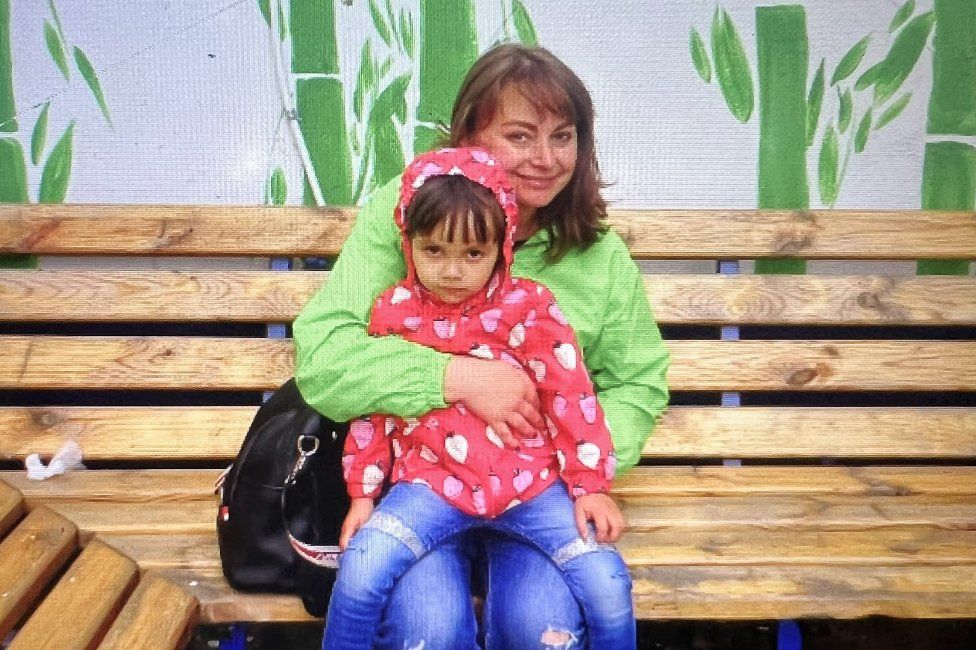
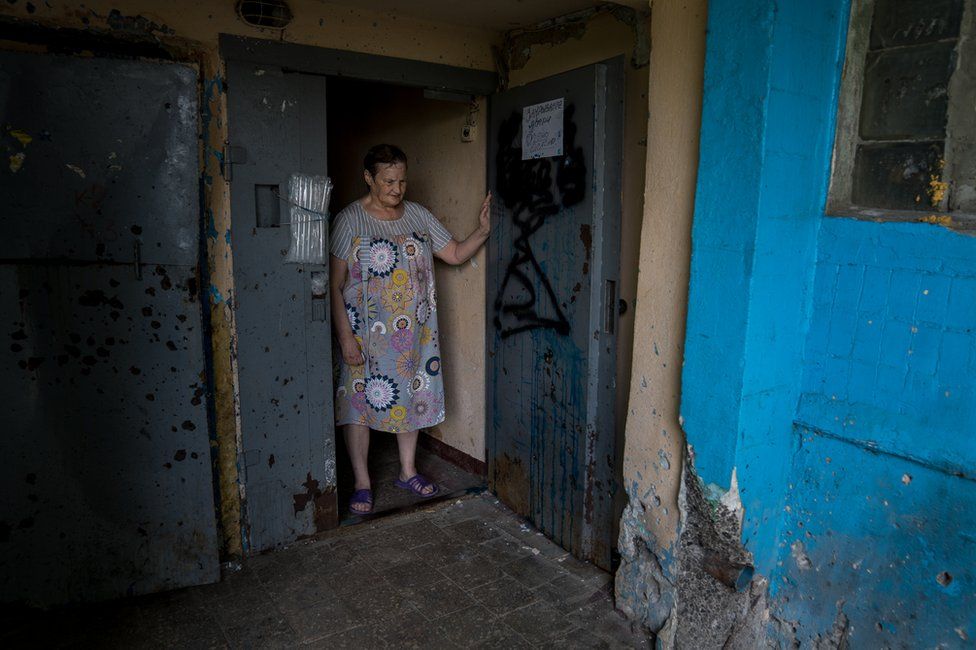
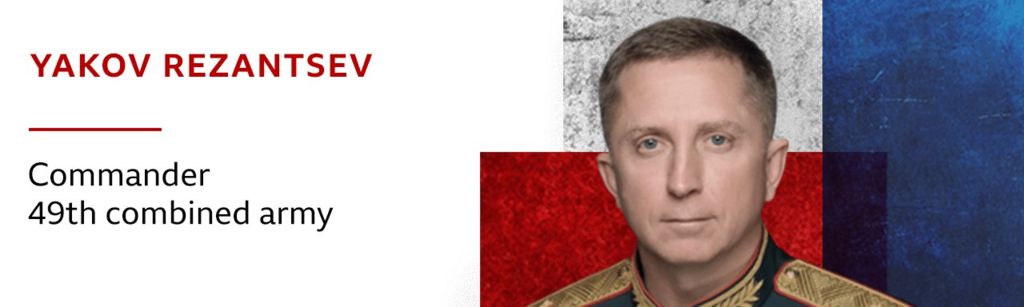
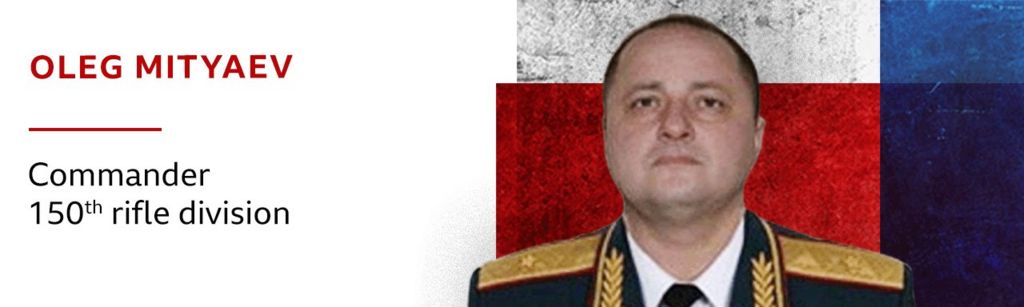
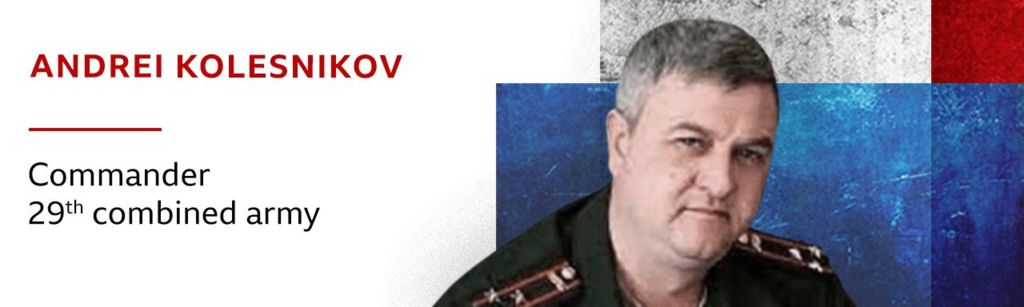
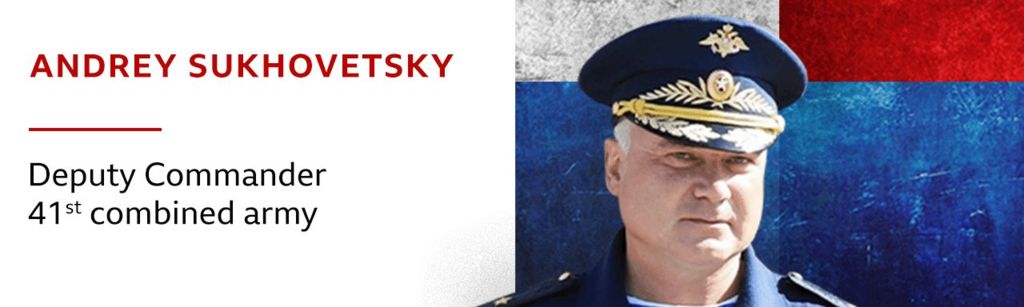
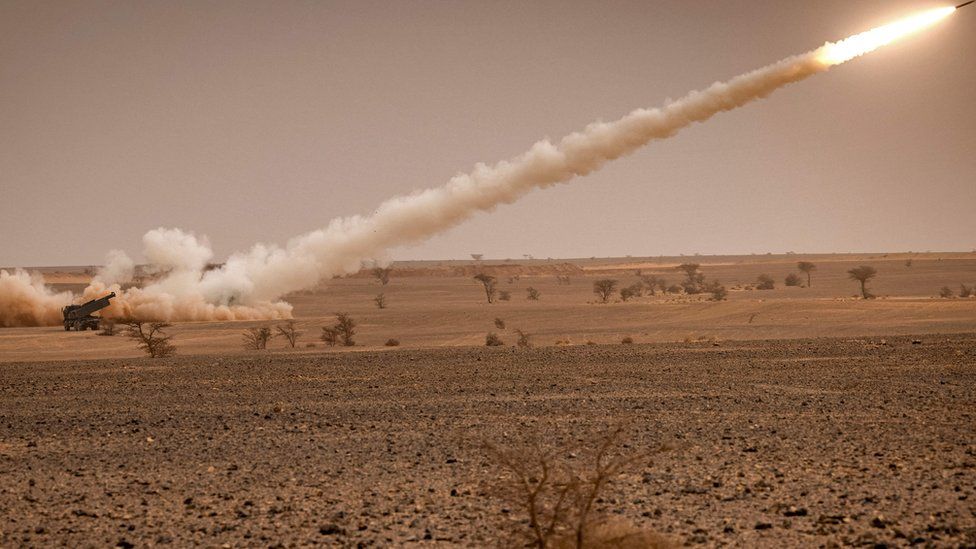
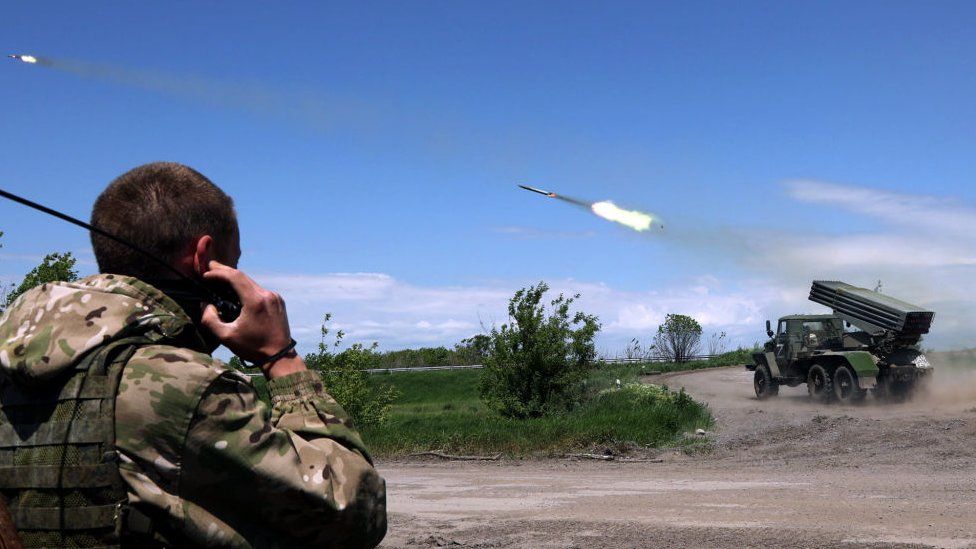
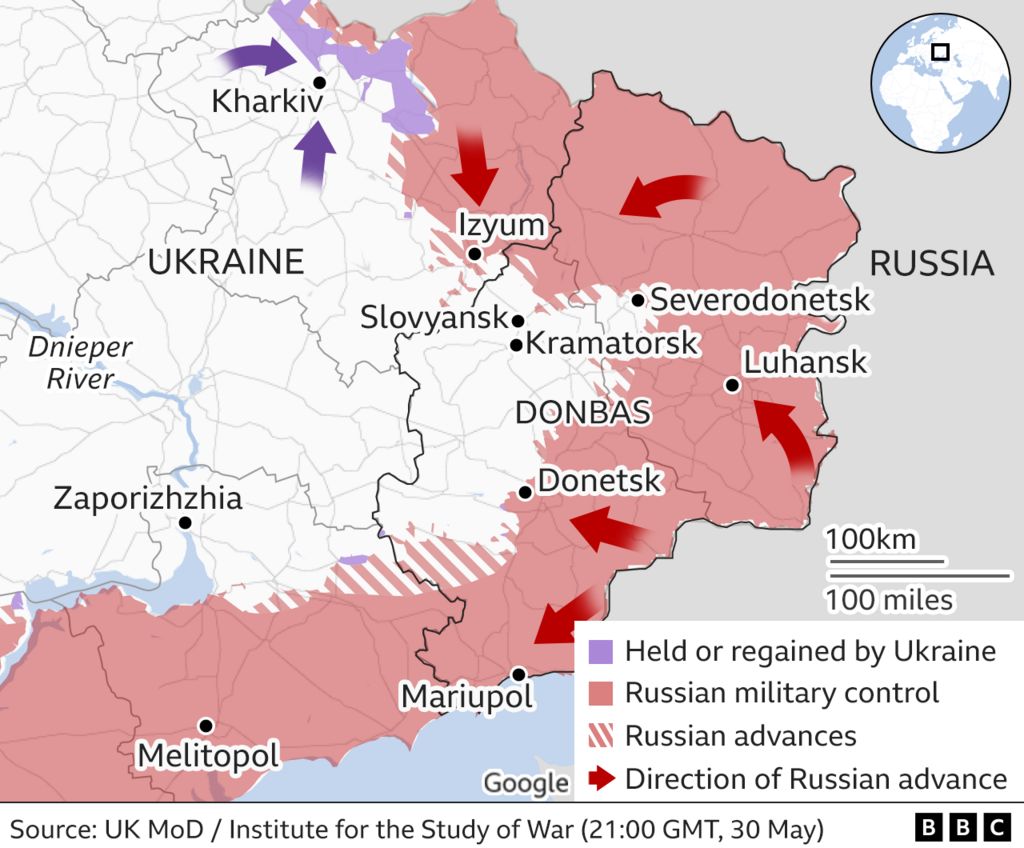
 Meanwhile in Ukraine, fighting is continuing in the eastern Donbas region.