Tag: Russia

  • Ukraine war: Russia acknowledges mobilization faults in the Ukraine war, despite mounting public opposition

    In the face of mounting public criticism, the Kremlin has acknowledged that its efforts to mobilise Russian army reservists to fight in Ukraine were flawed.

    “There are cases when the decree is violated,” Russian President Vladimir Putin’s spokesman said, adding that “all the errors will be corrected”.

    Multiple reports say people with no military experience – or who are too old or disabled – are being called up.

    Last week’s mobilization decree has already triggered widespread protests.

    President Putin announced what he described as partial mobilization on 21 September, with Defence Minister Sergei Shoigu later saying 300,000 reservists would be called up.

    However, reports in opposition Russian media suggested that up to one million people could be called up, pointing out that one paragraph believed to be about the exact number of the required reservists was omitted (classified) in the published version of Mr Putin’s decree on the official Kremlin website.

    A number of military experts in the West and Ukraine say Mr Putin’s decision to call up reservists shows that Russian troops are failing badly on the battlefield in Ukraine – more than seven months after Moscow launched its invasion.

    Since the mobilization announcement, more than 2,000 people have been detained at protests across Russia.

    At a briefing on Monday, Mr Putin’s spokesman, Dmitry Peskov, conceded that mistakes were being made.

    He said that in some regions, “governors are actively working to rectify the situation”.

    Mr Peskov also said he was unaware of any decisions to shut Russia’s borders and impose martial law in the country.

    Media reports earlier suggested this could be done to stop potential recruits from escaping abroad.

    In the latest sign of growing public protest, a man critically injured an army recruitment officer in the Siberian city of Ust-llimsk on Monday.

    Footage has emerged on social media apparently showing the attacker approaching the officer and then shooting him. People in the building are then seen screaming and running in panic after the gunman shouted to them to flee.

    Over the weekend, people in Russia’s Dagestan republic in the North Caucasus clashed with police over the mobilisation drive. More than 100 people were arrested during protests in the regional capital, Makhachkala, said OVD-Info, an independent Russian human rights monitor.

    There have also been reports of a number of arson attacks on recruitment centres and other administrative buildings across Russia.

    In his last week’s mobilisation announcement, Mr Putin did not specify how many reservists would be called up.

    But speaking immediately after the president, Mr Shoigu said 300,000 reservists – people who have had military experience and required specialist skills – would be enlisted.

    The minister said this was just over 1% of Russia’s 25 million military reserve potential. The process would be spread over several months.

    Certain age and disability limits would apply, the mobilisation decree said. It provided no further details. It is believed that males aged 18-60 – and in some cases even older – could be mobilised.

    Russian commentators have cast serious doubts on the promises of the president and his defence minister that the call-up will be limited.

    They also point out that the decree says nothing about exceptions, such as not recruiting students or conscripts.

    It is believed to have been left to regional heads to decide who to call in order to meet quotas.

    Before launching its invasion on 24 February, Russia had amassed about 190,000 troops along Ukraine’s borders.
     

  • ‘Sham’ referendums’: UK sanctions Russians

    The United Kingdom has imposed new round of sanctions.in response to what it described as Russia’s “sham” referendums in four occupied regions of Ukraine.

    “The Russian regime has organised these sham referendums in a desperate attempt to grab land and justify their illegal war,” the Foreign, Commonwealth & Development Office (FCDO) said in a statement.

    “The process reflects their approach in Crimea in 2014, combining disinformation, intimidation, and fake results. These referendums do not represent the demonstrated will of the Ukrainian people and are a severe violation of Ukraine’s territorial integrity and political independence,” it added, citing Moscow’s seizure of the Black Sea peninsula eight years ago.

    The FCDO said the measures will specifically target individuals behind the votes in Kherson, Donetsk, Luhansk and Zaporizhia on whether to join Russia, including several Moscow-installed officials in the occupied regions, a number of oligarchs, board executives from major state-owned banks and IMA Consulting, a firm described as Russian President Vladimir Putin’s “favourite PR agency”.

  • Russia and Hungary cheer new Italian leaders

    Now that Meloni is expected to win, there has been a greater reaction, with Moscow declaring its openness to forging “constructive” ties with Rome.

    “We are ready to welcome any political forces that are able to go beyond the established mainstream, which is filled with hate for our country,” Kremlin spokesman Dmitry Peskov told reporters.

    Meloni’s political allies in Italy have both made controversial remarks about Russia.

    Silvio Berlusconi claimed last week that Russian President Vladimir Putin was “pushed” into invading Ukraine, though he later made clear Russia’s aggression against Ukraine was “unjustifiable and unacceptable”.

    Meanwhile, Matteo Salvini has questioned Western sanctions on Moscow – something Meloni herself supports at the EU level.

    Meanwhile, Hungary’s nationalist leader Prime Minister Viktor Orban has congratulated Meloni – whose rhetoric on the EU is close to that of the Hungarian nationalist leader – and her allies on the election results.

    He added he looked forward to future cooperation over peace, the European economy, and the energy crisis.

  • Deadly gun attack at Russian school

    A gunman has opened fire at a school in central Russia, killing at least 13 people and injuring 21, Russian officials say.

    Victims include seven children at the school of about 1,000 pupils in the city of Izhevsk.

    The gunman killed himself at the scene. He was a former pupil of the school.

    Russian media have posted videos which appear to show panic inside the building where the shooting took place.

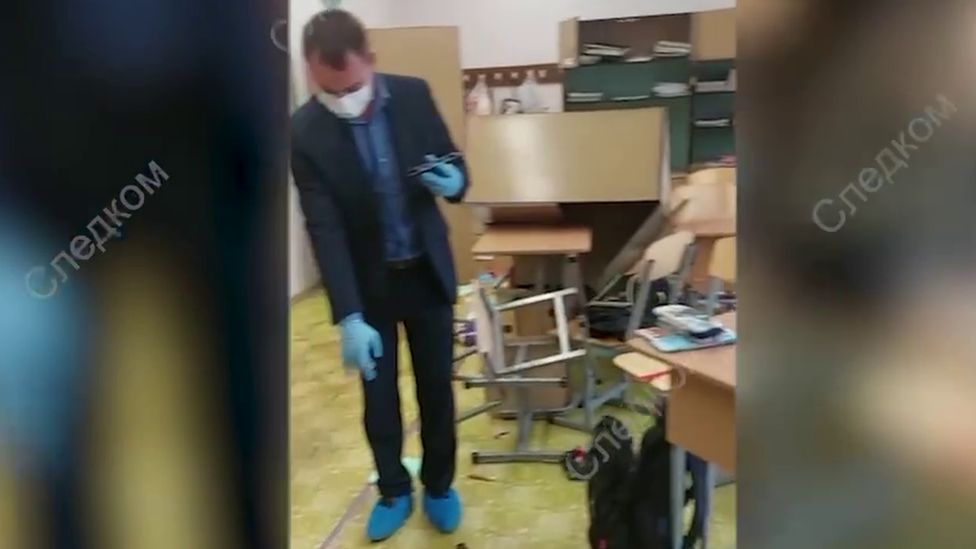
    Some footage shows blood on a classroom floor and a bullet hole in a window, with children crouching down underneath desks.

    Seven children and six adults were killed, including two security guards and two teachers, according to Russian officials. Staff and pupils have been evacuated from the school buildings.

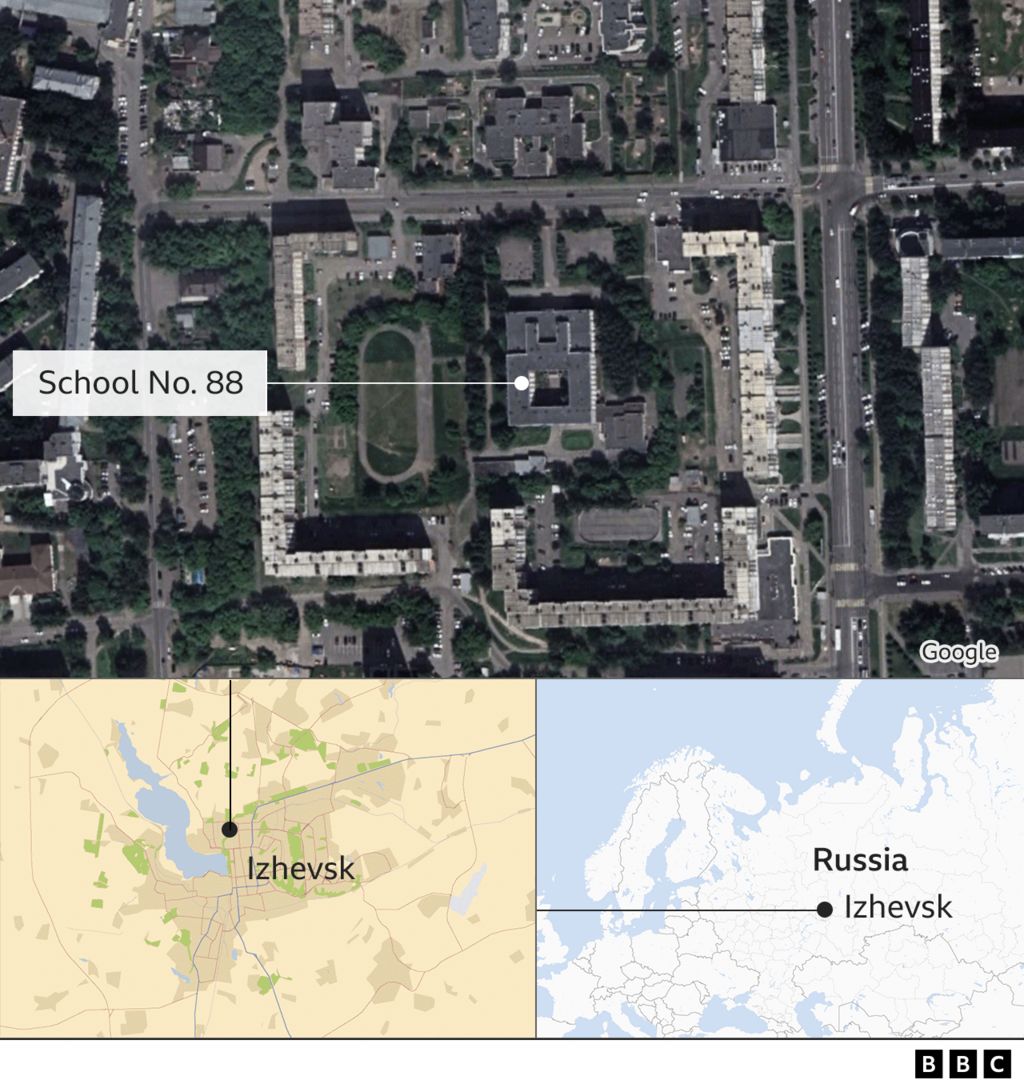
    Map of the school building

    One local MP said the attacker – named as Artem Kazantsev- had been armed with two pistols.

    A video posted online by the investigative committee shows the gunman lying dead on the floor wearing a T-shirt with a Nazi symbol and a balaclava. Investigators are searching his place of residence.

    A mourning period until 29 September has been announced by the head of the region. Russian President Vladimir Putin’s spokesperson said he is “deeply mourning” the attack.

    The school is in the centre of Izhevsk, a city of about 650,000 residents, close to central government buildings.

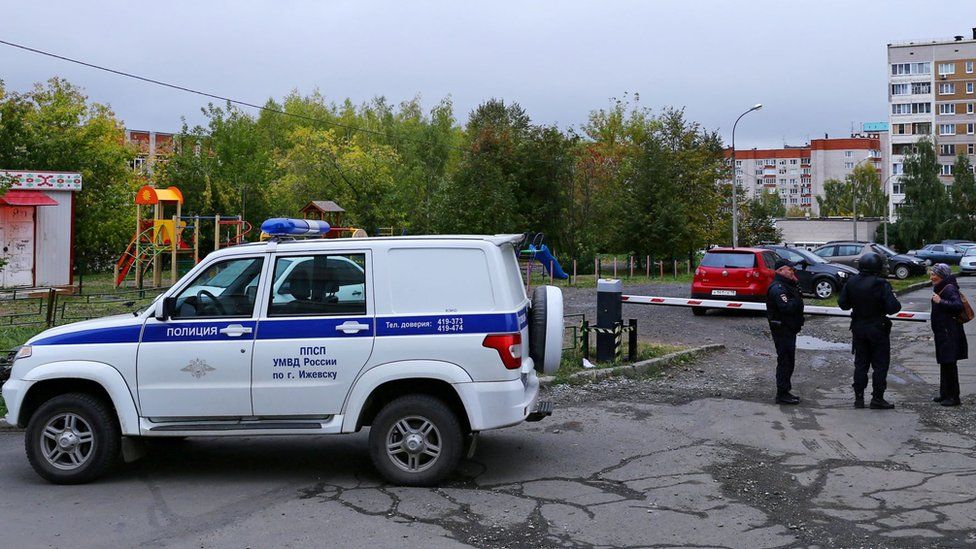
    Security service vehicle outside school
    Security services arrive at the scene of the shooting.

    Source: BBC

  • Moldova considers revoking citizenship of dual-nationals who fight for Russia

    Russia launched a “partial” mobilisation last week to reinforce its troops in Ukraine, and there are 200,000 people with dual Moldovan-Russian citizenship who live in the breakaway Moldovan region of Transnistria.

    Maia Sandu, Moldova’s pro-Western president, said there was a risk that some of those people could be called up by Russia to fight.

    “To prevent that happening, we are analysing the possibility of applying the process of revoking Moldovan citizenship for those people (with Russian passports) who fight on the side of the aggressor,” she said, adding Moldova was holding consultations with Moscow to prevent cases of its citizens being called up.

    A woman walks past the Operational Group of Russian Forces headquarters in Tiraspol in 2021, the capital of the breakaway region of Transnistria, a disputed territory unrecognised by the international community, in Moldova [File Photo: Dmitri Lovetsky/AP]
    Russia has had peacekeeping troops stationed in Transdniestria since the early 1990s when an armed conflict saw pro-Russian separatists wrest most of the region from Moldovan control [File: Dmitri Lovetsky/AP]
  • Ukraine war: Two people allegedly killed in a hotel attack in Kherson by Kyiv forces

    Kremlin authorities say Ukrainian soldiers killed two persons, including a former member of parliament, in a missile attack on a hotel located in Kherson.

    Oleksiy Zhuravko, a pro-Russian former politician from Ukraine, was alleged to have perished in the strike by a regional official.

    Kirill Stremousov said in a statement that Ukrainian armed forces fired a missile on the Play Hotel by Ribas at 05:30 (03:30 BST) on Sunday.

    Kyiv has not responded to the claims.

    The Russian-installed administration said in a post on Telegram that this “was a planned terrorist act”, adding that the building of the hotel was not used for military purposes.

    The statement said that two people were killed in the attack according to “preliminary information”.

    The authorities said journalists from Russian media were in the hotel when the missile struck, news agency AFP reports. These claims could not be independently verified.

    A representative of the law enforcement agencies in the region was quoted by the TASS news agency as saying that the attack “was clearly carried out with the help of Nato representatives, according to their intelligence and on their tip”.

    Rescue workers were said to be combing the rubble in search of victims at the hotel, located in the center of the southern Ukrainian city.

    The strike comes as Kherson – one of the first places to come under Moscow’s control after the invasion – is taking part in a so-called referendum, asking people if they want to join Russia. As well to Kherson, people in Luhansk, Donetsk, and Zaporizhzhia have also been casting their ballots since Friday and voting is due to finish on Tuesday.

    The West and Kyiv have condemned the votes as “shams” and pledged not to recognize their results. There have also been reports of armed Russian soldiers going door-to-door to collect votes.

    The votes come after Ukrainian forces launched a large-scale counter-offensive in the south. Last month, Ukraine’s military said it had broken through Russia’s first line of defence.

  • Mobilization call: Man shoots Russian soldier, sets conscription office on fire

    British intelligence has reported that, as men called up for the country’s partial mobilization began arriving at military camps, a man shot a recruiter and set a conscription office on fire in Russia.

    In Ust-Ilimsk, Irkutsk, a conscription office was shot at by the assailant, severely injuring a military recruitment officer.

    Sky News has confirmed a video purportedly taken by a would-be recruit of the shooting.

    It shows the gunman shooting the recruiter who falls to the ground, as others at the draft office start running out to the sounds of a woman screaming.

    He was detained by police and identified himself as 25-year-old Ruslan Zinin in a separate video posted on social media.

    Irkutsk region Governor Igor Kobzev wrote on the Telegram messaging app that the recruitment officer was in hospital in a critical condition, adding the detained gunman “will absolutely be punished”.

    It comes after Russian President Vladimir Putin – faced with a series of defeats in Ukraine – announced a partial mobilization last week that could see 300,000 reserves called up to fight.

    Elsewhere, a man was seen throwing Molotov cocktails at a military registration and enlistment office in Uryupinsk, in footage circulating on social media.

    It shows the man driving a car up to the entrance of the local government building in the center of the town.

    He can then be seen lighting several Molotov cocktails, throwing them one by one at the entrance to the building.

    Town officials confirmed the building was set on fire early on Monday morning, and a man was detained. Damage was minimal and no one was injured, they added.

    The threat of mass conscription has sparked protests around the country, and military-aged men have been fleeing in droves.

    “Everyone who is of conscription age should be banned from traveling abroad in the current situation,” Sergei Tsekov, a member of Russia’s upper house of parliament, the Federation Council, told RIA news agency on Monday.

    Russia faces an administrative and logistical challenge to provide training for the new recruits, the UK Ministry of Defense said in its latest intelligence update.

    Many tens of thousands of call-up papers have already been issued.

    “Many of the drafted troops will not have had any military experience for some years,” the MoD said.

    “The lack of military trainers, and the haste with which Russia has started the mobilization, suggests that many of the drafted troops will deploy to the front line with minimal relevant preparation.

    “They are likely to suffer a high attrition rate.”

    Videos have emerged showing men being forced onto buses as many citizens refused to take part in the war.

    Protests over mobilization have taken place in more than a dozen cities across Russia, with girls as young as 14 years old detained.

    Hundreds of people were arrested over the weekend, and there were major protests in the Dagestan region yesterday.

    Sky correspondent Alex Rossi in Moscow said: “Russia is a very heavily securitized police state. Dissent isn’t tolerated, but there have been sporadic protests all over the country. Thousands of people have been arrested, protesting against what the Kremlin is calling a partial mobilization, but really, what to you and I, looks like mass conscription.”

    The call-up of 300,000 reserves is almost double the initial invasion force, “so is a reflection really of how badly things are going on the battlefield, and shows that they have a very significant manpower problem”, he said.

    General Sir Richard Barrons, a former head of the Joint Forces Command, told Sky News some individuals who are mobilized may find themselves on the front line in Ukraine very quickly.

    “Of course, they wouldn’t necessarily be very enthusiastic about that,” he said. “And they won’t be very well trained and are probably not very well equipped for this kind of mobilization to make a difference.

    “Russia would have to invest in training and equipping these large numbers of people that would take them well into next year. And it just doesn’t look like they have the training machinery, the logistics, or the weapons to make this really work any time soon.”

    As Russia steps up its conscription of citizens, Ukrainian President Volodymyr Zelenskyy has urged opposition troops to surrender to his country’s forces.

    It comes as “sham” referendums continue in contested territory, which could lead to the formal annexation of Ukraine’s land.

    They are being held in the self-declared Donetsk (DPR) and Luhansk People’s Republics (LPR), and in Russian-occupied parts of the Kherson and Zaporizhzhia regions.

    The move comes eight years after a similar process in Russian-occupied Crimea, which Moscow said was justification for annexing the peninsula.

    Sky’s security and defense editor Deborah Haynes in Dnipro, Ukraine, said the move was “a further escalation of the war”.

    “There is no sign on the Ukraine side that they are backing down, but they are clearly going to have to counter an ever-increasing Russian force as they try to defend their territory and win back their land,” she added.

  • Over 13 dead in gun attack at Russian school

    At least 13 people have died with others sustaining injury after a gunman opened fire at a school in central Russia, officials say.

    Victims include some seven children at the school of about 1,000 pupils in the city of Izhevsk.

    Russian media have posted videos showing panic inside the building where the shooting took place.

    Some footage shows blood on a classroom floor and a bullet hole in a window, with children crouching down underneath desks.

    Two teachers and two security guards are among the dead, according to Russian officials. Staff and pupils have been evacuated from the school buildings.

    The gunman has reportedly killed himself and the motive is unclear. Emergency officials are at the scene.

    Man wearing gloves and mask in school building
    IMAGE SOURCE,RUSSIAN INVESTIGATIVE COMMITTEE Image caption, Russian officials posted a video showing the inside of a classroom.

    One local MP said the attacker had been armed with two armed pistols.

    A video posted online by the investigative committee shows the gunman lying dead on the floor wearing a T-shirt with a Nazi symbol.

    A mourning period until 29 September has been announced by the head of the region.

    The school is in the centre of Izhevsk, a city of about 650,000 residents, close to central government buildings.

  • Ukraine war: Hundreds arrested as Russian draft protests continue

    Hundreds of people have been arrested by authorities as protests against Russia’s new “partial mobilisation” continue across the country, an independent rights group has said.

    OVD-Info said 724 people were detained across 32 different cities on Saturday.

    Widespread demonstrations have broken out since President Vladimir Putin announced plans to draft 300,000 men to fight in Ukraine.

    Unsanctioned rallies are banned under Russian law.

    But Mr Putin’s move to draft civilians into the military has sparked large scale protests in urban areas, with more than 1,000 people being detained at demonstrations earlier this week.

    In Moscow, news agency AFP reported witnessing one demonstrator shouting “we are not cannon fodder” as she was arrested by officers.

    And in St Petersburg, Russia’s second city, one man told reporters: “I don’t want to go to war for Putin.”

    Seventy-year-old Natalya Dubova told AFP that she opposed the war and confessed she was “afraid for young people” being ordered to the front.

    Some of those arrested on Saturday reported being handed draft papers and ordered to report to recruiting centres while being held by security officials. The Kremlin defended the practice earlier this week, saying “it isn’t against the law”.

    Moscow has also approved harsh new punishments for those accused of dereliction of duty once drafted.

    Mr Putin signed fresh decrees on Saturday imposing punishments of up to 10 years imprisonment for any soldier caught surrendering, attempting to desert the military or refusing to fight.

    The president also signed orders granting Russian citizenship to any foreign national who signs up to serve a year in the country’s military.

    The decree, which some observers have suggested displays how severe Moscow’s shortage of troops has become, bypasses the usual requirement of five years of residency in the country.

    Elsewhere, other young Russians continue to flee mobilisation by seeking to leave the country.

    On the border with Georgia, queues of Russian cars stretch back more than 30km (18 miles) and the interior ministry has urged people not to travel.

    Local Russian officials have admitted that there’s been a significant influx of cars trying to cross – with nearly 2,500 vehicles waiting at one checkpoint.

    The admission is a change of tone from Russia, with the Kremlin describing reports of Russians fleeing conscription as “fake” on Thursday.

    One man the BBC spoke to in Vladikavkaz in North Ossetia, on the Russian side of the border, said he could see car registration numbers from all over Russia.

    “Our people don’t have the correct information about the situation in Ukraine,” he said. “Also, what I can say about people that I’ve been speaking with… it’s simple, people don’t want to go to war.”

    Meanwhile, Finland has also seen a sharp increase in the number of Russians seeking to enter the country.

    Matti Pitkaniitty, a spokesperson for the country’s Border Guard, said the number of Russians arriving had more than doubled since last week.

    On Friday, the government announced plans to stop Russian tourists entering the country.

    “The aspiration and purpose is to significantly reduce the number of people coming to Finland from Russia,” President Sauli Niinistö told the state broadcaster.

    Several other neighbouring states have already ruled out offering asylum to Russians seeking to avoid the draft.

    “Many Russians who now flee Russia because of mobilisation were fine with killing Ukrainians,” Latvia’s Foreign Minister Edgars Rinkēvičs said. “They did not protest then. It is not right to consider them as conscientious objectors.”

    On Friday, the Kremlin revealed a host of occupations it said will be exempt from conscription aimed at boosting its war effort in Ukraine.

    IT workers, bankers and journalists working for state media will escape the “partial mobilisation” announced by President Putin on Wednesday.

    But some have cast doubt on the truth of the Kremlin’s claims, and reports have been emerging of Russian men who do not meet the criteria being called up by local recruiting officers.

    Margarita Simonyan, the editor of the state-run media outlet RT, posted to Twitter a list of elderly and disabled citizens ordered to report for duty.

    Source: BBC

  • Russian Foreign Minister meets with Mexican officials to discuss Ukraine peace proposal

    Russian Foreign Minister Sergei Lavrov and Mexican Foreign Minister Marcelo Ebrard reportedly met to discuss a peace proposal for the Ukraine crisis.

    The plan was presented to the UN General Assembly this week but Ukraine opposes it, saying it would be advantageous to Russia.

    Mr Ebrard wrote on Twitter that he and Lavrov had a “cordial conversation”, and posted a picture of them together.

    Yesterday, the Mexican met his Ukrainian counterpart.

    The plan involves creating a “mediation committee” to settle conflicts worldwide, spearheaded by Indian Prime Minister Narendra Modi, UN Secretary-General Antonio Guterres and Pope Francis.

    Mexican President Andres Manuel Lopez Obrador said the committee would immediately start talks with Vladimir Putin and Volodymyr Zelenskyy to achieve “a truce of at least five years”.

    Mr Lopez Obrador said earlier this week: “I don’t want to play a leading role, as a government we’re making a proposal to see if it’s accepted.”

  • Ukraine’s ‘referendums’: Soldiers canvass homes for votes in sham votes

    Armed soldiers have reportedly gone door-to-door in Ukraine’s seized regions to solicit votes for sham “referendums” on joining Russia.

    “You have to answer verbally and the soldier marks the answer on the sheet and keeps it,” one woman in Enerhodar told the BBC.

    In southern Kherson, Russian guardsmen stood with a ballot box in the middle of the city to collect people’s votes.

    The door-to-door voting is for “security”, Russian state media says.

    “In-person voting will take place exclusively on 27 September,” Tass reported. “On the other days, voting will be organized in communities and in a door-to-door manner.”

    One woman in Melitopol told the BBC that two local “collaborators” arrived with two Russian soldiers at her parents’ flat, to give them a ballot to sign.

    “My dad put ‘no’ [to joining Russia],” the woman said. “My mum stood nearby and asked what would happen for putting ‘no’. They said, ‘Nothing’.

    “Mum is now worried that the Russians will persecute them.”

    The woman also said there was one ballot for the entire apartment block building, rather than per person.

    Although the evidence is anecdotal, the presence of armed men conducting the vote contradicts Moscow’s insistence that this is a free or fair process.

    Experts say the self-styled referendums, taking place across five days, will allow Russia to claim – illegally – four occupied or partially-occupied regions of Ukraine as their own.

    In other words, a false vote on annexation, seven months into Russia’s invasion.

    The self-styled “annexation” could lead to Russia claiming that its territory is under attack from Western weapons supplied to Ukraine, which could escalate the war further.

    British Foreign Secretary, James Cleverly, said the UK had evidence that Russian officials had already set targets for “invented voter turnouts and approval rates for these sham referenda”.

    Mr Cleverly said Russia planned to formalize the annexation of the four regions – Luhansk, Donetsk, Kherson, and Zaporizhzhia – by the end of the month.

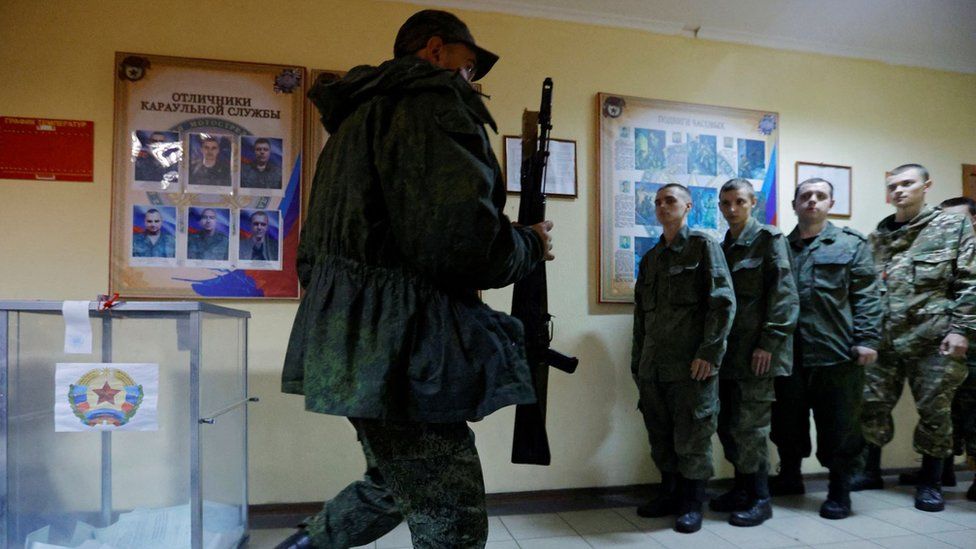
    Armed soldier walks past ballot box as people line up to vote
    IMAGE SOURCE, REUTERS Image caption, Ballot boxes being guarded by armed soldiers in Luhansk

    A source in Kherson told the BBC there was no public effort to encourage voting, apart from an announcement on the Russian news agency that people can vote at a port building, which had been disused for 10 years.

    Another woman in Kherson said she saw “armed militants” outside the building where the vote seemed to be taking place. She pretended to forget her passport, so she didn’t have to vote.

    The woman said all her friends and family were against the referendum. “We don’t know how our life will be after this referendum,” she said. “It is very difficult to understand what they want to do.”

    Kyiv says the referendums will change nothing, and its forces will continue to push to liberate all of the territories.

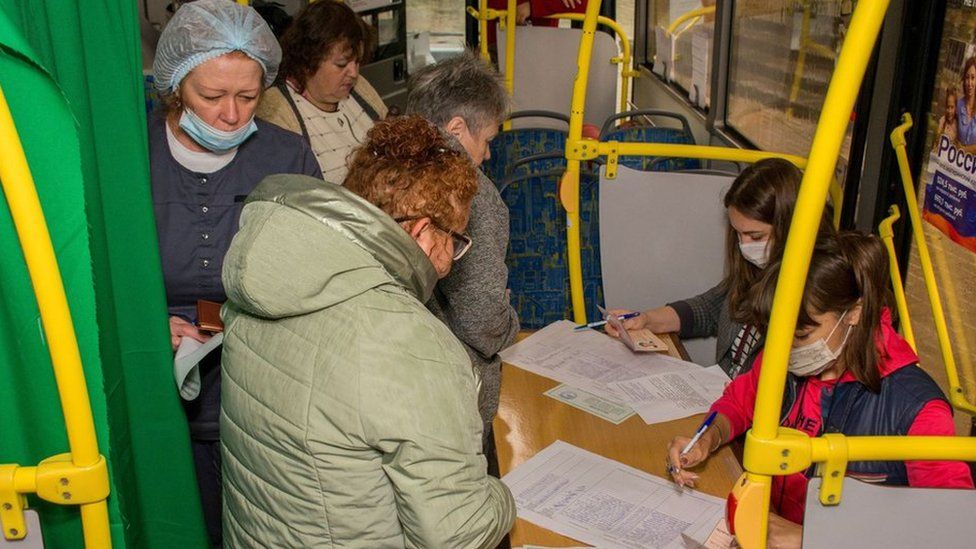
    Women line up to cast vote in referendums on bus.
    IMAGE SOURCE,REX/SHUTTERSTOCK Image caption, These women in Luhansk voted in a converted bus

    Meanwhile, Russian President Vladimir Putin’s recent mobilisation of at least 300,000 extra troops has caused many Russian men of fighting age to flee.

    One young Russian man who left St Petersburg for Kazakhstan to avoid the draft told BBC World Service that most of his friends were also on the move.

    “Right now, I feel like it’s a total collapse. I know only maybe one or two folks that don’t think about exile right now,” he said.

    He said some, like him, are travelling across the border, whereas others have gone to small Russian villages to hide.

    “The big problem of Russia is that we didn’t think about the war in Ukraine in February as we think about it right now,” he said.

  • Ghana will not recognise Ukraine territories taken by Russia – Foreign Minister

    The Minister of Foreign Affairs and Regional Integration, Shirley Ayorkor Botchwey, says Ghana will not recognise any territory forcefully taken from Ukraine by Russia.

    She has, therefore, called on Russia to immediately and unconditionally seize its operations in Ukraine by withdrawing its troops and also respecting the internationally recognised borders of Ukraine.

    The Minister who was speaking at the 77th session of the United Nations General Assembly in New York Thursday, further urged Russia to respect Ukraine’s sovereignty and political independence.

    For her, “Ghana does not and will not recognise any territory that is unilaterally and forcefully acquired as dismembered from a sovereign entity.”

    Ms. Ayorkor Botchwey said there was the need for Russia and Ukraine, to chart diplomatic course to resolve the impasse between them.

    She noted that the two nations cannot resolve their differences through the barrel of a gun, adding that the use of gun to resolve differences only “leads to needless bloodshed on both sides.”

    She expressed the concern that with the rising death tolls of the civilian population and growing reports of war crimes in Ukraine, including human rights violations, there was the need to investigate such issues and perpetrators sanctioned.

    “We must uphold our responsibilities as a country and send a clear message that the perpetrators of the atrocities will be held to account,” she noted.

    Source: Graphiconline.com

  • Former Italian PM defends Russian war on eve of Italian election

    Vladimir Putin’s invasion of Ukraine is backed by the former Silvio Berlusconi, who insists that Putin had been “pushed” into the conflict.

    The Russian president has a long-standing ally in the three-time Italian prime minister.

    According to the 85-year-old, Russian forces were sent in to overthrow the current administration and install “decent people” in its place.

    The three-time Italian PM is a long-term ally of the Russian president.

    This weekend his party is expected to take power as part of a right-wing coalition in a general election in Italy.

    A narrative alleging the Ukrainian government was slaughtering Russian speakers in the east of the country was created by the media in Moscow, Mr Berlusconi told Italian TV.

    He said the reporting, pushed by separatist forces and nationalist politicians in the Russian government, had left Mr Putin with no choice but to launch a limited invasion.

    “Putin was pushed by the Russian population, by his party, and by his ministers to invent this special operation,” he said.

    “The troops were supposed to enter, reach Kyiv in a week, replace the Zelensky government with decent people and a week later come back,” Mr Berlusconi added.

    “Instead they found an unexpected resistance, which was then fed by arms of all kinds from the West.”

    Opposition leaders were quick to condemn Mr Berlusconi’s comments, with Centrist Party leader Carlo Calenda accusing him of speaking “like a Putin general”.

    And Enrico Letta of the center-left Democratic Party said the intervention proved if Sunday’s election is “favourable to the right, the happiest person would be Putin”.

    But on Friday, Mr Berlusconi attempted to clarify his comments, saying his views had been “oversimplified” .

    “The aggression against Ukraine is unjustifiable and unacceptable, [Forza Italia’s] position is clear. We will always be with the EU and Nato,” he said.

    Mr Berlusconi has long been an admirer of Mr Putin, in 2012 joining the then-prime minister for a skiing trip in the Russian city of Sochi.

    But in April, he condemned the invasion and said he was “deeply disappointed and saddened” by Mr Putin’s behaviour, adding that the “massacres of civilians in Bucha and other localities are real war crimes”.

    The Forza Italia party leader is currently campaigning as part of a right-wing coalition ahead of Sunday’s general election.

    His centre-right party is the junior partner of the alliance, which is anchored by Giorgia Meloni’s hard-right Brothers of Italy and Matteo Salvini’s populist Lega Nord party. Polls have suggested the bloc will win a majority.

    Despite Mr Berlusconi’s past friendship with Mr Putin, and Mr Salvini’s criticism of Western sanctions on Russia, Ms Meloni, who is expected to lead any potential government, has pledged to continue Italy’s support of Ukraine.

    “The war in Ukraine is the tip of the iceberg of a conflict aimed at reshaping the world order,” she said earlier this month. “So we have to fight this battle.”

  • Mobilization call: Russia announces exemptions as people flee

    In order to increase its war effort in Ukraine, Russia’s defence ministry has announced a wide range of occupations that will be exempt from conscription.

    The “partial mobilisation” planned by President Vladimir Putin on Wednesday would not affect IT personnel, bankers, or journalists who work for state media.

    Around 300,000 citizens face being called up as part of the drive.

    The move has prompted a rush toward borders as young men attempt to flee to evade the draft.

    Announcing the exemptions on Friday, Russia’s defense ministry said employers must compile a list of workers who meet the criteria and submit it to its offices.

    But it accepted some sectors had to be excluded to “ensure the work of specific high-tech industries, as well as Russia’s financial system”.

    Some commentators have observed that the text of the mobilization decree has been left vague – potentially allowing it to be widened if necessary.

    And one paragraph remains entirely classified. Kremlin spokesman Dmitry Peskov said on Friday this referred to the total number of Russians that could be conscripted, which he said could not be disclosed.

    Earlier, the independent newspaper Novaya Gazeta had reported – citing an unnamed government source – that the redacted section allowed for a call-up of up to a million people, rather than the reported 300,000.

    Russian men are continuing to try to flee the country to avoid being called up by recruiters for the country’s first military mobilization since World War Two.

    In the south, miles-long queues of traffic have formed at the border crossing between Russia and Georgia.

    Some of those heading into the neighbouring country have used bicycles to bypass lines of cars and evade a ban on crossing on foot, with others reporting waits of up to 12 hours.

    When asked about the war, one man who did not wish to be named told the BBC he had known it was happening but that, until Mr Putin’s declaration of a “partial mobilization”, it had not been his concern.

    A Russian student, who also did not want to be identified, said that people had woken up. “They opened their eyes and started thinking about where to hide their children. Now people understand what’s happening because it affects them directly,” he said.

    Another IT worker told the BBC that he was opposed to the war, but was too scared to speak out against it.

    “I don’t want to risk my life, the life of my family. I don’t want to be put in detention,” he said. “All I could do was to get a Schengen visa. Luckily I got one in May.”

    Georgia is one of the few neighbouring countries where Russians can enter without needing to apply for a visa. Border guards in neighbouring Finland, which shares a 1,300km (800 miles) border with Russia but requires an entry visa, told the BBC that queues had grown at various crossing points.

    Other destinations reachable by air – such as Istanbul, Belgrade, or Dubai – have seen ticket prices skyrocket immediately after the military call-up was announced, with some destinations sold out completely.

    Turkish media have reported a large spike in one-way ticket sales while remaining flights to non-visa destinations can cost thousands of euros.

    Several countries are grappling with the prospect of an influx of Russian draft dodgers. Germany’s interior minister signalled on Thursday that that fleeing conscription would be welcome in her country.

    Nancy Faeser said deserters threatened by “severe repression” would receive protection on a case-by-case basis, following security checks.

    But several other European countries, including Lithuania, Latvia, Estonia, and the Czech Republic, struck a different tone, saying they would not offer to flee Russian refuge. The countries have long pushed the EU to take a harder line on Russia.

    “I understand that Russians are fleeing from ever more desperate decisions by Putin,” Czech Foreign Minister Jan Lipavsky said. “But those running because they don’t want to fulfill a duty imposed by their own government, they don’t meet the criteria for a humanitarian visa.”

    The call-up sparked protests in major Russian cities including Moscow and St Petersburg on Tuesday, resulting in a reported 1,300 arrests.

    There were also reports from Russia that some of those detained for protesting had been handed draft papers while in custody at police stations. When asked about the reports, Mr Peskov said that doing so was not against the law.

  • What does Russia wants from the votes in occupied Ukraine?

    Four seized regions of Ukraine are being held over by Russian-backed officials, who are holding so-called referendums on joining Russia.

    These so-called elections, which have been denounced as invalid and fraudulent by Ukraine and the West, are being held over the course of five days in four front-line regions: two in the east and two in the south.

    An annexation could lead to a claim by Russia that its territory is coming under attack from Western weapons supplied to Ukraine.

    This could escalate the war further.

    What is going on and why now?

    Seven months after Russia’s invasion began, Vladimir Putin is on the back foot. Ukraine’s counter-offensive has recaptured swathes of territory seized since the 24 February invasion.

    A vote on annexation is one of three steps taken by the Kremlin in an attempt to reset the war.

    By annexing another 15% of sovereign Ukraine, Russia will be able to claim its territory is under attack from weapons provided by Nato and other Western countries to Ukraine. By calling up 300,000 extra troops, it can defend a front line of 1,000km (620 miles). The Kremlin has also criminalized desertion, surrender and going absent without leave during mobilization.

    If Russia’s leader annexing territory sounds familiar, it is. When he ordered troops to seize Crimea in 2014, he followed it up with a vote rejected as an illegitimate sham by the international community.

    This latest event has also been denounced as illegal by many Western countries, including international monitoring groups, the OSCE, and Russian media have already said that a Yes-vote is beyond doubt.

    It is taking place over five days in Russia’s two proxy areas in Luhansk and Donetsk in the east, and in occupied parts of Kherson and Zaporizhzhia in the south.

    What makes these votes a sham?

    We have already seen how Crimea was annexed by Russia in 2014. While the Kremlin claimed 96.7% support, a leaked report from Russia’s Human Rights Council said only around 30% had voted and barely half supported annexation.

    Not a shot had been fired in Crimea, and yet in this latest case voting is expected to take place in the middle of a war.

    The four regions involved are either partially or completely under occupation.

    In the south, the city of Kherson is not a safe place right now, with Russian soldiers struggling to hold back a big Ukrainian counter-offensive. The central administration building was hit by a series of missiles only last week.

    A secure vote is impossible, and yet officials talk of 750,000 people registered and plans to incorporate occupied parts of another Ukrainian region, Mykolayiv, into the annexed area.

    Russian media reported that elected officials would go from door-to-door with portable ballot boxes from Friday to Monday.

    Polling stations will only operate on the fifth day, 27 September, with officials citing security reasons.

    Hundreds of stations are scheduled to open that day, with voters also able to cast ballots in regions outside their own – and refugees eligible to vote in parts of Russia itself.

    Then there’s Zaporizhzhia’s capital, which remains securely in Ukrainian hands, so any vote to annex that region makes little sense.

    Donetsk in the east is only 60% under Russian occupation and very much at the heart of the conflict.

    Russia does control most of Luhansk in the northeast even if it has begun to lose ground. Russian news agencies showed flyers being handed out entitled “Russia is the future”.

    Much of the pre-war population has fled the conflict. The head of Russia’s proxy authority in Donetsk, Denis Pushilin, ordered a mass evacuation days before the invasion.

    Russian-backed leaders have been keen to stage votes for several months, but the decision to hold the vote was taken just three days in advance and smacks of desperation.

    There will be no independent observers. Much of the voting will be online, although officials have promised extra security at polling stations.

    What will change?

    Ukrainian defense ministry adviser Yuriy Sak told the BBC the so-called referendums were doomed. “We are seeing that local populations are all in favour of returning to Ukraine, and this is why there’s so much guerrilla movement resistance in these territories.”

    In any event, Kyiv says nothing will change and its forces will continue to push to liberate the territories.

    Russia analyst Alexander Baunov says merely redefining the occupied areas as Russian territory is unlikely to stop Ukraine’s army, but it does send a message of intent to the populations under their control. And the Kremlin’s hope is that the West will balk at having its weapons fired at land declared by Moscow as Russian.

    Alarmingly President Putin has spoken of using all means at his disposal “to protect Russia”. And in case there was any doubt at all. the deputy head of Russia’s security council, Dmitry Medvedev, made clear that nuclear weapons could also be used to protect annexed territories.

    US Secretary of State Antony Blinken has spoken of a “dangerous escalation”, but reaffirmed Washington’s position that no Russian claim to Ukrainian soil could take away Ukraine’s right to defend itself.

    Even Turkey, which has sought to play a mediating role, has damned the vote as illegitimate.

  • Silvio Berlusconi defends Russian war on eve of Italian election

    Former Italian Prime Minister Silvio Berlusconi has supported Vladimir Putin’s invasion of Ukraine.

    The 85-year-old said Russia’s leader was “pushed” into the conflict.

    Silvio Berlusconi believes that Russian troops were meant to replace the government with “decent people” then leave.

    “Putin was pushed by the Russian population, by his party and by his ministers to invent this special operation. The troops were supposed to enter, reach Kyiv in a week, replace the Zelensky government with decent people and a week later come back,” Mr Berlusconi.

    Unfortunately, he said they found “an unexpected resistance, which was then fed by arms of all kinds from the West.”

    The three-time Italian PM is a long-term ally of the Russian President.

    This weekend his party is expected to take power as part of a right-wing coalition in a general election in Italy.

    A narrative alleging the Ukrainian government was slaughtering Russian speakers in the east of the country was created by the media in Moscow, Mr Berlusconi told Italian TV.

    He said the reporting, pushed by separatist forces and nationalist politicians in the Russian government, had left Mr Putin with no choice but to launch a limited invasion.

    Mr Berlusconi has long been an admirer of Mr Putin, in 2012 joining the then-prime minister for a skiing trip in the Russian city of Sochi.

    But in April, he condemned the invasion and said he was “deeply disappointed and saddened” by Mr Putin’s behaviour, adding that the “massacres of civilians in Bucha and other localities are real war crimes”.

    The Forza Italia party leader is currently campaigning as part of a right-wing coalition ahead of Sunday’s general election.

    His centre-right party is the junior partner of the alliance, which is anchored by Giorgia Meloni’s hard-right Brothers of Italy and Matteo Salvini’s populist Lega Nord party. Polls have suggested the bloc will win a majority.

    Despite Mr Berlusconi’s past friendship with Mr Putin, and Mr Salvini’s criticism of Western sanctions on Russia, Ms Meloni, who is expected to lead any potential government, has pledged to continue Italy’s support of Ukraine.

    “The war in Ukraine is the tip of the iceberg of a conflict aimed at reshaping the world order,” she said earlier this month. “So we have to fight this battle.”


  • Prisoners of war: Heavily pregnant medic among convicts returning home

    A Ukrainian doctor named Mariana Mamonova who is more than eight months pregnant is one of the detainees whom Russia has freed.

    She can be seen in a prisoner swap video that Ukrainian authorities made public on Wednesday.

    She was being held in the notorious Olenivka prison camp in the unrecognized Donetsk People’s Republic after being captured in April in Mariupol.

    Speaking to the BBC before her release, her husband spoke about his fears over the well-being of his wife and unborn baby – the couple’s first.

    “A baby can’t be kept in those conditions, so they could just take it away,” Vasilii said.

    Mariana was reportedly held under extremely difficult conditions at the prison camp.

    A fellow prisoner, Anna Vorosheva, said she was in a cell with more than 20 other women when she first arrived and had to sleep on the floor.

    “Straight away, everyone tried to help her – giving her food, making sure she got fresh air,” Ms Vorosheva, who was released in July, told the BBC.

    Eventually, she was moved to a smaller room with fewer people, and her cellmates ensured that she was able to sleep on one of the room’s two beds each night.

    At first, Mariana assumed that she would be a priority for a prisoner swap. But as her due date at the end of September approached, she began to fear she would give birth in captivity, and became increasingly worried that her baby would be taken from her.

    Frustrated at the lack of news, her family decided to go public with Mariana’s story in August, drawing attention to her case in the Ukrainian media.

    Still, weeks passed with no progress, but finally – just days before she is due to give birth – her family received the good news that she had been released.

  • UN Security meeting: Sergei Lavrov walks out after speech

    After giving his speech, Sergei Lavrov, the foreign minister of Russia, left the UN Security Council meeting.

    He began by saying: “There is an attempt today to impose on us a completely different narrative, about Russian aggression as the origin of all the tragedy”.

    He continued by talking about the historical relationship between Ukraine and Russia and described Ukraine as “totalitarian”.

    He added that he is “concerned about the fate of Russian soldiers taken prisoners by Ukraine”.

    Mr Lavrov said he has “no confidence” in the work of the International Criminal Court.

  • More ‘distortions, dishonesty and disinformation’ from Russia say UN foreign secretary

    After Russia’s foreign minister delivered a speech, James Cleverly, the foreign secretary, said that we have since heard additional “distortions, dishonesty, and disinformation” from Russia.

    At a UN Security Council meeting, Mr. Cleverly said: “President Putin invaded Ukraine illegally and without justification. He ignored the resounding pleas for peace I heard in this council on 17 February”.

    He adds that Russia has tried to “lay the blame on those imposing sanctions” for Vladimir Putin’s invasion.

    “Every day, the devastating consequences of Russia’s invasion become more clear,” he added.

    “We see the mounting evidence of Russian atrocities against civilians, including indiscriminate shelling and targeted attacks on more than 200 medical facilities and 40 educational institutions – and horrific acts of sexual violence.”

    Mr Cleverly then went on to talk about food security.

    He said: “We are not sanctioning food, it is Russia’s actions that are preventing food and fertilizer from reaching developing countries.”

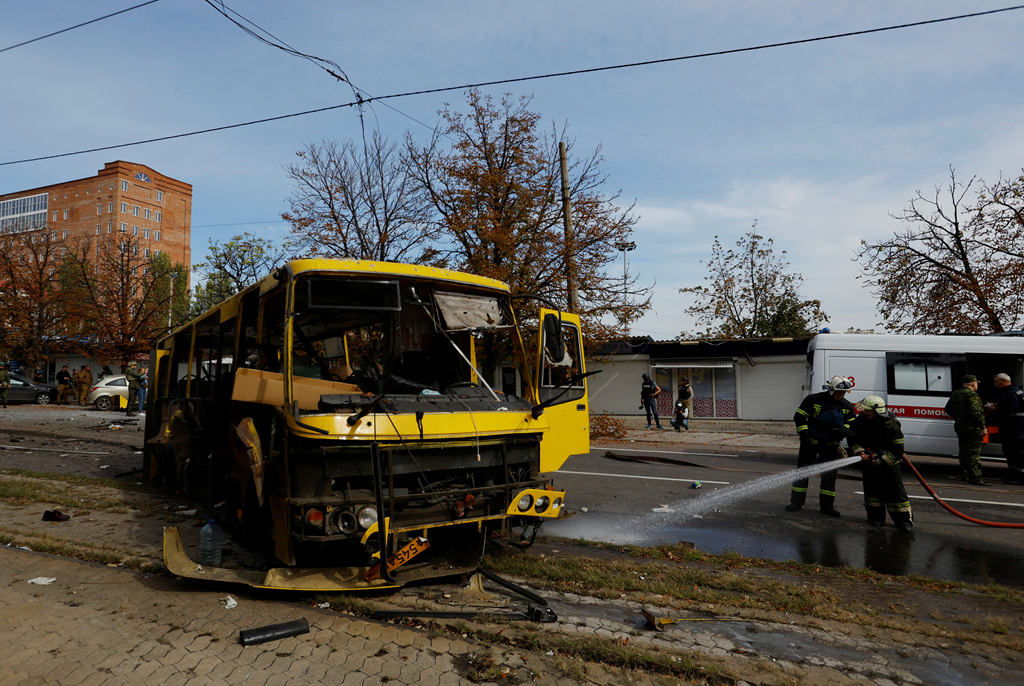
  • Donetsk missile strike: About six civilians, including a teenager killed

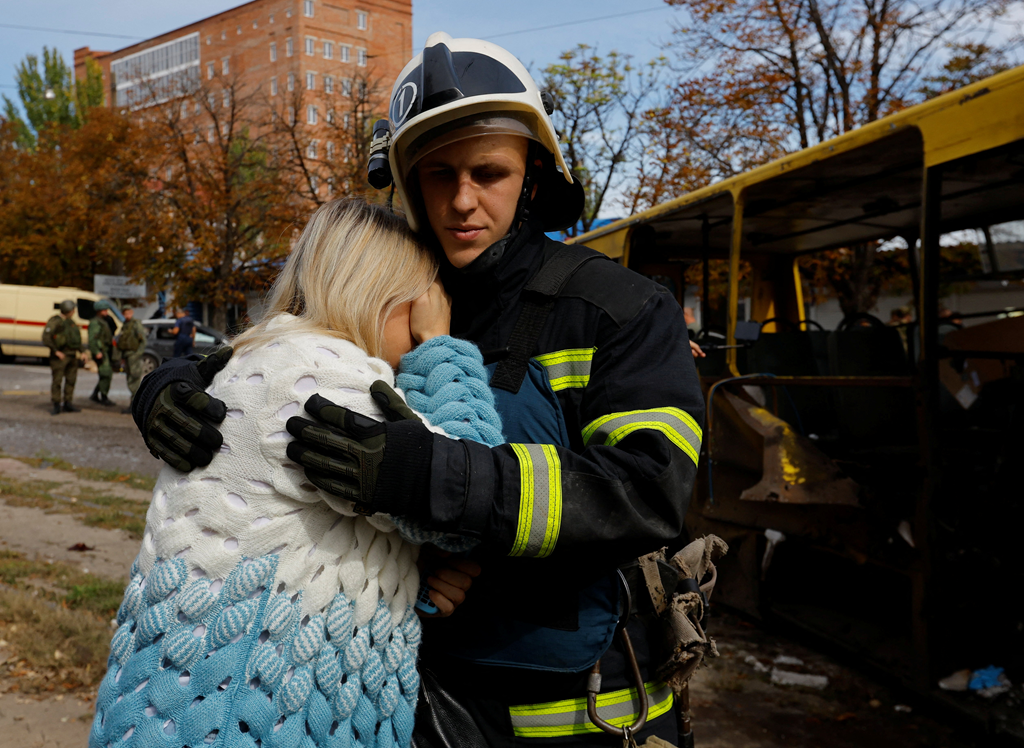
    A firefighter was consoling a mother whose teenage child had been murdered by shelling on a bus.

    The strike, according to officials supported by Russia, struck Donetsk’s separatist-controlled city centre.

    They blamed Ukrainian forces for the strike on a covered market.

    A Reuters journalist at the scene saw the body of a teenager and four others, as well as several wounded citizens.

    There has been no immediate comment from Ukraine, and the reports of who was behind the shelling cannot be independently verified.

  • Anticipating a steak dinner tonight – Captured Briton returns home

    A Briton, Shaun Pinnerwas freed as part of a prisoner swap between Russia and Ukraine, and he has since been reunited with his family.

    In April, Russian-backed separatists in eastern Ukraine arrested Mr. Pinner, 48, who was later found guilty of “mercenary actions” and given the death penalty.

    Our correspondent Emma Birchley spoke to him at his mother and stepfather’s home near Sandy in Bedfordshire.

    “It’s good to be home,” he said. “I’m looking forward to a steak dinner tonight!”

    He was finally reunited with his mother, stepfather, sister, and son at Heathrow at 6 am.

    For Mr Pinner’s mother, Debbie Price, the relief is overwhelming.

    “It’s been a really, really hard time,” she said. “We are just so happy to have him home. It’s hugely emotional.”

    The first hint Mr Pinner had that something was happening was after lunch on Tuesday.

    “They said you have to roll your stuff up. They said you’re going on a long journey,” he said.

    “We were moved to another location. We didn’t have any idea what was happening.”

    He was later flown with other released captives to Saudi Arabia.

    At 5.30 pm UK time yesterday, Mr Pinner was able to speak to his mother on the phone, from the Middle Eastern country.

    “It’s very emotional, as you can imagine,” he said. “I really want to say thank you to everyone who helped us get out from the government of Saudi Arabia and also Liz Truss and Boris Johnson.

    “The Saudis gave us a full MOT. Their hospitality was great,” he said.

    “Our thoughts go out to those who hope to be exchanged soon,” he said, referring to the prisoner swap which resulted in his release.

    He added that he has many friends still in Ukraine, as well as his wife. Today is their second wedding anniversary.

    It’s hoped she will be able to get a visa to also come to the UK.

    Mr Pinner’s sister Cassandra said she can’t believe how much changed in just 24 hours and described the feeling as “surreal”.

    She knew something was up when her mother phoned her at work, after being contacted by the Foreign Office at just before midday yesterday.

    Mr Pinner is yet to be fully debriefed by the Foreign Office and Intelligence Services.

  • Months of suffering ends after release of Britons says UK foreign secretary

    The foreign secretary, James Cleverly,  has welcomed the safe release of five British citizens who had been held as POWs in eastern Ukraine by forces backed by Russia.

    “This brings to an end many months of uncertainty and suffering, including the threat of the death penalty, for them and their families, at the hands of Russia,” he said.

    He said that was “tragically” not the case for British man Paul Urey who was captured by Russian-backed separatists in Ukraine and died in detention in July.

    “I would like to express my gratitude to President Zelensky and his team for their efforts to secure their release, and to HRH Crown Prince of Saudi Arabia, Mohammed bin Salman and his team, for their assistance.”

    He reiterated a call on Russia to comply with international humanitarian law and not exploit prisoners of war and civilian detainees for political purposes.

  • Protests across Russia resulted in more than 800 arrests

    A rights organization, said 826 individuals have been arrested across 37 locations in Russia as a result of today’s anti-mobilization protests.

    According to the independent protest monitoring organization OVD-Info, 309 people have been detained in Moscow.

    Sky’s Diana Magnay, who was at a protest in Moscow, said police were dealing with officers “very brutally”.

    It comes after the Russian president announced a partial military mobilization, with 300,000 reservists set to be called up.

  • Prisoners of war: British national Aiden Aslin released

    Aiden Aslin, a 28-year-old British national who was detained by Russian police and charged with “mercenary operations,” has been freed.

    A Russian stand-in court executed Mr. Aslin for participating in hostilities in Ukraine after he was apprehended in Mariupol in April.

    Mr Aslin’s local MP, Robert Jenrick, tweeted: “Aiden’s return brings to an end months of agonizing uncertainty for Aiden’s loving family in Newark who suffered every day of Aiden’s sham trial but never lost hope. As they are united as a family once more, they can finally be at peace”.

    Foreign Secretary James Cleverly welcomed the return of the prisoners of war and said it “brings to an end many months of uncertainty and suffering, including the threat of the death penalty, for them and their families, at the hands of Russia”.

    He added: “Tragically that was not the case for one of those detained and our thoughts remain with the family of Paul Urey”.

    Mr Urey died in July after he was charged with committing “mercenary activities” in the self-proclaimed Donetsk People’s Republic in eastern Ukraine.

    Russia claims he died due to “illnesses” and “stress”.

    Earlier this month Ukraine’s foreign minister said Russia had returned his body which showed “signs of possible unspeakable torture”.

  • Putin orders 10% boost in Russian troop numbers

    Russia’s president has signed a decree which could see 137,000 service personnel added to the country’s armed forces in the coming months.

    Currently Russia has a limit of just over a million military personnel and almost 900,000 civilian staff.

    Vladimir Putin’s decree comes amid a recruitment drive around the country, with large cash incentives on offer.

    Western officials say 70-80,000 troops have been killed or wounded since Russia invaded Ukraine six months ago.

    There have been reports that recruiters have even been visiting prisons, promising inmates freedom and money.

    The UK Ministry of Defence said in a statement two weeks ago that volunteer battalions being set up in several Russian regions were likely to form part of a new army corps.

    But it said “very limited levels of popular enthusiasm for volunteering for combat in Ukraine” meant it would be difficult to find the required number of troops.

    Russia had initially promised a short, decisive campaign when it invaded Ukraine in February, but fierce Ukrainian resistance has stalled its progress and in recent weeks front lines have hardly moved.

    Source: BBC

  • Five British nationals among prisoners of war released by Russia

    Among the five war prisoners released by Russia, are British nationals.

    Earlier we reported that 10 foreign prisoners who were caught in Ukraine, were released following mediation by Saudi Crown Prince Mohammed bin Salman, according to the Saudi foreign ministry.

    Prime Minister Liz Truss revealed that five Britons are among those released.

    Ms Truss tweeted: “Hugely welcome news that five British nationals held by Russian-backed proxies in eastern Ukraine are being safely returned, ending months of uncertainty and suffering for them and their families”.

    She thanked Ukrainian president Volodymyr Zelenskyy and Saudi Arabia for their efforts to secure their release.

  • Russia wants Ukraine to cease to exist – Biden

    Biden says Russia’s war is about extinguishing Ukraine’s right to “exist as state, as a people”.

    “Just before he invaded, Putin asserted, and I quote, ‘Ukraine was created by Russia’ and never had quote ‘real statehood’.

    “And now we see attacks on schools, railway stations, hospitals.. even more horrifying evidence of Russia’s war crimes.”

    The US president also references the mass grave recently uncovered in Izyum, which he said “showed signs of torture”.

    He says Russia’s war is about extinguishing Ukraine’s right to exist as a state – “plain and simple”, before telling those at the UN General Assembly:

    Quote Message: Whoever you are, wherever you live, whatever you believe – that should make your blood run cold. That’s why 141 nations in the General Assembly came together to unequivocally condemn Russia’s war against Ukraine.

    Whoever you are, wherever you live, whatever you believe – that should make your blood run cold. That’s why 141 nations in the General Assembly came together to unequivocally condemn Russia’s war against Ukraine.He adds that the US has personally marshalled “massive levels of security assistance, hamartian aid and direct economic support” to Ukraine.

  • Analysis: Putin’s decision to raise the stakes signals he cannot give up

    A decision by Vladimir Putin to raise the stakes even higher over Ukraine is a sign that his war is going badly, but it is also a signal that the Russian president cannot give up, writes Sky’s security and defence editor, Deborah Haynes.

    A partial mobilization; the holding of referendums to turn four Ukrainian regions “Russian”; and the spectre once more of nuclear confrontation mark a serious moment of escalation and a new test for the Ukrainian government with its Western backers.

    It comes in response to a significant counteroffensive by Ukrainian forces over the past three weeks, which has seized back swathes of territory in the northeastern Kharkiv region, forcing Russian troops into retreat and giving the Ukrainian side the momentum.

    Analysts have said from the beginning of Russia’s full-scale invasion that Putin cannot afford to lose this war as it would almost certainly mean the end of his presidency.

    But Ukraine has made clear it will not stop fighting until all Ukrainian territory is recaptured, meaning escalation will continue until either side blinks.

    It is interesting, therefore, to consider how the position – and risk appetite – of the UK, the US, and other western allies has evolved over the past nearly seven months of the war.

    There has been an unwavering desire to support Ukraine, but this support was initially constrained by a desire to avoid giving so much weaponry that it would be seen by Moscow as an escalatory step drawing Russia closer into direct confrontation with the West.

    But as the war has drawn on and Russian forces have resorted to exploiting their greater stockpiles of long-range artillery to smash Ukrainian positions, the West’s appetite has grown to gift Ukraine more powerful weapons – such as long-range multiple-launch rocket systems, tanks, and aircraft – regardless of the escalatory potential.

    DISCLAIMER: Independentghana.com will not be liable for any inaccuracies contained in this article. The views expressed in the article are solely those of the author’s and do not reflect those of The Independent Ghana

    Source: Sky News

  • Pound hits fresh 37-year low against dollar

    The pound has hit a new 37-year low against the dollar after Russia accused the West of “nuclear blackmail” raising fears the Ukraine war could escalate.

    The comments unnerved traders, pushing them towards safer investments such as the dollar.

    The pound briefly touched $1.13040 – its lowest level since 1985 – before regaining ground.

    In a televised address, the Russian president said he had signed a decree on partial mobilisation – the first since World War Two – as he seeks to send up to 300,000 more soldiers into battle.

    He also accused the West of wanting to destroy Russia, adding the country had “lots of weapons to reply”.

    • Putin calls up reservists to fight in Ukraine after losing ground
    • Exchange rates: Why has the value of the pound tumbled?

    The comments rattled investors who bought the dollar, gold and bonds, all of which are seen as less risky investments.

    Traders in sterling – which has been at low levels for weeks – were also looking ahead to a widely anticipated interest rate rise by the Federal Reserve on Wednesday.

    The US central bank has already raised interest rates four times this year to battle inflation. The Bank of England (BoE) is meanwhile expected to put up interest rates again on Thursday.

    Raising rates increases the cost of borrowing and encourages people to spend less, which can cool rising prices. However, central banks face a tough balancing act because higher rates may also slow the economy.

    Man shopping on Oxford StreetImage source, Getty Images

    Jumpy investors

    Sterling investors are also nervous about the policy implications of a planned mini-budget from the government on Friday, which will reportedly contain £30bn of tax cuts.

    It comes as the UK borrows billions of pounds to cap energy bills for households and businesses, adding to the UK’s already large debt pile.

    Official figures on Wednesday showed the government is also facing soaring interest payments on that debt due to rising inflation.

    This is because much of the interest paid on government bonds rises in line with the Retail Prices Index measure of inflation, which hit 12.3% in August.

    • Where does the government borrow billions from?
    • Firms could have energy bills cut by up to a third

    Interest due on public debt reached £8.2bn during the month – £1.5bn more than last year and the highest August figure since records began in 1997, the Office for National Statistics (ONS) said.

    Meanwhile, total government borrowing – the difference between spending and tax income – was £11.8bn.

    That is twice the level forecast for August by the Office for Budget Responsibility, the government’s independent fiscal watchdog.

    Source: BBC

  • Partial mobilization call: Russians rush for flights out of country

    Following Vladimir Putin’s announcement of a partial mobilization of military reservists for the war in Ukraine, a large number of Russians have hurried to reserve one-way tickets out of the country.

    The cost of flights scheduled to depart Moscow in the next several days has reportedly increased due to concerns that Russia’s borders may soon close or that a wider call-up may send many Russian men of fighting age to the front lines of the war.

    Tickets for the Moscow-Belgrade flights operated by Air Serbia, the only European carrier besides Turkish Airlines to maintain flights to Russia despite a European Union flight embargo, have sold out for the next several days.

    The price for flights from Moscow to Istanbul or Dubai increased within minutes before jumping again, reaching 9,200 euros (£8,037) for a one-way economy class fare.

    The Russian president’s decree stipulates that the number of people called to active duty will be determined by the defense ministry.

    Defense minister Sergei Shoigu said in a televised interview that 300,000 reservists with relevant combat and service experience would initially be mobilized.

    Up to 50,000 Russians have fled to Serbia since Russia invaded Ukraine and many have opened businesses, especially in the IT sector.

  • No room for blackmail and intimidation’ – Putin says

    Before US President Joe Biden’s speech, at the UN General Assembly, Russian president, Vladimir Putin made comments of his own.

    At an event to mark the 1,160th year of Russia’s statehood, he said the country would not lose its sovereignty and would not give in to “blackmail and intimidation”.

    Western officials would likely argue that they have not threatened the sovereignty of Russia, and it is instead Moscow that is endangering Ukraine’s sovereignty.

    Hours after Mr Putin ordered partial mobilization to boost troops in Ukraine, he also lauded the Russian military.

    He claimed it was fighting to save people in Ukraine’s eastern Donbas region, where Moscow has alleged Russian citizens are being persecuted.

    But Ukraine has forcefully denied the accusations and has aimed to push Russian forces out of its territory.

  • War in Ukraine: Biden says ‘chosen by one man’

    US President Joe Biden has termed the war in Ukraine as a war “chosen by one man”.

    Speaking at the UN General Assembly, he said Russia has made “irresponsible nuclear threats” and that “a nuclear war cannot be won and can never be fought”.

    His comments come just hours after Vladimir Putin warned the West he was not bluffing about the potential use of nuclear weapons.

    Mr Biden said Russia has “attempted to erase a sovereign state from the map”, adding that the war is about “extinguishing Ukraine’s right to exist as a state, plain and simple”.

    “Wherever you are, that should make your blood run cold.”

    Taking aim at Russia, Joe Biden said he wants the war to end on “just terms”.

    He added that he rejects the use of “violence and war to conquer nations and expand borders”.

  • Germany nationalises gas giant amid energy crisis

    In an effort to ensure energy supply amid the conflict in Ukraine, Germany will nationalize gas company Uniper.

    The deal will see the German government take on a 98.5% stake in the firm at a cost of €8.5bn (£7.4bn).

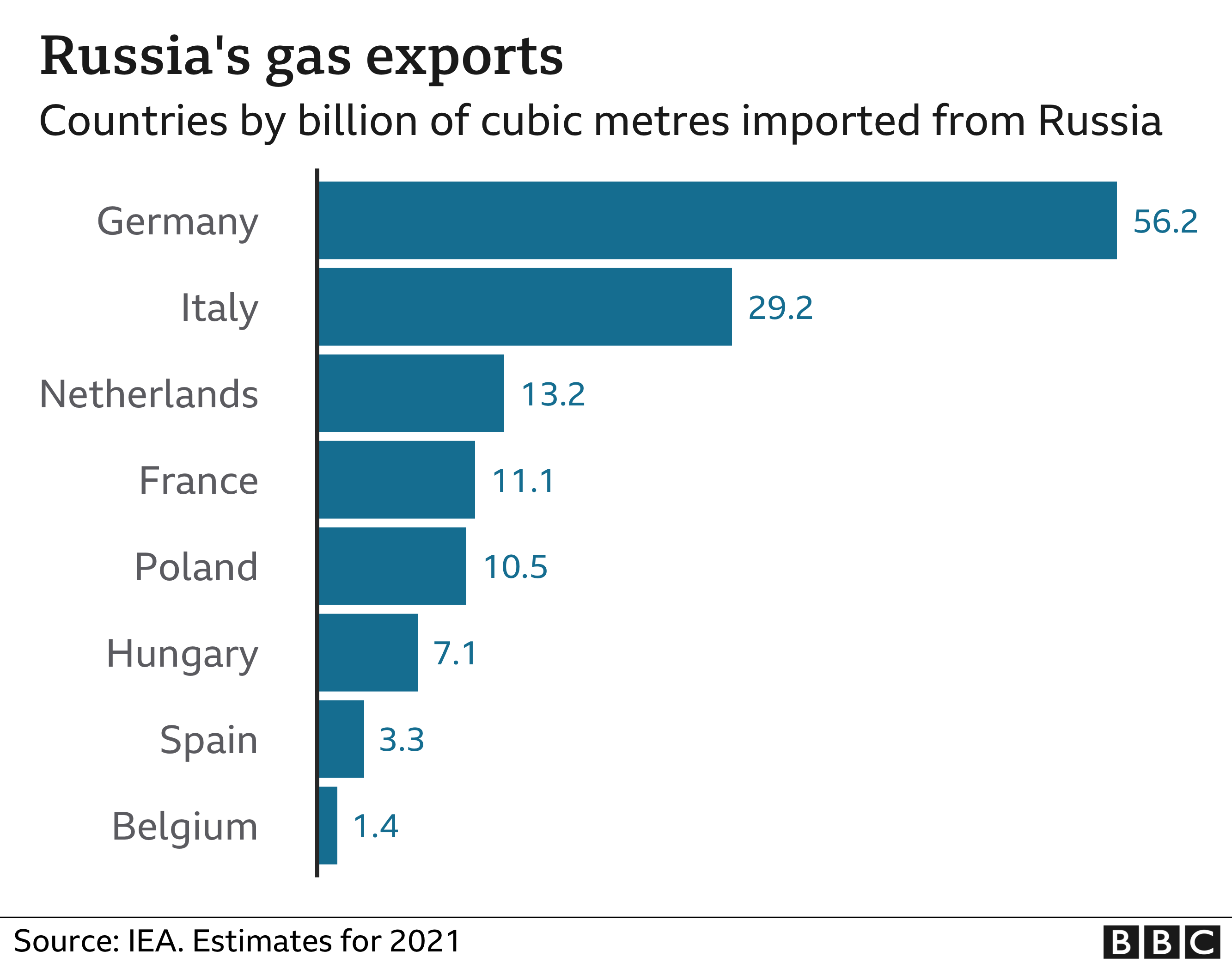
    Germany is Europe’s biggest importer of Russian gas, and has been particularly squeezed as Russia has reduced supplies in recent months.

    Chief executive Klaus-Dieter Maubach said the deal would help Uniper’s role as “a system-critical energy supplier”.

    Before Russia’s invasion of Ukraine it supplied Europe with about 40% of its natural gas, and has responded to Western sanctions by gradually cutting off supplies.

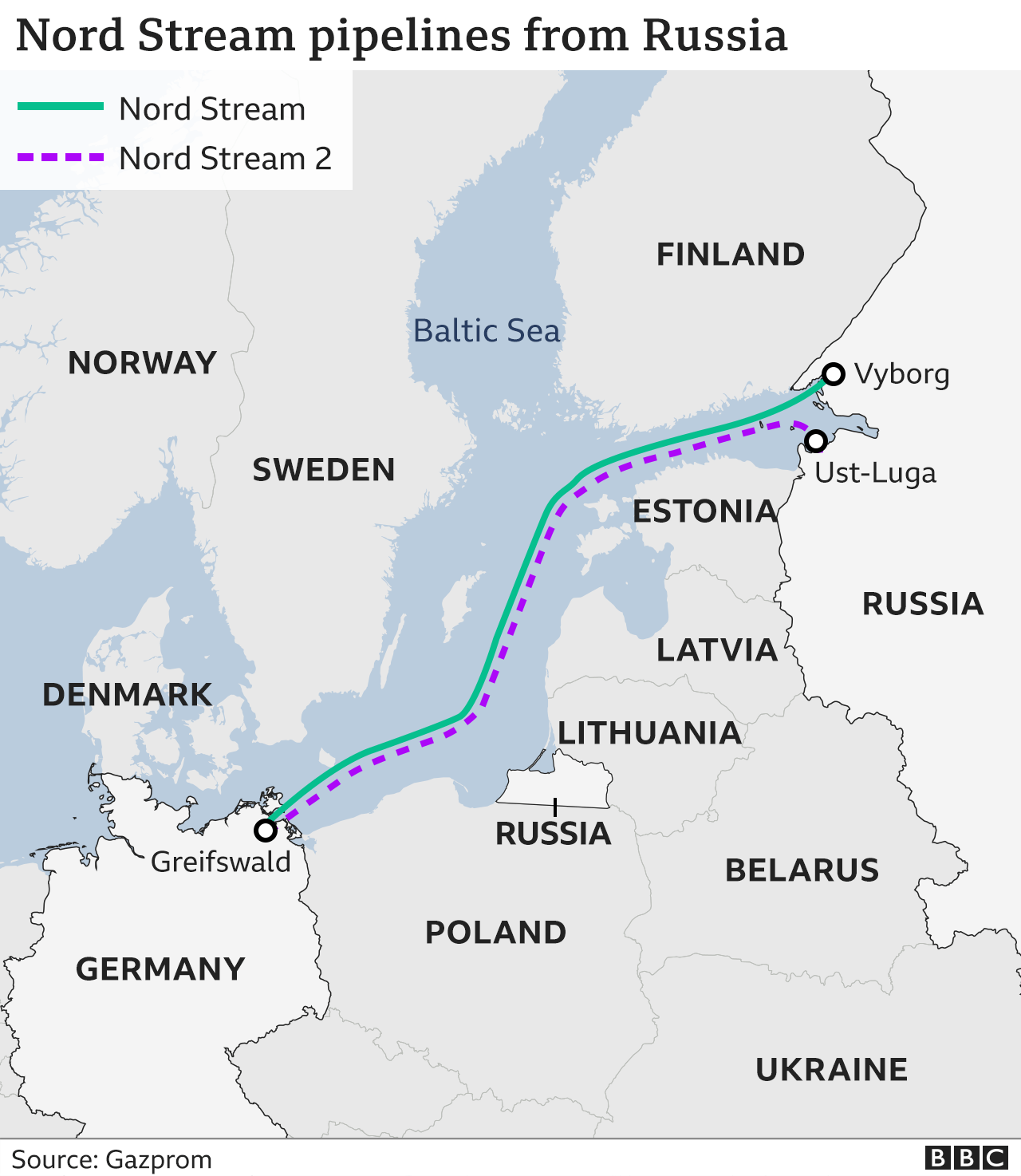
    At the start of this month, it halted supplies through the Nord Stream 1 pipeline, claiming repairs were needed – but later said supplies would not resume until sanctions were lifted.

    Uniper is the biggest buyer of Russian gas in Germany. In recent months it has had to replace Russian supplies with alternatives from the open market, where prices have soared.

    Uniper’s Finnish owner Fortum said the company has accumulated close to €8.5bn (£7.4bn) in gas-related losses “and cannot continue to fulfil its role as a critical provider of security of supply as a privately-owned company”.

    “The role of gas in Europe has fundamentally changed since Russia attacked Ukraine, and so has the outlook for a gas-heavy portfolio,” Fortum chief executive Markus Rauramo said in a statement.

    “As a result, the business case for an integrated group is no longer viable.”

    Under the terms of the deal, the German government will buy Fortum’s shares in Uniper for €500m (£437m) and inject €8.0bn (£7.0bn) of cash into the business.

    The government had already taken on a 30% stake of Uniper as part of a bailout agreement in July.

    Earlier this month, it also entered discussions with another major gas supplier, VNG, over a possible bailout package.

    Economy minister Robert Habeck said nationalising Uniper was a “necessary” step that would help “ensure security of supply for Germany”.

    He also said that, despite the loss of Russian supplies, Germany had succeeded in filling its gas storage facilities to over 90% capacity ahead of winter.

    “This means that, as a whole, we have coped quite well with the situation,” he said. “But for Uniper the situation became significantly more dramatic and significantly worse.”

    Gas exports

    At the start of September, Germany introduced a series of measures intended to cut energy use and stave off shortages over the coming months.

    Businesses are no longer allowed to keep their doors open throughout the day to reduce the need for heating, and illuminated advertising must be switched off after 10pm.

    The halls and corridors of most public buildings will no longer be heated, and offices can only be heated to a maximum of 19C.

    In July, energy ministers across Europe also agreed to reduce their natural gas consumption by 15%.

  • What precisely did Putin say when he ordered a partial mobilization?

    President Vladimir Putin issued an order to mobilize soldiers, stepping up Moscow’s apparent military operation in Ukraine.

    On Wednesday, Russian President Vladimir Putin authorized a “partial mobilization” that would call up 300,000 Russian citizens who were in the military reserves to serve in Ukraine.

    The incident came a day after a series of synchronized actions towards annexation referendums in Russian-occupied Ukrainian territory, and it signaled a dramatic uptick in Russia’s conflict with Ukraine.

    Putin spoke in Russian in the televised address. The quotes below have been translated into English.

    Partial mobilization

    “In such a situation, I consider it necessary to make the following decision, which is fully appropriate to threats we face. Namely, in order to protect our motherland, its sovereignty, and territorial integrity, and to ensure the safety of our people and people in the liberated territories, I consider it necessary to support the proposal of the defense ministry and the General Staff to conduct a partial mobilization in the Russian Federation.”

    “We are talking about partial mobilization. That is, only citizens who are currently in the reserves and, above all, those who have served in the armed forces, have military skills and relevant experience. Only they will be subject to conscription.”

    Fighting the West

    “Today our armed forces are operating across a front line that exceeds 1,000 km, opposing not only neo-Nazi formations but the entire military machine of the collective West.”

    “NATO is conducting reconnaissance across the south of Russia. Washington, London, and Brussels are directly pushing Kyiv to move military action to our country. They are openly saying that Russia should be defeated on the battlefield by any means.”

    Nuclear weapons

    “Nuclear blackmail has also been used. We are talking not only about the shelling of the Zaporizhzhia nuclear plant – encouraged by the West – which threatens to cause a nuclear catastrophe but also about statements from senior representatives of NATO countries about the possibility and permissibility of using weapons of mass destruction against Russia: nuclear weapons.

    “I would like to remind those who make such statements about Russia that our country also possesses various means of destruction, and in some cases, they are more modern than those of NATO countries. When the territorial integrity of our country is threatened, we, of course, will use all the means at our disposal to protect Russia and our people.

    “This is not a bluff. And those who try to blackmail us with nuclear weapons should know that the weathervane can turn and point towards them.”

    “Citizens of Russia can be convinced that our territorial independence and freedom will be provided, and I emphasize this one more time, with all means that we have at our disposal.”

    Referendums

    “Parliaments in the People’s Republics of the Donbas as well as the civil-military administrations in Kherson and Zaporizhzhia regions have decided to hold referendums on the future of the territories and have appealed to Russia to support such a step. We will do everything to ensure safe conditions to hold the referendums so that people can express their will.

    “We will support the decision on their future, which will be made by the majority of residents in the Donetsk and Luhansk People’s Republics, Zaporizhzhia, and Kherson.”

    West trying to ‘destroy’ Russia

    “In its aggressive anti-Russian policy, the West has crossed every line. We constantly hear threats against our country and our people.”

    “The purpose of this West is to weaken, divide and ultimately destroy our country. They are already saying that in 1991 they were able to break up the Soviet Union, and now the time has come for Russia itself that it should disintegrate. And they have been planning it for a long time.”

    “The West is not interested in a peaceful solution and making compromises; they just want to break all negotiations.”

  • Pro-Putin Russian MP threatens: A nuclear attack will convert the UK into a “Martian desert in three minutes flat”

    Monday’s nonstop coverage of the Queen’s funeral meant that several other stories, including the conflict in Ukraine, received less attention than they would have.

    The most recent episode of the pro-Kremlin television show 60 Minutes gave Russian State Duma member and retired major general Andrey Gurulyov the chance to make even more grave nuclear assault threats against the UK and Germany.

    Referring to US President Joe Biden’s warning to Russia over the use of nuclear weapons in Ukraine, the pro-Putin lawmaker said: “We may use them, but definitely not in Ukraine.”

    Having suggested Moscow could target Berlin with a nuclear strike, he goes on to discuss the likely US response in the event of an attack on the UK.

    Referring to NATO’s Article 5, which states that an attack on any member of the bloc is considered an act of violence against all the allies, he says: “If we turn the British Isles into a Martian desert in three minutes flat, using tactical nuclear weapons, not strategic ones, they could use Article 5, but for whom?

    “A non-existent country, turned into a Martian desert? They won’t respond. We shouldn’t be afraid of that.”

    Host Olga Skabeeva then joked: “We should have done it today, all the best people are there for the funeral.”

    Notorious for its frequently misleading information about the war in Ukraine, 60 Minutes is routinely used as a vehicle for pro-Russian propaganda.


  • Amid Western sanctions, China’s yuan has its moment in Russia

    The Chinese yuan is rapidly gaining popularity in Russia amid Western sanctions over the war in Ukraine.

    Trading on the Moscow Exchange, the currency has risen more than 50 fold this year, jumping from 0.5 percent of the total transactions in January to 26 percent in August.

    It is increasingly used in Russia’s international trade settlements and several of its largest companies have started issuing yuan-denominated bonds in a bid to raise capital.

    Russians have also begun stocking up as a growing number of banks offer clients the option of opening deposits in yuan.

    Individuals bought a record high of 4.5 billion yuan ($0.6bn) last month, according to data from Russia’s central bank.

    Analysts said that Russia’s pivot to the yuan could provide a boost to China’s ambitions of promoting greater international usage of its currency, while also helping Moscow to bypass Western sanctions aimed at severing it from the global financial system.

    “The popularity of yuan is due to the growing toxicity of the dollar and euro for Russians,” said Alexandra Prokopenko, an independent analyst who previously worked as an adviser to the Russian central bank.

    “As a result of sanctions, Russian accounts abroad can be frozen at any moment, not all foreign banks are willing to work with Russian banks, and transactions involving dollars and euros take a very long time to process,” she explained. “There are no such issues with the yuan.”

    Shortly after President Vladimir Putin ordered Russian troops into Ukraine, the United States and the European Union imposed sanctions against Russia’s central bank, sovereign wealth fund, and several of the country’s largest financial institutions.

    The administration of US President Joe Biden also banned the export of dollar notes to Russia.

    The latest news from around the world.Timely. Accurate. Fair.

    Russia has responded to these unprecedented sanctions by drawing even closer to China.

    Over the first eight months of this year, the trade turnover between the two countries increased by 31 percent to reach $117.2bn and officials have predicted that it is on course to hit a record of $200bn before 2023.

    Beijing has emerged as Moscow’s single biggest energy customer and Chinese companies have slowly begun to fill the gaps in the Russian market created by the mass exodus of Western corporations.

    “China is Russia’s largest trading partner so it’s logical that there’s a growing demand for yuans on the Russian market,” Prokopenko said. “Businesses need yuan to conduct trade settlements because under the current conditions, it’s easier to do so in yuan than in dollars or euros.”

    Since the start of the war, Russia has become the third-largest market for yuan payments outside mainland China, accounting for nearly 4 percent of international settlements involving the Chinese currency in July, according to the SWIFT payment system.

    Earlier this month, state energy giants Gazprom and China National Petroleum Corporation signed a deal under which China would begin to pay for Russian natural gas supplies exclusively in yuan and rubles.

    A growing number of Russian corporate giants are also seeking to attract funding in the Chinese currency.

    Over the past two months, state oil conglomerate Rosneft, aluminium producer Rusal, gold miner Polyus, and metallurgical company Metalloinvest have issued yuan-denominated bonds with a total value of 25.6bn yuan ($3.7bn).

    Meanwhile, the Russian finance ministry has announced plans to issue sovereign bonds in yuans, although it is widely expected that preparations for the placement will take at least another year or two.

    Valery Yemelyanov, a stock market analyst at BKS Mir investment firm, told Al Jazeera that due to the high demand for the yuan in Russia, companies which had accumulated large amounts of the currency were able to sell it at a favourable interest rate.

    “This is a fairly new experience for the Russian market, but a successful one so far,” he said. “Many companies are willing to place a bet on the yuan and plan their future business processes around it.”

    Russian banks have also been moving to expand their yuan offerings.

    Russians can now open yuan-denominated accounts at 10 of the country’s largest 30 banks, the RIA Novosti state news agency reported.

    Earlier this month, VTB Bank and Alfa-Bank became the first two Russian banks to allow clients to send money transfers to China in yuan without using the SWIFT international payment system.

    Alexander Borodkin, the head of the savings and investment unit at Otkritie bank, said that this growing interest in the yuan was driven by the Russian banking system’s efforts to dump the dollar and euro.

    He explained that banks were actively trying to discourage customers from storing savings in dollars or euros by refusing to open new deposits in these currencies, offering poor rates, or charging commissions.

    “The ideal option for the banking system is to have all of its clients convert their dollars and euros into rubles, but since not everyone will want to do that, it’s good to have the yuan as an option for those who want to diversify their savings account,” he said.

    Despite the yuan’s recent momentum, serious questions still remain about the Chinese currency’s ability to replace the dollar and euro for Russia.

    Yemelyanov of BKS Mir warned that because the yuan is not a freely convertible currency, Russians could lose out should Beijing decide to weaken the currency.

    Another problem is that the yuan is liquid and less convenient for investments, compared with the dollar or euro.

    “Beyond bonds and deposits, there really aren’t many other ways you can use the yuan in Russia, ” he said. “So if a person has significant capital, he will think 10 times about converting his resources from dollars and euros to yuan because it’s not all that clear what he can do with it afterwards.”

    Source: Aljazeera

  • Sri Lankans delivered from Russian brutality in Ukraine

    Ukraine‘s recapture of the city of Izyum has assisted with the redemption of a group of Sri Lankans held captive for months.

    There are have been multiple allegations of atrocities under Russian occupation.

    Dilujan was one of seven Sri Lankans captured by Russian forces in May. The group had just set out on a huge walk to safety from their homes in Kupiansk, north-eastern Ukraine, to the relative safety of Kharkiv, some 120km (75 miles) away.

    But at the first checkpoint they came across, they were captured by Russian soldiers. The Sri Lankans were blindfolded, their hands tied, and taken to a machine tool factory in the town of Vovchansk, near the Russian border.

    It was the start of a four-month nightmare which would see them kept prisoner, used as forced labour, and even tortured.

    “We thought we would never get out alive,” says Dilujan Paththinajakan.

    WARNING: You may find some of the details below about abuse distressing.

    The group had come to Ukraine to find work, or study. Now, they were prisoners, surviving on very little food, only allowed to use the toilet once a day for two minutes. On the occasions they were allowed to shower, that too was restricted to just two minutes.

    The men – mainly in their 20s – were all kept in one room. The only woman in the group, 50-year-old Mary Edit Uthajkumar, was kept separately.

    Mary Edit Uthajkumar
    Image caption, Mary Edit Uthajkumar, 50, said months of solitary confinement had taken a toll

    “They locked us in a room,” she said “They used to beat us when we went to take a shower. They didn’t even allow me to meet the others. We were stuck inside for three months.”

    Mary, her face already scarred by a car bomb in Sri Lanka, has a heart condition, but didn’t receive any medicine for it.

    But it was the impact of the solitude which really took its toll.

    “Being alone, I was so tense,” she says. “They said I was having mental health issues and gave me tablets. But I didn’t take them.”

    Others have been left with even more visible reminders of what they had endured: one of the men removed his shoes to show his toenails had been torn off with pliers. A second man reportedly also suffered that torture.

    The group also spoke of being beaten for no apparent reason – of Russian soldiers who would get drunk and then attack them.

    “They hit me across the body many times with their guns,” said 35-year-old Thinesh Gogenthiran. “One of them punched me in the stomach and I was in pain for two days. He then asked me for money.”

    “We were very angry and so sad – we cried every day,” Dilukshan Robertclive, 25, explained.

    “The only thing that kept us going was prayer – and family memories.”

    Russia has denied targeting civilians or committing war crimes, but the Sri Lankans allegations come alongside many other reports of atrocities committed by Russian occupying forces.

    Ukraine has been exhuming bodies from a burial site in forest near Izyum, some of which show signs of torture. And Ukrainian President Volodymyr Zelensky has said “more than 10 torture chambers have already been found in the liberated areas of Kharkiv region, in various cities and towns”.

    The liberated Sri Lankans with Ukrainian police in Kharkiv, 18 Sep 22
    Image caption, The liberated Sri Lankans with Ukrainian police in Kharkiv

    Freedom for the seven Sri Lankans finally came when the Ukrainian military began retaking areas in eastern Ukraine earlier this month – including Vovchansk.

    Once again, the group was able to begin their walk towards Kharkiv. Alone, and without their phones, they had no way to contact their families.

    But finally, their luck changed: someone spotted them along the way and called the police. One officer offered them their phone.

    The moment Ainkaranathan Ganesamoorthi, 40, saw his wife and daughter on the screen he broke down in tears. Other calls followed, more tears flowed. Eventually, the group huddled around the surprised police chief, engulfing him in a hug.

    The group have been taken to Kharkiv, where they are getting medical attention and new clothes, while sleeping in a rehabilitation centre with a pool and gym.

    “Now I feel very, very happy,” says Dilukshan, with a broad smile.

  • Deadly Donetsk blasts hit separatist-run city in Ukraine

    Thirteen people have been killed and others wounded in a series of explosions in the separatist-run city of Donetsk in eastern Ukraine, according to its Russian-backed mayor.

    Alexei Kulemzin blamed “punitive” Ukrainian shellfire for the deaths. There is no comment from Ukrainian officials.

    Donetsk has been controlled by Russia’s proxy authorities since 2014.

    They have repeatedly accused Ukrainian forces of targeting the city.

    Independent confirmation is hard to come by on the ground in separatist-held areas of the east. However, local authorities said nine 150mm shells were fired at the Kuibyshevsky district of Donetsk, from a village to the west of the city.

    Local leader Denis Pushilin accused Ukraine of deliberately targeting civilians at a bus-stop, a shop and a bank.

    Although Russian forces have seized areas of the Donetsk region further south since the invasion began in February, they have struggled to push the Ukrainian army back from the outskirts of the city itself.

    Map showing east Ukraine. Updated 13 Sept.
    1px transparent line

    Ukrainian forces have launched counter-offensives in the south as well as the north-east, and their most dramatic progress has come this month in the northern Kharkiv region.

    The head of Luhansk region, Serhiy Haidai, shared video of a Ukrainian tank crossing a pontoon bridge, and said Ukraine now controlled the left bank of the Oskil river, seen as the front line in north-east Ukraine.

    A Ukrainian troop carrier is seen crossing a river in eastern Ukraine
    IMAGE SOURCE,TELEGRAM/A_SHTIRLITZ Image caption, Ukraine’s armed forces said they had pushed across the river at the weekend

    If Ukrainian forces are able to maintain a foothold on the eastern side of the Oskil, it will represent a breakthrough. Mr Haidai said the next target would be liberating the city of Lyman, which was seized by Russian forces in May.

    “Luhansk region is right next door. De-occupation is not far away,” he claimed.

    In his nightly address late on Sunday, President Volodymyr Zelensky said that recent days may have looked like a lull of sorts: “But there will be no lull. There is preparation for the next series… For Ukraine must be free. All of it.”

    Russia was accused on Monday of targeting a nuclear plant in the south.

    Ukrainian nuclear operator Enerhoatom said a rocket landed 300m (1,000ft) from nuclear reactors at the the country’s second largest plant in Mykolayiv region, damaging buildings and shutting down part of a hydro-electric power station at the complex.

    The attack has not been independently confirmed, although footage was posted online by the Ukrainian military.

    Ukraine’s – and Europe’s – biggest nuclear plant at Zaporizhzhia has come under repeated fire since it was occupied by Russian forces at the start of the war and the UN has called for a safety zone to protect it.

    Meanwhile, the Kremlin has denied allegations of war crimes after some 450 bodies were uncovered in burial sites in the liberated city of Izyum.

    The discovery has prompted the European Union’s presidency, currently held by the Czech Republic, to call for an international tribunal into Russia’s invasion.

    Kremlin spokesman Dmitry Peskov said the revelations were “a lie, and of course we will defend the truth in this story”. He said the “scenario” was the same as in the town of Bucha near Kyiv, where local authorities say at least 458 civilians were murdered during Russia’s occupation.

    President Vladimir Putin said on Friday that Ukrainian counter-offensives would not change Russia’s military plans in the east of Ukraine.

    The ministry of defence in Moscow posted video on Monday that it said showed attack helicopters destroying Ukrainian manpower and equipment.

    However, according to the UK’s defence intelligence update, it was “highly likely” that Russia had lost four combat jets in Ukraine in the past 10 days as its air force took greater risks to support ground forces under pressure from the Ukrainian advances.

    The Institute for the Study of War says Russia is relying increasingly on “irregular volunteer and proxy forces” instead of its conventional military units.

    Russia says it is fighting neo-Nazis in Ukraine – a claim widely dismissed – and that it is threatened by the Nato alliance’s strong relations with Ukraine.

    Since the invasion on 24 February, the UN has recorded at least 5,718 civilian deaths, with 8,199 injured, and more than seven million Ukrainians have been recorded as refugees across Europe.

    The actual civilian death toll is believed to be thousands higher. Tens of thousands of combatants have been killed or injured.

    Russia, a global energy supplier, is locked in an economic struggle with the West which imposed sweeping sanctions in response to the invasion.

    Source: BBC

  • Ukraine has doubled its retaken area, Zelensky says

    President Volodymyr Zelensky says his forces have retaken over 2,000 sq km (772 sq miles) in a rapid counter-offensive in eastern Ukraine.

    His latest update, if confirmed, means Kyiv’s forces have more than doubled their gains in little over 24 hours.

    Ukraine’s rapid advance saw troops enter the key towns of Izyum and Kupiansk on Saturday.

    But UK defence officials have warned that fighting has continued outside those towns.

    And officials in Kyiv said Ukrainian forces were still fighting to gain control of a number of settlements around Izyum, while adding that more than 30 towns and villages have been retaken in the Kharkiv region.

    Russia’s defence ministry confirmed its forces’ retreat from Izyum itself and Kupiansk, which it said would allow its forces “to regroup” in territory held by Moscow-backed separatists.

    The Russian ministry also confirmed the withdrawal of troops from a third key town, Balaklyia, in order to “bolster efforts” on the Donetsk front. Ukrainian forces entered the town on Friday.

    Meanwhile, the head of the Russia-installed administration in the Kharkiv region recommended that its people evacuate to Russia “to save lives”.

    Unverified footage on social media appeared to show long queues of traffic building up at border crossings.

    And the governor of the Belgorod border region in Russia said mobile catering, heating, and medical assistance would be available to people queuing.

    The pace of the counter-attack has not only caught the Russians off guard, but even surprised some Ukrainians.

    But Russians still hold around a fifth of the country, and few imagine a swift end to the war.

    The Ukrainian advances – if held – would be the most significant frontline changes since Russia withdrew from areas around Kyiv in April.

    Kupiansk had served as Russia’s main eastern supply hub and the loss of Izyum – which Moscow spent over a month trying to take at the beginning of the war – would be seen as a major humiliation for President Vladimir Putin.

    According to one military expert, the advance marks the first time since World War Two that whole Russian units have been lost.

    The gains will also be seen as a sign that Ukraine’s army has the capacity to retake occupied territory – crucial as Kyiv continues to ask hard-pressed Western allies for military support.

    Ukraine’s Foreign Minister, Dmytro Kuleba, said the latest developments showed its forces could end the war faster with more Western weapons.

    Journalists have been denied access to the frontlines, and Ukraine is determined to control the information war.

    A map of Russian control in the east

    On Saturday, UK defence officials suggested that much of the retaken area was only “lightly held”.

    Ukraine launched its counter-offensive in the east earlier this week, while international attention was focused on an anticipated advance near the southern city of Kherson.

    Analysts believe Russia redirected some of its most seasoned troops to defend the city.

    But as well as gaining ground in the east, Ukraine is also making gains in the south, an official said.

    Nataliya Gumenyuk, a spokesperson for the Ukrainian army’s southern command, said they had advanced “between two and several dozens of kilometres” along that front.

    But Russian forces fighting on the southern front are said to have dug into defensive positions, and Ukraine’s troops have faced heavy resistance since the offensive began.

    And in Kharkiv itself, one person was killed and several homes damaged on Saturday as Russian rocket fire hit the city, according to local officials.

    Elsewhere, Ukraine’s energy regulator, Energoatom, says the last reactor at the Russian-occupied Zaporizhzhia nuclear power plant has been shut down, and is not generating electricity.

    The reactor had been generating energy for the plant itself for three days – it was shut down when external power was restored.

    The Ukrainian operator said that to prevent an emergency, it was essential that shelling of the power lines connecting the station to the national grid be halted.

  • In pictures: Ruins of psychiatric hospital

    A psychiatric hospital in Kramatorsk has been destroyed in Russian shelling. 

    The attack happened in the early hours of this morning.

  • Zelensky announces settlements recaptured from Russia

    Ukraine’s President Zelensky said he has “good news”, claiming the recapture of several settlements from Russia.

    Rumours have swirled for days about a possible breakthrough in the eastern Kharkiv region, but with no word from Ukrainian officials.

    Mr Zelensky declined to name which places had been retaken, saying that “now is not the time to name” them.

    Separately, US officials said Ukraine was making “slow but meaningful progress” against Russian forces.

    Speaking in his nightly video address to Ukrainians, President Zelensky said there was “good news” about the rumoured success of Ukrainian troops.

    “I think every citizen feels proud of our soldiers,” he said, naming specific military units and applauding their bravery in combat.

    But he said: “Now is not the time to name the settlements to which the Ukrainian flag returns.”

    Ukraine has tightened its operational security in recent weeks, sharing few details about a widely expected counter-offensive in the east and south.

    Ukrainian soldiers have launched an offensive south-east of Kharkiv, towards the eastern region of Donetsk, over which Russia has maintained substantial military control since the war began six months ago.

    Some reports suggest Ukrainian forces may be a few dozen kilometres from the city of Izyum, an important link in Russia’s military supply chain.

    Map showing east Ukraine. 29 Aug

    Speaking at an event in the United States, Colin Kahl – the Under-Secretary of Defense for Policy – suggested that Ukrainian forces were performing better than Russian troops in some areas.

    “It is early days. I think the Ukrainians are making slow but meaningful progress. And we’ll see how things pan out,” he was quoted as saying by Reuters news agency.

    “But I certainly think things are going better on the Ukrainian side right now in the south than is true on the Russian side.”

    The situation, however, remains fraught.

    In its nightly update, the Ukrainian General Staff said on Wednesday that it had “repelled all Russian attacks” in the Kharkiv and Donetsk regions – but that both sides continued to exchange artillery and air strikes, damaging a dozen different places.

    President Zelensky also said on Wednesday that Ukraine’s national budget next year would be that of a country at war – with more than a trillion hryvnia ($27bn; £23.5bn) spent on defence.

    But he promised key social provisions such as pensions would be maintained.

    However, “it is necessary to reduce as much as possible all non-critical expenses”, he warned – “all that does not help defence, does not help the economic development of the country, social and cultural provision of our people”.

    Separately, US and UN observers raised concerns over the fate of civilians in Ukraine as the war continues.

    A senior UN human rights official said the organisation was concerned about the displacement of people in Ukraine – and particularly the fate of children.

    “There have been credible allegations of forced transfers of unaccompanied children to Russian-occupied territory, or to the Russian Federation itself,” warned Ilze Brands Kehris, Assistant Secretary-General for Human Rights.

    Her agency is concerned that Russia has created “a simplified procedure” to provide those children with Russian citizenship, and potentially have them adopted into Russian families, she said.

    Such moves would breach the Geneva Convention, she added.

    The US, also on Wednesday, said it was concerned about a similar forced movement of Ukrainians – but of adults.

    The State Department accused the Kremlin of having lists of Ukrainians to be forced into areas of the country under Russian control as part of what it calls “filtration operations”.

    “Filtration is a dehumanising word, describing a massive campaign that the Kremlin has launched to imprison, to forcibly deport or disappear those Ukrainian citizens Moscow decides could be a potential threat,” spokesman Vedant Patel said.

    “Victims of filtration are given no choice but to submit or face dire consequences.”

    He described the system as a large-scale and advanced operation involving technology such as facial recognition and phone tracking – and said the US had evidence linking Kremlin officials to the project.

    However, Russia’s UN Ambassador, Vasily Nebenzya, said Ukrainians travelling to Russia merely went through a registration procedure.

    Source: BBC

  • Zaporizhzhia: Ukraine suggests UN peacekeepers for nuclear plant

    Ukraine’s nuclear chief has suggested that United Nations peacekeepers could secure the Zaporizhzhia power station.

    The plant has been occupied by Russia since the early days of the war and come under repeated attack, with both sides blaming each other.

    UN inspectors observed damage at the power station during a visit last week.

    The inspectors recommended that a security zone be set up immediately to shield the facility, which is Europe’s largest, from the fighting.

    Vladimir Putin has said he trusted the report from the UN’s nuclear watchdog, the International Atomic Energy Agency (IAEA), but criticised the agency for not saying Ukraine was to blame for shelling the area.

    The Russian leader described the IAEA as “a very responsible international organisation” which was under pressure. “Our servicemen are there – are we shooting at our own?” he asked, in response to claims that Russia could be responsible for shelling at the plant.

    Shelling continued while the 14-strong IAEA team visited the site and its head, Rafael Grossi, warned of a very real risk of nuclear disaster. Although most of the team left the plant after two days, it said two of its officials would remain there on a permanent basis.

    In an emergency session of the Security Council, the UN Secretary General Antonio Guterres set out steps for the creation of a demilitarised zone around the plant.

    Ukrainian President Volodymyr Zelensky welcomed calls by the IAEA for a safety protection zone at Zaporizhzhia.

    On Wednesday Petro Kotyn, who runs Ukraine’s nuclear agency Energoatom, suggested a UN peacekeeping contingent could set up a security zone at Zaporizhzhia and Russian troops withdraw.

    However, the IAEA was careful not to apportion blame to either side.

    The IAEA’s report says that there were Russian military vehicles stationed in two turbine halls and under the overpass connecting the reactor units and includes a photo showing Russian-flagged military trucks with the Z insignia parked inside a large building.

    However, on Wednesday Mr Putin denied that there was any Russian military equipment on-site at Zaporizhzhia.

    Zaporizhzhia graphic

    The IAEA detailed the damage to the plant and said that while continued shelling had not yet triggered a nuclear emergency, it did present a constant threat to safety that “may lead to radiological consequences with great safety significance”.

    There was an urgent need for “interim measures” to prevent a nuclear accident caused by military action, it added, saying all relevant parties would have to agree to a “nuclear safety and security protection zone” being set up to avoid further damage.

    The plant lies on the southern bank of the River Dnieper, across the water from Ukrainian-held towns and military positions.

    Map showing nuclear plant in Ukraine

    Meanwhile, the UK’s Ministry of Defence says fighting has continued in Ukraine on three fronts over the past 24 hours: in the east, in Donbas; in the north around Kharkiv, and in the south around Kherson.

    The redeployment of Russian forces to southern Ukraine around Kherson has enabled Ukrainian forces to make progress in the Kharkiv region. according to the US-based Institute for the Study of War. The institute suggests Ukrainian forces may have taken a town near Balaklia as Russian troops retreated, blowing up bridges.


    Source: BBC

  • EU plans Russian gas price cap despite Putin threat

    The European Union’s executive body has proposed capping the price of Russian gas, within hours of Russia’s leader condemning the idea as stupidity.

    Energy prices have soared in the wake of Russia’s invasion of Ukraine, forcing the EU’s 27 states into action.

    “We must cut Russia’s revenues which Putin uses to finance this atrocious war,” said European Commission chief Ursula von der Leyen.

    But Mr Putin said Moscow would react to a cap by halting supplies completely.

    “We will not supply gas, oil, coal, heating oil – we will not supply anything,” he said, if it went against Russia’s interests.

    European leaders have accused Moscow of “weaponising” its gas exports in response to Western sanctions on Russian individuals and businesses.

    While the Kremlin denies that is the case, the big Nord Stream 1 pipeline into northern Germany has been shut indefinitely, with Moscow directly blaming sanctions.

    Last week, the G7 group of nations – announced a price cap for Russian oil – a move it said would reduce both Moscow’s revenue for its Ukraine invasion, and inflation in the West.

    Finnish researchers recently estimated that Russia has made €158bn (£136bn) from surging fossil fuel prices during the six-month invasion – with EU imports accounting for more than half of that.

    Speaking to an economics forum in the far eastern city of Vladivostok on Wednesday, Russia’s leader condemned sanctions as economic aggression, and a “fever” posing a threat to the entire world.

    The quality of life for Europeans was being sacrificed while poorer countries were losing access to food, he argued: “Now we are seeing how production and jobs in Europe are closing one after another.”

    Although he acknowledged inflation in Russia was rising, he minimised the effect that sanctions were having on Russian companies: “I am sure that we have not lost anything and we will not lose anything.”

    Russian companies have struggled to source much-needed imported parts. But Mr Putin asserted that confidence in the dollar, euro and pound was being lost before people’s eyes – while Russia was emerging from the war with its sovereignty strengthened.

    Russian President Vladimir Putin attends the plenary session of the 2022 Eastern Economic Forum on Sept 7 2022Image source, Tass via Reuters
    Image caption, The Russian leader said Western currencies were falling while Russia was not losing anything

    Russia launched its invasion on 24 February and now occupies around a fifth of Ukrainian territory. Six months on, it has been pushed back from areas around Kyiv and the north and now faces a Ukrainian counter-offensive in the south and east.

    Western nations responded to the war with several rounds of sanctions. The European Union has attempted to cut its reliance on Russian gas and oil and Moscow – and on Friday EU energy ministers will try to decide how to protect consumers and businesses from the threat of enormous bills over the winter.

    Ahead of the meeting, Ursula von der Leyen said Europe had weakened Russia’s grip on its gas requirements. Gas storage was already up to 82% and supplies had increased from the US, Norway, Algeria and other countries.

    Before the invasion, Russia accounted for 40% of the EU’s imported gas, but today that proportion was now down to only 9%, she said.

    As well as a price cap on Russian gas, EU ministers have been looking at how to separate the cost of gas from the price of electricity, which are linked in Europe’s market. The Commission president outlined several other plans:

    • A mandatory target for reducing electricity use at peak hours
    • A cap on revenues for companies making unexpected profits from low-cost electricity such as renewable energy
    • A “solidarity contribution” from fossil fuel companies
    • Helping struggling energy companies cope with the volatile energy market with “liquidity” support

    The plans will go before energy ministers on Friday, and one diplomat told the BBC he was sceptical: “Good luck getting that through council complete and intact.”

    EU member states have already responded to the crisis with a series of packages to help consumers. At the weekend Sweden and Finland announced liquidity guarantees for power companies, while Germany said it would spend €65bn (£56.2bn) with help for the vulnerable as well as tax breaks for energy-intensive businesses.

    In Vladivostok, Mr Putin went on to accuse Europe of cheating the developing world out of Ukrainian grain exports in the wake of a UN-led deal to lift Russia’s naval blockade.

    For months ships were unable to leave Ukraine’s three Black Sea ports but shipments resumed last month. Mr Putin told his audience that only two grain ships had since gone to Africa – which is not the case. He said he wanted to discuss revisiting the deal, in remarks rejected by Ukraine as groundless.

    Other ships have left for Yemen and Sudan while several vessels have gone to ports in Egypt.

    A UN-chartered ship carrying 23,000 tonnes arrived in Djibouti last week. The grain has now reached Ethiopia in 60 lorries, with the aim of feeding more than one and a half million people in a country blighted by drought and civil war.

    Under the agreement all cargoes are approved by a joint centre in Turkey. The centre says 2m tonnes have been authorised so far, including to Turkey and the Middle East as well as ports in the EU.

    Map showing Ukrainian grain ships 

    Source: BBC

    1px transparent line
  • Journey to climb Russian volcano: Eight die, survivors evacuated

    Authorities in the area report that survivors of an eight-person climbing trip on Eurasia’s tallest volcano have been rescued by rescuers.

    The deceased was part of a group of 12 individuals, including two guides, who have been climbing Klyuchevskaya Sopka in the northeastern Kamchatka peninsula region of Russia since August 30, Russian state news agency, RIA Novosti, said. A rescue group began climbing to reach the survivors Monday, Russia’s Ministry of Civil Defense, Emergencies and Disaster Relief told state media.
    At 4,750 meters (15,580 feet), Klyuchevskaya Sopka is one of the world‘s highest active volcanos.
    The Russian Ministry of Emergency Situations reported that as of Tuesday morning the survivors had been transported by helicopter to the nearest village, Klyuchi, in the Ust-Kamchatka district. RIA Novosti noted that one of the survivors had contacted frostbite by the time rescuers reached them.
    According to local media, the plan is to ultimately evacuate the survivors to Petropavlovsk on a Regional Center of Disaster Medicine plane.
    Izvestiya, one of Russia’s main daily newspapers, reported that some of the rescue groups remained on the volcano after the survivors were evacuated. The remaining rescuers will decide on how to evacuate the dead bodies, located at a height of 4158 meters (13,641 feet) after the weather forecast is determined.
    Conditions on the volcano are treacherous and unpredictable, with strong winds, bitterly cold temperatures, and snow at high altitudes.
    Previous search and rescue attempts to reach the trapped individuals were unsuccessful, as strong winds prevented a helicopter from landing on the volcano Sunday, a day after five members of the group fell to their deaths. By Monday morning, three more had died, Russian Deputy Prime Minister of Kamchatka Roman Vasilevsky told RIA Novosti.
    The Minister of Emergency Situations for the region where the volcano is located has opened an information hotline for relatives of the climbing party, a spokesperson told RIA Novosti.
    “Relatives can find out information about the progress of search and rescue operations, as well as, if necessary, get psychological help,” the ministry’s press service said.
    A criminal case has been initiated to look into the cause of the deaths, RIA Novosti reported.
  • Gas prices soar 26% following closed key pipeline by Russia

    Gas prices have soared on concerns over energy supplies after Russia announced it would not reopen its main gas pipeline to Europe.

    The Dutch month ahead wholesale gas price, a benchmark for Europe, was up as much as 30% in early trading on Monday.

    The Nord Stream 1 pipeline had been due to reopen on Saturday after being shut for three days.

    But Russia’s state-owned energy firm Gazprom said it had found a leak.

    Europe has accused Russia of using gas supplies to blackmail European countries because of the Ukraine conflict, which Moscow denies.

    Wholesale prices have been very volatile in recent weeks. They fell sharply last week when Germany announced that its gas storage facilities were filling up faster than expected.

    Although the UK is not reliant on Nord Stream 1 for its gas, the Kremlin’s decision to squeeze supplies to Europe has driven up the overall cost of wholesale gas. Prices in the UK rose as much as 35% on Monday.

    The overall increase has been behind the spike in the energy bill price cap for consumers in England, Wales and Scotland.

    Tory leadership hopeful Liz Truss has promised to announce a plan to deal with high energy bills if she becomes prime minister. Her rival, Rishi Sunak, has said he will target further payments aimed at the poorest.

    However, UK businesses are not protected by a price cap and, last week, the British Chambers of Commerce warned firms would “close their doors this winter” if they were not given support with soaring bills.

    Energy expert Bill Farren-Price told the BBC’s Today programme that the “crunch moment” would come later in the year if demand is particularly high for gas and is going to exceed what can be imported.

    He added that looking action on energy bills would be the top priority for the incoming prime minister.

    A number of European governments have revealed plans to help businesses and consumers cope with surging energy costs. On Sunday, Germany announced a €65bn (£56.2bn) package which includes one-off payments to the most vulnerable and tax breaks to energy-intensive firms.

    Over the weekend, Sweden and Finland also announced multi-billion pound packages to support energy companies.

    ‘War winter’

    Other European ministers have accused Russia of using energy supplies as an economic weapon against those supporting Ukraine.

    Moscow has denied it is deliberately restricting exports in the run-up to winter, pushing up costs for households and businesses.

    State energy firm Gazprom said that an oil leak in a turbine on the Nord Stream 1 pipeline was behind the closure.

    But this has been disputed by the European Union and Siemens itself, the German firm which maintains the turbine.

    “Such leaks do not normally affect the operation of a turbine and can be sealed on site. It is a routine procedure within the scope of maintenance work,” Siemens said in a statement.

    Gazprom made the announcement on shutting the pipeline on Friday shortly after the G7 nations agreed to cap the price of Russian oil in support of Ukraine.

    Map showing the route of the Nord Stream pipelines between Russia and Germany.

    The introduction of a price cap means countries that sign up to the policy will be permitted to purchase only Russian oil and petroleum products transported via sea that are sold at or below the price cap.

    But Russia says it will not export to countries that participate in the cap.

    Swedish Prime Minister Magdalena Andersson said that Russia’s actions could not only risk leading to a “war winter”, but could potentially have a knock-on effect on businesses and its wider economy.

    The Nord Stream 1 pipeline stretches from the Russian coast near St Petersburg to north-eastern Germany and can carry up to 170 million cubic metres of gas a day.

    It is owned and operated by Nord Stream AG, whose majority shareholder is Gazprom.

    This is not the first time since Russia’s invasion of Ukraine that the pipeline has been closed.

    In July, Gazprom cut off supplies completely for 10 days, citing “a maintenance break”. It restarted again 10 days later, but at a much reduced level.

    Source: BBC

  • Germany pledges €65bn package to check rising energy costs

    As Europe struggles with scarce supplies after Russia’s invasion of Ukraine, Germany has announced a €65bn (£56.2bn) package of measures to ease the threat.

    The package from Germany will include one-off payments to the most vulnerable and tax breaks to energy-intensive businesses.

    There is rising energy costs in Europe. Energy prices have soared since the February invasion because energy was being provided by Russia.

    On the matter, President Volodymyr Zelensky of Ukraine, said Russia was trying to destroy the normal life of every European citizen.

    In his nightly address on Saturday, he said Russia was preparing a “decisive energy attack on all Europeans”, and only unity among European countries would offer protection.

    And in a BBC interview broadcast on Sunday, his wife Olena said that if support for Ukraine was strong the crisis would be shorter. She reminded Britons that while rising living costs were tough, Ukrainians were paying with their lives.

    According to website Politico, European Union officials have warned there is likely to be a crunch point in the coming months when countries start to feel acute economic pain while also still being asked to help the Ukrainian military and humanitarian effort.

    There are already small signs of discontent, with protesters taking to the streets of the Czech capital Prague on Sunday, rallying against high energy prices and calling for an end to sanctions against Russia. Police said about 70,000 people, mainly from far-right and far-left groups were in attendance.

    Meanwhile, several hundred protesters gathered at Lubmin in north-eastern Germany, the terminal of the Nord Stream gas pipeline from Russia.

    They were calling for the commissioning of Nord Stream 2, a new pipeline which was about to go online but was blocked by the German government after the invasion.

    Two days ago, Russia said it was suspending gas exports to Germany through the already operating Nord Stream 1 pipeline indefinitely.

    The stand-off with Russia has forced countries like Germany to find supplies elsewhere, and its stores have increased from less than half full in June to 84% full today.

    German Chancellor Olaf Scholz told journalists Germany would get through the winter, adding that Russia was “no longer a reliable energy partner”.

    He said the government would make one-off payments to pensioners, people on benefits and students. There would also be caps on energy bills.

    Some 9,000 energy-intensive businesses would receive tax breaks to the tune of €1.7bn.

    A windfall tax on energy company profits would also be used to mitigate bills, Mr Scholz said.

    German coal-fired power station
    IMAGE SOURCE,EPA Image caption, The energy crisis has forced Germany to bring this coal-fired power station back onto the grid

    The latest package brings the total spent on relief from the energy crisis to almost €100bn, which compares to about €300bn spent on interventions to keep the German economy afloat during the Covid-19 pandemic.

    Countries across Europe are considering similar measures.

    UK Tory leadership hopeful Liz Truss has said she will announce a plan to deal with energy costs within a week if she becomes prime minister on Tuesday.

    And EU energy ministers are due to meet on 9 September to discuss how to ease the burden of energy prices across the bloc.

    A document released about the meeting says the agenda will include price caps for gas and emergency liquidity support for energy market participants, Reuters news agency reported.

  • Russia shuts major gas pipeline to Europe

    Russia has completely halted gas supplies to Europe via a major pipeline, saying repairs are needed.

    The Russian state-owned energy giant, Gazprom, said the restrictions on the Nord Stream 1 pipeline would last for the next three days.

    Russia has already significantly reduced gas exports via the pipeline.

    It denies accusations it has used energy supplies as a weapon of war against Western countries.

    The Nord Stream 1 pipeline stretches 1,200km (745 miles) under the Baltic Sea from the Russian coast near St Petersburg to north-eastern Germany.

    It opened in 2011, and can send a maximum of 170m cubic metres of gas per day from Russia to Germany.

    The pipeline was shut down for 10 days in July – again for repairs, according to Russia – and has recently been operating at just 20% capacity because of what Russia describes as faulty equipment.

    The president of Germany’s network regulator has said the country will be able to cope – if Russia resumes delivery in the coming days.

    “I assume that we will be able to cope with it,” Klaus Mueller told Reuters. “I trust that Russia will return to 20% on Saturday, but no one can really say.”

    European leaders fear Russia could extend the outage in an attempt to drive up gas prices, which have already risen sharply in the past year.

    The steep rise threatens to create a cost of living crisis over the winter months, potentially forcing governments to spend billions to ease the burden.

    On Tuesday, French Energy Transition Minister Agnes Pannier-Runacher accused Russia of “using gas as a weapon of war”.

    She was speaking after Gazprom said it would suspend gas deliveries to the French energy company Engie.

    But Russian President Vladimir Putin’s spokesman has rejected the accusations – and insisted that Western sanctions have caused the interruptions by damaging Russian infrastructure.

    He insisted that that “technological problems” caused by sanctions are the only thing preventing Russia from supplying gas via the pipeline, without specifying what the problems were.

    The most recent controversy has been over a turbine which arrived in Germany after being repaired in Canada and which Russia refused to take back, arguing it was subject to the Western sanctions.

    Germany, however, denies this.

    Earlier this month, Economy Minister Robert Habeck said the pipeline was fully operational and said there were no technical issues as claimed by Russia.

    Earlier this week, EU Commission President Ursula von der Leyen promised to intervene in energy markets, telling a conference in Slovenia that they are “no longer fit for purpose”.

    “We need a new market model for electricity that really functions and brings us back into balance,” she said.

    Before the conflict, Germany had approved the €10bn (£8.4bn) Nord Stream 2 pipeline – which runs parallel to its namesake – but halted operations after Russia sent troops into Ukraine in February.

    Last week, the BBC revealed that Russia has been burning off an estimated $10m (£8.4m) worth of gas every day at a plant near the Finnish border.


    Map showing the route of the Nord Stream pipelines between Russia and Germany.
    Source: BBC

  • Nord Stream 1: Russia closes a key gas pipeline to Europe

    Due to the need for maintenance, Russia has fully stopped supplying gas to Europe through a major pipeline.

    The Nord Stream 1 pipeline will be restricted for the next three days, according to Russian state-owned oil company Gazprom.

    Russia already considerably cut back on pipeline-based gas shipments.

    It also denies claims that energy supplies were used to penalize Western countries for enacting sanctions in response to the invasion of Ukraine.

    The Nord Stream 1 pipeline stretches 1,200km (745 miles) under the Baltic Sea from the Russian coast near St Petersburg to north-eastern Germany.

    It opened in 2011 and can send a maximum of 170m cubic metres of gas per day from Russia to Germany.

    The pipeline was shut down for 10 days in July – again for repairs, according to Russia – and has recently been operating at just 20% capacity because of what Russia describes as faulty equipment.

    European leaders fear Russia could extend the outage in an attempt to drive up gas prices, which have already risen by 400%.

    The steep rise threatens to create a cost of living crisis over the winter months, potentially forcing governments to spend billions to ease the burden.

    On Tuesday, French Energy Minister Transition Minister Agnes Pannier-Runacher accused Russia of “using gas as a weapon of war”.

    She was speaking after Gazprom said it would be suspending gas deliveries to the French energy company Engie.

    But Russian President Vladimir Putin‘s spokesman has rejected the accusations and insisted that Western sanctions have caused the interruptions by damaging Russian infrastructure.

    He insisted that “technological problems” caused by Western sanctions are the only thing preventing Russia from supplying gas via the pipeline, without specifying what the problems were.

    The most recent controversy has been over a turbine that arrived in Germany after being repaired in Canada and which Russia refused to take back, arguing it was subject to the Western sanctions.

    Germany, however, denies this.

    Earlier this month, Economy Minister Robert Habeck said the pipeline was fully operational and said there were no technical issues as claimed by Russia.

    Earlier this week, EU Commission President Ursula von der Leyen promised to intervene in energy markets, telling a conference in Slovenia that they are “no longer fit for purpose”.

    “We need a new market model for electricity that really functions and brings us back into balance,” she said.

    Last week, the BBC revealed that Russia has been burning off an estimated $10m (£8.4m) worth of gas every day at a plant near the Finnish border.
  • EU split on visa bans for Russia, plans Ukraine training missions

    Germany and France have issued a joint warning against a ban on tourist visas for Russians, saying such a step, advocated by other European Union member states, would be counter-productive.

    The split on tourist visas will be at the heart of a meeting of the bloc’s foreign ministers in Prague on Tuesday and Wednesday, as they discuss what further steps they can take to sanction Russia for its six-month old invasion of Ukraine.

    Defence ministers meeting in Prague are likely to agree in principle on the less controversial step of organising joint military training missions for Ukrainian troops.

    “We caution against far-reaching restrictions on our visa policy, in order to prevent feeding the Russian narrative and trigger unintended rallying-around the flag effects and/or estranging future generations,” France and Germany said in the joint memo seen by Reuters.

    The bloc’s two leading countries argue for close scrutiny of visa applications for security risks, but believe visas should still be issued.

    “We must not give up on supporting pro-democratic elements with Russian society,” they said. “Our visa policies should reflect that and continue to allow for people to people contacts in the EU with Russian nationals not linked to the Russian government.

    “We should not underestimate the transformative power of experiencing life in democratic systems at first-hand, especially for future generations,” they added.

    Clear Message

    Others, in particular eastern and Nordic member states, have argued strongly for a ban. “It is very provocative to me that you see Russian men on European beaches in Southern Europe and at the same time Ukrainian men between 18 and 60 years cannot even leave their country but have to fight for their freedom,” Denmark’s Foreign Minister Jeppe Kofod said last week.

    “We think it is right that we together in Europe can limit and cut off tourists from Russia and it would send a clear message to (President) Putin.”

    An EU diplomat said the foreign ministers might agree in principle to suspend a visa facilitation agreement with Russia, which would mean Russians face a longer procedure and pay 80 euros instead of 35 for EU visas, but that divisions over tourism visa bans were too deep for any agreement on that.

    Russians mostly enter the EU via the land borders of Estonia, Latvia, Lithuania, Poland and Finland, Lithuanian Foreign Minister Gabrielius Landsbergis said last week, adding that these countries may act on their own if the EU does not agree on a union-wide ban.

    Meanwhile, EU foreign policy chief Josep Borrell said he hoped defence ministers would give him a green light to start working on an EU military training mission for Ukraine.

    “A number of EU countries are already hosting training facilitation for Ukrainians but I think it would be good to … ensure that the EU collectively is doing that in an organised way that can last for some time,” Ireland’s Foreign Minister Simon Coveney said in Prague.

    The Netherlands also backed the idea, saying it was working on de-mining training along with Germany.

    Source: Reuters

  • EU to face awful winters without gas cap 

    European Union countries are expected to face five to 10 terrible winters should not be done to reduce natural gas prices, Belgium’s Energy Minister has said.

    Minister Tinne Van der Straeten in a Twitter post wrote “The next five to 10 winters will be terrible if we don’t do anything.”

    She therefore added that “We must act at source, at European level, and work to freeze gas prices.”

    Calls are mounting for an EU-wide cap on the price of gas and its decoupling from the price of electricity.

    EU states have been struggling with huge energy price hikes since key gas supplier Russia invaded Ukraine in February, triggering sanctions.

    Russia, which supplied the EU with 40% of its gas last year, has in turn restricted supplies.

    Electricity prices have also been soaring and have reached record highs this week.

    “We have to stop this madness that is happening right now on energy markets,” Austria’s Chancellor Karl Nehammer said.

    Electricity prices must go down, he said, calling on the EU to decouple electricity and gas prices.

    “We cannot let [Russian President Vladimir] Putin determine the European electricity price every day,” he added.

    Natural gas is still widely used to generate electricity. Because gas prices have risen, this costs more.

    Significantly, this price is used when buying electricity wholesale even when it comes from much cheaper renewable resources.

    Germany – the largest importer of Russian gas in 2020 – has been racing to bolster its gas reserves before winter despite Russia cutting deliveries.

    Its aim is to fill its gas capacity to 85% by October. It has implemented energy-saving measures to do so.

    Economy Minister Robert Habeck said such measures – along with buying gas from alternative suppliers – had enabled Germany to fulfil its goal sooner than anticipated.

    He estimated that the 85% target could be reached by the start of September.