Five children’s bodies were recovered from a mass grave in a town formerly controlled by Russian soldiers.
According to investigators, four of the children were buried in a mass burial at a cemetery in Lyman, while another was exhumed from a makeshift grave dug by his mother in their yard.
It has been preliminarily established they all died from shrapnel wounds as a result of Russian shelling, the National Police of Ukraine said in a statement posted to Telegram.
After the forensic examination, the children will be reburied.
“Investigative actions have been ongoing for two weeks in Lyman — at the site of the largest mass burial in the de-occupied part of Donetsk region. Investigative teams work continuously, searching for and interviewing relatives, establishing the history of all the dead,” the statement said.
As of the morning of this morning, 35 military personneland 131 civilians were exhumed in the Kramatorsk district.
Among the civilians were 67 men, 56 women, and five children. The gender of six people is unknown.
Brittney Griner, the American WNBA basketball star whose appeal against a Russian prison sentence is set to be heard next week, thanked her supporters on her 32nd birthday.
“All the support and love are definitely helping me,” Griner was quoted as saying by her lawyers Maria Blagovolina and Alexander Boykov, who spent several hours with her in the Moscow pre-trial detention center where she is being held.
“Today is of course a difficult day for Brittney,” said Blagovolina, who is representing Griner in court.
“Not only is this her birthday in jail away from her family, teammates, and friends, but she is very stressed in anticipation of the appeal hearing on October 25.”
Oleg Nivievskyi, a professor at the Kyiv School of Economics where he serves as vice-president of economics education, is encouraging Ghana and other African countries to support Ukraine in the fight against Russia.
On 24 February 2022, Russia invaded Ukraine in an unprovoked act of aggression.
The aftershocks of the war are being felt by people around the world, including Africa.
Speaking on The Big Bulletin on Monday (17 October 2022), Nivievskyi said: “At the moment we have to find a way to win [over] Russia, otherwise it’s going to be difficult; it’s going to last for God knows how long.
“So, Russia has to be defeated, otherwise the world will be insecure. Because what I would like to stress is we, as a civilised world, we need trustful partners, secured partners that we can trust.
“Russia at the moment is not a trustful partner and it really undermines the world order.”
Rallying behind Ukraine
Nivievskyi said that African countries need a “unified voice” to back Ukraine in the fight against Russia.
“I think African countries can have a stronger voice,” Nivievskyi told Asaase 99.5’s Beatrice Adu. “There was a summit recently in UN in terms of recognising the ‘fake referendum’ which was recently done in Ukraine by Russians, and in that vote there were a couple of African countries that were kind of voting against although the majority were supporting Ukraine.”
According to him, Russia has to be defeated for the world to get back to normal.
“So, I will like for the African countries to be more united so that everybody understands the consequences and who is to blame. So, that’s the purpose of this visit. And by establishing platforms for discussions, we really hope the message is getting through and everybody is on the same page.”
Russia’s war in Ukraine has disrupted the promise of Africa’s recovery from the COVID-19 pandemic by raising food and fuel prices, disrupting trade in goods and services, tightening the fiscal space, constraining green transitions and reducing the flow of development finance around the continent, said United Nations Assistant Secretary General Ahunna Eziakonwa.
Eziakonwa, who serves as the UN Development Programme’s assistant administrator and regional director for Africa, said the war has put households, communities and countries across Africa in a “very precarious situation”.
While the level of trade between the African continent as a whole and Russia/Ukraine is insignificant, some African countries rely heavily on these two countries for critical imports, particularly wheat, fertilisers and steel. Disruptions to supplies of these imports has adversely affected African countries.
Bill Gates almost never gives up in a fight. “Several significant worldwide setbacks over the past few years have left many people disillusioned and wondering whether the world is doomed to get worse,” the billionaire philanthropist bemoaned on Twitter on July 13 after what he dubbed “setbacks.”
The pandemic is one of the biggest setbacks in history. The war in Ukraineis a gigantic tragedy for the entire world. The damage from climate change is already worse than most models predicted. The U.S. has taken a huge step backward for gender equality and women’s health.”
He later appeared somewhat optimistic, as if he’d been trying to persuade himself that he saw light at the end of the tunnel.
“But I’m still optimistic. These setbacks are happening in the context of two decades’ worth of historic progress and I believe it is possible to mitigate the damage and get back to the progress the world was making,” the entrepreneur said.
$1.2 Billion to Fight Polio
A few months later, the philanthropist seems to have regained his energy and his will to win his humanitarian battles.
He has thus just promised $1.2 billion more to eradicate polio. The announcement was made on Sunday in Berlin by the Bill and Melinda Gates Foundation, which made the pledge to the Global Polio Eradication Initiative.
“By coming together and funding efforts like the Global Polio Eradication Initiative, we can #EndPolio and build a healthier world, ” Gates tweeted on Oct. 15.
“We’re very committed,” Gates told Bloomberg in an interview. “I can’t say forever, but giving up would mean hundreds of thousands of kids being paralyzed.”
The new fund will help redouble and speed efforts to fight this disease, which has reappeared in recent months in regions where it was thought to have disappeared. A resurgence would jeopardize billions of dollars of investment over decades.
Polio Reappears in New York
A case of polio had been identified last summer in Rockland County, N.Y., half an hour north of Midtown Manhattan. Traces of the virus had also been detected in sewage in the U.K. and Israel, which had suggested that the disease, which had been almost eradicated worldwide, had resurged.
“The individual experienced severe symptoms, including paralysis, and was hospitalized,” New York State and County health officials said. “New Yorkers should know that paralysis from polio is typically permanent, resulting in life-long disability.”
The last known case of polio in the U.S. was in 2013, according to the Centers for Disease Control and Prevention. A 7-month-old child who had just moved from India to the U.S. was diagnosed in San Antonio.
The World Health Organization in June warned that a type of poliovirus derived from the oral polio vaccine – which, in rare cases, can cause infection in others but not in the person vaccinated – had been detected in London sewage samples. It can cause severe illness and paralysis in unvaccinated people.
Polio, which largelyaffects children under age 5, has been virtually eradicated worldwide, according to Unicef. Cases have fallen by 99% since 1988 when polio was still endemic in 125 countries and 350,000 cases were recorded. Polio remains endemic in two countries – Afghanistan and Pakistan.
Infections declined sharply in the late 1950s and early 1960s in the U.S., with the development of a vaccine. The last natural infection to have occurred in the U.S. dates from 1979.
The Gateses, through their foundation, have already donated nearly $5 billion directly to the fight against polio.
For 2019-2023 some $4.2 billion is needed to eradicate polio through vaccination and other health services, according to the Global Polio Eradication Initiative. The program had $2.2 billion before Gates’ pledge. After the commitment, the funding shortfall is around $1.4 billion. Germany will co-host a pledge event at the World Health Summit on Oct. 18 in Berlin.
“India’s success against poliovirus showed the world that to #EndPolio, perseverance and collaboration are vital. @naveenthacker and over 1,300 leading global experts have urged the world to recommit to ending polio,” Gates posted on Oct. 15.
Former Russian President Dmitry Medvedevhas warned Israel against selling arms to Ukraine, warning any effort to beef up Kyiv’s army will jeopardise bilateral relations.
“Israel appears to be getting ready to supply weapons to the Kyivregime. A very reckless move. It would destroy all bilateral relations between our countries,” Medvedev said on Telegram.
So far, Israel has sent humanitarian aid, including helmets, to Ukraine, but it has not sent any weapons.
A spokeswoman for Israeli Prime Minister Yair Lapid, who also holds the foreign affairs portfolio, told AFP his office would not be commenting on Medvedev’s remarks.
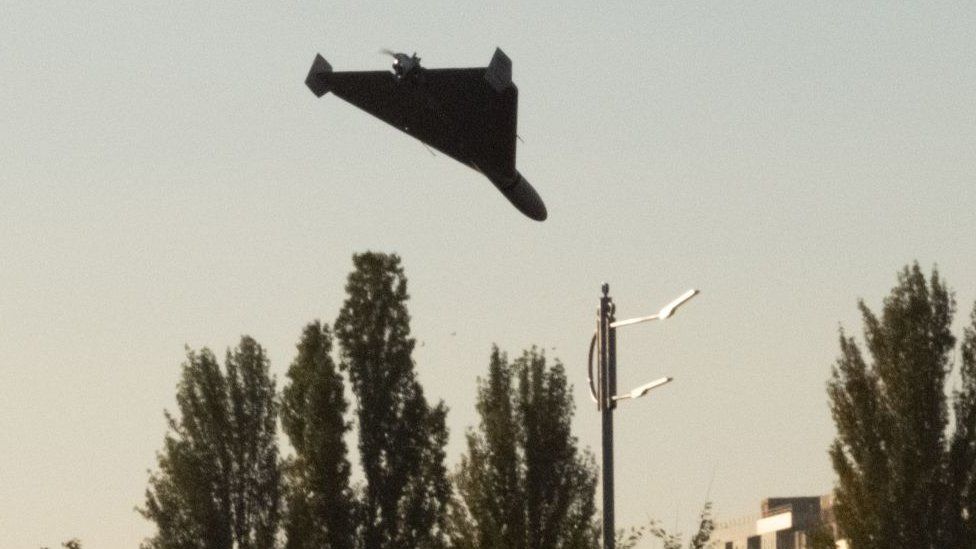
At least four explosions have occurred in the Ukrainian capital of Kyiv, with a presidential adviser accusing “kamikaze drones” launched by Russia.
“It shows their desperation,” said Andriy Yermak,head of Ukrainian President Zelensky’s staff.
Mayor Vitalii Klitschko said residential buildings in the central Shevchenkivskiy area had been damaged.
A week ago, the capital was hit by Russian missiles at rush hour, part of nationwide attacks which left 19 dead.
This morning’s attacks were from drones – the low buzzing of these slow-moving weapons is becoming familiar across the country.
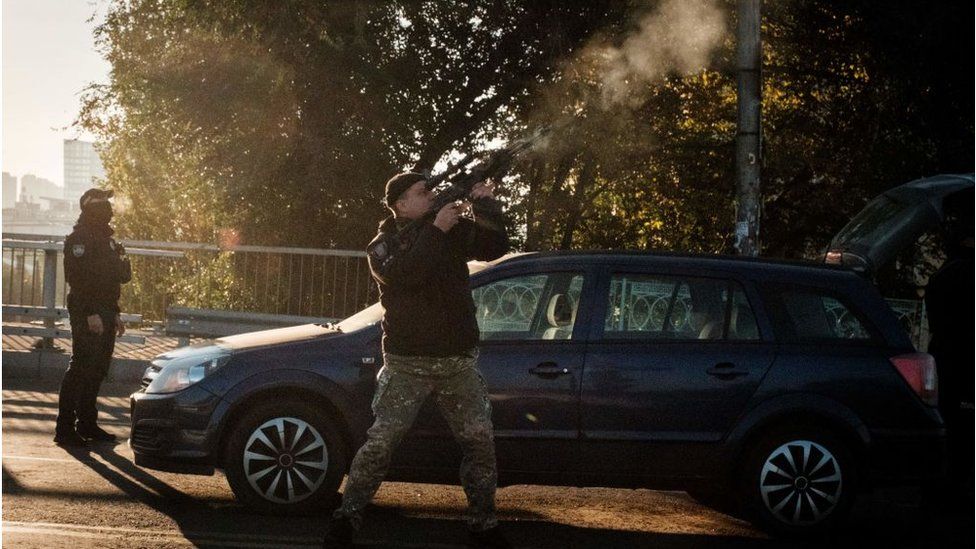
Kyiv reverberated to the rattle of gunfire as anti-aircraft batteries frantically tried to shoot them down. Video on social media appeared to show one interception.
The explosions on Monday began at around 06:30 local time (03:30 GMT), and there were at least five in total. The most recent was at around 08:10 local time.
Two were close to the city centre, with sirens and car alarms heard across the area.
What’s being targeted is hard to determine. The mayor’s office says residential and non-residential buildings have been hit. Railway officials say explosions were seen close to Kyiv’s main station.
Recent attacks have targeted Ukraine’s energy infrastructure. It will be surprised if that’s not the case today.
Writing on the Telegram social media site, Mr Klitschko said there were four strikes in Kyiv, although residents heard five or six explosions. He also told people to stay in air raid shelters.
But despite the warnings, the streets are far from deserted. Between the first and second set of strikes, plenty of people seemed to be going about their Monday morning business.
Mr Yermak described the kamikaze attacks as Russia’s “death throes”, and that Ukraine needed more air defence systems “as soon as possible”.
What are kamikaze drones?
Small aerial weapons, also known as loitering munitions, that are destroyed after striking the target
Unlike other drones – which are supposed to return home after dropping missiles – kamikaze drones are disposable
The name derives from the Japanese pilots who volunteered to crash their planes in suicide missions in World War Two
President Zelensky has previously accused Russia of using Iranian-made drones – Iran denies supplying them while Russia has not commented
Russian President Vladimir Putin said last week’s strikes were in retaliation for the bombing of a key bridge linking Russia to occupied Crimea, which he blamed on Ukraine.
It was the first time during the war that the centre of Kyiv had been directly targeted.
Earlier this week, Mr Putin said there was no need for more large-scale strikes on Ukraine. Most designated targets had been hit, he said, adding that it was not his aim to destroy the country.
IMAGE SOURCE,YASUYOSHI CHIBA Image caption, A drone seen in Kyiv on Monday
IMAGE SOURCE,YASUYOSHI CHIBA Image caption, A Ukrainian in Kyiv fires at a drone
European Union foreign ministers meeting in Luxembourg on Monday would not take any decisions on additional Iran sanctions after reports of drones delivered from Tehran to Moscow, Reuters has reported, citing an unnamed senior EU official.
The official added that the 27-nation bloc is still trying to find independent evidence for the alleged use of Iranian drones by Russia in Ukraine.
Iran, which blames NATO as the root of the Ukraine conflict, has denied supplying Russia with arms.
“The Islamic Republic of Iran has by no means supplied any side with arms to be used in the war in Ukraine, and its policy is to oppose arming either side with the aim of ending the war,” Hossein Amirabdollahian, Iran’s foreign minister, told his Polish counterpart on Sunday.
Russia’s Geneva U.N. envoy told Reuters on Thursday that Moscow has expressed reservations to the UN about a pact on Black Sea grain exports and is prepared to reject renewing the accord next month unless its demands are met.
The July accord, mediated by the UN and Turkey, allowed Ukraine to resume grain exports from Black Sea ports that had been closed since Russia’s invasion. Moscow obtained assurances for its own grain and fertiliser exports.
The agreement helped stave off a global food crisis: Russia and Ukraine are two of the world’s biggest grain exporters and Russia is the number one fertiliser exporter. But Moscow has repeatedly complained about its implementation, arguing it still faces difficulty selling fertilizer and food.
In an interview with Reuters, Gennady Gatilov, Russia’s ambassador to the United Nations in Geneva, said Moscow had delivered a letter to U.N. Secretary-General Antonio Guterres on Wednesday setting out a list of complaints. U.N. officials are due in Moscow on Sunday to discuss the renewal of the agreement.
“If we see nothing is happening on the Russian side of the deal – export of Russian grains and fertilisers – then excuse us, we will have to look at it in a different way,” he said.
He declined to make a copy of the letter available. A spokesperson for the United Nations did not immediately respond to a request for comment.
\Asked if Russia might withhold support for the grains deal’s renewal over the concerns, he said: “There is a possibility…We are not against deliveries of grains but this deal should be equal, it should be fair and fairly implemented by all sides.”
Gatilov, a career diplomat who was deputy minister of foreign affairs before taking up the Geneva post, said that he saw fading prospects for a negotiated settlement to the nearly eight-month war in Ukraine. He cited what he called “terrorist acts” such as an explosion on a bridge to Crimea.
“All this makes it more difficult to reach a political solution,” he said.
Washington has said that Russian claims to be open to talks on the war’s future amount to “posturing” as it continues to strike Ukrainian cities.
Asked about the prospect of a meeting between President Vladimir Putin and U.S. President Joe Biden, Gatilov said it was not feasible given the levels of U.S. military support for Ukraine. “It makes the U.S. a part of the conflict,” he said.
However, he was more upbeat on other negotiated outcomes such as on aid access and a further prisoner swap, calling these “a possibility”.
Former US ambassador to Russia Michael McFaul has been analysing the implications of Vladimir Putin’s latest escalation of his war on Ukraine.
In a Washington Post op-ed, he calls the president’s actions concerning but ultimately self-defeating.
He claims that the leader’s decision to illegally seize Ukrainian territory made reaching a peace agreement substantially more difficult.
In an op-ed in the Washington Post, he decries the president’s actions as worrying but also ultimately self-defeating.
He says the leader’s decision to illegally annex Ukrainian territory made a peace deal significantly harder
“With great difficulty, Ukrainian President Volodymyr Zelenskyy might have been able to fudge some sort of formula tacitly accepting Russian control over Crimea and Donbas, but it will be impossible for him to agree to comparable concessions on Kherson and Zaporizhzhia,” he writes.
Saying Mr Putin “has pushed himself into a corner”, he suggests “the only way to end this war might involve putting someone else in power in Moscow”.
“If the war continues to go badly, the voices quietly supporting suing for peace will grow,” he says.
“Tensions between the Russian military and intelligence services are already spilling into the open. These tensions will only grow if Russia’s soldiers continue to die and retreat in Ukraine.”
On the Russian leader’s threat’s around nuclear weapons, Mr McFaul says: “If Putin were to use a nuclear weapon (God forbid), that might also very likely deliver the final blow to his hold on power in Russia.
“No world leader would support him. The democratic world would be compelled to respond, both with more sophisticated weapons for Ukraine…
“After a nuclear attack, no Ukrainian leader would call for surrender. Instead, Zelensky would have every reason to bring the war to Russia, including attacks on targets in Moscow and other major cities. (Who doubts that Ukraine has sleeper cells in Moscow?) At the same time, it is hard to believe a majority of Russians would welcome the use of nuclear weapons against their Slavic neighbours.
“Putin would likely end up looking alone in his own country, a madman who must be stopped.
“The best way for Putin to hold on to power is to end his invasion today. He could declare victory regarding the defence of Donbas and then order his diplomats to settle into a long negotiation about the borders and political rights of those living in Donbas.
Russia is intensifying its targeted attacks on crucial infrastructure in Ukraine for the seventh day in a row.
Multiple Russian missile attacks jolted the Zaporizhzhia region’s capital overnight, as the city remained a target for Russian assault.
Zaporizhzhia regional Governor Oleksandr Starukh said Friday morning several explosions were reported in the city overnight at infrastructure facilities, causing fires.
Preliminary reports mentioned no victims.
Russian forces have struck the regional capital and the surrounding area continuously in recent days and weeks, creating concerns about the safety of the nearby nuclear power plant.
The regional capital is about 100 miles (160 kilometers) from the plant, which is the largest nuclear power facility in Europe.
The heavier Russian barrage began last Monday and comes as Ukraine pushes its military counteroffensive on the southern front.
Volunteers clear debris after an attack on Zaporizhzhia earlier this week.
Ukrainian officials have asked the Red Crossto send a team to a notorious prison camp in the country’s occupied east.
Andriy Yermak, the chief of staff of Ukraine’s president, has ordered that the International Committee of the Red Cross (ICRC) visit the Olenivka prison in Donetsk within three days.
“We just can’t waste more time. Human lives are at stake,” he tweeted.
Last month, the Red Cross tried to secure access to the camp but said it was denied by Russian authorities.
The Olenivka prison has been under the control of Russian-backed authorities in Donetsk since 2014, and conditions are said to be extremely poor.
In July, dozens of Ukrainian prisoners were killed in explosions at the camp, which both sides blamed on each other. Kyiv said the prison was targeted by Russia to destroy evidence of torture and killing, while Moscow blamed Ukrainian rockets. Without an independent investigation, however, the truth remains unknown.
Those detained at the site include members of the Azov battalion, who were the last defenders of the city of Mariupol and whom Russia has sought to depict as neo-Nazis and war criminals.
This is not the first time Ukraine has applied pressure on international organizations to investigate what is going on at the prison.
Mr Yermak said he had raised the issue again during a video conference with officials from the ICRC and other international organizations.
He has demanded the trip be made by Monday.
“Ukraine… will contribute to this mission in every possible way,” he said on Telegram, adding he did not understand why a mission to inspect Olenivka had not yet been arranged.
President Volodymyr Zelensky echoed the calls, and accused the Red Cross of inaction, saying it had “obligations, primarily of a moral nature”.
In his nightly address on Thursday, Mr Zelensky said he believed that the Red Cross was “not a club with privileges where one receives a salary and enjoys life”.
He said a mission to the prison camp could be organised similar to that of the International Atomic Energy Agency (IAEA), which visited the Russian-occupied Zaporizhzhia nuclear power station in August.
“But it requires leadership,” Mr Zelensky said in a thinly veiled criticism of the Red Cross. “The Red Cross can make it happen. But you have to try to make it happen.”
The ICRC has been contacted for comment.
Last month, the organisation’s Director-General Robert Mardini said talks were ongoing with Russian authorities about access to Olenivka – but were eventually denied.
“We are negotiating every day to have full access to all prisoners of war,” he told reporters. “It is clearly an absolute obligation [of] the parties to give the ICRC access to all prisoners of war.”
Also in his Thursday address President Zelensky said Ukraine would celebrate its Defenders Day on Friday, which was made a national holiday in 2014 after Russia’s invasion of Crimea.
“Tomorrow we will definitely celebrate… one of our most important days. The holiday of all our warriors – from ancient times to the present, from the Cossacks to the rebels, from all of them to the soldiers of the modern army,” he said.
Eighteen African countries abstained from voting for or against a United Nations resolution that condemned Russia over its illegal annexation of four Ukrainian territories.
Four others did not cast a vote at all meaning as many as 32 African countries voted in favour of the resolution that garnered 143 YES votes, 5 NO votes and 35 ABSTENTIONS.
A UN statement on the vote read: “The results were 143 Member States in favour, with five voting against, and 35 abstentions. The countries who voted against were Belarus, the Democratic People’s Republic of Korea, Nicaragua, Russia and Syria.
“A majority of those countries abstaining were African nations, alongside China and India.
“The resolution “defending the principles” of the UN Charter, notes that the regions of Donetsk, Kherson, Luhansk and Zaporizhzhia are temporarily occupied by Russia as a result of aggression, violating Ukraine’s territorial integrity, sovereignty and political independence,” it added.
The quartet that did not vote at all were, Burkina Faso, Cameroon, Equatorial Guinea and Sao Tome e Principe.
Twenty-six African countries voted in favour of a UN resolution rejecting Moscow’s contentious referendums in four Ukrainian regions that it declared part of Russia.
Nineteen countries abstained, including Eritrea that had previously voted to reject a UN resolution condemning Russia’s invasion of Ukraine.
Mali, the Central African Republic, Ethiopia, Congo-Brazzaville, South Africa, Sudan, Uganda and Zimbabwe also abstained.
Burkina Faso, Cameroon, Equatorial Guinea and Sao Tome were absent from the UN General Assembly during the vote.
Earlier this month, Ukraine’s Foreign Minister Dmytro Kuleba toured Africa to counter Russia’s apparent hold on the continent and persuade leaders to support Kyiv.
He cut the visit short after Russia intensified the bombardment of Ukraine.
United States President Joe Biden said the United Nations resolution against Russia’s annexations in Ukraine, passed with a historic majority, was a message to Moscow that it could not erase a sovereign state from the map.
“Today, the overwhelming majority of the world nations from every region, large and small, representing a wide array of ideologies and governments voted to defend the UN Charter.
“It condemns Russia’s illegal attempt to annex Ukrainian territory by force,” Biden said in a statement on Wednesday.
“The stakes of this conflict are clear to all and the world has sent a clear message in response: Russia cannot erase a sovereign state from the map.
“Russia cannot change borders by force. Russia cannot seize another country’s territory as its own,” Biden said.
“Nearly eight months into this war, the world has just demonstrated that it is more united, and more determined than ever to hold Russia accountable for its violations,” the US leader added.
The UN General Assembly on Wednesday condemned Russia’s recent move to annex the eastern Ukrainian regions of Donetsk, Kherson, Luhansk and Zaporizhzhya, by a vote of 143-5, with 35 countries abstaining.
All rights reserved. This material, and other digital content on this website, may not be reproduced, published, broadcast, rewritten or redistributed in whole or in part without prior express written permission from PUNCH.
A shortage of defence systems means Western allies are struggling to meet increasingly urgent requests to protect Ukraine’s skies from missile and drone attacks.
The UK will for the first time give Ukraine a number of powerful missiles to defend against Russian airstrikes, but it is not providing the weapons that launch them.
Instead, the AMRAAM rockets – capable of shooting down cruise missiles – will help to arm air defence systems that will be given to Ukraine by the United States.
A shortage of supply of these systems means Western allies, meeting this week in Brussels, are struggling to meet increasingly urgent requests from the government in Kyiv to protect Ukraine’s skies from Russian missile and drone attacks.
Asked by Sky News whether the failure of the West to give Ukraine more of these much-needed air defence systems faster was because of a lack of political will or a lack of supplies, US Defence Secretary Lloyd Austin pointedly only gave half an answer.
“Well certainly it’s not a question of lack of will,” he said on Wednesday at NATO headquarters in Brussels, speaking after chairing a contact group of NATO allies and other partners that have come together to pledge military support for Ukraine.
“The commitment, the resolve that the chairman [of the Joint Chiefs of Staff General Mike Milley] and I witnessed in this contact group meeting today was inspiring, and that’s what I told the members of the group. They remain committed to doing everything they can to generate additional capability.”
But a senior diplomat told Sky News a shortage of supply of air defence systems was a key factor limiting the ability of allies to respond to Ukraine’s needs.
The UK and other NATO members slashed defence spending, shrunk the size of their armed forces and reduced stockpiles of munitions following the end of the Cold War.
Russia’s invasion of Ukraine has belatedly triggered a rethink in funding for their collective security but it takes time to replenish stores.
The British air defence missiles, thought to number in the double digits, will arrive in Ukraine in the coming weeks.
“Russia’s latest indiscriminate strikes on civilian areas in Ukraine warrant further support to those seeking to defend their nation,” Ben Wallace, the defence secretary, said on Thursday in a statement released by the Ministry of Defence.
“So today I have authorised the supply of AMRAAM anti-aircraft missiles to Ukraine.
“These weapons will help Ukraine defend its skies from attacks and strengthen their overall missile defence alongside the US NASAMS.”
As NATO defence ministers gathered in Brussels to discuss additional support for Ukraine, he told Sky News there was no risk of Western allies running out of weapons to support Ukraine with because “unlike Russia” the West has the ability “to refurbish or indeed manufacture a new supply chain, which is what we’re doing right now”.
Mr Wallace said he would not “speculate” on how NATO would respond to a nuclear attack by Russia on Ukraine, adding: “The fundamentals are that NATO is an alliance of all types, conventional and nuclear powers, and fundamentally we are here to make sure our readiness is for whatever is thrown at us.”
Washington has pledged to send a total of eight National Advanced Surface-to-Air Missile Systems (NASAMS) to Ukraine, with the first two expected to be delivered soon and the other six over a longer period of time.
Germany has also delivered one air defence system, with three more due to arrive next year.
As well as the new rockets, the UK will also donate hundreds of additional, less-powerful air defence missiles as well as hundreds of drones and 18 more howitzer artillery guns.
The announcement came as NATO defence ministers meet for a second day in Brussels on Thursday, though Mr Wallace was not present at Wednesday’s gathering.
They are expected to discuss ways to rebuild their own munitions stockpilesand work together to source weapons for their security as well as to keep supporting Ukraine for the long term.
Twenty-six African countries have voted in favour of a UN resolution rejecting Moscow’s contentious referendums in four Ukrainian regions that it declared part of Russia.
Nineteen countries abstained, including Eritrea that had previously voted to reject a UN resolution condemning Russia’s invasion of Ukraine.
Russia’s perceived allies, including Mali, the Central African Republic, Ethiopia, Republic of Congo, South Africa, Sudan, Uganda and Zimbabwe are also among other African countries that abstained.
Three of these countries hosted Russia’s top diplomat Sergei Lavrov when he toured the region in July.
Burkina Faso, Cameroon, Equatorial Guinea and Sao Tome were absent from the assembly.
Earlier this month, Ukraine’s Foreign Minister Dmytro Kuleba toured Africa to counter Russia’s apparent hold on the continent and persuade leaders to support Kyiv.
He was forced to cut the visit short after Moscow heightened bombardments on Ukraine.
The top United Statesgeneral has condemned Russian missile strikes on Ukraine that killed civilians, suggesting they met the definition of war crimes under the international rules of war.
“Russia has deliberately struck civilian infrastructure with the purpose of harming civilians,” Army General Mark Milley, chairman of the Joint Chiefs of Staff, said at NATO headquarters in Brussels.
“They have targeted the elderly, the women, and the children of Ukraine,” he said. “Indiscriminate and deliberate attacks on civilian targets is a war crimein the international rules of war.”
The Russian leader says a mothballed pipeline can ferry energy exports west if it is proven safe following a spate of recent explosions.
Russian President Vladimir Putin has said Moscow is ready to resume gas supplies to the European Union via a link of the Germany-bound Nord Stream 2 pipeline under the Baltic Sea – an offer quickly rejected by Berlin.
Speaking at a Moscow energy forum on Wednesday, Putin said that one of the two links of the pipeline remained pressurised despite a series of ruptures last month which caused major leaks, sending gas spewing out off the coast of Denmark and Sweden.
TheNord Stream 1pipeline was also ruptured by powerful underwater explosions in September.
Western officials have linked the incidents to “sabotage” but have held back from attributing responsibility for the blasts while investigations by German, Danish and Swedish officials continue.
Putin said that if checks prove the Nord Stream 2 link is safe to operate, Russia stands ready to use the pipeline to pump gas to Europe, adding its capacity stands at 27 billion cubic meters (bcm) a year.
The Nord Stream 2 pipeline has never brought natural gas to Europe because Germany prevented the flows from ever starting just before Russia launched military action in Ukraine on February 24.
Putin also repeated an earlier accusation that the United States was likely behind the blasts on the Nord Stream pipelines, without providing any evidence to support his claim, and floated the idea of creating an alternative European gas hub via Turkey.
“The act of sabotage of the Nord Stream 1 and 2 is an act of international terrorism aimed at undermining energy security of the entire continent by blockingsupplies of cheap energy,” Putin said, alleging that the US wants to force Europe to switch to importing more expensive liquefied natural gas.
The White Houseis considering a complete ban on Russian aluminium in response to Russia’s military escalation in Ukraine, Bloomberg reports.
Talks are underway to raise tariffs to levels so punitive they would impose an effective ban, or sanctioning of United Co Rusal International PJSC, the company that produces Russia’s metal, Bloomberg said, citing sources familiar with the decision-making.
The report also said the White House had held off sanctioning Russian aluminium at the start of the invasion out of fear it could disrupt global suppliers.
But there were fewer products remaining for the US and Ukraine’s allies to ban now, Bloomberg said.
In response to the report, a White House official said: “We’re always considering all options. There is no movement on this as of now.”
Vladimir Putin has attempted to justify Monday’s deadly missile strikes targeting cities in Ukraine as retaliation for its “terrorist action” against Russian territory.
The Russian president said the strikes were a response to an attack on the Kerch Bridge which links Russia to the annexed Crimean peninsula.
And he claimed Ukraine had also “tried to blow up” the TurkStream natural gas pipeline – notably switching from calling Ukrainians “terrorists” rather than “Nazis” as he has in the recent past.
Writing in The Guardian, chair of the steering committee of the Ukraine Forum at Chatham House, Simon Smith, said the newest label Mr Putin is using for Ukrainians signals “he is paying no heed to any waning commitment to the war among the population at large, following his mobilisation decision”.
He goes on to write it is “partly an internal message: to underline to his ‘party of war’ that he’s one of them, that he’s lost no time in launching an act of vengeance for this purported ‘terrorist’ outrage.”
Mr Smith writes that for those who have not condemned Russia’s attacks on Ukraine, “Putin’s hope is that those with no time to read beyond the ‘terrorist’ label will lazily reassure themselves that there are, after all, bad lots on both sides and that it’s okay to continue to sit on the fence”.
“Perhaps we’ll see the ‘terrorist’ label emerge as part of a new Putinist rhetorical strategy, to replace the ‘Nazi’ label he ludicrously attached to Ukraine’s administration in his ‘justification’ of the 2022 invasion.”
DISCLAIMER: Independentghana.com will not be liable for any inaccuracies contained in this article. The views expressed in the article are solely those of the author and do not reflect those of The Independent Ghana
Russian forces have depleted a significant proportion of their precision-guided ammunition and the Kremlincannot produce all kinds of ammunition and weapon systems due to Western sanctions, a NATO official has said.
The official also suggested it could take months for Russia to mobilise the number of fighters it was aiming for.
Russia’s defence minister Sergei Shoigu has previously suggested 300,000 men with military experience would be called up to bolster Russia’s war efforts in Ukraine, although Mr Putin’s decree did not disclose a number.
Officials from two separate regions also said this week they had received new orders to mobilise troops, raising fears a second wave of men could be called up to serve in the army.
The governor of Russia’s Rostov region said he had received a “new mobilisation assignment”, while the deputy head of the Kursk region was quoted as saying they had been given a “second” mobilization target.
After allegedly setting fire to a Russian bank in St. Petersburg in an apparent act of protest against the Kremlin’s invasion of Ukraine, a pensioner has been taken into custody by police.
A small fire can be seen in the on-scene video at the Sberbank branch’s entryway as people gather outside.
Following Russia’s invasion of Ukraine, the UK imposed an asset freeze on Sberbank – the biggest lender in Russia – while the US introduced “full blocking sanctions” which meant the bank could no longer transact with any American individual or institution.
In St.Petersburg, a pensioner with the words “Glory to Ukraine!” tried to set fire to the local branch of Sberbank.
We have been reporting todayabout the potential for Vladimir Putin to launch a nuclear attack and what the consequences of that might be.
Now, footage shared by the BBC’s Francis Scarr, who analyses Russian television, shows a Russian TV presenter calling for more strikes in the country.
During a panel discussion on Russia’s state television, Bogdan Bezpalko said the strikes on Monday “could not be a one-off”.
“It needs to be constant, for two to five weeks in order to disable all their infrastructure entirely,” he said.
“All their combined heat and power stations, thermal power stations, electrical power stations, all the traction substations, all power lines, all railway hubs.
“And then Ukraine will descend into cold and darkness. They won’t be able to bring in ammunition or fuel, and then the Ukrainian army will turn into a crowd of armed men with chunks of iron.
“This needs to be done constantly, not just once.”
Mr Bezpalko added that Ukrainian President Volodymyr Zelenskyywould use the recent attacks on the country to “request even more money and arms” and therefore it was important to “batter them constantly”.
Just another totally normal day on Russian TV
Talking head Bogdan Bezpalko says Ukraine needs to be “constantly battered” by missile strikes for several weeks so that the country “descends into cold and darkness” pic.twitter.com/aP8mdzVPsq
From October 25, Russian tourists holding Schengen-zone visas issued by any country will no longer be allowed to enter the Czech Republic.
In recent months, countries bordering Russia, like the Baltic states, along with Finland and Poland, have barred Russian tourists.
Meanwhile, the Czech Republic immediately stopped visas for Russians, except on humanitarian grounds, after Moscow’s invasion of Ukraine but allowed in visitors at airports who had visas issued by other countries in the EU’s Schengen travel zone.
Now, the tightening of rules, approved by the government today, means even those with EU visas from other states will not be allowed to enter.
“While Russian rockets fall on a children’s playground and on people in Ukraine, up to 200 Russian Federation citizens travel to the Czech Republic via international airports every day,” the Czech Republic’s foreign minister Jan Lipavsky said.
The ban will be for Russians holding visas for tourism, sport, or culture, Mr Lipavsky added.
It’s the question we’ve been asking for months now, even before Russia invaded Ukraine.
What is Vladimir Putin thinking and planning?
Let me get the disclaimer in early. I have no Kremlin crystal ball. Neither do I have Putin on direct dial.
Former US President George W Bush once said he’d looked Vladimir Putin in the eye and “got a sense of his soul”. Look how well that ended for relations between Russia and the West.
So, getting inside the mind of the Kremlin leader is a pretty thankless task. But it’s important to try. Perhaps more than ever now, in light of recent nuclear sabre-rattling by Moscow.
There’s little doubt that the Russian president is under pressure. His so-called “special military operation” in Ukraine has gone badly wrong for him.
It was supposed to last a few days. But we’re nearly eight months in and there’s no end in sight.
The Kremlin admits “significant” troop losses; in recent weeks the Russian military has been losing territory in Ukraine which it had previously occupied.
To boost troop numbers, last month President Putin declared partial mobilisation, something he’d insisted he wouldn’t do. Meanwhile, sanctions continue to degrade the Russian economy.
So, back to Putin’s state of mind. Will he be thinking he got it all wrong, that his decision to invade was a fundamental error?
Don’t assume so.
“Putin’s perceptions drive the entire situation in this conflict,” believes Konstantin Remchukov, owner and editor-in-chief of the Russian newspaper Nezavisimaya Gazeta.
“He is the authoritarian leader of nuclear power. He’s the unchallenged leader in this country. He has some strong beliefs and perceptions which drive him crazy. He’s started to believe that this is existential from the point of view of importance. Not only for him. But for the future of Russia.”
If this conflict is existential, how far is President Putin prepared to go to win it?
In recent months senior Russian officials (including Putin himself) have been dropping unsubtle hints that the Kremlin leaderwould be prepared to use nuclear weapons in this conflict.
“I don’t think he will,” US President Joe Biden told CNN. “But I think that it’s irresponsible for him to talk about it.”
IMAGE SOURCE,EPA Image caption, Russian troops were forced to make a humiliating retreat from nearly all of Ukraine’s north-eastern Kharkiv region in September
This week’s intense Russian bombardment of Ukraine suggests the Kremlin is, at the very least, determined to escalate things with Kyiv.
With the West, too?
“He’s trying to avoid direct confrontation with the West, but at the same time he’s prepared for it,” believes veteran liberal politician Grigory Yavlinsky. “I fear most the possibility of nuclear conflict. And, on the second place, I fear endless war”.
But “endless war” requires endless resources. That’s something Russia doesn’t seem to have. The wave of missile strikes on Ukrainian cities is a dramatic demonstration of force, but how long can Moscow sustain that?
“Could you continue this missile flow for days, weeks, months? Many experts doubt that we have enough missiles,” says Mr Remchukov.
“Also, from the military point of view, no one has ever said what would be the sign of ultimate [Russian] victory? What is the symbol of victory? In 1945 it was the banner over Berlin. What is the criteria for success now? [A banner] over Kyiv? Over Kherson? Over Kharkiv? I don’t know. Nobody knows.”
It’s not even clear that Vladimir Putin knows.
Back in February, the Kremlin’s objective appears to have been the rapid defeat of Ukraine, forcing Russia’s neighbour back into Moscow’s orbit without a prolonged war. He miscalculated. He underestimated not only the determination of the Ukrainian army and people to defend their land but the capabilities of his own military.
What’s he thinking now? Is Vladimir Putin’s current plan to cement control over Ukrainian territory he claims to have annexed and then freeze the conflict? Or is he determined to push on until the whole of Ukraine is back in the Kremlin’s sphere of influence?
This week former Russian president Dmitry Medvedev wrote: “The Ukrainian state in its current configuration… will be a constant, direct, and clear threat to Russia. I believe the aim of our future actions should be the complete dismantling of Ukraine’s political regime.”
If Mr Medvedev’s words reflect President Putin’s thinking, expect a protracted and bloody conflict.
IMAGE SOURCE,REUTERS Image caption, Russia’s military says it wants to mobilise 300,000 reservists – but there appears to be growing opposition to the move across the country
But, inevitably, Mr Putin’s actions abroad are having consequences at home. Over years the Kremlin painstakingly cultivated Putin’s image of “Mr Stability”, encouraging the Russian public to believe that as long as he was in charge they would be safe.
That’s a hard sell now.
“The previous contract between Putin and society was that ‘I protect you,” says Mr Remchukov.
“For many years the main slogan was ‘predictability’. What kind of predictability is there today? The concept is over. Nothing is predictable. My journalists don’t know whether they will receive call-up papers when they get home today.”
Vladimir Putin‘s decision to invade Ukraine surprised many. But not Mr Yavlinsky.
“I think that [Putin] had been moving in that direction – year by year he was constructing the way to what we have now,” Mr Yavlinsky says.
“For example, destroying independent media. He stated that in 2001. Destroying independent business. He stated that in 2003. Then 2014 and what happened with Crimea and Donbas? You’d have to be blind not to see it.
“Russia’s problem is our system. A system was created here that created such a person [as Putin]. The question of the West’s role in creating this system is a very serious one.
“The problem is that this system didn’t create a society. There are a lot of very nice people in Russia. But there is no civil society. That’s why Russia can’t resist.”
DISCLAIMER: Independentghana.com will not be liable for any inaccuracies contained in this article. The views expressed in the article are solely those of the author’s and do not reflect those of The Independent Ghana
Elon Musk has refuted claims that he communicated with Vladimir Putin before putting his recommendations for stopping Russia’s invasion of Ukraine in a Twitter poll.
Ian Bremmer, head of the Eurasia Group political risk consultancy, alleged that Mr Musk had personally told him about the conversation with Mr Putin.
But Mr Musk has now refuted this.
“I have spoken to Putin only once and that was about 18 months ago. The subject matter was space,” Mr Musk tweeted.
Last week, the Tesla CEO asked his 107.7 million followers to vote on ways to resolve the Ukraine war.
The suggestions included a proposal to hold votes in parts of Ukraine occupied by Russia that the Kremlin says it has annexed. His comments were welcomed by Moscow.
The multi-billionaire said: “Russia leaves if that is the will of the people.”
President Putin has already declared four Ukrainian regions to be part of Russia, following so-called referendumsdenounced as fraudulent by Kyiv and its Western allies. Russia does not fully control any of the four regions.
Mr Musk also suggested the world should “formally” recognise Crimea – illegally annexed by Moscow in 2014 – as part of Russia.
In a newsletter, Mr Bremmer wrote that Mr Musk told him the Russian president was “prepared to negotiate”, but only if Crimea remained under Russian control if Ukraine accepted a form of permanent neutrality, and if Kyiv recognised Russia’s annexation of Luhansk, Donetsk, Kherson, and Zaporizhzhia.
Mr Bremmer said the SpaceX boss told him that Mr Putin said these goals would be accomplished “no matter what” and that there was the potential of a nuclear strike if Ukraine invaded Crimea.
But Mr Musk has since denied the reports.
No, it is not. I have spoken to Putin only once and that was about 18 months ago. The subject matter was space.
Ukrainian Foreign Minister Dmytro Kuleba said people proposing Ukraine give up on its people and land “must stop using the word ‘peace’ as a euphemism to ‘let Russians murder and rape thousands more innocent Ukrainians, and grab more land’”.
Russian chess grandmaster Garry Kasparov called Mr Musk’s tweet “moral idiocy, repetition of Kremlin propaganda, a betrayal of Ukrainian courage & sacrifice”.
Kremlin spokesman Dmitry Peskov welcomed Mr Musk’s suggestions, stating: “It is very positive that somebody like Elon Musk is looking for a peaceful way out of this situation.”
Early in the war, the billionaire gained widespread popularity in Ukraine after sending a number of his Starlink internet terminals to the country. He was subsequently invited to visit by Ukrainian President Volodymyr Zelensky.
But his recent tweets have seen that relationship sour, with Mr Zelensky last week hitting out at his Twitter polls.
US federal law prevents private citizens from conducting foreign affairs without the permission or involvement of the US government.
The Logan Actwas signed into law by President John Adams in 1799, but nobody has ever been prosecuted under it.
The EU suspects sabotage caused the damage to the Nord Stream gas pipelines last month, and Russia has come under suspicion, but it is not known for definite who was to blame.
The head of the alliance has promised that a planned attack on NATO’s energy sources will be faced with a “united and determined response.”
Secretary-General Jens Stoltenberg pledged to boost the protection of critical infrastructure in response to the damage to the Nord Stream gas pipelines.
The EU believes three leaks in the pipelines last month were the work of sabotage and suspicion has fallen on Russia, but it is not known for sure who was responsible.
Mr Stoltenberg said NATO has doubled its presence in the Baltic and the North Sea to more than 30 ships supported by aircraft and undersea activities.
In a speech on Tuesday, he also said the alliance is monitoring Russia’s nuclear forces closely as the country was “losing on the battlefield” in Ukraine.
Meanwhile, Moscow has issued a fresh warning to the West over its involvement in the Ukraine war.
Deputy foreign minister Sergei Ryabkov said Russia will take adequate countermeasures in response to the West’s “growing involvement”.
In the comments reported by the state-owned RIA news agency, he said: “We warn and hope that they realise the danger of uncontrolled escalation in Washington and other Western capitals.”
Russian bombs have rained down on Ukraine, killing at least 14 people on Monday.
Vladimir Putin said the strikes were in retaliation for its “terrorist action” against Russian territory – the attack on the Kerch Strait Bridge in occupied Crimea – but Ukraine has rejected this claim of “provocation”.
Ukrainian President Volodymyr Zelenskyy has vowed to make the battlefield “more painful” for Russian troops in response to the rocket attacks and said air defence was the “number one priority”.
Despite remarkable Ukrainian battlefield successes – both early on in the war with the defence of Kyiv and more recently with counterattacks in Kharkiv and Kherson regions – the war could continue for decades to come, one expert said.
Sky News security and defence analyst Professor Michael Clarke said the war is likely to be a “generational struggle” and could be a “forever conflict” until “something changes in European security or Russia”.
Mr Clarke said the current crisis in Ukraine was the “second war” and the first war was witnessed in 2014 when Russia annexed Crimea.
He added: “My feeling is next year there will be a ceasefire in which the Ukrainians will be better placed and that ceasefire will be unstable and it will break down and there will be a third war and then a ceasefire and a fourth war.
“We’re dealing here with an existential struggle because the Russian establishment thinks that Ukraine has no right to exist and they won’t change their mind in the short-term.
“This is likely to be a generational struggle. Let’s say it’s going to last 30,40 or 50 years.”
A deliberate attack on NATO energy supplies will be met with a “united and determined response”, the alliance’s chief has vowed.
Secretary-General Jens Stoltenberg pledged to boost protection of critical infrastructure in response to the damage to the Nord Stream gas pipelines.
The EU believes three leaks in the pipelines last month were the work of sabotage and suspicion has fallen on Russia, but it is not known for sure who was responsible.
Mr Stoltenberg said NATO has doubled its presence in the Baltic and the North Sea to more than 30 ships supported by aircraft and undersea activities.
In a speech on Tuesday, he also said the alliance is monitoring Russia’s nuclear forces closely as the country was “losing on the battlefield” in Ukraine.
Meanwhile, Moscow has issued a fresh warning to the West over its involvement in the Ukraine war.
Deputy foreign minister Sergei Ryabkov said Russia will take adequate countermeasures in response to the West’s “growing involvement”.
In the comments reported by the state-owned RIA news agency, he said: “We warn and hope that they realise the danger of uncontrolled escalation in Washington and other Western capitals.”
Russian bombs have rained down on Ukraine, killing at least 14 people on Monday.
Vladimir Putin said the strikes were in retaliation for its “terrorist action” against Russian territory – the attack on the Kerch Strait Bridge in occupied Crimea – but Ukraine has rejected this claim of “provocation”.
Ukrainian President Volodymyr Zelenskyy has vowed to make the battlefield “more painful” for Russian troops in response to the rocket attacks and said air defence was the “number one priority”.
Despite remarkable Ukrainian battlefield successes – both early on in the war with the defence of Kyiv and more recently with counterattacks in Kharkiv and Kherson regions – the war could continue for decades to come, one expert said.
Sky News security and defence analyst Professor Michael Clarke said the war is likely to be a “generational struggle” and could be a “forever conflict” until “something changes in European security or Russia”.
Mr Clarke said the current crisis in Ukraine was the “second war” and the first war was witnessed in 2014 when Russia annexed Crimea.
He added: “My feeling is next year there will be a ceasefire in which the Ukrainians will be better placed and that ceasefire will be unstable and it will break down and there will be a third war and then a ceasefire and a fourth war.
“We’re dealing here with an existential struggle because the Russian establishment thinks that Ukraine has no right to exist and they won’t change their mind in the short-term.
“This is likely to be a generational struggle. Let’s say it’s going to last 30,40 or 50 years.”
In connection to the explosion that occurred on a crucial bridge connecting Russia and Crimea on Saturday, Russia claims to have apprehended eight persons.
Five of those detained, according to its FSB security force, were Russians, while the others were Ukrainian and Armenian.
The FSB has accused the Ukrainian security services of being behind the attack on the bridge.
The news came as explosions were reported in the Ukrainian cities of Kherson, Zaporizhzhia, and Nikopol.
The BBC’s Hugo Bachega in Kyivsaid five explosions had been heard in Kherson, one of the largest cities under Russian occupation, while there were unconfirmed reports that the air defence system in the city had been activated.
He said it was not clear what had triggered the explosions.
The blast on the Crimea Bridge was a powerful symbolic blow to Russian President Vladimir Putin, who opened the bridge in 2018, four years after Russia’s annexation of Crimea.
President Putin called it an “act of terrorism”, saying Ukraine’s intelligence forces had aimed to destroy a critically important piece of Russia’s civil infrastructure.
Russian forces retaliated on Monday with a wave of missile strikes across the country, including central Kyiv, killing 19 people.
Following more strikes on Tuesday, Ukrainian President Volodymyr Zelensky has urged countries to hit Russia with more sanctions in response to “a new wave of terror“.
He called on the West to find new ways to apply political pressure to Russia and support Ukraine.
The calls came after he met the G7 group of nations for emergency virtual talks on Tuesday.
The bloc – which consists of Canada, France, Germany, Italy, Japan, the UK, and the US – promised to continue providing “financial, humanitarian, military, diplomatic and legal” support to his country “for as long as it takes”.
Nato also said it would stand with Ukraine for as long as necessary.
In another development, Polish pipeline operator Pern said it had detected a leak in one pipeline in the Druzhba system that carries oil from Russia to Europe.
The discovery follows leaks in the Nord Stream undersea gas pipelines that transport Russian gas to Europe, which have been widely blamed on sabotage.
Europe is facing a severe energy crisis in the aftermath of Moscow‘s invasion of Ukraine as it tries to wean itself off Russian gas and oil.
The continent has imposed tough sanctions on Russia in an effort to put economic pressure on the Kremlin.
Pern said that at this point, the causes of the leak were unknown. It was detected in a section of the pipe about 70km from the central Polish city of Plock.
Ukraine has indicated that it will continue its counter-offensive reclaiming land annexed by Russia in the south and east, despite yesterday’s escalation of missile attacks, a senior politician has told BBC News.
Our diplomatic correspondent Paul Adams spoke with Ihor Zhovkva, deputy head of Ukrainian President Volodymyr Zelensky’s office.
Zhovkva said Monday’s strikes were designed to cause panic, hitting major cities in the middle of rush hour.
But, he said, Russian President Vladimir Putin had failed to intimidate Ukrainians, even with the greater intensity of the strikes, which were seemingly targeted at both critical infrastructure and civilian targets.
As part of his nightly address on Monday, President Volodymr Zelensky filmed himself near recovery vehicles appearing to clean up one of the sites of the missile attacks.
“Restoration work is currently under way across the country. We will restore all objects that were damaged by today’s attack by Russian terrorists. It’s only a matter of time,” he said.
Zelensky added that Ukraine had managed to shoot down more than half of Russia’s missiles and drones , but he also warned of the ongoing threat.
“Follow the safety rules and pay attention to air sirens. The danger is still here but we are fighting,” the president cautioned.
Zelensky concluded his address by stating that Russia resorted to missile attacks because “they cannot oppose us on the battlefield.”
“Well, let’s make the battlefield even more painful for the enemy,” he said.
The UK’s Ministry of Defence (MoD) has given its daily update on the war in Ukraine.
It says the Kremlin’s appointment of hard-line General Sergei Surovikin to lead forces in Ukraine is probably an effort to improve the “delivery of the operation”.
However, he may have to contend with an “increasingly factional” and “poorly resourced” Russian defence ministry, the MoD says.
“Russia has likely lacked a single empowered field commander” for much of the war, the update says.
It’s thought that General Alexandr Dvornikov did hold this role between April and August, although it’s not clear how much control he held over the “often disparate and competing groupings of forces”.
Russian forceswill soon be down to their last supplies of fuel and unable to transport their troops in Ukraine after the crippling attack on the Kerch Bridge between Crimea and Russia, say analysts.
“If we’re talking about the ability to manoeuvre, ie drive places, I think we are talking days into very short weeks of supply,” intelligence analyst Forbes McKenzie told Sky News.
Ukrainians have been degrading Russian logistics with artillery and well-targeted HIMARS rocket attacks, but the Kerch Bridge attack has left Russians even more exposed.
They will soon be unable to move their troops, say, observers, which will put them in huge difficulty if the Ukrainians continue advancing.
Mr McKenzie said: “Can they stand and fight? They could sustain that likely through the winter time but if Ukraine has Russia on the move, ie they are dominating the battle space, pushing them back, forcing the Russians to manoeuvre and there’s no diesel to manoeuvre the armour with, it’s highly likely the armour will be left in place.”
President Vladimir Putin will have hoped his missile onslaught across Ukraine today has projected an image of strength. They are being read in the West as quite the opposite. The act of an increasingly desperate commander running out of options.
Mr Putin today warned that the missile attacks could be repeated if Ukrainecarried out more “terrorist” attacks such as that on the Kerch Bridge. But military analysts in the West question his ability to do so.
Long-distance precision-guided weapons are expensive to produce and Russia has used up many of its supplies. Russia has also bolstered its arsenal with Iranian-supplied Shaheed drones.
But they too are being depleted. Ukraine has been effective at locating the warehouses where they are being stored and destroying them. Both forms of munitions are finite resources.
The Russian missile attacks follow a series of retreats and defeats by their forces on the ground.
If the Ukrainians are able to move quickly enough and push the Russians back fast enough, they may force them to abandon their armour.
“We could see the Ukrainians stealing their entire armoured capability,” says Mr McKenzie.
That would be a humiliating outcome for President Putin which would pose an existential threat. He cannot afford to look weak or fail in this war.
His military is on the back foot and increasingly threatened by Ukrainian advances and now, say western observers, starved of logistics.
His position is looking increasingly desperate and he is running out of time.
DISCLAIMER: Independentghana.com will not be liable for any inaccuracies contained in this article. The views expressed in the article are solely those of the author and do not reflect those of The Independent Ghana
Russia’s missile attacks on Ukraine this morning have been “seriously criticised” by US President Joe Biden.
In a statement, Mr Biden said: “These attacks killed and injured civilians and destroyed targets with no military purpose.
“They once again demonstrate the utter brutality of Mr Putin’s illegal war on the Ukrainian people.”
The US leader went on to offer his condolences to the families and loved ones of those who were “senselessly killed”.
“These attacks only further reinforce our commitment to stand with the people of Ukraine for as long as it takes,” he added.
“Alongside our allies and partners, we will continue to impose costs on Russia for its aggression, hold Putin and Russiaaccountable for its atrocities and war crimes, and provide the support necessary for Ukrainian forces to defend their country and their freedom.
“We again call on Russia to end this unprovoked aggression immediately and remove its troops from Ukraine.”
The thermal generation and electrical substations were struck by today’s missile strikes, according to the Ukrainian ministry of energy, which means that starting tomorrow, it will no longer be able to supply electricity to the European Union.
The interruption will help Ukraine stabilise its own energy system, the ministry said in a statement on its website.
Ukraine started exporting power to the European Union on 1 July. At the time, President Volodymir Zelensky said the launching of power transmissions was the start of a processthat could help Europe reduce its dependence on Russian hydrocarbons, Reuters reported then.
Following the attacks in Kyiv this morning, a Russian military expert labeled Ukraine a “psychiatrically sick society.”
Footage shared by the BBC’s Francis Scarr shows Alexander Artamonov telling Russian state television that the “strikes need to continue systematically” following the attack.
There are fears Ukraine could see more strikes after Vladimir Putinwarned of a “harsh” response if attacks against Russia continued.
Earlier today, he told a Security Council: “The responses will be of the same scale as the threats to Russia.
“In the event of further attempts to carry out terrorist acts on our territory, Russia’s response will be harsh.”
Just when you thought Russian state TV couldn’t go any lower, military pundit Alexander Artamonov comes along while this morning’s strikes were still continuing all across Ukraine, and brands the country a “psychiatrically sick society” pic.twitter.com/udgGGIa7Kd
President Vladimir Putin chaired a meeting of his security council today – an unusual occurrence, as these meetings are usually held on Fridays.
In a statement that was broadcast by state news channels, he accused Ukraine of bombing the Turkish Stream gas pipeline – a natural gas pipeline running from Russia to Turkey through the Black Sea.
Putin also said that Ukraine had attacked the Kursk nuclear power plant in western Russia, going back to accusations from last August, when Russia’s FSB security service said Ukrainian saboteurs had blown up electricity pylons in the Kursk region, about 100km (60 miles) from Ukraine’s north-east border.
At the time, the FSB said the attacks had affected the “technological process of functioning” of the Kursk nuclear plant.
In his statement, Putin also said that Ukraine was behind attacks on the Zaporizhzhia power plant, which he said amounted to “atomic terrorism”. Ukraine and Russia have frequently traded accusations of shelling the facility.
Putin added that “should attempts to carry out terrorist attacks on the territory of the Russian Federation continue, the response will be harsh and proportionate to the level of the threats”.
Dmytro Kuleba has responded to Vladimir Putin‘s comments in the last few minutes, saying: “No, Putin was not provoked to unleash missile terror.”
Mr Putin claimed Monday’s deadly missile strikes targeting cities in Ukraine were in retaliation for its “terrorist action” against Russian territory – namely the hit on Kerch bridge this weekend.
But Mr Kuleba refutes this, saying: “This nonsenseabout being provoked must stop. He does not need anything to provoke him in order to commit heinous crimes.”
No, Putin was not “provoked” to unleash missile terror by “Crimea Bridge”. Russia had been constantly hitting Ukraine with missiles before the bridge, too. Putin is desperate because of battlefield defeats and uses missile terror to try to change the pace of war in his favor 1/2
The building housing the German consulate in Kyiv has been by a Russian missile strike, according to Germany’s foreign ministry.
There have been no casualties reported. It has emerged that the building has not been in use by Germany since the war broke out.
The former chairman of the Böll Foundation in Kyiv, Sergei Sumlenny, posted photos on Twitter and said addressing Chancellor Olaf Scholz (64, SPD) and Foreign Minister Annalena Baerbock (41, Greens):
“The building where the visa office of the German embassy in Kyiv was located was hit by Russians today. Maybe some Leopards can be sent to check the situation on the ground?”
Former US President Donald Trump is blaming his side for “almost forcing” Russian President Vladimir Putin to orchestrate Ukraine’s invasion.
According to him, should he have won the 2020 election and not President Joe Biden, the war between Russia and Ukraine would never have happened.
During an interview on Saturday morning on Real America’s Voice, a right-wing network, the former president said “Ukraine and Russia would not be fighting. It doesn’t mean they’d love each other, but there’s no way they’d be fighting, and there’s no way Putin would have actually gone in.”
“They actually taunted him, if you really look at it, our country and our so-called leadership taunted Putin,” Trump said. “I would listen, I would say, you know, they’re almost forcing him to go in with what they’re saying. The rhetoric was so dumb,” he added.
Trump did not provide any examples of how the US or President Joe Biden “taunted” Putin or what was the supposedly “dumb” rhetoric.
In the build-up to Russia’s invasion of Ukraine, Trump made the same baseless claim that Putin would not have invaded if he was still in power. He cited his positive relationship with the Russian leader.
“I knew Putin very well. I got along with him great. He liked me. I liked him,” Trump said during a “Clay Travis and Buck Sexton Show” appearance on February 22. “I mean, you know, he’s a tough cookie, got a lot of the great charm and a lot of pride, and he loves his country.”
Trump also controversially described Putin’s justification for invading as “savvy” and “genius.”
Trump said the United States “taunted Putin” to the point “of almost forcing him” to invade Ukraine. pic.twitter.com/K29QW8aOoP
At least 17 people have been killed by Russian missile strikes on the south-eastern city of Zaporizhzhia, the Ukraine defence ministry has said.
Dozens more were wounded, and several residential buildings destroyed.
The city is under Ukrainian control, but it is part of a region that Russia claimed it annexed last month.
Zaporizhzhia has been hit repeatedly in recent weeks, as Russia hits back at urban areas after suffering defeats in the south and north-east of Ukraine.
Parts of the Zaporizhzhia region, including its nuclear power plant – which is around 30 miles (52km) from the city – have been under Russian control since early in the invasion.
The Ukrainian regional governor in Zaporizhzhia, Oleksandr Starukh, said 12 Russian missilespartially destroyed a nine-storey building, and levelled five other residential buildings.
“There may be more people under the rubble. A rescue operation is under way at the scene. Eight people have already been rescued,” he said on Telegram.
Ukrainian President Zelensky called the shelling “merciless strikes on peaceful people again”.
“Absolute meanness,” he said. “Absolute evil. Savages and terrorists. From the one who gave this order to everyone who fulfilled this order. They will bear responsibility. For sure. Before the law and before people.”
At the plant itself, the head of the International Atomic Energy Agency (IAEA), Rafael Grossi, said on Saturday the security situation had deteriorated further after overnight shelling the previous night cut all external power.
The plant now relies on diesel generators for the electricity it needs for reactor cooling and other essential nuclear safety, Mr Grossi said.
The IAEA is pushing for a protection zone to prevent further damage to the site. Russia and Ukraine have blamed each other for the shelling.
Image caption,
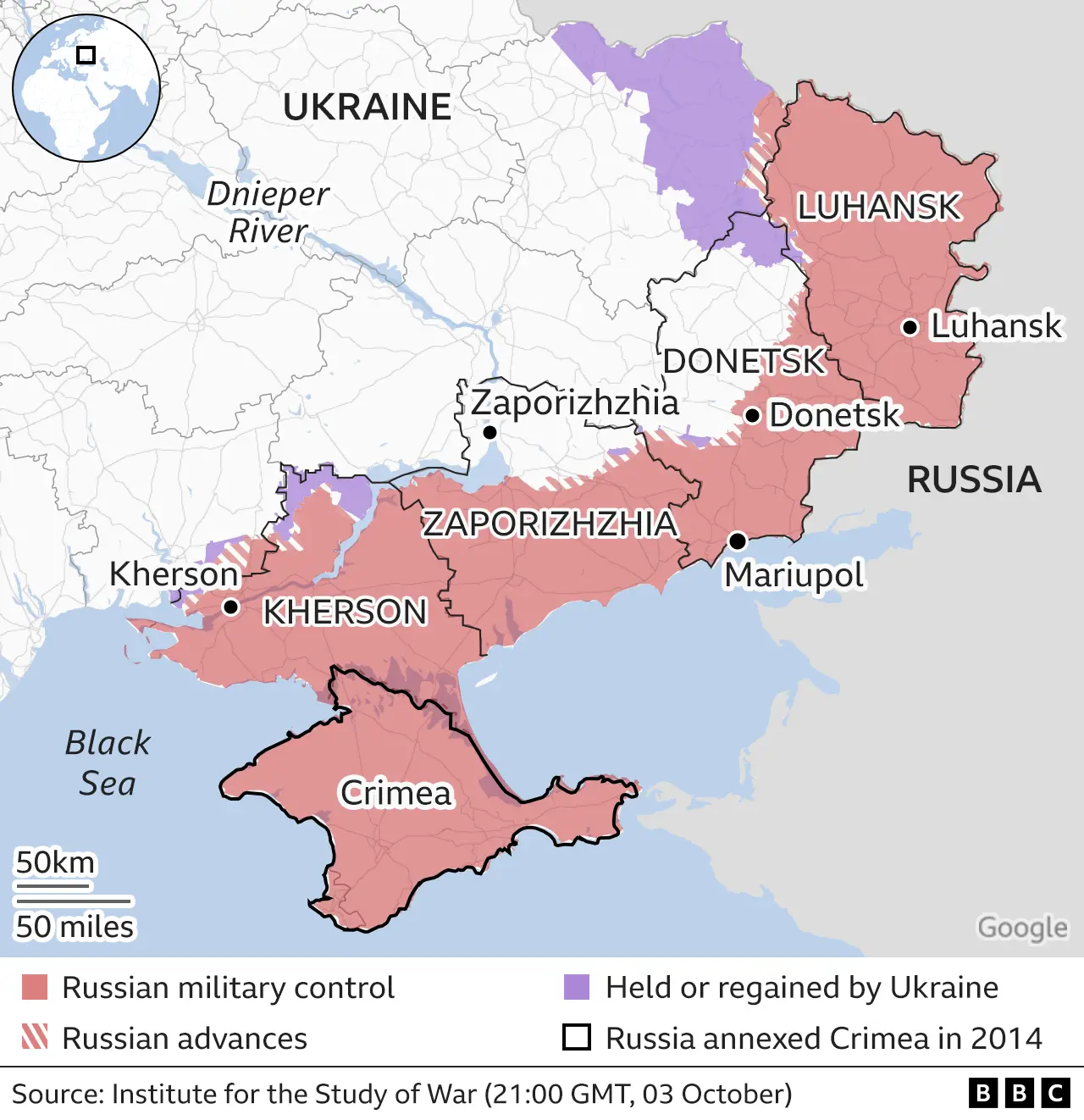
A map showing the four areas of Ukraine that Russia claimed it annexed last month, plus Crimea, which it has occupied since 2014
Meanwhile, Russian divers are beginning a fuller examination of the damage done by Saturday’s explosion on the road and rail bridge linking occupied Crimea with Russia.
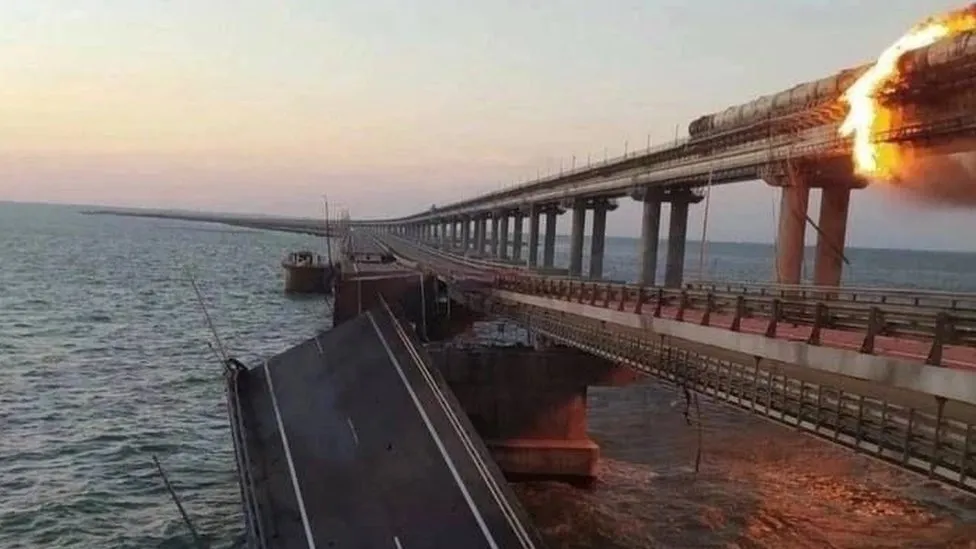
Though limited traffic has resumed along one lane, a section of the bridge was brought down by the blast.
Security has been tightened and Russian President Vladimir Putin has ordered a full investigation.
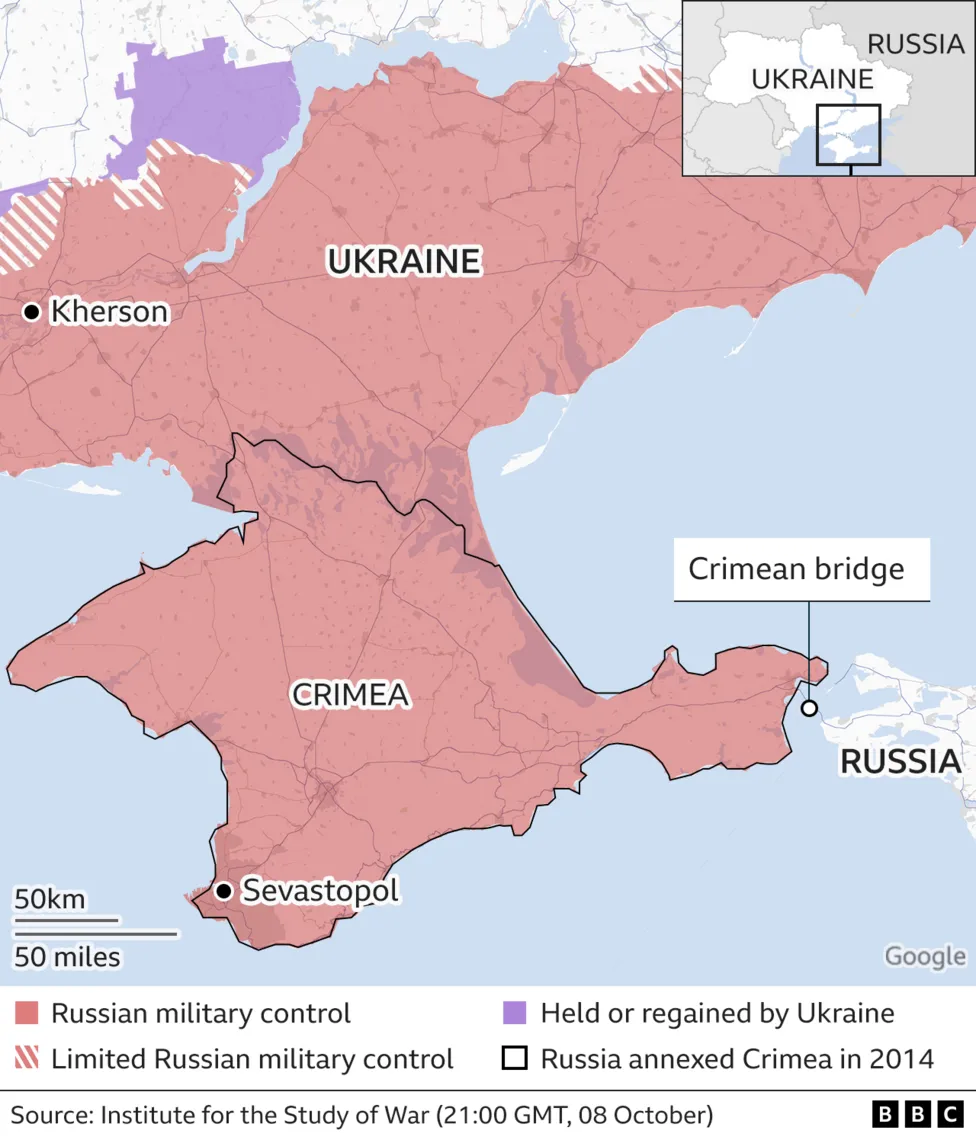
Russia ramped up security on its only bridge to Crimea after a huge blast destroyed sections of it on Saturday.
President Vladimir Putin has now ordered the country’s Federal Security Service (FSB) to oversee the key connector to the occupied peninsula.
The bridge is also a pivotal symbol of Russia’s annexation of Crimea from Ukraine in 2014. The blast killed three people, Russian investigators said.
Officials said work to fix the damaged sections would begin immediately.
Russia’s deputy prime minister ordered the destroyed parts of the bridge to be taken down immediately, and said divers would begin investigating damage below the waterline on Sunday morning, Russian news agencies report.
Hailed by Russian media as “the construction of the century”, the bridge has been crucial to Russia for the movement of military equipment, ammunition and troops into southern Ukraine.
But new satellite images released on Saturday showed smoke and fire near the collapsed areas of the 19km (12-mile) bridge, which was opened with much fanfare four years after Moscow annexed Crimea.
Since it plays a strategic role in the war, Ukrainian authorities have said it is a legitimate target, as they vow to retake the peninsula.
Ukrainian officials responded with thinly-veiled approval to the explosion – but have not indicated that their forces were behind the attack.
President Volodymyr Zelensky acknowledged the incident in his nightly address on Saturday, saying: “Today was not a bad day and mostly sunny on our state’s territory.”
“Unfortunately, it was cloudy in Crimea. Although it was also warm,” he added.
Russian authorities moved swiftly to reopen those parts of the key connector still intact, and said late on Saturday that the bridge has been partially reopened to road and rail traffic.
It is a vital artery in Moscow’s supply chain to the battlefront in its invasion of Ukraine – and to the annexed Crimean territory itself.
The Moscow-appointed governor of Crimea, Sergei Aksyonov, said there was a desire for revenge, but made reassurances that the peninsula still had a month’s worth of fuel and more than two months’ worth of food.
“The situation is manageable – it’s unpleasant, but not fatal,” he said.
Ukrainian official David Arakhamia, parliamentary head of Mr Zelensky’s party, said “Russian illegal construction is starting to fall apart and catch fire.
“The reason is simple: If you build something explosive, then sooner or later it will explode.”
And a Ukrainian MP told the BBC that regardless of who was responsible for the attack, this was a “big Ukrainian victory and very severe and hard loss for Russia”.
“The bridge is not destroyed but damaged, but the image of Putin is destroyed, that is the most important thing,” Oleksiy Goncharenko said.
It is hard to overstate the political, symbolic and strategic significance of the Crimean bridge. Russian officials previously claimed it was well protected from threats from air, land or water – particularly since it is more than 100 miles from Ukrainian-held territory.
A Russian national anti-terrorism committee said the damage was caused by a truck bomb blowing up, which caused seven railway carriages to catch fire. The home of a man from the Krasnodar region of southern Russia is being investigated, it added.
While Ukraine has not linked its armed forces to the explosion, it has targeted Crimea in the past. Last month, Ukraine claimed responsibility for a series of air strikes on Crimea – including an attack on Russia’s Saky military base.
Since the bridge attack on Saturday, Ukraine’s social media has erupted in celebration. Its second-largest bank says it has already issued a new debit card design featuring the collapsed bridge.
In recent weeks, Kyiv’s forces have taken back significant amounts of territory seized by Russia earlier in the war.
Hours after the bridge explosion, Russia appointed a new commander to lead its troops in Ukraine. Sergei Surovikin is a veteran commander known for leading Russian forces in Syria and was accused of overseeing the decimation of the city of Aleppo.
But Russia still controls swathes of Ukraine, including the Zaporizhzhia nuclear plant – the biggest in Europe – which has lost all external power and is relying on emergency diesel generators for the energy it needs for reactor cooling, according to the UN nuclear watchdog.
And the nearby city of Zaporizhzhia, in Ukraine’s south-east, saw overnight shelling which killed at least 12 people, according to regional governor Oleksandr Starukh.
A dozen Russian air strikes hit several residential buildings, destroying some and damaging many more, he said.
“There may be more people under the rubble. A rescue operation is under way at the scene. Eight people have already been rescued,” he said on Telegram.
Earlier, officials said 17 people had been killed in the shelling.
Ukraine is exploding with excitement this morning.
Videos of the damaged Crimean bridge have spread like wildfire on social media; this is already being compared to the sinking of the Russian warship Moskva in April.
“The guided missile cruiser Moskva and the Kerch bridge – two notorious symbols of Russian power in Ukrainian Crimea – have gone down,” tweeted Ukraine’s ministry of defence.
“What’s next in line, Russkies?” it went on.
Ukraine’s inventive social media activists are gleefully pumping out memes to celebrate the occasion.
Oleksii Danilov, Secretary of Ukraine’s National Security Council, wasn’t the only one noting that the attack came just a day after Vladimir Putin’s 70th birthday, tweeting a video of the damaged bridge next to Marilyn Monroe’s famous performance of Happy Birthday, Mr President from 1962.
The sense of excitement is palpable.
Coming on the back of weeks of mostly good news from the battlefront, where Ukrainian forces continue to take back territory seized by Russia back in February and March, the sight of the crippled, burning bridge is a massive additional boost to morale.
How was this done? Any number of theories are doing the rounds – from a Ukrainian special forces operation to the work of partisans in Crimea, a missile strike, or even a suicide bomb.
“This is a masterpiece of clandestine sabotage,” a former senior British army explosives expert told me.
“A well-planned attack from below may have been the cause,” he said.
“With structural demolition, you always plan a ‘collapse mechanism’ which lets the weight of the structure do the majority of the work.”
Ukrainian officials are giving little away, happy to apply the same level of ambiguity that followed a mysterious attack on the Russian airbase in Crimea in August.
But the attacks on the Saky base and the bridge are all part of the same wider effort: to undermine Russia’s ability to use Crimea as a launch pad for its war in southern Ukraine.
The road and railway bridges are vital links in Russia’s supply chain. Without them, Moscow will find it even harder to send troops and equipment to repel Ukraine’s offensive north of Kherson.
Kyiv is also saying to Moscow: Crimea is ours and eventually we are going to take it back.
For all the giddy delight ricocheting across social media, some Ukrainians are anxious.
This morning, we left the city of Zaporizhzhia, which is still in shock after Russian missile attacks on Thursday, which left at least 17 civilians dead.
People there suspect that they are being punished by Russia as Moscow lashes out after its recent military failures. They fear the coming days may bring more.
“Two notorious symbols of Russian power in Ukrainian Crimea have gone down,” it tweeted. “What’s next in line?”
It is hard to exaggerate the significance, and symbolism, of seeing the bridge on fire. Opened by President Putin in 2018, it was meant to symbolise that Crimea was Russian.
Russia has used the bridge to move military equipment, ammunition, and personnel from Russia to battlefields in southern Ukraine.
As such, Ukrainian authorities said it was a legitimate target, as they vow to retake the peninsula.
Any attack on Crimea, where the Russian army has a massive presence, will be seen as another massive humiliation for the Kremlin.
The bridge is particularly hated by Ukrainians. Social media in Ukraine erupted in celebration on seeing the fire – one day after Russian President Vladimir Putin turned 70.
Road and rail traffic across the bridge has been suspended. Local authorities in Crimea say they will organise a ferry service between the Russian mainland and the peninsula.
IMAGE SOURCE,MYKHAYLO PODOLYAK
Image caption, A still picture of the bridge was shared by Ukrainian presidential adviser Mykhaylo Podolyak
Russia’s National Anti-Terrorism Committee said: “At 06:07 Moscow time today [03:07 GMT], an explosion was set off at a cargo vehicle on the motorway part of the Crimean bridge on the side of the Taman peninsula, which set fire to seven fuel tanks of a train that was en route to the Crimean peninsula.
“Two motorway sections of the bridge partially collapsed.”
Crimean parliamentary speaker Vladimir Konstantinov blamed the explosion on “Ukrainian vandals, who have finally managed to reach their bloody hands to the Crimean bridge”.
He added the damage to the bridge would be “promptly restored, since it is not of a serious nature”.
President Putin has been briefed about the “emergency” on the bridge and has ordered a government inquiry, Kremlin spokesman Dmitry Peskov said, in comments quoted by Interfax news agency.
A criminal investigation is also under way.
The 19km (12-mile) bridge across the Kerch Strait, which cost £2.7bn to build, was opened by President Putin four years after Moscow illegally annexed Crimea.
It is the longest bridge in Europe, and was hailed by Russian media as “the construction of the century”. Russian officials previously claimed it was well protected from threats from air, land or water.
The crossing is more than 100 miles from Ukrainian-held territory. One explosives expert told the BBC the fire was probably not caused by a missile.
“The lack of obvious blast / fragmentation damage on the road surface suggests that an air-delivered weapon was not used,” he said.
He said it was possible that “a well-planned attack from below may have been the cause”.
“I suspect explosives on the road bridge and train deck were initiated near simultaneously using coded radio command,” he added.
Ukraine claimed responsibility last month for a series of air strikes on Crimea over the summer, including an attack on Russia’s Saky military base.
Kyiv has the momentum in this conflict. The army has reclaimed large swathes of territory, forcing Russian troops to abandon long-held positions.
Amid the losses, Moscow has begun a chaotic military mobilisation – which led to rare anti-war protests in Russia, and a huge exodus of military-age men.
On Russian TV talk shows, presenters and studio guests have been expressing increasing doom and gloom about the situation.
Ukraine’s President Volodymyr Zelensky has called for pre-emptive sanctions to be imposed on Russia, saying the country’s officials have begun to “prepare their society” for the possible use of nuclear weapons in the war.
In an interview with the BBC, President Zelensky denied having urged strikes on Russia, claiming that an earlier remark had been mistranslated.
“You must use preventive kicks,” he said, referring to sanctions, “not attacks”.
In recent weeks, the Ukrainian army has recaptured large swathes of territory in a successful counter-offensive that has forced Russian troops to abandon long-held positions. In what Kyiv describes as Moscow’s response to its defeats, President Vladimir Putin has incorporated four partially occupied regions of Ukraine.
The annexations, widely dismissed as illegal, have raised fears of a possible escalation in the seven-month war. President Putin and other senior Russian officials have suggested that nuclear weapons – possibly smaller, tactical weapons – could be used to defend those areas, although Western officials say there has been no evidence Moscow is prepared to do so.
Image caption, Ukraine’s president told the BBC’s John Simpson that Russia’s threats were a “risk for the whole planet”
Speaking in English at the presidential palace in Kyiv, President Zelensky said: “They begin to prepare their society. That’s very dangerous.
“They are not ready to do it, to use it. But they begin to communicate. They don’t know whether they’ll use or not use it. I think it’s dangerous to even speak about it.”
He denied having called for strikes on Russia during an online event on Thursday, saying the word he had used in Ukrainian had been misunderstood.
The initial comment was denounced by Kremlin spokesman Dmitry Peskov as “an appeal to start yet another world war”, while Russian Foreign Minister Sergei Lavrov said it demonstrated why Russia was right to launch its operation in Ukraine.
“After that translation,” President Zelensky said, “they [the Russians] did their way, how it’s useful for them, and began to retranslate it in other directions.”
The interview happened hours after US President Joe Biden said that the Russian threat to use nuclear weapons had brought the world closer to “Armageddon” than at any time since the Cuban Missile Crisis during the Cold War.
President Zelensky said action was needed now, as Russia’s threats were a “risk for the whole planet”. Moscow, he claimed, had “made a step already” by occupying the Zaporizhzhia nuclear power plant, Europe’s largest nuclear station which President Putin is trying to turn into Russian property.
“The world can stop urgently the actions of Russian occupiers,” President Zelensky said. “The world can implement the sanction package in such cases and do everything to make them leave the nuclear power plant.”
Empowered by sophisticated Western-supplied weapons, the Ukrainian army has made significant advances in the east and the south, reclaiming towns and villages even in areas the Kremlin claims are now part of Russia. The setbacks, a major embarrassment for President Putin, have sparked unusual criticism of the country’s military.
Amid the losses, President Putin announced the mobilisation of hundreds of thousands of reservists, which led to rare anti-war protests in Russia and to a huge exodus of military-age men.
President Zelensky urged Russians to “fight for your body, rights and soul”, saying: “These mobilised kids now, they come without machine guns, armoured jackets, they are just cannon fodder…. If they don’t want to be kebab… they need to fight [for their lives].
“All Putin is afraid of is not a nuclear strike. He’s afraid of his society, of his people.
“Because only this people can replace him, strip him of his power and give it to another person.”
The death toll from a Russian missile attack on Ukraine’s southeastern city of Zaporizhzhia this week has risen to 11, it has been reported.
The emergency services of Ukraine said the toll of Russian S-300 missile strikes on the city had now risen to 11 and a further 21 people had been rescued from the rubble of destroyed apartments.
In a Telegram message, regional governor Oleksandr Starukh said: “This was not a random hit, but a series of missiles aimed at multi-storey buildings.”
For context: Zaporizhzhia is one of the four regions of Ukraine that Russian President Vladimir Putin has illegally claimed as Russian territory.
The region is home to a sprawling nuclear power plant under Russian occupation while the city of the same name remains under Ukrainian control.
Russia is reported to have converted the S-300 from its original use as a long-range anti-aircraft weapon into a missile for ground attacks because of a shortage of other, more suitable weapons.
Sanna Marin, the prime minister of Finland, has stated that “leaving” Russia from Ukraine is the only way to end the crisis there.
Speaking to reporters today, Ms Marin said: “The way of the conflict is for Russia to leave Ukraine. That’s the way out of the conflict.”
The comments come after US President Joe Biden said Vladimir Putin’s threat to use nuclear weapons in Ukraine had brought the world closer to “Armageddon” than at any time since the Cold-War Cuban Missile Crisis.
Are Christmas festivities set to be cancelled in the Russian capital?
Moscow authorities are set to discuss whether New Year and Christmas events in the capital should be cancelled, according to Russian news site GazettaRu.
As we understand it, their tweet about it reads: “Moscow authorities announced a discussion on the cancellation of New Year and Christmas events in the capital”
A few other Russian cities have already announced that they are canceling festivities.
❗️Власти Москвы анонсировали обсуждение вопроса отмены новогодних и рождественских мероприятий в столице
As they depart Yakutia, in the Russian Far East, footage has surfaced showing men who have been mobilised in Russia receiving goody bags from the local authorities.
During the video, which was shared by the BBC’s Francis Scarr, the men are heard laughing as they view the bag’s contents, which contain a chocolate bar, sanitary pads, and a first aid kit.
In recent weeks, Ukraine’s advances in the east have exposed fundamental problems within the Russian military, including gaps in its intelligence and power struggles.
And as fighting continues there has been a drive to recruit more soldiers for the front line.
Local authorities in Yakutia are handing out goody bags as they bid farewell to mobilised men
They contain a first aid kit, a chocolate bar, and sanitary pads (apparently a makeshift bullet wound dressing)