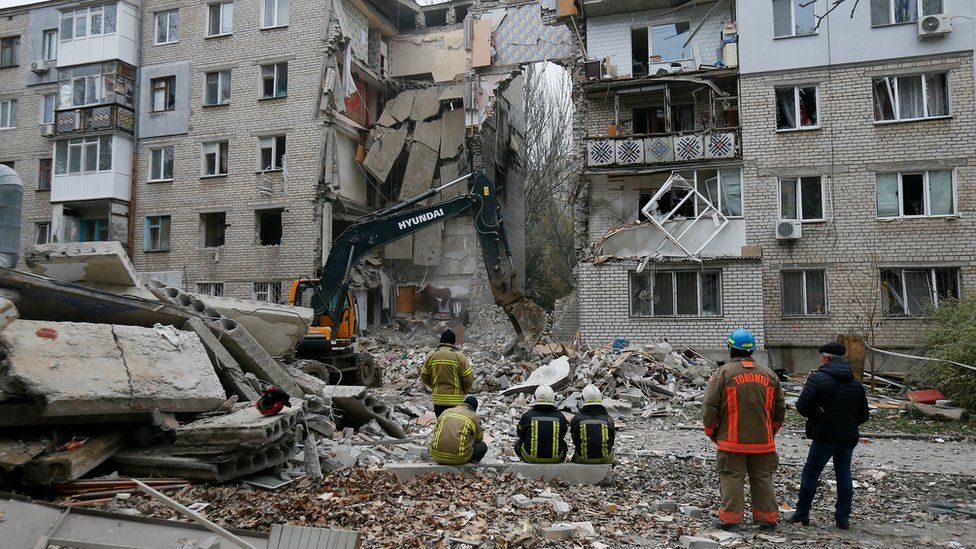
More than a dozen powerful explosions have been recorded near a huge Russian-occupied nuclear power plant in south Ukraine since Saturday evening.
The head of the UN nuclear watchdog, Rafael Grossi, made an urgent appeal for a stop to the fighting at the Zaporizhzhia plant, Europe’s biggest.
“Whoever is behind this, it must stop immediately,” he said. “You’re playing with fire!”
The plant stands on the River Dnipro, on the front line in the war.
Russia’s military accused Ukrainian forces on the other side of the river of shelling the area under its control. There was no immediate word from the Ukrainians who have previously suggested Russian forces shell the area themselves despite having their troops there.
The area around the plant, including the nearby Russian-occupied town of Enerhodar, had been under regular attack for months but there had been a period of calm before the new explosions this weekend, which continued into Sunday morning.
Monitors from Mr Grossi’s organisation, the International Atomic Energy Agency (IAEA), witnessed some of the explosions from their windows.
Citing information provided by officials at the Russian-controlled plant, the IAEA team said there had been damage to some buildings, systems and equipment at the site, but nothing so far “critical for nuclear safety and security”. There were no reports of casualties.
“The news from our team yesterday and this morning is extremely disturbing,” Mr Grossi said. “Explosions occurred at the site of this major nuclear power plant, which is completely unacceptable.”
He called once again for the two warring sides to agree and implement a nuclear safety and security zone around the plant as soon as possible.
“I’m not giving up until this zone has become a reality,” he said. “As the ongoing apparent shelling demonstrates, it is needed more than ever.”
Russian state media quoted an official from Russian nuclear power operator Rosenergoatom as saying 15 shells had been fired at the plant’s facilities, landing near a dry nuclear waste storage facility and a building that houses fresh spent nuclear fuel, but no radioactive emissions had been detected.
The plant was overrun by Russian forces a few weeks after Moscow invaded Ukraine on 24 February.
Russia annexed the Zaporizhzhia region and other Ukrainian territory in September but has been pushed back on the battlefield in the south, notably in Kherson region, and the two armies face each other across the River Dnipro (known as the Dnieper in Russian).
United Nations officials announced on Friday, 18 November, a second shipment of Russian fertiliser will go to West Africa after a first attempt was blocked in European ports because of sanctions imposed due to the conflict in Ukraine.
The move follows talks between Moscow and the UN .
Secretary General of UN’s trade and development agency UNCTAD, Rebeca Grynspan, told journalists: “There are around 300,000 tonnes of fertiliser in the different European ports.
“The first shipping will get out of a Netherlands port going to Malawi, the vessel is loading right now. And the date that has been established for the vessel to go is on the 21st of November, to Malawi through Mozambique.”
As part of the implementation of the two agreements signed on 22 July in Istanbul to ensure unhindered access to food and fertiliser from Ukraine and Russia, the WFP earlier announced it would facilitate the donation of 260,000 tonnes of fertiliser by the Russian fertiliser company Uralchem-Uralkali to the neediest countries in Africa, with Malawi as its first destination.
Grynspan added: “Beyond Malawi, with the help again with the donation from Uralchem/Uralkali, the intervention of WFP, and the help of the World Bank and France, we hope that the next destination of the fertilisers will be West Africa. That has been very affected by the affordability crisis of fertilisers.”
Agricultural products and fertilisers do not fall under the sanctions against Russia, but because of the risks linked to the conflict in the Black Sea, shipowners no longer wanted to hire their ships because they could not find insurance.
After intensive discussions, Russiaand the UN have established a framework for insurance, financial transactions and other matters which is compatible with the three existing sanctions systems (US, UK and EU) put in place following the Russian invasion of Ukraine on 24 February.
Last week, the Black Sea Grain Initiative, signed on 22 July between Turkey, Ukraine, Russia and the UN allowing Ukrainian grain exports from Ukrainian ports, was extended for 120 days from 19 November.
Turkey’s President Tayyip Erdogan talked on the phone with Ukrainian counterpart Volodymyr Zelenskyy and congratulated each other for the extension of an UN-brokered grains deal, Erdogan’s office said.
Erdogan told Zelenskyy that the grains deal and the prisoner exchange between Russia and Ukraine were positive experiences and that the “extension of this understanding to the negotiation table” would benefit all parties.
Russia will wait until a full damage assessment to the Nord Streamgas pipelines is done before deciding on any repairs, Kremlin spokesman Dmitry Peskov said.
“The very fact that data has already begun to come in, in favour of confirming a subversive act or a terrorist act … once again confirms the information that the Russian side has,” Peskov told reporters.
“It is very important not to stop, it is very important to find the one behind this explosion.”
Swedish investigators have found traces of explosives at the site of the damaged Nord Stream pipelines, confirming that gross sabotage had occurred.
The Swedish Prosecution Authority said in a statement “Analysis that has now been carried out shows traces of explosives on several of the objects that were recovered.”
Adding that, the findings establish the incident as “gross sabotage”.
Russia’s President Vladimir Putinsaid Moscow is interested in working closely with Qatar to ensure stability in the global gas market during a call with Qatar’s Emir Sheikh Tamim bin Hamad Al Thani, the Kremlin said.
Putin congratulated Qatar on hosting the upcoming FIFA World Cup, which kicks off this weekend.
FIFA banned Russia, which hosted the previous tournament in 2018, from participating in its competitions earlier this year in response to Russia’s invasion of Ukraine.
The Bill & Melinda Gates Foundationhas announced a $7 billion commitment to Africa over the next four years on Thursday, as Bill Gates warned that the Ukraine crisis was reducing the amount of aid flowing to the continent.
The Foundation’s pledge, which is 40% more than what it spent in the previous four years, will go toward projects that address hunger, disease, poverty, and gender inequality.
Nigeria, Africa’s most populous country, will receive the greatest proportion.
Humanitarian groups in Africa are grappling with the diversion of funding away towards Ukraine, and as Russia’s invasion increases goods prices globally, impacting aid operations.
“The European budgets are deeply affected by the Ukraine war and so right now the trend for aid is not to go up,” the billionaire co-founder of Microsoft Corp (MSFT.O) told journalists at the University of Nairobi during a visit to Kenya.
“If you take all aid (into Africa) including all climate aid – we’ll have a few years where it’ll probably go down.”
Kenya and much of East Africa are suffering their worst drought in four decades.
Drought, compounded by conflict and the COVID-19 pandemic, has pushed more than 10 million people in the region “to the very brink of a hunger crisis”, the U.S.-based Christian relief group World Vision said this week.
The United Nations says it expects famine to be declared in parts of Somalia this year.
Following a meeting with Kenyan President William Ruto, Gates said on Wednesday that the Foundation would establish a regional office in Nairobi.
“Our foundation will continue to support solutions in health, agriculture, and other critical areas—and the systems to get them out of the labs and to the people who need them,” Gates, who runs the foundation with his ex-wife Melinda French Gates, said in a statement.
The Foundation in 2021 gave charitable support of $6.7 billion and last week pledged $1.4 billion to help the world’s smallholder farmers cope with climate change.
Investigators have found traces of explosives at the site of the damaged Nord Stream pipelines, confirming that sabotage had taken place, a Swedish prosecutor said on Friday.
Swedish and Danish authorities are investigating four holes in the Nord Stream 1 and 2 pipelines which link Russia and Germanyvia the Baltic Sea and have become a flashpoint in the Ukraine crisis.
Denmark last month said a preliminary investigation had shown that the leaks were caused by powerful explosions.
“Analysis that has now been carried out shows traces of explosives on several of the objects that were recovered,” the Swedish Prosecution Authority said in a statement.
“The investigation is highly complex and comprehensive. The ongoing probe will determine whether any suspects can be identified,” it added.
The prosecutor’s office declined to give further comment.
If the missile that hit Poland was fired by Russia, it would be the first time Moscow’s weapons have hit a NATO member.
The United States and its allies in the North Atlantic Treaty Organization (NATO)are investigating a blast that killed two people in Poland’s Przewodow, a village in the eastern part of the country near the border with Ukraine.
Polish authorities have blamed a “Russian-made” missile for the deaths on Tuesday in a village about 6 kilometres (4 miles) from the border with Ukraine.
Russia’s defence ministry has denied that any Russian missiles hit Polish territory, describing such reports as “a deliberate provocation aimed at escalating the situation”.
If confirmed that the missile was fired by Russia, it would be the first time since its invasion of Ukraine in February that one of Moscow’s weapons has struck and inflicted casualties in a NATO country.
A possible Russian missile strike poses serious concerns as the foundation of the 30-member NATO alliance is the principle that an attack against one member is an attack on all.
While the Polish foreign ministry identified the missile as being made in Russia, Poland’s President Andrzej Duda has been more cautious regarding its origin, saying that officials did not know for sure who fired it or where it was made.
US President Joe Biden also said that the missile – based on trajectory – was unlikely to have been fired by Russia, adding however, “but we’ll see”.
As a NATO member, Poland has said it was verifying whether it needed to request consultations under Article 4 of the alliance.
Experts note that Article 4 must be invoked before the process begins that could, potentially, lead to the invocation of Article 5 – which enshrines NATO’s principle of collective defence.
So, what are NATO’s Article 4 and Article 5 and how do they work?
What is Article 4?
Article 4 can be invoked when any NATO member feels threatened.
Invoking Article 4 beings a process which leads to consultation between the member country (or countries) with NATO’s most senior decision-making body, the North Atlantic Council, or NAC, says John R Deni, a research professor at the US Army War College and lecturer at American University.
Meetings of the NAC are not unusual and take place regularly to discuss day-to-day issues related to the alliance, Deni told The Conversation.
However, when Article 4 is formally triggered by an alliance member, the NAC prioritises the consultation with the country concerned and their issue will be addressed immediately.
Article 4 can be triggered when a member or members believe that their “territorial integrity, political independence or security” is threatened.
“Any member country can formally invoke Article 4 of the North Atlantic Treaty. As soon as it is invoked, the issue is discussed and can potentially lead to some form of joint decision or action on behalf of the Alliance,” NATO says.
“Whatever the scenario, fellow members sitting around the Council table are encouraged to react to a situation brought to their attention by a member country,” the organisation says.
Article 4 has been invoked only on seven occasions during the lifespan of NATO, which was established in 1949.
Most recently, Article 4 was invoked in March by eight NATO countries – Bulgaria, Czechia, Estonia, Latvia, Lithuania, Poland, Romania and Slovakia – following Russia’s invasion of Ukraine on February 24.
Turkey invoked Article 4 in 2015 and twice in 2012, the first when in June that year one of its fighter jets was shot down by Syrian air defence. In October 2012, it invoked Article 4 when three Turkish citizens were killed by Syrian shelling amid the continuing civil war in its neighbouring country.
Turkey requested in the Article 4 consultation process that NATO deploy Patriot missiles as a defence system, which the organisation agreed to in the interests of protecting Turkish people and territory.
As Deni says, the Article 4 consultation and the decisions that might emerge are “a big deal – just not as weighty as invoking Article 5”.
Article 4 is a preparatory phase prior to Article 5, which is the alliance’s commitment to collective defence.
NATO’S ‘cornerstone’ Article 5
Described as the “cornerstone” of the military alliance, NATO’s collective defence principle – contained in Article 5 – was developed to create a mutual protective pact in order to counter risks posed by the Soviet Union, particularly in Eastern Europe, following World War II and the emergence of the Cold War.
Committing to Article 5 means that each NATO member knows that if one of the alliance is the “victim of an armed attack, each and every other member of the Alliance will consider this act of violence as an armed attack against all members”, NATO states.
That means that each NATO member is obligated to “take the actions it deems necessary to assist the Ally attacked”.
When Article 5 is invoked, NATO allies are free to provide whatever form of aid and assistance is deemed “necessary to respond to the situation”.
As NATO states: “It is therefore left to the judgment of each individual member country to determine how it will contribute.”
Each country consults with all other alliance members in terms of response and with the ultimate aim “to restore and maintain the security” of alliance members.
First use of Article 5
Article 5 was invoked for the first time ever following the September 11, 2001 attacks on the US by al-Qaeda.
The triggering of Article 5 saw “NATO engage actively in the fight against terrorism, launch its first operations outside the Euro-Atlantic area and begin a far-reaching transformation of its capabilities”, according to the alliance.
“By invoking Article 5, NATO members showed their solidarity toward the United States and condemned, in the strongest possible way, the terrorist attacks against the United States.”
Could the missile strike on Poland trigger Article 5?
Deni of the American University said that it was difficult to assess currently whether the apparent missile strike could trigger Article 5 as the details of what occurred in the Polish village are not yet fully known, and “there are lots of variables at play”.
Was the missile strike accidental or deliberate? Was Russia actually to blame?
“There is also the possibility that this was debris from a strike in Ukraine,” he said.
“The loss of any innocent lives is tragic in any case, but I think the number of deaths resulting from the strike will also be a factor in whether Poland requests invocation of Article 5,” he added.
This was the moment Western leaders have feared since Russia launched its all-out invasion in February: that the war might spill over onto the territory of one of Ukraine’s Nato neighbours, forcing Nato to respond and thus widening the conflict.
But early fears that Russia might have deliberately attacked Poland quickly faded, as analysts and then Western politicians lined up to say this did not look like a deliberate Russian attack.
After this morning’s Nato meeting, the alliance’s Secretary General, Jens Stoltenberg, said that his preliminary analysis showed that the wreckage filmed at the site was part of a Ukrainian air defence missile.
But, he added, this was not Ukraine’s fault. After all, none of this would have happened if Russia hadn’t launched dozens of cruise missiles yesterday at targets all across Ukraine.
Not Ukraine’s fault, but questions will be raised about Kyiv’s early denial that one of its air defence missiles was involved.
Ukraine’s Foreign Minister, Dmytro Kuleba, last night tweeted that any suggestion a Ukrainian missile had landed in Poland was a Russian “conspiracy theory”.
In light of subsequent comments from Joe Biden, his Polish counterpart, Duda, Stoltenberg, the Danish defence minister and others, Kuleba’s tweet seems hasty.
DISCLAIMER: Independentghana.com will not be liable for any inaccuracies contained in this article. The views expressed in the article are solely those of the author’s, and do not reflect those of The Independent Ghana
US President, Joe Biden has stated that it is “unlikely” that the missile that killed two people in Poland on Tuesday was fired from Russia.
According to Polish officials, the “Russian-made missile” landed in Przewodow, near the Ukrainian border.
Early reports suggested Russia was to blame for the explosion. Moscow has denied the allegations.
Speaking from the G20 summit in Bali, Mr. Biden disputed the reports based on “preliminary information.”
The US president was speaking early on Wednesday morning, after several world leaders gathered on the sidelines of the summit at an “emergency round table” to discuss the blast.
Among the attendees were President Biden, UK Prime Minister Rishi Sunak,French President Emmanuel Macron and EU Commission President Ursula von der Leyen.
Reports of the missiles falling in Poland – which is a Nato member – came after Russia launched a fresh wave of attacks across Ukraine on Tuesday, days after its troops were forced to leave Kherson.
Russia dismissed claims it was responsible, with the defence ministry in Moscow attacking what it called “a deliberate provocation aimed at escalating the situation”.
Kremlin spokesperson Dmitry Peskov also said he had no information on the blast.
Russian state news agency Ria Novosti said it was instead Ukrainian missiles that had hit Polish territory.
But Ukraine’s Foreign Minister Dmytro Kuleba said any claim that Ukraine was responsible was a Russian “conspiracy theory”, and that anyone amplifying the message was spreading “Russian propaganda”.
Polish President Andrzej Duda told reporters that it remained unclear how the blast had occurred and said investigators were evaluating all possibilities.
“We do not have any conclusive evidence at the moment as to who launched this missile… it was most likely a Russian-made missile, but this is all still under investigation at the moment,” he said.
Images shared online showed what appeared to be a large crater on what local media reported was Polish farmland, suggesting missile damage. Another image appeared to show a fragment of a missile.
The encroachment on to Polish territory raised questions as to whether Warsaw would trigger Article Four of the Nato treaty – meaning member states consult on whether the territorial integrity, political independence or security of any member state is threatened.
Warsaw said it was considering whether to invoke the provision.
Despite lending support to Ukraine since Russia’s invasion, Nato has been careful not to become too heavily involved in the conflict in order to prevent an escalation.
The G7 group of nations also released a statement condemning the “barbaric missile attacks” launched by Russia on Tuesday and addressing the “explosion” in Ukraine.
“We offer our full support for and assistance with Poland’s ongoing investigation. We agree to remain in close touch to determine appropriate next steps as the investigation proceeds,” it said.
Meanwhile, United Nations Secretary General Antonio Guterres also said he was “very concerned” by the Poland explosion and called for a thorough investigation.
“It is absolutely essential to avoid escalating the war in Ukraine,” said his spokesman, Farhan Haq.
The BBC’s Paul Adams said there were a number of possible explanations for the incident.
Russia has no interest in targeting Polish farms, so some kind of malfunction seems possible, he said. And on a day when Ukraine’s air defences were working hard to bring down Russian missiles, it is also possible that one of those missiles was knocked off course, our correspondent adds.
Nato Secretary General Jens Stoltenberg said he had spoken to Polish President Andrzej Duda and the military alliance was “monitoring the situation”.
“Allies are closely consulting,” he said on Twitter. “Important that all facts are established.”
The attacks came after one of the heaviest bombardments of Ukraine by Russian forces since the war began.
Ukraine was hit by more than 90 missiles on Tuesday, according to Ukraine’s Air Force spokesperson Yuri Ihnatw, who said more than 70 were successfully shot down.
Ukrainian President Volodymyr Zelensky said most of the rockets fired had been aimed at the country’s energy infrastructure.
Some seven million households have been left without electricity in Ukraine after Tuesday’s wave of Russian missile strikes targeted the country’s energy supplies, according to Ukraine’s presidential office.
Customers experienced power cuts in the Kyiv, Vinnytsya, Volyn, Donetsk, Dnipropetrovsk, Zhytomyr, Kirovohrad, Lviv, Poltava, Rivne, Sumy, Ternopil, Kharkiv, Khmelnytskyy, Cherkasy, Chernivtsi and Chernihiv regions.
Some 15 energy facilities were damaged as a result of the attacks, said the deputy head of Ukrainian President Volodymyr Zelensky’s office, Kyrylo Tymoshenko.
“Our power engineers are now doing everything to reconnect the power supply as soon as possible,” he said.
These are the first Russian missile strikes on Ukrainian cities since Kyiv‘s forces liberated Kherson, a key southern port city, on Friday.
Ukrainians regard the recapture of Kherson as a major victory, comparable to the retreat of Russian troops from the Kyiv suburbs in March, as well as a humiliation for the Kremlin.
Approximately 30,000 Russian troops withdrew to the Dnipro’s eastern bank, and Kherson celebrated the weekend. Since early March, the city has been under Russian occupation.
But before today Russia had already fired hundreds of missiles at Ukrainian cities, hitting residential blocks, power stations and many other civilian installations. Many were cruise missiles fired from Russian bombers or ships positioned outside Ukrainian territory.
Ukraine says its air defences have shot down many Russian missiles during these strikes.
Russia claims the Kherson region and three other occupied Ukrainian regions to be part of Russia, as well as Crimea, which Russia annexed in 2014. The claim – following hastily organised local “referendums” – is rejected internationally.
Ukraine has put forward “unrealistic” conditions for peace, Russia’s foreign minister, Sergei Lavrov has said.
Speaking to reporters in Bali, Indonesia, Mr Lavrov said he had been in talks with the leaders of France and Germany on the conflict in Ukraine before going on to accuse Kyiv of dragging out any possible resolution.
He claimed Ukraine was refusing to talk to Moscow and had put forward unrealistic conditions for peace.
The Kremlin official also said that the UN had promised to move obstacles to the export of Russian grain and fertilisers.
Russia has long complained of barriers to its farm exports, even though they are not directly targeted by Western sanctions.
In spite of the problems, Mr Lavrov said Russia had already exported 10.5 million tonnes of grain, mainly wheat, of which 60% had gone to Asia and 40% to Africa.
“I hope these promises will be fulfilled. At least the UN secretary general gave me his sworn assurance that this is a priority issue for him,” he added.
Yesterday, the Indonesian authorities said Mr Lavrov had been taken to hospital after his arrival in Bali for the G20 summit.
Wayan Koster, the governor of Bali, said he had been taken in for a “check-up” at the Sanglah Hospital in the provincial capital, Denpasar, and was “immediately returned”.
Three other Indonesian government and medical officials also said he was being treated on the resort island.
However, the Russian foreign ministry dismissed claims that he had been in hospital as “fake news”.
The Russian Foreign Ministry announced today that they added 100 Canadians to the list of people banned from entering the country, including actor Jim Carrey.
Among the 100 includes author Margaret Atwood, journalists, politicians, and CBC’s Leading International Correspondent Christopher Brown. They join a long list of Canadians that were already barred from entering Russia such as Deputy Prime Minister and Minister of Finance Chrystia Freeland and former Alberta premier Jason Kenney.
The list, posted on The Ministry of Foreign Affairs of the Russian Federation’s website, only included the announcement in Russian.
“In response to the ongoing practice of imposing sanctions by the regime of Prime Minister J. Trudeau against the Russian leadership, politicians and parliamentarians, representatives of the business community, experts and journalists, cultural figures, as well as anyone whom the Canadian Russophobic authorities consider objectionable, entry is closed on the basis of reciprocity for 100 Canadian citizens,” the Google translation read.
The ever-growing list of Canadians banned from entering Russia now hovers near 1000 Canadians, mostly politicians or journalists covering the Russo-Ukrainian War.
In addition to acting, earlier this year Carrey guested as the radio DJ on The Weeknd’s album Dawn FM. He resisted the request from his fellow Canadian at first.
“He put it to me that he was doing this thing that was the radio station in purgatory, and I was like, ‘I love you, but I don’t want to do any work.’ And he said, ‘You know, you can just do it into your iPhone like that, it’s broadcast quality,’” Carrey recalled.
The prime minister intends to use the summit to press the world’s most powerful economies to do more to reduce their reliance on Russian exports, while also encouraging others to do the same.
As he confronted Vladimir Putin’s officials at the G20 summit, Rishi Sunak said Russia must “get out of Ukraine and end this barbaric war.”
The prime minister made the remarks during the first session on Tuesday, criticising the absence of Russian President Vladimir Putin from the talks on the Indonesian island of Bali.
“It is notable that Putin didn’t feel able to join us here,” he said. “Maybe if he had, we could get on with sorting things out.
“Because the single biggest difference that anyone could make is for Russia to get out of Ukraine and end this barbaric war.
“The UK rejects this aggression. We will back Ukraine for as long as it takes.”
Mr Putin chose not to attend the talks, with the Kremlin blaming scheduling conflicts, but observers say officials are seeking to shield him from condemnation by world leaders.
Mr Sunak also rebuked Russia by saying “countries should not invade their neighbours”.
“It is very simple – countries should not invade their neighbours, they should not attack civilian infrastructure and civilian populations and they should not threaten nuclear escalation,” he said.
“Surely these are things on which we can all agree.”
The prime minister sat down with leaders of the world’s 19 biggest economies in Bali – the first meeting in the group’s 15-year history to be held in the shadow of a major European war instigated by one of its members.
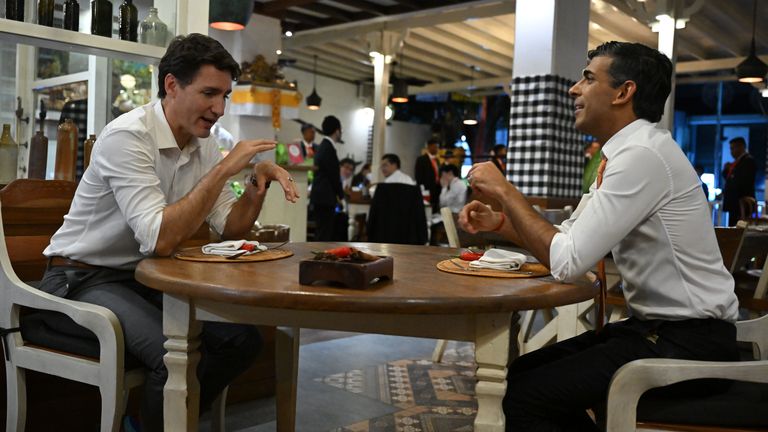
Image:Justin Trudeau, the Canadian leader, and Mr Sunak met at a Bali cafe on Monday
‘Chorus of opposition to Putin’
Mr Sunak will use the summit to push the world’s most powerful economies to do more to reduce their dependence on Russian exports, while supporting others to do the same.
He will also reiterate the UK’s financial support for Ukraine, saying he committed £4.1bn in aid when he was chancellor.
This included £2.3bn in military aid, while Mr Sunak will promise to match this level of spending next year.
Before the meeting, he said: “Putin and his proxies will never have a legitimate seat at the table until they end their illegal war in Ukraine.”
He continued: “At the G20, the Putin regime – which has stifled domestic dissent and fabricated a veneer of validity only through violence – will hear the chorus of global opposition to its actions.”
Many countries have stood firm, supporting Ukraine with weapons and aid, while imposing various sanctions on Russia.
Mr Putin sent Sergei Lavrov, the foreign minister, to the talks in his place.
He was taken to hospital on his arrival at the talks with a heart condition, the Indonesian authorities said – though the Russian foreign ministry dismissed the claims as “fake news”.
Last week, the UK introduced legislation to stop countries using its maritime services to transport Russian oil unless it is purchased below a price cap – which Number 10 described as a “hugely influential measure, given the UK provides around 60% of global maritime insurance”.
Ukrainian President Volodymyr Zelensky has called for Russia’s “destructive war” to end.
“I am convinced now is the time when the Russian destructive war must and can be stopped. It will save thousands of lives,” he told the G20 summit in Balivia video address on Tuesday, according to a speech in Ukrainian obtained by AFP.
He addressed leaders like US President Biden and Chinese leader Xi – and made a point of leaving out Russia.
“There cannot be any excuses for nuclear blackmail,” he added, specifically thanking the “G19” – and excluding Russia – for “making this clear”.
Russian President Vladimir Putin is not attending the summit, but his foreign minister Sergey Lavrov is there instead.
Three weeks to the day into the job; Rishi Sunak is on the world stage.
At the formal opening session of the G20 Summit, he said the “Putin regime” had “stifled domestic dissent and fabricated a veneer of validity only through violence” and is hearing “a chorus of global opposition to its actions”.
Sunak also addressed Russia’s representative in the room, the Foreign Minister Sergei Lavrov – the first time a British Prime Ministerhas confronted a senior Russian figure face-to-face since the war began.
The United Nations General Assemblyhas called for Russia to be held accountable for its invasion of Ukraine, approving a resolution recognising that Russia is responsible for reparation in the country.
The resolution, supported by 94 of the assembly’s 193 members, recognises that Russia must be held accountable for violations of international law in or against Ukraine and “must bear the legal consequences of all of its internationally wrongful acts, including making reparation for the injury, including any damage, caused by such acts”.
General Assembly resolutions are non-binding, but they carry political weight.
The Kremlin confirmed on Monday that talks between US and Russian officials took place in Ankara.
“Such negotiations really took place. It was the American side’s initiative,” Kremlin spokesman Dmitry Peskov was quoted as saying by Russia’s TASS news agency.
According to reports, US Central Intelligence Agency Director William Burns travelled to Turkey to meet with his Russian counterpart Sergey Naryshkin, the head of Russia’s Foreign Intelligence Service.
Burns reportedly warned Naryshkin of the consequences Russia would face in the event it used nuclear weapons in Ukraine.
NATO Secretary-General Jens Stoltenberg has said it is up to Ukraine to decide what terms are acceptable for negotiations with Russia to bring an end to the war.
“It is for Ukraine to decide what kind of terms are acceptable. It is for us to support them,” Stoltenberg said during a press conference with members of the Dutch government in The Hague.
“We should not make the mistake of underestimating Russia … They still control large parts ofUkraine … What we should do is strengthen Ukraine’s hand,” Stoltenberg added.
US Central Intelligence Agency DirectorWilliam Burns has travelled to Turkey to speak to his Russian counterpart and warn Moscow of the consequences of any use of nuclear weapons in Ukraine, according to several reports citing an unnamed White House official.
The Reuters news agency quoted the White House official as saying that Burns, a former US ambassador to Russia, was not conducting negotiations of any kind on Monday with Sergey Naryshkin, the head of Russia’s Foreign Intelligence Service.
Ukraine was briefed in advance about Burns’s trip to Turkey, the official added.
The official provided no details regarding the timing of Burns’s meeting, and it was not immediately clear whether his talks with Naryshkin had already concluded.
Turkey’s state-run Anadolu news agency also reported the meeting, citing unnamed intelligence sourcesas saying it was being hosted by Turkish intelligence officials.
But in the following weeks Ukraine began to make gains in the south of the country, advancing along Dnipro river towards Kherson and putting Russian forces under increasing pressure.
Finally, Russian forces withdrew and Ukrainian troops entered the city on Friday.
Locals were seen celebrating, some reuniting with loved ones they had not seen for months. The mood in the city was one of jubilation and relief, but also trepidation and fear of what may come next, the BBC’s Jeremy Bowen reported.
In his visit on Monday, Mr Zelensky told troops that Ukraine is “ready for peace, peace for all our country,” the Reuters news agency reported.
He thanked Nato and other allies for their support in the war against Russia, adding that high mobility artillery rocket systems (Himars) from the United States had made a big difference for Kyiv.
The president addressed a crowd gathered in Kherson’s main square, some of whom waved Ukrainian flags or wore them draped across their shoulders, a Reuters journalist in Kherson said.
Mr Zelensky said he is “really happy” about the liberation, as are the people of Ukraine.
Asked where Ukrainian forces might advance next, he said: “Not Moscow…We’re not interested in the territories of another country.”
Mr Zelensky had previously said that investigators have uncovered more than 400 war crimes in areas of Kherson abandoned by Russian forces as they retreated.
The BBC has been unable to verify these allegations, and Moscow denies that its troops intentionally target civilians.
A US official has been briefing reporters on Chinese Premier Li Keqiang’s comments about Russia’s invasion of Ukraine at the East Asia Summit in Cambodia on Sunday.
The US official said Li spoke at length about China’s views on the war, and condemned the “irresponsibility of nuclear threats”. Putin has repeatedly hinted at a readiness to use nuclear weapons.
The unnamed US official said that despite China’s allyship with Russia there was clear “discomfort in Beijing” over Russia’s rhetoric.
“I think it is also undeniable that China is probably both surprised and even a little embarrassed by the conduct of the Russian militaryoperations,” the US official said.
Meanwhile the Financial Times quotes a Chinese official as saying that Putin did not tell Xi that Russia was about to invade Ukraine when the two leaders met in February to seal a “friendship without limits”.
“Putin didn’t tell Xi the truth,” the unnamed Chinese official told the newspaper.
Russian President Vladimir Putin is unlikely to attend the G20, but the war and its global impact are a major concern at the summit.
When Vladimir Kara-Murza announced he was returning to Moscow earlier this year, his wife Evgenia knew the risk but did not try to stop him.
Russia had invaded Ukraine and made it a crime to call it a war. Thousands of protesters had been arrested. Vladimir himself was a sworn opponent of President Vladimir Putin and an outspoken critic of atrocities committed by his military.
Still, the opposition activist insisted on being in Russia.
Now he has been locked up and charged with treason and Evgenia has not been allowed to speak to him since April.
But in a series of letters to me from Detention Centre No. 5, Vladimir – who has twice been the victim of a mysterious poisoning – says he has no regrets, because the “price of silence is unacceptable”.
Opposing President Putin was dangerous even before the invasion, but since then the repression of dissent has intensified. Almost all prominent critics have either been arrested or left the country. Even so, the treatment of Vladimir is especially harsh.
All the charges against him are for speaking out against the war and against President Putin and yet his lawyer calculates he could spend 24 years behind bars.
“We all understand the risk of opposition activity in Russia. But I couldn’t stay silent in the face of what’s happening, because silence is a form of complicity,” Vladimir explains in a letter from his cell.
He felt he could not stay abroad either. “I didn’t think I had the right to continue my political activity, to call other people to action, if I was sitting safely somewhere else.”
‘I could kill him’
The first Evgenia heard of her husband’s arrest was a call from his lawyer, who had been tracking the activist’s phone as he always did when his client and friend was in town. On 11 April, the phone had come to a stop at a Moscow police station.
Vladimir was eventually allowed to call his wife, who lives in the US with their children for safety. There was just time to say: “Don’t worry!”
Evgenia smiles at the absurdity of that instruction.
The couple were children of perestroika, growing up during Russia’s democratic awakening after the Soviet collapse. Vladimir then studied history at Cambridge, and simultaneously began a career in Russian politics as an adviser to the young reformer Boris Nemtsov.
This is the longest the pair have been apart since their marriage on Valentine’s Day in 2004 and the activist says not seeing his family is the hardest thing. “I think about them every minute of every day and cannot imagine what they’re going through,” he says.
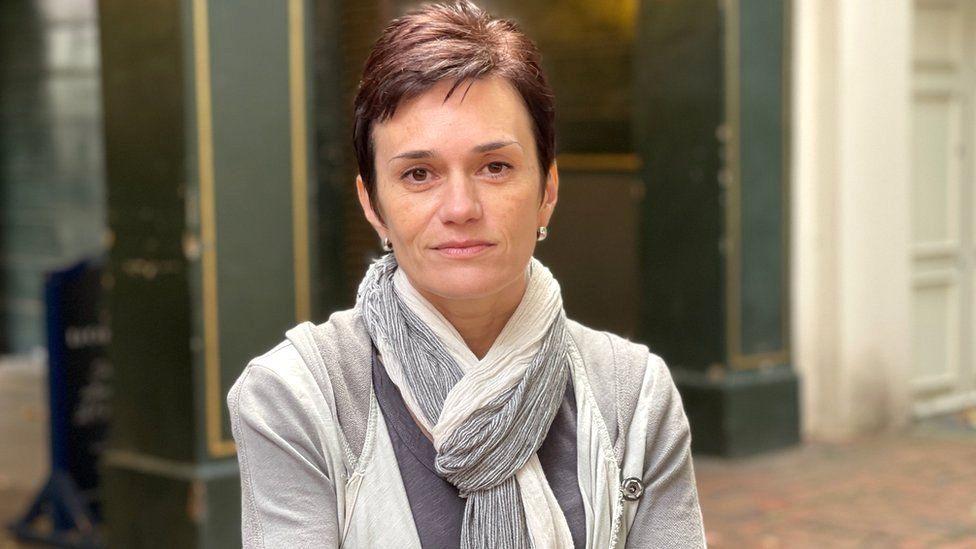
“I love and hate this man for his incredible integrity,” Evgenia told me on a recent trip to London.
“He had to be there with those people who went out on the streets and were arrested,” she said, referring to the many Russians detained for opposing the war. “He wanted to show that you shouldn’t be afraid in the face of that evil and I deeply respect and admire him for that. And I could kill him!”
Image caption, Evgenia has not been allowed to speak to her husband since he was jailed
Vladimir was initially detained for disobeying a police officer, but once in custody the serious charges began raining down.
The activist was first accused of “spreading false information” about Russia’s military and “higher leadership”.
The rights group OVD-Info has recorded more than 100 prosecutions under that so-called “fake news” law since the war began: a local councillor, Alexei Gorinov, was sentenced to seven years in July and activist Ilya Yashin will go on trial soon after referring to the murder of civilians in Bucha.
Vladimir’s case is based on a speech in Arizona where he said Russia was committing war crimes in Ukraine with cluster bombs in residential areas and “the bombing of maternity hospitals and schools”.
That has all been independently documented, but according to the charge sheet I have seen, Russian investigators deem his statements to be false because the defence ministry “does not permit the use of banned means… of conducting war” and insists that Ukraine’s civilian population “is not a target”.
The facts on the ground are ignored.
Another charge stems from an event for political prisoners at which the activist referred to what investigators term Russia’s “supposedly repressive policies”.
Then last month he was charged with state treason.
The activist responded to that in his latest letter: “The Kremlin wants to portray Putin’s opponents as traitors… the real traitors are those who are destroying the well-being, the reputation, and the future of our country for the sake of their personal power, not those who are speaking out against it.”
Political persecution
The treason charge is based on three speeches abroad, including one in which Vladimir said that in Russia political opponents were persecuted.
Investigators maintain that he was speaking on behalf of the US-based Free Russia Foundation, which is banned in Russia, where any “consultancy” or “assistance” to a foreign organisation considered a security threat can now be classed as treason.
No secrets have to be divulged.
“State treason for public speeches? That’s just absurd. It’s quite simply persecution for free speech. For opinion. Not for any real crime,” Vladimir’s lawyer, Vadim Prokhorov, argues by phone from Moscow.
He says the activist had no link to the foundation at the time.
“This is a political case. They’re trying to stigmatise the absolutely normal, civilised Russian opposition.”
Image source, Evgenia
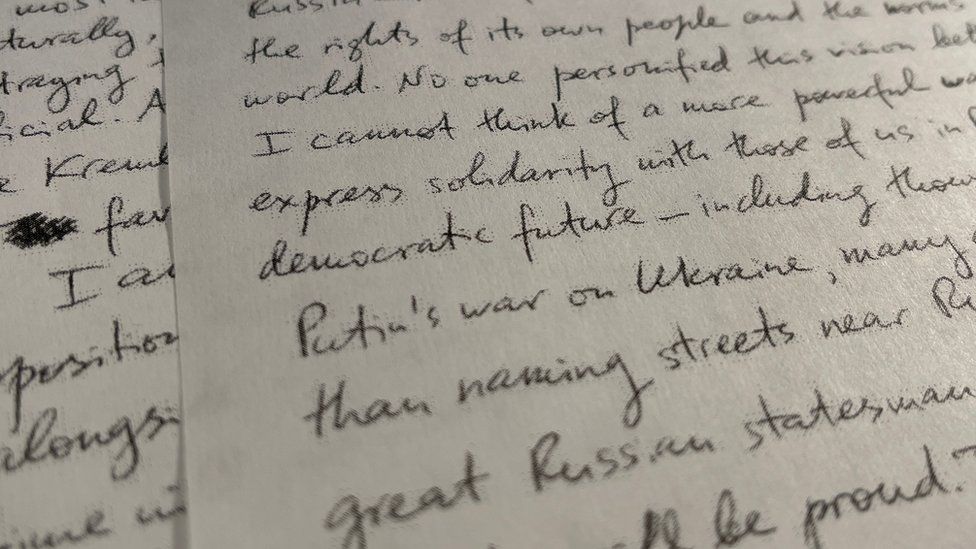
Image caption, Vladimir has written to the BBC from his jail cell
Vladimir himself points out that the last person accused of treason for political opposition was the Nobel Prize-winning writer Alexander Solzhenitsyn in 1974. “All I can say is that I am honoured to be in such company.”
Evgenia finds it harder to sound so calm.
This is not the first time she has been scared for her husband. He nearly died, twice, in Moscow, and the cause of his poisoning has never been identified.
When he first collapsed in 2015 and slipped into a coma, Evgenia was told he had a 5% chance of survival, but he defied the odds.
She nursed him back to health, helping him learn to function again, even to hold a spoon. He would then insist on working on his laptop on their couch, despite being sick every half hour.
“The moment he could walk, he packed his bags and went to Russia. That fight is bigger than his fears.”
For Evgenia, that has meant seven years sleeping with her phone, ”afraid I will get that call from him, or from someone else because he can’t talk anymore”.
She gave up persuading he husband not to go to Moscow long ago: her only protest was to refuse to help pack his bags. But before his last visit, after the war started, Evgenia accompanied him first to France.
“I wanted to make the trip beautiful,” she remembers, forcing back tears as she recalls long strolls through the streets of Paris, talking endlessly. “Deep inside, I knew what was coming.”
Nemtsov’s Place
Since Vladimir’s arrest, Evgenia has taken on his advocacy work: speaking out about the war in Ukraine and political repression in Russia, as well as her husband’s case.
On Monday she will unveil the Boris Nemtsov Place in London, the result of a long campaign by Vladimir to honour his mentor and friend. The prominent opposition politician was shot beside the Kremlin in 2015 in a contract killing for which the contractor has never been caught.
The renamed London street, actually a roundabout, is close to the Russian trade delegation in Highgate.
Image source, Evgenia Kara-Murza
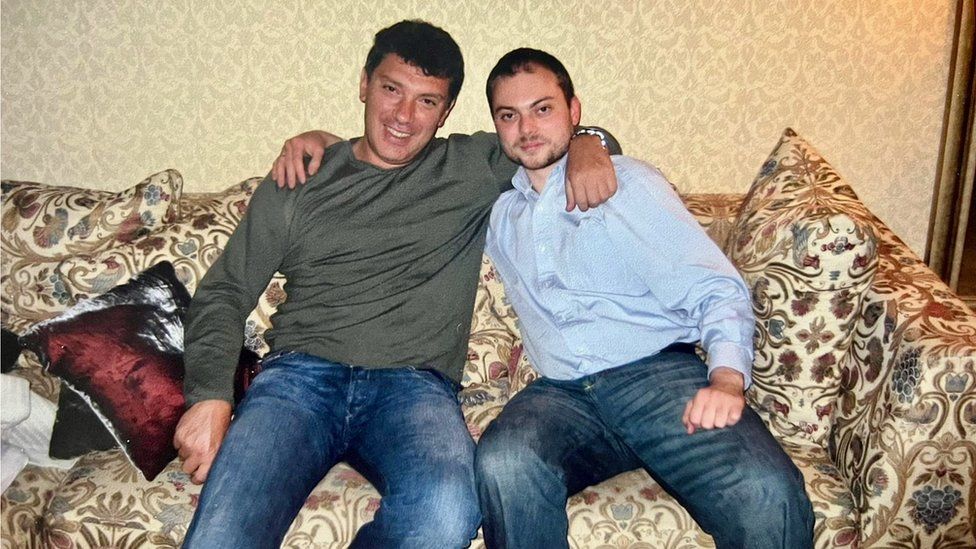
Image caption, Boris Nemtsov (left) was a friend and mentor to Vladimir (right)
“The idea was that every car that comes to the big gate will see the Boris Nemtsov plaque,” Evgenia explains. Her husband hopes a different Russia will one day be proud of that name.
For several years, the politician worked closely with Vladimir to lobby Western governments to sanction senior Russian officials for human rights violations. Their success infuriated a political elite that had enjoyed travelling abroad and channelling funds there.
In Moscow once, Vladimir told me he had concluded that those “Magnitsky” sanctions are why both he and Mr Nemtsov were targeted.
Standing-in for her husband is taking a heavy toll on Evgenia, but it is also kept her going.
“I am doing what I need to do so that he can be brought back to the kids and this hideous war stops and this murderous regime can be brought to justice.”
Vladimir is not staying silent, either.
His long, handwritten prison letters set out his convictions that Russia is not doomed to autocracy and its people are not all brainwashed Putin devotees.
He points to the large number of letters he gets from supporters who openly criticise the Ukraine invasion and the Kremlin, and to those who still protest publicly, despite the risk. He urges the West not to isolate that part of Russian society that “wants a different future for our country”.
He also warns that the Ukraine war will not stop whilst Vladimir Putin remains in power.
“For Putin, compromise is a sign of weakness and an invitation to further aggression,” he says. “If he’s allowed a face-saving exit from the war, then in a year or two we will have another one.”
Vladimir tells me he is coping with imprisonment with a mixture of exercise and prayer, books and letters. As a historian, he has a particular interest in Soviet-era dissidents and has been reading more about them as he awaits trial.
“Their favourite toast back then was ‘To the success of our hopeless cause!’” he writes. “But as we know, it wasn’t so hopeless after all.”
Rishi Sunak has promised to “call out Putin’s regime” at an international summit in Indonesia.
On Sunday afternoon, the prime minister will travel to Bali for a G20 summit of the world’s largest economies.
British officials had planned for this meeting assuming Russia‘s president would attend.
The prime minister was expected to join other world leaders in publicly condemning Vladimir Putin.
But Moscow said last week he wouldn’t be attending and the Kremlin would be sending Russia’s foreign minister, Sergei Lavrov, instead.
So the words of anger will be directed at him.
Speaking before setting off for Indonesia, the prime minister said: “Putin’s war has caused devastation around the world – destroying lives and plunging the international economy into turmoil.
“This G20 summit will not be business as usual. We will call out Putin’s regime, and lay bare their utter contempt for the kind of international cooperation and respect for sovereignty forums like the G20 represent.”
The G20 is a hotchpotch of countries with little in common beyond big economies.
IMAGE SOURCE, SHUTTERSTOCK Image caption, None of the other G20 leaders want to pose for a smiling photo with Russia amid its invasion of Ukraine
An economic forum whose members have been hammered, economically, by one of their own, Russia.
The other leaders refuse to be seen smiling in the presence of Russia.
Recent precedent suggests another usual staple of these affairs, what is known as a communique, a set of agreed conclusions published at the close of the summit, probably won’t happen either.
Almost three weeks into the job, this is Mr Sunak’s second overseas trip as prime minister, after last week’s dash to the COP27 climate summit in Egypt.
He managed to see a good number of fellow European leaders in Sharm el-Sheikh.
The trip to Bali will mean he can meet plenty from the Indo-Pacific region, a part of the world the government has been increasingly focused on since Brexit.
And, perhaps, a first chance to meet US President Joe Biden.
Meanwhile, back home, as Laura Kuenssberg writes, Chancellor Jeremy Huntwill continue preparing what is called the Autumn Statement, a budget in all but name, to be delivered on Thursday, just hours after the prime minister gets back home.
Downing Street is seeking to frame both the summit and the Autumn Statement as responses to the same shock: the consequences of the war in Ukraine.
A desperate global economic situation, as they describe it, with big domestic implications, that they seek to be trusted to grapple with, after the chaos of the Liz Truss administration.
But a fractious summit followed by what many will see as a bad news Budget won’t make for an easy week for Mr Sunak.
“The leaders discussed a number of current issues on the bilateral agenda with an emphasis on the continued building up of interaction in politics, trade, and the economy, including transport and logistics,” the Kremlin said in a statement.
The leaders agreed that the contacts between Russian and Iranian institutions will be increased, it added.
Kyiv and its Western allies have accused Moscow of using Iranian-made drones in recent weeks to carry out attacks in Ukraine, where it launched a “special military operation” in February.
Russian DeputyForeign Minister Sergey Vershinin says the fate of the grain deal after November 18 is unknown.
Vershinin stated that the agreement is divided into two parts, one of which calls for lifting sanctions on Russian food exports.
“It is impossible not to mention here the terrorist attacks that the Ukrainian side carried out on the Crimean Bridge. And the terrorist attack on Sevastopol, where ships are stationed that provide a humanitarian corridor through which dry cargo ships or other vessels go as part of the implementation of this Black Sea grain deal,” he said.
At a news conference following the Association of Southeast Asian Nations (ASEAN) summit in Phnom Penh, Lavrov chastised the US for its efforts in the region, which both Russia and the West consider as a possible strategic geopolitical struggle in the coming decades.
“The United States and its NATO allies are trying to master this space,” Lavrov told reporters.
He said Joe Biden’s Indo-Pacific strategy was an attempt to bypass “inclusive structures” for regional cooperation and would involve “the militarisation of this region with an obvious focus on containing China, and containing Russian interestsin the Asia-Pacific”.
Ukrainian officials have warned “the war is not over” after Russia’s withdrawal from Kherson, even as celebrations continue over the weekend.
Cheering crowds welcomed Ukrainian troops to the city – the only regional capital taken by Moscow since February – on Friday.
Similarly jubilant scenes were reported in other regions across Ukraine, including the capital, Kyiv, and Odesa.
But despite the blow to Moscow’s ambitions, officials remain cautious.
Yuriy Sak, an adviser to the Ukrainian defence minister, warned the BBC it was “too early to relax”.
“We always believed that we would liberate Kherson,” he told Radio 4’s Today programme. “And we are confident that now Russians are beginning to believe that they will never be able to win this war. We see the panic in their ranks. We see the panic in their propaganda machine.
“But of course, this is a very important moment, but… this war is far from over.”
Kherson lacks running water, medicines and food, but emergency supplies are starting to arrive from nearby Mykolaiv, an aide to the city’s mayor says.
The aide, Roman Golovnya, says 70-80,000 people live in Kherson now, out of a pre-war population of 320,000.
President Volodymyr Zelensky said that “before fleeing from Kherson, the occupiers destroyed all critical infrastructure – communications, supply of water, heat, electricity”.
It is not yet clear when electricity will be restored to the city – nearby areas are expected to get it back in a few days’ time. The power cuts prevented Kherson’s bakeries from making bread.
Ukrainian forces have begun the huge task of dismantling Russian mines and booby-traps in and around Kherson, Mr Zelensky said.
Meanwhile, Ukrainian TV has resumed broadcasts in the area – a key source of news for many Ukrainians.
Yuriy Sak warned of the continuing risk of missile attacks – as did Oleksiy Kuleba, head of the Kyiv region’s military administration. Russia has been firing missiles at Ukraine’s energy infrastructure in recent weeks, severely damaging the country’s output.
Mr Kuleba told the BBC: “Over the past month… we have seen massive shelling of peaceful settlements in Ukraine. Now I want to say that the threat of rocket attacks on the Kyiv region remains high.”
Meanwhile, the former head of Ukraine’s National Security Council, Oleksandr Danylyuk, has warned that the Russian troops who have retreated from Kherson will have crossed the Dnipro river to “go into deep defence on the left bank”, telling the BBC “it will put them [at an] advantageous position”.
Moscow said some 30,000 personnel had been taken out of the area – as well as around 5,000 pieces of military hardware, weaponry and other assets.
As BBC international editor Jeremy Bowen points out, the decision to pull out “has preserved the lives of soldiers who might have died fighting a battle they could not win” and allowed them to be deployed elsewhere in the country.
The UK’s Ministry of Defence noted on Saturday that it was “highly likely” Russian troops destroyed road and rail bridges over the Dnipro river as part of their retreat. Images emerged on Friday of the main river crossing – the Antonivsky Bridge – having partially collapsed. It remains unclear how the damage was caused.
On Saturday morning, other images emerged showing damage to the Nova Kakhovka dam, some 58km (36 miles) north-east of Kherson city.
US satellite imagery firm Maxar tweeted that “sections of the dam and sluice gates” had been destroyed. A road and railway line both run across the dam and Maxar’s photos show that they have been severed. It is not clear what caused the damage, which the BBC has not independently assessed.
New video footage, verified by the BBC, shows a huge explosion at one end of the dam.
Ukraine and Russia have accused each other of planning to breach the dam with explosives, raising the threat of flooding in the Kherson region.
The withdrawal – which the UK’s Ministry of Defence suggests could have started as early as 22 October under the cover of the civilian evacuation – means Russia has lost the administrative capital of one of the four regions it illegally annexed in September.
On Saturday, Moscow announced itstemporary replacement capitalwould be a port city called Henichesk, more than 200km (125 miles) south-east of Kherson, near Russian-occupied Crimea.
Russia’s Interfax news agency says the authorities evacuated all the regional offices, as well as “statues and historic artefacts”, from the west bank of the Dnipro river – that is, from Kherson city and its surroundings. More than 115,000 people were evacuated from that area, it reports.
The UK’s Defence Secretary, Ben Wallace, said the retreat from Kherson marked “another strategic failure” for Moscow.
“In February, Russia failed to take any of its major objectives except Kherson,” he said in a statement.
“Now with that also being surrendered, ordinary people of Russia must surely ask themselves: ‘What was it all for?’”
Ukrainian President Volodymyr Zelenskyy has sponsored a fundraising campaign to assist Ukraine in building a naval drone fleet to safeguard cities from Russian missiles launched from Black Sea warships.
United24, a charity effort founded by Zelenskyy in response to Russia’s invasion in February, stated that Ukraine needs 100 drones operating from the sea, each costing 10 million hryvnias (about $274,000).
“We must defend the waters of our seas and peaceful cities from Russian missiles launched from ships,” Zelenskyy wrote on the Telegram messaging app on Friday.
“Naval drones will also help unblock the corridor for civilian ships transporting grain for the world,” he said.
Since launching its full-scale invasion of Ukraine, Russia has carried out missile strikes from ships in the Black Sea and from Crimea, the peninsula Moscow seized from Ukraine in 2014 and which is home to the Russian navy’s Black Sea Fleet.
Russia has also used aerial drones, including Iranian-made so-called “kamikaze” models, to attack Kyiv and key infrastructure across the country.
Russia started blockading Ukraine’s Black Sea ports soon after the February invasion, including blocking the vital international export of grain. Three Ukrainian ports were unblocked under a deal brokered with Russia in July by the United Nations and Turkey to help ease a global food crisis.
Russia later suspended itsparticipation in the grain deal after what it said was a Ukrainian attack on three of its Black Sea Fleet vessels late last month from a combined force of aerial and naval drones. Moscow later returned to the deal, which is due to expire next week.
“I am sure that millions of people will support this important area of Ukraine’s defence,” Zelenskyy wrote of the naval drone fundraising campaign.
The mystery graffiti artistappears to be in Ukraine, where he is credited with three fresh murals.
After unveiling his latest artwork on Instagram, Banksy appears to have verified that he is in Ukraine.
The unidentified graffiti artist posted the painting, which depicts a female gymnast teetering on a destroyed building, late Friday night.
The location was labeled as Borodyanka, in Ukraine’s Kyiv area.
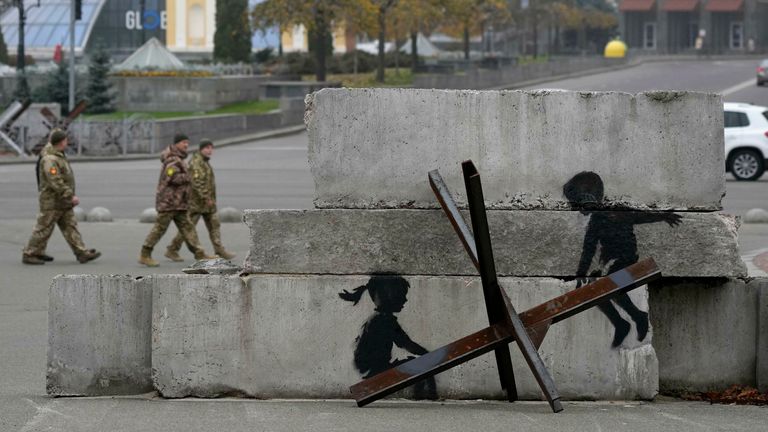
Two other murals were reportedly seen nearby – one depicting a man resembling Russian President Vladimir Putin being flipped during a judo match with a little boy, and another showing two children using a metal tank trap as a seesaw.
Image: The photo of this mural was taken earlier this month when its creator was still unverified. Pic: AP
Borodyanka, northwest of Ukraine’s capital Kyiv, was one of the towns hardest hit by Russia’s bombardment after the invasion began late in February.
It was liberated in April, but for weeks afterward, it was isolated – the power had been knocked out, shops were closed, transport links were not operating and humanitarian agencies and other volunteer groups were the only sources of food, clothes, and other necessities.
Ukraine’s President Volodymyr Zelenskyysaid later that the situation in occupied Borodyanka had been “much more horrific” than in Bucha, where hundreds of civilians were found dead in mass graves.
Two brothers have been charged in Sweden with spying for Russiaover a period of 10 years, prosecutors have announced.
Both are reported to have worked for Sweden’s security services, and one was a senior manager at a government agency when arrested last year.
Investigators have seized mobile phones, a smashed hard drive and notes detailing cash and gold transactions.
The suspects deny any wrongdoing, their defence lawyers have told local media.
Peyman Kia, 42, and Payam Kia, 35, are believed to have worked together to pass on information to Russia’s military intelligence service, the GRU.
The men were arrested in late 2021 and have been in custody ever since.
While both are accused of aggravated espionage, Peyman Kia has also been charged with the gross unauthorised handling of secret information.
The chief prosecutor of Sweden’s National Security Unit, Per Lindqvist, described the case as very difficult to investigate, adding the men were suspected of “highly serious criminality targeted at Sweden’s intelligence and security system”.
The secret information – which could result in “detriment to Sweden’s security” in the hands of a foreign power, according to Mr Lindqvist – was reportedly gathered while the older Mr Kia was employed at Sweden’s security services and army.
Newspaper Dagens Nyheter says the suspect also served in the Office for Special Acquisition (KSI), a top-secret organ of the country’s intelligence services.
During Peyman’s arrest, his younger brother Payam “dismantled and broke a hard drive that was later found in a bin”, according to the charges.
Payam is thought to have managed contact with Russia and the GRU including “matters of surrender of information and receipt of compensation”.
Much of the information from the preliminary investigation has not been released due to its sensitive nature.
The older Mr Kia’s defence lawyer, Anton Strand, told Sweden’s public broadcaster SVT the charges were imprecise and lacked “concrete” descriptions of his client’s alleged crimes.
Björn Sandin, defending the younger suspect, similarly suggested the charges demonstrated that prosecutors were “not entirely confident” about their claims, according to TV4.
If convicted, the brothers may be handed life sentences – generally a minimum of 20-25 years in prison in Sweden.
Prosecutors claimed David Smith, 58, intended to cause harm to the United Kingdom and the embassy where he had worked for eight years.
The British citizen was accused of gathering intelligence on the embassy and leaking classified documents.
Smith pleaded guilty to eight charges under the Official Secrets Act at the Old Bailey.
He is said to have wanted to live in Russia or Ukraine during the time he passed on classified information beginning in May 2020.
Prosecutors claimed he was motivated by a deep hatred for his homeland and enraged by the display of the Rainbow flag in support of the LGBT community.
He was arrested in August 2021 and 800 euros (£700) of cash was found in his home in Potsdam, Germany.
Smith, now of no fixed abode, pleaded guilty to the charges on 4 November, but reporting restrictions were initially put in place.
They were lifted on Friday after the prosecution indicated it would not seek a trial on a ninth charge that he had denied.
Smith will be sentenced at a later date and faces a maximum of 14 years in prison.
Extradited to UK
The charges laid against Smith stated he had communicated with General Major Sergey Chukhurov, the Russian military attache based out of the Russian Embassy in Berlin in 2020 – giving information about the addresses, phone numbers and activities of various British civil servants.
He collected intelligence on the operation and layout of the embassy, which was said to be useful to “an enemy, namely the Russian state”.
Some of this material was classified as “secret” and related to the activities of the British government and its German embassy.
But the material he has admitted passing on or collecting could still be very useful for the Russians.
It could potentially help identify undercover British intelligence officers at the Embassy and potentially even any agents they were meeting.
Things like details of CCTV could also potentially have helped Russian spies work out how to run their own operations against the embassy and collect its secrets.
Smith’s lawyers are understood to dispute the prosecution’s claims about his motivation but disgruntled employees historically have often been the most effective recruits for spy services.
The case may also raise questions about the checks carried out on staff, like Smith, that are recruited locally.
On the day of his arrest, Smith had left work early complaining he was feeling ill and was met by German police at his home.
A request was made for his extradition to the UK in November 2021, following a probe by British counter-terrorism police. Smith arrived back to the UK in April.
Footage from the embassy and a draft letter to a Russian military attache, dated 14 May 2020, were found after an examination of his electronic devices.
In the letter he confirmed he worked at the embassy and wanted anonymity as he offered a book classified as “official sensitive”.
There were also “secret” classified emails and documents, pictures of staff security passes and personal information as well as posters and whiteboards in the embassy.
Matthew Ryder KC said: “It is right to say there is significant difference as to the basis Mr Smith has pleaded guilty including him not having a negative intention towards the UK that the prosecution have alleged against him.”
England’sall-time leading goalscorer Wayne Rooney hopes Harry Kane smashes his record during the World Cup.
Kane heads to the tournament with 51 goals for the Three Lions, two behind Rooney’s record hail, with the pair standing as the only England players to have hit the half-century mark.
Having scored six times in Russia four years ago to win the Golden Boot, Kane will be confident of surpassing Rooney’s tally in Qatar.
While others may wish to hold onto such a record, Rooney is fully behind Kane taking a record that is “there to be broken”.
“I’m delighted for him, I think he’ll go on and smash the record, I think he’ll end up on 70-odd goals,” Ronney told TalkSPORT.
“He deserves it for the work he puts in. It’s a huge honour to have the record but the record is there to be broken and I couldn’t think of anyone better to take that record.
“Hopefully, he gets it during this World Cup because it will mean he’s doing well for England.”
6 – In the UEFA Champions League this season, only Lionel Messi (8) has created more chances directly following a carry than Jack Grealish (6). Inventor. #ThreeLionspic.twitter.com/htUisrYxmq
Kane was one of the sure-fire picks for Gareth Southgate’s 26-man squad, which was named on Thursday, though the England manager’s selection of Harry Maguire has come under some criticism.
Rooney, who took up a coaching role with D.C. United in MLS earlier this year, believes Southgate has made the right choice in picking the Manchester United centre-back, though he questioned the exclusion of Milan’s Fikayo Tomori.
“Harry has been great in the last two tournaments. When I was in the squad, Gareth reiterated to me that he is picking players on form and I wasn’t playing, so I didn’t get picked, but he seems to have gone away from that now,” he added.
“There’s a couple of players within the squad who haven’t been playing but I think Harry is a very good professional, he’ll start the games, I have no doubt, and I’m sure he won’t let England down.
“The squad is probably as strong as it could be, if I’m being honest. The only one really is Tomori, from my point of view. He was the one who was pushing to be in the squad, and he will be disappointed that he is not. Everything else is really what I expected.
“With Maguire not playing as much as he wants, I think Southgate might go for the protection with three centre-backs and that is obviously why he’s gone with Eric Dier ahead of Tomori, because he fits into the back three.
“I hope we go for four [at the back] and get an extra attacker on the pitch but I think he might go for the back three.”
England kick-off their group stage campaign against Iran on November 21, then tackle the United States and Wales in Group B.
Adidas cut its earnings forecast for the year on Wednesday to account for losses from the termination of its partnership with the rapper formerly known as Kanye West due to antisemitic remarks.
In its third-quarter earnings report, the German shoe and sportswear maker cut its sales and profit forecast for the year, even as the company’s chief financial officer said the profitability of the Yeezy shoe collaboration with Ye had been “overstated.”
According to CFO Harm Ohlmeyer, the company will largely offset the impact of the split next year by no longer having to pay royalties and marketing fees for the brand.
The Oct. 25 split with Ye, with production of all Yeezy products halted and royalty payments ended, will leave Adidas searching for another star to help it compete with ever-larger rival Nike. Adidas also is facing internal upheaval, with its CEO Kasper Rorsted stepping down Friday. He was previously expected to hand over next year, but the company announced the quicker change on Tuesday as it named Puma CEO Bjørn Gulden as his replacement.
Adidas faced pressure to split with Ye as other brands did earlier over the rapper’s antisemitic comments in interviews and social media, including a Twitter post earlier this month that he would soon go “death con 3 on JEWISH PEOPLE,” an apparent reference to the U.S. defense readiness condition scale known as DEFCON. He was suspended from both Twitter and Instagram.
Adidas owns the rights to product designs except for the Yeezy name and is developing plans for what to do with existing inventory.
Ohlmeyer said on a conference call with reporters that the profitability of the Yeezy business had been overstated because its costs only included expenses directly related to the products and not central overhead costs borne by the company.
“In other words, it does not include any further central cost allocation for sourcing, digital, retail, or any other services that this part of our business has been benefitting from and that were essential for its success,” Ohlmeyer said.
“At the same time, we will save around 300 million euros related to royalties and marketing fees; in combination, this will help us to compensate the majority of the top and bottom line impact in 2023,” he said.
The Yeezy brand accounted for up to 15% of Adidas’ net income, Morningstar analyst David Swartz said in a note Oct. 26.
The company had already cut its full-year earnings forecasts five days before announcing its split with Ye. The earlier outlook revision cited slowing activity in China, where severe restrictions aimed at limiting the spread of COVID-19 have held back the economy, and clearance of elevated inventory levels.
Net income for the third quarter from continuing operations was 66 million euros, down from 479 million euros in the same quarter a year ago.
Ukraine’s President Volodymyr Zelenskyhas said his country is moving “very carefully” following Russia’s announcement that it plans to withdraw its troops from the southern city of Kherson.
Zelensky called for Ukrainians to be cautious, saying that their enemy did not give out gifts, and did not make “goodwill gestures”.
Russia’s announced pullout comes just weeks after President Putin said he was annexing Kherson and three other Ukrainian regions, none of which were wholly occupied by Russian forces.
The commander of Russia’s forces in Ukraine, General Sergei Surovikin, described the decision as difficult. He said defences would be consolidated to the east, on the other side of the Dnipro river from Kherson.
Over in Moscow, our Russia editor Steve Rosenberghas filmed a quick press preview, mopping up the Russian media’s framing of the announced pullout from Kherson.
What’s interesting, he notes, is the Kremlin’s decision to distance President Putin from the decision – putting it all on the military men: Defence Minister Sergei Shoigu and General Sergei Surovikin.
See that and more in Steve’s clip below.
In today’s Russian papers: reaction to Russia’s Kherson retreat. Plus: “Our system is geared to the search for a great leader. His decisions are not up for discussion. So he mustn’t make mistakes, for there’s no mechanism to correct them.” #ReadingRussiapic.twitter.com/KvVaaBvWcT
Russianforces swept across southern Ukraine from annexed Crimea at the start of the war in February, seizing Kherson city in early March.
But yesterday the Russian defence minister ordered the withdrawal of his forces from the city, and the west bank of the Dnipro river.
Russia’s commander in Ukraine, Sergei Surovikin, said it was no longer possible to keep supplying the city.
Kherson has been the biggest prize in Russia’s invasion but Ukrainian forces have mounted a concerted counter offensive over recent weeks to try to recapture the city.
So this is the biggest setback yet for President Putin’s invasion.
General Sergei Surovikin stated on television that it is no longer possible to supply Kherson and other parts of the Dnipro River’s west bank.
He said: “We will save the lives of our soldiers and fighting capacity of our units.
“Keeping them on the right (western) bank is futile.
“Some of them can be used on other fronts.”
Russia’s defence minister Sergei Shoigu responded by saying: “I agree with your conclusions and proposals.
“Proceed with the withdrawal of troops and take all measures to transfer forces across the river.”
The announcement marks one of Russia’s most significant retreats – Kherson city was seized by Russia early in the war and is the only regional capital the country has taken during the conflict, which is almost nine months old.
Mikhailo Podolyak, an adviser to Ukraine’s president Volodymyr Zelenskyy, said: “Ukraine does not pay attention to Russian statements – words and actions differ.”
Kherson region was annexed in September, along with three other parts of Ukraine – Luhansk, Donetsk and Zaporizhzhia.
Brittney Griner, a convicted US basketball player, is being transferred from a Russian prison to a penal colony.
She was arrested in February at an airport near Moscow after cannabis oil vapes were discovered in her bags.
In August, the two-time Olympic gold medalist was convicted of smuggling and possessing cannabis oil and sentenced to nine years in a penal colony.
While the use of cannabis is illegal in Russia, Moscow has been accused of using Griner “as a political pawn”.
On Wednesday, the 32-year-old’s legal team said the transfer began last week and Griner was on her way to a penal colony, but they added that they had not been told where she currently is or where she is being sent to.
The US embassy is normally informed of where international prisoners are held. Griner’s team believe they may not be told for two weeks.
Penal colonies are the descendants of Soviet-era enforced labour camps, otherwise known as gulags.
In them, prisoners are housed in barracks and perform labour. Penal colonies are also a source of income, with some containing factoriesthat produce items such as food or clothing, while some inmates undertake construction work.
IMAGE SOURCE,GETTY IMAGES Image caption, Griner is the first woman in the league to consistently dunk
At the time of her trial, Griner pleaded guilty, but said she had made an “honest mistake” and had not meant to break the law.
Last month, Griner – who is seen by many as the greatest female basketball player of all time – and her legal team appealed against her nine-year sentence, but a court near Moscow upheld it, with the state prosecutor calling it “fair”.
The double Olympic winner apologised for her “honest mistake” in the appeal hearing via video link, saying her imprisonment had been “very, very stressful” and “traumatic”.
Speaking afterwards, the WNBA star’s lawyer, Alexander Boykov, said his team hoped that a prisoner exchange would be possible.
Mr Boykov has also criticised Griner’s sentence for being unduly harsh: “No judge, hand on heart, will honestly say that Griner’s nine-year sentence is in line with Russian criminal law,” he said after her appeal was rejected.
In Russia, possession of less than 6g of cannabis is normally punishable by a fine or 15 days in detention. Griner is thought to have had less than 1g when she entered Russia to play basketball during the US off-season.
Following the rejection of her appeal, Griner’s wife, Cherelle Griner, told the CBS Mornings programme that the basketball star was a “hostage” of the Russian government.
She said she did not know if her spouse “has anything left in her tank to continue to wake up every day and be in a place where she has no-one”.
IMAGE SOURCE,GETTY IMAGES Image caption, The basketball star has remained dominant in WNBA since her rookie year
Speaking after Griner’s transfer to the undisclosed penal colony, White House press secretary Karine Jean-Pierre said that the US was “unwavering” in attempts to free her and other detained Americans.
She added that US President Joe Biden had ordered his administration to swiftly “prevail on her Russian captors to improve her treatment and the conditions she may be forced to endure in a penal colony”.
Secretary of State Antony Blinken said the US expected Russian authoritiesto provide its embassy officials with access to Brittney and other Americans detained in Russia.
In late July, the Biden administration proposed a prisoner swap with Russia to secure Griner’s release, as well as ex-marine Paul Whelan, who Moscow accuses of spying. Officials said Russia had yet to respond positively to the suggestion and said diplomacy should not be conducted in public.
Russia’s invasion of Ukraine a week after Griner’s arrest and the US’s backing of Kyiv have further inflamed tensions between the two countries.
India’s foreign ministersays purchasing oil from a “steady and time-tested partner” is economically advantageous.
Foreign Minister Subrahmanyam Jaishankar said during his first visit to Russia since it invaded Ukraine that India will continue to buy Russian oil because it is beneficial to the country, a move that runs counter to Western efforts to cripple Russia’s economy with sanctions.
On Tuesday, Jaishankar met with his Russian counterpart Sergey Lavrov in Moscow, accompanied by senior officials in charge of agriculture, petroleum and natural gas, ports and shipping, finance, chemicals and fertiliser, and trade, emphasizing the importance of relations with Russia.
“Russia has been a steady and time-tested partner. Any objective evaluation of our relationship over many decades would confirm that it has actually served both our countries very, very well,” Jaishankar said in a joint news conference.
“As the world’s third-largest consumer of oil and gas, a consumer where the levels of income are not very high, it is our fundamental obligation to ensure that the Indian consumer has the best possible access on the most advantageous terms to international markets,” he said.
“We have seen that the India-Russia relationship has worked to advantage. If it works to my advantage, I would like to keep that going,” the Indian foreign minister added.
India, which has not explicitly condemned what Russia calls its “special military operation in Ukraine”, has emerged as Russia’s largest oil customer after China following a boycott by Western buyers.
Russian Foreign Minister Sergei Lavrov and his Indian counterpart Subrahmanyam Jaishankar shake hands during a news conference in Moscow. [Maxim Shipenkov/Pool via Reuters]
Jaishankar’s announcement came ahead of United States Treasury Secretary Janet Yellen’s visit to New Delhi later this week, when she is expected to discuss a Group of Seven (G7) plan to cap the price of Russian oil with Indian officials.
US officials and G7 countries have been in intense negotiations in recent weeks over the unprecedented plan to put a price cap on sea-borne oil shipments, which is scheduled to take effect on December 5 to ensure European Union and US sanctions do not throttle the global oil market.
Both New Delhi and Beijing have so far refused to join Western sanctions against Russia.
Lavrov praised the position of Russia’s “Indian friends” on Ukraine and accused Western countries of trying to consolidate a “dominant role in world affairs” and prevent “the democratisation of international relations”.
Russia and India are also considering joint production of modern defence equipment, the foreign minister was quoted by TASS news agency as saying. Last year, the two countries inked a $677m deal to produce AK-203 assault rifles in India as part of New Delhi’s push for self-reliance in defence manufacturing. India is one of the world’s largest buyers of defence equipment.
Moscow has been New Delhi’s biggest supplier of military equipment for decades. India imported Russian defence equipment worth more than $20bn between 2011 and 2021.
According to Lavrov, Russia and India also want to cooperate more closely in the fields of nuclear energy and space travel.
US National Security Adviser Jake Sullivan has confirmed that the communication channels between Washington and Moscow remain open.
It comes as the White House refuses to deny reports that Mr Sullivan has been leading talks with Russia to prevent a nuclear escalation in Ukraine.
Speaking in New York, Mr Sullivan said it was “in the interests” of the US to maintain contact with the Kremlin.
But he insisted officials were “clear-eyed about who we are dealing with”.
The Wall Street Journal reports that Mr Sullivan has held confidential discussions with his Russian counterpart, Security Council secretary Nikolai Patrushev, and senior Kremlin foreign policy aide Yuri Ushakov, over the past several months.
Senior officials told the paper the men had discussed ways to guard against the risk of nuclear escalation in the war in Ukraine, but had not engaged in any negotiations around ways to end the conflict.
Last month, Mr Sullivan said any use of nuclear weapons would have “catastrophic consequences for Russia“. He told the US broadcaster NBC that senior officials had “spelled out” the scope of the potential US response in private discussions with Russian officials.
US National Security Council spokeswoman Adrienne Watson refused to confirm the story, telling the paper that “people claim a lot of things”, while Kremlin spokesperson Dmitry Peskov accused Western newspapers of “publishing numerous hoaxes”.
But White House Press Secretary Karin Jean-Pierre said on Monday that the United States reserved the right to hold talks with Russia.
And Mr Sullivan – who is said to be one of the most senior advisers to US President Joe Biden still pushing for discussions with Russia – said maintaining contact with Moscow was in the “interests of every country who is affected by this conflict”.
Last week, the Washington Post reported that senior US officials were urging Kyiv to signal an openness to hold negotiations with Russia and drop their public refusal to discuss an end to the war while President Vladimir Putin remained in power.
But Mr Sullivan told a public event in New York that the Biden administration had “an obligation to pursue accountability” and pledged to work with international partners to “hold the perpetrators of grave and grotesque war crimes in Ukraine responsible for what they have done”.
“I was just in Kyiv on Friday. and I had the opportunity to meet with President [Volodymyr] Zelensky and my counterpart Andriy Yermak, with the military leadership and also to get a briefing on just what level of death and devastation has been erupted by Putin’s war on that country,” Mr Sullivan said.
Concerns have been heightened in recent months that Russia could resort to using nuclear weapons in a desperate attempt to defend four regions of eastern and southern Ukraine that it illegally annexed.
Meanwhile, Ukraine has invoked its war-time martial laws to take control of the assets of five strategically important companies.
Some of the companies – which include two energy companies and firms that make engines, vehicles and transformers – are linked to oligarch Vyacheslav Bohuslayev, who was arrested on suspicion of collaborating with Russia.
President Zelensky said the move would help Ukraine’s defence sector meet the needs of the military, which is currently engaged in counteroffensives in southern and eastern Ukraine.
A day before the US elections, Russian businessman Yevgeny Prigozhin says he will continue to meddle.A day before the midterm elections in the United States, the founder of Russia’s Wagner Group, a private mercenary force, admitted to meddling in US elections and promised to continue.
“We have interfered, we are interfering and we will continue to interfere – carefully, accurately, surgically and in our own way, as we know how to do,” Yevgeny Prigozhin said on Monday in comments posted by the press service of his Concord catering firm on Russian social media.
“During our pinpoint operations, we will remove both kidneys and the liver at once,” the Russian businessman wrote on VK, the Russian equivalent of Facebook.
He did not elaborate.
A 2018 US Justice Department indictment accused a Prigozhin-linked troll farm, the Internet Research Agency, of sowing divisions in the US electorate during the 2016 election campaign by using Facebook and Twitter.
Prigozhin usually keeps a low public profile but has become more outspoken in the course of the Ukraine war and has criticised Russian generals.
The Wagner Group, a private mercenary force, opened its first headquarters building on Friday in St Petersburg [Igor Russak/Reuters]
In September, after years of secrecy, he admitted to founding the Wagner Group, which has been active in Syria, African nations and now Ukraine.
On Friday, the Wagner Group opened a defence technology centre in St Petersburg, a further step by Prigozhin to highlight his military credentials and take a more public role in Russia’s defence policy.
Prigozhin owns a network of companies and is often referred to as “Putin’s chef” because his catering company has Kremlin contracts.
In July, the US State Department offered a reward of up to $10m for information on Prigozhin in connection with“engagement in US election interference.”
More than a dozen people were killed early Saturday after a firetore through a Russian nightclub.
According to the Associated Press, the incident took place at around 2:30 a.m. at Polygon—a single-story venue located in the city of Kostroma. Shortly after the blaze broke out, about 250 people were evacuated from the building, which is also used as a bar and cafe bar. Authorities say the blaze left at least 15 people dead and five others injured.
Local outlets say the roof of the venue collapsed during the fire, while emergency personnel attempted to extinguish the flames, treat victims, and search for a suspect. Investigators say they believe the fire began after a patron shot a flare gun after a woman rejected his advances.
“He was spending time in the bar with a woman, ordered her flowers, with a flare gun in his hands,” a witness told TASS news agency, as reported by Al Jazeera. “Then he went to the dance floor and fired it.”
Police have reportedly identified and detained the suspect.
“As a result of complex operational-search measures, police officers identified and detained a suspect in an unlawful act in one of the entertainment establishments in the city of Kostroma, which caused a fire and death of people,” the Ministry of Internal Affairs Media said in a statement.
“Currently, the suspect has been handed over to the investigating authorities.”
Russia’s emergency ministry officials said the building has not had a recent a fire safety inspection, as it’s considered a small business.
Analysts believe that the European Union’s solidarity and commitment to Kyiv will be tested this winter, and that the US midterm elections may also have an impact.
Since Russian troops entered Ukraine in late February, European leaders have presented a united front against President Vladimir Putin.
But more than 250 days later, as winter sets in and inflation rises, their resolve stands to be tested as public anxiety over the effects of a prolonged wA van drives past a crater in the road caused by a missile raid, as Russia’s invasion of Ukraine continues, in the eastern Donbas region of Bakhmut
At the same time, analysts warn a potential victory of critical voices in next week’s American midterm elections could fracture the West’s staunch support for Kyiv.
A van drives past a crater in the road caused by a missile raid, as Russia’s invasion of Ukraine continues, in the eastern Donbas region of Bakhmut [Clodagh Kilcoyne/Reuters]
Moscow has weaponised its energy resources, on which Europe’s heavily relies.
As they attempt to wean off Russian gas, European nations are rushing to find alternatives and energy-savings strategies.
Germany postponed the closure of its power plants, the Czech government swapped old lightbulbs in its offices to less-consuming LED sources.
Italians have lowered thermostats to 19 Celsius (66 Fahrenheit) and were advised to cook pasta at a lower heat.
Louis Vuitton’s parent company, LVMH, said lights at its stores would be turned off earlier, a move followed by Valentino and other luxury brands.
European countries have also reached, and exceeded, a November target to fill at least 80 percent of natural gas storages.
Yet the cold months ahead could offer the right conditions for Putin to indirectly foment unrest and test Europe’s support for Ukraine.
In September, the Russian leader threatened to deprive the European Union of energy, saying at an energy forum in Vladivostok: “We will not supply anything at all if it contradicts our interests, in this case, economic [interests]. No gas, no coal, no oil, nothing.”
Despite storage levels, Europe still needs the steady, even if fractioned, flow of natural gas from Russia running through pipelines beneath Ukraine, Rafael Loss, an EU security expert at the European Council on Foreign Relations, told Al Jazeera.
“If these are disrupted, for example through sabotage, energy rationing with significant consequences for households and industries could become necessary,” Loss said.
Next year’s winter is expected to be even tougher as new supplies from North America, the Gulf and Norway cannot fully compensate Russian imports and are slow to come online.
Putin hopes that Ukrainian refugees will flood neighbouring countriesto escape what is going to be an extremely cold winter in the war-torn country, Loss said
Since mid-October, Russia has renewed its war effort, barraging Ukraine with waves of air raids and damaging 30 percent of its energy facilities.
“If Russia succeeds in fomenting social unrest through the energy war, a migration crisis and its disinformation campaign … these could translate in the European support diminishing, which is Russia’s goal,” Loss said, adding though that so far, backing Ukraine remains a priority across the bloc.
Former Italian Prime Minister Mario Draghi sounded the alarm in September.
“The increasing cost of energy threatens the economic recovery, limits families purchasing power, damages our industries’ production capacities and can wear down our countries’ commitment towards Ukraine,” he said at the UN General Assembly in September.
As European governments pledge more military and financial aid to Ukraine while their citizens’ savings vanish in the face of life’s spiralling costs, anger is growing.
On Monday, inflation peaked to a new record, reaching 10.7 percent. In October last year it was 4.1 percent.
In the past two weeks, protests have erupted from France to Romania, with workers demanding better salaries to keep pace with rising costs.
In Germany, demonstrators urged their government for a U-turn in fiscal policy as the costs of fuel and food become unaffordable for many.
The worst may be yet to come.
“We expect unrest to grow as inflation is projected to stay high” said Capucine May, a Europe analyst at Verisk Maplecroft.
Her risk intelligence company reported in September that civil unrest was growing in 101 countries, due to rising living costs.
But while discontent simmers in countries supporting Ukraine, aid for Kyiv “is not currently a primary driver of unrest”, said May.
Even so, support for further aid for Ukraine is fragile, said Niklas Balbon, a research associate at the Global Public Policy Institute (GPPi).
“Unless European governments effectively tackle war-induced inflation and socioeconomic hardship, public opposition to further assisting Ukraine is likely to increase,” Balbon wrote for the Carnegie Europe think-thank.
In this handout photo released by Russian Foreign Ministry Press Service, Russian Foreign Minister Sergey Lavrov, (right), and then-British Foreign Secretary Liz Truss pose for a photo prior to their talks in Moscow, Russia, Thursday, February 10, 2022 [Russian Foreign Ministry Press Service via AP]
In recent weeks, Europe has witnessed the dizzying effects of economic volatility.
Liz Truss’s government in the United Kingdom lasted for 44 days – the shortest cabinet in British history – after her disastrous budget plans roiled financial markets and plunged the British pound to a record low.
And in the EU, cracks among the public are emerging.
An October report from IFOP, an international pollster, shows that French public support for anti-Russia sanctions dropped to 67 percent in October from 71 percent in March, while in Germany, it lowered to 66 percent from 80.
In Italy, a recent survey conducted by the IPSOS pollster suggests that support for Ukraine has decreased to 43 percent to 57 percent.
While Nathalie Tocci, the director of the Rome-based think-tank Institute of International Affairs (IAI), believes that a sense of war fatigue is exacerbated by the economic crisis, the trend is inconsequential in policy terms.
“There could be a reduction in military support, but even then the real country making the difference is the US, not the Europeans,” she said.
The US has so far promised 27.6 billion euro ($27bn) in military aid to Ukraine. By comparison, the pledges of UK, Germany and Poland – the three-largest military donors after the US – combined together reach 6.76, four times lower than Washington.
Tocci argued that looking ahead, the results of the midterm elections for the US Congress on November 8, could affect the EU’s approach towards Ukraine.
While the race for the Senate is tight, the Republican Party is heavily favoured to win at the House of Representatives.
If such a scenario materialises, the Republicans would have enough power to make it harder for President Joe Biden’s administration to pass additional military or financial aid for Ukraine. This is because Congress must approve federal budgets, which support for Ukraine.
“They wouldn’t take so much issue with Ukraine, but rather make everything impossible for the Biden administration, including delaying aid for Ukraine,” Tocci said, noting that Republicans projected to win the House include supporters of former President Donald Trump, whose aim is to undermine the Biden agenda as ahead of the 2024 presidential election.
A Eurasia Group report in October found strong support among Democrat and Republican voters for the current US approach to Ukraine. However, Kevin McCarthy, the highest-ranking Republican poised to lead the House has suggested a policy change could emerge.
“I think people are going to be sitting in a recession and they’re not going to write a blank cheque to Ukraine,” he said.
If US support for Kyiv diminishes, Tocci said, Ukraine’s fight against Russia could stall within a few months.
US weaponry and financial aid has been vital for Ukraine’s counteroffensive, which has allowed Kyiv to recapture large swaths.
In case of a standstill, “a realpolitik mode of thinking among Europeans would prevail with them favouring to stabilise things as they are, because they wouldn’t be able to make the difference,” Tocci said.
Following the Chinese leader’s consolidation of power, the trip has sparked controversy in Germany and concern throughout Europe.
Mr Scholz mentioned “economic ties as equals, with reciprocity.”
President Xi stated that the two countries should collaborate during “times of change and turmoil.”
The chancellor’s visit – the first by a G7 leader since the coronavirus pandemic – follows an extraordinary and bitter row within the Berlin government.
It had emerged that a Chinese company was poised to buy a significant stake in a part of the port of Hamburg. No fewer than six government ministers reacted furiously.
The deal, they argued, would give China significant influence over critical German infrastructure. Germany’s security services also urged caution.
But the German chancellor appeared insistent the deal should go ahead. He reportedly pushed through an agreement, albeit one that limited the size and influence of the stake, reducing it to 24.9%.
No-one is quite sure why he seemed so determined. A former mayor of Hamburg, Mr Scholz remains close to the city authorities who argued that the deal represented vital investment.
But plenty of other commentators suspect an ulterior motive; that Olaf Scholz did not want to turn up in Beijing without a “gift” for Xi Jinping.
That has raised both eyebrows and concerns.
Reuters
We will seek co-operation where it lies in our mutual interest, but we will not ignore controversies… When I travel to Beijing as German chancellor, I do so also as a European
As has the chancellor’s decision to take with him a delegation of German business executives. That was standard practice for his predecessor, Angela Merkel, who pursued a policy of “Change through Trade”, believing that economic ties could influence political relations with countries like China and Russia.
The chancellor’s visit comes hard on the heels of the National Congress of the Chinese Communist Party, at which President Xi tightened his grip on power and raised concerns in the West about his intentions towards Taiwan.
“The signal that’s being sent is that we want to extend and intensify our economic co-operation – that must be questioned,” says Felix Banazsak, a politician from the Green Party, a partner in Mr Scholz’s coalition government.
The Greens have long sought a tougher line on China. Just a few days ago the party’s foreign minister, Annalena Baerbock, sternly and publicly reminded him that his government came to power promising to readjust its China strategy.
Mr Banazsak says his country must learn from its previous dependence on Russian energy: “We must make ourselves as independent as possible from individual states, particularly if these are states which do not share our values.”
But Olaf Scholz will be painfully aware of the complexity and depth of his country’s ties with China, which remains Germany’s largest trading partner, although Germany imports more than it exports.
More than a million German jobs depend on that relationship. Take as an example car giant Daimler, which sells more than a third of its vehicles in China.
IMAGE SOURCE,GETTY IMAGES Image caption, German company Daimler is expanding its resources in China
In the first half of this year, German businesses invested more in China than ever before. Chemical company BASF has just opened a new plant in south China and expects to invest €10bn (£8.6bn; $9.9bn) in the site by the end of this decade.
On the eve of the visit, the head of the German Automotive Industry Association pointed to Germany’s reliance on China for raw materials and warned that “de-coupling” would be an economic and geo-strategic mistake.
Her counterpart at the Association of Small and Medium Businesses also advised against a sudden change in course, saying “the advice can only be not to smash any Chinese porcelain now”.
Chancellor Scholz is spending less than 12 hours in Beijing. His aim, he said ahead of his journey, was to find out how much co-operation was still possible – because “the world needs China” in the fight against the global pandemic and climate change.
“If China is changing, then our approach to China must change,” he said.
Many in Berlin and beyond will be looking for evidence of that Mr Scholz’s response to a shifting China may yet come to be the defining test of his chancellorship.
Scholz trip ruffles feathers in Europe
Germany is the EU’s most powerful economy and arguably most influential member, so what it says and does matters.
I once suggested former Angela Merkel could be viewed at times like a European Donald Trump for the way she tended to put Germany first.
Wider EU concerns were ignored in favour of lucrative German energy and trade contracts with Russia and China. She demanded EU austerity measures for Mediterranean member states during the eurozone crisis to protect German taxpayers from incurring shared debt.
Olaf Scholz is Mrs Merkel’s successor in far more than just name, in the minds of many EU leaders.
His massive aid package to help German businesses with high energy prices is viewed as giving them an unfair competitive advantage on the European single market.
And his trip to China, announced but not co-ordinated with others in the EU, has ruffled feathers Europe-wide. France’s Emmanuel Macron recently warned Mr Scholz he risked becoming isolated.
As Europe, and Germany first and foremost, weans itself off its dependency on Russian gas, the question is this: Is Berlin, blinded by the prospect of business deals, binding itself too close to China?
French President Emmanuel Macron has been pushing for years for the EU to become less beholden to Beijing. Critics accused him of protectionism.
But after global supply-chain breakdowns during the Covid-19 pandemic, the “weaponisation” of energy imports/exports after Russia’s invasion of Ukraine and Donald Trump’s presidency, it became clear Europe should no longer rely so heavily on the US in terms of security.
With Mr Macron’s insistence on the continent becoming more cohesive and self-reliant, diversifying its trade partners began to seem sensible to Brussels. Olaf Scholz is viewed as worryingly out of step.
“The nuclear war cannot be won and it should never be fought. And we stick strongly to thisstatement,” Moscow’s ambassador to the UK, Andrey Kelin, told Sky News.
The Russian ambassador to the UK has claimed Britain played a role in an attack on its warships – warning the country is “too deep” in the Ukraine war.
In an interview with Sky’s Mark Austin, diplomat Andrei Kelin claimed he had ‘proof’ that UK special forces were involved in a Ukrainian drone assault on Russia’s Black Sea fleet in Crimea and had handed evidence to the British ambassador.
Asked to provide evidence of Russia’s claims, Mr Kelin said: “We perfectly know about [the] participation of British specialists in [the] training, preparation and execution of violence against the Russian infrastructure and the Russian fleet in the Black Sea. We know that it has been done.”
Image:Russia’s ambassador to the UK, Andrei Kelin
Pressed to give evidence to the public on Moscow’s accusation the attack on the Russian fleet in the Black Sea was carried out under the guidance and leadership of British Navy specialists, Mr Kelin said it had been handed to the British ambassador and added that “it will become public pretty soon,” perhaps today, perhaps tomorrow.
He added: “It is dangerous because it escalates the situation. It can bring us up to the line of I would say no return, return is always possible. But anyway, we should avoid escalation.
“And this is a warning actually that Britain is too deep in this conflict. It means the situation is becoming more and more dangerous.”
The UK government has said such claims are false and are designed to distract from Russia’s military failures in Ukraine.
A spokesperson said: “In recent days, Russia has made a range of allegations against the UK, clearly designed to distract attention from Russia’s illegal invasion of Ukraine; Russia’s losses on the battlefield and its bombing of civilian populations and energy infrastructure without any regard for international law and the loss of innocent life.
“We do not plan to give a running commentary on these allegations; it is no secret that the United Kingdom has taken a public lead in our support to Ukraine – this has been enduring since Russia’s illegal annexation of Crimea in 2014.”
Moscow has cast Britain as a particularly insidious Western foil to Russia. President Vladimir Putin has said the UK is plotting to destroy Russia and carve up its vast natural resources.
Image: A Russian Yars intercontinental ballistic missile launched during nuclear exercises
Ambassador denies Moscow would use nuclear weapons
Speaking after Russia accused the West of “encouraging provocations with weapons of mass destruction”, Mr Kelin denied Moscow would use nuclear weapons in Ukraine.
Mr Kelin said: “The nuclear war cannot be won and it should never be fought. And we stick strongly to this statement.”
Image: A Russian Tu-95MS strategic bomber landing during exercises held by the country’s strategic nuclear forces
Asked if Moscow could use a tactical nuclear weapon in the conflict, Mr Kelin replied: “No. The world has every assurance that Russia is not going to use [a] tactical nuclear weapon in [the] Ukrainian conflict.”
Moscow has been ramping up its nuclear rhetoric since it invaded Ukraine, most recently by accusing Kyiv of planning to use a “dirty bomb,” though it did not offer evidence. Kyiv has denied it has any such plan.
The Russian Foreign Ministry said it feared the five declared nuclear powers were teetering “on the brink of a direct armed conflict”.
It added: “We are strongly convinced that in the current complicated and turbulent situation, caused by irresponsible and impudent actions aimed at undermining our national security, the most immediate task is to avoid any military clash of nuclear powers.”
As anti-French sentiments rise in Bamako, Mali’s military government has been strengthening ties with Russia.
Mali’s economy minister, Alousseini Sanou, says the West African country expects Russia to send shipments of fuel, fertilizer, and food worth around $100 million in the coming weeks.
Russian President Vladimir Putin discussed providing the supplies with his Malian counterpart in August, a sign of deepening ties as Mali’s relationship has soured with its longtime ally and former colonial ruler, France.
Speaking on national television from Moscow, Sanou said on Wednesday that Russia was going to send 60,000 tonnes of petroleum products, 30,000 tonnes of fertiliser and 25,000 tonnes of wheat.
Mali’s ruling military government came to power in a 2020 coup and has sparred repeatedly with neighbouring countries and Western powers over election delays, alleged army abuses and cooperation with Russian mercenaries in its fight against an uprising that has raged in Mali since 2012.
Fighters from the Wagner Group, a Kremlin-linked private military company, have been supporting the Malian army since late last year in its fight against groups linked to al-Qaeda and ISIL (ISIS).
In October, Putin told Mali’s interim president, Assimi Goita, that Moscow was committed to strengthening cooperation to help root out “terrorist groups” in Mali.
France intervened militarily in Mali in 2013, leading an effort to removearmed groups that had seized control of towns in northern Mali.
The departure of French troops in August raised new concerns about whether those fighters would regain territory as security responsibilities have now fallen on the Malian military and United Nations peacekeepers.
White House spokesman, the US does not perceive any indications that Russia is getting ready to use nuclear weapons.
Spokesman John Kirby declared: “We have been clear from the beginning that Russia’s comments about the potential use of nuclear weapons are deeply concerning, and we take them seriously.”
“We continue to monitor this as best we can, and we see no indications that Russia is making preparations for such use.”
Kirby’s remarks came after the New York Times newspaper reported earlier on Wednesday that senior Russian military leaders had recently held discussions about when and how Moscow might deploy a tactical nuclear weapon in Ukraine, citing multiple unnamed US officials.
Russia says it is fully committed to preventing nuclear war, stating that avoiding conflict between the world’s nuclear powers is its first priority.
“We fully reaffirm our commitment to the joint statement of the five nuclear-weapon states leaders on the prevention of nuclear war and the avoidance of an arms race from January 3, 2022,” the Russian foreign ministry said in a statement.
That statement by Russia, the United States, China, the United Kingdom, and France said they agreed “a nuclear war cannot be won”.