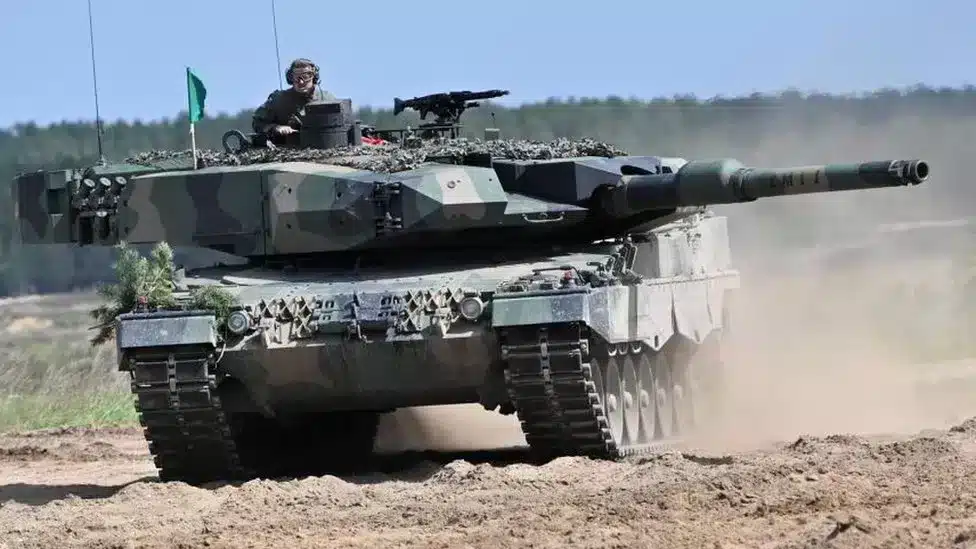
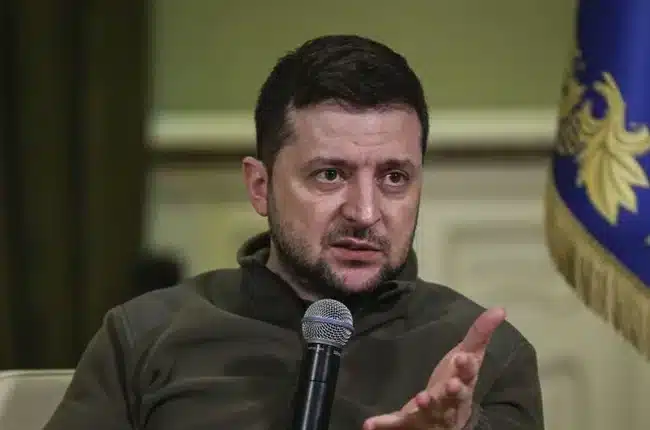
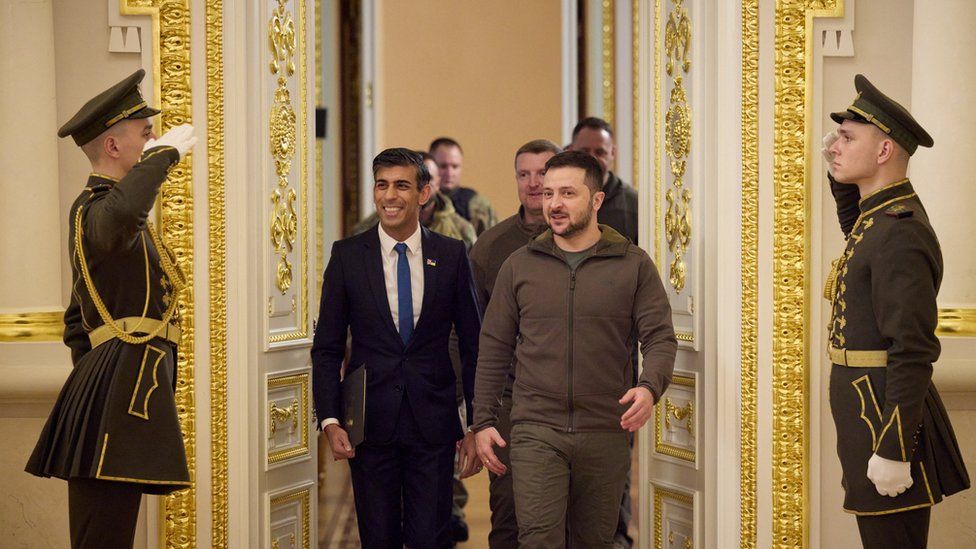
The president of Ukraine thanked Western leaders for sending tanks to aid in the conflict with Russia, but he urged that they be delivered as soon as possible.
Volodymyr Zelensky also implored the West to send fighter jets and long-range missiles in his nightly address.
After the US and Germany said they would send Abrams and Leopard tanks to Ukraine, he made his remarks.
The announcement was denounced by Russia as a “blatant provocation,” and any tanks supplied would be totally destroyed.
The tanks would “burn like all the rest,” said Dmitry Peskov, President Vladimir Putin’s spokesman. “They are just very expensive.”
Mr Zelensky said he told Nato Secretary General Jens Stoltenberg that “progress must be made in other aspects of our defence co-operation” – with Ukraine seeking supplies of long-range missiles and artillery.
He pressed not only for a prompt delivery of Western tanks but also for significant numbers: “We must form such a tank force, such a freedom force that after it strikes, tyranny will never again rise up.”
While Mr Zelensky is likely to focus now on equipping the Ukrainian air force with more technologically advanced fighter jets after securing the tanks, many Western governments remain opposed to such a move – fearing the aircraft could be used to strike targets inside Russia.
In his speech to the Bundestag in Berlin on Wednesday outlining the details of the tanks plan, German Chancellor Olaf Scholz insisted there would be “no fighter jet deliveries to Ukraine”.
US President Joe Biden announced on Wednesday that the US would send 31 M1 Abrams battle tanks to Ukraine.
The decision to deliver the tanks was announced hours after Germany said it would send 14 of its Leopard 2s to the Ukrainian battlefield.
Berlin also cleared the way for other European countries to donate German-made tanks from their own stocks.
Ukraine has lobbied Western allies to send the equipment for months.
It hailed the twin announcements as a turning point that would allow its military to regain momentum and take back occupied territory almost a year after Moscow invaded.
It also said the tanks could help deter a potential Russian offensive in the spring.
Watch: Biden says tanks are not an offensive threat to Russia
Announcing the decision to put its tanks on the battlefield, US President Joe Biden said Mr Putin had expected Europe and the United States to “weaken our resolve”, adding: “He was wrong from the beginning and he continues to be wrong.”
“We’re also giving Ukraine the parts and equipment necessary to effectively sustain these tanks in battle,” he said.
“This is about helping Ukraine defend and protect Ukrainian land. It is not an offensive threat to Russia.”
A Ukrainian tank battalion typically consists of 31 tanks, which is why that number has been agreed upon, Mr Biden added.
The US decision, however, marks a reversal in their position as the Biden administration has insisted for some time that the heavy M1 Abrams tanks would be difficult to deliver, expensive to maintain and challenging for Ukrainian troops to operate.
The US-made military vehicle is one of the most modern battle tanks in the world and requires extensive training to operate.
The $400m (£323m) US package also includes eight recovery vehicles that can tow the tanks if they become stuck, as well as ammunition, equipment, and funding for training and maintenance.
But it is likely to be many months before the tanks reach the battlefield.
White House national security spokesman John Kirby said there were no excess Abrams tanks in the US inventory. As such, they will have to be purchased from private contractors or bought from another country,
The German-made Leopard 2 tanks, however, will be drawn from existing inventories and are expected to arrive in two to three months. They are widely seen as one of the most effective battle tanks available.
The decision to send the heavy weapons follows weeks of diplomatic wrangling. Germany faced mounting international pressure to send the tanks, and there are reports that the eventual decision to do so was conditional on the US doing the same.
When asked if the US decision was designed to give Germany cover to send tanks, Mr Kirby said: “I wouldn’t use the word cover. What this decision does do is show how unified we are with our allies.”
He attributed the change in Washington’s position to the conditions on the ground as well as Russia’s tactics, without giving further details.
Ukrainian crews would soon be trained to use the Leopard tanks in Germany, officials in Berlin said.
While the acquisition of tanks from the West will be considered a diplomatic coup for Mr Zelensky, he said on Tuesday that his country required at least 300 of them to defeat Russia.
Several European countries have Leopard 2 tanks in their inventories, and the German decision means some of these can also be sent to Ukraine. Germany hopes around 90 will ultimately be delivered to the battlefield.
Poland wants to export 14 Leopard 2 tanks to Ukraine and Norway announced later on Wednesday that it would send some of its armoured vehicles – although it did not state how many.
The UK was the first Nato member to donate modern tanks to Ukraine when Prime Minister Rishi Sunak’s government announced that 14 Challenger 2s – the British army’s main battle tank – would be provided.
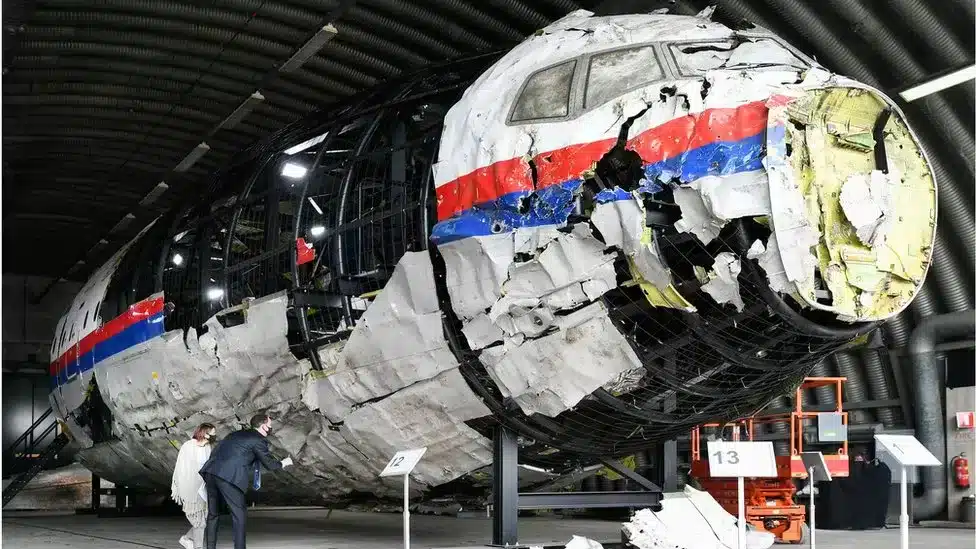
In relation to the downing of Flight MH17 in 2014, the European Court of Human Rights is about to say whether it will hear a Dutch case against Russia.
Russian misinformation regarding Moscow’s part in the incident, according to the Dutch government, violates the human rights of the relatives.
The accusations are rejected by Russia.
The decision will be read out at 14:30 local time (13:30 GMT).
The Boeing 777 was flying from Amsterdam to Kuala Lumpur when it was hit by a surface-to-air missile in July 2014 during a conflict between pro-Russia rebels and Ukrainian forces in the Donbas region of Ukraine.
The Netherlands argues that Russia played a key role in the air disaster and the case hinges on whether or not Moscow had “effective control” over the area of Ukraine where the missile was fired from.
At this stage, the ECHR will only rule on whether the criteria has been met for it to deal with this application.
Even if it decides to hear the Dutch case, it could be years before a ruling is issued. However, if the ECHR issues a guilty verdict against Russia, Moscow could be obliged to pay damages to the victims’ relatives.
Last September, Russia stopped being party to the European Convention on Human Rights, but the court can still deal with claims against Russia regarding actions up until that date.
In November, a Dutch court at the Schiphol Judicial Complex found three men – two Russians and a Ukrainian – guilty of murder in absentia for their part in the downing of MH17.
The court concluded that the missile had been fired deliberately to bring down a plane, even if the target had been military rather than civilian.
The three men were sentenced to life in jail but are all thought to be in Russia.
Since Moscow condemned the verdict as scandalous and politically motivated it is extremely unlikely that they will be handed over to face justice.
Russia has repeatedly denied involvement in the attack.
The European Court of Human Rights is set to announce whether it will hear a Dutch case against Russia over the downing of flight MH17 in 2014.
All 298 people on the Malaysia Airlines flight were killed when it was shot down by a Russian-made missile fired by Moscow-backed Ukrainian separatists.
The Dutch government argues that Russian disinformation about Moscow’s role in the incident is a violation of the relatives’ human rights.
Russia denies the allegations.
The decision will be read out at 14:30 local time (13:30 GMT).
The Boeing 777 was flying from Amsterdam to Kuala Lumpur when it was hit by a surface-to-air missile in July 2014 during a conflict between pro-Russia rebels and Ukrainian forces in the Donbas region of Ukraine.
The Netherlands argues that Russia played a key role in the air disaster and the case hinges on whether or not Moscow had “effective control” over the area of Ukraine where the missile was fired from.
At this stage, the ECHR will only rule on whether the criteria has been met for it to deal with this application.
Even if it decides to hear the Dutch case, it could be years before a ruling is issued. However, if the ECHR issues a guilty verdict against Russia, Moscow could be obliged to pay damages to the victims’ relatives.
Last September, Russia stopped being party to the European Convention on Human Rights, but the court can still deal with claims against Russia regarding actions up until that date.
In November, a Dutch court at the Schiphol Judicial Complex found three men – two Russians and a Ukrainian – guilty of murder in absentia for their part in the downing of MH17.
The court concluded that the missile had been fired deliberately to bring down a plane, even if the target had been military rather than civilian.
The three men were sentenced to life in jail but are all thought to be in Russia.
Since Moscow condemned the verdict as scandalous and politically motivated it is extremely unlikely that they will be handed over to face justice.
Russia has repeatedly denied involvement in the attack.
A rights organisation has warned that Andrey Medvedev, who is requesting asylum in the Nordic country,be sent back to Russia.
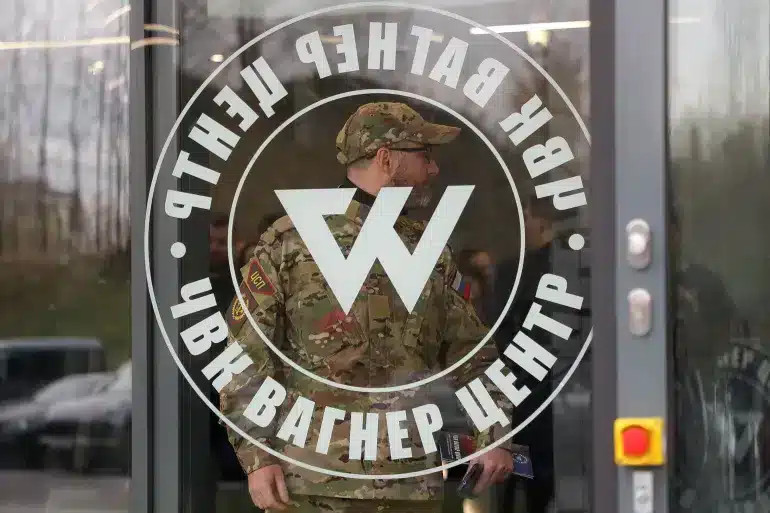
A former Wagner Group fighter who recently fled to Norway in search of asylum has been detained.
Andrey Medvedev might be deported to Russia, according to Gulagu.net, a Russian rights organisation that assisted in his escape.
The 26-year-old was detained on suspicion of entering the country without proper documentation, according to Jon Andreas Johansen, a police official in charge of immigration matters, who spoke to the Associated Press on Monday.
“It is being assessed whether he should be produced for detention,” Johansen said.
Medvedev crossed into Norway from neighbouring Russia on January 13, looking for shelter in the Nordic nation.
He claims to have climbed through barbed-wire fences at the 198 kilometre-long (123-mile) frontier, and evaded border patrol officials with dogs.
After witnessing the killing and mistreatment of Russian prisoners brought to the front lines in Ukraine to fight for the Wagner Group, Medvedev feared for his life.
The shadowy paramilitary organisation is closely aligned with the Kremlin and has been heavily involved in Russia’s invasion.
‘He has seen the light’
Gulagu.net, which campaigns for prisoners’ rights and has been in contact with Medvedev since he fled, said he had been detained and handcuffed on Sunday evening and told he was being taken to a detention centre for subsequent deportation.
There was no confirmation from Norwegian authorities of any plan to deport him.
Gulagu.net said Medvedev would face “brutal murder and death” for speaking out against Wagner if he was returned to Russia.
“We do not whitewash Medvedev. He has done many bad things in his life,” the rights group said.
“But he has seen the light, he has realised this, he is ready and willing to cooperate with the world, with the international investigation and with the authorities of Norway, he wants to live and testify” against Wagner and its founder Yevgeny Prigozhin, it added.
Medvedev is an orphan who joined the Russian army and served time in prison before joining the Wagner Group last July on a four-month contract.
He has reportedly told Gulagu.net that he is ready to expose everything he knows about the force of mercenary fighters, which Washington has said will be considered a criminal entity.
Russia’s state-owned TASS news agency said, a warship outfitted with hypersonic cruise missiles will participate in joint exercises with the navies of China and South Africa in February.
The participation of the Russian frigate Admiral Gorshkov of the Fleet of the Soviet Union was first mentioned in an official report on Monday.
The frigate is equipped with Zircon missiles, which have a range of more than 1,000 km and can travel at nine times the speed of sound (620 miles).
The missiles and the Avangard glide vehicle, which entered combat service in 2019, are the centerpiece of Russia’s hypersonic arsenal.
“‘Admiral Gorshkov’ … will go to the logistic support point in Syria’s Tartus, and then take part in joint naval exercises with the Chinese and South African navies,” TASS said in its report, citing an unidentified defence source.
The South African National Defence Force has said the drills will run from February 17-26 near the port cities of Durban and Richards Bay on South Africa’s east coast.
It said on Thursday that the joint exercise aims “to strengthen the already flourishing relations between South Africa, Russia and China”.
The exercise will be the second involving the three countries in South Africa, after a drill in 2019, the defence force added.
The Gorshkov held exercises in the Norwegian Sea earlier this month after President Vladimir Putin sent it to the Atlantic Ocean in a signal to the West that Russia would not back down over the war in Ukraine.
Putin has previously said the frigate and its Zircon missiles have “no analogues in the world”.
The Russian president sees the weapons as a way to pierce the United States’s increasingly sophisticated missile defences.
Russia, the US and China are in a race to develop hypersonic weapons, seen as a way to gain an edge over any adversary because of their speed and their manoeuvrability, features which make them harder to detect.
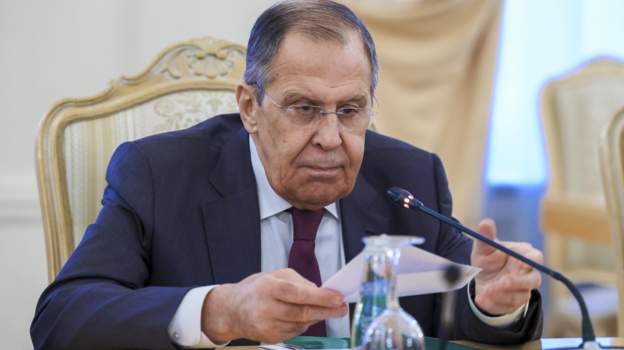
Foreign minister of Russia, Sergei Lavrov, is making his first trip to South Africa since the invasion of Ukraine 11 months ago, which Pretoria has refused to denounce.
While Russia is being shunned by the West, it has historic ties with Pretoria as well as close business links through the Brics bloc of emerging economies.
Mr Lavrov is due to hold talks with his South African counterpart, Naledi Pandor, in Pretoria.
A protest by anti-Russia demonstrators is planned outside the venue of the talks.
South Africa plans to hold joint naval exercises Operation Mosi with Russia and China next month.
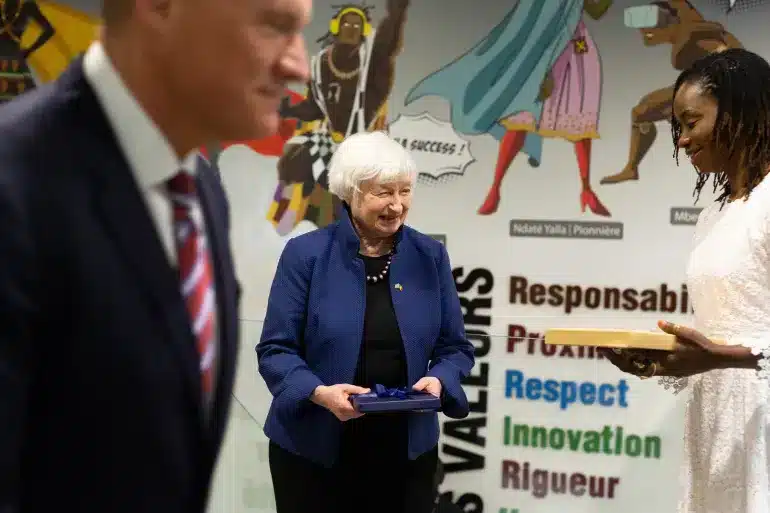
United States Secretary of the Treasury Janet Yellen has reaffirmed her country’s commitment to deepening relations and trade with Africa during a visit to Senegal, amid competition across the continent from China and Russia.
“The United States is all in on Africa, and all in with Africa,” Yellen said on Friday morning at a business incubator in the Senegalese capital of Dakar, where she touted the fruits of a new “mutually beneficial” US economic strategy towards Africa.
“Our engagement is not transactional, it’s not for show, and it’s not for the short-term,” she said.
Yellen’s three-country tour of the region comes just weeks after US President Joe Biden hosted the leaders of dozens of African nations, as well as the African Union, for the second US-Africa Leaders Summit in Washington, DC.
The talks were a follow-up to the first such gathering hosted by former US President Barack Obama in 2014. They highlighted Biden’s efforts to strengthen ties with like-minded countries across the region.
The Biden administration unveiled a string of new economic investments and trade deals in Africa during the summit, and Biden personally expressed support for the African Union’s push for a permanent place at the Group of 20 (G20) forum of global economies.
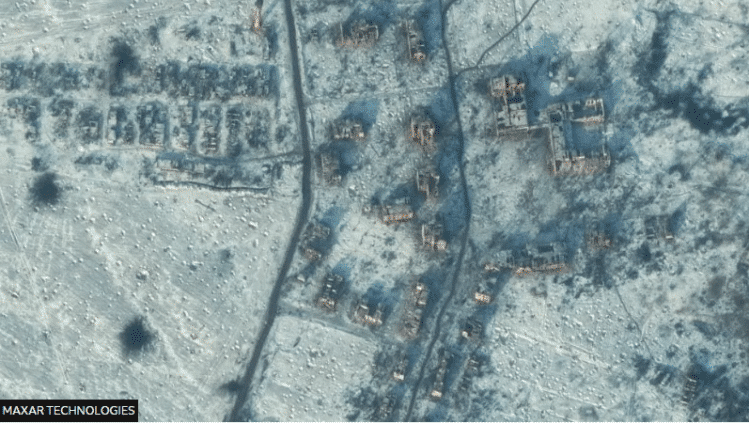
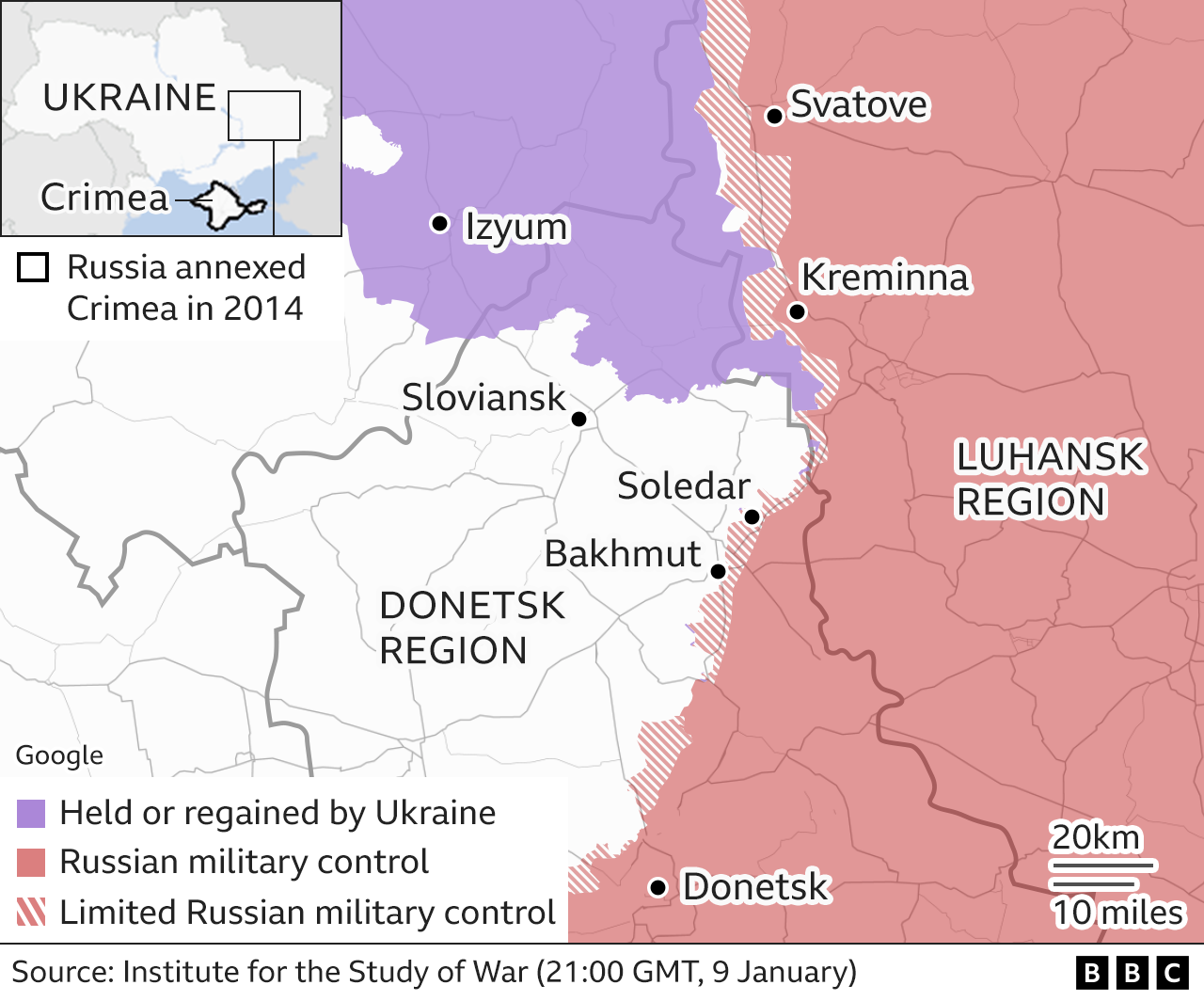
Russia’s military says it has captured the Ukrainian salt-mine town of Soledar after a long battle, calling it an “important” step for its offensive.
The victory would allow Russian troops to push on to the nearby city of Bakhmut, and cut off the Ukrainian forces there, a spokesman said.
This was a very confident and ambitious statement from Moscow.
But Ukrainian officials said the fight for Soledar was still going on and accused Russia of “information noise”.
The battle for Soledar has been one of the bloodiest of the war.
The town is relatively small, with a pre-war population of just 10,000, and its strategic significance is debatable. But if it is confirmed that Russian forces have seized control of it, then there will likely be a big sigh of relief in the Kremlin.
Divisions have emerged between regular Russian forces and the notorious Russian Wagner paramilitary group throughout the battle, with a jealous turf-war developing over who should take credit for the advance.
Barely any walls in Soledar remain standing, Ukraine’s President Volodymyr Zelensky said this week. Describing almost apocalyptic scenes, he spoke of the nearby terrain as scarred by missile strikes and littered with Russian corpses.
Speaking during his nightly address from Kyiv on Friday, Mr Zelensky said the battle in the region continued to rage, but avoided any reference to Russia’s claims of control over Soledar.
“Although the enemy has concentrated its greatest forces in this direction, our troops – the Armed Forces of Ukraine, all defence and security forces – are defending the state,” the Ukrainian leader said.
His chief of staff, Andriy Yermak, compared the fight for Soledar and Bakhmut to one of the bitterest battles of World War One, at Verdun.
Regional governor Pavlo Kyrylenko said on Thursday that 559 civilians including 15 children remained in Soledar and could not be moved out.
The town’s significance for the Russian military is disputed by military analysts because of its relatively small size. The US-based think tank Institute for the Study of War said while it was likely that Russian forces had captured Soledar, it did not believe they would then be able to go on to encircle Bakhmut.
Nevertheless, if it becomes clear that Russia has taken it, then that will be seen in Moscow as progress – even a victory.
That is exactly what President Vladimir Putin needs as Russia has failed to capture a single town in Ukraine since July 2022. Since then, Moscow’s forces have suffered a whole series of embarrassing defeats.
Ukraine’s successful counter-attack pushed Russia almost completely out of Kharkiv region in the north-east. In October, Russia’s Kerch bridge came under attack, with Russian forces retreating from the city of Kherson the following month.
The southern port city had been the only regional capital that Russia had managed to seize since the invasion began.
Capturing Soledar would be something for Moscow to present as some “good news” to the Russian people and the troops on the wintry front line.
But Serhiy Cherevatyi, spokesperson for Ukraine’s eastern military command, denied Soledar was in Russian hands: “We won’t give any more details as we do not want to reveal the tactical positions of our fighters.”
Deputy Defence Minister, Hanna Malyar, said fighting had been “hot in Soledar overnight”. Ukrainian fighters were “bravely trying to hold the defence”, she added, in what was a difficult stage of the war.
Western and Ukrainian officials have said much of the fighting in Soledar and Bakhmut is being done by the notoriously brutal Wagner mercenary group.
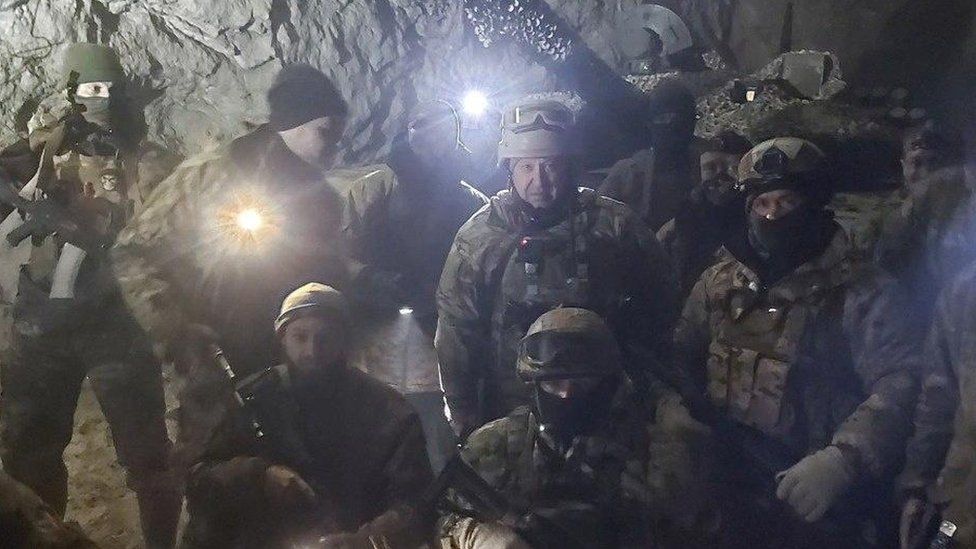
Ukraine this week cast doubt on a photo claiming to show Yevgeny Prigozhin inside a Soledar salt mine
Its leader, 61-year-old Yevgeny Prigozhin, has claimed repeatedly over the past few days that his forces are the only units on the ground in Soledar. He said on Tuesday night that his mercenaries had seized the town, only to be contradicted by Russia’s defence ministry the next morning.
Daily updates from the Russian defence ministry have made no mention whatsoever of Wagner, and Friday’s briefing was no exception. The military said that paratroopers had played a key part in the capture of the town.
Mr Prigozhin then released a statement saying he was “surprised” to read the defence ministry briefing. There “wasn’t a single paratrooper” in Soledar, he insisted, warning against “insulting [his] fighters” and “stealing others’ achievements”.
And on Friday evening, Mr Prigozhin accused “officials who want to stay in their places” of being the biggest threat to his group’s advance in Ukraine.
In a later statement, the defence ministry praised the mercenaries’ “courageous and selfless actions” during the fighting, but again emphasised the leading role of regular Russian forces.
Analysts have long spoken of tensions between the military and Mr Prigozhin’s Wagner group. The Russian oligarch has publicly criticised senior military leaders, including Gen Valery Gerasimov, appointed two days ago as overall commander of Russian forces in Ukraine.
While Russia has mobilised some 300,000 reservists for the war since the end of September, Prigozhin has looked to recruit extra numbers from Russia’s prisons.
Andriy Yermak told French daily Le Monde that Russian criminals had been sent straight to their deaths on the front line: “Soledar is a scene of street battles, with neither side really in control of the town.”
The US has accused Kremlin-backed Russian military contractors of meddling in African countries’ internal affairs and “increasing the likelihood that violent extremism will grow” in the Sahel region, which has seen an upsurge in attacks, an allegation Russia has denied.
At a UN Security Council meeting on West Africa and the Sahel on Tuesday, US Deputy Ambassador Richard Mills lashed out at the Wagner Group.
He accused the paramilitary force of failing to address the threat posed by armed groups, robbing countries of resources, violating human rights, and endangering the safety and security of UN peacekeepers and personnel.
France’s political counsellor, Isis Jaraud-Darnault, echoed Mills, saying the “model” used by Wagner mercenaries has proven “totally ineffective in combating terrorism”.
She cited the “nefarious” and devastating impact of their work and human rights violations, including the alleged killing of more than 30 civilians in Mali, and its pillaging of natural resources.
Britain’s Deputy Ambassador James Kariuki cited the deterioration of security in Mali, Burkina Faso, Nigeria and the Lake Chad Basin, and the fear of instability spreading to West African coastal countries. “You cannot ignore the destabilising role the Wagner Group plays in the region. They are part of the problem, not the solution,” he told the council.
Russia’s Deputy Ambassador Anna Evstigneeva rejected what she called attempts “to besmirch Russian assistance to Mali”, where Moscow has a bilateral agreement to assist the transitional government, “and in other countries in Africa”.
“Some countries once again today declared that Russia apparently is pillaging and looting the resources of Africa and is facilitating the growth of the terrorist threat,” she said, accusing those unnamed nations of doing the same thing “throughout the world and in Africa”, especially in neighbouring Libya, which destabilised the entire area.
“Accusations against Russia are just astonishing, given common sense,” and undermine African leaders trying to resolve their own problems and decide who they want to cooperate with, she said.
Evstigneeva never mentioned the Wagner Group by name. The group is run by Yevgeny Prigozhin, a close ally ofRussian President Vladimir Putin, and its mercenaries are accused by Western countries and UN experts of numerous human rights abuses throughout Africa, including in the Central African Republic, Libya and Mali.
Giovanie Biha, the deputy head of the UN Office for West Africa and the Sahel, told the council that “insecurity has again deteriorated in large parts of the region”, due to activities of armed groups, “violent extremists” and criminal networks.
As a result, she said, more than 10,000 schools across the Sahel have closed, leaving millions of children without an education. Nearly 7,000 health centres have also shut down.
Armed groups are fighting for supremacy and control of resources, she said, and the central Sahel is facing “unprecedented levels of security and humanitarian challenges; socio-political instability, further compounded by the impact of climate change; and food insecurity which was exacerbated by the conflict in Ukraine”.
She added that increasing attacks in countries along the Gulf of Guinea are threatening transport arteries to landlocked countries further north.
According to Secretary-General Antonio Guterres’ latest report issued this week, more than 18.6 million people in the region are experiencing “severe food insecurity” – an increase of 5.6 million since the end of June 2022 – with Burkina Faso, Niger and Nigeria being the hardest-hit. About 6.3 million people are displaced across the Sahel, an increase of 300,000 since June.
Russia’s Evstigneeva said Moscow shares concerns about the increasing number of threats in the region, ongoing inter-ethnic and inter-communal conflict, organised crime, drug trafficking and the killing of a large number of civilians by fighters in the second half of 2022.
She pointed to the withdrawal of French counterterrorism forces and the Takuba European military task force under their command on June 30, saying it wasn’t agreed on with Mali’s transitional government and is having “a negative impact” on the security situation in the short-term.
“Nonetheless,” she said, “there is already some progress” and Russia is providing Mali with “appropriate assistance”.
Mills, the US deputy ambassador, said the US is deeply concerned about the security, humanitarian and political crisis in the Sahel causing “a dramatic increase in the strength and influence of violent extremism”.
The problem requires “a democratic governance solution”, he said. “We are also gravely concerned about democratic backsliding across the region and urge the return of democratically elected, civilian-led governments.”
West Africa’s latest wave of coups kicked off in Mali in 2020, followed by another in Guinea in 2021, and then in Burkina Faso in January 2022.
Omar Alieu Touray, president of the West African regional groupECOWAS’ commission, told the council he was pleased to report that transitions to critical elections in the three countries are “on course”, with voting to take place in the next two years.
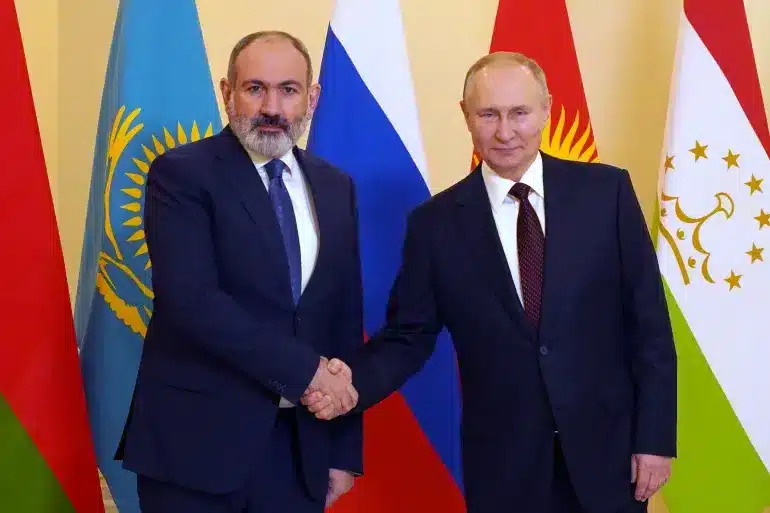
Pashinyan is growing more and more angry atRussia for not securing free passage along a corridor connecting Armenia and Nagorno-Karabakh.
In a move that reflects growing hostility between Yerevan and Moscow, Armenia has announced that it will not host military exercises by the Collective Security Treaty Organisation (CSTO), an alliance of post-Soviet nations led by Russia.
Russian officials announced earlier this year that the group, which includes Russia, Armenia, Belarus, Kazakhstan, Kyrgyzstan, and Tajikistan, would hold its annual exercises in Armenia.
“The Armenian defence minister has informed the CSTO Joint Staff that in the current situation, we consider it unreasonable to hold CSTO exercises on the territory of Armenia. At least, such exercises will not take place in Armenia this year,” Interfax news agency reported Prime Minister Nikol Pashinyan as saying.
From left: Armenian Prime Minister Nikol Pashinyan, President of the European Council Charles Michel, and Azerbaijan’s President Ilham Aliyev [File: François Walscherts/AFP]
Kremlin spokesman Dmitry Peskov, when asked about the cancelled military drill, said Moscow would ask Yerevan to clarify its position.
“In any case, Armenia is our close ally, and we will continue our dialogue, including the most complex issues,” he told reporters.
Pashinyan’s move followed his refusal in 2022 to sign a concluding document from a meeting of the leaders of CSTO member nations in Yerevan, Armenia’s capital.
Nagorno-Karabakh
The tensions are rooted in Armenia’s conflicts with Azerbaijan over Nagorno-Karabakh.
The two ex-Soviet states maintain good relations with Russia despite its invasion of Ukraine; Armenia hosts a Russian military base and the Kremlin wants to maintain ties with oil-rich Azerbaijan.
Nagorno-Karabakh lies within Azerbaijan but has been under the control of ethnic Armenian forces backed by Yerevan since a separatist war there ended in 1994. That conflict left not only Nagorno-Karabakh itself but large chunks of surrounding lands in Armenian hands.
In 44 days of heavy fighting that began in September 2020, the Azerbaijani military routed Armenian forces, forcing Yerevan to accept a Russia-brokered peace deal that saw the return of a significant part of Nagorno-Karabakh to Azerbaijan.
The agreement also required Armenia to hand over swaths of land it held outside the separatist region.
Pashinyan has repeatedly criticised Russian peacekeepers for failure to secure free transit along a corridor linking Armenia and Nagorno-Karabakh.
The Lachin province, which lies between Nagorno-Karabakh and Armenia, was the last of three areas on the region’s rim that Armenian forces surrendered in December 2020.
Russia deployed nearly 2,000 peacekeepers to ensure safe transit across the region and monitor the peace deal.
But travel across the Lachin province has been blocked since December 12 by Azerbaijanis identifying themselves as environmental activists who say that Armenia has unlawful mining sites in the region.
Armenia has called on Russian peacekeepers unblock the road, but Moscow has adopted a backseat approach to the dispute, which has angered the Armenian government.
“Russia’s military presence in Armenia not only fails to guarantee its security, but it raises security threats for Armenia,” Pashinyan said on Tuesday.
He added that the blockade of the Lachin corridor is intended to “break the will of the people of Nagorno-Karabakh”, and that Armenia will also seek support from the US and the European Union to help ease the tensions with Azerbaijan.
Due to a limited market supply, Brent crude increased by 2.5% to $79.75 a barrel and West Texas Intermediate by 2.6% to $74.70 early on Thursday.
US pipeline operator Colonial Pipeline said Wednesday it has halted operations at its Line 3, with a restart scheduled for Jan. 7, Reuters reported. Prior to the pipeline shutdown, oil prices had been hit by uncertainty in the near-term economic prospects for China as COVID-19 cases rise.
Significant disruption is expected in the coming months, followed by a recovery from around the middle of the year, which should boost demand, OANDA analyst Craig Erlam said in a Wednesday note.
The falling value of the US dollar supported higher oil prices by encouraging traders using other currencies. A weaker dollar further fuels strong demand in the market. Meanwhile, global recession fears lead to lower demand expectations.
Weaker demand worries heightened especially after the IMF’s Managing Director Kristalina Georgieva said one-third of the world’s economies are expected to go into recession in 2023.
Low demand fears are also supported by rising COVID cases in China which cap further price increases. Adding more on demand worries, the world’s second-largest economy, China, significantly increased its first batch of 2023 export quotas for refined oil products.
This shows the country is expecting less consumption.
What’s more, some insurers have stopped providing coverage for ships and planes moving goods to and from Belarus, Russia, and Ukraine. Reinsurers have also pulled out of the region on heightened risks, the report noted.
The Black Sea, which is shared by Romania, Bulgaria, Ukraine, Russia, Georgia, and Turkey, is a major oil and oil product shipping artery.
“The effect of (the exit of reinsurers) is reducing (underwriting) capacity in the market for war risk and will mean people will pay more this year,” one of the Reuters sources explained.
These higher rates and limited availability of reinsurance coverage add to industry woes related to the G7 price cap imposed on Russian oil exports. Per the rules of the cap regime, Western insurers, which constitute about 90 percent of all maritime insurers, are banned from providing coverage for vessels carrying Russian crude sold at over $60 per barrel.
Higher freight rates for Black Sea shipping, however, would add to the costs of the goods being shipped through the chokepoint.
“For shipments going in and out of Russia you will find premiums going up. It could easily rise by 50% (from the end of last year) to reflect the cost of capital from not being reinsured,” another Reuters source said.
On the flip side, tanker rates have declined despite expectations of a spike after the EU embargo on Russian crude went into effect. Among the reasons is the embargo itself: European refiners ramped up their intake of Russian crude before December 5 and after that date came the buying spree subsided and died out, effectively reducing demand for tankers.
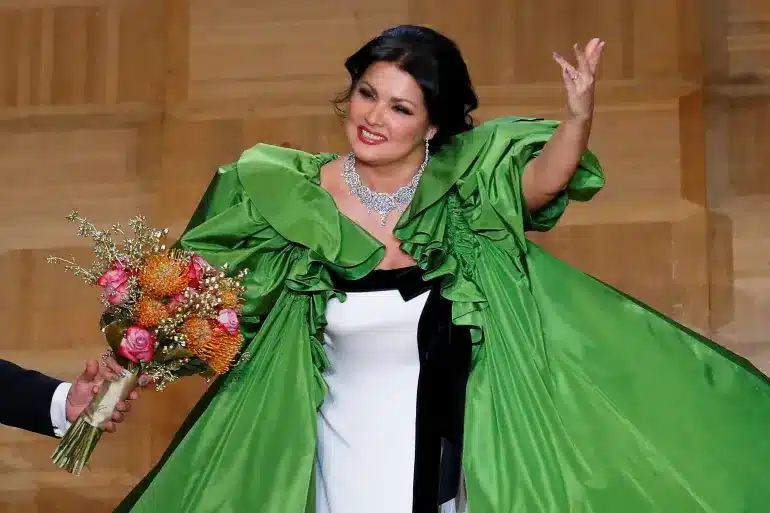
Anna Netrebko, an opera soprano from Vienna, is among the 118 people on the list.
According to a proclamation released by the president’s office, Ukraine has added dozens of Russian artists and other public personalities to a list of those subject to sanctions.
In light of the ongoing conflict in Ukraine, the announcement on Saturday features prominent figures from the opera, film, and pop music industries.
One of the most well-known names is that of Vienna-based opera singer Anna Netrebko, who has come under fire for being too close to the Kremlin and too uncritical of Russian President Vladimir Putin.
In February last year, Netrebko said she was “opposed” to the war.
“I am Russian and I love my country but I have many friends in Ukraine and the pain and suffering right now breaks my heart.”
She added that forcing artists and other public personalities to give their “political opinions in public and to denounce their homeland” was not right.
The sanctions list also includes Russian pop star Philipp Kirkorov and actor and director Nikita Mikhalkov, winner of awards from film festivals including Cannes and Venice.
Netrebko and 118 others, including three Ukrainians, will have any assets in Ukraine frozen. The sanctions will be in effect for 10 years, the TASS news agency reported.
Ukrainian media also reported that President Volodymyr Zelenskyy revoked the citizenship of 13 clergy members of the Ukrainian Orthodox Church at the end of December. It was not known who the individuals are.
Traditionally, the Ukrainian Orthodox Church has had close ties with Russia and only broke away completely from Moscow after the Russian invasion started last February.
The Ukrainian leader says the war will end when Russian troops leave Ukraine or ‘we throw them out’.
Ukrainian President Volodymyr Zelenskyy has rejected a Russian order for a ceasefire during the Orthodox Christmas season, calling it a ruse designed to halt Ukraine’s army’s progress in the eastern Donbas region and allow Moscow to send in more troops.
Following the call for a Christmas truce by the head of the Russian Orthodox Church, Patriarch Kirill of Moscow, Russian President Vladimir Putin ordered a 36-hour ceasefire, which will last from midday Friday (09:00 GMT) until the end of Saturday (21:00 GMT), the Kremlin said on Thursday.
“Taking into account the appeal of His Holiness Patriarch Kirill, I instruct the Minister of Defence of the Russian Federation to introduce a ceasefire regime along the entire line of contact of the parties in Ukraine…” the Kremlin said in a statement citing Putin.
The order did not specify whether the ceasefire would apply to both offensive and defensive operations by Russia, and it was not clear whether Russia would hit back if Ukraine kept fighting.
Speaking pointedly in Russian and addressing the Kremlin and Russians as a whole on Thursday night, Zelenskyy said Moscow had repeatedly ignored Kyiv’s peace plan.
“They now want to use Christmas as a cover, albeit briefly, to stop the advances of our boys in Donbas and bring equipment, ammunition and mobilised troops closer to our positions,” Zelenskyy said in his nightly video address.
“What will that give them? Only yet another increase in their total losses.”
“The whole world knows how the Kremlin uses interruptions in the war to continue the war with new strength,” Zelenskyy said.
The war would end, he said, when Russian troops left Ukraine or were thrown out.
Russia’s Orthodox Church observes Christmas on January 7. Ukraine’s main Orthodox Church has been recognised as independent and rejects any notion of allegiance to the Moscow patriarch. Many Ukrainian believers have also shifted their calendar to celebrate Christmas on December 25 as in the West.
Directing his address to Russian people, Zelenskyy said that ending the war meant “ending your country’s aggression … This continues every day that your soldiers are on our soil … And the war will end either when your soldiers leave or we throw them out”.
The Ukrainian leader also urged Russians to challenge Putin and his portrayal of the war as necessary to safeguard Moscow’s interests against the West.
“In order to end the war more quickly, we need something completely different. We need Russian citizens to find the courage in themselves, albeit for 36 hours, albeit during Christmas, to free themselves of the shameful fear of one man in the Kremlin.”
United States President Joe Biden was equally dismissive of Putin’s announcement.
“He was ready to bomb hospitals and nurseries and churches” on December 25 and on New Year’s Day, Biden said.
“I think he’s trying to find some oxygen,” he added.
The Institute for the Study of War said that Putin’s surprise ceasefire announcement was “an intentional information tactic” designed to portray Ukraine as the aggressor, and a pause in fighting now would primarily benefit Russian forces.
“The announcement of a ceasefire within 24 hours of when it is meant to enter into force suggests that it was announced with the intention of framing Ukrainian forces who continue to fight throughout the timeframe of the ceasefire as unwilling to work towards peace and wanting to fight at all costs,” the Institute said in a briefing paper on Thursday.
“Such a pause would disproportionately benefit Russian troops and begin to deprive Ukraine of the initiative,” the institute said.
Ukraine says that Moscow may use Belarus as a staging area for a northern offensive, thereby opening up a new front.
A train carrying Russian troops and equipment has arrived in Belarus, raising fears that Moscow will use the territory of its ally to launch an attack on Ukraine from the north.
Belarus’ defence ministry confirmed the contingent’s arrival on Friday, saying President Alexander Lukashenko had visited a military base where Russian troops were already stationed.
According to the report, Lukashenko and an unnamed representative from the Russian army discussed joint military drills between the two countries during the meeting.
Russian troops “are ready to carry out tasks as intended”, the representative said.
The developments came after Belarus, which has backed Russia over its war inUkraine, said on Thursday that it will receive more weapons and equipment from its neighbour as the two continue to boost military cooperation.
The Belarusian defence ministry said the goal of creating a joint force was “strengthening the protection and defence of the Union State [of Russia and Belarus]”.
“Personnel, weapons, military and special equipment of the armed forces of the Russian Federation will continue to arrive in the Republic of Belarus,” the statement said.
The two countries are preparing for joint air force exercises, the ministry said, without providing any further details.
The Belarusian government has repeatedly said the country will not join Russia’s war in Ukraine.
But Moscow deployed thousands of forces to Belarusian territory under the pretext of military drills before launching its offensive and then funnelled troops into Ukraine when its invasion began on February 24.
According to Kyiv, Russia continues to use Belarusian airspace for drone and missile attacks.
Any new attack on Ukraine from Belarus would open a major new front in the war, which has killed tens of thousands of people.
Lukashenko has blamed Western nations for the war, accusing them of seeking confrontation with Russia and provoking the ongoing bloodshed.
The 67-year-old says Ukraine has the power to end the conflict by accepting Moscow’s demands – namely the loss of partly-occupied regions in eastern and southern Ukraine.
Russia’s President Putin has instructed his defense minister to impose a 36-hour ceasefire on the front lines inUkraine.
The cease-fire, which begins at noon Moscow time (or 9:00 a.m. GMT), falls on the Russian Orthodox Christmas.
Mr. Putin requested that Ukraine do the same, but Kiev quickly rejected the demand.
President of Ukraine Volodymyr Zelensky claimed that the cease-fire was an effort to halt military advances made by his nation in the country’s east.
According to the Kremlin statement, President Putin ordered his troops to cease fire not because he was de-escalating the situation (Putin never does), but rather because he had heeded a plea from the leader of the Russian Orthodox Church.
Patriarch Kirill had, earlier in the day, called for a Christmas truce to allow believers to attend services for Orthodox Christmas.
Mr Putin’s order called on Ukraine to reciprocate so that the “large numbers of Orthodox believers [who] reside in areas where hostilities are taking place” could celebrate Christmas Eve on Friday and Christmas Day on Saturday.
But in his nightly video address, President Zelensky said that Russia wanted to use the truce as a cover to stop Ukrainian advances in the eastern Donbas region and bring in more men and equipment.
The Russian Orthodox Church – the largest of the Eastern Orthodox Churches – celebrates Christmas Day on 7 January, according to the Julian calendar.
Some people in Ukraine celebrate Christmas on 25 December, others on 7 January. Both days are public holidays in the country.
This year, for the first time, the Orthodox Church of Ukraine said it would allow its congregations to celebrate Christmas on 25 December, as do some other denominations in western Ukraine.
The Church split with the similarly named Ukrainian Orthodox Church (UOC) in 2018.
The UOC itself was tied to Moscow’s religious leadership until Russia’s invasion, and some of its top clergy have been accused of still covertly supporting Moscow.
Ukraine’s Foreign Minister, Dmytro Kuleba, said Moscow had repeatedly ignored President Zelensky’s propositions for peace. He pointed to Russia’s shelling of Kherson on 24 December and strikes on New Year’s Eve as evidence of Moscow’s inability to cease hostilities during religious holidays.
US President Joe Biden believes Mr Putin was simply “trying to find some oxygen”.
The Kremlin’s ceasefire fits in nicely with a common narrative in Moscow, one that is aimed primarily at the domestic audience. That is – that the Russians are the good guys, and it is Ukraine and the West that are threatening Russia.
The truce is also a handy tool that can be used to demonise Ukraine – as the Ukrainians have dismissed the proposal, Moscow will claim that Kyiv does not respect religious believers and has no desire for peace.
But it should not be forgotten that it was Russia who started this war by launching an unprovoked invasion of its neighbour.
The move also comes just a few days after a large number of Russian troops were killed in a Ukrainian strike on a temporary barracks in the occupied Ukrainian city of Makiivka.
The Russian defence ministry put the death toll at 89, making it the highest single loss of life admitted by Moscow since the war began.
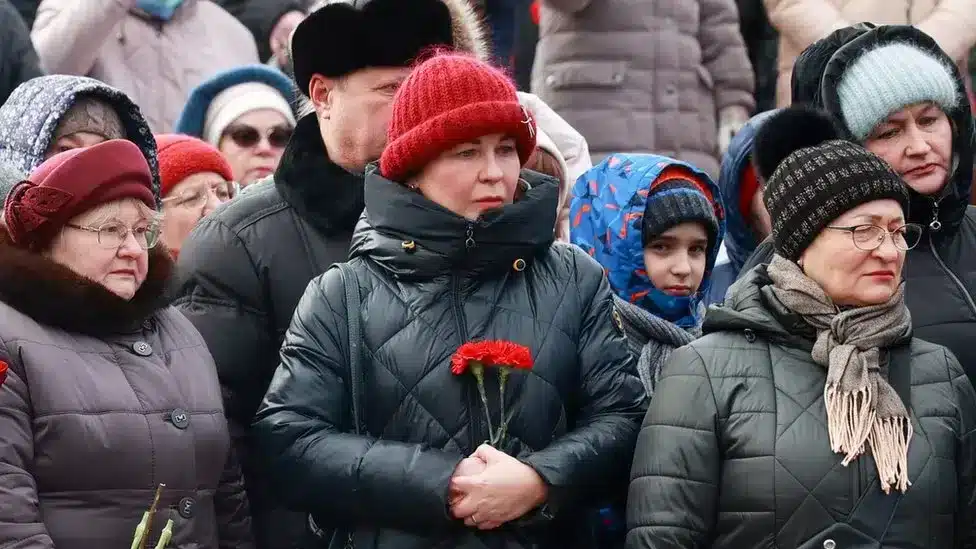
Relatives of the dead, as well as some politicians and commentators, expressed anger over what happened in Makiivka and blamed incompetent military officials. The incident happened on New Year’s Eve – the most important holiday in the Russian calendar.
Watch: Ros Atkins on… How Ukraine’s deadly New Year attack unfolded
Political analyst Tatyana Stanovaya says that it is possible the Kremlin wants to ensure no more major loss of life occurs on another important Russian holiday.
“Putin really does not want a repetition of that on Orthodox Christmas Day,” she wrote.
A few hours after Russia’s ceasefire announcement, Germany said it would follow the US in providing a Patriot air defence missile system to Ukraine. Germany also announced, in a joint statement with the US, that both countries would send armoured vehicles.
France said on Wednesday that it would send armoured fighting vehicles.
Kyiv has repeatedly called for more aid from its international allies in the face of continuing Russian aggression.
Russia has asserted that a New Year’s Day missile attack that killed at least 89 Russian soldiers occurred because troops were distracted by their cellphones.
According to officials, the enemy was able to locate its target due to the use of prohibited phones. An investigation has already been launched.
Ukraine claims 400 soldiers were killed and 300 were injured in an attack on a conscript training college in Makiivka, in the occupied Donetsk region.
It is the highest number of deaths acknowledged by Russia during the war.
Russia said that at 00:01 local time onNew Year‘s Day, six rockets were fired from a US-made Himars rocket system at a vocational college, two of which were shot down.
The deputy commander of the regiment, Lt Col Bachurin, was among those killed, the ministry of defence said in a statement on Wednesday.
A commission is investigating the circumstances of the incident, the statement said.
But it is “already obvious” that the main cause of the attack was the presence and “mass use” of mobile phones by troops in range of Ukrainian weapons, despite this being banned, it added.
“This factor allowed the enemy to locate and determine the coordinates of the location of military personnel for a missile strike.”
Officials found guilty in the investigation will be brought to justice, the statement added, and steps are being taken to prevent similar events in the future.
Russia also raised the number of Russian soldiers killed in the attack to 89 – up from 63 – although there is no way of verifying how many soldiers were killed. It is extremely rare for Moscow to confirm any battlefield casualties.
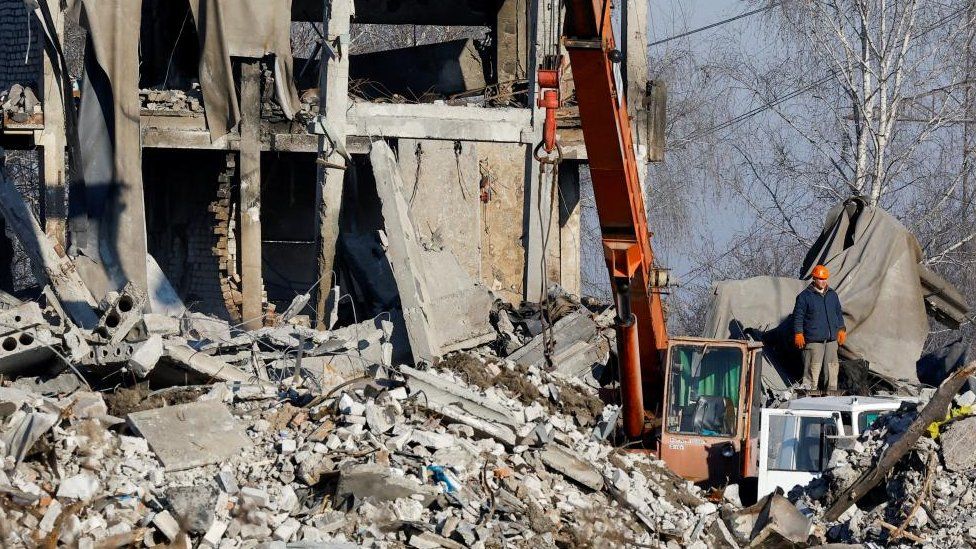
The vocational college was packed with conscripts at the time – men who were among the 300,000 called up in President Vladimir Putin’s partial mobilisation in September. Ammunition was also being stored close to the site, which was reduced to rubble.
Image caption,The building housing the conscripts was all but flattened in the Ukrainian attack
Some Russian commentators and politicians have accused the military of incompetence, saying the troops should never have been given such vulnerable accommodation.
Pavel Gubarev, a former leading official in Russia’s proxy authority in Donetsk, said the decision to house a large number of soldiers in one building was “criminal negligence”.
“If no-one is punished for this, then it will only get worse,” he warned.
The deputy speaker of Moscow’s local parliament, Andrei Medvedev, said it was predictable that the soldiers would be blamed rather than the commander who made the original decision to put so many of them in one place.
President Putin signed a decree on Tuesday for families ofNational Guard soldiers killed in service to be paid 5 million roubles (£57,000; $69,000).
Russia attacked Ukraine with 16 Iranian-made drones overnight – with seven of them targeted at the capital, Kyiv, Ukrainian officials have said.
All of the drones were destroyed, according to Kyiv’s military.
A day earlier, on Thursday, a wave of Russian missiles was fired at cities across the country.
Russia says it has been striking energy and military targets to weaken Ukraine’s capacity to move army reserves and repair equipment.
In the capital, an air alert was announced after 02:00 local time on Friday and residents were urged to take shelter.
Five of the drones were shot down in the air and two “on approach”, said Vitali Klitschko, the city’s mayor.
Reuters news agency reported hearing several blasts, as well as the sound of anti-aircraft fire. But the attack seemed to be over by dawn, it added.
No-one was reported injured in Kyiv, but windows in two buildings were damaged, Mr Klitschko added.
A fire was also started by one of the drones in a four-storey administrative building, according to the presidential office.
Ukraine’s armed forces said the country had been hit by more than 180 strikes of different kinds in the past 24 hours – mostly on energy infrastructure, according to President Volodymyr Zelensky.
The attack came from “various directions with air and sea-based cruise missiles”, the air force said, noting that a number of “kamikaze” drones had also been used.
At least three people were killed and six were wounded, according to Ukrainian Interior Minister Denys Monastyrsky.
Moscow’s defence ministry described it as a “massive strike” against military sites using “long-range high-precision weapons”, adding the goal was achieved, according to state media.
Most were repelled, but there were power cuts in Kyiv, Odesa, Kherson, Lviv and other regions, said Mr Zelensky.
He stressed it would have been much worse without Ukraine’s air defence systems.
It is believed Russia has been using Iranian-made Shahed-136 drones in the Ukraine conflict since mid-September. Iran has denied this.
Each drone has explosives in a warhead on its nose and is designed to loiter over a target until it is instructed to attack.
Dozens of Russian attacks have pounded Ukraine in recent weeks, causing repeated power outages across the country.
Ukraine’s presidential adviser, Mykhailo Podolyak, described Thursday’s strikes as “evil” and accused Moscow of seeking “to destroy critical infrastructure and kill civilians en masse”.
Moscow has repeatedly denied targeting civilians in its missile strikes. However, President Vladimir Putin has recently admitted that Russian troops have been hitting Ukraine’s critical energy facilities.
The government in Kyiv has pleaded with Western leaders to provide it with additional air defences, and US President Joe Biden recently agreed to supply its Patriot system.
Thursday’s attack came just hours after the Kremlin rejected Ukraine’s suggestion that peace talks could begin in 2023.
The president of Ghana alleged thatBurkina Faso had employed Wagner mercenaries from Russia to assist in fighting armed groups.
The president of Ghana claimed that Burkina Faso’s northern neighbour had paid Russian mercenaries by granting them access to a mine, but the country’s minister of mines has refuted this claim.
“We have not granted any permit to a Russian company in southern Burkina,” Minister of Mines Simon Pierre Boussim told reporters on Tuesday, after a meeting with civil society groups that were concerned about the allegations.
Ghanaian President Nana Akufo-Addo caused controversy by stating last week that Burkina Faso had hired mercenaries from Russia’s Wagner group to help it fight armed non-state actors.
“I believe a mine in southern Burkina has been allocated to them as a form of payment for their services,” Akufo-Addo said, speaking to reporters alongside the United States’s Secretary of State Antony Blinken at the US-Africa Summit.
Burkina Faso’s government has not formally confirmed or denied the allegation that it has made an agreement with Wagner, but it summoned the Ghanaian ambassador for a meeting on Friday to explain the president’s remarks.
“We made a list of all the exploitation or research permits for large industrial mines in the south, so they can see clearly that there is no hidden site,” Boussim said.
The Burkinabe government did recently award a new exploration permit to Russian firm Nordgold for a gold mine in Yimiougou, in the centre-north region, Boussim said, but the company has been active in Burkina Faso for more than 10 years.
Burkina Faso’s neighbour Mali hired Wagner last year to help it fight armed groups in the Sahel. The prospect of the group expanding its presence in Africa has troubled Western countries such as France and the United States, who say it exploits mineral resources and commits human rights abuses in countries where it operates.
As government borrowing increased to £22 billion last month, Chancellor Jeremy Huntcited the pandemic and Russia’s invasion of Ukraine as causes.
According to official data, government borrowing reached its highest level for November since records have been kept since 1993.
According to data from the Office for National Statistics (ONS), net public sector borrowing last month totaled £22 billion, excluding borrowing from public sector banks.
The amount was £13.9 billion higher than November 2021 and almost £9 billion higher than October’s total.
The increase occurred as the Energy Bill Support Scheme was expanded and interest payments increased to £7.3 billion.
The Energy Bills Support Scheme – which is paying out £400 to households over a six-month period – cost the government £1.9bn in November.
It also confirmed that the Energy Price Guarantee, which has capped energy costs to £2,500 for a typical household, was the main driver of a £4.7bn year-on-year increase in subsidies.
Interest rate payments rose and were £2.4bn higher than a year ago.
As inflation drove up prices, it also drove up the cost of government borrowing.
As the retail price index rose so too did the government bonds linked to inflation, index-linked gilts. Payments on those index-linked gilts accounted for £4.2bn of the total interest rate payments made by the government last month.
Debt as a whole across the public sector – excluding public sector banks – was £2,477.5bn at the end of last month.
That is up £125.9bn on the same period last year but is now a lower portion of gross domestic product (GDP) – a measure of economic output. The amount of debt accounts for around 98.7% of GDP.
Borrowing will only increase, according to economic research group Pantheon Macroeconomics.
“We continue to expect public borrowing to overshoot the OBR’s (Office of Budget Responsibility’s) forecast in future years,” the group said.
Chancellor Jeremy Hunt blamed the figures on the pandemic and Russia’s invasion of Ukraine.
“Faced with the twin global emergencies of a pandemic and Putin’s war in Ukraine, we have taken significant action to support millions of businesses and families here in the UK,” he said.
Despite the increasing debt, the Institute of Chartered Accountants in England and Wales said there is cause for relief in the figures.
“Chancellor Jeremy Hunt will be relieved that the deficit for the year-to-date only exceeded £100bn by £5bn, on track to stay within the Office for Budget Responsibility’s latest forecast of £177bn for the full year,” it said.
On the main square of the Siberian city of Chita, a dozen Russian soldiers armed with Kalashnikovs stand motionless.
When you factor in the wind chill, it’s -33 degrees Celsius. I’m wrapped in several layers of clothing, but I can feel my face freezing.
People walking by stop and stare at the servicemen. Some of them take selfies.
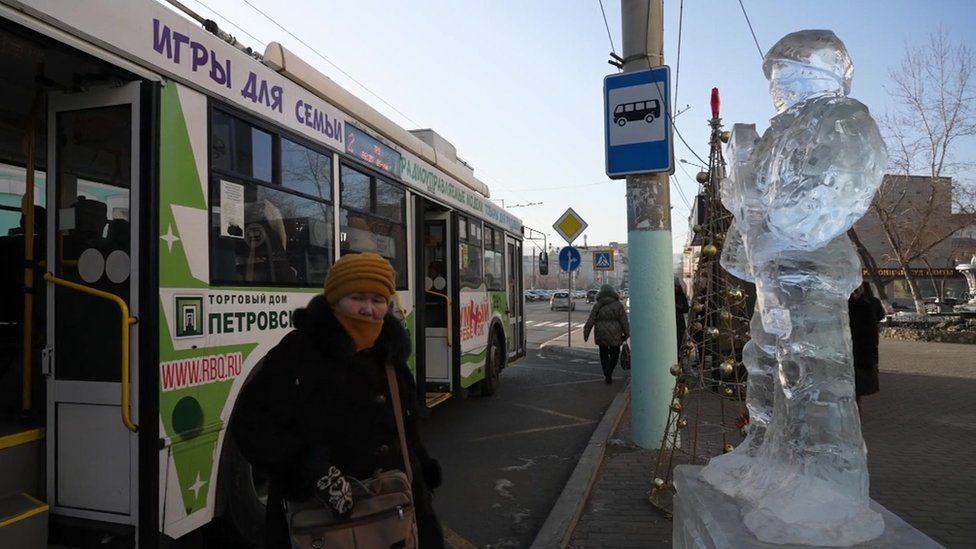
There’s a reason why the soldiers aren’t moving an inch. They’re made of ice.
Chita is located 3,000 miles (4,830 kilometres) east of Moscow. The local government decided that militarised ice sculptures would be an appropriate decoration for this holiday season, encouraging a patriotic new year.
The majority of people I talk to on the square agree.
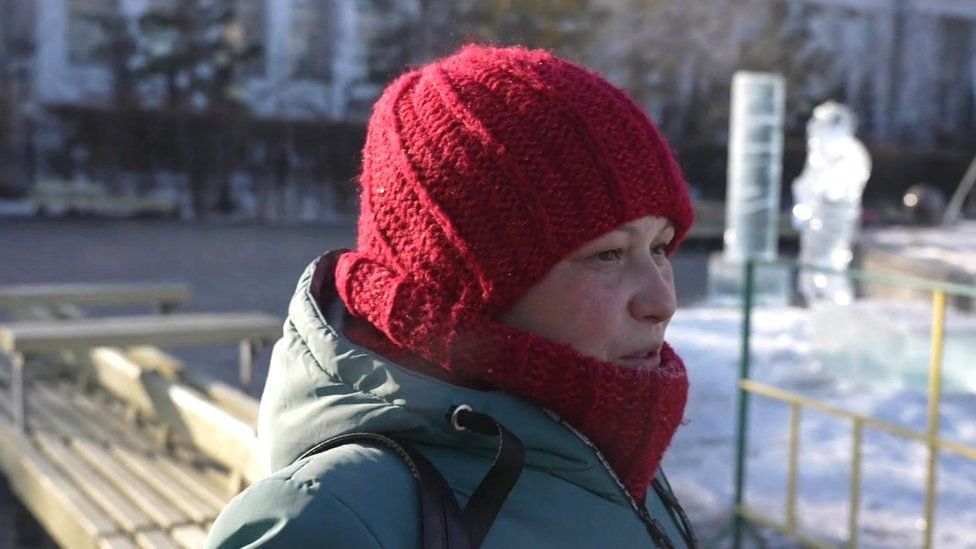
“It’s an unusual way of celebrating the New Year,” Ludmila tells me. “Normally you’d have Santa Claus, bunny rabbits or squirrels. But it’s a sign of the times.”
Image caption, Ludmila supports the Russian invasion of Ukraine – though she worries about friends who have been sent to fight
Ludmila admits she’s worried by what’s happening in Ukraine.
“We’ve got friends who’ve been mobilised and sent to fight there. We worry about them. We call to see if they’re OK. But whatever we may think of our government, our motherland is our motherland. If we don’t defend it, who will?”
“Defend it from what? From whom?” I ask Ludmila. After all, on 24 February it was Russia that launched a full-scale invasion of Ukraine. Not the other way around.
“Defend it from Nazis. There are a lot of them around,” Ludmila replies. “Russia’s being attacked on all fronts, including with LGBT propaganda. They’re trying to force this upon us. We reject these alien ideas. We embrace Russian values. It’s hard for me to explain this in words. I just feel it.”
Russians never used to say these kinds of things to me on the street. They never talked about feeling threatened by “Nazis” in Ukraine, or about the need to fight for so-called “Russian values”. It’s one of the biggest changes I’ve noticed here this year.
Having established total control of the media landscape in Russia, Kremlin propaganda has managed to convince many Russians that their country is now in some existential battle with the West. In conversations here now, I often hear people repeat – almost word for word – the anti-Ukrainian and anti-Western rhetoric they hear on Russian TV channels.
You might think that people in Chita would have more pressing concerns than repelling the onslaught of “Western values”. Despite Siberia enjoying huge gas reserves, the city of Chita has still not been connected to Russia’s domestic gas network. From the hills above the city you can see clouds of smoke rising from coal-fired power stations and from the myriad of wooden houses that are still heated by firewood.
Image caption, The ice sculpture soldiers stand throughout the centre of Chita
This winter, comfort and joy feel in short supply in Chita. But there’s patriotism aplenty. Outside the local concert hall, a stylised metal snowman is holding a Russian tricolour. On Lenin Square, the decorated fir tree shares centre stage with big signs bearing the letter “Z” – the symbol of the Kremlin’s “special military operation” in Ukraine. Watch the news on Chita TV, and you’ll see reports about local schoolchildren writing festive letters – not to Father Christmas, but to Russian soldiers in Ukraine.
But not everyone in Chita shares this particular interpretation of patriotism.
Across town I meet Ivan Losev. On social media recently, the 26-year-old sauna owner shared a bizarre dream he’d had in which he’d met President Volodymyr Zelensky of Ukraine.
“I dreamt I’d been mobilised and sent to a training camp,” recalls Ivan. “Suddenly the Ukrainian army, led by Zelensky, attacked. Everyone was captured. They were about to shoot us, when Zelensky pointed to me. ‘I’ve seen your Instagram stories. Glory to Ukraine!’ he said. ‘Glory to the Heroes!’ I replied.”
For posting about his dream – and for other comments he’d made on social media about the “special military operation” – Ivan was taken to court and fined 30,000 roubles (approximately £380) for “discrediting the Russian armed forces.”
“The closer you get to the downfall of an empire, the more stupid the laws become,” Ivan tells me. “I think this will end with the downfall of Putin’s Russia.
“Patriotism is loving your country, but criticising it to bring change. Patriotism is wanting to make your city better so that it prospers. So that people want to stay and live there and live well. But Russia’s patriotism is about bombing Ukraine to pieces. Our leaders don’t want our country to be better. They just want people in another country to live worse.”
Image caption,
Ivan Losev was fined for posting about a dream he’d had about Ukraine’s President Volodymyr Zelensky
Image caption,
Ivan Losev was fined for posting about a dream he’d had about Ukraine’s President Volodymyr Zelensky
As I head back to the city centre, I pass another ice sculpture of a serviceman who has been left to guard a bus stop. By now it’s dark. The new year illuminations have been switched on and are casting a multi-coloured glow over Lenin Square. It’s such a bizarre sight. And rather unnerving. As the fairy lights change colour, so do the ice soldiers with their automatic rifles.
It may be an attempt to foster a festive feel-good factor. But as this dramatic year nears the end, what exactly do Russians have to celebrate?
Certainly not peace on Earth.
“I worry that Russia will suffer from what is happening now,” says Margarita, with whom I get chatting on the square.
“At the end of the day I would like there to be peace. I would like there to be no wars. We can do without those. But what will be will be.”
In 2023, Cameron Norrie wants “the finest players in the world to be playing,” thus he is hopeful that Russian players will be permitted to return to Wimbledon.
Russian players were barred from SW19 due to the Russian invasion of Ukraine earlier this year.
This prevented players like Daniil Medvedev and Andrey Rublev from competing in the third grand slam of the year, which Novak Djokovic eventually won for the eighth time.
The prohibition on Russians resulted in the elimination of ranking points for the competition, which greatly infuriated the competitors.
Medvedev and Rublev finished a respective seventh and eighth in the year-end ATP rankings, and both took part in the ATP Finals in Turin.
Norrie hopes they are able to return to Wimbledon next year, telling reporters: “For me, I want the best players in the world to be playing.
“I felt last year was tough for those guys, especially for Daniil and for Andrey, who have a chance of winning Wimbledon.
“I know how much those guys sacrificed with their careers and their goals are obviously very high to be winning Slams.
Brittney Griner has shared her first statement since her release from Russiancustody earlier this month.
“It feels so good to be home!” wrote Griner alongside a photo of her leaving the plane that brought her back to the States, and another of her hugging her wife Cherelle Griner. “The last 10 months have been a battle at every turn. I dug deep to keep my faith and it was the love from so many of you that helped keep me going. From the bottom of my heart, thank you to everyone for your help.”
Griner thanked everyone who personally helped organize her release, including Cherelle and the Biden-Harris Administration. She also announced her intentions to play for the WNBA’s Phoenix Mercury this season.
“President Biden, you brought me home and I know you are committed to bringing Paul Whelan and all Americans home too,” she continued. “I will use my platform to do whatever I can to help you. I also encourage everyone that played a part in bringing me home to continue their efforts to bring all Americans home. Every family deserves to be whole.”
The 32-year-old said she looks forward to returning to the court, and thanked everyone who advocated, wrote, or posted for her return.
Griner was freed in a prisoner swap that saw the U.S. release convicted Russian arms dealer Viktor Bout last week. Biden confirmed the news in a tweet, where he said he spoke to Griner and said she was coming home.
Her family shared a statement to express “sincere gratitude” to Biden and others who helped end her wrongful detainment, which stemmed from her arrest in Moscow in February over the possession of hash oil cartridges.
The Ukrainian government has rejected calls by seasoned US diplomat Henry Kissingerthat the time had come for a negotiated peace with Russia in order to lessen the likelihood of a devastating world war as “appeasing the aggressor”
The idea was put forth in an opinion piece written by former US Secretary of State Henry Kissinger and published in the Spectator magazine. Kissinger was the mastermind behind the detente policy toward the Soviet Union during the Cold War under disgraced US President Richard Nixon and later President Gerald Ford.
“I have repeatedly expressed my support for the allied military effort to thwart Russia’s aggression in Ukraine,” Kissinger wrote.
“But the time is approaching to build on the strategic changes which have already been accomplished and to integrate them into a new structure towards achieving peace through negotiation,” he wrote.
“The preferred outcome for some is a Russia rendered impotent by the war. I disagree,” Kissinger continued.
Former Secretary of State Henry Kissinger in 2019 [File: Jaime R. Carrero/Reuters]
“For all its propensity to violence, Russia has made decisive contributions to the global equilibrium and to the balance of power for over half a millennium. Its historical role should not be degraded. Russia’s military setbacks have not eliminated its global nuclear reach, enabling it to threaten escalation in Ukraine,” he added.
Kissinger, who has met Russian President Vladimir Putin multiple times, proposed at the World Economic Forum in Davos in May that Ukraine should let Russia keep Crimea, which it annexed in 2014, and that Russia withdraw to the front lines before its February 2022 invasion.
“Mr. Kissinger still has not understood anything … neither the nature of this war, nor its impact on the world order,” Ukrainian presidential aide Mykhailo Podolyak said on Telegram.
“The prescription that the ex-Secretary of State calls for, but is afraid to say out loud, is simple: appease the aggressor by sacrificing parts of Ukraine with guarantees of non-aggression against the other states of Eastern Europe,” he said.
‘The time is approaching to build on the strategic changes which have already been accomplished and to integrate them into a new structure towards achieving peace through negotiation.’
Ukraine has said that it does not believe that Putin — who has said that he is prepared for a long war in Ukraine — is serious about peace, and that there can be no peace until every Russian soldier leaves its territory, including Crimea.
Podolyak added: “All supporters of simple solutions should remember the obvious: any agreement with the devil — a bad peace at the expense of Ukrainian territories — will be a victory for Putin and a recipe for success for autocrats around the world.”
Kremlin officials were not available for comment late on Sunday.
⚡️Zelensky aide rebuffs Kissinger’s proposal for negotiated peace with Russia.
Kyiv dismissed former U.S. Secretary of State Henry Kissinger’s suggestion that the time is approaching to achieve peace through negotiation with Russia, saying his proposal “appeases the aggressor.”
In May, Ukrainian President Volodymyr Zelenskyy denounced suggestions that Ukraine should cede control of territory to Russia in order to secure peace, comparing such a move with the appeasement of Adolf Hitler’s Nazi Germany.
Those “great geopoliticians” who suggest this are disregarding the interests of Ukrainians, “the millions of those who actually live on the territory that they propose exchanging for an illusion of peace”, Zelenskyy said at the time.
“Whatever the Russian state does, you will always find someone who says, ‘let’s take its interests into account’,” Zelenskyy said.
CIA Director William Burnssaid in an interview published on Saturday that while most conflicts end in negotiation, the CIA’s assessment was Russia was not serious yet about a real negotiation to end the war.
Russia says it will deploy musicians to the front lines of its war in Ukraine in a bid to boost morale.
The defence ministry announced the formation of the “front-line creative brigade” this week, saying it would include both vocalists and musicians.
The UK’s ministry of defence highlighted the brigade’s creation in an intelligence update on Sunday.
Meanwhile, Russian Defence Minister Sergei Shoigu visited frontline troops in Ukraine, the government said.
In a statement posted to Telegram, the defence ministry said Mr Shoigu “flew around the areas of deployment of troops and checked the advanced positions of Russian units in the zone of the special military operation”.
It added that he “spoke with troops on the frontline” and at a “command post” – but the BBC cannot confirm when the visit took place or whether Mr Shoigu visited Ukraine itself.
The reported visit comes as UK defence officials said low morale continues to be a “significant vulnerability across much of the Russian force”.
The UK said the new creative brigade – which follows a recent campaign, urging the public to donate musical instruments to troops – is in keeping with the historic use of “military music and organised entertainment” to boost morale.
But they questioned whether the new brigade would actually distract troops, who have been primarily concerned about “very high casualty rates, poor leadership, pay problems, lack of equipment and ammunition, and lack of clarity about the war’s objectives”.
According to the Russian outlet RBC news, the brigade will consist of troops mobilised under President Vladimir Putin’s recruitment drive, as well as “professional artists who voluntarily entered military service”.
The new unit will be tasked with maintaining “a high moral, political and psychological state [among] the participants of the special military operation,” the outlet cited the defence ministry as saying.
Meanwhile, intense fighting has continued around the town of Bakhmut in the eastern Donbas region on Saturday, Ukraine’s general staff said.
The area has seen heavy clashes between Ukrainian and Russian troops for months, as Russia seeks to retain territory following a string of defeats in eastern Ukraine earlier this year.
Western intelligence officials have previously said Russian attacks on the town are being spearheaded by the private military contractor, Wagner Group.
Moscow hopes to use the town as a staging ground to launch attacks on the Ukrainian-held cities of Kramatorsk and Sloviansk.
Elsewhere, heating has been restored to the Ukrainian capital of Kyiv, after Russian launched widespread strikes on Friday that targeted power and water infrastructure, Mayor Vitali Klitschko said.
Moscow launched 76 missiles on Friday, hitting nine power supply stations and plunging much of the country into darkness. Ukraine said it intercepted 60.
Russia says it will deploy musicians to the front lines of its war in Ukraine in a bid to boost morale.
The defence ministry announced the formation of the “front-line creative brigade” this week, saying it would include both vocalists and musicians.
The UK’s ministry of defence highlighted the brigade’s creation in an intelligence update on Sunday.
Meanwhile, Russian Defence Minister Sergei Shoigu visited frontline troops in Ukraine, the government said.
In a statement posted to Telegram, the defence ministry said Mr Shoigu “flew around the areas of deployment of troops and checked the advanced positions of Russian units in the zone of the special military operation”.
It added that he “spoke with troops on the frontline” and at a “command post” – but the BBC cannot confirm when the visit took place or whether Mr Shoigu visited Ukraine itself.
The reported visit comes as UK defence officials said low morale continues to be a “significant vulnerability across much of the Russian force”.
The UK said the new creative brigade – which follows a recent campaign, urging the public to donate musical instruments to troops – is in keeping with the historic use of “military music and organised entertainment” to boost morale.
But they questioned whether the new brigade would actually distract troops, who have been primarily concerned about “very high casualty rates, poor leadership, pay problems, lack of equipment and ammunition, and lack of clarity about the war’s objectives”.
According to the Russian outlet RBC news, the brigade will consist of troops mobilised under President Vladimir Putin’s recruitment drive, as well as “professional artists who voluntarily entered military service”.
The new unit will be tasked with maintaining “a high moral, political and psychological state [among] the participants of the special military operation,” the outlet cited the defence ministry as saying.
Meanwhile, intense fighting has continued around the town of Bakhmut in the eastern Donbas region on Saturday, Ukraine’s general staff said.
The area has seen heavy clashes between Ukrainian and Russian troops for months, as Russia seeks to retain territory following a string of defeats in eastern Ukraine earlier this year.
Western intelligence officials have previously said Russian attacks on the town are being spearheaded by the private military contractor, Wagner Group.
Moscow hopes to use the town as a staging ground to launch attacks on the Ukrainian-held cities of Kramatorsk and Sloviansk.
Elsewhere, heating has been restored to the Ukrainian capital of Kyiv, after Russian launched widespread strikes on Friday that targeted power and water infrastructure, Mayor Vitali Klitschko said.
Moscow launched 76 missiles on Friday, hitting nine power supply stations and plunging much of the country into darkness. Ukraine said it intercepted 60.
Russia has enough missiles to carry out yet more heavy strikes against Ukraine, but Ukrainians will resist, President Volodymyr Zelensky has said.
Engineers are continuing work to restore electricity to homes, hospitals and infrastructure following a ninth wave of Russian strikes on Friday.
The attacks have targeted civilian infrastructure, as temperatures drop below freezing in many regions.
Kyiv has accused Moscow of using winter as a weapon.
Parts of the Ukrainian capital remained without power and heating on Saturday, the city’s Mayor Vitali Klitschko said. But water supplies have now been fully restored in the city.
Power has been restored in the country’s second city of Kharkiv, after it was left without electricity for hours following Friday’s wave of strikes that targeted energy stations across the country.
Local officials said as many as nine power facilities were hit as Russian forces fired 76 missiles and carried out drone attacks.
Kharkiv’s mayor said the city suffered “colossal” damage.
One resident, Anastaisa, told the BBC the strikes began on Friday morning.
“In a matter of minutes, the lights started blinking,” the mother of a two-month-old child said.
“Just 10 seconds later, we were out of power, everything just went still and that’s it.”
Friday’s attack on Kherson was the third in as many days on the southern city, a month after Russian forces retreated
Defence Ministry adviser Yuriy Sak told the BBC on Friday that Russia’s frequent attacks meant that repairing the damage to electricity infrastructure is getting harder.
Elsewhere, in the city of Kryvyi Rih, four people have been confirmed killed after a residential building was hit -a 64-year-old woman, a 30-year-old couple and a one-year-old boy, whose body was found overnight. A third person died in Kherson. In Kyiv, the city’s metro was left at a standstill.
The alarm was raised across Ukraine on Friday and Commander-in-Chief General Valeriy Zaluzhny said air defences had intercepted 60 of the 76 missiles fired, most of them cruise missiles.
Kyiv city officials said about 40 missiles had been fired at the capital alone – one of the biggest barrages since Russia’s 24 February invasion.
Thirty-seven were brought down by air defences, the officials added.
“It’s very stressful, but now I’m used to this,” said 42-year-old Oksana, who lives in the capital. “I don’t want our children to live through this, to be in basements, shelters, I don’t want this for them.”
Russia’s attacks also cut power in the north-eastern Sumy region that borders Russia, and also in the central cities of Poltava and Kremenchuk.
Russia has launched more than 1,000 missiles and Iranian-made attack drones since the wave of strikes began on 10 October.
The UK’s Ministry of Defence says there has been an “uptick” in Russia’s campaign of long-range strikes against Ukraine’s critical infrastructure in recent days.
UN human rights commissioner Volker Turk warned Thursday that more attacks on power facilities could “lead to a further serious deterioration in the humanitarian situation and spark more displacement”.
“I’m angry,” said Yelyzaveta, 21. “They [Russia] are destroying our lives. We are used to it now. The most important thing is that Russia isn’t here.”
And Anastasia said that life was becoming more difficult as winter sets in.
“When it’s daytime it is still OK, it is tolerable and I can manage the situation, but when it’s dark outside, this is when my problems begin because I need to see clearly, to measure baby formula and also to attend to the baby – those are stressful,” she said
“And, of course, just the effect that we are out of power creates a lot of tension and lots of stress. So we just survive through the night and when the day breaks, it gets a bit better, but we cannot compare it to our normal day.”
According to a minister speaking to the BBC, Russia’s presence in West Africa is “neither constructive nor helpful,” and Britain is worried about the Russian mercenaries operating there.
During his visit to the area, UK Development Minister Andrew Mitchell reaffirmed his country’s commitment to assisting West African coastal nations stop the movement of militants from the Sahel and maintain general security.
He has, however, also voiced concern over how “very difficult” it has been to communicate security-related issues with the Burkina Faso government.
In order to evaluate Ghana’s capacity to fend off the jihadists, Mr. Mitchell has been visiting a military base in the northern part of the country.
It comes after Ghana’s President Nana Akufo-Addo said Russian mercenaries from the Wagner group have been operating near the country’s northern border with Burkina Faso.
He described Wagner’s presence as “distressing” during a meeting with US Secretary of State Antony Blinken this week.
He alleged that the military junta in Burkina Faso had hired Wagner mercenaries to help fight extremists and awarded them a mining concession as a form of payment. Burkina Faso has not commented on the claim.
In recent weeks, hundreds of people fleeing militants attacks in Burkina Faso have crossed the border into northern Ghana.
On Friday, Russian forces launched missile and drone attacks against Ukraine’s major cities, including the capital Kyiv, Kharkiv in the north, Odesa in the south, and Kryvih Rih in the centre.
This week, the number of attacks on Ukrainian cities increased as Russia targeted the nation’s infrastructure for civilian use.
While Kharkiv’s electricity was out, explosions were reported in Kiev’s northeast.
After a residential building in Kryvih Rih was struck, authorities issued a warning about potential casualties.
Several other cities were also hit as alerts were put out across Ukraine. Vitaliy Kim, the mayor of the southern city Mykolaiv, said as many as 60 missiles were thought to have been fired.
The governor of Sumy, a region close to Ukraine’s northern border with Russia, said power there was also out.
Kyiv Mayor Vitaliy Klitschko appealed to people not to leave shelters.
Millions of Ukrainians have gone without power as winter bites in Ukraine. UN human rights commissioner Volker Turk warned on Thursday that further attacks on power facilities could “lead to a further serious deterioration in the humanitarian situation and spark more displacement”.
Civilians have already been killed this week in Russian strikes. Two people died in shelling in the southern city of Kherson on Thursday.
US President Joe Biden is reportedly finalising plans to send Patriot air defence missiles to Ukraine, after months of requests from Kyiv.
In a second day of Russian attacks on central Kherson, which Ukraine recaptured last month, two people have died, according to Ukrainian officials.
According to the regional governor, the city as a whole was left without power due to heavy shelling on vital infrastructure in the port area.
One of Moscow’s biggest setbacks since the invasion in February was the Russian army’s withdrawal from Kherson.
Power facilities in Ukrainian cities have been the target for weeks.
Due to the below-freezing winter temperatures, millions of Ukrainians are without heat or electricity.
Shells reportedly landed 100m (328ft) from the main administration building in Kherson city, officials said, a day after the building itself was badly damaged. A 32-year-old paramedic and a 70-year-old man were killed in the attack which hit a medical aid point, Ukrainian media said.
Explosions also went off in Ukraine’s second biggest city Kharkiv. Mayor Igor Terekhov said Russia was shelling infrastructure facilities and appealed to residents to stay in shelters if possible.
UN human rights commissioner Volker Turk warned that Russia’s attacks were exposing millions of Ukrainians to “extreme hardship” and further attacks on power facilities could “lead to a further serious deterioration in the humanitarian situation and spark more displacement”.
Meanwhile, Russian-backed proxies said Ukrainian forces had launched their “most massive strike” on the centre of occupied Donetsk since 2014, when the separatists triggered a conflict by seizing parts of the Donbas region.
Russian-appointed official Alexei Kulemzin said 40 rockets were fired, killing one person and leaving nine more wounded.
Details of the attack could not be confirmed, but Mr Kulemzin posted pictures of damaged buildings in the city.
In his speech to the UN Human Rights Council in Geneva, Volker Turk said the war had left 18 million people in need of humanitarian aid. He gave details of summary executions of civilians by the Russian military between February and April, including the infamous murders in the town of Bucha outside Kyiv.
Ukrainian President Volodymyr Zelensky appealed to EU leaders on Thursday to help defeat “Russia’s energy terror”, by maintaining Ukraine’s energy supply with around 2bn cubic metres of gas and electricity worth about €800m (£697m; $851m) worth of electricity.
In the past six months he said Ukraine had achieved tangible victories and had begun building an air shield for Ukraine. The capital Kyiv was also targeted by 13 drones on Wednesday, the president said, but the military had been able to repel it.
IMAGE SOURCE,KHERSON OVA Image caption, This was the scene inside the Kherson administration building after Wednesday’s attack
Mayor Kyiv says, explosions were heard early on Wednesday in Kyiv, the capital of Ukraine.
Blasts reportedly shook the Shevchenkivskyi district in the city’s centre, and emergency services were called in, according to Vitali Klitschko.
Oleksiy Kuleba, the governor of Kiev, claims that air defence systems are in operation.
A short time after the air raid siren sounded, BBC reporters heard loud explosions. Since October, Russia has repeatedly used missiles and drones to attack Ukraine’s energy infrastructure.
Serhiy Popko, the head of the military administration for Kyiv, claimed that early on Wednesday, Ukrainian forces had shot down 13 Shahed drones made in Iran.
The body also said a drone fragment had hit two administrative buildings in the city centre. But a spokesperson for the city emergency services told Ukrainian media that no victims had been reported in the strike.
Ukraine has accused Iran of supplying Russia with “kamikaze” drones used in deadly attacks on 17 October, which Tehran initially denied.
Iran later admitted sending Moscow a limited number of drones “many months” before the war.
In response, Ukraine’s President Volodymyr Zelensky said this was a lie and that many more Iranian drones were being used.
Kyiv governor Kuleba said: “The air defence system is operating. It’s important now to stay in shelters and safe places. Russia is continuing its energy terror against our country. But we are getting stronger daily.”
Russia has been targeting Ukraine’s energy grid in recent months in a bid to demoralise its population.
Global leaders have said the strikes civilians infrastructure amount to a war crime, but last week Russian President Vladimir Putin defended the attacks and said they were in response to blast on the Russian bridgeto annexed Crimea on 8 October.
South Ukraine has come under attack from both sides of the war, with Kyiv retaliating near Melitopol after Russia fired drones at Odesa.
The Ukrainian army claimed to have shot down 10 drones on Saturday, but an additional five struck electrical infrastructure, knocking out electricity for about 1.5 million people.
Later, the exiled mayor of Melitopol, a Ukrainian, claimed that a strike had been launched against the Russian-controlled city.
According to Ukrainian officials, Russia used Iranian-made drones in its drone strike on the Ukrainian port city of Odesa.
“The situation in the Odesa region is very difficult,” President Volodymyr Zelensky said in his nightly video address. “Unfortunately the hits were critical, so it takes more than just time to restore electricity. It doesn’t take hours, but a few days.”
Since October, Moscow has been targeting Ukraine’s energy infrastructure with large waves of missile and drone strikes.
In Melitopol, pro-Moscow authorities said a missile attackhad killed two people and injured 10, while Ivan Fedorov, the exiled mayor, said scores of “invaders” had been killed.
“Air defence systems destroyed two missiles, and four reached their targets,” Yevgeny Balitsky, the Moscow-appointed governor of the occupied part of the Zaporizhzhia region, said on the Telegram messaging app.
He added that a “recreation centre” where people were dining had been destroyed in the Ukrainian attack with Himars missiles.
Yana and Yaroslava, two young mothers, do not want to take their 6-year-old kid out of Russia. However, they worry that they won’t have much of a choice due to a strict new anti-gay law imposed by Russian lawmakers.
“We are citizens, same as everyone else. We pay taxes and support charities. But the government is doing everything to force us to leave the country. Honestly, it is scary to stay,” Yaroslava told CNN.
Russia’s upper house of parliament gave its final approval in late November to a new legislative package that toughens an existing law on so-called “LGBTQ propaganda,” and it was signed into law Monday by President Vladimir Putin. The added restrictions on “propaganda” seen as promoting “non-traditional sexual relations and/or preferences” carry heavy penalties – a move activists say will put LGBTQ communities under heightened scrutiny and surveillance.
As the Kremlin prepared to finalize the expansion of the 2013 discriminatory anti-gay law, members of the LGBTQ community in Russia told CNN they feared the uncertain future ahead.
“We are the most vulnerable category within LGBT.We have a child, and they (Russian authorities) can put pressure on us,” Yaroslava said.
Activists say a new legislative package that beefs up an existing anti-gay law is a threat to LGBTQ people in Russia. Igor Russak/SOPA Images/LightRocket/Getty Images
Yana and Yaroslava, both self-employed marketing workers, are raising their child in Russia’s second-largest city of St. Petersburg. Both lesbians, have asked not to disclose their last names for security reasons.
“Our mere existence is illegal for our state and even for our child,” Yaroslava said.
“According to the law, we are people of non-traditional sexual orientation and children should not see us or that we exist at all. Our son sees us. By that logic, our very existence is ‘propaganda of non-traditional sexual relations’ within our family. That means we are illegal.”
The pair say they have created a bubble of protection around their family in order to avoid scrutiny from authorities. The measures include using private accounts on social media, having access to a network of trusted people, sending their son to a private kindergarten where the fact a kid has two moms is less likely to spark a homophobic reaction, and using a private hospital where they run less risk of a doctor calling child protection authorities to make inquiries about their family set-up, they said.
But, the couple says they are reluctant to leave because of a lack of financial resources and available relocation programs in LGBTQ-friendly countries, even though they are fearful about living under the toughened legislation.
‘We expect a new wave of hatred’
Some publishers self-censored certain texts that explore relationships between LGBTQ characters ahead of the implementation of the new law. Olga Maltseva/AFP/Getty Images
The new legislative package ratchets up the country’s existing ban on spreading so-called “propaganda of non-traditional sexual relations” among minors, making it illegal to share any information across all media and all ages.
Some have taken to self-censorship in anticipation of the law’s passage.
Enter your email to sign up for CNN’s “Meanwhile in China” Newsletter.
close dialog
Moscow-based publisher Eksmo took preemptive measures by censoring some fragments of the book “Shattered,” which contains descriptions of sexual scenes between two men, even before the law was finalized. The publisher explained it had hidden 3% of the text – covering it in black ink – “in order not to hide the fact of censorship,” the publisher said in a press release.
“I’m glad that the publisher decided not to cut out the text, but rather to paint it over in black. Where there were feelings, the characters’ attraction, where there was their experience of getting to know their own sexuality, there will now be empty black lines,” said the author, Max Falk, according to the press release. The story, published in October, is about the “love and friendship of two young men” from different social circles in Russia.
Recent novels centered on LGBTQ characters have attracted swathes of readers, causing a stir among Russian lawmakers.
The 2021 bestseller “Summer in a Pioneer Tie,” which explores the budding romance between two men who met in a summer camp in Soviet Kharkiv in the 1980s, sold a record 200,000 hard copies and 32,000 online copies. Lawmakers and public figures responded by lashing out with criticism and calling for beefed-up anti-LGBTQ legislation.
“As an author of books that raise [the LGBTQ] topic, of course, I am very concerned about this,” gay writer Ksenia told CNN. She asked not to give her last name for fear of repercussions.
Alexander Belik, an activist for LGBTQ rights in Russia, said the Kremlin’s crackdown on gay people would spark a new wave of hatred Alexander Belik
On the day the bill passed through the lower house of Parliament, Ksenia discovered both her books containing LGBTQ references had disappeared from Labirint, an online bookstore. The store confirmed in a press release they had “temporarily suspended” selling some books to “analyze their content for the presence of prohibited information in them.”
“Self-censorship is a big thing,” Ksenia told CNN, pointing out that the law had not even come into effect at the time of speaking.
“I don’t know how this law will affect the distribution of this content, but I assume that somehow people will find it,” Ksenia added.
‘I wanted to resume my transition at all costs.’ Trans Ukrainians uprooted by war struggle to continue treatment
She is hopeful that the new package will not stop books about LGBTQ characters from being published and read.
As human rights activists anticipate censorship in the form of blocked websites, banned books, and regular fines, LBGTQ bloggers and content creators are making their social media channels private and deleting posts, according to the Sphere Foundation, an organization that defends the rights of LGBTQ people in Russia and has launched a petition against the new bill.
“We expect a new wave of hatred,” Alexander Belik, head of the Sphere Foundation’s advocacy program, told CNN. “This law enhances public rhetoric of hate.”
Since the debate on the restrictions began, LGBTQ people have become increasingly worried for their safety, according to Belik.
“The community is in an alarming state,” Belik said of the new law, suggesting that it will induce self-censorship among LGBTQ advocacy groups who fear a potential Kremlin crackdown.
“We urge the LGBTQ community not to succumb to panic and continue living their lives,” Belik said.
He said the organization would continue fighting for the abolition of the law and support those who may be persecuted under it.
Russian politicians condemn ‘foreign values’
The Kremlin has consistently described LGBTQ communities in Russia as existing in opposition to “traditional values,” a line of rhetoric that activists say directly harms LGBTQ people across the country.
Since the first law on “gay propaganda” passed in 2013, Russia has seen repeated crackdowns on the gay community, most notably in 2017 and again in 2019 in the southern region of Chechnya, where activists reported dozens of men and women were detained and some tortured and killed for their sexual orientation, and no proper investigation followed.
Putin framed what he described as the Western renunciation of “traditional values” as a “challenge” to Russian society in a speech in September announcing the annexation of four Ukrainian regions, in violation of international law. At the time, he was facing unusual criticism even from Kremlin loyalists over Moscow’s huge losses on the battlefield in Ukraine, and low morale at home.
“Do we want our schools to impose on our children, from their earliest days in school, perversions that lead to degradation and extinction? Do we want to drum into their heads the idea that certain other genders exist along with women and men and to offer them gender reassignment surgery? Is that what we want for our country and our children?” Putin said inside the Kremlin’s Georgievsky Hall.
“This is all unacceptable to us. We have a different future of our own,” Putin continued.
Russian President Vladimir Putin has described LGBTQ communities in Russia as existing in conflict with “traditional values.” Kremlin Press Service/Anadolu Agency/Getty Images
The new package bans all materials that the authorities consider to be LBGTQ “propaganda,” making such material illegal among Russians of all ages, constituting an offense liable to a fine of up to $6,400 for individuals and up to roughly $80,000 for legal entities. Foreigners could receive up to 15 days in jail or deportation for breaking the law. The main difference between the original iteration of the law and the expanded version is that now, the prohibition of so-called same-sex “propaganda” will apply across all ages and across all media.
The chairman of Russia’s lower house of parliament, Vyacheslav Volodin, dubbed the new legislation an “Answer to Blinken Law,” referring to a tweet in which US Secretary of State Antony Blinken condemned the proposed expansion of the ban.
“It is the best answer to the Secretary of State Mr. Blinken. Stop imposing on us foreign values. You destroyed your values – we’ll see how it all ends, but it will definitely be sad,” Volodin said to the State Duma – Russia’s lower house – after it voted unanimously to pass the amendments in the final reading.
Putin’s enforcement of anti-LGBTQ laws is part of a wider trend of repressive policies as the Kremlin situates itself in opposition to so-called Western values, according to Dan Healey, a professor of modern Russian history at the University of Oxford.
“Those are being knit into a wider social and cultural and defense policy, you know, around so-called traditional values. And it’s just reducing the space within which a non-heterosexual existence can comfortably take place in Russia,” Healey told CNN.
“The consequences for LGBTQ people in Russia are wide-ranging and really, really repressive. They become a kind of underground people who are unable to become visible in public space.”
Transgender rights under threat
Russian activists claim the authorities’ renewed targeting of LGBTQ communities in Russia is linked to Moscow’s faltering war in Ukraine.
They suggest the purpose of the new legislative package is to distract the nation from the domestic backlash against Putin’s partial mobilization, announced in September, and the war of attrition that has exhausted the nation’s military resources.
“Among other things, it is also diverting attention from what is happening in the country. As soon as it gets a little worse, we have an enemy to point at: it’s because of them that it’s so rough,” said Anton Macintosh of Russia’s first transgender support group, T-Action. The organization was labeled a “foreign agent” – a status close to “traitor” that obstructs operating in Russia – the day after Russia’s parliament passed the third and final reading of the law.
Macintosh said his organization had been contacted by increasing numbers of people worried that they would not be able to receive proper medical support in their gender transition processes. The process is currently legal if a person passes an extensive review to obtain a psychiatrist’s note, Macintosh said, but it remains unclear how the new legislative package will be implemented.
Vanya Solovey, of the trans rights group Transgender Europe, told CNN the Kremlin’s new package increases the stigma that trans people in Russia have to face. Vanya Solovey
“Unlike a cisgender person, when visiting a doctor or being admitted to the hospital, a transgender person doesn’t have the option to hide their status,” Macintosh said, referencing the physical changes resulting from hormone therapy. “Will there be proper healthcare available for transgender people?”
The less access to support groups a transgender person has the more terrified and hopeless they are likely to feel, Macintosh explained. Stigmatizing their status causes even more emotional strain, he said.
“We receive a lot of suicidal letters. We do surveys every three months asking about emotional well-being. A lot of people have been sharing hard feelings about how they don’t know how they are going to live,” Macintosh said.
“This is not only an anti-gay law, but this is also explicitly an anti-trans law,” said Vanya Solovey, an advocacy and program officer for Eastern Europe and Central Asia at the trans rights group Transgender Europe, referencing the part of the package that forbids the promotion of information that could cause people to want to change their gender assigned at birth.
“It explicitly targets raising awareness about gender transition. And this is, of course, very concerning,” he added.
“When someone (Putin) at this high level of authority spreads these misconceptions, again this increases the stigma that trans people have to face.”
‘Another brick in building an autocracy’
When the bill passed its first reading in the State Duma in October, Russia’s first transgender politician, Yulia Alyoshina, made the decision to step down from her role as a regional head of the Civic Initiative party, and end her political career.
“I have never been involved in such propaganda, but I have no idea how to continue to conduct public political activity as an openly transgender woman,” she said in a Telegram post.
Yulia Alyoshina, Russia’s first transgender politician, said the new law was discriminatory and would make life tougher for Russia’s LGBTQ community. Yulia Alyoshina
Alyoshina said she had been discriminated against as a transgender politician on numerous occasions since she got her new passport in 2020, but says this law will complicate further the already difficult life of all LGBTQ people in Russia.
“The law is discriminatory,” she told CNN. “Any kind of information can fall under the term ‘propaganda.’ As it is not clearly spelled out, this will be left to the discretion of the courts.”
“The text of the law rejects the social equivalence of ‘traditional’ and ‘non-traditional’ preferences,” she added. “This means that LGBT people in Russiaare recognized by the authorities at the legislative level as socially unequal. In other words, second-rate people.”
Alyoshina said the new package is characteristic of an authoritarian government’s policy towards society.
“The sexual life of citizens is a part of human freedom that an authoritarian regime cannot tolerate,” she said. “The adoption of the law is just another brick in building an autocracy in Russia.”
The co-winner of this year’s Nobel Peace Prize from Russia claims that the Kremlin told him to decline the honor.
Memorial’s director, Yan Rachinsky, said that he was instructed not to receive the award because the two other co-winners—a Ukrainian human rights organization and a jailed Belarusian rights advocate—were thought to be “inappropriate.”
One of the first civil rights organizations in Russia, Memorial, was shut down by the Kremlin a year ago.
We reached out to the Russian Foreign Ministry for comment.
In an exclusive interview with the BBC’s HARDtalk programme, Mr Rachinsky said his organisation had been advised to decline the award, but “naturally, we took no notice of this advice”.
Despite threats to his safety, Mr Rachinsky said the work of Memorial remained essential.
“In today’s Russia, no one’s personal safety can be guaranteed,” he said. “Yes, many have been killed. But we know what impunity of the state leads to… We need to get out of this pit somehow.”
Memorial had been documenting historical Soviet repression.
Its first chairman – Arseny Roginsky – was sent to Soviet labour camps for the so-called “anti-communist” study of history.
Announcing the prize winners, the Nobel Committee said that the Memorial was founded on the idea that “confronting past crimes is essential in preventing new ones”.
Mr Rachinsky called the committee’s decision to award the prize to recipients in three different countries “remarkable”.
He said it was proof “that civil society is not divided by national borders, that it is a single body working to solve common problems”.
IMAGE SOURCE, REUTERS Image caption, Ukrainian Oleksandra Matviichuk refused to be interviewed alongside one of her co-winners, Russian Yan Rachinsky
But the decision to include a Russian recipient has been controversial.
The woman who runs Ukraine’s Center for Civil Liberties – another of the prize-winners – refused to be interviewed alongside Mr Rachinsky. The BBC spoke to them separately in Oslo.
When asked why she wanted to do the interview separately, Oleksandra Matviichuk told HARDtalk: “Now we are in a war and we want to make the voice of Ukrainian human rights defenders tangible.
“So I am sure that regardless that we are doing separate interviews, we transmit and deliver the same messages.”
The Center for Civil Liberties was recognized for its work promoting democracy in Ukraine and investigating alleged Russian war crimes in the country.
Despite refusing to speak beside her co-winner, Ms Matviichuk praised Mr Rachinsky’s work and described Memorial as “our partner”.
Memorial had helped the Ukrainian group for years, she said, adding she had “huge respect for all [her] Russian human rights colleagues” who work in difficult conditions.
She also warned that without proper accounting for Russian crimes, peace would not come to Eastern Europe.
Ms Matviichuk called for a new international tribunal to hold President Vladimir Putin and other Russians accountable for their actions in Ukraine, describing that the current system is insufficient.
“The question is, who will provide justice for hundreds of thousands of victims of war crimes?” she asked.
She also accused Russia of using the war as a tool to achieve its geopolitical aims – and committing war crimes in order to win the conflict.
The third Nobel winner, Belarusian human rights defender Ales Bialiatski, has been in prison without trial in his home country since July last year.
He is the founder of the country’s Viasna (Spring) Human Rights Centre, which was set up in 1996 in response to a brutal crackdown on street protests by Belarus’s authoritarian leader Alexander Lukashenko.
White House has reported that Russia and Iran are forming a full-fledged defense alliance to support Russia in its conflict with Ukraine.
John Kirby, a spokesman for the White House National Security Council, claimed that Russia is once more looking to Iran to replenish the Russian military with drones and surface-to-surface missiles.
“Russia is offering Iran an unprecedented level of military and technical support that is transforming their relationship into a fully-fledged defence partnership,” Mr Kirby said.
“I think it’s important for us to be clear this partnership poses a threat not just to Ukraine, but to Iran’s neighbours in the region.”
Concerns about new weapon sales to Russia come after Iran sold hundreds of attack drones to Russian over the summer.
The Biden administration recently unveiled sanctions against Iranian firms and entities involved in the transfer of Iranian drones to Russia for use in Putin’s ongoing invasion of Ukraine.
In October, the White House accused Tehran of sending Iranian troops to Crimea to support Russian drone attacks on Ukraine’s power stations and other key infrastructure,
The White House and British government said the relatively small number of Iranian personnel deployed to Crimea, a part of Ukraine unilaterally annexed by Russia in contravention of international law in 2014, were there to assist Russian troops in launching Iranian-made drones against Ukraine.
“Supports flowing both ways,” said Mr Kirby.
“Russia is seeking to collaborate with Iranon areas like weapons development and trade. As part of this collaboration, we are concerned that Russia intends to provide Iran with advanced military components.”
In response to what it called “egregious” human rights violations, Australia has declared that it will impose targeted sanctions on Russia and Iran.
In a statement, foreign minister Penny Wong said sanctions would be placed on 13 people and two organizations, including the Basij Resistance Force and Iran’s morality police, as well as six Iranians who took part in the suppression of the protests that began after Mahsa Amini, 22, died in custody in September.
Human rights sanctions would also be placed on seven Russians involved in what the foreign minister claimed was an attempt to kill former opposition leader Alexei Navalny, according to Ms. Wong’s statement.
In an opinion piece for the Sydney Morning Herald, Ms Wong said Seyed Sadegh Hosseini, whom she described as a senior commander of Iran’s Islamic Revolutionary Guard Corps, is one of those who will be sanctioned.
He was being listed for his alleged role in the “indiscriminate use of violence against protesters”.
“The Iranian regime’s flagrant and widespread disregard for the human rights of its own people has appalled Australians, and the perpetrators must be held accountable,” Ms Wong wrote in the newspaper on Saturday.
The US claims that there is now a full-fledged defense alliance between Russia and Iran.
Russia is giving an unprecedented level of military support, said US national security council spokesman John Kirby.
The US has seen reports that the two countries are considering joint production of lethal drones, he added.
Australia has announced it is sanctioning three Iranians and one Iranian business for supplying Russia with drones to use against Ukraine.
Co-operation between Russia and Iran has been highlighted recently, with Ukraine accusing Russia of using Iranian drones in its attacks.
After initially denying sending any drones to Russia, the Middle Eastern country later admitted it had supplied some before the invasion of Ukraine.
Mr Kirby said that a partnership between Iran and Russia to produce drones would be harmful to Ukraine, Iran’s neighbours and the international community.
“Russia is seeking to collaborate with Iran in areas like weapons development, training,” he said, adding that the US fears that Russia intended to “provide Iran with advanced military components” including helicopters and air defence systems.
“Iran has become Russia’s top military backer…” he said. “Russia’s been using Iranian drones to strike energy infrastructure, depriving millions of Ukrainians of power, heat, critical services. People in Ukraine today are actually dying as a result of Iran’s actions.”
In response to Mr Kirby’s comments, UK Foreign Secretary James Cleverly said that Iran had become one of Russia’s main military supporters and that the relationship between them was threatening global security.
The “sordid deals” between the two countries have seen Iran send hundreds of drones to Russia, he said.
Image source, Getty ImagesImage caption, Russian President Vladimir Putin with Iranian President Ebrahim Raisi in July.
“In return, Russia is offering military and technical support to the Iranian regime, which will increase the risk it poses to our partners in the Middle East and to international security,” he added.
He said the UK agreed with the US that Iranian support for the Russian military would grow in the coming months as Russia tried to get hold of more weapons, including hundreds of ballistic missiles.
Ukraine accused Iran of supplying Russia with “kamikaze” drones used in a series of attacks which killed at least eight people on 17 October.
After denying this, Iran later admitted sending a “limited number” of drones to Russia, “many months” before the war in Ukraine.
Ukraine’s President Volodymyr Zelensky said this was a lie and that Ukraine was shooting down about 10 Iranian drones a day.
Image source, ReutersImage caption, Russia’s war on Ukraine continues to affect many cities and regions, including Bakhmut in the Donbas
On Saturday, Penny Wong, Australia’s foreign minister, said in a statement: “The supply of drones to Russia is evidence of the role Iran plays in destabilising global security. This listing highlights that those who provide material support to Russia will face consequences.”
She also announced measures against 19 other people and two entities, including Iran’s Morality Police, for the brutal treatment of anti-government protestors following the death of 22-year-old Mahsa Amini in custody earlier this year.
In other developments:
Russia has turned the Ukrainian city of Bakhmut into “burnt ruins”, President Zelensky says, following months of deadly fighting in the eastern Donbas region
The United Nations says Belarus will allow the transit of Ukrainian grain through its territory for export from Lithuanian ports
The head of a Ukrainian human rights organisation that was jointly awarded this year’s Nobel Peace Prize – Oleksandra Matviichuk of the Centre for Civil Liberties – has called on nations to set up an international tribunal to try Russian President Vladimir Putin for Russia’s war in Ukraine
The International Olympic Committee says it will explore a proposal to allow athletes from Russia and Belarus to take part in sporting events in Asia – despite an international ban.
As James Cleverly approved the most sanctions the UKhas ever combined in one package, Foreign Secretary James Cleverly stated that the UK has a responsibility to “promote free and open societies.”
New sanctions have been imposed by the UK on 30 people and organisations that it deemed to be “corrupt political figures, human rights violators, and perpetrators of conflict-related sexual violence.”
People involved in the mobilisation of troops to rape civilians and the torturing of prisoners are included in the sanctions.
The number of individuals sanctioned from 11 nations—including Russia, Iran, Myanmar, and South Sudan—is the highest number the UK has ever gathered in a single package.
In order to commemorate International Anti-Corruption Day and Global Human Rights Day, the government claimed that the sanctions were planned with international partners.
approved the most sanctions the UK has ever combined in one package, James Cleverly stated that the UK has a responsibility to “promote free and open societies.”
New sanctions have been imposed by the UK on 30 people and organisations that it deemed to be “corrupt political figures, human rights violators, and perpetrators of conflict-related sexual violence.”
People involved in the mobilisation of troops to rape civilians and the torturing of prisoners are included in the sanctions.
The number of individuals sanctioned from 11 nations—including Russia, Iran, Myanmar, and South Sudan—is the highest number the UK has ever gathered in a single package.
In order to commemorate International Anti-Corruption Day and Global Human Rights Day, the government claimed that the sanctions were planned with international partners.
“It is our duty to promote free and open societies around the world,” Foreign Secretary James Cleverly said.
As part of the package, eight individuals involved in serious human rights abuses and violations have been designated under the Global Human Rights regime, which allows the UK to stop them from entering the country, channelling money through UK banks or profiting from the British economy.
Geographical sanctions have been placed on Iran and Russia, while five “corrupt actors” from Serbia, Moldova and Kosovo have been placed on the list.
The UK has now sanctioned more than 1,200 individuals in Russia, including members of the military. Russian President Vladimir Putin and his foreign minister Sergey Lavrov were sanctioned in February when Russia invaded Ukraine.
All sanctioned individuals will have their assets frozen and a travel ban imposed, while entities are subject to asset freeze.
Image:More than 1,200 Russians have now been sanctioned by the UK, including Vladimir Putin
Those included in the latest wave of sanctions are:
• Ten Iranian officials connected to Iran’s judicial and prison systems, including former directors of Evin Prison where Nazanin Zaghari-Ratcliffe was held, and those responsible for handing out death penalties to protesters
• Russian Colonel Ibatullin, commander of the 90th Tank Division, who has been on the front line of the Ukraine invasion
• Two county commissioners in South Sudan who mobilised troops to rape civilians during conflicts earlier this year
• Mali’s Katiba Macina group, also known as the Macina Liberation Front, who are known for sexual violence, including forced marriages
• Divisions of the Myanmar armed forces for sexual violence and Myanmar’s office of the chief of military and security affairs following reports of torture, rape and sexual violence
• Muslim cleric Mian Abdul Haq for forced conversions and marriages of girls and women from religious minorities in Pakistan
• Uganda’s former inspector general of police, general Kale Kayihura, for overseeing human rights violations, including torture
• The mayor and deputy mayor of Matagalpa in Nicaragua for promoting and supporting grievous human rights violations
• Russian federal security service member in Crimea, Andrey Tishenin, and Artur Shambazov, a senior detective in Crimea, for torturing Ukrainian activist Oleksandr Kostenko in 2015
• Russian Federation major of justice Valentin Oparin and Oleg Tkachenko, head of public prosecutions in Rostov forobstructing complaints of torture and using torture to extract testimony.
The massive fire in Khimki, which is close to the Russian capital of Moscow, destroyed the entire shopping centre.
One of the biggest shopping malls in Moscow was completely destroyed by a massive fire that claimed at least one life.
According to authorities, the fire broke out in the Mega shopping centre in Khimki, northwest of the Russian capital, and covered an area of about 7,000 square metres.
Firefighters’ attempts to put out the flames were hampered because the fire caused part of the building to collapse.
It broke out before the centre opened to customers.
Russia’s Investigative Committee, which probes major crimes, said it was looking into the cause of the fire.
Officials initially said arson may have been involved.
But, authorities later said the blaze appeared to have been sparked by welding that apparently violated safety regulations, with a probe launched.
The shopping centre used to house a number of Western shops, including IKEA, before the chains pulled out of Russia in the wake of the Ukraine conflict.
Swapping an American jailed for a minor drugs offense in Russia for one of the world’s most notorious arms traffickers known as “The Merchant of Death” might seem like a lopsided deal that could fuel dangerous national security precedents.
But President Joe Biden’s decision to exchange WNBA star Brittney Griner for Viktor Bout goes beyond the exchange’s bottom line. It represented a humane resolution to a painful dilemma that came after tortuous talks with a Russian regime that treats people as geopolitical pawns every day. In that sense, the Biden administration demonstrated the gulf between its moral grounding and that of Russian President Vladimir Putin who is currently demonstrating his inhumanity on another front, with a fearsome assault on Ukrainian civilians.
But the tragic counterpoint to this diplomatic triumph – Biden’s failure to also secure the release of Paul Whelan, another American incarcerated in a Russian penal colony – underscored the unforgiving moral conundrum he faced. And it prompted top Republicans to charge that he had prioritized a basketball superstar over an ex-marine who benefited from a vocal political pressure campaign on Biden.
There is no getting around the potential implications of the steps that Biden took, which followed earlier prisoner swaps with US adversaries conducted by his administration – including for an American and former US marine detained in Russia, Trevor Reed – and those of former presidents Barack Obama and Donald Trump. There is now a considerable risk that other rogue nations or groups see Washington as open for business and may therefore see Americans abroad as increasingly valuable targets in a vicious cycle of more detentions.
Furthermore, the return of Bout, who has been linked to Russian security services, handed Putin a propaganda coup at a time of rising domestic pressure. It enabled him to demonstrate to intelligence operatives engaged in nefarious activity abroad that they will not be forgotten by the Kremlin. Those intelligence services are critical to the Russian leader’s continued hold on power as his war in Ukraine deteriorates even further. Still, Biden’s strategy also hinted at intriguing diplomatic possibilities, three days after he refused to rule out future talks with Putin, if Ukraine’s agrees, aimed at ending the vicious war. He showed it was possible to deal with Russia, even amid an effective proxy war between the two old Cold War foes in Ukraine amid the worst relations between Moscow and Washington since the Cuban Missile Crisis.
Another notable cog in this deal was Saudi Arabia, which helped facilitate the exchange alongside the United Arab Emirates – and also helped secure the release of US citizens captured fighting in Ukraine earlier this year. Whether the kingdom, which has relations with both Moscow and Washington and is seeking to increase its global leadership role, might emerge as a mediator over Ukraine remains to be seen. But its recent smoothing of US-Russia exchanges might put Biden’s decision to travel to the country earlier this year and greet its ruthless Crown Prince Mohammed bin Salman with a fist bump, in a slightly different light.
Ultimately, it’s impossible for there not to be a sour aftertaste when dealing with an adversary as inhumane as Putin. But it is the job of a president to weigh these competing dynamics within the context of America’s national goals and duty to its citizens.
In cases like these, there is never a right answer.
The most immediate question now facing Biden is how to extract Whelan, whose hopes were raised and then smashed, as he remained in prison and Griner went home, after both Americans were at the center of US-Russia diplomacy.
“This is a precarious situation that needs to be resolved quickly,” a deeply disappointed Whelan told CNN’s State Department producer Jennifer Hansler in an exclusive phone interview. “I would hope that (Biden) and his administration would do everything they could to get me home, regardless of the price they might have to pay at this point.”
The harsh truth for Whelan is that Russia refused every inducement the US could offer to include him in an exchange package, leaving Biden’s capacity to free him in short order in doubt.
Russian officials told the US side that a one-for-two swap was not acceptable but resisted wider options, US officials said.
John Kirby, the National Security Council’s coordinator for strategic communications, told CNN that the Kremlin regarded Whelan in a different light than Griner, since he’s facing espionage charges – even though the US says such allegations are a sham. This added dimension to Whelan’s incarceration will fuel speculation that Moscow may leverage him as it seeks a three-way deal with Germany to free a former colonel from its domestic spy agency who was convicted of murder last year. CNN reported in August that Russia had requested Vadim Krasikov be included in a deal for the two Americans.
This adds another layer of complication for Biden as he seeks to get Whelan free, since it involves another government and would require German Chancellor Olaf Scholz to potentially agree to supersede his country’s own legal system. Whether the new German leader has the political capacity to do so is unclear, as is the kind of Russian concession Berlin might require.
A senior administration official said on Thursday evening that there is a recognition in the White House that the US needs to make available “something more, something different” from what they have offered to the Russians so far, CNN reported.
While Biden is being castigated by some political opponents in Washington for doing a bad deal, administration officials insisted that he got the best one on offer.
“I want to be very clear – this was not a situation where we had a choice of which American to bring home. It was a choice between bringing home one particular American, Brittney Griner, or bringing home none,” a senior administration official told reporters on Thursday.
Evelyn Farkas, a former deputy assistant secretary of defense, told CNN she thought Putin was never going to hand over Whelan and all along wanted to swap only Griner for Bout.
“It’s happening now because Vladimir Putin wants this to happen now, he needs a win, he needs a victory in Russia because he is having trouble convincing the Russia people that it’s a good idea to be at war with Ukraine,” Farkas said.
She added that there remained some hope for Whelan because the Griner exchange did show that “the Russians will make a deal if they think it’s in their interests.”
Whelan isn’t the only American imprisoned in Russia. The family of US teacher Marc Fogel, who is serving a 14 year sentence at a hard labor camp, has also called for the White House to negotiate his release. Fogel was arrested last year in Moscow after traveling into the country with cannabis that his lawyer said was used for medical purposes.
The fierce political divides that now challenge every US foreign policy decision did not take long to bubble over after Griner was freed – alongside a more vicious reaction on social media as some conservatives questioned her patriotism.
Florida Sen. Marco Rubio, the top Republican on the Senate Intelligence Committee, said he was relieved Griner was free but raised questions about the wisdom of such exchanges and whether they could endanger other Americans.
“I think the challenge this points to is these regimes know this. This is why (President Nicolas) Maduro traded five Citgo executives – who were lured to Venezuela to get arrested – for his nephews who are convicted drug traffickers,” Rubio said.
“That’s why you trade a professional basketball player with CBD oil for the Merchant of Death. These are bad trades,” he said.
Another Republican, Rep. Mike Waltz of Florida described the deal to free Griner in a Twitter post as “shameful” and accused the administration of “giving priority to a celebrity over a veteran.”
In a later interview with CNN’s Jake Tapper, Waltz said: “This is a tactical victory, I am glad she is coming home. But this is a strategic loss.”
“The reason the Iranian regime, the Taliban, Putin himself, continue to take Americans hostage is we continue to make concessions. When do we start dictating the terms to these regimes?”
Whelan’s family reacted with great dignity in welcoming Griner’s release, despite their devastation that their brother did not come home. Elizabeth Whelan, Paul’s sister, called for political unity over the fate of hostages abroad, saying that hostile foreign countries are trying to use such cases to stir dissent in the US.
Whelan also urged people to understand the human angle of Biden’s dilemma despite the grave geopolitical issues at stake.
“It’s an amazing thing to be able to get Brittney back. It’s a win for us,” she said.
“We tend to always look at what is Russia getting out of this? … We are getting a wrongfully detained American back home. It’s something to celebrate.”
US basketball star and Olympic gold medalist, Brittney Griner has been freed in a prisoner-swap and is now in US custody.
Russia agreed to swap her for its citizen, Viktor Bout, an infamous arms dealer nicknamed “Merchant of Death”.
The two-time Olympic gold medalist and all-star center for the Phoenix Mercury of the WNBA was held in February after customs officers at Moscow’s Sheremetyevo Airport allegedly discovered vape cartridges containing cannabis oil in her luggage.
Grinerconfirmed having the canisters in her suitcase at trial, but she claimed she packed them accidentally while rushing to catch her trip and had no malicious intent.
In written remarks, her defense team claimed that she had received a cannabis prescription to relieve chronic pain.
She was found guilty in August and given a nine-year prison term.
Viktor was caught in elaborate 2008 DEA sting operation in Thailand. He was convicted on terrorism charges and was sentenced to 25 years in prison.
He is a former Soviet military translator whose clients included warlords, rogue states in Africa, Asia, South America.
German Chancellor Olaf Scholzsays, the risk of nuclear weapons being used in the Ukraine conflict has decreased “for the time being.”
“In response to the international community drawing a line, Russia has stopped threatening to use nuclear weapons,” Mr Scholz said.
Russia’s Vladimir Putin said on Wednesday that nuclear weapons would only be used in retaliation.
However, the United States condemned the remarks as “loose talk.”
Mr Scholz said in an interview on Thursday that his recent trip to China helped “put a stop” to the threat of nuclear escalation.
He stated that he and Chinese President Xi Jinping agreed that “nuclear weapons must not be used,” and that the G20 countries quickly reaffirmed this position.
The German chancellor’s comment came the day after President Putin said that the risk of nuclear war is “growing – it would be wrong to hide it”.
Speaking at a televised meeting of his human rights council, the Russian leader asserted that Russia would “under no circumstances” use the weapons first and would not threaten anyone with its nuclear arsenal.
“We have not gone mad, we are aware of what nuclear weapons are,” he said, adding: “We aren’t about to run around the world brandishing this weapon like a razor.”
In the interview, Mr Scholz also addressed comments made by French President Emmanuel Macron that it would be necessary to provide “guarantees for its own security to Russia, the day it returns to the table” of negotiations.
“The priority now is for Russia to end the war immediately and withdraw its troops,” he said, adding that “of course we are ready to talk with Russia about arms control in Europe. We offered this before the war, and this position has not changed.”
Despite Mr Scholz’s assessment that the risk has been lowered thanks to Western pressure, the US criticised Mr Putin’s comments, which it said amounted to “loose talk” and “nuclear sabre-rattling”.
“It is dangerous and it goes against the spirit of that statement that has been at the core of the nuclear non-proliferation regime since the Cold War,” said a US state department spokesman.
Mr Scholz – who on Thursday marks one year since being elected chancellor – also touched upon the domestic defence issues that have been in the spotlight since the start of the war in Ukraine.
Shortly after Russia invaded the country, he announced a major defence policy shift by committing to spend €100bn (£86.4bn) on the Germany army and ramping up defence spending to above 2% of Germany’s GDP.
Now Mr Scholz has said he hopes to develop a missile defence shield in the next five years and signalled that the German government is already in talks with manufacturers of various defence systems “to get ready for concrete decisions”.
Oil prices have risen after major producers agreed to maintain output cuts and the G7 and its partners agreed to cap Russian oil prices.
On Monday morning, Brent crude rose from 0.6% to above $86 per barrel.
The G7 agreed on Friday to cap the price of Russian oil at $60 per barrel in order to put pressure on Russia over its invasion of Ukraine.
Meanwhile, the oil producers’ group Opec+ stated over the weekend that it would maintain its output-cutting policy.
Opec+ is a group of 23 oil-producing nations, including Russia, that meet on a regular basis to decide how much crude oil to sell on the global market.
“This decision by Opec+ to keep the quota where it is… is by itself an implicit sort of support to the oil market,” Kang Wu of S&P Global Commodity Insights told the BBC.
Analysts said oil prices had also been boosted by the easing of Covid restrictions in some Chinese cities, which could lead to an increase in demand for oil.
More cities in China, including Urumqi in the north west, have said they will loosen curbs after mass protests against the country’s zero-Covid policy.
Price cap
In a joint statement last week, the G7 and Australia said the $60 cap on Russian oil would come into force on Monday or “very soon thereafter”.
They said the measure was meant to “prevent Russia from profiting from its war of aggression against Ukraine”.
The price cap means only Russian oil bought for less than $60 a barrel will be allowed to be shipped using G7 and EU tankers, insurance companies and credit institutions.
This could make it difficult for Moscow to sell its oil at a higher price, because many major shipping and insurance companies are based within the G7.
Russia has said it will not accept the price cap, and has threatened to stop exporting oil to countries adopting the measures.
IMAGE SOURCE,GETTY IMAGES
Jorge Leon, senior vice-president at Norwegian energy consultancy Rystad Energy, told the BBC’s Today programme that oil prices could increase as a result.
“Russia has been very clear that they will not sell crude (oil) to anybody signing up to the price cap,” he said.
“So probably what’s going to happen is that we will see some disruptions in the coming months and therefore probably oil prices are going to start increasing again in the coming weeks.”
The G7 is an organisation of the world’s seven largest so-called “advanced” economies, which dominate global trade and the international financial system. They are Canada, France, Germany, Italy, Japan, the UK and the United States.
Supply fears
Prices of oil and gas have soared on concerns that Russia’s invasion of Ukraine could hit supply.
Russia is the world’s second top producer of crude oil after Saudi Arabia, and supplies around a third of Europe’s needs.
US Treasury Secretary Janet Yellen said the price cap would further constrain Russian President Vladimir Putin’s finances and “limit the revenues he’s using to fund his brutal invasion” while avoiding disrupting global supplies.
However, Ukraine President Volodymyr Zelensky called the cap “a weak position” that was not “serious” enough to damage to the Russian economy.
An EU-wide ban on Russian crude oil imported by sea will also take effect on Monday.
Although the measures will most certainly be felt by Russia,the blow will be partially softened by its move to sell its oil to other markets such as India and China, who are currently the largest single buyers of Russian crude oil.
On Wednesday, Russia’s upper house of parliament unanimously voted to strengthen a contentious law prohibiting what the bill refers to as “LGBT propaganda,” making it applicable to Russians of all ages.
After being passed by the Federation Council, the bill must be signed into law by Russian President Vladimir Putin. On November 24, it was approved by the State Duma, Russia’s lower house of parliament.
The proposed law prohibits all Russians from promoting or “praising” homosexual relationships or publicly implying that they are “normal,” as well as “propaganda” of paedophilia and gender reassignment in advertising, books, and films.
The original version of the law, passed in 2013, prohibited “propaganda of non-traditional sexual relationships” among minors. It is now being applied to adults by Russian legislators.
Individuals who spread what the bill calls “LGBT propaganda” or attempt to do so, will be fined up to 400,000 rubles ($6,600). Legal entities can be fined up to 5 million rubles ($82,100). Foreigners can be arrested for up to 15 days or deported, according to the text of the bill.
“The louder they squeal in the West, the more we will be sure that we are on the right track. This topic should become a sin in Russia like it is in many of our religions,” said one of the Senators, Taimuraz Dzambekovich, before voting for the bill to pass.
The bill says that materials published online that include information about pedophilia, sex changes or so-called LGBT propaganda will be included in the list of websites that will be monitored or blocked by Russia’s Internet watchdog Roskomnadzor.
New Delhi’s unique position on the world stage could see PM Narendra Modibecome a key peacemaker, say experts.
India’s balancing act on the war in Ukraine is becoming more difficult, but New Delhi’s unique position – as a friend of both Russia and the West – could see it emerge as a key mediator, experts have told Al Jazeera.
When war began on February 24, New Delhi was quick to support Ukraine’s humanitarian needs.
But India has abstained from condemning Moscow’s actions at the United Nations – a consistent position that the administration of Prime Minister Narendra Modi says is in line with India’s foreign and defence policies.
In a November interview with Times Now, an Indian media outlet, India’s Foreign Minister Subrahmanyam Jaishankar argued that he is not trying to cater to the demands of “other people”.
“Sometimes, I have lived with things that you [the West] did. Now, live with it [India’s foreign policy],” he said.
But as the war intensifies, global energy and food shortages are prompting India to re-evaluate its restrictive stance towards Russia.
On the sidelines of September’s Shanghai Cooperation Organisation (SCO) summit in Samarkand, Uzbekistan, Modi told Russian President Vladimir Putin: “I know that today’s era is not an era of war, and I have spoken to you on the phone about this.”
India was among the nations that abstained from a recent UN vote condemning Russia [Al Jazeera]
The premier reiterated this sentiment weeks ago at the Group of 20 (G20) summit in Bali.
“We have to find a way to return to the path of ceasefire and diplomacy in Ukraine,” he said.
Vivek Mishra, a fellow at the Observer Research Foundation (ORF) in New Delhi, told Al Jazeera that India’s stance is in a state of transition.
“Over the past 10 months, we’ve seen India’s spectrum of mediation in the war increase. This became evident with New Delhi indirectly telling Moscow that it is time to end the war. Moreover, over the next year, India leading the G20 will mean that New Delhi’s role in mediating the end of the war will gain more prominence,” he said, highlighting that the role of mediator signifies leadership.
‘Upgraded form of non-alignment’
New Delhi is set to take on the G20 presidency from Indonesia from December 1 and will host the next G20 meeting in 2023.
John-Joseph Wilkins, an associate fellow at the German Council on Foreign Relations, said that with its new responsibilities, India is likely to focus on protecting its strategic autonomy.
“India has always had a tradition of balancing world powers, but this year we’ve seen the country’s foreign policy establishment possibly embrace an upgraded form of non-alignment. This has the potential to increase New Delhi’s global influence going forward,” he told Al Jazeera.
Will India’s evolving position impact ongoing trade with Russia?
Russian President Vladimir Putin has acknowledged India’s recent concerns about the war and reassured Modi at their meeting in Uzbekistan that Moscow would do everything to stop the war “as soon as possible”.
Typically, he blamed Ukraine for prolonging the conflict.
Increasingly isolated by Western powers, Putin has been keen to forge closer ties to India by boosting trade relations.
“Our trade is growing, thanks to your additional supplies of Russian fertilisers to the Indian markets, which have grown more than eightfold. I am hopeful that this is going to be of huge help to the agricultural sector of India,” Putin told Modi.
Ahead of the Uzbekistan talks, Russia’s Ambassador to India Denis Alipov had hailed growing economic cooperation, telling Moscow’s TASS news agency: “In the first half of 2022, we saw an unprecedented growth in trade – by July it reached more than $11bn, and was $13.6bn for the entire 2021. This is a solid figure, which allows us to discuss the likelihood of achieving the goal of bringing the level of mutual trade to $30bn by 2025.”
Activists of Hindu Sena, a Hindu right-wing group, hold placards and flags as they take part in a march in support of Russia on March 6, 2022 [Anushree Fadnavis/Reuters]
India and Russia have shared a special relationship since the Cold War, and Moscow remains the Asian nation’s biggest arms and crude oil supplier.
According to the Stockholm Peace Research Institute (SIPRI), between 2011 and 2021, Russia accounted for 60 percent of weapons imports in India.
Meanwhile, Moscow supplied 22 percent of New Delhi’s total crude needs in October 2022.
According to the ORF’s Mishra, New Delhi’s evolving stance is unlikely to impact trade relations.
“In the case of oil imports, for example, India’s petroleum and natural gas minister Hardeep Singh Puri recently clarified that there is no moral conflict in buying oil from Russia because as a responsible nation, India also has to cater to domestic needs and on the global stage, oil has to be bought in order to ensure global prices are low. So this trade is bound to continue,” he said.
But Wilkins said India has been trying to diversify in areas such as hydrocarbons.
“The country has been slowly shifting its general position on Russia for some time now,” he said.
“The conflict in Ukraine really highlighted for the country’s policymakers the need to reduce their dependence on Moscow, especially in the hydrocarbons sector,” he said.
“India has a National Hydrogen Mission and it is quite clear that it eventually wants to and could become an exporter of ‘green hydrogen’, which essentially means establishing solid solar and hydro power infrastructure and diversifying supply chains. In that sense, reducing dependency on Russian hydrocarbons, which the country is heavily reliant on, aligns with its overall national mission,” he added.
India’s prominence to make it a peacemaker?
At the same time, the European Union has also been pushing for stronger ties with India, as the bloc’s relations with Russia and China cool.
The EU held its first round of trade talks with India in July this year, and the discussions are set to resume on Monday.
New Delhi aims to establish comprehensive free trade agreements not only with the EU, but also with the United Kingdom and Canada next year. Similar trade deals have already been signed with Australia and the United Arab Emirates this year.
Meanwhile, the United States has also fostered its defence partnership with India, after recognising New Delhi as a central figure in maintaining security in the Indo-Pacific – a sentiment shared by the Association of Southeast Asian Nations (ASEAN), which has also broadened its security ties with India.
Some geopolitical analysts say the Ukraine war has played a role in increasing India’s prominence on the global stage.
Ukrainian citizens hold their national flag in solidarity with their compatriots after Russia’s invasion of Ukraine, at Lodhi Garden in New Delhi, India on April 1, 2022 [Adnan Abidi/Reuters]
But Mishra argued that this theory undermines India’s achievements.
India’s potential as a stable market, he said, is what prompted the push.
“India’s economy recently surpassed the British economy, with India becoming the fifth largest economy in the world. This was scripted before the war,” he said.
He acknowledged, however, that the war brought India into the spotlight, because of New Delhi’s unique position as an ally of the West and Russia.
“So I think in this aspect, the spectrum of the role that India is playing has increased,” he added.
While Russia’s war in Ukraine has no end in sight, talk of negotiating a peaceful conclusion to the conflict has increased.
With India at the helm of the G20 from December, Mishra said the West might lobby New Delhito play a bigger role.
“If this initiative for peace is really pushed and Ukraine agrees to come to the negotiation table, the West could ask India to convince Russia to do the same due to India’s G20 role and special relationship with Moscow,” Mishra told Al Jazeera.
“Overall, India will continue being the bridge between the two sides,” he said, “but is also going to be in a good position to bring this war to an end.”
Many on the far right and some on the left were outraged by the symbolic declaration of Moscow as a terrorist regime.
The European Parliament voted on Wednesday to label Russia a “state sponsor of terrorism” for its involvement in the Ukraine conflict.
“The deliberate attacks and atrocities carried out by Russian forces and their proxies against civilians in Ukraine, as well as the destruction of civilian infrastructure and other serious violations of international and humanitarian law, amount to acts of terror and constitute war crimes,” the European Parliament stated.
In total, 494 European Parliament (MEPS) voted in favour of the resolution, 58 opposed it, and 44 abstained.
The largely symbolic move is unlikely to make an impact, because the European Union – unlike the United States – does not have the legal framework to designate countries. Across the Atlantic, on the US list are North Korea, Syria, Cuba and Iran.
The EU established its terror list in 2001, following the September 11 attacks in New York.
It includes people, groups and entities and is reviewed at least every six months.
ISIL (ISIS) and al-Qaeda armed groups are among those currently on the list.
Which members voted against the resolution?
Russia is the first country to be declared a state sponsor of terrorism by the European Parliament.
However, members were not unanimous in their voting, with a larger proportion of the right-wing bloc of the Parliament against the association of Russia with terrorism.
Twenty-six members of the far-right political group Identity and Democracy voted against designating Russia as a sponsor of terrorism.
Here is a breakdown of votes by country, home country party, and member:
These French politicians who voted against the resolution are all members of the National Rally or Rassemblement National, which is led by Marine Le Pen.
Mathilde Androuët
Jordan Bardella
Aurélia Beigneux
Dominique Bilde
Annika Bruna
Patricia Chagnon
Marie Dauchy
Jean-Paul Garraud
Catherine Griset
Jean-François Jalkh
France Jamet
Virginie Joron
Jean-Lin Lacapelle
Gilles Lebreton
Thierry Mariani
Philippe Olivier
André Rougé
The following German politicians who voted against the resolution are all members of the far-right Alternative for Germany or Alternative für Deutschland party (AfD).
Christine Anderson
Gunnar Beck
Nicolaus Fest
Maximilian Krah
Joachim Kuhs
Guido Reil
Bernhard Zimniok
Czech MEPs, who are members of the populist Freedom and Direct Democracy party, or Svoboda a přímá demokracie:
Hynek Blaško
Ivan David
One member of the centre-right European Conservatives and Reformist Group voted against the resolution:
Emmanouil Fragkos, whose party in Greece is Greek Solution, or Elliniki Lusi-Greek Solution
Twelve members from the centre-left Progressive Alliance of the Socialists and Democrats voted against the resolution.
From Bulgaria – all with the centre-left Bulgarian Socialist Party:
Ivo Hristov
Tsvetelina Penkova
Sergei Stanishev
Petar Vitanov
Elena Yoncheva
From Germany – all with the Social Democratic Party of Germany or Sozialdemokratische Partei Deutschlands (SPD), which is the party of Chancellor Olaf Scholz:
Joachim Schuster
Dietmar Köster
From Italy – these three politicians belong to Partito Democratico or the Democratic Party:
Pietro Bartolo
Andrea Cozzolino
Massimiliano Smeriglio
From Slovakia:
Monika Beňová (SMER-Sociálna demokracia, or Direction – Slovak Social Democracy)
Robert Hajšel (Independent)
Ten members of the Left group in the European Parliament voted against the resolution:
From Belgium:
Marc Botenga (Parti du Travail de Belgique or Workers’ Party of Belgium – which is a Marxist party)
From Cyprus:
Niyazi Kizilyürek (Progressive Party of Working People – Left – New Forces)
From Czech Republic:
Kateřina Konečná (Komunistická strana Čech a Moravy, or Communist Party of Bohemia and Moravia)
From Germany (DIE LINKE. party, or The Left party):
Özlem Demirel
Martin Schirdewan
From Portugal (Partido Comunista Português, or Portuguese Communist Party – a Marxist-Leninist group)
Nicolas Bay (France – Reconquête!, or Reconquest – a nationalist party)
Francesca Donato (Italy – now an independent but formerly with the far-right Lega Nord, or Northern league headed by Matteo Salvini)
Marcel De Graaff (Netherlands – Forum voor Democratie, or Forum for Democracy, a right-wing populist party)
Lefteris Nikolaou-Alavanos (Greece – Communist Party of Greece)
Kostas Papadakis (Greece – Communist Party of Greece)
Miroslav Radačovský (Slovakia – Slovak PATRIOT, which is a right-wing party)
Milan Uhrík (Slovakia – Hnutie Republika or Republic – a far-right party)
Martin Sonneborn (Germany – Die Partei or The Party, which is a satirical party)
Tatjana Ždanoka (Latvia – Latvijas Krievu savienība or the Latvian Russian Union, which is backed by ethnic Russians and other Russian-speaking minorities)
West African nations met with European leaders on Tuesday for talks on “homegrown” ways to prevent jihadist conflict in the Sahel threatening to “engulf” countries on the Gulf of Guinea.
Coastal states Ghana, Benin, Togo and Ivory Coast face increasing threats and attacks from Islamist militants across their northern borders with Burkina Faso and Niger.
The summit in Ghana’s capital Accra also comes as more Western nations have withdrawn peacekeepers from Mali after its military junta strengthened cooperation with Russia.
Ghana’s President Nana Akufo-Addo said worsening Sahel security was “threatening to engulf the entire West African region”.
“Terrorist groups, emboldened by their apparent success in the region are looking (for) new operational grounds, a development that has triggered a southward drift of the menace,” he said.
Under the so-called Accra Initiative, heads of state from the Gulf of Guinea and leaders from Niger and Burkina Faso met in Ghana with representatives from the West African bloc ECOWAS, the EU, Britain and France.
Akufo-Addo called for a “home-grown initiative” to answer the threat as well as a comprehensive approach involving economic and social development to tackle the roots of jihadism.
“We remain firm in our commitment to shoulder a greater part of the responsibility.”
– Sahel spill over –
The Sahel conflict began in northern Mali in 2012, spread to Burkina Faso and Niger in 2015 and now states on the Gulf of Guinea are suffering sporadic attacks.
Ghana has beefed up security along its northern frontier and has so far escaped any cross-border attacks.
But Benin and Togo in particular have faced threats from across their northern borders with Burkina Faso.
Benin has recorded 20 incursions since 2021 while Togo has suffered at least five attacks, including two deadly assaults, since November 2021.
“For years we have been talking about the risk of contagion of the terrorist threat from the Sahel to the coastal states. Today this is not a risk anymore, it is a reality,” EU Council president Charles Michel told the summit.
French and other peacekeeping missions had been operating in Mali for almost a decade as a bulwark against the spread of violence.
But after two coups in Mali, the military junta increased cooperation with Moscow and allowed what Western countries call Russian mercenaries into the country.
That prompted France to pull out its troops deployed under its Barkhane anti-jihadist mission. Britain and Germany last week said they would also end peacekeeping missions.
British Armed Forces Minister James Heappey last week said the UK would be “rebalancing” its deployment though he did not give details about what form that would take.
He said Accra Initiative countries would likely need different capabilities than the British long-range reconnaissance forces currently in Mali.
“The United Kingdom’s armed forces already enjoy great relationships with many of the countries within the Accra Initiative and we stand ready to build on that,” he said in Accra.
“But this is a regional problem that you have here in West Africa and it’s right that you seek to provide the solution.”
Across the three Sahel nations, thousands of people have been killed, more than two million displaced and devastating damage has been inflicted to three of the poorest economies in the world.
More now on the shelling attack that has struck the Zaporizhzhia nuclear power plant in Ukraine.
As we told you earlier, Russia initially reported the bombardment, blaming Ukraine, and the UN nuclear watchdog then confirmed explosions had been recorded at the site.
Ukraine’s nuclear energy company Energoatom has now commented on the attack, saying there were at least 12 hits on the plant’s facilities and accusing Moscow of being behind the strike.
It added that the list of damaged equipment indicated the attackers “targeted and disabled exactly the infrastructure” needed for the restoration of power production.
The nuclear power plant, which is Europe’s biggest, has come under several attacks since the war began, causing it to be disconnected from the grid and sparking fears of a nuclear incident.
Both Ukraine and Russiahave repeatedly blamed each other for the attacks.
Rishi Sunak has pledged £50m in defence aid to Ukraine as he met President Volodymyr Zelensky in his first visit to Kyiv since becoming prime minister.
Mr Sunak said it was “deeply humbling” to be in Kyiv and that the UK would continue to stand by Ukraine.
“Since the first days of the war, Ukraine and the UK have been the strongest of allies,” Mr Zelensky said following the meeting.
The aid package is intended to counter Russian aerial attacks
The £50m defence aid comprises 125 anti-aircraft guns and technology to counter deadly Iranian-supplied drones, including dozens of radars and anti-drone electronic warfare capability.
Mr Sunak also announced the UK will increase the training offer to Ukraine’s armed forces, sending expert army medics and engineers to the region to offer specialised support.
It follows more than 1,000 new anti-air missiles announced by the UK’s Defence Secretary Ben Wallace earlier this month.
On his visit the prime minister saw captured Iranian-made drones which have been used to target and bomb Ukrainian civilians in recent months.
Mr Sunak also laid flowers for the war dead and lit a candle at a memorial for victims of the 1930s Holodomor famine, before meeting emergency workers at a fire station.
The prime minister said: “I am proud of how the UK stood with Ukraine from the very beginning. And I am here today to say the UK and our allies will continue to stand with Ukraine, as it fights to end this barbarous war and deliver a just peace.
“While Ukraine’s armed forces succeed in pushing back Russian forces on the ground, civilians are being brutally bombarded from the air. We are today providing new air defence, including anti-aircraft guns, radar and anti-drone equipment, and stepping up humanitarian support for the cold, hard winter ahead.
He added that it was “deeply humbling” to be in the Ukrainian capital and have the opportunity to meet people “paying so high a price, to defend the principles of sovereignty and democracy”.
IMAGE SOURCE,UKRAINIAN PRESIDENT’S OFFICE
Image caption, Prime Minister Rishi Sunak said he was “humbled” to be in Ukraine as he met President Volodymyr Zelensky
Mr Sunak’s pledge to send more air defence support is exactly what President Zelensky would want to hear at a time when Russian airstrikes have destroyed nearly 50% of the country’s energy infrastructure, according to the government in Kyiv.
The men’s hopes for peace and a just outcome to the conflict may feel like distant prospects, but Mr Sunak’s promise to hold a reconstruction conference for Ukraine next year in London will be good news for the government and companies, which desperately need access to international finance.
During the visit, Mr Sunak also confirmed £12m for the World Food Programme’s response to Ukraine, as well as £4m for the International Organisation for Migration.
Downing Street said the funding would help provide generators and mobile health clinics, with the UK also sending tens of thousands of extreme cold winter kits for Ukrainian troops.
Labour’s shadow defence secretary John Healey tweeted: “The government continues to have Labour’s fullest backing to support Ukraine, reinforce Nato allies and confront Russia’s aggression.”
Ukraine has been requesting assistance from Western nations in recent months amid intense Russian aerial attacks on Kyiv and across the country.
Earlier in the week, Russia hit Ukraine with one of its biggest barrages of missiles yet, days after its troops were forced to withdraw from Kherson.
Kyiv was hit and there were strikes across the country, from Lviv in the west to Chernihiv in the north.
That attack coincided with the G20 summit in Indonesia this week where, in a virtual speech, Mr Zelensky said he was “convinced now is the time when the Russian destructive war must and can be stopped”.
IMAGE SOURCE,UKRAINIAN PRESIDENT’S OFFICE
Image caption,
Mr Sunak was shown destroyed military Russian vehicles by the Ukrainian president
While Mr Sunak was at the Bali summit, which was attended by Russia’s foreign minister Sergei Lavrov, the UK prime minister urged Russia to “get out of Ukraine” and condemned the country for its “barbaric invasion”.
He stressed the UK would “back Ukraine for as long as it takes”.
Britain is currently the largest provider of military aid to Ukraine aside from the US. So far the UK has committed about £2.3bn and has pledged to match that amount in 2023, according to the House of Commons library.
The UK is also hosting a programme which will aim to train 10,000 new and existing Ukrainian personnel within 120 days.
Mr Sunak’s predecessor Boris Johnson previously met Mr Zelensky in Kyiv in June and August, and Liz Truss was also a vocal supporter of Ukraine.
Mr Johnson became almost a cult figure in Ukraine, after he was one of the first international figures to publicly support Ukraine and send military assistance.
It is a tough comparison for Mr Sunak to live up to so early on in his premiership. Many people in Ukraine do not know the new prime minister well and they will want to see how committed he is to supporting the country.