Cyril Ramaphosa, the president of South Africa, has stated that he will “step aside” if accused of covering up a robbery that occurred on his private farm.
“Should the president be charged he would gladly step aside – should it be the case,” presidential spokesman Vincent Magwenya told journalists.
He added: “But as things stand there are no criminal charges against the president. What you have is a series of investigations that he’s fully co-operating with and he will continue to do so.”
Humanitarian aid will start reaching people who face hunger and disease in the northern Ethiopian region of Tigray by the end of the week, according to the national security adviser to the prime minister of Ethiopia.
Millions of people in the region are in urgent need of food, medicine, and other basic supplies.
Redwan Hussien is quoted as saying by the US State Department that “aid would flow unhindered” as was agreed in the peace talks.
(1/2) @RedwanHussein said in Nairobi that by week’s end humanitarian aid would flow unhindered as agreed in Pretoria. Vulnerable Ethiopians in Tigray, Afar, and Amhara need aid now…
The final round of talks between representatives of Tigray and the government in Addis Ababa are expected to end on Friday in Kenya.
Both parties have been meeting to discuss the implementation of the peace deal signed last week in South Africa.
Ethiopia’s government and the TigrayPeople’s Liberation Front have committed to ending two years of fighting.
The deal calls for aid deliveries to restart in Tigray and for essential services to be restored. Millions of people there urgently need food and medicine.
Thousands of public servants began a one-day strike in South Africa on Thursday over wage demands, professional organizations said.
The work stoppage is being led by one of South Africa’s largest public service unions, the Public Servants Association (PSA), which has some 235,000 members.
The dispute over public servants’ salaries flared up after Labour Minister Thulas Nxesi announced last week that he would increase salaries by 3 percent, while the unions were demanding 6.5 percent.
Picket lines were observed during the day around central government offices in Pretoria by strikers in the health, immigration, and police sectors.
According to the PSA, the strike was expected to have a “serious impact” on the Department of Home Affairs, transport and customs services.
According to the union, “the minister’s irresponsible attitude has degraded already fragile social relations and deepened the lack of trust” with the social partners.
South African Finance Minister Enoch Godongwana said in an October budget presentation that the government could only afford a 3.3 percent wage increase, well below the 7.8 percent inflation rate in July.
South Africa’s economy has already been hit hard by several weeks of strikes in the railways and port services, which have affected mineral and fresh fruit exports.
Hundreds of thousands of civil servants inSouth Africa have embarked on a nationwide strike over wages and working conditions.
Local media have described it as the first major strike by public servants in the decade.
It is expected to cause disruptions in some government departments and airports.
Members of the Public Servants’ Association (PSA) had for weeks staged lunchtime pickets, but have now decided on a full-scale shutdown in major cities across South Africa.
It follows a breakdown in negotiations between the union and the government.
The union is holding firm on its demand for a 6% increase in wages, rejecting the government’s final offer of 3%.
Services such as the issuing of passports, death certificates and driver’s licenses will be affected.
Meanwhile airport authorities have warned that the industrial action may cause delays at passport control and have warned travellers to arrive for their flights at least four hours before departure time.
The presidents of South Africa and Kenya said Wednesday they have resolved a long-standing visa dispute and Kenyans will be able to visit South Africa visa-free for up to 90 days in a calendar year.
South Africans already get free visas on arrival in Kenya, while Kenyans were charged and required to provide proof of sufficient funds and return flight tickets.
The new agreement is set to take effect on Jan. 1.
South African President Cyril Ramaphosa was in Kenya on his first official trip to the country.
He and Kenyan President William Ruto praised the Ethiopia peace agreement signed last week in South Africa and brokered by the African Union.
They appealed to the parties to “ensure full implementation of the agreement to reach a lasting political settlement.”
The Kenyan and South African leaders also directed their trade ministers to address barriers that limit trade between the two countries.
The two nations are among the strongest economies on the African continent.
The Nobel Peace Prizemedal awarded to South Africa’s last apartheid president, Frederik Willem de Klerk, was stolen from his Cape Town home six months ago, his foundation revealed on Wednesday.
He received the prize in 1993 alongside anti-apartheid icon Nelson Mandela, for his role in ushering South Africa into democracy.
The 18-carat medal made of recycled gold was stolen from his home in a burglary in April.
“I can confirm that the Nobel Peace Prize belonging to FW de Klerk was stolen from his home earlier this year,” Brenda Steyn, the foundation’s legacy manager told AFP.
France and Germany have released 600 million euros to help the energy transition in South Africa as part of an investment plan approved at COP27 in Egypt for a total of 98 billion dollars.
“South Africa, France, and Germany have signed loan agreements for the two European nations to provide 300 million euros each in concessional financing to South Africa in support of the country’s efforts to reduce its dependence on coal,” the three countries announced Wednesday in a joint statement.
South Africa gets 80% of its electricity from coal, a pillar of the economy that employs nearly 100,000 people. Several power plants are to be shut down by the end of 2030. The state-owned company Eskom, which is in debt, is unable to produce enough electricity with its aging installations and is imposing continuous power cuts.
A $98 billion investment plan for the energy transition of Africa’s leading industrial power was approved earlier this week at the UN climate summit in Sharm el-Sheikh, which opened on Sunday, following an agreement in principle reached last year at COP26 in Glasgow.
France, Germany, the United Kingdom, the United States, and the European Union had pledged the support of 8.5 billion dollars with the ambition of making South Africa an example of cooperation in the fight against emissions in developing countries.
The sum released by France and Germany, in the form of loans from the German public investment bank (KfW) and the French development agency (AFD), is the first tranche of this aid. The two countries have pledged one billion euros each to South Africa, which will need at least $500 billion to achieve carbon neutrality by 2050, according to the World Bank.
South African President Cyril Ramaphosa has repeatedly criticized rich countries for providing aid to the poorest mainly in the form of loans that risk adding to their debt.
Southern countries will need more than $2 trillion a year by 2030 to finance their climate action, nearly half of it from outside investors, according to a report commissioned by the COP presidency.
South Africais heavily dependent on coal for energy, but frequent power outages are one of the nation’s largest issues. How then can it increase its electricity supply while using fewer fossil fuels and switching to greener sources?
The precariousness of South Africa’s national electricity grid was highlighted in a single tweet by the state-owned power company Eskom one morning last month.
Before many people had even had a chance to eat breakfast, the newsflash read: “Stage four loadshedding was implemented at 05:30 due to breakdowns of five generators at five power stations overnight.”
Despite being Africa’smost developed economy, the country has been experiencing load-shedding – or an organised series of rolling blackouts – for the past 15 years. But this outage felt like something new.
Five units at five different power stations simultaneously suffering breakdowns is an indication of the fragility of the electricity infrastructure and shocked many.
“This is scary because you cannot have five units at five power stations failing overnight. What was happening?” asks energy expert Lungile Mashele.
“Your units are a reflection of how they are maintained… They tell a story that Eskom is not resilient, that Eskom has not been doing the necessary maintenance and that all interventions that they have been putting in place over the last couple of years have come to nought,” she tells the BBC.
Eskom has 14 coal-fired power stations, which produce around 80% of the country’s power. Most of them are old, inefficient and prone to breakdowns.
The two newer coal-fired power stations, whose construction started in 2007, are plagued by cost overruns and design flaws and are still not operating at capacity.
As a result of all these problems, South Africa has a shortfall of around 4,000-6,000MW of power every day – about 10% of current use.
The resulting blackouts are a source of deep anger and resentment for many South Africans.
The power-cuts are a huge problem for businesses, big and small. Roads become gridlocked when traffic lights stop working, people can’t cook when they get home from work and food rots when the fridge has no power.
And things could get worse as most of the old coal plants are being decommissioned as part of plans to move away from fossil fuels.
In October, the 1,000MW Komati power station in Mpumalanga province became the first to shut down. On the positive side, Komati will be repurposed into a renewable energy generation site using solar and wind power, and it has already secured funding of nearly $500m (£440m) from the World Bank to financethe project.
However, much more funding will be needed as more coal-fired power stations are going to be closed down in the coming years. Overall, Eskom plans to decommission half of its 45,000MW installed capacity by 2035.
The need to find replacement energy sources is urgent.
Luckily, South Africa is blessed with abundant wind and sunshine but it will require time, and lots of money, to harness their power.
In 2010, the government established the Independent Power Producer’s Procurement Programme (IPP), which looks for private sector investment into the country’s energy market from renewable sources such as onshore wind, solar power, biomass and small hydroelectric plants.
Some progress has been made. Speaking at a recent wind energy conference in Cape Town, Energy Minister Gwede Mantashe said that IPP projects had created more than 6,000MW of electricity capacity.
But that is not nearly enough.
In 2020, just 7% of the country’s energy came from renewable sources, according to the International Energy Agency.
South Africa’s energy woes and how to solve them are a global problem.
The country is among the world’s biggest emitter of greenhouse gases, such as the carbon dioxide produced by coal-fired power stations.
This is why there is a concerted effort from wealthier countries to help finance the country’s move away from coal.
The proposed $8.5bn deal announced at the last COP meeting in Glasgow was seen as an important first step in supporting South Africa.
But a year on, the deal is still subject to negotiations between South Africa and Germany, France, the UK, the US and the European Union, and what exactly happens could have far-reaching ramifications.
Its success or failure could influence whether or not other developing nations decide to decarbonise their economies.
But whatever happens, the development of renewable sources is not going to be a quick fix for South Africa’s massive energy shortfall.
Ahead of this year’s meeting in Egypt, President Cyril Ramaphosa mapped out a five-year plan to move from coal to greener sources of energy, but said it would cost $84bn – an astronomical sum.
Unveiling the plan, the president highlighted the need to decarbonise, create jobs and generate power at the same time. The aim is that the money will come from private investors as well as grants from donor nations.
In the meantime, the country is looking at another fossil fuel to answer the immediate problem of not having enough power.
Located 250km (155 miles) south-west of the buzzing commercial hub of Johannesburg is the quiet old mining town of Virginia. Where miners used to dig up gold, engineers are now sucking up precious helium and methane, even though that is also a greenhouse gas.
The Virginia Gas Project, owned by Johannesburg Stock Exchange-listed company Renergen, oversees vast gas fields covering some 190,000 hectares.
“There is gas in pretty much every direction that you look,” Renergen head Stefano Marani says as he walks around the plant, which used to be farmland.
Methane and helium are plentiful.
Gas was discovered in the 1950s, but is only now being produced on a commercial scale.
The gas extracted has a number of uses but most crucially for South Africa right now is that it can be used for power generation. Mr Marani believes that it can be added to the energy mix very quickly.
But it will not be a magic solution for the country’s chronic power problem and goes against moves to decarbonise power production.
And there is no speedy solution to Eskom’s infrastructure problems.
“The country is going to go through a tough time,” admitted the public utility’s Jan Oberholzer at a recent conference. “We need another year or year-and-a-half to get out of this.”
South Africa’s path to a cleaner and more secure energy is not straightforward and requires commitment and money – the success of which will be closely watched around the world.
The president was speaking to a parliamentary committee formed to investigate the theft of $4 million in cash from his game farm.
President Cyril Ramaphosa of South Africa has denied wrongdoing in testimony to a parliamentary panel investigating whether he should face impeachment over an alleged cover-up of a heist at his farmhouse, according to his office.
Ramaphosa “categorically denies that he violated this oath in any way, and denies that he is guilty of any of the allegations made against him,” the presidency said on Monday in written responses provided to the independent panel on Sunday.
The scandal erupted in June after South Africa’s former national spy boss filed a complaint with the police alleging that robbers broke into Phala Phala, the president’s farm in the northeast of the country, and stole $4m in cash stashed in furniture.
The complaint alleged that Ramaphosa hid the robbery from the authorities and instead organised for the robbers to be kidnapped and bribed into silence.
The scandal risks derailing Ramaphosa’s bid for a second term as president of the African National Congress (ANC)as the ruling party heads to hotly contested internal polls in December.
Ramaphosa’s office said he has always made it a point “to abide by his oath of office and set an example in his respect for the constitution”.
The independent panel, which was appointed by the National Assembly speaker last month, includes an ex-chief justice, a former prominent high court judge, and a lawyer.
It was established after a motion tabled by a legislator from The African Transformation Movement, one of the country’s opposition parties, and is set to report its findings in mid-November.
Impeaching a president requires a two-thirds majority vote in South Africa’s National Assembly, where Ramaphosa’s ANC commands more than two-thirds of the seats. But in June, he was heckled in parliament by opposition legislators.
In a new attack on the country’s impending presidential election, Jacob Zuma, the former president of South Africa, charged Cyril Ramaphosa on Sunday with “buying” his position as leader of the governing ANC party. The election is less than a month away.
The African National Congress (ANC) is due to meet in mid-December to decide whether or not to invest Mr Ramaphosa as a candidate for a second term in the 2024 presidential election by re-electing him as party president.
“Cyril Ramaphosa has clearly been accused of spending a lot of money to buy his position as ANC president,” Zuma told supporters in Durban. Dancing on stage and chanting “Amandla!” (“Power!”), he accused the current head of state of having “manipulated the democratic process”.
The financing of Mr Ramaphosa’s campaign for the ANC leadership in 2017 caused controversy. He was accused of lying to parliament about a 500,000 rand (about 28,000 euros) donation from an industrial group.
Mr Ramaphosa, 69, was finally cleared by the Constitutional Court and took over the reins of the country after the resignation 2018 of Jacob Zuma, mired in scandal.
Sentenced to 15 months in prison for stubbornly refusing to answer an anti-corruption commission, Mr Zuma, 80, finished serving his sentence last month. He was on conditional release for health reasons.
His incarceration in July 2021 triggered a wave of deadly violence and looting in a difficult socio-economic context.
The former president, who remains Cyril Ramaphosa’s biggest political rival, had already made a violent accusation against him last month, accusing him of “treason” and of being “corrupt”.
Mr Ramaphosa was elected on a promise to eradicate corruption and has been in turmoil for several months. He is the target of an investigation into mysterious cash found during a break-in at one of his properties.
An independent commission appointed by parliament is due to report back next week. The results of the enquiry could lead to a possible vote in parliament to remove Ramaphosa from office, who has denounced it as a political move.
Strategic Sourcing and Industrialisation insights with Prof Douglas Boateng
While the terms ‘Made in Ghana, or South Africa or Kenya or Nigeria’ have become common components of goods and services produced on the continent, a broader focus on ‘Made in Africa’ may be the key to long-term business success and continental wide socio-economic development.
This is particularly pertinent when it comes to the AfCFTA initiative and strategic sourcing practices on the continent.
With a potential market of approximately 1.347 billion people, organisations need to begin to think beyond their own communities, national and regional boundaries and start to consider the opportunities available to them throughout the continent.
Not only will a focus on a ‘Proudly African’ way of doing business increase access to greater markets and suppliers, it will also allow organisations to strategically source continentally produced products and services, thus supporting socio-economic growth, SMME development, AfCFTA and long term industralisation in Africa.
Price-driven acquisitions an ongoing threat to strategic sourcing and industrialisation
Current organisational procurement and consumer buying behaviors – which tend to focus on price-driven acquisitions – are hampering long-term industrialisation and socio-economic development in Africa.
While price is always an important element of sourcing and procurement, organisations and consumers in Africa need to recognise that the cheapest price does not always equate to the best value for money for society as a whole.
But, how can organisations and individuals alike begin to move away from short-term price-focused sourcing and consuming behaviours, and initiate long-term focused and developmental driven procurement habits? The possibilities vary. But from a strategic industrial and consumer sourcing perspective, the following should be considered.
Local should mean continental
To begin with, a mindset change, when it comes to the term ‘local’ needs to be promoted. Instead of understanding the idea of ‘local’ as being related to national, for example, Ghanaian, or South African or Kenyan or Nigerian or Namibian, production and services should instead be viewed as an African (ie continental product).
This focus on continental instead of national will open up greater opportunities for access to a larger number of products and services, while at the same time allowing for an expansion of potential markets.
Sourcing must be value driven and not price driven
Next, when it comes to sourcing, organisations and individuals on the continent need to be value driven and not cost driven. This means that instead of sourcing products and services based on just the ‘best price,’ they should rather take the quality and subsequent long-term value of the goods for industry and society into consideration.
Cheaper does not always mean better or value for money, and in a market rampant with low-cost, poor quality products, organisations should be weary of the influence that short-term price gains may have on the sustainability and success of their business and in the long term, on society
Source ‘locally’
Organisations should be encouraged to first source products produced locally (ie on the continent). If such sourcing attempts are unsuccessful, only then should they turn to the international market.
This practice of providing African organisations with the opportunity to supply products and services to their peers and continental counterparts, allows for the development, support and growth of SMMEs, long-term industrialisation and socio-economic development on the continent.
Support ‘Proudly African’
With the concept of sourcing locally first in mind, there needs to be a movement towards promoting ‘Proudly African’ and ‘Made in Africa’ products.
Instead of focusing purely on individual countries in which products are produced, a ‘Made in Africa: produced in Ghana, South Africa or Mozambique’ concept needs to be supported.
This support of African products and services will not only encourage a break in popular trade barriers, but will also enable the continent to tackle supply chain issues and challenges as a collective whole, rather than as individual, separate nations.
By following the above-mentioned suppositions, organisations on the continent may begin to reverse current short-term industrial and consumer behavior, and as such, prevent mainly price-driven acquisitions from continuing to de-industrialise the continent.
In addition, by promoting a continental rather than an individual country procurement and sourcing environment, organisations can contribute towards the acceleration of industrialisation, SMME growth, job creation and regional development in Africa.
In short, large political and socio-economic issues need to be tackled as a collective to break down artificial trade barriers. In time, African economies can move away from country specific initiatives to ‘Proudly African’ initiatives.
For strategic sourcing to change the economic fortunes of the continent, it is crucial that Africans educate and encourage individuals and organisations to think beyond their own community and national boundaries, and to use strategic sourcing practices to promote continent-wide development.
Douglas Boateng, Africa’s first ever appointed Professor Extraordinaire for supply and value chain management (SBL UNISA), is an International Professional certified Chartered Director and an adjunct academic. Independently recognised as one of the vertical specific global strategic thinkers on industrialization, supply and value chain governance and development, he continues to play leading academic and industrial roles in sectorial reforms both in Africa, and around the world.
He has received independent recognitions and numerous lifetime achievement awards for his extraordinary contribution to the academic and industrial advancement of supply chain management from various international organisations including the Chartered Institute of Procurement and Supply, the Commonwealth Business Council and American multi-national Hewlett Packard (HP). For more information visit www.douglasboateng.com and www.panavest.com
The World Banksaid in a statement on Friday that South Africa, a significant emitter of greenhouse gases and a country struggling with its energy transition, had been awarded $497 million to convert one of its old coal-fired power plants.
The continent’s leading industrial power, whose delegation will accompany President Cyril Ramaphosa to COP27, which opens Sunday in Egypt, still gets 80% of its electricity from coal, a pillar of the South African economy employing nearly 100,000 people.
But the country is plagued by continuous power cuts, with debt-laden state-owned Eskom unable to produce enough electricity with ageing facilities that are on average 41 years old and poorly maintained.
The World Bank “approves $497 million in financing to reduce greenhouse gas emissions in South Africa and support a just transition,” the institution said.
The funding, in the form of loans and a grant, will be used to convert the Komati power plant in the northern province of Mpumalanga.
The plant was shut down on Monday after more than 60 years of operation. The plant, which had nine generating units, consumed up to 12,000 tonnes of coal daily and produced twice as much electricity as all the country’s existing plants when it was completed.
It is to “serve as an example” for the energy transition of mighty South Africa and be converted into a renewable energy production site powered by 150MW of solar, 70MW of wind and 150MW of battery storage, the World Bank said.
“Reducing greenhouse gas emissions is a difficult challenge worldwide, particularly in South Africa given the high carbon intensity of the energy sector,” said the organisation’s president, David Malpass, quoted in the statement.
South Africa last year secured $8.5 billion in loans and grants from a group of rich countries to finance the transition to greener alternatives.
Tense negotiations on how the money should be spent were due to start ahead of COP27.
According to the World Bank, the country needs at least $500 billion to achieve carbon neutrality by 2050.
Hanna Tetteh, one-time Minister of Foreign Affairs was part of the high-profile team that mediated peace between Ethiopia’s federal government and rebels in the northern Tigray region.
Talks ended in South Africa on Wednesday, November 2, 2022 at African Union-led talks led by former Kenyan president Uhuru Kenyatta and AU mediator, Olusegun Obasanjo, the former Nigerian president.
“Life is a gift to be cherished,” Madam Tetteh, who is UN Under Secretary General & Special Envoy to the Horn of Africa, was quoted to have said after the agreement was signed.
The deal was reached almost two years to the day that conflict broke out in Ethiopia’s Tigray region, a permanent cessation of hostilities is signed between the two sides was hosted by the South African government.
Analysts are now keeping an eye on how the implementation phase of the deal will play out.
Hanna Tetteh has previously served at Special Rep of UN Chief at the UN Office to the AU – between 2019 and 2022. She was Foreign Minister under the John Dramani Mahama government that spanned Jan 2013 -Jan 2017.
Police in South Africaare investigating the discovery of at least 21 bodies of suspected illegal miners near an active mine in Krugersdorp, west of Johannesburg.
Police say 19 bodies were discovered on Wednesday afternoon, with two more discovered on Thursday morning. Police believe the bodies were moved to the location where they were discovered, which is a privately owned mine.
“We can confirm that this morning our search and rescue team went back to the scene and, as they were searching, they discovered two more bodies,” police spokeswoman Brenda Muridili said Thursday. “They retrieved them from an open (mine) shaft.”
The discovery is the latest in a series of incidents related to illegal mining in the Krugersdorp area. In July, eight female members of a film crew were raped and robbed at an abandoned mine in the area, where they were working on a music video shoot. The incident sparked violent protests against illegal miners in surrounding communities.
Last week, rape and robbery charges against 14 men, who are also suspected of being illegal miners, were withdrawn after police couldn’t link them to the rapes through DNA evidence. The men were among more than 80 people arrested during police raids on the abandoned mine where the rapes took place.
Illegal mining is rife in South Africa, with miners known locally as “zama zamas” searching for gold at the many disused and abandoned mines in and around the Johannesburg region. Krugersdorp is a mining town on the western edges of Johannesburg.
Illegal mining gangs, usually armed, are considered dangerous by the police and are known to fight violent turf battleswith rival groups. The trade is believed to be dominated by immigrants who enter illegally from neighboring countries Lesotho, Zimbabwe, and Mozambique.
The 14 men who had rape and robbery charges against them dropped are accused of being in South Africa illegally and have been charged with immigration offenses.
The African Union has announced that Ethiopia’s government and Tigrayan forces have formally agreed to end fighting following talks in South Africa.
The parties in the conflict in Ethiopia’s northern region of Tigray have agreed on a “permanent cessation of hostilities”, the African Union mediator said, just over a week after formal peace talks began in South Africa.
Former Nigerian President Olesegun Obasanjo, in the first briefing on the peace talks, also said Ethiopia’s government and Tigray authorities have agreed on “orderly, smooth and coordinated disarmament” along with “restoration of law and order,” “restoration of services” and “unhindered access to humanitarian supplies.”
The agreement marked a new “dawn” for Ethiopia, he said, speaking at a press conference.
The war, which broke out in November 2020, pits regional forces from Tigray against Ethiopia’s federal army and its allies, who include forces from other regions and from neighbouring Eritrea.
“It is now for all of us to honor this agreement,” said the lead negotiator for Ethiopia’s government, Redwan Hussein.
Tigray’s rebels hailed the deal and said they had made “concessions.”
“We are ready to implement and expedite this agreement,” said the head of their delegation, Getachew Reda.
“In order to address the pains of our people, we have made concessions because we have to build trust.”
“Ultimately, the fact that we have reached a point where we have now signed an agreement speaks volumes about the readiness on the part of the two sides to lay the past behind them to chart a new path of peace,” said Reda.
The conflict, which has at times spilled out of Tigray into the neighbouring regions of Amhara and Afar, has killed thousands of people, displaced millions from their homes and left hundreds of thousands on the brink of famine.
Urgent need for aid
Neither Eritrea nor regional forces allied with the Ethiopian army took part in the talks in South Africa and it was unclear whether they would abide by the agreement reached there.
Eritrean forces have been blamed for some of the conflict’s worst abuses, including gang rapes, and witnesses have described killings and lootings by Eritrean forces even during the peace talks.
Obasanjo, who has been leading the African Union’s mediation team, said the implementation of the agreement would be supervised and monitored by a high-level African Union panel. He praised the process as an African solution to an African problem and said the agreement would allow humanitarian supplies to Tigray to be restored.
A critical question is how soon aid can return to Tigray, whose communications and transport links have been largely severed since the conflict began. Doctors have described running out of basic medicines like vaccines, insulin, and therapeutic food while people die of easily preventable diseases and starvation.
United Nations human rights investigators have said the Ethiopian government was using “starvation of civilians” as a weapon of war.
“We’re back to 18th-century surgery,” a surgeon at the region’s flagship hospital, Fasika Amdeslasie, told health experts at an online event Wednesday. “It’s like an open-air prison.”
A humanitarian source said their organization could resume operations almost immediately if unfettered aid access to Tigray is granted.
“It entirely depends on what the government agrees to … If they genuinely give us access, we can start moving very quickly, in hours, not weeks,” said the source, who spoke on condition of anonymity because they were not authorised to speak publicly.
Machaze is one of the poorest regions in central Mozambique and that makes this transport hub one of the most important points for those who live here.
Many men often leave from Makaze in search of El Dorado in the mines and agri-fields of South Africa, Africa’s most industrialized economies.
The women stay. Waiting for what their husbands bring them once or twice a year. Be it nice clothes, bicycles or drums so they can collect one of the scarcest goods in Machaze.
“A lot of people from Machaze work in South Africa but without passports. They go to South Africa because these many bicycles that we are seeing here come from South Africa and the jerry cans also to carry water..” Silva Naissone, President of the Transports Association explains.
The men leave in search of a better life. They face South African xenophobia against foreigners. Some flee never to return, others nurture their dreams, for example Santos João .
“With jobs that I do here in Mozambique I can have an income, but it wouldn’t be the same. The income I hope to have in South Africa … as those who come from there say, those who have worked with electricity, at some point it comes out more advantageous because the jobs there are more promising.” says João.
Still single, Fatima Machava, only admits to emigrating if her future husband takes her. “I don’t have dreams of travelling and going to South Africa” she says. “Only maybe if someone comes along. In case someone comes along who wants to marry me. Then I can go to South Africa, yes”.
The Machaze regional government understands the ambitions of the local youth, but is trying to convince them to stay and help the local economy. Joana Guinda is Machaze’s District Administrator. Guinda wants residents to take up a government, I would really like to appeal to all young residents in our Machaze district to embrace entrepreneurship.
“As a government, I would really like to appeal to all young residents in our Machaze district to embrace entrepreneurship. Especially agribusiness and agriculture. We are potential now for sesame production. In the past campaign many made gains from this production. We also produce cashew nuts. Why are the young people not embracing this? Why do we have too much is arable land and so I really advise the youth not to do that (go to South Africa). It is better that they develop their country.”
The government’s arguments do not seem to alter the trend and in the region housing continues to increase in a community where polygamy is accepted. Migrants’ houses in South Africa are growing in Machaze as the number of wives increases and this is also one of the attractions pulling young people from Machaze to South Africa.
Michael Adomako, better known by his stage name Mike of the award-winning gospel duet Willie & Mike, was ordained and consecrated as a minister last Saturday at the Paintsil & Associates School of Ministry at Hyatt Regency, New Jersey, United States.
Many people in Burkina Faso, South Africa, the Netherlands, Denmark, Germany, Sweden, North America, and other regions of Africa have been moved by his music.
When asked about what being called into the ministry would mean for his music ministry, the successful musician said he sees it not as a setback but as an opportunity to reach more people for Christ via his songs.
Mike has served as a minister for 27 years and counting.
“This honor is humbling to me. Because I know that this is not going to be an easy road, but because I also know that God’s love and mercy will carry me through any difficulty that may arise, I am asking for greater prayers and support and seeking God’s direction.”
Several well-known gospel artists, such as Rev. Graceman, Mary Agyemang, Nana Yaw de Worshiper, the Lord of No Tribe Group, and many more dignitaries from over the globe attended the coronation basically to show their support for their fellow minister friend.
The worship leader thanked God for the day, his family, Apostle Dr. Steve Paintsil, his fellow members of the gospel music community, and everyone who had prayed for him and supported him over the years.
South Africa’s football team offered hope to a divided nation but has struggled to make an impact internationally.
In the early 1990s, the South Africanmen’s football team carried the hopes of millions, that it would bring together a divided nation at the end of apartheid.
In July 1992, the team was readmitted to FIFA after a nearly 30-year ban.
However, Bafana Bafana has failed to make a lasting impact, and observers are divided on the reasons.
Some former national team greats say its problems come from a lack of consistency, others point to the absence of South Africans in top European leagues as an indicator of player quality.
Others say the players, and the team, need to develop their own footballing identity instead of imitating the way teams develop in Europe.
From rising force to flunking out of the group stage
Following the country’s first democratic elections in 1994, the national team looked like a rising force in African football.
It won the 1996 African Cup of Nations (AFCON), lifting the trophy on home soil on its tournament debut, reaching an all-time high FIFA ranking of 16 in August that year.
Things looked promising for Bafana Bafana until the mid-2000s, boasting players such as Benni McCarthy, Steven Pienaar, Quinton Fortune, Lucas Radebe and Fish – all of whom played in the English Premier League. Then the team started to decline.
In the years to follow, Thulani Serero, Kermit Erasmus, Keagan Dolly, Phakamani Mahlambi, and Luther Singh were hailed as potential saviours of South African football but have not achieved consistency.
South Africa has not qualified competitively for a World Cupsince 2002. The team’s failure to qualify for the 2022 World Cup in Qatar meant it will not feature in a third consecutive World Cup since hosting the 2010 edition where it finished third in Group A.
That early exit gave them the ignominious title of being the only host nation in World Cup history not to progress beyond the group stage.
Since 2010, the team has also missed out on qualifying for four of seven AFCON tournaments – most recently the delayed 2021 event held in Cameroon earlier this year.
Even when Bafana Bafana did qualify for the continental event, the team has not advanced beyond the quarter-finals since 2000.
Former Charlton Athletic defender Mark Fish, who played for South Africa in the 1998 World Cup and in three AFCON events, believes a major change in the mindset is needed, and not just among the players and coaches, but also fans and the media.
Katlego Mphela during the game against Mexico in the World Cup 2010 group stages. South Africa is out of a third consecutive World Cup since hosting the 2010 edition [Jason Cairnduff/Action Images/Reuters]
“Sometimes we hear about players playing well in three or four games, and then being talked about as though they are the next best player. Even when I coach youngsters, I find that a player is quickly nicknamed Messi. I tell them they need to earn a nickname like that,” Fish told Al Jazeera.
Strong leagues make better players
Hans Vonk, who was part of Bafana Bafana’s 1998 and 2002 World Cup squads, believes the lack of South African players in Europe’s top five leagues – England, France, Germany, Italy, and Spain – impacts the national team’s performance.
“What we are lacking now is players who play in strong leagues,” said Vonk. “The experience makes them better players internationally.”
Current national team coach Hugo Broos, a Belgian, recently stirred controversy by saying the DSTV Premiership, South Africa’s top league, was not strong enough to equip players for the international stage, and Vonk agrees that the league is well-organized and marketed, but does not meet global standards.
“There is no good reason why a country of 50 million people is not producinggood players regularly,” he said. “The clubs are not focused on youth players but are instead focused first on making money. There is also no structure because the coaches are not educated enough.”
Vonk spent most of his career playing in the Dutch Eredivisie before ending it in South Africa with the now-defunct Ajax Cape Town in 2011.
At the 1998 World Cup, where Vonk started all three group matches, South Africa were outplayed by France in their opening game but went on to draw against Denmark and Saudi Arabia, finishing third in Group C.
In 2002, South Africa started their campaign with a 2-2 draw against Paraguay before claiming their first World Cup win with a 1-0 victory over Slovenia.
Needing only a draw against Spain, an Andre Arendse goalkeeping error meant South Africa crashed out.
“In 2002, we could have reached the last 16 if there was more focus,” said Vonk. “I felt like some of the players did not really feel like they were at a World Cup.”
‘Must do things our way’
Masilo Modubi, another former South Africa international, believes the domestic league harms the progress of aspiring players by trying to emulate systems in Europe instead of forming its own unique football identity.
A former Chelsea youth player, Modubi spent his career in Belgium with Westerlo and Dessel Sport. He currently works as a coach with KESK Leopoldsburg in Belgium.
Modubi said the age limits in the leagues work in Europe because players start their development from the age of six or seven. In South Africa, however, that development doesn’t start until about the age of 21, he said.
“Because of the age limits, the development of players is harmed. We can pick out certain things from Europe but we must still do things our own way. Top former players in South Africa like Teko Modise and Siphiwe Tshabalala only peaked in their late 20s,” said Modubi, adding that many of the best players cannot afford to attend academies.
Former Belgian international Hugo Broos became coach of South Africa’s national team in 2021 [Siphiwe Sibeko/Reuters]
In addition, South Africa has had 20 different coaches in the 30 years since its readmission to international football in 1992.
“There is no consistency in the South African national team. We change coaches like we change underwear,” Modubi said.
“For the public, progress is about winning things. For a coach, progress is taking the team in the direction that he wants. The public in South Africa is less patient than other countries when it comes to coaches.”
Modubi also said the country was losing out on “many talented players who will prefer to watch TV and play on their gaming console instead of playing the sport”.
“There are quite a few players who are good but they are too casual and don’t really focus on developing themselves,” he added.
The South African Football Association (SAFA) refused to comment on what ails the national team.
Neil Tovey, a former Bafana Bafana captain and SAFA technical director – who led the team to AFCON success in 1996 – believes a lack of leadership “and poor mentality” from players may be a key factor behind the inconsistency and a fall in performance.
“They have the talent but they do not have leadership as we had in 1996. When things went wrong, we changed it with our own ability. We did not wait until half-time for instruction or for post-match analysis,” said Tovey.
While many have praised Broos for slamming the state of South African football, Tovey thinks the Belgian “must stop looking for scapegoats and try to find something that will make the team better”, and believes South Africa can qualify for the expanded 48-team World Cup that takes placein 2026.
After a legal battle over succession, South Africa’spresident officially recognised King Misuzulu.
President Cyril Ramaphosa has officially recognised South Africa’s new Zulu king, Misuzulu kaZwelithini, as the head of the country’s most powerful traditional monarchy in the first Zulu coronation since 1971.
The ceremony recognising the new king, who has promised to unite his country and uphold tradition, brings an end to the legal squabble over his succession to the throne.
“Our king is indeed officially the king of the Zulu nation and the only king of the Zulu nation,” said Ramaphosa on Saturday.
The head of South Africa’s largest ethnic group was crowned in August but needed official recognition from Ramaphosa to fully access and use government resources and support.
In March 2021, former King Zwelithini, Misuzulu’s father, died after reigning since 1971. The coronation was to recognise Misuzulu, 48, as the rightful heir after his late father.
“You have picked up the mighty spear that has fallen. May your steady hand guide and bring stability to the kingship of AmaZulu,” Ramaphosa said, adding that his government was committed to working with the new king to help transform rural areas into places of prosperity.
Although the title of king does not bestow executive power, the monarchs wield great moral influence over more than 11 million Zulus, who make up nearly a fifth of South Africa’s population of 60 million.
King Misuzulu reigns over a divided royal family, with another faction, that includes some of his late father’s wives and some of his siblings from the other palaces, recognising King Zwelithini’s first-born son Prince Simakade as king.
Misuzulu was chosen as the rightful heir through the will of his mother, the late Queen Mantfombi Dlamini Zulu, who became interim leader after the death of her husband King Zwelithini. The queen passed away almost two months after Zwelithini.
“I commit to developing the country and the economy and promoting peace and reconciliation first among the Zulus and also among the South Africans and Africans,” King Misuzulu said after taking his oath.
The king controls vast swaths of land, estimated at about 3 million hectares (7.4 million acres), in KwaZulu-Natal under an entity called the Ingonyama Trust.
Khaya Ndwandwe, a Zulu historian, said at the stadium that recognition of the new king by the government as “the real king of the Zulu people” means “now the king will be more than protected”.
“It’s a great day for the Zulu nation. It’s a day of great joy for the Zulu people, for every
South Africa’s tourism minister says President Cyril Ramaphosa should step aside in line with the ruling party’s rule about members linked to corruption scandals.
President Ramaphosa is embroiled in an corruption scandal dubbed “farmgate”. It is about an alleged cover-up of a robbery that took place at his private farm, Phala Phala, back in February 2020.
The president denies any wrongdoing.
In an interview aired on Sunday night by the public broadcaster SABC, Lindiwe Sisulu said she intended to put the scandal on the agenda of the ANC conference in December.
She said there needed to be a discussion about President Ramaphosa’s fate and the application of the step-aside rule.
Quote Message: I would propose as we go into the next conference [that] anybody who we feel has serious allegations against them should step aside. For instance, the Phala Phala issue for me would call for that until all of us are quite certain that there is nothing wrong, nothing illegal about that.”
I would propose as we go into the next conference [that] anybody who we feel has serious allegations against them should step aside. For instance, the Phala Phala issue for me would call for that until all of us are quite certain that there is nothing wrong, nothing illegal about that.”
The ANC is set to pick its presidential candidate for the 2024 election and Mr Ramaphosa is under increasing scrutiny.
South Africans are not big fans of royalty, but the upcoming official coronation of the new Zulu king has the country captivated – and marks a watershed moment in the country’s history.
The event will include a number of firsts for the country.
President Cyril Ramaphosa will formally recognise King Misuzulu ka Zwelithini as monarch, marking the first time a black president has been involved in a Zulu coronation.
It will be the first Zulu coronation since South Africa became a democracy in 1994. It will also finally put an end to the fierce family feud that dogged his succession to the throne – an embarrassing battle played out in public.
The last coronation took place on a rainy day back in 1971 under the apartheid government, when King Goodwill Zwelithini ka Bhekuzulu was crowned.
Then, as now, South Africa’s traditional leadership was regulated by the government. But the white-minority authorities at the time expected the young monarch to wear Western attire.
He attended the event in a suit – a leopard skin sash the only nod to Zulu couture.
As the crowds gather at the Mabhida Stadium in the coastal city of Durban on Saturday for his son’s government-backed coronation, they will be hoping for a more ostentatious display of Zulu culture when President Ramaphosa hands over the certificate that endorses Misuzulu as the ninth Zulu king.
“It’s a joyous occasion, the beginning of a new era,” explains Sihawukele Ngubane, a professor of African languages at the University of KwaZulu-Natal and expert on Zulu culture.
“The apartheid-era government bestowed the certificate to the king back then. This time we expect our king to wear his traditional garb because we now live in a democracy and there’s absolutely no obligation for his majesty to wear British-inspired clothing.”
In first, the coronation is going to be broadcast live on national television.
A fifth of South Africa’s population is Zulu – the country’s largest ethnic group -and its monarchy has a yearly taxpayer-funded budget of more than $3.6 (£3.2m).
It is the money that tends to put South Africans off royalty – given the country has eight monarchs officially recognised by the government, all funded by taxpayers.
Many question the seemingly lavish lives that some of the traditional leaders lead, with luxury cars and large properties.
Saturday’s state coronation comes two months after a traditional one that took place for King Misuzulu at KwaKhangelamankengane Palace in KwaZulu-Natal province – with festivities attended by thousands of people.
The Zulu royal household receives one of the biggest budget allocations, though KwaZulu-Natal’s provincial government states that this money is not just spent on the family – it also covers staff salaries, maintenance of palaces, and programmes that deal with traditional ceremonies and social cohesion.
Political parties across the divide have welcomed the new king, including the Economic Freedom Fighters, led by controversial politician Julius Malema. The Zulu Inkatha Freedom Party says it has put aside its difference with the governing African National Congress (ANC) ahead of the event.
Only the South African Communist Party seems unhappy, its members plan to picket the event to raise awareness about the political situation in neighbouring Eswatini, as its absolute monarch, King Mswati III, is attending the coronation of King Misuzulu, his nephew.
The media fanfare that followed the succession saga has brought King Misuzulu to the attention of the South African nation – and endeared him to some.
He trended on social media as young South Africans felt they could identify with him, casually teasing him when he fluffed his first speech.
He made it a few months after his father had died and before his official succession had been resolved. It was a powerful appeal to people in KwaZulu-Natal to stop the looting and riots that broke out in July 2021 following the arrest of former President Jacob Zuma, a proud Zulu, for contempt of court.
It was the worst violence the country had witnessed since the end of apartheid, but as he tried to read the speech in Zulu, he struggled and he ended up reading it much more fluently in English.
For Prof Ngubane, it shows that although King Misuzulu may only hold a ceremonial position, he is considered someone that many look up to as a moral authority.
“In Zulu, we say: ‘Umlomo ongathethi manga’, which means ‘What the king says goes’.”
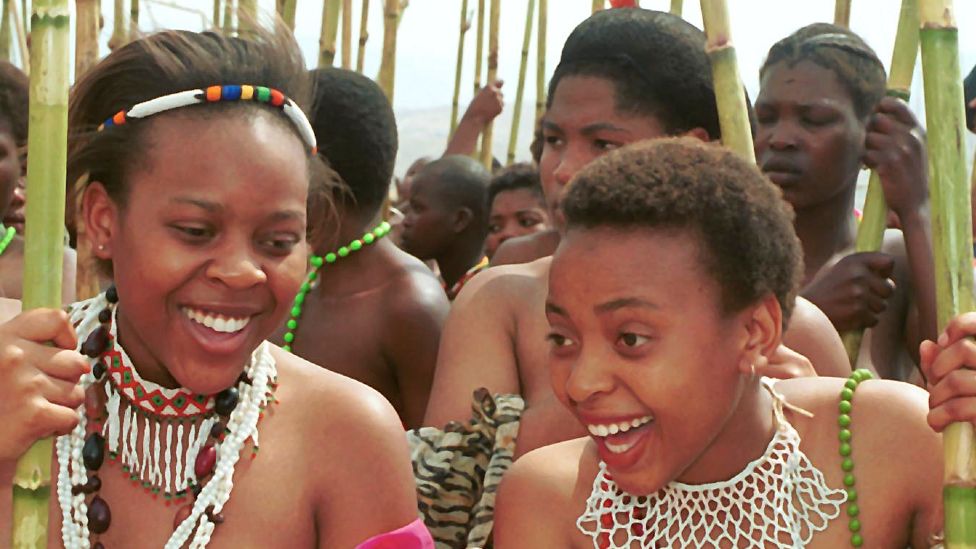
And when he oversaw last month’s Reed Dance – a rite of passage ceremony for teenage girls – the monarch spoke out against gender violence in a country that has one of the world’s highest rates of rapes and sexual assaults.
IMAGE SOURCE,AFP Image caption, The Reed Dance is a rite of passage for young Zulu women and teenage girls
“Violence against women and children is an embarrassment to our nation. A woman is to be respected and protected. We must do better as men,” he said.
On the side-lines of those rehearsing for the Durban coronation, some young women tell us why the event means so much to their generation.
“We are excited to attend to show him that we are 100% behind him as king,” one of them says.
Who is Misuzulu ka Zwelithini?
Born on 23 September 1974 in Kwahlabisa
Educated privately at St Charles College in Pietermaritzburg
Studied at Jacksonville University in the US, where he lived for several years
South Africa’s President Cyril Ramaphosa and visiting Spanish Prime Minister Pedro Sanchez on Thursday agreed to strengthen bilateral relations.
Ramaphosa told reporters at a joint news conference with Sanchez that there was consensus between the two countries about the effects of climate change on the continent.
“South Africa and Spain agree that climate change, the loss of biological diversity and other environmental challenges must be addressed within the context of sustainable development. Particularly, for those who are in areas that are vulnerable and will be negatively affected by the transition that we foresee” said Ramaphosa.
“An important part of our collective responses to climate change is increased support for green, sustainable energy policies and technologies.” added Ramaphosa.
On his part; Spanish Prime Minister Pedro Sánchez called on global leaders to prioritise solutions to the climate change crisis threatening food security in Africa and the effects on the continent of Russia’s invasion of Ukraine.
Sánchez said now more than ever, Spainwas determined to deepen its relations with the African continent as the two shared many common challenges.
“Spain wants to establish strong alliances with African countries to face together the challenges we share,” he said.
“The technological revolution, food security currently affected as a result of the crisis in Ukraine or migratory movements poses the firm determination of the Government of Spain to strengthen our bilateral relations with South Africa, both political and economic and commercial ones,” said Sánchez, speaking through a translator.
Sánchez was speaking during an official visit to South Africa where he met president Cyril Ramaphosa a day after meeting Kenyan president William Ruto.
Sánchez announced that the Spain would be available funding of up to 2.1 billion euros to South Africa over the next five years, which would be invested in various sectors including the renewable energy.
South Africa has honoured the country’s first black student to graduate with a degree in engineering.
Dr Solomon Boyce Isaac Lefakane studied civil engineering at the University of the Witwatersrand in Johannesburg, and was awarded a degree in 1961 – when the racist apartheid system was in operation.
Now, as part of the university’s centenary, Dr Lefakane, now 84, has been inducted into a brand new hall of fame at the Faculty of Engineering and Built Environment.
Dr Lefakane was the son of a domestic worker and gained a scholarship to pursue his studies.
“I knew I was facing very heavy odds at the time and I worked as hard as I could,” he told the BBC’s Focus on Africa radio programme.
Reflecting on his time there Dr Lefakane said he did not socialise with the white students, but there was a black student residence and “we made our own lives enjoyable”.
After graduation he tried to get with Johannesburg City Council but was offered a far smaller salary than his white counterparts. As a result he left South Africa, eventually ending up in the US.
Fourteen suspects accused of raping and sexually assaulting a group of women in South Africa in July have had those charges dropped.
The National Prosecuting Authority (NPA) said on Thursday that DNA evidence taken from the suspects, described as illegal miners, failed to link them to thecrime.
“Upon consultation with the complainants on the matter and evidence at had it became apparent we cannot proceed with prosecution. We have insufficient evidence to continue with the case,” said the NPA’s spokesperson Phindi Louw Mjonondwane.
The suspects were arrested and charged after some of the victims pointed them out as the alleged rapists during a police identity parade.
Eight women had been filming a music video on 30 July near a disused mine outside Johannesburg when they and the film crew were attacked by a large group of men.
Reports of the gang rape by the so-called Zama Zamas, a colloquial term used for illegal miners, led to violent protests by communities in the area where the mine is located.
It also led to xenophobic rhetoric and threats against undocumented immigrants.
Although the group have been cleared on the sexual violence and robbery charges, the NPA says the suspects will still be charged for allegedly contravening immigration laws.
That matter will be heard on 1 November.
The police have meanwhile told the BBC that they will continue investigating the rape cases and intend to bring the attackers to justice.
The dropped charges will be seen by some as an embarrassment to the country’s police and courts, which are often criticised for failing victims of sexual crimes.
South Africa has one of the highest reported cased of sexual violence in the world.
South Africa says it will allow a sanctioned Russian oligarch to dock his superyacht in Cape Town.
The $521m (£472m) vessel, which belongs to Alexei Mordashov – an ally of Russian leader Vladimir Putin – left Hong Kong earlier this week.
South African opposition leaders had urged the government to seize the 465ft long (141m) yacht called The Nord.
But a spokesman for President Cyril Ramaphosa said he saw “no reason” to comply with Western sanctions.
“South Africa has no legal obligation to abide by sanctions imposed by the US and EU,” Vincent Magwenya told reporters in Pretoria on Tuesday.
“South Africa’s obligations with respect to sanctions relate only to those that are specifically adopted by the United Nations,” Mr Magwenya added, noting that Mr Mordashov is not under any UN-sponsored sanctions.
Western countries and their allies have imposed sanctions on more than 1,000 Russian individuals and businesses in response to Russia’s invasion of Ukraine.
Like many other African countries, Mr Ramaphosa’s government has so far avoided directly criticising Russia, abstaining in several UN votes that have expressly condemned the war. Pretoria has also called for a negotiated settlement to end the conflict.
On Monday, Cape Town Mayor Geordin Hill-Lewis – a member of the opposition Democratic Alliance party – urged officials to block the superyacht’s entry, writing on Twitter that there could be “no place in our city for accomplices to, and enablers of, Putin’s war”.
“It must be said that so far, our country’s foreign policy conduct in relation to Russia’s illegal, imperialist war has been nothing less than shameful,” Mr Hill-Lewis added in a further statement. “Here is an opportunity to correct some of those errors of judgement and stand up for what is clearly right.”
It is unclear whether Mr Mordashov is actually onboard the vessel. Speaking to local media on Sunday, Mr Hill-Lewis suggested that the billionaire was travelling on his yacht.
But last week a spokesperson for the oligarch told Bloomberg News that he had been in Moscow since his yacht arrived in Hong Kong.
Hong Kong’s government recently offered similar justifications when refusing to prevent the entry of the superyacht, with Chief Executive John Lee saying the city would be accountable to UN sanctions but not “unilateral” ones imposed by “individual jurisdictions”.
Prior to the war, Mr Mordashov was Russia’s wealthiest man. The 57-year-old built a fortune of some $29.1bn (£25.92bn) through his steel and mining company Severstal.
Early in the conflict he was targeted by extensive Western sanctions due to his links with Mr Putin. But the billionaire has questioned the value of the moves, saying he had no involvement in Russian politics and maintains little influence with the Kremlin.
Mr Mordashov has already lost one of his smaller vessels, the 215ft Lady M, to Western sanctions after it was seized by Italian police in March.
But The Nord is believed to be his biggest yacht asset. The vessel is larger than a football field and is described as one of the world’s most extravagant boats, according to Forbes.
Shortly after the outbreak of the conflict in Ukraine, the yacht – which features two helicopter pads, a swimming pool and a cinema – left the Seychelles for the far-eastern Russian port of Vladivostok. The move was seen as a bid to avoid the fate of the Lady M.
But experts say owners like Mr Mordashov face serious issues finding international ports capable of maintaining superyachts. Most are in Europe, where the vessels would be instantly seized.
South African President Cyril Ramaphosa has addressed the nation detailing the steps his government will be taking in implementing a commission’s report on state capture.
The six-part report sought to uncover corruption, fraud and the weakening of state institutions under the administration of former president Jacob Zuma.
State capture describes a form of corruption in which businesses and politicians conspire to influence a country’s decision-making process to advance their own interests.
In a bold admission, President Ramaphosa accepted the findings by the commission of inquiry led by Judge Raymond Zondo that state capture did happen.
He announced that the commission made over 300 recommendations, some of which the government was responding to ranging from criminal prosecutions of accused persons, legislative changes, as well the establishment of an anti-corruption commission.
President Ramaphosa however was thin on detailing how his government would be implementing the commissions findings. No mention was made of members of his cabinet implicated in the report.
The corruption and fraud uncovered by the state capture report is estimated to have cost the country over $27bn (£24bn).
Mr Ramaphosa said the stolen money robbed South Africans of their future.
Ethiopian Prime Minister Abiy Ahmed has stated that the conflict in northern Tigray “will end and peace will prevail.”
He made the remarks during the inauguration of a talent development centre in the Oromia regional state on Thursday.
“The situation in northern Ethiopia will come to an end, peace will prevail. We will not continue fighting forever. I believe that in a short period of time, we will stand with our Tigrayan brothers for peace and development,” Mr Abiy said.
He urged Ethiopians to work together for the country’s prosperity and not to be divided along ethnic and religious lines.
On Thursday, the Ethiopian government accepted an invitation by the African Unionto participate in peace talks to be held on 24 October in South Africa to end the war that has killed an unspecified number of people and displaced millions.
It came on the same day Tigrayan rebels accused Ethiopian and Eritrean forces of killing seven youths in a town that was captured by the federal army on Tuesday.
South African President Cyril Ramaphosa is facing a criminal investigation after a revelation that he failed to report the theft of about $4 million in cash from his farm in northern Limpopo province.
An account of the theft is contained in an affidavit by the country’s former head of intelligence Arthur Fraser, who has opened a case against Ramaphosa.
Ramaphosa has not denied the theft but claims that he reported it to the head of his VIP Protection unit, who did not report it to the police.
In South Africa, it is illegal not to report a crime and according to Fraser’s affidavit, Ramaphosa tried to conceal the theft, which happened in February 2020 when he was attending an African Union summit in Addis Ababa, Ethiopia.
Several opposition parties have called for a full investigation into the theft, including whether the amount of foreign currency allegedly stolen had been declared to the South African Revenue Service.
The Democratic Alliance, the country’s biggest opposition party, said Ramaphosa should come clean about the circumstances surrounding the theft and why it was not reported to the police.
“The president is facing a crisis of credibility and cannot hide behind procedural smokescreens to avoid presenting South Africans with the full truth around the money that was stolen from his farm, and the subsequent cover-up,” the opposition party’s leader John Steenhuisen said in a statement.
Another opposition party, the United Democratic Movement, has called on Ramaphosa to take a “leave of absence” while Parliament probes the incident, saying it is not prudent for it to do so while he was in office.
Ramaphosa publicly spoke about the incident for the first time over the weekend since the revelations surfaced, saying the cash was from buying and selling animals on his farm.
“I want to reaffirm that I was not involved in any criminal conduct, and once again I pledge my full cooperation with any form of investigation,” said Ramaphosa on Sunday.
“I would like to say that I’m a farmer. I’m in the cattle business and the game business. And through that business, which has been declared to Parliament and all over, I buy and I sell animals,” he said.
The sales are sometimes through cash and sometimes through transfers, and what is being reported is a clear business transaction of selling animals, said Ramaphosa.
He was addressing the Limpopo provincial conference of the ruling party, the African National Congress, where his political allies were re-elected, boosting his own chances for re-election as the ANC’s president at the party’s national conference in December.
Ramaphosa’s supporters have cried foul, saying the timing of the revelation is part of efforts to derail his efforts to be re-elected party president in December.
The information about the theft was revealed by Fraser, the former head of South Africa’s intelligence, who is known to be loyal to former President Jacob Zuma.
Fraser controversially approved Zuma’s release from prison on medical parole last year, an action that is now being contested in court as illegal. Zuma had been sent to prison last year after he was convicted of defying the Constitutional Court by refusing to testify at a judicial inquiry probing allegations of corruption during his presidential term from 2009 to 2018.
Police in South Africa has initiated a manhunt for seven inmates who escaped from a jail in Grahamstown, a city in the Eastern Cape region.
According to a police statement, an officer who arrived at the Makhanda Correctional Facility at 04:00 local time saw some lights were on and discovered that the detainees had escaped through a window.
“Police are warning the community that these prisoners are dangerous and should not be approached instead police must be contacted,” the statement said.
The escapees include one person charged with murder and five Zimbabwean nationals either imprisoned for or facing rhino-poaching charges.
South Africa’s President Cyril Ramaphosa has withdrawn controversial perks for cabinet ministers and their deputies that saw their homes supplied with free electricity and water.
The benefits caused a public outcry as they were considered insensitive at a time South Africans are struggling with daily power cuts and rising cost of living.
In a press briefing on Monday evening, a spokesman said the president “acknowledges and appreciates the public sentiments on the matter”.
The ministerial handbook, which outlines ministerial benefits, will be “aligned to the realities that many South Africans face”, presidential spokesman Vincent Magwenya said.
He said the intention behind the perks was “not a nefarious one”.
“The intention was to try and find some form of balance between what ministers could afford versus some of the costs that they have,” he is quoted as saying the by the state news agency.
Former British military pilots are allegedly being recruited to China with substantial sums of money in order to pass on their experience to the Chinese military.
Up to 30 former British military pilots are said to have gone to China to teach members of the People’s Liberation Army.
The United Kingdom has issued an intelligence notice warning former military pilots not to serve in the Chinese military.
Attempts to headhunt pilots are ongoing and had been ramping up recently, western officials say.
A spokesperson from the Ministry of Defence said the training and the recruiting of pilots do not breach any current UK law but officials in the UKand other countries are trying to deter the activity.
“It is a lucrative package that is being offered to people,” said one western official. “Money is a strong motivator.” Some of the packages are thought to be as much as £237,911 ($270,000).
The retired British pilots are being used to help understand the way in which Western planes and pilots operate, information that could be vital in the event of any conflict, such as over Taiwan.
“They are a very attractive body of people to then pass on that knowledge,” a Western official said. “It’s taking Western pilots of great experience to help develop Chinese military air force tactics and capabilities.”
The UK first became aware of a small number of cases of former military pilots being recruited in 2019 which were dealt with on a case-by-case basis. The Covid-19 pandemic slowed attempts down when travel to China was almost impossible but the attempts have now increased, leading to this alert.
“We’ve seen it ramp up significantly,” a western official said in a briefing to journalists. “It is an ongoing issue.” Current serving personnel is being targeted but none are thought to have accepted.
The pilots have experience on fast jets and helicopters and come from across the military and not just the Royal Air Force. They have flown Typhoons, Jaguars, Harriers, and Tornados.
F-35 pilots are not thought to be involved although China is thought to be interested in them. Some of the pilots are in their late 50s and left the military some time ago. Pilots of other allied nations have also been targeted.
Officials said they are being recruited through intermediary head-hunters and cited a particular flying academy based in South Africa as being involved.
There is no evidence that any pilots have broken the Official Secrets Act or that they have committed any crime. The aim of the alert is to try and deter activity and inform current staff and industry partners and also remind personnel of their obligations to protect sensitive information.
“We are taking decisive steps to stop Chinese recruitment schemes attempting to headhunt serving and former UK Armed Forces pilots to train People’s Liberation Army personnel in the People’s Republic of China,” an MoD spokesperson said.
“All serving and former personnel are already subject to the Official Secrets Act,and we are reviewing the use of confidentiality contracts and non-disclosure agreements across Defence, while the new National Security Bill will create additional tools to tackle contemporary security challenges – including this one.”
Ghana’s Minister of works and housing, Francis Asenso-Boakye, has given assurance to world leaders that the country is committed to upgrading existing slums, while preventing the emergence of new ones in the country.
He made this known while addressing participants at a high-level meeting to launch the “Global Action Plan Framework on Informal Settlements and Slums” being held in Pretoria, South Africa by the United Nations Human Settlements Programme (UN-Habitat) and the government of South Africa.
Asenso-Boakye said there is the urgent need for a coherent and integrated national urban and housing policies, which prioritises the implementation of national developmental plans, policies, and result-oriented programmes and projects for slums.
“Ghana has taken the bold step in the development of a draft slum upgrading and prevention strategy, following the country’s active participation in the implementation of Phases 1 and 2 of the “Participatory Slum Upgrading Programme (PSUP)” and the emergence of this Global Action Plan will help shape our strategy for effective implementation,” the minister added.
Asenso-Boakye said the importance of the Global Action Plan Framework on Informal Settlements and Slums, cannot be over-emphasised as it will consolidate, and amplify the world’s collective resolve to accelerate the implementation of the Sustainable Development Goals (SDGs), and the New Urban Agenda (NUA).
The Executive director of the UN-Habitat, Maimunah Mohd Sharif, while speaking at the launch lauded various governments for their resolve towards upgrading of existing and prevention of slums.
The high-level meeting also brought together ministers, top government officials, as well as civil societies who continue to play active roles in upgrading and transforming informal settlements.
Global action plan framework
The international meeting will see to the launching of a Global Action Plan Framework to transform Informal Settlements and Slums in the Decade of Action, accelerating the implementation of the Sustainable Development Goals and the New Urban Agenda. The International Meeting leverages the momentum of the Urban October and the preparation process for the UN-Habitat Assembly in June 2023.
The Global Action Plan Framework Initiative is anchored in the Slums and Informal Settlements Network (SiSnet) launched during Habitat III in Quito as part of the global Participatory Slum Upgrading Programme (PSUP), initiated by the Organization of the African, Caribbean and Pacific States (OACPS), financed by the European Commission and implemented by UN-Habitat.
The Global Action Plan Framework is informed by the co-creation of a global publication in search of solutions to the challenges of informal settlements and slums. The publication provides a snapshot of the current global status quo of slums and informal settlements, reflects on lessons learnt in the past 20 years and identifies sustainable and inclusive solutions for transforming informal settlements and slums. The Government of South Africa invites Member States to launch a resolution formulation process shaping commitments and endorsement in support of the Global Action Plan Framework.
The intention of the Global Action Plan Framework is to take coordination, collaboration, commitments and partnerships to the next level. It consolidates and amplifies efforts for accelerating the implementation of the Sustainable Development Goals (SDGs) and the New Urban Agenda (NUA) in the Decade of Action. It provides a joint vision to inform actions framed by partnerships and is the basis for Member States to elevate commitments in form of a resolution to be pledged in the UN-Habitat Assembly process.
Wildlife enthusiasts in South Africa have shared footage of a honey badger fighting off a mother leopard and her two cubs.
The encounter happened at the Kruger National Park.
Outsized and outnumbered, the honey badger lived up to its reputation of being among the most fearless animals.
In the video, it was seen wrestling all the three leopards in turns. Following this, the Honey badger was “trotting off as though nothing had happened”.
Field guide Dan Fiser and business consultant Paola Murguia shared the story with LatestSightings.com – a website that shares footages of wildlife sightings and experiences.
“The honey badger was fighting back, instead of trying to run away, actually turning the tables at times.”
The South African PoliceService (SAPS) say a 21-year-old man will be charged with murder following the discover of six bodies – five of them in an advanced state of decomposition – in a building in the main city, Johannesburg.
Police launched an investigation after complaints of a foul smell coming from one of the rooms in the building.
The body of a woman was discovered in the building, and her clothes matched the description of a woman reported missing earlier this month, a police statement said.
Five more bodies were found outside “where there is a makeshift workshop and rubbish dumpsters”, the statement said.
“Unfortunately, the other five bodies are at the late stage of decomposition. They will be subjected to forensic analysis for identification,” it said.
The 21-year-old man – who is believed to be the last person to have been seen with the woman – had been arrested, the statement added.
He is to be charged with six counts of murder.
Police have not yet given a possible motive for the killings.
South Africa claimed a fourth successive ODI victory over India as they kick-started their three-match series with a nine-run win in Lucknow, despite Sanju Samson’s efforts.
With rain reducing the match to 40 overs per innings, India won the toss and put the tourists into bat on Thursday.
Despite a flurry of wickets between the 13th and 16th overs, with Shardul Thakur (2-35) the pick of India’s bowlers, Heinrich Klaasen and David Miller remained unbeaten on 74 and 75 respectively to guide the Proteas to 249-4.
Quinton de Kock scored 48 from 54 deliveries before being dismissed by Ravi Bishnoi, but Miller and Klaasen combined for a 139-run partnership to see out the innings.
Wayne Parnell and Kagiso Rabada set about damaging India’s response, with Shubman Gill and Shikhar Dhawan falling inside the opening six overs.
More quickfire losses followed for India in the 17th and 18th overs – Ruturaj Gaikwad stumped and Ishan Kishan caught out – but the hosts had won their last seven ODIs and had resistance in them.
Shreyas Iyer’s 50 included eight fours, before he was dismissed by Lungi Ngidi (3-52), yet with Samson, India had hope.
The wicketkeeper struck an unbeaten 86, leading a team flurry of 63 runs off the final five overs. The onslaught ultimately came too late, though.
🚨 RESULT | SOUTH AFRICA WIN BY 9 RUNS
Wickets at regular intervals gave the #Proteas the early momentum but India fought back. A 93-run sixth-wicket stand threatened to steal the win but our bowlers held their nerve to claim the victory#INDvSA#BePartOfItpic.twitter.com/MqRBks42TE
India’s wicketkeeper batted superbly, striking 12 boundaries in a career-best innings and holding firm against South Africa’s deadly attack. He had decent support from Shardul Thakur (33), though in the end could not carry the tail through.
South Africa have not lost to India in a bilateral ODI series since February 2018, and the rest of the hosts batters must show similar levels to Samson if they are to end that run.
Klaasen and Miller the difference
With India’s bowlers failing to perform at their best – Mohammed Siraj failed to take a wicket and Bishnoi was particularly expensive, conceding 69 runs – it still took some fine batting from South Africa’s sixth-wicket pair to clinch victory.
Between them, Klaasen and Miller hit 16 boundaries, including five sixes, to ultimately take the game away from India.
A report by the World Intellectual Property Organization (WIPO) has evaluated innovation levels across 130 economies to determine the most innovative markets in the world in 2022.
The 2022 Global Innovation Index (GII) measured each economy’s innovative capacity and output by focusing on a long list of criteria such as human capital, institutions, technology and creative output, as well as market and business sophistication, among others. The GII ranking is based on performance across seven pillars:
Which are the most innovative economies in 2022?
Switzerland is the most innovative economy in the world in 2022 – for the 12th year in a row – followed by the United States, Sweden, the United Kingdom and the Netherlands. China is nearing the top 10 while Türkiye and India enter the top 40 for the first time, according to the GII 2022.
Mauritius ranks first in Africa in Global Innovation Index 2022
Port Louis, Capital of Mauritius
According to the report, Mauritius emerged the most innovative African country, and climbing seven places to 45th on the Global Innovation Index (GII). Unlike most African countries, the report said Mauritius has a high human development score. Its economy has grown robustly in the last half a century, especially on financial services, tourism and information technology.
Top 10 innovation economies by region
This year, sixteen out of the 25 economies from Sub-Saharan Africa covered this year improved their ranking. Botswana took the biggest leap forward, reaching 86th position, and in so doing overtaking Kenya (88th) among the top 3 for the region. Other notable improvers within the region are Mauritius (45th), Ghana (95th), Namibia (96th) and Senegal (99th). South Africa remains unchanged in 61st place – and continuing to fail to improve consistently over time.
Here are the top 10 most-innovative countries in Africa, according to the 2022 Global Innovation Index
“To be honest, since I was a child, I’ve always loved helping people, I’ve never looked down on others. So what I did was to combine my passion and my skills, and that’s how I founded my company, “said Sibongile Mongadi about starting Uku’hamba.
Her company produces lightweight prosthetics to help amputees get around more easily. Uku’hamba embodies what Mongadi has always stood for; helping the vulnerable in society.
She started the company following a visit to the hospital after a thumb infection, whereupon she chanced on an amputee struggling to access his prosthetic limb at the hospital. She was moved by what she had seen and decided to act, according to IOL.
Related stories
“I put myself in that amputee’s shoes,” said Mongadi, quizzing: “Yes, it may not be me or one of my loved ones, but what if it was?”
“I went and spoke to him, to try to find out what the problem was, and was told that he had been coming to the hospital for five years trying to access a prosthetic limb from the public sector.”
The little investigation she did showed that demand for prostheses far outstripped supply. In addition, the cost is so high and beyond the reach of underprivileged people. She also investigated the use of 3D technology to address the needs of amputees, particularly concerning cost, quality, and the use of environmentally friendly materials, she told IOL.
“I taught myself about 3D printing then a few years later I tried to back it up with a qualification, and that’s how I ended up at the University of Johannesburg,” said Mongadi.
She uses a 3D printing machine to produce prosthetic limbs, and they come in a variety of bright colors and cater to clients’ specifications. They are also lightweight, which helps in easy movement, and also affordable.
According to Mongadi, her prosthetics are 80 percent cheaper than what is available on the market. “The life span of our limbs is on par with what is already on the market. The general lifespan of a prosthetic is five years,” she added.
She also has a partnership deal with some private hospitals for the supply of prosthetics. She is also a recipient of many awards in recognition of her hard work and innovation. She has been recognized as a Global Digital Female Leader in Innovation.
Mongadi hails from Dobsonville, Soweto. She was raised by self-employed parents and from a family of eight siblings. According to the entrepreneur, her parents were uneducated but that did not prevent her from chasing her dreams. Today, she is a role model in her community.
The world of wealth is ever-changing, yet everlasting. High-net-worth individuals are constantly having to keep up with their wealth and the factors that impact it, like the pandemic, rising inflation and the economy’s boom and bust cycles.
Safeguarding their money through volatile markets is of utmost importance.
For the first time in 11 years, FORBES AFRICA is honoring the keepers of these vaults, who have persevered in the toughest of times.
We speak to 10 of south Africa’s experts who specialize in wealth advisory and management services.
A common theme: wealth preservation, not only in South Africa but across the continent, which is key to the growth of any economy, even as times and trends change.
It is cold and dark when 53-year-old factory worker Letta Nkabinde leaves her home in Ivory Park at 5am to begin her hour-long commute to work.
She tucks her handbag beneath her coat to keep it hidden from the thieves who are known to lurk in this working-class Johannesburg neighbourhood, waiting for targets, before walking 10-15 minutes to the nearby taxi stand to catch a 16-seater minibus to the wealthy area where she works in a factory that manufactures cosmetics.
“The morning shift starts at 6am sharp, so I have to get up very early,” says Letta who is wearing a formal red jacket and crimson lipstick. “I know workers that wake up at 3am every day to get to work on time because they have to walk a longer distance to reach taxis. It’s very difficult.”
South Africa is the most unequal country in the world, according to the World Bank, which in a recent report highlighted how the historically unequal distribution of land “undermines rural development and entrepreneurship” and leaves Black South Africans, women-headed households, and unemployed people with the highest rates of poverty and income inequality.
Letta’s community in Ivory Park, a densely populated area where nearly 98 percent of the residents are Black, is one of the poorest in South Africa. Nearly 30 years after the end of apartheid, poorer communities continue to live with the harsh reality of segregated spatial dynamics, which began when apartheid-era laws forced different races to live in different areas, relegating people of colour – especially Black people – to those furthest from the urban centres where they could find employment.
The roads surrounding Ivory Park’s modest homes and corrugated informal dwellings are unpaved; some of them have potholes that have filled with water and sewage, and taxis refuse to pick up commuters from their streets to avoid tire damage.
But Letta does not mind the daily walk from home to reach a minibus taxi, she says, despite the threat of bad weather and crime. “That’s not the worst of it for me, the bigger problem is that public transport has become unaffordable.”
In previous years, the single mother of three used to budget about 900 rand ($51) for transportation every month; she now spends 1,200 rand ($68) per month and worries that the cost will only rise.
“Taxis are always increasing because of the rising cost of fuel. Towards month-end, you are struggling to go to work because you don’t have money for transport,” she explains.
Letta attended a nationwide demonstration against the rising cost of living in August [Courtesy of Letta Nkabinde]
‘Rising cost of living’
Letta works as a production line operator for a global cosmetics manufacturing brand based in the affluent area of Midrand, about 10km (6.2 miles) from Ivory Park. She has spent 25 years working daily eight-hour shiftsat the same factory and earns 70.83 rand ($4) per hour. Her net monthly income is 17,000 rand ($959) but she takes home approximately 13,000 rand ($733) per month after tax deductions. Although this is better than the minimum wage in South Africa (23.19 rand or just more than $1 per hour), she says it “is barely enough to get by”.
The latest news from around the world.Timely. Accurate. Fair.
The rising cost of goods and services has had a particularly harsh impact on workers like Letta, whose salary has remained stagnant for years.
“Companies don’t want to talk about wage increases any more, they just tell you about COVID and its impact,” she says, “As a worker, especially as a single parent, and a woman, it makes life very difficult.”
Letta supports her thee children – aged 30, 21 and 12 – as the family’s main breadwinner. Her two adult children live at home with her while they study and look for employment in South Africa’s dwindling job market. Her youngest daughter, she says with beaming pride, “is smart, she is not like children her age who demand ridiculous things because of what their friends have, she understands that as a single parent, I give them my best, and what I don’t offer them is beyond control”.
“It is difficult to take care of yourself and your children these days. We really can’t afford comfort any more, we are down to basics, and you must make tough choices,” says Letta, with a concerned expression. “Think about the current food inflation price, these days you have to choose between bread and things like [mobile phone] data or entertainment.”
Letta, at work years ago, when she was still a line production assistant at the factory [Courtesy of Letta Nkabinde]
The annual rate of consumer inflation grew from 7.4 percent in June to 7.8 percent in July, the highest rise in 13 years according to Stats SA, the government’s department of statistics. The largest contributors to food inflation, according to the report, are “oils and fats, electricity, fuel, and bread and cereals”.
In June, South African President Cyril Ramaphosa acknowledged the unbearable cost of living in his newsletter, stating, “the most basic foodstuffs cost more now than a year ago.”
He further attributed the price increases, particularly those for fuel and food, to the continuing conflict between Russia and Ukraine and claimed that these developments “are the result of circumstances over which we have little control.”
Since South Africa trades with both Russia and Ukraine, the human cost of the conflict is being felt by the general populace. The deputy minister of finance, David Masondo, told a parliamentary committee in March that, “much of what has been affected is wheat, maize, and oil supplies. The increase in [the] price of these household staples has added to inflation and reduced the disposal income of consumers”.
But Letta believes the government could be “doing more on issues that they can control” such as the price of household electricity.
In South Africa, government municipalities are largely responsible for distributing electricity to households after acquiring it from Eskom, the country’s power utility. The tariffs Eskom charges municipalities are a significant factor in the cost of electricity, according to the most recent research conducted by Stats SA.
The report also claims that since the introduction of rolling national blackouts in 2007, which resulted in a “loss of economic output” of roughly 500 million rand (about $28m) per blackout every day in 2020 and is thought to be a contributing factor in the loss of more than one million job opportunities, electricity rates have risen dramatically.
“I now spend about 500 rand ($28) on electricity every month, half of that used to be enough for me and my family,” says Letta.
“They tell you to save electricity consumption, but as much as we can try to lessen the amount of electricity we use in our homes, it doesn’t work,” she emphatically explains. “We turn off the television when we go to sleep, we even turn off the fridge when we go to sleep to try and save but you’ll wake up the next morning and find less units.”
‘By the grace of God’
Letta had a difficult childhood. She was born during apartheid in what is now Mpumalanga province, to the east of Johannesburg.
Raised by a working single mother, she remembers moving from one home to another, staying with “many families” until her mother got a house in an informal settlement in Johannesburg, but then being forced back to the rural areas when they lost that home.
“I’d say that I grew up like an orphan. I did not have a proper family so really I grew by the grace of God,” says Letta.
She dropped out of school after the 12th grade and started working the same year at just 18 years old. The idea that “when you are a woman, you must fend for yourself because no one will fend for you,” has always been ingrained in her, which forced her to mature quickly.
“I struggled to find a job after I left high school, so I started a small business. I would sell potatoes, oranges, mielies, on some days and then find piece jobs like babysitting, at the same time,” she says.
It wasn’t until she was 28 years old that she managed to get a steady job – working in the factory where she still works today, after almost a decade of experiencing income insecurity as an informal worker.
Members of South Africa’s labour unions carried placards during a nationwide strike over the high cost of living, in Pretoria, on August 24, 2022. Letta also took part in the demonstration [Esa Alexander/Reuters]
Although Letta considers herself a middle-income earner – defined by the South African Department of Human Settlements and Water Sanitation as individuals who earn between 3,501 rand ($197) and 22,000 rand ($1,241) per month – she contends that the country’s middle class is “living from paycheque to paycheque.”
“You know, before you were able to invest, you had money to keep aside, but not any more. It is impossible to save now. How do you save what you don’t have?” Letta laughs.
“We are the non-existent middle class. We do not qualify for government assistance, but we cannot afford many basics,” she says. “But do you know what they say we can afford? Debt.”
Union work
In August, Letta, who doubles as a worker representative in the factory for the grassroots General Industries Workers Union of South Africa (GIWUSA), swapped her factory garments for a red t-shirt and a pair of casual sneakers.
She took part in a national demonstration that was arranged by workers at the Union Buildings in Pretoria, the nation’s capital, with the support of 200 unions and civil society organisations. In major cities around the country, 5,000 protesters marched in support of increased pay, lower fuel prices, and government action to address the skyrocketing prices of basic needs and services.
The high turnout reveals the rising discontent and desperation among the country’s labour force about the cost of living.
“The protest was very important. The government should be aware that workers are suffering. When we are quiet, the government also keeps quiet. They need to understand what we are going through,” says Letta.
She often faces an uphill battle as both an employee and an advocate for workers, she explains, “I act as the middle woman between management and employees. If there’s a problem on the side of employees, I work on those complaints with management. And if the management has a problem, they also come to me.”
Letta acknowledges that the rising cost of living is “challenging to both companies and workers,” but she also thinks that individuals who educate themselves about the value of their labour and demand what they are entitled to may help bring about change.
“I’ve learned that as workers, we don’t know our rights. We don’t know what we are owed for our labour or our value,” she says. “I’m trying to bring awareness. Unions help us exercise our rights and I want to teach workers that.”
Workers at South Africa’s state-owned logistics firm Transnet will go on strike from Thursday over a wage dispute, two labour unions said, in a move that could halt the export of key minerals and other cargo.
Transnet has been operating below capacity due to a shortage of locomotives, poor maintenance and vandalism and theft of its infrastructure, costing miners billions of rand in potential revenue. A strike would paralyse freight rail services and impact South Africa’s ports, also managed by Transnet.
The United National Transport Union (UNTU), the biggest labour union at the company, said it had served notice to begin industrial action on Thursday. The other union at Transnet, South African Transport and Allied Workers Union (SATAWU), said it would join in the strike from Monday.
Both unions said Transnet’s offer of a 1.5 percent pay increase from October 1 fell below their demands.
“Transnet…must provide a salary increase offer that is aligned with the increased cost of living, cost of housing, medical costs, housing and, of course, the consumer price index (CPI) that is currently running at 7.6 percent,” UNTU said in a statement.
In recent years, the cost of living has soared in Africa’s most developed economy, worsened by the COVID-19 pandemic and the increase in prices of items like bread due to global supply chain disruptions since Russia’s invasion of Ukraine.
In July, former President Thabo Mbeki warned that there could be an “Arab Spring-type uprising” in the country due to the situation.
Transnet has said any increase beyond its current wage offer would not be sustainable.
“Transnet has consistently made the point that its wage bill currently makes up over 66 percent of monthly operating costs. This is not sustainable, particularly given the current operational and financial performance,” it said in a statement on Tuesday.
Transnet has applied to the Commission for Conciliation, Mediation and Arbitration (CCMA), a state agency that mediates labour disputes, for further talks with the unions.
Both UNTU and SATAWU said the mediation, which is due to start on October 12, would not affect their plans to go on strike.
Police in South Africa are investigating the killing of a German tourist during an attempted carjacking in the eastern Mpumalanga province.
The victim was part of a group of four German tourists who were waylaid on Monday evening while travelling towards a safari lodge at the Kruger National Park.
The gang is said to have ordered the tourists to open the doors of their vehicle, but when the driver reportedly locked all the doors, one of the suspects shot him through the window, police said.
Local police said the tourist died on the spot and the suspects sped off without taking anything.
“This is really cruel and uncalled for given the economic challenges that our country is facing,” police boss Semakaleng Daphney Manamela said.
David Miller’s stunning century proved to be in vain as India earned a 16-run victory over South Africa to take an unassailable 2-0 lead in their T20I series.
India cruised to an eight-wicket win in the low-scoring opener on Wednesday, but the runs flowed in Guwahati on Sunday as Suryakumar Yadav (61) and KL Rahul (57) helped the hosts post an imposing 237-3.
Suryakumar and Rahul both hit half-centuries in the first match, and they were at it again as South Africa’s bowling attack failed to get control of the match, with only Keshav Maharaj (2-23) picking up wickets as the likes of Kagiso Rabada and Lungi Ngidi struggled.
India’s score was their fourth-highest in T20Is, aided by important innings from captain Rohit Sharma (43) and Virat Kohli’s unbeaten 49. Yadav’s runs, meanwhile, came from just 22 balls, five of which he despatched for six.
South Africa’s chase started woefully, as captain Temba Bavuma and Rilee Rossouw were both dismissed for nought by Arshdeep Singh in the second over.
Quinton de Kock and Miller fought to keep South Africa in the game, as former captain De Kock made a snappy 69 not out while Miller hit 106no from 47 balls.
Despite those efforts, the Proteas never truly threatened to chase the challenging total as they lost the series with a game left to play, finishing on 221-3. The third match takes place on Tuesday in Indore.
Suryakumar became the fastest player to reach 1,000 T20I runs in terms of balls faced, as he hit five fours and as many maximums to post his second half-century in a row.
He reached 1,000 T20I runs in 573 balls, 31 fewer than the previous record-holder Glenn Maxwell required, and helped India to set a huge target as the Proteas bowlers were carted to all parts.
Rabada struggles to make a dent
A key member of South Africa’s pace attack, Rabada failed to make a significant impact as he finished with figures of 0-57 in his four overs.
The most expensive of the visitors’ bowlers, Rabada was hit for 10 boundaries as India stormed to a total out of South Africa’s reach.
Following the sudden death of 63 African penguins inside the Boulders beach colony near Simonstown, South Africa,veterinarians have discovered the cause to be a freak bee attack.
The deaths occurred suddenly sometime between Thursday afternoon and Friday morning.
Officials, expert advisors, and veterinarians from South African National Parks (SANParks), the City of Cape Town, and penguin experts from the Southern African Foundation for the Conservation of Coastal Birds (SANCCOB), started investigating the possible cause of death.
The dead birds were transported to SANCCOB for post-mortems, and biological samples were sent for disease and toxicology testing.
No external physical injuries were observed on any of the birds.
The post-mortems revealed that all the penguins had multiple bee stings, and many dead bees were found at the site where the birds had died.
Preliminary investigations suggest that the penguins died because of being stung by a swarm of Cape honey bees.
On Monday, SANCCOB research manager Katta Ludyia said that the attack was in all likliness a “complete freak accident.”
“We suspect that it is just basically bad luck for the penguins. We don’t expect this to happen more often or that the bees start being a threat to the penguins,” she added.
A dead penguin was also found on Fish Hoek beach yesterday which the SANCCOB vet has confirmed also had multiple bee stings.
However, samples are still being tested for other toxicity possibilities and diseases are still being tested to rule out any other potential cause.
African penguins gather to keep warm as others are fed sardines by staff at the South African Foundation for the Conservation of Coastal Birds, Cape Town, Sept 20, 2012.
Penguin colonies in South Africaare being closely monitored. The H5N1 highly pathogenic avian influenza was detected at the Boulders Penguin Colony Cape Town and South African officials have now raised concerns about the spread of the disease.
The black and white birds are one of the attractions in Western Cape, South Africa’s most developed tourism region. Veterinarians at the Southern African Foundation for the Conservation of Coastal Birds are on the alert.
“At the moment we are talking about the Avian influenza which is a disease that affects a lot of birds but we have an outbreak of a more dangerous variant of the disease and that is the H5N1 high pathogenicity strain”, clinical veterinarian David Roberts says.
“It has been affecting sea birds in South Africa and other countries all over the world for the last year and we have had thousands of birds die. The penguins are not that badly affected but we have had a recent outbreak at the Boulders penguin colony and a few penguins have died there and that’s what we are concerned about”, he adds.
Environmental authorities said on September 16 that the H5N1 strain was similar to that detected last year among wild seabirds. If the outbreak is smaller, the protocol remains the same: identify, isolate and perfom tests on birds.
“For the last year we have lost over 20,000 birds, but just recently at the Boulders (Beach) National Park we have only lost 28 penguins”, Roberts details.
“It is a small outbreak in a community of about 3,000 penguins that live at this colony. Its not terrible there but we are monitoring the situation in case it gets worse.”
Once sick birds are identified, they are euthanised and cremated in an attempt to reduce the spread of the disease. Another concern is if the influenza spreads to commercial poultry.
Europe is facing the largest bird flu outbreak ever. In the Netherlands for example, more than 3,5 million chickens, ducks and other birds had to be culled. A lot of work is being done on a vaccine against the current, highly contagious, variant.
Penguin colonies in South Africa are being closely monitored.
The H5N1 highly pathogenic avian influenza was detected at a Cape Town colony and South African officials have now raised concerns about the spread of the disease.
The black and white birds are one of the attractions in Western Cape, South Africa’s most developed tourism region. Veterinarians at the Southern African Foundation for the Conservation of Coastal Birds are on the alert.
“At the moment we are talking about the Avian influenza which is a disease that affects a lot of birds but we have an outbreak of a more dangerous variant of the disease and that is the H5N1 high pathogenicity strain”, clinical veterinarian David Roberts says.
“It has been affecting sea birds in South Africa and other countries all over the world for the last year and we have had thousands of birds die. The penguins are not that badly affected but we have had a recent outbreak at the Boulders penguin colony and a few penguins have died there and that’s what we are concerned about”, he adds.
South Africa: Preliminary investigation shows penguins killed by bee swarm https://t.co/22OlcQjC9D
Environmental authorities said on September 16 that the H5N1 strain was similar to that detected last year among wild seabirds. If the outbreak is smaller, the protocol remains the same: identify, isolate and perfom tests on birds.
“For the last year we have lost over 20,000 birds, but just recently at the Boulders (Beach) National Park we have only lost 28 penguins”, Roberts details.
“It is a small outbreak in a community of about 3,000 penguins that live at this colony. Its not terrible there but we are monitoring the situation in case it gets worse.”
Once sick birds are identified, they are euthanised and cremated in an attempt to reduce the spread of the disease. Another concern is if the influenza spreads to commercial poultry.
Europe is facing the largest bird flu outbreak ever. In the Netherlands for example, more than 3,5 million chickens, ducks and other birds had to be culled. A lot of work is being done on a vaccine against the current, highly contagious, variant.
King Charles III will welcome South African President Cyril Ramaphosa to the U.K. for three days of high-level talks next month.
This is to celebrate the first state visit of his reign with the leader of a Commonwealth member with close ties to the royal family.
Ramaphosa has accepted Charles’s invitation for a state visit from Nov. 22-24, Buckingham Palace said Monday. The South African leader will be accompanied by his wife, Dr. Tshepo Motsepe.
Charles has visited South Africa on several occasions since 1997. At Nelson Mandela’s funeral in 2013, he said the world would be a “poorer place” without the man who led South Africa’s transition from apartheid to multi-ethnic democracy, adding that Mandela was owed “an enormous debt of gratitude” for his achievements.
The King and Camilla, the queen consort then the Prince of Wales and the Duchess of Cornwall welcomed former South African President Jacob Zuma to the U.K. at the start of a state visit in 2010.
Charles’ sons, Princes William and Harry, have also visited South Africa a number of times.
Next month, King Charles III will host South African President Cyril Ramaphosa for three days of high-level negotiations in the United Kingdom. This will be the first official visit since the king succeeded his late mother Queen Elizabeth II last month.
In a statement on Monday, Buckingham Palace announced that Ramaphosa has accepted Charles’s invitation for a state visit from November 22 to 24.
The South African leader will be accompanied by First Lady Tshepo Motsepe.
South Africa is a member of the Commonwealth, a political association of 56 countries, mostly former British colonies.
Ramaphosa’s predecessors Nelson Mandela, Thabo Mbeki, and Jacob Zuma, the other presidents the country has had since its first multi-ethnic elections in April 1994, have also previously made state visits to the UK.
While still the prince of Wales and the Duchess of Cornwall, Charles, and Camilla, the queen consort, welcomed former South African President Jacob Zuma to the UK at the start of a state visit in 2010.
The new monarch has visited South Africa on several occasions since 1997. At Mandela’s funeral in 2013, he said the world would be a “poorer place” without the man who led South Africa’s transition from apartheid to multi-ethnic democracy, adding that Mandela was owed “an enormous debt of gratitude” for his achievements.
The visit comes as Ramaphosa faces a huge scandal back at home. Arthur Fraser, the former head of the country’s spy agency has accused the president of kidnapping, bribery, money laundering, and “concealing a crime” in relation to the alleged theft of $4m in cash found at his Phala Phala game ranch in northern South Africa.
Fit-again captain Temba Bavuma is not interested in “sideshows” as he prepares to lead South Africa in a three-match Twenty20 International series against India.
Bavuma has not played for his country since suffering an elbow injury during a T20I series in India three months ago which ended 2-2.
The batter has since spoken of feeling “let down” after he was not selected for the inaugural SA20 auction this month.
Questions have been asked over Bavuma’s credentials in the shortest format less than a month before the T20 World Cup in Australia begins.
The Proteas skipper is ignoring such “distractions” ahead of the opening T20I against the top-ranked side in the world at Greenfield Stadium in Thiruvananthapuram on Wednesday.
He said: “I’ve tried to put all those things behind me. My biggest focus is on the role that I have, which is to lead and serve the team as best as I can, make sure that the guys are in the best place possible going into that big World Cup tournament.
“All other distractions, all other sideshows, that’s stuff that I’ll deal with on a personal level, but now, here, being within the team, as long as I’m still wearing that shirt, it will be to lead and serve the team as best as I can.”
Bavuma added: “This is our last series before the World Cup. Obviously we will be looking for this series to fill whatever gaps we feel there are in the team. We have guys who have been playing a lot of cricket and I guess we will be managing their intensity.
“We also have guys who need some cricket under their belts. It will be to give those guys some game time because this is our last preparation in different conditions compared to Australia but still match time nevertheless.
“The last time we were here, we were tested in all departments of our game and I think we answered well.”
South Africa have beaten England and Ireland since drawing with India, who come into this series on the back of a 2-1 triumph over Australia.
The two sides will also meet in Group 2 at the World Cup in Perth on October 30.
Kohli to reach another landmark
Virat Kohli finally ended his long wait for an international hundred against Afghanistan in the Asia Cup this month.
The former skipper is set to bring up another century, as his next T20I innings will be his 100th. Kohli will be only the 10th player to be at the crease 100 times in the shortest format on the international stage.
Kohli has scored 3,660 runs from 99 innings, 684 more than the next best aggregate for any batter in their first 100 innings in men’s T20Is (Martin Guptill – 2,976 runs).
Proteas enjoying life on the road
South Africa have won each of their past four completed T20I games away from home.
The Proteas have been victorious six times on tour in 2022. Only in 2021, when they won 14 times away from home, have they bettered that tally in a calendar year.