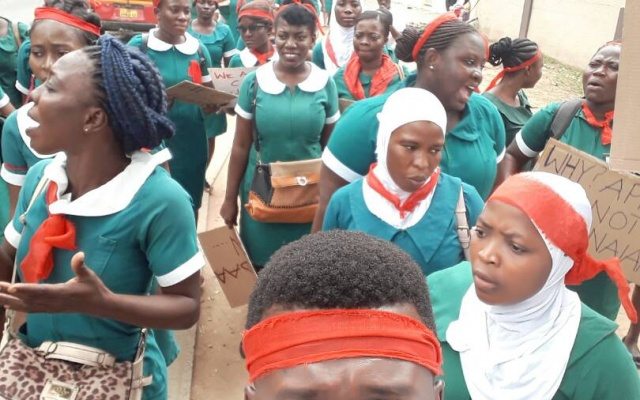
On March 20, 2024, the teacher unions withdrew their services, citing the poor working conditions.
There were meetings among the relevant stakeholders such as the Employment Ministry, NLC and teacher unions to come to a Middle ground, but those were unsuccessful.
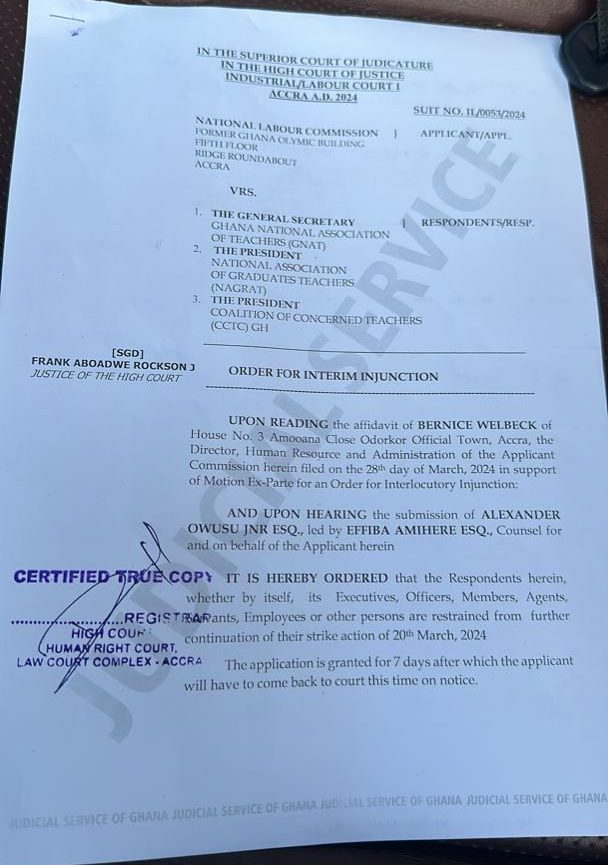
This prompted the NLC to head to a High Court, which has barred the teachers from extending their strike any further.
“It is hereby ordered that the Respondents herein, whether by itself, its Executives, Officers, Members, Agents, Employees or other persons are restrained from further continuation of their strike action of 20th March, 2024.”
On Tuesday, March 26, the teacher unions made some progress as the government agreed to address three of their grievances.
These include the full distribution of laptops to all teachers by the end of June, and the provision of a draft of the scheme of service to the unions for review by April 8.
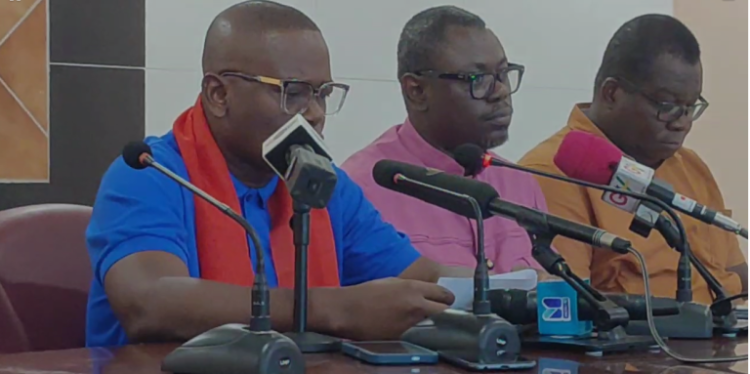
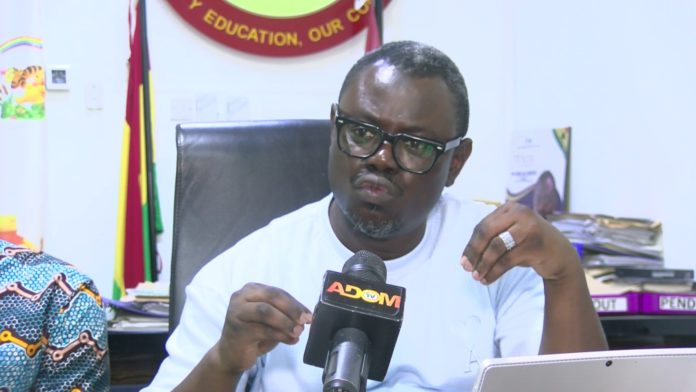
President of the Coalition of Concerned Teachers and spokesperson for the three striking teacher unions, King Ali Awudu, has reassured parents that missed lessons will be made up for once the impasse with the government is resolved and teachers return to the classroom.
There has been particular concern among final year Junior High School students about how the strike might affect their preparation for the upcoming Basic Education Certificate Examination (BECE).
Mr. Awudu addressed these concerns, emphasizing that as teachers, they are committed to ensuring the success of their students. He pointed out that during the COVID-19 pandemic, when schools were closed for months, teacher unions had devised strategies to continue teaching lessons, indicating their dedication to students’ education.
He made these remarks during an interview on JoyFM’s Newsnight on Tuesday, March 26.
“For the lost time, as teachers we have always done it. For example, when the Covid came and teachers were at home for about 10 months, it was we [teacher unions] that proposed to the government that we wanted to work extra to make up for the lost time. That is why we introduced this semester system in the basic school and all that, where for about four to five months continuously, the children were in school and we were teaching them.
“You go to the Senior High School and additional hours were added to the timetable at no additional remuneration to the teacher. We love the kids and no teacher wants his or her students to fail exams. So, most definitely when we go back we teach them and we know how we are going to handle matters to make up for the lost time. That one I promise you, we are going to handle matters to make up the lost time,”he reiterated.
The Ghana National Association of Teachers (GNAT), the National Association of Graduate Teachers (NAGRAT), and the Coalition of Concerned Teachers (CCT-Gh) initiated a nationwide strike on March 20.
The strike stemmed from the failure to finalize a new collective agreement by the agreed-upon deadline of February 29, 2024.
While the strike was ongoing, the National Labour Commission (NLC) reported progress in negotiations with the striking teachers. During a key meeting in Accra on March 26, the Commission successfully addressed three of the nine concerns raised by the teacher unions.
These included the provision of laptops, the reinstatement of salaries blocked by the Office of the Special Prosecutor (OSP), and the establishment of terms of service for teachers.
The NLC clarified that discussions would continue with teachers regarding the remaining six concerns. Despite these advancements, the striking unions have not yet called off the strike.
The three striking teacher unions have requested the Ministry of Employment and Labour Relations to postpone their meeting with the National Labour Commission, initially scheduled for today, March 22, to Monday, March 25.
The unions, which include the Ghana National Association of Teachers (GNAT), the National Association of Graduate Teachers (NAGRAT), and the Coalition of Concerned Teachers, commenced a nationwide strike on Wednesday, March 20.
They cite the government’s alleged reluctance to address their conditions of service as the reason for their action.
Despite the National Labour Commission’s directive for the unions to halt the strike, it continues unabated.
Herbert Arko Forson, the general secretary of the Coalition of Concerned Teachers, explained to Citi News the unions’ rationale for requesting the rescheduling of the meeting.
“We have responded to the invitation by the Ministry of Employment and Labour Relations, indicating that they want to meet us so that we can have the discussion. Honestly, we can’t refuse to attend such meetings, but most of our leaders do not stay in Accra, so we would like to organize ourselves. Therefore, we are proposing rescheduling the meeting to Monday, March 25, so that we can honour the invitation and then proceed with the discussion as expected.”
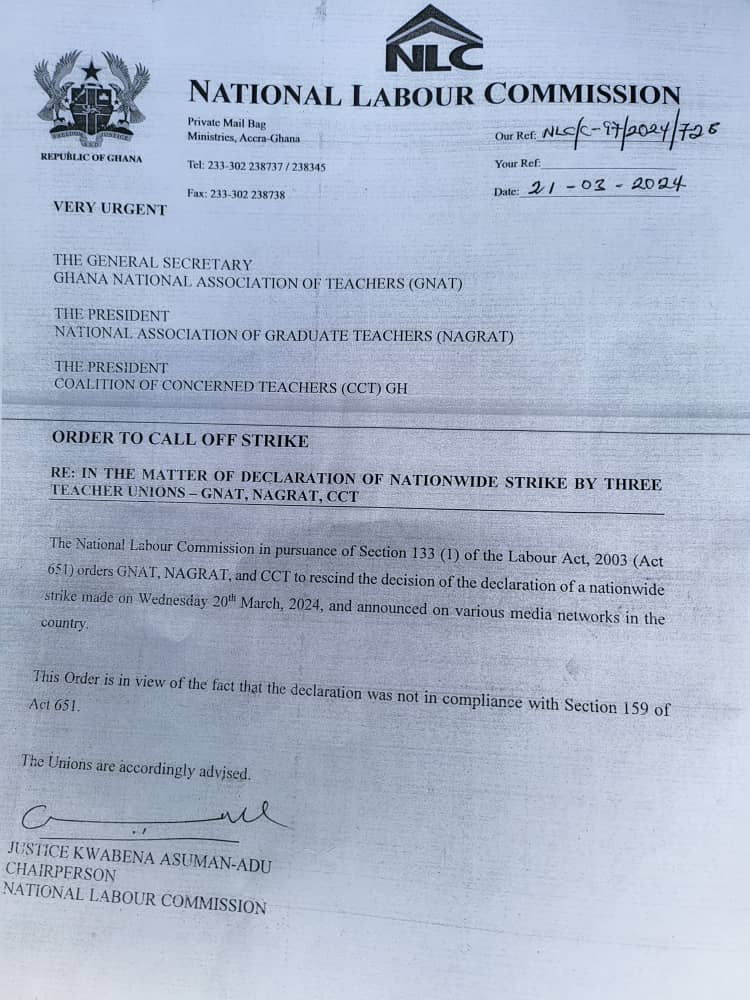
The National Labour Commission (NLC) has issued a directive ordering the three striking teacher unions to immediately cease their strike action.
The Commission stated that the declaration of the strike was non-compliant with the law, citing Section 159 of Act 651.
In a press statement released on Thursday, March 21, the NLC, chaired by Justice Kwabena Asuman-Adu, invoked Section 133 (1) of the Labour Act, 2003 (Act 651) to enforce its decision.
“In pursuance of Section 133 (1) of the Labour Act, 2003 (Act 651) orders GNAT, NAGRAT, and CCT to rescind the decision of the declaration of a nationwide strike made on Wednesday 20 March 2024 and announced on various media networks in the country.”
The Ghana National Association of Teachers (GNAT), the National Association of Graduate Teachers (NAGRAT), and the Coalition of Concerned Teachers (CCT) collectively declared a nationwide strike on Wednesday, March 20, 2024.
They cited government negligence in addressing their conditions of service as the primary reason for their action.
Among their grievances were the continued withholding of teachers’ salaries, unilateral changes to timetables without union consultation, and delays in the distribution of laptops to teachers.
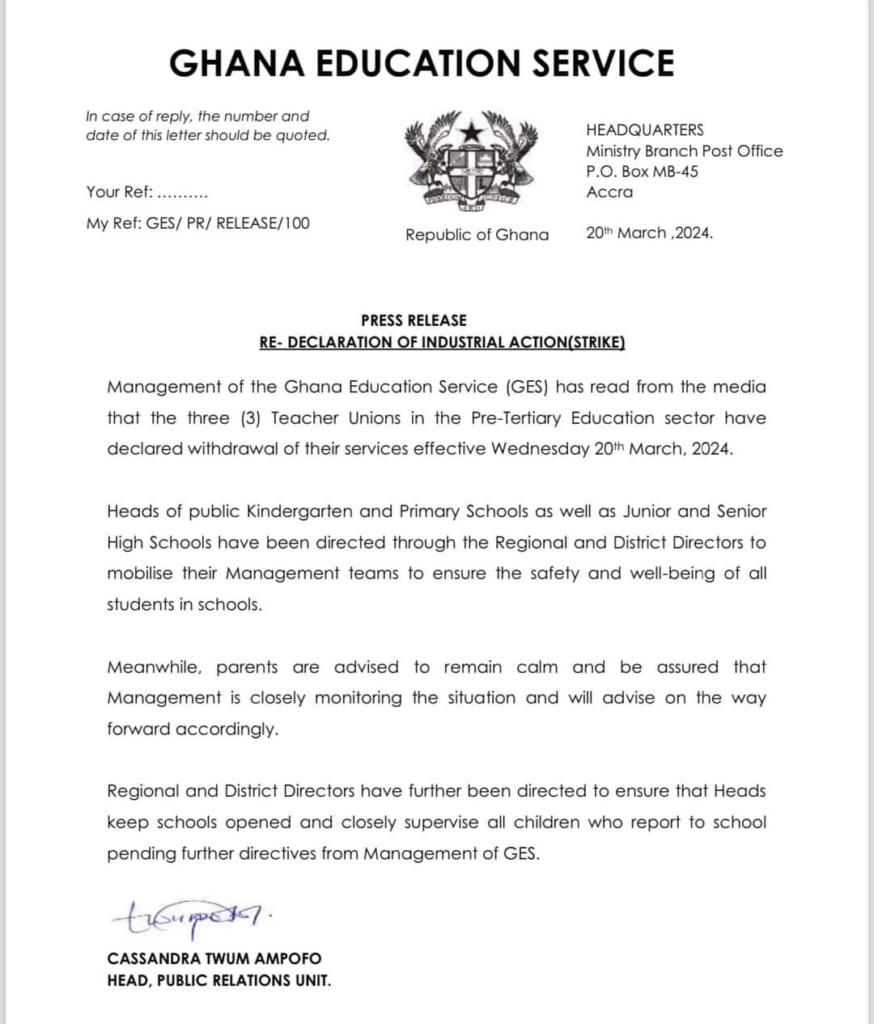
The Ghana Education Service (GES) has instructed junior and senior high school headteachers to continue school operations despite the ongoing strike by three teacher unions.
The strike, initiated on Wednesday, March 20, 2024, by the Ghana National Association of Teachers (GNAT), the National Association of Graduate Teachers (NAGRAT), and the Coalition of Concerned Teachers (CCT), is due to the government’s alleged failure to address their conditions of service.
Headteachers have been directed to ensure the safety of students during their time at school.
GES issued a press release on Wednesday, March 20, reassuring parents to remain calm, stating that management is actively monitoring the situation.
“Regional and District Directors have further been directed to ensure that Heads keep schools open and closely supervise all children who report to school pending further directives from Management of GES.”
Three teacher unions, including the Ghana National Association of Teachers (GNAT), the National Association of Graduate Teachers (NAGRAT), and the Coalition of Concerned Teachers (CCT-Gh), have announced a nationwide strike starting Wednesday, March 20.
The decision to embark on the industrial action was made due to the delay by the Ministry of Education and the Ghana Education Service in addressing their conditions of service.
According to a press statement issued on Wednesday, March 20, the unions stated that negotiations for a new collective agreement should have been completed by February 29, 2024, but this has not been done.
“Thus, the new Collective Agreement stands un-negotiated and we raised this concern in our letter to the Director General GES, dated February 29th, 2024 and also informed the National Labour Commission. As we gather here now, the issue is still outstanding,” part of the statement said.
The unions have also highlighted the Ghana Education Service’s lack of a functional scheme of service for teachers, which they argue is essential for addressing the requirements of the teaching profession.
They emphasized that a “cogent and appropriate” scheme would encompass all the necessary aspects of the teaching profession.
Additionally, the unions pointed out the government and the GES’s failure to complete the distribution of laptops to all teachers.
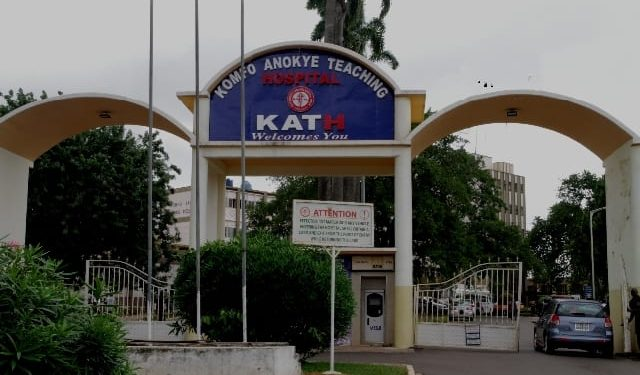
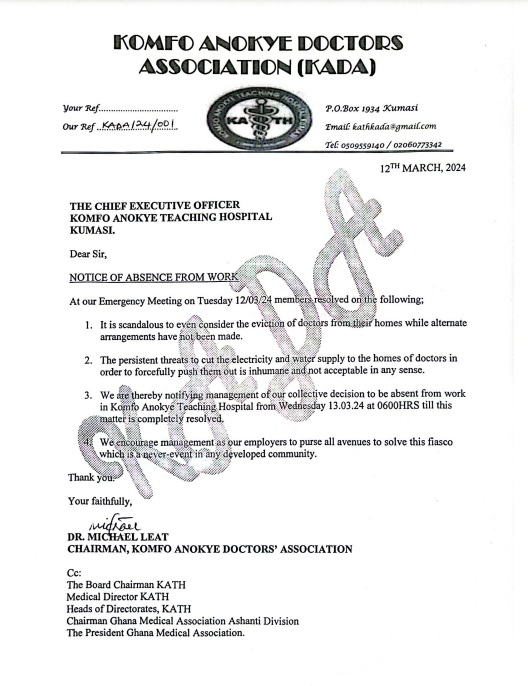
Doctors at the Komfo Anokye Teaching Hospital (KATH) and other medical workers will today lay down their tools to search for new accommodation following the alleged takeover of their current residences by private developers.
The decision was made public in a statement following an emergency meeting on Tuesday, where the doctors unanimously agreed to strike in support of 20 of their colleagues who have received eviction notice.
The Ghana Medical Association has endorsed the strike, which will only impact new admissions, as all doctors have agreed to comply with the Association’s directive.
This means that patients who would have been admitted for treatment or care at KATH may need to seek medical attention elsewhere or face delays in receiving care.
The medical workers, particularly those affiliated with the Komfo Anokye Teaching Hospital, claim they have been given a week’s ultimatum by the Ashanti Regional Coordinating Council to vacate their existing residences. They allege that their bungalows have been sold to private developers.
Ashanti Regional President of the Ghana Medical Association, Dr. Paa Kwasi Baidoo, expressed dismay at the sudden displacement of hospital staff from their homes, highlighting the agreement made with Manhyia Palace for new accommodations before the handover of the land.
However, this agreement, he said, has allegedly been disregarded.
“You will notice that a lot of our staff live 15 to 20 minutes away from the hospital and all of a sudden, people will come and ask you to move from your place because it has been sold to them and we took that issue up and we met with Manhyia on it and it was agreed that a new place be prepared to move us there before you can take possession of the land, they have disregarded that with impunity and so we are meeting this morning.
“We will all leave the hospital to go and look for accommodation because we don’t have a place to sleep.”
The Ghana Medical Association has endorsed the strike, which will only impact new admissions, as all doctors have agreed to comply with the Association’s directive.
This means that patients who would have been admitted for treatment or care at KATH may need to seek medical attention elsewhere or face delays in receiving care.
The decision to strike came after more than 20 doctors received eviction notices from their current residences, reportedly sold to private developers.
Following an emergency meeting, the doctors unanimously agreed to strike in solidarity with their colleagues facing eviction.
According to Dr. Paa Kwasi Baidoo, the Ashanti Regional President of the Ghana Medical Association, the doctors were given a one-week ultimatum by the Ashanti Regional Coordinating Council to vacate their homes.
Dr. Baidoo expressed disappointment at the sudden displacement of hospital staff, highlighting an agreement with Manhyia Palace for new accommodations before the land handover, which has allegedly been ignored.
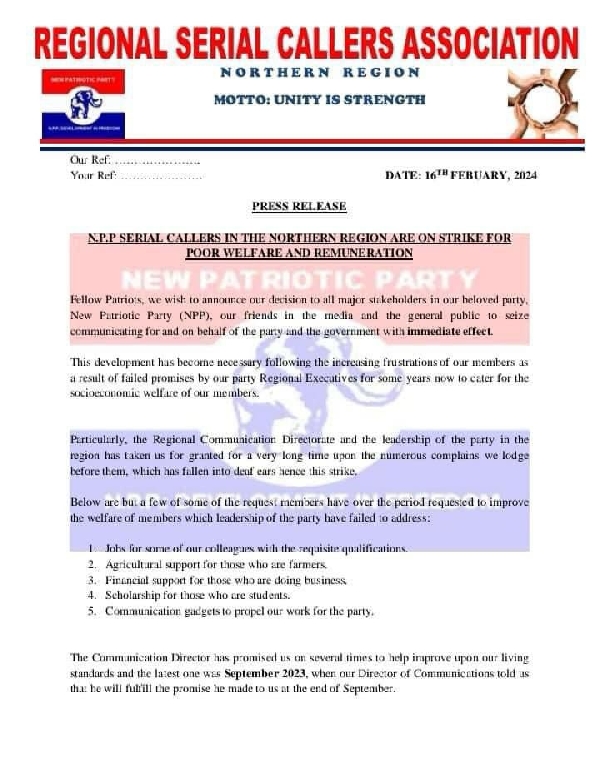
The Northern Regional Serial Callers Association of the New Patriotic Party (NPP) has announced a strike due to grievances over inadequate welfare and compensation.
In a press release dated February 16, 2024, the association expressed mounting frustration among its members regarding unmet commitments by regional party officials.
The group underscored the neglect of its members’ socioeconomic well-being by the regional executives and Communication Directorate.
“Fellow Patriots, we wish to announce our decision to all major stakeholders in our beloved party. New Patriotic Party (NPP), our friends in the media, and the general public to seize communicating for and on behalf of the party and the government with immediate effect.
“This development has become necessary following the increasing frustrations of our members as a result of failed promises by our party Regional Executives for some years now to cater for the socioeconomic welfare of our members.
“Particularly, the Regional Communication Directorate and the leadership of the party in the region has taken us for granted for a very long time upon the numerous complaints we lodge before them, which has fallen into deaf ears hence this strike,” part of the press statement said.
The strike is the result of the serial callers feeling that their concerns have not received enough attention over the years.
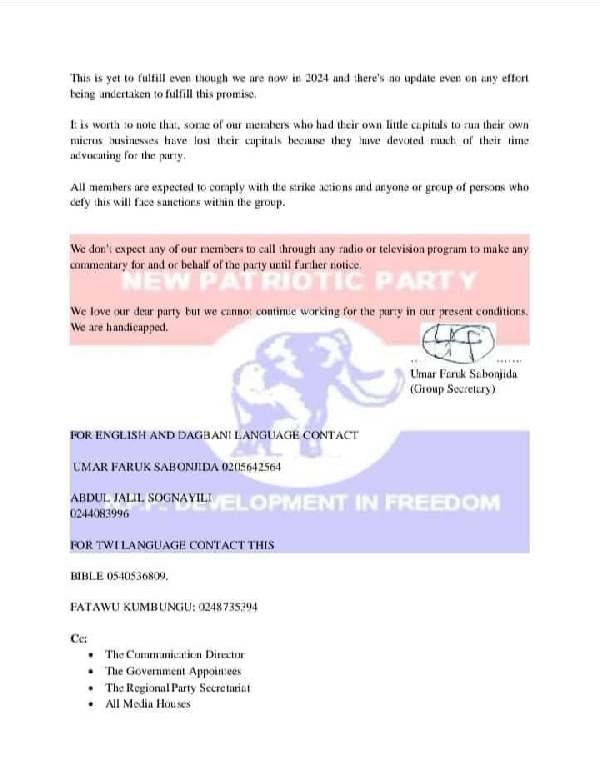
“Below are but a few of some of the requests members have over the period requested to improve the welfare of members which leadership of the party have failed to address:
“Jobs for some of our colleagues with the requisite qualifications.
“Agricultural support for those who are farmers.
“Financial support for those who are doing business.
“Scholarship for those who are students.
“Communication gadgets to propel our work for the party.
“The Communication Director has promised us on several times to help improve upon our living standards and the latest one was September 2023, when our Director of Communications told us that he will fulfill the promise he made to us at the end of September,” the statement added.
Serial callers are a group of people who dedicate themselves to calling into radio and TV talk shows with the aim of defending government policies and propagating the good works of the ruling party.
NPP Serial Callers in the Northern Region are on strike over poor welfare and remuneration pic.twitter.com/H4fUQb7d5e
Association of Master Bakers and Caterers of Nigeria has issued a warning, stating that it will initiate a nationwide service withdrawal from February 27 if the Federal government fails to implement an agreement reached with the association in 2020.
The association is demanding the immediate implementation of financial support palliatives promised by the Federal Government as post COVID-19 support programs for Small and Medium Enterprises. They highlight the significant loss suffered by bakers, with over 40 percent of their membership affected and still increasing.
Additionally, the association is calling for the suspension of all forms of taxation on the bakery industry at the federal, state, and local government levels.
In a statement delivered by the Kogi State Chairman of the association, Chief Gabriel Adeniyi, on behalf of the National President, Alhaji Mansur Umar, the decision to withdraw services is attributed to the perceived failure of the government to honor its commitments.
“multifarious increase in the prices of baking materials such as flour, sugar, yeast, vegetable oil, petrol, diesel all occasioned by subsidy removal and forex deregulation.”
The association said, “Multiple taxations from several federal, state, local government agencies fees and levies, hike in business activities in Nigeria are also some of the reasons for the impending strike action.”
The statement partly read, “The Association of Master Bakers and Caterers of Nigeria have critically accessed the state of our business operation, consequently demand the liberalisation of flour and sugar importation, reduction or total removal of import duties on major baking materials such as flour, sugar, butter, yeast etc as applicable to other commodities as have recently been done by the federal government and Provision of concessionary forex exchange to flour millers and other stakeholders as well as reduction of tariff on imported wheat and sugar.”
The development of wheat and sugar cane farming and processing in Nigeria, as well as the elimination of multiple taxes at all governmental levels, are among the association’s other demands.
In addition, the association demanded other measures that will facilitate business operations in the nation, such as the establishment of a price control and monitoring committee, as permitted by the recently amended constitution.
The Industrial and Commercial Workers’ Union, in collaboration with organized labor, has opted to postpone its planned strike scheduled for February 13, 2024.
This decision comes in response to the government’s commitment to temporarily halt the implementation of Value Added Tax (VAT) on electricity, with the aim of engaging in discussions with the International Monetary Fund (IMF).
The General Secretary of the ICU-Ghana, Morgan Ayawine, said at a press briefing, “We are equally suspending our action, and we will be on red alert.”
“The message we are sending to our members out there is that it is a victory, a victory not only for our members but for Ghanaians,” he said.
The Union emphasized its belief that the government’s choice to suspend the taxation on electricity should be definitive and not subject to further changes or reconsideration.
“We want to believe that it is a suspension in perpetuity. So our members should not feel that we have been defeated,” he said.
Organized Labor convened on Friday, February 2, to deliberate on their ultimatum to the government regarding the withdrawal of the tax on electricity, set to expire in January 2024.
The purpose of the planned demonstration was to pressure the government into retracting the introduction of the electricity tax, which has exacerbated the financial struggles of Ghanaians and heightened their challenges within the country.
In a bid to convey a resolute stance to the government, the leadership of Organized Labor urged all workers across the nation to wear red attire to work starting Monday, February 5.
This symbolic gesture was intended to send a powerful message indicating their unwavering commitment to resist the imposition of VAT on electricity until the government relented on its decision.
Three prominent unions, including the Senior Staff Association of Public Universities in Ghana (SSA-UoG), Teachers and Educational Workers’ Union (TEWU), and the Federation of Universities Senior Staff (FUSSAG), have announced the suspension of their industrial action.
In a statement signed by the National Chairman of SSA-UoG, Isaac Donkoh, the groups cited a successful meeting with their respective employers as the reason for suspending the strike.
This decision comes after the strike began on January 17, 2024, due to the government’s failure to pay Tier-2 members.
The unions arrived at this decision following an emergency National Executives Council (NEC) meeting held at KNUST on February 7, 2024, to assess the status of the strike.
“NEC passed a resolution to suspend the strike and engage Government on the roadmap for the payment of the three percent penalty and the recalculation of accrued interest from 2010 to 2016. Thus, we wish to announce that the ongoing industrial action is suspended with immediate effect,” the statement directed.
The strike by teacher unions, including the Teachers and Educational Workers’ Union (TEWU) of the Trades Union Congress, the Senior Staff Association of Public Universities, and the Federation of Universities Senior Staff, was initiated in protest against the government’s perceived negligence in issues related to pensions and the alleged unjust termination of their overtime allowances.
The National Labour Commission issued a directive on Thursday, January 25, instructing the Teachers and Educational Workers’ Union (TEWU), the Senior Staff Association of Public Universities, and the Federation of Universities Senior Staff to immediately halt their ongoing strike.
But their directive was ignored, insisting that they would only resume work if the government addressed their demands.
It has been over a week since members of the groups laid down their working tools.
The Trades Union Congress (TUC) and 35 organized labor unions have declared their intention to stage a demonstration on February 13.
The decision to protest comes in response to the government’s rejection of their demand to repeal the 15 percent Value Added Tax (VAT) imposed on electricity.
The TUC and the coalition of 35 labor unions argue that they are already facing substantial burdens, and the introduction of this new VAT on electricity will further exacerbate their financial challenges.
During crucial meeting on Friday, February 2, the General Secretary of TUC, Dr Anthony Yaw Baah, said “The VAT that the government has imposed that electricity on consumers. We have expected to pay.
“We have agreed not to pay, so we gave the government until 31[January] to implement changes. If they don’t change we mentioned that we will decide on what to do. Now we have decided to demonstrate on the 13th of February in all regional capitals.”
“Ghana workers, both formal and informal, in both the public and private sector, have decided to demonstrate in all regional capitals. From Accra to Bolgatanga.”
Dr. Baah emphasized that if the government does not reconsider its decision to implement a 15 percent VAT on electricity or engage in negotiations with them before Tuesday, the organized labor, including the Trades Union Congress (TUC), intends to proceed with the planned demonstration.
“If the government does not want us to embark on the demonstration, they should withdraw the letter, and if we don’t hear anything before Tuesday, February 13, we will demonstrate.
“The demonstration is to show the government that we will not pay [the VAT]. The country is ours and we say we don’t agree to pay VAT,” he added.
The VAT is yet to be implemented due to some technical challenges sighted by the Electricity Company of Ghana (ECG).
Earlier, the Finance Ministry revealed its intention to hold comprehensive meetings with Organised Labour and other crucial stakeholders in the upcoming weeks to incorporate their input into the decision-making process.
The introduction of the 15% VAT on electricity comes at a time when consumers have experienced continues rise in electricity tariff in 2023 by the Public Utilities Regulations Commission (PURC).
The Senior Staff Association of Universities of Ghana has stated that it is relying on the cooperation of the government to address specific proposals presented before considering calling off the strike of its members.
The strike, which has been ongoing for over a week, is a joint action with the Tertiary Education Workers Union of Ghana (TEWUG), and it revolves around the government’s failure to address concerns related to their pensions.
Following a meeting between the parties on February 1, the National Chairman of the association, Isaac Donkoh, mentioned that the strike would continue until the government addresses their demands.
“The Association or the unions have made some proposals to the government. The government has taken it in good faith, and they will get back to us in a few days… Until then, the strike is still on. So if they are able to work it out fast, it is better for all of us,” he said.
Members of the Tertiary Education Workers Union (TEWU) have commenced an indefinite strike from today, February 1, 2024.
The decision comes as a response to the government’s alleged failure to address a range of concerns, including welfare needs, Tier-two pension funds, vehicle maintenance allowance, and overtime allowance.
Various services provided by TEWU members, such as cleaning the environment, setting up classrooms, providing security, and hospital services, have been withdrawn as part of the industrial action. The National Chairman of TEWU, Sulemana Abdul-Rahman, emphasized that the strike will persist until their grievances are effectively addressed by the government.
“On the lackadaisical nature of the employer, which is the government of Ghana, to address the challenges and problems of TEWU members in the traditional public universities, the TEWU of Ghana hereby declares an indefinite strike, and the strike takes effect on 1st February, which is Thursday, until further notice,” declared Abdul-Rahman.
The union’s decision reflects the frustration among its members, who feel that their concerns have been overlooked, prompting this bold move to seek resolution. The indefinite strike is expected to impact various aspects of tertiary education services, creating urgency for authorities to engage with TEWU and address the underlying issues.
As the strike unfolds, stakeholders, including the government, are urged to initiate constructive dialogue to find a mutually agreeable solution, ensuring the resumption of essential services in the tertiary education sector.
The duration and impact of the strike will depend on the responsiveness of the government to the concerns raised by TEWU.
This decision follows the government’s failure to meet their demands for improved conditions of service, as stipulated in the ultimatum issued at the end of January.
Chairman Sulemana Abdul Rahman clarified that their demands include the non-provision of lump sum amounts for pension to some retired members and the non-receipt of various allowances owed to those currently in active service.
In an interview with JoyNews on January 30, Rahman stated that approximately 10,000 members across various public universities would abstain from rendering their services starting Thursday as part of the industrial action.
“I can assure you that we are over 10,000 members in the public universities across the country. So from tomorrow, the whole country will know whether we are on strike or we are not on strike, because we are still at the workplace that is why people were not seeing the seriousness.
“You know GAWU and SSA-SoG have already declared and they are on strike but because we were at the workplaces the impact was not there. The government has not felt the heat.
“From tomorrow government will feel the heat and do the needful. Even though we do not wish to embark on a strike, as I said, when you are being pushed to the wall, the only option that you have is to respect the voice of the members by putting down your tools, which we have done.”
He clarified that the strike would unfold in stages, meaning that certain crucial sectors such as security personnel, drivers, and certain secretarial staff would not participate initially. However, he added that, over time, the industrial action would encompass all members of the Teachers and Educational Workers Union of Ghana (TEWU-GH).
“We are of the view that the strike is in stages for now, we are asking the security to remain at the post. But when we get to a stage where we need to withdraw everybody, I can assure you that the university will be on lockdown. If the security men are not there to work, you can imagine what will happen,” he added.
Meanwhile, he said, if the government called them to the negotiation table and addressed their concerns, they would call off the strike.
The University Basic School (UBS) will temporarily be shut down, as announced by the University of Ghana (UG).
Consequently, students from KG1 to Junior High (JH) 3 are advised to stay home until further notice.
However, specific arrangements are being made to recall Junior High 3 students for the resumption of their preparations for final examinations.
The official statement from the University emphasized, “I write to inform the University Community and the general public that the KNUST Basic School is being closed down, effective Tuesday, 30th January, 2024, until further notice.”
“Our JH 3 students will however be called back to school in due course to continue with their preparation towards their final examinations after the necessary arrangements have been put in place to that effect.” the statement noted.
This is in light to an ongoing strike initiated by the Senior Staff Association – Universities of Ghana (SSA-UOG) and the Federation of Universities Senior Staff Association of Ghana (FUSSAG).
Government has arranged a meeting with striking tertiary workers scheduled for Thursday, February 1, 2024, to address the concerns behind the ongoing industrial action.
The demands put forth by the Senior Staff, Teachers, and Educational Workers Union, along with the Ghana Association of University Administrators at the University Of Ghana, include the payment of delayed tier 2 pensions with compound interest and improved conditions of service.
Expressing optimism, Ken Botchway, Chairman of the Legon branch of the Teachers and Educational Workers Union (TEWU), sees the meeting with the Minister for Labour Employment and Pensions on February 1 as a positive development.
He conveyed, “We want to see it as a positive development that we are meeting the Minister for Labour Employment and Pensions hopefully on the first of February. And then we will take it from there, whatever will happen we will let the media know about it.”
During a meeting on Monday, January 29, 2024, to update members on the ongoing strike, Mr. Botchway noted some progress in addressing issues related to their conditions of service.
However, he highlighted that concerns about the calculation of pensions remain a challenge and will be a central point of discussion during the February 1 meeting.
Despite the National Labour Commission’s directive to suspend the strike, the Senior Staff Association of Public Universities insists that their strike continues. The Association’s leadership underscores the necessity to engage in discussions with their members before deciding to unilaterally end the strike, prioritizing the interests of their members and resisting rushed decisions.
Amid the ongoing strike by the Senior Staff Association of Public Universities (SSA UoG), social media users are urging authorities to step in, expressing concern for the well-being of affected students.
Arguing that the lives of ill students are in jeopardy due to the strike, these users emphasize the potential worsening of the students’ health during the ongoing industrial action.
“Today Mark exactly 10 days Public Universities hospitals got shutdown due to strike action by the Senior Staff Association of Public Universities (SSA UoG). Sadly, students can not get access to healthcare which should be a basic needs. I want to plead with authorities to help,” a X user posted.
Today Mark exactly 10 days Public Universities hospitals got shutdown due to strike action by the Senior Staff Association of Public Universities (SSA UoG). Sadly, students can not get access to healthcare which should be a basic needs. I want to plead with authorities to help. pic.twitter.com/1NXAAlelyn
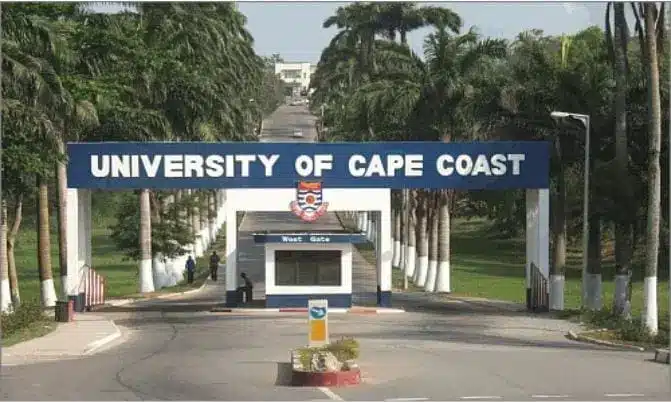
The University of Cape Coast took the drastic step of indefinitely closing its hospital on January 19, 2024, in response to the senior staff strike.
The strike, declared by the Senior Staff Association of Public Universities in Ghana (SSA-UoG) and the Federation of Universities Senior Staff (FUSSAG) on January 17, 2024, is a nationwide protest against the government’s alleged disregard for their welfare.
The association cites the government’s failure to fulfill obligations such as payment of their two-tier pension and overtime allowances as key reasons for the strike.
The withdrawal of services, including healthcare, administration, and security, has led to the closure of the university’s hospital.
During this period, the university’s communication team advises students to seek care for minor conditions at their respective hall infirmaries.
For severe conditions, students are directed to the school student’s clinic near the Sam Jonah Library, which will operate from 8 a.m. to 6 p.m. every day excluding weekends.
Additionally, the ongoing medical exam for fresh students has been temporarily suspended until further notice.
The Senior Staff Association of Public Universities is standing firm on the continuation of their strike, disregarding the directive from the National Labour Commission (NLC) to suspend the industrial action.
Leadership within the Association asserts that they must first convene and hold discussions with their members before deciding on any unilateral decision to end the strike.
National Chairman of the Association, Isaac Donkoh, emphasized in an interview with Citi FM that they are committed to prioritizing the interests of their members and will not be rushed into making any decisions that may be unfavorable to their cause.
“We are still on strike at the moment. So we are expecting that engagement, and we hope and pray that the engagement will yield some positive results. Unfortunately, we planned to meet last week Friday, but we couldn’t convene.”
“So we are planning to schedule a meeting within the week before we meet the government. So we are yet to meet and decide,” he said.
The National Labour Commission (NLC) issued a directive on Thursday, January 25, instructing the Teachers and Educational Workers’ Union (TEWU), the Senior Staff Association of Public Universities, and the Federation of Universities Senior Staff to immediately cease their ongoing strike.
The NLC argued that addressing the various demands presented by the striking teacher unions would only be feasible if the unions comply with this directive. Following a meeting with the unions, Ofosu Asamoah, the Executive Secretary of the NLC, reported progress in addressing some of the concerns raised by the unions.
However, the NLC reiterated that the resolution of the remaining outstanding issues is contingent upon the unions calling off their strike action.
Meanwhile, the Association is expected to meet with the NLC on Thursday, February 1.
The ongoing strike by teacher unions, including the Teachers and Educational Workers’ Union (TEWU) of the Trades Union Congress, the Senior Staff Association of Public Universities, and the Federation of Universities Senior Staff, was initiated in protest against the government’s perceived negligence of issues related to pensions and the alleged unjust termination of their overtime allowances.
On January 17, 2024, the Senior Staff Association of Public Universities in Ghana and the Federation of Universities Senior Staff (FUSSAG) commenced an indefinite nationwide strike, citing the government’s blatant neglect of their welfare as the primary reason.
Both associations disclosed that the government has repeatedly failed to meet obligations related to their two-tier pension and overdue overtime allowances.
This strike has led to the cessation of various services across public universities.
“TEWU of TUC (GH), is by this statement calling on its members in the Public Universities to join the ongoing strike in solidarity and especially on the non-payment of Tier 2 pension contributions by government that is outstanding for nine (9) months. We wish to serve notice, and is hereby served that the Teachers and Educational Workers’ Union (TEWU) of TUC (GH) has joined the strike declared by the Senior Staff Association of Universities of Ghana (SSA-UoG).”
TEWU also called for the government‘s swift response to the action.
“TEWU of TUC (GH) is calling on government to immediately pay the nine months Tier 2 pension contributions arrears of workers of the Public Universities to ensure dignified retirement. It is hoped that the smooth running of Ghana’s Public Universities will be revered in a swift response of the government agencies to forestall disruptions in the academic calendar.”
FOR IMMEDIATE RELEASE
Dear Sir/Madam
TEACHERS AND EDUCATIONAL WORKERS’ UNION OF TUC (GH) JOINS ONGOING STRIKE IN PUBLIC UNIVERSITIES WITH IMMEDIATE EFFECT
The Teachers and Educational Workers’ Union of TUC (GH) (TEWU of TUC (GH)), associate itself with the Senior Staff Association of Universities of Ghana (SSA-UoG) in the issues culminating in the current nationwide strike action.
It is noteworthy that the demands for Tier 2 pension payment and the restoration of payments of stopped agreed allowances were among the myriad of issues listed on the petitions to the National Labour Commission (NLC) in October, 2023 which almost led to another joint non-teaching staff Unions strike in the Public Universities.
It is obvious that the patience of the universities workers has waned, and the continued lethargy of government agencies in addressing labour issues will no more be entertained.
TEWU of TUC (GH), is by this statement calling on its members in the Public Universities to join the on-going strike in solidarity and especially on the non-payment of Tier 2 pension contributions by government that are outstanding for nine (9) months.
TEWU of TUC (GH) is calling on government to immediately pay the nine months Tier 2 pension contributions arrears of workers of the Public Universities to ensure dignified retirement.
We wish to serve notice, and is hereby served that the Teachers and Educational Workers’ Union (TEWU) of TUC (GH) has joined the strike declared by the Senior Staff Association of Universities of Ghana (SSA-UoG).
It is hoped that the smooth running of Ghana’s Public Universities will be revered in the swift response of government agencies to forestall disruptions in the academic calendar.
Long Live TEWU of TUC (GH)!
Long Live Public Universities!!
Long Live Ghana!!!
……………………………………….
(MARK DANKYIRA KORANKYE)
GENERAL SECRETARY
CC:
The Executive Secretary, National Labour Commission
Hon. Minister, Ministry of Education
Hon. Minister, Ministry of Finance
Hon. Minister, Ministry of Employment and Labour Relations
Director General, Ghana Tertiary Education Commission
The Chief Executive, Fair Wages and Salaries Commission
The National Labour Commission (NLC) has expressed concern that the ongoing industrial action by the Senior Staff Association of Public Universities in Ghana (SSA-UoG) and the Federation of Universities Senior Staff (FUSSAG) is hindering efforts to address their grievances.
Executive Secretary of the NLC, Mr. Ofosu Asamoah, stated that his attempts to persuade the striking group to suspend the industrial action in favor of negotiations have been unsuccessful.
He believes that the prolonged strike will hamper efforts to resolve their issues and expressed hope that the Senior Staff would call off the strike immediately to allow for a scheduled meeting next week.
“There has been a complaint and a response, so we now have to bring the parties together and see the way forward. Either the Commission will settle it summarily, or there will be mediation or an arbitration.
“So the two parties must come together, then, with the Commission’s assistance, we look at the thing and see the issue at stake, and that’s why we invited them.
“Unfortunately, the senior staff are saying that they committed to their schedule so they couldn’t come, but they can make it on the 24th, and we communicated to the other party.
“The only issue for now is that of the strike which has started. Whenever there is a strike, issues must be attended to urgently,” he said.
Commenting on whether the NLC made efforts to prevent the Senior Staff from embarking on the strike, Mr Asamoah asserted, “We did, by first writing to those against whom the complaint has been made, that this is what the Senior Staff Association is saying. What are you doing to avert the strike? We had in our letter that they should apprise the Commission of what steps they are taking within these days, and then we fixed the date to meet the two parties. That is what was done.”
The ongoing strike by the Senior Staff Association of Public Universities in Ghana (SSA-UoG) and the Federation of Universities Senior Staff (FUSSAG) was initiated on Thursday, January 19, to demand improved conditions of service, payment of tier-two pension arrears, and restoration of overtime allowances.
However, the National President of the Association, Isaac Donkoh, mentioned in an interview that they were willing to call off the strike and return to the negotiation table if the Ghana Tertiary Education Commission (GTEC) withdrew its denial about their overtime allowance.
“I think we are gradually getting somewhere, and once my good friend has spoken, we are taking it in good faith. I think we still have the second letter in circulation, so they should write and withdraw the second letter. We have to also get the two people to intervene, and then we are good to go,” he said.
Commenting on whether the strike can be suspended while they pursue the other issues of regarding the interests of the students, Mr Donkoh said; “That is not anything difficult to do. I can’t assure you on the phone, but it’s nothing difficult. I will have a discussion, and then we’ll take it from there, so it is nothing difficult at all.”
The Chief Executive Officer of the Fair Wages and Salaries Commission, Mr. Ben Arthur, expressed that the ongoing strike by the senior staff is unfortunate.
“That letter was rejected. It was not directed at public universities where the infraction had been reported. So way back on June 30th, 2023, as my good friend Isaac has alluded to, the matter should be resolved. So if we have any issues, any non-compliance for which you have noticed, then it is only fair that you come back to us to resolve the matter,” he said.
The University of Cape Coast (UCC) indefinitely closed its hospital starting from January 19, 2024, due to the ongoing strike by senior staff.
The Senior Staff Association of the Public Universities in Ghana (SSA-UoG) and the Federation of Universities Senior Staff (FUSSAG) initiated a nationwide indefinite strike on January 17, 2024, citing the government’s disregard for their welfare.
The strike is in protest of the government’s failure to fulfill the payment of two-tier pensions and overtime allowances.
The senior staff’s strike has led to the cessation of various services, including healthcare, administration, and security, prompting the closure of the University’s hospital.
During this period, the University’s communication team has advised students to seek care for minor conditions at their respective hall infirmaries.
For severe conditions, students are encouraged to visit the school student’s clinic located near the Sam Jonah Library, which will be operating from eight in the morning to six in the evening every day except weekends.
Additionally, the ongoing medical examination for fresh students has been suspended until further notice.
The Senior Staff Association – Universities of Ghana (SSA-UoG) and the Federation of Universities Senior Staff Association of Ghana (FUSSAG) insist that they will not resume work until the government fulfills its obligation to pay their outstanding amounts in full.
Members of the Senior Staff of Public Universities in Ghana are demanding the immediate payment of all outstanding pension contributions, along with appropriate interest calculated from March to December 2023.
They emphasize the application of the three percent penalty rates stipulated by the Pensions Act, Act 766 Section 64.
The staff has taken industrial action in response to what they perceive as the unilateral decisions made by the Fair Wages and Salaries Commission and the Ghana Tertiary Education Commission (GTEC).
The aggrieved workers cite the government’s failure to remit their Tier-2 Pension contributions and the cancellation of overtime and weekend allowances, which they assert violates their agreements.
The National Chairman of the Senior Staff of Public Universities in Ghana, Isaac Donkoh, affirmed on Starr Today with Joshua Kodjo Mensah that despite the awareness of the challenges their strike may pose, they are resolute in their decision.
He emphasized that the government needs to fulfill its responsibilities, including paying the outstanding amounts and rescinding the decision that senior staff are ineligible for overtime.
Mr. Donkoh stated that these actions are essential for the staff to consider returning to work. As of now, the government has not communicated with the workers since the announcement of the indefinite strike action.
“We are aware of the circumstances surrounding our strike but this is the decision we have taken once and for all. Because those children on the various campuses are our children, our nephews and we pay their fees as well. We pay for their accommodation and buy them books. “With this strike, we are not going to rescind our decision, the only thing that can bring us back to work is for the government to do the needful and, they know the needful.
He continued: “They should pay the money and they should also withdraw the letter that has been sent to university management that senior staff do not qualify for over-time. When these things are done, even tomorrow morning we can come back to work. But until it is done I am sorry we can’t come back to work.”
The Senior Staff Association of Public Universities in Ghana (SSA-UoG) and the Federation of Universities Senior Staff (FUSSAG) have initiated an indefinite strike with immediate effect.
The decision to strike is a response to what they perceive as the government’s disregard for their welfare.
The strike is fueled by various issues, including the government’s alleged failure to address concerns related to pensions and the claimed illegal cancellation of their overtime allowance.
National Chairman of SSA-UoG, Isaac Donkoh, stressed the government’s responsibility for any consequences arising from their decision during a news conference held at the University of Ghana in Accra on Wednesday, January 17.
“As leadership, we are forced to declare indefinite strike action,” pointing to the fact that “government has failed to release our tier 2 pension to our fund managers since February 2023.”
He added, “So we are asking the government to as a matter of urgency release all the outstanding arrears to our fund managers and also pay the accrued interest with a three percent interest rate.”
“We are also again asking the government to do a recalculation on the accrued interest between the years 2010 and 2016 as we all agreed on July 25th 2022. We are also asking the government as a matter of urgency to pay all outstanding arrears to our staff who are on pension from 2020 to 2023. Then, lastly, we are calling on the Fair Wages and Salaries Commission, Ghana Tertiary Education Commission (GTEC) to withdraw the letter dated 7th November and 20th November respectively.”
He directed all members of the unions to stay home until reached out for further actions, stressing that “from today, nobody should go to work until further notice.”
The Senior Staff Association of Public Universities in Ghana (SSA-UoG) and the Federation of Universities Senior Staff (FUSSAG) have initiated an indefinite strike, citing the government’s blatant disregard for their welfare.
The strike is in response to the government’s failure to address issues related to pensions and the alleged improper cancellation of their overtime allowance.
Isaac Donkoh, the National Chairman of SSA-UoG, announced the decision at a News Conference held at the University of Ghana in Accra.
Mr Donkoh emphasized that the government bears responsibility for any consequences resulting from their actions.
The key demands include the immediate release of tier 2 pension arrears to fund managers since February 2023, payment of accrued interest at a three percent rate, recalculation of accrued interest from 2010 to 2016, payment of outstanding arrears to pensioned staff from 2020 to 2023, and the withdrawal of letters dated November 7th and 20th, 2022, by the Fair Wages and Salaries Commission and Ghana Tertiary Education Commission (GTEC) respectively.
Donkoh concluded by instructing their members to stay at home until further notice, declaring a work stoppage effective immediately.
“As leadership, we are forced to declare indefinite strike action. The reason is that the government has failed to release our tier 2 pension to our fund managers since February 2023. So we are asking the government to as a matter of urgency to release all the outstanding arrears to our fund managers and also pay the accrued interest with a three percent interest rate.
“We are also again asking the government to do a recalculation on the accrued interest between the years 2010 and 2016 as we all agreed on July 25th 2022. We are also asking the government as a matter of urgency to pay all outstanding arrears to our staff who are on pension from 2020 to 2023. Then, lastly, we are calling on the Fair Wages and Salaries Commission, Ghana Tertiary Education Commission (GTEC) to withdraw the letter dated 7th November and 20th November respectively.”
“On this note, we are, therefore, directing our rank and file to stay at home until further notice. From today, nobody should go to work until further notice,” he said.
The Technical University Senior Administrators’ Association of Ghana (TUSAAG) has decided to suspend the nationwide strike initially slated for Monday, January 8, 2024.
TUSAAG has raised the stakes by threatening a nationwide strike. Their demand centers on the insistence that both the government and the management of various technical universities must fully adhere to the retirement roll-over date.
Tensions rise as the association issues a stern ultimatum, leaving the possibility of a strike hanging in the balance.
In a statement released on January 1, TUSAAG highlighted the failure of Accra Technical University (ATU) and Koforidua Technical University (KTU) management to implement the roll-over conditions for eligible personnel. This non-compliance has resulted in the premature termination of employment for affected staff members.
A January 8 statement by TUSAAG indicated that the “Vice Chancellors of Technical Universities of Ghana (VCTU-G) have met with the leadership of TUSAAG, and have agreed to implement the Roll Over provisions in our Conditions of Service. The VCTU-G has further issued a Resolution Memorandum to all Vice Chancellors.”
In response to commitments and assurances made during a recent meeting, the Technical University Senior Administrators’ Association of Ghana (TUSAAG) has decided to suspend its planned strike. The association has urged calm among its members as they await further developments.
“In view of the interventions made by the Minister of Education, Minister of Employment and Labour Relations, the GTEC, the FWSC and the commitment of the Vice Chancellors of Technical Universities of Ghana, to fully implement the Roll Over, the NEC of TUSAAG suspends the intended strike action with immediate effect.”
“The NEC calls for calm on all the affected University campuses, as we wait for the GTEC and the VCTU-G to firm up their commitment in dealing with the other outstanding issues indicated in our earlier correspondence.”
The National Executive Committee (NEC) of the Technical University Senior Administrators’ Association of Ghana (TUSAAG) has announced a nationwide strike set to commence on Monday, January 8, 2024. This decision is poised to have widespread implications as administrators across the country unite in protest.
In a released statement, the Association has clarified that the industrial action is a resolute effort to emphasize their call for complete adherence to the terms of the retirement date rollover, as stipulated in the relevant sections of the Conditions of Service.
“The strike action shall mean the outright cessation of all administrative and professional services (including all services for both fresh and continuing students), withdrawal of services at all Units, Sections, Departments, Faculties, Centres, Directorates, Halls of Residence, Finance, ICT Services, physical development, facilities maintenance services, as well as all other main and general services (at the offices of the Vice-Chancellor, the Pro Vice-Chancellor the Registrar),” portions of the statement read.
TUSAAG’s NEC also insisted that the strike will be implemented until the conditions of the roll-over of the retirement date, as outlined in the Conditions of Service, are wholly implemented by the Management of all Technical Universities.
“By this correspondence, all members of the Association are to take note, and act accordingly,” it added.
The Senior Staff Association and the Teachers and Educational Workers’ Union (TEWU) at the University of Ghana have issued a threat to go on strike if the university’s management does not settle the arrears of Interim Market Premium for some staff by December 13.
Despite pursuing various avenues, including legal intervention, to compel the university’s management to pay the arrears spanning from 2010 to 2018, the associations assert that all efforts have been in vain.
National Chairman of the Association, Isaac Donkor, conveyed in an interview with Citi News that the planned strike is a firm stance with the expectation that it will prompt the university’s management to address and clear the outstanding arrears.
“The court ordered that the university should pay the market premium to the staff but we have been battling with them since 2018 and they are still not paying us and we have taken the matter to the National Labour Commission (NLC) and about three different timelines were given and they missed all the three timelines.”
“For now, we have no other option because our members are chasing us, and we have to listen to them because this money ought to have been paid long ago and the value of that money is already gone and so we have given them up to December 13 to pay us and if nothing is done, we are going to lay down our tools.”
Ghanaian rapper Sarkodie has responded to the notice issued by the Mortuary Workers Association of Ghana (MOWAG) regarding a potential strike next week if their concerns are not addressed.
Expressing his opinion, Sarkodie warned that if the government neglects the situation and allows the mortuary workers to proceed with the planned strike, it could have severe repercussions for the nation, especially considering the death rate.
Sarkodie emphasised that mortuary work, despite being one of the most underrated professions in the country, plays a vital role in ensuring that deceased individuals receive proper treatment before their burial.
Sarkodie called on the government to meet the demands of the Mortuary Workers Association and furnish them with the requisite equipment needed to discharge their duties effectively. “This will affect us heavily…
“Yes, I wouldn’t want a strike, especially from “them” but I understand… this is one of the underrated/underpaid jobs yet one of the hardest and riskiest. They deserve the right salary, equipment and environment to work effectively … We can escape some services in life but this,” he wrote on his X page.
This will affect us heavy … Yes I wouldn’t want a strike especially from “them” but I understand… this is one of the underrated / underpaid jobs yet one of the hardest and riskiest jobs. They deserve the right salary , equipment and environment to work effectively … We can… https://t.co/BZ1M2u8htV
According to a letter addressed to four ministries and three state agencies, MOWAG said its intended action was in line with activating Section 159 of Act 651 (2003).
“Our position is that all Mortuary Workers in Ghana shall lay down their tools starting on Wednesday, November 29, 2023, until all matters already in your domain are resolved. “This is an exercise of rights, as the 1992 constitution of the Republic of Ghana stipulates. You are respectfully notified,” the letter read in part.
The ministries that received notifications included Health, Employment and Labour Relations, National Security, and Finance.
Additionally, copies were sent to the Chief Executive of the Fair Wages and Salaries Commission, the Executive Secretary of the National Labour Commission, and the Registrar of the Mortuaries and Funeral Facilities Authority.
The letter, signed by MOWAG General Secretary Richard Kofi Jordan, has garnered humorous and critical reactions since it was shared on the social media platform ofmedia personality Serwaa Amihere.
The United Auto Workers (UAW) union is extending its strike at major American car companies, entering its third week of protests over pay and benefits.
Union leader Shawn Fain announced that an additional 7,000 employees at Ford and General Motors factories will join the strike, bringing the total number of striking workers to about 18,000. Notably, this action does not include Stellantis, indicating progress in those negotiations.
The dispute has cast a shadow over the US economy, drawing attention from both President Joe Biden and former President Donald Trump, who is seeking re-election.
Both leaders visited the Detroit area this week to address the ongoing labor tensions, which are reflective of broader worker unrest in the country.
The union’s demands include a substantial 40% pay increase over four years and an end to practices that result in lower pay and reduced benefits for newer employees.
In response, the companies argue that these demands would impede their long-term investments and have offered a 20% pay raise along with other concessions.
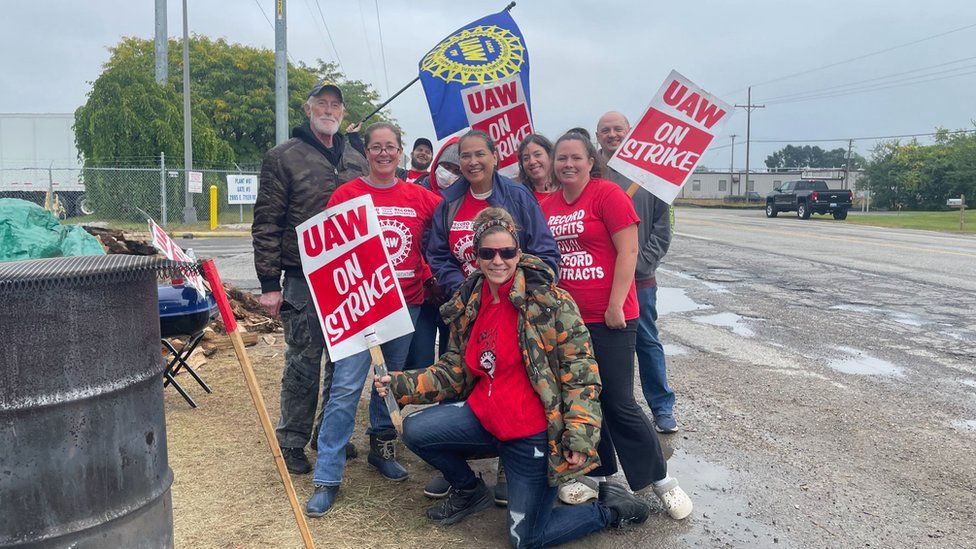
On the picket lines in Michigan, many workers expressed their readiness for a prolonged battle.
“People are fed up. We want there to be a middle class,” said Emily Yettaw, who has worked at GM for 17 years. “They’re making billions in profit and we deserve better.”
Image caption,Emily Yettaw, right, is among the GM workers on strike in Ypsilanti Michigan
The union, which represents 146,000 workers at the three companies, has been slowly ratcheting up pressure on the car makers to strike a deal since labour contracts expired on 14 September.
The latest action expands the work stoppages to a Ford factory in Chicago that makes Explorers, and a GM factory in Michigan which makes large crossover SUVs such as the Chevrolet Traverse and Buick Enclave.
The union’s prior targets included 38 facilities that distribute parts to dealers and three factories – one at each company.
In a message to employees, General Motors said “calling more strikes is just for the headlines, not real progress”.
The company said it had not received a “comprehensive” reply since it put forward a proposal on 21 September. It said that offer provided workers with “historic wage increases and job security while not jeopardizing our future”.
“We continue to stand ready and willing to negotiate in good faith to reach an agreement that benefits you and doesn’t let the non-union manufacturers win,” said Gerald Johnson, executive vice president for global manufacturing.
The economic impact of the action remains limited, but is building. In just its first week, the stand-off had led to an estimated $1.6bn (£1.3bn) in economic losses, including more than $100m (£81m) in lost wages – a cost that is weighing on local economies.
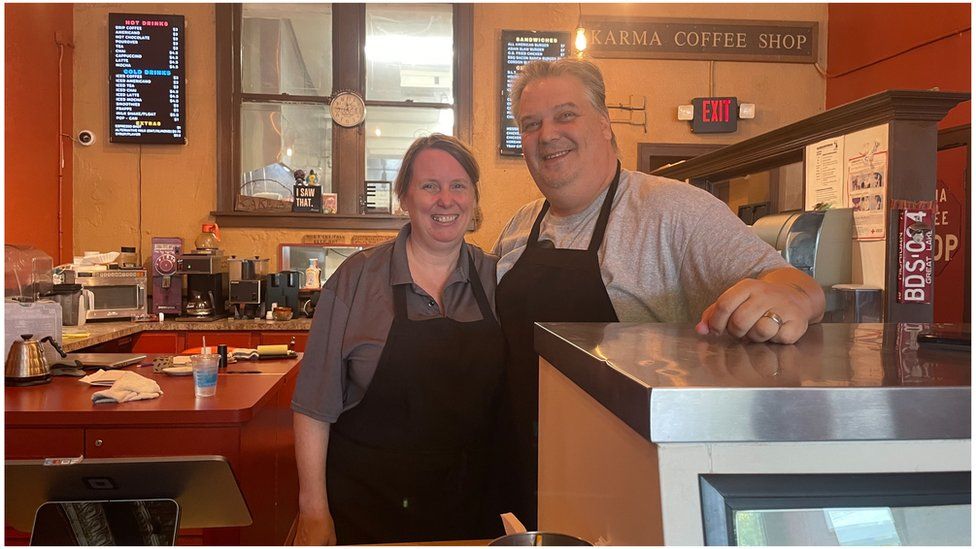
Jennifer Romero owns the Karma Coffee & Kitchen in Wayne, Michigan. Her shop, with a flier in the window supporting the strike, is located just down the road from a closed Ford factory. Jennifer says sales have been noticeably slow at her store.
Image caption,Jennifer and David Romero said they supported the workers but could see the economic hit from the strike
“Our neighbourhood is mostly blue collar workers,” she said. “If they’re not working, they’re not spending money and if they’re not spending money, we’re not making money.”
For the car companies, which are facing heavy investment costs and intense competition as the industry ramps up production of electric cars, the timing of the dispute “could not be worse”, said Wall Street analyst Dan Ives of Wedbush Securities.
“This UAW debacle strike trajectory is like watching a slow moving car crash take place on black ice,” he wrote in a note on Friday.
“This is a defining period for Detroit and the future of the auto industry as we firmly believe that if GM, Ford, Stellantis accept anything close to the deal on the table the future will be very bleak for the US auto industry.”
For now, workers on the picket line in the Detroit area this week said they remained committed to the fight, despite the loss of income for many that will come from receiving just $500 (£410) in strike pay a week.
“It’s ramen noodles and mac and cheese time,” GM workers in Ypsilanti joked. “No more Red Lobster.”
“I don’t think anybody is scared to be out here,” added Kemi Hooker, 53, who has worked for GM for 24 years. “We’ll do what it takes”.
The Tertiary Education Workers Union (TEWU) and two other university unions, namely the Senior Staff Association of the University of Ghana (SSA-UoG) and the Ghana Association of University Administrators (GAUA), have issued a two-week ultimatum to the government, demanding the reinstatement of their withheld allowances.
During a press conference held in Accra, the National President of GAUA, Dr. Beth Offei-Awuku, expressed concern that the non-payment of these allowances was causing undue hardship for their members.
The unions have warned that if the government does not restore their allowances by October 15, 2023, they will initiate a service withdrawal across all public universities in the country.
Meanwhile, Organized Labour has advised its members to follow the proper procedures and seek police approval when planning demonstrations.
The Deputy Secretary-General of the Trade Union Congress (TUC), Joshua Ansah, emphasized that adhering to these protocols would grant them the necessary authorization to proceed with their protests.
“We are a law-abiding organisation. We normally write to the police the number of days that is required which is five days to the police,” Ansah said.
“The police also have the duty to respond. If they are satisfied with all the arrangements, the routes, the destination, the starting points, and the time of closing, I think that they can give us the go-ahead.”
“I don’t think the police would dream of stopping us from having our demonstration or strike after we have informed them in accordance with the law,” he stated.
Healthcare professionals working within the Maternity Wing of Mampong Government Hospital have issued a firm caution regarding their plan to initiate a sit-down strike, set to commence on Monday, August 14th, 2023.
The catalyst behind this decision arises from recent actions taken by the administration of the Mampong Nursing and Midwifery Training College, involving the closure of a passageway leading to the hospital’s maternity unit.
These dedicated healthcare workers are currently confronted with the predicament of having to traverse a densely vegetated path due to the blocked route.
They express that this choice not only compromises their safety due to heightened security vulnerabilities, as several colleagues have previously encountered assaults, but also generates distress among patients.
These patients, now compelled to cover extended distances due to the route’s closure, frequently encounter exacerbated health complications.
In a conversation with Citi News, the discontented healthcare staff underlined their firm belief that resorting to a strike presents the only feasible avenue to compel the resolution of their grievances.
“The hospital comprises twin wings, and the road that has been obstructed serves as the primary link connecting the two sections. This obstruction hampers the smooth exchange of goods and services between the maternity wing and the general wing. Our staff members reside beyond this gate, often hampering their ability to respond to emergencies promptly. Therefore, we implore the management to urgently address this matter, fostering harmony between the staff and the local community.”
“Should we not receive any communication from the leadership by Monday, we will have no choice but to initiate a sit-down strike.”
Amid the taxi strike in Cape Town, South Africa, a total of five individuals have tragically lost their lives due to violent protests. Among the casualties were a 40-year-old British citizen and a police officer.
The unrest ensued following a week-long strike organized by the South African National Taxi Council (Santaco), triggered by what the drivers described as “heavy-handed tactics” employed by law enforcement authorities.
The United Kingdom has issued a travel advisory concerning South Africa, raising concerns about the strike’s classification as a high-security threat.
Despite attempts at negotiation, the taxi strike is expected to persist as discussions between Santaco and the Democratic Alliance-led provincial government deteriorated.
Concurrently, Transport Minister Sindisiwe Chikunga has demanded the immediate release of minibus taxis impounded by municipal authorities.
She asserted that the legislation utilized by the city had been misapplied and incorrectly executed.
Taxi drivers and owners contended that their vehicles were being unfairly targeted and seized for minor infractions, such as not wearing seat belts or improperly using the emergency lane.
Meanwhile, other motorists were subjected to mere fines for comparable transgressions.
The main labor union federations in Nigeria have agreed to pursue negotiations with the government and have delayed a statewide strike in protest of the growing cost of living.
The main problem is the withdrawal of the gasoline subsidy by President Bola Tinubu.
The government had until Wednesday to change its mind on the subsidies, according to the unions.
The unions organized marches in cities all throughout the nation on Wednesday as the authorities refused to budge.
But according to a statement from the Nigerian presidency, the unions have now consented to further negotiations.
“Consequent upon the fruitful and frank discussion with President Tinubu and their confidence in his ability to encourage open and honest consideration of all the issues put forward by the labour movement, the labour leaders resolved to stop further protest,” it said.
The Reuters news agency is quoting the Nigeria Labour Congress as saying that it had “decided for a return to a new and reinvigorated dialogue process”.
Since taking office as president in May, Mr. Tinubu has started a number of economic reforms.
He claimed that by eliminating the gasoline subsidy, which cost the government $10 billion (£8 billion) last year, the government will be able to allocate more funds to specific programs that benefit the less fortunate.
The Teacher and Educational Workers Union (TEWU) has issued a stern warning of potential industrial action in response to unresolved issues concerning their allowances.
The Union is dissatisfied with the government’s failure to address outstanding arrears related to their professional development allowances.
In a release dated August 1, 2023, and signed by the General Secretary, Mark Dankyira Korankye, TEWU called on the Fair Wages and Salaries Commission to expedite negotiations and settle the allowance payments by August 4, 2023.
The Union emphasized its disappointment with the handling of the negotiation process by the Fair Wages and Salaries Commission.
They expressed frustration over the lack of progress and assert that if the Commission does not meet the specified deadline of August 7, 2023, for completing the negotiations and ensuring payment by November 2023, they will take appropriate action.
The threat of industrial action looms, and TEWU warns that if their concerns are not addressed promptly, aggrieved members of the Teachers and Educational Workers’ Union of TUC (GH) may resort to taking action.
“At a meeting held by the TEWU of TUC (GH) Management Committee on 26th July, 2023, the meeting resolved that the Fair Wages and Salaries Commission should be given up to 7th August, 2023 to complete the negotiation for the payment of the allowance by November, 2023.
“Therefore, if the Commission fails to complete the negotiation by 7th August, 2023, leadership of the Union should not be blamed for any action that may be taken by aggrieved members of the Teachers and Educational Workers’ Union of TUC (GH),” portions of the release indicated.
Members of the Wa High Court jury in the Upper West region have declared an indefinite strike due to their unpaid sitting and attendance allowances by government.
They expressed their frustration at a media press briefing, stating that they have been working without pay for nearly two years, and their appeals to the government for the release of allowances have been unsuccessful.
The jury members began unfolding their strike action plans last Monday when they boycotted criminal proceedings at the Wa High Court, hoping that the government would address their concerns.
Three days after the boycott, the group, comprising about 25 members, gathered at the forecourt of the Wa High Court to declare their indefinite strike in protest of the non-payment of their 21 months’ allowances.
The jury’s role is critical in Ghana’s legal system, particularly in criminal cases, where they serve as impartial fact-finders, community representatives, and determinants of guilt or innocence, safeguarding against potential abuse of power by the government.
The absence of the jury has led to adjournments in court proceedings, causing disappointment among lawyers and accused persons who came to defend their cases.
The principal state attorney at the Upper West office of the Attorney General Department, Saeed Abdul Shakur, expressed concern about the dire consequences of the strike on justice delivery in the region and appealed to the government to address the concerns of the jury.
On the first day of a strike initiated by public service doctors in Nigeria, government hospitals experienced a complete shutdown of services, causing significant difficulties for patients seeking healthcare.
The president of the resident doctors’ union informed the BBC that his members had exhausted all possible avenues to resolve the crisis before resorting to the strike.
At the Aminu Kano Teaching Hospital in Kano, the largest city in the north-west region, the situation was dire as patients were turned away and advised to take their sick relatives back home due to the unavailability of doctors to attend to them.
Khadijah Hassan had brought her husband, who was involved in a car accident, to the hospital at midnight on Wednesday, but the doctors refused to provide medical attention due to the strike.
The patient was left lying down in the hospital corridors. “What are we going to do? We will have to sit here in the hospital till the doctors resume work,” she said.
Khadijah’s situation mirrored that of Ishiaku Musa, who brought his elder brother from a neighboring state to the teaching hospital in Kano 12 days ago. Ishiaku’s brother was suffering from migraine headaches, but due to the ongoing strike, they were only given prescriptions and asked to leave without any significant improvement in his condition.
In the capital city, Abuja, the local chapter of the doctors’ union was still attending to patients as they awaited a statement from the national body regarding joining the strike.
In Lagos, the commercial hub, doctors were still attending to admitted patients, but no new patients were being admitted.
The resident doctors, who constitute a significant portion of Nigeria’s tertiary hospital doctors, have gone on strike until their demands concerning salaries and welfare are met. They are seeking immediate payment of salary arrears owed to them, a new hazard allowance, and the establishment of a training fund.
Given Nigeria’s fragile healthcare system, strikes by resident doctors could have a substantial impact on medical services in government hospitals nationwide.
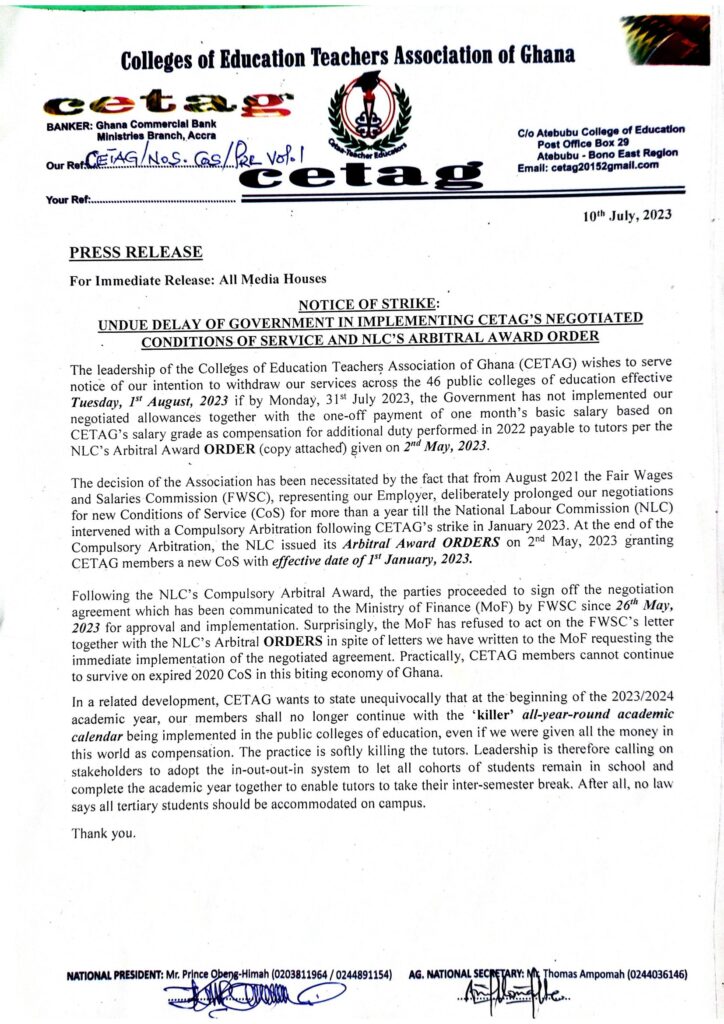
The National Labour Commission (NLC) has instructed the Colleges of Education Teachers Association of Ghana (CETAG) to refrain from its planned strike.
The NLC stated in a letter dated July 11, 2023 and written to CETAG that the subject has already been determined and that failure to implement will result in Commission enforcement.
The Colleges of Education Teachers Association (CETAG) has given notice that they would be leaving the 46 public colleges of education on Tuesday, August 1st, 2023.
The government has until July 31, 2023 to implement the stipulated allowances, according to the Association.
“Together with the one-off payment of one month’s basic salary based on CETAG’s salary grade as compensation for additional duty performed in 2022 payable to tutors per the NLC’s Arbitral Award ORDER given on 2nd May 2023,” the National President of CETAG, Mr. Prince Obeng-Himan stated in a press release dated July 10, 2023.
He added that their decision was forced by the Fair Wages and Salaries Commission’s (FWSC) “deliberately prolonged” negotiation of their working conditions.
The leadership of the Colleges of Education Teachers Association (CETAG) has announced their intention to withdraw services from all 46 public colleges of education starting from Tuesday, August 1, 2023.
CETAG has given the government a deadline of July 31, 2023, to implement the negotiated allowances.
“Together with the one-off payment of one month’s basic salary based on CETAG’s salary grade as compensation for additional duty performed in 2022 payable to tutors per the NLC’s Arbitral Award ORDER given on 2nd May 2023,” the National President of CETAG, Mr. Prince Obeng-Himan stated in a press release dated July 10, 2023.
The decision of the Colleges of Education Teachers Association (CETAG) to withdraw services was driven by what they perceive as intentionally prolonged negotiations by the Fair Wages and Salaries Commission (FWSC) regarding their condition of service.
Organized Labour has decided to suspend its planned strike, initially scheduled for Monday, July 10, 2023, which aimed to demand the reinstatement of three terminated local union workers at Sunon Asogli Power Limited.
The suspension comes following the Council of State’s request for additional time to engage with key stakeholders.
Expressing disappointment with Sunon Asogli’s refusal to reinstate the union leaders after what they deem as unjust contract terminations, the Trades Union Congress Secretary General, Dr. Yaw Baah, addressed the media.
He stated that the Council of State has been given until July 17, 2023, to deliver positive news on the matter.
Addressing the media, the Secretary General of the Trades Union Congress, Dr. Yaw Baah says it has given the Council of State up till July 17, 2023, to come up with positive news.
“Today, the council of state called us and assured us. Having listened to our issue they saw that, we are not asking for the moon, all that we are asking is that our three brothers are reinstated.”
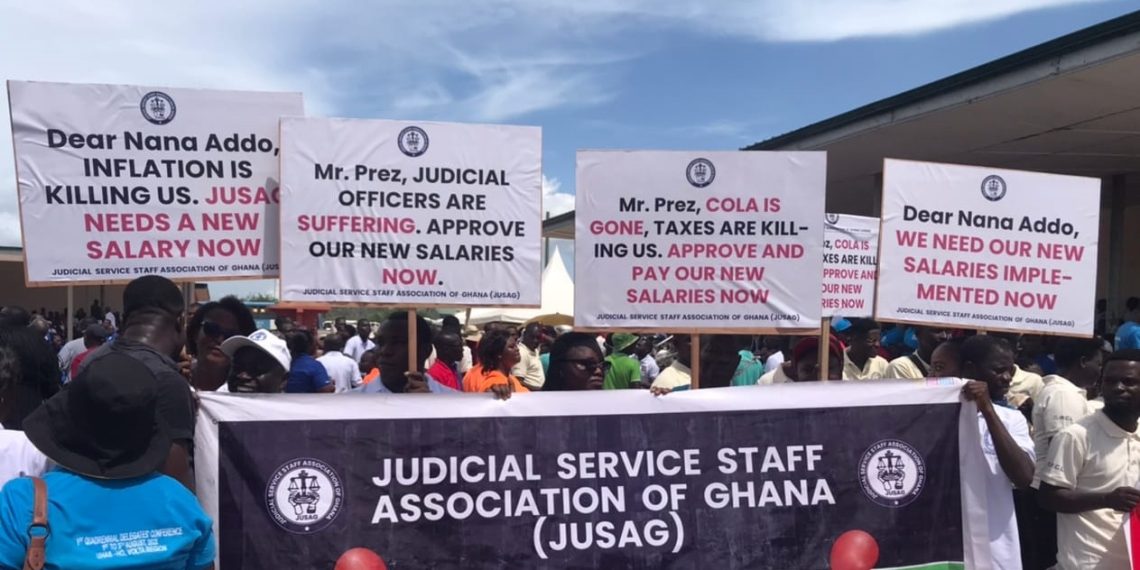
The approval of the proposed remuneration structure and a payment schedule, according to the Judicial Service Staff Association of Ghana (JUSAG), would be sufficient to end the ongoing statewide strike.
This follows an appeal from the Judicial Service to JUSAG to call off the strike.
In a release dated May 25, 2023, management of the Judicial Service invited executives of the striking group for a meeting scheduled for Wednesday, May 31, to discuss their concerns.
Speaking to the media, General Secretary of JUSAG, Abdulai Yakubu, acknowledged the appeal by the Judicial Service, adding however that they will not back down on their decision until a payment plan is communicated to them.
“We respect the call by the Judicial Secretary to meet, and we are highly appreciative of the intervention that is coming from the management. However, the meeting that has been called is a work in progress and not an end to meeting our demand. So we will wait to get to the meeting before we make a decision,” he said.
Meanwhile, Chief Justice nominee, Justice Gertrude Torkornoo, during her vetting on Friday, May 26, said processes are ongoing to address the concerns of JUSAG.
Justice delivery is in limbo as the industrial action by JUSAG over salary increase and payment of arrears since January 2023 continues to bite harder.
The Judicial Service Staff Association of Ghana (JUSAG) has stated that the approval of their proposed salary structure and the communication of a payment plan would be sufficient for them to halt their ongoing nationwide strike.
This comes in response to an appeal made by the Judicial Service to JUSAG, urging them to end the strike.
In a press release issued on May 25, 2023, the management of the Judicial Service invited the executives of JUSAG for a meeting scheduled to take place on Wednesday, May 31. The purpose of the meeting is to address the concerns raised by the striking group.
During an interview on Eyewitness News on Citi FM, Abdulai Yakubu, the General Secretary of JUSAG, acknowledged the appeal made by the Judicial Service. However, he emphasized that they would not reconsider their decision to strike until a concrete payment plan is communicated to them.
“We respect the call by the Judicial Secretary to meet, and we are highly appreciative of the intervention that is coming from the management. However, the meeting that has been called is a work in progress and not an end to meeting our demand. So we will wait to get to the meeting before we make a decision,” he said.
Meanwhile, Chief Justice nominee, Justice Gertrude Torkornoo, during her vetting on Friday, May 26, said processes are ongoing to address the concerns of JUSAG.
Justice delivery is in limbo as the industrial action by JUSAG over salary increase and payment of arrears since January 2023 continues to bite harder.
The Rotational Nurses and Midwives Association is charging the Nurses and Midwifery Council to take a great interest and guarantee the payment of their 10-month unpaid allowance.
According to the association if government does not heed to their demands it has no other option than to put down their tools.
The group has in recent times been engaging various stakeholders including the Health and Finance Ministries to give them clearance for payments to be made however that has not yielded any positive results.
Speaking to Citi News, President of the Rotational Nurses and Midwives Association, Jasper Dzorkah lamented the impact this is having on members of the association while hinting at the group’s plan to withdraw their services or embark on a demonstration exercise on May 15 if government fails to pay them this week.
He however wants their professional body, the Nurses and Midwifery Council, to intervene in the matter.
“I think that everybody must have interest in what is going on. It is not fair to look at your younger ones working on an empty stomach for 10-11 solid months, and nothing has been said about it. We admit that the economy is in crisis and that we are not in normal times. But as we speak today, all MPs and Ministers are being paid. The government has ways of paying these people, so why not sort us out? It is really not necessary that every year Rotational Nurses and Midwives have to be on the streets before they are paid. It does not bring honour to the profession.
“I will call on the Nurses and Midwifery Council that they should have interest in our payments. If government fails to pay us we might be forced to strike on May 15,” Jasper Dzorkah, President of the Rotational Nurses and Midwives Association said.
Many Mobile Money Agents across the nation have complained about the holdup in commission payments.
In response to the delay, the Mobile Money Agents have also threatened to go on strike.
The Mobile Money Agents including the Northern Momo Agents, Mobile Money Advocacy Group, ABAG and MM Agents Association of Ghana, further want an increase in the cap in commission to GH¢3000 from the current GH¢1,000.
In a joint statement, the Mobile Money agents demanded: “The cash in Commission cap be moved from GH¢1,000 to GH¢3,000 while the 0.5% rate is maintained.”
According to them, “failure to do something about the status quo will have operational implications for Agents and customers alike.”
“Cash-out commission shares should be made 50 percent. Maximum amount per cash out is GH¢1000.
“We are unable to cooperate with the two payment cycles i.e. 15th and 27th of the following month for payment of previous month’s commissions to our members,” the Mobile Money Agents indicated.
The Mobile Money Agents stressed that: “Further delay in payment reduces the purchasing power of what is paid Agents due to the current inflationary rate and cost of service availability.
“That auditing and validation as the cause of the current undue delay, cannot be justified hence we want all our members to be paid the same date on or before 15th of each Month.”
The Mobile Money Agents added that: “It was totally wrong to unilaterally decide on payment in batches without prior agreement with leadership.”
Jury members who had stopped showing up to court because they had not received their allowances for 13 months have returned to work after the strike was called off.
After making a partial settlement with their underpaid allowances last week, they returned to court this week.
On April 18, persons who were seconded by their respective institutions to serve as jurors to assist the Judicial Service of Ghana resolve high-profile cases at the High Court abandoned their duties over 13 months of unpaid allowances.
They complained that, since March 2022, their allowances have been outstanding, making it impossible for them to commute to and from the court.
On Tuesday, April 25, the jurors are back in court serving their duties in the various murder cases.
EIB Network’s Legal Affairs Correspondent, Murtala Inusah, who is in court, reports that the jurors have so far been paid about four months of their allowances.
Workers of Tema Oil Refinery(TOR) have given notice of their intention to embark on a series of actions, including picketing at the Jubilee House, to support their call for the revamping of the refinery.
Mr. Bernard Owusu, National Chairman of the General Transport Petroleum Chemical Workers Union (GTPCWU), announcing this in a press conference at the forecourt of TOR, said the industrial actions would precede the May Day celebrations.
Mr. Owusu said other workers would also picket at the premises of the Ministry of Energy and other strategic locations as several calls and meetings with management and government officials had yielded no result.
He said it was worrying that the refinery, which has the best engineers in the sub-region and has the capacity to refine 45,000 barrels a day, was only carrying finished products instead of fulfilling its core mandate of refining crude.
He questioned why Ghana has crude oil and yet TOR could not get crude to refine, adding that, almost all the companies created by Osagyefo Dr. Kwame Nkrumah Ghana’s First President has collapsed.
He said TOR workers would not allow that to happen to the refinery.
He reminded the government that if TOR was working at full capacity, it would supply the country with 50 percent of its overall domestic consumption, provide 100 percent of the residual fuel oil (RFO) for industrial operations, provide 20 to 25 percent of LPG consumption, and provide 100 percent of Aviation Turbine Kerosene (ATK).
The National Chairman of GTPCWU further said that on average, Ghana required about $4.8 billion to import petroleum products per year.
He said if TOR was producing, the forex requirement for petroleum product imports would significantly reduce by over 50 percent.
He said other benefits included the lowering of domestic ex-pump prices due to the removal of certain import charges, including the freight rate of about $92/Mt for petrol, $101/Mt for diesel, and $83/Mt for LPG.
He added that revamping TOR to work at full capacity would also lower the financing charges as these transactions were cedi denominated.
The Union observed that as Ghana was currently going through financial distress and a debt restructuring programme, significant benefits from TOR’s work should be top on the national agenda.
“Unless the managers of the country have no confidence in those, they have appointed to manage the TOR facility, the state is responsible and determines those who constitute the Board of Directors and the MD of TOR.
“Therefore, all past and current operational anomalies and challenges must be borne by the appointing authority of these key critical office holders, knowing very well that all operational controls are a function of management,” he added.
Mr. Anthony Koomson, Chairman of the Senior Staff Union, reminded the government that when TOR functions, it does not only benefit the staff but all Ghanaians and the economy.
Mr. Koomson said if the issue has to do with competent management, then the government must appoint the right people.
Due to the delay in paying its members’ professional and skills development allowance, the Teachers and Education Workers Union (TEWU) has given notice that it would stop providing its services.
The Union claims that it has waited in vain for the concerned parties to address the issue, together with its members in the Ghana Education Service (GES).
A statement issued by the Union signed by its Secretary, Mark Dankyira Korankye, noted: “We have come to the conclusion that although processes leading to the payment of the allowance have been concluded, our Employer and the Government side are deliberately frustrating the union’s effort in getting this legitimate for our members.”
It noted that leadership of the Union can no more hold the pressure mounting on them by members.
It, therefore, served notice that if no pragmatic steps are put in place towards payment of the allowances, it will withdraw its services.
“If by 15 April 2023, we do not hear of pragmatic and positive measures put in place to ensure payment of the allowances, we will have no option than to resume our strike action which was suspended on 5 January 2023, in good faith and full of trust which has been broken on the side of government,” the statement added.
TEWU, whose members include bursars, cooks, cleaners, administrators, accountants, auditors, among others, called off its nationwide strike last year after a meeting with stakeholders to discuss their grievances.
A committee was set up to deliberate on their grievances after it had called off the strike.
On Wednesday, 13 January 2021, TEWU went on a similar strike over the government’s failure to finalise their conditions of service.
After voting overwhelmingly in favour of industrial action earlier this month, the British Medical Association (BMA) declared that the doctors had “no option” but to go on strike beginning March 13.
The BMA stated that junior doctors have requested an urgent meeting with health secretary Steve Barclay twice in the past week, but added that no time has been set.
The BMA reported that a meeting with Department of Health employees earlier this week had produced no appreciable advancement and that the minister had declined to attend.
The co-chairs of the BMA junior doctors’ committee, Dr Rob Laurenson and Dr Vivek Trivedi, said patients and the public alike need to know the blame for the strike action “lies squarely at the government’s door.”
They said: “Make no mistake, this strike was absolutely in the government’s gift to avert; they know it, we know it and our patients also need to know it.
“We have tried, since last summer, to get each health secretary we have had around the negotiating table. We have written many times, and, even as late as yesterday, we were hopeful Steve Barclay would recognise the need to meet with us to find a workable solution that could have averted this strike.
“We have not been told why we have not been offered intensive negotiations or what we need to do for the government to begin negotiations with us. We are left with no option but to proceed with this action.
“The fact that so many junior doctors in England have voted yes for strike action should leave Ministers in absolutely no doubt about what we have known for a long time and have been trying to tell them: we are demoralised, angry, and no longer willing to work for wages that have seen a real terms decline of over 26% in the past 15 years.
“This, together with the stress and exhaustion of working in an NHS in crisis, has brought us to this moment, brought us to a 72-hour walk out.
“How, in all conscience, can the Health Secretary continue to put his head in the sand and hope that by not meeting with us, this crisis of his government’s making, will somehow just disappear?
“It won’t, and patients and the public will continue to feel the brunt of his inaction, until he starts to negotiate with us and we agree a deal that truly values junior doctors and pays us what we are worth.”
The British Dental Association announced that dentists working in hospitals employed under the junior contract will join the 72-hour walkout after voting for industrial action.
British Dental Association chairman Eddie Crouch said: “This small but important group of dentists are working to the same contracts as their medical colleagues, and like them are not worth a penny less than they were 15 years ago.