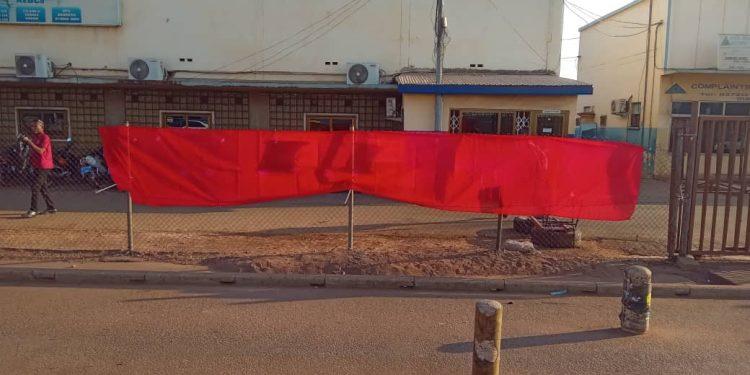
The strike was to demand Osmani Aludiba Ayuba, Managing Director of NEDCo, to voluntarily resign or be removed from office by the Board of Directors.
The angry NEDCo staff accused the Managing Director of failing to improve the company’s financial situation.
“Our finances from 2019 to date has been worse. In fact, our cash flow is terribly bad to the extent that we are unable to pay our third parties (contractors). In Bolgatanga, our contractors went on strike because of work they have done for NEDCo. From January-December 2022, we are not able to pay and so that is how bad the situation is.”
They also accused the Managing Director of incompetence saying it has resulted in the companylosing revenue.
The National Labour Commission (NLC) on Friday summoned the agitating staff for a meeting after a complaint by the Ministry of Energy.
In a letter, the staff union asked all its members to resume work effective Friday, February 17, 2023, in compliance with the NLC directive.
Below is the full statement by NEDCo
UPDATE ON VRA/NEDCo STAFF GROUPS RESOLUTION FOR THE REMOVAL OF MR OSMANI ALUDIBA AYUBA AS THE MANAGING DIRECTOR, NEDCO
The Staff Groups Leadership of VRA/NEDCo wish to bring to you an update on the Resolution passed by staff in all five (5) Operational Areas in NEDCo at emergency meetings held from January 06, 2023, to January 10, 2023, calling on Mr. Osmani Aludiba Ayuba, the Managing Director, NEDCo to voluntarily resign or be removed from office by the NEDCo Board of Directors on or before the end of January 2023.
At an emergency meeting held by Staff in all five (5) Operational Areas including head office on February 16, 2023, Staff affirmed the earlier resolution for the removal of Mr. Osmani Aludiba Ayuba as Managing Director of NEDCo and also voted massively for the escalation of the industrial action.
Staff Group Leadership was served later in the evening with a summons to appear before the National Labour Commission on Monday, February 20, 2023, in Accra. The commission also directed that we stay all ongoing industrial action and/or any intended action and appear as scheduled.
In view of this latest development, Leadership directs that we suspend the partial withdrawal of services and resume all services effective Friday, February 17, 2023, in compliance with the NLC directive.
Leadership will update Staff on the next line of action after the meeting at the National Labour Commission on Monday.
Most significant German airports, including the two busiest hubs in Frankfurt and Munich, are impacted in addition to Berlin’s. Participants include ground staff, employees from the public sector, and air traffic control.
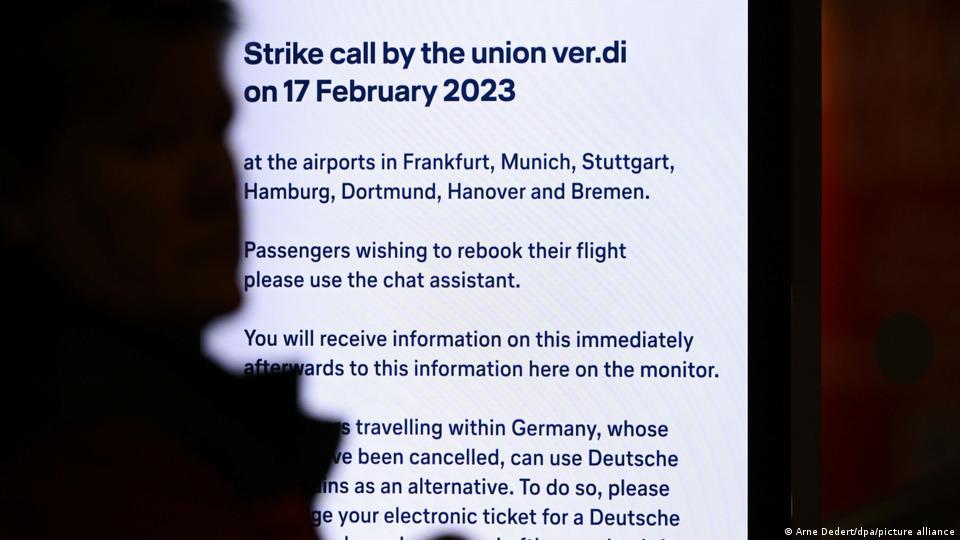
Almost all passenger flights are being halted on Friday due to a 24-hour strike at seven major German airports.
A total of 294 flights have been cancelled, affecting about 295,000 passengers, including the foreign minister of Romania who was trying to attend the Munich Security Conference.
All regular passenger flights were halted at Germany’s two busiest hubs, Frankfurt and Munich, and airports in Bremen, Dortmund, Hamburg, Hanover, and Stuttgart were also affected by the strikes.
Berlin Brandenburg Airport was the largest hub spared the disruption, though it suffered a full-day warning strike late last month.
“When we look at the airport terminals this morning, it reminds us more of the worst days of coronavirus than of a warning strike,” Ralph Beisel of the ADV airports’ association told Bavarian public broadcaster Bayerischer Rundfunk on Friday.
Airports and airlines have questioned the extent of the industrial action and its appropriateness, while the Verdi trade union said it needed to send a “strong signal.”
Beisel said the terminals were empty, with advanced warning for the strikes meaning the vast majority of affected passengers at least knew not to come to the airports.
International flights were for the most part rescheduled, domestic travelers were mainly offered replacement rail tickets.
Who is on strike?
Ground personnel, air traffic controllers and public sector officials like firefighters are all on strike as part of major industrial action across multiple sectors by Germany’s second-largest trade union by membership, Verdi.
As the airports are state owned, most of their direct employees class as public sector employees, including IT officials, technicians and administrators, as well as ground staff like check-in or boarding assistants, refueling truck drivers or disabled passenger assistants.
This industrial action is a change of pace from the pilots’ strikes that led to repeated disruptions, particularly for the Lufthansa and Eurowings airlines, late last year.
Verdi is seeking improved pay and conditions for staff at airports in various functions, with a senior union representative saying the sector is hemorrhaging personnel even at a time when it is trying to recruit to fill gaps dating back to the serious reduction in air travel during the pandemic.
“If nothing changes on pay, then another chaotic summer awaits us all — and we must prevent that as a matter of urgency,” Verdi’s Christine Behle said on RBB-Inforadio early on Friday. “Many people did not just decide to switch workplaces during the pandemic, we all learnt that during last summer’s chaos.”
Ground staff went on strike on multiple occasions during 2022’s peak travel season in Germany, most notably during July.
A combination of staff shortages and rapidly recovering demand also led to chaos and overcrowding at a host of European airports, even on days with no industrial action.
Medical, aid, military, and government flights still in the air
Although almost all regular passenger flights to the affected airports were halted, some other crucial services were still operating.
Medical transports, aid deliveries — for instance following the major earthquake hitting Turkey and Syria — military flights and government flights were still running as scheduled.
This was particularly important for Munich International Airport, as the 59th Munich Security Conference formally opens on Friday.
Most visiting leaders and delegates could still fly into Munich on board government planes.
However, Romania’s Foreign Minister Bogdan Aurescu, who was scheduled to fly in on a commercial plane, would have to fly to Austria and then take a roughly four-hour car ride to Munich for the event, Romania’s embassy said.
Canada’s national women’s team will go on strike in pursuit of equal pay and increased funding from governing body Canada Soccer.
The players made the announcement via a joint statement on social media, calling for “immediate” change and demanding Canada Soccer reverse funding cuts they say have placed an “unacceptable burden” on the team.
Canada are sixth in FIFA’s women’s world rankings and are due to face the United States in the SheBelieves Cup on February 17.
Bev Priestman’s team are also viewed among the contenders for this year’s Women’s World Cup, where they have been drawn alongside hosts Australia, the Republic of Ireland and Nigeria in Group B.
The statement read: “We have been patiently negotiating with Canada Soccer for more than a year. Now that our World Cup is approaching, the women’s national team players are being told to prepare to perform at a world-class level without the same level of support received by the men’s national team.
“We are left feeling frustrated and, once again, deeply disrespected by Canada Soccer.
“We are tired – tired of constantly having to fight for fair and equal treatment, and for a program which will give us a chance to achieve what we know this team is capable of achieving.
“If Canada Soccer is not willing or able to support our team, new leadership should be found. We are committed to doing whatever it takes to create public awareness of this crisis.”
Players from the men’s national team subsequently issued a statement of their own, saying they “wholeheartedly support” the actions of the women’s team.
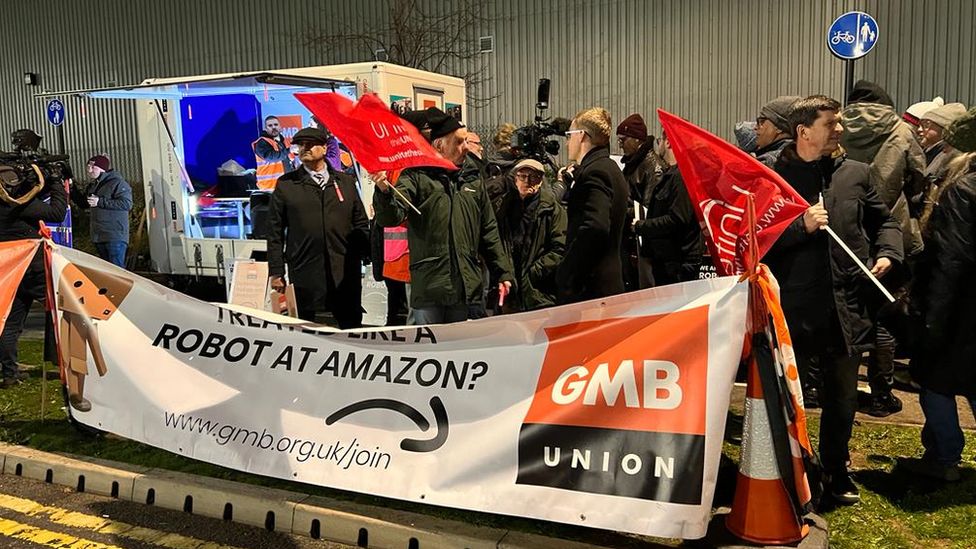
According to the GMB union, about 300 employees at Amazon’s warehouse in Coventry went on strike in protest of a “derisory” 5% pay increase to £10.50 per hour.
Workers complained to the BBC about “severe” working conditions, saying they are constantly watched and reprimanded for taking “idle time” that only lasts a few minutes.
A system “that recognises great performance” exists, according to Amazon.
If an employee isn’t meeting their performance goals, it “also encourages coaching to help them improve,” a spokesman said.
Two Amazon workers, who are members of the GMB, said the robots in the warehouse “are treated better than us”.
Darren Westwood and Garfield Hilton described to the BBC how even a trip to the toilet can lead to questions by managers.
“The thing with stopping work is that they want to know why,” said Mr Hilton. “So if the time is beyond a couple of minutes they can see it on the system.”
‘They will question you’
Mr Hilton, who has diabetes, said it is not always possible to find toilets close by in the building and the process of locating one and returning can sometimes take upwards of 15 minutes.
“They will then question you, ‘what were you doing?’”
Image caption,Amazon workers in Coventry voted in December to take strike action
The men said that managers track staff performance, and time that is not spent scanning items is accrued.
Workers at the Coventry warehouse scan stock which is sent out to Amazon fulfilment centres, to be shipped to consumers.
Instead of scanning, workers might be asked to handle pallets. “So when there’s problems with a pallet or a box, that time will accrue,” said Mr Westwood.
“Technically it could add up to 30 minutes. [The managers] will come down and say, ‘during today, you’ve had 34 minutes of idle time. What were you doing?”
A spokesman for Amazon said: “Performance is only measured when an employee is at their station and logged in to do their job.
“If an employee logs out, which they can do at any time, the performance management tool is paused.”
But Mr Westwood and Mr Hilton said some colleagues were working 60-hour weeks to keep up with the cost of living.
Mr Hilton said that he has seen workers falling asleep on the short bus ride to Amazon’s warehouse. “There’s a huge amount of them in the building virtually in ghost mode.”
He said Amazon wants “every minute in that building to be maximised”.
“You have to look at it this way, if the box with the product is not moving, you’re not making money. This is Amazon. If there’s a problem with a box, it’s a loss-maker. If the box leaves a building it is making money.”
In August, Amazon offered UK workers a 5% payrise, which was worth 50p outside London and the South East.
Inflation, the rate at which prices rise, is at a 40-year high, putting pressure on household budgets.
Bogdan, who is 29, has worked for Amazon since 2015. He said after workers put their health at risk to work during the height of the pandemic, the pay offer “insulted” staff.
He said one reason for striking was the public needed to “understand what is going on” behind the scenes every time they make an order.
He claimed Amazon portrayed an image that “everything is fine”, but he added: “It’s actually not true.”
Image caption,Amazon chairman Jeff Bezos, seen here with his partner Lauren Sánchez, has a $120bn fortune
An Amazon spokesman said it was “proud” of its “competitive” pay rates. He said the starting pay for workers was £11.45 an hour in London and the South East, and £10.50 an hour in the rest of the UK.
He said this marked a 29% increase in the minimum hourly wage paid to Amazon employees since 2018.
But union members want to be paid £15 an hour. Mr Westwood said the 50p offer was “a smack in the mouth”.
“These people had worked two years through the pandemic, that had seen Amazon’s shares go through the roof. They had seen the profits just become unimaginable,” he said.
Amanda Gearing, a senior GMB union organiser, told the BBC’s Today programme that Wednesday’s strike action would have a “massive impact” on the Coventry warehouse.
‘Only the start’
Of the 1,500 workers at Amazon’s Coventry site, around 300 will walk out, the union says.
“Coventry might be the start [of the strikes], but it won’t be the finish,” Ms Gearing said from the picket line. “We know there are workers in other centres that feel exactly the same.”
She added: “People are having to choose between heating their homes and… eating really, so it’s not good enough, not from someone like Amazon that’s got billions and billions of pounds of profit during the pandemic.”
Amazon’s global sales and profits soared as Covid restrictions forced people to shop online. Between 2019 and 2020, profits nearly doubled to $21.3bn (£17.2bn) and rose again the following year to $33.3bn.
Growth has been uneven since economies have reopened and after taking on thousands of staff since 2019, Amazon is now laying off 18,000 workers worldwide.
Mr Westwood said “people might think we’re being greedy” by asking for £15 an hour. But he pointed to Jeff Bezos, Amazon’s founder, executive chairman and space adventurer, who has a $120bn fortune according to Forbes magazine.
“We don’t want his boat or his rockets,” said Mr Westwood. “We just want to be able to live. I just want to be able to pay my bills at the end of the week. That’s all we’re asking for.”
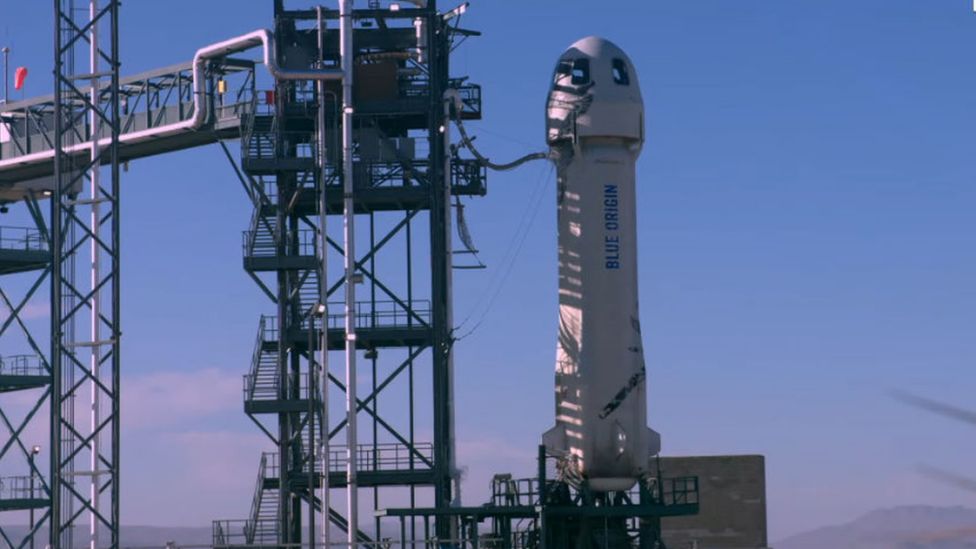
Image caption,Amazon founder Jeff Bezos owns Blue Origin, a “space tourism” business
Amazon said a “tiny proportion” of its workforce was involved in the industrial action. It said “only a fraction of 1%” of its UK employees voted in the ballot, which included those who voted against industrial action.
But Mr Westwood said the numbers were “brilliant”. Amazon does not recognise unions but, according to the GMB, there are members scattered throughout the UK in varying numbers.
Amazon has been battling against unionisation in the US.
More than half of the 8,000 workers at a warehouse on Staten Island, New York, voted to join the Amazon Labor Union which has now been officially certified. However, the company has vowed to appeal the certification.
Mr Westwood said there was a huge range of different nationalities who work at Coventry. “They don’t understand this is the UK – we can organise a union, we can protest, we can withdraw our labour,” he added.
“[Our workers] need someone. I know it’s going to be a long slog, but these people need someone who’s not frightened. And I’m not frightened.”
Airlines in Nigeria said on Monday that flights were being disrupted after ground staff began an indefinite strike to demand higher pay.
Air Peace, which has the biggest fleet in Nigeria, and smaller domestic carrier Dana Air said the strike by the Nigerian Aviation Handling Company (NAHCO) was delaying flights and they hoped the issue would be quickly resolve.
“The strike has affected all operations of all airlines being handled by the company [NAHCO],” Air Peace said in a statement.
British Airways and Qatar Airways, among the foreign airlines frequently flying to Nigeria, did not immediately respond to requests for comment.
The National Union of Transport Employees and Air Transport Services Senior Staff Association of Nigeria issued a notice last week that its members would go on strike from Monday to press NAHCO for better pay.
Flight disruptions are common in Nigeria due to issues surrounding logistics, labour union strikes and fuel scarcity.
In May 2022, the Airline Operators of Nigeria, an umbrella organisation of domestic airlines, suspended flights for days saying the price of jet fuel had jumped from 190 to 700 Nigerian naira per litre (from $0.45 to almost $1.70). The rise was primarily caused by the Russian invasion of Ukraine in February.
Senegal’s transportation industry went on strike this past Wednesday. Several unions banded together to criticize the actions taken on January 9 to address road insecurity.
A plan announced in the wake of the deadly accident in the department of Kaffrine. But some transporters protest against the lack of consultation, and the impossibility of applying certain measures.
On Monday, the fatal bus accident cost the life of at least 19 people, bringing the death toll of car crashes to about 60 in a matter of days.
The government responded by announcing nearly two dozen measures, including limiting buses and trucks to 90 kilometres per hour (56 mph), banning night buses and outlawing the import of used tyres — the suspected cause of last week’s accident. However, some transport unions called certain dispositions out of touch with reality and lifestyles.
According to the World Bank, Senegal, a country of 17 million, records 24 road deaths for every 100,000 inhabitants annually.
College of Education Teachers’ Association of Ghana (CETAG) has announced that it will resume its strike on January 6, 2023.
In a release dated January 5, 2023, CETAG explained that the resumption of the strike is imminent as the stakeholders have not attached the needed seriousness to their concerns regarding the conditions of service for over two years now.
“Following a meeting held between the Government Team and CETAG on January 4, 2023, over the outstanding issues of CETAG, the National Council of CETAG met to evaluate what transpired and concluded that the strike action, which was suspended on December 17, 2022, shall resume on Friday, January 6, 2023, if the two-day grace period given to the Minister expires without a resolution of the outstanding issues,” portions of the statement read.
According to them, “all the outstanding issues contained in the communiqué signed on December 16, 2022, which the Minister promised to resolve within two weeks after the suspension of the strike, remain unresolved to date.”
CETAG also stated that the Fair Wages and Salaries Commission (FWSC) never took any steps to seek a financial mandate from the Finance Ministry for the three outstanding generic allowances, as promised.
It further rejected the January 2023 effective date for CETAG’s 2021 Conditions of Service, which the parties settled on at the beginning of the negotiations in August 2021.
“The effective date of January 2023 that government team wants to unilaterally impose on CETAG instead of the mutually agreed effective date of January 2022 is totally unacceptable,” they added.
According to CETAG, they can no longer trust the assurances given by the stakeholders to seek a further financial mandate for the three outstanding generic allowances since all previous assurances were never fulfilled.
They added that “GTEC has failed to disclose to CETAG the amount it has proposed to be paid as all-year-round work compensation as well as the time the payment shall be made.”
It will be recalled that on December 17, 2022, CETAG called off its five-week industrial action over their conditions of service.
This follows a majority vote by the Association’s local branches to call off their strike in exchange for an assurance from theEducation Minister that their concerns would be addressed within two weeks of suspension.
Out of the 35 colleges that voted online, 19 of them, forming the majority, agreed to suspend the strike but would resume if their outstanding issues were not resolved as promised.
Labour expert, YB Amponsah says, the government’s prompt action will help prevent the unions from completely shutting down the public service.
Y B Amponsah, a labour expert, has urged the government to act quickly to allay labour unions’ worries following their reservations about the debt exchange programme.
In keeping with the government’s efforts to restructure debt and restart the economy, Finance Minister Ken Ofori-Atta introduced the debt exchange programme on Monday, December 5.
Amponsah said the government’s timely intervention will help avert a total shut down of the public service by the unions.
At least seven labour unions – Teachers and Education Workers’ Union (TEWU), Ghana National Association of Teachers (GNAT), Ghana Registered Nurses and Midwives Association (GRNMA), National Association of Graduate Teachers (NAGRAT), Ghana Medical Association (GMA), Ghana Chamber of Commerce and the Trades Union Congress (TUC) – have raised red flags over the programme.
In a media engagement, Amponsah said the government has been too slow in addressing the issue.
“Is it too difficult for the government to call organised labour for a discussion? You have to engage them because that’s how you handle industrial relations.
“If this matter was handled early, I’m sure there would’ve been some consensus by now,” he said. “This is a negotiable matter. The government is saying A, you want B so it’s a matter of discussion.”
“If I was leading the negotiation, I’ll ask them (organised labour) to push their strike further down so you get some room for negotiation,” Amponsah added.
Strike
Organised labour has declared an indefinite strike effective 27 December to force the government to exempt pension funds from the planned debt exchange programme.
The Secretary General of TUC, Dr Yaw Baah, announced the industrial action at a press conference in Accra.
“We have decided firmly that because the government has refused to grant us our request that all pension funds must be exempted from the domestic debt exchange programme, all workers of Ghana are going to strike on 27 December 2022. We will be on strike until our demand has been granted,” Baah said.
“What it means is that all workers of Ghana should stay at home starting from 27 December. We will stay at home until the government acts. That is straight forward and very simple. We won’t sit down for the vulnerable people to suffer because somebody has made mistakes. We are going to be in our red dresses until we hear from the government,” he added.
Extension of debt exchange programme
Meanwhile, the Ministry of Finance has extended the deadline for the domestic debt exchange programme from 19 to 30 December, an official statement has said.
A statement issued by the Ministry of Finance on Friday (16 December), said the extension will afford the government the opportunity to consider suggestions made by all stakeholders with the aim of adjusting certain measures acceptable within the constraints of the Debt Sustainability Analysis.
“Considering these developments, and taking cognisance of the festive season, we have decided to extend the expiration date of the voluntary offer to Friday 30 December 2022, with a contemplated settlement date on Friday 6 January 2023,” the statement said.
“This extension comes on the heels of the announcement of a Staff-Level Agreement (SLA) with the IMF on 13 December 2022,” the statement added.
Following a majority decision by the association’s local chapters to end their strike, the Education Minister promised to address their issues within two weeks of the strike’s suspension.
Nineteen of the 35 universities that cast online ballots decided to call off the strike, but would resume if their unresolved issues are not addressed as promised. This represents the majority of the 35 colleges.
The remaining 16 cast ballots to prolong the strike until their welfare demands were satisfied.
However, eleven of the teacher preparation programs chose not to cast a ballot.
On Monday, December 19, 2022, instructors at the 46 colleges of education around the country are anticipated to report for duty.
The national president of the group, Prince Himah, promised members in a letter that the leadership was determined to negotiate better working conditions.
“Leadership promise to go to all length so that CETAG will get the best out of the engagement that is going to ensue as we suspend our destiny strike today, hoping the Minister and the Fair Wages and Salaries Commission shall take the necessary steps as promised to bring finality to bear on all the unresolved issues of CETAG,” portions of the statement read.
The biggest nursing protestever is set to start this morning as nurses in England, Wales and Northern Ireland will go on strike from 08:00 on Thursday in the largest action of its kind in NHS history.
Staff will continue to provide “life-preserving” and some urgent care but routine surgery and other planned treatment is likely to be disrupted.
The Royal College of Nursing said staff had been given no choice after ministers refused to reopen pay talks.
The UK government said the RCN’s 19% pay rise demand was unaffordable.
The action will involve nurses in around a quarter of hospitals and community teams in England, all health boards in Northern Ireland and all but one in Wales. Nurses are not striking in Scotland.
Under trade union laws, the RCN has to ensure life-preserving care continues during the 12-hour strike.
Chemotherapy and kidney dialysis should run as normal, along with intensive and critical care, children’s accident and emergency and hospital neonatal units, which look after newborn babies.
Beyond that, it will be up to NHS boards and trusts to negotiate services on a local level, with discussions likely to come down to the circumstances of some individual patients.
The biggest impact is likely to be in pre-booked treatment such as hernia repair, hip replacements or outpatient clinics.
The NHS has said it is “vital” people continue to come forward for emergency care during the strikes and anyone not contacted to reschedule an appointment should attend as planned.
The RCN balloted more than 300,000 nurses across individual NHS trusts and boards rather than in a single, national vote.
This means some nurses are not entitled to take industrial action, because the turnout in their local area was too low.
In England, the first round of strikes will go ahead in 51 of 219 hospitals, mental-health trusts and community services.
Strikes are also going ahead in all of Northern Ireland’s health boards and all but one in Wales, the Aneurin Bevan.
Most GP services will be unaffected, as nurses working directly for practices were not entitled to take part in the vote, but the strike will include district nurses working in people’s homes or community settings.
A second day of strike action will go ahead on 20 December, unless there is a breakthrough in talks.
In England and Wales, most NHS staff have already received a pay rise of roughly £1,400 this year – worth about 4% on average for nurses.
The political situation in Northern Ireland meant there was a delay in processing the increase – but nurses should receive backdated payments before the end of the year.
The RCN wants a larger rise, of 5% above the RPI inflation rate, which currently stands at 14%, saying its members have received years of below-inflation pay increases.
England’s Health Secretary, Steve Barclay, said further pay rises would mean taking money away from other front-line services.
“I’ve been working across government and with medics outside the public sector to ensure safe staffing levels – but I do remain concerned about the risk that strikes pose to patients,” he said.
Mr Barclay added that the government had followed the recommendation of the independent NHS Pay Review Body, which said in July NHS staff should receive the £1,400 increase, with slightly more for the most experienced nurses.
The body, made up mainly of economists and human-resources (HR) professionals, had been asked to base that recommendation on a range of factors, including:
the need to recruit staff
the funds available to the NHS
the government’s 2% inflation target
Welsh ministers said they were unable to enter pay talks without extra funding from the UK government.
In Scotland, the RCN’s strike action has been “paused”, after ministers made a fresh offer worth just over £2,200 a year for most NHS staff. Nurses have been asked to vote on that deal, with results due next week.
Union bosses have offered to suspend strikes if the UK government agrees to reopen serious discussions over pay.
But a face-to-face meeting earlier this week broke down, with the RCN accusing Mr Barclay of “belligerence” and having “too little to say”.
This will be only the second time RCN members have walked out in its 106-year history. Until 1995, the union had a formal no-strike policy in its rulebook.
In 2019, nurses in Northern Ireland went on strike over pay. And in 2014, those in England who were members of Unison walked out – also over pay.
This winter, a number of other major health unions, including Unison, the GMB, Unite the Union and the Royal College of Midwives, have also voted to strike in different parts of the UK, with a series of walkouts planned over Christmas and the new year.
Mark Harper advises unions to “think again” about their industrial action after the RMT’s most recent poll revealed that nearly 40% of respondents would accept the offer on the table.
According to Transport Secretary Mark Harper, the trend is shifting among rail unions in regards to the pay proposals that are being considered.
Yesterday, 64% of RMT members rejected Network Rail’s most recent offer, with general secretary Mick Lynch describing it as “substandard.”
The agreement would have increased pay by 5% and 4% over the course of two years, but it would also have resulted in thousands of job losses, a 50% reduction in scheduled maintenance tasks, and a 30% increase in unsocial hours.
However, Mr Harper said it had more support than previous offers on the table, urging the union to “look at it again, call off the strikes and accept what is a reasonable pay offer”.
Rail workers have staged another walkout today in the first of a raft of strike days in this month, covering 13, 14 and 16 and 17 December.
More strikes are also planned from 6pm on Christmas Eve to 5.59am on 27 December.
Speaking to Sky News, Mr Harper said the government has “got to be fair to the taxpayer”, adding: “There isn’t a bottomless pit of money to go into the rail industry.”
He insisted the offer made to workers was “very fair and reasonable”, and pointed to the fact bosses of the TSSA union – which represents station staff – had already recommended it to their members.
“Even with the RMT’s very strong recommendation to their members to not accept the offer to turn it down, to reject it out of hand, we still saw nearly 40% of RMT members wanting to accept it,” said the transport secretary.
“So I think the tide is turning on opinion about whether these offers are reasonable or not, and therefore I hope the union will look at it again, call off the strikes and accept what is a reasonable pay offer.”
But Mr Lynch said the offer included too many of the union’s “red lines”, including taking guards off trains and closing ticket offices.
“I can see a way through where we can get some improvements in the proposals,” he told Sky News. “We can come to terms with what they are calling their ‘modernisation agenda’.
“[But] if you’re looking for a compromise, you don’t put things into a package that you know your counterpart can never accept as a red line and as a principle.
“We don’t do that to the employers. We don’t demand things that they can never give us. We only request the things that are capable of being delivered.
“So it’s the imposition of the government that has caused a non-development of a deal and a non-development of a set of proposals that we can all work with.”
‘Campaign of disruption’
Mr Harper appeared to reject accusations that he had added in caveats to the deal on terms and conditions, meaning members would have to accept having no staff on driverless trains – something the RMT is strongly against.
“I don’t want these strikes to take place at all,” he added. “They’re bad for passengers. They’re bad for businesses.”
However, Mr Lynch stuck by his allegation, calling it a “campaign of disruption” by senior ministers.
“The government intervened with a set of proposals that they know cannot be acceptable because they want these strikes to go ahead,” he added.
“They are making enemies of working people. They make enemies of trade unions and they’re making enemies of the public.
Labour’s Andrew Gwynne told Sky News it was “incumbent on the transport secretary to sit down and negotiate a deal”, and accused him of refusing to do just that.
“Ultimately the public will now be worried about whether their Christmas arrangements are in turmoil,” he added.
“The government’s really got to get a grip of this and that starts by sitting down, negotiating, meeting and coming up with some kind of compromise that both sides can live with.”
Mr Gwynne also accused ministers of “letting” the nurses strikes go ahead later this month by refusing to negotiate over pay.
Health secretary Steve Barclay met the general secretary of the Royal College of Nursing, Pat Cullen, last night, with the RCN hoping he would move on a pay offer to avert the two days of industrial action on the cards.
But speaking to Sky News afterwards, Ms Cullen revealed he “was true to its word” and “would not talk to me about pay”, accusing him of “belligerence”.
Mr Harper defended the move when pressed on it this morning, saying: “We’ve got for the health service an independent pay review body that’s made a series of recommendations for people who work in the health service, including nurses who we value.
“So we’ve accepted all of their recommendations in full. The 19% pay rise that the nurses are asking for isn’t affordable. I don’t think it’s reasonable. And it would take money away from frontline health.”
But Labour’s Mr Gwynne said: “We’re not saying that we can afford what the unions are asking for, but a negotiation is just that. You sit down, you listen to the issues, you listen to the concerns on both sides. You come up with common areas to agree and ultimately come out with a deal.
“The government’s not doing that. We would do that. We would sit down with the employers’ representatives and we would ensure that we averted these strikes.
“We didn’t have a single strike on the NHS under the last Labour government. There’s no reason why there should be one under this Conservative government.”
‘Where were you in 22?’
The RMT’s Mr Lynch had his own advice for Labour when it came to striking workers, however, after the party’s leader Sir Keir Starmer banned frontbenchers from joining them on the picket lines.
“There will be a lot of working class people who are asking when the election comes, where were you in 22? What were you doing to support working class people in their struggles?
The general secretary of the RMT says Labour frontbenchers may wish to consider supporting striking workers if they want votes at the next election.
“If they want our votes in an election, they might want to come and stand next to us when we’re struggling with austerity, when we’re struggling with low pay and people who are in work are having to use foodbanks and living in housing and substandard conditions because of what this government is doing to us.
“If [Sir Keir] wants to be a leader of the working class, he’s got to show he identifies with the working class.”
Ambulance workers are set to strike, raising concerns among the public about their ability to respond in an emergency, but their union has stated that the government has the authority to halt their strike.
As the government holds emergency COBRA meetings to limit disruption while ten different industries go on strike this week, troops are being trained to drive ambulances.
Over the weekend, government sources stated that no decision had been made to submit a formal request to the Ministry of Defence, but that one was “not far away.”
But the Cabinet Office confirmed on Sunday night military personnelare being deployed to NHS hospital trusts across the UK to “familiarise themselves with vehicles” ahead of ambulance strikes planned for 21 and 28 December.
There will be 750 military personnel deployed, with 600 driving ambulances and 150 in support roles to cover 10,000 ambulance workers going on strike.
Two emergency COBRA meetings will also be held this week as ministers step up plans to limit disruption caused by industrial action, which is set to take place every day until the end of the year.
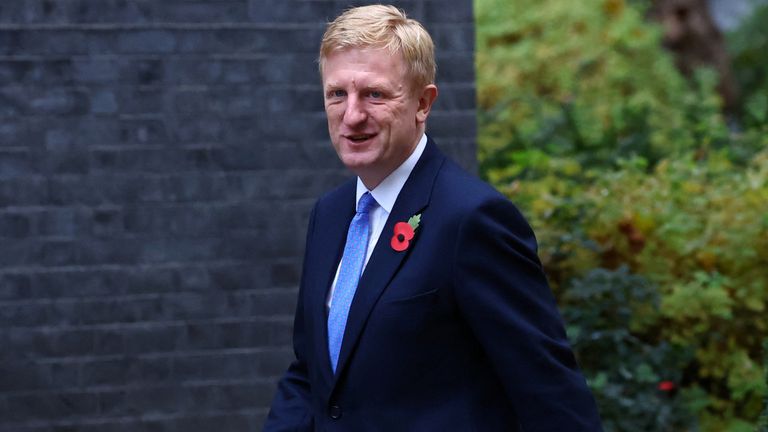
Cabinet Office minister Oliver Dowden will lead a meeting with his department on Monday to help “protect the public” against a lack of service caused by the strikes.
Starting from Monday, 10 sectors are set to strike this week: rail, the NHS, the Eurostar, buses, National Highways, baggage handlers, Royal Mail, nurses, driving examiners and civil servants.
The Cabinet Office said the government’s priority is to protect “those who may need access to emergency services support and limit disruption as much as possible, particularly at a time when increased numbers of people will be travelling for the festive period and NHS services are under huge pressure due to the impact of COVID”.
They will be attended by ministers from the Department for Transport, Department of Health and Social Care, the Home Office and the Ministry of Defence.
Image:Oliver Dowden will chair two emergency COBRA meetings on strikes this week
The Cabinet Office said the government has been planning to limit disruption since unions first proposed the December strikes last month.
Mr Dowden said: “We regret the stance unions have taken as it will only serve to disrupt the lives of millions of people up and down the country at what is an important time for them and their families.
“We urge union bosses to call off these damaging strikes and to keep talking.
“But it is right that each department across government plans for disruption and put in place the appropriate contingency measures to limit it as much as possible over the coming weeks.”
On Friday, Sky News reported military personnel had started training at Heathrow and Gatwick airports to check passports as Border Control staff are set to go on strike over Christmas.
A total of 600 military personnel are being deployed to help and around 1,400 civil servants are volunteering.
NHS workers who are Unison members in Northern Ireland will kick off this week’s strikes.
Nurses in England, Wales and Northern Ireland, who are members of the Royal College of Nursing, will go on strike for the first time ever on Thursday and again on 20 December.
Union bosses have said the strikes could still be called off if the government sits down and tries to resolve all the different disagreements over pay and conditions.
Foreign Secretary James Cleverly told Sky News on Sunday unions should negotiate with the independent pay review bodies, not with ministers.
RMT rail union leader Mick Lynch requested an urgent meeting with Rishi Sunak.
The prime minister’s spokesman said: “The government has played its part by facilitating a fair and decent offer and the RMT and its members should vote this deal through and end this harmful disruption.”
Unison said the government has the power to halt the strikes by making an effort to “put a proper pay plan on the table”.
“Instead of putting plans in place for the strike days, ministers should be concentrating all their efforts on ending the disputes,” Sara Gorton, head of health at Unison, said.
“Speaking to unions about improving wages can work wonders as the Scottish government has found. It’s time ministers in Westminster did the same. They should stop talking tough, put a proper pay plan on the table and get the unions in to discuss it.”
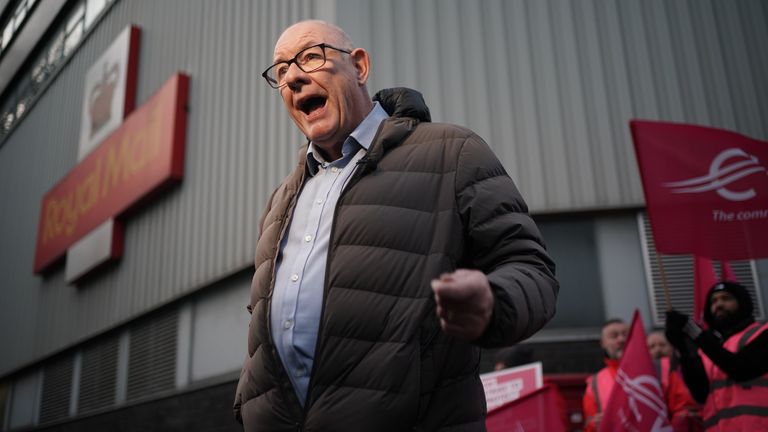
A postal workerwho is taking part in the strike action today discusses the complaints that front-line Royal Mail employees have and asserts that the firm will comply with their demands after the main Christmas season.
He said that the 115,000 frontline employees were fighting for the company’s very survival.
Workers are on strike today, and more walkouts are expected on December 11, 14, 15, 23, and 24.
In exchange for a greater salary raise, the firm is pursuing a modernization program that includes voluntary Sunday work. According to their union, the CWU, this would transform Royal Mail into a “gig economy-style parcel courier, dependent on casual labor.”
Royal Mail has argued it is crucial to help it better compete as it places a greater focus on the lucrative parcel delivery sphere at a time when the company is losing £1m a day.
Derek, who is a union member but not a rep, explained that while part of the fight was for better pay, he and his colleagues were walking out to protect the company’s values from a future that would mean a worse deal for the public and staff alike.
He said Royal Mail was attempting to weaken its commitments to letter delivery and make its contracted workers go further, through increased flexibility, to line the pockets of shareholders.
Dave Ward, general secretary of the Communication Workers Union, told Sky News that even if they were offered a 50% pay rise they would not accept it if the same terms and conditions were attached.
Image: The company has accused CWU leader Dave Ward of spreading unfounded claims about Royal Mail’s modernization plans
The main gripes, Derek said, covered Sunday working and later start times for deliveries.
“The pay deal is something we wanted but 2% (with more in return for accepting new working practices) was a joke,” he said.
“The vision is to start deliveries later and finish later but if you don’t complete by your time allocated, we don’t know where we stand as the goalposts keep changing. It becomes a conduct issue.
“They’ve got us by the b****.
“We are cutting off (finishing rounds before completion) on a regular basis because we’re not getting paid any extra to clear backlogs.”
CWU’s Dave Ward on what postal union will accept over pay deal
Derek blamed staff shortages, saying agency workers had been brought in to help.
“We’re on £12 an hour. Agency is getting £15-20,” he said.
“The night shifts for Christmas are another issue. The backlog is phenomenal. Packages are being prioritized when the company insists that is not the case.
Royal Mail boss: Union leaders are ‘trying to destroy Xmas’
“It’s the terms and conditions that are the paramount issue in this dispute. They’re trying to fix something that doesn’t need it.
“Once Christmas is over, they’ll do whatever they want and impose these changes.
“Compulsory working Sundays – I didn’t sign up for that. They say it’s voluntary but I’m having to do that now.
“Sickness is going through the roof.”
He added that Royal Mail was deducting wages by £117 per day for strike days.
“I only earn £75 per day but they’ve taken off allowances including for the loss of leaflet drops,” he claimed.
“Royal Mail said: “We are not docking extra days’ pay – if people work, are on annual leave, off sick or on a rest day, then they are paid as normal; if people take part in strike action, then they are not paid for the period that they are on strike.”
Royal Mail reacted to the growing cost of the strikes in October by launching a consultation on job cuts that could see around 10,000 roles cut by the end of August 2023. It later revealed half-year financial losses of £219m.
The company made, what it called, a “best and final” offer to end the dispute in late November.
However, its “extensive improvements” were rejected by the CWU.
A Royal Mail spokesperson said of Derek’s comments: “Dave Ward, general secretary of the Communication Workers Union, has made several false statements about job losses designed to mislead and create fear and uncertainty amongst our employees.
“As recently 28 November, we wrote Mr Ward to correct his false allegations that Royal Mail is planning to ‘sack’ thousands of workers and wants to become ‘another courier company.
“This is simply not true. We have already announced that reductions in 10,000 full-time equivalent roles – which have become necessary as a result of industrial action, the need for better productivity, and lower parcel volumes following the pandemic – will be achieved through natural attrition, reducing temporary workers and a generous voluntary redundancy scheme which has been oversubscribed.
Thousands of pupilsin Scotland will be absent from school on an unscheduled day as teachers continue their strike.
On Wednesday and Thursday, members of the SSTA and NASUWT unions will strike in their ongoing pay dispute.
It follows the EIS strike, which saw almost all schools close on November 24th, and the rejection of the most recent pay offer of 6.85%.
The Scottish government declared that the unions’ demands were “unaffordable.”
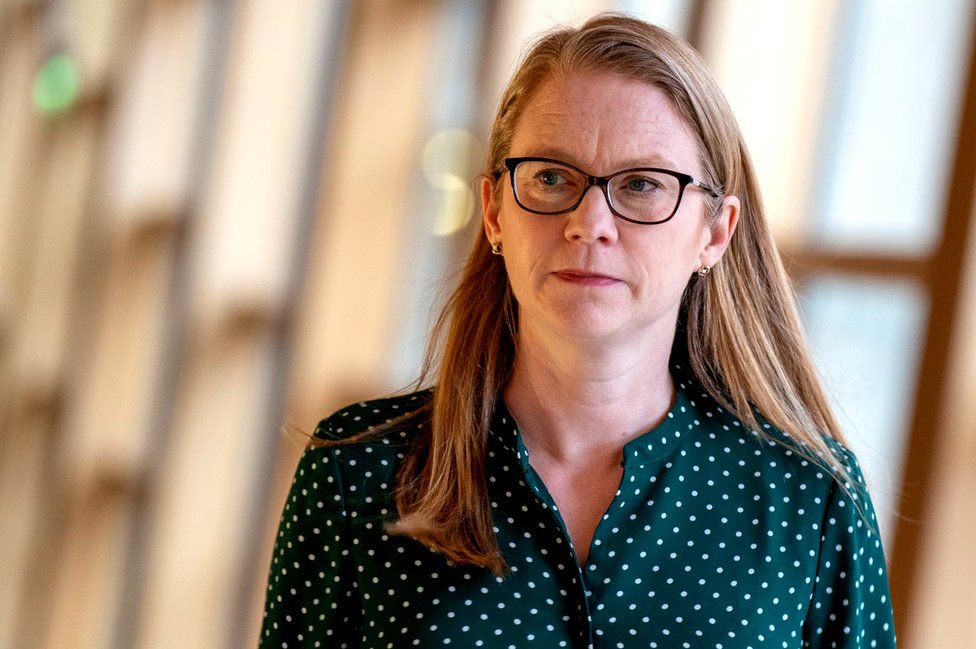
Shirley-Anne Somerville, Education Secretary, expressed her disappointment that the fourth offer made to the unions had been rejected.
On Wednesday, industrial action is taking place in: Argyll and Bute; Dumfries and Galloway; East Ayrshire; East Dunbartonshire; East Renfrewshire; Eilean Siar; City of Glasgow; Highland; Inverclyde; North Ayrshire; North Lanarkshire; Orkney; Renfrewshire; Shetland; South Ayrshire; South Lanarkshire; West Dunbartonshire.
The local authorities affected on Thursday are: City of Aberdeen; Angus; Aberdeenshire; Clackmannanshire; Dundee City; City of Edinburgh; East Lothian; Falkirk; Fife; Midlothian; Moray; Perth and Kinross; Scottish Borders; Stirling; West Lothian.
Disruption is expected in most areas through either partial or full closures of schools.
Although mainly limited to secondary schools, some primaries are affected. About a third of councils said they expected “significant” disruption.
IMAGE SOURCE,GETTY IMAGES Image caption, Education Secretary Shirley-Anne Somerville said the pay demands were not affordable
With prelim exams taking place in many schools, older pupils are being prioritised and younger pupils are being given the day off.
The latest pay offer from the Scottish government was formally rejected last Wednesday.
Unions were offered a rise of between 5% and 6.85% but the EIS is asking for 10%.
On Tuesday the NASUWT said it was seeking a fully funded rise of 12% for 2022/23.
It said that a typical teacher in Scotland is almost £50,000 worse off as a result of their pay failing to keep pace with inflation since 2010, a loss they say will be further compounded by the current below-inflation pay offer.
The union also confirmed that following this week’s strikes, members would begin a programme of ongoing action, including a refusal to cover for absent colleagues and attendance at only one meeting per week outside pupil sessions.
“The fact it has come to this is a reflection of the depth of anger and frustration they feel at being continually told by ministers and Cosla that there is no more money to increase their pay, while their workloads spiral and the expectations on them mount.
“They are sick of warm words telling them how much they are valued, while their pay dwindles each year in real terms.
“Talk is cheap but actions matter and they are tired of being taken for granted and expected to work harder and harder for less and less money.”
‘Willingness to resolve the dispute’
Seamus Searson, the SSTA’s general secretary, said employers Cosla had not contacted the union since 22 November to avert the strikes.
He said teachers were striking to send a hard message that teachers demand to be respected and receive a professional salary that will retain staff.
“Hopefully, the employers and the Scottish government will understand that all teacher unions in Scotland are united in seeking a fair and reasonable pay settlement and there needs to be a willingness to solve the pay dispute,” he said.
“The latest offer was quickly rejected by the teacher unions and was deliberately divisive and inadequate. This apparent show of contempt to teachers by this offer has hardened the resolve of members and forced the SSTA to take the strongest form of action”.
Mr Searson apologised to pupils and parents and said the teachers would rather be in school teaching.
He added that the SSTA was always willing to meet at any time with the employers and Scottish government to find a resolution.
‘Engage constructively’
Education Secretary Shirley-Anne Somerville said: “Strike action is in no-one’s interest, least of all learners, parents and carers. We remain committed to a fair, sustainable settlement for Scotland’s teachers and will continue to engage teaching unions and Cosla constructively.
“It is very disappointing that the teaching unions have rejected the latest offer – the fourth which has been put to unions – which mirrors the deal accepted by other local government workers.
“The request for a 10% increase for all teachers – even the highest paid – is not affordable within the Scottish government’s fixed budget.
“While councils are responsible for managing the impact of industrial action, I expect schools to remain open wherever possible, so that disruption can be minimised. Any closures would follow risk assessments made in individual areas.”
The pay offer made by employers before the EIS strike a fortnight ago has not been improved or amended.
So is this dispute now deadlocked? Or will a new offer be made in time to avert the next wave of strikes after Christmas?
The Scottish government has made it clear that a bigger pay rise would mean tougher cuts and savings elsewhere.
The other potential difficulty is that teachers – who are employed by councils – could end up with a bigger pay rise than other local authority staff, including those on significantly lower salaries.
The council unions would almost certainly consider this when they submit their next pay claim.
But the spectre of regular school strikes is something nobody wants.
The teachers’ unions will have noted how an improved pay offer was made to NHS staff amid the threat of strikes.
Solving industrial disputes usually involves compromising. It is rare for one side to get everything it wants. But one side usually has to blink first.
Meanwhile the EIS has said its members should not cover for striking colleagues in the two other unions.
It said: “The EIS position is that no member should engage in any duty which is normally carried out by members of another union who are on strike action.
“We are aware that some local authorities are attempting to exert pressure on teachers to provide cover, but the EIS believes that it is unreasonable for our members to be instructed to strike break for colleagues of another trade union carrying out official industrial action in a common dispute.
“The EIS will offer its full support to any member who is subjected to this type of intimidation by their employer.”
Workers across the ambulance services and some NHS trusts have voted to take industrial action over the government’s 4% pay award, which the GMB has described as another “massive real-terms pay cut”.
More than 10,000 ambulance workers have voted to strike in England and Wales, the GMB union has announced.
It said: “No one in the health service takes strike action lightly – today shows just how desperate they are.”
Paramedics, emergency care assistants, call handlers and other staff are set to walk out in nine trusts:
South West Ambulance Service
South East Coast Ambulance Service
North West Ambulance Service
South Central Ambulance Service
North East Ambulance Service
East Midlands Ambulance Service
West Midlands Ambulance Service
Welsh Ambulance Service
Yorkshire Ambulance Service
The industrial action is set to take place before Christmas, with the union planning to meet reps in the coming days to discuss potential dates.
The GMB said workers across the ambulance services and some NHS trusts have voted to strike over the government’s 4% pay award, which it described as another “massive real-terms pay cut”.
“Ambulance workers – like other NHS workers – are on their knees,” said the union’s national secretary, Rachel Harrison.
“Demoralised and downtrodden, they’ve faced 12 years of Conservative cuts to the service and their pay packets, fought on the front line of a global pandemic and now face the worst cost of living crisis in a generation.”
What other strikes are due to take place?
The strike comes after the UK’s biggest trade union, Unison, announcedthousands of its ambulance workers in England also intend to take industrial action before Christmas.
Up to 100,000 nurses from the Royal College of Nursing are also set to stage a mass walkout in December – one of the busiest months for the NHS.
Thearmy has already been placed on stand by in case it is needed to fill the roles of NHS workers while strikes are taking place.
Several strikes are also taking place across other sectors, with Eurostar security staff announcing earlier on Wednesday that they will be taking part in a walkout next month in a dispute over pay.
Heathrow Airport ground handlers will go on strike for 72 hours in protest of their pay.
According to the Unite union, the strike will begin at 4 a.m. on Friday.
The strike by workers at aviation services firm Menzies will affect a number of airlines and disrupt flights departing from terminals 2, 3 and 4 at Britain’s busiest airport, according to a union statement.
Air Canada, American Airlines, Luthansa, Swiss Air, Air Portugal, Austrian Airlines, Qantas, Egypt Air, Aer Lingus, and Finnair flights are the most likely to be affected.
Workers are walking out in protest at what the union describes as a “derisory” pay offer from Menzies to the ground handlers, which they say is “far below the current real inflation rate of 14.2 per cent (RPI) and amounts to a substantial real terms pay cut”.
It had been feared passengers using Qatar Airways to fly to the football World Cupmight be affected, but planned action by another ground handling company, Dnata and by Menzies Cargo, has been cancelled.
Unite regional officer Kevin Hall said the strike was “entirely of Menzies’ own making”.
He added: “They have had every opportunity to make a fair pay offer, but have chosen not to do so.”
A Heathrow spokesperson said it was aware of the proposed industrial action.
A statement added: “We are in discussions with our airline partners on what contingency plans they can implement to support their ground handling.
“Our priority is to ensure passengers are not disrupted by airline ground handler shortages.”
The Royal College of Nursing (RCN) announced last week that its members at the majority of NHS employers across the UK had votedto strike.
Nurses have given the government five days to begin “detailed negotiations” on pay, or they will declare a December strike.
It comes as the chancellor pledged an extra £2.3 billion for the NHS over the next two years, as the health service deals with inflationary pressures.
NHS England has forecast a £7 billion funding shortfall for next year, which it cannot close with efficiency measures alone.
However, health officials are said to agree that the new funding is adequate in light of the fact that economists believe October’s inflation figure was the high point.
Last week, the Royal College of Nursing (RCN) announced its members at the majority of NHS employers across the UK had voted to take strike action.
A health system in crisis
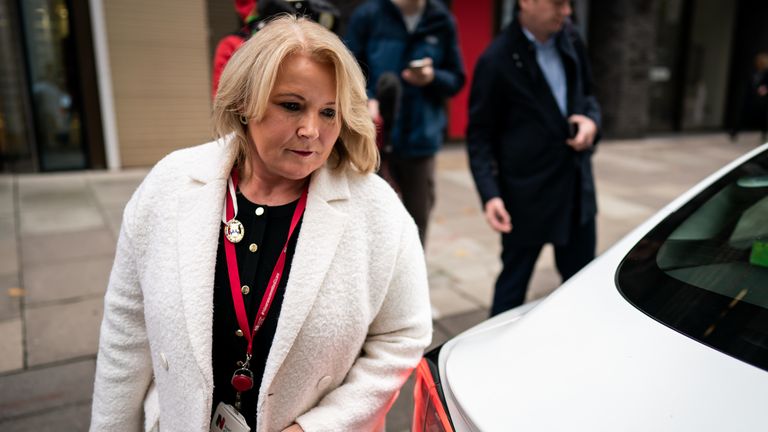
In a letter to the health secretary following Thursday’s autumn statement, RCN general secretary and chief executive Pat Cullen said recent meetings with Steve Barclay, while cordial in tone, had not resolved the issues at the heart of strike action.
“I must not let my members, nor the public confuse these meetings for serious discussions on the issues of NHS pay and patient safety,” she said in the letter.
“There is only value in meeting if you wish to discuss – in formal, detailed negotiations – the issues that have caused our members to vote for strike action.”
She added: “You have again asked to meet in the coming days and for this third occasion I must be clearer in my expectation.”
With record demand and waiting times, as well as a growing backlog ahead of what looks set to be a busy winter, the UK’s health and care system are facing a crisis.
Image: Pat Cullen leaving a meeting with the health secretary earlier this month
There are nursing staff shortages across the UK – made worse by the COVID-19 pandemic and cost of living crisis – with 60,000 unfilled nursing roles.
Data from the London School of Economics found the salaries of experienced nurses have declined by 20% in real terms over the last 10 years across most of the UK. This means nurses are effectively working one day a week for free.
The RCN is calling for a pay rise of 5% above inflation to combat this.
Strikes across the NHS
The RCN is not the only organisation threatening strike action within the NHS.
NHS workers in roles such as blood and transplant services were among nearly 10,000 people being balloted over action that could see them walk off the job as soon as January.
Unite union, which represents 100,000 NHS workers, said voting papers are going out across 36 NHS trusts and organisations in England and Wales.
Thousands of public servants began a one-day strike in South Africa on Thursday over wage demands, professional organizations said.
The work stoppage is being led by one of South Africa’s largest public service unions, the Public Servants Association (PSA), which has some 235,000 members.
The dispute over public servants’ salaries flared up after Labour Minister Thulas Nxesi announced last week that he would increase salaries by 3 percent, while the unions were demanding 6.5 percent.
Picket lines were observed during the day around central government offices in Pretoria by strikers in the health, immigration, and police sectors.
According to the PSA, the strike was expected to have a “serious impact” on the Department of Home Affairs, transport and customs services.
According to the union, “the minister’s irresponsible attitude has degraded already fragile social relations and deepened the lack of trust” with the social partners.
South African Finance Minister Enoch Godongwana said in an October budget presentation that the government could only afford a 3.3 percent wage increase, well below the 7.8 percent inflation rate in July.
South Africa’s economy has already been hit hard by several weeks of strikes in the railways and port services, which have affected mineral and fresh fruit exports.
Kenya Airways was forced to cancel 75% of its flights on Monday due to the ongoing pilots’ strike, leaving thousands of passengers stranded.
Members of the Kenya Pilots’ Association began their industrial action on Saturday, despite a court suspension order, after it failed to reach an agreement in talks with management on better working conditions.
Their demands include the companylifting a suspension of payments to the staff provident fund and for salaries owed from the Covid-19 pandemic period to be paid.
Impacting travel
The cancellation of flights by Africa’s second largest airline, is having a huge impact on travel across the continent. While some people have managed to find alternative flights, others have not been so lucky.
‘The government of Kenya is doing nothing about it to make sure that people go back to their homes. There are people who have work to do and now we are stuck here. Like four days, it’s a long time,’ says South African, Martha Magumbu.
Others, like Ifebusola Shotunde, are disappointed as the alternative flights they have been offered have substantially increased their travel time.
‘I was supposed to go home today from Nairobi to Lagos, but due to the strike they have postponed our flight to 4:30 am tomorrow. Now I need to think about what I am going to do tonight and also the plans I made back at home,’ he says.
Jeopardizing recovery of airline
The strike is exacerbating the woes of the troubled national carrier which has been running at a loss for years, despite the government pumping in millions of dollars to keep it afloat.
It is also expected to have a negative impact on Kenya’s exports as the airline transports some 150 tonnes of fresh produce on average to Europe and the Middle East.
Two major staff associations at the 46 colleges of education across the country have threatened to lay down their tools if government does not prioritize their welfare.
They claim to be disappointed at “the way Government has handled issues affecting the welfare of our members in the colleges of education over the years.”
Some of the issues include non-finalisation of Conditions of Service (CoS) negotiations, unilateral determination of April 2023 by the Fair Wages and Salaries Commission (FWSC) as effective date for placing First Degree Holders of CENTSAG on 17H on the SSSS, undue delay by the Ministry of Education in responding to our request for payment of compensation among others.
In the November 6, the joint communiqué gave the government five working days to address the concerns or risk a strike.
CETAG and CENTSAG insisted that “by Friday, 11th November, 2022 if our demands have not been met, we shall reactivate our indefinite strike actions which we suspended on January 24 and April 14, 2022 respectively.”
Teachers strike
Meanwhile, three striking Teacher Unions have resolved to continue their ongoing industrial action after an inconclusive meeting with the Ministry of Employment and Labour Relations.
The leadership of the Unions – the National Association of Graduate Teachers, Ghana National Association of Teachers and Coalition of Concerned Teachers Ghana- declared a strike on Friday, November 4, 2022.
The industrial action comes after the expiration of an ultimatum the Unions gave government to rescind its decision on the appointment of Dr Eric Nkansah, the new Director-General of the Ghana Education Service.
Following the ultimatum, the Ministry of Employment and Labour Relations called the Unions to a meeting on notice of the strike on Friday, November 04, 2022.
The meeting was inconclusive and was thus rescheduled to Monday, November 07, 2022.
The Reverend Isaac Owusu, President of the Ghana National Association of Teachers, said they were hoping to have a favourable response on Monday, November 07, 2022.
He said they would report to their members on the meeting outcome as they await the next meeting on Monday.
Rev. Owusu stressed that they were hopeful that their concerns would be considered.
Mr Bright Wireko-Brobbey, Deputy Minister of Employment and Labour Relations, said the Ministry was hopeful that the matter would be settled amicably.
He urged the Unions to call off the strike as they engage.
Kenya’s national carrier, Kenya Airways, has threatened to start disciplinary action against its pilots whose strike has entered its third day.
The airline has maintained that the strike is unlawful, a position that has been backed by government officials who say the actions of the 400 pilots amount to economic sabotage.
The national carrier says it cancelled 56 flights over the weekend, affecting some 12,000 passengers.
Export and importation of cargo such as fresh produce and pharmaceutical products has also been affected.
The airline now warns that the window for negotiation is closing, and the pilots involved in the strike could face dismissal or legal proceedings.
The labour ministry on Sunday said the airline was at liberty to take necessary lawful measures against its pilots.
The government, which is the biggest shareholder at Kenya Airways, said it had invested nearly $500m (£442m) to keep the carrier afloat in the last three years.
The pilots say the strike is still in full force until their demands are met.
The want the airline to reinstate contributions to their retirement fund, as well as top managers including the CEO to be fired with immediate effect among other grievances.
The parties are due to appear in court on Tuesday after the airline acquired an injunction days to the strike.
Nurses across the UK are set to strike in the first ever national action over a pay dispute.
The strike ballot among more than 300,000 members of the Royal College of Nursing (RCN) was the biggest ever in the union’s 106-year history.
Although counting is still under way, it is understood that RCN officials believe enough members have voted for winter industrial action which is set to take place within a few weeks, possibly before Christmas.
RCN general secretary Pat Cullen said: “Our strike action will be as much for patients as it is for nurses – we have their support in doing this.”
The exact nature of the strike action is yet to be determined, but it will likely see patients face disruption to operations and appointments while already facing record NHS waiting lists.
A union source told the Observer newspaper: “This will see the majority of services taken out, and picket lines across the country.”
The RCN said there are record nursing vacancies and in the last year 25,000 nursing staff around the UK left the Nursing and Midwifery Council register.
Pilots at Kenya’s national airline, Kenya Airways, will go strike this Saturday, union officials have announced.
The action comes days after the expiry of a two-week’s strike notice issued by the pilots’ union, who are demanding that the airline resumes contributions to their retirement fund.
The Kenya Airline Pilots Association (Kalpa) says their members will not report for duty at the Jomo Kenyatta International Airport in Nairobi from Saturday 06:00 local time.
It’s the largest airport in the country and the fourth busiest in Africa.
“Kenya Airways Management’s actions have left us with no other option,” reads the statement signed by union by general secretary Murithi Nyagah.
The union’s 14-day strike notice expired on Wednesday, but operations at the airline remained uninterrupted on Thursday.
Kenya Airways officials are yet to respond to the escalation of calls for a strike.
Earlier in the week, the company said it was unable to resume contributions to the pilots’ provident fund until 2023.
Lecturers in Nigeria’s universities have suspended their strike which began eight months ago.
They were demanding better funding for universities, more facilities and an improved pay system among other issues.
Several rounds of talks with the government had failed to resolve the dispute. Last month a court ordered the lecturers to end the strike but their union appealed against the decision.
However, in the early hours of Friday, the Academic Staff Union of Universities (Asuu) announced the suspension of the strike after a meeting of its leaders overnight.
Union vice-president Chris Piwuna confirmed the suspension of the strike to the BBC.
The conditions for the suspension are not immediately clear.
The union has now asked its members to resume work on Monday next week.
Earlier this week the union gave the clearest indication to end the strike after a meeting with key leaders of Nigeria’s parliament.
The eight-month industrial action was one of the longest strikes by university lecturers in Nigeria. It disrupted academic activities in the country’s public universities, affecting around two million students.
The suspension of the strike comes as a huge relief to the students after months of anxious waiting.
The government has urged nurses to “carefully consider” the impact on patients.
The RCN has been calling for a rise of 5% above the RPI inflation rate of 12%, but no UK nation has offered close to that.
In England and Wales, NHS staff, including nurses, are being given an average of 4.75% more, with extra for the lowest paid, while in Scotland, 5% has been given. In Northern Ireland, nurses are yet to receive a pay award.
The RCN said it had commissioned research showing average pay had fallen by 6% between 2011 and 2021 – once inflation had been taken into account – compared with the 4.6% average for the whole economy.
General secretary Pat Cullen told the BBC: “We’re not asking for the salaries of bankers or billionaires that seems to be the focus of this government.
“We’re just asking for a decent wage for our nursing staff so they can continue to do the brilliant job they do every day for their patients, and so that we can absolutely retain the staff that we’ve got.”
She added: “They need to give them a decent wage so they can look after their families, pay their bills.”
Speaking about how a strike would work, she added: “We will add no additional risk to the risk patients are facing every single day as a consequence of not having the right numbers and expertise of nursing staff looking after them.”
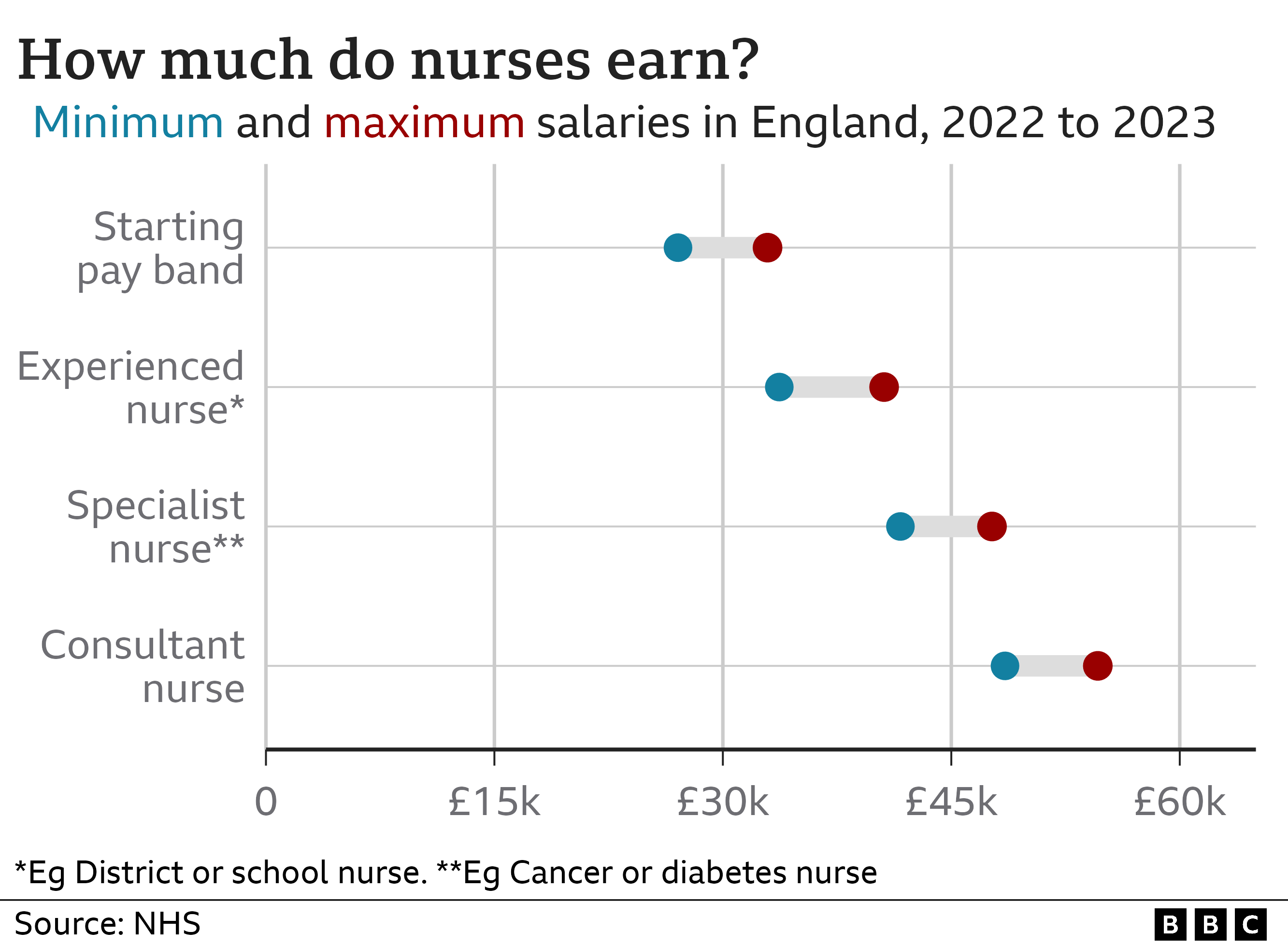
Starting salaries for nurses in England are currently just above £27,000, rising to nearly £55,000 for the most senior nurses.
The RCN said the average pay for a full-time established nurse was just above £32,000 last year – similar to average pay across the economy.
The union is inviting members of the public to co-sign a letter to Prime Minister Liz Truss, backing its stance.
IMAGE SOURCE,GETTY IMAGES Image caption, The Department of Health and Social Care in England said it valued “the hard work of NHS nurses”
The 380,000 members of Unison, including about 50,000 nurses, are also being balloted.
These ballot papers have been sent out in Scotland, with the rest of the UK following suit in the coming weeks.
Midwives in Scotland have also been balloted on strike action by the Royal College of Midwives, while the British Medical Association has said it will ballot junior doctors over industrial action.
A spokeswoman for the Department of Health and Social Care in England pointed out the independent NHS Pay Review Body had recommended its pay award.
And it followed a 3% pay rise last year, in recognition of work during the pandemic, despite a public-sector pay freeze.
“We value the hard work of NHS nurses and are working hard to support them. Industrial action is a matter for unions and we urge them to carefully consider the potential impacts on patients,” she added.
Scottish Health Secretary Humza Yousaf said: “Any ballot for industrial action is disappointing. We are engaged with health unions and I hope we can come to an agreement on pay in the near future.”
In 2019, RCN members went on strike in Northern Ireland over pay, while nurses who are members of Unison in England walked out in 2014 over pay.
During any strike action, some nurses would continue to work to ensure emergency and urgent services continue.
Workers at South Africa’s state-owned logistics firm Transnet will go on strike from Thursday over a wage dispute, two labour unions said, in a move that could halt the export of key minerals and other cargo.
Transnet has been operating below capacity due to a shortage of locomotives, poor maintenance and vandalism and theft of its infrastructure, costing miners billions of rand in potential revenue. A strike would paralyse freight rail services and impact South Africa’s ports, also managed by Transnet.
The United National Transport Union (UNTU), the biggest labour union at the company, said it had served notice to begin industrial action on Thursday. The other union at Transnet, South African Transport and Allied Workers Union (SATAWU), said it would join in the strike from Monday.
Both unions said Transnet’s offer of a 1.5 percent pay increase from October 1 fell below their demands.
“Transnet…must provide a salary increase offer that is aligned with the increased cost of living, cost of housing, medical costs, housing and, of course, the consumer price index (CPI) that is currently running at 7.6 percent,” UNTU said in a statement.
In recent years, the cost of living has soared in Africa’s most developed economy, worsened by the COVID-19 pandemic and the increase in prices of items like bread due to global supply chain disruptions since Russia’s invasion of Ukraine.
In July, former President Thabo Mbeki warned that there could be an “Arab Spring-type uprising” in the country due to the situation.
Transnet has said any increase beyond its current wage offer would not be sustainable.
“Transnet has consistently made the point that its wage bill currently makes up over 66 percent of monthly operating costs. This is not sustainable, particularly given the current operational and financial performance,” it said in a statement on Tuesday.
Transnet has applied to the Commission for Conciliation, Mediation and Arbitration (CCMA), a state agency that mediates labour disputes, for further talks with the unions.
Both UNTU and SATAWU said the mediation, which is due to start on October 12, would not affect their plans to go on strike.
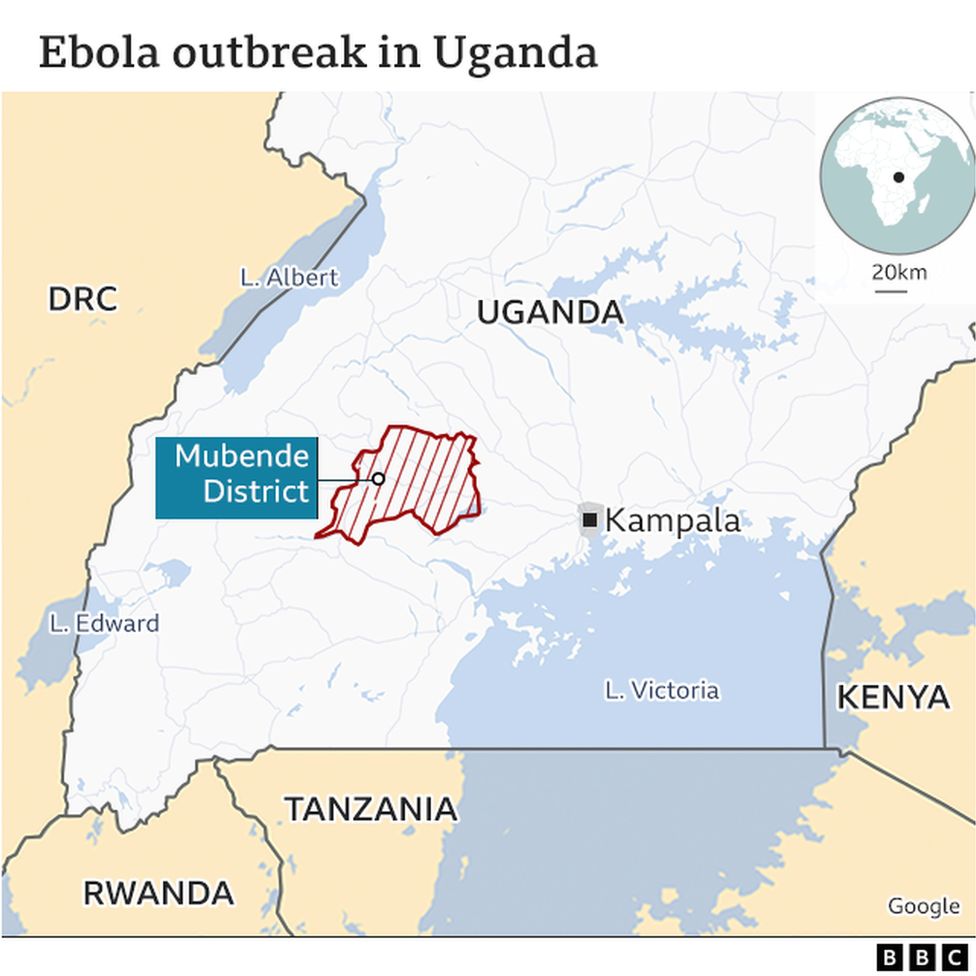
No effective Ebola vaccine is available here yet, because the Sudan strain circulating in central Uganda is different from the Zaire strain that has afflicted West Africa and DR Congo and which can be immunized against.
Experts say it is unrealistic to think Ebola will ever be eradicated, but it is now easier to prevent a crisis.
Their union says more than 40,000 employees of Network Rail and 15 train operators will go on strike once more on October 8.
As part of a protracted dispute over salary, employment, and working conditions, the RMT declared that it will “effectively shut down the railway network.”
It will come just a week after an even bigger strike by members of RMT and the train drivers union Aslef.
It added that full timetables for upcoming strike days would be published soon.
The latest action comes after a series of large-scale walkouts as unions call for pay increases in line with the rising cost of living.
In June, the biggest rail strikes for 30 years threatened to grind the country to a halt. But while some people faced substantial disruption it was business as usual for others.
RMT general secretary Mick Lynch said the union had met with new Transport Secretary Anne-Marie Trevelyan to discuss the disputes.
“However, as no new offer has been tabled, our members have no choice but to continue this strike action,” he said.
“We will continue to negotiate in good faith, but the employers and government need to understand our industrial campaign will continue for as long as it takes.”
The RMT, which represents rail workers including guards and signalling staff, had already announced its 40,000 members would strike on 1 October. This is the day before the London Marathon and the Conservative Party conference in Birmingham.
Train drivers at 12 operators who are members of Aslef will also walk out on 1 October, meaning that only 10% of UK services are likely to run that day.
Aslef members will also hold a second day of strike action on 5 October.
The striking university lecturers inNigeria say they would challenge the arbitration court’s decision ordering them to call off their seven-month strike and report to work.
The National Industrial Court gave the order on Wednesday while it considered a government suit challenging the strike.
But the Academic Staff Union of Universities said its lawyers were already filing an appeal and urged its members to “remain calm”.
The government approached the court to stop the lecturers from continuing their strike after both parties failed to resolve their differences. It said the strike would result in irreparable damage to Nigerian students and to the country if not suspended.
For the past seven months, public university lecturers have suspended classes across the country due to pay disagreements with the government.
The lecturers accused the government of failing to fulfill some of the agreements reached with the union 10 years ago.
The umbrella body of university students in Nigeria, the National Association of Nigerian Students (Nans),had earlier welcomed the court order, describing it as a win-win situation for all the stakeholders in the matter.
The students’ union however urged the government not to see the ruling as a victory over the lecturers.
The Port of Felixstowe says it “regrets” the impact of the strike and cites a warning from the Unite union about significant supply chain disruption. The strikes, however, were predicted to simply be “an inconvenience, not a catastrophe,” according to a port source.
In the most recent round of labor unrest that has affected numerous economic sectors, nearly 2,000 employees at the largest container port in the UK quit their jobs on the first day of an eight-day strike.
The strike at Felixstowe port on the east coast rounds off a week that saw various strikes by thousands of transport workers in disputes over pay, as the cost of living crisis bites.
The union has warned the stoppage at the port, which handles almost half the container freight entering the country, will have a significant impact on UK supply chains and the logistics and haulage sectors.
But a port source downplayed the warning, telling the PA news agency the strikes will be an “inconvenience, not a catastrophe”.
The supply chain is used to disruption following the pandemic, he claimed.
“Disruption is the new normal. The supply chain has moved from ‘just in time to just in case,” he added.
Beneficiaries of Nation Builders Corps (NABCo) programme, on Thursday, hit the streets of Accra to register their displeasure about the delay in the payment of their allowances.
According to the aggrieved protestors, government has failed to pay them for a period of 10 month.
The lack of remuneration, according to the NABCoamidst the current economic challenges has made life unbearable.
Demanding government to provide the necessary financial commitment promised them, the agitated group presented a presented a petition to the Vice President, Dr Mahamudu Bawumia.
Deputy Chief of Staff, Emmanuel Adumua-Bossman, received the petition on behalf of the Vice President.
“This government is indeed a listening government so these things that you have scripted shall be carefully considered at the highest levels and as soon as it is practicable, you would hear something tangible on the issues you have raised.â€
The NABCo program is expected to end in September this year, after it was extended by the Government.
The Akufo-Addo-led administration introduced NABCo in 2017 as part of measures to address graduate unemployment in the country.
The initiative was run under seven modules: Educate Ghana, Heal Ghana, Feed Ghana, Revenue Ghana, Digitize Ghana, Enterprise Ghana, and Civic Ghana.
It was reported that government invested approximately GH¢2.2 billion into the policy.
The Ghana Education Service (GES) is expected to meet with the leadership of the four teacher unions which have declared a strike action over the non-payment of their Cost of Living Allowance (COLA).
Public Relations Officer of the Education Ministry, Kwesi Kwarteng in an interview with JoyNews on Tuesday said the meeting will “develop a roadmap and engage on how to bring this issue to an end.â€
“We hope that by the close of tomorrow [Wednesday] some progress would have been made,†he told Emefa Apawu on Newsnight.
Mr. Kwarteng is optimistic that the various stakeholders involved would show commitment and goodwill to resolve the impasse.
Responding to calls by the Minority for schools to be shut down due to the strike action, he noted that the GES directive for schools to remain open despite the industrial action is the best interim solution.
“We know there is a problem and we know there has to be a decision that ought to be made…In the interim, this takes very good care of these children while we look at an immediate resolution of the strike action which is just tomorrow. That is even with regards to the schools that are operating the boarding system in the SHS schools.
“If you come to the basic level that is the primary schools to the JHS level, we could not have shut down the schools because it is possible that some parents did not even know and the temptation to take their wards to school will be high,†he stated.
Background
Four teacher unions on Monday, July 4 declared an indefinite nationwide strike over demands for the payment of Cost of Living Allowance (COLA).
The unions, comprising the Ghana National Association of Teachers (GNAT), the National Association of Graduate Teachers (NAGRAT), the Teachers and Educational Workers Union (TEWU) and the Coalition of Concerned Teachers Ghana (CCT), are demanding that 20% of their basic salary be paid to them.
“We can no longer bear the hardship. Even more so, we reject the inequality of salaries in the public services of this country. We have been compelled under the current circumstances to publicly communicate to Ghanaians on our intention to go on strike, having gone past the June 30, 2022 deadline [that] we gave government for the payment of the Cost of Living Allowance.
“Consequently, we have decided to embark on a strike action effective today, Monday, July 4, 2022. By this, we are informing the general public that we are withdrawing all our services in all the pre-tertiary education space this includes teaching and non-teaching staff,†the teachers announced.
The Senior Staff Association of the University for Development Studies has threatened to embark on an industrial strike against the university’s management on Thursday, 12, 2022.
The Association outlined several issues that will trigger their strike action if not addressed by the Management of the University by Wednesday, May 11, 2022.
“The University management’s failure to respect and implement the prudent professional recommendations of the Ghana Tertiary Education Commission (GTEC) on the concerns of Senior Staff Association in relation to qualification requirements for progression and upgrading to Senior Member Grade, contained in a letter dated December 24 2021.
“Capricious and whimsical applications of administrative rules by some heads within the university,” as another reason for the planned strike,” the letter dated Sunday, May 8, 2022, and signed by the Chairman SSA-UoG, UDS, Tamale, Zakaria Mohammed disclosed.
He continued, “The Executive Council of the Senior Staff of the Universities Teachers- University for Development Studies, Tamale shall embark on an indefinite industrial strike on Thursday, May 12 2022.”
The National Executive Council of Senior Staff Association- Universities of Ghana (SSA-UoG) has announced the suspension of its industrial strike action, which was declared on 21st January 2021.
This has become imperative as a result of your interlocutory injunction secured and served on us, and also after broad and constructive consultations with our legal team.
In a letter signed by its National Chairman, Zakaria Mohammed and addressed to the National Labour Commission on 9 February 2021 stated that the suspended strike “has become imperative as a result of your interlocutory injunction secured and served on us, and also after broad and constructive consultations with our legal teamâ€.
“Notwithstanding that, we will continue to engage faithfully with government and other relevant stakeholders in our fight for justice and fairness in the payment of our Tier2 pension contribution arrears and the award of market premium and non-basic allowance to our Union members.
SSA-UoG therefore asked its members to resume work tomorrow Wednesday, 10 February 2021 “without further delayâ€.
It will be recalled that the National Labour Commission secured a 10-day court injunction against the ongoing strike by the Senior Staff Association, Universities of Ghana (SSA-UoG) on 3 February 2021.
The court ordered SSA-UoG “to comply with the directive of the National Labour Commission issued on Wednesday, 27 January 2021 and call off the industrial strike action”.
Prior to that, the National Labour Commission haddirected Senior Staff Association of Universities of Ghana (SSA-UoG) to immediately call off their strike and return to the negotiating table on Wednesday, 27 January 2021.
The Fair Wages and Salaries Commission (FWSC) has urged the Senior Staff Association to call off their strike immediately and return to the negotiation table for an amicable solution.
A statement issued by the FWSC and signed by the Chief Executive, Dr. Edward Kwapong underscored the need for the Association to meet with FWSC urgently so as to clear some outstanding issues raised in their petition.
“As part of the negotiations, we have covered all demands except two (2). Incidentally, there are two (2) outstanding issues comprising issues raised in your press release for which we need to engage. In the circumstance, we are urging you to call off the strike and meet with FWSC as soon as possible early next week,†the statement said.
The Senior Staff Association of Universities of Ghana, (SSA-UoG) announced the withdrawal of their services effective Thursday, January 21.
According to the First Vice Chairman of the Senior Staff Association, this has become necessary following the non-payment of their tier-two pension arrears, delay in the award of market premium and non-basic allowance, failure by the Fair Wages and Salaries Commission (FWSC) to engage them on their condition of service among others.
“I wish on behalf of the National Executive Council, to announce the withdrawal of our services with immediate effect. This has become necessary in view of the following concerns.
“Non-payment of tier-two pension arrears, delay in the award of market premium and non-basic allowance, failure by FWSC to engage us on condition of service.
“For the avoidance of doubt, members are hereby required to lay down their tools until further notice,†he said at a press conference on Thursday, January 21.
But the FWSC in a reaction to the development rather accused the Senior Staff Association of negotiating in bad faith.
“FUSSAG to be able to determine the manner in which the Union would collaborate with each other in engaging the employer. We are therefore, extremely surprised that while waiting, you wrote to the National Labour Commission on 15th January, 2021, informing them of your intention to embark on a strike action.â€
The Senior Staff Association of Universities of Ghana, (SSA-UoG) has declared a nationwide industrial action.
They announced the withdrawal of their services with immediate effect on Thursday, January 21.
According to the First Vice Chairman of the Senior Staff Association, this has become necessary following the non-payment of their tier-two pension arrears, delay in the award of market premium and non-basic allowance, failure by the Fair Wages and Salaries Commission (FWSC) to engage them on their condition of service.
“I wish on behalf of the National Executive Council, to announce the withdrawal of our services with immediate effect. This has become necessary in view of the following concerns.
“Non-payment of tier-two pension arrears, delay in the award of market premium and non-basic allowance, failure by FWSC to engage us on condition of service.
“For the avoidance of doubt, members are hereby required to lay down their tools until further notice,†he said at a press conference on Thursday, January 21.
The University of Ghana chapter of the Teachers and Educational Workers Union (TEWU) has dismissed claims from national executives of the Union that an agreement has been reached to call off their strike.
Leaders of the Union on the campus of the University says that no such agreements have been made, thus, the notice from the national union should be disregarded.
The UG chapter says that their industrial action continues unabated as long as the government does not exhibit a concrete commitment to improving their conditions of service.
Speaking to UniversNews after meeting with members of the Union on Wednesday, UG local TEWU President, Kenneth Botchway, said that the statement from the national executive calling for an end to the strike was made without consultation with local executives.
“The statement that we saw which is not carrying our letterhead stated that local executives in public universities have agreed to suspend the strike. That paper circulating is not carrying our letterhead so we do not treat it with relevance,” Kenneth Botchway.
There are reports of a partial shortage of LPG products over the weekend, especially in pockets of places around Accra and Takoradi in the Western region, following a decision some aggrieved tanker drivers to down their tools over industry-related issues, including their welfare.
The union some weeks ago at a press conference accused officials of the NPA, of conniving with some Police officers to harass them on the roads.
The drivers also wanted approval for more than 80 applications submitted to the NPA to enable them construct LPG station.
Again, they claim their welfare issues have been ignored, a situation which has forced some of them to hit on hard times.
But the NPA in a response refuted some of the claims and put out evidence which suggests series of meetings had taken place over the issue which the driver union actively participated.
After the release, the NPA, AOMC, LPG marketers, Tanker owners and the drivers met, to discuss the issues and find a resolution to the impasse. Another meeting also took place with the Police hierarchy to address the issue of harassment. A source told Starrfm.com.gh that assurances were given in that regard by a senior police personnel, who said any of their men who misconduct themselves in this regard will be dealt with.
But a source at the meeting says the latest partial strike has come as a surprise to some of them, including some drivers, who believe their concerns are already being addressed, one after the other.
Speaking on condition of anonymity, the source says the partial strike is the insistence of the NPA to follow the rules governing the granting of construction permits, which some of the leadership of the drivers union are not interested in.
“ They have already being granted license for 11 stations, but it appears they want more, which is not even right especially when one considers that cabinet in 2017 temporarily suspended the issuance of construction permits, while the NPA looks at the safety concerns being raised by the public,†says the source.
“These drivers and their collaborators want the regulator to bend the safety rules so they can have their way but should the unfortunate happen, it is the public that will be impacted.â€
Documents available indicate that some leaders of the LPG tanker drivers had even constructed stations without obtaining the required permits from the appropriate agencies, but are seeking for approval to be given them.
“Is it the money they want at the expense of public safety,? An aggrieved driver who is not in support of the strike asked.
There are also suspicions that the strike is being used to push government to bend the safety rules because of the upcoming elections.
Fuel tanker drivers across the country have been directed by their mother association, the Ghana National Petroleum Tanker Drivers Union not to move any of their trucks today, Monday, October 19, 2020.
The association in a letter said all the drivers must however report to their respective loading gantries.
“We are informing all tanker drivers across the country that on Monday, 19th October 2020, no driver should move a truck but report to their various loading gantries at Tema for Union Offices, Takoradi, Buipe, Kumasi respectively,†the letter from the association said.
It is unclear the reason for the directive but Citi News understands that the association will organize a press briefing later today to give details about the decision.
Previous strikes
In September 2020, tanker drivers operating at the Buipe depot in the Savannah Region declared an indefinite strike over the refusal of the Bulk Oil Storage and Transport (BOST) management to fix malfunctioning loading metres at the depot.
Months earlier, the drivers kicked against the implementation of the new Electronic Cargo Tracking System by the National Petroleum Authority (NPA).
The Electronic Cargo Tracking System and the National Command Centre from the National Petroleum Authority was launched in Accra in January 2020 to improve the efficiency of NPA in the monitoring of Bulk Roads Vehicles nationwide and also check illicit activities associated with the transportation of petroleum products across the country.https://www.youtube.com/embed/2ecPzYwC-_U
But the drivers threatened to strike if the implementation is not suspended.
They said the NPA must hold on with the implementation until the partial lockdown announced in parts of the country earlier in the year due to the COVID-19 pandemic is over.
Staff of the Ghana Civil Aviation Authority (GCAA) has threatened to embark on a strike effective Wednesday, October 14, 2020, to demand the return of lands taken away from the Authority.
This was disclosed in a notice by the GCAA to airlines flying from and to the Kotoka International Airport and the general public.
It was co-signed for and on behalf of the Coalition of GCAA workers by its spokespersons William Amoako and John Sampah.
According to the GCAA staff, it “may embark on an action to withdraw some essential services, including Air Traffic Services, from Wednesday, 14th October 2020, to demand the return of lands taken away from the Authority.â€
The staff noted that the strike action has become necessary “after exhausting all relevant avenues, including meetings and discussions with the executive management of GCAA and the Ministry of Aviation, interventions by the National Labour Commission and the Ministry of National Security, a letter to the Chief of Staff, a petition to President Nana Addo Dankwa Akufo-Addo, and a recent press conference.â€
The statement further noted: “The reallocation or sale of lands strictly meant for aviation purposes to private developers poses serious safety concerns to the aviation industry. You would recall that some of your flights have been experiencing occasional breakdown in communication with air traffic control due to constant interference and heavy background noise on some of our frequencies since October 2, 2020.â€
The staff continued that they have “reason to believe that these challenges are due to the activities of real estate developers around our communication systems, navigational aids and surveillance systems on GCAA lands,†as these developments have made it nearly impossible for GCAA “to provide quality air traffic and air navigation services.â€
The GCAA staff are, therefore, demanding that the government stop “the threat and damage to vital communication, navigation and surveillance equipment and installations, the wanton demarcation and sale of GCAA lands to private persons†and “the forceful eviction of GCAA staff from their officially allocated bungalows.â€
The staff, however, stated that they would rescind their decision to withdraw essential services “only if all activities on the lands are stopped immediately and land titles, by Executive Instrument and lease, are issued in the name of GCAA.â€
The Coalition also stated that if its pleas are not “heeded and any accident or serious incident occurs, the following persons, whose actions and inactions have led to this unfortunate situation, must be held accountable: Mad. Cecilia Dapaah, immediate past Minister of Aviation; Joseph Kofi Adda, Minister of Aviation; Kwaku Asomah Cheremeh, Minister of Lands; Air Commodore Rexford GM Acquah (Rtd), Board Chairman of GCAA; Ing. Simon Allotey, immediate past Director-General of GCAA; Ing. Charles Kraikue, Director-General of GCAA; Mr Paul Kontoh, who is a retired Director of General Services at GCAA, but on a two-year contract; and Alhaji Suleiman, Mr Quainoor and Clemence Gyato, all of Lands Commission.â€
The coalition emphasised that it is resorting to the strike in “the interest of safety, the sustainable growth of the aviation industry, and a lasting solution to this matter.â€
It, however, regretted “the inconveniences that might arise from the withdrawal of these vital services†reiterating that “we must protect current installations and make provisions for new ones.â€
Staff of the GCAA had earlier embarked on a protest to register their displeasure about the encroachment of lands belonging to the Authority.
According to the GCAA staff, the aviation sector in the country risks shutting down if steps are not taken to protect its lands.
A statement issued by the leaders of the GCAA staff noted: “The aviation industry is dynamic and driven by technologyâ€.
“This means that new technology may spring up, which requires a piece of land for its implementation.
“Some parcels of land must, therefore, be set aside for those purposes.
“Non-availability of land for these installations will mean there is no future for aviation in Ghanaâ€, they warned.
The Mortuary Workers Association of Ghana (MOWAG) have rescinded their decision to embark on a strike after a meeting with the Ministry of Employment and Labour Relations.
The group earlier said it was going embark on a strike on October, 1, 2020 in protest of what they believe to be unfair working conditions which have not been addressed by the Ministry of Health.
“Having become tired of its inactions and being aware that the government appears to be nowhere near taking a serious look at the grievances of the MOWAG, pursuant to resolving same problems, the MOWAG, under article 159 of the Labour Law (Act 651) has now initiated this industrial strike action till its demands are met.â€
But in a joint statement signed the Minister for Employment and Labour Relations, Ignatius Baffour Awuah and Richard Kofi Jordan who is the General Secretary of MOWAG, the group has called off the strike after assurances that their grievances were going to be addressed.
The mortuary workers have decided to continue working while the Ministry of Health and the Fair Wages and Salaries Commission (FWSC) deliberate with their leaders on the demands they are making.
Below are the terms as spelt out in the statement
Fair Wages and Salaries Commission should collaborate with MOWAG to resolve the issue of salaries and allowances taking into consideration the risks and uniqueness of their job.
That Mortuary attendant in health facilities with recorded cases of COVID-19 deaths should be considered as part of the front-line staff and hence benefits from any benefit that it goes with.
That the Ministry of Health should expedite action on and complete the issuance of appointment letters to eligible mortuary workers.
That the Ministry of Health should ensure the provision of adequate Personal Protective Equipment (PPE) to Mortuary workers in all health facilities at all times. Those PPEs should not only be limited to those of COVID-19 pandemic but also their routine job assignments.
That MOWAG should liaise with the Labor Department to resolve matters relating to the issuance of a Collective Bargaining Certificate to MOWAG.
That all the decisions reached should be implemented within a month.
That a meeting would be convened among the stakeholders including MOWAG on or before October 27, 2020, to bring finality to the discussions.
That, MOWAG has agreed to call off their intended strike.
Dr Bernard Okoe-Boye, the Deputy Minister of Health, has announced that the government has concluded a financial clearance process for about 3,400 Allied Health professionals across the country.
He said the financial clearance would give the opportunity to the health professionals to apply for postings, which would be open soon in the coming weeks to the various public health facilities across the country.
“We had a backlog of close to 4,000 people. As we speak, the government has given financial clearance for about 3,400 and the portal will be open in the coming weeks for them to go online and apply and be posted across the country,†he said.
Dr Okoe-Boye gave the announcement at the 8th induction and swearing of oath ceremony of Allied Health graduates organized by the Allied Health Professions Council in Accra.
The ceremony saw the induction of 170 graduates made up of 57 Doctor of Optometry graduates and 113 Doctor of Medical Laboratory Science graduates.
It was on the theme; “The Role of Allied Health Professional-During and Post COVID-19â€.
He said Allied Health Professionals played key roles in the health sector, hence, the need for the clearance by government to employ more hands and asked them to accept postings to deprived communities.
He expressed regret that newly recruited often rejected postings to other regions, saying, “especially when you see people that have been posted to other regions coming back for reposting to the Greater Accra and Ashanti regions specifically. This is worrying because you cannot have a situation where about 80 per cent of all our staff in only two regions,†he added.
The Deputy Minister, thus, urged medical professionals to be willing to go to any part of the country as there were more opportunities outside Accra and Kumasi.
He congratulated the inductees saying, “there are so many opportunities that can support your career, so accept postings as they comeâ€.
Dr Samuel Yaw Opoku, the Registrar, Allied Health Professions Council, congratulated the inductees for their six years of education to get to their final stage.
He said due to the COVID-19 pandemic the induction and swearing of oath ceremony had been divided into six batches, four in Accra and two in Kumasi adding that, “all the ceremonies will be held in the morning and afternoonâ€.
Dr Opoku noted that Allied Health Professionals played important roles and therefore asked for the needed recognition to enable them to make the real difference in the lives of their clients to improve the healthcare delivery system.
He appealed to the government to do something about the long stay of the health professionals at home after their internship programmes for the population to benefit from their services.
Communications Director of the New Patriotic Party (NPP), Yaw Buaben Asamoa, has appealed to the striking nurses and midwives to resume work.
The Ghana Registered Nurses and Midwives Association (GRNMA) comprising all public sector nurses, midwives, Physician Assistants (PAs) and Anesthetists (CRAs) have today, September 22 embarked on nationwide strike.
The GRNMA is demanding better conditions of services from the government, hence refusing to comply with an interim injunction by the National Labour Commission (NLC) to restrain them.
The NLC has called on them to pick up their tools but the members of the Association have paid deaf ears to the NLC as they remain on strike.
The Fair Wages and Salaries Commission (FWSC) has also asked the nurses to back down on the strike and go to the negotiation table to have their grievances resolved.
Adding his voice to the calls on the nurses and midwives, Yaw Buaben Asamoa has asked them to be patient with the government and heed the appeals on them to call off the strike and return to the negotiation table.
“It doesn’t mean someone hates you. It doesn’t mean you don’t have the right to go on strike. It doesn’t mean you don’t have grievances. All we’re saying is for you to abide by the Labour Commission’s instructions for peace to reign,” he stated on Peace FM’s ‘Kokrokoo’.
Mr. Buaben Asamoa added that the government has been charitable to the nurses, midwives and all other health workers, particularly the frontline workers at the forefront of the COVID-19 fight and so expects them to cooperate with the government to arrive at a better decision.
He reminded them of the government’s tax waivers and 50% salary increase to them which, to him, should tell the nurses and midwives that the government has their welfare at heart.
“We have been good to you. We’ve been ably employed you…Be patient; I don’t believe that the government that’s created jobs for you and paid your allowances will turn to intimidate and sack you. It won’t honor the government in anyway,” he said.
Managing Editor of the Insight newspaper, Kwesi Pratt Jnr, has called on the striking health workers in the country to resume work in order to save lives.
The Ghana Registered Nurses and Midwives Association (GRNMA) consisting of all public sector nurses, midwives, Physician Assistants (PAs), and Anesthetists (CRAs) have embarked on strike, therefore seeking better conditions of services from the Akufo-Addo government.
The nurses and midwives have refused to return to work until their grievances are resolved but Kwesi Pratt is pleading with them to consider the innocent Ghanaian who may become a casualty due to the strike.
“If His Excellency Nana Addo Dankwa Akufo-Addo falls sick today and we have to take him for medical treatment for even a month, we will do it. If we have to charter an ambulance jet to fly him outside, we will take him. The people who will suffer are the poor people,” he said.
Making his submissions on ‘Kokrokoo’ on Peace FM, Mr Pratt empathized with the health workers in the country saying, “I admit that you’re being cheated and in fact, it’s not only you who feel cheated but a lot of Ghanaians as well…So, we are all cheated and should we all decided to take an action, we shouldn’t think about ourselves only but have a plan that will help ease all of us. My dear nurses, you have a good case. You have been cheated for too long but we plead with you to resume work so that the innocent pregnant woman won’t lose her life”.
Meanwhile, the National Labour Commission (NLC) has secured an interim injunction to restrain the nurses and midwives from the strike.
The Fair Wages and Salaries Commission (FWSC) has also asked them to back down on the strike and return to the negotiation table.
Nurses and Midwives in the Sekondi-Takoradi Metropolis and Effia-Kwesimintsim Municipality have joined the nationwide strike action embarked by nurses in demand for better working conditions.
As a result, a number of government hospitals within the two Assemblies have recorded low Out Patient Department (OPD) turn out.
A visit by the GNA to the European Hospital in Takoradi revealed the absence of nurses at the OPD with virtually empty seats.
Reverend Osei Boateng, the administrator of the hospital, bemoaned the current situation saying, it was unfortunate that the nurses had embarked on the strike action during these abnormal times.
He was, however, happy that doctors, laboratory technicians, Administrators, Accountants, and other support service providers were at post.
Rev. Boateng appealed to the government to negotiate with the Ghana Registered Nurses and Midwives Association (GRNMA) to chart a clear path in meeting their demands.
He explained that workers within the health sector should be given all the allowances due them to prevent frequent strike actions since the strikes could lead to the loss of lives.
Rev Boateng noted that apart from the nurses, other staff such as administrators, accountants, cleaners and caterers have also not received much attention from various governments, stressing that they all play critical roles in achieving holistic healthcare delivery.
The situation was not different at the Kwesiminstim Hospital, where the Administrator, Mr Felix Osei Kesse, indicated that on a regular day, an average of 300 patients visit the OPD, however, the strike action had resulted in a decrease in attendance.
Mr Kesse also said the doctors were now playing the roles of nurses pointing out that “Doctors are now taking the vital statistics of patients and attending to pregnant women at the Ante natal Care (ANC) unit”.
This he noted would increase the workload of the Doctors.
Mr Kesse explained that so far, only four critical cases were still on admission and being attended to while all other patients on admission had been discharged since nurses were not around.
He said the hospital had some referral cases but that the patients were likely to meet the same situation at the hospital they would be referred to.
Nana Owusu, a patient at the Essikado Hospital lamented that he had been at the facility for quite some time but had not been issued with a card because there were no nurses to attend to patients with general problems.
He called on the government to attend to the demands of the nurses for them to call off their strike action.
The strike action has been triggered by the poor conditions of service and unpaid allowances to nurses and midwives.
Physician assistants and certified registered Aneastetics are also included in the strike.
Patients at the Ho Municipal Hospital have been directed to go home or seek medical attention in private hospitals due to the industrial action by a segment of health workers.
At the time of visiting, the Ghana News Agency (GNA) observed that patients were not being attended to by the doctors.
At the maternity ward, a pregnant patient disclosed that she was told to go home.
“I did not sleep the entire night due to pains in my stomach. I begged to be attended to but they failed and asked that I go home because nurses are on strike.â€
Another patient, who was on admission due to an accident over the weekend, said, “Since the strike action, we have been lying here without care, and not knowing whether a doctor or nurse will come around. I pray that the government listens to their demands so they can return.â€
Some patients also said they were asked to go home and return when the strike was over.
Ghana Registered Nurses and Midwives Association (GRNMA), the Allied Associations including the Ghana Physician Assistants Association (GPAA) and Ghana Association of Certified Registered Anesthetists (GACRA) embarked on a strike on Monday to back demands for improved conditions of service.
Nurses and midwives across the country are beginning a strike today Monday, September 21,2020 over their service conditions.
It comes after the failure of government to agree with the healthworkers on their demand for improved conditions of service.
A press release by the Ghana Registered Nurses and Midwives Association noted “having reconvened in the meetings held on 15th and 16th September 2020 the posture of the Employer changed for the better but did not meet the expectation of the majority of Nurses, Midwives, Physician Assistants and Certified Registered Anaesthetists in Ghana.â€
The statement, therefore, directed its members to stay away from work until the outstanding issues are addressed with their employer.
Meanwhile, an Accra High Court on Friday granted an interlocutory injunction application by the National Labour Commission against the strike.
The move by the court presided by Justice Frank Aboagye Rockson is to stop the health workers from their industrial action.
The Ghana Registered Nurses and Midwives Association (GRNMA) has directed its members to withdraw their services from Monday, September 21.
According to the Association, government has failed to improve their conditions of service for the over 82,000 members.
President of the Association Perpetual Ofori Ampofo on Thursday, September 17 told TV3s Daniel Opoku that negotiations with government over their work conditions did not yield any results.
She also raised issues with non-payment of the allowances for frontline health workers and insurance, which were promised as part of incentives in the fight against Covid-19.
The Association says it has petitioned the National Labour Commission (NLC) over its intended action.
Nigerian doctors have ended a nationwide strike that was called to protest against low pay and inadequate protective equipment.
The National Association of Resident Doctors (Nard), which represents some 40% of Nigeria’s doctors, said it called off the strike to give the government time to act on its demands.
The week-long strike ends on Monday morning, according to a statement quoted by local media. It had not affected medics treating coronavirus patients.
The association said some hospitals had since been supplied with protective gear and the government had promised to provide more.
It said the government had also promised to address their demand for better welfare for resident doctors.
The association said resident doctors who had been disengaged at Jos University Teaching Hospital had been reinstated and the chief medical director directed to pay their withheld salaries.
The Ghana Medical Association (GMA) has cancelled its intended industrial action, after holding talks with the government.
The health workers had given government up to February 29, 2020, to implement an already signed agreement on their conditions of service.
But the doctors and dentists have rescinded their decision after discussions between all parties.
The Association had earlier served notice that doctors in the country will embark on a strike if the government failed to immediately implement their signed Conditions of Service.
An internal memo sighted by Citi News directed all members to withdraw their services in all facilities if the government fails to meet their demands by January 29, 2020.
“The Association has accordingly given the government up to Saturday, 29th February 2020 to ensure full implementation (including payment of all occasioned arrears) of the CoS document at both the National and facility levels. If any default on the part of Government occurs Vis-à -vis the stated deadline, there shall be immediate withdrawal of all services by members in all facilities,†the memo warned.
The National Executive Committee of the Medical Association said it also observed that during the validation of February salaries, there was the absence of fuel allowance on the payslips of members; and urged members to put all discrepancies on notice for rectification.
The Association further vowed that the intended strike action by its members will only be called off if the government and the Health Ministry play their part in meeting their demands before the given deadline.