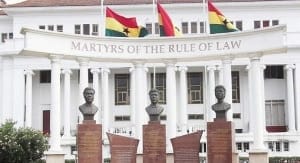
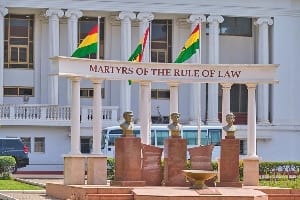
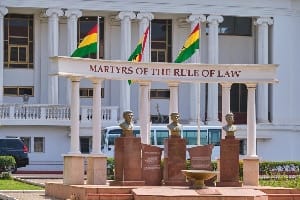
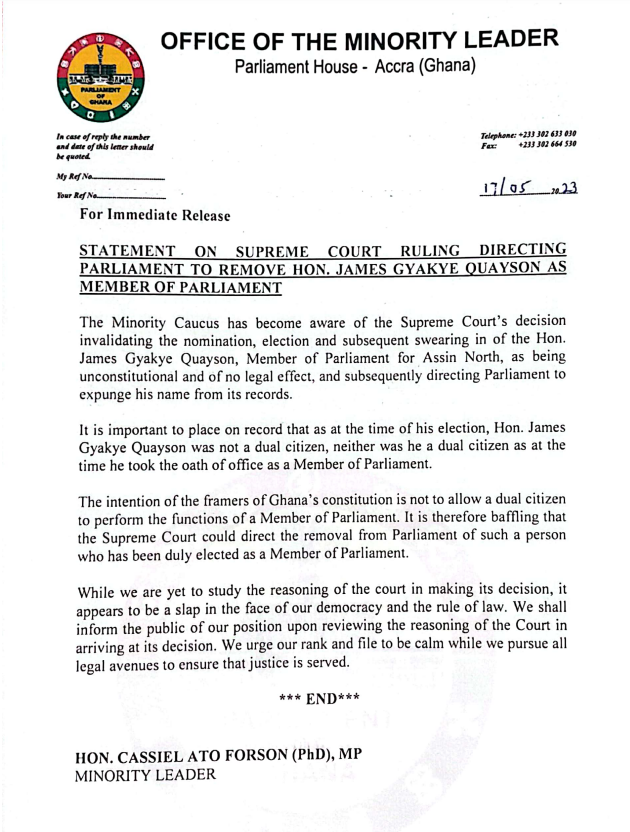
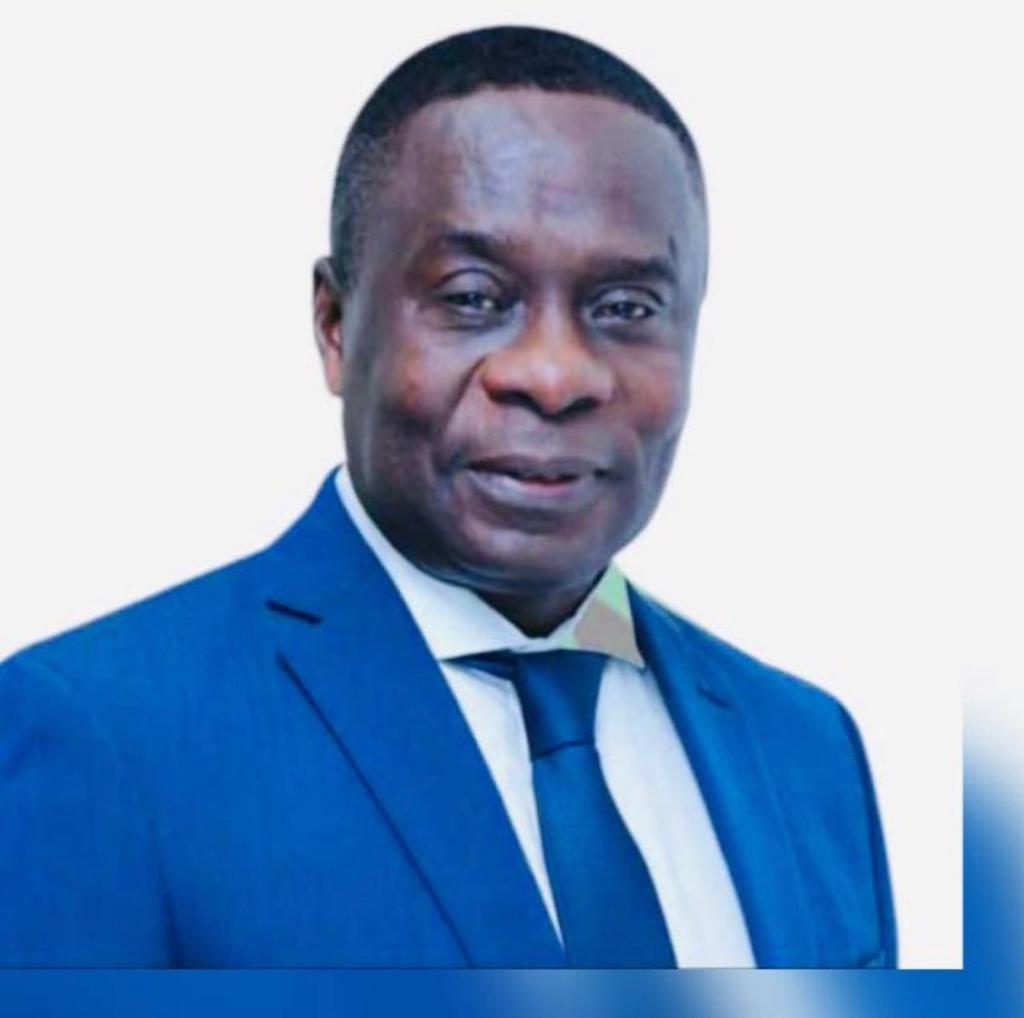
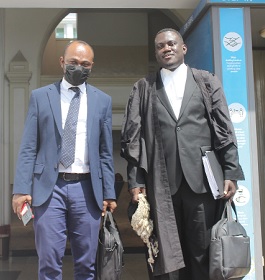
The Supreme Court has recently made available the complete judgment regarding its declaration of the election of James Gyakye Quayson as the Member of Parliament (MP) for Assin North in the Central Region as unconstitutional.
In a unanimous ruling on May 17, 2023, a seven-member panel of the Supreme Court upheld the petition challenging Quayson’s eligibility and ordered Parliament to remove his name from the list of MPs.
After the 2020 presidential and parliamentary elections, one Michael Ankomah Nimfah dragged Mr Quayson to a High Court for contesting the Assin North seat while in possession of Canadian and Ghanaian citizenship.
The apex court noted that allowing Mr Quayson to remain in the capacity as MP “will be an indictment of the administration of justice” should it disregard the orders of the High Court which nullified the Assin North election on the basis that Mr Quayson had dual citizenship.
The case was heard by Justices Jones Dotse, Nene Amegatcher, Mariama Owusu, Gertrude Torkonoo, Prof Henrietta Mensah Bonsu, Emmanuel Kulendi and Barbara Ackah Ayensu
The release of the full judgment offers transparency and clarity regarding the court’s decision and the legal basis on which it was made.
The judgment emphasizes the constitutional violation at hand and underscores the importance of adhering to the principles of eligibility for parliamentary candidacy.
The Supreme Court has declared the endorsement of candidates or political parties by chiefs as unconstitutional. The court’s decision sets a significant precedent, affirming that such endorsements are in violation of constitutional principles.
The ruling highlights the importance of upholding the integrity of the electoral process and ensuring a level playing field for all candidates, independent of any affiliations with traditional authorities.
This landmark judgment is expected to have far-reaching implications on future political campaigns and the role of chiefs in the electoral arena.
The court, however, pointed out that chiefs praising or lauding the policy of a candidate is a permissible endorsement.
Justice Emmanuel Yonny Kulendi who authored the November 2022 Judgment of the court explains that this conclusion is “consistent with the role of a Chief as a champion and an advocate for the welfare and interests of their communities”.
He nonetheless stated that other statements where a Chief is heard to endorse the person of the candidate or his party by declaring their preferential support for the election of the candidate or his party or urging voters to vote for them are the kind of “taking sides” in a partisan political contest which the constitution disapproves of.
This is the Apex Court’s decision in a case filed by legal practitioner Elorm Kwame Gorni against the Attorney General.
It was heard by Justices Jones Dotse, Gabriel Pwamang, Nene Amegatcher, Prof Ashie Kotey, Mariama Owusu, Lovelace Johnson and Emmanuel Yonny Kulendi.
Mr Gorni had urged the apex court to interpret “active party politics” as used in Article 276(1) of Ghana’s constitution. This provision states;
“A chief shall not take part in active party politics, and any chief wishing to do so and seeking election to Parliament shall abdicate his stool or skin.“
He wanted the court to declare that certain chiefs who during the electioneering campaign leading up to the 2020 General Elections “endorsed” either the NPP’s Nana Akufo-Addo or the NDC’s John Dramani Mahama were engaged in active party politics. He argued such an endorsement was a breach of the Constitution.
The Attorney General took the view that the case raises no issue requiring the interpretation of the court.
He pointed out that the word “active” is “clear, unambiguous and admits of no interpretation”.
The AG further pointed out that a chief’s endorsement of a candidate for “elective political office without more cannot be said to constitute an engagement in active party politics”.
He insisted chiefs like every citizen have the right to freedom of speech and expression as well as the freedom of thought, conscience and belief.
The Supreme Court however took the view that the phrase “active party politics” raises and presents an issue worth interpreting.
Justice Kulendi explained that it was important for “the exact contours or boundaries of what constitutes such participation” to be determined.
On the substantive issue of chiefs and politics, Justice Kulendi said chiefs occupy an elevated position in the social order and play an influential role in the governance and development of their communities and the country.
“It is on account of the exceptional social and public status of chiefs that although chiefs are not public officers, the constitution disqualifies certain persons, notably persons convicted of offences involving fraud, dishonesty or moral turpitude from being chiefs.
“It is the same heightened concern with preserving and protecting the dignity of the chief’s office that partly underpins Article 276(1)’s banning of chiefs from taking part in active party politics.”
He continued that chiefs are not barred from expressing their opinions about matters that are the subject of public debate and discussion.
This he added strikes the right balance between the rights of Chiefs, the reasonable expectations associated with their role and the public interest concerns that animated the said constitutional provision.
Mr Gormi attached various statements made by some chiefs to his court documents.
“The Paramount Chief of the Duayaw Nkanta Traditional Council, Nana Boakye Tromo III, told the President,
“You have distributed the national cake equitably, and we, in Duayaw Kwanta, have gotten our fair share of development.
The publication proceeded to state that:
“Citing several examples of projects undertaken in Duayaw Nkwanta, together with policies such as Free SHS, 1-District -1-Factory, and the programme for Planting for Food and Jobs, Nana Boakye Tromo III stated that “this clearly shows that you have been sent by God to lead us…”
“We are solidly behind you, and we are declaring today that four more for Nana’, ‘Four more to do more”
The Krontihene of Techimantia, Nana Ampong Koromantan is reported to have said;
“Today, we just want to tell you that we, in Techimantia, will never forget you for the construction of the Bechem-Techimantia-Akomadan road. Indeed the presence of a lot of townsfolk at this durbar testifies to the fact that we have already accepted you as one of us. It is four more for you.”
On his part, the Omanhene of Kenyasi No.1 Nana Kofi Abiri reportedly stated as follows:
“We pleaded with him to construct our roads for us, we also needed a TVER institute. He didn’t ignore our request as we can see machines constructing the road. We also said that we needed a mobile phone network at Wamahiniso, you have done it for us we are grateful.”
The Okyenhene, Osagyefo Amoatia Ofori Panin II is reported to have stated as follows:
“Just like the singer, Lucky Mensah, said in his songs, Nana Akufo-Addo has exceeded all expectations as President and must be given the nod to continue for a second term”.
The Omanhene of Mehame Traditional Area, Nana Owusu Kontoh II is said to have stated the following:
“I have a good road, electricity, ICT centre, health centre and nursing training college among other infrastructure developments and they are all because of Mr Mahama and Alhaji Collins Dauda who is our MP.
The final comment produced in court was that of the Paramount Chief of the Waala Traditional Area, Naa Fuseini Seidu Pelpuo IV:
“No one, at least not one that has lived in this country can deny the fact that the evidence of your achievements during your tenure abound before us. I am therefore justified to bless your decision to contest the Flagbearer position of your party and by extension to seek a re-run for power in 2020”.
Justice Kulendi noted that the courts could not vouch for the accuracy of the statements. The court nonetheless said it will deal with them and conclude with the presumption that they are accurate. He concluded that the statements above that praise a policy or program or project of a candidate or party are permissible endorsements and not unconstitutional.
On the other hand, those other statements where a chief is heard to endorse the person of the candidate or his party or urging voters to vote for them are the kind of “taking sides” in a partisan political contest that the constitution disapproves of.
A Ghanaian private legal practitioner has argued that the Supreme Court’s unanimous decision describing the President’s directive to Daniel Yao Domelevo to go on leave as unconstitutional has set a high precedent for the country.
According to lawyer Tachie Antiedu, while some may agree that it took two years to reach this decision, the long-term impact is what is most important.
He contended that the ruling would mean that no president would be able to abuse his or her office and remove an Auditor-General from office.
The most important thing, according to the lawyer, is that the court has prevented any future occurrence in which a president could order an Auditor-General to go on leave, especially if that leader feels threatened by that person’s work.
The lawyer was speaking on Rainbow Radio 87.5FM’s Frontline with host Kwabena Agyapong.
“This is a significant protection for that office. It is richly deserved. It would be dangerous to appoint someone to audit you if that person lacked any form of protection. That is why the constitution established that special office,” he explained.
He emphasised that the Audit Service is an independent body that must be protected and that the court’s decision was positive and should be applauded.
To him, we needed that verdict, and Domelevo would be entitled to personal benefits if he was interested in taking the matter up.
“He has the right to sue for unpaid benefits. He is entitled to all types of benefits now that it has been determined that his removal was unconstitutional. He may personally decide not to pursue the matter, but if he so desires, he may do so and win the case.”
“The court’s decision has removed all doubt. Nobody can make that decision now that it has been established. That, in my opinion, is the most important factor we must consider,” the lawyer stated.
In a statement signed by the Head of the Numo Nmaishie Family, Daniel Nii Adzetey Adjei, it stated that contrary to the reportage that all the 70 lands in question were taken away from them, the number was rather 17.
“The publication alleged that the Supreme Court in a unanimous decision dismissed claims by the Numo Nmaishie family of Teshie for the ownership of over 72,000 acres of land in Accra Eastern regions which comprises about 70 townships and villages in the Greater Accra Region.
“Your reportage also stated that the court further directed that the name of the Numo Nmaishie Family be deleted from the records of the Lands Commission as being owners of the 72,000 acres of land.
“The Numo Nmaishie family wants to state without any equivocation that, your publication is not wholly accurate as per the judgment given by the Apex Court.
“We would like to put on record that the Supreme Court did not take away all the 70 towns and villages which belong to the Numo Nmaishie family, the court only took 17 out of the 70 towns and villages,” the statement said.
The statement also indicated that the claim that the Supreme Court had ordered the Lands Commission of Ghana to delete the family’s name from its records is not accurate.
They explain that, that directive was only in respect of the 17 lands that the Supreme Court ruled were no longer in their family name.
“Again, the Supreme Court did not direct the Lands Commission to delete from its records the Numo Nmaishie family as owners of the remaining towns/villages/lands.
“The Apex Court’s directives to the commission to strike out the Numo Nmaishie family’s name from its records only applied to the 17 affected areas,” the statement added.
Read the full statement by the Numo Nmaishie Family of Teshie below:
Our attention has been drawn to a publication of your media outfit carried on the 29th May 2023 in respect of the above subject which you copied from – Myjoyonline.com and has been re-published by other online portals notably among them being Modern Ghana.
I wish to bring to your attention that your headline as stated above and some paragraphs attributed to the court are very misleading and do not represent facts as expressed in the judgment.
The publication alleged that the Supreme Court in a unanimous decision dismissed claims by the Numo Nmaishie family of Teshie for the ownership of over 72,000 acres of land in Accra Eastern regions which comprises about 70 townships and villages in the Greater Accra Region.
Your reportage also stated that the court further directed that the name of the Numo Nmaishie Family be deleted from the records of the Lands Commission as being owners of the 72,000 acres of land.
The Numo Nmaishie family wants to state without any equivocation that, your publication is not wholly accurate as per the judgment given by the Apex Court.
We would like to put on record that the Supreme Court did not take away all the 70 towns and villages which belong to the Numo Nmaishie family, the court only took 17 out of the 70 towns and villages.
Again, the Supreme Court did not direct the Lands Commission to delete from its records the Numo Nmaishie family as owners of the remaining towns/villages/lands.
The Apex Court’s directives to the commission to strike out the Numo Nmaishie family’s name from its records only applied to the 17 affected areas which are:
1. Baatsonaa- Page 22 (Paragraph 45)
2. Madina – Page 23 (Paragraph 47)
3. Bawaleshie- Page 23 (Paragraph 47)
4. Mpehuasem- Page 23 (Paragraph 47)
5. Frafraha- Page 24 (Paragraph 48)
6. Paapao-Page 24 (Paragraph 49)
7. Haatso- Page 24 (Paragraph 49)
8. Ashongman-Page 24 (Paragraph 49)
9. Oyarifa- Page 24 (Paragraph 49)
10. Adenta-Page 24 (Paragraph 49)
11. Pantang-Page 25 (Paragraph 50)
12. Danfa-Page 25 (Paragraph 50)
13. Adoteiman-Page 25 (Paragraph 50)
14. Otinibi-Page 25 (Paragraph 50)
15. Ashalley Botwe-Page 27 (Paragraph 54)
16. Teshie Artillery Range- Page 27(Paragraph 54)
17. Kpeshie Ridge -Page 28 (Paragraph 55) from it.
Below are portions of the ruling which can be found on pages 30 and 31
“VARIATION OF THE JUDGMENT OF THE TRIAL COURT
(58) While we substantially affirm the findings of fact and conclusion reached by the Trial Court that the judgment in Suit No.49/80 which proclaimed the 3 Defendant Family as owners of the said seventy (70) villages and land comprising over 72,000 acres was procured by fraud, it must be clarified that, this decision does not affect the issue of entitlement to compensation determined in KLU VS. AGYEMANG III (supra) wherein the then Court of Appeal pronounced that the 3rd Defendant Numo Nmashie Family, own the about 25 acres which constitute the acquisition area. By upholding the Plaintiff’s allegation of fraud therefore, this court must not be misconstrued as having held that, the aspect of the judgment of the then Court of Appeal which proclaimed the Numo Nmashie Family’s entitlement to compensation is also fraudulent. That issue has never been contested since the decision was delivered.
(59) We further make the following consequential orders: a. The pronouncements and declarations herein made in favour of the numerous families and stools, most of whom are not parties to the instant suit, should be treated merely as declaratory. That is, our judgment is not to open the flood gates, for attempts to recover possession and trigger demolition orders, particularly in relation to grantees of the 3rd Defendant Family in respect of some of the lands we have pronounced as not falling within the scope of the judgment in Suit No.49/80. IN RE ADJANCOTE ACQUISITION, KLU VS. AGYEMAN III (supra).
b. All persons who have acquired grants from the Numo Nmashie Family in areas which by this judgment have been held not to belong to the said 1st and 2nd Defendants and 3 Defendant Family and have taken possession of those pieces of lands shall not be dispossessed of their interest. They shall, however, atone tenant to the relevant stool or family as per the decision reached in this judgment and other like cases on them.
c. We further affirm the order of the Trial Court that the name of the 3rd Defendant, the Numo Nmashie Family be deleted from the records of the Lands Commission as being owners of the lands afore-declared as not forming part of the Numo Nmashie Family land.”
The Numo Nmashie Family will, therefore, be very grateful if you could give this rejoinder the same prominence to help erase the wrong impression carried in your earlier publication.
Counting on your cooperation.
..Signed… DANIEL NII ADZETEY ADJEI (Head of Numo Nmashie Family of Teshie)
Some roads within Assin Bereku, the district capital of Assin North, are currently being repaired, a day after the Electoral Commission (EC) scheduled a by-election for June 27 in that constituency.
Several residents of the area believe that the upcoming by-election has provided an opportunity to address the long-standing issue of neglected roads in Assin Bereku.
“We are not surprised that they are constructing the road. We will give thanks to James Gyakye Quayson for giving the sitting government pressure. When Jesus Christ died mankind benefited and that is the same way James Gyakye Quayson has done.
However, residents are raising questions about whether these developmental projects will continue beyond the by-election.
“But the question we want to ask is whether they will still continue with all the developmental projects even after the by-elections. Gyakye Quayson has said it already that he will give the NPP government pressure to do the needful, and so he deserves the needed applause.
“Our roads since 1996 have not been good, and it has not been any better till today. So if they are fixing our town roads it’s because of Gyake Quayson.”
The two main contenders for the NPP, Fredrick Amoah Kyei and Charles Opoku will be submitting their nomination forms today.
The winner of the NPP primary for the constituency will slug it out with James Gyake Quayson of the NDC for the slot to lead the constituency.
The by-election in Assin North was prompted by the Supreme Court’s ruling that led to the removal of the former Member of Parliament, Gyakye Quayson.
The court determined that he was a Canadian citizen when he contested and won the seat in 2020.
As a result, Parliament declared the Assin North seat vacant on Tuesday, May 30.
The upcoming by-election holds significant importance for the constituency and its residents.
The Centre for Democratic Development(CDD), has expressed satisfaction with the Supreme Court’s ruling regarding the former auditor general, Michael Domelevo and believes it will establish a precedent in Ghana.
Speaking to the media on Thursday, 1 June a research analyst with CDD Gilfred Asiamah says they are happy with the ruling, adding that it will serve as a precedent in Ghana.
“It’s not only about Domelevo. It’s about the rule of law. That said, in the future, we don’t expect the encroaching on the office of the auditor general.
“It’s a good day for accountability. It’s a good day for good governance and it’s a good day for anti-corruption.”
“We’ll keep looking at the structures and processes. If some of them need clarity, we will facilitate that when we come across those issues,” Asiamah said.
Listen to the full interview in the attached audio clip below:
Background
A seven-member Supreme Court panel by unanimous decision, declared the practice where the president directs a serving Auditor General to proceed on leave or to take their accumulated leave as unconstitutional.
The panel presided over by Justice Nene Amegatcher also included Justices Professor Ashie Kotey, Mariama Owusu, Lovelace Johnson, Gertrude Torkornoo, Professor Henrietta Mensa-Bonsu and Yonny Kulendi.
The landmark decision of the Supreme Court followed an application of the Centre for Democratic Development (CDD) challenging a directive of President Akufo-Addo on 29 June 2020, instructing the then auditor general, Daniel Yaw Domelevo to take his accumulated leave.
The plaintiff contended that the directives were unlawful since the president does not have the power to exercise such disciplinary control over independent bodies.
The court, however, opted not to issue any other orders including stopping Domelevo from proceeding on leave since he has since retired.
The action of President Akufo-Addo followed an earlier directive by former President John Evans Atta Mills that directed the then Auditor General Edward Dua Agyeman on 9 April 2009, to take his accumulated leave. Relief sought
The Centre for Democratic Development (CDD) in their action filed at the Supreme Court, sought a total of seven reliefs. First, “a declaration that, on a true and proper interpretation of Articles 70(1)(6) and 71), 187(3), (5), (7Xa), (8), (12), and (13), and Article 297(a) of the 1992 Constitution, the directives issued by or on behalf of the President on or between 29th June, 2020 and 3rd July, 2020, instructing the Auditor-General to proceed on “accumulated” leave with effect from 1st July, 2020 for a prescribed number of days determined by the President, are void and of no legal effect, because the said directives are inconsistent with the letter and spirit of the aforementioned provisions of the Constitution as they improperly interfere with the independence and functions of the Auditor General”.
Second, “a declaration that, the purported appointment or designation by or on behalf of the President on 30th June, 2020, of one Johnson Akuamoah Asiedu as “Acting Auditor-General” is void and of no legal effect, as the said appointment stands contrary to Articles 70(1) (b), 187(3), and (7) of the Constitution as well as the Second Schedule to the Constitution”.
Third, “a declaration that, on a true and proper interpretation of Articles 70(1)(b) and 187(3) of the Constitution, the power to appoint, authorize or designate a person or persons to exercise a power or perform a function constitutionally assigned to the Auditor-General is vested solely in the Auditor-General; therefore, the purported appointment of a person as ‘Acting Auditor-General,” and the subsequent performance of the functions of the Auditor-General by such person, without authorization from the Auditor-General violate the letter and spirit of the aforementioned provisions of the Constitution and are void and without any legal effect whatsoever”.
Fourth, “a declaration that, on a true and proper interpretation of Articles, 71(1), 187(12), and 297(a) of the Constitution, the leave entitlement of the Auditor General is, like his salary, are right associated with his office as an independent constitutional officeholder and does not constitute or give rise to an obligation which the Auditor General is duty-bound to assume or else be compelled so to do at the instance and insistence of the president”.
Fifth, “an order of perpetual injunction to restrain the President or his agents from issuing or seeking to enforce on the Auditor-General any directive that has the purpose or effect of commanding the Auditor-General to take his leave or to surrender any of his powers or functions to another person”.
Sixth, “an order of perpetual injunction to restrain the President or his agents from designating or appointing any person as Acting Auditor-General” to exercise a constitutional power or perform a constitutional function of the Auditor – General without authorisation from the sole duly-appointed Auditor-General”.
Lastly, “any other consequential orders that this Honourable Court may deem appropriate under the circumstances”. By Court
The Supreme Court in its decision today (31 May 2023), granted relief one by declaring that on a true and proper interpretation of Articles 70(1)(6) and 71), 187(3), (5), (7Xa), (8), (12), and (13), and Article 297(a) of the 1992 Constitution, the directives issued by or on behalf of the President on or between 29th June, 2020 and 3rd July, 2020, instructing the Auditor-General to proceed on “accumulated” leave with effect from 1st July, 2020 for a prescribed number of days determined by the President, are void and of no legal effect, because the said directives are inconsistent with the letter and spirit of the 1992 Constitution as they improperly interfere with the independence and functions of the Auditor General.
The Court also granted reliefs two, three and four but dismissed reliefs five, six and seven which were essentially seeking orders to perpetually injunct and restrain the President or his agents from issuing or seeking to enforce on the Auditor-General any directive that has the purpose or effect of commanding the Auditor-General to take his leave or to surrender any of his powers or functions to another person”.
In a unanimous ruling, the Supreme Court has dismissed a case challenging the regulation of plant breeders in Ghana.
The Plant Variety Protection Act, 2020 (ACT 1050) was passed by Parliament in 2020 to oversee breeders in the country.
According to the law, a breeder is defined as an individual who bred, discovered, or developed a particular variety, or the person’s employer or successor in title.
The legislation mandates breeders to comply with Ghana’s regulations on the production, certification, marketing, importation, and exportation of variety materials.
To engage in such activities, breeders are required to apply for a plant breeder right. Food Sovereignty Ghana, a food advocacy group, took legal action against the Attorney General, arguing that certain provisions of the law were unconstitutional. However, the Supreme Court’s ruling dismissed these contentions.
The group through its lawyers argued that these portions of the law constitute “an unnecessary infringement on the farmers’ rights to save, use, exchange and sell farm-saved seeds and other propagating material.
They also pointed out that it hinders “farmers’ right to propagate material as same is hindered by authorisation”.
They pointed out that this law was passed to enforce an international convention which has not been ratified by Ghana.
The group wanted the Supreme Court to declare these portions of the law as unconstitutional.
A seven-member Supreme Court panel presided over by Justice Paul Baffoe Bonnie on May 31 unanimously dismissed the case. Justice Bonnie pointed out that “the case fails in its entirety as the jurisdiction of the court has not been properly invoked”.
He said the Court’s full reasons will be available on October 2, 2023. Other panel members were Justices Gabriel Pwamang, Professor Henrietta Mensah Bonsu, Lovelace Johnson, Emmanuel Y. Kulendi and Barba Ackah-Yensu. Lead counsel for the group Wayoe Ghanamannti told JoyNews he disagrees with the decisions.
“They said their jurisdiction have not been invoked. We are yet to see the reasons but we will wait and advise our clients and seek a review. It is trite law that domestic law and international law are different and must be ratified before they are used,” he stated.
Former Auditor-General, Daniel Yao Domelevo has expressed his delight over the Supreme Court ruling against President Akufo-Addo’s 2020 directive for him to proceed on forced leave.
He said he feels vindicated following the ruling of the Apex Court.
“I felt vindicated when the decision came,” he said, adding that: “if you remember, when I wrote to the office of the President to draw their attention to the unconstitutionality or the unlawfulness of the directive from the President, I was told it is because I’m not a lawyer, I don’t appreciate the Law but I’m happy that those in whose bosom resides the interpretation of the Constitution and the Laws of this country have affirmed my position. So that makes me happy.”
Domelevo added that what brings him greater joy is that his case will serve as a guiding precedent for the country, prompting a collective effort to prevent the recurrence of such incidents.
“What makes me more happy is that from now onward, there are going to be several Auditor-Generals to come, and several presidents to come and they will not be a repeat of what happened in 2022, any Auditor-General or I believe even Independent Constitution Office holders,” he added.
Asked by the interviewer if he felt he had been denied justice given the period the incident happened and the time a verdict had been passed, he responded in the negative.
“I don’t feel that way [that I have been denied justice] because I don’t think anyone knows about justice being delayed, justice being denied more than the Supreme Court. It is the Apex Court of the country so they should know better. They may have reasons why it has taken this long so I will not like to say that I have been denied justice,” he said.
“But to be very honest with you, it’s better late than never and it is going to guide us going forward. So people should worry that it did not come quickly enough for me to continue doing the work,” he added.
Recall that in 2020, President Akufo-Addo directed Mr Domelevo to proceed on forced leave.
In a letter dated June 29, 2020, and signed by the Director of Communications at the Presidency, Eugene Arhin, the President justified the decision with sections 20(1) and 31 of the Labour Act, 2003 (Act 651), which apply to all workers, including public office holders such as the Auditor-General. Mr Domelevo’s leave was further extended after the first deadline was due.
The Centre for Democratic Development (CDD) and eight other Civil Society Organisations (CSOs) who described the move as an affront to the independence of the office took up the matter and sought legal redress for the former Auditor-General at the Supreme Court after several unattended appeals to the President.
After hearing the case, the Supreme Court ruled that the move was unconstitutional.
The Court said the decision by President Nana Akufo-Addo against Daniel Yao Domelevo in 2020 to take his 169 working days of accumulated leave was null and void.
A former Auditor-General, Daniel Domelevo, has expressed delight over the Supreme Court’s Wednesday ruling against his forced leave.
He says although people may be justified in concluding that the ruling is a clear case of justice delayed, justice denied, he believes it is better late than never.
Speaking in an interview on Joy News’ Upfront programme on Wednesday, May 31, he said the ruling has vindicated his earlier position on the president’s unconstitutional act.
“Justice delayed is justice denied. The justices of the Supreme Court know better… From my point of view, it’s better late than never. So from today going, it will not be repeated on any constitutional body or any Auditor General, that is my happiness.”
“I’m equally sad that the highest office of the land, the presidency, is at the forefront of not respecting the constitution of the country, I find it a bit disturbing.”
“Even when I drew their attention, they told me I don’t appreciate the law. I am hoping that they will write to the Supreme Court and tell them that they have to go back for law classes since they have upheld the position that I was pushing forward. I think that the ruling was a very good one,” he said.
Meanwhile, he also said he does regret accepting the offer to serve as Auditor-General.
According to him, he could not resist the opportunity to serve his motherland in that capacity.
He added it was a privilege for him to have been offered such an opportunity to help protect the public purse.
“So when the opportunity came for me to serve my country, I thought it was a great privilege. So I have no regret serving Ghana as the Auditor-General even though the conditions and service of my previous job was better,” he told Raymond Acquah on JoyNews’ Upfront programme on Wednesday, May 31.
Background
The Supreme Court has in a unanimous decision on Wednesday described as unconstitutional the directive from the Presidency that asked him to proceed on leave.
The court also described as unconstitutional the President’s appointment of an Acting Auditor General while there was a substantive Auditor-General as equally unconstitutional.
The Presidency in July 2020 asked the then Auditor General to proceed on leave.
When Mr Domelevo pointed this out as unlawful, his leave was further extended from 123 days to 167 effective July 1, 2020.
Eventually, Mr. Domelevo, whose retirement age was near, retired. Even that one was not without controversy, as he was accused of attempting to alter his age to stay in office for a much longer period.
There were even allegations that he was not Ghanaian per his personal data, but rather a Togolese. Mr. Domelevo denied all these allegations before going on his forced retirement, just when he had returned from the forced leave.
Nine civil society groups sued the Attorney General over these directives.
They included the Centre for Democratic Development (CDD-Ghana), Ghana Integrity Initiative, (GII), Citizen Movement Ghana, Africa Center for Energy Policy (ACEP), and Parliamentary Network Africa.
They contended that the directives were u lawful since the President does not have the power to exercise such disciplinary control over independent bodies.
The Court, however, opted not to issue any other orders including stopping Mr Domelevo from proceeding on leave since he has since retired.
The case was heard by Justices Nene Amegatcher, Prof Ashie Kotey, Mariama Owusu, Lovelace Johnson, Getrude Torkonoo, Prof Henrietta Mensah Bonsu and Emmanuel Kulendi.
The statute that permittedPresident Akufo-Addo to impose limitations as part of the effort to contain the coronavirus pandemic has been dismissed by the Supreme Court.
The government at the height of the COVID-19 pandemic, caused the Legislation of the Imposition of the Restriction Act which gave powers to the President to restrict human activities for the purpose of fighting the pandemic.
Law Professor and Human Rights advocate, Kwadwo Appiagyei-Atua along with eight others dragged the government to the Supreme Court.
The applicants sued the Attorney General claiming that directives pursuant to the act such as the closure of schools, and restriction of movements, were unconstitutional.
They claimed that it unlawfully empowered the President to unilaterally suspend fundamental human rights and freedoms in the whole or a part of Ghana, excluding the special role of the Chief Justice and the Superior Court of Judicature in managing or regulating the suspension of fundamental human rights and freedoms in the whole or a part of Ghana; and excluding the role of Parliament in managing or regulating the suspension of fundamental human rights and freedoms in the whole or a part of Ghana.
The apex court in delivering its ruling described the Act as null and void.
President Akufo-Addo‘s directive forcing former, Auditor General, Daniel Domelovo to take a leave of absence been deemed unlawful by the Supreme Court.
In 2020, Domelovo was compelled by the presidency to take 169 working days of accumulated leave.
The Centre for Democratic Development(CDD) and eight other Civil Society Organizations who described the move as an affront to the independence of the office applied to the Supreme Court for a declaration that the action by the President was unconstitutional and null and void.
The suit filed in October 2020 was necessitated by the failure of the president to rescind the directive after several appeals.
After a two-year hearing, the apex court delivered its judgment, upholding the plea of the applicants.
Lecturer at the University of Ghana and member of the National Democratic Congress (NDC) Dr Michael Kpessah-Whyte has been found guilty of contempt, despite pleas by the Lecturer for the Jury to temper justice with mercy.
He had pleaded guilty to charges before a five member-panel of the Supreme Court presided over by Justice Mariama Owusu after he made some derogatory comments against the justices of the Apex Court.
The comments said to be contemptuous according to the summons read to him scandalized, rediculed and prejudiced the court.
According to EIB Network’s Legal Affairs Correspondent, Murtala Inusah, the panel of five which also includes Justice Justice Lovelace Avril Johnson, Justice Prof.Henrietta Mensa-Bonsu, Justice Samuel Asiedu and Justice George Kingsley Koomson have currently retired to deliver their ruling.
The Supreme Court has ruled against Numo Nmaishie Family’s claim that it owns over 72,000 acres of land in Accra East, in the Greater Accra Region.
A unanimous decision at the apex court of the land saw the attempt by the family to lay claim to large expanse of land, which comprises about 70 townships and villages, crashed.
A report by myjoyonline.com stated that the court was presided over by Justice John Dotse.
It added that the ruling of the Supreme Court restores an earlier court order in 2011 which indicated that “the disputed towns and villages and their adjourning lands are not under the authority of the Numo Nmaishie family.”
By this ruling, the Supreme Court has directed that the name of the Numo Nmaishie Family be deleted from the records of the Lands Commission as the owners of the lands in the dispute.
Communities that fall within this enclave include Madina, Adentan, Oyarifa, Adjankote Hill, East Legon, North Legon, Pantang area, UPSA area, Ashesi University area, Adjirigano and others.
Background as provided by myjoyonline.com
What started as a compensation claim has led to this dispute seeking a determination of whether the Numo Nmaishie family of Teshie are owners of 70 villages and towns and land which they claim covers over 72, 454.09.
This follows the state acquisition of 25.031 acres of land on Adjankote Hill by the government of the National Liberation Council which numerous claims were pursued for compensation.
The State Land Tribunal, set up and chaired by Abban J. declared the chief of Brekuso Nana Adu Mireku III as entitled to compensation against the Numo Nmaishie family of Teshie and the Dowouna family of Osu.
The Nmaishie family then mounted an appeal against the decision in suit No. CA 49/80 as reported in the case of RE: Adjankote Acquisition; KLU Vrs Agyemang III.
The then court of appeal decided that the Numo Nmaishie family and their grantees and licensees owned the lands and villages almost contiguous to the 25.031 acres of land compulsorily acquired by the state at the Adjankote Hill area and as such they were entitled to compensation from the government for the acquisition.
The decision by the Court of Appeal that the Nmaishie family were owners of the land contiguous to the acquisition area therefore firmed that the seventy villages and land covering about 72, 000 acres which were contiguous to the acquisition area also belong to them.
The Plaintiff argued that the judgement of the court of appeal was procured by fraud, principally because the court was misled in relying on a composite plan which listed 70 villages and towns as belonging to the Numo Nmaishie family.
For the plaintiff, most of those villages do not belong to the family yet but they misled the court and appointed a surveyor at the time to prepare a composite plan to include those villages.
The Federal Bureau of Investigation (FBI) will pursue individuals engaged in the romance fraud saga, according to a US-based prosecutor andSupreme Court attorney, Ebenezer Apiagyei.
According to him, members of the enterprise who worked with Hajia 4Reall to defraud people should not think that they have been left under the radar, but rather, they will be arrested at the right time when all investigations have finally been concluded.
“Absolutely, this is what people do not know, especially people that get involved in conspiracy and fraudulent activities. You cannot defraud United State citizens, and go scot-free. The fact that they have not come to your time, doesn’t mean nobody is investigating you. There were a group of individual enterprise, 8 of them were indicted in 2020, they investigate them from 2014 to 2018. You realise that they were investigating this individual from 2013 to 2019. As a prosecutor, I can tell you, this might not go to trial, because they have enough evidence against them,” he explained.
Lawyer Ebenezer Apiagyei spoke toFrank NtiamoahWilliams in an interview, which was monitored by GhanaWeb.
Background
Ghanaian social media influencer, Mona Faiz Montrage, also known as Hajia4Reall, is officially the subject of a six-count charge in a Manhattan Federal Court, the United State’s Attorney’s Office confirmed in a May 15, 2023 statement.
The socialite was extradited from the United Kingdom to the US for allegedly swindling older, single American men and women in a romance scam to the tune of over US$2 million.
According to the statement, Mona4Reall appeared in court on Monday, May 15, 2023, for her alleged involvement in a series of schemes that targeted vulnerable people who lived alone.
The New York Post news portal stated that the socialite pleaded not guilty to the charges, and is set to be released in the coming days on a $500,000 bond with GPS tracking via an ankle monitor.
Her lawyer, Adam Cortez, confirmed to The Post that Mona received money from several others who were swindled by scammers in her network, and that she is charged with wire fraud, money laundering, receipt of stolen money, and conspiracy.
If convicted on the top charge, Montrage could face up to 20 years in prison.
According to court documents, she was involved with a group of con artists from West Africa from at least 2013 through 2019.
The scammers would trick victims into transferring money to them under false pretences, such as to help move gold to the US from overseas, to resolve bogus FBI investigations, and payments to help fake US Army officers in Afghanistan.
Manhattan US Attorney Damian Williams said in a statement shared by the New York Post said, “Thanks to the efforts of our law enforcement partners, Montrage was arrested abroad and has been brought to the United States to face justice. These scams can be both financially and emotionally devastating for vulnerable victims.”
Cortez said his client can only travel in certain parts of New York and New Jersey pending her case.
The Supreme Court of Nigeria has dismissed a case that sought to disqualify Vice-President-elect Kashim Shettima as the candidate for the All Progressives Congress (APC) in the country’s general election.
Had the case proceeded, it could have had significant implications for the candidacy and eventual victory of President-elect Bola Tinubu, as they ran on a joint ticket.
The opposition Peoples Democratic Party (PDP) filed the suit in July of the previous year, arguing that Mr. Shettima’s nomination as Mr. Tinubu’s running mate violated the Nigerian constitution.
They contended that Mr. Shettima’s simultaneous nomination to contest the positions of both vice president and the Borno central senatorial seat was contrary to the law.
However, a five-member panel of the Supreme Court ruled on Friday that the case lacked merit. The court cited evidence that Mr. Shettima had eventually withdrawn his nomination for the senatorial seat, thus resolving the constitutional concern raised by the opposition party.
There had been palpable fear and anxiety before the landmark judgement but the justices also decided that the PDP lacked the power to put forward the lawsuit since it is not a member of the APC.
Justice Adamu Jauro, who delivered the lead judgment, noted that the PDP was meddling in the internal affairs of another party and ordered it to pay a fine of around $4,300 (£3,500).
The Supreme Court ruling has now put the issue to rest and seemingly given a judicial seal of approval for the inauguration of President-elect Bola Ahmed Tinubu and Vice President-elect Kashim Shettima.
They are due to be sworn in on 29 May when outgoing President Muhammadu Buhari leaves office after completing a two terms.
However, lawsuits by major opposition parties challenging Mr Tinubu’s election victory are still ongoing at the election petitions tribunal, where hearings will begin on 30 May, a day after Mr Tinubu is sworn in.
A Research Fellow with the History and Politics Department of the Institute of African Studies (IAS), University of Ghana, Dr. Michael Kpessa-Whyte, has apologised to the Supreme Court of Ghana over his statement describing the Supreme Court as stupid.
Kpessa-Whyte, who is an ardent member of the National Democratic Congress (NDC), in a statement sighted by GhanaWeb, said that his comments were not intended at denigrating the image of the Supreme Court of Ghana.
He, however, stated that his choice of words was not the best and retracted the statement he made in a tweet he shared on Friday, May 19, 2023.
“Sincerely, the tweet was not done with the intent to scandalize or denigrate a revered institution such as the Supreme Court of Ghana for which I have tremendous amount of respect and admiration. These are consequences I never intended, although I do accept responsibility that, I could have exercised better judgment in my choice of words.
“Please permit me to state unequivocally that I have no reason to slander our Supreme Court, and I hereby sincerely apologize unreservedly for any pain and discomfort my tweets may have caused the Chief Justice, the Supreme Court and the entire judiciary.
“I hereby retract the tweet in question; accordingly, the tweet has been deleted completely and I pray for forgiveness,” parts of his statement read.
The academic also rejected reports in the media that his statement was a reaction to the ruling of the Court in the case of the Member of Parliament for Assin North, James Gyakye Quayson.
A seven-member panel of the Supreme Court ordered Parliament to expunge the name of James Gyakye Quayson as a Member of Parliament.
Dr. Michael Kpessa-Whyte, an unsuccessful National Democratic Congress (NDC) parliamentary hopeful for Shai Osudoku and a lecturer at the University of Ghana, has been summoned by the Supreme Court to provide a valid reason why he should not be held in contempt.
This summons comes in response to allegations that he denigrated the nation’s highest judicial body by referring to it as “a stupid court.”
In a recent Twitter post, Dr. Kpessa-Whyte stated, “The Supreme Court is being turned into a ‘Stupid Court’.” He further expressed his dissatisfaction with the current state of Ghana’s judiciary, accusing it of displaying partisanship and lacking common sense.
These tweets were made shortly after the Supreme Court ordered Parliament to remove the name of NDC MP James Gyakye Quayson from its records, citing procedural breaches during his nomination and election in 2020.
Three days after his tweet, the academic cum politician posted two tweets pointing out that people had been reaching out to him over the content of his tweet apparently linking it to the Ghanaian judiciary.
He clarified that his tweets were not in reference to Ghana’s judiciary.
“Thanks to all who have asked questions about my May 19th, 2023 tweet. For the avoidance of doubt, I follow judicial decisions in many countries and so the said tweet cannot be pinned to Ghana. It has more to do with developments elsewhere including the US. We live in a global village.”
As several national executives have arrived in Assin North, the New Patriotic Party (NPP) is prepared to stage another by-election.
This comes after the Supreme Court, on May 17, ordered Parliament to remove James Gyakye Quayson’s name as a Member of Parliament.
In its ruling, the apex court barred Mr. Quayson from assuming the role of a Member of Parliament, stating that he was not qualified at the time he contested the 2020 election.
The ruling party has announced its preparations for the upcoming election, pending the decision of the Electoral Commission regarding the scheduling of a by-election in the region
Mr. Quayson is currently facing five criminal charges, including Deceit of a public officer (contrary to section 251 (b) of the Criminal Offences Act, 1960, Act 29), Forgery of Passport or Travel Certificate (contrary to section 15 (1)(b) of the Passports and Travel Certificates Act, 1967, NLCD 155), Knowingly making a False Statutory Declaration (in contravention of the Statutory Declarations Act, 1971, Act 389), Perjury (as per section 210 (1) of the Criminal Offences Act, 1960, Act 29), and False Declaration for Office (against section 248 of the Criminal Offences Act, 1960, Act 29).
Given the high stakes involved, it is expected that both major parties will go to great lengths to secure the seat.
The NPP, in particular, appears to be taking the fight seriously, as the General Secretary, Justin Kodua Frimpong, and the National Organizer, Henry Nana Boakye, arrived in Assin North yesterday ahead of the polls, as reported by Daily Guide.
Unsuccessful parliamentary contender with the National Democratic Congress (NDC) and a University of Ghana lecturer, Prof. Michael Kpessa-Whyte, has explained a recent tweet that referred to a Supreme Court being turned into a Stupid Court.
The critical comments were posted on May 19, 2023 on Twitter lamenting generally the state of the particular judiciary and accusing it of partisanship and lack of common sense.
“They have succeeded in turning a. Commonsense is now a scare commodity. A major element in the death of democracies is partisanship in the delivery of justice. and ethics. Time will tell !” the tweet read.
Three days later, the academic cum politician posted two tweets pointing out that people had been reaching out to him over the content of his tweet apparently linking it to the Ghanaian judiciary.
His first clarification tweet read: “Thanks to all who have asked questions about my May 19th 2023 tweet. For the avoidance of doubt I follow judicial decisions in many countries and so the said tweet cannot be pinned to Ghana. It has more to with developments elsewhere including the US. We live in a global village.”
“Folks, a number of you have called to express concerns about my safety following my recent tweets. I want to make it clear that NONE of my recent tweets about judicial decisions are in reference to Ghana’s judiciary. My focus currently is on developments elsewhere outside Ghana,” he stressed.
His tweet had been published barely 24-hours after Ghana’s Supreme Court ordered Parliament to expunge the name of an NDC MP, James Gyakye Quayson from its records citing prodecural breaches during his nomination and election in 2020.
See his three tweets below:
Folks, a number of you have called to express concerns about my safety following my recent tweets. I want to make it clear that NONE of my recent tweets about judicial decisions are in reference to Ghana’s judiciary. My focus currently is on developments elsewhere outside Ghana.— Prof. Michael Kpessa-Whyte (@kpessawhyte) May 23, 2023
Thanks to all who have asked questions about my May 19th 2023 tweet. For the avoidance of doubt I follow judicial decisions in many countries and so the said tweet cannot be pinned to Ghana. It has more to with developments elsewhere including the US. We live in a global village.— Prof. Michael Kpessa-Whyte (@kpessawhyte) May 23, 2023
They have succeeded in turning a Supreme Court into a Stupid Court. Commonsense is now a scare commodity. A major element in the death of democracies is partisanship in the delivery of justice. Our judges need lessons in political philosophy and ethics.
Time will tell !
— Prof. Michael Kpessa-Whyte (@kpessawhyte) May 19, 2023
In a 5-4 ruling, the Supreme Court has reaffirmed its stance that the legislation permitting the cultivation of cannabis (commonly known as weed) in Ghana was unconstitutionally passed by Parliament.
Chief Justice Dotse, presiding over the case, emphasized that the party seeking to review the court’s judgment had failed to meet the necessary threshold required for such a review.
Back in July 2022, the court had invalidated Section 43 of the Narcotics Control Commission Act, Act 1019, which dealt with the cultivation of cannabis.
This provision stipulated that “the Minister on the recommendation of the Commission, may grant a licence for the cultivation of cannabis popularly referred to as “wee” in Ghana, which is not more than 0.3 % THC content on a dry weight basis for industrial purposes for obtaining fibre or seed for medicinal purposes.”
However, the apex court in a 4-3 majority decision annulled this provision and declared that it is a violation of Article 106 of the 1992 constitution.
This article reads;
“No bill, other than such a bill as is referred to in paragraph (a) of article 108 of this Constitution, shall be introduced in Parliament unless-
a. it is accompanied by an explanatory memorandum setting out in detail the policy and principles of the bill, the defects of the existing law, the remedies proposed to deal with those defects and the necessity for its introduction; and
b. it has been published in the Gazette at least fourteen days before the date of its introduction in Parliament.”
The private citizen, Ezuame Mannan argued that the explanatory memorandum that was laid in parliament did not sufficiently lay out the policy change that was being brought by the law, specifically by section 43.
This policy change he insisted was not debated enough before its passage into law. The Apex Court upheld this position.
The Attorney General however filed processes asking the court to review its decision. Mr Dame told the court the original panel committed an error of law.
“Fundamental and grave errors have occasioned a substantial miscarriage of justice. It is only at the beginning of the process that there must be a memorandum.
“There is no requirement for a memorandum to further accompany any amendment made by Parliament. Such a reading of the law imposes a further burden on Parliament and curtails its autonomy in passing laws, Mr Dame stated.
The lawyer for the private citizen Effiba Amihere disagreed.
“No miscarriage of justice has been occasioned by the decision of the court. We will respectfully talk about the amendment which is section 43, that was sneaked in at the time that the full debate had concluded.
“That it was contrary to the Constitution. The AG has said that in amending the law, there is no need for the memorandum, the issues as well as the departure from the national policy, the position do the plaintiff is that, at the time of the debate, this particular amendment that was sneaked in, was not part. The nation was not made aware of the clear change in the policy,” she stated.
Justice Jones Dotse ruled that the review threshold of the court had not been met. Justices Jones Dotse, Prof Kotey, Mariama Owusu, Prof Henrietta Mensah Bonsu, and Emmanuel Kulendi formed the majority while Justices Lovelace Johnson, Amadu Tanko, Samuel Asiedu and George Koomson formed the minority.
Chief Justice of the Supreme Court Kwasi Anin-Yeboah is set to retire today, May 24.
The 70-year-old served for three years since taking over from retired Justice Sophia Abena Boafoa Akuffo in 2020.
Earlier this month, President Akufo-Addo informed Parliament of his decision to appoint Justice Gertrude Torkonoo as Chief Justice as Justice Anin’s replacement.
President Akufo-Addo in an earlier letter to the Council of State said Justice Torkonoo’s appointment is to avoid any vacuum that would occur following the retirement of Justice Kwasi Anin Yeboah.
Justice Mrs Torkornoo per this nomination, will be vetted by Parliament and approve her nomination or otherwise.
President Nana Akufo-Addo has described outgoing Justice Anin-Yeboah, as an exceptional leader of the Judiciary at a farewell dinner organized by the Ghana Bar Association (GBA) in his honour.
The President said the tenure of Chief Justice Anin-Yeboah has seen laudable achievements worth emulating by his successor.
“Chief Justice Anin-Yeboah has been an exceptional leader to the judiciary. He has guarded jealously the judiciary and his conduct has brought honour to the judiciary and to our country. Not only has he continued with the modernisation of activities of the judiciary, but his tenure of office has also seen arguably the largest infrastructural development undertaken in the history of the judiciary,” he said.
Justice Yeboah on his part thanked the President and the Ghana Bar Association for their support.
Background on Chief Justice Anin-Yeboah
Justice Anin Yeboah is the fourth longest-serving Justice of the Supreme Court.
A graduate of the Ghana School of Law in 1981, he was appointed to the Supreme Court by former President John Agyekum Kufuor in June 2008.
Prior to that, he served as a Justice of the High Court from 2002 to 2003 and a Justice of the Court of Appeal from 2003 to 2008.
Apart from being a Supreme Court Justice, Justice Anin-Yeboah is also a part-time lecturer in Civil Procedure and the Ghana Legal System at the Ghana School of Law.
Justice Anin Yeboah’s name is also associated with football. In May 2017, he was appointed the Chairman of the Disciplinary Committee of the Federation of International Football Associations (FIFA).
He also served as the Chairman of the Appeal Committee of the Ghana Football Association from 2004 to 2008.
The National Democratic Congress has pledged to support embattled James Gyakye Quayson to reclaim the Assin North parliamentary seat anytime a bye-election is held.
“The full weight of the party, including the Minority Caucus in Parliament, will be put behind Honourable Quayson so as to ensure an even more resounding victory for him in the upcoming bye-election,” Fifi Kwetey, the General Secretary of the NDC wrote in a statement.
The Supreme Court on Wednesday ruled that Parliament should expunge the name of Mr Gyakye Quayson from its records.
This ruling was the outcome of a case brought before the Supreme Court, invoking its original jurisdiction to examine the constitutionality of James Gyakye Quayson’s election.
James Gyakye Quayson had been accused of holding dual citizenship prior to the 2020 election, an allegation he vehemently denied.
The Minority Leader, Ato Forson in an earlier statement insisted that “at the time of his election, Hon. James Gyakye Quayson was not a dual citizen, neither was he a dual citizen as at the time he took the oath of office as a Member of Parliament”.
“The intention of the framers of Ghana’s constitution is not to allow a dual citizen to perform the functions of Parliament.”
The NDC in a statement also described the ruling as strange, and made reference to similar situations involving Honourable J.H. Mensah, Honourable Baba Jamal and Honourable Peter Amewu where the “Supreme Court had stated that it did not have the jurisdiction to invalidate a Parliamentary election and that the High Court is where such a matter should be taken.”
The party added that even though there are “serious questions about the legitimacy of this decision after consultation with Hon Quayson, the leadership of the National Democratic Congress (NDC) wishes to state unequivocally that we are ready for the bye-election that is now the result of this decision.”
The Minority in Parliament has said that the decision of the Supreme Court to expel Mr James Gyakye Quayson from the house and his name expunged from the records of the House is a slap in the face of Ghana’s democracy and rule of law.
In a statement reacting to the ruling, the Minority stated that the laws of Ghana only prohibit people from performing their functions as members of parliament if they still have dual citizenship.
However, “It is important to place on record that as at the time of his election, Hon. James Gyakye Quayson was not a dual citizen, neither was he a dual citizen as at the time he took the oath of office as a Member of Parliament,” parts of the statement released on Wednesday, read.
The statement signed by Minority Leader Dr Cassiel Ato Forson added that as a result, they find it baffling that the Supreme Court would order the removal from parliament of Mr Quayson who they say was duly elected as MP.
“While we are yet to study the reasoning of the court in making its decision, it appears to be a slap in the face of our democracy and the rule of law. We shall inform the public of our position upon reviewing the reasoning of the Court in arriving at its decision. We urge our rank and file to be calm while we pursue all legal avenues to ensure that justice is served.”
On Wednesday, May 17, the Supreme Court by a unanimous decision, ordered the Parliament of Ghana to expunge his name from its records as a Member of Parliament.
The Court ruled that the Electoral Commission acted unconstitutionally in allowing him to contest the 2020 Parliamentary Elections without proof that he had denounced his Canadian citizenship at the time he filed his nomination in October 2020, to contest the parliamentary elections in the Assin-North constituency.
The court in a unanimous decision ruled that Mr. Quayson was not qualified at the time of filing his nomination forms.
It further held that the EC allowing him to contest when he had not shown evidence of renunciation of his citizenship of Canada is unconstitutional.
It further declared that his election was unconstitutional, null and void and of no effect. His swearing-in was equally declared to be unconstitutional with Parliament ordered to expunge his name from its records.
Meanwhile, reacting to the ruling, Mr Quayson said that he is disappointed in the decision of the Supreme Court.
“I am especially surprised that the Court now says that foreign bureaucrats now determine whether natural-born Ghanaians have the right to contest for parliamentary elections in Ghana or not. Thus, a country that does not allow renunciation of its citizenship can bar a natural born Ghanaian, who has severed all relations with a country of acquired citizenship, from ever standing for MP.”
He, nevertheless, noted that he has turned the page on litigating this matter in the courts of justice and will now leave the matter to the court of conscience.
Deposed MP for Assin North, James Gyakye Quayson, has expressed utmost disappointment in the decision of the Supreme Court to get his records expunged as a Member of Parliament.
On Wednesday, the Supreme Court by a unanimous decision, ordered the Parliament of Ghana to expunge his name from its records as a Member of Parliament.
The Court ruled that the Electoral Commission acted unconstitutionally in allowing him to contest the 2020 Parliamentary Elections without proof that he had denounced his Canadian citizenship at the time he filed his nomination in October 2020, to contest the parliamentary elections in the Assin-North constituency.
Mr. Quayson stated in a letter that even though the Electoral Commission (EC) inspected his renunciation certificate in November 2020, prior to allowing him to contest the elections in accordance with the EC’s regulations, which the law presumes to be regular, the Court held that he should have offered this proof to the EC at the time of filing for his nomination.
He stated: “It is a matter of public record that I filed for the renunciation of my Canadian citizenship in December 2019. It is also a matter of record that I left Canada in February 2020. It is also a matter of record that as soon as I applied for renunciation of my Canadian citizenship and left Canada, I lost all the rights of Canadian citizenship. It is also a matter of record that I picked up my renunciation certificate from the Canadian Embassy in Accra in November 2020.”
He further stated that: “It is also a matter of public record that Canadian law does not say I owe allegiance to Canada, even after filing for renunciation. In fact, Canadian law is unequivocal that disavowal of allegiance is subjective and can be done at any time, including immediately after swearing the oath of citizenship. Thus, under Canadian law, I owed no allegiance to Canada at all material times.”
Mr. Quayson says, “I am, of course, disappointed by the Court’s decision. I am especially surprised that the Court now says that foreign bureaucrats now determine whether natural born Ghanaians have the right to contest for parliamentary elections in Ghana or not. Thus, a country that does not allow renunciation of its citizenship can bar a natural born Ghanaian, who has severed all relations with a country of acquired citizenship, from ever standing for MP.”
He, nevertheless, noted that he has turned the page on litigating this matter in the courts of justice and will now leave it (the matter) to the court of conscience, which Ghandi reminds us, supersedes all other courts.
He assured that the constituency remains his priority and he is helping to develop his constituency as it has always been.
The deposed MP for Assin North assured his constituents that nothing has changed, and he will work even harder than before to win their support and to attain the set goals.
“I thank the good people of Assin North, the leadership of the NDC, my attorneys, and the numerous Ghanaians, from all sides of the political divide, who have supported me during these turbulent times. Together, we must ensure that we build a progressive and inclusive society that does not treat any of our citizens as second-class citizens. May God bless our homeland Ghana, and bless my beloved Assin North Constituency and her people,” he ended the letter.
The election of James Gyakye Quayson as Member of Parliament (MP) for Assin North in the Central Region has been declared unconstituitional by the Supreme Court.
In a unanimous decision Wednesday morning (May 17, 2023), a seven-member panel of the Supreme Court ordered Parliament to expunge the name of Mr Quayson as MP, reports Graphic Online’s Emmanuel Ebo Hawkson from the court.
The Supreme Court in April 2022 ordered the National Democratic Congress (NDC) Member of Parliament for Assin North, James Gyakye Quayson, to stop holding himself as an MP until the determination of a suit challenging the constitutionality of his election.
In a 5-2 majority decision on April 13, 2022, the apex court ordered Mr Quayson to abstain from any Parliamentary business and also refrain from engaging in activities pertaining to an MP.
Reasons
In its ruling, the Supreme Court was of the considered view that the High Court in Cape Coast has declared the election of Mr Quayson as null and void, and therefore allowing him to continue as an MP while the constitutional issue was yet to be determined “will be an indictment of the administration of justice.”
“There can be no justification for ignoring the submissions on the continued disregard of the orders of the High Court which have not been suspended or overturned,” the court held.
Also, the court held that the whole country would suffer greater hardship if Mr Quayson was allowed to continue to serve as an MP and the court determines that his election violated the 1992 Constitution.
“This court will be failing in its exclusive mandate and duty to the Ghanaian people to uphold and defend the Constitution if it does not suspend, mitigate or abate an alleged constitutionality illegality if the applicant were to succeed in the end of this suit,” the court held.
The majority decision was authored by Justice Kulendi.
In the dissenting opinions, Justice Dordzie and Amegatcher were of the view that the Supreme Court was not the right forum for the applicant, and that all he needed to do was to enforce the judgment of the High Court.
Plaintiff’s case
In July 2021, Mr Ankomah-Nimfah won a judgment at the Cape Coast High Court nullifying Mr Quayson’s election on the basis that the MP held Canadian citizenship at the time he filed to contest the seat.
He then went to Supreme Court in January, this year for interpretation of Article 94 (2) (a), the same constitutional provision the High Court used to nullify Mr Quayson’s election.
His basis for going to the apex court was that despite the judgment by the High Court, Mr Quayson still continued to parade himself as an MP.
Mr Ankomah-Nimfah is seeking a declaration from the Supreme Court that upon a true and proper interpretation of Article 94(2)(a) of the 1992 Constitution, at the time the EC opened nominations for people to file to contest the Assin North parliamentary seat, Mr Quayson held a Canadian citizenship and therefore was not eligible to contest.
He further wants the court to declare that the EC breached Article 94(2)(a) of the 1992 Constitution when it allowed Mr Quayson to contest the parliamentary election in Assin North when he owed allegiance to another country.
Again, he is urging the Supreme Court to declare the entire process that led to Mr Quayson’s election as MP for Assin North as unconstitutional and, therefore, null and void.
The Supreme Court has decided that Nii Amanoo Dodoo, the former uniBank receiver, may testify in the criminal trial of Dr. Kwabena Duffour, the bank’s founder, and other officials.
The first witness called by the State was Mr. Dodoo, but Dr. Duffour’s attorneys pleaded with the judge to prevent him from testifying.
They claimed that several provisions of the 2016 Banks and Specialized Deposit Act had been broken by the Receiver.
His appointment as Receiver of UniBank followed his time as a partner at KPMG, which audited the bank’s financial records, according to the lawyers’ explanation.
But the State opposed the objection. The Director of Public Prosecution, Yvonne Attakora Obuobisa admitted that Mr Dodoo was previously a partner of KPMG.
She, however, argued that his appointment as the Receiver was lawful. She urged the court to dismiss the objection since the witness meets the requirement for qualifying to testify.
Court of Appeal Judge, Bright Mensah, who is hearing the matter as an additional High Court judge dismissed the objection and upheld the Director of Public Prosecution’s arguments.
He stated that Section 59 of the Evidence Act explains who is not qualified to testify. This includes someone who is incapable of coherent expression so as to be understood, directly or through interpretation by another person who can understand that person; or incapable of understanding the duty of a witness, to tell the truth.
The Receiver was therefore asked to take the oath and proceed to testify. Dissatisfied with this decision, Dr Duffuor and the officials took the matter to the Court of Appeal.
The Court of Appeal affirmed the High Court decision leading to a further appeal to the Supreme Court.
The Apex Court on Wednesday, May 3, 2023, affirmed the Court of Appeal’s decision by a majority 3-2 decision. Justices Paul Baffoe Bonnie, Prof Mensah Bonsu and Samuel Asiedu made up the majority while Justices Gabriel Pwamang and Amadu Tanko dissented.
Dr Kwabena Duffour and eight others are facing a total of 71 charges for various roles they played that led to the collapse of some financial institutions.
A case contesting the government’s decision to allow Metropolitan, Municipal and District Chief Executives (MMDCE‘s) to continue serving in their positions in an acting capacity has been dismissed by the Supreme Court in a unanimous ruling.
The government’s directive, according to South-Dayi’s representative in parliament, Rockson-Nelson Dafeamekpor, is unconstitutional.
Member of Parliament (MP) for South Dayi, Rockson-Nelson Dafeamekpor
At the start of his second term, President Akufo-Addo invited MMDCEs to serve in an acting capacity while he conducted consultations in order to make permanent appointments.
The lawmaker brought the case to the Supreme Court with the help of his attorneys, who included Nii Kpakpo Samoa Addo.
He sought the following reliefs;
1. A declaration that upon a true and proper interpretation of Article 243(1) and Article 246(2) of the 1992 Constitution, the President of the Republic of Ghana has no power or authority to instruct or direct Metropolitan, Municipal and District Chief Executives to remain in office in an acting capacity.
2. A declaration that upon a true and proper interpretation of Article 243(1) of the Constitution, 1992, the prior approval of the members of the District and Metropolitan Assemblies is a mandatory pre-condition for the President to direct, instruct or appoint any person to either act or hold office as a Metropolitan, Municipal and District Chief Executive.
3. A declaration that the Presidential directive dated 11th January, 2021 with reference number SCR/DA 39/314/01 directing Metropolitan, Municipal and District Chief Executives to continue in office in an acting capacity contravenes Articles 243(1) and 246(2) of the 1992 Constitution and is therefore null and void and of no legal effect.
4. A declaration that all acts, decisions, orders and rules made by the said acting District, Municipal and Metropolitan executives pursuant to the Presidential directive dated the 11th of January, 2021 contravene Articles 243(1) and 246(3) of the Constitution, 1992.
5. A declaration that all public expenses arising and pursuant to those decisions, acts, orders or rules made by the acting District, Municipal and Metropolitan Chief Executives are unlawful.
6. A declaration that all agreements or contracts entered into and decisions made by the said acting District, Municipal and Metropolitan Chief Executives are unlawful and same are not binding on the Republic of Ghana.
7. A declaration that all liabilities or obligations or demands placed on the Republic of Ghana as a result of the acts, decisions, orders, agreements or contracts entered into by the acting District, Municipal and Metropolitan Chiefs Executives during the period of their acting capacity are not binding on the Republic of Ghana.
8. An order directed at all Metropolitan, Municipal and District Chief Executives continuing in office pursuant to the above-mentioned Presidential directive to vacate office with immediate effect.
9. Any other Order(s) or Direction(s) that this Honourable Court may deem necessary.
But the seven-member panel presided over by Justice Jones Dotse on Wednesday, May 3, 2023 ruled that the case was without merit.
The court stated that its full reasoning will be made available in the coming days.
Other panel members are Justices Nene Amegatcher, Mariama Owusu, Lovelace Johnson, Henrietta Mensah Bonsu, Gertrude Torkonoo and Prof Mensah Bonsu.
Her Ladyship Justice Gertrude Araba Esaaba Torkonoo, Chief Justice nominee
Meanwhile, Gertrude Torkonoo has been appointed by President Akufo-Addo as the new Chief Justice.
The president wrote to the Speaker of Parliament, Alban Bagbin, calling for the swift approval of Justice Josephine Torkornoo as Chief Justice of Ghana.
The president emphasised the urgency of filling the position without delay and noted that the approval process should not hinder the timely dispensation of justice.
Justice Torkornoo has had a long and illustrious career in the legal profession, serving as a Judge in the High Court and the Court of Appeal before being elevated to the Supreme Court in 2019.
Her nomination has been widely welcomed by the legal fraternity in Ghana, with many praising her as an experienced and competent jurist.
On Friday, the Supreme Court blocked lower courts’ decisions that would have restricted the use of a commonly used abortion medicine.
The order is listed here.
Cite as: 598 U. S. ____ (2023) 1 ALITO , J., dissenting SUPREME COURT OF THE UNITED STATES _________________ No. 22A901 _________________ DANCO LABORATORIES, LLC v. ALLIANCE FOR HIPPOCRATIC MEDICINE, ET AL. ON APPLICATION FOR STAY _________________ No. 22A902 _________________ FOOD AND DRUG ADMINISTRATION, ET AL. v. ALLIANCE FOR HIPPOCRATIC MEDICINE, ET AL. ON APPLICATION FOR STAY [April 21, 2023] The applications for stays presented to J USTICE ALITO and by him referred to the Court are granted. The April 7, 2023 order of the United States District Court for the Northern District of Texas, case No. 2:22–cv–223, is stayed pending disposition of the appeal in the United States Court of Appeals for the Fifth Circuit and disposition of a petition for a writ of certiorari, if such a writ is timely sought. Should certiorari be denied, this stay shall termi- nate automatically. In the event certiorari is granted, the stay shall terminate upon the sending down of the judg- ment of this Court. J USTICE THOMAS would deny the applications for stays. J USTICE ALITO , dissenting from grant of applications for stays. In recent cases, this Court has been lambasted for staying a District Court order “based on the scanty review this Court gives matters on its shadow docket,” Merrill v. Milli- gan, 595 U. S. ___, ___ (2022) (KAGAN, J., dissenting) (slip2 DANCO LABORATORIES, LLC v. ALLIANCE FOR HIPPOCRATIC MEDICINE ALITO , J., dissenting op., at 2). In another, we were criticized for ruling on a stay application while “barely bother[ing] to explain [our] con- clusion,” a disposition that was labeled as “emblematic of too much of this Court’s shadow-docket decisionmaking— which every day becomes more unreasoned.” Whole Woman’s Health v. Jackson, 594 U. S. ___, ___–___ (2021) (KAGAN, J., dissenting from denial of application for injunc- tive relief) (slip op., at 1–2). And in a third case in which a stay was granted, we were condemned for not exhibiting the “restraint” that was supposedly exercised in the past and for not “resisting” the Government’s effort to “shortcut” nor- mal process. Barr v. East Bay Sanctuary Covenant, 588 U. S. ___, ___ (2019) (SOTOMAYOR, J., dissenting) (slip op., at 5). Cf. Does 1–3 v. Mills, 595 U. S. ___, ___ (2021) (BARRETT , J., concurring in denial of application for injunc- tive relief) (slip op., at 1) (warning that the Court should not act “on a short fuse without benefit of full briefing and oral argument” in a case that is “first to address the ques- tions presented”). I did not agree with these criticisms at the time, but if they were warranted in the cases in which they were made, they are emphatically true here. As narrowed by the Court of Appeals, the stay that would apply if we failed to broaden it would not remove mifepristone from the market. It would simply restore the circumstances that existed (and that the Government defended) from 2000 to 2016 under three Pres- idential administrations. In addition, because the appli- cants’ Fifth Circuit appeal has been put on a fast track, with oral argument scheduled to take place in 26 days, there is reason to believe that they would get the relief they now seek—from either the Court of Appeals or this Court—in the near future if their arguments on the merits are per- suasive. At present, the applicants are not entitled to a stay be- cause they have not shown that they are likely to suffer ir- reparable harm in the interim. The applicants claim thatCite as: 598 U. S. ____ (2023) 3 ALITO , J., dissenting regulatory “chaos” would occur due to an alleged conflict be- tween the relief awarded in these cases and the relief pro- vided by a decision of the United States District Court for the Eastern District of Washington. It is not clear that there actually is a conflict because the relief in these cases is a stay, not an injunction, but even if there is a conflict, that should not be given any weight. Our granting of a stay of a lower-court decision is an equitable remedy. It should not be given if the moving party has not acted equitably, and that is the situation here. The Food and Drug Admin- istration (FDA) has engaged in what has become the prac- tice of “leverag[ing]” district court injunctions “as a basis” for implementing a desired policy while evading both nec- essary agency procedures and judicial review. Arizona v. City and County of San Francisco, 596 U. S. ___, ___ (2022) (ROBERTS, C. J., concurring) (slip op., at 2). The Washington District Court enjoined the FDA from altering its current practice regarding mifepristone—some- thing that the FDA had never hinted it was contemplating. The FDA did not appeal that appealable order, and when seven States that might take such an appeal asked to inter- vene, the FDA opposed their request. This series of events laid the foundation for the Government’s regulatory “chaos” argument. Once this argument is put aside, the applicants’ argu- ment on irreparable harm is largely reduced to the claim that Danco could not continue to market mifepristone be- cause the drug would be mislabeled and that distribution could not resume until Danco jumped through a series of regulatory steps that would be largely perfunctory under present circumstances. That would not take place, how- ever, unless the FDA elected to use its enforcement discre- tion to stop Danco, and the applicants’ papers do not pro- vide any reason to believe the FDA would make that choice. The FDA has previously invoked enforcement discretion to permit the distribution of mifepristone in a way that the4 DANCO LABORATORIES, LLC v. ALLIANCE FOR HIPPOCRATIC MEDICINE ALITO , J., dissenting regulations then in force prohibited, and here, the Govern- ment has not dispelled legitimate doubts that it would even obey an unfavorable order in these cases, much less that it would choose to take enforcement actions to which it has strong objections. For these reasons, I would deny the stay applications. Contrary to the impression that may be held by many, that disposition would not express any view on the merits of the question whether the FDA acted lawfully in any of its ac- tions regarding mifepristone. Rather, it would simply re- fuse to take a step that has not been shown as necessary to avoid the threat of any real harm during the presumably short period at issue.
Liberia’s Supreme Court on Wednesday rejected the opposition’s appeal to halt the country’s ongoing universal voter registration and the October presidential and legislative elections.
The Collaborating Political Parties (CPP) argued that it was unconstitutional to list voters without first defining constituencies in accordance with the most recent national census.
However, the court stated in a majority decision that it did not see any justification for “disturbing” the voter registration process because the National Elections Commission (NEC) did not, as claimed, violate the constitution.
The court determined that the case was not an election matter.
The court ruling allows the electoral body to move ahead with phase two of the voter registration exercise, having already conducted phase one last month, which was overshadowed by a series of technical glitches.
Liberia’s population has grown by 50.4% to 5.2 million people, according to 2022 provisional results released in February.
Opposition fears the new numbers might be manipulated to favour President George Weah who is facing strong challenges in his re-election bid.
The Supreme Court (SC) of Norway have declined to grant leave to Messrs Jongsbru AS, a party to the Norway Court of Appeal decision ruled in Ghana’s favor on November 2, 2022.
This was a preliminary decision by a three-member panel of the SC to Norwegian civil procedure rules.
The case concerns the litigation over the purchase of a property previously identified by the Republic of Ghana for use as a chancery building inOslo.
Per the Norwegian law, if a Court of Appeal gives a judgement in a civil case and same is appealed at the SC, the court, would first, make a preliminary decision by taking into consideration, whether a new or major issue of law is raised in the matter.
The Norway SC does not hear an appeal on matters concerning the facts or evidence in a civil matter.
This judgement brings finality to the four year litigation in which the Attorney General and Minister of Justice, Mr Godfred Dame represented Ghana.
The Court of Appeal on November 2, 2022 awarded cost of $250,000 in favour of Ghana.
The SC ordered Jongsbru to compensate Ghana nominal legal costs of USD 1 871.
Mr Dame said he was elated by the decision of the SC.
He explained that the cost awarded to Ghana, which was still outstanding, would be used to defray his travel expenses and those of witnesses from Ghana’s Ministry of Foreign Affairs, who testified on behalf of Ghana.
Prior to the decision of the SC, Mr Dame explained that, under Norwegian civil procedure rules, any civil judgment of the Court of Appeal may be appealed to the SC but the hearing of that appeal is not as of right.
In the appeal at the SC, Jongsbru contended that the decision of the Court of Appeal was too short, vague, unclear and contained deficiencies, which rendered a proper appeal on the merits impossible and therefore, the judgment had to be “repealed.”
An application for a judgment to be repealed, in Norwegian law, is similar to a request to set aside the judgment.
Although a lawsuit challenging a statewide ban is being heard by an appeals court, the US Supreme Court found that a transgender girl can compete on her middle school’s track team.
West Virginia’s prohibition on transgender sports, which was passed into law in 2021, is being challenged in court by Becky Pepper-Jackson, a 12-year-old transgender pupil there.
According to the Preserve Women’s Sports Act, a person’s ability to join an athletic team “must be purely based on the individual’s reproductive biology and genetics at birth.”
Students who are born male can play on male and coed teams, whereas students who are born female can participate on male, female, and coed teams, according to the law.
Pepper-Jackson challenged the law a month after it was passed in 2021. She received support from the American Civil Liberties Union and Lambda Legal, an LGBTQ+ civil rights group.
Her lawyers argued that West Virginia’s law violates the equal protection clause of the Fourteenth Amendment, as well as federal civil rights law under Title IX – which prohibits sex-based discrimination.
A district court in Charleston, West Virginia initially sided with the state, but Pepper-Jackson appealed the case.
The Fourth US Circuit Court of Appeals is currently considering her lawsuit. During this process, the court ruled Pepper-Jackson can continue competing on the girls’ team.
West Virginia’s Attorney General Patrick Morrissey filed an emergency appeal, asking the Supreme Court to intervene before oral arguments were heard.
The Supreme Court refused to overturn the Circuit Court’s ruling, paving the way for Pepper-Jackson to continue competing in the current outdoor track season.
The court provided no reasoning for its decision.
Only two justices dissented, conservatives Samuel Alito and Clarence Thomas.
‘Enforcement of the law at issue should not be forbidden by the federal courts without any explanation,’ Justice Alito wrote in his dissenting opinion.
Article 71 of the Constitution of Ghana, spells out that the salaries and allowances of Article 71 office holders, be determined by the President, on the recommendations of a committee of not more than five persons appointed by him and acting upon the advice of the Council of State.
The Article 71 officeholders include the President, the Vice-President, the Speaker of Parliament, the Chief Justice, and the Justices of the Supreme Court.
But Mr Fuseini told Samson Lardy Anyenini on Newsfile on Saturday that the conditions stated in Article 71 created room for discrimination against some public officers.
According to him, Article 71 officeholders are also public officers, and the provisions of Article 71 enabled the Article 71 officeholders to receive preferential treatment.
This, he pointed out, contradicted Article 17 of the Constitution, which spells out that there must be equality before the law, thus his advocating for the removal of Article 71.
The lawyer, while contributing to a discussion on Newsfile, Saturday, April 1, told the host, Samson Lardy Anyenini, “Article 71 should be deleted in its entirety because it appears to me to be it is inconsistent with article 17 of the constitution, which deals with non-discrimination.
“All officers under article 71 are public officers, and so there should not be discrimination between the Article 71 office holders and all other office holders,” he added.
Additionally, Mr Fuseini stated that he believed that the Independent Emolument Committee has been recommended by the constitution review committee for Article 71 to be examined and substituted with a different arrangement.
President Akufo- Addo’s four candidates for the Supreme Court is up for debate in Parliament.
Barbara Ackah-Yensu and Samuel Adibu Asiedu have already received the House’s approval, however, Justice George Kingsley Koomson and Justice Ernest Yao Gaewu are yet to.
The President stated that the appointments had gone via both the Judicial Council and the Council of State in his letter to Parliament in July of last year.
The Minority says Justice Gaewu’s past as a Parliamentary candidate for the New Patriotic Party (NPP) disqualifies him from such a position.
Asawase MP, Muntaka Mubarak insisted his approval will be a bad reflection on the House.
“When you set a bad precedent, tomorrow it becomes the yardstick for others to make this same demand,” he said on the floor on Friday.
On the other hand, the opposition MPs are holding back George Koomson’s approval because “he just joined the appeal court.”
“He also joined to meet so many senior colleagues,” he told the House.
He told the Speaker that if these two nominees are allowed to pass, “what we are doing to this country is simply telling our judges to be sycophants.”
Meanwhile, Ejisu MP, John Kumah says he is satisfied with the judges’ capacity to deliver on their mandate.
If the stalemate persists, the House is expected to put the approval to a secret balloting process.
A constitutional review is required, in order to restrict the Supreme Court’s jurisdiction according to Head of the Judicial Service by the Committee Chairman, Alhassan Abdallah Iddi,.
The Minority in Parliament expressed worry that the Supreme Court’s expansion from 11 to 14 justices would deplete state funds, contradicting the president’s assertion that he was safeguarding the public purse.
But speaking to Citi News after a three-day visit to the Judicial Service by the committee, Chairman Alhassan Abdallah Iddi said “look at the number of cases the Supreme Court hears. Almost every case comes to the Supreme Court holding all other variables constant.
“Many times, people are not satisfied at the Court of Appeal level. They definitely want to go to the Supreme Court. For us to have a cap as others call it, I think that better will it be for a constitutional review to reduce the jurisdiction of the Supreme Court. I think that those who cry for the number of judges to the supreme court should look at it very well. It is tied to the jurisdiction of the Supreme Court.”
The Ghana Bar Association believes it is time for a cap to be placed on the number of Supreme Court judges Ghana has at a time.
Speaking to Citi News on the matter, the Public Relations Officer of the Association, Saviour Kudze, said “the way our constitution is now, if we don’t put a ceiling on it, it will not help us.”
For the limit to the number of judges possibly put in place, Mr. Kudze said, “it will depend on the work at hand.”
“Many more cases are going on appeal now and the Supreme Courthappens to be the highest and final appellate court, so for me, going forward, we need to look at it and see if you can have some ceiling.”
Injuncted Eastern Regional Youth Organizer of the NDC Richard Etornam Nyarko alias “Commander Blibo” has filed a Judicial Review Application at the Supreme Court invoking the supervisory jurisdiction of the Supreme Court to quash the ruling of the Koforidua High Court which granted an injunction order against him.
The immediate past Eastern Regional Youth Organizer of the NDC, Emmanuel Okai Minta is challenging in court the regional youth organizer election held on November 11, 2022, at Nsawam which saw his then deputy regional youth organizer, Richard Etornam Nyarko defeat him with 55 votes as against 52 votes he obtained.
According to the plaintiff, the Constituency youth organizers, their deputies and other youth executives making a total of six(6) delegates from Afram Plains South and Atewa West were not eligible to take part in the election because the Functional Executives committee of the party had nullified the elections in the said constituencies in a press release.
That, they ought not to have taken part in the election.
The plaintiff prayed the Koforidua High court to place a perpetual injunction restraining Richard Etornam Nyarko from holding himself as Regional Youth Organizer or any other executive within the Regional executive committee until a fresh election is conducted.
A declaration that Atiwa West and Afram Plains South illegally voted at the youth wing elections held on November 11, 2022, and an order to annul the Eastern Regional Youth wing election by the aforesaid infractions.
In December 2022, the Koforidua High Court presided by His Lordship Nana Yaw Gyamfi Frimpong granted the injunction application against Richard Etornam Nyarko and went on to make a pronouncement that nullified the Eastern Regional Youth Organizer election even though the substantive case is yet to be determined.
The ruling of the court Thursday, December 8, 2022, came less than 48 hours before the national youth organizer conference of the NDC held in Cape Coast in the Central Region on Saturday, December 10, 2022.
The Judicial Review Application filed at the Supreme Court by Richard Etornam Nyarko is intended to quash the ruling of the High Court in Koforidua claiming the judge erred when it proceeded to grant almost all the reliefs endorsed on the writ of summons when he was granting the injunction application which is something that is considered to be prejudicial because until the court case has been fully heard by the court, the High Court had no jurisdiction to decide the matter and deliver the ruling against him in the manner that the court did.
Richard Etornam Nyarko in his Affidavit in Support of the Application invoking the jurisdiction of the Supreme Court says that the Koforidua High court did not have the jurisdiction to do what it did for which reason the Supreme Court should bring up the order and quash it.
He is also asking the Supreme Court to transfer the case to a different judge because having determined the matter, the High Court in Koforidua cannot be made to sit on the case again.
Richard Etornam Nyarko is therefore seeking an Order of Certiorari and Prohibition from the Supreme Court against the High Court in Koforidua to quash the Ruling and Order of the High Court and to Prohibit the High Court Judge from sitting on the case.
His Legal team headed by Lawyer Isaac Minta Larbi of Okore Chambers, in Koforidua- Adweso, and also Chairman of the NDC Legal Team, Eastern Region is confident in the competence of his client’s application.
The First Lady of Kenya, Rachel Ruto, has called for nationwide prayers against homosexuality, claiming that the family is under assault.
Mrs Ruto said the country cannot condone the Supreme Court ruling last month that upheld the LGBTQ community’s right of association.
“We should not even try to talk about LGTBQ. This is a conversation we should not even have in our country because accepting it is like throwing our morals into the dustbin,” the first lady said on Sunday.
Homosexuality remains criminalised in Kenya. The Supreme Court ruled that refusal to allow the LGBT community to register lobby groups in Kenya would would violate their right to association, as provided in the Kenyan constitution.
However, the ruling was met with protests from President William Ruto, as well as religious leaders in Kenya.
Kenya’s attorney-general said the government will challenge the court’s ruling, insisting that the issue is a matter for public consultations rather than for the courts.
The Supreme Court has declared that the old Naira notes remain legal money till 31st December, 2023.
This has cancelled the initial March 3, deadline set aside by the Central Bank of Nigeria, (CBN).
Delivering the judgement of the Supreme Court, Justice Emmanuel Agim said the naira redesign policy by the Federal Government was an affront to the 1999 Constitution.
A hasty redesign of Nigeria’s most important banknotes prompted many states to file lawsuits against the federal government and the Central Bank of Nigeria to demand that older banknotes continue to be accepted as legal money.
What you need to know
Prior to the judgement day, the Federal Government, Bayelsa and Edo states have tried to get the lawsuit filed by 16 states, led by Kaduna, Kogi and Zamfara, struck out by the Supreme Court.
Prime Business Africa had reported that the 16 states sued FG over the Naira redesign policy, which they stated has affected their citizens and led to hardship and chaos within their states.
The lawsuit was initially filed by Kaduna, Kogi and Zamfara, but 13 states joined in the suit, arguing that the deadline of 10 February 2023 was not conducive for the transition from old Naira notes to the redesigned banknotes.
They told the court that the CBN has not been able to sufficiently meet the demands of persons that deposited their money in the bank when they approach for withdrawal.
It was disclosed that the Naira redesign policy and the short time to phase out the old Naira notes led to the scarcity of the N200, N500 and N1,000 notes, resulting in an economic downturn within their states, as the inability of people to withdraw grounded cash-driven trades in their states.
Update on Supreme Court judgement
The Supreme Court rejected the application by FG, Bayelsa and Edo states to strike out the lawsuit from the 16 states after the Attorney of the Federal argued that the apex court doesn’t have jurisdiction on the matter.
FG said the states failed to join the CBN as defendants in the lawsuit despite the matter centring on the Naira redesign policy led by the central bank.
Justice Agim said the Supreme Court has jurisdiction on the matter and the 16 states not including the CBN as defendants were the right decision.
During the reading of the judgement, the judge cited the admittance of President Muhammadu Buhari during a nationwide broadcast where he said the CBN Naira redesign policy is enmeshed in various challenges.
The apex court also said President Buhari acted like a dictator by disobeying its ruling on 8 February 2023, when the Supreme Court said the old Naira N200, N500 and N1,000 notes remain legal tender.
Agim told the plaintiffs and the Defendants that in the modern age, the Naira redesign policy turned Nigeria into a country where the people adopted trade by barter in order to survive.
Governor Nasir El-Rufai of Kaduna State, Kogi State counterpart, Yahaya Bello and Zamfara State Governor, Bello Matawalle, were in court on Friday during the proceeding
The appeal against the decision to revoke Shamima Begum’s British citizenship was denied. Shamima Begum, then 15 years old, departed the United Kingdom to join ISIS.
After a five-day hearing in November during which her attorneys claimed the UK Home Office had a duty to look into whether she was a victim of trafficking before stripping her of her citizenship, Judge Robert Jay issued the judgement on Wednesday.
If Begum’s citizenship was revoked legally is what is decided in the judgement, not whether she can go back to Britain.
Begum, now 23 and living in a camp in northern Syria, flew to the country in 2015 with two school friends to join the ISIS terror group. In February 2019, she re-emerged and made international headlines as an “ISIS bride” after pleading with the UK government to be allowed to return to her home country for the birth of her son.
Family of ISIS victim says YouTube algorithm is liable. What will the Supreme Court say?
Then-Home Secretary Sajid Javid removed her British citizenship on February 19, 2019, and Begum’s newborn son died in a Syrian refugee camp the following month. She told UK media she had two other children prior to that baby, who also died in Syria during infancy.
Begum’s lawyers criticized Wednesday’s ruling as a “lost opportunity to put into reverse a profound mistake and a continuing injustice.”
“The outcome is that there is now no protection for a British child trafficked out of the UK if the home secretary invokes national security,” Gareth Pierce and Daniel Furner, of Birnberg Pierce Solicitors, said in a statement seen by UK news agency PA Media.
“Begum remains in unlawful, arbitrary and indefinite detention without trial in a Syrian camp. Every possible avenue to challenge this decision will be urgently pursued,” it continued.
Rights group Amnesty International described the ruling as a “very disappointing decision.”
“The power to banish a citizen like this simply shouldn’t exist in the modern world, not least when we’re talking about a person who was seriously exploited as a child,” Steve Valdez-Symonds, the group’s UK refugee and migrant rights director, said in a statement.
“Along with thousands of others, including large numbers of women and children, this young British woman is now trapped in a dangerous refugee camp in a war-torn country and left largely at the mercy of gangs and armed groups.”
“The home secretary shouldn’t be in the business of exiling British citizens by stripping them of their citizenship,” Valdez-Symonds said.
Javid, the home secretary who removed Begum’s British citizenship, welcomed Wednesday’s ruling, tweeted that it “upheld my decision to remove an individual’s citizenship on national security grounds.”
“This is a complex case but home secretaries should have the power to prevent anyone entering our country who is assessed to pose a threat to it.” Javid added.
Begum has made several public appeals as she fought against the government’s decision, most recently appearing in BBC documentary The Shamima Begum Story and a 10-part BBC podcast series.
In the podcast series she insisted that she is “not a bad person.” While accepting that the British public viewed her as a “danger” and a “risk,” Begum blamed this on her media portrayal.
She challenged the UK government’s decision to revoke her citizenship but, in June 2019, the government refused her application to be allowed to enter the country to pursue her appeal.
In 2020, the UK Court of Appeal ruled Begum should be granted leave to enter the country because otherwise, it would not be “a fair and effective hearing.”
The following year, the Supreme Court reversed that decision, arguing that the Court of Appeal made four errors when it ruled that Begum should be allowed to return to the UK to carry out her appeal.
Shamima Begum loses legal bid to return home to appeal citizenship revocation (February 2021)
Begum was 15 when she flew out of Gatwick Airport with two classmates and traveled to Syria.
The teenagers, all from the Bethnal Green Academy in east London, were to join another classmate who had made the same journey months earlier.
While in Syria, Begum married an ISIS fighter and spent several years living in Raqqa. Begum then reappeared in al-Hawl, a Syrian refugee camp of 39,000 people, in 2019.
With ISIS fall, Europe faces returnees dilemma (February 2019)
Speaking from the camp before giving birth, Begum told UK newspaper The Times that she wanted to come home to have her child. She said she had already had two other children who died in infancy from malnutrition and illness.
She gave birth to her son, Jarrah, in al-Hawl in February of that year. The baby’s health quickly deteriorated, and he passed away after being transferred from the camp to the main hospital in al-Hasakah City.
In response to that news, a British government spokesperson told CNN at the time that “the death of any child is tragic and deeply distressing for the family.”
But the spokesperson added the UK Foreign Office “has consistently advised against travel to Syria” since 2011.
It appears the Lawyers for businessman Seidu Agongo are peeved over what has been described as unlawful conduct by a retired justice of the Supreme Court, Justice Clemence Honyenuga.
They, thus, have made the strongest move yet to get the retired justice to recuse himself from the ongoing trial at the High Court.
The judge is being accused of deliberately putting hurdles in the way of the accused so that they falter and get jailed on trumped-up charges.
In a motion filed on Friday, February 17, the embattled businessman called the entire trial, which has lasted over four years, a sham.
The retired judge has been presiding over the trial of former COCOBOD Chief Executive, Dr. Stephen Opuni, and businessman Seidu Agongo, as well as Agricult Ghana Limited, who are facing 27 charges, including willfully causing financial loss to the state in contravention of the Public Procurement Act in the purchase of Lithovit liquid fertiliser between 2014 and 2016. A copy of the affidavit sighted by Newstitbits.com made copious reference to the May 7, 2021 ruling on the submission of no case, in which Justice Honyenuga in his closet unilaterally and “curiously rejected” as many as 18 evidentiary documents that the accused persons said exonerated them of any wrongdoing.
“That by rejecting the exculpatory evidence and marking them as rejects thus ensuring that we can never rely on the said exhibits at the trial while at the same time calling on us to open our defence in respect of the very same matters means that this Court has already sealed our fate and only wants us to go through a sham of a trial when it has already predetermined our guilt even before we are heard especially when similar evidence tendered by the Prosecution was spared the wrath of this Court.”
Mr. Agongo described the actions of Justice Honyenuga in that ruling as a “clear assault” on his constitutional rights to fair trial as well as being against the rules of natural justice and, “as a result, disqualifies the said trial Judge from continuing with the further conduct of the proceedings in this matter”.
Justice Honyenuga was also accused of being selective in applying the laws.
According to him, the judge “unfairly, capriciously, discriminatorily, and prejudicially” applied the hearsay rules “only against the Accused Persons”.
He cited the case of two farmers whose statements were taken and tendered in evidence in a similar manner but by two different parties. He noted that the farmer whose statement was tendered by the accused was rejected, but the same court accepted the one tendered by the prosecution and used same in his ruling against the accused.
Academic Exercise
“That I am advised by Counsel and I verily believe the same to be true that a fair minded trial Court in a criminal matter must be interested in evidence that enures to the benefit of an accused person and not seek to capriciously put such evidence beyond the use of an accused as this Court had done in rejecting and marking as rejects all these documents to the effect that we cannot rely on them in our defence at the trial.”
He is therefore convinced that no matter the evidence that would be adduced, “our fates are sealed and any further trial proceedings before the same judge will just be an academic exercise”.
Justice Honyenuga was once again accused of “clearly being influenced by extrajudicial considerations” in the matter before him.
The businessman also cited a recent event in court to buttress his reason to get the judge to back off.
On February 14, 2023 when the case was called, Mr. Agongo was not in court due to ill health.
The judge had previously ordered the registrar of the court to go to the 37 Military Hospital, where the accused was on admission, to ascertain the veracity of his claim.
“As I indicated, I have limited time to conclude this matter but such medical excuses are delaying the trial of this case. I must state emphatically that this court has the discretion to accept or reject medical evidence and I must also add that the second accused is on bail and he is still subject to this court’s discretion. And I must also add that this court has enormous powers to deal with any situation in this court,” the judge said in part before adjourning the case.
But he said comments made by the judge were terrifying and suggested that the judge did not trust him.
“That I was simply terrified to have read the above sentiments expressed and the threat issued by the said Justice C.J. Honyenuga (JSC), who obviously did not care whether or not I was unwell because he must by all means conclude this matter and considers my ill health as an impediment to his goal,” Agongo’s affidavit read.
“…his present threats to me would lead any independent observer, unfortunately, to the only irresistible conclusion that the said Justice C.J. Honyenuga (JSC) cannot be an arbiter in this matter; and must, respectfully, recuse himself in the interest of justice.”
When the motion was brought to the attention of the court on February 20, the judge admitted that issues raised in the motion were very serious.
“In view of the very serious matters raised, I am adjourning this case to Thursday 10:00am. I would have abridged the time to Wednesday the 22nd February to hear the motion but I am aware that the Supreme Court will give a ruling in the review filed by the first accused.”
Find excerpts of Agongo’s affidavit below
21. That I am advised by Counsel and I verily believe the same to be true that a fair minded trial Court in a criminal matter must be interested in evidence that enures to the benefit of an accused person and not seek to capriciously put such evidence beyond the use of an accused as this Court had done in rejecting and marking as rejects all these documents to the effect that we cannot rely on them in our defence at the trial.
22. That by rejecting the exculpatory evidence and marking them as rejects thus ensuring that we can never rely on the said exhibits at the trial while at the same time calling on us to open our defence in respect of the very same matters means that this Court has already sealed our fate and only wants us to go through a sham of a trial when it has already predetermined our guilt even before we are heard especially when similar evidence tendered by the Prosecution was spared the wrath of this Court.
23. That I am advised by Counsel and I verily believe the same to be true that when this Court, presided over by Justice C.J. Honyenuga (JSC), suo motu decided to reject the exhibits, all of which had been admitted at the trial with the agreement of the Prosecution in not objecting to their being tendered, the said Court ought to have given the Accused Persons, including the Applicants herein, a hearing on the matter prior to making a decision which the said Judge failed to do.
24. That for the trial Court on its own to exclude all the exculpatory evidence without giving us a hearing is clearly an assault our constitutional rights to fair trial and against the rules of natural justice and, as a result, disqualifies the said trial Judge from continuing with the further conduct of the proceedings in this matter.
25. That while this Court did not explain what it meant by saying in its Ruling that because the matter is a “sensitive” one we should open our defence, I am advised by Counsel and I verily believe the same to be true that the sensitivity of a criminal case is not a legally recognized ground on which to call upon an accused person to open a defence in a criminal matter; and to that extent the trial Judge has shown that he is clearly being influenced by extrajudicial considerations in this matter.
26. That apart from having unlawfully excluded those exhibits as this Court did; this Court in its Ruling of 7th May, 2021, also made sweeping definite final and conclusive findings against us, the Applicants, at the stage of submission of no case to answer as though the said Ruling was the final judgment of this Court after full trial, when the said Court was yet to hear us; demonstrably leaving no room in this Court’s mind for the statutory reasonable doubt that we are required to raise as to our guilt on the charges laid against us.
27. That at page 40 of the Ruling (Exhibit “SA 2”), for instance, this Court states “…of course, this cannot be the Lithovit Fertilizer the 2nd and 3rd accused [Applicants herein] knew that what they supplied to COCOBOD cannot be Lithovit fertiIizer. “
28. That at page 42 of Exhibit “SA 2″, the trial Judge stated further ” … In the instant case, the 2nd and 3rd accused knew that the representation they made and supplied COCOBOD with 700,000 litres, and 1,000,000 litres of Lithovit were (sic) false because they knew that the liquid substance they had supplied to COCOBOD were (sic) not Lithovit fertilizers. “
29. That again the trial Judge, Justice C.J. Honyenuga (JSC), stated at page 43 to 44 of the Ruling that ” … In the instant case, the 2nd and 3rd accused knew that the liquid substances they supplied to COCOBOD were false and they knew that they were not the Lithovit Foliar fertilizer from Germany. PW7’s testimony supports the assertion that the liquid substance was prepared from their (accused’s) own warehouse with(sic) any scientific formular. From the GSA and UG (1) it is clear that this liquid substance was intentionally prepared using insignificant portions of the genuine Lithovit Fertilizer from Germany, (urea was then added to it to pass off as Lithovit fertilizer from Germany. “
30. That at page 45 of Exhibit “SA 2” the said trial Judge continued thus ….. Is a result of the representations made by the 2nd and 3rd accused that they had supplied COCOBOD with Lithovit Foliar Fertilizer from Germany tested and approved by CRIG and COCOBOD, both the Audit, Inspectorate and Finance Departments believed that they were paying for genuine Lithovit fertilizer from Germany but did not know that they were paying for a liquid substance that could not be described as Lithovit Foliar fertilizer.”
31. That on page 54 of the Ruling, Justice C.J. Honyenuga (JSC) stated further that “… All these were perpetuated to facilitate the 2nd and 3rd accused’s [Applicants herein] business and defraud COCOBOD. Indeed these acts were all perpetuated to facilitate and intentionally, voluntarily to aid the 2nd and 3rd accused [Applicants herein] to perpetrate fraud on COCOBOD by supplying a different product from what was tested and approved… However, the 1st accused although he knew the correct state of affairs and knowingly facilitated and aided the 2nd and 3rd accused [Applicants herein] to defraud COCOBOD… there was no way COCOBOD would have been defrauded of such huge amounts. “
32. That at page 55 of the Ruling, Justice C.J. Honyenuga (JSC) continued his assault on the Applicants herein by stating “… The 1st accused made things easier for the 2nd, and 3rd accused to succeed in their enterprise of defrauding.”
33. That the said trial Judge continued his onslaught at page 59 of the Ruling thus: “… It is in evidence that these colossal amounts were paid through the 1st accused as the CEO of COCOBOD to the 2nd and 3rd accused [Applicants] who supplied Lithovit liquid fertilizer which was not tested nor approved by COCOBOD and which scientific reports which PW5 tendered as exhibit H from the Ghana Standard Authority and University of Ghana Chemistry Department that the Foliar liquid fertilizer is worthless. It is a fact that the state is the owner of these monies paid out and her coffers were depleted without receiving any value for its money. This indeed constitutes financial loss to the state… The actions of the 1st, 2nd and 3rd accused were willful.”
34. That on page 60 of the Ruling, Justice C.J. Honyenuga (JSC) continued thus “…it is safe to conclude that that the 1st, 2nd and 3rd accused intentionally engaged in a conduct which injured the state financially … It was an adulterated product and therefore could not have been tested and approved product from Germany. It was an intentional conduct to merit the charge.”
35. That at page 64 of the Ruling, Justice C.J. Honyenuga (JSC) stated “In the instant case the prosecution had proved that the accused persons acted together and the purpose was to cause financial loss to the state as earlier proved under the substantive offence. “
36. That t am convinced beyond any doubts that with the above categorical and determinative statements made by Justice C.J. Honyenuga (JSC), even before we could be heard, after he found ways of putting very vital evidence that would have assisted us to raise any doubts as to our guilt beyond our use at the trial by marking them as rejects at the submission of no case stage; we (Applicants) stand no chance before him no matter what manner of evidence we adduce before the said Court as, for all practical purposes, our fates are sealed and any further trial proceedings before the same judge will just be an academic exercise.
37. That by the above statements the court has again deprived us of our constitutional rights to be condemned only after the Court has heard both sides of the matter
38. That these deliberate hurdles placed in the way of the Accused Persons in this matter notwithstanding the 1st Accused (not a party to this Application) eventually opened his defence on 2nd December,2021, by calling DW1, Mr. Charles Tetteh Dodoo, and has so far called six (6) other witnesses; Dw7 currently testifying.
39. That midway through the evidence of the DW7, Justice C.J. Honyenuga (JSC), on the 16th of December, 2021, ordered all accused persons, including the Applicants herein, to file Witness Statements together with any documents the Accused might rely on at the trial; with a further order that each witness, together with the Accused Persons, including the Applicants, shall have a day to give their evidence-in-chief and the cross-examination of each witness shall not exceed two sitting days.
40. That the trial Judge, Justice C.J. Honyenuga (JSC), imposed these new restrictions on the Applicants in the conduct of our defence even though no such restrictions were imposed on the Prosecution when it conducted its case.
4t. That when the 1st Accused after the 16th December,2021, Ruling/Orders brought an Application in the Supreme Court for Certiorari and Prohibition, Justice C.J. Honyenuga (JSC), quite extraordinarily, personally swore to and filed an Affidavit in Opposition denouncing the 1st Accused and the allegations made in his said Application before the Supreme Court; thereby clearly descending into the arena of conflict or taking issues personally with the 1st Accused, with whom the Applicants herein have been jointly charged with conspiracy.
42. That I have always attended Court on this matter until the 31st of January, 2023, when I was absent on account of ill health. I had attended the Korle Bu Teaching Hospital for medical care; and the Court adjourned the matter to 2nd February, 2023, for me to furnish proof of having sought such medical attention.
43. That on the 31st of January, 2023, I was given Three (3) days excused duty and scheduled to attend a review on 7th February, 2023; and as such I was unable to attend Court on the 2nd of February, 2023, but my lawyers furnished the Court with the Medical Note I had been given from the Korle Bu Teaching Hospital on 31st January,2023; upon which the court adjourned the case to 6th February, 2023, for continuation.
44. That on 6th February,2023, I attended Court though I was still seriously unwell on the insistence of my lawyers in order that we are not accused of delaying the proceedings; and at the end of the day’s proceedings the matter was adjourned to 8″‘February, 2023, for continuation.
45. That on 7th February, 2023, I duly attended my medical review session as scheduled but was still unwell and had to be taken to the 37 Military Hospital at night on the said 7th of February,2023, where I was admitted until 11th February, when I was discharged, and therefore could not attend Court on the 8th of February, 2023; I attach herewith evidence of my attendance at the 37 Military Hospital marked as Exhibit (SA 3).
46. That I am informed by Counsel and I verily believe the same to be true that on the said 8th of February, 2023, Justice C.J. Honyenuga (JSC) expressed his grave displeasure at having to adjourn the matter due to my absence from Court on account of being on admission at the Hospital and “with a heavy heart” adjourned the matter to 13th February, 2023, while ordering the Registrar of the Court to verify from the 37 Military Hospital whether I was indeed admitted there and for my lawyers also to furnish the Court with proof of my said admission on the l3th of February,2023.
41. That I am informed by Counsel and I verily believe the same to be true that on 13th February,2023, though the Court was furnished with the Medical Advisory Certificate given to me from the 37 Military Hospital upon my discharge on 11th February, 2023, which confirmed the dates of my admission at the said Hospital and gave me a week’s excused duty, Justice C.J. Honyenuga (JSC) adjourned the matter to 14th February, 2023, in order to receive the report of the Registrar as to whether or not I had in truth been admitted at the said Hospital; a clear indication that the said judge disbelieved the fact of my ill health and or admission.
48. That I am again informed by Counsel and I verily believe the same to be true that on the 14th of February, 2023, Justice C.J. Honyenuga (JSC) was incensed that I was absent and given a week’s excused duty and unable to hide his indignation, delivered himself in the following words or in words of similar nature: “At the last adjourned date, I expressed my difficulty in having to adjourn the case because of the absence of the 2nd accused on medical excuse duty. As I indicated, I have limited time to conclude this matter but such medical excuses are delaying the trial of this case. I must state emphatically that this court has discretion to accept or reject medical evidence and I must add that the 2nd accused is on bail and he is still subject to this court’s discretion. And I must also add that this court has enormous powers to deal with any situation in this court.”
49. That I am also informed by Counsel and I verily believe the same to be true that the Registrar’s report to the Court on the said 14th of February,2023, was to the effect that the Adjutant of the 37 Military Hospital, who was the appropriate person to have responded to the Registrar’s query, was otherwise engaged at the time the Registrar visited the said Hospital and as a result the Registrar was asked to wait till 11:00am when he would have been attended to, but Justice C.J. Honyenuga (JSC) would seem to have taken this report to mean disrespect towards him and stated thus: “At the last adjourned date, I also indicated that I was giving the 2nd accused the benefit of the doubt for his absence from court. I will, again, give him the final benefit of the doubt, especially when the effort of the Registrar who was to verify from the 37 Military Hospital whether or not the 2nd accused was on admission, ended in a fiasco.”
50. That I was simply terrified to have read the above sentiments expressed and the threat issued by the said Justice C.J. Honyenuga (JSC), who obviously did not care whether or not I was unwell because he must by all means conclude this matter and considers my ill health as an impediment to his goal.
51 That the said trial Judge’s conduct in unlawfully excluding vital evidence critical to our defence; setting up a personal battle with the 1st Accused, with whom we are jointly charged; sending the Registrar of the Court to the Hospital to confirm whether I had been on admission despite documentation from the Hospital to that effect; and his present threats to me would lead any independent observer, unfortunately, to the only irresistible conclusion that the said Justice C.J. Honyenuga (JSC) cannot be an arbiter in this matter; and must, respectfully, recuse himself in the interest of justice.
Nigeria’s Supreme Court on Wednesday temporarily suspended Friday’s deadline to stop using old banknotes, which had caused a cash crisis in the country.
The Supreme Court’s decision comes after a legal challenge initiated by the northern states of Kaduna, Kogi and Zamfara earlier this month.
Many banks have not had enough of the new naira notes, leading to desperate and chaotic scenes as people tried to get their hands on them.
There were fights at ATMs, protests and mob attacks on commercial banks, local media have been reporting for days now.
The chaos led to concern that it could affect this month’s elections, as many Nigerians do not have bank accounts.
The head of the election commission said some election service providers will need to be paid in cash, and that could prove to be difficult.
The Central Bank said the currency redesign would help it tackle inflation, which is currently running at about 21%, curb counterfeiting and promote a cashless society.
It added that 80% of the notes currently in circulation were being held outside financial institutions.
It hoped the redesign would bring some of that money being hoarded by individuals and companies back into the financial system, and so stop prices from rising so quickly.
Their lawyers argued that the government’s policy had led to an “excruciating situation that is almost leading to anarchy in the land”.
After careful consideration of the motion exparte in the application, Justice Okoro granted the prayer.
Ruling on the motion, Justice Okoro held that “An order of Interim Injunction restraining the federal government through the Central Bank of Nigeria (CBN) or the commercial banks from suspending or determining or ending on February 10, 2023, the time frame with which the now older version of the 200, 500 and 1,000 denomination of the naira may no longer be legal tender pending the hearing and determination of their motion on notice for an interlocutory injunction”.
The case has been adjourned to 15 February for a hearing of the main suit.
Critics indicate that Iván Velásquez’s accusations represent the newest assault on Guatemala’s anti-corruption officials.
After Guatemala announced it would look into a former anti-corruption investigator assigned to the nation, the UN released a statement expressing “concern.”
According to Guatemalan prosecutors, Iván Velásquez, a Colombian who oversaw the UN’s anti-corruption initiatives in Guatemala from 2013 to 2019, is being looked into for “illegal, arbitrary, and abusive acts.”
But detractors have cautioned that the investigation represents the latest attempt by Guatemala’s government to abandon its anti-corruption initiatives.
UN Secretary-General António Guterres “expresses his concern at the numerous reports suggesting that criminal prosecution is being exercised against those who sought to shed light on cases of corruption and worked to strengthen the justice system in Guatemala”, a spokesperson said on Wednesday.
The UN also underscored that “justice operators and officials” from its former anti-corruption campaign continue to “enjoy privileges and immunities” even after their positions have come to a close.
The campaign started in 2006 when the UN and Guatemala agreed to launch the International Commission against Impunity in Guatemala (CICIG). The aim of the commission was to root out “criminal groups believed to have infiltrated state institutions” in the wake of Guatemala’s decades-long civil war.
In 2007, at the time when the commission was ratified, Guatemala was in the grip of a police scandal, with reports of extrajudicial killings, and there were fears corruption could erode the country’s democratic gains.
Velásquez, a Colombian who formerly served as an auxiliary magistrate to his country’s Supreme Court, was appointed to head the CICIG on August 31, 2013.
Under his leadership, the commission pursued investigations into some of Guatemala’s highest authorities, including the administration of then-President Otto Perez Molina.
Both Molina and his vice president ultimately resigned amid accusations they participated in a corruption scheme known as “La Linea”, which allegedly used customs officials to solicit bribes in exchange for evading import duties.
Molina was sentenced last month to 16 years on fraud and conspiracy charges. He has denied any wrongdoing.
The UN commission’s investigations are estimated to have led to the sentencing of more than 400 people, as well as the disruption of at least 60 criminal networks.
But the CICIG’s work came to a sudden halt in 2019, when Guatemala announced it would withdraw from the 2006 agreement with the UN. The government had previously tried to declare Velásquez a “persona non grata” and deny him entry to the country.
The move prompted fears that 12 years’ worth of government reform would be reversed. “The old actors that have manipulated the judicial system are empowered and will look to debilitate the system again,” a constitutional lawyer from Guatemala told Al Jazeera at the time. But proponents of the move said the CICIG had become a tool of political persecution.
In the years since, the Guatemalan government has faced criticism that it has retaliated against former members of the CICIG, as well as other anti-corruption figures. The Associated Press estimates that about 30 judges, magistrates and prosecutors have been forced into exile from Guatemala under its current administration.
One of the most high-profile cases was that of Juan Francisco Sandoval. Formerly the head of the Guatemalan Special Prosecutor’s Office Against Impunity, he was sacked and fled the country in 2021.
And just this past February, another prominent anti-corruption prosecutor in Guatemala, Virginia Laparra, was arrested. Charged with abuse of authority, she was given a four-year sentence in December.
“The targeted prosecution of justice and media actors undermines Guatemalan rule of law, democracy and prosperity,” the US State Department’s spokesperson Ned Price said in response to Laparra’s sentencing.
Guatemala is now investigating Velásquez, the former CICIG head, in connection to a cooperation agreement with the Brazilian construction firm Odebrecht, a company previously involved in an international bribery scandal.
The case is being led by Guatemalan prosecutor Rafael Curruchiche Cacul, whom the US State Department has previously accused of “disrupting high-profile corruption cases against government officials and raising apparently spurious claims”. He succeeded the exiled Sandoval as leader of the Guatemalan Special Prosecutor’s Office Against Impunity.
The investigation has sparked tensions between Guatemalan President Alejandro Giammattei and his Colombian counterpart Gustavo Petro, who appointed Velásquez as defence minister.
Speaking from the World Economic Forum in Switzerland, Petro said he would not accept an arrest warrant for the defence minister.
Giammattei, meanwhile, told the Spanish news agency EFE that Velásquez is facing an investigation and not a criminal prosecution at this time.
“It would be nice if someone enlightened Mr Petro on the difference,” Giammattei said. Both presidents have summoned their ambassadors to each other’s country to discuss the diplomatic incident.
“I am deeply grateful to the president [Gustavo Petro] for his expressions of solidarity and trust,” Velásquez wrote.
Referring to corruption as a monster, Velásquez emphasised that he and Petro shared a common goal: “We know the monster, we have seen it up close and, from different trenches, we have fought it. We know how it transforms and the methods it uses, but it doesn’t scare us.”
In the late 1980s and early 1990s she was a judge in Ethiopia’s high court. Later, she founded the Ethiopian Women Lawyers Association to help women in need of legal advice.
One of the most famous cases in which she was involved was made into a movie, with Hollywood star Angelina Jolie serving as executive producer.
She has been replaced as Supreme Court president by Tewodros Mihret, a legal academic, whose appointment was approved by the country’s lower house of parliament on Tuesday.
The changes would, among other things, make it simpler for the parliament to overturn Supreme Court judgements.
The proposed changes by Prime Minister Benjamin Netanyahu were branded an assault on democracy by protesters.
It comes after the installation of the most pious and rigidly conservative government in Israeli history.
Local media reported that protests were also held in front of the prime minister’s home in Jerusalem and the northern city of Haifa.
One group of protesters clashed with police while attempting to block a major road, Ayalon highway, in Tel Aviv.
Critics say the reforms would cripple judicial independence, foster corruption, set back minority rights and deprive Israel’s court system of credibility.
Banners referred to the new coalition led by Mr Netanyahu as a government of shame.
Image caption,Israeli security forces with left-wing protesters during the rallies in Tel Aviv
Among those opposed are Israel’s Supreme Court chief justice, Esther Hayat, and the country’s attorney-general.
The BBC’s Samantha Granville in Tel Aviv saw protesters draped in Israeli flags, carrying posters in Hebrew, and pictures of Mr Netanyahu with X’s over his mouth.
There was a group of young girls with red-painted hand prints over their mouths. They wanted to tell the government they won’t be quiet.
One woman, who asked not to use her name, said through her tears she was a second-generation Holocaust survivor.
“My parents immigrated from non-democratic regimes to live in a democracy,” she said. “They came from the totalitarian regime to live freely. So seeing that destroyed is heart-breaking.”
She and her friend said they expected Mr Netanyahu to try radical changes, but never thought they would come so fast.
These are the largest demonstrations since Mr Netanyahu’s new coalition government was sworn in, in December.
Opposition parties had called on Israelis to join the rallies to “save democracy” and in protest at the planned judicial overhaul.
Under the plans announced by Justice Minister Yariv Levin earlier this month, a simple majority in the Knesset (parliament) would have the power to effectively annul Supreme Court rulings. This could enable the government of the day to pass legislation without fear of it being struck down.
Critics fear the new government could use this to scrap Mr Netanyahu’s ongoing criminal trial, although the government has not said it would do that.
Mr Netanyahu is being tried on charges of bribery, fraud and breach of trust – something he strongly denies.
Image caption,A huge crowd gathered in Tel Aviv to protest at the judicial reforms to reduce Supreme Court powers
The reforms would also give politicians more influence over the appointment of judges, with most members of the selection committee coming from the ruling coalition.
If it passes into law, the plan could make it easier for the government to legislate in favour of Jewish settlements in the occupied West Bank without worrying about challenges in the Supreme Court.
Israel has previously highlighted the power of the court to rule against it, as a way of blunting international criticism of such moves.
President Nana Addo Dankwa Akufo-Addo has told the newly-sworn justices of the Supreme Court, Barbara Frances Ackah-Yensu; and Samuel Kwame Adibu Asiedu to bear in mind that the growth of the nation demands a Judiciary that commands the respect of the people by the quality of its delivery of justice, as well as by the comportment of its judges.
Mr Akufo-Addo told them that application of the laws of the land must occur without fear or favour, affection or ill-will, and, therefore, without recourse to the political, religious or ethnic affiliations of any citizen of the land.
The President said these on Wednesday, December 28 when he swore in the two new justices of the apex court at a ceremony at the Jubilee House.
Mr Akufo-Addo also used the occasion to swear into office the Minister for Gender, Children and Social Protection, Lariba Abudu and her Deputy, Francisca Oteng-Mensah.
The Minority in Parliament wants the number of Supreme Court judges to be reduced to 13.
They believe this will prohibit any President from putting his faithfuls in that position.
Speaking on the floor of Parliament, Minority Leader Haruna Iddrisuemphasised that the country does not need more than 13 SC judges.
“We have seen significant numbers appointed under President Akufo-Addo to the Supreme Court of Ghana in the name of anticipated vacancies. Ghana does not need more than 13 Justices of the Supreme Court.
Article 128 of the 1992 Constitution makes room for the appointment of 9 or more justices for the Supreme Court, in addition to the Chief Justice.
In line with this, President Akufo-Addosince the beginning of his government has appointed 15 SC judges. The Minority leader who believes this number exceeds the needed number of judges called on Parliament to find a way to regulate this such that not more than 13 judges are appointed for that role.
“This Parliament somehow must find a way to limit the numbers of Justices of the Supreme Court that the President can appoint…Mr. Speaker, where there is no ceiling provided, I want to believe that the framers of the Constitution assumed that Parliament will provide for those limitations, we cannot have an open end,” he said.
Currently, Kwasi Anin-Yeboah, the Chief Justice, heads the judges at the Supreme Court.
Other judges of the apex Court include Justice Jones Dotse, His Lordship Justice Paul Baffoe Bonnie, His Lordship Justice Gabriel Pwamang, Her Ladyship Justice Agnes M.A. Dordzie, His Lordship Justice Nene Abayaateye Ofoe Amegatcher, among others.
Recently, two more namely Justice Barbara Frances Ackah-Yensu and Justice Samuel Kwame Adibu Asiedu have added up to the number after Parliament approved their nomination.
President Akufo-Addo’s list of candidates for appointment as Justices of the Supreme Court has been reported by the Appointments Committee of Parliament to the House.
Mr Andrew Amoako Asiamah, the Second Deputy Speaker, Presiding as Speaker, subsequently referred the report to the House for consideration.
It would be recalled that on Tuesday, July 26, 2022, President Nana Addo Dankwa Akufo-Addo, in accordance with Article 144(2) of the 1992 Constitution, communicated to Parliament the nominations of four Justices for appointment to the Supreme Court.
The Speaker, in accordance with Standing Order 172, referred the nominations to the Appointment Commitment of the House for consideration and report.
The nominees include Justice Barbara Frances Ackah-Yensu, Justice of the Court of Appeal; Mr Justice Samuel Kwame Adibu Asiedu, Justice of the Court of Appeal; Mr Justice George Kingsley Koomson, Justice of the Court of Appeal; and Mr Justice Ernest Yao Gaewu, Justice of the High Court.
The Committee after its deliberations recommended to the House by consensus the approval of the nominations of Justice Ackah-Yensu and Justice Asiedu for appointment as Justices of the Supreme Court.
It also requests the House to adopt its report and approve the nominees as Justices to the Supreme Court.
President of South Africa, Cyril Ramaphosa, has filed a petition with the Constitutional Court to have a parliamentary report that implicated him in a corruption scandal and whose conclusions opened the door for impeachment proceedings against him overturned.
In a document submitted to the supreme court, a copy of which was obtained by AFP on Monday, the head of state demanded that the report submitted to parliament on Wednesday be “reviewed, declared illegal and not taken into account”, while the report is still pending.
The 70-year-old Ramaphosa, who has been embarrassed by the scandal for several months, is accused of trying to cover up a burglary at one of his properties in 2020 by not declaring it to the police or tax authorities. The criminals took $580,000 in cash, hidden under the cushions of a sofa.
What this means is that the GRA will not entertain any challenge to its decision for an entity to pay certain taxes unless that entity had first complied with the provision of Section 42(5)(b) of Act 915.
Read full story below…
The Supreme Court has affirmed a legal provision which makes it mandatory for taxpayers dissatisfied with a tax assessment by the Ghana Revenue Authority (GRA) to pay 30 per cent of the tax before challenging its legality.
In a unanimous decision at the sitting in Accra yesterday, the seven-member panel of the apex court dismissed a suit filed by one Richard Amo-Hene challenging the constitutionality of the said law.
Known as the “pay now, argue later” rule, Section 42(5) (b) of the Revenue Administration Act, 2016 (Act 915) stipulates that before a taxpayer can challenge a tax assessment by the GRA, the person must pay at least 30 per cent of the tax in dispute.
It specifically states that “an objection against a tax decision shall not be entertained unless the person has in the case of other taxes, paid all outstanding taxes including 30 per cent of the tax in dispute.”
What this means is that the GRA will not hear any appeal challenging its decision for an entity to pay tax unless that entity had first paid at least 30 percent of the taxes as stipulated under Section 42(5) (b) of Act 915
High Court rule
The highest court of the land also upheld a High Court rule similar to Section 42(5) (b) of Act 915 which makes it mandatory for a person seeking to appeal a tax decision by the GRA at the High Court to pay at least 25 per cent of the tax before initiating a legal action.
In a 6-1 majority decision, the Supreme Court dismissed the plaintiff’s reliefs seeking a nullification of Order 54 Rule 4(1) (2) of the High Court (Civil Procedure) Rules 2004 (C.I47) as unconstitutional.
Order 54 Rule 4(1) (2) of C.I 47, states that “an aggrieved person who has filed an appeal against an assessment decision or order of the Commissioner under rule 1 of this order shall, pending the determination of the appeal, pay an amount not less than a quarter of the amount payable in the first quarter of that year of assessment as contained in the notice of assessment.”
The above provision means that if one is dissatisfied with a decision of the Commissioner–General of the GRA in relation to taxes, he can only appeal that decision at the High Court if he or she had paid at least 25 per cent of the tax in dispute.
The plaintiff was of the contention both Section 42(5) (b) of Act 915 and Order 54 Rule 4(1) (2) of C.I 47 were unconstitutional because they impeded access to justice and violated the right to fair trial for persons aggrieved.
The suit was against the GRA, the Attorney-General and the Judicial Service.
Judgment
Delivering the judgment, Justice Jones Dotse, who presided over the panel, said the court had unanimously dismissed all the reliefs by the plaintiff which was seeking a nullification of Section 42(5) (b) of Act 915.
With the reliefs challenging Order 54 Rule 4(1) (2) of C.I 47, Justice Dotse said the court dismissed it in a 6-1 majority decision, with Justice Gabriel Pwamang dissenting.
The other judges on the panel were Justices Nene Amegatcher, Professor Nii Ashie Kotey, Mariama Owusu, Avril Lovelace Johnson and Prof. Henreitta Mensa-Bonsu.
The court did not immediately give reasons for its decision but said that it would be filed at the Registry of the court by December 15, 2022.
Plaintiff case
The legal team of the plaintiff, led by Theophilus Tawiah, had submitted before the court that making it mandatory for a taxpayer to pay part of a tax imposed by the GRA before challenging it was a hindrance on the taxpayer to access justice and, therefore, unconstitutional.
The 1992 Constitution, the plaintiff argued, guaranteed the right to fair trial and also stipulated that a person was presumed innocent until proven guilty.
It was the case of the plaintiff that Section 42(5) (b) of Act 915 and Order 54 Rule 4(1) (2) of C.I 47 had removed the presumption of innocence guaranteed by the 1992 Constitution and also made it virtually impossible for a taxpayer to challenge a decision by the GRA.
“These provisions have inhibited a person’s right of access to court, participation in the administration of justice and the presumption of innocence until proven guilty, hence inconsistent with the Constitution,” the plaintiff argued.
The plaintiff further argued that the two provisions defeated the concept of equality before the law because it meant a person without the resources to pay the 30 or 25 per cent of the tax liabilities would not have the opportunity to exercise his or her constitutional right to justice and a fair trial.
“The simple effect of the law is that before a taxpayer can access justice in Ghana, the taxpayer must obey the law. If the person fails to comply, the appeal shall be dismissed. In much brevity, no 30 per cent or 25 per cent of disputed tax, no hearing,” the plaintiff contended.
Defence
In its defence, the GRA argued that Section 42(5) (b) of Act 915 was not cast in stone because the law allowed the Commissioner-General of the GRA to waive it.
The GRA also submitted that taxes were the lifeblood of the country and, therefore, it was important for measures to be put in place to enable the state to adequately collect taxes.
“A person becomes a debtor to the state immediately payment of taxes becomes overdue. Moreover, a taxpayer is at liberty to seek a waiver, variation or suspension of the 30 per cent part payment of the tax in dispute,” the GRA argued.
The US Supreme Court has cleared the way for ex-President Donald Trump’s tax forms to be released to a Democratic-controlled congressional committee.
The justices rejected Mr Trump’s bid in October to block a lower court’s ruling that granted the panel’s request for his financial records.
The move is a blow to Mr Trump, who has for years kept his returns sealed.
Mr Trump became the first president in 40 years not to release his taxes after announcing his first presidential run.
The House of Representatives Ways and Means Committee has been seeking access to his records since 2019.
Mr Trump, who launched his third campaign for the White House last week, is facing several investigations related to his business practices. He denies any wrongdoing.
The Supreme Court’s brief response on Tuesday did not note dissent from any of the judges.
The decision means the US treasury department can deliver the tax returns from 2015-20 for Mr Trump and some of his businesses to the Democratic-controlled committee.
It comes just before the Republicans take control of the House after this month’s midterm elections.
Donald Trump was almost able to run out the clock on the congressional request to view his tax returns.
With just over a month left of Democratic control of the House of Representatives, the Supreme Court has given the green light for the treasury department to provide the documents to the Ways and Means Committee.
Given that the treasury department is run by the Biden administration, the process of handing over the documents should proceed expeditiously.
Democrats won’t have long to review them before Republicans take over on 3 January, however.
And coming up with any proposed changes to federal law regarding presidential tax returns – the stated purpose of the congressional request – seems a pointless effort with the little time remaining before congressional adjournment.
But a few weeks may be long enough to unearth evidence of any unusual or potentially improper accounting by Mr Trump – and for those details to leak to the public.
And that, many assume, was the real motive behind the request.
Mr Trump has notched two other defeats this year from the conservative-dominated Supreme Court, three of whose justices he appointed.
In October, the court refused to weigh in on the legal fight over the FBI search of Mr Trump’s Mar-a-Lago home. Agents served a warrant at the estate in August on suspicion that the former president improperly handled classified documents.
In January, the court refused to act to stop the National Archives from handing over documents to the committee investigating the 6 January 2021 riot by Trump supporters at the US Capitol.
Mr Trump has rejected the Ways and Means Committee’s hunt for his taxes as politically motivated.
The chairman of the committee, Congressman Richard Neal, said in a statement that lawmakers “will now conduct the oversight that we’ve sought for the last three and a half years”. He did not say whether the committee plans to publicly release Mr Trump’s tax statements.
Last year, a Trump-appointed judge on the court of appeals in Washington DC ruled that the House did have a legitimate need to review the forms.
The committee argued it needed to see Mr Trump’s records to determine if tax officials were properly auditing presidential candidates, and whether any new legislation was necessary.
They had argued to the lower court that Mr Trump’s refusal blocked Congress from conducting oversight of the executive and judicial branches.
Balenciaga has issued an apology after the fashion house was accused of sexualizing children in its recent advertisements.
Earlier this week, Balenciaga sparked backlash for a holiday campaign featuring photos of young kids holding teddy bears dressed in what appears to be bondage gear.
The label also landed itself in hot water for incorporating an image of a Supreme Courtopinion in a child pornography case, which it admitted was “unsettling.”
It didn’t take long before social media users criticized Balenciaga’s advertisement. “The photos were taken by National Geographic photographer Gabriele Galimberti,” wrote Paper, “known for his photographs of children and ‘Toy Stories’ project and portfolio.”
On Tuesday, the brand took to social media to issue an apology for its actions.
“We sincerely apologize for any offense our holiday campaign may have caused,” a statement on Instagram read. “Our plush bear bags should not have been featured with children in this campaign. We have immediately removed the campaign from all platforms.”
As for the controversial Supreme Court ruling, Balenciaga wrote, “We apologize for displaying unsettling documents in our campaign. We take this matter very seriously and are taking legal action against the parties responsible for creating the set and including unapproved items for our Spring 23 campaign photoshoot. We strongly condemn abuse of children in any form. We stand for children safety and well-being.”