The Member of Parliament for South Dayi, Rockson-Nelson Dafeamekpor, has questioned whether the Chief Justice, Justice Kwasi Anin-Yeboah, has the power to extend the contract of justices of the Supreme Court of Ghana.
A Supreme Court Judge, Justice Clemence Jackson Honyenuga, announced in court on Thursday, July 28, 2022, that Chief Justice Anin-Yeboah had extended his retirement to enable him to complete the ongoing criminal trial of former COCOBOD Chief Executive, Dr. Stephen Opuni.
“The Chief Justice, as the Administrative Head of the Judiciary, has the power under the Constitution to grant an extension to a retiring judge.”
“In pursuant to Article 112(2) of the Constitution, 1992, the chief justice has granted me a limited time to conclude this case. In the circumstances, this court shall, in addition, sit on Tuesdays at 11 a.m. for early disposal of this four-year-old case. In view of the pending vacation, the case is adjourned to October 3, 2022, at 10 a.m. for continuation,” he said.
But Dafeamekpor, in a tweet he shared on November 15, insinuated that the move by the chief justice was wrong since the President of the Republic is the only appointing authority and he alone can extend the contract of his appointees.
He also questioned whether the vetting and approval of the president’s appointees are valid after their retirement age.
“In re the extension of time of Hoenyenuga JSC by the CJ: the Constitutional Question is: Can the CJ extend the life of a Supreme Court Judge beyond his statutory 70yr tenure?
“Remember, the Prez is the Appointing authority. Also, is the Parliamentary vetting valid beyond 70yrs?” the MP’s tweet read.
View the MPs tweet below:
In re the extension of time of Hoenyenuga JSC by the CJ: the Constitutional Question is: Can the CJ extend the life of a Supreme Court Judge beyond his statutory 70yr tenure? Remember, the Prez is the Appointing authority. Also, is the Parliamentary vetting valid beyond 70yrs?
— Rockson-Nelson Dafeamekpor, Esq. MP. (@etsedafeamekpor) November 15, 2022
Food and Drug Authority (FDA)have been hauled before the Supreme Court by an artist manager and music publisher, Mark Darlington Osae, over its directive on the non-advertisement or promotion of alcoholic beverages by celebrities.
The directive, which was issued in 2015, was to protect and ensure the safety of underage citizens who may be lured into alcoholism.
The authority mandated to protect public health by ensuring the safety, efficacy, and security of product consumption also stated that the ban was in adherence to a World Health Organisation policy.
Failure to adhere to the directive, according to FDA, will attract a 15-year jail term and a fine of about 7,500 cedis.
The plaintiff is, however, unhappy about the directive, which bars celebrities from advertising alcoholic beverages. According to him, the directive is discriminatory and does not augur well for the economic status of these individuals.
He explained that being unable to advertise for these companies robs celebrities of potential streams of income.
In the writ issued on November 11, Mr Darlington, Osae argued that the regulation is inconsistent with and in contravention of articles 17(1) and 17 (2) of the 1992 Constitution.
Articles 17(1) and 17 (2) of the 1992 Constitution states that: All persons shall be equal before the law. A person shall not be discriminated against on the grounds of gender, race, colour, ethnic origin, religion, creed or social or economic status.
As such, Mr Darlington Osae prayed to the apex court to render unconstitutional the guidelines of the FDA.
Meanwhile, the FDA has barely two weeks to file its defence in the suit brought against it regarding portions of its guidelines.
The Food and Drugs Authority (FDA) has barely two weeks to file its defense in a suit brought against it regarding portions of its guidelines.
The FDA’s directives discourage the use of celebrities in the promotion of alcoholic beverages via any medium.
This policy forms part of efforts to ensure that minors are protected from being lured into alcoholism.
But this, according to the plaintiff, does not augur well for the entertainment industry and robs them of potential streams of income.
In the writ issued on November 11, the plaintiff, Mark Darlington Osae said those areas of the FDA’s 2015 regulations are tantamount to discrimination on grounds of economic status, and occupation among others.
The artiste manager and music publisher is however praying the Supreme Courtto render unconstitutional the guidelines which stipulate that “No well-known personality or professional shall be used in alcoholic beverage advertising.”
`
The plaintiff says it is inconsistent with and in contravention of articles 17(1) and 17 (2) of the 1992 Constitution.
The Attorney General was also mentioned as a party to the legal action.
This is not the first time this law has caused a stir in the entertainment industry.
Many celebrities and public figures have had cause to vent over the situation since its introduction in 2015.
In January 2020, musician Wendy Shay complained that the policy has made her lose valuable deals.
Also in April this year, “Sugarcane” hitmaker, Camidoh also campaigned for his colleagues in the industry to unite against the law.
However, no legal step has been taken for redress prior to this latest development.
In a unanimous decision, the Supreme Court has dismissed a case filed by NPP Bono Regional Chairman, Kwame Baffoe aka Abronye DC, against some former and current Parliamentarians.
Abronye DC had argued that the actions of the MPs and former government appointees who received double salaries as MPs and ministers or deputy ministers are inconsistent with Article 98 of the Constitution.
The named individuals are Minority Leader, Haruna Iddrisu; Alhassan Azong, Fifi Fiave Kwetey, Eric Opoku, Abdul Rashid Hassan Pelpuo, Emmanuel Armah Kofi Buah, Edwin Nii Lantey Vanderpuye, Mark Owen Woyongo, Comfort Doyoe, Cudjoe Ghansah and Aquinas Tawiah Quansah.
The Attorney General’s Office raised an objection to the case. It argued that the jurisdiction of the court had not been properly triggered since the said constitutional provision is clear and did not require interpretation.
It was also pointed out that the NPP Chairman had the option of using another forum rather than the Supreme Court. The Apex court upheld the arguments describing the case as unmeritorious.
“After carefully reviewing and hearing counsel in open court, we agree that our jurisdiction has not been properly invoked. The articles referred to require no interpretation.
“The plaintiffs’ remedy lies in another forum. Because of the frivolous nature of this case, we were minded to award costs personally. But have opted out of policy considerations not to do so”, presiding Justice Nene Amegatcher stated.
Other panel members included Prof Ashie Kotey, Mariama Owusu, Gertrude Torkonoo Mensah Bonsu, Amadu Tanko and Emmanuel Yonny Kulendi.
Michigan voters approved a constitutional amendment to protect abortion rights.
The bill will effectively repeal a 1931 abortion ban. The ban was overturned by a state judge, but it could be reinstated by another court.
The initiative will overturn the ban and affirm the right to freely choose abortion and other reproductive services such as birth control during pregnancy. Similar legislation was passed in Vermont and California.
Meanwhile, a measure in Kentucky that would would amend the state constitution to explicitly say abortion is not a protected right remained too close to call on Wednesday.
The ballot measures came months after the Supreme Court overturned Roe v Wade and the constitutional right to abortion it guaranteed to women nationwide. The decision in June has led to near-total bans in a dozen states.
BREAKING: Voters in Michigan just voted to make abortion a right protected by their state constitution.
Abortion is our right — and safe, legal abortion care is here to stay in Michigan.
Private legal practitioner, Nkrabea Effah Dartey, has questioned the insistence of investigative journalist, Anas Aremeyaw to testify with his identity hidden in the criminal trial of former GFA President, Kwasi Nyantakyi.
The Supreme Court on Tuesday, November 8, 2022, quashed a High Court ruling which granted the journalist the right to testify with a mask in the case of the Republic v Kwasi Nyantakyi & Another.
Reacting to the court’s ruling in an interview with Okay FM, Mr Effah Dartey questioned why the journalist wants to testify with his identity hidden saying, “If you know what you are doing and what you are saying is the truth why should you be afraid?”
“Me Nkrabea Effah Dartey, if you look me in the eyes and call me an ex-convict I won’t be happy but that is the truth. I was convicted in June 1981. I was convicted and sentenced for planning a coup, to stage a coup and become a head of state. But if you as a journalist claim Kwasi Nyantakyi has taken a bribe you should come out openly and tell us,” he added.
Cromwell Gray LLP, lawyers for the celebrated investigative journalist, Anas Aremeyaw Anas, has urged the public to disregard what it describes as a false reportage within a section of the media that the Supreme Court of Ghana presided over by Baffoe-Bonnie, JSC, has ordered the journalist to testify without a mask.
According to a seven-point release available to GhanaWeb, the lawyers indicated that the Supreme Court in its ruling on Tuesday, November 8, 2022, did not make such an order. They also noted that their client is not being compelled by the apex to appear in court without his mask.
Background:
Mr Nyantakyi and a former Chairman of Northern Regional Football Association (RFA), Abubakar Alhassan, were charged with conspiracy to commit crime in a football scandal following Tiger Eye PI expose.
Mr Nyantakyi is facing additional charges of corruption by a public officer and fraud by an agent.
They have, however, denied the charges and have been admitted to bail in the sum of Gh¢1m with three sureties each; one of the sureties is to be justified.
Thaddeus Sory, Lead counsel for former President of the Ghana Football Association (GFA), Kwesi Nyantakyi, has stated that his side is only ensuring due processes are followed in the ongoing criminal trial of his client.
According to the private legal practitioner, the decision to seek a Supreme Court ruling to quash an order of the High Court granting investigative journalist, Anas Aremeyaw Anas the right to testify against his client with his identity hidden is to ensure due process is followed.
“We are not bent; that is a constitutional provision. If you check, it says every trial should be in public. It is statutory; it is a constitutional right to have your trial in public. So if you want to go contrary to that, it should be a compelling reason. So it is not as wanting somebody or not wanting somebody to testify in camera.
“Basically, that is what it is (following due process), so that is what the constitution says that every proceeding should be in public and that if you want to testify or have a proceeding in camera, there are laid down processes and procedures that you go through. So if he comes today and says that he wants to testify in camera, yes, you should come properly; bring an application, support it with an affidavit,” he told GhanaWeb iLawyer for Kwasi Nyantakyi speaks on Supreme Court ruling on Anas testifying
n an exclusive interview.
The Supreme Court on Tuesday, November 8, 2022, quashed a High Court ruling which granted the journalist the right to testify with a mask in the Republic v Kwesi Nyantakyi & Another case.
Meanwhile, Cromwell Gray LLP, lawyers for the celebrated investigative journalist, Anas Aremeyaw Anas, has urged the public to disregard what it describes as a false reportage within a section of the media that the Supreme Court of Ghana presided over by Baffoe-Bonnie, JSC, has ordered the journalist to testify without a mask.
According to a seven-point release available to GhanaWeb, the lawyers indicated that the Supreme Court in its ruling on Tuesday, November 8, 2022, did not make such an order. They also noted that their client is not being compelled by the apex court to appear in court without his mask.
Mr Nyantakyi and a former Chairman of the Northern Regional Football Association (RFA), Abubakar Alhassan, were charged with conspiracy to commit crime in a football scandal following Tiger Eye PI expose.
Mr Nyantakyi is facing additional charges of corruption by a public officer and fraud by an agent.
They have, however, denied the charges and have been admitted to bail in the sum of Gh¢1m with three sureties each; one of the sureties is to be justified.
Anas, who is a witness of the prosecution nominated to testify against the accused persons after his colleague, Ahmed Suale, who was the lead witness, was murdered on January 19, 2019.
Lawyers for investigative journalist Anas Aremeyaw Anas have asked the public to disregard media reports suggesting that the Supreme Court has ordered him to testify in a court case without his iconic face mask.
In a statement dated November 8, 2022, and issued Tuesday night, Cromwell Gray LLP, lawyers for the ace journalist stated: “Anas may choose to testify as a prosecution witness or not.”
“Anas and his Tiger Eye team will continue to wear the iconic face beads as a symbol of impartial anonymity in investigative journalism and to highlight the extreme risks in that line of duty,” they stated.
Supreme Court
The Supreme Court had quashed the Accra High Court’s decision for Anas Aremeyaw Anas, to testify in-camera against Kwesi Nyantakyi for his documentary dubbed ‘Number 12’ on football administration and alleged bribery.
A witness for the Republic, Ahmed Suale, who was one of the investigative journalists in respect of the documentary, was murdered in Madina, Accra weeks before his testimony could be taken.
Anas Aremeyaw Anas had then agreed to testify in the stead of Ahmed Suale, on condition that he be allowed to do so in camera or in chambers.
The court had agreed but lawyers for the accused person, Kwesi Nyantakyi petitioned the Supreme Court to quash the High Court’s decision for Anas to testify in camera.
The Supreme Court, presided over by Justice Baffoe-Bonnie on Tuesday, November 8, 2022, granted the application for certiorari filed by Kwesi Nyantakyi quashing the order of the Accra High Court granting a dispensation to Anas to testify in camera as a prosecution witness in the criminal case entitled Republic v Kwesi Nyantakyi & Another.
In March 2022, during Case Management Conference, the High Court presided over by Justice Elfreda Dankyi granted an application by the prosecution for Anas to give evidence in camera as a prosecution witness in the case of Republic v Kwesi Nyantakyi and Another.
Mr Nyantakyi therefore applied to the Supreme Court for an order of certiorari to quash the dispensation given to Anas.
Grounds
Mr Nyantakyi’s grounds for going to the Supreme Court were that the order of the High Court offended the human rights of the applicant as guaranteed under the 1992 Constitution, that the order was made without regard to the procedures and rules of court which required that a formal and not an oral application be made in such circumstances; and the order of the court was made in excess of jurisdiction of the court.
The Supreme Court upheld the application and quashed the order of the High Court as having been made without the requisite legal basis.
Following that, some media reports had suggested that Anas would now have to testify in open court without his iconic face mask.
Reaction by Anas’s lawyers
But reacting to the media reports on the ruling by the Supreme Court, lawyers for Anas explained that the criminal proceedings were instituted following Anas’ petition filed with the Attorney-General.
“The Star witness for the Republic, Ahmed Suale, who was one of the investigative journalists in respect of the documentary, was murdered in Madina, Accra weeks before his testimony could be taken.”
“Anas Aremeyaw Anas agreed to testify in the stead of Ahmed Suale on condition that he be allowed to do so in camera or in chambers.”
“The public should disregard false reportage that Anas has been ordered by the Supreme Court or is being compelled by the Supreme Court to appear in court without his trademark face beads.
“Anas may choose to testify as a prosecution witness or not. Anas and his Tiger Eye team will continue to wear the iconic face beads as a symbol of impartial anonymity in investigative journalism and to highlight the extreme risks in that line of duty.”
Attached below is a copy of the statement from Anas’s lawyers
PRESS RELEASE
IN RE: REPUBLIC v. KWESI NYANTAKYI & ANOTHER
We are lawyers for the celebrated undercover investigative journalist, Anas Aremeyaw Anas.
Our attention has been drawn to developments in the ongoing criminal trial of the former head of the Ghana Football Association, Kwesi Nyantakyi who is standing trial for corruption and fraud over the Number12 investigative report aired in 2018. The documentary uncovered football related corruption in Ghana and other African countries.
The criminal proceedings were instituted following Anas’ petition filed with the Attorney-General.
The Star witness for the Republic, Ahmed Suale, who was one of the investigative journalists in respect of the documentary, was murdered in Madina, Accra weeks before his testimony could be taken.
Anas Aremeyaw Anas agreed to testify in the stead of Ahmed Suale on condition that he be allowed to do so in camera or in chambers.
The public should disregard false reportage that Anas has been ordered by the Supreme Court or is being compelled by the Supreme Court to appear in court without his trademark face beads.
Anas may choose to testify as a prosecution witness or not. Anas and his Tiger Eye team will continue to wear the iconic face beads as a symbol of impartial anonymity in investigative journalism and to highlight the extreme risks in that line of duty. Cromwell Gray LLP 8 November 2022
The Supreme Court of Ghana has delivered a damaging blow to Anas Aremeyaw Anas after ordering the journalist to appear in open court without his usual face mask to face Kwesi Nyantakyi.
The highest ruling body in Ghana ruled on Tuesday morning that the reluctant journalist must appear in court without any face mask covering to testify in the case with the former Ghana FA President.
Anas, who has been extremely reluctant to appear in court let alone without his mask, will now be publicly seen in court in his real flesh as he testifies in court.
This comes after the Supreme Court quashed an earlier ruling by a lower court giving permission to Anas to testify in camera.
The journalist, whose investigation led to Nyantakyi resigning several football posts, claimed his life would be in danger if he testifies in court.
The order of the High Court 2, Criminal Division granted permission to Anas Aremeyaw Anas to testify on camera in the case against Kwesi Nyantakyi.
But on appeal by lawyers of Nyantakyi, the Supreme Court ruled in favour of the former football chief and asked Anas to appear in flesh to be cross-examined in open court by Nyantakyi.
By this decision of the Supreme Court Anas Amereyaw Anas must give evidence in open court.
Nyantakyi is fighting his case against the controversial journalist in a bid to clear his name.
The former Ghana FA capo is serving a global ban following the documentary.
Nyantakyi, who was rising to the very top of global football administration, had to step aside from his roles with Caf including as 1st vice-president, the most senior figure at the confederation after its former president, Ahmad.
Nyantakyi and other football officials from around the continent were secretly filmed by undercover reporters receiving cash gifts as part of a documentary by controversial Ghanaian investigative journalist Anas Aremeyaw Anas.
The Supreme Court has ordered investigative journalist Anas Aremeyaw Anas to appear in open court to face former Ghana FA chief Kwesi Nyantakyi.
This means that, as a result of a decision made by the nation’s top governing body on Tuesday morning, Anas will come before the court without his customary face mask to face Kwesi Nyantakyi.
The journalist has been extremely reluctant to appear in court without his mask but Supreme Court has quashed earlier ruling by a lower court, however, Anas will now be publicly seen in court in his real flesh as he testifies in court.
The order of the High Court 2, Criminal Division granted permission to Anas Aremeyaw Anas to testify on camera in the case against Kwesi Nyantakyi.
But on appeal by lawyers of Nyantakyi, the Supreme Court ruled in favour of the former football chief and asked Anas to appear in flesh to be cross-examined in open court by Nyantakyi.
By this decision of the Supreme Court, Anas Amereyaw Anas must give evidence in open court.
Nyantakyi is fighting his case against the controversial journalist in a bid to clear his name.
The former Ghana FA capo is serving a global ban following the documentary.
Nyantakyi, who was rising to the very top of global football administration, had to step aside from his roles with Caf including as 1st vice-president, the most senior figure at the confederation after its former president, Ahmad.
Nyantakyi and other football officials from around the continent were secretly filmed by undercover reporters receiving cash gifts as part of a documentary by controversial Ghanaian investigative journalist Anas Aremeyaw Anas.
The majority in parliament claims it is considering taking Alban Bagbin, speaker of the house, to the Supreme Court for his decision about Sarah Adwoa Safo, a member of parliament from Dome-Kwabenya.
The majority leader, Osei Kyei-Mensah-Bonsu, called the decision “unfortunate” and suggested that the Speaker might have erred in his interpretation of the legislation.
“If we lend ourselves by what I consider to be a very capricious ruling, then the Supreme Court would be the final arbiter,” he added.
The issue whether the Dome Kwabenya MP should lose her seat for missing more than 15 sittings must be discussed by the entire House, according to Alban Bagbin’s ruling.
Her continuous absence from Parliament divided the House with the Majority interestingly taking the view that the Privileges Committee report should be final.
Majority Leader, Osei Kyei-Mensah-Bonsu
“As I have noted in this ruling, the decision as to whether or not to admit a motion is the exclusive preserve of the Speaker. In view of the foregoing, the House is well within its rights to receive and consider the report of the Committee and make a determination arising out of the recommendation,” Mr Bagbin ruled.
But the Suame MP says the Speaker was wrong and they are determined to fight it before the debate.
“When they [Privileges Committee] have made that determination, it doesn’t come back to Parliament for Parliament to vote on it. So for the Speaker to come in with what I consider very unfortunate interpretation of the Constitution… this is a matter of the interpretation of the Constitution and it can go to the Supreme Court,” he added.
A day after the Speaker’s ruling, an NPP legislator commenced the process of filing a suit at the Supreme Court to have her seat declared vacant.
In documents cited by Myjoyonline.com, the MP is praying the Court that by failing to appear before the Privileges Committee to explain her absence from Parliament, Sarah Adwoa Safo ceases to be a Member of Parliament.
The Ahafo Ano North MP, Sulemana Adamu Sanid, is contesting the Speaker’s ruling.
“A declaration that upon a true and proper interpretation of Article 97(1)(c) of the 1992 Constitution of the Republic of Ghana, a member of Parliament who absents himself/herself, without permission in writing of the Speaker and he/she is unable to offer a reasonable explanation to the Parliamentary Committee on privileges, from fifteen sittings of a meeting of Parliament during any period that Parliament has been summoned to meet and continues to meet, automatically forfeits his/her membership of the Parliament of Ghana,” portions of the reliefs read.
Background
Before going on recess in July, Mr. Bagbin deferred his ruling on whether the Dome-Kwabenya seat should be declared vacant or not following Madam Safo’s failure to honour an invite by the Privileges Committee on her continuous absence from Parliament.
Mr. Bagbin, on May 4, referred Madam Safo, Mr. Henry Quartey, MP of Ayawaso Central, and Mr. Kennedy Ohene Agyapong, MP, Assin Central, to the Privileges Committee for absenting themselves from 15 sittings of the House without his permission.
That was during the First Session of the Eighth Parliament.
The Committee failed to achieve a consensus in its recommendations on whether absenting herself for more than the mandatory 15 days without permission warranted her seat being declared vacant.
Dome-Kwabenya MP, Sarah Adwoa Safo
The Majority, however, wants the seat declared vacant without delay in line with stated constitutional provisions.
It observed that Madam Safo failed to take advantage of the numerous opportunities to explain her absence without leave.
Meanwhile, the Majority of MPs on the Committee cited Article 97 (1) (c) of the 1992 Constitution and the Court of Appeal decision in the case of Prof Stephen Kwaku Asare v the Attorney-General & 3 Ors, in this regard.
The Minority MPs on the Committee, argued that according to the principle of natural justice, the seat should not be declared vacant because Madam Safo did not provide her side of the story to the Committee.
The Committee, however, determined that the explanation offered by her two colleagues, Mr. Agyepong and Mr. Quartey for absenting themselves, were reasonable.
A copy of the report made available to the Ghana News Agency before recess, showed that the Committee members gave a split decision on the fate of Madam Safo.
Speaker Alban Bagbin has said he welcomes dissenting views being expressed on his rulings in the House.
This comes after he was heavily criticized by the Majority Leader Osei Kyei-Mensah-Bonsu on his ruling to refer Dome-Kwabenya Member of Parliament Sarah Adwoa Safo to the plenary for debate.
Addressing a press conference in Accra, Speaker Bagbin said “The Supreme Court sometimes disagrees, sometimes the decision can be unanimous but after a few months they themselves realize they erred. I always welcome disagreement. It is a language that sometimes I feel uncomfortable about but as for the disagreement, it is welcomed.”
Mr Osei Kyei-Mensah-Bonsu had told him that his understanding of law on how to handle a lawmaker who has been absent without permission, was wrong.
Addressing the press after the Speaker’s ruling Adwoa Safo, on Wednesday October 26, Mr Kyei-Mensah-Bonsu who is lawmaker for Suame said “The Speaker is totally wrong in his understanding of the law, that is why I repeated that he has sent us on a very obsequious path, it doesn’t help Parliament.”
Mr Bagbin ruled that Parliament will debate on the removal or otherwise of Adwo Safo.
Delivering his ruling in Parliament on Wednesday October 26, Speaker Bagbin said “The house is well within its right to receive and consider the report from the committee and make a determination.
“It is my ruling that motion be was rightfully admitted.”
Sarah Adwoa Safo absented herself for more than the stipulated 15 days.
The Majority caucus wanted her seat to be declared vacant but this was opposed by the Minority, who felt she should be heard first.
The Speaker also questioned the authority of the New Patriotic Party (NPP) MPs to declare her seat vacant.
In March, Majority Leader Osei Kyei-Mensah-Bonsu disclosed that Sarah Adwoa Safo had requested a month-long leave from the House.
Subsequently, the Speaker referred her case and that of two other MPs, namely Henry Quartey, MP for Ayawaso Central and Kennedy Agyapong, MP for Assin Central, to the Privileges Committee for hearing.
Speaker Bagbin, who deferred ruling on the matter before parliament went on recess, promised to do so when sitting resumes.
In a formal communication to the House on Tuesday, the Speaker noted that because there were few things to transact just after the assumption, he deferred the ruling to Wednesday.
The Member of Parliament for Ahafo Ano North on the ticket of the New Patriotic Party (NPP), Sulemana Adamu Sanid, has dragged the ruling of the Speaker of Parliament, Alban Bagbin, to the Supreme Court.
The MP is seeking the apex court’s interpretation of the ruling of the Speaker on the matter of absenteeism by his three colleagues.
The three MPs are Sarah Adwoa Safo, Kennedy Agyapong, and Henry Quartey of the Dome Kwabenya, Assin Central, and Ayawaso Central constituencies, respectively.
According to a report by graphic.com.gh, the Ahafo Ano North MP, Sulemana Adamu Sanid, is seeking the Supreme Court’s interpretation on the matter because he disagrees with the verdict of the Speaker of Parliament.
The report added that the NPP MP said he wants “the Supreme Court to clarify the operationalisation of Article 97 (1) (c) to be sure if the ruling by the Speaker of Parliament was in consonance with the 1992 Constitution.”
Andy Kwame Appiah-Appiah, who is counsel for the MP, said his client believes that a determination has already been made by the Court of Appeal, being the precedence as was in the case of Kwaku Asare [Kwaku Azar] vs. Attorney General.
He is said to have said that in such an instance, as has been determined to have been the case of the three absentee MPs, an “automatic vacation of the seat” should apply and that the only job for the Committee of Privileges in Parliament is for the affected MP(s) to explain why they were absent.
He added that the only work, in this matter, that the Privileges Committee – which looked into the absenteeism of the MPs -, had to play was to look at the “reasonableness or otherwise of the explanation without more,” as mandated by the 1992 constitution.
In his ruling on Wednesday, October 26, 2022, Alban Bagbin concluded his 18-page report by stating that parliament should receive the report of the committee and have its contents debated upon.
This was however not pleasant news to the Majority Leader, Osei Kyei-Mensah-Bonsu, who immediately got up to challenge the Speaker of Parliament, describing his ruling as “unfortunate.”
A Ghanaian, Samuel Ampomah, on October 18, 2022, prayed a seven-member panel of the Supreme Court presided over by Justice Baffoe-Bonnie to order the State to remove restrictions to a wife under the marriage Ordinance for him to marry again in fulfilment of his fundamental human rights, having already married under the Act and unwilling to divorce his wife, while desirous of adding another.
In a case against the Attorney-General, Ampomah is seeking a declaration mandating the State to amend the Ordinance under the Marriages Act to respect choices and fundamental human rights to marry more in line with customary and Islamic arrangements of Ghana’s marital laws.
Marriage under the ordinance is presently the only strict monogamous marriage arrangement under Ghanaian law, with possibility of a criminal charge of bigamy against a man who adds another wife under the same law.
The case has been adjourned for the Attorney General to file the State’s response, a report filed by Dennislawnews stated.
Why?
In Ghana, marriage under the ordinance is governed by the Marriages Act (Cap 127) and is the only, strictly monogamous legal means of marriage in Ghana.
After recess
The new legal year has begun in earnest and thus the apex court of Ghana is back in full flight presiding over cases invoking its numerous jurisdictions.
On Tuesday, October 18, 2022, the Supreme Court sat on its first batch of cases after the vacation and one amongst the many was the writ filed by the Ghanaian citizen, Samuel Ampomah against the Attorney General of the Republic.
When the seven-member panel presided over by Baffoe-Bonnie (JSC) sat and the case duly called by the Registrar, a member of the panel queried the plaintiff, and his capacity relative to this action.
Subsequently, his counsel was allowed to tell the court why they were there.
Then he mentioned that having married under the marriage ordinance, his client is only restricted to marrying one wife and thus wants the apex court to make a declaration directed at the Attorney General to change the law, allowing him to marry more women.
In Ghana, marriage under the ordinance is governed by the Marriages Act (Cap 127) and is the only, strictly monogamous legal means of marriage in Ghana. This option is a civil union available to any Ghanaian to take advantage of.
Even though there is much confusion about it, it is entirely secular and not religious (Christian) at all thus those intending to get married are required to give notice to the marriage registrar in the district where the marriage is going to occur.
After the above brief of the plaintiff’s action, counsel further mentioned that his client was coming relative to a supposed breach of his fundamental human right.
The Attorney General was then asked if they have duly responded, which she mentioned in the negative.
As a result, the case was adjourned sine in order for the AG to file the necessary documents.
Other members of the panel were; Nene Amegatcher (JSC), Pwamang (JSC), Torkonoo (JSC), Owusu (JSC), Prof Kotey (JSC) and Kulendi (JSC).
They are bold and beautiful and are currently making strides as justices of Ghana’s Supreme Court, having been appointed at different periods by the President Akufo-Addo.
Out of some 14 Justices of the Supreme Court, these 5 women are making a name not only for themselves in legal history but on behalf of all Ghanaian women.
We take a look at their profiles and achievements.
Agnes Mercy Abla Dordzie
Agnes Mercy Abla Dordzie was born in Taviefe-Deme in the Volta Region. After her basic and secondary education in various schools including the Ola Girls Secondary School in the Volta Region, she proceeded to the University of Ghana to study Law and Political Science from 1974 to 1977.
Dordzie worked as a national service personnel at the National Council on Women and Development at Koforidua from 1977 to 1978.
She then enrolled at the Ghana School of Law in 1979 and graduated in November 1980 with a Barrister-at-law degree. Justice Dordzie was called to the bar that same year. text
She joined the Attorney General’s Department as an assistant state attorney until January 1983. A month later, she moved to Nigeria on a contract appointment to work with the Minister of Justice at Calabar, Cross River State as a state council.
She later returned to Ghana to begin private legal practice at Adzoe Gbadegbe and Company.
She remained in private legal practice until May 1987 when she appointed magistrate at Somanya. In November 1991 she was elevated to a Circuit Judge, working in Accra.
She served as a High Court judge in Accra from November 1995 to November 2003.
From December 2003 to November 2005, she was the supervising High Court judge of the Ashanti Region.
Justice Dordzie was appointed by the Commonwealth Secretariat on the secondment of the Judiciary of Ghana to serve as a High Court judge in The Gambia and was later elevated to the Court of Appeal in July 2010.
In 2007 she pursued a master’s degree program in International Relations at the Commonwealth Open University, British Virgin Islands, United Kingdom, graduating in 2010.
She also enrolled at the Institute of Theological Studies to study a six-month diploma course in Christian Counselling in 2014.
Agnes Mercy Abla Dordzie was one of four Supreme Court Justices nominated by President Nana Addo Dankwa Akufo-Addo on July 3, 2018.
Her nomination followed the retirement of some justices of the Supreme Court and the need to replace them.
It was an interesting banter between Minority Leader, Haruna Iddrisu and Supreme Court Justice-nominee, Justice Ernest Yao Gaewu when the latter sat before the Appointments Committee to be vetted for his nominated position.
Justice Gaewu was the only High Court judge among the four Judges nominated by the President to the Supreme Court.
Having resigned as a member of the New Patriotic Party on the 16th of September 2020, the same day he was appointed a High Court judge, Justice Gaewu is the only one among the nominees to have been linked with political affiliations.
During his vetting on Wednesday, October 19, 2022, Haruna Iddrisu sought to understand the reasoning behind his nomination, having skipped a position at the Appeals Court.
Despite acknowledging the President’s appointing powers, Mr. Iddrisu noted that concerns had been raised about the appointment of Justice Gaewu when his seniors who equally were qualified for the position were not given the opportunity.
According to him, this may serve as a disincentive to colleagues who may have paid their dues through service but have not received such recognition.
Below is the interaction between Haruna Iddrisu and Justice Gaewu as it happened:
The four Judges nominated to the Supreme Court by President Nana Addo Dankwa Akufo-Addo are being vetted by the Appointments Committee of Parliament.
Haruna Iddrisu:
Your particular nomination to the high office of the Justice of the Supreme Court, has ignited some public interest about what the president can and cannot do.
Since the law is in your bosom and we are only here as members of parliament, let me just correct the erroneous impression that is being said somewhere.
No one has questioned the authority or mandate of the constitutional power of the president to appoint a justice of the Supreme Court.
What we have sought to express concern about is having been appointed a judge at the high court, just at the beginning of a career, you are elevated and fast-tracked ahead of your superiors from the same high court to the Appeals Court, to the court of Appeal. We have expressed to the Supreme Court, that that can be a disincentive to judges who have played their part in public service to serve the country in that capacity at the high court which have not been recognized, and those at the Appeals Court.
Justice Ernest Yao Gaewu:
It’s a constitutional mandate granted the president to appoint and there are criteria within which the person qualifies or doesn’t qualify.
Haruna Iddrisu:
Do you fall within that criteria?
Justice Ernest Yao Gaewu:
Yes I do
Haruna Iddrisu:
Which article in the constitution are you relying on?
Justice Ernest Yao Gaewu:
Article 128 (4)
Haruna Iddrisu:
Kindly read it for our purposes
Justice Ernest Yao Gaewu:
It says; “A person shall not be qualified for appointment of Justice of the Supreme Court unless he is of high moral character and proven integrity and is of not less than 15 years standing as a lawyer.
So three things; high moral character, Haruna Iddrisu: – Which we’ll be accessing here, Justice Ernest Yao Gaewu:, Proven integrity – Haruna Iddrisu: Which we’ll be accessing here; Justice Ernest Yao Gaewu:and not less than 15 years as a lawyer.
Haruna Iddrisu:
So how many years have you been?
Justice Ernest Yao Gaewu:
I’ve been 22 years.
Haruna Iddrisu:
We are concerned when we raise the concern, we state it as a matter of public concern that appointment and promotion to the judicial organ of state must be done with balance and respect for merit.
Background:
On July 26, 2022, President Nana Addo Dankwa Akufo-Addo nominated four persons for elevation onto the Supreme Court Bench.
The nominees are Justice Barbara Frances Ackah-Yensu, Justice George Kingsley Koomson, and Justice Samuel Kwame Adibu Asiedu, all from the Appeals Court. The only High Court judge who made the list is Justice Ernest Yao Gaewu.
They were referred to the Appointments Committee for consideration after Speaker Bagbin announced their nominations in the House in July.
Their appointment followed pending and projected vacancies at the Supreme Court this year.
Supreme Court Justice nominee Barbara Frances Ackah-Yensu has shocked some members of the appointments committee including the chairman Joseph Osei-Owusu with her advocacy for applying Alternative Dispute Resolution, (ADR) in environmental crimes including galamsey.
She opined that the current ADR laws must be amended to that effect.
“Speaking as a Judicial officer, we will determine if any case comes before us on the harmful nature of galamsey, we’ll look at the particular circumstances of each case and apply the law and make a determination. But as a propenent of ADR, I think that a section of environmental matters in the ADR Act, probably will have to be looked at again so that we can try applying ADR mechanisms in resolving galamsey.”
The Supreme Court nominee made the suggestion when answering questions from minority leader Haruna Iddrisu on the galamsey menace during her vetting Tuesday.
When asked the role ADR will play specifically in dealing with galamsey cases, the nominee said:”ADR will come between the communities and the perpetrators if they are made to sit together and have a conversation.”
Her answer drew in chairman of the committee Joseph Osei-Owusu who questioned whether the nominee has ever been to a galamsey site before to appreciate the level of devastation, but the Justice nominee answered, No!
On the dwindling confidence in the judiciary by the public, Barbara Frances Ackah-Yensu though conceded some level of confidence has been lost argued majority of the public still has trust in the judicial system thus the increasing number of cases judges have had to deal with every day.
Shares in some of the world’s largest “gig” economy companies have fallen after the US government outlined a plan to change the way workers are treated.
Under the US Labor Department’s proposal, workers would be more likely to be classified as employees instead of independent contractors.
Shares in firms including Uber and Lyft fell by more than 10% on the news.
Tens of millions of people work in the global gig economy across services like food delivery and transport.
Mr Walsh said his department had seen many cases where “employers misclassify their employees as independent contractors, particularly among our nation’s most vulnerable workers.”
“Misclassification deprives workers of their federal labour protections, including their right to be paid their full, legally earned wages,” he added.
Public consultations for the proposal begin on Thursday and are scheduled to run for 45 days.
Uber shares closed 10.4% lower in New York on Tuesday, while Lyft lost 12% and DoorDash ended down by 6%.
Dan Ives, an analyst at Wedbush Securities, said the plan was “a clear blow to the gig economy and a near-term concern for the likes of Uber and Lyft.”
“With ride sharing and other gig economy players depending on the contractor business model, a classification to employees would essentially throw the business model upside down and cause some major structural changes,” Mr Ives said in a note.
Uber, Lyft and DoorDash did not immediately respond to BBC requests for comment.
Gig economy firms have come under increased scrutiny as the industry grows in size.
Payments firm Mastercard has estimated that 78 million people will be employed in the gig economy by next year.
Gig workers are paid for individual tasks, such as a food delivery or a car journey, rather than getting a regular wage.
Most US federal and state labour laws, such as those requiring a minimum wage or overtime pay, do not apply to gig workers.
The Chief of Kade, Osabarima Agyare Tenadu II, has filed a motion at the Supreme Court to Stay Execution of the National House of Chiefs’ recent judgement against him.
The applicant in his motion on notice filed on October 5 is seeking the Apex Court to set aside the judgement of the National House of Chiefs delivered on September 29.
He is also asking the court to restore the decision of the judicial committee of the Eastern Regional House of Chiefs.
The Regional House of Chiefs had ordered for a retrial of the case at the Akim Abuakwa Traditional Council.
But that decision of the retrial, in the case titled Ohemaa Ekua Fosua, II, and four others vs Osabarima Agyare Tenadu, II, was appealed (by the 5 applicants) and same upheld by the National House of Chiefs.
Dissatisfied with the judgement, the Kadehene has filed a motion at the Supreme Court to Stay Execution of the decision.
In his Affidavit in support of the motion said “the Akim Abuakwa Traditional Council Judicial Committee actually set up measures to begin a retrial of the case.”
“Strangely, the Respondents went for extension of time before the Eastern Regional House of Chiefs to appeal to the National House of Chiefs which was granted,” the Kadehene contended.
“To my total shock and surprise, the judicial committee of the National House of Chiefs has given Judgment saying that they have allowed the appeal.
“I pray for leave to file an appeal to the Supreme Court because I feel terribly aggrieved by the Judgment.
“That, I will be ready to state my full grounds for the appeal to the Supreme Court when I get a certified copy of the Judgment, yet to be given on 10th November 2022.
The Kadehene noted that “for now all I can say is that I do not understand why in the face of gross irregularities which took place at the Judicial Committee of the Akim
“Abuakwa Traditional Council which had the Eastern Regional House of Chiefs ordering them to retry the case can be upheld here and affirmed by the National House of Chiefs as if endorsing irregularities,” he noted in his statement of case.
The trial of the former Chief Executive Officer of the Ghana Cocoa Board, Dr Stephen Opuni, and businessman and philanthropist, Mr Seidu Agongo, resumes on Monday, 3 October 2022, after a two-month legal break.
Trial judge Justice Clemence Honyenuga has six months to continue in service, having clocked the constitutionally mandatory retirement age of 70 years for Supreme Court judges on 4 September 2022.
The extra period is pursuant to Article 145(4) of the 1992 Constitution, which grants superior court judges that concession to wind up active cases and hand them over before proceeding on retirement.
Prior to the legal break, Justice Honyenuga, who is also a chief in the Volta Region, had said that Chief Justice, Kwasi Anin-Yeboah, had given him some time to conclude the case.
The Supreme Court judge, who has been sitting on the case as an additional High Court judge, told the court on Thursday, 28 July 2022: “In pursuant to Article 112(2) of the Constitution, 1992, the Chief Justice has granted me a limited time to conclude this case”.
“In the circumstances, this court shall, in addition, sit on Tuesdays at 11 am for early disposal of this four-year-old case”, he added, before adjourning the matter to Monday, 3 October 2022 “, at 10 am for continuation”.
As the case returns next month, it enters critical mode and raises public interest in how things will pan out, especially as Justice Honyenuga was once prohibited from the case by the Supreme Court, which declared him incapable of being impartial on the matter after the defence team had accused him of bias.
The 3-2 decision was, however, subsequently overturned by the same Supreme Court after the state filed for a review, thus, restoring Justice Honyenuga on the case.
Ruling
The landmark 3-2 majority decision was made by the apex court on 28 July 2021.
That case was heard by Justices Jones Dotse, A.M Dordzie, Amadu Tanko, Lovelace Johnson and Gabriel Pwamang after the lawyers of Dr Opuni had complained of Justice Honyenuga’s likelihood of bias against their client after the judge had rejected some documents submitted as evidence that inured to the advantage of the accused persons.
Justice Gabriel Pwamang, who wrote the lead judgment, concluded as follows:
“A reasonably well-informed observer, taking account of the exclusion of the exhibits that appear to favour the accused person and the pronouncements made by the judge which connote that the 2nd and 3rd accused persons have defrauded Cocobod and it would not have happened but for the applicant [Dr Opuni] herein deliberately and knowingly facilitating it and that by that he has caused financial loss to the state, would come to the conclusion that the judge would not be impartial in the consideration of any defence the accused person has to put forward,” the majority decision read.
The majority noted: “The test is an objective one based on the principle that not only must justice be done, but it must be seen to be done. As the authorities say, bias is so insidious that the judge himself may not even be aware that he has a bias in the matter under consideration”.
“It is for the reasons explained above that I hereby grant the prayer for prohibition in order that justice will be seen to be done in this case. Therefore, in conclusion, the application succeeds on both counts and is accordingly granted as prayed.”
Attorney General Godfred Dame, however, filed a review application against Justice Honyenuga’s prohibition, which led to the same apex court overturning its earlier decision, thus, restoring Justice Honyenuga to the case.
The review application was heard by an enhanced panel with Justices Gertrude Torkonoo and Prof Ashie Kotey as additional Justices to the original panel.
Mr Dame had argued: “The decision of the ordinary bench contained fundamental and grave errors”, which, in his view, “manifestly resulted in a substantial miscarriage of justice”.
In the AG’s view, “The decision to prohibit the trial judge must be on the basis of only compelling circumstances which shows indisputable bias on the part of the judge, and not on account of matters complained by the respondent [Dr. Opuni]”.
While arguing against the Attorney General’s review application against the Supreme Court Justice’s removal, Dr Opuni’s counsel, Mr Sam Cudjoe, told the apex court: “He [Justice Honyenuga] had made his mind and was going through the rituals while waiting to pronounce sentence”.
Dr Opuni alleged that his right to be heard fairly had been breached by the judge, aside from a demonstration of bias.
The allegations flowed from Justice Honyenuga’s ruling on a submission of no case application.
Dr Opuni’s lawyers contended that the judge committed an error of law when he rejected some documents submitted as evidence.
Since March 2018, Dr Opuni and Mr Agongo, as well as Agricult Ghana Limited, an agrochemical company owned by the latter, have been facing 27 charges, including defrauding by false pretences, willfully causing financial loss to the state, corruption by public officers and contravention of the Public Procurement Act, in the purchase of Lithovit liquid fertiliser between 2014 and 2016.
They have pleaded not guilty to the charges and are on a GH¢300,000.00 self-recognisance bail each.
The judge was informed that the bullets used in executions are intended to shatter inside the heart and that the effects of the electric chair on the body’s interior organs are comparable to frying.
Executions via lethal injection or firing squad are unlawful and constitute “torture,” according to a US judge.
Lawyers for four inmates in South Carolina who took legal action against the state had argued prisoners would feel terrible pain whether their bodies were “cooking” by electricity or when their heart was stopped by a marksman’s bullet – assuming they are on target.
And on Tuesday, Judge Jocelyn Newman ruled that both the state’s newly-created firing squad and its use of the electric chair should desist.
The state’s governor, Republican Henry McMaster, said he planned to appeal her decision.
From 1995 to 2011 – when the state’s last execution was performed – South Carolina carried out the death penalty with lethal injections on 36 prisoners.
But, as the state’s supply of lethal injection drugs expired in 2013, an involuntary pause in executions resulted from pharmaceutical companies’ refusal to sell the state more.
Condemned inmates technically had the choice between injection and electrocution, meaning that opting for the former would in essence leave the state unable to carry out the sentence.
Execution ‘ought to be humane’
Struggling to implement new execution protocols, prison officials sought help from state lawmakers, who for several years had considered adding the firing squad as an option to approved methods, but the debate on it never advanced.
Last year, Democratic Senator Dick Harpootlian and Republican Senator Greg Hembree, both of whom previously served as prosecutors, again argued in favour of adding the firing squad option.
“The death penalty is going to stay the law here for a while. If it is going to remain, it ought to be humane,” Mr Harpootlian had said.
‘The death chamber’ at the state penitentiary in Huntsville, Texas – the state which executes more people than any other
During last month’s hearing before Judge Newman, lawyers representing the state provided evidence from their experts who appeared to agree with them and said death by the yet-to-be-used firing squad or the rarely used electric chair would be instantaneous and the condemned would not feel any pain.
The ultimately approved measure, signed into law by Mr McMaster last year, made South Carolina the fourth state in the United States to allow the use of a firing squad, and made the state’s electric chair – built in 1912 – the default method for executions, thereby giving prisoners a new choice.
The South Carolina Supreme Court subsequently blocked the planned executions of two inmates by electrocution, however, saying they could not be put to death until they truly had the choice of a firing squad option set out in the state’s newly revised law.
Ammunition ‘splits up in the heart’
Earlier this year, the state rolled out its updated execution protocols, to include the new method.
During last month’s trial, a Corrections Department official said he devised the firing squad protocols after consulting a prison official in Utah, the location of the only three inmates to die by firing squad since 1977.
In her ruling, Judge Newman recalled the testimony of two physicians, who said an inmate “is likely to be conscious for a minimum of ten seconds after impact”.
During that time, the judge wrote, “he will feel excruciating pain resulting from the gunshot wounds and broken bones,” a sensation that “constitutes torture” as it is “exacerbated by any movement he makes, such as flinching or breathing”.
Dr Jonathan Arden testified the electric chair caused “effects on parts of the body, including internal organs, that are the equivalent of cooking”.
Just three prisoners in South Carolina have chosen the electric chair since lethal injection was made available in 1995.
Officials with the state Corrections Department told the Associated Press they were “assessing the ruling”.
The Speaker of Parliament, Alban Bagbin, has referred four Supreme Court Justice nominated by President Akufo-Addo to the Appointments Committee for consideration.
The move is in accordance with Article 144 (3) of the 1992 Constitution.
The nominees from the Court of Appeal are Justice Barbara Frances Ackah-Yensu, Justice George Kingsley Koomson, and Justice Samuel Kwame Adibu Asiedu.
From the High Court is Justice Ernest Yao Gaewu.
Their appointments are subject to vetting and subsequent approval or rejection by Parliament.
The President made these nominations to fill up expected vacancies at the apex court.
Interested persons and organisations have been asked to submit their memoranda in respect of the nominations to the clerk of the Appointments Committee for consideration.
The US Environmental Protection Agency (EPA) has lost some of its power to reduce greenhouse gas emissions.
The landmark ruling by the US Supreme Court represents a major setback to President Joe Biden’sclimate plans.
He called it a “devastating decision” but said it would not undermine his effort to tackle the climate crisis.
The case against the EPA was brought by West Virginia on behalf of 18 other mostly Republican-led states and some of the nation’s largest coal companies.
They argued that the agency did not have the authority to limit emissions across whole states.
These 19 states were worried their power sectors would be forced to move away from using coal, at a severe economic cost.
In a 6-3 ruling, the court sided with the conservative states and fossil-fuel companies, agreeing that the EPA did not have the authority to impose such sweeping measures.
Attorney General Eric Schmitt for Missouri – one of the 19 states – called it a “big victory… that pushes back on the Biden EPA’s job-killing regulations”.
The court hasn’t completely prevented the EPA from making these regulations in the future – but says that Congress would have to clearly say it authorises this power. And Congress has previously rejected the EPA’s proposed carbon limiting programmes.
Environmental groups will be deeply concerned by the outcome as historically the 19 states that brought the case have made little progress on reducing their emissions – which is necessary to limit climate change.
The states made up 44% of the US emissions in 2018, and since 2000 have only achieved a 7% reduction in their emissions on average.
“Today’s Supreme Court ruling undermines EPA’s authority to protect people from climate pollution at a time when all evidence shows we must take action with great urgency,” said Vickie Patton, general counsel for Environmental Defense Fund (EDF).
IMAGE SOURCE,EPA-EFE/REX/SHUTTERSTOCK
It means President Biden is now relying on a change of policy from these states or a change from Congress – otherwise the US is unlikely to achieve its climate targets.
This is a significant loss for the president who entered office on a pledge to ramp up US efforts on the environment and climate.
On his first day in office he re-entered the country into the Paris Agreement, the first legally-binding universal agreement on climate change targets.
And he committed the country to reducing its greenhouse gas emissions by 52% by 2030 against 2005 levels.
“While this decision risks damaging our nation’s ability to keep our air clean and combat climate change, I will not relent in using my lawful authorities to protect public health and tackle the climate crisis,” he said.
The outcome of this case will be noted by governments around the world, as it will affect global efforts to tackle climate change. The US accounts for nearly 14% of the world’s greenhouse gas emissions.
A United Nations spokesman called it “a setback in our fight against climate change” but added that no single nation could derail the global effort.
In the US, this ruling could also affect the EPA’s broader existing and future regulatory responsibilities – including consumer protections, workplace safety and public health.
The ruling gives “enormous power” to the courts to target other regulations they don’t like, Hajin Kim, assistant professor of law at University of Chicago, tells the BBC.
This is because judges can say Congress did not explicitly authorise the agency to do that particular thing, she adds.
The court now says it will deliver its judgement on July 27.
The Court previously indicated it was delivering its decision on May 4 and July 22.
Two MPs Rockson Nelson Dafeamekpor of South Dayi, Dr. Clement Apaak of Builsa South and private citizen Frederick Nii Commey filed the action against the Attorney General.
The Committee had recommended that the First Lady be paid a salary equivalent to a Cabinet Minister who is a Member of Parliament (MP) while her husband is in office and the payment of a salary equivalent to 80% of the salary of a Minister of State who is a Member of Parliament (MP) if the spouse served one full term as President or 100% of the salary of a Minister of State who is a Member of Parliament (MP) if the spouse served two or more full terms as President.
The Committee further suggested that the Second Lady be paid a salary equivalent to a Cabinet Minister who is not an MP while her husband is in office and the payment of a salary equivalent to 80% of the salary of a Minister of State who is not a Member of Parliament (MP) if the spouse served one full term as President or 100% of the salary of a Minister of State who is a Member of Parliament (MP) if the spouse served two or more full terms as Vice President.
But the plaintiffs say Ntiamoa-Baidu Emoluments Committee did not have the power to recommend payment of salaries or provision of any facilities to the first and second lady.
On the back of this, Mr. Dafeamekpor told pressmen the court must begin to adopt technology to publish judgements to avoid inconveniencing parties with such adjournments.
Meanwhile, First Lady Rebecca Akufo-Addo and wife of Vice President Mahamudu Bawumia, Samira Bawumia have both returned to the state, salaries paid to them in 2021.
The U.S. Supreme Court on Wednesday dismissed a bid by Republican state officials to take over the legal defense of a hardline immigration rule imposed under former President Donald Trump barring permanent residency for immigrants deemed likely to need government benefits.
The unsigned one-sentence ruling “dismissed as improvidently granted” an appeal by 13 Republican state attorneys general led by Arizona’s Mark Brnovich seeking to defend the rule in court after Democratic President Joe Biden’s administration refused to do so and rescinded it.
The rule widened the scope of immigrants deemed likely to become a “public charge” mainly dependent on the government for subsistence.
The state attorneys general had hoped to ask lower courts to throw out decisions that sided with various challengers to the rule, including a number of Democratic-led states.
Biden’s administration in February proposed a new public charge rule that it called more “fair and humane.” It would avoid penalizing people for seeking medical attention and other services.
Trump’s rule was in effect from February 2020 until Biden’s administration rescinded it in March 2021, acting on a decision in a separate legal case in Illinois that vacated the rule nationwide.
Republican state officials also sought to intervene in that case in their uphill battle to revive Trump’s rule.
U.S. guidelines in place for the past two decades had said immigrants likely to become primarily dependent on direct cash assistance or long-term institutionalization, in a nursing home for example, at public expense would be barred from legal permanent residency, known as a “green card.”
Trump’s policy expanded this to anyone deemed likely to receive a wider range of even non-cash federal benefits such as the Medicaid healthcare program, housing and food assistance for more than an aggregate of 12 months over any 36-month period.
The San Francisco-based 9th U.S. Circuit Court of Appeal decided in 2020 that Trump’s policy impermissibly expanded the definition of who counts as a “public charge” in violation of a federal law called the Administrative Procedure Act. Other courts made similar rulings.
Brnovich sought to intervene in a challenge to Trump’s immigration rule involving three lawsuits, including two filed in California and Washington state by 18 mostly Democratic-led states and the District of Columbia.
Brnovich was joined by officials from Alabama, Arkansas, Indiana, Kansas, Louisiana, Mississippi, Missouri, Montana, Oklahoma, South Carolina, Texas and West Virginia.
The Republican officials said the public charge rule would save states more than $1 billion annually by limiting the immigration of individuals who are not self-sufficient.
During the time the policy was enforced, the government issued only five adverse decisions under it, according to court filings, all of which have since been reversed.
The U.S. Supreme Court on March 3 ruled that Kentucky’s Republican attorney general could seek to restore a restrictive abortion law after the state’s Democratic governor dropped defense of the statute when lower courts struck it down.
A former General Secretary of the New Patriotic Party, Kwabena Agyei Agyepong, has called for a cap on the number of Judges at the Supreme Court.
According to him, the number of Supreme Court judges in Ghana should not exceed 9.
In an interview with Francis Abban on State of Affairs on GHOne TV, Mr. Agyepong said Ghana could consider the American model of limiting the number of judges at the Apex court.
“On issues like the amount of Supreme Court judges we have in the country, I don’t know what the law says but a country like Ghana shouldn’t have more than 9.
“I think there should be a cap on it, and even maybe we should adopt the American model because, with the law, you get better with age, and if you are physically okay, maybe they should wait till you pass out and then you are replaced.”
He further argued that the retirement age of 70 years for Supreme Court Judges is too low and must be changed.
He is also calling for the enforcement of the constitutional provision of 19 ministers of the cabinet.
He is also proposing that the ministerial composition of the council of state be bi-partisan since it is the advisory body of the president.
The Supreme Court by a unanimous decision has dismissed an application for an injunction at the Supreme Court to stop the implementation of the Electronic Transfer Levy (E-Levy).
Three Members of Parliament; Minority Leader, Haruna Iddrisu; Mahama Ayariga, the MP for Bawku Central; and Samuel Okudzeto Ablakwa, the MP for North Tongu; are demanding that the Apex Court restrains the Ghana Revenue Authority (GRA) from implementing the E-Levy until the final determination of their suit challenging the constitutionality of its passage by Parliament.
The injunction application filed by their lawyer, Godwin Kudzo Tameklo, on April 19, 2022, “avers that millions of people will suffer irreparable harm if the E-Levy Act is not put on hold and the court determines that its passage was unconstitutional.”
According to the suit, GRA would be unable to reimburse the millions who would have paid the E-Levy while the 1992 constitution, which is the supreme law of the land, would have been undermined.
The court dismissed the application stating that should the substantive case be heard and ruled as unconstitutional, the GRA should keep accurate record for reimbursement.
The case was presided over by a seven-member panel made up of Justices Nene Amegatcher, Prof. Nii Ashie Kotey, Mariama Owusu, Avril Lovelace Johnson, Gertrude Torkornoo, Henrietta Mensa-Bonsu, Yonny Kulendi
Former Electoral Commission Chairperson, Charlotte Kesson-Smith Osei, has declined calls to be appointed as a Supreme Court Judge in 2025.
A social media user, Andy Yidana, had in a post tagged her official account asking that she be made a judge at the apex court.
He tweeted, “@char_osei should be appointed as a Supreme Court Judge in 2025.”
But responding to the tweet, the former EC boss politely refused the call.
“No thank you,” she retweeted.
Another social media user also suggested that she accepts an appointment to her former position but the lawyer responded with an infuriated emoji.
Mrs. Charlotte Osei and her two deputies, Amadu Sulley and Georgina Opoku Amankwaa were removed from office in 2018.
Their removal was based on recommendations from a committee that investigated corruption and misconduct allegations against them.
Some concerned workers of the Electoral Commission, in July 2017 petitioned the President and the Chief Justice to begin impeachment processes against the Chairperson of the Commission, Mrs. Charlotte Osei.
They accused Mrs Osei of taking unilateral decisions without recourse to the appropriate departments of the EC, even her deputies.
The group also accused the EC Chair of engaging in fraudulent activities, citing her decision to cancel a contract awarded to Superlock Technologies Limited (STL) to supply and manage Biometric Voter Registration machines (BVRs) and the Biometric Voter Devices (BVDs), as well as her directive for the payment of $76,000 to IT firm, Dream Oval, news portal graphic.com.gh reported.
Charlotte Osei is currently the host of Business Compass (BC) which is a transformational weekly business television show for nurturing and coaching small business owners.
The Akuapim South Police Command has advised complainants involved in land disputes to seek justice in court since the Police do not handle civil matters.
“The Police do not deal with these civil cases, so, complainants are directed to send their cases to court to be settled,†DSP Isaac Quaye, Akuapim South Police Commander told the Ghana News Agency in an interview.
The civil cases involved parties in dispute over the ownership of a property, custody of a child, family misunderstandings or divorce.
He also asked residents who registered their lands between the 1990s and the early 2020s to do it again using the new Global Positioning System (GPS) to ensure ownership authenticity.
“Those who registered under the previous system in the 1990s and early 20s should look through their registration with the GPS to prevent having multiple ownership of lands,” he said.
DSP Quaye stated that the paucity of property for sale in the national capital, Accra, has prompted most individuals to acquire land in the Greater Accra region’s neighboring areas, such as the Eastern and Central regions.
This, he observed, has resulted in the acquisition of land twice or even three times by different persons, resulting in a lot of misunderstanding about land ownership in the Akuapim South Municipality.
Accusations of threats of life reported to Police officers, according to DSP Quaye, are frequently accompanied by land dispute issues, motivating complainants to file their cases in court.
Ms Akosua Oye, a resident of Akuapim South Municipality who is in her late 70s, said her land, totaling more than 10 acres, was transferred to a family by “bogus†persons claiming to the landowners.
“I was reported to the police for threat of life,†she said. “However, those who reported me were found to have no case, and I was directed to the court to file my case.â€
According to her, the majority of fictitious property owners pose as chiefs and landowners and sell lands to unsuspecting members of the public looking to acquire land.
She, therefore, advised buyers to register their lands via the new land registration system.
Lawyer Justice Abdulai has stated that filing for a review to challenge the illegality of the passage of the 2022 budget is not a useless exercise.
In a Joy News interview monitored by GhanaWeb, Justice Abdulai said that he believes that the Supreme Court Justices are reasonable people and are likely to change their minds if his arguments are right.
Asked whether his review application was an exercise in futility, Abdulai said, “that I cannot agree. That is prejudicing this whole application and pre-judging the outcome of it. I think that part is not healthy for the Supreme Court.
“I think we should expect the supreme court to be able to change their mind. We should accord them that level of respect that they are capable of changing their mind when a reasoned argument is made before them. They have that ability. They are not robots they are human beings and these are very intelligent lawyers who have become Supreme Court Judges and so if you make a strong case before them, I have every faith that they will listen to it and made give you a positive answer,†he added.
He indicated that the reasons for his review are sound and the justices of the supreme court will listen to him and give a fair judgment.
He also refuted suggestions that his review application will be affected by a suit filed by members of the minority caucus in Parliament for the court to annul the passage of the E-Levy, citing the ruling of the Supreme court on his case on the need for a quorum for decision making in the house.
“Their case is grounded on the existing law, i.e., the Justice Abdulai versus the Attorney-General and it has not been heard yet. As a matter of fact, my review could affect theirs… in this particular case Haruna Iddrisu versus the Attorney-General rather rely on the Justice Abdulai versus the Attorney-General,†he explained.
The Supreme Court in March 2022 ruled that a Deputy Speaker of Parliament can vote while presiding over sitting in the house, contrary to the standing orders of parliament.
According to the highest court of the land, the proper interpretation of Articles 103 and 104 of the 1992 Constitution of Ghana shows that Deputy Speakers do not lose their right to take part in decision-making while sitting in the stead of the Speaker.
The court which was presided over by Justice Jones Dotse also ruled that the passing of the budget on November 30, 2021 in which Joseph Osei-Owusu, the First Deputy Speaker counted himself as part of the quorum, was valid.
Also, the court struck out order 109 (3) of the Standing Orders of Parliament which prevented a deputy Speaker presiding from voting, as unconstitutional.
Justice Abdulai in his review is maintaining that Deputy speakers can not vote while presiding over the house.
An application filed by the embattled Member of Parliament for Assin North James Gyekye Quaayson at the Supreme Court has been dismissed in a unanimous decision.
According to a Joynews report, the court deemed the MP’s application as lacking merit.
The MP, in a review application, had asked the Apex court to set aside an earlier ruling in which the court ordered Mr Quayson to file his defence in a case that seeks to stop him from holding himself as a member of the legislature.
On March 8, 2022, the Supreme Court ruled that the said case had sufficiently been brought to the attention of the MP and thus ordered him to go ahead and file his defence.
This came after the Supreme Court in February 2022 ordered that processes be brought to the attention of the MP through substituted service, including newspaper publications.
The MP was also to be served through a notice posting on the wall of the Supreme Court in Accra, the High Court in Cape Coast and at his residence.
A private citizen, Michael Ankomah Nimfah, in a suit filed against the MP, notified the court through his lawyers that attempts to serve court documents on Mr Quayson had proved futile.
In July 2021, a Cape Coast High Court delivered a judgment in which it declared the 2020 Assin North Parliamentary elections as null and void.
The court upheld the prayer of a plaintiff that Mr Quayson, at the time of filing his nomination for the elections in which he was declared winner, owed allegiance to another country aside from Ghana, contrary to provisions of the constitution.
The court ordered a rerun of the election, but Mr Quayson has since been battling to get the decision of the court set aside in what has now turned out to involve multiple cases being fought in different courts on the matter.
Michael Nimfah, through his lawyers, has asked for Mr Quayson to be restrained from performing any parliamentary duties until a decision by a Court of Appeal is made on the Cape Coast High Court’s ruling.
At a previous sitting of the Supreme Court, lead counsel for the Assin North MP, Tsatsu Tsikata, told the court that the order of substituted service asked to be served on his client had not been served properly.
He noted that a publication of the court processes in the Daily Graphic only contained the order of the court and the date for hearing and not the entire process.
However, the lawyer for Nimfah, Frank Davies, informed the court that its order in respect of the Daily Graphic publication could not mean the MP has not been made aware of the court processes.
The court after hearing arguments from the counsels, including the Attorney General, Godfred Yeboah Dame, declined Mr Tiskata’s objection in a unanimous decision.
“The essence of substituted service is to bring to the attention of a party of the pendency of the suit. This court does not expect all processes to be published. Again the letter by Mr Teriwajah speaks for itself. We, therefore, dismiss the preliminary objection.
“On the issue of whether this case is ripe for hearing, this court, in a majority decision of 6-1 with Justice Kulendi dissenting, holds that the first accused was duly served as of February 28 2022. The cause is adjourned to March 16 2022, for hearing. The first defendant is to file all processes on or before March 16”, President of the Panel Justice Dotse ruled.
Following various motions by Lawyer Tsatsu Tsikata to support his application and get the court to reverse its March 8 decision, the court, in a ruling read on Tuesday, April 5, 2022, described the application by the Assin North MP as being without merit.
“The application lacks merit and is accordingly dismissed”, Justice Dotse, reading the ruling of the court said.
The court panel was made up of Justices Jones Dotse, Agnes Dordzie, Nene Amegatcher, Prof Ashie Kotey, Mariama Owusu, Gertrude Torkonoo, Clemence Honyenuga, Prof Henrietta Mensah Bonsu and Emmanuel Y. Kulendi.
Prof Ashie Kotey and Justice Clemence Honyenuga also joined the seven members who heard the original application in hearing the review application.
For the first time after the 2020 election petition at the Supreme Court, the former President, John Dramani Mahama, has spoken about the problems the NDC had with the judiciary.
He, has, however, called for urgent internal reforms from the judiciary when he addressed the United States Chapter of the NDC at the Bentley University on Sunday, March 27, 2022.
He charged the Chief Justice, Kwasi Anin-Yeboah, to as a matter of urgency ensure that those reforms take place so that it will restore the confidence the public has in the judiciary.
“We do have problems with the judiciary, I must say. I think that it is necessary for some internal reforms to take place there. It is necessary for the Chief Justice or whoever is responsible to make some reforms.
“Most of the governance institutions have been politicized. I give the example of the judiciary. It is only in Ghana that a Supreme Court will make a decision that a birth certificate is not proof of citizenship,” John Dramani Mahama said.
He added, “there are many such funny judgements that have been given. I remember at one time, our colleague Professor Raymond Atuguba said that from research he had done, judges turn to give their judgements in favour of the political party or leader that appointed them.
“He was subjected to such a whirlwind of indignation by the judiciary but if you bring it down to what is happening today, and you look at it and see who appointed who, you will find that there was some truth in the research.
“The thing is, our constitution gives the security of tenure to judges. Once you have been appointed you cannot be removed. That is why we give security of tenure so that you will have the courage no matter who appointed you to give judgement according to your conscience. That is what our judges should do. They must rise up to the occasion,†John Dramani Mahama stressed.
The Chief Executive Officer of the State Transport Corporation (STC), Nana Akomea, has deflated all arguments that Parliament is a master of their own, therefore the Supreme Court giving a verdict on the Deputy Speakers of Parliament is an interference of the parliamentary rules.
The Supreme Court has come under intense public heat after a seven-member panel unanimously ruled that a “Deputy Speaker is entitled to be counted as a Member of Parliament for quorum” and can “vote and take part in the decision of Parliament”.
While some critics like former President John Mahama say the Supreme Court, by their ruling, has set a “dangerous precedent of judicial interference in Parliamentary procedure for the future”, others like the Member of Parliament for Ningo-Prampram, Sam Nartey George, describe the decision as “despicable”.
In a series of tweets, he said; “The sham called Justice delivery in our Republic. Despicable!†he said in a tweet.
“Abi we all go dey the Chamber inside. Come and give the referee the ball to play some let us see. The sweetness of the pudding is in its eating.”Â
The Supreme Court, to some critics, is by this ruling interfered with the business of Parliament because, to them, the House has its own rules and regulations.
Reacting to the issue, Nana Akomea noted that Parliament has no choice but to obey the Supreme Court ruling.
Speaking to host Kwami Sefa Kayi on Peace FM’s ‘Kokrokoo’ programme, he emphasized; “If they refuse, it means Parliament is breaking the law. It’s a very simple matter; it means you’re breaking the law. So, you cannot refuse.”
He expounded that, “there is no contradiction in what the Supreme Court is saying. They are saying they cannot give rules for Parliament, so go and do your rules. There’s no contradictions. How Parliament, the procedure that Parliamentwill use to obey the law is left to Parliament. That’s why we say Parliament is the master of its own rules but Parliament is not a master of its own laws. Parliamentis subject to the law”.
To him, the Legislative House must begin implementing the verdict because “they cannot and they will not choose to disobey what the court has said”.
“They would have to bring a procedure to allow the Deputy Speakers to vote because that is the law,” he stressed.
The Minority in Parliament has dared the Supreme Court judges to come to the chamber to enforce their ruling that a Deputy Speaker presiding over Parliament has voting rights. Â
“Folks, we wait to see who will enter the Chamber of Parliament to restrain us from preventing an attempt by a presiding Deputy Speaker to vote,” Dr. Clement Apaak, the National Democratic Congress’ Member of Parliament for Builsa South in the Upper East Region said in a Facebook post on Thursday, March 10, 2022. Â
He stated that the Supreme Court does not decide what happens in Parliament, but rather the Constitution and standing orders do.
“We resisted attempts to use all kinds of schemes and plots, including a military invasion of the Chamber of Parliament, to get Rt. Hon. Aaron Mike Oquaye, their preferred, was elected in the early hours of January 7, 2020.Â
“We stood our grounds, resisted the oppression and oppressors, and voted for Rt. Hon. Speaker Alban Sumana Bagbin as Speaker of this 8th Parliament. He was elected; he didn’t become speaker by conferment and consensus as claimed by some dishonest and insincere elements,” he stated.
Dr Apaak said the Minority will “continue to resist any attempt by other arms of government to meddle with the work of Parliament”, adding, “Parliament is a master of its rules, we make our rules, and they are not at variance with the constituency.”
Quoting Minority leader Haruna Iddrissu, Dr. Apaak said the ruling of the Supreme Court of Ghana amounts to a “judicial interference in time tested Parliamentary practice and established convention.”Â
“And yes, the Supreme Court’s ruling is judicial support for the killer E-Levy. However, this will not change our resolve to vote 137 No, against the much-hated, rejected, and obnoxious extortion scheme called E-levy,” he added.Â
The Supreme Court on Thursday, March 10 2022, in a 7-0 decision, ruled that Deputy Speakers presiding as speakers in Parliament have voting rights.Â
The opposition NDC and its Minority in Parliament, unhappy with the ruling, have described it as judicial interference in parliamentary practice.
The Supreme Court has ruled that a Deputy Speaker of Parliament presiding over proceedings in Parliament has the right to be counted in decision making and has the right to participate in voting.
According to a Graphic report, the court presided over by Justice Jones Dotse, held that the Deputy Speaker does not lose his right to take part in decision-making upon a true and proper interpretation of Article 103 and 104 of the 1992 Constitution.
The court, therefore, held that the passing of the budget on November 30, 2021 in which Joseph Osei-Owusu, the First Deputy Speaker counted himself as part of the quorum, was valid.
Also, the court has struck down order 109(3) of the standing orders of Parliament which prevented a deputy speaker presiding from voting, as unconstitutional.
The court gave the unanimous decision today, March 9, 2022, after it dismissed a writ by a law lecturer, Justice Abdulai, who was challenging the decision of Mr Owusu to be counted as part of the quorum to pass the budget.
Justice Abdulai was seeking an interpretation by the Supreme Court on Articles 102 and 104 of the 1992 Constitution and declaring the action of Osei Owusu as unconstitutional.
He also wanted the Supreme Court to declare the whole proceedings in Parliament on November 30, 2021, which led to the passage of the 2022 budget as unconstitutional insisting the Deputy Speaker should not have counted himself as an MP when he presided over proceedings.
Justices Jones Dotse, Nene Amegatcher, Prof Ashie Kotey, Mariama Owusu, Lovelace Johnson, Clemence Honyenuga and Emmanuel Kulendi decided on and gave the ruling.
A seven-member panel of Supreme Court Justices ordered a substituted service on the National Democratic Congress (NDC) Member of Parliament (MP) for Assin North, James Gyakye Quayson.
The panel included: Justices Jones Dotse as President, Prof. Henrietta Mensah Bonsu, Mariama Owusu, Agnes Dordzie, Nene Amegatcher, Gertrude Torkornor and Yoni Kulendi.
They upheld an application by the plaintiff a resident of Assin Breku, Michael Ankomah-Nimfah.
The Court, by this order, has asked for a court case that is seeking to stop James Gyakye Quayson from holding himself as an MP, to be published in the Daily Graphic and at the residence of the MP.
Moving the application, the Lawyer for the plaintiff, Frank Davies, as part of his motion submitted a paper and the affidavit in support, which were filed on February 15, 2022, seeking the substituted service.
He brought to the attention of the Court that a Bailiff attached to the High Court in Assin Fosu, had filed an application of non-service, indicative of yet another inability to serve the process on Gyakye Quayson.
Background
Michael Ankomah-Nimfah, who secured a judgement from the Cape Coast High Court nullifying the election of Mr Quayson on the basis that he held a Canadian citizenship, wants an injunction from the apex court restraining him from holding himself as an MP.
Mr Quayson has been dragged before the Supreme Court to stop him from holding himself as an MP.
The plaintiff argues that despite the judgement of the Cape Coast High Court, Mr Gyakye continues to parade himself as a sitting MP.
He is also seeking an interpretation of Article 94(2)(a) of the 1992 Constitution which bars a person owing allegiance to another country from contesting as an MP, the same constitutional provision the High Court used to nullify the election.
A seven-member panel of the Supreme Court has granted an application exparte for substituted service in the case involving Assin North Constituency Member of Parliament (MP) James Gyakye Quayson.
Michael Ankomah Nimfah, a member of the New Patriotic Party is seeking for an interlocutory injunction against the MP from performing his Parliamentary duties.
However, his effort to have the MP served with the processes has yielded no results.
With an exparte motion, he prayed the court for substituted service.
The exparte Motion moved by Frank Davis counsel for the applicant, Michael Ankomah Nimfah, prayed the court to allow copies to be posted on his frontage and doors of his home.
While granting the motion, the court has also directed that the processes be published in the Daily Graphic and would be deemed valid after seven days.
The panel presided over by Justice Jones Dotse with support from Justice Henrietta Mensah Bonsu, Justice Mariama Owusu, Justice Agnes Dordzie, Justice Nene Amegatcher, Justice Gertrude Torkornor and Justice Yoni Kolendi adjourned the case sine die (indefinitely).
James Quayson was absent in court because the bailiff at the High Court in Assin Fosu was unable to serve him with the processes.
Charles Wereko Brobbey, Chief Policy Analyst at the Ghana Institute of Public Policy Options, GIPPO, has reacted to current happenings in the Parliament of Ghana where the Majority Group and Minority are having stern disagreements.
In his view, the apex court of the land, the Supreme Court of Ghana, appears to be the only institution that can restore order to the lawmaking chamber.
“At this juncture, only the Supreme Court can restore order to the Parliament of Ghana,” he posted on his known social media handles – Twitter and Facebook.
Parliament’s rejection on November 26, 2021, of the 2022 budget statement and subsequent recision of that decision and passage of the budget on November 30, 2021, has raised a number of legal issues.
In the case of the rejection, there is the argument that there was no quorum in the first place for the said vote to be valid. The official count on the day was 137 MPs voting to reject the ballot.
The session was led by Speaker Alban Bagbin, who in a social media post insists that there were 138 MPs in the house of 275 despite the Majority Group walking out.
Four days later when the Majority moved to rescind the rejection, the presiding Speaker’s decision to count himself as the 138th MP despite acting as Speaker has also been challenged as illegal. He defends it as valid stressing that he did not vote.
Charles Wereko Brobbey, Chief Policy Analyst at the Ghana Institute of Public Policy Options, GIPPO, has reacted to current happenings in the Parliament of Ghana where the Majority Group and Minority are having stern disagreements.
In his view, the apex court of the land, the Supreme Court of Ghana, appears to be the only institution that can restore order to the lawmaking chamber.
“At this juncture, only the Supreme Court can restore order to the Parliament of Ghana,” he posted on his known social media handles – Twitter and Facebook.
Parliament’s rejection on November 26, 2021, of the 2022 budget statement and subsequent recision of that decision and passage of the budget on November 30, 2021, has raised a number of legal issues.
In the case of the rejection, there is the argument that there was no quorum in the first place for the said vote to be valid. The official count on the day was 137 MPs voting to reject the ballot.
The session was led by Speaker Alban Bagbin, who in a social media post insists that there were 138 MPs in the house of 275 despite the Majority Group walking out.
Four days later when the Majority moved to rescind the rejection, the presiding Speaker’s decision to count himself as the 138th MP despite acting as Speaker has also been challenged as illegal. He defends it as valid stressing that he did not vote.
A journalist cum lawyer has filed a motion at the Supreme Court seeking an invalidation of the November 26 process that resulted in a rejection of the budget.
A journalist cum lawyer has filed a motion at the Supreme Court seeking an invalidation of the November 26 process that resulted in a rejection of the budget.
The Supreme Court of Ghana has thrown out a review application filed by Yaw Boakye, son of the late Edward Osei Boakye of Boakye Mattress fame.
The application was filed to challenge a ruling requiring him to pay outstanding rent of $2.5million to the Edward Osei Boakye Trust Fund, which was set up under the Will of the late business mogul, Graphic.com.gh reports
The Apex court, on July 21, 2021, gave trustees of the Trust Fund the go-ahead to take steps to retrieve $2.5 million from Yaw Boakye.
The amount in question is the total unpaid rent over a building which he (Yaw Boakye) had failed to pay as part of consent judgment agreed between him and the trustees.
The court in addition, gave permission to the trustees to not just retrieve the unpaid rent, but also, to take over an office space in the commercial building, located between Opeibea House and Golden Tulip Hotel, Accra. This being another outstanding obligation of Yaw Boakye under the consent judgment.
Dismissal of Application
Yaw Boakye challenged the decision of the Supreme Court through a review application.
However, in a unanimous decision on Tuesday, November 30, 2021, a seven-member panel of the apex court, presided over by Justice Jones Dotse dismissed the application.
Background
Edward Osei Boakye died in 2006 and at the time of his death, the building was uncompleted.
The first court case in relation to the building was filed on October 17, 2008, by the trustees challenging the validity of a letter purportedly written by the executors of the estate of the late businessman, allegedly allowing Yaw Boakye to complete and take over the building.
The trustees lost at the High Court, but won at the Court of Appeal in 2011 after the second-highest court of the land held that, per the will and testament of the deceased, the building was supposed to be given to Edward Osei Boakye Trust Fund, which is managed by the trustees.
The Court of Appeal, therefore, ordered Yaw Boakye to cease all construction works on the property, and also vacate it.
Aggrieved by the decision of the Court of Appeal, Yaw Boakye filed an appeal at the Supreme Court but while the appeal was pending, the parties decided to settle the matter based on terms of settlement, which was adopted by the Supreme Court as consent judgement in the case involving the parties.
Terms of settlement
Under the terms of settlement, the Trustees agreed to sublet the property to Yaw Boakye for a period of 15 years, from May 1, 2015, to April 30, 2030, for a monthly rent of $35,000, payable in cedis annually.
The terms of settlement also included a commitment by Yaw Boakye to allocate one office space on the ground floor of the building upon completion of works.
Court documents showed that Yaw Boakye paid the first year rent of $420,000 after which he reneged on his obligations.
Legal actions
This prompted the trustees to file a fresh suit in the High Court, seeking recovery of the property, the unpaid rent, as well as damages for breach of contract.
In 2019, the High Court issued an interim order of preservation and inspection, which led to the court ordering the tenants in the building not to pay rent to Yaw Boakye, but rather into an interest-bearing account until the final determination of the suit.
Yaw Boakye challenged the decision and initiated a plethora of applications from the High Court to the Supreme Court, which were all dismissed.
Two Ghanaian citizens have headed to the Supreme Court to seek clarification on the issue of immunity and privileges for Members of Parliament.
The two Ghanaians, Hilda Mansuwa Kpentey Dongotey and Albert Gyamfi, according to a citinewroom.com report, “argue that the framers of the constitution could not have intended the expression proceedings of Parliament to refer to the entire duration of a session or a meeting of the House.â€
Article 117 of the 1992 constitution stops any criminal or civil processes coming from any court from being served on or executed to the Speaker, or a member of the Clerk to Parliament while the person is on his or her way to, attending, or returning from, parliamentary duty.
According to the lawyer of the plaintiff, Samson Lardi Ayenini, they want the apex court to declare that an MP, a Speaker, Deputy Speaker, or a Clerk to Parliament can be arrested for any offence committed while on his or her way to, attending, or returning from any proceedings of Parliament.
This comes after the police served him criminal summons for his involvement in a protest in his constituency.
The protest, the police said, led to an “unlawful road blockade and destruction of public property.â€
The police had written to parliament for him to avail himself for questioning but, parliament refused to grant the request of the police citing articles 117 and 118 of the Constitution.
The Speaker of parliament, however, referred the matter to the privileges committee of parliament for findings and recommendations.
But the police has now taken a step to challenge the matter before the court after two failed attempts to arrest him.
However, Sosu is yet to make an appearance in court as the Speaker of Parliament informed the police he was out of the country for parliamentary duties.
A private legal practitioner, George Bernard Shaw, has sworn to challenge the anti-LGBTQ+ before parliament at the Supreme Court.
According to him, the bill before parliament breaches the fundamental human rights guaranteed in the constitution.
He adds that people are confusing morality with the law, this he says should not happen in a democratic dispensation.
Speaking on Citi TV’s Eye Witness News, he said, “the bill is against basic human rights because Ghana has subscribed to a lot of international conventions and treaties that prohibit discrimination. People are confusing morality with law. If you identify as a homosexual, you are likely or liable to be imprisoned and for me who is a human rights activist, I can be jailed for promoting, propagating, and advancing or even explaining why. Like what I am doing now when the bill is passed, I can be jailed and this should not happen in a democratic dispensation.â€
The issue of Lesbian, Gay, Bisexual, Transgender, and Queer Intersex Rights (LGBTQ+) act and rights has become a subject for discussion in the country for weeks now.
Social media has been riddled with discussions on the subject, topping trends.
The conversation on the rights of persons of the LGBTQ+ community in Ghana resurfaced, mainly after news broke of the opening of a new office for persons of this sexual orientation in Accra.
While some 8 Members of Parliament have presented a bill before parliament to criminalize the act of LGBTQ+, a group of 18 renowned lawyers and other professionals have also sent a memorandum to parliament for the bill to be thrashed.
According to them, the bill violates the fundamental human rights guaranteed in the constitution.
A Justice of the Supreme Court Justice Marful-Sau has passed away, a source has confirmed to JoyNews. He was 64.
Justice Marful-Sau was a member of the 7-member Supreme Court panel that decided the 2020 Election Petition brought before the Court by former President John Dramani Mahama.
He was appointed to the Court in 2018 by President Nana Akufo-Addo.
Marful-Sau was admitted to practice in Ghana as a Barrister-at-Law and Solicitor in 1984 and served briefly as a prosecutor in the office of the Special Public Prosecutor from August 1984 to July 1986.
In 2002, he was appointed a Justice of the High Court and was elevated four years later to the Court of Appeal where he served until he was appointed to the Supreme Court in 2018.
Tsatsu Tsikata, the venerable legal practitioner on Tuesday, March 30, 2021, suffered yet another defeat at the Supreme Court.
Tsatsu Tsikata who was the counsel for some residents of Santrokofi, Akpafu, Likpe, and Lolobi (SALL) failed in his quest to have the Supreme Court review an earlier decision made by the court.
The seven-member review panel ruled that the application for review filed by Tsatsu Tsikata on behalf of the SALL residents was without merit.
Tsatsu Tsikata had argued that the court committed a blunder when it quashed the decision by the Ho High Court which granted an injunction request by residence on the Member of Parliament for Hohoe, John Peter Amewu.
Tsatsu held that the court breached the right of the residents with its decision to quash the decision by the High Court.
Grace Ewool, the Chief State Attorney argued that Tsatsu did not adduce any new evidence in the review application.
The legal luminary, it will be recalled, was the lead counsel for John Dramani Mahama in the 2020 election petition.
Tsatsu Tsikata in that case suffered a 7-0 defeat with all members of the panel rejecting his argument.
The Supreme Court ruled that “the petitioner has not produced any evidence to rebut the presumption created by the publication of the C.I. 135″, for which the court said the petitioner wanted a rerun to be madeâ€.
The Supreme Court on Wednesday ruled that charges preferred against Mr. Ernest Thompson, former Director-General of the Social Security and National Insurance Trust (SSNIT) and four others by the State were inappropriate
Thompson and four others are being held for allegedly causing financial loss to the State of over $14.8 million in the SSNIT Operational Business Suite (OBS) project.
The five member panel presided over by Justice Yaw Appau ruled that the charges preferred against the accused persons did not meet the constitutional requirements.
The State had gone to the apex court to challenge the decision of the Court of Appeal, which held that the particulars of offence levelled against Thompson and others were inadequate and scanty.
The five member panel ruled that, it was in agreement with decision of the Court of Appeal.
It, therefore, dismissed the appeal by the state on the basis that it had no merit.
The court tasked Mrs Yvonne Atakorah Obuobisah, the Director of Public Prosecution (DPP) who represented the State to take a look at the charges. Mr Thompson has been charged before an High court with John Hagan Mensah, a former Information Technology (IT) Manager at SSNIT, Juliet Hassana Kramer, the Chief Executive Officer of Perfect Business Systems (PBS); Caleb Kwaku Afaglo, a former Head of Management Information Systems (MIS) at SSNIT; and Peter Hayibor, the lawyer for SSNIT.
They have denied the various charges before an Accra High Court.
The former SSNIT boss wanted the charges against him struck out on grounds that the prosecution failed to provide adequate particulars of the offences as required by law.
Thompson contended that the prosecution failed to provide sufficient particulars of the offences levelled against him as required under Article 19 (2) of the 1992 Constitution and Section 122 of the Criminal Offences (Procedure) Act, 1960 (Act 30).
He contended that the particulars were scanty and did not afford him any concrete information to enable him mount his defence.
The prosecution, on the other hand, insisted that the particulars of the offences contained adequate information, and argued that the contention of Mr Thompson when allowed to hold, would amount to the prosecution providing evidence in the particulars of offence.
The offences levelled against Mr Thompson and the other accused persons included willfully causing financial loss to the State, conspiracy to commit the crime, defrauding by false pretence in contravention of the public procurement act and authoring of forged documents.
Other Justices on the panel are Agnes M.A. Dordzie, Avril Lovelace-Johnson, Gertrude Torkonoo and Issifu Omoro Tanko Amadu.
In June 2010, SSNIT initiated the $34 million OBS project to use Information and Communications Technology (ICT) to revamp its operations to enable it to provide a state-of-the-art pension administration system in the country.
It is the case of the prosecution that between September 2013 and September 2016, the five accused persons engaged in various illegalities that caused financial loss to the State in relation to the said project.
The prosecution said the contract sum also ballooned from $34 million to over $66 million, even though the OBS system failed to perform efficiently as the project contract had envisaged.
After its last sitting on Thursday, February 11, 2021, the Supreme Court will later today, Monday, February 15, 2021, sit to hear an application by lawyers of the petitioner, John Dramani Mahama, to reopen his case in the ongoing 2020 Election Petition case.
Lawyers for the former president, who is in court seeking a rerun of the election because he believes no candidate won the December polls, had earlier closed their case after cross-examination was done on their three witness.
They had expected that the respondents in the case would also do same but that may not happen as the Justices of the Court ruled against a petition to force the Chairperson of the Electoral Commission, Jean Mensa, to enter the witness box for cross-examination.
Lawyers for the first and second respondents had argued that they were not presenting any witnesses because they had adduced enough evidence from cross-examining the witnesses of the petitioner.
John Mahama has, through his lawyers, therefore filed a fresh application for leave, expected to be heard today in court.
Should this application go through, the petitioner will be able to subpoena Jean Mensa to compulsorily testify in the case.
A private legal practitioner, Lawyer Tachie Antiedu says it was not surprising that the Supreme Court by a unanimous decision dismissed the application by lawyers for petition John Dramani Mahama to inspect original documents in the custody of the Electoral Commission (EC).
He explained that it is not in the rules of procedure used by the Apex court for this application to be granted but through the inherent jurisdiction of the court, it could have granted on grounds for a fair trial.
The lawyer speaking on Frontline on Rainbow Radio 87.5Fm said the ruling should not surprise people.
He said the most important thing is the duties of a person who goes to court either as a petitioner or a plaintiff, you, have the burden to provide evidence to support your claims.
He said you have the burden to argue your case and convince the court that you have a strong case.
The lawyer told hoast Kwabena Agyapong the dismissal of the application was a big blow to the petitioner.
The petitioner was seeking to have documents which include the originals of the constituency presidential election result collation forms (form 9) for all constituencies, the originals of all constituency presidential election results summary sheet (form 10) and the originals of the regional presidential election collation forms (form 11) for all regions.
The others are the team is asking for the originals of the regional presidential election results summary sheets (form 12) for all regions and the original declaration of the presidential results form (form 13) and the records of the alleged update to the purported declaration of presidential election results on 9th December 2020, of the results of four (4) constituencies in the Greater Accra Region.
But the court in its ruling said the petitioner failed to demonstrate that he had no copies of the documents in question.
The court said the witnesses of the petitioner admitted on oath of having copies of the documents.
The chair of the panel Chief Justice Anin-Yeboah said the application and whether it would be granted was subject to the discretion of the court and not as of rights.
He added the application did not also raise that it had no copies of the original documents.
“In the instant case, the applicant has not raised any issue that he has no copies of the documents of the subject of this application. In view of the fact that the proceedings show the petitioner has copies of all the documents the subject of this application. We are of the opinion that no proper case has been made to warrant the exercise of our discretion in favour of the applicant.â€
The lawyer in his opinion said this was not surprising and the copies the petitioner have is as genuine as the originals unless there is a situation the authenticity of a document is in doubt.
“In evidence act, the original copies are seen as the best evidence rule. In documentary evidence, the originals are the best but there exceptions and if there is no doubt with the copies, then it is as good as the originals. That was what the court based their ruling on and dismissed the applicationâ€.
In his view, it was needless for the petitioner to have pursued this application when their witnesses admitted under oath to having copies.
He stressed this has had a blow on the petitioner since his application was dismissed.
The Supreme Court has adjourned the hearing of the Election Petition to Tuesday, January 26 after hearing on Wednesday, January 20.
The petitioner in the 2020 Presidential Election Petition, John Dramani Mahama, has sought a review of a ruling on some 12 questions he wanted the 1st Respondent Electoral Commission to answer.
The court had earlier dismissed an application filed by the Petitioner Mr. Mahama seeking some answers from the Chair of the Electoral Commission (EC).
Lawyer for the petitioner on Wednesday told the court at the beginning of hearing that he has come to seek a review of the ruling on their application for interrogatories the previous day.
The court ruled that “the crucial issue of relevancy has not been established in this Application†emphasizing the various amendments that have been made to the Court Procedures and Rules, the latest being C.I 99.
“We are strictly bound by C.I 99 and therefore will not apply Order 22 of C.I 47 OF 2004 in this circumstance.
“We accordingly refuse to grant the application and same is accordingly dismissedâ€, the court ruled.
Tsatsu Tsikata, the Lead Counsel for John Dramani Mahama in the 2020 Election Petition has urged the seven-member judging panel not to prioritize expediting the hearing of the case at the expense of justice.
According to him, despite the court working with a strict timeline, the delivery of justice should take precedence over decisions they make.
Tsatsu was expressing his discontent about an order by the Supreme Court for all parties involved in the case to file their witness statement by 12pm, Thursday, January 21, 2021.
Tsatsu protested before the justices that the period is too short and that the order is not in conformity with the law.
But the panel referred Tsatsu to C.I 99 which requires them to work within strict timelines.
A member of the panel also said he was shocked by the stance of Tsatsu Tsikata and that as petitioners, they should have been adequately prepared their witness statement.
But Tsatsu Tsikata retorted that the judges must ensure that justice is not perverted in their bid to expedite the hearing.
“Justice cannot be sacrificed for expeditionâ€, he told the court. Meanwhile, the case has been adjourned to Tuesday, January 26.
Counsels for the petitioner will pray the court today starting from about 9:30am to allow a live broadcast contrary to the convention that court matters are not broadcast live or recorded.
According to Mahama, the live telecast will be in the interest of fairness as a similar broadcast was done during the 2012 election petition by Nana Akufo-Addo, now president.
In a Motion on Notice sighted by GhanaWeb, Mahama prayed: “that counsel for and on behalf of the petitioner shall move this Honourable Court for an order directing live transmission of the whole of the proceedings in this petition upon the grounds contained in the accompanying affidavit…or other orders as the Honourable Court may deem fitâ€.
The whole nation is expected to get excited when the Supreme Court grants this request on Thursday, January 14, when the court holds the first hearing of the case.
It is widely expected that the counsels for the first and second respondents, namely the Electoral Commission and Nana Akufo-Addo respectively, will not oppose this motion since it is a matter of huge national interest.
Per Rule 69C (4) of C.I. 99, “provision is made for the proceedings of the court to be transmitted live if the court so determinesâ€, and 4(a)(b) and (c) provides for the dismissal of a petition where the petitioner fails to file the processes regarding the petition, “within the time specified by law or to hear and determine the petition where the respondents fail to file their answers or fail to file their processes regarding their answer within the specified timeâ€.
Meanwhile, the Supreme Court will hear a motion by counsel for former President John Dramani Mahama, praying leave of the court to amend the election petition on grounds of typographical errors which mixed up first and second respondents in several paragraphs.
The mistake, as stated in the motion was in relief (f) of the election petition.
Relief (f) is seeking “an order of mandatory injunction directing the first respondent to proceed to conduct a second election with petitioner and first respondent as the candidates as required under Articles 63(4) and (5) of the 1992 Constitutionâ€.
The rerun should instead be between the first petitioner and the second respondent, who is Nana Akufo-Addo.
The Supreme Court of Ghana will today begin hearings on the presidential election petition filed by John Dramani Mahama who is praying the court to order a rerun of the December 7, 2020, election between himself and Nana Addo Dankwa Akufo-Addo.
He avers that neither him nor Nana Akufo-Addo, named as 2nd Respondent, being the two leading candidates obtained more than 50 per cent of the valid votes cast per the results declared by Jean Mensa, the EC Chairperson on 9 December.
Mahama argues further that if that 9 December Declaration which was based on wrong results and a wrong calculation of the then outstanding Techiman South Results were considered, then there was no winner, thereby necessitating a rerun.
In summary, Mahama, through his lawyers, is praying to the Supreme Court to annul the Declaration of 9 December as unconstitutional and further that all subsequent amendments by the EC, to the extent that those amendments were announced without a prior re-collation in the presence of the agents of the candidates as required by Constitutional Instrument (C.I.) 127, but were thrust on the people of Ghana via unsigned press statements are null and void and of no effect whatsoever.
Akufo-Addo had indicated that the evidence of vote padding produced by the Petition amounts to just 6622 votes, which are insignificant since he was validly elected based on Article 64(1) by a margin of some 500 thousand votes.
He stated that more than 38 thousand polling station results witnessed by the general public and international observers attest to his win.
He, however, entered into quicksand in paragraph 35 of his Answer when he stated that the results were “corroborated by all media houses of note in the country as well as many local and international observersâ€.
Documents relating to the case reveal a hearing date fixed for Thursday, January 14, 2021.
Judgement should be delivered by 10 February according to the rules governing the case.
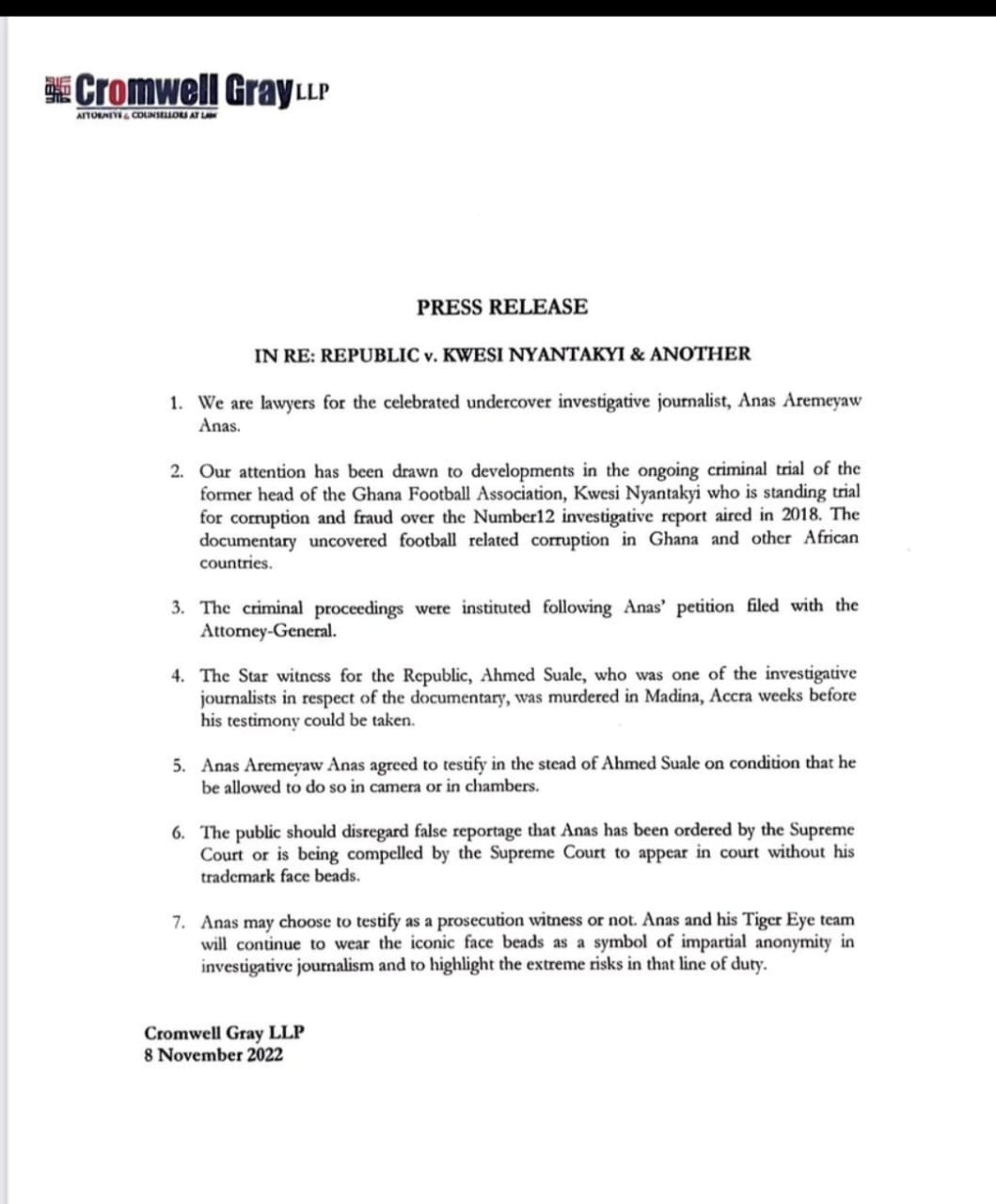
 Majority Leader, Osei Kyei-Mensah-Bonsu
 Dome-Kwabenya MP, Sarah Adwoa Safo