Tag: Uganda

  • Prisoners and diaspora allowed to vote in Ugandan election

    The High Court in Uganda has ruled that prisoners and citizens in the diaspora should be allowed to participate in elections.

    Lawyer Stephen Kalali filed the petition two years ago and the ruling was delivered on Wednesday.

    He argued that excluding these two groups was a violation of their fundamental rights.

    The electoral commission had argued that there was no legal framework which provided for voting while in the diaspora and in places of confinement.

    The judge, however, said that by excluding these categories of people from voting, the Electoral Commission was acting contrary to the fundamental rights and freedoms in the constitution.

    Uganda is due to hold a general election in 2021.

    The Coronavirus pandemic has already heavily affected the preparation for that election, with mass rallies banned.

    Source: bbc.com

  • How radio campaigning may muzzle Uganda’s opposition

    The banning of campaign rallies by the Uganda electoral commission ahead of general elections in January 2021 could give the ruling party an advantage over the opposition.

    This is because radio remains the most accessible form of media in Uganda and most private stations are owned by ruling party politicians.

    Although the public broadcaster, Uganda Broadcasting Corporation (UBC), has channels covering as many local languages and regions as possible, most FM radio stations are privately owned.

    The concern is that ruling party candidates will have an unfair advantage over the opposition, with more access and more airtime.

    Opposition politician Kizza Besigye sued the UBC after the 2016 election, for denying him airtime – and a court ruled in his favour.

    The national broadcaster is obliged to give equal time to presidential candidates, but this does not happen in practice.

    Radio stations in rural areas have in the past been raided by security agents, who have pulled shows off air for hosting members of the opposition.

    The rallies have been banned to stop the spread of coronavirus.

    Candidates will be free to use online and social platforms to campaign, but not everyone has access to those.

    It is not yet known if President Yoweri Museveni, who is serving his fifth term of office, will run for another term.

    Source: bbc.com

  • Uganda bans campaign rallies ahead of elections

    Uganda’s Electoral Commission has banned mass campaign rallies and encouraged aspiring candidates to campaign through the media.

    The commission said the country’s general elections will go ahead in January 2021, but with strict measures to protect voters against coronavirus.

    Wearing of masks, hand hygiene and social distancing will be enforced on polling day.

    The commission has squeezed the elections’ timelines, including nomination of candidates, into less than six months.

    Ugandans will elect their president, members of parliament and local leaders in the elections.

    President Yoweri Museveni, who is serving his fifth term of office, is eligible for a fresh term but has not announced whether he will vie.

    Source: bbc.com

  • Uganda bans campaign rallies ahead of elections

    Uganda’s Electoral Commission has banned mass campaign rallies and encouraged aspiring candidates to campaign through the media.

    The commission said the country’s general elections will go ahead in January 2021, but with strict measures to protect voters against coronavirus.

    Wearing of masks, hand hygiene and social distancing will be enforced on polling day.

    The commission has squeezed the elections’ timelines, including the nomination of candidates, into less than six months.

    Ugandans will elect their president, members of parliament and local leaders in the elections.

    President Yoweri Museveni, who is serving his fifth term of office, is eligible for a fresh term but has not announced whether he will vie.

    Source: bbc.com

  • Uganda preparing 40,000-bed field hospital

    Uganda’s President Yoweri Museveni has said the country is preparing a 40,000-bed field hospital at Namboole Stadium in the capital, Kampala, for coronavirus patients.

    The president said the Ministry of Health was initially planning for 9,000-bed facility but he had instructed that the capacity be increased.

    Uganda has so far recorded 657 cases of Covid-19, the respiratory illness caused by coronavirus.

    Mr Museveni said the country had managed to prevent coronavirus-related deaths but warned that as the numbers increased there could be deaths.

    Buses have been disinfected after some lockdown restrictions were eased at the beginning of June

    President Museveni criticised some people for not following regulations to social distance by attending burials and weddings.

    He said to stop community transmissions of the virus people needed to be more careful and stay at home if they had nothing important to do.

    Source: bbc.com

  • Coronavirus: Uganda approves return of citizens stranded abroad

    The Ugandan cabinet has approved the return of 2,400 nationals stranded abroad amid Coronavirus pandemic, a government official said on Tuesday.

    The cabinet on Monday agreed that Ugandan nationals trapped in 66 countries can return home at their own cost, Judith Nabakooba, minister for information, communication technology and national guidance, told reporters.

    “Cabinet in principle agreed that Ugandans who are stranded abroad should be allowed to return home. They are going to return in phases,” said Nabakooba.

    The government is making arrangements with the UN World Food Program (WFP) to fly the stranded citizens home, said Nabakooba, adding that all the returning citizens will have to undergo a 14-day mandatory institutional quarantine.

    President Yoweri Museveni last month directed Prime Minister Ruhakana Rugunda to study the possibility of evacuating dozens of citizens stranded abroad amid Covid-19 pandemic travel restrictions.

    To contain the spread of Covid-19, the country on March 22 suspended all incoming flights, except cargo flights.

    Uganda currently has 253 confirmed Coronavirus cases, with 69 recoveries, according to the Ministry of Health.

    Source: theeastafrican.co.ke

  • Ugandan police ‘close shops without wash-points’

    Police in Uganda’s capital Kampala have closed shops that had not installed wash-points, the New Vision newspaper reports.

    The authorities were following the president’s new directives to slow down the spread of coronavirus, the state-owned newspaper continued.

    People without face masks were also ordered to get one and the traders put up notices to customers that face masks were compulsory.

    The newspaper tweeted photos of police enforcing the directives:

    President Yoweri Museveni on Monday said the government will distribute free masks to all citizens aged over six before lifting coronavirus containment measures.

    Thereafter, shops will be allowed to open, public transport vehicles will be allowed to carry only half their capacity and food market vendors who have been working and living at their stalls will be allowed to go home at the end of each day.

    However, public transport is still banned in border districts for 21 days.

    Source: bbc.com

  • Lake Victoria rising levels affects Uganda power supply

    The record water levels in Lake Victoria forced authorities in Uganda to ration power over the weekend until Monday.

    The lake is the source of water for the country’s four big hydropower plants, along the River Nile and following heavy rains the water level has risen to its highest since 1964.

    The authorities have been releasing water from the dams, to ease pressure.

    On Friday water levels on Lake Victoria rose to more than 13.4m, setting a new record.

    The high water has caused flooding, with homes and hotels close to the shore affected.

    It has also dislodged large islands of floating debris and weeds, which threatened to block turbines and forced the electricity suppliers to close down hydropower dam operations twice recently.

    That caused power cuts across Uganda and other countries in the region.

    East Africa is experiencing heavier than usual rains, which are forecast to continue this month.

    Source: bbc.com

  • Ugandan rebels behead 3 in DR Congo

    Uganda’s Allied Democratic Forces (ADF) beheaded three people in the latest attack in the Ituri region in the Democratic Republic of Congo’s north Kivu province, local media reported Saturday.

    “Three civilians were killed in a new attack by the Allied Democratic Forces fighters late Friday in the village of Mbingi, west of the city of Oicha, in Beni territory. All the victims, including a woman, were beheaded,” Actualite.cd quoted Kinos Katuho, head of a local civil society group.

    The killings took place at 9 p.m. local time (2000GMT).

    Armed Forces of the Democratic Republic of Congo (FARDC) pursued the attackers, according to media reports.

    It is the second attack blamed on ADF rebels this week in the area.

    Rebels killed two civilians in Mabatundu village late Thursday.

    FARDC launched an offensive against the ADF at the end of October.

    Originally from Uganda, the rebels have been accused of killing more than 1,000 people in the Beni area in the northern part of North Kivu since 2014.

    According to civil society groups, rebels killed about 150 civilians between November and December in reprisal attacks.

    The attacks on civilians triggered protests in Beni in December, where locals blamed the UN peacekeeping force, MONUSCO, of failing to protect them.

    Source: aa.com.tr

  • Ugandan rebels behead 3 in DR Congo

    Uganda’s Allied Democratic Forces (ADF) beheaded three people in the latest attack in the Ituri region in the Democratic Republic of Congo’s north Kivu province, local media reported Saturday.

    “Three civilians were killed in a new attack by the Allied Democratic Forces fighters late Friday in the village of Mbingi, west of the city of Oicha, in Beni territory. All the victims, including a woman, were beheaded,” Actualite.cd quoted Kinos Katuho, head of a local civil society group.

    The killings took place at 9 p.m. local time (2000GMT).

    Armed Forces of the Democratic Republic of Congo (FARDC) pursued the attackers, according to media reports.

    It is the second attack blamed on ADF rebels this week in the area.

    Rebels killed two civilians in Mabatundu village late Thursday.

    FARDC launched an offensive against the ADF at the end of October.

    Originally from Uganda, the rebels have been accused of killing more than 1,000 people in the Beni area in the northern part of North Kivu since 2014.

    According to civil society groups, rebels killed about 150 civilians between November and December in reprisal attacks.

    The attacks on civilians triggered protests in Beni in December, where locals blamed the UN peacekeeping force, MONUSCO, of failing to protect them.

    Source: aa.com.tr

  • Ugandans donate $6m to government for virus fight

    People in Uganda have contributed a total of about $6m (£4.8m) to help the government finance the provision of cars and medical supplies, to support efforts to fight coronavirus.

    Many African countries have weak and underfunded health systems but Uganda is relying on preventing the spread of the pandemic by drawing on lessons learned from containing outbreaks like Ebola.

    Covid-19 threatens not only people’s health, but the national lockdown has caused food insecurity and that shortage of basic supplies prompted ordinary Ugandans to start giving food donations.

    The efforts to provide food were commended by President Yoweri Museveni which then encouraged donations of money, vehicles and medical equipment such as protective clothing needed by doctors and nurses.

    Ordinary citizens and companies have given the government more than 50 4×4 cars and ambulances, which the authorities now intend to expand into an emergency fleet of 1,300 vehicles, spread around the country.

    As the money donated increases so the extra funds will be used to purchase more vehicles.

    Source: bbc

  • Coronavirus: Uganda bans lorry drivers from sleeping at hotels

    All lorry drivers crossing over the border into Uganda will not be allowed to carry passengers in their vehicles or to sleep in hotels or other people’s homes as part of new measures to prevent the spread of coronavirus.

    Ugandan President Yoweri Museveni made announcement after more than 20 of drivers entering the country from Kenya tested positive for Covid-19, the respiratory illness caused by the virus.

    Mandatory testing for Covid-19 for lorry drivers began earlier this week has been causing huge traffic jams on the border between Kenya and Uganda.

    The route from the Kenyan port city of Mombasa is vital for transporting food, medicine and other essential goods to Uganda, Rwanda, South Sudan and the east of the Democratic Republic of Congo.

    President Museveni said stopping cargo traffic altogether would be suicidal.

    He also spoke out against growing hostility towards truck drivers by some Ugandans who worry they could be transmitting the disease.

    But he acknowledged that the group posed a real threat and compared the situation to the Aids scourge of the 1980s and 1990s when lorry drivers in the region transmitted HIV in towns and cities they travelled through.

    Source: bbc.com

  • Uganda denies sending back coronavirus positive truck drivers

    Uganda’s health minister has denied that the country repatriated 14 truck drivers who tested positive for coronavirus.

    The minister, Jane Aceng, said only one driver was repatriated and that 13 others left on their own.

    On Monday, director general of health services, Dr Henry Mwebesa announced that 14 drivers returned to their countries.

    The announcement triggered reactions from Kenyans and Tanzanians online prompting the minister to clarify that 13 of the drivers left Uganda of their own accord:

    Source: bbc.com


  • Uganda moves to curb virus spread by truck drivers

    Ugandan President Yoweri Museveni has announced new measures to control the spread of the coronavirus by lorry drivers after more than 20 entering the country from Kenya tested positive.

    The drivers won’t be allowed to carry passengers or to sleep in hotels or other people’s homes.

    Mandatory testing for Covid-19 has already caused huge traffic jams on the border between Kenya and Uganda.

    The route from the Kenyan port city of Mombasa is vital for transporting food, medicine and other essential goods to Uganda, Rwanda, South Sudan and the east of the Democratic Republic of Congo.

    President Museveni said stopping cargo traffic altogether would be suicidal.

    He also spoke out against growing hostility towards truck drivers by some Ugandans who worry they could be transmitting the disease in the country.

    But he acknowledged that the group posed a real threat and compared the situation to the Aids scourge of the 1980s and 90s when lorry drivers in the region transmitted HIV in towns and cities they travelled through.

    Source: bbc.com

  • Ugandan MPs give themselves $2.6m ‘awareness budget’

    Uganda’s President Yoweri Museveni has blasted members of parliament for allocating themselves a total of 10bn Ugandan shillings ($2.6m; £2m) to raise awareness on coronavirus.

    The president said it was “morally reprehensible” for the MPs to allocate themselves the money, instead of funding district committees created for that purpose.

    President Museveni said he would write to the Auditor General to investigate MPs who had already spent the money to buy relief items for their constituents.

    Uganda has so far confirmed 79 cases of coronavirus. The country is on a lockdown that ends on 5 May.

    Source: bbc.com

  • Coronavirus: Ugandan policeman arrested for attending house party

    A Ugandan policeman who gave permission to a businessman to hold a party and then attended it himself has been arrested and charged with the disobedience of lawful orders and committing negligent acts likely to cause the spread of diseases, a police spokesman told the BBC.

    Samson Lubega, a police commander in Agago, northern Uganda, was detained on Sunday after being at the party organised by someone who had visited the UK and travelled back through Dubai, reports the Daily Monitor newspaper.

    President Yoweri Museveni banned social gatherings in Uganda to prevent the spread of coronavirus.

    Source: bbc.com

  • Ugandan journalist arrested

    A Ugandan journalist was arrested on Monday night shorty after leaving work.

    The NBS television news presenter Samson Kasumba was detained at a police station overnight.

    He has so far not commented on the arrest.

    Ugandan police spokesperson Fred Enanga on Tuesday said the journalist’s arrest had nothing to with his work and would share more details later.

    He said police were interrogating him and had sealed off his house where a search was being conducted.

    NBS television tweeted;

    Uganda’s Daily Monitor tweeted:

    Source: bbc.com

  • Ugandan court ‘suspends $2.6m Covid-19 fund for MPs’

    A Ugandan court has suspended the allocation of 10 billion Ugandan shillings ($2.6m; £2.1m) to members of parliament to fight the spread of coronavirus in their constituencies, the Daily Monitor newspaper reports.

    Each MP was due to receive about $5,300 to, among other things, fuel ambulances and pay allowances for the drivers involved in the Covid-19 taskforces at district level, the newspaper reports quoting sources in parliament.

    The proposal sparked a public outcry and an online petition. The petition said the money should go to the Covid-19 Task Force instead of MPs. It said that many of the MPs were not in their constituencies because of lock down.

    Two opposition MPs on Tuesday succeeded in getting a court order suspending the allocation.

    The Daily Monitor has tweeted about the development:

    Source: bbc.com

  • Coronavirus: Ugandan MP ‘arrested’ for distributing food

    A Ugandan opposition MP is being held by police for distributing food to his constituents over weekend in Mityana district, about 70km (45 miles) from the capital, Kampala, the Daily Monitor newspaper reports.

    Francis Zaake, an independent MP, was arrested in his Mityana Municipality constituency for contravening a presidential directive on food distribution during the ongoing lockdown, Wamala region police spokesperson Rachel Kawala is quoted as saying

    President Yoweri Museveni last week extended a nationwide coronavirus lockdown until 5 May. Restrictive measures imposed include closure of national borders, including Entebbe International Airport, to passenger travel, a dusk-to-dawn curfew and a ban on public transport.

    The MP tweeted photos purporting to show security officers “breaking into his home”.

    He had also tweeted a photos of the food rations he had been distributing to his constituents.

    Source: bbc.com

  • Uganda extends border closure and curfew

    Uganda’s President Yoweri Museveni has extended the nationwide coronavirus controls for 21 days.

    In his address to the nation at the end of an initial 14-day lockdown, the president said that all control guidelines previously announced will remain in place.

    The measures include closure of national borders, including Entebbe International Airport, to passenger travel, a dusk-to-dawn curfew, and a ban on public transport.

    Mr Museveni said that the extension will help health workers study the situation, and monitor about 18,000 people said to have come into the country between 7-22 March.

    Air and road cargo transport are still permitted.

    Inter-state long-distance truck drivers, whether transiting through or destined for Uganda, will be tested at the border points.

    So far, over 5,600 samples have been tested and 54 cases confirmed in the country, eight of whom have recovered.

    Source: bbc.com

  • Uganda extends border closure and curfew

    Uganda’s President Yoweri Museveni has extended the nationwide coronavirus controls for 21 days.

    In his address to the nation at the end of an initial 14-day lockdown, the president said that all control guidelines previously announced will remain in place.

    The measures include closure of national borders, including Entebbe International Airport, to passenger travel, a dusk-to-dawn curfew, and a ban on public transport.

    Mr Museveni said that the extension will help health workers study the situation, and monitor about 18,000 people said to have come into the country between 7-22 March.

    Air and road cargo transport are still permitted.

    Inter-state long-distance truck drivers, whether transiting through or destined for Uganda, will be tested at the border points.

    So far, over 5,600 samples have been tested and 54 cases confirmed in the country, eight of whom have recovered.

    Source: bbc.com

  • Ugandans kicking out Chinese residents from their business premises just like it is happening to Africans in China

    Uganda has begun serving local Chinese residents with the same hostility meted out to some Africans in China.

    In a video, a business owner in Uganda is seen giving orders not to allow access to any Chinese citizens into their premises.

    Horrible videos and pictures have been flying across the internet showing how Africans in China are been denied access to their hotels and apartments on the basis that may be carrying the Coronavirus.

    The African Union and other international organizations have condemned the inhumane act by China on African residents and called for a seizure.

    Watch Video Below:

    In a video, a business owner in Uganda is seen giving orders not to allow access to any Chinese citizens into their premises.

    Horrible videos and pictures have been flying across the internet showing how Africans in China are been denied access to their hotels and apartments on the basis that may be carrying the Coronavirus.

    The African Union and other international organizations have condemned the inhumane act by China on African residents and called for a seizure.

    Watch Video Below:

    Embedded video

    Source: bestnewsghana.com

  • Ugandan police officers charged for ‘torturing’ women

    Ten police officers in Uganda have been charged for allegedly torturing a group pf women while enforcing a lockdown to curb the spread of coronavirus, the Uganda Police Force said on Tuesday.

    The officers were accused of caning 38 women and forcing them to swim in mud in the northern town of Elegu.

    The 10 officers will be held in custody until 7 May, the police said.

    Photos of the women showing injuries they had sustained and their muddy clothes were shared online over the weekend.

    Ten police officers in Uganda have been charged for allegedly torturing a group pf women while enforcing a lockdown to curb the spread of coronavirus, the Uganda Police Force said on Tuesday.

    The officers were accused of caning 38 women and forcing them to swim in mud in the northern town of Elegu.

    The 10 officers will be held in custody until 7 May, the police said.

    Photos of the women showing injuries they had sustained and their muddy clothes were shared online over the weekend.

    Source: bbc.com

  • Uganda arrests former security minister charged with treason

    Ugandan security agencies have arrested former Security Minister Lt. Gen. Henry Tumukunde and charged him with treason, police said Friday.

    Police spokesperson Fred Enanga said in a statement that Tumukunde was arrested on Thursday night for calling on the support of a neighboring country to remove President Yoweri Museveni from power.

    Tumukunde’s arrest comes barely a week after he announced his intentions to challenge Museveni in the 2021 presidential polls.

    “The arrest follows his utterances in a series of radio and television interviews, which seek to foster hatred that might lead to inter-community violence, fomenting and glorifying violence in general,” said Enanga.

    “He in addition, calls on the support of a neighboring country to support him in removing the current leadership with or without the ballot,” Enanga said.

    He said Tumukunde’s arrest should act as a deterrent to others who would like to promote violence in the country.

    Source: GNA

  • Ugandan imam who married man ‘released on bail’

    A Ugandan imam who was arrested after marrying a man in a wedding dress, has been released on bail, according to Daily Monitor newspaper.

    Human rights organisations represented the two men in court and filed a bail application which was ruled in their favour.

    Activist Stella Nyanzi was present in court and told Daily Monitor the two should not have been arrested.

    Sheikh Mohammed Mutumba and his fake bride Richard Tumushabe, whose alias is Swabullah Nabukeera, were ordered to pay 1m Ugandan shillings ($270; £209) as bond.

    Sheikh Mutumba married Mr Tumushabe who had pretended to be a woman and dressed in a bridal gown.

    Mr Tumushabe’s cover was blown when neighbours accused him of stealing and during a search police discovered he wasn’t a woman.

    The imam was arrested and both charged with having with having carnal knowledge with a person against the order of nature.

    Source: BBC

  • The Ugandan village devastated by elephantiasis

    Despite sitting down as she shells bright-pink beans, Margaret Tindimutuma’s swollen feet are in pain. The Ugandan matriarch has a rare type of elephantiasis that has caused her family untold suffering.

    “I have always had allergies since I was young. So when my legs started to develop little swellings, like boils, I didn’t think much of it,” the octogenarian says as she sits on a papyrus mat in the centre of a compound of mud houses.

    “But the pain became so intense, I would feel pinpricks all over. The skin in between the toes broke out in sores. Then my sons started to fall sick. I wondered if they had inherited my illness.”

    Her two grown-up sons both died after sores caused by the disease became infected, one in 2017 and the other last year.

    We sit on a wooden bench in the yard, as Hope Amooti, the widow to one of them, shows me photographs of happier times. Her husband of 18 years was a tall man and in one picture he has a broad smile and shyly looks at the ground.

    “When the pain in his legs overwhelmed him, his back grew permanently arched.

    “When we could afford painkillers, he would walk around. But by the time he died, he couldn’t even leave his bed,” Mrs Amooti says, shielding her welling eyes from the morning sun.
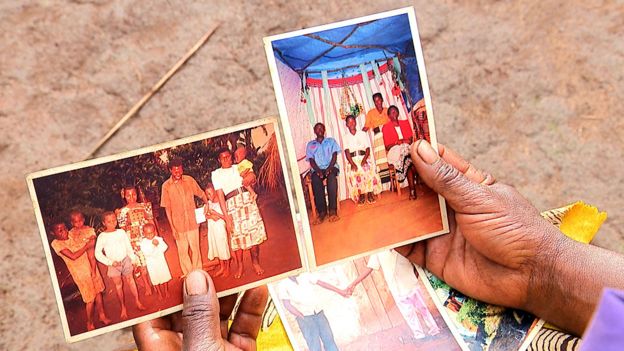
    Woman's hands showing two photographs
    The family remembering happier times

    In another photograph, Mr Amooti’s younger brother sits with his sisters in a decorated tent. He has no shoes on, and you can see that his feet are slightly puffy, the skin between the toes broken and peeling.

    ‘Rejected by in-laws’

    Enid Twasiima, one of Mrs Tindimutuma’s daughters who had been married in another village, fell sick too. Her arm grew into an ashen, swollen log.

    The disease then moved to her legs. Her husband’s family rejected her, and she returned to Kyakatoma village with her children.
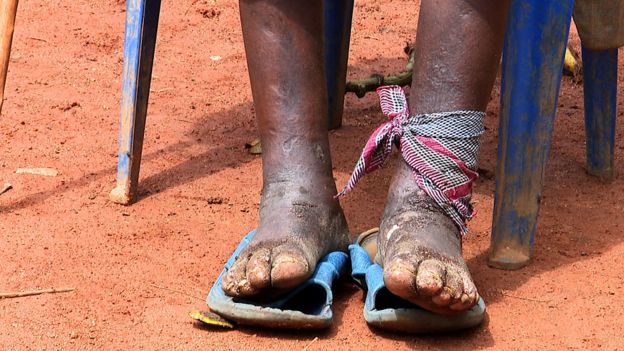
    Legs covered in sores with a handkerchief wrapped round
    Enid Twasiima uses a handkerchief to keep away flies

    “I used to grow enough food for my family. For five years now, I have been stuck at home,” Mrs Tindimutuma says.

    Ms Twasiima, sitting on a stool nearby, listens pensively. She covers the worst of the wounds with a dirty chequered handkerchief, tied around the leg, to keep away the buzzing flies.

    As we speak, a neighbour joins us. The lower part of his leg has a deep, oozing ulcer. Out of politeness, I stop short of covering my nose from the putrid smell.


    In 2015, a team of scientists visited the village searching for clues about this rare illness – classified by the World Health Organization (WHO) as a neglected tropical disease.

    They took samples of the soil, and tested those who were sick.
    Rural scenery
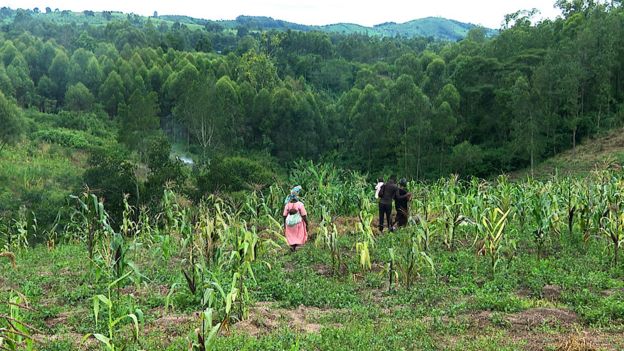
    Scientists have advised the villagers to wash their arms and legs after doing farm work

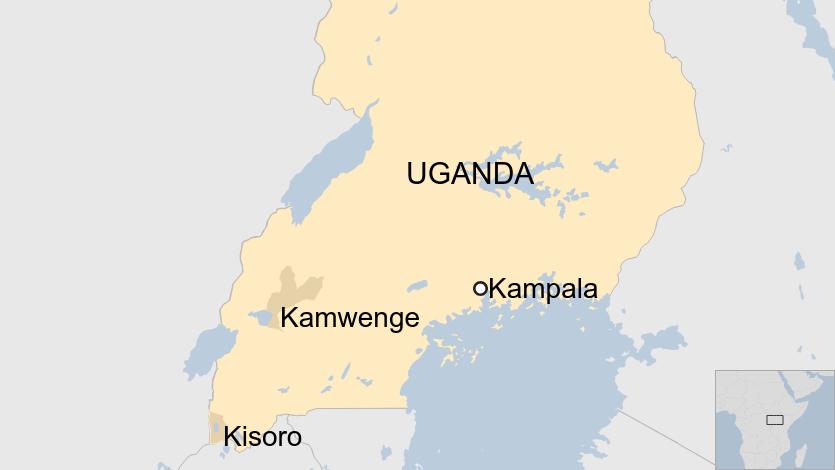
    Their results showed that the elephantiasis that has devastated dozens of families in Uganda’s western district of Kamwenge, is a rare type known as podoconiosis.

    While the most common form of elephantiasis is caused by worms, microfilaria, transmitted by mosquitoes, podoconiosis results from exposure to minerals in the area’s volcanic soils.

    “There are minerals such as silicon, iron and aluminium, really small particles which penetrate the skin,” says senior epidemiologist Christine Kihembo, who led the study while working at the ministry of health.

    “They affect the normal flow of fluid in the limbs, causing the pain and inflammation. The condition manifests after years of exposure to the soil.”

    Some reports indicate that more than 300 people might be affected in the district of Kamwenge alone. A few cases have been seen further south in Kisoro.

    Podoconiosis has also been recorded in Ethiopia, Rwanda and Cameroon. This type of elephantiasis is thought to affect about four million people globally, according to WHO estimates.

    ‘Gumboots prized’

    Families in Kamwenge derive their livelihood from the land. The locals work the rich soil with basic tools, and their bare hands.
    After the findings of the study were published, the scientists advised the villagers to wear protective gear, and wash their arms and legs shortly after farm work. Gumboots became a prized possession, for those who could afford them.

    In the neighbouring village, 39-year-old Provia Arinaitwe whimpers as she rises from a mat in front of her small house. She is down with a bout of malaria, which has meant days of not caring for her legs. And now the pains are back.

    Her calloused legs are covered in dark marks, but Ms Arinaitwe does not have any festering wounds. She is in a better condition than anyone else I have met. And she shows me why.

    After washing her feet in a plastic basin of water, she measures out three scoops of table salt in her palm, throwing it into in the clean basin, where her daughter pours mugfuls of water. She soaks her feet in the water for 15 minutes.

    “When I do this, three times a day, it gives me great relief. I am able to go about my work. But sometimes I have no money to buy the salt, and the blisters and pain return,” she says, wincing as she slips the feet into a pair of slippers.

    Dr Kihembo says that during the study, it was noted that people who washed their feet within at least two hours of finishing work on the farm were 11 times less likely to have symptoms of podoconiosis than those who cleaned up much later or not at all.

    There are drugs available in Uganda that can treat the more common form of elephantiasis, but sufferers from podoconiosis can only get symptomatic relief through painkillers, which are hard to afford.

    Shunned

    Everest Beyanga is a local volunteer who, in the absence of a government intervention, has made it his job to document this misery.

    He carries around a sheaf of papers in a blue folder.

    Written on them are names, ages, villages: every single person suffering from this debilitating disease in his sub-county. On a separate sheet is a list of 30 who have died since he started doing his rounds.

    He sighs with hopelessness: “No-one was visiting these people. Everyone avoids them because their wounds stink.

    “I thought, ‘This is my village too.’ If the disease is indeed in the soil, we will all probably catch it.

    “Sometimes, all one needs is for you to drop in and greet them. But sometimes I do not even want to come, because I don’t even have a pack of salt to offer them.”

    At our last stop, the woman we have come to see asks after three people she knew, who had podoconiosis.

    They have all died since he last visited, Mr Beyanga tells her.

    She had not heard the news because she was not well enough to leave her home and no-one had come to see her.

    Her furrows her brow in response and she hobbles way to prune her banana trees with a machete.

    Source: BBC


  • ‘She set the bar so high’: Mother’s tribute to Queen of Katwe star

    Queen of Katwe actress Nikita Pearl Waligwa, who died last week aged 15, has been described by her mother as a determined girl who never let anything get in her way.

    The young Ugandan actress died after being diagnosed with a brain tumour in 2016.

    Rachel Asiimwe Waligwa told BBC Newsday that her daughter “endured all the pain like an adult with such grace” and would insist she was fine even when one could see she was in pain.

    She added:

    “She was very determined, she never let obstacles… She never had excuses for not getting what she wanted. She was self-driven, she set the bar so high. She was very determined, she never let obstacles… She never had excuses for not getting what she wanted. She was self-driven, she set the bar so high.

    “She didn’t think the brain tumour or cancer or surgery was an obstacle. She still fought, she was such a fighter. My daughter has lived her life, she’s accomplished so much.” She didn’t think the brain tumour or cancer or surgery was an obstacle. She still fought, she was such a fighter. My daughter has lived her life, she’s accomplished so much.”

    Source: bbc.com

  • Uganda: ‘Children die after eating pesticide pancakes’

    Two children in Uganda have died and 11 others have been hospitalised after they ate pancakes made with pesticides instead of cooking oil, according to the Daily Monitor newspaper.

    All 13 children are from the same family in Budumba, western Uganda.

    The newspaper reports that the children made the pancakes themselves – a dish commonly known in Uganda as Kabalagala.

    But the Daily Monitor adds that they used the wrong ingredients – mistaking a pesticide, used to grow watermelons and vegetables, for cooking oil.

    The children then started vomiting, the news site reports, and were taken to Busolwe hospital where two of them died and the 11 others are being treated:

    Source: bbc.com

  • Uganda’s labour minister warns youth against social media misuse

    Minister of State for Labour, Mr Mwesigwa Rukutana has warned ‘idle youths’ against what he described as increased tendencies of misuse of Social media platforms by posting hate and sectarian information aimed at frustrating government projects.

    According to the minister who is also the MP Rushenyi County, social media platforms like Facebook, Twitter and Instagram were designed to help people keep up with friends, unite those with distinct ideas and help government where there are some loopholes.

    However, social media users in Uganda have a tendency of spreading propaganda and sensational information, according to Mr Rukutana.

    He said this had fueled cyber bullying and amplified social divisions among citizens.

    “It is unfortunate that some youths have opted to use social media to criticize government programmes and sectors such as health and other infrastructural development and attack their leaders claiming that they have done nothing yet things are there. I want to tell you that your wishes are our wishes. If all wishes were horses, beggars would ride, ” Mr Rukutana said during an impromptu visit to Rubaare Health Centre IV in Rubaare Town council, Rushenyi County on Sunday.

    The minister also refuted reports that Rubaare Health Centre IV was not working because it lacked equipment.

    He said he was concerned about a viral social media post alleging that the health facility was ‘sick’ due to inadequate equipment.

    “Such is done by wrong elements used by local leaders who failed to win political seats during last general elections. Local politicians who lost elections must stop misusing unemployed youths to criticise government facilities and programmes on social media platforms,” he said.

    According to the minister, all departments of the health facility are operational except the theatre which developed cracks on the roof before the Ministry of Health suspended operations. He pledged to get all necessary materials to renovate the theatre.

    According to Ntungamo District health officer, Dr Richard Bakamuturaki, the theatre has not been operational for the last five years because it needs Shs24 million to renovate the ceiling.

    Ntungamo District has 41 health units including Itojo hospital and four health centre IVs.

    Earlier, the minister donated Shs1 million to Rubaare Elders’ Association comprised of 260 members led by one Simeon Kakoona Biganja. The money was aimed at empowering the elders in both Rubaare Sub County and town council, according to the minister.

    SOurce: allafrica.com

  • Work with right values – Kagame urges government officials

    President Kagame cautioned Government officials against treating their jobs and institutions they run as if they own them.

    President Paul Kagame on Sunday cautioned leaders who regularly fail to deliver on their responsibilities that it was fundamental to uphold the right values and character if they are to fulfil their duties.

    He was speaking at the opening of the 17th edition of the National Leadership Retreat, also known as Umwiherero, at the Rwanda Defence Force Combat Training Centre in Gabiro, Gatsibo District.

    The retreat brought together more than 400 leaders including the First Lady, central and local government, parastatals, private sector and youth representatives from different sectors.

    The Head of State rejected the idea that everything the country has failed to achieve is a result of lack of skills or resources.

    “The reason for not doing things right is having the wrong values. You have the skills and knowledge and you know what needs to get done but you have the wrong values,” he told the leaders.

    The President cautioned the government officials against treating their jobs and institutions they run, as if they own them. He reminded them that they are public servants and should work in the interest of Rwandans. And, if they feel, they can not deliver, they should be honest enough to admit they need to step down.

    While the country has made a lot of progress over the last 17 years, Kagame said, there was a lot more that needs to get done to deliver the country’s transformation goals.

    While the President strongly criticized leaders for repeated cases of misconduct and negligence, he urged the younger audience against following a similar path.

    “It’s never too early to be responsible and mature to understand the strategic objectives of our country,” he added.

    Kagame highlighted scenarios where leaders failed to deliver on their responsibilities.

    “When we experienced problems with our Ugandan neighbors, some of our people grieved. I learned that citizens had been driven to access basic services like health, education and other services from our neighbor,” he said.

    “The situation made us look at things in a different lens. But the truth is, we had not failed to have these services, we had just abandoned our people,” Kagame pointed out.

    Economy thriving

    Despite the challenges Rwanda has faced, Kagame highlighted that the country’s economy continued to grow.

    In the past two years (2018 and 2019), the Head of State indicated that Rwanda achieved strong growth compared to previous years.

    Rwanda’s economy grew at 10.9 per cent in the last three quarters of 2019, driven by different sectors, notably services, industry and agriculture.

    The President challenged the private sector to even think bigger and do more to grow their businesses.

    Kagame insisted that Rwanda is at a critical stage where leaders cannot afford to sit and just watch.

    “We shouldn’t stop now,” he said.

    The conversations on the first day revolved around what the country needs to achieve Vision 2050 – 30 years from now.

    Prime Minister Édouard Ngirente said that it will require making strategic investment, efficient use of public resources, and working together to achieve that vision.

    He stated that this year’s retreat will allow leaders to chart a new chapter of growth for the country.

    “We see this gathering as a platform to examine ourselves. We also see it as an avenue to question those who didn’t deliver, but also chart a way forward,” he said.

    According to the Premier, 43 activities out of 57 that were adopted from last year’s retreat were being implemented.

    However, he admitted that the government was lagging behind when it comes to investing in education and correcting mistakes in health sector.

    Source: allafrica.com

  • Four rare mountain gorillas ‘die in Uganda lightning strike’

    Four rare mountain gorillas, including a pregnant female, have died in Uganda after being hit by lightning, a conservation group says.

    The three adult females and a male infant were found in Uganda’s Mgahinga National Park with “gross lesions” on their bodies indicating electrocution.

    The Greater Virunga Transboundary Collaboration (GVTC) called this a “big loss for the species”.

    There are just over 1,000 mountain gorillas in existence.

    The species is restricted to protected areas in the Democratic Republic of Congo, Rwanda and Uganda.

    The four that died were part of a 17-member group, which has been called the Hirwa family by the authorities.

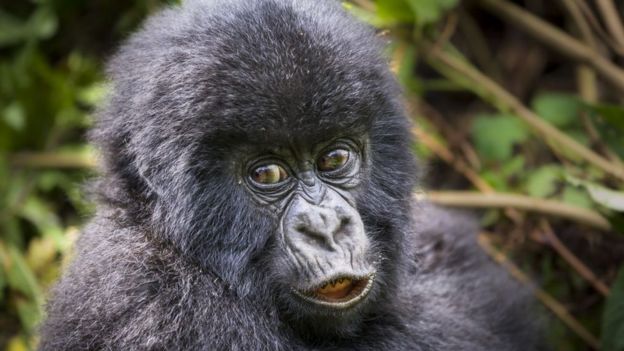
    An infant mountain gorilla
    Members of the Hirwa group were photographed in 2012

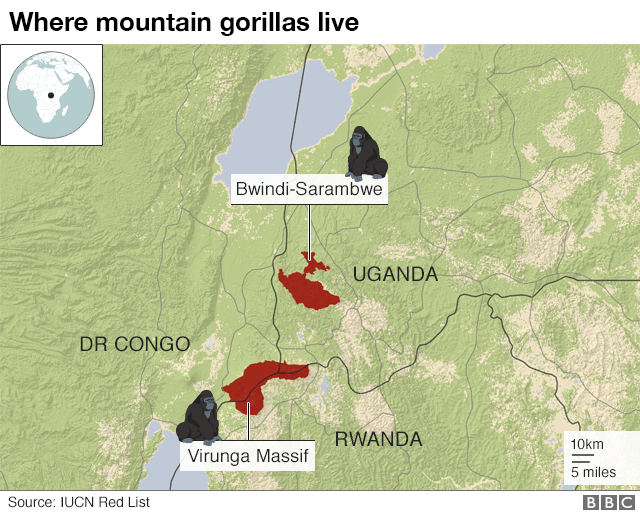
    The Hirwa group had crossed the border from Rwanda into Uganda last year and had been living in Uganda’s Mgahinga National Park.

    Mgahinga is in the Virunga Massif range of mountains which straddle the borders of Uganda, Rwanda and DR Congo.

    “This was extremely sad,” Andrew Seguya, executive secretary of the GVTC, told the BBC.

    “The potential of the three females for their contribution to the population was immense,” Dr Seguya said.

    He added that the 13 surviving members of the Hirwa family have been found and are feeding well.

    Infographic

    Samples from the post-mortem are currently being tested and confirmation of the cause of death is expected within the next three weeks, GVTC said.

    In 2018, the mountain gorilla was removed from the list of critically endangered species, after intensive conservation efforts, including anti-poaching patrols, paid off.

    SOurce: myjoyonline.com

  • Why Ugandan Minister wants ban on labia stretching

    The minister for Gender and Culture has warned school matrons against initiating young girls into genital elongation.

    Ms Peace Mutuuzo on Wednesday said government will find avenues of talking to girls, especially in primary schools, how to report the perpetrators for encouraging a practice that does not add value to their health.

    “We shall target matrons in primary boarding schools. You are preparing our girls who are not yet ready for marriage and may get partners who do not care about that (genital elongation),” Ms Mutuuzo said while addressing journalist in Kampala.

    Pulling as it’s popularly known, is a tradition common in central and southern parts of Uganda and Rwanda, which basically involves the elongation of the labia minora on the female private parts by girls and women.

    The practice is widely criticised by the west for allegedly being outdated and barbaric.
    Ms Mutuuzo hinted on the vice while addressing journalists about the forthcoming International Day for Zero Tolerance of Female Genital Mutilation scheduled on February 6.

    She said her ministry needs an increase in the budgetary allocation from the current Shs200 million to Shs1.2 billion to help fight female genital mutilation which is predominant in Sebei sub region in eastern Uganda.
    The money is to, among other things, help in community sensitisation, strengthen male engagement, establish shelters for FGM victims and engage more elders in the fight against the practice.

    Uganda has four types of FGM; some of which are irreversible while others have resulted into death due to over bleeding by the victims.

    The types of FGM practised in Uganda, according to government, are; clitoridectomy, excision (practised by the Sabiny), infibulation or pharaonic (practised by the Pokot) and other types- mainly genital elongation practiced by Bantu speaking people, especially in central Uganda.

    Ms Mutuuzo said Uganda is experiencing an emerging trend of medicalisation since some believe that the cutting is less painful when done by a medical personnel.
    She believes this has been encouraged by the educated Ugandans who should have been in the centre of the fight against the practice.

    “The young people have utilised social media platforms like WhatsApp and Facebook, to openly campaign for preservation of FGM, as an important practice of the Sabiny culture using the slogan “Our culture, our Identity” Ms Mutuuzo said.

    The minister said government was aware of the WhatsApp groups created to aid the outlawed vice and are planning on how to track down the members for prosecution.

    Uganda enacted the Prohibition of FGM Act 2010 to eliminate the practice but it has persisted due to cultural beliefs one of which is an enhancement to please men during sex.
    According to UNFPA country representative, Mr Alaine Sibenaler, cultural practices are very difficult to eradicate.
    “But should not be used as an excuse to abuse human rights,” he said.

    He said there should be a dialogue between the young people and their parents so that they understand the dangers of FGM to have concerted efforts in fighting the practice in this generation.

    Ministry of Gender reports indicate that between November 2018 and January 2019, about 350 girls underwent FGM in Kapchorwa, Kween and Bukwo districts.
    Globally, it is estimated that approximately 100 to 140 million girls and women have undergone some form of genital mutilation or cutting.

    Health experts say cutting has far reaching health effects including severe bleeding which may lead to death, permanent scars that may block the birth canal, obstetric fistula, urine incontinence, permanent disability, depression, trauma, feelings of disgust, loss of libido, among others.

    In 2012, the UN General assembly designated February 6 as the international day of zero tolerance of FGM. The theme for 2020 is “Unleashing Youth Power”, One decade of accelerating actions for zero Female Genital Mutilation by 2030.

    Source: allafrica.com


  • Uganda confirms yellow fever outbreak, three dead

    Ugandan health minister Ruth Aceng on Friday confirmed that three people have been killed in a yellow fever outbreak in the midwestern and northwestern parts of the country.

    Two adult men, who were 18 and 21 and dealing in cutting and trading timber between Uganda and neighboring South Sudan, succumbed to the virus in the northwestern district of Moyo earlier this month, and a third male victim, a 37-year-old cattle keeper, died last November in the midwestern district of Buliisa, the minister said.

    The cattle keeper’s wife, 38, also tested positive of the yellow fever virus, on January 22.

    “Blood samples were withdrawn and sent for testing at Uganda Virus Research Institute (UVRI). Results from UVRI confirmed yellow fever infection,” Aceng said.

    Read:50 dead, dozens in hospital as yellow fever hits Nigeria

    She said the health ministry and the World Health Organization have dispatched rapid response teams to Moyo and Buliisa districts to “support investigations, active search for cases, community mobilisation and sensitization.”

    Uganda has requested yellow fever vaccines from the International Coordination Group that manages global stock piles of yellow fever and meningitis vaccines, Aceng said.

    “We anticipate that within the next two weeks, vaccines will be available and vaccination will commence in Moyo and Buliisa districts,” she said.

    Aceng said her ministry has applied with the Global Vaccine Alliance and the WHO for inclusion of the yellow fever vaccination into its routine immunization schedule.

    Read:No yellow fever, polio vaccination, no entry Saudi Arabia

    “Having faced four outbreaks, Uganda now qualifies to introduce yellow fever vaccine as a long-term measure to prevent yellow fever outbreaks,” she said. The minister said all travellers in and out of the country must be vaccinated against yellow fever.

    “Travelers are urged to comply with this travel requirement to ensure the risk of spread of yellow fever through international travel is minimized,” Aceng said.

    “The ministry would also like to re-assure Ugandans and all other residents that with the experience and expertise available in the country, the disease will be contained,” she said.

    The yellow fever is mostly caused by a type of mosquitoes called “Aedes Aepyti” found in the tropics and sub-tropics. It is transmitted from person to person through mosquitoes, although there are also forest monkeys that transmit it.

    Read:How black people were eliminated in Argentina throughout history

    According to the ministry, symptoms of the disease include high fever, headache, general body aches, fatigue, vomiting, blood in urine or stool and yellow discoloration of skin or eyes.

    If not detected and treated on time, the disease will affect the blood and the victims will experience renal failure and possible coma.

    Source: Theeastafrican.co.ke

  • Uganda landslides: More bodies recovered as toll increases to 13

    Eight more bodies have been recovered in Bududa and Sironko districts following landslides in Bugisu sub-region triggered by heavy rains, bringing the death toll so far to 13.

    The search and rescue team led by police and Uganda National Roads Authority (UNRA) retrieved the bodies using an excavator on Friday and Saturday. However, more are feared dead as several people are still missing.

    Read: 24 killed in a landslide in Kenya

    Earlier, five bodies had been recovered by the locals using hand hoes in the affected villages of Naposhi, Shikhururwe and Namasa in Bushika Sub-county and Naroko village in Bunabutiti sub-county.

    According to the residents and local leaders, more bodies are still buried under the debris.

    “More are still buried. We pray we find them so that we can give them a decent burial,”Ms Mary Nabutuwa, a survivor, who also lost her husband but his body was still missing by Friday, said.

    The landslides also left more than 300 families displaced and currently sheltering themselves at their respective relatives’ homes, churches and schools.

    However, Daily Monitor learnt that the operator of the excavator fell sick and was unable to work on Sunday.

    “We are told the operator will not work today (Sunday) because he is sick. Why would government send only one operator? We want to see the bodies of our missing relatives,” Mr George Nambale, LCI chairperson of Shikhururwe village said.

    The LCV chairperson, Bududa District, Mr Wilson Watila confirmed that four more bodies were retrieved bringing the number to 9.

    “But more are still missing and the search will continue,” he said.

    Mr Watila, however, said UNRA should leave the excavator to work for at least one week because the two days they were given are not enough for the effective search.

    “The excavator should be here for more a week because the affected area is big and the machine is only one with the one operator,” he said.

    He added they are also facing challenges of lack of enough money to buy fuel for the excavator.

    “We have borrowed fuel to enable the machine run for three days but after that, we are not sure where more fuel will come from,” he said.

    Read: Floods kill at least 39 in Congolese capital Kinshasa

    Another landslide hit villages of Bunagisa village in Shimoma parish in Zesui sub -county in Sironko district. Four more bodies have recovered and eight are still missing.

    In Manafwa district, resident are also living in fear after reports of fresh cracks, which have been cited in parishes of Bumukari, Butuwa, Bukimanayi and Bunamungoma in Kaato Sub-county.

    Ms Allen Khalayi, one of the resident, appealed to government to come to their rescue.

    “We pray that government gets serious and relocate us to a safe place before we die, “Ms Khalayi, said.

    The Manafwa RDC, Mr Ahamad Washaki, said has written to the office Prime Minister (OPM) for intervention.


    Source: allafrica.com

  • Uganda to charge 16 arrested for ‘gay sex’

    Police in Uganda say 16 people will be charged with having “unnatural sex”, a reference to same-sex relations.

    Police spokesman Fred Enanga said medical examinations proved that the 16 had been having “unnatural sex”.

    Read:Uganda wants death penalty for gay sex

    The 16 were arrested on Monday in a suburb neighbouring the capital, Kampala.

    Their detention comes nearly two weeks after the government said it had no plans to re-introduce the anti-homosexuality bill which could impose stiffer penalties, including the death sentence, for gay sex.

    Read:Gay marriage, abortion laws liberalised in Northern Ireland

    Under the penal code, which dates back to the colonial era, anybody convicted of having “unnatural sex” could face life imprisonment.

    Source: bbc.com