Police in Uganda have arrested a lecturer at the country’s leading Makerere University for alleged physical assault.
Bernard Wandera of the College of Humanities and Social Sciences is being investigated for allegedly slapping a female student in a lecture hall last Friday.
It is reported that the student was among a group that kept interrupting the lecturer by talking while he was teaching.
A video of the incident has been widely shared online and Makerere has suspended the lecturer.
In a clip shared by police
, a man is seen on one end of a lecture room slapping a young woman several times and yelling at her.
“We firmly condemn the instructor’s conduct because it goes against several university policies. The conduct of the faculty is unacceptable and portrays an abuse of authority entrusted to him to nurture and guide students as they pursue knowledge at our great university,” the university said in a tweet
on Saturday.
Mr Wandera is yet to be produced in court and has not commented on the allegations.
In the past, Makerere, the oldest and largest university in Uganda, has been in the spotlight over sexual harassment and “sex for marks” allegations.
In a statement, the ministry said no participant at the marathon presented any symptom of the deadly virus.
It added that no Ebola case had been registered in the capital city beyond those already under quarantine.
The country is grappling with an Ebola outbreak that has so far killed over 50 people. Schools have been closed and a lockdown imposed in two districts thought to be the epicentre of outbreak.
The authorities say efforts have been made to prevent exportation of the virus to other parts of the country.
Uganda will be the third country to send troops to the eastern Democratic Republic of the Congo,following contingents from Kenya and Burundi.
Uganda’s army announced on Monday that it will send 1,000 troops to the neighbouring Democratic Republic of the Congo (DRC) by the end of the month to join a regional force tasked with ending decades of instability.
The seven East African Community (EAC) countries, which DRC joined this year, agreed in April to form a force to combat militia groups in the country’s east.
Uganda will be the third country to deploy troops, following contingents from Kenya and Burundi, according to Uganda’s army spokesman Felix Kulayigye.
In September, Uganda paid Congo $65m, the first installment of reparations amounting to $325m for losses caused by Ugandan troops occupying Congolese territory in the 1990s.
Eastern DRC already hosts hundreds of Ugandan troops, deployed nearly a year ago under a separate bilateral arrangement to help hunt down the ISIL-allied group Allied Democratic Forces (ADF).
Despite billions of dollars spent on one of the United Nations’ largest peacekeeping forces, more than 120 armed groups continue to operate across large swathes of eastern Congo, including M23 rebels, which Congo has repeatedly accused Rwanda of supporting. Kigali denies the claims.
The UN says it found evidence contrary to Kigali’s claims.
The M23 have staged a major offensive this year, seizing territory, forcing thousands of people from their homes, and sparking a diplomatic row between Congo and Rwanda.
On Friday, the EAC said Kenya’s former President Uhuru Kenyatta and Rwanda’s President Paul Kagame had agreed on the need for M23 rebels to cease fire and withdraw from captured territory.
Ebola has taken almost everything and everyone dear to Joseph Singiringabo. The 78-year-old lost his wife, son, and newborn granddaughter tothe disease in a matter of weeks.
He is left to care for three grandchildren under the age of 13 after their mother fled the village to avoid the threat of Ebola. His livestock was stolen while he was incarcerated for the required 21 days, leaving him destitute and desperate.
“I’m not sure where they got the virus from because I went and got checked and I left the hospital with no problems with these children of mine,” he said, sitting on a log outside his modest house in Madudu, Uganda’s central Mubende district.
“The problem I am facing now is getting food. Secondly, I never went to school, but I want these grandchildren to continue and get educated.”
A deadly outbreak
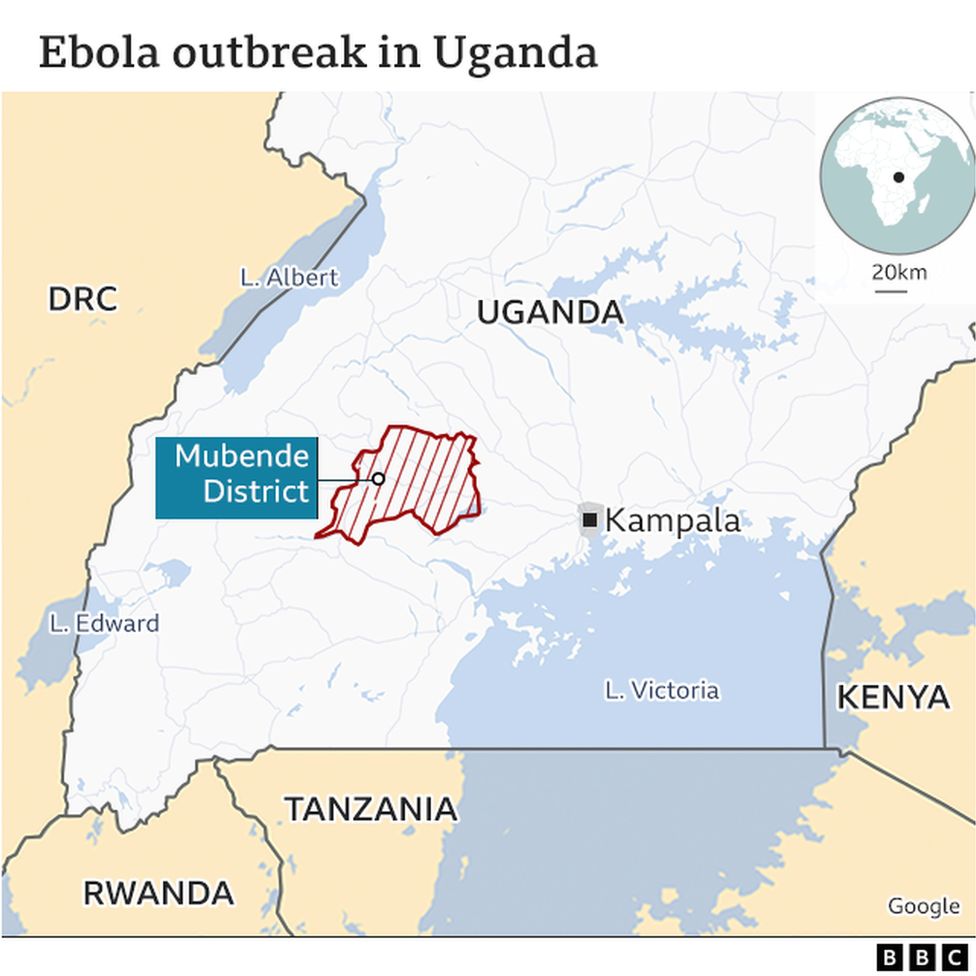
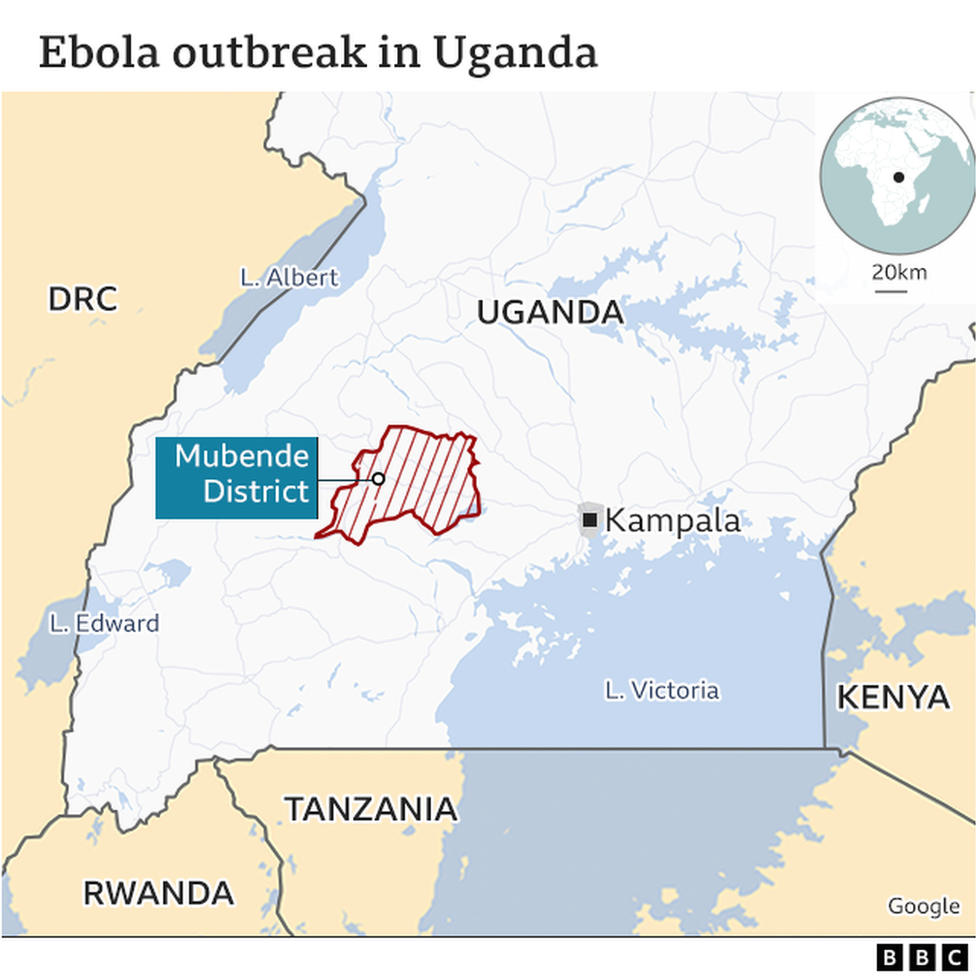
Uganda is grappling with its deadliest Ebola outbreak in more than a decade, first detected in the Mubende district in late September.
The 2012 Ebola outbreak in the Kibaale district in the country’s western region, led to 17 deaths out of 24 confirmed cases but was declared over in less than 3 months.
Officials have launched aggressive contact tracing to track down relatives and friends who handled the bodies of first victims or attended funerals.
Some escaped from quarantine facilities, others traveled as far as the capital Kampala, and a few visited traditional healers and witchdoctors for treatment instead.
“Some of the patients are still hiding and they don’t know that they have Ebola so they’re out there in the community,” public health physician Dr. Jackson Amone told CNN.
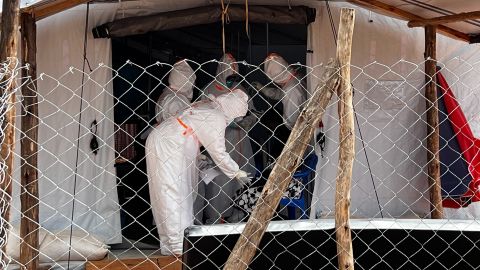
An Ebola treatment unit in Mubende, Uganda. Larry Madowo/CNN
He has been involved in every Ebola outbreak in Uganda as well as in Sierra Leone in 2017. “We need to do case investigation, a lot of contact tracing, and community engagement so that those who present with Ebola symptoms are brought for testing before we release them.”
Dr. Amone is leading the teams operating the Ebola Treatment Units in Mubende. The first was set up in a hurry on the edge of the Mubende Regional Referral Hospital.
A larger center operated by the medical non-profit Médecins Sans Frontières (MSF) is expanding with new ICU beds on the other side of town.
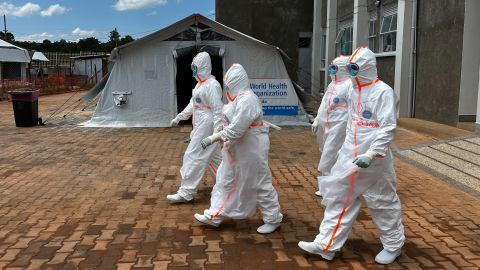
Health workers don extensive Personal Protective Equipment (PPE) to enter the red zones where patients are receiving treatment.
In one zone, a health worker cradles a three-month-old baby suspected of having been infected. Her mother and another sibling are undergoing treatment for Ebola and the disease has already claimed the life of her father.
It’s a cruel welcome to the world for the infant who is wrapped in a blanket as steady rain falls on the makeshift treatment center.
It’s a familiar story across this region as Ebola spreads despite the Ugandan government’s best efforts.
“This Ebola is much easier to deal with than either corona(virus) or AIDS. The main problem here is behavior change,” President Yoweri Museveni told the nation in a Tuesday night address, stressing the need to follow the government’s procedures for those who come into contact with the disease.
Vaccine trials offer hope
Ebola can spread from person to person through direct contact with blood or other bodily fluids such as saliva, sweat, semen, or feces, or through contaminated objects like bedding or needles.
“It doesn’t spread through the air like COVID-19and does not hide for some months before it shows itself like AIDS,” Museveni said in his televised address.
The country had so far recorded 55 deaths from Ebola, 141 confirmed cases and 73 people had recovered, he said.
Health minister Dr. Jane Ruth Aceng Ocero told CNN she expects Uganda to have the outbreak under control by April if communities cooperate with the government.
Health workers don extensive Personal Protective Equipment (PPE) to enter the red zones where patients are receiving treatment Larry Madowo/CNN
There are currently two licensed Ebola vaccines, according to the World Health Organization, but they were developed to be safe and protective against the Zaire strain of the Ebola virus.
Unlike the previous Zaire ebolavirus, the Sudan strain currently circulating in Uganda has no known effective treatment or approved vaccine. However, the country is about to roll out three trial vaccines that have been certified as safe by the World Health Organization (WHO) working group.
The WHO said the first doses would be shipped to Uganda next week and the country expects to expand the vaccine trials after reviewing results from the initial phase.
They are manufactured by the International Aids Vaccine Iniative (IAVI), the Sabin Vaccine Institute USA and a third developed by the University of Oxford and the Jenner Institute UK.
“Our further testing is about efficacy, and how long it protects. We are looking at 3,000 contacts of confirmed cases so we’ll be doing ring vaccination,” Aceng Ocero said, referring to a vaccine process that administers vaccines only to people in close contact with infected patients.
“If we have a confirmed case, then the contacts are the ones who are given the vaccine and they are followed up for 29 days because we want to see if they can quickly generate antibodies and can protect themselves from getting into full-blown disease,” Aceng Ocero added.
Obstacles of tradition and religion
Public health officials believe that cases are stabilizing due to increased vigilance, but tradition and religion are holding back progress. One community in Kassanda district, central Uganda, exhumed a body that had been buried safely by health workers to perform religious rites.
It led to “an explosion of over 41 cases within 5 days and 10 deaths,” President Museveni said in his address. He has now barred traditional healers and witchdoctors from taking clients during the Ebola outbreak.
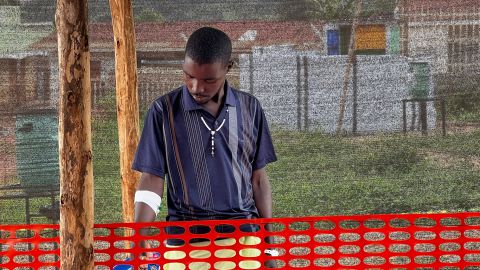
Infections are also rising as it is hard to keep people apart in close-knit communal settings. Robert Twinamasiko, a 30-year-old driver is undergoing treatment after he helped an infected friend to an ambulance. The friend and one other person involved both died.
A 30-year-old driver, Robert Twinamasiko receives treatment for Ebola after helping an infected friend to an ambulance. Larry Madowo/CNN
Twinamasiko has spent 17 days in hospital but says he has no regrets. Although he looked frail, he was making a recovery and told CNN he was looking forward to going home.
“I’m just waiting for my blood work to be discharged but the world out there should know that Ebola is real,” he said from inside a red zone.
Uganda is also trying to contain the spread of the disease by closing the school term early to avoid an outbreak of Ebola in schools which could be hard to manage. “If you have one learner in a class testing positive, the entire class has to undergo quarantine. But also, you will not be 100% sure that that learner did not have contact with other learners outside that class,” Minister Aceng Ocero explained.
She said she was frustrated that Uganda wasn’t getting enough credit internationally for managing the Ebola crisis. “We have experience. This is our eighth Ebola outbreak. Every time we get an outbreak, our experience increases,” she said.
The World Health Organization (WHO) announced on Wednesday that three trial vaccines for Ebola will arrive in Uganda next week.
The announcement was made during the G20 meeting in Indonesia.
“Today I’m pleased to announce that the WHO committee of external experts, has evaluated three candidate vaccines and agreed that all three should be included in the planned trial in Uganda. WHO and Uganda’s minister of health has conceded and accepted the committee’s recommendation. We expect that the first dose of vaccines to be shipped to Uganda next week”, announced Tedros Adhanom Ghebreyesus, WHO Director-General.
An Ebola outbreak in Uganda was declared in late September. Since then, Ebola claimed at least 55 deaths.
“We hope – I dearly hope – that this epidemic goes away. And this epidemic is controllable without vaccines, it’s clear that we can get containment without vaccines. But it’s also clear from the Congo experience that you can get to control much quicker using effective vaccines and that’s where the answers we need to get”, said Michael Ryan, WHO health emergencies director.
Two of the three trial vaccines were developed in the UK, the third trial vaccine comes from the US.
The crested crane, Uganda’s national symbol, appears on the country’s flag and coat of arms.
However, these beautiful birds are now considered endangered due to the loss of their wetland habitats to farming. There are only about 20,000 of them left in the world.
As people continue to drain and reclaim swampland for farming, cranes have fewer places to nest and breed.
Communities in Kabale, in the south-west, are working to protect the crane and the wetlands where it lives.
Convincing locals to give up potential farming land has not been easy, but members of the community have now come on board as so-called “crane custodians”.
They keep an eye on the birds in their localities, report any that are injured or killed, as well as pairs that have nested or have chicks.
Jimmy Muheebwa of Nature Uganda says the number of cranes has now stabilised.
But Uganda has already lost over 40% of its wetlands in the last two decades. So in some regions, it might be too late for the cranes.
Uganda’s President Yoweri Museveni has assured foreign visitors that the Ebola outbreak in the East African nation will be brought under control.
In an address to the country on Tuesday, the president noted that foreign tourists were cancelling bookings and international conferences had been cancelled or moved to other countries.
He said the epidemic was localised – with active cases in just six out of 146 districts across the country.
“Uganda is safe and international guests are welcome,” he added.
He said that a list of people exposed to the virus had been provided to immigration authorities to prevent them from international travel.
Some 141 cases with 55 deaths have been recorded since the outbreak was confirmed in September.
The presidentsaid that progress had been made in controlling the epidemic.
For 18 days, there had been no confirmed cases in Mubende district, the epicentre of the outbreak, although one case was reported on Monday, according to health officials.
Mr Museveni said that efforts to control the epidemic were being hampered by some members of the public who were refusing to adhere to health restrictions.
Motorcycle taxis, known as boda boda, were defying lockdown rules in the affected areas and transporting passengers instead of only cargo.
In Kassanda district, 10 members of an extended family died of Ebola after exhuming a body interred by official burial teams and reburying it according to their religious beliefs.
In Kampala, two contacts linked to separate cases escaped from facilities – one to Masaka city and another to Jinja city – and both have since died.
Even though the epidemic has spread to districts far from the epicentre in the central region, Ugandan officials seem confident that the outbreak can be controlled before it spreads.
President Yoweri Museveniof Uganda has accused Western countries of reprehensible double standards when it comes to climate change commitments.
Mr Museveni highlighted the partial dismantling of a wind farm in Germany to make way for the expansion of a coal mine in a social media post.
He stated that the move made a mockery of Western climate commitments.
The Ugandan leader also said European countries were happy to take Africa’s resources for their own energy needs but were against the development of fossil fuel projects which were for the benefit of Africans.
Uganda is due to start exporting oil within three years.
Due to the global energy crisis, some European countries have recentlydecided to increase coal production – a move heavily criticized by climate change activists.
Uganda will close schools nationwide later this month after 23 Ebola cases were confirmed among pupils, including eight children who died, the country’s first lady said on Tuesday.Janet Museveni, who is also the education minister, said there had been cases in five schools in the capital Kampala, as well as the neighbouring Wakiso district and Mubende, the epicentre of the outbreak.She said the cabinet had agreed to close pre-primary, primary and secondary schools from November 25, two weeks before the scheduled end of term.”Closing schools earlier will reduce areas of concentration where children are in daily close contact with fellow children, teachers and other staff who could potentially spread the virus,” said the minister and wife of President Yoweri Museveni.
On Saturday, Uganda extended a three-week lockdown on Mubende and neighbouring Kassanda, the two central districts at the heart of the outbreak which has claimed more than 50 lives.
Advertisement
The measures include a dusk-to-dawn curfew, a ban on personal travel and the closure of markets, bars and churches.
Since the outbreak was declared in Mubende on September 20, the disease has spread across the East African nation, including to the capital Kampala.
But the president has said nationwide curbs were not needed.
Fifty three people have died of Ebola out of 135 cases according to government figures dated November 6.
The World Health Organisation (WHO) last week said Uganda had registered over 150 confirmed and probable cases, including 64 fatalities.
Uganda’s last recorded fatality from a previous Ebola outbreak was in 2019.
The strain now circulating is known as the Sudan Ebola virus, for which there is currently no vaccine, although there are several candidate vaccines heading towards clinical trials.
Ebola is spread through bodily fluids, with common symptoms being fever, vomiting, bleeding and diarrhoea.
Outbreaks are difficult to contain, especially in urban environments.
Janet Kataha Museveni, Uganda’s minister of education, announced on Tuesday that the country would cut the length of the school year by two weeks in an effort to decrease everyday contact between pupils and slow the spread of the Ebola virus.
Since the pandemic spread to Kampala, the country’s capital and home to some two million people, authorities have been battling to contain the extremely contagious and lethal haemorrhagic fever.
According to the health ministry, the nation has 135 confirmed cases overall as of Monday, along with 53 fatalities.
Preschools, primary schools, and secondary schools would be closed on November 25 due to the significant risk of infection posed by overcrowded classrooms, according to the ministry.
In a statement signed by Museveni, he said “Closing schools earlier will reduce areas of concentration where children are in daily close contact with fellow children, teachers, and other staff who could potentially spread the virus.”
Currently, students in Uganda are completing their third and last term of the academic year, which is followed by their promotional exams.
According to Museveni, who is also the president’s wife, there have been 23 confirmed cases in youngsters, eight of which have resulted in fatalities.
A NASArocket carried it first-ever domestic satellites of Zimbabwe and Uganda into orbit.
Three Zimbabwean scientists who received support and training in Japan created and put together the country’s first satellite, known as ZimSat-1.
Uganda’s satellite, the PearlAfricaSat-1 was also built by three of its own aerospace engineers, and hope that it will be able to set up its own command station to manage it.
Once in orbit, the two satellites will collect images to help support research into weather forecasting, as well as monitoring border security, and disaster prevention for their countries.
Outrage on social media
But for Zimbabweans, facing tough economic times, the launch was not without controversy and has provoked strong reactions on social networks. The cost of the project was not disclosed.
‘Launching a satellite when the economy is fragile is stupid. Poverty has increased in the last five years. You can’t buy a car when your family is starving,’ posted @patriot263.
Zimbabwe has been in a deep economic crisis for the past two decades and remains under international sanctions. In September, the IMF announced that growth forecasts were still down due to a drop in agricultural production.
At least six school children from 3 different schools tested positive for the Ebola Virus in Kampala Uganda, with one of them losing the battle to the disease that has been on the rise in the country.
Ugandan Minister for Health Doctor Jane Ruth Aceng told journalists on Wednesday six children who hail from the same neighborhood were from an earlier contact that succumbed to the virus.
“These learners attended three schools in the Rubaga division. We have listed 170 contacts from these schools for follow up.” Says the Minister Doctor Jane Ruth Aceng.
Aceng also blamed the escalation of the virus on Ugandans who are shying away from hospitals.
When The Associated Press visited God’s Will Primary School, classes remained closed and the headmaster, in an interview, said they closed the school to mourn the passing of their pupil.
“Before the child passed on, the KCCA (Kampala Capital City Authority) medical team was here to ensure that they put in place what the Ministry of Health requested for us to ensure that we curb the spread of the Ebola,” Steven Lwanga said.
One of the most affected schools, Green Valley Primary School has had to close 3 classrooms including Primary Seven Candidates who are due to sit for the National Examinations.
“I think they are disturbed a little they are traumatized, they are demoralized in a way they are not sure whether they are going to sit so that is their worry,” said Ian Mugisha.
The outbreak has sent fears among the communities surrounding the schools.
Steven Lwanga, the Headmaster of God’s Will Primary School said the community is shunning school staff and pupils even when they do not present any symptoms.
“We are becoming a nuisance to the community. People are fearing coming closer to us, when they see you they run away they think you have Ebola, so the Ministry should together with the Government do a lot to sensitize the public,” Lwanga said.
Natukunda Rosette, a shopkeeper and neighbor to the school, said she has been interacting with the children on a daily basis as she sells snacks and other scholastic materials.
She said since the announcement was made, she has been living in constant fear hoping she has not contracted the disease.
“I stopped selling those eats and whoever is coming to buy something I be far away from that person.”
The Ugandan government declared the Ebola outbreak in the Central district of Mubende on September 20, after a 24-year-old man tested positive.
According to the Centre for Disease Control, to date, at least 31 people have lost their lives to the virus and over 109 people have tested positive to the Ebola virus.
The son of Ugandan leaderYoweri Museveni, Muhoozi Kainerugaba, said in a tweet on Thursday that he will “certainly” be president after his father.
The 48-year-old Muhoozi Kainerugaba, who recently became embroiled in a diplomatic row with Kenya, has long been seen by observers as a possible successor, even though Kainerugaba said in 2013 that “Uganda is not a monarchy”.
“The only way I can thank my beautiful mother is to become president of Uganda. And I certainly will,” Muhoozi Kainerugaba tweeted on Thursday.
Yoweri Museveni, 78, who has ruled Uganda with an iron fist since 1986, could again be a candidate in the presidential election scheduled for 2026.
On 18 October, Yoweri Museveni declared that his only son who also has three daughters would no longer tweet about the country’s affairs after a series of controversial tweets in early October had threatened to invade Kenya.
The head of state had said that his son could still express himself on the social network, provided he limited himself to comments on sports,for example.
But Muhoozi Kainerugaba did not care, saying on Twitter the next day: “I am an adult and no one will ban me from anything.
In early October, the president’s son had suggested that it would take him and his army not “two weeks” to take over the Kenyan capital Nairobi. He apologised a few days later to the new Kenyan President William Ruto.
On 4 October, the son of the Ugandan head of state was replaced as head of the country’s ground forces.
Already in 2022, a series of comments on Twitter by Muhoozi Kainerugaba in favour of the rebels in the Ethiopian region of Tigray, which is at war with the federal authorities, had also incensed the authorities in Addis Ababa.
In 2013, Ugandan police raided the offices of two newspapers and a radio station after a confidential memo from a general claimed that President Museveni was grooming his son to succeed him and planned to assassinate opponents.
Six school children in Uganda’s capital have tested positive for Ebola, the health minister said Wednesday, marking a serious escalation of the outbreak declared just over a month ago.
The children, who attend three different schools in Kampala, are among at least 15 people in the city confirmed to have been infected with Ebola, according to a statement by Health Minister Jane Ruth Aceng.
The children are members of a family exposed to the disease by a man who traveled from one Ebola-hit district, sought treatment in Kampala, and died there, the statement said.
“He is responsible for infecting the family of seven, including the neighbors and many others,” the statement said, speaking of the traveling Ebola patient. “We were able to get this cluster, plus one other, because of the ministry’s vigilance in contact tracing and field case management.”
Authorities are “following up” 170 contacts from schools the six children attend, it said.
Fears that Ebola could spread far from the outbreak’s epicenter compelled authorities to impose an ongoing lockdown, including nighttime curfews, on two of the five districts reporting Ebola cases on Oct. 16. The measures were put in place after a man infected with Ebola traveled to Kampala and died there, becoming the city’s first confirmed Ebola case.
Tracing contacts is key to stemming the spread of contagious diseases like Ebola.
The head of the Uganda Medical Association on Tuesday urged health authorities to impose a lockdown in Kampala, a stringent measure that the country’s president has previously said he doesn’t want to implement.
That official, Dr. Samuel Oledo, told reporters the situation was alarming because some “people are not even reporting cases” of Ebola.
Ebola, which manifests as viral hemorrhagic fever, has infected 109 people and killed 30 since Sept. 20, when the outbreak was declared several days after the disease began spreading in a rural community in central Uganda.
Ugandan health officials in the district of Mubende, the epicenter, were not quick to confirm Ebola partly because the disease’s symptoms can mimic those of the more prevalent malaria.
Ebola is spread by contact with the bodily fluids of an infected person or contaminated materials. Symptoms include fever, vomiting, diarrhea, muscle pain, and, at times, internal and external bleeding.
A fire outbreak at a boarding school on the outskirt of Uganda’s capital, Kampala, has killed 11 people, including children, a police official said Tuesday.
six others who were found in critical condition have been admitted to the hospital, the Ugandan police said in a statement but could not state the cause of the fire at Salama School for the Blind.
Fatuma Ndisaba, a top official in Mukono, told local broadcaster NTV that the victims, including children aged between 7 and 10, were burned beyond recognition.
With the support of families, she said, the victims’ bodies will be identified through DNA investigations.
“I have no words to describe the pain I am going through,” Richard Muhimba, the father of a dead child who lives in the nearby town of Mukono, told AFP.
“I visited him on Saturday, he was in good health, and three days later he died,” he said on the phone before hanging up, overcome with grief.
The Salama School for the Blind, built in 1999, has dozens of students, aged between 6 and 25.
Fire incidents at schools have been a cause of concern for education officials in the East African country where classrooms and dormitories are often crowded.
There’s usually no firefighting equipment in place, and officials sometimes blame incidents on poor electrical connections.
Two dormitories at a prominent boarding school in Kampala were destroyed in separate incidents in 2020.
In 2008, 19 elementary school students were killed in a night-time fire outbreak at a boarding school.
Uganda’s national referral hospital Mulago in the capital Kampala has confirmed more than nine positive cases for the Ebola virus.
Seven of the new positive cases are from one family, while the others are a health worker and his wife.
The health worker is from a local clinic in an area just outside the city, where he treated one of the now-positive cases.
This brings the number of positive cases at the facility’s isolation unit to 14.
Health Minister Dr Jane Ruth Aceng has said that the positive cases are contacts of an individual from Kassanda, one of the most affected districts, who recently died at Mulago hospital.
There is growing concern that the outbreak could get out of hand as more cases continue to be reported in the capital.
There is an ongoing quarantine in the two most affected districts of Mubende and Kassanda, but cases have continued to rise.
Last week, officials inspected health facilities in Kampala and Entebbe region to check on their readiness to handle Ebola cases.
It has been over a month since an outbreak of the Sudan strain of Ebola was first reported in Uganda’s central region, in a rural part of Mubende district.
Official figures show there are currently 75 positive Ebola casesin the country, 28 of whom have died. These are only confirmed cases, and do not include figures for probable cases or deaths.
Uganda’s President Yoweri Museveni says he plans to invite French President Emmanuel Macron for talks on how to resolve the conflict in neighbouring Democratic Republic of Congo.
“I’m going to write to [Mr] Macron and invite him here to discuss African and world issues, including Europe,” President Museveni told the outgoing French ambassador during a meeting on Monday evening.
He added: ““I would like really to sit down with Mr Macron and we talk strategically. Europe has nothing to lose if they work well with Africa.”
I met the outgoing ambassador of France to Uganda H.E Jules-Armand Aniambossou, who briefed me on various issues the French government is involved in, including efforts to bring lasting peace to Eastern DRC. pic.twitter.com/N2eR67upml
DR Congo is battling rebel activity in large swathes of its eastern region. One of the main armed groups there, the M23, has recently made gains against the army to occupy a strategic border town and areas around it in North Kivu province.
President Macron last month met the leaders of Rwanda and DR Congo on the sidelines of the UN General Assembly in New York.
They discussed how to put an end to the activities of armed groups in DR Congo.
As the government faces an Ebola outbreak, two areas in Uganda have been placed under lockdown for three weeks.
Bars, nightclubs, houses of worship, and entertainment venues in Mubende and neighbouring Kassanda will be closed, and a curfew will be imposed.
The move is a U-turn for Uganda’s President Yoweri Museveni, who previously said there was no need for such measures.
This latest outbreak has killed 19 people among 58 recorded cases.
However, the real number of deaths and cases may be higher.
The outbreak began in early September in Mubende, about 80km (50 miles) from the capital Kampala, and has remained the epicentre.
President Museveni had previously ruled out lockdowns, saying Ebola was not an airborne virus so did not require the same measures as Covid-19.
But on Saturday he halted all movement in and out of Mubende and Kassanda districts for 21 days.
Cargo trucks will still be allowed to enter and leave the areas, he said, but all other transport will be stopped.
“These are temporary measures to control the spread of Ebola,” he said in a televised address.
“We should all cooperate with authorities so we bring this outbreak to an end in the shortest possible time.”
The president had already ordered police to arrest anyone suspected of having the virus who refused to isolate.
And he has forbidden traditional healers from trying to handle cases. In previous outbreaks, healers have been associated with hotspots for the spread of the virus.
The first recorded death in this outbreak was a 24-year-old man in Mubende. Six members of his family also died.
It later reached the capital Kampala, with one death recorded in October. But health officials said the city remained virus-free, as the man who died had travelled from Mubende.
This latest outbreak is of the Sudan strain of the virus, for which there is no approved vaccine. The Zaire strain, which killed 11,000 people in an outbreak across West Africa from 2013-2016, can be vaccinated against.
Ebola spreads through direct contact with bodily fluids or contaminated material.
Symptoms include vomiting, diarrhoea, and in some cases internal or external bleeding.
The incubation period can last from two days to three weeks, and the virus can be associated with other illnesses, such as malaria and typhoid.
A new law in Uganda to regulate social media use is a sign of a further regression of digital rights and freedoms in the country, some activists here say.
President Yoweri Museveni signed into law the Computer Misuse Amendment Act on Thursday.
Edrine Wanyama,a legal officer with Cipesa, a regional organisation that promotes ICT use for development, says the legislation will affect access to information as well as accountability. It could also lead to increased persecution and prosecution, she added.
A number of activists are now looking into challenging the law.
The new measure says that anyone who uses social media to publish, distribute or share information prohibited under the country’s laws could face up five years in jail or have to pay a fine of $3,900 (£3,500).
It also introduces hefty fines and jail terms for people found guilty of sending malicious information, hate speech or sharing information about children without the consent of their parents or guardians.
Persons convicted under the act shall not hold office for a period of 10 years while a leader or holder of a public office will be dismissed.
Supporters of the new law say it will help to stop online abuse and protect the right to privacy.
In the recent past, several government critics – among them university lecturer, Dr Stella Nyanzi and satirical novelist Kakwenza Rukirabashaija have been charged under a similar law.
Authorities in Taiwan have charged a university administrator and nine others over a scholarship scam that saw Ugandan students forced to work in a factory instead of studying, the AFP news agency reports.
It follows local reports in January of student complaints of being ordered to “intern” at factories, AFP adds.
Chung Chou University of Science and Technology has since been banned from recruiting foreign students.
Prosecutors on Friday charged the school’s dean of student affairs, the deputy chief of the county government’s youth development department and eight others with human trafficking, fraud and corruption among other charges.
The dean and two others allegedly “tricked” the Ugandans with “fake promises of hefty scholarships and high-tech industry internships”, district prosecutors are quoted by AFP as saying.
The students are reported to have been informed that they owed the school travel and other expenses, and had to do work at labour-intensive local factories.
The university is quoted as having told a local news agency in January that “there was a major difference in understanding between foreign students and school administration”.
The Ugandan capital, Kampala, remains Ebola-free despite a 45-year-old man dying from the virus in the city a week ago, Health Minister Jane Ruth Aceng is quoted by the AFP news agency as saying.
The victim – the 19th death from Ebola in the current outbreak – had fled from Mubende district.
On Thursday, the Ugandan authorities said that his wife had tested positive before giving birth at a clinic in the hospital, AFP reports.
“I want to state very clearly that this does not mean Kampala has Ebola,” Dr Aceng said.
“Cases that were already listed in Mubende remain cases of Mubende. Unless Kampala generates its own cases that start within Kampala, we cannot call that a Kampala case.”
Uganda has recorded 58 cases of the Sudan strain of Ebola since last month. There is no vaccine available for this strain.
President Yoweri Museveni’s office has announced that on Saturday he will be addressing the nation on Ebola for the second time this week.
Ugandan General Muhoozi Kainerugaba has apologised to Kenya’s President William Ruto over tweeted threats about invading the neighbouring country and capturing its capital in two weeks.
Gen Kainerugaba’s tweets drew angry reactions from Kenyans and prompted his father, President Yoweri Museveni, to apologise to Kenya.
In his Thursday evening apology, the general said he had never had any problem with President Ruto.
He added: “If I made a mistake anywhere,I ask him to forgive me as his young brother.”
I have never had any problem with Afande Ruto. If I made a mistake anywhere, I ask him to forgive me as his young brother. Godbless East Africa! pic.twitter.com/5LuzVabLKz
Mr Museveni – who has been in power since 1986 – has long been suspected of grooming his 48-year-old son to succeed him when he eventually steps down, an allegation he has always denied.
Uganda’s president’s son, General Muhoozi Kainerugaba has apologised to Kenya’s President William Ruto over tweeted threats about invading the neighbouring country and capturing its capital in two weeks.
Gen Kainerugaba’s tweets drew angry reactions from Kenyans and prompted his father, President Yoweri Museveni, to apologise to Kenya.
In his Thursday evening apology, the general said he had never had any problem with President Ruto.
He added: “If I made a mistake anywhere, I ask him to forgive me as his young brother.”
I have never had any problem with Afande Ruto. If I made a mistake anywhere, I ask him to forgive me as his young brother. Godbless East Africa! pic.twitter.com/5LuzVabLKz
Mr Museveni – who has been in power since 1986 – has long been suspected of grooming his 48-year-old son to succeed him when he eventually steps down, an allegation he has always denied.
Uganda’s President Yoweri Museveni has directed traditional healers to stop treating people during the ongoing Ebola outbreak that has so far killed 19 people in the country.
The president also directed security officials to arrest people suspected of having contracted the virus if they refuse to go into isolation.
In a televised address to the nation, during which he switched to the widely spoken Luganda language to address them directly, he told traditional healers and herbalists not to treat people suspected to be infected with the viral haemorrhagic disease.
It follows the death of a 45-year-old-man who was listed by health teams as having been exposed to the Ebola virus.
The man, who died in a hospital in the capital, Kampala, had fled his village in Mubende district, the outbreak’s epicentre.
He sought treatment from a traditional healer elsewhere before turning up at the Kampala hospital and died hours after being admitted there, authorities said.
Some of the man’s family members have been put under quarantine, while others have gone into hiding. The president urged them to report to health facilities.
Although Mr Museveni said there were currently no confirmed cases of Ebola in Kampala, he warned the public to continue being vigilant, assuring that health workers would bring the outbreak under control.
It has been almost a month since Uganda confirmed the outbreak of the Sudan strain of Ebola, which has now spread to five districts.
There have been 54 confirmed cases so far. Some 20 people, including five medical workers, have recovered.
African health ministers attending a high-level meeting following the Ebola outbreak in Uganda want two regional health bodies to set up an Africa Ebola co-ordination task force.
They said this would oversee preparedness and response to the current outbreak as well as other epidemics in the continent.
Acting director of the Africa Centres for Disease Control, Ahmed Ogwell, says Africa needs to stop seeking international assistance, as it is on its own during pandemics.
“This is not the first outbreak of the Sudan strain of Ebola virus here in Africa and particularly here in Uganda,” he told the gathering in the Ugandan capital, Kampala
“As Africa, we must now do things differently, appreciating that for the most time we will be on our own. Knowing that we are on our own, though, needs to motivate us so that we can do things on our own but not alone,” he added.
The Africa CDC says the continent is dealing with 11 different public health outbreaks. They are monkeypox, cholera, flooding, influenza, lassa fever, measles, yellow fever, hepatitis E, and the Crimean – Congo haemorrhagic fever.
A trainee doctor from Uganda who had Ebolawas officially released from the hospital on Tuesday.
Hudson Kunsa is a medical student in his last year and a resident physician at the Mubende hospital.
He shared his journey to recovery with the BBC in an interview.
Quote Message: You start with general body weakness, fevers. Your first thought as a doctor is to rule out the common things we have. I went and took my test for Ebola. After two days when they called me to the hospital, I knew it was positive.
You start with general body weakness, fevers. Your first thought as a doctor is to rule out the common things we have. I went and took my test for Ebola. After two days when they called me to the hospital, I knew it was positive.
Quote Message: So after we went to the isolation [centre] with the symptoms just starting and two, three, four, five days down the road we were at the peak of all the symptoms that you know of; the vomiting, the diarrhoea, the general body weakness. It was not a very good experience.”
So after we went to the isolation [centre] with the symptoms just starting and two, three, four, five days down the road we were at the peak of all the symptoms that you know of; the vomiting, the diarrhoea, the general body weakness. It was not a very good experience.”
The thought of death always lurked in his mind, he said.
Quote Message: At one point I was scared, thinking that we were going to die. You would see yourself diarrheaing everything out. They tell you, you have to drink but still you don’t want to drink. But eventually I came out. But the scared part was there.”
At one point I was scared, thinking that we were going to die. You would see yourself diarrheaing everything out. They tell you, you have to drink but still you don’t want to drink. But eventually I came out. But the scared part was there.”
Quote Message: This happened because we didn’t enough protective equipment as medics to use. By the time the patient we worked on died and we started experiencing the symptoms we knew that possibly we could also be infected with Ebola.”
This happened because we didn’t enough protective equipment as medics to use. By the time the patient we worked on died and we started experiencing the symptoms we knew that possibly we could also be infected with Ebola.”
Bobi Wine, a former pop sensation from Uganda who is now a politician, claims he was detained in Dubai over the weekend after travelling there to take part in a concert.
He claims that throughout his 12-hour detention at the airport, he was questioned about his political affiliation, personal history, and family.
He was later released without charge and the concert, whose proceeds were meant to benefit African migrants in the Gulf country, was later cancelled.
Mr Kyagulanyi has blamed Uganda embassy officials for the cancellation of his music concert
“The information I have is that the Ugandan embassy in Dubai influenced the cancellation of this concert because maybe if I was able to return these girls back home then the government of Uganda will be slapped in the face,” he told the BBC’s Newsday programme.
He added: “I have performed in Dubai many times for the last 15 years but this show was cancelled, and the cancellation was not adequately explained.”
Mr Kyagulanyi participated in last year’s presidential election which he lost to the incumbent Yoweri Museveni.
British actress Michaela Coelhas taken her American Vogue cover to the streets of Accra.
Coel, who has been cast in Marvel’s blockbuster Black Panther: Wakanda Forever is Vogue’s November cover star – and she chose to have the photo shoot in her ancestral home, Ghana, alongside her father, Derek Kwesi Coel, and grandmother Jemima Andam.
She was photographed by Senegalese-Italian model Malick Bodian.
“They asked me where I’d like to shoot it and I thought to myself ‘shoot for the stars aim for the moon’, and I said ‘Ghana’, and they were like ‘sure’.”
Speaking to Vogue about a previous visit to Ghana in 2018, Coel said: “I’d been to Africa before – Kenya and Uganda – but when I came here, I was really seeing people who looked like me.”
“I remember looking at all the kids playing, and it hit me, like, Wow, this could’ve been me and I think I would have really enjoyed that,” she continued.
“Yes, there are a lot of sad things, poverty, unemployment, struggle. There’s also a lot of peace and friendliness. There’s a lack of anxiety.”
In her Vogue interview, Coel also spoke about her upcoming rolein Black Panther where her character falls in love with her warrior colleague, played by Florence Kasumba.
“That sold me on the role, the fact that my character’s queer,” Coel said. “I thought: I like that, I want to show that to Ghana.”
Coel was born and raised in East London after her parents emigrated from Ghana. She is most famous for writing, directing, and starring in the comedy-drama series I May Destroy You.
Kenyans have received an apology from President Yoweri Museveni after reading tweets from his son Muhoozi Kainerugaba that regularly threatened to invade Uganda’s neighbouring country in East Africa.
In a series of tweets on Monday and Tuesday, Kainerugaba posted provocative messages, including proposing the unification of Kenya and Uganda.
“It wouldn’t take us, my army and me, 2 weeks to capture Nairobi,” Kainerugaba wrote, referring to Kenya’s capital.
“Union is a MUST! No honorable men can allow these artificial, colonial borders anymore. If our generation has men, then these borders must fall!.”
Presidential apology
President Museveni apologized for his son’s comments, saying it was wrong for public officers to meddle in the affairs of other nations.
“I ask our Kenyan brothers and sisters to forgive us for tweets sent by General Muhoozi, formerCommander of Land Forces here, regarding the election matters in that great country,” Museveni wrote in a statement released Wednesday on his official website.
His comments drew angry reactions from Kenyans on social media and Kainerugaba, who is widely regarded as the de facto head of the military and his father’s chosen successor, was on Tuesday removed as commander of Uganda’s land forces. It was unclear whether the change was made following his controversial tweets.
He was later promoted from lieutenant general to the rank of a full general and will remain a senior presidential adviser for special operations, a Ugandan Ministry of Defence statement announced.
Despite his apology, Museveni justified Kainerugaba’s promotion, saying his son had only erred in his comments and not in his service.
“Why, then, promote him to full General after these comments? This is because this mistake is one aspect where he has acted negatively as a public officer,” the Ugandan leader said.
“There are, however, many other positive contributions the General has made and can still make,” he added while describing Kainerugaba as “a passionate Pan-Africanist.”
An outspoken general
Kainerugaba is outspoken on social media and has frequently traded barbs with opposition figures and weighed into politics, despite his military role barring him from doing so.
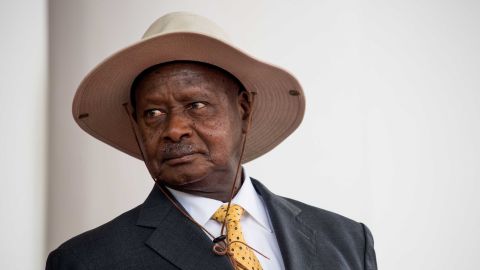
Uganda’s President Yoweri Museveni pictured in 2018. SUMY SADRUNI/AFP/Getty Images
Kainerugaba also asked his more than 600,000 Twitter followers how many cows should be offered as a bride price for Giorgia Meloni, the right-wing politician expected to be named Italy’s prime minister this month.
“I would give her 100 Nkore cows immediately! For being fearless and true!!,” he wrote.
Ugandan LGBTQ organization calls government shutdown of its operations a ‘clear witch-hunt’
Kainerugaba later said the comments were made in jest. While an aide to Francesco Lollobrigida, told reporters Kainerugaba’s offer was not a serious topic.
Ugandan analysts and opposition leaders havelong accused the 78-year-old Museveni of grooming his son to take over from him, but Museveni, who has been in power for 36 years, has repeatedly denied doing so.
The European Union has mobilised 200,000 euros to help the Ugandan Red Cross in the face of a fresh Ebola outbreak.
The outbreak has already left more than 40 people dead in the country.
The European Commission in a statement on Tuesday in response to an urgent appeal for help launched by the International Federation of Red Cross and Red Crescent Societies (IFRC).
Uganda declared an Ebola outbreakon 20 September after confirming a case in Mubende district in central Uganda, where a 24-year-old man died from the Ebola virus after contracting the rare strain from Sudan.
This strain is not only less transmissible but also has a lower mortality (40-100%) than the Zaire strain (70-100%).
There is currently no approved vaccine against this Sudan strain, unlike the Zaire strain, which has been recorded in epidemics of the disease in the neighbouring Democratic Republic of Congo (DRC), which on 24 September announced the end of its last Ebola outbreak.
Countries such as Kenya, Tanzania, Rwanda, and Somalia are on the alert to prevent the possible spread of the virus.
Uganda’s defense ministry announced Tuesday that President Yoweri Museveni’s son, Muhoozi Kainerugaba, was being replaced by another military officer as head of the country’s ground forces, hours after a tweet by the son caused an uproar in Kenya.
Lt. Gen. Kayanja Muhanga “has been appointed commander of the ground forces,” according to a ministry statement, replacing Kainerugaba.
The ministry also announced that President Museveni had promoted his 48-year-old son to the rank of general, a move seen by analysts interviewed by AFP as cosmetic.
The Defense Ministry’s decision came shortly after Kainerugaba sparked an outcry by tweeting that he was ready to invade Kenya.
“It wouldn’t take me and my army two weeks to capture Nairobi,” he said in the tweet Monday night, before doing an about-face in a second.
“I will never beat the Kenyan army because my father told me never to attempt it! So our people in Kenya should relax!”
The outcry on social media prompted Uganda’s foreign ministry to issue a statement saying its “commitment to good neighborliness (and) peaceful coexistence” with Kenya.
Yoweri Museveni, who has ruled Uganda since 1986, may again run for president in the 2026 election.
The anaesthetic officer who passed away in the early hours of Wednesday has been confirmed by the Ugandan health ministry.
Margaret Nabisubi, 58, is the fourth medical worker to die of Ebola, according to Health Minister Jane Ruth Aceng.
I regret to announce the passing of another Health worker, Ms. Nabisubi Margaret, an anesthetic officer. The 58 year old succumbed to Ebola at 4.33am this morning at Fort Portal Hospital (JMedic) after battling the disease for 17 days.
— Dr. Jane Ruth Aceng Ocero (@JaneRuth_Aceng) October 5, 2022
A team of medics got exposed to the virus when they treated the first confirmed case, who needed surgery, and they have been admitted to Fort Portal regional hospital.
A Tanzanian medical student, who was part of the team, died at the weekend.
Separately, a health assistant in the district of Kagadi died of the virus too.
It is suspected that a midwife also died from Ebola.
Medical workers expressed concerns about not having enough personal protective gear in the first days of the outbreak.
Official figures show that there have been 43 confirmed cases since the outbreak was announced two weeks ago, and 10 of these have died.
Health officials said they have traced more than 800 people suspected to have come into contact with those who contracted the disease.
Health officialsat a major Uganda-Kenya border crossing say they have intensified screening of cargo truckers and other travellers to prevent the export of Ebola cases.
An official at the Malaba border in the east told the BBC that teams had already been screening for several infectious diseases since the peak of the Coronavirus pandemic, but have now increased their level of alertness.
Healthteams are taking details of travellers’ point of origin in Uganda, and checking for symptoms like fever, headaches and stomach pains.
Positive Ebola cases have been steadily rising. The latest figures from the health ministry show that confirmed cases now stand at 43, and nine of these have died.
One of them was a Tanzanian doctor, who died on Saturday. Dr Mohammed Ali was an intern at Mubende regional hospital where the first confirmed case had been treated.
The 37 year old was buried in western Uganda on Sunday, according to international health protocols for infectious disease epidemics.
Health teams say they have traced at least 800 people who are suspected to have come into contact with people who tested positive for Ebola. They are under observation.
The health ministry confirms that an intern physician who participated in the frontline fight against the Ebola outbreak in Uganda has passed away from the disease.
Ali Mohammed, 37, travelled from Tanzania to pursue his surgical master’s degree.
He was one of six medical trainees working at Mubende regional hospital who contracted Ebola and were moved to a quarantine center.
Mr Mohammed is the second health worker to die of the virus. The first was a midwife from a private clinic in the Mubende district.
Official figures indicate that the total number of confirmed Ebola cases stands at 35, with eight deaths.
Mubende is at the centre of this outbreak, and medical students there warned the government they were putting their lives at risk because they lacked proper equipment and sometimes had to handle patients with bare hands.
The medical association and the surgeons’ association in the country have issued messages of condolence on their Twitter accounts.
It is with great sorrow that we have received the news of the passing of Dr. Mohammed Ali, a 37 years old Tanzania national who has been pursuing a Master of Medicine in Surgery at Kampala International University.
The number of confirmed Ebola cases in Uganda has risen to 31. One more death has also been recorded, bringing the total number of confirmed deaths to six.
One of the six medical workers who tested positive with the virus is now in critical condition, according to information from the country’s health ministry.
Uganda’spresident has defied calls by medical workers to put the Ebola-hit central region under quarantine to prevent the virus spreading to the rest of the country.
He went on national TV on Wednesday to say no such measures were needed because Ebola is not airborne, and said a laboratory would be set up in the virus epicentre to speed up patient testing.
Meanwhile, the World Health Organization believes that Uganda’s Ebola outbreak may have been detected late, given that the first person who had it showed symptoms back in August yet the outbreak wasn’t declared until late September.
Global health experts say it is unrealistic to think Ebola will ever be eradicated, but it is now easier to prevent a crisis.
Soon Ugandans who need organ transplants will no longer have to travel abroad, thanks to a new law allowing the procedure in the country.
Kidney patients are currently the biggest group in need of transplants in Uganda. There is just one dialysis unit in the whole country.
A kidney transplant can cost at least $30,000 (£27,000) abroad, but experts say this could come down to about $8,000 if done within the country.
The new law will clear the way for transplantation centres and a national waiting list of organ recipients to be created, but also contains stringent measures in case of organ trafficking or abuse of donors’ rights.
Operating an illegal transplant clinic or harvesting organs from a living person without their consent may attract life imprisonment.
Parliament has approved the new transplant law meaning that it will come into force as soon as the president gives his assent – which is largely a formality, because assent is almost always given.
The President of Uganda, Yoweri Museveni, has stated that imposing restrictions in Ebola hotspots in the central region is not necessary as the viral disease is not airborne.
Mr Museveni said his government had the capacity to control the epidemic due to previous experience with similar outbreaks. This is the fourth time Ebola has broken out in Uganda.
He said that health experts who had previously dealt with Ebola outbreaks had been deployed to the affected region.
Ebola is spread through contact with an infected person or infected surfaces and human waste.
The association of medical workers in the country had previously called for the affected region to be put under quarantine to stop further spread of the haemorrhagic fever.
It is currently taking 24 hours for samples to be tested and laboratory results to be released.
The president said the government would set up a laboratory at Mubende district headquarters, the epicentre of the outbreak, to quicken the sample processing.
Six medical workers who treated the 24-year-old man who was later identified as the first case, have tested positive for Ebola.
A total of 24 people have been confirmed to be infected by the virus in the country, five of whom have died, since the outbreak was declared last week.
Two weeks ago, EU legislators approved a resolution alerting the public to the project’s potential for social and environmental harm as well as violations of human rights.
President Yoweri Museveni of Uganda has criticized the EU parliament for urging his administration to cancel a crucial oil pipeline project with Tanzania’s neighbour.
Two weeks ago EU lawmakers passed a resolution warning of human rights abuses and the social and environmental risk posed by the project.
“Some of these EU MPs are insufferable and so wrong that they think they know everything but should calm down,” Museveni said at the annual Uganda International oil & gas summit on Tuesday.
President @KagutaMuseveni: I encourage the oil companies to move on the two, the refinery and the pipeline.
He added: “This is the wrong battleground for them. I hope our partners join us firmly and advise them. For us, we’re moving forward with our programme.”
Mr Museveni has touted the oil pipeline project as one that would boost the country’s economic development.
Rights groups say some 100,000 people risk being displaced and have urged the contractors, France’s Total Energies and the China National Offshore Oil Corporation, to pause the US $10 billion (£8bn) project until they find an alternative route.
The East African Crude Oil Pipeline project will stretch 1,443km (896 miles) from Lake Albert in western Uganda to the Tanzanian port of Tanga on the Indian Ocean.
34 trainee medical personnel claimed they were refusing to work and charged the government with failing to provide them with the necessary safety equipment.
Since an epidemic was reported last week, the World Health Organization (WHO) reports that there have been 36 Ebola cases in Uganda, including 18 confirmed cases and 18 suspected cases.
It stated that 23 deaths, of which five were confirmed instances, had happened in three areas of central Uganda.
The WHO said this was the first Ebola outbreak in Uganda since 2012 caused by the Sudan strain of the disease, for which there are no licensed vaccines.
On Monday, Uganda denied reports of a strike by medical staff at the Mubende hospital.
Thirty-four trainee medical staffsaid they were refusing to work and accused the government of not providing them with appropriate safety kits.
No effective Ebola vaccine is available here yet, because the Sudan strain circulating in central Uganda is different from the Zaire strain that has afflicted West Africa and DR Congo and which can be immunized against.
Experts say it is unrealistic to think Ebola will ever be eradicated, but it is now easier to prevent a crisis.
Medical interns at Uganda’s Mubende hospital have gone on strike, accusing the government of not providing them with appropriate safety kit, risk allowances and health insurance.
The hospital, located some 150 km (95 miles) from the capital, Kampala, is hosting the main isolation centre for Ebola patients as the outbreak continues to spread in the central region.
All 34 interns, including doctors, pharmacists and nurses said in a statement that they would not return to work and want to be evacuated to a facility with safer working conditions.
Six intern medical workers are said to have been exposed to the virus and are currently in isolation awaiting laboratory results.
Authorities say there have been at least 36 suspected Ebola cases, although not all have been confirmed.
At least 23 deaths are suspected to have been caused by the virus.
An outbreak of the Sudan strain of Ebola was declared in the country last week.
The first confirmed death was a 24-year-old-man, who lost six members of his family in the first two weeks of September.
Available vaccines against the haemorrhage-inducing virus can’t be used in Uganda because they are only effective in dealing with the Zaire strain which was behind the 2013 – 2016 outbreak in West Africa.
Yet all 34 of the hospital’s interns – including doctors, pharmacists and nurses – have announced their decision to strike in a joint statement.
They say they are being put at undue risk because they lack appropriate safety kit, risk allowances and health insurance.
Six interns at the hospital have already been exposed to the virus, and are awaiting their test results in isolation.
Since the outbreak began earlier this month, official government data shows 36 people are suspected of contracting Ebola, of whom 23 have died.
A 24-year-old-man was the first known Ebola death, and six members of his family also died.
No effective Ebola vaccine is available here yet, because the Sudan strain circulating in central Uganda is different to the Zaire strain that has afflicted West Africa and DR Congo and which can be immunised against.
Experts say it is unrealistic to think Ebola will ever be eradicated, but it is now easier to prevent a crisis.
The number of suspected Ebola infections continues to rise in Uganda.
Currently, the country’s Health Ministry is monitoring 34 suspected cases.
Health officials are also investigating 21 deaths believed to be as a result of the Ebola virus. Already, health teams are continuing to trace any people that may have come into contact with it.
The outbreak began in the central district of Mubende but has now spread to two neighbouring districts.
There are as yet no confirmed cases in the capital Kampala.
This is the fourth Ebola outbreak Uganda has faced. Neighbouring countries have said that they are on high alert.
Three more Ebola patients have died in Uganda, the health ministry said on Friday, bringing the total death toll to four.
This comes days after authorities confirmed an outbreak.
“In the last 24 hours, three new deaths have been recorded,” the health ministry said in a statement.
Uganda’s health ministry has so far confirmed 11 cases of Ebola in total, including four deaths.
The current outbreak, attributed to the Ebola Sudan strain, appears to have started in a small village in Mubende district around the beginning of September, authorities say.
Seven other deaths are being investigated for being linked to the outbreak in Mubende, around 130 km west of the capital Kampala.
The first casualty was a 24-year-old man who died earlier this week.
The World Health Organization says the Ebola Sudan strain is less transmissible and has shown a lower fatality rate in previous outbreaks than Ebola Zaire, a strain that killed nearly 2,300 people in the 2018-2020 epidemic in the neighbouring Democratic Republic of Congo.
The health ministry in Uganda has revealed three more lives have been lost to Ebola, bringing the total number to four since an outbreak was declared earlier this week.
So far, 11 cases have been confirmed.
Meanwhile, some seven other deaths are being investigated to see if they’re linked to the outbreak in Mubende west of the capital Kampala.
The World Health Organization (WHO) has said the Ebola Sudan strain which is present in Uganda is less transmissible and has shown a lower fatality rate in previous outbreaks of a different strain, Ebola Zaire.
Between 2018 and 2020, it killed nearly more than 2,000 people in the neighbouring Democratic Republic of Congo.
Organizations working on behalf of hearing-impaired people in Uganda have urged public and commercial institutions to make it easier for the deaf to access information reports local Daily Monitor news website.
An estimated one million people are deaf in Uganda, according to the Initiative for Social and Economic Rights (ISER).
The organisation urged the government to integrate sign language into teachers’ training as a way of dealing with the shortage of people with the skill.
“If we integrate sign language into the teachers’ training, then what you are doing is rolling out teachers that know sign language so that the teacher will be able to sign for a deaf student, likewise to doctors, nurses, police officers, and court, among others,” said Elizabeth Atori from ISER.
He praised the police for using a sign language interpreter during their briefings but criticized the media for ignoring them.
“The issue of sign language interpretation is within the justice law and order sector, and we appreciate that police have one sign language interpreter in the entire country but also what media houses do is during the police press briefing, you people cut off our sign language interpreter,” Robert Nkwangu told journalists.
The Mubende district of Uganda has recorded an additional 11 suspected Ebola cases, according to the Ministry of Uganda.
In a statement issued on Tuesday September 20, 2022, the ministry stated that the death of a one-year-old was most likely caused by Ebola.
It indicated that samples from the 1-year-old and the 10 suspected cases that are being kept in isolation are being analyzed at the Uganda Virus Research Institute.
After a case of the relatively uncommon Sudan strain was discovered in the nation, Uganda declared an Ebola epidemic, according to the World Health Organization (WHO), on Tuesday.
A sample from a 24-year-old male in the Mubende district, who the government claimed had died after exhibiting symptoms, was tested to confirm he contracted the virus.
In Uganda, it is believed a second person, a young child, has died of Ebola in a hospital in the centre of the country, according to the local New Vision newspaper.
Tests are being conducted to confirm the cause of death.
Health officials say the deceased was one of 14 people admitted to hospital with Ebola-like symptoms.
Tests are also being conducted on six people who died of what locals have described as a strange illness earlier this month.
On Tuesday, the World Health Organization confirmed Uganda’s first outbreak of the rare Sudan strain of Ebola in more than a decade.
A small group of placard-carrying protesters have gathered outside the European Union offices in Uganda’s capital, Kampala, to express displeasure over its call to the country to end a strategic oil pipeline project with neighbouring Tanzania.
“EU respect Africans and their resources,” one placard reads, “our oil is our hope,” says another.
Last week the EU parliament passed a resolution warning of human rights abuses and the social and environmental risk posed by the project.
Rights groups say some 100,000 people risk being displayed and have urged the contractors, France’s Total Energies and the China National Offshore Oil Corporation, to pause the $10bn (£8bn) project until they find an alternative route.
The East African Crude Oil Pipeline project will stretch 1,443km (896 miles) from Lake Albert in western Uganda to the Tanzanian port of Tanga on the Indian Ocean.
JUST IN: A group of people are demonstrating outside the gates of the @EUinUG offices at Crested Towers, Kampala.
These are demonstrating against @Europarl_EN Resolutions on the East African Crude Oil Pipeline project.
The authorities in Tanzania and Uganda have criticised the EU’s opposition to the project.
Uganda’s President Yoweri Museveni said nothing would stop the project.
“I saw in the papers that the EU parliament passed a resolution directing Total not to proceed with the East African Crude Oil Pipeline. Please, don’t waste your time thinking about that. We have a contract with Total written very well. The oil will come out in 2025, the first batch. The oil project will go on and no one can stop it,” the president said on Friday last week.