The other team have not only left the goal wide open, but the goalkeeper has also wandered off the pitch.
The strikers are repeatedly kicking themselves in the face.
The other players have either turned on each other, collapsed, or abandoned the game entirely.
Parts of the pitch are on fire.
All Sir Keir has to do is calmly take the ball and walk it over the line.
It should be an easy win, even for a leader whose party has often questioned his ability to make an impact on the electorate, fearing his cautious approach just doesn’t cut through.
In normal times this might have held him back, but these are far from normal times.
The Conservatives have done a lot of the work for him.
Under Boris Johnson, they forfeited much of their moral authority – and in a matter of days under Liz Truss, the party’s economic credibility hangs in the balance.
In his conference address, there doesn’t need to be sparkling oratory or groundbreaking policy ideas.
DISCLAIMER: Independentghana.com will not be liable for any inaccuracies contained in this article. The views expressed in the article are solely those of the authors’ and do not reflect those of The Independent Ghana
In the wake of mini-budget market turbulence, which has sparked worries about additional interest rate hikes, UK mortgage providers search for a way out. While Halifax will discontinue fee-paying mortgages, Virgin Money and Skipton Building Society have temporarily pulled their whole product lines.
The market turmoil caused by Friday’s seismic mini-budget has hit mortgage offerings as providers withdrew partial and entire lending ranges.
Virgin Money and Skipton Building Societyhave temporarily withdrawn their entire mortgage product range, while Halifax, the country’s largest mortgage lender, said it is to remove fee-paying mortgages.
Fee-paying mortgages allow borrowers to pay a fee in exchange for a lower interest rate.
Halifax’s changes are to take effect on Wednesday, while the Virgin Money and Skipton Building Society decisions have already taken effect.
Chancellor Kwasi Kwarteng’s announcement of the most extensive programme of tax cuts for 50 years, and the associated market upset, has traders expecting that the Bank of England will raise interest rates to 6%- even higher than it outlined last Thursday.
On Monday, the Bank fuelled those fears when, in a surprise statement, it said it “will not hesitate to change interest rates as necessary”.
“The uncertainty around the risk of an emergency rate rise is likely to see other lenders withdrawing products or increasing rates dramatically until they know the extent of how this all pans out,” Jamie Lennox, a director at Dimora Mortgages, said.
Parent company Lloyds said Halifax was making the changes to its mortgage product offering “as a result of significant changes in the cost of funding”.
Virgin Money made its decision “given market conditions”, a spokesman said in a statement, with already submitted applications to be processed as normal.
Record numbers of children and young people are being registered with the National Referral Mechanism as suspected victims of modern slavery, but a Sky News investigation found the system is failing many of them.
Over the course of nine months, we’ve got to know ‘Maria’, who says she has been sexually abused by a gang of men for a decade – and this exploitation is ongoing.
During one interview she admitted that if the men called her that night, she would have to go to them – such is the level of threat, such is the violence she has already experienced.
Maria, not her real name, is among thousands of people referred every year to what is called the National Referral Mechanism, which is often held up by the Home Office as a safety net for people trafficked in the UK. But it’s not working.
Record numbers of children and young people are being registered with the NRM as suspected victims of modern slavery, but a Sky News investigation found the system is failing many of them.
Freedom of Information requests by Sky News shows the NRM is dangerously slow to recognise victims. The average time it takes to conclusively recognise a victim is 553 days.
Home Office guidance published in June 2022 says that the decision should be made “as soon as possible” after the 45 day recovery period when a potential victim is first registered.
Support is offered for 45 days once a victim is first registered but a decision on their status should come soon after that.
Jamie Fookes from Anti-Slavery International said: “The delays are getting worse and worse and worse and worse. And that is a huge hindrance to the recovery of the individuals in the NRM. Plus, also it massively increases the risk of re-exploitation.”
He added: “Police are first responders, local authorities are first responders, yet a lot of the people in those organisations will not be aware of modern slavery, and certainly not be aware of the national referral mechanism and that’s a problem.”
Furthermore, charities and victims say that support such as safe houses or counseling is often unavailable. It is even suggested that the system offers better protection to foreign victims compared to British nationals.
Robyn Phillips from the Human Trafficking Foundation said: “A number of British survivors of modern slavery have told us that because they speak English, they’ve been perceived as less vulnerable or traumatized and have been left to navigate complex processes alone.”
Modern slaves could be child drug mules, people exploited for domestic labor, or trafficked for sex.
Maria says she has been sexually abused by older men from the age of 13 and since then she has been trafficked and raped by hundreds of men and now in her early 20s is still abused.
She says she is regularly called up, threatened, coerced into meeting men, taken to houses, and raped and abused so brutally that she feels it is safer not to put up any resistance.
The men, who she alleges are involved in a range of criminal activity, often sell her to others – and she says she has also been sold to pay off drug debts.
She told Sky News: “Sometimes I’d be gang raped by multiple men. Once, they poured petrol all over me, whilst I was naked, and then threatened to burn me.”
Maria says, despite reporting her abuse to the police, she remains in their clutches. During one interview she explained how she had been threatened only the weekend before.
She said: “I was getting phone calls on a Friday, saying that if I didn’t come and meet them, they were going to burn down my flat and then burn down my parents’ flat.”
She felt she had no choice but to meet the men and allow them and others to rape her.
‘You want a beating later?’
Sky News has seen the texts on her phone. One reads: “You know wots gonna happen if u don’t do what we say. Kill u and your fam.” Another reads: “You are testing me today. You want a beating later?”It goes on to describe brutal torture.
Maria says: “So like the typical ones (texts) are ‘we’ll kill you, we’ll get you, we’ll burn you, we’ll chop you’ and, it sounds really stupid, but they say they’ll sell me as kebab meat in a takeaway shop.”
We’ve decided not to identify where Maria lives, but she has been in regular contact with her local police force, and although there have been no charges against her alleged abusers she was registered as a victim of modern slavery on the National Referral Mechanism.
Two years on she is still waiting for a conclusive decision – and she has only just begun to receive counseling.
She said: “When there was a big incident, I asked to go into a safe house, and they were like ‘yeah that’s fine…’ but nobody called me back. And I was later told by a member of staff at the Salvation Army that ‘we don’t like putting British victims into safe houses, and to contact the council. She didn’t give any reason at all.”
The NRM was set up in 2009 as a support network for victims offering help and protection but critics say it was tailored towards people trafficked into the UK and hasn’t adapted well enough in offering support to domestic victims.
British victims account for a third of all modern slavery victims registered last year, and 70% of those are children.
In total 3,000 British children were registered last year.
Robyn Phillips from the Human Trafficking Foundation said, “Despite being the highest nationality referred into the NRM, it’s only in the past year that the voices of British survivors are being heard.”
He added: “Housing has been another obstacle, with British survivors often not qualifying for NRM safe house accommodation because the local authority has a duty to house them, but councils are not recognising them as ‘priority need’.”
The Salvation Army told Sky News: “When victims of modern slavery are referred to us, we see the person and their need first and foremost. We can categorically state that we never make decisions about what support a person receives based on their nationality.
“If someone is in need of safe house accommodation, regardless of their circumstances or nationality, they will be found a suitable place.
“In most cases, our support workers are in touch much more frequently than the minimum standards to check on progress or respond as needs arise.”
We’ve spoken to a number of young people who’ve been on the NRM. One said: “I didn’t get a worker with it, I didn’t get any of the money that comes with it, I don’t think I got any support from it, apart from a piece of paper.”
She added: “I think it takes far too long. Two years I’ve been waiting and waiting for it and then they closed it, then they had to reopen it I had to go through it all again. I had to tell them my story again… it takes far too long.”
She said: “I’ve never actually been contacted by the NRM people, and no one has ever helped me in any kind of way.”
And the father of a trafficking victim told Sky News: “I’ve not received any paperwork, or any professional to explain and NRM to me. I’ve spent time researching and reading up… it isn’t easy to understand.
“As far as the service, my daughter has not had any interventions related to the NRM implemented in her care – to date.”
Maria continues to receive threats to set fire to her home. And though she remains in contact with the police – she no longer trusts them.
She said: “Every day I’m kind of just waiting for something to happen, or for a phone call or for an incident. I’m just living in fear every day.”
A Home Office spokesperson said: “We are improving the decision-making times in the National Referral Mechanism by digitalising the referral process and case management systems, and recruiting more decision makers.”
Privately among some Conservative MPs though, there’s a fear the government doesn’t.
And so politically, a tussle for perhaps the biggest prize of the lot: the mantle of economic credibility.
For years, this has been an Achilles’ heel for Labour; pummelled by Conservative opponents labeling them fiscally incontinent; unable to restrain the urge to tax, borrow and spend.
But they are now attempting to turn that charge around on the Tories, and allow themselves to imagine this might be a moment – like Black Wednesday 30 years ago – where events spiral beyond the government’s control and so mug ministers of reputations, never to properly return.
Others, though, counsel caution… this moment may pass; pressures may ease.
The United Kingdomhas imposed a new round of sanctions.in response to what it described as Russia’s “sham” referendums in four occupied regions of Ukraine.
“The Russian regime has organised these sham referendums in a desperate attempt to grab land and justify their illegal war,” the Foreign, Commonwealth & Development Office (FCDO) said in a statement.
“The process reflects their approach in Crimea in 2014, combining disinformation, intimidation, and fake results. These referendums do not represent the demonstrated will of the Ukrainian people and are a severe violation of Ukraine’s territorial integrity and political independence,” it added, citing Moscow’s seizure of the Black Sea peninsula eight years ago.
The FCDO said the measures will specifically target individuals behind the votes in Kherson, Donetsk, Luhansk and Zaporizhia on whether to join Russia, including several Moscow-installed officials in the occupied regions, a number of oligarchs, board executives from major state-owned banks and IMA Consulting, a firm described as Russian President Vladimir Putin’s “favourite PR agency”.
The cost of UK government borrowing increased again to the greatest level since 2008 amid the financial crisis as a result of the falling value of the pound.
It’s because Chancellor Kwasi Kwarteng’s mini-budget outlined tax cuts which means the billions needed to help households with their energy bills will have to be borrowed.
When governments want to borrow money, they sell bonds – usually bought by international investors – and the loan gets added on to the national debt.
The larger the national debt gets, the more interest the government has to pay on all the bonds it has sold.
Until recently, the government was able to borrow very cheaply, at rates of less than one percent.
The interest on ten-year bonds has risen from 3.83% on Friday to 4.11% on Monday.
Paul Dales, from Capital Economics, says this shows that markets are worried that the government’s tax cuts will force the Bank of England to raise interest rates higher and “a deterioration in the public finances will undermine the UK’s long-term growth prospects”.
Chancellor Kwasi Kwartengis accused of squandering a chance to lay out a “real response to the cost of living problem” by Labour’s Shadow Chancellor Rachel Reeves in the opening of her keynote address at the Labour Party’s Annual Conference in Liverpool.
“What did we get instead?” she asks. “Tax cuts for the top 1%, increased bankers bonuses, and more than £50bn piled onto the national debt every single year.
“Sterling is down, that means higher prices as the cost of imports rise,” she says.
She adds that with the cost of government borrowing up, taxpayers’ money will go into paying off debt.
“The cost of borrowing for working people willnow go up too,” with higher mortgage repayments for families, she says.
“And all for what? Not to invest in industries of the future, not for our NHS, not for schools, but for tax cuts for the wealthiest, a return to trickle-down economics.”
Let’s head back toLondon now, the chancellor has declined to comment on reports that the pound hit an all-time low after his mini-budget.
Approached by a BBC journalist, while walking between government buildings, Kwasi Kwarteng is asked: “Chancellor, what are you doing to do about the turmoil in the markets this morning, sir?”
Refusing to answer, the Tory MP replies: “I’m not going to make any comment now.”
The reporter continues, asking what conversations Kwarteng is having with the Bank of England. He also asks if the chancellor has anything to say about what’s going on.
“Are you going to reverse your announcement that you made last Friday?” the reporter asks, referring to the mini-budget, to which Kwarteng says only: “I’m just going to my office now, thanks.”
The chancellor’s plan was quickly followed by the announcements of two additional unions to join the rail strikes on October 1. As a result, all unions are participating, and there won’t be training services in various parts of the country.
Unions have condemned Kwasi Kwarteng’s plan to introduce a law that will require members to vote on pay offers before strikes can happen.
The chancellor, announcing a mini-budget, said it was “unacceptable” industrial action was causing so much disruption – ahead of fresh rail strikes next week.
He said other European countries had minimum service levels to stop “militant trade unions” closing down transport systems.
Mr Kwarteng said the government would do the same “and go further”.
Moments after his comments, two unions, Unite and the Transport Salaried Staffs Association (TSSA), announced fresh rail strikes in the long-running dispute over jobs, pay, and conditions.
It means all the major rail unions are now taking strike action on 1 October, threatening a complete shutdown of the network for the first time since the row blew up earlier this year.
Further action is planned on 5 and 8 October, with Network Rail saying only about 11% of services will operate on 1 October and in some parts of the country there will be no trains at all.
The strikes will affect the Conservative Party conference in Birmingham, which takes place from 1-5 October, while the London Marathon takes place on 2 October when train services will also be affected.
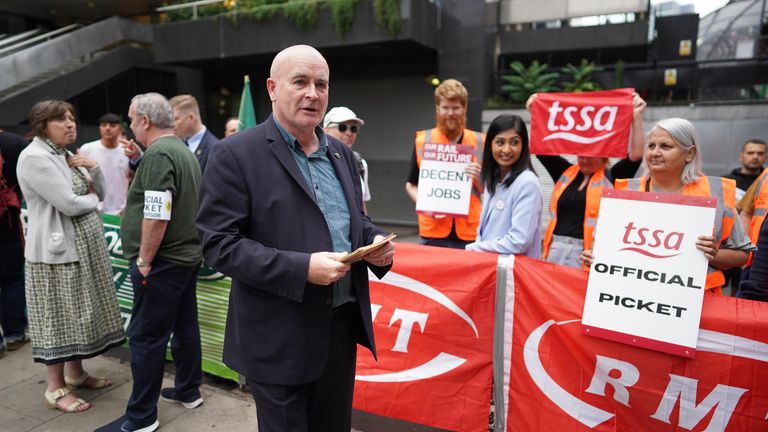
Mick Lynch, general secretary of the RMT, said the plan was not the right move
Mick Lynch, general secretary of the Rail, Maritime, and Transport (RMT) union, said: “We already have the most severe anti-democratic trade union laws in western Europe and this latest threat will rightly enrage our members.
“RMT and other unions will not sit idly by or meekly accept any further obstacles on their members exercising the basic human right to withdraw their labour.”
Manuel Cortes, general secretary of the TSSA, said: “Unions are democratic organizations and industrial action only occurs as a last resort and after a postal ballot of members which also includes having to meet undemocratic thresholds.
“Frankly, having to ballot our members on pay offers before they can take industrial action will not make a blind bit of difference.
“If the offer is rubbish, it will still be rubbish whether our elected workplace reps have consulted our members on it or a ballot has taken place.
“This new Tory proposal will serve only to elongate disputes andgenerate greater anger among union members. It will do precisely nothing to encourage employers to come to the negotiating table with realistic offers.”
Ward participated in RuPaul’s Drag Race UK’s second season and later served as the host of the BBC documentary Gypsy Queen And Proud.
A statement from his family described his death as a “profound shock”.
Ward, who died on Sunday, was raised in Darlington, County Durham as part of the Traveller community.
He qualified as a mental health nurse in 2015, before starting his career in drag.
“It is with the most heart-wrenching and deepest sadness to inform you that our George – Cherry Valentine – has tragically passed away,” Ward’s family said.
“This will come as a profound shock to most people and we understand there is no easy way for this to be announced.”
Image caption, Ward performed as Cherry Valentine on RuPaul’s Drag Race UK
“As his family, we are still processing his death and our lives will never be the same,” they added.
“We understand how much he is loved and how many lives he has inspired and touched. All we ask is for your patience and your prayers at this time. We love you Georgie.”
In his introductory video for the show, he described his Cherry Valentine alter-ego as “glamour”, “dark” and “gothic”.
He said his work as a nurse had “put me in that right position to be able to understand people a bit more”.
“If you are a drag queen you are working with people. And to understand people I think you go the extra mile.”
After appearing on the show, Ward joined with the BBC to produce a documentary exploring his Traveller heritage, called Gypsy Queen And Proud.
He revisited the community he left aged 18 as part of the programme.
Ward also performed publicly and appeared opposite Charli XCX in the music video for her single Good Ones.
RuPaul’s Drag Race is known for the glitz, the glamour, and the hilarity but beneath the make-up and the glitter, at its heart are the personalities and lives of the much-loved contestants.
Cherry Valentine brought all of that not just on the stage, but behind the scenes with the open way she talked about her own experiences.
She shared her difficulties growing up LGBT in the Traveller community, giving a voice to a subject and people that many may not know about.
Cherry spoke strongly about the importance of mental health, having qualified as a mental health nurse before venturing into the world of drag. She once described drag as a “lifeline” during the Covid pandemic in which she was involved in the vaccine effort.
She too touched the lives of so many who will be shocked by the loss of someone whose performances on stage were as inspiring as those away from the camera.
Being interviewed for the launch of Drag Race UK in January 2021, Ward explained he was introduced to the drag scene while a student at Lancaster University.
“I went to Manchester for a couple of nights out and thought: ‘This is crazy, this is what I want to do.’ That’s when Cherry was born,” he said.
Image caption, Cherry Valentine was described as an “incredible queen” by fans
“I did drag in Darlington behind the scenes. It was a case of doing it when your parents are out of the house and dressing up in your mother’s clothes, strutting round the house in nails.”
Speaking about taking part in the show, he said: “I just wanted to go on and show wherever you come from, whoever you are, you can do whatever makes you happy.”
Following the news of Ward’s death, BBC Three controller Fiona Campbell said: “We are all shocked and heartbroken to hear the news of the passing of George, known to many as Cherry Valentine. A fan favourite and an inspiration to so many, we were privileged to have worked with him.”
Good Morning Britain presenter Charlotte Hawkins tweeted: “Very sad to hear that Cherry Valentine has died, aged just 28. We met back in June at Epsom – so full of life then, it’s hard to believe. Sending love to George’s family & friends, just heartbreaking.”
Fans of the show also posted social media tributes to Ward on Friday following the news of his death.
Singer Jack Remmington described Ward as “a brilliant drag performer who did so much for this world both as a nurse and as representation for the gypsy community”.
“In such sad shock at the news of Cherry Valentine,” added writer and journalist Harrison Brocklehurst. “What an absolutely incredible queen.”
Journalist Emma Kelly said Ward’s death was “horribly tragic”, while Ben Smoke described it as “a horrifying loss”.
The key announcements in Chancellor Kwasi Kwarteng’s mini-budget: stamp duty, energy bills, and alcohol duty.
Here are the key points from Chancellor Kwasi Kwarteng’s mini-budget statement to MPs:
• The basic rate of income tax will be cut to 19p in the pound from April 2023. Will mean 31 million people will be better off by an average of £170 per year.
• The 45% higher rate of income tax is to be abolished.
• It was already announced that April’s National Insurance hike is to be reversed from 6 November – saving money for businesses and 28 million workers. The 1.25 percentage points increase was introduced under former chancellor Rishi Sunak.
• Planned duty rises on beer, cider, wine, and spirits canceled
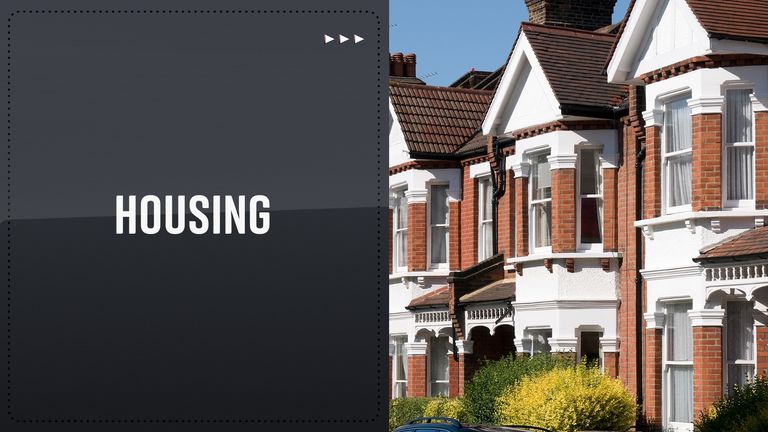
• Stamp duty to be cut from “today”. Nothing will be paid for the first £250,000 of the property’s value – double the current amount allowed. The threshold for first-time buyers is to be increased from £300,000 to £425,000. The value of the property on which first-time buyers can claim relief is to also go up from £500,000 to £625,000.
Image:Energy bills
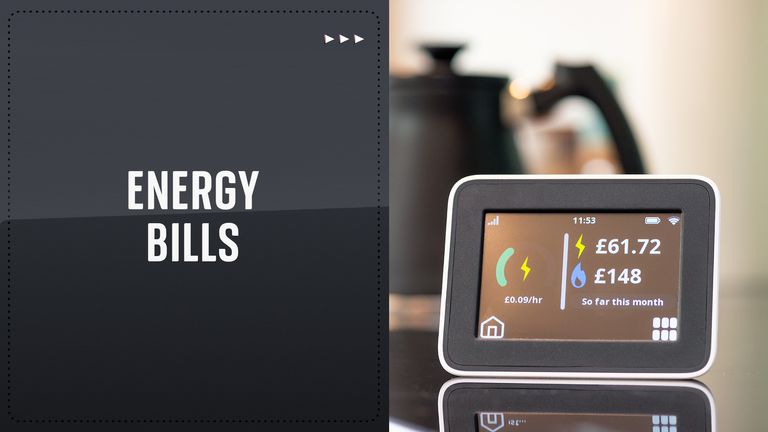
• Household bills to be cut by an expected £1,000 this year with aid from an energy price guarantee and a £400 grant. Millions of the most vulnerable households will receive additional payments, taking their total savings this year to £2,200.
Image: Economy
• Total cost of energy package, including business support, over the next six months estimated at £60bn. It is “entirely appropriate for the government to use our borrowing powers to fund temporary measures to support families and businesses”.
• Treasury estimates tax cut measures will cost nearly £45bn a year in 2026.
• Independent forecasters expect the government’s energy plan “will reduce peak inflation by around five percentage points”.
• Bank of England independence is “sacrosanct”.
• Government to set out its fiscal approach more fully in the future and the Office for Budget Responsibility will publish an economic and fiscal forecast before the end of the year.
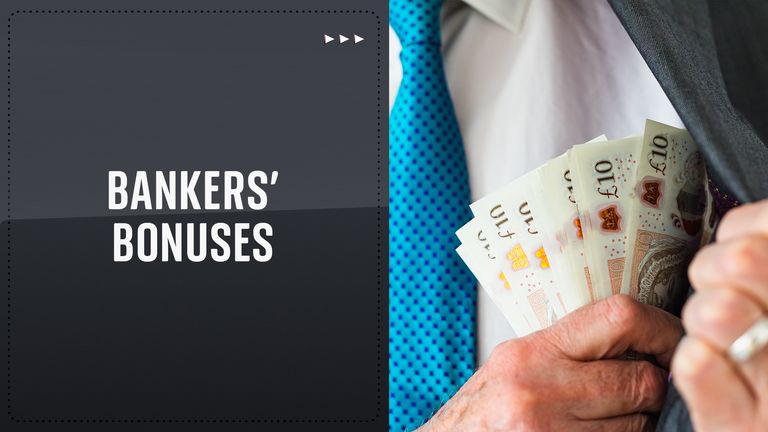
• The EU-inspired cap on bankers’ bonuses is to be scrapped as part of efforts to “reaffirm” the UK’s status as a financial services hub. “All the bonus cap did was to push up the basic salary to bankers or drive activity outside Europe”, the chancellor said.
• Planned rise in corporation tax to 25% next year is cancelled. “We will have the lowest rate of corporation tax in the G20. This will plough almost £19 billion a year back into the economy”, Mr Kwarteng said.
• Will legislate to require trade unions to put pay offers to a member vote so strikes can only be called once negotiations have fully broken down.
• To cut taxes for businesses in designated sites for 10 years to support investment, jobs, and growth. In talks with 38 local and mayoral combined authority areas in England about “investment zones”. Aims to roll out more widely across the UK.
• Universal Credit Claimants who earn less than the equivalent of 15 hours a week at the National Living Wage, 120,000 people, will be required to meet regularly with their Work Coach and take active steps to increase their earnings or face having their benefits reduced. The aim is to reduce vacancies in the economy.
• Will simplify IR35 rules – governing how temporary contractors are paid – by scrapping reforms in 2017 and 2021 that added “unnecessary complexity and cost” for many businesses.
• Introducing VAT-free shopping for overseas visitors.
• Changing regulations to increase investment by pension funds into UK assets, benefiting savers and boosting economic growth, and incentivizing investment into Britain’s science and tech companies.
• Annual Investment Allowance – tax relief for businesses on plant and technology investment – to remain at £1m permanently, rather than letting it return to £200,000 in March 2023.
The UK’s plan to relocate its embassy from Tel Aviv to Jerusalem has been labeled as a “blatant violation of international law” by the Palestinians.
While at the UN, UK PM Liz Trussreportedly informed her Israeli colleague, Yair Lapid, of the review.
Such a move would be highly controversial. The opening of the US embassy in Jerusalem in 2018 was met with outrage across the Arab world.
Mr Lapid tweeted his thanks to Ms Truss for “positively considering” it.
He described Ms Truss as his “good friend”, writing in Hebrew after the pair met on the fringes of the UN General Assembly in New York.
Downing Street has not given any indication of timing but has confirmed that a review is underway.
British officials said they would not speculate on the outcome, adding that Ms Truss was aware of the sensitivity and importance of the location of the British embassy in Israel.
The status of Jerusalem is one of the thorniest issues in the decades-old Israel-Palestinian conflict.
Israel sees the entire city as its eternal, undivided capital while Palestinians claim the eastern part as the capital of their hoped-for future state.
East Jerusalem, along with the West Bank and Gaza Strip, were captured by Israel from Jordan and Egypt in the 1967 Middle East war and have since been viewed internationally as occupied Palestinian territory.
On Twitter, the Palestinian ambassador to the UK, Husam Zomlot, wrote that it was “extremely unfortunate” that Ms Truss had used her first appearance at the UN as prime minister to “commit to potentially breaking international law”.
He said any embassy move would be “a blatant violation” of “the UK’s historic responsibilities”, undermining the two-state solution of an independent Palestinian state alongside Israel to the Israel-Palestinian conflict.
“Such promise is immoral, illegal and irresponsible!” he said.
It is extremely unfortunate that Prime Minister @trussliz uses her first appearance at the UN to commit to potentially breaking international law by promising a “review” of the location of the British embassy to Israel 1/3 https://t.co/qgC1QnIUhi
Up until now, the UK – like most other countries – has kept its embassy in Tel Aviv, rather than in bitterly contested Jerusalem, holding that it should only move to the holy city after a final peace deal between Israel and the Palestinians.
Britain has a consulate in East Jerusalem.
Ms Truss reportedly raised the idea of relocating the embassy during therecent Conservative leadership campaign.
When US President Donald Trump recognised Jerusalem as Israel’s capital – fulfilling a campaign promise – it brought international condemnation. It also led to a flare-up in violence in which dozens of Palestinians were killed by Israeli forces.
At the time, the British PM, Theresa May, criticised the US action.
The only countries to have since followed Mr Trump’s example by moving their embassies from Tel Aviv to Jerusalem have been Honduras, Guatemala and Kosovo.
Chancellor Kwasi Kwarteng,has announced that the National Insurance increase from April will be repealed starting on November 6.
The 1.25% increase was put in place by the former chancellor Rishi Sunak, but Liz Truss promised to reverse it during the Tory leadership race.
Mr Kwarteng made the announcement ahead of a “mini-budget” on Friday.
He said: “Taxing our way to prosperity has never worked.
“To raise living standards for all, we need to be unapologetic about growing our economy. Cutting tax is crucial to this.”
The Treasury said most employees will receive a cut to their national insurance contribution directly via their employer’s payroll in their November pay, although some may be delayed to December or January.
They calculate that almost 28 million people will keep an extra £330 of their money on average next year, whilst 920,000 businesses are set to save almost £10,000 on average next year thanks to the change
In a tweet, Mr Kwarteng called it a “tax cut for workers”.
I can confirm that this year’s 1.25% point rise in National Insurance will be reversed on 6th November.
Its replacement – the Health and Social Care Levy planned for April 23 – will be cancelled.
The tax hike was put in place to help fix the NHS backlog and fund social care sector improvements. It was due to raise around £13bn per year.
However, Ms Truss argued it was wrong of her party to break its 2019 manifesto commitment not to raise taxes and said the extra funds can be raised through general taxation.
The chancellor confirmed today that the funding for health and social care services will be maintained at the same level as if the levy was in place.
MPs are expected to vote on repealing the health and social care levy once they return from party conferences in October.
“This is delivering on a commitment the PM made on the (Tory leadership) campaign trail,” a No 10 spokeswoman said.
The move comes ahead of Chancellor Kwarteng’s “fiscal event” on Friday when he will set out more details of the government’s plans to cut taxes, including scrapping a planned rise in corporation tax.
The Bank of England hikes interest rates as it indicates the UK is already in recession; government hints energy support for schools, hospitals, and care homes could continue beyond six months; submit your cost of living dilemma to personal finance expert Gemma Godfrey using the form below.
What is a recession?
It is a significant decline in economic activity, lasting months or even years.
Economists usually define a recession as two consecutive quarters where GDP has fallen.
Why do recessions happen?
There are a number of common causes for recession, including:
A sudden economic shock – such as the COVID pandemic or the war in Ukraine
Excessive debt
Asset bubbles – when investors become too optimistic and inflate the stock market or real estate bubbles, before the bubble bursts and panic selling ensues
Many people will also remember the Great Recession of 2008 and 2009 – the UK’s worst in modern history.
This was largely due to the mortgage crisis in the US impacting the British banking sector, and the subsequent “credit crunch”.
The UK also saw a recession between 1990 and 1991, caused by rapid economic expansion under Margaret Thatcher and Britain’s plans to maintain membership of the Exchange Rate Mechanism.
How will a recession affect you?
Unemployment levels will rise, so more people will be at risk of losing their jobs.
People who keep their jobs may see cuts to pay and benefits, or struggle to negotiate future pay rises.
Meanwhile, investments can lose money and savings can be reduced, upsetting some people’s plans for retirement or for large expenses such as buying homes or getting married.
Businesses make fewer sales during a recession, and mortgage lenders can also tighten standards for mortgages, car loans and other types of financing – meaning you may need a better credit score or larger down payment.
Under a significant government support programme, energy bills for UK firmswill be reduced by around half this winter from their anticipated level.
In an effort to prevent businesses experiencing skyrocketing costs from going out of business, the programme will stabilize gas and electricity prices for businesses for six months starting on October 1.
According to the administration, hospitals, schools, and charities would also receive assistance.
It follows the announcement by ministers of a £150 billion plan to assist homeowners with their skyrocketing costs for two years.
Industry groups welcomed the package but warned further support may be needed after the winter.
It is understood the scheme will be reviewed after three months with an option to extend support for “vulnerable businesses” – but it is not known what sectors come under the category.
Wholesale prices are expected to be fixed for all non-domestic energy customers at £211 per MWh for electricity and £75 per MWh for gas.
Companies do not need to contact suppliers as the discount will automatically be applied to bills, with savings seen from October but received from November.
Independent analysts Cornwall Insight said the support was “substantial”, representing a 45% discount on wholesale energy prices at the end of last week.
“The support effectively reverts the market back to where it was price-wise in the Spring of 2022,” said Robert Buckley, its head of relationship development.
Prime Minister Liz Truss said the government understood the “huge pressure businesses, charities, and public sector organizations are facing with their energy bills”.
“As we are doing for consumers, our new scheme will keep their energy bills down from October, providing certainty and peace of mind,” she said.
“At the same time, we are boosting Britain’s homegrown energy supply so we fix the root cause of the issues we are facing and ensure greater energy security for us all.”
The support will apply to all non-domestic energy customers in England, Scotland and Wales. A parallel scheme, based on the same criteria and offering comparable support, will be established in Northern Ireland.
Officials have not said how much the package will cost the taxpayer, as it will depend on what happens to wholesale market prices between October and April when the support expires.
However, Cornwall Insight estimates the cost at around £25bn.
IMAGE SOURCE, MONTY RAKUSEN Image caption, Steel manufacturing requires a lot of energy
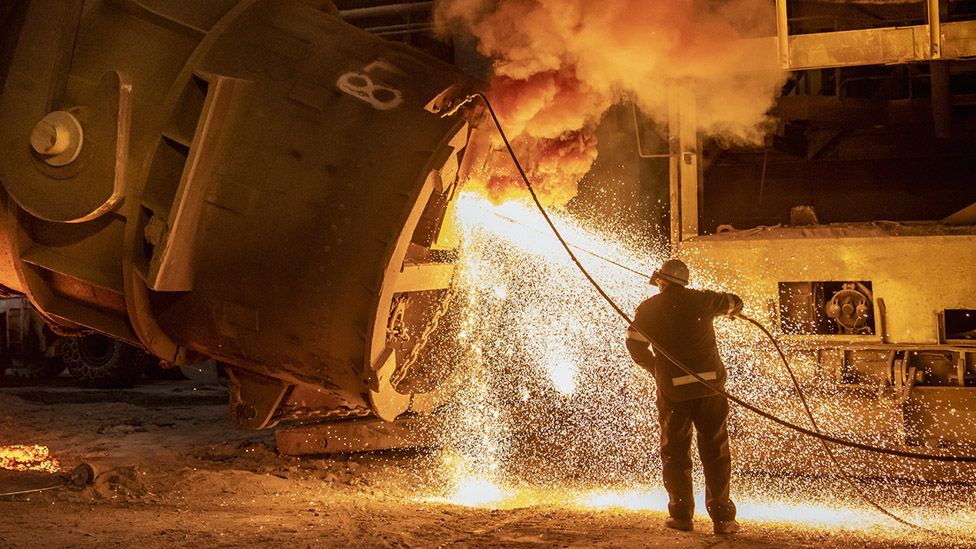
Energy-intensive industries such as steel manufacturers have raised concerns about their energy costs, which have surged following Russia’s invasion of Ukraine.
Unlike households, businesses are not covered by an energy price cap, which is the maximum amount a supplier can charge per unit of energy. It means non-domestic bills have soared even higher.
The government announced earlier this month that household bills would be limited to £2,500 annually until 2024 under a separate scheme.
The government also said it would provide an additional £100 payment to households not able to receive support for their heating costs, such as those not served by the gas grid.
The big problem with this support for business is its shelf life. Few businesses plan with only a six-month time horizon and there will be some whose plans to cut production, close premises, and let staff go will not change as a result of this intervention.
But many others – particularly those in retail and hospitality – may see this as giving them a fighting chance over the commercially crucial Christmas trading period.
The government has thrown an emergency blanket over the economy this winter, but longer-term, more fundamental reform to the energy supply market, its pricing, and mechanics will be needed.
Developing more cheap renewables, securing foreign supplies of liquid gas, drilling for more domestic fossil fuels, breaking the link between gas prices and electricity, and pushing ahead with hydrogen, carbon capture and storage, and small and large-scale nuclear have been part of the government’s plan for nearly two years.
What’s new is the pressure applied by Vladimir Putin to do it as fast as possible.
‘Welcome but more to be done’
Stephen Phipson of Make UK, which represents UK manufacturers, said businesses would “warmly welcome” the government support.
“Government has delivered a scheme which is simple to understand, giving reassurance to the business sector and making immediately available the much-needed help companies have been calling for across the board at a time energy costs were spiraling out of control.”
However, Mr Phipson warned that energy prices were likely to remain high for more than the six-month duration of the scheme and firms may need “support for a longer period if we are to protect jobs and remain competitive”.
Director General of UK Steel, Gareth Stace, said the price cap would give steel makers “the chance to get through the winter”. But he called on the government to “rapidly reform the energy market to ensure longer-term competitive prices beyond the current price”.
Smaller businesses have also been struggling with rising bills, with brewery bosses warningpubs and restaurants across the UK will be forced to close due to energy costs soaring by as much as 300%.
A landlord of one pub in Essex told the BBC his energy bill had risen from about £13,000 a year to £35,000.
Kate Nicholls, chief executive of UKHospitality, said the industry was “relieved” by the support ahead of the busy Christmas trading period.
“The inclusiveness of the support announced today – covering businesses small and large – will be extremely beneficial to the sector… A sector that provides a huge number of jobs, many of which are now more secure.”
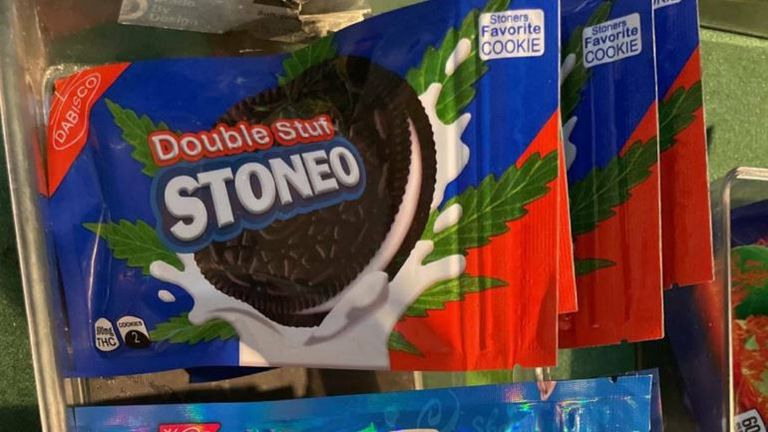
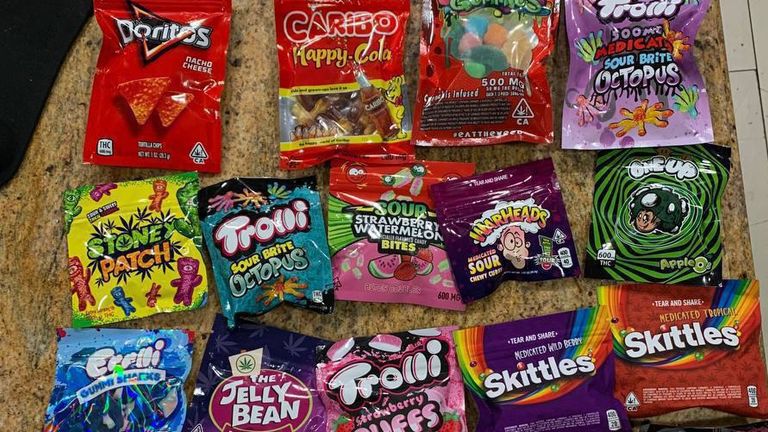
Sky News has reported that cannabis candies marketed and promoted on social media platforms like Instagram and Tik Tok are packaged to resemble packages of Haribo and Skittles.
On Telegram, one dealer is promoting a variety of cannabis candies in colorful packages with false branding.
At least six children have been sent to the hospital aftereating cannabis sweets, according to the police, who claim that the packaging makes them appealing to kids. One kid was only eight years old.
There are also concerns that drugs are used to lure children into trafficking drugs by county lines gangs, which are based in big cities but use youngsters to deliver and sell drugs to users in towns and rural areas. Police in the east of England said that a third of people arrested in relation to cannabis edibles are under the age of 18.
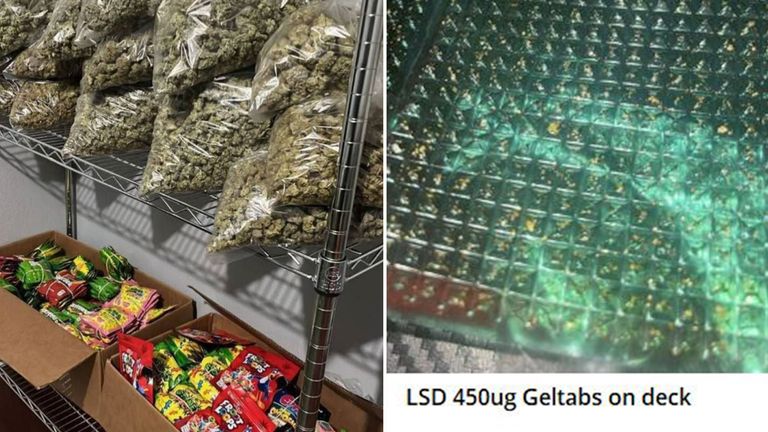
The sweets are routinely promoted and sold alongside class A drugs including heroin, cocaine, and LSD, as well as large quantities of marijuana.
Image: One Telegram channel posted images of large bags of marijuana above boxes of gummies, as well as sheets of the Class A drug LSD
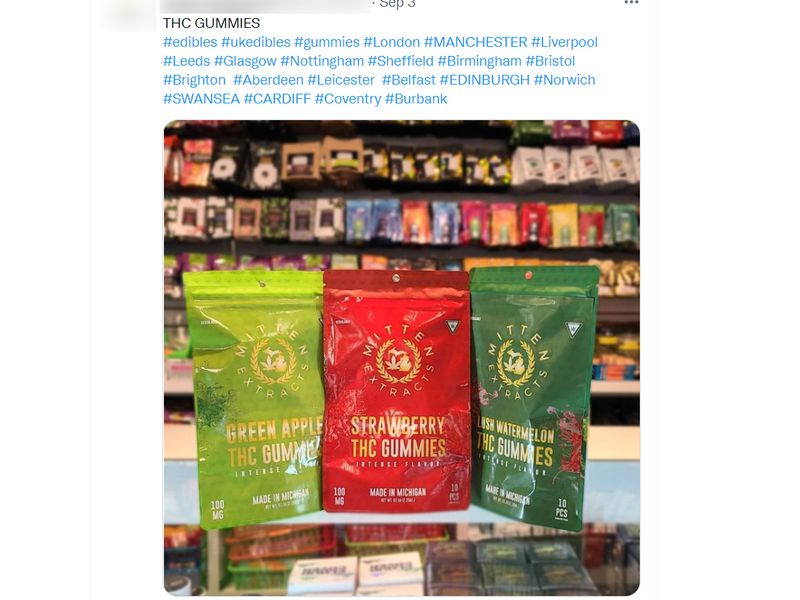
Sky News found dealers are operating openly on the five most popular social media sites: Facebook, Instagram, TikTok, Twitter, and Snapchat. They are also using the messaging services Whatsapp and Telegram, and the latter is the most popular platform for dealers to provide prices and initiate sales.
The story came to light after a dealer added a Sky News journalist on Instagram to anaccount selling cannabis sweets.
The sweets are known as gummies and have no connection to the legitimate brands named on some of the packagings.
Some dealers are adding illegal substances to the sweets themselves
Some products using CBD, a chemical found in cannabis, are on sale legitimately in shops across the country, but these sweets are illegal and contain high levels of THC – which is the chemical that gives a user a high.
Many appear to have been brought into the UK from California, where drug laws are different.
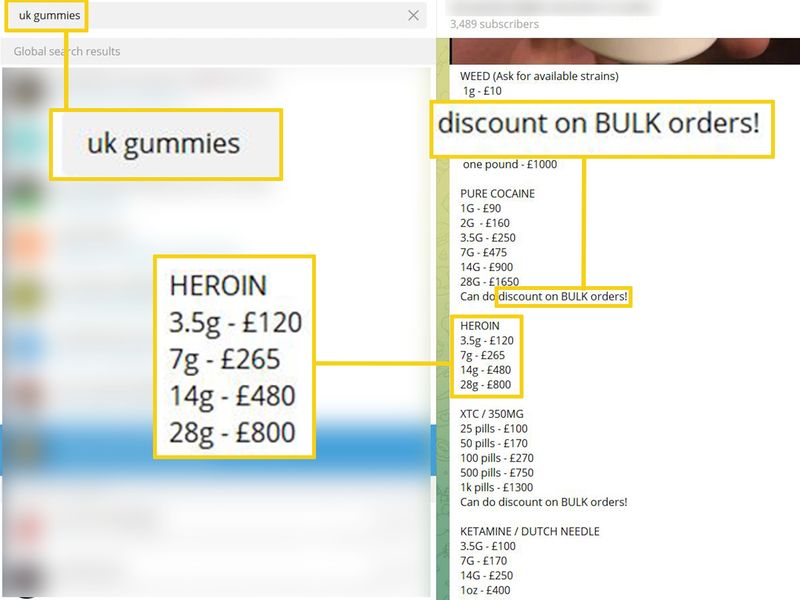
Ordering in bulk is encouraged, and dealers offer discounts on big orders of gummies and harder drugs.
Image: This seller is advertising class A drugs like heroin and offering bulk discounts on other hard drugs, while also offering ‘gummies’ elsewhere in the channel. The chat appears under searches for ‘uk gummies’. Pic: Telegram
Searching on Telegram for the word “gummies” brings up many groups where the sweets can be bought for just £5. One group has 62,000 subscribers and two others have almost 30,000 and 16,000 subscribers each.
Typing in the word “edibles” on the Facebook marketplace in the UK resulted brought up items containing drugs. Around a third of the first 40 results were advertised as containing cannabis.
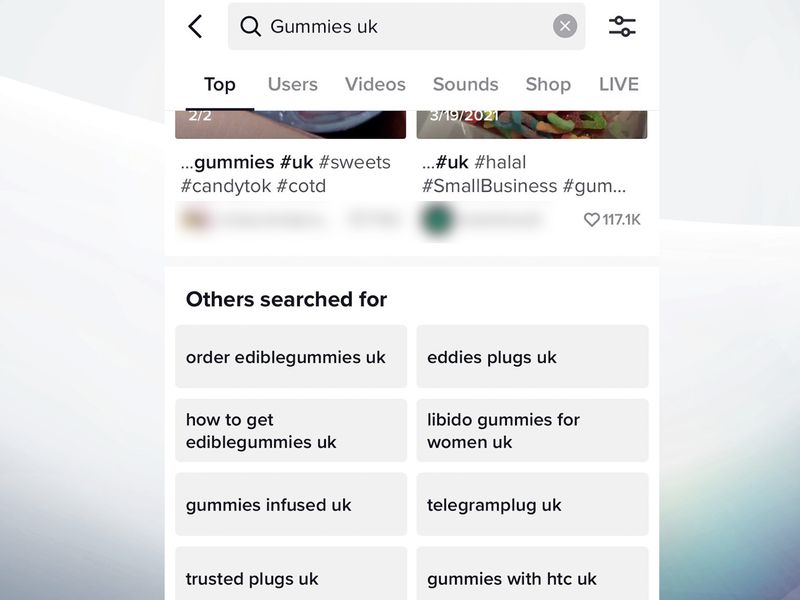
Those looking for “gummies uk” on TikTok were shown results mostly showing legal sweets but the app offers suggestions that point users to sweets offered by dealers.
These suggestions include searching “how to get ediblegummies uk” and “telegrampluguk” (plug being a term for a dealer or someone who can connect you to a dealer) and “gummies with htc uk” (htc being a spelling variation of THC).
Image: TikTok’s suggested searches pointed users to other drug content. Pic: TikTok
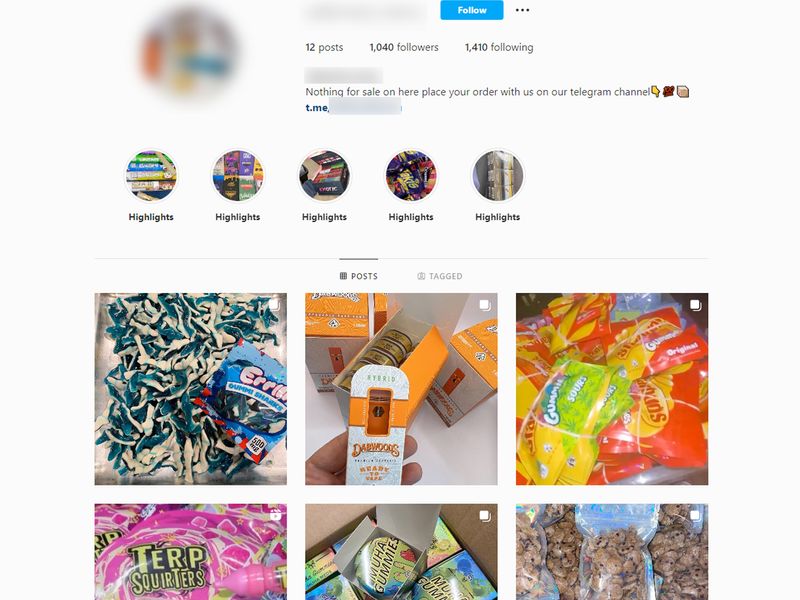
A network of dealers appears to be operating on some of the social sites. For example on Instagram, looking at the accounts following or being followed by a seller leads you to discover more sellers.
Cannabis sweets are a problem for police forces across the UK. Almost all police forces in England, Scotland, Wales, and Northern Ireland have had an issue with the sweets in their area, and 80% issued a statement or confirmed this to Sky News.
Image: One dealer’s Instagram page
The Eastern Region Special Operations Unit (ERSOU) has a unit that manages the threat of serious and organized crime across eastern England and covers Bedfordshire, Cambridgeshire, Hertfordshire, Norfolk, Suffolk, Kent, and Essex.
Intelligence from ERSOU shared with Sky News suggests boys and girls under 18 are consuming cannabis edibles, primarily those of secondary school age.
A third of those arrested in relation to cannabis edibles in the eastern region are under the age of 18.
Image: The likeness of some big name brands are used by dealers to market their edibles
Detective Chief Inspector Rob Burns, from ERSOU, says that cannabis edibles are illegal and have side effects, such as loss of consciousness.
He said: “The way they are branded to look like sweets suggests they are being marketed at children, but worryingly also means that they could easily fall into the wrong hands.
“We also know that gangs involved in county lines will use an array of tactics to target vulnerable young people, and reporting suggests social media is used to advertise the sale of cannabis edibles, potentially to appeal to younger people who are using multiple social media platforms.”
He added that anyone with information on the sale of these items or who thinks a child is being exploited to sell them should contact the police.
The social media companies mentioned in this article all told Sky News they have strict policies prohibiting the buying or selling of any drugs, including sweets containing THC. They say they actively monitor this issue on their platforms using a mix of both technology and humans to review content.
Meta, which owns Instagram, Facebook, and Whatsapp,said it removed 98% of this content proactively in the last quarter and that it was working with the police and youth organizations to improve their moderation.
Image: Accounts selling gummies were also found on Twitter
Most of the accounts and search terms flagged during the Sky News investigation have now been banned.
The companies behind the sweets and snacks whose branding is copied by drug makers have previously spoken out against the look-a-like packaging, and some took legal action.
Sky News has blurred the names of accounts to avoid giving publicity to the sellers.
The flowers will be utilized for park planting initiatives in London.
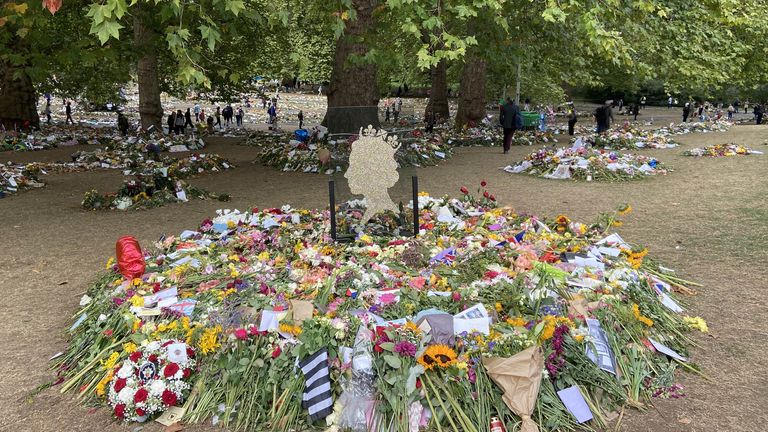
From next week Monday, flowers left in memory of the Queen will be composted and planted as shrubberies and landscaping materials in the Royal Parks.
Flowers left by visitors in honour of the Queen will still be accepted,but those that have already started to lose their beauty will be taken to the Hyde Park nursery.
It is expected that work to remove items laid by the public will begin on Monday, a week after the state funeral, and will continue for seven days.
Once taken away, any remaining packaging, cards, and labels will be removed before the plant material is composted in Kensington Gardens.
The compost will then be used on landscaping projects and shrubberies across the Royal Parks.
The London Royal Parks include Hyde Park, Green Park, St James’s Park, Regent’s Park, and Kensington Gardens.
Sue Tovey, 57, from North Wales, traveled to the tribute site in Green Park to leave flowers with her husband and her granddaughter.
She said: “I think it’s amazing because so many people have brought things down and I love how they’ve gotten rid of all the Cellophane and actually just got the bouquets. It’s beautiful, really moving isn’t it?”
Belinda Barber, 56, from Huntingdon, left flowers at the Green Park tribute site.
She said: “We’re all gardeners anyway so it’s a lovely touch that this will go and get used in Royal Parks, which is fantastic. There’s going to be a lot of compost here I would’ve thought.”
Image: Thousands of mourners have left flowers since the Queen’s death
In terms of other tributes, a spokesperson for the Royal Parks said: “Our priority at the moment is to manage the huge volume of flowers and tributes that are being left in the Green Park Floral Tribute Garden.
“We will store any teddies and artifacts that have been left andwill work closely with our partners to agree on what we do with them over the next few months with discretion and sensitivity.”
Monday’s nonstop coverage of the Queen’s funeral meant that several other stories, including the conflict in Ukraine,received less attention than they would have.
The most recent episode of the pro-Kremlin television show 60 Minutes gave Russian State Duma member and retired major general Andrey Gurulyov the chance to make even more grave nuclear assault threats against the UK and Germany.
Referring to US President Joe Biden’s warning to Russia over the use of nuclear weapons in Ukraine, the pro-Putin lawmaker said: “We may use them, but definitely not in Ukraine.”
Having suggested Moscow could target Berlin with a nuclear strike, he goes on to discuss the likely US response in the event of an attack on the UK.
Referring to NATO’s Article 5, which states that an attack on any member of the bloc is considered an act of violence against all the allies, he says: “If we turn the British Isles into a Martian desert in three minutes flat, using tactical nuclear weapons, not strategic ones, they could use Article 5, but for whom?
“A non-existent country, turned into a Martian desert? They won’t respond. We shouldn’t be afraid of that.”
Host Olga Skabeeva then joked: “We should have done it today, all the best people are there for the funeral.”
Notorious for its frequently misleading information about the war in Ukraine, 60 Minutes is routinely used as a vehicle for pro-Russian propaganda.
Meanwhile in Russia, more of the usual: nuclear threats against Germany and Britain, cautioning NATO against going into Ukraine. This directly clashes with their lies, constantly spewed by state TV, that Russia is already at war with NATO & “uniformed NATO troops” are in Ukraine. pic.twitter.com/ioMgbrzhbF
According to sources in the area, the 43-year-old guy sang the British national anthem and performed a number of tunes on his harmonica, including one related to protests in 2019
He was held under the sedition laws of the colonial era authorities say.
Up until recently, prosecutors have only occasionally applied this law.
But the past few months have seen an increasing number of people charged under this law, including five speech therapists who were found guilty earlier this month of publishing “seditious” children’s books.
Footage shared widely on social media shows the man standing outside the consulate playing “Glory to Hong Kong”, the unofficial anthem of protesters during 2019 pro-democracy protests, on his harmonica.
A large crowd, which had gathered to watch an online live broadcast of the later Queen’s state funeral in the UK, is seen singing along to the tune.
The song’s lyrics make reference to the “tears on our land”, and also mention “democracy and liberty”.
Hong Kongers have over the past week been lining up for hours to pay their respects to the Queen, in what has been perhaps the biggest display of affection for the late monarch seen outside the UK.
The city, formerly a British colony, returned to Chinese rule in 1997.
Under the terms of the handover, China agreed to govern Hong Kong under the principle of “one country, two systems”, where the city would enjoy “a high degree of autonomy, except in foreign and defense affairs” for the next 50 years.
But a crackdown on protests, Beijing’s imposition of its national security law and only allowing “patriots” to govern are seen bymany as reneging on that promise.
According to Nana Gyan, who spoke on SVTV Africa, the Ghanaian community overseas is the “bedrock of many problems,” so he pretends.
“Before coming here, you didn’t know anyone, but as soon as you arrive, people want to interject themselves in your business.
When they learn something about you, it becomes a topic right away.
Speaking about life in the UK, Mr. Gyan disclosed that he occasionally experiences depression, particularly when things don’t go as planned.
In contrast to Ghana, he continued, they overwork themselves to pay their bills and rent.
“There are moments when I feel upset because you’ve worked hard and may be hoping for a result in this amount of time, but it doesn’t happen that way.
Although the competition here is tough, it helps you gain experience and strengthens your resolve, Nana continued.
For a two-day visit to celebrate Queen Elizabeth II, President Joe Biden flew into London late on Saturday. According to the president, the long-reigning monarch “shaped an era.”
Biden, who visited the late sovereign last year and said later that she reminded him of his mother, is joining leaders from a considerable number of other countries to pay their respects to the late sovereign.
For Biden, it is an opportunity to think back on a monarch whose life was a timeline of the most important historical events of the last 100 years and who personified a dedication to public service.
When Biden first encountered the Queen in 1982, his own Irish American mother admonished him not to show her any respect.
He didn’t bow down then, or when he met the Queen as President last year while attending a Group of 7 summits in England. But his respect for a woman whose constancy on the world stage over the last century was unparalleled has been plain.
“She was a great lady. We’re so delighted we got to meet her,” Biden said on the day that she died.
The Queen’s surprise decision last year to travel to the Cornish coast to meet world leaders at the G7 summit was a signal of her desire to remain engaged in global affairs.
Later that week, when she hosted Biden and first lady Jill Biden for tea at Windsor Castle, she inquired about two authoritarian leaders, Presidents Xi Jinping of China and Vladimir Putin of Russia, the President told reporters afterward.
“She had such curiosity. She wanted to know all about American politics, and what was happening. So, she put us at ease,” Jill Biden said recently in an interview with NBC.
At Sunday evening’s reception, Biden will see Charles for the first time since he became King. The two men have met previously and spoke last week by phone.
As Prince of Wales, Charles was a passionate campaigner for certain issues Biden has also championed, including combating climate change. It remains to be seen how involved the new King will be on those issues going forward.
Relatively close in age — Charles is 73, Biden is 79 — the two men have a shared experience of being in the public eye for decades before assuming their current roles as heads of state.
On his call with the King, Biden “conveyed the great admiration of the American people for the Queen, whose dignity and constancy deepened the enduring friendship and special relationship between the United States and the United Kingdom,” the White House said. “President Biden conveyed his wish to continue a close relationship with the King.”
Security in the British capital is at its highest level in memory as Biden and dozens of other world leaders convene to remember the late Queen, who met 13 sitting US Presidents during her reign.
White House aides have declined to provide specific security details for the President’s visit but say they are working well with their British counterparts to ensure the demands of presidential security are met.
Plans for the Queen’s funeral have been in place for years, allowing US advisers greater insight into precisely what will happen over the coming days as they make security arrangements.
The White House said it received an invitation only for the President and first lady, making for a slimmed-down American footprint.
Biden traveled with his national security adviser, communications director, and other personal aides aboard Air Force One to London.
When reports emerged last week that world leaders would be required to ride on a bus to the funeral, US officials were skeptical and shot down the suggestion Biden that would travel to Westminster Abbey in a coach.
In 2018, when other world leaders traveled together in a bus to a World War I memorial in Paris, then-US President Donald Trump traveled separately in his own vehicle. The White House explained at the time that the separate trip was “due to security protocols.”
The Queen’s death came at a moment of economic and political turmoil for the United Kingdom. A new prime minister, Liz Truss, entered office after months of uncertainty following the decision of her predecessor, Boris Johnson, to step down.
Truss invited several visiting world leaders to meet individually at 10 Downing Street this weekend. In the role for only a little more than a week, it will be Truss’ first time meeting face to face with many of her foreign counterparts.
While her office initially said Biden would be among the leaders visiting Downing Street, it was later announced that Truss and the President would meet for formal bilateral talks on Wednesday on the sidelines of the United Nations General Assembly in New York.
A host of issues are currently testing the US-UK “special relationship,” which has been heralded repeatedly in the UK.
It was only two days after Truss traveled to Balmoral Castle in Scotland to formally accept the Queen’s appointment as prime minister that the long-reigning monarch passed away. Since then, the country has been in a formal period of mourning.
Truss inherited a deep economic crisis, fueled by high inflation and soaring energy costs, that has led to fears the UK could soon enter a prolonged recession. The challenges have been aggravated by Russia’s invasion of Ukraine, which has caused volatility in the oil and gas markets.
While few in the Biden administration shed tears at Johnson’s resignation– Biden once described him as the “physical and emotional clone” of Trump — the US and the UK were deeply aligned in their approach to Russia under his leadership.
White House officials expect that cooperation will continue under Truss, even as she comes under pressure to ease economic pressures at home.
Less certain, however, is whether Truss’s hard-line approach to Brexit will sour relations with Biden. The President has taken a personal interest in the particular issue of the Northern Ireland Protocol, a post-Brexit arrangement that requires extra checks on goods moving between Northern Ireland and the rest of the UK.
The rules were designed to keep the border between Northern Ireland and the Republic of Ireland open and avoid a return to sectarian violence. But Truss has moved to rewrite those rules, causing deep anxiety in both Brussels and Washington.
Biden, who makes frequent references to his Irish ancestry, has made his views clear on the issue, even though it does not directly involve the United States. Congressional Democrats have similarly expressed concern over any steps that could reignite the Northern Ireland conflict.
In their first phone call as counterparts earlier this month, Biden raised the matter with Truss, according to the White House.
A US readout of their conversation said they discussed a “shared commitment to protecting the gains of the Belfast/Good Friday Agreement and the importance of reaching a negotiated agreement with the European Union on the Northern Ireland Protocol.”
At the service where King Charles gave his first speech to the country, no members of the Royal Family were present.
The Queen’s memorial ceremony at St. Paul’s Cathedral ended with the first formal performance of “God Save the King.”
The lyrics to the national anthem have changed from “Queen” to “King” and “her victorious” to “him victorious” to mark King Charles III taking over as the new monarch.
It comes after crowds spontaneously sang the version of the song outside Buckingham Palace on Friday as the King arrived with the Queen Consort Camilla.
The anthem is also expected to be sung at the Kia Oval cricket ground on Saturday as England and South Africa’s Third Test Match resumes. The match was paused on Friday following the Queen’s death.
No members of the Royal Family were present at the service but audio of King Charles’s first address to the nation was played to the congregation.
The King said he was speaking with “feelings of profound sorrow” as he told the country: “Queen Elizabeth was a life well lived; a promise with destiny kept and she is mourned most deeply in her passing. That promise of lifelong service I renew to you all today.”
King Charles went on to say: “As the Queen herself did with such unswerving devotion, I too now solemnly pledge myself, throughout the remaining time God grants me, to uphold the constitutional principles at the heart of our nation.
“And wherever you may live in the United Kingdom, or in the realms and territories across the world, and whatever may be your background or beliefs, I shall endeavor to serve you with loyalty, respect, and love, as I have throughout my life.”
Prime Minister Liz Truss and senior ministers were also in attendance along with 2,000 members of the public who collected wristbands on a first-come-first-serve basis.
MsTruss, who met King Charles for a brief audience in person at Buckingham Palace earlier, gave a brief reading from the Bible.
She said: “We do not live to ourselves, and we do not die to ourselves. If we live, we live to the Lord, and if we die, we die to the Lord; so then, whether we live or whether we die, we are the Lord’s.”
To honor the Queen, Liz Truss’ cabinet gathered in Downing Street.
A number of senior ministers, many of whom were only appointed this week, including Business Secretary Jacob Rees-Mogg and Education Secretary Kit Malthouse, were seen arriving for the gathering.
A Number 10 spokesperson said: “At 9.30 am the cabinet paid tribute to Her Majesty, and shared memories of her lifetime of service, including fond recollections of their own encounters with her.
“Cabinet was united in their support for His Majesty the King, as he and the United Kingdom continue to mourn the passing of his mother. There was a moment of silence at the conclusion of the meeting.”
The gathering comes before a special session of Parliament, starting at midday, in which MPs and peers will share their memories and praise for the monarch, who died at Balmoral on Thursday aged 96.
Ms Truss became the Queen’s 15th prime minister when she was appointed at Balmoral on Tuesday.
The meeting became the last public appearance of the monarch.
Later on Friday, Ms Truss will meet the King when he returns to London from Scotland, where he had been since the Queen’s health deteriorated.
Many people have come alone to take at the moment, while others have come in groups with friends.
Australian Chloe Hogan pictured with her two friends outside Buckinham Palace
Australian Chloe Hogan made her way to the palace after hearing the news about the Queen’s health in her family group chat down. She says: “I think it’s quite scary that we don’t know what’s going to happen.” The Queen is also the monarch of Australia.
Chloe adds: “I think if anything did happen Australians would be just as devastated as when Princess Diana died, the exact same thing.
“It would be devastating, and everyone would be like people in the UK would be.”
The Duke and Duchess of Sussex, who were already in the UK for a planned visit, are understood to be on their way to Balmoral separately from other royals, reports PA. But they have reportedly been “in coordination†with the plans of other family members.
But as summer temperatures soared, there was little talk of greater ambition from the Tory contenders, and plenty about how environmental policies might be watered down or changed.
In its latest progress report on net zero the government’s advisers, the Climate Change Committee (CCC), said that “tangible progress is lagging the policy ambition”.
So is the new Truss government going to close the “policy gaps” identified by the CCC, or widen them?
Don’t expect the new business secretary to be making many friends within the environmental lobby, or the “green blob” as he has called them.
Mr Rees-Mogg has spoken in the past of extracting “every last drop” of North Sea oil, and licenses could be approved rapidly for new oil and gas exploration. That’s a complete no-no for almost all climate scientists, who say there can be no more fossil fuel projects if we are going to retain any hope of keeping global temperature rises under 1.5 degrees. Climate scientists say missing that target would accelerate the risks of climate change like extreme weather.
“It doesn’t have a knock on effect on net zero.” Mr Rees Mogg said when talking about new North Sea oil and gas on his podcast earlier this year.
“It’s more environmentally friendly to use gas that you’ve got at hand than to import liquefied gas from the rest of the world.”
A small group of Conservatives have also been demanding that the new PM take a fresh look at fracking and Ms Truss has given them some encouragement.
On the campaign trail she said that what she called the “effective ban” on fracking would be lifted but it would only take place where local communities supported it (which may well stop it happening).
Mr Rees-Mogg has called shale gas “very clean” and said that the threat of drilling causing earthquakes was overstated with “some the equivalent of a bus passing by your house.”
Renewables
The cold, hard capitalist truth is that new renewables are currently a much cheaper source of new power generation than any of the fossil fuel or nuclear alternatives. So shifting towards wind and solar makes not just environmental, but economic sense, while at the same time giving us more energy security.
Image source, Reuters
Image caption, New environment secretary Ranil Jayawardena has talked about “protecting our countryside from solar farms”
Britain is a world leader in offshore wind and in the next few years the building of ever larger wind-farms – mainly in the North Sea – looks set to continue. Huge projects are already under way and will come on stream in the next couple of years.
There’s unlikely to be shift in policy towards two Tory renewable bugbears with comparable price tags – onshore wind and solar.
Ms Truss has already said she wants new solar panels to be limited to the roofs of buildings and not put on agricultural land, and her environment minister appears to have even stronger views.
“I don’t think there’s any need for solar power given the huge potential for wind,” Ranil Jayawardena said in a social media video posted in November 2021.
“If you feel strongly about protecting our countryside from solar farms write to your local councillor and give them the support they need to take action quickly to protect our countryside from them.”
Wind farms on land have a much shorter development timeline, but new projects have effectively been halted since 2014 when local communities were given greater powers to object. Despite the attraction of quicker cheap energy, neither Ms Truss, Mr Rees-Mogg or Mr Jayawardena have shown any enthusiasm for making onshore any easier.
On one of his podcasts, Mr Rees-Mogg talks about “hairshirt greenery”, the idea that environmental problems can be addressed by limiting our consumption of resources.
“If you are too aggressive, too “hairshirty” people won’t vote for it.” he says.
“So you’ve got to go with the grain of public opinion with what people are willing to accept. And that means raising living standards through efficient use of technology”.
In that light, latest polling on renewables conducted by Mr Rees-Mogg’s new department makes interesting reading. It shows that 7% of people would be unhappy (compared to 54% who would be happy) about a solar farm being built in their local area and 12% unhappy (with 43% happy) about an on-shore wind-farm.
Newly sworn-in UK Prime Minister, Liz Truss, has made a major reshuffle hours after succeeding Boris Johnson.
Now at the helm of affairs are key allies of hers.
Kwasi Kwartenghas been made chancellor, James Cleverly becomes foreign secretary and Suella Braverman replaces Priti Patel as home secretary.
One of Ms Truss’s closest friends, Therese Coffey, is now the health secretary and deputy PM.
Her new cabinet will meet ahead of her first Prime Minister’s Questions later.
None of those who backed her defeated rival, Rishi Sunak, will remain in her full cabinet, with Dominic Raab, Grant Shapps, George Eustice and Steve Barclay all returning to the backbenches.
But Ms Truss’s press secretary said the changes would “unify” the Tory Party and pointed to senior roles for five of her leadership rivals: Suella Braverman, Tom Tugendhat as security minister, Kemi Badenoch as trade secretary, Penny Mordaunt as leader of the Commons, and Nadhim Zahawi as chancellor of the Duchy of Lancaster.
For the first time, none of the top four “great offices of state” – prime minister, chancellor, home secretary and foreign secretary – is held by a white man.
Meanwhile, the new PM made her first call to a fellow foreign leader, pledging the UK’s ongoing support to Ukraine in a call with President Volodymyr Zelensky.
No 10 said Ms Truss was also “delighted” to accept an invitation to visit Ukraine.
She later spoke to US President Joe Biden, where the pair discussed the importance of the UK reaching an agreement with the EU over post-Brexit trading rules in Northern Ireland.
Liz Truss is delivering her address to the nation after being appointed the country’s new prime minister by the Queen.
The Tory leader, who became the UK’s third female prime minister today, begins by paying tribute to Boris Johnson who she says was a “hugely consequential prime minister”.
She says the UK now finds itself facing “global headwinds” caused by Russia’s war in Ukraine and now is the time to “tackle the issues that are holding Britain back”.
Ms Truss says she has a “bold plan” to “grow the economy through tax cuts and reform” and says she has three priorities.
“I will cut taxes to reward hard work and boost business-led growth and investment,” she says.
The new prime minister says she will deal “hands-on” with the energy crisis caused by Vladimir Putin‘s war and will “secure our future energy supply”.
“I will make sure that people can get doctors appointments and the NHS services they need. We will put our health service on a firm footing by delivering on the economy, on energy and on the NHS,” she says.
She adds: “As strong as the storm maybe I know that the British people are stronger.
“Our country was built by people who get things done. We have huge reserves of talent, energy, and determination. I am confident that together we can ride out the storm, we can rebuild our economy and we can become the modern, brilliant Britain that I know we can be.”
Language barriers, complex enrolment processes and a lack of awareness among colleges and universities on asylum applications are leading to delays and postponements for more and more young people.
And this figure has more than doubled (a 125% increase) compared to the total three years previously (September 2018 – August 2019).
The charity says students are waiting for several rounds to join the next academic year due to language barriers, complex enrolment processes and a lack of awareness among colleges and universities on asylum applications.
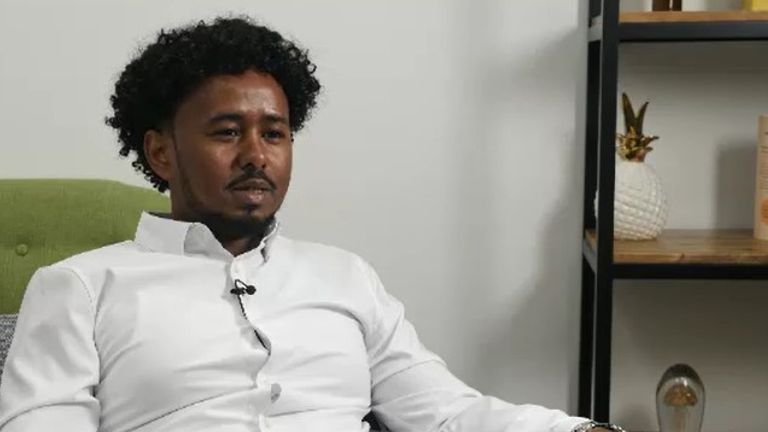
Ahmed Mohammed, 21, is a refugee from Eritrea and says a delay in enrolment means he is years behind his age group.
“Enrolment is a very hard process,” he told Sky News.
“Sometimes they say you need an online application and as a person that doesn’t know English, you cannot do this and so you just give it up and the whole year goes by. It’s just wasted.”
‘I felt I was in the wrong place’
Image:Ahmed Mohammed says he is years behind his age group
Ahmed says he was already behind because of the time it took to flee Eritrea and get enrolled in a UK school.
“I couldn’t even write my surname. My mathematics was very basic because my last education was in grade 4 (9-10 years old).”
“I remember being in a high-level GCSE class but the only thing I knew was plus, minus and multiplication. Everyone else was answering the teacher’s questions with ease.
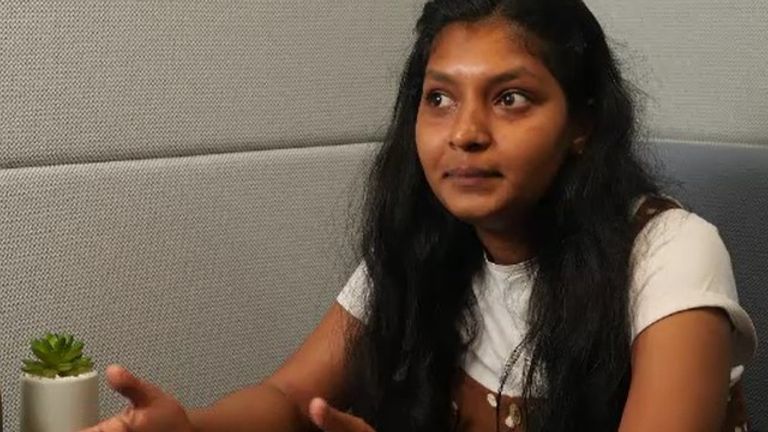
Gobika, 24, is from Sri Lanka and struggling to get into university because she is yet to pass GCSE English.
“I’d already taken a GCSE in Sri Lanka, but when I came here I was asked to take it again. So I’m doing GCSE English. It’s almost been five years,” she told Sky News.
‘I’m not able to plan my future’
Image: Gobika, 24, was forced to re-sit her GCSE in English
“It’s very frustrating. People my age have started working in good jobs. For me, I’m still doing English GCSE. I need to go to university, and that’s for three years. So I’m not able to plan my future. I’m almost 25.”
Refugee Education UK’s Chief Executive, Catherine Gladwell, says when students cannot start their education, it removes hope for the future.
“We often have young people say to us that so much of what they get asked about is backward-looking.
“A solicitor trying to establish their claim for asylum in the UK is going to be asking, ‘What happened to you in order for you to be referred to here?’ If they’re referred to a counselor, it’s about unpicking previous experiences.
“Education is often the one thing in their lives that is actually forward-looking. So when you take that away, what you’re doing is taking away that young person’s chance to imagine and envision and be equipped for the future that they should have.”
Most vulnerable
A government spokesperson said it recognized that refugee and asylum-seeking children were among the most vulnerable in society – and that being in a school was vital to help children integrate into their communities.
A statement added: “Local authorities are responsible for providing enough school places for children in their area, and should consider their linguistic and cultural needs.
“Our Free Schools programme and capital funding for school places are also making sure every child has the opportunity of a place at a good school, whatever their background.”
The couple was detained last week at their Yangon residence.
The case is likely to be about wider political concerns than immigration offenses, for which foreigners are rarely prosecuted in Myanmar.
Ms Bowman, a fluent Burmese speaker, is a well-known member of Myanmar’s small international community.
She first served in what was then called Burma in 1990 as a junior diplomat and returned as ambassador from 2002-2006. She now runs the Myanmar Centre for Responsible Business (MCRB), based in Yangon, which said it was “shocked” by the sentences.
In its statement, it added that Ms Bowman had “dedicated many years of her life to strengthening social and economic development in Myanmar”.
“We hope it will be possible for her to be reunited with her family in the UK soon,” it said.
Ms Bowman and her husband were detained when they returned to the city from a home they have in Shan State. Military authorities charged them both with failing to register her as living at a different address.
Htein Lin is a prominent artist and former political prisoner who was a member of the All Burma Student’s Democratic Front, an armed resistance group that was formed after the popular student-led uprisings against the military junta in 1988.
The couple got married and moved to London before returning to Yangon in 2013.
The pair’s arrest came as the UK recently announced sanctions against the military authorities in Myanmar – coinciding with the fifth anniversary of its deadly crackdown on Rohingya Muslims in the country. The onslaught in 2017 left more than 6,000 people dead, and displaced hundreds of thousands in just the first few months, with most of them fleeing across the border into Bangladesh.
Earlier on Friday, a military-run court in Myanmar also sentenced former leader Aung San Suu Kyi to a further three years in jail on election fraud charges.
Myanmar’s military regime has been accused of widespread violations of human rights.
The junta seized power last year after overthrowing Aung Sung Suu Kyi’s democratically-elected government.
After last year’s coup, Ms Bowman chose to stay in Myanmar and appears to have been careful to avoid any public comment which might provoke the military government.
The news comes amid growing fears that families in the EU will not be able to afford the cost of heating this winter.
Energy prices have soared since Russia invaded Ukraine and scarce supplies could push up the cost even further.
Europe is attempting to wean itself off Russian energy in an effort to reduce Moscow’s ability to finance the war, but the transition may not come quickly enough.
EU Council President Charles Michel said the Russian move was “sadly no surprise”.
“Use of gas as a weapon will not change the resolve of the EU. We will accelerate our path towards energy independence. Our duty is to protect our citizens and support the freedom of Ukraine,” he tweeted.
It has blamed the sanctions for holding up routine maintenance of Nord Stream 1, but the EU says this is a pretext.
Germany’s network regulator, the Bundesnetzagentur, said the country was now better prepared for Russian gas supplies to cease, but it urged citizens and companies to cut consumption.
Gazprom’s announcement came shortly after the G7 nations agreed to cap the price of Russian oil in support of Ukraine.
The G7 (Group of Seven) consists of the UK, US, Canada, France, Germany, Italy, and Japan.
Their introduction of a price cap means countries that sign up to the policy will be permitted to purchase only Russian oil and petroleum products transported via sea that are sold at or below the price cap.
However, Russia says it will not export to countries that participate in the cap.
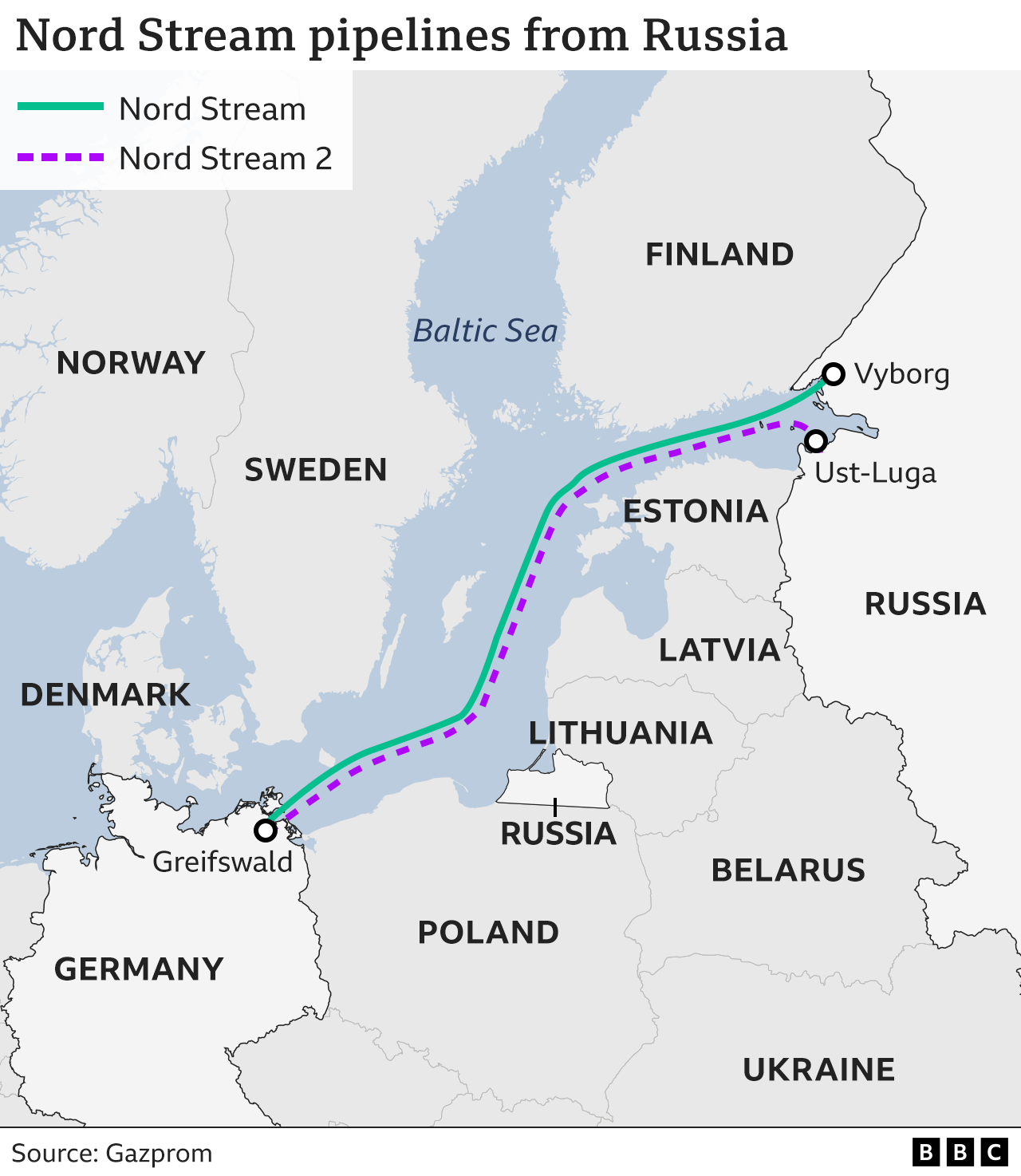
The gas pipeline stretches from the Russian coast near St Petersburg to north-easternGermany and can carry up to170 million cubic metres of gas a day.
It is owned and operated by Nord Stream AG, whose majority shareholder is Gazprom.
Germany had also previously supported the construction of a parallel pipeline – Nord Stream 2 – but the project was halted after Russia invaded Ukraine.
Gazprom said the fault had been detected at the Portovaya compressor station, with the inspection carried out alongside workers from Siemens, the German firm that maintains the turbine.
It said that fixing oil leaks in key engines was only possible in specialized workshops, which had been hindered by Western sanctions.
However, Siemens itself said: “Such leaks do not normally affect the operation of a turbine and can be sealed on site. It is a routine procedure within the scope of maintenance work.”
This is not the first time since the invasion that the Nord Stream 1 pipeline has been closed.
In July, Gazprom cut off supplies completely for 10 days, citing “a maintenance break”. It restarted again 10 days later, but at a much-reduced level.
Speaking to the BBC from the Swiss capital Bern, an economist and energy analyst, Cornelia Meyer, said the gas shutdown would have a major impact on employment and prices.
“That really has huge ramifications for gas in Europe which is about four times more expensive than it was a year ago and this cost of living crisis will really soar because it’s not just gas,” she said. “Gas becomes fertilizer and it’s used in many industrial processes, so that will affect jobs, and it will affect costs.”
The flow of gas through Nord Stream 1 had already been reduced to a relative trickle. Now, once again, it has been halted completely.
An oil leak, claims Gazprom – which has previously attributed reduced flows through the pipeline to technical issues related to sanctions.
Europe, though, believes President Putin is weaponizing gas supplies – deliberately limiting flows through the pipeline to push up prices, in order to test the resolve of Russia’s critics.
The result, as we’ve already seen, is soaring energy costs – with businesses and consumers paying a heavy price.
The timing of Gazprom’smove is certainly interesting. It comes on the same day the G7 announced moves to cap the price of Russia’s oil exports.
But it also comes shortly after Germany – which is heavily reliant on Russian gas – revealed that its winter storage was filling up faster than expected.
A cynic might say this was the last opportunity to tighten the screw, in order to inflict maximum damage over the colder months.
Microsoft’s plan to buy Activision Blizzard could substantially lessen competition in consoles, multi-game subscription services and game streaming, a UKwatchdog has said.
Microsoft wants to buy the maker of Overwatch, Candy Crush and Call of Duty for $68.7bn (£59.2bn).
But the UK’s Competition and Markets Authority (CMA) says its concerns mean it may now carry out an in-depth probe.
Microsoft said it was ready to work with the CMA on the “next steps”.
If the deal goes through it will be the Xbox maker’s largest ever acquisition.
The games Activision Blizzard make are some of the most popular in the world. But it has previously faced accusations of permitting a toxic and sexist work-place culture.
In its ruling, the CMA said that it was concerned that if Microsoft bought Activision Blizzard it could harm rivals, “by refusing them access to Activision Blizzard games or providing access on much worse terms”.
Sorcha O’Carroll, senior director of mergers at the CMA, said: “Microsoft could use its control over popular games like Call of Duty and World of Warcraft post-merger to harm rivals.
“If our current concerns are not addressed, we plan to explore this deal in an in-depth Phase 2 investigation to reach a decision that works in the interests of UK gamers and businesses.”
This decision marks the end of the CMA’s initial investigation, Phase 1 as it is called. At Phase 2, the CMA appoints an independent panel to examine the deal in more depth.
If after that CMA finds that a merger is problematic it will take steps to remedy its bad effects. That could mean stopping the merger, or allowing it to proceed but only if certain conditions are met.
Mobile motive
In response to the news Microsoft President Brad Smith said in a statement, “We’re ready to work with the CMA on next steps and address any of its concerns.
“Sony, as the industry leader, says it is worried about Call of Duty, but we’ve said we are committed to making the same game available on the same day on both Xbox and PlayStation. We want people to have more access to games, not less.”
Microsoft maintains that its principal interest in the planned acquisition is Activision Blizzard’s expertise in mobile gaming.
The firm’s head of gaming, Phil Spencer, told Bloomberg that “the biggest gaming platform on the planet is mobile phones” an area in which Microsoft lacked expertise.
Currently Activision games can be played on both Xbox and rival PlayStation consoles, but the proposed takeover have led some to speculate that more games might become Xbox exclusives.
This is something Mr Smith previously denied in an interview with CNBC, telling the network that “Great titles like Call of Duty… will continue to be available on the Sony PlayStation”.
He drew parallels with the firm’s 2014 acquisition of Minecraft where he said the company had invested in the game and brought it to more platforms.
The point was reiterated in a blog post by Phil Spencer published on Thursday.
Microsoft’s proposed acquisition of Activision Blizzard, an eye watering deal worth almost $70bn, shook the games industry.
These two are both absolute giants, and their merger would make them a behemoth.
The US tech giant, which owns Xbox, has aggressive gaming ambitions and deep pockets. It owns 23 games studios, including Minecraft maker Mojang, and Bethesda, creator of Fallout and SkyRim.
Activision Blizzard’s greatest hits include Call of Duty, Overwatch, Skylander and Diablo.
Sony – owner of the world’s best-selling games console, the PlayStation – has said publicly that it “expects” Microsoft to keep these enormous titles multi-platform.
But Microsoft’s Phil Spencer says what he’s really interested in now is the mobile gaming market, and Activision also happens to own Candy Crush Saga – a simple, ten year old game which remains one of the most popular mobile games of all time.
It’s no wonder that the competition regulators are now putting this deal even further under the microscope. They need to be certain that a merger of this size won’t completely crush the market.
Other countries, in addition to the UK, are carrying out their own anti-trust investigations – and last month Saudi Arabia became the first to approve the deal.
Previous purchases
Some have pointed to previous takeovers for evidence that the deal might lead to more new Activision Blizzard games becoming exclusive to Microsoft owned platforms.
Last year, Microsoft successfully purchased the parent company of Fallout maker Bethesda Softworks for $7.5bn (£6.46bn).
At the time the Mr Spencer said, “some new titles in the future that will be exclusive to Xbox and PC players”.
And in a tweet Xbox’s Aaron Greenberg confirmed that Starfield, a game announced by Bethseda three years prior to the purchase in 2018, will not be released on PlayStation.
Image source, Twitter
Some independent game-makers have also been worried they might be marginalised in Microsoft’s Netflix-like game subscription service Game Pass if the deal went through, and the firm began favouring its own titles.
But Sony, which makes PlayStation, has also been acquiring studios, purchasing game-maker Bungie for $3.7bn in June.
A Canadian intelligence agent helped Shamima Begum get into Syria after she escaped the UK and joined the Islamic State.
According to documents obtained by the BBC, he claimed to have smuggled other Britons to fight for IS and given Canada Ms. Begum’s passport information.
The loss of Ms. Begum’s citizenship is being contested by her attorneys on the grounds that she was a victim of trafficking.
Ms Begum was 15 when she and two other east London schoolgirls – Kadiza Sultana, 16, and 15-year-old Amira Abase – traveled to Syria to join the IS group in 2015.
At the main Istanbul bus station, the girls met Mohammed Al Rasheed, who would facilitate their journey to IS-controlled Syria.
A senior intelligence officer, at an agency that is part of the global coalition against IS, has confirmed to the BBC that Rasheed was providing information to Canadian intelligence while smuggling people to IS.
He told authorities that he had gathered information on the people he helped into Syria because he was passing it to the Canadian embassy in Jordan.
Rasheed, who was arrested in Turkey within days of smuggling Ms Begum to IS, told authorities he had shared a photo of the passport the British schoolgirl was using.
The dossier shows that Ms Begum was moved to Syria through a substantial IS people-smuggling network that was controlled from the group’s de-facto capital in Raqqa.
Rasheed was in charge of the Turkish side of this network and facilitated the travel of British men, women, and children to IS for at least eight months before he helped Ms Begum and her two friends.
Ms Begum told the BBC’s forthcoming I’m Not A Monster podcast: “He organized the entire trip from Turkey to Syria… I don’t think anyone would have been able to make it to Syria without the help of smugglers.
“He had helped a lot of people come in… We were just doing everything he was telling us to do because he knew everything, we didn’t know anything.”
Rasheed kept information about the people he helped, often photographing their ID documents or secretly filming them on his phone.
One recording shows Ms Begum and her friends getting out of a taxi and into a waiting car not far from the Syrian border.
Myanmar’s military authorities have arrested the UK‘s former ambassador to Myanmar, Vicky Bowman, and her husband.
She has been accused of breaking visa rules, and her husband with helping her to stay in Myanmar – charges that could result in up to five years in jail.
Ms Bowman served as ambassador in Myanmar from 2002-2006. She is married to Htein Lin, a Burmese artist and former political prisoner.
She runs the Myanmar Centre for Responsible Business, based in Yangon.
The pair have been sent to Insein prison in the city, with a trial scheduled for 6 September.
The UK embassy say they are providing consular assistance to her.
The MCRB describes itself as “an initiative to encourage responsible business activities throughout Myanmar”. It co-operates with the Institute for Human Rights and Business (IHRB) – whose aim is “to make respect for human rights part of everyday business”.
The UK is threatening health and marine life on the French coast by allowing raw sewage to be dumped in the Channel and North Sea, say three Euro MPs.
Pollution warnings have been issued for almost 50 beaches in England and Wales, after heavy rain caused sewage overflow to be diverted into rivers and the sea.
The French MEPs accuse the UK of neglecting environmental commitments and risking marine life and fishing.
British water companies have said they are investing in solving the problem.
Since its departure from the European Union, the United Kingdom had neglected its environmental commitments, the MEPs said in a letter calling for legal or political action from the European Commission.
Despite no longer being bound by EU laws, the UK was still a signatory to relevant United Nations conventions on protecting shared waters, they argued.
The three MEPs all belong to French President Emmanuel Macron’s pro-EU En Marche party. One of them, Pierre Karleskind, chairs the European Parliament’s fisheries committee.
The UK could not be allowed to neglect commitments made under Brexit and jeopardise 20 years of European progress on water quality standards, he argued.
The MEPs warn that in the short term the sewage leaks risk bathing waters on the French coast and could also harm marine biodiversity, fishing and shellfish farming.
Most of the UK has a combined sewage system, so wastewater from toilets is carried to sewage treatment works through the same pipes as rainwater.
To prevent homes and public spaces being flooded after heavy rains, the system is designed occasionally to overflow and discharge untreated sewage into rivers and the sea.
Recent hot weather has increased the risk of flooding, as the dry ground is unable to quickly absorb water.
Water UK, which represents the UK water industry, has said water firms “agree there is an urgent need” for action and are investing more than £3bn to improve overflows as part of a wider national environmental programme between 2020 and 2025.
The cost of living crisis could spark a “public health emergency” and lead to a rise in excess winter deaths unless the government takes action to help people with rising energy costs, health chiefs have warned.
Families are looking ahead to a grim winter as experts predict the cap on energy bills will hit close to £3,600 per year from October – before rising again in April next year.
Surging prices mean people will have to choose between skipping meals to heat their homes or living in poor conditions, the National Health Service(NHS) Confederation said in a letter to ministers.
This will inevitably lead to more people falling ill and seeing their health deteriorate.
The body, which represents NHS leaders across England, Wales and Northern Ireland, also warned rising rates of poverty will lead to increased hospital admissions as well as a huge increase in demand on other parts of the NHS, placing front-line services and staff under “intolerable pressure”.
“If people cannot afford to heat their homes sufficiently and if they cannot afford nutritious food, then their health will quickly deteriorate,” the health chiefs wrote.
“This will increase the already high number of annual deaths associated with cold homes – estimated at around 10,000 a year.
It said the measure would enable more reliable passenger journeys.
The UK’s largest airport said the cap would “provide passengers with confidence ahead of their half-term getaways”.
When the cap was first announced in July it was initially in place until 11 September.
The airport also said the cap would be kept under regular review and could be lifted early if staffing levels improved.
Heathrow chief commercial officer Ross Baker said: “Our primary concern is ensuring we give our passengers a reliable service when they travel.”
“We want to remove the cap as soon as possible, but we can only do so when we are confident that everyone operating at the airport has the resources to deliver the service our passengers deserve,” he added.
In response, a spokesman for airline Virgin Atlantic said: “We are disappointed that Heathrow Airport has already decided to extend the passenger capacity cap until the end of October, as additional resources come on line every week and the airport experience improves.”
The airline said that its ground handlers, Cobalt Ground Solutions, which are responsible for services including ramp and baggage operations, currently have staff resourcing at 95% of 2019 levels.
“Airline customers have a right to expect their bookings will be honoured and we’re doing everything in our power to minimise disruption, getting our customers to where they need to be smoothly,” he added.
Consumer rights group Which? also warned the move will leave thousands of passengers’ plans in limbo, saying the situation was a “mess”.
“Though the extension of the passenger cap may help Heathrow prevent a repeat of the unacceptable last-minute cancellations we saw earlier in the summer, thousands of people will now be anxious about whether their travel plans could be scuppered,” said Guy Hobbs, travel editor at the organisation.
“Heathrow and impacted airlines must act without delay to provide travellers with clarity on which flights are being cut, and airlines must ensure affected passengers are aware of their rights to rebooking or refunds.”
Tens of thousands of UK passengers have been affected by travel disruption throughout the summer.
During the pandemic the aviation industry cut thousands of jobs as international travel ground to a halt. But since then it has struggled to recruit and train new staff quickly enough.
According to aviation analytics firm Cirium, the number of last-minute flight cancellations from the UK was up 188% in June 2022, compared to June 2019 before the pandemic.
In June, the Department for Transport and the Civil Aviation Authority wrote a joint letter to carriers, telling them to cancel flights they cannot deliver this summer.
Image source, Getty ImagesImage caption, Heathrow, along with other airports, has seen long queues for security and check-in over the summer
Meanwhile, the Unite union said it had secured a pay rise worth an average of 13% for around 16,000 British Airways staff.
The deal will see workers get a lump sum worth 5% of their wages in August, a consolidated 5% increase in September and a further 3% consolidated rise in December.
It came after some 700 BA workers at Heathrow – mostly check-in staff – called off strike action after agreeing a similar pay deal.
Staff had originally backed industrial action over a 10% pay cut imposed during the Covid pandemic.
The Developing Countries Trading Scheme comes into force in January and builds on a scheme the UK was first part of while a member of the European Union.
Goods such as clothes, shoes and foods not widely produced in the UK will benefit from lower or zero tariffs.
The scheme covers 65 developing countries.
It is on top of the thousands of products which developing nations can already export to the UK without tariffs and will affect around 99% of goods imported from Africa.
The Department for International Trade said the work was part of a wider push by the UK to use trade to “drive prosperity and help eradicate poverty”, as well as reduce dependency on aid.
The scheme includes powers to suspend a country on the grounds of human rights or labour violations, as well as for not meeting their climate change obligations.
International Trade Secretary Anne-Marie Trevelyan said: “As an independent trading nation, we are taking back control of our trade policy and making decisions that back UK businesses, help with the cost of living, and support the economies of developing countries around the world.
“UK businesses can look forward to less red-tape and lower costs, incentivising firms to import goods from developing countries.”
Many goods, from textiles to fruit, in 65 of the world’s poorest nations already benefit from reduced or zero tariffs when sold to the UK, making them more appealing.
The new scheme cuts some of those charges further – for example, on cucumbers which can not be produced here during the winter.
It also simplifies the rules for which items, such as some textiles, qualify for preferential treatment.
The changes could save importers millions of pounds – although, even if passed on in full, the price savings for consumers may be marginal.
Coming when aid to developing countries has been reduced, the scheme underlines a government policy of using trade instead.
The scheme removes some seasonal tariffs on products like cucumbers, which cannot be grown in the UK in the winter, so they are tariff-free during this period for the majority of countries under the scheme.
It also simplifies trade rules such as rules of origin, which dictate what proportion of a product must be made in its country of origin.
Mohammed Jabbar, managing director of DBL Group, a textile business from Bangladesh, said this was a “game changer” for his company.
“[The changes] mean we will be able to source our cotton from many more countries than we could before, which will make the business more competitive and our supply chains a lot more resilient,” he said.
Authorities declared large portions of England officially to be in a drought on Friday, asking locals and businesses to save water during the driest summer in 50 years.
Following the National Drought Group meeting, which was attended by water corporations, ministers, and other water authorities, the Environment Agency declared that England’s south, southwest, and southeast, together with the central and eastern regions, are experiencing drought conditions. London, the capital, is also affected in some areas.
The UK has had five consecutive months of below-average rainfall and back-to-back heat waves, with temperatures expected to peak on Saturday as high as 37 Celsius (98.6 degrees Fahrenheit) in some parts. Only two months since the start of 2021 have seen at least average rainfall.
Southern England received just 17% of its average rainfall in July, according to the UK Met office.
“We are currently experiencing a second heatwave after what was the driest July on record for parts of the country. Action is already being taken by the Government and other partners including the Environment Agency to manage the impacts,” the country’s Water Minister Steve Double said in a statement. “All water companies have reassured us that essential supplies are still safe, and we have made it clear it is their duty to maintain those supplies.”
While the lack of rain and heat are driving this drought, around 3.1 billion liters of water are lost every day in England and Wales through leaks in the nation‘s aging infrastructure. Consumer groups and experts have called on water companies to do more to plug leaks.
The Environment Agency said in its statement that the government expected water companies “to reduce leakage and fix leaking pipes as quickly as possible and take wider action alongside government policy.”
Several rivers across England have been drying up in parts, including the Thames, which runs through London. Officials have been reoxygenating rivers and rescuing fish where levels are low. Water levels in reservoirs are also rapidly dropping.
A car passes over a bridge over a dried-up river bed where the River Thames usually flows, near Kemble in Gloucestershire.
The drought declaration means water companies and governments should implement drought plans without seeking permission from ministers. Companies are likely to impose more hosepipe bans, which are already in place for millions of people, forcing them to water gardens and wash cars without hoses, and refrain from filling up paddling pools in the ongoing heat wave. Companies could also take more water out of rivers and other sources to ensure supplies.
The announcement Friday puts the declared area under an amber drought alert, meaning several indicators — including rainfall, river levels and flows, reservoir storage, and groundwater levels — are very low.
Thirteen rivers that the Environment Agency monitors as indicators of wider conditions are at their lowest levels ever recorded, while soil moisture is comparable to the end of the 1975-76 drought, one of the country’s most severe. That drought was also triggered by a combination of extreme heat and consecutive months of low rainfall.
The amber alert is one tier below the more severe red alert and means that there is likely to be stress on water supply sources, reduced agricultural and crop yields, localized wildfires, and impacts on wildlife and their habitats, according to a previous report by the Environment Agency.
The London Fire Brigade has also warned of “tinderbox dry” conditions this week and an “exceptional fire risk” across the capital as temperatures are expected to reach 36 Celsius (97 degrees Fahrenheit) on Saturday and as grass — from lawns to public parks and heaths — is bone dry and brown without the usual rainfall. Parts of the capital, including homes and parks, were hit by fires on July 19 during a record-breaking heat wave.
Concerns grow over food security
The UK does typically experience drought conditions every five to 10 years in some areas.
The Centre for Ecology and Hydrology has said that drought conditions could continue until at least October.
The agency only looks a few months ahead, and climate scientists have warned that if this coming winter is also dry, like last winter, the UK’s food security could be at risk.
Local residents use garden hoses to assist fire crews to tackle a crop fire that swept over farmland and threatened local homes on August 11, 2022, in Skelton, England.
Liz Bentley, CEO of the Royal Meteorological Society, said that there were already concerns about the impact of drought on food supplies and affordability.
“There’s a number of crops that are really struggling due to either lack of rainfall, like the potato crop here relies on rainfall, they don’t usually take water from anywhere else to irrigate the fields. And even some of the other crops that do take water from rivers, for example, to irrigate fields, they’re really struggling at the moment,” Bentley told CNN.
“Even in current conditions, yields are going to be down for a number of crops and the price of these things are going to go up, and obviously that’s due to a drought here in the UK. But there are other things going on across Europe.”
The start of London’s Thames River, now in Somerford Keynes in the English county of Gloucestershire.
The starting point of England’s famous River Thames has dried up and moved downstream, following weeks of little rainfall and a heat wave in July that smashed the UK’s all-time temperature record.
The Thames usually begins in the English market town of Cirencester, part of the green and hilly Cotswolds countryside, and flows through the capital, London, and then out into the North Sea.
The start of the river has moved 5 miles (8 kilometers) downstream to Somerford Keynes, according to the Rivers Trust, which works across the UK and Ireland.
The flow there is weak and only just discernible.
“What we’re seeing at the source of the iconic River Thames is sadly emblematic of the situation we’re facing across the country, now and in the future,”
Christine Colvin, Advocacy and Engagement Director for the Rivers Trust, said in a statement sent to CNN.
A dried-up part of the river in Kemble, England.
The “source” refers to the start, or headwaters, of a river.
“Whilst it’s not uncommon for the source to be dry in the summer, to only be seeing the river flowing five miles downstream is unprecedented,” she said. “
The climate crisis is leading and will lead, to more extreme weather including droughts and heatwaves.
This poses a grave threat to rivers and, as a result, the wider landscape.”
She added that the country needed to build resilience against the future climate.
“This means detecting household leaks, fixing mains infrastructure leaks, more efficient water use domestically plus implementing sustainable drainage solutions as part of desperately needed green infrastructure,” Colvin said.
The shift in the river’s headwaters comes as authorities in England warn that the nation could officially fall into a drought at some point in August
Southern England recorded its driest July on record since 1836, with only 17% of average rainfall, according to the Met office.
The country as a whole recorded just 35% (around 23 millimeters) of its average rainfall in July.
Several water companies have already announced hosepipe bans in parts of England’s south.
The UK’s Met Office has warned that high temperatures will return to England next week, though they are not expected to reach near the record highs seen in July.
It said in a statement that an area of high pressure was building from the Atlantic into the south and southwest of England and that temperatures could reach the low to mid-30s, in degrees Celsius, toward the end of next week.
These cities are better at enduring extreme heat. Here’s what they’re doing different
“We could see parts of the UK entering heatwave conditions if the above-average temperatures last for three days or more,” Met Office chief forecaster Steve Willington said. “As the high pressure builds there is very little meaningful rain in the forecast, especially in those areas in the south of England, which experienced very dry conditions last month.”
Rebekah Sherwin, the deputy chief meteorologist at the Met Office, said that early August sunshine in the UK didn’t have the same heating potential as mid-July, because the sun is lower in the sky and the days are shorter.
“Both of these factors suggest that we’re very unlikely to see temperatures peak much above low to mid-30s,” she said. “However, this would still be a hot spell of weather.”
On mainland Europe, some countries, including France, are experiencing their third heat wave of the summer, and pockets of the continent are in a drought.
In spite of record-high fuel costs, BP has announced its largest quarterly profit in 14 years of £6.9 billion ($8.45 billion).
Underlying BP’s replacement cost profit, the company’s definition of net earnings, was the strongest since 2008 and far exceeded analysts’ expectations of £5.6bn ($6.8bn).
But it did take a £19.9bn ($24.4bn) hit after ditching its near-20% stake in Russian oil producer Rosneft in response to the Ukraine war.
BP chief executive Bernard Looney said: “Today’s results show that BP continues to perform while transforming.
“Our people have continued to work hard throughout the quarter helping to solve the energy trilemma – secure, affordable, and lower carbon energy.
“We do this by providing the oil and gas the world needs today – while at the same time, investing to accelerate the energy transition.”
But it comes as UK households face a rapidly-worsening cost of living crisis, with rising wholesale energy prices being a major factor.
It also comes days after record profits were reported by rival Shell, as well as the two largest US oil companies – Exxon Mobil and Chevron.
The record cash flowing into energy companies has reignited calls for a tougher windfall tax on additional profits on oil and gas, the prices of which have soared as Russia invaded Ukraine and threatened to cut off gas supplies to Europe.
Rachel Reeves MP, Labour’s shadow chancellor, said: “People are worried sick about energy prices rising again in the autumn, but yet again we see eye-watering profits for oil and gas producers.
“Labour argued for months for a windfall tax on these companies to help bring bills down, but when the Tories finally u-turned they decided to hand billions of pounds back to producers in tax breaks. That is totally wrong.
“It’s clear people need greater protection from rising bills. That’s why Labour would use this money now to help people get through the winter.
“But we can’t carry on like this. Labour would bring down energy bills for good with a green energy sprint for home-grown power, and a 10-year warm homes plan to cut bills for 19 million cold, draughty homes.”
‘Laughing all the way to the bank’
Doug Parr, the chief scientist for Greenpeace UK, said: “While households are being plunged into poverty with knock-on-impacts for the whole economy, fossil fuel companies are laughing all the way to the bank. The government is failing the UK and the climate in its hour of need.
“Government must bring in a proper windfall tax on these monster profits and stop giving companies massive tax breaks on destructive new fossil fuel investments.
“This could unlock billions of pounds to alleviate household bills and fund a nationwide roll-out of home insulation which would keep bills low for good and get our UK fossil gas use under control.”
The cost of fraudulent Universal Credit (UC) claims in Northern Ireland almost doubled to £102m last year, a public spending watchdog has said.
The figure has emerged in the auditor general’s annual audit of the Department for Communities accounts.
The department said a significant number of fraudulent claims date to the start of the pandemic.
At that time certain conditions were eased to allow unprecedented numbers of people to get financial help.
In the previous year, the cost of fraudulent UC claims was £51.8m.
The number of households on UC in Northern Ireland almost doubled between February and July 2020 when people lost jobs or had their income reduced as a result of pandemic restrictions.
UC is the main benefit for unemployed or lower-paid working-age people and is claimed by about 130,000 people in Northern Ireland.
In 2021/22, expenditure on UC was £912m, accounting for nearly 13% of overall benefit expenditure.
The department’s analysis of UC fraud cases shows that 28% of the cases concerned an initial claim made during the early days of the pandemic.
A significant proportion relates to self-employed income, which is more difficult to verify than taxed income through HMRC records.
‘Concerned’
Auditor general Kieran Donnelly said: “I note that the situation in Great Britain with respect to UC is similar to Northern Ireland in terms of increasing expenditure and estimated overpayment rates due to customer fraud.
“Nonetheless, I remain concerned that estimated overpayments due to fraud are so high here, given our relative size.”
Mr. Donnelly said the department told him it was taking “a number of initiatives” to address the issue.
Meanwhile, he said that as part of a UK-wide problem nearly 5,000 people in Northern Ireland were underpaid their state pension.
In August 2020 the UK Department for Work and Pensions (DWP) found there was a significant issue and estimated it had underpaid 134,000 pensioners over £1bn, an average of £8,900 each.
DWP’s review of all possibly affected cases is ongoing and so far 5,000 cases have been reviewed and £4.6m in arrears has been paid out to Northern Ireland claimants.
Gas prices have soared after Russia cut gas supplies to Germany and other central European countries after threatening to earlier this week. Further
European gas prices rose 9%, trading close to their earlier all-time high after Russia invaded Ukraine.
Critics accuse the Russian government of using gas as a political weapon.
Russia has been cutting flows through the Nord Stream 1 pipeline to Germany, with it now operating at less than a fifth of its normal capacity.
Germany imports 55% of its gas from Russia and most of it comes through Nord Stream 1 – with the rest coming from land-based pipelines.
Russian energy firm Gazprom has sought to justify the latest cut by saying it was needed to allow maintenance work on a turbine.
The German government, however, said there was no technical reason for it to limit the supply.
Ukraine has accused Moscow of waging a “gas war” against Europe and cutting supplies to inflict “terror” on people.
The latest reduction in flows puts pressure on EU countries to reduce their dependence on Russian gaseven further, and will likely make it more difficult for them to replenish their gas supplies ahead of winter.
Since the invasion of Ukraine European leaders has held talks over how to reduce its dependence on Russian fossil fuels.
On Tuesday, theEuropean Unionagreed to cut gas use in case Russia halts supplies but some countries will have exemptions to avoid rationing.
EU members have now agreed to voluntarily reduce 15% of gas use between August and March.
However, the deal was watered down after previously not having exemptions.
The EU has said its aim of the deal is to make savings and store gas ahead of winter, warning that Russia is “continuously using energy supplies as a weapon”.
The voluntary agreement would become mandatory if supplies reach crisis levels.
The EU agreed in May to ban all Russian oil imports which come in by sea by the end of this year, but a deal over gas bans has taken longer.
Since Russia invaded Ukraine in February the price of wholesale gas has already soared, with a knock-on impact on consumer energy bills across the globe.
The Kremlin blames the price hike on Western sanctions, insisting it is a reliable energy partner and not responsible for the recent disruption to gas supplies.
While the UK would not be directly impacted by gas supply disruption, as it imports less than 5% of its gas from Russia, it would be affected by prices rising in the global markets as demand in Europe increases.
UK gas prices rose 7% on Wednesday, almost six times higher than a year ago, but still 20% below the peak seen in the aftermath of Russia’s invasion of Ukraine.
UK energy bills increased by an unprecedented £700 in April, and are expected to rise again to £3,244 a year for a typical household in October.
Gas prices have soared after Russia further cut gas supplies to Germany and other central European countries after threatening to earlier this week.
European gas prices rose 9%, trading close to their earlier all-time high after Russia invaded Ukraine.
Critics accuse the Russian government of using gas as a political weapon.
Russia has been cutting flows through the Nord Stream 1 pipeline to Germany, with it now operating at less than a fifth of its normal capacity.
Germany imports 55% of its gas from Russia and most of it comes through Nord Stream 1Â – with the rest coming from land-based pipelines.
Russian energy firm Gazprom has sought to justify the latest cut by saying it was needed to allow maintenance work on a turbine.
The German government, however, said there was no technical reason for it to limit the supply.
Ukraine has accused Moscow of waging a “gas war” against Europe and cutting supplies to inflict “terror” on people.
The latest reduction in flows puts pressure on EU countries to reduce their dependence on Russian gas even further, and will likely make it more difficult for them to replenish their gas supplies ahead of winter.
Since the invasion of Ukraine European leaders has held talks over how to reduce its dependence on Russian fossil fuels
On Tuesday, the European Union agreed to cut gas use in case Russia halts supplies but some countries will have exemptions to avoid rationing.
EU members have now agreed to voluntarily reduce 15% of gas use between August and March.
However, the deal was watered down after previously not having exemptions.
The EU has said its aim of the deal is to make savings and store gas ahead of winter, warning that Russia is “continuously using energy supplies as a weapon”.
The voluntary agreement would become mandatory if supplies reach crisis levels.
The EU agreed in May to ban all Russian oil imports which come in by sea by the end of this year, but a deal over gas bans has taken longer.
Since Russia invaded Ukraine in February the price of wholesale gas has already soared, with a knock-on impact on consumer energy bills across the globe.
The Kremlin blames the price hike on Western sanctions, insisting it is a reliable energy partner and not responsible for the recent disruption to gas supplies.
While the UK would not be directly impacted by gas supply disruption, as it imports less than 5% of its gas from Russia, it would be affected by prices rising in the global markets as demand in Europe increases.
UK gas prices rose 7% on Wednesday, almost six times higher than a year ago, but still 20% below the peak seen in the aftermath of Russia’s invasion of Ukraine.
UK energy bills increased by an unprecedented £700 in April, and are expected to rise again to £3,244 a year for a typical household in October.
The UK‘s competition watchdog has found streaming has made the music industry challenging for many artists.
The Competition and Markets Authority (CMA) said more than 80% of recorded music was now listened to via streaming, with more than 138 billion streams in the UK last year.
MPs had demanded a “complete reset” of the industry, amid “pitiful returns” for artists.
They had called for the CMA to look into the power of the major players.
Although the primary focus of the report was on consumers, the watchdog found a small number of high-profile artists enjoyed most of the financial success while the majority made no substantial earnings.
CMA interim chief executive Sarah Cardell said: “For many artists, it is just as tough as it has always been – and many feel that they are not getting a fair deal.”
But the report notes streaming has made it easier not only for listeners to access music but also for artists to record and share it.
Low earnings
The report addresses the claim most artists are paid far too little for music streams and the business model benefits only big labels and star acts.
A million streams per month would earn an artist only about £12,000 per year, it says.
Spotify is believed to pay between £0.002 and £0.0038 per stream, Apple Music about £0.0059.
YouTube pays the least – about £0.00052 (0.05p).
Image source, Getty ImagesImage caption, Catherine, from Ward Thomas
Catherine Willcox, of UK country-music duo Ward Thomas, told BBC News: “Having been in the industry for more than a decade and achieving relative success – a number-one album, sold-out tours and many exciting festival spots – it may appear from the outside that we would be fairly comfortable financially.
“However, with the decline in album sales across the board and the rise in streaming, no-one is fully sure how they will sustain a creative career as the landscape of the industry changes so dramatically.”
The CMA noted every artist was competing harder than ever before for each of these streams – both with new artists and, in the form of the back catalogue, all the music ever made.
“We are incredibly lucky to be able to do this full time for the moment,” Wilcox said, “but it is always very tenuous – and this is coming from two artists who profit from the masters, the performance rights and live shows.
“This is even more difficult for songwriters who only get their writer’s cut.”
Best songs
More artists than ever before are releasing music, the report says, but this does not mean more are successful.
Analysis published by the Intellectual Property Office (IPO) shows the number reaching one million UK streams per month remains low, about 1,700.
“Some of the best songwriters we know have had to secure other sources of income and so can’t dedicate the proper time needed to their craft,” Wilcox said.
“The best songs are yet to be written – but if they aren’t being fairly compensated, too many very talented people will be forced to quit.”
New audiences
The report found streaming was now the primary means for artists and labels to distribute music and the public were embracing it.
Some of the other key findings include:
Access to a wide range of music – old and new – means older songs can more easily find a new lease of life and new audiences
The number of artists streaming music rose from about 200,000 to 400,000 between 2014 and 2020
A number of groups had called for a full market investigation by the CMA – and more solutions to support singers and songwriters.
But the watchdog rejected this because “our initial findings have not identified any significant concerns in terms of consumer outcomes relating to music streaming”.
The #BrokenRecord campaign was one of those groups – started by Gomez member Tom Gray at the beginning of lockdown, after artists lost touring income.
He told BBC News: “A serious concern is the mantra that things have always been this difficult.
“Indeed ‘just as tough as’ suggests things may have been worse – but we can see no evidence for such an assertion.
“The IPO carried out a report into creator earnings last year and could not find data to say where things were in the past, so it feels fairly groundless.
“Creators find it harder now to make income from recorded music than ever before.”
‘Good deal’
Listeners now have access to a huge choice of music for a fixed monthly subscription fee – and these have fallen in real terms.
But Mr Gray said this was bad for artists.
“Rhapsody, the first streaming service cost $9.99 in 2001,” he said.
“Streaming costs the same 21 years later.
“Obviously, that is a good deal for consumers – but is it destructive to the value of music itself?
“The answer ought to be, ‘Yes.’”
The CMA also touched on the “strong concern” from some artists labels gave insufficient information about their how their earnings were calculated.
Mr Gray said: “Whilst music has always been precarious, the pro-rata system is significantly more ‘winner takes all’ than anything we’ve seen before.”
Image source, Getty Images
The CMA said the market was delivering good outcomes for customers but it would be concerned if:
innovation in the sector was decreased
the balance of power changed and labels and streaming services began to make sustained and substantial excess profits
Association of Independent Music chief executive Paul Pacifico said: “We welcome the CMA’s update report, which reinforces what we know – that building success in music is hard – and underlines the need for organisations across music to work together to secure positive outcomes for the sector.”
British Phonographic Industry chief executive Geoff Taylor also welcomed the findings and said: “We will continue to engage with the CMA and government to help ensure that the streaming market works to the benefit of artists, songwriters, record companies and fans.”
‘Serious problems’
Ms Cardell said: “Our initial analysis shows that the outcomes for artists are not driven by issues to do with competition, such as sustained excessive profits.
“We are now keen to hear views on our initial findings, which will help guide our thinking and inform our final report.”
Musicians’ Union general secretary Naomi Pohl said it was “disappointing” the “competition issues” in the streaming market “will not be explored fully by a CMA investigation”.
“The CMA’s release today highlights what it sees as positive impacts of music streaming – but we feel they have failed to recognise the very serious problems posed to creators,” she said.
With growth stalling in the UK, US, China and Europe, the world “may soon be teetering on the edge of a global recession”, it said.
“We know that people are feeling the impact of rising prices, caused by global economic factors, triggered by the illegal Russian invasion of Ukraine,” a HM Treasury spokesperson said in a statement, adding that help for households included £400 off energy bills plus personal tax cuts worth up to £330 a year.
The IMF has cut its 2022 global growth forecast to just 3.2% and warned the slowdown risks being even more severe.
It said fast-rising prices were to blame for much of the slowdown, with households and businesses squeezed by a combination of higher prices and higher borrowing costs as policymakers raise interest rates to try to counter inflation.
“The global economy, still reeling from the pandemic and Russia’s invasion of Ukraine, is facing an increasingly gloomy and uncertain outlook,” economist Pierre-Olivier Gourinchas wrote in a blog outlining the international lending body’s latest economic forecast.
“The outlook has darkened significantly” since April, the last time the IMF issued forecasts, he added.
The global economy contracted in the three months to July, which was the first decline since the pandemic hit, the IMF said.
The probability of a recession in the G7 economies – Canada, France, Germany, Italy, Japan, the US and UK – now stands at roughly 15% – nearly four times higher than usual.
While UK growth is expected to remain relatively strong this year, Mr Gourinchas said unusually high inflation – faster than in Europe or the US – is expected to take a toll in 2023.
“If you were to look at both years together, it’s actually not very far from where the other advanced economies are,” he told the BBC. “The one thing that worries me more about the UK economy is that their inflation numbers seem to be quite high. There is a fairly high pass through from high gas prices to broader prices in the economy.
“That would signal even further monetary policy tightening by the Bank of England and that would also weigh down on growth going forward.”
The IMF now expects inflation to reach 6.6% in advanced economies and 9.5% in emerging market and developing economies – nearly a full percentage point higher than it expected in April.
“Inflation at current levels represents a clear risk for current and future macroeconomic stability and bringing it back to central bank targets should be the top priority for policymakers,” Mr Gourinchas said.
“Tighter monetary policy will inevitably have real economic costs, but delaying it will only exacerbate the hardship.”
The fallout from the war in Ukraine is being felt in pockets across the world. Soaring food and fuel prices and higher interest rates means the IMF sees more gloomy prospects for all major economies – but it’s the UK that, Russia apart, remains bottom of the pile for 2023.
Brexit may not have helped but it’s our reliance on fossil fuels – they make up 75% of our energy mix, compared to just over half of the EU’s – that’s made us particularly vulnerable to this shock. Those prices are determined on international markets but affect us all. This report comes on the day that, with the energy price cap set to top £3,000 in October, a committee of MPs warns that further government help for households may be needed.
But the IMF is among those economists who’ve noted that the UK faces more fundamental issues than the current crisis, with living standards having dropped behind many competitors over the last 15 years, something many attribute to a lack of investment in skills, equipment and infrastructure. Officials from the IMF have previously told me that one way to remedy that would be to raise, not lower taxes, to fund more investment.
The US saw the steepest downgrade of any country for 2022. The IMF cut its growth forecast for the world’s largest economy to 2.3% this year, from 3.7% previously, and to just 1% in 2023.
Meanwhile growth in China is expected to fall to 3.3% this year, the slowest rate in nearly four decades, as the country wrestles with new Covid lockdowns and a property crisis.
Questions about the reliability of Europe’s natural gas supplies from Russia, as well as political unrest generated by high food and fuel prices, are among the risks the global economy is facing in the months ahead, the IMF said.
“We can be reasonably hopeful that China might be rebound,” Mr Gourinchas said, adding that he was “much more concerned about both the inflation path and the tightening of monetary policy leading to a slowdown going ahead”.
It warned that in a “plausible” scenario, in which only some of those risks materialise, like a shutdown of Russian gas flows to Europe, global economic growth could fall to 2% next year – a pace the world has fallen below just five times since 1970.
In recognition of the serious disruption pupils faced during the pandemic, this year’s exams will be graded more generously.
When is results day?
Pupils will get their GCSE results from 08:00 BST on Thursday, 25 August in England, Wales and Northern Ireland. Some BTec Firsts, Technical and Tech Awards students will also receive results.
In Scotland, students get their National 4 and 5 results from 08:00 BST on Tuesday, 9 August.
How do I get my results?
You should be able to collect your results in person from your school, so check what arrangements are in place.
If you can’t go, ask your school in advance if you can access them online, or if someone else can pick them up for you.
In Scotland, your certificate will come in the post, but if you signed up to MySQA, you’ll get your results by text or email.
How have grades been decided this year?
The year’s final grades are based on exams.
Students may need fewer marks to reach a particular grade, or if they are very close to the number of marks needed for a higher mark, they may be looked at more favourably than in previous years.
Some parts of the curriculum were cut, and students were also given information about areas to revise.
However, exam boards were criticised for mistakes on some papers, where pupils were tested on topics they had been told wouldn’t come up.
Image source, Getty Images
It’s expected that the overall results will be lower than in the last two years, when grades were based entirely on teacher assessment. But they are predicted to be higher than in 2019, the last year of exams before the pandemic.
Scotland had record results in 2020, based on teacher assessments, but saw a slight dip in 2021 when the Scottish Qualification Authority (SQA) marked student work which had been done in school.
The SQA is also taking a more generous approach to grading this year.
What grade will I get?
Wales kept its letter-based grading structure, while Northern Ireland opted for a mixture of letters and numbers.
In Scotland, the National 4 qualification is based on continuous assessment, with each unit that makes up the course marked as pass or fail. National 5s are graded A-D or “no award”.
What about BTecs?
BTecs – or Business and Technology Education Council qualifications – are largely assessed through practical work done during the course, with exams making up a smaller proportion of the final mark.
Image source, Getty Images
Grade boundaries for each unit taken in school or college have been looked at, as well as those for the final exams.
Students are normally awarded a pass, merit or distinction.
What if I’m not happy with my results?
If you’re unhappy with your GCSE or BTec grade, you should first talk to your school or college.
In England, Wales and Northern Ireland, your school will contact the exam board on your behalf and ask for your marks to be reviewed.
If you still think you’ve been unfairly graded after a review, you can ask your school or college to appeal. The exam board will look at your work again, and correct your mark if necessary.
BTec students can also appeal directly to their exam board.
If you’re still not satisfied, you can request a review from the exams regulator Ofqual.
In Scotland, the process is slightly different. You normally receive a grade estimate which is submitted to the exam board.
If your final grade is lower that this, you can appeal directly to the SQA, but should speak to your school or college first. If your appeal is accepted, the exam board will look at the marks you received.
Rishi Sunak and Liz Truss tore into each other over their rival visions for the future of the UK economy, in their first head-to-head TV debate.
The two contenders to be the next PM did not hold back from “blue-on-blue” attacks in the hour-long BBC special.
Mr Sunak told Ms Truss her tax cut plan would “tip millions of people into misery” and cost the Conservatives the next election.
Ms Truss said tax rises brought in by him would lead to a recession.
The foreign secretary and former chancellor, who until three weeks ago were in the same cabinet, talked over each other at times and shot angry glances across the stage at Stoke-on-Trent’s Victoria Hall.
It led to complaints afterwards by Ms Truss’s supporters that the ex-chancellor was being too aggressive and was “mansplaining” – something fiercely denied by the Sunak camp.
The pair were on better terms by the end of the debate, with Ms Truss saying she would “love” to have Mr Sunak on her team if she becomes PM. The ex-chancellor praised her stance on Russia.
But the row over tax dominated the early exchanges.
Ms Truss wants to scrap the rise to National Insurance, a planned rise in corporation tax and would temporarily scrap green levies on energy bills to be paid for through borrowing.
Mr Sunak says he would not cut taxes until inflation was under control.
Mr Sunak – who quit as chancellor earlier this month – said the coronavirus pandemic had created a large bill and that putting it on the “country’s credit card” would “pass the tab to our children and grandchildren”.
Media caption, Watch: Sunak and Truss angrily debate borrowing and debt
Ms Truss insisted that under her plans the UK would start paying down the debt in three year’s time – and paying it back straight away as Mr Sunak wanted to do would push the UK into a recession.
Mr Sunak suggested her plans would lead to higher interest rates, but the foreign secretary dismiss this as “scaremongering” and “project fear” – an echo of the criticism aimed at the Remain campaign during Brexit referendum.
Mr Sunak took this opportunity to point out that, unlike him, Ms Truss campaigned against Brexit.
“Maybe I learnt from that,” she replied. She later said the Brexit referendum was when she had learnt not to trust Treasury forecasts on the economy.
Other key moments in the debate included:
Both candidates accusing the other of not having been tough enough on China in the past
Ms Truss contrasting her comprehensive school education with that of Mr Sunak’s, who attended the fee-paying Winchester College
Mr Sunak said he was “not going to apologise” for his background, adding that his parents’ aspirational values were Conservative – something that earned him the evening’s first round of applause
Mr Sunak’s resignation as chancellor helped trigger the downfall of Mr Johnson.
He praised Mr Johnson’s handling of Brexit and the pandemic but said he had quit as a matter of principle over the PM’s “conduct” and the fact that they had “very different views about the direction of travel on the economy”.
Ms Truss acknowledged the prime minister had made mistakes but said they were not “sufficient” enough for the Conservative Party to have “rejected him”.
Neither said they would accept Mr Johnson in their cabinet.
Chief secretary to the Treasury and Truss-backer Simon Clarke told BBC Breakfast that polling after the debate showed the majority of Conservative voters thought his candidate had won the evening – and it had reaffirmed his view that she was the right candidate to lead the country.
He refused to criticise Mr Sunak for interrupting, but said viewers would have to make up their own minds about his debating style. He added he thought Ms Truss had been “cool, controlled” and had made compelling arguments.
Labour leader Sir Keir Starmer told BBC Breakfast the debate showed a Conservative Party which had “lost the plot and lost its purpose”.
He said Mr Sunak was acting like he had “just come down from the moon” and discovered the economy was in a bad way when he had been in charge of it until three weeks ago, while Ms Truss was playing “fantasy economics” without explaining how she would pay for tax cuts.
“We do need change in the UK but the change we need is not a change at the top of the Conservative Party, it is more fundamental than that. We need a fresh start for Britain. We need a Labour government,” he said.
A Liberal Democrat spokesperson simply said: “Eurgh.”
For all the talk of wanting the “blue-on-blue” attacks to subside – this debate showed they haven’t gone away.
Liz Truss’s campaign accused Rishi Sunak of not letting her get a word in edgeways, and Rishi Sunak continued to slam Liz Truss’s tax cut plans for not being economically sound.
Sources close to Sunak said he had “won the argument” on the economy, with his argument that her tax cuts would further fuel inflation and push up interest rates and people’s mortgages.
Behind the scenes, Truss’s camp feel positive too – claiming that while she stayed calm Sunak was “flustered”.
Debates about their backgrounds haven’t gone away either. Both are keen to distance themselves from any suggestion they had certain privileges.
Truss pointed to her comprehensive school education but distanced herself slightly, though, from the outright attacks on Sunak’s clothing and education from some of her supporters.
But the key battleground – and the biggest dividing line between the two – is still tax.
Nearly 3.5 million people, or one in 18, has the virus – that’s up from 2.7m, or one in 25, the week before.
The rise is being driven by fast-spreading sub-variants of Omicron, called BA.4 and BA.5.
People are still able to catch the infection even if they have had Covid before.
The data is collated by testing thousands of people from UK households – whether they have symptoms or not – to estimate how much virus is around.
In the latest report the ONS estimates Covid rates were:
One in 19 in England – up from one in 25 the week before
One in 17 in Wales – up from one in 20
One in 17 in Northern Ireland – up from one in 19
One in 16 in Scotland – up from one in 17
Sarah Crofts, Head of Analytical Outputs for the Covid-19 Infection Survey, said: “Infections are showing no signs of decreasing, with rates approaching levels last seen in March this year at the peak of the Omicron BA.2 wave.
“Rates have continued to increase across the UK and among all age groups. We will continue to closely monitor the data.”
Hospital admissions of people in England with Covid are also rising, but that increase is showing signs of slowing down.
The rate of admissions stood at 17.9 per 100,000 people in the week ending July 10, according to the UK Health Security Agency (UKHSA).
This is up from 15.7 per 100,000 the week before, but is the smallest rise for several weeks.
Dr Mary Ramsay, UKHSA director of clinical programmes, said: “We urge all those who are eligible for the spring booster to take up the offer as soon as possible.
“Anyone who has not yet had their first or second dose should also get up-to-date with their jabs to give themselves the best possible protection.”
The Covid waves we’ve had this year have infected incredible numbers of people.
Go back to January 2021 and the highest number of people infected in the ONS weekly surveys was 1.2 million.
Already this year we’ve had a wave cap out at 4.9 million at the end of March and now one at 3.5 million and climbing.
And yet we’re seeing nowhere near the levels of severe illness.
The number needing ventilation in intensive care went above 3,700 in England alone in January 2021.
The equivalent figure now – in a much bigger wave – is just 274.
Dozens of artillery guns, hundreds of drones and tens of thousands of ammunition rounds are to be sent by the UK to Ukraine over the coming weeks.
Defence Secretary Ben Wallace said the package would ensure that Ukrainians had the “tools to defend their country from Putin’s illegal invasion”.
The announcement follows last month’s government pledge of another £1bn in military support to Kyiv.
Russia has said its military focus is no longer limited to eastern Ukraine.
In an interview with state media on Wednesday, Foreign Minister Sergei Lavrov implied Moscow’s strategy had changed after Western nations supplied Ukraine with increasingly powerful weapons.
The latest support from the UK is set to include more than 20 M109 155mm self-propelled guns and 36 L119 105mm artillery guns, the Ministry of Defence (MoD) said.
A further 50,000 rounds of ammunition for Ukraine’s Soviet-era artillery have also been promised, along with drones and at least 1,600 more anti-tank weapons.
Jack Watling of the Royal United Services Institute said the latest package of British support was “very much attuned with what Ukraine needs”.
He said some of the guns offered are capable of outranging Moscow’s artillery. But because Kyiv’s troops were using around 6,000 rounds a day, there would be a “ongoing requirement”, he added.
Since Russia launched its invasion in February, Kyiv has issued multiple requests for weaponry.
Ukraine’s First Lady Olena Zelenska addressed the US Congress on Wednesday, asking for more air-defence systems to “help us to stop this terror against Ukrainians”.
An announcement of another £1bn in support for Ukraine, announced by Prime Minister Boris Johnson at last month’s Nato summit in Madrid, has taken the UK’s total military aid for Kyiv to £2.3bn.
The MoD said it had already provided more than 6,900 anti-tank missiles, multiple launch rocket systems and 120 armoured vehicles among other provisions.