In British politics, the Great Offices of State refers to the four top jobs in politics: prime minister, chancellor, foreign secretary, and home secretary.
We know Rishi Sunak is the first, so let’s look at who the other three are.
Chancellor
ReutersCopyright: Reuters
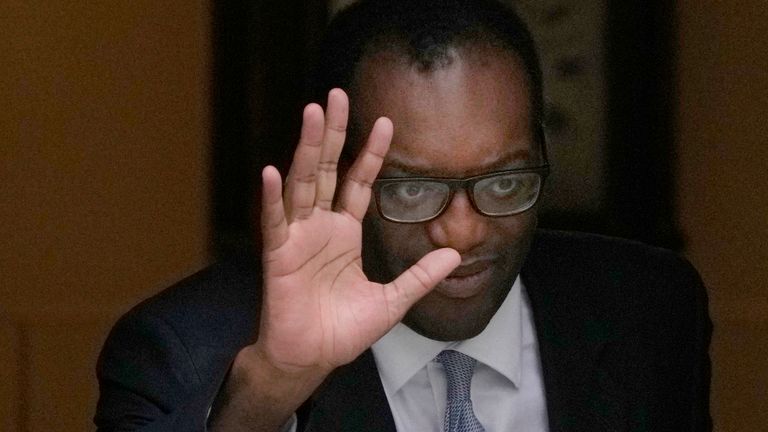
In a move that many expected, Sunak decided to keep Jeremy Hunt as chancellor after he was brought in to undo the mess caused by former chancellor Kwasi Kwarteng’s September 23 mini-budget.
His was the first appointment to be announced by Sunak’s team.
Foreign Secretary
Getty ImagesCopyright: Getty Images
Another person who stayed in their cabinet role was James Cleverly, made foreign secretary by Truss a few weeks ago.
It was reported that Penny Mordaunt, Sunak’s rival in the leadership race, had made it clear this was the job she wanted – but she instead remained in her current post as leader of the House of Commons.
Home secretary
EPACopyright: EPA
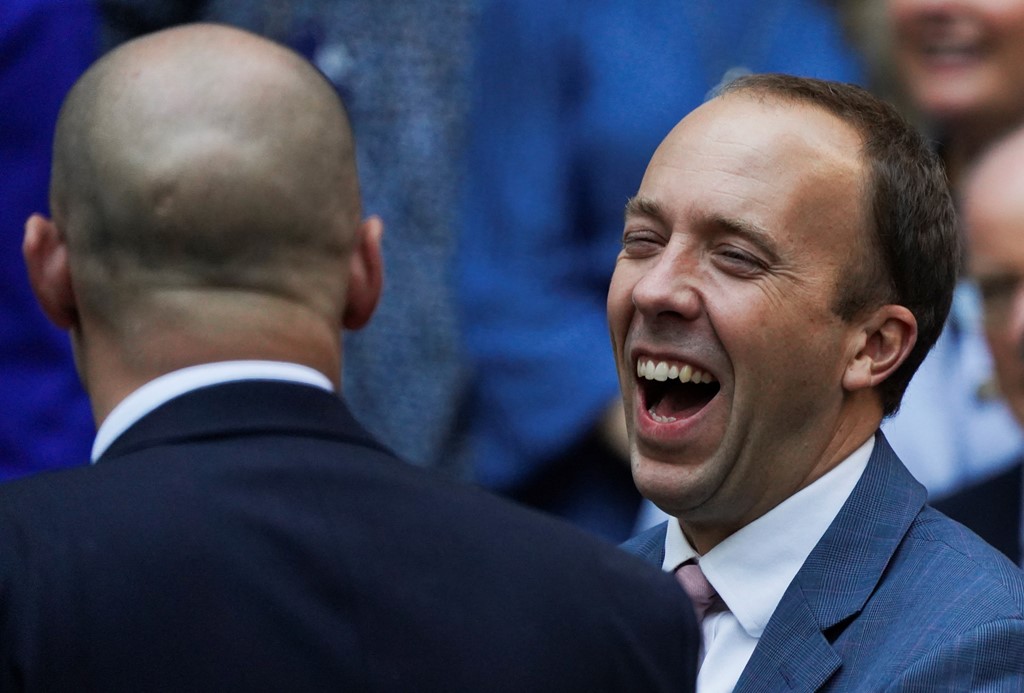
A controversial addition was Suella Braverman, who were both appointed and re-appointed as home secretary yesterday.
Braverman was made home secretary by Truss in September, but she later resigned after it was revealed she had broken the rules by sending an official document from her personal email account.
In her resignation letter, Braverman claimed it was “not serious politics” for MPs to make mistakes and carry on. Many saw this as a reference to Truss, who was under intense pressure to stand aside, which she did – the next day.
Stay tuned for a full list of everyone Sunak hired yesterday.
Michael Gove has returned to the cabinet under Rishi Sunak,three months after being fired by Boris Johnson. He will resume his duties as levelling up secretary.
Mr Gove was on the back benches for the first time in a very long while after being removed from the position in the wake of political chaos under Mr Johnson.
It had been widely suspected Mr Gove would return to the Department for Levelling Up, Housing and Communities.
This could be a tactical move by Mr Sunak, as Mr Gove has not been shy in criticising the government from the backbenches.
Labour’s shadow minister for levelling up responded with a jibe, saying: “If at first, you don’t succeed, try, try and try again…”
Lisa Nandy added: “Congratulations Michael Gove. The job has got a whole lotharder.”
Sir Keir Starmerhas dropped the gloves in his latest remarks about the new Prime Minister, after previously congratulating Rishi Sunak.
Mr Sunak has only ever fought one leadership election battle, which he was “thrashed” by Liz Truss, the Labour leader told his shadow cabinet.
“Rishi Sunak stabbed Boris Johnson in the back when he thought he could get his job. And in the same way, he will now try and disown the Tory record of recent years and recent months and pretend that he is a new broom,” Sir Keir said, according to a readout of the meeting.
“But he was also the chancellor who left Britain facing the lowest growth of any developed country, the highest inflation, and millions of people worried about their bills. And now he plans to make working people pay the price for the Tories crashing the economy.”
He said Mr Sunak is a “weak prime minister who will have to put his party first and the country second”.
Acknowledging the Tories could expect a “bounce” in the opinion polls, he said he knew Labour’s hugelead in recent surveys was no more than an “enjoyable story”
A protester shouts “Rishi out!” as Rishi Sunakarrives at Downing Street.
Standing at the lectern outside his new home, he announces that he has accepted the King’s invitation to form a government.
He takes a solemn approach, saying the country is “facing a profound economic crisis”, the aftermath of COVID “lingers” and Putin is presenting a threat in Ukraine.
Mr Sunak pays tribute to his predecessor Liz Truss, saying she was enthusiastic to create change, but “some mistakes were made”.
He says they were not the result of “bad intentions”, but they were “mistakes nonetheless”.
“I have been made the leader of the party and your prime minister, in part, to fix them, and that work begins now,” he says.
Liz Truss has defended her lower-tax vision for the UK as she prepares to leave office as the UK’s shortest-serving prime minister in history.
She urged her successor, Rishi Sunak, to be “bold” in order to boost the economy in an unapologetic farewell speech.
She said the UK “cannot afford” for government spending to take up an “increasing share of our national wealth”.
And she insisted “brighter days lie ahead” for the UK.
Flanked by her husband and children, Ms Truss said she would go back to being a backbench MP for her South West Norfolk constituency.
Mr Sunak will take power later after he is formally appointed by the King following his victory in the Conservative leadership contest.
Ms Truss announced her resignation last week after just 45 days in office, after big tax cuts in a hastily-assembled mini-budget prompted financial turmoil.
After initially defending her agenda, she later abandoned almost all of it in a bid to calm markets but saw support from her own MPs ebb away.
But she struck a defiant tone in her speech in Downing Street, adding: “I’m more convinced than ever that we need to be bold and confront the challenges we face.
“We simply cannot afford to be a low-growth country where the government takes up an increasing share of our national wealth,” she added.
Quoting the Roman philosopher Seneca, she added: “it’s not because things are difficult that we do not dare, it’s because we do not dare that they are difficult.”
She also pointed to her reversal of April’s National Insurance rise and her plan to limit energy rises as examples of successes during her short time in office.
She also urged Mr Sunak to continue British support for Ukraine, adding the country “must prevail” in its “brave fight against [Vladimir] Putin’s aggression”.
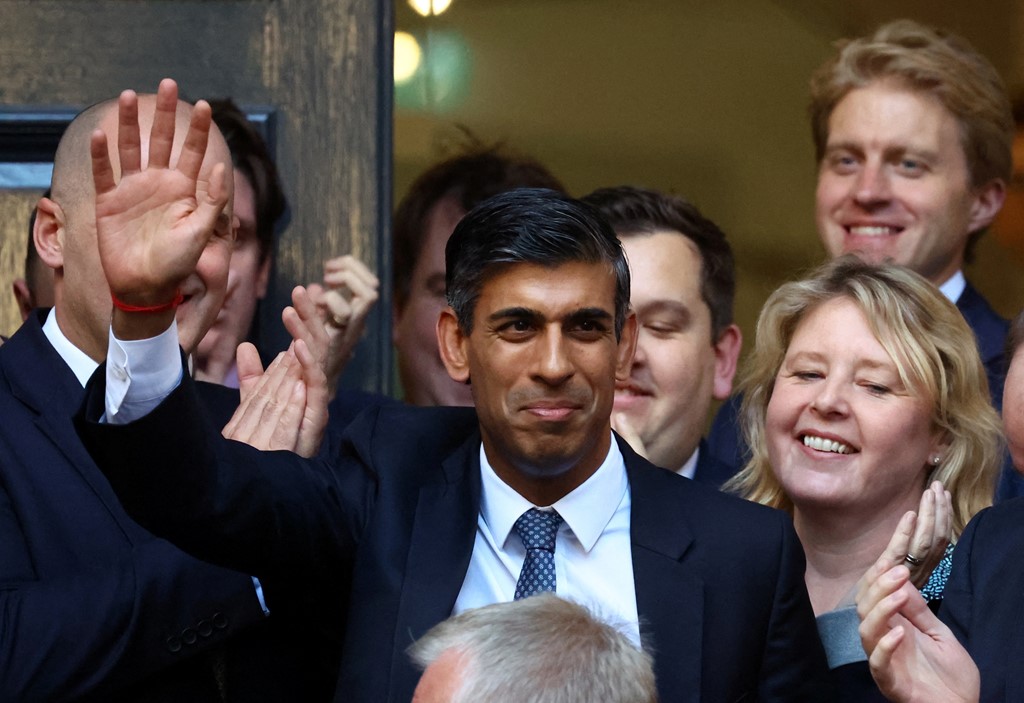
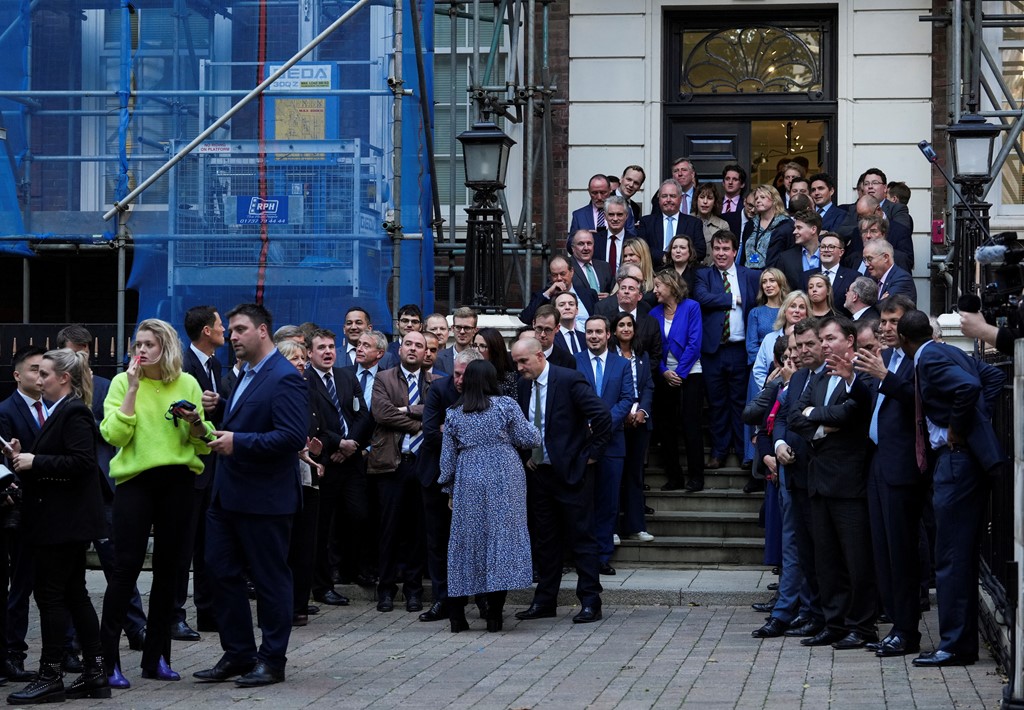
It is traditional for the new prime minister to be greeted by a throng of applauding advisers and MPs as they walk along Downing Streetfor the first time as PM.
But one of Rishi Sunak’s close allies, Mel Stride, texted MPs to say this will not be happening today.
The new PM apparently wants to avoid a celebratory tone.
The fact Mel Stride has sent this email suggests he may be destined to be Mr Sunak’s chief whip, in charge of parliamentary discipline.
According to a media notice from Downing Street,Liz Truss used her final cabinet meeting to tell her ministers the government had “secured some significant achievements” in the “short time” it had been in place.
A readout of this morning’s meeting said: “The prime minister opened cabinet by thanking ministers for their support. She said that in the short time the government had been in place they had secured some significant achievements.
“She said the government ensured the country was able to mourn the passing of Her Majesty The Queen and to welcome His Majesty King Charles III as the new monarch, a vital moment in the history of our country.
“The prime minister said the government acted to immediately protect the public and businesses from unsustainably high energy bills – bringing in the Energy Price Guarantee to save the typical household around £700 this winter.
“The government also stuck to its pledge to scrap the rise in national insurance and demonstrated its steadfast commitment in supporting Ukraine in its fight against Russia’s war of aggression.”
The media notice ends: “The prime minister concluded by saying her time in the role had been a huge privilege and that her successor will have her support as they now build on the important steps already taken by the cabinet to support the country.”
Labouris saying the Conservatives are still a “divided and chaotic party” despite the accession of Rishi Sunak as prime minister.
Labour’s shadow chief secretary to the Treasury Pat McFadden told Sky News that today’s reshuffle will be “another round of ministerial chairs being moved around”.
Mr McFadden said this was now not just affecting politics, “but it’s now affecting people in their pockets”.
While Labour wants to a general election, Mr McFadden said that will only happen if Mr Suank agrees to it, “so as much as I’d like to see one, he probably won’t have one”.
Asked about how Mr Sunak – as a multimillionaire – would be able to implement restrictive economic policy, Mr McFadden says he did not think personal wealth was something to harp on – and he prefers to talk about policies.
Rishi Sunak’s victory in the Conservative leadership election has been described as a “groundbreaking milestone” by US President Joe Biden.
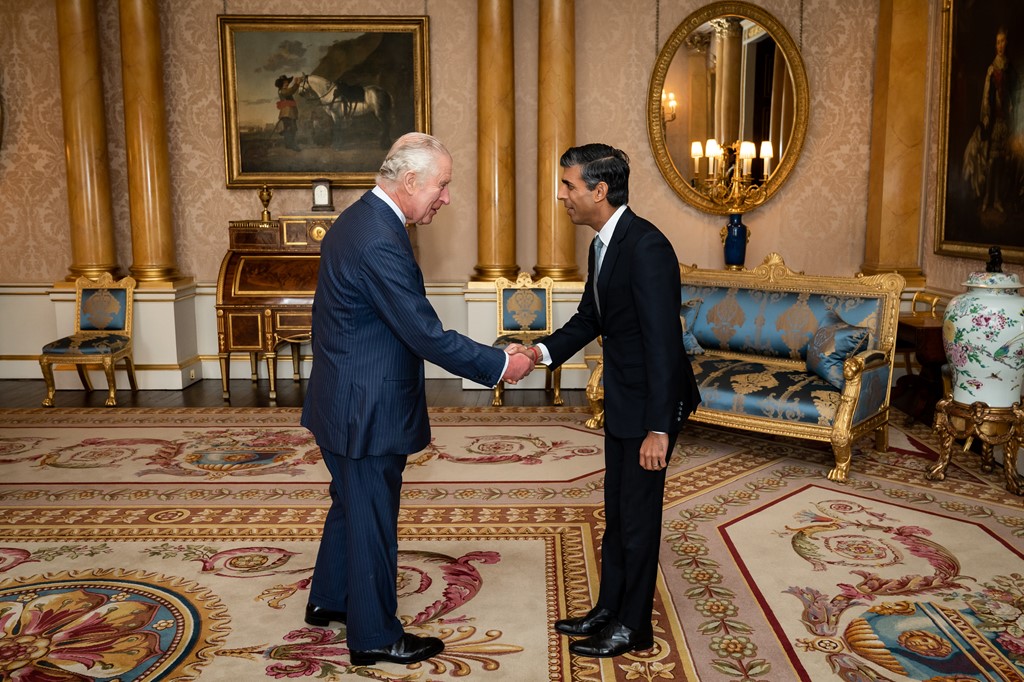
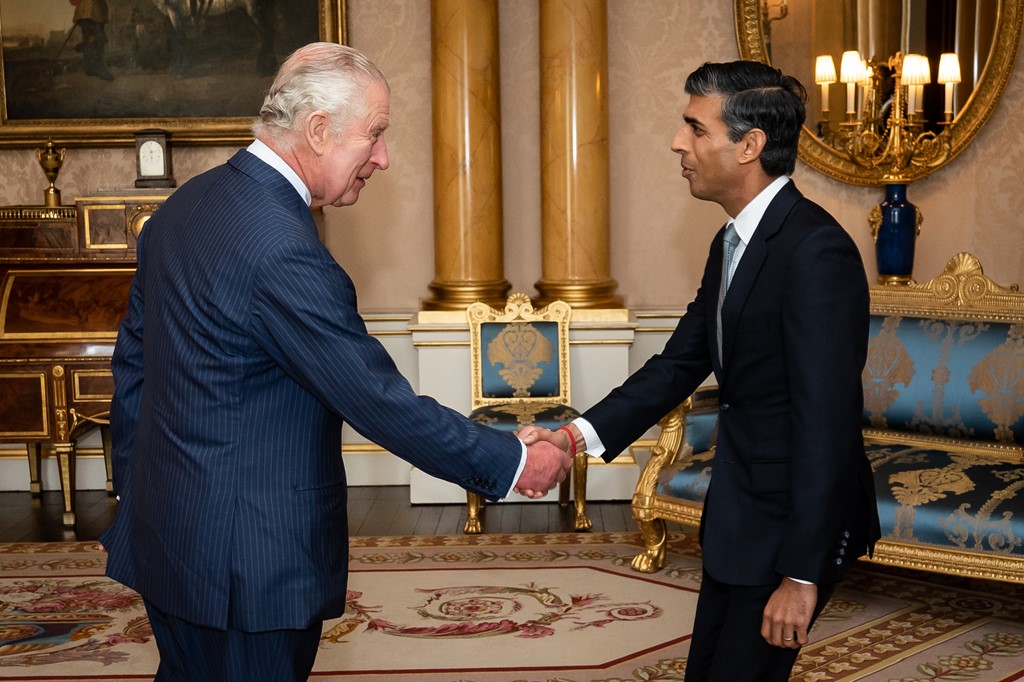
After meeting King Charles today, Mr Sunak is set to become Britain’s first black prime minister. On Monday, Mr. Biden made the remark at a White House event commemorating the Indian holiday of Diwali.
Mr Sunak, a 42-year-old multimillionaire former hedge fund boss, won the race to lead the Conservative Partyon Monday and will become the UK’s youngest leader in modern times.
His family migrated to Britain from India in the 1960s, a period when many people from Britain’s former colonies moved to the country to help it rebuild after World War Two.
“We’ve got the news that Rishi Sunak is now the prime minister,” Mr Biden said. “He’s expected to become the prime minister I think tomorrow when he goes to see the King.
“Pretty astounding. A groundbreaking milestone and it matters.”
White House press secretary Karine Jean-Pierre had earlier said Mr Biden would call Mr Sunak in the coming days, noting that it was protocol for the US president to wait to offer his congratulations until after an incoming British prime minister had met with the monarch and been formally invited to form a new government.
Some Conservative Party supporters have cancelled their memberships followingthe announcement that Rishi Sunak is set to be prime minister, with one voter of more than 40 years saying they felt as though the party “has been destroyed from within”.
While some felt “delighted” by the news, others said the move has left them “fuming” that party members were not able to vote for Mr Sunak to take over from Liz Truss.
Lyn Bond, a 60-year-old retired nurse who has voted Conservative since she was 18, sent an email to cancel her membership after it was confirmed the MP for Richmond will lead the party.
“The whole thing is rather sad because, for a party that had such a wonderful win in 2019, it has been destroyed from within,” Ms Bond, from Bishop Auckland, Co Durham, said.
“I feel awash on a boat in the ocean not knowing where to go, what to do.
“I’ve never doubted what I voted for, ever, until today.”
Samuel Jukes, a retail worker from Birmingham who joined the Tories in 2019 and was supporting Boris Johnson in the contest, said a general election should now be called as Mr Sunak “has no mandate”.
“I’m fuming right now, we never voted for Rishi Sunak,” the 33-year-old told PA.
“I’m considering leaving, not decided yet but I see a lot of members are canceling their memberships and I might be the same… Rishi has no mandate.
“Right now I’m ashamed to be a Conservative member.”
Former Chancellor of the Exchequer, Rishi Sunak, is set to become the UK’s next Prime Minister just 44 days after it was announced that ex-Conservative party member, Liz Truss, would be stepping down as Britain’s governing leader.
The 42-year-old, who is the son of Indian immigrants, is one of the wealthiest politicians in Westminster and will be the country’s first leader of colour. The ex-banker will also be asked to form a government by Britain’s recently appointed head-of-state, King Charles, after he defeated opponents Boris Johnson and Penny Mordaunt.
“This decision is an historic one and shows, once again, the diversity and talent of our party,” Mordaunt said in a statement as she withdrew from the race after failing to garner support. “Rishi has my full support.”
Sunak was selected to follow on from Truss by lawmakers from the Conservative Party, becoming the nation’s third prime minister in less than two months tasked with restoring stability to a country indebted with years of political and economic turmoil.
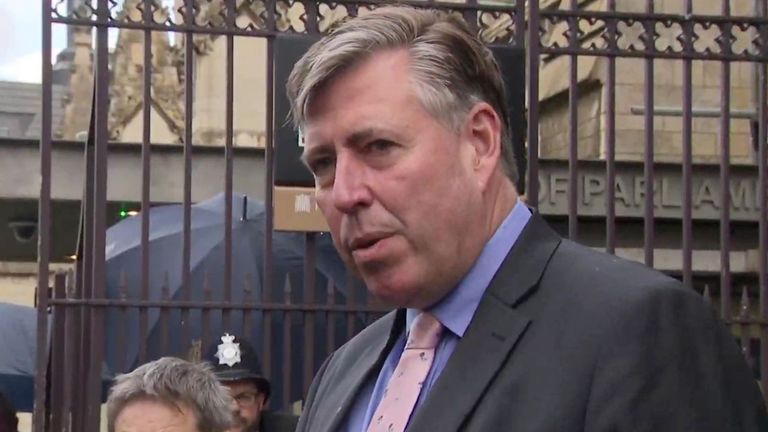
Sir Graham Brady, chairman of the 1922 Committee, said that when announcing the results of the leadership race, the Conservative Party only received one “valid” nomination to be the leader and therefore Prime Minister, and that was Sunak.
An Oxford University graduate, the former Goldman Sachs analyst first came to national attention just as the COVID-19 pandemic hit Britain, where he served as Finance Minister under Boris Johnson, developing the successful furlough scheme.
Sunak met his wife, Akshata Murthy—whose father is Indian billionaire N. R. Narayana Murthy, founder of outsourcing giant Infosys Ltd—while at Stanford University. Sunak will only become Prime Minister when Liz Truss formally hands in her resignation with King Charles, when he will be invited to form a government.
Sunak won the Conservative Party leadership election, and Scotland’s first minister has congratulated him, saying she will do her best “to build a constructive working relationship with him in the interests of those we serve,” but she has also renewed calls for Scottish independence.
“That he becomes the first British Asian to become PM is a genuinely significant moment,” Nicola Sturgeon tweeted.
“As for the politics, I’d suggest one immediate decision he should take and one he certainly should not. He should call an early General Election. And he should not – must not – unleash another round of austerity. Our public services will not withstand that,” she said.
“For Scotland, of course, he becomes another PM we did not and, without doubt, would not vote for even if given the chance. To escape the damage of Westminster governments with no mandate here, and take our future into our own hands, Scotland needs independence.”
Sunak’simpending status as the UK’s first prime minister from an ethnic minority is “a massive moment” symbolically, says Anand Menon, director of the UK in a Changing Europe think tank.
“[But] his reputation will hinge on how well he delivers as PM at what is perhaps a uniquely difficult time in our history,” Menon told Al Jazeera.
“At a minimum, the South Asian community will take note because one of their own is in Downing Street, though ultimately they will judge him on his policies and there is no guarantee that his policies will be to all of their likings,” he said.
“He’s different because he’s not white, … [but] socio-economically, he is absolutely part of the UK elite.”
DISCLAIMER: Independentghana.com will not be liable for any inaccuracies contained in this article. The views expressed in the article are solely those of the author and do not reflect those of The Independent Ghana
The handover of power from Trussto Sunak will not take place on Monday, the Reuters news agency has quoted a spokesman for the current prime minister as saying.
“I can confirm that the transition won’t be taking place today,” the spokesman said.
He added that discussions between the outgoing and incoming prime ministers and King Charles IIIon the timing and choreography of the changeover were being held.
Rishi Sunak’s accession to Number 10, making him the first British Indian prime minister, is being hailed as a “historic moment”.
Sunder Katwala, the director of the British Future think tank, said: “This simply would not have been possible a decade ago.”
He noted that Mr Sunak becoming prime minister will be “a source of pride to many British Asians – including many who do not share” his politics.
“We should not underestimate this important social change,” he said.
“When Sunak was born in Southampton in 1980, there had been no Asian or black MPs at all in the post-war era. There were still no black or Asian Conservative MPs when he graduated from university in 2001.
“Sunak reaching 10 Downing Street does not make Britain a perfect meritocracy. While there is more to do, this is a hopeful sign of progress against the prejudices of the past.
“National politics has set the pace and business, public services and charities should accept the challenge to reflect modern Britain too.”
Rishi Sunak has given his first speech as Conservative Party leader, telling the party he is “humbled and honored” to win their support.
“I’d like to pay tribute to Liz Truss for her dedicated public service to the country,” he said of the outgoing leader. “She has led with dignity and grace through a time of great change.”
“It is the greatest privilege of my life to be able to serve the party I love, and to be able to give back to the country I owe so much to,” Sunak said.
“The United Kingdom is a great country, but there is no doubt we face a profound economic challenge,” he added. “We need stability and unity, and I will make it my utmost priority to bring our party and our country together.”
“I pledge that I will serve you with integrity and humility … I will work day in, day out to deliver for the British people,” he concluded at the end of a very brief speech.
After a mainly shadowy leadership race, the veil has cleared and we now have a new prime minister. We’ll never know how many supporters Penny Mordaunt – or Boris Johnson – had, but it wasn’t clear if this would be a coronation or a struggle until the very end.
It is extraordinary to see the man who was defeated by Liz Truss sevenweeks ago replacing her so soon. This time 12 days ago, Kwasi Kwarteng was chancellor and Liz Truss was pushing ahead with her economic vision. Few could have imagined Rishi Sunak would have another shot at the top job so soon.
But today it became clear a Sunak era was close. Pressure had been mounting on Ms. Mordaunt, who was stuck on 25 public endorsements this morning, to pull out as her team dug in. Behind the scenes, they said she had more than 90 backers. She might indeed have been close, but the momentum from the start of this race has been with Mr Sunak.
He did no media interviews, there were no swish videos – just one plain statement announcing he wanted to be the next prime minister.
The former chancellor has managed to bring together very different wings of the party, from Caroline Naokes to Suella Braverman. Even the most ardent of Boris Johnson backers James Duddridge eventually rowed in behind Mr Sunak. His allies say has been proven right on the economy, but the divisions in the Tory party run deep and could quickly resurface. He inherits a grim in-tray in the midst of a cost-of-living crisis and will need to find a way to stop the Tory party from tearing itself apart.
They say divided parties don’t win elections. As the next general election slowly starts to creep into view, will Mr Sunak be able to unite the party enough to govern effectively? He certainly has his work cut out.
DISCLAIMER: Independentghana.com will not be liable for any inaccuracies contained in this article. The views expressed in the article are solely those of the author’s and do not reflect those of The Independent Ghana
Former cabinetministers rushed to congratulate Rishi Sunak on his victory in the leadership election.
It comes at a time when many people are looking for a return to the top table of government.
“Huge congrats to Rishi Sunak,” former health secretary Matt Hancock said. He is the prime minister we need.
“All of those who know Rishi well know he has the integrity, ability, and experience to lead our country in thesetroubled times.”
Sajid Javid – another former health secretary and ex-chancellor, said: “Congratulations Rishi Sunak on becoming the new leader of the Conservatives.
“We face huge challenges, but he has the skill and experience to bring the stability we need.
“Conservatives must unite behind him and deliver for the British people.”
Former housing secretary Robert Jenrick said: “Congratulations Rishi Sunak. I couldn’t be prouder of my friend today.
“He’s won the overwhelming support of the parliamentary party. There are huge challenges ahead, but I have every faith that with him at the helm, the country will succeed.”
Ex-Northern Ireland secretary Julian Smith said: “In Rishi Sunak as prime minister, the United Kingdom has the best possible person to deal with the current challenges we face. Finally.”
And former business secretary Andrea Leadsom – a key backer of Ms Mordaunt – said: “Penny has done an amazing job and run an excellent campaign.
“Huge congratulations to Rishi Sunak and enormous gratitude to all those who have worked so hard on Penny’s campaign.”
Penny Mordaunthas stepped down at the last minute, paving the way for Rishi Sunak to become the next Prime Minister.
Mr Sunak had over 200 supporters as the two contenders raced to obtain 100 nominations by today’s 2 pm deadline.
Ms Mordaunt said in a statement that it was “clear that colleagues feel we need certainty today.”
“They have taken this decision in good faith for the good of the country…
“As a result, we have now chosen our next prime minister. This decision is a historic one and shows, once again, the diversity and talent of our party.”
The Commons leader said Mr Sunak now has her “full support” and that now is the time to “unite and work together for the good of the nation”.
“There is much work to be done,” she added.
Ms Mordaunt’s withdrawal means there is only one candidate left in the race – Rishi Sunak – and therefore he will be the new leader.
A source within Penny Mordaunt’s campaign team has texted Beth Rigby to say: “We have now passed 90. For the sake of the party, it’s important our members have their say.”
Only 25 Tory MPs have publicly backed the Commons leader – compared with 180 for Rishi Sunak.
We heard from Boris Johnson’s campaign last night, as he stood back from the race, that he’d had 102 backers – something commentators have questioned.
It willbecome clear over the coming hours whether Ms Mordaunt’s campaign is inflating the number to try to gain momentum, or whether the bookies and onlookers like George Osborne have got this completely wrong.
If Rishi Sunak is elected, one of the first big concerns he will face is appointing a new defence secretary.
Of course, we don’t yet know who will be in his cabinet, but as think tank chief Torsten Bell points out, the present (and popular) Defence Secretary Ben Wallace’s stance on defence expenditure may complicate matters.
Unless Ben Wallace finds himself a climb down strategy the first crisis of this new government could be losing the defence secretary. We ain’t going to be spending 3% of GDP on defence
Mr Wallace, one of the most experienced and well-regarded members of the cabinet, has campaigned hard for increases in defence spending.
One of Liz Truss’s key pledges had been to boost defence spending to 3% of national income by 2030.
But Jeremy Hunt – who is widely expected to stay on as chancellor when the new prime minister comes in – has refused to commit to this promise.
He said the Ministry of Defence would need to make additional savings, along with other departments.
Mr Sunak himself has also signalled he is unlikely to stand by the 3% spending promise.
He said this target was “arbitrary” and “not a plan”.
The former chancellor had also become embroiled in a row with Mr Wallace, with the latter claiming Mr Sunak had tried to block a multi-year settlement for the Armed Forces in 2019.
The number of MPs publicly backing her hovered around 20 all weekend and anyone hoping Boris Johnson’s exit would see a flurry of his backers joining her camp will be disappointed.
Even Mr Johnson’s most passionate backers, like Nadine Dorries and James Duddridge, are rowing in behind Mr Sunak. It is clear which way the wind is blowing.
With over half the parliamentary party now backing the former chancellor, the pressure is mounting on Ms Mordaunt.
Former Chancellor George Osborne has taken to Twitter to urge her to step aside. He said that “she can’t command the support of a majority of MPs” and Mr Sunak is best placed to “reinforce the return of market credibility”.
But there is no sign of Ms Mordaunt giving up – her team says she is continuing to speak to colleagues from across the party and is “in it to win it”.
Allies say behind the scenes the numbers are closer than they seem.
Some MPs do believe the membership should have a say and want a contest – not a coronation.
Last time round Ms Mordaunt secured the backing of 105 MPs in the final round and there are still enough undeclared votes for her to make it onto the ballot.
But one of the biggest jobs for whoever takes over will be uniting a deeply divided parliamentary party; with three hours to go calls for Conservative MPs to unite around Mr Sunak are getting louder.
DISCLAIMER: Independentghana.com will not be liable for any inaccuracies contained in this article. The views expressed in the article are solely those of the author’s, and do not reflect those of The Independent Ghana
The SNP’s Westminster leader, Ian Blackford, has written to Labour leader Sir Keir Starmer, asking him to table a motion of no confidence.
Writing to Sir Keir, Mr Blackford said: “As opposition leaders, we simply cannot stand idly by as the Tories attempt to impose their third prime minister in the space of three months. Now is the time to act.”
He added that the “rules of Westminster” means that only the leader of the Opposition – Sir Keir – can submit a formal no-confidence motion.
Mr Blackford acknowledges that the SNP and Labour will have different goals from the election but he hopes “we can act together to stop this shambles”.
The Tories cannot be allowed to impose a third Prime Minister without an election.
I’ve written to Keir Starmer making clear @theSNP will back a vote of no confidence in the Tory government if he tables it this week. We must put maximum pressure on Tory MPs to give voters a say. pic.twitter.com/r7uxjLcB8c
Meanwhile, the Liberal Democrats are trying to use a “presentation bill” to amend the law which repealed the Fixed Terms Parliament Act to call for a general election this year.
The likelihood of this working is probably quite slim.
Wendy Chamberlain, the Liberal Democrats’ chief whip, said: “We future of our country cannot be left to another Conservative stitch-up. It must be in the hands of voters who deserve a say through a general election now.”
George Osborne,who was chancellor during the David Cameron years, doesn’t have much expectation of Penny Mordaunt persuading 100 backers and taking this to a vote of Tory members…
Rishi Sunak will be Prime Minister by the end of the day. Some think,like me, he’s a solution to our problems;others think he’s part of the problem.But whatever your politics,let’s all celebrate the first British Asian becoming PM and be proud of our country where this can happen
Sir Keir Starmerhas said that a Labour government would not issue further gas and oil licences.
It comes after his party helped clinch Liz Truss’s doom last week with a vote to outlaw fracking. Tory whips transformed it into a confidence vote in the government, and while Ms Truss survived the vote, the pandemonium that followed – with reports of MPs being abused – meant she was gone within 24 hours.
Speaking to LBC this morning, Sir Keir said: “We accept there’s got to be a transition, so where there is oil and gas already being yielded that needs to continue as part of the transition, but no new sites, no new fields to be opened.
“We need to transition to renewables. We can do it … we can double our onshore wind, we can triple our solar energy and we can quadruple our offshore wind – and the sooner we do that, the better.
“I do think that new nuclear, as well, and hydrogen is part of the equation.”
He said, “it was a straight no” when asked if the UK would rejoin the EU if Labour took power.
And he said the only way to get people a “sustainable pay rise” is to grow the economy.
Sir Keir said to do this institutions like the OBR and Bank of England need to be respected.
He also said that there was “not a great deal” between Labour and the Conservatives on immigration – although he did say he would scrap the Rwanda scheme.
Sir Keir said: “Now we don’t have free movement anymore, then you either have a pure numbers game or you have a points-based system that says ‘well, for certain types of jobs, certain types of roles here, you would get a number of points. I think that makes sense.
“So, in that sense, not a great deal between the major parties on immigration.
“We would have a slightly different approach and I would particularly want to welcome really good students.”
The politicalsituation in the UK has clearly had a bit impact on the markets, and now the ratings agency Moody’s has lowered its outlook from “stable” to “negative”.
Rating agencies, in essence, rate a country on the strength of its economy.
It affects how much it costs governmentsto borrow money in the international financial markets. In theory, a high credit rating means a lower interest rate (and vice versa).
Moody’s said there were two “drivers” behind its decision to change the UK’s economic outlook.
It said the first was “the increased risk to the UK’s credit profile from the heightened unpredictability in policymaking amid a volatile domestic political landscape”.
The rating’s agency said it viewed the government’s mini-budget, the reversal of the majority of the policies in it, and the change in prime minister as a “continuing reflection of the weakening predictability of fiscal policymaking seen in previous years”.
The leveling up secretary, Simon Clarke, is the second cabinet minister to officially back Boris Johnson as Tory Party leader.
In a joint statement to Daily Telegraph with the Tees Valley mayor, he says Johnson would lead “a broad-based, inclusive government drawing on talent from right across the Conservative Party, driven by a disciplined Downing Street”.
Business Secretary Jacob Rees-Mogg has already backed Johnson, while Defence Secretary Ben Wallace said he was “leaning” towards supporting him.
Clarke, a Truss loyalist, said Johnson “is the person we need to lead our country and our party” as he can unite the UK, make Brexit a success, and control illegal immigration.
No one has yet confirmed they are entering the race, but the BBC’s latest tally suggests Rishi Sunakwould have the backing of 56 MPs, Johnson would have 33 and Penny Mordaunt would be on 17.
As we said earlier, we’ve been keeping an eye on the number of Conservative MPs who have declared their support for potential contenders in the leadership election so far.
Take a look at our latest tally:
Rishi Sunak – 56
Boris Johnson – 33
Penny Mordaunt – 17
No one has publicly said they’re running yet.
Our tally is based on MPs telling the BBC who they’re backing, or publicly declaring for a potential candidate, as compiled by the BBC.
You may say see different counts online – as others may be including MPs who‘ve privately told them who they’re backing.
We’ll bring you updates on the numbers as we get them.
Other namesbeing floated as potential contenders are former Home Secretary Suella Braverman and international trade secretary Kemi Badenoch. Defence Secretary Ben Wallaceearlier ruled himself out of the contest.
Candidates need the support of at least 100 MPs by 14:00 on Monday – a much higher threshold than the last leadership race.
The two go back a long way. In 2016, Wallace ran Johnson’s failed leadership bid after the Brexit referendum.
When Johnson resigned this summer, Wallace is said to have worried that losing him as a leader without a plan for a successor would land the party in trouble.
His support today was not totally unqualified. He did nod towards “questions” around Johnson.
The trouble is they are more than just “questions” for a significant number of Tory MPs who remember Johnson for the chaos he brought to Downing Street, the fact he broke the law while in office, was fined, saw dozens of resignations, and is still being investigated by parliament for lying.
Wallace said today a new Tory leader had to have a focus on unity, but that’s something Johnson may struggle to bring to his party.
DISCLAIMER: Independentghana.com will not be liable for any inaccuracies contained in this article. The views expressed in the article are solely those of the author’s, and do not reflect those of The Independent Ghana
Surging inflation means the cost of servicing government debt hit a record level last month, according to figures from the ONS, which also reported that consumers were now back buying less than they were before the COVID pandemic.
The latest official data on the state of the public finances and consumer spending makes for grim reading as the country awaits its next leader.
The report pointed to a record debt interest payment total of £7.7bn for the month of September – much of which could be attributed to rising inflation as a quarter of payments on the £2.4trn debt mountain are linked to the RPI measure.
Government spending increased by £5.8bn to £79.3bn as a result of the jump in interest, the ONS said.
It separately revealed that retail sales volumes fell 1.4% on the previous month, meaning that “consumers were now buying less than before the pandemic”.
The declines was far worse than the 0.5% decline that economists had forecast.
It was likely to reflect not only the deteriorating cost of living crisis that has squeezed consumer budgets this year but also the impact of store closures for the funeral of the Queen.
Image: Many retailers closed their stores out of respect for the Queen on the day of her state funeral on 19 September
The borrowing figures cover the start of Kwasi Kwarteng’s short and turbulent tenure as chancellor.
He was appointed on 6 September before being fired weeks later following the market chaos that followed the tax giveaway mini-budget on 23 September.
While the contentious measures have now been largely overturned by the new Chancellor Jeremy Hunt, the backlash temporarily raised the interest rate demanded by investors to hold UK government debt.
That has fed into fixed-rate mortgage costs.
Image: Much of the borrowing – the second-highest September total on record – came while Kwasi Kwarteng was chancellor
It also led to the pound falling to a record low against the US dollar– with continued sterling weakness adding to the country’s import costs and therefore inflation.
The chancellor’s medium-term fiscal plan, due on Halloween, will aim to restore market confidence in the UK’s public finances.
But it will now fall under the oversight of a new PM following the resignation of the ill-fated mini-budget’s architect, Liz Truss.
The Tories expect their new leader to be in place in a week’s time – days before Mr Hunt is due to outline how he plans to balance the books while also maintaining a measure of support for struggling households and businesses.
A survey by the City watchdog found that almost 32 million people, or 60% of adults, were already finding it a heavy burden or somewhat of a burden to pay their bills because of the growing cost of living crisis.
The Financial Conduct Authority’s financial lives survey, which was taken between February and June, said the total was up six million from 2020 when the economy went into lockdown to fight the COVID-19 pandemic.
Another closely watched survey, compiled by GfK, found that confidence among British consumers remained close to the lowest level on record last month.
The chancellor said in the wake of the ONS data: “Strong public finances are the foundation of a strong economy.
“To stabilise markets, I’ve been clear that protecting our public finances means difficult decisions lie ahead.
“We will do whatever is necessary to get drive down debt in the medium term and to ensure that taxpayers’ money is well spent, putting the public finances on a sustainable path as we grow the economy.”
Leading pollster Professor Sir John Curtice said whoever leads the Conservative party next should “enjoy the next 18 months to two years, because that will probably be their tenure”.
“Parties and governments who preside over a fiscal crisis have nearly always struggled at the ballot box at the next election,” Sir John said.
An Opinium poll this week projected a 1997-style landslide for Labour, with the party winning 411 seats.
The same poll, conducted for the TUC interviewing more than 10,000 adults, predicted the Conservatives would be reduced from 356 MPs to 137.
IMAGE SOURCE, GETTY IMAGES
Sir Keir said: “This is not just a soap opera at the top of the Tory party – it’s doing huge damage to the reputation of our country.
“We need a general election so the public can have their say on this utter chaos.
“There’s a manifesto that is going to be ready whenever an election is called,” Sir Keir told the BBC’s Newscast podcast.
“I’ve had a team working on that. I’ve had a team working on general election preparedness. We’ve moved our teams onto a general election footing.
“We’re very, very prepared should there be a general election.”
In his speech to the TUC conference on Thursday, Sir Keir said Labour had a long-term plan to “deliver cheaper bills and higher living standards for working people, growth and jobs in every part of our country”.
He outlined some of the policies he announced at Labour’s annual conference last month, including those in its “green prosperity plan”
The plan includes pledges to create a publicly-owned renewable energy firm, achieve carbon-free electricity by 2030, and insulate 19 million homes.
The former prime minister has pleaded with her party to provide an “orderly transition”, amid fears the upcoming leadership contest could become messy.
The Prime Minister is right to provide a roadmap for an orderly transition.
MPs must now be prepared to compromise. It is our duty to provide sensible, competent government at this critical moment for our country.
Other Conservative MPs have shared similar thoughts this afternoon – including Justin Tomlinson, who said this was the “last-chance saloon” for the party to maintain credibility.
A vicious leadership contest would further divide an already split party that is about to see its third prime minister in the space of a few months.
While some Conservative MPs are asking for Boris Johnson’s comeback, others are cautioning against it.
Sir Roger Gale reminded people that the ex-prime minister was still being investigated by the Privileges Committee for potentially misleading the House.
He added: “Until that investigation is complete and he is found guilty or cleared, there should be no possibility of him returning to government.”
We need to remember that Mr Johnson is still under investigation by the Privileges Committee for potentially misleading the House.
Until that investigation is complete and he is found guilty or cleared, there should be no possibility of him returning to Government.
One Tory MP believes previous leadership challenger and ex-chancellor Rishi Sunak will run to replace Liz Truss.
“I am pretty sure he will, I hope so,” Richard Holden tells Sky News.
The MP says that in the difficult economic times, the party and the country need a PM “who has got the economic experience to deliver real stability over the next few years and get the ship of state back on an even keel” – and that person is Sunak.
He adds: “What we need is competence right at the core of this at the moment… and the economy front and center.
“We have had a really tough time over the past few weeks. Even though I didn’t support Liz [in the leadership contest] I didn’t want it to go the way things have gone.
“What we need to see now is competence at the heart of government and particularly the economic vision.”
But while Holden wants Sunak in Number 10, he also promises he will “unite behind anybody”.
He adds: “The truth is that the Conservative Partyhas got to unite behind whoever is elected to win the next election.”
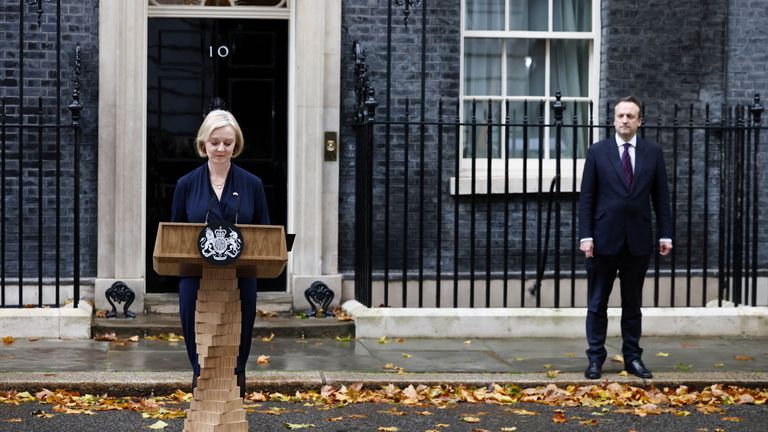
Liz Truss resigned as Prime Minister just 44 days after succeeding Boris Johnson.
She will be the prime minister with the shortest tenure in modern British political history.
In a statement read outside Downing Street, Ms Truss said: “I came into office at a time of great economic and international instability.
“Families and businesses were worried about how to pay their bills.”
She said she was elected “with a mandate to change this”, adding: “We delivered on energy bills.”
” I recognise, though, given the situation, I cannot deliver the mandate on which I was elected by the Conservative Party,” she said.
“I have therefore spoken to His Majesty the King to notify him that I am resigning as leader of the Conservative Party.
“This morning, I met the chairman of the 1922 committee, Sir Graham Brady. We’ve agreed that there will be a leadership election to be completed within the next week.”
He added: “The Tories cannot respond to their latest shambles by yet again simply clicking their fingers and shuffling the people at the top without the consent of the British people.
“They do not have the mandate to put the country through yet another experiment; Britain is not their personal fiefdom to run how they wish.”
The start of Truss’ downfall
Ms Truss’ downfall started when her former chancellor Kwasi Kwarteng announced his mini-budget a month ago, which prompted weeks of economic turmoil and eventually led to him being sacked last Friday.
Mr Hunt, who voted for Rishi Sunak during the leadership campaign, then took over as chancellor and U-turned on the majority of the unfunded mini-budget tax cuts on Monday – further undercutting Ms Truss’ authority.
On Wednesday afternoon, her home secretary, Suella Braverman then quit after saying she had breached security rules by sending a policy message to a colleague over her personal email by mistake.
It only got worse on Wednesday evening after confusion over whether Labour’s opposition day vote was actually a confidence vote in the government or not – which resulted in allegations of “manhandling” of Tory MPs bycolleagues.
Some Tory MPs had publicly called for Ms Truss’ resignation before that but in the hours before she quit, a flurry of Tory MPs revealed they wanted her to go.
Conservative Party rules prevent a leader from a confidence vote in the first 12 months of their tenure but it is understood after a significant number of MPs wrote to Sir Graham Brady, chair of the 1922 Committee of backbench Tory MPs, calling for her to go, a decision was made that she could not stay.
As we all face soaring prices, BBC News is talking to people across the UK about how they are coping with the financial pressures and providing support and advice on saving money from our experts.
Today we’re reporting from Sunderland in north-east England. Unemployment levels are higher here compared to the rest of the UK and workers earn less than people in other parts of the country.
We’ll be hearing from households, businesses and families about how the rise in living costs is affecting them.
You’ll be able to follow this across the BBC – whether that’s here on the website, on BBC Breakfast and the News Channel, or on Radio 5 Live and Radio 1’s Newsbeat.
Later we’ll bring you coverage of a special programme hosted by Nicky Campbell exploring issues and solutions – you’ll be able to watch that at the top of this page.
A news blackout in southern Ukraine means “something big is going on”, military expert Professor Michael Clarke has told Sky News.
Professor Clarke, former director-general of the Royal United Services Institute (RUSI), said: “The Ukrainians have conducted a complete news blackout on what is happening in the Kherson oblast because the Russians are holding a line between Snihurivka and My love, and that line they have been holding onto for over a week now as Ukraine moves south.
“When the Ukrainians have a news blackout it means something is going on. They have always done this before when there is a big offensive push on.
“Now for sure, something big is happening. It might fail, and it may not work, but in the past, it has worked.
“Standby for some more interesting information – I am guessing on this frontline between Mylove and Snihurivka.”
Meanwhile, around 100 women – all from the Azovstal steelworks – have also been released in a prisoner exchange.
Showing footage of their release, Professor Clarke said: “These women are all coming out, some of them are in combats, they might have been given those combats, but they are walking in line – they are coming out they are almost marching.
“They are coming out in order, they are making a point. We are the women from Azovstal steelworks.
“Civilians got mixed in with the troops towards the end, it was all pretty awful.
“But here they are, they are holding their head up, they are coming out with pride and that is making a point to the Russians and the rest of the world. ”
DISCLAIMER: Independentghana.com will not be liable for any inaccuracies contained in this article. The views expressed in the article are solely those of the author and do not reflect those of The Independent Ghana
A British MP says that one of China’s most senior UK ambassadorswas involved in violence towards demonstrators at the Manchester consulate on Sunday.
MPs in Parliament have privilege, allowing them to speak freely without fear of legal action.
China has not commented on Zheng Xiyuan’s alleged involvement.
But the foreign ministry in Beijing defended the actions of consulate staff.
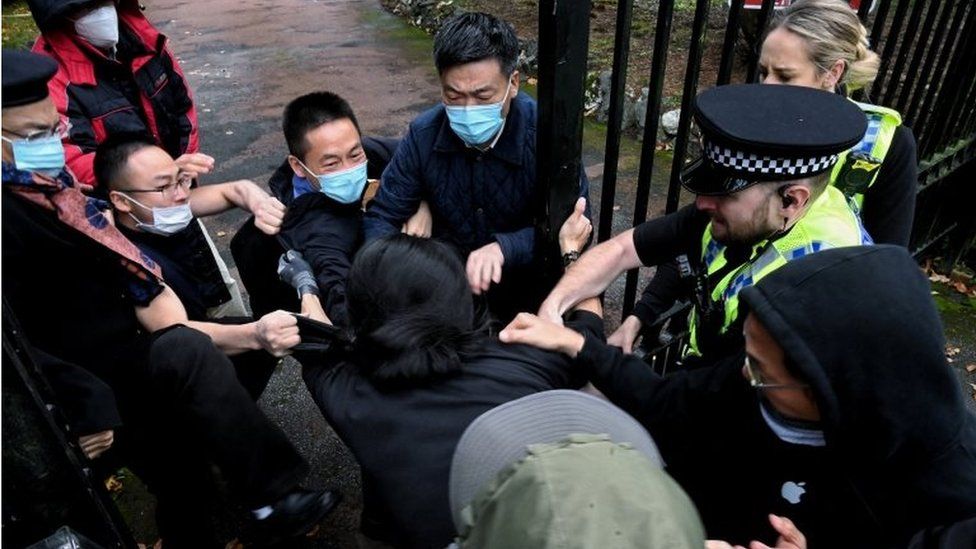
IMAGE SOURCE, REUTERS Image caption, A protester is pulled at the gate of the consulate on Sunday – the consul-general is alleged to be in a mask and hat (far left)
Spokesman Wang Wenbin said people had “illegally entered” the grounds and any country’s diplomats would have taken “necessary measures” to protect their premises.
But the official Chinese version is at odds with video footage and statements from police. Officers had to drag back a protester from inside the consulate gate as he was being attacked.
After Consul-General Zheng Xiyuan ripped down the placards, Ms Kearns told MPs, there was “grievous bodily harm against a Hongkonger, one of whom was hospitalised for taking part in a peaceful protest.
“Some were then dragged onto consulate territory for a further beating by officials who have been recognised to be members of the Chinese Communist Party (CCP).
“We cannot allow the CCP to import their beating of protesters, their silencing of free speech, and their failure to allow time and time again protests on British soil. This is a chilling escalation.”
According to a statement by the Greater Manchester Police, around 30 to 40 people had gathered outside the consulate to protest.
“Shortly before 4 pm a small group of men came out of the building and a man was dragged into the consulate grounds and assaulted,” the statement said.
“Due to our fears for the safety of the man, officers intervened and removed the victim from the consulate grounds.”
The consulate is UK territory, but cannot be entered without consent.
Another MP, Labour’s Afzal Khan – who represents the constituency where the consulate is, Manchester Gorton – told the House of Commons he was “sickened” by the scenes.
“The UK stands for freedom, the rule of law, and democracy,” said the Labour MP. “The quashing of peaceful protests will never be tolerated on British soil.”
Mr Khan and other MPs called for the consul-general to be declared a “persona non grata” – meaning a person who is unwelcome in the country.
As a diplomat, the consul-general has diplomatic immunity, meaning he is theoretically protected from prosecution. Declaring someone “persona non grata” can remove diplomatic status and potentially result in expulsion.
Conservative MP Sir Iain Duncan Smith asked if the government would “be prepared to expel the consul-general and any of those that are found to have been part of that punishment beating and the vandalism?”
Foreign Office minister Jesse Norman said, “we will take action once we have a full understanding of the facts”. He added the government had issued a summons to the Chinese charge d’affaires in London – the Chinese ambassador’s deputy – for an explanation.
Mr Norman told the House of Commons: “We’ve already outlined a process of raising this formally with the Chinese embassy… and we will see where these procedures, these legal and prosecutorial procedures, may lead to, and at that point, we will take further action.”
Some MPs called for the Foreign Office to go further, including Labour’s Andrew Gwynne who said: “Had these incidents happened on the streets of Hong Kong, there would have been outrage from the British government, rightly so.
“They happened on the streets of Manchester and yet we have this situationwhere the minister is basically sending a memo to the Chinese embassy, an offer of a cup of tea and a chat with the ambassador.”
A few smiles at cabinet this morning, as the chancellor was set to deliver a tough message-spending cut are on the way, and every department will have to make them.
It’s the prime minister’s first formal meeting with her cabinet – although she held a reception with them last night – since firing her former chancellor and allowing her new one to tear up her economic strategy as she sat silently beside him.
Jeremy Hunt yesterday reversed almost all of the tax cuts which have not yet been enacted and went further on income tax by saying even Rishi Sunak’s plan to cut it in two years was no longer affordable.
Today he was poised to tell cabinet ministers that all spending is under review, from the health service – where seven million people are waiting for treatment – to defence spending, pensions, and schools, as he finalises his fiscal plan.
The prime minister, who cabinet ministers concede, was forced into a U-turn by the government’s creditors, is being described in normally friendly newspapers as a “lame duck” and a mourner at the funeral of her own policies, only just falling short of calling for her resignation.
As she enters a critical week in which Conservative MPs must decide whether she has the authority to continue even in the short-term, Ms Truss will meet groups of her MPs today.
She met the One Nation group of centrist Conservatives last night where I’m told she was relatively upbeat.
Tonight, she meets the European Research Group, most of whom backed her tax-cutting agenda and will be disappointed it’s no longer viable.
Her allies take heart from the fact that if MPs moved to oust her, the Tory factions would struggle to agree on a candidate who they could unite around.
With the polls looking increasingly dire, and unpopular decisions imminent, that can very soon change.
DISCLAIMER: Independentghana.com will not be liable for any inaccuracies contained in this article. The views expressed in the article are solely those of the author and do not reflect those of The Independent Ghana
Earlier today, Armed Forces Minister James Heappey stated that the mini-budget was approved by the entire cabinet.
He stated that the full cabinet had agreed to it before it was submitted to the Commons, and he also continued to make the case for the Ministry of Defence to preserve its promised money, despite the fact that Chancellor Jeremy Hunt was expected to tell all government departments to find savings.
Now, Pat McFadden, Labour’s shadow chief secretary to the Treasury, has said the “frank admission” that ministers approved the disastrous mini-budget showed the Conservatives had “lost all economic credibility”.
“They couldn’t run a bath let alone a major G7 economy,” he said.
“They have put a Tory premium on people’s mortgages and reduced the UK to nervously watching its gilt yields day by day.
“Labour will match the financial stability the country needs with a proper plan for growth based on the efforts of the whole country, not tired and failed trickle-downeconomics.”
Prime Minister Liz Truss went into “waxworks mode” in the Commons Wednesday and her performance lacked “emotional intelligence”, according to body language expert Judi James.
Speaking to Sky News today, Ms James said the body language of the prime minister was “hard to fathom” and “bizarre”.
Analysing the scenes, she said: “I would imagine the best way to describe it would be a lack of intelligence.”
Ms James went on to say Commons leader Penny Mordauntlooked like “somebody on a sinking ship for over an hour armed with a teacup” before Ms Truss “bounced in” and “started laughing and chatting behind her”, which was “strange”.
“There was no bonding going on between the two women,” she said.
The body language expert said the Tory leader then fell into “waxworks mode” and did not join in, before adding that her facial expression became “frozen” and her eyes “looked like somebody who was fighting sleep”.
“You know if you go to see a bad play or go to the cinema and you can feel your eyes beginning to droop. It was that kind of blinking going on,” Ms James continued.
“And then the only other sign we got from her body language is what I call her ‘poker tell’.
“When she doesn’t like something her chin moves from side to side.
“But apart from that, very little endorsement signals going on. Normally we’d expect to see her looking at Hunt and nodding, but she just sat there looking glazed and looking at the opposition but without any real focus .”
Asked if Ms Truss’s body language gave a hint as to whether she was determined or defeated, Ms James added: “She is determined in the brain cells, but I think generally her body is telling her she is defeated.”
Market estimatesfor the Bank of England’s bank rate are at their lowest since the mini-budget, which is excellent news for individuals with mortgages.
Market forecasts peaked soon after the mini-budget at 6.1%, but have since dropped to just over 5%.
It was just three weeks ago the then-Chancellor Kwasi Kwarteng unveiled his tax-cutting mini-budget to MPs, which caused economic turmoil in the UK,as the value of the pound plummeted.
Today, Mr Hunt said there “were mistakes” in last month’s announcement, and pointed out some taxes may have to rise and others might not fall as much as planned.
The BoE is due to announce its next decision on interest rates, which will impact household mortgages, on 3 November and many investors think it will either raise them from their current level of 2.25% to 3% or possibly 3.25%, both of which would be much bigger moves than usual.
The UK government will reverse “almost all” of the tax cuts announced in last month’s mini-budget in an emergency move aimed at calming investors.
New chancellor Jeremy Hunt said the strategy, which includes keeping income tax at current levels, would bring in £32bn.
The move comes after economists warned the original plans would leave a £60bn black hole in the public finances.
Mr Hunt said his priority was to restore “economic stability”.
The government’s mini-budget on 23 September sparked alarm among investors. The then chancellor Kwasi Kwarteng announced huge tax cuts on top of a plan to subsidise energy prices for two years. He did not give any detail on how the the tax cuts and extra spending would be paid for.
“At a time when markets are rightly demanding commitments to sustainable public finances, it is not right to borrow to fund this tax cut,” added Mr Hunt, referring to the plan to Mr Kwarteng’s plan bring down the basic rate of income tax by 1p.
Mr Hunt noted that the instability on financial markets had a wider impact affecting “the prices of things in shops, the cost of mortgages and the values of pensions”.
Immediately after the mini-budget, investors began demanding higher rates of interest to lend to the government as the UKwas deemed a higher risk investment and borrowing costs surged to worrying levels.
The turmoil forced pension funds to sell bonds due to concerns over their solvency, and threatened to create a downward spiral in bond prices as more were offloaded which left some funds close to collapse.
The Bank of England was forced to step in to buy bonds to try and stabilise their price.
The turmoil also fed through to the mortgage market, where hundreds of products have been suspended due to concerns about how to price these long-term loans.
The Institute for Fiscal Studies (IFS) warned last week that that the chancellor would need to make “big and painful” spending cuts to put the country’s finances on a sustainable path.
The think tank predicted that with a weaker economy and promised tax cuts, there would be a large shortfall in revenue.
It calculated the government would have to spend £60bn a year less by 2026-27.
The prime minister has tweeted to align herself with the announcements made by chancellor Jeremy Hunt (who some Tory MPs are referring to as “de-facto PM) this morning…
The British people rightly want stability, which is why we are addressing the serious challenges we face in worsening economic conditions.
We have taken action to chart a new course for growth that supports and delivers for people across the United Kingdom. https://t.co/P3yglx6efZ
Shadow chancellor Rachel Reeves says “the damage has been done” by the mini-budget.
Responding to Jeremy Hunt’s statement today, Ms Reeves said the “Conservatives have lost all credibility”, and that they cannot provide the “confidence and stability” the chancellor said was needed.
Ms Reeves said: “There will continue to be a huge cost to families because of the actions of this Tory government.
“We are still flying blind with no OBR forecastsand no clarity of the impact of their mistakes.
“The humiliating climb-down on their energy plan begs the question yet again – why won’t they bring in a windfall tax on energy producers to help foot the bill?
“Only Labour offers the leadership and ideas Britain needs to fix the economy and get out of this mess.”