As freezing fog, sleet, and snow hamper travel across the UK, passengers have been encouraged to contact their airline for the most recent flight information.
Due to the amount of snowfall, Manchester Airport has closed both runways.
A tweet read as follows: “We’ve blocked both runways temporarily due to the significant snowfall. Health and safety will always come first, and business will pick back up as soon as possible.”
Numerous flights are impacted, therefore passengers are urged to contact their airline for the latest recent travel information.
It comes as the Met Office warned freezing fog, sleet and snow could bring travel disruption to parts of the UK during the coming days.
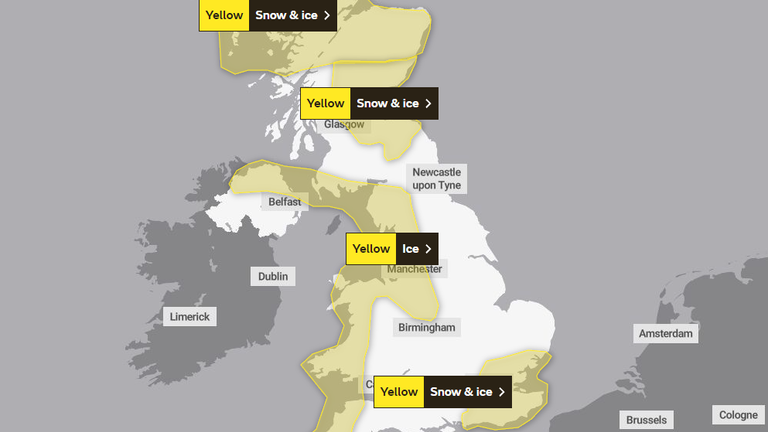
Southeast England has been covered by a yellow weather warning for snow and ice on Sunday and Monday.
The western coast of England, Wales, and the north of Northern Ireland have warnings for ice on Saturday and Sunday.
Scotland, apart from the southwest, has a yellow warning for snowand ice covering Saturday and Sunday.
Suella Braverman, the home secretary, has urged people to reconsider travelling during the Christmas seasonas Border Force employees join a number of other groups in discussing industrial action over pay and conditions.
The home secretary has advised people to “think carefully” before booking a trip over the Christmas holiday after Border Force employees became the latest to announce they would go on strike.
Suella Braverman warned of “undeniable, serious disruption for the many thousands who have holiday plans” and urged people to reconsider travelling during the holiday season.
“I really want to urge people who have got plans to travel abroad to think carefully about their plans because they may well be impacted,” she said.
“Ultimately, I’m not willing to compromise on security at the border – that’s the number one priority.
“So that may well have an adverse impact on convenience for people, frankly, whether it’s the time that they may have to wait for flights or departures.
“They may well be delayed on arrivals and various travel plans.
“Ultimately, security at the border is my number one non-negotiable priority.”
Border Force strikes will take place between 23-26 December, and from 28 to 31 December, impacting Birmingham, Cardiff, Gatwick, Glasgow, Heathrow and Manchester airports, as well as the Port of Newhaven.
Manchester Airport has warned some cancellations are likely, while long queues at immigration are expected.
Downing Street has said anyone due to fly over the Christmas period should check with their airline for the latest information “because sadly there will be disruption”.
A spokesperson added that they were “not aware of any plans” to reduce border checks, saying: “Public safety is paramount.”
The Border Force walkouts join a raft of strikes that are set to hit festive travel, with industrial action organised by train, bus and road workers in the run up to Christmas and throughout the holiday season.
Ministers ‘have torpedoed’ strike talks
The warning from the home secretary comes as the boss of the rail union accused the government of “sabotaging” negotiations aimed at stopping the disruption.
Mick Lynch, the general secretary of the RMT, told Sky News that ministers have “torpedoed” talks between train operating companies and workers taking industrial action over pay and conditions.
Image: RMT general secretary, Mick Lynch
Mr Lynch said that after months of negotiations, rail companies had put together a document and a set of pay scales they wanted the RMT to consider “and we would have done that”.
“But at the last moment, including last night around about six o’clock, the government decided that they would not allow the railway companies to make that offer and instead instructed them to prepare for the strike,” he said.
“In fact, they sabotaged and sunk the negotiations just as they were reaching the point of conclusion,” he said.
He accused Transport Secretary Mark Harper of “obstructing talks” and also pointed the finger at Business Secretary Grant Shapps, as well as the Treasury.
“I meet with the most senior people on the railway and I’m on the phone to them constantly. They are telling me they’ve got a document ready to go.
“They’ve shown it to me and they’ve shown it to my negotiators and the government has stopped them putting that document forward.”
Mr Lynch said “somebody” in government has put driver-only operation back on the table and into the documents when “they know we can never accept that as a principle”.
Mr Harper was asked about this during an appearance in front of the Transport Select Committee on Wednesday and did not explicitly deny that this is what happened.
It means a series of rail strikes are set to go ahead on the 13, 14, 16 and 17 December, and from 6pm on Christmas Eve to 6am on 27 December, as well as on 3, 4, 6 and 7 January
Christmas strikes ‘really disappointing’
The picket lines are not limited to transport, with teachers, nurses and ambulance workers among others from the public sector taking action over pay and conditions.
The government has been criticised for failing to stop the strikes, with union bosses accusing ministers of stonewalling requests for meaningful pay talks.
Gillian Keegan, the education secretary, told Sky News that the strikes were “disappointing” but giving in to the union’s demands would cost the taxpayer £28bn and “you can’t spend your way out of inflation”.
She said “we do expect there will be disruption and delays” but 2,000 soldiers would be drafted in to help with Border Force roles and “we should be extremely grateful to them”.
With only one day left in December when there are no strikes – the 12th – it was put to the cabinet minister that general strikes bring down governments, as seen in the 1970s.
Ms Keegan said: “Well, I mean, that has happened in history for sure.”
However, she insisted the government was taking a “sensible and balanced” approach by not interfering in the pay negotiations, saying the disputes were between “unions and the paymasters”.
Government ‘failing to get a grip’
Unions are demanding pay rises above or in line with inflation as the UK is gripped by a recession and the cost of living rises.
Labour’s shadow chief secretary to the Treasury, Pat McFadden told Sky News the government is “failing to get a grip” on the strikes, adding: “Even when we don’t have strikes, public services are not working properly, I can scarcely think of a public service in this country that works better after 12 years of Conservative government than what before they came into office.
“That is a damning indictment of their period of stewardship.”
Prime Minister Rishi Sunak has promised “tough” new laws to limit the impact of strike action, and has not ruled out banning strikes in the emergency services.
Government ‘working at speed’ on strike legislation
Downing Street said the government is “working at speed” to bring in new legislation, though a spokesman on Thursday stressed that nothing has been confirmed.
Any new measures will put them on a collision course with unions, who say the mooted proposals are anti-worker.
Sharon Graham, general secretary of the Unite union, told the PM on Wednesday “we are ready industrially and financially” to challenge any new measures.
In a joint letter to Chancellor Jeremy Hunt, union heads accused ministers of “ignoring the main issue on the table” that is causing the strikes – public sector pay.
Highlighting “huge” pay cuts public sector workers have suffered, the union leaders warned: “With CPI inflation over 11% and RPI inflation above 14%, frontline workers are facing another massive real-terms hit to their wages.
“Nurses, ambulance staff, teachers and millions of other key workers have already seen their living standards decimated with over a decade of pay cuts and wage freezes.
“Nurses today are earning £5,000 a year less in real terms than they were in 2010 and hospitals and schools are having to set up food banks for staff. This cannot go on.”
In anticipation of the February 25, 2023 presidential elections, Chatham House, a significant policy institute and think-tank forum, has invited Peter Obi of the Labour Party (LP) to speak about his ideas for Nigerians.
Obi, a former governor of Anambra State, is anticipated to attend the event in London, United Kingdom, on January 16, 2023. This gathering and its associated products are just one of many that focus on the 2023 elections in Nigeria.
On December 5, 2022, Bola Tinubu, an All Progressives Congress (APC) rival of Obi’s, gave a speech at Chatham House in London where he discussed some of his ideas for crucial areas like technology, education, the military, and the economy.
Bola Ahmed Tinubu
As part of the event, which drew harsh criticism, Tinubu also assigned some of his loyalists, including governors and MPs now in office, to respond to questions from attendees.
Obi, Tinubu and Atiku Abubakar of the Peoples Democratic Party (PDP) are the leading candidates in the 2023 presidential race.
One woman is running for president of Nigeria out of the 18 candidates, but experts says she has no chance of winning, and neither do the other 13 contestants.
According to the majority of analysts, only four candidates; Bola Tinubu of the All Progressives Congress (APC), Atiku Abubakar of the main opposition People’s Democratic Party (PDP), Peter Obi of the Labour Party (LP), and Rabiu Musa Kwankwaso of the New Nigeria People’s Party (NNPP), have a chance of winning or influencing the outcome of the presidential election in February 2019.
Peter Obi is the youngest of the four at 61 years old, despite the call for leaders from a younger age. They are all familiar with one another and with Nigerian politics.
Liz Truss resigned after just 44 days as a result of the Tory MP’s mini-budget statement,which caused one of the most turbulent economic periods in modern history.
Former chancellor Kwasi Kwarteng has accepted that he and Liz Truss “blew it” by instituting extensive economic reforms and “got carried away.”
The Conservative MP called their low-tax, small-state plans “very exciting” and said he fully supported them, but he also acknowledged that the way they were carried out was their downfall.
The markets crashed after Mr. Kwarteng announced his “mini” budget just 17 days after Ms. Truss appointed him chancellor, forcing him to resign before Ms. Truss was also forced to resign.
“It was very exciting, you felt you were part of a project,” he told the FT Weekend Magazine.
As soon as she became PM, Ms Truss said she did not want any opinion polling as she felt politicians were obsessed with “optics”.
Despite advisers warning her and Mr Kwarteng that their plans would be seen as a “budget for the rich”, they were ignored.
Mr Kwarteng added: “People got carried away, myself included. There was no tactical subtlety whatsoever.”
He still believes the goal was correct but admitted: “Where we fell woefully short was to have a tactical plan.”
As the economic turmoil continued, despite the government U-turning on some of the recently announced policies, Mr Kwarteng went to IMF meetings in Washington as he did not want to cause more panic by not attending.
But he was called back early after, he and his allies believe, Cabinet Secretary Simon Case managed to persuade Ms Truss she had to reverse some of the measures to avoid economic ruin.
When Ms Truss told him he could no longer be chancellor on 14 October, he says he told her: “I know, I’ve seen it on Twitter.”
Mr Kwarteng said he warned her he was a “firebreak” and getting rid of him would “make her weaker, not stronger”.
“She said she was doing this to save her premiership,” he told the FT.
Last month, Mr Kwarteng said he and Ms Truss are still “friends”.
The frigid weather will last until the following week. While this is going on, weather experts are predicting that snow could fall in the South East of Englandon Sunday night and into Monday morning.
Parts of southern England could experience snowfall in the coming days as forecasters warn that the Arctic blast will last into next week and cause temperatures to drop as low as -15C.
A yellow snow and ice warning has been issued by the Met Office for London and the South East from 9 a.m. on Sunday to 9 a.m. on Monday, stating that two to five centimetres of snow, and even up to 10 cm in some areas, may fall during that time.
“Snow may push in across parts of east and southeast England, leading to a risk of travel disruption especially on Monday morning,” it said.
Image:Met Office warnings for Sunday
Spokesman Grahame Madge said: “The outlook for the UK remains cold at least for the next seven days, with the potential for this to continue even longer.”
Temperatures dropped as low as -9C (15F) in Benson, South Oxfordshire, overnight, and Sky News weather producer Joanna Robinson said -15C could possibly be reached in Scotland where there is snowfall and clear skies over the coming week.
The Met Office had already issued several yellow weather warnings for snow and ice which are in place for parts of Scotland, Northern Ireland, Wales and South West England.
In addition, the UK Health Security Agency has issued a level three cold weather alert covering England until Monday – and says vulnerable people should heat their homes to at least 18C, wear extra layers of clothing, and eat hot food to protect themselves.
As parts of the UK are hit by freezing conditions, those on the lowest incomes in England and Wales will receive a £25 cold weather payment.
The winter payments are triggered for eligible households where the average temperature has been or is forecast to be 0C or below over a period of seven consecutive days.
Robinson said further wintry showers into next week will bring icy stretches, with conditions reaching well below freezing.
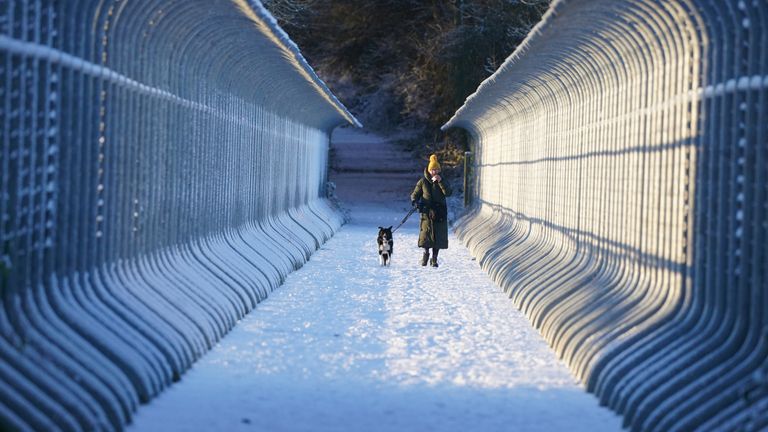
Image:Consett, County Durham, on Friday
She said: “The Arctic air is across us now, bringing wintry hazards that could last for most of next week, but there will be plenty of sunshine.
“Like recently, temperatures will widely drop below freezing at night, reaching -4C to -8C under clear skies, and -10C is likely in some prone cold spots.
“And it’s staying cold in the day, with temperatures generally 2C to 4C, but freezing in some places.
“Disruptive freezing fog is looking increasingly likely over the weekend, especially in the south.”
Image:Castleside Viaduct in Durham on Friday
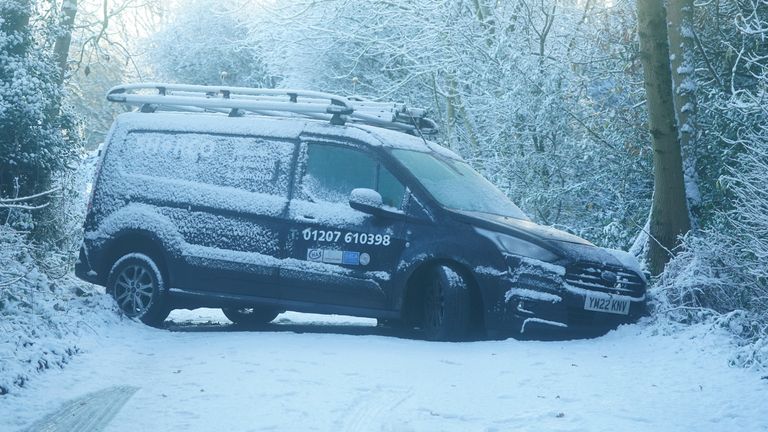
Image:A van in the snow in Castleside, Durham
The Met Office has extended a yellow weather warning for snow and ice in northern Scotland until 12pm on Sunday.
It warned some disruption is likely due to icy surfaces in coastal and northern England and parts of Wales and Northern Ireland where yellow warnings for ice have been issued for Friday.
The icy conditions in coastal England and parts of Northern Ireland and Wales are expected to continue into Saturday.
The forecaster’s meteorologist Alex Deakin said earlier this week there was a potential for “significant” snow in parts of England and Wales in a predicted weather model for next week, which shows a low pressure system heading towards the UK.
He added: “The weather patterns don’t shift too much by the time we get to Monday, we’ve still got the cold air in place, cold weather fronts around, some freezing fog and some ice as well.”
The government is considering tough new laws amid the winter’s strikes, according to Rishi Sunak.
The legislation, which unions claim is anti-worker, is anticipated to include a ban on strikes from all blue light services and minimum service levels for public services.
Mr Sunak said: “I’m not going to get into details now, we’re looking at all options.
“But what I can say is my priority is to always be reasonable – and that’s what we’re going to continue to do – but also to make sure we protect lives and minimise the disruption to people’s lives.”
He added: “We’re looking at everything right now at pace but my priority is going to be to protect lives and to minimise the disruption on people’s lives.
“So the government is trying its best to act reasonably, that’s why we’ve accepted in full the recommendations of independent bodies who make recommendations to the Government about pay settlements in the public sector, and often those pay settlements have been higher than what many people in the private sector are receiving, but the government accepted them in full to be reasonable, to be fair.
“But it’s right now that we also look to minimise the disruption on people’s lives and that’s why we’re looking at tough new laws.”
Scotland Yard describes the situation as “deeply worrying” and acknowledges the fret it will bring to the public and other members of the UK’s largest force. It also notes that the officer was suspended right away.
Two counts of rape have been brought against an officer with the Metropolitan Police.
After being detained on suspicion of rape on September 5th, PC Rupert Edwards was released on bail and placed on administrative leave.
On Thursday, he was taken into custody once more on rape suspicion.
The 29-year-old has since been accused of two counts of rape and will make his court appearance later today while still being held in custody.
The 29-year-old has since been charged with two counts of rape and is due to appear in custody at Westminster Magistrates’ Court later today.
Commander Jon Savell, in charge of the Met’s professionalism command, said: “This news is deeply worrying and I recognise the concern it will cause the public and other police officers.
“We took immediate action to suspend PC Edwards from duty when he was first arrested in September.
“Legal proceedings are now active and it is important that I do not comment while that process takes place.”
The charges relate to two women aged in their 20s and 30s, who are being supported by specially trained officers.
The offences are alleged to have occurred in Lambeth, south London, on 26 August, and in Surrey on 5 September, while the officer was off-duty.
The Scottish Parliamentis about to pass a new law that will make it easier for anyone in Scotland who wants to change their gender to do so legally.
The likelihood that the UK government will reject it, however, raises serious concerns for those who would like to relocate elsewhere in the country.
Since 1998, MPs in Westminster have made some laws that are applicable in Scotland, while MSPs in Edinburgh have made others.
The timeline for obtaining a gender recognition certificate, a document that enables someone to change their gender on their birth certificate, will be shortened by legislation currently before the Scottish Parliament.
Gender recognition certificates allow people to change certain legal documents, and can affect areas such as entitlement to benefits and pensions.
The legislation is currently making its way through the Scottish Parliament and is likely to pass later this month.
UK government ministers are responsible for the law in this area in England and Wales, and have no plans to move in the same direction as the Scottish government.
A UK government source close to the process told the BBC this was “absolutely” possible.
The Westminster government is also not ruling out the prospect of a legal challenge once the legislation is passed by MSPs – it believes the new law may have an impact on areas where policy is decided in London.
Asked if there could be a legal challenge to the Scottish legislation, the source told the BBC “nothing can be ruled out”.
Scottish government ministers have said they are happy to meet their UK counterparts to discuss their concerns – and officials in Edinburgh said they had tried to set up talks in October, without any response.
The SNP-led government believes the bill involves powers held solely in Edinburgh, so the UK government would not have grounds to mount a legal challenge.
Equalities Secretary Kemi Badenoch has written to the Scottish government expressing concerns about the Scottish legislation, and has offered to meet Scottish ministers to discuss it.
‘Nasty Westminster’
A UK government source told the BBC that they had concerns people from elsewhere in the UK may relocate to Scotland to change gender.
And they claimed Scottish ministers wanted to paint Scotland as a “haven of inclusivity” in comparison to a “nasty Westminster”.
The source described the Scottish legislation as a “test case scenario” of how a bill passed by the Scottish Parliament could “undermine Westminster competencies” – in other words, handing Holyrood powers outside Scotland.
A separate UK government official told the BBC there was “genuine concern” about the impact the legislation could have across the rest of the UK. They added that they hoped a legal battle could be avoided.
Scottish Social Justice Secretary Shona Robison has said she would be “happy to meet with Ms Badenoch” to discuss the issue.
The most recent UK Health Security Agency statistics indicate that ,fifteen children have died in the UK as a result of invasive strep A infections since September.
One child died in Wales, and another died in Northern Ireland. There have been no confirmed deaths in Scotland.
There have also been 47 adult deaths from strep A in England.
Most strep A infections are mild, but the number of more severe invasive cases, while still uncommon, is increasing.
Experts advise anyone who is experiencing symptoms to seek immediate medical attention.
Strep A infections typically peak in the spring, but data show that cases are increasing earlier than usual this year.
The UKHSA says the last time there was a significant number of cases was in the 2017/18 season when there were 27 deaths in children under 18 in England and 328 adult deaths.
Seasons with high cases can occur every three to four years. But social distancing measures during the pandemic may have interrupted the cycle and that could help explain the recent increase, UKHSA experts say.
So far, since September, there have been 85 cases of invasive strep A inchildren aged one to four in England and 60 in children aged five to nine.
The majority of cases are in people over 45.
Dr Colin Brown, deputy director of the UKHSA, said: “We know that this is concerning for parents, but I want to stress that while we are seeing an increase in cases in children, this remains very uncommon.
“There a lots of winter bugs circulating that can make your child feel unwell, that mostly aren’t cause for alarm.
“However, make sure you talk to a health professional if your child is getting worse after a bout of scarlet fever, a sore throat or respiratory infection – look out for signs such as a fever that won’t go down, dehydration, extreme tiredness and difficulty breathing.”
Infections caused by strep A are usually mild, with symptoms like a sore throat or skin infections.
The bug can also cause scarlet fever – with a sore throat, skin rash that feels like sandpaper, a high temperature and a so-called “strawberry tongue”.
It is treated with antibiotics which may also help reduce the risk of complications and spread of the bug.
However, in a very small number of cases, strep A can get deeper into the body – for example, into the lungs and bloodstream – causing invasive Group A Streptococcus (iGAS), which needs immediate medical attention.
UKHSA experts say there is currently no evidence of a new strain of strep Acirculating.
What should parents do?
Trust your judgement if your child seems seriously unwell.
Contact NHS 111 or your local surgery if they:
are getting worse
are eating much less than normal
show signs of dehydration, such as a dry nappy for 12 hours
have a temperature of 39C or higher, or 38C if under three months old
are a baby and feel hotter than usual when you touch their back or chest or sweaty
are very tired or irritable
Call 999 or go to an accident-and-emergency unit if:
they are having difficulty breathing – you may notice grunting noises or their stomach sucking under their ribs
they are pausing when they breathe
their skin, tongue or lips are blue
they are floppy and will not wake up or stay awake
The administrative court of London rejected, on Monday, the petition of a British NGO (WSC), working on behalf of the “polisario”, which challenged the association agreement between Morocco and Great Britain.
With this verdict, the British justice confirms the validity of the partnership agreement between Morocco and the United Kingdom, which fully benefits the populations and the development of all the regions of the Kingdom, from north to south, without exception.
This judgment thus inflicts a new setback on the enemies of the territorial integrity of the Kingdom, who are trying to hide their repeated failures by trying in vain to convince the British justice to re-examine the post-Brexit trade agreement, signed and supported by the two Kingdoms.
As soon as the verdict became known, the British government reaffirmed its commitment to continue the partnership with Morocco.
“We welcome today’s verdict. We will continue to work closely with Morocco to maximize the £2.7 billion of trade between our countries,” said a spokesperson for the UK Department for International Trade.
“We look forward to continuing our exchanges with our Moroccan counterparts through the Association Council next year,” he assured.
The Morocco-UK Association Agreement, signed in London on October 26, 2019, entered into force on January 1, 2021.
The Agreement restores, within the framework of bilateral relations, all the effects that the two countries granted each other under the Morocco-EU Association Agreement.
It thus ensures the continuity of trade exchanges between Morocco and the United Kingdom after December 31, 2020.
By allowing the two Kingdoms to settle definitively in a structured strategic partnership, endowed with operational and institutionalised cooperation instruments, and driven by a common ambition, the Agreement constitutes a guarantee for Moroccan and British companies undertaking economic and trade relations in all sectors of cooperation and covering the whole of the Kingdom.
Ghana and the British government are poised to sign a nurse-for-cash contract.
Health Minister Kweku Agyeman-Manu stated on the floor of parliament on Monday, 5 December 2022 during a discussion of the 2023 budget that each nurse Ghana sends to the UK will likely cost the West African nation £1,000 once the arrangement is finalized.
In accordance with a previous agreement reached between the two nations, nurses from Ghana are already being dispatched to Barbados.
“Mr. Speaker, as you are aware, we have begun sending our nurses abroad on a bilateral basis, and the second cohort of nurses has been dispatched to Barbados as a result of the agreement we struck with that country.
Why would they come for both, Mr. Speaker?
Now that we’re hearing about it in Barbados, patients are asking for Ghanaian nurses to be by their bedsides, and I think that’s good news for us,” said Mr. Agyeman-Manu.
“And, out of these nurses, Ghana is going to benefit from some little monies that the UK government will pass on”, he noted, explaining: “For every single nurse that goes away – when we finish the agreement – it’s likely we’ll get a £1,000 to come back to support our health system”.
Ninety-five Ghanaian nurses (49 women and 46 men) on Thursday, 30 July 2020 arrived in Barbados on an Azores Airlines chartered flight for a two-year contract.
They were to help the Caribbean country’s healthcare system.
In March 2022, the Prime Minister of the Island nation, Mia Motley, said during Ghana’s 65th independence anniversary in the Central Region, at which she was the special guest of honour, that: “I stand here on your Independence Day to thank the people of Ghana for being able to support us in our need for nurses, with the first 95 nurses having gone to Barbados in July 2020.”
“We thank you, the government of the people of Ghana, for that most generous gesture, and we are heartened that they have made a huge difference to our public healthcare system; so much so that we have completed an interview for another 200 nurses to come to Barbados in the near future,” she added.
In November 2019, the Foreign Ministers of Ghana and Barbados, on behalf of the governments and peoples of their respective countries, signed an agreement for the recruitment of a total of 120 nurses from Ghana to complement the staffing needs of the island nation.
The agreement was signed on Friday, 15 November 2019 at Ghana’s Jubilee House, when the Prime Minister of Barbados, Mia Mottley, paid a courtesy call on the President of the Republic of Ghana, Nana Addo Dankwa Akufo-Addo, as part of her official visit.
The objective of the agreement is to provide the framework for the provision of nurses by the Republic of Ghana to Barbados, taking cognisance of the existing commitment of Barbados to accepted international workforce policies and practices, as well as the International Council of Nurses (ICN) Code of Ethics for nurses.
The scope of services and responsibilities include Ghana providing registered nurses to Barbados with a level of expertise as agreed to by both countries, with Barbados providing Ghanaian nurses safe and secure working conditions for professional practice, and medical treatment where needed.
Remuneration is commensurate with the terms and conditions of Barbadian local registered nurses. Barbados is also to provide professional support to Ghanaian nurses to comply with the guidelines and rules of the Nursing Council of Barbados.
A total of 150 short-listed candidates underwent interviews, out of which 120 were to have been chosen.
The qualified nurses possess a minimum of three years of experience, with specialities in the following areas: critical care, cardiac catheterisation, emergency room, operating theatre, and ophthalmology.
It will be recalled that on 15 June 2019, during an official visit to Barbados, as part of activities to promote the declaration of 2019 as the Year of Return, President Akufo-Addo, in principle, agreed to a request by Prime Minister Mottley to send some nurses to work in a number of medical facilities in Barbados.
Addressing a press conference in the aftermath of the bilateral discussions, and with Barbados facing an acute nursing shortage, the Barbadian Prime Minister stated that “we have indicated that we are searching for just under 400 nurses, so it is not a small number, and we really do believe that this is a wonderful opportunity of co-operation between our two countries.”
In addition, she noted that there was also an initial promise to secure the nurses and provide joint education programmes going forward, all in an attempt to secure Barbados’ healthcare sector.
For his part, President Akufo-Addo indicated that “we have a surplus of nurses in Ghana, and placing them all in our public health system is one of my headaches. There have been a lot (of nurses) produced, which, for several years, we have not been able to do anything with.”
He continued, “So, I am going back. I will be back in Accra on Monday, and, the week after, the Prime Minister will hear from me on this matter of nurses.”
The UK is “sleepwalking” into a food supply crisis, according to the National Farmers Union (NFU), and the government must intervene to assist farmers.
Tomato and other crop yields are expected to fall to record lows this year, with potential supply issues ahead, as seen with eggs.
Farmers were under severe strain as a result of rising fuel, fertiliser, and feed costs, according to the report.
The government, however, stated that the UK has a “highly resilient food supply chain.”
Some supermarkets are restricting egg sales after farmers reduced or ceased production due to rising costs, a situation exacerbated by the Avian flu outbreak.
The NFU, on the other hand, warned that food producers in other areas were now facing difficulties.
It said yields of energy-intensive crops like tomatoes, cucumbers and pears were likely to hit their lowest level this year since records began in 1985.
It also said milk prices were likely to fall below the cost of production, while beef farmers were considering reducing the number of cows they breed.
Rising costs were to blame, it said, with fertiliser prices for farmers more than tripling since 2019 and the cost of feed and diesel up by 75%.
Wholesale gas prices have also jumped more than six-fold in that time, and businesses importing food items from Europe have faced extra red tape and checks because of Brexit.
“Shoppers up and down the country have for decades had a guaranteed supply of high-quality affordable food produced to some of the highest animal welfare, environmental and food safety standards in the world,” said NFU president Minette Batters.
“But British food is under threat… at a time when global volatility is threatening the stability of the world’s food production, food security and energy security.”
“I fear the country is sleepwalking into further food supply crises, with the future of British fruit and vegetable supplies in trouble,” she added.
But Andrew Opie, director of food and sustainability at the British Retail Consortium, said that retailers were used to managing pressures across their supply chains.
“Supermarkets source, and will continue to source, the vast majority of their food from the UK and know they need to pay a sustainable price to farmers,” he said, although they are facing additional costs.
Costs challenge
The war in Ukraine and the coronavirus pandemic have driven up the price of food, energy and fuel over the last year, affecting consumers and businesses alike.
Grocery prices are rising at their fastest rate for 45 years, the latest official figures show, with the cost of staples such as milk, cheese and eggs surging.
Steve Dresser, the boss of Grocery Insight, told the BBC that the big challenge comes from consumer appetite.
“[The] customer’s focus is on saving money and local foods generally come at a higher prices, which can be difficult,” he said.
He said that rising prices meant farming “has taken a real battering this year”, and added that “food security is increasingly important, as we saw during lockdown restrictions and indeed the period afterwards that led to empty shelves.”
“It’s clear that we facing real challenges in our supply chain and as a nation, we should be looking to back our farming community, especially as Brexithas made things harder around importing foods.”
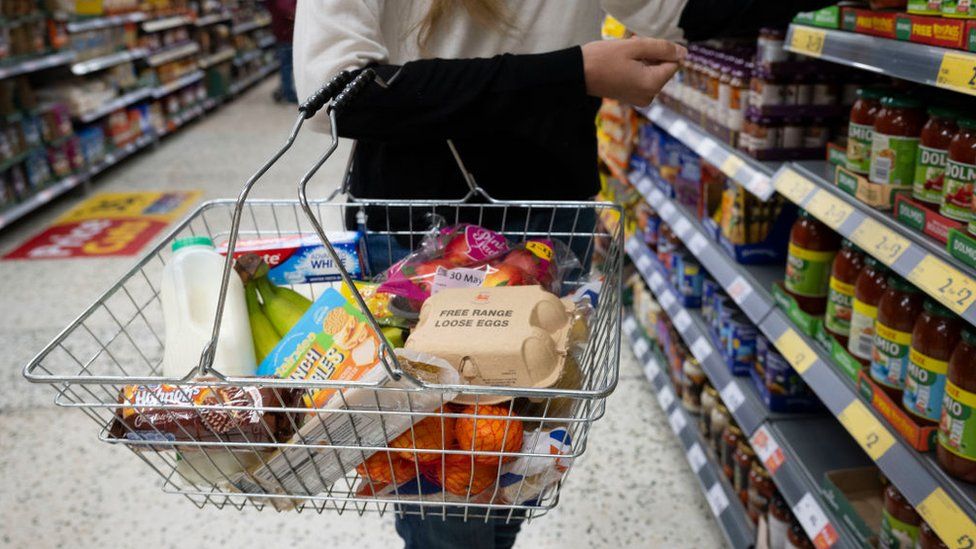
IMAGE SOURCE,GETTY IMAGES
The NFU also called on the government to do more to help farmers who have been pushed out of business since the pandemic hit.
It said there were currently 7,000 fewer registered agricultural businesses in the UK than in 2019.
The NFU wants the government investigate whether an “exceptional market conditions” declaration should be made under the 2020 Agriculture Act, given the disruption egg producers and UK consumers are facing.
This would enable the Department for Environment, Food and Rural Affairs (Defra) to provide support to egg producers whose livelihoods are under threat.
It also wants ministers to lift a cap on seasonal overseas workers and establish a new “food security” target, which would include an obligation to monitor and report on domestic food production levels.
A Defra spokesman said: “Our high degree of food security is built on supply from diverse sources; strong domestic production as well as imports through stable trade routes.”
He added that the government is in touch regularly with farmers and that the food and farming minister will meet with businesses in the egg industryon 6 December.
The new legislation will also allow workers to work for multiple employers by removing exclusivity clause restrictions.
Workers in the United Kingdom will soon be able to request flexible working from their first day on the job, thanks to new government plans.
Employees will no longer be required to wait 26 weeks before requesting flexible working arrangements under legislation currently being debated in parliament.
Before rejecting a request, employers must consult with employees and discuss alternative options. The time limit for employers to respond to a request has also been reduced, from three to two months.
Such flexible work arrangements can include working altered hours, job sharing or working remotely. Two requests can be made within a 12-month period as part of proposals.
Under the existing legal framework, employees must set out theeffects of the requested flexible working arrangement to their bosses. But this is also to be removed by the proposed legislation.
The move comes as the government responds to the making flexible working the default consultation, set up last year to reform flexible working regulations.
It’s hoped the proposals will make for happier, more productive workers.
Clauses which limit workers doing jobs for multiple employers are also to be prohibited for low paid workers.
So-called exclusivity clauses are to be removed for an estimated 1.5 million workers with a guaranteed weekly income at or below £123, the lower earnings limit. When implemented, the legislation will allow workers to take up multiple short-term contracts.
It’s hoped this will particularly benefit students or people with caring responsibilities who need more flexibility over where and when they work.
It’s also hoped the measures could add more workers to the employment market and make it easier for employers to hire staff as the number of jobs outstrips the number of available workers.
There has been an increase in “economic inactivity” since the pandemic as the number of people neither working nor seeking work has risen to more than nine million people, one-in-five working age adults.
A mental health crisis is also causing workers to drop out of the labour market and fuelling staff shortages.
HSBChas announced plans to shut a further 114 UK branches.
The UK-based but mainly Asia-focused bank said the sites affected would be shut from April next year.
The decision, as the wider banking sector has consistently claimed over many years, is the result of the surge in online banking which has led to declining demand for over-the-counter transactions.
The Duchess of Sussexfaced “disgusting and very real” threats while working as a royal, according to the outgoing Metropolitan Police assistant commissioner.
Neil Basu stated that he could understand Meghan feeling “under threat all the time.”
People have been charged in connection with the threats, he told Channel 4 News.
Prince Harry, who will move to California with Meghan in 2020, stated last year that he did not feel safe in the UK.
The couple have often spoken about the abuse they received before they left and how it affected their mental health. As early as 2016, after the couple went public with their relationship, Prince Harry issued a statement attacking social media trolls for targeting Meghan.
Neil Basu – the former head of counter-terrorism policing in England – was speaking to Channel 4 News in his final interview as assistant commissioner.
“If you’d seen the stuff that was written and you were receiving it, the kind of rhetoric that’s online, if you don’t know what I know, you would feel under threat all of the time,” he said.
When asked if there had been genuine threats to Meghan from the far-right, he added: “Absolutely.
“We had teams investigating it. People have been prosecuted for those threats.”
He said he had previously spoken publicly about the threat of “extreme right-wing terrorism”, saying it was the “fastest growing” threat that he dealt with.
“When I started in counter-terrorism in 2015, it was about 6% of our total workload. When I left 15, 16 months ago, it was over 20% of our workload.”
Mr Basu, who is Britain’s most senior officer of colour, was also in charge of royal protection.
He added: “I speak about race because I know something about race because I’m a 54-year-old mixed-race man.”
Mr Basu also criticised the government during his interview, saying he found “some of the commentary coming out of the Home Office inexplicable”.
He had been asked about comments by Home Secretary Suella Braverman saying that it was her “dream” to see asylum seekers removed to Rwanda under the government’s policy.
“It is unbelievable to hear a succession of very powerful politicians who look like this talking in language that my father would have remembered from 1968. It’s horrific.”
In response to his comments, a Home Office spokesman said: “The Home Secretary expects forces to take a zero tolerance approach to racism within their workplace.
“But the Home Secretary is also very clear about the need to manage our borders effectively and have an asylum system that works for those in genuine need, as are the British people.”
The Duke and Duchess of Sussex stepped down as senior members of the Royal Family in 2020 to carve out their own path in the US.
After leaving the Royal Family, Meghan gave an Oprah interview in which she revealed she felt suicidal while a serving royal.
Harriet Thompson, United Kingdom (UK) High Commissioner to Ghana, has warned that over 70 per cent of cocoa lands in Ghana will no longer be suitable to grow the crop by 2050.
According to her, this will happen if temperatures continue to rise as is currently the case in the country.
The High Commissioner made these comments via a tweet on Tuesday, November 29 after she paid a courtesy call to the Minister of Food and Agriculture, Dr Owusu Akoto Afriyie.
Her visit to the minister was to enable the two deliberate on issues of relevance in the agriculture sector, especially on the subject of the United Kingdom Support Climate Smart Agriculture in Ghana.
“Over 70% of land currently used to grow cocoa in Ghana will not be suitable for that crop by 2050 if temperatures continue to rise as they are doing currently.
“Now is the time to adapt – and the potential to do so is great,” Harriet Thompson tweeted.
Abwbaker is the first suspect arrested in the United Kingdomafter 31 migrants drowned when their boat deflated and sank just two hours after leaving France.
He is the first suspect to be apprehended in the UK after 31 migrants drowned two hours after leaving France when their boat deflated and sank in darkness.
Due to emergency phone calls, it was unclear whether the lifeboat was in French or British waters.
The next day, 27 bodies were found, two people survived, and four are still missing.
He is the first suspect to be apprehended in the UK after 31 migrants drowned two hours after leaving France when their boat deflated and sank in darkness.
Emergency telephone calls led to confusion about whether the dinghy was in French or British waters.
A total of 27 bodies were recovered the next day, two people survived and four are still missing.
Soon after the tragedy, French authorities arrested five suspects and held fifteen more in June this year.
Abwbaker, whose photo has been blurred by the NCA due to legal concerns, is set to appear at Westminster magistrates on Wednesday morning on a French extradition warrant.
“This is a significant arrest, and comes as part of extensive inquiries into the events leading to these tragic deaths in the Channel,” said the agency’s deputy director Craig Turner.
This is what remained of the boat that capsized in the Channel
“The individual detained today is suspected of having played a key role in the manslaughter of those who died.”
He added: “Working closely with our French partners, we are determined to do all we can to get justice for the families of those whose lives were lost, and disrupt and dismantle the cruel organised criminal networks involved in people smuggling.”
Home Secretary Suella Braverman has said her thoughts are with the “families of those who tragically lost their lives” and thanked investigators for their “tireless work”.
The United Kingdom High (UK) Commissioner to Ghana, Harriet Thompson has indicated that by 2050, over 70 per cent of the lands in Ghana used to grow cocoa will no longer be suitable for that purpose.
She says this will happen if temperatures continue to rise as they are doing currently in the country.
Madam Thompson said this in a tweet on Tuesday November 29 after she paid a courtesy call on the Minister of Food and Agriculture Dr Owusu Akoto Afriyie.
The courtesy call was to enable the two of them deliberate on issues of relevance in the agriculture sector especially on the United Kingdom Support Climate Smart Agriculture in Ghana.
Madam Thompson said “Over 70% of land currently used to grow cocoa in Ghana will not be suitable for that crop by 2050 if temperatures continue to rise as they are doing currently.
“Now is the time to adapt – and the potential to do so is great.”
Over 70% of land currently used to grow cocoa in 🇬🇭 will not be suitable for that crop by 2050 if temperatures continue to rise as they are doing currently. Now is the time to adapt – and the potential to do so is great. https://t.co/FLNuE9NZhe
Rishi Sunak has declared that the so-called “golden era” of relations with China is over, vowing to “evolve” the UK’s approach to the country.
Mr Sunak said in his first foreign policy speech that the previous decade’s closer economic ties were “naive.”
The prime minister stated that the UK must replace wishful thinking with “robust pragmatism” in dealing with competitors.
However, he cautioned against “Cold War rhetoric,” adding that China’s global importance could not be overlooked.
Since taking office last month, Mr Sunak has faced pressure from Tory backbenchers to toughen the UK’s stance on China.
His speech, at the Lord Mayor’s Banquet in London, comes after protests in China over the weekend against the country’s strict Covid lockdown laws.
Police have made several arrests, and a BBC journalist was detained while covering a protest in Shanghai on Sunday. He was beaten and kicked by the police during his arrest and held for several hours before being released.
Mr Sunak told the audience of business leaders and foreign policy experts that, in the face of the protests, China had “chosen to crack down further, including by assaulting a BBC journalist”.
“We recognise China poses a systemic challenge to our values and interests, a challenge that grows more acute as it moves towards even greater authoritarianism,” he said.
He added that the “golden era” of UK-China relations was “over”, along with the “naïve idea” that more trade with the West would lead to Chinese political reform.
The phrase “golden era” is associated with closer economic ties under former Prime Minister David Cameron – but relations between London and Beijing have since deteriorated.
However, Mr Sunak stressed that “we cannot simply ignore China’s significance in world affairs – to global economic stability or issues like climate change”.
He added that the UK would work with allies including the US, Canada, Australia,and Japan to “manage this sharpening competition, including with diplomacy and engagement”.
“It means standing up to our competitors, not with grand rhetoric but with robust pragmatism,” he added.
Mr Sunak and Chinese President Xi Jinping were set to meet for the first time at the G20 summit in Indonesia earlier this month, but the encounter was cancelled following a missile blast in Poland.
Mr Sunak’s predecessor Liz Truss was reportedly planning to re-categorise China as a “threat” to the UK as part of a review of its foreign policy.
In his speech, Mr Sunak echoed the phrase used in the review – that China is a “systemic challenge”. He said there would be more details of the review in the new year.
The truth is, right now, we don’t know in practical terms what this new approach will actually amount to.
Mr Sunak is promising more detail in what is known as the Integrated Review – which will set out the UK’s national security and foreign policy – in the new year.
But we know already how China is now described: a “systemic challenge”.
The government hopes that people will understand that international relations, like any human relations, are complex and nuanced; that a binary approach, as they see it, would not be in the UK’s interests.
But for the prime minister’s critics, failing to describe Beijing as a “threat” is a big mistake.
But the “robust pragmatism” line in the speech was criticised by former Conservative Party leader Iain Duncan Smith, who is one of a number of backbenchers pushing for a tougher line.
Reacting to a preview of the speech, he wrote in the Daily Express that China had become a “clear and present threat to us and our allies”.
“I wonder if robust pragmatism now sounds more and more like appeasement,” he added.
Labour’s shadow foreign secretary David Lammy called the speech “thin as gruel”, accusing the government of “flip-flopping its rhetoric on China”.
Nigel Inkster, senior China advisor at foreign affairs think tank the International Institute for Strategic Studies, told BBC Radio 4’s Today programme he did not think the China-UK golden age “was ever real and substantial”.
He said: “It attempted to focus on economic relations with China while putting geopolitics to one side, and experience shows you simply can’t do that.
“China in its present form is here to stay for the foreseeable future, and I think the Marxist-Leninist dialogue is only going to increase so we are going to have to learn to get used to this.”
Elsewhere in his speech, Mr Sunak promised to continue support for Ukraine, adding: “We will stand with Ukraine for as long as it takes.”
He promised to “maintain or increase” British military aid to the country next year, and provide new air support to protect civilians and critical infrastructure.
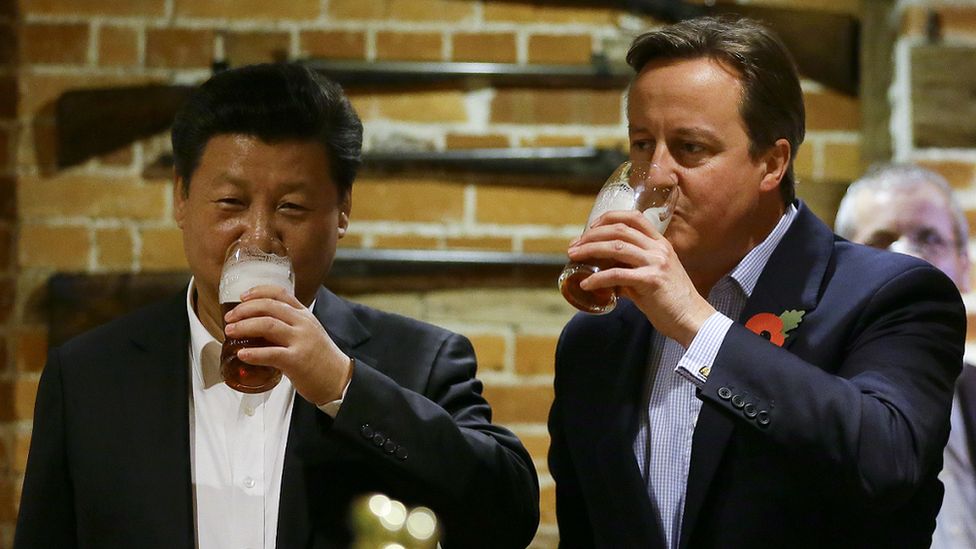
IMAGE SOURCE,GETTY IMAGES Image caption, China’s President Xi Jinping and former prime minister David Cameron drink a beer together during his state visit to the UK in 2015
Mr Sunak visited Ukrainian President Volodymyr Zelensky earlier this month, in his first visit to Kyiv since entering Downing Street.
During the visit, he announced the UK would supply Ukraine with additional anti-aircraft guns and radars, and increase the training offer to Ukraine’s armed forces.
President Zelensky’s wife, Olena Zelenska, made her own visit to Londonon Monday where she spoke about sexual violence allegedly being perpetrated by Russian troops in Ukraine.
Seven-year-old Eric giggles, showing off a broad toothless grin, as he talks about space travelin the shade of a garden, surrounded by lush, thick forest, a few hours north of the Philippines’ capital Manila.
Eric dreams of flying a rainbow-coloured rocket to Saturn. He has just lost his baby teeth but he is small for his age. His white, checked shirt hangs off his tiny shoulders.
“What do you cry about during therapy?” his social worker asks him. “I cry about my parents,” he says, looking at the ground.
Fedalyn Marie Baldo has spent months with Eric, his 10-year-old sister Maria and two older brothers to help them understand that theirs is not a normal childhood.
For years, when their neighbourhood was asleep and much of the Western world was awake, all four children were forced to perform live sex shows for paedophiles around the world.
They were raped and repeatedly sexually abused on camera by their mother. Their father, aunt and uncle also took part.
It was the children’s father who eventually reported his wife and her family to the police, allegedly after a dispute. Investigators traced payments to the family from accounts in the UK and Switzerland.
Months later, Eric, his brothers and sister ended up at a home run by the charity Preda, which focuses on helping sexually abused children.
That has also been Ms Baldo’s job for 17 years. In that time, images and videos of child sexual abuse have ballooned into a billion-dollar industry in the Philippines, now the world’s largest-known source of such exploitation.
Grinding poverty, high-speed internet access and an ability to accept instructions in English have all kept it going.
Then came the pandemic. More than two years of lockdowns and some of the world’s longest school closures left vulnerable children stuck at home with cash-strapped parents desperate to make money.
A recent study by Unicef and Save the Children estimates that around one in five Filipino children are now at risk of sexual exploitation, putting the grim figure close to two million.
Ms Baldo fears that the abuse is becoming “normalised” in the Philippines and may become endemic in some of the country’s poorest neighbourhoods.
President Bongbong Marcos has declared an “all-out war” on child sexual abuse and the industry it has spurred. But so far, it’s a war the Philippines is not winning.
A global war
In Manila, as the clock ticks towards dawn, a team from the National Bureau of Investigation has gathered near a graveyard.
Flashlights are kept low, guns are loaded, cameras are ready to film evidence as the team leader gives a final briefing. They are under pressure to get results.
Amid the tombstones in this densely populated city, a family live among the dead. A 36-year-old mother is on her smartphone in a small wooden hut built against some of the largest monuments in the cemetery.
She thinks she is messaging a paying customer in Australia who is requesting a live sex show involving her three children. In truth, her texts are going to an undercover police officer.
As she switches on the camera, around a dozen officers rush through narrow paths to her door. The only warning is when the stray dogs start to bark.
She offers no resistance as a female officer takes the children to safety and others start to bag evidence: sex toys, smartphones, receipts detailing overseas payments.
As with many of these arrests, this one too is the result of a tip-off from abroad.
The Australian Federal Police told the BBC they caught a man at an airport with a storage device full of explicit child abuse videos. His phone allegedly contained messages between him and a woman in the Philippines requesting money in exchange for the videos.
The operation then took dozens of officers weeks to plan and led to two arrests. One in Manila and the other in Sydney.
Australian officials said they had recorded an increase of around 66% in reports of child exploitation in the last year.
They are working alongside teams from the International Justice Mission, the UK National Crime Agency and the National Police of the Netherlands, and officers in the Philippines, to try to find child sex offenders. Once they’ve identified them, they try to track down the source of the material.
But often, the only way the abuse is reported is when the child comes forward. And even then it’s a long road ahead.
Several social workers say they have to spend days, even weeks, pushing local police to rescue the children and file charges against the parents.
“Sometimes we get the co-operation of law enforcement authorities, other times the actions of people who are supposed to really protect children are delayed. But we have to work around it,” says Emmanuel Drewery from Preda.
Image source, Getty Images
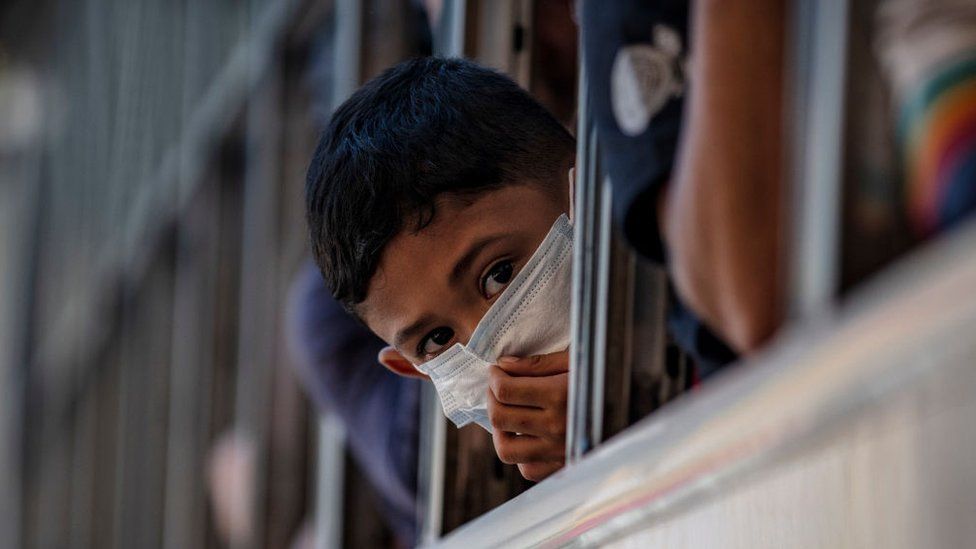
Image caption, One in five Filipino children are at risk from sexual exploitation
The organisation first set up a children’s home for girls back in the 1970s near the port city of Olongapo, once home to a large American naval base.
It had become a hub for sex tourism – illegal prostitution between foreign men and Filipina girls often still in their teens and trafficked into the industry, or young women pushed into the sex trade by family pressure and economic desperation.
Years on, social workers fear much of the sexual abuse here is generational, that many of the children’s mothers were also raped or sexually assaulted. They believe their view is: “It happened to me, I did this to survive and so must you.”
Father Shay Cullen, president of Preda, has been fighting for the rights of abused children in the Philippines since 1974. He wants a global solution to this new and growing problem.
“There has to be [an] international law. This is the only way. All national governments need to really put restrictions on the internet corporations. They must co-operate to restrict the passage of child abuse material and the online streaming of the sexual abuse of children.”
Things are changing, he agrees – but slowly.
But that’s only one part of the war. For organisations like Preda, the bigger battle lies in rehabilitating the children.
‘Why did you do this to me?’
Some of the toughest healing at Preda happens inside a dark room with soft music playing in the background.
There are large pads on the walls and floors – the kind gymnasts would use for a soft landing. The only light comes from the open door.
About five children are kneeling, each in their own space. Most of them are facing the wall.
The overwhelming sound is the erratic thud of their fists and feet as they pummel the pads.
Image caption, Eric says he enjoys power dance and therapy at the centre
The first raw, anguished cries make your heart stop. And then it starts again, but it’s difficult to keep listening, even from a distance, even for a few minutes.
The questions hurled at the cushioned walls – “Why did you do this to me? Why me? What did I do?” – are heart-breaking.
A therapist kneels quietly inside, ready to help.
“It all begins in the room,” says Francisco Bermido Jr, president of Preda.
“If they are able to confront the abusers in the ‘primal’ room, they can move on forward and confront these abusers in the court-room. These are emotions like hate towards their abusers, but also hate towards those they told, but who did not believe them.”
Preda has used this form of emotional release therapy – called primal – for decades to help children cope with the emotional impact of physical and sexual abuse.
But they are struggling for resources. Their centre near Manila can only afford to take around 100 children a year. But so many more need help.
Once a police report is filed, children can be sent to a number of homes or orphanages, but many don’t have the training or experience to care for children who have suffered abuse.
Eric’s older brother was first placed into a nearby orphanage without his siblings before he was moved to the Preda centre.
Social workers at the centre say that around 40% of abused children who’ve been in their care go on to live a life safe from harm. And every success keeps them going.
Routine helps. The centre offers a daily schedule of schoolwork, sports like karate and volleyball, storytelling sessions and, of course, therapy.
“I love karate, power dance and primal,” Eric shouts as he punches happily in the air.
He also enjoys singing – and he joins his friends in the playroom. When it’s his turn for a solo, he sings softly at first, then his confidence grows and his voice soars around the room.
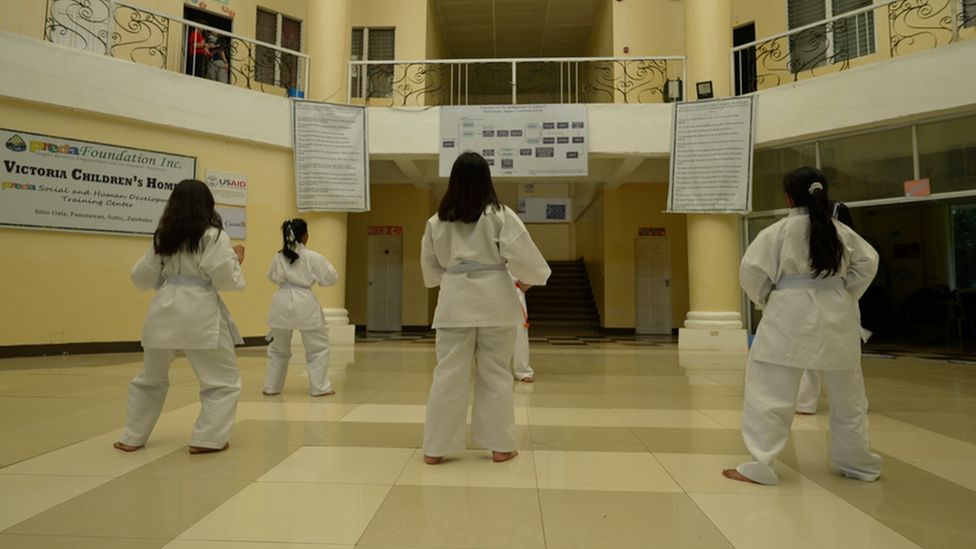
Image caption, Social workers say routine – and sports like karate – help the children heal
One of his older brothers is still too traumatised to talk. Their sister Maria, Ms Baldo warns, also speaks little.
But on that day, a beaming Maria, clinging to either her prized pencil case or a soft toy, was surprisingly curious and full of questions. She really wanted to know what a snowflake felt like.
“When they arrived, they were very meek and docile and untrusting of the world and of others,” Mr Bermido Jr says.
But months later, they are able to tell their story – every horrifying detail – to the social workers. All four children have also testified against their family, a requirement by Philippines’ courts.
“That’s actually very important because that’s where their quest for justice begins,” he adds.
Both Eric and Maria attend the group storytelling session. He sits next to her and absently curls his fingers around his sister’s ponytail.
Ms Baldo asks Maria about Cinderella, and she replies: “Cinderella did not give up even during hard times, even in the toughest situation, she still had hope,” she says, hugging her soft toy tighter.
“Just like us – even though our parents abused us, we should be like Cinderella.”
Following a significant increase in diphtheria cases this month, a vaccine programme has been expanded in migrant processing centres. According to the immigration minister, public health is the government’s top priority, and they are going above and beyond to keep cases from spreading.
Fifty recent arrivals in the UK have been diagnosed with diphtheria, according to the immigration minister.
Robert Jenrick told MPs that the number of cases has risen from four on November 1st, when he first provided an update, to 50 on November 25th.
He said the UK Health Security Agency (UKHSA) found the cases, which were across different asylum accommodations, had developed before the migrants had entered the UK, either in their country of origin or on their journey through Europe.
“It’s important to emphasise that the UKHSA has been clear that the risk to the wider UK population from onward transmission of diphtheria is very low, thanks in no small part to our excellent childhood immunisation programme,” he told the Commons.
He said “public health is paramount” and the government will take all steps necessary to ensure that the public are protected”.
The UKHSA said of the 50 cases, two were severe and required hospital admission and treatment with diphtheria anti-toxin and antibiotics.
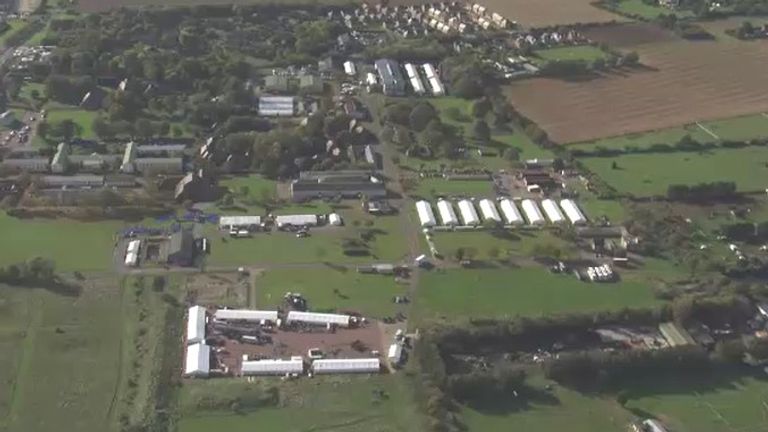
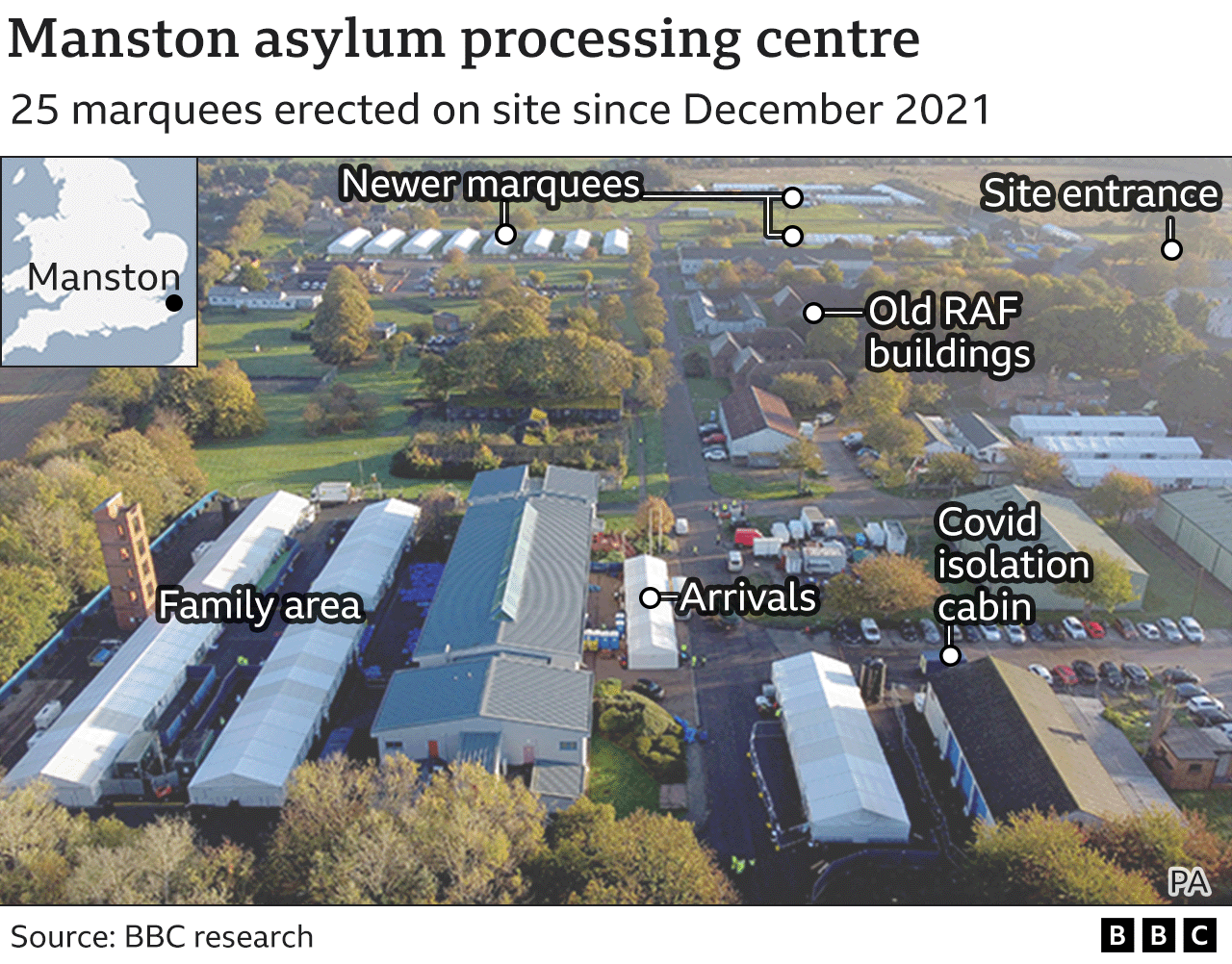
Earlier today the Home Office revealed 500 migrants at the Manston processing centre in Kent had been vaccinated against diphtheria before they were moved to further accommodation.
At the beginning of November, the centre was suffering from severe overcrowding, which is when reports of diphtheria cases were first made.
Sky News also revealed today a man who died after staying at Manston had the disease.
Mr Jenrick said initial tests on the man were negative but a subsequent PCR test showed he had diphtheria, however his cause of death is pending as the post-mortem results have not come through yet.
500 migrants vaccinated for diphtheria
The minister said migrants are being tested upon arrival in the UK and those with diphtheria are being isolated in a designated area.
People with symptoms are being tested, and also their close contacts, he said.
Mr Jenrick added that the measures “go beyond the baseline advice of the UKHSA because we want to take precautionary measures”.
All migrants who arrived at Manston this weekend took up the offer of the vaccine, which is voluntary, Mr Jenrick said.
When the government initially started offering the vaccine there was only around a 45% uptake but he said it is now 100%.
Mr Jenrick said the government will be liaising with the French to assess the diphtheria status in the migrant camps in northern France, where most stay before making the dangerous Channel crossing to the UK.
Image:The Manston processing centre in Kent was opened in February this year
Labour’s shadow home secretary Yvette Cooper asked what is happening with the “other several thousand” who have been moved on from Manston over the past month.
She raised concerns not enough has been done to stop diphtheria potentially spreading from those who have not been vaccinated as she said the public health recommendation to screen and vaccinate was made nearly three weeks ago “and that was already late”.
Ms Cooper also called on ministers to make sure all those with symptoms are given “precautionary antibiotics” to fight the disease”.
Mr Jenrick said the Home Office and the UKHSA are going to work with public health directors in areas where migrants are being sent to make they have the guidance to protect people from the disease.
Migrants who have been moved on and have diphtheria will be required to “isolate in their rooms within those hotels or other forms of accommodation”, he added.
They will get their food and laundry brought to their door until they are well again and if further measures are needed they will be implemented, he said.
The UK’s Ministry of Defence has said heavy fighting is taking place in Pavlivka and Vuhledar, two towns in eastern Donetsk province. There has been intense combat in the area over the last two weeks, it said.
“This area remains heavily contested, likely partially because Russia assesses the area has potential as a launch point for a future major advance north to capture the remainder of Ukrainian-held Donetsk Oblast,” the ministry said.
“However, Russia is unlikely to be able to concentrate sufficient quality forces to achieve an operational breakthrough.”
Latest Defence Intelligence update on the situation in Ukraine – 27 November 2022
Due to high-tech 3D scanners, security restrictions on liquids and laptops in airport hand luggagecould be eliminated in the UK within two years.
The government is considering deploying more advanced scanners by mid-2024, according to a source, though no final decision has been made.
The equipment, which is similar to CT scanners used in hospitals, provides a clearer picture of the contents of a bag.
Due to the pandemic, an earlier installation deadline was pushed back.
According to the Times, ministers have been conducting a review, and an announcement is expected before Christmas, with the hope of reducing queues at UK airports.
Currently, passengers taking liquid in their cabin baggage are restricted to clear plastic bags holding no more than 100ml, which must be shown to security staff in a single, transparent, resealable plastic bag of about 20cm (8in) x 20cm.
Those limits have been in place since November 2006. Their introduction ended a ban on liquids in the cabin imposed three months earlier, when British police said they had foiled a plot to blow up as many as 10 planes using explosives hidden in drinks bottles.
But the new technology enables staff to zoom in on a bag’s contents and rotate the images for inspection.
The 3D scanners have been trialled at London Heathrow Airport, starting in 2017.
Its chief executive, John Holland-Kaye, told The Times newspaper: “We are slowly rolling them out.
“We have just started the expansion of the security area in Terminal 3 which will have more CT scanners and have a deadline of mid-2024 from the [Department for Transport]. By then the normal passenger experience will be that liquids stay in bags.”
The technology has already been in use by US airports, such as Atlanta’s Hartsfield-Jackson and Chicago’s O’Hare, for a number of years.
Former Prime Minister Boris Johnson made a pledge to use the scanning technology to speed up pre-boarding checks and improve security, giving UK airports a deadline of the end of 2022.
But passenger numbers were dented during the pandemic with travel restrictions in place across much of the globe.
The latest figures from the International Air Transport Association for September show that passenger traffic levels have only reached 73% of pre-Covid levels.
A spokeswoman for the Department for Transport said: “Passengers at UK airports must not carry liquid containers larger than 100ml through security, and both liquids and electronics should be taken out of cabin bags at airport security checkpoints.”
Boris Johnson’s claim that Germanywanted Ukraine to “fold” in its war with Russia is “utter nonsense”, a German government spokesman has said.Earlier today, the former prime minister claimed other European nations took very different views on the war in Ukraine, with Germany allegedly preferring a quick Ukrainian defeat over a long conflict.
He told CNN Portugal: “This thing was a huge shock… we could see the Russian battalion tactical groups amassing, but different countries had very different perspectives.
“The German view was at one stage that if it were going to happen, which would be a disaster, then it would be better for the whole thing to be over quickly, and for Ukraine to fold.”
The ex-PM also said France was in denial “right up until the last moment” when Russian forces crossed the border.
However, Chancellor Olaf Scholz’s spokesman, Steffen Hebestrei, has refuted the claims and said Berlin had swiftly decided to send arms to Ukraine after Moscow launched its invasion.
“We know that the very entertaining former prime minister always has a unique relationship with the truth; this case is no exception,” he said.
Gareth Johnsonaccused the group of causing “misery and mayhem” and asked the prime minister to take the extreme measure.
Just Stop Oil should be labelled a terrorist organisation, a Tory MP has said.
Gareth Johnson urged Rishi Sunak to make the environmental group a “proscribed” organisation, a term for groups involved in terrorism, at Prime Minister’s Questions this afternoon.
“These people are not protesters, they are criminals,” he said.
“Will the prime minister therefore consider making Just Stop Oil a proscribed organisation so that they can be treated as the criminal organisation they actually are?”
Mr Sunak agreed the protests had caused “mass misery for the public” and claimed they “put people in danger”.
But he did not go as far as agreeing with the MP’s suggestion, saying: “The police have our full support in their efforts to minimise this disruption and tackle reckless and illegal activity.
“The Public Order Bill will give them the powers they need.”
Proscribing an organisation is a measure available to the home secretary under the Terrorism Act 2000 if they think a group commits, participates, prepares, promotes or encourages terrorism.
It makes being a member of the group illegal, as well as “expressing an opinion or belief that is supportive of a proscribed organisation”, and can result in up to 14 years in prison and a fine.
There are 78 groups on the government’s list, including Islamic and far right extremists.
Just Stop Oil wants the government to commit to ending all new licenses and consents for the exploration, development and production of fossil fuels in the UK.
The group’s recent actions have attracted a lot of attention, after they staged four days of protests on the M25.
In all 63 people were arrested during the protest, with 58 later being charged.
A spokesperson from the group said: “Gareth Johnson is right to be cross about the disruption caused by supporters of Just Stop Oil – but as we saw in the floods, days after the M25 actions were halted, the terror and mayhem from extreme weather events cannot be arrested, injuncted or proscribed.
“But the government can end the disruption today, by following the advice of the United Nations, the International Energy Agency and the world’s scientists and ending new oil and gas.”
The spokesperson also said the members were “ordinary people who use all possible peaceful means to protect all they love”, adding: “Gareth Johnson needs to read some climate science, to face up to reality and then seek to protect his constituents by calling for the end to new oil and gas.”
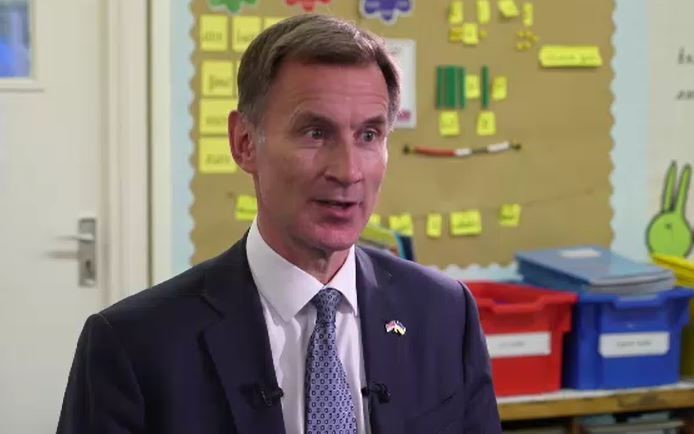
Jeremy Hunthas told the Treasury Select Committee why he kept the HS2 line going to Manchester instead of listening to a Policy Exchange report saying it would be better value to have it going from West London to Birmingham.
Despite massive overspending and delays, Mr Hunt committed in the autumn statement to keeping the longer route.
“We’ve long had infrastructure that’s inferior to peer countries and if we want to be the most prosperous economy in Europe we need to fix these problems,” the chancellor said.
He added that there is a problem with how the British government implements large infrastructure projects and said the failure to have good national infrastructure is the key reason why regional imbalances in wealth exist.
Putting in good transport links will mean people can take benefit of a better way of living without having to move to London or the southeast, he said.
The decision from the UK‘s top judges was unanimous, but Nicola Sturgeon vows to fight on for “the basic democratic right” to chose Scotland’s future.
The Scottish Parliament does not have the power to call a second independence referendum in the country, the Supreme Court has said.
The unanimous ruling from the UK’s top judges said, despite demands from the SNP for a fresh vote, the country’s government would need approval from the government in Westminster before going ahead.
First Minister Nicola Sturgeon had proposed a second referendum – dubbed Indyref2 – for 19 October 2023.
But she had also warned she would use the next general election as an informal referendum if the court ruled against her plan.
Speaking from Edinburgh in the hours after the ruling, Ms Sturgeon said she accepted the judgement, and the issue was not with judges interpreting it, but the law itself.
“Until now it has been understood by opponents of independence, as well as by its supporters, that the UK is a voluntary partnership of nations,” she said.
“[But] let us be blunt. A so-called partnership in which one partner is denied the right to choose a different future, or even to ask itself question cannot be described in any way as voluntary or even partnership at all.
“So this ruling confirms that the notion of the UK, a voluntary partnership of nations, if it ever was a reality, is no longer a reality, and that it exposes a situation that is quite simply unsustainable.”
The first minister said the option “remains open” to the UK government to “accept democracy and reach an agreement” over how to hold a second referendum.
But if not, she pledged “not to give up on democracy” and use the next general election to ask the question, with a special party conference in the new year to agree the detail.
“This is no longer justabout whether or not Scotland becomes independent, vital though that decision is,” said Ms Sturgeon. It is more fundamental.
“It is now about whether or not we even have the basic democratic right to choose own future. Indeed, from today, the independence movement is as much democracy as it is about independence.”
However, Speaking in the Commons, Scotland Secretary Alister Jack said the government welcomed the ruling, and called on the Scottish government “to set aside these divisive constitutional issues so that we can work together, focusing all of our attention and resources on the key issues that matter the people of Scotland”.
He added: “When we work together as one United Kingdom, we are safer, stronger and more prosperous.”
‘Political consequences’
Scotland held an independence referendum in 2014 and just over 55% voted to remain part of the UK.
But the pro-independence SNP, which has led the country since 2007, believes it has a mandate to hold a fresh vote because of its continued success in elections – the majority of members in the Scottish Parliament back independence – and because of the change in circumstances since Brexit.
Ms Sturgeon began her attempts to get approval for a new referendumin 2017 by asking then-prime minister Theresa May for a Section 30 order, which is used to increase or restrict, permanently or temporarily, the Scottish Parliament’s legislative authority – and was used to temporarily legislate for the first referendum.
But she and subsequent UK PMs have refused, leading to today’s court case on whether the Scottish Parliament could pass a bill to hold a referendum without the nod from Westminster.
Announcing the ruling, the court’s president, Lord Reed, said legislation for a second vote would relate to “reserved matters”, making it outside the powers of Holyrood.
“A lawfully-held referendum would have important political consequences in relation to the Union and the United Kingdom Parliament,” he said.
“It would either strengthen or weaken the democratic legitimacy of the Union and of the United Kingdom Parliament’s sovereignty over Scotland, depending on which view prevailed, and would either support or undermine the democratic credentials of the independence movement.
“It is therefore clear that the proposed bill has more than a loose or consequential connection with the reserved matters of the Union of Scotland and England, and the sovereignty of the United Kingdom Parliament.”
With the withdrawal of some 300 British peacekeepers from Mali in the wake of frosty relations with Bamako over the involvement of Russian mercenariesin the fight against terrorist groups in the Sahel, some special forces are expected to arrive in Ghana.
In a report by UK-based ‘The Telegraph’ and sighted by GhanaWeb, British ministers are also expected to be in Accra to hammer out a new security agreement which will position Ghana and by extension Burkina Faso as the new frontline against terrorism.
It is unclear if the move is a face-saving operation in the wake of the mission in Mali being shut down or something more significant as British forces already train troops in Ghana.
Ghana, Togo, Benin and Cote d’Ivoire all signed up for the Accra Initiative in 2017. This is a coalition which aims at stopping insecurity spilling over their borders from the Sahel.
It was reported on Monday, November 14, that the UK will be withdrawing all of its troops from Mali, which until only a few months ago, Whitehall officials were describing as “the new frontline of the war on terror”.
Former Africa Minister Rory Stewart, who championed the so-called “pivot to the Sahel” under Prime Minister Theresa May, was scathing about the real purpose of the Ghana trip, suggesting it was no more than a face-saving operation.
“We struggled to maintain 300 troops in Mali, partly because it cost perhaps as much as a hundred million pounds from tightly stretched budgets,” he told The Telegraph. “I fear that the ‘pivot to Ghana and Burkina Faso‘ is largely a way of excusing our retreat from the Sahel and will ultimately add up to less than people pretend.”
“We have been worrying about Burkina Faso for some time. But without an embassy there or any significant investment, there is a real limit to what the UK can do,” Stewart added.
Labour leader Sir Keir Starmer has told business leaders that the days of “cheap labour” must end in order to wean the UK off its “immigration dependency.”
Sir Keir advocated for a strategy to train British workers and transition the economy away from its “low-pay model.”
He did, however, acknowledge the need for skilled foreign workers and promised a “pragmatic” approach to immigration.
His speech comes at a time when businesses are urging more migrant workers to help boost economic growth.
Labour leader, Sir Keir Starmer delivered his speech to the Confederation of British Industry (CBI) conference in Birmingham on Monday, following Prime Minister Rishi Sunak.
Mr Sunak told business leaders having “proper control of our borders” was one of the immediate benefits of Brexit and said curbing illegal migration was the “country’s number one priority right now”.
He spoke after CBI director-general Tony Danker said the UK needed more foreign workers to drive economic growth as the country faces a deep recession.
“People are arguing against immigration – but it’s the only thing that has increased our growth potential since March,” Mr Danker said.
There was considerably less migration during the Covid-19 pandemic than in previous years and the number of EU citizens moving to the UK has dropped since the UK left the European Union.
In his speech, Sir Keir set out what the UK’s immigration policy would look like under a Labour government, should the party win the next general election.
He promised an immigration system that works better for the needs of business and recognises the need for skilled workers from abroad.
But he stressed that any changes to a points-based migration system “will come with new conditions for business”.
“We will expect you to bring forward a clear plan for higher skills and more training, for better pay and conditions, for investment in new technology,” he said.
“But our common goal must be to help the British economy off its immigration dependency. To start investing more in training up workers who are already here.”
Sir Keir outlined Labour’s plans for reform including:
Ensuring all employers able to sponsor visas are meeting decent standards of pay and conditions
Speed up visa delays to avoid labour shortages damaging the economy
Introduce training and plans for improving pay and conditions for roles that require international recruitment
Reforming the migration advisory committee to project future trends more accurately
Sir Keir spoke about immigration in an interview with the BBC last week, saying the UK was recruiting too many people from overseas into the NHS.
Keir Starmer believes, we are told, that there needs to be a fundamental rethink that involves training the domestic workforce rather than relying on immigration.
But there is a political calculation too.
Sir Keir wants to persuade the old Labour heartlands which voted for Brexit that he understands some of the concerns about high levels of immigration.
He also wants to try and convince them he is serious about making Brexit work – without freedom of movement.
But not everyone in the Labour Party will agree with the tone or the substance of his speech.
The rise of legal migration to the UK was one of the most prominent political issues in the country ahead of the EU referendum in 2016.
Former Conservative Prime Minister David Cameron once promised to get immigration down to the tens of thousands a year.
Net migration – the difference between people coming to the UK and those leaving – has been over 200,000 since the late 1990s.
Asked how Labour’s policy differed from that of the Conservatives, shadow business secretary Jonathan Reynolds said his party would demand businesses implement better pay and conditions, particularly in the care sector.
He also said Labour would introduce flexibility to the apprenticeship levy, so companies could spend the money on other forms of training.
Under Sir Keir’s leadership, Labour has ruled out a return to the EU single market, which guarantees citizens of member states the freedom to live and work anywhere in the bloc.
Labour’s policy on Brexit has divided the party, with some calling for a much closer relationship with the EU on different terms.
Sir Keir’s speech comes as Mr Sunak denied that ministers could look to realign the UK with EU laws.
Some Tories have been angered by suggestions the government was weighing up a Swiss-style relationship with the EU.
But the prime minister told the CBI conference on Monday that the UK “will not pursue any relationship with Europe that relies on alignment with EU laws”.
“I didn’t seek asylum. I told them I was an economic migrant,” said Artan. “They gave us plastic bags with our belongings; I was told tomorrow morning you will arrive in Tirana.”
Unlike many other Albanians who have entered the UK illegally on small boats, he was quickly sent home on a rapid deportation flight.
He had paid Kurdish people smugglers around £3,500 ($4,169) for the perilous trip across the English Channel, borrowing the money from friends and family.
We met Artan in an industrial suburb of the Albanian capital. It isn’t his real name as his identity needs protecting for fear of reprisals. In his early 30s, he cut a downbeat figure.
“The traffickers were armed with knives and pistols. They were repeatedly threatening us, saying not to film anything and not even to smoke cigarettes as the light would give away our location.”
Despite the threat, he managed to record a few shots from his journey across the Channel.
Leaving Albania, especially for the UK or Germany, is an aspiration shared by many young people here. More than 12,000 Albanians have arrived in the UK on small boats this year, the largest group of migrants to try to enter the country that way. On average more than half of Albanians are given asylum.
“The journey across the Channel was torture,” Artan remembered. It was cold, stormy and incredibly scary.
“A French police boat appeared 20 minutes into our journey. They accompanied us from a distance of maybe 200m, just observing, which reassured us. They stayed for three hours, maybe more. Then we crossed into UK waters and called British police.”
Artan recalls how the British authorities helped them get to shore safely. “They told us they were coming to get us, that we mustn’t panic. They behaved well and seemed very welcoming and polite. We jumped to the UK police boat where we got life vests.”
Like the thousands of others who have crossed the Channel on small boats this year, he ended up in the Manston reception centre in Kent.
At the peak of the small-boat crisis in October, 4,000 people were being housed on a site where the safe occupancy level is 1,600. The numbers were so high that the Home Secretary Suella Braverman controversially denounced the arrival of Channel-crossing migrants as an “invasion”.
Artan rejected that characterisation but made no secret of why he had travelled to the UK.
“I said to the woman interviewing me: ‘I know I have entered illegally, but I have not come here for fun. I have come because I want to work. I didn’t seek asylum.’
“I told them I was an economic migrant. My father is disabled. For 15 years he’s been living on a disabled person’s pension, not enough to buy his own medication.”
I put it to him that he knew he’d reached the UK illegally.
“Yes, of course I did. If you enter a foreign country without proper documentation, visas, stamps, of course you are entering illegally.”
Most Albanians we have met in Albania complain that legal routes of entry into the UK are too difficult to access.
He added: “Yes there are legal ways, but I was in a hurry. I went for the quickest and cheapest way. The visa should be cheaper but I needed help with the application and people charge more for that than the dinghy journey.”
One of the reasons Artan was deported was that he was honest about his reasons for travelling to the UK. He did not try to claim asylum, he insisted he was there to work.
He had little notice he was being flown home: “They took us out, we were surrounded by police.”
“At that moment I was so upset I can’t describe it. I felt like my brain was exploding and I could do nothing about it all.”
Image caption, Artan recorded videos as he crossed the English Channel on a small dinghy
Artan readily admits he broke UK law and that was why he was deported. As well as being flown home, he is now banned from other European nations for the next three years.
He said: “I cried for the entire journey, from the moment I got on that bus and realised I was being deported, until I arrived in Albania.”
The issue of small boat crossings has led to furious debate in the UK, with some claiming the problem has been overstated, while others think it is a full-blown crisis.
The one thing that almost everyone agrees on, is that the only people really benefiting from the status quo are the smuggling gangs, making huge profit from risking the lives of others.
Artan’s own journey has left him thousands of pounds of debt and he bitterly regrets going.
He now believes that anyone else considering such a trip would be better off not leaving at all.
“It was an unimaginable terror. For certain I’d say don’t choose the dinghy. If there is a legal way, with a visa, then yes leave, but please never think about leaving on a dinghy.”
Source: BBC
DISCLAIMER: Independentghana.com will not be liable for any inaccuracies contained in this article. The views expressed in the article are solely those of the author’s, and do not reflect those of The Independent Ghana
We’re using the word historic, but what will this fund actually do and how will it work?
Well, we are still trying to get more details on what exactly has been agreed here.
We know it is a decision to set up a fund that should start delivering money next year – money which should go to developing nations and come from developed nations.
Poor nations have called for this for so long because they suffer the worst of climate impacts, but historically caused little to none of the greenhouse gas emissions that warm Earth’s atmosphere.
Take the UK – it has emitted these gases for around 150-200 years since the industrial revolution, burning coal, then oil and gas to fuel economic growth.
But, while climate change will affect the UK, it will not hit as badly as low-lying nations which could be almost wiped out by sea level rise.
Yet those nations barely contribute to emissions. It’s that imbalance that this commitment is trying to address.
The UK’s negotiator Alok Sharma, who of course presided over COP26 in Glasgow last year, has given his reaction to journalists here in Sharm el-Sheikh.
“I’m incredibly disappointed that we weren’t able to go further,” he told us.
He came here wanting to raise global ambition on urgently cutting the use of fossil fuels to limit global warming. That has not happened.
“We had to fight incredibly hard, relentlessly, it was like a battle, to make sure that we preserved what we got over the line in Glasgow,” he said.
There was strong push back from some countries, Sharma said. He said he’d told those countries they need to look climatevulnerable countries “in the eye”.
But he said developed nations wanted to keep the commitment to a loss and damage deal, which he calls historic.
The commitment to limiting global warming to 1.5C by 2100 remains in the agreement, but has slipped down the priority list in the cover text – the overarching agreement from the summit.
Sharma says: “I said in Glasgow that the pulse of 1.5C was weak. Unfortunately, it remains on life support.”
Jeremy Hunt has warned that families face “real challenges” as government forecasters predict the greatest drop in living standards since records began.
According to the Office for Budget Responsibility, household income will drop by 7% over the next 18 months.
In his Autumn Statement, the chancellor said tax increases and spending cuts would help tame inflation, which he blamed for the drop.
However, Labour claimed that fairer tax decisions could have been made.
Shadow chancellor Rachel Reeves called the emergency budget measures “an invoice for the economic carnage” caused by former Prime Minister Liz Truss’ policies.
It was deliberately stripped of surprises and political theatre, with many of the announcements having been trailed in the media beforehand.
Mr Hunt told the BBC’s political editor Chris Mason his plan would bring down soaring prices, while protecting public services.
“These are real challenges for families up and down the country,” he said, adding: “I’m not pretending these aren’t going to be difficult times, but there’s a plan, there’s hope – and if we follow this plan, if we stick with it, we can get through to the other side.”
In the next two years, before the next general election is due, there will be further support for households and extra money for schools, the NHS and social care in England.
Tax thresholds will be frozen until April 2028, meaning millions will pay more tax
Spending on public services in England will rise more slowly than planned – with some departments facing cuts after the next election
The state pensions triple lock will be kept, meaning pensioners will see a 10.1% rise in weekly payments
The household energy price cap has been extended for one year beyond April but made less generous, with typical bills capped at £3,000 a year instead of £2,500
There will be additional cost-of-living payments for the “most vulnerable”, with £900 for those on benefits, and £300 for pensioners
The top 45% additional rate of income tax will be paid on earnings over £125,140, instead of £150,000
UK minimum wage for people over 23 to increase from £9.50 to £10.42 an hour
The windfall tax on oil and gas firms will increase from 25% to 35%, raising £55bn from this year until 2028
The Resolution Foundation think tank said the Autumn Statement piled further pressure on “the squeezed middle” earners.
But it said increasing benefits in line with prices would make a “huge difference to those on low-to-middle incomes”.
Mr Hunt denied that he had been forced to raise taxes and reduce spending because of the turmoil caused by Ms Truss’s mini-Budget.
He said there had been mistakes, but insisted the government had “corrected those within weeks”.
He argued that other countries, such as Germany, France and America were all facing similar problems as a result of the conflict in Ukraine and rising energy prices.
The Chancellor’s tone was sober; the facial expressions of Conservative MPs business-like rather than emblazoned with smiles.
Even the opposition parties were relatively muted too: times are and will continue to be very difficult for millions of households.
For all of the numbers, the forecasts, the rhetoric, the standout statistic comes from the government’s independent analysers, the Office for Budget Responsibility: Living standards are falling further right now than at any point since the 1950s.
Bad news.
Add to the mix a chancellor wrestling with a recession; responding with tax rises – taxation levels are their highest for 75 years – and government spending below what it was expected to be.
He argues that protecting the state pension, benefits, and the announcements on spending for education and health shield the government against the suggestion this is another era of austerity.
But lots of government departments face lean years, inflation pickpocketing their spending power.
And Mr Hunt has also postponed the big spending squeezes until after the next election.
The OBR, which produced an economic forecast to accompany Mr Hunt’s statement, says high inflation and rising interest rates will lead to consumers spending less, tipping the UK’s economy into a recession “lasting just over a year”.
It predicts the economy will shrink by 1.4% in 2023 before growth slowly picks up again.
The forecaster also says that as a result of Mr Hunt’s decisions, the tax burden would rise to its highest level since the end of World War Two.
Mr Hunt described a target to reduce government debt in five years time as one of “two new fiscal rules”. But speaking on BBC Newsnight, OBR chairman Richard Hughes suggested the plan could end up only being an aspiration because the end date can be extended every year at the budget.
Attacking Mr Hunt’s plans in Parliament, Labour’s Rachel Reeves said he had introduced “a Conservative double whammy that sees frozen tax thresholds and double-digit inflation erode the real value of people’s wages”.
She accused the government of increasing taxes by “stealth” arguing that freezing the personal allowance – the amount of income someone does not have to pay tax on – would cost an average earner more than £600 per year.
Speaking to the BBC on Friday, Ms Reeves said “fairer choices around tax could have been made”, criticising the Tories for not abolishing non-dom status and instead going to the “pockets of the ordinary working man and woman”.
The Liberal Democrats said people were “being forced to pay the price for this Conservative government’s incompetence”.
The SNP’s Treasury spokeswoman Alison Thewliss said: “This is a UK so weak that no-one would wish to join it – Scotland cannot be forced to stay in broke, broken, Brexit Britain.”
There was also an attack from the chancellor’s own side with former cabinet minister, Conservative MP Jacob Rees-Mogg arguing that the measures announced were based on unreliable economic forecasts.
Meanwhile, a Conservative MP is seeking assurances from the chancellor that he will not increase fuel duty.
The tax is suppose to rise in line with inflation, but has repeatedly been frozen. The Treasury has said a final decision would not be taken until the next Budget in spring 2023.
Writing to the chancellor, Conservative backbencher Jonathan Gullis warned that a “substantial number” of Tory MPs would be opposed to a rise.
Jeremy Huntsays he accepts the “uncomfortable situation” that living standards are going down for everyone.
Speaking to reporters after his autumn statement, he claims the government is “helping every bit as much as we can” to reduce the impact on households and businesses, as well as protecting public services.
And indeed, amid the stealth tax rises and departmental cuts, spending is actually going up over the next two years under the government’s new plans.
But while Mr Hunt says he believes the measures will make the current recession “shallower”, he hints further, tougher measures could be on the horizon.
“We have been careful in a very balanced approach to make sure that we’re not making that situation worse,” says the chancellor.
Away from the autumn statement, and it’s been revealed that former PM Boris Johnsonwas paid £276,000 for a speech to American insurers just a few weeks after leaving Number 10.
Mr Johnson addressed a conference held by the Council of Insurance Agents and Brokers (CIAB) in October.
He is said to have given a 30-minute speech and a 45-minute “fireside chat” at the event in Colorado Springs.
An update to the MPs’ register of interests published on Thursday showed the former PM was paid £276,130 for his services.
The entry says this was for eight hours and 30 minutes’ worth of work – giving him an hourly rate of almost £32,500.
It also confirmed Mr Johnson received transport and accommodation from the CIAB for himself and two members of staff.
Another entry in Mr Johnson’s register of interests showed media mogul Rupert Murdoch paid £11,559 to fly Mr Johnson to a business meeting in Montana and provide him with “accommodation and hospitality” after his appearance in Colorado.
The Royal College of Nursing (RCN) announced last week that its members at the majority of NHS employers across the UK had votedto strike.
Nurses have given the government five days to begin “detailed negotiations” on pay, or they will declare a December strike.
It comes as the chancellor pledged an extra £2.3 billion for the NHS over the next two years, as the health service deals with inflationary pressures.
NHS England has forecast a £7 billion funding shortfall for next year, which it cannot close with efficiency measures alone.
However, health officials are said to agree that the new funding is adequate in light of the fact that economists believe October’s inflation figure was the high point.
Last week, the Royal College of Nursing (RCN) announced its members at the majority of NHS employers across the UK had voted to take strike action.
A health system in crisis
In a letter to the health secretary following Thursday’s autumn statement, RCN general secretary and chief executive Pat Cullen said recent meetings with Steve Barclay, while cordial in tone, had not resolved the issues at the heart of strike action.
“I must not let my members, nor the public confuse these meetings for serious discussions on the issues of NHS pay and patient safety,” she said in the letter.
“There is only value in meeting if you wish to discuss – in formal, detailed negotiations – the issues that have caused our members to vote for strike action.”
She added: “You have again asked to meet in the coming days and for this third occasion I must be clearer in my expectation.”
With record demand and waiting times, as well as a growing backlog ahead of what looks set to be a busy winter, the UK’s health and care system are facing a crisis.
Image: Pat Cullen leaving a meeting with the health secretary earlier this month
There are nursing staff shortages across the UK – made worse by the COVID-19 pandemic and cost of living crisis – with 60,000 unfilled nursing roles.
Data from the London School of Economics found the salaries of experienced nurses have declined by 20% in real terms over the last 10 years across most of the UK. This means nurses are effectively working one day a week for free.
The RCN is calling for a pay rise of 5% above inflation to combat this.
Strikes across the NHS
The RCN is not the only organisation threatening strike action within the NHS.
NHS workers in roles such as blood and transplant services were among nearly 10,000 people being balloted over action that could see them walk off the job as soon as January.
Unite union, which represents 100,000 NHS workers, said voting papers are going out across 36 NHS trusts and organisations in England and Wales.
Moving onto the NHS, Jeremy Hunt says he knows how hard those in the healthcare sector work.
“The biggest issues are workforce shortages and pressures in the social care sector. So today I addressed them both,” he says.
Referring to himself in his former role as health and social care select committee chair, Mr Hunt notes that a proposal was put forward for a long-term healthcare workforce plan.
On social care, he says there are 1.6 million employees “working incredibly hard” under enormous struggles.
But he notes that he has “very real concerns” about whether local authorities will be able to deliver the Dilnot social care reforms “immediately”.
“So I will delay the implementation of this important reform for two years, allocating the funding to allow local authorities to provide more care packages,” he tells MPs.
Mr Hunt also confirms he has “decided to allocate for adult social care additional grant funding of £1bn next year and £1.7bn thereafter”.
He says combined with the savings from the delayed Dilnot reforms and more council tax flexibilities, this means an increase in funding available to the social care sector of up to £2.8bn next year and £4.7bn the year after.
“We want Scandinavian quality alongside Singaporean efficiency” in the NHS, Mr Hunt says.
He tells MPs he has asked former Labour health secretary Patricia Hewitt to help ensure new “integrated care boards” work properly.
The chancellor says the NHS budget will increase in each of the next two years by an extra £3.3bn which totals a “record £8bn package for our health and social care system” overall.
Jeremy Hunt goeson to ask the NHS “to join all public services in tackling waste and inefficiency”.
“We want Scandinavian quality alongside Singaporean efficiency – both better outcomes for citizens and better value for taxpayers”, the chancellor says.
“That doesn’t mean asking people on the frontline to work harder, but rather asking challenging questions on how to reform all public services for the better,” he adds.
BBCCopyright: BBC A packed Commons chamber is watching the chancellor Image caption: A packed Commons chamber is watching the chancellor
There are clear attempts here by the chancellor to avoid some of these political decisions being framed as “tax rises”.
Instead, for taxes like income tax and national insurance he is freezing the threshold at which people start paying certain levels of tax.
What this means in practice, though, is that if people’s wages go up but the tax levels stay the same, they may not feel as big an impact from that wage rise.
That’s because they’re paying more in taxes than they otherwise would have.
Hunt says: “Because we want school standards to continue to rise, we’re going to do more than protect the school budget – we’ll increase it.”
He says in 2023 and 2024 the government will invest an extra £2.3bn in schools.
He says that the government’s message to school staff is: “Thank you for your brilliant work… the Conservative government is investing more in the public service that defines all our futures.”
Chancellor Jeremy Huntis laying out his plan for the country’s finances going forward in the House of Commons.
Here is what the chancellor has announced:
Tax as a percentage of GDP will increase by just 1% over the next five years;
On personal tax, he will reduce the threshold at which the 45p rate becomes payable from £150,000 to £125,140. Those earning £150,000 or more will pay just over £1,200 more a year;
The annual exempt amount for capital gains tax will be cut from £12,300 to £6,000 next year and then to £3,000 from April 2024;
Confirmed two new fiscal rules – the first is that underlying debt must fall as a percentage of GDP by the fifth year of a rolling five-year period. The second is that public sector borrowing, over the same period, must be below 3% of GDP;
From April 2025, electric cars will no longer be exempt from Vehicle Excise Duty;
On windfall taxes, from 1 January until March 2028 he will increase the energy profits levy from 25% to 35%;
Also from 1 January, “we have also decided to introduce a new, temporary 45% levy on electricity generators… together these taxes raise £14bn next year”.
Stamp duty cuts will stay in place until March 2025;
While the employers’ national insurance contributions threshold is frozen until April 2028, the employment allowance will be retained at its new, higher level of £5,000 until March 2026;
Hunt confirms the UK will continue to maintain the defence budget at least 2% of GDP to be consistent with our NATO commitment – but there is no 3% commitment as previously promised.
600,000 more people on Universal Credit will be asked to meet with a work coach to increase hours or earnings;
On education, the chancellor has said he will invest an extra £2.3bn per year in schools;
A £2.8bn funding increase for the social care sector;
With regards to the NHS, the government will increase the budget for healthcare by £3.3bn.
Continuing with his autumn statement, Jeremy Hunt moves on to business taxes.
He says he has decided to retain the employment allowance at its new higher level of £5,000 until 2028.
“This means 40% of all businesses will pay no NICS at all,” he adds, noting that “the VAT threshold is already more than twice as high as the EU average”.
Mr Hunt says he will “make sure multinational corporations, including big tech companies, pay the right tax in the countries they operate”.
He says that reforms to tackle tax avoidance and evasion will raise an additional £2.8bn by 2027-28.
Moving onto the windfall tax,Mr Hunt says he has “no objection” to them if they are “genuinely about windfall profits caused by unexpected increases in energy prices”.
He adds that any such tax “should be temporary”.
“So taking account of this, I’ve decided that from 1 January until 28 March, we will increase the energy profits levy from 25% to 35%,” the chancellor tells MPs.
“The structure of our energy market also creates windfall profits for low carbon electricity generation.
The chancellor ison his feet at the despatch box in the House of Commons to reveal the government’s new economic policies.
Mr Hunt begins by saying that “teachers, nurses and many others” are worried about the future given the economic climate.
He says today he will unveil a plan to revive the economy.
“We are honest about the challenges and we are fair in our solutions,” he tells MPs.
“We will also protect the vulnerable,” he adds.
He says the plan will lead to “a shallower downturn” and “lower energy bills”.
The chancellor says the government has three priorities within the autumn statement – “stability, growth and public services”.
Beginning with stability, he tells MPs “the furlough scheme, the vaccine rollout and the response of the NHS did our country proud, but they all have to be paid for”.
Mr Hunt says the Bank of England has “my wholehearted support” and confirms that the government “will not change its remit”.
The chancellor says “credibility cannot be taken for granted and yesterday’s inflation figures show we must continue a relentless fight to bring it down, including a rock solid commitment to rebuild our public finances”.
The UK is “not as wealthy a nation as it thought it would have been in 2020”, Sky’s economics and data editor Ed Conway has said.
Analysing the country’s financial situation, Ed said that before the pandemic GDP was expected to rise but then when the pandemic hit there was a “massive fall down”.
He went on to say the Bank of England forecast’s were now flatlining.
“There’s a lot of other things going on right now. The dollar has been very strong recently as well,” he adds.
“But even so, these charts, whether it’s the pound, whether it’s government bond yields, are the kinds of things that the government is going to be paying attention to.”
He adds that looking at the latest charts helps explain why the UK will most likely receive a “miserable” update from the chancellor today.
The Government’s key goal today is to restore stability and credibility when it comes to the economy.
You can expect the chancellor to talk about the need to balance the books and fill a fiscal black hole. The Treasury believes it is around £54bn pounds.
Slightly more of it will be filled by cutting spending that raising taxes, the ratio is around 55% to 45%.
But not all of this is popular or accepted by everyone. Some believe the spending cuts will go too far and return the UK to a form of austerity.
Others – among them some Tory MPs – believe the tax rises are a problem and could make a recession longer and deeper.
The UK is working to remove Iran from a UN body dedicated to women’s rights.
David Rutley, a foreign office minister, was answering an urgent question about the protest in Iran.
He said the UK was working with the US and others to remove Iran from the United Nations Commission on the Status of Women.
Mr Rutley said the protest had seen more than 300 deaths – of which 43 were children.
The demonstrations started two months ago after Mahsa Amini, 22, died in custody after being detained by “morality police” for allegedly breaking strict hijab rules.
There have been large protests in numerous parts of the country, as well as smaller, individual actions like clerics having their headwear knocked off and women breaking rules on wearing head coverings.
Mr Rutley said death sentences are now likely to increase.
The latest case of alleged bullying to put pressure on Prime Minister Rishi Sunak is British Deputy Prime Minister Dominic Raab’s request for an independent investigation into two formal complaints about his behaviour.
Raab said on Wednesday that he had received notification of two separate complaints, one from his previous tenure as foreign minister and one from his previous tenure as justice minister.
Some officials who worked for him describe him as a tough and demanding boss, while others have been quoted in local media as being rude, aggressive, and a bully. Raab has denied the charges.
“I have written to the prime minister to request an independent investigation into two formal complaints that have been made against me,” Raab said on Twitter. “I look forward to addressing these complaints.”
Raab said in a letter he attached to his tweet he had “never tolerated bullying”, and had always sought to empower teams working in his departments.
‘Integrity, professionalism and accountability’
The new allegations put more pressure on Sunak, who used his first speech as prime minister last month to say his government would demonstrate “integrity, professionalism and accountability”.
Sunak defended his deputy this week, saying he did not recognise allegations that Raab had bullied staff.
Also on Wednesday, Sunak said that an investigation requested by Raab was the correct course of action.
“I know that you will be keen to address the complaints made against you and agree that proceeding in this way is the right course of action,” Sunak told Raab in a letter.
“Integrity, professionalism and accountability are core values of this Government. It is right that these matters are investigated fully.”
A cabinet minister, Gavin Williamson, resigned from the government last week over allegations he had bullied colleagues, raising questions about Sunak’s judgement just weeks into the job.
The meeting which took place at the Windsor Castle ws confirmed by a tweet on the official handle of the Royal Family.
“This afternoon, The King welcomed the President of Ghana to Windsor Castle for an Audience,” the caption accompanying a photo of the two gentlemen shaking hands read.
Akufo-Addo is in the United Kingdom on a private visit. He is expected back in the country today.
Per GhanaWeb tracking, Akufo-Addo becomes the third African leader to meet the King after Ali Bongo of Gabon and Muhammadu Buhari of Nigeria respectively.
Dozens of African leaders were in the UK in Septemberto attend the funeral of the King’s late mother, Queen Elizabeth II who spent seven decades as the monarch.
The British government announced on Monday the early withdrawal of its military contingent currently deployed in Mali as part of the UN mission to the country.
Behind the decision is the ruling junta’s use of the Russian paramilitary group Wagner.
According to the Ministry of Defence, the commitment was supposed to last three years, but faced with the rising instability in the country, London decided to anticipate the withdrawal of its troops, who should leave the country in the next six months.
France, the main country intervening militarily in Mali, notably through the Barkhane force, alongside its European partners announced in February their withdrawal from the country. The last French soldiers left Mali this summer, after nearly a decade.
Almost 300 British soldiers have been in Mali since the end of 2020, as part of the deployment of the UN peacekeeping mission in the country launched in 2013 (Minusma, Ed.), aimed in particular at stabilising the security situation in a country plagued by jihadist attacks.
The prime minister intends to use the summit to press the world’s most powerful economies to do more to reduce their reliance on Russian exports, while also encouraging others to do the same.
As he confronted Vladimir Putin’s officials at the G20 summit, Rishi Sunak said Russia must “get out of Ukraine and end this barbaric war.”
The prime minister made the remarks during the first session on Tuesday, criticising the absence of Russian President Vladimir Putin from the talks on the Indonesian island of Bali.
“It is notable that Putin didn’t feel able to join us here,” he said. “Maybe if he had, we could get on with sorting things out.
“Because the single biggest difference that anyone could make is for Russia to get out of Ukraine and end this barbaric war.
“The UK rejects this aggression. We will back Ukraine for as long as it takes.”
Mr Putin chose not to attend the talks, with the Kremlin blaming scheduling conflicts, but observers say officials are seeking to shield him from condemnation by world leaders.
Mr Sunak also rebuked Russia by saying “countries should not invade their neighbours”.
“It is very simple – countries should not invade their neighbours, they should not attack civilian infrastructure and civilian populations and they should not threaten nuclear escalation,” he said.
“Surely these are things on which we can all agree.”
The prime minister sat down with leaders of the world’s 19 biggest economies in Bali – the first meeting in the group’s 15-year history to be held in the shadow of a major European war instigated by one of its members.
Image:Justin Trudeau, the Canadian leader, and Mr Sunak met at a Bali cafe on Monday
‘Chorus of opposition to Putin’
Mr Sunak will use the summit to push the world’s most powerful economies to do more to reduce their dependence on Russian exports, while supporting others to do the same.
He will also reiterate the UK’s financial support for Ukraine, saying he committed £4.1bn in aid when he was chancellor.
This included £2.3bn in military aid, while Mr Sunak will promise to match this level of spending next year.
Before the meeting, he said: “Putin and his proxies will never have a legitimate seat at the table until they end their illegal war in Ukraine.”
He continued: “At the G20, the Putin regime – which has stifled domestic dissent and fabricated a veneer of validity only through violence – will hear the chorus of global opposition to its actions.”
Many countries have stood firm, supporting Ukraine with weapons and aid, while imposing various sanctions on Russia.
Mr Putin sent Sergei Lavrov, the foreign minister, to the talks in his place.
He was taken to hospital on his arrival at the talks with a heart condition, the Indonesian authorities said – though the Russian foreign ministry dismissed the claims as “fake news”.
Last week, the UK introduced legislation to stop countries using its maritime services to transport Russian oil unless it is purchased below a price cap – which Number 10 described as a “hugely influential measure, given the UK provides around 60% of global maritime insurance”.
On the plane to Bali, Rishi Sunak was asked whether he would commit, like his predecessor Liz Truss, to recategorising China as a “threat” to national security.
During the leadership campaign Liz Truss had pledged to reopen the integrated review, published last year, which lays out the UK’spriorities in diplomacy and defence.
Sunak said he believed China posed a “systemic challenge” to the UK’s values but he did not say he would stick with Truss’ commitment to officially reclassify China in the integrated review.
“My view on China is straightforward. I think that China unequivocally poses a systemic threat – well, a systemic challenge – to our values and our interests and is undoubtedly the biggest state-based threat to our economic security… that’s how I think about China,” he said.
“That’s why it’s important that we take the powers that we need to defend ourselves against that. For example the National Security Investment Act National Security Investment Act is a good example of that.
“But I also think that China is an indisputable fact of the global economy and we’re not going to be able to resolve shared global challenges like climate change, or public health, or indeed actually dealing with Russia and Ukraine, without having a dialogue with them.”
The Prime Minister was also asked whether he thought the UK should send arms to Taiwan.
He said: “We’re looking at all of these policies as part of our refresh of the integrated review. Our policy on Taiwan is obviously there should be no unilateral change to the status and there should be a peaceful resolution to that situation. We stand ready to support Taiwan as we do in standing up to Chinese aggression.”