More than 900 Ukrainian fighterswho had been holed up in Mariupol’s Azovstal steel plant have been taken to a prison colony in Russian-controlled territory, Moscow has said.
Ukraine ordered troops there to stand down as part of a deal struck by both sides, as it attempts to save their lives. Food and water supplies have reportedly been scarce in the plant for several weeks.
A Russian foreign ministry spokesperson, Maria Zakharova, said on Wednesday that 959 Ukrainian service personnel had surrendered since Tuesday. Of those, 51 were being treated for their injuries and the remainder had been sent to a former prison colony in the town of Olenivka in a Russian-controlled area of the Donetsk region.
The defence ministry in Kyiv said it was hoping for an “exchange procedure… to repatriate these Ukrainian heroes as quickly as possible”, according to AFP.
Their fate remains unclear, with Kremlin spokesman Dmitry Peskov refusing to say whether they would be treated as criminals or prisoners of war.
Ukraine’s defence ministry pledged to do “everything necessary” to rescue those still in the sprawling network of tunnels and bunkers under the steel plant, but admitted there was no military option available.
A 21-year-old Russian soldier has pleaded guilty to killing an unarmed civilian, in the first war crimes trial in Ukraine since the war started.
Vadim Shishimarin admitted shooting a 62-year-old man a few days after the invasion began. He faces life in jail.
The prisoner was brought into the tiny Kyiv courtroom in handcuffs, flanked by heavily armed guards. He looked nervous, and kept his head bowed.
Just a couple of metres from him, the widow of the man killed was sitting.
She wiped tears from her eyes as the soldier entered court, then sat with hands clasped as the prosecutor set out his case, describing the moment Kateryna’s husband was shot in the head.
“Do you accept your guilt?” the judge asked. “Yes,” Shishimarin replied.
“Totally?” “Yes,” he replied quietly from behind the glass of his grey metal-and-glass cage.
He and four other soldiers stole a car, and as they travelled near Chupakhivka, they encountered the 62-year-old on a bicycle, they said.
According to prosecutors, Shishimarinwas ordered to kill the civilian and used a Kalashnikov assault rifle to do so.
The Kremlin said earlier it was not informed about the case.
Shishimarin’s trial was adjourned shortly after the civilian’s widow heard for the first time the Russian soldier admit to the murder. This high profile hearing will restart on Thursday in a larger courtroom.
Kateryna, the 62 year-old’s widow, told the BBC how she was coping, before she left the court for the day.
“I feel very sorry for him [Shishimarin],” she said. “But for a crime like that – I can’t forgive him.”
The country’s chief prosecutor Iryna Venediktova tweeted: “By this first trial, we are sending a clear signal that every perpetrator, every person who ordered or assisted in the commission of crimes in Ukraine shall not avoid responsibility,”
Moscow has denied its troops have targeted civilians, but investigators have been collecting evidence of possible war crimes to bring before the International Criminal Court (ICC) in The Hague.
The ICC is sending a team of 42 investigators, forensics experts and support staff to Ukraine. Meanwhile, Ukraine has also set up a team to preserve evidence to enable future prosecutions.
Turkey’s president has restated his opposition to Finland and Sweden joining Nato – just hours after they said they would seek membership.
Recep Tayyip Erdogan said the two Nordic nations should not bother sending delegations to convince Turkey, a key Nato member, of their bids.
He is angered by what he sees as their willingness to host Kurdish militants.
Without the support of all Nato members, Sweden and Finland cannot join the military alliance.
On Monday, Sweden said Europe was living in a dangerous new reality, referring to Russia’s invasion of Ukraine.
Russian President Vladimir Putin said the move by Finland and Sweden to join the 30-member military alliance did not threaten Moscow directly – but stressed that any expansion of military infrastructure would trigger a response from the Kremlin.
At a news conference on Monday, Mr Erdogan said Turkey opposed the Finnish and the Swedish bids to join Nato, describing Sweden as a “hatchery” for terrorist organisations.
“Neither of these countries have a clear, open attitude towards terrorist organisation. How can we trust them?” the Turkish president said.
Turkey accuses the two Nordic nations of harbouring members of the Kurdistan Workers’ Party (PKK), a group it views as a terrorist organisation, and followers of Fethullah Gulen, who Ankara accuses of orchestrating a 2016 coup attempt.
All member states must agree that a new country can join Nato, therefore Sweden and Finland require Turkey’s support in their bid to join the military alliance.
Mr Erdogan said Swedish and Finnish delegations should not bother going to Ankara, Turkey’s capital, to convince it to approve their Nato bid.
His government has also pledged to block applications from countries that have imposed sanctions on it.
In 2019, both Nordic nations slapped an arms embargo on Ankara after its incursion into Syria.
Speaking in parliament in Helsinki on Monday, Finnish Foreign Minister Pekka Haavisto said he was surprised by Turkey’s stance, but added that his government was not interested in “bargaining” with Mr Erdogan.
Finland formally announced its bid to join Nato last week.
It was joined by neighbour Sweden on Saturday in a move that will end the Scandinavian country’s centuries-long military non-alignment.
“Nato will strengthen Sweden, Sweden will strengthen Nato,” Prime Minister Magdalena Andersson said at a briefing on Monday.
She said Europe was now living in a dangerous new reality, referring to Russia’s invasion of Ukraine.
“We are leaving one era behind us and entering a new one,” Ms Andersson told lawmakers during a debate in Stockholm, also on Monday.
She said a formal application could be handed within several days and would be synchronised with Finland. Nato has signalled its willingness to admit the two new members.
However, Ms Andersson stressed that Sweden did not want permanent Nato bases or nuclear weapons on its territory.
Norway, Denmark and Iceland – all Nato members – immediately said they were ready to support Sweden and Finland by all means necessary if they came under attack.
The UK, also a Nato member, has already given security guarantees to Sweden and Finland to cover the transition period.
Monday’s announcement by Sweden came as Nato began one of its biggest exercises in the Baltic region, involving some 15,000 troops. Named “Hedgehog”, the drills in Estonia involve 10 countries, including Finland and Sweden.
The price of wheat has jumped on international markets after India banned the export of the staple cereal.
The benchmark wheat index rose as much as 5.9% in Chicago, the highest it has been in two months.
The export ban comes after a heatwave hit India’s wheat crops, taking domestic prices to a record high.
The cost of everything from bread and cakes to noodles and pasta has risen in recent months as wheat prices soared on world commodity markets.
India’s government said it would still allow exports backed by letters of credit that have already been issued, and to countries that request supplies “to meet their food security needs”.
Government officials also said the ban was not permanent and could be revised.
However, the decision has been criticised by agriculture ministers from the Group of Seven (G7) nations meeting in Germany.
“If everyone starts to impose export restrictions or to close markets, that would worsen the crisis,” German food and agriculture minister Cem Ozdemir said.
The G7 is an organisation of the world’sseven largest so-called “advanced” economies, which dominate global trade and the international financial system. They are Canada, France, Germany, Italy, Japan, the UK and the United States.
Although India is the world’s second-biggest wheat producer, it has not previously been a major exporter as most of its crop is sold on domestic markets.
But Ukraine’s wheat exports plunged after the Russian invasion. And with droughts and floods threatening crops in other major producers, commodity traders were expecting supplies from India to make up for part of the shortfall.
Before the ban, India had aimed to ship a record 10 million tonnes of wheat this year.
Since Russian forces were pushed back from Kyiv at the end of March, the bodies of more than 1,000 civilians have been discovered in the Bucha region – many hastily buried in shallow graves.
The BBC’s Sarah Rainsford has been investigating what happened at a children’s summer camp – now being treated as a crime scene.
*This report contains material some readers will find disturbing*
It is easy to miss the killing spot at first in the gloom. But in a cold, damp basement on the edge of the woods that made Bucha a popular get-away spot before the war, five Ukrainian men were forced to their knees and shot in the head.
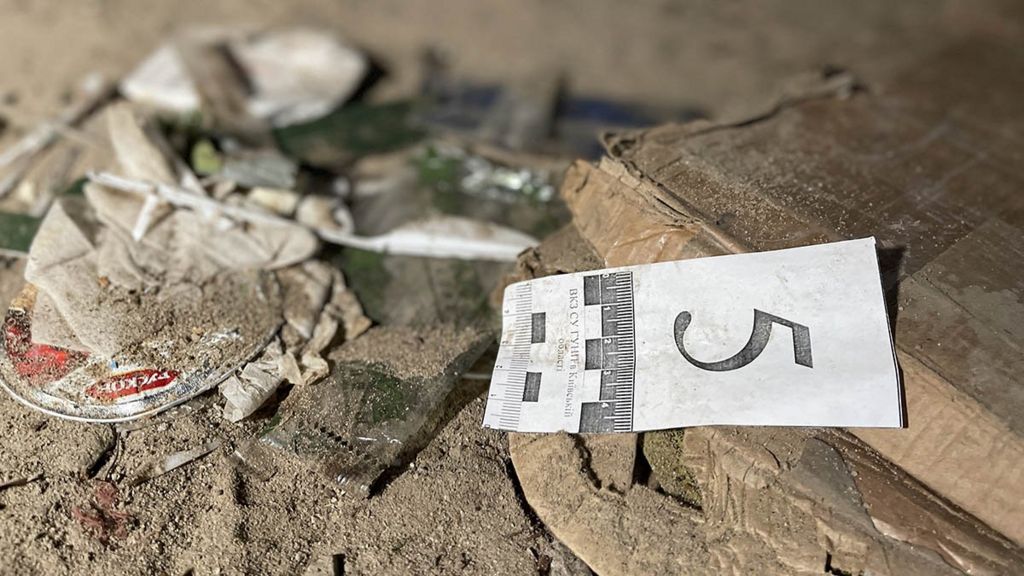
To the right of the entrance, there are stones coated in blood that has turned dark red. Lying among that is a blue woollen hat with an exit hole in one side and its rim soaked in blood. In the wall, I counted at least a dozen bullet holes.
Image caption, A marker left by a forensics team in the basement
A couple of steps away are the remains of a Russian military ration pack – an open can of rice porridge with beef and an empty packet of crackers. A name daubed in graffiti on a wall is a reminder that the scene is a children’s camp. But when Russian troops moved into Bucha, just outside the capital, in early March, Camp Radiant became an execution ground.
The story of the summer camp killings is chilling but so is this detail: more than 1,000 civilians were killed in the Bucha region during a month under Russian occupation, but most did not die from shrapnel or shelling. More than 650 were shot dead by Russian soldiers.
Now Ukraine is searching for their killers.
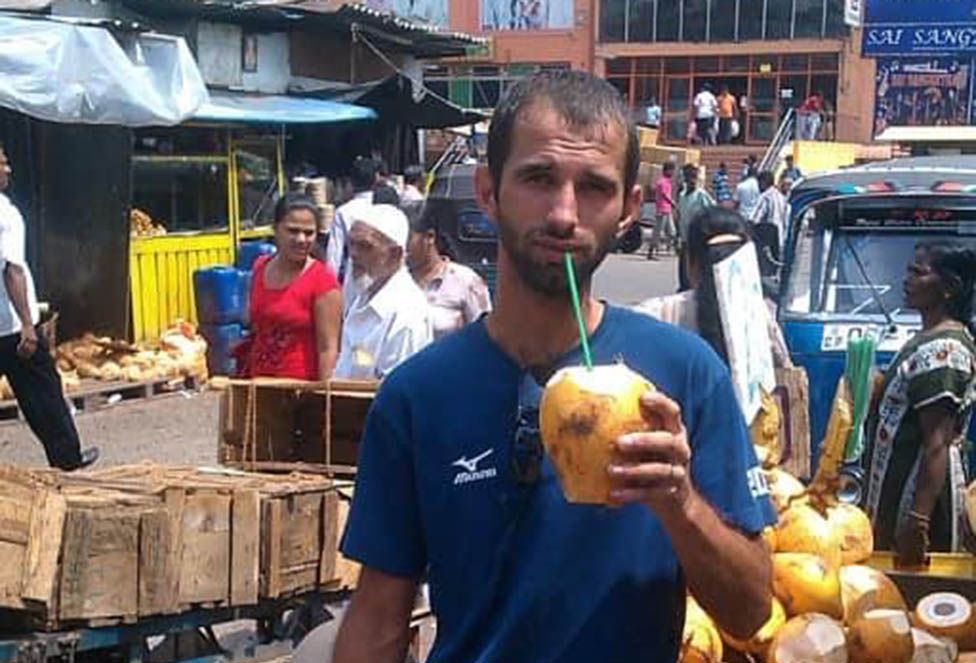
Volodymyr Boichenko lived in Hostemel, just up the road from Bucha and near the airfield where the first Russian forces landed to try to overthrow Ukraine’s government. When his sister Aliona Mykytiuk decided to flee before the fighting reached her, she pleaded with Volodymyr to join her. He was a civilian, not a soldier, but he wanted to stay and help. So he spent the days searching Hostemel for food and water to bring to neighbours, including children, who were trapped in their cellars by the constant shelling and Russian airstrikes.
A chatty 34-year-old, who had travelled the world in the merchant navy, Volodymyr phoned his family from Hostemel most days to reassure them he was safe. Aliona would wait nervously for his brief calls: she knew he had to move to higher ground to get a connection and if the shelling was heavy it was impossible to leave the bomb shelter. As supplies ran low, she urged her brother to try to escape but by then the roads were blocked.
IMAGE SOURCE, BOICHENKO FAMILY
Image caption, Volodymyr Boichenko had travelled the world
The last time Aliona heard from him was on 8 March. Volodymyr wasn’t the demonstrative type, but that day he told his sister not to worry about him. “He said ‘I really love you,’ and that was so painful to hear,” Aliona sobs, rubbing her eyes hard but unable to stop the tears. “There was fear in his voice.”
Four days later, Volodymyr was spotted by neighbours close to Promenystyi, as it’s known here, or Camp Radiant. Then he disappeared.
In March, the fighting around Kyiv was intense and the small town of Bucha was at the epicentre. The withdrawal of Russian troops in early April revealed scenes that shocked the world: the bodies of residents slumped in the streets where they’d been shot.
Moscow tells anyone who will listen that the killings were staged, an idea that is as twisted as it is patently false. Determined to hold those responsible to account, Ukrainian investigators are busy collecting the hard evidence on territory now back under their control.
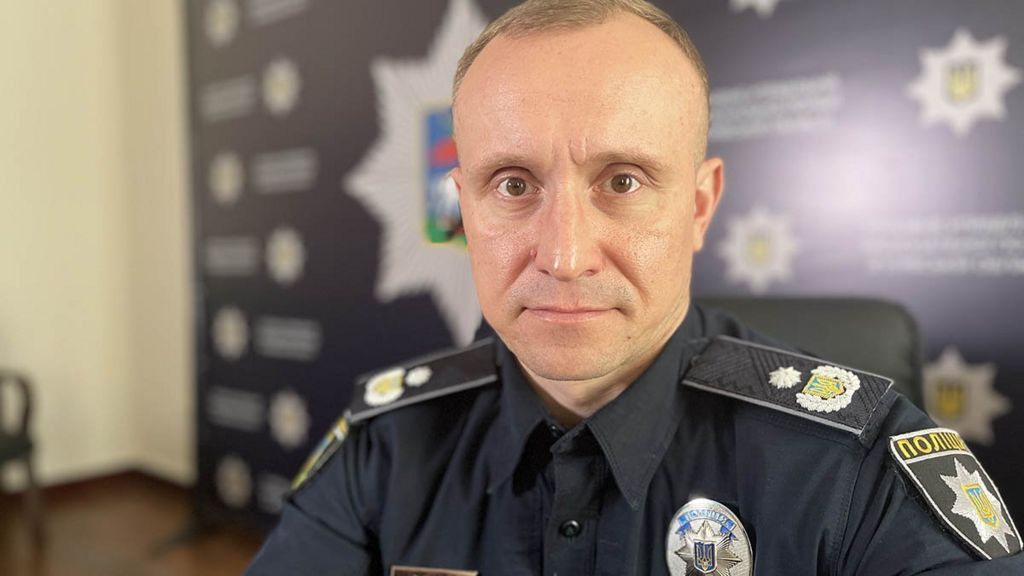
“We don’t know what Putin’s plans are, so we are working as quickly as possible in case he drops a bomb and destroys all the proof,” says Kyiv regional police chief, Andrii Niebytov.
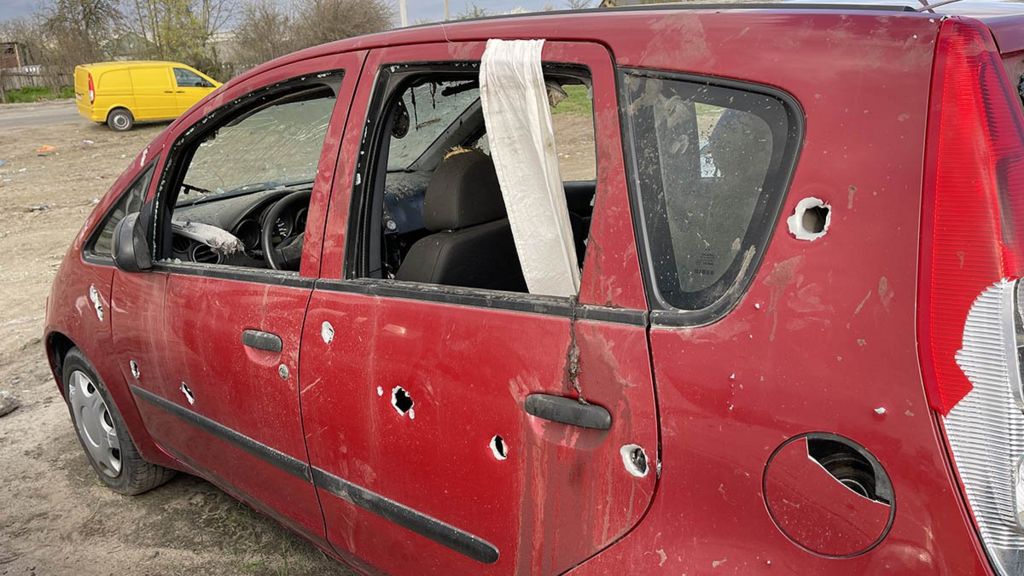
That evidence includes a field full of civilian cars pierced with multiple bullet holes, now piled up on the edge of Bucha. They are vehicles that were shot at when families tried to flee. One still has a length of white cloth at the window, hung to show the soldiers that its occupants were no threat. Step too close, and you catch the sickly smell of death.
Image caption, A white flag did not prevent this car from being attacked
When the bodies beneath Camp Radiant were discovered on 4 April, Volodymyr Boichenko was among them. Aliona had spent weeks frantically calling hospitals and morgues. That day she was sent a photograph to identify. She knew it was her brother before it had even downloaded.
“I hate them with every cell of my being,” Aliona cries, about Volodymyr’s killers. “I know that’s wrong to say about people, but they are not human. There was not one patch on those men’s bodies that was not beaten.”
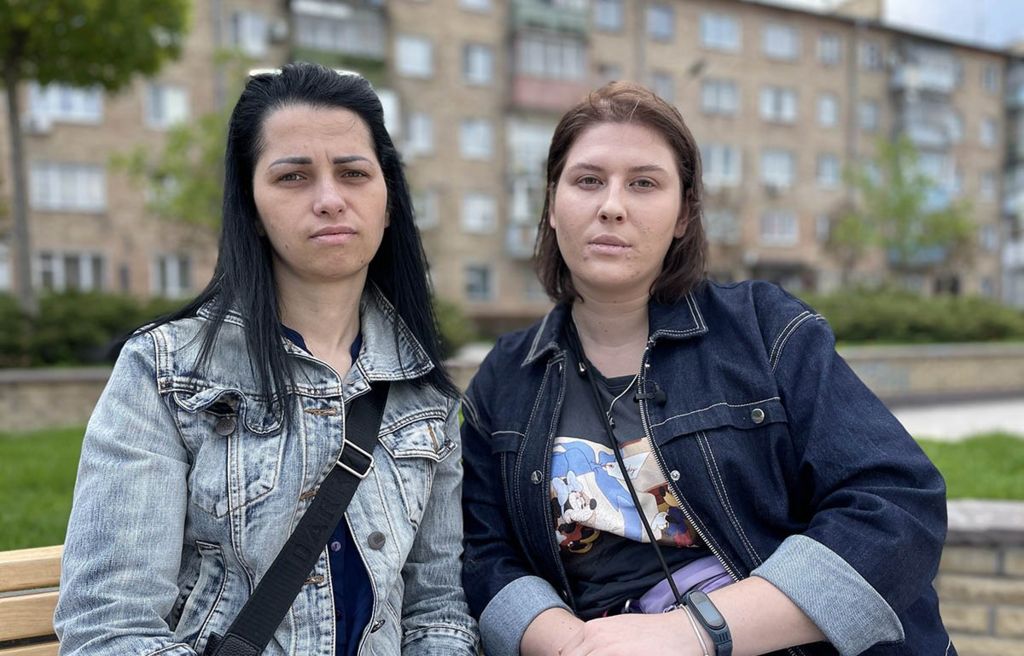
Image caption, Volodymyr’s sister Aliona, with her cousin Ilona
The five men had been found crouching on their knees, heads down and hands bound behind their backs.
“We know they had been tortured,” the police chief told the BBC. “The Russian army has crossed the line of how war is conducted. They were not fighting the military in Ukraine, they were kidnapping and torturing the civilian population.”
Neither the Prosecutor’s Office nor the SBU security service will disclose details of ongoing investigations, but some Russian military were so careless at covering their tracks that there are likely to be considerable clues to work with. Ukrainian territorial defence units have even discovered lists of soldiers at some abandoned positions. One appears to be part of a rota for litter duty, another includes passport details and mobile phone numbers.
Image caption, Kyiv regional police chief, Andrii Niebytov, is working fast to gather evidence
With such a vast volume of work – more than 11,000 potential war crimes cases registered so far – Ukraine’s security services have called on more digitally savvy civilians for help.
“I feel some call of duty,” said Dmytro Replianchuk, a journalist at slidstvo.info who worked to expose corruption within Ukraine’s law enforcement bodies before the war. Now he’s joined forces with prosecutors, scouring the internet for extra data to help catch suspected war criminals.
“I understand it will be so hard and a lot of cases won’t be solved. But in these weeks, it’s important to find as much information as possible,” Dmytro explained.
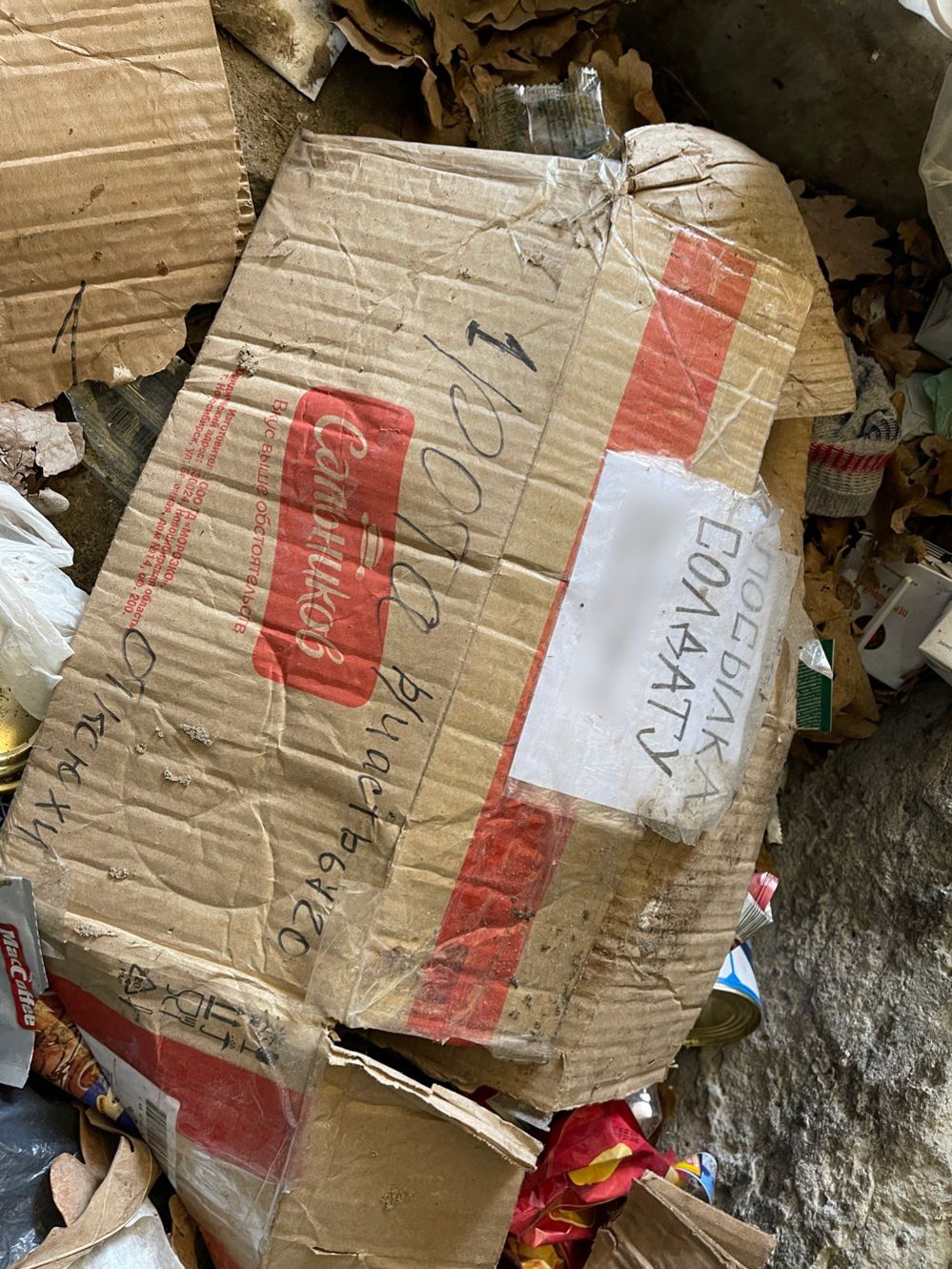
We found one potential clue among the litter at Camp Radiant – the wrapping from a parcel sent by a woman named Ksyukha to a Russian soldier whose own name and military unit are clearly marked. Unit 6720 is based in Rubtsovsk, in the Altai region of Siberia. It has been linked to Bucha before when soldiers from the town were caught on CCTV sending giant packages to relatives full of goods that they had looted from Ukrainian homes.
Image caption, A parcel addressed to a Russian soldier – the name has been blurred
We can’t be sure yet whether soldiers from Rubtsovsk were based at the children’s camp, or were there when the men were killed. The police first need to establish a more precise time of death.
“We are working on it, but it’s not a quick thing,” Mr Niebytov explains. “But that camp was a headquarters so there would have been a commander. The soldiers could not have executed anyone without the commander’s knowledge. So we will first find the organisers and then look for the implementers.”
Across the road from Camp Radiant, behind a church spattered with shrapnel damage, a corner of Bucha is slowly showing renewed signs of life. Young boys run around the yard, while a man fixes sheets of wood to windows shattered when the town was being shelled, constantly. And a little shop has just reopened to serve others now trickling back to begin their own repairs.
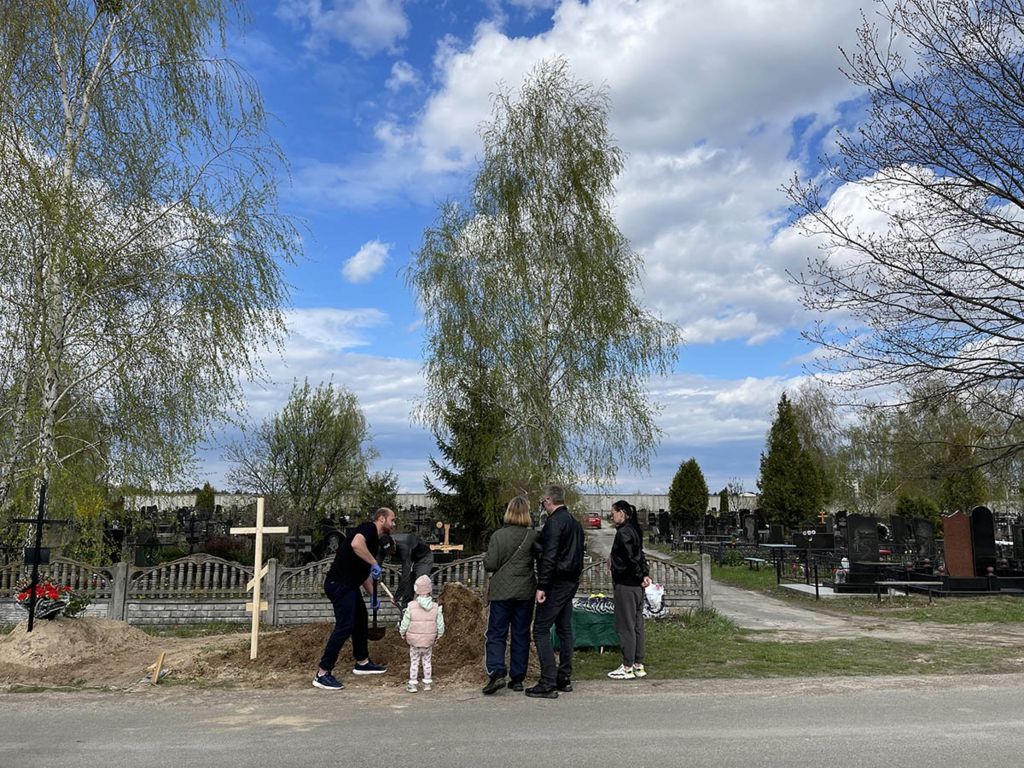
Image caption, Fresh graves are still being dug in Bucha
As neighbours cross paths, they discuss the days when Russian tanks rolled into their town, the soldiers who would shoot wildly and those who roamed the streets drunk, breaking into homes and stealing from them. And they remember the local man who escaped to their block of flats from the summer camp opposite, and who they had sheltered despite the risk.
Viktor Sytnytskyi didn’t know Camp Radiant before, but all the details he gives match up. He’s now in western Ukraine and told me his story over the phone, calling from his car so he wouldn’t upset his mother.
It was early March when Viktor was grabbed by Russian soldiers on the street. They tied his hands and pulled his hat down over his eyes, then dragged him to a cellar that he’s sure was on the grounds of the children’s camp.
Image caption, Camp Radiant is decorated with mosaics of happy children playing – now it’s a crime scene
There, the Russians poured water over his legs so he would freeze, and they held a gun to his head.
“They kept saying, ‘Where’s the fascists? Where’s the troops? Where’s Zelensky? One of them mentioned Putin so I said something rude and he hit me,” Viktor recalls.
He remembers being angry at his captors as well as terrified. He had worked in Moscow in the past with men from Siberia and was horrified that Russians could now treat him with such brutality. Even more so, when one of the soldiers revealed that he, too, was from Siberia.
Viktor told him he was sad things had come to this.
“The sad thing is that our grandfathers fought together against the Nazis and now you’re the fascists,” was the Russian’s angry reply.
“He told me: ‘You have until the morning to remember what you’ve seen, and if not, you’ll be shot.’”
That night, Viktor got lucky. There was heavy shelling and when he realised his captors were no longer guarding him, he ran for his life.
“I calculated that I had more chance of surviving under shelling than if I stayed in that cellar. They’d already put the gun to my head. What would it cost them to pull the trigger?”
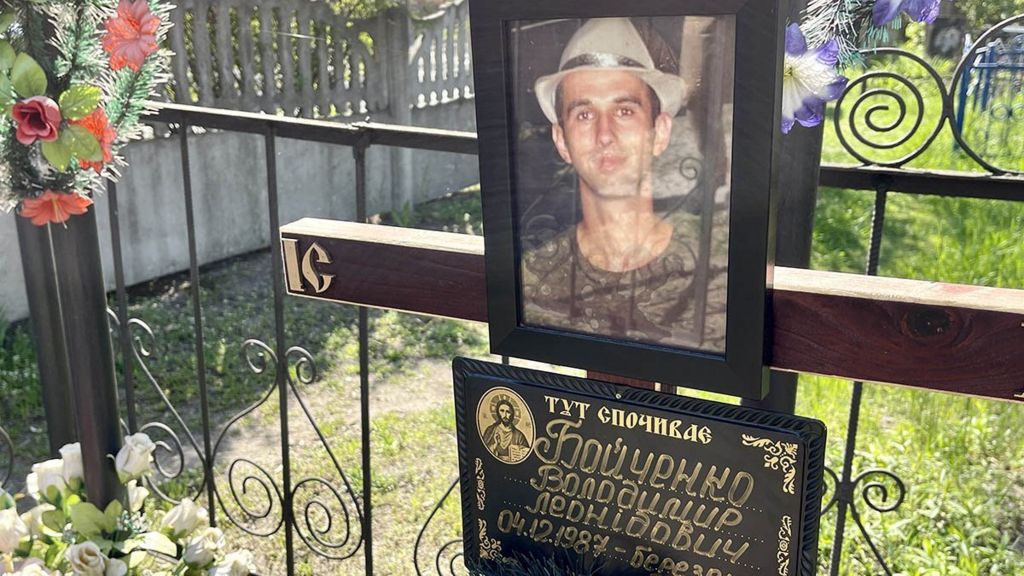
From a common grave beneath the children’s camp, Volodymyr Boichenko has now been given a proper burial beneath the cherry blossom in the old cemetery of Bucha.
After his funeral, Aliona says she finally saw her brother’s face in her dreams again, as if he were comforting her.
But she still has many questions. The cross on Volodymyr’s grave is marked only with his birthday, not the date of his death, because the family have no idea when he was shot.
They may never know, unless the Russian commander who took over Camp Radiant can be found.
Like everyone in Bucha, though, they do know that civilians are not only caught up in this war. They are being targeted – by Russian soldiers who either don’t know the rules of war, or don’t care.
Photographs by Sarah Rainsford unless otherwise marked
Additional reporting: Daria Sipigina, Mariana Matveichuk and Tony Brown
Ukraine is preparing for a new Russian push in the eastern Donbas region, President Volodymyr Zelensky says.
Since failing to take Kyiv at the beginning of the invasion in late February, control of Donbas has become one of Moscow’s main objectives.
“We are preparing for new attempts by Russia to attack in Donbas, to somehow intensify its movement in the south of Ukraine,” President Zelensky said in his nightly address.
“The occupiers still do not want to admit that they are in a dead-end and their so-called ‘special operation’ has already gone bankrupt,” he added.
He once again called on the West to impose an oil embargo on Russia.
“We are also working to strengthen sanctions on Russia. Partners need to make decisions that limit Russia’s ties to the world every week,” he said.
“The occupiers must feel the rising cost of war for them, feel it constantly.”
Ukraine has started its first war crimes trial since the beginning of Russia’s invasion, with a 21-year-old soldier appearing in the dock accused of killing an unarmed civilian.
Vadim Shishimarin appeared at a preliminary hearing in Kyiv. He faces life in prison if convicted.
Ukraine says it has identified thousands of potential war crimes committed by Russia.
Russia has denied targeting civilians and made no comment on the trial.
Prosecutors say Mr Shishimarin was driving in a stolen vehicle with other soldiers in the north-eastern Sumy region when they encountered a 62-year-old cyclist using a phone.
He was ordered to shoot the civilian to stop them from telling Ukrainian defenders about their location, according to the prosecutors.
It is not clear how he was captured or what the nature of the evidence against him is.
Mr Shishimarin spoke to confirm basic details such as his name. He is yet to enter a plea, and the trial will reconvene next week.
Hundreds of bodies have been found in regions previously occupied by Russia.
Some of Ukraine’s allies, such as the UK and US, have joined the country in accusing Russia of carrying out genocide.
After the hearing, state prosecutor Andriy Synyuk told Reuters: “This is the first case today. But soon there will be a lot of these cases.”
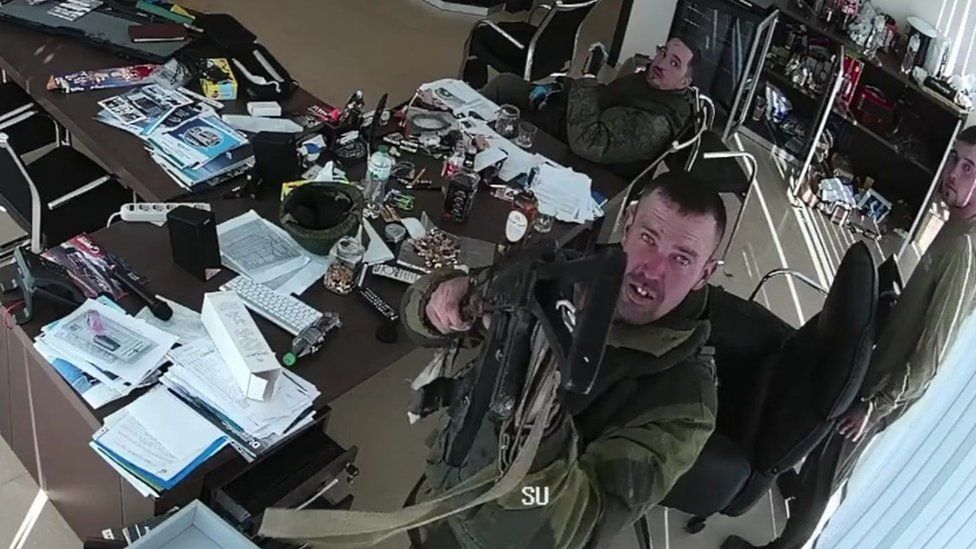
When Leonid Pliats and his boss were shot in the back by Russian soldiers, the killing was captured on CCTV cameras in clear and terrible detail. The footage, which was obtained by the BBC, is now being investigated by Ukrainian prosecutors as a suspected war crime.
It was the height of the fighting around Kyiv and the main roads into the capital were a battlefield, including around the bicycle shop where Leonid worked as a security guard.
But this was no firefight: the video clearly shows heavily armed Russian soldiers shooting the two unarmed Ukrainians and then looting the business.
We have pieced together the full sequence of events, matching what was recorded on multiple CCTV cameras around the site with the testimony of people Leonid phoned that day, as well as the Ukrainian volunteer fighters who tried to rescue him.
The Russians arrive in a stolen van daubed with the V sign used by Russian forces and the words Tank Spetsnaz in black paint. They wear Russian military uniform and approach with their guns up, fingers on the triggers.
Leonid walks towards the soldiers with his hands up to show he’s unarmed and no threat.
Image caption, The Russian soldiers had not realised they were being filmed
The Russians initially talk to him and his boss through the fence. There is no audio on the footage but the men seem calm, they even smoke. Then the Ukrainians turn away and the soldiers start to leave.
Suddenly they turn back, crouch then shoot the two men multiple times in their backs.
One is killed outright but somehow Leonid manages to stagger to his feet. He even ties his belt around his thigh to slow the blood, then stumbles to his cabin where he begins to call for help.
Vasyl Podlevskyi spoke to his friend twice that day, as he sat bleeding heavily.
Leonid told him the soldiers claimed they don’t kill civilians, then they shot him.
“I said can you at least bandage yourself up? And he told me, Vasya, I barely crawled here. Everything hurts so much. I feel really bad,” Vasyl remembers the call.
“So I told him to hang in there and started phoning the territorial defence.”
The men he called used to sell air conditioning before the war.
Image caption, There has been fierce fighting on the outskirts of Ukraine’s capital
Now volunteer fighters, Sasha and Kostya show me video on their mobile phones of Russian tanks rolling past their positions. Their job was to send real-time information on Russian movements to Ukraine’s military positions up the road.
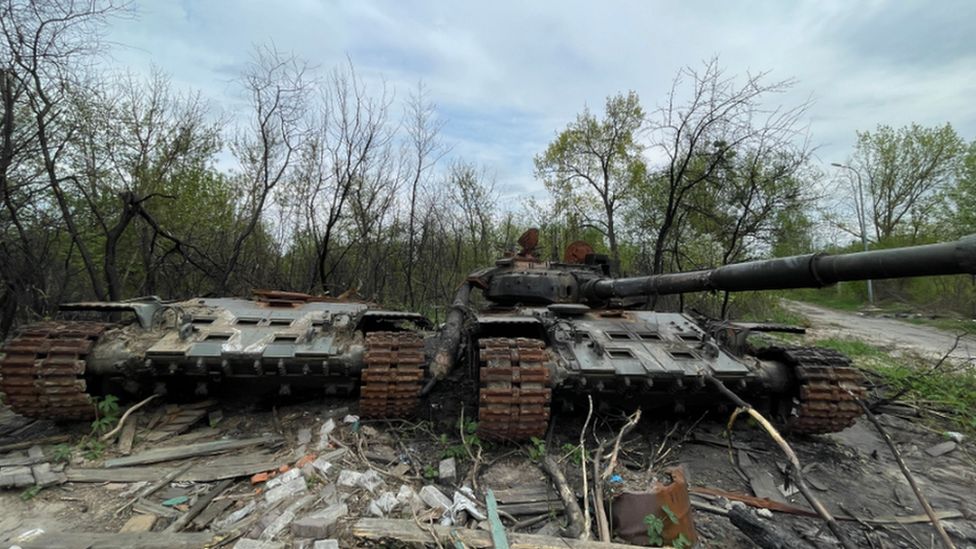
When Leonid Pliats was injured they were tasked with crossing the dangerous E40 highway to try to save him. Even today, the road is littered with the burned-out carcasses of Russian tanks, a reminder of the intensity of the fighting.
As the security guard lay bleeding, Russian troops were still on site.
On the CCTV you see them shooting their way into rooms, stealing bicycles and even a scooter and lolling around in the director’s office, drinking his whisky, and rifling through his cupboards.
Outnumbered and only lightly armed, Sasha and Kostya were forced to wait although they realised that Leonid was dying.
“We talked to him on the phone, we tried to calm him. We told him, it’s ok. Everything will be ok. You’ll survive,” Sasha tells me they did their best to comfort him.
“We said we were on our way. Maybe that helped him. Maybe. But unfortunately, by the time we made it, he was dead.”
Even as they collected the two men’s bodies, the volunteer fighters had to take cover as a Russian tank rolled past.
There is ample evidence against the men responsible for these killings. We have studied the video in minute detail and the Russian soldier who we believe was one of the killers is clearly visible, his face uncovered.
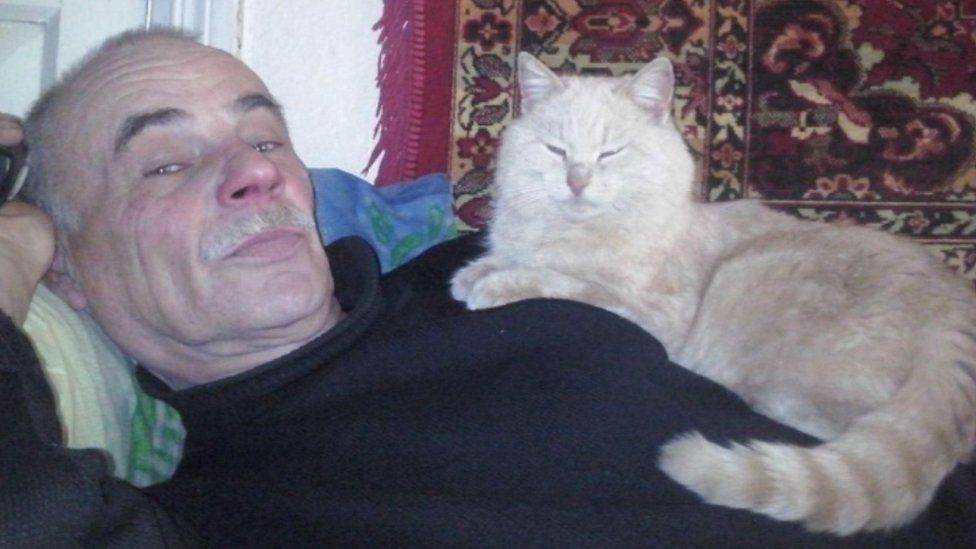
Image caption, Leonid was 65 when he died
It is a long time before his friends realise they are being filmed and smash one of the security cameras.
We showed the footage to the chief of police for Kyiv region and he told us the bodies of 37 civilians, all of them shot dead, were found along the road to Ukraine’s capital after Russian forces were pushed back.
The Prosecutor’s office confirms that it is now investigating the killing of Leonid and his colleague as a possible war crime: one of more than 10,000 cases they have registered.
“My Dad was not a military man at all. He was a pensioner. They killed a 65-year-old. What for?” Leonid’s daughter, Yulia Androshchuk, wants to know.
She is abroad and hasn’t even been able to bury her father yet because of the war.
“I’m not so much furious as full of grief – and fear. These damn Russians are so out of control, I’m afraid of what they might do next,” she told me.
Yulia hopes those responsible will stand trial someday, somehow. For now, she wants people to know exactly what happened to her father and for the brutality to stop.
(CNN) — As the world comes to terms with Russia launching a military attack on Ukraine, attention turns to how the international community will respond and how far it will go in punishing Vladimir Putin.
German Chancellor Olaf Scholz called the attack a “reckless act by President Putin” and a “terrible day for Ukraine and a dark day for Europe.” He added that the EU, G7 and NATO would coordinate closely on Thursday.
European Union Commission President Ursula von der Leyen called Russia’s actions a “barbaric attack” and said she will present EU member states with “massive and strategic” sanctions against Russia for approval later today. “These sanctions are designed to take a heavy toll on the Kremlin’s interests and their ability to finance war. And we know that millions of Russians do not want war,” she added. British Prime Minister Boris Johnson is also expected to announce a fresh package of sanctions. He tweeted on Thursday morning that Russia’s actions were “a catastrophe for our continent.”Â
French President Emmanuel Macron, who has led many of the diplomatic efforts to deescalate, reacted by saying “France stands in solidarity with Ukraine. It stands with Ukrainians and is working with its partners and allies to end the war.”
While Europe has largely stood united, there has been a notable silence from Hungarian leader Viktor Orban, who has a close relationship with Putin and has behind the scenes been accused of disrupting Europe’s unity in response to the crisis.
Enter your email to sign up for CNN’s “Meanwhile in China” Newsletter.
close dialogOutside of Europe, US President Joe Biden warned of incoming “consequences the United States and our Allies and partners will impose on Russia for this needless act of aggression against Ukraine and global peace and security.”
NATO and European security sources have previously told CNN that the US has been coordinating the unified response to the crisis and will likely take the lead today as the International community is expected to dramatically increase sanctions on Russia.
Western allies around the world have also committed to work with their partners in response to Russia. Japanese Prime Minister Fumio Kishida has said the “situation is tense. We will continue to work in collaboration with the international community, including the G7 nations.”
European Commission President Ursula von der Leyen speaks during a press statement on Russia’s attack on Ukraine, in Brussels on February 24, 2022, ahead of a EU special summit called to respond to the attacks.Â
Australian Prime Minister Scott Morrison has said Ukraine has his country’s “unwavering support.”
In Africa, the response was muted with only a handful of governments on the continent speaking out in the aftermath of the attacks.
“The Nigerian position is that dialogue should be prioritized over force,” a spokesman for President Muhammadu Buhari told CNN Thursday.
South Africa said the ongoing crisis “could have regional and global ramifications” if allowed to deteriorate.”All parties have much to gain from a negotiated outcome and much to lose from unnecessary and violent conflict,” the country’s Minister of International Relations and Cooperation, Dr Naledi Pandor, said in a statement.
Uncomfortably for Putin, China has not expressed particular support for Russia. China is Putin’s only major ally and has in recent years developed a close relationship with Russia, supporting it at the UN.
However, China has thus far refused to criticize Russia and said it would begin importing Russian wheat, a move that could ease the impact of Western sanctions on Russia.
China’s ambassador to the UN, Zhang Jun, only went so far as saying all parties needed “stay cool headed and rational,” he added that it was “especially important at the moment to avoid fueling tensions.”Governments all over the world are currently holding meetings to discuss how far sanctions should go against Russia in response to this huge escalation. A first wave of sanctions came from the US, EU and UK on Tuesday, though they were limited in scope and criticized for not going very far. It is very likely that fresh sanctions will go further and will target Russia’s broad economy in a less compromising manner, possibly going so far as hitting Putin’s personal wealth directly.
The National Union of Ghanaian Students (NUGS) has revealed that some Ghanaian students studying in Ukraine are currently stranded and in distress following conflict between the country and Russia.
This follows brewing tensions in the last few days over attacks from Russia on Ukraine, in what many fear could be the beginning of the Third World War. Russia is demanding for an end to NATO’s eastward expansion, which will affect Ukraine, a former Soviet republic.Â
In a statement, NUGS explained that some Ghanaian students have already began fleeing the country for fear of their lives in the face of escalations of the conflict.Â
According to NUGS, some of these students who recently returned to Ghana from Ukraine have reached out to them to detail the situation and to seek that they advocate for evacuation of these students.Â
They are therefore, urging the government to as soon as possible, put in measures for the evacuation of all Ghanaian students close to the areas of the conflict between Russia and Ukraine.
“As conflict escalates within the region, governments of countries across the world are prioritizing the evacuation of their citizens from the area, to forestall harm to their citizens. Currently, a number of students have fled the region, showing growing insecurity and fear among our students.Â
“Some of those students including Chapter Executives of NUGS in Ukraine have touched down and made contact with the National Secretariat of NUGS, advising that urgent steps be taken to ensure the safety of their colleagues still in the region,†parts of the statement said.
Read full statement of the NUGS below:
Meanwhile, reports in the international media have indicated that Russia has begun invading Ukraine. Russian troops for months have been camping at the borders of Ukraine.Â
Since the attacks began countries including the United States and European Union have hit sanctions on Russia and the UN Secretary-General Antonio Guterres has said that the world is “facing a moment of peril†over the Ukraine-Russia crisis.
Russia is “very concerned” about increased shelling in eastern Ukraine, according to Foreign Minister Sergei Lavrov.
Weapons are being used that are banned under the Minsk peace plan, Lavrov said in Moscow on Friday. The Organization for Security and Co-operation in Europe (OSCE) also noted increased violations of the agreed ceasefire.
Ukrainian government troops, equipped with weapons and ammunition by the West, are facing Russian-backed separatists there. The sides blame each other for the flare-up of violence.
Lavrov accused the Ukrainian government of sabotaging the Minsk peace plan. At a meeting with his Greek counterpart Nikos Dendias in Moscow, he criticized the OSCE for not naming Kiev as the initiator of the violence. Shooting is also taking place from the separatist areas.
In an interview with Russian state television, Lavrov once again said that Moscow had no plans to invade Ukraine. It was Western “propaganda, fake news and made-up,” he said. “The main thing is that the authors of these fakes believe in what they say themselves. They like that,” Lavrov said. “It evokes a laugh.”
UN Secretary-General, Antonio Guterres, used his opening speech at the Munich Security Conference on Friday to warn against conflict in Ukraine, saying it was “high time to seriously de-escalate.”
“With a concentration of Russian forces around Ukraine, I am deeply concerned about heightened tensions and increased speculation about a military conflict in Europe. I still think it will not happen. But if it did, it would be catastrophic,” he said.
“I am often asked whether we are in a new Cold War. My answer is that the threat to global security now is more complex and probably higher than at that time,” he said.
“During much of the Cold War, there were mechanisms that enabled the protagonists to calculate risks and use back-channels to prevent crises. Today, many of those systems no longer exist and most of the people trained to use them are no longer here with us.”
Just prior to Guterres, conference chair Wolfgang Ischinger described this year’s edition as “the single most importance conference” during his 14 years in charge of the meeting. The world was faced, he said, with a “rising tide of mutually reinforcing crises.”
Ischinger said he regretted that Russian representatives were not at the conference, and welcomed the participation of Ukrainian President Volodymyr Zelensky, at which point many delegates in the hall clapped.
AÂ man armed with a grenade has escaped arrest and took a senior Ukrainian policeman hostage in the central city of Poltava, according to Ukraine’s deputy interior minister.
“Negotiations are ongoing to force the attacker to surrender to the police without harming himself or others,” Anton Gerashchenko said on Facebook on Thursday.
Police were trying to arrest a man suspected of hijacking a vehicle when he took out a grenade and threatened to kill one of the officers, Gerashchenko said.
After negotiations, the man exchanged the police officer for a police colonel and drove off with him in a car provided by the police.
It was the second hostage-taking in Ukraine in three days. On Tuesday, an armed man held 13 people captive on a bus for hours before releasing them.
Ukrainian President Volodymyr Zelensky says he has been fined for violating the country’s lockdown rules.
Zelensky said this happened after he visited a cafe in the central city of Khmelnytsky on 3 June.
His office later released a photo of Zelensky sipping coffee in the cafe – although a ban on catering services indoors was still in effect at the time. The president was also without a face mask.
“They did the right thing,” the president said, referring to the fine – but without revealing how much he had to pay.
Zelensky also said he had even considered at one point getting deliberately infected with COVID-19 to show Ukrainians that the danger was real.