Tag: Ukraine

  • What does Russia wants from the votes in occupied Ukraine?

    Four seized regions of Ukraine are being held over by Russian-backed officials, who are holding so-called referendums on joining Russia.

    These so-called elections, which have been denounced as invalid and fraudulent by Ukraine and the West, are being held over the course of five days in four front-line regions: two in the east and two in the south.

    An annexation could lead to a claim by Russia that its territory is coming under attack from Western weapons supplied to Ukraine.

    This could escalate the war further.

    What is going on and why now?

    Seven months after Russia’s invasion began, Vladimir Putin is on the back foot. Ukraine’s counter-offensive has recaptured swathes of territory seized since the 24 February invasion.

    A vote on annexation is one of three steps taken by the Kremlin in an attempt to reset the war.

    By annexing another 15% of sovereign Ukraine, Russia will be able to claim its territory is under attack from weapons provided by Nato and other Western countries to Ukraine. By calling up 300,000 extra troops, it can defend a front line of 1,000km (620 miles). The Kremlin has also criminalized desertion, surrender and going absent without leave during mobilization.

    If Russia’s leader annexing territory sounds familiar, it is. When he ordered troops to seize Crimea in 2014, he followed it up with a vote rejected as an illegitimate sham by the international community.

    This latest event has also been denounced as illegal by many Western countries, including international monitoring groups, the OSCE, and Russian media have already said that a Yes-vote is beyond doubt.

    It is taking place over five days in Russia’s two proxy areas in Luhansk and Donetsk in the east, and in occupied parts of Kherson and Zaporizhzhia in the south.

    What makes these votes a sham?

    We have already seen how Crimea was annexed by Russia in 2014. While the Kremlin claimed 96.7% support, a leaked report from Russia’s Human Rights Council said only around 30% had voted and barely half supported annexation.

    Not a shot had been fired in Crimea, and yet in this latest case voting is expected to take place in the middle of a war.

    The four regions involved are either partially or completely under occupation.

    In the south, the city of Kherson is not a safe place right now, with Russian soldiers struggling to hold back a big Ukrainian counter-offensive. The central administration building was hit by a series of missiles only last week.

    A secure vote is impossible, and yet officials talk of 750,000 people registered and plans to incorporate occupied parts of another Ukrainian region, Mykolayiv, into the annexed area.

    Russian media reported that elected officials would go from door-to-door with portable ballot boxes from Friday to Monday.

    Polling stations will only operate on the fifth day, 27 September, with officials citing security reasons.

    Hundreds of stations are scheduled to open that day, with voters also able to cast ballots in regions outside their own – and refugees eligible to vote in parts of Russia itself.

    Then there’s Zaporizhzhia’s capital, which remains securely in Ukrainian hands, so any vote to annex that region makes little sense.

    Donetsk in the east is only 60% under Russian occupation and very much at the heart of the conflict.

    Russia does control most of Luhansk in the northeast even if it has begun to lose ground. Russian news agencies showed flyers being handed out entitled “Russia is the future”.

    Much of the pre-war population has fled the conflict. The head of Russia’s proxy authority in Donetsk, Denis Pushilin, ordered a mass evacuation days before the invasion.

    Russian-backed leaders have been keen to stage votes for several months, but the decision to hold the vote was taken just three days in advance and smacks of desperation.

    There will be no independent observers. Much of the voting will be online, although officials have promised extra security at polling stations.

    What will change?

    Ukrainian defense ministry adviser Yuriy Sak told the BBC the so-called referendums were doomed. “We are seeing that local populations are all in favour of returning to Ukraine, and this is why there’s so much guerrilla movement resistance in these territories.”

    In any event, Kyiv says nothing will change and its forces will continue to push to liberate the territories.

    Russia analyst Alexander Baunov says merely redefining the occupied areas as Russian territory is unlikely to stop Ukraine’s army, but it does send a message of intent to the populations under their control. And the Kremlin’s hope is that the West will balk at having its weapons fired at land declared by Moscow as Russian.

    Alarmingly President Putin has spoken of using all means at his disposal “to protect Russia”. And in case there was any doubt at all. the deputy head of Russia’s security council, Dmitry Medvedev, made clear that nuclear weapons could also be used to protect annexed territories.

    US Secretary of State Antony Blinken has spoken of a “dangerous escalation”, but reaffirmed Washington’s position that no Russian claim to Ukrainian soil could take away Ukraine’s right to defend itself.

    Even Turkey, which has sought to play a mediating role, has damned the vote as illegitimate.
  • Silvio Berlusconi defends Russian war on eve of Italian election

    Former Italian Prime Minister Silvio Berlusconi has supported Vladimir Putin’s invasion of Ukraine.

    The 85-year-old said Russia’s leader was “pushed” into the conflict.

    Silvio Berlusconi believes that Russian troops were meant to replace the government with “decent people” then leave.

    “Putin was pushed by the Russian population, by his party and by his ministers to invent this special operation. The troops were supposed to enter, reach Kyiv in a week, replace the Zelensky government with decent people and a week later come back,” Mr Berlusconi.

    Unfortunately, he said they found “an unexpected resistance, which was then fed by arms of all kinds from the West.”

    The three-time Italian PM is a long-term ally of the Russian President.

    This weekend his party is expected to take power as part of a right-wing coalition in a general election in Italy.

    A narrative alleging the Ukrainian government was slaughtering Russian speakers in the east of the country was created by the media in Moscow, Mr Berlusconi told Italian TV.

    He said the reporting, pushed by separatist forces and nationalist politicians in the Russian government, had left Mr Putin with no choice but to launch a limited invasion.

    Mr Berlusconi has long been an admirer of Mr Putin, in 2012 joining the then-prime minister for a skiing trip in the Russian city of Sochi.

    But in April, he condemned the invasion and said he was “deeply disappointed and saddened” by Mr Putin’s behaviour, adding that the “massacres of civilians in Bucha and other localities are real war crimes”.

    The Forza Italia party leader is currently campaigning as part of a right-wing coalition ahead of Sunday’s general election.

    His centre-right party is the junior partner of the alliance, which is anchored by Giorgia Meloni’s hard-right Brothers of Italy and Matteo Salvini’s populist Lega Nord party. Polls have suggested the bloc will win a majority.

    Despite Mr Berlusconi’s past friendship with Mr Putin, and Mr Salvini’s criticism of Western sanctions on Russia, Ms Meloni, who is expected to lead any potential government, has pledged to continue Italy’s support of Ukraine.

    “The war in Ukraine is the tip of the iceberg of a conflict aimed at reshaping the world order,” she said earlier this month. “So we have to fight this battle.”


  • UN Security meeting: Sergei Lavrov walks out after speech

    After giving his speech, Sergei Lavrov, the foreign minister of Russia, left the UN Security Council meeting.

    He began by saying: “There is an attempt today to impose on us a completely different narrative, about Russian aggression as the origin of all the tragedy”.

    He continued by talking about the historical relationship between Ukraine and Russia and described Ukraine as “totalitarian”.

    He added that he is “concerned about the fate of Russian soldiers taken prisoners by Ukraine”.

    Mr Lavrov said he has “no confidence” in the work of the International Criminal Court.

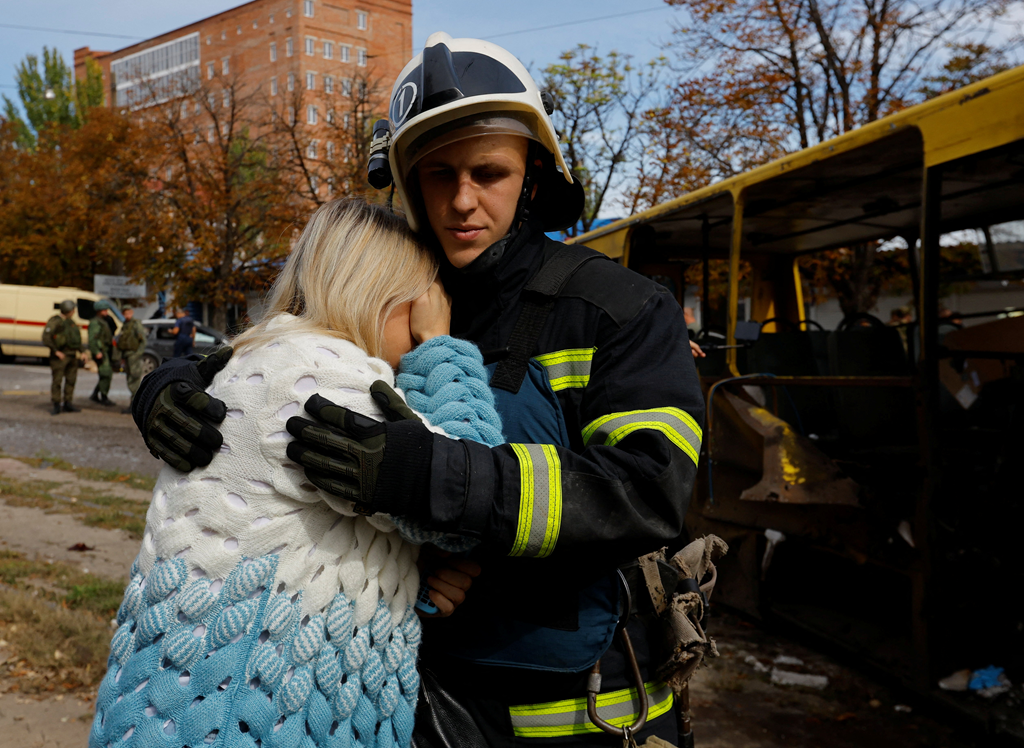
  • Donetsk missile strike: About six civilians, including a teenager killed

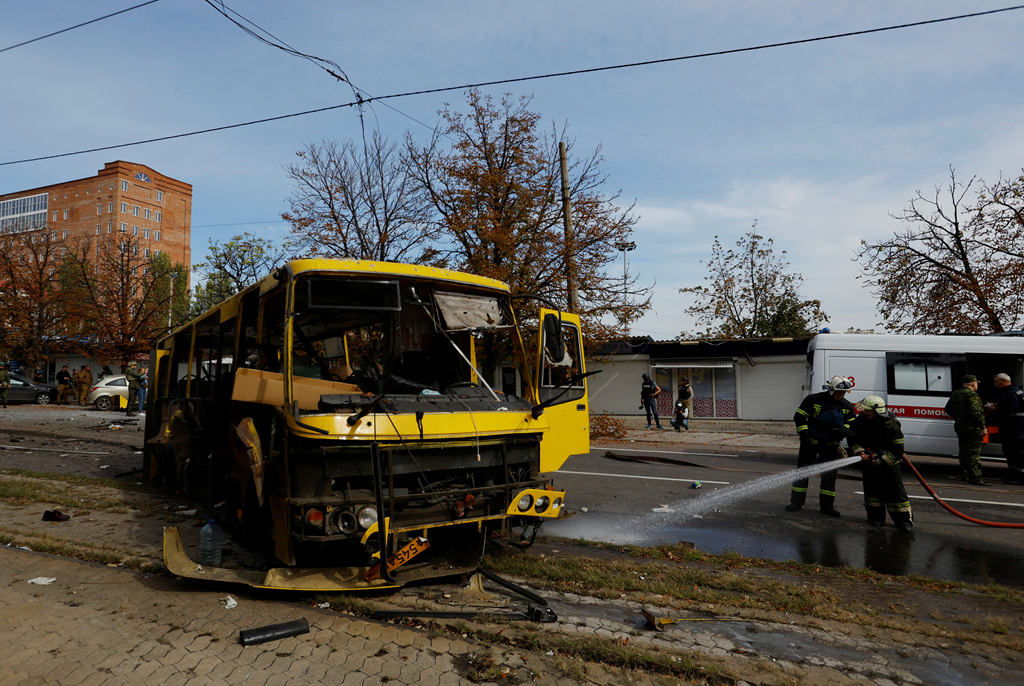
    A firefighter was consoling a mother whose teenage child had been murdered by shelling on a bus.

    The strike, according to officials supported by Russia, struck Donetsk’s separatist-controlled city centre.

    They blamed Ukrainian forces for the strike on a covered market.

    A Reuters journalist at the scene saw the body of a teenager and four others, as well as several wounded citizens.

    There has been no immediate comment from Ukraine, and the reports of who was behind the shelling cannot be independently verified.

  • Anticipating a steak dinner tonight – Captured Briton returns home

    A Briton, Shaun Pinnerwas freed as part of a prisoner swap between Russia and Ukraine, and he has since been reunited with his family.

    In April, Russian-backed separatists in eastern Ukraine arrested Mr. Pinner, 48, who was later found guilty of “mercenary actions” and given the death penalty.

    Our correspondent Emma Birchley spoke to him at his mother and stepfather’s home near Sandy in Bedfordshire.

    “It’s good to be home,” he said. “I’m looking forward to a steak dinner tonight!”

    He was finally reunited with his mother, stepfather, sister, and son at Heathrow at 6 am.

    For Mr Pinner’s mother, Debbie Price, the relief is overwhelming.

    “It’s been a really, really hard time,” she said. “We are just so happy to have him home. It’s hugely emotional.”

    The first hint Mr Pinner had that something was happening was after lunch on Tuesday.

    “They said you have to roll your stuff up. They said you’re going on a long journey,” he said.

    “We were moved to another location. We didn’t have any idea what was happening.”

    He was later flown with other released captives to Saudi Arabia.

    At 5.30 pm UK time yesterday, Mr Pinner was able to speak to his mother on the phone, from the Middle Eastern country.

    “It’s very emotional, as you can imagine,” he said. “I really want to say thank you to everyone who helped us get out from the government of Saudi Arabia and also Liz Truss and Boris Johnson.

    “The Saudis gave us a full MOT. Their hospitality was great,” he said.

    “Our thoughts go out to those who hope to be exchanged soon,” he said, referring to the prisoner swap which resulted in his release.

    He added that he has many friends still in Ukraine, as well as his wife. Today is their second wedding anniversary.

    It’s hoped she will be able to get a visa to also come to the UK.

    Mr Pinner’s sister Cassandra said she can’t believe how much changed in just 24 hours and described the feeling as “surreal”.

    She knew something was up when her mother phoned her at work, after being contacted by the Foreign Office at just before midday yesterday.

    Mr Pinner is yet to be fully debriefed by the Foreign Office and Intelligence Services.

  • Ukraine conflict: Russia arrests hundreds at anti-war protests

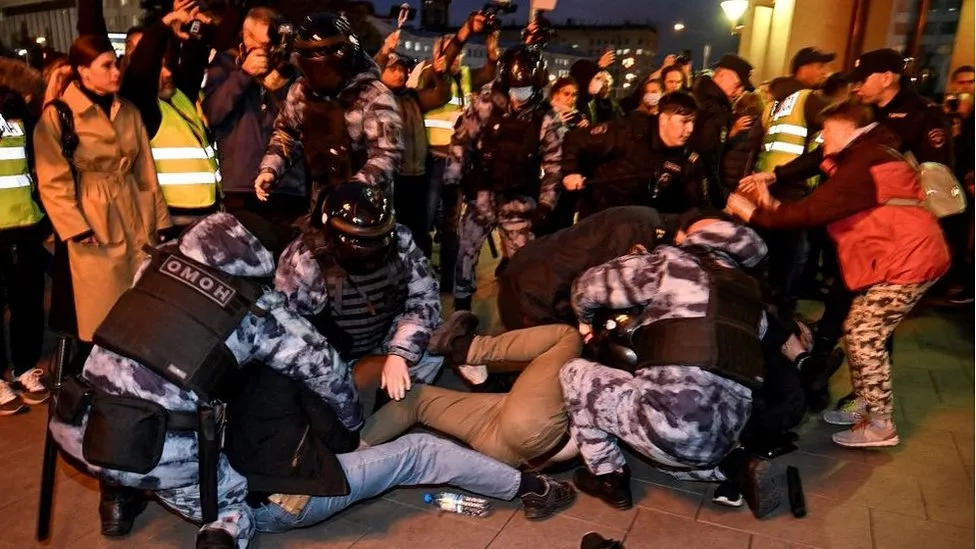
    Russian police are reported to have arrested hundreds of protesters rallying against the Kremlin’s decision to call up thousands of extra troops to fight in Ukraine.

    Russian human rights group OVD-Info put the total at more than 900. The largest number arrested was in Yekaterinburg, a major city east of Moscow.

    Dozens were also detained in Irkutsk and other Siberian cities, and Moscow.

    Flights out of Russia sold out fast after Vladimir Putin’s announcement.

    Russia’s president ordered a partial mobilisation, meaning some 300,000 military reservists – but not conscripts – will be drafted to bolster Russia’s forces who have suffered recent battlefield reverses in Ukraine.

    The move came a day after occupied areas of Ukraine announced snap referendums on joining Russia.

    And in remarks condemned by Ukraine and its allies, Mr Putin stressed that he would use “all available means” to protect Russian territory – implying this could involve nuclear weapons.

    Tough warnings to protestors

    Moscow protest - scuffle with police, 21 Sep 22Image source, AFP
    Image caption,

    Scuffles broke out in Moscow as police made arrests

    The Moscow prosecutor’s office on Wednesday warned that calls on the internet to join unauthorised street protests, or participation in them, could incur up to 15 years in jail. They could be prosecuted under laws against discrediting the armed forces, spreading “fake news” about Russia’s military operation in Ukraine, or encouraging minors to protest.

    Russia’s tough penalties for spreading “disinformation” about the Ukraine war and police harassment of anti-Putin activists have made public anti-war protests rare.

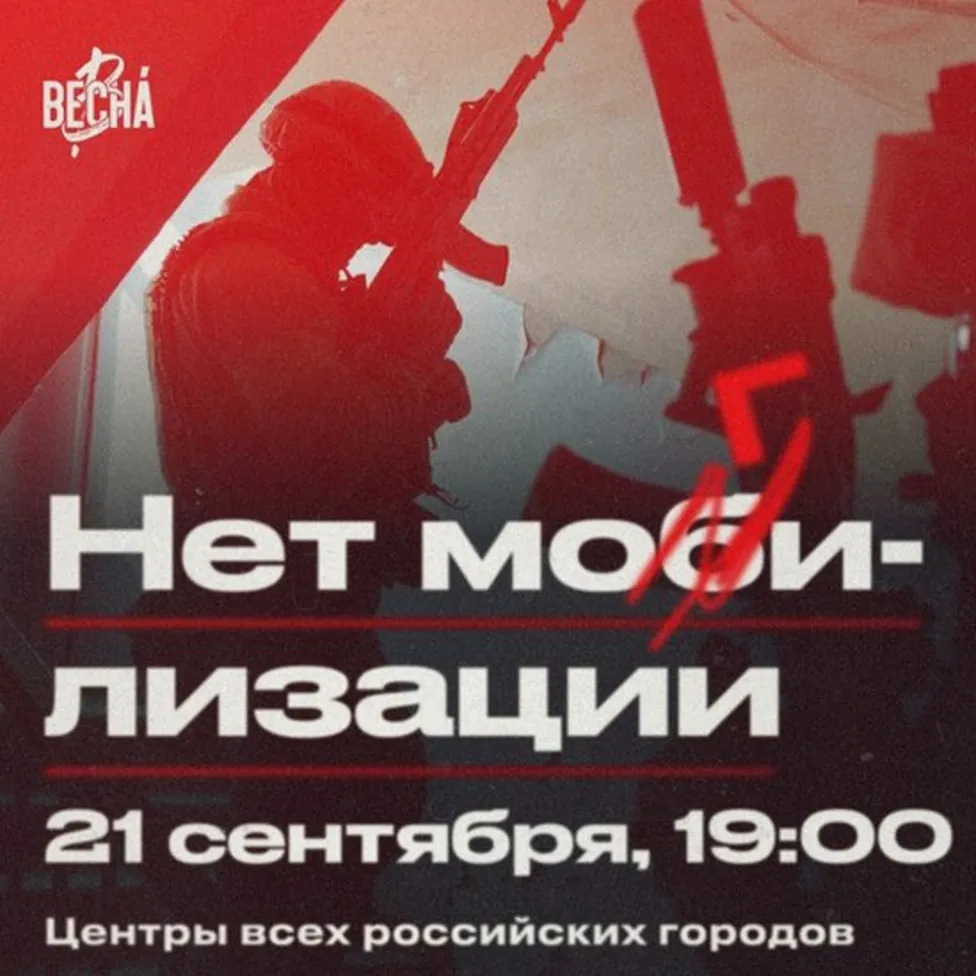
    But the anti-war opposition group Vesna called for widespread protests, and on Telegram it reported many arrests across Russia. A video clip from Yekaterinburg showed police violently bundling protesters into a bus.

    The protests appeared relatively small. Vesna called its action “no to mogilisation” – a play on words, because “mogila” in Russian means grave.

    Pavel Chikov, a lawyer for the Russian human rights group Agora, said Agora had received 6,000 inquiries to its hotline since Tuesday morning, from Russians wanting information about soldiers’ rights.

    Meanwhile, flights to popular destinations such as Istanbul in Turkey and Yerevan in Armenia were snapped up, and prices for remaining seats skyrocketed.

    ‘Absolutely everyone is afraid’

    Vesna slogan on TelegramImage source, Vesna/Telegram
    Image caption,

    On Telegram opposition group Vesna called for anti-war rallies

    The Kremlin’s mobilisation move follows heavy losses in Ukraine, where Kyiv’s forces have recaptured a huge area east of Kharkiv.

    President Putin’s control of the state media has ensured that many Russians support his claim that Ukraine’s “neo-Nazi” government and Nato threaten Russia, and that ethnic Russians in Ukraine have to be defended. In reality Ukraine’s government was democratically elected and has no far right politicians.

    The scale of Russian opposition to the Kremlin line on Ukraine is hard to gauge, as media restrictions are so tight.

    Pro-Putin Russian regional governors, who now have to organise the mobilisation, voiced support for it.

    “We won’t be weakened, divided or exterminated,” said Ulyanovsk governor Alexei Russkikh. “Our region, like all the others in our country, has a duty to mobilise citizens for military service.”

    Chelyabinsk governor Alexei Teksler said the mobilisation was needed to ensure Russia’s “sovereignty, security and territorial integrity”.

    But young Russian men have told the BBC of their fears about the call-up.

    Matvey in St Petersburg said “I was hoping it would never happen”. “Now it’s obvious that Putin won’t step back and he’s going to continue his stupid fight to the last Russian citizen.” He said “I shouldn’t be recruited during this step of mobilisation, but there are no guarantees that things won’t get worse”.

    Evgeny, a 31-year-old Russian living in the UK, told the BBC: “Absolutely everyone is afraid, everyone is sending around different information on mobilisation. It is very difficult to figure out what is true and what isn’t. Nobody trusts the government.”

    Source: BBC

  • EU will not be recognize outcome of planned referenda – foreign affairs chief

    The European Union has condemned Russia’s plans to hold referenda in parts of Ukraine and has said the outcomes will not be recognized.

    In a statement, EU foreign affairs chief Josep Borrell said: “The European Union strongly condemns these planned illegal “referenda” which go against the legal and democratically elected Ukrainian authorities, are in violation of Ukraine’s independence, sovereignty, and territorial integrity, and in blatant breach of international law.”

    Mr Borrell said those involved with these “referenda” will be held accountable and additional restrictive measures against Russia would be considered.

    He added that the EU and its member states would not recognize the outcome of the referendums.

    Moscow-controlled regions in eastern and southern Ukraine are set to hold referenda on becoming parts of Russia, which could give the Kremlin the pretext for a wider war because Vladimir Putin would be able to claim parts of his state were being attacked.

    Source: Sky News

  • Germany nationalises gas giant amid energy crisis

    Germany is to nationalise gas giant Uniper in an effort to secure energy supplies amid the war in Ukraine.

    The deal will see the German government take on a 98.5% stake in the firm at a cost of €8.5bn (£7.4bn).

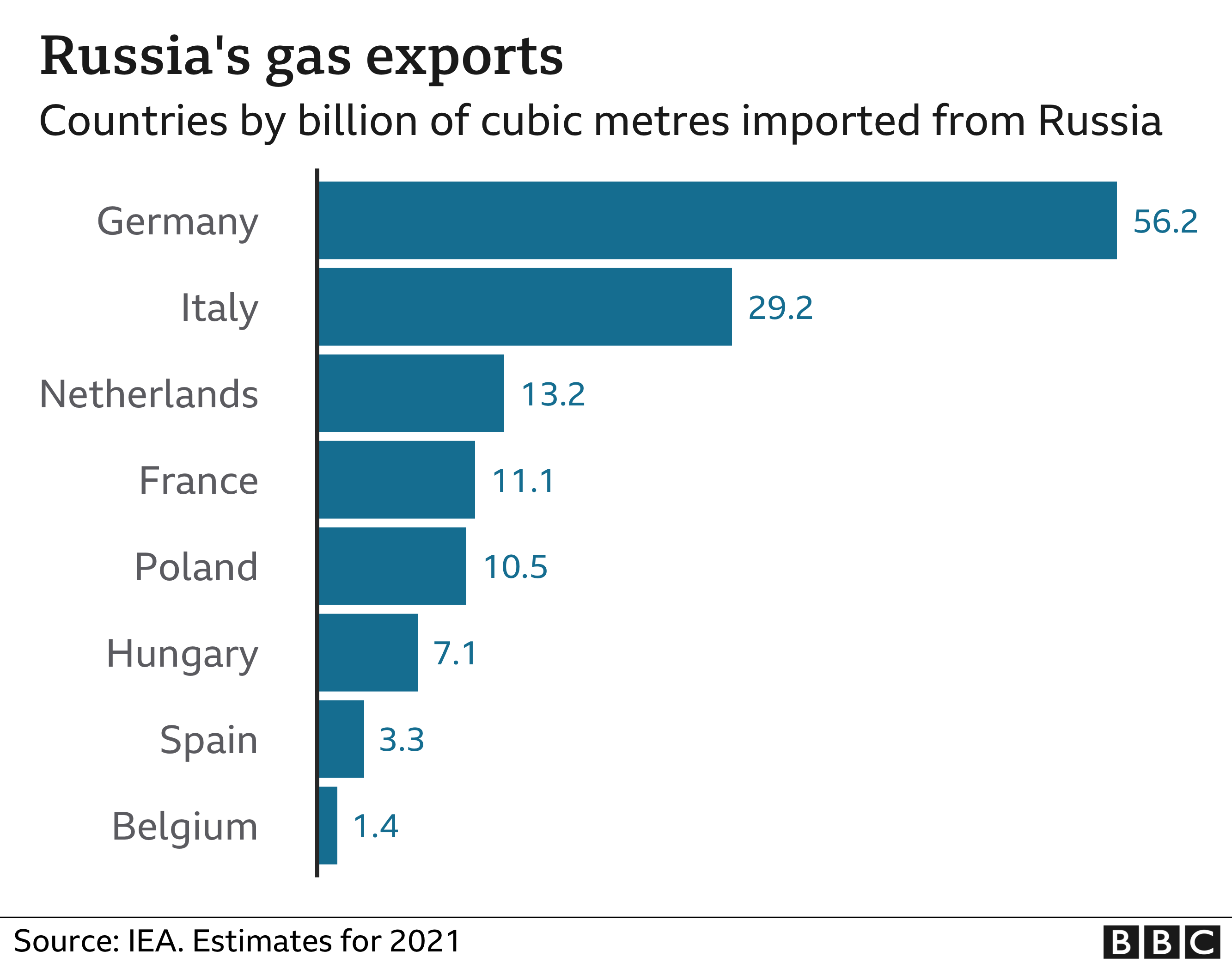
    Germany is Europe’s biggest importer of Russian gas, and has been particularly squeezed as Russia has reduced supplies in recent months.

    Chief executive Klaus-Dieter Maubach said the deal would help Uniper’s role as “a system-critical energy supplier”.

    Before Russia invaded Ukraine it supplied Europe with about 40% of its natural gas, and it has responded to Western sanctions by gradually cutting off supplies.

    At the start of this month, Russia halted supplies through the Nord Stream 1 pipeline, claiming repairs were needed – but later said flow would not resume until sanctions were lifted.

    Uniper, which operates gas, coal, and hydro plants across Europe and is currently controlled by Finnish state-owned energy company Fortum, is the biggest buyer of Russian gas in Germany.

    In recent months it has had to replace Russian supplies with alternatives from the open market, where prices have soared.

    Fortum said Uniper had accumulated close to €8.5bn (£7.4bn) in gas-related losses “and cannot continue to fulfil its role as a critical provider of security of supply as a privately-owned company”.

    “The role of gas in Europe has fundamentally changed since Russia attacked Ukraine, and so has the outlook for a gas-heavy portfolio,” Fortum chief executive Markus Rauramo said in a statement.

    “As a result, the business case for an integrated group is no longer viable.”

    The price of shares in Uniper, which also owns the coal-fired Ratcliffe-on-Soar power station in Nottinghamshire, has fallen by more than 90% in the past year.

    Under the terms of the deal, the German government will buy Fortum’s shares in Uniper for €500m (£437m) and inject €8bn (£7bn) of cash into the business.

    Some assets in Russia will also come under Germany’s control, a government spokesperson said, adding that it was still being decided what would be done with them.

    The government had already agreed to take on a 30% stake of Uniper as part of a bailout agreement in July.

    Earlier this month, it also entered discussions with another major gas supplier, VNG, over a possible bailout package.

    Economy minister Robert Habeck said nationalising Uniper was a “necessary” step that would help “ensure security of supply for Germany”.

    He also said that, despite the loss of Russian supplies, Germany had succeeded in filling its gas storage facilities to over 90% capacity ahead of winter.

    “This means that, as a whole, we have coped quite well with the situation,” he said. “But for Uniper the situation became significantly more dramatic and significantly worse.”

    Gas exports
  • UK Foreign Secretary to call out Russia’s atrocities at UN Security Council

    UK Foreign Secretary, James Cleverly is expected to call out Russia’s atrocities at a UN Security Council meeting on Thursday.

    James Cleverly will be in New York on Tuesday, September 20 to attend United Nations General Assembly high-level meetings as part of the 77th UN General Assembly (UNGA).

    A statement from the Foreign, Commonwealth and Development Office of the UK said the Foreign Secretary will travel alongside the Prime Minister to meet his global counterparts “to take action on a series of global challenges, including Russia’s malign activity and building stability in the Middle East.”

    Ahead of arriving in New York, Foreign Secretary James Cleverly said: “We live in an increasingly unstable, divided world. As Foreign Secretary, I will work to bring countries together to tackle aggression, overcome challenges and promote our democratic values. We will judge others on actions not words. Every day the devastating consequences of Russia’s barbaric tactics become clearer. There must be no impunity for Putin’s hostility.”

    James Cleverly is also due to hold meetings with his counterparts from the US, Ukraine and India and attend a G7 Foreign Ministers’ dinner.

    This will be the Foreign Secretary’s first overseas trip since he took his new role. His main event of the week will be a special UN Security Council session on Thursday.

    The statement added that the UN Security Council session will focus on the situation in Ukraine.

    “…ensuring that Russia does not get away with its actions unpunished. The Foreign Secretary will give the UK’s intervention at the meeting, exposing Russian aggression and tactics as they seek to justify their illegal war.”

    Cleverly is due to have his first bilateral meeting in his new role with the US Secretary of State Antony Blinken later on Tuesday.

    He is also due to meet Ukrainian Foreign Minister, Dmytro Kuleba, India’s Subrahmanyam Jaishankar and Canada’s Melanie Joly on Wednesday and Australia’s Penny Wong on Thursday.

    On arrival in New York, he is due to attend a global food security event hosted by the United States, European Union and African Union as 50 million people worldwide face being just one step away from famine.

    Also this week, the Foreign Secretary will join partners, including fellow G7 Foreign Ministers, for an event on nuclear safety, as concerns around the Zaporizhzhia Nuclear Power Station in Ukraine continue to grow.

    Stability in the Middle East will be a recurring theme on the agenda in New York, with discussions set to take place on Yemen, Syria and the Gulf.

    Source: Myjoyonline

  • Moroccan among war prisoners released by Russia

    Saudi Arabia says Russia has released 10 prisoners of war captured in Ukraine, following mediation by Crown Prince Mohammed bin Salman, including from Morocco.

    The other citizens are from the United States, Britain, Sweden and Croatia.

    They have not yet been named.

    A Saudi statement said they had been transferred from Russia to Saudi Arabia.

    It did not say if Ukraine had released Russian prisoners in return.

    Read more about the war prisoners release here.

    Source: BBC

  • Ukraine war: Moroccan’s death sentence overlooked, according to sister

    The predicament of the Moroccan guy who was given a death sentence in Ukraine has received little attention says his sister.

    A Russian proxy court tried Brahim Saaudun, 21, and two Britons who were arrested while fighting with the Ukrainian army as mercenaries.

    The British and Ukrainian governments have condemned the trial but Morocco is yet to comment.

    Iman Saaudun told the BBC he had been “left aside” as attention focused on the other men.

    “At first, when they captured all of them, then it was like different news about every person,” she told the BBC.

    “There wasn’t much attention on my brother… Maybe it’s because of my government, they are not doing much about it, they are literally silent.”

    The BBC has contacted the Moroccan government for a response.

    Like many countries in Africa and the Middle East, Morocco has avoided taking sides in the conflict in Ukraine, calling instead for a peaceful resolution to the war which started with Russia’s invasion of the country in February this year.

    On 13 June, Morocco’s king underlined his country’s “solid friendship” with Russia in a message to President Vladimir Putin on the occasion of Russia’s National Day, without mentioning Mr Saaudun’s case.

    He moved to Ukraine to study and received Ukrainian nationality in 2020 after undergoing military training required to access aerospace technology studies at a university in Kyiv, his father Tahar Saaudun said in an email to the Reuters news agency.

    Brahim, left, and his friend Dmytro
    IMAGE SOURCE, PA MEDIA Image caption, Brahim (L) moved to Ukraine to study and his friends in Kyiv are campaigning for his release

    After his capture alongside Britons Aiden Aslin and Shaun Pinner, all three were tried by a proxy court in the so-called Donetsk People’s Republic, a pro-Russian breakaway region in eastern Ukraine. They were tried as mercenaries rather than being treated as prisoners of war, whose rights are protected under the Geneva Convention.

    The men’s lawyers said they all wished to appeal the sentence, Russia’s Tass news agency reported.

    The court is not recognized internationally, but Russia’s foreign minister has defended the death sentences it gave the men.

    Iman said she feared that her brother did not know that people were trying to help him.

    “I just want to tell him you’re loved. I just want to tell him, like, things will be OK. Don’t be scared. He’s my little brother. That’s what a big sister should do, but I could not do that. I cannot do that,” she said.

    Friends are now campaigning for his release and posting under the hashtag #SaveBrahim.

    “Everyone is heartbroken,” Dasha Oleynik, a close friend of Mr Saaudun, told the Guardian newspaper.

    “I wish he knew how much support he actually has… how many people care, how many people write about it, how many people post about it.”

    Iman hailed his friends’ efforts.

    “Your government let you down. Your own people let you down, but others did not and they will find their best for you”.

  • Five British nationals among prisoners of war released by Russia

    Among the five war prisoners released by Russia, are British nationals.

    Earlier we reported that 10 foreign prisoners who were caught in Ukraine, were released following mediation by Saudi Crown Prince Mohammed bin Salman, according to the Saudi foreign ministry.

    Prime Minister Liz Truss revealed that five Britons are among those released.

    Ms Truss tweeted: “Hugely welcome news that five British nationals held by Russian-backed proxies in eastern Ukraine are being safely returned, ending months of uncertainty and suffering for them and their families”.

    She thanked Ukrainian president Volodymyr Zelenskyy and Saudi Arabia for their efforts to secure their release.

  • Russia wants Ukraine to cease to exist – Biden

    Biden says Russia’s war is about extinguishing Ukraine’s right to “exist as state, as a people”.

    “Just before he invaded, Putin asserted, and I quote, ‘Ukraine was created by Russia’ and never had quote ‘real statehood’.

    “And now we see attacks on schools, railway stations, hospitals.. even more horrifying evidence of Russia’s war crimes.”

    The US president also references the mass grave recently uncovered in Izyum, which he said “showed signs of torture”.

    He says Russia’s war is about extinguishing Ukraine’s right to exist as a state – “plain and simple”, before telling those at the UN General Assembly:

    Quote Message: Whoever you are, wherever you live, whatever you believe – that should make your blood run cold. That’s why 141 nations in the General Assembly came together to unequivocally condemn Russia’s war against Ukraine.

    Whoever you are, wherever you live, whatever you believe – that should make your blood run cold. That’s why 141 nations in the General Assembly came together to unequivocally condemn Russia’s war against Ukraine.He adds that the US has personally marshalled “massive levels of security assistance, hamartian aid and direct economic support” to Ukraine.

  • Analysis: Putin’s decision to raise the stakes signals he cannot give up

    A decision by Vladimir Putin to raise the stakes even higher over Ukraine is a sign that his war is going badly, but it is also a signal that the Russian president cannot give up, writes Sky’s security and defence editor, Deborah Haynes.

    A partial mobilization; the holding of referendums to turn four Ukrainian regions “Russian”; and the spectre once more of nuclear confrontation mark a serious moment of escalation and a new test for the Ukrainian government with its Western backers.

    It comes in response to a significant counteroffensive by Ukrainian forces over the past three weeks, which has seized back swathes of territory in the northeastern Kharkiv region, forcing Russian troops into retreat and giving the Ukrainian side the momentum.

    Analysts have said from the beginning of Russia’s full-scale invasion that Putin cannot afford to lose this war as it would almost certainly mean the end of his presidency.

    But Ukraine has made clear it will not stop fighting until all Ukrainian territory is recaptured, meaning escalation will continue until either side blinks.

    It is interesting, therefore, to consider how the position – and risk appetite – of the UK, the US, and other western allies has evolved over the past nearly seven months of the war.

    There has been an unwavering desire to support Ukraine, but this support was initially constrained by a desire to avoid giving so much weaponry that it would be seen by Moscow as an escalatory step drawing Russia closer into direct confrontation with the West.

    But as the war has drawn on and Russian forces have resorted to exploiting their greater stockpiles of long-range artillery to smash Ukrainian positions, the West’s appetite has grown to gift Ukraine more powerful weapons – such as long-range multiple-launch rocket systems, tanks, and aircraft – regardless of the escalatory potential.

    DISCLAIMER: Independentghana.com will not be liable for any inaccuracies contained in this article. The views expressed in the article are solely those of the author’s and do not reflect those of The Independent Ghana

    Source: Sky News

  • Sri Lankans delivered from Russian brutality in Ukraine

    Ukraine‘s recapture of the city of Izyum has assisted with the redemption of a group of Sri Lankans held captive for months.

    There are have been multiple allegations of atrocities under Russian occupation.

    Dilujan was one of seven Sri Lankans captured by Russian forces in May. The group had just set out on a huge walk to safety from their homes in Kupiansk, north-eastern Ukraine, to the relative safety of Kharkiv, some 120km (75 miles) away.

    But at the first checkpoint they came across, they were captured by Russian soldiers. The Sri Lankans were blindfolded, their hands tied, and taken to a machine tool factory in the town of Vovchansk, near the Russian border.

    It was the start of a four-month nightmare which would see them kept prisoner, used as forced labour, and even tortured.

    “We thought we would never get out alive,” says Dilujan Paththinajakan.

    WARNING: You may find some of the details below about abuse distressing.

    The group had come to Ukraine to find work, or study. Now, they were prisoners, surviving on very little food, only allowed to use the toilet once a day for two minutes. On the occasions they were allowed to shower, that too was restricted to just two minutes.

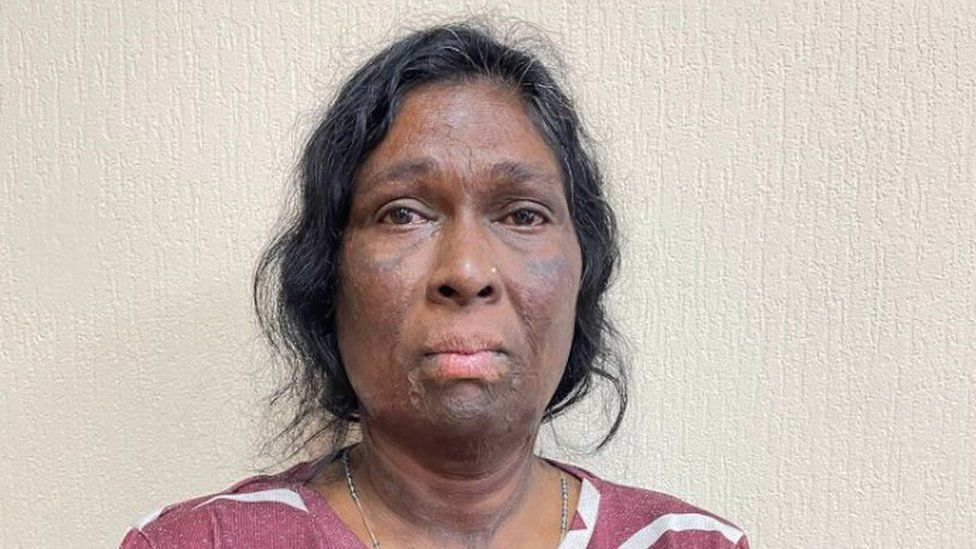
    The men – mainly in their 20s – were all kept in one room. The only woman in the group, 50-year-old Mary Edit Uthajkumar, was kept separately.

    Mary Edit Uthajkumar
    Image caption, Mary Edit Uthajkumar, 50, said months of solitary confinement had taken a toll

    “They locked us in a room,” she said “They used to beat us when we went to take a shower. They didn’t even allow me to meet the others. We were stuck inside for three months.”

    Mary, her face already scarred by a car bomb in Sri Lanka, has a heart condition, but didn’t receive any medicine for it.

    But it was the impact of the solitude which really took its toll.

    “Being alone, I was so tense,” she says. “They said I was having mental health issues and gave me tablets. But I didn’t take them.”

    Others have been left with even more visible reminders of what they had endured: one of the men removed his shoes to show his toenails had been torn off with pliers. A second man reportedly also suffered that torture.

    The group also spoke of being beaten for no apparent reason – of Russian soldiers who would get drunk and then attack them.

    “They hit me across the body many times with their guns,” said 35-year-old Thinesh Gogenthiran. “One of them punched me in the stomach and I was in pain for two days. He then asked me for money.”

    “We were very angry and so sad – we cried every day,” Dilukshan Robertclive, 25, explained.

    “The only thing that kept us going was prayer – and family memories.”

    Russia has denied targeting civilians or committing war crimes, but the Sri Lankans allegations come alongside many other reports of atrocities committed by Russian occupying forces.

    Ukraine has been exhuming bodies from a burial site in forest near Izyum, some of which show signs of torture. And Ukrainian President Volodymyr Zelensky has said “more than 10 torture chambers have already been found in the liberated areas of Kharkiv region, in various cities and towns”.

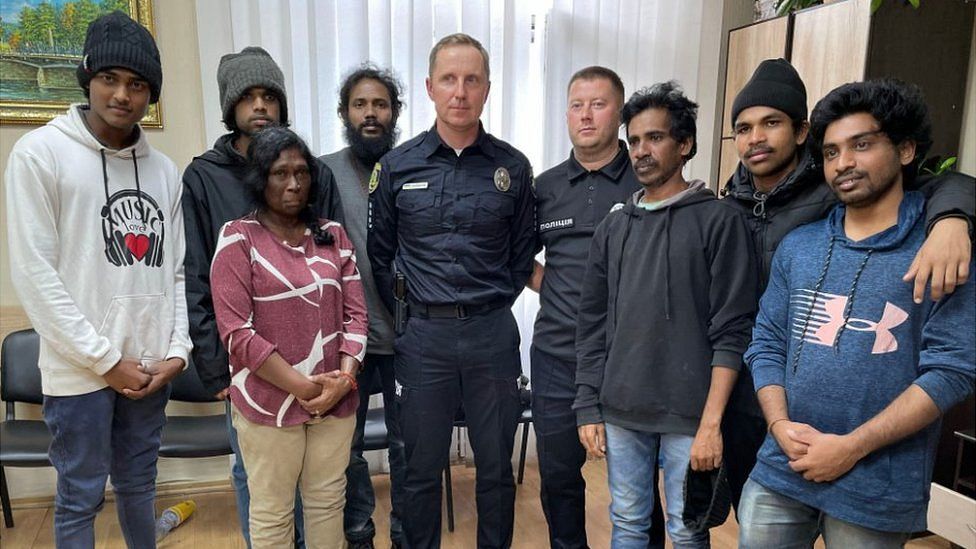
    The liberated Sri Lankans with Ukrainian police in Kharkiv, 18 Sep 22
    Image caption, The liberated Sri Lankans with Ukrainian police in Kharkiv

    Freedom for the seven Sri Lankans finally came when the Ukrainian military began retaking areas in eastern Ukraine earlier this month – including Vovchansk.

    Once again, the group was able to begin their walk towards Kharkiv. Alone, and without their phones, they had no way to contact their families.

    But finally, their luck changed: someone spotted them along the way and called the police. One officer offered them their phone.

    The moment Ainkaranathan Ganesamoorthi, 40, saw his wife and daughter on the screen he broke down in tears. Other calls followed, more tears flowed. Eventually, the group huddled around the surprised police chief, engulfing him in a hug.

    The group have been taken to Kharkiv, where they are getting medical attention and new clothes, while sleeping in a rehabilitation centre with a pool and gym.

    “Now I feel very, very happy,” says Dilukshan, with a broad smile.

  • Deadly Donetsk blasts hit separatist-run city in Ukraine

    Thirteen people have been killed and others wounded in a series of explosions in the separatist-run city of Donetsk in eastern Ukraine, according to its Russian-backed mayor.

    Alexei Kulemzin blamed “punitive” Ukrainian shellfire for the deaths. There is no comment from Ukrainian officials.

    Donetsk has been controlled by Russia’s proxy authorities since 2014.

    They have repeatedly accused Ukrainian forces of targeting the city.

    Independent confirmation is hard to come by on the ground in separatist-held areas of the east. However, local authorities said nine 150mm shells were fired at the Kuibyshevsky district of Donetsk, from a village to the west of the city.

    Local leader Denis Pushilin accused Ukraine of deliberately targeting civilians at a bus-stop, a shop and a bank.

    Although Russian forces have seized areas of the Donetsk region further south since the invasion began in February, they have struggled to push the Ukrainian army back from the outskirts of the city itself.

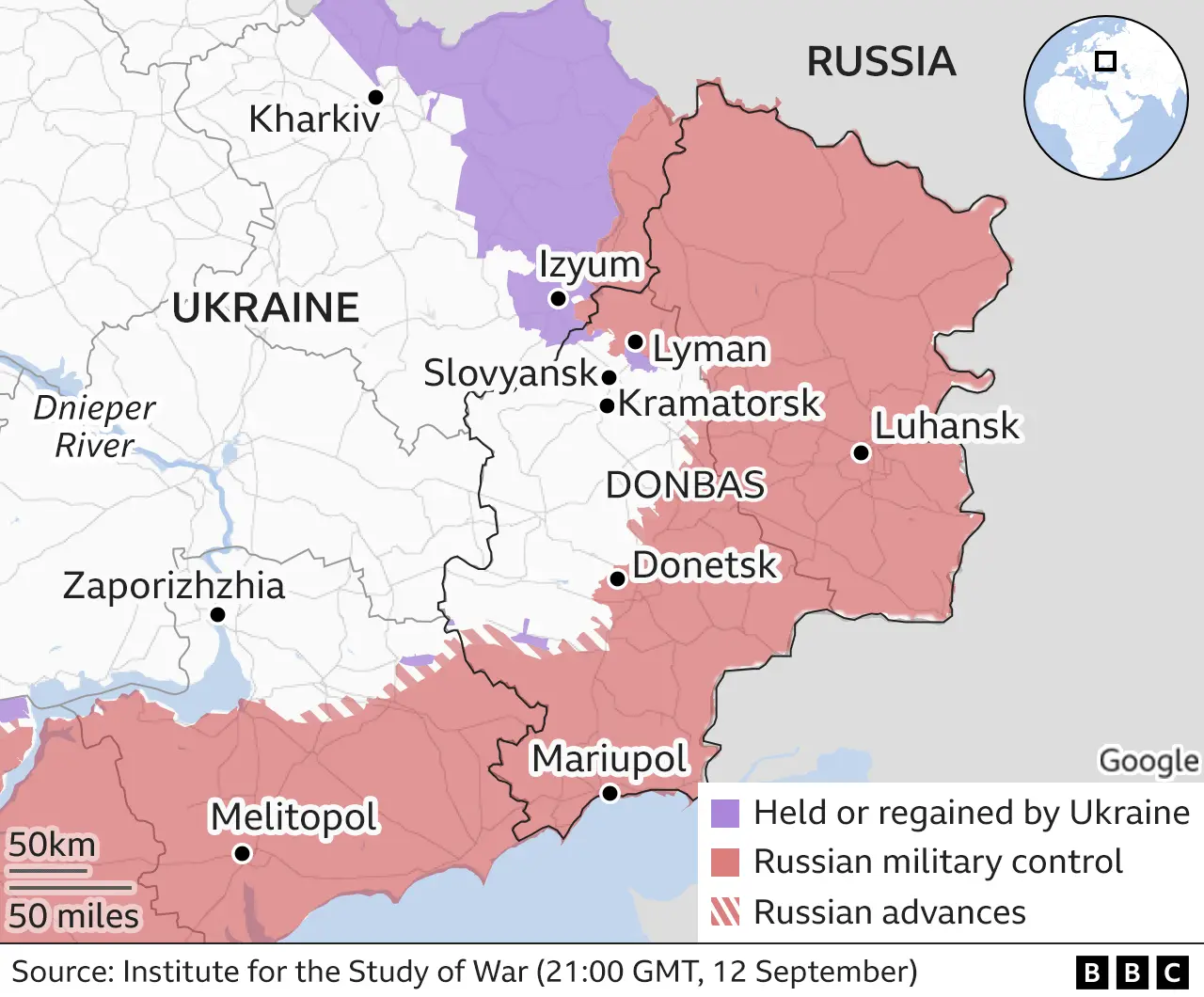
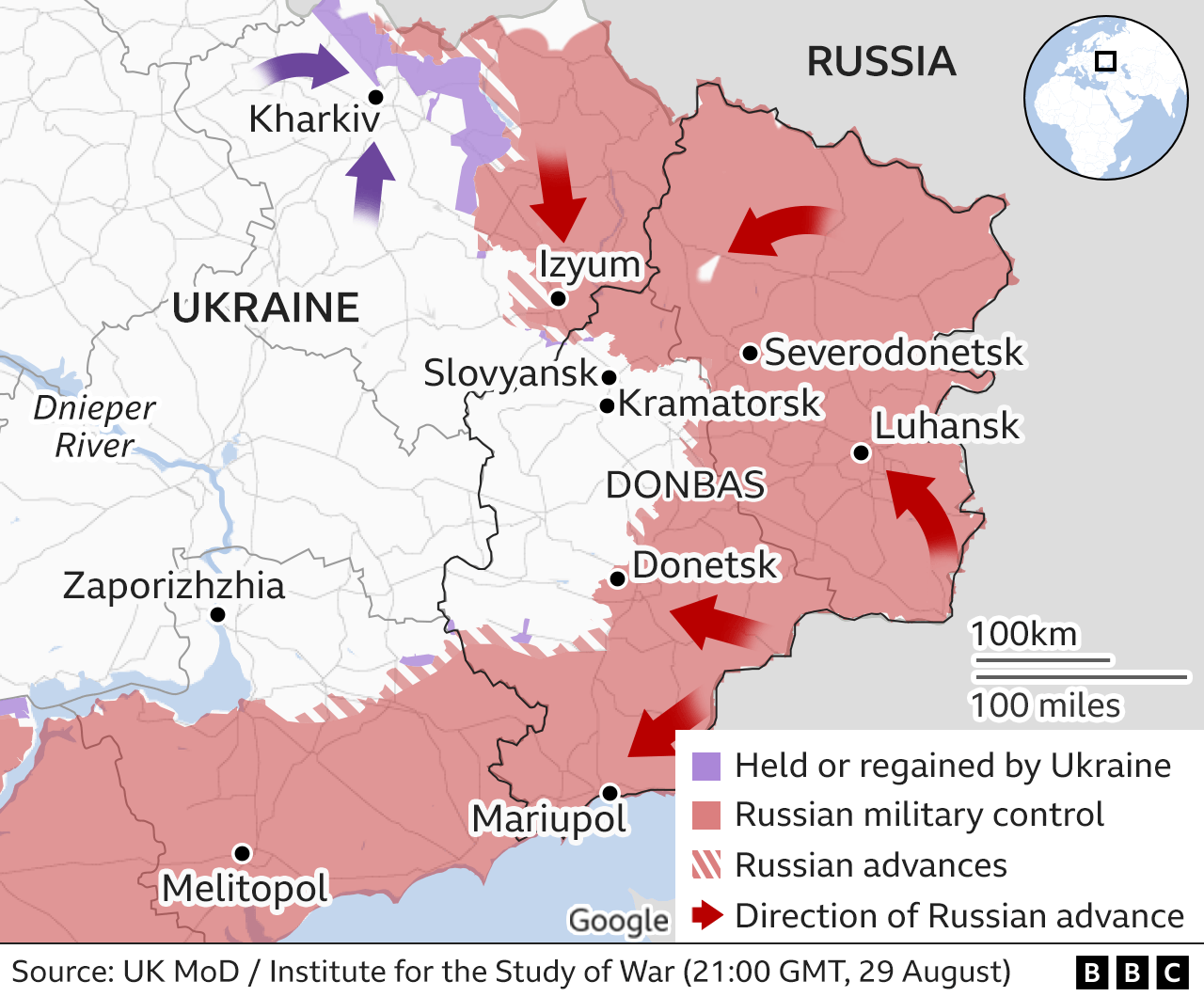
    Map showing east Ukraine. Updated 13 Sept.
    1px transparent line

    Ukrainian forces have launched counter-offensives in the south as well as the north-east, and their most dramatic progress has come this month in the northern Kharkiv region.

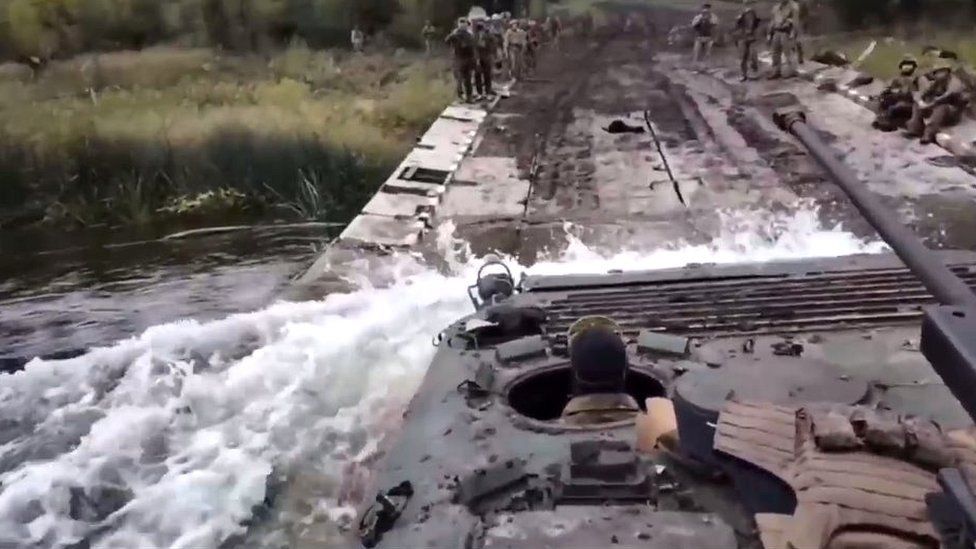
    The head of Luhansk region, Serhiy Haidai, shared video of a Ukrainian tank crossing a pontoon bridge, and said Ukraine now controlled the left bank of the Oskil river, seen as the front line in north-east Ukraine.

    A Ukrainian troop carrier is seen crossing a river in eastern Ukraine
    IMAGE SOURCE,TELEGRAM/A_SHTIRLITZ Image caption, Ukraine’s armed forces said they had pushed across the river at the weekend

    If Ukrainian forces are able to maintain a foothold on the eastern side of the Oskil, it will represent a breakthrough. Mr Haidai said the next target would be liberating the city of Lyman, which was seized by Russian forces in May.

    “Luhansk region is right next door. De-occupation is not far away,” he claimed.

    In his nightly address late on Sunday, President Volodymyr Zelensky said that recent days may have looked like a lull of sorts: “But there will be no lull. There is preparation for the next series… For Ukraine must be free. All of it.”

    Russia was accused on Monday of targeting a nuclear plant in the south.

    Ukrainian nuclear operator Enerhoatom said a rocket landed 300m (1,000ft) from nuclear reactors at the the country’s second largest plant in Mykolayiv region, damaging buildings and shutting down part of a hydro-electric power station at the complex.

    The attack has not been independently confirmed, although footage was posted online by the Ukrainian military.

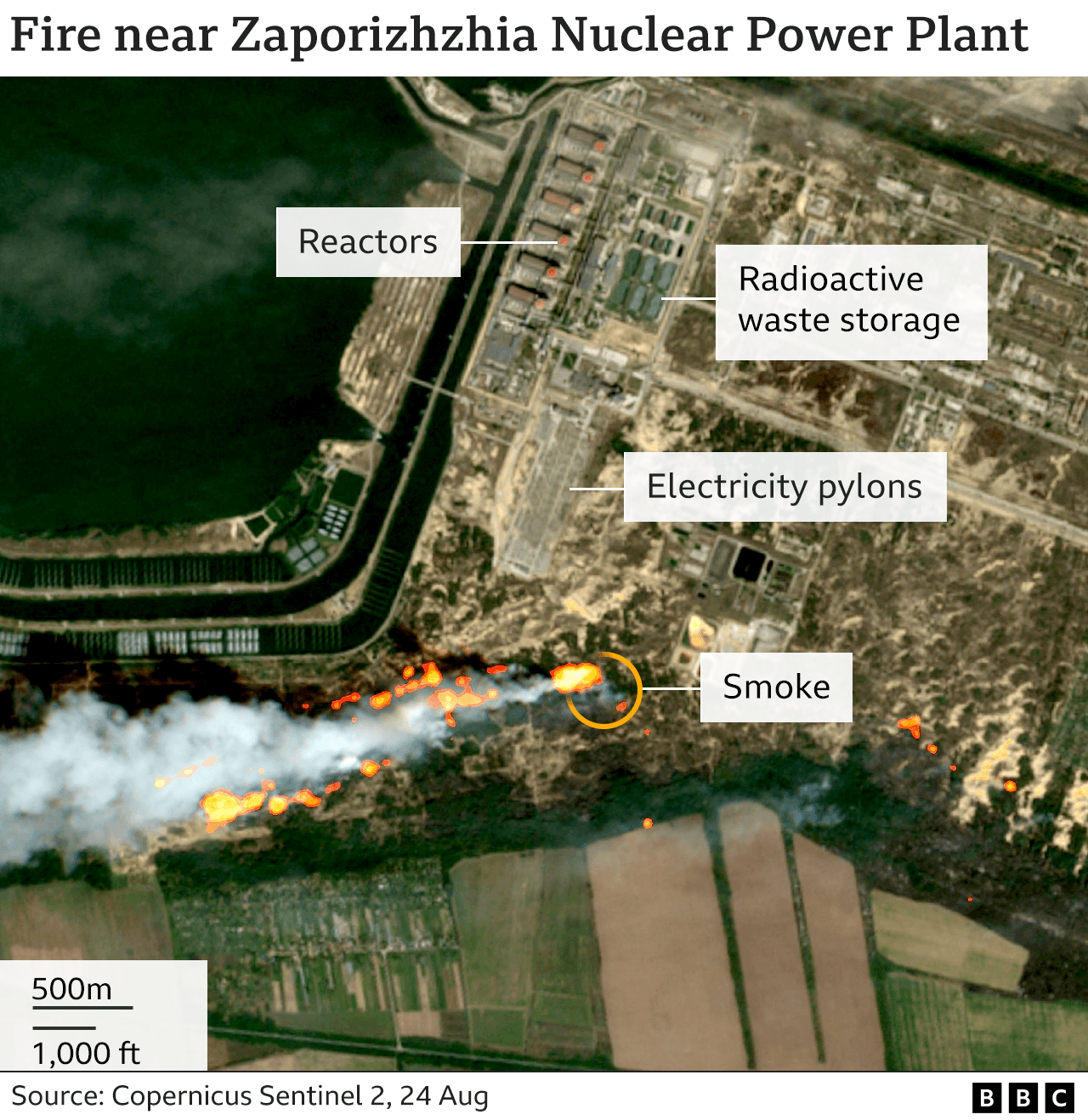
    Ukraine’s – and Europe’s – biggest nuclear plant at Zaporizhzhia has come under repeated fire since it was occupied by Russian forces at the start of the war and the UN has called for a safety zone to protect it.

    Meanwhile, the Kremlin has denied allegations of war crimes after some 450 bodies were uncovered in burial sites in the liberated city of Izyum.

    The discovery has prompted the European Union’s presidency, currently held by the Czech Republic, to call for an international tribunal into Russia’s invasion.

    Kremlin spokesman Dmitry Peskov said the revelations were “a lie, and of course we will defend the truth in this story”. He said the “scenario” was the same as in the town of Bucha near Kyiv, where local authorities say at least 458 civilians were murdered during Russia’s occupation.

    President Vladimir Putin said on Friday that Ukrainian counter-offensives would not change Russia’s military plans in the east of Ukraine.

    The ministry of defence in Moscow posted video on Monday that it said showed attack helicopters destroying Ukrainian manpower and equipment.

    However, according to the UK’s defence intelligence update, it was “highly likely” that Russia had lost four combat jets in Ukraine in the past 10 days as its air force took greater risks to support ground forces under pressure from the Ukrainian advances.

    The Institute for the Study of War says Russia is relying increasingly on “irregular volunteer and proxy forces” instead of its conventional military units.

    Russia says it is fighting neo-Nazis in Ukraine – a claim widely dismissed – and that it is threatened by the Nato alliance’s strong relations with Ukraine.

    Since the invasion on 24 February, the UN has recorded at least 5,718 civilian deaths, with 8,199 injured, and more than seven million Ukrainians have been recorded as refugees across Europe.

    The actual civilian death toll is believed to be thousands higher. Tens of thousands of combatants have been killed or injured.

    Russia, a global energy supplier, is locked in an economic struggle with the West which imposed sweeping sanctions in response to the invasion.

    Source: BBC

  • Ukraine war: Power is restored at major nuclear reactor in Zaporizhzhia

    International Atomic Energy Agency (IAEA,) the UN’s nuclear watchdog, reports that Ukraine’s massive Zaporizhzhia nuclear power facility has resumed power supply from the national grid.

    Power lines connected to the plant were destroyed by shelling in the region.

    The plant’s six reactors are all in a state of cold shutdown, but it still needs outside electricity to keep them cool and prevent a meltdown.

    The situation at the plant, which is seized by Russian forces, has reportedly improved but is still unstable, according to the IAEA.

    At the beginning of the month, a group of nuclear experts from the IAEA (International Atomic Energy Agency) travelled to Zaporizhzhia, the biggest nuclear facility in Europe.

    The trip followed increasing calls from Ukraine and the international community for a safety inspection following reports of shelling.

    Russia and Ukraine both blamed each other for the shelling of the facility in southeast Ukraine.

    After the IAEA’s first inspection, the agency announced it would maintain a permanent presence in order to monitor the situation.

    Members of the team at the site on Saturday learned that one of the four main external power lines damaged by shelling had been repaired, allowing electricity to be received directly from the national grid, the IAEA tweeted on Saturday.

    Further east in Ukraine, the discovery of mass graves in Izyum has led the European Union presidency to call for an international tribunal for war crimes to be carried out.

    Hundreds of bodies have been discovered buried in a forest at the edge of the city, which recently came under the control of Ukraine after Russian forces retreated.

    Many are said to be civilians, women, and children among them.

    Ukraine says it believes war crimes have been committed.

    “In the 21st Century, such attacks against the civilian population are unthinkable and abhorrent,” said Jan Lipavsky, foreign minister of the Czech Republic which holds the EU’s rotating presidency.

    “We must not overlook it. We stand for the punishment of all war criminals,” he wrote in a tweet. “I call for the speedy establishment of a special international tribunal that will prosecute the crime of aggression.”

    Fighting raged on Saturday in the divided eastern region of Donetsk, which is mostly under the control of Russian-backed separatists.

    The separatist mayor of Donetsk city said four people had been killed by Ukrainian government shelling of a central district while the Donetsk region’s Ukrainian governor accused Russian forces of shelling a thermal power plant in Mykolaivka, disrupting drinking water supplies in the area.

    Ukrainian troops are continuing their counter-offensive in the country’s north-east, after successfully recapturing territory from Russia in recent days, the UK’s defence ministry says. It adds that Russia has established a defensive line protecting one of its main supply routes from Belgorod, near its border with Ukraine.

    Russian President Vladimir Putin said on Friday that Ukrainian counter-offensives would not change Russia’s military plans in the east of Ukraine.

  • Ukraine has doubled its retaken area, Zelensky says

    President Volodymyr Zelensky says his forces have retaken over 2,000 sq km (772 sq miles) in a rapid counter-offensive in eastern Ukraine.

    His latest update, if confirmed, means Kyiv’s forces have more than doubled their gains in little over 24 hours.

    Ukraine’s rapid advance saw troops enter the key towns of Izyum and Kupiansk on Saturday.

    But UK defence officials have warned that fighting has continued outside those towns.

    And officials in Kyiv said Ukrainian forces were still fighting to gain control of a number of settlements around Izyum, while adding that more than 30 towns and villages have been retaken in the Kharkiv region.

    Russia’s defence ministry confirmed its forces’ retreat from Izyum itself and Kupiansk, which it said would allow its forces “to regroup” in territory held by Moscow-backed separatists.

    The Russian ministry also confirmed the withdrawal of troops from a third key town, Balaklyia, in order to “bolster efforts” on the Donetsk front. Ukrainian forces entered the town on Friday.

    Meanwhile, the head of the Russia-installed administration in the Kharkiv region recommended that its people evacuate to Russia “to save lives”.

    Unverified footage on social media appeared to show long queues of traffic building up at border crossings.

    And the governor of the Belgorod border region in Russia said mobile catering, heating, and medical assistance would be available to people queuing.

    The pace of the counter-attack has not only caught the Russians off guard, but even surprised some Ukrainians.

    But Russians still hold around a fifth of the country, and few imagine a swift end to the war.

    The Ukrainian advances – if held – would be the most significant frontline changes since Russia withdrew from areas around Kyiv in April.

    Kupiansk had served as Russia’s main eastern supply hub and the loss of Izyum – which Moscow spent over a month trying to take at the beginning of the war – would be seen as a major humiliation for President Vladimir Putin.

    According to one military expert, the advance marks the first time since World War Two that whole Russian units have been lost.

    The gains will also be seen as a sign that Ukraine’s army has the capacity to retake occupied territory – crucial as Kyiv continues to ask hard-pressed Western allies for military support.

    Ukraine’s Foreign Minister, Dmytro Kuleba, said the latest developments showed its forces could end the war faster with more Western weapons.

    Journalists have been denied access to the frontlines, and Ukraine is determined to control the information war.

    A map of Russian control in the east

    On Saturday, UK defence officials suggested that much of the retaken area was only “lightly held”.

    Ukraine launched its counter-offensive in the east earlier this week, while international attention was focused on an anticipated advance near the southern city of Kherson.

    Analysts believe Russia redirected some of its most seasoned troops to defend the city.

    But as well as gaining ground in the east, Ukraine is also making gains in the south, an official said.

    Nataliya Gumenyuk, a spokesperson for the Ukrainian army’s southern command, said they had advanced “between two and several dozens of kilometres” along that front.

    But Russian forces fighting on the southern front are said to have dug into defensive positions, and Ukraine’s troops have faced heavy resistance since the offensive began.

    And in Kharkiv itself, one person was killed and several homes damaged on Saturday as Russian rocket fire hit the city, according to local officials.

    Elsewhere, Ukraine’s energy regulator, Energoatom, says the last reactor at the Russian-occupied Zaporizhzhia nuclear power plant has been shut down, and is not generating electricity.

    The reactor had been generating energy for the plant itself for three days – it was shut down when external power was restored.

    The Ukrainian operator said that to prevent an emergency, it was essential that shelling of the power lines connecting the station to the national grid be halted.

  • Zelensky announces settlements recaptured from Russia

    Ukraine’s President Zelensky said he has “good news”, claiming the recapture of several settlements from Russia.

    Rumours have swirled for days about a possible breakthrough in the eastern Kharkiv region, but with no word from Ukrainian officials.

    Mr Zelensky declined to name which places had been retaken, saying that “now is not the time to name” them.

    Separately, US officials said Ukraine was making “slow but meaningful progress” against Russian forces.

    Speaking in his nightly video address to Ukrainians, President Zelensky said there was “good news” about the rumoured success of Ukrainian troops.

    “I think every citizen feels proud of our soldiers,” he said, naming specific military units and applauding their bravery in combat.

    But he said: “Now is not the time to name the settlements to which the Ukrainian flag returns.”

    Ukraine has tightened its operational security in recent weeks, sharing few details about a widely expected counter-offensive in the east and south.

    Ukrainian soldiers have launched an offensive south-east of Kharkiv, towards the eastern region of Donetsk, over which Russia has maintained substantial military control since the war began six months ago.

    Some reports suggest Ukrainian forces may be a few dozen kilometres from the city of Izyum, an important link in Russia’s military supply chain.

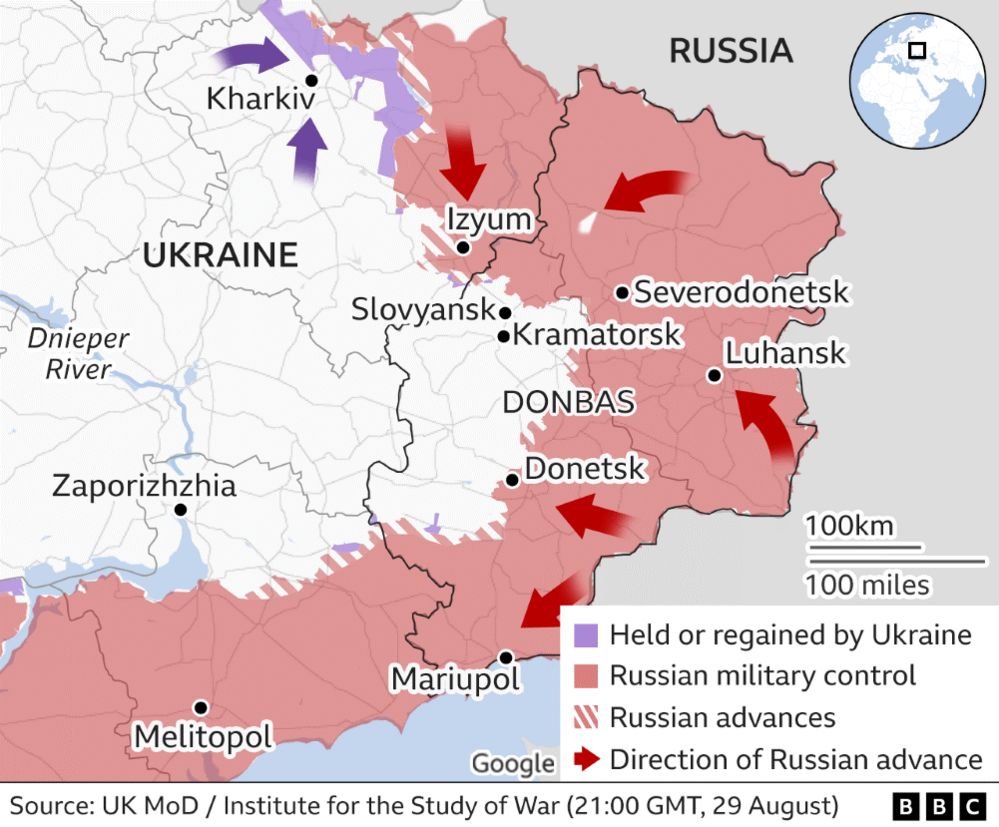
    Map showing east Ukraine. 29 Aug

    Speaking at an event in the United States, Colin Kahl – the Under-Secretary of Defense for Policy – suggested that Ukrainian forces were performing better than Russian troops in some areas.

    “It is early days. I think the Ukrainians are making slow but meaningful progress. And we’ll see how things pan out,” he was quoted as saying by Reuters news agency.

    “But I certainly think things are going better on the Ukrainian side right now in the south than is true on the Russian side.”

    The situation, however, remains fraught.

    In its nightly update, the Ukrainian General Staff said on Wednesday that it had “repelled all Russian attacks” in the Kharkiv and Donetsk regions – but that both sides continued to exchange artillery and air strikes, damaging a dozen different places.

    President Zelensky also said on Wednesday that Ukraine’s national budget next year would be that of a country at war – with more than a trillion hryvnia ($27bn; £23.5bn) spent on defence.

    But he promised key social provisions such as pensions would be maintained.

    However, “it is necessary to reduce as much as possible all non-critical expenses”, he warned – “all that does not help defence, does not help the economic development of the country, social and cultural provision of our people”.

    Separately, US and UN observers raised concerns over the fate of civilians in Ukraine as the war continues.

    A senior UN human rights official said the organisation was concerned about the displacement of people in Ukraine – and particularly the fate of children.

    “There have been credible allegations of forced transfers of unaccompanied children to Russian-occupied territory, or to the Russian Federation itself,” warned Ilze Brands Kehris, Assistant Secretary-General for Human Rights.

    Her agency is concerned that Russia has created “a simplified procedure” to provide those children with Russian citizenship, and potentially have them adopted into Russian families, she said.

    Such moves would breach the Geneva Convention, she added.

    The US, also on Wednesday, said it was concerned about a similar forced movement of Ukrainians – but of adults.

    The State Department accused the Kremlin of having lists of Ukrainians to be forced into areas of the country under Russian control as part of what it calls “filtration operations”.

    “Filtration is a dehumanising word, describing a massive campaign that the Kremlin has launched to imprison, to forcibly deport or disappear those Ukrainian citizens Moscow decides could be a potential threat,” spokesman Vedant Patel said.

    “Victims of filtration are given no choice but to submit or face dire consequences.”

    He described the system as a large-scale and advanced operation involving technology such as facial recognition and phone tracking – and said the US had evidence linking Kremlin officials to the project.

    However, Russia’s UN Ambassador, Vasily Nebenzya, said Ukrainians travelling to Russia merely went through a registration procedure.

    Source: BBC

  • Zaporizhzhia: Ukraine suggests UN peacekeepers for nuclear plant

    Ukraine’s nuclear chief has suggested that United Nations peacekeepers could secure the Zaporizhzhia power station.

    The plant has been occupied by Russia since the early days of the war and come under repeated attack, with both sides blaming each other.

    UN inspectors observed damage at the power station during a visit last week.

    The inspectors recommended that a security zone be set up immediately to shield the facility, which is Europe’s largest, from the fighting.

    Vladimir Putin has said he trusted the report from the UN’s nuclear watchdog, the International Atomic Energy Agency (IAEA), but criticised the agency for not saying Ukraine was to blame for shelling the area.

    The Russian leader described the IAEA as “a very responsible international organisation” which was under pressure. “Our servicemen are there – are we shooting at our own?” he asked, in response to claims that Russia could be responsible for shelling at the plant.

    Shelling continued while the 14-strong IAEA team visited the site and its head, Rafael Grossi, warned of a very real risk of nuclear disaster. Although most of the team left the plant after two days, it said two of its officials would remain there on a permanent basis.

    In an emergency session of the Security Council, the UN Secretary General Antonio Guterres set out steps for the creation of a demilitarised zone around the plant.

    Ukrainian President Volodymyr Zelensky welcomed calls by the IAEA for a safety protection zone at Zaporizhzhia.

    On Wednesday Petro Kotyn, who runs Ukraine’s nuclear agency Energoatom, suggested a UN peacekeeping contingent could set up a security zone at Zaporizhzhia and Russian troops withdraw.

    However, the IAEA was careful not to apportion blame to either side.

    The IAEA’s report says that there were Russian military vehicles stationed in two turbine halls and under the overpass connecting the reactor units and includes a photo showing Russian-flagged military trucks with the Z insignia parked inside a large building.

    However, on Wednesday Mr Putin denied that there was any Russian military equipment on-site at Zaporizhzhia.

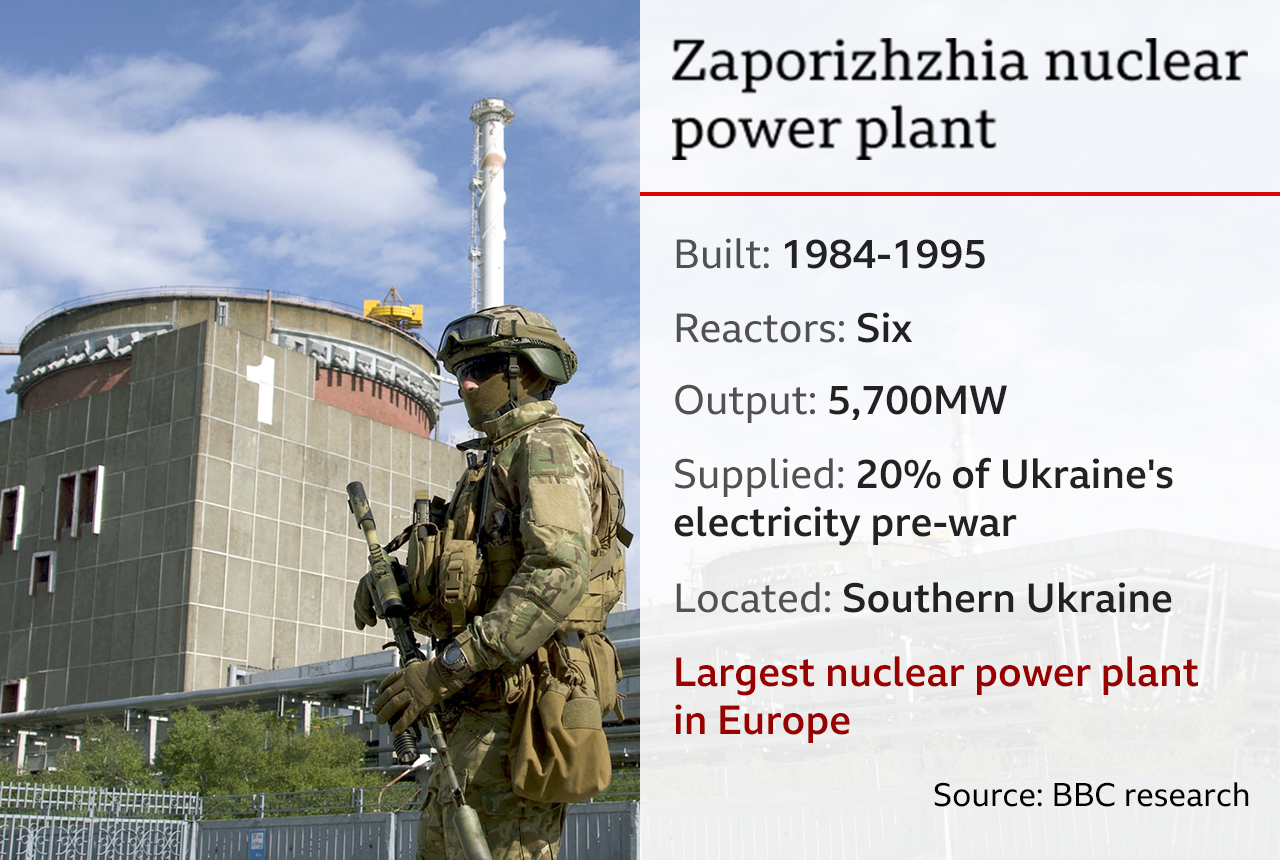
    Zaporizhzhia graphic

    The IAEA detailed the damage to the plant and said that while continued shelling had not yet triggered a nuclear emergency, it did present a constant threat to safety that “may lead to radiological consequences with great safety significance”.

    There was an urgent need for “interim measures” to prevent a nuclear accident caused by military action, it added, saying all relevant parties would have to agree to a “nuclear safety and security protection zone” being set up to avoid further damage.

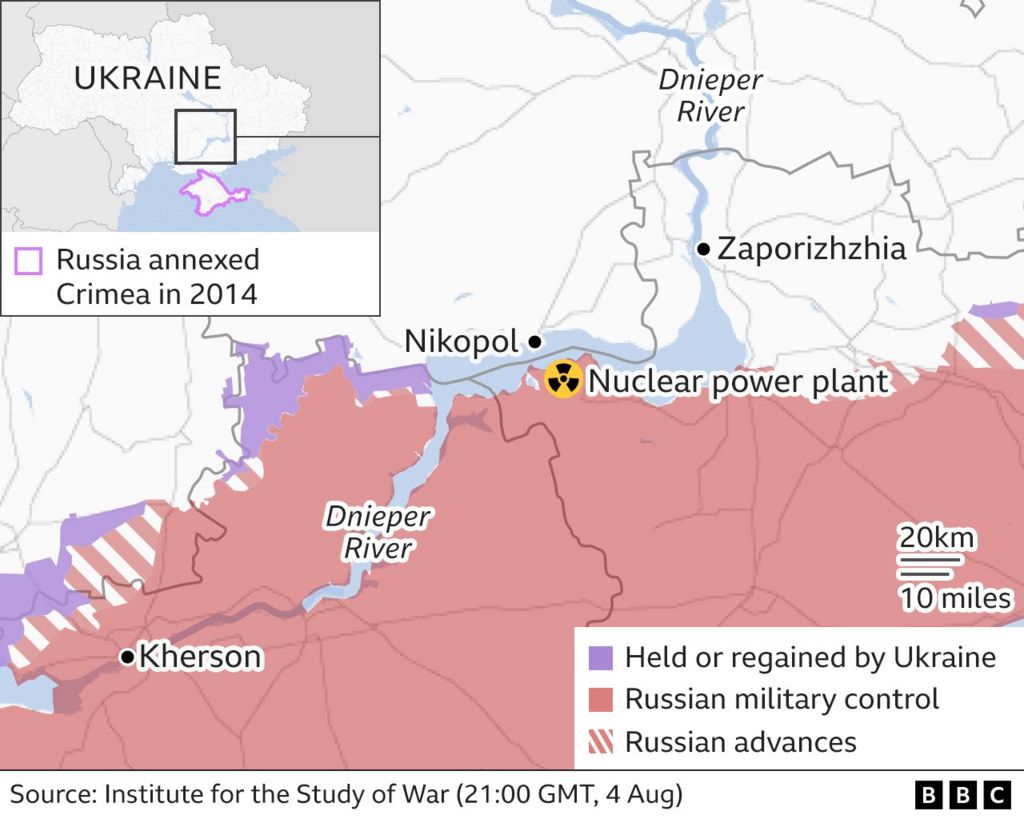
    The plant lies on the southern bank of the River Dnieper, across the water from Ukrainian-held towns and military positions.

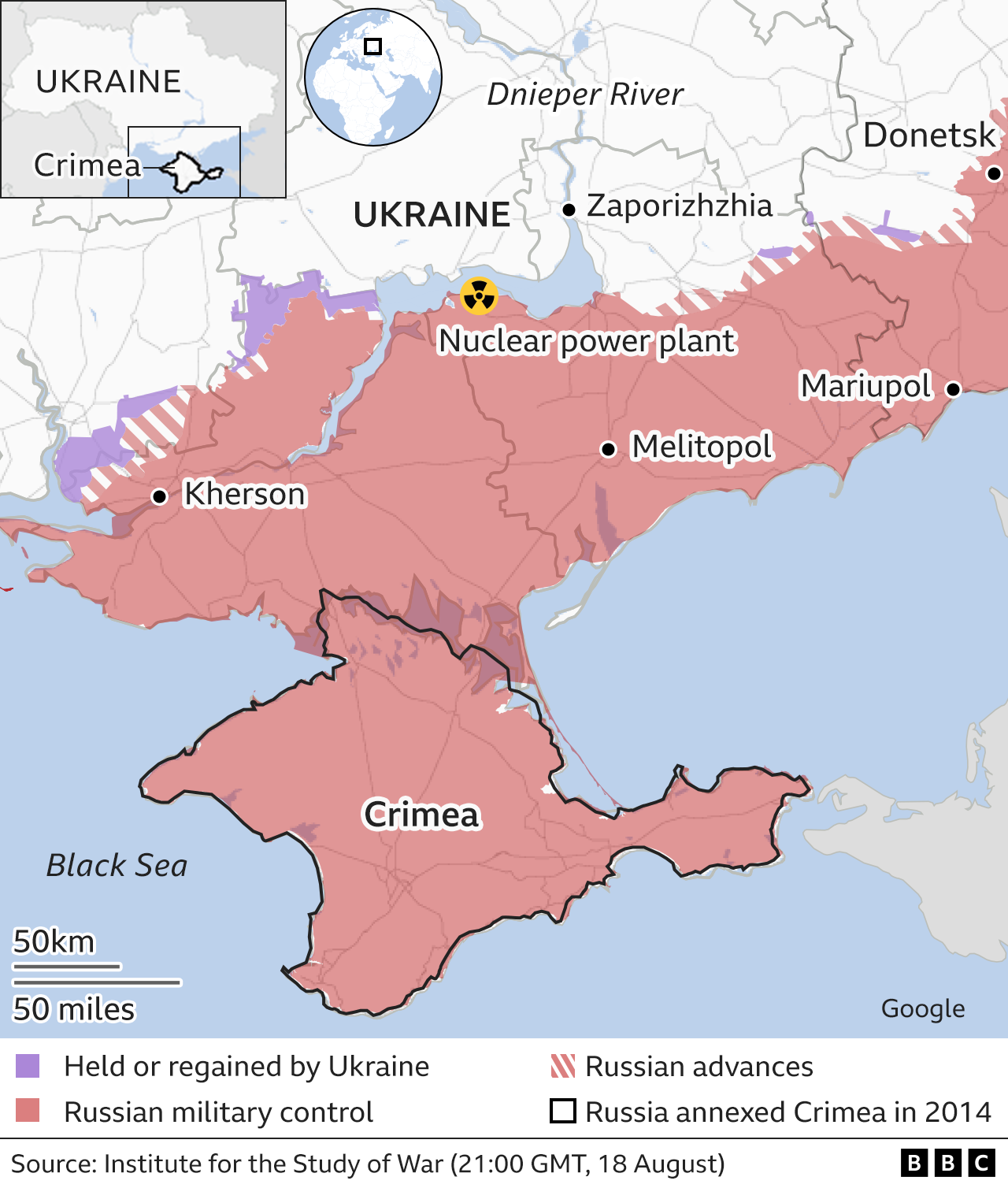
    Map showing nuclear plant in Ukraine

    Meanwhile, the UK’s Ministry of Defence says fighting has continued in Ukraine on three fronts over the past 24 hours: in the east, in Donbas; in the north around Kharkiv, and in the south around Kherson.

    The redeployment of Russian forces to southern Ukraine around Kherson has enabled Ukrainian forces to make progress in the Kharkiv region. according to the US-based Institute for the Study of War. The institute suggests Ukrainian forces may have taken a town near Balaklia as Russian troops retreated, blowing up bridges.


    Source: BBC

  • EU plans Russian gas price cap despite Putin threat

    The European Union’s executive body has proposed capping the price of Russian gas, within hours of Russia’s leader condemning the idea as stupidity.

    Energy prices have soared in the wake of Russia’s invasion of Ukraine, forcing the EU’s 27 states into action.

    “We must cut Russia’s revenues which Putin uses to finance this atrocious war,” said European Commission chief Ursula von der Leyen.

    But Mr Putin said Moscow would react to a cap by halting supplies completely.

    “We will not supply gas, oil, coal, heating oil – we will not supply anything,” he said, if it went against Russia’s interests.

    European leaders have accused Moscow of “weaponising” its gas exports in response to Western sanctions on Russian individuals and businesses.

    While the Kremlin denies that is the case, the big Nord Stream 1 pipeline into northern Germany has been shut indefinitely, with Moscow directly blaming sanctions.

    Last week, the G7 group of nations – announced a price cap for Russian oil – a move it said would reduce both Moscow’s revenue for its Ukraine invasion, and inflation in the West.

    Finnish researchers recently estimated that Russia has made €158bn (£136bn) from surging fossil fuel prices during the six-month invasion – with EU imports accounting for more than half of that.

    Speaking to an economics forum in the far eastern city of Vladivostok on Wednesday, Russia’s leader condemned sanctions as economic aggression, and a “fever” posing a threat to the entire world.

    The quality of life for Europeans was being sacrificed while poorer countries were losing access to food, he argued: “Now we are seeing how production and jobs in Europe are closing one after another.”

    Although he acknowledged inflation in Russia was rising, he minimised the effect that sanctions were having on Russian companies: “I am sure that we have not lost anything and we will not lose anything.”

    Russian companies have struggled to source much-needed imported parts. But Mr Putin asserted that confidence in the dollar, euro and pound was being lost before people’s eyes – while Russia was emerging from the war with its sovereignty strengthened.

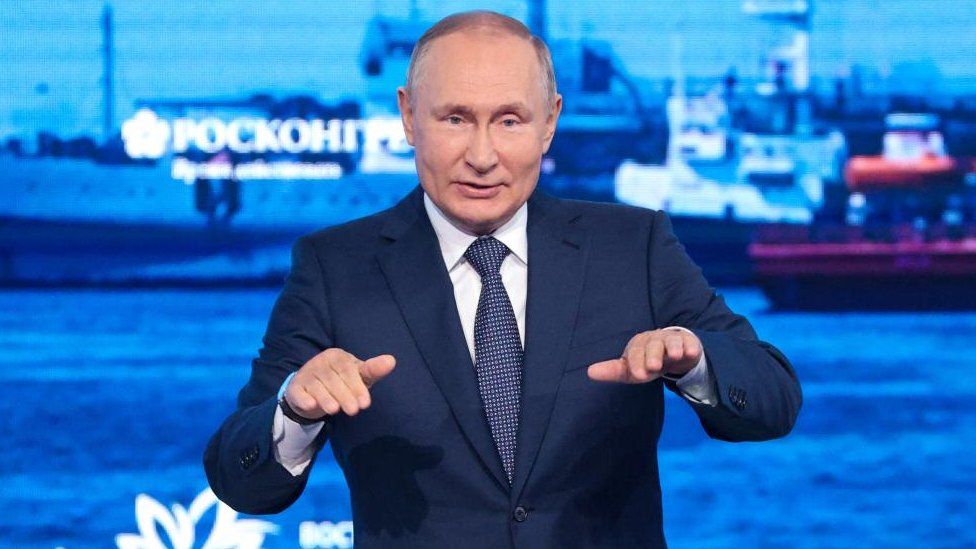
    Russian President Vladimir Putin attends the plenary session of the 2022 Eastern Economic Forum on Sept 7 2022Image source, Tass via Reuters
    Image caption, The Russian leader said Western currencies were falling while Russia was not losing anything

    Russia launched its invasion on 24 February and now occupies around a fifth of Ukrainian territory. Six months on, it has been pushed back from areas around Kyiv and the north and now faces a Ukrainian counter-offensive in the south and east.

    Western nations responded to the war with several rounds of sanctions. The European Union has attempted to cut its reliance on Russian gas and oil and Moscow – and on Friday EU energy ministers will try to decide how to protect consumers and businesses from the threat of enormous bills over the winter.

    Ahead of the meeting, Ursula von der Leyen said Europe had weakened Russia’s grip on its gas requirements. Gas storage was already up to 82% and supplies had increased from the US, Norway, Algeria and other countries.

    Before the invasion, Russia accounted for 40% of the EU’s imported gas, but today that proportion was now down to only 9%, she said.

    As well as a price cap on Russian gas, EU ministers have been looking at how to separate the cost of gas from the price of electricity, which are linked in Europe’s market. The Commission president outlined several other plans:

    • A mandatory target for reducing electricity use at peak hours
    • A cap on revenues for companies making unexpected profits from low-cost electricity such as renewable energy
    • A “solidarity contribution” from fossil fuel companies
    • Helping struggling energy companies cope with the volatile energy market with “liquidity” support

    The plans will go before energy ministers on Friday, and one diplomat told the BBC he was sceptical: “Good luck getting that through council complete and intact.”

    EU member states have already responded to the crisis with a series of packages to help consumers. At the weekend Sweden and Finland announced liquidity guarantees for power companies, while Germany said it would spend €65bn (£56.2bn) with help for the vulnerable as well as tax breaks for energy-intensive businesses.

    In Vladivostok, Mr Putin went on to accuse Europe of cheating the developing world out of Ukrainian grain exports in the wake of a UN-led deal to lift Russia’s naval blockade.

    For months ships were unable to leave Ukraine’s three Black Sea ports but shipments resumed last month. Mr Putin told his audience that only two grain ships had since gone to Africa – which is not the case. He said he wanted to discuss revisiting the deal, in remarks rejected by Ukraine as groundless.

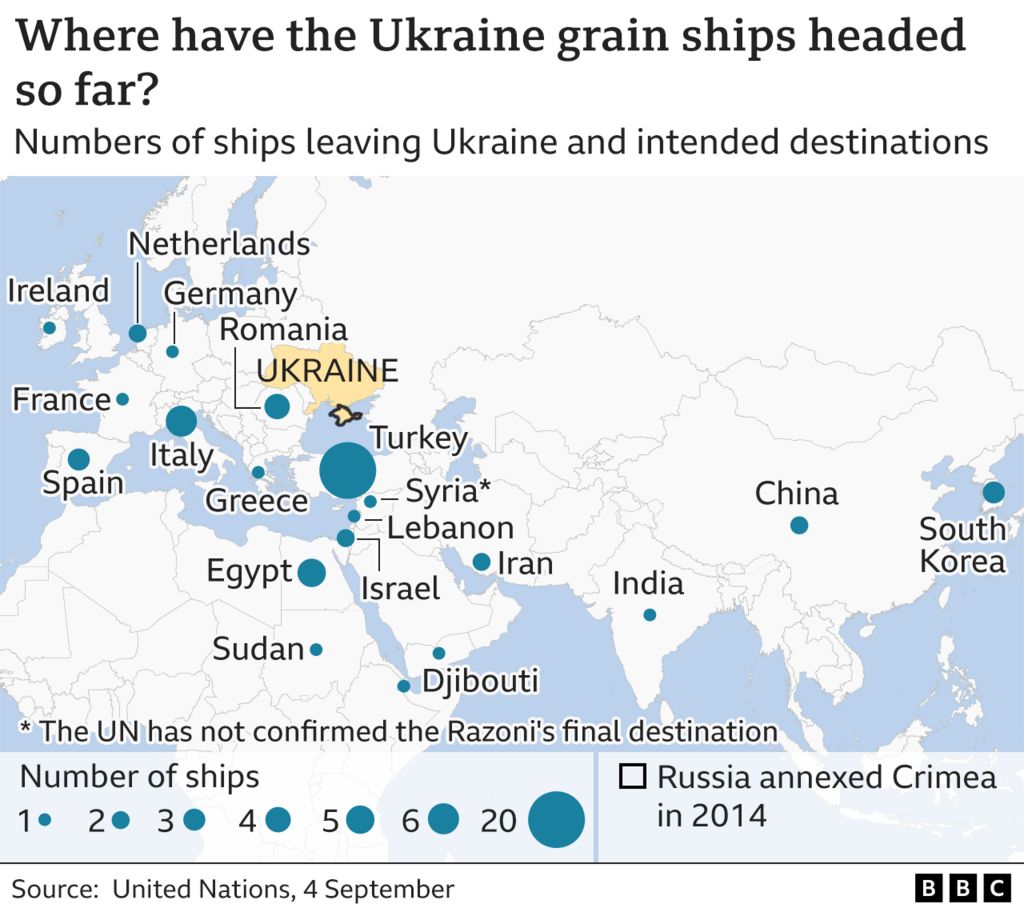
    Other ships have left for Yemen and Sudan while several vessels have gone to ports in Egypt.

    A UN-chartered ship carrying 23,000 tonnes arrived in Djibouti last week. The grain has now reached Ethiopia in 60 lorries, with the aim of feeding more than one and a half million people in a country blighted by drought and civil war.

    Under the agreement all cargoes are approved by a joint centre in Turkey. The centre says 2m tonnes have been authorised so far, including to Turkey and the Middle East as well as ports in the EU.

    Map showing Ukrainian grain ships 

    Source: BBC

    1px transparent line
  • Ukraine war: North Korea arming Russia – US reports

    As a result of Western sanctions, Russia apparently has been obliged to purchase weapons from North Korea in order to maintain its invading force in Ukraine.

    Russian media reports that it has purchased millions of rockets and artillery ammunition from Pyongyang.

    Last week it received the first order of new Iranian drones, US reports said.

    New Russian missile strikes have been reported across Ukraine, with a fuel depot set on fire in the Kryvyi Rih area and deadly attacks on Kharkiv.

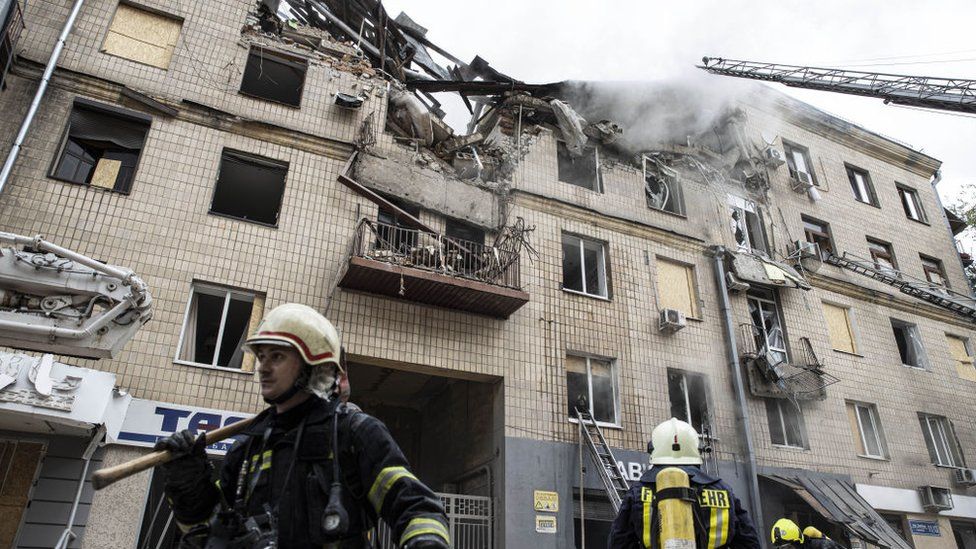
    In the north-eastern city of Kharkiv, a woman’s body was found after a strike destroyed the upper part of a block of flats, local authorities said.

    Firefighters near a damaged building in Kharkiv, 6 September
    IMAGE SOURCE, GETTY IMAGES
    Image caption,

    Flats were destroyed in Kharkiv

    In Kryvyi Rih, in central Ukraine, thick black smoke billowed from the depot in a photo posted by the governor of the Dnipropetrovsk region.

    It was attacked with two missiles on Monday evening, Valentyn Reznichenko said, adding that there was no immediate information about casualties.

    In another development, Russian-backed separatists controlling Donetsk said parts of the eastern city had been shelled by Ukrainian government forces on Tuesday, with one civilian wounded.

    A US official said Russia would be forced to buy additional North Korean weaponry as the war dragged on.

    Iran and North Korea, themselves both the targets of significant Western sanctions, have sought to deepen ties with Russia since President Vladimir Putin launched his invasion of Ukraine in February.

    Kim Jong-un’s government has blamed the US for the conflict and accused the West of pursuing a “hegemonic policy” that justified Russia’s use of force.

    Last month, North Korea recognized the independence of two Russian-backed breakaway regions in eastern Ukraine – the Donetsk and Luhansk people’s republics – and vowed to deepen its “comradely friendship” with Moscow. Mr Putin said the two countries would expand their “comprehensive and constructive bilateral relations”, according to North Korean state media.

    The exact size and scale of the new weapons deliveries reported by the New York Times and Associated Press news agency remain unclear.

    But a US official said turning to North Korea for support demonstrated that “the Russian military continues to suffer from severe supply shortages in Ukraine, due in part to export controls and sanctions”.

    Broad economic sanctions have done little to damage Russia’s income from energy exports, according to a Finnish think tank the Centre for Research on Energy and Clean Air. It estimates Russia has made €158bn (£136bn) from surging fossil fuel prices during the six-month invasion, with EU imports accounting for more than half of that.

    However, the US and EU believe that Moscow’s ability to resupply its military has been impaired.

    Last week, officials in the Biden administration told US media that the first shipments of Iranian-made drones had also been delivered to Russia.

    US intelligence officers believe that Russian operators have travelled to Iran to receive training on the Mohajer-6 and Shahed series weapons.

    But they told reporters recently that many of the drones had been beset by mechanical and technical problems since delivery.

    Iran has officially denied delivering weapons to either side of the conflict, but in July US National Security Advisor Jake Sullivan said Tehran was planning to supply Moscow with potentially hundreds of drones for its war in Ukraine, some with combat capabilities.

    On Tuesday, UK defence officials said in a daily update that Russia was struggling to maintain its supply of battlefield drones in the face of significant “combat losses”.

    “It is likely that Russia is struggling to maintain stocks of UAVs [unmanned aerial vehicles], exacerbated by component shortages resulting from international sanctions,” the update said.

    “The limited availability of reconnaissance UAVs is likely degrading commanders’ tactical situational awareness and increasingly hampering Russian operations,” the officials added.

  • Germany pledges €65bn package to check rising energy costs

    As Europe struggles with scarce supplies after Russia’s invasion of Ukraine, Germany has announced a €65bn (£56.2bn) package of measures to ease the threat.

    The package from Germany will include one-off payments to the most vulnerable and tax breaks to energy-intensive businesses.

    There is rising energy costs in Europe. Energy prices have soared since the February invasion because energy was being provided by Russia.

    On the matter, President Volodymyr Zelensky of Ukraine, said Russia was trying to destroy the normal life of every European citizen.

    In his nightly address on Saturday, he said Russia was preparing a “decisive energy attack on all Europeans”, and only unity among European countries would offer protection.

    And in a BBC interview broadcast on Sunday, his wife Olena said that if support for Ukraine was strong the crisis would be shorter. She reminded Britons that while rising living costs were tough, Ukrainians were paying with their lives.

    According to website Politico, European Union officials have warned there is likely to be a crunch point in the coming months when countries start to feel acute economic pain while also still being asked to help the Ukrainian military and humanitarian effort.

    There are already small signs of discontent, with protesters taking to the streets of the Czech capital Prague on Sunday, rallying against high energy prices and calling for an end to sanctions against Russia. Police said about 70,000 people, mainly from far-right and far-left groups were in attendance.

    Meanwhile, several hundred protesters gathered at Lubmin in north-eastern Germany, the terminal of the Nord Stream gas pipeline from Russia.

    They were calling for the commissioning of Nord Stream 2, a new pipeline which was about to go online but was blocked by the German government after the invasion.

    Two days ago, Russia said it was suspending gas exports to Germany through the already operating Nord Stream 1 pipeline indefinitely.

    The stand-off with Russia has forced countries like Germany to find supplies elsewhere, and its stores have increased from less than half full in June to 84% full today.

    German Chancellor Olaf Scholz told journalists Germany would get through the winter, adding that Russia was “no longer a reliable energy partner”.

    He said the government would make one-off payments to pensioners, people on benefits and students. There would also be caps on energy bills.

    Some 9,000 energy-intensive businesses would receive tax breaks to the tune of €1.7bn.

    A windfall tax on energy company profits would also be used to mitigate bills, Mr Scholz said.

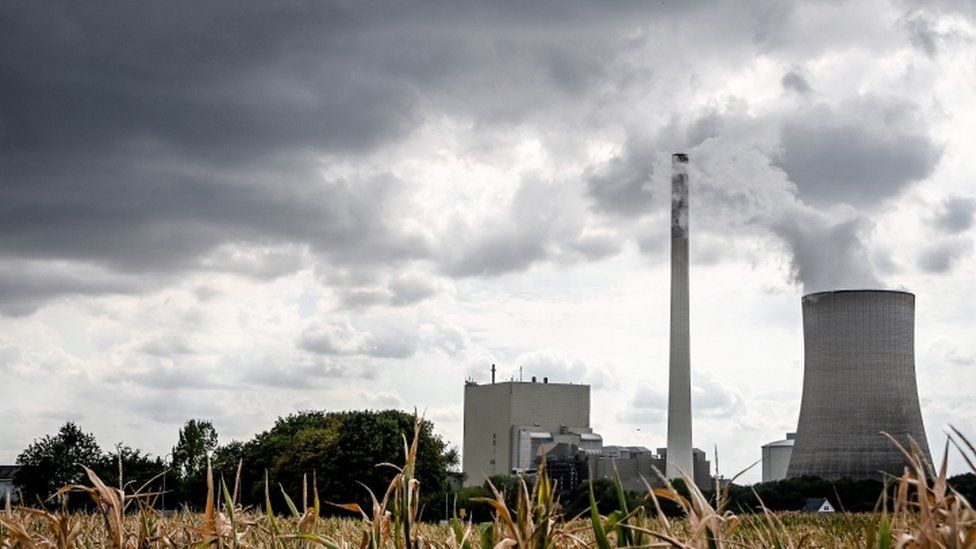
    German coal-fired power station
    IMAGE SOURCE,EPA Image caption, The energy crisis has forced Germany to bring this coal-fired power station back onto the grid

    The latest package brings the total spent on relief from the energy crisis to almost €100bn, which compares to about €300bn spent on interventions to keep the German economy afloat during the Covid-19 pandemic.

    Countries across Europe are considering similar measures.

    UK Tory leadership hopeful Liz Truss has said she will announce a plan to deal with energy costs within a week if she becomes prime minister on Tuesday.

    And EU energy ministers are due to meet on 9 September to discuss how to ease the burden of energy prices across the bloc.

    A document released about the meeting says the agenda will include price caps for gas and emergency liquidity support for energy market participants, Reuters news agency reported.

  • War in Ukraine: Russia to keep a vital gas route to the EU shut

    National energy company Gazprom has disclosed that the gas pipeline from Russia to Germany won’t resume on Saturday as scheduled.

    The Nord Stream 1 pipeline would be permanently shut down after the company claimed to have discovered an oil leak in one of its turbines.

    For the past three days, the pipeline has been closed for what Gazprom has referred to as maintenance work.

    The news comes amid growing fears that families in the EU will not be able to afford the cost of heating this winter.

    Energy prices have soared since Russia invaded Ukraine and scarce supplies could push up the cost even further.

    Europe is attempting to wean itself off Russian energy in an effort to reduce Moscow’s ability to finance the war, but the transition may not come quickly enough.

    EU Council President Charles Michel said the Russian move was “sadly no surprise”.

    “Use of gas as a weapon will not change the resolve of the EU. We will accelerate our path towards energy independence. Our duty is to protect our citizens and support the freedom of Ukraine,” he tweeted.

    Moscow denies using energy supplies as an economic weapon in retaliation for Western sanctions imposed following Russias invasion.

    It has blamed the sanctions for holding up routine maintenance of Nord Stream 1, but the EU says this is a pretext.

    Germany’s network regulator, the Bundesnetzagentur, said the country was now better prepared for Russian gas supplies to cease, but it urged citizens and companies to cut consumption.

    Gazprom’s announcement came shortly after the G7 nations agreed to cap the price of Russian oil in support of Ukraine.

    The G7 (Group of Seven) consists of the UK, US, Canada, France, Germany, Italy, and Japan.

    Their introduction of a price cap means countries that sign up to the policy will be permitted to purchase only Russian oil and petroleum products transported via sea that are sold at or below the price cap.

    However, Russia says it will not export to countries that participate in the cap.

    The gas pipeline stretches from the Russian coast near St Petersburg to north-eastern Germany and can carry up to 170 million cubic metres of gas a day.

    It is owned and operated by Nord Stream AG, whose majority shareholder is Gazprom.

    Germany had also previously supported the construction of a parallel pipeline – Nord Stream 2 – but the project was halted after Russia invaded Ukraine.

    Gazprom said the fault had been detected at the Portovaya compressor station, with the inspection carried out alongside workers from Siemens, the German firm that maintains the turbine.

    It said that fixing oil leaks in key engines was only possible in specialized workshops, which had been hindered by Western sanctions.

    However, Siemens itself said: “Such leaks do not normally affect the operation of a turbine and can be sealed on site. It is a routine procedure within the scope of maintenance work.”

    This is not the first time since the invasion that the Nord Stream 1 pipeline has been closed.

    In July, Gazprom cut off supplies completely for 10 days, citing “a maintenance break”. It restarted again 10 days later, but at a much-reduced level.

    Speaking to the BBC from the Swiss capital Bern, an economist and energy analyst, Cornelia Meyer, said the gas shutdown would have a major impact on employment and prices.

    “That really has huge ramifications for gas in Europe which is about four times more expensive than it was a year ago and this cost of living crisis will really soar because it’s not just gas,” she said. “Gas becomes fertilizer and it’s used in many industrial processes, so that will affect jobs, and it will affect costs.”

    The flow of gas through Nord Stream 1 had already been reduced to a relative trickle. Now, once again, it has been halted completely.

    An oil leak, claims Gazprom – which has previously attributed reduced flows through the pipeline to technical issues related to sanctions.

    Europe, though, believes President Putin is weaponizing gas supplies – deliberately limiting flows through the pipeline to push up prices, in order to test the resolve of Russia’s critics.

    The result, as we’ve already seen, is soaring energy costs – with businesses and consumers paying a heavy price.

    The timing of Gazprom’s move is certainly interesting. It comes on the same day the G7 announced moves to cap the price of Russia’s oil exports.

    But it also comes shortly after Germany – which is heavily reliant on Russian gas – revealed that its winter storage was filling up faster than expected.

    A cynic might say this was the last opportunity to tighten the screw, in order to inflict maximum damage over the colder months.

  • Zelensky urges IAEA to call for Zaporizhzhia demilitarisation

    Let’s hear from Ukraine‘s President Volodymyr Zelensky who, in his nightly address, welcomed the International Atomic Energy Agency (IAEA)’s arrival at Zaporizhzhia – but called for swifter action from the agency.

    Zelensky said it was “good” UN experts had made their first inspection of the nuclear power plant – “despite provocations by the Russian military” – before countering it was “bad that we have not yet heard the appropriate calls from the IAEA”.

    Referring to a meeting he’d had with agency chief Rafael Grossi in Kyiv beforehand, the Ukrainian leader said the pair “clearly” agreed a need for “demilitarisation and full control by Ukrainian nuclear specialists” of Zaporizhzhia.

    In the address, posted to Telegram, he also called out the agency for failing to allow “independent journalists” to accompany and document the mission – something he claimed was also pre-agreed.

    Despite this, he said Ukraine was “hopeful” the mission would draw “objective” conclusions, adding:

    Quote Message: When the Russian military finally… take away their weapons, ammunition, when they stop shelling neighbouring areas and cease their provocations, the Zaporizhzhia plant will be able to return to a completely safe functioning, which has always been the case under the control of Ukraine.” from Ukrainian President Volodymyr Zelensky

  • Zaporizhzhia nuclear plant: UN nuclear inspectors depart regardless of ‘significant’ risks

    Despite the “severe” dangers of their mission, a group of international experts is headed to Ukraine’s Zaporizhzhia nuclear plant for a scheduled inspection of the facility on Thursday, according to Rafael Grossi, the head of the International Atomic Energy Agency (IAEA).

    Upon arrival at the plant, the team will start an immediate “assessment of the security and safety situation,” Grossi told reporters, with the ultimate goal of “establishing a continued presence of the IAEA at the plant.”

    The plant is near the front line of the war in southeastern Ukraine and was captured by Russian troops in March. Both sides have accused each other of shelling it.

    “I have been briefed by the Ukrainian regional military commander about the inherent risks but weighing the pros and cons and having come so far, we are not stopping, we are moving now,” Grossi said. “We know that there is a so-called ‘gray zone’ where the last line of Ukrainian defense [ends] and the first line of Russian occupying forces begin; where the risks are significant.
    “At the same time, we consider that we have the minimum conditions to move, accepting that the risks are very high. Still, myself and the team feel we can proceed with this, we have a very important mission to accomplish.”

    It is uncertain how long the IAEA visit will last.

  • Nord Stream 1: Russia closes a key gas pipeline to Europe

    Due to the need for maintenance, Russia has fully stopped supplying gas to Europe through a major pipeline.

    The Nord Stream 1 pipeline will be restricted for the next three days, according to Russian state-owned oil company Gazprom.

    Russia already considerably cut back on pipeline-based gas shipments.

    It also denies claims that energy supplies were used to penalize Western countries for enacting sanctions in response to the invasion of Ukraine.

    The Nord Stream 1 pipeline stretches 1,200km (745 miles) under the Baltic Sea from the Russian coast near St Petersburg to north-eastern Germany.

    It opened in 2011 and can send a maximum of 170m cubic metres of gas per day from Russia to Germany.

    The pipeline was shut down for 10 days in July – again for repairs, according to Russia – and has recently been operating at just 20% capacity because of what Russia describes as faulty equipment.

    European leaders fear Russia could extend the outage in an attempt to drive up gas prices, which have already risen by 400%.

    The steep rise threatens to create a cost of living crisis over the winter months, potentially forcing governments to spend billions to ease the burden.

    On Tuesday, French Energy Minister Transition Minister Agnes Pannier-Runacher accused Russia of “using gas as a weapon of war”.

    She was speaking after Gazprom said it would be suspending gas deliveries to the French energy company Engie.

    But Russian President Vladimir Putin‘s spokesman has rejected the accusations and insisted that Western sanctions have caused the interruptions by damaging Russian infrastructure.

    He insisted that “technological problems” caused by Western sanctions are the only thing preventing Russia from supplying gas via the pipeline, without specifying what the problems were.

    The most recent controversy has been over a turbine that arrived in Germany after being repaired in Canada and which Russia refused to take back, arguing it was subject to the Western sanctions.

    Germany, however, denies this.

    Earlier this month, Economy Minister Robert Habeck said the pipeline was fully operational and said there were no technical issues as claimed by Russia.

    Earlier this week, EU Commission President Ursula von der Leyen promised to intervene in energy markets, telling a conference in Slovenia that they are “no longer fit for purpose”.

    “We need a new market model for electricity that really functions and brings us back into balance,” she said.

    Last week, the BBC revealed that Russia has been burning off an estimated $10m (£8.4m) worth of gas every day at a plant near the Finnish border.
  • Nuclear treaty agreement blocked by Russia over Ukraine reference

    Russia has objected the adoption of a joint declaration by a United Nations conference on nuclear disarmament.

    Russia noted that it has “grave concern” over military activities around Ukraine’s nuclear plants, in particular Zaporizhzhia.

    The draft section also remarked on “the loss of control by the competent Ukrainian authorities over such locations as a result of those military activities, and their profound negative impact on safety”.

    Russia’s representative, Igor Vishnevetsky, said the draft final text lacked “balance”.

    “Our delegation has one key objection on some paragraphs which are blatantly political in nature,” he said – adding that other countries also disagreed with the text.

    The Nuclear Non-Proliferation Treaty, which is reviewed by its 191 signatories every five years, aims to prevent the spread of nuclear weapons.

    Australian Foreign Minister Penny Wong said she was “deeply disappointed” at the lack of agreement.

    “Russia obstructed progress by refusing to compromise on proposed text accepted by all other states,” she said.

    The US representative, Ambassador Bonnie Jenkins, said the US “deeply regrets this outcome, and even more so on Russia’s actions that led us here today”.

    There was an impasse in 2015 during the last review.

    The 2022 meeting, which had been due in 2020, was delayed because of the Covid-19 pandemic. The failure to agree a joint declaration followed a four-week conference in New York.

    The final document needed approval of all countries at the conference. A number of countries, including the Netherlands and China, expressed disappointment that no consensus had been reached.

    The Dutch said they were “content with the useful discussions”, but “very disappointed that we have not reached consensus”.

    China’s ambassador, meanwhile, said despite the lack of agreement, the process was “an important practice of common security and genuine multilateralism”.

    The International Campaign to Abolish Nuclear Weapons regretted that “in a year when a nuclear-armed state invaded a non-nuclear armed state, a meeting of nearly all countries in the world failed to take action on nuclear disarmament”, while the Washington-based Arms Control Association said the conference represented a “missed opportunity to strengthen the treaty and global security”.

    The Non-Proliferation Treaty, backed by 190 countries in 1970, commits countries which signed up – including the US, Russia, France the UK and China – to reducing their stockpiles and bars others from acquiring nuclear weapons.

    Last week, the Zaporizhzhia plant was temporarily disconnected from the power grid, raising fears of a possible radiation disaster.

    Russia’s military took control of the plant, the largest nuclear plant in Europe, in early March, but it is still being operated by Ukrainian staff under difficult conditions.

    The UN’s nuclear watchdog, the International Atomic Energy Agency (IAEA), is expected to organised a trip to the Zaporizhzhia plant in the coming days to inspects facilities there.

    Last week, Russia said it would allow IAEA inspectors to visit the plant.

  • World narrowly avoided radiation accident, Zelensky says

    President Volodomyr Zelensky has revealed that Europe nearly witnessed a radiation disaster when a Russian-occupied nuclear plant was disconnected from Ukraine’s power grid on Thursday.

    He noted that the Zaporizhzhia plant was able to operate safely owing to back-up electricity kicking in.

    “If the diesel generators hadn’t turned on, if the automation and our staff of the plant had not reacted after the blackout, then we would already be forced to overcome the consequences of the radiation accident,” President Zelensky warned on Thursday night.

    There is growing concern over fighting near the complex, which is the largest nuclear plant in Europe.

    The damage was caused by fires which Ukraine’s state nuclear agency said had interfered with power lines connecting the plant on Thursday, temporarily cutting Zaporizhzhia off from the national grid for the first time in its history.

    “As a result, the station’s two working power units were disconnected from the network,” Kyiv officials said.

    The state nuclear company said work was under way on Friday to try to reconnect the reactors to the grid. Zaporizhzhia’s other four reactors have been out of action for most of the war.

    Satellite images taken on Wednesday showed an extensive fire burning in the immediate vicinity of the nuclear complex.

    President Zelensky blamed the damage on Russian shelling, and in his nightly address accused Moscow of putting Ukraine and Europe “one step away” from disaster.

    But local Russian-appointed governor Yevgeny Balitsky blamed the Ukrainian military for the strikes, accusing them of causing power outages to the region as a result.

    The BBC was not able to independently verify which side was responsible. Russia’s military took over the plant in early March, but it is still being operated by Ukrainian staff under difficult conditions.

    Image shows fire
    1px transparent line

    Radiation levels nearby remained normal despite the Zaporizhzhia nuclear complex losing its main power supply on Thursday, local officials reported.

    The UN’s nuclear watchdog, the International Atomic Energy Agency (IAEA), said the plant “remained connected to a 330kV line from the nearby thermal power facility that can provide back-up electricity if needed”, citing Ukraine’s state nuclear agency.

    It added that all six nuclear reactor units remained disconnected from the power grid despite supplies having been restored later on Thursday.

    Normally the nuclear plant supplies one-fifth of Ukraine’s total electricity – so its continued disconnection from the national grid would pose serious challenges for Ukraine.

    The Kremlin has signalled it will allow international inspectors to visit the complex – but until that happens it is difficult to verify what is happening on the ground.

    “Almost every day there is a new incident at or near the Zaporizhzhia nuclear power plant. We can’t afford to lose any more time,” IAEA director general Rafael Grossi said in a statement, repeating his call to lead an international mission to the plant in the next few days.

    Energy experts worry that some of the site’s safety mechanisms could fail if the complex loses all power.

    It comes amid claims from Kyiv that Moscow could be trying to intentionally divert power from the occupied nuclear plant to reconnect it to Russia’s own power grid.

    There were reports on Thursday of power outages across towns and villages in neighbouring parts of Russian-occupied Ukraine.

    The mayor of Enerhodar, which is located next to the nuclear plant, claimed on Thursday that the city had no power or water at all and there were also reports of power cuts in the Russian-occupied cities of Melitopol and Kherson.

    Washington officials condemned any bid by Moscow to redirect the power generated by the Zaporizhzhia plant away from Kyiv’s national grid.

    “The electricity that it produces rightly belongs to Ukraine,” US state department spokesperson Vedant Patel said on Thursday evening, adding that “no country should turn a nuclear power plant into an active war zone.”

  • Scholz meets Ukrainian soldiers training in Germany

    The service members are in Germany for training on Gepard tanks. Chancellor Olaf Scholz has vowed to send even more heavy weapons to Ukraine in the coming months.

    Chancellor Olaf Scholz visited Ukrainian soldiers in northern Germany on Thursday, expressing his admiration for their “courage.” The service members are in the northern state of Schleswig-Holstein for training on German Gepard tanks.

    Germany, Scholz said, wants to ensure that the soldiers have the support they need. He praised the Bundeswehr for providing the training.

    He said the training was “an outstanding example” of Berlin’s support for Ukraine.

    The chancellor met with the officers heading up the training before inspecting the Gepard tanks and posing for a photo op inside one.

    Scholz reiterated that Germany would deliver other heavy weapons systems to Ukraine, namely self-propelled howitzers, multiple rocket launchers and the Iris-T air defense system, which is capable of “performing the defense of the airspace of an entire city.”

    Scholz pledges E500 million

    The trip marked a stark contrast from the early weeks of the war, when Scholz was accused of dithering about whether to send heavy weapons to Kyiv. Two days earlier, Scholz had promised Ukraine further arms deliveries worth more than E500 million.

    Germany is providing modern and effective weapons “because Ukraine has the right to defend its own country, integrity, independence and sovereignty” against Russian aggression, Scholz said.

    Source :Deutsche Welle

  • Putin to increase size of Russian armed forces by 137,000 starting in 2023

    Moscow has not said how many fatalities its army has recorded since it began the war in Ukraine. However, Western officials and Kyiv believe the number is in the thousands.

    Vladimir Putin has ordered Russia’s military to expand with another 137,000 personnel starting from next year.

    The announcement by the Russian president came a day after Moscow’s invasion of Ukraine reached  its six-month mark.

    Moscow has not revealed any losses in the conflict since the first weeks, but Western officials and the Kyiv government believe the number is in the thousands.

    The Russian president signed a decree on Thursday, but it didn’t explain how the military will beef up its ranks and whether this would be through more conscriptions, more volunteer soldiers or a combination of both.

    According to Professor Michael Clarke, unless a “war” is declared by Russia in Ukraine then conscription is not permitted.

    Prof Clarke, former director-general of the Royal United Services Institute, said: “Then there is a fair amount of mutiny at the front lines. But that will not stop the offensive in itself.

    “Russia is now offering big amounts (three to four times the average monthly salary) for young men to take the military contract and serve for as little as six months, with virtually no training.


    Mr Putin’s decree aims to increase the number of military personnel to 1,150,628, which will come into effect on 1 January.

    In November 2017, Mr Putin fixed the size of the number of combat personnel in Russia’s army to 1.01 million from a total armed forces headcount, including non-combatants, of 1.9 million.

    Dozens killed on Independence Day

    Wednesday marked 31 years since it gained independence from the Soviet Union, a date that fell on the same day as the six-month point of Russia’s invasion.

    Ukraine had been bracing for heavy attacks during the day, and a rocket attack in the town of Chaplyne killed 25 people at a train station.

    In the occupied city of Melitopol, in the southeast, the mayor said resistance forces have “blown up” a building which was being used by Russian-back officials in the village of Pryazovsko, which is just outside the city.

    Ivan Fedorov posted a video on his Telegram channel said to show damage to the building, which was apparently being used for issuing Russian passports and to prepare for “voting” in a “pseudo-referendum”.

    The vote is being planned as a way to incorporate the region into Russia.

    Mr Fedorov also claimed on Thursday that Russia had cut off electricity in nearly all the captured areas of the Zaporizhzhia region and said people were now without power, as well as water and gas.

    Source: Sky news

  • Ukraine’s volunteer ‘IT army’ responds to Russian hackers, minister

    The largest power producer in Ukraine, which operates four nuclear power plants, last week survived what officials described as the most powerful attack on Ukraine by Russia hackers since the end of February.

    According to the Ukrainian nuclear agency, Energoatom, the attack did not cause any harm.

    At the same time, Ukrainians are hitting back at Russian digital infrastructure. In Russia, more than 600 online resources including the federal postal service, pension fund, online banking and video conference platforms were affected by Ukrainian hackers in this month, according to a statement by the Ministry of Digital Transformation of Ukraine.

    “Cyberspace is a frontline of the 21st century, and victories there are as important as in actual battlefields,” Mykhailo Fedorov, the Minister of Digital Transformation of Ukraine, told ABC News

    He’s responsible for establishing the so-called “IT army” — a gathering of more than 230,000 anonymous volunteers who are working together via Telegram, an online messaging platform.

    Russia’s assault on Ukraine has extended into the virtual domain as well as on real-life battlegrounds. And here the enemy is choosing very sensitive targets that could impact security for Ukraine, Europe and even the world.

    But Fedorov said his country’s cyber security system was more than efficient.

    None out of over 800 cyberattacks since February 24 caused real losses for the Ukrainian economy, stopped the banking system or damaged critical infrastructure,” he said.

    Some IT companies in Lviv, one of the biggest hubs for the industry, said they weren’t eager to disclose their involvement in the country’s digital defense efforts. Some in the Lviv IT community told ABC News it is a matter of a personal choice for members of their staff to join the fight.

    Stepan, a 41-year-old member of the IT army, spoke to ABC News but asked not to use his real name because of fears of reprisal.

    “On the second or third day of a new phase of Russian aggression I saw the tweet from the minister of digital transformation about the establishment of a Telegram channel, and that was very helpful to figure it out, what exactly to do to help my country,” Stepan said.

    Source: ABC news

  • Ukraine war: UK imports no fuel from Russia for first time on record

    The UK imported no fuel from Russia in June for the first time on record, according to official figures.

    Imports of goods from Russia also fell to £33m in June, the lowest level since records began in January 1997, the Office for National Statics (ONS) said.

    Western nations have imposed strict sanctions on Russia since it invaded Ukraine in February.

    The UK has pledged to phase out Russian oil imports by the end of the year and gas imports as soon as possible.

    Fuel imports from Russia fell by £499m – or 100% – compared with the average for the previous 12 months to February.

    In 2021, the UK imported around 4% of its gas from Russia, and 11% of its oil, according to the International Energy Agency.

    Exports of most goods to Russia had also decreased substantially by June, with machinery and transport equipment sales slashed by 91.3% to £118m.

    Overall, exports to Russia dropped by almost 70%, to £168m, compared with the monthly average in the 12 months to February.

    The only products to see a slight rise were chemicals, driven by an increase in exports of medicinal and pharmaceutical products, which are exempt from sanctions.

    The ONS said that apart from government-stipulated sanctions, trade between Russia and the UK was lessened as businesses voluntarily sought alternatives to Russian goods.

    The figures were released as Ukraine marked its day of independence, exactly six months since the Russian invasion began.

    As a result of Russia’s invasion, the EU has said it will cut gas imports from Russia by two-thirds within a year and has also agreed to ban all Russian oil imports which come in by sea by the end of the year.

    Meanwhile, the US has imposed a total ban on Russian oil and gas imports.

    2px presentational grey line
    Analysis box by Andy Verity, economics correspondent

    This data doesn’t include services, where the UK has in the past made large sums through consultants, accountants and lawyers in London advising Russian companies and wealthy individuals.

    But insofar as we’re talking about imported goods, it looks like sanctions have been highly effective.

    According to the ONS we imported no fuel whatsoever from Russia in June, whereas normally we’d import on average about half a billion pounds of it.

    Prior to the war, gas imported from Russia was about 4.9% of total UK gas imports; now it’s dropped to zero.

    The UK hasn’t cut the overall amount of gas it’s importing; Russian gas has largely been replaced with gas from elsewhere.

    That shows clearly the mismatch between the effect of war on the supply to the UK of wholesale gas (modest) and the change to the prices we’re paying (huge).

    A lot of the fear built into the price of wholesale gas relates to market speculation on the potential disruptions to supply to Germany, Italy and other Russian-gas-addicted countries.

    Our own gas supply is much more secure.

    Yet because the energy price cap is linked to international wholesale gas prices, the danger is that when the price cap re-sets in October, millions of households will end up paying unnecessarily large bills which have a whole lot of irrelevant fear built into them.

    Source: BBC

  • Putin will ‘increase disruption’ in West as war continues, former ambassador to Russia warns

    Vladimir Putin will “increase his disruption” in the West as he gets “deeper into trouble” in Ukraine, former British ambassador to Russia, Sir Roderic Lyne, has said.

    Speaking to Sky News, Mr Lyne said: “I think he will try to encourage more conflict in the Balkans. I think we may well see the Russians being even more active in the east and in north Africa.”

    The ambassador also said that he thought the Russian leader would “at some point” offer some kind of a ceasefire in return for recognition of annexation of four western provinces of Ukraine.


    “I think he’s going to use a range of tactics as the situation  on the ground in Ukraine becomes more and more difficult for his troops,” he continued.

    Mr Lyne also said Ukrainian troops would not surrender their freedom and the conflict would most likely continue at a “much lower intensity”.

    He said: “The intensity is going to go down as both sides are pretty exhausted, pretty depleted. And I think we’re heading into a sort of stalemate with intermittent fighting across the line of control and a long, drawn out war of attrition.”


    The ambassador went on to say that Mr Putin had a “total obsession” with Ukraine and believed “pummelling” will allow him to win the war.

    “There’s really no end in sight. It’s not just the last six months. This war has been going on for eight and a half years. And Putin has a total obsession with Ukraine,” he said.

    “The Ukrainians are now fighting for their survival. They’re fighting for their freedom, fighting for their territory, and they’re not going to give up.

    “We’d all love this horrible stop tomorrow. I’m afraid it’s not going to do so because Putin thinks that he can win a war of attrition.

    “He thinks that if he goes on pummelling Ukraine, he rebuilds his military forces, that eventually and I do mean a long way down the road that he can win.

    “I don’t believe he can, so long as Western support holds up for Ukraine.”

    Source; Skynews

  • Timeline of Ukraine’s history since independence

    As Ukraine marks its independence day, here is a timeline of the main events in its political history since it won independence from the Russian-dominated Soviet Union in 1991 (it is also worth noting that the country we now call Ukraine was independent from Russia before the Soviet Union).

    1991: The leader of the Soviet republic of Ukraine, Leonid Kravchuk, declares independence from Moscow. In a referendum and presidential election, Ukrainians overwhelmingly back independence and elect Mr Kravchuk president.

    1994: Mr Kravchuk is replaced by Leonid Kuchma and Ukraine also agrees to relinquish its nuclear arsenal inherited from Soviet times – in return for security assurances.

    2004: Pro-Russian candidate Viktor Yanukovich is declared president but allegations of vote-rigging trigger protests in what becomes known as the Orange Revolution, forcing a re-run of the vote. A pro-Western former prime minister, Viktor Yushchenko, is later elected president.

    2005: Viktor Yanukovich takes power with promises to lead Ukraine out of the Kremlin’s orbit, towards NATO and the European Union.

    2013: Mr Yanukovich’s government suspends trade and association talks with the EU in November and opts to revive economic ties with Moscow, triggering months of mass rallies in Kyiv. Mr Putin accuses the West of inciting and supporting the protests.


    2014: The protests, largely focused around Kyiv’s Maidan Square, turn violent and dozens of protesters are killed. In February, the parliament votes to remove Mr Yanukovich, who flees.

    Within days, armed men seize parliament in Crimea and raise the Russian flag. Moscow annexes the territory after a 16 March referendum which shows overwhelming support in Crimea for joining Russia.

    April 2014: Pro-Russian separatists in Ukraine’s eastern Donbas region declare independence. Fighting breaks out and continues sporadically into 2022, despite frequent ceasefires.

    July 2014: A missile brings down passenger plane MH17 over eastern Ukraine en route from Amsterdam to Kuala Lumpur, killing all 298 people on board. Investigators trace back the weapon used to Russia, which denies involvement.


    2017: President Petro Poroshenko, a pro-Western billionaire businessman in power since May 2014, clinches an association agreement with the EU on free trade of goods and services. Ukrainians also gain the right to visa-free travel to the EU.

    2019: Former comic actor Volodymyr Zelenskyy defeats Mr Poroshenko in an April presidential election on promises to tackle endemic corruption and end the war in eastern Ukraine.

    2021: Mr Zelenskyy appeals in January to US President Joe Biden to let Ukraine join NATO.

    2022: Vladimir Putin signs agreements to recognise the breakaway regions in eastern Ukraine as independent.

    Russian troops then invade the country on 24 February.

    Source; Skynews

  • Ukraine will never give up its freedom on Independence Day-Defiant Zelenskiy

    President Volodymyr Zelenskiy told Ukrainians in an emotional speech marking 31 years of independence on Wednesday that their country had been “reborn” when Russia invaded and that it would never give up its fight for freedom from Moscow’s domination.

    In a recorded speech aired on the six-month anniversary of Russia’s Feb. 24 invasion, Zelenskiy said Ukraine no longer saw the war ending when the fighting stopped but when Kyiv finally emerged victorious.

    “A new nation appeared in the world on Feb. 24 at 4 o’clock in the morning. It was not born, but reborn. A nation that did not cry, scream or take fright. One that did not flee. Did not give up. And did not forget,” he said.

    The 44-year-old wartime leader delivered the speech in combat fatigues in front of central Kyiv’s towering monument to independence from the Russian-dominated Soviet Union that broke up in 1991.

    Zelenskiy underscored Ukraine‘s hardening war stance that opposes any kind of compromise that would allow Moscow to lock in territorial gains, including swathes of southern and eastern Ukraine captured over the past six months.

    “We will not sit down at the negotiating table out of fear, with a gun pointed at our heads. For us, the most terrible iron is not missiles, aircraft and tanks, but shackles. Not trenches, but fetters,” he said.

    He vowed that Ukraine would recapture lost territory in the industrial Donbas region in the east as well as the peninsula of Crimea that Russia annexed in 2014.

    “What for us is the end of the war? We used to say: peace. Now we say: victory,” he said.

    Ukrainians are bracing for a prolonged war – and a brutal winter of energy shortages – after pushing back Russian forces at the start of what Moscow describes as a “special military operation” and preventing the fall of Kyiv.

    Western military sources now say Russian forces are making little headway in their offensive operation in Ukraine’s eastern and southern territories, comparing the fighting to the slow, bloody, attritional fighting of World War One.

    The streets of central Kyiv were unusually empty on Wednesday morning following days of dire warnings that Russia could launch fresh missile attacks on major cities. An air raid siren rang out in the capital at 0740 GMT.

    Source: Reuters

  • We had nothing to do with Russian murder-Ukraine

    Ukrainian officials have ridiculed Russia’s accusation that its special services were behind the killing of Darya Dugina, the daughter of an ultra-nationalist, in a car-bomb attack.

    “We don’t work in this way,” said National Security and Defence Council secretary Oleksiy Danilov.

    A memorial service for Ms Dugina, 29, was taking place in Moscow on Tuesday.

    Ms Dugina, a commentator on a Russian nationalist TV channel, died when her car blew up on the outskirts of Moscow.

    Her influential father, Alexander Dugin, may have been the intended target of the attack. His expansionist ideas of a New Russia or “Novorossiya” on Ukrainian territory are said to have influenced President Vladimir Putin’s annexation of Crimea in 2014.

    President Putin condemned the “cruel and treacherous” attack and posthumously awarded Ms Dugina the Order of Courage.

    Her 60-year-old father paid tribute to her as a “rising star at the start of her journey”. She was brutally murdered in front of him by Russia’s enemies, he said, and he went on to call for victory over Ukraine. Ms Dugina’s memorial service took place at Russia’s Ostankino TV centre on Tuesday morning.

    In Kyiv, the security and defence council secretary said Ukraine had nothing to do with the bombing: “We have more important tasks for our boys and girls… The FSB did this and is now suggesting that one of our people did it,” he was quoted as telling Ukrainian TV.

    Presidential office adviser Mykhailo Podolyak, said Russian “propaganda lives in a fictional world”, adding that the car bombing was part of a struggle within Russia’s special services.

    Russia’s Federal Security Service (FSB) said it had solved the case and blamed Ukraine directly. Its claims were widely reported by state TV, and pro-Kremlin commentators called for immediate revenge.

    The Russian outcry came as Ukraine prepared to mark 31 years of independence on Wednesday, which coincides with six months since Russia’s invasion of Ukraine began.

    The US state department has warned that Russia is stepping up efforts to attack Ukrainian civilian infrastructure and government facilities. Fears of an escalated Russian attack have prompted Kyiv to ban public events while the city of Kharkiv has brought forward an overnight curfew to start at 16:00 local time (13:00 GMT).

    According to the FSB’s account of Darya Dugina’s death, a Ukrainian woman linked to security services in Kyiv had moved to Russia in July alongside her young daughter.

    The woman had rented an apartment in the same building as Ms Dugina for a month, preparing for the attack, it alleged. In that time, she allegedly followed her target through Moscow in a Mini Cooper – for which she used three different licence plates.

    The FSB later released video purporting to show the suspect’s car entering Russia, then of her entering Ms Dugina’s building and finally leaving Russia for Estonia.

    Russian investigators released this photo of teams inspecting the site of the explosion

    Ms Dugina and her father were attending a festival near Moscow on Saturday evening where he was giving a lecture. They had reportedly intended to leave in the same car, but changed their plans at the last minute.

    Investigators said explosives had been planted underneath the Toyota Land Cruiser she was driving. Video appeared to show him looking on in shock as her car burned.

    Ms Dugina was a vocal supporter of the Russian invasion of Ukraine and a political commentator for her father’s International Eurasian Movement organisation. She wrote regularly for pro-Kremlin media outlets and had been placed under sanctions by the UK in July as “a frequent and high-profile contributor of disinformation in relation to Ukraine”.

    “My daughter Darya Dugina was brutally murdered in front of me,” his statement on Telegram read. “She was a beautiful Orthodox woman, patriot, war reporter, an expert for central TV and philosopher.”

    Russian media linked the suspect identified by the FSB to Ukraine’s Azov regiment, which Moscow says is a terrorist group. The Azov regiment flatly denied the allegation.

    Estonia rejected the Russian claim that Ms Dugina’s alleged killer had fled across the border as a “provocation in a very long line of provocations by the Russian Federation”.

    Independent Russian outlet Agentstvo raised several questions about the FSB version of events, surrounding the woman identified as the killer and the Mini Cooper car. It wondered why she would take a child with her on such a dangerous mission and said video of the car had been posted in the Kyiv region three days before the blast.

    Exiled former Russian MP Ilya Ponomarev argued it was the work of a little-known Russian resistance group called the National Republican Army. The former MP who moved to Ukraine said the group had carried out several actions already, although there was no public reference to the group before Sunday.

    Source: BBCnews

  • Russia-Ukraine updates: Russia claims its missiles destroyed ammunition depot in Odesa

    Russia‘s defense ministry claims its hypersonic Kinzhal missiles destroyed an ammunition depot in Ukraine‘s Odesa region. Meanwhile, Ukraine authorities say the missiles struck a granary.

    Russia said on Sunday that its hypersonic Kalibr missiles had destroyed an ammunition depot containing missiles for the US-made HIMARS rocket system in Ukraine’s southeastern Odesa region, while Kyiv said a granary had been hit.

    Russia’s defense ministry said sea-based Kalibr missiles had destroyed a depot that also housed Western-made anti-aircraft systems.

    A spokesman for Odesa’s regional administration said two missiles had been shot down over the sea, but that three had struck agricultural targets.

    There were no casualties, the spokesman, Serhiy Bratchuk, said on Telegram. An explosives expert and other investigators were working at the granary, he said.

    Russia’s defense ministry also said its forces had destroyed two M777 Howitzers in combat positions in the Kherson region, as well as a fuel depot in the Zaporizhzhia region that it said was storing more than 100 tonnes of diesel fuel.

    Zelenskyy warns Russia against trials of Ukrainian soldiers

    During his nightly video address, Ukrainian President Volodymyr Zelenskyy warned Russia against putting Ukrainian soldiers on trial.

    Zelenskyy referenced media reports that indicated Moscow and its proxy forces planned public show trials of Ukrainian fighters who were captured during the siege of Mariupol.

    “If this despicable court takes place, if our people are brought into these settings in violation of all agreements, all international rules, there will be abuse,” he said.

    On August 24, Ukraine celebrates 31 years of independence from the former Soviet Union.

    Ukraine is gearing up for the possibility for Russian state-sponsored mischief and terror. In Kyiv, authorities have banned gatherings from August 22 to August 25.

    Ukraine’s Independence Day will also mark six months since Russia launched its full-scale invasion of its neighbor.

    Mykhaylo Podolyak, a Zelenskyy advisor, noted, “Russia is an archaic state that links its actions to certain dates, it’s an obsession of sorts,” and was therefore likely to intensify its bombing campaign to coincide with the holiday.

    UK, US, France, Germany push for nuclear safety in Ukraine

    British Prime Minister Boris Johnson and the leaders of the United States, France and Germany on Sunday stressed the importance of ensuring the safety of nuclear sites in Ukraine in a call, Johnson’s office said.

    “On a joint call, the Prime Minister, President (Joe) Biden, President (Emmanuel) Macron and Chancellor (Olaf) Scholz underlined their steadfast commitment to supporting Ukraine in the face of Russia’s invasion,” a Downing Street spokesperson said in a statement.

    “They stressed the importance of ensuring the safety and security of nuclear installations and welcomed recent discussions on enabling an IAEA mission to the Zaporizhzhia facility.”

    Moscow and Kyiv have earlier accused each other of shelling the complex, and the fighting has raised fears of a nuclear catastrophe.

    German Finance Minister says he wants to travel to Ukraine soon

    In the ARD interview on Sunday, German Finance Minister Christian Lindner (FDP) said he wants to travel to Ukraine soon.

    When asked when he was going to Kyiv, Lindner answered: “Now in late summer or autumn. I’m talking to my Ukrainian colleague about it.”

    In May, Lindner had already offered his counterpart in Ukraine a visit to Kyiv.

    German Foreign Minister Annalena Baerbock (Greens) was the first German government member to visit Kyiv in May since the beginning of the Russian invasion on February 24, and several other ministers have followed since. Chancellor Olaf Scholz (SPD) traveled to Ukraine in June.

    Senior Ukrainian intelligence official found dead

    A regional head of Ukraine’s SBU intelligence services has been found dead at his home in central

    Ukraine, the prosecutor general’s office said on Sunday.

    Oleksandr Nakonechny was found by his wife with gunshot wounds in a room of their apartment in the city of Kropyvnytsky late Saturday after she heard gunfire, the office wrote on Telegram.

    Police have opened an investigation into the death, but made no further comments. Nakonechny has headed the SBU branch in the region since January 2021.

    In July, Ukrainian President Volodymyr Zelenskyy fired the head of the SBU, his childhood friend Ivan Bakanov, saying he did not do enough to rid the agency of spies and Russian collaborators.

    Zelenskyy said there would be a revision of SBU personnel and several senior officials at the agency have been fired over the past several months.

    Czechs send 1,968 crowns to Ukraine in nod to 1968 Soviet invasion

    Czech nationals have been sending exactly 1,968 crowns ($80) to Ukraine to help it defend itself against Russia and to commemorate the 1968 invasion of then Czechoslovakia by Soviet-led troops, the Ukrainian embassy said on Sunday.

    Russia’s invasion of Ukraine, which has killed thousands, forced millions to flee and caused damage worth billions of dollars, enters its seventh month next week.

    The Czechs were using a special payment code to donate 1,968 crowns ($80) to an already existing account set up by Ukraine’s embassy in the Czech Republic to collect funds.

    “Even at the weekend, dozens and dozens of payments in the value of 1,968 crowns are arriving to our account, thank you so much, Czech friends!” the embassy said on Twitter.

    On August 21, 1968, armies of the Soviet Union and its allies crossed borders into Czechoslovakia, a fellow member of the eastern bloc, to crush a reform movement started earlier that year known as the “Prague Spring”.

    The troops killed dozens of civilians and the subsequent occupation pushed tens of thousands into exile. The troops eventually left after the fall of Communist rule in 1989.

    Source; DW


  • Ukraine: Obstacles to global grain shipments remain

    A month after Russia and Ukraine agreed on a sea corridor so that global exports of grain could resume, high insurance premiums are just one issue. Experts have called for international support for Ukrainian farmers.

    Over two dozen ships have left the largest Ukrainian ports in the Black Sea since July 22, when Russia and Ukraine signed an agreement brokered by the United Nations and Turkey to allow grain exports from Ukraine to restart. After months of exports being blocked by Russian warships and Ukrainian sea mines, one of the first vessels to leave was chartered by the UN and carried 23,000 tons of wheat for the World Food Program to help avert famine in Ethiopia and other parts of Africa.

    So far, according to an interim report by the Ukrainian Sea Ports Authority, some 600,000 tons have arrived on the global market. The authority hopes eventually for 100 ships to be leaving ports in Odesa, Pivdennyi and Chornomorsk every month. But this is not happening yet.

    Shipping companies reluctant to dock in a war zone

    Apart from the UN-chartered ship that left for Ethiopia, only four vessels entered the ports of the Odesa region in accordance with new contracts. The other ships had already been waiting in port for months.

    “The situation is very slow with new contracts,” Pavlo Martyshev from the Kyiv School of Economics (KSE) told DW. “The participants on the market don’t really trust the Russians and expect surprises,” he added, alluding to a Russian missile strike on the port of Odesa just one day after the grain corridor agreement was signed.

    At the beginning of August, Martyshev had optimistically estimated in an analysis for the KSE that revenues of over $5 billion (€5 billion) would be generated by the additional export potential — an important sum in foreign currency for war-torn Ukraine and its farmers. But the reality currently looks different.

    “Freight costs vary widely, often within a day. The market is nervous. Sometimes there are reports of Russian missile fire on the Odesa region, sometimes on the port of Mykolaiv, sometimes Russian fighter planes fly over the demilitarized sea corridor intended for the safe passage of ships,” Martyshev

    explained.


    Risk premiums are high

    Odesa resident Gennediy Ivanov, the managing director of the logistics company BPG Shipping, is familiar with transporting goods to war zones: His company organized shipments to Yemen for over 10 years. Now, he is struggling to convince shipping companies to dock in his hometown.

    “There are few shipping companies that systematically work in potentially dangerous regions such as West Africa or Yemen and are also willing to serve Ukraine because they know there are risk premiums,” he told DW. “This ultimately means that shipping costs are much higher than in neighboring, ‘peaceful’ countries like Romania and Bulgaria.”

    But he was confident that the longer the grain corridor functioned without incident, the more ships would enter Ukrainian ports. “When the grain agreement was signed, insurance companies expected premiums of 4 to 5% of the ships’ market value for a seven-day period. Today, they are at 1 to 1.5%, which still costs an average of $200,000 to $270,000 per week,” he said.

    Advantage for Russia

    Ivanov explained that it costs roughly $10,000 more per day to hire a ship to export grain from Ukraine than from Romania. Also, the time-consuming inspections in Istanbul meant shipowners charged Ukrainian clients for seven to nine days extra. A Russian condition of the agreement was that all ships entering and leaving Istanbul should be inspected by the Turkish military in order to prevent any weapons from arriving in Ukraine by ship.

    “All this means that a ton of cargo leaving from ports in Ukraine costs $25 to $35 more than from Romania,” Ivanov said.

    The rising costs are reducing the exporters’ returns and leading to decreased purchasing prices for Ukrainian farmers — this means an advantage for Russia, Ukraine’s main rival on the grain market, even if risk premiums for Russian ports have also increased since the war broke out.

    “Russia expects a record wheat harvest of over 90 million tons this year,” Martyshev told DW. “Under these circumstances, Russian wheat will dominate the market. The Russians can give discounts and they have already managed to rid certain significant markets, such as Turkey or Egypt, of Ukrainian wheat.”

    The same was true for sunflower oil, he added: “Many factories have been at a standstill since the beginning of the war, and instead of sunflower oil, Ukraine is now exporting unprocessed sunflower seeds, which brings in much less foreign currency.”

    Potential disaster for food security

    Experts estimate that around 18 million tons of grain are still stuck in Ukrainian silos. This is a tight situation for corn farmers, in particular, warned Martyshev.

    “In September/October, the new harvest will be here, and if exports do not step up drastically, there will be a shortage of storage capacity for around 10 million tons of corn.”

    He called for international support, including loans that could help small farms build temporary silos ahead of the next sowing season.

    Heinz Strubenhoff, a consultant who worked for many years in Ukraine for the World Bank, said he believes the Istanbul grain agreement will only produce tangible results when Ukraine’s main international partners help shoulder the risk premiums of insuring cargo. “Russia has an interest in continued uncertainty and keeping insurance premiums high,” he said. “The EU and the US must have an interest in helping Ukraine with the cost of reinsurance, which would make exports competitive again,” he said.

    He said more farmers in Ukraine might otherwise be tempted to grow rapeseed and sunflowers and this would do nothing to improve food security in the medium term, which was initially one of the main reasons for the grain corridor agreement.

    Source: DWnews

  • Major London gallery cancels Russian-organized show of Ukrainian art after backlash

    London’s Saatchi Gallery has canceled an exhibition of Ukrainian contemporary art after a social media outcry over it being organized by the Russian banker and art collector Igor Tsukanov, with cultural impresario and fellow Russian Marat Guelman as a consultant.
    “The Ukrainian Way” had been scheduled to show 100 Ukrainian artists at the gallery from September 3-11 accompanied by an auction of physical works and NFTs. With Kyiv’s M17 Contemporary Art Center (M17 CAC) listed as a partner, a press release claimed that all proceeds would go to “charities supporting Ukrainian arts and culture including the Art for Victory Fund and the Ukrainian Emergency Art Fund.”
    “Saatchi Gallery was not the organizer or curator of ‘The Ukrainian Way’ nor was it involved in any direct communication with the artists or collectors,” the venue’s press office said in a statement to The Art Newspaper.
    The gallery had donated its space with the goal “of promoting Ukrainian artists and generating charitable funds for the benefit of Ukraine” and its “involvement with the project was predicated on the involvement of key Ukrainian stakeholders,” the statement continued. “We received assurances from those stakeholders that the project was one they fully supported.
    Once it became apparent that support from a number of these key parties had been withdrawn, along with the reports of concerns raised by artists in recent days, Saatchi Gallery immediately took the decision to cancel the ten-day exhibition and withdraw its support from the project.”
    “The Ukrainian Way” has been canceled after backlash on social media. Credit: Saatchi Gallery

    The gallery says it will work with the Ukrainian Institute, which promotes Ukrainian culture internationally, to “find ways to showcase the works of Ukrainian artists, raise awareness of the unacceptable situation in Ukraine and generate funds to support Ukrainian culture”.

    Tetyana Filevska, the creative director of the institute — which called for a boycott of cultural cooperation with any organizations affiliated with Russia following the invasion of Ukraine — told The Art Newspaper that “it is hard to imagine any kind of cultural cooperation between Ukrainians and Russians, especially in a Ukrainian project” and that “both Tsukanov and Guelman created a level of miscommunication” that was unacceptable.
    M17 CAC’s director Natalia Shpytkovska says in a statement: “Unfortunately, under the circumstances of the project’s flawed informational presentation, as well as uncoordinated actions and statements, M17 CAC withdraws from participation in ‘The Ukrainian Way’ exhibition.”
    Tsukanov told The Art Newspaper: “The circumstances in Ukraine are so tragic that their reflections in people’s mind(s) create such surreal perceptions on the true intentions. The show ‘The Ukrainian Way’ is the biggest Ukrainian art show in history and my fifth show at Saatchi. All of them were blockbusters. This time I picked the wrong partner whose director wanted to kill it,” he said, referring to Shpytkovska. “She managed to achieve her goal.”
    Last week, after seeing announcements for the show, Ukrainian curators and artists took to social media to condemn it as an egregious example of Russian cultural colonialism.
    “The organizers of the exhibition […] do not pay any attention to the opinion of [Ukrainian artists],” wrote Olha Sahaidak, an art critic and curator who advocated on Facebook for the exhibition to be pulled. “Possession of the object does not necessarily give the right to publish and exhibit.”
    Artists featured in the show commented on her post saying that they objected to being included in the exhibition and that it was happening without their consent. Some works are in the collections of Tsukanov and Guelman, who have worked together previously on exhibitions at the Saatchi Gallery. The Tsukanov Family Foundation and the gallery announced a partnership in 2013. Tsukanov’s wife, Natasha — also an investment banker — had been an advisor to the head of the state oil company Rosneft, Igor Sechin, an ally of Russian president Vladimir Putin. The couple, based in London, is not on Western sanctions lists against Russian oligarchs.
    Guelman, who moved to Montenegro in 2014 after facing threats in Russia, was a promoter in the late-Soviet era of a movement of Ukrainian artists presented as the “southern Russian wave” of art — a term now especially regarded as demeaning — for a Moscow exhibition in the early 1990s. He reportedly worked on political campaigns as a strategist for Kremlin interests in Ukraine during the 2000s.
    Guelman withdrew from the show several days ago in a Facebook post saying that he “sincerely wanted to help” as someone who had dealt with Ukrainian art since 1987 but that “unfortunately the war, Russia’s aggression in Ukraine, and all of this is not as important as the fact that I am a Russian gallerist.”
    DISCLAIMER: Independentghana.com will not be liable for any inaccuracies contained in this article. The views expressed in the article are solely those of the author(s) and do not reflect those of The Independent Ghana
  • Ukraine claims Russia is preparing to stage the biggest nuclear power plant

    Ukraine has said Russia is preparing to stage a “provocation” at Europe’s biggest nuclear power plant on Friday.

    The country’s intelligence agency made the claim just hours after Moscow accused Ukraine of trying to stage an “accident” there, which may involve a radiation leak, during the UN secretary-general Antonio Guterres’ visit to the war-ravaged nation.


    Located in the southeast of Ukraine, the Zaporizhzhia plant was captured by Russia in the early days of the war and in recent weeks has repeatedly come under fire.

    Both sides have pointed the finger at each other for the shelling.

    Russian news agencies have reported shelling over Enerhodar overnight, close to the power plant, which is being blamed on Ukraine.

    There had been suggestions Russia may try to carry out a false flag operation in the area – Russia’s defense ministry earlier claimed Ukraine would stage a “minor accident” and “provocation” – and blame it on them – to coincide with Mr Guterres’ trip.

  • Russia resorts to gray-market imports to ease sanctions pain

    A deeper dive into the gray market has meant that Russians continue to have access to goods like iPhones and Zara dresses even months after their Western makers left Russia. But are these parallel imports even legal? Russia has been importing goods without the consent of their Western manufacturers for months. It’s part of a scheme aimed at helping the country bypass supply restrictions put in place by Western countries and companies in response to its invasion of Ukraine.

    Parallel imports, or gray-market purchases, into Russia totaled $6 billion (E5.9 billion) between May and July, Denis Manturov, Russia’s deputy prime minister and minister of industry and trade, told reporters this week.

    Russia launched the parallel imports scheme, covering goods ranging from auto spare parts to gaming consoles, in May as imports slumped due to Western sanctions and scores of foreign companies left its shores in protest against the war in Ukraine and to avoid any potential reputational damage.

    “Russia is not going to do anything in response to Western sanctions. So, it obviously has procedures in place to try and get a lot of critical imports that it needs to sustain the economy and maintain the war,” Timothy Ash, an emerging-market strategist from BlueBay Asset Management, told DW. “The question mark and challenge will be what the West will do to try and tighten the sanctions regime to stop that happening.”

    What are parallel imports?

    Parallel imports refer to goods that are imported into a market without their manufacturer’s consent. To be clear, they are authentic goods, but they may be meant by the manufacturer to be sold in a different country or region.

    For example, if a pair of Levi’s jeans produced, packaged and priced for the Indian market is imported by a reseller to be sold in Germany outside of the apparel maker’s certified distribution channels, then that’s a parallel import.

    Such imports are deemed to be on the gray market as they are sold by unauthorized dealers. Since brand owners have no control over the distribution of these goods, they are not covered by their warranty plans.

    What is Russia doing?

    In May, Russia released a list of Western goods eligible to be imported under the parallel imports scheme. The list included critical imports like warships, spare parts needed for railways and auto components, as well as consumer goods like electronics and household appliances, clothing, footwear and cosmetics — goods that Russia said their Western manufacturers “refused to supply directly.”

    Some of the brands on the list were Mercedes-Benz, Volkswagen, Continental, Ferrari, Apple, Samsung, Microsoft, Siemens, Duracell, Canon and PlayStation.

    The Russian scheme offers importers protection from civil suits for bypassing official distribution channels.

    Much of the unauthorized imports into Russia are coming via post-Soviet countries like Kazakhstan, Kyrgyzstan, Armenia and Belarus, members of the Moscow-led Eurasian Economic Commission, The Guardian newspaper reported.

    Are these gray-market purchases legal?

    Parallel imports are typically not illegal. They are original, licensed products just obtained via parallel distribution channels, often more expensively.

    “Gray and mysterious may only be the distribution channels by which these goods find their way to the importing country,” according to a document published by the World Intellectual Property Organization.

    “If products sold or imported by third parties fall within the scope of patents, trademarks or copyrights valid in this particular country, such sale or importation by third parties is generally deemed infringing,” the document said.

    The Russian scheme involves the international principle of copyright exhaustion, which allows a Russian company to import a product without the consent of the manufacturer as soon as it starts selling in any country in the world, according to Russia’s Interfax news agency.

    This means when Apple, which is on the Russian parallel imports list, starts selling iPhone 14 later this year, Russian resellers like re:store would be able to import them for sale despite the US tech giant pulling out of the country months ago.

    How are parallel imports supporting Russian economy?

    The Russian scheme is aimed at ensuring the availability of vital imports, which plunged following the exodus of Western companies.

    Moscow expects parallel imports to touch $16 billion this year, a figure that would be equivalent to only 4% of overall imports in 2021. By comparison, total imports into Russia are expected to collapse by as much as a third this year.

    “The biggest problem for Putin is going to be rebuilding the Russian military, which has been massively destroyed in terms of equipment in Ukraine. If the car production in Russia has stopped because they can’t get electronics components, then imagine trying to rebuild a tank or build a tank or an airplane,” Ash said.

    Experts say the Kremlin expects the parallel imports scheme to serve yet another purpose. The various consumer and luxury goods on the list are meant to ensure Russians continue to go about their daily lives without much disruption in the face of Western sanctions.

    “Maybe, it’s more a PR exercise aimed at the domestic audience trying to send the message that sanctions aren’t working and that we’re winning,” Ash said.

    What can the West do to curb parallel imports into Russia?

    Since Russia is applying the international copyright exhaustion rule, Western companies may not be able to do a lot to prevent the parallel import of their goods.

    Ash says Western governments could exhort countries and companies to not help Russia evade sanctions or even threaten them with secondary sanctions.

    “The more Russia tells us about this, the more they are public about it, the more likely the West is to tighten sanctions to stop it happening,” Ash said.

    Source: msn.com

  • Russia strikes Kharkiv ahead of Erdogan, UN chief meeting with Zelensky AFP

    Russian strikes battered the northeast Ukraine region of Kharkiv Thursday, killing at least five people, hours ahead of the first face-to-face meeting since the start of the war between the Turkish and Ukrainian leaders.

    Moscow meanwhile denied it had deployed any heavy weapons at the Russian-controlled Zaporizhzhia nuclear power plant in southern Ukraine where a recent escalation in fighting has increased fears of a nuclear disaster.

    The head of the Kharkiv region Oleg Synegubov said Moscow’s forces had launched eight missiles from Russian territory at around 0430 local time (0130 GMT) striking across the city.

    “Three people died, including a child. Eight people, including two children, were rescued,” the emergency services said.

    Synegubov posted images from the scene of one strike showing the smoldering remains of several burnt-out buildings and twisted wreckage of destroyed vehicles nearby.

    In separate strikes on the town of Krasnograd southwest of Kharkiv, bombardments that damaged residential buildings left two dead and two more injured, he said.

    “Kharkiv. 175 days of horror. Daily terror, missile strikes on residential areas and civilians,” a senior presidential aide, Mykhaylo Podolyak, wrote on social media.

    – A ‘political solution’ –

    The strikes in the war-scarred east of the country come a day after bombardments killed at least seven in the city and as the Turkish President Recep Tayyip Erdogan and UN chief Antonio Guterres were convening in the western city of Lviv.

    The two were key brokers of a deal last month with Moscow and Kyiv allowing the resumption of grain exports from Ukraine after Russia’s invasion blocked essential global supplies.

    A spokesman for Guterres said that the UN chief, Ukrainian President Volodymyr Zelensky and Erdogan will discuss the grain deal, as well as “the need for a political solution to this conflict”.

    He added that he had “no doubt that the issue of the nuclear power plant” would be raised.

    In his regular nightly address on Wednesday, Zelensky said he and Guterres would “work to get the necessary results for Ukraine”.

    The UN chief is slated to travel on Friday to Odessa, one of three ports involved in the grain exports deal — hammered out in July under the aegis of the UN with Ankara’s mediation.

    He will then head to Turkey to visit the Joint Coordination Centre, the body tasked with overseeing the accord.

    According to the UN, the first half of August saw 21 freighters authorized to sail under the deal carrying more than 563,000 tones of agricultural products, including more than 451,000 tones of corn.

    The first wartime shipment of UN food aid for Africa reached the Bosphorus Strait on Wednesday carrying 23,000 tonnes of wheat.

    – ‘Provocation’ –

    Russia’s defense ministry meanwhile said Thursday its forces had not deployed heavy weapons at the Zaporizhzhia plant, accusing Kyiv of preparing a “provocation” at the station.

    “Russian troops have no heavy weapons either on the territory of the station or in areas around it. There are only guard units,” the ministry said in a statement.

    Zelensky touched on the Zaporizhzhia plant in his address on Wednesday, saying Ukrainian diplomats and scientists were in “constant touch” with the International Atomic Energy Agency (IAEA) with the goal of sending a mission by the watchdog to the occupied nuclear facility.

    “The Russian army must withdraw from the territory of the nuclear power plant and all neighboring areas, and take away its military equipment from the plant,” he added. “This must happen without any conditions and as soon as possible.”

    Earlier Wednesday, NATO Secretary General Jens Stoltenberg said Russia’s seizure of the plant “poses a serious threat to the safety and the security of this facility (and) raises the risks of a nuclear accident or incident”.

    Also calling for a Russian withdrawal and inspections by the IAEA, Stoltenberg accused Moscow of using “the ground around the nuclear power plant as a staging area, as a platform, to launch artillery attacks on Ukrainian forces, and this is reckless”.

    Russian forces took the Zaporizhzhia plant, located in southern Ukraine, in March shortly after invading.

    It is the largest in Europe, and the uncertainty surrounding it has fueled fears of a nuclear accident to rival Chernobyl in 1986.

    Russia and Ukraine have accused each other of shelling the Zaporizhzhia installation.

    Source: Skynews

  • Ukraine war: Insolence of Russian troops in Kherson appears to confirm officers have fled

    Russia has been trying to change the southern Ukraine city of Kherson into one of its own, but strikes by US-supplied HIMARS missiles have helped cut off the city from its supply lines. Insiders say the signs are that a Ukrainian counterattack is imminent.

    The city of Kherson, on the banks of the Dnipro River in southern Ukraine, was taken by Russian forces without much fight in early March, days after the invasion started.

    It remains Russia‘s biggest victory in the war and still one of the only major cities that its forces have managed to capture.

    In recent weeks, however, Ukrainian forces have struck three key bridges over the river, making them virtually impassable for heavy vehicles – the aim being to slowly strangle Russian supply lines and cut off thousands of soldiers in the city.


    Ukraine ‘kills 200 Russians in a day’ – war latest

    A full-on Ukrainian counteroffensive is thought to be imminent.

    Ukrainian mobile phone networks have been shut down and replaced with insecure Russian equivalents that are bugged and do not allow international calls

    Source: Skynews

    .

  • Ukraine admits it was behind three explosions in Crimea

    Ukraine was behind three explosions that rocked Russian military facilities in the annexed province of Crimea this past week, including an explosion at a Russian air base on the peninsula’s west coast that wrecked several airplanes, according to a Ukrainian government report circulated internally and shared with CNN by a ​Ukrainian official. ​

    The official requested anonymity because they were not authorized to share the information with the media.

    The report describes the Saki airbase, which was rocked by explosions last Tuesday, as a hard but one-time loss for Russian military infrastructure in the peninsula, with subsequent attacks as proof of Ukraine’s systematic military capability in targeting Crimea.

    The August 9 incident at Saki airbase, which destroyed at least seven military aircraft, severely damaged the base, and killed at least one person​.


    Russia claimed it was a result of an accident and Ukrainian officials have so far declined to confirm on the record that they were responsible. What caused the explosions remains unclear.

    In a speech following the incident, Ukrainian President Volodymyr Zelensky said the war “began with Crimea and must end with Crimea — its liberation.”​

    Another set of explosions were reported in Crimea this week, on August 16, this time at an ammunition depot in Maiske and at an airfield in Gvardeyskoe.

    Russian officials said the incident in Maiske had been the result of sabotage​, but they did not specify the kind of sabotage, or whom they believed was responsible.

    What do we know about other recent incidents?


    On Tuesday, a fire and smoke plume were seen rising from an electrical substation 12 miles away from Maiske’s ammunition depot, according to social media footage. The cause of the fire, and smoke, at the substation remains unclear.

    The incidents both took place around the Dzhankoi area, described by the British Ministry of Defence as “a key road and rail junction that plays an important role in supplying Russia’s operations in southern Ukraine.”

    Smoke rises from an electric substation in Crimea on Tuesday.

    The attacks come at a time when nascent resistance movement in Russian occupied areas appears to have been carrying out acts of sabotage.

    Over the weekend, Ukrainian officials said that a railway bridge near the southeastern Ukrainian city of Melitopol, used by Russians to transport military equipment and weapons from occupied Crimea, was blown up by Ukrainian partisans. Melitopol has for months been a center of underground resistance to Russian occupation.

    As analysts speculate that there is a campaign to degrade Russia’s military capability in Crimea, Zelensky warned Ukrainians living in occupied areas on Tuesday to stay clear of Russian forces’ military facilities.

    What do the blasts mean for Putin’s ambitions?


    The explosions at Saki airbase jolted sunbathers lounging in beach-side cabanas last week, and marked the start of a series of mysterious incidents on the Ukrainian peninsula that threatens the jewel of President Vladimir Putin’s revanchist ambitions.

    Western officials and analysts have since offered competing explanations about the cause.

    In any event, the Cavell Group said, the “Saki attack was audacious and highly effective in both damaging Russian reinforcements and striking a significant psychological blow to morale amongst the Russian military and civilians.”

    A mushroom cloud of smoke can be seen in the distance, scaring beachgoers in Crimea last week.

    Whatever caused the explosions, they could have significant implications for the overall conflict, especially if the attack were to have been carried out with any new long-range weapon system that Ukraine has developed.

    The UK Ministry of Defence says that the loss of combat jets represents a minor proportion of the overall fleet of aircraft Russia has available to support the war.

    But it noted that Saki is the main base for supporting the Russian navy in the Black Sea. “The fleet’s naval aviation capability is now significantly degraded. The incident will likely prompt the Russian military to revise its threat perception,” it said.

    It may also cause a re-evaluation of the threat to Crimea which “has probably been seen as a secure rear-area,” the ministry said.

    Source: CNN

  • Ukraine war: Zelensky warns Russian soldiers at Zaporizhzhia nuclear plant

    Ukrainian President Volodymyr Zelensky has accused Russia of using “nuclear blackmail” at the Zaporizhzhia nuclear power plant – Europe’s largest.

    Russia seized the plant in March and has been accused of turning it into a base from where it hits nearby towns.

    Both countries have traded blame for shelling it in recent days, prompting UN warnings of a nuclear disaster.

    Mr Zelensky says any Russian soldier who shoots at or under the cover of the plant will be a “special target”.

    The six-nuclear reactor Zaporizhzhia station is located in the city of Enerhodar, on the eastern bank of the Dnieper River (Dnipro in Ukrainian) in southern Ukraine.

    Russia invaded Ukraine on 24 February, seizing the plant within days. Moscow has kept Ukrainian personnel to operate the facility.

    The UN has warned that continued hostilities around the station could lead to a nuclear disaster affecting much of Europe.

    Russia has repeatedly denied any wrongdoing at the plant.

    It says it seized control of the plant to prevent leaks of radioactive materials during fighting in the region.

    Map showing Zaporizhzhia nuclear power plant and Nikopol

    During his video address late on Saturday, Mr Zelensky said Russia had engaged in “constant provocations” by firing on the plant and said forces stationed there had used it as a base to shell the cities of Nikopol and Marhanets – on the other bank of the river.

    This was being done, the president said, to “blackmail our state and the entire free world”. But he stressed that “Russian blackmail only mobilises even more global efforts to confront terror”.

    “Every Russian soldier who either shoots at the plant, or shoots under the cover of the plant, must understand that he is becoming a special target for our intelligence, for our special services, for our army,” the president said.

    He added that “every day” of Russia’s occupation of the plant “increases the radiation threat to Europe”.

    Ukraine’s defence intelligence agency also accused Russia of a provocation by parking a Pion self-propelled heavy artillery piece outside a nearby town and painting a Ukrainian flag on it, in an attempt to discredit Kyiv.

    A BBC investigation revealed earlier this week that many of the Ukrainian workers at the site are being kept under armed guard amid harsh conditions.

    On Thursday, foreign minsters from the G7 group of industrial democracies demanded that Russia withdraw from the site immediately.

    Their warning echoed statements from the United Nations’ nuclear watchdog, the International Atomic Energy Agency (IAEA), which called for an end to “all military activities that endanger nuclear security”.

    UN Secretary General António Guterres has warned that the situation at the plant could “lead to disaster”.

    Source: BBC

  • McDonald’s plans to reopen in Kyiv and western Ukraine

    McDonald’s has announced plans to reopen outlets in Ukraine, which closed after Russia’s invasion in March.

    The fast food chain said it hoped the move would help restore a “small but important sense of normalcy”.

    There will be a phased reopening over the next several months in Kyiv and western Ukraine in areas deemed safe, the burger giant said.

    McDonald’s had more than 100 restaurants in Ukraine before the conflict started.

    The company has continued to pay wages to more than 10,000 staff since then.

    “We’ve spoken extensively to our employees who have expressed a strong desire to return to work and see our restaurants in Ukraine reopen, where it is safe and responsible to do so,” senior vice president Paul Pomroy said in a message posted on the firm’s website.

    “In recent months, the belief that this would support a small but important sense of normalcy has grown stronger. And Ukrainian officials have advised that businesses resuming operations will support the local economy and the Ukrainian people.”

    Analysts expect the war to trigger a 35% or more economic decline in Ukraine this year, disrupting exports, devastating key infrastructure, and forcing shut thousands of businesses.

    In June, Ukrainian President Volodymyr Zelensky spoke at a meeting of western business leaders hosted by Yale University and urged firms to invest in the country.

    He has also celebrated the reopening of dozens of embassies in Kyiv, including the UK’s in April.

    McDonald’s said it was working with suppliers and contractors to ensure the restaurants were ready for reopening.

    KFC, Nike and Zara are among the other western brands whose stores are reported to be open in the country.

    McDonald’s also suspended operations in Russia in March, and in May sold most of its Russian restaurants to a local licensee.

    Source: BBC

  • Military activities endangering nuclear security ‘must be stopped’ – IAEA chief

    Shelling at Ukraine’s Zaporizhzhia nuclear power plant has violated virtually all seven nuclear safety and security pillars, the Director-General of the International Atomic Energy Agency, Rafael Mariano Grossi, has said.

    However, IAEA experts believe the shelling hasn’t caused an immediate nuclear safety threat, based on information provided by Ukraine, Grossi says.

    For days, Ukraine and Russia have blamed each other for attacks on the site, which is Europe’s largest nuclear plant and has raised concerns of a major accident.

    The complex has been under Russian occupation since early March, although Ukrainian technicians still operate it.

    “All military activities that endanger nuclear and security must be stopped,” Grossi has said.

    G7 nations have condemned Russia’s occupation of the Zaporizhzhia nuclear power plant and called on Moscow to “immediately hand back full control” to Ukraine.

    Ukrainian staff operating the plant “must be able to carry out their duties without threats or pressure. It is Russia’s continued control of the plant that endangers the region,” the G7 foreign ministers said in a statement.

    “The Russian Federation must immediately withdraw its troops from within Ukraine’s internationally recognized borders and respect Ukraine’s territory and sovereignty,” it said.

    The G7 have said they remain “profoundly concerned by the serious threat” posed by Russia’s actions around Ukraine’s Zaporizhzhia nuclear power plant.

    They say the actions of Russia’s armed forces are significantly raising the risk of a nuclear accident or incident and endangering the population of Ukraine, neighbouring states and the international community.

    The G7 reiterate their “strongest condemnation” of Russia’s invasion of Ukraine, which they call an “unprovoked and unjustifiable war of aggression”.

    They say Russia’s actions also undermine the ability of the International Atomic Energy Agency to monitor the safety of nuclear activities in Ukraine.

    Source: BBC

  • United States to provide Ukraine $89m for demining

    The United States has announced that it will provide Ukraine $89m (£73m) to enable the country remove land mines set up by forces of Russia.

    According to the US State Department, approximately five million Ukrainians are still residing in areas threatened by bombs planted by the Russians.

    In a statement, the US Department said “Russia’s unlawful and unprovoked further invasion of Ukraine has littered massive swaths of the country with landmines, unexploded ordnance, and improvised explosive devices.”

    These explosive hazards are reportedly blocking access to fertile farmland, delay reconstruction efforts, prevent displaced communities from returning to their homes, as well as maiming innocent civilians in Ukraine.

    Since March, about 160,000 mines have been defused in Ukraine due to the ongoing war.

    An official says Ukraine’s challenge to attempt to disarm unexploded ordnance “may be on a par” with similar efforts in Vietnam, Cambodia and Laos following the American war of the 1960s and 70s.

  • Russia-Ukraine war must end with liberation of Crimea Zelensky

    President of Ukraine, Volodymyr Zelensky, has said its war with Russia must end at where it all began, Crimea.

    On Tuesday, he said Crimea must be liberated.

    “This Russian war…began with Crimea and must end with Crimea – with its liberation. Crimea is Ukrainian and we will never give it up,” he is quoted to have said.

    He made the comment following a string of explosions that hit a Russian airbase there, killing one person, leaving eight others injured.

    On Tuesday, a series of explosions rocked the Saky military base near Novofedorivka, in the west of Crimea – which is near seaside resorts popular with Russian tourists.

    Novofedorivka and Saky are about 50km (30 miles) north of the port of Sevastopol, home of Russia’s Black Sea Fleet, which has been leading a blockade of the Ukrainian coastline. The airbase had been used by Russia to launch attacks on targets deep inside Ukraine.

    Footage circulating on social media showed beachgoers running as the explosions hit, with witnesses saying they had heard at least 12 blasts.

    Crimea is globally recognised as part of Ukraine, however, the Black Sea peninsula was annexed by Russia in 2014 after a referendum which the global community sees as illegitimate.

    It is reported that this may have begun the war with Russia.

    On the matter, Russia’s Defence Ministry has indicated that the blasts were due to ammunition that had exploded in a store and that there was no “fire impact” from outside – although this has not been independently verified.

    Also, Ukrainian presidential aide Mykhailo Podolyak has denied allegations that Ukraine was behind the blasts.

    “Of course not. What do we have to do with this?” he is quoted to have said on Dozhd online television channel.

    Per international reports, any attack on Crimea by Ukraine would be considered deeply serious by Moscow.

    Russia sounded a warning last month when ex-President Dmitry Medvedev threatened last month that “Judgement Day will instantly await” if Ukraine targeted Crimea.

    In other news, Ukrainian officials say 13 people were killed in overnight Russian strikes in the central Dnipropetrovsk region, and another one in the Zaporizhzhia region in the south.