Tag: Ukraine

  • Crimean bridge: Explosion is ‘the beginning’, says Zelensky adviser

    A large fire on the only crossing between the occupied Crimean peninsula and Russia was caused by a lorry explosion, Russian officials say.

    A blast on the road section led to oil tankers on the rail section catching fire, before the road collapsed.

    Crimea was annexed in 2014 by Russia, which now uses the bridge to move military equipment into Ukraine.

    The official Twitter account of the Ukraine government responded to the fire by tweeting: “Sick burn.”

    An adviser to Ukraine’s President Zelensky, Mykhailo Podolyak, called the damage a “beginning” – but did not directly claim Ukrainian responsibility.

    “Everything illegal must be destroyed, everything stolen must be returned to Ukraine, everything occupied by Russia must be expelled,” he tweeted.

    Meanwhile, the Ukraine defence ministry compared the bridge explosion to the sinking of Russia’s Moskva missile cruiser in April.

    “Two notorious symbols of Russian power in Ukrainian Crimea have gone down,” it tweeted. “What’s next in line?”

    It is hard to exaggerate the significance, and symbolism, of seeing the bridge on fire. Opened by President Putin in 2018, it was meant to symbolise that Crimea was Russian.

    Russia has used the bridge to move military equipment, ammunition, and personnel from Russia to battlefields in southern Ukraine.

    As such, Ukrainian authorities said it was a legitimate target, as they vow to retake the peninsula.

    Any attack on Crimea, where the Russian army has a massive presence, will be seen as another massive humiliation for the Kremlin.

    The bridge is particularly hated by Ukrainians. Social media in Ukraine erupted in celebration on seeing the fire – one day after Russian President Vladimir Putin turned 70.

    Road and rail traffic across the bridge has been suspended. Local authorities in Crimea say they will organise a ferry service between the Russian mainland and the peninsula.
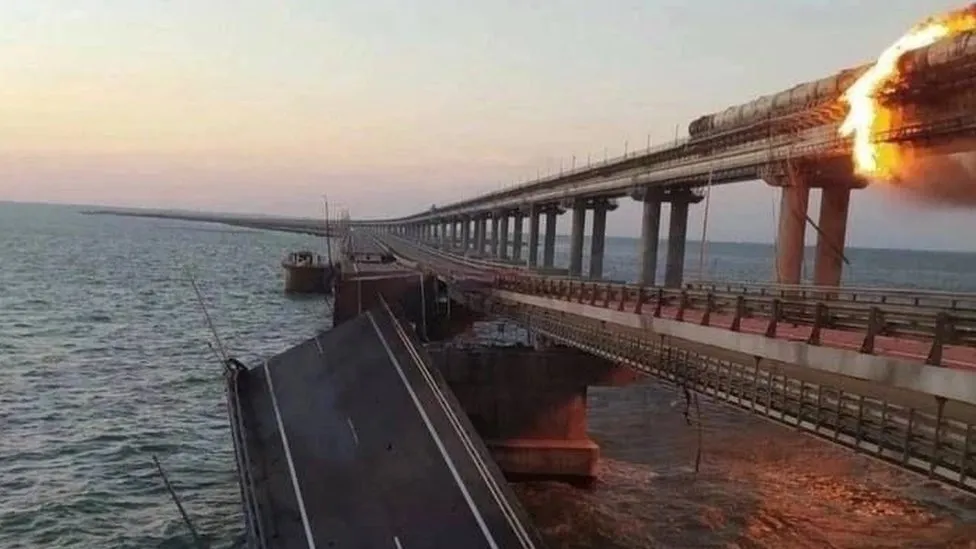
    A still picture of the bridge was shared by Ukrainian presidential adviser Mykhaylo PodolyakIMAGE SOURCE,MYKHAYLO PODOLYAK
    Image caption, A still picture of the bridge was shared by Ukrainian presidential adviser Mykhaylo Podolyak

    Russia’s National Anti-Terrorism Committee said: “At 06:07 Moscow time today [03:07 GMT], an explosion was set off at a cargo vehicle on the motorway part of the Crimean bridge on the side of the Taman peninsula, which set fire to seven fuel tanks of a train that was en route to the Crimean peninsula.

    “Two motorway sections of the bridge partially collapsed.”

    Crimean parliamentary speaker Vladimir Konstantinov blamed the explosion on “Ukrainian vandals, who have finally managed to reach their bloody hands to the Crimean bridge”.

    He added the damage to the bridge would be “promptly restored, since it is not of a serious nature”.

    President Putin has been briefed about the “emergency” on the bridge and has ordered a government inquiry, Kremlin spokesman Dmitry Peskov said, in comments quoted by Interfax news agency.

    A criminal investigation is also under way.

    The 19km (12-mile) bridge across the Kerch Strait, which cost £2.7bn to build, was opened by President Putin four years after Moscow illegally annexed Crimea.

    It is the longest bridge in Europe, and was hailed by Russian media as “the construction of the century”. Russian officials previously claimed it was well protected from threats from air, land or water.

    The crossing is more than 100 miles from Ukrainian-held territory. One explosives expert told the BBC the fire was probably not caused by a missile.

    “The lack of obvious blast / fragmentation damage on the road surface suggests that an air-delivered weapon was not used,” he said.

    He said it was possible that “a well-planned attack from below may have been the cause”.

    “I suspect explosives on the road bridge and train deck were initiated near simultaneously using coded radio command,” he added.

    Ukraine claimed responsibility last month for a series of air strikes on Crimea over the summer, including an attack on Russia’s Saky military base.

    Kyiv has the momentum in this conflict. The army has reclaimed large swathes of territory, forcing Russian troops to abandon long-held positions.

    Amid the losses, Moscow has begun a chaotic military mobilisation – which led to rare anti-war protests in Russia, and a huge exodus of military-age men.

    On Russian TV talk shows, presenters and studio guests have been expressing increasing doom and gloom about the situation.

    Source: BBC

  • Ukraine war: World must act now to stop Russia, says Zelensky

    Ukraine’s President Volodymyr Zelensky has called for pre-emptive sanctions to be imposed on Russia, saying the country’s officials have begun to “prepare their society” for the possible use of nuclear weapons in the war.

    In an interview with the BBC, President Zelensky denied having urged strikes on Russia, claiming that an earlier remark had been mistranslated.

    “You must use preventive kicks,” he said, referring to sanctions, “not attacks”.

    In recent weeks, the Ukrainian army has recaptured large swathes of territory in a successful counter-offensive that has forced Russian troops to abandon long-held positions. In what Kyiv describes as Moscow’s response to its defeats, President Vladimir Putin has incorporated four partially occupied regions of Ukraine.

    The annexations, widely dismissed as illegal, have raised fears of a possible escalation in the seven-month war. President Putin and other senior Russian officials have suggested that nuclear weapons – possibly smaller, tactical weapons – could be used to defend those areas, although Western officials say there has been no evidence Moscow is prepared to do so.

    Ukraine's President Zelensky (L) with the BBC's John Simpson
    Image caption, Ukraine’s president told the BBC’s John Simpson that Russia’s threats were a “risk for the whole planet”

    Speaking in English at the presidential palace in Kyiv, President Zelensky said: “They begin to prepare their society. That’s very dangerous.

    “They are not ready to do it, to use it. But they begin to communicate. They don’t know whether they’ll use or not use it. I think it’s dangerous to even speak about it.”

    He denied having called for strikes on Russia during an online event on Thursday, saying the word he had used in Ukrainian had been misunderstood.

    The initial comment was denounced by Kremlin spokesman Dmitry Peskov as “an appeal to start yet another world war”, while Russian Foreign Minister Sergei Lavrov said it demonstrated why Russia was right to launch its operation in Ukraine.

    “After that translation,” President Zelensky said, “they [the Russians] did their way, how it’s useful for them, and began to retranslate it in other directions.”

    The interview happened hours after US President Joe Biden said that the Russian threat to use nuclear weapons had brought the world closer to “Armageddon” than at any time since the Cuban Missile Crisis during the Cold War.

    President Zelensky said action was needed now, as Russia’s threats were a “risk for the whole planet”. Moscow, he claimed, had “made a step already” by occupying the Zaporizhzhia nuclear power plant, Europe’s largest nuclear station which President Putin is trying to turn into Russian property.

    “The world can stop urgently the actions of Russian occupiers,” President Zelensky said. “The world can implement the sanction package in such cases and do everything to make them leave the nuclear power plant.”

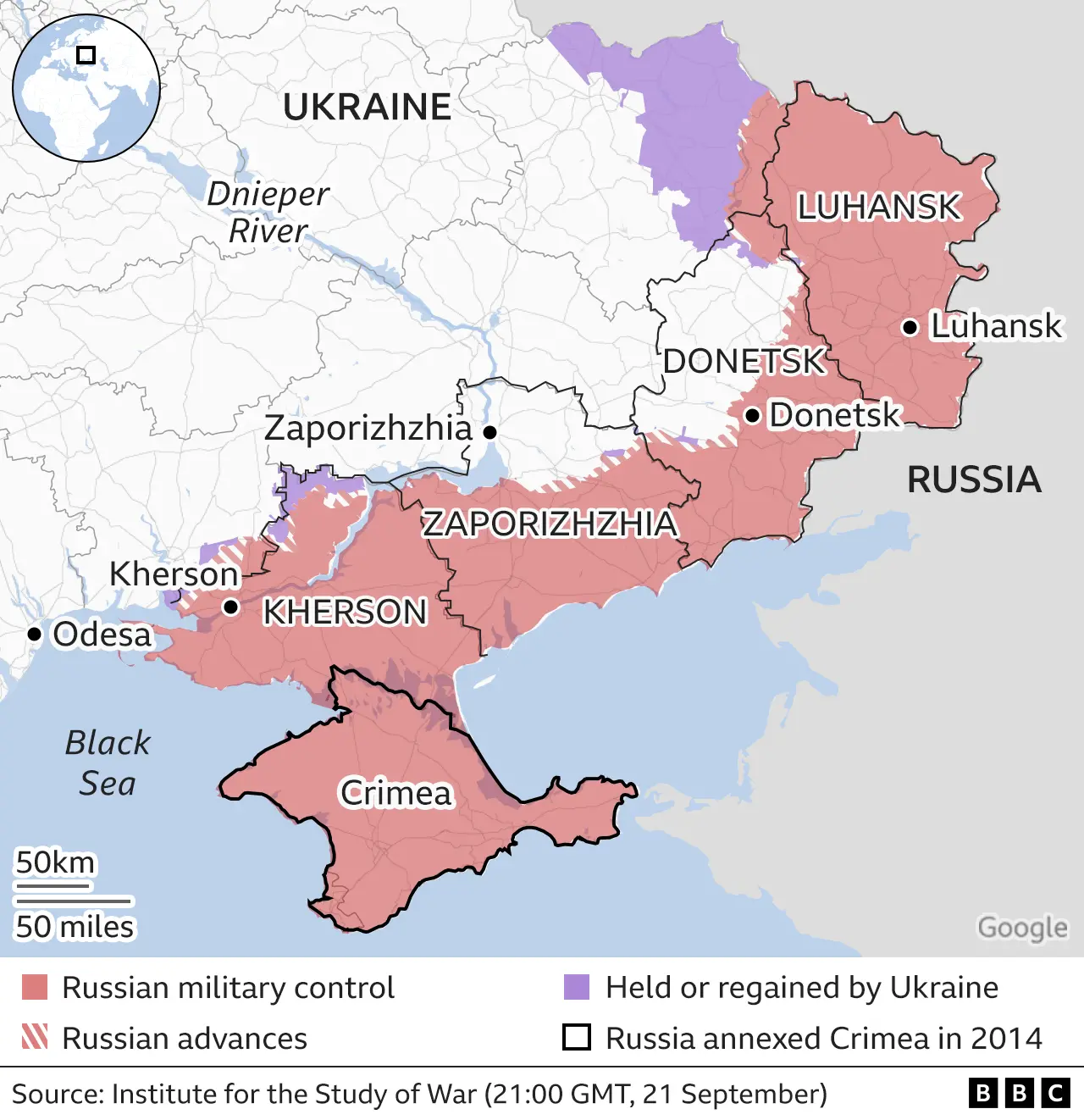
    Map showing areas of Russian military control in Ukraine
    1px transparent line

    Empowered by sophisticated Western-supplied weapons, the Ukrainian army has made significant advances in the east and the south, reclaiming towns and villages even in areas the Kremlin claims are now part of Russia. The setbacks, a major embarrassment for President Putin, have sparked unusual criticism of the country’s military.

    Amid the losses, President Putin announced the mobilisation of hundreds of thousands of reservists, which led to rare anti-war protests in Russia and to a huge exodus of military-age men.

    President Zelensky urged Russians to “fight for your body, rights and soul”, saying: “These mobilised kids now, they come without machine guns, armoured jackets, they are just cannon fodder…. If they don’t want to be kebab… they need to fight [for their lives].

    “All Putin is afraid of is not a nuclear strike. He’s afraid of his society, of his people.

    “Because only this people can replace him, strip him of his power and give it to another person.”

    Source: BBC

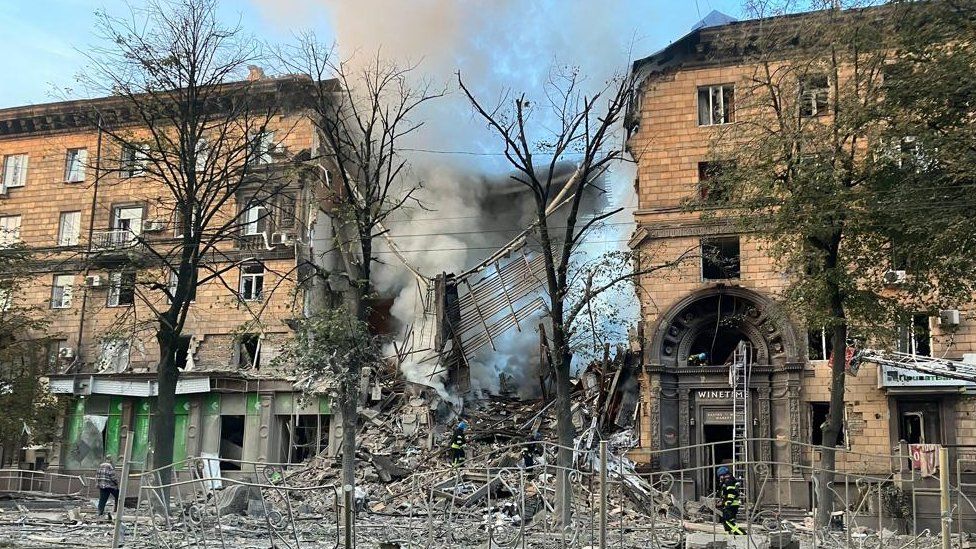
  • Zaporizhzhia missile strike: Death toll rises to11

    The death toll from a Russian missile attack on Ukraine’s southeastern city of Zaporizhzhia this week has risen to 11, it has been reported. 

    The emergency services of Ukraine said the toll of Russian S-300 missile strikes on the city had now risen to 11 and a further 21 people had been rescued from the rubble of destroyed apartments.

    In a Telegram message, regional governor Oleksandr Starukh said: “This was not a random hit, but a series of missiles aimed at multi-storey buildings.”

    For context: Zaporizhzhia is one of the four regions of Ukraine that Russian President Vladimir Putin has illegally claimed as Russian territory.

    The region is home to a sprawling nuclear power plant under Russian occupation while the city of the same name remains under Ukrainian control.

    Russia is reported to have converted the S-300 from its original use as a long-range anti-aircraft weapon into a missile for ground attacks because of a shortage of other, more suitable weapons.

    The Ukrainian military said most of the drones it shot down on Thursday and Friday were the Iranian-made Shahed-136.

    The weapons are unlikely to significantly affect the course of the war, the Washington-based Institute for the Study of War said.


  • Ukrainian artists create the most amazing glass spiders

    Glass Symphony, a Ukrainian family-owned company specializing in hand-made glass sculptures, has become famous for its anatomically-correct arachnids.

    Using a centuries-old technique known as lampworking, the artisans at Glass Symphony, use glass rods, extreme heat and fine wrist movements to manipulate colored glass into intricate miniatures. A gas burner is used to heat the glass to a temperature of 1800 degrees, after which trained artisans shape the glass into various animal-inspired shapes, from different species of spiders and locusts to snails and octopuses.

    Despite their small size, every sculpture respects the anatomical features of the animal that inspired it. Each figurine is made by hand and therefore unique.

    The creations of Glass Symphony – especially the spiders – regularly go viral on social media platforms like Reddit and Facebook. The company sells its hand-made products via its own website and its Etsy shop.

    Source: Oddity Central


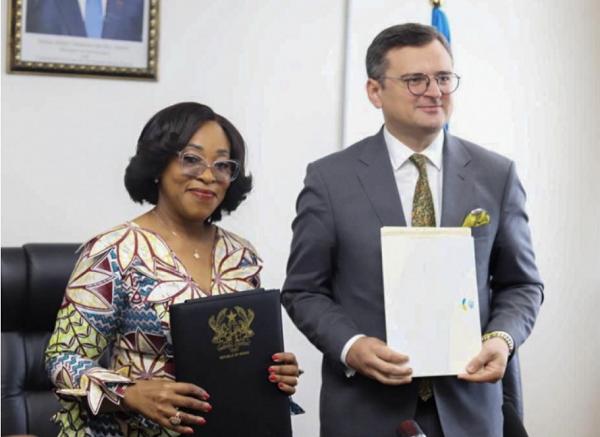
  • Ukraine to establish embassy in Ghana, thanks country for UN support

    Ukraine plans to establish an embassy in Ghana in future as part of efforts to expand its presence in Africa.

    This was disclosed by Ukraine’s Minister of Foreign Affairs (MFA) of Ukraine, Dmytro Kuleba when he held talks with the Minister of Foreign Affairs of Ghana, Shirley Ayorkor Botchway, in Accra.

    The visit of the head of Ukrainian diplomacy to Ghana takes place within the framework of the first-ever tour of the head of the MFA of Ukraine to African countries.

    A publication on Ukraine’s MFA website said Mr Kuleba informed his Ghanaian colleague in detail about his country’s efforts to liberate Ukrainian territories from Russian occupation.

    He thanked Ghana for its solidarity with Ukraine, and support for resolutions at the UN and other international organizations aimed at restoring Ukraine’s sovereignty and territorial integrity.

    The minister emphasized Ukraine’s desire to start a new high-quality partnership with Ghana, which will be based on mutual respect, mutual support and mutual benefit.

    “As part of the implementation of the African strategy, which was developed at the Ministry of Foreign Affairs on the instructions of President Volodymyr Zelensky, Ukraine is expanding its presence in Africa. We reached an agreement with the Ghanaian side: we plan to open a Ukrainian embassy in Ghana in the near future. The establishment of a diplomatic presence in Accra will give an impetus to the development of political contacts, trade, investments, cultural exchanges and cooperation in the field of education,” Mr Kuleba said.

    The ministers discussed in detail the steps to intensify cooperation between Ukraine and Ghana in the spheres of security, cyber security, digital transformation, and agriculture.

    They agreed to start preparations for the establishment of the Joint Commission on Trade and Economic Cooperation.

    They also spoke about finding ways to restore the safe education of Ghanaian students in Ukrainian universities.

    The parties signed a memorandum of understanding on the training of Ghanaian diplomats on the basis of the Diplomatic Academy named after Hennadiy Udovenko at the Ministry of Foreign Affairs of Ukraine. The Ghanaian minister also reported on Ghana’s readiness to consider the possibility of internships for Ukrainian students studying English.

    Madam Botchway also expressed the interest of the Ministry of Foreign Affairs of Ghana in studying the Ukrainian experience in the field of combating disinformation.

    As a result of the meeting, the ministers agreed to hold political consultations between the ministries of foreign affairs with the participation of representatives of various departments of the two countries to develop a comprehensive “road map” for the further development of bilateral relations between Ukraine and Ghana.

    Mr Kuleba also held talks with President Akufo-Addo.

  • Lavrov says, Zelenskyy remarks confirm need for ‘special operation’ in Ukraine

    Russia’s foreign minister, Sergei Lavrov, says remarks by Ukrainian President Volodymyr Zelenskyy recommending that  NATO undertake preventative strikes on Russia validate the need for a “special operation” in Ukraine.

    “By doing so, (he) essentially presented the world with further evidence of the threats posed by the Kyiv regime,” Mr Lavrov said.

    “This is why a special military operation was launched to neutralise them.”

    For context: During an Australian think tank last night, Mr Zelenskyy said he believed strikes were necessary to preclude any use of nuclear weapons.

    He did not go into detail about what kind of strikes he meant and made no reference to any need for nuclear strikes.

    The Ukrainian leader also urged the world to “show strength” following the annexation of four Ukrainian regions.

    He told the think tank: “The head of Russia is now carefully analysing the world’s reaction to the sham referenda he organised on Ukrainian soil and to the announcement of the annexation of our territory.

    “He is interested in whether he still has the potential for escalation. If the world’s reaction is weak now, Russia will come up with some new escalation.”

    Kremlin spokesman Dmitry Peskov denounced Mr Zelenskyy’s comments as “an appeal to start yet another world war with unpredictable, monstrous consequences”, according to RIA news agency.


  • Discussions in Russia moving increasingly toward the Kremlin’s willingness to talk

    The US president is hardly unique in saying that the risk of nuclear Armageddon is higher now than it has been since the Cuban missile crisis, or as it is known in Russia, the Caribbean crisis.  

    Anyone who has thought for more than five seconds about Vladimir Putin‘s nuclear threats given the geopolitical state of play would conclude the same and indeed it is a staple comment across Russian state TV.

    And though the Russian president’s assertion that “this is not a bluff” is the kind of statement you make when you’re bluffing, Russia’s nuclear arsenal should be taken seriously. That is why it’s there.

    Clearly, US officials are which is why they have reportedly been making firm comments behind closed doors to their Russian counterparts that a nuclear strike is the worst of all possible ideas and that retaliation would be decisive.

    At their core, the power of nuclear weapons lies in their ability to persuade the opposing party to do or not to do something, that is the very nature of deterrence.

    Actually putting them to use in any capacity, tactical or strategic, has undeterminable benefits and escalation risks which are in all likelihood impossible to control and potentially catastrophic for all concerned.

    At a very basic level – the wind might blow in Russia’s direction, Vladimir Putin would lose his friends in China and India, and a Western conventional retaliatory strike might knock out the Russian infrastructure President Putin needs to keep his country going and his people on side.

    The question is whether Vladimir Putin, who celebrates his 70th birthday today, is thinking rationally about any of that.

    Russia’s nuclear doctrine allows for a first-strike nuclear attack only if the very existence of the state is deemed at risk.  It is a high bar.

    Ukraine has already struck targets inside Russia, in the border town of Belgorod most frequently and in Crimea.

    Russia seems to have preferred not to make too big a deal out of it. Although these illegitimate annexations mean Russia can claim these territories as its own and therefore that any Ukrainian attack is a strike on the Russian state, it is a stretch to claim that as existential and a road that Russia has so far chosen not to travel.

    Nor does Russia appear to have moved to take any of its nuclear warheads out of central storage and unite the payload with the means of delivery.  So far, its nuclear threats are just that – threats.  There is still a long way to go in the way of signalling and warnings before we reach actual Armageddon.

    And although Russia may be losing ground on the battlefield, it does still have other options beyond continuing to hammer it out in Donbass and Kherson.

    Why hasn’t it taken out targets in Kyiv, for example, since the early days of the war? What about other forms of hybrid warfare, (continuing to) target energy infrastructure in Ukraine and beyond?  Vladimir Putin is a master of those dark arts.  A nuclear strike, one would hope, would be his weapon of last resort.

    The talk now in Russia is moving increasingly toward the Kremlin’s willingness to talk. The proposition seems to be – let’s discuss ending this now with Russia claiming a huge chunk of Eastern Ukraine as its own and there is the threat of tactical nuclear weapons if you don’t or if NATO troops get involved.

    Ukraine’s president is understandably not convinced. Volodomyr Zelenskyy wants his country back, whole. He is not the one thinking about potential off-ramps for Vladimir Putin, he’s thinking about winning.

    Which is why it is so important that the US president is. As Joe Biden put it in comments overheard by reporters, he’s trying to figure out where Mr Putin finds a way out where he “does not only lose face but lose significant power within Russia”.

    The trouble is it is incredibly hard to determine what that is and by raising the rhetorical stakes, Vladimir Putin appears to be backing himself increasingly into a corner. The prospects are deeply worrying.

    In an interview with Sky News, a Russian lawmaker and TV host Evgeny Popov insisted Russia would never make the first strike.

    “Using a nuclear weapon in the 21st century is an insane decision. We are not insane and we hope you are not either,” he said.

    Let’s hope Vladimir Putin feels the same.

    Source: SkyNews Diana Magnay, Moscow correspondent


  • Nobel Peace Prize awarded Human rights campaigners in Belarus, Russia and Ukraine

    According to Berit Reiss-Andersen, chair of the Norwegian Nobel Committee, the judges sought to recognise “three exceptional supporters of human rights, democracy, and peaceful coexistence.”

    Ales Bialiatski, a jailed human rights advocate from Belarus, Memorial, a Russian advocacy organisation, and the Center for Civil Liberties in Ukraine have all received the Nobel Peace Prize.

    The winners were announced in Oslo by Berit Reiss-Andersen, chair of the Norwegian Nobel Committee.

    She said the judges wanted to honour “three outstanding champions of human rights, democracy, and peaceful coexistence in the neighbour countries Belarus, Russia, and Ukraine”.

    She added: “Through their consistent efforts in favour of human values and anti-militarism and principles of law, this year’s laureates have revitalised and honoured Alfred Nobel’s vision of peace and fraternity between nations, a vision most needed in the world today.”

    The award traditionally recognises the work of groups and activists seeking to prevent conflict, tackle hardship, and protect human rights.

    Last year’s winners have faced a difficult time since receiving the prize.

    Journalists Dmitry Muratov of Russia and Maria Ressa of the Philippineshave been fighting for the survival of their news organisations and defying government efforts to silence them.

    They were honoured last year for “their efforts to safeguard freedom of expression, which is a precondition for democracy and lasting peace.”

    A week of Nobel Prize announcements kicked off on Monday with Swedish scientist Svante Paabo receiving the award in medicine for unlocking secrets of Neanderthal DNA that provided key insights into the immune system.

    Three scientists jointly won the prize in physics Tuesday.

    Frenchman Alain Aspect, American John F Clauser, and Austrian Anton Zeilinger had shown that tiny particles can retain a connection with each other even when separated, a phenomenon known as quantum entanglement, that can be used for specialised computing and to encrypt information.

    The Nobel Prize in chemistry was awarded on Wednesday to Americans Carolyn R Bertozzi and K. Barry Sharpless, and Danish scientist Morten Meldal for developing a way of “snapping molecules together” that can be used to explore cells, map DNA and design drugs that can target diseases such as cancer more precisely.

    French author Annie Ernaux won this year’s Nobel Prize in the literature on Thursday.

    The panel commended her for blending fiction and autobiography in books that draw on her experiences as a working-class woman to explore life in France since the 1940s.

    The 2022 Nobel Prize in economics will be announced on Monday.

    The prizes carry a cash award of 10 million Swedish kronor (around £800,000) and will be handed out on 10 December.

    The money comes from a bequest left by the prize’s Swedish creator who invented dynamite.


  • Ukraine war: Putinn passes laws annexing Ukraine despite military losses

    Even as his troops faced more blows, Russian President Vladimir Putin signed the necessary documents to seize four regions of Ukraine.

    The documents state that the Luhansk, Donetsk, Zaporizhzhia, and Kherson areas have been “admitted into the Russian Federation.”

    But in two of those areas – Luhansk and Kherson – Ukraine said it has been retaking more villages.

    Mr Putin also signed a decree to formalise Russia’s seizure of the nuclear power plant in Zaporizhzhia.

    Last Friday, the Russian leader held a grand ceremony in the Kremlin, where he signed agreements with the Moscow-installed leaders of the four regions.

    The move followed self-proclaimed referendums in the areas, denounced as a “sham” by the West.

    But on the ground there appears to be a different reality, with Ukrainian forces making gains in both the south and the east.

    Serhiy Haidai, Ukrainian governor of Luhansk, told the BBC on Wednesday that six villages in the region had been recaptured.

    And President Zelensky later said Ukraine had liberated three more villages in the southern region of Kherson.

    That followed a series of gains in Kherson the previous day, including the strategically key village of Davydiv Brid.

    Meanwhile, the southern city of Zaporizhzhia was rocked by a series of huge explosions an hour or so before dawn.

    Local authorities say seven Russian missiles hit residential buildings and that people are under the rubble. There has been no information on casualties so far.

    The BBC’s Paul Adams, who is in the city, says rescue workers are combing through the shattered remains of an elegant five storey apartment building in the middle of the city.

    Ukraine says multiple explosions were heard in the southern city of Zaporizhzhia before dawn on Thursday
    Image caption, Zaporizhzhia was rocked by a series of huge explosions an hour or so before dawn on Thursday

    Kremlin spokesman Dmitry Peskov said Russia would retake any territory that had been lost to Ukrainian forces.

    Facing questions over the recent losses, he told reporters: “There is no contradiction here. They will be with Russia forever, they will be returned.”

    In a speech to teachers on Russian teachers’ day, Mr Putin said he would “calmly develop” the annexed territories.

    But Andrey Kartopolov, the chairman of the State Duma defence committee, told state media that Russia needed to stop lying about what was happening on the battlefield, saying that Russians were not stupid.

    Russia is still working to mobilise reservists, after Mr Putin announced a call-up last month of 300,000 people who had completed compulsory military service.

    But Mr Putin has rowed back on which groups will be affected, after strong opposition and protests in Russia against the move.

    He has signed a decree exempting several categories of students, including first-time students at accredited institutions, and certain types of postgraduate students – such as those in the field of science.

    In another move, President Putin has signed a decree to formalise Russia’s seizure of the nuclear power plant in one of the annexed regions – Zaporizhzhia – which has been occupied by Russian troops since the early days of the war.

    Russia says the plant – Europe’s largest nuclear facility – will be operated by a new company, but Ukraine’s nuclear operator has dismissed the move as “worthless”.

    Rafael Grossi, the head of the UN’s nuclear watchdog, the IAEA, has said he will hold consultations with the two sides following the development.

    He is heading to Kyiv and then Moscow, seeking to establish a protection zone around the plant, which is situated near the front line of fighting.

    Russia’s President Vladimir Putin has signed the final papers to annex four regions of Ukraine – even as his military suffered further setbacks.

    The Luhansk, Donetsk, Zaporizhzhia and Kherson regions are “accepted into the Russian Federation” the documents say.

  • Amateur boxing world governing body lifts ban on Russian and Belarusian boxers

    Amateur boxing’s world governing body has lifted its ban on Russian and Belarusian athletes.

    Boxers from the two nations were banned from competition in March following Russia’s invasion of Ukraine.

    The International Boxing Association’s president is Russian Umar Kremlev and it counts Russian state-backed energy giant Gazprom among its chief sponsors.

    In a statement, it said it “strongly believes that politics shouldn’t have any influence on sports”.

    Adding it remained “politically neutral and independent”, the IBA – formerly known as the AIBA – added: “IBA calls for peace and remains a peacemaker in any conflicts. Moreover, the IBA has obligation to ensure equal treatment towards the athletes and competition officials, regardless of their nationality and residence.

    “Both Russian and Belarus teams will be able to perform under their flags, and the national anthems will be played in case they win a gold medal.

    “According to the decision, the technical officials of Russia and Belarus will also be back in the competitions.”

    On Friday, the IBA suspended the Ukrainian boxing federation after it had written to IBA members calling for Kremlev to resign or be voted out of office.

    The IBA does not recognise Kyrylo Shevchenko as the Ukrainian federation’s president, insisting it is Volodymyr Prodyvus, an ally of Kremlev who left Ukraine after the Russian invasion.

    Two days later, IBA delegates voted to reject a proposal to hold new presidential elections, with the International Olympic Committee (IOC) saying it was “extremely concerned” by the result.

    The IBA was stripped of involvement in last year’s Tokyo Olympics because of governance, finance, refereeing and ethical issues, while it will also not be involved in the running of qualification events or competitions at the Paris 2024 Games.

    Boxing was left off the initial list of sports for the 2028 Games.

    Source: BBC

  • Ukraine join Spain and Portugal in joint bid for 2030 World Cup

    Ukraine have joined Spain and Portugal in a joint bid to host the 2030 World Cup, it was announced on Wednesday.

    Spain and Portugal had already joined forces with an “Iberian bid” to host but Ukraine have joined as a third host, with the bid now being referred to as a “European bid”.

    Reports on Tuesday revealed Ukraine’s involvement, and it was confirmed on Wednesday by the Spanish Football Federation (RFEF) and the Portuguese Football Federation (FPF) at UEFA’s Swiss headquarters, with Europe’s governing body backing the bid.

    According to reports, the plan is for Ukraine to play host to one group in the 48-team tournament – which will be the second with expanded teams after the 2026 World Cup in North America; hosted by the United States, Mexico and Canada.

    Ukraine previously hosted the 2012 European Championship alongside Poland, while Portugal hosted the same tournament in 2004. Neither has hosted the World Cup previously but Spain hosted it in 1982.

    The European bid will compete with others for the rights to host the 2030 tournament, with a final decision to be made in 2024.

    Currently, a South American proposal from Uruguay, Argentina, Paraguay and Chile has been made, while it is reported a joint bid from Greece, Saudi Arabia and Egypt is also in the works.

    Another inter-federation bid may involve Israel, partnering with the United Arab Emirates or Bahrain, while Morocco could launch a joint bid with other northern African nations having failed with previous bids for the tournaments in 1994, 1998, 2006 and 2010.

    Australia could also be an option, with reports previously indicating a joint proposal could be made alongside either New Zealand or Indonesia.

    A plethora of joint bids appear to suggest that this year’s World Cup in Qatar could be the final tournament to be hosted by a single nation, with the appeal of hosting the tournament in numerous countries increasing – particularly to involve those who would not be able to host a tournament individually.

    The increase to a 48-team World Cup would also put further strain on individual nations to host an entire tournament, with a total of 80 matches to be played – an increase on the 64 that will be played in Qatar.

    Source: Livescore

  • Smiling Ukrainian commander drives captured Russian tank

    A Ukrainian commander has been seen driving a captured Russian tank as the army continues to make rapid advances into previously held Russian territory.  

    In the video – shared on the official Twitter account for Ukraine’s defence – Colonel Pavlo Fedosenko, commander of the 92nd Mechanised Brigade, is seen smiling as he drives the Russian tank.

    The video said he captured the tank “personally”.

    Sky News has been unable to verify the claims made by the account – however, the vehicle does appear to be a T-90, a third-generation Russian main battle tank.

    It is also not the first enemy tank to be captured by advancing forces; in recent weeks a number of T-72 and T-80 tanks have been added to the Ukrainian arsenal.

    Source: Skynews

  • Irishman, 23, killed in combat in Ukraine, his family confirms 

    A 23-year-old Irishman has been killed while fighting in Ukraine, his family has confirmed.

    Rory Mason died as a Ukrainian armed forces serviceman while fighting in the International Legion for the Defence of Ukraine near the Russian border.

    The Mason family learned of Rory’s death from the Department of Foreign Affairs, which is providing consular assistance.

    His father Rob described him as a “private young man of drive, purpose, and conviction”.

    He went on: “Though we are deeply saddened at his death, we are enormously proud of his courage and determination and his selflessness in immediately enlisting to support Ukraine.

    “Rory was never political but he had a deep sense of right and wrong and an inability to turn the other way in the face of injustice.”

    The International Legion for the Defence of Ukraine said that while conducting operations, Mr Mason’s unit came under attack.

    A spokesman said in a statement: “Our brother in arms, Rory Mason, has taken part in the Kharkiv counteroffensive with his unit and was killed in action.

    “Rory’s memory will live on in his unit, in the legion and the armed forces of Ukraine.”

  • 100 medical students from Ukraine awaiting results for placement into Ghana schools

    One hundred Ghanaian medical students trained in Ukraine are still awaiting results verification and placement into Ghanaian medical schools.

    This revelation comes after Dr. Anthony Nsiah- Asare, the chairman of the inter-ministerial committee put together to come out with modalities to integrate the students into Ghanaian medical schools, disclosed that about 100 out of the initial 187 students had been placed into Ghanaian medical schools.

    Dr. Nsiah-Asare said the committee has successfully completed its work and would soon submit a report to the Ministry of Education.

    But speaking to Citi News, the president of the Ukrainian branch of NUGS, Philip Bobbie Ansah says they are yet to see the placements done by the committee.

    “100 medical students in Ukraine have been placed in medical school now, but we are yet to see the placement and results. The statement was made by the Medical and Dental Council, but the students are yet to see the assessment so we are looking for the date that they will release the results because they are awaiting the Ministry of Health.”

    The Medical and Dental Council of Ghana believes criticisms of its decision not to recognize degree certificates issued by Medical and Dental Schools in Ukraine are unjustified.

    The council’s Registrar, Dr. Divine Ndonbi Banyubala, suggested that his outfit was deserving of praise for being proactive and “acting in our collective interest.”

    “We are set up exactly to do that; to make sure substandard practitioners, do not come and become licensed murderers,” Dr. Banyubala said.

    The council’s decision is because some schools in Ukraine have resorted to studying online following the Russian invasion.

    But Ghanaian students studying Medicine and Dentistry in Ukraine have decried the decision by the Ghana Medical and Dental Council not to recognise their certificates.

    Speaking to Citi News, an Executive Member of the National Union of Ghana Students in Ukraine, Henry Brook Smith said the move is not in the best interest of Ghanaian students studying in Ukraine.

    “Ukraine is currently running an offline mode. The online is being organised for those who can’t make it to Ukraine due to the invasion. Our concern is that, this decision has been taken without recourse to the effects on parents and students.”

    Source: Citinews

  • Ukraine foreign minister begins Africa tour in Senegal

    There has been sparse media coverage in Senegal following a visit to Dakar by Ukraine Foreign Affairs Minister Dmytro Kuleba, who is embarking on an African tour.

    The Ukrainian diplomat met Senegal’s Foreign Minister Aissata Tall Sall and they signed several bilateral co-operation deals.

    Mr Kuleba is on an apparent counteroffensive tour following a visit to the continent by Russia’s top diplomat Sergei Lavrov in July, ahead of plans to host the second Russia-Africa summit in Ethiopia next year.

    Ukraine President Volodymyr Zelensky has repeatedly made overtures to African leaders to condemn Russia over its invasion of his country.

    Source: BBC

  • Musk and Zelensky  battling over the Ukraine “peace plan poll”

    President of Ukraine Volodymyr Zelensky reacted to Elon Musk after the Tesla CEO shared a Twitter poll with his ideas for stopping Russia’s invasion.

    Voting options that included giving territory to Russia were put to the vote by Mr. Musk’s 107.7 million followers.

    In response, Mr Zelensky posted his own poll asking users if they liked the world’s richest person more when he supported Ukraine.

    Other Ukrainians criticized Mr Musk.

    Ukraine’s outgoing ambassador to Germany, Andrij Melnyk, used a strong expletive, which he described as his “very diplomatic reply”.

    Meanwhile, Russian chess grandmaster Garry Kasparov said: “This is moral idiocy, repetition of Kremlin propaganda, a betrayal of Ukrainian courage & sacrifice.”

    Mr Musk’s ideas included votes in parts of Ukraine occupied by Russia that the Kremlin says it is annexing.

    The multi-billionaire said: “Russia leaves if that is the will of the people.”

    President Vladimir Putin has already declared four Ukrainian regions to be part of Russia, following so-called referendums denounced as fraudulent by Kyiv and its Western allies. Russia does not fully control any of the four regions.

    Mr Musk also suggested the world should formally recognise Crimea – annexed by Russia in 2014 – as part of Russia. And the world’s richest person in 2022, according to Forbes magazine, cautioned that the conflict could end in nuclear war, though added this was “unlikely”.

    After being posted for 10 hours Mr Musk’s poll had attracted more than two million votes.

    Mr Zelensky responded with his own poll asking: “Which @elonmusk do you like more? One who supports Ukraine [or] One who supports Russia.”

    Eight hours after it was posted, that poll had been voted on more than 1.5 million times.

    Earlier in Russia’s invasion, Mr Musk’s satellite internet company sent equipment to Ukraine.

    That gained Mr Musk popularity in Ukraine and he was subsequently invited by Mr Zelensky to visit when the war with Russia was over.

    The businessman posted his poll during a busy week when he is due to give evidence to lawyers acting for Twitter ahead of a trial set to begin on 17 October. Twitter is suing Mr Musk after he walked away from a $44bn deal to buy the social media platform.

    Twitter is hoping the court in Delaware will order Mr Musk to complete the takeover at the agreed price of $54.20 per share.

  • Ukraine criticises Iran for providing drones to Russia

    Vladimir Putin doesn’t have many partners who are willing to send weaponry, despite the fact that the West has been arming Ukraine throughout the conflict.

    It has been widely reported that Russia has received Iranian drones for use in Ukraine – but Iran, according to Kyiv, has not been upfront with them about this.

    Now Ukraine has called them out on Twitter

  • Analysis: The nuclear option could become more appealing for Putin as his options shrink

    More losses for Russia in Ukraine, this time around in Kherson – Ukraine’s long-telegraphed Kherson counter-offensive is making some headway along the western banks of the Dnipro river, between the villages of Zolota Balka and Dudchany around 100km north of Kherson.

    Russia’s Ministry of Defence admitted on Monday that the Ukrainians had broken through Russian lines at Zolota Balka and Oleksandrivka but that the Russians had taken up pre-prepared defensive positions and were continuing to inflict “massive fire on the enemy”.

    Just four days after Russia declared all this territory theirs, it doesn’t look good for them. Plus Russian losses are appearing in the public domain, in a way that one month ago they would not have done. Russian military bloggers are documenting Russian setbacks in expanding groups of followers.

    The likes of Ramzan Kadyrov, who incidentally has just announced he’ll be sending his three teenage sons to fight (including his 14-year-old), has poured criticism on the Russian military command in charge of the Lyman debacle, as has Evgeny Prigozhin who recently revealed himself to nobody’s great surprise as head of the Russian mercenary group, Wagner.

    Pundits on state TV are expressing concern at the dire state of affairs. Could this open Pandora’s box for the Kremlin, criticism which gathers pace and which it cannot control, triggering a slow unraveling?

    Perhaps. It could also, intentionally or not, serve a purpose for Vladimir Putin. If his nuclear bluffs are to be taken seriously and given Russian capabilities it would be foolish not to, he needs to present a case to his people that the nuclear option is – at some point – justified.

    He and his propagandists are pitching this as an existential battle against the military might of the collective West, out to destroy and dismantle Russia.

    A nuclear strike is an abhorrent option in any scenario but it makes no sense if you’re winning. With Russia losing ground though, and the outlook increasingly bleak, it might become more appealing as Vladimir Putin sees his options shrink.

    DISCLAIMER: Independentghana.com will not be liable for any inaccuracies contained in this article. The views expressed in the article are solely those of the author’s, and do not reflect those of The Independent Ghana

    Source: Skynews By Diana Magnay, Moscow correspondent 

  • Ukraine foreign minister starts Africa tour in Senegal

    There has been sparse media coverage in Senegal following a visit to Dakar by Ukraine Foreign Affairs Minister Dmytro Kuleba, who is embarking on an African tour.

    The Ukrainian diplomat met Senegal’s Foreign Minister Aissata Tall Sall and they signed several bilateral cooperation deals.

    Mr Kuleba is on an apparent counteroffensive tour following a visit to the continent by Russia’s top diplomat Sergei Lavrov in July, ahead of plans to host the second Russia-Africa summit in Ethiopia next year.

    Ukraine President Volodymyr Zelensky has repeatedly made overtures to African leaders to condemn Russia over its invasion of his country.

  • Ukraine defeats Russia in the south

    More territory has been retaken by Ukrainian forces in regions that Russia illegally annexed, with Kyiv’s soldiers moving closer to Kherson in the south and consolidating gains in the east.

    Officials from Russia who had been deployed in Kherson acknowledged the advance but claimed that Moscow’s men had dug in.

    In the east, Ukrainian forces pushed into the Russian-held Luhansk region.

    Ukraine’s President Volodymyr Zelensky said “there are new liberated settlements in several regions”.

    Speaking during his nightly address, President Zelensky said “fierce fighting continues in many areas”, but he did not give details. The progress of Ukraine’s counterattacks have been closely guarded and reporters have largely been kept away from the front lines.

    But in the south, Vladimir Saldo, the Russian-installed leader in the Kherson region, admitted that Ukrainian forces had broken through near Dudchany, a town on the Dnipro river about 30km (20 miles) south of the previous front line. The river is called Dnieper by Russians.

    “There are settlements that are occupied by Ukrainian forces,” Mr Saldo said. Some Russian reports say the Ukrainians have now taken Dudchany.

    A Russian defence ministry spokesman, Igor Konashenkov, said “numerically superior” Ukrainian tanks had “driven a deep wedge” south of Zolota Balka, a village that marked the previous front line on the Dnipro. He claimed the Russians had killed about 130 Ukrainian troops in that fighting.

    According to Mr Saldo, two Ukrainian battalions tried to reach the Kakhovka hydroelectric power station, about 70km (44 miles) east of Kherson. The power station is in the port city of Nova Kakhovka.

    The Ukrainian advance is targeting supply lines for as many as 25,000 Russian troops on the west bank of the Dnipro, Reuters news agency reports.

    Map of Kherson region
    Short presentational transparent line

    Meanwhile, in the east Kyiv’s troops have continued an advance that has seen them slowly making inroads into Luhansk, a province annexed by Moscow last week and previously under almost complete Russian control.

    On Saturday Ukrainian forces recaptured the important hub town of Lyman in the east, lying near the Luhansk regional border. Russia’s military had turned Lyman into a logistical base.

    Russia’s proxy forces in Luhansk said Ukrainian troops had pushed a few kilometres into the Luhansk region. Reports suggest that the Ukrainians are moving towards the Russian-held towns of Kremenna and Svatove in Luhansk, with some pro-Kremlin bloggers suggesting that Russian forces have again been ordered to retreat.

    Kherson and Luhansk are among four regions which Russian President Vladimir Putin has declared to be part of Russia, following so-called referendums denounced as fraudulent by Kyiv and its Western allies. Russia does not fully control any of the four regions.

    On Monday, Kremlin spokesperson Dmitry Peskov attracted ridicule online after he admitted that Russia was still deciding which areas it had “annexed”, suggesting that Moscow does not know where its self-declared borders are.

    Mr Peskov claimed the entirety of Luhansk and Donetsk regions were part of Russia, but said the Kremlin will “continue consultations with the population regarding the borders of the Kherson and Zaporizhzhia regions”.

    Kyiv has vowed to retake all the territory annexed by Russia, including Crimea, seized by Russian troops in 2014.

    The Russian defence ministry says reservists drafted into the army under Mr Putin’s mobilisation order last month are now undergoing intensive combat training in the Russian-controlled Luhansk and Donetsk regions. The Kremlin plans to call up about 300,000 reservists – though Mr Putin did not set an upper limit.

  • 100 medical students from Ukraine integrated into Ghanaian medical schools

    About 100 out of the initial 187 students who expressed their desire to continue their education in Ghana, have successfully been placed in at least one of the country’s seven medical schools.

    The number formed part of the over 900 Ghanaian Medical students from Ukraine whose education got truncated due to the Russian invasion of Ukraine.

    The decision to integrate the students into local medical schools was contained in the yet-to-be-submitted report of the 13-member Inter-ministerial Committee put together to come out with modalities to integrate these students into Ghanaian universities to continue their studies.

    Dr. Anthony Nsiah-Asare, the chairman of the committee, who disclosed this to the media in Accra last Wednesday, said the committee had successfully completed its work and would soon submit its report to the Minister of Education.

    He explained that even though the window of opportunity was offered to all the over 900 affected students; less than 200 of them decided to take advantage of it.

    Dr. Nsiah-Asare said, out of 187 students who initially expressed interest in the integration process, only 121 registered to take part in an assessment organised by the Medical and Dental Council.

    He noted that out of the registered number, 101 availed themselves for assessment, stressing that “We’ve placed the students in first-year level 100, level 200, level 300, level 400 and level 500.

    We didn’t place anybody in level 600 because the arrangement or the course structure in Ukraine for level 600 is quite different from the course structure in Ghana,” he said.

    However, he noted that one student was not placed in any of the universities due to the fact that even though he started as a medical student in Ukraine, he decided to change course after the third year.

    “He actually wanted to take advantage of the window of opportunity given but upon thorough assessment of his documents, it was realised that he abandoned medicine for economics, I think after the third year,” he said.

    Dr. Nsiah-Asare who is also the Special Advisor to the President on Health, justified the Ghana Medical and Dental Council’s decision not to recognise certificates issued to students who conducted their studies via online.

    The Council, on Monday, September 26, 2022, said it would not recognise degree certificates issued by Medical and Dental Schools from Ukraine citing inappropriate training processes.

    The Council explained that, that was not in accordance with the required training process as it threatened the quality and credence of the profession.

    Dr. Nsiah-Asare explained that it was wrong to allow persons who had not gone through the required training process to practice as medical and dental officers.

    “In medicine, especially in clinical medicine, I am a doctor so I can say it, you cannot say that you’ve done online courses for the rest of your clinical courses and so you are a doctor. I don’t think you will allow anybody who has done online courses alone to come and see you,” he said.

    I know that some people are comparing that because of AI, people are even doing virtual surgeries and all those things, but that person has trained as a doctor, he has done postgraduate training and gone to do specialised training as a robotic surgeon…, but not just straight from medical school and you say that you’ve finished your medical school online.

    I don’t think you will allow such a doctor to see you. So, we are guarding the profession and protecting the public. The Medical and Dental Council guards the profession and protects the public,” he empahsised.

    Philip Bobbie-Ansah, President of the NUGS-Ukraine, attributed the failure of many of the qualified and interested students to participate in the assessment exercise to their inability to afford plane tickets to Ghana as well as the short notice of the exercise.

    The NUGS-Ukraine president appealed to the Council to give opportunities to students who still wanted to take advantage of the offer, to do so.

    “I have made a plea to the Registrar of the GMC that if possible, already, we’ve done the assessment, and the structures are already there.”

  • Recapture of Lyman: Ukrainian forces  bursting to regain more land as they can already smell victory

    These guys are steadily retaking Ukrainian territory on the eastern front, and despite their exhausted appearance, they can smell victory, according to Sky’s special correspondent Alex Crawford.

    They have a lot of self-assurance and confidence right now. They are eager to retake more, too.

    I asked the soldiers: “How confident are you about retaking Severodonetsk, Lysychansk?”

    One replied: “100%. This is Ukraine.”

    Lyman is their biggest win on the battlefield in weeks and the first since President Vladimir Putin declared this Russian territory.

    So tearing down the Russian flags inside Lyman is delivered with particular relish.

    Pic: Reuters

    Seizing Lyman it is hoped will be the launchpad to reclaim even more land in the east.

    The Ukrainians have been celebrating with their foreign friends who have fought alongside them.

    Now they’re pushing forward. The road to Lyman is littered with the discards of fierce fighting but the Ukrainians say they have also surrounded their enemy in parts of Lysychansk nearly 60km (37 miles) away.

    A soldier said: “Now they are on the Lysychansk plant. They are surrounded, they will be pushed back and the road to Lysychansk will be opened.”

    Neighbouring towns, like Siversk, have suffered badly in the fight to retake Lyman – with house after house destroyed. Those still here are just clinging to hope.

    A local man said: “I want peace. I want that my parents will be alive. I want that my wife will be alive. Nothing more.”

    But Russians are still close enough to instill much fear.

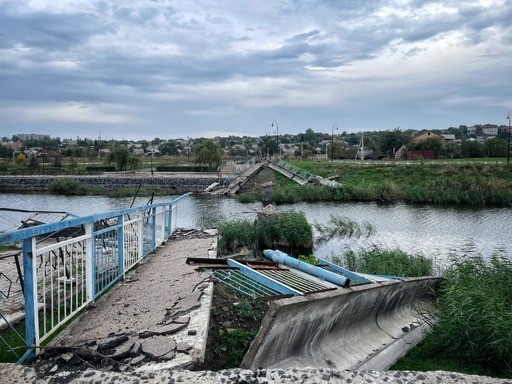
    The Ukrainians have blown up bridges into Bakhmut to slow down any Russian advance

    Forty minutes south, the ferocity of the Russian assault is stark in Bakhmut. This was the Ukrainians’ key military hub for the east, now blasted to bits and a virtual ghost town.

    There are enormous craters that have utterly changed the geography around here and ripped the heart out of the town.

    The holdouts move around in a war-torn haze – weary and tearful.

    Irina said: “These borders that they’re trying to change. It’s for those who divide. They divide big money between them and they don’t care about us people, the people who are living here. I’m sorry because a lot of my friends died. Big politics is filthy.”

    Irina
    Irina

    Victory tastes very different depending on where you are.

    The Russians are still on the edges of Bakhmut fighting and making their presence very much felt.

    I asked a local man: “Did you think the Russians were close to coming in?”

    He replied: “You understand maybe for a little while they will succeed, but everyone wants the opposite. But here there are a lot of collaborators, a lot, and they are saying a lot of terrible things.

    “I start arguing with them, which I shouldn’t do, because God forbid if they do come here, those people will be first who betray.”

    The Ukrainians are hoping the battle of Lyman may prove a turning point in this war but so many and so much has been sacrificed already.

  • Ukraine war: Concerns raised about France’s supply of arms to Kyiv

    Why is France’s contribution to the war effort in Ukraine so minimal if it aspires to lead Europe into a new era of military independence?

    Some of the nation’s leading strategic thinkers are pressing President Emmanuel Macron to decide quickly whether to send more armaments to Kyiv, and they are asking him this hard question.

    Recent analysis conducted on the ground in Poland and Ukraine shows that the French share of foreign arms deliveries is less than 2%, way behind the US on 49%, but also behind Poland (22%) and Germany (9%).

    “I was concerned about the reliability of the statistics which showed France low on the list of contributing countries,” says François Heisbourg, who is perhaps France’s most influential defence analyst.

    “So I went out to the main distribution hub in Poland to see how much in tonnage was actually being delivered, rather than just promised.

    “Unfortunately the figures bore out my fears. France is way down the list – in the ninth position.”

    The official reaction to this in Paris is: “Yes, but…”

    Yes, the aid statistics are unflattering, but there are other factors at work.

    First, defense officials say the true measure of military help is quality, not quantity. Some countries are delivering masses of outdated equipment. France has given 18 Caesar self-propelled artillery units, which are now celebrated along the Ukrainian front line.

    France, they add, is like other Western countries in having run down military stocks as part of the post-Cold War peace dividend

    1px transparent line

    Ukraine’s Caesars are fully one-quarter of France’s entire mobile artillery. It cannot offer much more without making itself vulnerable in regions where it is already committed, like the Sahel and the Indo-Pacific.

    “It might look like we are behind other countries, but France has every intention of playing its part,” says Gen Jérome Pellistrandi, editor of the National Defence Review.

    These arguments are not without merit, says Mr Heisbourg. The problem is that by not being more present in the theatre, France risks writing itself out of the plot.

    “When I was in Kyiv, everyone was very polite. I had no sense that the Ukrainians disapproved of us,” he says. “In a way, it was worse. I had the distinct feeling we were becoming irrelevant.”

    For Mr Heisbourg the equation is simple. Ukraine will talk to countries that it knows are likely to deliver the weapons it needs. France at the moment is not one of them.

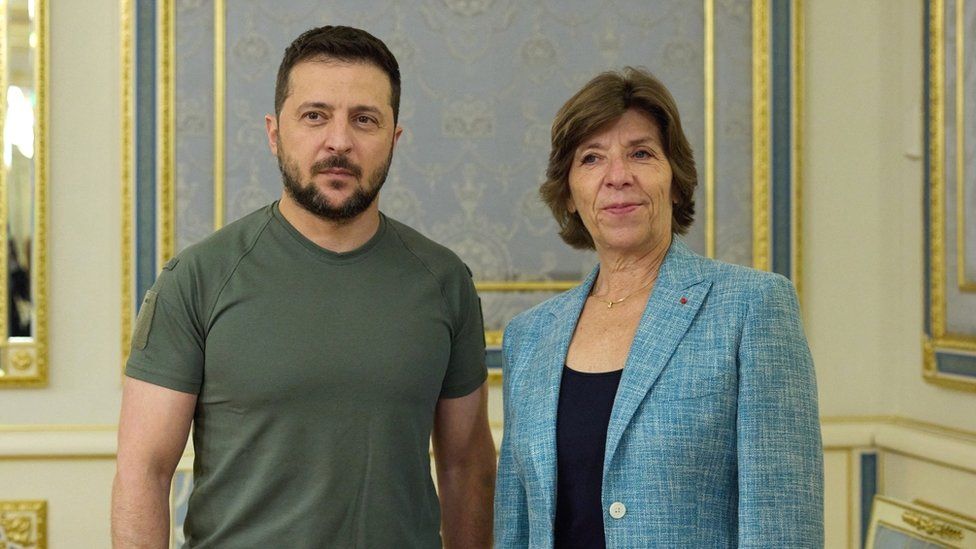
    French Foreign Minister Catherine Colonna and Ukraine's President Volodymyr Zelensky attend a meeting in Kyiv, Ukraine
    IMAGE SOURCE,REUTERS Image caption, French Foreign Minister Catherine Colonna discussed the supply of defence equipment with President Zelensky in Kyiv

    But there is another danger for France. Its relative absence in Ukraine undermines its bid for leadership in the cause of European defence.

    Already many countries of eastern Europe are wary of President Macron, who they believe was far too indulgent towards Russia’s Vladimir Putin in the first months of the war. A narrative has taken root according to which France still feels ambivalent about an outright Ukrainian triumph.

    For Pierre Haroche, who lectures on international security at the Queen Mary University of London, this narrative is unfair – and is not the reason for France’s low levels of arms deliveries to Ukraine.

    However, he is firm of the view that France should beef up its contribution as early as possible, in order to reassure eastern European countries like Poland that “we are all on the same page”.

    “France’s goal of strategic autonomy for Europe is focused primarily on building up our defence industries via joint procurement. But if you want joint procurement, you have to demonstrate to other countries that you have the same vision about our common security,” he says.

    “In order to make our objective of European co-operation viable, we need to show eastern European countries that co-operating with France and buying the idea of strategic autonomy is not a strategic risk.”

    Dr Haroche is calling for France to send 50 Leclerc main battle tanks. Mr Heisbourg would prefer air defense systems, which he says Ukraine is more in need of.

    “It is like a fire extinguisher,” says Dr Haroche. “If there is a fire in a neighbour’s house it is better to offer your extinguisher straightaway, and not wait till the fire reaches your own home.

    “It’s not just generosity. It’s also for your own protection.”

  • Kadyrov says Russia should use low-yield nuclear weapon

    After a significant fresh defeat on the battlefield, Ramzan Kadyrov, the leader of Russia’s Chechnya region, suggested on Saturday that Moscow might use a low-yield nuclear weapon in Ukraine.

    As Russia confirmed the loss of its stronghold of Lyman in eastern Ukraine, Kadyrov slammed top commanders for their failings and wrote on Telegram: “In my personal opinion, more drastic measures should be taken, right up to the declaration of martial law in the border areas and the use of low-yield nuclear weapons”.

    He was speaking a day after President Vladimir Putin proclaimed the annexation of four Ukrainian regions – including Donetsk, where Lyman is located – and placed them under Russia’s nuclear umbrella, saying Moscow would defend the lands it had seized “with all our strength and all our means”.

    Russia has the world’s largest atomic arsenal, including low-yield tactical nuclear weapons that are designed to be deployed against opposing armies.

    Other top Putin allies, including former president Dmitry Medvedev, have suggested that Russia may need to resort to nuclear weapons, but Kadyrov’s call was the most urgent and explicit.

    The influential ruler of the Caucasus region of Chechnya has been a vocal champion of the war in Ukraine, with Chechen forces forming part of the vanguard of the Russian army there. Kadyrov is widely believed to be personally close to Putin, who appointed him to govern restive Chechnya in 2007.

  • The annexation of Ukrainian territory by Russia is rejected by Turkey

    Turkey’s foreign ministry has said it rejects Russia’s annexation of four regions in Ukraine, adding the decision is a “grave violation” of international law.

    Turkey, a NATO member, has conducted a diplomatic balancing act since Russia invaded Ukraine on February 24.

    Ankara opposes Western sanctions on Russia and has close ties with both Moscow and Kyiv, its Black Sea neighbours. It has also criticised Russia’s invasion and sent armed drones to Ukraine.

    The Turkish ministry said on Saturday it had not recognised Russia’s annexation of Crimea in 2014, adding that it rejects Russia’s decision to annex the four regions, Donetsk, Luhansk, Kherson, and Zaporizhia.

  • Russian patrol detains the general manager of the Zaporizhzhia nuclear plant: Energoatom

    The director-general of Ukraine’s Russian-occupied Zaporizhzhia nuclear power plant has been detained by a Russian patrol, according to Energoatom, the state agency in charge of the plant.

    Ihor Murashov was detained on his way from Europe’s largest nuclear plant to the town of Enerhodar at about 4 pm (13:00 GMT) on Friday, the company said in a statement.

    “He was taken out of the car, and with his eyes blindfolded he was driven in an unknown direction,” it said.

  • Ukraine applies for accelerated accession to NATO

    Ukraine has submitted an application for accession to NATO under an accelerated procedure, President Volodymyr Zelenskiy said in an address on September 30.

    The announcement came after meetings of Ukraine’s top military and security councils and after Russian President Vladimir Putin signed decrees to formally seize four Ukrainian territories partially occupied by Moscow.

    Commenting on Putin‘s statements about occupied or partially occupied regions of Ukraine “joining Russia,” Zelensky said Russia is “trying to steal what does not belong to it.”

    “We have a solution. First, only the path of strengthening Ukraine and expelling the occupiers from our entire territory will restore peace. We will go this way,” he said.

    NATO Secretary-General Jens Stoltenberg says Russia’s recent actions on the war in Ukraine represent “the most serious escalation” since Moscow launched its invasion in February.

    Stoltenberg cited Russian President Vladimir Putin’s partial military mobilization, his “irresponsible nuclear saber-rattling,” and decrees signed on September 30 illegally annexing more Ukrainian territory.

    Speaking at a news conference in Brussels, Stoltenberg condemned the Russian “land grab” of four Ukrainian provinces in decrees signed by Putin earlier at a Kremlin ceremony. He said the move was “illegal and illegitimate,” calling it the “largest attempted annexation of European territory by force since World War II.”

    NATO allies “do not, and will not, recognize any of this territory as part of Russia,” he said.

    Putin’s move is a sign of weakness, Stoltenberg said, adding that the Russian leader has “utterly failed” in his strategic objectives.

    He also said that Russia faces “severe consequences” if it uses nuclear arms in Ukraine, and reaffirmed NATO’s “unwavering support” for Ukraine’s independence, sovereignty, and territorial integrity.

    He said Ukraine has the right to retake Ukrainian territory, and NATO allies support Ukraine’s right to choose its own path.

    If Russia were to win in Ukraine, he said it would be catastrophic for the country and dangerous for NATO.

    But he remained noncommittal on Ukrainian membership in NATO, which President Volodymyr Zelenskiy said Ukraine will immediately seek on an expedited basis. Stoltenberg said it is a decision that requires a consensus of all 30 allies, and the focus should remain on helping Kyiv’s war effort.

    Source: Radio Free Europe via Reuters, AFP and dpa

  • Biden blasts Russia’s “shameless” annexation efforts

    A “so-called referendum” conducted by Russia in Ukrainian territory has been denounced by Joe Biden as a “shameless and transparent endeavor by Russia to acquire parts of neighboring Ukraine.”

    The US president made the comments during a White House summit with Pacific Island nations.

    Mr Biden said the results of Russia’s “referendums” “were manufactured in Moscow”.

    He added “the United States will never, never, never recognise Russia’s claims on Ukraine sovereign territory.

    The US and its allies have promised to adopt even more sanctions than they’ve already levied against Russia and to offer millions of dollars in extra support for Ukraine.

  • Annexation celebration underway as Moscow’s Red Square prepares

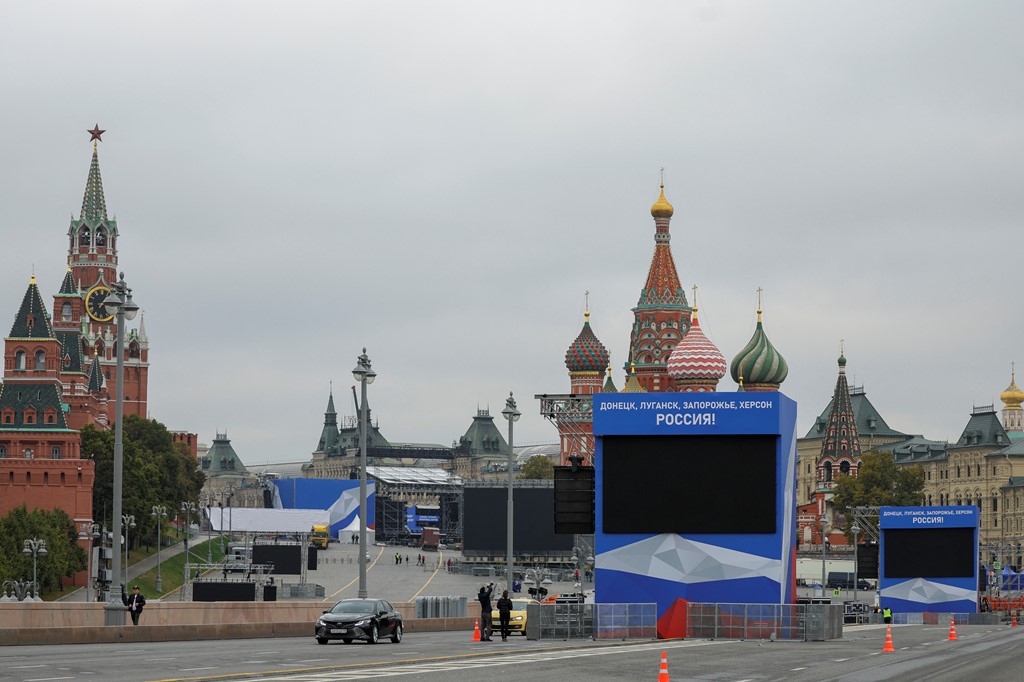
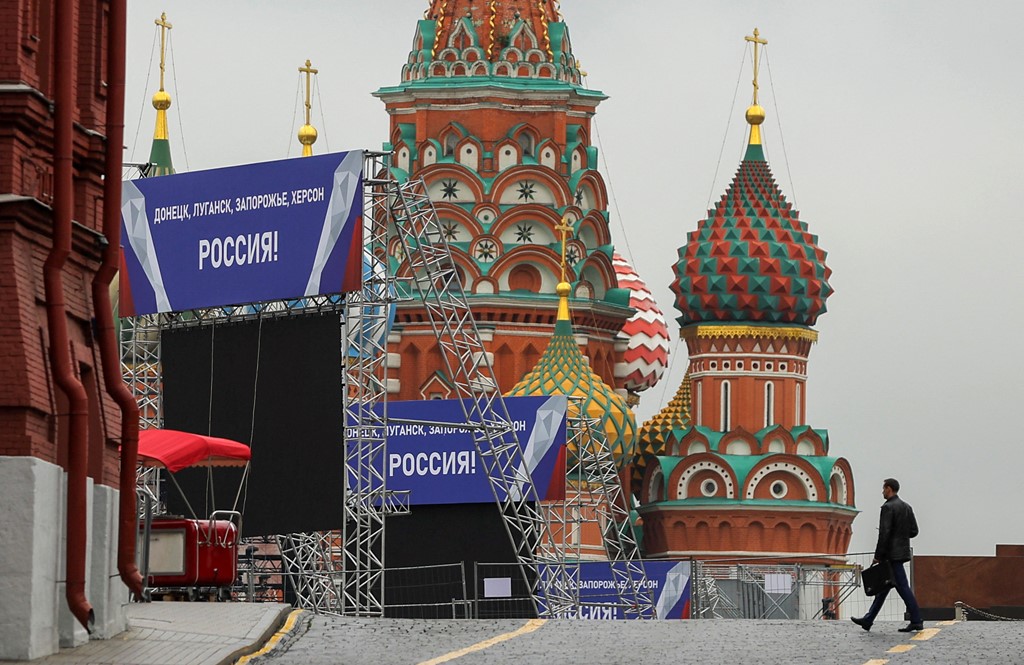
    In Moscow’s Red Square, arrangements are being made for a large event that will formally ratify Russia’s takeover of four regions of Ukraine.

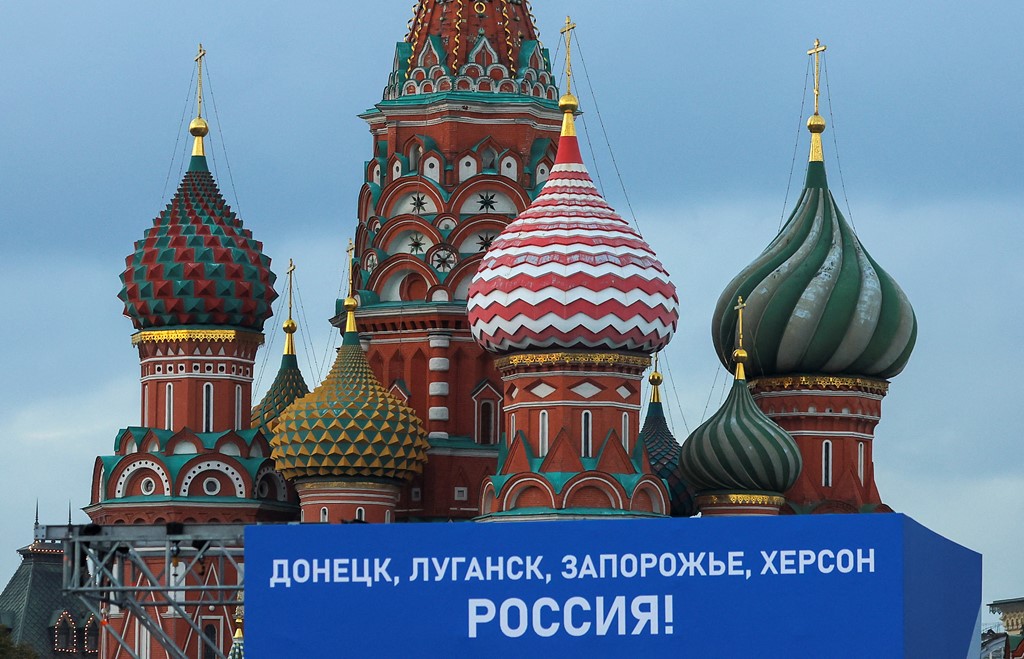
    The area has been closed to visitors and tourists for the works and a stage, giant video screens, and billboards can be seen that read, “Donestsk, Luhansk, Zaporizhzhia, Kherson – Russia”, declaring the inclusion of the regions into Russian territory.

    A pop concert is also planned on Red Square.

    Vladimir Putin’s spokesman Dmitry Peskov has said the Russian president will sign accession documents in an ornate Kremlin hall, give a speech, and meet leaders of the self-styled Russian-backed Donetsk People’s Republic and Luhansk People’s Republic as well as the Russian-installed leaders of the parts of Kherson and Zaporizhzhia that Russian forces occupy.

    Mr Peskov did not say whether Mr Putin will attend the Red Square celebration, as he did a similar event in 2014 after Russia proclaimed it had annexed Ukraine’s Crimea region – however, the Russian leader is widely expected to be there.

  • Russia’s planned annexation of Ukrainian territories follows predictable script

    In a move that follows a plodding and predictable script Russia will recognise the four territories it has occupied and captured in conquest. 

    Under the country’s 1993 constitution there needed to be a popular vote for this to happen – hence the hurried fake referenda.

    Like other autocratic police states, pseudo- legalism is of the utmost importance in Russia – we’ll hear a lot more turgid legal language today as a way of giving this international outrage a veneer of legitimacy.

    Moving to annex Russia has overturned centuries of convention – that you don’t steal land with force.

    Putin is also returning Europe to a period pre-WW2.

    For the Kremlin though there’s logic and need.

    Domestically the annexation allows Putin more room to argue that Russia’s ‘Special Military Operation’ is not an offensive but a defensive manoeuvre.

    There was no invasion.

    Luhansk, Donetsk, Zaporizhia, and Kherson are now, according to Putin, part of the motherland.

    Mobilisation is therefore not only justified but necessary to fight off a wider attack by the west.

    The Kremlin is signalling it is now battling not a limited war but an unlimited existential war.

    That’s the sale to the public.

    What he’s hawking to the west is a bit more nuclear blackmail.

    As part of Russia these four occupied regions will fall under Moscow’s nuclear umbrella – is it worth WW3 by continuing to support Ukraine?

    And in the upside-down world of Putin’s Russia reality doesn’t matter.

    The fact that Russian forces don’t even control all of the areas he’s about to annex – which is about the size of Portugal – can be glossed over.

    The war of liberation continues and even if it means bombing his own new subjects.

    This morning in what appears to be another egregious Russian war crime a convoy of civilians were killed in a missile attack.

    At the time of writing 28 are wounded and 25 dead according to officials in Ukraine.

    The bigger picture of all of this is that this crisis just got a bit worse.

    Putin is signposting that – despite manpower shortages and major setbacks on the battlefield – he’s not giving up.

    Any chance of a negotiated settlement is now non-existent.

    Source: Alex Rossi, Sky News international correspondent

  • Dozens of people dead as rockets hits relief convoy in Zaporizhzhia 

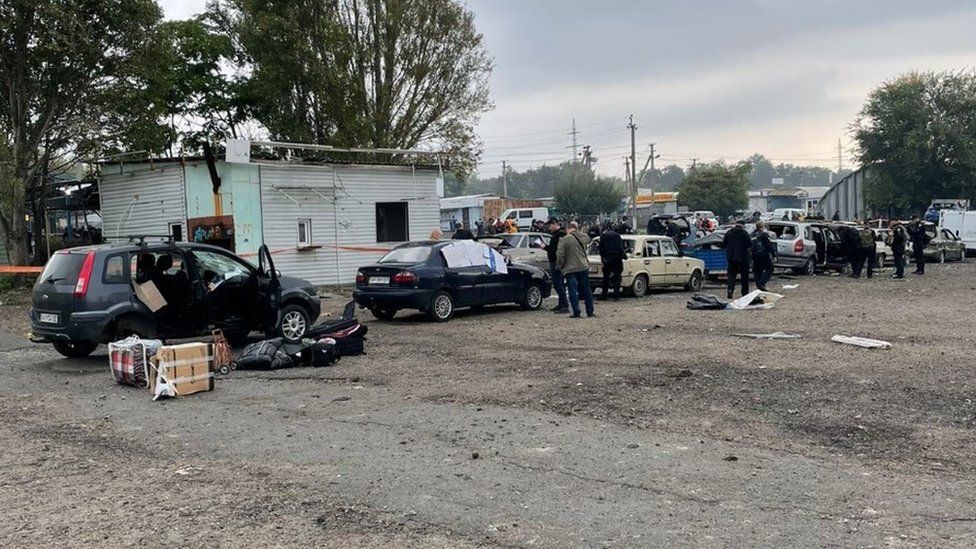
    Local authorities report that a Russian missile attack on a humanitarian convoy in south Ukraine resulted in at least 23 deaths and several injuries.

    In the city of Zaporizhzhia, a sizable crater next to a line of automobiles bears witness to the attack’s brutality. Windscreens and windows have been broken.

    The BBC observed six apparently civilians dead lying at the scene. Coats and luggage were all over the runway.

    One shocked survivor told the BBC she heard at least three explosions.

    Reacting to the attack in the early hours of Friday on the outskirts of the regional capital of the Zaporizhzhia region, Ukrainian President Volodymyr Zelensky said Russia was a “state-terrorist”.

    He said Russia launched 16 rockets on the city and vowed to punish perpetrators for “every lost Ukrainian life”.

    Meanwhile, a Russian-installed local official blamed Ukraine for the attack.

    The convoy was hit as people were preparing to travel to the Russian-occupied part of the region to pick up their relatives and also deliver humanitarian aid.

    Near the missile’s impact crater, the BBC spoke to Kateryna Holoborod, who sat on her suitcase in a state of shock.

    ‘We arrived in a line, to join a column going towards Kherson,” she said.

    “We got out to see what number we had in the queue. Then the first rocket hit, behind the wagons.

    “We dropped to the ground. Then the second one hit in the centre of the queue. There was glass everywhere, and people screaming and running. I don’t remember much.

    “It was very scary. I then got up to see what happened, and help the injured. I tried to help an injured young man when the third explosion happened.”

    Scene of the attack in Zaporizhzhia, southern Ukraine. Photo: 30 September 2022
    Image caption, Ukraine said the attack was “another terrorist act” by Russia

    The attack comes as Russian President Vladimir Putin is preparing for a signing ceremony in Moscow to annex Zaporizhzhia along with Ukraine’s Donetsk, Luhansk, and Kherson regions.

    The move follows self-styled referendums in the eastern and southern regions, which have been condemned by Ukraine and the West as a sham.

    Russia invaded Ukraine on 24 February, and Moscow currently controls the majority of the Zaporizhzhia region, including Europe’s biggest nuclear power plant there – but not the regional capital.

    Moscow-installed regional official Vladimir Rogov blamed “Ukrainian militants” for the Zaporizhzhia attack, Russian state-run media reported.

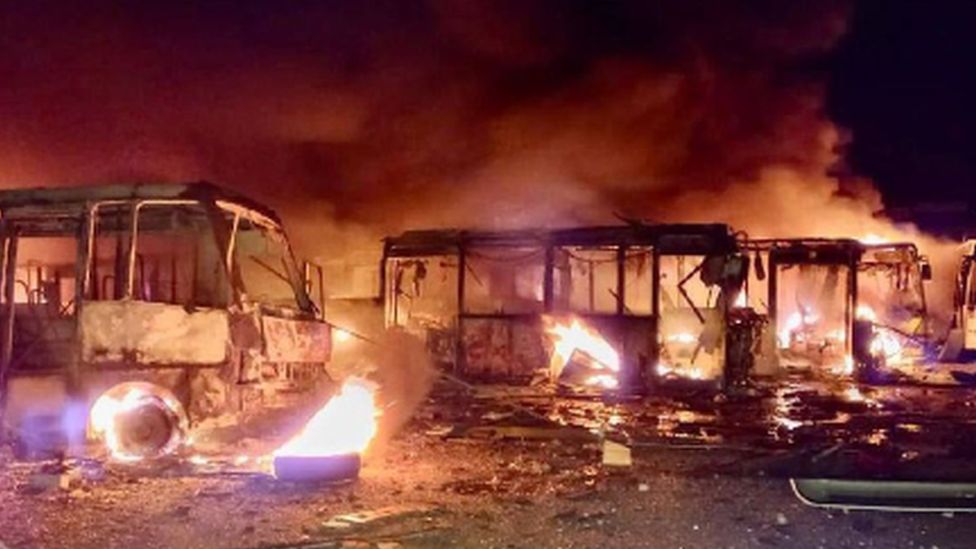
    Burnt buses in Dnipro, Dnipropetrovsk region, central-eastern Ukraine. Photo: 30 September 2022
    IMAGE SOURCE,DNIPROPETROVSK REGIONAL ADMINISTRATION Image caption, A Ukrainian transport company in Dnipro was hit in overnight Russian strikes, local officials said

    In a separate development, one person was killed and five injured in overnight Russian strikes by Iskander missiles on the central city of Dnipro, about 70km (43 miles) north of Zaporizhzhia, local officials said.

    They said a transport company was targeted, and as many as 52 buses were burnt and another 98 damaged.

    Several high-rise buildings, offices and a shop were also hit.

  • Medical Council decision to bar medicine degrees from Ukraine unfair, illogical – Titus Glover

    The former Tema East Member of Parliament, Daniel Nii Kwartei Titus Glover, has berated the Medical and Dental Council of Ghana for its decision not to recognise degree certificates of Ghanaian doctors trained in Ukraine.

    According to him, the decision of the council is not only unfair but also illogical because the nation badly needs the services of doctors.

    The council said that it will no longer recognise degree certificates issued by Medical and Dental Schools from Ukraine, as some schools have resorted to studying online.

    According to citinewsroom.com, the council said that the training of these students online is not in accordance with the required process and will not be accepted as it threatens the quality and credence of the profession.

    “Training to be a doctor must be in accordance with established strategies. Will potential patients be happy to be treated by a doctor who was trained online? We have to take our public interest responsibility seriously. The point is what is the kind of training that is acceptable in the world? If it is not standard, then, I am afraid, this regulator will not give any stamp of approval,” citinewsroom.com quoted the Council’s Registrar, Dr. Divine Ndonbi Banyubala.

    He, therefore, urged students to take advantage of the government’s intervention to continue their training in Ghana rather than taking online lessons.

    But speaking in a Multimedia interview monitored by GhanaWeb, Titus Glover, who is also a former deputy minister of transport, intimated that there is nothing wrong with students studying online given the advancement in technology.

    He added that the students not being able to complete their education through in-person tutoring was no fault of theirs.

    “Parents paid money for their wards to have some education in Ukraine and because of the Russian invasion, they had to come back home.

    “During the COVID-19 era were the universities not running online programmes? The online courses are still going on in the country.

    “We plead with the Medical and Dental Council to reverse their decision. Lawyers who train abroad are given the chance to take the professional exam when they come back home. Why are we not giving the doctors from Ukraine the chance to write the medical examination because we need more doctors? For them to tell them that we don’t recognise doctors from Ukraine is unfair,” he said in Twi.

  • Prepare to fight for Russia, Ukrainians told

    Compared to its accomplishments in the northeast, Ukraine’s progress in the southern regions of Kherson and Zaporizhzhia has been far more constrained.
    As both Russia and Ukraine try to advance, front-line positions are frequently fired upon.

    Abdujalil Abdurasulov of the BBC was able to visit the front lines in Kherson, where Ukrainian men have been warned that they may be recruited to fight for the Russian army.

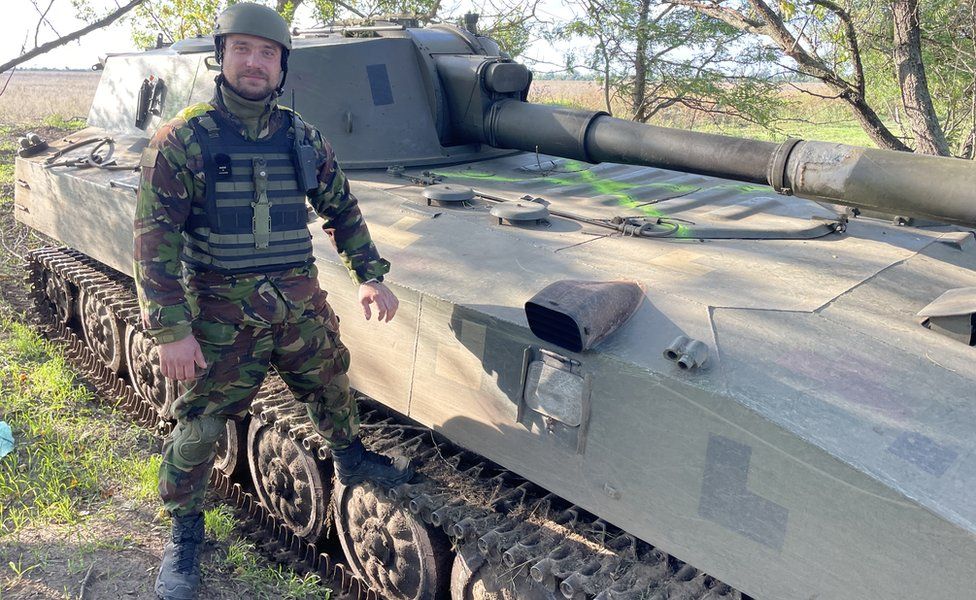
    An old Soviet self-propelled howitzer called Gvozdika or “Carnation” is rolled out in an open field and put into position. Its barrel tilts up. “Fire!” comes the command.

    The gunners hastily move away after the last shot, acting quickly.

    Although the advance of Ukrainian forces in the south is very slow, their artillery units remain busy.

    Stus, commander of the gunners, explains that the Russians target his infantry and they respond in order to silence them.

    Their job is very much felt at the front line. Soldiers walk across the vast field under the cover of a line of trees. They pay no attention to the sound of missiles flying above their head nor the thud of explosions. The fighters say a Russian observation post is 500m away and they might be within the range of small arms.

    The Ukrainians move quickly to reach a destroyed farm building that they took back just a week ago. Now, they are digging trenches and carrying sandbags in order to fortify their new position.

    Stus, commander of the gunners standing next to the “Gvozdika” howitzer
    Image caption, Stus, commander of the gunners, says troops “shouldn’t underestimate our enemy”

    But Ukraine’s advancement in the south is moving slowly.

    All talk about counter-offensive here helps to deceive Russians and achieve gains in the East, laughs Vasyl, a deputy commander of the regiment.

    “But we have some success here as well. We continue liberating villages with small steps but it’s very difficult – every victory we have is covered with blood,” he adds.

    Many Ukrainians who remain behind the Russian front line, in the occupied territories, are anxiously waiting for this counter-offensive.

    “We’re euphoric when Ukraine hits the occupied territories,” says Iryna, a resident of Melitopol in the south. “It means that Ukraine has not forgotten us. We all know that living near military infrastructure and buildings is not safe, so most civilians have moved out from those locations.”

    But for people in the occupied territories, the longer they wait, the harder it is to survive. Many believed that the counter-offensive would happen in August. But when that didn’t happen, people started to flee to Ukrainian-controlled territories and areas further to the West.

    Among them was Tatyana Kumok from Melitopol. The Israeli citizen was visiting her hometown when the Russian invasion started in February. She stayed in the city and distributed aid to residents but in September, she and her family decided to leave. One of the main reasons for leaving was Russia’s promise to hold a so-called referendum.

    “As soon as it’s done, the Russians will introduce new bans according to their laws and try to legitimize the occupation,” she says.

    With the city turned into a giant military base, she says it is clear that Russian troops won’t abandon the city easily.

    “It was obvious the city won’t be liberated this fall,” she adds.

    Tatyana Kumok helping distribute aid
    IMAGE SOURCE, TATYANA KUMOK Image caption, Tatyana Kumok, and her family fled Melitopol just before Russia decided to hold a so-called referendum

    Even a silent resistance to Russian occupation is getting dangerous now.

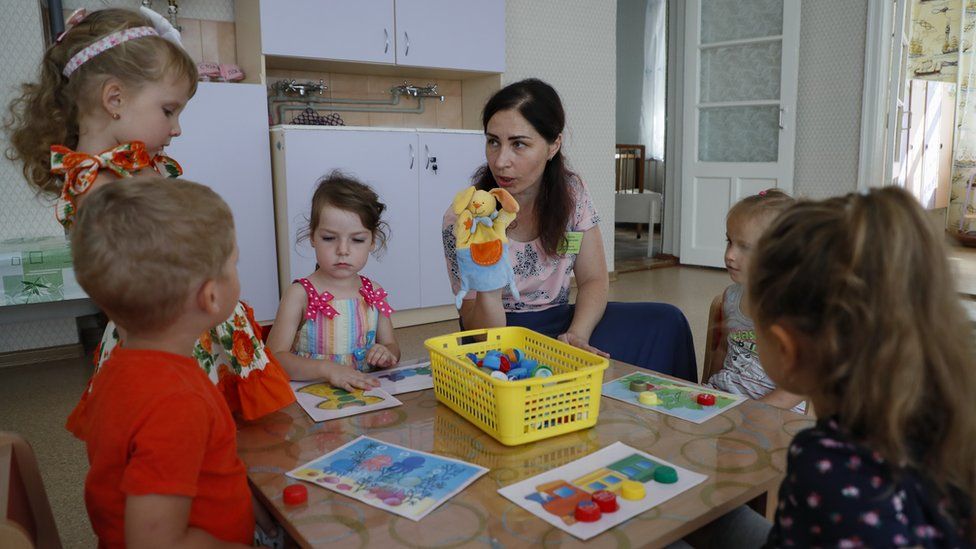
    In September many families were forced to send their children to Russian-administered schools even though their children would be exposed to the Kremlin’s propaganda.

    “If you don’t send your child to school, it’s a litmus test for you – it means you have pro-Ukrainian views,” explains Ms Kumok. “I know parents who had to tell their seven-year-old child not to talk about things discussed at home with anyone at school. Otherwise, the child could be taken away. That was really awful.”

    A picture taken during a visit to Berdyansk organized by the Russian military shows children at a newly opened kindergarten in Berdyansk, Zaporizhia region
    IMAGE SOURCE, EPA Image caption, Children at a newly opened nursery in Russian-occupied Berdyansk of Zaporizhia region

    The crackdown on people who do not support Russian rule is rising.

    “There is a sharp increase of arrests since August following the successful Ukrainian air strikes,” says Bohdan who is still living in Kherson. He spoke with the BBC via a messenger app and his real name is not being revealed for his safety.

    Bohdan says that earlier detentions were based on a list of names that the Russian military had. But now anyone can be arrested and thrown into a basement for interrogation.

    Russian soldiers recently came to the house of Hanna (not her real name) in Nova-Kakhovka, a city in the Kherson region, to check who was living there.

    “They didn’t go inside the house but it was still scary. I don’t even walk with my phone now,” she said via a messenger app.

    A woman casts her ballot during voting in a so-called referendum on the joining of Russian-controlled regions of Ukraine to Russia, in a hospital in Berdyansk, Zaporizhzhia region
    IMAGE SOURCE, EPA Image caption, A woman in Russian-occupied Zaporizhzhia casts her ballot during voting in a so-called referendum

    The self-styled referendum is bringing a new threat to the local population – mobilization. Many men could be drafted to fight for the Russian army.

    Russian soldiers are already going house to house in some villages and writing down the names of male residents, local residents say. They claim soldiers have told them to be ready for a call-up after the referendum.

    Men aged 18-35 are reportedly not allowed to leave the occupied territories anymore.

    Iryna left on 23 September, the first day of the so-called referendum, with her husband and two children. They wanted to stay in order to look after her paralysed 92-year-old grandmother.

    “But when Putin announced the call-up, and we already knew about the referendum, it was clear there would be a mass mobilization and men would be detained right on the street irrespective of their age,” she says.

    “We could survive without gas and electricity, we could find solutions for that. But not for this. That was our red line,” says Iryna.

    Vasyl, a deputy commander of the regiment in uniform smiling at the camera
    Image caption, Vasyl, a deputy commander in the Ukrainian army says “every victory we have is covered with blood”

    The Russian call-up will pose more challenges for the Ukrainian counter-offensive.

    It will certainly escalate the war and more people will die, Ukrainian soldiers say.

    “We shouldn’t underestimate our enemy,” says Stus, commander of the gunners. “Those newly recruited Russian soldiers will have guns and grenades, so they will pose a threat, which we will have to eliminate”.

    As the gunners wait for new tasks with their howitzer hidden in the bushes, Russian troops hit a nearby Ukrainian village with Grad missiles. The gunners are silent as they listen to the series of explosions.

    That terrifying sound was just another reminder that the success of the Ukrainian troops will depend on how quickly they can make Russian artillery and rocket launchers go silent.

    Source: BBC

  • Could IMF deal seal economic recovery?

    An agreement with the IMF is anticipated to increase investor confidence as Ghana’s fiscal and debt vulnerabilities intensify in the face of a challenging external environment.

    According to a recent announcement made by the Ghana Statistical Service, July saw an increase in Ghana’s inflation rate to 31.6%, the highest level in 20 years.

    The country’s already fragile economy has recently been significantly damaged by increases in food and gasoline prices as well as supply-chain shocks brought on by the conflict in Ukraine, forcing discussions with the IMF about a seventeenth bailout.

    The price of diesel has more than doubled in one year, while petrol has increased by 83.2 per cent, provoking a hike in transport costs, with a rollover effect on the price of basic commodities.

    Households in Ghana now deal with higher prices of imported and local food items: grapes, cooking oils, wheat flour, millet, Bambara beans, and watermelon are at least 50 per cent more expensive than last year. The prices of solid fuels such as firewood or charcoal increased by more than 80 per cent between 2021 and 2022.

    The current energy crisis has a twofold effect on Ghana. As oil is the second most exported product in Ghana – $2.71bn in 2020 – after gold ($5.93bn) and before cocoa beans ($1.28bn), the country’s petroleum industry is benefiting from the global surge in oil prices.

    In the first half of 2022, the only revenue which exceeded the government’s budgetary assumptions was oil revenue, while cocoa production declined sharply compared to last year.

    Paradoxically, however, Ghana relies heavily on refined oil imports for its domestic consumption. The only refinery in the country, Tema Oil Refinery, has a limited capacity of 30,000 barrels per day (bpd), whereas the country produces approximately 170,000 bpd of crude oil designated for exports.

    Existing challenges exacerbated

    This reliance on imports is exacerbating a precarious economic situation fuelled by high state spending prior to the COVID-19 pandemic.

    Although inflation is a global phenomenon – the US inflation rate has almost quadrupled in the past two years – it has disproportionally affected Ghana since the start of the Ukraine war.

    Apart from Nigeria, in which inflation rate rose by 18.6 per cent in June, other West African countries have experienced a much lower rise in the prices of goods. The inflation rates of Togo and Côte d’Ivoire, two of Ghana’s neighbouring countries, rose by only 5.4 per cent and 6.8 per cent respectively during the month of June.

    “Even though countries are subject to similar economic shocks, they are experiencing different effects because of the pre-existing condition of the state of the economy before the shock hit,” the assistant professor of economics at Niagara University in Toronto, Dennis Nsafoah, explained.

    In the case of Ghana, the country’s fiscal position was already a challenge before the COVID-19 crisis hit, with a debt-to-GDP ratio of 64 per cent in 2019, the reason being that, at the time, the government entered a phase of substantial public spending.

    Two major fiscal policy measures have weighed on the government’s budget deficit: the clean-up of the banking sector, which saw a reduction in the number of banks, and the abolition of fees for senior high school, meaning that costs for education were assumed by the government for students between 15 and 18.

    “The government’s strategy was to push the economy to reach certain objectives, which were to benefit the population in the long run, but they could not have anticipated the successive economic shocks that were to come,” says Mr Nsafoah.

    “These programmes have eliminated Ghana’s fiscal space, and the country was thus severely hit by the economic downturn resulting from the Covid-19 pandemic.”

    According to the IMF, Ghana’s public debt increased from 65 per cent to 80 per cent of GDP during the global pandemic.

    “The government’s fiscal efforts to preserve debt sustainability were not seen as sufficient by investors, leading to credit rating downgrades, non-resident investors exit from the domestic bond market and loss of access to international capital markets,” says the Washington-based institution.

    In addition, Ghana’s currency, the Cedi, has lost 47.1 per cent against the dollar since the beginning of the year, making it the worst-performing currency in Africa after Zimbabwe’s dollar, and contributing to the inflation of imported products.

    How to counter rising inflation?

    In response to an ever-increasing budget deficit, the Central Bank of Ghana has sold foreign assets to support the economy.

    As a consequence, Ghana’s net foreign assets went from $3bn in May 2021 to a negative value of $126m in May 2022, according to the Bank of Ghana’s last monthly monetary survey.

    Traditionally, Ghana’s balance of payments has experienced a current account deficit. In recent years its financial and capital account has remained relatively high as a result of foreign portfolio investment and foreign direct investment, mainly in the country’s cocoa, gold, and petroleum industries. However, about three months ago, Ghana’s capital account figures went negative as a result of the sales of all of its international reserves by the Bank of Ghana.

    “This is not sustainable. The Bank of Ghana cannot replicate this model for the next half of 2022, or it will run out of international reserves, which will scare a lot of investors,” Mr Nsafoah argued.

    “It is time for the fiscal government, namely the Ministry of Finance, to find a way to go on the international market and borrow on its own, instead of relying on the Bank of Ghana,” Mr Nsafoah said.

    But because Ghana has missed its budget target several times in recent years, credit-rating agencies have constantly downgraded the country, making it difficult to attract investors.

    On August 10, Fitch Ratings downgraded Ghana to CCC from B-, right after S&P lowered Ghana’s local and foreign currency credit ratings to CCC+/C from B-/B.

    In response, the government said credit-rating agencies were preventing the country from accessing global capital markets.

    “We are disappointed by S&P’s decision to downgrade Ghana despite the bold policies implemented in 2022 to address macro fiscal challenges and debt sustainability,” Ghana’s Ministry of Finance said at the time. — African  Business

  • Medical and Dental Council: Not recognizing Ukraine-trained doctors in Ghana’s interest

    The Medical and Dental Council has protested certain Ghanaian medical students’ decision to use online training from war-torn Ukraine.

    According to Dr. Divine Banyubala, the registrar for the Medical and Dental Council, the council’s stance against not recognizing medical professionals with training in Ukraine is in Ghana’s best interests.

    Ghanaians studying medicine in Ukraine have been forced to relocate due to the current Russia-Ukraine conflict.

    Some of the displaced students have since resorted to online tutorials, a situation which the Medical and Dental Council has kicked against, adding that, the degree from war-hit Ukraine will not be recognized.

    Speaking to Benjamin Offei-Addo on the Asaase Breakfast Show on Tuesday ( 27 September), Banyubala said, “… we do know the disruptive effect of the war in Ukraine [has] made in-person training for our nationals impossible in Ukraine.”

    “Now, the Ukrainian universities, which will not offer online training to their own people, persist in offering this online training to our compatriots,” he said.

    Banyubala added, “We speak for Ghana and we act in the public interest of Ghana, I have just indicated to you that our compatriot in Nigeria also issued a similar statement in June.”

  • Final day of flawed voting in Ukraine under Russian control during the war

    Tuesday marks the penultimate day of a vote for regions of Ukraine controlled by Russia, which the government in Kyiv and its Western allies call a fraud.

    Nearly four million people from the eastern regions of Donetsk and Luhansk, and the southern regions of Kherson and Zaporizhzhia, are being asked to attend polling stations and vote in so-called referendums on joining Russia.

    This follows four days of early voting during which allegations of intimidation multiplied as election officials went house to house accompanied by armed guards.

    The votes, called with just a few days’ notice, serve a deadly serious purpose as they will be used by the Kremlin to legitimise its invasion aims.

    If Russia absorbs these regions, making up about 15% of Ukraine’s territory, it could take the war to a new and more dangerous level, with Moscow portraying any attempt by Ukraine to regain them as an attack on its sovereign territory.

    There is now speculation that Russian President Vladimir Putin may announce the four regions’ annexation in a speech to a joint session of Russia’s parliament on Friday.

    In March 2014 he announced that Ukraine’s Crimea Peninsula had been annexed just a few days after a likewise unrecognised referendum was held.

    ‘At gunpoint’

    Were the guns there to protect you as you voted, or to cow you into voting? That was a question passing through people’s minds in recent days as election officials escorted by soldiers come to knock on their doors.

    Serhiy Haidai, the governor-in-exile of the Luhansk region, accused the separatist authorities there of taking down the names of people who voted against joining Russia or who refused to vote at all.

    “Representatives of the occupation forces are going from apartment to apartment with ballot boxes,” he said, quoted by Reuters news agency. “This is a secret ballot, right?”

    Talking separately to the Associated Press news agency, he suggested the Russians were using the process as a pretext to search homes for men they could mobilise as soldiers as well as checking for “anything suspicious and pro-Ukrainian”.

    One woman described for BBC News how her parents had voted in the city of Melitopol in the Zaporizhzhia region.

    Two local “collaborators” had arrived with two Russian soldiers at their flat to give them a ballot paper to sign, she said.

    Voting in Donetsk, 23 September
    IMAGE SOURCE, GETTY IMAGES Image caption, Soldiers are escorting electoral workers going door to door in Donetsk

    “My dad put ‘no’ [to joining Russia],” the woman said. “My mum stood nearby and asked what would happen for putting ‘no’. They said, ‘Nothing’. Mum is now worried that the Russians will persecute them.”

    Another woman in the embattled town of Enerhodar, where the Zaporizhzhia nuclear power station is located, told the BBC: “You have to answer verbally and the soldier marks the answer on the sheet and keeps it.”

    Ukrainian journalist Maxim Eristavi tweeted to say that his family had been “forced to vote at gunpoint” in southern Ukraine.

    “They come to your house,” he wrote. “You have to openly tick the box for being annexed by Russia (or for staying with Ukraine if you feel suicidal). All while armed gunmen watch you.”

    Petro Kobernik, who left Kherson just before the voting began, told AP in an interview by phone: “The situation is changing rapidly, and people fear that they will be hurt either by the Russian military, or Ukrainian guerrillas and the advancing Ukrainian troops.”

    The vote on paper

    The questions on the ballot papers (there is no digital voting) differ according to region.

    This is because pro-Russian separatists have been running parts of Donetsk and Luhansk since 2014 when they held unrecognized independence referendums.

    Voters, there are being asked whether they “support their republic’s accession to Russia as a federal subject”.

    In the parts of Kherson and Zaporizhzhia occupied by Russian forces since the invasion in February, people are being asked if they “favour the region’s secession from Ukraine, creation of an independent country and subsequent accession to Russia as a federal subject”.

    The ballot papers there are printed in both Ukrainian and Russian whereas in the eastern regions they are printed in Russian only.

    Voting was spread over five days to allow for ballots to be “organized in communities and in a door-to-door manner for security reasons”, Russian state news agency Tass reports.

    Refugees now scattered across Russia can vote in as many as 200 polling stations there.

    The vote is being heavily guarded by Russian or Russian-backed security forces and with reason.

    Not only have Ukrainian forces been pushing the Russians and their separatist allies back in both the east and south, but attacks on figures associated with the Russian occupation have mounted.

    Voters in Rostov-on-Don, 24 September
    IMAGE SOURCE, REUTERS Image caption, People voted at a polling station in the Russian city of Rostov-on-Don

    Former Ukrainian MP Oleksiy Zhuravko, who championed the Russian invasion, was killed along with another person in a missile attack on a hotel in Kherson on Sunday.

    Reports say that Russian journalists who were also staying at the hotel escaped uninjured.

    In the city of Berdyansk in the Zaporizhzhia region, the deputy head of the city administration and his wife who headed the city election commission were killed in an attack a week before the referendum.

    Members of a guerrilla group called the Yellow Band have spread leaflets threatening anyone who votes and urging others to send photos and videos of anyone who does in order to track them down later, AP reports.

    The guerrillas have also sent around phone numbers of election commission chiefs in the Kherson region, asking activists to “make their life unbearable”, the agency reports.

    Ukraine has threatened anyone organizing or supporting the so-called referendums with eventual criminal prosecution, saying they face up to 15 years in prison if convicted.

    International outcry

    Even Serbia, which has close ties with Moscow and is one of the few European countries not to join sanctions on Russia, has announced it will not recognise the results of the voting.

    Foreign Minister Nikola Selakovic said that to do so would be “completely contrary” to his country’s policy of “preserving territorial integrity and sovereignty and… commitment to the principle of inviolability of borders”.

    But in the face of international opposition, Russia’s Foreign Minister, Sergei Lavrov, insisted that the votes were “the expression of the will” of the people who lived in the regions.

    He confirmed that if the four regions joined Russia they would have the same protection as any other part of its territory, including protection with nuclear weapons.

    The White House says the US will never recognise “Ukrainian territory as anything other than part of Ukraine”.

    In its view, the referendums are a “sham – a false pretext to try to annex parts of Ukraine by force in flagrant violation of international law”.

    The UK has responded with new sanctions targeting top Russian officials involved in enforcing the votes among others.

  • Ukraine war: Final day of discredited voting in Russian-held Ukraine

    Tuesday is the final day of a ballot for Russian-held regions of Ukraine which the government in Kyiv and its Western allies dismiss as a sham.

    Nearly four million people from the eastern regions of Donetsk and Luhansk, and the southern regions of Kherson and Zaporizhzhia, are being asked to attend polling stations and vote in so-called referendums on joining Russia.

    This follows four days of early voting during which allegations of intimidation multiplied as election officials went house to house accompanied by armed guards.

    The votes, called with just a few days’ notice, serve a deadly serious purpose as they will be used by the Kremlin to legitimise its invasion aims.

    If Russia absorbs these regions, making up about 15% of Ukraine’s territory, it could take the war to a new and more dangerous level, with Moscow portraying any attempt by Ukraine to regain them as an attack on its sovereign territory.

    There is now speculation that Russian President Vladimir Putin may announce the four regions’ annexation in a speech to a joint session of Russia’s parliament on Friday.

    In March 2014 he announced that Ukraine’s Crimea Peninsula had been annexed just a few days after a likewise unrecognised referendum was held.

    ‘At gunpoint’

    Were the guns there to protect you as you voted, or to cow you into voting? That was a question passing through people’s minds in recent days as election officials escorted by soldiers come to knock on their doors.

    Serhiy Haidai, the governor-in-exile of Luhansk region, accused the separatist authorities there of taking down the names of people who voted against joining Russia or who refused to vote at all.

    “Representatives of the occupation forces are going from apartment to apartment with ballot boxes,” he said, quoted by Reuters news agency. “This is a secret ballot, right?”

    Talking separately to the Associated Press news agency, he suggested the Russians were using the process as a pretext to search homes for men they could mobilise as soldiers as well as checking for “anything suspicious and pro-Ukrainian”.

    One woman described for BBC News how her parents had voted in the city of Melitopol in Zaporizhzhia region.

    Two local “collaborators” had arrived with two Russian soldiers at their flat to give them a ballot paper to sign, she said.

    Voting in Donetsk, 23 September
    IMAGE SOURCE,GETTY IMAGES Image caption, Soldiers are escorting electoral workers going door to door in Donetsk

    “My dad put ‘no’ [to joining Russia],” the woman said. “My mum stood nearby, and asked what would happen for putting ‘no’. They said, ‘Nothing’. Mum is now worried that the Russians will persecute them.”

    Another woman in the embattled town of Enerhodar, where the Zaporizhzhia nuclear power station is located, told the BBC: “You have to answer verbally and the soldier marks the answer on the sheet and keeps it.”

    Map showing the four regions holding so-called referendums. 22 September.

    Ukrainian journalist Maxim Eristavi tweeted to say that his family had been “forced to vote at gunpoint” in southern Ukraine.

    “They come to your house,” he wrote. “You have to openly tick the box for being annexed by Russia (or for staying with Ukraine if you feel suicidal). All while armed gunmen watch you.”

    Petro Kobernik, who left Kherson just before the voting began, told AP in an interview by phone: “The situation is changing rapidly, and people fear that they will be hurt either by the Russian military, or Ukrainian guerrillas and the advancing Ukrainian troops.”

    The vote on paper

    The questions on the ballot papers (there is no digital voting) differ according to region.

    This is because pro-Russian separatists have been running parts of Donetsk and Luhansk since 2014 when they held unrecognised independence referendums.

    Voters there are being asked whether they “support their republic’s accession to Russia as a federal subject”.

    In the parts of Kherson and Zaporizhzhia occupied by Russian forces since the invasion in February, people are being asked if they “favour the region’s secession from Ukraine, creation of an independent country and subsequent accession to Russia as a federal subject”.

    The ballot papers there are printed in both Ukrainian and Russian whereas in the eastern regions they are printed in Russian only.

    Voting was spread over five days to allow for ballots to be “organised in communities and in a door-to-door manner for security reasons”, Russian state news agency Tass reports.

    Refugees now scattered across Russia can vote in as many as 200 polling stations there.

    The vote is being heavily guarded by Russian or Russian-backed security forces, and with reason.

    Not only have Ukrainian forces been pushing the Russians and their separatist allies back in both the east and south, but attacks on figures associated with the Russian occupation have mounted.

    Voters in Rostov-on-Don, 24 September
    IMAGE SOURCE,REUTERS Image caption, People voted at a polling station in the Russian city of Rostov-on-Don

    Former Ukrainian MP Oleksiy Zhuravko, who championed the Russian invasion, was killed along with another person in a missile attack on a hotel in Kherson on Sunday.

    Reports say that Russian journalists who were also staying at the hotel escaped uninjured.

    In the city of Berdyansk in Zaporizhzhia region, the deputy head of the city administration and his wife who headed the city election commission were killed in an attack a week before the referendum.

    Members of a guerrilla group called the Yellow Band have spread leaflets threatening anyone who votes and urging others to send photos and video of anyone who does in order to track them down later, AP reports.

    The guerrillas have also sent around phone numbers of election commission chiefs in Kherson region, asking activists to “make their life unbearable”, the agency reports.

    Ukraine has threatened anyone organising or supporting the so-called referendums with eventual criminal prosecution, saying they face up to 15 years in prison if convicted.

    International outcry

    Even Serbia, which has close ties with Moscow and is one of the few European countries not to join sanctions on Russia, has announced it will not recognise the results of the voting.

    Foreign Minister Nikola Selakovic said that to do so would be “completely contrary” to his country’s policy of “preserving territorial integrity and sovereignty and… commitment to the principle of inviolability of borders”.

    But in the face of international opposition, Russia’s Foreign Minister, Sergei Lavrov, insisted that the votes were “the expression of the will” of the people who lived in the regions.

    He confirmed that if the four regions joined Russia they would have the same protection as any other part of its territory, including protection with nuclear weapons.

    The White House says the US will never recognise “Ukrainian territory as anything other than part of Ukraine”.

    In its view, the referendums are a “sham – a false pretext to try to annex parts of Ukraine by force in flagrant violation of international law”.

    The UK has responded with new sanctions targeting top Russian officials involved in enforcing the votes among others.

    Source: BBC

  • ‘Sham’ referendums’: UK sanctions Russians

    The United Kingdom has imposed new round of sanctions.in response to what it described as Russia’s “sham” referendums in four occupied regions of Ukraine.

    “The Russian regime has organised these sham referendums in a desperate attempt to grab land and justify their illegal war,” the Foreign, Commonwealth & Development Office (FCDO) said in a statement.

    “The process reflects their approach in Crimea in 2014, combining disinformation, intimidation, and fake results. These referendums do not represent the demonstrated will of the Ukrainian people and are a severe violation of Ukraine’s territorial integrity and political independence,” it added, citing Moscow’s seizure of the Black Sea peninsula eight years ago.

    The FCDO said the measures will specifically target individuals behind the votes in Kherson, Donetsk, Luhansk and Zaporizhia on whether to join Russia, including several Moscow-installed officials in the occupied regions, a number of oligarchs, board executives from major state-owned banks and IMA Consulting, a firm described as Russian President Vladimir Putin’s “favourite PR agency”.

  • We won’t recognize doctors trained in Ukraine – Medical and Dental Council

    The Medical and Dental Council of Ghana has said that it will no longer recognise degree certificates issued by Medical and Dental Schools from Ukraine, as some schools have resorted to studying online.

    According to a citinewsroom report, the council said that the training of these students online is not in accordance with the required process and will not be accepted as it threatens the quality and credence of the profession.

    “Training to be a doctor must be in accordance with established strategies. Will potential patients be happy to be treated by a doctor who was trained online? We have to take our public interest responsibility seriously. The point is what is the kind of training that is acceptable in the world? If it is not standard, then, I am afraid, this regulator will not give any stamp of approval,” citinewsroom quoted the Council’s Registrar, Dr. Divine Ndonbi Banyubala.

    He therefore urged students to take advantage of the government’s intervention to continue their training in Ghana rather than taking online lessons.

    According to citinewsroom.com, the newly trained doctors are granted licenses to practice in Ghana after the examination.

    In 2019 for instance, a total of 157 out of 225 foreign-trained Ghanaian doctors who sat for the Medical and Dental Council (MDC)’s examination failed.

    Only 68, representing a 30.2 per cent pass rate, were able to prove their mettle in the examination.

    The 225 comprises 208 general duty medical doctors, eight general duty dentists, eight specialists and a ‘matured’ candidate, who studied in more than 10 universities in China, Ukraine, Russia, Philippine and Belarus for six years.

    The bi-annual examination, introduced in 2000, is to ensure that doctors trained in other countries had the requisite knowledge and skill to offer medical and dental care to patients in the country.

  • USA is keen to cooperate with new Italian government

    The US government says it is “eager” to collaborate with a new Italian government on “shared goals” now that Giorgia Meloni’s success is obvious.

    US Secretary of State Antony Blinken on Twitter listed the priorities:

    • supporting a free and independent Ukraine
    • respecting human rights
    • building a sustainable economic future

    Quote Message: Italy is a vital ally, strong democracy, and valued partner [of the US].” from Antony Blinken US Secretary of State

    Antony BlinkenUS Secretary of State

    Meanwhile, French President Emmanuel Macron says his government respects the democratic choice of Italian voters.

    The European Union must continue to work together with Italy “as neighbours and friends”, the Elysée Palace said in a statement.

    “It is within Europe that we will overcome our common challenges”, it added.

    France’s statement shares similarities with the official line from fellow eurozone lynchpin Germany, where the government has expressed the view it expects Italy to continue to be a “very Europe-friendly country”.

  • US provides $457.5 million in humanitarian aid for Ukraine

    United States Secretary of State, Antony Blinken, has announced that the US will offer Ukraine new civilian security assistance of $457.5 million.

    The aid is designed to help Ukrainian law enforcement and criminal justice agencies, Blinken tweeted.

    “We share their commitment to a democratic, independent, and sovereign Ukraine,” he added.

    Source: Aljazeera

  • Moldova considers revoking citizenship of dual-nationals who fight for Russia

    Russia launched a “partial” mobilisation last week to reinforce its troops in Ukraine, and there are 200,000 people with dual Moldovan-Russian citizenship who live in the breakaway Moldovan region of Transnistria.

    Maia Sandu, Moldova’s pro-Western president, said there was a risk that some of those people could be called up by Russia to fight.

    “To prevent that happening, we are analysing the possibility of applying the process of revoking Moldovan citizenship for those people (with Russian passports) who fight on the side of the aggressor,” she said, adding Moldova was holding consultations with Moscow to prevent cases of its citizens being called up.

    A woman walks past the Operational Group of Russian Forces headquarters in Tiraspol in 2021, the capital of the breakaway region of Transnistria, a disputed territory unrecognised by the international community, in Moldova [File Photo: Dmitri Lovetsky/AP]
    Russia has had peacekeeping troops stationed in Transdniestria since the early 1990s when an armed conflict saw pro-Russian separatists wrest most of the region from Moldovan control [File: Dmitri Lovetsky/AP]
  • Ukraine backlash: Roger Waters gigs in Poland cancelled

    In response to criticism of the musician’s position on the Ukraine war, Roger Waters, the co-founder of Pink Floyd, has cancelled scheduled performances in Poland.

    Live Nation Poland, the concert’s promoter, confirmed the cancellation but provided no explanation.

    The controversy was triggered by an open letter Waters wrote to Ukraine’s first lady, Olena Zelenska.

    In it, he said, “extreme nationalists” in Ukraine “have set your country on the path to this disastrous war”.

    He accused her husband, Ukrainian President Volodymyr Zelensky, of failing to fulfill his election campaign promises to bring peace to the Donbas region and made no mention of Russia’s responsibility for the war.

    In response, Mrs Zelenska wrote on Twitter that it was Russia that invaded Ukraine and was now destroying its cities and killing civilians. “Roger Waters, you should ask for peace from the president of another country,” she wrote.

    Mr Water’s open letter led Łukasz Wantuch, a Krakow city councilor, to urge people to boycott the concerts.

    City councillors have drafted a resolution to declare Mr Waters persona non grata, due to be voted on at a session on September 28.

    “Taking into account Russia’s criminal attack on Ukraine as well as the increasing number of war crimes committed by Russian soldiers that are coming to light, [the councillors] express outrage at the theses and statements made by Mr Roger Waters in connection with Russia’s invasion of Ukraine,” the resolution states.

    Mr Waters, currently on tour in the US, hit back in another Facebook post entitled “Hey Łukasz Wantuch, Leave them kids alone”, referencing the lyrics of the classic Pink Floyd song, Another Brick in the Wall.

    He denied an earlier media report that he or his management had canceled the concerts themselves and accused Mr Wantuch of the “draconian censoring” of his work.

    Asked whether the cancellation was connected to Mr Waters’ comments, a venue spokesman for the Tauron Arena in Krakow told the BBC: “No comment.”

    The Polish government has been a staunch ally of Mr Zelensky. It has sent hundreds of Soviet-era tanks and other armaments to Ukraine and encouraged the European Union to introduce tougher sanctions against Russia.

    Following Russia’s invasion of Ukraine in February, the government decided to open Poland’s borders to millions of Ukrainian women and children fleeing the fighting.

    According to the United Nations Refugee Agency, UNHCR, close to 1.4 million Ukrainians have registered for temporary protection in neighboring Poland.

    Hundreds of thousands of refugees have been put up by Poles in their own homes.

  • Ukraine war: Two people allegedly killed in a hotel attack in Kherson by Kyiv forces

    Kremlin authorities say Ukrainian soldiers killed two persons, including a former member of parliament, in a missile attack on a hotel located in Kherson.

    Oleksiy Zhuravko, a pro-Russian former politician from Ukraine, was alleged to have perished in the strike by a regional official.

    Kirill Stremousov said in a statement that Ukrainian armed forces fired a missile on the Play Hotel by Ribas at 05:30 (03:30 BST) on Sunday.

    Kyiv has not responded to the claims.

    The Russian-installed administration said in a post on Telegram that this “was a planned terrorist act”, adding that the building of the hotel was not used for military purposes.

    The statement said that two people were killed in the attack according to “preliminary information”.

    The authorities said journalists from Russian media were in the hotel when the missile struck, news agency AFP reports. These claims could not be independently verified.

    A representative of the law enforcement agencies in the region was quoted by the TASS news agency as saying that the attack “was clearly carried out with the help of Nato representatives, according to their intelligence and on their tip”.

    Rescue workers were said to be combing the rubble in search of victims at the hotel, located in the center of the southern Ukrainian city.

    The strike comes as Kherson – one of the first places to come under Moscow’s control after the invasion – is taking part in a so-called referendum, asking people if they want to join Russia. As well to Kherson, people in Luhansk, Donetsk, and Zaporizhzhia have also been casting their ballots since Friday and voting is due to finish on Tuesday.

    The West and Kyiv have condemned the votes as “shams” and pledged not to recognize their results. There have also been reports of armed Russian soldiers going door-to-door to collect votes.

    The votes come after Ukrainian forces launched a large-scale counter-offensive in the south. Last month, Ukraine’s military said it had broken through Russia’s first line of defence.

  • Mobilization call: Man shoots Russian soldier, sets conscription office on fire

    British intelligence has reported that, as men called up for the country’s partial mobilization began arriving at military camps, a man shot a recruiter and set a conscription office on fire in Russia.

    In Ust-Ilimsk, Irkutsk, a conscription office was shot at by the assailant, severely injuring a military recruitment officer.

    Sky News has confirmed a video purportedly taken by a would-be recruit of the shooting.

    It shows the gunman shooting the recruiter who falls to the ground, as others at the draft office start running out to the sounds of a woman screaming.

    He was detained by police and identified himself as 25-year-old Ruslan Zinin in a separate video posted on social media.

    Irkutsk region Governor Igor Kobzev wrote on the Telegram messaging app that the recruitment officer was in hospital in a critical condition, adding the detained gunman “will absolutely be punished”.

    It comes after Russian President Vladimir Putin – faced with a series of defeats in Ukraine – announced a partial mobilization last week that could see 300,000 reserves called up to fight.

    Elsewhere, a man was seen throwing Molotov cocktails at a military registration and enlistment office in Uryupinsk, in footage circulating on social media.

    It shows the man driving a car up to the entrance of the local government building in the center of the town.

    He can then be seen lighting several Molotov cocktails, throwing them one by one at the entrance to the building.

    Town officials confirmed the building was set on fire early on Monday morning, and a man was detained. Damage was minimal and no one was injured, they added.

    The threat of mass conscription has sparked protests around the country, and military-aged men have been fleeing in droves.

    “Everyone who is of conscription age should be banned from traveling abroad in the current situation,” Sergei Tsekov, a member of Russia’s upper house of parliament, the Federation Council, told RIA news agency on Monday.

    Russia faces an administrative and logistical challenge to provide training for the new recruits, the UK Ministry of Defense said in its latest intelligence update.

    Many tens of thousands of call-up papers have already been issued.

    “Many of the drafted troops will not have had any military experience for some years,” the MoD said.

    “The lack of military trainers, and the haste with which Russia has started the mobilization, suggests that many of the drafted troops will deploy to the front line with minimal relevant preparation.

    “They are likely to suffer a high attrition rate.”

    Videos have emerged showing men being forced onto buses as many citizens refused to take part in the war.

    Protests over mobilization have taken place in more than a dozen cities across Russia, with girls as young as 14 years old detained.

    Hundreds of people were arrested over the weekend, and there were major protests in the Dagestan region yesterday.

    Sky correspondent Alex Rossi in Moscow said: “Russia is a very heavily securitized police state. Dissent isn’t tolerated, but there have been sporadic protests all over the country. Thousands of people have been arrested, protesting against what the Kremlin is calling a partial mobilization, but really, what to you and I, looks like mass conscription.”

    The call-up of 300,000 reserves is almost double the initial invasion force, “so is a reflection really of how badly things are going on the battlefield, and shows that they have a very significant manpower problem”, he said.

    General Sir Richard Barrons, a former head of the Joint Forces Command, told Sky News some individuals who are mobilized may find themselves on the front line in Ukraine very quickly.

    “Of course, they wouldn’t necessarily be very enthusiastic about that,” he said. “And they won’t be very well trained and are probably not very well equipped for this kind of mobilization to make a difference.

    “Russia would have to invest in training and equipping these large numbers of people that would take them well into next year. And it just doesn’t look like they have the training machinery, the logistics, or the weapons to make this really work any time soon.”

    As Russia steps up its conscription of citizens, Ukrainian President Volodymyr Zelenskyy has urged opposition troops to surrender to his country’s forces.

    It comes as “sham” referendums continue in contested territory, which could lead to the formal annexation of Ukraine’s land.

    They are being held in the self-declared Donetsk (DPR) and Luhansk People’s Republics (LPR), and in Russian-occupied parts of the Kherson and Zaporizhzhia regions.

    The move comes eight years after a similar process in Russian-occupied Crimea, which Moscow said was justification for annexing the peninsula.

    Sky’s security and defense editor Deborah Haynes in Dnipro, Ukraine, said the move was “a further escalation of the war”.

    “There is no sign on the Ukraine side that they are backing down, but they are clearly going to have to counter an ever-increasing Russian force as they try to defend their territory and win back their land,” she added.

  • Ukraine war: Hundreds arrested as Russian draft protests continue

    Hundreds of people have been arrested by authorities as protests against Russia’s new “partial mobilisation” continue across the country, an independent rights group has said.

    OVD-Info said 724 people were detained across 32 different cities on Saturday.

    Widespread demonstrations have broken out since President Vladimir Putin announced plans to draft 300,000 men to fight in Ukraine.

    Unsanctioned rallies are banned under Russian law.

    But Mr Putin’s move to draft civilians into the military has sparked large scale protests in urban areas, with more than 1,000 people being detained at demonstrations earlier this week.

    In Moscow, news agency AFP reported witnessing one demonstrator shouting “we are not cannon fodder” as she was arrested by officers.

    And in St Petersburg, Russia’s second city, one man told reporters: “I don’t want to go to war for Putin.”

    Seventy-year-old Natalya Dubova told AFP that she opposed the war and confessed she was “afraid for young people” being ordered to the front.

    Some of those arrested on Saturday reported being handed draft papers and ordered to report to recruiting centres while being held by security officials. The Kremlin defended the practice earlier this week, saying “it isn’t against the law”.

    Moscow has also approved harsh new punishments for those accused of dereliction of duty once drafted.

    Mr Putin signed fresh decrees on Saturday imposing punishments of up to 10 years imprisonment for any soldier caught surrendering, attempting to desert the military or refusing to fight.

    The president also signed orders granting Russian citizenship to any foreign national who signs up to serve a year in the country’s military.

    The decree, which some observers have suggested displays how severe Moscow’s shortage of troops has become, bypasses the usual requirement of five years of residency in the country.

    Elsewhere, other young Russians continue to flee mobilisation by seeking to leave the country.

    On the border with Georgia, queues of Russian cars stretch back more than 30km (18 miles) and the interior ministry has urged people not to travel.

    Local Russian officials have admitted that there’s been a significant influx of cars trying to cross – with nearly 2,500 vehicles waiting at one checkpoint.

    The admission is a change of tone from Russia, with the Kremlin describing reports of Russians fleeing conscription as “fake” on Thursday.

    One man the BBC spoke to in Vladikavkaz in North Ossetia, on the Russian side of the border, said he could see car registration numbers from all over Russia.

    “Our people don’t have the correct information about the situation in Ukraine,” he said. “Also, what I can say about people that I’ve been speaking with… it’s simple, people don’t want to go to war.”

    Meanwhile, Finland has also seen a sharp increase in the number of Russians seeking to enter the country.

    Matti Pitkaniitty, a spokesperson for the country’s Border Guard, said the number of Russians arriving had more than doubled since last week.

    On Friday, the government announced plans to stop Russian tourists entering the country.

    “The aspiration and purpose is to significantly reduce the number of people coming to Finland from Russia,” President Sauli Niinistö told the state broadcaster.

    Several other neighbouring states have already ruled out offering asylum to Russians seeking to avoid the draft.

    “Many Russians who now flee Russia because of mobilisation were fine with killing Ukrainians,” Latvia’s Foreign Minister Edgars Rinkēvičs said. “They did not protest then. It is not right to consider them as conscientious objectors.”

    On Friday, the Kremlin revealed a host of occupations it said will be exempt from conscription aimed at boosting its war effort in Ukraine.

    IT workers, bankers and journalists working for state media will escape the “partial mobilisation” announced by President Putin on Wednesday.

    But some have cast doubt on the truth of the Kremlin’s claims, and reports have been emerging of Russian men who do not meet the criteria being called up by local recruiting officers.

    Margarita Simonyan, the editor of the state-run media outlet RT, posted to Twitter a list of elderly and disabled citizens ordered to report for duty.

    Source: BBC

  • Ghana will not recognise Ukraine territories taken by Russia – Foreign Minister

    The Minister of Foreign Affairs and Regional Integration, Shirley Ayorkor Botchwey, says Ghana will not recognise any territory forcefully taken from Ukraine by Russia.

    She has, therefore, called on Russia to immediately and unconditionally seize its operations in Ukraine by withdrawing its troops and also respecting the internationally recognised borders of Ukraine.

    The Minister who was speaking at the 77th session of the United Nations General Assembly in New York Thursday, further urged Russia to respect Ukraine’s sovereignty and political independence.

    For her, “Ghana does not and will not recognise any territory that is unilaterally and forcefully acquired as dismembered from a sovereign entity.”

    Ms. Ayorkor Botchwey said there was the need for Russia and Ukraine, to chart diplomatic course to resolve the impasse between them.

    She noted that the two nations cannot resolve their differences through the barrel of a gun, adding that the use of gun to resolve differences only “leads to needless bloodshed on both sides.”

    She expressed the concern that with the rising death tolls of the civilian population and growing reports of war crimes in Ukraine, including human rights violations, there was the need to investigate such issues and perpetrators sanctioned.

    “We must uphold our responsibilities as a country and send a clear message that the perpetrators of the atrocities will be held to account,” she noted.

    Source: Graphiconline.com

  • Ghana will not recognise Ukraine territories taken by Russia – Foreign Minister

    The Minister of Foreign Affairs and Regional Integration, Shirley Ayorkor Botchwey, says Ghana will not recognise any territory forcefully taken from Ukraine by Russia.

    She has, therefore, called on Russia to immediately and unconditionally seize its operations in Ukraine by withdrawing its troops and also respecting the internationally recognised borders of Ukraine.

    The Minister who was speaking at the 77th session of the United Nations General Assembly in New York Thursday, further urged Russia to respect Ukraine’s sovereignty and political independence.

    For her, “Ghana does not and will not recognise any territory that is unilaterally and forcefully acquired as dismembered from a sovereign entity.”

    Ms. Ayorkor Botchwey said there was the need for Russia and Ukraine, to chart diplomatic course to resolve the impasse between them.

    She noted that the two nations cannot resolve their differences through the barrel of a gun, adding that the use of gun to resolve differences only “leads to needless bloodshed on both sides.”

    She expressed the concern that with the rising death tolls of the civilian population and growing reports of war crimes in Ukraine, including human rights violations, there was the need to investigate such issues and perpetrators sanctioned.

    “We must uphold our responsibilities as a country and send a clear message that the perpetrators of the atrocities will be held to account,” she noted.


  • Mobilization call: Russia announces exemptions as people flee

    In order to increase its war effort in Ukraine, Russia’s defence ministry has announced a wide range of occupations that will be exempt from conscription.

    The “partial mobilisation” planned by President Vladimir Putin on Wednesday would not affect IT personnel, bankers, or journalists who work for state media.

    Around 300,000 citizens face being called up as part of the drive.

    The move has prompted a rush toward borders as young men attempt to flee to evade the draft.

    Announcing the exemptions on Friday, Russia’s defense ministry said employers must compile a list of workers who meet the criteria and submit it to its offices.

    But it accepted some sectors had to be excluded to “ensure the work of specific high-tech industries, as well as Russia’s financial system”.

    Some commentators have observed that the text of the mobilization decree has been left vague – potentially allowing it to be widened if necessary.

    And one paragraph remains entirely classified. Kremlin spokesman Dmitry Peskov said on Friday this referred to the total number of Russians that could be conscripted, which he said could not be disclosed.

    Earlier, the independent newspaper Novaya Gazeta had reported – citing an unnamed government source – that the redacted section allowed for a call-up of up to a million people, rather than the reported 300,000.

    Russian men are continuing to try to flee the country to avoid being called up by recruiters for the country’s first military mobilization since World War Two.

    In the south, miles-long queues of traffic have formed at the border crossing between Russia and Georgia.

    Some of those heading into the neighbouring country have used bicycles to bypass lines of cars and evade a ban on crossing on foot, with others reporting waits of up to 12 hours.

    When asked about the war, one man who did not wish to be named told the BBC he had known it was happening but that, until Mr Putin’s declaration of a “partial mobilization”, it had not been his concern.

    A Russian student, who also did not want to be identified, said that people had woken up. “They opened their eyes and started thinking about where to hide their children. Now people understand what’s happening because it affects them directly,” he said.

    Another IT worker told the BBC that he was opposed to the war, but was too scared to speak out against it.

    “I don’t want to risk my life, the life of my family. I don’t want to be put in detention,” he said. “All I could do was to get a Schengen visa. Luckily I got one in May.”

    Georgia is one of the few neighbouring countries where Russians can enter without needing to apply for a visa. Border guards in neighbouring Finland, which shares a 1,300km (800 miles) border with Russia but requires an entry visa, told the BBC that queues had grown at various crossing points.

    Other destinations reachable by air – such as Istanbul, Belgrade, or Dubai – have seen ticket prices skyrocket immediately after the military call-up was announced, with some destinations sold out completely.

    Turkish media have reported a large spike in one-way ticket sales while remaining flights to non-visa destinations can cost thousands of euros.

    Several countries are grappling with the prospect of an influx of Russian draft dodgers. Germany’s interior minister signalled on Thursday that that fleeing conscription would be welcome in her country.

    Nancy Faeser said deserters threatened by “severe repression” would receive protection on a case-by-case basis, following security checks.

    But several other European countries, including Lithuania, Latvia, Estonia, and the Czech Republic, struck a different tone, saying they would not offer to flee Russian refuge. The countries have long pushed the EU to take a harder line on Russia.

    “I understand that Russians are fleeing from ever more desperate decisions by Putin,” Czech Foreign Minister Jan Lipavsky said. “But those running because they don’t want to fulfill a duty imposed by their own government, they don’t meet the criteria for a humanitarian visa.”

    The call-up sparked protests in major Russian cities including Moscow and St Petersburg on Tuesday, resulting in a reported 1,300 arrests.

    There were also reports from Russia that some of those detained for protesting had been handed draft papers while in custody at police stations. When asked about the reports, Mr Peskov said that doing so was not against the law.

  • Ghana will not recognise Ukraine territories taken by Russia – Foreign Minister

    According to Shirley Ayorkor Botchwey, Minister of Foreign Affairs and Regional Integration, Ghana will not recognize any area that Russia forcibly annexed from Ukraine.

    As a result, she has urged Russia to cease all operations in Ukraine immediately and without conditions. This includes pulling out its forces and respecting Ukraine’s internationally recognized borders.

    The Minister further asked Russia to respect Ukraine’s sovereignty and political independence while speaking at the 77th session of the UN General Assembly on Thursday in New York.

    For her, “Ghana does not and will not recognise any territory that is unilaterally and forcefully acquired as dismembered from a sovereign entity.”

    Ms. Ayorkor Botchwey said there was the need for Russia and Ukraine, to chart diplomatic course to resolve the impasse between them.

    She noted that the two nations cannot resolve their differences through the barrel of a gun, adding that the use of gun to resolve differences only “leads to needless bloodshed on both sides.”

    She expressed the concern that with the rising death tolls of the civilian population and growing reports of war crimes in Ukraine, including human rights violations, there was the need to investigate such issues and perpetrators sanctioned.

    “We must uphold our responsibilities as a country and send a clear message that the perpetrators of the atrocities will be held to account,” she noted.