Tag: Ukraine

  • Ukraine war: Russia accuses US of direct role in Ukraine war

    Russia has accused the US of direct involvement in the war in Ukraine for the first time.

    A spokesperson for Moscow’s defense ministry alleged the US was approving targets for American-made Himars artillery used by Kyiv’s forces.

    Lt Gen Igor Konashenkov said intercepted calls between Ukrainian officials revealed the link. The BBC could not independently verify this.

    There was no immediate comment on the allegation from US officials.

    Russia previously accused Washington of fighting a “proxy war” in Ukraine.

    “It is the Biden administration that is directly responsible for all rocket attacks approved by Kyiv on residential areas and civilian infrastructure facilities in settlements of Donbass and other regions that caused mass deaths of civilians,” Mr. Konashenkov said.

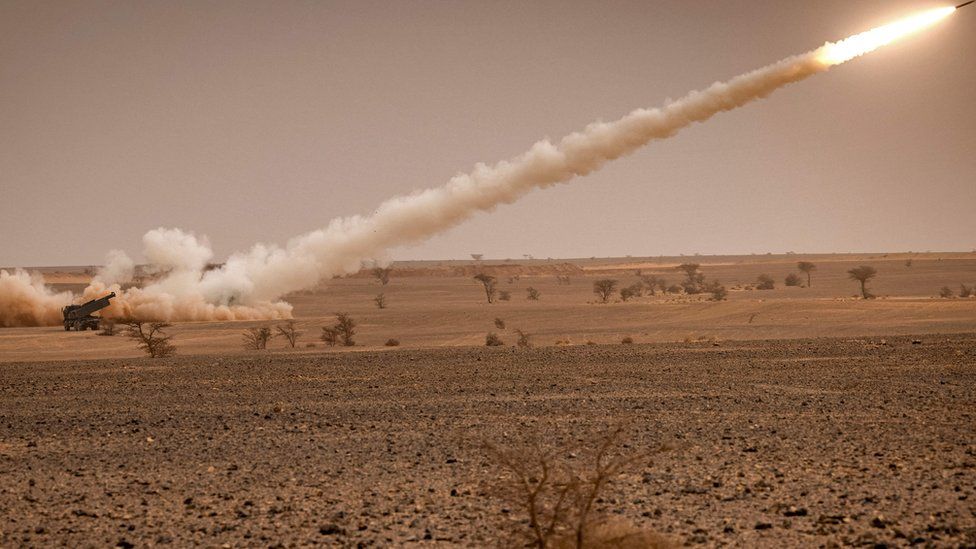
    Himars is a multiple rocket system that can launch precision-guided missiles at targets as far as 70km (45 miles) away – far further than the artillery that Ukraine previously had.

    They are also believed to be more accurate than their Russian equivalents.

    In April, Foreign Minister Sergei Lavrov said US President Joe Biden’s decision to supply Ukraine with billions of dollars worth of arms meant “Nato, in essence, is engaged in a war with Russia through a proxy and is arming that proxy”.

    “War means war,” the 72-year-old warned.

    Throughout the conflict in Ukraine, Russia has been accused of numerous war crimes and crimes against humanity. Last week, Ukraine accused Moscow of bombing a prison in separatist-held Donetsk to cover up allegations of torture.

    And the BBC has documented allegations of torture and beatings of Ukrainian prisoners by both the Russian military and security services.

    Source: bbc.com
  • First ship carrying Ukrainian grain heading into Turkish waters

    Our correspondent Alex Rossi has the latest update, which is that it’s heading into Turkish waters.

    It will dock in Istanbul, where it will be checked by officials from the UN, Turkey, Russia, and Ukraine.

    The checks are part of an agreement brokered by Turkey and the UN, which proved a rare diplomatic breakthrough in the Russia-Ukraine conflict.

    The Sierra Leone-flagged ship Razoni will head to Lebanon after passing through Turkey’s Bosphorus Strait.

    It is carrying 26,527 tonnes of corn.

    The United Nations has warned of the risk of multiple famines this year as the war in Ukraine has heavily dented food supplies.

    Source: skynews.com

  • Kherson: Ukraine stepping up counter offensive to retake city – sources

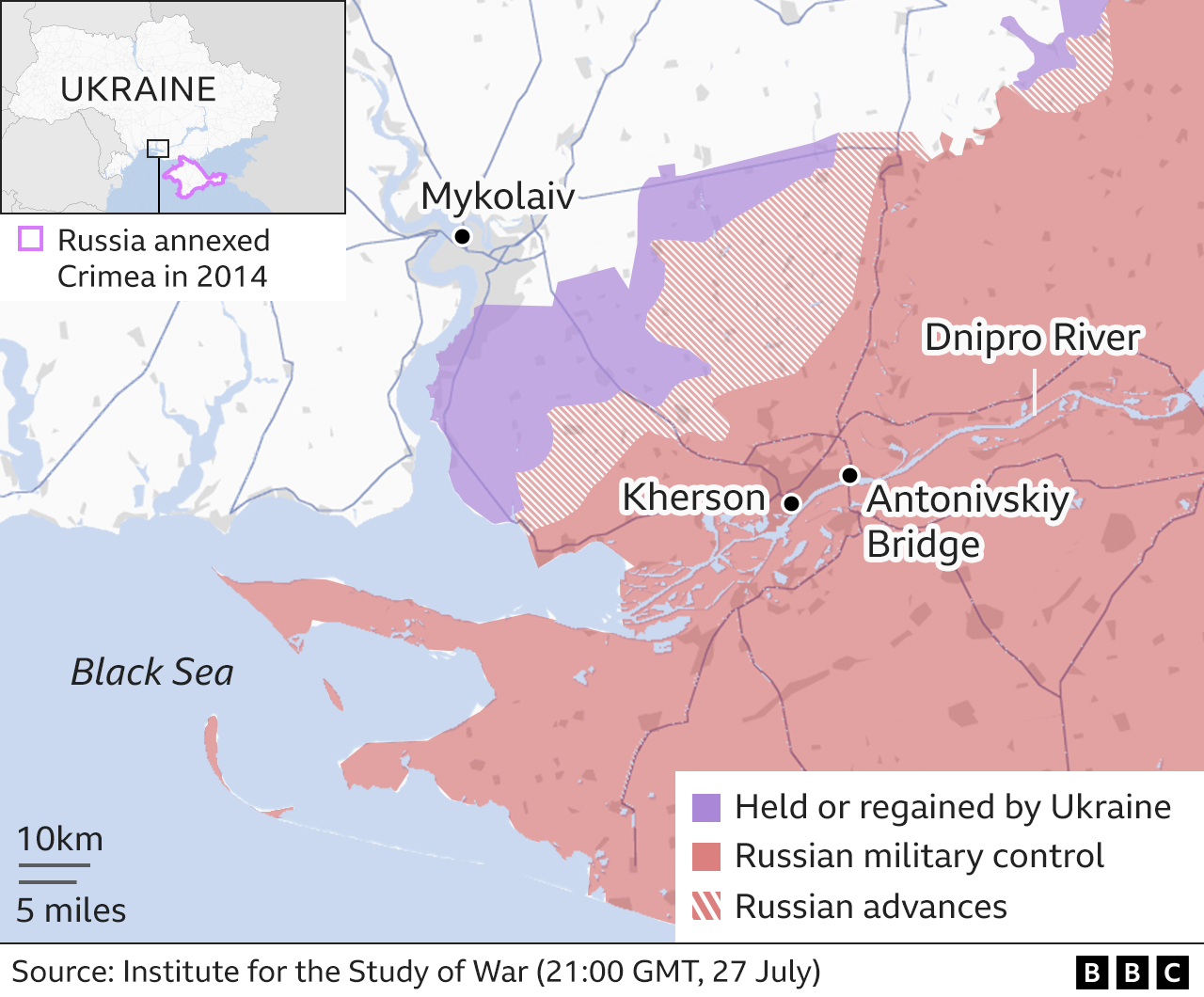
    Ukraine’s campaign to retake the occupied Kherson region is “gathering pace”, Western military sources say.

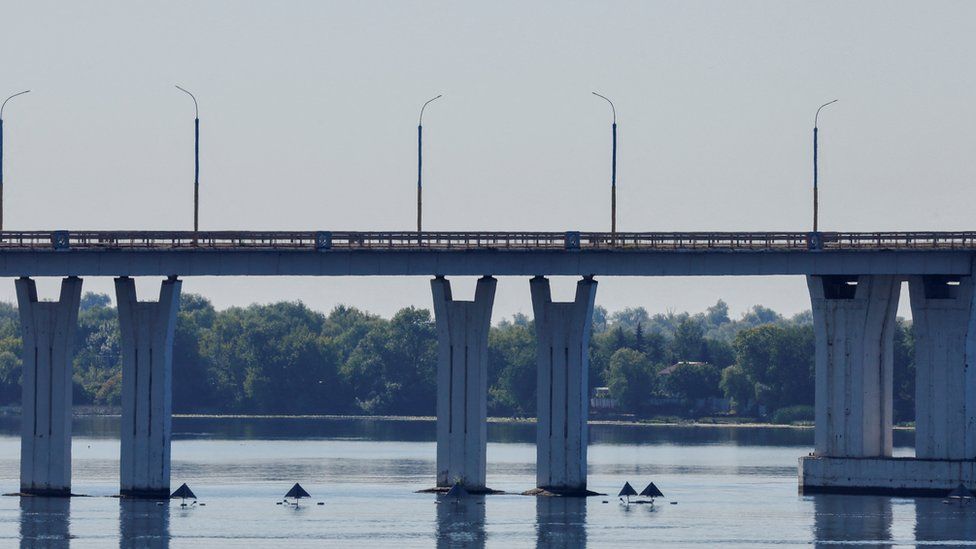
    A key bridge into the city of Kherson is now out of action after Ukrainian forces struck it with long-range rockets supplied by the US.

    UK defence officials say the city is now “virtually cut off from other occupied territories”.

    However, senior Ukrainian figures warned that Russia was now shifting its forces to defend the southern area.

    Strategically located west of the Dnipro river, the city was the first in the war to fall to Moscow’s forces.

    Ukrainian forces fired at Kherson’s Antonivskiy Bridge using a Himars artillery rocket system on Tuesday which, according to Western military sources, has left the crossing “completely unusable”.

    Only a pockmarked wreck is said to remain of the half-mile long bridge, one of two key routes spanning the Dnipro river which have both now been hit.

    Moscow relies on the crossings to resupply their troops stationed west of the river, and are now at risk of becoming isolated from the rest of Russia’s occupying forces. A third bridge, over the Inhulets river to the north-east of Kherson city, has also been hit.

    Military sources described Kherson as “politically the nearest Russia has to a jewel in the crown of its occupation” – and its loss, they say, “would severely undermine Russia’s attempts to paint the occupation as a success”.

    In a daily intelligence update, UK defence officials said the Ukrainian counter-offensive in the region was “gathering momentum”, adding that Kyiv’s forces had likely established a bridgehead south of the Inhulets river, “which forms the northern boundary of Russian occupied Kherson”.

    Moscow was now “moving the maximum number of troops in the Kherson direction”, said Oleksiy Danilov, who is secretary of Ukraine’s National Security Council, on Wednesday evening.

    The BBC has not been able to independently verify his remarks, however Ukrainian presidential adviser Oleksiy Arestovych agreed Russian forces were shifting their forces to the south in anticipation of a counter-offensive and changing their focus to strategic defence.

    Meanwhile, Russian forces in the east said they had captured Ukraine’s second largest power station – the Vuhlehirsk coal-fired plant. Mr Arestovych described it as a “tiny, tactical advantage”.

    Map of Kherson and the surrounding area
    1px transparent line

    Russian-installed officials in Kherson confirmed that a Ukrainian artillery strike had seriously damaged the Antonivskiy Bridge, forcing its closure to traffic.

    Speaking to Ria news agency, deputy city leader Kirill Stremousov said ferries and pontoon bridges would now be used instead to maintain links across the Dnipro River with the rest of Russian-occupied territory.

    For days the Ukrainian military has targeted the bridges using highly effective rocket systems supplied by the US.

    According to Western military sources, the attack is part of a Ukrainian counter effort to isolate Russian troops, with the ultimate goal of recapturing the entire region.

    If it proves successful the ambitious campaign would provide a much-needed boost for Kyiv by retaking from Russia the most significant population centre it has so far captured since the invasion began – the city of Kherson.

    Image shows bridgeImage source, Reuters
    Image caption, Despite still standing, Russian-backed local officials confirmed that the Antonivskiy Bridge is now impassable due to damage from Ukrainian rocket attacks

    The southern city, which had a population of 290,000 before the war, is administered by Moscow-backed officials since falling early on in the war.

    Last week, Russian Foreign Minister Sergei Lavrov said Russia’s military focus was no longer only on eastern Ukraine but on its southern regions of Kherson and Zaporizhzhia too.

    The US has accused Russia of preparing to annex parts of occupied Ukraine illegally.

    In his nightly Wednesday address President Volodymyr Zelensky vowed that Ukraine would eventually rebuild the Antonivskiy Bridge as well as other crossings in the Kherson region.

    “We are doing everything to ensure that the occupying forces do not have any logistical opportunities in the country,” he said.

    Russia captured Kherson with relatively little resistance in the war’s early days – and the failure of Ukraine’s security service to destroy crossing points over the Dnipro river at the time is believed to have last week led to Mr Zelensky’s dismissal of the agency’s director Ivan Bakanov.

    Source: BBC

  • Reality of Ukraine war hidden from Fortress Russia

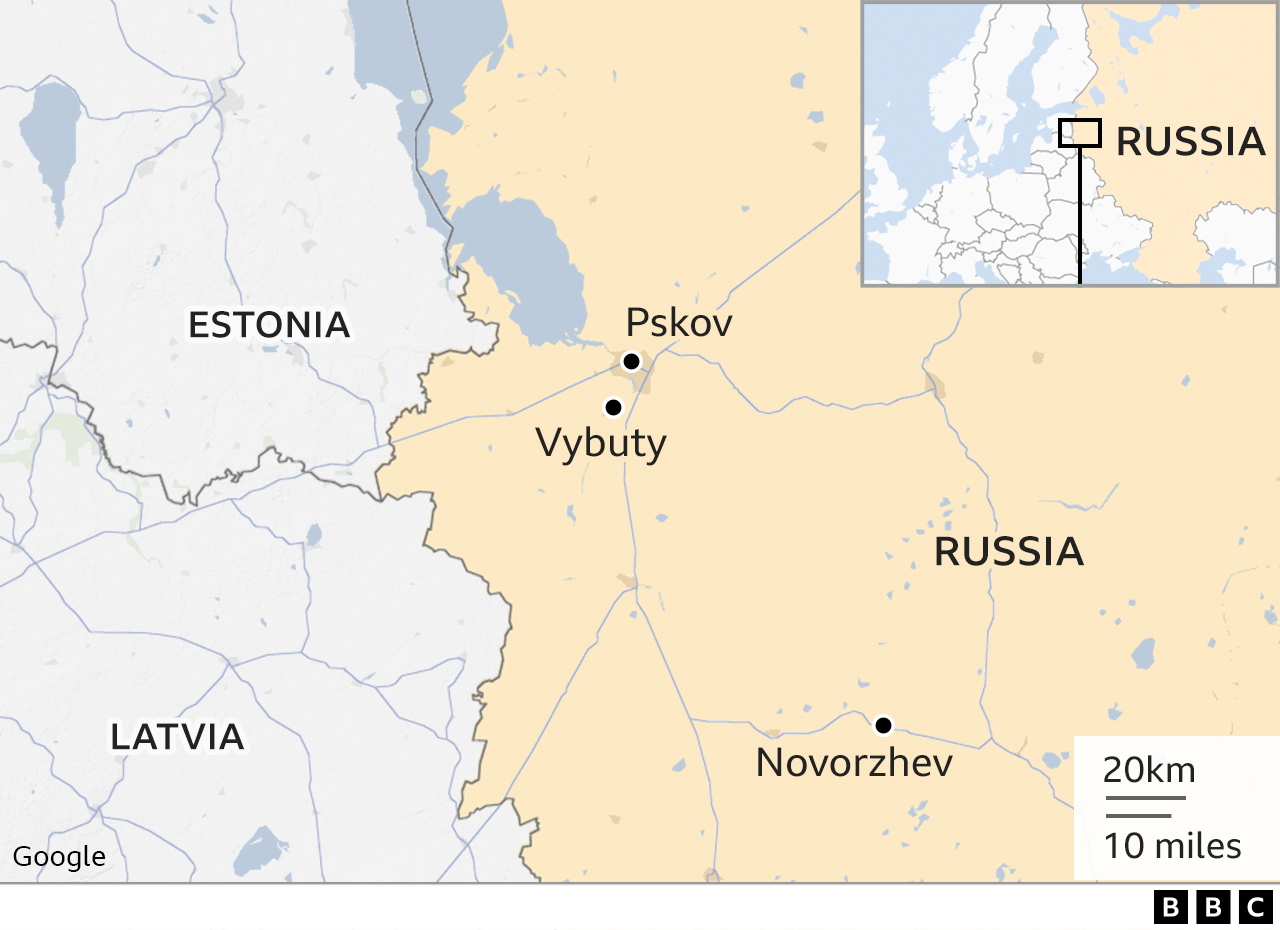
    In the village of Vybuty, a large crowd has gathered outside a church. People are queuing up to kiss the icon of a saint.

    An Orthodox priest in a gold embroidered vestment chants a prayer for Russia: “For our blessed country, its rulers and its army.”

    In the congregation are Russian servicemen. They cross themselves with three fingers according to the Orthodox tradition.

    Ukraine isn’t mentioned in the mass. But it’s on people’s minds.

    “In our family, we have a lot of young men who are serving there,” one of the worshippers, Ludmila, tells me. “God won’t abandon them. They will definitely return home.”

    Many Russian soldiers haven’t.

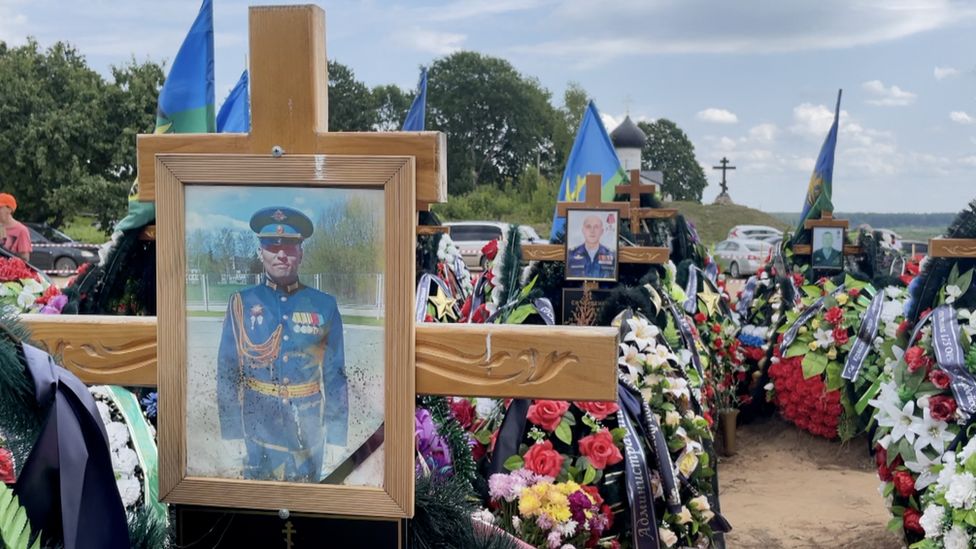
    Cemetery in village of Vybuty
    Image caption, Russia gives no details of the numbers killed in Ukraine referring only to “significant losses”

    Just a few metres away, in the village cemetery, there are two dozen fresh graves of Russian paratroopers.

    The burial ground is carpeted with wreaths, while banners of the men’s regiment flutter in the wind. Attached to wooden crosses are plaques with names and dates of death.

    All these soldiers were killed after 24 February: the day Russia launched its invasion of Ukraine.

    The scene is a stark reminder of the “significant losses” the Kremlin admits Russia has suffered in Ukraine.

    The invasion was President Vladimir Putin’s idea. He ordered it. It is his “special military operation”.

    Despite the thousands of civilian deaths in Ukraine, the Kremlin leader has displayed no remorse, no hint of regret over his decision to attack a sovereign, independent nation.

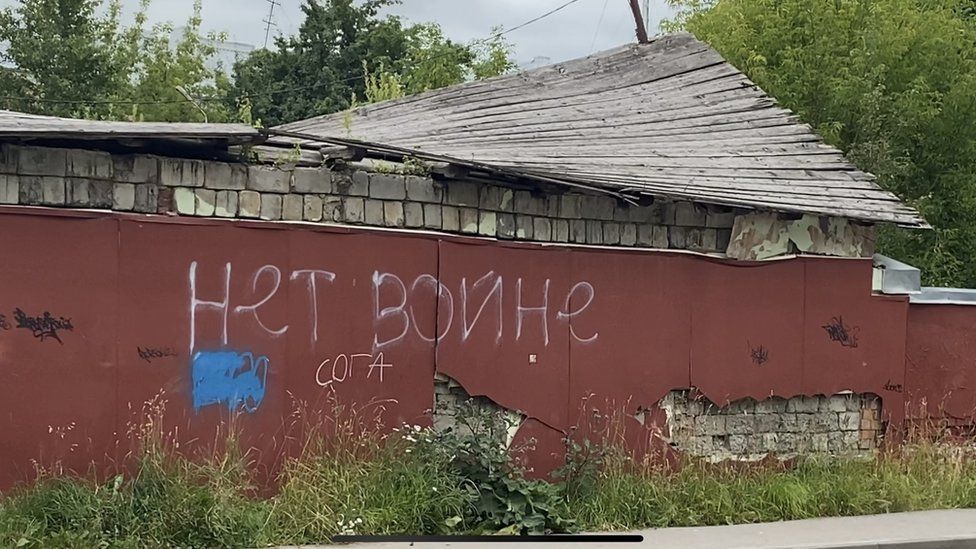
    "No war" graffiti in Pskov
    Image caption, “No to war” reads this graffiti in Pskov, but there is little opposition to the war to be found

    But what of the Russian public? More than five months on, do Russians believe their president took the right decision?

    In the big cities, such as Moscow and St Petersburg, it’s not uncommon to hear people criticise the Kremlin’s “special operation”.

    But I’m a long way from the capital after a nine-hour drive north-west of Moscow.

    I leave the village and head to the regional capital, Pskov. As I drive past a military base, the slogan on the poster outside catches my eye: “The borders of Russia never end!”

    Map of Pskov region
    1px transparent line

    Pskov is a medieval fortress town which, in a thousand years, has seen many battles.

    With its high walls and watchtowers, the ancient citadel is curiously topical and symbolic. This is how the Kremlin portrays modern Russia: as a besieged fortress threatened by the West.

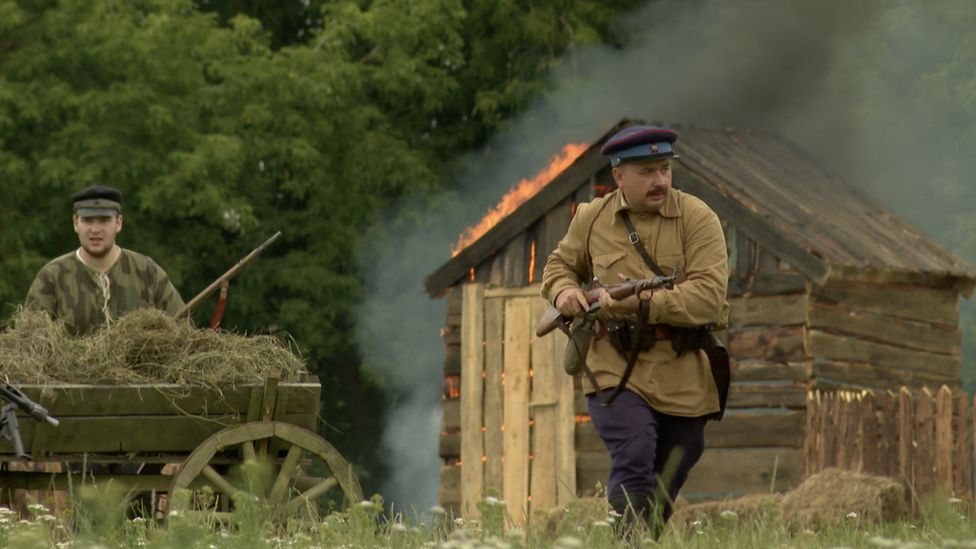
    In town, at a rundown Soviet era sports stadium, they’re re-enacting a battle from World War Two.

    People posing a Russian partisans are involved in a shoot-out with a group dressed as German Nazis. A mock-up of a Russian village is in flames.s

    The Kremlin likens what is happening in Ukraine now to the Second World War. It insists that today, once again, Russians are victims, heroes, liberators: the good guys fighting Nazis and fascists.

    It is a false image. A parallel reality. But many here believe it.

    World War Two re-enactment in Pskov
    Image caption, The Kremlin has rallied support by comparing its invasion of Ukraine to World War Two

    “My youngest child says that Russians always win. That Russia will always be victorious. I hope that’s true,” says one of the spectators, Tatyana. “The past teaches us that people gave their lives so that we could live. That’s why we must support our soldiers now.”

    The event organisers do not support us asking questions about Ukraine. Just as I’m about to interview another spectator, the re-enactment director interrupts us. He smiles awkwardly.

    “Thank you for coming,” he says. “I respect you. But I must ask you leave. This is a complex part of the country.”

    It is also one of the poorest.

    I continue my journey through Pskov region and drive to Novorzhev. Russia may be an energy superpower, but this town has no gas supply – it’s still being built.

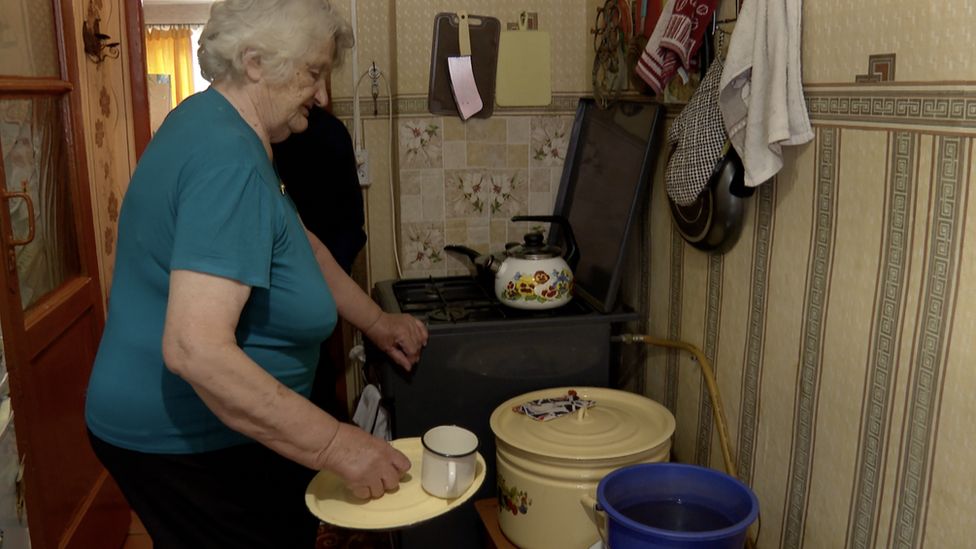
    To heat their homes, many people here burn firewood. One apartment block I visit has no running water. The residents bring it in buckets from a well.

    Novorzhev
    Image caption, Living is so rudimentary in Novorzhev that some residents have no running water

    At the local market, I meet senior citizen Natalya Sergeyevna.

    More than two decades of Vladimir Putin in power have not given her a comfortable retirement. To supplement her pension, Natalya sells everything she grows at home: from blackberries to potted plants.

    At the age of 84, Natalya still toils in the garden, planting and harvesting potatoes to raise extra cash. She doesn’t blame her president, though.

    “I like Putin and what he’s doing,” she tells me. “I feel sorry for him. He gets no rest. As for America and all those other troublemakers, they just want to break Russia into parts. They don’t understand that they mustn’t try to humiliate us.”

    I have heard the criticisms Natalya makes about Ukraine, the US and the West many times before on Russian TV. It’s hardly surprising.

    In Russia, television remains the key tool for shaping public opinion. And since the Kremlin controls TV, it pretty much controls the narrative and the messaging in the country. Especially since independent media in Russia have been silenced.

    The result: the Russian public is receiving a highly filtered, distorted picture of what is happening in Ukraine. But state propaganda doesn’t work in isolation.

    Like Natalya Sergeyevna’s garden, which produces a wealth of berries, fruits and vegetables, in Russia there is a fertile soil for the idea of Russia as an empire, a superpower, dictating to its neighbours and taking on the West.

    The Kremlin knows that its messaging will strike a chord with many here. But striking a chord is one thing. Persuading Russians to join the fight in Ukraine is quite another.

    “I support the special military operation. So many of our lads have been killed,” says an 18-year-old student in Novorzhev. “If I’m called up, I’ll go and fight. But I don’t want to sign up.”

    “It’s our duty to fight, if we’re enlisted,” another student, Konstantin, tells me. “Otherwise I won’t go near there. Not for money, not for anything. Family’s more important.”

    The Kremlin may dominate the information landscape. But there are limits to its powers of persuasion.

    Source: BBC

  • Ukraine war: First grain ship leaves under Russia deal

    The first ship carrying grain has left a Ukrainian port under a landmark deal with Russia.

    Turkish and Ukrainian officials say the ship left the southern port of Odesa early on Monday morning.

    Russia has been blockading Ukrainian ports since February, but the two sides agreed on a deal to resume shipments.

    It is hoped the deal will ease the global food crisis and lower the price of grain.

    In a statement issued ahead of the ship’s departure, Turkey said the Sierra Leone-flagged vessel would dock in Lebanon, adding that further shipments were planned over the coming weeks.

    The Joint Coordination Centre (JCC) in Istanbul set up under the deal said the ship was carrying some 26,000 tonnes of corn and was expected to arrive in Turkish waters for inspection on Tuesday.

    “Today Ukraine, together with partners, takes another step to prevent world hunger,” Ukraine’s Infrastructure Minister Alexander Kubrakov wrote on Facebook.

    “Unlocking ports will provide at least $1 billion in foreign exchange revenue to the economy and an opportunity for the agricultural sector to plan for next year.”

    Mr. Kubrakov added that 16 other ships were waiting to depart in the ports of the Odesa Region in the coming weeks.

    Last month’s deal – brokered by the UN and Turkey – took two months to reach and is set to last for 120 days. It can be renewed if both parties agree.

    The blockade of Ukraine’s grain has caused a global food crisis with wheat-based products like bread and pasta becoming more expensive and cooking oils and fertilizer also increasing in price.

    Under the terms of the deal, Russia has agreed not to target ports while shipments are in transit and Ukraine has agreed that its naval vessels will guide cargo ships through waters that have been mined.

    Turkey – supported by the United Nations – will inspect ships, to allay Russian fears of weapons smuggling.

    Three ports in southern Ukraine – Odesa, Chornomorsk, and Pivdenny – are expected to be the focal point of the exports.

    But the deal was thrown into chaos less than 24 hours after it was announced that Russia had launched two missiles at Odesa port.

    Ukraine’s President Volodymyr Zelensky said the strike showed that Moscow could not be trusted to stick to the deal.

    Source: bbc.com
  • Ukraine war: First grain ship leaves under Russia deal

    The first ship carrying grain has left a Ukrainian port under a landmark deal with Russia.

    Russia has been blockading Ukrainian ports since February, but the two sides agreed a deal to resume shipments.

    It is hoped the deal will ease the global food crisis and lower the price of grain.

    In a statement issued ahead of the ship’s departure, Turkey said the Sierra Leone-flagged vessel would dock in Lebanon, adding that further shipments were planned over the coming weeks.

    The Joint Coordination Centre (JCC) in Istanbul set up under the deal said the ship was carrying some 26,000 tonnes of corn and was expected to arrive in Turkish waters for inspection on Tuesday.

    “Today Ukraine, together with partners, takes another step to prevent world hunger,” Ukraine’s Infrastructure Minister Alexander Kubrakov wrote on Facebook.

    “Unlocking ports will provide at least $1 billion in foreign exchange revenue to the economy and an opportunity for the agricultural sector to plan for next year.”

    Mr Kubrakov added that 16 other ships were waiting to depart in the ports of Odesa Region in the coming weeks.

    Last month’s deal – brokered by the UN and Turkey – took two months to reach and is set to last for 120 days. It can be renewed if both parties agree.

    The blockade of Ukraine’s grain has caused a global food crisis with wheat-based products like bread and pasta becoming more expensive, and cooking oils and fertiliser also increasing in price.

    Under the terms of the deal, Russia has agreed not to target ports while shipments are in transit and Ukraine has agreed that its naval vessels will guide cargo ships through waters that have been mined.

    Turkey – supported by the United Nations – will inspect ships, to allay Russian fears of weapons smuggling.

    Three ports in southern Ukraine – Odesa, Chornomorsk and Pivdenny – are expected to be the focal point of the exports.

    But the deal was thrown into chaos less than 24 hours after it was announced that Russia had launched two missiles at Odesa port.

    Ukraine’s President Volodymyr Zelensky said the strike showed that Moscow could not be trusted to stick to the deal.

    Source: BBC

  • Ukraine grain tycoon killed in Russian shelling of Mykolaiv

    One of Ukraine‘s richest businessmen has been killed with his wife in “massive” Russian shelling of the southern city of Mykolaiv.

    Oleksiy Vadatursky, 74, and his wife Raisa died when a missile hit their home overnight, Ukrainian media said.

    Mr Vadatursky owned Nibulon, a group involved in grain exports. He had also received the “Hero of Ukraine” award.

    Mykolaiv mayor Oleksandr Senkevych said it was probably the heaviest Russian bombardment of the city so far.

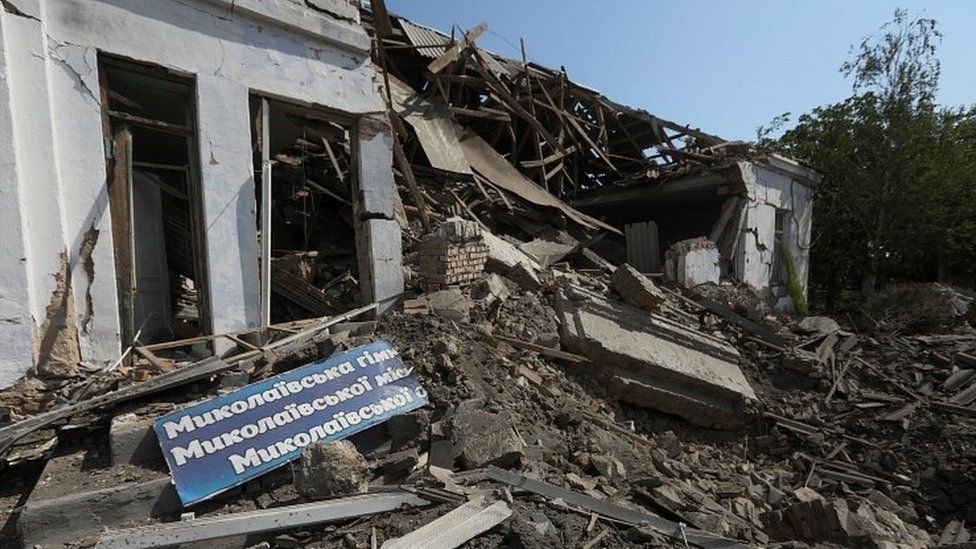
    There was damage to a hotel, a sports complex, two schools and a service station, as well as homes.

    Mykolaiv is on the main route to Odesa, Ukraine’s main port, and has been hit repeatedly.

    School in Mykolaiv wrecked by shelling, 28 Jul 22

    The region’s leader Vitaliy Kim said Mr Vadatursky “did a lot for the Mykolaiv region, a lot for Ukraine.

    “His contribution to the development of the agricultural and shipbuilding industry, the development of the region is invaluable,” he said on Telegram.

    Nibulon has built many storage facilities and other infrastructure for exporting grain.

    Ukraine and Russia are major exporters of wheat and other grains, and the disruption of exports caused by the war has sent food prices soaring worldwide.

    The two countries signed a UN-brokered agreement in Turkey last week, aimed at easing the food crisis. But Ukrainian shipments are expected to be slow amid heavy security checks.

    Ukraine accuses Russian forces of stealing grain from farms on occupied land and exporting it via Crimea. Russia denies those claims.

    Blow to Russian Navy Day

    Meanwhile, Russia has cancelled Navy Day celebrations in occupied Crimea.

    The reason given by Sevastopol Governor Mikhail Razvozhayev was an alleged Ukrainian drone strike on the Black Sea Fleet headquarters. The fleet has long been based in Sevastopol.

    But a senior Ukrainian official, Serhiy Bratchuk, dismissed the Russian report as a “provocation”.

    “The liberation of our Crimea will take place differently and much more efficiently,” he said.

    Russian forces annexed Crimea in 2014. That was internationally condemned as illegal and triggered sanctions against Russia.

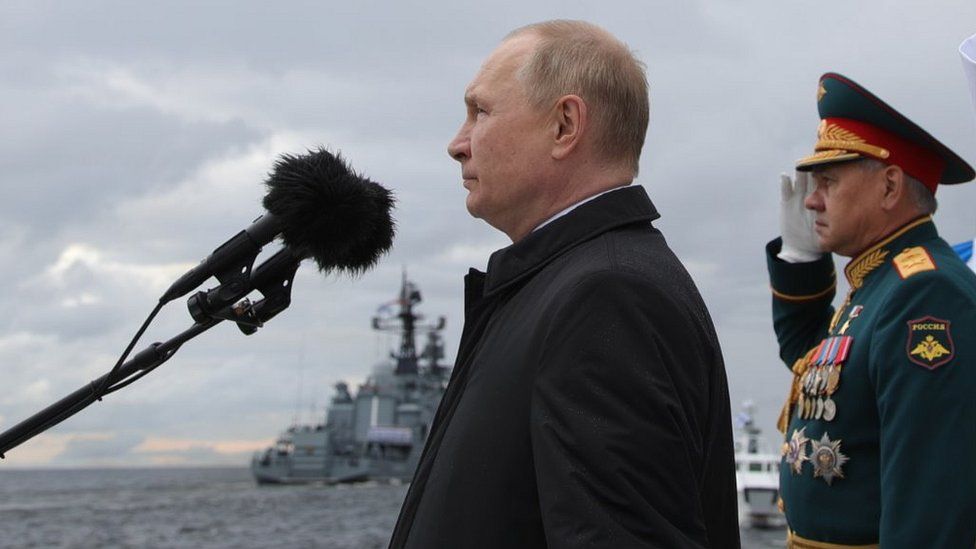
    Navy Day is an annual Russian holiday, and celebrations are taking place across Russia on Sunday. President Vladimir Putin is overseeing events in St Petersburg, his home city.

    President Putin and Defence Minister Sergei Shoigu (R) review warships in St Petersburg, 31 Jul 22

    In a Telegram post, the Sevastopol governor said “an unidentified object flew into the courtyard of the [Black Sea] Fleet headquarters” and “according to preliminary data, it was a drone”.

    Blaming “Ukronazis”, he said six people – Fleet HQ staff – were wounded, and none were killed.

    Russia has often accused Ukrainian authorities of being “Nazis”, as part of the Kremlin’s propaganda campaign to justify its invasion of Ukraine on 24 February.

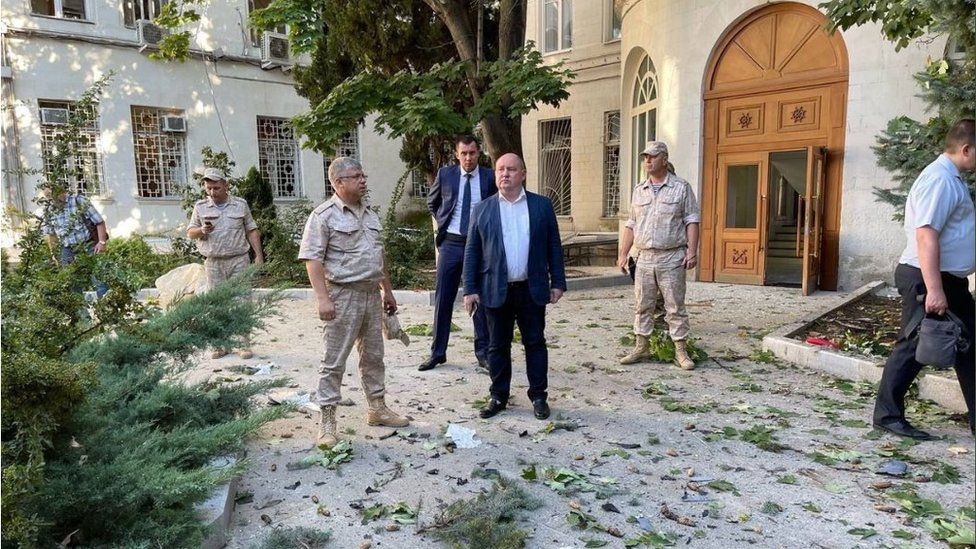
    A photo posted by Governor Razvozhayev showed him in a courtyard littered with leaves, but with no obvious structural damage. He said the Navy Day celebrations had been cancelled for security reasons.

    The scene after an alleged drone hit on the Black Sea Fleet HQ in Sevastopol (pic: Governor Razvozhayev)

    In a previous blow to the Black Sea Fleet, in April, the fleet’s flagship Moskva sank after what Ukraine described as a strike with two Neptune missiles.

    Russia admitted there was a big fire on board caused by exploding ammunition, without attributing it to a Ukrainian attack, and said the missile cruiser sank in a storm while being towed.

    It remains unclear how many Russian sailors were killed or injured in the ship’s demise.

    Meanwhile in the north, Ukraine’s second city Kharkiv was hit by Russian missiles again, mayor Igor Terekhov said on Telegram. Three Russian S-300 missiles struck a school there, destroying the main building, he said.

    The BBC was unable to verify the latest reports independently.

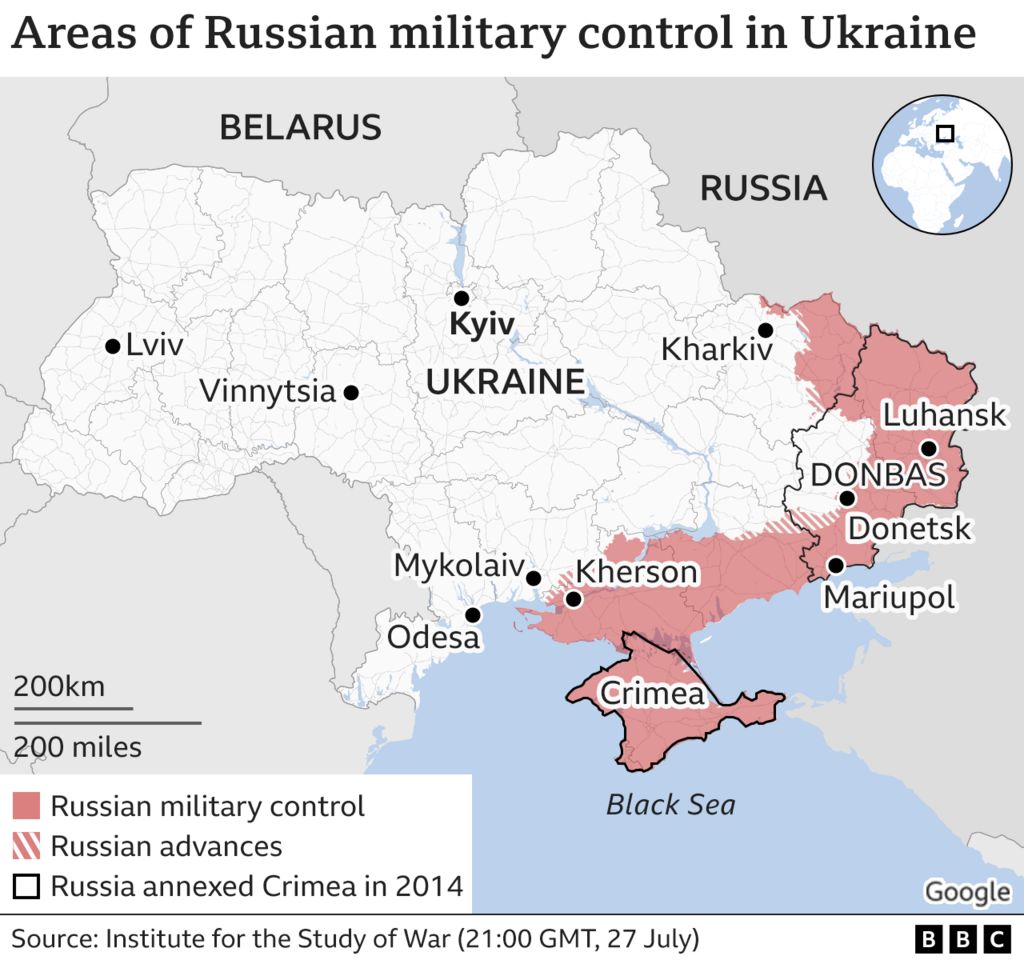
    Map showing areas of Ukraine that remain under Russian military control

    In a late-night address on Saturday, Ukraine’s President Volodymyr Zelensky told all civilians still living in parts of eastern Donetsk region under Ukrainian control to evacuate.

    The region has seen heavy clashes amid a slow advance by Russian forces, who already control large parts of it.

    “The more people leave Donetsk region now, the fewer people the Russian army will have time to kill,” Mr Zelensky said. “We will use all available opportunities to save as many lives as possible and to limit Russian terror as much as possible.”

    Source: BBC1px transparent line

  • ‘Ukraine is under constant stress’ – First Lady Olena Zelenska

    Ukraine’s First Lady Olena Zelenska has told the BBC that the whole of the country is “under constant stress”.

    Her comments come hours after a number of rocket attacks were reported in the country, including in the Kyiv region.

    “We have been under constant stress from 24 February and that does not relent,” she said.

    Ms. Zelenska says the government is implementing support to help Ukrainians get help for their mental health and is being assisted by the WHO.

    “We need expert help and that’s why we’ve approached the WHO who are helping us with psychological help.”

    Ms. Zelenska, who is known for being quite private, also discussed her recent appearance in Vogue. She said it was a massive opportunity to speak about Ukraine.

    “Millions read Vogue and speaking to them directly was my duty. And that was an interesting experience,” she said.

    “In peaceful life, I’m not used to the attention. Everyone is fighting on a front line and it’s work and I have to do that work,” she added.

    Last week Ms. Zelenska hosted a First Lady summit, attended by the spouses of a number of world leaders. During the meeting, they discussed the Ukraine war and the assistance needed.

    “First ladies have no opportunities to influence politics but we have an emotional influence. We understand each other, we feel each other,” she said.

    Ms. Zelenska also said that the need for the country to keep working and for people to keep going is very important.

    “The country has to survive, the country has to preserve some form of normality. Even soldiers are saying to their friends to go and have a coffee, see a film, enjoy the peace that you have. We are here on the front line to give that peace for you.

    “It’s a very delicate balance. So if someone might say Kyiv is a completely peaceful city, that would be an illusion. We had several rocket attacks but the country has to keep working. Businesses have to keep working. The country is working and it shouldn’t stop. There is no life without development – we have to keep developing.”

    Source: bbc.com
  • Ukraine war: Russian investigator says 92 Ukrainians charged

    Moscow has charged 92 members of the Ukrainian armed forces with crimes against humanity, the head of Russia’s investigative committee has said.

    Alexander Bastrykin told government news site Rossiiskaya Gazeta over 1,300 criminal investigations had begun.

    He also proposed an international tribunal backed by countries including Iran, Syria and Bolivia – traditional allies of Russia.

    As well as the 92 who have already been charged by Russia, some 96 people, including 51 armed forces commanders, are wanted, Mr Bastrykin said.

    The Ukrainians were involved in “crimes against the peace and security of humanity”, he told the newspaper.

    The BBC has been unable to verify claims made in the interview and Kyiv has not commented.

    But this month, Ukraine said it was examining more than 21,000 war crimes and crimes of aggression allegedly committed by Russian forces since the start of the invasion in February.

    And in May, the first war crimes trial since the invasion began took place in Ukraine, where a court jailed a Russian tank commander for life for killing a civilian.

    The International Criminal Court (ICC), which has described Ukraine as a “crime scene”, has also sent a team of investigators and forensics experts to Ukraine.

    The Kremlin denies all war crimes, or that it has been targeting civilians. It has regularly blamed Ukraine for shelling its own infrastructure and killing its own civilians – accusations which have been widely dismissed by international leaders.

    When asked in the interview whether a UN-backed trial could take place, Mr Bastrykin accused the West of openly sponsoring “Ukrainian nationalism” and said such a thing “is extremely doubtful”.

    Moscow has repeatedly made the false claim that Ukraine is overrun by neo-Nazis as justification for what it calls a “special military operation”.

    Mr Bastrykin instead proposed that an international tribunal should be set up with countries that have “an independent position on the Ukrainian issue” – in particular Syria, Iran and Bolivia.

    Syria and Iran both voted against a UN resolution in March condemning Russia’s invasion of Ukraine, while Bolivia abstained.

    Along with hundreds of Ukrainian military and political targets, Mr Bastrykin said investigations are under way into Ukrainian health ministry employees who he accused, without providing evidence, of developing weapons of mass destruction.

    Suspected mercenaries from the UK, the US, Canada, the Netherlands and Georgia are under investigation, he told the newspaper.

    In June, two Britons and a Moroccan who were captured while fighting for Ukraine were sentenced to death by a Russian proxy court in eastern Ukraine.

    Aiden Aslin, Shaun Pinner and Brahim Saaudun are accused of being mercenaries, but the Britons’ families have insisted they are long-serving members of the Ukrainian military.


    Source: BBC

  • Ukraine war: UK announces latest package of weaponry

    Dozens of artillery guns, hundreds of drones and tens of thousands of ammunition rounds are to be sent by the UK to Ukraine over the coming weeks.

    Defence Secretary Ben Wallace said the package would ensure that Ukrainians had the “tools to defend their country from Putin’s illegal invasion”.

    The announcement follows last month’s government pledge of another £1bn in military support to Kyiv.

    Russia has said its military focus is no longer limited to eastern Ukraine.

    In an interview with state media on Wednesday, Foreign Minister Sergei Lavrov implied Moscow’s strategy had changed after Western nations supplied Ukraine with increasingly powerful weapons.

    The latest support from the UK is set to include more than 20 M109 155mm self-propelled guns and 36 L119 105mm artillery guns, the Ministry of Defence (MoD) said.

    A further 50,000 rounds of ammunition for Ukraine’s Soviet-era artillery have also been promised, along with drones and at least 1,600 more anti-tank weapons.

    Jack Watling of the Royal United Services Institute said the latest package of British support was “very much attuned with what Ukraine needs”.

    He said some of the guns offered are capable of outranging Moscow’s artillery. But because Kyiv’s troops were using around 6,000 rounds a day, there would be a “ongoing requirement”, he added.

    Since Russia launched its invasion in February, Kyiv has issued multiple requests for weaponry.

    Ukraine’s First Lady Olena Zelenska addressed the US Congress on Wednesday, asking for more air-defence systems to “help us to stop this terror against Ukrainians”.

    An announcement of another £1bn in support for Ukraine, announced by Prime Minister Boris Johnson at last month’s Nato summit in Madrid, has taken the UK’s total military aid for Kyiv to £2.3bn.

    The MoD said it had already provided more than 6,900 anti-tank missiles, multiple launch rocket systems and 120 armoured vehicles among other provisions.


    Source: BBC

  • Ukraine war round-up: Russia expands its aims and Putin’s tricky Tehran moment

    Russia’s war aims have expanded beyond east Ukraine in response to the supply of longer-range Western weapons to Ukraine, Foreign Minister Sergei Lavrov said on Wednesday.

    In an interview with Russian state media, he said that the “geography is different now”, because Ukraine has access to weapons that can fire missiles over a longer distance.

    Russia would now have to push Ukrainian forces further from the front line to ensure its own security, he said.

    “We cannot allow the part of Ukraine controlled by [Ukrainian President Volodymyr] Zelensky… to possess weapons that would pose a direct threat to our territory.”

    The West has supplied Ukraine with increasingly powerful weapons since Russia’s invasion began, including the long-range Himars missile system which has brought Ukraine some success.

    For two days running, Ukrainian forces have used the US-supplied weapon to hit a key strategic bridge in occupied Kherson, according to reports.

    Source: CNN

  • Ukrainian farms try to bring in the harvest amid fires, mines and tank attacks

    Unblocking Ukrainian ports is the only way to prevent a global food crisis and save Ukrainian agricultural producers, said Mykola Horbachov, the President of the Ukrainian Grain Association.

    Horbachov was speaking to Ukrainian television ahead of the expected agreement in Istanbul Friday to secure safe corridors through the Black Sea for Ukrainian agricultural exports.

    Russians had stolen about 500,000 tons of grain in occupied territories and about 1 million tons of grain remains in the elevators under the control of the occupiers, he claimed, estimating that the losses of the Ukrainian agricultural industry due to the war at about $20 billion.

    Horbachov forecast that the grain harvest in the current season will decrease by 30-35%, which is about 70 million tons of grain and oilseeds compared to 106 million tons last season. And he said farmers will need help in order to be able to carry out the next sowing campaign, which will start in 2 months.

    However, the harvest in Ukraine was gaining momentum, the Ukrainian Ministry of Agrarian Policy said Friday. Dnipropetrovsk, Mykolaiv, and Odesa regions had each collected more than a million tons of new crop grain. Peas were threshed for more than 59% of the area, and rapeseed for a third.

    It said figures from the regions showed that an area of 2.1 million hectares had been harvested so far.

    Across Ukraine, the harvest of grain is underway – but every day brings new details about the perils farmers are facing as they try to bring in the crops, and about the theft of produce and equipment in Russian-controlled areas.


    Source: CNN

  • Russia’s Ukraine war effort running ‘out of steam’ as Putin’s ability to spy in Europe cut in half, MI6 chief says

    The chief of Britain’s foreign intelligence service believes that Russia is losing steam in its invasion of Ukraine, and has lost its ability to spy in Europe “by half” following the expulsion of more than 400 Russian intelligence officers from cities across Europe and the arrest of several deep-cover spies posing as civilians.

    Richard Moore, the head of MI6, told CNN’s Jim Sciutto at the Aspen Security Forum that since Russia invaded Ukraine in February, European countries have expelled “north of 400 Russian intelligence officers operating under diplomatic cover” across the bloc.

    “And we reckon, in the UK, that has probably reduced their ability to do their business to spy for Russia in Europe by half,” Moore said. He added that a number of “illegals,” or Russian spies operating under deep cover and masquerading as ordinary civilians, have also been exposed and arrested in recent months.

    Moore also said he believes Russia could be “about to run out of steam” in Ukraine.

    “I think our assessment is that the Russians will increasingly find it difficult to supply manpower material over the next few weeks,” he said. “They will have to pause some way and that will give the Ukrainians opportunities to strike back.”

    “Their morale is still high,” Moore said, referring to the Ukrainians. “They’re starting to receive increasing amounts of good weaponry.” Russia, by contrast, failed significantly in its initial objectives to take Kyiv and overthrow the government there and is largely using “cannon fodder” for its offensives in eastern Ukraine, he said.

    Asked whether the war in Ukraine has made Russia a “target rich environment” for the UK and its allies to recruit potential assets, Moore would only say that “it is our hope” that Russians in the intelligence and diplomatic services will “reflect on what they are witnessing in Ukraine” and decide to “strike back against the system” as many did during the Prague Spring in 1968.

    “Our door is always open,” he said.

    Moore also echoed what CIA Director Bill Burns told the forum on Wednesday about Russian President Vladimir Putin’s health. “There is no evidence that Putin is suffering from serious ill health,” he said. Burns told the forum that the US believes Putin is “entirely too healthy,” despite rumors and speculation that he might be sick.

    Asked what lessons China has learned from Russia’s invasion of Ukraine, especially when it comes to whether Beijing might try to invade Taiwan, Moore said it is too early to tell. But he said that Chinese President Xi Jinping is watching the conflict and how the US and the west are responding to it “like a hawk.”

    “I think he underestimates US resolve and power,” Moore said. “And that might lead him to miscalculate … particularly over Taiwan.” Moore said, however, that he does not believe a war between China and Taiwan is inevitable.

    Moore said that MI6 now devotes “more effort to China than any other single subject,” but that it is “still a pretty opaque system.”

    “At one level, understanding Xi Jingping’s strategic intent is not difficult,” Moore said, citing Xi’s stated desire to dominate key technological spaces. “But if you go beneath that strategy in terms of how they implement, how they organize, how they, what their tactical intent is, and then what are the capabilities they’re building up, that’s a black box.”

    Moore said it is clear, though, that the Chinese “are helping the Russians over Ukraine by buying their oil.” And while they have been “quite conservative about military assistance” to Russia, “I’m sure if they could provide that and get away with it, they would,” he said. In terms of the partnership between the countries, “Moscow is very much the junior partner and the Chinese are very much in the driving seat,” he added.

    Moore also addressed the Iran nuclear deal, telling Sciutto that while he believes the deal should be revived, “I’m skeptical that the Supreme Leader will go for the deal. I think the deal is absolutely on the table and the European powers and the and the administration are very, very clear on that. And I don’t think that the Chinese and Russians on this issue would block it. But I don’t think the Iranians want it.”


    Source: CNN

  • Ukraine war: Russia’s Lavrov says ready to expand war aims

    Russia’s military focus in Ukraine is no longer “only” the east of the country, Foreign Minister Sergei Lavrov has said.

    In an interview with Russian state media, he implied Moscow’s strategy had changed after the West supplied Ukraine with longer-range weapons.

    Russia invaded Ukraine in February, claiming falsely that Russian-speakers in Ukraine’s eastern Donbas region had suffered a genocide and needed to be liberated.

    Five months on, Russia has occupied parts of the east and south of the country, but it failed in its original aim of capturing Kyiv and has since claimed its main objective was the liberation of Donbas.

    Since February, the West has supplied Ukraine with increasingly powerful weapons to use in its defence against Russian forces.

    Mr Lavrov says that has forced Russia to expand its objectives further.

    “We cannot allow the part of Ukraine controlled by [Ukrainian President Volodymyr] Zelensky… to possess weapons that would pose a direct threat to our territory,” Mr Lavrov said in the interview with Margarita Simonyan – a well-known commentator on Russian TV and editor-in-chief of broadcaster RT.

    “The geography is different now,” he said, naming the southern Kherson and Zaporizhzhia regions as Russia’s latest objectives. Moscow’s forces already occupy parts of both regions.

    Image source, BBC

    Mr Lavrov specifically referred to the Himars longer-range rocket system – supplied only recently by the US – with which Ukraine has had some success.

    For two days running Ukrainian forces have used Himars to hit a key, strategic bridge in occupied Kherson, reports say. The Antonivskyi bridge is one of two bridges that Russia relies on to supply areas it has captured on the west bank of the Dnipro river, including Kherson city.

    The Russian foreign minister described the West’s actions in giving weapons to Ukraine as an “impotent anger” and a “desire to make things worse”.

    Russia’s annexation plans

    The apparent expansion of Russia’s objectives was also noted on Tuesday by US National Security Council spokesman John Kirby, who said Russia was already making plans to annex large swathes of Ukrainian territory.

    He accused Moscow of using a similar “playbook” to its takeover of Crimea, when it annexed the Ukrainian peninsula by organising a sham referendum in 2014.

    Mr Kirby said Russia was installing illegitimate pro-Russian officials to run occupied regions of Ukraine. These new “administrations” would then organise local referendums on becoming part of Russia, possibly as soon as September.

    The results of the votes would be used by Russia “to try to claim annexation of sovereign Ukrainian territory”, Mr Kirby said.

    Crimea was annexed by Russia in 2014 after a hastily-organised referendum – viewed as illegal by the international community, in which voters chose to join Russia.

    Many supporters of Kyiv boycotted the vote and the campaign was neither free nor fair.

    Similar votes held in other parts of Ukraine would almost certainly see a similar situation, with any opposition to joining Russia largely supressed.

    Mr Kirby said he was “exposing” the Russian plans “so the world knows that any purported annexation is premeditated, illegal and illegitimate”, and promised there would be a quick response from the US and its allies.

    The areas targeted for annexation included Kherson, Zaporizhzhia, Donetsk and Luhansk, he said – the same regions Mr Lavrov says are now Russian objectives.

    Source: BBC
  • Ukraine war: Russia plans to annex Ukrainian land – US

    Russia plans to annex more Ukrainian territory using a similar “playbook” to its takeover of Crimea, the US says.

    Citing US intelligence, National Security Council spokesman John Kirby said Russia is already laying the groundwork for annexation.

    Occupied regions of Ukraine could hold “sham” referenda on joining Russia as soon as September, he said.

    Russia annexed Crimea from Ukraine in 2014 after a referendum which was widely viewed as illegitimate.

    “We want to make it plain to the American people,” Mr Kirby told reporters. “Nobody is fooled by it. [Russian President Vladimir Putin] is dusting off the playbook from 2014.”

    He accused Russia of installing illegitimate pro-Russian officials to run occupied regions of Ukraine, with the aim of organising referenda on becoming part of Russia.

    The results of the votes would be used by Russia “to try to claim annexation of sovereign Ukrainian territory”, Mr Kirby said.

    Russia has already installed its own regional and local officials in the parts of Ukraine it has occupied.

    Crimea was annexed by Russia in 2014 after a hastily-organised referendum – viewed as illegal by the international community, in which voters chose to join Russia.

    Many supporters of Kyiv boycotted the vote and the campaign was neither free nor fair.

    Similar votes held in other parts of Ukraine would almost certainly see a similar situation, with any opposition to joining Russia largely supressed.

    Mr Kirby said he was “exposing” the Russian plans “so the world knows that any purported annexation is premeditated, illegal and illegitimate”, and promised there would be a quick response from the US and its allies.

    The areas targeted for annexation include Kherson, Zaporizhzhia, Donetsk and Luhansk, he said.

    Source: BBC


  • Ukraine aims to amass ‘million-strong army’ to recapture south, says defence minister

    Ukraine plans a “million-strong army” equipped with Nato weapons to retake the south of the country from occupying Russians, the defence minister says.

    Retaking the areas around the Black Sea coast was vital to the country’s economy, Oleksii Reznikov said.

    However, the comments are more of a rallying cry than a concrete plan, says the BBC’s Joe Inwood in Kyiv.

    The defence minister’s remarks come as Russia makes progress in taking territory in the eastern Donbas region.

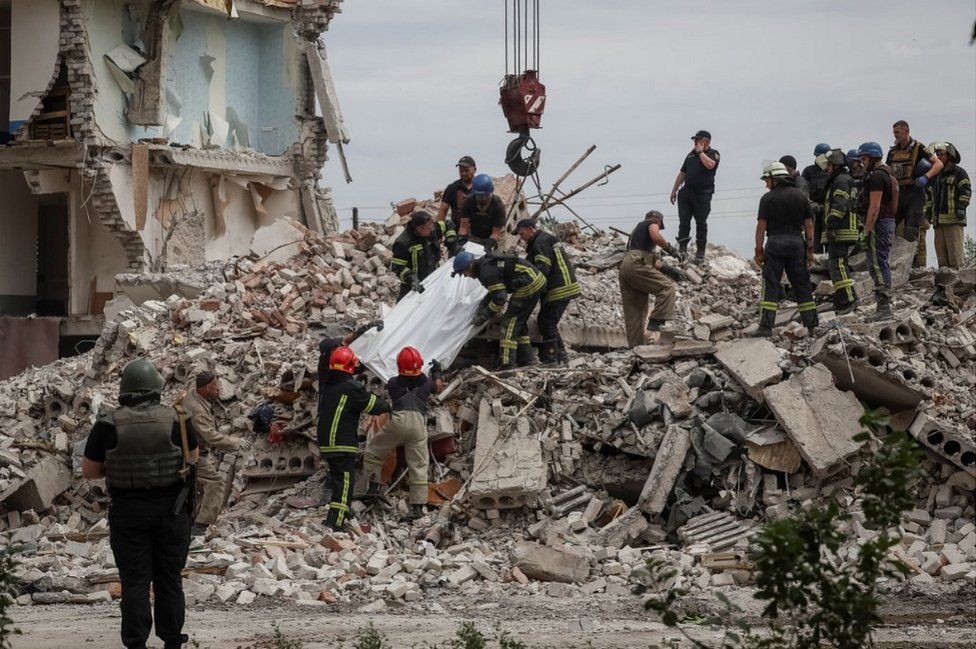
    An attack on a block of flats on Sunday killed at least 18 people – with more than 20 are feared buried under rubble.

    Rescuers are still looking for survivors at the site of the five-storey building in Chasiv Yar, near the city of Kramatorsk, in Donetsk region which has been the focus of a Russian push.

    In his interview with The Times newspaper, Mr Reznikov praised the UK for being “key” in the transition from providing Ukraine with Soviet-era weapons to Nato-standard air defence systems and ammunition.

    He said weapons deliveries needed to be sped up.

    “We need more, quickly, to save the lives of our soldiers. Each day we’re waiting for howitzers, we can lose a hundred soldiers,” he said.

    “We have approximately 700,000 in the armed forces and when you add the national guard, police, border guard, we are around a million strong,” the defence minister said.

    The devastated apartment block in Chasiv Yar, eastern Ukraine, 10 Jul 22
    IMAGE SOURCE,REUTERS Image caption, Chasiv Yar: Bodies were recovered from the devastated apartment block

    However, Dr Jack Watling, senior research fellow at the Royal United Services Institute, cautioned against the figure.

    “It’s not a million strong force that will be conducting a counter-attack,” Mr Watling told the BBC.

    “Normally you would want operational surprise when you launch a counter-attack, so announcing it publicly is partly about forcing the Russians to have to commit resources more widely to guard against this threat.”

    Source: BBC

  • Ukraine war: 21,000 alleged war crimes being investigated, prosecutor says

    Ukraine says it is investigating more than 21,000 war crimes and crimes of aggression allegedly committed by Russia since the start of its invasion.

    Prosecutor General Iryna Venediktova told the BBC she was receiving reports of between 200 to 300 war crimes a day.

    She admitted that many trials would be held in absentia, but stressed that it was “a question of justice” to continue with the prosecutions.

    Russia invaded Ukraine on 24 February. It denies all war crimes allegations.

    Speaking to the BBC’s World Service Outside Source programme, Ms Venediktova warned that Russian soldiers who killed, tortured or raped civilians “should understand that it’s only a question of time when they all will be in court”.

    She said that although her team was working in regions across Ukraine, it was unable to investigate all cases “properly and effectively” because of a lack of access to some people and areas. This was an apparent reference to Ukraine’s territories occupied by Russian troops.

    In May, Ms Venediktova said that about 600 suspects had already been identified and 80 prosecutions had begun.

    The first Russian soldier to be put on trial in Ukraine, Sgt Vadim Shishimarin, was sentenced to life in prison for killing a civilian in May.

    Ukraine says it has uncovered multiple mass graves in Bucha, Borodyanka and other towns near the capital Kyiv that were briefly seized by Russian troops.

    The International Criminal Court has described Ukraine as a “crime scene”, dispatching its largest team of detectives ever to the country to assist in multiple investigations.

    Moscow has repeatedly denied targeting civilians.

    On the ground, Ukraine’s military said Russian troops were preparing for an offensive in the eastern Donetsk region, shelling several towns.

    Russia captured nearly all of the neighbouring Luhansk region over the weekend, part of its attempts to seize the wider Donbas area.

    In its update, Ukraine’s military said its forces were under intense pressure but had so far held off Russian forces.

    Residents of Slovyansk, a key city in Ukrainian hands, were earlier urged to evacuate further west – a day after a deadly Russian attack on a local market.

    Ukrainian President Volodymyr Zelensky, meanwhile, said “artillery from our Western partners had started working very powerfully, so the losses of the occupiers will only increase”.

    Source: BBCJohnson term in office chart

  • Ukraine war: Market hit as Russians shell frontline city Slovyansk

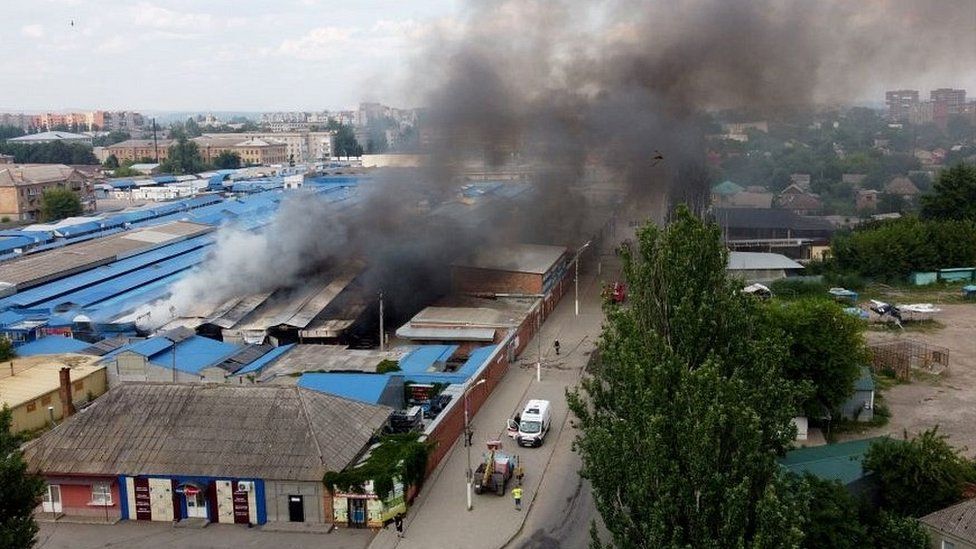
    Russian shelling set a central market ablaze in Ukraine’s eastern city of Slovyansk, killing two people and injuring seven, an official said.

    “This is pure terrorism!” Donetsk regional head Pavlo Kyrylenko said.

    Mayor Vadym Lyakh said Slovyansk was being hit by Russian artillery salvoes from closer positions, as it became a frontline city.

    He posted photos of Tuesday’s blaze on Facebook, describing massive shelling, and urging people to stay in shelters.

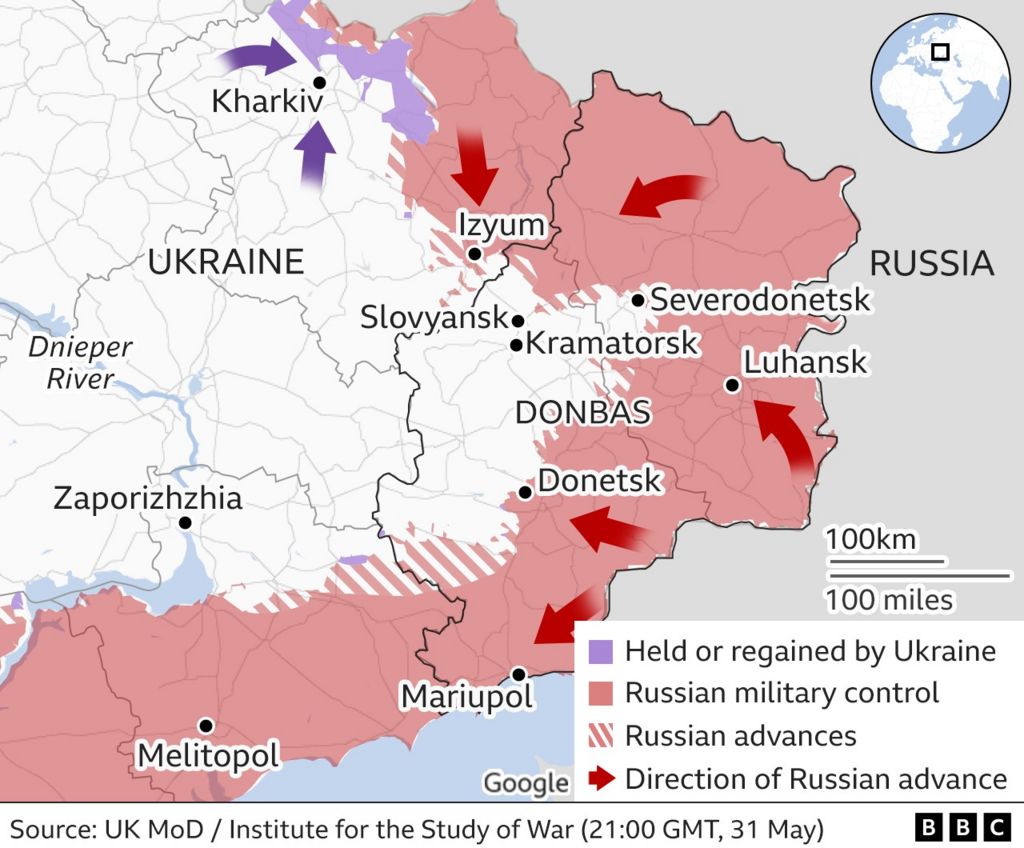
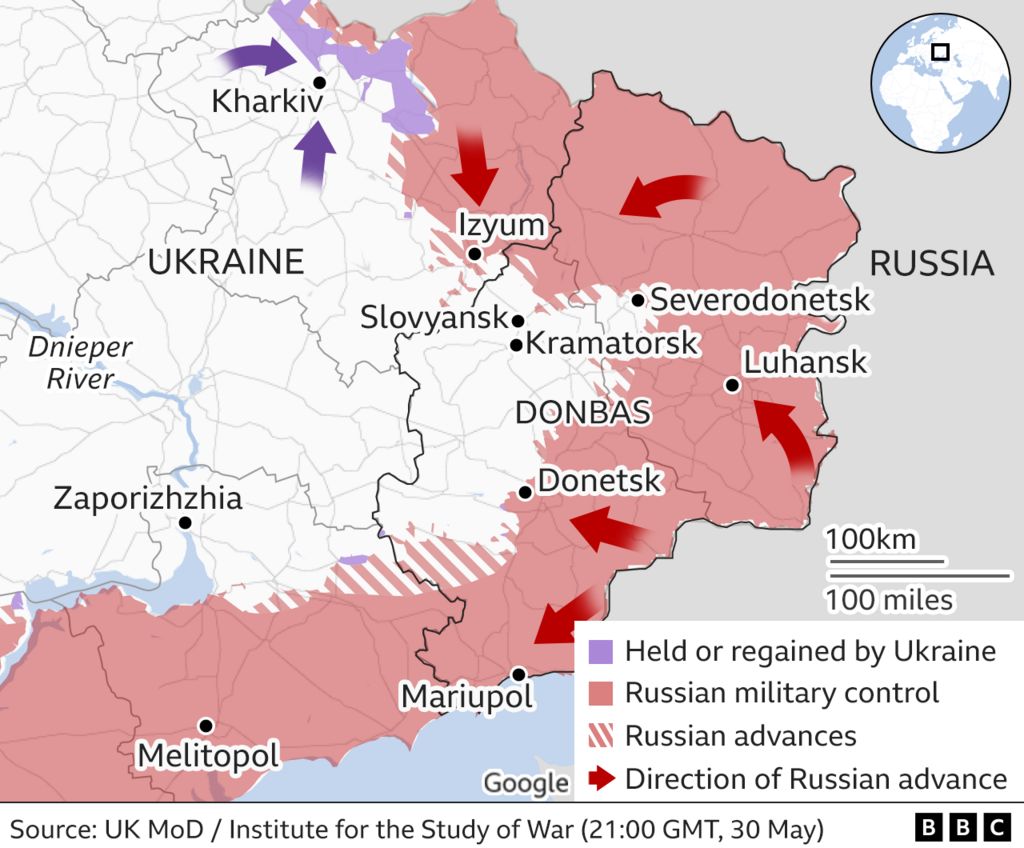
    Russia is seeking to capture all of the eastern industrial Donbas area.

    The area is made up of two regions, Luhansk and Donetsk. After recognising two rebel self-proclaimed statelets there, Russian President Vladimir Putin ordered an invasion of Ukraine on 24 February.

    Last week, Ukraine’s military said it had to pull out of Lysychansk, its last remaining stronghold in Luhansk, under intense Russian fire.

    It said its troops were now strengthening fortifications to defend areas it holds in Donetsk, including Slovyansk.

    Luhansk regional head Serhiy Haidai on Tuesday said that “heavy fighting is going at the edge of the Luhansk region near Lysychansk”.

    “The enemy has deployed significant forces,” he said, adding that Russia was trying to send more of its forces across a river by building pontoon bridges.

    Mr Haidai said the Russians were “sustaining heavy losses”.

    The BBC has not been able to verify details of the latest attacks.

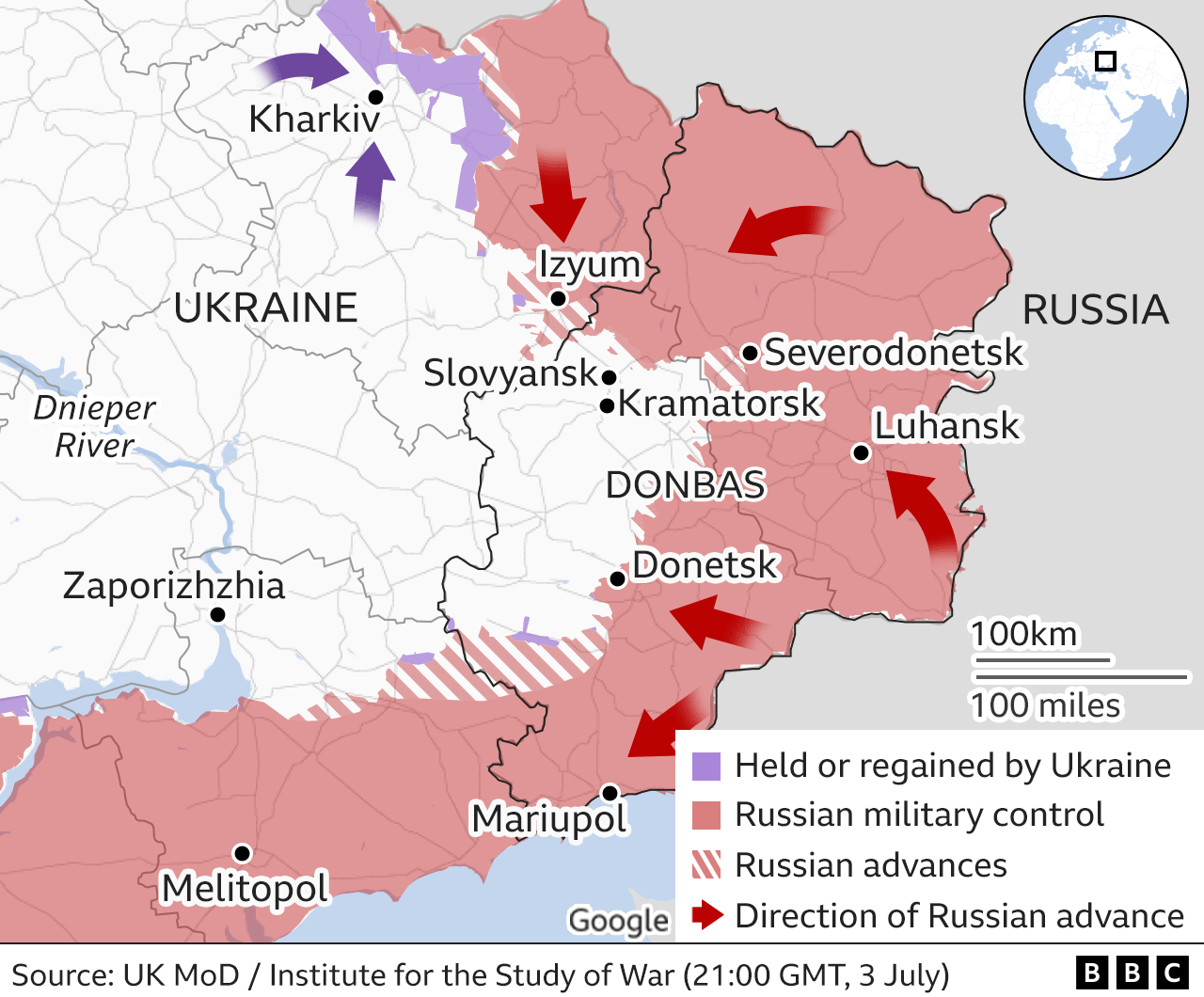
    Map of eastern Ukraine, showing Russian areas of control, updated 4 Jul
    line

    In other developments:

    • In Russian-occupied southern Ukraine grain is being sent for export to the Middle East from the Zaporizhzhia region, Russian media report. Yevgeny Balitsky, a Moscow-appointed official, told Tass news agency that agreements had been reached with buyers in Iraq, Iran and Saudi Arabia. He said a deal with Iran involved supplying 150,000 tonnes of Ukrainian grain
    • Turkish presidential adviser Ilnur Cevik told the BBC that Ankara may sell the grain carried in a Russian ship it detained over the weekend, and hand the proceeds to Kyiv, if proven to be Ukrainian. The Zhibek Zholy is carrying 7,000 tonnes of grain and had left Berdyansk, a Ukrainian port seized by Russia.
    • The foreign ministers of Finland and Sweden launched the process for their countries to join Nato at a ceremony in Brussels. But the parliaments of all 30 Nato members first have to ratify their accession, and Turkey is demanding the handover of more than 70 opposition exiles living in the Nordic countries. They are on a Turkish list of suspects with alleged “terrorist” links.
    • The Russian parliament’s lower house, the Duma, has backed a draft law allowing for “special measures” in industry to support the Russian military in Ukraine. The state would be able to enforce longer working hours and impose contracts on certain enterprises linked to what Russia calls its “special military operation” in Ukraine.
    Central market fire, Slovyansk, 5 Jul 22
    IMAGE SOURCE,AFP Image caption, The central market fire in Slovyansk on Tuesday
    Source: BBC
  • Ukraine war: Russian missile strikes kill 21 in Odesa region – emergency service

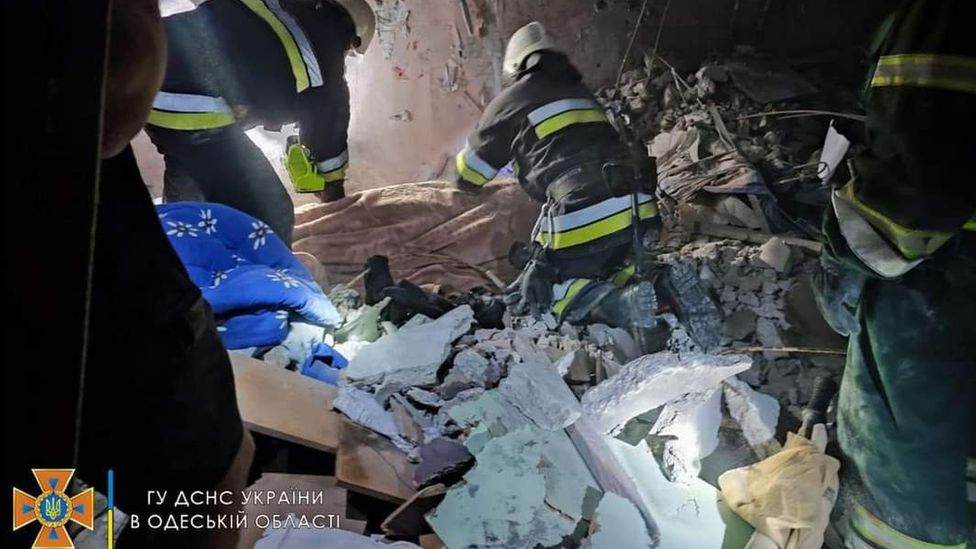
    At least 21 people, including one child, have died in overnight Russian missile strikes on Ukraine’s southern Odesa region, Ukrainian officials say.

    The state emergency service, DSNS, says 16 people were killed in a nine-storey building hit by one missile in the village of Serhiyivka.

    Another five people, including the child, were killed in a separate strike on a holiday resort in the village.

    Russia has fired dozens of missiles on Ukrainian cities in the past few days.

    On Friday Kremlin spokesman Dmitry Peskov again denied that Russia was hitting civilian targets.

    “We heard three explosions and now there is nothing left of the recreation centre,” local resident Yulia Bondar, 60, told the BBC.

    “The village is very quiet, we never thought this could happen.”

    Rescuers comb through the rubble in Serhiyivka, Odesa region, on 1 July 2022
    IMAGE SOURCE,UKRAINE’S DSNS EMERGENCY SERVICE Image caption, Ukrainian rescuers were searching for more survivors at the bombed site

    The DSNS said the missiles hit Serhiyivka at about 01:00 on Friday (22:00 GMT Thursday).

    It released footage showing firefighters searching for survivors in the wreckage of the nine-storey building.

    They were also seen carrying what looked like the body of one of the victims in a bag.

    The DSNS says 38 people, including six children, were injured in the Russian strikes.

    Maryna Martynenko, a DSNS spokeswoman in the Odesa region, told Ukrainian TV that the building’s external wall was damaged, and a nearby shop was set ablaze after the strike. Firefighters later put out the fire.

    She said 60 rescuers were currently working at the site.

    As many as 150 people are believed to have lived in the building.

    The child killed at the holiday resort was a 12-year-old boy, said Kyrylo Tymoshenko, deputy head of President Volodymyr Zelensky’s office.

    Ukrainian officials said three missiles were launched from Russian warplanes over the Black Sea.

    Odesa regional administration spokesman Serhiy Bratchuk said Soviet-era X-22 missiles were believed to have been used.

    The city’s mayor, Gennadiy Trukhanov, told the BBC World Service’s Newshour there were no military installations or radar stations near Serhiyivka, despite the Russian defence ministry insisting there were.

    The people of Odesa were “living their lives in fear” of further Russian attacks, he added.

    Andriy Yermak, Ukrainian President Volodymyr Zelensky’s chief of staff, accused Russia of being a “terrorist country”.

    “In response to defeats on the battlefields, they [Russians] are waging a war on civilians,” he said.

    Source: BBC

  • Russia in historic foreign debt default, reports suggest

    Russia has defaulted on its overseas debt for the first time in more than a century after missing a Sunday deadline, reports suggest.

    Russia has the money to make a $100m (£81.4m) payment and is willing to pay, but sanctions made it impossible to get the sum to international creditors.

    The Kremlin had been determined to avoid the default, which is a major blow to the nation’s prestige.

    The Russian finance minister branded the situation “a farce”.

    The $100m interest payment was due on 27 May. Russia says the money was sent to Euroclear, a bank which would then distribute the payment to investors.

    But that payment has been stuck there, according to Bloomberg News, and creditors have not received it.

    Meanwhile, some Taiwanese holders of Russian bonds denominated in euros have not received interest payments, according to the Reuters news agency, which cited two sources.

    The money had not arrived within 30 days of the due date, that is, Sunday evening, and so is considered a default.

    Euroclear would not say if the payment had been blocked, but said it adhered to all sanctions, introduced following Russia’s invasion of Ukraine.

    Although default is a symbolic blow, it will have few immediate practical consequences for Russia.

    Defaulting nations usually find it impossible to borrow any more money, but Russia is already in effect barred from borrowing in Western markets by sanctions.

    In any case, it is reportedly earning about $1bn a day from fossil fuel exports, and Russian Finance Minister Anton Siluanov said in April the country had no plans to borrow more.

    ‘Legacy’ problem

    The default will trigger repayments on a large chunk of Russia’s debt, according to Chris Weafer, former chief strategist at Russia largest bank Sberbank-CIB and chief executive at Moscow-based consultancy Macro Advisory.

    “Some parts of that debt will now become automatically due because there will be early repayment clauses in all debt instruments so if you default on one it usually triggers the immediate demand for payment on the other debts, so Russia could certainly face immediate debt repayment of about $20bn at this stage,” he told the BBC’s Today programme.

    The last time Russia defaulted on its foreign debt was in 1918, during the Bolshevik Revolution when the new communist leader Vladimir Lenin refused to pay the debts of the Russian Empire.

    Russia’s last debt default of any kind was in 1998 as the country was rocked by the rouble crisis during the chaotic end of Boris Yeltsin’s regime. At the time Moscow failed to keep up payments on its domestic bonds but managed not to default on its overseas debt.

    Russia has seemed on an inevitable path to default since sanctions were first imposed by the US and European Union following the invasion of Ukraine.

    These restricted the country’s access to the international banking networks which would process payments from Russia to investors around the world.

    Mr Weafer said that while the default would have no short or medium-term impact on Russia, because it is reaping revenue from selling high-priced commodities such as oil, it would create a “legacy” problem if the situation with Ukraine and the resultant sanctions improves.

    “This is the sort of action that will hang over the economy and make recovery much more difficult when we get to that stage,” he said.

    Takahide Kiuchi, executive economist at the Nomura Research Institute, told the BBC he did not expect a default to have a major impact on the global markets because investors had been expecting it.

    However, he believes the combination of a foreign debt default and international sanctions will have a severe effect on Russia’s economy.

    “In the short-term the Russian economy is expected to go into recession, contracting by around 10% this year,” Mr Kiuchi said.

    “Looking further forward, the country will struggle to grow its economy as it may not be able to borrow money from overseas for decades, possibly up to 30 years.”

    The Russian government has said it wants to make all of its payments on time, and up until now it had succeeded.

    About $40bn of Russia’s debts are denominated in dollars or euros, with around half held outside the country.

    Default seemed inevitable when the US Treasury decided not to renew the special exemption in sanctions rules allowing investors to receive interest payments from Russia, which expired on 25 May.

    The Kremlin now appears to have accepted this inevitability too, decreeing on 23 June stating that all future debt payments would be made in roubles through a Russian bank, the National Settlements Depository, even when contracts state they should be in dollars or other international currencies.

    Mr Siluanov admitted foreign investors would “not be able to receive” the payments, according to the RIA Novosti news agency.

    Because Russia wants to pay and has plenty of money to do it, he denied that this amounts to a genuine default, which usually occur when governments refuse to pay, or their economies are so weak that they cannot find the money.

    “Everyone in the know understands that this is not a default at all,” RIA Novosti quoted him. “This whole situation looks like a farce.”

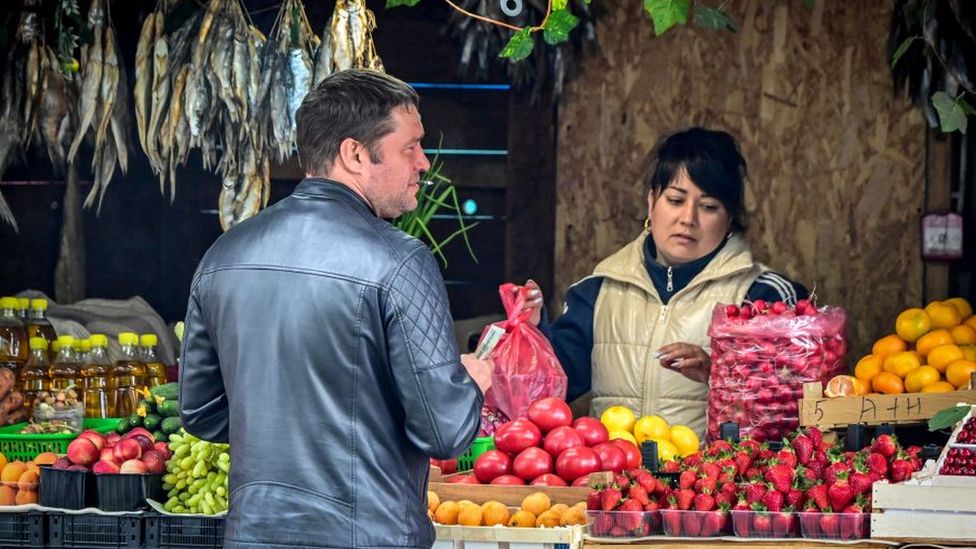
    Market trader and customer in MoscowIMAGE SOURCE,GETTY IMAGES

    Meanwhile, Mr Weafer, who is based in Moscow, said that life was more or less operating as normal despite sanctions and Western companies withdrawing from Russia.

    “If you’re in Moscow right now frankly, if you weren’t reading the newspapers, you’d see there’s been a price increase but otherwise life is as it was before February 24.

    “In March and April there was a lot of concern that products would disappear, that factories would not be able to get components or materials to continue operating and we could be looking therefore at a severe drop in employment or a rise in unemployment by the summer [or] early autumn. That situation has improved,” he added.

    “We’ve seen alternative import routes opening via Kazakhstan and Turkey, the government has promoted what they call a parallel import scheme so effectively a lot of products that were blocked in March and April are now starting to reappear, albeit at a higher price.”

    Source: BBC

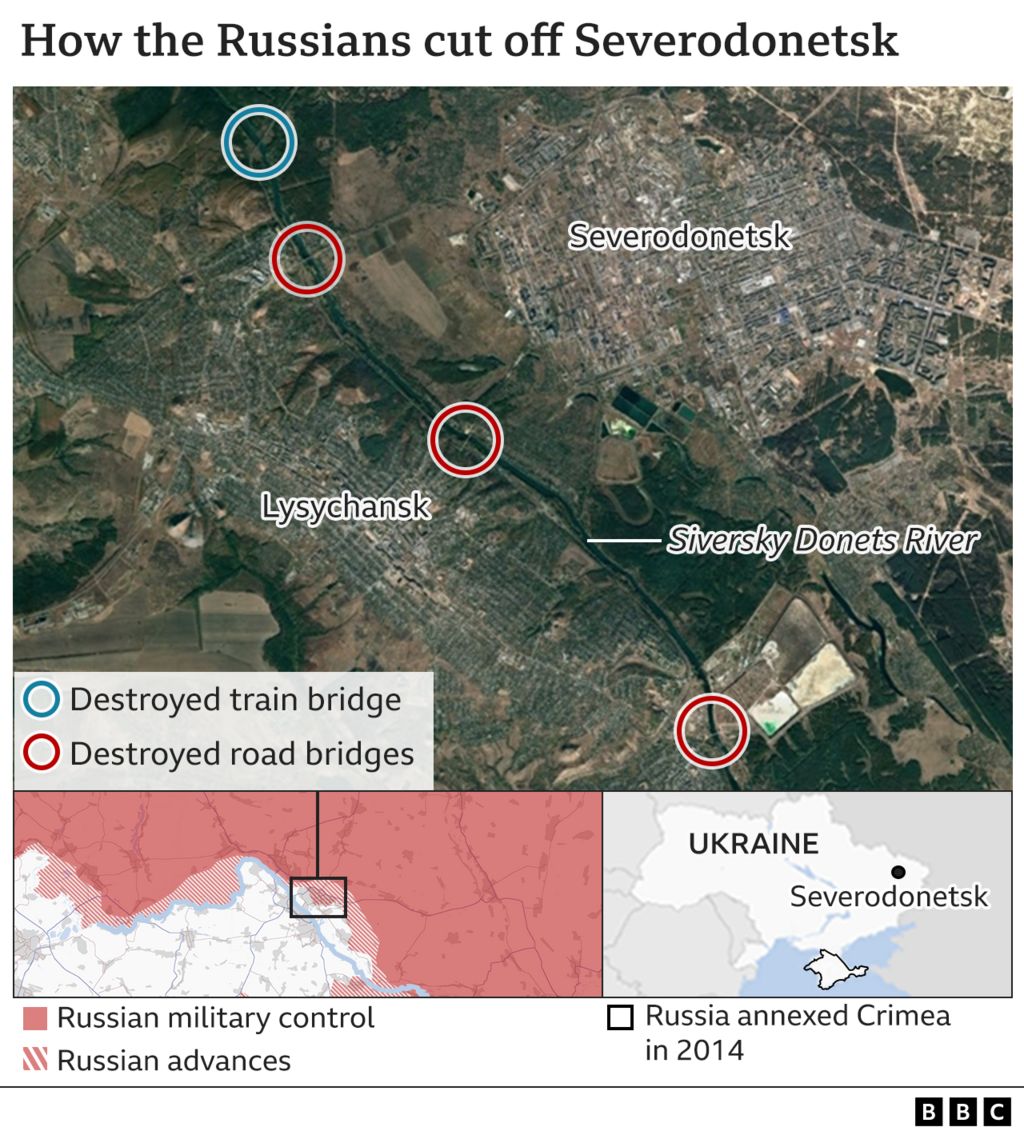
  • Severodonetsk: Ukrainian forces told to retreat from key eastern city

    Ukrainian forces in Severodonetsk have been told to withdraw, according to the top regional official.

    The city is the focus of Russia’s invasion as Moscow tries to take control of large parts of east Ukraine.

    “Remaining in positions that have been relentlessly shelled for months just doesn’t make sense,” Luhansk regional governor Serhiy Haidai said.

    Russian forces have made advances in recent days and have nearly encircled the city, and its twin city Lysychansk.

    “They have received orders to retreat to new positions… and from there continue their operations,” Mr Haidai told Ukrainian television.

    “There is no point in staying in positions which have been destroyed over several months just for the sake of staying,” he said.

    The city’s entire infrastructure has been completely destroyed, Mr Haidai added, with over 90% of houses shelled and 80% of them critically damaged.

    Russia’s invasion of Ukraine, which began in February, has been focused on Severodonetsk and its twin city Lysychansk for several weeks.

    They are the last remaining Ukrainian positions in the Luhansk region, one of two regions which make up the eastern Donbas.

    Russia’s President Vladimir Putin has falsely claimed that Russian speakers in the Donbas have been the victims of genocide – one of the key justifications he uses for invading Ukraine.

    On Thursday, Russian forces took control of more territory to the south of Severodonetsk and Lysychansk, raising fears that Ukrainian forces will soon be encircled there.

    Source: BBC

  • Ukraine war: Russia aiming to ‘destroy’ Donbas, Zelensky says

    A key advisor to Ukraine’s president has said the battle for the eastern cities of Severodonetsk and Lysychansk has reached a “fearsome climax”.

    Oleksiy Arestovych said Russian forces could soon encircle the twin cities and cut them off from Ukrainian territory.

    “The threat of a tactical Russian victory is there, but they haven’t done it yet,” he said.

    It comes as President Volodymyr Zelensky accused Moscow of trying to “destroy” the Donbas region.

    “There were massive air and artillery strikes in Donbas. The occupier’s goal here is unchanged, they want to destroy the entire Donbas step-by-step,” Mr Zelensky said in his nightly video address.

    He also repeated his calls for Western leaders to speed up the delivery of heavy artillery to his troops.

    “We again and again emphasize the acceleration of arms deliveries to Ukraine. What is quickly needed is parity on the battlefield in order to halt this diabolical armada and push it beyond Ukraine’s borders.” he said.

    A Ukrainian soldier
    IMAGE SOURCE,REUTERS Image caption, Ukrainian troops have been trying to hold the twin cities against a relentless Russian assault

    Russia has directed much of its attention to Severodonetsk and Lysychansk, which are the final Ukrainian outposts in the Luhansk region, and in recent days Moscow’s forces appear to be making some progress in their attempt to encircle Ukrainian troops there.

    Regional Governor Serhiy Haidai said on Thursday that two key settlements to the south of the cities had been captured and suggested that troops in the town of Zolote, which has been on the front line of fighting since 2014, may be forced to retreat.

    In its daily update, the UK’s ministry of defence said that Russian forces have advanced over 5km (3 miles) towards the southern perimeter of Lysychansk this week.

    “Some Ukrainian units have withdrawn, probably to avoid being encircled. Russia’s improved performance in this sector is likely a result of recent unit reinforcement and heavy concentration of fire,” UK officials said.

    On Wednesday, Mr Haidai said Russian shelling has “significantly destroyed infrastructure and housing” in Lysychansk.

    He added that Severodonetsk is also shelled “every day”, despite Moscow’s forces having seized much of the city. Hundreds of civilians remain trapped there, with many of them seeking shelter in the sprawling Azot chemical plant.

    A map of the Donbas

    But Mr Arestovych said fighting in both cities had slowed significantly after Ukraine inflicted heavy losses on Russian forces, which he claimed are now made up of significant numbers of conscripted troops. The BBC cannot verify this claim and Russia denies using conscripts in the war.

    “It’s like two boxers grappling with each other in the 18th round of a bout and barely able to move things forward. This operation started on 14 April and has been going on for nearly 80 days,” he said.

    Elsewhere, Russia resumed its shelling of Ukraine’s second city of Kharkiv on Wednesday morning.

    Many civilians had started to return to the city after Russian forces were pushed back across the border, but fears have grown that Moscow could be planning a fresh assault in the region.

    Meanwhile, Russia accused Ukraine of using drones to attack an oil refinery in the Rostov region, close to the Ukrainian border.

    “As a result of terrorist actions from the western border of the Rostov region, two unmanned aerial vehicles struck at the technological facilities of Novoshakhtinsk,” representatives of the plant said in a statement.

    Social media footage appeared to show the unmanned vehicles smashing into the refinery in a rare direct assault on Russian territory. Officials in Kyiv have yet to comment on the attack.

    And near the occupied city of Kherson, the pro-Russian administration accused “Ukrainian saboteurs” of attempting to carry out the “failed assassination” of the Moscow appointed head of a town.

    The Russian state news agency Tass claimed the head of Chernobaevka, Yuri Turulev, was injured in an attempted car bombing by Ukrainian partisan forces.

    It is difficult to determine the extent of the pro-Kyiv insurgency in Kherson, but several attacks have been reported in the city and a dedicated government department, the Centre for National Resistance, has been set up to coordinate partisan activity.

    The intense fighting comes as EU leaders are expected to approve Ukraine’s application for candidate status of the bloc.

    Source: BBC

  • Ukraine war: Russia becomes China’s biggest oil supplier

    Russia has become China’s biggest supplier of oil as the country sold discounted crude to Beijing amid sanctions over the Ukraine war.

    Imports of Russian oil rose by 55% from a year earlier to a record level in May, displacing Saudi Arabia as China’s biggest provider.

    China has ramped up purchases of Russian oil despite demand dampened by Covid curbs and a slowing economy.

    In February, China and Russia declared their friendship had “no limits”.

    And Chinese companies, including state refining giant Sinopec and state-run Zhenhua Oil, have increased their purchases of Russian crude in recent months after being offered heavy discounts as buyers in Europe and the US shunned Russian energy in line with sanctions over its war on Ukraine.

    The imports into China, which include supplies pumped through the East Siberia Pacific Ocean pipeline and shipments by sea, totalled nearly 8.42m tonnes last month, according to data from the Chinese General Administration of Customs.

    That pushed Saudi Arabia – formerly China’s biggest source of crude oil – into second place with 7.82m tonnes.

    In March, the US and UK said they would ban Russian oil, while the European Union has been working towards ending its reliance on Russian gas, as the West steps up the economic response to the invasion of Ukraine.

    At the time, US President Joe Biden said the move targeted “the main artery of Russia’s economy”.

    Energy exports are a vital source of revenue for Russia but the move is also likely to impact Western consumers.

    Last week, a report by the Centre for Research on Energy and Clean Air think tank said Russia earned almost $100bn (£82bn) in revenue from fossil fuel exports in the first 100 days of the country’s invasion of Ukraine, despite a fall in exports in May.

    The European Union made up 61% of these imports, worth approximately $59bn.

    Overall, exports of Russian oil and gas are falling and Moscow’s revenue from energy sales has also declined from a peak of well over $1bn a day in March.

    But revenues still exceeded the cost of the Ukraine war during the first 100 days – with the CREA estimating that Russia is spending around $876m per day on the invasion.

    Monday’s figures also showed that China imported 260,000 tonnes of Iranian crude oil last month, its third shipment of Iran oil since last December.

    China has continued to buy Iranian oil despite US sanctions on Tehran.

    Source: BBC

  • Ukraine war could last for years, warns Nato chief

    The West must prepare to continue supporting Ukraine in a war lasting for years, Nato’s chief has warned.

    Secretary-General Jens Stoltenberg said the costs of war were high, but the price of letting Moscow achieve its military goals was even greater.

    His comments came as UK Prime Minister Boris Johnson also warned of the need to brace for a longer-term conflict.

    Both Mr Stoltenberg and Mr Johnson said sending more weapons would make a victory for Ukraine more likely.

    “We must prepare for the fact that it could take years. We must not let up in supporting Ukraine,” the Nato chief said in an interview with German newspaper Bild.

    “Even if the costs are high, not only for military support, also because of rising energy and food prices.”

    The Western military alliance chief said that supplying Ukraine with more modern weapons would increase its chances of being able to liberate the country’s eastern Donbas region, much of which is currently under Russian control.

    For the last few months Russian and Ukrainian forces have battled for control of territory in the country’s east – with Moscow making slow advances in recent weeks.

    Writing in the Sunday Times, British Prime Minister Boris Johnson accused Russia’s Vladimir Putin of resorting to a “campaign of attrition” and “trying to grind down Ukraine by sheer brutality.”

    “I’m afraid we need to steel ourselves for a long war,” he wrote. “Time is the vital factor. Everything will depend on whether Ukraine can strengthen its ability to defend its soil faster than Russia can renew its capacity to attack.”

    The prime minister, who visited Ukraine’s capital on Friday, said supplies of weapons, equipment, ammunition, and training to Kyiv needed to outpace Moscow’s efforts to rearm itself.

    Ukrainian officials have spoken bluntly in recent days about the need to boost the supply of heavy weapons to the country if Russian forces there are to be defeated.

    On Wednesday the country’s Defence Minister, Oleksiy Resnikov, met some 50 countries in the Ukraine Defence Contact Group in Brussels to ask for more arms and ammunition.

    The country’s Western allies have so far offered it major weapons supplies but Ukraine says it has only received a fraction of what it needs to defend itself and is asking for heavier arms.

    Russian officials often criticise Nato military support for Ukraine and in an interview last week with the BBC the country’s Foreign Minister, Sergei Lavrov, cited the prospect of Ukraine joining the Western alliance as a reason for the invasion in the first place.

    “We declared a special military operation because we had absolutely no other way of explaining to the West that dragging Ukraine into Nato was a criminal act,” Mr Lavrov told the BBC.

    Ukraine is not a member of Nato and although it has expressed a wish to join there is no timeframe for this.

    Source: BBC

  • Ukraine war: Thousands of civilians trapped in Severodonetsk

    Thousands of civilians are trapped in the Ukrainian city of Severodonetsk with essential supplies running out, the United Nations is warning.

    Many of them are sheltering in bunkers beneath the city’s Azot chemical plant.

    The last bridge leading out of the city was destroyed in fighting earlier this week – effectively trapping its 12,000 remaining residents inside.

    For weeks capturing Severodonetsk has been a top military goal for Russia, which now controls most of the city.

    “The lack of water and sanitation is a big worry. It’s a huge concern for us because people cannot survive for long without water,” spokesperson for the UN’s Humanitarian Affairs office Saviano Abreu told the BBC.

    Mr Abreu added that food supplies and health provisions were also running out in Severodonetsk, which is in Ukraine’s eastern Luhansk region.

    The UN is hoping to provide aid to those trapped in the city, but continued fighting means its agencies cannot get access or assurances to safely reach the civilians still there, including women, children and the elderly.

    The warning followed Russian promises to open a humanitarian corridor earlier on Wednesday to evacuate civilians trapped beneath the Azot plant.

    But so far there has been no confirmation that the planned safe route – which would have evacuated civilians into Russian-controlled territory to the city’s north – had actually gone ahead.

    On Wednesday a pro-Russian separatist official accused Ukrainian forces of “completely thwarting” the evacuation of civilians trapped in the chemical plant.

    “At Azot, militants are trying to disrupt the evacuation! From the territory of the plant, the militants have begun firing from a mortar and a tank,” Rodion Miroshnik, the “ambassador” to Moscow of the self-proclaimed Luhansk People’s Republic, said on Telegram.

    The BBC has not been able to verify this claim.

    Russian media outlets also blamed Ukrainian forces for the fact that civilians were trapped alongside its fighters in the plant – accusing them of using local residents as “human shields”.

    Gazprom-owned NTV suggested there may be as many as 1,200 people, including children, trapped underneath the plant.

    While civilians took shelter below the Azot complex, Russian and Ukrainian forces battled for control of the city above ground.

    Capturing Severodonetsk would give Moscow command over almost all the Luhansk region, much of which is controlled by Russian-backed separatists.

    In an update posted on Telegram the city’s mayor said that Ukraine was still in control of Severodonetsk’s eastern district.

    “Efforts are being made to push the enemy back towards the city centre. It’s a permanent situation with partial success and tactical retreat in places,” Oleksandr Stryuk said.

    Source: BBC

  • Biden announces new $1 bln in weapons for Ukraine

    President Joe Biden on Wednesday announced a fresh infusion of $1 billion in weapons for Ukraine that includes anti-ship rocket systems, artillery rockets, howitzers and ammunition.

    In a phone call with Ukraine President Volodymyr Zelenskiy, Biden said he told the embattled leader about the new weaponry.

    “I informed President Zelenskiy that the United States is providing another $1 billion in security assistance for Ukraine, including additional artillery and coastal defense weapons, as well as ammunition for the artillery and advanced rocket systems,” Biden said in a statement after the 41-minute call.

    The president also announced an additional $225 million in humanitarian assistance to help people in Ukraine, including by supplying safe drinking water, critical medical supplies and healthcare, food, shelter, and cash for families to purchase essential items.

    The latest weapons packages for Ukraine include 18 howitzers, 36,000 rounds of ammunition for them, two Harpoon coastal defense systems, artillery rockets, secure radios, thousands of night vision devices and funding for training, the Pentagon said.

    The aid packages, which come as U.S. Defense Secretary Lloyd Austin is meeting with allies in Brussels, were split into two categories: transfer of excess defense articles from U.S. stocks and other weapons being funded by the Ukraine Security Assistance Initiative (USAI), a separate congressionally authorized program.

    Russia’s U.N. Ambassador Vassily Nebenzia on Wednesday accused Western countries of “fighting a proxy war with Russia,” telling reporters: “I would like to say to the Western countries supplying weaponry to Ukraine the blood of civilians is on your hands.”

    Ukraine is pressing the United States and other Western nations for speedy deliveries of weapons in the face of increased pressure from Russian forces in the eastern Donbass region.

    Oleksandra Ustinova, a member of the Ukrainian Parliament, told reporters at an event organized by the German Marshall Fund: “We need all these weapons to be concentrated in a moment to defeat the Russians, not just keep coming every two or three weeks.”

    In May, the Biden administration announced a plan to give Ukraine M142 High Mobility Artillery Rocket Systems after receiving assurances from Kyiv that it would not use them to hit targets inside Russian territory. Biden imposed the condition to try to avoid escalating the Ukraine war.

    The rocket artillery in this aid package would have the same range as previous U.S. rocket shipments and is funded using Presidential Drawdown Authority, or PDA, in which the president can authorize the transfer of articles and services from U.S. stocks without congressional approval in response to an emergency, said a source who spoke on condition of anonymity.

    For the first time, the United States is sending ground-based Harpoon launchers. In May, Reuters reported the U.S. was working on potential solutions that included pulling a launcher off of a U.S. ship to help provide Harpoon missile launch capability to Ukraine.

    Harpoons made by Boeing Co (BA.N) cost about $1.5 million per missile, according to experts and industry executives.

    Source: www.reuters.com
  • Ukraine war: Evidence shows widespread use of cluster munitions in Kharkiv

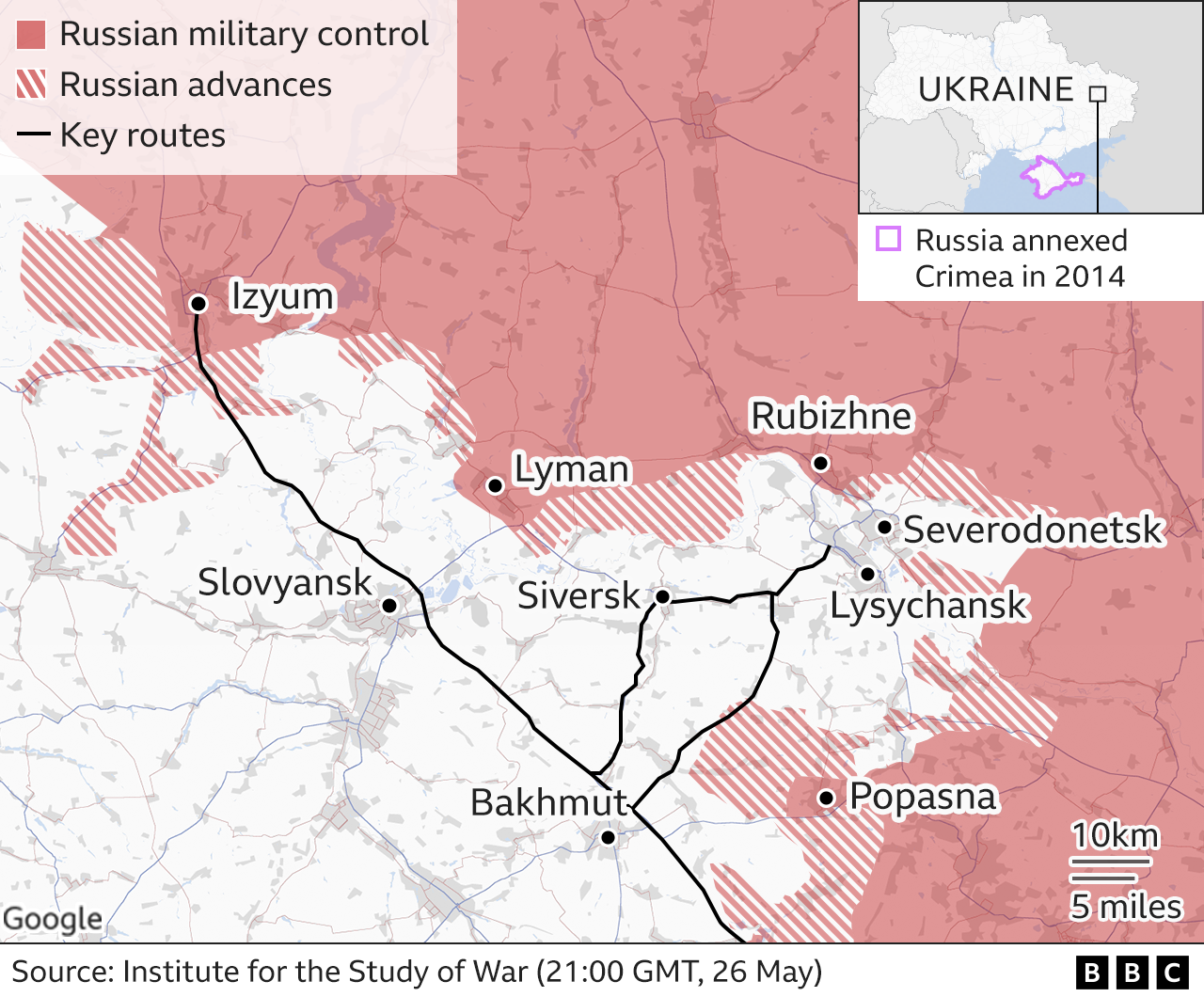
    Russia has killed hundreds of civilians in the north-eastern Ukrainian city of Kharkiv using indiscriminate shelling and widely-banned cluster munitions, according to new research by Amnesty International.

    Amnesty said it had found evidence of Russian forces repeatedly using 9N210/9N235 cluster bombs, as well as “scatterable” munitions – rockets that eject smaller mines that explode later at timed intervals.

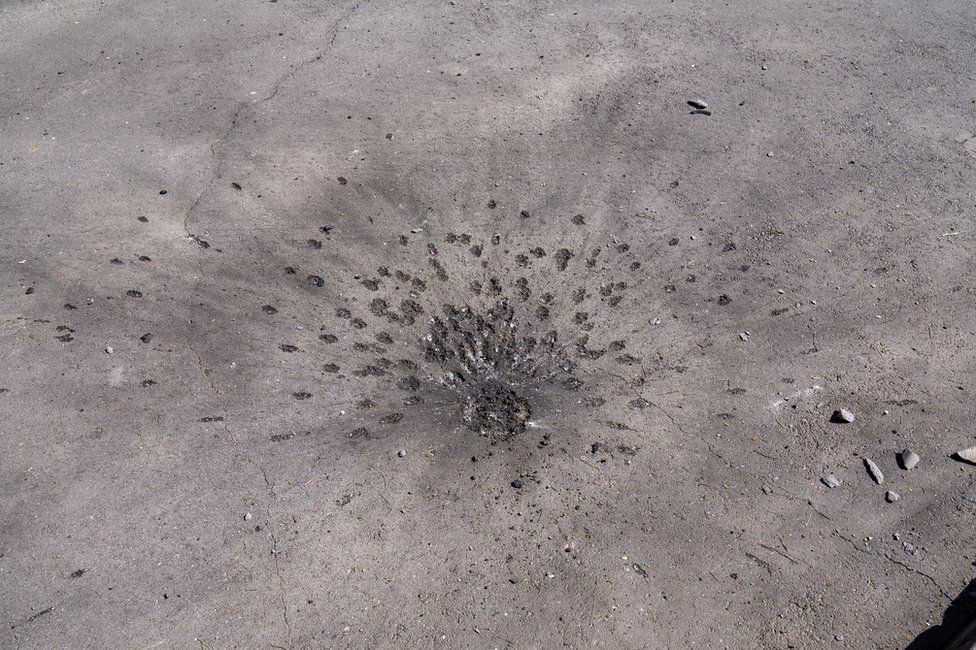
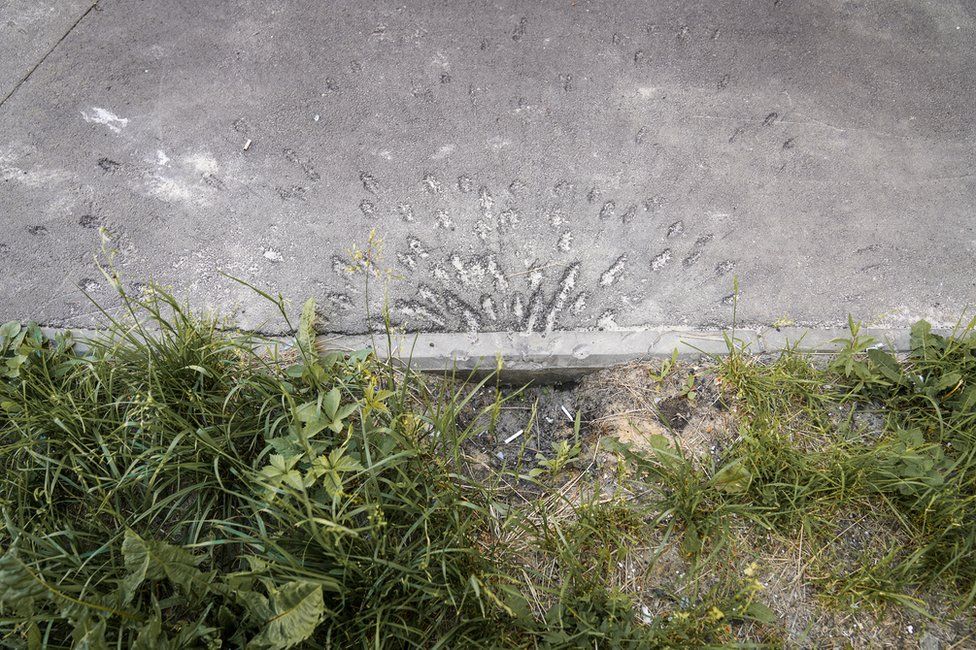
    The BBC visited five separate impact sites in residential neighbourhoods in Kharkiv and saw evidence of a distinctive, symmetrical spalling effect associated with cluster munitions. We showed images from the sites to three weapons experts, who all said the impacts were consistent with the controversial weapons.
    “Those impacts are from cluster munitions, it’s a classic signature,” said Mark Hizney, a senior researcher in the arms division of Human Rights Watch, a campaign group.

    “And in one image you can see a remnant of a stabiliser fin from one of the submunitions,” he said.

    CCTV footage passed to the BBC by a resident at one of the sites showed successive clustered detonations – “a very strong indicator of submunitions from a cluster weapon,” said Hamish de Bretton Gordon, a former British Army colonel and Cambridge University weapons expert.

    An apparent submunition impact from a cluster bomb in a Kharkiv residential neighbourhood
    Image caption, The spalling pattern created by cluster bomb impacts, seen in a Kharkiv residential neighbourhood (Joel Gunter/BBC)

    Cluster munitions are controversial because they detonate in the air and release a cluster of smaller bombs which fall indiscriminately over a wide area, potentially putting civilians at risk.

    The smaller bombs also often fail to detonate on impact, posing a threat for years to come. More than 120 countries have signed a treaty prohibiting the use of the weapons – though neither Russia or Ukraine are signatories.

    At the site of one apparent cluster munition strike in Kharkiv, around a housing estate and playground in the Industrialnyi neighbourhood, the spalling effect was visible around three separate impacts on three sides of a playground.

    Ivan Litvynyenko’s wife Oksana was badly wounded in the strike and later died.

    Litvynyenko, 40, told the BBC the couple was walking through the playground with their five-year-old daughter when the munitions hit. Their 14-year-old son was inside their apartment.

    “Suddenly I saw a flash and I heard the first explosion,” Litvynyenko said. “I grabbed my daughter and pressed her to a tree. My wife was about five metres away and she just dropped.”

    An impact site next to where Ivan Litvynyenko's wife was hit by shrapnel. (Joel Gunter/BBC)
    Image caption, An impact site next to a playground where Ivan Litvynyenko’s wife was hit by shrapnel. (Joel Gunter/BBC)

    Oksana, 41, was hit by shrapnel that penetrated her back, chest and abdomen, puncturing her lungs and damaging her spine.

    She was in intensive care for two months, until Sunday, when she died from complications from her injuries and diabetes, Litvynyenko said.

    “Doctors operated on her several times but her body could not survive it,” he said, speaking just hours after her death.

    Describing the strike, Litvynyenko said he saw a “series of explosions, lots of bombs one after another”.

    Two other residents who were inside their apartments at the time of the strike told the BBC they heard successive detonations when the attack happened. “You could hear explosions over several minutes,” said Danya Volynets, 26.

    “When we came outside I could see the burning cars. It looked like everything was on fire.”

    Tetiana Ahayeva, a 53-year-old nurse, was standing in front of her building when the munitions hit. “There was a sudden sound of firecrackers everywhere, lots of them, all over,” she told Amnesty.

    “We dropped to the ground and tried to find cover. Our neighbour’s son, a 16-year-old boy called Artem Shevchenko, was killed on the spot. He had a hole 1cm wide in his chest. His father had a shattered hip and a shrapnel wound in his leg.”

    Oksana Litvynyenko with her daughter. Oksana was badly wounded in April and died on Sunday. (Family handout)
    Image caption, Oksana Litvynyenko with her daughter. Oksana was badly wounded in April and died on Sunday. (Family handout)

    Doctors at a central Kharkiv hospital said that among the victims brought in after the playground strike they saw penetrating wounds to the abdomen, chest and back, and they collected metal fragments which matched the types of pellets found in 9N210/9N235 cluster munitions.

    According to Amnesty, the strike on the Industrialnyi neighbourhood killed at least nine civilians and wounded 35, detonating over an area of 700 square metres.

    At another residential building, in Kharkiv’s Haribaldi Street area, a munition landed in the entranceway to the building, killing two elderly women and gravely wounding another. The tell-tale spalling effect could be seen around the doorway and on the path nearby.

    “There was a series of explosions one after another,” said resident Nadia Kravchuk, 61. “I came out and saw a woman lying here face down and another other woman lying here, and next to them was Lena, who lost both her legs. She was crying out, ‘I have lost my leg.’”

    Tetiana Bielova and Olena Sorokina were sitting on a bench outside when a munition detonated nearby.
    They got up to enter the building but a second munition landed right in the entranceway, killing Bielova and another woman called Tetiana who was with them. Sorokina lost both her legs in the blast.
    Nadia Kravchuk looks down at damage from a munition that killed two of neighbours (Joel Gunter/BBC)
    Image caption, Nadia Kravchuk looks down at damage from a munition that killed two of her neighbours (Joel Gunter/BBC)

    In total, over two weeks’ field research, Amnesty investigated 41 strikes in Kharkiv in which at least 62 civilians were killed and 196 wounded, the charity said. They found evidence of cluster munitions and unguided rockets killing people who were shopping, queuing for food aid, or simply walking down the street.

    “These weapons should never be used,” Donatella Rovera, Amnesty’s senior crisis response adviser, told the BBC. “They cannot be pinpointed. They are area weapons. And they have a devastating effect and cause a lot of civilian death and injury.”

    Use of the weapons was “tantamount to deliberately targeting civilians,” Rovera said. “Russia cannot claim it does not know the effect of these types of weapons,” she said. “And the decision to use them shows absolute disregard for civilian life.”

    Russia has previously denied using cluster munitions in Ukraine and insisted that Russian forces have only struck military targets.

    Source: BBC

  • New details about US weapons sent to Ukraine

    New details have been released of the total amount of US weapons and equipment sent to Ukraine since the conflict started on 24 February.

    More than $4bn-worth of military hardware has been given to Ukraine and much of it now is in the country. The US is by far the biggest contributor.

    Donated weapons include:

    • 6,500 Javelin anti-tank missiles
    • 20,000 light anti-armour weapon
    • 1,400 Stinger surface to air missiles
    • 108 M777 howitzers with 220,000 shells
    • 4 HIMARS multiple launch rocket systems
    • 121 Phoenix Ghost and 700 Switchblade attack drones
    • 200 armoured anti-personnel carriers
    • Several hundred Humvee vehicles
    • 20 Soviet made Mig-17 helos
    • 7,200 firearms with 50m rounds
    • 3 AN/TPQ-36 counter battery radars

    Equipment mostly ends up in Donbas in the east, where the focus of the fighting is taking place.

    Kyiv has repeatedly asked for more weapons to fight off attacks by Moscow, attacks which are being better supplied given their close proximity to Russia’s border.

    Source: BBC

  • Ukraine war: EU blames Russia for food crisis prompting walkout

    Russia’s UN ambassador has stormed out of a UN Security Council meeting after the European Council president blamed Russia’s invasion of Ukraine for causing a global food crisis.

    Charles Michel said Russia was using food supplies as a “stealth missile” against the developing world, forcing people into poverty.

    The Russian envoy Vassily Nebenzia accused Mr Michel of spreading lies.

    The war has left food stuck at Ukrainian ports.

    Ukraine is a large exporter of cooking oil as well as cereals such as maize and wheat. Russia also exports vast amounts of grains as well as fertiliser. The lack of these exports has caused the price of alternatives to soar.

    “Mr Ambassador of the Russian Federation, let’s be honest, the Kremlin is using food supplies as a stealth missile against developing countries,” Mr Michel said during the Security Council meeting in New York.

    “The dramatic consequences of Russia’s war are spilling over across the globe, and this is driving up food prices, pushing people into poverty, and destabilising entire regions.

    “Russia is solely responsible for this food crisis.”

    He added that he had seen for himself the millions of tons of grain stuck in the Ukrainian port of Odesa because of a naval blockade enforced by Russia.

    Mr Michel also accused Russia of stealing grain and preventing crop planting and harvesting in Ukraine because of its military activities there.

    His comments led to Mr Nebenzia storming out. As he left, Mr Michel addressed him directly: “You may leave the room, maybe it’s easier not to listen to the truth”.

    Mr Nebenzia told Reuters he couldn’t stay because of “the lies that Charles Michel came here to distribute”.

    In a separate meeting, US Secretary of State Antony Blinken also said Russia was preventing Ukrainian grain exports from leaving the country and accused Russian forces of destroying Ukrainian agricultural infrastructure.

    Speaking during a virtual roundtable with philanthropists, non-governmental organisations and private sector entities, Mr Blinken said: “There’s somewhere around 20 million tons of wheat that’s trapped in silos near Odesa, and in ships literally filled with grain that are stuck in the Odesa port because of this Russian blockade.”

    Like Mr Michel, he said there were credible reports that Russia was “pilfering” Ukraine’s grain to sell for its own profit.

    Source: BBC

  • Ukraine war: Another Russian general killed by Ukrainian forces – reports

    Russian state media has confirmed the death of one of Moscow’s top generals during heavy fighting in Ukraine’s eastern Donbas region.

    Maj Gen Roman Kutuzov was killed leading an assault on a Ukrainian settlement in the region, a reporter with the state-owned Rossiya 1 said.

    Alexander Sladkov said Gen Kutuzov had been commanding troops from the self-declared Donetsk People’s Republic.

    Russia’s defence ministry has not commented on the reports.

    “The general had led soldiers into attack, as if there are not enough colonels,” Mr Sladkov wrote on the Telegram social media app. “On the other hand, Roman was the same commander as everyone else, albeit a higher rank.”

    Ukraine’s military also confirmed the killing of Gen Kutuzov, without offering further details about the circumstances.

    Ukraine war: Russian soldier Vadim Shishimarin jailed for life over war crime

    His death comes as rumours circulated on social media that a second senior officer, Lt Gen Roman Berdnikov, commander of the 29th Army, was also killed in fighting over the weekend. The BBC cannot independently verify the claims.

    Russian commanders have been increasingly forced to the front in an attempt to drive forward the invasion and Moscow has confirmed the deaths of three senior generals.

    Kyiv claims to have killed 12 generals and Western intelligence officials say at least seven senior commanders have been killed.

    But there has been confusion over reports of the deaths of several other Russian officers. Three generals that Ukrainian forces claimed to have killed have subsequently been reported to be alive.

    In March, Ukrainian forces said Maj Gen Vitaly Gerasimov had been killed outside the country’s second city of Kharkiv. However, on 23 May Russian state media said he had been awarded a state honour and dismissed reports of his death.

    Another commander, Maj Gen Magomed Tushaev, also appeared to be still alive and periodically appears in videos posted to social media.

    And on 18 March, Kyiv alleged that Lt Gen Andrey Mordvichev had been killed in an airstrike in the Kherson region. However, he later appeared in a video meeting with Chechen leader Ramzan Kadyrov and on 30 May BBC Russia confirmed that he was still alive.

    The deaths of generals are rarely officially acknowledged in Russia. In the case of Maj Gen Vladimir Frolov, no information about his death had appeared in state media prior to his funeral in St Petersburg in April.

    Russia lists military deaths as state secrets even in times of peace and has not updated its official casualty figures in Ukraine since 25 March, when it said that 1,351 Russian soldiers had been killed since President Vladimir Putin launched his invasion of Ukraine on 24 February.

    In March, an official within President Volodymyr Zelensky’s inner circle told the Wall Street journal that a team of Ukrainian military intelligence officers had been tasked with locating and targeting Russia’s officer class.

    “They look for high profile generals, pilots, artillery commanders,” the official said. They added that the officers were then targeted either with sniper fire or artillery.

    Yakov Rezantsev

    Lt Gen Yakov Rezantsev was reportedly killed by a Ukrainian strike on the Chornobaivka airbase near the city of Kherson.

    He was promoted to lieutenant general last year, and was commander of the 49th combined army of Russia’s southern military district.

    He is said to have taken part in Russia’s military operation in Syria.

    Oleg Mityaev graphic

    Maj Gen Oleg Mityaev reportedly died somewhere near the city of Mariupol, a city in south-east Ukraine which was the scene of a protracted Russian siege.

    The nationalist Azov regiment claimed to have killed him.

    He was a commander of the Russian army’s 150th motorised rifle division, a relatively new unit formed in 2016, and based in the Rostov region close to the Ukrainian border.

    Ukraine claims that the unit was created in order to take part in the conflict in separatist-controlled areas of eastern Ukraine, although Russia denies that its military was involved in fighting there.

    Andrei Kolesnikov graphic

    Maj Gen Andrei Kolesnikov, of the 29th combined army, was killed in fighting on 11 March, according to official Ukrainian sources.

    The circumstances of his death were not given.

    After Kolesnikov became the third Russian general reportedly killed in Ukraine, one western official told the Press Association that the Russian army may be suffering from low morale, which is why high-ranking military officers are moving closer to the front line.

    Andrey Sukhovetsky

    Maj Gen Andrey Sukhovetsky, a deputy commander at the same unit as Gerasimov, was reportedly killed by a sniper on 3 March.

    Like Gerasimov, Sukhovetsky was part of Russia’s military operations in Crimea and in Syria.

    Unlike the other generals, Sukhovetsky’s death was reported in the Russian media and Russian President Vladimir Putin confirmed in a speech that a general had died in Ukraine.

    Source: BBC

  • Ukraine: Explosions shake Kyiv while battles rage in east

    A number of explosions shook parts of Kyiv early on Sunday in the first assault on Ukraine’s capital for weeks.

    Russia claims it targeted a site storing tanks supplied by Europe, but Ukraine says rockets hit a train repair plant where no tanks were held.

    Columns of black smoke could be seen above the city after the attack and at least one person was hurt.

    Kyiv has been largely spared in recent months as Russian forces concentrate attacks on Donbas in eastern Ukraine.

    The capital has felt like it is returning to some sort of normality; bars and cafes are open and people are back on the streets.

    But watching columns of black smoke rising over Kyiv in the early hours of Saturday morning, that illusion was shattered.

    Ukraine has no intention of attacking Russia – Zelensky

    Just a few moments before, Russian cruise missiles had slammed into two sites in the east of the city. Dramatic video on social media showed a number of explosions. The man filming cursed the Russians as he ducked for cover.

    At the site of one of the strikes, normal life continued. The factory itself was sealed off, but families nearby went about their business, and buses dropped off passengers. One man came and rather angrily demanded we stop filming.

    Moscow claimed it was targeting a delivery of tanks and armoured vehicles sent in by Ukraine’s eastern European allies. Kyiv denied this, saying it was a train repair plant dealing with “gondola cars and grain trucks”.

    A badly damaged building in KyivIMAGE SOURCE, GETTY IMAGES
    Image caption,

    The strike damaged a building in the Darnitsky district of Kyiv

    It comes as Russia’s advances into the eastern Donbas region seem to be stalling, with one Ukrainian politician saying the attack on Kyiv was revenge for Moscow’s frustrations.

    Some of the fiercest fighting is currently in the city of Severodonetsk – one of the few parts of Luhansk region not fully under Russian control. Luhansk is one of two regions which makes up the Donbas.

    Ukraine war: US to send longer-range rockets in latest aid package

    Speaking to the BBC, Luhansk regional governor Serhiy Haidai said there was street-fighting in Severodonetsk and that it was still possible for Ukrainian forces to retake it.

    “Russians understand that if there is a stable supply of ammunition to Ukrainians, they will not be able to hold the city.”

    Severodonetsk lies across the river from the city of Lysychansk, which remains under Ukrainian control. Mr Haidai said it held more strategic value.

    “Lysychansk is much more important because it is located on the hill. It is easier for the military to defend and strike,” he said.

    Map of eastern Ukraine

    Ukrainian forces are also hoping that more advanced rocket systems promised by the US will arrive soon, tipping the balance in their favour.

    But speaking on Russian television on Sunday, Russian President Vladimir Putin said that if the West carried through with its promises of sending the weapons to Ukraine, he would hit “new targets they had not attacked before”.

    It wasn’t clear what he meant by that, but it would most likely mean more nights for Kyiv like the one it has just endured.

    Source: BBC

  • Ukraine war: Hungry Africans are victims of the conflict, Macky Sall tells Vladimir Putin

    African countries are innocent victims of the war in Ukraine and Russia should help ease their suffering, the head of the African Union has told Vladimir Putin at a meeting in Russia.

    After talks in Sochi, Macky Sall said the Russian leader had promised to ease the export of cereals and fertiliser, but gave no details.

    Mr Putin denied Moscow was preventing Ukrainian ports from exporting grain.

    Over 40% of wheat consumed in Africa usually comes from Russia and Ukraine.

    But Ukraine’s ports in the Black Sea have been largely blocked for exports since the conflict began. Kyiv and its allies blame Moscow for blockading the ports, which Ukraine has mined to prevent a Russian amphibious assault.

    “Failure to open those ports will result in famine,” the UN’s crisis coordinator Amin Awad said in Geneva.

    He said a grain shortage could affect 1.4 billion people and trigger mass migration.

    The war has exacerbated already existing shortages in Africa caused by bad harvests and insecurity.

    Food prices have shot up across the continent since Russia invaded Ukraine 100 days ago, pushing huge numbers towards hunger.

    The head of the World Food Programme, Mike Dunford, said more than 80 million people were acutely food insecure, acutely hungry in Africa – up from about 50 million people this time last year.

    Chad has declared a national food emergency. A third of the population needs food aid, according to the UN and the government has appealed for international assistance.

    Mr Sall, who is Senegal’s president, told Mr Putin he should be “aware that our countries, even if they are far from the theatre [of action], are victims of this economic crisis”.

    He said he was also pleading on behalf of other countries in Asia, the Middle East and Latin America.

    Mr Putin said Russia was ready to guarantee the safe export of Ukrainian grain via ports on the Azov and Black seas it controls. He said the best solution would be to lift sanctions on Belarus, a close Russian ally, so the grain could be shipped that way.

    Some analysts argue the Kremlin is hoping that a looming food crisis will put political pressure on the West by provoking big new refugee flows towards Europe from food-insecure countries in the Middle East and Africa.

    Before Friday’s meeting, Mr Putin said he was always on the side of Africa, but didn’t explicitly mention the continent’s food crisis.

    Like many African countries, Senegal has avoided taking sides in the conflict and the Senegalese leader also said food supplies should be “outside” the West’s sanctions on Russia. He said he had made this point when he spoke to the European Council earlier in the week.

    Last Friday, US President Joe Biden dismissed the idea that the West bore responsibility for the global price rises.

    “This is a Putin price hike. Putin’s war has raised the price of food because Ukraine and Russia are two of the world’s major bread baskets for wheat and corn, the basic product for so many foods around the world,” he said.

    Source: BBC

  • Ukraine has no intention of attacking Russia – Zelensky

    Ukraine’s President Zelensky has said his country has “no intention of attacking Russia”.

    In an interview with conservative US TV channel Newsmax, the Ukrainian leader insisted the artillery would be used solely for self-defence.

    “We are not interested in the Russian Federation. We are not fighting on their territory like they do with us,” Zelensky told Newsmax’s Rob Schmitt.

    Meanwhile, US President Joe Biden has agreed to send Ukraine more advanced rocket systems.

    This is in the hope that more artillery power will level the playing field between the two sides and make a diplomatic solution to bring the war to an end more likely.

    But the US has agreed to provide the precision-guided missiles, which can reach targets as far as 70km (45 miles), only after gaining assurances that the weapons would not be used to attack targets inside Russia.

    Source: BBC

  • Ukraine war: US to send longer-range rockets in latest aid package

    The US will send Ukraine more advanced rocket systems to help it defend itself, President Biden has announced.

    The weapons, long requested by Ukraine, are to help it strike enemy forces more precisely from a longer distance.

    Until now, the US had refused the request out of fear the weapons could be used against targets in Russia.

    But on Wednesday, Mr Biden said the lethal aid would strengthen Kyiv’s negotiating position against Russia and make a diplomatic solution more likely.

    Writing in the New York Times, he said: “That is why I’ve decided that we will provide the Ukrainians with more advanced rocket systems and munitions that will enable them to more precisely strike key targets on the battlefield in Ukraine.”

    This is a fine balancing act for Mr Biden, as providing more powerful weapons could risk drawing the US and its Nato allies into direct conflict with Russia.

    New weaponry will include the M142 High Mobility Artillery Rocket System (HIMARS), a senior White House official said – although he did not specify how many of them would be supplied.

    The systems can launch multiple precision-guided missiles at targets as far as 70km (45 miles) away – far further than the artillery that Ukraine currently has. They are also believed to be more accurate than their Russian equivalents.

    Image shows HIMARS rocket system in useIMAGE SOURCE, GETTY IMAGES
    Image caption, A US-made M142 HIMARS rocket launcher takes part in military exercises last year

    Last month, Ukraine‘s army chief said that getting the HIMARS units would be “crucial” in allowing it to counter Russian missile attacks.

    The US expects Ukraine to deploy the weapons in the eastern Donbas region, where the fighting is most intense, and where they can be used to strike Russian artillery units and forces targeting Ukrainian towns.

    White House officials agreed to provide the rockets, they said, only after gaining assurances from President Volodomyr Zelensky that the weapons would not be used to attack targets inside Russia.

    “We are not going to send to Ukraine rocket systems that can strike into Russia,” Mr Biden wrote on Wednesday.

    Mr Zelensky confirmed this in an interview for US network Newsmax.

    “We’re not interested in what is happening in Russia,” he said. “We’re only interested in our own territory in Ukraine.”

    Image shows rocket firingIMAGE SOURCE, GETTY IMAGES
    Image caption,

    Pro-Russian ‘DPR’ forces fire a rocket targeting Ukrainian positions in Yasynuvata, Donetsk

    The latest rockets will be the centrepiece of a $700m (£556m) support package for Ukraine that will be formally unveiled on Wednesday, White House officials said.

    Helicopters, anti-tank weapons, tactical vehicles and spare parts are to be included in what will be the 11th package of military aid approved by the US for Ukraine since the invasion began in February.

    In Wednesday’s article, Mr Biden wrote that the US’s goal was simply to see a “democratic, independent, sovereign” Ukraine, not to oust Mr Putin from his role as Russian president or to seek broader conflict with Moscow.

    He blamed Russia’s continued aggression for the stalling of peace efforts, adding that the US would never put pressure on Ukraine to concede any of its territory in return for an end to the conflict.

    Directly addressing the risk of nuclear weapons being used in Ukraine, Mr Biden said “we currently see no indication” of this being Russia’s intention – but warned that doing so would be unacceptable and bring with it “severe consequences”.

    Soon after Mr Biden’s piece was published, Russian military officials announced that the country’s nuclear forces were holding drills in Ivanovo province near Moscow, Interfax news agency reported.

    Previously Russian Foreign Minister Sergei Lavrov has accused the West of “pumping up the Ukrainian nationalists with weapons” and said that any cargo of arms bound for Ukraine would become a legitimate target for Moscow.

    The ministry has said that Nato countries are “playing with fire” by sending weapons to Ukraine.

    Image shows map

    1px transparent lineMeanwhile in Ukraine, fighting is continuing in the eastern Donbas region.

    On Tuesday, the governor of Luhansk said that one of Ukraine’s last holdouts in the region – the eastern city of Severodonetsk – was now mostly under Moscow’s control.

    Russian forces now occupy almost all of Luhansk and are focusing on seizing neighbouring Donetsk, the two regions which collectively make up Donbas.

    Source: BBC
  • Ukraine war: Eurovision trophy sold to buy drones for Ukraine

    Kalush Orchestra, the Ukrainian band which won this year’s Eurovision Song Contest, have sold their trophy for $900,000 (£712,000; €838,000) to raise money for the war in Ukraine.

    The crystal microphone was auctioned on Facebook, with the aim of buying drones for Ukraine’s military.

    The sale coincided with the band’s appearance at a charity concert at Berlin’s Brandenburg Gate.

    It aimed to raise money for medical care and supplies.

    Speaking at the concert, band member Oleh Psiuk appealed for people not to get used to the war, which has left at least 4,031 civilians dead and 4,735 injured, according to the UN, along with an unknown number of combatants.

    It has also forced more than 14 million people to flee their homes since Russia invaded on 24 February, with towns and cities reduced to rubble.

    “I think it should be on the front pages always, until peace comes,” said Psiuk, whose Eurovision win had been hotly tipped in the run up to the contest. Their song, Stefania, was originally written in tribute to Psiuk’s mother, but emotive lyrics like “I will always walk to you by broken roads” have been re-interpreted as a rallying cry.

    Ukrainian TV presenter Serhiy Prytula announced that the money raised from the sale of the trophy would be used to purchase three Ukrainian-made PD-2 drones, Reuters news agency reports.

    Drones are used heavily by Ukrainian and Russian forces, both as weapons and reconnaissance aircraft.

    Source: BBC

  • Ukraine war: Russian Foreign Minister Lavrov denies Putin illness

    Russian Foreign Minister Sergei Lavrov has denied speculation that President Vladimir Putin is ill.

    In an interview with French TV, Mr Lavrov said the Russian leader appears in public every day, and no sane person would see any signs of an ailment.

    There has been increasing unconfirmed media speculation that Mr Putin, who turns 70 this year, may be suffering from ill health, possibly cancer.

    The interview came as Russia continues its advance in Ukraine’s Donbas region.

    Mr Lavrov said the “liberation” of the eastern region was an “unconditional priority” for Russia.

    He repeated the Kremlin’s widely discredited line that Russia is fighting a “neo-Nazi regime”.

    A Ukrainian serviceman inspects an area damaged by a Russian military strike, as Russia"s attack on Ukraine continues, in the town of Marinka, in Donetsk region, Ukraine May 28, 2022.IMAGE SOURCE, REUTERS
    Image caption, A Ukrainian soldier inspects Russian shell damage in Marinka, Donetsk region, this weekend

    Noting that President Putin regularly appeared in public, Mr Lavrov told TF1: “I don’t think that sane people can see in this person signs of some kind of illness or ailment.”

    “You can watch him on screens, read and listen to his speeches,” he said in comments released by the Russian foreign ministry.

    “I leave it to the conscience of those who spread such rumours despite daily opportunities to assess how anyone is looking.”

    British intelligence sources were quoted telling media outlets that Mr Putin was seriously ill in the last week. However, rumours about the condition of the Russian leader, long known for his healthy lifestyle and love of sport, have surfaced periodically for years.

    Asked about the human cost of the fighting, which has seen devastating artillery and rocket attacks on some urban areas, the foreign minister insisted Russian soldiers were “under strict orders categorically to avoid attacks and strikes on civilian infrastructure”.

    Since Russia invaded on 24 February, at least 4,031 civilians have been killed and 4,735 injured, according to the UN, and an unknown number of combatants have died or been wounded. More than 14 million people have fled their homes, with towns and cities reduced to rubble.

    The fighting is now focused on the Donbas – the mining belt made up of the Donetsk and Luhansk regions. Separatists in the two regions, which historically have strong ties to Russia, broke away in 2014 and are now fighting alongside Russian troops to take full control.

    Mr Lavrov told TF1 that winning in “the Donetsk and Luhansk regions, recognised by the Russian Federation as independent states, is an unconditional priority”.

    However, he added, it was up to the rest of Ukraine if people there were “happy to return to the authority of a neo-Nazi regime that has proven it is Russophobic in essence“.

    Russia has already been forced to pull back from an attempt to overrun the capital Kyiv, after been repelled by Ukrainian forces.

    They have also been pushed back from the second city, Kharkiv, in recent weeks, with Ukrainian President Volodymyr Zelensky making a morale-boosting trip to the battle scarred city on Sunday.

    Speaking in the city, he said his soldiers would defend their land “to the last man”. “They [the Russians] have no chance,” he said. “We will fight and we will definitely win.”

    Map showing area around Severodonetsk, updated 27 May

    Source: BBC

  • Ukraine war: Russia says ‘liberation’ of Donbas its key priority

    The “liberation” of eastern Ukraine’s Donbas region is an “unconditional priority” for Russia, Foreign Minister Sergei Lavrov has said in an interview.

    Defending Russia’s ongoing military operation more than three months after it invaded, he said again it was aimed at “demilitarising” its neighbour.

    He repeated the Kremlin’s widely ridiculed line that Russia is fighting a “neo-Nazi regime”.

    And he denied speculation that Russian President Vladimir Putin was ill.

    The man who has dominated Russia for more than two decades turns 70 in October.

    Noting that President Putin regularly appeared in public, Mr Lavrov told TF1: “I don’t think that sane people can see in this person signs of some kind of illness or ailment.”

    Source: BBC

  • Russia-Ukraine war: Powerful blast ‘hits Melitopol’

    The Russian-appointed head of Melitopol says there has been a powerful explosion in the south-eastern city on Monday morning.

    Plumes of black smoke are visible in the centre of the city, Vladimir Rogov said on the Telegram messaging app.

    The explosion shook the walls and windows of buildings on several streets, he added.

    According to some reports, the blast occurred in the area where the Russian-appointed “head of the Zaporizhzhia region” Yevgeny Balitsky is located.

    Russian forces took over the city early on in the war, back in February.

    But there has been fierce resistance from residents ever since.

    Source: BBC

  • Ukraine war: World Bank boss warns over global recession

    The head of the World Bank has warned that Russia’s invasion of Ukraine could cause a global recession as the price of food, energy and fertiliser jump.

    David Malpass told a US business event on Wednesday that it is difficult to “see how we avoid a recession”.

    He also said that a series of coronavirus lockdowns in China is adding to concerns about a slowdown.

    His comments are the latest warning over the rising risk that the world economy may be set to contract.

    “As we look at the global GDP… it’s hard right now to see how we avoid a recession,” Mr Malpass said, without giving a specific forecast.

    “The idea of energy prices doubling is enough to trigger a recession by itself,” he added.

    Last month, the World Bank cut its global economic growth forecast for this year by almost a full percentage point, to 3.2%.

    GDP, or Gross Domestic Product, is a measure of economic growth. It is one of the most important ways of measuring how well, or badly, an economy is performing and is closely watched by economists and central banks.

    It helps businesses to judge when to expand and recruit more workers or invest less and cut their workforces.

    Governments also use it to guide decisions on everything from tax and spending. It is a key gauge, along with inflation, for central banks when considering whether or not to raise or lower interest rates.

    Mr Malpass also said that many European countries were still too dependent on Russia for oil and gas.

    That’s even as Western nations push ahead with plans to reduce their dependence on Russian energy.

    He also told a virtual event organised by the US Chamber of Commerce that moves by Russia to cut gas supplies could cause a “substantial slowdown” in the region.

    He said higher energy prices were already weighing on Germany, which is the biggest economy in Europe and the fourth largest in the world.

    Developing countries are also being affected by shortages of fertiliser, food and energy, Mr Malpass said.

    Mr Malpass also raised concerns about lockdowns in some of China’s major cities – including the financial, manufacturing and shipping hub of Shanghai – which he said are “still having ramifications or slowdown impacts on the world”.

    “China was already going through some contraction of real estate, so the forecast of China’s growth before Russia’s invasion had already softened substantially for 2022,” he said.

    “Then the waves of Covid caused lockdowns which further reduced growth expectations for China,” he added.

    Also on Wednesday, China’s premier Li Keqiang said the world’s second largest economy had been hit harder by the latest round of lockdowns than it had been at the start of the pandemic in 2020.

    He also called for more action by officials to restart factories after lockdowns.

    “Progress is not satisfactory,” Mr Li said. “Some provinces are reporting that only 30% of businesses have reopened… the ratio must be raised to 80% within a short period of time.”

    Full or partial lockdowns were imposed in dozens of Chinese cities in March and April, including a long shutdown of Shanghai.

    The measures have led to a sharp slowdown in economic activity across the country.

    In recent weeks, official figures have shown that large parts of economy have been impacted, from manufacturers to retailers.

    Source: BBC

  • US closes loophole for Russian debt payments

    The US is cutting off another financial route for Russia to pay its international debts, a move that could push the country closer to default.

    The US Treasury Department said it would end a waiver that had allowed US bondholders to accept payments, tightening sanctions imposed over the war in Ukraine.

    Russia, which is rich from its oil and gas supplies, has the funds to pay.

    It has already signalled plans to contest any declaration of default.

    The country has almost $2 billion worth of payments that will be due up to the end of the year on its international bonds.

    While the new rules only apply to people in the US, they will make it difficult for Russia to make payments elsewhere given the role of US banks in the global financial system.

    The US had already barred Russia from using US banks to transfer payments.

    In comments last week, US Treasury Secretary Janet Yellen warned the waiver for investors was likely to expire. She said the exemption had been intended to allow an “orderly transition”.

    Analysts have said they do not expect major ramifications from the move outside of Russia, with IMF chief Kristalina Georgieva saying in March that exposure to the holdings was “not systemically relevant”.

    Russia’s debt was already downgraded to”junk status” by major ratings agencies in March, a move that disqualifies it from purchases by major investors, making it difficult for Russia to raise money on international markets.

    Professor Philip Nichols of the Wharton School at the University of Pennsylvania said it’s not clear what Western holders of Russian bonds have done in the weeks since the invasion, whether rushing to offload them or holding on in hopes the situation will eventually normalise.

    A default would mark the first time Russia has failed to pay its government debt since 1998 – the economic crisis at the end of then President Yeltsin’s term in office.

    It would likely trigger a court case, opening up Russia to recovery proceedings from creditors.

    Inside Russia, any impact would be felt only over the long term as part of the country’s wider economic isolation, Prof Nichols said.

    “Russia just has a lot of oil and gas and that translates into a lot of money, but in the long-run, this is part of a web of instruments that are designed to make it far, far more difficult for Russia to wage war on its neighbours,” he said.

    “It’s going to be really interesting to see what happens,” Prof Nichols said.

    Source: BBC
  • Quad Summit: World faces ‘dark hour’ with Ukraine war, says Biden

    The world is “navigating a dark hour in our shared history” with Russia’s invasion of Ukraine, US President Joe Biden told key Asian allies.

    The war has now become a “global issue” underscoring the importance of defending international order, he said.

    Japanese PM Fumio Kishida also echoed his comments, saying that a similar invasion should not happen in Asia.

    Mr Biden is meeting the leaders of Japan, Australia and India in Tokyo in his first visit to Asia as president.

    The four countries known collectively as the Quad are discussing security and economic concerns including China’s growing influence in the region – and differences over the Russian invasion.

    Mr Biden’s comments come a day after he warned China that it was “flirting with danger” over Taiwan, and vowed to protect Taiwan militarily if China attacked, appearing to contradict a long-standing US policy on the issue.

    In his opening remarks at Tuesday’s summit, Mr Biden said their meeting was about “democracies versus autocracies, and we have to make sure that we deliver”.

    The Ukraine war, he said, “is going to affect all parts of the world” as Russia’s blockade of Ukraine grain exports worsens a global food crisis.

    Mr Biden promised the US would work with allies to lead the global response, reiterating their commitment to defend international order and sovereignty “regardless of where they were violated in the world” and remaining a “strong and enduring partner” in the Indo-Pacific region.

    While Quad leaders will be looking to present a united front, there are differences.

    India is the only Quad member so far that has refused to directly criticise Russia for the invasion. In his opening remarks at Tuesday’s summit, Indian PM Narendra Modi did not mention the issue.

    Australia’s new PM Anthony Albanese meanwhile emphasised his country’s commitment to regional security and climate change.

    What is the Quad – and why is China a concern?

    Formally referred to as the Quadrilateral Security Dialogue, the Quad began as a loose grouping of countries following the 2004 Indian Ocean tsunami that banded together to provide humanitarian and disaster assistance. The group fell dormant before it was resuscitated in 2017.

    Australian Prime Minister Anthony Albanese, US President Joe Biden, Japanese Prime Minister Fumio Kishida, and Indian Prime Minister Narendra Modi wave to the media prior to the Quad meeting at the Kishida's office in Tokyo on May 24, 2022.IMAGE SOURCE, GETTY IMAGES
    Image caption, Australia’s Anthony Albanese, US’ Joe Biden, Japan’s Fumio Kishida and India’s Narendra Modi met on Tuesday

    Since then however, the top leaders have gathered for the fourth time – they have already met once in Washington last September and twice virtually – in less than two years.

    Analysts say the steady decline in each Quad nation’s bilateral ties with China in the past few years appears to have given the grouping more impetus.

    There has been mounting discomfort with China’s growing assertiveness in the region, with ongoing maritime disputes between China and several countries, and a land boundary conflict with India.

    Beijing’s heavy investment in strengthening its navy and its recent security pact with the Solomon Islands has stoked fears in Australia, while Japan has become increasingly wary of what it calls routine “incursions” from the Chinese navy in its waters.

    In a move to preserve US interests in the region, Mr Biden unveiled the Indo-Pacific Economic Framework for Prosperity (IPEF) on Monday – a new US-led trade pact aiming to promote regional growth that includes 13 countries, mostly in Asia.

    US Commerce Secretary Gina Raimondo called it an “important turning point in restoring US economic leadership in the region” that would provide countries “an alternative to China’s approach”.

    Officials said it would set standards in the areas of trade, supply chains, clean energy and infrastructure, and tax and anti-corruption.

    Source: BBC

  • Ukraine war: Russian soldier Vadim Shishimarin jailed for life over war crime

    A court in Ukraine has jailed a Russian tank commander for life for killing a civilian at the first war crimes trial since the invasion.

    Captured soldier Sgt Vadim Shishimarin was convicted of killing Oleksandr Shelipov, 62, in the north-eastern village of Chupakhivka on 28 February.

    He admitted shooting Mr Shelipov but said he had been acting on orders and asked forgiveness of the man’s widow.

    Many other alleged war crimes are being investigated by Ukraine.

    And in a conflict where the deliberate targeting of civilians has become one of the defining features, Monday’s outcome sets a significant legal precedent.

    Moscow has always denied its troops have targeted civilians, despite a wealth of evidence to the contrary, while Ukraine says more than 11,000 crimes may have occurred.

    Ukraine, however, is likely to bring more cases like this to unpick Moscow’s blanket denials.

    This sentencing is unlikely to lead to an immediate change in tactics from the invading forces, but it does bring Oleksandr Shelipov’s widow Kateryna Shelipova justice.

    Imposing the life sentence, Judge Serhiy Agafonov said Shishimarin, 21, had carried out a “criminal order” by a soldier of higher rank.

    “Given that the crime committed is a crime against peace, security, humanity and the international legal order… the court does not see the possibility of imposing a [shorter] sentence of imprisonment,” he said.

    Shishimarin, wearing a blue and grey hooded sweatshirt, watched proceedings silently from a reinforced glass box in the courtroom and showed no emotion as the verdict was read out.

    His lawyer said an appeal would be lodged against the verdict.

    The Kremlin’s response is already in motion, with laws being drafted and courts being set up in Russia to try some Ukrainian prisoners as war criminals.

    This suggests both countries could soon find themselves in a legal tit-for-tat while the conflict rages on.

    Image shows Kateryna Shelipova at trialIMAGE SOURCE, EPA
    Image caption, ‘What did my husband do to you?’ widow Kateryna Shelipova asked the Russian soldier during the trial

    Shishimarin served in Russia’s Kantemirovskaya tank division. At the time of the killing, he and other soldiers were travelling in a car they had seized after their convoy came under attack and they became separated from their unit.

    When they spotted Mr Shelipov, he was speaking on his phone, Shishimarin told the court. He said he was told to shoot him with an assault rifle.

    His defence lawyer told the court on Friday that Shishimarin had only fired after twice refusing to carry out the order to shoot and that only one out of three to four rounds had hit the man.

    He said Shishimarin fired the rounds out of fear for his own safety and he questioned whether the defendant had intended to kill.

    In one dramatic moment, the victim’s widow Kateryna Shelipova confronted Shishimarin. “Tell me please, why did you [Russians] come here? To protect us?” she asked, citing Russian President Vladimir Putin’s justification for the invasion of Ukraine.

    “Protect us from whom? Did you protect me from my husband, whom you killed?”

    The soldier had no answer to that. Asking forgiveness of the widow earlier, he said: “But I understand you won’t be able to forgive me.”

    Ms Shelipova told the BBC: “I feel very sorry for him but for a crime like that – I can’t forgive him.”

    Since President Putin sent Russian troops into Ukraine on 24 February, at least 3,838 civilians have been killed and 4,351 injured, according to the UN.

    Among the dead are numerous suspected victims of war crimes in occupied towns such as Bucha.

    Earlier this month, the BBC obtained CCTV footage of the killing of two civilians in cold blood allegedly by Russian soldiers, a case now being investigated by prosecutors as a suspected war crime.

    Source: BBC

  • Ukraine extends martial law until August

    Ukraine has extended martial law for three months until 23 August.

    President Volodymyr Zelensky first signed the decree, along with a general military mobilisation call, on 24 February and since then has extended it for a month on two occasions.

    On Sunday, Ukraine’s parliament voted by an absolute majority for a third extension as Russia continues to focus its offensive on the eastern Donbas region.

    Zelensky’s representative at the Constitutional Court, Fedir Venislavskyy, said the decision to extend it for 90 days this time is because a “counter-offensive takes more time than defence”.

    Under martial law, Ukrainian men aged 18-60 are banned from leaving the country unless they have special exemptions.

    Source: BBC

  • ‘I’m so proud to be Ukrainian’ – Man City’s Zinchenko

    After winning the English Premier League title for the fourth time with his club Manchester City, Ukrainian footballer Oleksandr Zinchenko has said he found it hard to even think about football after Russia invaded Ukraine in February.

    Speaking to Sky Sports after draping the Ukrainian flag around the Premier League trophy, an emotional Zinchenko called it an unforgettable moment.

    “I’m so proud to be Ukrainian,” he said. “I would love to one day bring this title to Ukraine, for all Ukrainian people, because they deserve it.”

    Zinchenko said the time since the invasion began was the “toughest period in my life”.

    In an interview with BBC Sport’s Gary Lineker soon after the start of the war, the Manchester City defender said he could not count the number of times he had cried since Russia’s invasion began.

  • Ukraine may be losing up to 100 lives every day in east – Zelensky

    Ukraine may be losing between 50-100 lives in the east every day, President Volodymyr Zelensky says.

    He made this known during a press briefing on Sunday.

    He said those killed were defending Ukraine in “the most difficult direction”.

    Zelensky did not elaborate further but the comments appear to be a reference to military losses and are a sign of how fierce the fighting is in the east.

    Russian forces have stepped up their attempts to capture cities in the eastern Donbas region, with a focus on the city of Severodonetsk.

    Russia’s death toll equals that of Afghan conflict

    In its latest intelligence update, the UK’s Ministry of Defence (MOD) says that in the first three months of the war, Russia is likely to have suffered a similar death toll to that seen by the Soviet Union during its nine-year war in Afghanistan.

    The high casualty rate – seen in the Donbas offensive – can be explained by a combination of poor low-level tactics, limited air cover, lack of flexibility and “a command approach which is prepared to reinforce failure”.

    The MoD predicts those casualties, as they continue to rise, will become more apparent to the Russian public, and “public dissatisfaction with the war and a willingness to voice it may grow”.

    It is a pointed reference. The Soviet Union lost at least 15,000 soldiers in the Afghan conflict trying to prop up a communist government. The war became a bloody stalemate, and is viewed as a factor in the collapse of the Soviet Union.

    Source: BBC

  • Zelensky: Only diplomacy can end Ukraine war

    The war in Ukraine can only be resolved through “diplomacy”, President Volodymyr Zelensky has said.

    Speaking on national TV, he suggested his country could be victorious against Russia on the battlefield.

    However, he added that the war could only come to a conclusive halt “at the negotiating table”.

    Meanwhile, heavy fighting is taking place in and around Severodonetsk, as Russian forces step up efforts to seize the whole of the Luhansk region.

    The end of fighting in the southern port city of Mariupol has freed up Russian troops for redeployment elsewhere and allowed them to intensify their onslaught in the east.

    Local governor Serhiy Haidai said the Russians were “destroying” Severodonetsk as they gradually surrounded it.

    Writing on the messaging app Telegram, he said Ukrainian troops had repelled 11 attacks on the frontline – with eight tanks among the Russian vehicles destroyed. There was no independent confirmation of the claims.

    BBC correspondent James Waterhouse said Russia had increased its artillery and air strikes as well as missile attacks – gaining ground mile by mile in Luhansk while the Ukrainians are forced to retreat.

    In his TV address, Mr Zelensky said the conflict “will be bloody, there will be fighting, but it will only definitively end through diplomacy”.

    But he indicated this would not be easy, as neither side wanted to give anything up.

    On Tuesday, Kyiv’s lead negotiator, Mykhaylo Podolyak, said talks were on hold.

    The following day, Kremlin spokesman Dmitry Peskov accused Kyiv authorities of not wanting to continue talks to end hostilities.

    Russian news agencies say the last meeting happened nearly a month ago, on 22 April.

    With no end in sight to the fighting, the US is sending more military, economic and humanitarian aid.

    On Saturday, President Joe Biden signed a bill to provide a package for Ukraine worth nearly $40bn (£32bn), the White House said.

    The money represents the largest programme of American assistance since Russia launched its invasion in February.

    The bill, which will funnel support to Ukraine for about the next five months, includes some $6bn budgeted for armoured vehicles and air defences.

    President Zelensky tweeted his gratitude, saying military aid was “needed more than ever”.

    It also emerged on Saturday that President Biden is one of over 900 US citizens who have been indefinitely banned from entering Russia.

    The list also includes Secretary of State Antony Blinken, CIA chief William Burns and hundreds of members of Congress.

    In another development, Russia has switched off its gas supply to Finland after it refused Moscow’s demand to pay for fuel in Russian roubles.

    Source: BBC

  • Russia declares complete victory in Mariupol

    Russia has declared victory in its months-long battle to conquer Mariupol.

    Last night, Moscow said the port city had been “completely liberated” after the last fighters defending the Azovstal metal works surrendered.

    Friday’s evacuation marks the end of the most destructive siege of the war, with Mariupol now in complete ruins.

    It said 531 Ukrainian troops had left the site. “The underground facilities of the enterprise, where the militants were hiding, came under the full control of the Russian armed forces,” it added in a statement.

    Ukrainian President Volodymyr Zelensky said the site’s last remaining defenders had been given permission to leave.

    “Today the boys received a clear signal from the military command that they can get out and save their lives,” he told a Ukrainian television channel.

    According to Moscow officials, a total of 2,439 Ukrainian fighters have now surrendered from the steel works in recent days.

    Moscow has released no information about where the soldiers who left last night are being evacuated to, but previous buses have been sent to Russian-controlled territories.

    Source: BBC

  • US to arm Ukraine with anti-ship missiles – reports

    US officials are considering arming the Ukrainian military with advanced anti-ship missiles, the Reuters news agency has reported.

    Citing Biden administration officials, the report says the White House could offer Kyiv Boeing Harpoon and Naval Strike missiles with which to target the Russian Black Fleet, which is currently blockading Ukrainian ports.

    UK defence officials have said that around 20 Russian Navy vessels, including submarines, are active in the region.

    Officials are said to believe the arms could help force Russian ships away from Ukrainian territory and allow shipments of grain and other agricultural products to resume.

    But the missiles, which cost around $1.5m (£1.2m) per round and have a range of 300km, are mainly sea based missiles, meaning Ukraine could face difficulty firing it from shore.

    Source: BBC

  • Ukraine war: US fully backs Sweden and Finland Nato bids, Biden says

    Sweden and Finland have the “full, total and complete backing” of the US in their decision to apply for Nato membership, President Joe Biden says.

    Both countries submitted their applications to be part of the Western defence alliance this week, marking a major shift in European geopolitics.

    To join the alliance, the two nations need the support of all 30 Nato member states.

    But the move by the Nordic nations has been opposed by Turkey.

    Speaking alongside Swedish Prime Minister Magdalena Andersson and Finnish President Sauli Niinisto at the White House on Thursday, Mr Biden called Sweden and Finland’s applications “a watershed moment in European security”.

    “New members joining Nato is not a threat to any nation,” he said. The president added that having two new members in the “high north” would “enhance the security of our allies and deepen our security co-operation across the board”.

    Russia has repeatedly said it sees Nato as a threat and has warned of “consequences” if the block proceeds with its expansion plans.

    Turkey has accused both Sweden and Finland of hosting suspected militants from the Kurdistan Workers’ Party (PKK), a group it views as a terrorist organisation.

    However, both Nato Secretary-General Jens Stoltenberg and British Defence Minister Ben Wallace have expressed confidence that these concerns will eventually be addressed.

    Mr Biden’s comments came as the US Senate voted to approve a new $40bn (£32bn) bill to provide military and humanitarian aid to Ukraine. It is the biggest emergency aid package so far for Ukraine.

    The bill – which was passed by the House of Representatives with broad bipartisan support on 10 May – was expected to be passed earlier this week, but was blocked by Kentucky Republican Rand Paul over a dispute about spending oversight.

    But the Republican’s Senate leader Mitch McConnell dismissed these concerns and told reporters that Congress had a “moral responsibility” to support “a sovereign democracy’s self-defence”.

    “Anyone concerned about the cost of supporting a Ukrainian victory should consider the much larger cost should Ukraine lose,” Mr McConnell said.

    Last week, Defence Secretary Lloyd Austin and Secretary of State Antony Blinken urged Congress to approve the package and warned that the US military only had enough funds to send weapons to Kyiv until 19 May.

    Ukraine’s President Volodymyr Zelensky praised the aid package as “a significant US contribution to the restoration of peace and security in Ukraine, Europe and the world”.

    The package brings the total US aid delivered to Ukraine to more than $50bn, including $6bn for security assistance such as training, equipment, weapons and support.

    Another $8.7bn will be allocated to replenish stocks of US equipment already sent to Ukraine.

    Source: BBC

  • Ukraine invasion could cause global food crisis, UN warns

    Russia’s invasion of Ukraine could soon cause a global food crisis that may last for years, the UN has warned.

    Secretary-General Antonio Guterres said the war had worsened food insecurity in poorer nations due to rising prices.

    Some countries could face long-term famines if Ukraine’s exports are not restored to pre-war levels, he added.

    The conflict has cut-off supplies from Ukraine’s ports, which once exported vast amounts of cooking oil as well as cereals such as maize and wheat.

    This has reduced the global supply and caused the price of alternatives to soar. Global food prices are almost 30% higher than the same time last year, according to the UN.

    Speaking in New York on Wednesday, Mr Guterres said the conflict – combined with the effects of climate change and the pandemic – “threatens to tip tens of millions of people over the edge into food insecurity followed by malnutrition, mass hunger and famine”.

    “There is enough food in our world now if we act together. But unless we solve this problem today, we face the spectre of global food shortage in the coming months,” he added.

    He warned that the only effective solution to the crisis was reintegrating Ukraine’s food production, as well as fertiliser produced by both Russia and Belarus, back into the global market.

    Source: BBC