Ukraine’s foreign minister says he has spoken with Israeli Prime Minister Binyamin Netanyahu about the harm inflicted by “Russian missiles and Iranian-made drones.”
Ukrainian and Israeli officials met to discuss Kyiv’s request for Israeli air defence support, just days after Russia purportedly used Iranian “kamikaze” drones in a new wave of air strikes on war-torn Ukraine.
Ukrainian foreign minister Dmytro Kulebasaid on Thursday he had spoken on the phone to Israeli Prime Minister Yair Lapid and “discussed in detail” the provision of air and missile defense systems and technology.
“I informed him [about the] unspeakable suffering, loss of life, and destruction caused by Russian missiles and Iranian-made drones,” he tweeted.
I spoke to Israeli Prime Minister @YairLapid and informed him on unspeakable suffering, loss of life, and destruction caused by Russian missiles and Iranian-made drones. We discussed in detail Ukraine’s request for Israel to provide air and missile defense systems and technology.
Lapid’s office said in a statement on Thursday that the Israeli prime minister had expressed “deep concern” over the military ties between Russia and arch-foe Iran.
Ukraine this week accused Russia of using four Iranian-made drones to bomb Kyiv and said its air defences have shot down 223 Iranian drones since mid-September.
The Kremlin said it had no knowledge of its army using Iranian drones in Ukraine and Tehran said the claims that it is providing Russia with weapons are “baseless”.
European Union countries, however, said they had found evidence supporting Kyiv’s claim and on Thursday adopted sanctions on Iran over its provision of drones to Russia.
The phone call between Kuleba and Lapid came two days after Ukraine stepped up appeals for Israeli help with air defence systems to intercept Iranian drones and ballistic missiles.
In the request, Ukraine also demanded that Israel train its forces in operating the systems, Axios reported.
Israel has walked a delicate diplomatic line since the start of the Russian invasion in late February, seeking to preserve ties with Moscow.
While condemning Russia’s move, it has limited its assistance to humanitarian relief, citing a desire to ensure the well-being of Russia’s Jews and to continue cooperation with Moscow over war-ravaged neighbour Syria.
On Wednesday, Israeli defence minister Benny Gantz reiterated Tel Aviv’s position that it would not sell weapon systems to Ukraine.
According to a statement by his office, however, Gantz had asked Ukraine “to share information about their needs for air defence alerts”.
Israel would be able to “assist in the development of a life-saving civilian early-warning system”, the statement said. Ukraine’s ambassador had asked for systems that would shoot down the drones instead.
Russia warned on Monday that an Israeli move to bolster Kyiv’s forces wouldseverely damage relations between Moscow and Tel Aviv.
Ukraine’s national energy company has urged citizens to “charge everything” by 07:00 (04:00 GMT) Thursday because of expected power cuts caused by Russian missile strikes.
Energy plants were hit by Russian missiles again on Wednesday – part of a wave of such strikes since 10 October.
Outages of up to four hours at a time will affect the whole country on Thursday, grid operator Ukrenergo said.
It comes as Russia declares martial law in areas of Ukraine it has annexed.
Heightened security measures have also come into force in Russia – mostly areas along the Ukraine border.
In preparation for the blackouts, Ukrenergo has appealed to Ukrainians to stock up with water and ensure they have “warm socks and blankets and hugs for family and friends”.
Phones, power banks, torches and batteries need to be charged, it urged.
As much as 40% of Ukraine’s energy infrastructure has been seriously damaged, according to Oleksandr Kharchenko, an adviser to the energy minister.
President Volodymyr Zelensky said three energy facilities had been destroyed on Wednesday and energy companies were preparing for “all possible scenarios” for winter. He was due to address a summit of EU leaders, who are trying to reach an agreement on bringing down gas prices.
Serious damage was reported to power facilities in Kryvyi Rih in central Ukraine and Burshtyn in the west. Ukrenergo said there had been more attacks in the past 10 days than in the whole preceding period since Russia’s invasion on 24 February.
Ukrenergo said it would use “controlled, calculated consumption restrictions” and warned power cuts may occur throughout Ukraine from 07:00 to 22:00. It advised citizens to check the regional network operators’ websites to see how it would apply to them.
Sporadic power cuts have already affected parts of the capital Kyiv and many of Ukraine’s regions. Russian missiles have damaged infrastructure all across Ukraine, including cities like Lviv in the west – a long way from the fighting.
Authorities have urged Ukrainians to reduce their power use in the evenings.
“We do not rule out that with the onset of cold weather, we will ask for your help more often,” Ukrenergo said.
Western leaders have condemned the infrastructure strikes.
“Russia’s attacks against civilian infrastructure, especially electricity, are war crimes,” tweeted EU Commission President Ursula von der Leyen.
“Cutting off men, women, children of water, electricity and heating with winter coming – these are acts of pure terror.”
Martial law
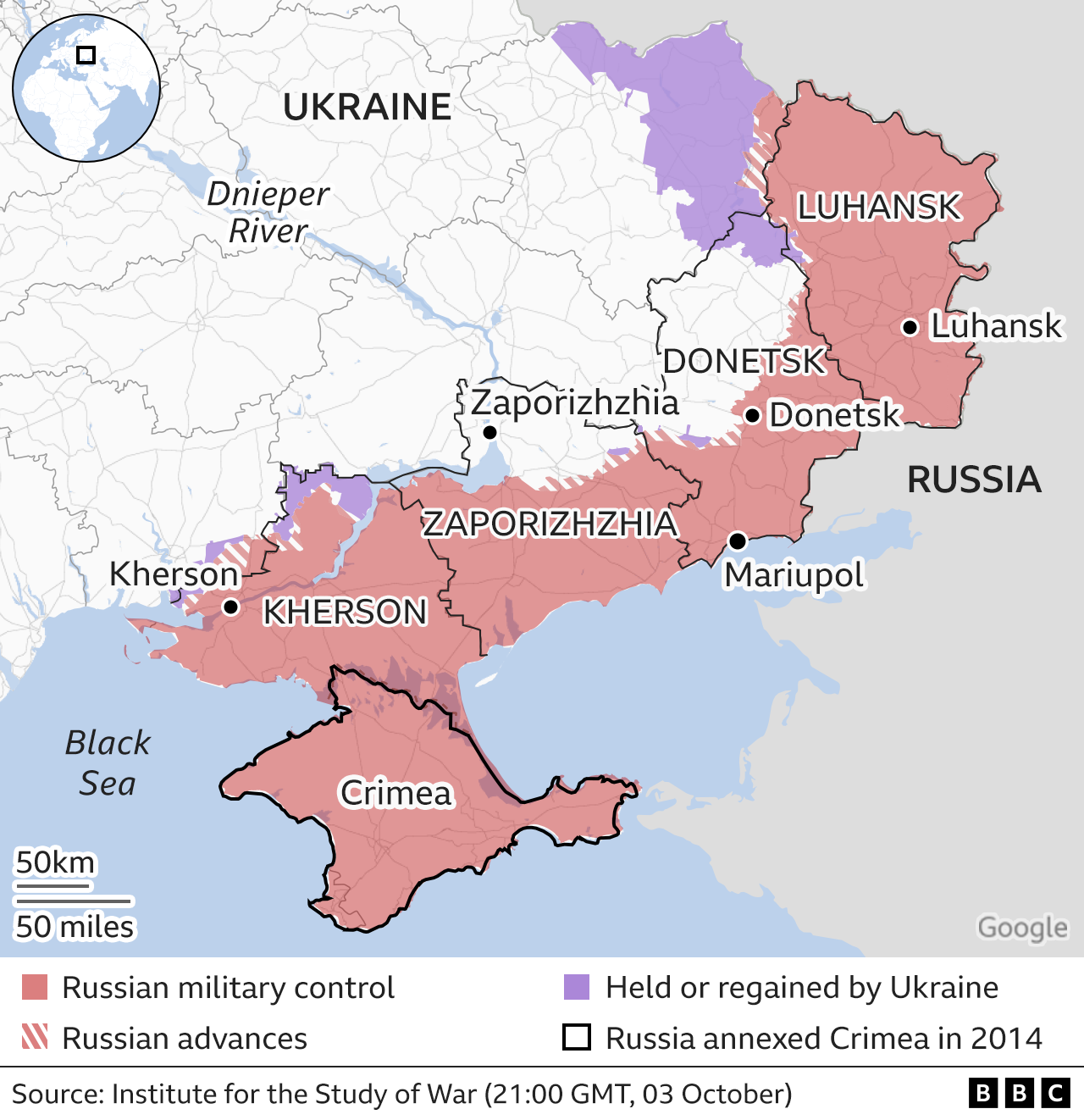
Russia is now implementing martial law in areas of Ukraine that it recently annexed – Kherson and Zaporizhzhia in the south and Donetsk and Luhansk in the east.
The Kremlin claims those regions are now part of Russia – a claim internationally rejected and condemned.
Martial law means tighter security checks and restrictions on movement in the areas affected. But the war has already curbed the rights and freedoms of Ukrainians under occupation.
Additionally, while it was decreed by President Vladimir Putin on Wednesday – the Russian military does not fully control those four regions, so what martial law will mean in reality is yet to be seen.
Heightened security measures are also coming into force across Russia – there will be new restrictions on movement in regions along the Ukrainian border, notably Bryansk, Belgorod and Krasnodar. The same applies to Crimea, which was annexed by Russia in 2014.
US President Joe Biden said Vladimir Putin was running out of options in Ukraine.
“It seems his only tool available to him is to brutalise individual citizens in Ukraine to try to intimidate them into capitulating,” he said.
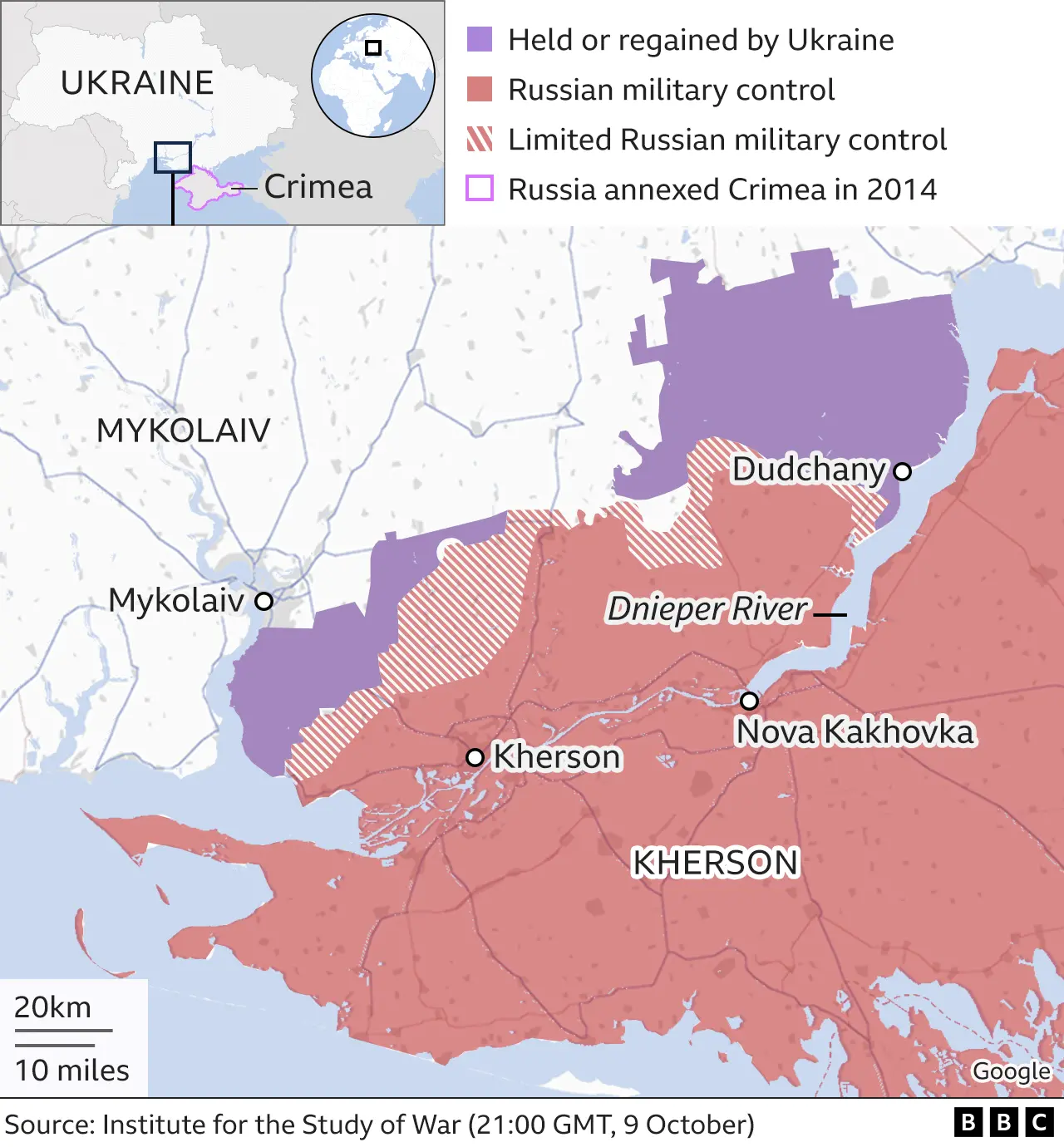
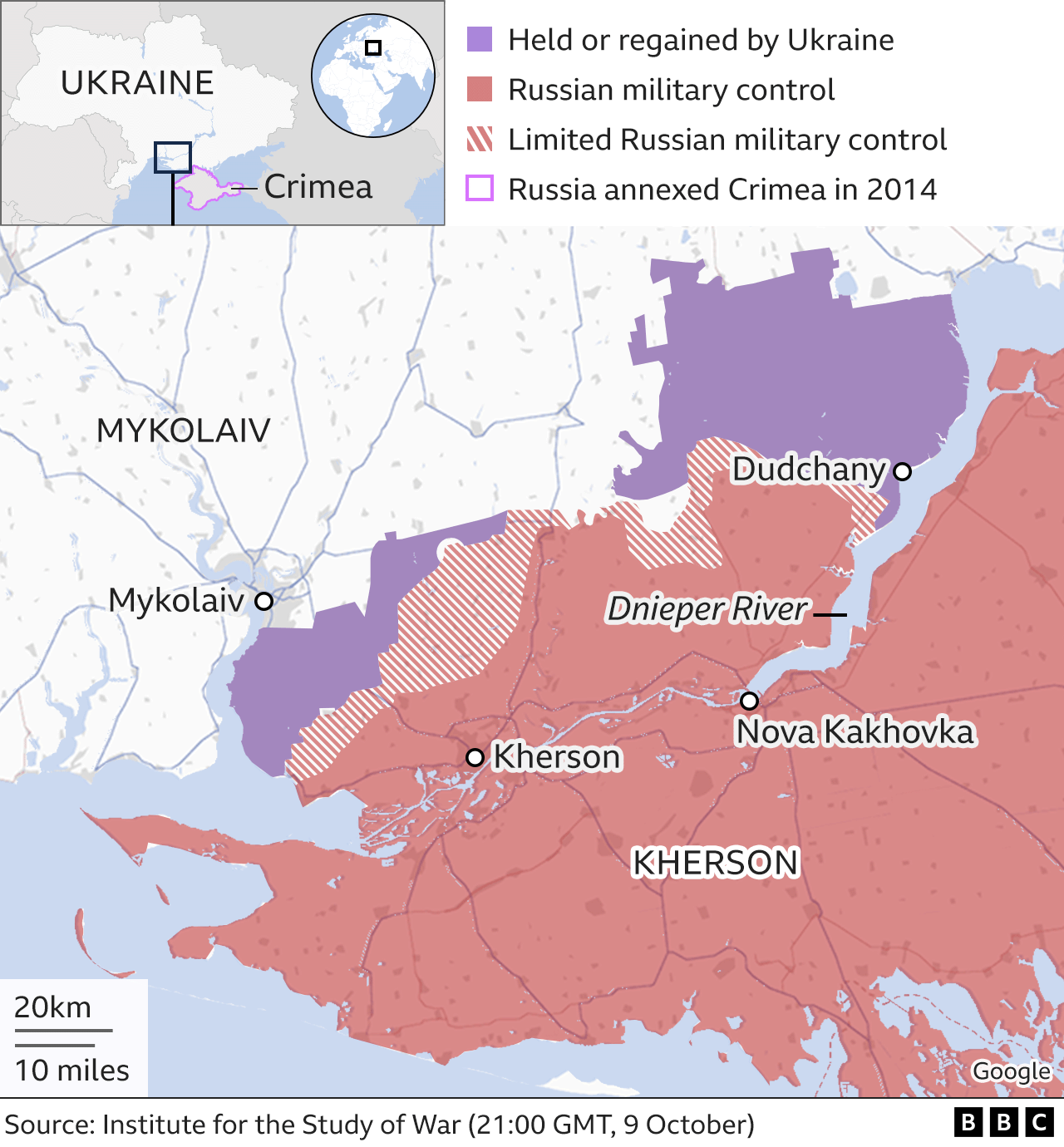
Russia is moving tens of thousands of civilians and Russian-appointed officials out of the Kherson region, as advancing Ukrainian troops close in on the regional capital. Russia says people on the west bank of the River Dnieper (called Dnipro by Ukrainians) are especially at risk from Ukrainian shelling.
The region’s Moscow-installed head, Vladimir Saldo, said all Russian-appointed departments and ministries would cross the river, along with some 50-60,000 civilians.
But Ukrainian officials have questioned whether large numbers of people are actually being evacuated, suggesting that images of a crowd assembled by the river are largely for show.
Ukraine has called on residents to ignore the Russian move.
The transfer or deportation of civilians by an occupying power from occupied territory is considered a war crime.
The commander of Russian forces in Ukraine says the situation in the southern city of Kherson is “difficult” and residents are to be evacuated.
General Sergei Surovikin said Ukrainian troops using Himars rockets were hitting the city’s infrastructure and housing. He spoke on Russian state TV.
“The Russian army will above all ensure the safe evacuation of the population” of Kherson, he said.
His rare admission of big problems was echoed by a top local official.
Russian-installed regional official Kirill Stremousov warned Kherson residents that “in the very near future” Ukrainian troops would launch an assault on the city.
“Please take my words seriously – I’m talking about evacuating as quickly as possible,” he said on the Telegram messaging service. He added that people on the River Dnieper’s west bank (called Dnipro in Ukraine) were most at risk.
This was confirmed by regional governor Vladimir Saldo, who was also appointed by Russia. Four towns on or near the west bank were to be evacuated in what he called an “organised, gradual displacement” of civilians.
Kherson was the first big city to fall to the Russians, back in February.
Ukrainian forces have been steadily retaking nearby territory for the past few weeks. They have pushed as far as 30km (19 miles) south along the Dnieper, threatening to trap Russian troops.
“As a whole the situation in the special military operation zone can be described as tense,” Gen Surovikin said.
Kherson is the only Ukrainian regional capital to have been captured by the Russians in their invasion. The Kremlin now claims Kherson and three other Ukrainian regions to be part of Russia – a claim rejected internationally.
Infrastructure damage
Gen Surovikin, who has a reputation for harsh methods, said Ukraine’s volley of rockets had damaged Kherson’s Antonivsky Bridge and the Kakhovka hydroelectric dam, blocking traffic along those key arteries.
That had created supply problems for essential services, namely food deliveries, water and electricity, he said.
Vladimir Saldo accused Ukrainian forces of building up for a large-scale offensive and planning to destroy the Kakhovka dam, flooding the area.
There is no evidence of that and the BBC has been unable to verify the level of hardship in Kherson.
The general also said the Ukrainians were launching constant attacks across a wide front – in the areas of Kupiansk and Lyman in the east and, in the south, on the Mykolaiv-Krivyi Rih front.
Mr Saldo said on Wednesday that the evacuation would involve some 50-60,000 civilians over a six-day period, Tass news agency reported. If Russia forces people to leave their homes it could constitute a war crime, under the UN’s definition.
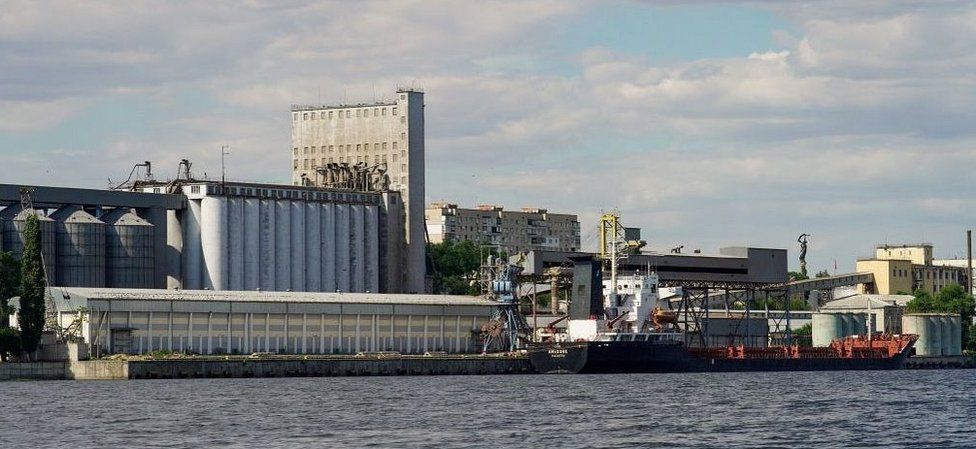
Image source, AFP/ Image caption, Kherson is a major economic hub, with port facilities and various industries
In March, Ukraine said Russia illegally deported thousands of people to its territory from Mariupol, a city devastated by Russian shelling.
Under its definition of war crimes the UN includes: “The transfer, directly or indirectly, by the occupying power of parts of its own civilian population into the territory it occupies, or the deportation or transfer of all or parts of the population of the occupied territory”.
The Russian State Duma – the lower house of parliament – discussed plans on Tuesday for transferring Kherson residents to Russia. Deputy Prime Minister Marat Khusnullin said they would be offered new homes anywhere in Russia, and the government would provide financial assistance.
According to Russia’s Vremya TV news, each family member will get 100,000 roubles (£1,433; $1,626) to replace household goods they were forced to abandon.
Kherson’s pre-war population was nearly 300,000, but Ukrainian officials estimate that about half that number have fled the city.
Gen Surovikin is the new commander of Russia’s war in Ukraine – what the Kremlin calls a “special military operation”.
He is nicknamed General Armageddon and is a veteran of Russia’s wars. In Syria he oversaw Russian bombing raids that killed many civilians. He has also commanded troops accused of human rights abuses in Chechnya.
Gen Surovikin was speaking on a day of further Russian drone and missile strikes on Kyiv and other Ukrainian cities, many of them targeting Ukraine’s electricity supply. Parts of Kyiv now have no power or running water.
Ukraine’s President Volodymyr Zelensky said that 30% of his country’s power stations had been destroyed in the past eight days.
Tens of thousands of civilians and Russian-appointed officials are being moved out of Ukraine’s southern Kherson region ahead of a Ukrainian offensive, says the Russia-installed local leader.
Vladimir Saldo said all Russian-appointed departments and ministries would cross the Dnieper river.
Some 50-60,000 civilians would also leave in an “organised, gradual displacement”, he said earlier.
Ukraine has called on residents to ignore the Russian move.
The head of Kherson’s regional administration said Russia wanted to take civilians hostage and use them as human shields. The transfer or deportation of civilians by an occupying power from occupied territory is considered a war crime.
In a separate development, Russia’s Vladimir Putin said he had signed a decree imposing martial law on four Ukrainian regions, including Kherson, which Moscow annexed last month in a move rejected as illegal by the international community.
He told Russia’s Security Council that it would give regional leaders additional powers to maintain social order and safeguard important facilities.
Russian TV footage on Wednesday showed a number of people gathering near the west bank of the Dnieper. As they queued for boats, it was not clear how many were leaving.
One Kherson resident told the BBC’s World Service that she was not going anywhere until Kherson was liberated by Ukrainian troops: “People are not panicking, nobody wants to be evacuated.”
She said that Russian soldiers were now worried how they could survive in the city. “There are plenty of them here; they are dressed as civilians. We can see them – they are different to Kherson people. They walk in groups, their hair is cut short, they are dressed mainly in black.”
Ukrainian presidential adviser Mykhailo Podolyak pointed out it was less than a month since Russia had held a ceremony to annex Kherson: “Reality can hurt if you live in a fictional fantasy world.”
Late on Monday, Russia’s new military commander in Ukraine, Gen Sergei Surovikin, had described the situation in Kherson city, the regional capital, as difficult.
A Russian-installed official, Kirill Stremousov, warned Kherson residents that Ukrainian forces would launch an assault on the city “in the very near future”. “No-one is going to retreat, but we also want to save your life. Please move as quickly as possible to the left bank,” he added.
IMAGE SOURCE,GETTY IMAGES
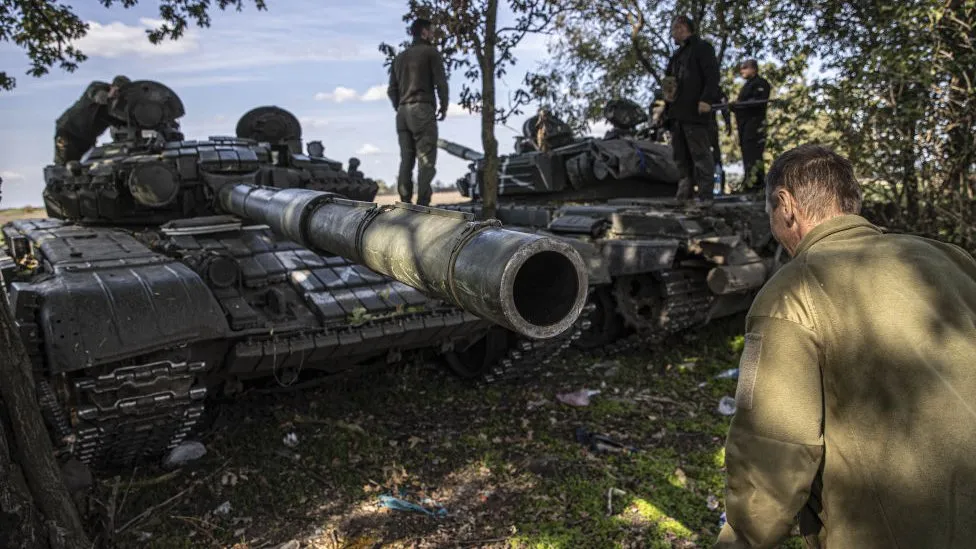
Image caption, Ukraine said recently it had recaptured more than 400 sq km of territory in less than a week
Mr Saldo, who was appointed governor of the region by Moscow, told Russian TV that no-one was about to surrender, but it was “undesirable” for residents to remain in a city facing military action. “In the past two days, more than 5,000 people have left Kherson,” he was quoted as saying.
The head of Ukraine’s presidential office said Moscow was trying to intimidate residents with fake news that Ukraine’s military was shelling their city. “It is a fairly primitive tactic, taking into account that the AFU [Armed Forces of Ukraine] do not shell cities,” Andriy Yermak wrote on Telegram.
Earlier this month, Kherson’s exiled deputy mayor said only 100,000 residents remained in Kherson city of the pre-war population of 320,000, with many fleeing Russia’s occupation.
The mayor of Russian-occupied Melitopol, Ivan Fedorov, warned that Kherson’s civilians were facing enforced deportation and being deprived of their homes so that Russia could populate the city with “soldiers and traitors”. Last month, Ukraine said 2.5 million people had been forcibly deported from Ukraine to Russia.
The Russian-appointed governor accused Ukraine of building up for a large-scale offensive and planning to destroy the Kakhovka dam on the River Dnieper, flooding the area.
Kherson was the first major city to fall to Russian forces when they invaded Ukraine in February. However, in just a few weeks, the Ukrainian military has recaptured territory in the north of the region and pushed as far as 30km (19 miles) south along the Dnieper, threatening to trap Russian troops.
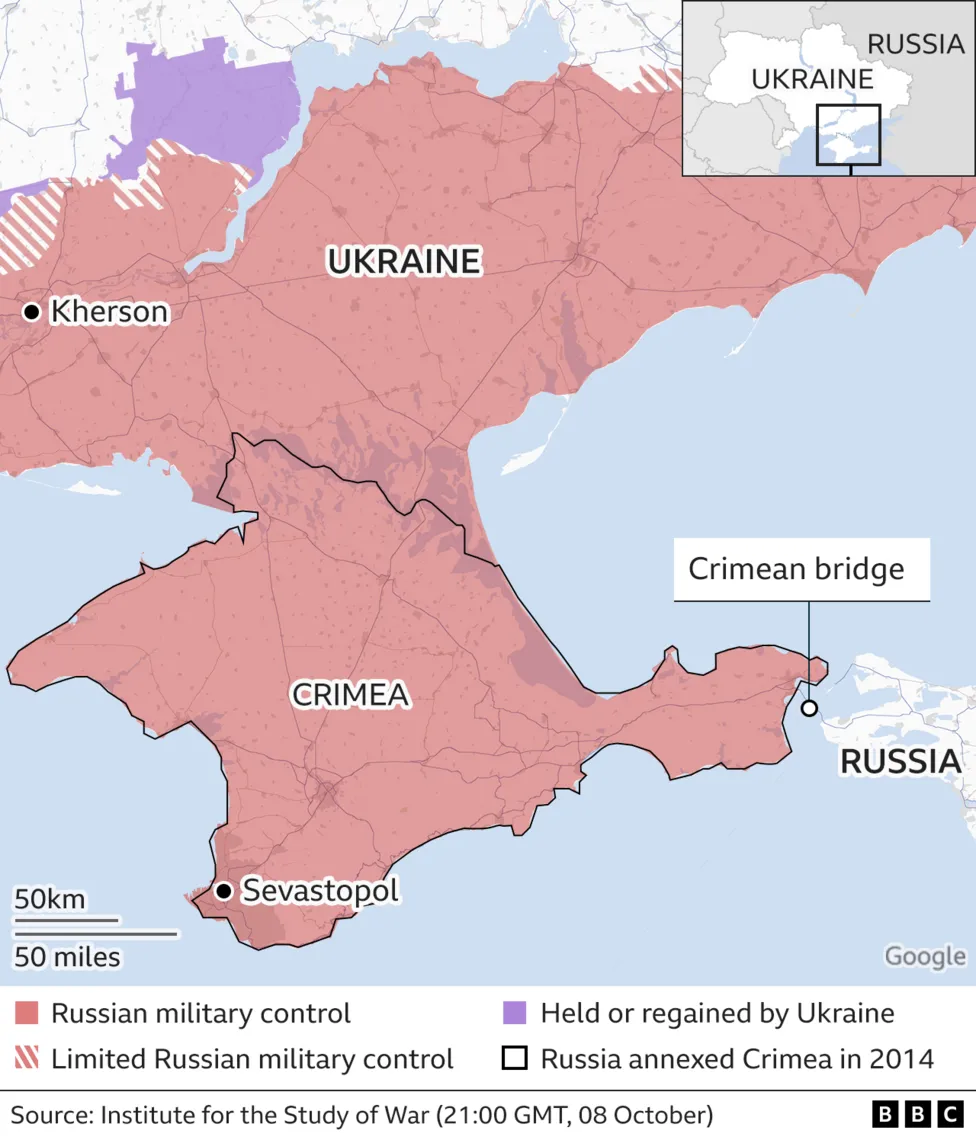
Ukrainian officials said last week that 400 sq km (155 sq miles) of territory had been regained in less than a week. Russian forces have also been hit by damage to the bridge linking annexed Crimea to Russia. An explosion earlier this month has severely affected Russia’s ability to resupply its troops.
The impact of the war in Ukraine and subsequent economic downturn on child poverty in eastern Europe and Central Asia, warns that ripple effects of the surge could result in a steep rise in school dropouts and infant mortality.
Data from 22 countries across the region shows that children are bearing the heaviest burden of the economic crisis stemming from Russia’s 24 February invasion of Ukraine.
While they make up only 25 per cent of the population, they account for nearly 40 per cent of the additional 10.4 million people forced into poverty this year.
“Children all over the region are being swept up in this war’s terrible wake”, said UNICEF Regional Director for Europe and Central Asia Afshan Khan.
Rooted in war
Sparked by the Ukraine war and a cost-of-living crisis across the region, Russia accounts for nearly three-quarters of the increase in child poverty – with an additional 2.8 million now living in households below the poverty line.
Ukraine is home to half a million additional children living in poverty, the second largest share, followed by Romania, where there has been an increase of 110,000, the study notes.
“Beyond the obvious horrors of war – the killing and maiming of children, mass displacement – the economic consequences of the war in Ukraine are having a devastating impact on children across eastern Europe and Central Asia”, said Ms. Khan.
Beyond money woes
The consequences of child poverty stretch far beyond families living in financial distress.
The sharp increase could result in an additional 4,500 babies dying before their first birthdays and learning losses could mean an extra 117,000 dropping out of school this year alone, the study says.
“If we don’t support these children and families now, the steep rise in child poverty will almost certainly result in lost lives, lost learning, and lost futures”, warned the UNICEF official.
Cycle of poverty
The poorer a family is, the higher the proportion of income that must go towards food, fuel, and other necessities.
When the cost of basic goods soars, the money available to meet other needs such as healthcare and education, falls, the study points out.
The subsequent cost-of-living crisis means that the poorest children are even less likely to access essential services, and are more at risk of violence, exploitation, and abuse.
And for many, childhood poverty lasts a lifetime, perpetuating an intergenerational cycle of hardship and deprivation.
When governments reduce public expenditure, raise taxes, or add austerity measures to boost their economies, they diminish support services for those that depend on it.
“Austerity measures will hurt children most of all – plunging even more children into poverty and making it harder for families who are already struggling”, said Ms. Khan.
Plan for assistance
The study makes recommendations to help those in financial distress, such as providing universal cash benefits for children; expanding social assistance to families with children in need; and protecting social spending.
It also suggests supporting health, nutrition, and social care services to pregnant mothers, infants, and preschoolers as well as introducing price regulations on basic food items for families.
Meanwhile, UNICEF has partnered with the EU Commission and several EU countries to pilot the EU Child Guarantee initiative to mitigate the impact of poverty on children.
Strong response needed
With more children and families being pushed into poverty, a robust response is essential, across the region.
UNICEF is calling for expanded support to strengthen social protection systems in high and middle-income countries in Eastern Europe and Central Asia; and social protection programme funding for vulnerable children and families.
“We have to protect and expand social support for vulnerable families before the situation gets any worse”, underscored the UNICEF Regional Director.
Estonian lawmakers blasted Moscow’s illegal acquisition of Ukrainian territory and labeled Russia a “terrorist regime.”
The statement received 88 votes from the 101-member legislature, with 10 MPs missing and three abstaining.
The statement said the Estonian parliament “declares Russia a terrorist regime and the Russian Federation a country that supports terrorism.
“(President Vladimir) Putin’s regime, with its threats of a nuclear attack, has turned Russia into the biggest danger to peace both in Europe and in the whole world,” it said.
A UN investigation determined that Russian forces were responsible for the “vast majority” of human rights breaches in Ukraine during the early weeks of the conflict, including potential war crimes against civilians.
The Independent International Commission of Inquiry on Ukraine found that Russian forces had indiscriminately shelled areas they were trying to capture and “attacked civilians trying to flee”.
It also found abuses committed by Ukraine, including two cases of people who were out of action who were shot, wounded, or tortured.
“Russian armed forces are responsible for the vast majority of the violations identified, including war crimes,” the Council said in the report.
“Ukrainian forces have also committed international humanitarian law violations in some cases, including two incidents that qualify as war crimes.”
Five children’s bodies were recovered from a mass grave in a town formerly controlled by Russian soldiers.
According to investigators, four of the children were buried in a mass burial at a cemetery in Lyman, while another was exhumed from a makeshift grave dug by his mother in their yard.
It has been preliminarily established they all died from shrapnel wounds as a result of Russian shelling, the National Police of Ukraine said in a statement posted to Telegram.
After the forensic examination, the children will be reburied.
“Investigative actions have been ongoing for two weeks in Lyman — at the site of the largest mass burial in the de-occupied part of Donetsk region. Investigative teams work continuously, searching for and interviewing relatives, establishing the history of all the dead,” the statement said.
As of the morning of this morning, 35 military personneland 131 civilians were exhumed in the Kramatorsk district.
Among the civilians were 67 men, 56 women, and five children. The gender of six people is unknown.
Since early last week, Russian attacks have destroyed more than 400 infrastructure targets across Ukraine, according to a top Ukrainian official.
Ukraine’s Minister for Communities and Territories Development, Oleksii Chernyshov, stated that Russian missiles and Iranian-made drones had hit 408 Ukrainian sites since October 10.
The targets included 45 energy facilities and more than 180 civilian buildings.
Chernyshov insisted that Ukrainians would not be cowed by Moscow’s onslaught.
He said that “such terrorist actions of the aggressor mobilize and harden us even more”.
Oleg Nivievskyi, a professor at the Kyiv School of Economics where he serves as vice-president of economics education, is encouraging Ghana and other African countries to support Ukraine in the fight against Russia.
On 24 February 2022, Russia invaded Ukraine in an unprovoked act of aggression.
The aftershocks of the war are being felt by people around the world, including Africa.
Speaking on The Big Bulletin on Monday (17 October 2022), Nivievskyi said: “At the moment we have to find a way to win [over] Russia, otherwise it’s going to be difficult; it’s going to last for God knows how long.
“So, Russia has to be defeated, otherwise the world will be insecure. Because what I would like to stress is we, as a civilised world, we need trustful partners, secured partners that we can trust.
“Russia at the moment is not a trustful partner and it really undermines the world order.”
Rallying behind Ukraine
Nivievskyi said that African countries need a “unified voice” to back Ukraine in the fight against Russia.
“I think African countries can have a stronger voice,” Nivievskyi told Asaase 99.5’s Beatrice Adu. “There was a summit recently in UN in terms of recognising the ‘fake referendum’ which was recently done in Ukraine by Russians, and in that vote there were a couple of African countries that were kind of voting against although the majority were supporting Ukraine.”
According to him, Russia has to be defeated for the world to get back to normal.
“So, I will like for the African countries to be more united so that everybody understands the consequences and who is to blame. So, that’s the purpose of this visit. And by establishing platforms for discussions, we really hope the message is getting through and everybody is on the same page.”
Russia’s war in Ukraine has disrupted the promise of Africa’s recovery from the COVID-19 pandemic by raising food and fuel prices, disrupting trade in goods and services, tightening the fiscal space, constraining green transitions and reducing the flow of development finance around the continent, said United Nations Assistant Secretary General Ahunna Eziakonwa.
Eziakonwa, who serves as the UN Development Programme’s assistant administrator and regional director for Africa, said the war has put households, communities and countries across Africa in a “very precarious situation”.
While the level of trade between the African continent as a whole and Russia/Ukraine is insignificant, some African countries rely heavily on these two countries for critical imports, particularly wheat, fertilisers and steel. Disruptions to supplies of these imports has adversely affected African countries.
Bill Gates almost never gives up in a fight. “Several significant worldwide setbacks over the past few years have left many people disillusioned and wondering whether the world is doomed to get worse,” the billionaire philanthropist bemoaned on Twitter on July 13 after what he dubbed “setbacks.”
The pandemic is one of the biggest setbacks in history. The war in Ukraineis a gigantic tragedy for the entire world. The damage from climate change is already worse than most models predicted. The U.S. has taken a huge step backward for gender equality and women’s health.”
He later appeared somewhat optimistic, as if he’d been trying to persuade himself that he saw light at the end of the tunnel.
“But I’m still optimistic. These setbacks are happening in the context of two decades’ worth of historic progress and I believe it is possible to mitigate the damage and get back to the progress the world was making,” the entrepreneur said.
$1.2 Billion to Fight Polio
A few months later, the philanthropist seems to have regained his energy and his will to win his humanitarian battles.
He has thus just promised $1.2 billion more to eradicate polio. The announcement was made on Sunday in Berlin by the Bill and Melinda Gates Foundation, which made the pledge to the Global Polio Eradication Initiative.
“By coming together and funding efforts like the Global Polio Eradication Initiative, we can #EndPolio and build a healthier world, ” Gates tweeted on Oct. 15.
“We’re very committed,” Gates told Bloomberg in an interview. “I can’t say forever, but giving up would mean hundreds of thousands of kids being paralyzed.”
The new fund will help redouble and speed efforts to fight this disease, which has reappeared in recent months in regions where it was thought to have disappeared. A resurgence would jeopardize billions of dollars of investment over decades.
Polio Reappears in New York
A case of polio had been identified last summer in Rockland County, N.Y., half an hour north of Midtown Manhattan. Traces of the virus had also been detected in sewage in the U.K. and Israel, which had suggested that the disease, which had been almost eradicated worldwide, had resurged.
“The individual experienced severe symptoms, including paralysis, and was hospitalized,” New York State and County health officials said. “New Yorkers should know that paralysis from polio is typically permanent, resulting in life-long disability.”
The last known case of polio in the U.S. was in 2013, according to the Centers for Disease Control and Prevention. A 7-month-old child who had just moved from India to the U.S. was diagnosed in San Antonio.
The World Health Organization in June warned that a type of poliovirus derived from the oral polio vaccine – which, in rare cases, can cause infection in others but not in the person vaccinated – had been detected in London sewage samples. It can cause severe illness and paralysis in unvaccinated people.
Polio, which largelyaffects children under age 5, has been virtually eradicated worldwide, according to Unicef. Cases have fallen by 99% since 1988 when polio was still endemic in 125 countries and 350,000 cases were recorded. Polio remains endemic in two countries – Afghanistan and Pakistan.
Infections declined sharply in the late 1950s and early 1960s in the U.S., with the development of a vaccine. The last natural infection to have occurred in the U.S. dates from 1979.
The Gateses, through their foundation, have already donated nearly $5 billion directly to the fight against polio.
For 2019-2023 some $4.2 billion is needed to eradicate polio through vaccination and other health services, according to the Global Polio Eradication Initiative. The program had $2.2 billion before Gates’ pledge. After the commitment, the funding shortfall is around $1.4 billion. Germany will co-host a pledge event at the World Health Summit on Oct. 18 in Berlin.
“India’s success against poliovirus showed the world that to #EndPolio, perseverance and collaboration are vital. @naveenthacker and over 1,300 leading global experts have urged the world to recommit to ending polio,” Gates posted on Oct. 15.
“According to a report from the pilots, who jettisoned from the plane, the reason for the crash was a fire in one of the engines during take-off,” its statement said.
In a telegram post (in Russian), the governor of the Krasnodar territory, which Yeysk is part of, said he was on his way to the town and all regional and local fire services were battling the blaze.
Local media report the fire engulfed five floors of the multi-storey building and a number of apartment blocks have been damaged.
Former Russian President Dmitry Medvedevhas warned Israel against selling arms to Ukraine, warning any effort to beef up Kyiv’s army will jeopardise bilateral relations.
“Israel appears to be getting ready to supply weapons to the Kyivregime. A very reckless move. It would destroy all bilateral relations between our countries,” Medvedev said on Telegram.
So far, Israel has sent humanitarian aid, including helmets, to Ukraine, but it has not sent any weapons.
A spokeswoman for Israeli Prime Minister Yair Lapid, who also holds the foreign affairs portfolio, told AFP his office would not be commenting on Medvedev’s remarks.
Ukraine’s military says to have destroyed 37 Russian drones since Sunday evening, accounting for around 85 percent of aircraft participating in the strikes.
Russian drone strikes killed at least three civilians in central Kyiv early Monday.
The airstrikes came exactly one week after Russia unleashed its heaviest aerial bombardment on Kyiv and other Ukrainian cities since the start of the war.
Several explosions rocked the central Shevchenkivskyi district of Ukraine’s capital on Monday, according to Kyiv Mayor Vitali Klitschko, damaging a number of residential buildings.
At least four explosions have occurred in the Ukrainian capital of Kyiv, with a presidential adviser accusing “kamikaze drones” launched by Russia.
“It shows their desperation,” said Andriy Yermak,head of Ukrainian President Zelensky’s staff.
Mayor Vitalii Klitschko said residential buildings in the central Shevchenkivskiy area had been damaged.
A week ago, the capital was hit by Russian missiles at rush hour, part of nationwide attacks which left 19 dead.
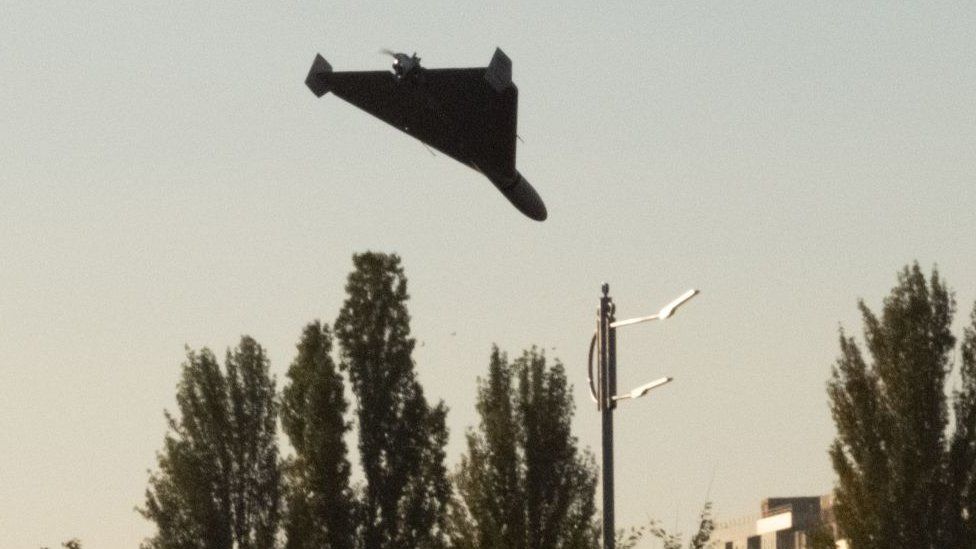
This morning’s attacks were from drones – the low buzzing of these slow-moving weapons is becoming familiar across the country.
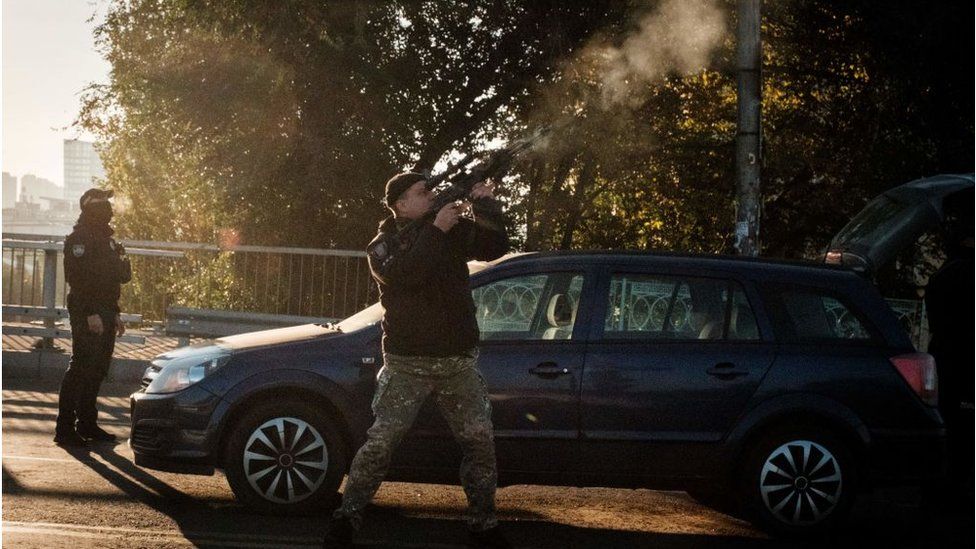
Kyiv reverberated to the rattle of gunfire as anti-aircraft batteries frantically tried to shoot them down. Video on social media appeared to show one interception.
The explosions on Monday began at around 06:30 local time (03:30 GMT), and there were at least five in total. The most recent was at around 08:10 local time.
Two were close to the city centre, with sirens and car alarms heard across the area.
What’s being targeted is hard to determine. The mayor’s office says residential and non-residential buildings have been hit. Railway officials say explosions were seen close to Kyiv’s main station.
Recent attacks have targeted Ukraine’s energy infrastructure. It will be surprised if that’s not the case today.
Writing on the Telegram social media site, Mr Klitschko said there were four strikes in Kyiv, although residents heard five or six explosions. He also told people to stay in air raid shelters.
But despite the warnings, the streets are far from deserted. Between the first and second set of strikes, plenty of people seemed to be going about their Monday morning business.
Mr Yermak described the kamikaze attacks as Russia’s “death throes”, and that Ukraine needed more air defence systems “as soon as possible”.
What are kamikaze drones?
Small aerial weapons, also known as loitering munitions, that are destroyed after striking the target
Unlike other drones – which are supposed to return home after dropping missiles – kamikaze drones are disposable
The name derives from the Japanese pilots who volunteered to crash their planes in suicide missions in World War Two
President Zelensky has previously accused Russia of using Iranian-made drones – Iran denies supplying them while Russia has not commented
Russian President Vladimir Putin said last week’s strikes were in retaliation for the bombing of a key bridge linking Russia to occupied Crimea, which he blamed on Ukraine.
It was the first time during the war that the centre of Kyiv had been directly targeted.
Earlier this week, Mr Putin said there was no need for more large-scale strikes on Ukraine. Most designated targets had been hit, he said, adding that it was not his aim to destroy the country.
IMAGE SOURCE,YASUYOSHI CHIBA Image caption, A drone seen in Kyiv on Monday
IMAGE SOURCE,YASUYOSHI CHIBA Image caption, A Ukrainian in Kyiv fires at a drone
On Saturday, gunmen killed 11 people at a Russian militarytraining facility.
Two individuals opened fire on a group of volunteers who had enlisted to fight in Ukraine during a firearms training session, according to state-owned news agency Ria.
The attackers were from a former Soviet republic, the Russian defence ministry said, but did not give further details.
They were also shot dead during the incident in the Belgorod region of Russia, which borders Ukraine.
A further 15 people were wounded.
“During a firearms training session with individuals who voluntarily expressed a desire to participate in the special military operation [against Ukraine], the terrorists opened fire with small arms on the personnel of the unit,” Ria cited a defence ministry statement as saying.
“As a result of the shooting, 11 people were fatally wounded. Another 15 people with wounds of varying severity were taken to a medical facility,” it said.
The local governor said no residents of the Belgorod region had been killed or injured.
Last month Russian President Vladimir Putin ordered a mobilisation of 300,000 Russians who had previously done compulsory military service.
The order sparked protests across Russia and a surge of people attempting to leave the country.
Soon after the mobilisation was announced, a military recruiter was shot at an enlistment office in Siberia.
Last week, Putin announced that over 200,000 people had already beenmobilized, and he saw no need for additional mobilization.
The war in Ukraine is still ongoing after nearly eight months. Ukrainian counter-offensives continue to make progress, while Russian forces continue to press elsewhere.
However, it is a one-sided affair on the internet.
“This is a meme nation,” says Olena, a Kyiv entrepreneur who manages teams of social media volunteers.
“If this was a war of memes, we would be winning.”
Olena is not her real name. Due to the sensitive nature of the work she and her teams carry out on behalf of Ukraine’s defence ministry, she has asked to remain anonymous.
Her teams work round-the-clock, reacting within hours to news from around the country, producing punchy videos, often set to music, for the ministry’s audiences at home and abroad.
Just as Ukraine’s President Volodymyr Zelensky tailors speeches to foreign parliaments to take account of local history, culture, and sensibility, so Olena’s five-strong international team targets their messages.
A June video thanking Britain for its military assistance featured the music of Gustav Holst and The Clash, with glimpses of Shakespeare, David Bowie, Lewis Hamilton, and a montage of British-supplied anti-tank weapons in action.
More recently, French President Emmanuel Macron’s decision to supply Caesar with self-propelled guns was greeted with a video that declared: “Romantic gestures take many forms”.
Images of red roses, chocolates, and the Paris skyline, followed by the guns in action, were set – perhaps inevitably – to the sound of Serge Gainsbourg and Jane Birkin’s breathless Je T’aime Moi Non-Plus.
With nods to a Macron-Zelensky bromance, it was suggestive and thoroughly tongue-in-cheek.
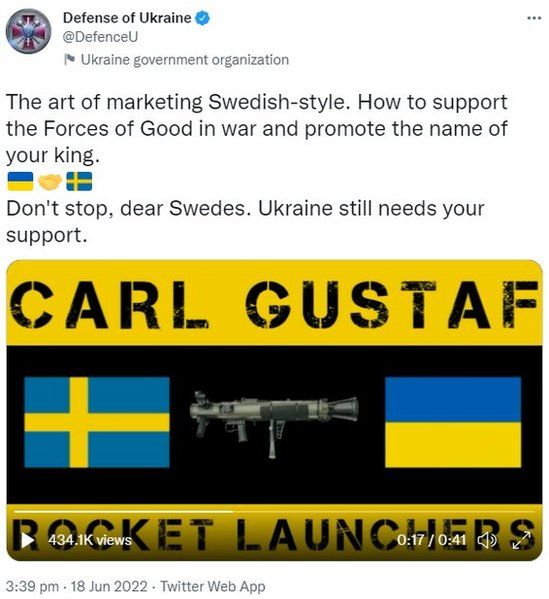
Olena says one of her favourite “thank you” videos praised Sweden for its value-for-money investment in Ukraine: $20,000 (£17,900) Carl Gustav rocket launchers, capable of knocking out Russian T-90 tanks worth $4.5m.
The tune? You guessed it: Abba’s Money, Money, Money.
IMAGE SOURCE, DEFENSE OF UKRAINE
Thanks to the team’s efforts, the defence ministry’s Twitter feednow has 1.5m followers around the world. Some of the videos have been viewed more than a million times.
Their most successful video, released in August after several mysterious attacks on Russian targets in annexed Crimea, has racked up 2.2m views. It mocked Russians for going on holiday on the peninsula and was set to the Bananarama song Cruel Summer.
“The main idea is to speak to the international audience and show that Ukraine is actually capable of winning,” she says. “Because nobody wants to invest in losers.”
But another of Olena’s teams carries out more subversive work, designed to highlight Russian losses and demoralise Ukraine’s invaders.
Targeting Russian audience
With a wealth of videos depicting Russian military setbacks being posted on social media platforms, the team is not short of material. But they’ve learned through trial and error what works and what doesn’t.
“We started displaying dead Russian bodies,” Olena says. “And then we realised that it actually didn’t work. It only united them against us.”
The team then tried to appeal to the consciences of Russian soldiers by showing images of dead Ukrainian civilians. Again, it seemed to fall on deaf ears.
“We realized they were actually proud of it. They were not condemning this at all,” she says. “We realised that we have to do this in a much more sophisticated way.”
IMAGE SOURCE, DEFENCE OF UKRAINE Image caption, Ukrainian videos warn Russians that they will suffer more big losses
Now the volunteers scrutinise Russian social media platforms, looking to press buttons and probe weaknesses in specific parts of the country.
“If you do it in Saratov you have to know what’s going on in Saratov,” Olena says. “If you do it in Nizhny Novgorod, you have to know what’s going on in Nizhny Novgorod.”
It’s extremely hard to gauge the impact this work is having, but Vladimir Putin’s recent partial mobilisation has given the volunteers lots of material to work with.
“We were waiting for the mobilisation,” Olena says. “We knew that it would be very demoralising for them.”
The single richest seam of material is to be found on the messaging service Telegram. Olena calls it “the Wild Wild West”.
The volunteers providing material for the defence ministry are just a small part of a vast, vibrant, fiercely patriotic, and wildly irreverent community reacting to events on the ground, sometimes with amazing speed.
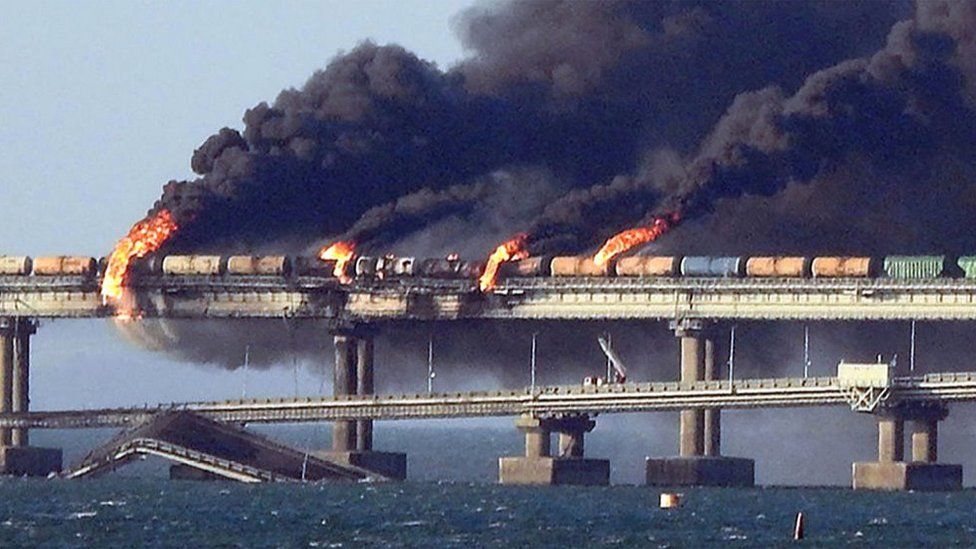
IMAGE SOURCE, AFP Image caption, Ukrainians quickly exploited the dramatic attack on Russia’s Kerch Bridge in the information war
Scores of Telegram channels attract huge numbers of followers.
One, called “Ukrainian Offensive”, has 96,485 followers. Its slogan is “fighting on the civil-meme frontlines of the information war since 2014.”
It provides a diet of military updates, out-and-out trolling of Moscow, and occasional digs at Western media coverage (including the BBC).
Like most other channels, it doesn’t shy away from showing suffering, including footage of dead or dying Russian soldiers.
The recent explosion on Russia’s Kerch Bridge, linking Russia with occupied Crimea, triggered a tidal wave of videos, jokes, and memes as Ukraine’s internet army celebrated wildly.
But the country didn’t turn into a nation of digital ninjas overnight. Eight years of war in the eastern Donbas region has given people lots of time to hone their skills, from countering disinformation to circulating humorous content designed to boost morale.
The current social media environment, says Ihor Solovey, head of Ukraine’s Centre for Strategic Communication and Information Security, reflects a rare convergence of official and popular sentiment.
“We’re witnessing perhaps the first time in history when civil society trusts the state and is helping it,” he told me.
“The armed forces do their own thing, while society is creating content, memes, creative works on their own. Because everyone feels responsible for their own future.”
What, if anything, is Russia throwing back at Ukraine?
Strangely, given Russia’s reputation for troll farms and shady scammers with alleged links to the Kremlin, the answer seems to be: not much.
Earlier this month, two well-known Russian pranksters did manage to con Ukraine’s Foreign Minister Dmytro Kuleba into thinking he was talking to a former US ambassador to Moscow, Michael McFaul.
Excerpts were broadcast on Russian state media, in which Mr Kuleba appeared to admit that Ukraine was responsible for recent attacks in Crimea and Russia – although the prank was conducted before the 8 October Kerch Bridge explosion.
But if Russia does have a similarly inventive internet army, Olena says she has seen little sign of it.
“Russians haven’t managed to come up with anything interesting,” she says. “No humour, no beauty. Not even pain. No compassion.”
Image caption, A mural of a hacker has appeared on the streets of Kyiv
Residents of Kyiv have been asked to reduce their evening electricity use after a Russian missile strike knocked out a power plant near the capital.
Power was restored earlier in Ukraine, according to officials, after Russian missiles struck the electricity infrastructure.
But Ukraine’s state energy operator Ukrenergo has still called for the reduction between 17:00 and 23:00 (15:00 – 21:00 GMT), warning of possible power cuts.
The request was not confined to Kyiv.
The deputy head of Ukraine’s presidential administration, Kyrylo Tymoshenko, said the populations of Zhytomyr, Cherkasy, and Chernihiv should also save electricity.
“If this advice is ignored, we will have difficulties and it will be necessary to take out the candles,” he warned on Telegram.
Ukrenergo has urged residents to save electricity in the evening by not using energy-guzzling appliances, switching off unnecessary lighting, and doing their washing at night.
However, the BBC’s Paul Adams reports that Kyiv streets are already darker than usual at night, but “life very much goes on”.
The energy warning comes as more heavy fighting is reported north of Russian-held Kherson.
Kirill Stremousov, a Russian-appointed leader in the southern region, said Ukrainian shelling was coming from the Dudchany area, on the west bank of the Dnieper river (called Dnipro by Ukrainians).
Advancing Ukrainian forces have repeatedly bombarded bridgesover the river, aiming to cut off Russian troops in Kherson city.
Russian-installed officials in the city have urged Moscow to help transfer Kherson families to Russian cities as Ukrainian shelling intensifies.
President Vladimir Putin has declared Kherson and three other Ukrainian regions to be part of Russia – a move condemned internationally, after hastily-organized so-called referendums in the regions.
Meanwhile, Ukrainian prosecutors have accused Russian soldiers of shooting and killing the chief conductor of the Kherson Music and Drama Theatre, Yuri Kerpatenko, in his home. It is widely reported in Ukrainian media, but there are few details. He is said to have refused to cooperate with the occupation authorities.
Russian oil depot fire
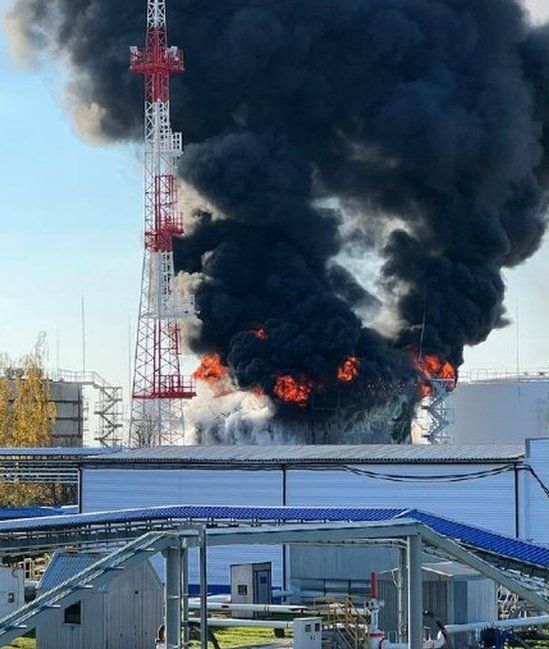
For two days running the governor of Belgorod, a Russian city 40km (25 miles) north of Ukraine, has reported Ukrainian cross-border shelling. One shell caused a major fire at an oil depot near the city on Saturday, Vyacheslav Gladkov said, adding later that firefighters had extinguished it.
Ukrainian shelling set fire to an electricity substation in Belgorod on Friday, he reported on Telegram. In that case, too the fire was contained. Kyiv has not commented on the Russian claims, but there have been explosions in the Belgorod region previously, which Russia blamed on Ukrainian shelling.
IMAGE SOURCE,VVGLADKOV/TELEGRAM Image caption, Oil depot fire near Belgorod – pic from Governor Gladkov (Telegram)
On Friday President Putin said he saw no need for further massive missile strikes against Ukraine “for now”, on the scale of last Monday’s, which hit Kyiv and other cities, killing at least 20 civilians. Mr Putin said those strikes were retaliation for the attack that damaged Russia’s huge Kerch bridge – a key strategic link to annexed Crimea.
Another focus of fighting in the south is Zaporizhzhia – Ukrainian officials in the city say it was hit by more Russian missiles and Iranian-made Shahed “kamikaze” drones overnight. There was damage to energy facilities and industrial infrastructure there.
The Zaporizhzhia nuclear power plant – Europe’s largest – lies just south of the city, under Russian control, and repeated shelling in the area has raised fears of a nuclear disaster.
The US has announced $725m (£649m) of further military aid for Ukraine, including ammunition for Himars rocket systems, artillery rounds, anti-tank weapons and Humvee armoured vehicles. The US has provided more than $17bn of military aid since Russia’s 24 February invasion – by far the largest contribution among Ukraine’s Western allies.
On Ukraine’s northern border, Belarus says a new Russian militarycontingent has arrived – part of what it describes as a regional border protection force. Belarus has hosted Russian forces involved in the war in Ukraine, including those who launched an abortive assault on Kyiv. But so far it has not sent its own troops across the border.
Russian President Vladimir Putin has stated that there is no need for any big strikes on Ukraine, just days after the country was bombarded with the worst bombing since the war began.
He stated that the majority of the planned targets of the strikes had been hit, but that it was not his intention to destroy Ukraine.
He predicted that Moscow‘s goal of mobilising 300,000 men would be met in two weeks.
It comes as Russian forces are mostly in retreat and Ukraine advances, almost eight months since the invasion.
Speaking to journalists after a summit with regional leaders in Kazakhstan’s capital Astana, the Russian leader said that the recent strikes had destroyed 22 out of the 29 targets in Ukraine set by the military and that “they are getting” the remaining seven.
“There’s no need for massive strikes. We now have other tasks,” he said.
From Monday onwards, Russia unleashed a wave of strikes on cities across Ukraine, in what Mr Putin said was retaliation for a blast that damaged a key bridge between Russia and annexed Crimea.
Dozens of people were killed and injured in the strikes, which also damaged infrastructure. Central areas of Kyiv were targeted for the first time since the invasion.
But Mr Putin said it was not Russia’s intention to destroy Ukraine, but he did not regret the invasion.
“What is happening today is not pleasant, to put things mildly,” he said. “But all the same, [if Russia hadn’t attacked] we would have been in the same situation, only the conditions would have been worse for us. So we’re doing everything correctly and at the right time.”
President Putin said 220,000 men had been mobilised, of whom 16,000 were already in combat. He saw no need for additional mobilisation, he added.
However, the call-up has caused widespread discontent in Russia, with tens of thousands of men fleeing to neighbouring countries. The BBC has also found evidence of the poor level of training such conscripts or recruits receives before being sent to the front.
Meanwhile, the BBC Russian service says it has identified more than 7,500 Russian service personnel who have died in the Ukraine war. The actual level of casualties is believed to be much higher, and there are reports that some recently mobilised troops have been killed.
Addressing relations with other former Soviet countries, Mr Putin insisted that the war had not affected their “character and depth”.
He said it was natural for some countries to be concerned but he was keeping them informed in detail.
But analysts say Russia’s influence in the region is declining, with leaderslike Kazakhstan’s Kassym-Jomart Tokayev trying to distance themselves from Mr Putin over the war.
The Russian leader also chided Germany for canceling the Nord Stream 2 gas project following Russia’s invasion of Ukraine, about which he said he had “no” regrets.
Putin’s comments on Friday focused on Germany were thinly veiled admonishments of disapproval
Russian President Vladimir Putin said at a press conference in the Kazakh capital of Astana Friday that Germany had made a “mistake” in siding with NATO in the war in Ukraine.
He claimed that the decision to cancel the Nord Stream 2 pipeline was a German one and that it was an error to prioritize NATOand European security over what Moscow believes to be Germany’s national interest.
“German citizens, businesses, and its economy are paying for this mistake because it has negative economic consequences for the eurozone as a whole, and in Germany,” he said, in reference to Nord Stream 2.
By contrast, Putin believes Russia “is doing everything right” in its stalled effort to conquer Ukraine, which has led Russia to be accused of frequent rights abuses, war crimes and violations of international law.
What else did Putin say about NATO?
Any direct confrontation between NATO forces and Russian troops would be a “global catastrophe,” he said.
Putin relayed that he had no regrets about his decision to invade Ukraine despite the hugely unpopular mobilization and Russia’s minimal battlefield gains in the months since the war began.
He added he would want the humanitarian corridors for Ukrainian grain closed should it emerge they are being used for what he termed “acts of terror.” Turkey, a NATO member state, and the UN brokered a deal to bring Ukrainian grain to world markets in July.
Earlier this month, the Kerch Bridge connecting Russia to Crimea, which Moscow illegallyannexed in 2014, was targeted by a truck bomb Russia has since blamed on Ukraine.
While Kyiv residents and government officials celebrated the act of sabotage and the Ukrainian postal service ordered up commemorative stamps, Ukraine did not formally claim its forces were behind the attack. Russia has blamed Ukraine’s military intelligence.
What else did Putin say about Ukraine?
At the news conference following the summit of the Collective Security Treaty Organization (CSTO), Putin claimed that the partial mobilization he ordered would be over in two weeks.
He added that there are no future plans at present for further call-ups. Sixteen thousand reservists are currently engaged in military activities, he noted.
“Nothing additional is planned. No proposals have been received from the defense ministry and I don’t see any additional need in the foreseeable future,” he said.
Though Putin once said the invasion and capture of Ukraine would be over swiftly, he ordered 300,000 reservists be called up to fight in Ukraine last month. Nearly as many men of military age left the country than to avoid mobilizing.
Mobilized Russian soldiers lack equipment, food
And he said there was no need for massive strikes on Ukraine “for now,” following a week of missile barrages on Ukrainian towns and cities.
“Our aim is not to destroy Ukraine,” Putin said.
What does Putin say about other countries’ perceptions of Russia’s war on Ukraine?
Putin noted that China and India favor a “peaceful dialogue” over Ukraine after their leaders clashed with him at a different summit in Uzbekistan last month.
While some countries once occupied by the Soviet Union are “worried,” Putin said he believes there has been no change in “the character and depth of the Russian Federation’s relations with these countries.”
The Collective Security Treaty Organizationconsists of Russia and five other countries that were once considered part of the Soviet Union: Armenia, Belarus, Kazakhstan, Kyrgyzstan, and Tajikistan.
As with the Warsaw Pact that once existed in satellite countries under Russian tutelage during the Cold War, members of the organization have only seen Russian forces be used to suppress civil disturbances in their countries.
The Russian leader also said he finds “no need” for future talks with US President Joe Biden, who earlier in the week dismissed the idea of dialogue with Putin.
Putin said he has not made a decision yet on whether to attend the G20 summit in Bali next month, which would be his first encounter with leaders who stand vehemently opposed to his war against Ukraine.
Kyiv will find a solution to keep the Starlink internet service operational in Ukraine, according to presidential adviser Mykhailo Podolyak.
Elon Musk previously stated that his rocket firm, SpaceX,could not continue to sponsor Starlink in Ukraine indefinitely.
“Let’s be honest. Like it or not, @elonmusk helped us survive the most critical moments of war. The business has the right to its own strategies.
“Ukraine will find a solution to keep #Starlink working. We expect that the company will provide stable connection till the end of negotiations,” Podolyak wrote on Twitter.
Let’s be honest. Like it or not, @elonmusk helped us survive the most critical moments of war. Business has the right to its own strategies. 🇺🇦 will find a solution to keep #Starlink working. We expect that the company will provide stable connection till the end of negotiations.
Russia is intensifying its targeted attacks on crucial infrastructure in Ukraine for the seventh day in a row.
Multiple Russian missile attacks jolted the Zaporizhzhia region’s capital overnight, as the city remained a target for Russian assault.
Zaporizhzhia regional Governor Oleksandr Starukh said Friday morning several explosions were reported in the city overnight at infrastructure facilities, causing fires.
Preliminary reports mentioned no victims.
Russian forces have struck the regional capital and the surrounding area continuously in recent days and weeks, creating concerns about the safety of the nearby nuclear power plant.
The regional capital is about 100 miles (160 kilometers) from the plant, which is the largest nuclear power facility in Europe.
The heavier Russian barrage began last Monday and comes as Ukraine pushes its military counteroffensive on the southern front.
Volunteers clear debris after an attack on Zaporizhzhia earlier this week.
Ukrainian officials have asked the Red Crossto send a team to a notorious prison camp in the country’s occupied east.
Andriy Yermak, the chief of staff of Ukraine’s president, has ordered that the International Committee of the Red Cross (ICRC) visit the Olenivka prison in Donetsk within three days.
“We just can’t waste more time. Human lives are at stake,” he tweeted.
Last month, the Red Cross tried to secure access to the camp but said it was denied by Russian authorities.
The Olenivka prison has been under the control of Russian-backed authorities in Donetsk since 2014, and conditions are said to be extremely poor.
In July, dozens of Ukrainian prisoners were killed in explosions at the camp, which both sides blamed on each other. Kyiv said the prison was targeted by Russia to destroy evidence of torture and killing, while Moscow blamed Ukrainian rockets. Without an independent investigation, however, the truth remains unknown.
Those detained at the site include members of the Azov battalion, who were the last defenders of the city of Mariupol and whom Russia has sought to depict as neo-Nazis and war criminals.
This is not the first time Ukraine has applied pressure on international organizations to investigate what is going on at the prison.
Mr Yermak said he had raised the issue again during a video conference with officials from the ICRC and other international organizations.
He has demanded the trip be made by Monday.
“Ukraine… will contribute to this mission in every possible way,” he said on Telegram, adding he did not understand why a mission to inspect Olenivka had not yet been arranged.
President Volodymyr Zelensky echoed the calls, and accused the Red Cross of inaction, saying it had “obligations, primarily of a moral nature”.
In his nightly address on Thursday, Mr Zelensky said he believed that the Red Cross was “not a club with privileges where one receives a salary and enjoys life”.
He said a mission to the prison camp could be organised similar to that of the International Atomic Energy Agency (IAEA), which visited the Russian-occupied Zaporizhzhia nuclear power station in August.
“But it requires leadership,” Mr Zelensky said in a thinly veiled criticism of the Red Cross. “The Red Cross can make it happen. But you have to try to make it happen.”
The ICRC has been contacted for comment.
Last month, the organisation’s Director-General Robert Mardini said talks were ongoing with Russian authorities about access to Olenivka – but were eventually denied.
“We are negotiating every day to have full access to all prisoners of war,” he told reporters. “It is clearly an absolute obligation [of] the parties to give the ICRC access to all prisoners of war.”
Also in his Thursday address President Zelensky said Ukraine would celebrate its Defenders Day on Friday, which was made a national holiday in 2014 after Russia’s invasion of Crimea.
“Tomorrow we will definitely celebrate… one of our most important days. The holiday of all our warriors – from ancient times to the present, from the Cossacks to the rebels, from all of them to the soldiers of the modern army,” he said.
A shortage of defence systems means Western allies are struggling to meet increasingly urgent requests to protect Ukraine’s skies from missile and drone attacks.
The UK will for the first time give Ukraine a number of powerful missiles to defend against Russian airstrikes, but it is not providing the weapons that launch them.
Instead, the AMRAAM rockets – capable of shooting down cruise missiles – will help to arm air defence systems that will be given to Ukraine by the United States.
A shortage of supply of these systems means Western allies, meeting this week in Brussels, are struggling to meet increasingly urgent requests from the government in Kyiv to protect Ukraine’s skies from Russian missile and drone attacks.
Asked by Sky News whether the failure of the West to give Ukraine more of these much-needed air defence systems faster was because of a lack of political will or a lack of supplies, US Defence Secretary Lloyd Austin pointedly only gave half an answer.
“Well certainly it’s not a question of lack of will,” he said on Wednesday at NATO headquarters in Brussels, speaking after chairing a contact group of NATO allies and other partners that have come together to pledge military support for Ukraine.
“The commitment, the resolve that the chairman [of the Joint Chiefs of Staff General Mike Milley] and I witnessed in this contact group meeting today was inspiring, and that’s what I told the members of the group. They remain committed to doing everything they can to generate additional capability.”
But a senior diplomat told Sky News a shortage of supply of air defence systems was a key factor limiting the ability of allies to respond to Ukraine’s needs.
The UK and other NATO members slashed defence spending, shrunk the size of their armed forces and reduced stockpiles of munitions following the end of the Cold War.
Russia’s invasion of Ukraine has belatedly triggered a rethink in funding for their collective security but it takes time to replenish stores.
The British air defence missiles, thought to number in the double digits, will arrive in Ukraine in the coming weeks.
“Russia’s latest indiscriminate strikes on civilian areas in Ukraine warrant further support to those seeking to defend their nation,” Ben Wallace, the defence secretary, said on Thursday in a statement released by the Ministry of Defence.
“So today I have authorised the supply of AMRAAM anti-aircraft missiles to Ukraine.
“These weapons will help Ukraine defend its skies from attacks and strengthen their overall missile defence alongside the US NASAMS.”
As NATO defence ministers gathered in Brussels to discuss additional support for Ukraine, he told Sky News there was no risk of Western allies running out of weapons to support Ukraine with because “unlike Russia” the West has the ability “to refurbish or indeed manufacture a new supply chain, which is what we’re doing right now”.
Mr Wallace said he would not “speculate” on how NATO would respond to a nuclear attack by Russia on Ukraine, adding: “The fundamentals are that NATO is an alliance of all types, conventional and nuclear powers, and fundamentally we are here to make sure our readiness is for whatever is thrown at us.”
Washington has pledged to send a total of eight National Advanced Surface-to-Air Missile Systems (NASAMS) to Ukraine, with the first two expected to be delivered soon and the other six over a longer period of time.
Germany has also delivered one air defence system, with three more due to arrive next year.
As well as the new rockets, the UK will also donate hundreds of additional, less-powerful air defence missiles as well as hundreds of drones and 18 more howitzer artillery guns.
The announcement came as NATO defence ministers meet for a second day in Brussels on Thursday, though Mr Wallace was not present at Wednesday’s gathering.
They are expected to discuss ways to rebuild their own munitions stockpilesand work together to source weapons for their security as well as to keep supporting Ukraine for the long term.
After thousands of people spent Monday night in bomb shelters while explosions erupted, the President of Ukrainedeclared that air defence was the “number one priority.”
After another devastating day of rocket attacks on Ukraine, Volodymyr Zelenskyy remained belligerent and pledged to make the battlefield “more painful” for Russian troops.
The Ukrainian president said air defence was the “number one priority” after thousands of people spent Monday in bomb shelters as explosions erupted in cities across the country.
At least 14 people were killed and 97 injured in attacks on Kyiv, Kharkiv, Dnipro, Lviv, Sumy, Zaporizhzhia, Zhytomyr, and elsewhere.
Vladimir Putin said the strikes were in retaliation for its “terrorist action” against Russian territory – the attack on the Kerch Strait Bridge in Crimea – but Ukraine has rejected this claim of “provocation”.
“We will do everything to strengthen our armed forces,” President Zelenskyy said in his nightly address. “We will make the battlefield more painful for the enemy.”
“Now the occupiers are not capable of opposing us on the battlefield already, that is why they resort to this terror,” he said on Telegram.
Meanwhile, in his nightly address, which he delivered from the streets of Kyiv, Mr Zelenskyy said Ukraine “cannot be intimidated” following the strikes.
He continued: “Only united even more. Ukraine cannot be stopped. Only convinced even more that terrorists must be neutralized.
“The Russian army specifically struck these blows precisely during the morning rush hour. This is a typical terrorist tactic. They wanted to instill more fear and affect more people. They did. The whole world took notice.
In a call with the Ukrainian leader, Joe Biden reiterated that the US will provide advanced air defence systems.
It comes after the Pentagon said on 27 September that it would start delivering the National Advanced Surface-to-Air Missile System (NASAMS) over the next two months or so.
Former Ukrainian prime minister, Arseniy Yatsenyuk, told Sky News that “critical infrastructure” were among Russia’s key targets in Monday’s strikes and that Ukraine is expecting some blackouts as a result, putting hospitals in “jeopardy”.
President Putin has said the strikes were retaliation for the attack on the Kerch Strait Bridge, which links occupied Crimea to Russia.
The Russian leader has blamed the damage on Ukrainian special forces, but Kyiv has not claimed responsibility for the blast.
Whoever was responsible, the attack is set to further squeeze Russian logistics and supply lines amid speculation that Kremlin forces will soon be down to their last supplies of fuel and unable to transport their troops.
The strike on the bridge came after months of Ukrainian forces using HIMARS rocket attacks to degrade Russian logistics, hitting ammunition stores and transport networks.
Sir Jeremy Fleming, the head of GCHQ, is set to deliver a speech saying that Russia is running out of weapons for its war against Ukraine and the costs to the Kremlin are “staggering” in terms of soldiers and equipment lost.
He will say that Ukrainian armed forces are “turning the tide” on the physical battlefield as well as in cyberspace.
Twenty-six African countries have voted in favour of a UN resolution rejecting Moscow’s contentious referendums in four Ukrainian regions that it declared part of Russia.
Nineteen countries abstained, including Eritrea that had previously voted to reject a UN resolution condemning Russia’s invasion of Ukraine.
Russia’s perceived allies, including Mali, the Central African Republic, Ethiopia, Republic of Congo, South Africa, Sudan, Uganda and Zimbabwe are also among other African countries that abstained.
Three of these countries hosted Russia’s top diplomat Sergei Lavrov when he toured the region in July.
Burkina Faso, Cameroon, Equatorial Guinea and Sao Tome were absent from the assembly.
Earlier this month, Ukraine’s Foreign Minister Dmytro Kuleba toured Africa to counter Russia’s apparent hold on the continent and persuade leaders to support Kyiv.
He was forced to cut the visit short after Moscow heightened bombardments on Ukraine.
The White Houseis considering a complete ban on Russian aluminium in response to Russia’s military escalation in Ukraine, Bloomberg reports.
Talks are underway to raise tariffs to levels so punitive they would impose an effective ban, or sanctioning of United Co Rusal International PJSC, the company that produces Russia’s metal, Bloomberg said, citing sources familiar with the decision-making.
The report also said the White House had held off sanctioning Russian aluminium at the start of the invasion out of fear it could disrupt global suppliers.
But there were fewer products remaining for the US and Ukraine’s allies to ban now, Bloomberg said.
In response to the report, a White House official said: “We’re always considering all options. There is no movement on this as of now.”
About $10 million has been raised in the last 24 hours to acquire kamikaze drones for Ukrainian soldiers.
The crowdfunding campaign, which was founded by Ukrainian activists Serhiy Prytula and Serhii Sternenko, was launched after Russian missiles rained down across cities in Ukraine on Monday.
And in a statement on Twitter today, Mr Prytula said a total of $9.6m (£8.7m) had been raised so far to purchase additional weapons for Ukraine’s armed forces.
In an interview with The Guardian, Mr Prytula said: “They wanted to scare us but we united even more.
“Remember: never infuriate Ukrainians. Never. The people have donated for the revenge, so we will ensure the revenge happens.”
Our crowdfunding campaign with @sternenko to help Ukrainian Armed Forces has reach the sum of ≈ 5,6 million USD.
Ukrainians are enraged by russian terror attacks! And we will answer!
Great, but we can do better! The campaign will end tomorrow at 12:00.
So pls join our cause! pic.twitter.com/c9sy7i4Fzz
After allegedly setting fire to a Russian bank in St. Petersburg in an apparent act of protest against the Kremlin’s invasion of Ukraine, a pensioner has been taken into custody by police.
A small fire can be seen in the on-scene video at the Sberbank branch’s entryway as people gather outside.
Following Russia’s invasion of Ukraine, the UK imposed an asset freeze on Sberbank – the biggest lender in Russia – while the US introduced “full blocking sanctions” which meant the bank could no longer transact with any American individual or institution.
In St.Petersburg, a pensioner with the words “Glory to Ukraine!” tried to set fire to the local branch of Sberbank.
A deliberate attack on NATO energy supplies will be met with a “united and determined response”, the alliance’s chief has vowed.
Secretary-General Jens Stoltenberg pledged to boost protection of critical infrastructure in response to the damage to the Nord Stream gas pipelines.
The EU believes three leaks in the pipelines last month were the work of sabotage and suspicion has fallen on Russia, but it is not known for sure who was responsible.
Mr Stoltenberg said NATO has doubled its presence in the Baltic and the North Sea to more than 30 ships supported by aircraft and undersea activities.
In a speech on Tuesday, he also said the alliance is monitoring Russia’s nuclear forces closely as the country was “losing on the battlefield” in Ukraine.
Meanwhile, Moscow has issued a fresh warning to the West over its involvement in the Ukraine war.
Deputy foreign minister Sergei Ryabkov said Russia will take adequate countermeasures in response to the West’s “growing involvement”.
In the comments reported by the state-owned RIA news agency, he said: “We warn and hope that they realise the danger of uncontrolled escalation in Washington and other Western capitals.”
Russian bombs have rained down on Ukraine, killing at least 14 people on Monday.
Vladimir Putin said the strikes were in retaliation for its “terrorist action” against Russian territory – the attack on the Kerch Strait Bridge in occupied Crimea – but Ukraine has rejected this claim of “provocation”.
Ukrainian President Volodymyr Zelenskyy has vowed to make the battlefield “more painful” for Russian troops in response to the rocket attacks and said air defence was the “number one priority”.
Despite remarkable Ukrainian battlefield successes – both early on in the war with the defence of Kyiv and more recently with counterattacks in Kharkiv and Kherson regions – the war could continue for decades to come, one expert said.
Sky News security and defence analyst Professor Michael Clarke said the war is likely to be a “generational struggle” and could be a “forever conflict” until “something changes in European security or Russia”.
Mr Clarke said the current crisis in Ukraine was the “second war” and the first war was witnessed in 2014 when Russia annexed Crimea.
He added: “My feeling is next year there will be a ceasefire in which the Ukrainians will be better placed and that ceasefire will be unstable and it will break down and there will be a third war and then a ceasefire and a fourth war.
“We’re dealing here with an existential struggle because the Russian establishment thinks that Ukraine has no right to exist and they won’t change their mind in the short-term.
“This is likely to be a generational struggle. Let’s say it’s going to last 30,40 or 50 years.”
Ukraine has indicated that it will continue its counter-offensive reclaiming land annexed by Russia in the south and east, despite yesterday’s escalation of missile attacks, a senior politician has told BBC News.
Our diplomatic correspondent Paul Adams spoke with Ihor Zhovkva, deputy head of Ukrainian President Volodymyr Zelensky’s office.
Zhovkva said Monday’s strikes were designed to cause panic, hitting major cities in the middle of rush hour.
But, he said, Russian President Vladimir Putin had failed to intimidate Ukrainians, even with the greater intensity of the strikes, which were seemingly targeted at both critical infrastructure and civilian targets.
The UK’s Ministry of Defence (MoD) has given its daily update on the war in Ukraine.
It says the Kremlin’s appointment of hard-line General Sergei Surovikin to lead forces in Ukraine is probably an effort to improve the “delivery of the operation”.
However, he may have to contend with an “increasingly factional” and “poorly resourced” Russian defence ministry, the MoD says.
“Russia has likely lacked a single empowered field commander” for much of the war, the update says.
It’s thought that General Alexandr Dvornikov did hold this role between April and August, although it’s not clear how much control he held over the “often disparate and competing groupings of forces”.
Russia’s missile attacks on Ukraine this morning have been “seriously criticised” by US President Joe Biden.
In a statement, Mr Biden said: “These attacks killed and injured civilians and destroyed targets with no military purpose.
“They once again demonstrate the utter brutality of Mr Putin’s illegal war on the Ukrainian people.”
The US leader went on to offer his condolences to the families and loved ones of those who were “senselessly killed”.
“These attacks only further reinforce our commitment to stand with the people of Ukraine for as long as it takes,” he added.
“Alongside our allies and partners, we will continue to impose costs on Russia for its aggression, hold Putin and Russiaaccountable for its atrocities and war crimes, and provide the support necessary for Ukrainian forces to defend their country and their freedom.
“We again call on Russia to end this unprovoked aggression immediately and remove its troops from Ukraine.”
In Germany, officials say they’re planning to send Ukraine new air defence systems.
Known as IRIS-T SLMs, they’re used to “protect the population, important buildings, objects as well as ground troops against attacks from the air”, according to Diehl BGT Defence, their manufacturer.
This is exactly the sort of system Ukraine has been asking for since the beginning of this conflict.
The system uses GPS and INS navigation, and receives frequent target positional data from its base station, guiding it toward the threat.
It also has an infrared seeker as an additional feature and is effective against helicopters, aircraft, cruise missiles, air-to-surface weapons, and anti-ship weapons. Crucial to all this is how many will be delivered – and when. It’s all part of the gradual Westernisation of Ukraine’s armed forces, following Russia’s invasion in February.
Currently, Ukraine has Soviet-era surface-to-air (SAM) systems, comprising S-300 for long-range and Buk-M1 SAMs for shorter-range. The German systemwould be a significant upgrade.
The US has provided the greatest amount of weaponry so far – totalling more than $17bn (£15bn), while the UK has supplied the country with the Starstreak anti-aircraft missile system, and other systems, as part of an assistance package worth £2.3bn.
DISCLAIMER: Independentghana.com will not be liable for any inaccuracies contained in this article. The views expressed in the article are solely those of the author’s, and do not reflect those of The Independent Ghana
The defence editor of the Economist says today’s attacks on Ukraine were likely planned to lower civilian morale and tax the nation’s military capabilities.
Shashank Joshi, speaking to the BBC, claimed that Russia had demonstrated by the destruction of vital infrastructure that it intended to keep the Ukrainian economy “on its knees,” regardless of any victories Ukraine may have on the battlefield.
“It also, as a secondary objective, I suspect diverts military resources onto the home front,” he said.
“If you look at the disruption of transport, infrastructure, energy… it’s going to make [fighting the war] that little bit more difficult.”
But Joshi also said that Russia had already been running short of missiles, and appeared to have used up some 80-100 on Monday.
“They have to save some, of course, in case the war escalates, in case they have to fight Nato, fight the West,” he said.
“So I don’t think Russia can keep up this pace of strikes in perpetuity, and they’ll have to resort to weapons that are not suited to [these kinds of attacks].”
Ms. Dzhaparova, who is presently in Kyiv, told Sky News that the city’s residents heard explosions early in the morning, which gave her morning a “horrible way.”
“I jumped out of my window and started filming,” she said.
“The first three missiles that came to the city centre, and I’ve been staying in the city centre, I could feel. And then I managed to run downstairs just to hide myself and my dog.”
Asked if the last couple of days in the country had felt like an escalation in the war, Ms Dzhaparova said it was a “new wave of aggression“.
“The core nature of aggression has not been changed. It’s the same,” she added.
Ukraine “counts on Britain’s leadership”, President Volodymyr Zelenskyyhas said following a call with Prime Minister Liz Truss.
Ms Truss and Mr Zelenskyy spoke today following the wave of attacks which left at least 11 dead and 64 injured.
The missile and drone barrage was launched by Moscow in retaliation for the attack on a bridge linking Russia with Crimea.
The Russian attacks prompted an international outcry, with Ms Truss and fellow leaders of G7 nations expected to hold crisis talks on Tuesday.
Following the call with Mr Zelenskyy,a spokesperson for Ms Truss said the prime minister had stressed that the UK stood “wholeheartedly” behind the Ukrainian leader.
I’ve had a phone call with Prime Minister @trussliz. We count on 🇬🇧’s leadership in consolidating international political and defense support for Ukraine, in particular regarding the protection of our skies. And also in the further isolation of Russia.
The thermal generation and electrical substations were struck by today’s missile strikes, according to the Ukrainian ministry of energy, which means that starting tomorrow, it will no longer be able to supply electricity to the European Union.
The interruption will help Ukraine stabilise its own energy system, the ministry said in a statement on its website.
Ukraine started exporting power to the European Union on 1 July. At the time, President Volodymir Zelensky said the launching of power transmissions was the start of a processthat could help Europe reduce its dependence on Russian hydrocarbons, Reuters reported then.
Following the attacks in Kyiv this morning, a Russian military expert labeled Ukraine a “psychiatrically sick society.”
Footage shared by the BBC’s Francis Scarr shows Alexander Artamonov telling Russian state television that the “strikes need to continue systematically” following the attack.
There are fears Ukraine could see more strikes after Vladimir Putinwarned of a “harsh” response if attacks against Russia continued.
Earlier today, he told a Security Council: “The responses will be of the same scale as the threats to Russia.
“In the event of further attempts to carry out terrorist acts on our territory, Russia’s response will be harsh.”
Just when you thought Russian state TV couldn’t go any lower, military pundit Alexander Artamonov comes along while this morning’s strikes were still continuing all across Ukraine, and brands the country a “psychiatrically sick society” pic.twitter.com/udgGGIa7Kd
President Vladimir Putin chaired a meeting of his security council today – an unusual occurrence, as these meetings are usually held on Fridays.
In a statement that was broadcast by state news channels, he accused Ukraine of bombing the Turkish Stream gas pipeline – a natural gas pipeline running from Russia to Turkey through the Black Sea.
Putin also said that Ukraine had attacked the Kursk nuclear power plant in western Russia, going back to accusations from last August, when Russia’s FSB security service said Ukrainian saboteurs had blown up electricity pylons in the Kursk region, about 100km (60 miles) from Ukraine’s north-east border.
At the time, the FSB said the attacks had affected the “technological process of functioning” of the Kursk nuclear plant.
In his statement, Putin also said that Ukraine was behind attacks on the Zaporizhzhia power plant, which he said amounted to “atomic terrorism”. Ukraine and Russia have frequently traded accusations of shelling the facility.
Putin added that “should attempts to carry out terrorist attacks on the territory of the Russian Federation continue, the response will be harsh and proportionate to the level of the threats”.
The foreign ministry of Indiahas expressed its grave worry about the conflict’s escalation in Ukraine after dozens of Russian missiles have struck different cities.
Spokesman Arindam Bagchi said India is willing to support “all attempts” at de-escalation in the coming weeks.
“We reiterate that escalation of hostilities is in no one’s interest,” he said.
“We urge immediate cessation of hostilities and the urgent return to the path of diplomacy and dialogue.”
The European Commission earlier condemned the strikes as “heinous” as it emerged at least 11 people had died in the blasts, with upwards of 64 injured.
Dmytro Kuleba has responded to Vladimir Putin‘s comments in the last few minutes, saying: “No, Putin was not provoked to unleash missile terror.”
Mr Putin claimed Monday’s deadly missile strikes targeting cities in Ukraine were in retaliation for its “terrorist action” against Russian territory – namely the hit on Kerch bridge this weekend.
But Mr Kuleba refutes this, saying: “This nonsenseabout being provoked must stop. He does not need anything to provoke him in order to commit heinous crimes.”
No, Putin was not “provoked” to unleash missile terror by “Crimea Bridge”. Russia had been constantly hitting Ukraine with missiles before the bridge, too. Putin is desperate because of battlefield defeats and uses missile terror to try to change the pace of war in his favor 1/2
The building housing the German consulate in Kyiv has been by a Russian missile strike, according to Germany’s foreign ministry.
There have been no casualties reported. It has emerged that the building has not been in use by Germany since the war broke out.
The former chairman of the Böll Foundation in Kyiv, Sergei Sumlenny, posted photos on Twitter and said addressing Chancellor Olaf Scholz (64, SPD) and Foreign Minister Annalena Baerbock (41, Greens):
“The building where the visa office of the German embassy in Kyiv was located was hit by Russians today. Maybe some Leopards can be sent to check the situation on the ground?”
Former US President Donald Trump is blaming his side for “almost forcing” Russian President Vladimir Putin to orchestrate Ukraine’s invasion.
According to him, should he have won the 2020 election and not President Joe Biden, the war between Russia and Ukraine would never have happened.
During an interview on Saturday morning on Real America’s Voice, a right-wing network, the former president said “Ukraine and Russia would not be fighting. It doesn’t mean they’d love each other, but there’s no way they’d be fighting, and there’s no way Putin would have actually gone in.”
“They actually taunted him, if you really look at it, our country and our so-called leadership taunted Putin,” Trump said. “I would listen, I would say, you know, they’re almost forcing him to go in with what they’re saying. The rhetoric was so dumb,” he added.
Trump did not provide any examples of how the US or President Joe Biden “taunted” Putin or what was the supposedly “dumb” rhetoric.
In the build-up to Russia’s invasion of Ukraine, Trump made the same baseless claim that Putin would not have invaded if he was still in power. He cited his positive relationship with the Russian leader.
“I knew Putin very well. I got along with him great. He liked me. I liked him,” Trump said during a “Clay Travis and Buck Sexton Show” appearance on February 22. “I mean, you know, he’s a tough cookie, got a lot of the great charm and a lot of pride, and he loves his country.”
Trump also controversially described Putin’s justification for invading as “savvy” and “genius.”
Trump said the United States “taunted Putin” to the point “of almost forcing him” to invade Ukraine. pic.twitter.com/K29QW8aOoP
At least 17 people have been killed by Russian missile strikes on the south-eastern city of Zaporizhzhia, the Ukraine defence ministry has said.
Dozens more were wounded, and several residential buildings destroyed.
The city is under Ukrainian control, but it is part of a region that Russia claimed it annexed last month.
Zaporizhzhia has been hit repeatedly in recent weeks, as Russia hits back at urban areas after suffering defeats in the south and north-east of Ukraine.
Parts of the Zaporizhzhia region, including its nuclear power plant – which is around 30 miles (52km) from the city – have been under Russian control since early in the invasion.
The Ukrainian regional governor in Zaporizhzhia, Oleksandr Starukh, said 12 Russian missiles partially destroyed a nine-storey building, and levelled five other residential buildings.
“There may be more people under the rubble. A rescue operation is under way at the scene. Eight people have already been rescued,” he said on Telegram.
Ukrainian President Zelensky called the shelling “merciless strikes on peaceful people again”.
“Absolute meanness,” he said. “Absolute evil. Savages and terrorists. From the one who gave this order to everyone who fulfilled this order. They will bear responsibility. For sure. Before the law and before people.”
At the plant itself, the head of the International Atomic Energy Agency (IAEA), Rafael Grossi, said on Saturday the security situation had deteriorated further after overnight shelling the previous night cut all external power.
The plant now relies on diesel generators for the electricity it needs for reactor cooling and other essential nuclear safety, Mr Grossi said.
The IAEA is pushing for a protection zone to prevent further damage to the site. Russia and Ukraine have blamed each other for the shelling.
Image caption, A map showing the four areas of Ukraine that Russia claimed it annexed last month, plus Crimea, which it has occupied since 2014
Meanwhile, Russian divers are beginning a fuller examination of the damage done by Saturday’s explosion on the road and rail bridge linking occupied Crimea with Russia.
Though limited traffic has resumed along one lane, a section of the bridge was brought down by the blast.
Security has been tightened and Russian President Vladimir Putin has ordered a full investigation.
At least 17 people have been killed by Russian missile strikes on the south-eastern city of Zaporizhzhia, the Ukraine defence ministry has said.
Dozens more were wounded, and several residential buildings destroyed.
The city is under Ukrainian control, but it is part of a region that Russia claimed it annexed last month.
Zaporizhzhia has been hit repeatedly in recent weeks, as Russia hits back at urban areas after suffering defeats in the south and north-east of Ukraine.
Parts of the Zaporizhzhia region, including its nuclear power plant – which is around 30 miles (52km) from the city – have been under Russian control since early in the invasion.
The Ukrainian regional governor in Zaporizhzhia, Oleksandr Starukh, said 12 Russian missilespartially destroyed a nine-storey building, and levelled five other residential buildings.
“There may be more people under the rubble. A rescue operation is under way at the scene. Eight people have already been rescued,” he said on Telegram.
Ukrainian President Zelensky called the shelling “merciless strikes on peaceful people again”.
“Absolute meanness,” he said. “Absolute evil. Savages and terrorists. From the one who gave this order to everyone who fulfilled this order. They will bear responsibility. For sure. Before the law and before people.”
At the plant itself, the head of the International Atomic Energy Agency (IAEA), Rafael Grossi, said on Saturday the security situation had deteriorated further after overnight shelling the previous night cut all external power.
The plant now relies on diesel generators for the electricity it needs for reactor cooling and other essential nuclear safety, Mr Grossi said.
The IAEA is pushing for a protection zone to prevent further damage to the site. Russia and Ukraine have blamed each other for the shelling.
Image caption,
A map showing the four areas of Ukraine that Russia claimed it annexed last month, plus Crimea, which it has occupied since 2014
Meanwhile, Russian divers are beginning a fuller examination of the damage done by Saturday’s explosion on the road and rail bridge linking occupied Crimea with Russia.
Though limited traffic has resumed along one lane, a section of the bridge was brought down by the blast.
Security has been tightened and Russian President Vladimir Putin has ordered a full investigation.
Russia ramped up security on its only bridge to Crimea after a huge blast destroyed sections of it on Saturday.
President Vladimir Putin has now ordered the country’s Federal Security Service (FSB) to oversee the key connector to the occupied peninsula.
The bridge is also a pivotal symbol of Russia’s annexation of Crimea from Ukraine in 2014. The blast killed three people, Russian investigators said.
Officials said work to fix the damaged sections would begin immediately.
Russia’s deputy prime minister ordered the destroyed parts of the bridge to be taken down immediately, and said divers would begin investigating damage below the waterline on Sunday morning, Russian news agencies report.
Hailed by Russian media as “the construction of the century”, the bridge has been crucial to Russia for the movement of military equipment, ammunition and troops into southern Ukraine.
But new satellite images released on Saturday showed smoke and fire near the collapsed areas of the 19km (12-mile) bridge, which was opened with much fanfare four years after Moscow annexed Crimea.
Since it plays a strategic role in the war, Ukrainian authorities have said it is a legitimate target, as they vow to retake the peninsula.
Ukrainian officials responded with thinly-veiled approval to the explosion – but have not indicated that their forces were behind the attack.
President Volodymyr Zelensky acknowledged the incident in his nightly address on Saturday, saying: “Today was not a bad day and mostly sunny on our state’s territory.”
“Unfortunately, it was cloudy in Crimea. Although it was also warm,” he added.
Russian authorities moved swiftly to reopen those parts of the key connector still intact, and said late on Saturday that the bridge has been partially reopened to road and rail traffic.
It is a vital artery in Moscow’s supply chain to the battlefront in its invasion of Ukraine – and to the annexed Crimean territory itself.
The Moscow-appointed governor of Crimea, Sergei Aksyonov, said there was a desire for revenge, but made reassurances that the peninsula still had a month’s worth of fuel and more than two months’ worth of food.
“The situation is manageable – it’s unpleasant, but not fatal,” he said.
Ukrainian official David Arakhamia, parliamentary head of Mr Zelensky’s party, said “Russian illegal construction is starting to fall apart and catch fire.
“The reason is simple: If you build something explosive, then sooner or later it will explode.”
And a Ukrainian MP told the BBC that regardless of who was responsible for the attack, this was a “big Ukrainian victory and very severe and hard loss for Russia”.
“The bridge is not destroyed but damaged, but the image of Putin is destroyed, that is the most important thing,” Oleksiy Goncharenko said.
It is hard to overstate the political, symbolic and strategic significance of the Crimean bridge. Russian officials previously claimed it was well protected from threats from air, land or water – particularly since it is more than 100 miles from Ukrainian-held territory.
A Russian national anti-terrorism committee said the damage was caused by a truck bomb blowing up, which caused seven railway carriages to catch fire. The home of a man from the Krasnodar region of southern Russia is being investigated, it added.
While Ukraine has not linked its armed forces to the explosion, it has targeted Crimea in the past. Last month, Ukraine claimed responsibility for a series of air strikes on Crimea – including an attack on Russia’s Saky military base.
Since the bridge attack on Saturday, Ukraine’s social media has erupted in celebration. Its second-largest bank says it has already issued a new debit card design featuring the collapsed bridge.
In recent weeks, Kyiv’s forces have taken back significant amounts of territory seized by Russia earlier in the war.
Hours after the bridge explosion, Russia appointed a new commander to lead its troops in Ukraine. Sergei Surovikin is a veteran commander known for leading Russian forces in Syria and was accused of overseeing the decimation of the city of Aleppo.
But Russia still controls swathes of Ukraine, including the Zaporizhzhia nuclear plant – the biggest in Europe – which has lost all external power and is relying on emergency diesel generators for the energy it needs for reactor cooling, according to the UN nuclear watchdog.
And the nearby city of Zaporizhzhia, in Ukraine’s south-east, saw overnight shelling which killed at least 12 people, according to regional governor Oleksandr Starukh.
A dozen Russian air strikes hit several residential buildings, destroying some and damaging many more, he said.
“There may be more people under the rubble. A rescue operation is under way at the scene. Eight people have already been rescued,” he said on Telegram.
Earlier, officials said 17 people had been killed in the shelling.
Ukraine is exploding with excitement this morning.
Videos of the damaged Crimean bridge have spread like wildfire on social media; this is already being compared to the sinking of the Russian warship Moskva in April.
“The guided missile cruiser Moskva and the Kerch bridge – two notorious symbols of Russian power in Ukrainian Crimea – have gone down,” tweeted Ukraine’s ministry of defence.
“What’s next in line, Russkies?” it went on.
Ukraine’s inventive social media activists are gleefully pumping out memes to celebrate the occasion.
Oleksii Danilov, Secretary of Ukraine’s National Security Council, wasn’t the only one noting that the attack came just a day after Vladimir Putin’s 70th birthday, tweeting a video of the damaged bridge next to Marilyn Monroe’s famous performance of Happy Birthday, Mr President from 1962.
The sense of excitement is palpable.
Coming on the back of weeks of mostly good news from the battlefront, where Ukrainian forces continue to take back territory seized by Russia back in February and March, the sight of the crippled, burning bridge is a massive additional boost to morale.
How was this done? Any number of theories are doing the rounds – from a Ukrainian special forces operation to the work of partisans in Crimea, a missile strike, or even a suicide bomb.
“This is a masterpiece of clandestine sabotage,” a former senior British army explosives expert told me.
“A well-planned attack from below may have been the cause,” he said.
“With structural demolition, you always plan a ‘collapse mechanism’ which lets the weight of the structure do the majority of the work.”
Ukrainian officials are giving little away, happy to apply the same level of ambiguity that followed a mysterious attack on the Russian airbase in Crimea in August.
But the attacks on the Saky base and the bridge are all part of the same wider effort: to undermine Russia’s ability to use Crimea as a launch pad for its war in southern Ukraine.
The road and railway bridges are vital links in Russia’s supply chain. Without them, Moscow will find it even harder to send troops and equipment to repel Ukraine’s offensive north of Kherson.
Kyiv is also saying to Moscow: Crimea is ours and eventually we are going to take it back.
For all the giddy delight ricocheting across social media, some Ukrainians are anxious.
This morning, we left the city of Zaporizhzhia, which is still in shock after Russian missile attacks on Thursday, which left at least 17 civilians dead.
People there suspect that they are being punished by Russia as Moscow lashes out after its recent military failures. They fear the coming days may bring more.