The United Stateshas announced an additional $400m of military aid for Ukraine, including paying for the refurbishment of 45 Czech T-72 tanks to be sent to Kyiv.
Deputy Pentagon Press Secretary Sabrina Singh said she did not have an exact timeline for the supply of the tanks but expected the first units to be delivered before the end of the year.
She acknowledged that T-72s are “Soviet-era tanks” and were chosen because the Ukrainians had already been trained on them, rather than sending other, more modern tank systems.
A 24-hour curfew has been imposed in the Russian-controlled city of Kherson, a local Moscow-installed official has said.
Kirill Stremousov, the Russia-backed deputy governor of the Kherson region, said in a video message posted on Telegram that the measure was necessary “in order to defend our city of Kherson” from what he referred to as “terrorist attacks”.
Stremousov repeated earlier calls for civilians to leave Kherson city, saying that columns of Ukrainian vehicles had been spotted on areas of the frontline and that an attack was possible.
Ukrainian forces have in recent weeks drawn closer to the city, the only regional capital to fall to Moscow since it launched its invasion on February 24.
Analysts believe that the European Union’s solidarity and commitment to Kyiv will be tested this winter, and that the US midterm elections may also have an impact.
Since Russian troops entered Ukraine in late February, European leaders have presented a united front against President Vladimir Putin.
But more than 250 days later, as winter sets in and inflation rises, their resolve stands to be tested as public anxiety over the effects of a prolonged wA van drives past a crater in the road caused by a missile raid, as Russia’s invasion of Ukraine continues, in the eastern Donbas region of Bakhmut
At the same time, analysts warn a potential victory of critical voices in next week’s American midterm elections could fracture the West’s staunch support for Kyiv.
A van drives past a crater in the road caused by a missile raid, as Russia’s invasion of Ukraine continues, in the eastern Donbas region of Bakhmut [Clodagh Kilcoyne/Reuters]
Moscow has weaponised its energy resources, on which Europe’s heavily relies.
As they attempt to wean off Russian gas, European nations are rushing to find alternatives and energy-savings strategies.
Germany postponed the closure of its power plants, the Czech government swapped old lightbulbs in its offices to less-consuming LED sources.
Italians have lowered thermostats to 19 Celsius (66 Fahrenheit) and were advised to cook pasta at a lower heat.
Louis Vuitton’s parent company, LVMH, said lights at its stores would be turned off earlier, a move followed by Valentino and other luxury brands.
European countries have also reached, and exceeded, a November target to fill at least 80 percent of natural gas storages.
Yet the cold months ahead could offer the right conditions for Putin to indirectly foment unrest and test Europe’s support for Ukraine.
In September, the Russian leader threatened to deprive the European Union of energy, saying at an energy forum in Vladivostok: “We will not supply anything at all if it contradicts our interests, in this case, economic [interests]. No gas, no coal, no oil, nothing.”
Despite storage levels, Europe still needs the steady, even if fractioned, flow of natural gas from Russia running through pipelines beneath Ukraine, Rafael Loss, an EU security expert at the European Council on Foreign Relations, told Al Jazeera.
“If these are disrupted, for example through sabotage, energy rationing with significant consequences for households and industries could become necessary,” Loss said.
Next year’s winter is expected to be even tougher as new supplies from North America, the Gulf and Norway cannot fully compensate Russian imports and are slow to come online.
Putin hopes that Ukrainian refugees will flood neighbouring countriesto escape what is going to be an extremely cold winter in the war-torn country, Loss said
Since mid-October, Russia has renewed its war effort, barraging Ukraine with waves of air raids and damaging 30 percent of its energy facilities.
“If Russia succeeds in fomenting social unrest through the energy war, a migration crisis and its disinformation campaign … these could translate in the European support diminishing, which is Russia’s goal,” Loss said, adding though that so far, backing Ukraine remains a priority across the bloc.
Former Italian Prime Minister Mario Draghi sounded the alarm in September.
“The increasing cost of energy threatens the economic recovery, limits families purchasing power, damages our industries’ production capacities and can wear down our countries’ commitment towards Ukraine,” he said at the UN General Assembly in September.
As European governments pledge more military and financial aid to Ukraine while their citizens’ savings vanish in the face of life’s spiralling costs, anger is growing.
On Monday, inflation peaked to a new record, reaching 10.7 percent. In October last year it was 4.1 percent.
In the past two weeks, protests have erupted from France to Romania, with workers demanding better salaries to keep pace with rising costs.
In Germany, demonstrators urged their government for a U-turn in fiscal policy as the costs of fuel and food become unaffordable for many.
The worst may be yet to come.
“We expect unrest to grow as inflation is projected to stay high” said Capucine May, a Europe analyst at Verisk Maplecroft.
Her risk intelligence company reported in September that civil unrest was growing in 101 countries, due to rising living costs.
But while discontent simmers in countries supporting Ukraine, aid for Kyiv “is not currently a primary driver of unrest”, said May.
Even so, support for further aid for Ukraine is fragile, said Niklas Balbon, a research associate at the Global Public Policy Institute (GPPi).
“Unless European governments effectively tackle war-induced inflation and socioeconomic hardship, public opposition to further assisting Ukraine is likely to increase,” Balbon wrote for the Carnegie Europe think-thank.
In this handout photo released by Russian Foreign Ministry Press Service, Russian Foreign Minister Sergey Lavrov, (right), and then-British Foreign Secretary Liz Truss pose for a photo prior to their talks in Moscow, Russia, Thursday, February 10, 2022 [Russian Foreign Ministry Press Service via AP]
In recent weeks, Europe has witnessed the dizzying effects of economic volatility.
Liz Truss’s government in the United Kingdom lasted for 44 days – the shortest cabinet in British history – after her disastrous budget plans roiled financial markets and plunged the British pound to a record low.
And in the EU, cracks among the public are emerging.
An October report from IFOP, an international pollster, shows that French public support for anti-Russia sanctions dropped to 67 percent in October from 71 percent in March, while in Germany, it lowered to 66 percent from 80.
In Italy, a recent survey conducted by the IPSOS pollster suggests that support for Ukraine has decreased to 43 percent to 57 percent.
While Nathalie Tocci, the director of the Rome-based think-tank Institute of International Affairs (IAI), believes that a sense of war fatigue is exacerbated by the economic crisis, the trend is inconsequential in policy terms.
“There could be a reduction in military support, but even then the real country making the difference is the US, not the Europeans,” she said.
The US has so far promised 27.6 billion euro ($27bn) in military aid to Ukraine. By comparison, the pledges of UK, Germany and Poland – the three-largest military donors after the US – combined together reach 6.76, four times lower than Washington.
Tocci argued that looking ahead, the results of the midterm elections for the US Congress on November 8, could affect the EU’s approach towards Ukraine.
While the race for the Senate is tight, the Republican Party is heavily favoured to win at the House of Representatives.
If such a scenario materialises, the Republicans would have enough power to make it harder for President Joe Biden’s administration to pass additional military or financial aid for Ukraine. This is because Congress must approve federal budgets, which support for Ukraine.
“They wouldn’t take so much issue with Ukraine, but rather make everything impossible for the Biden administration, including delaying aid for Ukraine,” Tocci said, noting that Republicans projected to win the House include supporters of former President Donald Trump, whose aim is to undermine the Biden agenda as ahead of the 2024 presidential election.
A Eurasia Group report in October found strong support among Democrat and Republican voters for the current US approach to Ukraine. However, Kevin McCarthy, the highest-ranking Republican poised to lead the House has suggested a policy change could emerge.
“I think people are going to be sitting in a recession and they’re not going to write a blank cheque to Ukraine,” he said.
If US support for Kyiv diminishes, Tocci said, Ukraine’s fight against Russia could stall within a few months.
US weaponry and financial aid has been vital for Ukraine’s counteroffensive, which has allowed Kyiv to recapture large swaths.
In case of a standstill, “a realpolitik mode of thinking among Europeans would prevail with them favouring to stabilise things as they are, because they wouldn’t be able to make the difference,” Tocci said.
Turkey’spresident has said a deal to free up grain exports from Ukraine will consider African countries struggling with supplies.
Recep Tayyip Erdogan said he and Ukrainian President Volodymyr Zelenskiy had discussed sending grain to African countries.
“The situation in Djibouti, Somalia and Sudan is not good at all. If there is a problem in any other less developed countries, we will carry out shipments to these countries,” Mr Erdogan said in an interview with Turkish broadcaster ATV.
The grain deal was brokered by the UN and Turkey in July, bringing to an end a five-month Russian blockade of Ukrainian ports that trapped millions of tonnes of grain and sunflower oil and sent food prices soaring.
The deal ends on 19 November and those involved still have to agree on extending it.
Russia had suspended supportfor grain exports but agreed this week to restart its participation in the agreement.
In response to the conflict in Ukraine, the United Kingdom has imposed sanctions on four Russian steel and petrochemical tycoons.
Alexander Abramov and Alexander Frolov were among those who received sanctions; according to the UK, they were known allies of the oligarch Roman Abramovich, who received sanctions of his own earlier this year.
“Today we are sanctioning an additional four oligarchs who rely on
Putin for their positions of authority and in turn fund his military machine,” Foreign Secretary James Cleverly said.
“By targeting these individuals, we are ramping up the economic pressure on Putin and will continue to do so until Ukraine prevails.”
Putin continues to rely on his cabal of selected elite to maintain control and fuel his illegal invasion of Ukraine.
We are sanctioning four oligarchs who rely on Putin for their positions of authority and wealth and in turn fund his military machine. https://t.co/HH5GIKePNy
White House national security spokesman John Kirby says, the United States has information that suggests North Korea is clandestinely supplying Russia with a “significant” amount of artillery shells for use in Ukraine.
North Korea was trying to conceal the shipments by routing them through nations in the Middle East and North Africa, Kirby said in a virtual briefing.
“Our indications are that the DPRK is covertly supplying, and we are going to monitor to see whether the shipments are received,” Kirby said, referring to the country by the acronym of its official name, adding that the US would consult with the United Nations on accountability issues over the shipments.
“It is not an insignificant number of shells, but we don’t believe they are in such a quantity that they would change the momentum of the war,” he said.
North Korea said in September that it had never supplied weapons or ammunition to Russia and has no plans to do so.
President Vladimir Putin has threatened to walk away from the Ukraine grain deal again if Kyiv breaches the security guarantees that Moscowclaims it has provided.
“Russia retains the right to leave these agreements if these guarantees from Ukraine are violated,” Putin said in televised comments hours after Russia announced it was rejoining the deal.
Moscow said it had received assurances from Kyiv that it would not use the secure shipping corridor or its designated Ukrainian ports for attacks against Russia.
Putin affirmed the receipt of those commitments and said that if Russia withdrew once more because of Ukrainian breaches, it would substitute the entire volume of grain destined for the “poorest countries” for free from its own stocks.
But, in a nod to Turkey’s influence, as well as what he called its “neutrality” in Russia’s conflict with Ukraine, Putin added: “In any case, we will not in the future impede deliveries of grain from Ukrainian territory to the Turkish Republic.”
Ukraine’s sole power grid operator has announced that power outages have been implemented in multiple regions as it prepares to stabilise the energy supply damaged by recent Russian drone and missile attacks.
Ukrenergo said in a statement that people in the capital Kyiv, as well as Chernihiv, Cherkasy, Zhytomyr, Sumy, Kharkiv, and Poltava regions were without power as of 6am local time.
Consumption restrictions are necessary to reduce the load on the grid, ensure sustainable balancing of the power grid and avoid repeated accidents, it said.
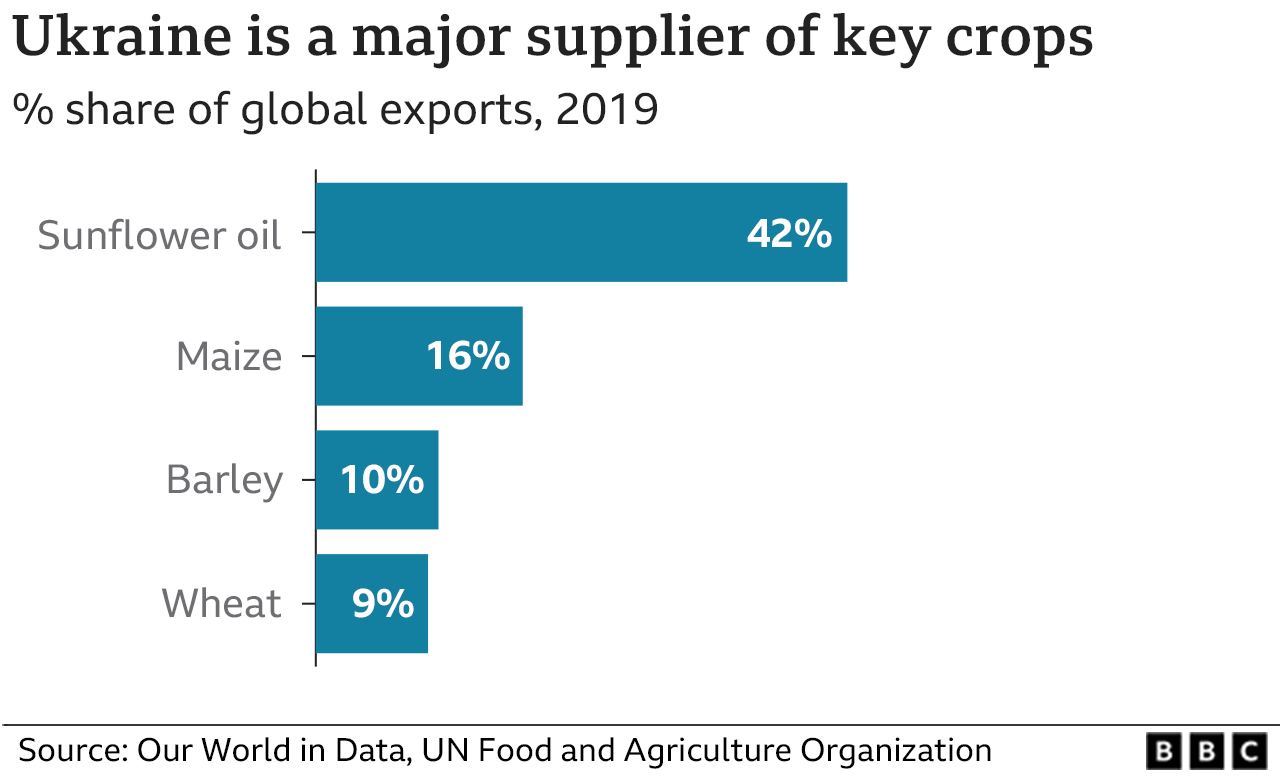
Ukraine’s grain exports are down year on year in the 2022/23 season so far to almost 13.4 million tonnes from 19.7 million tonnes at the same date a season earlier, data collated by the country’s agriculture ministry has shown.
Ministry data showed that exports so far in the July 2022 to June 2023 season included 5.1 million tonnes of wheat, 7.1 million tonnes of corn and 1.1 million tonnes of barley.
The government has said that Ukraine could harvest between 50 million and 52 million tonnes of grain this year, down from a record 86 million tonnes in 2021, because of the loss of land to Russian forces and lower yields.
The European Union is looking into ways to help Ukraine’s energy sector, which has been harmed by Russian attacks for weeks.
During a visit to the Ukrainian capital of Kyiv on Tuesday, Energy Commissioner Kadri Simson confirmed the move.
“I am in Kyiv today to help scale up support to the Ukraine energy sector,” she said.
“I have witnessed the scale of destruction in Ukraine first hand and am making all efforts to increase financial, technical, and practical help.”
Ms Simson called Russia’s attacks “a cruel and inhumane tactic to cause human suffering as the winter is approaching”.
The European Union is looking into ways to help Ukraine’s energy sector, which has been harmed by Russian attacks for weeks.
During a visit to the Ukrainian capital of Kyiv on Tuesday, Energy Commissioner Kadri Simson confirmed the move.
The additional help will have to come from EU institutions, member states, international partners, and private donors, she said.
The commissioner travelled to Kyiv following weeks of Russian attacks that focused on Ukrainian civilian infrastructure, in particular power stations.
Ms Simson plans to meet Ukrainian energy companies to talk about how the EU, international partners, and the private sector can help.
She will also discuss the situation at the Russian-occupied Zaporizhzhianuclear power plant, the security of supply, and the future reconstruction of the energy system.
A Ukrainian official has asked people to donate heaters and generators to Ukraine, which is still without power as a result of Russian strikes on energy facilities.
“Best support for Ukraine today, aside from weapons, is autonomous electricity & heat sources,” said Ministry of Internal Affairs Adviser Anton Gerashchenko on Twitter.
Best support for Ukraine today, besides weapons, are autonomous electricity & heat sources
If you have a generator you don’t or rarely use – please consider gifting it to 🇺🇦. We have a difficult winter ahead but we will prevail
Please contact 🇺🇦 embassy in your country for this
“If you have a generator you don’t or rarely use – please consider gifting it to Ukraine. We have a difficult winter ahead but we will prevail.”
In recent weeks, the Kremlin has attacked Ukraine’s critical infrastructure with wave after wave of air strikes – leaving people without electricity, heat, and water.
On Monday, large parts of Kyiv were cut off from power and water supplies after Russian strikes hit critical infrastructure in the capital, Kharkiv, and other cities.
The series of attacks appeared to be an apparent retaliation for what Moscow alleged was a Ukrainian attack on its Black Sea Fleet over the weekend.
Mr Geraschenko added that those who want to donate them should contact their Ukrainian embassy.
President Vladimir Putin has said Russia is suspending – but not ending – its participation in a deal that allows safe passage to vessels carrying Ukrainian grain exports.
Moscow pulled out of the UN-brokered agreement on Saturday, alleging that Ukraine had used a safety corridor in the Black Sea to attack its fleet.
The UN says there were no ships inside the corridor that night.
Ukraine has not claimed responsibility for the attack.
Ukrainian President Volodymyr Zelensky said the deal would be honoured and accused Russia of “blackmailing the world with hunger” – a claim Russia denies.
Despite the fallout, 12 ships containing 354,500 tons of food, including grain, left Ukraine’s Black Sea ports on Monday, Ukraine’s infrastructure ministry said. This constituted a record volume of exports since the grain deal began, said a spokesperson for Odesa’s military administration quoted by Reuters.
One of the vessels carrying 40,000 tons of grain was destined for Ethiopia, where “the real possibility of mass starvation” existed, the infrastructure ministry added.
After Russia invaded Ukraine in February, its navy imposed a blockade on Ukraine’s Black Sea ports, trapping about 20 million tonnes of grain meant for export inside the country, along with other foodstuffs such as maize and sunflower oil.
But in July, a deal between Ukraine and Russia was brokered by Turkey and the UN, agreeing to resume grain exports through the Black Sea ports.
On Monday, however, President Putin said the deal was being suspended, citing the “massive” drone attack on its fleet in Crimea that he alleged Kyiv was responsible for.
He said maritime safety must be ensured and that implementing grain exports under such conditions were too risky.
“Ukraine must guarantee that there will be no threats to civilian vessels,” Mr Putin said in a televised address.
Kyiv has not admitted responsibility for the attack, saying Moscow had long planned to abandoned the internationally-brokered deal and used the attack as a pretext to do so.
“In conditions when Russia is talking about the impossibility of guaranteeing the safety of shipping in these areas, such a deal is hardly feasible, and it takes on a different character – much more risky, dangerous and unguaranteed,” Kremlin spokesman Dmitry Peskov said.
Russia’s withdrawal from the deal has been condemned by the US, who said Moscow was “weaponising food”.
The EU’s foreign policy chief, Josep Borrell, has urged Russia to reverse its decision, saying jeopardising the export of grain and fertilisers would impact the global food crisis.
The Russian ambassador to the US has rejected accusations that his country was exacerbating a global food crisis, saying it was unfair to criticise Russia.
The suspension comes as Russia says it has expanded its evacuations of the occupied Kherson region, despite stating over the weekend that these had come to an end.
‘Don’t let Russia starve the world’: Ukraine responds to Russia’s suspension of grain agreements
As US politicians make their final appeals to voters ahead of critical midterm elections, a wide-reaching and varied set of issues has dominated discussions across the United States.
Republicans, who are seeking to retake control of Congress from their Democratic Party rivals, are lamenting the state of the economy amid a global financial downturn and a steady rise in the cost of living.
And Democrats are focusing on abortion rights after the US Supreme Court revoked the constitutional right to the procedure while raising concerns about the future of democracy and fair elections in the country.
The November 8 election, which will see all the seats in the House of Representatives and more than a third of the Senate up for grabs, will have an enormous influence on the rest of President Joe Biden’s term.
Here, Al Jazeera examines the major issues at play in this election cycle.
The economy
“It’s the economy, stupid.”
That was the de facto motto of Bill Clinton’s 1992 campaign against incumbent President George HW Bush, who had rallied dozens of countries across the world to beat back Saddam Hussein’s invasion of Kuwait. As Bush tried to tout the triumph of the first Gulf War, Clinton shifted the focus to an economic recession at that time and won the presidency.
Taking a page out of Clinton’s book, this year Republicans have been pushing to make the economy a central issue in the midterm elections, often accusing Biden of seeking to distract from soaring inflation.
Despite a dip in petrol costs in August, consumer prices went up 8.3 percent compared to the same month last year. While Democrats argue that inflation is linked to global events, such as the war in Ukraine, and coronavirus pandemic-related supply chain issues, Republicans say government spending, which has accelerated under Biden, is to blame.
“Inflation is crushing Americans, and it’s disproportionately hurting the most vulnerable,” Mehmet Oz, a Republican Senate candidate running in the swing state of Pennsylvania, wrote on Twitter on September 20. “It’s making everyday necessities like groceries cost more. Hurting small businesses. And hitting seniors, many of whom rely on Social Security, when they need every last penny.’
Abortion
In contests across the country, Democrats are prioritising abortion rights in their pitch to voters, portraying the elections as a referendum on reproductive rights.
Since the overturning of the Supreme Court’s 1973 Roe v Wade ruling in June, many conservative US states passed restrictive abortion laws, including near-total bans.
In response, Democrats have been trying to pass a federal law to protect the right to abortion, but currently, they do not have the numbers in the Senate, where a legislative procedure known as the filibuster requires 60 votes in the 100-member chamber to pass major legislation.
With the election looming, Biden and other top Democrats have promised to carve out a filibuster exception if they retain the House and expand their majority in the Senate.
Most Republican officials argue that abortion regulations should be handled by US states. But Senator Lindsey Graham – who is not up for re-election – recently introduced a federal bill to ban abortions at 15 weeks of pregnancy.
“This November: Abortion access will be on the ballot. A woman’s freedom will be on the ballot. The future of women’s reproductive rights will be on the ballot,” Democratic Senator Maggie Hassan, who is seeking re-election in New Hampshire, wrote on Twitter on September 17.
Abortion rights became a major campaign issue for Democrats after the US Supreme Court in June revoked the right to the procedure [File: Alyssa Pointer/Reuters]
Immigration
With a record number of migrants and asylum seekers crossing the southern border this year, Republicans are turning opposition to Biden’s immigration policies into a political rallying cry ahead of the elections.
Republicans blame Biden – who reversed some of his predecessors Donald Trump’s anti-immigration policies but has failed to revoke others – for the arrivals, saying his administration is failing to secure the border.
Most recently, Republican governors in Texas, Arizona, and Florida have captured national headlines by paying to transport migrants to liberal-leaning northern cities in what they say is an effort to share the burden.
Migrant rights groups, Democratic lawmakers, and the White House have denounced the push as “cruel political theater” meant to curry votes at the expense of asylum seekers. But the Republican governors are sticking by it, while others have pledged to continue some of Trump’smost hardline strategies if elected.
For example, on his campaign website, Adam Laxalt, a Republican Senate candidate trying to unseat a Democratic incumbent in Nevada, has vowed to “finish the wall” at the southern border.
Democracy
Democrats have been sounding the alarm that Trump’s Republican base is growing increasingly authoritarian – or as Biden put it, “semi-fascist” – as the former president is still contesting the 2020 presidential elections based on false allegations of voter fraud.
Democratic candidates are now arguing that a Republican return to power could fundamentally harm the governing system in the country, especially with the GOP having nominated election deniers to offices up and down the ballot across the country.
Trump had pressured state legislatures, the US Department of Justice, and his own vice president to overturn the 2020 vote, and as recently as last month, he called to be reinstated as president.
With Trump likely to seek the White House again in 2024, Democrats say blocking a Republican return to power is needed to safeguard American democracy.
Earlier this month, Biden warned that Trump’s far-right supporters “represent an extremism that threatens the very foundations of our republic”.
“As I stand here tonight, equality and democracy are under assault. We do ourselves no favour to pretend otherwise,” he said.
Other issues
Education: Republicans – wary of discussions about race, sexuality, and gender identity in schools – want more parental control over what children are taught. In his platform, House Minority Leader Kevin McCarthy vows to “recover lost learning from school closures, and expand parental choice so over a million more students can receive the education their parents know is best”. Democrats dismiss the Republican rhetoric as a push for censorship that especially harms LGBT students.
Climate: Democrats, especially those in the progressive wing of the party, say mitigating the climate crisis is one of their most pressing priorities. They are looking to keep control of Congress to expand on recent legislation signed by Biden that incentivises a push towards green energy and electric cars.
Public safety: The US saw an uptick in homicides and violent crime in 2020 and 2021 – a trend that conservatives blame on liberals and progressives. Biden had rejected calls to “defund the police” that rose in the wake of the George Floyd racial justice protests in 2020. Still, many Republicans are trying to paint their rivals as enabling crime. “In the US Senate I’ll fight every day to make life in Arizona safe again,” Republican Senate Candidate Blake Masters says on his website.
Gun control: With the country regularly witnessing mass shootings, Democrats are pushing for tighter gun restrictions, including an assault weapons ban. At the same time, Republicans are vowing to protect gun access and the Second Amendment of the US Constitution, which grants the right to bear arms.
A Ukrainian official has reacted strongly to Russia’s decision to withdraw from the Black Sea grain deal.
Government official Oleg Nikolenko said: “Don’t let Russia starve the world”.
Global prices for wheat have increased by 5% following Russia’s suspension of the grain deal. Millions in Africa and Asia will face malnutrition and hunger because of Moscow’s cruelty. Ukraine wants to continue grain exports to those in need. Don’t let Russia starve the world.
It comes as wheat and other wholesale food costs have risen sharply after Russia withdrew from the export deal which is designed to ensure crucial supplies flow from Ukraine.
Ukraine and Russia account for 30% of global wheat supplies.
A deal with Vladimir Putin’s government had been struck, brokered by the UN, in July to allow shipments from Ukraine.
A Ukrainian MP has said recent Russian attacks on energy infrastructure are making it “harder” for Ukrainians, but added that “no one is complaining”.
Kira Rudik told Sky News: “There are no military targets in these objects Russia is attacking, Putin is attacking them just to make sure it is harder for us to survive winter. Today, people are figuring out how to get water for themselves and their families.
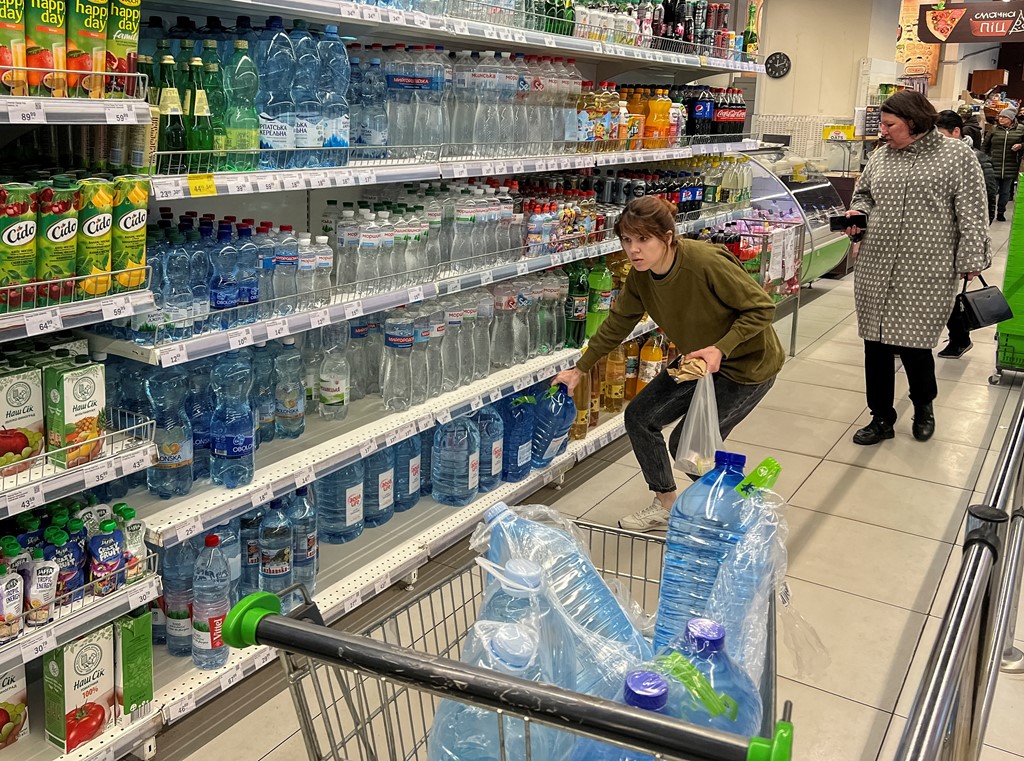
“We were ready for spending a couple of days without electricity and heat, but we were not ready to spend days without running water and this is what may happen.”
She added that while Ukrainians are working to restore damaged sites, she claimed Russia waits for them to be restored and targets them again.
Ms Rudik added that people are preparing to supply water for themselves and using local sources.
“People are supporting each other, but it’s getting harder and harder in Kyiv and other major cities in Ukraine.”
Moscow withdrew from the Black Sea agreement after accusing Ukraine of carrying out a drone attack in Crimea.
Western governments are urging Russia to reverse its decision to withdraw from an UN-brokered grain deal, which undermines efforts to alleviate the global food crisis, with Ukraine claiming Moscow planned the move well in advance.
In July, Russia and Ukraine signed a deal brokered by Turkey and the United Nations under which Moscow allowed grain ships to leave Ukrainian Black Sea ports. The agreement, which had already allowed the export of over 9 million tonnes of Ukrainian grain, was set to be renewed on November 19.
UN Secretary-General Antonio Guterres on Sunday expressed “deep concern” as Ukraine’s maritime grain exports were halted.
“The Secretary-General continues to engage in intense contacts aiming at the end of the Russian suspension of its participation in the Black Sea Grain Initiative,” Guterres’ spokesman said.
“The same engagement also aims at the renewal and full implementation of the initiative to facilitate exports of food and fertilizer from Ukraine, as well as removing the remaining obstacles to the exports of Russian food and fertilizer.”
Moscow suspended its participation in the deal on Saturday, effectively blocking shipments from Ukraine, one of the world’s top grain exporters, in response to what it called a major Ukrainian drone attack earlier in the day on its Black Sea Fleet headquarters near the port of Sevastopol in Russian-annexed Crimea.
“Russia’s decision to suspend participation in the Black Sea deal puts at risk the main export route of much-needed grainand fertilisers to address the global food crisis caused by its war against Ukraine,” European Union foreign policy chief Josep Borrell said on Twitter on Sunday.
“The EU urges Russia to [reverse] its decision.”
Russia’s decision to suspend participation in the Black Sea deal puts at risks the main export route of much needed grain and fertilisers to address the global food crisis caused by its war against Ukraine.
Missile debrislanded in the northern Moldovan village of Naslavcea on Monday morning after a Russian fusillade was intercepted by air defences in neighbouring Ukraine, according to a statement from Moldova’s interior ministry.
No one was hurt, but the windows of several homes in Naslavcea, which borders Ukraine, were shattered, according to the ministry.
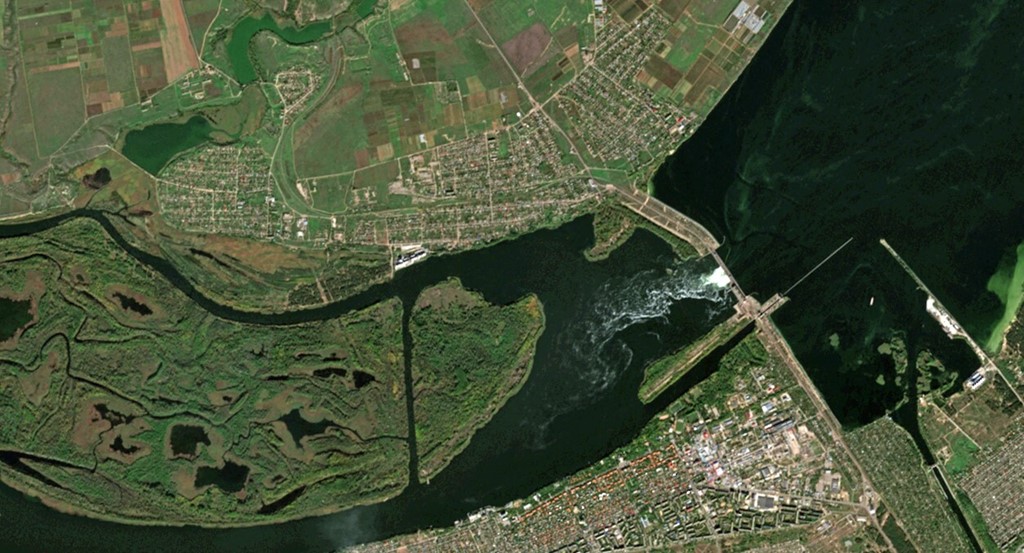
Nicu Popescu, Moldova’s foreign minister, said the Russian attack had targeted a Ukrainian dam on the Nistru River that runs through the two countries.
“Attacks on water infrastructure and ensuing stress on the river could put the entire region in danger of floods,” he tweeted, condemning Russian aggression against Ukraine “in the strongest possible terms”.
This morning a part of a Russian missile shot down by Ukrainian air defences landed in the Moldovan village of Naslavcea on the Ukrainian border.
There were no casualties; the shock wave shattered windows of several residential houses.
President Recep Tayyip Erdogan says Turkeyis determined to “serve humanity” and move forward with the UN-brokered Black Sea grain export deal after Moscow withdrew from the initiative over the weekend.
“Even if Russia behaves hesitantly because it didn’t receive the same benefits, we will continue decisively our efforts to serve humanity,” Erdogan said in a televised address.
“Our effort to deliver this wheat to countries facing the threat of starvation is evident. With the joint mechanism that we established in Istanbul, we contributed to the relief of a global food crisis,” the Turkish leader added, noting the deal had already provided 9.3 million tonnes of food to world markets.
Russia has warned that it would be “risky” for Ukraine to continue exporting grain via the Black Sea after Moscow suspended its participation in an initiative to facilitate shipments.
“In conditions when Russia is talking about the impossibility of guaranteeing the safety of shipping in these areas, such a deal is hardly feasible, and it takes on a different character – much more risky, dangerous and unguaranteed,” Kremlin spokesman Dmitry Peskov told reporters.
Peskov said Russian contacts with Turkey and the United Nations, who brokered the grain export deal in July, were continuing. He declined to comment when asked what needed to happen, from Russia’s point of view, for the deal to be resumed.
Ukrainian officials have reported that Russia has launched massive missile strikes across Ukraine, including the capital Kyiv, causing power and water outages.
At least two explosions have been reported in Kyiv. One resident told the BBC that his neighbourhood was now without power.
According to local authorities, critical infrastructure facilities in the northeastern city of Kharkiv were hit.
The strikes follow Russia’s accusation that Ukraine was responsible for a drone attack on its Black Sea Fleet in annexed Crimea.
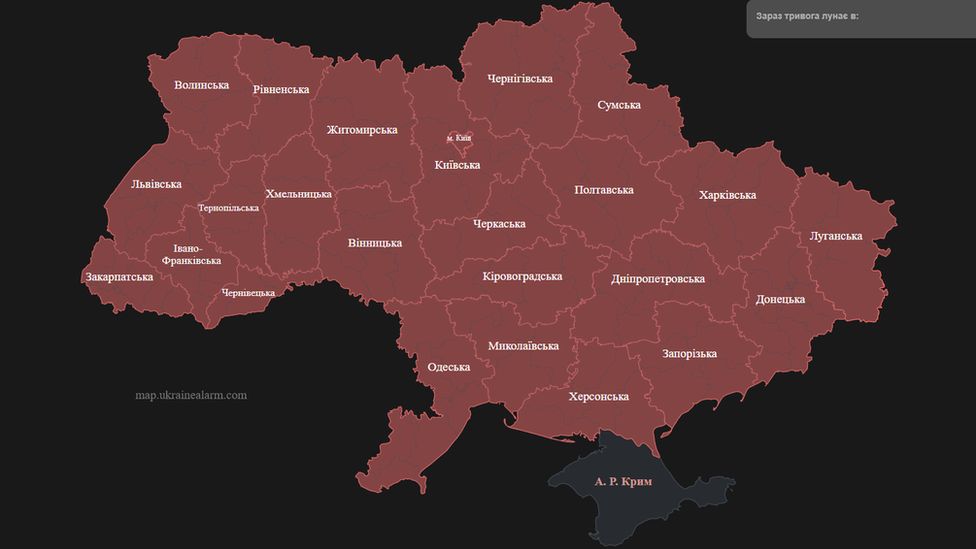
On Monday morning, missile strikes were also reported in the central Vinnytsia region, as well as Dnipropetrovsk and Zaporizhzhia in the southeast, and Lviv in western Ukraine.
A facility at the Dnipro hydroelectric power plant in the Zaporizhzhia region was also reportedly hit.
In Kyiv, a facility that powers 350,000 apartments was damaged, with engineers urgently deployed to restore the supply.
Residents in the regions under attack were urged to remain in shelters, amid fears more strikes could follow.
Ukraine’s Air Force spokesman Yuriy Ihnat told Ukrainian TV that Russia had used its strategic bombers to carry out its “massive” strikes.
Andriy Yermak, the head of President Volodymyr Zelensky’s office, said that “Russian losers are continuing to fight against peaceful objects”.
IMAGE SOURCE, UKRAINE’S DIGITALISATION MINISTRY Image caption, All of Ukraine’s regions – except for the annexed Crimea in the south – were marked in red as being under air attack on Monday morning
Russia has so far made no public comments on the reported latest strikes.
On Saturday, one Russian warship was damaged in the port city of Sevastopol in a drone attack, the Russian defence ministry said. It also accused British specialists of having trained the Ukrainian soldiers who then carried out the strikes in Crimea – Ukraine’s southern peninsula, annexed by Russia in 2014.
Moscow provided no evidence to back its claims.
Ukraine has not commented on the issue, while the UK defence ministry said Russia was “peddling false claims on an epic scale“.
Moscow has said it will supply hundreds of thousands of tonnes of grain to poor countries over the next four months, with assistance from Turkey.
TASS news agency, citing agriculture minister Dmitry Patrushev, said only 3% of food exported under an UN-brokered deal had gone to the poorest countries and that Western nations accounted for half of all shipments.
The agreement was signed back in July to release several million tonnes of grain from blockaded Ukrainian ports.
The World Food Programme said the war in Ukraine has exacerbated a global hunger crisis as the conflict has pushed up the costs of food, fuel, and fertilizers.
TASS has indicated that Russia has suspended its participation in a grain export deal following overnight attacks on ships in Crimea.
The UN-mediated agreement, signed in July, allowed shipments of Ukrainian grain to be exported from blockaded ports.
“Taking into account… the terrorist act by the Kyiv regime with the participation of British experts against the ships of the Black Sea Fleet and civilian vessels involved in ensuring the security of the “grain corridor”, the Russian side suspends participation in the implementation of agreements on the export of agricultural products from Ukrainian ports,” the ministry said in a statement.
It earlier said the drone attacks were mostly repelled, although a ship received minor damage.
Social media videos purport to show fires and black smoke in the Bay of Sevastopol.
A UN spokesperson has said they are in touch with Russian authorities and that all sides should refrain from doing anything to imperil the deal.
In the last few minutes, Russia’s agriculture minister Dmitry Patrushev said only 3% of the food exported under the UN-brokered deal had gone to the poorest countries – and that Moscow intends to supply 500,000 tonnes of grain to these nations over the next few months.
On Wednesday, UN aid chief Martin Griffiths said he was “relatively optimistic” the deal would be extended beyond mid-November.
Russia has slammed the United States for making false claims about Moscow’s decision to withdraw from a grain export deal mediated by the United Nations.
Russia’s defence ministry said Ukraine used 16 drones to attack its Black Sea Fleet near Sevastopol on the Russian-annexed Crimean peninsula early Saturday, and that British navy “specialists” assisted in coordinating the “terrorist” attack.
Anatoly Antonov, the Russian ambassador to the US, said on Telegram: “Washington’s reaction to the terrorist attack on the port of Sevastopol is truly outrageous.
“We have not seen any signs of condemnation of the reckless actions by the Kyiv regime.”
Mr Antonov added: “All the indications that the British military specialists were involved in organising the massive strike with the use of drones, are disregarded.”
The UK has dismissed Russia’s claims as false, while US President Joe Biden denounced Russia’s decision on the grain deal as “purely outrageous” and said it would increase starvation.
The UK has hitback after Moscow accused a Royal Navy unit of causing explosions along a key gas pipeline between Russia and Europe.
It said Russia had made the “false claims of an epic scale” to “detract from the disastrous handling of the illegal invasion of Ukraine”.
To detract from their disastrous handling of the illegal invasion of Ukraine, the Russian Ministry of Defence is resorting to peddling false claims of an epic scale
This invented story, says more about arguments going on inside the Russian Government than it does about the west
It also mentioned “arguments going on inside the Russian government”, referring to reports of disquiet among Vladimir Putin’s top officials over the war situation.
British military experts have said Russia’s claim is a “straight lie” and that the navy would not have the means to carry out such an attack.
A large proportion of the pot – some £3bn – is being spent on housing refugees, mainly from Ukraine, according to the Centre for Global Development (CGD).
The UK is now spending more of its aid budget at home than in poorer countries, development experts have said.
That is because a large proportion of the pot – some £3bn – is being spent on housing refugees, mainly from Ukraine, according to the Centre for Global Development (CGD).
The UK aid budget is around £11bn, with some £4bn going to multilateral institutions including the World Bank.
Of the remaining £7bn, which is administered by the UK directly, more than half will be spent domestically this year, including some £3bn on housing refugees, according to CGD’s analysis.
While the UK is allowed to count refugee-hosting costs as official development assistance (ODA) under internationally agreed rules, it is one of only a few countries – and the only one in the G7 – to fund all the costs of Ukrainian refugees from its existing aid budget, the Washington and London-based think tank said.
Rishi Sunak was criticised for cutting the budget from 0.7% to 0.5% of national income during his time as chancellor, for setting a precedent for letting the Home Office and other departments use the pot, and for stretching the rules on what can be counted as aid.
Ranil Dissanayake, the policy fellow at CGD, said: “The development budget – the pot of money we put aside to help the world’s poorest people – is being squeezed from every angle.
“Not only was it slashed by almost a third, Rishi Sunak then set a precedent as chancellor for letting other departments claim whatever they could back from this pot.
“Saying we spend 0.5% of our national income on aid is becoming meaningless, when such a huge proportion of this pot is being spent domestically, rather than on helping people facing enormous hardship across the world.”
The appointment was seen as significant as Mr Mitchell, a former international development secretary, could increase pressure on Mr Sunak to honour his pledge to return to 0.7% international aid spending by 2024-25.
However, the prime minister is considering freezing the budget for an extra two years – saving £4bn a year – as he eyes ways to plug a multi-billion pound fiscal black hole, the Telegraph reported.
A spokesperson at the Foreign, Commonwealth and Development Office said: “Across government, there are significant pressures on the 0.5% ODA budget due to the costs of accepting refugees from Afghanistan and Ukraine as well as wider migration challenges. Obviously how many refugees arrive in any particular period is not certain, so there is not fixed cost.
“We remain one of the largest global aid donors, spending more than £11 billion in aid in 2021, and UK aid has recently gone towards those in need in the Horn of Africa and Pakistan.”
Octopus has announced that it will acquire Bulb’s 1.5 million customers. The failure of Bulb inNovember 2021 was the most significant of dozens of energy supplier failures.
Octopus Energy has completed its acquisition of Bulb, a failed energy rival supported by billions of pounds in government funding for nearly a year.
Octopus stated that it is acquiring Bulb’s 1.5 million customers in order to “put an end to taxpayer losses and uncertainty for Bulb customers and employees.”
It added: “Octopus is paying the government to take on Bulb’s customer base – it is believed that this will represent a higher amount per customer than suppliers typically paid to take on any of the 29 suppliers who have failed since September 2021.
“Taxpayers will also benefit from a profit share agreement for a period of up to four years.”
It comes after Ovo Energy launched an 11th-hour bid to prevent Octopus from swallowing the nationalised supplier.
Ovo submitted an offer for Bulb soon after it collapsed into insolvency a year ago but subsequently pulled out of the auction.
Bulb’s collapse in November 2021 was the most significant among dozens of supplier failures, with Ofgem, the industry regulator, facing heavy criticism for its approach to licensing new entrants to the market.
The government has already been forced to spend billions of pounds buying gas to supply Bulb customers because the company did not hedge its purchases in order to fix its cost base.
Wholesale gas prices have soared over the last year, with Vladimir Putin’s invasion of Ukraine having a particularly pronounced impact on global energy markets.
That would allow the buyer to secure sufficient forward supplies of gas to steer the company through the winter months.
Octopus intends to repay the government funding over a period lasting a number of months, according to sources close to the situation.
Russia saysonly 3 percent of food exported from Ukraine under a deal that allowed its grain shipments to resume has gone to the world’s poorest countries. It says Western nations have received half.
“The geography of the recipients of these cargoes has turned out to be completely inconsistent with the initially declared humanitarian objectives,” Russia said in a statement.
“Needy states such as Somalia, Ethiopia, Yemen, Sudan, and Afghanistan have received just 3 percent of the food, mostly from the World Food Programme,” it said.
Since the signing of the UN-backed Black Sea Grain Initiative in July in Turkey, several million tonnes of corn, wheat, sunflower products, barley, rapeseed, and soya have been exported from Ukraine.
But President Vladimir Putin and other Russian officials have since complained that there are serious problems with the deal, raising fears that Moscow could block those exports unless its demands are met.
The US willprovide a new $275m military assistance package for Ukraine to help it battle Russia’s invasion, the Pentagon has announced.
The package includes ammunition for Himars precision rocket launchers, various types of 155 mm artillery rounds, anti-armor systems, small arms ammunition, and four satellite communications antennas, Deputy Pentagon Press Secretary Sabrina Singh told journalists.
“We’re seeing Ukrainian infrastructure and electrical grids being targeted by the Russians and these antennas provide an additional capability on the ground at a critical time when Ukraine’s infrastructure is being hit,” Singh said.
This month, Russia resumed strikes on Kyiv, targeting critical infrastructure and forcing Ukraine to implement rolling blackouts.
According to Mr Klitschko, the city’s electricity deficit currently ranges between 20% and 50%.
It is, therefore, still operating in an emergency capacity.
Ukraine’s main power supplier, Ukrenergo, said it hopes to eliminate the shortages within two to three weeks – if there are no further strikes.
Mr Klitschko said: “The city is doing everything possible to save electricity consumption. In particular, trolleybuses have been replaced by buses on many routes of communal public transport.
“At the same time, the capital is not going to stop the metro. Once again, I call on the citizens of Kyiv and businesses to reduce electricity consumption!
“The risk of a major blackout, when a lack of electricity can lead to even greater consequences and an even greater shutdown, there is.”
Ukrainianian Foreign MinisterDmytro Kuleba said he had received a call from his Iranian counterpart Hossein Amirabdollahian on Friday.
Within it, Mr Kuleba said he had demanded that Tehran stop sending weapons to Russia.
Ukraine and its Western allies have accused Iran of sending “kamikaze” drones to Russia – which have then been used to devastating effect.
Iran denies the charge, which relates to attacks in major Ukrainian cities.
“I demanded Iran to immediately cease the flow of weapons to Russia used to kill civilians and destroy critical infrastructure in Ukraine,” he saidUkrainian minister demands Iran stop ‘supplying weaponry to Russia’
Ukrainian Foreign Minister Dmytro Kuleba said he had received a call from his Iranian counterpart Hossein Amirabdollahian on Friday.
Within it, Mr Kuleba said he had demanded that Tehran stop sending weapons to Russia.
Ukraine and its Western allies have accused Iran of sending “kamikaze” drones to Russia – which have then been used to devastating effect.
Iran denies the charge, which relates to attacks in major Ukrainian cities.
“I demanded Iran to immediately cease the flow of weapons to Russia used to kill civilians and destroy critical infrastructure in Ukraine,” he said
Today, I received a call from Iranian Foreign Minister Hossein Amir Abdollahian, during which I demanded Iran to immediately cease the flow of weapons to Russia used to kill civilians and destroy critical infrastructure in Ukraine.
Canada announced on Fridaythat it will sell a five-year government-backed bond to raise funds for Ukraine.
It will also impose new sanctions on 35 Russian individuals, including executives from Gazprom.
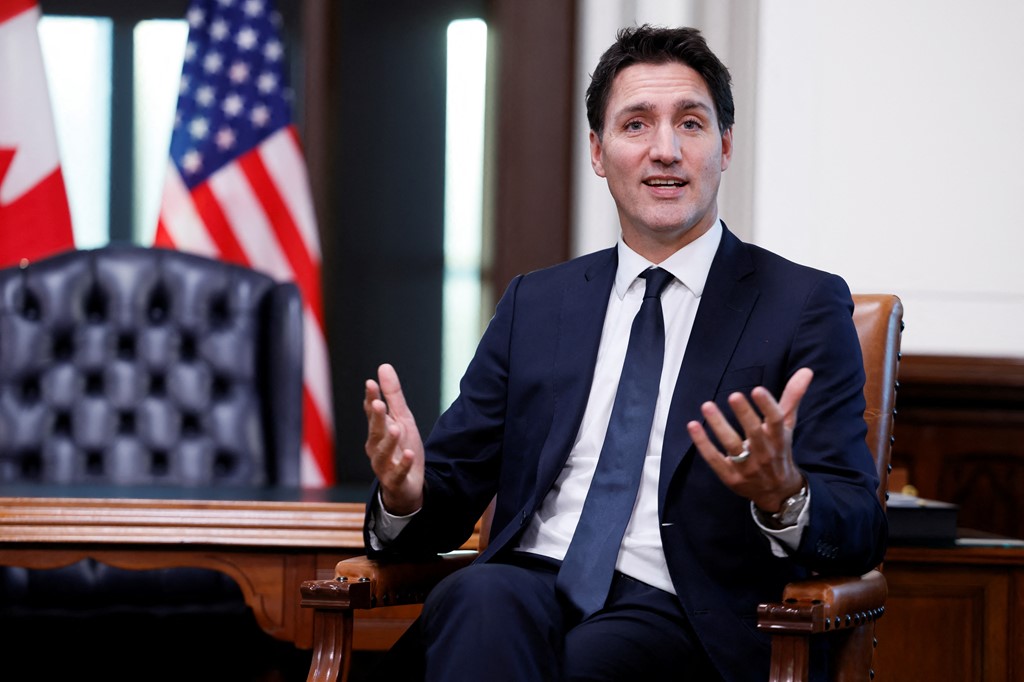
“Canadians will now be able to go to major banks to purchase their sovereignty bonds, which will mature with interest after five years,” Prime Minister Justin Trudeau said.
“These funds will go to support the government of Ukraine so they can continue to support the Ukrainian people.”
The proceeds will “help the (Ukrainian) government continue operations, including providing essential services to Ukrainians, like pensions, and purchasing fuel before winter,” a statement added.
The equivalent of the income raised will be channelled “directly to Ukraine” through an International Monetary Fund-administered account.
Mr Trudeau also announced new sanctions on 35 senior officials of energy sector entities, including Gazprom “and its subsidiaries,” according to a statement, plus six other “energy sector entities.”
“We will continue to tighten the screws on anyone abetting this illegal invasion,” he said.
Russian officials say they have completed an operation to move civilians out of the southern city of Kherson ahead of an expected battle with Ukrainian forces.
At least 70,000 civilians are said to have crossed the Dnipro river, in what Ukraine has called forced deportations.
“We’re preparing Kherson for defence,” said Russian militia commander Alexander Khodakovsky.
“We’re taking the civilian population out, in many ways untying our hands.”
Ukraine’s southern Kherson region was one of four areas of Ukraine annexed by Vladimir Putin last month, despite Russia not having total control of any of them.
Kherson city was captured shortly after Russia’s invasion last February but in recent weeks Ukrainian forces have steadily recaptured territory on the west or right bank of the Dnipro. The front line is 30km (18 miles) away from the city, according to Ukrainian officials.
Russian-installed officials have warned of an assault on the regional capital in the near future. However, Ukraine’s defence minister, Oleksii Reznikov, has described the counter-offensive as really difficult because of the tough terrain and rainy weather which make it harder to use fighting vehicles with wheels.
The man installed by Russia’s occupying authorities in annexed Crimea, Sergei Aksyonov, posted pictures of the bank of the Dnipro on Thursday night, during a visit with a leading figure in the Kremlin, Sergei Kiriyenko.
“The work on organising the departure of residents has been completed,” he announced. Occupying authorities say they have been moved to “safe regions of Russia”, which include other areas of Ukraine under Russian control but also, reportedly, Russia itself.
The deportation or transfer of civilians by an occupying power inside or outside the occupied territory is considered a war crime.
Another Russian-appointed official admitted that many civilians had stayed. Vladimir Saldo, installed by the Russians as governor of Kherson, said 150-170,000 people were still in and around the city on the right bank of the Dnipro river. The pre-war population of the city alone was some 300,000.
One resident told the BBC last week that no-one was going anywhere and that Russian soldiers were worried how they could survive in Kherson city.
One of the most hardline backers of the war, Chechen leader Ramzan Kadyrov, admitted that a Chechen unit had suffered “big losses” in the region this week. He said 23 fighters were killed and 58 others were wounded in a Ukrainian artillery attack, but went on to claim that his forces had killed many more Ukrainians.
Ukraine’s regional leader in Kherson, Serhiy Khlan, said Kadyrov’s men were being replaced by soldiers recently called up as part of President Putin’s mobilisation drive across Russia. Fields around the regional capital were being mined, he said, and the new recruits were now acting as Russia’s first line of defence.
Ahead of any battle for Kherson city, Ukrainian officials have suggested that Russia has withdrawn its occupying authority to the town of Henichesk, some 200km to the south-east.
Ukrainian military spokeswoman Natalya Humenyuk said the Russians were trying to hold on to the right bank of the Dnipro, but the fact they were preparing to defend the other side of the river too was a “telling sign they understand. the real situation – that they are unlikely to hold on to the right bank”.
President Volodymyr Zelensky says Russiahas launched more than 30 drone attacks on Ukraine in just two days.
He added that in total, Moscow had also carried out some 4,500 missile strikes and over 8,000 air raids.
Speaking from Kyiv and standing beside what appeared to be a downed Iranian Shahed drone, Mr Zelensky pledged to “clip the wings” of Moscow’s air power.
Western officials believe Iran has supplied a large number of drones to Russia, but Moscow and Tehran deny it.
It comes as US Secretary of State Antony Blinken called Russia’s aggressive use of drones “appalling”.
The top US diplomat accused Russian commanders of using the devices to “kill Ukrainian civilians and destroy the infrastructure they rely on for electricity, for water, for heat” during a visit to the Canadian capital Ottawa.
“Canada and the United States will keep working with our allies and partners to expose, to deter, and to counter Iran’s provision of these weapons,” Mr Blinken said.
In recent weeks, Russian attacks have targeted Ukraine’s civilian infrastructure, damaging the country’s electricity and water supply just as temperatures begin to drop.
Western countries say Iran is supplying its domestically developed drones to Moscow and that Iranian military experts are on the ground in Russian-occupied Crimea to provide technical support to pilots.
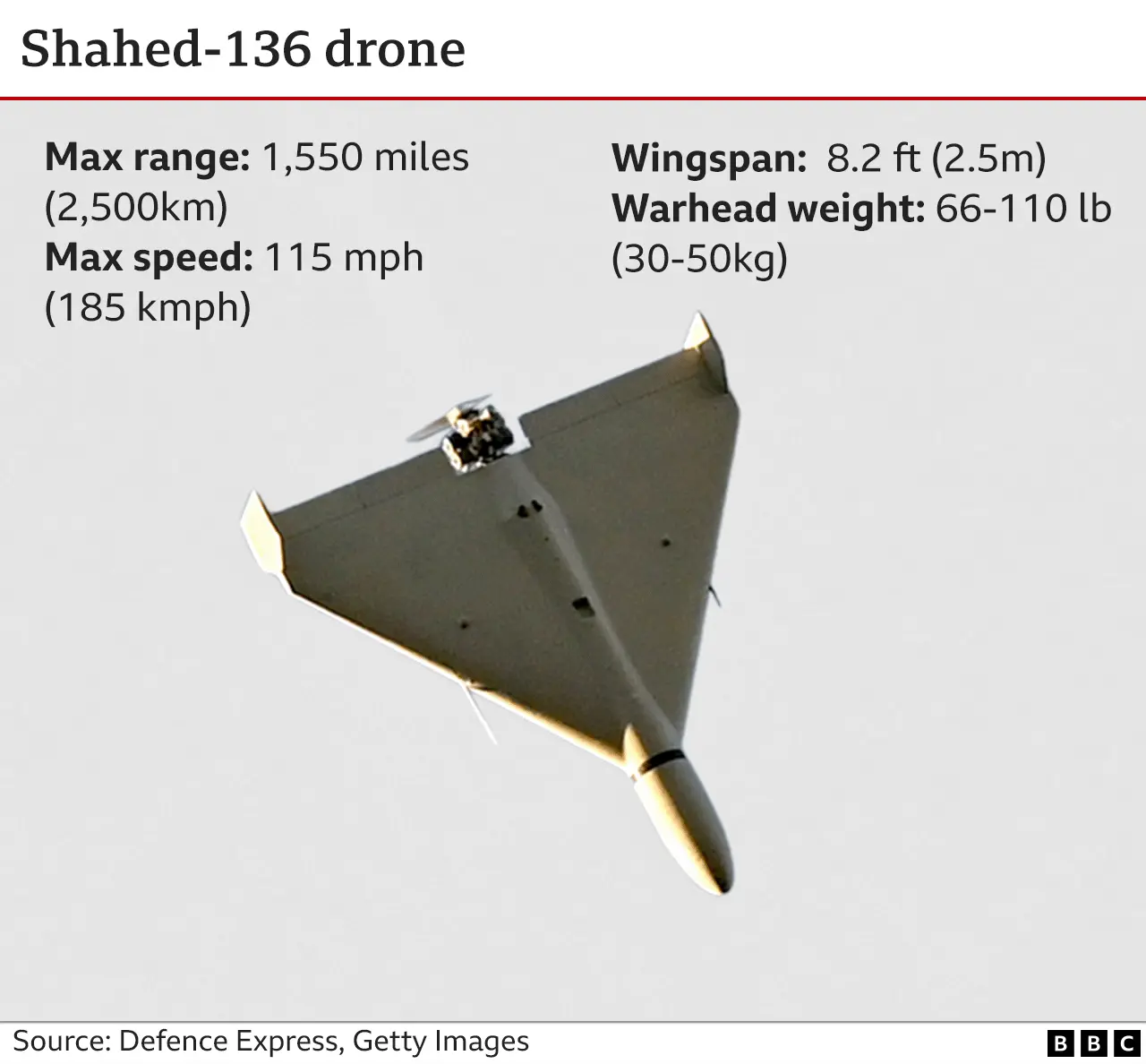
Kyiv has identified the drones used in some attacks on its infrastructure as Iranian Shahed-136 drones. They are known as “kamikaze” drones because they are destroyed in the attack – named after the Japanese fighter pilots who flew suicide missions in World War Two.
Ukraine says around 400 drones have already been used by Russia, from a total order of roughly 2,000 weapons.
But Tehran has repeatedly denied that it has struck any arms deal with the Kremlin, and Moscow also denies using Iranian drones.
On Wednesday, Iran’s Foreign Minister Hossein Amir-Abdollahian called the accusations “baseless” and urged Ukraine to “present any evidence supporting the accusations”.
“If… it becomes clear to us that Russia has used Iranian drones in the war against Ukraine, we will definitely not be indifferent about this issue,” he added.
Tehran’s regional adversary, Israel, has also attacked Iran over the alleged exports. During a meeting with US President Joe Biden at the White House on Thursday, President Isaac Herzog slammed the regime’s activities.
“The fact that Iran, following its activities in killing its own citizens, in working towards nuclear weapons endlessly, endangering the entire world and the region — and now killing innocent civilians in Ukraine, clearly that gives you a picture of what Iran is all about,” Mr Herzog said.
Prior to the visit, he had pledged to share “proof” with Mr Biden that Iran was supplying the weapons.
Meanwhile, US officials have said they will supply Ukraine with an additional $275m (£237m) of military aid, according to the Associated Press.
The assistance is expected to be used to restock ammunition for Ukrainian artillery systems, including the HIMARS launchers that Kyiv’s forces have used to great effect.
On the ground, fighting has slowed in recent days, with a much anticipated Ukrainian advance on the southern city of Kherson stalled due to poor weather.
Russia‘s President Vladimir Putin on Thursday accused the Western nations of escalating the ongoing conflict in Ukraine, and accused them of eroding the principles of collective security, with the substitution of international law for the so-called rules-based order.
Speaking at the 19th meeting of the Valdai International Discussion Club in a forum themed The World After Hegemony: Justice and Security for All, Putin launched a scathing attack on the “so-called West” for attempting to instate one “hegemonic” rule.
‘They’re fuelling the war in Ukraine..’: Putin
The Russian President slammed the western nations for trying to escalate the war in Ukraine. “They’re fueling the war in Ukraine,” said the head of the Russian Federation, adding that they have been fueling tensions around Taiwan, destabilizing the world food and roiling the energy markets. “As far as the last one is concerned, it is not deliberate, [I] don’t doubt that,” Putin said at the meeting. Russia’s leader noted that energy and food security was impacted globally due to a number of systematic errors committed by the Western authorities, referring to crippling sanctions imposed on the Russian Federation in response to its invasion.
Putin accused the West of playing a “dangerous” game as he asserted that the dominion of the world “is precisely what the West has decided to stake in this game. But this game is a dangerous, dirty, and bloody one.” He further iterated that such acts contest the “sovereignty of peoples and nations, their identity and uniqueness and have no regard whatsoever for the interests of other countries.” He furthermore stated that humanity, which stands at a crossroads, has two options – “either continue to ‘accumulate all of the problems that are certain to crush all of us’ or nations can work together ‘to find solutions.’”
Russia earlier accused the “nuclear US-UK-France troika” – the nuclear alliance of NATO, of waging a proxy-war strategy against Moscow by bringing weapons into Kyiv, and expanding the alliance to its eastern flank, posing a grave threat to Russia’s national security. In a statement made at the Military Security and Arms Control summit in Vienna, Moscow lambasted US’ Democratic majority leader Steny Hoyer for “openly declaring that the US is in a state of war with Russia”. Hoyer (D-Md.) was arguing on the House floor about the ongoing inflation of energy costs due to Russia’s war.
The Kremlin also previously refuted the United States’ narrative of it waging a “nuclear war” saying that such a conflict “must never be fought” and that any military conflict between nuclear powers “must be avoided as declared by P5 countries”.
Moscow accused the West of flaring the Ukraine conflict by supplying weapons to Ukraine to kill Russian commanders and its military forces.
Ukraine has increased the number of forces deployed in northern regions near Belarus to counter any potential renewed Russian attack across the border, according to the country’s general staff.
“At the current time, the creation of a strike force [in Belarus] is not observable. [But] there are and will be threats. We are reacting, we have already increased our troops in the northern direction,” Oleksii Hromov, deputy head of the general staff’s main operations directorate, told a regular news briefing.
Belarus is a close ally of Russia and has previously allowed Moscow’s forces to use its territory as a springboard to attack Ukraine.
Earlier this month, Belarusian President Alexander Lukashenko said Belarus and Russia would deploy a joint military task force near Ukraine in response to what he claimed was a clear threat to his country from Kyiv and its backers in the West, without providing evidence for the assertion.
Mercedes-Benz has announced its intention to exit the Russian market and sell shares in its industrial and financial services subsidiaries to a local investor, making it the latest carmaker to do so.
Japan’s Nissan this month took a $687m loss in handing over its business in Russia to a state-owned entity for 1 euro, mirroring an earlier move by Renault, which sold its majority stake in Russia’s Avtovaz for 1 rouble.
Now shares in Mercedes’s local subsidiaries are expected to be sold to the car dealer chain Avtodom.
Mercedes stopped manufacturing in Russia in early March.
White House has reported that US President Joe Biden and UK Prime Minister Rishi Sunak have agreed to work together to support Ukraine.
They first spoke just hours after Sunak became Britain’s third prime minister this year.
The two leaders also reaffirmed the “special relationship” between the US and the UK, and said they would work together to advance global security and prosperity, the White House said in a read-out of the conversation.
“The leaders agreed on the importance of working together to support Ukraine and hold Russiaaccountable for its aggression,” the statement said.
Managers say it will be a“huge logistical challenge” to recruit and train 25,000 people to return the airport to pre-COVID capacity.
The UK’s busiest airport is still less busy than it was before the pandemic, but it is planning measures to avoid Christmas travel chaos.
Demand for air travel is still below 2019 pre-pandemic levels, Heathrow Airport said, with numbers expected to be down a quarter on 2019 for the whole of 2022 at between 60 and 62 million people.
The numbers won’t return to 2019 levels for a number of years, the airport said in its financial results for the nine months ending 30 September.
Heathrow served 18 million passengers over the summer, more than any other European hub.
Airport bosses blamed the headwinds of a global economic crisis, the war in Ukraine, and the impact of COVID-19 for the lower passenger numbers.
But there was some good news for the airport as it managed to turn a £1.4bn loss in the first three quarters of last year into a £643m profit this year.
In order to bring up passenger numbers and cope with peak demand, the “huge logistical challenge” of recruiting and training 25,000 security-cleared staff needs to be done by businesses across the airport.
South Africa says it will allow a sanctioned Russian oligarch to dock his superyacht in Cape Town.
The $521m (£472m) vessel, which belongs to Alexei Mordashov – an ally of Russian leader Vladimir Putin – left Hong Kong earlier this week.
South African opposition leaders had urged the government to seize the 465ft long (141m) yacht called The Nord.
But a spokesman for President Cyril Ramaphosa said he saw “no reason” to comply with Western sanctions.
“South Africa has no legal obligation to abide by sanctions imposed by the US and EU,” Vincent Magwenya told reporters in Pretoria on Tuesday.
“South Africa’s obligations with respect to sanctions relate only to those that are specifically adopted by the United Nations,” Mr Magwenya added, noting that Mr Mordashov is not under any UN-sponsored sanctions.
Western countries and their allies have imposed sanctions on more than 1,000 Russian individuals and businesses in response to Russia’s invasion of Ukraine.
Like many other African countries, Mr Ramaphosa’s government has so far avoided directly criticising Russia, abstaining in several UN votes that have expressly condemned the war. Pretoria has also called for a negotiated settlement to end the conflict.
On Monday, Cape Town Mayor Geordin Hill-Lewis – a member of the opposition Democratic Alliance party – urged officials to block the superyacht’s entry, writing on Twitter that there could be “no place in our city for accomplices to, and enablers of, Putin’s war”.
“It must be said that so far, our country’s foreign policy conduct in relation to Russia’s illegal, imperialist war has been nothing less than shameful,” Mr Hill-Lewis added in a further statement. “Here is an opportunity to correct some of those errors of judgement and stand up for what is clearly right.”
It is unclear whether Mr Mordashov is actually onboard the vessel. Speaking to local media on Sunday, Mr Hill-Lewis suggested that the billionaire was travelling on his yacht.
But last week a spokesperson for the oligarch told Bloomberg News that he had been in Moscow since his yacht arrived in Hong Kong.
Hong Kong’s government recently offered similar justifications when refusing to prevent the entry of the superyacht, with Chief Executive John Lee saying the city would be accountable to UN sanctions but not “unilateral” ones imposed by “individual jurisdictions”.
Prior to the war, Mr Mordashov was Russia’s wealthiest man. The 57-year-old built a fortune of some $29.1bn (£25.92bn) through his steel and mining company Severstal.
Early in the conflict he was targeted by extensive Western sanctions due to his links with Mr Putin. But the billionaire has questioned the value of the moves, saying he had no involvement in Russian politics and maintains little influence with the Kremlin.
Mr Mordashov has already lost one of his smaller vessels, the 215ft Lady M, to Western sanctions after it was seized by Italian police in March.
But The Nord is believed to be his biggest yacht asset. The vessel is larger than a football field and is described as one of the world’s most extravagant boats, according to Forbes.
Shortly after the outbreak of the conflict in Ukraine, the yacht – which features two helicopter pads, a swimming pool and a cinema – left the Seychelles for the far-eastern Russian port of Vladivostok. The move was seen as a bid to avoid the fate of the Lady M.
But experts say owners like Mr Mordashov face serious issues finding international ports capable of maintaining superyachts. Most are in Europe, where the vessels would be instantly seized.
Russian forces have repelled Ukrainian attacks in the southern Kherson region and eastern Luhansk area, the Kremlin’s defence ministry claimed today.
As Ukrainian troops continue with their counteroffensive in the east, Russian-installed officials have been evacuating thousands of civilians from Kherson across the Dnipro river.
Kherson’s regional capital is the only big city Russia has captured intact since the start of the invasion.
And the province controls the gateway to Crimea, which Russia seized and claimed to annex in 2014.
On Monday, pro-Russian authorities in the region announced that men who stayed in the area would have the option of joining a military self-defence unit.
However, Kyrylo Budanov, Ukraine’s military spy chief, told the Ukrainska Pravda media outlet: “They are creating the illusion that all is lost.
“Yet at the same time, they are moving new military units in and preparing to defend the streets of Kherson.”
The European Union will send Kyiv 1.5 billion euros each month in 2023 to assist Ukraine in its struggle against Russia’s invading soldiers, according to the bloc’s leader.
European Commission President Ursula von der Leyen said that the EU had given Ukraine 19 billion euros this year. “It is very important for Ukraine to have a predictable and stable flow of income,” she said, adding that Kyiv estimated its monthly needs at 3-4 billion euros “for the basics.”
The EU chief told a news conference the EU would finance 1.5 billion euros per month of that, with the rest expected to come from the United States and international institutions.
“That will give a total of 18 billion for the next year – an amount Ukraine can count on and where there is a stable and reliable, predictable flow of income.”
At least 15 EU countries seek a price cap in response to popular outrage over rising living costs, but Germany is adamantly opposed.
Despite hours of squabbling, European Union leaders have failed to achieve an agreement on a proposal to help protect their citizens from rising energy prices.
The group’s leaders emerged from their second summit in as many weeks at about 2 am in Brussels (00:00 GMT) with a “roadmap” to agreeing on a set of measures to lower energy bills, which have soared as a result of Russia’s invasion of Ukraine.
While the announcement of the summit text made a public show of unity among the 27 member states, the absence of any decision on capping gas prices indicated negotiations would remain difficult.
“We do now have a very good and solid roadmap to keep on working on the topic of energy prices,” European Commission President Ursula von der Leyen told reporters in the early hours of Friday morning.
No timeframe was given on when a decision on price caps would be made, with EU energy ministers due to meet in Luxembourg on Tuesday for further discussions.
The published text calls on the European Commission and EU countries to find ways to shield consumers from the high prices “while preserving Europe’s global competitiveness… and the integrity of the Single Market”.
“There is a strong and unanimously shared determination to act together, as Europeans, to achieve three goals: lowering prices, ensuring the security of supply, and continuing to work to reduce demand,” said meeting host Charles Michel, the EU Council president.
The EU has been squabbling for months over which joint initiatives to adopt in negotiations made more challenging by the varying energy mixes in each country.
At least 15 EU states want a cap on gas prices amid growing public anger over the cost of living in countries including France and Belgium.
But Germany, the EU’s biggest economy, has resisted the call, arguing a cap risked freezing Europe out of the gas market and reducing incentives for energy saving.
Chancellor Olaf Scholzsaid the meeting outcome was a “good signal of solidarity” but there was frustration among other leaders.
Before the war, the EU got 40 percent of its gas from Russia, but in July it agreed to cut Russian gas usage by 15 percent. The move prompted Moscow to cut supplies, further contributing to the rise in prices. European gas prices reached a record high of more than 343 euros ($335) per megawatt-hour in late August.
“We are asked to show solidarity in sharing energy, but there is no solidarity on our calls for containing prices,” Italy’s outgoing Prime Minister Mario Draghi told his peers, an EU official familiar with the closed-door discussions told the Reuters news agency.
Prime Minister Alexander de Croo of Belgium, which exports gas to neighbouring Germany, shared similar sentiments.
“Solidarity should not just be on supply — it should also be on prices,” he told the gathering, according to the official.
French President Emmanuel Macron, who had gone into the summit saying Germanywas isolating itself, expressed satisfaction with the result.
“The next two or three weeks will allow the commission to come up with these mechanisms” to be implemented.
He said it sent a “very clear signal to the markets of our determination and our unity”.
We stated in the previous hour that Ukraine had hit a critical bridge near Kherson, so here’s a rundown of what’s going on in the south.
Ukrainian forces have increased pressure on Russian positions in the occupied zone, focusing on resupply routes across the Dnieper.
Ukraine has long trailed a full-scale counteroffensive on the region, hoping to take back control. The city of Kherson was one of the first urban areas captured by Moscow’s forces and remains the largest city under Russian occupation. It is a key target for both sides due to its key industries and major river port.
The region of Kherson has been illegally annexed by Russia, and Vladimir Putin imposed martial law there earlier this week in an attempt to assert Russian authority.
In recent weeks, Ukraine has targeted key crossings along the Dnieper riverto cut off Russian resupplies.
The Antonivskyi Bridge – the main route from Crimea to Russian-held territories in southern Ukraine – was struck late last night.
Russian authorities have set up ferry crossings and pontoon bridges to ferry supplies to Kherson after the bridge was made inoperable.
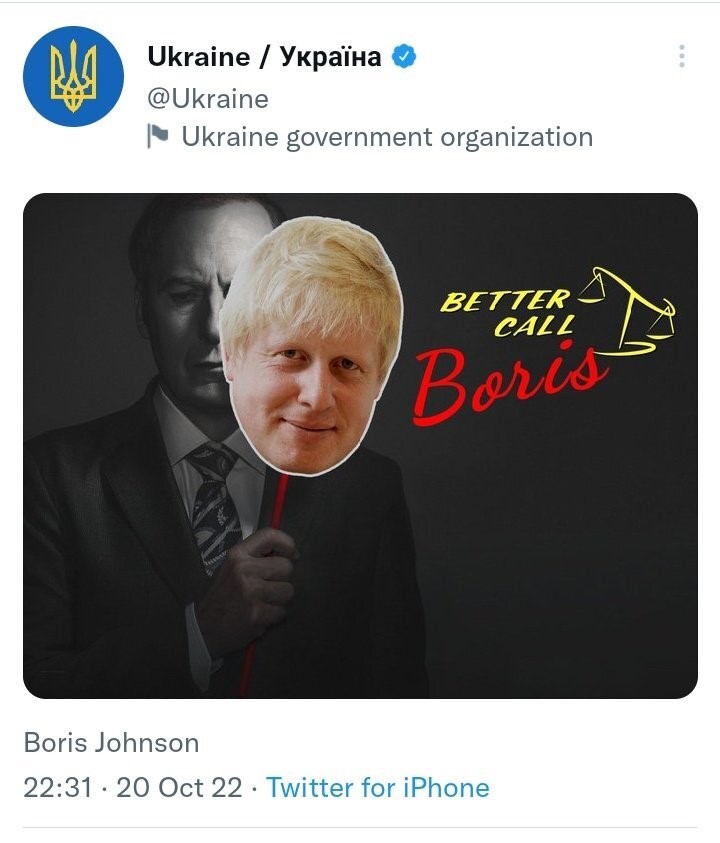
After Liz Truss’ resignation, the official Twitter account of Ukraine’s government issued a tweet that appeared to be sympathetic to the former leader, fueling rumors that Boris Johnson will try to reclaim his position as Prime Minister.
Mr Johnson is well-liked in Kyiv for his support for the country in its fight against Russia’s invading forces.
However, the meme based on the Netflix series Better Call Saul and posted by the @Ukraine account triggered a significant backlash, with some even pointing to the Uxbridge MP’s alleged links with Russian figures including Evgeny Lebedev – newspaper owner and son of ex-KGB agent Alexander.
Evgeny Lebedev was made a lifelong peer in the House of Lords during Mr Johnson’s tenure as PM.
The US says Iranian military trainers are in Crimea teaching Russian soldiers how to utilise Iranian-made drones to attack targets in Ukraine.
“We can confirm that Russian military personnel based in Crimea have been piloting Iranian UAVs and using them to conduct kinetic strikes across Ukraine, including in strikes against Kyiv in recent days,” US State Department spokesman Ned Price told a daily briefing with reporters.
“We assess that … Iranian military personnel were on the ground in Crimea and assisted Russia in these operations,” Price said.
He added“we do have credible information,” but did not provide evidence.
Following Liz Truss’s announcement that she was going to step down as prime minister, the Kremlin said it did not expect Britain to choose its new leader with “political wisdom.”
Asked about the possible return of Boris Johnson to the top post, Kremlin spokesman Dmitry Peskov said: “We do not expect insight and political wisdom from anyone in the countries of the collective West, let alone Britain. Especially in Britain, where people do not choose the person at the head of the executive branch, who appears as a result of internal party shake-ups.”
Former prime minister Boris Johnson, an outspoken supporter of Ukraine, was ousted in July after a wave of scandals.
At the time, Russian media and officials celebrated the news of his departure.
Russia has likewise warmly welcomed news of Truss’s imminent departure.