Ukraine is beefing up border defences with Belarus amid fears that Russia is planning a new attack, according to a government official.
According to Deputy Interior Minister Yevhen Yenin, Ukraine will reinforce its border with Belarus with armed forces and ammunition.
The announcement came as Vladimir Putin was on his way to Minsk to meet Belarusian President Alexander Lukashenko.
Belarus shares a border with both Russia and Ukraine.
The Russian president later ordered the strengthening of Russia’s borders and of social control within Russia. He said the security services should quickly thwart any attempt to violate Russia’s borders, combat risks coming from abroad, and identify traitors and saboteurs.
He also said the special services should ensure the safety of people living in the parts of Ukraine that Moscow claims as its own. In some of these areas, most notably Kherson, Russia recently suffered significant military reverses.
Russia’s defence ministry announced that its troops stationed in Belarus would conduct joint military exercises with Belarus.
Reacting to this and the visit Mr Yenin confirmed: “We are building up our defence lines all across the border with Russia and with Belarus.”
While Belarus has not become involved in the war directly, it did allow Russian troops to use its territory to launch the invasion in February.
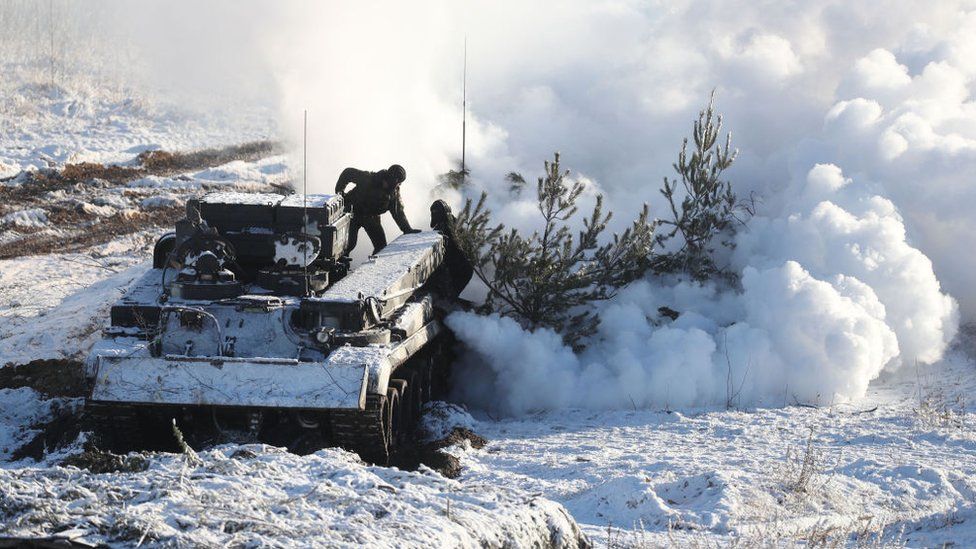
IMAGE SOURCE,GETTY IMAGES Image caption, Russia and Belarus held joint military drills near the Ukrainian border in February – just days before Russia’s full-scale invasion
Minsk is coming under increasing pressure from Moscow to step up its support in the “special military operation”.
But Kremlin spokesman Dmitry Peskov dismissed the reports “as totally stupid, groundless fabrications”.
President Putin flew to Minsk for talks with President Lukashenko – the first time in three-and-a-half years the pair have met in Belarus.
The meeting has been described as a “working visit” and lasted for more than two hours.
Speaking at a joint press conference President Putin said Russia did not want to “absorb” anyone. He also said that unspecified “enemies” wanted to stop Russia’s integration with Belarus.
Speaking later on Monday, US state department spokesperson Ned Price said Putin’s statement was the “height of irony” given he was currently seeking to absorb Ukraine.
Something rare happened today: Vladimir Putin got on a plane and flew to Minsk. Now, President Putin and President Alexander Lukashenko meet a lot – but in Russia.
For the first time in three-and-a-half years, here was President Putin in Belarus. So why did he go… and why now?
There were few clues at the joint press conference as the two leaders spoke a lot about economic relations, trade, but also security.
President Putin indicated that some Belarusian military aircraft have been re-equipped to potentially carry nuclear missiles and that Russia is helping to train their crews.
In return, President Lukashenko thanked him for providing Belarus with an S-400 air defence system and Iskander ballistic missile system.
The word “Ukraine” was hardly mentioned – in public.
But the visit has fuelled speculation that the Kremlin leader may be trying to pressure the leader of Belarus into joining a possible new ground offensive in Ukraine.
This may indeed be just a rumour. Or a ploy by Moscow to make Ukraine expect a Belarusian offensive and so tie up Ukrainian soldiers in the north.
But, there are reportedly several thousand Russian soldiers already in Belarus and there have been joint exercises.
Until now Alexander Lukashenko has been reluctant to commit his own troops to fighting in Ukraine.
Russia says it will deploy musicians to the front lines of its war in Ukraine in a bid to boost morale.
The defence ministry announced the formation of the “front-line creative brigade” this week, saying it would include both vocalists and musicians.
The UK’s ministry of defence highlighted the brigade’s creation in an intelligence update on Sunday.
Meanwhile, Russian Defence Minister Sergei Shoigu visited frontline troops in Ukraine, the government said.
In a statement posted to Telegram, the defence ministry said Mr Shoigu “flew around the areas of deployment of troops and checked the advanced positions of Russian units in the zone of the special military operation”.
It added that he “spoke with troops on the frontline” and at a “command post” – but the BBC cannot confirm when the visit took place or whether Mr Shoigu visited Ukraine itself.
The reported visit comes as UK defence officials said low morale continues to be a “significant vulnerability across much of the Russian force”.
The UK said the new creative brigade – which follows a recent campaign, urging the public to donate musical instruments to troops – is in keeping with the historic use of “military music and organised entertainment” to boost morale.
But they questioned whether the new brigade would actually distract troops, who have been primarily concerned about “very high casualty rates, poor leadership, pay problems, lack of equipment and ammunition, and lack of clarity about the war’s objectives”.
According to the Russian outlet RBC news, the brigade will consist of troops mobilised under President Vladimir Putin’s recruitment drive, as well as “professional artists who voluntarily entered military service”.
The new unit will be tasked with maintaining “a high moral, political and psychological state [among] the participants of the special military operation,” the outlet cited the defence ministry as saying.
Meanwhile, intense fighting has continued around the town of Bakhmut in the eastern Donbas region on Saturday, Ukraine’s general staff said.
The area has seen heavy clashes between Ukrainian and Russian troops for months, as Russia seeks to retain territory following a string of defeats in eastern Ukraine earlier this year.
Western intelligence officials have previously said Russian attacks on the town are being spearheaded by the private military contractor, Wagner Group.
Moscow hopes to use the town as a staging ground to launch attacks on the Ukrainian-held cities of Kramatorsk and Sloviansk.
Elsewhere, heating has been restored to the Ukrainian capital of Kyiv, after Russian launched widespread strikes on Friday that targeted power and water infrastructure, Mayor Vitali Klitschko said.
Moscow launched 76 missiles on Friday, hitting nine power supply stations and plunging much of the country into darkness. Ukraine said it intercepted 60.
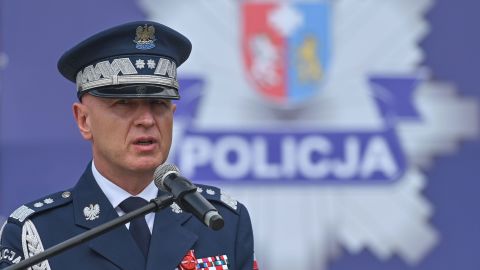
A gift that Jaroslaw Szymczyk received in Ukraine unexpectedly exploded on Wednesday, sending the head of Poland’s police to the hospital with minor wounds.
“Yesterday at 7:50 a.m., an explosion occurred in a room adjacent to the office of the Police Chief,” Poland’s Interior Ministry said on Thursday.
“During the Police Chief’s working visit to Ukraine on December 11-12 this year, where he met with the heads of the Ukrainian Police and Emergency Situations Service, he received some gifts, one of which exploded.”
The statement alleged the gift came from one of the heads of Ukrainian services.
Poland has asked Ukraine to clarify what happened and a case was “immediately opened” with the prosecutor’s office and corresponding services, it said.
Photo by Artur Widak/NurPhoto/Shutterstock Artur Widak/NurPhoto/Shutterstock
Szymczyk has been hospitalized for observation. A member of staff from the Police Headquarters also suffered minor injuries, but did not need hospitalization, according to the statement.
Kyiv blames Russia for bloody packages containing ‘animal eyes’ sent to Ukrainian embassies across Europe
The incident follows a slew of suspicious mail sent to Ukrainian embassies in Europe, pushing Ukraine to put all of its overseas diplomatic stations under heightened security.
Kyiv’s embassies in Hungary, the Netherlands, Poland, Croatia, Italy, Austria, as well as the consulates general in Naples and Krakow, have received suspicious packages, according to Oleh Nikolenko, spokesperson for the Ministry of Foreign Affairs of Ukraine.
Mayor Kyiv says, explosions were heard early on Wednesday in Kyiv, the capital of Ukraine.
Blasts reportedly shook the Shevchenkivskyi district in the city’s centre, and emergency services were called in, according to Vitali Klitschko.
Oleksiy Kuleba, the governor of Kiev, claims that air defence systems are in operation.
A short time after the air raid siren sounded, BBC reporters heard loud explosions. Since October, Russia has repeatedly used missiles and drones to attack Ukraine’s energy infrastructure.
Serhiy Popko, the head of the military administration for Kyiv, claimed that early on Wednesday, Ukrainian forces had shot down 13 Shahed drones made in Iran.
The body also said a drone fragment had hit two administrative buildings in the city centre. But a spokesperson for the city emergency services told Ukrainian media that no victims had been reported in the strike.
Ukraine has accused Iran of supplying Russia with “kamikaze” drones used in deadly attacks on 17 October, which Tehran initially denied.
Iran later admitted sending Moscow a limited number of drones “many months” before the war.
In response, Ukraine’s President Volodymyr Zelensky said this was a lie and that many more Iranian drones were being used.
Kyiv governor Kuleba said: “The air defence system is operating. It’s important now to stay in shelters and safe places. Russia is continuing its energy terror against our country. But we are getting stronger daily.”
Russia has been targeting Ukraine’s energy grid in recent months in a bid to demoralise its population.
Global leaders have said the strikes civilians infrastructure amount to a war crime, but last week Russian President Vladimir Putin defended the attacks and said they were in response to blast on the Russian bridgeto annexed Crimea on 8 October.
According to data from Africa, some of the 10 richest African-American billionaires’ businesses performed better in 2022, increasing their net worth by $910 million, from $24 billion to $24.91 billion.
The highest rise in net worth was recorded by Robert Smith, the richest Black man in America, who gets the majority of his wealth from his ownership of Vista Equity Partners.
At the same time, Kanye West, now known as “Ye,” lost his billionaire status during the year after German sportswear company Adidas severed ties with the African-American multi-industry creative following a series of offensive and antisemitic comments he made in October.
1. Robert F. Smith
Source: Private Equity
Net worth: $8 billion
Robert F. Smith is America’s wealthiest Black man. He is the founder of Vista Equity Partners, a private equity firm focused on software investments that Smith founded in 2000 and has grown to more than $50 billion in assets with annual returns of 22 percent since its inception.
Almost all of Smith’s $8-billion fortune stems from his stake in the Texas-based private equity firm, which Forbes ranks 252nd in the world.
2. David Steward
Source: IT
Net worth: $6 billion
David Steward, America’s second-richest Black person, is the founder and chairman of Worldwide Technology, one of the largest African-American-owned businesses.
His company has evolved from a technology equipment reseller in 1990 to a leading provider of technology solutions. In 2020, the company’s revenue was $13.4 billion.
According to Forbes, Steward’s net worth has increased from $5.8 billion to $6 billion since the start of the year.
3. Oprah Winfrey
Source: Media
Net worth: $2.51 billion
According to Forbes, “The Queen of Talk,” Oprah Gail Winfrey, is the wealthiest Black woman in America, with a net worth of $2.51 billion. Oprah has turned her 25-year-long hit talk show into a media and business empire.
To preserve and grow her fortune, the leading media mogul has reinvested profits from her show, as well as profits from films such as “The Color Purple,” “Beloved,” and “Selma,” into key assets and entities in the media industry.
4. Michael Jordan
Source: Charlotte Hornets, Endorsements
Net worth: $1.7 billion
Michael Jordan earned $90 million in salary during his career, but according to Forbes, he has pocketed $1.8 billion (pre-tax) from corporate partners such as Nike, Hanes, and Gatorade.
Jordan is the chairman and principal owner of the Charlotte Hornets, an NBA team based in North Carolina. In 2019, Jordan agreed to sell a minority stake in the NBA team for $1.5 billion. He also owns a NASCAR team and a stake in DraftKings, a sports betting company.
5. Robyn “Rihanna” Fenty
Source: Cosmetics, Music
Net worth: $1.3 billion
Robyn “Rihanna” Fenty, the world’s youngest Black billionaire and renowned musician, is the second-richest Black woman in the United States.
Her net worth has dropped from $1.7 billion at the start of the year to $1.3 billion at the time of writing this report.
The majority of her fortune is derived from her ownership of Fenty Beauty, a rapidly expanding cosmetics company that sells her makeup and skincare products on Sephora shelves in the United States, Canada, Mexico, France, Spain, Denmark, Sweden, Thailand, Malaysia, Australia, Singapore, and the Middle East, as well as online to more than 150 countries.
6. Shawn “Jay-Z” Carter
Source: Liquor, Music Streaming
Net worth: $1.3 billion
Shawn “Jay-Z” Carter, an African-American businessman worth $1.3 billion at the time of writing, has seen his net worth increase by $300 million since 2021, when Moet Hennessy Louis Vuitton (LVMH) acquired a 50-percent stake in his Champagne brand, Armand de Brignac.
He made $297 million last year when he sold a majority stake in Tidal, his high-fidelity music streaming platform, to Jack Dorsey’s Square.
The rapper turned businessman and investor’s net worth has increased from $1 billion to $1.3 billion since February 2021, when LVMH signed a partnership deal with his Champagne brand.
7. Tyler Perry
Source: Films
Net worth: $1 billion
Tyler Perry is an African-American writer, producer, director, and actor who has amassed a fortune through his work. Perry owns 100 percent of his creative output, which includes more than 1,200 TV episodes, 22 feature films, and at least two dozen stage plays, as well as a 330-acre studio on the outskirts of Atlanta.
His “Madea” franchise, which has grossed over $660 million, accounts for a sizable portion of his $1-billion fortune.
He recently signed a four-film deal with Amazon Studios, a television and film producer and distributor based in the United States and one of Amazon’s subsidiaries.
8. Tiger Woods
Source: Golf, endorsements, real estate
Net worth: $1 billion
Tiger Woods, the world’s greatest golfer, has won more prize money than any other professional golfer in history, totaling $121 million. The majority of his fortune is derived from endorsements with companies such as Nike, Gatorade, Rolex, and Monster Energy.
Woods also has a golf course design company as well as a live production company. He is also a shareholder in Nexus Luxury Collection, a global hospitality real estate development and asset management firm. He also has a stake in a luxury mini-golf experience with multiple Florida locations, as well as a hospital software startup.
9. LeBron James
Source: Basketball, Endorsements, Investments
Net worth: $1 billion
LeBron James is the first active NBA player to reach the billion-dollar mark. His pretax earnings with the Cavaliers, Miami Heat, and his current team, the Los Angeles Lakers, total more than $385 million. Off the court, he has amassed well over $900 million (pretax) in earnings from commercial initiatives and endorsement deals with companies such as PepsiCo, Walmart, and his long-time sponsor, Nike. He also has a stake in Beats by Dre and the Blaze Pizza fan base.
10. Sean “Diddy” Combs
Source: Ciroc Vodka, Music, Investments
Net worth: $1 billion
The majority of Sean “Diddy” Combs’ wealth stems from his partnership with Diageo to create Ciroc Vodka, a move that saw him take the helm of Ciroc in 2007, guiding the brand from obscurity to multibillion-dollar status.
The African-American businessman became a billionaire on the same day that Kanye West, now officially known as “Ye,” lost his billionaire status due to the termination of his lucrative contract with Adidas. Since 2019, Combs’ net worth has risen from $740 million to $1 billion.
South Ukraine has come under attack from both sides of the war, with Kyiv retaliating near Melitopol after Russia fired drones at Odesa.
The Ukrainian army claimed to have shot down 10 drones on Saturday, but an additional five struck electrical infrastructure, knocking out electricity for about 1.5 million people.
Later, the exiled mayor of Melitopol, a Ukrainian, claimed that a strike had been launched against the Russian-controlled city.
According to Ukrainian officials, Russia used Iranian-made drones in its drone strike on the Ukrainian port city of Odesa.
“The situation in the Odesa region is very difficult,” President Volodymyr Zelensky said in his nightly video address. “Unfortunately the hits were critical, so it takes more than just time to restore electricity. It doesn’t take hours, but a few days.”
Since October, Moscow has been targeting Ukraine’s energy infrastructure with large waves of missile and drone strikes.
In Melitopol, pro-Moscow authorities said a missile attackhad killed two people and injured 10, while Ivan Fedorov, the exiled mayor, said scores of “invaders” had been killed.
“Air defence systems destroyed two missiles, and four reached their targets,” Yevgeny Balitsky, the Moscow-appointed governor of the occupied part of the Zaporizhzhia region, said on the Telegram messaging app.
He added that a “recreation centre” where people were dining had been destroyed in the Ukrainian attack with Himars missiles.
A few blocks from Ghana’s statehouse in Accrasits a 14.5-acre parcel of prime real estate with a football field-sized hole in the middle of it. What should be emerging from the ground is the frame and sweeping, concave roof of the futuristic 5,000-seat National Cathedral of Ghana.
Instead, the project has stalled, a victim of an economic crisis in the West African country, which was until recently one of the world’s fastest-growing economies and a magnet for foreign investment.
The cathedral’s original price tag of $100 million has quadrupled amid an economic crisis that has seen record inflation and the cedi, the world’s worst-performing currency this year, lose close to 60% of its value — almost double that of Ukraine.
With debt interest payments eating up more than half of government revenues Ghana has asked the IMF for a $3 billion bailout, proposed a debt restructuring that could involve losses of up to 30% for foreign investors, and is planning to barter some of the gold it produces for oil. It represents a sharp reversal in fortune from a sub-Saharan success story to the harbinger of what awaits several emerging markets that borrowed heavily at a time of low-interest rates but now face expensive repayments.
The government in Accra has already spent more than $58 million on the cathedral with nearly half going to the firm of star architect Sir David Adjaye. The project has become one of the most high-profile in a decade-long spending spree by successive Ghanaian governments after debt forgiveness in 2006, the discovery of oil and the issuance of its first Eurobond in 2007 helped boost growth.
The country of 31 million people embodies a period when emerging-market borrowing by sovereign nations surged, hitting a record total of $250 billion in 2020, according to Bloomberg data. But its plight is a test case: if a country that until very recently was a darling of lenders is struggling to dig its way out of this crisis, how will other frontier markets fare?
The country’s economic descent has been swift. In February 2020 it raised $3 billion in a debt auction that the government said was five times oversubscribed. A little over a year later it was locked out of international debt markets altogether. Since January, it has repeatedly been downgraded to junk status by rating agencies.
It is not alone. At least 15 of the 72 emerging markets in a Bloomberg index including Ethiopia, Pakistan, and Tajikistan now have dollar debt trading at distressed levels, after Russia’s invasion of Ukraine fueled global energy and food price inflation. Central banks have responded by increasing interest rates, which has shrunk the available liquidity for junk-rated nations. At least $80 billion has flowed out of emerging-market debt funds this year.
He spoke shortly after Moscow accused Kyiv of carrying out drone attacks on three Russian airfields, two of which were hundreds of miles away from Ukraine.
Ukraine has made no comment on the matter.
Russian President Vladimir Putin has repeatedly warned the United States and its allies not to cross “red lines” by supplying Ukraine with long-range weapons.
The US-led Nato military alliance has ruled out providing such arms to Kyiv, amid concerns that this could lead to a major escalation with a nuclear-armed Russia that invaded Ukraine on 24 February.
Two Russian airfield explosions were reported on Monday, in the Ryazan and Saratov regions. The sites house strategic bombers used to carrying out regular missile attacks on Ukraine’s critical energy infrastructure.
Russia said there was another attack was on Tuesday, in the Kursk region that borders Ukraine.
Russia’s latest missile attack on Ukraine was on Monday, when 70 rockets were fired on targets across the country. Four people were killed, local officials said.
Millions of people across the country are now without electricity and running water, raising fears people may die of hypothermia in sub-zero temperatures.
At a briefing on Tuesday, Mr Blinken accused Russia of “trying to take out the civilian infrastructure that is allowing people to have heat, to have water, to have electricity”.
He said Moscow was now “weaponising winter” and “that is the daily and nightly reality in Ukraine”.
“We have neither encouraged nor enabled the Ukrainians to strike inside of Russia, but the important thing is to understand what Ukrainians are living through every day with the ongoing Russian aggression against their country.
He said he was determined that Ukrainians have “the equipment that they need to defend themselves, to defend their territory, to defend their freedom.”
Speaking alongside him, US Defence Secretary Lloyd Austin stressed that the US would not prevent Ukraine from developing its own long-range strike capability.
“The short answer is no. We are absolutely not doing that,” Mr Austin said, adding that Washington had already given Ukraine more than $19bn (£16bn) in security assistance.
In other developments on Tuesday:
Ukrainian President Volodymyr Zelensky visited troops in the eastern Donetsk region where fierce fighting has been going for weeks
In the evening, one person was injured in Russian strikes in the central-eastern Dnipropetrovsk region, local officials said
Russian-installed officials in the city of Donetsk – controlled by Moscow since 2014 – said six people were killed in Ukrainian shelling
Police in Spain arrested 30 people on suspicion of smuggling cannabis disguised as aid for Ukraine.
Those detained in Andalusia included Ukrainians, Spaniards, Germans, and Moroccans.
According to police, the drugs originated in the southern region, were packaged in cardboard boxes, and were transported in convoys across several countries.
The seizure comes just a month after Spanish authorities announced the largest cannabis haul ever discovered in the country.
The Guardia Civil police force said in a statement on Monday that they became suspicious after identifying a group of Ukrainians on the Costa del Sol collecting cannabis and storing it in a flat in Mijas, near Malaga.
The drugs were packed in vacuum bags and placed in cardboard boxes on vans registered in Ukraine, which proceeded to travel “as a solidarity convoy so they could pass under the radar of police and border controls”, it said.
In raids in Malaga province and in the southern cities of Granada, Cordoba and Seville, police seized nearly €800,000 (£690,000; $847,000), six guns and 2,500 cannabis plants.
Thousands of people across Europe have been involved in efforts to alleviate the suffering of Ukrainian civilians since Russia launched an invasion of its neighbour on 24 February.
Former US ambassador to NATO, Robert Hunter, has expressed concern about the amount of military aid being provided to Ukraine by NATO members.
“It’s surprising that the alliance led by the US hasn’t done more so far in terms of anti-drone and anti-missile defences,” Hunter said from Washington DC to Al Jazeera.
Hunter stated that it was clear throughout the autumn that, while the Ukrainians would continue to fight a “valiant fight,” Russia would try to gain an advantage by targeting Ukraine’s sources of power and heat.
In response to Ukraine’s foreign minister’s earlier appeal at a meeting of NATO foreign ministers in Bucharest, Hunter said, “Faster, faster, faster, has to mean immediately, not something to be talked about and maybe done in a few months.”
The former US envoy said that steps could have been taken to counter the destruction Russia was doing in Ukraine instead of just repairing the damage.
“The US and the NATO, quite frankly, are failing Ukraine.”
People wait in line to collect water, in Kyiv, Ukraine, Thursday, Nov. 24, 2022. Residents of Ukraine’s capital clutched empty bottles in search of water and crowded into cafés for power and warmth, switching defiantly into survival mode after new Russian missile strikes a day earlier plunged the city and much of the country into the dark. [Evgeniy Maloletka/AP]
New Delhi’s unique position on the world stage could see PM Narendra Modibecome a key peacemaker, say experts.
India’s balancing act on the war in Ukraine is becoming more difficult, but New Delhi’s unique position – as a friend of both Russia and the West – could see it emerge as a key mediator, experts have told Al Jazeera.
When war began on February 24, New Delhi was quick to support Ukraine’s humanitarian needs.
But India has abstained from condemning Moscow’s actions at the United Nations – a consistent position that the administration of Prime Minister Narendra Modi says is in line with India’s foreign and defence policies.
In a November interview with Times Now, an Indian media outlet, India’s Foreign Minister Subrahmanyam Jaishankar argued that he is not trying to cater to the demands of “other people”.
“Sometimes, I have lived with things that you [the West] did. Now, live with it [India’s foreign policy],” he said.
But as the war intensifies, global energy and food shortages are prompting India to re-evaluate its restrictive stance towards Russia.
On the sidelines of September’s Shanghai Cooperation Organisation (SCO) summit in Samarkand, Uzbekistan, Modi told Russian President Vladimir Putin: “I know that today’s era is not an era of war, and I have spoken to you on the phone about this.”
India was among the nations that abstained from a recent UN vote condemning Russia [Al Jazeera]
The premier reiterated this sentiment weeks ago at the Group of 20 (G20) summit in Bali.
“We have to find a way to return to the path of ceasefire and diplomacy in Ukraine,” he said.
Vivek Mishra, a fellow at the Observer Research Foundation (ORF) in New Delhi, told Al Jazeera that India’s stance is in a state of transition.
“Over the past 10 months, we’ve seen India’s spectrum of mediation in the war increase. This became evident with New Delhi indirectly telling Moscow that it is time to end the war. Moreover, over the next year, India leading the G20 will mean that New Delhi’s role in mediating the end of the war will gain more prominence,” he said, highlighting that the role of mediator signifies leadership.
‘Upgraded form of non-alignment’
New Delhi is set to take on the G20 presidency from Indonesia from December 1 and will host the next G20 meeting in 2023.
John-Joseph Wilkins, an associate fellow at the German Council on Foreign Relations, said that with its new responsibilities, India is likely to focus on protecting its strategic autonomy.
“India has always had a tradition of balancing world powers, but this year we’ve seen the country’s foreign policy establishment possibly embrace an upgraded form of non-alignment. This has the potential to increase New Delhi’s global influence going forward,” he told Al Jazeera.
Will India’s evolving position impact ongoing trade with Russia?
Russian President Vladimir Putin has acknowledged India’s recent concerns about the war and reassured Modi at their meeting in Uzbekistan that Moscow would do everything to stop the war “as soon as possible”.
Typically, he blamed Ukraine for prolonging the conflict.
Increasingly isolated by Western powers, Putin has been keen to forge closer ties to India by boosting trade relations.
“Our trade is growing, thanks to your additional supplies of Russian fertilisers to the Indian markets, which have grown more than eightfold. I am hopeful that this is going to be of huge help to the agricultural sector of India,” Putin told Modi.
Ahead of the Uzbekistan talks, Russia’s Ambassador to India Denis Alipov had hailed growing economic cooperation, telling Moscow’s TASS news agency: “In the first half of 2022, we saw an unprecedented growth in trade – by July it reached more than $11bn, and was $13.6bn for the entire 2021. This is a solid figure, which allows us to discuss the likelihood of achieving the goal of bringing the level of mutual trade to $30bn by 2025.”
Activists of Hindu Sena, a Hindu right-wing group, hold placards and flags as they take part in a march in support of Russia on March 6, 2022 [Anushree Fadnavis/Reuters]
India and Russia have shared a special relationship since the Cold War, and Moscow remains the Asian nation’s biggest arms and crude oil supplier.
According to the Stockholm Peace Research Institute (SIPRI), between 2011 and 2021, Russia accounted for 60 percent of weapons imports in India.
Meanwhile, Moscow supplied 22 percent of New Delhi’s total crude needs in October 2022.
According to the ORF’s Mishra, New Delhi’s evolving stance is unlikely to impact trade relations.
“In the case of oil imports, for example, India’s petroleum and natural gas minister Hardeep Singh Puri recently clarified that there is no moral conflict in buying oil from Russia because as a responsible nation, India also has to cater to domestic needs and on the global stage, oil has to be bought in order to ensure global prices are low. So this trade is bound to continue,” he said.
But Wilkins said India has been trying to diversify in areas such as hydrocarbons.
“The country has been slowly shifting its general position on Russia for some time now,” he said.
“The conflict in Ukraine really highlighted for the country’s policymakers the need to reduce their dependence on Moscow, especially in the hydrocarbons sector,” he said.
“India has a National Hydrogen Mission and it is quite clear that it eventually wants to and could become an exporter of ‘green hydrogen’, which essentially means establishing solid solar and hydro power infrastructure and diversifying supply chains. In that sense, reducing dependency on Russian hydrocarbons, which the country is heavily reliant on, aligns with its overall national mission,” he added.
India’s prominence to make it a peacemaker?
At the same time, the European Union has also been pushing for stronger ties with India, as the bloc’s relations with Russia and China cool.
The EU held its first round of trade talks with India in July this year, and the discussions are set to resume on Monday.
New Delhi aims to establish comprehensive free trade agreements not only with the EU, but also with the United Kingdom and Canada next year. Similar trade deals have already been signed with Australia and the United Arab Emirates this year.
Meanwhile, the United States has also fostered its defence partnership with India, after recognising New Delhi as a central figure in maintaining security in the Indo-Pacific – a sentiment shared by the Association of Southeast Asian Nations (ASEAN), which has also broadened its security ties with India.
Some geopolitical analysts say the Ukraine war has played a role in increasing India’s prominence on the global stage.
Ukrainian citizens hold their national flag in solidarity with their compatriots after Russia’s invasion of Ukraine, at Lodhi Garden in New Delhi, India on April 1, 2022 [Adnan Abidi/Reuters]
But Mishra argued that this theory undermines India’s achievements.
India’s potential as a stable market, he said, is what prompted the push.
“India’s economy recently surpassed the British economy, with India becoming the fifth largest economy in the world. This was scripted before the war,” he said.
He acknowledged, however, that the war brought India into the spotlight, because of New Delhi’s unique position as an ally of the West and Russia.
“So I think in this aspect, the spectrum of the role that India is playing has increased,” he added.
While Russia’s war in Ukraine has no end in sight, talk of negotiating a peaceful conclusion to the conflict has increased.
With India at the helm of the G20 from December, Mishra said the West might lobby New Delhito play a bigger role.
“If this initiative for peace is really pushed and Ukraine agrees to come to the negotiation table, the West could ask India to convince Russia to do the same due to India’s G20 role and special relationship with Moscow,” Mishra told Al Jazeera.
“Overall, India will continue being the bridge between the two sides,” he said, “but is also going to be in a good position to bring this war to an end.”
Former UK Prime Minister, Boris Johnson has been awarded by Ukraine for his contribution and support towards the country during its war with Russia.
Johnson has been awarded the title of the honorary citizen of Kyiv, according to Kyiv Mayor Vitaliy Klitschko.
Klitschko posted on Telegram on Friday, November 25: “The Kyiv City Council approved a decision to award Boris Johnson, a great friend of Ukraine, the title of honorary citizen of Kyiv.
“Boris visited the Ukrainian capital several times – both in peacetime and in the most dramatic time of our struggle against the Russian aggressor.
“Johnson has done and, I am sure, will continue to do everything possible so that Great Britain and world leaders provide the necessary assistance to Ukraine. We thank you for your support! We are waiting for you in Kyiv again to present this honorable award!”
Mr Johnson was previously given the title of Doctor Honoris Causa by The Academic Council of the Ivan Franko National University of Lviv.
Polish leaders say that the air-defence system which Germany offered Polandwould be best given to Ukraine to help it protect itself against Russian strikes.
Earlier this week, Germany offered Warsaw Eurofighter planes and Patriot defence systems to help defend Poland’s airspace after a stray missile exploded in a border village.
Poland’s Defense Minister Mariusz Blaszczak initially said he received Germany’s offer with “satisfaction.”
However, following Wednesday’s air strikes the Polish leader said it would be better if the defence systems were placed in western Ukraine.
The head of Poland’s ruling party, Jaroslaw Kaczynski, called Germany’s offer “interesting,” but said he believed “it would be best for Poland’s security if Germany handed the equipment to the Ukrainians, trained Ukrainian teams, with the caveat that the batteries would be placed in Ukraine’s west.”
The country is facing blackouts as rockets rain down on several cities, with at least four people killed in Kyiv.
A Russian barrage on Ukrainian infrastructure has knocked out power in large areas of the war-torn country, as well as parts of neighbouring Moldova.
When a rocket struck a two-story building in Kyiv on Wednesday, at least four civilians were killed and nine were injured, according to authorities.
As Moscow continues its campaign to cripple Ukraine’s essential services ahead of the impending winter, multiple regions have reported attacks in quick succession.
President Volodymyr Zelenskyy had previously stated that Russian strikes had already damaged roughly half of Ukraine’s infrastructure.
Ukrainian officials say they believe Russian President Vladimir Putin is hoping that the misery of unheated and unlit homes in the cold and dark of winter will turn public opinion against a continuation of the war, but they say it is having the opposite effect and is strengthening Ukrainian resolve.
Kyiv Mayor Vitali Klitschko said Wednesday that “one of the capital’s infrastructure facilities has been hit” and there were “several more explosions in different districts” of the city.
Power outages also affected the northern city of Kharkiv, the western city of Lviv, the Chernihiv region in northern Ukraine and the Odesa region in the south.
Anton Gerashchenko, a Ukrainian ministerial adviser, noted that the attacks came moments after the European Parliament declared Russia a “state sponsor of terrorism”.
Rockets hit Kyiv right after European Parliament recognized Russia as a state sponsor of terrorism.
In Moldova, Infrastructure Minister Andrei Spinu said, “We have massive power outages across the country.” Its Soviet-era energy systems remain interconnected with Ukraine’s.
There was a similar outage in the country of 2.6 million people on November 15.
“Russia left Moldova in the dark,” its pro-Western president, Maia Sandu, said, adding that her nation “must remain toward the free world”.
Power also was out in most parts of western Ukraine’s Khmelnytskyi region, Governor Serhii Hamalii said on Telegram. He added that a nuclear power plant in the region was disconnected from the Ukrainian electricity grid.
“This was the latest of several rounds of similar waves of missile strikes, basically designed to cripple Ukraine’s power infrastructure to plunge the country into darkness,” said Al Jazeera Rory Challands, reporting from Kyiv. “There may be more to come.”
He added that “there’s no evidence” of Russia breaking the will of the Ukrainian people, according to the many people he has interviewed in recent weeks.
The latest onslaught came hours after Ukrainian authorities said a rocket attack destroyed a hospital maternity ward in southern Ukraine, killing a two-day-old baby boy.
After the overnight strike in Vilniansk, close to the city of Zaporizhzhia, the baby’s mother and a doctor were pulled alive from the rubble.
The region’s governor said the rockets were Russian. The strike adds to the gruesome toll suffered by hospitals and other medical facilities – and their patients and staff – in the Russian invasion, which will enter its 10th month this week.
First lady Olena Zelenska wrote on Twitter: “Horrible pain. We will never forget and never forgive.”
‘The chaos of the war’
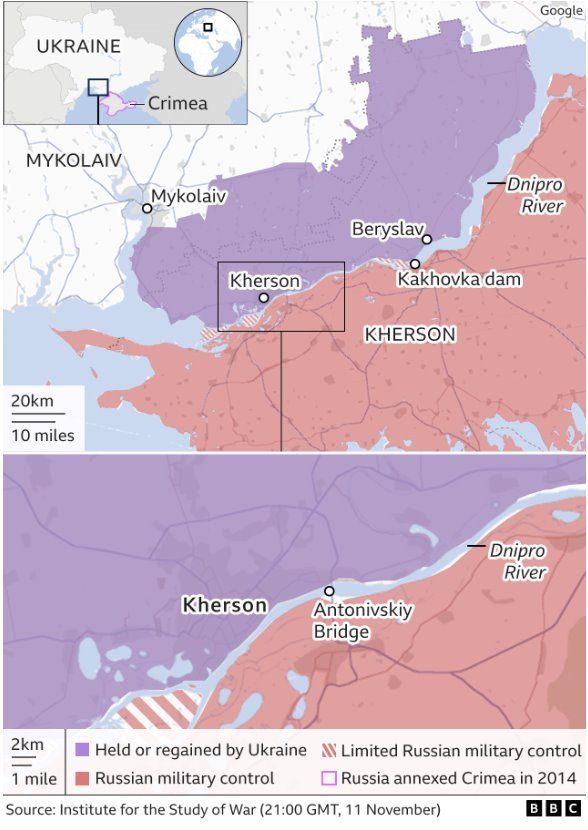
The situation is also concerning in the southern city of Kherson, from which Russia retreated nearly two weeks ago after occupying it for months.
Many doctors there are working in the dark, unable to use elevators to transport patients to surgeries and operating with headlamps, cell phones and flashlights. In some hospitals, key equipment no longer works.
“Breathing machines don’t work, X-ray machines don’t work,” said Volodymyr Malishchuk, the head of surgery at a children’s hospital in Kherson. “There is only one portable ultrasound machine, and we carry it constantly.”
Meanwhile, Save the Children raised the alarm on Wednesday as freezing weather sets in.
“An average of about 900 children a day are being born into a life of uncertainty,” said Sonia Khush, the charity’s director in Ukraine. “The chaos of the war poses a serious threat to these mothers and newborns. We’re hearing accounts of women who’ve gone into labour early because of their constant state of stress and fear.
“At the start of the war, many pregnant women were forced to give birth in basements or bunkers,” she said. “Now, we’re seeing women give birth in overwhelmed hospitals, away from family members, and in countries hosting refugees from Ukraine.Even though there are fewer women giving birth in bunkers compared to earlier this year, their pregnancies are still just as stressful.”
The head of Ukraine’s biggest private energy firm says people should consider leaving the country to reduce demand on the country’s power network.
“If they can find an alternative place to stay for another three or four months, it will be very helpful to the system,” DTEK chief executive Maxim Timchenko told the BBC.
Russian attacks have damaged almost half of Ukraine’s energy system.
Millions of people are without power as temperatures drop for winter.
Blackouts – both scheduled and unscheduled –have become common in many parts of Ukraine, as Russia aims regular waves of missile attacks at parts of the energy infrastructure.
Earlier this week, Kremlin spokesperson Dmitry Peskov suggested that the strikes were a “consequence” of Ukraine’s refusal to negotiate with Russia.
Several Western leaders have said that targeting civilian infrastructure is a war crime.
Mr Timchenko, whose company supplies more than a quarter of Ukraine’s power, says the system becomes less reliable with each Russian attack, and reducing electricity consumption is the key to keeping it running.
The government has urged people to limit their use of domestic appliances such as ovens and washing machines.
But the damaged energy system is still unable to produce enough electricity to meet current needs, so any way of reducing usage – including leaving the country – should be seen as helping Ukraine to win the war against Russia, Mr Timchenko explained.
“If you consume less, then hospitals with injured soldiers will have guaranteed power supply. This is how it can be explained that by consuming less or leaving, they also contribute to other people.”
Russia’s attacks on infrastructure increased after a series of setbacks on the battlefield, including a major Ukrainian counter-offensive in the Kharkiv region and territorial gains in the south of the country, which eventually led to the recapture of the city of Kherson.
With temperatures in some parts of Ukraine already below freezing, there is concern that millions of people will be left without power and heating throughout the winter.
Until now, blackouts have generally been limited to a few hours, but more Russian attacks could lead to longer periods without power. Fixing the damaged infrastructure is also becoming more difficult.
“Unfortunately we have run out of equipment and spare parts… That’s why we appeal to our partners, government officials, companies and equipment producers to help us with the immediate supply of available equipment,” Mr Timchenko said.
Russia’s historical ties with Ukraine – including in developing its energy system – are also proving a problem.
“They were colleagues, now they are enemies,” Mr Timchenko said. “They bring all this knowledge to Russian military forces, educate them, make very concrete targets, know big parts of our grid or power stations.”
Despite the difficulties though, Ukrainian engineers continue to work in some of the most dangerous parts of the country, risking their lives to reconnect towns and cities to the grid.
The Ukrainian defence ministry has shared its daily update on the number of Russian losses, but today the figures have been posted alongside a Helen Keller quote.
“Never bend your head. Always hold it high. Look the world straight in the eye,” the ministry wrote, which is a quote often attributed to the deaf and blind American author.
The authority reported that 330 Russian soldiers have been “eliminated” in the last 24 hours, taking the total to 84,210.
A total of 2,886 tanks, 278 jets and 5,817 armoured combat vehicles have also been destroyed since the war began, it claimed.
Sky News has not been able to independently verify these figures.
“Never bend your head. Always hold it high. Look the world straight in the eye.”
Helen Keller
As we have been reporting, the UN’s nuclear watchdog has called for an immediate halt to attacks on Europe’s largest nuclear power plant in Ukraine.
The International Atomic Energy Agency has warned those responsible for shelling the Zaporizhzhia plant that they’re “playing with fire”.
Russia has accused Ukraine of being behind the latest attacks on the facility, which is under Russian control, but Ukraine has blamed Moscow.
Retired Air Vice Marshal Sean Bell has been explaining the latest developments on the ground.
“Yesterday evening and this morning, there were a series of powerful explosions that rocked the Zaporizhzhia nuclear facility.
“It’s probably worth remembering, though, that the International Atomic Energy Agency is on the ground at the moment, so we’re probably going to hear more than we would otherwise because they are getting nervous.
“This is one of the biggest nuclear reactors in Europe and it was seized by the Russians in right at the start of the war in March.
“And while Russiablames Ukrainians for this shelling, and buildings and equipment have been damaged, we’ve been reassured by all parties that there are no critical nuclear security or safety issues.
“This is strategically important to Russia. It provides a significant proportion of power across the whole of Ukraine, and if you recall, Russia’s been targeting Ukrainian critical national infrastructure for the last month or so.
“They will not want it to fall into Ukrainian hands. The Russians have been hiding their military equipment there and then firing out from there at the Ukrainian forces, which inevitably provokes a response.
“The real question is why is it happening now?
“The Russians are unsure whether the Ukrainians are going to continue their attack or pause and what looks likely now is that while the Dnipro river provides quite an effective barrier for the Ukrainian forces to come across, they have been looking to come round to the southwest, but also all around the north to attack to the east of Zaporizhzhia.
“Now, Russia is paranoid about Ukraine counterattacks and counteroffensive. They are bolstering their defences of the Crimea. They’re also bolstering their defences in the Donbas.
“But if the Ukrainian forces are successful with some of their counterattacks. The Russian forces in Zaporizhzhia will become increasingly isolated.”
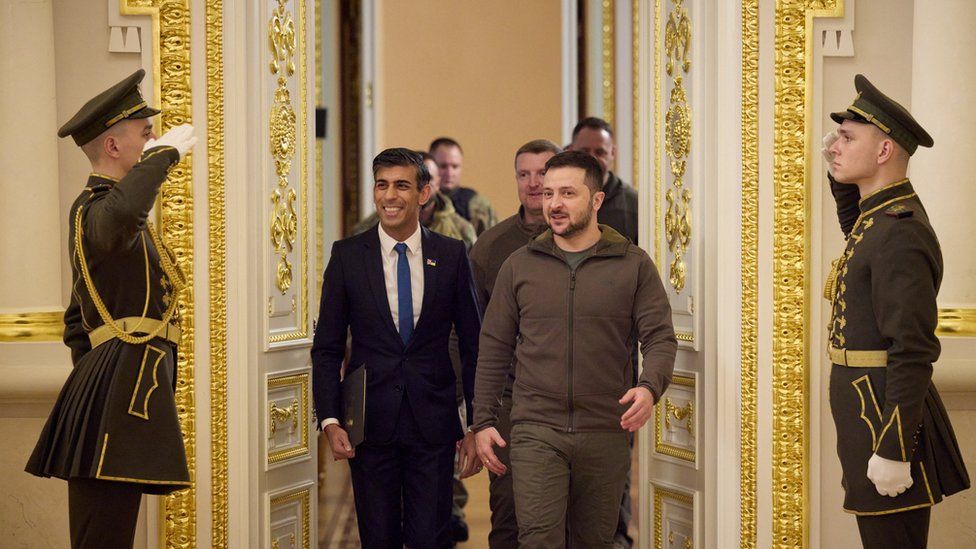
Rishi Sunak has pledged £50m in defence aid to Ukraine as he met President Volodymyr Zelensky in his first visit to Kyiv since becoming prime minister.
Mr Sunak said it was “deeply humbling” to be in Kyiv and that the UK would continue to stand by Ukraine.
“Since the first days of the war, Ukraine and the UK have been the strongest of allies,” Mr Zelensky said following the meeting.
The aid package is intended to counter Russian aerial attacks
The £50m defence aid comprises 125 anti-aircraft guns and technology to counter deadly Iranian-supplied drones, including dozens of radars and anti-drone electronic warfare capability.
Mr Sunak also announced the UK will increase the training offer to Ukraine’s armed forces, sending expert army medics and engineers to the region to offer specialised support.
It follows more than 1,000 new anti-air missiles announced by the UK’s Defence Secretary Ben Wallace earlier this month.
On his visit the prime minister saw captured Iranian-made drones which have been used to target and bomb Ukrainian civilians in recent months.
Mr Sunak also laid flowers for the war dead and lit a candle at a memorial for victims of the 1930s Holodomor famine, before meeting emergency workers at a fire station.
The prime minister said: “I am proud of how the UK stood with Ukraine from the very beginning. And I am here today to say the UK and our allies will continue to stand with Ukraine, as it fights to end this barbarous war and deliver a just peace.
“While Ukraine’s armed forces succeed in pushing back Russian forces on the ground, civilians are being brutally bombarded from the air. We are today providing new air defence, including anti-aircraft guns, radar and anti-drone equipment, and stepping up humanitarian support for the cold, hard winter ahead.
He added that it was “deeply humbling” to be in the Ukrainian capital and have the opportunity to meet people “paying so high a price, to defend the principles of sovereignty and democracy”.
IMAGE SOURCE,UKRAINIAN PRESIDENT’S OFFICE
Image caption, Prime Minister Rishi Sunak said he was “humbled” to be in Ukraine as he met President Volodymyr Zelensky
Mr Sunak’s pledge to send more air defence support is exactly what President Zelensky would want to hear at a time when Russian airstrikes have destroyed nearly 50% of the country’s energy infrastructure, according to the government in Kyiv.
The men’s hopes for peace and a just outcome to the conflict may feel like distant prospects, but Mr Sunak’s promise to hold a reconstruction conference for Ukraine next year in London will be good news for the government and companies, which desperately need access to international finance.
During the visit, Mr Sunak also confirmed £12m for the World Food Programme’s response to Ukraine, as well as £4m for the International Organisation for Migration.
Downing Street said the funding would help provide generators and mobile health clinics, with the UK also sending tens of thousands of extreme cold winter kits for Ukrainian troops.
Labour’s shadow defence secretary John Healey tweeted: “The government continues to have Labour’s fullest backing to support Ukraine, reinforce Nato allies and confront Russia’s aggression.”
Ukraine has been requesting assistance from Western nations in recent months amid intense Russian aerial attacks on Kyiv and across the country.
Earlier in the week, Russia hit Ukraine with one of its biggest barrages of missiles yet, days after its troops were forced to withdraw from Kherson.
Kyiv was hit and there were strikes across the country, from Lviv in the west to Chernihiv in the north.
That attack coincided with the G20 summit in Indonesia this week where, in a virtual speech, Mr Zelensky said he was “convinced now is the time when the Russian destructive war must and can be stopped”.
IMAGE SOURCE,UKRAINIAN PRESIDENT’S OFFICE
Image caption,
Mr Sunak was shown destroyed military Russian vehicles by the Ukrainian president
While Mr Sunak was at the Bali summit, which was attended by Russia’s foreign minister Sergei Lavrov, the UK prime minister urged Russia to “get out of Ukraine” and condemned the country for its “barbaric invasion”.
He stressed the UK would “back Ukraine for as long as it takes”.
Britain is currently the largest provider of military aid to Ukraine aside from the US. So far the UK has committed about £2.3bn and has pledged to match that amount in 2023, according to the House of Commons library.
The UK is also hosting a programme which will aim to train 10,000 new and existing Ukrainian personnel within 120 days.
Mr Sunak’s predecessor Boris Johnson previously met Mr Zelensky in Kyiv in June and August, and Liz Truss was also a vocal supporter of Ukraine.
Mr Johnson became almost a cult figure in Ukraine, after he was one of the first international figures to publicly support Ukraine and send military assistance.
It is a tough comparison for Mr Sunak to live up to so early on in his premiership. Many people in Ukraine do not know the new prime minister well and they will want to see how committed he is to supporting the country.
More than a dozen powerful explosions have been recorded near a huge Russian-occupied nuclear power plant in south Ukraine since Saturday evening.
The head of the UN nuclear watchdog, Rafael Grossi, made an urgent appeal for a stop to the fighting at the Zaporizhzhia plant, Europe’s biggest.
“Whoever is behind this, it must stop immediately,” he said. “You’re playing with fire!”
The plant stands on the River Dnipro, on the front line in the war.
Russia’s military accused Ukrainian forces on the other side of the river of shelling the area under its control. There was no immediate word from the Ukrainians who have previously suggested Russian forces shell the area themselves despite having their troops there.
The area around the plant, including the nearby Russian-occupied town of Enerhodar, had been under regular attack for months but there had been a period of calm before the new explosions this weekend, which continued into Sunday morning.
Monitors from Mr Grossi’s organisation, the International Atomic Energy Agency (IAEA), witnessed some of the explosions from their windows.
Citing information provided by officials at the Russian-controlled plant, the IAEA team said there had been damage to some buildings, systems and equipment at the site, but nothing so far “critical for nuclear safety and security”. There were no reports of casualties.
“The news from our team yesterday and this morning is extremely disturbing,” Mr Grossi said. “Explosions occurred at the site of this major nuclear power plant, which is completely unacceptable.”
He called once again for the two warring sides to agree and implement a nuclear safety and security zone around the plant as soon as possible.
“I’m not giving up until this zone has become a reality,” he said. “As the ongoing apparent shelling demonstrates, it is needed more than ever.”
Russian state media quoted an official from Russian nuclear power operator Rosenergoatom as saying 15 shells had been fired at the plant’s facilities, landing near a dry nuclear waste storage facility and a building that houses fresh spent nuclear fuel, but no radioactive emissions had been detected.
The plant was overrun by Russian forces a few weeks after Moscow invaded Ukraine on 24 February.
Russia annexed the Zaporizhzhia region and other Ukrainian territory in September but has been pushed back on the battlefield in the south, notably in Kherson region, and the two armies face each other across the River Dnipro (known as the Dnieper in Russian).
A war in far-away Ukraine has worsened Zimbabwe’s decades old multi-layered economic crisis with the southern African country’s agriculture industry being the hardest hit amid heightened food insecurity and rising cost of living, United Nations agencies have warned.
In a report titled: Impact of the Ukraine Crisis in Zimbabwe that covers the period between February 2022 and when Russia invaded its neighbour and October, the World Food Programme (WFP), International Organisation for Migration (IOM) and Food and Agriculture Organisation (FAO) painted a gloomy picture of the situation in Zimbabwe.
Before the war between Russia and Ukraine broke out, Zimbabwe’s economy was already saddled with rising inflation, low foreign direct investments, unsustainable foreign debt levels and corruption, among a litany of problems.
Zimbabwe was also emerging from a devastating Covid-19 pandemic that led to unprecedented economic disruptions globally.
The outbreak of the war led to a spike in prices, supply chain disruptions and a general deterioration of macro-economic and living conditions.
UN agencies that have been feeding more than half of Zimbabwe’s population for years fear that the Russia-Ukraine conflict will make things even harder for the southern African country.
“The faraway war has had direct effects on increasing food, fuel and fertiliser prices and disrupted supply chains and trade, leading to fiscal tightening and a widening of inequalities and governance issues,” the agencies said in the report.
“Poor households have further fallen into food insecurity emanating from the increased cost of living.
“While some of these factors cannot be directly linked to the Ukraine crisis, analysis shows that the conflict in Europe has exacerbated vulnerability and migration as a coping mechanism.”
The WFP, IOM and FAO have been jointly monitoring the impact of the Ukraine-Russia conflict on rising food prices, food security, access to essential needs and agricultural inputs, and migration patterns in Zimbabwe.
They concluded that the situation was “precarious because inflation still remains very high, the lean season has begun earlier than usual, high costs for agricultural inputs— particularly fertiliser are being observed, and there is possibility of a delayed start of the rainy season in the primary crop-producing northern regions of the country.”
Zimbabwe’s inflation, which is pegged at more than 280 percent, remains one of the highest globally and the only country in southern Africa with headline inflation above 50 percent.
The country is expected to struggle to get fertiliser for the forthcoming season.
Zimbabwe uses around 800 000 tonnes of fertiliser a season and over half of it is imported from Russia and Belarus.
“Zimbabwe depends heavily on fertiliser imports (ammonium nitrate, urea, potash, and ammonia gas) from Russia and Belarus and the conflict has far reaching consequences on availability and affordability,” the UN agencies added.
“In fact, 70 percent of the fertilisers used in Zimbabwe are imported as raw materials and or finished products and this exposes the market to the effects of global shortages and price volatility.
“These higher prices are making fertilisers unaffordable and out of reach to communal farmers and will have a negative effect on productivity of maize, soya beans and other crops in the main 2022/23 cropping season.”
Globally, the conflict has had a significant impact on the supply of fertiliser raw materials – creating a shortage and leading to all-time high price increases of over 100 percent.
“The rise in logistical costs by over 100 percent due to increased demand and a shortage of shipping vessels and fuel, has increased the landed fertiliser prices in Zimbabwe and other import dependent countries,” the agencies added.
Zimbabwe has also been struggling with fuel imports. The country gets most of its fuel from Mozambique, South Africa and Singapore.
The price of fuel, which was already on an upward trend prior to the start of the Ukraine-Russia conflict, experienced a sharp increase immediately after the start of the Ukraine crisis.
Fuel prices rose by 17 percent for petrol from US$ 1.51 a litre in March to US$1.77 a litre in June, while diesel rose by 25 percent from US$1.51 a litre in March to US$ 1.88 a litre in June.
“This upward trend was also observed on the global market and is largely attributed to the effects of the Ukraine-crisis,” the report added.
“In June, the government of Zimbabwe enacted measures to stabilise the price of fuel, resulting in a reduction of the average cost by 10 percent.
“However, the current price remains 18 percent higher than it was during the pre-crisis period.
“The rising costs of fuel contributed to the increase in the price of basic food and non-food commodities.”
During the same period, Zimbabwe also recorded a 15 percent decrease in the supply of vegetable oil.
The decrease was attributed to the Ukraine crisis as Zimbabwe imports 96 percent of its sunflower oil from abroad, making it vulnerable to the effects of the disruption in global supply chains.
Russian and Ukrainian exports account for nearly a quarter of the global total for the commodity.
The sharp rise in prices has seen the cost of a basic food basket in Zimbabwe increasing by an average of seven percent between January and September this year.
The price of bread increased by more than 100 percent from US$1 a loaf in January to about US$2.10 a loaf in May.
There was also a slight decrease in remittances, which the UN agencies said could be attributed “partially to the impact of the crisis in countries where remittances originate from.”
“Among those who received remittances, 90 percent reported that these were not adequate to cover essential needs,” the report added.
“Of the households who reported receiving remittances, between 62 and 75 percent use the remittances mainly for food, followed by education (17 to 21%) and health services (four to seven percent.”
Zimbabwe’s economy has been lurching from one crisis to another for the past two decades.
The economic problems started surfacing in 1997 when the regime of the late Robert Mugabe paid unbudgeted pensions to veterans of the country’s 1970s liberation war, leading to a currency collapse.
The situation got worse in 1999 when Zimbabwe sent its troops to fight in Democratic Republic of Congo civil war that also drew armies from Uganda, Rwanda and Angola.
A violent land reform programme that displaced nearly 5 000 commercial farmers precipitated the e
Disputed elections and human rights violations led to the country’s economic isolation, which has taken a serious toll on the economy.
Zimbabwe is one of the few African countries that have been vocal in their support of Russia’s excursion into Ukraine.
The Bill & Melinda Gates Foundationhas announced a $7 billion commitment to Africa over the next four years on Thursday, as Bill Gates warned that the Ukraine crisis was reducing the amount of aid flowing to the continent.
The Foundation’s pledge, which is 40% more than what it spent in the previous four years, will go toward projects that address hunger, disease, poverty, and gender inequality.
Nigeria, Africa’s most populous country, will receive the greatest proportion.
Humanitarian groups in Africa are grappling with the diversion of funding away towards Ukraine, and as Russia’s invasion increases goods prices globally, impacting aid operations.
“The European budgets are deeply affected by the Ukraine war and so right now the trend for aid is not to go up,” the billionaire co-founder of Microsoft Corp (MSFT.O) told journalists at the University of Nairobi during a visit to Kenya.
“If you take all aid (into Africa) including all climate aid – we’ll have a few years where it’ll probably go down.”
Kenya and much of East Africa are suffering their worst drought in four decades.
Drought, compounded by conflict and the COVID-19 pandemic, has pushed more than 10 million people in the region “to the very brink of a hunger crisis”, the U.S.-based Christian relief group World Vision said this week.
The United Nations says it expects famine to be declared in parts of Somalia this year.
Following a meeting with Kenyan President William Ruto, Gates said on Wednesday that the Foundation would establish a regional office in Nairobi.
“Our foundation will continue to support solutions in health, agriculture, and other critical areas—and the systems to get them out of the labs and to the people who need them,” Gates, who runs the foundation with his ex-wife Melinda French Gates, said in a statement.
The Foundation in 2021 gave charitable support of $6.7 billion and last week pledged $1.4 billion to help the world’s smallholder farmers cope with climate change.
An explosion in eastern Poland near Ukraine’s border killed two, prompting world leaders to call for an investigation.
A missile hit Przewodow village in eastern Poland near the Ukrainian border and killed two people on Tuesday, raising alarm among world leaders about a possible escalation of the war in Ukraine.
The blast occurred as Russian attacks hit cities and towns throughout Ukraine.
While Russia and Ukraine were quick to trade blame over the incident, the United States and NATO adopted a cautious approach to ease tensions.
Ultimately, US President Joe Biden said the missile that struck the village in Poland was “unlikely” to have been fired from Russia.
Poland’s President Andrzej Duda, who on Tuesday suggested the missiles were Russian, changed track on Wednesday and said it is “very likely” that the rocket was from Ukraine’s air defence system.
Here is how some world leaders reacted:
President Duda of Poland, a strong ally of Kyiv, said on Wednesday the missile appeared to be from Ukraine’s air defence.
“Absolutely nothing indicates that this was an intentional attack on Poland … It’s very likely that it was a rocket used in anti-missile defence, meaning that it was used by Ukraine’s defence forces,” he told reporters.
Previously, he had said it was “most probably” a Russian attack but that its origins were still being verified.
“We are acting with calm,” he said. “This is a difficult situation.”
Polish Foreign Minister Zbigniew Rau earlier summoned the Russian ambassador and “demanded immediate detailed explanations”, the government said.
Ukraine
Zelenskyy told G20 leaders there was a “terrorist state” among them and accused Russia of the missile attack.
“We exchanged available information and are clarifying all the facts. Ukraine, Poland and all of Europe and the world must be fully protected from terrorist Russia,” Zelenskyy wrote on Twitter.
After NATO and Poland said the blast was likely a Ukrainian accident, officials in Kyiv demanded to visit the site of the blast and asked that allies share their information.
Had a call with 🇵🇱 President @AndrzejDuda. Expressed condolences over the death of Polish citizens from Russian missile terror. We exchanged available information and are clarifying all the facts. 🇺🇦, 🇵🇱, all of Europe and the world must be fully protected from terrorist Russia.
Vasily Nebenzya, head of the permanent mission of Russia to the United Nations, said the missile blast was an attempt to provoke a direct clash between Russia and NATO.
Dmitry Polyanskiy, the first deputy permanent representative of Russia to the UN, wrote on Twitter: “I advise everyone to analyse facts before rushing to conclusions. It’s obvious that impact of direct rocket strike would be significantly bigger than the pictures show.”
The Russian defence ministry said the explosion had been caused by a Ukrainian air defence missile, and that Russian strikes in Ukraine had been no closer than 35km (22 miles) from the Polish border.
“The photos published in the evening of Nov. 15 in Poland of the wreckage found in the village of Przewodow are unequivocally identified by Russian defence industry specialists as elements of an anti-aircraft guided missile of the S-300 air defence system of the Ukrainian air force,” the Russian defence ministry said in a statement.
On Wednesday, the Kremlin decried Poland’s initial response as hysterical and said the US had been more “measured” – rare praise.
I advise everyone to analyze facts before rushing to conclusions. It’s obvious that impact of direct rocket strike would be significantly bigger than the pictures show #Przewodowhttps://t.co/WQXTG3fzrK
US President Joe Biden attended an “emergency” meeting of the G7 and NATOleaders in Indonesia on Wednesday morning for consultations over the explosion, and later said the missile was “unlikely” to have been fired from Russia.
“There is preliminary information that contests that,” Biden told reporters when asked if the missile had been fired from Russia. “It is unlikely in the lines of the trajectory that it was fired from Russia, but we’ll see.
“I’m going to make sure we find out exactly what happened,” he said. “And then we’re going to collectively determine our next step as we investigate.”
Unnamed US officials told The Associated Press news agency the missile was fired by Ukrainian forces at an incoming Russian missile.
Biden called Duda to express his condolences.
On Twitter, Biden promised “full support for and assistance with Poland’s investigation”.
Earlier, I met with G20 and NATO Leaders to discuss the explosion in Eastern Poland near the Ukrainian border.
We offer our full support for and assistance with Poland’s ongoing investigation. pic.twitter.com/KZcWZBo4VI
Jens Stoltenberg said even though the Ukrainian air defence missile likely caused the explosion, Russia should be ultimately blamed since it is behind the war.
“This is not Ukraine’s fault. Russia bears ultimate responsibility as it continues its illegal war against Ukraine,” he said.
He had called an emergency meeting of the alliance’s envoys in Brussels on Wednesday. Like Biden, he offered his condolences to Duda.
“NATO is monitoring the situation and Allies are closely consulting. Important that all facts are established,” Stoltenberg wrote on Twitter.
Spoke with President Duda @prezydentpl about the explosion in #Poland. I offered my condolences for the loss of life. #NATO is monitoring the situation and Allies are closely consulting. Important that all facts are established.
Turkey’s President Recep Tayyip Erdogan, who holds good ties with both warring sides, said Russia had “nothing to do” with the missiles and that he respects Moscow’s statement denying the accusation.
“Russia saying this has nothing to do with them and Biden saying these missiles are not Russian-made show that this has nothing to do with Russia,” Erdogan said at a news conference during the G20 summit in Bali, Indonesia.
“It could be a technical glitch or something else. That’s why it’s necessary to investigate and research into this.”
He said pointing fingers at Russia after finding out that the missile is not Russian-made “will cause provocation”, as Turkey has been working to “gather Russia and Ukraine around the same table” for negotiations.
European Union
European Commission President Ursula von der Leyen said the G20 summit participants discussed the blast in Poland and expressed their continued solidarity with Ukraine.
“We offer our full support to Poland and assistance with the ongoing investigation. We will remain in close contacts with our partners on the next steps. We will stand with Ukraine as long as it takes,” she said.
While G20 leaders were meeting and calling for the war to end, Russia conducted massive strikes against Ukraine.
With G7 and NATO partners, we condemn these brutal acts.
We also offer full support to Poland and assistance with the investigation on the explosion at the border. pic.twitter.com/gohB25y1et
Prime Minister Giorgia Meloni said the origin of the missile does not change much since Russia is still to blame for attacking infrastructure in Ukraine.
“The possibility that the missile falling on Poland was not a Russian missile but a Ukrainian one changes very little,” she said.
Meloni said she spoke to Polish Prime Minister Mateusz Morawiecki.
China
Chinese foreign ministry spokeswoman Mao Ning called for calm.
“Under the current situation, all relevant parties should stay calm and exercise restraint to avoid escalation of the situation,” she told a press briefing.
United Kingdom
Prime Minister Rishi Sunak spoke to Duda about the missile blast and “reiterated the UK’s solidarity with Poland and expressed condolences for the victims”, he wrote on Twitter.
I have just spoken to Polish President @AndrzejDuda following reports of a missile strike in Poland.
I reiterated the UK’s solidarity with Poland and expressed condolences for the victims.
We will remain in close contact and continue to coordinate with our NATO allies.
Chancellor Olaf Scholz called for a careful inquiry.
“This destruction must be investigated, the rocket parts must be investigated and then we must wait for the results before they are publicly released,” Scholz told reporters in Indonesia.
“In such a serious matter, there must not be any hasty conclusions about the course of events before this careful investigation.”
Meanwhile, a German government spokesperson dismissed Ukraine’s call for a no-fly zone, saying such a move would threaten a direct confrontation between Russia and NATO.
Ukraine’s presidential adviser Mykhailo Podolyak had earlier tweeted that European countries should “close the sky” over Ukraine after the blast.
If the missile that hit Poland was fired by Russia, it would be the first time Moscow’s weapons have hit a NATO member.
The United States and its allies in the North Atlantic Treaty Organization (NATO)are investigating a blast that killed two people in Poland’s Przewodow, a village in the eastern part of the country near the border with Ukraine.
Polish authorities have blamed a “Russian-made” missile for the deaths on Tuesday in a village about 6 kilometres (4 miles) from the border with Ukraine.
Russia’s defence ministry has denied that any Russian missiles hit Polish territory, describing such reports as “a deliberate provocation aimed at escalating the situation”.
If confirmed that the missile was fired by Russia, it would be the first time since its invasion of Ukraine in February that one of Moscow’s weapons has struck and inflicted casualties in a NATO country.
A possible Russian missile strike poses serious concerns as the foundation of the 30-member NATO alliance is the principle that an attack against one member is an attack on all.
While the Polish foreign ministry identified the missile as being made in Russia, Poland’s President Andrzej Duda has been more cautious regarding its origin, saying that officials did not know for sure who fired it or where it was made.
US President Joe Biden also said that the missile – based on trajectory – was unlikely to have been fired by Russia, adding however, “but we’ll see”.
As a NATO member, Poland has said it was verifying whether it needed to request consultations under Article 4 of the alliance.
Experts note that Article 4 must be invoked before the process begins that could, potentially, lead to the invocation of Article 5 – which enshrines NATO’s principle of collective defence.
So, what are NATO’s Article 4 and Article 5 and how do they work?
What is Article 4?
Article 4 can be invoked when any NATO member feels threatened.
Invoking Article 4 beings a process which leads to consultation between the member country (or countries) with NATO’s most senior decision-making body, the North Atlantic Council, or NAC, says John R Deni, a research professor at the US Army War College and lecturer at American University.
Meetings of the NAC are not unusual and take place regularly to discuss day-to-day issues related to the alliance, Deni told The Conversation.
However, when Article 4 is formally triggered by an alliance member, the NAC prioritises the consultation with the country concerned and their issue will be addressed immediately.
Article 4 can be triggered when a member or members believe that their “territorial integrity, political independence or security” is threatened.
“Any member country can formally invoke Article 4 of the North Atlantic Treaty. As soon as it is invoked, the issue is discussed and can potentially lead to some form of joint decision or action on behalf of the Alliance,” NATO says.
“Whatever the scenario, fellow members sitting around the Council table are encouraged to react to a situation brought to their attention by a member country,” the organisation says.
Article 4 has been invoked only on seven occasions during the lifespan of NATO, which was established in 1949.
Most recently, Article 4 was invoked in March by eight NATO countries – Bulgaria, Czechia, Estonia, Latvia, Lithuania, Poland, Romania and Slovakia – following Russia’s invasion of Ukraine on February 24.
Turkey invoked Article 4 in 2015 and twice in 2012, the first when in June that year one of its fighter jets was shot down by Syrian air defence. In October 2012, it invoked Article 4 when three Turkish citizens were killed by Syrian shelling amid the continuing civil war in its neighbouring country.
Turkey requested in the Article 4 consultation process that NATO deploy Patriot missiles as a defence system, which the organisation agreed to in the interests of protecting Turkish people and territory.
As Deni says, the Article 4 consultation and the decisions that might emerge are “a big deal – just not as weighty as invoking Article 5”.
Article 4 is a preparatory phase prior to Article 5, which is the alliance’s commitment to collective defence.
NATO’S ‘cornerstone’ Article 5
Described as the “cornerstone” of the military alliance, NATO’s collective defence principle – contained in Article 5 – was developed to create a mutual protective pact in order to counter risks posed by the Soviet Union, particularly in Eastern Europe, following World War II and the emergence of the Cold War.
Committing to Article 5 means that each NATO member knows that if one of the alliance is the “victim of an armed attack, each and every other member of the Alliance will consider this act of violence as an armed attack against all members”, NATO states.
That means that each NATO member is obligated to “take the actions it deems necessary to assist the Ally attacked”.
When Article 5 is invoked, NATO allies are free to provide whatever form of aid and assistance is deemed “necessary to respond to the situation”.
As NATO states: “It is therefore left to the judgment of each individual member country to determine how it will contribute.”
Each country consults with all other alliance members in terms of response and with the ultimate aim “to restore and maintain the security” of alliance members.
First use of Article 5
Article 5 was invoked for the first time ever following the September 11, 2001 attacks on the US by al-Qaeda.
The triggering of Article 5 saw “NATO engage actively in the fight against terrorism, launch its first operations outside the Euro-Atlantic area and begin a far-reaching transformation of its capabilities”, according to the alliance.
“By invoking Article 5, NATO members showed their solidarity toward the United States and condemned, in the strongest possible way, the terrorist attacks against the United States.”
Could the missile strike on Poland trigger Article 5?
Deni of the American University said that it was difficult to assess currently whether the apparent missile strike could trigger Article 5 as the details of what occurred in the Polish village are not yet fully known, and “there are lots of variables at play”.
Was the missile strike accidental or deliberate? Was Russia actually to blame?
“There is also the possibility that this was debris from a strike in Ukraine,” he said.
“The loss of any innocent lives is tragic in any case, but I think the number of deaths resulting from the strike will also be a factor in whether Poland requests invocation of Article 5,” he added.
The missile blast has intensified global fears about the Ukraine war spiralling even further.
A blast in NATO member Poland, near the Ukraine border, on Tuesday sent shockwaves across the world, with fears of a direct confrontation between the alliance and Russia.
After the incident, Polish President Andrzej Duda said the explosive, which killed two people in the eastern village of Przewodow, was “most likely Russian-made”.
But on Wednesday, he said it was “very likely” that the missiles were from Ukraine’s air defence.
“Absolutely nothing indicates that this was an intentional attack on Poland,” he said. “It’s very likely that it was a rocket used in anti-missile defence, meaning that it was used by Ukraine’s defence forces.”
Washington and NATO have made similar statements, suggesting the blast was unintentional.
An investigation is ongoing.
Russia immediately denied its missiles struck Poland while Ukraine was quick to blame Moscow.
Here’s what you need to know.
What do we know about the explosion?
First news of the incident was reported by Polish Radio ZET, which said on Tuesday that two missiles had hit Przewodow, a village in eastern Poland about six kilometres (3.5 miles) from the border with Ukraine, killing two men.
Residents of the village, with a population in the hundreds, told local media that a missile had hit a grain drying facility, near a school.
President Duda said “it was most likely a Russian-made missile” but noted Warsaw had no conclusive evidence on who fired it and that the incident was still under investigation.
He also described the incident as “a one-off event” and said there was “no indication” it would be repeated.
A day later, he said there was no evidence the blast was an intentional attack, and, in line with NATO, claimed the missile was likely part of Ukraine’s defensive air systems.
What was happening in Ukraine at the time?
The explosion in Poland came on a day of sustained Russian shelling in Ukraine.
Moscow’s forces launched 110 missiles and 10 Iranian-made attack drones throughout the country, the general staff of Ukraine’s armed forces said, leaving millions of households without power.
Ukraine said more than 70 missiles were shot down, but some hit the city of Lviv, near the border with Poland to the west.
Al Jazeera’s Jonah Hull, reporting from Kyiv, said it had been a “hugely kinetic” day.
“The explosion in Poland … only added to a sense of crisis,” Hull said.
“NATO member after NATO member is now standing back and urging caution and saying they are awaiting the outcome of an investigation [into the incident],” Hull said.
How did Ukraine and Russia react?
Ukraine was quick to blame Russia for the missile blast.
President Volodymyr Zelenskyy said on Tuesday, without producing evidence, that Russian missiles hit Poland in a “significant escalation” of the conflict.
“The longer Russia feels impunity, the more threats there will be to anyone within reach of Russian missiles. To fire missiles at NATO territory. This is a Russian missile attack on collective security. This is a very significant escalation. We must act,” Zelenskyy said in his nightly video address.
Russia said the explosion was caused by a Ukrainian air defence missile.
“The photos published in the evening of November 15 in Poland of the wreckage found in the village of Przewodow are unequivocally identified by Russian defence industry specialists as elements of an anti-aircraft guided missile of the S-300 air defence system of the Ukrainian air force,” the Russian defence ministry said in a statement on Wednesday.
The ministry also said that Russian attacks in Ukraine on Tuesday had been 35km (22 miles) from the Polish border at their nearest point to the NATO member state.
Kremlin spokesman Dmitry Peskov accused a number of countries of having made “baseless statements” about Russia’s involvement “without having any idea of what had happened”.
In rare praise for Washington, he lauded its “measured” response after United States President Joe Biden said it was “unlikely” the missile had come from Russia.
As fears of an escalation eased, Ukraine said it wants access to the site of the explosion and to see the information that provided the basis for its allies’ conclusions.
What have the US and NATO said?
The US and its NATO were cautious in their early responses.
Asked whether it was too early to say that any missile was fired from Russia, Biden said that the trajectory suggested otherwise.
“There is preliminary information that contests that,” he told reporters at the G20 summit in Indonesia. “I don’t want to say that until we completely investigate it but it is unlikely … that it was fired from Russia, but we’ll see.”
NATO Secretary-General Jens Stoltenberg said the alliance’s member states were “monitoring” the situation and “closely consulting” with one another.
“[It is] Important that all facts are established,” he tweeted on Tuesday.
On Wednesday, NATO said the blast was most likely the result of a Ukrainian accident but ultimately blamed Russia as the aggressor force.
Spoke with President Duda @prezydentpl about the explosion in #Poland. I offered my condolences for the loss of life. #NATO is monitoring the situation and Allies are closely consulting. Important that all facts are established.
Al Jazeera’s Rob McBride, reporting from the G20 summit in Indonesia, said the explosion in Poland was “very much overshadowing” the last day of the meeting – Wednesday – which is being attended by Sergey Lavrov, Russia’s foreign minister.
Western leaders convened an emergency roundtable in Bali after reports of the blast on Tuesday.
“I think the point that will be made by the US and its allies, even if it is determined to have been a Ukrainian missile, is that it was fired as a direct result of Russia’s invasion of Ukraine,” McBride said.
What will happen next?
The explosion has sparked concern that NATO, which Poland joined in 1999, might be drawn into the conflict between Russia and Ukraine.
Poland, which has put its military on heightened alert following the blast, is protected by NATO’s commitment to collective defence enshrined in Article 5 of its founding treaty.
If it is determined that Moscow was to blame for the blast, which seems very unlikely following NATO’s statement on Wednesday, it could trigger Article 5, starting deliberations on a potential military response.
While the situation was less clear, Warsaw was expected to request urgent consultations under Article 4 of the NATO Treaty, which is invoked when any member state feels their “territorial integrity, political independence or security” are at risk.
Any response by the alliance will be heavily influenced by whether the incident was accidental or intentional – and for now, the former seems the most probable scenario.
This was the moment Western leaders have feared since Russia launched its all-out invasion in February: that the war might spill over onto the territory of one of Ukraine’s Nato neighbours, forcing Nato to respond and thus widening the conflict.
But early fears that Russia might have deliberately attacked Poland quickly faded, as analysts and then Western politicians lined up to say this did not look like a deliberate Russian attack.
After this morning’s Nato meeting, the alliance’s Secretary General, Jens Stoltenberg, said that his preliminary analysis showed that the wreckage filmed at the site was part of a Ukrainian air defence missile.
But, he added, this was not Ukraine’s fault. After all, none of this would have happened if Russia hadn’t launched dozens of cruise missiles yesterday at targets all across Ukraine.
Not Ukraine’s fault, but questions will be raised about Kyiv’s early denial that one of its air defence missiles was involved.
Ukraine’s Foreign Minister, Dmytro Kuleba, last night tweeted that any suggestion a Ukrainian missile had landed in Poland was a Russian “conspiracy theory”.
In light of subsequent comments from Joe Biden, his Polish counterpart, Duda, Stoltenberg, the Danish defence minister and others, Kuleba’s tweet seems hasty.
DISCLAIMER: Independentghana.com will not be liable for any inaccuracies contained in this article. The views expressed in the article are solely those of the author’s, and do not reflect those of The Independent Ghana
Sweden will provide 3 billion crowns ($287 million) in new military aid to Ukraine, its largest package of defence material to date, including an air defence system, Prime Minister Ulf Kristersson announced.
Sweden’s previous contributions to NATO, along with neighbouring Finland, have ranged from simple equipment such as helmets and body armour to rocket-propelled grenades and missiles.
“It’s a bigger military support package than all eight previous packages combined,” Kristersson told a news conference. “It’s the single largest we’ve done, and we follow exactly the Ukrainian priority list of what they themselves think they need just now.”
Defence Minister Pal Johnson said the new package of military equipment included an air defence system and ammunition from the stock piles of its armed forces, much needed to defend Ukraine against a fierce onslaught of Russian missiles in recent weeks.
Sweden’s previous Social Democrat government, which lost to Kristersson right-wing coalition in elections in September, had agreed several tranches of aid to Ukraine, both military and humanitarian, worth well over 1 billion crowns.
The Archer artillery system has been high on the Ukrainian wish list for some time but was not included in the fresh aid package, though Johnson did not rule it out for the future and said more support would be forthcoming.
Kristersson also said the government was closely following developments concerning the explosion in Poland near the Ukrainian border on Tuesday and that more information was needed to gain a clearer picture of what happened.
Russia is forcing imprisoned Africans into the frontline of their war against Ukraine, the Ukrainian Foreign Ministry has alleged.
This accusation was contained in a tweet, by Oleh Nikolenko, a Ukrainian ministry spokesman: “Putin is sending African citizens imprisoned in Russia to the war in Ukraine. A former Zambian student was killed.
“We call on African Union and all African states to demand that Russia stop press ganging their nationals. Africans shouldn’t die for Putin’s sick imperial ambitions.”
Lusaka is seeking answers from Moscow over the death in combat of Lemekhani Nyirenda, a 23-year-old Zambian student at the Moscow Engineering Physics Institute.
He was serving a jail for a drug offence but was mysteriously killed in Ukraine in September.
The circumstances of his release from prison are unknown, but Russia has offered freedom to some prisoners in exchange for fighting in Ukraine, a BBC Africa report noted.
US President, Joe Biden has stated that it is “unlikely” that the missile that killed two people in Poland on Tuesday was fired from Russia.
According to Polish officials, the “Russian-made missile” landed in Przewodow, near the Ukrainian border.
Early reports suggested Russia was to blame for the explosion. Moscow has denied the allegations.
Speaking from the G20 summit in Bali, Mr. Biden disputed the reports based on “preliminary information.”
The US president was speaking early on Wednesday morning, after several world leaders gathered on the sidelines of the summit at an “emergency round table” to discuss the blast.
Among the attendees were President Biden, UK Prime Minister Rishi Sunak,French President Emmanuel Macron and EU Commission President Ursula von der Leyen.
Reports of the missiles falling in Poland – which is a Nato member – came after Russia launched a fresh wave of attacks across Ukraine on Tuesday, days after its troops were forced to leave Kherson.
Russia dismissed claims it was responsible, with the defence ministry in Moscow attacking what it called “a deliberate provocation aimed at escalating the situation”.
Kremlin spokesperson Dmitry Peskov also said he had no information on the blast.
Russian state news agency Ria Novosti said it was instead Ukrainian missiles that had hit Polish territory.
But Ukraine’s Foreign Minister Dmytro Kuleba said any claim that Ukraine was responsible was a Russian “conspiracy theory”, and that anyone amplifying the message was spreading “Russian propaganda”.
Polish President Andrzej Duda told reporters that it remained unclear how the blast had occurred and said investigators were evaluating all possibilities.
“We do not have any conclusive evidence at the moment as to who launched this missile… it was most likely a Russian-made missile, but this is all still under investigation at the moment,” he said.
Images shared online showed what appeared to be a large crater on what local media reported was Polish farmland, suggesting missile damage. Another image appeared to show a fragment of a missile.
The encroachment on to Polish territory raised questions as to whether Warsaw would trigger Article Four of the Nato treaty – meaning member states consult on whether the territorial integrity, political independence or security of any member state is threatened.
Warsaw said it was considering whether to invoke the provision.
Despite lending support to Ukraine since Russia’s invasion, Nato has been careful not to become too heavily involved in the conflict in order to prevent an escalation.
The G7 group of nations also released a statement condemning the “barbaric missile attacks” launched by Russia on Tuesday and addressing the “explosion” in Ukraine.
“We offer our full support for and assistance with Poland’s ongoing investigation. We agree to remain in close touch to determine appropriate next steps as the investigation proceeds,” it said.
Meanwhile, United Nations Secretary General Antonio Guterres also said he was “very concerned” by the Poland explosion and called for a thorough investigation.
“It is absolutely essential to avoid escalating the war in Ukraine,” said his spokesman, Farhan Haq.
The BBC’s Paul Adams said there were a number of possible explanations for the incident.
Russia has no interest in targeting Polish farms, so some kind of malfunction seems possible, he said. And on a day when Ukraine’s air defences were working hard to bring down Russian missiles, it is also possible that one of those missiles was knocked off course, our correspondent adds.
Nato Secretary General Jens Stoltenberg said he had spoken to Polish President Andrzej Duda and the military alliance was “monitoring the situation”.
“Allies are closely consulting,” he said on Twitter. “Important that all facts are established.”
The attacks came after one of the heaviest bombardments of Ukraine by Russian forces since the war began.
Ukraine was hit by more than 90 missiles on Tuesday, according to Ukraine’s Air Force spokesperson Yuri Ihnatw, who said more than 70 were successfully shot down.
Ukrainian President Volodymyr Zelensky said most of the rockets fired had been aimed at the country’s energy infrastructure.
A group of Ukrainian activists has disrupted a high-level meeting of Russian officials at the UN climate summit in Egypt.
It’s the first time Russia was speaking publicly at COP27.
Russian Deputy Environment Minister Sergei Anopriyenko had just started talking when a young woman stood up shouting: “You are killing my people. You are shooting bombs at our people.”
Then another held a banner bearing the slogan Fossil Fuels Kill.
Seconds later, Viktoriya Ball stood up and shouted “you are war criminals” before walking out.
She told me outside the plenary room that Russia should not be at COP27.
“This conference is about making a better place for people and planet. But Russia is committing genocide, ecocide, they are destroying Ukraine, and fossil fuels are paying for war in my country,” she said.
Alyona Lovita, who came to Sharm el-Sheikh from Lviv, Ukraine, said she protested for her relatives living under bombardment.
After protesters were escorted out by UN security, Russian officials continued their event, telling the meeting that “we cannot stop climate change”.
Some seven million households have been left without electricity in Ukraine after Tuesday’s wave of Russian missile strikes targeted the country’s energy supplies, according to Ukraine’s presidential office.
Customers experienced power cuts in the Kyiv, Vinnytsya, Volyn, Donetsk, Dnipropetrovsk, Zhytomyr, Kirovohrad, Lviv, Poltava, Rivne, Sumy, Ternopil, Kharkiv, Khmelnytskyy, Cherkasy, Chernivtsi and Chernihiv regions.
Some 15 energy facilities were damaged as a result of the attacks, said the deputy head of Ukrainian President Volodymyr Zelensky’s office, Kyrylo Tymoshenko.
“Our power engineers are now doing everything to reconnect the power supply as soon as possible,” he said.
President Volodymyr Zelensky has said that 85 missiles were launched against Ukraine on Tuesdayand 20 more are expected to hit the country.
In a video shared on Telegram, he also warned residents to stay in shelters.
The deputy head of the president’s office, Kyrylo Tymoshenko, said the situation across the country was “critical” after missiles battered energy facilities, forcing emergency shutdowns and plunging parts of Kyiv into darkness.
“Russian terrorists carried out another planned attack on energy infrastructure facilities,” he said.
The situation in the capital Kyivwas, he added, “extremely difficult”.
These are the first Russian missile strikes on Ukrainian cities since Kyiv‘s forces liberated Kherson, a key southern port city, on Friday.
Ukrainians regard the recapture of Kherson as a major victory, comparable to the retreat of Russian troops from the Kyiv suburbs in March, as well as a humiliation for the Kremlin.
Approximately 30,000 Russian troops withdrew to the Dnipro’s eastern bank, and Kherson celebrated the weekend. Since early March, the city has been under Russian occupation.
But before today Russia had already fired hundreds of missiles at Ukrainian cities, hitting residential blocks, power stations and many other civilian installations. Many were cruise missiles fired from Russian bombers or ships positioned outside Ukrainian territory.
Ukraine says its air defences have shot down many Russian missiles during these strikes.
Russia claims the Kherson region and three other occupied Ukrainian regions to be part of Russia, as well as Crimea, which Russia annexed in 2014. The claim – following hastily organised local “referendums” – is rejected internationally.
Ukraine has put forward “unrealistic” conditions for peace, Russia’s foreign minister, Sergei Lavrov has said.
Speaking to reporters in Bali, Indonesia, Mr Lavrov said he had been in talks with the leaders of France and Germany on the conflict in Ukraine before going on to accuse Kyiv of dragging out any possible resolution.
He claimed Ukraine was refusing to talk to Moscow and had put forward unrealistic conditions for peace.
The Kremlin official also said that the UN had promised to move obstacles to the export of Russian grain and fertilisers.
Russia has long complained of barriers to its farm exports, even though they are not directly targeted by Western sanctions.
In spite of the problems, Mr Lavrov said Russia had already exported 10.5 million tonnes of grain, mainly wheat, of which 60% had gone to Asia and 40% to Africa.
“I hope these promises will be fulfilled. At least the UN secretary general gave me his sworn assurance that this is a priority issue for him,” he added.
Yesterday, the Indonesian authorities said Mr Lavrov had been taken to hospital after his arrival in Bali for the G20 summit.
Wayan Koster, the governor of Bali, said he had been taken in for a “check-up” at the Sanglah Hospital in the provincial capital, Denpasar, and was “immediately returned”.
Three other Indonesian government and medical officials also said he was being treated on the resort island.
However, the Russian foreign ministry dismissed claims that he had been in hospital as “fake news”.
A draft of a statement that has been viewed by the media states that “majority” of the G20 summit participants “strongly oppose” the invasion of Ukraine.
The war is “causing immense human suffering and exacerbating existing fragilities in the global economy”, the delcaration says, though it seems there is not unanimous support for the statement.
“There were other views and different assessments of the situation and sanctions,” the draft says, which is yet to be adopted by leaders at the meeting.
Yesterday Russia’s foreign ministry said that the G20 was not the place to discuss security issues and should instead prioritise the world’s economic challenges.
Prime Minister of India, Narendra Damodardas Modi, has called for a “return to the path of ceasefire and diplomacy” in Ukraine.
Speaking at a session on food and energy security, he said that global supply chains were “in ruins” because of problems caused by climate change, the Covid pandemic and the ongoing war in Ukraine.
He also emphasised the role of G20 leaders in “creating a new world order” after the pandemic.
“Over the past century, World War Two wreaked havoc in the world. After that, the leaders of that time made a serious effort to take the path of peace. Now it’s our turn,” he said.
At the session, which also had US president Joe Bidenand Russian FM Sergey Lavrov in attendance, Modi said that India’s energy security was crucial for global growth.
“We must not promote any restrictions on the supply of energy and stability in the energy market should be ensured,” he said.
Indian leaders have repeatedly said that the country will continue buying oil from Russia despite Western pressure to isolate Putin.
The Zambian governmentannounced on Monday that a 23-year-old student from Zambia who was imprisoned in Russia after being found guilty and was presently residing in a prison on the outskirts of Moscow had been discovered dead in battle in Ukraine. Zambian officials have asked Russia for an explanation.
Lemekhani Nathan Nyirenda “died on 22 September 2022 in Ukraine,” Foreign Minister Stanley Kakubo said in a statement, “on the frontline of the conflict between Russia and Ukraine.
Zambia said it had asked Russia to explain “the circumstances under which a Zambian citizen, who is serving a prison sentence in Moscow, could have been recruited to fight in Ukraine and lost his life.
The boss of the paramilitary group Wagner, Russian oligarch Yevgeny Prigozhin, who is reputed to be close to Vladimir Putin, is accused by Ukraine of sending thousands of fighters to the front, recruited directly from Russian prisons in exchange for the promise of a salary and an amnesty.
Lemekhani Nathan Nyirenda had been convicted of breaking Russian law in April 2020, according to the Zambian government, which did not give further details.
The student of nuclear engineering at the Moscow Engineering Physics Institute (MEPhI), had been sentenced to nine years and six months in prison. He was serving his sentence in a medium-security prison on the outskirts of Moscow.
The Zambian Foreign Minister said he was “deeply saddened by the untimely death of Mr Nyirenda in such circumstances”, adding that his remains had been taken to the Russian border town of Rostov for repatriation.
Canada will provide another $500 million in military assistance to Ukraine, in addition to sanctions against nearly two dozen Russians, Prime Minister Justin Trudeau’s office announced.
The additional funding, which will help fund military, surveillance and communications equipment, fuel, and medical supplies, will be added to the $3.4 billion in Canadian assistance to Kyiv for its defence against Russia’s invasion, according to Trudeau’s office.
Monday’s sanctions target 23 Russian individuals “involved in gross and systematic human rights violations against Russian opposition leaders,” including police officers, prosecutors, judges and prison officials, the statement added.
NATO Secretary-General Jens Stoltenberg has said it is up to Ukraine to decide what terms are acceptable for negotiations with Russia to bring an end to the war.
“It is for Ukraine to decide what kind of terms are acceptable. It is for us to support them,” Stoltenberg said during a press conference with members of the Dutch government in The Hague.
“We should not make the mistake of underestimating Russia … They still control large parts ofUkraine … What we should do is strengthen Ukraine’s hand,” Stoltenberg added.
Interior minister blames blast on Kurdish fighters, says those detained include ‘the person who left the bomb’ on Istiklal Avenue.
Turkish police have arrested 46 people over the explosion in central Istanbul that left at least six people dead and 81 others wounded, Istanbul police have said.
Interior minister Suleyman Soylu told reporters on Monday that the suspects included the “person who left the bomb that caused the explosion” on the busy Istiklal Avenue in Turkey’s largest city.
Al Jazeera’s Sinem Koseoglu, reporting from Istanbul, said a three-year-old girl and her father were among those killed.
#URGENT Person who left bomb that caused explosion Sunday on Istanbul’s Istiklal Avenue arrested by police, says Interior Minister Suleyman Soylu pic.twitter.com/I08OTC4rPb
Soylu blamed the outlawed Kurdistan Workers Party (PKK) for Sunday’s blast, in the popular shopping and tourism spot, saying: “Our assessment is that the order for the deadly terror attack came from Ain al-Arab [Kobane] in northern Syria,” where he said the group has its Syrian headquarters.
“We will retaliate against those who are responsible for this heinous terror attack,” he said, adding that 81 people had been wounded, two of them in critical condition.
Turkish authorities are not ruling out ISIL (ISIS) ties, a senior Turkish official said Monday.
The PKK has issued a statement in which it denied involvement in the attack, and expressed its condolences.
Turkish President Recep Tayyip Erdogan on Sunday described the explosion as “treacherous” and said it “smells like terrorism”.
In initial questioning, the woman said she was trained by Kurdish militants in Syria and entered Turkey through northwest Syria’s Afrin region, the police said.
Television news reports also showed images of a person, who appeared to be a woman, leaving a package below a raised flower bed on Istiklal, which has a tramline running the length of the street.
Al Jazeera’s Koseoglu said two more Syrian nationals were involved in the attack, according to security sources.
“The interior minister mentioned that these perpetrators are linked to the YPG, the Syrian Kurdish fighter group, which Turkey considers as an offshoot of the outlawed PKK,” Koseoglu said.
“We’re waiting for officials to give more details about the suspects… [including] how they crossed the Turkish-Syrian border as Turkey has been very strict about Syrians who are staying in big cities without residential permits or without being registered.”
She added that the woman seems to be in her late twenties or early thirties and “was captured by the police in the place where she was staying” at 2:50am.
According to Istanbul police, 1,200 security cameras have been checked near the site of the explosion. Police have conducted raids at 21 different addresses the female suspect has been identified to have links with.
Istanbul and other Turkish cities have been targeted in the past by Kurdish separatists, ISIL (ISIS), and other groups, including in a series of attacks in 2015 and 2016.
These include twin bombings outside an Istanbul football stadium in December 2016 that killed 38 people and wounded 155. The attack was claimed by an offshoot of the PKK, which has kept up a campaign for Kurdish self-rule in southeastern Turkey since the 1980s and is designated a terrorist group by Turkey, the European Union and the United States.
Regularly targeted by Turkish military operations, the PKK is also at the heart of a tussle between Sweden and Turkey, which has been blocking Stockholm’s entry into NATO since May, accusing it of leniency towards the Kurdish group.
Condemnations of Sunday’s attack and condolences for the victims rolled in from several countries, including Azerbaijan, Egypt, France, Greece, Italy, Pakistan, Ukraine, the United Kingdom, and the US.
Greece “unequivocally” denounced the blast and expressed condolences, while the US said it stood “shoulder-to-shoulder with our NATO ally in countering terrorism”.
French President Emmanuel Macron said in a message to the Turkish people: “We share your pain. We stand with you in the fight against terrorism”.
Ukrainian President Volodymyr Zelenskyy also tweeted in Turkish: “The pain of the friendly Turkish people is our pain.”
European Council President Charles Michel also sent condolences, tweeting: “My thoughts are with the victims and their families.”
But in the following weeks Ukraine began to make gains in the south of the country, advancing along Dnipro river towards Kherson and putting Russian forces under increasing pressure.
Finally, Russian forces withdrew and Ukrainian troops entered the city on Friday.
Locals were seen celebrating, some reuniting with loved ones they had not seen for months. The mood in the city was one of jubilation and relief, but also trepidation and fear of what may come next, the BBC’s Jeremy Bowen reported.
In his visit on Monday, Mr Zelensky told troops that Ukraine is “ready for peace, peace for all our country,” the Reuters news agency reported.
He thanked Nato and other allies for their support in the war against Russia, adding that high mobility artillery rocket systems (Himars) from the United States had made a big difference for Kyiv.
The president addressed a crowd gathered in Kherson’s main square, some of whom waved Ukrainian flags or wore them draped across their shoulders, a Reuters journalist in Kherson said.
Mr Zelensky said he is “really happy” about the liberation, as are the people of Ukraine.
Asked where Ukrainian forces might advance next, he said: “Not Moscow…We’re not interested in the territories of another country.”
Mr Zelensky had previously said that investigators have uncovered more than 400 war crimes in areas of Kherson abandoned by Russian forces as they retreated.
The BBC has been unable to verify these allegations, and Moscow denies that its troops intentionally target civilians.
Ukrainian President Volodymyr Zelensky says that investigators have uncovered more than 400 war crimes in areas of Kherson abandoned by Russian forces as they retreated.
Mr Zelensky said the bodies of civilians and soldiers had been found.
The BBC has been unable to verify the allegations. Moscow denies its troops intentionally target civilians.
Meanwhile Ukrainian authorities imposed an overnight curfew and restricted travel in and out of Kherson.
“In the Kherson region, the Russian army left behind the same atrocities as in other regions of our country, where it was able to enter,” Mr Zelensky said in his nightly video address.
“We will find and bring to justice every murderer. Without a doubt.”
Since the start of the war, mass graves have been found in areas including Bucha, Izyum and Mariupol. Ukraine has accused Russian troops of being behind the atrocities.
A UN commission last month said that war crimes had been committed in Ukraine and that Russian forces were responsible for the “vast majority” of human rights violations at the start of the invasion.
Kherson was the only regional capital to be captured by Russia since the February invasion of Ukraine.
The region, along with three others, was proclaimed by President Vladimir Putin to be part of Russia, at a ceremony in the Kremlin in September.
But Kherson city was liberated by Ukrainian troops on Friday. Crowds of flag-waving Ukrainians greeted Kyiv’s soldiers with hugs and kisses.
Officials have returned to run Kherson’s administration after the retreat of some 30,000 Russian occupation troops.
Ukrainians see it as a major national victory and humiliation for the Kremlin, on a par with the Russian withdrawal from the Kyiv suburbs in March.
There are fears that some Russian soldiers may have remained behind in disguise, while collaborators who helped the Russians during the occupation are now liable to be prosecuted.
Mr Zelensky said detention of Russian soldiers and mercenaries “who were left behind in this territory and neutralisation of saboteurs are also ongoing”.
Ukrainian forces are working to restore internet and television connections, while electricity and water supplies will be fixed “as soon as possible”, he said.
There are fears that Russian troops, now digging in on the opposite bank of the Dnipro river, may resume shelling.
Kherson officials have banned use of river transport from 13 to 19 November.
Russian explosives litter the region, and locals who fled have been warned not to return until their homes have been checked for mines or booby traps.
Kherson governor Yaroslav Yanushevych has told citizens to avoid crowded places and stay away from the city centre on Monday because the military will be de-mining there.
The overnight curfew was put in place from 17:00 to 08:00 (15:00 to 06:00 GMT).
Following scenes of joy in newly liberated Kherson,Ukrainian authorities imposed a curfew and restricted travel in and out of the city, citing a tense security situation.
There are fears that Russian troops, who have retreated to the opposite bank of the Dnipro river, will resume shelling.
From November 13 to 19, Kherson officials have barred the use of river transportation.
Locals who fled have been warned not to return until their homes have been thoroughly inspected for mines or booby traps.
Russian explosives litter the region.
“The enemy mined all critical infrastructure objects,” said Kherson governor Yaroslav Yanushevych.
The overnight curfew runs from 17:00 to 08:00 (15:00 to 06:00 GMT). Officials have returned to run Kherson’s administration after the retreat of some 30,000 Russian occupation troops.
There are also fears that some Russian soldiers may have remained behind in disguise, while collaborators who helped the Russians during the occupation are now liable to be prosecuted.
In a reminder of the continuing threat, a volley of artillery fire hit the area of Kherson airport on Sunday.
President Volodymyr Zelensky said the Russians had destroyed all critical infrastructure in Kherson, depriving the city of heat, electricity, water, and communications.
IMAGE SOURCE, REUTERS Image caption, Kherson celebrations followed months of grim Russian occupation
Gradually essential supplies are arriving in Kherson, Ukrainian officials say.
Governor Yanushevych has announced a distribution of firewood to residents of Kherson and nearby areas, instructing them to request it with their ID and contact details. The city council also plans to hand out 6,000 small stoves to local residents.
“Most houses have no electricity, no water, and problems with gas supplies,” said Yuriy Sobolevskiy, a senior council official.
Kherson’s liberation on Friday was marked by crowds of flag-waving Ukrainians greeting Kyiv’s soldiers with hugs and kisses. The celebrations continued on Saturday.
Ukrainians see it as a major national victory and humiliation for the Kremlin, on a par with the Russian withdrawal from the Kyiv suburbs in March.
Ukrainian officials say there was widespread looting by the Russian army. The level of theft has triggered mockery by Ukrainians since a video clip surfaced showing a Russian soldier picking up a raccoon by its tail and throwing it into a cage inside an enclosure – reportedly in Kherson zoo.
The raccoon meme has gone viral on social media, with Ukrainians turning the raccoon – allegedly a prisoner of the Russians – into a war hero.
Ukrainians joked about a message on Telegram by a Russian blogger, Anna Dolgareva, which said: “I was begged to provide some good news about Kherson, but really the only good news is that my friend managed to steal a raccoon from Kherson zoo.”
According to Oleksandr Todorchuk, founder of the animal welfare charity UAnimals, “the raccoon from Kherson zoo was stolen not just by some stupid soldier, but by the Russian command”. In a Facebook post, he said: “They took most of the zoo’s collection to Crimea: from llamas and wolves to donkeys and squirrels.”
Kherson was the only regional capital to be captured by Russia since the February invasion of Ukraine.
The region, along with three others, was proclaimed by President Vladimir Putin to be part of Russia, at a ceremony in the Kremlin in September.
The governor of Ukraine’s Donetsk region says two civilians have been killed and another wounded during Russian strikes in the eastern region.
“On November 12, Russians killed two civilians in the Donetsk region – in Bakhmut. In addition, law enforcement officers found the bodies of two died during the occupation: in Yampol and in Yarovaya,” Pavlo Kyrylenko said in a message on Telegram.
Ukrainian officials have warned “the war is not over” after Russia’s withdrawal from Kherson, even as celebrations continue over the weekend.
Cheering crowds welcomed Ukrainian troops to the city – the only regional capital taken by Moscow since February – on Friday.
Similarly jubilant scenes were reported in other regions across Ukraine, including the capital, Kyiv, and Odesa.
But despite the blow to Moscow’s ambitions, officials remain cautious.
Yuriy Sak, an adviser to the Ukrainian defence minister, warned the BBC it was “too early to relax”.
“We always believed that we would liberate Kherson,” he told Radio 4’s Today programme. “And we are confident that now Russians are beginning to believe that they will never be able to win this war. We see the panic in their ranks. We see the panic in their propaganda machine.
“But of course, this is a very important moment, but… this war is far from over.”
Kherson lacks running water, medicines and food, but emergency supplies are starting to arrive from nearby Mykolaiv, an aide to the city’s mayor says.
The aide, Roman Golovnya, says 70-80,000 people live in Kherson now, out of a pre-war population of 320,000.
President Volodymyr Zelensky said that “before fleeing from Kherson, the occupiers destroyed all critical infrastructure – communications, supply of water, heat, electricity”.
It is not yet clear when electricity will be restored to the city – nearby areas are expected to get it back in a few days’ time. The power cuts prevented Kherson’s bakeries from making bread.
Ukrainian forces have begun the huge task of dismantling Russian mines and booby-traps in and around Kherson, Mr Zelensky said.
Meanwhile, Ukrainian TV has resumed broadcasts in the area – a key source of news for many Ukrainians.
Yuriy Sak warned of the continuing risk of missile attacks – as did Oleksiy Kuleba, head of the Kyiv region’s military administration. Russia has been firing missiles at Ukraine’s energy infrastructure in recent weeks, severely damaging the country’s output.
Mr Kuleba told the BBC: “Over the past month… we have seen massive shelling of peaceful settlements in Ukraine. Now I want to say that the threat of rocket attacks on the Kyiv region remains high.”
Meanwhile, the former head of Ukraine’s National Security Council, Oleksandr Danylyuk, has warned that the Russian troops who have retreated from Kherson will have crossed the Dnipro river to “go into deep defence on the left bank”, telling the BBC “it will put them [at an] advantageous position”.
Moscow said some 30,000 personnel had been taken out of the area – as well as around 5,000 pieces of military hardware, weaponry and other assets.
As BBC international editor Jeremy Bowen points out, the decision to pull out “has preserved the lives of soldiers who might have died fighting a battle they could not win” and allowed them to be deployed elsewhere in the country.
The UK’s Ministry of Defence noted on Saturday that it was “highly likely” Russian troops destroyed road and rail bridges over the Dnipro river as part of their retreat. Images emerged on Friday of the main river crossing – the Antonivsky Bridge – having partially collapsed. It remains unclear how the damage was caused.
On Saturday morning, other images emerged showing damage to the Nova Kakhovka dam, some 58km (36 miles) north-east of Kherson city.
US satellite imagery firm Maxar tweeted that “sections of the dam and sluice gates” had been destroyed. A road and railway line both run across the dam and Maxar’s photos show that they have been severed. It is not clear what caused the damage, which the BBC has not independently assessed.
New video footage, verified by the BBC, shows a huge explosion at one end of the dam.
Ukraine and Russia have accused each other of planning to breach the dam with explosives, raising the threat of flooding in the Kherson region.
The withdrawal – which the UK’s Ministry of Defence suggests could have started as early as 22 October under the cover of the civilian evacuation – means Russia has lost the administrative capital of one of the four regions it illegally annexed in September.
On Saturday, Moscow announced itstemporary replacement capitalwould be a port city called Henichesk, more than 200km (125 miles) south-east of Kherson, near Russian-occupied Crimea.
Russia’s Interfax news agency says the authorities evacuated all the regional offices, as well as “statues and historic artefacts”, from the west bank of the Dnipro river – that is, from Kherson city and its surroundings. More than 115,000 people were evacuated from that area, it reports.
The UK’s Defence Secretary, Ben Wallace, said the retreat from Kherson marked “another strategic failure” for Moscow.
“In February, Russia failed to take any of its major objectives except Kherson,” he said in a statement.
“Now with that also being surrendered, ordinary people of Russia must surely ask themselves: ‘What was it all for?’”
Ukrainian President Volodymyr Zelenskyy has sponsored a fundraising campaign to assist Ukraine in building a naval drone fleet to safeguard cities from Russian missiles launched from Black Sea warships.
United24, a charity effort founded by Zelenskyy in response to Russia’s invasion in February, stated that Ukraine needs 100 drones operating from the sea, each costing 10 million hryvnias (about $274,000).
“We must defend the waters of our seas and peaceful cities from Russian missiles launched from ships,” Zelenskyy wrote on the Telegram messaging app on Friday.
“Naval drones will also help unblock the corridor for civilian ships transporting grain for the world,” he said.
Since launching its full-scale invasion of Ukraine, Russia has carried out missile strikes from ships in the Black Sea and from Crimea, the peninsula Moscow seized from Ukraine in 2014 and which is home to the Russian navy’s Black Sea Fleet.
Russia has also used aerial drones, including Iranian-made so-called “kamikaze” models, to attack Kyiv and key infrastructure across the country.
Russia started blockading Ukraine’s Black Sea ports soon after the February invasion, including blocking the vital international export of grain. Three Ukrainian ports were unblocked under a deal brokered with Russia in July by the United Nations and Turkey to help ease a global food crisis.
Russia later suspended itsparticipation in the grain deal after what it said was a Ukrainian attack on three of its Black Sea Fleet vessels late last month from a combined force of aerial and naval drones. Moscow later returned to the deal, which is due to expire next week.
“I am sure that millions of people will support this important area of Ukraine’s defence,” Zelenskyy wrote of the naval drone fundraising campaign.
The mystery graffiti artistappears to be in Ukraine, where he is credited with three fresh murals.
After unveiling his latest artwork on Instagram, Banksy appears to have verified that he is in Ukraine.
The unidentified graffiti artist posted the painting, which depicts a female gymnast teetering on a destroyed building, late Friday night.
The location was labeled as Borodyanka, in Ukraine’s Kyiv area.
Two other murals were reportedly seen nearby – one depicting a man resembling Russian President Vladimir Putin being flipped during a judo match with a little boy, and another showing two children using a metal tank trap as a seesaw.
Image: The photo of this mural was taken earlier this month when its creator was still unverified. Pic: AP
Borodyanka, northwest of Ukraine’s capital Kyiv, was one of the towns hardest hit by Russia’s bombardment after the invasion began late in February.
It was liberated in April, but for weeks afterward, it was isolated – the power had been knocked out, shops were closed, transport links were not operating and humanitarian agencies and other volunteer groups were the only sources of food, clothes, and other necessities.
Ukraine’s President Volodymyr Zelenskyysaid later that the situation in occupied Borodyanka had been “much more horrific” than in Bucha, where hundreds of civilians were found dead in mass graves.
The new forecast of $1.94 trillion would represent an all-time high and a 10 per cent increase over the record level of 2021.
However, the pace of increase is expected to slow down in response to higher food prices and the depreciation of currencies against the United States dollar, according to the latest Food Outlook report.
‘Alarming signs’
Food prices rose worldwide following Russia’s invasion of Ukraine but have somewhat decreased. Together, these countries produce around 30 per cent of all wheat exports, in addition to other grains and related foodstuffs.
Although the bulk of the increase in the global food import bill will be accounted for by richer countries, rising food costs have disproportionately affected poorer nations.
The aggregate costs for food imports for low-income countries is expected to remain almost unchanged, even though it is predicted to shrink by 10 percent in volume terms, pointing to growing accessibility issues for these countries.
“These are alarming signs from a food security perspective, indicating importers are finding it difficult to finance rising international costs, potentially heralding an end of their resilience to higher international prices”, FAO said.
Deepening differences
The Food Outlook report warns that existing differences are likely to become more pronounced.
High-income countries will continue to import from the entire spectrum of food products, while their developing world counterparts will increasingly focus on staple items.
Last month, the International Monetary Fund (IMF) approved a new Food Shock Window to provide emergency financing to lower-income countries.
FAO has welcomed the move, calling it an important step to ease the burden of soaring food import costs.
Agriculture-related imports
The report also assesses expenditures on imported agricultural inputs.
This year, the global bill is expected to jump by nearly 50 per cent to $424 billion, or some 112 per cent over 2020, driven largely by higher costs for imported energy and fertilizers.
“Negative repercussions for global agricultural output and food security” are likely to extend into 2023, said FAO.
Commodities conundrum
The Food Outlook report is published twice a year by the agency’s Markets and Trade Division.
It also contains market supply and utilization trends for commodities such as cereals, oils, sugar, meat, dairy and fish.
Currently, supplies are at close to record levels, though multiple factors indicate tighter markets ahead.
For example, world wheat production is forecast to reach a record 784 million tonnes over the coming year, boosted by significant harvest recoveries in Canada and Russia.
Although this should push global wheat inventories to record levels, the report said that accumulations are expected mostly in China and Russia, while stock levels are predicted to decline by eight per cent in the rest of the world.
Russianforces swept across southern Ukraine from annexed Crimea at the start of the war in February, seizing Kherson city in early March.
But yesterday the Russian defence minister ordered the withdrawal of his forces from the city, and the west bank of the Dnipro river.
Russia’s commander in Ukraine, Sergei Surovikin, said it was no longer possible to keep supplying the city.
Kherson has been the biggest prize in Russia’s invasion but Ukrainian forces have mounted a concerted counter offensive over recent weeks to try to recapture the city.
So this is the biggest setback yet for President Putin’s invasion.
US National Security Adviser Jake Sullivan has confirmed that the communication channels between Washington and Moscow remain open.
It comes as the White House refuses to deny reports that Mr Sullivan has been leading talks with Russia to prevent a nuclear escalation in Ukraine.
Speaking in New York, Mr Sullivan said it was “in the interests” of the US to maintain contact with the Kremlin.
But he insisted officials were “clear-eyed about who we are dealing with”.
The Wall Street Journal reports that Mr Sullivan has held confidential discussions with his Russian counterpart, Security Council secretary Nikolai Patrushev, and senior Kremlin foreign policy aide Yuri Ushakov, over the past several months.
Senior officials told the paper the men had discussed ways to guard against the risk of nuclear escalation in the war in Ukraine, but had not engaged in any negotiations around ways to end the conflict.
Last month, Mr Sullivan said any use of nuclear weapons would have “catastrophic consequences for Russia“. He told the US broadcaster NBC that senior officials had “spelled out” the scope of the potential US response in private discussions with Russian officials.
US National Security Council spokeswoman Adrienne Watson refused to confirm the story, telling the paper that “people claim a lot of things”, while Kremlin spokesperson Dmitry Peskov accused Western newspapers of “publishing numerous hoaxes”.
But White House Press Secretary Karin Jean-Pierre said on Monday that the United States reserved the right to hold talks with Russia.
And Mr Sullivan – who is said to be one of the most senior advisers to US President Joe Biden still pushing for discussions with Russia – said maintaining contact with Moscow was in the “interests of every country who is affected by this conflict”.
Last week, the Washington Post reported that senior US officials were urging Kyiv to signal an openness to hold negotiations with Russia and drop their public refusal to discuss an end to the war while President Vladimir Putin remained in power.
But Mr Sullivan told a public event in New York that the Biden administration had “an obligation to pursue accountability” and pledged to work with international partners to “hold the perpetrators of grave and grotesque war crimes in Ukraine responsible for what they have done”.
“I was just in Kyiv on Friday. and I had the opportunity to meet with President [Volodymyr] Zelensky and my counterpart Andriy Yermak, with the military leadership and also to get a briefing on just what level of death and devastation has been erupted by Putin’s war on that country,” Mr Sullivan said.
Concerns have been heightened in recent months that Russia could resort to using nuclear weapons in a desperate attempt to defend four regions of eastern and southern Ukraine that it illegally annexed.
Meanwhile, Ukraine has invoked its war-time martial laws to take control of the assets of five strategically important companies.
Some of the companies – which include two energy companies and firms that make engines, vehicles and transformers – are linked to oligarch Vyacheslav Bohuslayev, who was arrested on suspicion of collaborating with Russia.
President Zelensky said the move would help Ukraine’s defence sector meet the needs of the military, which is currently engaged in counteroffensives in southern and eastern Ukraine.
The governmentclaims that the move is intended to ensure that its military has enough supplies to fight Russian forces.The Ukrainian government claims it has used wartime laws to seize control of stakes in several “strategically important” companies in order to ensure that its military has enough supplies to repel a Russian invasion.
Defence Minister Oleksii Reznikov announced on Monday the acquisition of a leading engine manufacturer as well as four other energy and manufacturing companies from some of the country’s wealthiest men.
He did not specify the size of the stakes acquired, but stated that the assets of the five companies would be managed by his ministry to meet “urgent” military needs.
“This is about providing fuel and lubricants, repairing military equipment and weapons,” Reznikov told a news conference, alongside Prime Minister Denys Shmyhal and Oleksiy Danilov, secretary of Ukraine’s national security and defence council.
There was no immediate comment by any of the five companies.
During the conference, Shmyhal said the companies being taken under state control make products or provide services that are “critical” for Ukraine’s defence and energy needs.
“These enterprises must operate 24 hours a day, seven days a week for the needs of the state’s defence,” he said.
The announcement comes as Russia unleashed a barrage of air raids on Ukrainian cities in recent weeks, damaging some 40 percent of Ukraine’s energy infrastructure.
It was the first time the government had used martial law for such a move since Russia invaded Ukraine in February. It is also the most dramatic wartime intervention into big business, affecting companies linked to tycoons whose political power Ukraine President Volodymyr Zelenskyy’s team has long sought to curb.
The enterprises include aircraft engine manufacturer Motor Sich working from the partially Russian-controlled region of Zaporizhia, Danilov told the news conference in the capital, Kyiv.
“After martial law is lifted, these assets may be returned to their owners or their value may be reimbursed,” Danilov added.
The other energy and manufacturing companies include Zaporozhtransformator, AvtoKrAZ and the oil and gas company UkrNafta.
The decision was taken at a meeting of top security officials chaired by Zelenskyy on Saturday and went into effect on Sunday.
The companies are partially owned by the state and are associated with powerful businessmen, including billionaires Ihor Kolomoisky and Kostiantyn Zhevaho, as well as businessman Vyacheslav Bohuslayev, who was arrested in October on suspicion of collaborating with Russia.
“This is not nationalisation,” Reznikov said. “This is a direct taking over of assets during wartime. These are totally different legal forms.”