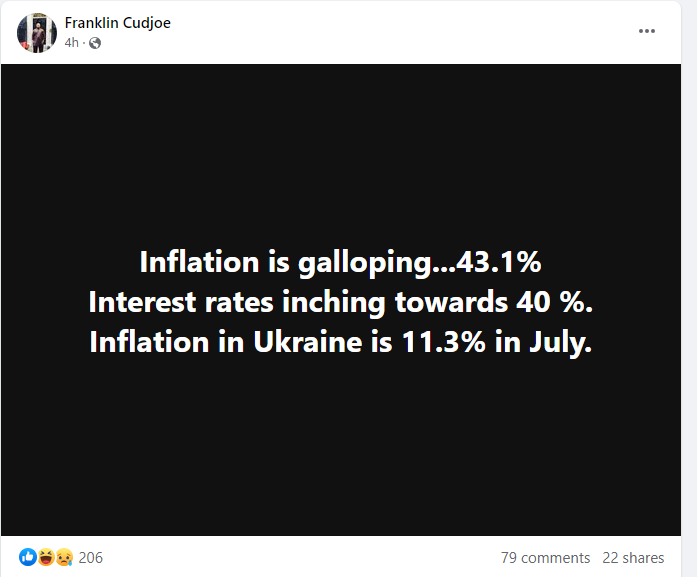
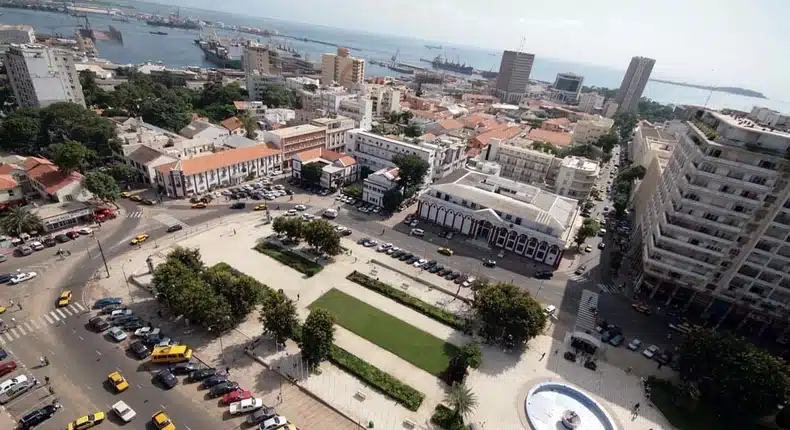
President and Founder of IMANI Africa, Franklin Cudjoe, has highlighted that Ghana’s inflation rate for July 2023 is three times higher than the inflation rate in crisis-stricken Ukraine.
Cudjoe pointed out that as of July 2023, Ghana’s inflation had reached 43.1%, with interest rates edging close to 40%.
He further noted that Ukraine’s inflation rate for the same month, July 2023, was recorded at 11.3%, which is three times lower than Ghana’s inflation rate.
In a Facebook post dated Thursday, August 10, 2023, the President of IMANI Africa emphasized the alarming pace at which Ghana’s economic situation is deteriorating.
“Inflation is galloping… 43.1% interest rates inching towards 40%. Inflation in Ukraine is 11.3% in July,” he wrote on his Facebook page.
Background
As stated in its 2022 Annual Report and Financial Statement, the Bank of Ghana encountered a substantial loss primarily due to the Debt and Deficit Exchange Program (DDEP).
As outlined in the report, the central bank underwent a restructuring of its holdings of government debt, while its non-marketable holdings of Government of Ghana instruments, which included long-term stocks, a COVID-19 Bond, and overdrafts, underwent a haircut of 50 percent.
Similar terms were applied to the exchange of Bank of Ghana’s other claims (holdings of marketable instruments) as those of other financial institutions participating in the DDEP.
This restructuring resulted in an impairment of GH¢48.40 billion in the year 2022.
Additionally, the Central Bank experienced revaluation losses on its foreign assets and liabilities due to the depreciation of the exchange rate.
The combined impact of impairments and revaluation losses led to a negative equity position amounting to GH¢55.12 billion for the year 2022.
The report further indicated that despite a robust trade surplus, the balance of payments incurred a deficit of US$3.64 billion, attributed to significant net outflows in the capital and financial account.
This situation prompted a drawdown of US$3.46 billion in Gross International Reserves, causing a decline from US$9.70 billion at the end of December 2021 to US$6.24 billion at the end of December 2022. This amount provided a cover for 2.7 months of imports.
The substantial reduction in reserves exerted considerable pressure on the currency, leading to the reduction of the Common Equity Tier 1 capital ratio from 6.5 percent to 5.5 percent, and an increase in the maximum Tier 2 capital ratio from 2.0 percent to 3.0 percent of total risk-weighted assets.
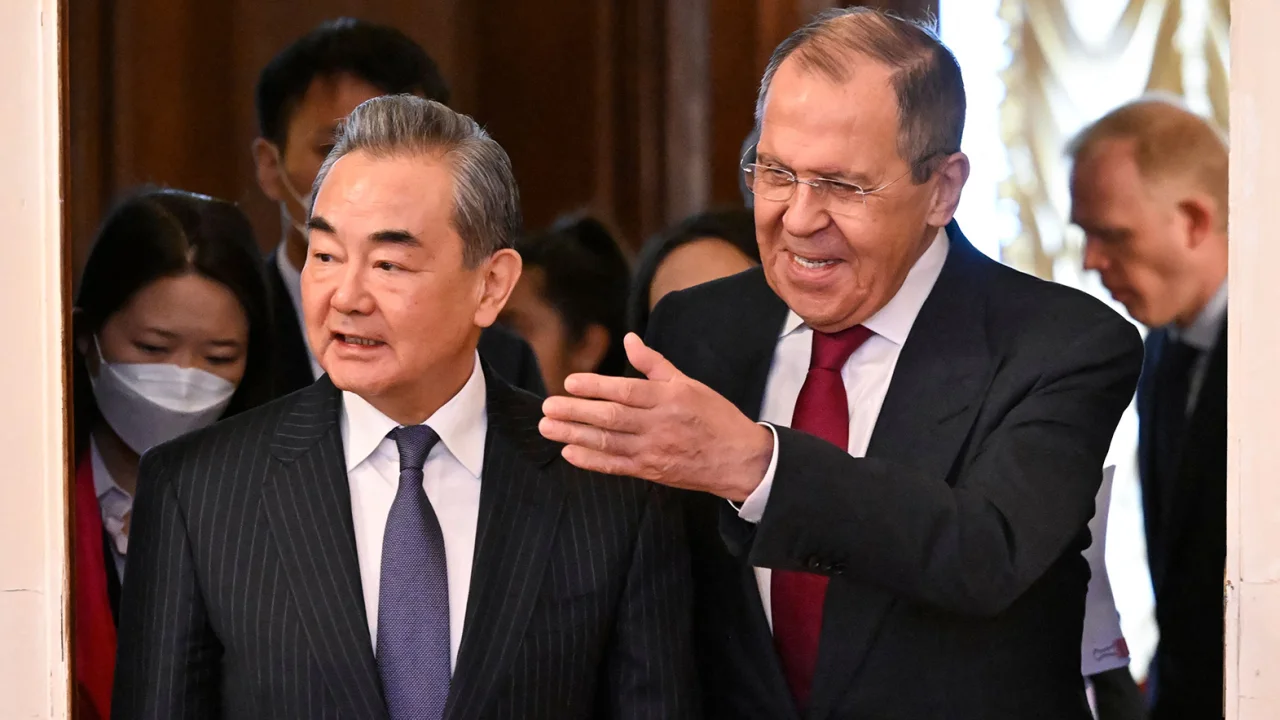
A day after a Chinese delegation took part in international negotiations to settle the conflict that included Kyiv but excluded Moscow, China’s top diplomat Wang Yi assured his Russian counterpart that Beijing continues to be “impartial” on the conflict in Ukraine.
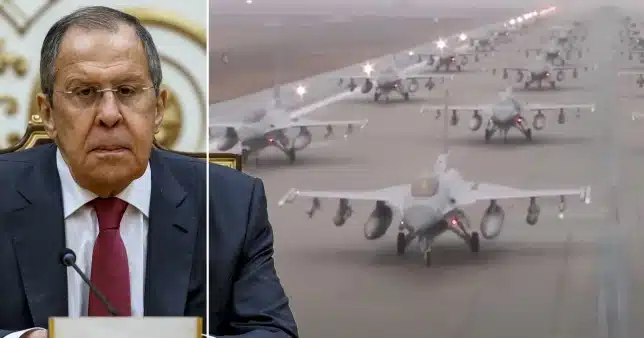
Wang emphasised to Sergei Lavrov, the foreign minister of Russia, in a phone chat on Monday that China and Russia are “trustworthy and reliable good friends and partners.”
According to a readout of the call released by China’s Foreign Ministry, Wang stated, “On the Ukraine crisis, China will uphold an independent and impartial position, sound an objective and rational voice, actively promote peace talks, and strive to seek a political solution on any international multilateral occasion.”
The call came after two days of talks in Saudi Arabia, where nearly 40 countries, including important allies of Ukraine like the US, UK, and Germany, as well as India and several Middle Eastern countries, gathered to talk about resolving the conflict after Moscow’s invasion began almost 18 months ago.
In order to identify “common ground that will pave the way for peace,” the group concluded that it is crucial to engage in international conversation.
According to China’s Foreign Ministry’s readout of the call on Monday, Lavrov “appreciates and welcomes the constructive role played by China” towards a diplomatic resolution of the “Ukraine crisis.”
Dmytro Kuleba, the foreign minister of Ukraine, referred to China’s participation in the discussions in Jeddah as “a super breakthrough and a historic victory.”
Xi Jinping, the leader of China and a self-described buddy of Russian President Vladimir Putin, has long been seen as a potential mediator who may help drive Moscow towards peace, and this expectation has been shared by both Ukraine and its Western allies.
Putin and Xi both saw the other as a key ally in altering what they perceive to be an American-led international order that is antagonistic to their objectives.
Despite Putin’s invasion of Ukraine, which Beijing has never denounced, China has continued to strengthen its economic, political, and security ties with Russia.
Despite making efforts in recent months to establish itself as a viable peace mediator in the crisis, it did not send a team to previous international negotiations in Denmark in June.
China’s involvement in the Jeddah meetings coincides with the country’s efforts to reignite its relationship with important European trading partners in the face of economic hardship and continued tension with the United States. China has also been stepping up its ties with Saudi Arabia.
Beijing’s backing of Russia has seriously hurt Beijing’s standing in Europe.
The mission was headed by Li Hui, China’s special envoy for Eurasian affairs, who “had extensive interaction and conversation with all sides on the political settlement of the Ukraine problem… carefully to various points of view and suggestions, furthering the development of global consensus,” China’s foreign ministry said in a statement to Reuters on Monday. The ministry has been contacted by CNN for comment.
However, China’s participation in the negotiations did not seem to change its own position on the dispute.
Following the meetings, the ministry told Reuters that Beijing would continue to strengthen the dialogue based on its 12-point position on a political resolution to the problem.
Beijing’s earlier-in-the-year plan called for negotiations to end the crisis. However, it differs considerably from Ukraine’s own vision for peace in that it advocates for a ceasefire without also urging the evacuation of Russian soldiers, which, according to detractors, would enable Moscow to cement its illegitimate military victories.
Despite the opposing side’s objections, Ukraine and Russia continue to officially support the conditions for direct dialogue.
The Chinese foreign ministry reports that Lavrov and Wang addressed China’s proposal during their phone discussion on Monday, with Lavrov reportedly stating that Russia “highly endorses” it.
Wang called for both parties to “work closely and strategically” to promote a “multi-polar world” and “democratisation of international relations” – terms they used to express their shared vision for a world order where Western countries hold less sway. This conversation also highlighted their alignment in the international arena more generally.
According to an official Russian account of the call, which was released by state-run news agency Tass, the two “once again confirmed unanimity or broad consonance of Moscow and Beijing’s approaches to world affairs.”
According to Tass, “They noted their rejection of the Western bloc’s confrontational policy towards Russia and China, as well as its attempts to stifle their growth through the use of sanctions and other illegal means.”
The two had not spoken since Wang’s surprise reappointment as China’s foreign minister in late July, following the abrupt replacement of Qin Gang, who had served in the position for barely six months.
Prior to being elevated to head the foreign affairs branch of the ruling Chinese Communist Party late last year, Wang served as foreign minister for approximately ten years. He now occupies both positions.
According to Tass, Lavrov wished his Chinese counterpart “great success in his new demanding role” and congratulated him on his appointment.
Pope Francis recently paid a famed Catholic monument in Portugal a visit. The shrine is known for ominous prophecies about damnation, world peace, and Soviet communism that have gained fresh significance in light of Russia’s conflict in Ukraine.
The 86-year-old prayed the rosary in Fatima, where the Church claims the Virgin Mary appeared to three shepherd children in 1917, among some 200,000 other pilgrims.
Francis was supposed to travel to Ukraine to pray for peace, according to the Vatican, but instead he skipped a speech that was supposed to be the highlight of the event.
Since the tour began on Wednesday, he has cut down on many addresses or deviated from the script, with one speech being attributed to difficulty with his glasses.
Pope Francis, according to Vatican spokesman Matteo Bruni, “always addresses first and foremost the people he meets, as a shepherd, and speaks accordingly.”
When speaking in his native Spanish, the Argentine pontiff veers much further from his planned statements.
We join Your Holiness’ prayer for peace, which is strongly associated with this sanctuary, he continued, “thinking in particular of the war in Ukraine and so many other conflicts in the world.”
Later, as a helper carefully pushed his wheelchair through the crowd, Francis addressed scores of individuals one by one, frequently pausing to console infants and the sick.
He then proceeded to return to the helicopter that would take him to the following event on his five-day visit to Portugal, where he was serving as the chief celebrant of World Youth Day.
Since the children’s first claimed vision of the Virgin Mary on May 13, 1917, Fatima has fascinated Catholics.
Tradition has it that the Virgin Mary visited Francisco, Jacinta, and Lucia Marto, three Portuguese cousins, six times, and revealed three secrets to them.
The first two foresaw the end of World War I and the beginning of World War II, as well as the rise and fall of Soviet communism. They also painted an apocalyptic picture of hell.
The third was kept a secret by everyone save Lucia and the popes for more than three and a half centuries, creating literature and cults that believed it to be the timing of the end of the world.
On May 13, the same day as the first alleged apparition in 1917, the Vatican claimed in 2000 that it was a prophecy of the 1981 attempt on the life of Pope John Paul II.
At the time, the kids ranged in age from seven to ten. A few years after they passed away, Francisco and Jacinta were canonised in 2017.
At the age of 97, Lucia became as a nun and passed away in 2005. She is also being attempted to become a saint.
The Nottingham hospital is relocated to a new location in Ukraine. An ongoing contribution drop-off location for Ukraine that was under danger of closing has found a new location.
In February 2022, City Hub Ukraine opened its doors in a vacant ward at Nottingham City Hospital.
The base was declared “unsuitable” due to excessive rain, and the volunteer-run group was instructed to leave.
But now, a new location at the hospital has been identified, which, according to the volunteers, was crucial to their cause.
The centre is believed to be the sole permanent location in Nottingham where supplies are gathered for war-torn Ukraine.
The hospital initially informed Ann Vickers, who co-runs the hub with her husband Stuart, that their location in the Minster building was no longer viable owing to “continued water ingress” and that they needed to leave with “some urgency.”
The hospital has acquired a new base, and donations can be transferred in this week, Ms. Vickers has now been informed.
Julie Golding, a former nurse who has volunteered at the hub since April 2022, said it was crucial that the hub stay housed at the hospital.
We’re so handy because we’re right there, she said. We would absolutely lose that kind of donation if we moved off-site.
They were scheduled to deliver a 40th truck, carrying 24 tonnes of relief, to the nation in the coming days, Ms. Vickers.
According to the organiser, an ancient sewing machine that could operate without electricity was requested last month so that injured soldiers could use donated bedding to create knickers and pyjamas.
Last month, the organisation also dispatched an ambulance, which Ms. Vickers claimed was now “saving lives.”
The conflict won’t end, thus we must have a place to carry out this work, according to Mr. Vickers. Most likely, it’s growing worse.
He added that hub assists Ukrainians in Nottingham with moving into new residences and that they have met “great friends” who “are like family.”
Volunteering at the hub is Kherson-born Elina Babich, a Ukrainian immigrant who said: “With a family we discovered warmth, comfort, love, amazing care, and tranquilly.
“I bow to you for your kind hearts on behalf of all Ukrainian refugees accepted by the UK. Thank you so much.”
Director of estates and facilities at Nottingham University Hospitals NHS Trust, Andrew Chatten, stated: “The hub has my full support and we will do all we can to assist their efforts to provide much-needed relief to Ukraine.”
A refugee from Ukraine who had been residing in the UK for nine months announced that she was going back since there was no sign of the war coming to an end.
Since November, Maryna Nesterenko, 38, and her daughter, 3, have resided with a host family in Rendlesham, Suffolk.
She said, however, that she did not wish to remain apart from her husband and family any longer.
No one is certain when the battle will finish, she said.
From Chernihiv, which is about a two-hour drive north of Kyiv, Ms. Nesterenko left.
She admitted that returning to the Ukraine was a “really difficult” decision, but she needed her spouse and her family’s support.
She claimed, “If there was someone close by, I would stay here longer and be able to rent a flat or a house, but I don’t have the support.”
She claimed that it had been “heart-breaking” for her spouse to miss out on watching their kid grow up.
“It’s a really tough decision; I can’t decide whether to stay or leave, but I believe this is the right choice,” the speaker said.
“The entire family will be reunited, my husband will assist me, I’ll go to work, and I’ll have extra hands,” she said.
“It’s obvious that the war won’t end this year, as everyone in the world sees,” she remarked.
As Ukraine intensifies its attacks on Russian infrastructure and territory, major road bridges connecting the seized Crimea with areas of the Kherson region under Russian control have been destroyed by explosions, according to Russian authorities.
The explosions happened the same day the mayor of Moscow reported that a drone had been shot down as it approached the city, and shortly after that, Ukraine attacked a significant naval facility and one of Russia’s largest oil tankers with a sea drone.
Videos appear to show a Russian cruiser being attacked by a Ukrainian sea drone.
The missiles that struck two bridges in Crimeaon Sunday, according to Vladimir Saldo, the interim leader of Kherson region chosen by Russia, were all Storm Shadows, an air-launched long-range missile supplied to Ukraine by the UK.
Saldo said that civilian traffic, not military traffic, used the two bridges. Twenty thousand people of the Kherson city of Henichesk had their supplies cut off due to a gas pipeline rupture that ran across the bridge.
This kind of cunning rocket attack is unforgivable, Saldo remarked. It resembles an injured animal rising to its feet.
“These strikes have no impact on the ongoing special military operation,” They have made the decision to exact small-scale retaliation against civilians and those currently traversing the land of the Kherson region.
He said that no one was wounded and that traffic would resume on the bridge by the end of the day.
Volodymyr Zelensky, the president of Ukraine, had earlier claimed that a Russian guided aerial bomb had hit a blood transfusion facility in the Kharkiv region on Saturday.
Without giving an exact count, he said, “There are dead and wounded.”
Overnight, a fresh round of Russian missiles also impacted targets across Ukraine, the majority of which were intercepted.
The fighting is becoming more and more frequent with Ukrainian attacks within Russia and on territory that is under Russian control.
Throughout the summer, a number of drone attacks targeted Russian cities, including Moscow, and on Friday, a battleship was left listing after an attack on a Russian port hundreds of kilometres from Ukrainian-held territory.
Russian tanker being attacked by a marine drone in a video. Here’s why it might change everything.
On Saturday, Ukraine vowed that additional strikes on Russian ships and the Crimea bridge will occur.
Any explosions that occur near Russian ships or the bridge over the Crimean Peninsula are “certainly a logical and practical move.” Additionally, these special operations are carried out in Ukrainian territorial seas and are entirely lawful, according to Vasyl Maliuk, head of the SBU.
The only way for the Russians to halt these explosions, according to Maliuk, is to leave Ukraine’s territorial waters and our territory.
President of Ukraine, Volodymyr Zelensky have said tha a Russian “guided bomb” struck a blood transfusion facility in northeastern Ukraine, killing one person and injuring several others.
The number of those killed or injured in the attack that took place in the Kharkiv region on Saturday was not disclosed by Volodymyr Zelensky.
“This war crime alone says everything about Russian aggression,” he said.
Russia has made no remarks. It has previously refuted any claims that it has committed war crimes or targeted civilians.
The BBC has not been able to verify the report.
Two months in, Ukraine’s big offensive is slower than it hoped
Saturday night’s attack occurred in the Kypiansk area.
The city of Kupiansk and nearby settlements were seized by Russian troops in the first few days of Moscow’s full-scale invasion of Ukraine, launched in February 2022.
The area was liberated during a Ukrainian counter-offensive last September.
In a post on social media, Mr Zelensky described the perpetrators as “beasts”.
“Defeating terrorists is a matter of honour for everyone who values life,” he added.
President Zelensky reported that on Saturday, Russia conducted a missile attack on an aeronautical company operated by the Motor Sich group in the western Khmelnytskyi region.
These Russian strikes occurred in the context of Moscow’s accusation against Ukraine of targeting a Russian tanker in the Black Sea with a drone attack, resulting in damage to the engine room of the Sig tanker in the Kerch Strait. Fortunately, there were no injuries among the 11 crew members on board during this incident, marking the second sea drone attack within two days.
Russian tanker hit in attack near Crimea
The Kerch Strait connects the Black Sea and the Sea of Azov, separating Crimea – Ukraine’s peninsula annexed by Moscow in 2014 – and Russia’s Taman peninsula.
Ukraine has not publicly commented. But a Ukrainian security service source told the BBC a sea drone had been used.
Senior officials from around 40 nations, except Russia, will gather for a weekend meeting in Jeddah, Saudi Arabia, with the goal of formulating fundamental guidelines for ending Russia’s invasion of Ukraine.
Volodymyr Zelenskyy, the president of Ukraine, hailed the diversity of nations participating in the negotiations, which got underway on Saturday. This included developing nations that were particularly severely impacted by the rise in food prices brought on by the conflict.
“This is very important because, on issues such as food security, the fate of millions of people in Africa, Asia and other parts of the world directly depends on how fast the world moves to implement the peace formula,” he said.
Last month, Russia took the decision to suspend its involvement in a United Nations-mediated grain agreement, which facilitated the transport of Ukrainian agricultural products through the Black Sea to regions facing food shortages.
President Zelenskyy expressed his aspiration that this move would pave the way for a global gathering of leaders during the upcoming autumn, dedicated to endorsing the principles outlined in Ukraine’s 10-point formula for conflict resolution.
Among the crucial components of Ukraine’s formula are demands for the acknowledgment of its territorial integrity and the removal of Russian forces from areas that Moscow claims to have annexed.
The forum excludes Russia, which has rejected Ukraine’s peace formula. The Kremlin said it will “keep an eye” on the meeting.
Kremlin spokesman Dmitry Peskov said earlier this week that Russia would “need to understand what goals are set and what will be discussed”.
“Any attempt to promote a peaceful settlement deserves a positive evaluation,” he said.
Al Jazeera’s Step Vaessen, reporting from Kyiv, said the summit was important for Ukraine as it presented an opportunity to reach out to nations that have remained neutral, including India and Brazil.
The participation of China, a steadfast ally of Russia, was particularly noteworthy. Vaessen continued, “What Ukraine truly hopes is that China will support Zelenskyy’s peace plan.
China, which claims to be a third party to the war but has come under fire from Western capitals for delaying to denounce the invasion of Ukraine, announced on Friday that it would send Special Envoy for Eurasian Affairs Li Hui to the Jeddah talks.
“We have many disagreements and we have heard different positions, but it is important that our principles are shared,” he said.
A spokesperson for the Chinese ministry, Wang Wenbin, stated that China is committed to collaborating with the international community to actively contribute to finding a political resolution to the crisis in Ukraine.
China and Russia have repeatedly emphasized their strong relationship, particularly after Presidents Xi Jinping and Vladimir Putin declared an extensive partnership in February 2022 during Putin’s visit to Beijing.
However, tensions arose when China’s embassy in Russia criticized the treatment of five Chinese citizens denied entry into Russia, stating that it was inconsistent with the overall amicable relations between the two nations.
Saudi Arabia also played a significant role in the recent talks, expressing its readiness to use its influence to help achieve a lasting peace. As the world’s largest crude exporter and closely aligned with both Russia and Ukraine on oil policy, Saudi Arabia has positioned itself as a potential mediator in the conflict.
Crown Prince Mohammed bin Salman’s rehabilitation on the global stage was facilitated in part by the energy crisis stemming from the Ukraine war. Although isolated following the 2018 killing of Jamal Khashoggi, Saudi Arabia’s stance against Russia’s invasion and annexation in Ukraine has bolstered its international significance.
The recent meeting between key parties follows informal talks organized by Ukraine in Copenhagen in June, which did not yield an official statement.
In May, Saudi Arabia hosted Ukrainian President Zelenskyy at an Arab League summit in Jeddah, where he called out some Arab leaders for turning a blind eye to the atrocities of Russia’s invasion in Ukraine.
Russian authorities have reported that a Russian tanker carrying 11 crew members suffered damage in an attack within the Black Sea, allegedly carried out by Ukrainian forces.
The incident, which occurred in the Kerch Strait, resulted in damage to the vessel’s engine room during an overnight strike. Fortunately, no injuries were reported among the crew.
While Ukraine has not made a public statement regarding the incident, a source from the Ukrainian security service informed the BBC that a sea drone was utilized in the attack.
This marks the second consecutive day featuring an assault involving similar weaponry. However, Russia has not confirmed any destruction resulting from the previous day’s attack.
Sea drones, also known as naval drones, are unmanned, compact vessels designed to operate either on or beneath the water’s surface.
The Kerch Strait serves as the link between the Black Sea and the Sea of Azov, effectively dividing Crimea – a peninsula seized by Moscow in 2014 – and Russia’s Taman peninsula.
Ukraine’s SBU security service revealed that the operation on Saturday was conducted in collaboration with the Ukrainian navy, involving the use of 450kg of TNT explosive. Notably, the targeted tanker was laden with fuel, causing the resulting explosion to be visible from a considerable distance.
As per Russia’s maritime transport agency, the Sig tanker was positioned 17 miles (27km) south of the Crimean Bridge at the time of the attack.
An official from Russia’s regional Marine Rescue Co-ordination Centre (MRCC) reported to the state-run Tass news agency that two tugboats had already arrived at the scene of the assault, situated just south of the Kerch Strait.
“The engine room was damaged. Not much, but it was damaged,” the official said.
Russia’s maritime transport agency RosMorRechFlot later said the vessel had a hole “in the area of [the] engine room near the waterline from the starboard side, presumably as a result of an attack by a sea drone”.
“The ship is afloat,” it added.
Reports from Russian state-run media indicate that the Crimean Bridge’s lights, located to the north, were deactivated and traffic was halted due to warnings of an impending attack.
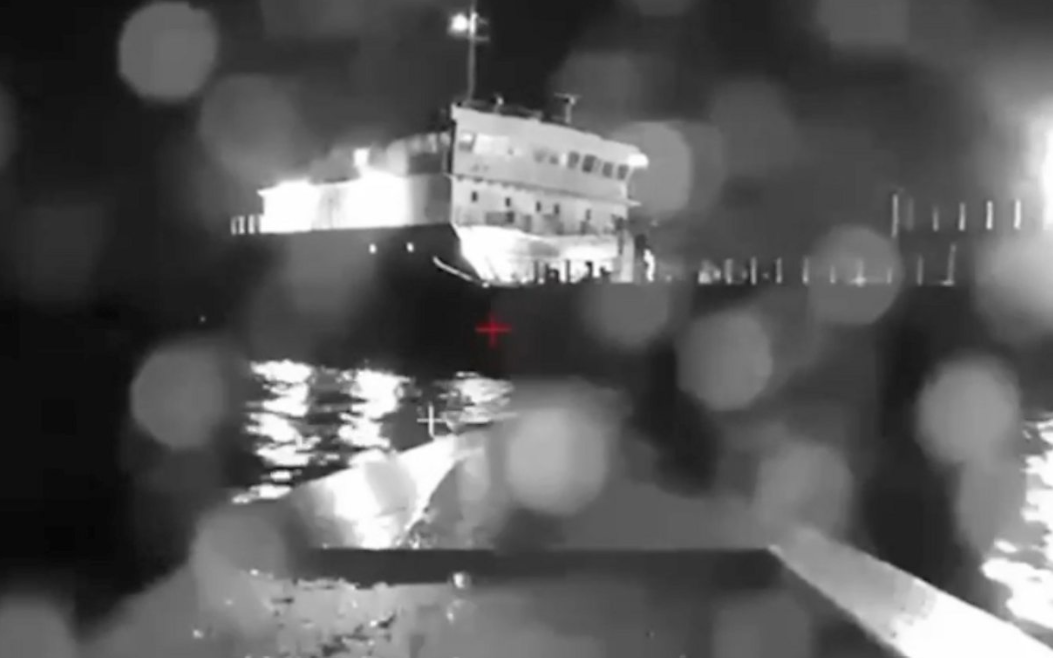
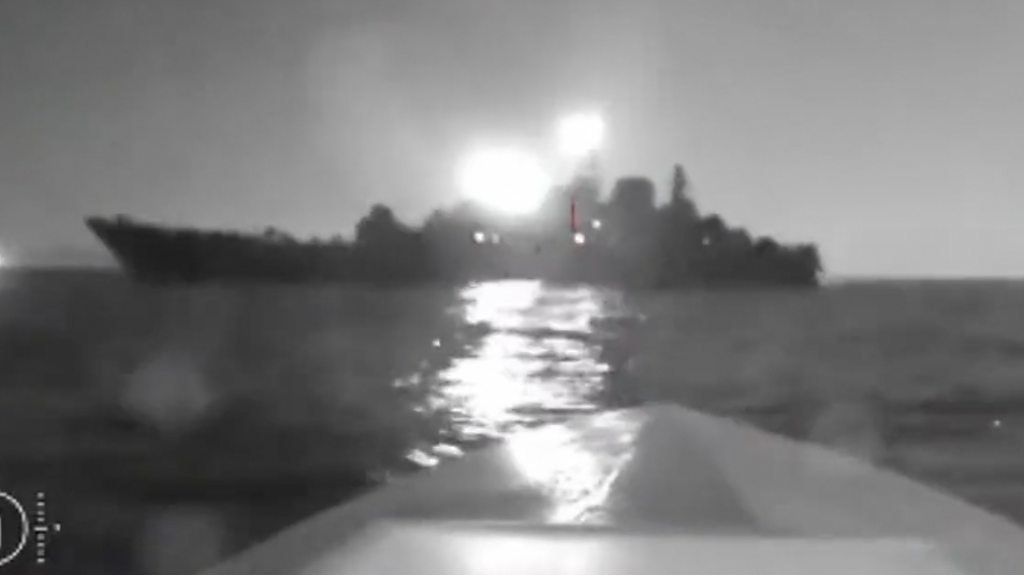
On Friday, Ukrainian security sources informed the BBC that a Ukrainian naval drone had executed a substantial strike on a Russian naval vessel near the Black Sea port of Novorossiysk. Allegedly, footage emerged depicting the drone hitting the Olenegorsky Gornyak large landing ship. Another video, yet to be verified, displayed a prominently tilting vessel being towed to port.
In contrast, Russia’s defense ministry asserted that it had successfully thwarted a Ukrainian attack on its naval base in Novorossiysk, involving two sea drones, without acknowledging any resulting damage.
Situated southeast of the Kerch Strait, Novorossiysk stands as a significant conduit for Russian exports.
Recent weeks have witnessed escalated clashes at sea, coinciding with Russia’s abandonment of a pivotal UN agreement that ensured secure grain exports across the Black Sea.
Russian drones and missiles have targeted Ukrainian ports, prompting Kyiv to issue threats of retaliation.
In a distinct development, Saudi Arabia is scheduled to convene talks aimed at resolving the Ukrainian conflict later on Saturday. Invitations have been dispatched to approximately 30 nations, excluding Russia, for the meeting to be held in the Red Sea city of Jeddah.
Russian President Vladimir Putin initiated a comprehensive invasion of Ukraine in February 2022.
Ukrainian sources, has stated that a Russian naval ship in the Black Sea was damaged in a drone attack conducted by the Ukrainian navy. The incident reportedly took place near the Russian port of Novorossiysk, a major hub for Russian exports.
Russia’s defense ministry claimed to have repelled the Ukrainian attack on its naval base using two sea drones but did not acknowledge any damage to its vessel. However, Ukrainian security service sources revealed that the ship, Olenegorsky Gornyak, was struck and suffered a serious breach. They stated that a sea drone carrying 450kg (992lb) of dynamite hit the ship.
Russia’s official report did not mention any damage resulting from the attack. Sea drones are unmanned vessels that operate either on or below the water’s surface.
A video provided to the BBC by a source with Ukraine’s security service appears to show the drone approaching a ship, believed to be the Olenegorsky Gornyak. The footage depicts the vessel coming close to the ship’s side before the feed abruptly cuts off, presumably due to the impact. An unverified video also shows the ship listing to one side.
The Olenegorsky Gornyak is a landing ship designed for launching amphibious forces close to shore for beach landings and efficiently unloading cargo at ports. Any damage to this vessel could disrupt Russia’s efforts to resupply its forces fighting in occupied southern Ukraine.
In response to the attack, the Novorossiysk port temporarily suspended ship movements, as stated by the Caspian Pipeline Consortium, which handles oil loading onto tankers at the port.
Research conducted by BBC Verify indicates that Ukraine has carried out at least ten attacks using sea drones, targeting military ships, Russia’s naval base in Sevastopol, and Novorossiysk harbor in a previous assault. Ukrainian defense sources also disclosed that sea drones were employed in an attack on the Kerch Bridge in Crimea in July.
Ukraine’s attempts to target the Novorossiysk port are not new, and the reasons behind their actions are apparent.
The port plays a crucial role in exporting approximately 1.8 million barrels of oil per day, accounting for about 2% of the global supply. Additionally, Novorossiysk serves as a significant naval base for Moscow.
Recent weeks have witnessed an escalation in sea clashes following Russia’s decision to abandon a UN deal that allowed safe grain exports between Russia and Ukraine across the water. As a result, Ukrainian ports have faced attacks from Russian drones, prompting Kyiv to respond actively.
Interestingly, Ukraine appears more forthcoming in acknowledging its involvement in strikes using sea drones, in contrast to attacks deeper within Russian territory.
The defense ministry of Russia reported that it successfully thwarted Ukrainian attacks on the Novorossiysk naval base in the Black Sea overnight.
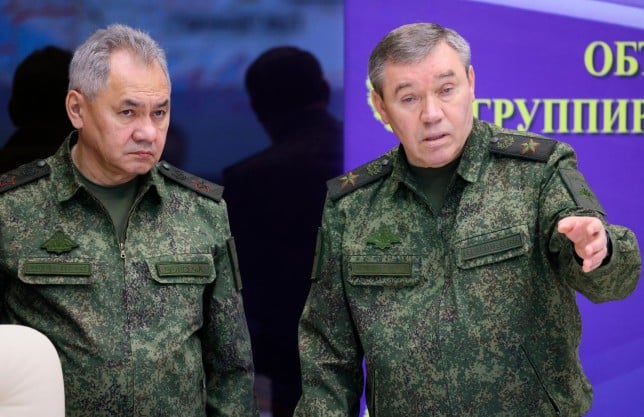
In response to the situation, Russia’s defense minister, Sergey Shoigu, visited Russian troops on the front line in Ukraine.
Additionally, Russia claimed to have shot down at least 13 Ukrainian drones over the Crimean Peninsula.
Amid the escalating costs of the conflict in Ukraine, Russia has reportedly revised its 2023 defense spending goal to exceed $100 billion, constituting around one-third of its total public expenditure. A government document examined by Reuters reveals this updated budget allocation, as specific financial data concerning the conflict is no longer publicly disclosed.
The disclosed figures provide insight into Russia’s financial commitment to the ongoing conflict in Ukraine. Notably, during the initial half of 2023, Russia’s defense spending surpassed its original target by 12 percent, amounting to 600 billion roubles ($6.4 billion) more than the initially allocated 4.98 trillion roubles ($53 billion) for the year.
These revelations highlight the substantial allocation of resources to defense, with the first half of 2023 witnessing defense expenditures of 5.59 trillion roubles ($58 billion) out of a total expenditure of 14.97 trillion roubles ($159 billion). The document indicates that Russia’s budget aims to allocate 17.1 percent of total funds to “national defense.”
Despite these disclosures, neither Russia’s government nor its finance ministry has responded to Reuters’ requests for commentary on the provided numbers.
In the coming weeks, Vladimir Putin will travel on a diplomatic mission to Turkey, his first trip to a nation that is a member of NATO since the conflict in Ukraine began.
Erdogan emphasised the significance of the Black Sea Grain Initiative, which he called a “bridge for peace,” and told Putin that “no steps should be taken that will escalate tensions in the Russia-Ukraine war.” Erdogan also confirmed the visit.
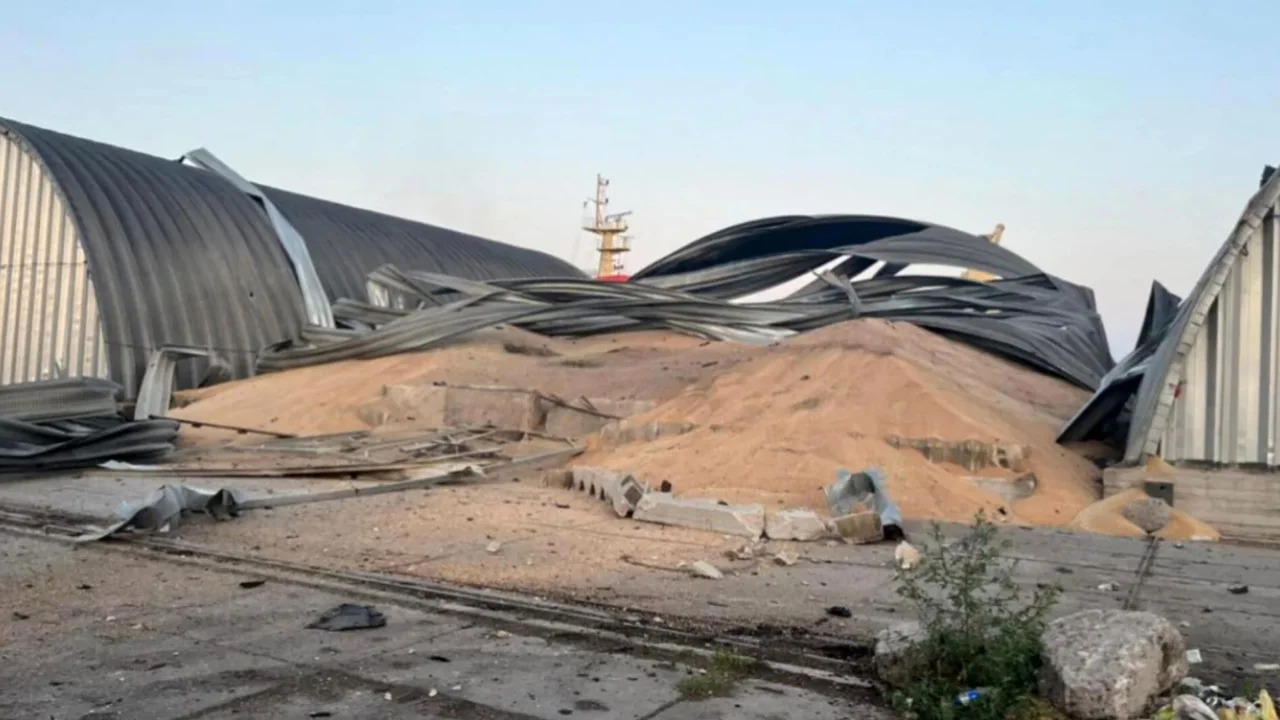
But as Russia intensifies its use of force to stop Ukraine from exporting grain, it today assaulted Ukraine‘s biggest inland port, which is located across the Danube River from Romania. As a result, food prices around the world have increased.
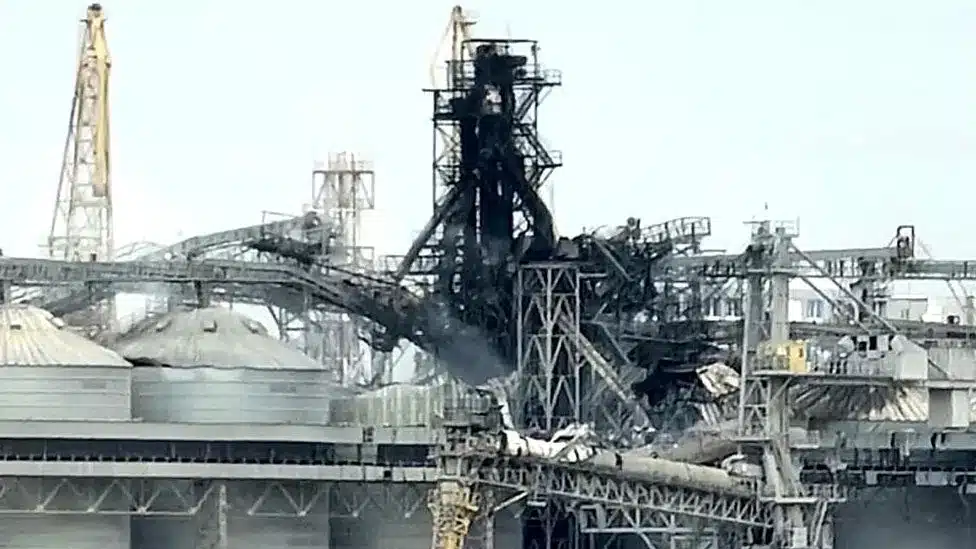
As ships prepared to arrive at the port of Izmail to load up with Ukrainian grain in violation of a de facto blockade Russia reimposed in mid-July, the attacks destroyed buildings there and prevented them from doing so.
Oleksandr Kubrakov, the deputy prime minister of Ukraine, claimed that about 40,000 tonnes of grain that were bound for China, Israel, and nations in Africa were damaged by Russian drone assaults.
President Volodymyr Zelenskiy posted on Telegram that “Russian terrorists have once again attacked ports, grain, and global food security.”
One of the major exporters of grains worldwide is Ukraine. After declining to renew a deal that had eased its wartime blockade of Ukrainian ports last year, Russia began attacking Ukraine’s agricultural and port infrastructure and has continued to do so for more than two weeks.
Since Russia’s blockade of Ukraine’s Black Sea ports in mid-July, the port, which is across the river from NATO member Romania, has served as the primary alternate route for grain exports out of Ukraine.
After speaking with Erdogan, the Kremlin reaffirmed Russia’s need for rejoining the grain agreement: the implementation of a parallel agreement that would improve the terms for its own food and fertiliser exports.
These shipments are now immune from sanctions, which the West claims Moscow is attempting to thwart by endangering the world’s food supply.
Putin and Erdogan, according to Erdogan’s staff, decided that he will visit Turkey soon.
Putin, who is wanted for war crimes by the International Criminal Court, has made no official trips outside of the country this year and has only travelled outside of the former Soviet Union once since beginning his invasion, on a day trip to Tehran more than a year ago. Erdogan has long expressed the desire to welcome Putin and persuade him to resume the grain agreement.
Recent assaults on Ukraine’s grain infrastructure have been characterised by Moscow as reprisal for a Ukrainian attack on a Kerch Strait bridge to Crimea that was being used to supply Russian forces in southern Ukraine.
In a statement, American ambassador Bridget Brink denounced the strikes and listed recent Russian targets, including “Homes. Ports. cereal silos. historic structures. Men, women, and kids.
Round-the-clock and escalating Russian attacks on Kryvyi Rih, Kharkiv, Kyiv, and Kherson once again demonstrate Russia’s lack of interest in peace, disregard for the safety of civilians, and disregard for people across the world who depend on Ukrainian food.
According to Kyiv, the purpose of the strikes is to convince shippers and their insurance firms that Ukrainian ports are hazardous to resume exports, hence reinstating Russia’s blockade.
Before Russia withdrew from the Black Sea agreement, grain was exported mostly via Ukraine’s Danube river ports like Izmail, which have subsequently become the principal exit point. Grain is loaded onto barges and transported to Romania’s Constanta Black Sea port for further shipment.
While Moscow claims it will treat ships bound for Ukrainian seaports as potential military targets, Kiev wants international ships to arrive right there and load up.
Russia’s decision to renege on the agreement, mediated by the U.N. and Turkey, has prompted a warning from the United Nations about a potential food catastrophe in the world’s poorest nations.
According to Ukrainian officials, in nine days of strikes following the termination of the grain agreement, Moscow has attacked 26 port facilities, five civilian vessels, and 180,000 tonnes of grain.
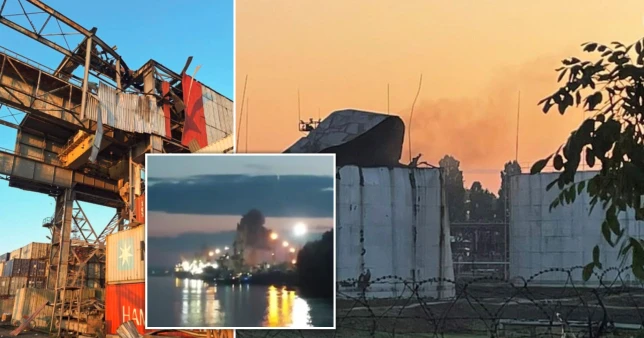
A short distance from NATO member Romania, in Izmail on the Danube, a Russian drone strike struck Ukrainian port facilities.
Damage has been done to a grain elevator, a passenger facility and a grain warehouse.
After pulling out of a UN agreement that allowed both countries to move grain securely across the Black Sea, Russia started attacking Ukrainian ports.
Early on Wednesday, a sizable fire erupted from Izmail’s port area.
The size of the fire could be seen in video taken from the Romanian bank of the Danube, which was around 3 km (1.9 miles) distant.
The ongoing Russian strikes on Ukrainian infrastructure “close to Romania,” according to Romanian President Klaus Iohannis, are unacceptable.
Russian drones were reportedly moving towards the Danube river, where Ukraine has two ports, Izmail and Reni, according to the air force of Ukraine.
According to Ukraine’s military command in the south, air defences have been in operation for about three hours.
Oleh Kiper, the regional governor of Odesa, reported that emergency personnel were on the scene of the most recent Russian attack and that no casualties had been reported.
Volodymyr Zelensky, the president, stated that “unfortunately there has been damage,” and the regional administrator shared several pictures on social media that showed that multiple buildings had been affected.
The Izmail prosecutor has opened an investigation into a freight terminal, a warehouse and a lift that were all destroyed, without specifying precisely where in the Odesa region, according to officials and the Ukrainian army ministry.
Russian drones also targeted grain storage facilities in Reni, which is located further up the Danube and close to Romanian territory, last week.
The attacks that were so close to Romania, according to President Iohannis, were war crimes that further harmed Ukraine’s “ability to transfer their food products towards those in need in the world.”
Earlier, Russia bombed the significant Black Sea ports of Odesa and Chornomorsk, destroying 60,000 tonnes of grain, according to the authorities.
Russia effectively imposed a naval blockade when it abandoned the grain agreement in July by threatening to strike any ships en route to Ukrainian ports on the Black Sea.
Ukraine’s ports on the Danube have continued to be reached by ships travelling through the Black Sea, albeit this alternate route has gained prominence.
Wheat and maize are two commodities that Ukraine exports in large quantities to other countries, and the majority of the shipments had been coming from ports along the Black Sea. For Ukraine’s exports, the Danube becomes crucial if the Black Sea is closed to ships.
In the immediate aftermath of Russia’s withdrawal from the grain agreement, wheat prices skyrocketed on global markets.
Global food security is becoming a worry, particularly for underdeveloped Asian and African countries.
According to local officials, Russia also launched more than 10 drones overnight on Kyiv, the capital of Ukraine.
Anti-aircraft systems destroyed all of the projectiles, but according to the officials, falling debris damaged a number of non-residential buildings.
Russia has not made any official comments about the alleged strikes to date.
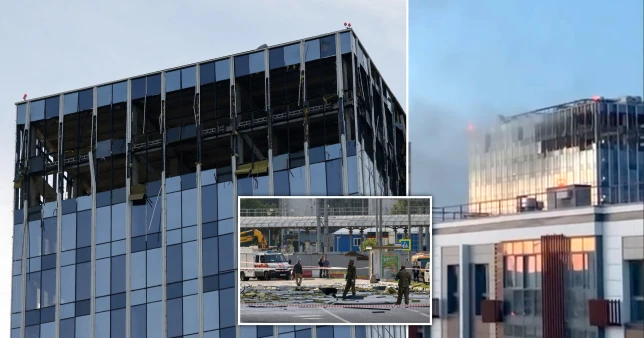
According to the BBC, the building’s exterior was harmed, but no injuries were recorded.
It was the fourth strike attempt this week and the fifth this month on the capital region.
It appears from surveillance video that the drone impacted the structure at that same moment.
In a video posted early this morning, smoke can also be seen flowing from the skyscraper.
According to Sergei Sobyanin, the mayor of Moscow, “over 150 square metres of glazing was destroyed.”
The Russian military ministry has attributed a supposed “terrorist attack” on Ukraine.
They reported that two further Ukrainian drones had been shot down in other areas of the capital.
The airport at Vnukovo briefly shut down, according to Russian news media.
In a tweet, Volodymyr Zelensky’s advisor Mykhailo Podolyak predicted that as the war entered its 18th month, there would be “more unidentified drones, more collapse, more civil conflicts, and more war” in Russia.
A security officer was hurt in the incident on Sunday after three drones targeted the city.
Two of the others were jammed and crashed in the Moscow City commercial sector, while one was shot down by air defence systems.
Concerns about Moscow’s vulnerability to strikes have increased as Russia’s war in Ukraine enters its 18th month.
Additionally, Ukraine has been charged by Russia with conducting a drone attack on the Kremlin in May.
None of the incidents had a claim of responsibility from Ukraine.
Attacks on Russian territory, according to President Volodymyr Zelensky, are a “inevitable, natural, and entirely fair process.”
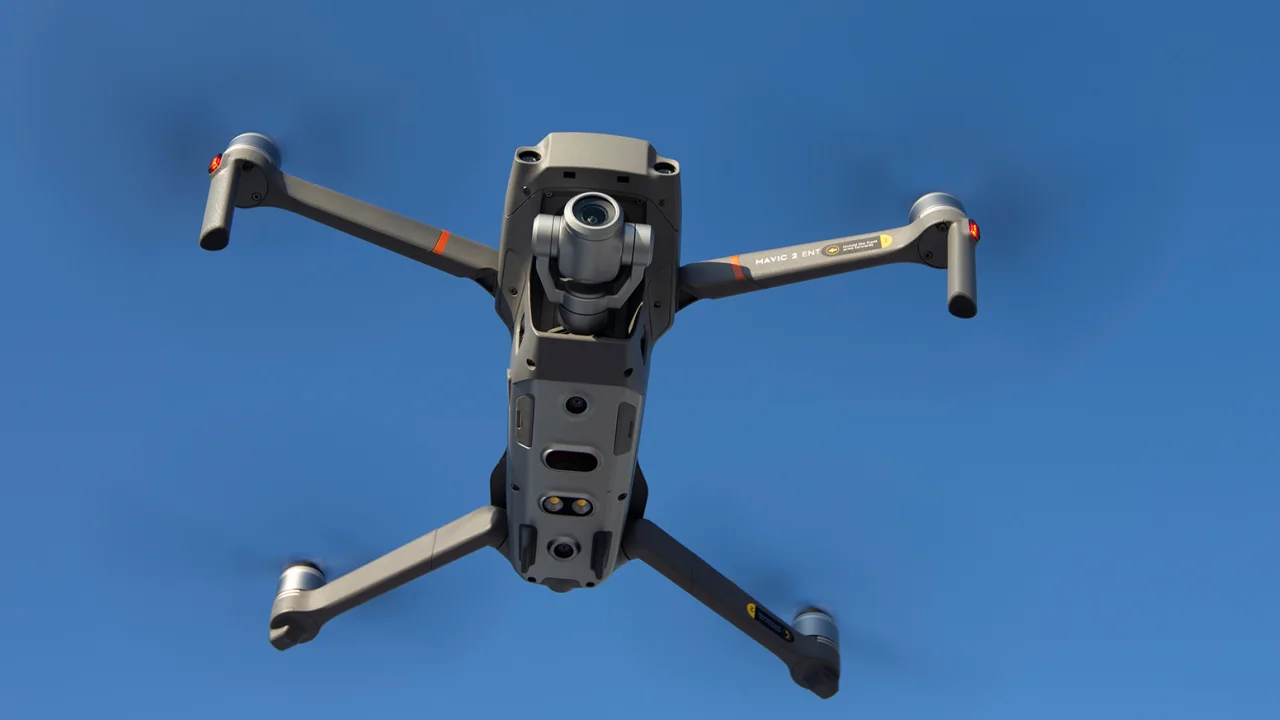
China will impose export restrictions on drones and drone equipment to “safeguard national security and interests,” according to a statement made by the country’s commerce ministry on Monday. This decision may have an impact on the situation in Ukraine.
Vendors will need to request approval to export specific drone engines, lasers, imaging, communications, and radar equipment due to the equipment restrictions. The restrictions, which go into effect on September 1, also apply to consumer-grade drones that meet particular requirements.
An unnamed ministry representative issued an internet statement banning the export of any civilian drones not covered by the regulations for military use.
The statement added that China has “consistently opposed the use of civilian drones for military purposes” and that its “modest expansion of the scope of drone control this time is an important measure to demonstrate its commitment as a responsible major country to implement global security initiatives and maintain world peace.”
As Moscow wages war on its neighbour, drones have become a more prevalent component of modern warfare, being used by both Russia and Ukraine. During the conflict, civilian drones that could be modified or used for military purposes have also gained attention.
CNN discovered proof of an armed, downed Chinese-made drone earlier this year that had been deployed to target Ukrainian military.
It was their airframe, the manufacturer, Mugin Limited, said CNN, calling the situation “deeply unfortunate.”
The devices are referred to as “Alibaba drones” by some tech journalists since they can be purchased for up to $15,000 on Chinese marketplace websites like Alibaba and Taobao.
China has a substantial domestic drone manufacturing business and exports drones to many nations, including the United States.
A report created by the US Office of the Director of National Intelligence, which claimed that as of March, China “had shipped more than $12 million in drones and drone parts” to Russia, was published last week. The report cited a “third-party analysis” of Russian customs data and stated that China had exported more than $12 million in drones and drone parts to Russia.
The paper, headed “Support Provided by the People’s Republic of China to Russia” and dated 2023, mostly bases its assertions on information from open sources and news coverage from Western media.
The report mentions shipments of “dual-use” equipment but does not say if the alleged drone shipments were utilised in combat.
Friday, a representative for China’s Foreign Ministry denied the claim, stating that Beijing’s collaboration with Moscow “does not target any third party.”
In a statement released in April, the Commerce Ministry refuted claims that China was aiding Russia militarily by exporting drones to the front lines, labelling media reports of such behaviour as “deliberate smears.”
A spokeswoman stated that some Chinese civilian drone businesses had also “taken the initiative to suspend their operations in conflict areas” since the “crisis” in Ukraine started. This was due to China’s limitations on specific drones, which barred them from being used for “non-peaceful purposes,” the spokesperson added.
Chinese leaders have long been cautioned by Western officials not to financially back the Russian war. Beijing has maintained its diplomatic and financial backing for Moscow despite claiming neutrality in the war.
However, there are “ongoing concerns” that Chinese companies may be giving Russia technology that could “advance its aggression in Ukraine,” according to US Secretary of State Antony Blinken, who stated in June that Washington had “received assurances from China that it is not and will not provide lethal assistance to Russia for use in Ukraine.”
The measures also come amid high-tech export restrictions between the United States and China as a result of growing worries in Washington about the threat Beijing poses to its national security.
China claimed that its new policies, which were unveiled on Monday, do not target “any specific” nation.
Henry Gao, a law professor at Singapore Management University, claims that the limitations are an addition to the drone export prohibitions Beijing has already put in place for the better part of the last 20 years.
In recent years, “especially since the US-China trade war,” China has also placed restrictions on the grounds of national security, he claimed.
The additional actions would “further exacerbate US-China tensions and make it harder for businesses in both countries to do business,” Gao continued.
According to two US lawmakers, the largest drone manufacturer in the world, DJI, which is based in Shenzhen, makes more than 50% of the drones marketed in the US. US public safety agencies like DJI models. They proposed legislation earlier this year that would prevent the firm from using the communications infrastructure in the US.
The US implemented broad rules last year that prevent Chinese corporations from acquiring sophisticated semiconductors and chip-making machinery without a licence. Beijing implemented export restrictions on two components necessary for the production of semiconductors last month. The restrictions start on August 1.
Already, drones are a factor in US-China tensions.
In 2021, the US added DJI to a list of companies to avoid investing in because of allegations that the company assisted in the mistreatment of Uyghur Muslims and other racial and religious minorities in China’s Xinjiang region.
The business was prohibited from acquiring American technology since it was already on the US Entity List. DJI vehemently denied doing anything to earn a spot on the list.
Following the ministry’s announcement on Tuesday, DJI posted a statement to its website in which it declared that it had never created or marketed any technology for military use and that it would “actively cooperate” with the new export control regulations.
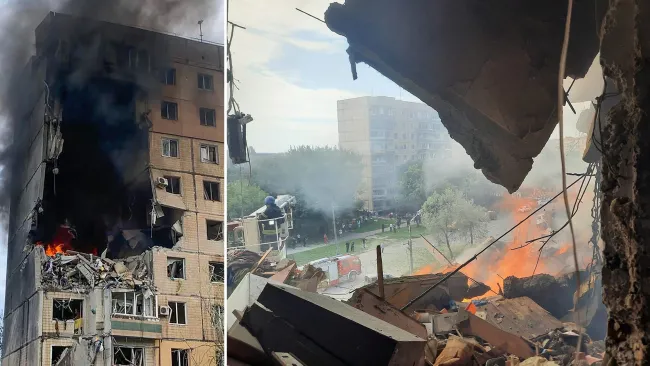
At least four persons have died as a result of a Russian missile attack on a home in Kryvyi Rih, the hometown of Ukrainian president Volodymyr Zelensky.
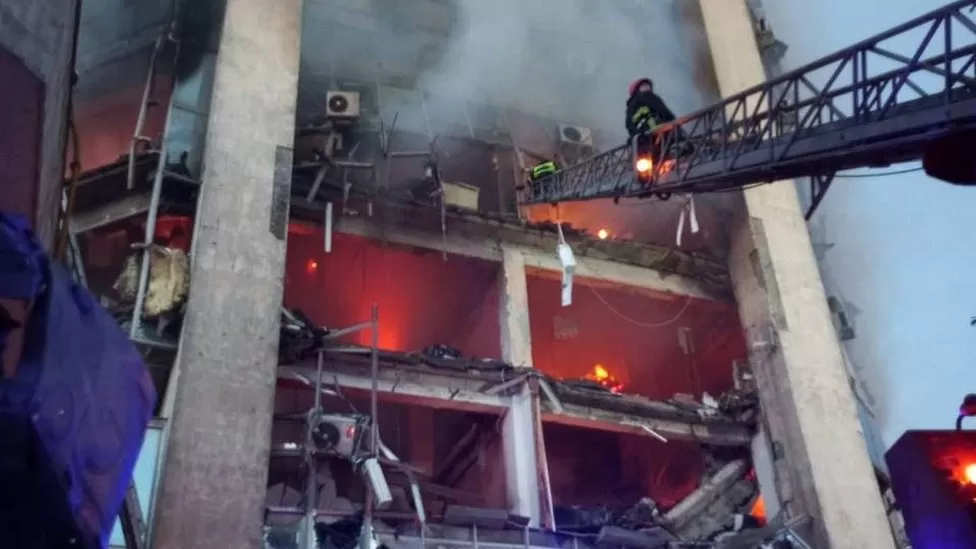
Images from the scene show a massive hole that spans from the fourth to the ninth floors of the apartment building, with black smoke rising out of it.
‘A 45-year-old mother and a 10-year-old daughter’ were among the fatalities, according to a social media post by Mykhailo Podolyak, an adviser to the head of the Zelensky presidential office.
“International law will never succeed if the aggressor does not perceive a real power behind it,” he continued. Closing the Ukrainian skies with missile defence and air defence equipment is where the power starts.
Zelensky said in a statement shared on social media that the enemy has been obstinately bombing cities and city centres as well as shelling homes and other civilian objects in recent days.
However, we won’t be scared or broken by this dread. Saving our people is what we are doing.
Since Russia began its full-scale invasion of Ukraine in February of last year, attacks on Kryvyi Rih have been extremely infrequent.
The significant exception occurred last month, when a missile strike that struck a five-story residential structure resulted in three fatalities and 25 injuries.
Three drone missile attacks on Moscow’s federal buildings were followed by this morning’s strike.
The façade of two office towers were “slightly damaged,” according to the city’s mayor, Sergei Sobyanin, but no one was hurt.
Although Zelensky did not explicitly affirm or deny that Ukraine was responsible for the strikes, he did state in his nightly speech that “gradually, the war is returning to the territory of Russia”—specifically, to its military bases and symbolic centres. He added that this process was inevitable, natural, and wholly fair.
Denis Pushilin, the Moscow-installed head of the forcibly annexed province, reported that two individuals were killed in a Ukrainian artillery strike in the partially held Donetsk region.
Pushilin claimed that during the shelling of Donetsk, the provincial capital, a bus had also been struck.
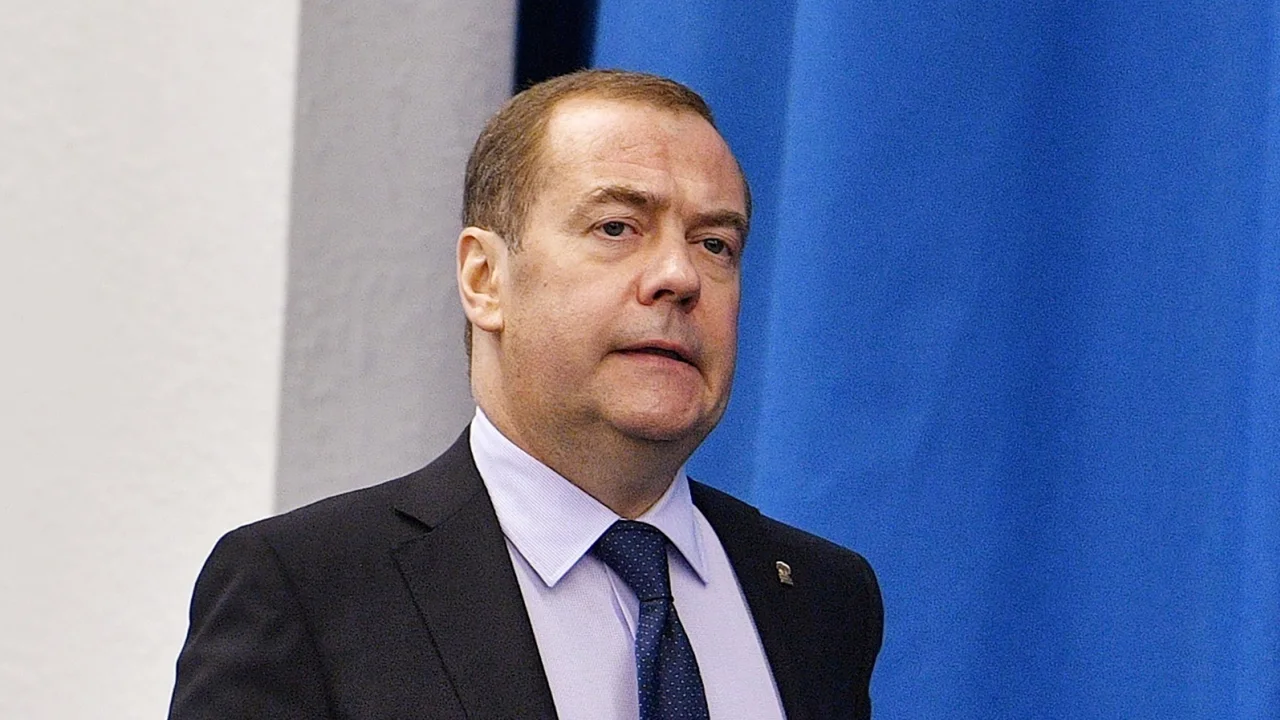
Senior Russian official Dmitry Medvedev warned on Sunday that if Ukraine’s counteroffensive is successful, Russia may be obliged to deploy nuclear weapons. This is the latest nuclear threat issued by President Vladimir Putin’s top backer during Moscow’s invasion.
Imagine for a moment suppose the NATO-supported offensive was successful and a portion of our land was captured. The Russian Presidential Decree’s provisions would therefore force us to use nuclear weapons, stated Medvedev, the deputy head of the Russian Security Council, in a Telegram post.
The former Russian leader continued, “There would just be no other way out.” “Our adversaries should beg our warriors to prevent the world from engulfing in nuclear conflagration.”
Throughout Moscow’s invasion of Ukraine, Medvedev, the Russian president from 2008 to 2012, has adopted a bellicose demeanour and frequently invoked the possibility of nuclear war.
He issued a nuclear warning last April should Sweden and Finland join NATO. Stockholm’s path to NATO membership was eased earlier this month after Turkey abandoned its objections, while Helsinki joined the defence alliance later that month.
In September, Medvedev claimed that Russia might protect Ukrainian territories that had been annexed by it with strategic nuclear weapons.
And in January, as NATO members discussed sending more weaponry to Ukraine, Medvedev warned that a loss for Russia in the fight may spark a nuclear exchange.
In January, Medvedev posted on Telegram that “the loss of a nuclear power in a conventional war can provoke the outbreak of a nuclear war.” “Nuclear powers don’t lose significant battles in which their future is at stake.
“Anyone should understand this. even to a Western politician with even a modicum of competence.
In a rare admission from a senior Russian official, Medvedev said in his speech on Sunday that Russia may eventually lose the war after nearly 18 months of attrition.
They also occurred just after the Russian Defence Ministry accused Kiev of launching a drone attack on Moscow. A corporate and shopping complex in the western part of the Russian capital was damaged, the ministry reported, despite the fact that three drones were intercepted on Sunday.
Both privately and publicly, notably during the previous UN General Assembly, the United States has already warned Russia against using nuclear weapons in Ukraine.
Putin said last month that Russia had transferred a first batch of tactical nuclear weapons to Belarus, where they had been stationed for “deterrence.”
Putin stated at the St. Petersburg International Economic Forum that Belarus would get the remaining tactical nuclear weapons from Russia “by the end of the summer or by the end of the year.”
According to the US Defence Intelligence Agency (DIA), there is “no reason to doubt” Putin’s assertion that Belarus has nuclear weapons.
However, Matthew Miller, a spokesman for the US State Department, stated at the time that the US had “not seen any reason to adjust our own nuclear posture nor any indication Russia is preparing to use a nuclear weapon.”
Alexander Lukashenko, the president of Belarus, declared last month that he would use the Russian tactical nuclear weapons stationed on Belarusian land without “hesitation” in the event of assault.
Senior DIA officials, however, asserted that they did not think Lukashenko would be in charge of the arsenal. Russian authority over it would likely be total, according to the officials.
The Federation of American Scientists estimates that Russia possesses 4,477 deployed and reserve nuclear warheads, including around 1,900 tactical nuclear weapons.
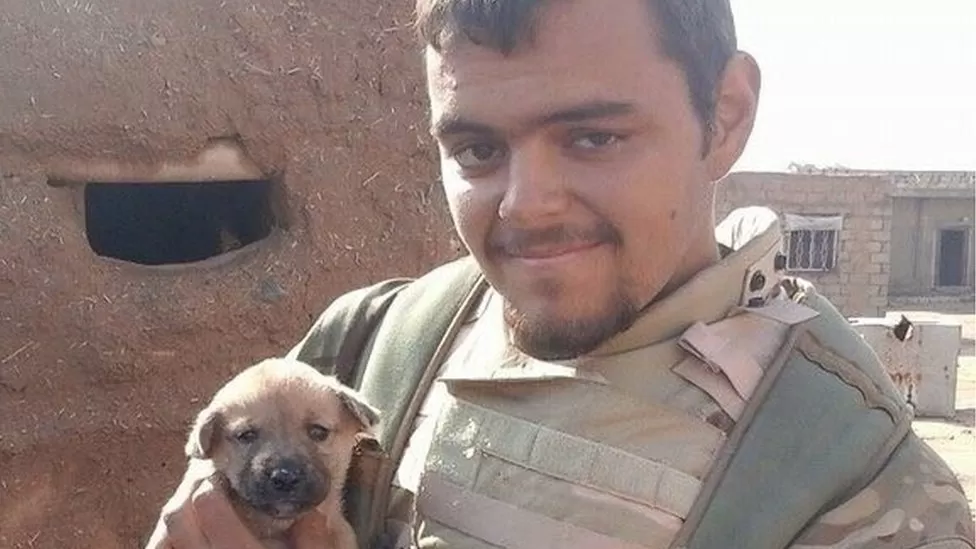
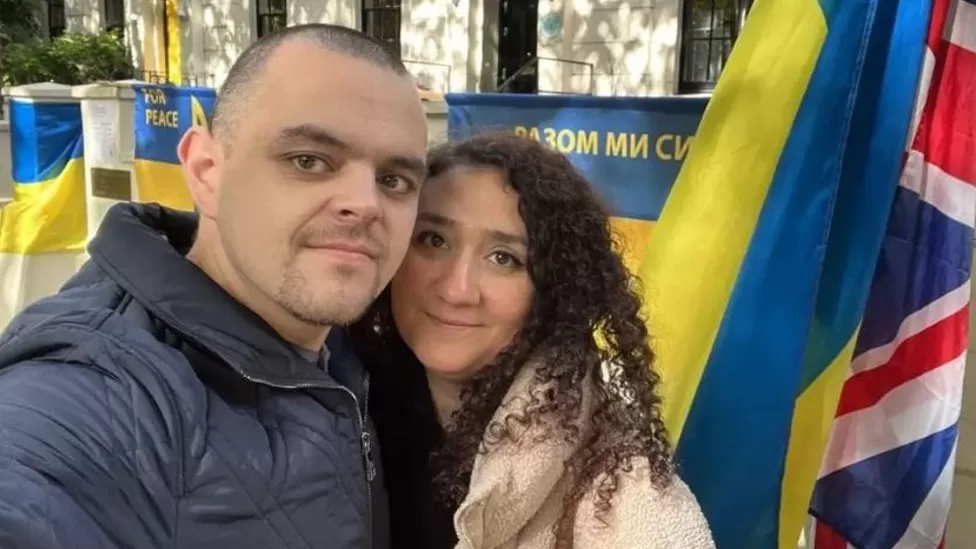
Former Ukrainian soldier who is being held by forces supported by Russia says he plans to return as an online reporter.
Despite being taken prisoner in April, Aiden Aslin was one of five British nationals who were freed in September.
Mr. Aslin, a resident of Newark, Nottinghamshire, who received a death sentence, said he was beaten and stabbed while a prisoner.
He has since declared that he will not engage in combat but instead report on the war from his YouTube channel.
In April, Mr. Aslin was taken prisoner during combat in Mariupol, a city in the southeast.
After being freed, he admitted that he had been held in a tiny cell with an open window, no toilets, and scant food.
In addition, he claimed, he had received punches, death threats, and orders to perform the Russian national anthem.
Analysis
It may seem strange to go back to Ukraine after such a horrible ordeal.
Aiden, though, has long accepted the dangers.
He lived in Ukraine for four years, and he still has a strong connection to it and a desire to participate in the struggle there.
Social media has a sizable audience for content that stirs up conflict. On Instagram, YouTube, and other platforms, a large number of combatants, civilians, and citizen journalists share their experiences, bringing us closer than ever to the horrors of conflict.
This is the channel Aiden now plans to utilise to draw attention to the struggle his former allies are still having. He believes he can offer a viewpoint that perhaps traditional media outlets cannot.
Now that Aiden is well-known in Ukraine, he will have access to more opportunities, but he is also aware that this could make things more dangerous.
Even if it is difficult for them, his family at home supports his decision.
Alexander Nikulin, the judge who executed Mr. Aslin and two other people, was shot and hurt earlier this month in what appears to have been an assassination attempt.
In September, ten prisoners, including Mr. Aslin, were freed after Saudi Arabia claimed to have arranged a trade between Russia and Ukraine.
Five of them, including Mr. Aslin, John Harding, Dylan Healy, Andrew Hill, and Shaun Pinner, were British citizens.
In the self-declared Donetsk People’s Republic, Mr. Aslin, Mr. Pinner, and a Moroccan citizen named Brahim Saadoun were put on trial and informed they would likely receive the death penalty.
A former soldier who was taken prisoner and held captive by Russians has declared his intention to settle back in Ukraine.
Before being released last year, Aiden Aslin, a Newark resident, was imprisoned by forces in Mariupol that were supported by Russia and given the death penalty.
He revealed on the BBC’s Ukrainecast podcast that he would be returning to Ukraine with his Ukrainian fiancée, Diana Okovyta.
He intends to begin a career in conflict journalism there.
After completing the process of leaving the Ukrainian army, Mr. Aslin, who has published a book about his time in captivity, said he and Ms. Okovyta will want to settle down.
“It’s going to be a long drive, and hopefully everything will go as planned,” he remarked.
Although there is always a chance that you could be hurt or killed in one of the airstrikes, life goes on because we have been in Ukraine for such a long time, especially for a family that is there.
In addition, Mr. Aslin discussed his month-long detention by Russian military, which ended only after protracted discussions.
He described it as “like some old Soviet sort of police thing.”
There are no mattresses, only a concrete floor, no bathroom, and you get like a tiny piece of bread every day. In addition, everyone gets a two-liter bottle of water, so you’d be lucky to get maybe a quarter of a cup.
“Therefore, it’s just the bare minimum to keep you alive, and then on top of this, you have people that will get taken out – they’ll find out something about them, and you just hear them being taken beaten,”
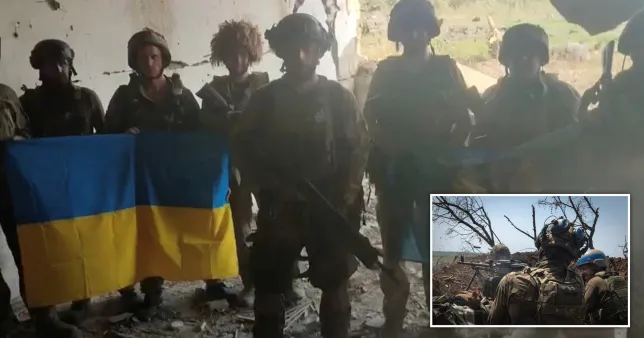
The president of Ukraine has praised his troops for retaking a village in the southeast of the nation, which has been dubbed a “significant” victory in the country’s ongoing counteroffensive.
Volodymyr Zelensky published a video of some soldiers holding the Ukrainian flag yesterday, claiming they had retaken Staromaiorske in the Donetsk area, which is close to the Zaporizhzhia province.
Our South! Zelensky exclaimed. Our men! Praise be to Ukraine!
On Wednesday, he added, “By the way, today our boys had very good results at the front,” to his weekly message. Well done to them!
It occurs while ferocious battle rages on in southeast Ukraine, where, according to a US research tank, Kyiv appears to have launched a “significant” attack that appeared to have “broken through” some Russian defences.
Recent engagements have been fought along a 1,000 km (600 km) front line, with Ukrainian military supported by equipment and training provided by the west.
Russian military bloggers have verified that Ukrainian forces had occupied a portion of the settlement, which was the target of recent Ukrainian attacks.
According to Zelenskyy, Ukraine has retaken the settlement of Staromaiorske in the southeast.
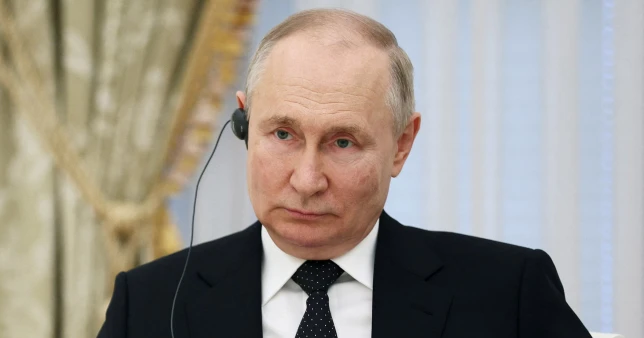
Although it was unable to objectively confirm Putin’s allegation, he emphasised on state television that the Ukrainian troops’ drive ‘wasn’t successful’ and claimed they incurred significant casualties. At an African leaders’ summit in St. Petersburg, the Russian president was there.
Since beginning their long-awaited counteroffensive in early June, Ukrainian troops have only made marginal gains, and Putin has often asserted that Ukraine has suffered significant losses without providing supporting data.
Generals in Kyiv have issued a warning that the hardened Russian defence line and the significant quantity of land mines that have been sown make quick results all but impossible.
A Western diplomat who was not authorised to openly discuss the topic claimed that Ukraine recently sent thousands of troops to the area.
Few operational information about the counteroffensive’s development have been made public by the authorities.
But on Wednesday, Hanna Maliar, the deputy defence minister, claimed that troops were moving closer to Melitopol, a city in the Zaporizhizhia region.
It would be a big victory for Ukraine to seize Melitopol in the Sea of Azov in order to breach the land border between Russia and the Crimean Peninsula, which Moscow unlawfully annexed in 2014.
That might divide the Russian army in half and cut off supplies to the westward-moving battalions. Currently, Russia is in charge of the entire Sea of Azov shore.
According to a study from the Washington-based Institute of Study of War, Ukrainian forces conducted ‘a large mechanised counteroffensive operation’ in western Zaporizhzhia on Wednesday and ‘look to have broken through certain pre-prepared Russian defensive lines.’
This week, Zelensky travelled to Dnipro, which is located north of Zaporizhzhia along the Dnieper River, where he met with military leaders to talk about air defences, ammunition supplies, and local recruitment.
He also went to a hospital that treated front-line soldiers with wounds. He expressed gratitude to the personnel and stressed the value of their job.
In the meantime, a missile attack in southern Ukraine’s Odesa region resulted in one civilian fatality and significant port infrastructure damage.
According to Governor Oleh Kiper of Odesa, it follows Moscow’s termination of a grain export arrangement.
It appears that the cruise missile was fired from the Red Sea.
President Vladimir Putin expressed his desire for the African Union (AU) to become a full member of the G20 club of nations while speaking at the beginning of a summit for African leaders in St. Petersburg.
“We hope that this decision will be made as early as September, during the G20 summit in New Delhi,” Mr Putin said.
“As before, Russia is ready to do everything possible to promote the strengthening of the sovereignty of African states, to help make Africa one of the key partners in the new system of a multipolar world order,” he added.
Regarding Russia’s decision to leave a UN-mediated agreement that would have allowed grain supplies from southern Ukrainian ports to finally reach Africa in safety, Mr. Putin declared that Russia can fill the gap.
In the upcoming months, six African nations would be able to get free food from Russia, he noted.
The summit has fewer African leaders participating than the last gathering, in part due to Russia’s invasion of Ukraine.
A Russian drone bombed a Ukrainian port on the Danube River in this unnerving occurrence, approximately 200 metres from NATO territory.
Early on Monday, footage was taken from a boat on the river of the attack on the grain storage facilities in the town of Reni, which lit up the Romanian sky.
In its attempts to limit Ukraine‘s crucial agricultural exports to the rest of the globe, Russia came the closest to assaulting a member of the alliance since the war’s beginning in February 2022.
It was stressed by Romania’s President Klaus Iohannis that this presented a “serious risk to the security of the Black Sea.”
He blasted the demonstration along the Danube River and warned that the most recent escalation “affects further Ukrainian grain transit and global food security.”
The Russian military has increased its airstrikes on civilian targets in the Odesa region ever since the Russian Federation unilaterally chose to discontinue taking part in the Black Sea Grain Initiative, said Prime Minister Marcel Ciolacu.
“We demand that the Russian Federation immediately cease aerial attacks against Ukrainian port infrastructure.”
The Russian Federation’s targeting of port infrastructure, which has a detrimental effect on global food security and puts many people in danger, is another evidence of its desire to obstruct Ukrainian grain exports to foreign markets.
It was the most recent in a string of assaults that have recently destroyed crucial infrastructure in southern Ukraine.
According to the Ukrainian military, four personnel suffered injuries and a grain hangar and a storehouse for other commodities were both destroyed.
The attacks were billed as payback for last week’s attack on the vital Kerch Bridge connecting Russia and Crimea by the Kremlin.
Oleh Kiper, the regional governor of Odesa, claimed that Russian drones of Iranian manufacture had been attacking for four hours and that Ukrainian air defences had shot down three of them.
Dmytro Kuleba, the Ukrainian foreign minister, posted on Twitter that “Russia hit another Ukrainian grain storage overnight.”
By keeping 400 million people hostage, it tries to get concessions.
“I urge all countries to mount a coordinated global response to food terrorism, especially those in Africa and Asia that are most impacted by rising food prices.”
Oleksii Reznikov, Ukraine’s defence minister, declares that Ukraine will keep attacking the Russian-occupied Crimea and the Kerch Bridge that connects it to the Russian mainland while simultaneously acknowledging that the plan for Ukraine’s lethargic counteroffensive is running late.
Ukraine has kept up its airstrikes within Crimea while Russia has pounded the southern port city of Odesa and the surrounding area over the past week. A week after seaborne drones hit the Kerch bridge, Ukrainian drones bombed an ammo stockpile on Tuesday.
According to Reznikov in an interview with CNN, “all these targets are official targets because it will lessen their ability to fight against us (and) will help to save the lives of Ukrainians.”
Asked if Ukraine’s goal is to permanently disable the bridge, Reznikov responded: “It’s normal tactics to ruin the logistic lines of your enemy to stop the options to get more ammunition, to get more fuel, to get more food, etcetera. That’s why we will use these tactics against them.”
Reznikov also accused Russia of operating as “a terrorist state.”
The fifth night of Russian strikes in Odesa badly damaged more than two dozen landmarks in the historic city center. Drones meanwhile pounded the region’s port infrastructure, targeting crucial grain stocks days.
The barrage comes after Moscow withdrew from a crucial grain deal that allowed for the safe export of Ukrainian wheat to international markets, exacerbating a global food crisis.
“This approach is absurd, but it’s real and that’s why it’s new evidence they are a terrorist state,” Reznikov told CNN’s Alex Marquardt on Saturday.
Senior Russian officials have said the spike in attacks is a response to a deadly explosion on the strategic Kerch bridge in Russian-occupied Crimea earlier this month.
“(Russia) tried to explain that it’s a response for some explosions in their territories, but they are fighting with the civilians,” Reznikov said. “That’s why I call them looters, rapists and murderers.”
Asked if Ukraine plans to ramp up attacks against Russian ships in the Black Sea in retaliation, he said, “We have capacity. We have weapons as we did with the cruiser Moskva and if they threaten us in the Black Sea, we’ll have to respond.”
The pride of Russia’s fleet, guided-missile cruiser Moskva, sank in the Black Sea in April, in an attack claimed by Ukrainian officials.
Ukrainian air defense forces have struggled to counter Russia’s renewed attacks on Odesa in recent weeks, as Kyiv attempts to break Moscow’s tight defenses in the southeastern regions.
But Ukraine’s grueling counteroffensive has not resulted in any significant breakthroughs, despite Western allies donating billions of dollars worth of aid to bolster Kyiv’s military might and putting hundreds of soldiers through training.
Reznikov however insisted the operation is “going to plan,” saying: “Our generals, our commanders, they see the real situation on the battlefield. And again, I have to repeat the main value for us is life of for our soldiers.”
But asked if the plan is behind schedule, he acknowledged that it is.
If Ukrainian forces can successfully puncture Moscow’s sizeable defense lines along Ukraine Sea of Azov coastline that links Crimea to Donbas, Reznikov said it would be “a good result” for Kyiv.
“We have to do it thinking about the lives of our soldiers instead of Russians. They’re using the soldiers as cannon fodder.
“It’s a war and I think that we will show to the world again that we will win this war,” he said, referring to Ukraine taking back territory in the Kherson and Kharkiv regions.
Reznikov said that F-16 training for Ukrainian pilots will begin in August, adding that if Kyiv had the fighter jets now they would “certainly” have helped make more progress in the counteroffensive.
Reznikov also said he would share a report with the United States about the use of controversial US-supplied cluster munitions in Ukraine this week, “probably Monday or Tuesday.”
Highly destructive cluster munitions are outlawed by the UK, France, Germany and other key US allies, but the US and Ukraine are not signatories to the ban, nor is Russia.
Russia’s invasion of Ukraine has shifted the security landscape in Europe, triggering Western allies to rethink their national security strategy and reigniting calls from Kyiv to join NATO.
The NATO summit in the Lithuanian capital of Vilnius in July kicked off with heightened pleas from Ukrainian President Volodymyr Zelensky to invite Ukraine into the bloc, despite resistance from allies amid Kyiv’s war with Russia.
In his interview with CNN, Reznikov acknowledged that Ukraine will likely only be able to join the alliance once the war is over, referencing Article 5, which requires members to come to the defense of any fellow member under attack.
“”After the victory, after then, it will be in the interest of NATO because we became a real eastern shield of NATO or eastern shield of Europe,” he said.
Ukraine has gained “real combat experience – how to deter Russians, to defeat them, to beat them with using NATO standard weaponry,” he added.
He predicted that Ukraine’s membership bid will be accepted in July 2024, when the NATO summit is scheduled to take place in Washington to mark the 75th anniversary of the alliance.
Asked if he thought the war would be over by next summer, he quickly answered, “Yes. We will win this war.”
President Putin has stated that Russia has the capability to replace Ukraine as a supplier of grain to Africa after withdrawing from a deal that allowed safe shipment of grain across the Black Sea.
In a statement from the Kremlin, Moscow announced its willingness to provide grain to Africa on both commercial and free-of-charge terms. Previously, in the year leading up to June 2022, Russia was a major exporter of wheat to Africa, shipping 10.8 million tonnes. During the same period, Ukraine exported 6.3 million tonnes of wheat to the continent.
President Putin expressed confidence in a record harvest this year in Russia. The country is set to host the second Russia-Africa summit later in the week.
The termination of the Ukraine grain deal was met with regret from the African Union, whose member states have been severely impacted by the surging food prices.
There are reports suggesting that Moscow is seeking to supply grain to Africa through a partnership involving Qatar and Turkey, although it remains uncertain whether they will accept this arrangement.
In the early hours of Monday morning, a strike caused a tower next to Russia’s Defence Ministry to catch fire.
Authorities in Moscow claim that Ukraine launched a “terrorist attack” after drones struck two non-residential facilities there.
Video showed a high-rise’s top blazing, with grey smoke rising into the sky.
Mayor of the capital Sergei Sobyanin confirmed no one was injured in the incident as the military jammed both drones, forcing them to crash.
One fell on Komsomolsky Prospekt near the city centre, close to the main defence ministry building, Russian media reported.
Another hit an office building in southern Moscow, gutting its upper floors, with residents nearby awoken by ‘everything shaking’.
But it is unclear if the drones hit the buildings when they were brought down, or whether they were targeting the buildings.
‘On the morning of July 24, an attempt by the Kyiv regime to launch a terrorist attack using two unmanned aerial vehicles against facilities on the territory of the city of Moscow was thwarted,’ the ministry said on Telegram.
‘Two Ukrainian UAVs (Unmanned Aerial Vehicles) were suppressed by electronic warfare means and crashed.’
Christo Grozev, Bulgarian investigator at Bellingcat, stressed that if Ukraine hit the building, the ‘symbolic damage to MoD/GRU will be very significant’.
He shared a video on Twitter showing the defence building had suffered at least some damage, with windows appearing to be shot out.
Ukrainian authorities did not immediately claim responsibility for the strike, which was the second drone attack on the Russian capital this month.
In order to launch a significant attack in the Kharkiv region of Ukraine, Russia is apparently building up a battle force of some 100,000 soldiers, according to reports from Kyiv.
The substantial Russian presence in the area, which the Ukrainian army’s spokesman Col. Serhi Cherevaty says is concentrated on retaking the city of Kupyansk, was confirmed.
Up until Kyiv’s counteroffensive in the autumn of last year, the city was an essential supply route and centre for Russia’s eastern invasion forces.
‘The enemy has concentrated a very powerful group,’ said Col Cherevaty told Ukrainian media. ‘More than 100,000 personnel, more than 900 tanks, more than 550 artillery systems and 370 rocket salvo systems.’
Keep up with the latest news on the Russia-Ukraine war on our live blog.
A Ukrainian military spokesman confirmed Russia had been amassing a huge fighting force to retake the city of Kupyansk (Picture: Getty)
He added: ‘They are concentrating everything in order to break through our defence. Our soldiers are firmly on the defensive. They do not allow the enemy to seize the initiative.’
Moscow’s troops have reportedly been in the area, but the recent uptick in attacks is seen to be a recent development.
‘This issue is not recent; it has been ongoing for many months, and our defense forces have consistently thwarted their progress with strong counterattacks,’ Chervaty said.
‘The presence of 100,000 personnel is not a recent development. The approximate number has been known [to Ukrainian military intelligence] for a considerable time.’
Cherevaty claimed the Russian attacks, though significant in scale, have been ineffective due to the low quality of Russian unit training and lack of real motivation.
‘Yes, it is big. We have to take into account its size. However, this number does not indicate a direct threat or a cause for concern,’ he added.
His comments come following reports that Vladimir Putin has increased the maximum age elegible for military service to 70 as he seeks to regain the intiative in the conflict with a big win.
Cherevaty’s claims were backed up by Ukrainian Army Land Forces Commander General Oleksandr Syrsky, who confirmed via Telegram that Russia had concentrated its forces to attack in the Kupyansk direction but has been unable to make a breakthrough thus far.
Syrsky, who commands Ukraine’s forces in the east, said Russia had recently reinforced its positions around Bakhmut with additional forces, but were steadily losing ground to the Ukrainians.
Meanwhile, Hanna Malyar, Ukraine’s deputy defence minister, suggested that the Kupyansk attack may be a diversionary tactic used to lift pressure on sectors of the battlefield in the south where Ukraine has been taking ground.
‘As soon as we seize the operational initiative and start moving forward, the enemy immediately activates in other directions to distract and drag in our forces,’ she said.
Kremlin sources also appeared to confirm movement in the direction of Kupyansk, although there is no consensus on the size and shape of the attacking force.
According to a report on Tuesday, the Russian military had claimed that its troops had advanced on a ‘limited section of the front’ near Kupyansk, after ‘successful offensive operations.’ The announcement did not say when the attack or attacks took place.
‘On the Kupyansk front, units from the Western group of troops continue successful offensive operations,’ a Kremlin statement said. ‘The total advance was up to two kilometres along the front and up to one and a half kilometres in depth’.
The Lyman-Kupyansk sector has experienced a period of relative calm in recent months, marked by sporadic air strikes, intermittent artillery fire, and occasional ground exchanges. The current front line in the sector was set in October 2022 after a successful Ukrainian counteroffensive and has seen minimal movement since then.
But over the past 24 hours, Ukrainian forces in the Kupyansk-Lyman sector registered a distinct upturn in Russian barrages, counting 536 strikes throughout the day with all calibers of artillery.
The news comes as Kyiv has softened its rhetoric regarding the effectiveness of their counter-offensive against Russia, with commanders now alluding to ‘slow but steady’ progress against the invaders instead of a lightning push towards the Sea of Azov.
On Tuesday, Sysrky told BBC’s Today programme that ‘our advance is really not going as fast as we would like.’
However, the US’s top general said on Tuesday that Ukraine’s counter-offensive was ‘far from a failure’, but that the fight ahead would be long and bloody.
‘I think there’s a lot of fighting left to go and I’ll stay with what we said before: This is going to be long. It’s going be hard. It’s going to be bloody,’ Mark Milley, the chairman of the joint chiefs of staff, said.
Britain’s Ministry of Defence also announced on Tuesday that it plans to spend an extra £2.5 billion on army munitions and create a new ‘global response force’, vowing to learn lessons from the war in Ukraine.
The MoD said the additional investment in stockpiles would cover the coming decade, and be paired with other spending and reforms intended to bolster ‘warfighting resilience’ and deterrence.
Vladimir Putin had vowed retaliation to the alleged attack on the Kerch bridge, which connects Russia to Crimea, earlier this week
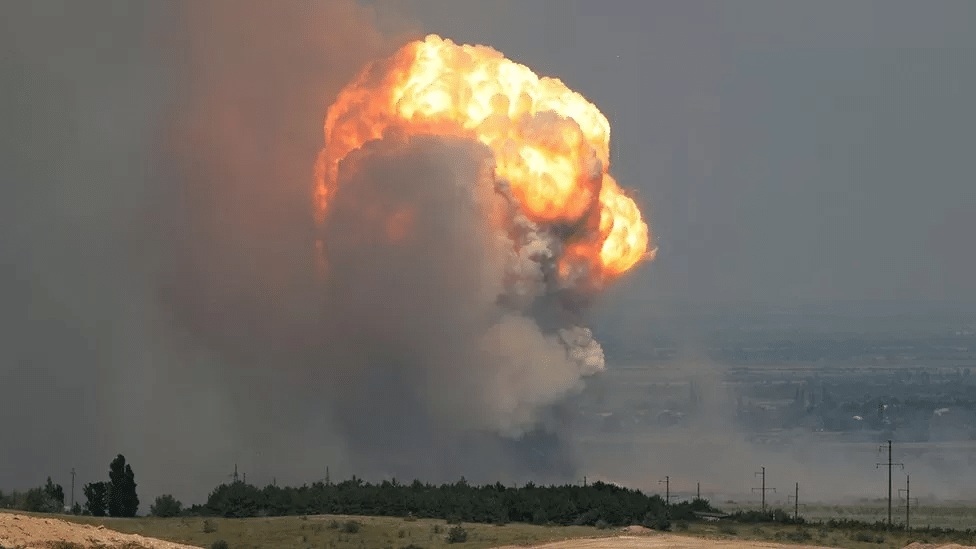
On Wednesday, a Russian weapons storage facility in occupied Crimea was rocked by a series of explosions that drove thousands of locals from their homes and forced local authorities to divert traffic from a nearby roadway.
The site near Stary Krym in Crimea’s Kirorvsky region was shown on video to be engulfed in smoke and flames, and blasts continued there for at least six hours after the original explosion. According to Russian official media, the head of the Crimean parliament indicated that it might take two days to completely put out the fire.
The cause of the blasts has not yet been confirmed. The Russian-backed leader of Crimea, Sergey Aksyonov, said on Telegram that “a fire occurred at a military training ground.” Askenov said residents of four surrounding villages – more than 2,000 people – were being evacuated.
The explosions are the latest in a series of recent incidents to roil Crimea, the Ukrainian peninsula illegally seized by Russia in 2014. On Monday, Ukraine claimed responsibility for an attack that damaged part of the bridge linking Crimea to Russia, a vital supply line for Moscow’s invasion and a personal project for President Vladimir Putin.
Kyiv has not commented on Wednesday’s explosions at the Crimea training ground. The pro-Russian Grey Zone Telegram channel claimed that a Ukrainian Storm Shadow missile struck the depot, which could not immediately be confirmed, while a rebel Ukrainian group in Crimea called Atesh celebrated the fire but said it was not responsible.
Putin’s spokesman said he had been briefed on the blasts at the ammunition dump.
Russia has retaliated against the Ukrainian strike on the bridge by launching a brutal two-day aerial assault on the strategic port city of Odesa in southern Ukraine, damaging key infrastricture and injuring civilians.
The Kremlin’s barrage overnight included Kalibr, Kh-22 and Oniks cruise missiles, and Iran-made Shahed-136/131 UAVs, the Ukrainian Air Force said, adding that it destroyed 14 cruise missiles and 23 drones.
CNN journalists in Odesa heard an intense bombardment early Wednesday local time.
The Russian Defense Ministry claimed it targeted military and fuel facilities in Odesa with “high-precision sea and air-based weapons.”
Earlier, Ukrainian President Volodymyr Zelensky said Moscow deliberately leveled strikes at key “grain deal infrastructure,” after the Kremlin on Monday pulled out of an agreement that allowed grain to be exported by sea from Ukrainian ports otherwise blockaded by Russia.
He said it was the “largest” attempt by Russia to “inflict pain on Odesa” since the invasion began in February 2022, adding that about “a million tons of food” is stored in the ports that were struck on Wednesday.
“Everyone is affected by this Russian terror,” the Ukrainian leader added.
The Ukrainian Agriculture Ministry said the damage, which hit grain export infrastructure in Odesa and the nearby port of Chornomorsk, would take at least a year to fully restore.
“This is a terrorist act not only against Ukraine, but against the whole world. Its food security is once again under threat. Humanity is being held hostage by a terrorist country that is blackmailing the world with hunger,” the Ukrainian Agricultural Minister Mykola Solskyi said in a Wednesday statement.
Odesa Mayor Hennadii Trukhanov called the bombardment “one of the most horrible nights” of the war.
“We do not recall such a scale of attack since the beginning of a full-scale invasion,” he said on Facebook.
There were no casualties reported. But the city was shaken by explosions and several people were wounded by a downed Russian missile, including a nine-year-old boy, officials said.
Further east, two civilians were killed and seven others injured by Ukrainian shelling in parts of separatist-controlled areas of the eastern Donetsk region, according to a Russian-backed official.
Several homes, two schools and a hospital were damaged, the head of the separatist self-proclaimed Donetsk People’s Republic (DPR), Denis Pushilin, said on Telegram.
Ukraine’s attack on the Crimea bridge dealt a logistical and symbolic blow to Moscow’s faltering military campaign. The bridge is a critical artery for supplying the peninsula with both its daily needs and supplies for the military, in addition to fuel and goods for civilians.
The $3.7 billion-dollar corridor, which is 12 miles long, is a critical artery for supplying the peninsula with both its daily needs and supplies for the Russian military, in addition to fuel and goods for civilians.
The strike was a joint operation of Ukraine’s Security Service (SBU) and Ukraine’s naval forces, an SBU official told CNN. The attack killed a couple and left their daughter injured.
Officials report that 60,000 tonnes of grain have been destroyed, and storage infrastructure has been damaged following Russian missile attacks on Ukraine’s Black Sea coast.
Ukraine’s Agriculture Minister, Mykola Solskyi, stated that a significant portion of export infrastructure is now out of operation.
Russia’s withdrawal from an international grain deal, which ensured safe passage for exports across the Black Sea, has contributed to the escalation of the situation.
The Kremlin claimed that its export demands were not being met, leading to its decision to withdraw from the agreement.
Shortly after the withdrawal, Russia launched missile strikes on the southern port cities of Odesa and Mykolaiv, causing significant damage.
Subsequent attacks targeted grain terminals and port infrastructure in Odesa and Chornomorsk, extending further along the Black Sea coast.
The impact of these attacks poses a serious threat to Ukraine’s grain exports and agricultural sector.
Odesa military spokesman Serhiy Bratchuk called it a “truly massive attack”. The agriculture minister said the 60,000 tonnes destroyed in the strike were “supposed to be loaded on a large-tonnage ship and sent through the grain corridor 60 days ago”.
Ukrainian President Volodymyr Zelensky said each missile strike was a blow not just to Ukraine, but to “everyone in the world striving for a normal and safe life”.
France and Germany also condemned the attack. Germany Foreign Minister Annalena Baerbock said that by covering Odesa with a hail of bombs, Russian President Vladimir Putin was robbing the world of any hope of Ukrainian grain and “hitting the world’s poorest”.
The infrastructure ministry published a series of photos showing damage to silos and other grain facilities. Officials said there had been damage to wharves and reservoirs, but it was international Ukrainian traders and carriers that had suffered the most.
Russian war commentators said the damage proved that Kyiv was unable to shoot down the majority of Russian missiles and drones.
Officials said the co-ordinated attack involved Kalibr cruise missiles, Onyx supersonic and Kh-22 anti-ship missiles as well as kamikaze drones, fired from the Black Sea, Crimea and southern Russia. Although 37 Russian missiles and drones were shot down, a number did penetrate Ukrainian defences, they said.
“I saw a red flash in the window and reacted immediately,” one resident told the Reuters news agency.
“I went downstairs, it was noisy and filled with smoke outside, people were in panic, some were crying, glass shards were scattered all over. It was impossible to remain in the area.”
Russia referred to its initial attack on Odesa as a “retaliatory strike” in response to an alleged attack on the Russian-built bridge over the Kerch Strait, which connects occupied Crimea to Russia. The bridge was targeted by seaborne drones, resulting in the destruction of a section and the death of a Russian couple.
On Wednesday, further disruptions occurred in Crimea as a fire triggered explosions at an ammunition depot near a military training range. As a precautionary measure, approximately 2,200 residents from four nearby villages were evacuated.
Russian-appointed officials also closed a 12-km section of the Tavrida motorway, which connects Simferopol and Sevastopol in southern Crimea to the Kerch Strait bridge. The construction of this road began in 2017 under Russia’s occupation authorities.
Multiple explosions were heard in the area starting at around 04:30 on Wednesday. The cause of the fire near the city of Staryi Krim is under investigation, although unconfirmed reports on social media suggested Ukrainian involvement in the incident.
The Kremlin confirmed that President Putin had been briefed on the situation. Sergei Aksyonov, the Russian-appointed leader in Crimea, stated that the cause of the fire at the military range was being investigated and that no injuries were reported.
The president of Ukraine has issued a warning that the withdrawal of Russia from the grain deal in the Black Sea will lead to future international crises.
“Last year, we were able to stop a price catastrophe in the global food market thanks to our Black Sea Grain Initiative,” President Volodymyr Zelensky stated in his evening address on Tuesday that political and migration crises would have unavoidably followed a price explosion, especially in African and Asian nations.
Numerous nations will be affected, he claimed, and Ukraine is “working without partners to prevent this.” On Monday, Russia backed out of the agreement.
Ukraine is developing options for action and agreements “to preserve Ukraine’s global role as a guarantor of food security, our maritime access to the global market, and jobs for Ukrainians in ports and the agricultural industry,” he said, adding Kyiv is “fighting for global security and for our Ukrainian farmers.”
Former President Donald Trump has disclosed his precise strategy, months after boasting he could put an end to Russia’s assault on Ukraine in a single day after retaking the White House.
In an appearance with Fox News’ Sunday Morning Futures, Trump described how he thinks he could resolve the dispute. In his opening remarks, Trump said that international leaders are smart and that his replacement, President Joe Biden, is ill-equipped to cope with them.
These are intelligent people, including French President Emmanuel Macron. I could mention everyone on the list, including (Vladimir) Putin… These individuals are nasty, tough, and generally savage. Trump then attacked Biden, saying, “They’re vicious, and they’re at the top of their game.”
‘We have a man that has no clue what’s happening. It’s the most dangerous time in the history of our country.’
Ex-President Donald Trump said that President Joe Biden ‘has no clue what’s happening’ (Picture: Fox News)
Host Maria Bartiromo pressed Trump on his prior claim.
‘So what should be the response?’ she said. ‘You said you could end the war in Ukraine in 24 hours. How would you do that?’
Trump replied that he knows Ukrainian President Volodymyr Zelensky ‘very well’. He added that Zelensky was ‘very honorable’ because ‘he didn’t even know what they were talking about’ when ‘they asked him about the perfect phone call’.
He was referring to a July 2019 call between himself and Zelensky, in which Trump offered a ‘quid pro quo’ agreement to pressure Zelensky into pushing conspiracy theories about his 2020 opponent Biden in exchange for aid from the US.
Bartiromo cut Trump off and said, ‘Well, that’s not going to be enough for Putin to stop bombing Ukraine.’
Trump proceeded to elaborate on his plan.
‘No, no, no. No, I’m not saying that. I… what I’m saying is that I know Zelensky very well, and I know Putin very well, even better. And I had a good relationship, very good, with both of them,’ Trump said.
‘I would tell Zelensky: No more. You got to make a deal. I would tell Putin: If you don’t make a deal, we’re going to give them a lot. We’re going to give them more than they ever got, if we have to.’
He reiterated his claim: ‘I will have the deal done in one day, one day.’
Trump in May told GB News, ‘If I were president, and I say this, I will end that war in one day, it would take 24 hours.
Some Republicans interpreted Trump’s remarks as him favoring possibly sending even more aid to Ukraine than Biden has. His comments ‘commenced an all-out freakout among the GOP’s Ukraine funding skeptics’, noted Washington Post writer Aaron Blake.
In his analysis, Blake wrote that Trump is actually ‘talking about playing hardball. The idea is that he’s going to bluff to both sides – or at least one side (you pick which) – until they reach a deal’.
‘Credit to Bartiromo for actually getting Trump to offer something more about a promise that had been, up to this point, a platitude without a plan,’ wrote Blake. ‘What she revealed was nothing amounting to a thoroughly considered course of action – just a bluff that she, deliberately or not, called.
Without Russia’s consent, a critical agreement authorising the sale of grain from Ukraine is likely to expire on Monday.
According to Reuters, the last ship to travel as part of the Black Sea Agreement departed the port of Odesa early on Sunday.
On Saturday, Russian President Vladimir Putin informed South African President Cyril Ramaphosa over the phone that the deal had not achieved its goals.
According to a Kremlin readout of the conversation, “[Putin] stressed that the obligations set out in the pertinent Russia-UN memorandum to remove barriers to the export of Russian food and fertilisers still remain unfulfilled.”
“Moreover, the main goal of the deal, namely the supply of grain to countries in need, including those on the African continent, has not been realized,” it said.
Putin has previously complained about restrictions over its own exports but has agreed to previous extensions.
The deal, which was first brokered by Turkey and the United Nations following the outbreak of Russia’s war on Ukraine in July 2022, creates procedures to ensure the safe export of grain from Ukrainian ports.
Under the deal, grain ships are able to navigate through a safe corridor in the Black Sea under the direction of Ukrainian pilots, and then pass through the Bosphorus Strait – an important shipping corridor in north-west Turkey – in order to reach global markets.
It has proven vital for stabilizing global food prices and bringing relief to the developing countries who rely on Ukrainian exports.
The deal’s survival continues to rest in Russia’s hands, and Moscow has repeatedly threatened to quit the pact.
Prior to its third renewal in May, the Kremlin had remained elusive as to whether it would remain in the deal, before agreeing to a last-minute extension.
Russia also suspended its participation for a few days in late October and early November 2022, citing drone attacks on the city of Sevastopol in occupied Crimea.
Moscow later announced that it would reverse course and rejoin the agreement for a further 120 days, following mediation.
Considering employing cluster munitions against Ukraine “if they are used against us,” Russian President Vladimir Putin stated, his country has a stockpile of them.
Putin made his remarks just days after American-manufactured cluster munitions were sent to Ukraine, though a senior Ukrainian military official told CNN that they had not yet been deployed.
The Russian leader claimed in an interview with a pro-Kremlin journalist that “Russia has a sufficient supply of various types of cluster munitions.”
“If they are used against us, we reserve the right to mirror actions.”
Washington’s decision to send cluster bombs to Kyiv was controversial and criticized by human rights groups.
The weapons are particularly dangerous to civilians and noncombattants when fired near populated areas because they scatter explosive material, so-called “bomblets,” across large areas. Those that fail to explode on impact can detonate years later, posing a long-term risk to anyone who encounters them, similar to landmines.
What are cluster munitions?
Cluster munitions contain multiple explosives that are released over an area up to the size of several football fields. They can be dropped from a plane or launched from the ground or sea.
The submunitions are released in flight and fall to the ground. They can range from the tens to many hundreds
They are designed to explode on impact but as many as a third don’t, and remain a deadly risk to civilians for years to come
94% of recorded cluster bomb casualties are civilians, of which almost 40% are children
Note: Cluster munitions can vary widely in design and scale, this graphic only aims to explain their general function.
The danger posed by cluster weapons has prompted more than 100 countries – including the United Kingdom, France and Germany – to sign a treaty prohibiting their use.
US President Joe Biden told CNN that the decision whether to send cluster munitions to Ukraine was “very difficult,” but he opted to do so because Kyiv needs more ammunition to continue its fight to push Russian troops out of Ukrainian territory.
A top official at the US Defense Department said Kyiv gave “assurances in writing” that it would not use the cluster munitions in urban areas.
In his interview, Putin said that the Biden administration had called the use of cluster munitions a war crime and that he agreed with that assessment.
It’s not clear exactly which comments Putin was referring to, but former White House press secretary Jen Psaki said last year at the outset of the conflict that reports of Russia’s use of cluster bombs, if confirmed, would constitute a war crime.
Putin also claimed that Russia has not yet used cluster munitions, despite evidence to the contrary.
In March, the United Nations said it had compiled credible reports that Russian forces had used cluster munitions in populated areas at least 24 times. A CNN investigation last year found that the Kremlin fired 11 cluster rockets at Kharkiv, Ukraine’s second-largest city, during the war’s opening days.
The top commander of Ukraine has hinted that Ukrainian-made weapons may soon be used in strikes against Russian territory.
General Valery Zaluzhny, commander in chief of Ukraine, recently spoke with the Washington Post. In the interview, he defended his army’s ability to launch attacks against Russian territory using homegrown weapons and lamented the red lines that the AFU’s western partners had placed on it.
Why do I need permission to act on enemy land in order to save my people? He informed the WP.
‘For some reason, I have to think that I’m not allowed to do anything there. Why? Because Putin will … use nuclear weapons? The kids who are dying don’t care.’
One of the key conditions imposed on Ukraine by its western allies when providing them with arms was that Kyiv doesn’t use their weaponry to strike targets inside Russia due to fears of further escalation.
To date, despite a number of strikes taking place on Russian territory, Kyiv has rarely claimed responsibility for the attacks.
But according to Zaluzhny, this could soon change.
‘If our partners are afraid to use their weapons, we will kill with our own. But only as much as is necessary.’
He added: ‘This is our problem, and it is up to us to decide how to kill this enemy. It is possible and necessary to kill on its territory in a war.’
Despite being told by allies that they have enough heavy weapons to conduct their counteroffensive, Zaluzhny said Ukraine still lacks the necessary resources to liberate all the occupied territories and minimise casualties.
The general criticised those who say Ukraine doesn’t need F-16 fighter jets, and said that Kyiv’s Western allies would never fight like this.
Zaluzhny also reiterated Ukraine’s goal to liberate Russian-occupied Crimea despite concerns over Putin’s potential response voiced by some Western officials.
‘As soon as I have the means, I’ll do something. I don’t give a damn — nobody will stop me,’ he said.
Elsewhere in the interview, the army commander claimed to ‘eagerly’ read everything written by Russia’s top general Valerey Gerasmiov, which he described as ‘very, very interesting’, before lamenting the fact that ‘he hasn’t published anything lately’.
‘He is an enemy — an enemy who is very smart,’ Zaluzhny said.
‘Smart and therefore devious. He is still strong. So you have to respect him as such and look for ways to kill him. Because that is the only way to win.’
Gurulyov is a former military commander and frequent commentator on state TV.
‘It was necessary either to keep quiet and be a coward or to say it the way it is,’ Popov said.
‘I had no right to lie in the name of you, in the name of my fallen comrades in arms, so I outlined all the problems which exist.’
He also highlighted issues like lack of proper counter battery systems to help repel Ukrainian artillery attacks and lack of military intelligence.
Popov headed up an army in the southern Zaporizhzhia region of Ukraine (Picture: AP)
Popov said his dismissal was demanded by senior commanders – who he accused of treason – and approved by the Russian defence minister, Sergei Shoigu.
Russian bloggers reported that the order to dismiss Popov came from the head of Russia’s armed forces, General Valery Gerasimov.
They said General Gerasimov accused Popov of ‘alarmism and blackmailing senior management’ after he highlighted the need to rotate soldiers who had been in the front line for a sustained period of time and had suffered significant losses.
‘The senior chiefs apparently sensed some kind of danger from me and quickly concocted an order from the defence minister in just one day and got rid of me,’ Popov said.
‘The Ukrainian army could not break through our ranks at the front but our senior chief hit us from the rear, viciously beheading the army at the most difficult and intense moment.’
The Russian defence ministry has not yet commented on the dismissal.
In a sign that many in Russia share Popov’s criticism, Andrei Turchak, the first deputy speaker of the upper house of parliament who heads the main Kremlin party United Russia, strongly backed the general.
The news comes a day after General Oleg Tsokov, was killed by a Ukrainian missile strike.
Sergei Markov, a pro-Kremlin political analyst, noted Popov’s statement echoed criticism of the top brass by Prigozhin.
However, he added Popov’s statement was not a rebellion, but instead a call for Vladimir Putin’s help.
‘Such public disputes at the top of the Russian army isn’t a show of force,’ he said.
Speaking in Helsinki on Thursday after a Nato summit, Joe Biden said he is not certain about what fate awaits Prigozhin.
‘I’m not even sure where he is,’ Mr Biden said. ‘If I were he, I’d be careful what I ate, I’d be keeping an eye on my menu. But all kidding aside … I don’t know. I don’t think any of us know for certain what the future of Prigozhin is in Russia.’
You presumably already know that US Vice President Joe Biden has been in Europe for the past several days, unless you’ve been living on a different planet.
Although a vital NATO summit in Lithuania was the major objective of the trip, the president began the week with a quick stop in London to strengthen the US-UK “special relationship.”
It was a high-stakes diplomatic visit that took place days after the contentious decision to deliver cluster munitions to Ukraine by the American commander in chief, a move that the UK vehemently opposes as a signatory to a prohibition on the weapon.
First, he met with UK Prime Minister Rishi Sunak before climbing aboard Marine One for a short flight to Windsor to meet King Charles III. It was their first in-person chat since Charles was crowned in May. But there appeared to be no hurt feelings over Biden’s non-attendance at the coronation, with the King warmly welcoming his guest with a guard of honor.
This wasn’t a full-on formal state visit, which usually lasts several days and is full of pageantry, diplomatic sit-downs and a glittering Buckingham Palace banquet. Instead, the catch-up was billed as a ceremonial state welcome.
The display of military personnel – formed of the Prince of Wales’ Company of the Welsh Guards on this occasion – was “designed to show the ultimate respect to the United States, our greatest ally, and used troops with some of the closest links to the King who are also preparing to deploy to the US to train alongside US forces in a matter of weeks,” according to the British Army.
National anthems were performed, followed by the two heads of state inspecting the troops. At several points, Biden placed his hand on the King’s back, in a tactile display of their close rapport. The gesture was later described to us by a royal source as being a “wonderful symbol of warmth and affection.”
As is often the case when a president comes to town, some observers scrutinized Biden’s moves for a potential breach of regal etiquette. But the royal source told CNN that the King is “entirely comfortable with that kind of contact” and that “contrary to some reports that is in fact the correct protocol.”
Afterward, the two had tea together before they viewed a Royal Collection exhibition of items relating to the US. On the face of it, the encounter seemed entirely similar to those conducted by the late Queen Elizabeth II. However, there was some deviation you may have missed.
Ahead of the meeting, it was revealed what the monarch and president would be discussing on Monday: climate change – a subject important to both men. It was a move that Charles’ late mother never allowed. The Queen, always regimented and steadfast in her duties, never revealed what she discussed with the 12 presidents she met during her reign. The few insights we’ve had have come from former presidents and tended to reveal how she made them feel welcomed or their impressions of her given her lengthy reign, rather than the specifics of their meetings.
Another departure from the Queen’s approach to presidential meetings was that a concurrent event took place at Windsor Castle, which the pair later joined in the castle’s Green Drawing Room. High-profile private sector stakeholders had been brought together for a Climate Finance Mobilisation Forum aimed at bolstering “commitments to climate action within emerging markets and developing economies.”
UK Energy Security Secretary Grant Shapps heralded the King’s “many decades” of sounding the alarm around climate change and told Biden he was “enormously pleased” by the climate provisions in the US Inflation Reduction Act passed last August. He noted there would be “a couple of billion dollars’ worth of pledges” coming out of the meeting, adding that the group planned to turn their discussion into “real, tangible outcomes.”
Neither the King nor Biden spoke on camera while media were allowed in the room. Among the group of top financiers and philanthropists was Biden’s special presidential envoy for climate, John Kerry. He spoke to us for a few minutes afterward and called Monday’s engagement “time well spent” and praised the King’s “convening power” on a critical issue.
The attendees “agreed that we need to accelerate the deployment of capital, money, investment in the new energy economy.” The president, Kerry said, was particularly interested in a part of the discussion focused on “what could be done in the insurance industry to be able to provide insurance for certain types of investments.”
Some critics had questioned whether the King had overstepped by wading into policy. Kerry wouldn’t be drawn on the subject but said there had been a “great discussion” and characterized it as more of a “briefing” for the King, who, he said, “didn’t take part in the meeting” itself.
The British sovereign, Kerry said, “does have extraordinary convening power.”
“He obviously has great respect for people that are pushing an issue he’s cared about for all of his life,” said Kerry.
Let me start off by putting my support for Ukraine in their struggle against the Russian invasion on the line. I also believe that western allies should be helping Ukraine in this struggle.
In the past, I have offered arguments for why Vladimir Putin may have been justified in renewing his steadfast demands that NATO not admit Ukraine or other Eastern Europeans to their club, and I still stand by those claims.
Ben Wallace, the UK’s defence secretary, made an important—and immediately divisive—point this week, though, as the war between the two nations shows little promise of coming to an end anytime soon.
During the ongoing NATO summit, where Ukrainian President Volodymyr Zelensky is once again pushing for more support in terms of more powerful military equipment, and that his homeland hadn’t been issued a timeframe for joining the bloc, Wallace spoke with typical frankness about the situation.
Wallace said: ‘Whether we like it or not, people want to see a bit of gratitude.
‘Sometimes you are asking countries to give up their own stocks [of weapons]. Sometimes you have to persuade lawmakers on the [Capitol] Hill in America.’
He added: ‘You know, we’re not Amazon. I told them that last year, when I drove 11 hours to be given a list.’
There was immediate outcry at Wallace’s bluntness.
He was accused of being ‘wrong’ and ‘out of order’ and was even gently slapped down by the Prime Minister Rishi Sunak, who said that everyone agreed Zelensky had expressed his gratitude.
But here’s the thing – I genuinely think Wallace is right.
Many of the British public are struggling with the cost of living crisis, and making ends meet is becoming increasingly difficult.
So when they hear that the Ukrainian leader is moaning about a perceived lack of action despite the billions the UK has already pledged, they can be forgiven for feeling a little aghast.
That’s all Wallace was saying, not that the aid should stop, not that the Ukrainian cause was not just, simply that Zelensky needed to recognise that ‘war fatigue’ in countries battling economic crises is a real threat, and that gratitude always helps.
And I think he’s entirely correct.
In total Ukraine has received around $150billion from countries around the globe in the year since Putin’s invasion.
Meanwhile, Afghanistan, a country that the West played a pretty significant part in destabilising, is in dire need of around $4.6billion in humanitarian aid this year, according to the UN.
There’s no rush by NATO to plug that significant gap, and I don’t think it’s anti-Ukraine of me to point out that there may be a hint of hypocrisy at play.
And nor do Wallace’s comments don’t mean *he* is anti-Ukraine, just that we need to be realistic about the levels of aid that the UK is giving to them and just how long that is sustainable.
There are estimated to be as many as 32 countries around the world engaged in armed conflict, but Russia’s invasion of Ukraine is too often considered by politicians and parts of the media as the only one worth paying attention to.
I won’t speculate as to why, but I think it is important that Zelensky doesn’t forget that this is not the only country facing a fight, and that’s what the Defence Secretary’s comments might help achieve.
Wallace may be an outlier in the UK – and I suspect he feels liberated by the fact that he has consistently ruled himself out of standing for the Tory leadership – but he isn’t the only player on the world stage who feels resources and the attitude of western citizens need to be taken into account.
The American national security adviser, Jake Sullivan, told a public forum at the same NATO summit: ‘The American people do deserve a degree of gratitude from the United States government for their willingness to step up and from the rest of the world as well.’
President Biden has always said the USA will continue supporting Ukraine for as long as it takes, but a recent poll showed a 5% fall in support for the US backing Zelensky’s country in reclaiming territory, something that could have informed Sullivan’s comments.
I wouldn’t suggest the West stops all funding and aid to Ukraine, but fatigue is a real danger, and Zelensky needs to be aware, and yes grateful, about how much this is truly costing his allies.
Senior Russian General has been dismissed from post in Ukraine for revealing the truth about frontline situation.
Maj Gen Ivan Popov was the commander of the 58th Army, which has been fighting in the southern Zaporizhzhia region.
In a voice message, Maj Gen Popov said he raised questions about high casualty rate and lack of artillery support.
“It was necessary either to keep quiet and be a coward or to say it the way it is,” he said.
“I had no right to lie in the name of you, in the name of my fallen comrades in arms, so I outlined all the problems which exist.”
The voice message was posted to telegram by Russian MP Andrei Gurulyov, who is a former military commander and frequent commentator on state TV. It is unclear when the message was recorded.
Among the issues Maj Gen Popov said he highlighted to his superiors were the lack of proper counter battery systems to help repel Ukrainian artillery attacks, as well as a lack of military intelligence.
The commander said his dismissal was demanded by senior commanders – who he accused of treason – and approved by the Russian defence minister, Sergei Shoigu.
Russian military bloggers – often the most insightful form of information in the absence of official comment from Moscow – reported that the order to dismiss Maj Gen Popov had come from the head of Russia’s armed forces, Gen Valery Gerasimov.
They said Gen Gerasimov accused Maj Gen Popov of “alarmism and blackmailing senior management” after he highlighted the need to rotate soldiers who had been in the front line for a sustained period of time and had suffered significant losses.
“The senior chiefs apparently sensed some kind of danger from me and quickly concocted an order from the defence minister in just one day and got rid of me,” Maj Gen Popov said.
“The Ukrainian army could not break through our ranks at the front but our senior chief hit us from the rear, viciously beheading the army at the most difficult and intense moment.”
The Russian defence ministry has yet to comment on the dismissal.
However, a senior official of the pro-government United Russia party, of which Mr Gurulyov is a member, criticised the MP for making a “political show” out of Maj Gen Popov’s remarks.
“General Popov’s statement was not public and was posted on closed chats of the commanders and troops of the 58th Army,” Andrei Turchak wrote on telegram.
“Let the fact that… Gurulyov somehow got hold of this and made a political show out of it remain on his conscience,” he said, adding that Maj Gen Popov’s conscience was clear and the country could be proud of commanders like him.
Zaporizhzhia and the eastern Donetsk region have become the focus of Ukraine’s counteroffensive, which was launched over a month ago, but has struggled to penetrate well established Russian defensive lines.
On Wednesday, another Russian MP said former Russian commander Gen Sergei Surovikin, who has not been seen in public since the Wagner mutiny, was “resting”.
Gen Surovikin was said to enjoy close relations with the former Wagner boss Yevgeny Prigozhin and there had been media reports that he had been arrested following the brief revolt.
There has been no official confirmation or comment about his whereabouts.
Meanwhile, another senior Russian general – Lt Gen Oleg Tsokov – is said to have been killed in a strike in Ukraine’s occupied south coast this week, although his death has not been officially confirmed by Russia’s defence ministry.
From 4.7% in 2022 to above 5.3% in 2023, Senegal’s growth is projected to pick up, in part due of a growing oil and gas industry. But the country faces many challenges, including an economic fallout from the Ukraine crisis, stricter financial regulations, and growing political upheaval in the region. Two major problems are growing fiscal imbalance and rising government debt.
The strong post-pandemic recovery of Senegal has been impeded, according to Edward Gemayel, IMF Mission Chief for Senegal. As a result, GDP predictions have been reduced, and inflation has increased, worsening the fiscal and current account deficits. Additionally, the national debt now accounts for nearly 76% of GDP.
However, the nation has bright prospects, which are supported by the production of oil and gas, which will stimulate the economy for the foreseeable future. With the assumption that the IMF-supported programs’ cautious macroeconomic policies and resolute structural reforms are carried out, growth is forecast to pick up to 10.6% in 2024 and 7.4% in 2025, with non-hydrocarbon growth anticipated to reach about 6%.
“Inflation hit a multi-decade high of 9.7 percent in 2022, driven largely by the surge in food prices, which account for almost half of the CPI basket in Senegal. Inflation has since eased to around 9 percent and is projected to fall to around 5 percent by year-end but could potentially increase again if commodity prices remain high,” he disclosed during an interview.
The Senegalese government responded by raising public sector pay by almost 20% and increasing gasoline and energy subsidies, which have risen to about 4% of GDP.
However, in order to address the budget deficit, public investments were decreased. Future important actions, such as cutting tax exemptions and gradually eliminating energy subsidies while better focusing on social spending to mitigate the consequences of falling real wages, will be required to maintain debt sustainability and help contain inflation.
According to Senegal’s Nationally Determined Contribution (NDC), which outlines the country’s projected climate actions between 2023 and 2030, the nation will need funds equivalent to almost 7% of its GDP year until 2030 to achieve its mitigation and adaptation goals.
One of Vladimir Putin‘s closest supporters has warned the ‘totally crazy West’ that its ongoing support for Ukraine puts Russia and the West at risk of going to war.
Former Russian President and current vice-chairman of the influential Security Council, Dmitry Medvedev, declared that “World War Three is drawing near.”
A new “long-term” security plan for Kyiv is about to be unveiled by the G7 in an effort to “end the war and deter and respond to any future attack.”
Earlier, NATO Secretary General Jens Stoltenberg said the biggest risk is Vladimir Putin winning the war, which he described as being ‘a tragedy for Ukraine’ but ‘a danger to us’.
Russia, which says NATO’s eastward expansion is an existential threat to its own security, swiftly lashed out at the proposals.
Writing on the Telegram messaging app, Mr Medvedev said: ‘The completely crazy West could not come up with anything else… In fact, it’s a dead end. World War Three is getting closer.
‘What does all this mean for us? Everything is obvious. The special military operation will continue with the same goals.’
The Kremlin said on Wednesday that security assurances for Ukraine would be a dangerous mistake that would expose Europe to greater risks for years ahead.
Commenting on the proposed security assurances, spokesman Dmitry Peskov said ‘We consider this to be badly mistaken and potentially very dangerous.
‘Because by providing any kind of security guarantees for Ukraine, these countries would be ignoring the international principle on the indivisibility of security.
‘By providing guarantees to Ukraine, they would be impinging on the security of the Russian Federation.’
It was impossible for Moscow to tolerate anything that threatened its own security, Mr Peskov added, saying he hoped that politicians in the West would realise the risks attached to providing Ukraine with such assurances, a move he said would carry ‘highly negative consequences’.
‘By taking such a decision, these countries will make Europe much more dangerous for many, many years to come. And, of course they will do a disservice to us, something we will take into account.’
Some pro-Kremlin figures gloated at the fact that NATO a day earlier had told Ukraine that it could join ‘when conditions are met’ while stopping short of naming a date or specifying the conditions.
Foreign Ministry spokeswoman Maria Zakharova said it was a lesson for Kyiv which she said proved the West made up its own rules of the game to fit its agenda.
‘This is the “rules-based order” invented by Westerners,’ she wrote on Telegram.
‘Smarter people don’t take part in it, since there are no rules – they are invented on the go, and they change if the game doesn’t bring the desired result,’ she said.
Konstantin Kosachyov, deputy chairman of Russia’s upper house of parliament, said the outcome was a humiliation for Ukrainian President Volodymyr Zelensky.
He claimed NATO was exploiting Kyiv to wage war on Russia while keeping it out because of the risk of nuclear confrontation.
‘In the end, Kyiv was shown its place: to serve as expendable material, to destroy its soldiers for NATO without guarantees of membership in it, and in general to keep its distance from the alliance for now because Ukraine clearly “smells” of a nuclear war in which “real” Europeans will die,’ Kosachyov wrote on Telegram.
The transfer of F-16 fighter jets from NATO to Ukraine, according to Vladimir Putin’s foreign minister, poses a “direct nuclear threat” to Russia.
In response to Nato’s promise to begin training Ukrainian pilots to operate the fighter jets in August, Sergey Lavrov spoke out.
The Kremlin asserts that it forewarned the US, UK, and France about the dangers of giving Ukraine the jets.
Lavrov said: ‘Just one example of an extremely dangerous turn of events is the United States plans to transfer F-16 fighter jets to the Kiev regime.
‘We have informed the nuclear powers, the United States, Britain and France, that Russia cannot ignore the ability of these aircraft to carry nuclear weapons.
‘No amount of assurances will help here.’
Lavrov continued: ‘In the course of combat operations, our servicemen are not going to sort out whether each particular aircraft of this type is equipped to deliver nuclear weapons or not.
‘We will regard the very fact that the Ukrainian armed forces have such systems as a threat from the West in the nuclear sphere.’
He also warned: ‘The United States and its Nato satellites are creating risks of a direct armed clash with Russia, and this is fraught with catastrophic consequences.
‘The conditions for Russia’s use of nuclear weapons are clearly defined in our military doctrine.
‘They are well known, and I will not repeat them once again.’
He also accused countries at the Nato summit which was held in Vilnius, Lithuania, of ‘consistently lowering the threshold for the use of force and building up the nuclear capability in military planning’.
A key theme of this year’s summit was Volodymyr Zelensky’s wish for Ukraine to join Nato.
But defence secretary Ben Wallace said Zelensky needed to be mindful about keeping ‘doubting politicians’ on side following his complaints.
Mr Wallace said he needed to show more ‘gratitude’ to western allies for arming Ukraine and said ‘we’re not Amazon’.
In other news, Wagner Group chief Yevgeny Prigozhin, who staged a coup against Vladimir Putin, is likely dead or in jail, a former US military leader said.
The mercenary leader ordered his soldiers to travel towards Moscow in a failed rebellion against the Kremlin in late June.
The Russian president said his former caterer’s actions amounted to ‘armed mutiny’, and Prigozhin is now feared dead by experts.
The actual number of Russian men who died in the conflict in Ukraine has apparently been revealed through an investigation.
More than 6,000 soldiers have killed, according to data publicly confirmed by Moscow.
However, two independent media organisations conducted in-depth research and discovered that this number was more than eight times greater.
Kremlin officials have continually tried to ‘unsuccessfully hide’ the death count, according to experts analysing the data.
The study shows that the number of men to have died in the conflict is in-fact around the 50,000 mark.
It’s the first independent statistical analysis that has been undertaken to shed light on one of Vladimir Putin’s most closely-guarded secrets – the true human cost of the invasion of Ukraine.
Two independent outlets, Mediazona and Meduza, have worked together with a data scientist from Germany’s Tubingen University to identify a more realistic reflection of the lives lost.
Researchers relied on a statistical concept popularised during the Covid-19 pandemic called excess mortality.
Drawing on inheritance records and official mortality data, they estimated how many more men under the age of 50 died between February 2022 and May 2023 than normal.
Neither Moscow nor Kyiv gives timely data on military losses, and each is at pains to amplify the other side’s casualties.
Reports about military losses have been repressed in Russian media, activists and independent journalists say.
Documenting the dead has become an act of defiance, and those who do so face harassment and potential criminal charges.
Despite such challenges, Mediazona and the BBC’s Russian Service, working with a network of volunteers, have used social media postings and photographs of cemeteries across Russia to build a database of confirmed war deaths.
As of July 7, they had identified 27,423 dead Russian soldiers.
‘These are only soldiers who we know by name, and their deaths in each case are verified by multiple sources,’ said Dmitry Treshchanin, an editor at Mediazona who helped oversee the investigation.
‘The estimate we did with Meduza allows us to see the “hidden” deaths, deaths the Russian government is so obsessively and unsuccessfully trying to hide.’
To come up with a more comprehensive tally, journalists from Mediazona and Meduza obtained records of inheritance cases filed with the Russian authorities.
Their data from the National Probate Registry contained information about more than 11 million people who died between 2014 and May 2023.
According to their analysis, 25,000 more inheritance cases were opened in 2022 for males aged 15 to 49 than expected.
By May 27 this year, the number of excess cases had shot up to 47,000.
That surge is roughly in line with a May assessment by the White House that more than 20,000 Russians had been killed in Ukraine since December, though this is lower than US and UK intelligence assessments of overall Russian deaths.
In February, the UK Ministry of Defence said approximately 40,000 to 60,000 Russians had likely been killed in the war.
A leaked assessment from the US defence intelligence agency put the number of Russians killed in action in the first year of the war at 35,000 to 43,000.
‘Their figures might be accurate, or they might not be,’ Mr Treshchanin, the Mediazona editor, said in an email.
‘Even if they have sources in the Russian ministry of defence, its own data could be incomplete. It’s extremely difficult to pull together all of the casualties from the army, Rosgvardia, Akhmat battalion, various private military companies – of which Wagner is the largest, but not the only one.
‘Casualties among inmates, first recruited by Wagner and now by the ministry of defence, are also a very hazy subject, with a lot of potential for manipulation. Statistics could actually give better results.’
Independently, Dmitry Kobak, a data scientist from Germany’s Tubingen University who has published work on excess Covid-19 deaths in Russia, obtained mortality data broken down by age and sex for 2022 from Rosstat, Russia’s official statistics agency.
He found that 24,000 more men under age 50 died in 2022 than expected, a figure that aligns with the analysis of inheritance data.
The Covid-19 pandemic made it harder to calculate how many men would have died in Russia since February 2022 if there had not been a war.
Both analyses corrected for the lingering effects of Covid on mortality by indexing male death rates against female deaths.
Sergei Scherbov, a scholar at the International Institute for Applied Systems Analysis in Austria, said that ‘differences in the number of deaths between males and females can vary significantly due to randomness alone’.
He said: ‘I am not saying that there couldn’t be an excess number of male deaths, but rather that statistically speaking, this difference in deaths could be a mere outcome of chance.’
Russians who are missing but not officially recognised as dead, as well as citizens of Ukraine fighting in units of the self-proclaimed Donetsk and Luhansk republics, are not included in these counts.
Mr Kobak acknowledged that some uncertainties remain, especially for deaths of older men.
Moreover, it is hard to know how many missing Russian soldiers are actually dead. But he said neither factor is likely to have a huge impact.
‘That uncertainty is in the thousands,’ he said. ‘The results are plausible overall.’
Meduza is an independent Russian media outlet that has been operating in exile for eight years, with headquarters in Riga, Latvia.
In April 2021, Russian authorities designated Meduza a ‘foreign agent’, making it harder to generate advertising income, and in January 2023, the Kremlin banned Meduza as an illegal ‘undesirable organisation’.
Moscow has also labelled the independent outlet Mediazona as a ‘foreign agent’ and blocked its website after Russia’s full-scale invasion of Ukraine.
The fact that four leaders from the Asia-Pacific region attended this week’sNATO summit implies that there are other important security issues on the alliance’s (European-North American) defence agenda in addition to Ukraine.
Since the end of the Cold crisis, the crisis in Ukrainehas drawn the US-led alliance’s members closer together than ever before. On Monday, NATO Secretary General Jens Stoltenberg encapsulated their shared worries that what is occurring in Asia today may happen in Asia tomorrow.
“The Chinese government’s increasingly coercive behaviour abroad and repressive policies at home challenge NATO’s security, values, and interests,” Stoltenberg said on the website of Foreign Affairs.
Autocratic nations, including China, were looking at Russia’s actions in Ukraine, and weighing the costs and benefits of offensive action, he said.
On Tuesday the US-led alliance underscored these concerns, making several references to China in a strongly worded communique issued midway into the two-day summit, in which it said Beijing’s stated ambitions posed “systemic challenges” to “Euro-Atlantic security.”
While noting the alliance remained “open to constructive engagement” with China, it singled out what it said was the “deepening strategic partnership” between Beijing and Moscow and their “mutually reinforcing attempts to undercut the rules-based international order.”
And in language that closely mirrored Stoltenberg’s earlier remarks, the leaders’ communique condemned China’s confrontational rhetoric and disinformation.
China employs a “broad range of political, economic, and military tools to increase its global footprint and project power, while remaining opaque about its strategy, intentions and military build-up,” noted the communique, which called on Beijing “to abstain from supporting Russia’s war effort in any way.”
While neither Stoltenberg nor the joint communique named the island of Taiwan, the self-governing democracy is the most obvious point of comparison with recent events in Europe, given China’s ruling Communist Party remains committed to unifying it with the mainland – by force if necessary.
“When I visited Japan and South Korea at the start of this year, their leaders were clearly concerned that what is happening in Europe today could happen in Asia tomorrow,” Stoltenberg said Monday.
For its part, China says Taiwan is an internal matter and it sees no role for countries in the region, let alone NATO members, to be interfering.
“We will not allow anyone or any force to meddle in China’s own affairs under the disguise of seeking peace,” Foreign Ministry spokesperson Wang Wenbin said at a regular press briefing in May.
CNN reporters explain one of the most contentious issues of US-China relations.
The Asia-Pacific contingent at the NATO talks includes Japanese Prime Minister Fumio Kishida, South Korean President Yoon Suk Yeol, Australian Prime Minister Anthony Albanese and New Zealand Prime Minister Chris Hipkins.
All four nations have expressed views that what has happened in Ukraine cannot happen in the Pacific.
Mirna Galic, senior policy analyst at the US Institute of Peace, said the presence of the four Pacific leaders in Vilnius, Lithuania, “is a testament to … [NATO’s] interest in the Indo-Pacific and the focus on the challenges that China poses for the alliance.”
On that point, Stoltenberg looks to be in lockstep with US President Joe Biden, with the two pledging to strengthen NATO ties to the Pacific when they met at the White House last month.
And the leaders of the four Pacific nations also seem to be striving for a united approach.
Kim Sun-hye, senior secretary to the South Korean President, said Yoon will preside over a side meeting of four Pacific countries to strengthen common awareness, solidarity, and cooperation on emerging security threats.
There may be a push for greater involvement from Asia-Pacific leaders in the alliance, but there’s no consensus on the role NATO should take in the Pacific.
While Stoltenberg and others would like to see NATO open a liaison office in Japan to enable smoother communications with its Pacific partners, French President Emmanuel Macron is against such a plan, and has informed the secretary general of Paris’ opposition, according to Japanese public broadcaster NHK.
The French stance is reportedly that NATO is a North American and European alliance, not a global one.
France can effectively veto any Tokyo office plan as establishing it would require unanimous approval of the 31 NATO nations, NHK reported.
The idea of not letting NATO’s focus drift outside of the “North Atlantic” in its name is backed up by Article 5 of the NATO treaty, its mutual defense clause, which stipulates an armed attack on one alliance member is to be treated like an attack on all.
However, the article explicitly limits the response to attacks that occur in Europe and North America.
So military actions against US forces stationed in Japan or South Korea, or even the US Pacific territory of Guam, do not fall under NATO’s collective self-defense remit.
But outside of NATO, its members have been increasing their military visibility in the Pacific.
British forces have been training in Japan; a Canadian warship was accompanying a US destroyer when the American vessel was involved in a near collision with a Chinese warship in June; and German Defense Minister Boris Pistorius announced at the Shangri-La Dialogue defense summit last month that Berlin will send two naval vessels to the Pacific next year.
France, despite its opposition to a liaison office in Tokyo, is a frequent military visitor to the Pacific, with 10 fighter jets participating in exercises with the US in the Pacific islands even as the NATO summit is about to start in Lithuania.
And those deployments display what Stoltenberg, the secretary general, said in his op-ed.
“NATO is a regional alliance of Europe and North America, but the challenges we face are global,” he wrote, noting the summit invitations for the Pacific leaders.
“We must have a common understanding of the security risks we face and work together to strengthen the resilience of our societies, economies, and democracies.”
Russia has warned that if the conflict in Ukraine worsens, there would be “catastrophic consequences” for Europe.
The military alliance’s chiefs are getting ready to send Kyiv a “positive message” on its potential future membership.
However, the Kremlin claimed that one of the main reasons for its decision to invade Ukraine 17 months ago was NATO’s eastern expansion and that Moscow would respond forcefully and openly if Ukraine opted to join the organisation.
Konstantin Gavrilov, a Vienna-based senior Russian security negotiator, accused the United States of fuelling the conflict by pouring arms into Ukraine ahead of the NATO summit.
He said Europe would be the first to face ‘catastrophic consequences’ if the war escalated – but he did not say what these consequences would be.
Gavrilov also accused the United States of seeking to ‘undermine’ Russia.
He said: ‘Let’s look at the facts – the fate of Europe is of little interest to the United States.’
Earlier, Russia’s ambassador to the United States, Anatoly Antonov, made a similar criticism of what he called Washington’s ‘anti-Russian’ stance at the summit in Vilnius.
‘Everything is being done to prepare local public opinion for the approval of any anti-Russian decisions that will be made in Vilnius in the coming days,’ Antonov said in a post on the embassy’s Telegram channel.
NATO leaders are set to approve the alliance’s first comprehensive plans since the end of the Cold War to defend against any attack by Moscow at the summit in Lithuania.
Russia’s ambassador to Belgium, Alexander Tokovinin, in comments cited by RIA, said those plans would make NATO’s confrontation with Moscow more tense and prolonged.
Diplomats said differences were narrowing among the allies over Ukraine’s push for NATO membership, though it will not be invited to join the alliance while the war still rages.
‘Both the United States and NATO understand that time is not working for them. They are losing in Ukraine,’Gavrilov said.
Kyiv’s counteroffensive, which began last month, has been proceeding more slowly than hoped, but Ukraine’s military said on Monday its forces had caught occupying Russian troops ‘in a trap’ in the shattered eastern city of Bakhmut.
NATO member states have stated that Ukraine can join the military alliance “when allies agree and conditions are met,” following President Volodymyr Zelensky’s criticism of the delay in Ukraine’s accession.
While acknowledging the need for a swifter process, NATO’s communique did not provide a specific timeframe.
President Zelensky expressed his frustration, describing the delay as “absurd” and noting the apparent lack of readiness to invite Ukraine to join NATO or become a member. He is currently in Vilnius, Lithuania, where the summit is taking place.
Although Kyiv recognizes that it cannot join NATO while engaged in a conflict with Russia, it remains eager to join as soon as possible once the fighting comes to an end.
In their first working session at the #NATOSummit, Allies took decisions to bring Ukraine closer to NATO, and reinforce the Alliance’s collective deterrence and defence
During a briefing, NATO Secretary-General Jens Stoltenberg confirmed that allies had reaffirmed Ukraine’s future NATO membership and had agreed to forgo the need for a formal membership action plan in the process.
“This will change Ukraine’s membership path from a two-step process to a one-step process,” he said.
But Mr Zelensky tweeted that the lack of an agreed timeframe meant his country’s eventual membership could become a bargaining chip.
“A window of opportunity is being left to bargain Ukraine’s membership in Nato in negotiations with Russia. Uncertainty is weakness,” he said.
President Volodymyr Zelensky’s comments come in the midst of disagreement among NATO members regarding Ukraine’s membership in the alliance. Some members express concerns that granting Ukraine near-automatic membership could incentivize Russia to further escalate and prolong the conflict that resulted from its invasion of Ukraine.
NATO’s communique acknowledged Ukraine’s increasing interoperability and political integration with the alliance, as well as the progress it has made in implementing reforms. Member states pledged their support for continued reforms in Ukraine.
NATO Secretary-General Jens Stoltenberg is scheduled to meet with President Zelensky at the inaugural meeting of the NATO-Ukraine Council on Wednesday.
During the summit, a series of military packages were announced. A coalition of 11 nations will commence training Ukrainian pilots to operate F-16 fighter jets at a center to be established in Romania starting in August.
Meanwhile, Russian Defense Minister Sergei Shoigu was quoted by Russian news agencies as warning that Moscow would be compelled to use “similar” weapons if the United States supplied controversial cluster munitions to Ukraine. Cluster munitions release bomblets over a wide area and are banned by over 100 countries due to their impact on civilians. Shoigu stated that while Russia possesses similar cluster weapons, they have refrained from using them thus far.
Human rights groups have reported the use of cluster munitions by both Russia and Ukraine during the 17-month-long conflict following Russia’s invasion in February last year.
As Joe Biden met Rishi Sunak in No. 10, he called the alliance between the US and the UK “rock-solid.”
In his official vehicle, known as the “Beast” because of its size, Mr. Biden arrived at Downing Street during a stopover in London on his way to the Nato summit in Lithuania.
The president lauded the strong links between the two countries as the leaders conversed in the garden of the prime minister.
According to him, he “couldn’t be meeting with a closer friend and a greater ally.”
Mr Sunak, meanwhile, said the pair would continue talks on how the UK and US can ‘strengthen our co-operation, our joint economic security, to the benefit of our citizens’.
Mr Biden, on his first visit to No 10 as president, ignored questions from reporters, during the meet-up, which happened just weeks after Mr Sunak’s trip to Washington.
Although both leaders emphasised the closeness of their relationship, the US not currently backing Ukraine’s bid to join Nato and their decision to provide Kyiv with controversial cluster munitions, are signs the two countries differ on some international matters.
The president has defended what he described as the ‘difficult’ decision to send the munitions to Ukraine.
Mr Sunak responded by saying Britain ‘discourages’ their use as one of 123 signatories of a convention banning the bombs, but Downing Street did not say whether the PM would raise the issue today.
It’s believed Ukraine’s ambitions for Nato membership will be discussed at the upcoming summit in Vilnius tomorrow.
All attendees agree Ukraine should not become a member while still at war, but the US appears to be the most reluctant to see the country join at all in the near future.
MrBidenhas described Kyiv’s bid as ‘premature’, telling CNN: ‘I don’t think it’s ready for membership in Nato.’
Britain, on the other hand, has indicated support for a fast-track approach for Ukraine.
It comes weeks after Sweden and Finland were officially invited to join the alliance.
Mr Biden arrived at Downing Street just after 10.30am today, with a heavy security presence, and the two men spoke for around 40 minutes.
US Secretary of State Antony Blinken, Foreign Secretary James Cleverly and several senior national security advisers were among those also attending.
The president has also met King Charles today at Windsor Castle for tea and talks on the climate crisis.
Though it is not a full-blown state visit, he was treated to a display of pomp and pageantry.
The US leader received a royal salute and heard the US national anthem, courtesy of the Welsh Guards, before having tea with Charles.
In spite of rumours that he had been “purged,” Putin‘s top officer in charge of the campaign against Ukraine made an appearance in a new film.
Since Yevgeny Prigozhin, the leader of Wagner, sought his removal during the failed uprising last month, Valery Gerasimov has not been seen.
By releasing video showing the general listening to a report from his military leaders, the Kremlin appears to be putting an end to speculations of the general’s death.
During his attempted coup, Prigozhin repeatedly denounced Gerasimov and defence minister Sergei Shoigu for denying supplies to his mercenary fighters in Ukraine.
Gerasimov’s absence since the revolt prompted claims Putin had got rid of him, something the Russian president has not been shy about doing.
Putin has fired several leaders during the war, including Colonel-General Mikhail Mizintsev, known as ‘The Butcher of Mariupol’, and General Rustam Muradov who was behind the massacre in Vuhledar.
The uncertainty over Gerasimov follows reports Putin is furious by Ukraine President Volodymyr Zelensky bringing key commanders of the Azov regiment home from Turkey.
Moscow claims it was ‘deceived’ over an agreement that Azov commander Denys Prokopenko, 32, and his lieutenants would remain in Turkey after their part in the Siege of Mariupol.
Putin is also likely to be further enraged by Zelensky’s visit to the liberated Snake Island in the Black Sea, marking the 500th day of the war.
A significant border between Russia and the annexed Crimea has been temporarily closed as a result of a Ukrainian missile attack.
The Kerch Bridge’s traffic was stopped in both directions after Russian air forces claimed they had shot down a missile nearby.
According to the Russian research group Rybar, Ukraine employed a “modernised missile from an S-200 complex with a range of about 250 miles.”
According to sources, the weapon was brought down on Sunday on the Kerch, or Crimean, side of the 10-mile bridge.
It appears there were no casualties but any damage to the bridge will be seen as a blow to Moscow.
The bridge is largely seen as a vanity project for Vladimir Putin, who ordered the £3 billion crossing to be built after he illegally invaded Crimea in 2014.
It was severely damaged last October when a ‘truck bomb’ blew up and killed at least three people, Russian investigators said at the time.
Ukrainian president Volodymyr Zelensky previously said his government ‘did not order’ the attack but his deputy minister of defence, Hanna Maliar, seemingly admitted responsibility over the weekend.
As part of a list of 12 Ukrainian achievements posted on Telegram, he said: ‘273 days ago, (we) launched the first strike on the Crimean bridge to disrupt Russian logistics.’
Sergey Aksyonov, head of the pro-Russian government in Crimea, said: ‘In the Kerch area, air defence forces shot down a cruise missile. No damage or casualties.
‘I ask everyone to remain calm and rely only on trusted sources of information.’
Russia was already fearful of disgruntled Wagner fighters, who have turned against Putin, would try to destroy the bridge.
Last week, tourists heading to the Black Sea peninsula faced severe delays of up to seven hours, as each vehicle was subject to strict security checks.
Guards went to extremes, which included sending children to get x-rays and inspecting every single section of the cars, such as the glove compartments, according to citizen information service InformNapalm.
Now, Russian war channels are discussing the possibility the Ukrainian military will set its sights on the bridge again.
Kyiv previously made a video targeted at Russians planning holidays in Crimea, warning them to ‘stay away’.
The slightly bizarre clip, which was released by the Ukrainian Ministry of Defence, starts with the question: ‘Big plans this summer?’
It begins like a budget ad with grainy clips of surfers in the water, with captions that read: ‘A travel advisory is in effect for certain beaches.
’We warned you last summer to stay away from Crimea.’
The video then suddenly cuts to images of explosions and tourists fleeing missile attacks. A Russian woman is also shown crying in the back of a car.
‘Our seasonal forecast calls for stormy weather,’ it warns finally before ending with lightning.
US President Joe Biden has stood by his “very difficult decision” to supply Ukraine with cluster bombs, despite concerns over their history of causing harm to civilians.
Biden acknowledged that it took some time for him to be convinced of the necessity, but he ultimately took action due to Ukraine’s depleting ammunition supplies.
While Ukraine’s leader expressed appreciation for the move, the decision has faced criticism from human rights organizations and certain members of the Democratic Party. Meanwhile, a Moscow envoy condemned the decision as “cynical” on the part of Washington.
Mr Biden told CNN in an interview on Friday that he had spoken to allies about the decision, which comes ahead of a Nato summit in Lithuania next week. Cluster bombs are banned by more than 120 countries, but have been used by both Russia and Ukraine during the war.
National Security Adviser Jake Sullivan told Friday’s daily White House briefing that officials “recognise the cluster munitions create a risk of civilian harm” from unexploded bombs. “This is why we’ve deferred the decision for as long as we could.”
Mr Sullivan said Ukraine was running out of artillery and needed “a bridge of supplies” while the US ramps up domestic production. “We will not leave Ukraine defenceless at any point in this conflict period,” he said.
The munitions have caused controversy over their failure – or dud – rate, meaning unexploded small bombs can linger on the ground for years and indiscriminately detonate later on.
Mr Sullivan told reporters the American cluster bombs being sent to Ukraine were far safer than those he said were already being used by Russia in the conflict.
He told reporters the US ones have a dud rate of less than 2.5%, while Russia’s have a dud rate of between 30-40%, he said.
Mr Biden’s move will bypass US law prohibiting the production, use or transfer of cluster munitions with a failure rate of more than 1%. Early on in the war, when the White House was asked about allegations that Russia was using cluster and vacuum bombs, the then-press secretary said it would be a potential “war crime” if true.
Marta Hurtado, speaking for the UN human rights office, said on Friday: “The use of such munitions should stop immediately and not be used in any place.”
An apartment building in Lviv, western Ukraine, has been struck by a Russian rocket, resulting in the loss of four five lives.
Among the victims are two women aged 21 and 95. The mayor of Lviv described this as one of the most severe attacks on the city’s civilian infrastructure, with 40 people sustaining injuries. Over 30 houses were destroyed, according to Maksym Kozytskyi, the head of the Lviv region.
Ukraine’s air force has accused Russia of launching the missiles from the Black Sea.
As of now, there has been no official comment from Russia’s military regarding the reported attack. President Volodymyr Zelensky has pledged a substantial response to this assault by what he referred to as “Russian terrorists.”
Expressing his grief on Telegram, Mr. Kozytskyi stated, “Tonight, a rocket claimed the life of a young girl in her apartment in Lviv. She was only 21 years old. Russia is robbing us of our youth and our future.”
The number of victims of the Russian strike on #Lviv increased to 5, 40 more people were wounded. pic.twitter.com/na6TWbzUYS
Mr Kozytskyi said emergency services were still working to clear debris and rescue people who are feared to be trapped under rubble.
“There is a shelter next to the house that was hit by the missile,” he added.
“It is in good condition and was open at the time of the alarm. But, only five people were in the shelter from the entire building. Very disappointing.”
Dr Sasha Dovzhyk, who works at the Ukrainian Institute London but is currently in Lviv, described hiding in her bathroom when she heard the air raid siren.
“This is what we are supposed to do,” she told the BBC. “This is the Ukrainian routine.
“You are supposed to put two walls and preferably no windows, no glass, between yourself and the street, the outside.
“When the rocket, the missile, a Kalibr missile as we know now, hit the residential building 2km away, the walls in the bathroom where I was hiding shook, so the impact was quite strong.”
Image caption,Interior Minister Ihor Klymenko said there are fears people are trapped under the rubble
Tragedy struck Kramatorsk, an eastern city near the Russian-occupied areas of Ukraine, last week when a restaurant and shopping center were targeted, resulting in the loss of 13 lives, including children.
Despite being located in western Ukraine, far from the front lines in the south and east, Lviv has also experienced previous attacks orchestrated by Russia.
Just last month, officials in Lviv reported a drone attack on vital infrastructure within the city. These incidents serve as grim reminders of the ongoing threat posed by Russian aggression and the indiscriminate nature of the attacks, which not only impact the conflict zones but also extend to areas further away from the front lines.