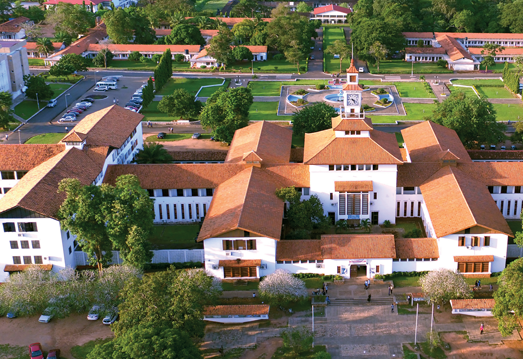
A planned press conference by students of the Mensah Sarbarh and the Commonwealth Halls of the University of Ghana has been prevented from happening.
This is after a joint team of police personnel, and UG security prevented the aggrieved group of students from going ahead with their planned presser, GhanaWeb can confirm.
The students were to hold the press conference in protest of the decision of the management of the university to revoke accommodation and residency for continuing male students their respective halls.
The decision, captured in a statement by the school management, follows the recent clashes involving the two halls on the university campus.
In a statement signed by the Registrar of the University, the residents were to be randomly assigned to available rooms in any of the University of Ghana Enterprise Limited Hostel (UGEl) and private hostels.
The statement furthered that, continuing female students of Mensah Sarbah Hall and students with special needs in both halls will not be affected.
According to the University Council, the recommendations were from the residence and Academic Board, regarding changes to student residence arrangements and the changes were requested by the council of the University following the repeated incidences of violence involving students on campus.
“All continuing students of Commonwealth Hall and continuing male students of Mensah Sarbah Hall will not return to these halls, or to any of the traditional halls. They are to be randomly assigned to available rooms in any of the UGEL and private hostels. Continuing female students of Mensah Sarbah Hall and students with special needs in both halls will not be affected by this measure,” the statement said.
He contends that the government may reduce spending in other ways that won’t interfere with its goals for debt sustainability.
“The government should have no trouble cutting roughly 41 billion from pension funds to pay interest. This is due to the fact that there is still a way out; the government can realign and change some of the budget lines to make room for this exception, he told myjoyonline.com.
However, despite growing concerns that external bondholders may make similar demands, Prof. lord Mensah noted that the conditions are different.
“These investors are long-term in nature, and they will not be responding immediately to some of these measures that the government is undertaking,” he said.
The finance ministry announced the extension of the expiration date of the invitation date for the Voluntary Domestic Debt Exchange to Monday, January 16, 2023 (at 1600 hours).
The Settlement Date for the Invitation is now expected to occur on Tuesday, January 24, 2023, “or as soon as practicable thereafter, but no later than the Longstop Date which is now scheduled for Tuesday, January 31, 2023, unless further extended by the Government pursuant to the Invitation,” a press release from the Finance Ministry stated.
“The announcement Date is now expected to occur on or about 17th January 2023″.
The previous deadline for the invitation was set for Friday, December 30, following the extension of the original deadline of Monday, December 19.
Management of the University of Ghana, Legon, has increased its academic fees for the 2022-2023 academic year by 14 per cent.
This follows the passage of the Fees and Charges (Miscellaneous Provisions) Act, 2022 (Act 1080) by Parliament of Ghana.
In a statement from the Ghana Tertiary Education Commission (GTEC) dated December 16, 2022, this allows a 15% increase across board for all institutions covered by the Act.
“Please be advised therefore that Fees and Charges applicable in all Public Tertiary Education Institutions for the 2022/2023 Academic Year may be adjusted by up to maximum of 15% of the last approved rates,” the statement added.
Fresh students (Undergraduate Regular students) at the College of Humanities (Bachelor of Arts) were initially to pay GHS1,813.00, while those who studied Administration/ Law pay GH1,914.00.
Following the adjustment, they will now pay GHS2,069.00 and GH2,185.00 respectively.
Those in level 200, 300 and 400 studying Bachelor of Arts and Administration/ Law under the College of Humanities were to pay GHS1,340.00 and GHS1,441.00.
These continuing students will now pay GHS1,524.00 and GHS1,640.00 respectively.
For fresh undergraduate students under the full fee paying category and studying Bachelor of Arts and Administration/ Law, they will pay GHS5,054.00 and GHS6,128.00 respectively instead of GHS4,401.00 and GHS5,342.00.
Continuing students offering such programmes will now pay GHS4,500.00 and GHS5,583.00.
AU Farouk, a representative of the main opposition NDC from the Northern Region, has passed on.
The popular serial caller to most radio and television morning shows across the country is said to have collapsed at the University of Ghana where most delegates have been lodging for the Congress.
His mortal remains have since been taken back to Tamale for burial.
NDC’s 10th National Congress
The opposition National Democratic Congress (NDC) will today, Saturday, December 17, 2022 elect national executives for the party.
The party is moving at least 9,000 delegates to the Accra Sports Stadium from various constituencies to partake in the congress.
The key race to watch in the NDC polls is the national chairmanship position between the incumbent Chair, Samuel Ofosu Ampofo, the incumbent General Secretary, Johnson Asiedu Nketiah, and former Member of Parliament, Nii Armah Ashiety, and Samuel Yaw Adusei.
Incumbent Chairman, Ofosu Ampofo will be facing a formidable challenge from General Secretary, Asiedu Nketiah in a high-stakes election. The two frontrunners are poised to put forth a fierce battle to secure a win after working hard for the party.
Meanwhile, an amount of GH₵1,083,000 was generated through the party’s fundraising appeal to finance the 10th national congress scheduled for today December 17, 2022 at the Accra Sports Stadium.
Below is the list of candidates vying for various positions:
CHAIRMAN
SAMUEL YAW ADUSEI
JOHNSON ASEIDU NKETIA
SAMUEL OFOSU AMPOFO
NII ARMAH ASHIETEY
ELVIS AFRIYIE ANKRAH
FIFI FIAVI KWETEY
DR. PETER BOAMAH OTOKUNOR
DEPUTY GENERAL SECRETARY
FRANCIS LANME GURIBE
CATHERINE DEYNU
BARBARA SERWAA ASAMOAH
GBANDE FOYO MUSTAPHA
KWAME ZU
BRADI PAUL OPATA
EVANS AMOO
NATIONAL ORGANIZER
JOSHUA HAMIDU AKAMBA
HENRY OSEI AKOTO
MAHDI MOHAMMED GIBRILL
SIDII ABUBAKARI
SOLOMON YAW NKANSAH
CHIEF HAMILTON BINEY NIXON
JOSEPH YAMMIN
DEPUTY NATIONAL ORGANIZER
KOBBY BARLON
HABIB MOHAMMED TAHIRU
ELIKEM ERIC KEVIN KWAME KOTOKO
ALHAJI YAW KUNDOW
COMMUNICATION OFFICER
SAMMY GYAMFI
DEPUTY COMMUNICATION OFFICER
GODWIN AKO GUNN
ADONGO ATULE JACOB
MALIK BASINTALE
KWAKU BOAHEN ANTHONY
MOHAMMED NAZIRU
ZONGO CAUCUS CO-ORDINATOR-
ABASS ZULKARNAIN KAMBARI
HON. ALHAJI BABANLAMIE ABU SADAT
MAMAH MOHAMMED COLE YOUNGER
ABDUL-AZIZ MOHAMMED
YAKUBU MAHMUD MUDI
NEC MEMBERS
EPHRAIM NII TAN SACKEY
PEREZ FERNANDEZ ARMAH LARYEA
ISSAHAKU ISSAH ADEL
REV. IRENE SENA AGBLEKE
ABDULLAH FARRAKHAN ISHAQ
MALIK ADAMA
VICTORIA KUMA-MINTAH
EMMANUEL EWOENAM YAO ADZOME-DZOKANDA
CECILIA N. ASAGA
EBENEZER EFFAH HACKMAN
NAJAWA ALHAJI ISSAH
STEPHEN LADZEDO
ANITA ANNAN
RANSFORD CHATMAN VANNI-AMOAH
THOMAS AYISI KUMAH
WONDER VICTOR KUTOR
MOHAMMED MAMUDU
ARABA TAGOE
FAMOUS KWESI KUADUGAH
Due to recent fights on campus, male occupants of the Mensah Sarbah and Commonwealth halls at the University of Ghana would no longer be allowed to live there for the 2022–2023 academic year.
This was stated in a statement released by university management on December 14, 2022.
According to the statement, the impacted students would have their room assignments in the private dorms on the university campus made at random.
“All continuing students of Commonwealth Hall and continuing male students of Mensa Sarbah Hall will not return to these halls, or to any of the traditional halls.
“They are to be randomly assigned to available rooms in any of the UGEL and private hostels. Continuing female students of Mensah Sarbah Hall and students with special needs in both halls will not be affected by this measure,” the statement said.
Only first-year and graduate students would be assigned rooms in the Commonwealth and Mensah Sarbah halls beginning with the following academic year, the statement continued.
“Beginning from the 2022/2023 academic year, only Level 100 and graduate students (Masters and PhD level) will be assigned to Mensah Sarbah and Commonwealth Halls.
“Subsequently, undergraduate students will vacate the halls at the end of Level 100 and may secure accommodation in the private hostels from Level 200 until completion.
“Level 100 students who opt for traditional halls will be randomly assigned to the halls.”
The University of Ghana lecturer encouraged the government to form a commission for the nation’s rice production immediately.
He claims that if the government focused on domestic rice production, the nation’s $1.2 billion yearly rice import expenditure might be reduced.
While praising government’s intention to reduce rice imports, the development economist suggested that government should set up a committee that would include players in the rice industry’s value chain and discuss how to fully implement the ban on rice importation plan.
“Ghana imports $1.2 billion worth of rice annually. This can be reduced drastically if we concentrate on the local production of rice,” he stressed.
The Development Economist added that the committee will monitor and involve stakeholders in the rice business to make sure there were no lapses as local rice starts to take a larger share of the market.
He made this call at an economic forum organized by the Danquah Institute in Accra, according to Graphic Online.
In addition to that, he also stated that when that was done, not only would it curb the rapid fall of the cedi but also create jobs for Ghanaians who would earn more and pay taxes for economic growth and development.
“We have to manage our economy well by simply paying attention to some of the key sectors that drive economic growth,” he said.
He finally added that raw materials from agriculture should be turned into finished goods through manufacturing.
Government may generate a lot of money if it takes advantage of digitization and digitalization.
To prevent income leaks, combine digitization and revenue collection, he advised.
Before obtaining necessary services like passports, driver’s licenses, etc., tax certificates must be submitted, he continued.
Dr. Sarkodie also pointed out the tax sectors that are growing fast. He mentioned the service, industrial and agric sectors as areas that would give the government so much revenue.
“Property rates and tax exemption bill should be accelerated. Property rates can rake in GHC16 billion annually. 8 billion can also be realized from the informal sector” he opined.
Tax exemptions, he observed, can be cut by GHC5 billion to help reduce pressures on the government’s finances.
Dr. Sarkodie expressed these sentiments during the Danquah Institute’s Economic Forum which took place at the ISSER building at the University of Ghana, Legon, on Friday, December 9, 2022.
The forum was also attended by Dr. George Domfeh, Dr. Kwadwo Opoku with Professor Eric Osei Assibey as chairman.
“The approach government is using in managing all of these appears like trying to trick or surprise the market . . . we know that Ghana is in a deep crisis, in fact in economics if there was any word beyond crisis that is what we will be using now . . . we all do acknowledge that we have to come out of this . . . ” he said.
” . . Broader consultations, the humility to acknowledge where we have gone wrong and where we can do better, that brings everybody to the table is very critical now . . . we need negotiations, to do so you have to come to the negotiation table with some moral authority . . . failure to do that, it’s going to be difficult for us to get out of this,” he averred.
“Consensus building is the way to go and to do this, it requires honesty and transparent,” he added.
Speaking under the title “Economic growth: Our common duties” at the Danquah Institute’s Economic Forum, Mr. Assibey suggested that Ghanaians should concentrate more on finding solutions.
Dr. Antionette Tsiboe-Darko, the diligent Executive Director for Danquah Institute, put together a lovely event.
The reality that Ghana is in crisis is evident, Mr. Osei Assibey further stated.
“In fact the whole world, the IMF and World Bank are predicting that next year about a 3rd of the global economy will be in recession and across the globe many debt to GDP is rising and inflation is also rising. It has seen unprecedented levels and even in advanced countries for the first time in about 40-years Great Britain inflation is in double digit.
“So Ghana is not alone, but it appears we have been disproportionately affected by what is happening globally. For that reason our economy is going under serious stress. But really this is not so unprecedented we have seen this before,” Mr. Osei Assibey reiterated.
He continued: “I mean if we should put this in historical context, even right from our independence. If you look at our development trajectory. You will see that when the British left us, we say that Ghana was comparable to South Korea, Singapore and others because of per capita to GDP.”
Professor Assibey further narrated that “then the Nkrumah government stated spending and state interventions central plan system of governance and at the end. By the time they were leaving office we had depleted our reserves. We were in very difficult economic conditions.”
He said the coup d’état’s coming and during Acheampong time he even said his government cannot pay the huge debts left.
“Then came the global crisis and the weather conditions and we went into serious economic conditions in the 80s. Then we didn’t know what to do so we went in for the IMF programme and the structural adjustment program. Our economy deteriorated and the fiscal deficits became so large. Inflation was about 123 percent and we never thought that we could come out.” Mr. Osei Assibey indicated.
The Associate Professor added that the IMF program at that time saved the nation from the difficulties with severe conditionality which include the divestiture.
“We were talking about privatization, redeployment and a host of other conditions that hit us so hard although we were young. But we do remember the economic condition. We were fortunate to have come out of that, we saw that in the early 90s and most of the economic indicators turned in a positive direction,” the economist narrated.
He also cited the HIPC initiative that was introduced by former President John Kuffour’s era that wrote off many of Ghana’s debt.
Mr. Assibey therefore advised that the focus of Ghanaians should be how to come out of the economic challenges.
He said the move will not only enable expected growth in the production sector but also ensure that government generates more revenue through production taxation where there is value addition.
“The budget as it stands, I believe, has given us direction. As we seek to attain capacity, what is the relation between aggressive revenue mobilisation and building capacity? We at AGI believe that it is a chicken and egg situation, and there must be pain before gain when we get to this stage.
“We believe to promote the industrialisation agenda that will go all the way back to correct the wrongs and informalities in the SMEs and create a saving culture and related matter, you might need to move from pre-production taxation to post-production taxation,” he said, speaking at the KPMG 2023 post-budget forum in Accra.
He explained that given the fact that most of the raw materials are not found in this country, the removal of pre-production taxes will give some leverage to the production sector.
“In the pre-production stage, currently you might not get all the raw materials you need in Ghana so they get imported; and one might have to pay all levies on the raw materials. However, if you excuse us from that tax and we pay it at the post-production after value-added stage, the revenue there will be higher than the primary stage.
“But government must deploy IT systems that can track everybody in the value chain who benefitted from the pre-production taxation,” he said.
Dr. Humphrey Ayim-Darke holds that government must work in parallel with the production sector, as its role and contribution to the country’s GDP will remain crucial even after the IMF programme and intervention.
“You might deliberately and consciously work with the productive sector so that you do not kill the sector that will lay eggs beyond the three-year IMF strategies. Also, working in parallel and reducing a bit of the pre-production taxation is key.
“If we do not consciously industrialise to pick up the structures of this economy and improve on them, the status quo will be the same,” he said.
She added that while many have touted how the IMF programme will help put the economy on a good pedestal, the country must own its game after the programme to prevent the cyclical pattern of bouncing back to challenging times.
“Hopefully, once we go under this programme and come out of it, we’ll be able to manage ourselves well so that we don’t repeat this cyclical pattern of every time the country does well under a fund-assisted programme, the moment we come out you find we are suffering because we do not tackle the structural issues. The challenges of local production needs to be catered for to be able to take up import substitution industrialisation,” she said.
Dean of the School of Performing Arts at the University of Ghana, Prof Kofi Agyekum, popularly known as Opanyin Agyekum, has bemoaned the absence of New Patriotic Party (NPP) Members of Parliament (MPs) during the debate on the 2023 Budget and Economic Statement in the House.
According to him, the travel by the NPP MPs to Qatar for the World Cup at the expense of the budget debate show their lack of respect for Ghanaians and their constituents who voted for them.
Speaking in a Peace FM interview monitored by GhanaWeb, Opanyin Agyekum added that the failure of the NPP MPs to appear for the 2023 budget debate will certainly affect the fortunes of the party in the upcoming elections.
“… If Kufuor was not alive, he will be rolling in his tomb when he sees that NPP MPs are boycotting the budget debate for their own government. I didn’t understand this, it makes no sense that a party in government will boycott the debate of its own budget.
“It would have been okay if the opposition MPs were the ones who were absent but they were even more the MPs of the government in power. They (the NPP MPs) are destroying the party because of one man, Ofori-Atta.
“These are the things that lead parties to opposition. These are the things that discourage people from voting for you. They will not vote for the NDC (National Democratic Congress). If I vote for you and this is how you’re going to behave why won’t I sleep,” he said in Twi.
The minority caucus in Parliament expressed concern on Tuesday (October 29) about the absence of members from the majority side from the House.
The concern was anchored on the premise that the debate on the 2023 budget, as presented by the Minister of Finance, Ken Ofori-Atta, was expected to start with a race to pass the Appropriation Bill in time.
Though no official reason was given for the mass absence of the majority members, GhanaWeb checks show that some of the majority Members of Parliament (MPs) were out of the jurisdiction.
At least three of them were spotted in Qatar, where the 2022 FIFA World Cup is ongoing.
One of the MPs who has been in Qatar for the past two weeks is Mustapha Ussif of Yagaba-Kubori, who doubles as Minister of Youth and Sports.
Minister of Communications and Digitalisation, who doubles as the Member of Parliament for Ablekuma West Constituency, Ursula Owusu-Ekuful, was also spotted in Qatar, according to social media posts.
Minister of Energy and Manhyia South MP, Dr. Matthew Opoku Prempeh was also in Qatar cheering on the Black Stars.
Patrick Yaw Boamah, Okaikwei Central MP was also in Qatar, where he shared photos of himself on the streets and at the stadium supporting Otto Addo and his charges.
Gender diversity and widespread engagement of women in the energy sector are reportedly necessary conditions for the development of creative and inclusive solutions for a successful transition to sustainable energy.
These submissions came from the Accra, Ghana, Women in Energy Conference in 2022.
The energy sector remains one of the least gender-diverse sectors in the economy, despite recent efforts to promote and encourage women’s participation. Women face structural and cultural challenges and the lack of women in leadership positions in the sector compounds the difficulty in recruiting and retaining female leaders.
There is an urgent need to improve the knowledge and skills of women in activities related to clean energy. The chosen theme for this year’s Women in Energy Conference “Energy Transition: Prospects for Women in Energy” intends to increase awareness of women with regard to Ghana’s current trajectory for the sector and to advance their understanding, leadership and participation in the opportunities presented within a transitioning environment.
The Acting Chief Director at the Ministry of Energy, Mrs. Wilhelmina Asamoah said women have a role to play in the Energy Transition agenda.
Chief Executive of the Volta River Authority (VRA) Mr. Emmanuel Antwi Darkwa pledged the VRA’s commitment in erasing stereotyping in the Energy sector.
Prof. Nana Ama Klutse is an Associate Professor at the Department of Physics at the University of Ghana, Legon. She said energy issues must be on the front burner for discussions.
The three-day Conference seeks to among other issues encourage women to take advantage of energy transitioning.
Citations were presented to some distinguished females for their role in the Energy Sector.
In May 2022, the current administration implemented E-Fee, which imposed a 1.5% levy on electronic transfers.
The purpose of the tax was to “improve domestic tax mobilization, increase the tax base, and provide everyone a chance to contribute to national development.”
The levy has however not generated the expected results as some who are still against it find ways of dodging its payment.
Revision in budget
Subsequently, the government in its 2023 budget statement disclosed the rate has been revised again from 1.5% to 1%.
This, according to the government, will allow more Ghanaians to use the service.
“Review the E-Levy Act and more specifically, reduce the headline rate from 1.5% to 1% of the transaction value as well as removal of the daily threshold,” Finance Minister, Ken Ofori-Atta said.
“Government should delete it (E-Levy). When something is conceptually wrong and it doesn’t meet certain basic principles of taxation, people have issues with it; even if it’s 0.1% . . . CSOs, Private sector said all that they could say about e-levy but sometimes it is as though somebody wants to do it to demonstrate where power lies,” he intimated.
He further stated that when your policy announcement aligns with the expectation of the market, they pick on it and confidence is generated.
“Taxation is not a hammer where you treat everybody else in the market as a nail . . . you cannot tax your way out of poverty; it’s never done anywhere . . . ” he added.
Prof. Godfred Bopkin, a lecturer at the University of Ghana, has demanded further information regarding the recent announcement of a ban on the use of V8 by all government appointees in the capital.
He worries that the directive contained in the 2023 Budget, which was delivered to Parliament on November 24, may be disregarded until clear guidelines are provided.
“We must be very careful we don’t push people beyond the point where they will not be able to tolerate. That is the part that we are getting towards and especially when you don’t see greater commitment in internalizing that austerity.
“So, if you tell me that don’t drive V8 in Accra, who monitors that? If I see V8 leaving from East Legon, do I conclude it’s going to Central Region?” he quizzed in an interview on Joy FM, November 25.
Government bans the use of V8, V6 vehicles except for cross-country travel
Prof. Vera Ogeh Fiador is the keeper of that record; the UG Council granted her the job in a statement dated November 18, 2022.
Prof. Fiador joined UGBS in 2008 and is described as a complete academic with Legon training.
She began working at the Business School in 2008 after receiving her MPhil in Finance from the University of Ghana Business School in 2006 and her BSc Administration degree (Banking and Finance with First Class) from the same institution in 2003.
“The first female Associate Professor of Finance has been dedicated to the University since she joined the university and serves on a number of ad hoc and standing committees, including the University’s Finance and General Purposes Committee, and the Resource Allocation for Academic Purposes Committee.
“Until her sabbatical in 2020, she also served as a tutor for Legon Hall. She is currently the Programme Coordinator for one of the Business School’s flagship programmes, the One-Year MSc in Development Finance,” the statement read in part.
Maybe not very high up in the leadership of the university as a whole, Prof. Fiador joins a league of women history-makers at the University, a list that includes Vice-Chancellor Prof. Nana Aba Appiah Amfo.
Amfo, a former pro-Vice-Chancellor made history on two different levels with her appointment as the youngest VC and the first woman to be appointed last year.
The duo were; Mrs. Mary Chinery-Hesse, the first female Chancellor. In attendance was Justice Sophia Akuffo (Rtd), the first female Chair of the University Council.
Brief about the history-making Professor of Finance
Prof Vera Ogeh Fiador started her primary school education at Datus Complex, Dansoman, truncating at class three to continue at Christ Mission School, Kwashieman and then to Ministry of Health School, Korle-Bu for her Junior High School education.
She then got admission to Holy Child School, Cape Coast, where she obtained her high school (SSCE) certificate.
Professor Fiador holds a PhD in Management (with Finance specialisation) from the Graduate School of Business, University of Cape Town, South Africa. Her PhD research focused on Monetary Policy in Sub-Saharan Africa.
Her core expertise lies in the areas of corporate governance, corporate finance, gender diversity, enterprise risk management, and environmental and social risk management. She has a number of peer-reviewed publications to her name.
Prof Vera Ogeh Fiador is married to Mr. Daniel Fiador, Esq. and they are blessed with 4 children.
A study conducted by a team of researchers from the University of Ghanahas revealed that most farmers in the country sell a large proportion of their produce, including food they reserve to eat for the rest of the year.
Those who produce food crops such as maize, rice, yam and sorghum also sell their produce because they need cash.
A researcher at the Institute of Statistical, Social and Economic Research (ISSER) of the University of Ghana, Dr Fred Dzanku, said “they [farmers] have children who go to school, and since they do not have any other source of income, they sell [the food] to take care of their needs”.
Unfortunately, he said, after engaging in such commercialisation, those farmers did not have food to depend on in the latter part of the year.
He said most of them also devoted their resources to the production of non-food cash crops, even in highly commercialised regions.
According to the study, those practices could lead to food insecurity in the country.
Dr Dzanku, who was among the nine-member team that conducted the research, made the disclosure at the presentation of findings and observations of the research in Accra yesterday.
The research, which was on land commercialisation, gendered agrarian transformation and the right to food, is a Demeter Project conducted from 2015 to 2022.
Demeter Project
The overall objective of the Demeter Project is to strengthen knowledge on the relationship among food security, the right to food and gender equality to enable the people to claim their rights and also encourage governments to facilitate the realisation of the objective.
Ghana and Cambodia were used for the research, but the presentation in Accra focused on the findings and observations in Ghana.
In Ghana, the study was done in four districts in four regions.
The seven-year Demeter Project is funded by the Research for Development Project of the Swiss National Science Foundation and the Swiss Agency for Development and Cooperation.
On how to deal with the over-commercialisation of farm produce, Dr Dzanku suggested that in the short term, farmers should be educated to devote a certain proportion of their land to food production, while the state must invest in roads, infrastructure and storage facilities, in the long term.
Cassava production
Presenting her work on the political economy of food insecurity in Ghana, a member of the research team, Dr Gertrude Dzifa Torvikey, said industrial cassava production was an important policy imperative.
“The state and policy makers should map out what cassava means in the development of the nation and its position in the future development agenda,” she said.
Earlier, the principal investigator of the team, Prof. Dzodzi Tsikata, had said during the demeter study in 2015, there were 800 million chronically food insecure people, with 50 per cent living on small farms, 20 per cent landless, while 70 per cent were women and girls.
While the nation spends billions on importing goods that some of these companies could make, domestic producers like Pwalugu Tomato Factory, Komenda Sugar Factory, Tema Oil Refinery, Volta Aluminum Company (VALCO), Akosombo Textiles Limited, and Wenchi Tomato Factory, among others, have either shut down or are struggling to survive.
However, Dr. Owoo, a Senior Lecturer at the Department of Economics, in an attempt to proffer solutions to the current economic crisis characterised by high inflation of 40.4 percent, high cost of living, the rising cost of fuel, and a fast-depreciating cedi, opined that these companies, if revived and retooled, have huge a potential to help restore relative stability.
“These companies can reduce our import bills on sugar, rice and tomato, and serve as raw materials for industries,” she added.
Dr. Owoo said this during the 46th Annual General Meeting of the Ghana National Chamber of Commerce and Industry (GNCCI) in Accra and explained that the government could partner with the private sector to revamp them as part of an import substitution strategy, or under a broader plan to shift from import reliance to local manufacturing.
She spoke on the theme ‘Ghana’s Cyclical Economic Crisis: Time for Bold Policies to Address the Economic Structure’, and said reviving abandoned or struggling domestic manufacturers would offer both short and long-term gains – adding real value to the economy and boosting the recovery process.
It will also help strengthen the domestic currency which has lost over 50 percent of its value against the United States dollar this year by reducing imports, as well as creating quality jobs for young Ghanaian men and women, she said.
While the government has constantly blamed the COVID-19 pandemic and Russia-Ukraine fight for the current economic situation, Dr. Owoo – just like many economists and business associations like the GNCCI – holds the view that the import-reliant structure of the economy makes it very susceptible to external shocks.
For the President of the GNCCI, Clement Osei-Amoako, the government should encourage multinationals to keep a certain percentage of their earnings with local banks.
This measure, if properly implemented, would shore up the country’s foreign currency reserve and further strengthen the domestic currency, he noted.
“It is high time, as a country, we lived within our means. The acceptance of a fiscal deficit in the nation’s finances is unacceptable, and has been the reason for the government competing with the private sector for capital with a high-interest rate,” he said.
Mr. Osei-Amoako further lamented that a high-interest rate remains a major obstacle to the growth of the private sector, hence, it should be tackled with all seriousness.
Management at the University of Ghana, in partnership with the National Signals Bureau, has begun the installation of secret closed-circuit television (CCTV) cameras throughout the university’s campus, to amp up security.
The announcement was made by the school in an email to students on Friday, November 11, 2022.
The message read, “The University of Ghana is partnering with the National Signals Bureau for the installation of CCTV cameras at various locations on the Legon campus as part of measures to improve upon security in the university.“
The statement also noted that the project is expected to be completed within the next four weeks; however, they do ask students and the general public to be cautious and aware of the ongoing project while going about their daily activities on campus.
“The laying of cables for the project has started, and it’s expected to continue for the next four weeks,” the statement noted.
They are, however, asking students and the general public to “ Kindly take note as you drive or move around campus”
The Mensah Sarbah Annex B road leads to the Physical Development and Municipal Service Directorate PDSMD, the Political Science Department’s T-junction, which connects to the road leading to the Botanical Gardens, the New N-Block, which leads to the UG Press, the Addae Mensah Intersection, the George Benneh Roundabout, the Hilla Liman Hall, the School of Engineering, the Volta Hall Roundabout, the Balm Library Roundabout, and the Okponglo gate.
Meanwhile, universities in Ghana have a long history of violent clashes with members of the CommonWealth Hall (Vandals), and members of Mensah Sarbah Hall recently engaged in a violent fight that resulted in the burning of a vehicle parked at the Mensah Sarbah Hall car park, as well as the destruction of several other properties.
A few weeks after the UG clash, Kwame Nkrumah University of Science and Technology saw another clash between members of the university hall (Katanga) and continental hall (Conti) during a procession by some members of Katanga.
With the aid of CCTV footage, management was able to arrest some of the culprits.
This, as well as several other incidents on other campuses such as UCC,
Professor Ernest Aryeetey, a former vice-chancellor, of the University of Ghana, has said Ghana must think beyond the International Monetary Fund (IMF) in the quest to stabilise and transform the economy.
He noted that Ghana had always known how to recover from economic hardship with the support of the IMF but had refused to follow the reguired reforms due to political expediency.
Prof. Aryeetey said this at the 26th GJA Awards in Accra on the theme: “Walking the path towards Ghana’s Economic Recovery – The Role of the Media”.
He said after economic recovery, there must be stabilisation and transformation, which required broad participation and the need to change agriculture, boost trade, stimulate investment and industrialise not to get back to the same situation.
“Today, we are where we are because we failed to develop the right type of politics that will support economic transformation… (We need to) think about the political economy. How we (can) use our institutions to develop the right type of policies,” Prof. Aryeetey said, adding that the country needed to welcome more analysis and debates on the economy.
Prof. Aryeetey asked the media to create space for discussions on the economy towards finding solutions to the challenges, saying without that, it would only be the ideas of a small political group, friends and families.
“Let’s encourage debates on the economy. Let’s create a Ghana where ideas flourish and stop tagging people who share their thoughts on the economy..,” Prof. Aryeetey, who chaired the awards event said.
Florence Oboshie Sai-Coffie, special advisor to President Nana Addo Dankwa Akufo-Addo on Media and Strategic Communications, said the government was doing its best to bring the economy back on track and tasked the media to amplify voices that could help find solutions to the economic challenges.
She said the media would be prioritised in the search for the solution and said Government was happy journalists were responding positively to the call for all hands to be on deck for economic recovery.
Yaw Boadu Ayeboafo, the chairman of the National Media Commission, asked the media to sustain national interest in discussions on the economy and not partisan ones.
The United States ambassador to Ghana, Virginia E. Palmer, commended the media for its role in sustaining Ghana’s democracy and socio-economic development and stressed the importance of a free press and the safety of journalists.
She said the embassy would continue to support the capacity building of journalists and commended GJA for the establishment of Journalists Support Fund.
Kojo Oppong Nkrumah, Minister for Information, in a speech read on his behalf, said the Government attached great importance to the work of journalists and commended them for the interest in helping bring the economy back to life.
He said the government remained committed to the safety of journalists and asked corporate Ghana to support the GJA Journalists Support Fund.
Albert Kwabena Dwumfour, GJA president, said journalists had a great role to play in bringing the economy back to life and said a series of symposiums and lectures would be organised to help find solutions to challenges facing the country.
He said the GJA had engaged some institutions towards the building of the capacity of journalists and called for the support of all.
The GJA president also called for support for the Association’s Support Fund towards the welfare of journalists.
Since 1957 Ghana has entered 17 bailout arrangements with the IMF to restore the health of government finances, having exited the last one in April 2019.
The country is currently with the IMF seeking support to restructure the economy and bring it back on track.
He claims that the cost of maintaining the nation’s operations prevents the funding of domestic development initiatives.
At the 11th Ghana Economic Forum, Professor Bokpin warned the government to be prudent with its spending while speaking to GhanaWeb.
“While we are thrilled about the huge potential to raise more money, we must also urge the government to be prudent with its spending since, in this nation, we have been so wasteful that the cost of operating our democracy has been so high.
“The cost of running our democracy in terms of the size of government and all of that is just too huge and at the end of the day, it leaves very little for where money has to go for growth to be engineered,” he intimated.
“Beyond that, we must replicate that across state-owned enterprises. If you look at their staff strength which has gone up since 2017, we are creating deputy CEOs and all of that. This is the best time for Ghana to look at Ghana and say what is tolerable and what cannot be allowed,” he noted.
On October 27, 2022, the RS Amegashie Auditorium at the University of Ghana hosted the competition’s beginning and preliminary rounds.
The University of Ghana (Propane), Ghana Communication Technology University (Butane), and Tamale Technical University (Methane) were three of the 12 participating institutions that made up Zone 1 of the competition, and they competed for a berth in the first semi-final.
Throughout the contest, Team Propane from the University of Ghana held on to their impressive start to win the contest and book their semi-final berth with 66 points.
A last-minute charge by Team Methane of Ghana Communication Technology University was enough for second place with 48 points.
A derail in their hot start saw Team Butane finish third on the day with 42 points.
Daniel Dzanie, one of the winners shared their excitement with Univers News, saying they are poised to win the 3rd edition of the contest.
“Well, we’ve been able to effectively identify our portholes and all our deficiencies and we seek to correct all those things to ensure the mistakes we’ve made in the past will not be repeated. This year by the grace of God we seek to win the Ghana Gas Challenge 2022.
“The preparations were solid, we had a lot of sleepless nights but today we are standing here feeling very amazed and proud of ourselves. Thanks to our team, the coaches and trainers everything they helped us with was superb. Although they were hard on us, today we saw that it was actually a good thing, so we’re grateful to them and the Almighty God,” he said.
Chief Executive officer of the Ghana National Gas Company, Dr. Ben K. Asante, disclosed that the Gas Challenge is one of the many steps the company is putting in place to deepen the knowledge of the Tertiary populace and the whole Ghanaian public at large about gas.
The Gas Challenge is first step of many that we hope to come to deepen the knowledge of the Ghanaian population at large and in this particular focus the Tertiary institutions around the country on the importance of Gas and the activities of the Ghana National Gas Company
Zone 2 contest is scheduled to take place on Wednesday, 2nd November, 2022 at Cape Coast between the University of Cape Coast, Takoradi Technical University and All Nations University for a place in the semi final.
The Gas Challenge is an educative program intended to increase knowledge in the petroleum industry as well as create awareness about Ghana’s gas processing system and the operations of the Ghana National Gas Company.
This year’s competition will be held under the theme: Embracing the future together: the indispensable role of Gas in facilitating social and economic growth and development.
An economist at the University of Ghana, Prof Godfred Alufar Bokpin, has charged the government to reduce the number of staff in its governance structure and across all state-owned institutions.
His calls came at the back for calls for the dismissal of the finance minister Ken Ofori-Atta.
Speaking to GhanaWeb on the sidelines of the 11th Ghana Economic Forum, he said “We must adopt the lean government across the general government approach, not just the central government, but general government approach to doing business must adopt least cost approach. That is the only way we can come out of with this.”
Professor Bokpin indicated his support for the calls to remove the finance minister, whiles adding that “that is not the only change we want. Beyond that, it will not amount to so much just changing the finance minister. We must go a step further and reduce the number of ministers and the government size overall, including the staff at the presidency.”
“Beyond that, we must replicate that across state-owned enterprises. If you look at their staff strength which has gone up since 2017, we are creating deputy CEOs and all of that. This is the best time for Ghana to look at Ghana and say what is tolerable and what cannot be allowed,” he noted.
Award-winning Ghanaian singer, Bertha Bridget Kankam, popularly known as Yaa Yaa, has graduated from the University of Waterloo, Canada with Masters of Business, Entrepreneurship and Technology.
Yaa Yaa posted a picture in her graduation gown with a caption expressing how overwhelmed she is by the achievement.
“See what the Lord has done! Master of Business, Entrepreneurship and Technology program, done and dusted! I am overwhelmed with emotions right now. I’ll come back later with my speech but for now, help me thank the Lord ,” she said.
The “Kae” hitmaker prior to this feat completed a four-year degree programme at the University of Ghana.
He intimated that answers to the devaluation of the cedi is at the department of economics at the University of Ghana.
“There is a book there called Economy of Ghana 101. Every politician should read it. We should go to the people at the economic department of the University of Ghana, get the book and read it,” the managing Editor advised.
He stressed the challenges with the cedi are embedded in the book adding that the issues dealt with in the book have to do with the country’s import and export structure of the economy.
Meanwhile, he said he believes that the cedi is heading toward its natural place.
“You know every animal has a habitat and the cedi is heading towards its natural habitat. When Kwame Nkrumah gave us the cedi its value was comparable to the pound sterling. But by the time we got towards the later part of Rawlings tenure one dollar was GH¢10,000” Mr. Kuranchie told Starr News.
Mr. Kuranchie, however, added that the redenomination about 16 years ago by former President John Agyakum Kuffuor was not helpful and “his government could not explain why cedi was equivalent to the dollar after the redenomination.”
“So until we sit and answer that question and address it and begin to passionately deal with that problem. The cedi will continue to head to its natural place and we are heading to a very deep and dark place.
The Minister of Finance, Ken Ofori-Atta has said Ghanaians should not panic over the high depreciation of the Cedi.
The woes of the Ghana Cedi continue to deepen as the currency has depreciated and reaching GH¢17.5 to 1$.
But, Ken Ofori Atta believes the economy will bounce back soon and the Cedi stabilized following measures being put in place by the government.
“…It is a bit perplexing but as you know, typically we go to market at the beginning of the year and get our 2 billion, this we were not able to do. We were able to get our 750 from AfroExim and in the summer – August or so things stabilized a bit. Then we moved on traditionally as we do with the ASL (Annual Syndicated Loan) of COCOBOD and that came in very strongly. So it’s a bit perplexing to see where it’s going.”
“Of course, typically in October, people are importing for Christmas, and maybe there’s a rush for that. But my expectation is that once we also conclude with the Fund that will lead to the Fund’s disbursement early next year. With the support we are getting from countries like Germany, France etcetera, we are confident that we’ll get the resources needed. So we really will want people not to panic or be rushing for that pressure on the currency. I think it is unnecessary and we are in good shape,” Mr Ofori Atta said in an interview in Washington.
An Associate Professor at the University of Ghana’s School of Public Health, Richmond Aryeetey, has admitted that a significant proportion of the Ghanaian populace is food-insecure.
According to him, this is happening despite the government’s flagship programme Planting for Foods and Jobs (PFJ).
He said there is a difference between food supply and food security, explaining that food supply is a component of food security.
Prof Aryeetey stressed that the government’s PFJ forms part of the food supply chain.
He explained that this is an indication that people may not be eating right.
The nutritionist said 20 to 40 per cent of the Ghanaian population is food-insecure.
In his view, food inflation is making it difficult for people to consume quality food in recent times.
These have health implications for the country, he warned.
For instance, he pointed out that as a consequence, many Ghanaians are taking risks regarding eating right.
“People make difficult decisions on how many times they will eat in a day,” he lamented.
The Associate Professor made these comments while reacting to the World Bank’s report that one-third of Ghana’s population skips a meal a day.
He spoke on the 505 news hosted by Korku Lumor on Class 91.3 FM on Thursday, October 6, 2022.
He noted that not eating right could make people not think right
A senior lecturer at the University of Ghana, Professor Godfred Alufar Bokpin, has stated that even though the Bank of Ghana’s efforts to address the rising inflation rates by increasing the monetary policy, the timing for its recent hike is wrong.
The Bank of Ghana increased the monetary policy rate by 250 basis points to 24.5% on October 6, 2022.
Prof. Bokpin explained that what the Bank of Ghana currently lacks is the right positioning of the policy rate to effectively deal with the current economic crisis.
“We have said that where we are, the triggers are much more from the fiscal side and therefore there is a limit to how far you can deploy monetary policy largely of course to eliminate the demand-related inflationary pressures but where I disagree with the Bank of Ghana is the timing of their policy rate adjustment that seems to lack in terms of positioning it to anchor inflationary expectation, I think we missed it,” he is quoted by myjoyonline.com.
Ghana’s current inflation currently stands at 33.9% as of August 2022, the highest it has been in 21 years.
However, the economist identified that Ghana’s problem has to do largely with the fiscal side of the economy.
Therefore, the Bank of Ghana should not be blamed entirely.
“We may be missing the point if we blame the Bank of Ghana so much and leave out the big elephant in the room which is the fiscal side where the political economy is dominant and where politicians and managers of the fiscal side are to be blamed for the current mess that we are in.
“If you look at Bank of Ghana’s statement for the past year, you will see a certain posture of Bank of Ghana that suggests that they are unhappy with the way the fiscal side is being managed,” he explained.
A lecturer at the University of Ghana‘s School of Business, Dr. Kobby Mensah, has lamented President Nana Addo Dankwa Akufo-Addo’s statement linking the fight against illegal small-scale mining, galamsey, and winning the 2024 elections.
He is concerned that more pressing socio-economic, environmental and generational considerations have failed to make the list of why the fight against the scourge must be won.
In a tweet posted on October 5, 2022; hours after Nana Addo Dankwa Akufo-Addo had met with the National House of Chiefs and selected Metropolitan, Municipal, and District Chief Executives (MMDCEs), Dr. Mensah wondered why the fixation on elections.
“So NPP will only fight Galamsay becos [because] will make them win elections Ei! Where are the values – securing the future of generations unborn? Sustaining the earth’s resources? Protecting the livelihoods – human and animals etc. None of these important to president but elections,” his post read.
President Akufo-Addo in his address admonished MMDCEs, in particular, to put in their best effort to ensure that the government wins the fight against galamsey.
The president stressed that they had to put in their best effort because winning the war against ‘galamsey’ will ensure that the New Patriotic Party, NPP, wins power for an unprecedented third successive term under the Fourth Republic.
“Let us work together to get rid of this one. And I believe that if the people of Ghana see a determined effort on our part which is yielding results. Our water bodies are clearing, our landscape is being reclaimed, our forest zones are being preserved, it will help them enable us to do what? Break the Eight,” the president told the MMDCEs.
During the first part of the meeting, President Nana Addo Dankwa Akufo-Addo refuted suggestions that his government is not committed to the fight against galamsey.
According to Akufo-Addo, his government has been committed to the fight against the menace since his first day in office and its determination to curb it even cost the NPP some votes in the 2020 General Elections.
The president intimated that the votes he and his party lost showed that he really put his presidency on the line to fight galamsey.
“Since I took office on January 7th, 2017, nearly six years ago, I have made it a central feature of my presidency to lead in the fight to rid our country of this menace, which we all now call galamsey.
“Indeed, it was an important aspect of my inaugural address that day. It has not been easy; it has not been popular and we have not gotten the immediate results that I was looking for.
“Indeed, in the last election of 2020, my stance on the issue cost my party and I significant losses in the mining communities. It turned out that my statement that I was putting my presidency on the line in the fight against galamsey was neither bumbazed nor reckless. It was the simple truth,” he said.
Speaking on Accra-based TV3’s Showbiz 360 on Friday, 23 September 2022, Chance the Rapper said, “My favourite thing that happened today, we visited the University of Ghana.”
“I don’t know how much everybody that lives here everyday understands how powerful or how historic or how celebrated that institution is around the world,” he wondered.
“Malcom X spoke there in 1964. One of his most important speeches is from out of that space,” he noted.
“It’s produced plenty of presidents for this country [Ghana],” singer and record producer added.
When host Giovanni noted he is a proud alumnus of the school, Vic Mensa who appeared on the television show with Chance piped in with: “My father too, you know.”
“It’s a place that I want to just highlight and say thank you for welcoming us so well,” the Chicago-born musician said.
He took the liberty to highlight the upcoming January 6, Black Star Line Festival.
“I wanted to point out that the Black Star Line Festival isn’t only January 6. There is an entire week lead up of events that happen and one of the most important things is that a lot of thought-leaders – I can’t say which one yet – but a lot of thought-leaders, activists, artists, and celebrated people around the diaspora are going to be leading some important talks at the University of Ghana, at the lecture halls,” he excitedly advertised.
Chance the Rapper entreated “everybody to mark their calendars and be ready for the top of the year. Don’t party too hard at the end because it’s going to be a wild week for sure.”
“It’s free [the concert],” he emphasised and rose from his seat.
Prostitution dates back to ancient societies and occurs in various forms within communities but when and how did it become common among universitystudents?
Over the years, the name prostitution or Commercial sex work has evolved to what is now known as Hookup or Slay Queens.
Despite being a criminal offence in Ghana, some students are finding ways and means to engage in illegal activity for various reasons.
A brief study conducted on selected university campuses has revealed that the proliferation of commercial sex work among students is for financial, material, and emotional gains. Student sex workers have devised various strategies to combine academic work and sex work.
Student sex workers seek out their potential clients by hanging out in pubs and nightclubs on and around university campuses at night and/or leaving contact details on their various social media handles.
Some student sex workers also convert their hostel rooms into brothels. Price negotiation is based on the environment, duration, the sex workers’ perceived safety of the sexual act, customers’ preferences for styles, and positions adopted for sex.
A level 400 student at the University of Ghana speaking on condition of anonymity said she engages in the act to pay her fees and also to keep up with the increasing financial burden on her. According to her, she is not perturbed that the laws of the country are against prostitution as long as she gets her daily bread.
“Prostitution started right from the bible [ancient times and recorded in the bible], or you don’t know? So what has the law got to do with me? So far as I disguise myself, nobody will know my sister… I have to do what I have to do to survive, the financial pressure is real and that [prostitution] is my only option.”
The Criminal code 1960 Act 29, sections 273-279, specifically makes it an offense to engage in prostitution. Section 273 – Persons Trading in Prostitution:
(1) Any person who
(a) knowingly lives wholly or in part on the earnings of prostitution; or
(b) is proved to have, for the purposes of gain, exercised control, direction or influence over the movements of a prostitute in such manner as to aid, abet, or compel the prostitution with any person or generally, shall be guilty of a misdemeanor.
“Oh honestly, I was desperate because I was in my final year as an undergraduate student in the University of Ghana and all my mates from high school that were in different schools had completed and were doing well so I wanted to use all means possible to get money. Currently I am pursuing a master’s programme at GIMPA and I am able to fund my education because of this sugar mummy… So how I go fit stop! You barb?” A male student who referred to himself as Johnny at the Ghana Institute of Management and Public Administration said.
Obiora, a Nigerian student at the University of Ghana also said “shebi you know I be Nigerian? Eheh! Na my friend tell me say work dey… wey I fit do get money so me too gree follow her come. But the truth be say she no tell me say na olosho oh, na later I come find out but anyhow shaa edey ok so make I kuku do am as money no dey house. My mama don sick wey my papa na one rubbish man so you sef you for understand now”.
Even though they say that prostitution is a gold mine being exploited by students, there are risks involved. Some of them are assaulted, others contract sexually transmitted diseases, while some after giving out their bodies are not paid for and threats.
Johnny also added “This is funny but…my client’s husband almost caught me. The woman wasn’t aware that the husband was going to come home so we were resting when we heard the door bell ringing and a call followed afterwards and it was a call from the husband. I remember the words vividly “darling please open the door I am home, I wanted to surprise you”. You should have seen how my heart left my body haha but I managed to escape.”
Is there a way out?
Well until the problem of unemployment is resolved, prostitution will continue to increase especially among students. Realistically, we all know that it cannot be fully eradicated but there are a few things that can help curb the menace.
Recent statistics by the National STIs and HIV/AIDS Control Programme revealed a total of 23,495 people in Ghana tested positive for HIV in the first half of this year (January to June).
The figure is two percent of the 948,094 people who undertook HIV testing from January to June 2022. The majority of the newly infected people were youth. This means something urgent must be done to fight prostitution among students.
Parents must be interested and more responsible in the lifestyles and upkeep of their children in universities than allowing students to fend for themselves.
This one may sound exhausting but I believe students can apply for evening or weekend jobs.
Students must not also look for the easy way out but rather look out for the weekend and paid part-time jobs to help them meet their financial demands.
Students who intend to make money can also enroll in skill training programmes such as soap making, wig making, and dressmaking which can provide an avenue to establish a business after school.
The writer is a student at the Ghana Institute of Journalism (GIJ)
DISCLAIMER: Independentghana.com will not be liable for any inaccuracies contained in this article. The views expressed in the article are solely those of the author’s, and do not reflect those of The Independent Ghana
Lecturer at the Department of Dance Studies, School of Performing Arts, University of Ghana, Dr. Terry Kweku Ofosu, says colonization has led to Africans appreciating their culture less.
“Unfortunately for us, I say very passionately we were damaged by the colonialists so they actually made us repudiate our traditional dance performances. So, in fact even within Christianity you were not allowed to wear cloth and Ephraim Amu was sacked from the church premises for wearing cloth. Imagine if the church was disgusted by the wearing of cloth then how much our traditional dance and all that.”
Dr. Terry Kweku Ofosu made this revelation in an interview with e.tv Ghana’s Fati Shaibu Ali on a special Made In Ghana discussion on the topic; “Passing on the Ghanaian Heritage through Dance”.
As a lecturer, Dr. Ofosu more often than not experiences first hand mockery of students of performing arts who are labeled ‘dondologists’. “These people although Ghanaians have been damaged and that has been transferred from one person to another and it is just sad. Most Ghanaians will prefer for their children to learn ballet dance as they assign prestige to it but these same people will frown on their children learning our traditional dance.”
Citing China as a country which cherishes tradition and has imbued that in its citizens, he shared the country’s dragon dance has been instituted and treated with passion.
“Our psyche is so damaged that we don’t want or like what belongs to us. But what does not belong to us we rush in for that sadly,” he reiterated.
Subscribe to be notified whenever a new post is published. We promise to be discrete.
At a short presentation ceremony, the Director of Communications at Newmont Ghana, David Johnson, said considering the role the department played, it was proper to support the training of its students with some information and communication technology (ICT) equipment.
“Newmont is responsive to our stakeholder communities, but beyond that, as part of our corporate social responsibilities, we support institutions that are doing things that align with our values as a company,” he stated.
Mr Johnson added that the company also had partnership with the University of Mines and Technology, Tarkwa.
Opportunities
On opportunities for communication students, Mr Johnson stated that the company had a communication office in Accra and also communication teams in Ahafo and Akyem, where the company was located.
“So, now and then, when opportunities open up, we advertise and people with the requisite communication background can apply,” he added.
The Head of the Department of Communication Studies, Dr Abena Animwaa Yeboah-Banin, received the items on behalf of the department and expressed gratitude for the kind gesture shown by the mining company.
She noted that the laptops would augment that of ICT equipment in the department and also facilitate teaching and learning.
“We hold pride of place in the communications training space in Ghana and it comes because we put in a lot of effort in the training we deliver to our students, and these equipment would help in furthering that cause,” she said.
Dr Yeboah-Banin reiterated her earlier call to all the alumni of the department to contribute towards the further expansion of their alma-mater and to participate in the year-long series of activities earmarked to celebrate its golden anniversary.
Newmont produces copper, silver, zinc and lead. Its presence in Ghana includes the Ahafo mine in the Ahafo region and the Akyem operation in the Eastern region near New Abirem.
The company’s portfolio of assets, prospects and talent is anchored in favourable mining jurisdictions in North America, South America, Australia and Africa.
Newmont was founded in 1921 and has been publicly traded since 1925.
The company is seeking to establish footprints in other parts of Africa and is currently establishing its roots in Ethiopia and La Cote D’Ivoire.
The fourth biennial scientific conference of the College of Health Sciences of the University of Ghana opened in Accra yesterday[September 28, 2022], with a call on Ghanaian public to adhere to the COVID-19 protocols in order not to be overtaken by events.
The Chief Executive Officer of Promasidor Ghana, Festus Tettey, who made the call, said the public appeared to have become complacent with the pandemic, and were no longer vigilant.
“A few places of business still provide hand sanitisers, while most don’t provide hand-washing logistics. Let us not become complacent in adhering to all the necessary precautions that we have learnt to follow,” he advised.
The three-day conference — attended by professionals and experts in the health sciences — was dubbed: “COVID-19 pandemic to date: the uncertain path ahead”.
Mr Tettey said it was possible to slow down and prevent the spread of the pandemic and any new diseases that the country might encounter, stressing, however, that the onus was on everyone to take personal responsibility by adhering to the protocols.
Health system
He pointed out that COVID-19had become a feature of the health system, and that it was important that people learnt to live with it.
“Despite the strides made globally and in the country in combating the pandemic, the path ahead is still unclear. Indeed, as recently as last month, the World Health Organisation (WHO) warned of more dangerous COVID-19 variants.
“This come on top of other viral disease outbreaks such as Monkeypox. All these facts support the assertion that the path ahead is uncertain.
Let us not be complacent in adhereing to all the necessary precautions in our everyday lives,” he added.
The Pro-Vice-Chancellor, Research, Innovation and Development of the University of Ghana, Prof. Felix Ankomah Asante, said it was serious that about 68 per cent of the country’s population were reported not to have been vaccinated against the health crisis.
He urged the conference to deliberate on why Ghanaians were behaving that way towards the vaccination, pointing out that if the country was able to achieve 100 per cent coverage immunisation of children under five in certain areas, it should be possible to achieve same for the whole population.
Prof. Asante gave the assurance that the university would continue to provide the enabling environment to conduct high quality research to address the needs of the country.
He disclosed that the university, through its office of research, innovation and development, hoped to review its current research areas towards ones that promoted innovation; re-orient its research towards addressing global challenges, and for its faculty to train the next generation of scientists and researchers.
Prof. Asante explained that malaria research would, for example, be broadened to include COVID-19and non-communicable diseases, while considering the use of artificial intelligence in the research strategy.
The Provost of the College of Health Sciences of the University of Ghana, Prof. Julius Fobil, said conferences of the college were one of the several ways it sought to promote its research, provide services and address the health challenges of the nation and the global community.
There are reports of growing agitation among University teachers following the high cost of living and what some describe as worsening conditions of service
There is however uncertainty if the agitation is related to any possible breaches of pledges made after the nationwide action by all 15 public Universities in January this year which was called off after nearly two months.
A communique sighted by myxyzonline indicates a joint press conference to be addressed by UTAG leadership and all Labour Unions in Public Universities, is scheduled to take place on the afternoon of Wednesday, 28th September, 2022.
The event according to the notice shall take place at the University of Professional Studies, Accra.
The agenda has been clearly spelt out, ‘Conditions of Service of University Workers’.
The development comes as government meets representatives of the IMF on expenditure cuts and how to restructure the economy.
General Secretary of the University of Ghana branch of the University Teachers Association of Ghana (UTAG), Professor Ransford Yaw Gyampo, however, hinted at an imminent strike.
In a write-up on social media he sarcastically spoke the minds of his peers as he commented on the booing of President Nana Addo Dankwa Akufo-Addo at the Global Citizen Concert held at the Black Star Square in Accra.
“We will speak against this act of disrespect against the President and the PRESIDENCY, regardless of how angry we are, and the fact that, we would even be leading labor once again to go on strike very shortly,” Professor Gyampo wrote.
“Yes, we are hungry but we cannot eat with both hands when we find food. A few party appointees are enjoying, even in times of hardships, and are asking the rest of us to keep tightening our belt.”
It will be recalled that on January 10 this year, all 15 public Universities embarked on an indefinite strike. That lasted till the first week of March, 2022 when they reluctantly called it off.
When it was his turn to speak at the Global Citizen Festivalat Independence Square over the weekend, President Akufo-Addo was booed by some fans.
A lecturer at the University of Ghana’s Department of Political Science, Ransford Gyampo has condemned the heckling of President Akufo-Addo at the just concluded Global Citizen Festival.
In a Facebook post on Tuesday ( 27 September) Gyamposaid despite the current economic challenge in the country, Ghanaians must respect the president.
“A few days ago, patrons at the 2022 Global Citizen Festival, we are told, hooted at President Akufo-Addo when he mounted the podium to deliver a speech at last night’s event held at the Black Star Square in Accra.
“Thousands of patrons turned up at the event grounds to witness the international festival, with several local and international artistes performing. But when the president mounted the stage to address the crowd, people started chanting and hooting at the president, making it difficult for him to deliver his address.”
An epileptologist at the University of Ghana, Legon, Prof. Patrick Adjei, approximately 300,000 people in Ghana are battling with epilepsy.
According to him, a large number of people do not realize they have epilepsy as a result of the country‘s flawed diagnostic system.
In addition, he said that there are non-convulsive forms of epilepsy, they include automatism, repetitive blinking, chewing, and swallowing.
He said that non-convulsive epilepsy “represented a considerable burden in prevalence which, if not treated, interfered significantly with a person’s functioning.”
He noted that there “were two principal deficits in the knowledge of the burden of the disease in the country — seizures, because they were easy to detect, and no data on the prevalence of the disease in the urban environment,” Graphic reported.
Pro. Adjei, who is also a team member of the country’s Epilepsy Pathway Innovation in Africa (EPInA), made this known at an intersectoral global action plan on epilepsy, neurological disorders and strengthening the public health approach to epilepsy in the country organised by WHO.
Meanwhile, WHO Representative in Ghana, Dr Francis Kasolo, has said that efforts are being put in place to reduce the gap in epilepsy treatment in the country.
According to him, over 2,700 people have been provided with care and treatment since the ‘Fight against epilepsy’ initiative was rolled out in the country between 2012 and 2016.
He added that the WHO had expanded its work on epilepsy treatment and care with the introduction of a flagship programme, the Health Gap Action Programme (mhGAP), aimed at training non-specialist health workers to diagnose and manage mental, neurological and substance use conditions.
Epilepsy
A disorder in which nerve cell activity in the brain is disturbed, causing seizures.
Epilepsy may occur as a result of a genetic disorder or an acquired brain injury, such as a trauma or stroke.
During a seizure, a person experiences abnormal behaviour, symptoms and sensations, sometimes including loss of consciousness. There are few symptoms between seizures.
Epilepsy is usually treated by medication and, in some cases, by surgery, devices or dietary changes.
The guarantee comes in the wake of the 2021 Auditor-publication, General’s Report’s which revealed that more than 600 programs offered by the two top institutions lacked accreditation.
Only 61 of the 360 programs provided by the KNUST were accredited, the report claims, while 374 UG programs were not accredited.
This has triggered concerns about the validity of the certificates issued by the two universities to those who participate in such programmes.
“We are fully aware that the students are the likely innocent and unfortunate victims and so the board will make sure that their interests are protected.†– GTEC
Assurance
However, the Director-General of the GTEC, Professor Mohammed Salifu, has allayed such fears, saying: “We want to reassure the students that their interests will be at the centre of the resolution of the problem and shall be protected.â€
“We are fully aware that the students are the likely innocent and unfortunate victims and so the commission will make sure that their interests are protected,â€Â Prof Salifu told Graphic Online’s Severious Kale-Dery.
Legacy issues
Prof. Salifu said the issues were “legacy issues†that predated the establishment of GTEC, and added that the commission had been working with the universities for a speedy resolution, even before the release of the Auditor-General’s Report.
“As a result, many of the programmes flagged as being without active accreditation in the report have either now been fully reaccredited or are at advanced stages of consideration by GTEC.â€
“Indeed, some are due to be approved by the next board meeting on September 15, 2022,†he added.
Accreditation regime
Prof. Salifu explained that every programme offered by a university at first accreditation was for a period of three years and subsequently for a five-year duration for re-accreditation.
Therefore, all programmes had to go through reaccreditation every five years, he pointed out.
He explained that the rationale for re-accreditation was to ensure that the programmes remained fit for purpose and were being delivered to the required standards and quality.
He added that every accreditation approval letter explicitly stated that the “institution must start the process for re-accreditation one year before the expiry of the current accreditationâ€.
“So the onus is on the university to trigger the process by completing the appropriate self-assessment questionnaire freely available on the GTEC website,†he added.
The director-general expressed regret that in spite of the above provisions, many of the programmes referred to by the Auditor-General’s Report had their accreditation by the erstwhile National Accreditation Board lapsing as far back as 2013, without any action being taken by the universities in accordance with the conditions of accreditation and the law.
Accusation untenable
Prof. Salifu said claims that the problem was due to the slow nature of the assessment process or bureaucracy at GTEC were a misleading distraction intended to shift blame.
In his view, “if both universities had simply followed the rules and the law, the problem we are addressing today would not have arisenâ€.
“The GTEC takes responsibility for its processes and strives to improve upon them all the times, even though one or two isolated glitches may occur occasionally, as it is with every human institution.
“But, certainly, running a programme without accreditation, whether expired or never acquired, since 2013 cannot reasonably be blamed on bureaucracy or inaction by an institution that is barely two years old,†he said.
Sanctions
He reminded managers of all universities about the severe sanctions regime prescribed under the new Education Regulatory Bodies Act 2020 (Act 1023), which included steep fines or imprisonment or both for “advertising; causing to be advertised and/or running an institution or programme without a valid accreditationâ€.
“For now, our priority is working proactively with the universities to rectify the current situation, but the universities need to be on notice, as they were informed during engagements with GTEC, long before the release of the Auditor-General’s report, that some sanctions would have to follow after the resolution.
“It is important that measures taken as part of the process for resolving this situation are deterrent enough to avoid any future recurrence,†he said.
He hinted that at a meeting held last Friday, at the instance of the Minister of Education, Dr Yaw Osei Adutwum, between council chairpersons and vice-chancellors of the University of Cape Coast (UCC), KNUST and UG, on the one hand, and the GTEC, on the other, both parties resolved to expedite action on the prior agreed plan for a speedy resolution.
Prof. Salifu advised potential students and parents to always visit the GTEC website to check on the accreditation status of all programmes before enrolling onto them.
They should also form the habit of looking out for the list of GTEC accredited institutions published in the media from time to time to guide their choices, he added.
Dubbed “Ghanaian Genome (GhGenome) Projectâ€, the initiative will focus on early detection of the diseases to enhance their treatment.
It will involve building the capacity of health professionals in genetic medicine across the country.
With a target of affecting 1,000 children, GhGenome will also seek to shine a light on the root causes of rare diseases and developmental delays in children.
Other planned activities for the project include a nationwide public lecture series to create awareness of sickle cell diseases, childhood cancers and the prospects of the initiative.
This will be coupled with free genetic health screening for sickle cell conditions, breast and prostate cancers and developmental delays.
Event
The launch was attended by the Vice-Chancellor of the university, Prof. Nana Aba Appiah Amfo; the Divisional Head Chief of Okyeman Gyaasehene and Kwabenghene, Daasebre Anyimadu Kantamanto II, who represented the Okyenhene, Osagyefuo Amoatia Ofori Panin, the patron of the project; some traditional rulers of the Ga State, heads of various institutions of the university, students and captains of industry, among others.
In line with objectives
Prof. Amfo said the components of the project were in line with the key strategic objectives she had outlined for the university, which included the conduct of impactful research for the benefit of the country and the world.
“This work will be transformative not only in Ghana but on the African continent as it would be among the fi rst population sequencing in this part of the world,†she added.
Daasebre Kantamanto, who launched the project, commended the university for its efforts in leading the country to join the human genetics revolution via the launch.
He added that it would enable Ghanaians to become more intimate with their genetics and understand its impacts on all aspects of their lives.
Decoding
In a brief lecture, the Lead Director of the project, Prof. Fiifi Ofori-Acquah, said despite the fact that Ghanaians knew more of their genetics than they received credit for, there were other genetically inherited traits that brought sadness to many people.
He added that the burden of undiagnosed diseases and very low genetic information had led many people to jump to conclusions.
Prof. Ofori-Acquah said in the face of those challenges, “it is the duty of Ghanaians to decode and unravel their DNAâ€.
Residents of the Commonwealth Hall at the University of Ghana are contesting management’s decision to suspend their Hall Master and Senior Tutor over the recent chaos between the hall and the Mensah Sarbah Hall.
The peeved students, clad in red attires have converged at the forecourt of the all-male hall to demand the reinstatement of their Hall Master and Senior Tutor with immediate effect.
“The Hall Master and Senior Tutor of Commonwealth Hall have not exhibited sufficient willingness and ability to hold students of the hall accountable for their actions in the recent violent clashes. These officers should therefore, in the interim, be relieved of their duties while management works with the security services to investigate the clashes, and works towards finding lasting solutions to the tensions between students of the two halls,” part of the statement read.
But Commonwealth Hall residents have described the decision taken by the University Council at its meeting on Thursday, 11th August 2022, as unfair.
“We think the authorities took a cursory look at the issue. They did not pay much attention to it. For sanity to prevail and for peace to come back, the right thing must be done,†one of the residents told the media.
The residents are also against the decision to review the composition of Commonwealth, an all male residency and Mensah Sarbah Halls, a residency housing both males and females.
Officers of the Ghana Police Service have been deployed to the school to prevent any uprising.
On August 5 and 6, 2022, students of Commonwealth and Mensah Sarbah Halls engaged in a fisticuff which led to the destruction of a private vehicle. The vehicle was set ablaze by one of the factions.
It is currently unknown to management what may have prompted students to pelt stones and other objects at each other and in the process, vandalize properties belonging to the school.
At the end of the meeting, the Council have also decided that “Commonwealth Hall is to be surcharged with the cost of damages to property in the vicinity of Mensah Sarbah Hall, in the recent clashes.”
Also, Junior Common Room (JCR) Presidents of Commonwealth and Mensah Sarbah Halls will be referred to the Disciplinary Committee for Junior Members, for their actions and inactions leading to and after the riots.
The bust was mounted in honour of Mensah Sarbah, a lawyer, for his contribution to education in the country in 1963 at the residence hall of the university.
The President of the Junior Common Room (JCR) of the Mensah Sarbah Hall, Samuel Ofori Frimpong, disclosed in an interview with the Ghanaian Times in Accra yesterday that the missing bust was of concern to members of the hall.
Mr. Frimpong appealed to the management of the University to expedite action to ensure the bust was retrieved and mounted back at its original place.
“We are law-abiding students and believe in intellectual engagement, we appeal to the leadership of the university to collaborate with the security agency to get back our bust which is our pride,†he added.
He said students of the hall were calm about the issue and currently waiting in anticipation of the return of the bust.
The JCR president said the university was calm and students were going about their duties without fear.
Additionally, he stated that police personnel were stationed at vantage points on campus to maintain law and order.
Students of the two halls clashed last weekend, a vehicle was set ablaze and the bust of John Mensah Sarbah at the University of Ghana (UG), Legon, vandalised and taken away.
It was unclear what sparked the inter-hall scuffle, which reportedly occurred on Friday and the early hours of Saturday, resulting in setting ablaze a vehicle, injuries to students, and damage to properties running into several cedis.
The Ghana Police Service has begun policing some universities in the country.
On Saturday, May 14, the Police Mounted Squadron together with some Police Divisional and District Commanders visited the campuses of the University of Ghana, University of Professional Studies and the Valley View University in the Greater Accra Region.
This forms part of efforts to show police visibility, gather intelligence, engage communities and bring the police to the doorstep of the public.
During the visit, the officers engaged the university community and listened to their security concerns.
They answered some questions on basic policing issues and also gathered some intelligence on the security situations on the various campuses.
Credit: Ghana Police Service
The team also shared some insights about the Police Service and the need to work together with the communities.Â
Credit: Ghana Police Service
In a Facebook post, the Police thanked the various institutions for the warm welcome and assured that the exercise will be extended to other universities across the country.
“We are grateful to the academic staff, the student body, and all other members of the university community for their cooperation during our interactions with them.”
“We wish to assure the public that we will continue to sustain this and other operational interventions and also work in partnership with you for safer and more secure communities.â€
Credit: Ghana Police Service
Following the visit, the Police Service has begun operationalizing some of the intelligence picked during the exercise and putting in strategies to improve security at the universities.
A former Vice-Chancellor of the University of Ghana, Prof Ernest Aryeetey, has outlined five reasons for the decline in the quality of Ghana’s public school system.
According to him, Ghana’s public school system has been affected over the years even prior to the introduction of the Free SHS policy but he believes the policy has worsened the situation.
At a forum organised by policy think tank, Centre for Social Justice (CSJ), Prof Aryeetey said the Free SHS policy, which is government’s flagship public education programme, needs crucial review to live up to its purpose.
Presenting findings by the African Research Universities Alliance (ARUA), in his capacity as General Secretary, Prof Aryeetey revealed that the poor performance of Ghana’s public school system is generally attributed to the following:
1. Inadequate investment in schools reflected by poor infrastructure, facilities and equipment;
2. Inadequate teacher preparation, often attributed to poor motivation and low morale;
3. Inadequate time spent in school;
4. Schools focus on getting students to pass examinations mainly, so no broad education and critical thinking;
5. System of governance of public schools does not provide much incentive for schools to want to excel.
Commenting on the problem with the governance of public schools, he said currently, boards of the schools have no say in the running of their schools.
“The school boards don’t run the school. They don’t take any important decisions. All the important decisions are taken by the Ministry of Education and the Ghana Education Service,” he said.
The forum, which is CSJ’s 10th Leadership Dialogue Series, was on the topic, “Ghana’s Education System: Current and Future Aspirations.” To deal with the problem of inadequate investments, which he said was one of the major setbacks, Prof Aryeetey recommended that the government adopts a Public Private Partnership (PPP).
According to him, the government cannot sustain the current arrangement to build the infrastructure for the thousands of public schools across the country single-handedly.
Participants of the virtual forum included a free SHS graduate, parents, and teachers.
They all gave a critical assessment of the free SHS system and called on the government to heed to the numerous suggestions to review the policy.
The Foundation for Security Development in Africa (FOSDA), has called on Ghanaians to be responsible in the protection of public properties in the country.
Speaking to UniversNews, the Programs officer for FOSDA, Mr. Ali Ibrahim called for the education and sensitization of Ghanaians on the importance of maintaining such properties.
“We live in a society where everybody thinks that this is the responsibility of this person or the responsibility of this institution, neglecting the roles and responsibilities invested in us. We should have a strong institution that is supposed to ensure that these things really work well.
If you talk about the key people that are indiscriminately selling across areas that they are not supposed to do, what has been the environment that has been created for these individuals to enjoy that sort of economic benefit? Are there places for them to go and have that alternative work that they can do? These are all questions we should be asking ourselves,†he said.
Mr. Ali Ibrahim also called on the government to introduce innovative ways of strengthening institutions to enforce laws that speak against the destruction of public properties
“We need innovative ideas from the government to come in and make sure that that gap is filled and give institutions the strength to be able to enforce some of these laws and that is how we have some of these impunities in our systems.
The society will move the way we want until some of these things are trashed out, we might not be able to have a balanced environment for us to be able to investigate and ensure that people that are flouting these rules are brought to book,†he added.
The University of Ghana last Tuesday, October 26, inducted a new Vice-Chancellor in the person of Prof. Nana Aba Appiah Amfo.
The 49-year-old former pro-Vice-Chancellor made history on two different levels with her appointment. The youngest occupant of the office and the first woman to be appointed.
She became the 13th Executive Head of the University of Ghana at a colorful ceremony held at the Great Hall, Legon; which ceremony also had some strong significance gender-wise.
This was due to two other history-making women who joined the new Vice-Chancellor on the stage as she was celebrated.
The two were the head of UG’s Governing Council and the Chancellor of the university.
“The ceremony was presided over by Mrs. Mary Chinery-Hesse, First female Chancellor. In attendance was Justice Sophia Akuffo (Rtd), First female Chair of the University Council,” UG’s official Facebook page wrote.
The development means that for the first time in its history, the university’s top principals were all women. This is despite the fact that Legon is the third public university to have a female Vice-Chancellor.
GhanaWeb looks at briefs relating to the three glass-shattering women
Mrs. Mary Chinery-Hesse was duly elected as Chancellor of the University of Ghana and subsequently inducted into office on Wednesday, August 1, 2018 at a Special Congregation of the University held in the Great Hall.
The Chancellor is one of the three Principal Officers of the University; the two are the Chairperson of the University Council and the Vice-Chancellor.
The Chancellor is the head of the University and takes precedence over the other officers of the University.
Mrs. Justice Sophia A.B. Akuffo (rtd) served as Chief Justice of the Republic between 2017 till 2019 when she retired.
Her appointment to head the 20-member UG Governing Board was in June this year after the tenure of the last governing board elapsed in May.
It was the Governing Board that announced the Vice-Chancellorship appointment of Prof Amfo in August in an acting capacity. Justice Akuffo was in attendance when the new Vice-Chancellor took office officially.
Prof. Nana Aba Appiah Amfo Until her appointment as VC was the Pro-Vice-Chancellor in charge of Academic and Students Affairs at the University.
The first statement announcing her appointment (as acting VC) was issued in July, following the expiration on July 31, 2021, of the tenure of the then Vice-Chancellor, Prof. Ebenezer Oduro Owusu.
“Prof. Amfo in her inaugural speech promised to create a culture that promotes research, teaching and learning, administrative processes and extension activities driven by technology and anchored in humanism.
“She also outlined her goal of training students who are critical thinkers, technological adept, humane, culturally sensitive and ready to provide leadership for the country and continent,” UG’s Facebook page added.
History-making female VCs before Prof. Amfo
While she takes a pioneer seat at Legon, her rise comes behind that of others who occupied the seat at the University of Cape Coast and another compatriot currently in the seat at the Kwame Nkrumah University of Science and Technology in Kumasi.
2008 – Kufuor appoints Naana Jane Opoku-Agyemang as UCC VC
In 2008, as he prepared to leave office, former President John Agyekum Kufuor, appointed Professor Naana Jane Opoku-Agyemang, as the first female Vice-Chancellor of a public University in Ghana – in this case UCC.
2020 – KNUST Council appoints Rita Akosua Dickson VC
On August 1, 2020; Professor Rita Akosua Dickson officially started her four-year tenure as Vice-Chancellor of the Kwame Nkrumah University of Science and Technology (KNUST).
The Students Accounts Office of the University of Ghana has resumed work after the indefinite strike by members of Senior Staff Association Universities of Ghana (SSA-UoG) of which workers of the office are part.
On Thursday, May 20, 2021, the Students Accounts Office served notice of their intended strike; after an emergency meeting held at the Kwame Nkrumah University of Science and Technology on Tuesday, 18th May 2021 on the conditions of service of its members.
The Students Account Office at the University of Ghana helps students experiencing difficulties in registering their courses because of issues pertaining to the reflection of fees on their student portal.
Since the registration portal was opened for academic registration on Monday 31st May 2021, Level 100 and 400 students have thronged the accounts office located at Jones Quartey Building (JQB) to seek rectifications on the reflection of fees paid.
However, due to the industrial action, students in previous days did not get the assistance they needed.
The second cohort of the modular system comprising level 100 and 400 students and post-first-degree law level 200 students are however expected to report to school on Thursday, 17th June 2021.
Acting President of the Students Representative Council of the University of Ghana, Kwame Amo Ntow-Fianko, is calling for calm amongst students who have announced plans to protest against the modular system on Monday, June 7, 2021.
He made this call on social media network, Twitter.
Ntow-Fianko wants the leader of the aggrieved students to reach out to the executive body of the SRC for a proper resolution on the matter.
A document, widely circulated in various student groups, has called on students to be in black and red attire on Monday, 7th June 2021, and march against the modular system.
The leaders of this march failed to include their names or contact in the document being circulated.
These angry student students are demanding the discontinuation of the modular system.
They are also asking for an “accommodation facility plan that absorbs the excessive deficits with a sacrificed time period.”
In the document, they criticized the SRC, saying that it has done little to address the situation.
“We remind all students and inform you to keep in mind that we do not have a Student Representative Council (leadership). For we voted not the current body that pretends to represent us while doing the biding of the school authorities. So we are entreated to lead ourselves against our woe bearers by this march,†part of the statement reads.
Dear UG students, the conveners of the said demonstration should kindly reach out to the UGSRC Executives in order for a proper resolution to be reached. We won't stand in the way of anyone who wishes to do things lawfully but humbly and respectfully… 1/2 @univers1057fm_
Driver and a passenger in a Honda Accord saloon car escaped unhurt when they crashed into a tree Wednesday evening on the campus of the University of Ghana.
The accident occurred on the stretch from the Mensah Sarbah Hall annexes to the Fire Station.
According to eyewitnesses, the driver of the unregistered vehicle lost control and crashed into the tree after passing over a ramp with speed.
The vehicle somersaulted after hitting the tree.
The occupants in the vehicle have been freed after being trapped in the vehicle.
They have been sent to the hospital for attention.
Personnel of the Ghana Fire Service on campus are currently at the scene and have towed the vehicle off the road to avoid traffic.
The National Executive Council of the Senior Staff Association-Universities of Ghana has described the unilateral decision of the government not to increase salaries and wages of public sector workers until 2024 as not only “shocking and worrying†but “disappointing, frustrating and traumatizingâ€.
According to the council, salaries and wages are determined by a Tripartite Committee and not solely by the government.
The council in a statement wondered that if the government is unable to increase salaries of public sector workers due to the effect of the covid-19 pandemic on the economy could the government not have engaged the national leadership of unions in stakeholder consultative meetings to prepare their minds for no salaries adjustment?
The council noted that tertiary education plays a pivotal role in the socio-economic development of the country and contribute immensely to the sustenance of these gains and, therefore, it is shocking and demotivating that instead of the government consolidating and motivating them to continue to improve and expand their frontiers, it has “chosen to inject into our body system a high dose of agony and worsening economic conditions intended to lower or even kill the velocity†of its members with its unilateral position not to increase wages and salaries until 2024.
The statement further said its members are unable to tighten their belt as the government has asked them to do because of the following reasons:
1. Our conditions of service which is supposed to be reviewed every two years have been in arrears since 2008.
2. We were ignored and discriminated against in the determination and award of Market Premium and Non-basic allowance
3. The 28th January 2021 National Labour Commission Directive contained in reference number: NLC/G-572/019/2021, that states that the parties should go back to the negotiation table to negotiate in good faith on the non-basic allowance and when the Tier 2 pension arrears wound be paid.
4. That the parties are given three months to engage in the negotiations and report to the commission.
5. That the government should do everything possible to pay the pensions arears that is outstanding by the end of March 2021.
We strongly suspect three things that either government intends to
1. Rubbish the NLC directives
2. Stall the current negotiation of our conditions of service that is underway or
3. Ask for an extension of time.
The council noted that no one should blame them for any action that they may initiate any time soon.
The University of Ghana says it will sanction students who fail to adhere to COVID-19 safety protocols while on campus.
Authorities say they will see such offences as a serious one as it has the tendency of putting other students of the university at risk.
In an interview with Citi News, the Chairman of the Heads of Halls at the University of Ghana, Dr. Wiafe Akenten indicated that students can be rusticated or expelled if COVID-19 guidelines are not respected.
“There is a generic rule that the halls go by so anytime you break a university regulation, depending on the magnitude, you can either be rusticated or suspended because this is not a sickness that affects only one person, so we do not want the situation where the recalcitrance of one person will affect everyone.â€
More than ten thousand freshmen have been admitted to the University of Ghana this academic year.
About 20,000 have also been admitted at the University of Education, Winneba.
With the admissions come concerns of possible spread of COVID-19 given the challenge of social distancing particularly in academic and residential facilities.
The tertiary institutions have however assured parents and wards of its dedication to making the campus safe for teaching and learning while sticking to COVID-19 protocol
The government closed down schools on March 15, 2020 as part of measures to curtail the spread of the novel Coronavirus.
President Nana Akufo-Addo in his 21st COVID-19 update, however, announced the reopening of schools.
He said the academic year will commence for new and continuing university students in January 2021.
Management of the University of Ghana Sports Directorate has announced the reopening of its gymnasium and swimming pool until further notice.
The reopening comes several months after its closure due to the confirmation that a student of the university had contracted the novel Coronavirus disease.
The Directorate says that it has put in place COVID-19 protocols to ensure the safety of all clients accessing and using the facilities.
It has also assured that there will be strict adherence to these protocols.
To limit the number of patrons who will be admitted at a time, the Directorate has prospective clients to book their sessions ahead of time via an online registration link.
Meanwhile, it has also been announced that offices at the Directorate have been relocated to the UG Stadium.
According to the Public Affairs Directorate, the offices have been completed with furnishing to make them fully functional.
The offices include; Director of Sports, Assistant Registrar, Technical Section, Organising Team, General Office, and other Ancillary Staff
The old building has been designated as a fully functional gymnasium with offices for the following: Fitness Section, Grounds Men and Women, Finance Officer, Physiotherapist.
Management of the University of Ghana (UG) has reversed its decision to increase the facility user fees for students for the 2020/2021 academic year.
The students by this release, are directed to pay the exact amount they paid for the previous academic year for the 2020/2021 academic year.
“After due consideration, management of the University of Ghana has decided to reverse the fees published for the 2020-2021 academic year.â€
“The 2019-2020 fees will therefore be applied for the 2020-2021 academic year. The new fees for the 2020-2021 academic year will, therefore, be published at the UG website.â€
About a month ago, the management of the University of Ghana and the Ghana Institute of Journalism increased the facility user fees for the next academic year.
The decision led to a mass protest on social media as the management of the two public universities were labeled as insensitive to the hardship brought by the coronavirus pandemic.
UG proposed a 12 percent increment while GIJ increased the fees by five percent.

 Master of Business, Entrepreneurship and Technology program, done and dusted!
 I am overwhelmed with emotions right now. I’ll come back later with my speech but for now, help me thank the Lord
 ,” she said.