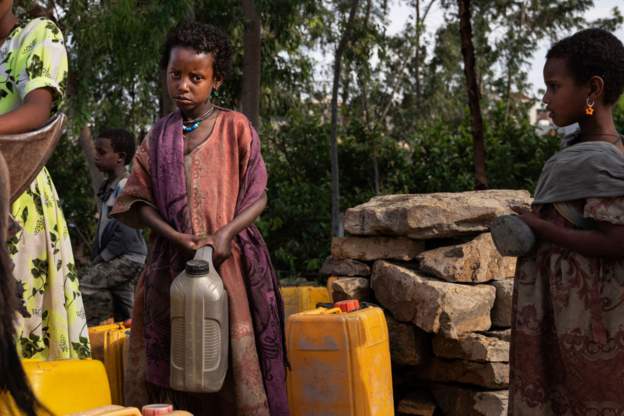
Over the past two months, the regional government of Tigray has reported that at least 728 people have lost their lives following the suspension of food aid by the US and the UN to the war-torn region in Ethiopia.
According to an official from Tigray’s Disaster Risk Management Commission, Gebrehiwot Gebregziaher, the majority of the victims were children, pregnant mothers, and individuals with pre-existing health conditions.
Although USAid and the UN World Food Programme (WFP) officially halted aid in April due to concerns over theft and resale of the shipments, in reality, many Tigrayans had been deprived of assistance long before the formal suspension. This prolonged period without aid has exacerbated the humanitarian crisis in the region.
The situation highlights the urgent need for sustained humanitarian support and a robust mechanism to ensure the effective delivery of aid to the vulnerable population in Tigray. Addressing the challenges of theft and ensuring that aid reaches those in dire need is crucial to prevent further loss of life and alleviate the suffering of the affected communities.
People feel they are “dying of famine in the dark even though it is declared to the world [that] peace is flourished,” said Dr Gebrehiwot, referring to a peace deal made in Pretoria in November last year between Ethiopia’s government and TPLF rebels after two years of civil war.
A prominent figure within the National Democratic Congress (NDC), Victor Smith, has called for an investigation into the citizenship status of other MPs following the removal of James Gyakye Quayson as Member of Parliament for Assin North, for failing to renounce his Canadian citizenship prior to the 2020 elections.
According to Mr Smith, he possesses information regarding an MP from the New Patriotic Party (NPP) who applied for the renunciation of her US citizenship at a later date than Gyakye Quayson did for his Canadian citizenship.
The MP in question represents the Nsuta-Kwaman-Beposo Constituency and happens to be Adelaide Yaa Agyeiwaa Ntim, the sister of NPP National Chairman Stephen Ntim.
“Gyakye Quayson is in court for something to do with dual nationality. There are a few people in there (parliament) and we have to investigate this. It is documented that one NPP MP, called Yaa Agyeiwaa Ntim, a sister of the NPP chairman, had a similar issue.
“Even for her, she said she filed for her renunciation in 2020 before she went for the election. I’m almost certain that if we look at her document or that from the US Embassy, we would see that her renunciation did not take effect before we went into the election. But as for her, they have left her remaining as an MP,” he said in Twi in an Ahorot FM interview on Thursday, June 22, 2023.
Victor Smith, a former High Commissioner of Ghana to the United Kingdom, said that he is certain that the NPP MP did not get her renunciation certificate from the US government just like Gyakye Quayson before the 2020 election.
“In the case of Gyakye Quayson, they agreed that he has renounced his foreign citizenship but at the time he went for the election, the approval had not been given and so because of that he can’t be an MP,” he said.
He called on the NPP MP to prove him wrong saying, “I’m asking that this woman, Yaa Agyeiwaa Ntim, the MP for Nsuta-Kwaman-Beposo, to bring documents to show that the time she went for election, the US government had approved her renunciation.”
Air India dispatched a plane on Wednesday to pick up hundreds of U.S.-bound passengers have been left stranded in Russia.
The flight was forced to make an emergency landing in the country’s far east.
Flight AI173 departed from Delhi to San Francisco on Tuesday with 216 passengers and 16 crew onboard when it developed a technical issue with one of its engines, Air India said in a statement.
The decision to land in the country despite those complications sparked criticism on social media.
The flight was diverted to the Siberian port town of Magadan, where it was able to land safely, the airline said. Air India said local authorities at the airport extended “all cooperation and support upon the flight’s arrival.”
The airline said it made “sincere attempts to accommodate passengers in hotels locally with the help of local government authorities. But it said passengers were “eventually moved to a makeshift accommodation.”
“As we do not have any Air India staff based in the remote town of Magadan or in Russia, all ground support being provided to the passengers is the best possible in this unusual circumstance,” Air India said.
UPDATE: FERRY FLIGHT TO MAGADAN AIRBORNE
Our ferry flight AI195 from Mumbai (BOM) to Magadan, Russia (GDX) is now airborne, and is expected to arrive at GDX at 0630 Hours (local time) on 08 June 2023.
On Wednesday, the airline said a replacement ferry flight, AI195, was on its way to Magadan and was expected to arrive at around 6:30 a.m. Thursday local time (3:30 p.m. ET Wednesday).
Sharing video of the replacement flight taking off, the airline said a team was onboard the flight to “provide any support that the passengers and staff at GDX may require.”
“The ferry flight is carrying essentials in addition to sufficient amount of food to cater to all passengers on the onward flight scheduled from GDX to San Francisco,” it said, adding that the aircraft would transport all passengers and crew onward to San Francisco on Thursday.
In a State Department briefing on Tuesday, principal deputy spokesperson Vedant Patel said the department was “aware of a U.S. bound flight that had to make an emergency landing in Russia.”
He said he wasn’t able to confirm how many U.S. citizens were aboard the flight, but said it was “likely” that there were Americans involved as the flight was bound for the U.S.
One stranded passenger told Indian broadcaster NDTV there were many U.S. citizens on the flight who were worried, given the tension between Russia and the United States.
“There are a lot a nervous people here,” said the passenger, according to Reuters, which named them only as Gagan.
Air routes have been disrupted since Russia issued a ban on some foreign carriers using its airspace in retaliation for Western sanctions over the war in Ukraine.
While U.S., European and Japanese carriers have stopped flying over Russia, Air India and other airlines have continued to do so.
As Air India faced mounting criticism on social media, the airline apologized in a tweet “for all the inconvenience caused” by making the emergency landing in Russia.
Video shared on social media is purported to show passengers sleeping on thin mattresses on the floor with blankets in what appears to be a classroom.
Responding to a tweet sharing the video, the airline said: “We understand the situation,” adding that its replacement plane was on the way. NBC News has not verified the video.
“My relatives are in that flight and they are still struggling to take care of themselves,” one person wrote. NBC News was not immediately able to verify their account.
“We understand how frustrating and concerning this must be for you and your loved ones,” Air India said, responding to the tweet.
“Please know that we take these situations very seriously and will do our utmost to ensure that all passengers are taken care of and able to continue their travels safely,” the airline said.
Air India did not immediately respond to a request for more information from NBC News.
Girvaan Singh Kahma, 16, was traveling on the flight with his uncle and brother. He told the Associated Press they were barred from leaving the hostel where they were staying in Magadan and couldn’t use their credit cards to buy things because of sanctions over Russia’s war on Ukraine.
“The first day and a half was really hard for all of us,” he said. “The weather went to 3 to 4 degrees (Celsius, or 37 to 39 Fahrenheit) in the morning, and in the night it was bitter cold,” he said, according to the news agency, adding that it was getting better with food and a place to sleep.
“The Russian soldiers, the Russian police, the authorities, everyone working in the hostel has been treating us extremely well,” he reportedly said.
After serving a four-year prison sentence for stabbing a friend, Sam Safo, a popular Ghanaian musician and socialite known as Showboy, is set to be deported from US to Ghana.
Showboy who announced his release from prison today, June, 7, on Instagram yesterday said he wanted to be in Ghana.
“Follow my new snap chat-Ahantan. I wish I was in Ghana lol. Anyways, I’m getting released tomorrow 06/07,2023 … my last night in prison!(sic)”.
Showboy was sentenced to serve six years in prison in March 2019 for stabbing Junior US, a US based Ghanaian musician during a tussle.
Junior US survived the stabbing but was later killed in a robbery attack in 2021.
At the time of Junior’s death, many people accused Showboy’s “men” for carrying out the crime but that was disputed when the real culprits were later apprehended by the US Police.
Showboy had a good relationship with Criss Waddle
Even though Showboy was in detention, he was quite active on social media giving details of his life and events leading to his incarceration.
In one of his posts last year, he accused Criss Waddle, founder of AMG Record label, which he is said to be co-founder for setting him up.
“5yrs ago Criss Waddle sent junior us to my house (apartment) … they set me up..my life hasnt been the same since then. July 3,2016 . I never forget this day. U can read the statement and see the lies they told police, came to court and denied everything and said they scared of me,”
“Told court am a Gunsta .. prosecutor told me I got a Huge Ego and said I call the shot .. I was profiled .. if not Criss Waddle sending Junior to me to come pay me money he Criss Waddle owed ..all this never was going to happen .. Junior us was never my friend. That was Criss Waddle friend that hated on me out of jealousy .. I was set up by Criss Waddle and his friends. .thats the facts … still ain’t got no visit from Criss Waddle till today. .. haven’t seen him in 5yrs(sic),” he wrote at the time.
Perhaps, Showboy gave a hint of his deportation in April this year in a Facebook post.
This is what he said, “Dem want deport me ..a make sad rough. .. a taya for life … if a come Ghana too Boyz want beat me especially criss waddle and shatta wale in friends lol …. make a sign for deportation or sit for another 1yr or 2 for immigration detention to fight for ma stay and still be on 9yrs probation. .. or to just sign for the deportation n come face death or happineass in Ghana …… lol am stressed, I can’t think far ..
Sometimes I think God don’t like me”.
till today. .. haven’t seen him in 5yrs “
“Being doing time for almost 2 and half years now … still depressed ..still suffering mentally … I am not innocent ,I was attacked first and I defended myself by stabbing. .I dont have control off ma adrenaline ..I did whatever to survive at the moment. .THEY SET ME UP ..TOOK MY FREEDOM FROM ME …. U ASK WHY AM MENTALLY UNSTABLE..THIS IS .. I DONT HAVE NO FRIEND ,NOBODY TO TRUST … JUST FAKE LOVE ALL AROUND ME (sic)”.
British Airways has been fined $1.1 million (£878,000) by the US government for allegedly failing to provide timely refunds to passengers whose flights were canceled during the pandemic.
The US Department of Transportation reported that the airline received over 1,200 complaints regarding this issue.
According to the department, between March and November 2020, British Airways’ website instructed customers to contact the airline by phone to discuss refund options for canceled or significantly changed flights.
However, customers faced difficulties in reaching customer service agents as the airline failed to maintain proper functionality of its phone lines for several months during this period.
British Airways has disputed these allegations, stating that it has always acted lawfully.
“There was also no way to submit a refund request through the carrier’s website during this period,” the department said.
It added that from March to November 2020, misleading information on BA’s website had led consumers to inadvertently request travel vouchers instead of refunds.
It said that along with the 1,200 complaints received by the department, BA had received thousands more complaints and refund requests directly from consumers.
The department said the failures had “caused significant challenges and delays in thousands of consumers receiving required refunds”.
It added that the fine established a “strong deterrent to future similar unlawful practices”.
BA will be credited $550,000 towards the penalty because it paid more than $40m in refunds to customers with non-refundable tickets in 2020 and 2021.
The airline said: “We’re very sorry that at the height of the unprecedented pandemic – when we were unfortunately forced to cancel thousands of flights and close some call centres due to government restrictions – our customers experienced slightly longer wait times to reach customer service teams.
“During this period, we acted lawfully at all times and offered customers the flexibility of rebooking travel on different dates, or claiming a refund if their flights were cancelled.
“To date, we have issued more than five million refunds since the start of the pandemic.”
The US Congress has successfully passed a deal to raise the nation’s borrowing limit, averting a potential default on its debt just days before the deadline.
The bipartisan agreement swiftly moved through the Senate with a vote of 63-36, following its approval in the US House of Representatives.
President Joe Biden has expressed his intention to sign the bill into law, ensuring that the United States avoids a disastrous default on its substantial $31.4tn (£25tn) debt.
With the country projected to surpass its existing debt ceiling on Monday, June 5th, this legislation provides a crucial resolution to the looming financial crisis.
Failure to raise the borrowing limit would severely restrict the government’s ability to borrow money and meet its financial obligations, with far-reaching implications both domestically and internationally. It would have a detrimental impact on global markets, affecting prices and mortgage rates in other countries.
During Thursday night’s session, the bill received backing from 44 Democrats, 17 Republicans, and two independents. In the 100-seat chamber, which is narrowly controlled by Democrats, a minimum of 60 votes was required to pass the measure.
Thirty-one Republicans, including prominent party member John Barrasso, opposed the bill. Notably, four Democrats, including senators Bernie Sanders, John Fetterman, and Elizabeth Warren, voted against it.
Initially, senators proposed 11 amendments to the debt ceiling bill. However, all of these amendments were swiftly rejected, clearing the path for the final vote. Had any of the amendments passed, the entire bill would have had to be returned to the House for further consideration, leaving little time to secure its final passage before the US faced a perilous financial situation.
“America can breathe a sigh of relief, a sigh of relief because in this process we are avoiding default,” Democratic Majority leader Chuck Schumer told the Senate.
In a rare display of bipartisanship, Senate Republican leader Mitch McConnell told reporters he would be “proud to support it without delay”.
The deal easily cleared the House on Wednesday evening by a vote of 314-117. Some 165 Democrats joined 149 Republicans in approving it by the required simple majority.
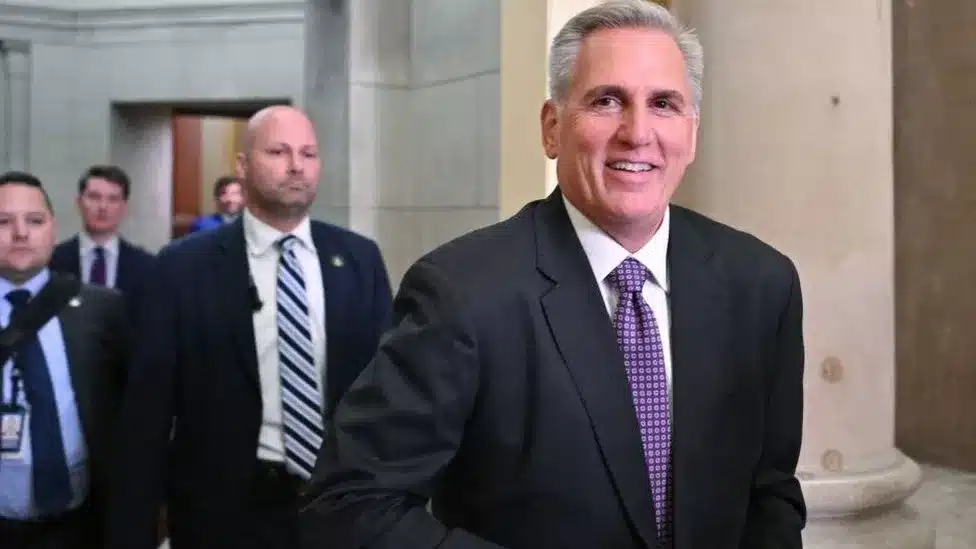
With Republicans in control of the lower chamber of Congress and Democrats holding sway in the Senate and White House, a deal proved elusive for weeks until Mr Biden and House Speaker Kevin McCarthy inked a compromise last weekend.
The agreement suspends the debt ceiling, the spending limit set by Congress that determines how much money the government can borrow, until 1 January 2025.
The legislation will result in $1.5tn in savings over a decade, the independent Congressional Budget Office said on Tuesday.
The contents of the bill drew objections from both right-wing Republicans and left-wing Democrats, but there were more than enough political centrists in both parties to get it over the line.
The last time the US came this close to overshooting its debt ceiling, in 2011, the credit agency Standard & Poor’s downgraded the country’s rating, a move that has yet to be reversed.
Ahead of the Senate vote, US stock markets made gains, with the Dow closing 0.5% higher. The broader S&P 500 index rose by 1% and the tech-heavy Nasdaq ended the day 1.3% higher.
The United States has moved closer to enacting a deal that allows the country to borrow additional funds, just days before it faces the risk of defaulting on its debt.
The proposed measure easily cleared the House of Representatives with a vote of 314-117, despite some members defecting from both sides of the aisle.
The Senate is currently convening for a vote, which is crucial for the bill to proceed to President Joe Biden for signing into law.
The government is projected to reach its borrowing limit on June 5th, leaving little room for error as lawmakers rush to prevent a default on the nation’s $31.4 trillion (£25 trillion) debt, which serves as the foundation of the global financial system.
A default would have severe implications, preventing the government from borrowing further funds or fulfilling all its financial obligations. This scenario would also have far-reaching consequences for the global economy, impacting prices and mortgage rates in other countries.
On Wednesday evening, 165 Democrats joined 149 Republicans in approving the 99-page bill to raise the debt ceiling, allowing it to pass the House by the required simple majority.
With Republicans in control of the lower chamber of Congress and Democrats holding sway in the upper chamber and White House, a deal had proven elusive for weeks until Mr Biden and House Speaker Kevin McCarthy inked a bipartisan compromise over the weekend.
In a statement, Mr Biden thanked the speaker, saying he had negotiated in good faith.
“Neither side got everything it wanted,” said the president. “That’s the responsibility of governing.”
An Australian guy who was snorkelling off the coast of far-north Queensland when he was bitten on the head by a crocodile managed to escape the unique attack by prying apart the reptile’s jaws.
The avid surfer and diver Marcus McGowan was snorkelling with his wife and a group of friends near a remote island off the northern edge of the country when he felt something had “got its jaws around my head.”
McGowan said in a statement on Tuesday that he initially believed he had been bitten by a shark, but that as he reached up, he discovered it was actually a crocodile.
“I was able to lever its jaws open just far enough to get my head out,” recalled the Gold Coast resident, who said the crocodile then struck at him again, but he managed to push it away with his hand.
The boat that had taken McGowan’s group to the diving spot near Charles Hardy Islands, some 40 kilometers off the coast, heard their screams and came to retrieve them.
McGowan was rushed to Haggerston, a resort island some 45 minutes away, before being helicoptered to a regional hospital. He suffered cuts and puncture wounds to his head and hands.
“I was simply in the wrong place, at the wrong time. I’m just grateful it was me and not one of the kids or ladies in the group,” he said in the statement.
McGowan said the attack happened so quickly he was unable to get a proper look at the croc but guesses it was a juvenile, about two to three meters long.
Saltwater crocodiles can grow up to six meters long and weigh up to 1,000 kilograms, according to Australia Zoo.
Known locally as “salties,” the reptiles are more commonly found in the country’s warmer northern regions. According to federal government estimates, there are about 100,000 saltwater crocodiles in Australia.
Crocodiles were sighted on nine occasions in Cook Shire on Cape York since the start of this year, according to the Queensland government.
Nvidia shares jumped this week, bringing the company’s valuation close to the trillion dollar threshold.
The increase was triggered by the company’s latest quarterly results, which were revealed late on Wednesday. The business stated that it was increasing chip output to fulfill “surging demand.”
Nvidia has come to dominate the market for artificial intelligence (AI) chips.
Interest in that sector reached frenzied levels after ChatGPT went public last November, which sent a jolt well beyond the technology industry.
From helping with speeches, to computer coding and cooking, ChatGPT has proved to be a wildly popular application of AI.
What is ChatGPT?
But all that would not be possible without powerful computer hardware – in particular computer chips from California-based Nvidia.
Originally known for making the type of computer chips that process graphics, particularly for computer games, Nvidia hardware underpins most AI applications today.
“It is the leading technology player enabling this new thing called artificial intelligence,” says Alan Priestley, a semiconductor industry analyst at Gartner.
“What Nvidia is to AI is almost like what Intel was to PCs,” adds Dan Hutcheson, an analyst at TechInsights.
ChatGPT was trained using 10,000 of Nvidia’s graphics processing units (GPUs) clustered together in a supercomputer belonging to Microsoft.
Image caption,The widely used A100 GPU costs upwards of $10,000
“It is one of many supercomputers – some known publicly, some not – that have been built with Nvidia GPUs for a variety of scientific as well as AI use cases,” says Ian Buck, general manager and vice president of accelerated computing at Nvidia.
Nvidia has about 95% of the GPU market for machine learning, noted a recent report from CB Insights.
Its AI chips, which it also sells in systems designed for data centres, cost roughly $10,000 (£8,000) each, though its latest and most powerful version sells for far more.
So how did Nvidia become such a central player in the AI revolution?
In short, a bold bet on its own technology plus some good timing.
Image caption,In 2006 Nvidia chief executive Jensen Huang made the company’s chips programmable
Jensen Huang, now the chief executive of Nvidia, was one of its founders back in 1993. Then, Nvidia was focused on making graphics better for gaming and other applications.
In 1999 it developed GPUs to enhance image display for computers.
GPUs excel at processing many small tasks simultaneously (for example handling millions of pixels on a screen) – a procedure known as parallel processing.
In 2006, researchers at Stanford University discovered GPUs had another use – they could accelerate maths operations, in a way that regular processing chips could not.
It was at that moment that Mr Huang took a decision crucial to the development of AI as we know it.
He invested Nvidia’s resources in creating a tool to make GPUs programmable, thereby opening up their parallel processing capabilities for uses beyond graphics.
That tool was added to Nvida’s computer chips. For computer games players it was a capability they didn’t need, and probably weren’t even aware of, but for researchers it was a new way of doing high performance computing on consumer hardware.
It was that capability that helped sparked early breakthroughs in modern AI.
In 2012 Alexnet was unveiled – an AI that could classify images. Alexnet was trained using just two of Nvidia’s programmable GPUs.
The training process took only a few days, rather than the months it could have taken on a much larger number of regular processing chips.
The discovery – that GPUs could massively accelerate neural network processing – began to spread among computer scientists, who started buying them to run this new type of workload.
“AI found us,” says Mr Buck.
Nvidia pressed its advantage by investing in developing new kinds of GPUs more suited to AI, as well as more software to make it easy to use the technology.
A decade, and billions of dollars later, ChatGPT emerged – an AI that can give eerily human responses to questions.
Image caption,In 2021 Metaphysic made headlines with its Tom Cruise deep fakes
AI start-up Metaphysic creates photorealistic videos of celebrities and others using AI techniques. Its Tom Cruise deep fakes created a stir in 2021.
To both train and then run its models it uses hundreds of Nvidia GPUs, some purchased from Nvidia and others accessed through a cloud computing service.
“There are no alternatives to Nvidia for doing what we do,” says Tom Graham, its co-founder and chief executive. “It is so far ahead of the curve.”
Yet while Nvidia’s dominance looks assured for now, the longer term is harder to predict. “Nvidia is the one with the target on its back that everybody is trying to take down,” notes Kevin Krewell, another industry analyst at TIRIAS Research.
Other big semiconductor companies provide some competition. AMD and Intel are both better known for making central processing units (CPUs), but they also make dedicated GPUs for AI applications (Intel only recently joined the fray).
Google has its tensor processing units (TPUs), used not only for search results but also for certain machine-learning tasks, while Amazon has a custom-built chip for training AI models.
In addition, for the first time in decades, there are also computer chip start-ups emerging, including Cerebras, SambaNova Systems and Habana (bought by Intel). They are intent on making better alternatives to GPUs for AI by starting from a clean slate.
UK-based Graphcore makes general purpose AI chips it calls intelligence processing units (IPUs), which it says have more computational power and are cheaper than GPUs.
Founded in 2016, Graphcore has received almost $700m (£560m) in funding.
Its customers include four US Department of Energy national labs and it has been pressing the UK government to use its chips in a new supercomputer project.
“[Graphcore] has built a processor to do AI as it exists today and as it will evolve over time,” says Nigel Toon, the company’s co-founder and chief executive.
He acknowledges going up against a giant like Nvidia is challenging. While Graphcore too has software to make its technology accessible, it is hard to orchestrate a switch when the world has built its AI products to run on Nvidia GPUs.
Mr Toon hopes that over time, as AI moves away from cutting-edge experimentation to commercial deployment, cost-efficient computation will start to become more important.
Back at Nvidia, Ian Buck is not overly concerned about the competition.
“Everyone has the need for AI now,” he says. “It is up to others to work out where they are going to make a contribution.”
Lawmakers in Connecticut have agreed to exonerate 12 persons who were convicted of witchcraft in colonial America more than 370 years ago.
Eleven of the 12 were hanged after trials that the state Senate now acknowledges were a “miscarriage of justice”.
It follows a long-running campaign by descendants to clear the names of those wrongfully accused of being witches.
Dozens were executed for witchcraft in the US in the 17th Century.
On Thursday, Connecticut’s Senate voted 33-1 to exonerate those convicted in trials that took place in the state in the mid-to-late 1600s.
The senator who voted against the move, Rob Sampson, said that he believed it was wrong to “dictate what was right or wrong about periods in the past that we have no knowledge of”.
“I don’t want to see bills that rightfully or wrongfully attempt to paint America as a bad place with a bad history,” he was quoted as saying by the Associated Press.
“I want us to focus on where we’re going, which is a brighter and better future.”
The resolution had already passed in Connecticut’s House of Representatives, with 121 votes in favour and 30 against.
The resolution follows nearly two decades of lobbying by the CT Witch Trial Exoneration Project, a group set up in 2005 by descendants of the accused.
The group said they are “ecstatic, pleased, and appreciative” especially as the decision comes on the eve of the 376th anniversary of the first witch-hanging in New England – that of Alice Young.
“We are grateful to descendants, advocates, historians, legislators of both parties and many others who made this official resolution possible.”
They added that they “will continue to advocate for historical education and memorialisation of the witch trial victims“.
Some members of the organisation discovered their family links using genealogy tests.
The family members and their supporters argue that the exonerations are an important step to learning from the mistakes of the past.
Saud Anwar, a state senator who took an interest after a constituent discovered their ancestor was a witch accuser, told the AP that witchcraft trials still take place around the world.
“It’s relevant, even to this time as well,” he said.
The Witch Trial Exoneration Project hopes that in addition to correcting past wrongs, that this will bring awareness to “deadly witch hunts still happening in many parts of the world due to fear, misogyny and superstition”.
At least 45 people were accused of witchcraft in colonial Connecticut, although the Witch Trial Exoneration Project believes the record is likely incomplete.
In the more widely-known Salem Witch Trials in nearby Massachusetts, about 200 people were accused, leading to the deaths of 25 people.
Last August, Massachusetts formally exonerated Elizabeth Johnson, the last person to be convicted during the Salem Witch Trials.
While initially sentenced to death, she was granted a reprieve and lived to be 77. Historians now believe she suffered from a mental disability.
Other countries have also sought to recognise people that were unfairly persecuted for witchcraft in the past.
Last year, then-First Minister of Scotland Nicola Sturgeon offered a formal apology to 4,000 Scots, mostly women, who were accused of witchcraft between 1563 and 1736.
Reports indicate that a businessman named Emmanuel Kodjo Narh has been sentenced to a 12-month jail term for bigamy by an Accra Circuit Court.
Justice Christina Cann, who presided over the case, stated that the accused person had initially been cleared of charges of threats to harm until the prosecution successfully established the crime of bigamy.
The report reveals that the complainant, a nurse residing in the USA and a native of Odumase Krobo, had a valid marriage with Narh, while he was also legally married to another woman in Ghana.
The prosecution presented the sequence of events, explaining that the complainant, who was abroad in the USA in June 2015, received a call from her property manager in Ghana informing her about a road construction near her property. The property manager provided the complainant with several phone numbers, including Narh’s, to address the issue. Narh answered the call and promised to handle the problem.
According to the report, Narh and the complainant developed a friendship from their initial interaction, with Narh calling her daily to check up on her. In August 2015, Narh proposed to the complainant, but she declined, expressing her desire to get to know him in person first. She planned to visit Ghana to discuss the proposal.
The prosecution continued, stating that the complainant and Narh met for the first time on October 26, 2015, when she arrived at the airport. On October 28, 2015, Narh proposed to her with a ring, introduced her to his family, and showed her some of his workers.
During their engagement, the complainant discovered another marriage certificate dated October 4, 2008, between Narh and another woman. It was later revealed that Narh had children with two other women without being married to them. The complainant, who was a divorcee, decided to end the marriage upon returning to the USA.
The matter was reported to the police, leading to the arrest of Narh’s first wife. Narh claimed that both women were his wives. The complainant sought to dissolve the fraudulent marriage upon her return to the USA.
On June 3, 2019, the complainant received a threatening message from Narh through his son’s phone, stating, “We shall see, but this time, this is going to be a tribal war, I swear.”
The complainant lodged a petition with the director general of the Criminal Investigations Department (CID) through her lawyer, which was subsequently referred to the Domestic Violence and Victims Support Unit (DOVVSU) at the Police Headquarters in Accra.
The prosecution revealed that Narh was invited for questioning, during which he stated that the marriage between him and the complainant was a “planned thing” aimed at facilitating travel documents for his daughter to the USA.
US President Joe Biden has expressed optimism regarding the ongoing discussions with top Republican Kevin McCarthy concerning the US debt ceiling, despite Congress going on a holiday weekend recess.
Their objective is to strike a deal to raise the government borrowing limit for a two-year period, ensuring that the nation can continue meeting its financial obligations.
The urgency stems from the approaching 1 June deadline for a potential US debt default, which would have severe repercussions on the economy and create a global impact.
President Biden mentioned “several productive conversations” with McCarthy, highlighting the positive momentum in their negotiations.
If an agreement is reached, both parties could claim victories. Republicans could secure spending curbs, while Democrats could protect important domestic programs.
Speaking at a White House event on Thursday, President Biden affirmed that his team was maintaining communication with McCarthy’s team, emphasizing that progress was being made in the discussions.
He added: “I made clear time and again defaulting on our nation debt is not an option.” He said Americans deserved certainty over issues such as social security payments.
The debt ceiling is a spending limit set by Congress which determines how much money the government can borrow – an issue on which Democrats and Republicans disagree.
With no deal yet struck, the Treasury has warned that the US will not have enough money to pay all of its bills as soon as 1 June.
Analysts say there could be severe economic consequences if the US fails to honour its obligations.
‘Two-year deal’
A US official told Reuters that the White House was considering scaling back an increase of the Internal Revenue Service to hire more auditors, which was intended to target wealthy Americans.
The Times reported negotiators were closing in on a deal that would raise the debt limit for two years while imposing strict caps on spending, with the military and veterans’ budgets protected from caps.
Republicans are seeking spending cuts in exchange for raising the $31.4tn (£25tn) cap on government borrowing.
Mr McCarthy – who leads Republicans in the House and has been the most high-profile public face of the talks for his party – earlier said Democrats and Republicans had worked past midnight on Wednesday and would continue to negotiate.
“There’s a couple of issues still hanging out there that we’ve got to get done,” he said. “We’re gonna work 24/7 to try to make that happen.”
Another key Republican said he believed a deal to raise the nation’s debt-ceiling deal was “likely” by Friday afternoon.
“We are inching closer to a deal. I think it’s some of the finer points they are working on right now,” Rep Kevin Hern told Reuters news agency. “You are likely to see a deal by tomorrow afternoon.”
“Neither side is going to get exactly what they want,” White House press secretary Karine Jean-Pierre said.
The S&P 500 and the Nasdaq were trading higher at midday on Thursday, lifted by positive updates on earnings from some companies, while the Dow Jones Industrial Average was down about 0.6%.
That followed several days of declines. Any agreement formed between the two sides will need to be turned into a legislative text to be approved by Congress.
Mr McCarthy has promised to give lawmakers 72 hours to review the bill, and at least 24 hours’ notice if they have to return to Washington early. If a deal is reached this week, a vote could happen early next week.
There is little wiggle room for objections to be raised, as the Senate would also have to vote on the bill, which would then go to the White House for signing.
Lawmakers could also temporarily lift the debt cap to give the talks more time.
Detective Chief Superintendent James Conway said: ‘I do not underestimate the widespread upset, distress and concern that these videos caused.
‘Some people have referred to these as ‘prank’ videos, but I hope that this significant development demonstrates just how seriously we have been taking this investigation since this footage began circulating online.
‘A number of these videos were produced, impacting on many different people and our investigation remains ongoing as we seek to build a strong picture of both the activity featured in the footage and impact on the public.’
Alli Nansolo debated whether or not to trim his son’s dreadlocks for years. Although it is not required by law in Malawi, a widespread unwritten policy meant that his son was being turned away from government schools because of the colour of his hair.
With his meagre earnings from manufacturing dresses, Nansolo’s was unable to provide his son Ishmael with a private education, and cutting his hair—a significant Rastafari religious symbol—was out of the question.
“The rastafari way of life is spiritual. Maintaining dreadlocks is comparable to making a pledge before the Most High Creator that we shall live our lives in service to Him without disobeying His Laws or Commandments, according to Nansolo, who spoke to CNN.
The 48-year-old makes between 200,000 to 300,000 Malawian Kwacha (around $194 to $291) monthly, while his wifeEmpress supplements the family’s income by selling secondhand clothes.
“I felt oppressed,” Nansolo said as he recalled the staff of a state-run secondary school in Zomba, southern Malawi. refusing to register Ishmael because of his hair.
Nansolo said he contacted an officer at the Ministry of Education who advised him to cut his son’s hair so that he could go to school.
Nansolo found himself caught up in the discriminatory policies of Malawian public schools and decided to take legal action against the Ministry of Education, along with a group of parents.
“I went to the Women Lawyers Association of Malawi to ask for help. The association accepted and we went to court in November 2017,” he said.
For three years, Ishmael, then 15, would remain out of school as the court case dragged on.
Then, in 2020, the Malawi High Court placed an interim order compelling public schools to enroll Ishmael and other Rastafari children until a final ruling was reached.
It was a legal victory that marked a significant milestone for the estimated 15,000 Rastafarian community in Malawi, according to Nansolo, who is also a community elder.
However, the temporary relief did not address the broader issue of discrimination that around 1,200 affected students face, their lawyer Chikondi Chijozi told CNN.
“We saw a number of Rastafari children being admitted into government schools but there were still reported cases of children of [the]Rastafari community being denied admission into government schools, and their parents were forced to take the court injunction to the school to compel them to admit them,” Chijozi said.
After a six-year legal challenge, the Malawian High Court delivered a landmark ruling on May 8.
The court ruled that it was unlawful to require learners, including Rastafarian kids, to cut their hair before they are enrolled into public schools.
The ruling came into immediate effect but the government has until June 30 to issue a nationwide statement mandating acceptance of all dreadlocked children into school.
Chijoki told CNN: “We got a judgment from the court which essentially upheld the rights of the Rastafari children and abolished the policy that requires all learners, including Rastafari children, to cut off their dreadlocks for them to be admitted into government schools.”
Nansolo expressed his community’s jubilation that their children could now finally continue their education.
“The judgment means that we are now free because most of us in [the]Rastafarian community don’t earn much, so we couldn’t manage to send our children to private schools,” Nansolo said.
“We are happy seeing that our children will now be going to public schools without being sent back or denied their right to education.”
CNN has contacted the education ministry for comment on the ruling.
Despite this victory, Malawi’s Rastafarian community still faces numerous challenges. Unemployment, poverty, and corporate discrimination persistently plague the community. Data on the community is hard to come by but the US State Department says around 5.6 percent of Malawi’s nearly 21 million population is formed of other religions includingHindus, Baha’is, Rastafarians, Jews, and Sikhs.
“Most of us rely on business to survive. Lack of jobs is a big challenge for the Rastafarian community because those in offices are reluctant to employ Rastas,” Nansolo said.
“The corporate world feels that being Rastafari is associated with criminality, but we are not like that.”
Jojo Mills-Robertson recognised for his role in ‘Efiewura’ series as Sofo Joe has recounted a scheme executed by someone he regarded as a friend that would have gotten him deported from the United States.
During his initial stay at the US, the Ghanaian actor noted that he did not have in his possession the required documents to make him a legal migrant.
However, he had been saving to ensure he goes through the right process. He decided to have his money saved in his friend’s account (Joe, not his real name) which was later allegedly squandered on his blind side.
“Later when I asked for my money, he kept telling me I shouldn’t worry he will give it to me. Then I told him that he knew I needed the money for some important things but he still told me to be patient.
“One day, he called me that I should come so we go to the bank for my money. With excitement, I sat in the car. When we got to a traffic light, although the red light was on, my friend still crossed on a top speed and I was wondering why,” he said in the local parlance.
A police vehicle then pursued them and finally caught up to them. Before the officer’s arrival, Jojo said “my friend asked me to put my hand on the dashboard because the police there were very disciplined so I obeyed.”
Upon his arrival, the officer is said to have asked why they crossed the red light.
“My friend explained to him that it was a mistake,” he said.
The officer asked for Joe’s driving licence and after a brief investigation, realised the car has no record.
“Don’t we have any illegal thing in our car?” Jojo said the officer then asked. According to him, immediately the question was posed, Joe pointed to him that he is illegal.
“He said ask this gentleman. He does illegal stuff. So, the police said why is he pointing at me when I am not the one driving the car. Then the policeman asked my name and then I mentioned it; then he asked for my documents but I told him I didn’t have; then my friend told him, I’m a criminal, I don’t have papers.”
“But the policeman insisted that even if I don’t have papers, I am not the one driving the car and told my friend that he is not an immigration officer so why did he cross the red light? The policeman added that since you say you’re not involved in illegality and your friend also has no papers, what do we do?” he quizzed.
In the end, he said the policeman gave Joe a citation and asked him not to do that again.
“When we got home, then I told my friend that I want to go and see my nephew in Virginia and he asked me what I was going to do there and I told him I was going to visit him and that was when I never returned again to his house,” he added.
China claims that US memory chip manufacturer Micron Technology’s goods pose a threat to national security.
The nation’s cyberspace authority declared on Sunday that the nation’s top memory chip manufacturer presents “serious network security risks.”
It implies that the company’s goods won’t be allowed in significant infrastructure projects in the second-largest economy in the world.
It is China’s first major move against a US chip maker, as tensions increase between Beijing and Washington.
The announcement is the latest development in a deepening row between the US and China over the technology crucial to economies around the world.
The long-running dispute has seen Washington impose a series of measures against Beijing’s chip making industry and invest billions of dollars to boost America’s semiconductor sector.
In a statement, the Cyberspace Administration of China (CAC) said: “The review found that Micron’s products have serious network security risks, which pose significant security risks to China’s critical information infrastructure supply chain, affecting China’s national security.”
The CAC did not give details of the risks it said it had found or in which Micron products it had found them.
A Micron spokesperson confirmed to the BBC that the company had “received the CAC’s notice following its review of Micron products sold in China”.
“We are evaluating the conclusion and assessing our next steps. We look forward to continuing to engage in discussions with Chinese authorities,” they added.
In response, the US government said it would work with allies to address what it called “distortions of the memory chip market caused by China’s actions”.
“We firmly oppose restrictions that have no basis in fact,” a US Commerce Department spokesperson said.
“This action, along with recent raids and targeting of other American firms, is inconsistent with [China’s] assertions that it is opening its markets and committed to a transparent regulatory framework.”
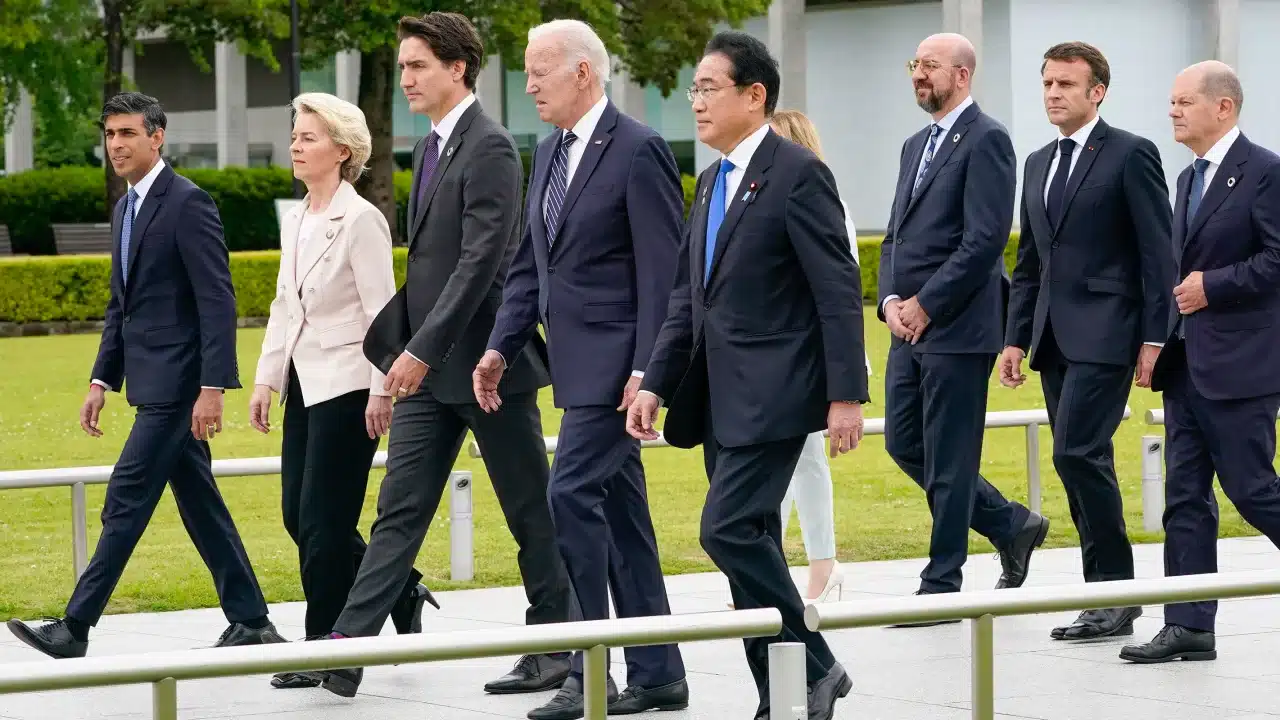
The CAC’s announcement came a day after a G7 leaders meeting in Japan issued a joint statement which criticised China, including its use of “economic coercion”.
On Sunday, US President Joe Biden said G7 nations were looking to “de-risk and diversify our relationship with China”.
“That means taking steps to diversify our supply chains,” he added.
Micron chief executive Sanjay Mehrotra attended the summit in Hiroshima as part of a group of business leaders.
Last week, the company said it would invest around 500bn yen ($3.6bn; £2.9bn) to develop technology in Japan.
A senior administration official tells CNN that President Joe Biden reminded the G7 leaders on Friday that the US will back an initiative to educate Ukrainian pilots on fourth generation aircraft, including F-16s, in collaboration with allies and partners.
The official stated that the training is most likely to take place exclusively in Europe and is not anticipated to take place in the US. However, the official stated that representatives from the US will train alongside European friends and partners. The completion time is anticipated to be many months, and the official expressed hope that it will start “in the coming weeks.”
The decision marks a stark turnaround for Biden, who said earlier this year that he did not believe that Ukraine needed the F-16s. The decision to support the training initiative came together very quickly, officials said, and was made by Biden following meetings with G7 leaders in Hiroshima, Japan, where the topic of F-16s to Ukraine was a key point of discussion. UK Prime Minister Rishi Sunak has been pushing particularly hard in recent days for countries that have the jets in their stockpile to send them to Ukraine so that the country can better defend itself against Russia’s daily aerial attacks.
“As the training takes place over the coming months, our coalition of countries participating in this effort will decide when to actually provide jets, how many we will provide, and who will provide them,” the official said.
The official added that “to date, the United States and our allies and partners have focused on providing Ukraine with the vast majority of the systems, weapons, and training it requires to conduct offensive operations this spring and summer. Discussions about improving the Ukrainian Air Force reflect our long-term commitment to Ukraine’s self-defense.”
Ukrainian President Volodymyr Zelensky, who is on his way to the G7 meeting, tweeted to say he welcomed “the historic decision of the United States and @POTUS to support an international fighter jet coalition.”
“This will greatly enhance our army in the sky. I count on discussing the practical implementation of this decision at the #G7 summit in Hiroshima,” Zelensky added.
In March, the US hosted two Ukrainian pilots at a military base in Tucson, Arizona, to evaluate their skills using flight simulators and to assess how much time they would need to learn to fly various US military aircraft, including F-16s. Congress set aside money in the 2023 budget for such training.
CNN reported on Thursday that the Biden administration has signaled to European allies in recent weeks that the US would allow them to export F-16 fighter jets to Ukraine, sources familiar with the discussions said, as the White House comes under increasing pressure from members of Congress and allies to help Ukraine procure the planes amid intensifying Russian aerial attacks.
A handful of European countries have a supply of US-made F-16s, including the Netherlands, which has signaled a willingness to export some of them to Ukraine. But the US would have to approve that third-party transfer because of the jets’ sensitive US technology.
A spokesperson for UK Prime Minister Rishi Sunak said earlier this week that the UK and the Netherlands were looking to form an “international coalition” not only to procure the jets for Ukraine but also to train Ukrainian pilots on the 4th genertion fighters, which are more advanced than the Ukrainian fighter fleet.
Gun regulation and racial crime have been two of the most contentious problems in the United States of America in recent years.
Mass shootings, racially or religiously motivated gun attacks have always brought to the fore how the country should treat guns in private hands but before the politicians agree on anything, the next attacker or assailant strikes.
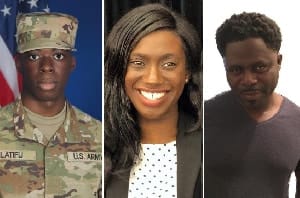
Ghanaian immigrants and or Ghanaian Americans have been victims of gun violence in the last few years, GhanaWeb tracking shows that three Ghanaians have so far been killed in the US this year alone.
They are:
May 2023 – Ghanaian cab driver murdered by three teenagers in New Jersey
A cab driver was shot and killed by a group of young teenagers during a robbery incident in New Jersey, with police identifying the victim as 57-year-old Ghanaian immigrant, Koffi Addo.
Addo came to the U.S. from Ghana in 2006 determined to work hard — and he did, six days a week, driving a school bus by day, a taxi by night. On the night he died, three teenagers reportedly called All Brunswick Taxi and said they needed a ride to the movie theaters. But evidently, their motives were much more sinister.
“He was a beautiful soul to be taken away from us so soon. He had so much more on this Earth to do,” said his widow, Kecia Banks.
Addo had done so much already, having brought his two sons here from Ghana to give them a better life. He also worked to send money back to his village to help others do the same.
He was behind the wheel of his taxi the night of May 18 when he got the call to come to a quiet block of Franklin Township — unaware that three teenagers, just 13 and 14 years old, allegedly lay in wait.
The three teenagers who are charged with killing him are in juvenile detention. His widow, an educator, said that despite her family’s pain, she prays for them.
“Those are someone’s babies and my heart goes out to their families as well. I pray they have strength,” said Banks.
February 2023 – Ghanaian-American councilwoman killed in New Jersey
The New Jersey Republican Party (NJGOP) in the United States issued a statement confirming the murder of one of its members, Councilwoman, Eunice Dwumfuor, a Ghanaian-American.
According to multiple reports by news portals in the US, the 30-year-old, from Sayreville, New Jersey, was found inside her car with multiple gunshot wounds just before 7:30 p.m. on Thursday, February 1, 2023.
The police have since said they believe she was the intended target of the shooting, but they do not have a clear motive, the report added.
Eunice Dwumfour, who was a business analyst and part-time EMT, is said to have been elected to the council in 2021.
January 2023 – Ghanaian-American soldier killed at Alabama military base
A Ghanaian-American family based in the US is mourning the passing of their son who died under strange circumstances at a military base in Alabama.
According to the military, the 21-year-old soldier, Pvt. Abdul-Nafsu Latifu was killed in an “altercation with another soldier” at the Alabama Army post, Fort Rucker where he was training to become an Army air traffic control operator.
A source close to the family revealed that news about his demise was published on local websites in Alabama as early as 11:30 am CST, even though his next-of-kin was officially called four (4) hours later to report that he had been hospitalized and in critical condition.
Pvt. Abdul N. Latifu until joining the US Army lived in New York. He is described as very smart and respectful by all who have encountered him. As relatives, friends, and neighbours visit his New York home to mourn with the family, eulogies and questions continue to pour in.
Ghanaian musician, Nhyiraba Kojo, is soliciting prayers for Ghanaian Influencer, Hajia4Reall, following her arrest.
Given the gravity of the case and its associated ramifications, he appealed to the general public to support Hajia with prayers.
“If she has been extradited from the UK to the US, it’s all part of the law. I also just got out of a court case. Let’s all pray for her so she’ll be strong to go through all of these. I can only pray for her to get out of this better,” he said.
Background
Several international news portals and the United States FBI had reported that Hajia4Reall had been extradited to the United States from the United Kingdom over alleged involvement in a $2 million romance scam targeting older, single Americans.
Federal prosecutors established that the 30-year-old model appeared in Manhattan federal court on Monday, May 15, for her alleged involvement in a series of romance schemes.
The news has since flooded social media, topping Twitter trends amidst massive reactions from netizens online.
Speaking in an interview with KingdomFM’s Fiifi Pratt on the matter, Nhyiraba Kojo said on the day of Hajia4Reall’s arrest, they met at the GUCCI store where she shopped for some items.
“I don’t know much about the case. All I know is that we were all in the UK at the time the incident happened. Prior to the incident, we even met at the GUCCI shop where she bought some stuff. On that very day, she bought from the same shop I bought my stuff. This sunglass I’m even wearing was part of the items I bought that day. She even shared a post on social media and afterward, we heard she was arrested,” he stated.
He added that legal matters are very sensitive, and as such, he can only pray to God to strengthen her in times like this.
Nhyiraba Kojo said he also just got out of prison over a contempt case, so he isn’t in the right capacity to speak about such issues.
A man has been charged by US prosecutors for the theft of the iconic red slippers worn by Judy Garland’s character Dorothy in the 1939 film “The Wizard of Oz.”
The valuable shoes were recovered in an FBI operation back in 2018, following their theft from a museum in August 2005. However, no arrests were made at that time.
Federal prosecutors have now filed charges against Terry Martin, a 76-year-old resident of Minnesota, for the theft of this significant artwork. These particular slippers are one of only four pairs known to exist.
The theft occurred at the Judy Garland Museum in Grand Rapids, Minnesota. The thief had broken through a window in the building’s back door to gain access, leaving no fingerprints and triggering no alarms, as reported by CBS News, the BBC’s US partner.
They were found in a sting operation launched by the FBI’s art crime team. The case is being handled by federal prosecutors in North Dakota and the FBI’s Minneapolis Division.
The red shoes are central to The Wizard of Oz. When Dorothy clicks the heels of the shoes together and says “there’s no place like home” she is transported back to Kansas.
Charging documents released on Tuesday contained no information about what led to Mr Martin’s arrest. On Wednesday, Martin told a reporter for the Minneapolis Star Tribune: “I gotta go on trial. I don’t want to talk to you.”
According to the newspaper, Mr. Martin resides approximately 12 miles away from the museum, which is situated at Judy Garland’s childhood home.
Janie Heitz, the executive director of the museum, stated that she does not believe the suspect had any association with the museum as an employee.
These cherished pieces of Hollywood memorabilia, valued at $3.5 million (£2.8 million), were appraised by the US Attorney’s Office for the District of North Dakota. It was noted that at the time of the theft, nearly 18 years ago, they were insured for $1 million.
One of the other pairs of red sequined slippers is housed at the Smithsonian Institution in Washington DC, while another pair was acquired by the Academy of Motion Picture Arts & Sciences in 2012.
The stolen slippers remain under the custody of the FBI. “Until the court cases are done, nothing can be done with them,” the museum wrote on Facebook.
An Earth-sized planet that is entirely unlike Earth has been discovered by astronomers.
Instead, the exoplanet, known as LP 791-18 d, is most likely covered with volcanoes and may have eruptions as frequently as Jupiter’s moon Io, our solar system’s most volcanically active location.
The exoplanet was discovered using information from ground-based telescopes, the decommissioned Spitzer Space Telescope, and NASA’s planet-hunting Transiting Exoplanet Survey Satellite. The results of a study were released in the journal Nature on Wednesday.
LP 791-18 d circles a tiny red dwarf star in the Crater constellation, about 90 light-years from Earth.
Two other known planets also orbit the star, including LP 791-18 b, which is estimated to be 20% bigger than Earth, and LP 971-18 c, about 2.5 times Earth’s size and more than seven times its mass. And astronomers believe the massive planet LP 971-18 c might be contributing to the newly detected exoplanet’s possible volcanism.
As the two objects orbit their star, LP 971-18 c and the newfound exoplanet LP 791-18 d closely pass each other, allowing the gravitational pull of the larger planet LP 971-18 c to tug on planet d and reshape its orbit. With each trip around the star, planet d’s path shifts, becoming slightly more oval-shaped. The elliptical revolutions cause the interior of the planet to heat up, driving volcanic activity.
This phenomenon is similar to what occurs on Io, caught in a gravitational crossfire between Jupiter and its larger moons.
But there is no direct evidence yet to prove that volcanoes exist across LP 971-18 d.
“We don’t know that there are any volcanoes here,” said study coauthor Ian Crossfield, associate professor of physics and astronomy at the University of Kansas in Lawrence, in a statement. “All we know is that this is a small planet that’s experiencing a straight-up periodic stretching due to its orbit around its star and near the other planets. That might cause lots of volcanoes like on Jupiter’s moon Io, which is the most volcanically active thing in our solar system. We know about that because we’ve sent things nearby and taken pictures. There’s not yet that kind of clear evidence yet with LP 791-18 d.”
Future observations of the planet could provide more data as astronomers continue the search for potentially habitable Earth-size planets.
Volcanic activity and planetary atmospheres
Astronomers estimate that LP 791-18 d falls within the inner edge of the habitable zone, the distance from a star where a planet is warm enough to support liquid water on its surface.
“LP 791-18 d is tidally locked, which means the same side constantly faces its star,” said study coauthor Björn Benneke, professor of astronomy at the Trottier Institute for Research on Exoplanets at the University of Montreal, in a statement. “The day side would probably be too hot for liquid water to exist on the surface. But the amount of volcanic activity we suspect occurs all over the planet could sustain an atmosphere, which may allow water to condense on the night side.”
Although volcanic activity sounds like an impediment to water and potential life, it may actually help the planet maintain an atmosphere. Volcanoes can drive interactions between the interior and exterior of a planet.
“A big question in astrobiology, the field that broadly studies the origins of life on Earth and beyond, is if tectonic or volcanic activity is necessary for life,” said study coauthor Jessie Christiansen, a research scientist at NASA’s Exoplanet Science Institute at the California Institute of Technology in Pasadena, in a statement. “In addition to potentially providing an atmosphere, these processes could churn up materials that would otherwise sink down and get trapped in the crust, including those we think are important for life, like carbon.”
Astronomers are intrigued by how volcanic activity can drive changes on planets. Venus, similar enough in size to Earth to be called its twin, may have once been more like our world.
“On Venus, volcanic carbon dioxide stayed in the atmosphere, pushing the planet into a runaway greenhouse state,” said study coauthor Stephen Kane, professor of planetary astrophysics at the University of California Riverside, in a statement. “Today, surface temperatures on Venus are more than 850 degrees Fahrenheit (454.4 degrees Celsius) — as hot as a wood-fired pizza oven — and odds of life there are slim. But it may not always have been that way. Volcanoes might be a big piece of the puzzle about what actually happened on Venus. Planets like LP 791-18d can shed important insights into how volcanoes shape planetary environments with time, including those of Venus and Earth.”
The larger planet LP 971-18 c is already on the list of targets that the James Webb Space Telescope will observe in the future, and now the study team believes that the newly spotted planet d is also a prime candidate. Astronomers are using the Webb telescope to search for signs of atmospheres around exoplanets and peer into them to determine the chemicals that make up these extraterrestrial atmospheres.
The discovery of LP 971-18 d points to the importance of data collected by space telescopes. The planetary system was one of the last observation targets of the Spitzer Space Telescope before the observatory was retired in January 2020.
“It is incredible to read about the continuation of discoveries and publications years beyond Spitzer’s end of mission,” said Joseph Hunt, Spitzer project manager at NASA’s Jet Propulsion Laboratory in Pasadena, California, in a statement. “That really shows the success of our first-class engineers and scientists. Together they built not only a spacecraft but also a data set that continues to be an asset for the astrophysics community.”
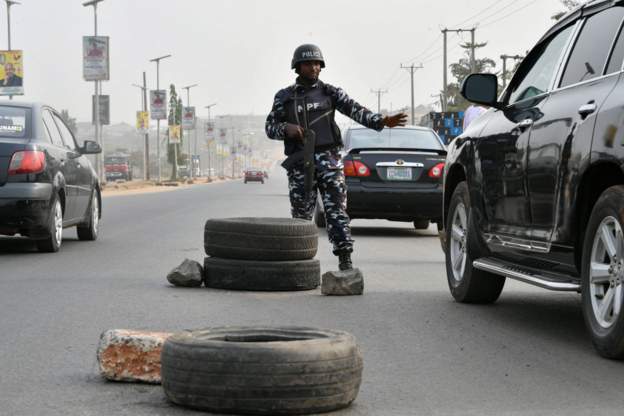
Gunmen in Nigeriahave launched an assault on a convoy of US personnel, resulting in the tragic deaths of four individuals, including two members of the US consulate and two police officers.
During the attack, three additional individuals were abducted before the assailants set their vehicle ablaze.
The incident occurred in the southeastern region of Anambra state. Authorities have promptly initiated a rescue and recovery operation to address the situation.
It is important to note that no US citizens were present in the targeted convoy, and further information regarding the purpose of the convoy’s presence in the state has not been disclosed.
A Nigerian state police spokesperson expressed regret that the convoy entered the state “without recourse to the police in the area or any security agency”.
The US said its mission in Nigeria was working with Nigerian security services to investigate the incident.
“The security of our personnel is always paramount, and we take extensive precautions when organising trips to the field,” the US State Department said.
Violence in the south-east of the country is just one of the many issues facing president-elect Bola Tinubu, who takes the helm of Africa’s most populous nation later this month.
China has given a 78-year-old US citizen a life sentence for spying, in a case that could worsen the already strained relations between Beijing and Washington.
John Shing-Wan Leung, who also has permanent residency in Hong Kong, was arrested in April 2021 by China’s counter-intelligence agency in Suzhou, a city in southeastern China. The details of his charges have not been made public.
He was tried and sentenced behind closed doors by a Suzhou court on Monday morning.
The court announced Leung’s full name in both Chinese and English, along with his HKID number, Home Return Permit number, and his US passport number.
He was arrested during a period when China had implemented strict border closures and domestic travel restrictions to combat the spread of COVID-19.
These investigations and trials are typically conducted behind closed doors, with limited information released to the public, often encompassing vague allegations of infiltration, espionage, and threats to national security.
Leung’s case comes at a time when the US and China are locked in disputes over trade, technology, human rights and territorial issues.
Tensions between Washington and Beijing have reached a historic low due to ongoing disputes over trade, technology, human rights, and China’s assertive stance on territorial claims, particularly concerning Taiwan and the South China Sea.
High-level government visits have been suspended, and US companies are delaying significant investments due to mixed signals from Beijing.
The sentencing coincides with US President Joe Biden’s visit to Hiroshima, Japan, for the Group of Seven (G7) summit, followed by a trip to Papua New Guinea.
The latter is a Pacific island nation where China has been striving to expand its economic, military, and diplomatic influence.
In response to China’s growing presence in the region, the US and its Asia-Pacific partners have increased their regional engagement, offering investments and financial support to counterbalance China’s influence.
A spokesperson for the US embassy in Beijing acknowledged reports of the conviction and sentencing of a US citizen in Suzhou.
The spokesperson emphasized the US Department of State’s commitment to the safety and security of its citizens abroad but refrained from providing further details due to privacy considerations.
When questioned about the case, Chinese Foreign Ministry spokesman Wang Wenbin declined to comment during a regular press briefing on Monday.
The resumption of high-level contacts between the US and China, following a pause triggered by the US shooting down a suspected Chinese surveillance balloon in February, seems to have provided a glimmer of hope. US National Security Advisor Jake Sullivan and top Chinese diplomat Wang Yi engaged in eight hours of talks in Vienna last week, with both sides characterizing the meeting as “candid, substantive, and constructive.”
On Friday, the US issued a statement condemning the reported sentencing of human rights activist Guo Feixiong, also known as Yang Maodong, to eight years in prison for “inciting subversion of state power.” However, China has not officially confirmed the sentencing, and the US State Department stated that its diplomats were barred from attending the trial in southern China. The US urged China to uphold its international commitments, grant its citizens due process, respect human rights and freedoms, including freedom of speech, and put an end to arbitrary detentions and exit bans.
The upcoming G7 summit, scheduled for May 19-21, is expected to address the group’s relationship with China, a topic of great significance.
In recent years, there have been several high-profile espionage cases, including the arrest of Chinese-born Australian writer Yang Jun in 2019. Last week, Australia called for the release of another detained national, journalist Cheng Lei, after spending 1,000 days in custody on charges of “supplying state secrets overseas.” In April, a prominent Chinese journalist was formally charged with spying more than a year after being detained while having lunch with a Japanese diplomat at a Beijing restaurant, as reported by a media rights group.
Inflation in the US dropped to its lowest level in two years last month as a result of lower prices for milk, new vehicles, and airline tickets.
According to official statistics, the rate of inflation in the 12 months leading up to April was 4.9%.
This was the eighth month in a row that price increases have slowed down, down from 5% in March.
The decline follows a substantial increase in interest rates by the US central bank in an effort to curb inflation.
The US had its greatest level of inflation since 1981 in June of last year, when it reached 9.1%.
But officials have hesitated to declare victory, as a problem that once seemed contained to particular sectors – such as energy and manufactured goods – has spread throughout the economy.
Housing, petrol and used car prices all jumped from March to April. The cost of haircuts, veterinary visits and gardening services also climbed.
And though no longer soaring, overall prices continue to rise far more quickly than the 2% rate the Federal Reserve considers healthy.
The Federal Reserve has raised interest rates 10 times since last March, bringing them to the highest levels since 2007.
The moves are intended to discourage people from borrowing, leading economic activity to slow and easing the pressures that are pushing up prices.
The head of the Federal Reserve, Jerome Powell, signalled this month that officials believe they may have done enough to get inflation under control and could be ready to pause their programme of rate rises.
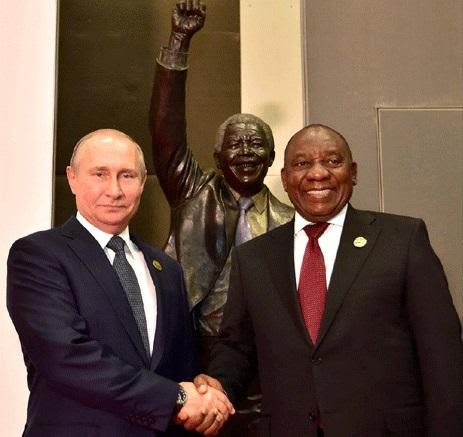
The South African rand plunged on Thursday after the US accused the country of arming Russia. The currency dropped more than 30 cents against the dollar in minutes, reaching its lowest level since the historic slump in 2020, local media reported. The US ambassador to South Africa Reuben Brigety claimed that South Africa had supplied weapons and ammunition to a Russian ship that visited the Simon’s Town naval base in Cape Town in December last year. The allegation sparked concerns that the US would impose economic sanctions on South Africa. President Cyril Ramaphosa‘s office said a retired judge would lead an independent investigation into the matter.
US prosecutors have stated that a YouTuber who intentionally crashed an airplane for views will plead guilty to obstructing a federal investigation by tampering with the crash site.
Trevor Jacob, aged 29, uploaded a video of the plane crash on YouTube in December 2021, falsely implying it was an accident.
The video has garnered over 2.9 million views to date. According to a plea agreement, Jacob admitted to filming the video as part of a product sponsorship agreement. He could potentially face a maximum prison sentence of 20 years.
The US Department of Justice announced on Thursday that the pilot and skydiver, aged 29, has agreed to plead guilty to one felony charge of destruction and concealment with the intent to obstruct a federal investigation.
In November 2021, Jacob took off on a solo flight from a Santa Barbara, California airport, equipped with cameras mounted on his plane, a parachute, and a selfie stick
He “did not intend to reach his destination, but instead planned to eject from his aircraft during the flight and video himself parachuting to the ground and his airplane as it descended and crashed”, the US Attorney’s Office for the Central District of California said.
Image caption,Mr Jacob ejecting from the plane before the crash
The plane crashed into the Los Padres National Forest 35 minutes after takeoff. He hiked to the site and recovered the footage.
Some YouTube viewers were sceptical of the crash, noting that Mr Jacob was already wearing a parachute and made no attempt to land the plane safely.
He reported the crash to the National Transportation Safety Board, who said he was responsible for preserving the wreckage. According to the plea agreement, Mr Jacob later claimed he did not know the location of the site.
He did, and returned by helicopter and secured and removed the wreckage, which he later destroyed, the statement says.
Mr Jacob is expected to make his initial court appearance in the coming weeks.
A Russian woman is suspected of hiring an assassin to kill her children in order to take their inheritance.
The 67-year-old was detained by police last week in Krasnoyarsk, the second-largest city in Siberia.
Three plain-clothes officers are seen holding the elderly outside of her home in video published by the Ministry of Internal Affairs on Telegram.
‘Do you understand why you were detained?’ one of them asks her on the street while cuffing her.
Surprised, the woman replies: ‘No.’
It was alleged she ordered the murder of her son and two daughters, so she could become the sole owner of a family property.
She shared her plan with her friend who helped her find a hitman, who was later paid ₽80,000, or a little more than £810 to do the job.
Her alleged deviousness was exposed on the day when the hired killer was supposed to take one of her daughters out.
Pictures shared by police show the pile of cash that she had allegedly taken out to make the payment.
A ministry statement said: ‘Employees of the criminal investigation department of the Krasnoyarskoye Ministry of Internal Affairs of Russia detained a suspect in organising the murder of her children.
‘Operatives received information that a resident of the regional center, born in 1956, wishing to remain the sole owner of real estate, ordered the murder of her son, born in 1978, and daughters born in 1974.’
Dr. Rochelle Walensky, 54, announced on Friday that she will leave her position as the head of the main public health organisation in the nation. On June 30, she will vacate the position.
In an email to the CDC, Walensky stated, “I took on this role with the goal of leaving behind the dark days of the pandemic and moving the CDC – and public health – into a much better and more trusted place.”
Walensky emailed staff shortly after President Joe Biden addressed her resignation.
‘She marshaled our finest scientists and public health experts to turn the tide on the urgent crises we’ve faced,’ stated Biden.
‘Dr Walensky leaves CDC a stronger institution, better positioned to confront health threats and protect Americans.’
Earlier on Friday, the World Health Organization (WHO) announced that the coronavirus is no longer considered a global emergency. The declaration came more than three years after millions of people were killed worldwide and widespread lockdowns hurt economies.
‘It’s with great hope that I declare COVID-19 over as a global health emergency,’ stated WHO Director-General Tedros Adhanom Ghebreyesus. ‘That does not mean COVID-19 is over as a global health threat.’
Still, Tedros warned that new coronavirus variants could emerge and that the world is out of the emergency phase, but there have been a rise in cases in Southeast Asia as well as the Middle East.
Walensky in her resignation letter added: ‘The end of the Covid public health emergency marks a tremendous transition for our country, for public health, and in my tenure as CDC Director.’
She served just over two years as CDC director, during which the agency was entangled in various controversies.
In January, the Center for Strategic & International Studies (CSIS) flagged severe deficiencies in how the CDC was being run and called for an overhaul.
‘The big picture here is, we all see the need for a reset of the agency,’ CSIS member and former CDC Director Julie Gerberding, told CNN at the time.
It was not immediately known who will take over the CDC director position.
Despite the upheaval in the banking industry and the effects of increasing borrowing prices, job growth in the US remained strong last month.
253,000 new positions were added by employers, which was more than many analysts had predicted.
The unemployment rate decreased to 3.4%, hitting a low not seen in many years.
The improvements served as a reminder of the US labor market’s tenacity, which has endured despite vigorous attempts by the US central bank to slow the economy.
The Federal Reserve has raised its benchmark interest rate from near zero to between 5% and 5.25% in little over a year, an abrupt shift aimed at curbing prices that were soaring last year at the fastest pace in decades.
These increases have sharply increased the cost of buying a home or car, as well as making it more expensive to borrow to expand a business or take on other debt. In theory, that should reduce demand, leading the economy to slow and easing the pressures pushing up prices.
But while job gains have moderated since last year, they continue to outpace the numbers that economists estimate are needed to keep up with population growth.
In its Friday report, the Labor Department said hiring had been weaker than previously estimated in February and March.
But last month, job creation picked up again, while wages were up 4.4% from a year ago.
“Today’s report clearly suggests weakening labour markets – most obviously in the downward revisions of prior months data – but from a very strong starting point,” said Ronald Temple, chief market strategist at Lazard.
Many economists expect the US economy to fall into recession later this year, noting big slowdowns in key sectors such as housing.
Recent weeks have seen a flurry of job cut announcements by big companies such as Facebook-owner Meta, Amazon, entertainment giant Disney, banks and other firms.
The rate rises also contributed to turmoil in the banking sector, which has been rocked by the most serious string of failures since the 2008 financial crisis.
But the head of the US central bank, Jerome Powell, said this week that the continuing strength of the labour market made him hopeful that this time would be “different” – and the US could avoid a downturn that would throw millions of people out of work.
“That would be against history,” he acknowledged. “I fully appreciate that.”
Image caption,Brian Zovko is optimistic that he’ll get a new job
Software engineer Brian Zovko was laid off from his job in the car industry in February.
He said he was surprised because his company had been posting strong profits. But more recently bosses had raised the prospect of cost cuts, noting that they were concerned about the impact of higher borrowing costs and a slowdown in the economy.
The 27-year-old, who lives in Texas, says he has been relying on savings and trying to spend cautiously. He said he sensed that the market has cooled over the past few months – but he remained hopeful he would find a new job shortly.
“I’m mildly optimistic that I should be able to get back on track,” he said. However, he added, “it seems like there’s a decent risk the economy gets worse”.
The US believes that since December, fighting in Ukraine has claimed the lives of around 20,000 Russian servicemen.
According to National Security Council spokesperson John Kirby, who was using recently released intelligence, an additional 80,000 people have been hurt.
The Wagner mercenary company, which has been targeting the eastern Bakhmut city, is responsible for half of the fatalities.
In a grueling war of attrition, Russia has been attempting to conquer the little city since last year.
Most of Bakhmut is currently under the hands of Moscow, while a tiny area to the west of the city is still under the control of Ukrainian forces. For both sides, the intense conflict has acquired a great deal of symbolic significance.
Ukrainian officials have also said they are using the battle to kill as many of Russia’s troops as possible and wear down its reserves.
“Russia’s attempt at an offensive in the Donbas [region] largely through Bakhmut has failed,” Mr Kirby told reporters. “Russia has been unable to seize any real strategic and significant territory.
“We estimate that Russia has suffered more than 100,000 casualties, including over 20,000 killed in action,” he added.
The toll in Bakhmut accounts for losses since the start of December, according to the US figures.
“The bottom line is that Russia’s attempted offensive has backfired after months of fighting and extraordinary losses,” Mr Kirby said.
He added he was not giving estimates of Ukrainian casualties because “they are the victims here. Russia is the aggressor”.
The BBC is unable to independently verify the figures given and Moscow has not commented.
Image caption,A local resident pushes his bicycle down a street in Bakhmut in January
The capture of the city would bring Russia slightly closer to its goal of controlling the whole of Donetsk region, one of four regions in eastern and southern Ukraine annexed by Russia last September following referendums widely condemned outside Russia as a sham.
Analysts say Bakhmut has little strategic value, but has become a focal point for Russian commanders, who have struggled to deliver any positive news to the Kremlin.
The Wagner mercenary group – which widely uses convicts and has become notorious for its often inhumane methods – has taken centre stage in the Russian assault on Bakhmut.
Its leader, Yevgeny Prigozhin, has staked his reputation, and that of his private army, on seizing the city.
But he recently threatened to pull his troops out of Bakhmut.
In a rare in-depth interview to a prominent Russian war blogger, he vowed to withdraw Wagner fighters if they were not provided with much-needed ammunition by the Russian defence ministry.
Wagner fighters could be redeployed to Mali, he warned.
He has often clashed with Russia’s defence ministry during the war, accusing officials of not providing his fighters with enough support.
Mr Prigozhin also called upon the Russian media and military leadership to “stop lying to the Russian population” ahead of an expected Ukrainian spring counteroffensive.
“We need to stop lying to the Russian population, telling them everything is all right,” he said.
He praised the Ukrainian military’s “good, correct military operations” and command.
A top Ukrainian general said on Monday that counterattacks had ousted Russian forces from some positions in Bakhmut, but the situation remained “difficult”.
New Russian units, including paratroopers and fighters from Wagner, are being “constantly thrown into battle” despite taking heavy losses, Gen Oleksandr Syrskyi, the commander of Ukraine’s ground forces, said on Telegram.
“But the enemy is unable to take control of the city,” he said.
The biggest bank failure in the nation since 2008 occurred last month when Silicon Valley Bank fell, and the US central bank has claimed that it did not act with “sufficient force and urgency” in its supervision of the institution.
One of the primary conclusions from the Federal Reserve’s study into the occurrence is the conclusion.
It raised concerns about the state of the banking sector throughout the world.
First Republic, another US lender, is still having problems as of the time of the assessment.
According to reports, US regulators are preparing a potential rescue plan for the troubled company, which was the country’s 14th-largest bank at the end of the previous year.
Michael Barr, the Federal Reserve‘s vice chair for supervision, who led the review, said the US central bank should toughen its rules in response to what it had learned from SVB’s demise.
“Federal Reserve supervisors failed to take forceful enough action,” he said, pointing to regulatory standards that were “too low”, supervision that did not work with urgency, and risks to the wider system posed by troubles at a mid-size bank that Fed policies had missed.
“Following SVB’s failure, we must strengthen the Federal Reserve’s supervision and regulation,” he said.
Image caption,Jerome Powell said he was confident the recommendations would lead to a more resilient banking system
The head of the Federal Reserve, chairman Jerome Powell, said he welcomed the “thorough and self-critical report”.
“I agree with and support his recommendations to address our rules and supervisory practices, and I am confident they will lead to a stronger and more resilient banking system,” he said.
The report from the Fed was one of three published by US officials on Friday, detailing regulatory lapses that contributed to the failures of SVB and Signature Bank last month.
Both banks catered to business customers and ran into trouble after the US central bank raised interest rates sharply last year which is when customers started to withdraw money.
SVB’s subsequent announcement that it needed to raise funds last month prompted panic and billions of dollars were withdrawn overnight, forcing regulators to step in.
The fears then spread to other firms, including Signature Bank and First Republic, which suffered $100bn in outflows last month.
Shares in First Republic, worth more than $120 apiece at the beginning of March, fell more than 40% on Friday to below $4, as questions swirled about its future.
Being tucked between two Pacific giants, the Philippines has historically had to tread carefully when managing the clashing interests of Beijing and Washington, an intricate juggling act that has been vividly on show in recent weeks.
In addition to staging the largest joint military exercises with the US to date, the Philippines has had a very busy diplomatic month in April. China, which has grown increasingly alarmed and vocal about the archipelago’s defense ties, sent a top envoy to the country.
There was a sensitive period in US-Philippine relations only a few years ago.
The country’s then leader, Rodrigo Duterte, routinely launched obscenity laden rants against US counterpart Barack Obama while downplaying longstanding territorial disputes with Beijing and seeking to attract investment from its giant neighbor to the north.
But the election of his successor, Ferdinand Marcos Jr, last year has returned relations to a more even keel, in part because Manila has become wary of a more assertive China.
Marcos Jr, who has been on a charm offensive to mend ties with Manila’s historical ally, is set to fly to the United States to meet with President Joe Biden in Washington next week.
He visit caps a month of frenetic exchanges with the United States.
More than 12,000 American troops joined some 5,000 soldiers from the Philippines over the last three weeks to take part in the largest “Balikatan” joint military exercises to date, an event Beijing’s state-run media has labeled an “attempt to target China.”
The climax of the war games came Wednesday when US and Philippine forces fired on a mock enemy warship in the West Philippine Sea, the part of the South China Sea that encompasses the Philippines Exclusive Economic Zone.
Just as those drills kicked off, the US also hosted two top diplomats from the Philippines, for talks during which both sides agreed to complete a roadmap for the US to provide security assistance to its regional ally the next five to 10 years, US Defense Secretary Lloyd Austin said in a “2+2 meeting” in Washington.
Last year the US granted $100 million to boost the Southeast Asian country’s defense capabilities and military modernization. It also plans to allocate $100 million for the improvement of military bases to which the US has access under the Enhanced Defense Cooperation Agreement (EDCA).
In February, the Philippines granted new rights to the US military to add four bases to the five originally covered under the EDCA. The new facilities include three on the main island of Luzon, close to Taiwan, and one in Palawan province in the South China Sea (SCS).
That appears to have alarmed China.
Earlier this month Beijing’s ambassador in Manila, Huang Xilian, accused the Philippines of “stoking the fire” of regional tensions by offering expanded military base access to the US, saying that the goal was to interfere in China’s affairs with Taiwan.
China’s ruling Communist Party has never controlled Taiwan but claims the self-ruled island democracy as its own and has repeatedly refused to rule out taking it by force, a threat which Manila perceives as reason to ramp up its guard with help from Washington.
Huang also appeared to threaten overseas Filipino workers (OFWs) in Taiwan, which prompted a backlash in the Philippines.
“The Philippines is advised to unequivocally oppose ‘Taiwan independence’ rather than stoking the fire by offering the US access to the military bases near the Taiwan Strait, if you care genuinely about the 150,000 OFWs,” Huang said.
National Security Council spokesperson Jonathan Malaya responded to the Chinese ambassador’s remarks by saying that “the Philippines has no intention of interfering in the Taiwan issue,” and added that the EDCA sites were “not meant for offensive operations against China or for interference in the Taiwan issue.”
With tensions high over the Beijing ambassador’s comments, Chinese Foreign Minister Qin Gang arrived last Friday for a three-day visit to Manila, where he met with Marcos Jr and Foreign Secretary Enrique Manalo.
The readouts suggested both sides were keen to calm the waters with Marcos Jr announcing “more lines of communications” to resolve conflicts between the two countries over the West Philippine Sea and Manalo also pledging to “overcome difficulties and interference.”
Qin said Beijing hoped the Philippine side would “properly handle Taiwan-related and maritime issues in line with the overall interests of regional peace and stability.”
Analysts say the positioning of the Philippines makes the archipelago vital for anyone wanting to project power across the Pacific.
“The Philippines is crucial in safeguarding the national security interests of both China, as well as the security or strategic interests of the United States in the Pacific,” said Aries Arugay, a visiting fellow at Singapore’s ISEAS-Yusof Ishak Institute.
“And this is why both superpowers are very sensitive every time the Philippines is being perceived as leaning more towards one or the other,” he added.
What the last month has shown, added Anna Malindog-Uy, vice president of the Asian Century Philippines Strategic Studies Institute (ACPSSI), is that Filipinos “do not want to be compromised for the geopolitical interests and agenda of the United States in the region.”
Manila may be thousands of miles away from Washington, but their defense alliance dates back to the end of World War II, as America sought to protect its interests in the Pacific.
The Philippines was a former US territory and used to be home to two of the US military’s largest overseas installations, Clark Air Base and Subic Bay Naval Base, which were transferred to Philippine control in the 1990s.
A mutual defense treaty signed in 1951 remains in force, stipulating that both sides would help defend each other if either were attacked by a third party.
Moderninzing the Philippines’ military capabilities by working with the US, and establishing well-connected regional defense cooperation with players like Japan, South Korea and Australia, is a priority for Marcos Jr, according to Richard Heydarian, senior lecturer in international relations at the University of the Philippines Asian Center.
Heydarian describes the approach as a “multi-vector foreign policy of maximizing ties with all major powers without excessively relying on any one of them.”
“He’s doubling down in the Philippines’ alliance with the United States so that we deal with China from a position of strength,” Heydarian said.
Heydarian added that China has to rethink its strategy towards the Philippines, as the Marcos Jr administration is openly more aligned with the US.
China remains one of the top trade partners of the Philippines, while Marcos Jr also continues to negotiate energy and agriculture investments from Beijing.
But Manila’s growing caution towards Beijing in recent years has been furthered by recent maritime aggressions – including accusations China used a high-powered laser against a Philippine Coast Guard vessel in February – Beijing’s increased drills around Taiwan as well as maritime patrols in the South China Sea, said Chong Ja Ian, an associate professor at the National University of Singapore.
“These give the Philippines a lot of reason for caution towards Beijing. But at the same time, they do want to keep relations with Beijing on an even keel,” Chong said.
Supportfor the expanded defense ties with Washington is far from unanimous.
Some worry Marcos Jr might be giving too much access to the US, especially when it comes to bases and facilities close to Taiwan, Heydarian said.
The president’s own sister, Sen. Imee Marcos, has publicly questioned why the Philippine government should rely on foreigners for its external defense, urging for defined limitations on the EDCA pact should the country be dragged into regional conflict.
As the US-China rivalry intensifies the Indo-Pacific, their competition for influence has been localized within the Philippines, particularly in the provinces where American bases are located, Arugay added.
There were pockets of protest in Cagayan province, the northern mountainous region where three out of the four new EDCA sites are to be built.
At least 5,000 people in Cagayan held demonstrations and prayer rallies, as they believed that America’s self-interest were prioritized before the native residents, according to the Cagayan Provincial Information Office.
A truce in Sudan went into effect at midnight local time (22:00 GMT on Monday), and it seems to be holding.
With prior cease-fires not being respected, this is the fourth attempt to put an end to the violence that started on April 15.
After 48 hours of discussions, the army and the paramilitary Rapid Support Forces (RSF) came to a 72-hour truce, according to US Secretary of State Antony Blinken.
On Tuesday, there were reports of gunshots in the capital, Khartoum.
There have also reportedly been reports of airplanes hovering overhead, but city dwellers have returned to the streets.
Independently, both parties to the conflict, which has claimed more than 400 lives, declared their participation in the truce.
The violence in Sudan, according to UN Secretary General António Guterres, runs the risk of igniting a “catastrophic conflagration” that might spread over the entire region and beyond.
Residents in Khartoum have been ordered to stay inside since the violence started, and food and water supplies are running low.
Some individuals have been compelled to drink water from the River Nile since the bombing damaged important infrastructure, such as water pipes.
As battle raged in the core, heavily populated areas of the capital, nations scurried to evacuate their embassies and citizens.
There will be hopes the ceasefire will allow civilians to leave the city. Foreign governments will also hope it will allow for continued evacuations out of the country.
Egypt’s foreign ministry said on Monday that an attaché had been killed while driving to the embassy in Khartoum to help with the evacuation of Egyptian citizens.
EU foreign policy chief Josep Borrell also confirmed on Monday that more than 1,000 EU citizens had been evacuated.
South Africa, Kenya and Uganda are among the African nations to have announced the evacuation of their citizens.
The UK government has announced it will begin evacuating British passport holders and immediate family members from Tuesday.
On Monday, Mr Blinken said that some convoys trying to move people out had encountered “robbery and looting”.
The US, he added, was looking at potentially resuming its diplomatic presence in Sudan but he described the conditions there as “very challenging”.
Sudan suffered an “internet blackout” on Sunday amid the fighting but connectivity has since been partially restored, according to monitoring group NetBlocks.
It is estimated that tens of thousands of people, including Sudanese citizens and those from neighbouring countries, have fled because of the unrest.
Hassan Ibrahim, 91, was among them. The retired physician lives near the main airport in Khartoum, where some of the worst fighting has taken place, but has since made the perilous journey into neighbouring Egypt with his family.
He told the BBC World Service’s Newshour programme they had escaped being caught up in a firefight between RSF fighters and the army but that a van travelling behind them had got hit. The family then boarded a bus to the border, which took 12 hours, only for them to be met by “crowded and chaotic” scenes as people waited to be given entry.
“There were so many families with elderly passengers, children and babies,” said Mr Ibrahim. “The Sudanese are fleeing the country – it is a sad reality.”
Eiman ab Garga, a British-Sudanese gynaecologist who works in the UK, was visiting the capital with her children when the fighting began and has just been evacuated to Djibouti on a flight organised by France. Her hurried departure meant that she was not able to say goodbye to her ailing father, her mother or her sister.
“The country is dirty, there’s rubbish all over it,” she told BBC Radio 4’s World Tonight programme. “There’s sewage overflowing, it smells, so now we’re next going to have an outbreak of illness and disease, and there won’t be a hospital to go to there.”
“We’re just looking at death and destruction and destitution.”
Violence broke out primarily in Khartoum, between rival military factions battling for control of Africa’s third largest country.
This came after days of tension as members of the RSF were redeployed around the country in a move that the army saw as a threat.
Since a 2021 coup, Sudan has been run by a council of generals, led by the two military men at the centre of this dispute – Gen Abdel Fattah al-Burhan, the head of the armed forces and in effect the country’s president, and his deputy and leader of the RSF, Gen Mohamed Hamdan Dagalo, better known as Hemedti.
They have disagreed on the direction the country is going in and the proposed move towards civilian rule.
The main sticking points are plans to include the 100,000-strong RSF into the army, and who would then lead the new force.
Gen Dagalo has accused Gen Burhan’s government of being “radical Islamists” and that he and the RSF were “fighting for the people of Sudan to ensure the democratic progress for which they have so long yearned”.
Many find this message hard to believe, given the brutal track record of the RSF.
Gen Burhan has said he supports the idea of returning to civilian rule, but that he will only hand over power to an elected government.
FIFA has received four expressions of interest, including a combined candidacy from the United States and Mexico, to host the 2027 Women’s World Cup.
With the hosts scheduled to be chosen in May of next year, Brazil, South Africa, and another combined bid from the Netherlands, Belgium, and Germany have already entered the competition.
The only other potential host nation with prior hosting experience is Germany, who did so in 2011. The USA hosted the Women’s World Cup in 1999 and 2003, winning the latter event.
The United States, Mexico, and Canada have already been selected to host the 2026 men’s World Cup.
🇧🇪🇩🇪🇳🇱 🇧🇷 🇿🇦 🇺🇸🇲🇽
FIFA has received four expressions of interest to host the 2027 @FIFAWWC:
Federations hoping to host the tournament now have until May 19 to confirm their involvement in the bidding process.
FIFA secretary general Fatma Samoura said: “We are thrilled by the expressions of interest received, not least because they come from member associations with a strong football tradition representing four confederations, thus confirming the consistent popularity of women’s football across the world.
“All member associations can rely on the most robust and comprehensive bidding process in the history of the FIFA Women’s World Cup.”
The 2023 edition of the tournament – taking place in Australia and New Zealand – will kick off on July 20, with the Matildas facing the Republic of Ireland and their co-hosts taking on Norway on the opening day.
Tech company Seagate has been fined $300 million (£241 million) by US officials for allegedly breaking export laws by sending hard drives to China’s Huawei.
After export restrictions were put in place in 2020, Seagate Technology delivered Huawei equipment valued more than $1.1 billion, according to the Department of Commerce.
The fine is the most recent action taken by the US government to halt the export of advanced technology to China.
According to US sources, China’s military may use this equipment.
According to the Commerce Department, Seagate shipped 7.4 million SSDs to Huawei for nearly a year following the rule’s imposition by the previous administration of President Donald Trump.
It continued to do so “even after Huawei was placed on the Entity List for conduct inimical to our national security,” Matthew Axelrod of the department’s Bureau of Industry and Security (BIS) said.
“This settlement is a clarion call about the need for companies to comply rigorously with BIS export rules, as our enforcement team works to ensure both our national security and a level playing field,” Mr Axelrod added.
Huawei’s other two main hard drive suppliers had stopped exports to the Chinese firm in accordance with the new rule, the department said.
The penalty will be paid in instalments of $15m every three months for the next five years, Seagate said.
It comes as the US continues its drive to curb sales of technology, such as advanced computer chips, to China.
As part of its efforts to reduce sales of American goods to Huawei due to worries about national security and foreign policy, the US placed Huawei on a list of companies with trade restrictions in 2019.
The technology, according to Washington, might be used by the Chinese military to assist abuses of human rights or pose other threats to US national security.
The charges have been consistently refuted by the Chinese government.
Many Western nations have recently taken action against Chinese technology businesses due to security concerns.
Equipment installation on networks in the US, Australia, Japan, India, and Canada has been prohibited for firms that specialize in 5G technology, such as Huawei, ZTE, and Hytera.
Meanwhile, the UK government has ordered equipment installed by Huawei to be removed from 5G networks by 2027.
Earlier this week, Chinese surveillance technology giant Hikvision denied that it was illegally disguising its products sold to the US government to enable Chinese espionage.
The United State government has registered its displeasure against the arrest of Tunisia opposition leader, Rached Ghannouch, and the closure of the opposition Ennahdha party headquarters
On Thursday, a Tunisian judge ordered the imprisonment of Rached Ghannouchi, the Ennahda party leader and a prominent critic of President Kais Saied.
Mr Ghannouchi had been arrested and detained on Monday by Tunisian authorities.
In response, the US Department said in a statement that the arrests of opposition leaders and the banning of opposition meetings represented a “troubling escalation by the Tunisian government against perceived opponents”.
“The government’s obligation to respect freedom of expression and other human rights is larger than any individual or political party, and is essential to a vibrant democracy and to the US-Tunisia relationship,” it said.
A man has been accused of shooting a teenager who rang the wrong doorbell while picking up his younger brothers in the US state of Missouri.
According to prosecutors, Andrew Lester, 84, has been charged with first-degree assault and armed criminal conduct.
Ralph Yarl, 16, who is black, was allegedly shot once in the head and once in the arm last Thursday night by Mr. Lester, a white man. The young man lived.
A prosecution claimed that there was a “racial component” to the shooting.
Mr Lester has not been charged with a hate crime, and charging documents do not describe the alleged racial bias.
At a press conference on Monday, Clay County Prosecutor Zachary Thompson said: “My message to the community is that, in Clay County, we enforce the laws and we follow the laws.
“That doesn’t matter where you come from, what you look like or how much money you have.”
Image caption, Suspect Andrew Lester, 84
Police initially detained Mr Lester for questioning and let him go, sparking protests throughout the city on Sunday.
On Monday, protesters gathered outside the suspect’s home chanting “black lives are under attack” and “stand up, fight back”, online video shows. Mr Lester’s home has also reportedly been vandalised.
Personal injury lawyer Benjamin Crump, who is representing the Yarl family, said: “You can’t just shoot people without having justification when somebody comes knocking on your door – and knocking on your door is not justification.”
Ralph’s family said the teen had been trying to pick up his younger twin brothers from a friend’s house at around 22:00 local time on 13 April when he knocked on Mr Lester’s door.
Family members say the boy mistakenly went to 115th Street instead of 115th Terrace and rang the bell twice. After being shot, he went to three nearby homes before someone helped him, they said.
No words were exchanged before the homeowner opened fire with a .32 revolver, prosecutors said.
But another attorney for the family, Lee Merritt, told NBC News: “He heard rustling around going on in the house and then finally the door was open.
“And he was confronted by a man who told him, ‘Don’t come back around here,’ and then he immediately fired his weapon.”
According to local reports, Mr Lester told police that he believed someone was breaking into his home and fired two shots through his door. A witness also told the local news station that he heard Ralph “screaming that he had been shot”.
On Monday, prosecutors said Missouri citizens have the right to use force if they “reasonably” fear that they are in danger. They declined to elaborate further on the specifics of this case. Media caption,
Watch: ‘No-one should shoot through a door’
Ralph was released from hospital on Sunday and was at home recovering from his injuries, family members said.
The boy’s father, Paul Yarl, told the Kansas City Star the charges were “such a relief”.
“I’m happy. This is what we’ve been looking for. It’s here.”
According to the family’s lawyers, President Joe Biden called the Yarls on Monday and spoke with them for 20 minutes.
He told reporters that Mr Biden had offered his prayers and invited them to the White House once the teenager has recovered.
Celebrities including Viola Davis, Justin Timberlake, Halle Berry and Kerry Washington – as well as Kansas City Chiefs star quarterback Patrick Mahomes – condemned the shooting.
A GoFundMe account set up to pay for Ralph’s medical recovery has raised over $2.1m (£1.7m) as of Monday.
In a separate incident on Saturday, a 20-year-old woman in New York state was shot after the vehicle she was in mistakenly drove into the wrong driveway.
Friends drove Kaylin Gillis away from the scene and attempted to call for help in a nearby town, but she was was later pronounced dead by paramedics.
In a court hearing in Boston, the US airman accused of disclosing secret intelligence and defense documents was formally charged.
Jack Teixeira, 21, wore shackles and a prison uniform as he stood before a federal judge on Friday.
After a shout of “love you, Jack” from a person in the courtroom, the defendant replied “you too, dad”.
Mr Teixeira faces up to 15 years in prison over charges of unauthorised transmission of defence information.
He is also charged with the unauthorised removal and retention of classified documents.
The airman faces up to 10 years in prison for the first charge, and up to five years in prison for the second.
The dozens of leaked documents had revealed US assessments of the war in Ukraine as well as sensitive secrets about American allies.
The leaks embarrassed Washington and raised fresh questions over the security of classified information.
Mr Teixeira was arrested by armed FBI agents at his family home in Massachusetts on Thursday.
The judge ruled that the suspect qualifies for a public defender – a lawyer employed at public expense in a criminal trial for people who cannot afford legal fees.
Mr Teixeira remains in custody.
US President Joe Biden thanked law enforcement in a statement for their “rapid action” to investigate the source of the leaks. He said he has directed US military and intelligence to secure and limit distribution of any more sensitive information.
Watch: How damaging are 21-year-old Jack Teixeira’s US intelligence leaks?
‘Top secret clearance’
The leaked intelligence material first appeared in a Discord chat room on which Mr Teixeira is said to have been an administrator. Its members would often discuss geopolitical affairs and wars.
The affidavit provided by FBI Special Agent Patrick Lueckenhoff to the court stated that the suspect began posting the leaked documents some time in December.
The initial leaks were in the form of paragraphs of text, according to the affidavit, but Mr Teixeira then moved on to posting photographs of documents in January.
It was not until intelligence material was posted outside the chat room group that Pentagon officials became aware of the leak, prompting a search for the culprit.
Mr Teixeira worked as an IT specialist in the intelligence wing of the Massachusetts National Guard, based at Otis Air National Guard Base in western Cape Cod.
The National Guard is a reservist wing of the US Air Force. They are not employed full-time in the military, but can be deployed when necessary.
Mr Teixeira’s official title was cyber defence operations journeyman, according to the criminal complaint filed in the Boston court. He held the rank of Airman 1st Class – a relatively junior position.
The affidavit stated that Mr Teixeira held a “top secret” security clearance since 2021, and that he would have “signed a lifetime binding non-disclosure agreement” to take on his role.
Mr Luekenoff added the suspect “would have had to acknowledge that the unauthorized disclosure of protected information could result in criminal charges”.
The affidavit also alleged that Mr Teixeira used his government computer to search classified intelligence reporting for the word “leak” on 6 April – the day when public reporting about the documents first emerged.
Prosecutors alleged that Mr Teixeira searched the term to learn whether US intelligence had information on the identity of the person behind the leaks.
The 2022 Country Reports on Human Rights Practices in Ghana have been published by the US State Department.
On the State Department website, the executive summary of the study stated that Ghana would continue to experience significant human rights problems in 2022.
It cited violence against the LGBTQI community in Ghana and the enactment of legislation to criminalise LGBTQI activities as serious human rights issues in the country.
Other human rights issues cited in the report included the unlawful killings of persons, serious restrictions to free expression and media, baseless arrests and prosecutions of journalists as well as restrictions to freedom of assembly.
“Significant human rights issues included credible reports of: arbitrary or unlawful killings including extrajudicial killings; torture or cruel, inhuman or degrading treatment or punishment by the government or on behalf of the government; arbitrary arrest or detention; serious restrictions on free expression and media, including violence and threats of violence against journalists, and unjustified arrests or prosecutions of journalists,” parts of the executive summary read.
The other human rights issues include “substantial interference with the freedom of peaceful assembly; serious government corruption; lack of investigation of and accountability for gender-based violence, including domestic or intimate partner violence; crimes involving violence or threats of violence targeting lesbian, gay, bisexual, transgender, queer or intersex persons; laws criminalizing consensual same-sex sexual conduct between adults, although not fully enforced; and crimes involving violence or threats of violence targeting persons with disabilities”.
The report also indicated that even though the government is taking steps to resolve issues of corruption and human rights abuses by officials, the “impunity remained a problem”.
The latest 2022 Country Report on Human Rights Practices published by the U.S. Department of State has made some damning revelations about some agencies and agents in Ghana.
The report, sectioned into seven parts discusses the total disregard for the respect for the integrity of persons; civil liberties; freedom to participate in political process; corruption and lack of transparency in government; posture towards alleged abuses of human rights; discrimination and societal abuses, as well as the rights of workers happening in Ghana.
This article will delve into the first section of the report – Respect for the Integrity of the Person.
Killings
Government through its agents has been accused of unlawful killings. The report cited the shooting incident in February where police officers killed one and injured eight others at the palace of the Yendi Chief after opening fire.
Although the six officers involved in the incident were suspended with reduced pay, the Police administration failed to release the results of its internal investigation – derailing accountability.
The 2022 Country Report on Human Rights Practices also bemoaned the demise of Albert Donkor, who passed away while in police custody for his alleged involvement in a series of robberies.
“In a departure from typical practice, police did not announce an operation or arrest had taken place until more than three weeks later,” the report bemoaned.
Donkor’s death prompted protests in Nkoranza which also led to the death of an individual after a clash between the youth and police.
“As of November police had not concluded an internal investigation into both deaths,” the report added.
Ghana’s inability to unravel the eight deaths that took place during the 2020 elections is another major concern highlighted in the report.
At least two of the victims were killed by the National Elections Security Task Force, composed of military and police units, per a portion of the report.
Torture
Although the report was unable to cite specific instances, it nonetheless accused state agencies such as the Police of abusing detained suspects and other citizens.
It noted that victims were unwilling to stand up against the police and in instances where they did, the “police generally denied allegations or claimed the level of force used was justified.”
“Impunity remained a significant problem in the Ghana Police Service, particularly regarding corruption and bribery. The investigation and complaints processes did not effectively address reports of abuses and bribery. Results of internal police investigations were almost never publicly released,” the report further revealed.
The Office of the Inspector General of Police and the Police Professional Standards Board, per the report investigated claims of excessive force by police force members. It is unknown whether sanctions were meted out or not.
Abusive Physical Conditions
Ghana’s prison and detention centers have been considered abusive to the fact that they are overcrowded, have poor sanitary conditions, medical care and subpar food which is mostly inadequate.
“Meals routinely lacked fruit, vegetables, or meat, forcing prisoners to rely on charitable donations and their families to supplement their diet.”
The report noted that as of September 2022, overcrowding stood at 150 percent of capacity per information from the Ghana Prisons Service.
The huge number got about 100 prisoners sharing one toilet which often overflowed with excrement.
“There were no facilities to support intersex or transitioning persons,” the report highlighted as a challenge to LGBTQ persons whose presence is frowned upon by society.
On treatment of detainees, the report stated that authorities frequently detained individuals without charge or a valid arrest warrant for periods longer than 48 hours, contrary to the law.
It noted that for instance, 30 members of the LGBTQI+ community who were arrested by the Police on June 26, 2021, and were only released on June 28, 2021. The charges of unlawful assembly – the reason for the arrest, were later dropped due to lack of evidence.
The report also lamented the lengthy pretrial detention where the government kept prisoners in extended pretrial detention (up to many months) due to “police failure to investigate or follow up on cases, case files lost when police prosecutors rotated to other duties every three years, slow trial proceedings marked by frequent adjournments, detainees’ inability to meet bail conditions that were often set extremely high even for minor offenses, and inadequate legal representation for criminal defendants.”
The law provides for the right of any person to challenge the lawfulness of his or her arrest or detention in court, but lack of legal representation for detainees inhibited this right, the report added.
Denial of fair public trial
The reported highlighted the role of corrupt judges who prevented fair trials. These unidentified judges are said to have accepted bribes to expedite or postpone cases, “lost” records, or issued favorable rulings for the payer of the bribe.
“A judicial complaints unit within the Ministry of Justice headed by a retired Supreme Court justice addressed complaints from the public, such as unfair treatment by a court or judge, unlawful arrest or detention, missing trial dockets, delayed trials and rendering of judgments, and bribery of judges. The government generally respected court orders,” the report mentioned.
Visit the IndependentGhana.com for the remaining sections of the 2022 Country Report on Human Rights Practices.
According to what appears to be a leak of top-secret Pentagon data, Ukraine’s air defenses may run out of ammunition in a matter of weeks.
There have been several reports presenting American intelligence assessments, one of which claims that two of Ukraine’s main anti-aircraft missile systems will be depleted by May 2.
In a statement on the subject released on Sunday, the Pentagon did not attempt to discount the documents as false despite the fact that they had not been validated.
They have also sparked a stern response from two other US allies, South Korea and Israel, after appearing to leak explosive internal security information.
The documents appear to lay out a detailed timeline of Ukrainian defence capacities, some of which partly rely on allied supplies
One paper described as a ‘Top Secret’ CIA update from last month said Israel’s equivalent of MI5 was encouraging protests against an alleged power grab by its prime minister Benjamin Netanyahu.
The dramatic claim suggests the Israeli government is more splintered than it has been for decades over Mr Netanyahu’s reforms, which would give his ministers power to appoint judges.
Another document suggested CIA spies had been monitoring talks among South Korean officials over the sale of artillery shells to the US that could end up in Ukraine.
The New York Times shared some of the papers which it claims to be genuineThe Pentagon has stressed some other documents appearing online have been altered
The claims are embarrassing for the South Korean government, which has joined international sanctions against Russia but refuses to send weapons to the Ukrainians.
The papers on Ukraine appear to be an assessment of its Ukraine’s S-300 and Buk missile systems, which are the defenders’ main protection against Russian fighter jets and bombers.
The New York Times reports there are no plans to restock the systems, and that current usage indicates they will be in trouble by mid-April and be ‘completely reduced’ by May 23.
This would hammer Ukraine’s ability to hold the frontline in the east of the country, where troops rely on convoys of supplies vulnerable to harassment by Russian bombers.
Ukraine’ ability to hold the frontline of Bakhmut could be hampered if its air defences do run out (Picture: Reuters)
It’s not known whether new arrangements have been made to replenish the systems.
The US Department of Justice has opened a criminal investigation into the leak, admitting the documents ‘appear to contain sensitive and highly classified material’.
Pentagon deputy press secretary Sabrina Singh said the Ukraine-related documents appear to be photographs of documents which were uploaded to the social media platform Telegram.
Some of the slides appear to have been crudely doctored, such as one which massively undercuts publicly known Western estimates of Russian troops killed in action.
US officials confirmed that some of the documents appear authentic while others have been altered.
Ms Singh added in a statement: ‘An interagency effort has been stood up, focused on assessing the impact these photographed documents could have on U.S. national security and on our Allies and partners.
‘Over the weekend, U.S. officials have engaged with Allies and partners and have informed relevant congressional committees of jurisdiction about the disclosure.’
While the US continues to increase its military exercises with South Korea, North Korea has threatened that it will take unnamed “offensive action.”
The North’s official Korean Central News Agency (KCNA) claimed the exercises were turning the area into a “huge powder magazine, which can be exploded at any moment” amid escalating tensions on the peninsula.
The remarks were made a day after US bombers with nuclear capability crossed the ocean to participate in joint aerial exercises with South Korean jets.
Pyongyang has already reacted angrily to the use of that specific aircraft because it sees the action as a practice invasion.
In recent weeks, North Korea has frequently tested missiles, some of which have been capable of carrying nuclear warheads.
In a commentary attributed to a scholar, KCNA said: ‘The military provocations by the US-led warmongers have gone beyond the tolerance limit.
‘This reality awaits more explicit stand and answer of (North Korea’s) defence capabilities.’
The news agency added: ‘(North Korea’s) war deterrence will continue to show its responsibility for and confidence in its crucial mission through offensive action.’
The warning comes a month after North Korean leader Kim Jong-un’s sister cautioned the US about taking action against their frequent missile tests.
Kim Yo-jong said: ‘We keep our eye on the restless military moves by the U.S. forces and the South Korean puppet military and are always on standby to take appropriate, quick and overwhelming action at any time according to our judgment.’
Meanwhile, US president Joe Biden’s special representative for North Korea has flown to Seoul for talks with allies over the nuclear threat.
Sung Kim met with South Korean foreign minister Park Jin and the country’s chief nuclear negotiator Kim Gunn today.
South Korea’s foreign ministry said Mr Kim would be attending a three-way meeting with Mr Gunn and Takehiro Funakoshi, the nuclear envoy for Japan, on Friday.
The former president Donald Trump aggressively criticized the criminal accusations he is facing and the several other investigations into him in his first statements following his arraignment.
At after 8.15 p.m., from Mar-a-Lago, Trump said: “God bless you all.” He had just finished getting his fingerprints taken in a Manhattan courthouse. God’s blessings on you all. Furthermore, I had no idea that something similar could occur in the United States.
Defending our country bravely against those who want to do it harm is the only crime I have ever done.
Trump claims election interference is behind criminal charges after his arrest
Trump slammed Manhattan District Attorney Alvin Bragg’s investigation into a hush money payment to a porn star, and called the presiding Justice Juan Merchan a ‘Trump-hating judge’.
He also ripped other probes on him including Georgia’s investigation into whether he and his allies tried to overturn the state election, and a federal investigation into his handling of classified documents that wound up at Mar-a-Lago.
Trump called special counsel Jack Smith – who is overseeing the federal probes into the classified materials and his actions around the January 6 Capitol riot – a ‘lunatic’.
The ex-president also brought up the Hunter Biden laptop scandal and blamed the country’s problems including an economic slowdown on the Biden administration and Democrats.
Some TV news stations did not air Trump’s full speech, even though it ran for less than 30 minutes. MSNBC host Rachel Maddow explained that it was ‘basically a campaign speech in which he is repeating his same lies and allegations against his perceived enemies’.
Meanwhile, ABC News cut it off as Trump claimed that President Joe Biden would provoke an ‘all-out nuclear World War 3’.
Trump walked into his Florida resort to cheers from fans wearing MAGA hats.
His family members who entered Mar-a-Lago smiling included his son Eric Trump and wife Lara Trump, and his youngest daughter Tiffany Trump. Walking behind them was Republican Representative Marjorie Taylor Greene, who appeared for a speech outside Manhattan Criminal Court before being swarmed by protesters and escorted away by police.
What is Trump charged with and what’s next?
WHAT’S THIS CASE ABOUT?
The grand jury spent weeks investigating money paid during Trump’s 2016 presidential campaign to two women who alleged that they had extramarital sexual encounters with him.
Trump has denied the allegations.
His former lawyer Michael Cohen, who testified as a key prosecution witness, paid Daniels $130,000 through a shell company he set up and was then reimbursed by Trump, whose company logged the repayments as legal expenses.
Earlier in 2016, Cohen also arranged for former Playboy model Karen McDougal to be paid $150,000 by the publisher of the supermarket tabloid the National Enquirer, which squelched her story in a journalistically dubious practice known as ‘catch and kill’.
WHAT’S AN INDICTMENT?
An indictment is the formal charge brought against someone after a grand jury — which is made up of members of the community — votes and enough members agree there’s sufficient evidence to charge someone with a crime.
The indictment against Trump remains sealed, as is standard in New York before an arraignment. But once the document is made public, it will lay out the crime or crimes that Trump is accused of committing.
Sometimes indictments include a lengthy narrative with lots of details about the allegations, while others are more basic and just outline the charges a defendant is facing.
WHAT ARE THE CHARGES?
Trump is facing multiple charges of falsifying business records, including at least one felony offense, according to two people who spoke on condition of anonymity to discuss information that isn’t yet public.
Under the law, prosecutors must prove there was an ‘intent to defraud’.
The felony falsifying business records offense requires prosecutors to prove that the records were falsified with the intention of committing, aiding or concealing a second crime.
It’s not clear yet what prosecutors allege the second crime to be, but experts have said it is probably some kind of campaign finance violation.
WHAT’S AN ARRAIGNMENT?
An arraignment is generally the first time a defendant appears in court after being charged.
The judge will tell Trump the charges against him and advise him of his right to go to trial and other things.
Trump will enter a plea of not guilty — as is standard for defendants to do at arraignment. The indictment is expected to be unsealed upon his arraignment.
Trump is expected to walk out of the courtroom because the charges against him don’t require that bail be set in New York.
It’s possible — but unlikely — that Judge Juan Merchan could decide that Trump is a flight risk and order him held, with or without bail, though Trump’s lawyers would vigorously fight that.
WHAT WILL TRUMP’S DEFENSE BE?
Trump’s lawyers have vowed to ‘vigorously fight this political prosecution in court’.
Defense attorney Joe Tacopina has described Trump as a victim of extortion who had to pay the money because the allegations were going to be embarrassing to him. But he says it had nothing to do with the campaign.
Trump will no doubt try to fight the case on multiple fronts. He may try to have the case moved out of Manhattan or New York City entirely — arguing he can’t get a fair trial there — though it’s rare for judges to agree to do that.
Trump may also argue that the statute of limitations has passed.
He has complained that the statute of limitations ‘long ago expired’ because the hush money payments and Cohen’s reimbursements happened more than six years ago.
New York’s statute of limitations for most felonies is five years. For misdemeanors, it’s just two years. But in New York, the clock can stop on the statute of limitations when a potential defendant is continuously outside the state.
Trump visited New York rarely over the four years of his presidency and now lives mostly in Florida and New Jersey.
WHAT ARE THE POLITICAL RAMIFICATIONS FOR TRUMP?
Neither the indictment itself nor a conviction would prevent Trump from running for or winning the presidency in 2024.
Already, the charges have been a boon to his fundraising. The campaign announced Friday evening that it had raised over $4 million in the 24 hours after the indictment became public, far smashing its previous record after the FBI search of Trump’s Mar-a-Lago club.
Trump’s team over the weekend blasted out emails full of supportive comments from dozens of top Republicans, many of whom had already been supportive of him leading up to the indictment.
Those likely to be facing off with Trump in next year’s GOP primary contests have also slammed the prosecution.
Former Vice President Mike Pence called the indictment ‘an outrage’ and ‘nothing more than a political prosecution’.
Former South Carolina Governor Nikki Haley said on Twitter that the indictment ‘is more about revenge than it is about justice’.
Biotech investor Vivek Ramaswamy, who is also seeking the GOP presidential nomination, called the indictment ‘a dark moment in American history’.
Florida Governor Ron DeSantis on Saturday accused District Attorney Alvin Bragg of weaponizing the law ‘for political purposes’ to bring a case against a former president, never mentioning Trump by name.
Trump finished his remarks with his familiar campaign slogan.
‘With a very dark cloud over our beloved country,’ he said, ‘I have no doubt that we will make America great again.’
Donald Trump has just left Trump Tower and is heading to the court building in Lower Manhattan.
This is where he will be formally arrested. The journey itself is about a 30-minute drive south through Manhattan, but that time could be much less if there’s a full police escort.
About ten automobiles, with a police escort, are currently traveling into Lower Manhattan.
New York City firefighters and police are in the caravan.
It appears that all traffic has been moved off the highways, so the trip could take as short as 20 minutes.
The motorcade is seen moving south in the video taken from a helicopter, which you can see at the top of this page.
Legal cases like this can take months, sometimes even years to play out, but here are some of the things we know have to happen after Trump appears in court.
Disclosure of evidence
Within 15 days of the arraignment, the prosecution must hand over all evidence gathered as part of the investigation to the defence.
This is known as “discovery” and includes the minutes from the grand jury process, testimony of every witness interviewed by law enforcement (although some may be redacted), every exhibit shown to the grand jury, and other records prosecutors obtained such as telephone records, tapes, emails etc.
Motions will be filed
Trump’s team has already said they will file motions to dismiss the case before it goes to trial.
Generally, the defence has 45 days to file motions after arraignment, but the judge has discretion to grant more time.
Without knowing what is in the indictment, we can’t predict what tack Trump’s lawyers will take, but he has already floated the idea of filing a motion to transfer the case out of Manhattan.
Motions to change venue are rarely granted as the defence would need to convince the judge that Trump wouldn’t be able to get a fair hearing in New York due to pre-trial publicity.
With the amount of media attention this case has already generated across America, it is hard to see a judge agreeing to that.
Other motions will likely hinge on arguments about the statute of limitations having expired, the nature of the charges involving federal campaign violations, or other attacks on the sufficiency of the evidence.
Jeremy Saland, a former assistant district attorney, suggested Trump’s team could file catch-all motion to dismiss the indictment — known as a “Clayton motion”— seeking to have the judge throw the case out not on the merits, but in the interests of justice.
Trump’s day in court
The “speedy trial” rule in New York states that prosecutors must be ready to try a felony case within six months, but what’s on the books is frequently different to what happens.
Mr Saland added: “I could see this go north of year. They are going to file every motion in book.”
After failing to find a buyer, Cineworld has abandoned ambitions to sell its companies in the US, UK, and Ireland.
The owner of the movie chain also claims to have reached a provisional agreement with creditors to emerge from bankruptcy.
The business, which is the owner of the Picturehouse chain in the UK, disclosed plans to raise $2.26 billion (£1.8 billion) in fresh capital.
In order to escape its $5 billion debt, Cineworld sought US bankruptcy protection last year.
“This agreement with our lenders represents a ‘vote-of-confidence’ in our business and significantly advances Cineworld towards achieving its long-term strategy in a changing entertainment environment,” chief executive Mooky Greidinger said.
The company said it will continue to consider proposals for the sale of its business outside the US, UK and Ireland.
The proceeds of the capital raising will be used to fund the turn around of the business including costs related to the restructuring its debts, Cineworld said in a filing with the US bankruptcy court in the Southern District of Texas.
On Monday morning in London, Cineworld Group shares fell by more than 20%.
It is the world’s second-largest cinema chain by the number of screens, with more than 9,000 screens in almost 750 locations.
Cineworld’s operations span 10 countries – including the UK, the US, Poland and Israel – with approximately 30,000 employees worldwide.
Cinema chains were one of the worst hit industries during the pandemic.
Many cinemas were forced to close for extended periods during the lockdowns, or had to operate at a reduced capacity due to social distancing rules.
Cineworld reported a huge loss for the first six months of 2020 after it was forced to temporarily close some cinemas, and movie studios delayed the release of some blockbuster movies.
The company’s London-traded shares have plunged by more than 90% over the last year as investors fret about its future. Its current stock market value is below £40m ($49.1m).
Cinemas have also been facing tough competition from streaming services, which soared in popularity during the lockdowns.
In 2020, a row broke out when Cineworld and rival AMC, which owns the Odeon Cinemas chain, criticised Universal Pictures for releasing Trolls: World Tour online at a time when cinemas were forced to close because of coronavirus.
Cineworld subsequently signed a deal with Warner Bros to show films in theatres before they are streamed.
More recently, streaming giant Netflix reported a sharp fall in subscribers, as the rising cost of living leads to people cutting back.
After lockdown restrictions eased, cinema chains have seen large audiences drawn by the latest Hollywood blockbusters.
Big box office hits in recent months include Top Gun: Maverick, Avatar: The Way of Water and Dungeons & Dragons: Honour among Thieves.
The 85-year-old author talks about her reaction to seeing Are You There God in this video. More than 50 years after it was initially released as a novel, It’s Me, Margaret was made into a movie.
Are You There God?, by American author Judy Blume, is a beloved book. The first edition of It’s Me, Margaret came out in 1970. An 11-year-old girl who is battling with puberty, friendships, and faith is the protagonist.
Its frank look at adolescence courted controversy and in the the 1980s, it was banned from some American school libraries.
Asked today why it took so long to bring the book to the screen, Blume says she was waiting for someone who she could recognise as having the passion to deal with the project.
“It was the right moment because it was the right team,” she tells Laura Kuenssberg.
Blume says her son once told her she should wait until “all those people who grew up with your books are in power in Hollywood and… see what happens”.
“And I’m so glad that I’m around to see it,” she adds.
According to the BBC, the World Bank’s president is worried about some of the loans China has been providing to developing nations in Africa.
The terms and conditions need to be “more transparent,” according to David Malpass.
It happens amid concerns that some nations, including Ghana and Zambia, are having trouble paying back their debts to China.
According to China, all such lending complies with international laws.
Developing nations frequently take out loans from foreign countries or multilateral organizations to fund economic growth-oriented industries like infrastructure, education, and agriculture.
However steep increases in interest rates in the US and other major economies over the last year are making loan repayments more expensive because lots of that borrowing is done in foreign currencies such as US dollars or euros.
It is a particularly acute problem for developing economies who can struggle to find the extra money that is required as the relative value of their own currency falls.
China refutes suggestions that it is exploiting other countries with its financial support.
At a press conference this week Foreign Ministry Spokesperson Mao Ning said China “respects the will of relevant countries, has never forced any party to borrow money, has never forced any country to pay, will not attach any political conditions to loan agreements, and does not seek any political self-interest”.
Image caption,Ghana’s Finance Minister Ken Ofori-Atta travelled to Beijing this month for talks on restructuring its debt repayments. The country also got $3bn from the IMF in December.
Mr Malpass said the problems were not unique to Chinese financing but things were improving.
“If you think of the history of Western lending, sometimes it’s not for the full benefit of the people in the countries [being lent to]. Even World Bank loans haven’t always been for the best that could have been done in a country.”
“So what we’re trying to do, and I think everyone should be trying to do, is improve the quality of the lending.
“One of the techniques is to unbundle the loan, meaning if there’s an investment project, let’s say you’re building a train, describe the project and what the cost will be. And then separately, arrange the financing.
“If you bundle them together, it makes it very hard to know, am I getting a good deal on the train or on the financing.”
Food and energy concerns
The outgoing World Bank president is also concerned that higher food, fertiliser and energy prices, as a result of the war in Ukraine, are sapping government budgets in poorer countries. While that could deepen the economic challenges they face there is relief that price rises are now starting to ease.
“The immediate crisis is over but one thing that’s been left is that countries didn’t use enough fertiliser, so their soil is depleted. So the yields are expected to be lower next year than normal.”
“So a farmer that was just making ends meet, she didn’t get fertiliser, and now her land is not as productive. And so where’s the food going to come from for the family and for the community? That’s the big immediate problem. What we’re trying to do is help countries directly with fertiliser [and] with food.”
Image caption,Many of the world’s poorest economies have been hit hard by higher food prices as a result of the war in Ukraine
The World Bank is concerned that these challenges will worsen a first-ever increase in the global extreme poverty rate – people getting by on less than $1.90 per day. As a result of the coronavirus pandemic it rose from 8.4% to 9.3%.
The planet’s leading development body hopes that its upcoming showpiece joint Spring Meetings with the IMF in Washington will help it raise more money to tackle its key mission.
“The ambition is there,” says Mr Malpass, “but the needs are much bigger than the amount of flows” of money coming in.
It is a “double whammy and it means that [economic] growth is going to be slower”, says Mr Malpass.
US-China rivalry
Tackling that challenge and its consequences was one of the main reasons for this week’s visit by US Vice-President Kamala Harris to three African countries. It is a visit that comes with big commitments of financial support to Tanzania and Ghana.
There is a growing rivalry with China for influence in the continent, whose abundance of natural resources include the metals, such as nickel, crucial for the batteries needed for technology such as electric cars.
Speaking in Ghana’s capital, Accra, she said “America will be guided not by what we can do for our African partners, but what we can do with our African partners”.
While highlighting a new nickel processing facility in Tanzania Ms Harris said the project would be supplying the US and other markets by 2026 and that it would “help address the climate crisis, build resilient global supply chains, and create new industries and jobs”.
Image caption,US Vice-President Kamala Harris was warmly welcomed in Ghana’s capital, Accra, by Vice-President Mahamudu Bawumia as she sought to strengthen economic ties
That collaborative approach was praised by Mr Malpass who said the competition between the world’s two biggest economies was “maybe healthy for developing countries” as it provided different options.
“What I encourage strongly is that they be transparent in their contracts. That’s been one of the problems; if you write a contract and say ‘but don’t show it to anybody else’, that’s a minus. So get away from that.”
There was also a warning that “for governments in Africa, they shouldn’t be offering collateral as an inducement to make a loan, because it locks it up for generations. That’s been happening with China.”
Beijing has become one of the biggest sources for loans to developing economies in recent years. A new study led by the Kiel Institute for the World Economy shows that globally China lent $185bn (£150bn) in bailouts to 22 countries between 2016 and 2021.
Following a string of tornadoes that tore through towns and cities in the South and Midwest of the United States, at least 26 people have died.
Storms devastated multiple states, destroying homes and leaving people without electricity.
The Washington Post reported that there were more than 60 tornado reports.
Weather-related fatalities have been reported in Arkansas, Tennessee, Illinois, Indiana, Alabama, and Mississippi, among other states.
One storm tore into Wynne, Arkansas, a town located about 100 miles (170 km) east of Little Rock, the state capital.
Image caption,Wynne, Arkansas saw several deaths due to Friday’s tornado
Ashley Macmillan said she, her husband and their children huddled with their dogs in a small bathroom as a tornado passed, “praying and saying goodbye to each other, because we thought we were dead”.
A falling tree seriously damaged their home, but they were unhurt.
She told the AP news agency: “We could feel the house shaking, we could hear loud noises, dishes rattling. And then it just got calm.”
Lisa Worden, a teacher at Wynne High School, said a decision to send pupils home early was critical.
“We got out at 1:30, which was such a God blessing from our superintendent, because otherwise kids would have been on busses and teachers would have still been here. And so that would have been even more devastating,” she told Reuters news agency.
Governor Sarah Huckabee Sanders declared a state of emergency in the state of Arkansas on Friday, with the national guard activated to help with recovery efforts.
Image caption,Wynne’s high school suffered heavy damage from the tornado
She said she had spoken to President Joe Biden about the situation, who promised federal aid.
Friday’s storms also led to the collapse of a theatre roof at a packed heavy metal gig in Belvidere, Illinois state, leading to one death and 28 injuries.
As storms continue to work their way east, hundreds of thousands of people are without power across several states.
Virginia, Ohio and Pennsylvania are the worst affected, according to the US PowerOutage website.
In a bulletin, the Storm Prediction Center warned some of the projected tornadoes could track across the ground for long distances.
Image caption,Investigators look over the Apollo Theater following a tornado in Belvidere, Illinois
The deadly tornadoes come a week after a rare, long-track twister killed 26 people in Mississippi.
The Mississippi tornado last week travelled 59 miles (94km) and lasted about an hour and 10 minutes – an unusually long period of time for a storm to sustain itself. It damaged about 2,000 homes, officials said.
President Biden visited the state on Friday to pay his condolences.
The Japanese government says it intends to impose limits on some exports of components used to make computer chips following similar actions by the US and the Netherlands.
23 different types of semiconductor manufacturing equipment will be affected by the regulations.
The US and China are embroiled in a nasty trade war over semiconductors, which power everything from mobile phones to military weapons.
As a result of export restrictions put in place by Washington, China has frequently referred to the US as a “tech hegemony.”
China or the US were not mentioned in the trade and industry ministry of Japan’s statement from Friday.
“We are fulfilling our responsibility as a technological nation to contribute to international peace and stability,” the ministry said.
The policy will be subject to public comment, with plans to implement it in July.
Japanese trade minister Yasutoshi Nishimura told reporters that the move was not coordinated with US restrictions.
“If our exports are not being reappropriated for military use, we will continue exporting. We believe the impact on companies will be limited,” Mr Nishimura added.
The announcement came as Japanese foreign minister Yoshimasa Hayashi was due to visit Beijing at the weekend.
Mr Hayashi said he will meet his Chinese counterpart Qin Gang for “an honest and frank discussion to create a constructive and stable relationship”.
Japan’s restrictions will apply to equipment supplied by major technology companies including Tokyo Electron and Nikon.
They will affect exports ranging from tools which are used to clean silicon wafers to immersion lithography machines.
Lithography machines use lasers to print miniscule patterns on silicon as part of the manufacturing process of microchips.
In October, Washington announced that it would require licences for companies exporting chips to China using US tools or software, no matter where they are made in the world.
The US had also called on the Netherlands and Japan to adopt similar restrictions.
This month, the Dutch government said it would put restrictions on the country’s “most advanced” microchip technology exports to protect national security.
Dutch trade minister Liesje Schreinemacher said the measures will affect “very specific technologies in the semiconductor production cycle”.
She added that the government had considered “the technological developments and geopolitical context,” without naming China or Dutch chip equipment maker ASML.
ASML is one of the most important firms in the global microchip supply chain. It makes machines that produce the world’s most advanced chips.