Tag: US

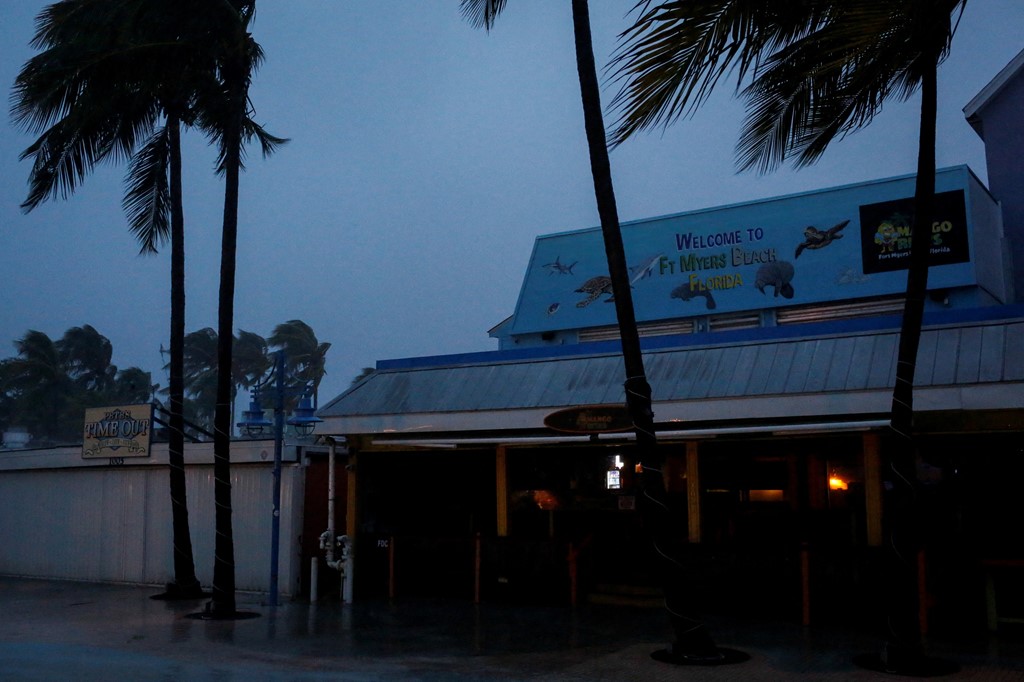
  • ‘Life-threatening’ As Hurricane Ian approaches the Florida coast

    The storm has maximum winds of 155 mph as it moves toward Florida’s southwest coast, falling just short of the most severe Category 5 status.

    Authorities have issued dire warnings about catastrophic storm surges that might cause the water to rise up to 12 feet or 16 feet above ground in some places.

    More than 2.5 million people are under mandatory evacuation orders, although some have chosen not to flee or are unable to.

    Residents have rushed to board up their homes and stash precious belongings on upper floors.

    Severe winds and rain have already begun to lash the American state’s heavily populated Gulf Coast.

    The massive storm is expected to slam into the Gulf Coast somewhere north of Fort Myers and some 125 miles south of Tampa.

    Florida governor Ron DeSantis warned at a news conference: “This is the kind of storm surge that is life-threatening.”

    “It is a big storm, it is going to kick up a lot of water as it comes in,” he said from Sarasota, a coastal city of 57,000 in the storm’s projected path.

  • Boy dead: Aunt ‘push boy,3 into Lake Michigan and watched as he sank

    On Sunday, shortly after 10 a.m. local time, Josiah Brown was declared deceased. He had been taken from the lake last Monday while in a severe state, and it had not been anticipated that he would make it.

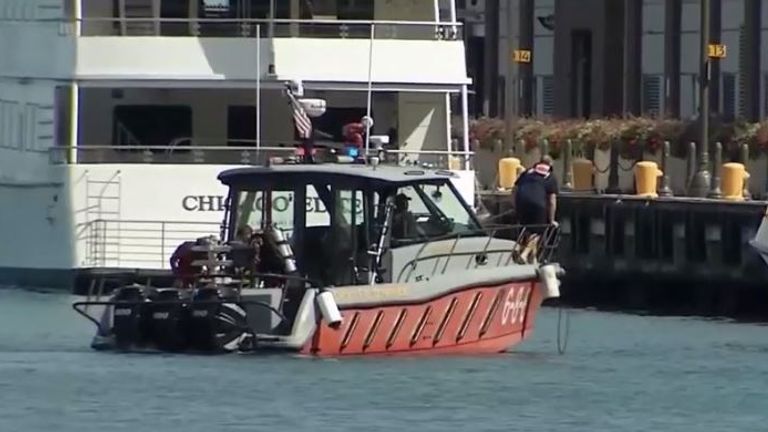
    A three-year-old boy has died after his aunt allegedly pushed him into Lake Michigan in Chicago, US officials say.

    Josiah Brown was pronounced dead shortly after 10 am local time (4 pm UK time) on Sunday.

    He had been in a critical condition after being pulled from the lake last Monday and had not been expected to survive.

    Victoria Moreno. Pic: Chicago Police
    Image:Victoria Moreno. Pic: Chicago Police

    Josiah was allegedly shoved by his aunt Victoria Moreno at Navy Pier, a fall of more than 6ft, and she then stood by as he sank below the water, according to authorities.

    Divers found the boy at the bottom of the lake about half an hour later.

  • Russian citizenship granted to Edward Snowden

    A former US intelligence contractor Edward Snowden, who exposed vast US surveillance programmes, has been awarded Russian citizenship.

    The decree was signed by Russian President Vladimir Putin on Monday.

    Mr Snowden, 39, has been living in exile in Russia since exposing the National Security Agency (NSA) programme affecting millions of Americans in 2013.

    Mr Snowden, who faces espionage charges in the US, has made no public comments.

    In 2020, the NSA surveillance of millions of Americans’ telephone records was ruled unlawful by the US Court of Appeals.

    Mr Snowden said afterward that he felt vindicated by the ruling.

    Top US intelligence officials had publicly insisted the NSA had never knowingly collected data from private phone records until Mr Snowden exposed evidence to the contrary.

    Following the revelation, officials said the NSA’s surveillance program had played a crucial role in fighting domestic terrorism, including the convictions of Basaaly Saeed Moalin, Ahmed Nasir Taalil Mohamud, Mohamed Mohamud, and Issa Doreh, of San Diego, for providing aid to al-Shabab militants in Somalia.

  • US to ease internet curbs for Iranians amid protest

    The US says it will ease internet curbs on Iran to counter Tehran’s clampdown on protests which were sparked by a woman’s death in police custody.

    “We are going to help make sure the Iranian people are not kept isolated and in the dark,” said US Secretary of State Anthony Blinken.

    The relaxation of software controls will allow American tech firms to expand their business in Iran.

    Mahsa Amini, 22, fell into a coma last week, hours after morality police arrested her for allegedly breaking headscarf rules.

    Officers reportedly beat Ms Amini’s head with a baton and banged her head against one of their vehicles. The police have said there is no evidence of any mistreatment and that she suffered “sudden heart failure”.

    Anti-government protests continued for an eight straight night on Friday, while pro-regime rallies also took place in Tehran and other cities.

    Mr Blinken said the partial relaxation of internet restrictions was a “concrete step to provide meaningful support to Iranians demanding that their basic rights be respected”. It was clear, he added, that the Iranian government was “afraid of its own people”.

    The US treasury said the move would help counter the Iranian government’s attempt to “surveil and censor” its people.

    But it is unlikely to have an immediate impact as it “does not remove every tool of communications repression”.

    Billionaire Elon Musk said on Twitter that he would activate his satellite internet firm, Starlink, to provide internet services to Iran in response to Mr Blinken’s announcement.

    Starlink provides internet services via a huge network of satellites and is aimed at people who live in remote areas who cannot get high-speed internet.

    US officials said that the updated license did not cover hardware supplied by Mr Musk but his firm and others were welcome to apply for permission to the treasury.

    Footage shared on social media on Friday showed large crowds of protesters gather in several Tehran neighbourhoods after dark, while other incidents occurred elsewhere the country. In the protests women have defiantly taken off their hijabs and burned them, or cut off their hair in front of cheering crowds.

    While spreading across much of the country, many of the early protests were concentrated in western Iran, particularly areas with large Kurdish populations, the group Ms Amini belonged to.

    On Friday, reports emerged from Oshnavieh, in Iran’s West Azerbaijan Province, which borders Kurdistan, showing widespread protests, as well as suggestions demonstrators had taken control of large parts of the city. The BBC was unable to confirm this.

    Videos posted from Oshnavieh showed large crowds of people marching through city streets with no police presence, while loud explosions could be heard.

    Friday also saw pro-regime demonstrations in Tehran and other cities, with those present declaring support for Supreme Leader Ayatollah Ali Khamenei, who has been a target of anti-government protesters.

    President Ebrahim Raisi spoke at a pro-government event, saying he would not allow the country’s security to be “threatened”.

    “We will not allow people’s security to be put at risk under any circumstances,” he said, shortly after returning from the United Nations General Assembly in New York.

    Stressing that Iran’s “enemies” wanted to exploit the unrest, Mr Raisi said the government would listen to criticism over Ms Amini’s death, but would not be influenced by “rioting”.

    Source: BBC


  • South Korean President: Denies US insult caught on hot mic

    President Yoon Suk-yeol of South Korea has denied making insulting remarks to the US Congress following his meeting with US President Joe Biden last week in New York.

    He was recorded using a hot mic and appeared to be referring to US lawmakers with a phrase that may either be translated as “idiots” or something considerably heavier in Korean.

    The footage quickly went viral in South Korea.

    But his spokeswoman says he had “no reason to talk about the US or utter the word ‘Biden’”.

    The remark is said to have occurred as part of a conversation about Mr Biden’s drive to increase the US contribution to a global initiative known as the Global Fund, which would require congressional approval.

    “How could Biden not lose face if these [expletive] do not pass it in Congress?,” Mr Yoon apparently said to his aides afterward.

    Presidential spokeswoman Kim Eun-hye said in New York on Thursday Mr Yoon did not actually say “Biden”, but a similar-sounding Korean word, and that he was referring to the South Korean parliament, not the US Congress.

    Many were unconvinced by the government’s defense – an opposition MP said it was like telling Koreans they were “hearing impaired”.

    Mr Yoon is a former prosecutor who only entered politics last year and won the presidential elections earlier this year by less than 1%.

    He is known as being prone to gaffes and has been struggling with low approval ratings soon after being elected, correspondents say.

    He also drew criticism for failing to attend the Queen’s lying-in-state on his first day in London, for which his office blamed traffic issues.

    Last year, he had to backtrack on his comment that the authoritarian president Chun Doo-hwan, who was responsible for massacring protesters in 1980, was “good at politics”.

  • No room for blackmail and intimidation’ – Putin says

    Before US President Joe Biden’s speech, at the UN General Assembly, Russian president, Vladimir Putin made comments of his own.

    At an event to mark the 1,160th year of Russia’s statehood, he said the country would not lose its sovereignty and would not give in to “blackmail and intimidation”.

    Western officials would likely argue that they have not threatened the sovereignty of Russia, and it is instead Moscow that is endangering Ukraine’s sovereignty.

    Hours after Mr Putin ordered partial mobilization to boost troops in Ukraine, he also lauded the Russian military.

    He claimed it was fighting to save people in Ukraine’s eastern Donbas region, where Moscow has alleged Russian citizens are being persecuted.

    But Ukraine has forcefully denied the accusations and has aimed to push Russian forces out of its territory.

  • Mark Frerichs: US hostage exchanged for Taliban-affiliated Afghan leader

    The Taliban have released a US engineer they had held hostage since 2020 in exchange for an Afghan tribal leader held in US custody since 2005.

    Mark Frerichs was handed over at Kabul airport on Monday, the Taliban said.

    In return, they received Bashir Noorzai, a Taliban ally serving a life sentence for drug trafficking.

    US President Joe Biden said that the swap required “difficult decisions” that he did not take lightly.

    Mr Frerichs, 60, was abducted by the Taliban the year before the group swept back to power in Afghanistan and its Western-backed government collapsed.

    He had been living and working in Kabul as a civil engineer for 10 years. Mr Frerich’s sister, Charlene Cakora, said the family had never given up hope of getting him back.

    “I am so happy to hear that my brother is safe and on his way home to us. Our family has prayed for this each day of the more than 31 months he has been a hostage,” she said in a statement.

    “There were some folks arguing against the deal that brought Mark home, but President Biden did what was right. He saved the life of an innocent American veteran.”

    The detention of the former navy officer has been a major impediment to improving relations between the US and the Taliban, whose government is still to be recognised by any country in the world.

    President Biden said in January: “The Taliban must immediately release Mark before it can expect any consideration of its aspirations for legitimacy. This is not negotiable.”

    At least one other American remains in Taliban hands. Filmmaker Ivor Shearer and his Afghan producer, Faizullah Faizbakhsh, were detained in Kabul in August.

    Eric Lebson, a former national security official who worked as a volunteer to help the Frerichs family, said he hoped Mr Biden’s actions to secure Mr Frerichs’ release “are an indicator of his commitment to do the same on an urgent basis for other Americans held hostage or wrongfully detained abroad”.

    “They are being held because they are Americans and they need the US government to bring them home,” Mr Lebson said.

    Bashir Noorzai told reporters in Kabul his release would bring peace with the US

    Bashir Noorzai was given a hero’s welcome on his return to the Afghan capital, and was greeted by Taliban fighters carrying garlands of flowers.

    “My release together with that of an American will make peace between the countries,” he told a news conference.

    Noorzai was a close ally and friend of Taliban founder Mullah Omar and helped finance the first Taliban government in the 1990s.

    He did not hold an official position but “provided strong support including weapons”, Taliban spokesman Zabihullah Mujahid told the AFP news agency.

    Noorzai had served 17 years in US custody for heroin smuggling. Prosecutors said he ran a vast opium-growing operation in Kandahar province, the Taliban’s traditional heartlands in the south of the country.

    At the time of his arrest in 2005, he was considered one of the biggest drug dealers in the world, controlling more than half of Afghanistan’s drug exports, which account for most of the world’s harvest.

    In 2008, he was convicted by a court in New York of conspiring to smuggle more than $50m of heroin into the United States.

  • North Korea makes the “irreversible” decision to declare itself a nuclear-armed state

    In a move that its leader Kim Jong Un calls “irreversible,” North Korea has enacted new legislation proclaiming itself a nuclear weapons state.

    Kim vowed the country would “never give up” its nuclear weapons and said there could be no negotiations on denuclearization as he hailed the passage of the law, North Korean state media reported Friday.
    The new law also enshrines Pyongyang’s right to use preemptive nuclear strikes to protect itself — updating a previous stance under which it had said it would keep its weapons only until other countries denuclearized and would not use them preemptively against non-nuclear states.
    Nuclear weapons represent the “dignity, body, and absolute power of the state,” Kim said as he welcomed the decision by the country’s rubber-stamp parliament — the Supreme People’s Assembly — to pass the new law in a unanimous vote.
    “The adoption of laws and regulations related to the national nuclear force policy is a remarkable event as it’s our declaration that we legally acquired war deterrence as a means of national defense,” Kim said.
    “As long as nuclear weapons exist on Earth, and imperialism and the anti-North Korean maneuvers of the US and its followers remain, our road to strengthening our nuclear force will never end.”
    The new law also bans the sharing of nuclear technology with other countries.
    It comes amid rising regional tensions over North Korea’s expansion of its nuclear weapons and missiles program.
    Kim has made increasingly provocative threats of nuclear conflict toward the United States and its allies in Asia in recent months.
    At the same time, the US has become increasingly concerned that North Korea may be preparing to carry out its first underground nuclear test in years
    Yang Moo-jin, a professor at the University of North Korean Studies in Seoul, said the law demonstrated Pyongyang’s hopes of strengthening its relations with China and Russia at a time of heightened global tensions.
    “North Korea mentioning the possibility of using nuclear weapons if and when an attack on the state and leader is imminent is significant, even though it states nuclear weapons as a defensive last resort,” Yang said.
  • Shark attack kills US cruise passenger in Bahamas

    A US cruise ship passenger was killed by a shark while snorkelling near the Bahamas on Tuesday, according to local authorities.

    The 58-year-old woman from Pennsylvania was on an excursion near Green Cay near Nassau when the incident took place.

    Police later said that the family identified the shark as a bull shark. A similar incident in the area took the life of a 21-year-old American in 2019.

    Despite gripping public attention, shark attacks are exceedingly rare.

    Bahamian police spokeswoman Chrislyn Skippings told reporters that the woman was on an excursion with a local tour company, which took her to the popular snorkelling area.

    Family members and tour company staff saw her being attacked and managed to pull her from the water. A local news outlet, Eyewitness News, quoted Ms Skippings as saying that the victim suffered wounds to her “upper extremities”.

    The victim was declared dead by authorities after being taken to shore.

    Her cruise ship, the Harmony of the Seas, was docked in Nassau at the time of the attack. It had just begun its seven day cruise of the western Caribbean from Port Canaveral in Florida on 4 September.

    Cruise operator Royal Caribbean International said in a statement that they are “providing support and assistance to the guest’s loved ones during this difficult time.”

    The incident is the first fatal shark attack in the Bahamas since 2019, when a 21-year-old woman from California was attacked by sharks near Rose Island, about half a mile (0.8km) away from Tuesday’s attack.

    In another recent incident, an eight-year-old British boy was injured after being attacked by three sharks in another part of the Bahamas. His father later told The Sun that the attack “was like a scene out of Jaws”.

    In total, statistics from the Florida-based International Shark Attack File show that only about 32 shark attacks have been reported in the Bahamas since 1749, the highest number in the region.

    Michael Heithaus, a marine biologist at Florida International University in Miami, told the Associated Press that the relatively high number of shark attacks in the area is likely due to the high number of people in the waters, which are home to a vibrant marine ecosystem.

    Globally, there were 73 confirmed unprovoked shark attacks in 2021, including nine which resulted in death.


    Source: BBC

  • ‘Fat Leonard’ escapes house arrest after US navy bribery scandal with ‘wild sex parties’

    A Malaysian contractor at the centre of the US navy’s worst corruption scandal escaped house arrest in California over the weekend after cutting off his GPS anklet, federal agents have said.

    Leonard Francis, known as “Fat Leonard”, who admitted to offering $500,000 in bribes to US navy officers, has reportedly gone on the run before his sentencing in three weeks.

    Police found his home in the city of San Diego empty on Sunday morning.

    Francis was arrested in 2013, accused of plying navy officers with cash, expensive food and cigars, rare cognac, and wild sex parties in luxurious hotels in exchange for contracts.

    Two years later he pleaded guilty to bribing navy officials as part of a massive fraud and bribery scheme involving his ship-servicing company, Glenn Defense Marine Asia, in Singapore.

    Local officials and the Naval Criminal Investigative Service are now understood to be searching for him.

    Supervisory Deputy US Marshal Omar Castillo told the San Diego Union-Tribune, a local newspaper: “He was planning this out, that’s for sure.”

    Francis’ neighbours reportedly saw U-Haul moving lorries going in and out of his home in recent days.

    Francis had suffered from ill health in recent years and was placed under house arrest in 2018 while cooperating with investigators and acting as a witness for the prosecution.

    He was due to be sentenced on 22 September.

    The US Justice Department previously called Francis’ scheme a colossal fraud.

    They later brought charges against more than 30 others.

    Many of those charged have pleaded guilty or were convicted at trial.

  • China issues a threat of “countermeasures” after the US accepts a $1.1 billion arms sale to Taiwan

    Following the Biden administration‘s approval of more than $1.1 billion in arms sales to Taiwan, China has warned the United States that it will take “countermeasures.”

    China is “firmly opposed” to the sales, which “seriously imperil China-US ties and peace and stability across the Taiwan Strait,” according to Liu Pengyu, spokesman for the Chinese embassy, who also urged Washington to “immediately rescind” them.

    Liu’s comments on Twitter came after the Biden administration on Friday formally notified Congress of the proposed sales, which include up to 60 anti-ship missiles and up to 100 air-to-air missiles.
    The State Department said the sales are in line with a longstanding US policy of providing defensive weapons to the island and described the “swift provision” of such arms as being “essential for Taiwan’s security.”
    China, however, has accused the US of interfering in what it sees as its internal affairs.
    China’s Communist Party claims Taiwan, a self-governing democracy, as part of its territory — despite never having governed it — and has long vowed to “reunify” the island with the Chinese mainland, by force if necessary.
    “The US interferes in China’s internal affairs and undermines China’s sovereignty and security interests by selling arms to Taiwan,” Liu tweeted.
    “It sends the wrong signals to ‘Taiwan independence’ separatist forces and severely jeopardizes China-US relations and peace and stability across the Taiwan Strait,” Liu said.
    He called on the US to “honor its commitments to the one-China principle” and ended his series of tweets by saying Taiwan is “an inalienable part of the Chinese territory” and warned China will “resolutely take legitimate and necessary counter-measures.”
    US-China tensions have spiked since House Speaker Nancy Pelosi visited Taiwan last month.
    China had warned Pelosi against making the trip, and responded by ordering days’ worth of military drills around the island after she had left.
    Taiwan said Saturday it “highly welcomes” the latest arms sales and thanked the US government for “continuing to implement its security commitments to Taiwan.”
    “In response to China’s recent continuous military provocations and unilateral changes in the status quo and creating crises, Taiwan’s determination to defend itself is extremely firm,” Taiwan’s Ministry of Foreign Affairs said in a statement Saturday.
    “This batch of arms sales includes a large number of various types of missiles that are needed to strengthen Taiwan’s self-defense, which fully demonstrates that the great importance the US government attaches to Taiwan’s defense needs, assisting our country to obtain the equipment needed for defense in a timely manner and to enhance our national defense capabilities.”
    In an incident that underscored the heightened tensions, Taiwan’s military shot down a drone hovering over one of its island outposts just off the Chinese coast on Thursday.
    A day earlier, Taiwan said it had warned off drones hovering over three of the islands it occupies off the coast of the Chinese port city of Xiamen.
  • War in Ukraine: Russia to keep a vital gas route to the EU shut

    National energy company Gazprom has disclosed that the gas pipeline from Russia to Germany won’t resume on Saturday as scheduled.

    The Nord Stream 1 pipeline would be permanently shut down after the company claimed to have discovered an oil leak in one of its turbines.

    For the past three days, the pipeline has been closed for what Gazprom has referred to as maintenance work.

    The news comes amid growing fears that families in the EU will not be able to afford the cost of heating this winter.

    Energy prices have soared since Russia invaded Ukraine and scarce supplies could push up the cost even further.

    Europe is attempting to wean itself off Russian energy in an effort to reduce Moscow’s ability to finance the war, but the transition may not come quickly enough.

    EU Council President Charles Michel said the Russian move was “sadly no surprise”.

    “Use of gas as a weapon will not change the resolve of the EU. We will accelerate our path towards energy independence. Our duty is to protect our citizens and support the freedom of Ukraine,” he tweeted.

    Moscow denies using energy supplies as an economic weapon in retaliation for Western sanctions imposed following Russias invasion.

    It has blamed the sanctions for holding up routine maintenance of Nord Stream 1, but the EU says this is a pretext.

    Germany’s network regulator, the Bundesnetzagentur, said the country was now better prepared for Russian gas supplies to cease, but it urged citizens and companies to cut consumption.

    Gazprom’s announcement came shortly after the G7 nations agreed to cap the price of Russian oil in support of Ukraine.

    The G7 (Group of Seven) consists of the UK, US, Canada, France, Germany, Italy, and Japan.

    Their introduction of a price cap means countries that sign up to the policy will be permitted to purchase only Russian oil and petroleum products transported via sea that are sold at or below the price cap.

    However, Russia says it will not export to countries that participate in the cap.

    The gas pipeline stretches from the Russian coast near St Petersburg to north-eastern Germany and can carry up to 170 million cubic metres of gas a day.

    It is owned and operated by Nord Stream AG, whose majority shareholder is Gazprom.

    Germany had also previously supported the construction of a parallel pipeline – Nord Stream 2 – but the project was halted after Russia invaded Ukraine.

    Gazprom said the fault had been detected at the Portovaya compressor station, with the inspection carried out alongside workers from Siemens, the German firm that maintains the turbine.

    It said that fixing oil leaks in key engines was only possible in specialized workshops, which had been hindered by Western sanctions.

    However, Siemens itself said: “Such leaks do not normally affect the operation of a turbine and can be sealed on site. It is a routine procedure within the scope of maintenance work.”

    This is not the first time since the invasion that the Nord Stream 1 pipeline has been closed.

    In July, Gazprom cut off supplies completely for 10 days, citing “a maintenance break”. It restarted again 10 days later, but at a much-reduced level.

    Speaking to the BBC from the Swiss capital Bern, an economist and energy analyst, Cornelia Meyer, said the gas shutdown would have a major impact on employment and prices.

    “That really has huge ramifications for gas in Europe which is about four times more expensive than it was a year ago and this cost of living crisis will really soar because it’s not just gas,” she said. “Gas becomes fertilizer and it’s used in many industrial processes, so that will affect jobs, and it will affect costs.”

    The flow of gas through Nord Stream 1 had already been reduced to a relative trickle. Now, once again, it has been halted completely.

    An oil leak, claims Gazprom – which has previously attributed reduced flows through the pipeline to technical issues related to sanctions.

    Europe, though, believes President Putin is weaponizing gas supplies – deliberately limiting flows through the pipeline to push up prices, in order to test the resolve of Russia’s critics.

    The result, as we’ve already seen, is soaring energy costs – with businesses and consumers paying a heavy price.

    The timing of Gazprom’s move is certainly interesting. It comes on the same day the G7 announced moves to cap the price of Russia’s oil exports.

    But it also comes shortly after Germany – which is heavily reliant on Russian gas – revealed that its winter storage was filling up faster than expected.

    A cynic might say this was the last opportunity to tighten the screw, in order to inflict maximum damage over the colder months.

  • We must contest Chinese missiles over Taiwan- US commander

    A senior US military officer has stated that China’s decision to launch missiles over Taiwan must be disputed.

    Vice Admiral Karl Thomas, commander of the Seventh Fleet, described China’s actions as “a gorilla in the room” if they weren’t stopped.

    This month, Beijing conducted military exercises around the autonomous island, though it did not confirm whether any missiles actually flew over it.

    After US lawmaker Nancy Pelosi visited Taiwan in August, tensions skyrocketed.

    Beijing, which asserts sovereignty over the island, was incensed by her high-profile visit.

    Tuesday’s comments by Vice Admiral Thomas are significant, Based in Yokosuka, Japan, the Seventh Fleet is the largest forward-­deployed fleet in the US Navy, with some 50 to 70 vessels and submarines – and is a key part of its military presence in the region.

    “It’s very important that we contest this type of thing. I know that the gorilla in the room is launching missiles over Taiwan,” Vice Admiral Thomas told reporters in Singapore. “It’s irresponsible to launch missiles over Taiwan into international waters.

    “If you don’t challenge it… all of a sudden it can become just like the islands in the South China Sea [that] have now become military outposts. They now are full functioning military outposts that have missiles on them, large runways, hangers, radars, listening posts.”

    China’s decision to conduct nearly a week of military drills in the waters around Taiwan disrupted major shipping and aerial routes – a move the island said effectively amounted to a blockade. It also accused Beijing of using the drills as practice for an invasion.

    Taiwan said the missiles China fired flew high into the atmosphere and posed no threat. Its defense ministry did not disclose the trajectory of the missiles, citing intelligence concerns.

    The Japanese embassy in Washington said it believed four missiles fired by China had passed over Taiwan’s capital Taipei.

    The US and other allies have stepped up naval crossings in the Taiwan Strait and the South China Sea, another area of strategic importance to Beijing, to emphasize that these are international waters.
    While the US has official diplomatic relations with China and not Taiwan, it maintains a special relationship with the island, which includes selling weapons for defense – an arrangement that has long troubled China.

    In recent years it has also become yet another flashpoint between Washington and Beijing as tensions between the two soured.

  • Investigating Trump: Photos show handwritten notes that Trump tried to flush down toilet

    Newly revealed pictures reveal two occasions on which former President Donald Trump apparently flushed documents down the toilet.

    Maggie Haberman, a New York Times reporter, and CNN contributor are publishing the new images in her forthcoming book, “Confidence Man,” and the images were earlier posted by Axios. CNN has previously reported how Trump flouted presidential record-keeping laws and would often tear up documents, drafts, and memos after reading them.
    He periodically flushed papers down the toilet in the White House residence — only to be discovered later on when repairmen were summoned to fix the clogged toilets. Trump has denied the allegations, and in a statement given to Axios on Monday, a spokesman claimed that reporting about the practice was fabricated.
    In the images revealed on Monday, it’s unclear what the documents are in reference to — and who authored them — but they appear to be written in Trump’s handwriting in black marker. Haberman said one image is from a White House toilet and the other one is from an overseas trip that was provided to her by a Trump White House source.
    “Who knows what this paper was? Only he would know and presumably whoever was dealing with it, but the important point is about the records,” Haberman told CNN’s John Berman and Brianna Keilar on “New Day” Monday morning.
    Trump had a pattern of disregarding normal record preservation procedures. On one occasion, Trump asked if anyone wanted to put a copy of a speech he just delivered up for auction on eBay, during a mid-flight visit to the press cabin of Air Force One.
    In other instances, Trump would task aides with carrying boxes of unread memos, articles, and tweet drafts aboard the presidential aircraft for him to review and then tear to shreds.
    A former senior Trump administration official said a deputy from the Office of Staff Secretary would usually come in to pull things out of the trash and take them off Trump’s desk after he left a room.
    A former White House official recalled that while document preservation was a key responsibility of the staff secretary, the rest of Trump’s senior staffers lacked the sense of their obligation to maintain records of papers that moved through the West Wing.
    Trump’s haphazard record-keeping was the subject of a drawn-out fight earlier this year between him and the National Archives, and the Justice Department has been investigating the matter.
  • New START treaty : Russia suspends US inspections of nuclear arsenal

    In accordance with the New START arms limitation deal, Russia has informed the US that it has “temporarily” stopped on-site inspections of its strategic nuclear weapons.

    The Russian foreign ministry claims that the US seeks to take advantage and had deprived Russia of the right to undertake inspections on US territory.

    It said US sanctions imposed on Russia over Ukraine had changed conditions between the countries.

    The treaty came into force in 2011.

    It is the last remaining arms reduction agreement between the former Cold War rivals. It caps at 1,550 the number of long-range nuclear warheads that each country can deploy.

    The ministry said the suspension was allowed under the treaty terms “in exceptional circumstances”.

    The suspension comes a week after US President Joe Biden said he was ready to work on a new nuclear arms deal with President Vladimir Putin. The current one will expire in 2026.

    The ministry accused the US of ignoring “existing realities” such as “the suspension of normal” air links.

    New START followed years of arms reduction talks between the US and the former USSR, aimed at preventing nuclear war.

    Russia’s invasion of Ukraine in February sparked hostile rhetoric on both sides, including warnings that the conflict could escalate into a third world war.

    Some commentators on Russian state media have boasted about Moscow’s nuclear arsenal in the context of current tensions with Nato.

  • US fireman finds 10 dead in house blaze are his family

    In the US state of Pennsylvania, a house fire has claimed the lives of three children and seven adults. The firefighter who was summoned to the site was devastated to learn that the victims were members of his own family.

    Six of the victims’ names have been confirmed by Pennsylvania State Police, but the youngest children, aged five, six, and seven, are still unidentified.

    A criminal investigation has been launched into the fire’s cause.

    The blaze is thought to have begun on the porch early on Friday morning.

    Harold Baker, a Nescopeck Volunteer Fire Company firefighter, told the Associated Press news agency that the dead were his son, daughter, father-in-law, brother-in-law, sister-in-law, three grandchildren, and two other relatives.

    He said the three children who died – two boys and a girl – did not live in the home, and were visiting for summer activities.

    Three children and seven adults have died in a house fire in the US state of Pennsylvania, and a firefighter called to the scene was horrified to find the victims were his own family.

    Pennsylvania State Police confirmed the names of six of the victims, but have yet to identify the youngest children, ages five, six, and seven.

    A criminal investigation has been launched into the fire’s cause.

    The blaze is thought to have begun on the porch early on Friday morning.

    Harold Baker, a Nescopeck Volunteer Fire Company firefighter, told the Associated Press news agency that the dead were his son, daughter, father-in-law, brother-in-law, sister-in-law, three grandchildren, and two other relatives.

    He said the three children who died – two boys and a girl – did not live in the home, and were visiting for summer activities.

  • US urges Russia to accept deal to free jailed Brittney Griner

    The US has urged Moscow to accept a deal to free basketball player Brittney Griner, who has been sentenced to nine years in a Russian prison.

    The double Olympic winner was convicted of possessing and smuggling drugs after admitting to possessing cannabis oil.

    White House national security spokesman John Kirby said the US offer was “a serious proposal”, but gave no details.

    On Friday, Russia’s Foreign Minister Sergei Lavrov said Moscow is ready to discuss the topic.

    US media reports suggest Washington is offering a prisoner swap involving a Russian arms trafficker.

    Viktor Bout – known as the “merchant of death” – is serving a 25 year-prison sentence in the US.

    He could be transferred by Washington to the Russian authorities in exchange for Griner and former US Marine Paul Whelan, the reports say.

    Whelan, who has US, British, Canadian and Irish passports, was sentenced in 2020 to 16 years in jail in Russia after being convicted of spying.

    Mr Kirby told reporters that the duo were being wrongfully detained and needed to be let go.

    On the subject of the US proposal, Mr Kirby said: “We urge them to accept it. They should have accepted it weeks ago when we first made it.”

    But according to Reuters news agency, one stumbling block is that Russia wants to add convicted murderer Vadim Krasikov, who is in prison in Germany, to the proposed swap.

    When questioned about this possibility, Mr Kirby dismissed it, saying: “I don’t think we go so far as to even call it a counter-offer.”

    Griner, 31, told the court she had made an “honest mistake” and had not intended to break the law.

    Considered one of the best female players in the world, she was detained in February at an airport near Moscow when vape cartridges containing cannabis oil were found in her luggage. She had come to Russia to play club basketball during the US off-season.

    Soon afterwards, Russia invaded Ukraine and her case has become subject to high-profile diplomacy between the US and Russia.

    Her defence team said they would appeal against the verdict.

    Griner’s Phoenix Mercury teammates staged a gesture of solidarity on Thursday, when they and their Connecticut Sun opponents observed 42 seconds of silence before their game, in honour of her number 42 jersey.

    US President Joe Biden called her sentencing “unacceptable”, adding: “I call on Russia to release her immediately so she can be with her wife, loved ones, friends, and teammates.”

    Meanwhile Secretary of State Antony Blinken added: “Russia, and any country engaging in wrongful detention, represents a threat to the safety of everyone travelling, working and living abroad.”

    Mr Blinken raised the issue in a phone call with Mr Lavrov last week, in the first conversation between the two men since the start of the war in Ukraine.

    A day after Griner’s sentencing, Mr Lavrov said that Moscow is ready to discuss the topic of prisoner exchanges with Washington, but within the framework of an existing diplomatic channel agreed upon by Presidents Putin and Biden, Reuters news agency quotes him as saying.

    Both Mr Lavrov and Mr Blinken are now in Cambodia for a meeting of the Association of South-East Asian Nations. The US says Mr Blinken will try to speak with Mr Lavrov again while they are there.

    Source: BBC

  • Taiwan braces as China drills follow Pelosi visit

    China is kicking off its biggest-ever military exercises in the seas around Taiwan following US politician Nancy Pelosi’s visit.

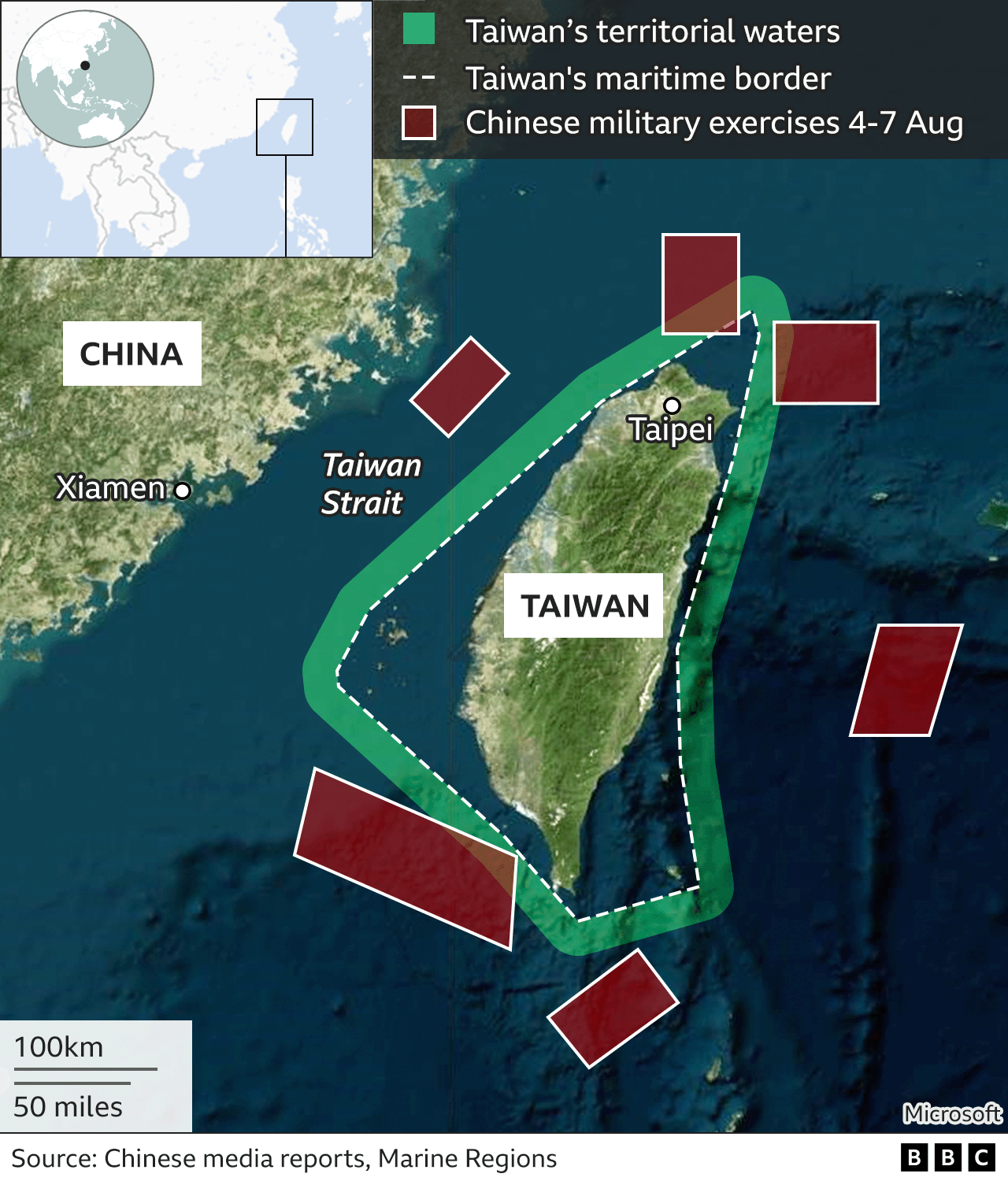
    The live fire drills began at 12:00 local time (04:00 GMT) and in several areas were due to take place within 12 miles of the island.

    Taiwan said China was trying to change the status quo in the region.

    Ms. Pelosi made a brief but controversial visit to Taiwan, which China regards as a breakaway province.

    The drills are Beijing’s main response, although it has also blocked some trade with the island.

    The exercises are due to take place in busy waterways and will include long-range live ammunition shooting, Beijing says.

    Taiwan says it amounts to a sea and air blockade while the US said the drills were irresponsible and could spiral out of control.

    Analyst Bonnie Lin told the BBC that the Taiwanese military would react cautiously but there was still a risk of confrontation.

    “For example, if China decides to fly planes over Taiwan’s airspace, there is a chance that Taiwan might try to intercept them. And we could see a mid-air collision, we could see a lot of different scenarios playing out,” she said.

    Taiwan said it scrambled jets to warn off Chinese warplanes on Wednesday and its military fired flares to drive away unidentified aircraft over the Kinmen islands, located close to the mainland.

    Several ministries have suffered cyber-attacks in recent days, the Taiwanese government said.

    Taiwan has also asked ships to take different routes and is negotiating with Japan and the Philippines to find alternative aviation routes.

    A map showing where the drills will take place

    Japan has also expressed concern to China over the areas covered by the military drills, which it says overlaps with its exclusive economic zone (EEZ).

    In response, Chinese government spokeswoman Hua Chunying said Beijing did not accept the “so-called” Japan EEZ.

    On Wednesday, China detained a suspected Taiwanese separatist in the coastal Zhejiang province on suspicion of endangering national security, according to local media reports.

    Meanwhile, China’s Ambassador to France Lu Shaye told French TV that after “reunification” with Taiwan, Beijing would focus on “re-education”.

    China has previously used the term “re-education” to refer to its detention of mostly-Muslim minorities in its north-western Xinjiang region, where human rights groups say more than a million people have been incarcerated.


    These drills are unprecedented

    In the Taiwanese capital, the situation remains calm but Taiwan is being forced to reroute a huge amount of air and sea traffic around the exclusion zones declared by Beijing.

    Meanwhile a US aircraft that can track ballistic missiles in flight has taken off from Japan and is heading towards Taiwan.

    Analysts say one scenario is that China is preparing to fire ballistic missiles – to splash down in the exclusion zones, very close to Taiwan’s coast. That is what China did back in 1996, the last time tensions between Beijing and Taipei got this bad. But this time the exclusion zones are much closer to Taiwan.

    There is also concern that one of the exclusion zones is to the east of Taiwan in the Pacific ocean. Analysts say it is possible China is preparing to fly a missile over the top of Taiwan – to splash down in that zone. That would be considered a major violation of Taiwan’s airspace.

    Mrs Pelosi, the most senior US politician to visit Taiwan in 25 years, made the trip as part of a wider Asian tour.

    China had warned her not to travel to the island.

    Accusing the US of “violating China’s sovereignty under the guise of so-called democracy”, Chinese Foreign Minister Wang Yi said: “Those who play with fire will not come to a good end and those who offend China will be punished.”

    In a statement after the visit, Ms. Pelosi said China cannot “prevent world leaders or anyone from traveling to Taiwan to pay respect to its flourishing democracy, to highlight its many successes and to reaffirm our commitment to continued collaboration”.

    After leaving Taiwan, Ms. Pelosi traveled to South Korea, where she met her counterpart Kim Jin-pyo. She is due to visit the Joint Security Area near the border between the two Koreas, patrolled by the US-led UN command and North Korea.

    The US walks a diplomatic tightrope with its Taiwan policy. On the one hand, it abides by the “One China” policy, which recognizes only one Chinese government, giving it formal ties with Beijing and not Taiwan.

    On the other, it maintains a “robust unofficial” relationship with the island, which includes selling weapons for Taiwan to defend itself.

    Source: bbc.com
  • Why Nancy Pelosi’s pink suit in Taiwan was about more than power-dressing

    Although Nancy Pelosi’s plane arrived in Taiwan at night, everything about her entrance was orchestrated  to draw attention.
    Descending onto the asphalt at Taipei Songshan Airport on Tuesday evening, the US House speaker shone out from the darkness in a pink pantsuit.
    Amid a sea of black and gray (fellow Democrat Mark Takano’s powder blue number notwithstanding), her outfit recognized that this was no time to be understated.
    Nancy Pelosi meeting with Malaysia's Parliament Speaker Azhar Azizan Harun during her recent visit to Malaysia, dressed in a pink suit.

    Nancy Pelosi meeting with Malaysia’s Parliament Speaker Azhar Azizan Harun during her recent visit to Malaysia, dressed in a pink suit. Credit: Famer Rohen/Malaysian Department of Information/Reuters
    It was not simply a case of sticking out for the cameras, however.
    Pelosi’s controversial trip to the self-governing island is, in itself, symbolic. And if her goal is to signal America’s commitment to a democracy that she described — somewhat like her suit — as “vibrant,” then wearing pink was also a form of political communication.
    There had been no mid-flight costume change. Earlier that day, she had worn the same suit with heels and string of pearls (the glamorous but unshowy accessory du jour for US politicians) to visit Malaysia’s parliament.
    This makes her decision to arrive in Taiwan wearing it no less deliberate, though. Confident, powerful but unthreatening, pink appeared to frame her presence as an act of friendship towards Taiwan, not belligerence toward China, which has accused her of “knowingly and maliciously” creating a crisis.
    What has commentators really guessing is whether Pelosi intentionally nodded to another of America’s great pantsuit aficionados: Hillary Clinton.
    In 1995, the then-first lady wore a remarkably similar outfit to the United Nations’ Fourth World Conference on Women in Beijing, where she famously declared:
    “Women’s rights are human rights.” Like Pelosi’s trip, Clinton’s speech was somewhat controversial. During her address, she detailed threats facing women globally — including in China — and made thinly veiled swipes at her host’s intolerance of dissent.
    Hillary Clinton, dressed in a pink power suit, speaks in Beijing in 1995 at the UN Fourth World Conference.

    Hillary Clinton, dressed in a pink power suit, speaks in Beijing in 1995 at the UN Fourth World Conference. Credit: Emmanuel Dunand/AFP/Getty Images
    The moment was, unsurprisingly but ironically, censored by Beijing.
    And if Pelosi were aiming to evoke a historical memory, then that of Clinton openly criticizing the China on mainland soil would certainly be a subtly provocative one.
    We will likely never know. As with many female leaders, Pelosi rarely entertains questions about her style choices.
    But there is little doubt that the House speaker appreciates — and regularly harnesses — the power of clothing, from coordinated facemasks and “power scarves” to the suffragette-white she and others wore to protest then-President Donald Trump’s State of the Union address in 2020.
    Along with numerous Democrat congresswomen, Pelosi also wore white to Trump’s joint address to Congress in 2017, while her red Max Mara “Fire Coat” spoke volumes ahead of her infamous showdown with the former president a year later.
    There was the hot pink suit she wore on “The Late Show with Stephen Colbert,” the one she sported (with pink pumps) for the House committee chairs’ latest official photo and the fuchsia dress she chose for the 116th Congress’ swearing-in, which featured a record-breaking 127 women. She can even be seen wearing a pink blazer in her official Twitter profile picture.
    Hillary Clinton wearing a rose-hued outfit in 1995, during an exhibition opening at the White House.

    Hillary Clinton wearing a rose-hued outfit in 1995, during an exhibition opening at the White House. Credit: Joyce Naltchayan/AFP/Getty Images
    In each case, the shade exuded feminine power.
    Just as Congresswoman Alexandria Ocasio-Cortez applied red lipstick like “war paint” and Kamala Harris wore all-white for her acceptance speech as America’s first female vice president, Pelosi treats her choice of outfit as another string to her political bow.
    One can read too much into politicians’ wardrobes. Indeed, it may have been no more than a coincidence that Tsai Chi-chang, deputy speaker of Taiwan’s legislature, appeared to respond to Pelosi’s suit by wearing a pink tie to meet her on Wednesday morning.
    But clothes carry symbolism — and if the roars of approval on social media are anything to go by, the message behind Pelosi’s pink suit was heard in Taipei, Beijing and beyond.
  • Nobody would be prevented by China from coming to Taiwan -Nancy Pelosi

    US House Speaker Nancy Pelosi said on Wednesday, August 2 2022 said China will not “stand in the way” of people visiting Taiwan. She  was speaking at a joint conference in Taipei with Taiwan’s President Tsai Ing-wen

    “I just hope that it’s really clear that while China has stood in the way of Taiwan participating and going to certain meetings, that they understand that they will not stand in the way of people coming to Taiwan,”.

    Pelosi said the US congressional delegation’s visit to the self-ruled democratic island was a “show of friendship and support,” but also a source of learning and collaboration, after referencing previous trips made by US legislators.

    Pelosi reiterated the US’ support for Taiwan, again saying they had come to send an “unequivocal message—America stands with Taiwan.”

    “We have to show the world, and that is one of the purposes of our trip, the success of the people of Taiwan,” Pelosi said, pointing to the courage of the Taiwanese people to uphold democracy.

    “We want Taiwan to always have freedom with security, and we’re not backing away from that,” Pelosi said.


  • Young people in Taiwan are learning to fight, see why

    Friends who know I am in Taiwan have been sending me increasingly alarming messages – “I hope you have your flak jacket with you!” “Does your hotel have a bomb shelter?”

    They’ve seen the fire-breathing rhetoric coming from Chinese state media, most notably the Global Times, and have concluded that Nancy Pelosi’s visit to Taiwan could end very badly.

    Indeed some very eminent US-based China scholars have said the same, calling the visit “reckless” and warning against “pushing Beijing into a corner”.

    That’s not how it’s viewed here.

    Freddy Lim is a one-time heavy metal singer, and now a ruling party MP. These days Freddy sports a short haircut and a smart shirt, but tattoos still peek out from beneath his neatly pressed cuffs.

    “There is a basic principle that we welcome high-level politicians like Nancy Pelosi coming to Taiwan. It’s very important. It is not a provocation against China. It is welcoming a friend in a normal way, just like any other country,” he told the BBC.

    This is something all the main political parties in Taiwan agree on.

    Charles Chen is an MP for the opposition KMT (Kuomintang) party and a former presidential spokesman.

    “I think this time if Speaker Pelosi can come to Taiwan, it will be a crucial time for the United States to show support to Taiwan, to Taiwan’s democracy,” he said.

    From Taiwan’s point of view, the arrival here of the third most powerful politician in the US carries huge symbolic significance. It also serves to normalize such high-level visits, which Taiwan would like to see a lot more of (the last one was 25 years ago).

    Taiwan military drillIMAGE SOURCE, HANDOUT
    Image caption,

    Taiwan showed off its firepower last week – but it has fallen behind China

    But by itself, Nancy Pelosi’s visit does not change the fundamental calculus – that Taiwan’s status as a free and democratic society is in jeopardy.

    There is a growing realization that China’s threats to “reunifying the island, by force if necessary” are real, and that China now vastly outmatches Taiwan in military capability.

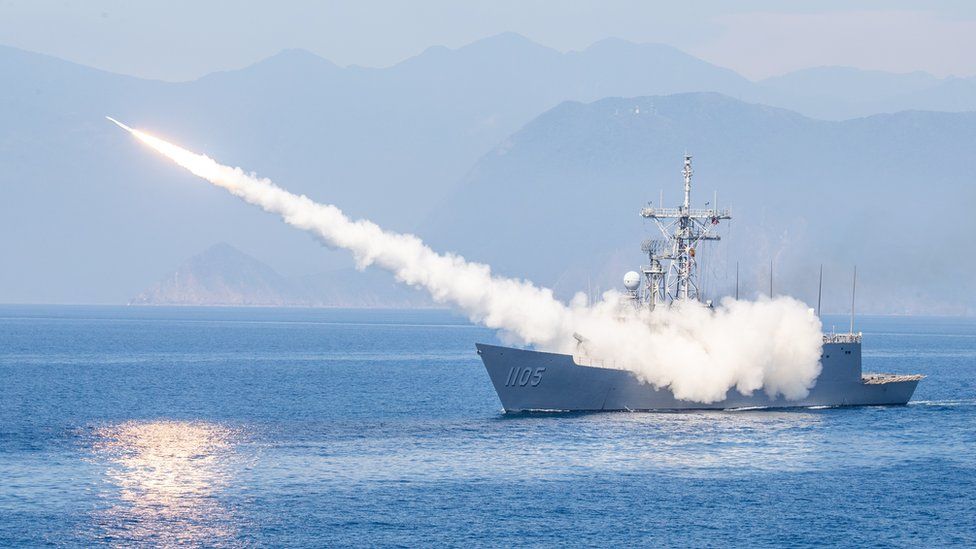
    Last week Taiwan showed off its military power in a five-day extravaganza of live fire drills and air and naval maneuvers called Han Kuang 38.

    To the casual observer, it was an impressive show of modern military might. To specialists, it showed just how far Taiwan has fallen behind China.

    Its tanks, artillery, and fighter jets are old, its navy ships lack the most modern radar and missile systems and it has no modern submarines.

    There’s little doubt that in a head-to-head fight, China would win. But what would trigger a Chinese attack? For Beijing, the red line has traditionally been a formal declaration of independence by Taiwan.

    Mr. Chen says the current government of President Tsai Ing-wen and her Democratic Progressive Party (DPP) has been getting dangerously close to that.

    “The condition for Beijing to attack Taiwan may be that it believes Taiwan is going independent and there’s no way to draw back,” he says.

    “So, if in the next presidential election the DPP candidate wins again, then maybe Beijing will make a decision to make an early attack on Taiwan to prevent it from going independent.”

    That is a rather self-serving argument from a party that is desperate to get back into power. But it does illustrate the deep dividing line in Taiwan politics.

    On one side is the KMT, which wants to assure Beijing that Taiwan will not change the status quo. On the other are those like Freddy Lim, who believe placating China has failed and that the only answer is for Taiwan to have a stronger defense.

    “We have tried to appease China for decades. And it just proves we cannot appease them,” he says.

    taiwan air defence drillIMAGE SOURCE,EPA
    Image caption,

    Taiwanese run for bomb shelters in an air defense drill earlier this month

    “After the Ukraine war, the polls clearly show that Taiwanese people support having a stronger defense… Especially the younger generation shows a strong will to defend our own country.”

    Mr. Lim is right that the Ukraine war has had a big impact here.

    Last weekend at a disused factory building half an hour outside Taipei, I watched around 30 young men and women learning basic gun skills. The weapons are powered by compressed air, but otherwise are identical to the real thing. The training company is run by Max Chiang.

    “Since February the numbers joining has jumped by 50% and the number of women joining is now 40-50% of some classes,” he tells me.

    “People have begun to realize the reality that a stronger country could invade a smaller neighboring country. They’ve seen what happened in Ukraine and it shows what could happen here.”

    Max Chiang
    Image caption,

    Defense trainer Max Chiang says sign-ups to his class have jumped by 50%

    In a building next door, a more advanced group is going through street fighting scenarios. This group is in full camouflage, with body armor, helmets, and radio communications gear.

    At a table loading her gun is Lisa Hsueh.

    “If our tensions with China lead to war, I’ll stand up to protect myself and my family. That is the reason that I learned to use a gun,” she says.

    “Women like me don’t go fight at the front line. But if a war breaks out, we will be able to protect ourselves in our homes.”

    I ask her why she believes it was important to be ready to fight for Taiwan.

    “I cherish our freedom. We live in a democratic country. So, these are our basic rights. And we must uphold these values,” she answers.

    “China is a country without democratic rights. So I feel blessed to have grown up in Taiwan.”

    Source: bbc.com

  • Ukraine war: Russia accuses US of direct role in Ukraine war

    Russia has accused the US of direct involvement in the war in Ukraine for the first time.

    A spokesperson for Moscow’s defense ministry alleged the US was approving targets for American-made Himars artillery used by Kyiv’s forces.

    Lt Gen Igor Konashenkov said intercepted calls between Ukrainian officials revealed the link. The BBC could not independently verify this.

    There was no immediate comment on the allegation from US officials.

    Russia previously accused Washington of fighting a “proxy war” in Ukraine.

    “It is the Biden administration that is directly responsible for all rocket attacks approved by Kyiv on residential areas and civilian infrastructure facilities in settlements of Donbass and other regions that caused mass deaths of civilians,” Mr. Konashenkov said.

    Himars is a multiple rocket system that can launch precision-guided missiles at targets as far as 70km (45 miles) away – far further than the artillery that Ukraine previously had.

    They are also believed to be more accurate than their Russian equivalents.

    In April, Foreign Minister Sergei Lavrov said US President Joe Biden’s decision to supply Ukraine with billions of dollars worth of arms meant “Nato, in essence, is engaged in a war with Russia through a proxy and is arming that proxy”.

    “War means war,” the 72-year-old warned.

    Throughout the conflict in Ukraine, Russia has been accused of numerous war crimes and crimes against humanity. Last week, Ukraine accused Moscow of bombing a prison in separatist-held Donetsk to cover up allegations of torture.

    And the BBC has documented allegations of torture and beatings of Ukrainian prisoners by both the Russian military and security services.

    Source: bbc.com

  • US accuses Russia: three Britons to be tried in a Russian proxy court

    The US accuses Russia of using a major power plant as a “nuclear shield,” and three more Britons are set to go on trial in the so-called Donetsk People’s Republic for allegedly being “foreign mercenaries” in Ukraine.

    Three Britons are being tried by pro-Russian rebels in eastern Ukraine on charges that they were foreign “mercenaries” fighting for the Ukrainian side.

    John Harding, Cambridgeshire aid worker Dylan Healy, 22, and military volunteer Andrew Hill are set to be tried in the Moscow-backed Supreme Court of the Donetsk People’s Republic, according to Russian news agency Tass.

    After their alleged involvement in combat with the Azov battalion and other military troops captured in Mariupol, all three men are apparently refusing to cooperate with investigators.

    They will be tried alongside a man from Croatia and another from Sweden.

    A video on Russian television in April featured a man speaking with an English accent who gave his name as Andrew Hill from Plymouth.

    Last month, the Donetsk court sentenced British men Aiden Aslin and Shaun Pinner to death for the same charges. The European Court of Human Rights has been forced to intervene and demanded that Moscow ensure the punishment is not carried out.


  • Iran’s atomic energy chief says country could build a bomb but has no plan to

    Iran’s atomic energy chief says the country has the ability to build a nuclear weapon but has no plan to, an Iranian news agency reports.

    Mohammad Eslami‘s comments echo a similar recent statement by a senior adviser to Iran’s supreme leader.

    Such public claims by top officials are rare and are likely to intensify concerns over the nature of Iran’s nuclear program.

    It has advanced its nuclear activities since a deal limiting them faltered.

    The 2015 agreement began to unravel when the US pulled out and reinstated crippling economic sanctions.

    Iran has repeatedly claimed its nuclear program is for purely peaceful purposes but Western powers and the global nuclear watchdog say they are not convinced.

    Western officials have warned time is running out to restore the deal before Iran’s program reaches such a point where it cannot be reversed.

    In his remarks reported on Monday by the semi-official Fars news agency, Mr. Eslami reiterated comments made by the senior adviser, Kamal Kharrazi.

    “As Mr. Kharrazi mentioned, Iran has the technical ability to build an atomic bomb, but such a program is not on the agenda,” Mr. Eslami said.

    In his own remarks made to the Al Jazeera news channel on 17 July, Mr. Kharrazi said: “Iran has the technical means to produce a nuclear bomb but there has been no decision by Iran to build one.”

    There have been growing concerns over the so-called breakout time or the amount of time it will take Iran to amass enough highly enriched uranium for a nuclear weapon.

    In June, the head of the global atomic energy agency, Rafael Grossi, said Iran could acquire such a quantity in a matter of weeks. The US put the breakout time at about a year during the period in which the nuclear deal was intact.

    However, Mr. Grossi said possessing enough material did not mean Iran could manufacture a nuclear bomb.

    In its latest report in May, the IAEA said Iran had 43.1kg (95lb) of uranium enriched to 60% purity. About 25kg of uranium enriched to 90% is needed for a nuclear weapon.

    The claims from Iran that it has the technical know-how to develop a bomb come at a time when Iran and world powers are at loggerheads over reviving the 2015 deal.

    Months-long on-off-talks in Vienna have stalled, and rare indirect negotiations between the US and Iran on the issue which took place in Qatar in June ended without agreement.

    Source: bbc.com

  • US judge orders Libya’s Haftar to compensate victims’ families

    A US judge Friday ordered the military chief of eastern Libya, Field Marshal Khalifa Haftar, to compensate Libyan plaintiffs who allege he ordered the torture and extrajudicial killings of their family members.

    The federal judge in the state of Virginia, where Haftar lived before returning to Libya, ruled that he had not cooperated with the court and that by “default” was ordered to pay damages to the families.

    Haftar, a dual US-Libyan citizen whose name is spelled “Hifter” in American legal documents, can still appeal the decision, and future hearings will need to be held to determine the level of compensation.

    Nonetheless, Friday’s ruling represents a major setback for the military leader.

    “Justice has prevailed. Hifter will be held responsible for his war crimes,” said Faisal Gill, one of the lawyers spearheading the cases, in a statement shared with AFP.

    Filed in 2019 and 2020, the civil lawsuits argue that Haftar, as head of the eastern-based Libyan National Army, authorized the indiscriminate bombings of civilians during his unsuccessful 2019 campaign to take Tripoli, resulting in the death of the plaintiff’s family members.

    They are suing Haftar under a 1991 US law, the Torture Victim Protection Act, which allows for civil lawsuits against anyone who, acting in an official capacity for a foreign nation, commits acts of torture and/or extrajudicial killings.

    The court had paused the case ahead of Libyan elections in December 2021 — but restarted it after the vote was once again delayed.

    Haftar has also unsuccessfully attempted to dismiss the suit, claiming immunity as a head of state.

    Oil-rich Libya has been mired in a bitter power struggle since the fall of dictator Moamer Kadhafi’s regime in 2011, with a major division between the north African country’s east and west.

    Two governments are vying for power: one based in Tripoli and another supported by Haftar’s army, which controls portions of the east and south.

    Haftar, 78, is a Soviet-trained soldier who assisted in the 1969 coup that brought Kadhafi to power. After taking on a senior military position in Libya’s war with Chad, Haftar was taken as a prisoner of war, and subsequently disavowed by Kadhafi.

    He was ultimately offered political asylum in the United States, where he lived for 20 years and gained American citizenship as well as, according to the Wall Street Journal, several properties worth millions of dollars.


    Source: France24.com

  • US charges Russian with interfering in US politics

    US prosecutors have charged a Russian national with conspiring to use US citizens as “illegal agents of the Russian government”.

    The US Justice Department indictment also alleges that Alexander Viktorovich Ionov, a resident of Moscow, tried to interfere in US elections.

    It says he ran the Anti-Globalization Movement of Russia (AGMR), a body which recruited US political groups to further Russian state interests.

    He has denounced the US accusation.

    The indictment says Mr Ionov worked under the direction of the Russian Federal Security Service (FSB) and controlled certain unnamed political groups in Florida, Georgia and California.

    One of the Russian goals, it alleges, was to “promote California’s secession from the United States”.

    He could face a maximum of five years in jail if found guilty.

    Denouncing the indictment on Facebook, Mr Ionov said: “I have never met such nonsense and deception.

    “There are no specific names of officials, there is no evidence of funding and there are no intelligible arguments.”

    He went on: “The Ukrainian crisis has driven American officials crazy! Comrades, now you see what kind of ‘democracy’ exists in the USA!”

    Mr Ionov has told CNN he is currently in Russia. As with other Western indictments of senior Russian figures, he is likely to be tried in absentia.

    Dozens of senior Russian officials and state-controlled bodies, including banks, are under Western sanctions for Russia’s invasion of Ukraine and earlier annexation of Ukraine’s Crimea peninsula.

    ‘Malign influence’

    The US indictment says that from at least December 2014 until March 2022, Mr Ionov and at least three Russian officials “engaged in a years-long foreign malign influence campaign targeting the United States”.

    Mr Ionov has denounced some independent Russian media organisations, including The Bell and Meduza, and got them labelled as “foreign agents” under Russian law. That label restricts their activities in Russia.

    The US Treasury Department also announced sanctions against Mr Ionov, the AGMR and two other organisations allegedly controlled by him: the STOP-Imperialism website and Ionov Transcontinental, a company “which has a footprint in Iran, Venezuela and Lebanon”.

    Sanctions were also imposed on Natalya Valeryevna Burlinova and her Center for Support and Development of Public Initiative Creative Diplomacy (PICREADI). The US statement alleges that PICREADI is funded by the Russian state, despite claiming to be independent.

    The sanctions block those organisations’ assets in the US and prohibit transactions with them.

    Mr Ionov is also alleged to be an associate of Yevgeny Prigozhin, who is under US sanctions for Kremlin interference in the 2016 presidential election won by Donald Trump.

    The Treasury Department says Mr Ionov “sought to collaborate with Prigozhin’s Foundation for Battling Injustice (FBR) about the feasibility of directly supporting a specific candidate in a 2022 US gubernatorial election”.

    It adds that in mid-2021 he “worked to disseminate and promulgate disinformation that would influence the US election process”.

    Source: BBC

  • Senator Joe Manchin suddenly backs Biden climate and tax bill

    A US Democratic senator who has proved a political thorn in the White House’s side has stunned Washington by announcing sudden support for President Joe Biden’s top agenda item.

    Joe Manchin says he now backs a bill to raise corporate taxes, fight climate change, and lower medical costs.

    The West Virginians previously objected to the proposal, citing fears more spending could worsen inflation.

    Passage of the bill would be a major legislative victory for Mr. Biden.

    Salvaging a key plank of his domestic agenda could also grant a much-needed electoral boost for his fellow Democrats, who are battling to retain control of Congress as midterm elections loom in November.

    “If enacted, this legislation will be historic,” said the president.

    It is not clear what prompted the senator’s dramatic reversal to support the new bill. He is something of a political anomaly, representing a conservative state that voted overwhelmingly for former President Donald Trump.

    Earlier this week, the 74-year-old tested positive for Covid. He is fully vaccinated and wrote on Twitter that he was experiencing mild symptoms.

    In a joint statement on Wednesday evening with Senate Democratic leader Chuck Schumer, Mr. Manchin provided a few specifics about his change in position on the bill which:

    • Is said to be much more modest than the $3.5tn (£2.9tn) version Democrats originally put forward
    • Would arguably help the US lower its carbon emissions by about 40% by the year 2030
    • Would devote $369bn to climate policies such as tax credits for solar panels, wind turbines, and electric vehicles, and to tackling the impact of pollution on low-income communities.

    “By a wide margin, this legislation will be the greatest pro-climate legislation that has ever been passed by Congress,” Mr. Schumer said.

    Mr. Manchin and Mr. Schumer also maintained the measure would pay for itself by raising $739bn (£608bn) over the decade through hiking the corporate minimum tax on big companies to 15%, beefing up Internal Revenue Service tax enforcement, and allowing the government to negotiate prescription drug prices.

    President Biden needs the support of all 50 Democratic senators, along with Vice President Kamala Harris’s tiebreaking vote, to get the bill through the Senate and send it to the House of Representatives – where Democrats hold a razor-thin majority.

    If passed, the legislation would mark a major breakthrough for the president, enshrining a number of his major policy goals into law and offering to salvage a domestic economic agenda that has in recent months stalled under failed negotiations.

    The bill still amounts to significantly less than what the White House had hoped to achieve in its original $1.9tn Build Back Better agenda – an ambitious plan to comprehensively rewrite the US’s health, education, climate, and tax laws.

    That earlier plan, which for months has floundered in the Senate with an uncertain future, is now “dead”, Mr. Manchin said on Wednesday.

    Barely a fortnight ago, the senator exasperated the White House by saying he could only back the portions of the proposal relating to pharmaceutical prices and healthcare subsidies.

    “I have worked diligently to get input from all sides,” Mr. Manchin said on Wednesday evening.

    He had previously expressed concern that policies boosting the development of clean energy without also increasing fossil fuel production could hurt the US by making it more dependent on foreign imports.

    Oil and gas companies employ tens of thousands of people in West Virginia and Mr. Manchin received $875,000 (£718,000) in campaign donations from the industry over the past five years.

    Mr. Schumer hopes to pass the bill with 51 votes through a budgetary maneuver that would allow him to circumvent rules requiring support from 60 out of 100 senators. If every Democrat backs the measure in the evenly split chamber, it would go through.

    Mr. Schumer said the Senate would take the bill up next week. The House of Representatives could then take it up later in August.

    However, Senator Kyrsten Sinema, a moderate Arizona Democrat who has in the past acted as a roadblock to President Biden’s agenda, could still scupper the plan. She declined to comment on news of the agreement on Wednesday night.

    In April, US media reported that Ms. Sinema had told Arizona business leaders she remained “opposed to raising the corporate minimum tax rate”.

    Republicans, who have previously tried to woo Mr. Manchin to join their party, slammed him.

    “I can’t believe that Senator Manchin is agreeing to a massive tax increase in the name of climate change when our economy is in a recession,” Senator Lindsey Graham of South Carolina said.

    Ahead of the Glasgow climate conference last year, Mr. Biden promised the US would provide $11.4 billion (£9.35 billion) a year in climate finance by 2024 – to help developing countries tackle and prepare for climate change.

    But in March he managed to secure just $1 billion of that from Congress – only a third more than the Trump-era spending.

  • Cost of living: Walmart issues profit warning as price rises hit

    US retail giant Walmart has warned over its profits for the second time since May, as the soaring cost of food and fuel hits customer spending.

    The company says it now expects profits to fall by as much as 13% this year.

    One expert told the BBC that Walmart’s unscheduled announcement “signals a warning bell for the retail sector”.

    The firm’s stock market value slumped almost 10% in after-hours trade in New York, while shares in rival retailers Amazon and Target also fell sharply.

    Walmart had previously said that it expected its full-year profit to fall by just 1% this year.

    “The increasing levels of food and fuel inflation are affecting how customers spend,” its chief executive Doug McMillon said in a statement on Monday after US markets closed.

    He added that the retailer planned to cut the prices of clothing as it was “anticipating more pressure on general merchandise in the back half” of this year.

    As food and fuel prices rise, shoppers are having to spend more of their income on essentials and have cut back on other spending, Neil Saunders, managing director of retail at data analytics firm GlobalData, told the BBC.

    Mr Saunders said Walmart’s warning suggests that many other retailers were also feeling the squeeze.

    “Walmart has buying power like few others. That helps it mitigate against some inflation, but as today’s announcement shows, even the mightiest are not immune to rising costs,” he said.

    Also on Monday, online retail giant Amazon raised the price of its Prime service for UK customers for the first time since 2014 because of “increased inflation and operating costs”. Prime offers unlimited delivery of products, and entertainment streaming services.

    Prices in the US and UK are rising at their fastest rate in four decades, driven by higher petrol and food costs.

    The Ukraine war and supply chain issues caused by the pandemic have driven up everyday costs for households and businesses.

    In its last earnings announcement in May, Walmart said it had more than $60bn (£49.7bn) worth of stock and pledged “aggressive” price cuts on some items.

    The company also trimmed its profit outlook for the first time. That led to its shares suffering their biggest one-day drop since 1987.

    Walmart is scheduled to publish its second quarter earnings on 16 August.

    Source: BBC

  • Myanmar executions: US urges China to condemn Myanmar

    The US has urged China to increase pressure on Myanmar following the military junta’s execution of four democracy activists.

    A state department spokesperson said China could influence Myanmar more than any other country – but China said it did not interfere in other countries’ internal affairs.

    Meanwhile Myanmar’s junta insisted the men “deserved many death sentences”.

    A spokesman said the four had been able to defend themselves in court.

    “If we compare their sentence with other death penalty cases, they have committed crimes for which they should have been given death sentences many times,” junta spokesman Zaw Min Tun said at a regular press briefing.

    The four men had been allowed to speak with family members by video link before their execution, Zaw Min Tun said.

    State department spokesman Ned Price said there could be “no business as usual” with the junta.

    “We are calling on countries around the world to do more. We will be doing more as well,” he said.

    He called on all countries to ban sales of military equipment to the country and “refrain from lending the regime any degree of international credibility”.

    Activist Kyaw Min Yu, better known as Ko Jimmy, and former lawmaker Phyo Zeya Thaw were among those executed.

    The activists were arrested after an army-led coup last year and accused of committing “terror acts”. They were sentenced to death in a closed-door trial that rights groups criticised as being unjust.

    Both Phyo Zeya Thaw and Ko Jimmy lost their appeals against their sentences in June.

    Less is known about the two other activists – Hla Myo Aung and Aung Thura Zaw. They were sentenced to death for killing a woman who was an alleged informer for the junta.

    Rights group Amnesty has warned that 100 more people in the country have been sentenced to death after being convicted in similar proceedings.

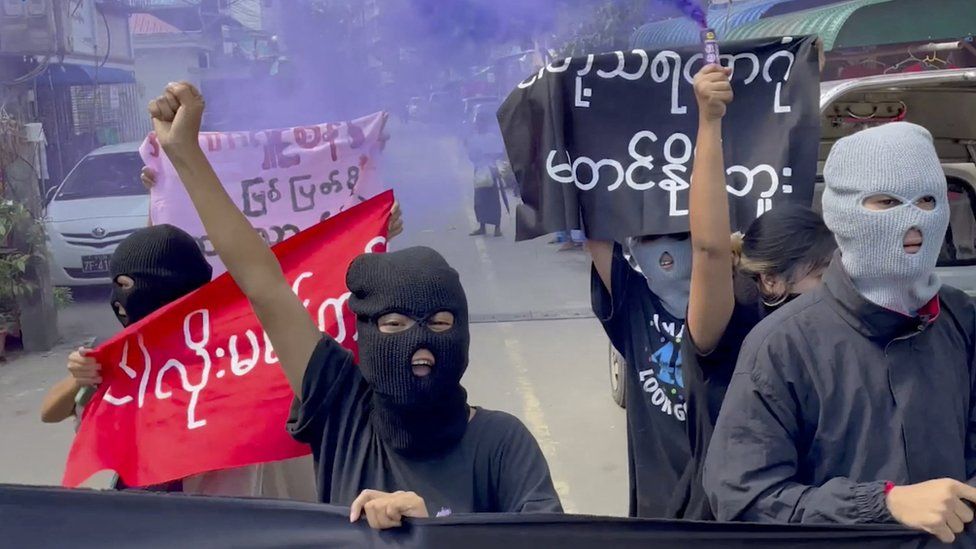
    People protest in the wake of executions, in Yangon, Myanmar, July 25, 2022 this screen grab obtained from a social media video. Lu Nge Khit/via REUTERSImage source, LU NGE KHIT
    Image caption, People protested in Yangon after the executions were announced

    The executions have been roundly criticised by the international community.

    In a joint statement, the EU, Australia, Canada, Japan, New Zealand, Norway, South Korea, the UK and the US called them “reprehensible acts of violence that further exemplify the regime’s disregard for human rights and the rule of law”.

    They also called for the junta regime to fulfil its obligation to seek peace through dialogue under an agreement negotiated with the Association of Southeast Asian Nations (Asean).

    However former US ambassador to Myanmar Scott Marciel told the BBC that the Asean plan had been “dead on arrival” last year and countries sympathetic to Myanmar’s democracy movement should do more.

    “It keeps being trotted out and highlighted as a way forward when in fact it’s not,” he said.

    Asean itself, UN human rights chief Michelle Bachelet and rights groups have all condemned the executions.

    “This cruel and regressive step is an extension of the military’s ongoing repressive campaign against its own people,” said Ms Bachelet.

    Source: BBC

  • Ukraine war: Russia plans to annex Ukrainian land – US

    Russia plans to annex more Ukrainian territory using a similar “playbook” to its takeover of Crimea, the US says.

    Citing US intelligence, National Security Council spokesman John Kirby said Russia is already laying the groundwork for annexation.

    Occupied regions of Ukraine could hold “sham” referenda on joining Russia as soon as September, he said.

    Russia annexed Crimea from Ukraine in 2014 after a referendum which was widely viewed as illegitimate.

    “We want to make it plain to the American people,” Mr Kirby told reporters. “Nobody is fooled by it. [Russian President Vladimir Putin] is dusting off the playbook from 2014.”

    He accused Russia of installing illegitimate pro-Russian officials to run occupied regions of Ukraine, with the aim of organising referenda on becoming part of Russia.

    The results of the votes would be used by Russia “to try to claim annexation of sovereign Ukrainian territory”, Mr Kirby said.

    Russia has already installed its own regional and local officials in the parts of Ukraine it has occupied.

    Crimea was annexed by Russia in 2014 after a hastily-organised referendum – viewed as illegal by the international community, in which voters chose to join Russia.

    Many supporters of Kyiv boycotted the vote and the campaign was neither free nor fair.

    Similar votes held in other parts of Ukraine would almost certainly see a similar situation, with any opposition to joining Russia largely supressed.

    Mr Kirby said he was “exposing” the Russian plans “so the world knows that any purported annexation is premeditated, illegal and illegitimate”, and promised there would be a quick response from the US and its allies.

    The areas targeted for annexation include Kherson, Zaporizhzhia, Donetsk and Luhansk, he said.

    Source: BBC

  • US considers over-the-counter birth control pills for first time

    For the first time in the US, a pharmaceutical firm has asked to be allowed to sell birth control pills over the counter.

    The announcement comes just weeks after the Supreme Court overturned the constitutional right to abortion.

    The firm, Paris-based HRA Pharma, says its application to the Food and Drug Administration is unrelated.

    The pills, the most common form of contraception in the US, have long required a prescription.

    Studies have shown that over 50% of approximately 6.1 million pregnancies in the US each year are unintended. While birth control pills were first approved for use in the US more than 60 years ago, about one-third of US women who have tried to get or fill prescriptions have reported difficulties doing so.

    Globally, more than 100 countries provide oral contraceptives without a prescription, making the US one of the few countries to require one. Several major US medication organisations – including the American Medical Association and American Academy of Family Physicians – have called on US authorities to do the same.

    Frédérique Welgryn, Chief Strategic Operations and Innovation Officer at HRA Pharma, argued that the firm’s application was a “ground-breaking moment” in reproductive equity in the US.

    The application, the company has said, follows years of research intended to help make its case to US regulators.

    “Moving a safe and effective birth control pill to OTC [over the counter] will help even more women and people access contraception without facing unnecessary barriers.”

    According to the company, a decision from the FDA is expected next year. An approval would apply exclusively to the firm’s Opill drug, which was acquired from Pfizer in 2014. Patients have been able to use the pill, if prescribed, since 1973.

    The BBC has reached out to the FDA for comment.

    HRA’s application comes amid intense public debate over reproductive rights in the US, with Democratic lawmakers and pro-choice activists urging the FDA to consider similar requests.

    In March, for example, 50 congressmen of the House of Representatives’ Pro-Choice Caucus wrote an open letter calling on the administration to “review applications for over the counter birth control pills without delay and solely on the data”.

    Ms Welgryn told the New York Times that the firm’s application was unrelated and “a really sad coincidence”. “Birth control is not a solution for abortion access,” she said.

    Since the Supreme Court’s abortion ruling, leading US retailers have reported rationing birth control pills amid surging demand.

    Also on Monday, US President Joe Biden’s administration said healthcare providers must offer abortion services if the life of a mother is at risk.

    The administration said federal law on emergency treatment guidelines superseded state laws that now ban the procedure.

    The Department of Health and Human Services said physicians must provide abortions if they believe a “pregnant patient” is experiencing an emergency medical condition and if the procedure would be a “stabilising treatment”.

    It said emergency conditions included “ectopic pregnancy, complications of pregnancy loss, or emergent hypertensive disorders, such as preeclampsia with severe features”.

    Source: BBC

  • US closes loophole for Russian debt payments

    The US is cutting off another financial route for Russia to pay its international debts, a move that could push the country closer to default.

    The US Treasury Department said it would end a waiver that had allowed US bondholders to accept payments, tightening sanctions imposed over the war in Ukraine.

    Russia, which is rich from its oil and gas supplies, has the funds to pay.

    It has already signalled plans to contest any declaration of default.

    The country has almost $2 billion worth of payments that will be due up to the end of the year on its international bonds.

    While the new rules only apply to people in the US, they will make it difficult for Russia to make payments elsewhere given the role of US banks in the global financial system.

    The US had already barred Russia from using US banks to transfer payments.

    In comments last week, US Treasury Secretary Janet Yellen warned the waiver for investors was likely to expire. She said the exemption had been intended to allow an “orderly transition”.

    Analysts have said they do not expect major ramifications from the move outside of Russia, with IMF chief Kristalina Georgieva saying in March that exposure to the holdings was “not systemically relevant”.

    Russia’s debt was already downgraded to”junk status” by major ratings agencies in March, a move that disqualifies it from purchases by major investors, making it difficult for Russia to raise money on international markets.

    Professor Philip Nichols of the Wharton School at the University of Pennsylvania said it’s not clear what Western holders of Russian bonds have done in the weeks since the invasion, whether rushing to offload them or holding on in hopes the situation will eventually normalise.

    A default would mark the first time Russia has failed to pay its government debt since 1998 – the economic crisis at the end of then President Yeltsin’s term in office.

    It would likely trigger a court case, opening up Russia to recovery proceedings from creditors.

    Inside Russia, any impact would be felt only over the long term as part of the country’s wider economic isolation, Prof Nichols said.

    “Russia just has a lot of oil and gas and that translates into a lot of money, but in the long-run, this is part of a web of instruments that are designed to make it far, far more difficult for Russia to wage war on its neighbours,” he said.

    “It’s going to be really interesting to see what happens,” Prof Nichols said.

    Source: BBC
  • US says ‘Hotel Rwanda’ hero Rusesabagina ‘wrongly detained’

    The United States has determined that Paul Rusesabagina, portrayed in the film “Hotel Rwanda” sheltering hundreds of people during the African nation’s 1994 genocide, has been “wrongfully detained,” the State Department said on Thursday.

    Rusesabagina, 67, was sentenced last September to 25 years in prison over eight terrorism charges tied to an organization opposed to Rwandan President Paul Kagame’s rule. He has denied all the charges and refused to take part in the trial that he and his supporters have called a political sham.
    “The determination took into account the totality of the circumstances, notably the lack of fair trial guarantees during his trial. This determination does not imply any position on his innocence or guilt,” a State Department spokesperson said.
    Rusesabagina, who was feted around the world after being portrayed by actor Don Cheadle in 2004’s “Hotel Rwanda,” is a vocal critic of Kagame. He is being held in a Rwandan prison.
    He has acknowledged having a leadership role in the Rwanda Movement for Democratic Change (MRCD), but denied responsibility for attacks carried out by its armed wing, the National Liberation Front (FLN). The trial judges said the two groups were indistinguishable.
    The “wrongfully detained” designation means the responsibility for the case will now be transferred from the State Department’s Bureau of Consular Affairs to the office of the Special Envoy for Hostage Affairs, effectively raising the issue’s political profile.
    Under 2020 legislation passed by Congress, there are criteria outlined in 11 points, based on which the Secretary of State can make the designation of wrongfully detained.
    Among those are the cases of individuals who are being detained solely or substantially because they are an American citizen or with the purpose of influencing U.S. government policy.
  • Covid in North Korea: No response to US vaccine offer

    President Joe Biden says North Korea has not responded to a US offer of Covid vaccines, as the country battles its first acknowledged outbreak.

    Nearly 2.5 million people have been sickened by “fever” in North Korea and it is under a nationwide lockdown, according to the country’s state media.

    It is thought to be particularly vulnerable because it has little testing or vaccine supply.

    Mr Biden announced the offer at a press conference in South Korea.

    “We’ve offered vaccines, not only to North Korea but to China as well, and we’re prepared to do that immediately,” Mr Biden said in a joint appearance with South Korean President Yoon Suk-yeol.

    “We’ve got no response,” he added.

    The isolated regime of North Korea has previously turned down offers of vaccines from Covax, the global vaccine-sharing scheme, and from South Korea, as well as reportedly declining other offers.

    Instead, it claimed to have successfully kept Covid out of the country by sealing its borders, although experts believe the virus has been present there for some time.

    State media has recommended remedies such as herbal tea, gargling salt-water and taking painkillers such as ibuprofen, while the country’s leader, Kim Jong-un, has accused officials of bungling the distribution of national medicine reserves.

    China is also struggling to control a wave of infections from the highly transmissible Omicron variant, with tens of millions of people under some form of lockdown.

    At the news conference in the South Korean capital, Seoul, President Biden said he was willing to meet Mr Kim under the right circumstances.

    “It would depend on whether he was sincere and whether he was serious,” Mr Biden said.

    His predecessor, Donald Trump, held a historic summit with Mr Kim in Singapore in 2018 and became the first US president to set foot in North Korea the following year.

    But two years ago, Mr Kim questioned whether there was any need to continue “holding hands” with the US.

    The US and South Korean presidents also agreed to deploy American weapons if necessary to deter North Korea and to increase military drills – which had been scaled down in recent years in an effort to reduce tensions.

    Source: BBC

  • US to arm Ukraine with anti-ship missiles – reports

    US officials are considering arming the Ukrainian military with advanced anti-ship missiles, the Reuters news agency has reported.

    Citing Biden administration officials, the report says the White House could offer Kyiv Boeing Harpoon and Naval Strike missiles with which to target the Russian Black Fleet, which is currently blockading Ukrainian ports.

    UK defence officials have said that around 20 Russian Navy vessels, including submarines, are active in the region.

    Officials are said to believe the arms could help force Russian ships away from Ukrainian territory and allow shipments of grain and other agricultural products to resume.

    But the missiles, which cost around $1.5m (£1.2m) per round and have a range of 300km, are mainly sea based missiles, meaning Ukraine could face difficulty firing it from shore.

    Source: BBC

  • China Eastern plane crash likely intentional, US reports say

    Flight data indicates a China Eastern Airlines plane that crashed in March was intentionally put into a nose-dive, according to US media reports.

    Investigators have so far not found any mechanical or technical faults with the jet, the reports say, citing a preliminary assessment by US officials.

    The Boeing 737-800 was flying between the southern Chinese cities of Kunming and Guangzhou when it crashed.

    All 132 passengers and crew on board the plane died in the crash.

    “The plane did what it was told to do by someone in the cockpit,” according to the Wall Street Journal, which first reported the story, citing a person familiar with US officials’ preliminary assessment of the cause of the crash.

    Data from one of the plane’s “black box” flight recorders, which was recovered from the crash site, suggested that inputs to the controls pushed the plane into a near-vertical dive, the report said.

    ABC News, citing US officials, also reported that the crash was believed to have been caused by an intentional act.

    Investigators looking into the crash are examining whether it was due to intentional action on the flight deck, with no evidence found of a technical malfunction, according to Reuters, which cited two people briefed on the matter.

    China Eastern Airlines previously said the three pilots on board were qualified and in good health.

    The airline separately told the Wall Street Journal that there was no indication that any of the pilots was in financial trouble.

    China Eastern Airlines did not immediately respond to a BBC request for comment.

    The Civil Aviation Administration of China (CAAC), which is leading investigations into the crash, also did not immediately respond to a BBC request for comment.

    Last month, the CAAC said reports that the plane may have been crashed deliberately had “gravely misled the public” and “interfered with accident investigation work”.

    Map showing route of flight

    1px transparent line

    Investigators are still in the process of analysing flight data and the wreckage from the crash, Chinese state media outlet the Global Times reported on Wednesday.

    It also said the CAAC will continue to “carry out the accident investigation in a scientific, rigorous and orderly manner”.

    The Chinese embassy in Washington, the US National Transportation Safety Board (NTSB), and plane maker Boeing declined to comment on the Wall Street Journal’s report, due to guidelines set out by the United Nations’ International Civil Aviation Organization.

    “Under the rules regarding crash investigations… only the investigating agency can comment on an open air accident investigation,” a Boeing spokesperson told the BBC on Wednesday. The company previously said it was assisting investigations in China and communicating with the NTSB.

    Chinese airlines generally have a good safety record – the last major accident took place 12 years ago.

    The China Eastern Airlines plane that crashed was less than seven years old.
    Source: BBC
  • Coronavirus: Trump says US reopening, ‘vaccine or no vaccine’

    President Donald Trump says the US will reopen, “vaccine or no vaccine”, as he announced an objective to deliver a coronavirus jab by year end.

    He likened the vaccine project, dubbed “Operation Warp Speed”, to the World War Two effort to produce the world’s first nuclear weapons.

    But Mr Trump made clear that even without a vaccine, Americans must begin to return to their lives as normal.

    Many experts doubt that a coronavirus jab can be developed within a year.

    What is Operation Warp Speed? Speaking at a White House Rose Garden news conference on Friday, Mr Trump said the project would begin with studies on 14 promising vaccine candidates for accelerated research and approval.

    “That means big and it means fast,” he said of Operation Warp Speed. “A massive scientific, industrial and logistical endeavour unlike anything our country has seen since the Manhattan Project.”

    Mr Trump named an Army general and a former healthcare executive to lead the operation, a partnership between the government and private sector to find and distribute a vaccine.

    Moncef Slaoui, who previously led the vaccines division at pharmaceutical giant GlaxoSmithKline, will lead the mission, while Gen Gustave Perna, who oversees distribution for the US Army, is to serve as chief operating officer.

    Speaking after Mr Trump, Mr Slaoui said he was “confident” that a “few hundred million doses of vaccine” will be delivered by the end of 2020.

    He acknowledged in an earlier interview with the New York Times that the timeline was ambitious, but said he “would not have committed unless I thought it was achievable”.

    Many experts say a vaccine is the only thing that will give Americans confidence in fully reopening the economy in the absence of widespread testing.

    What else did President Trump say?

    “I don’t want people to think this is all dependent on a vaccine,” he said. “Vaccine or no vaccine, we’re back. And we’re starting the process.”

    “In many cases they don’t have vaccines and a virus or a flu comes and you fight through it,” he added. “Other things have never had a vaccine and they go away.”

    “I think the schools should be back in the fall,” Mr Trump continued.

    Earlier this week Dr Anthony Fauci, who serves on the coronavirus taskforce and appeared wearing a mask at the Rose Garden conference, testified to the Senate that it would be a “bridge too far” for schools to reopen in the autumn.

    As Mr Trump spoke on Friday, lorry drivers who have parked around the White House for several weeks blared their horns in protest against low wages, neither for nor against the president.

    “Those are friendly truckers. They’re on our side,” Mr Trump said. “It’s almost a celebration in a way.”

    At one point, the president – who wore no mask – instructed a reporter to remove hers so she could be better heard over the noise of honking as she addressed him.

    Is end of 2020 a realistic timeframe? Dr Fauci and other experts have strongly suggested that a jab will take at least a year to develop.

    When the Ebola outbreak struck between 2014-16, it was not until December 2019 that the US Food and Drug Administration approved its first vaccine.

    Some health experts have remained sceptical about the rapid timeline for development and distribution proposed by the White House.

    “I don’t understand how that happens,” said Dr Peter Hotez, co-director of the Medicine Coronavirus Vaccine Team at Baylor College, on CNN after Mr Trump’s announcement.

    “I don’t see a path by which any vaccine is licensed for emergency use or otherwise till the third quarter of 2021,” he added.

    Dr Rick Bright, an ousted US vaccines director who has accused the White House of exerting political pressure around coronavirus treatments, testified to Congress on Thursday that such jabs often take up to a decade to develop.

    What other US coronavirus efforts are there? ‘Warp Speed’ is the latest of several Covid response projects Washington has undertaken.

    In March, the White House launched a testing initiative, enlisting major pharmacy retailers like CVS, Walgreens and Rite Aid to set up drive-through testing sites throughout the country. Such partnerships have stalled, however, and the US has faced continued criticism for its lags in testing.

    In recent weeks, the White House announced further efforts and has helped ramp up testing to nearly 10 million as of 15 May, according to the Our World in Data database.

    Besides the new White House jab initiative, the Food and Drug Administration is also evaluating vaccine candidates for possible human trials.

    On Friday night, the Democratic-controlled US House of Representatives passed by a vote of 208-199 a bill to spend more than $3tn (£2.5tn) on coronavirus relief, including stimulus funds to local governments and direct payments to Americans.

    But the package, which even some Democrats objected to, is rated as having no chance of passage in the Republican-controlled Senate.

    Source: bbc.com

  • Coronavirus: Trump seems to undercut US spies on virus origins

    US President Donald Trump has appeared to undercut his own intelligence agencies by suggesting he has seen evidence coronavirus originated in a Chinese laboratory.

    Earlier the US national intelligence director’s office said it was still investigating how the virus began.

    But the office said it had determined Covid-19 “was not manmade or genetically modified”.

    China has rejected the lab theory and criticised the US response to Covid-19.

    Since emerging in the Chinese city of Wuhan at the end of last year, the coronavirus is confirmed to have infected 3.2 million people worldwide and killed more than 230,000.

    What did President Trump say?

    At the White House on Thursday, Mr Trump was asked by a reporter: “Have you seen anything at this point that gives you a high degree of confidence that the Wuhan Institute of Virology was the origin of this virus?”

    “Yes, I have. Yes, I have,” said the president, without specifying. “And I think the World Health Organization should be ashamed of themselves because they’re like the public relations agency for China.”

    Asked later to clarify his comment, he said: “I can’t tell you that. I’m not allowed to tell you that.”

    He also told reporters: “Whether they [China] made a mistake, or whether it started off as a mistake and then they made another one, or did somebody do something on purpose?

    “I don’t understand how traffic, how people weren’t allowed into the rest of China, but they were allowed into the rest of the world. That’s a bad, that’s a hard question for them to answer.”

    The New York Times reported on Thursday that senior White House officials have asked the US intelligence community to investigate whether the virus came from a Wuhan research laboratory.

    Intelligence agencies have also been tasked with determining if China and the WHO withheld information about the virus early on, unnamed officials told NBC News on Wednesday.

    Source: bbc.com

  • US airlines to receive $25bn rescue package

    The US has agreed a roughly $25bn (£19.8bn) rescue package for 10 of the country’s biggest airlines as travel plunges due to the coronavirus.

    American Airlines, United, Delta and Southwest are among the recipients.

    The money is to be used for payroll and will be provided through a combination of low-cost loans and direct grants.

    Congress had planned for the aid as part of its roughly $2tn emergency relief bill last month but airlines had been negotiating the deal.

    Rescue package

    Under terms outlined by the US Treasury Department last week, major airlines were expected to repay about 30% of the payroll funds they receive.

    Congress had also included conditions when it crafted the emergency aid law, such as prohibitions against involuntary furloughs and bars on reducing worker pay and benefits until the end of September.

    The terms also limit share repurchases until the end of September 2021 and executive pay until the end of March 2022.

    US Treasury Secretary Steven Mnuchin on Tuesday said the airline deal would “support American workers and help preserve the strategic importance of the airline industry while allowing for appropriate compensation to the taxpayers”.

    “We look forward to working with the airlines to finalise the necessary agreements and disburse funds as quickly as possible.”

    Confirmation that the airlines would use the payroll bailout lifted industry shares in after-hours trading, sending American Airlines up more than 8% and United Airlines up more than 7%.

    American Airlines boss Doug Parker said his company expects to receive more than $10bn in support, including$5.8bn in payroll funds, of which it expects about $4.1bn is set to be a grant. The firm will also apply for a government loan through a different programme.

    “The support our government has entrusted to us carries immense responsibility and an obligation that American Airlines is privileged to undertake,” American chief executive Doug Parker said.

    Other companies set to receive aid include Southwest which said it would receive a total of $3.2bn, including $2.3bn in payroll support.

    Bailout concerns

    Global airlines group IATA has forecast more than $300bn in losses related to the coronavirus and warned that some 25 million jobs are at risk.

    In the US travel has dropped more than 95%, leading to widespread cancellations, fleet groundings and billions in losses.

    However, the industry had faced criticism for spending money in recent years to repurchase shares, instead of investing the money back into the company or it workers.

    Politicians have also been worried that bailouts of private firms will lead to controversy as happened during the 2008 financial crisis.

    The labour union that represents flight attendants, the Association of Flight Attendants-CWA International, said it believed Congress had intended airlines to receive all $25bn in payroll support in the form of grants but it nevertheless welcomed news that the industry and the White House had come to terms.

    “We are closer than ever to almost a million airline workers knowing they will receive their pay cheque and keep their healthcare and other benefits, at least through September,” the group’s president, Sara Nelson, said. “This is an unprecedented accomplishment – a truly workers-first stimulus.”

    At the beginning of April, 250 trades unions and environmental groups signed an open letter opposing unconditional bailouts of airlines.

    Source: bbc.com

  • Coronavirus: US death toll passes 2,000 in a single day

    The US has become the first country in the world to record more than 2,000 coronavirus deaths in a single day.

    Figures from Johns Hopkins University show 2,108 people died in the past 24 hours while there are now more than half a million confirmed infections.

    The US could soon surpass Italy as the country with the most coronavirus deaths worldwide.

    But experts on the White House Covid-19 task force say the outbreak is starting to level off across the US.

    Dr Deborah Birx said there were good signs the outbreak was stabilising, but cautioned: “As encouraging as they are, we have not reached the peak.”

    President Donald Trump also said he expects the US to see a lower death toll than the initial predictions of 100,000 fatalities.

    The US now has at least 18,693 deaths and 500,399 confirmed cases, according to Johns Hopkins.

    About half of the deaths were recorded in the New York area.

    Italy has recorded 18,849 deaths while globally more than 100,000 people have died with the virus.

    Researchers had predicted the US death toll would hit its peak on Friday and then gradually start to decline, falling to around 970 people a day by 1 May – the day members of the Trump administration have floated as a possible date to start reopening the economy.

    Source: bbc.com

  • US business levels fall sharply amid coronavirus

    Business activity in the US service sector fell last month for the first time since 2013, hurt by the coronavirus, according to a survey.

    The drop came amid a “notable worsening” in the services sector, which includes finance and retail, the IHS Markit research firm reported.

    New orders received by private sector firms also declined for the first time since 2009, it said.

    US financial markets fell sharply following the report.

    The latest IHS Markit/CIPS purchasing managers’ index data found that services business activity fell to 49.4, from 53.4 in January, while manufacturing output slowed to 50.8, compared to 51.9 in January, a six-month low.

    The combined score was 49.6, down from 53.3 in the opening month of 2020. Anything below 50 indicates contraction.

    The report added to fears spurred by recent trends in the bond markets, which suggest investors see the risks of holding short and long-term government debt as increasingly similar. That comparison is often tracked as an indicator of possible recession.

    The blue chip Dow Jones Industrial Average fell about 0.7%, while the S&P 500 dropped about 0.9% and the tech-heavy Nasdaq was more than 1% lower.

    Investors also turned to US government debt, considered a less risky investment, driving the prices up and yields on bonds down.

    The IHS survey found that manufacturing output was hurt by delivery delays from China, while services industries such as travel also took a hit.

    Executives also reported spending more cautiously, amid questions about the upcoming presidential election and worries about the possibility of a wider economic slowdown.

    The survey found a modest rise in business confidence, suggesting that executives are hopeful the slowdown will prove short-lived. But the rate of contraction last month was still severe, said Chris Williamson, chief business economist at IHS.

    “With the exception of the government shutdown of 2013, US business activity contracted for the first time since the global financial crisis in February,” he said.

    In recent weeks, companies around the world, including Apple, sportswear firms, airlines and carmakers, have reported slowdowns.

    But analysts have said that the US – where consumer spending drives much of the economy – should be relatively insulated from the effects, assuming the coronavirus outbreak wanes relatively soon.

    US jobs growth beat expectations last month, while the overall economy is growing at about 2.1%, according to the most recent government figures.

    However, traders are also now anticipating the Federal Reserve will move to cut interest rates further this year, although the head of the central bank said at its most recent meeting that it did not think the economy needed additional help.

    The IHS Purchasing Managers Index (PMI) report will raise fears about the country’s underlying economic health, said Michael Pearce, senior US economist at Capital Economics, adding that the contraction in the service sector – which includes industries like healthcare – was especially alarming.

    However, he added: “We have a hard time believing the apparent message…that the economy is on the brink of a recession.

    “Unless job creation and consumer confidence suddenly craters, it’s difficult to see how the new downside risks that have emerged in recent months would be enough to sink the entire economy.”

    Source: bbc.com

  • US warns South Africa over land seizures

    US Secretary of State Mike Pompeo has warned that the South African government’s plan to expropriate land without compensation will be “disastrous” for the economy and the nation.

    Mr Pompeo made the comments in Ethiopia, the final leg of his visit to Africa, which also saw him going to Angola and Senegal.

    “South Africa is debating an amendment to permit the expropriation of private property without compensation. That would be disastrous for that economy, and most importantly for the South African people,” he was quoted by Bloomberg news agency as saying.

    African economies needed “strong rule of law, respect for property rights [and] regulation that encourages investment”, he added.

    South Africa’s President Cyril Ramaphosa has vowed to press ahead with amending the constitution to allow land expropriation without compensation in order to tackle the “historical injustice” caused by the white-minority rule.

    Most of the country’s farms and agricultural holdings are owned by white farmers – 72% according to government statistics. White people make up 9% of the population.

    The government’s plan has been fiercely resisted by the main opposition Democratic Alliance party, and mainly white lobby groups.

    In 2018, US President Donald Trump said he had asked Mr Pompeo “to closely study the land and farm seizures and expropriations and the large-scale killing of farmers”.

    The South African government said Mr Trump was “misinformed”, and it would take up the matter through diplomatic channels.

    Source: BBC

  • US investigates Harvard and Yale over foreign funding

    The US has launched investigations into Harvard and Yale universities over suspicions they received undisclosed funds from foreign countries, including Saudi Arabia and China.

    The US Department of Education said the elite schools did not fully report hundreds of millions of dollars in foreign gifts and contracts.

    Harvard and Yale told the BBC they were preparing responses for the government.

    It comes amid a clamp down on foreign funding to academic institutions.

    Under US law, universities are required to report all gifts and contracts from foreign sources that exceed $250,000 (£193,000).

    Since July, the Department of Education said it had uncovered some $6.6bn in previously unreported gifts from countries including Qatar, China, Saudi Arabia and the United Arab Emirates. It said this figure could be “significantly underestimated”.

    Officials have previously described foreign spending on US universities as a “black hole” and warned that such money can come with strings attached.

    “This is about transparency. If colleges and universities are accepting foreign money and gifts, their students, donors, and taxpayers deserve to know how much and from whom,” said US Secretary of Education Betsy DeVos.

    “Unfortunately, the more we dig, the more we find that too many are underreporting or not reporting at all,” she said.

    What are Harvard and Yale accused of?

    The Department of Education said Yale University had chosen not to report any foreign funding over the last four years, and is suspected of failing to disclose at least $375m in foreign gifts and contracts.

    The agency said it was also concerned that Harvard lacked “appropriate institutional controls over foreign money” and had failed to fully report foreign gifts and contracts.

    Earlier this month, the chairman of Harvard’s chemistry department and two Chinese researchers were charged with making false statements about ties to the Chinese government.

    In letters to the Ivy League universities, the Department of Education called on them to supply the names and addresses of foreign sources involved in contracts and gifts, as well as the activities supported by the funding since August 2013.

    Harvard was asked to disclose records involving the governments of China, Qatar, Russia, Saudi Arabia and Iran, as well as companies including Chinese technology giant Huawei.

    Officials called on Yale to disclose similar information about foreign contributions.

    Yale did not comment on the allegation that it had failed to report $375m in foreign gifts and contracts, but told the BBC it was preparing a response to the government’s letter. Harvard said it was also preparing a response.

    Source: bbc.com

  • Roadside bomb kills two US troops in Afghanistan

    Two American soldiers were killed in southern Afghanistan on Saturday when a Taliban roadside bomb ripped through an army vehicle, officials said.

    Two other soldiers were wounded in the attack in Kandahar province, according to NATO’s Resolute Support mission in the country.

    A mission spokesman said the names of those killed were being withheld pending notification of next of kin.

    Read:Taliban truck bomb kills police, wounds children in Afghanistan

    The troops were on patrol near Kandahar airport in Dand district, provincial police spokesman Jamal Nasir Barkzai told AFP.

    The Taliban claimed responsibility for the attack, with spokesman Zabihullah Mujahid saying on Twitter that the blast destroyed the vehicle and killed all on board.

    Violence in Afghanistan usually recedes as winter sets in. But this year the Taliban have pushed forward with their operations despite heavy snowfall in the mountains — and despite their negotiations with the US for a deal that would see American troops leave the country.

    Read:Death toll in Afghanistan wedding blast rises to 80

    According to details made public so far, the Pentagon would withdraw about 5,000 of its 13,000 or so troops from five bases across Afghanistan, provided the Taliban sticks to its security pledges.

    The insurgents have said they will renounce Al-Qaeda, fight the Islamic State group and stop jihadists using Afghanistan as a safe haven.

    Last year was the deadliest for US forces in Afghanistan since combat operations officially finished at the end of 2014, highlighting the challenging security situation that persists.

    Read:US meth lab strikes in Afghanistan killed at least 30 civilians UN

    More than 2,400 US troops have been killed in combat there since the US-led invasion in October 2001.

    Source: France24

  • US rolls out new Iran sanctions after airstrikes

    In a joint statement to the press on Friday, US Secretary of State Mike Pompeo and Treasury Secretary Steve Mnuchin announced a new raft of economic sanctions against several senior Iranian officials and major companies.

    The financial penalties came as a response to Iranian airstrikes against US bases in Iraq, which were in turn in retaliation for the assassination of Iran’s General Qassem Soleimani.

    Soleimani had been the commander of the Quds Force, a special unit of Iran’s Revolutionary Guards. He was also known to be in charge of attacks on US targets within Iraq.

    Read:At UN, US justifies killing Iranian commander as self-defence

    “We don’t know exactly which day it would’ve been executed but it was very clear, Qassem Soleimani himself was plotting a broad, large-scale attack against American interests and those attacks were imminent,” Pompeo said.

    New sanctions will target individuals and firms who own, operate, or assist “sectors of the Iranian economy including construction, manufacturing, textiles and mining,” Mnuchin said.

    The plan is also to target the “inner heart of Iranian security apparatus” with the sanctions.

    Read:Iran denies missile downed plane, calls for data

    ‘It is likely that plane was shot down by an Iranian missile’

    While the Iranian airstrikes did not kill any US personnel, Pompeo said he believed it possible that the crash of a Ukrainian Airlines flight outside of Tehran on Wednesday that killed 176 civilians could have been caused by an Iranian missile launch.

    “We do believe it’s likely that plane was shot down by an Iranian missile. We are going to let the investigation play out before we make a final determination,” he said.

    Government officials in the US, UK, and Canada have said there is evidence that the crash was caused by a surface-to-air missile, though with the caveat that the passenger jet was not necessarily downed on purpose.

    Read:Iran invites Boeing, US investigators to help probe plane crash likely downed by missile

    During the press conference, Mnuchin said sanction waivers would be given to anyone wanting to “help facilitate the investigation” into the crash.

    Source: dw.com

  • Iraq set for conflict, even if US and Iran de-escalate

    Arch-foes Tehran and Washington may be temporarily calling it even after Iranian missiles targeted US forces in Iraq, but analysts predict violent instability will keep blighting Baghdad.

    “Iraq will remain a zone of conflict,” said Randa Slim of the Washington based Middle East Institute.

    Early Wednesday, Iran launched 22 ballistic missiles at bases in Iraq hosting American and other foreign troops, in a calibrated response to the killing of a top Iranian general in a US air strike last week.

    Read:Key Iran General Soleimani killed by US in Iraq

    Iran warned Iraq about the raids shortly before they happened and in their immediate aftermath, foreign minister Mohammad Javad Zarif said Tehran had concluded its “proportionate” retaliation.

    US President Donald Trump, too, said Iran “appears to be standing down” and even suggested Tehran and Washington could work towards a nuclear deal while cooperating against jihadists.

    That hinted at a common desire to contain the fallout, but analysts say it would not be enough to spare Iraq.

    “Both sides are so mobilised in Iraq, which has become such symbolic terrain for hitting out at the other,” said Erica Gaston of the New America Foundation.

    Indeed, US troops and even the embassy in Baghdad had been hit by more than a dozen rocket attacks in recent months, which have killed one Iraqi soldier and an American contractor.

    The attacks went unclaimed but the US blamed hardline elements of the Hashed al-Shaabi, an Iraqi military network incorporated into the state but linked to Tehran.

    The strike that killed Iranian general Qasem Soleimani outside Baghdad international airport on Friday also killed his top Iraqi aid and Hashed deputy chief Abu Mahdi al-Muhandis.

    Read:World War 3: Iran fires missiles at US targets in Iraq: All the latest updates

    ‘Who is the mediator?’

    Just because the US and Iran have struck each other directly does not mean the Hashed would now sit on the sidelines, said Gaston.

    “The Hashed is closer to the tip of the spear,” she said.

    “There isn’t perfect command-and-control in the Hashed, which includes a lot of angry militiamen willing to take revenge on the US,” she added.

    Bolstered by Iran’s attack, the Hashed said Wednesday it would take its own steps avenge Muhandis’s death.

    “That is a promise,” vowed leading member Qais al-Khazali.

    Hours later, two rockets slammed into the Iraqi capital’s Green Zone, the high-security enclave where the US embassy, other foreign missions and some foreign troops are based.

    Hashed factions decided in recent days to unite under a “resistance” coalition to oust US troops from Iraq.

    The spectre of bloodshed was especially worrisome as there is no evident mediator between the parties, said Slim.

    In Lebanon, Iran’s ally Hezbollah has repeatedly clashed with its sworn enemy Israel but the United Nations’ peacekeeping force in the south has usually intervened before the conflict could spin out of control.

    But “who is the mutually liked mediator?” on Iraqi soil, Slim asked.

    Read:Iran attack: Oil prices rise after Iraq missile attacks

    Baghdad has long warned that tensions between Tehran and Washington, which began deteriorating significantly in 2018, would bring devastating conflict to the entire region.

    Iraq’s government had tried to strike a balance between the two countries, both of which have close political and military ties to various elements of Iraq’s elite.

    Balance now ‘impossible’

    But the stunning developments of the last week — from the killing of Soleimani to Wednesday’s pre-dawn strikes — also hugely exacerbated Iraq’s political crisis.

    “It has made a balance impossible and pushed Baghdad squarely into Iran’s camp,” said Toby Dodge, a professor at the London School of Economics.

    Figures like Iraq’s President Barham Saleh, who was seen as one of the most senior officials with close ties to Washington, would likely see their influence dwindle.

    “If last night was the theatre of retaliation, what today brings is political consolidation and domination of the pro-Iran factions,” Toby said.

    Read:Ukrainian passenger plane crashes in Iran

    The Hashed’s political arm, the Fatah bloc, has already seized on anti-US sentiment over the last week to push for a total ouster of foreign troops from Iraqi territory.

    Some 5,200 American troops and hundreds more British, French, Canadian and other forces are based in Iraq to help local forces defeat jihadist sleeper cells.

    On Wednesday, Iraqis’ reactions to Iran’s strikes were much tamer than the anger expressed at the US last week.

    “Baghdad condemns the US publicly, but not Iran,” said Ramzy Mardini, a researcher and Iraq expert.

    While appearing to be pro-Washington in the current climate carries a political cost, some political figures may be busy behind the scenes trying to salvage Iraq’s relationship with the US and restore some stability, however fragile.

    But, Mardini warned, “if the crisis escalates, Baghdad’s space for manoeuvering will shrink. They’ll be forced to pick a side — and it won’t be the US.”

    Source: France24

  • Oil prices rise after Iraq missile attacks

    Oil prices have risen after two bases hosting US troops in Iraq were hit by ballistic missiles.

    Brent crude was up by 1.4% at $69.21 per barrel in the middle of the Asian trade, easing back from earlier gains.

    So-called safe haven assets, like gold and the Japanese yen, also rose on the news.

    At the same time global stock prices were sent lower on concerns over the growing conflict in the Middle East.

    Read:Iran says oil field found with 53 bln barrels of crude

    Japan’s benchmark Nikkei 225 stock index fell by 1.3%, and Hang Seng in Hong Kong was down 0.8%.

    Iranian state television said the attack was a retaliation for the killing of the country’s top commander Qasem Soleimani.

    The attack happened just hours after the funeral service for Soleimani, who was killed by a US drone strike on Friday.

    His death had raised concerns that the conflict between the US and Iran could escalate further.

    Read:US blames Iran for attacks on Saudi oil facilties

    That could disrupt shipping in the world’s busiest sea route for oil, the Strait of Hormuz. Around a fifth of global oil supply passes through the strait which connects the Gulf with the Arabian Sea.

    The Strait of Hormuz is vital for the main oil exporters in the Gulf region – Saudi Arabia, Iraq, the UAE, and Kuwait – whose economies are built around oil and gas production. Iran also relies heavily on this route for its oil exports.

    Qatar, the world’s biggest producer of liquefied natural gas (LNG), exports nearly all its gas through the strait.

    Read:World War 3: Iran fires missiles at US targets in Iraq: All the latest updates

    After the latest attacks, the US aviation regulator banned American airlines from flying over Iraq, Iran and neighbouring countries. The ban includes the Gulf of Oman and the waters between Iran and Saudi Arabia.

    The Federal Aviation Administration (FAA) said the decision was in response to heightened military activity, and increased political tension in the region.

    Before the latest guidance, the FAA had already prohibited US airlines from flying below 26,000 feet (7,925 metres) over Iraq and from flying over an area of Iranian airspace above the Gulf of Oman since Iran shot down an American drone in June 2019.

    At the same time Singapore Airlines has said that all of its flights would now be diverted from Iranian airspace.

    Source: bbc.com

  • Iran attack: Oil prices rise after Iraq missile attacks

    Oil prices have risen after two bases hosting US troops in Iraq were hit by ballistic missiles.

    Brent crude was up by 1.4% at $69.21 per barrel in the middle of the Asian trade, easing back from earlier gains.

    So-called safe haven assets, like gold and the Japanese yen, also rose on the news.

    At the same time, global stock prices were sent lower on concerns over the growing conflict in the Middle East.

    Oil price surges above $70 a barrel

    Japan’s benchmark Nikkei 225 stock index fell by 1.3%, and Hang Seng in Hong Kong was down 0.8%.

    Iranian state television said the attack was a retaliation for the killing of the country’s top commander Qasem Soleimani.

    The attack happened just hours after the funeral service for Soleimani, who was killed by a US drone strike on Friday.

    His death had raised concerns that the conflict between the US and Iran could escalate further.

    That could disrupt shipping in the world’s busiest sea route for oil, the Strait of Hormuz. Around a fifth of global oil supply passes through the strait which connects the Gulf with the Arabian Sea.

    The Strait of Hormuz is vital for the main oil exporters in the Gulf region – Saudi Arabia, Iraq, the UAE, and Kuwait – whose economies are built around oil and gas production. Iran also relies heavily on this route for its oil exports.

    Qatar, the world’s biggest producer of liquefied natural gas (LNG), exports nearly all its gas through the strait.

    After the latest attacks, the US aviation regulator banned American airlines from flying over Iraq, Iran and neighbouring countries. The ban includes the Gulf of Oman and the waters between Iran and Saudi Arabia.

    From selling of shirts, watches to owning Oil & Gas Company, the story of Ethel Laurel Akafful

    The Federal Aviation Administration (FAA) said the decision was in response to heightened military activity and increased political tension in the region.

    Before the latest guidance, the FAA had already prohibited US airlines from flying below 26,000 feet (7,925 metres) over Iraq and from flying over an area of Iranian airspace above the Gulf of Oman since Iran shot down an American drone in June 2019.

    At the same time, Singapore Airlines has said that all of its flights would now be diverted from Iranian airspace.

    Source: bbc.com

  • US takes Wakanda off free-trade list after listing the mythical African country

    The US Department of Agriculture (USDA) has removed the mythical African country of Wakanda from an online list of nations that have free-trade agreements with the US.

    The mistake was noticed by a Tweeter:

    The software engineer was looking for data on US agricultural tariffs for a fellowship he is pursuing, reports Reuters.

    Read:Chadwick Boseman dodges Wakanda salute

    “I was very confused at first and thought I misremembered the country from the movie and got it confused with something else,” Mr Tseng told Reuters.

    Before it was removed, Reuters adds that Mr Tseng downloaded an Excel spreadsheet listing “Harmonized Schedule” tariff codes for various goods traded between Wakanda and the US including live animals, dairy goods, tobacco and alcohol but that there was no mention of a trade agreement in vibranium – a fictional ultra-strong metal found in Wakanda.

    Read:Marvel working on Black Panther spin-off

    After the list was corrected, Tseng tweeted a tongue-in-cheek political analysis of the situation:

    A spokesman told The Washington Post that the inclusion of Wakanda was a mistake made as part of a test officials were running.

    Source: bbc.com

  • US cautions gays on Tanzania travel

    The US State Department on Tuesday urged travellers to Tanzania to “exercise increased caution” due in part to threats that gay people may experience there.

    The advisory comes as another indication that the Trump administration is not abandoning the Obama-era practice of speaking out on behalf of lesbian, gay, bisexual, transgender and intersex Africans.

    Read:9 Celebrities You Never Knew Were Gays, Number 7 Will Shock You

    “Members of the LGBTI community have been arrested, targeted, harassed, and/or charged with unrelated offenses,” the State Department said in an updated advisory on travel to Tanzania.

    “Individuals detained under suspicion of same-sex sexual conduct could be subject to forced anal examinations.”

    The advisory comes about a year after Paul Makonda, regional commissioner of Dar es Salaam and an ally of President John Magufuli, announced last year that a newly formed surveillance squad would scrutinise social media in order to identify and arrest same-sex couples.

    Read:Gay marriage, abortion laws liberalised in Northern Ireland

    Additionally, the advisory also warns that “terrorist groups continue plotting possible attacks in Tanzania” in a addition to prevalence of violent crimes.

    “Terrorists may attack with little or no warning, targeting embassies, police stations, mosques, and other places frequented by Westerners,” it said.

    The US had issued a Tanzania travel warning in September that focused on an alleged case of Ebola. Government officials, however, subsequently denied that the disease was present in the country, and the new State Department advisory makes no mention of Ebola.

    Source: www.theeastafrican.co.ke