Tag: Zimbabwe

  • Cricket: Zimbabwe beats Pakistan in latest upset at ICC Men’s T20 World Cup

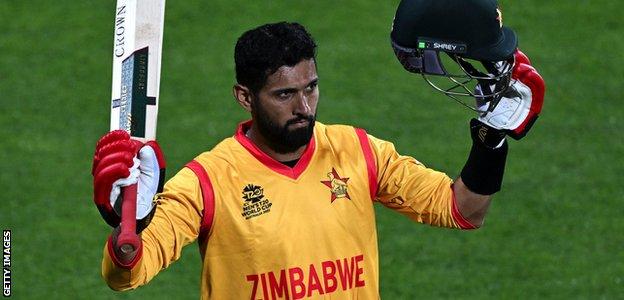
    The ICC Men’s T20 World Cup is in full swing. Zimbabwe held its nerve for a 1-run victory over Pakistan in the latest upset at the tournament in Australia, Thursday (Oct 27).

    Three games in Group 2 took place Thursday with South Africa crushing Bangladesh by 104 runs. Rilee Rossouw posted the first century of the tournament.

    Pakistan’s brittle middle-order batters were restricted at 129-8 in a thrilling game at Perth after Zimbabwe chose to bat first and struggled against pace on a bouncy wicket to make 130-8.

    It just proved enough for Zimbabwe, helped by 14 extras.

    Unorthodox spinner Sikandar Raza bagged 3-25 and brought Zimbabwe back in the hunt in the 14th over with the wickets of Shadab Khan and Haider Ali off successive deliveries.

    Raza then dealt a major blow by having top-scorer Shan Masood (44) stumped off a wide ball down the leg side in the next over.

    “I’m lost for words, my throat’s dry probably because of all the emotions,” Raza said.

    “The way our seamers started at the top as well is just unbelievable and the way we backed it up in the field and the way we kept believing, I don’t think there’s any words I can share right now.”

    Third-place Zimbabwe, whose opening group game was abandoned against South Africa, has three points, one more than Bangladesh.

    Pakistan is in trouble with zero points. It was Pakistan’s second successive defeat after a nerve-wracking loss against arch-rival India.

    About the ICC Men’s T20 World Cup

    The ICC T20 World Cup is the apex global event for T20 cricket, the game’s fastest growing format.

    Australia was originally scheduled to host the event in 2020, before it was postponed due to COVID-19 pandemic.

    The world’s best players from 16 teams will play 45 matches around the country.

    It’s the first time Australia hosts the ICC Men’s T20 World Cup. In March 2020, it hosted the Women’s T20 World Cup. The final in Melbourne was won by Australia over India in front of 86,174 spectators, a record crowd for women’s sport on the island and the second-highest crowd ever recorded for a women’s sporting event globally.


    Source: African News

  • Zimbabwe: Impoverished residents of Epworth turn to sand poaching in cemetary

    For years, illegal sand mining otherwise known as sand poaching has been a growing cancer in Zimbabwe. Thousands of hectares of land in the country’s capital city, Harare have been left extensively damaged

    “We have resorted to sand poaching and brick laying because there are no jobs. It’s easy for us to find the sand we need because its easily accessible at at the nearby graveyard. We have to survive even if it means breaking the law.A lot of young man in this community are into the venture”. one sand poacher told our correspondent.

    With places where a sizable amount of sand can be illegally mined dwindling everyday, sand poachers have resorted to digging in a cemetery in one of Harare’s high density suburbs, Epworth. Not only are they exhuming the dead in their bid to get sand, they are also disposing corpses they would have dug up in a nearby river, a move that has upset residents whose buried relatives are disappearing each day.

    The areas community leaders are concerned. “As a community leader who had taken part in the burial of more than 100 kids, I’m saddened that a huge chunk of the graves at which we laid them to rest has disappeared, all that left is a shallow ditch”.

    Another laments about the condition of some of the graves. “Some of the graves are now exposed. The sand poachers have removed a lot of corpses and thrown them in the nearby river”.

    Government authorities are not unaware of the situation.

    “What you find is currently within particularly Chitungwiza and Epworth. We have got rampant sand poaching. Sand poachers are basically going into areas where there is river sand and any other form of sand used for construction”, says Tafadzwa Muguti, secretary for provinvial affairs and devolution in the office of the president and cabinet for Harare Metropolitan province.

    “The challenge we have as we approach the rain season is that when the rains come and fill up most of these places we have children who will drown. As it is our laws need to be reviewed. EMA, our environmental management authority is in the process of reviewing all their ACTS so that we can criminalize most of the aspects of land degradation”.

    Known for its famous monuments (The balancing rocks) Epworth, one of Harare’s forgotten surburb has for years been subject to illegal sand mining otherwise known as sand poaching. It remains to be seen whether thousands of hectares of land in Epworth’s Zinyengere’s cemetery will recover from the immense environmental degradation its being subjected to on a daily basis.


    Source: African News

  • Dozens injured in Zimbabwe political skirmishes

    Dozens of people, including an opposition MP, were injured and property damaged in south-west Zimbabwe following violent clashes between political parties on Monday.

    They were allegedly attacked as they campaigned ahead of by-elections this coming weekend.

    Thirty people sought medical treatment for a various injuries, a local human rights group told the BBC.

    Increasing numbers of incidents of political violence have raised concerns as Zimbabwe prepares for general elections next year.

    The group from the opposition party Citizens Coalition for Change say the Monday attack was carried out by ruling party members.

    The same group was attacked over the weekend with some pictures showing some women in the group were stripped off their clothes.

    Police say they received complaints from both parties and are investigating.

    Human rights lawyers have decried the levels of violence against the opposition in recent months.

    Source:BBC

  • Dozens injured in Zimbabwe political skirmishes

    Dozens of people, including an opposition MP, were injured and property damaged in south-west Zimbabwe following violent clashes between political parties on Monday.

    They were allegedly attacked as they campaigned ahead of by-elections this coming weekend.

    Thirty people sought medical treatment for a various injuries, a local human rights group told the BBC.

    Increasing numbers of incidents of political violence have raised concerns as Zimbabwe prepares for general elections next year.

    The group from the opposition party Citizens Coalition for Change say the Monday attack was carried out by ruling party members.

    The same group was attacked over the weekend with some pictures showing some women in the group were stripped off their clothes.

    Police say they received complaints from both parties and are investigating.

    Human rights lawyers have decried the levels of violence against the opposition in recent months.

    Police say they received complaints from both parties and are investigating.

    Human rights lawyers have decried the levels of violence against the opposition in recent months.

    Police say they received complaints from both parties and are investigating.

    Human rights lawyers have decried the levels of violence against the opposition in recent months.

    Source: BBC

  • T20 World Cup: Zimbabwe coach wary of West Indies challenge

    Zimbabwe coach Dave Houghton is wary of a backlash from West Indies when the sides meet in their T20 World Cup first round group game on Wednesday.

    The two-time champions were shocked in their opening Group B game by Scotland before Zimbabwe secured a victory over Ireland.

    The Africans know a win would put them on the brink of a place in the Super 12 – a result which would effectively eliminate the West Indies.

    “I expect the West Indies to come fighting and bouncing back in the next game,” Houghton told BBC Sport Africa.

    “They’ve got some very, very good players, they play a lot more T20 cricket than we do and they’ve just come off the Caribbean Premier League as well. They’ve had quite a bit of cricket recently in this format.

    “I expect them to be very, very difficult on Wednesday.”

    Houghton is well aware the meeting with the West Indies is a “huge game” for Zimbabwe, but he is excited about the encounter in Hobart after Monday’s 31-run win over the Irish.

    “We feel that if we play well, we’ll be a real challenge for them,” he said.

    “There is a good feeling among the guys. We’ve got a fair amount of our game to improve on and if we bring our ‘A’ game to the table, we’re going to be a challenge for any side.”

    Scotland’s stunning 42-run victory over the West Indies has blown open the group, but Houghton is sticking to his own plans for this tournament.

    “I never made any secret of the fact that when we came here and arrived, we wanted to play three and win three,” the 65-year-old said.

    “We have got to keep our brand of cricket going.

    “We looked at the games and thought Scotland would be the weakest side in the section, yet they’ve got on top of the side we thought would be the strongest. So we’re under pressure straightaway.

    “It was important for us to get away with the win – it gives us just a little bit of breathing space with two games to play.

    “Even though there’s a good feeling among the guys you know, we can get better.”

    Sikandar Raza celebrates his half century against Ireland

    Meanwhile, Houghton has heaped praise on batter Sikandar Raza who recovered from serious health issues to star in their win over Ireland.

    The 36-year-old needed surgery on a bone marrow infection following a cancer scare, and there were fears the Pakistan-born right hander’s career may be over.

    Raza’s knock of 82 helped Zimbabwe recover from 37-3 in the sixth over and set them on their way to victory in Hobart.

    “I didn’t know a lot about what had gone on with Raza and his cancer,” admitted Houghton.

    “He’s been out for a little while and only really been back in action since I took over as coach, so we’ve had him for the last three or four months. He has played some outstanding innings in that period of time.”

    Raza was named as the International Cricket Council’s player of the month for August following his two unbeaten one-day international centuries against Bangladesh as well as a bringing up a ton against India.

    Houghton, who captained Zimbabwe and was regarded as one of his countries finest batters, says Raza has been in “fantastic form”.

    “When he gets in, he can destroy attacks,” he added.

    “He genuinely makes maximum contribution, so if we’re batting first he puts us in a great position and if we’re betting second he generally gets us over the line.

    “That’s a really good trait to have – an absolute match-winner in your batting department.”

    Source: BBC

  • African countries divided over UN vote against Russia

    Twenty-six African countries voted in favour of the resolution, rejecting Moscow’s controversial referenda in four Ukrainian regions. Nineteen others abstained.

    Mali, the Central African Republic, Ethiopia, the Republic of Congo, South Africa, Sudan, Uganda, and Zimbabwe were among the African countries that abstained. Eritrea, which had previously voted to reject a UN resolution condemning the Russian invasion of Ukraine, also abstained.

    Three of these countries hosted Russian diplomatic chief, Sergei Lavrov, during his tour of the region in July.

    Burkina Faso, Cameroon, Equatorial Guinea, and Sao Tome were absent from the assembly.

    The General Assembly of the 193 member states had met in an emergency meeting. It adopted the resolution with 143 votes in favour, with five countries against and 35 abstaining, including China, India, Pakistan, and South Africa, despite diplomatic efforts by the United States.

    The five states that voted against were Russia, Belarus, Syria, North Korea, and Nicaragua.

    Earlier this month, Ukrainian Foreign Minister,DmytroKuleba, toured Africa in an effort to counter Russia’s apparent hold on the continent. The goal was to persuade leaders to support Kyiv.

    He was forced to cut his visit short after Moscow intensified its bombing of Ukraine.

  • Court denies Zimbabwe MPs bail despite public pressure

    Two opposition MPs are to spend more time in detention after a magistrate denied them bail in a case which has attracted public attention and criticism.

    Job Sikhala and Godfrey Sithole have been in pre-trial detention since June, when they were arrested and charged with inciting people to commit public violence.

    Godfrey Sithole
    Image caption: Godfrey Sithole serves the constituency of Chitungwiza North

    It followed clashes between members of the ruling party and opposition at a funeral wake. They deny the charges.

    The opposition Citizens Coalition for Change has accused the government of weaponising the law against its members. More than a dozen others face similar charges.

    Repeated requests for bail have been rejected at both the magistrates’ and high courts, prompting an outcry.

    On Wednesday the magistrate rejected the latest bail application in which the defence had argued changed circumstances, including a public petition with more than 48,000 signatures to President Emmerson Mnangagwa calling for their release.

    The defence also argued that the continued detention was more political than legal, echoing concerns expressed by groups such as Amnesty International that it was unjust.

    The court ruled on Wednesday that public opinion was not fact and that it would not be swayed by it or be dragged into political issues.

    Source: BBC

  • Home of Mnangagwa challenger targeted by arsonists

    Zimbabwe police say they are investigating an arson attack on the home of Sybeth Musengezi who is mounting a legal challenge against President Emmerson Mnangagwa’s 2017 rise to power.

    The case was due to begin on Monday, but Mr Musengezi’s lawyer told the BBC that the matter was removed from the court roll, pending the outcome of the appeal against two other parties joining the case.

    Mr Musengezi, who says he is a Zanu-PF member, said his house was attacked by four men with their faces covered. They threw an incendiary object into his vehicle and into his home, he told the BBC.

    He and his family were unharmed but one room and his vehicle were damaged. He said that while the police should be allowed to conduct their investigations, he believed the motive was political.

    Last October, he lodged a case challenging the legality of the Zanu-PF central meeting that appointed Mr Mnangagwa as party leader after Robert Mugabe was ousted in 2017.

    Mr Musengezi argues the party did not follow its own constitution and that Mr Mnangagwa is not the legitimate head of the party.

    “I don’t have a problem with Mr Mnangagwa leading Zanu-PF, but the leaders have to be democratically elected,” he told the BBC, adding that the arson incident would not deter him.

    Mr Musengezi was arrested earlier this year and charged with fraud for using the incorrect address when he became a member of Zanu-PF in 2012. He said the charge was meant to silence him and it was later thrown out.

    Prior to the alleged attack, he said unmarked cars had parked outside his home and that he has received death threats.

    Zanu-PF spokesperson, Tafadzwa Mugwadi, told the BBC that the party rejected any suggestion that Zanu-PF was behind the attack. He accused Mr Musengezi of attempting to gain a profile by playing the victim.

  • Former Ghana coach Avram Grant to visit Zimbabwe

    Former Ghana coach Avram Grant is expected in Zimbabwe in October for the inaugural Zimbabwe Football Forum in Harare.

    The Zimbabwe Football Forum which is expected to run on 14th October will bring in a number of think tanks in football with the aim of unlocking value in local football.

    Terrence Malunga of Tinmanh Sports who are the brains behind the football forum said Zimbabwe is lagging behind in global football trends hence the need to bring in experts that will help local football to grow in line with international standards.

    “We haven’t really commercialized the game, we haven’t really professionalised the game. We are still behind, infact we haven’t really started. So this is a platform where we are going to explore ways we can create an industry out of football,” Mulenga said.

    “What intend to do is to promote investment, innovation and creativity in our football industry. To help us achieve this, we have external experts coming in to share their experience and knowledge. From the region we have South African legend Doctor Khumalo coming in to support and give us his experience.”

    Grant was appointed as head coach of the Black Stars in 2014. He led Ghana to the 2015 Africa Cup of Nations (AFCON) final, where they were beaten on a penalty shoot-out by Ivory Coast, ending the tournament as runners-up.

    Two years later, Grant resigned as the coach of Ghana after finishing fourth in the 2017 AFCON, losing against Cameroon in the semi-final and Burkina Faso in the third place play-off.

    Source: Footballghana

  • Zimbabwe court fines novelist Tsitsi Dangarembga over protest

    Prize-winning Zimbabwean novelist and filmmaker Tsitsi Dangarembga has been fined and given a six-month suspended jail sentence after a court found her guilty of “inciting public violence” during a 2020 anti-government protest.

    Dangarembga was tried alongside her friend and fellow protester Julie Barnes, who was also found guilty on Thursday.

    The two were fined 70,000 Zimbabwean dollars ($193) and given a suspended sentence, which means they remain free provided they do not commit a similar offence in the next five years.

    A vocal critic of President Emmerson Mnangagwa’s government, Dangarembga has been fighting for years against corruption and demanding reforms. She argued during the trial that Zimbabweans had the right to demonstrate.

    “The two intended to incite violence and the accused are found guilty as charged,” Harare magistrate Barbara Mateko said.

    Their lawyer Chris Mhike said the two women were first-time offenders and asked for leniency.

    Outside court, 63-year-old Dangarembga said she was “not surprised” by the ruling.

    “Our role as citizens is being changed into a role that is not an active citizen, but a subject, and we are not a monarchy,” she said, adding that she would appeal the conviction.

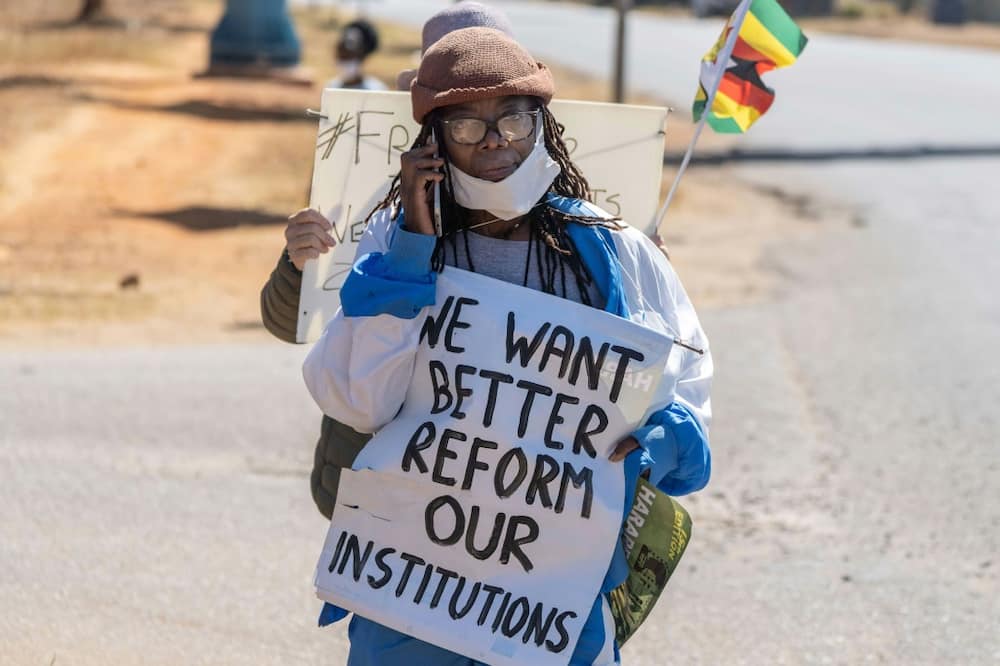
    Dangarembga and Barnes were arrested at the end of July 2020 after they marched in the empty streets of Harare, holding a banner that read ‘We want better — reform our institutions’ before they were hauled into a police van. The novelist was freed on bail a day later.

    Human rights lawyers said at the time that dozens of activists were arrested by security forces who had been sent to put down the protest. Rights lawyers also said there were cases of abductions and torture, which the government has denied.


    Zimbabwean novelist Tsitsi Dangarembga holds a placard reading 'We want better. Reform our Institutions' during an anti-corruption protest march in Harare in July 2020
    Tsitsi Dangarembga was arrested at an anti-corruption protest. She says the right to protest has been “seriously eroded” in Zimbabwe [File: Zinyange Auntony/AFP]

    Dangarembga told Al Jazeera shortly afterwards that the crackdown showed the right to peaceful protest had been “seriously eroded” in Zimbabwe.

    The latest news from around the world.Timely. Accurate. Fair.

    “Zimbabwean citizens are expected to keep silent and docilely accept whatever the authorities decide to do, or face arrest for peacefully expressed differences of opinion,” she said.

    Dangarembga won the African section of the Commonwealth Writers’ Prize in 1989 for her first novel, Nervous Conditions, the first book to be published in English by a Black woman from Zimbabwe.

    She was nominated for the prestigious Booker Prize in 2020 for her book This Mournable Body. The two works are part of a trilogy that charts Zimbabwean politics through the eyes of Tambudzai Sigauke, known as Tambu, as she grows up. The second book in the series is The Book of Not, which was published in 2006.

    Source: Aljazeera

  • Zimbabwean author Tsitsi Dangarembga was convicted over placard protest

    A celebrated author from Zimbabwe, Tsitsi Dangarembga, was found guilty of inciting violence by toting a sign that demanded political reform.

    The magistrate argued that by encouraging others to join, the protest may have disturbed the peace.

    In exchange for avoiding a three-month jail sentence, Ms. Dangarembga consented to pay a fine of approximately $220 (£200).

    In a trial that critics claim is the most recent example of a government crackdown on dissent, she had entered a not guilty plea.

    This is despite the fact that President Emmerson Mnangagwa took power in 2017 with a promise to introduce reforms after the decades-long repressive rule of his predecessor, Robert Mugabe.

    Ms Dangarembga is one of Zimbabwe’s most famous authors. Her novel, This Mournable Body, was shortlisted for the Booker Prize, in 2020.

    She was convicted along with a friend Julie Barnes.

    The pair had walked along a road in the capital, Harare, two years ago, holding placards that called for political reform and the release of two government critics.

    The courtroom gasped and the two women stood motionless as the verdict was pronounced.

    “Guilty of inciting public violence and breaching the peace,” came the judgment.

    The magistrate said that as they protested on a public road and pictures were shared on social media, others could have been provoked to protest.

    The two have until Tuesday to pay the fine. If they re-offend within the next five years they will be jailed for six months.

  • ‘Gasps in courtroom’ at Dangarembga verdict

    The courtroom gasped and the two accused; Tsitsi Dangarembga and Julie Barnes stood motionless as the verdict was pronounced.

    Acclaimed author Tsitsi Dangarembga and friend Julie Barnes: “Guilty of inciting public violence and breaching the peace”, came the judgement.

    Critics say freedom of speech was on trial here.

    The two women were arrested for holding placards on the side of a main road that called for a better Zimbabwe, for reforms and for the release from jail of two government critics.

    They say they were merely exercising their constitutional rights.

    But the magistrate ruled that by protesting on a public road intended could have provoked the public to protest.

    The sentence is a fine of 70,000 Zimbabwe dollars ($220; £200) or three months in jail if they can’t pay.

    They have agreed to pay the fine and have until Tuesday to do so.

    If they reoffend within the next five years they will be jailed for six months.

    It comes amid criticism of a government crackdown on opponents.

    Source: BBC

  • AU chairman urges lifting of Zimbabwe sanctions

    Senegal’s President Macky Sall wants sanctions against Zimbabwe to be lifted.

    He made the call in his address to the 77th UN General Assembly in New York.

    The Senegalese leader, and the current chairman of the African Union, said the measures against Zimbabwe were aggravating the suffering of the people.

    The US and the European Union (EU) maintain sanctions on Zimbabwe, citing a lack of progress in democratic and human rights reforms as well as restrictions on press freedoms.

    The sanctions target both specific individuals and companies – including President Emmerson Mnangagwa.

    Zimbabwe’s economy has faced deep economic crises over the past few years with periods of hyperinflation – but there’s little evidence to suggest that the sanctions are responsible.

    President Sall was the first African leader to address the General Assembly.

    He urged the Security Council to address conflicts in Africa in the same way it addressed other conflicts.

    He also called for reforms in the council that would make it more inclusive and possibly grant Africa a permanent seat.

    Mr Sall also called for Africa to be given a seat in the G20 group, which includes leaders of the world’s 20 major economies.

    More African leaders are expected to address the UN general assembly on Wednesday on the second day of the high-level debate.

    Source: BBC

  • Zimbabwe: Anti-vaxxers hinder the fight against measles

    Over 150 children have died in Zimbabwe due to a measles outbreak. To stop the spread, the government has started a widespread vaccination drive, but unvaccinated households are fiercely resisting because of their religious convictions.

    Zimbabwe has reported at least 2,056 cases of measles as of mid-August. Virtually all of the 157 recorded deaths were in children who had not been vaccinated, Information Minister Monica Mutsvangwa said last week.

    The outbreak began in the eastern Manicaland province at the beginning of August, spreading rapidly across the country. Health authorities are scrambling to contain the spread.

    The government has announced a mass vaccination campaign targeting children between the ages of six months and 15 years. Authorities are also trying to engage traditional and faith leaders to support the drive.

    Zimbabwe has continued vaccinating children against measles during the COVID-19 pandemic, but the drive has been hampered by religious groups preaching against vaccines.

    Rejection of modern medicine

    The Christian sects in question are against modern medicine and have told their members to rely on self-proclaimed prophets for healing.

    DW caught up with one of the religious groups on an annual pilgrimage in Manicaland, where thousands of members of the Johane Marange Apostolic sect had gathered to listen to an oracle. The church doctrine does not allow its members to be vaccinated or seek medical treatment when they fall sick.

    A preventable fatal disease

    Measles is among the most infectious diseases in the world. Childhood infection is caused by a virus that can be fatal for small children. It primarily spreads in the air by coughing, sneezing, or through close contact. Symptoms include coughing, fever, and a skin rash. However, a vaccine can easily prevent the disease.

    But 56-year-old sect member Kuziva Kudzanai told DW it was a sin to seek medical treatment. “If anyone gets sick, they will go to the church elders for prayers,” he insisted.

    Church gatherings that have resumed following the easing of COVID-19 restrictions have themselves “led to the spread of measles to previously unaffected areas,” the Health Ministry said in a statement last week.

    Added pregnancy risks

    The prohibition on medical care also applies to pregnant women, sect member Janet Hanyanisi told DW. “We are not allowed to be vaccinated or even to go to a hospital for treatment. Instead, we go to our church midwives for delivery,” she said.

    Health authorities have struggled to break down some religious communities’ resistance to vaccinating their children, who they believe are speeding up the spread of the disease.

    “So far what we have seen is that almost all the dead are unvaccinated children,” said Cephas Hote, a medical officer in Mutasa District, one of the worst-affected regions. He added that there were a few infections among vaccinated children, but only with mild symptoms.

    Scramble to contain measles

    The government has reacted to the outbreak by launching a national measles vaccination blitz. July Moyo, a minister in the local government, said several government departments and the police are enforcing the vaccination to “tackle the emergency.”

    Moyo hopes the involvement of the entire government will ensure that “people, especially children, get vaccinated.”

    Before the current outbreak, Zimbabwe had not recorded a single measles case for more than 10 years. Public health authorities are hoping the current outbreak can be contained before it becomes an epidemic.

    Scientists estimate more than 90% of the population needs to be immunized to prevent measles outbreaks.

    In April, the World Health Organization warned of an increase in measles cases in vulnerable countries as a result of a disruption of services due to COVID-19.

    UNICEF has said about 25 million children worldwide have missed out on routine immunizations against common childhood diseases, calling it a “red alert” for child health.

  • Oldest dinosaur in Africa discovered in Zimbabwe

    Scientists have unearthed in Zimbabwe the remains of Africa’s oldest dinosaur, which lived more than 230 million years ago.

    The Mbiresaurus raathi was one metre tall, ran on two legs, and had a long neck and jagged teeth.

    Scientists said it was a species of sauropodomorph, a relative of the sauropod, which walked on four legs.

    The skeleton was discovered during two expeditions, in 2017 and 2019, to the Zambezi Valley.

    “When we talk of the evolution of early dinosaurs, fossils from the Triassic age are rare,” Darlington Munyikwa, deputy director of National Museums and Monuments of Zimbabwe, and who was part of the expeditions, told the BBC.

    He said that fossils from that era – which ended more than 200 million years ago – had been unearthed in South America, India, and now Zimbabwe.

    The find is expected to shed more light on the evolution and migration of early dinosaurs, back when the world was one huge continent and Zimbabwe was at the same latitude as those countries, he said.

    Zimbabwe has been aware of other fossils in the area for decades and Mr Munyikwa said there were more sites that needed further exploration in the area, subject to funding availability.

    “It shows that dinosaurs didn’t start out worldwide, ruling the world from the very beginning,” Christopher Griffin, another scientist involved in the expedition, told the BBC.

    “They, and the animals they lived with, seem to have been constrained to a particular environment in the far south – what is today South America, southern Africa and India.”

    Christopher Griffin in 2017, excavating part of the Mbiresaurus raathi skeleton
    IMAGE SOURCE, STEPHEN TOLAN/VIRGINIA TECH
    Image caption,

    Christopher Griffin 2017, excavated part of the Mbiresaurus raathi skeleton

    He added that the find was the “oldest definitive dinosaur ever found in Africa”.

    Prof Anusuya Chinsamy-Turan, a paleontologist at the University of Cape Town, told the BBC that the discovery was important because it was part of the lineage that gave rise to the sauropod dinosaurs, which includes the diplodocus and the Brontosaurus.

    “It tells us that when dinosaurs were evolving, they were found on different continents, but they seem to have followed a hot humid environment rather than dry inhospitable one,” she told the BBC. “We hope there is more coming out of that area.”

    She added that the area where the discovery took place had seen recent gas mining exploration.

    “I hope that there is a strict policy in place to ensure that if they encounter fossils, they hand them over to the museums, so we don’t lose that material,” she said.

    The near-complete skeleton of the Mbiresaurus raathi is stored in a room in a museum in Zimbabwe’s southern city of Bulawayo. It is thought to date to the Carnian stage of the Triassic period when today’s Zimbabwe was part of the massive supercontinent Pangaea.

    Dinosaurs were believed to be well adapted to the high latitudes where today’s Zimbabwe is located, which were humid and had ample vegetation.

  • Cameron Green stars with the ball as Australia defeat Zimbabwe by five wickets

    Australia were too good for Zimbabwe in the first of their three-match ODI series on Sunday, riding some dominant bowling from Cameron Green in a five-wicket victory.

    Winning the toss and opting to bowl first, the Australians clearly felt their bowling attack could restrict Zimbabwe to a manageable total, but the tourists started well in Townsville.

    Zimbabwe’s openers safely navigated the opening 10 overs, before Innocent Kala was caught and bowled by Mitchell Marsh to make it 42-1, but the partnership of Tadiwanashe Marumani and Wessly Madhevere looked resolute.

    Australian quicks Mitchell Starc and Josh Hazlewood would have felt they were unlucky to not take any wickets in their opening spell, but despite some loose shots and near-catches, Zimbabwe built a healthy platform of 87-1.

    Marumani ended up playing all around a straight one from Adam Zampa to be dismissed on 45 from 61 deliveries, and once he was gone, Madhevere starting losing running-mates quickly.

    Six of the last seven batsmen to come to the middle were dismissed for no more than seven runs, with Regis Chakabva’s 31 from 33 deliveries the last piece of resistance before Madhevere was caught and bowled by Zampa on 72 from 91.

    A late onslaught from the Aussie attack turned 185-4 into 200 all out, as Cameron Green rattled off five quick wickets to clean up the tail, finishing with figures of 5-33 from nine overs. Zampa was Australia’s only other multiple wicket-taker, collecting 3-57.

    With such a low target required, the Australians knew they could take their time, as evidenced by their top three batsmen all going at a pace slower than a run-per-ball.

    David Warner controlled proceedings early, surviving a close third-umpire referral when the Zimbabwe wicket keeper was convinced he heard a feathery touch, going on to score 57 from 66 deliveries before being bowled.

    Steve Smith came in at three and was far from in a hurry, methodically playing his way to 48 from 80 deliveries, before Glenn Maxwell came in at seven to race towards the finish.

    Maxwell only saw nine deliveries, but he sent three to the rope along the ground, and three for six on his way to a rapid unbeaten 32  finishing the game with a big six in the 34th over.

    Ryan Burl was expensive for Zimbabwe with the ball, giving up 60 runs in seven overs, but took three wickets, claiming the scalps of Marcus Stoinis, Alex Carey and Marsh.

    The second match of the series will take place on Wednesday, with the third scheduled for Saturday.

    Source:livescore

  • Andrew Symonds’ family pay touching tribute to ‘Roy’ during Australia ODI win

    Touching tributes were paid to Andrew Symonds in Townsville during Australia’s ODI with Zimbabwe on Sunday.

    Former Australia all-rounder Symonds died in a car accident in May at the age of 46.

    The outfield at Riverway Stadium was emblazoned with ‘Roy 388′ a reference to Symonds’ nickname and his Australia Test cap number.

    Symonds’ children, Billy and Chloe, stood alongside ODI captain Aaron Finch and Steve Smith during the national anthems, when a minute’s silence was held in his honour.

    They later served as enthusiastic drinks carriers for Australia’s players in the field.

    Symonds’ wife Laura Vidmar, sister Louise, mother Barbara, his children and close friend Jimmy Maher took to the middle during the interval to place his baggy green, his bat, his Akubra hat, a fishing rod and a crab pot at the stumps. His much-loved dogs Buzz and Woody also joined the family for the emotional tribute.

    “What he did as a player was remarkable,” Finch said prior to the match, which Australia won by five wickets.

    “He was someone who put bums on seats, he was box office with bat and in the field. [It’s been] a really sad time obviously for Australian cricket over the last little while. It’ll be nice to have some tributes and his family here.

    “For someone who was so laid-back, his depth of knowledge of cricket and players was second to none. I think the larrikin tag was there, but the deep knowledge of the game was outstanding as well.”

    Symonds made 26 Test appearances for Australia, scoring two centuries, his first coming in the Boxing Day Test in 2006-07 Ashes series. He recorded 10 half-centuries and had an average of 40.61 and took 24 Test wickets.

    In ODI cricket, he played a key role in Australia’s 2003 Cricket World Cup triumph, scoring 326 runs in five innings at an average of 163. He also featured in their 2007 success.

    He scored 5,088 ODI runs, 16th in the all-time list for Australia, producing six centuries and 30 half-centuries. Symonds took 133 wickets in the 50-over format.

    Source:livescore

  • Gill hits maiden international century as India hold off Zimbabwe

    Shubman Gill scored his first international century on Monday as India defeated Zimbabwe by 13 runs to win the ODI series 3-0.

    India entered the game seeking their hosts’ 15th straight ODI victory as well as a second straight one-day series victory over Zimbabwe, and they were unstoppable in a high-scoring affair.

    Shikhar Dhawan (40), KL Rahul (30), and Ishan Kishan all contributed to the tourists’ 289-8 score at Harare Sports Club before Gill’s historic strike

    Brad Evans (5-54) recorded the best figures of his fledgling ODI career and although Sikandar Raza made a brilliant 115 off 95 balls, Zimbabwe fell short on 276 all out.

    The wickets began to tumble when Zimbabwe threw caution to the wind midway through the innings, losing Regis Chakabva (16), Takudzwanashe Kaitano (13), Ryan Buri (8) and Luke Jongwe (14) in the space of just under 10 overs.

    Raza led a terrific fightback, hitting three sixes and finding the rope nine times before he was caught by Gill off the bowling of Shardul Thakur in the penultimate over, and Avesh Khan finished off the job by cleaning up Victor Nyauchi.

    Avesh took 3-66, while Axar Patel (2-30), Kuldeep Yadav (2-38) and Deepak Chahar (2-75) also made an impact with the ball.

    India have now won seven consecutive ODIs away from home, their best run since a sequence of nine in a row between July 2017 to February 2018.

    Source:livescore.com

  • Zimbabwe’s inflation rises by 250%

    The annual inflation of Zimbabwe has risen to more than 250%, leaving many Zimbabweans  struggling to cope.

    It is the highest level for a year and a half since inflation stated quadrupling in February.

    According to reports, the high cost of goods and services are as a result of the COVID-19 pandemic and the high global prices on fuel, grain and fertiliser.

    A local shortage of American dollars to pay for imports has also contributed to the rising cost of basic goods and services.

    On Monday the central bank released gold coins onto the market in an attempt to stem inflation by curbing the appetite for US dollars.

  • Wode Maya welcomed to Zimbabwe, his 25th African country he is visiting

    The man reputed as Africa’s biggest YouTuber, Wode Maya, is currently in Zimbabwe on an official visit.

    He was officially welcomed by the southern African country’s Information Minister on Monday, July 11, 2022 during a press conference in the capital Harare.

    The official Twitter handle of the ministry posted photos of Wode Maya, real name, Berthold Kobby Winkler Ackon, together with Minister Monica Mutsvangwa at the conference.

    It was captioned as follows: “Today @InfoMinZW Minister Hon Monica Mutsvangwa, welcomed Ghanaian blogger Berthold Kobby Winkler Ackon, popularly known as Wode Maya, to the country. Wode Maya is on a mission to change the negative narrative on Africa, with Zimbabwe being the 25th African country he is visiting.”

    It is not known what Wode Maya’s visit will entail but what is sure is, the details will be out sooner rather than later.

    Source:ghanaweb.com

  • Zimbabwe issues arrest warrant for top author

    Zimbabwe has issued an arrest warrant for award-winning author and filmmaker Tsitsi Dangarembga after she failed to appear in court over charges of inciting violence, her lawyer said Tuesday.

    Dangarembga, 63, is seeing her doctor in Germany and “missed court for medical reasons,” her lawyer Chris Mhike told AFP.

    “We expect her to be well enough to return to Zimbabwe imminently, and to attend to the outstanding court processes.”

    Dangarembga was arrested in July 2020 for staging an anti-government protest alongside her neighbour in the affluent Harare suburb of Borrowdale.

    Standing by the roadside, she held a banner that read “We want better — reform our institutions.”

    Dangarembga was charged with inciting public violence and freed on bail the following day.

    Nearly two years on, the trial has still not started and Dangarembga has filed to have the case thrown out for lack of evidence.

    A magistrate’s court on Monday was due to rule on her request, but issued the arrest warrant when she failed to show up.

    Dangarembga will seek to have the warrant cancelled, said the lawyer.

    Dangarembga was charged after staging a roadside protest on the anniversary of President Emmerson Mnangagwa's election
    Dangarembga was charged after staging a roadside protest on the anniversary of President Emmerson Mnangagwa’s election.

    The ruling on the application for discharge will now be handed down on August 4.

    Dangarembga stepped into the international limelight in 1988 with her debut novel “Nervous Conditions,” the first book published in English by a black Zimbabwean woman.

    The work earned her the prestigious Commonwealth Writers’ Prize the following year.

    The Berlin International Film Festival (Berlinale) last week called on the Zimbabwe government to clear Dangarembga “of all charges, or to drop the case.”

    Source:briefly.co.zo

  • Ex-lover arrested over murder of Zimbabwe activist

    Police in Zimbabwe say they have arrested a man on suspicion of murdering an opposition activist whose mutilated body was found in a well weeks after she went missing.

    The suspect has been identified as Pius Jamba, who police previously described as an ex-lover of the victim Moreblessing Ali.

    Ms Ali was reported missing following an argument with Mr Jamba.

    She was a member of the opposition Citizens Coalition for Change (CCC) party.

    The suspect has not commented on his arrest and police have said they will issue a detailed statement later.

    The police had previously said they were treating the case as a domestic issue rather than something that was politically motivated.

    Chaos broke out at Ms Ali’s funeral earlier this week after ruling Zanu-PF party supporters allegedly attacked mourners.

    Source: BBC

  • Zimbabwe opposition MPs arrested after protest

    Two opposition MPs have been arrested in Zimbabwe following violent protests over the killing of an opposition member in Chitungwiza near the capital, Harare.

    Political tensions have been rising in the community after Moreblessing Ali’s severed remains were found in a well, close to three weeks after she was reported missing.

    MPs Job Sikhala and Godfrey Sithole were arrested on allegations of inciting public violence, according to their Citizens Coalition for Change (CCC) party.

    The police have also confirmed the arrest of Job Sikhala, accusing him of being connected to “orgy of public violence” in Nyatsime area, Chitungwiza – about 30km (18 miles) from the capital, Harare.

    Source: BBC

  • Missing Zimbabwean opposition activist found dead

    A Zimbabwean opposition party says the remains of a missing supporter have been found in a well, ending a widely publicised search.

    Moreblessing Ali was reported missing following an argument with a former boyfriend, Pius Jambo.

    Mr Jambo, who’s been described by the opposition Citizens’ Coalition for Change as a ruling party supporter, is alleged to have dragged her from a bar in May.

    The ruling party, Zanu PF, has denied involvement in the killing and asked that police be allowed to do their investigations.

    Ms Ali’s mutilated body was found dumped in a well south of the capital, Harare.

    Police have previously said they were treating the case as domestic rather than politically motivated.

    But an opposition spokesperson Fadzayi Mahere said Mr Jambo was linked to previous violent attacks against opposition supporters. She called for a swift, impartial investigation.


    Source: BBC

  • Zimbabwe seeks EU backing to sell $600M worth of ivory

    Zimbabwe on Monday sought the support of the European Union to sell off US$600 million worth of ivory it has accumulated due to the global ban on the sale of tusks.

    International trade in ivory has been banned since 1989 under the Convention on International Trade in Endangered Species of Wild Fauna and Flora (CITES).

    Zimbabwe Parks and Wildlife Management Authority director-general Fulton Mangwanya told EU ambassadors to Harare that the country has 163,000 tonnes of ivory and 67 tonnes of rhino horns in vaults.

    “The burden of managing a stockpile that we cannot derive economic value, or plough back into the communities and conservation of the same species is quite a great pain to us,” he said.

    “We kindly request the support of the EU for Zimbabwe to be allowed a once off sale of our national ivory stock,” said Mangwanya.

    The EU diplomats were taken on tour of the vaults in Harare.

    Mangwanya said if allowed, the funds would be used to benefit local communities living around animal conservancies.

    The country can support up to 55,000 elephants but the population has more than doubled to 100,000, according to officials.

    Elephants have so far this year killed 60 people, in a conservation success story that has led to increased conflict with humans.

    But the plea did not immediately garner support.

    “Conservation and prevention of illegal wildlife trade is an international issue because of the involvement of criminal syndicates in illegal wildlife trade hence there is need to strengthen international cooperation,” the Swiss ambassador Niculin Jager responded on behalf of his colleagues.

    Three years ago, Botswana, Namibia and Zimbabwe — home to the world’s largest elephant population — asked for the right to sell ivory acquired through natural deaths, confiscations and culling.

    But that demand was rejected by a CITES meeting in Geneva in 2019.

    Source: Africa news

  • 30-day lockdown for Zimbabwe following spike in coronavirus cases

    Following a spike in coronavirus cases, Zimbabwe has reintroduced a 12-hour curfew from 6 pm until 6 am.

    The new curfew was announced on Saturday by Vice President Constantino Chiwenga.

    “We have seen a surge in COVID-19 cases and deaths, almost double in two months, from 8,374 on 1 November to 14,084 to date. In light of the recent surge in COVID-19 cases the following stiff lockdown measures are being put in place with immediate effect,” he said.

    Aside from the dawn-to-dusk curfew, other measures have been reintroduced.

    Only essential businesses can remain open and all gatherings such as wedding ceremonies or religious services are banned, with the exception of funerals, which are limited to 30 people.

    The measures could worsen the already troubled Zimbabwean economy.

    However, Health Minister Constantino Chiwenga justifies this decision by an increase in coronavirus contaminations which is said to have almost doubled since November — rising from 8,374 cases to more than 14,000.

    Since the onset of the COVID-19 pandemic, the country has recorded 369 deaths linked to coronavirus.

    Source: africanews.com

  • Zimbabwean music star apologises after kicking fan off stage

    Zimbabwean music star Rodney Mashandure, famous by his stage name Jah Master, has apologised for kicking a fan who had gone on stage during his performance.

    The incident happened on Sunday during a state-sponsored gala to protest against sanctions imposed by the US and European Union against politicians and companies linked to human rights abuses.

    A video of the incident sparked condemnation against the musician.

    Jah Master has said in a Facebook post

    that he will take the fan for a medical checkup and give him all proceeds from the show.

    State-owned Herald newspaper has tweeted a video of the incident:

    Source: bbc.com

  • ‘I was jailed for a month after exposing corruption’ – Zimbabwe journalist

    In our series of letters from African journalists, Zimbabwe’s Hopewell Chin’ono explains how he came face-to-face with the consequences of an alleged corruption scandal he helped highlight earlier this year.

    I had been expecting trouble – so when eight men, some with AK-47s, arrived at my gate in an unmarked vehicle on the morning of 20 July, I was not surprised.

    One warning had come about seven weeks earlier, when the spokesman for the ruling party had called me “unscrupulous” and accused me of tarnishing the name of the president’s family.

    This was after I’d publicised a Covid-19 procurement scandal involving multi-million dollar contracts awarded to buy supplies at inflated prices – the health minister was then sacked and is facing charges over the allegations.

    When the state agents asked me to come out of my house, I asked to see their warrant of arrest but they didn’t show me one.

    Instead they hit my dining room glass door with a gun, and walked through to my bedroom where I was waiting for them with my phone, live-streaming their entrance.

    I was dragged out of my bedroom barefoot, and asked to use the same entrance where the broken glass lay strewn.

    That was the beginning of my 45-day nightmare.

    I was not alone, I had been arrested on that same chilly day with Jacob Ngarivhume, a political activist who had called for a peaceful protest against corruption.

    We were both charged with inciting violence as I had endorsed his march as the Zimbabwean constitution allows citizens to protest peacefully – something that President Emmerson Mnangagwa’s government often thwarts.

    Whilst at Harare Central Remand Prison, we received a visit from Zimbabwe’s main opposition leader, Nelson Chamisa, which we were told upset the president’s office.

    So the next day, we were bundled into a truck and sent to the notorious Chikurubi Maximum Security Prison, where the convicted criminals are kept in legs irons and handcuffs if they move from their cell section.

    The jail has a capacity for 1,360 prisoners, yet it had more than 2,600.

    I shared a cell, meant to house 16 inmates, with 44 other prisoners. There was no space to turn whilst sleeping, and this is in the middle of a Covid-19 pandemic.

    The prisoners had no masks at all, and there was no running water or soap in the cells, where we were locked up for 17 hours a day.

    With only one light bulb, it was impossible to read.

    During the day we were in a courtyard, where 500 inmates shared only two toilets. Again there was no running water.

    Many of the convicts suffered with pellagra because of the poor diet – symptoms include dermatitis and diarrhoea.

    There was maize porridge for breakfast, maize meal with boiled beans for lunch – served at 10 in the morning – supper was again badly cooked maize meal with boiled cabbage.

    ‘I teared up’

    I fell ill in the last week of August with a terrible fever – the prison hospital didn’t even have a paracetamol to help relieve the pain.

    When my doctor came to the prison, the hospital didn’t have a blood pressure machine for him to use.

    Most of the prisoners have turned to religion – and it was difficult to get any sleep because of their loud praying, it is their only source of hope.

    Some of them are there for crimes they have committed, there are also those inside for their political activism, some convicted despite no evidence.

    I protested to the warders about the conditions – we got three more light bulbs, and some masks – some prisoners were given coronavirus tests.

    My cell mates were grateful. After I was granted bail on 2 September, I teared up when a couple of them turned to me before I left and said: “Please don’t forget about us.”

    I felt my fight against corruption was vindicated.

    I had been writing about the alleged looting of public funds and at Chikurubi I had seen how an institution had been starved of investment.

    My ordeal is also a reflection of the difficulties faced by investigative journalists in Zimbabwe.

    Three years since Robert Mugabe was ousted, abductions of perceived critics of the authorities have become more common.

    That is not to say there was no intimidation under Mugabe, but I was still able to report on stories without arrest, including an award-winning documentary about the 2008 post-poll violence.

    At the time I was taken into custody a government spokesman said no profession was above the law, yet I feel the intention of my arrest was to instil fear in journalists – and it seems to be succeeding.

    Recently I met a few young journalists who said they had important information they were sitting on. Their reason for failing to report it? “We are too afraid,” they said.

    Source: bbc.com
  • More elephants found dead in Zimbabwe

    The Zimbabwean wildlife authorities have found more carcasses of elephants, bringing the total number to 22.

    The elephants died of a suspected bacteria infection according to the authorities.

    Most of the dead elephants were young with the oldest aged 18 years.

    The authorities suspect that the young elephants may have eaten poisonous vegetation.

    They said there had been scarcity of food and the young elephants were unable to reach higher tree branches.

    Source: bbc.com

  • Twelve elephants die mysteriously in Zimbabwe

    Park authorities in Zimbabwe are investigating the death of 12 elephants at Hwange National Park.

    The elephants were found dead with their tusks intact.

    The authorities say they do not suspect cyanide poisoning – used by poachers instead of rifles – as no other wild animal was affected.

    Blood samples from the elephants have taken for examination to determine the cause of death.

    The Hwange National Park is near the border with Botswana where hundreds of elephant carcasses were found early this year.

    Source: bbc.com

  • UK diplomat criticises Zimbabwe crackdown

    The UK ambassador to Zimbabwe says she is seriously concerned about the human rights situation in the country, following the recent arrests of activists and opposition politicians.

    In a BBC interview, Melanie Robinson specifically mentioned the case of journalist Hopewell Chin’ono, who has been in prison for five weeks and has repeatedly been denied bail.

    He was arrested for supporting anti-government protests.

    President Emmerson Mnangagwa has accused countries in the west of undermining his government and contributing to Zimbabwe’s economic crisis by imposing sanctions.

    Ms Robinson said that no Zimbabweans were currently under British sanctions.

    She said the crisis was due to economic mismanagement and corruption.

    Source: bbc.com

  • Zimbabwe rejects Catholic bishops’ criticism of corruption and abuse

    Zimbabwe’s government has dismissed a letter by Roman Catholic bishops highlighting corruption, poverty and human rights abuses.

    “There is no crisis, political or otherwise,” said Information Secretary Nick Mangwana.

    He accused the Zimbabwe Catholic Bishop’s Conference of joining groups seeking “to manufacture crises”.

    The bishops had called for an urgent resolution to the country’s economic and political challenges.

    “The struggle in Zimbabwe, has resulted in a multi-layered crisis of convergence of economic collapse, deepening poverty, food insecurity and human rights abuses,” said seven bishops from the Zimbabwe’s main cities and towns in a letter released on Friday.

    “Corruption in the country has reached alarming levels,” they added.

    Zimbabweans have been protesting against alleged government corruption and a deepening economic crisis with inflation running at more than 700%.

    President Emmerson Mnangagwa has, however, blamed his political opponents of working with foreigners to try to destabilise the country. He called them “bad apples” and warned that he will “flush” them out.

    His government has recently attracted heavy criticism over a crackdown targeting anti-government protesters which has resulted in several people being assaulted and arrested.

    Prominent journalist Hopewell Chin’ono was charged last month with inciting public violence. He is still in detention after being denied bail.

    He had exposed alleged corruption in the health ministry during the purchase of medical supplies to tackle the coronavirus pandemic.

    Images of police assaulting protesters have been shared online sparking a global campaign using the hashtag #ZimbabweanLivesMatter to highlight rights abuses.

    Celebrities like rappers Ice Cube, AKA and Lecrae and actresses Thandie Newton and Pearl Thusi have expressed support.

    What else did the bishops say?

    “Fear runs down the spine of many of our people today. The crackdown of dissent in unprecedented,” the Zimbabwe Catholic Bishop’s Conference said in their letter.

    “Voices of various governments, the European Union, the African Union, and the UN on the desperate situation in Zimbabwe have not only confirmed the seriousness of the human rights breaches by government agents but the need to rally behind #ZimbabweanLivesMatter,” they said.

    But writing in the state-owned The Herald newspaper, Mr Mangwana defended the government.

    “Zimbabwe, like most countries in the world, is currently grappling with challenges attendant to illegal sanctions, drought and the coronavirus pandemic,” he said.

    He said President Mnangagwa had demonstrated his commitment to fight corruption, highlighting the arrest of high profile individuals and strengthening of anti-corruption bodies.

    The information secretary also said the bishops had ignored the impact that close to two decades of economic sanctions had had on the country.

    Source: bbc.com

  • Zimbabwe opposition says 30 members have fled homes

    Zimbabwe‘s main opposition party MDC Alliance says about 30 of its members have fled their homes for fear of being abducted.

    The party has tweeted that some members were contemplating “moving their children to safer places”.

    Many fear being tortured or detained, it said.

    Opposition supporters and activists called for anti-government protests towards the end of last month to decry economic mismanagement and corruption.

    The government suppressed the protests by warning people to stay indoors and cracked down on solo protesters.

    Those arrested have been charged with various offences that activists say have been fabricated to fall within the constitution.

    Source: bbc.com

  • Zimrights blasts government for sitting on Motlanthe commission recommendations

    The Zimbabwe Human Rights Association (ZimRights) has slammed government for apparent failure to implement recommendations made by a post-election violence probe team once headed by former South African President Kgalema Motlanthe two years ago.

    The Motlanthe Commission was a seven-member Commission of Inquiry into post-election violence in Harare 2018.

    Seven civilians were gunned down by soldiers who had been deployed into the Harare CBD August 1, 2018 to quell wild protest scenes by sympathisers of the opposition MDC Alliance who were agitated by the slow announcement of poll results amid rigging fears by government opponents.

    The Commission recommended, among others, compensation for victims of the atrocities and the bringing to account, members of the country’s security establishment who killed the civilians.

    The Commission also urged Zimbabwean authorities to create a platform for political dialogue with political opponents.

    But in its report entitled, “The Motlanthe Commission: What’s next for victims”, ZimRights argues none of the recommendations has been implemented yet.

    The rights watchdog argues this was sheer waste of taxpayers’ money.

    “A year and a half into the commission of inquiry’s findings and recommendations, no justice has been done for the victim and the perpetrators remain at large.

    “It leaves in question government’s band-aid intention in establishing and appointing the Commission of inquiry with whom it had no obligation to implement the recommendations,” reads the report.

    “The government has not fulfilled the recommendations, instead politicians have sought to use the report more as a public relations document rather than a sincere quest for reform and nation-building.”

    The report further points out Mnangagwa has only used the Motlanthe Commission report to gain favour internationally.

    Adds the report: “It is important for government to seek dialogue first with its citizens and affected families before parading the report to foreign governments.

    “Many believe it was wasted money and time.”

    In December 2018, ISS Researcher Ringisai Chikohomeron described the Commission as a “High Level PR stunt” by Mnangagwa.

    Government on the other hand argues it has fully implemented the recommendations.

    Justice Ministry Permanent Secretary Virginia Mabhiza, who was also secretary of the Commission earlier this year, said a few delays were as a result of Covid-19 but everything else had been dealt with.

    “We have complied fully with the Motlanthe Commission but some of the processes are still ongoing,” said Mabhiza.

    She said compensation of victims had been delayed because they were not forthcoming.

    A Political Leaders and Actors Dialogue (POLAD) platform formed to facilitate discussions on key policies by the Mnangagwa administration has been dismissed by main opposition MDC and since failed to have the expected impact.

    MDC president Nelson Chamisa has refused to acknowledge Mnangagwa’s presidency and POLAD.

    Source: allafrica.com

  • Zimbabwe VP named health minister after Coronavirus scandal

    Zimbabwe’s Vice-President Constantino Chiwenga has been appointed as health minister, about a month after the ministry was rocked by a scandal surrounding the procurement of coronavirus tests and equipment.

    Mr Chimwenga is a former head of the army who led the military takeover from former President Robert Mugabe.

    His predecessor at the health ministry, Obadiah Moyo, appeared in court in June over corruption charges related to a $20m (£16m) contract awarded to a Hungary-registered firm, allegedly without going through proper processes.

    He was granted bail.

    “President Mnangagwa has noted the urgency needed to stabilise the health delivery system in the context of the Covid-19 pandemic where the country has registered an acute surge of cases,” a statement from the presidency on Tuesday said.

    Zimbabwe has confirmed nearly 4,200 coronavirus cases, including 81 deaths, but the actual number of cases is thought to be higher.

    Source: bbc.com

  • Zimbabwe leader vows to ‘flush out bad apples’

    Zimbabwean’s President Emmerson Mnangagwa has given a stark warning to opposition figures and human rights campaigners amid growing uproar over corruption and economic mismanagement.

    In a televised address on Tuesday, the president condemned the “machinations of destructive, terrorist opposition groupings”.

    “Those who promote hate and disharmony will never win. The bad apples that have attempted to divide our people and to weaken our systems will be flushed out. Good shall triumph over evil,” he said.

    Opposition supporters and activists had last week called for anti-government protests, but security agencies ordered people to stay indoors. Some activists including Booker-longlisted author Tsitsi Dangarembga were arrested and later released on bail.

    Zimbabwe Lawyers for Human Rights say more than 60 people have been detained.

    Mr Mnangagwa in his speech said “security services will continue to carry out their duties with appropriate astuteness and resolve”.

    “We shall overcome attempts at destabilisation of our society by the few rogue Zimbabweans acting in league with foreign detractors,” he said.

    Source: bbc.com

  • Tsitsi Dangarembga: Booker Prize nominee arrested in Zimbabwe

    Award-winning Zimbabwean author Tsitsi Dangarembga, a nominee for this year’s Booker Prize, has been arrested in the country’s capital, Harare, during an anti-government protest.

    Dangarembga, 61, and another protester were bundled into a police lorry while carrying placards.

    The government has warned that participation in Friday’s demonstration is regarded as insurrection.

    Police and soldiers are patrolling cities where streets are mainly empty.

    Opposition parties and civil society organisations had called for protests against alleged government corruption and a deepening economic crisis with inflation running at more than 700%.

    But President Emmerson Mnangagwa has accused the opposition of exploiting the country’s economic challenges to topple his government.

    Media captionZimbabwe was largely shut down on the day meant for demonstrations against corruption and economic hardships.

    An opposition politician who called for the demonstration is in detention, arrested last week and charged with inciting violence.

    He remains behind bars, along with prominent investigative journalist Hopewell Chin’ono, who was detained at the same time.

    In June Chin’ono had exposed an alleged multi-million dollar scandal involving coronavirus supplies – revelations which led to the sacking of the health minister.

    Source: bbc.com

  • Booker Prize nominee arrested in Zimbabwe

    Award-winning Zimbabwean author Tsitsi Dangarembga, a nominee for this year’s Booker Prize, has been arrested in the country’s capital, Harare, during an anti-government protest.

    Dangarembga, 61, and another protester were bundled into a police lorry while carrying placards.

    The government has warned that participation in Friday’s demonstration is regarded as insurrection.

    Police and soldiers are patrolling cities where streets are mainly empty.

    Opposition parties and civil society organisations had called for protests against alleged government corruption and a deepening economic crisis with inflation running at more than 700%.

    But President Emmerson Mnangagwa has accused the opposition of exploiting the country’s economic challenges to topple his government.

    An opposition politician who called for the demonstration is in detention, arrested last week and charged with inciting violence.

    He remains behind bars, along with prominent investigative journalist Hopewell Chin’ono, who was detained at the same time.

    In June Chin’ono had exposed an alleged multi-million dollar scandal involving coronavirus supplies – revelations which led to the sacking of the health minister.

    Why is the protest banned?

    The authorities say that the demonstration is not allowed because of coronavirus restrictions.

    Security forces have intensified their patrols and streets are deserted despite assurances by government that the public should go about their normal business without fear, reports the BBC’s Shingai Nyoka in Harare,

    Covid-19 checkpoints have meant only essential service workers have been allowed in the city centre, she says.

    Most people have chosen to stay at home – and the few who have gone out to demonstrate have faced arrest.

    The main opposition Movement Democratic Change (MDC) party says several of its supporters, including a party official, have been detained.

    A photographer with the AFP news agency reports that police bundled Dangarembga and another protester into a lorry full of police armed with AK-47 rifles and riot gear.

    Dangarembga was carrying placards calling for reforms and for the release of Chin’ono, the agency says.

    The author later tweeted that they were being held at Borrowdale Police Station, later saying: “May not be able to tweet for a while.”

    On Thursday, Dangarembga had told the BBC that demonstrating against the government was “necessary” given the situation in the country.

    “Every sector is disintegrating. Health, education, the economy. I am concerned for my safety. It would be naïve not to be because we have a very repressive regime and we know that they will most likely be deployed against the people,” she said.

    “This is one of the grievances that the people have, that the security forces, the security service is often deployed against the people, instead of being deployed for the protection of the people.”

    Who is Tsitsi Dangarembga?

    The writer and film director was born in Mutoko town in the north-east of the country when it was under white-minority rule.

    At the age of two she moved with her parents to the UK, returning to her homeland in 1980 just before Zimbabwe became independent.

    Her first novel Nervous Conditions won the African section of the Commonwealth Writers Prize in 1989.

    Other award-winning credits include Neria, Zimbabwe’s most successful film released in 1993.

    Her latest book, This Mournable Body, is on the Booker Prize longlist, which was unveiled earlier this week.

    It is a sequel to Nervous Conditions, and “channels the hope and potential of one young girl and a fledgling nation to lead us on a journey to discover where lives go after hope has departed”, the Booker Prize website says.

    Source: BBC

  • Zimbabwe enters coronavirus danger zone – Government

    The panicky Zimbabwean government says the country has entered a Coronavirus danger-zone in which daily updates are now made in terms of deaths rather than confirmed cases.

    In a statement Monday, Information Minister Monica Mutsvangwa urged all citizens to help stop the spread of the virus as cases and deaths more than doubled over the past week.

    “Fellow Zimbabweans the day we knew would come, but hoped would pass us by is now upon us. We are at a time where we speak more of how many of our loved ones have passed on than how many have tested positive,” she said.

    “This is not an easy time for the nation. Each one of us has a critical role to play in the battle that is before us. The Inter-Ministerial Taskforce continues to make preparation so that we can deal with the eye of the storm.”

    Mutsvangwa said members of the Covid-19 national taskforce have visited the country’s 10 provinces to assess the situation and had brought back grim and scary reports.

    “Over the weekend, members of the national taskforce visited provincial Taskforce structures across the country in order to inspect and monitor the progress these structures have made in the fight against the pandemic. These visits also sought to address province-specific challenges and to also evaluate localised COVID-19 responses.”

    She however said progress had been made in establishing isolation centres for those infected.

    “The national taskforce noted that there was progress in the rehabilitation and renovation of identified isolation centres, with some facilities now complete and already admitting mild cases and those cases that cannot self-isolate in their homes,” she said.

    She also bemoaned high cases of irregular migration and border jumping which are widely blamed for the proliferation of untraceable cases.

    “The taskforce noted with concern continued cases of illegal border crossers, but it commends responsible citizens who are apprising the police and health officials of these potential threats to local communities,” she said.

    Meanwhile, from Chinhoyi, James Muonwa reports that Mutsvangwa who heads the Mashonaland West ministerial taskforce told government officials at the weekend that Covid-19 figures painted a grim picture.

    “It’s real, Covid-19 has come closer home. It is now widespread in our communities. As leaders go out there and tell people to adhere to regulations because this is not about government or the president saying ‘stay at home’, it’s about our lives,” she said.

    “These figures paint a grim picture. We’re in a war, let’s fight together.”

    Meanwhile, the Zimbabwe National Family Planning Council (ZNFPC) Monday closed its Chinhoyi branch after one of its staff members tested Covid-19 positive.

    The female ZNFPC staffer underwent testing after her husband was diagnosed positive in Harare. This prompted the organisation to shut its doors to the public while 14 employees who were in direct contact with the patient also underwent compulsory testing and are awaiting results.

    ZNFPC Mashonaland West provincial manager, Geshema Madzingaidzo confirmed the closure of the ZNFPC Chinhoyi branch.

    “Indeed, we have one of our female workers whose husband tested positive for COVID-19. She was also tested and results came on Thursday confirming she was also positive.

    “As a precautionary measure, we asked all our employees who were in direct contact with her to get tested and we are awaiting results,” Madzingaidzo told NewZimbabwe.com.

    Source: allafrica.com

  • Zimbabwe targets 50% teenage pregnancy cut

    he Zimbabwe National Family Planning Council (ZNFPC) is escalating efforts to halve the country’s teenage pregnancy rate from 24% to 12% by end of this year.

    This envisaged goal will come at the backdrop of an envisaged successful roll-out of the Zimbabwe National Family Planning Costed Implementation Plan (ZNFPCIP).

    The blueprint translates the nation’s strategy 2016-2020 into a result-based and actionable costed plan to guide intervention programming, resource mobilisation and allocation, and performance measurement.

    ZNFPC sister-in-charge for Mashonaland West, Christopher Katanda, told NewZimbabwe.com recently that teenage pregnancies remained a huge challenge, particularly in rural areas where there is low uptake of contraceptives among young and unmarried sexually active women.

    “This has contributed to the high prevalence of teenage pregnancies, therefore, there is need for demand creation for contraceptives as we push to reduce the teenage pregnancy rate from 24 to 12 per cent by end of 2020,” said Katanda.

    Journalists attending a recent ZNFPC media engagement meeting, raised fears of an upsurge in unwanted teen pregnancies in light of the prevailing Covid-19 pandemic, which has seen most youths redundant and exposed to mischief.

    According to the ZNFPCIP, Zimbabwe seeks to increase, among its key populations, knowledge of long-acting and permanent family planning methods among all women and men from 46 to 51% by 2020.

    Long-acting and reversible contraceptives include implants and intrauterine contraceptive devices (IUCDs), while permanent methods include male and female sterilisation.

    ZNFPC targets to avert over 3 million unwanted pregnancies, cut in excess of 900,000 abortions, supress 7,000 maternal deaths and avoid 33,000 child deaths by end of this year (2020).

    According to the last population census, Zimbabwe has an estimated 15 million people and is projected to reach 19, 3 million by 2032, based on the country’s total fertility rate which is higher among poor less-educated rural women.

    This demographic group averages five births per woman.

    Family planning is vital in a country’s development as it informs government budgeting of key resources, policy formulation and implementation aimed at improved livelihoods of families and communities.

    Source: allafrica.com

  • Zimbabwe investigative journalist arrested

    An outspoken journalist who recently exposed alleged government corruption involving coronavirus supplies has been arrested in Zimbabwe.

    Hopewell Chin’ono live-streamed his arrest on Monday on social media before being told to put his phone down.

    It is not yet clear why security officials broke into Hopewell Chin’ono’s home and arrested him.

    The US embassy called it deeply concerning, and the journalist’s lawyer said it was an abduction.

    “We’re not sure where he has been taken. His helper says they did not produce any warrant when they came to his house,” human rights lawyer Beatrice Mtetwa said in a video statement.

    Motioning to a smashed patio door at Mr Chin’ono’s home, Ms Mtetwa said eight or so security agents were involved in the raid.

    This video streamed on Facebook appears to show the moment the investigative journalist was confronted inside his home:

    What did Mr Chin’ono report about?

    Mr Chin’ono’s reporting on alleged Covid-19 procurement fraud within the health ministry led to the arrest and sacking of Health Minister Obadiah Moyo.

    President Emmerson Mnangagwa fired Mr Moyo earlier this month for “inappropriate conduct” over the $60m (£47.5m) medicines supply scandal.

    Zimbabwe’s opposition MDC party said the state was persecuting a journalist for exposing government corruption.

    A government official later responded by tweeting that journalists were not above the law.

    What’s happening in Zimbabwe?

    BBC Africa correspondent Andrew Harding says the incident comes at a time of rising tensions in Zimbabwe, with hyperinflation strangling the economy, and talk of a new round of mass protests against Zanu-PF, the party that has run the country since independence.

    Zimbabwe’s government promised reforms and economic growth after former President Robert Mugabe was ousted from power three years ago.

    But critics say it has reverted to its old habits of repression and corruption.

    Source: bbc.com

  • Zimbabwe top police officer ‘arrested over $1m scandal’

    A top Zimbabwean police officer and a chief public prosecutor have been arrested over bribery allegations in a $1m (£798,000) land sale scandal, a state-owned newspaper reports.

    Obeylaw Moyo, an assistant commissioner in the commercial crimes unit, and an unnamed prosecutor were arrested on Wednesday and are expected to appear in court “soon”, the Herald newspaper reports.

    There is no comment reported from either man.

    The anti-corruption commission spokesman is quoted as confirming the arrests.

    The scandal involves the illegal sale of land at a suburb in the capital, Harare, owned by the local authority.

    Source: bbc.com

  • Breast cancer: Zimbabwe woman’s struggle to avoid mastectomy

    A 44-year-old woman in Zimbabwe, Tendayi Gwata, is battling to avoid a mastectomy after her breast cancer treatment abruptly ended when the only radiotherapy machine in the capital, Harare, stopped working.

    Ms Gwata, a marketing consultant, had already lost all her hair during chemotherapy. Then she was told that because the machine had broken down, she may need her breast removed.

    Zimbabwe’s health sector has largely collapsed amidst an economic crisis that has seen inflation soaring to 785%, and a severe shortage of cash. The crisis has been compounded by the coronavirus outbreak.

    Ms Gwata told the BBC’s Clare Spencer about her ordeal:

    In July 2019 I had discomfort in my breast so I went to the doctor in Harare and had a scan and mammogram.

    A biopsy then confirmed I had stage-three breast cancer and the cancer had spread to my armpit.

    I flew to South Africa to go through the full cycles of chemotherapy and had surgery to remove the tumour.

    Then I started radiotherapy back in Harare to stop the tumour from recurring.

    When we were booking the radiotherapy, there was only one machine working in the whole of Harare and that was at the private facility, Oncocare.

    I’d got quite far in my treatment – 21 sessions of the 30 that I was supposed to do.

    Then I got the call.

    I was in my car on my way to my 22nd daily radiotherapy session when they phoned me to tell me to turn around because the machine had broken.

    That was on 21 April. A week went by. A month went by. And I still had no clue when the radiotherapy machine was going to get fixed.

    My oncologist said I would need to start thinking about having a mastectomy.

    I tried really hard to not cry.

    I’ve worked so hard to stay positive, to stay energised, to look to the future and say: “I’m going to survive this,” to only get to this point where I’m now having to go through a new set of fully invasive procedures, in the hope that I have a better chance of survival all because someone won’t fix the machine.

    I was really just wanting to burst into tears but my anger took over and I went to Twitter.

    I also started learning as much as I could about radiotherapy.

    The only research I could find on the impact of missing radiotherapy sessions is for up to two days.

    I couldn’t find any research on the impact of missing it for two months, for three months.

    It’s not even explored because it’s so incomprehensible to the rest of the world that a machine can break and not be fixed.

    I talked on BBC Focus on Africa radio about my anger and frustration and after that interview I had loads of people phoning me asking: “What can I do? How can we help?”

    I explained to them that I was failing to get in touch with someone who could actually give me answers and who I could talk to for a way forward.

    So, one of my friends I went to high school with gave me the phone number of the head of the health services board, who in turn put me in touch with Ernest Manyawo, the chief executive officer of Harare’s biggest public hospital, Parirenyatwa.

    It’s not just me

    That’s when I discovered the scale of the problem. He said that there are 500 people sitting at home right now waiting for radiotherapy because of broken machines.

    It’s not just me. It’s not just a handful of people but it’s a lot of people and that’s where my outrage comes from.

    Having had personal experience of the pain and agony that you go through, going through chemo, surgery, raising money for treatment, the overall impact on your family, just to then fall at the last hurdle because these facilities don’t exist, that really struck a chord with me.

    Source: bbc.com

  • Zimbabwean mother, son fight for church president’s position

    The widow of late top local church founder Cuthbert Tafundikira Makoni, Leddie Makoni, and her son Collin Zondai Makoni are involved in a bitter fight over the church’s presidency.

    The mother, Leddie has since approached the High Court seeking a declaratur that she is the rightful leader of the church according to the constitution of Christ Ministries Church.

    She wants her son, Collin to be stopped from creating confusion in the church and interfering with the church’s business.

    Christ Ministries Church was cited as the first applicant in the court application while Leddie is the second applicant.

    She complained her son had developed the habit of scandalising her in a bid to win favours from church members.

    Collin, Moses Ruvetsa, and the Registrar of Marriages were cited as first, second and third respondents, respectively.

    According to the court application, the church solemnises civil marriages in terms of the Marriage Act (Chapter 5:11) and is required by law to submit a copy of its constitution to the Registrar of Marriages.

    However, according to Leddie’s affidavit, her son is influencing the Marriages Registrar not to entertain her.

    She said she founded the Christ Ministries Church with her late husband with the now-deceased being the founding president.

    On April 4, 1992, a special meeting of the church’s assembly adopted a constitution for the church and in terms of that constitution, the church is a corporate body, separate and distinct from its members.

    Leddie said prior to his death, her husband on October 6, 2014, executed his last will and testament.

    “In his will, my late husband appointed me to succeed him as president. This puts the succession issue beyond debate. I was appointed as the successor to Rev C T Makoni before his death in accordance with clause 6(a) of the Constitution,” she says in her court papers.

    “Accordingly, my exercise of presidential powers is lawful and constitutional. I have a clear right to the presidency and I respectfully request this court to grant me a declaration to this effect.”

    She said Collin does not recognise her as the president of the church.

    Collin has also instructed his guards to bar Leddie from visiting the church office insisting the religious institution had no leader yet since the death of his father.

    “The dispute arises from the conduct of the first respondent who is my second child,” Leddie said.

    “He refuses to recognise my appointment as president and has issued endless correspondence to members of the church in which he scandalises me and other senior members of the church. His conduct is causing unnecessary instability within the church.”

    Leddie further accused her son of getting support from Ruvetsa who claims to be head of denomination adding Ruvetsa was writing letters to the Registrar of Marriages instructing him to reject the church’s 1992 constitution.

    She said Ruvetsa continues to cause havoc despite that he is based in the United Kingdom where he has started his own church known as Maranatha Assemblies of God.

    Leddie said her son’s conduct can only be stopped by a court interdict.

    The case is yet to be set down for hearing.

    Source: allafrica.com

  • Zimbabwean nurses vow to continue with strike as government tight-lipped over crisis

    There is no end in sight to the crippling strike by health professionals after nurses in government hospitals Friday remained adamant their industrial action will continue until the government addressed their grievances.

    They also accused their employer of being insensitive and uncooperative as it was not responding to their correspondence.

    “The government has decided to go on silent mode. They are not responding to any of us.

    “We have tried to engage with them but it seems they are not willing to cooperate with us,” Zimbabwe Nurses Association (ZINA) president Enock Dongo told New Zimbabwe on Friday.

    “Nurses are not reporting for work. We are still on strike until the problem is fixed. Nurses were given $3,500 last month and it is already gone.

    “The government does not care about Zimbabwe; people are dying in hospitals with some being returned home without treatment and the government is not taking any action which just shows that they do not care about the health and well-being of the nation.”

    Dongo said nurses were not said they were not demanding anything that would make them rich but something that would allow them to lead decent salaries.

    “We are not expecting to be rich,” he said, adding, “We just need a normal living wage because we all know the economic situation in Zimbabwe, but we have been put on corner. The public is not worried, people are not talking about it when patients are being sent home which means more people are going to die.”

    “The public has to talk about these issues for the authorities to act.”

    Doctors and nurses downed tools over a week ago over poor wages and shortage of personal protective clothing.

    A knee jerk decision by the government to pacify them with a US$75 monthly allowance in addition to a 50% salary hike did not help matters as they rejected the offer, describing it as measly.

    Source: punchng.com

  • Zimbabwe anti-corruption body starts audit of the rich

    Zimbabwean authorities say people who cannot explain where their wealth came from are in danger of having their assets seized even if courts clear them of a corruption allegation.

    The new operation was “an intensive lifestyle audit” of the rich, said the chairman of Zimbabwe’s anti-corruption commission Justice Loyce Matanda-Moyo.

    The country is facing its worst economic crisis in more than a decade.

    There is mounting public anger over poor services and corruption.

    “This is an intensive lifestyle audit on some of the rich people. They have to produce their invoices on what goods or services they rendered and this has to match the value of the acquired properties. We will also be checking if these people or their businesses were paying taxes.” Justice Matanda-Moyo told Zimbabwe’s Sunday News.

    The operation is using powers the commission gained in July 2019 to demand an explanation for how people earned their wealth – known as an unexplained wealth order.

    People under investigation can go to the High Court to account for their wealth but failure to do so automatically results in seizure of their assets.

    Zimbabwe is not the first country to reverse the burden of proof, requiring individuals to explain the source of their wealth. Ireland and the UK both changed their laws to introduce unexplained wealth orders in 2017.

    The corruption watchdog Transparency International recently singled out a Zimbabwean case of coronavirus medical supply procurement as looking suspicious.

    The organisation said the prices of the medical supplies were highly inflated, indicating possible corruption.

    Subsequently, on Saturday, the country’s Health Minister Obadiah Moyo was charged with the criminal abuse of office related to the contract.

    He is expected to appear in court again in July.

    Source: bbc.com

  • Zimbabwe anti-corruption body starts audit of the rich

    Zimbabwean authorities say people who cannot explain where their wealth came from are in danger of having their assets seized even if courts clear them of a corruption allegation.

    The new operation was “an intensive lifestyle audit” of the rich, said the chairman of Zimbabwe’s anti-corruption commission Justice Loyce Matanda-Moyo.

    The country is facing its worst economic crisis in more than a decade.

    There is mounting public anger over poor services and corruption.

    “This is an intensive lifestyle audit on some of the rich people. They have to produce their invoices on what goods or services they rendered and this has to match the value of the acquired properties. We will also be checking if these people or their businesses were paying taxes.” Justice Matanda-Moyo told Zimbabwe’s Sunday News.

    The operation is using powers the commission gained in July 2019 to demand an explanation for how people earned their wealth – known as an unexplained wealth order.

    People under investigation can go to the High Court to account for their wealth but failure to do so automatically results in seizure of their assets.

    Zimbabwe is not the first country to reverse the burden of proof, requiring individuals to explain the source of their wealth. Ireland and the UK both changed their laws to introduce unexplained wealth orders in 2017.

    The corruption watchdog Transparency International recently singled out a Zimbabwean case of coronavirus medical supply procurement as looking suspicious.

    The organisation said the prices of the medical supplies were highly inflated, indicating possible corruption.

    Subsequently, on Saturday, the country’s Health Minister Obadiah Moyo was charged with the criminal abuse of office related to the contract.

    He is expected to appear in court again in July.

    Source: bbc 

  • Zimbabwe: Coup plot tensions as security forces seal major towns

    Zimbabwe’s security forces sealed the country’s major cities without notice amid claims of plots to topple President Emmerson Mnangagwa’s government.

    Armed soldiers and police set up checkpoints on major roads in Harare, Bulawayo and Kwekwe beginning Monday.

    Government buses – the only mode of public transport allowed under a lockdown to stop the spread of Covid-19- were being forced to drop off passengers at the check points.

    They were only allowed to proceed with health workers and members of security forces.

    The government has issued conflicting statements on the heightened security clampdown, but President Mnangagwa’s spokesman George Charamba said it was meant to stop an uprising.

    “The state decided on a lockdown last week acting on the basis of information and threats, which civilians will never know unless informed,” Mr Charamba said.

    On the other hand, lnformation minister Monica Mutsvangwa said the military activities were linked to the ongoing lockdown to slow down the spread of coronavirus.

    “As much as our president has opened the economy, we will make sure that we adhere to the containment measures, otherwise the disease will spread,” Mrs Mustvangwa said.

    “We are still telling our people to stay at home and only go out when necessary.

    “What the police are doing is in line with what the (Covid-19) taskforce put in place and we are singing from the same hymn book.”

    Army spokesman Overson Mugwisi said the military was only helping police to enforce lockdown regulations.

    The military activities also coincided with threats of protests by civil servants over salary cuts.

    In Harare, health workers from one of the largest referral hospitals on Wednesday staged a peaceful protest over poor work conditions.

    Unions representing other government workers also threatened to roll out protests in the coming days. A week ago security chiefs issued a statement disassociating themselves from alleged rumours of an ‘imminent’ coup.

    The military said the rumours were being spread by members of the former regime of the late Robert Mugabe and the opposition.

    President Mnangagwa’s government is under increasing pressure to deal with a worsening economic situation characterised by raging inflation.

    Zimbabwe’s inflation surged to 785.55 percent year-on-year in May from 765.57 percent the previous month as the government grapples with a weakening currency.

    As of Wednesday, Zimbabwe had recorded 391 Covid-19 cases with four deaths.


    Source: allafrica.com

  • Corruption dents Zimbabwe’s mining sector recovery

    The mining sector is in turmoil, with bureaucratic red tape and corruption, among other factors, causing loss of business confidence and sparking capital flight, Business Digest has learnt.

    Although the government is targeting to build a US $12 billion mining sector by 2023, inconsistency, double standards, double allocations, as well as incompetence caused by a bureaucratic system, could stand in the way if decisive action is not taken.

    The mining sector is reeling under the impact of delays in the processing of mining certificates, verification of applications, ground inspection, and delays in the settlement of disputes.

    Zimbabwe Prospectors Association (ZPA) president Samson Dzingwe this week said the issuance of mining certificates is taking several years in some mining provinces, with torn and obscure maps causing several mining disputes.

    “Blanketing or carpeting of the whole country’s mineable areas with speculative EPOs (exclusive prospecting orders) is a thorn in the flesh for small-scale mining and the prospecting business. You will realise that the implication of delays in verifying of applications, ground inspections or verifications and issuance of mining certificates is that prospective miners will now have to spend most of their productive time chasing their applications, thus creating a breeding ground for corruption,” Dzingwe said.

    He said delays in the issuance of mining certificates breeds illegal miners, reducing the flow of gold through formal channels like Fidelity Printers and Refiners.

    “It creates a conducive environment for red tape or corruption, which is an enemy of economic growth. This is the reason why a target of 40 tonnes of gold per year is difficult to achieve,” Dzingwe said.

    He said the lack of registration certificates causes miners to channel their gold through the black market, which is not good for the growth of the mining industry and the economy.

    “Delays close Zimbabwe for business when it is supposed to be open for business, thus chasing away potential investments.”Some of the delays are caused by missing or lack of up-to-date data sources, making verification processes difficult.

    He said the government needs to look into the closing of prospecting or pegging areas through blanketing or carpeting of speculative EPOs, as it shrinks the small-scale mining business while promoting speculation on vast mineral lands, which militates against productivity.

    Dzingwe is frustrated over government’s dithering in amending the Mines and Minerals Bill.

    “We are also concerned with the silence on the Mines and Minerals Bill, which was rejected and sent back to Parliament by President Mnangagwa in 2018. As a stakeholder, we have not yet been consulted about the bill. We were disheartened to learn that the Bill was discussed by other stakeholders in our absence,” Dzingwe said.

    “We wrote to Ministry of Mines, Parliamentary Portfolio Committee on Mines and Attorney-General’s office, seeking clarity on that issue but up to now we are in the dark on what is happening to that Bill. We even wrote to the Ministry of Mines in connection with this issue, but nothing concrete have been heard from them. Our greatest concern is that we had previously been sidelined, yet we are key stakeholders. By right, we deserve to be consulted before laws that affect our operations are crafted. It is also my belief that laws are crafted for people concerned through exhaustive consultations.”

    Dzingwe added that miners are worried by government’s silence on the Mines and Minerals Bill of 2015, which was earmarked to replace the current Mines and Minerals Act (Chapter 21:05), saying it remains unclear what has been done by the government.

    “In other words, it is a total overhaul of the current Act with an addition of computerised or digital Cadastre system and it went through Parliament several times without succeeding. It was thrown back to the Ministry of Mines because of issues to do with transparency and accountability.

    “The greatest challenge we had as an association is that the Bill removed us (approved prospectors) from the amendment text without consulting or engaging us as concerned stakeholders That is why we challenged this Bill in 2018. We also wrote to President Mnangagwa after the Bill was passed in Parliament and Senate. We were glad when the President rejected the Bill and sent it back to Parliament. There were promises that when Bill is returned to Parliament, all key stakeholders would be consulted and this has not yet happened,” he said.

    Dzingwe said there was no need for the ministry to totally overhaul the existing Act just because the government wants to add a computerised or digital Cadastre (mining records) system, but a few amendments in order to accommodate the system. He said the Ministry of Mines should ensure that the verification of applications is done timeously while tattered maps are replaced with clear digital topography maps to ensure the mining sector’s recovery.

    Source: bbc.com

  • Rapist father jailed 18 years

    A 42-year-old Zimbabwean man who raped his 11-year-old daughter on numerous occasions since she was eight years, was yesterday sentenced to 18 years in prison by a Bindura magistrate.

    The man from Mhasvi Village in Chiweshe, kept his daughter isolated and silenced her by saying no one would look after her if she reported him to the police.

    The man pleaded not guilty to rape charges when he appeared before regional magistrate, Mr Ngoni Nduna, but was convicted after a full trial.

    He was initially sentenced to 20 years, but Mr Nduna suspended two years of the sentence.

    Mr Nduna said the man had committed, “a terrible, traumatising, dehumanising, humiliating and abominable crime”.

    The court was told that the medical report showed that the minor had sustained hymnal tears that had since healed, an indication that the abuse started years back.

    The sexual assault started in 2016 when the man was left in the custody of the minor after he divorced the mother.

    The victim slept in the kitchen, while the father used the bedroom.

    The court heard that on an unknown date in 2016, the father knocked at her door at night.

    She opened the door for him and he raped her. The court heard that she cried for help, but no one heard her and he ordered her not to tell anyone about the offence before going back to his room. He raped her on numerous occasions and in her evidence, in court, the minor said she became afraid of her father.

    On December 20, 2019, she was assaulted for allowing a neighbour to fetch water at their well and decided to leave the homestead.

    She met Chaitezvi Mundandiswe, the sister-in-charge at Rosa Clinic while looking for transport to Mt Darwin where she intended to look for her mother.

    The girl narrated her ordeal to her and the matter was reported to the police, leading to the man’s arrest.

    In his defence, the man said he used to come home late and never sexually assaulted his daughter.

    He told the court that relatives refused to take custody of the minor and the mother was also not forthcoming.

    Source: allafrica.com