Author: Abigail Ampofo

  • Ghana’s external reserves rise by 11.5%, hit $14.5 bn

    Ghana’s external reserves rise by 11.5%, hit $14.5 bn

    Ghana’s external reserves have seen about 11.5% increase in the last few months. This comes after the Central Bank in January announced during the 128th MPC meeting that the country’s reserve had hit $13 billion.

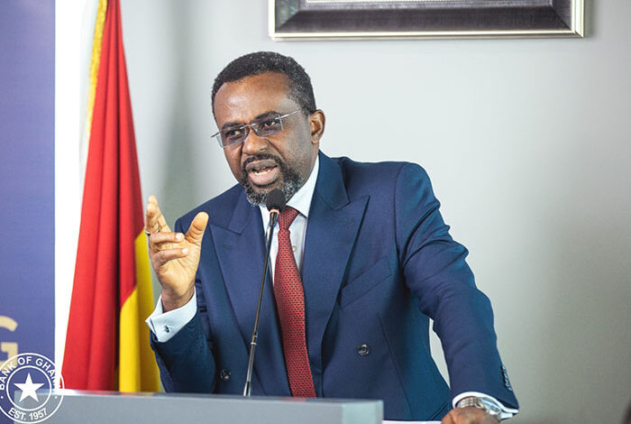
    However, in about 2 months, the external reserves have recorded a notable increase, reaching approximately $14.5 billion, the Bank of Ghana (BoG) Governor, Dr Johnson Pandit Asiama, said, providing about 5.8 months of import cover and strengthening the country’s external position.

    The increase, according to BoG, helps maintain and build buffers to support the economy against external shocks.

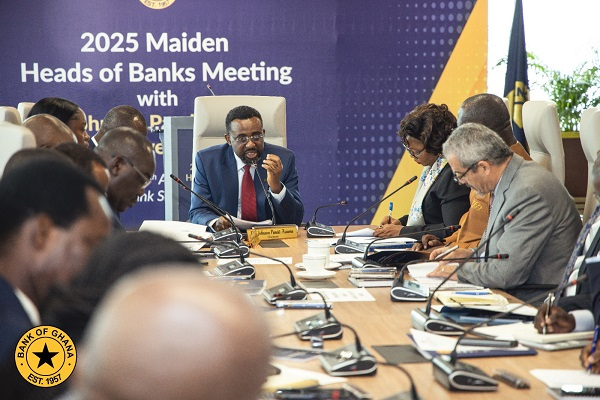
    Speaking during the opening of the 129th MPC meeting on Monday, March 16, Governor Dr Johnson Pandit Asiama indicated that the increase in reserves indicates a broader trend of improvement in macroeconomic conditions, i.e., Ghana’s economy is currently doing better than earlier predictions suggested.

    He noted that inflation has continued to ease, declining to 3.3 per cent in February and extending a streak of 14 consecutive monthly reductions. The rate has now fallen below the central bank’s medium-term target band, presenting new considerations for policymakers.

    The Governor also cited the economy’s improved fiscal performance, with Ghana recording a primary surplus of 2.6 per cent of GDP at the end of 2025. He added that economic activity in the real sector is gradually picking up, supported by rising business and consumer confidence as well as a modest recovery in credit growth.

    “Taken together, these indicators suggest that the economy is stabilising faster than many anticipated, underscoring the impact of disciplined policy measures,” he said.

    About two years ago, investor confidence in the Ghanaian economy was relatively weak, due to fiscal stress, high inflation, and currency volatility; however, according to records, lately, there has been development with economic indicators showing growth and a consecutive decline in inflation.

    Consequently, Dr Johnson believes that the growth of Ghana’s external reserves will help attract investors and maintain their confidence to help sustain fiscal growth in the country.

    “A stronger reserves position is essential for maintaining investor confidence and enhancing Ghana’s ability to withstand global economic shocks”, he noted. 

    He further disclosed that reserve accumulation will remain a priority under the government’s Ghana Accelerated National Reserve Accumulation Programme (GANRAP), which aims to significantly boost the country’s external buffers over the medium term.

    “Reserve accumulation will remain a priority under the government’s Ghana Accelerated National Reserve Accumulation Programme (GANRAP), which aims to significantly boost the country’s external buffers over the medium term. The initiative targets an increase in reserves to the equivalent of 50 months of import cover by 2028, compared with the current level of about 5.8 months”, he continued.

    However, Dr Asiama cautioned that such ambitious programmes require careful coordination, noting that they could have implications for liquidity conditions, the central bank’s balance sheet and the conduct of monetary policy.

    Despite the positive indicators, he emphasised that the MPC’s task goes beyond acknowledging improvements, as it must also consider how to sustain the gains amid global uncertainties.

    He warned that rising tensions in the Middle East are already affecting global energy markets and shipping routes, increasing the risk of imported inflation for Ghana and posing fresh challenges for economic management.

    GANRAP – 2026-2028

    In late February, the Minister of Finance, Dr Cassiel Ato Forson, unveiled Ghana’s first-ever comprehensive national policy specifically designed to deliberately and sustainably build the country’s external reserves and secure long-term macroeconomic stability.

    Presenting the Ghana Accelerated National Reserve Accumulation Policy (GANRAP) (2026–2028) to Parliament, the minister described the initiative as a historic and strategic shift in how Ghana manages its external buffers, moving away from costly borrowing and short-term reserve-building measures toward a structured, gold-backed and reform-driven accumulation framework.

    Strong Economic FoundationDr Forson told Parliament that the policy builds on the decisive macroeconomic turnaround achieved in 2025 following the 2022–2023 crisis.

    Key indicators at the end of 2025 included

    Real GDP growth averaged 6.1% in the first three quarters of 2025, inflation declined sharply from 23.8% in 2024 to 5.4% and further to 3.8% in January 2026, the 91-day Treasury bill rate fell from 27.7% at end-2024 to 6.4% in February 2026, public debt declined from 61.8% of GDP to 45.3%, and gross international reserves rose to US$13.8 billion, equivalent to 5.7 months of import cover, up from 4.0 months in 2024.

    Despite these gains, the Minister cautioned that the traditional benchmark of three months of import cover is no longer sufficient in today’s volatile global environment.

    Target: 15 Months of Import Cover by 2028Under GANRAP, the government is targeting an ambitious increase in reserves to the equivalent of 15 months of import cover by end-2028.

    The policy sets intermediate milestones of:

    8.6 months by end-2026, 11.8 months by end-2027, 15 months by end-2028.

    The Minister described the target as the creation of an “economic war chest” to shield Ghana against commodity price shocks, global financing volatility, geopolitical tensions and climate-related disruptions.

    Gold as the Strategic Anchor

    Central to the policy is a deliberate gold-backed reserve accumulation strategy anchored on the Ghana Gold Board Act, 2025 (Act 1140), which mandates the Ghana Gold Board to generate foreign exchange and support gold reserve accumulation by the Bank of Ghana.

    The government has set an operational weekly gold purchase target of approximately 3.02 tonnes.

    This will be achieved through: Acquisition of at least 2.45 tonnes weekly from the Artisanal Small-Scale Mining (ASM) sector, Invocation of pre-emption rights to secure a minimum of 0.57 tonnes weekly from the large-scale mining sector.

    The gold acquired will be refined, added to Ghana’s physical reserves, and may only be sold with prior approval of Cabinet and Parliament.

    Ending Costly Borrowing for Reserves

    The Minister noted that between 2017 and 2024, Ghana relied heavily on Eurobonds, swaps, sale-and-buy-back transactions and commercial bank borrowing to build reserves at significant cost.

    From 2022 to 2024 alone, the Bank of Ghana accumulated US$5.65 billion in reserves through swaps and related transactions at a cost of US$1.16 billion in interest.

    Additionally, Eurobond borrowings between 2018 and 2021 to support reserve build-up cost taxpayers about US$2.5 billion in interest payments alone, with Ghana still servicing these debts.

    Dr Forson stressed that borrowing to accumulate reserves is unsustainable and contributed to the 2022 debt distress.

    In contrast, he revealed that in 2025 alone, the Ghana Gold Board generated approximately US$10 billion in foreign exchange at a cost of US$214 million, significantly lower than the cost of comparable borrowing.

    Broader Structural Reforms

    Beyond gold, the policy integrates structural reforms aimed at expanding foreign exchange inflows and reducing persistent outflows.

    These include: scaling up non-traditional exports, revitalising cocoa productivity, implementing the National Policy on Integrated Oil Palm Development, accelerating new oil field developments such as Pecan, and conserving foreign exchange through a Gas-to-Power Transformation Policy.

    The Minister emphasised that maintaining fiscal discipline and sustaining a primary surplus remain critical to protecting the gains achieved.

    Safeguarding Ghana’s FutureDr. Forson concluded by urging Parliament to support what he described as a historic and forward-looking policy framework designed to strengthen Ghana’s first line of defence against external shocks.
  • Transport fares will not increase soon despite fuel price hike – GPRTU

    Transport fares will not increase soon despite fuel price hike – GPRTU

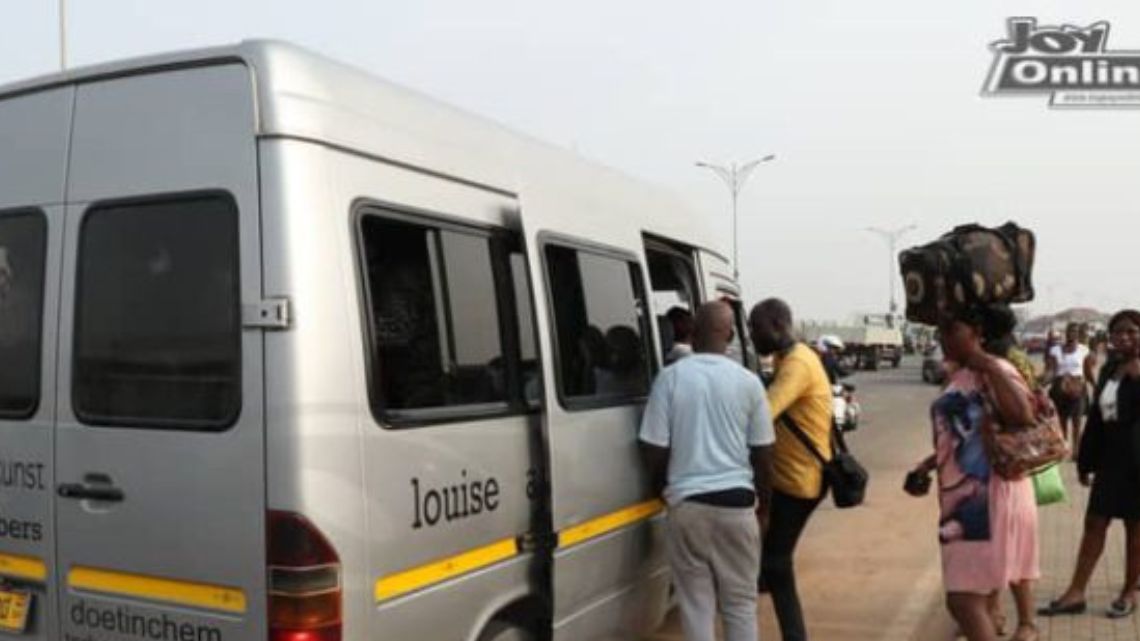
    In a new twist of events, the Ghana Private Road Transport Union (GPRTU) has assured commuters that it will not rush to adjust transport fares despite the recent increase in fuel prices.

    New prices of fuel took effect yesterday, Monday, March 17. As a result, petrol priced at GHȼ10.46 per litre will now be sold at GHȼ11.57. The price floor for diesel has jumped from GH¢11.42 to GH¢14.35 per litre, and LPG has risen from GH¢9.38 to GH¢10.67 per kilogramme.

    The assurance follows growing public concern that recent increases in fuel prices at the pumps could trigger a corresponding rise in transport fares across the country.

    Speaking on Channel One Newsroom, the Deputy Public Relations Officer of the GPRTU, Samuel Amoah, backed the Union’s Industrial Relations Officer, Abass Imoro, who earlier mentioned a possible upward adjustment of the fares following the fuel price hikes, citing fares were not determined solely by fuel prices but also by other operational costs, including spare parts, lubricants and taxes.

    “We all agreed that where it is now, we will not rush into making any decision but will wait to see what will happen next. We are going to maintain the fares we are taking for now because who knows, the fuel price may stabilise or there may be an increase or reduction in the next pricing window,” he said.

    According to him, authorities and other stakeholders met with the leadership of the Ghana Road Transport Coordinating Council and the Concerned Drivers Association of Ghana on Monday, March 16, and after the meeting, it was concluded that the current fares are to remain for the time being.

    According to Amoah, the unions rely on a technical team to monitor market conditions and provide guidance on when fare adjustments may be necessary.

    “We have a technical team that goes out to check all these things and reports. Per their report, there is a need for us to hold on to see what will happen in the next pricing window. We do not know where it will go. What if we increase, and then in the next pricing window, it goes up to where we can’t control the situation? We will not know what to tell our members, and we can’t come back to tell the public that we are coming in for another increment,” Amoah said.

    He added that the unions will review the situation after the next fuel pricing window before determining whether fares should be increased, reduced or maintained.

    The last time the Ghana Private Road Transport Union (GPRTU) officially increased transport fares was in October 2025, when fares went up by about 20% nationwide due to rising fuel prices and spare parts costs.

    Amid stakeholders and some experts’ predictions, the Middle East crisis is likely to soon affect fuel prices in Ghana, and given the country’s dependence on the Arabs states for about 20% of its fuel, commuters will bear the cost.

    Speaking on the fares, GPRTU’s Industrial Relations Officer, Abass Imoro, indicated that transport fares may increase if fuel prices go up in the next pricing window.

    He said the review will be to cope with rising operational expenses.

    “You know we work for profit, and for some time now prices have remained the same. Some of our people even went out of their way to increase their prices, but we were able to stop them. This indicates that they are looking for a change in the prices of fares,” he explained while speaking on Accra-based Channel One TV.

    Meanwhile, last year, GPRTU justified its decision to maintain its transport fares despite a minor reduction in fuel prices, emphasising that fare adjustments were influenced by several cost elements beyond fuel hike.

    During an interview on PM Express on Joy News on Tuesday, March 18, GPRTU’s Deputy PRO, Samuel Amoah, highlighted that expenses related to spare parts, insurance, DVLA charges, and other operational costs significantly impacted fare determinations.

    “Before December, we had plans of increasing transport fares, first, because of the high cost of spare parts; then where the fuel price was also heading; and the cost of lubricants, insurance, and DVLA taxes,” Amoah stated.

    “But we held on, thinking that things would improve because of the promises we had that going forward, things were going to get better.”

    He admitted that fuel prices had decreased slightly but insisted that the reduction did not justify a fare decrease.

    “Yes, we had seen that fuel prices were coming down a little bit. But what I could say was that it had not gotten to the level that would call for a reduction in transport fares.”

    He acknowledged the slight drop in fuel prices but maintained that the decrease was not substantial enough to justify reducing transport fares.

    Amoah also emphasized that fuel costs were just one of several key factors considered when reviewing fare adjustments.

    “We didn’t only consider fuel prices to determine our transport fares,” he explained.

    “We had other components, like the cost of spare parts, as I earlier mentioned. We also considered the cost of lubricants, taxes, and other petroleum products.”

    He also detailed the procedures the GPRTU adhered to when determining fare adjustments.

  • Otto Addo to name squad for Austria, Germany friendlies this week – Reports

    Otto Addo to name squad for Austria, Germany friendlies this week – Reports

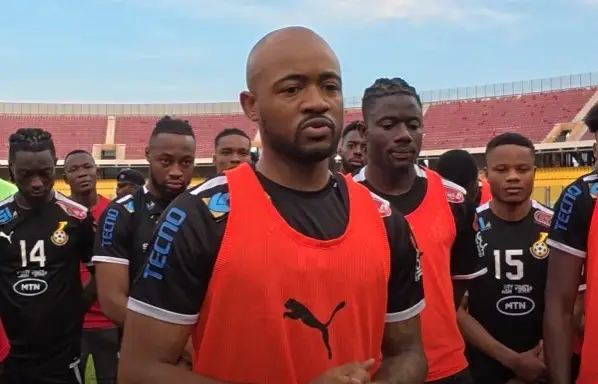
    Black Stars head coach Otto Addo is set to announce the squad for the 2026 FIFA World Cup friendlies this week, according to a report by JoyNews.

    The friendlies form part of the Black Stars’ preparatory games ahead of the main tournament in June; consequently, Otto Addo will release the list of players who will represent Ghana in the two high-profile international friendlies against Austria and Germany later this month.

    Ghana will first take on Austria on Friday, March 27, at the Ernst Happel Stadium in Vienna at 17:00 GMT.

    After that, the squad will travel to Germany for their second friendly, where the four-time African champions will face the 2014 world champions on Monday, March 30, 2026, in Stuttgart.

    Ghana will end their preparations with another friendly against Mexico in May and another clash against Wales on June 2.

    Making their fifth appearance at the World Cup, Ghana have been drawn in Group L alongside Panama, England, and Croatia.

    Final squad to be announced in June

    Otto Addo is expected to release the final squad list for the 2026 World Cup in June next year.

    This was confirmed by the Communications Director of the Ghana Football Association (GFA), Henry Asante Twum, in an interview with Accra-based radio station Asempa FM on December 15. He explained that all qualified nations are required by FIFA to announce their provisional squads on April 11, 2026, with final lists due before midnight on June 1, 2026.

    “All qualified teams, including the Black Stars of Ghana, are mandated by FIFA to announce their provisional squad on April 11, 2026. The final squads for the tournament must be announced before midnight on June 1, 2026,” he said.

    He added that players performing well both domestically and abroad will be considered for selection.

    “Every Ghanaian player with a strong performance is closely monitored by the technical team, and regardless of where they play, they will be given a call-up,” Asante Twum noted.

    Ghana has been drawn in Group L alongside Panama, England and Croatia following a draw held at the John F. Kennedy Centre for the Performing Arts in Washington, D.C. The ceremony was attended by high-profile figures, including President Donald Trump, entertainers Kevin Hart and Heidi Klum, as well as sports icons Tom Brady, Shaquille O’Neal, Rio Ferdinand and Ghana legend Asamoah Gyan.

    The Black Stars will open their campaign against Panama on June 17 in Toronto, before facing England on June 23 in Boston. They will conclude the group stage against Croatia on June 27 in Philadelphia.

    The 2026 tournament, which will be co-hosted by the USA, Canada and Mexico, will mark Ghana’s fifth appearance at the World Cup, having previously competed in 2006, 2010, 2014 and 2022. Their best performance came in 2010, when they reached the quarter-finals in South Africa.

    After Ghana discovered their group stage opponents, the Minister for Sports and Recreation, Kofi Adams, charged the national team’s technical team to make the squad selection based on competence and talent, rather than sentiment.

    Speaking during an interview with Sporty FM, the Buem Member of Parliament (MP) emphasised that Ghana must select the best players to make up the 2026 FIFA World Cup tournament squad.

    “We must call up the best, as I have always insisted. A lot of it is emotional, but you also need technical capabilities and sound judgment. You have to decide based on performance and readiness, not just history or popularity. The country must go with its best,” he noted.

    He pledged his support for the coach in whatever decisions he makes to ensure the best outcome for the team.

    “…Wherever we find it, the coach has my support. Whoever is responsible for the team will have my support,” he added.

    Budget allocation for the team

    The government has announced a (GHS 150million) hundred and fifty million($13m) to fund the team’s preparations for the World’s biggest football tournament.

    During the presentation of the 2026 Budget Statement by the Finance Minister, Dr Cassiel Ato Forson, on the floor of Parliament yesterday, he explained that,

    “The government’s sustained investment in sports yielded impressive results, with the Black Stars qualifying for the 2026 FIFA World Cup. An amount of GH¢150 million has been allocated for the Black Stars to participate in the World Cup,” he stated.

    Dr Forson explained that the funding underscores the government’s wider strategy to support national teams competing on the global stage and to strengthen sports development nationwide.

    He added that the government remains committed to improving sports infrastructure and nurturing talent across the country, noting that plans are underway to build new stadiums in selected regions.

  • Joan Laporta wins again, to remain Barcelona president until 2031

    Joan Laporta wins again, to remain Barcelona president until 2031

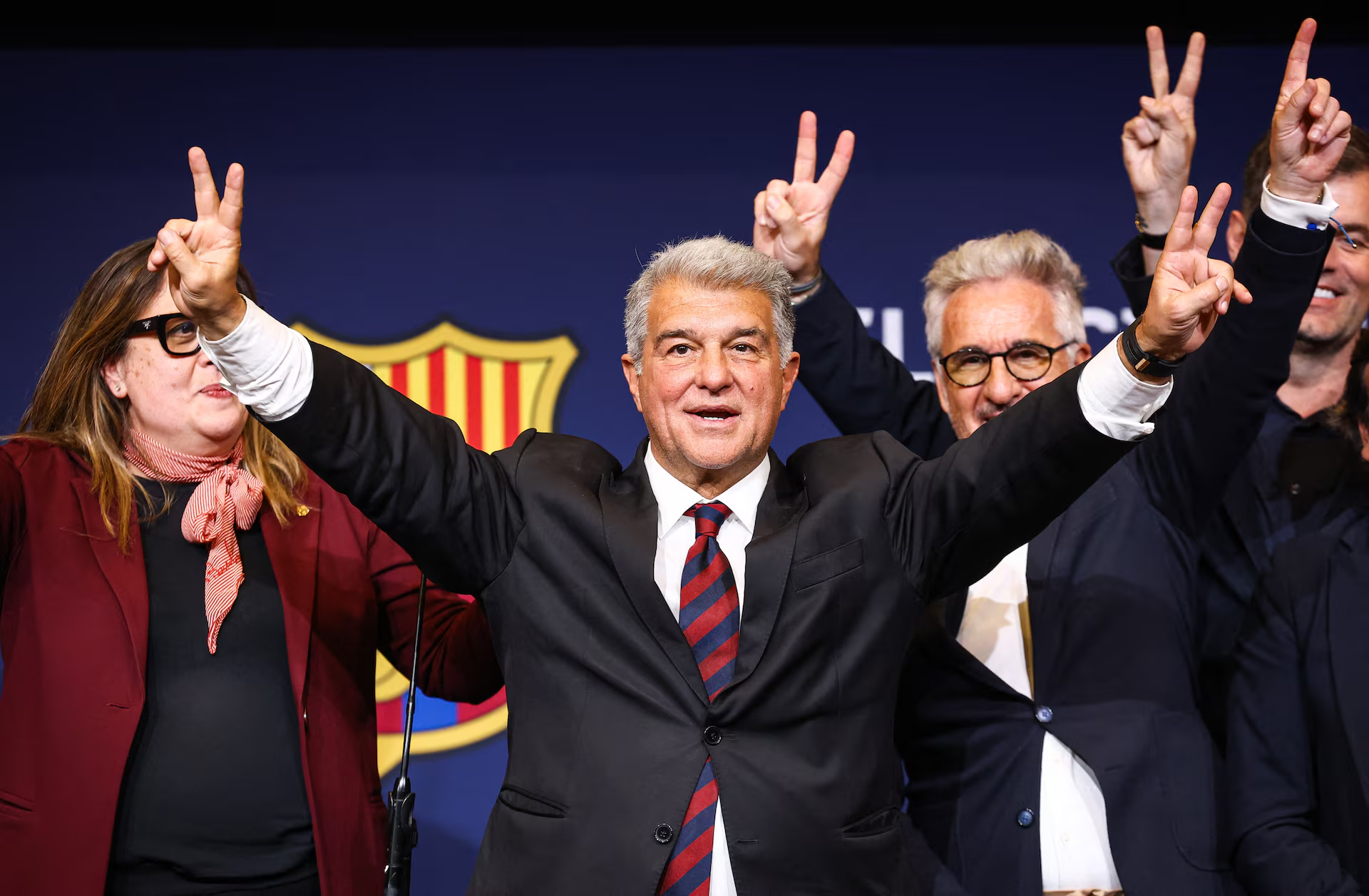
    Joan Laporta has maintained his position as Barcelona’s president after the just-ended club election. He beat his contender, Victor Font, after securing  32,934 of the 48,480 votes from the club’s members (socios), while Font received 14,385 votes, 984 were left blank, and 177 were declared void.

    This means that he will continue as the president of the club until 2031. In his thank-you message,  he said, 

    “First of all, I want to dedicate a few words of gratitude to this wonderful club we have. It’s great to see that members can still choose who represents us. This passion is a joy, it makes the club special, so thanks to Barça and all the members that voted today in a display of democracy”, Laporta said after his victory.

    He continued with a pledge to make the next five years the best of their lives for all club members.

    “The result itself is conclusive, and it gives us a lot of strength, so much strength that it will make us unstoppable. We will keep defending Barcelona against everything and everyone. The upcoming years will be thrilling. They will be the best of our lives,” he added.

    With 114,504 members eligible to vote, Barca said, from the results they saw, just a turnout of 42.34%, Barça said, with 114,504 members eligible to take part in the election.

    Current and former presidents, coaches and players were among those to cast their ballot at Spotify Camp Nou, including Hansi Flick and members of the men’s first team squad.

    Sunday’s election coincided with Barça’s 5-2 win over Sevilla in LaLiga, with coach Flick and many players, including Raphinha, Pedri and Dani Olmo, submitting their votes after the victory.

    “I won’t tell you who [I will vote for] because it’s a secret,” Flick said in a news conference shortly before voting. “It’s a special day. I saw it on the television in my office in the stadium, the election going on, it’s special. I think everyone is happy. It was a great day.”

    During the elections, goalkeeper Marc-Andre ter Stegen, who is on loan at Girona, couldn’t vote because his name was not on the electoral register.

    All Barça players are made members when they join the club, but it is their responsibility to update their membership, which the German international had not done ahead of the election.

    Injured Barça Femení players Aitana Bonmatí and Laia Aleixandri also voted, although the majority of their teammates could not as they played away at Deportivo de La Coruña on Sunday.

    Former Barça coach Xavi Hernández also voted, just days after calling Laporta a “liar” for his role in Lionel Messi’s failed return to the club in 2023, as did ex-Inter Miami CF midfielder Sergio Busquets. Spotify Camp Nou was one of five polling stations set up on the day, with members also able to vote in Tarragona, Girona, Lleida and Andorra.

    Laporta resigned before March election…why?

    Joan Laporta stepped down as president of FC Barcelona. His resignation was in line with the club’s statutes, which required that the incumbent president and any board members wishing to re-contest in elections first resign from their positions.

    Article 42 of the club’s statutes was intended to ensure that the electoral process was fair, preventing sitting officials from using their authority or resources to gain an advantage.

    The club was set to hold its election on March 15, and following Laporta’s resignation, a management commission was expected to oversee the day-to-day running of the club in the interim.

    The commission was to be led by Rafa Yuste, who had been one of Laporta’s vice presidents since his election in 2021.

    Laporta was expected to contest the presidency with Víctor Font, Marc Ciria, Xavier Vilajoana, and Joan Camprubí, all of whom had announced their candidacies.

    As part of the requirements to qualify as candidates for the presidency, all aspirants were expected to secure 2,321 signatures from club members as proof of support for their candidacy.

    The campaign trail was then expected to begin in earnest, with key issues likely to influence voters including potential summer signings, the club’s finances, the redevelopment of Spotify Camp Nou, which was in its final stages, and any future role for Lionel Messi at the club.

    Laporta had been elected in 2021 for a second spell as Barça president, having previously held the role between 2003 and 2010 after winning elections in 2003 and 2006.

    He had finished ahead of Font five years earlier, securing 30,184 votes to Font’s 16,679, while Toni Freixa, who did not run in that election, finished third with 4,769 votes.

  • Transport fares may increase soon amid looming fuel price increase – GPRTU warns

    Transport fares may increase soon amid looming fuel price increase – GPRTU warns

    Ghanaians may have to brace themselves for a hike in transport fares amid the looming upward adjustment of fuel prices.

    The last time the Ghana Private Road Transport Union (GPRTU) officially increased transport fares was in October 2025, when fares went up by about 20% nationwide due to rising fuel prices and spare parts costs.

    Amid stakeholders and some experts’ predictions, the Middle East crisis is likely to soon affect fuel prices in Ghana, and given the country’s dependence on the Arabs states for about 20% of its fuel, commuters will bear the cost.

    Speaking on the fares, GPRTU’s Industrial Relations Officer, Abass Imoro, indicated that transport fares may increase if fuel prices go up in the next pricing window.

    He said the review will be to cope with rising operational expenses.

    “You know we work for profit, and for some time now prices have remained the same. Some of our people even went out of their way to increase their prices, but we were able to stop them. This indicates that they are looking for a change in the prices of fares,” he explained while speaking on Accra-based Channel One TV.

    He continued that fuel is not the only factor affecting drivers, stating that the cost of spare parts, lubricants, and other vehicle maintenance items has remained high.

    “We spoke about the prices of spare parts, lubricants and other things we use on our cars, but their prices have remained high. So these are the indicators we look at,” he said.

    He further noted that the union does not immediately impose fare increases, but upward fuel price adjustments often influence such decisions.

    “We do not immediately impose a new fare, but if the price of fuel changes and it is upwards, everybody should expect a change in lorry fare,” he added.

    This warning came just a day before the second fuel pricing window, beginning Monday, March 16, with industry analysts predicting potential pump price increases across the country.

    Recent figures show that the price floor for petrol has risen to GH¢11.57 per litre from GH¢10.46 between March 1 and 15. Diesel has also increased to GH¢14.35 per litre from GH¢11.42, while liquefied petroleum gas (LPG) now costs GH¢10.67 per kilogramme, up from GH¢9.38.

    Overall, these adjustments represent increases of GH¢1.11 for petrol, GH¢2.93 for diesel, and GH¢1.29 for LPG within the same month.

    Meanwhile, last year, GPRTU justified its decision to maintain its transport fares despite a minor reduction in fuel prices, emphasising that fare adjustments were influenced by several cost elements beyond fuel hike.

    During an interview on PM Express on Joy News on Tuesday, March 18, GPRTU’s Deputy PRO, Samuel Amoah, highlighted that expenses related to spare parts, insurance, DVLA charges, and other operational costs significantly impacted fare determinations.

    “Before December, we had plans of increasing transport fares—first, because of the high cost of spare parts; then where the fuel price was also heading; and the cost of lubricants, insurance, and DVLA taxes,” Amoah stated.

    “But we held on, thinking that things would improve because of the promises we had that going forward, things were going to get better.”

    He admitted that fuel prices had decreased slightly but insisted that the reduction did not justify a fare decrease.

    “Yes, we had seen that fuel prices were coming down a little bit. But what I could say was that it had not gotten to the level that would call for a reduction in transport fares.”

    He acknowledged the slight drop in fuel prices but maintained that the decrease was not substantial enough to justify reducing transport fares.

    Amoah also emphasized that fuel costs were just one of several key factors considered when reviewing fare adjustments.

    “We didn’t only consider fuel prices to determine our transport fares,” he explained.

    “We had other components, like the cost of spare parts, as I earlier mentioned. We also considered the cost of lubricants, taxes, and other petroleum products.”

    He also detailed the procedures the GPRTU adhered to when determining fare adjustments.

  • NACSA’s Gun Amnesty Programme: Over 4,000 firearms surrendered – Interior Minister

    NACSA’s Gun Amnesty Programme: Over 4,000 firearms surrendered – Interior Minister

    In December last year, the government launched a nationwide Gun Amnesty Programme (GAP), which directed citizens in possession of holding illicit or unregistered firearms the chance to surrender them without facing arrest or prosecution. Initially set for December 1, 2025 – January 15, 2026, it was later extended to January 30, 2026 due to strong public interest.

    About 2 months after the end of the exercise, the Minister for the Interior, Muntaka Mohammed Mubarak, revealed that over 4,000 firearms had been voluntarily surrendered by civilians under the GAP.

    Speaking during an appearance on Sunday, March 15, the Minister indicated that, before the official launch of the programme, security agencies had already recovered about 11,000 firearms from civilians . But the launch became a window for more people to give up their firearms to escape the legal consequences during the amnesty window.

    “That’s why we came in with the amnesty. And when we rolled out the amnesty period, the statistics showed that we were able to retrieve over 4,000 guns in the hands of civilians,” he stated.

    What happens to the firearms?


    He added that the firearms would be catalogued and labelled by the authorities before being destroyed.

    The Minister indicated that the amnesty programme forms part of a broader government strategy to tackle the spread of illegal firearms and strengthen public safety across the country.

    He noted that removing unlicensed weapons from circulation is crucial in supporting the work of security agencies in addressing violent crime.

    When was the programme launched?

    The initiative was first declared on November 18, 2025, and took effect on December 1, 2025, as part of efforts to address the persistent gun-related violence across the country.

    The Commission announced in a statement, “After 30th January, 2026, security agencies will intensify enforcement operations, and any person found in possession of an unregistered or illicit firearm will be arrested and prosecuted in accordance with the law”.

    Meanwhile, the Greater Accra Region is leading in the number of firearms retrieved under the Gun Amnesty Programme. Executive Secretary of NACSA, Dr Adam Bonaa, disclosed this information in an engagement with the National Chief Imam on Friday, December 26.

    He noted, “The Greater Accra Region is one of the areas where most of the weapons we have collected are coming from. It is currently leading in terms of arms surrendered under the amnesty programme, with the support of the security commanders”.

    Dr Adam Bonaa’s meeting with the Chief Imam forms part of efforts to create awareness of the ongoing programme within the Muslim community. The illegal possession of small arms remains a pressing challenge in the country.

    How the firearm surrendring was done or expected to be done

    Also, on the gun, Minister Muntaka revealed during a session with the Public Accounts Committee (PAC) of Parliament in Accra, on Tuesday, 30 September, in response to questions on firearm regulation and monitoring, announced that gun registration, which is currently done manually, will be digitalised to make it easily accessible and less daunting for citizens.

    In a detailed explanation, he broke down what measures the Ministry intends to put in place.

    He said, “So this is what is going to happen: You register, and we have you in the registry. In the registry, we have your contact number and all your details. So, three months before expiry, we will send you a notification that your license will expire on 31st December. And you no longer need to walk to any CID office where you have to join a queue to pay for the renewal.

    Because the databases will be talking to each other, and over the one year, we will have recorded no criminal activities about the person we granted the license to hold the firearm, you will be able to pay through your MoMo or using your bank details. You can renew it immediately without any struggle.

    “Many people even tend to forget that the time has come for them to renew it. Maybe along the line, they just see the gun and say, “Hey, when was the last time I renewed this?” So we want to digitalise this, and by the grace of God, when we are done, by the close of the year, worst case, by the close of the year, all these things will be digitalised. It will give people the opportunity to do the renewal online without necessarily having to walk to the Police Headquarters.

    However, Mr Muntaka added that gun owners flagged for criminal activity during the renewal period will not be allowed to complete the process online.

    “The only thing is that if there’s a criminal record over the period when you want to renew, it may deny you, and that may require that you come physically. But it also helps us. Even if you change address; because we are going to link it to your Ghana Card, we will be able to tell that Maka has a gun, has not renewed it over this period, and has changed his address from Asar to Bima. We will be able to track him and either retrieve the gun from him or get him to renew his license”, he continued.

    Meanwhile, in September this year, Ghana strengthened its global stance against nuclear weapons. Ghana joined sixty-nine (69) other nations in efforts to reduce and ultimately eradicate dangerous weapons, particularly atomic bombs, from the world.

  • 1D1F: Auditors flag fictitious GHC 89.4m, say banks unable to confirm payments

    1D1F: Auditors flag fictitious GHC 89.4m, say banks unable to confirm payments

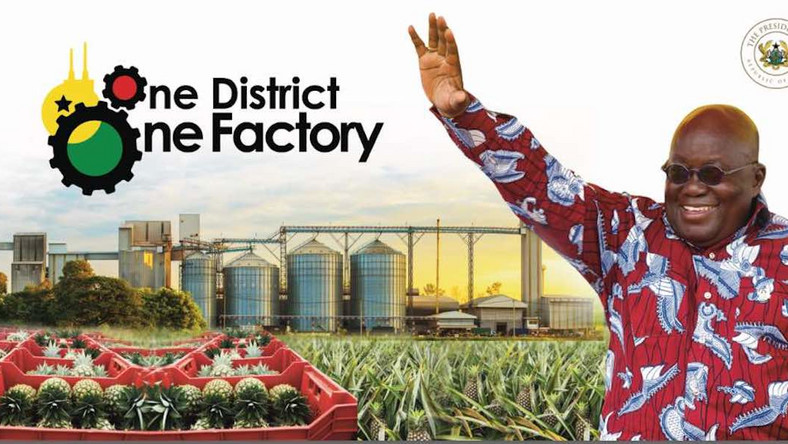
    One of the flagship programmes of the erstwhile government, the One District One Factory (1D1F) has come under heavy scrutiny after an audit revealed what officials have described as a fictitious GH¢89.4 million debt linked to the initiative.

    1D1F initiative, a flagship policy of former President Nana Akufo-Addo and the New Patriotic Party (NPP), was designed to accelerate industrialisation by establishing at least one factory in every district.

    Presenting the results of the findings on the floor of Parliament in a statement delivered by Deputy Finance Minister Thomas Nyarko Ampem on behalf of Dr Cassiel Ato Forson.

    The Finance Minister indicated that in 2024, the Ministry of Trade and Industry requested the release of GH¢89.4 million to five commercial banks as the government’s contribution toward interest payments under the 1D1F programme.

    The Ministry of Finance processed the request and sent it to the Controller and Accountant-General’s Department for payment.

    However, when auditors from the Ghana Audit Service, working with international firms Ernst & Young and PwC, reached out to the banks to confirm the claims, all five institutions reportedly denied that the government owed them any funds under the scheme.

    “According to the auditors, the said GH¢89.4 million debt was fictitious,” the statement told Parliament. “Without the audit intervention, a whopping GH¢89.4 million of hard-earned public money could have been disbursed to settle this non-existent liability.”

    The audit also flagged another suspicious transaction: a reported GH¢10.5 million payment into a so-called “Buffer Account” at a commercial bank.

      According to the report, a follow up to authenticate the transaction to the banks, it was confirmed they never received any payments. 

    Further investigation revealed that the account number provided did not exist in the bank’s records and did not follow its account numbering format.

    “The evidence from the audit pointed to a completely fictitious account,” the statement added.

    In response, the government has announced plans to conduct a full forensic audit of the entire One District One Factory programme.

    Mr. Ampem emphasised the importance of the review, given the large sums involved, noting that about GH¢391 million had already been disbursed in interest subsidies for the programme by the end of 2024.

    “Mr Speaker, only God knows how much of taxpayers’ money has been lost to similar fictitious claims,” he said.

    Minister of Trade, Agribusiness, and Industry, Elizabeth Ofosu-Adjare, revealed that the erstwhile government’s One District One Factory (1D1F) policy had been scrapped.

    The minister announced this when she appeared before Parliament on Tuesday, June 8.

    “Mr Speaker, I want to draw the House’s attention to the fact that as of now, there is no policy as 1D1F,” the minister said.

    She added that “The 24-hour economy policy was the new thing on the block and the game changer, which sought to make Ghana very vibrant irrespective of the minute of the hour or the time of the day.”

    In reaction, Minority Leader Alexander Afenyo-Markin quizzed, “Is the ministry, MOTAI, exploring the establishment of new industrial parks as part of a revised investment attraction strategy?”

    The Trade Minister replied: “We are doing agro-parks which seek to be a great game changer, especially in the agro-processing zones, and it is being worked on to ensure we are able to produce around the clock for import substitution, export, foreign exchange, and to create jobs for our teeming youth.”

    Earlier this year, Elizabeth Ofosu-Adjare stated that the National Democratic Congress’ (NDC) proposed 24-hour economy initiative would enhance the effectiveness of the One District, One Factory (1D1F) programme.

    During her appearance before the Appointments Committee on Wednesday, January 22 for vetting after her nomination, she underscored the shortage of sufficient raw materials as a major hurdle undermining the success of the 1D1F initiative.

    She emphasised that the adoption of the NDC’s 24-hour economy policy would serve as a strategic measure to overcome this challenge.

    She said, “The solution lies in the 24-hour economy, where businesses will have access to a steady supply of raw materials. Agribusiness will play a crucial role through commercial contract farming, which will substantially resolve the raw material challenge.”

    The Techiman North Member of Parliament further said, “These factories will benefit from tax holidays and other incentives under the 24-hour economy framework.”

    The One District, One Factory (1D1F) initiative, introduced by former President Akufo-Addo, aimed to revolutionise Ghana’s economy by minimising dependence on raw material exports and imported finished products.

    The programme emphasised industrial growth, value enhancement, employment generation, and the export of refined goods.

    Although several factories were set up under the initiative, its progress was hampered by numerous challenges.

  • Goldbod denies sole-sourced GHS 11m renovation contract to Stan Dogbe-owned company

    Goldbod denies sole-sourced GHS 11m renovation contract to Stan Dogbe-owned company

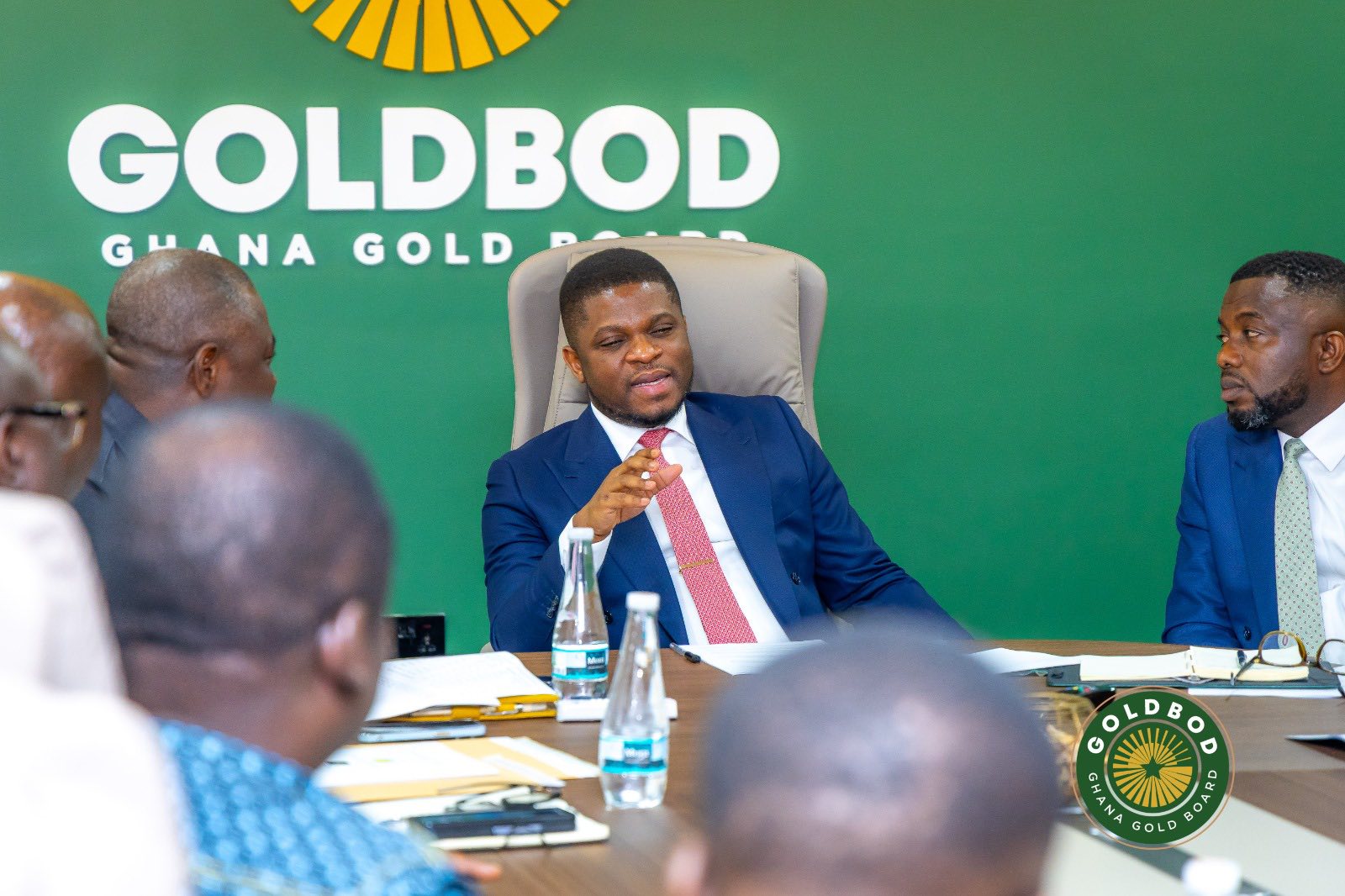
    The Ghana Gold Board (GoldBod) has rebuffed allegations that it awarded a GHC 11 million renovation contract to a company owned by the Deputy Chief of Staff in charge of Operations through sole sourcing.

    Some netizens online began peddling the allegations some days ago, prompting an official rebuttal from GoldBod on March 10, where the gold trading regulator described the allegations as “completely false”.

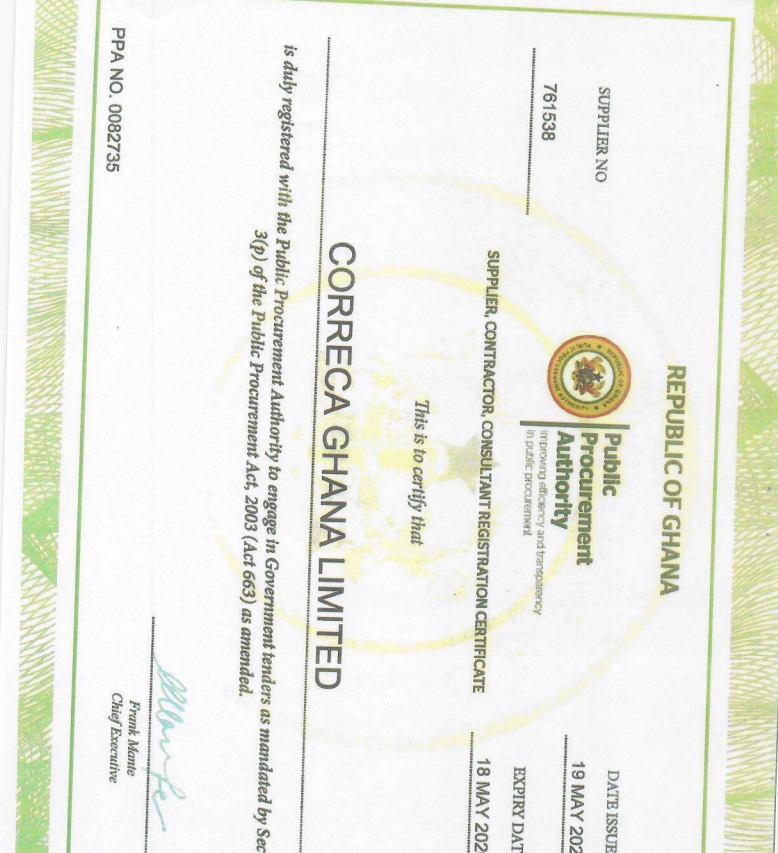
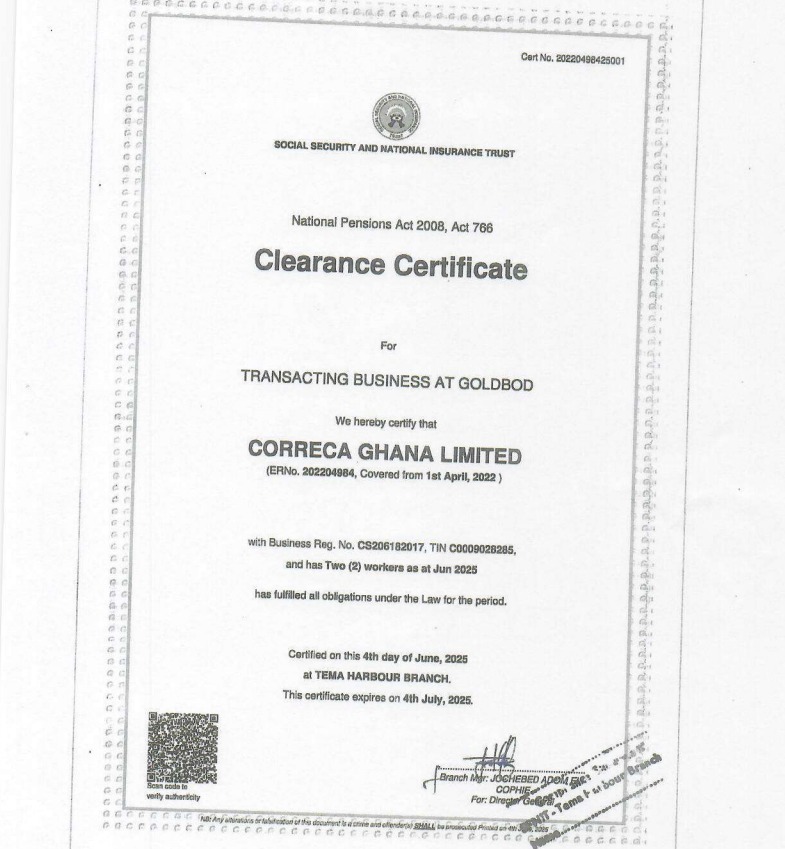
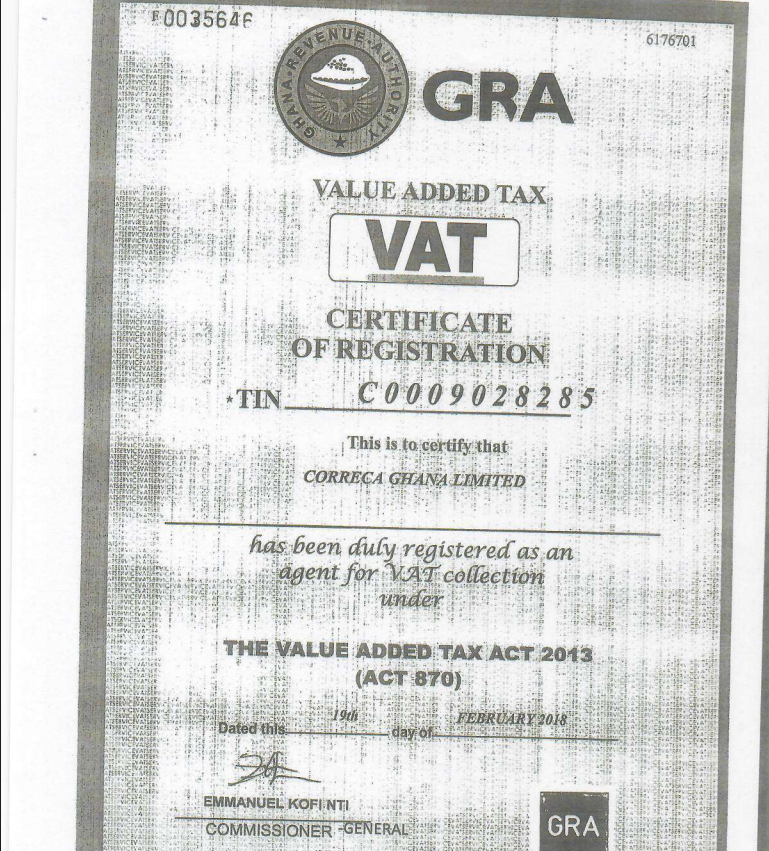
    GoldBod clarified that approval was obtained from the Public Procurement Authority (PPA) on 24 June 2025 to use a restricted tendering process. Three companies were shortlisted, with Correca Ghana Limited ultimately awarded the contract.

    “The mischievous claim that the contract was awarded through sole-sourcing is completely false. Correca Ghana Limited was qualified to undertake the works and completed the project in a timely and professional manner,” the Board said.

    In a commitment to transparency, GoldBod has published the full contract on its official website. The Board condemned attempts by “fake news merchants” to smear its reputation, noting that all claims suggesting intercepted documents were entirely false.

    In the statement, the Board explained that the renovation had become necessary following its establishment in April 2025.

    It said it had to, since it moved to the old building of the Bank of Ghana (BoG) Head Office at No. 1 Thorpe Road, Accra, which had some parts dilapidated and weak, and a refurbishment was necessary.

    It continued that GoldBod required the recruitment of over 300 new staff and the creation of additional directorates and units.

    “To cater for the spatial and functional necessities of the new organisation, it became imperative to relocate from the dilapidated offices of the defunct PMMC,” the statement said.

    A technical, independent report recently presented to GoldBod by economists from the University of Ghana (UG) and the University of Ghana Business School (UGBS)—Professor Festus Ebo Turkson, Professor Agyapomaa Gyeke-Dako, and economist Peter Junior Dotse—indicated that artisanal and small-scale mining (ASM) gold exports rose by 39.4 tons, increasing from 63.6 tons in 2024 to 103 tons in 2025.

    According to the report, GoldBod cut the rate at which gold was being smuggled out of Ghana; trading was now done officially through the right channels, leading to an increase in the amount of forex coming into the country. The benefits to the economy were much bigger than the trading losses reported by the Bank of Ghana.

    The report explained that each ton of gold was worth about US$96.5 million. Based on this value, the gold that was brought into the formal system was worth about US$3.8 billion in foreign currency.

    This meant the benefits were 18 times bigger than the US$214 million loss reported by the Bank of Ghana. In fact, the report said that formalising just 2.2 tons of gold would have been enough to cover that loss.

    Prof. Festus Ebo Turkson, one of the report’s authors, emphasised that “GoldBod converts illicit gold flows into formal FX, strengthens Ghana’s external position, and supports macroeconomic stability. Evidence showed it was a high-return policy intervention for the economy.”

    The study also revealed that GoldBod’s initiatives reduced reliance on costly external borrowing. ASM exports facilitated by GoldBod in 2025 generated US$10.8 billion in FX inflows. Had Ghana borrowed equivalent funds externally at interest rates of 7–10%, it would have incurred annual interest costs of US$756 million to US$1.08 billion.

    Even considering only the reduction in smuggling, the avoided annual interest costs ranged from US$266–380 million, creating a recurring economic benefit.

    Beyond financial gains, the report highlighted broader macroeconomic effects:

    Strengthened international reserves (≈ US$11–12 billion), exchange-rate stabilisation, reduced domestic cost of external debt (≈ GHS 6.2 billion), lower import bill valuation (≈ GHS 50.6 billion for Jan–Oct 2025), and disinflation through reduced exchange-rate pass-through.

    The report also clarified that the reported losses by the MF in GoldBod’s trading activities were merely an accounting effect and not a cash deficit or loss. GoldBod purchased gold at near-retail exchange rates to deter smuggling, while FX inflows were recorded at the interbank rate. True economic costs were estimated at just 2.5% of the gold value.

    According to the report, GoldBod should be seen as a policy tool for macroeconomic stabilisation rather than a profit-driven entity. Recommendations included sustaining price competitiveness to prevent smuggling, improving transparency in BoG reporting, gradually reducing policy costs, and strengthening governance and oversight.

    Ghana’s Artisanal and Small-Scale Mining (ASM) gold export saw exponential growth in 2025 compared to 2024, reaching approximately US$6.2 billion, a surge of nearly 135%, reflecting the sharpest year-on-year growth within the period.

    This was announced in an infographic shared by the Gold Board (GoldBod) on its official X (formerly Twitter) page.

    According to the data shared, ASM gold export earnings rose from US$2.8 billion in 2018 to US$10.8 billion in 2025, representing an increase of about US$8.0 billion, or roughly 286%. The infographic also provided a year-on-year breakdown of exports, along with remarks on the exported commodity, stressing that the data covered exports made through official channels over the previous seven years.

    Ghana’s artisanal and small-scale mining (ASM) gold exports stood at 75.7 tons valued at US$2.8 billion in 2018, despite a nationwide ban on small-scale mining, indicating strong underground or regulated output.

    Exports declined to 53.4 tons worth US$2.2 billion in 2019 and further to 39.3 tons valued at US$2.0 billion in 2020, reflecting continued enforcement of mining restrictions and possible COVID-19 disruptions. In 2021, exports collapsed sharply to just 3.4 tons valued at US$185 million following the introduction of a 3% withholding tax on unprocessed ASM gold, which discouraged official exports.

    Volumes recovered in 2022 to 22 tons worth US$1.1 billion after the tax was reduced to 1.5%, with growth continuing in 2023 when exports rose to 37.4 tons valued at US$2.1 billion. A major jump was recorded in 2024, with exports increasing to 63.6 tons valued at US$4.6 billion, driven by improved formalisation and high global gold prices.

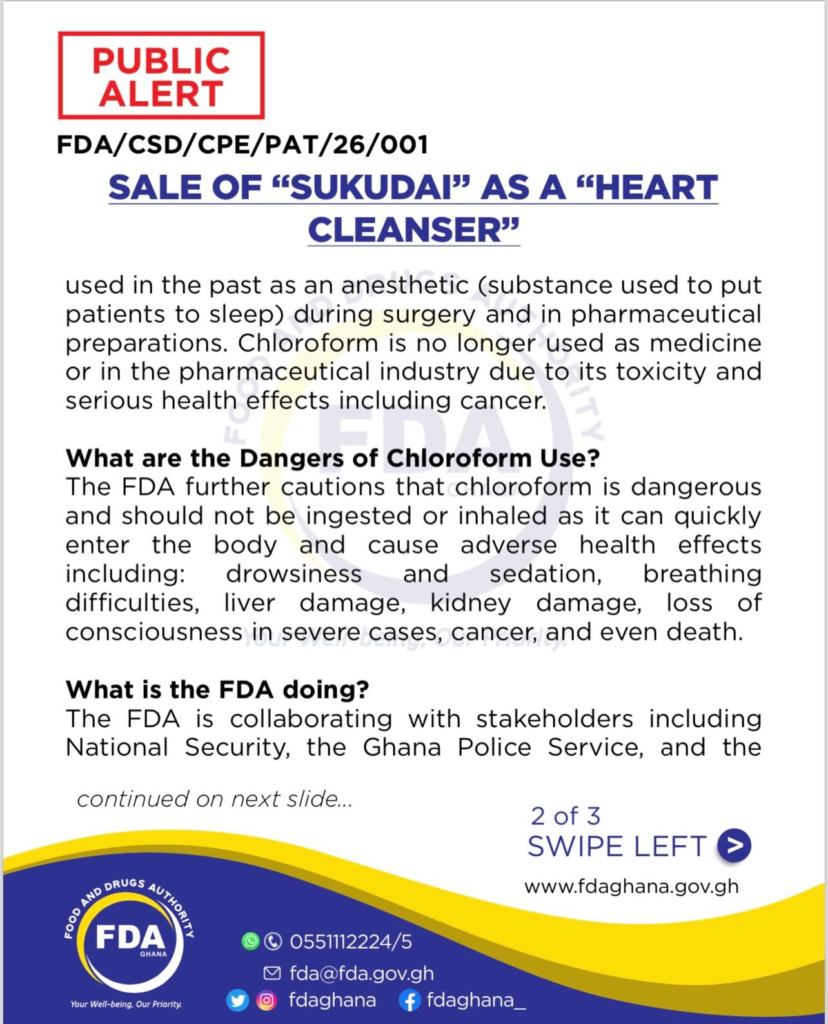
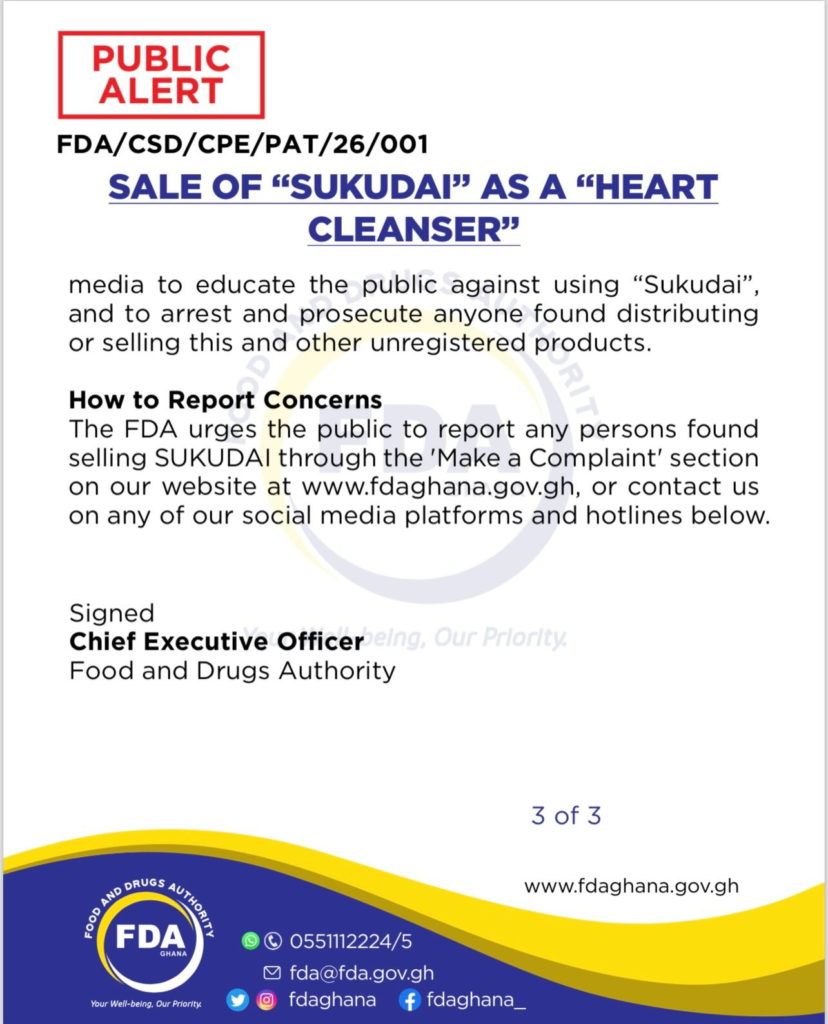
  • FDA warns public against ‘sukudai’, a purported heart-cleansing remedy containing cancer-causing chemicals

    FDA warns public against ‘sukudai’, a purported heart-cleansing remedy containing cancer-causing chemicals

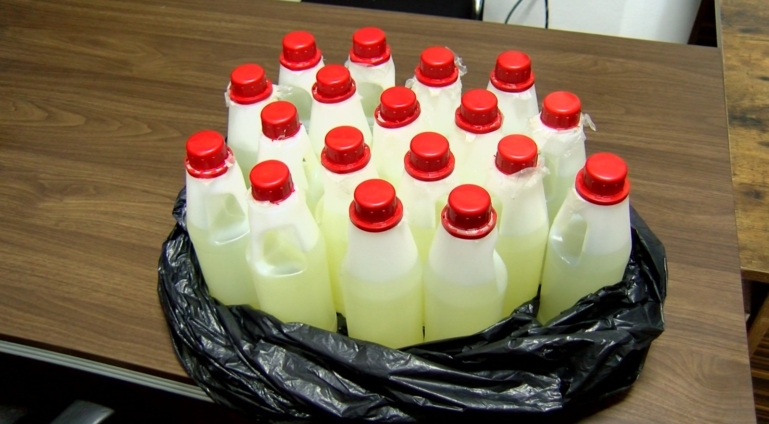
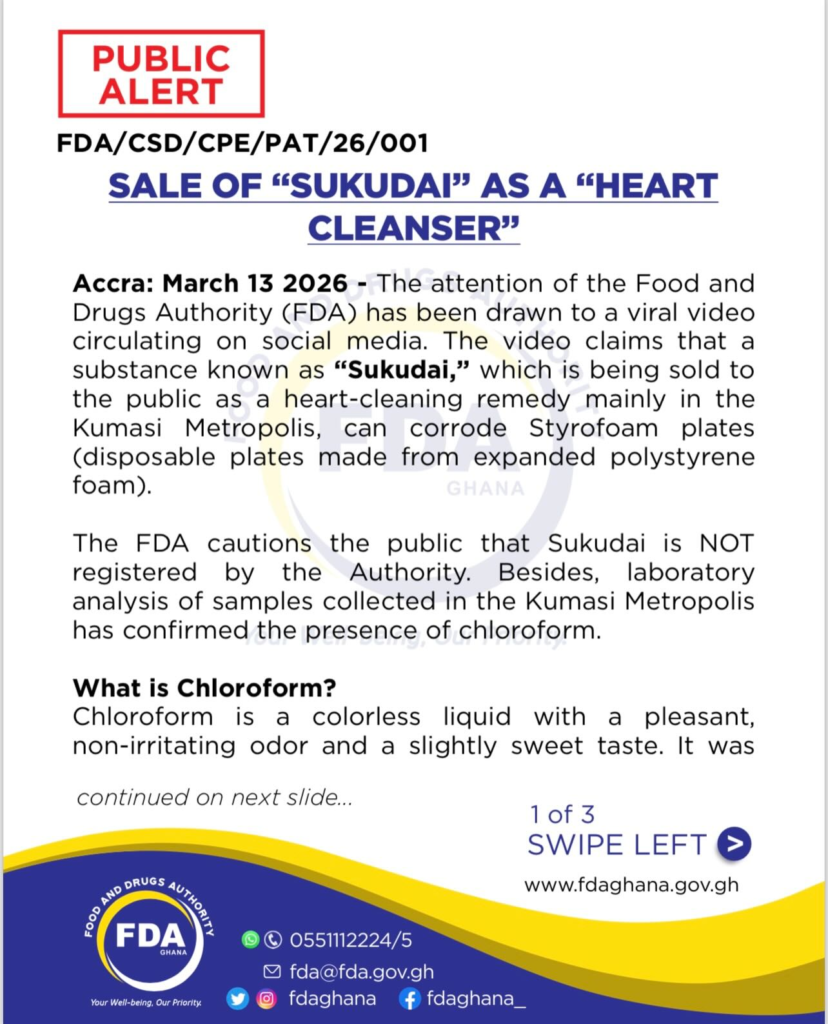
    “Sukudai”, a purported heart-cleansing remedy, has been flagged by the Food and Drugs Authority (FDA) as harmful to human beings.

    In a public notice issued by the nation’s product safety regulator, it warned the general public to stay away from the product, citing that after laboratory tests detected chloroform, a toxic chemical linked to serious health risks, including cancer.

    The regulator said the product, reportedly being sold mainly in Kumasi, is not registered with the authority.

    The FDA’s caution comes after a viral video circulating on social media captured the substance corroding a Styrofoam plate, raising concerns about its chemical composition.

    Following the video, the FAD says it collected samples and tested them in a laboratory. Results confirmed the presence of a chemical once used as an anaesthetic but no longer approved for medical use due to its toxic effects.

    Consequently, the authority warned that consuming or inhaling chloroform can lead to severe health complications, including drowsiness, breathing difficulties, liver and kidney damage, loss of consciousness, cancer, and even death.

    Last month, sixteen (16) food service establishments operating without valid hygiene permits in the Greater Accra Region were closed by the Food and Drugs Authority (FDA) on Wednesday, February 18.

    Cheesecake House, Dolce Frizzante, Onda, and Alora Beach Resort, among others, were among the affected facilities.

    They were shut down for failing to meet regulatory requirements. Before the exercise, the FDA had issued a two-week public notice to all food service establishments operating, instructing them to acquire a valid Food Hygiene Permit effective February 1, 2026.

    The FDA had consistently warned against the sale, distribution, and consumption of unregistered and unapproved products on the Ghanaian market, particularly drugs, herbal medicines, cosmetics, and food items that had not undergone proper safety and quality checks.
    In 2025, the FDA shut down Famude Catering Services in the Ashanti Region and revoked its license for illegally producing two alcoholic drinks — Kings Orange Flavoured Liqueur and Jupiter 1990.

    These drinks were unregistered and were found to contain marijuana (cannabis) extracts, according to the FDA.

    The matter was referred to the Suntresu District Police for investigation and prosecution.

    The FDA issued a new directive last month, ordering all importers, manufacturers, and distributors of alcoholic beverages mixed with stimulants to withdraw such products from the Ghanaian market by the end of March 2026.

    The regulatory authority announced this in a formal statement dated February 25, noting that the withdrawal had become necessary after it conducted an assessment on the safety of these beverages and their health implications for the public.

    In the statement, the FDA said it “concluded a post-registration review of mixed drinks containing both depressant substances (alcohol) and stimulants such as caffeine, inositol, glucuronolactone, ginseng, and guarana. The assessment took into account international and regional regulatory precedents, where several countries had restricted, suspended, or banned alcoholic energy drinks due to their associated public health risks.”

    It continued that the review was conducted in compliance with the Public Health Act, 2012 (Act 851), under Sections 81 and 82(a). Section 8 empowered the FDA to conduct post-market surveillance and safety reviews of regulated products, allowing them to reassess products already approved if new evidence showed health risks, while Section 82(a) authorized the FDA to withdraw, suspend, or revoke approval of products that posed risks to public health.

    One of the FDA’s major concerns was the rise in serious psychological health challenges, particularly among the youth.

    “The review assessed the safety and regulatory compliance of these products on the Ghanaian market. It was conducted under Sections 81 and 82(a) of the Public Health Act, 2012 (Act 851), which empowered the FDA to enforce standards necessary to protect public health and safety. Growing scientific and public health evidence linked the combination of alcohol and stimulants to serious health risks and adverse psychosocial behaviours, particularly among youth, young adults, and unsuspecting consumers.”

    Consequently, the FDA gave all supply chain operators 33 days to withdraw such beverages from the market or face serious sanctions for non-compliance.

    “Findings from the review were supported by the FDA’s Food Expert Committee, specifically the Technical Advisory Committee on Food Safety and Nutrition. Consequently, the FDA directed all importers, manufacturers, and distributors of mixed drinks containing both alcohol and stimulants to clear such products from the Ghanaian market by the end of March 2026 without sanction. Beyond this deadline, non-compliant products would attract regulatory sanctions, including withdrawal from the market. This directive took effect immediately,” the statement continued.

    The FDA also ordered that “manufacturers and producers re-formulate their products to conform strictly to the approved standards for alcoholic beverages and energy drinks as separate product categories,” emphasizing its commitment to public safety and urging the general public to report any suspicious products for investigation.

    “The FDA remained committed to safeguarding public health and safety, and ensuring that all food and beverage products on the Ghanaian market met approved safety, quality, and regulatory standards. Consumers were encouraged to remain vigilant and report any suspicious or non-compliant products to the FDA for necessary investigation and enforcement action,” the statement concluded.

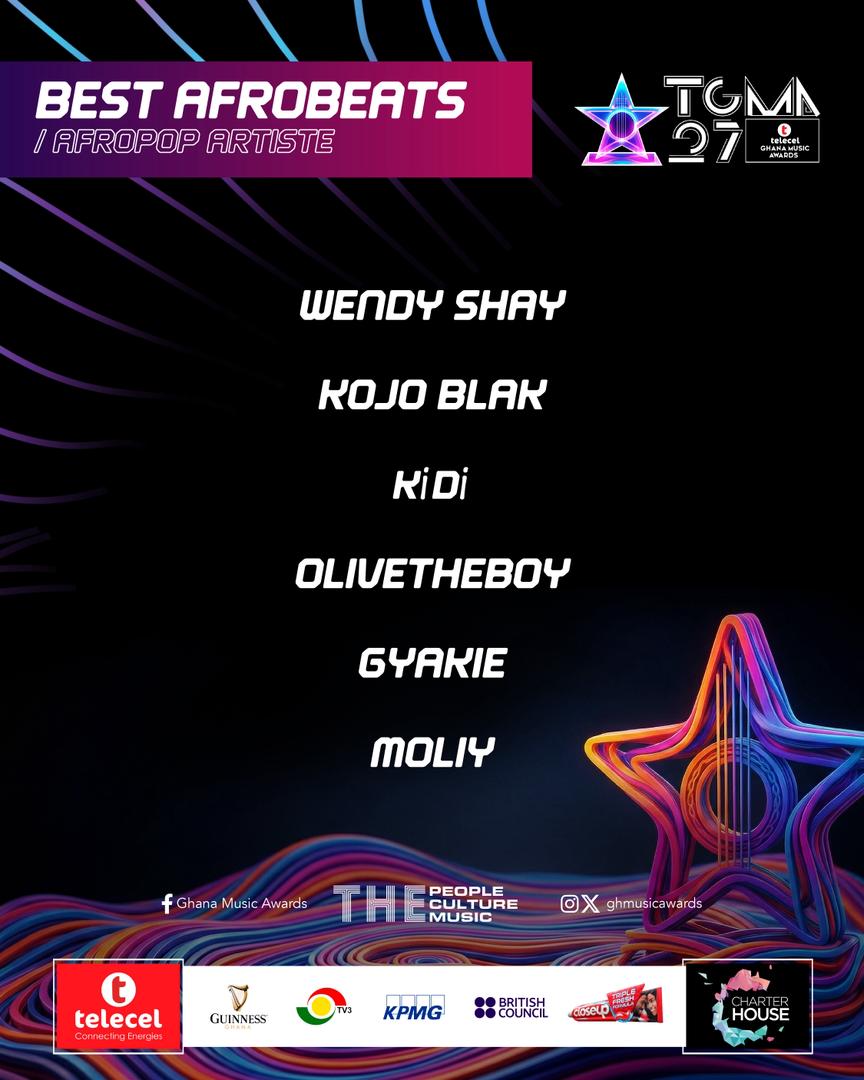
  • 27th TGMA: Wendy Shay,Moliy,Kojo Black,others battle for Afrobeats  Artiste

    27th TGMA: Wendy Shay,Moliy,Kojo Black,others battle for Afrobeats  Artiste

    One of Ghana’s most anticipated award schemes, the Telecel Ghana Music Awards (TGMA), is set to take place in the next two months. As it’s done every year, nominees are announced in March to allow their fans to vet their work and vote, and for artists, managers, and sponsors to use the nomination period to campaign and build momentum for the deserving artiste to bag the award.

    Battling for this year’s Best Afrobeats/Afropop Artist are Wendy Shay, OliveTheBoy, Kidi, Jackie and Moliy Nominees.

    Given Ghanaians’ growing taste for Afrobeats, this category has become one of the most anticipated on the night, celebrating artists who have not only delivered hit songs but also shaped the sound and culture of contemporary Ghanaian music over the year under review.

    The 26th edition last year saw its winner, King Promise, beat other artistes in the category due to his dominance in the genre, reaching beyond Ghana with hit songs like ‘Terminator’ that topped charts on Boomplay, Spotify, and YouTube, and gaining massive airplay on radio and TV.

    KiDi maintained a steady presence in Ghana’s Afrobeats scene, performing at major concerts and festivals.

    However, this year, Wendy Shay has been releasing back-to-back hits and a stream of dynamic collaborations that have etched her voice in heavy rotation on the radio and streaming platforms, which makes it difficult to talk about category winners without mentioning her.

    Her ability to blend edgy lyrics with infectious rhythms has sustained her relevance and made her a fixture in conversations around this category.

    Kojo Blak has also been consistently stunning his fans within and outside Ghana with soulful tracks and compelling features. His growth as an artist has been evident in both his solo work and partnerships, earning him recognition beyond regional borders.

    Meanwhile, OliveTheBoy, Gyakie and Moliy each bring something unique to the table. OliveTheBoy’s smooth vocals and heartfelt melodies have won him a devoted fanbase, while Gyakie’s soulful songwriting continues to resonate widely. Moliy’s creative versatility and international collaborations have further expanded her reach, making her one of the standout female voices in Afrobeats and Afropop today.

    CATEGORY DEFINITION

    Best Afrobeats / Afropop Artiste
    The Best Afrobeats/Afropop Artiste is the Artiste(s) adjudged by the Academy, the Board and the General Public as the Artiste with the highest audience appeal and popularity in the Afrobeats/Afropop music genre.

    The artiste must have commercially released an afrobeats/afropop hit Single / EP / Album during the year under review.

    See the lists of some nominees and winners of last year’s TGMA
    Best Reggae/Dancehall Artiste
    Jupitar

    Samini

    Ras Kuuku

    Epixode

    Stonebwoy ****WINNER

    Rocky Dawuni

    Songwriter of the Year
    Ayisi Kofi

    Kinaata ****WINNER

    Okyeame Kwame

    OlivetheBoy

    Team Eternity Ghana

    Telecel Most Popular Song
    OlivetheBoy – Asylum ft Kidi

    Black Sherif – Lomo Lomo

    Lasmid – Puul

    King Paluta – Aseda ****WINNER

    Black Sherif – January 9

    King Promise – Paris

    Team Eternity – Defe Defe

    Stonebwoy – Jejereje

    Collaboration of the Year
    Beeztrap KOTM & Oseikrom Osikani – Fly Girl

    King Promise ft Sarkodie & OliveTheBoy – Favourite Story

    KIDI ft Black Sherif – Lomo Lomo ****WINNER

    Rap Fada ft King Paluta – Obo Bi Ye Bad

    Sarkodie ft Beeztrap KOTM – Amen

    Joe Mettle ft Sandra Boakye Duah – Give Me Oil

    Best Afropop Song
    Kwesi Arthur – Fefe Ne Fe

    King Promise – Paris ****WINNER

    Stonebwoy – Jejereje

    Black Sherif – January 9

    SmallGod ft Black Sherif – Fallen Angel

    AraTheJay ft Black Sherif – Jesus Christ 2

    International Collaboration of the Year
    Joe Mettle ft. SunmiSola Agbebi – Oba Awon Oba

    Stonebwoy ft. Odumodu BLVCK – Ekelebe

    King Promise ft. Shalipopi – Continental

    Stonebwoy ft. Spice – Jiggle and Whine

    Diana Hamilton ft. Mercy Chinwo – The Doing of the Lord ****WINNER

    Gambo ft. Edem & Jim Jones – Drip RMX

    Best Music Video
    Fallen Angel – Small God Directed by Babs Direction

    Auntie Ama – Kofi Kinaata directed by Awudu Musa

    Continental – King Promise Directed by Meekah Jagun

    Jejereje – Stonebwoy Directed by Banini ****WINNER

    Peace of Mind – MzVee Directed by Rex

    Keep It Sexy – King Promise Directed by Rex

    African Song of the Year
    Rema – OZEBA

    Mr Pilato, Ego Slimflow & Tebogo G Mashego FT SJE KONKA, Focalistic, DJ Maphorisa, Scotts Maphuma & Cowboii – BIRI MARUNG

    Titom FT S.N.E, YUPPE, Burna Boy – TSHWALABAM ****WINNER

    Darkoo ft. Rema – FAVORITE GIRL RMX

    Tems – LOVE ME JEJE

    Ayra Star – COMMAS

    Producer of the Year
    Kenny Beatz and King Paluta ****WINNER

    Best Afrobeats/Afropop Artiste
    KIDI

    Camidoh

    OliveTheBoy

    King Promise ****WINNER

    Mr Drew

    Lasmid

    Best Highlife Artiste
    Kofi Kinaata

    Fameye ****WINNER

    Kuami Eugene

    Sista Afia

    Kwabena Kwabena

    Best Album/EP of the Year
    Kweku Smoke – Kweku Jesus

    King Paluta – Give Time Some Time

    Stonebwoy – Up and Running

    Kofi Kinaata – Kofi OO Kofi

    King Promise – True To Self ****WINNER

    Team Eternity Ghana – Testimony

    Best New Artiste
    Lali x Lola

    AratheJay

    Rap Fada

    Team Eternity

    Beeztrap KOTM ****WINNER

    Kwesi Amewuga

    Group of the Year
    Team Eternity ****WINNER

  • Salt display in Kumasi restaurants now illegal over rising hypertension cases

    Salt display in Kumasi restaurants now illegal over rising hypertension cases

    Since 2008, hypertension has remained a serious public health issue in Kumasi, with nearly 1 in 3 adults affected, marking it as one of the leading causes of morbidity and mortality in the region.

    As excessive intake of salt (sodium) salt being medically proven to be one of the major contributors of hypertension, the Kumasi Metropolitan Assemblyh has taken steps to ban its display in eateries, restaurants and bars in the region to protech residents health.

    Chief Executive of the Kumasi Metropolitan Assembly (KMA), made this statement on Friday, March 13, 2026, in Kumasi while announcing the Assembly’s new public health policy following a resolution passed at the KMA’s sitting on December 18, 2025 after swirling concerns of rising casses of   hypertension and other non-communicable diseases (NCDs) in the metropolis.

    “By addressing everyday risk factors such as the routine availability of salt on dining tables, we are taking a practical and preventive step to protect the health of our residents,” he said.

    KMA says following an observational study  conducted across 156 food service establishments in Kumasi it noticed that 62% openly displayed salt on dining tables, a practice believed to encourage customers to add extra salt to meals already prepared with the mineral.

    According to the study, chop bars, topped eateries that openly display salts on dinning tables. Mr Boadi says, now it is illegal to do so.

    The assembly also observed that none of the establishments assessed displayed health advisories on salt consumption, highlighting a missed opportunity to educate the public on the health risks associated with excessive salt intake

    Mr. Agyeman-Boadi said the policy is intended to create a healthier food environment while encouraging both food vendors and consumers to adopt safer dietary habits.

    “Hypertension is no longer a distant health concern; it is affecting families and productive lives across Kumasi,” he noted.

    Nationally, non-communicable diseases affect up to 34% of urban populations, with the Ashanti Region recording a prevalence rate of about 37.4%, including many undiagnosed and uncontrolled cases.

    A 2024 study by Rivia, a network of tech-driven primary care clinics, has shed light on the growing prevalence of “silent” killer diseases in Ghana, signaling a serious threat to both individuals and the healthcare system.

    The report reveals that these conditions, which often develop unnoticed, are taking a significant toll on public health. It indicates that more than 80% of individuals aged 27-62 in a sample of 23,000 patients are hypertensive, with a particularly high rate of 68% among men. Additionally, the study found that 50% of a larger sample of 80,000 individuals suffer from undiagnosed or inadequately managed diabetes.

    The research also highlights that lifestyle choices—such as excessive salt consumption, alcohol misuse, and stimulant abuse—are contributing to an alarming rise in kidney disease, especially among younger generations, now affecting 23% of them. Among the 27-62 age group, the top five chronic health conditions identified include hypertension, diabetes, kidney disease, mental health issues, and cancers.

    Addressing this growing public health crisis, the report stresses the need for a multifaceted approach, integrating government intervention, workplace health programs, and stronger preventive healthcare initiatives. It advocates for tax breaks to incentivize corporate wellness schemes and suggests that companies, unions, and associations should be required to offer subsidized annual health screenings for employees.

    The report also calls for more stringent food labeling laws aimed at reducing salt and sugar consumption in processed foods, helping consumers make more informed and healthier dietary decisions. It encourages workplaces to implement regular health checkups, mental health resources, stress management programs, and physical fitness activities to promote overall well-being.

    Key to improving access to preventative care, the report emphasizes the role of partnerships with providers like RiviaCare. It also urges the expansion of mobile health units and the Community-based Health Planning and Services (CHPS) network to reach underserved areas.

    Public education campaigns focused on the importance of regular health screenings and disease prevention are seen as crucial for empowering individuals to take ownership of their health. The report further stresses the need for specialized training for healthcare professionals in managing chronic diseases to ensure better patient care and outcomes.

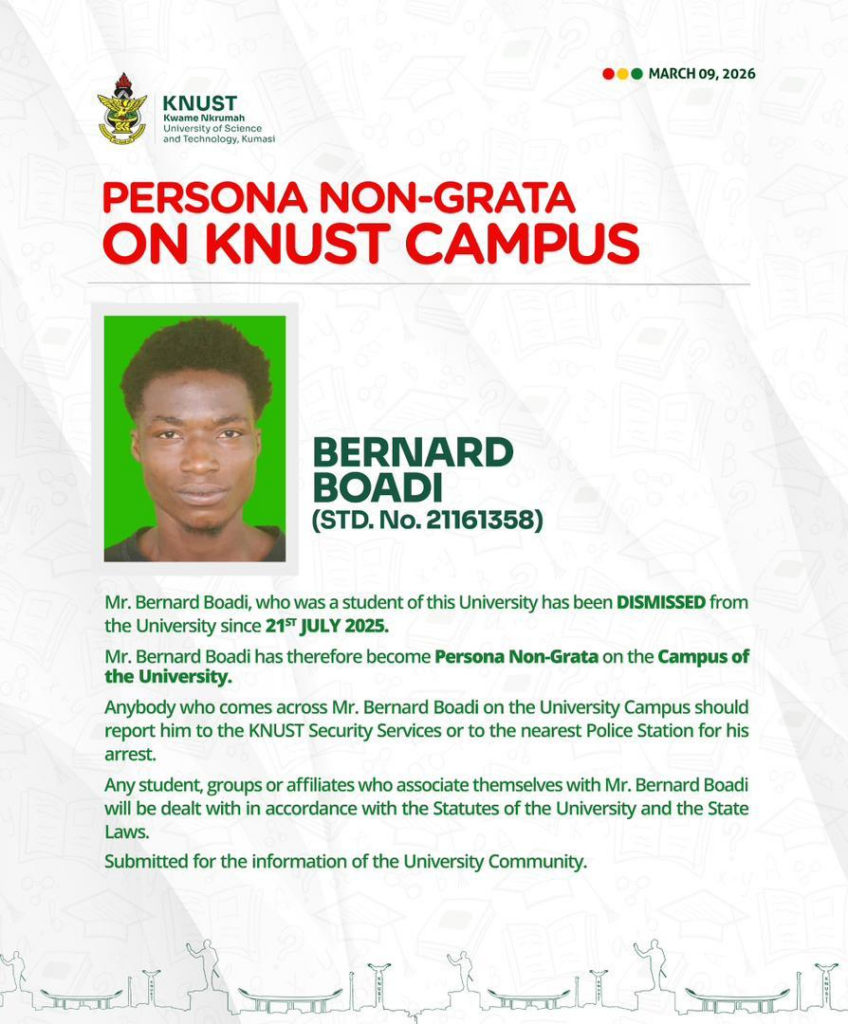
  • KNUST declares five dismissed students persona non grata, bans them from campus

    KNUST declares five dismissed students persona non grata, bans them from campus

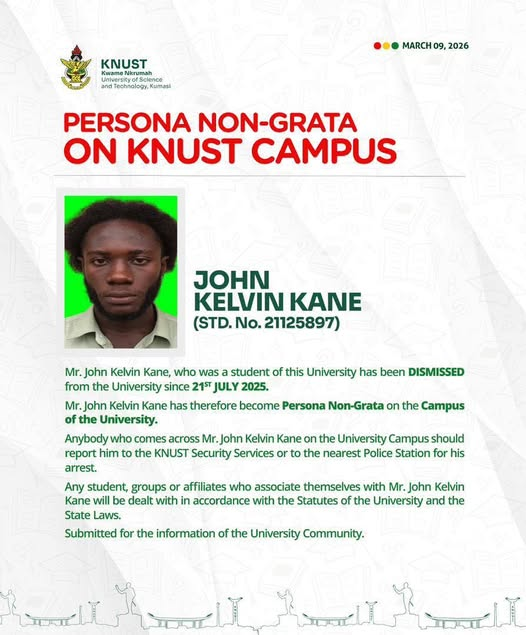
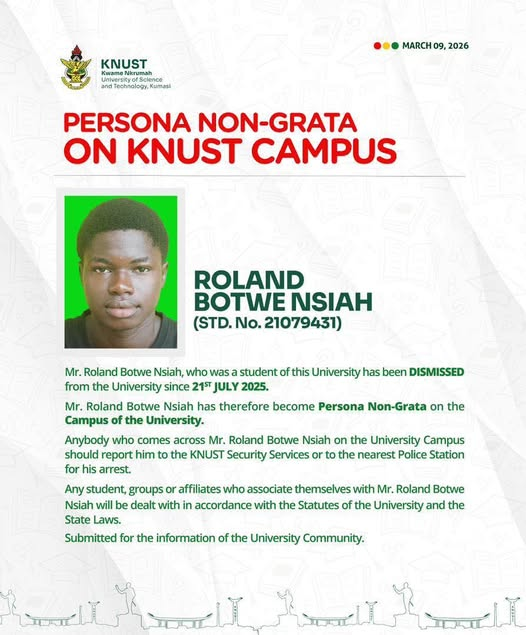
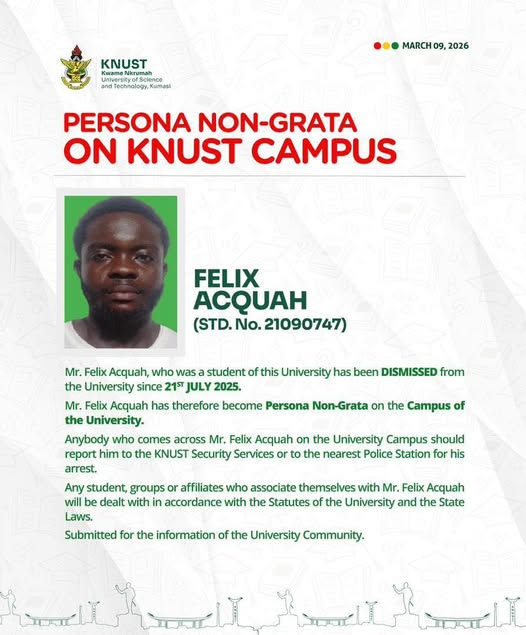
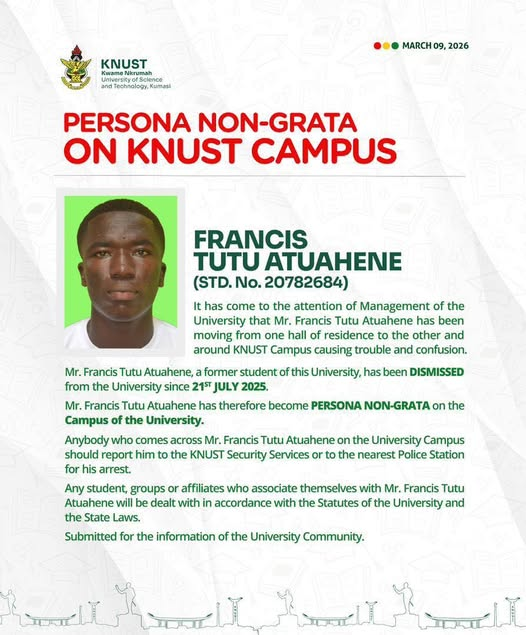
    Five former students of Kwame Nkrumah University of Science and Technology (KNUST) who were dismissed last year have been formally declared persona non grata by the university’s management following their alleged continuous involvement in activities that disrupt the institution’s operations and threaten campus stability.

    The students were all dismissed on July 21, 2025, for misconduct. However, after repeatedly defying their dismissal orders and continuing to frequent the university, management imposed a permanent ban on their access to the campus.

    The individuals affected by the directive are Bernard Boadi, Francis Tutu Atuahene, John Kelvin Kane, Roland Botwe Nsiah, and Felix Acquah.

    In a statement released by the University Relations Office and signed by Deputy Registrar Daniel Norris Bekoe on Friday, March 13,  it urged the general to report any of the above-listed culprits to the campus security or nearby police if found anywhere around the school premises.

    “The individuals are hereby prohibited from entering or remaining on the KNUST campus,” the statement said.

    It also warned that students, groups or individuals found mingling with the 5 students will face consequences as stated in the school’s laws.

    “Any student, group or affiliates who associate themselves with …..will be dealt with in accordance with the Statutes of the University and the State Laws,” parts of the statement read.

    The university explained that the measure was taken to protect students, staff and visitors while preserving discipline and the smooth running of academic and administrative activities.

    KNUST emphasised that it remains committed to strictly enforcing its regulations in order to maintain a secure and peaceful environment that supports teaching, learning, research and community engagement.

    In April last year, KNUST banned two former students, Ransford Fosu-Boateng, also known as Scammer Baby, and Raphael Appiah Owusu, from coming anywhere near the campus.

    According to the university, the two had been causing trouble for some time and posed a threat to the peace and safety of the institution.

    In a statement issued by the school’s Registrar, it was revealed that Ransford was dismissed in March 2022, while Raphael was also dismissed at the end of the 2023/2024 academic year.

    Even after their dismissal, the two continued sneaking into the school’s hostels, causing disturbances, harassing other students, and disregarding school regulations.

    The university stated that they were no longer students and should not be seen loitering on campus.

    “They were banned from campus and would be treated as trespassers if found anywhere on university grounds,” the statement said.

    KNUST also warned current students to stay away from the two individuals. It added that any student caught assisting them or granting them access to university facilities would face serious sanctions.

    KNUST’s rules on misconduct

    KNUST’s Students’ Guide and Code of Conduct classifies misconduct into four categories.

    They include: academic, behavioural, property and institutional, and criminal or social.

    Academic misconduct includes cheating during examinations, such as copying, impersonation, or using unauthorized materials. It also covers plagiarism, where a student presents another person’s work as their own, and falsification of records or misrepresentation in academic matters.

    Behavioural misconduct refers to disruptive conduct that interferes with teaching, learning, or administration. It also involves acts of violence or threats against staff, students, or property, harassment in any form—whether sexual, verbal, or physical—and substance abuse on campus.

    Property and institutional misconduct involves damaging university property through vandalism or theft, unauthorised occupation or use of facilities, and defiance of lawful instructions issued by university authorities.

    Criminal or social misconduct includes engaging in criminal activity either on or off campus that tarnishes the reputation of the university. It also covers organising unlawful demonstrations or riots, as well as cyber misconduct such as hacking or spreading false information.

    To address these violations, the statutes empower KNUST to impose disciplinary measures. These range from warnings or reprimands to suspension, which temporarily removes a student from academic activities. In more serious cases, dismissal may be applied, permanently removing the student from the university.

    Finally, the university may declare a dismissed student persona non grata, banning them from campus entirely and making the order enforceable by arrest if violated.


  • March 16–20 set for ADR Week to offer cheaper, faster delivery of justice – Chief Justice

    March 16–20 set for ADR Week to offer cheaper, faster delivery of justice – Chief Justice

    The Office of the Chief Justice has announced that March 16-20 will be observed as a week of Alternative Dispute Resolution (ADR) nationwide.

    This was announced in a formal statement dated March 13 and directed all courts across the country to observe it as such as part of activities for the legal year term under the theme, Adoption of Innovation and Technology to enhance access to Justice Delivery through Alternative Dispute Resolution (ADR)”

    “We wish to bring to the attention of the general public that the Chief Justice of Ghana, His Lordship Justice Paul Baffoe-Bonnie, has declared Monday 16th to Friday 20th March, 2026, as ADR Week for this Legal Year Term….” parts of the statement read.

    The statement outlines two main reasons behind the week-long exercise. It explained that the exercise is to educate the general public on what ADR is and what benefits they stand to gain from it, and also offers quick resolutions of cases, particularly for the poor and vulnerable.

    “The rationale for the ADR Week is to allow the ADR Directorate of the Judicial Service to engage the general public on the presence of ADR within the court system, its importance in seeking justice, and how to take advantage of such an important process for meaningful access to justice, especially for the poor and the vulnerable. It is also to afford court users whose cases are pending before the courts the opportunity of using ADR during the week under what we call the “Mass Mediation Exercise”, the statement added.

    According to the Head of Judiciary, “One Hundred and Thirty-Eight (138) Courts nationwide, comprising Thirty-Five (35) Circuit Courts and One Hundred and Three (103) District Courts, shall participate by devoting the whole week to the settlement of court cases with ADR across the country”.

    Also, “There will be a Press Briefing at the High Court, Sunyani, in the Bono Region, on Monday, 16th March, 2026, at 10:00 am prompt, to mark the official opening of the ADR Week”, where the Honourable Chief Justice of the Republic of Ghana will address the media.

    Consequently, all members of the public are urged to fully participate in the exercise to make it successful.

    “The Bar, court users, the media, and the public are therefore encouraged to participate fully and cooperate with the Judicial Service to make this Legal Year Term’s ADR Week

    a success. Alternative Dispute Resolution (ADR) has been adopted by the Judicial Service of Ghana as part of its adjudication process, dubbed “Court-Connected ADR”. This programme aims to ensure that access to justice in Ghana is made easier, cheaper, non- adversarial, expeditious, and flexible to all, particularly the underprivileged and vulnerable.

    “Pursuant to this, the Chief Justice, in a policy directive on the Court-Connected ADR Programme, has instituted an ADR Week which is to be celebrated every Legal Year Term thrice, to allow parties to settle their cases through mediation and to run programmes and activities to create awareness of the availability of ADR as a complement to the adjudication process in the courts.” the statement closed.

    ADR and Ghana’s constitution

    The exercise is governed by the Alternative Dispute Resolution Act, 2010 (Act 795). It is Ghana’s main law governing arbitration, mediation, and other non-court dispute resolution methods. It establishes clear rules for how ADR should be conducted, the powers of arbitrators and mediators, and how agreements reached through ADR can be enforced.

    The Act details several ADR mechanisms, including arbitration, mediation, customary arbitration, and the institutional framework

  • Eid ul-Fitr, Shaqq Day: March 20, March 23 declared public holidays

    Eid ul-Fitr, Shaqq Day: March 20, March 23 declared public holidays

    Friday, March 20, 2026 and Monday, March 23, 2026, have been declared nationwide public holidays.

    The Ministry of Interior announced in a statement issued on Friday, March 13.

    According to the statement, the holiday is declared in recognition of the celebrations of Eid ul-Fitr and Shaqq Day, which fall on Friday, March 20 and Saturday, March 21, 2026, respectively.

    “The general public is hereby informed that Friday, 20th March and Saturday, 21st March 2026 mark Eid-Ul-Fitr and Shaqq Days, which are Statutory Public Holidays,” parts of the statement read.

    According to the statement, both days are statutory public holidays under the Public Holidays and Commemorative Days Act (Act 601).

    However, the Ministry explained that since March 21, 2026, falls on a Saturday, John Dramani Mahama, President of Ghana, has by Executive Instrument (E.I) declared Monday, March 23, 2026, as an additional public holiday.

    “However, in view of the fact that 21st March 2026 falls on a Saturday, His Excellency, the President of the Republic of Ghana has, by Executive Instrument (E.I), in accordance with Section 2 of the Public Holidays and Commemorative Days Act (Act 601), as amended, declared Monday, 23rd March 2026, as an Additional Public Holiday…” the statement added.

    The Ministry therefore urged the general public to observe Friday, March 20 and Monday, March 23, 2026, as public holidays throughout the country.

    “and should be observed as such throughout the country,” the Ministry continued.

    Meanwhile, Tuesday, July 1, 2025, Republic Day was reinstated as a statutory public holiday after Parliament on Wednesday, June 25, passed the Public Holidays and Commemorative Days (Amendment) Bill, 2025, which amended Act 601.

    However, the government noted that statutory holidays that fell on Tuesday, Wednesday or Thursday would be commemorated on Monday or Friday. As such, the government declared July 4 a holiday.

    The passage of the bill followed an assessment by the Committee on Defence and Interior, along with the leadership of the Committee on Constitutional and Legal Affairs, who deemed the bill urgent.

    While presenting the motion for the adoption of the committee’s report, Interior Minister and Member of Parliament for Asawase, Mohammed Mubarak Muntaka, explained that the government had reviewed the number of public holidays in line with its earlier commitments to reform and streamline the holiday calendar.

    He emphasized that Republic Day held great significance in Ghana’s history, which was why the government reinstated it as a full public holiday.

    According to him, Ghana would continue to observe key holidays such as New Year’s Day on January 1, Constitution Day on January 7, Independence Day on March 6, Good Friday and Easter Monday in March or April for Christians, Labour Day on May 1, and Republic Day on July 1.

    The bill was introduced to Parliament by Mohammed Mubarak Muntaka in his capacity as Interior Minister the previous week and was passed under a certificate of urgency after its first reading.

    In 2024, President John Dramani Mahama expressed regret over his predecessor, former President Nana Akufo-Addo’s decision to abolish Republic Day as a public holiday and pledged to reinstate it.

    He wrote on Facebook, “It was most regrettable that the current government had scrapped commemorating this important day as a public holiday. However, as we reflected on the significance of Republic Day, we used it as a rallying call to rekindle the spirit of dedication and commitment that our forebears demonstrated. We had to continue building a better, renewed Ghana where opportunities were created for everyone to thrive.”

    During his Thank You tour in the Western Region on February 5, President Mahama revealed that he planned not only to declare July 1 a statutory holiday but also a day when Ghanaians would gather and pray.

    The proposed day was expected to provide an opportunity for Ghanaians to reflect on and appreciate the country’s achievements and progress.

    “We would have the opportunity as a nation to pray and give thanks to the Almighty God, as enjoined by the Holy Book that says, ‘In all things, give thanks,’” he stated.

    Former President Nana Akufo-Addo also called on Ghanaians to support President Mahama’s declaration of July 1 as a National Day of Prayer and Thanksgiving.

    “All of us had to support this initiative. It was a worthwhile initiative that we had this one day where all of us came together to give thanks to the Almighty for the many blessings He had bestowed upon us,” he said.

    To facilitate a seamless observance, President Mahama established a committee of religious leaders responsible for coordinating preparations for the event.

  • Manasseh Azure Awuni: Ibrahim Mahama’s jet, lecturer’s girlfriend, and conflict of interest

    Manasseh Azure Awuni: Ibrahim Mahama’s jet, lecturer’s girlfriend, and conflict of interest

    The guidelines on conflict of interest published by the Commission on Human Rights and Administrative Justice (CHRAJ) identify three kinds of conflict of interest—actual, potential and apparent (perceived). This means a public official can be found guilty of a conflict of interest even if the conflict is not proven to have occurred.

    According to CHRAJ, an actual conflict of interest occurs when a public officer’s private engagements compromise his or her judgment or objectivity in the public office.

    In the context of a potential conflict of interest, the present action may not have put the public officer in a conflict of interest, but it creates the conditions for such a conflict to occur.

    Here is how the third kind of conflict of interest, apparent or perceived, occurs:

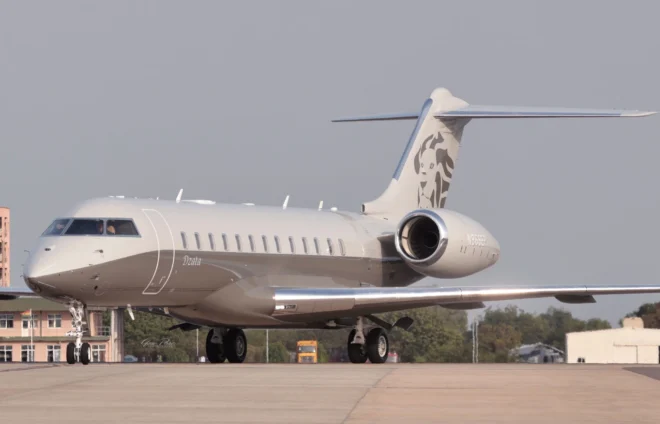
    Imagine applying for a mining concession or bidding for a government contract, hoping to win. Unfortunately, you lose. But the person whose company wins the deal is the businessman whose private jet the president of the republic travels on.

    The ministers who supervise the procurement process are appointed by the president and may have travelled on the private jet owned by the winner of the government contract.

    Even if this businessman won the contract with a superior bid, would it be wrong to tinker with the perception that the government is simply returning the favour done by the private jet owner?

    Absolutely not.

    Or consider it this way. You’re in a class with the lecturer’s girlfriend. She comes first in the lecturer’s course. She may be the most brilliant student in the class, but how many students would not think that she came first because of her relationship with the lecturer?

    That is what is wrong with President John Mahama’s use of his brother Ibrahim Mahama’s private jet for official presidential travels. The president’s spokesperson stated that the president did so to reduce costs. The alternative would have been to charter a jet for the president’s travel, since the current presidential jet is not airworthy and the new one being procured is not yet ready.

    President Mahama’s move may be well-intentioned, but this is governance. He must not be seen to be signalling right and turning left, especially when the president has published a code to govern his appointees’ conduct.

    That code of conduct prohibits his appointees from accepting gifts worth more than GHS20,000.

    The wisdom here is that if an appointee encounters significant gift-givers in the discharge of an official duty, his or her judgment could be impaired by the gift.

    The gift of an aircraft, like the Burkinabe contractor who gifted President Mahama a vehicle in his first term, is definitely more valuable than the president’s threshold of acceptable gifts. Like the Burkinabe contractor, the president’s brother’s companies do business with the state. And it is proper that the president separates the business of the state from his private relationship with his family.

    As mentioned, the president may mean well, but his code of conduct will be rendered meaningless if his appointees, like him, begin to give excuses why they cannot adhere to it.

    The nation is not bleeding because of legitimate transactions, such as the cost of the president’s travels. Ghana is on its knees because those who oversee the government procurements facilitate deals that cause us to lose hundreds of millions of cedis.

    A single compromised procurement deal can cost us more than the entire cost of the president’s travels over his entire term.

    Mr President, you have begun well. The optics don’t look good with you in your brother’s jet. The conflict of interest provision is clear. Your code of conduct is unambiguous.

    Don’t let these things drain your goodwill. The leaks that sink mighty ships aren’t always gaping holes. Sometimes they are too small to notice until they become serious enough to seal.

    DISCLAIMER: Independentghana.com will not be liable for any inaccuracies contained in this article. The views expressed in the article are solely those of the author’s, and do not reflect those of The Independent Ghana

  • Shatta Wale, John Legend set to release new single ‘Ain’t Nobody’ on March 20

    Shatta Wale, John Legend set to release new single ‘Ain’t Nobody’ on March 20

    In just 7 days, the World will be hit with a new single from Ghanaian dancehall artiste Shatta Wale featuring American singer and songwriter John Legend.

    Set for release on March 20, the collaboration is expected to blend two distinct musical backgrounds and genres. With Shatta Wale known for his dancehall sound and John Legend widely recognised for his soulful R&B style, it is anticipated that this collaboration will sweep fans off their feet.

    In an Instagram post , Shatta Wale announed the collaboration with an imge of himself and John Legend with a caption that reads, “

    Ain’t Nobody” 🔥🔥 — dropping officially on 20th March!
    Shatta Movement I got this beautiful RnB mixed with Reggae sound for you from our own brother from another mother “JOHN LEGEND”.

    https://www.instagram.com/p/DVxpXTjAqqt/?utm_source=ig_web_copy_link&igsh=MzRlODBiNWFlZA==

    Affectionately called the ‘Dancehall King’, Shatta Wale, over the years, has worked with both local and international icons like Beyoncé, Bounty Killer, Vybz Kartel, Gramps Morgan and Shenseea. These projects have positioned him as one of the key African voices bridging dancehall and the global mainstream.

    John Legend stands among the most decorated artistes of his era, with 13 Grammy Awards from more than 40 nominations. His catalogue of timeless hits, worldwide acclaim and respected musicianship have secured his place among music’s elite.

    ‘Ain’t Nobody’ is expected to further strengthen Shatta Wale’s international presence as he continues to expand his reach beyond Africa.

  • Shatta Wale has promised me a free verse – Ren Mich

    Shatta Wale has promised me a free verse – Ren Mich

    Ghanaian musician Ren Mich is excited to have the Ghanaian dancehall artist Shatta Wale collaborate with him on one of his songs soon, after successfully gaining the Gringo hitmaker’s attention online.

    According to Ren Mich, he gained Shatta Wale’s attention by consistently tagging him in every post in the last four years. Consequently, the musician has promised him a free verse for a song after noticing his work online.

    Speaking in an interview on Daybreak Hitz about his music career, Ren Mich said he has always admired Shatta Wale and credits him for playing a significant role in his journey in the music industry.

    “I used to tag him in every post I made. I was shocked when Shatta Wale eventually reposted one of my videos and promised me a free verse for a collaboration.”

    He also revealed that Shatta Wale contributed to the music video for his soon-to-be-released song.

    He noted that growing up, he listened to musicians like Sarkodie and Shatta Wale during the period he was known as Bandana.

    The artist further shared that he has released four EPs so far, with his latest EP released on March 5.

    Shatta Wale speaks on his Lamborghini controversy and its impact on his brand
    Shatta Wale says the controversy surrounding his Lamborghini, which involves the Economic and Organised Crime Office (EOCO), regarding investigations into a Lamborghini linked to former National Signals Bureau Director-General, Kwabena Adu-Boahene, has caused significant damage to his reputation and brand.

    Shatta Wale was arrested at his residence in Accra on 20 August 2025 by Ghana’s Economic and Organised Crime Office (EOCO) over his Lamborghini Urus, which authorities alleged was linked to a $4 million U.S. fraud case.

    Speaking in an interview on Ekosii Sen on Wednesday, 11 March, the Gringo hits maker noted that the controversy has taken a heavy toll on his brand, causing him to lose several deals both locally and internationally.

    “…because they have really tarnished my image in Ghana and even abroad,” he stated.

    He continued that, for the damage caused to him, there is a need for the anti-crime agency to formally apologise to his brand, citing that the damage could have been avoided if the matter had been handled privately.

    “I want to boldly say that the EOCO boss needs to apologise to my brand, not me, Shatta Wale, The best thing they could have said was, ‘Shatta, come and take your car,’ but to hear another story that the car is proceeds of crime, I was like, ‘where is this coming from?’ At a point, I felt like I was not safe in this country.”

    He recounted how EOCO officials raided his house, claiming to verify that some vehicles belonging to Mr Adu-Boahene were in his possession, but he insisted the only car found at his house was his Lamborghini.

    Shatta Wale maintained that he has no dealings with the former state official and questioned why the issue was not handled privately. He said the situation has created the impression that he knowingly purchased a stolen vehicle, which he described as unfair.

    EOCO and Shatta Wale

    The EOCO in June seized a 2019 Lamborghini Urus used by Shatta Wale after its Surveillance and Asset Recovery Unit (SARU) conducted a lawful search of a home at Trassaco Valley Phase 1 in Accra.

    The search, said to be “professional and civil,” was conducted on a 2023 request from the Federal Bureau of Investigations (FBI) and the United States Justice Department.

    EOCO clarified that “it is a standard safety protocol practice for officers of the Surveillance and Asset Recovery Unit (SARU) to carry weapons whilst on operation for the safety of officers.”

    According to the EOCO, the FBI and the Justice Department have tied the seized vehicle to the proceeds of the criminal enterprise of one Nana Kwabena Amuah, who is currently serving an 86 month sentence for several financial crimes in the United States of America (USA).

    It is reported that Nii Armah pleaded with officers that he did not want the seizure to be made public because “the vehicle was a big part of his brand, and if his supporters saw the vehicle being driven away in the company of EOCO, it would destroy his brand.”

    In light of this, Nii Armah was allowed to surrender the vehicle himself, which is currently in the possession of the Economic and Organized Crime Office.

  • Ebo Taylor’s one-week observance set for this Saturday in Saltpond

    Ebo Taylor’s one-week observance set for this Saturday in Saltpond

    The one-week observance in honour of the legendary Ghanaian musician is scheduled for this Saturday, March 14, in Saltpond, Central Region.

    According to the announcement shared by the family, the memorial will begin at 6:30 a.m. at Wesley Methodist Church, Saltpond.

    After the memorial, mourners will proceed to the next part of the observance in their prescribed attire, black, as the family has asked attendees to wear black for the ceremony.

    The gathering is expected to attract family members, musicians, fans and members of the creative arts community who wish to pay tribute to one of Ghana’s most influential musical figures.
    Legendary Ghanaian highlife musician Ebo Taylor is dead.

    The Musicians Union of Ghana (MUSIGA) announced that he died at the age of 90 in the early hours of Saturday, 7 February 2026.

    MUSIGA president Bessa Simons said: “Ghana and indeed the world has lost a great son.”

    Taylor died only a month after marking his 90th birthday and a day following the inauguration of the Ebo Taylor Festival, which was established to celebrate his musical contributions.

    He was born Deroy Taylor on January 6, 1936, in Cape Coast and grew to become one of Ghana’s most respected guitarists, composers, bandleaders and producers. Over a career spanning more than sixty years, he played a major role in developing highlife and Afrobeat in Ghana and internationally, fusing indigenous rhythms with elements of jazz, funk and soul to form his distinct musical style.

    Taylor gained early recognition in the late 1950s through his involvement with the Stargazers and the Broadway Dance Band. He later travelled to London in 1962 with the Black Star Highlife Band, where he collaborated with Afrobeat trailblazer Fela Kuti and other African artistes, before returning to Ghana to produce songs for renowned musicians such as Pat Thomas and C.K. Mann.

    His work later attracted global attention and reached new listeners worldwide. In the 21st century, his music was sampled by international producers, including Usher on “She Don’t Know” featuring Ludacris, which drew from Taylor’s track “Heaven.” He also produced highly praised albums including Love and Death (2008), Appia Kwa Bridge (2012) and Yen Ara (2018).

    Taylor remained active in live performances and recording well into his late eighties. His most recent project was the Ebo Taylor JID022 album, released in 2025 under the Jazz Is Dead series.

    MUSIGA’s tribute described him as “Saltpond’s light … Ghana’s legend … the world’s icon” and highlighted that he created and managed more than twelve bands throughout his career, with the last being the Ebo Taylor and Family Band.

    His passing has drawn tributes from musicians and admirers across Ghana and the international music scene, many of whom acknowledge his influence in elevating West African music on the global stage.

    The music industry is grieving the death of Kwabena Owusu, better known as Aseibu Amanfi, who died on the morning of Sunday, December 28, 2025, following a short illness.

    A video shared on X the same day highlighted Amanfi’s passing as a powerful reminder of his influence and the mark he left on generations, signalling the close of a chapter in Ghana’s vibrant highlife music history.

    His legendary track, “Kakra b3ka wo” (“a little will tell you” or “little by little will reveal to you”), embodies the virtue of patience and the revelations that come with time.

    Aseibu Amanfi was a towering presence in Ghana’s music scene, celebrated for his emotive voice and the lively rhythms that brought his songs to life.

    He once said, “We have somewhere to go or a journey to embark on,” reflecting on life and mortality during a performance paying tribute to the late Daddy Lumba.

    With unforgettable songs like “Kakra Bɛka Wo,” “Bamaso,” and “Asoko,” Amanfi’s music has become an enduring part of Ghanaian culture, bridging generations and resonating with fans of all ages.

    His work was more than entertainment; it became a cultural legacy, linking people across different times and experiences.

    “In life, when a child is born, joy fills the air, celebrated with white cloth and gifts during naming ceremonies. However, when death strikes, we are left with sorrow and sympathy as we bid farewell,” he once said, capturing the profound emotions tied to life and loss.

  • COCOBOD disburses additional  GHS4.2bn to settle cocoa farmers’ arrears

    COCOBOD disburses additional GHS4.2bn to settle cocoa farmers’ arrears

    The government has disbursed an additional GH¢4.2 billion to the Ghana Cocoa Board (COCOBOD) to be given to Licensed Buying Companies (LBCs) for onward payment to cocoa farmers who have been owed since November last year.

    This comes at a time when some cocoa farmers continue to wallow in discontent over the producer price cuts in mid-February.

    Speaking in an interview with Citi Business News, the Head of Public Affairs at COCOBOD, Jerome Sam, highlighted his outfit’s commitment to clearing all outstanding debt before the end of the 2025/2026 cocoa season, expected around August.

    “We hope to complete all payments before the close of the season, which is expected to end around August or September,” he stated.

    He continued that the GH¢4.2 billion was released by COCOBOD around last week to the Licensed Buying Companies to facilitate payments to farmers.

    He explained that while some farmers are still owed, others have already received payment due to existing financing arrangements between COCOBOD and the Licensed Buying Companies.

    Jerome Sam added that COCOBOD remains focused on improving liquidity within the cocoa purchasing system to ensure prompt payments to farmers and sustain production across the country’s cocoa-growing areas.

    “Some of the payments are recent, while others are older. Since 2023, when we experienced challenges with the syndicated loan, Licensed Buying Companies sometimes stepped in to pre-finance cocoa purchases. COCOBOD later reimburses them for those purchases.

    “That is why some farmers are not owed by the LBCs, while others still have outstanding payments. As COCOBOD, we are working tirelessly to ensure that every cedi owed to the Licensed Buying Companies is paid so they can also settle any outstanding debts with their cocoa farmers,” he explained.

    Cocoa farmers picket over price cuts

    Aggrieved cocoa farmers picketed at the headquarters of the Ghana Cocoa Board (COCOBOD) in Accra, on Friday, February 20, over a slash in producer prices and delayed payments, which they say have placed them in economic and financial distress.

    With placards bearing inscriptions of government betrayal and chanting slogans, they called on authorities and all stakeholders to protect their livelihoods.

    Some of the inscriptions read: “We worked, you lied,” “Government celebrates, but our families mourn,” and “We can’t pay our kids’ school fees,” among others.

    Article image 1

    The distressed farmers expressed deep concerns through their chants and placards, stating that despite their significant contribution to the economy, their income has been eroded. They warned that unless urgent measures are taken, they may lose their livelihoods, a situation likely to push many farmers away from cocoa farming and potentially affect future production levels which is likely to affect the economy.

    They are demanding an upward review of the prices and expedited processing to ensure the settlement of outstanding payments owed to them by Licensed Buying Companies operating under COCOBOD’s supervision.

    “The prices were not reduced under the previous regimes; why is this administration reducing them. We have no problem with the government; they should just leave the prices to remain the same,” a frustrated woman told journalists.

    According to the farmers, delays in payment and the recent downward adjustment in cocoa prices have made it increasingly difficult to cover basic household needs, including school fees, healthcare, and farm maintenance.

    “We depend entirely on cocoa. When payments are delayed, or prices drop, our families suffer,” one protester said, adding that many farmers are struggling to prepare for the next crop season due to a lack of funds.

    President Mahama speaks on price cuts

    President John Dramani Mahama defended the upward revision of cocoa prices, describing it as a critical measure to shield the country from sliding into fresh debt running into billions of dollars.

    Delivering the 2026 State of the Nation Address (SONA) in Parliament on Friday, the President said the decision formed part of difficult but necessary steps aimed at stabilising the economy and preventing a return to recent fiscal turmoil.

    “We revised the prices of cocoa to achieve competitive pricing. Failure to do this would have meant borrowing billions in borrowed funds. This unplanned expenditure would have taken us right back to the very devasting economic problem we have only recently began to escape,”

    He further assured cocoa farmers that these adjustments are not merely fiscal corrections but the foundation of a structural overhaul, the benefits of which will be realised in the long term.

    “I can firmly assure farmers that the reforms announced by the government will see the total transformation of the sector and ensure they achieve more from the cocoa… These are difficult decisions, but, Mr Speaker, I had to take them,” he said.

  • Ghana Month Focus: Ahenema – The royal slippers walking through time

    Ghana Month Focus: Ahenema – The royal slippers walking through time

    Ahenema come in two main styles: Asansan Tuo, the curved design, and Atine, the straight form. Both have long been worn by chiefs and royalty during festivals, funerals, weddings, and other ceremonial gatherings. The slippers are often marked with the number eight carved into the sole, symbolising stability and balance.

    Beyond style, Ahenema carry deep meaning within the institution of chieftaincy.

    “It is very traditional. When a chief’s Ahenema is removed from their feet, it signals that their rule has ended,” Daniel explained.

    Yet what was once confined to palace courtyards has gradually entered everyday cultural expression. Across Ghana, Ahenema are now worn at weddings, festivals, funerals, and even church services, often paired with kente and other traditional attire.

    Daniel believes this growing popularity reflects a renewed appreciation for Ghanaian culture, especially among younger generations.

    “People now want to wear them for weddings, naming ceremonies, and church,” he said. “But we shouldn’t focus on ‘Made in Ghana’ only during Ghana Month. We should integrate it into our lifestyle to promote Ghanaian craftsmanship.”

    As Ghana celebrates another Ghana Month, the quiet craft of Ahenema making continues in roadside workshops like Daniel’s. Leather, rubber, and tradition come together to produce slippers that carry history beneath every step.

    What once walked only the courts of kings now walks confidently among the people, a strong reminder that Ghanaian culture, like Ahenema, continues to live on in everyday life.

    DISCLAIMER: Independentghana.com will not be liable for any inaccuracies contained in this article. The views expressed in the article are solely those of the author, and do not reflect those of The Independent Ghana

  • These are AI-generated photos – Baba Jamal reacts to images of him sleeping in Parliament

    These are AI-generated photos – Baba Jamal reacts to images of him sleeping in Parliament

    Almost immediately after Ayawaso East Member of Parliament (MP), Baba Jamal, was sworn into Parliament by the Speaker, Alban Bagbin, on Tuesday, March 10, images of the newly sworn-in MP sleeping began circulating online. 

    Reacting to the images, the former High Commissioner to Nigeria indicated that they were manipulated and do not reflect what actually occurred during parliamentary proceedings.

    “There are several of the photos going around. Even one of them had me with my mouth wide open. These are AI-generated photos,” he explained during an interview with Accra-based Okay FM.

    Baba Jamal suggested the circulation of the images is part of efforts by some individuals to discredit him following what he described as a significant moment in his political journey.

    “People would always want to dent every beautiful thing when it happens,” he added.

    His swearing-in came after constituents in Ayawaso East on Tuesday, March 3, elected the National Democratic Congress (NDC) candidate Mohammed Baba Jamal Ahmed as their MP.

    More than 49,000 registered voters participated in the by-election conducted at 113 polling stations. Baba Jamal polled 10,884 votes to beat the New Patriotic Party’s (NPP) Yussif Baba Ali, who secured 4,009 votes.

    The three other contestants were the Liberal Party of Ghana’s (LPG) candidate, Ibrahim Iddrisu, who polled 43 votes; Independent candidate Alhaji Mohammed Umaru Sanda secured 1,885 votes; and another Independent candidate, David Kanor, had 104 votes.

    Ahead of the by-election, a poll by Global InfoAnalytics predicted victory for Baba Jamal. The survey projected that the NDC candidate would secure about 75 per cent of the votes, ahead of his main contender, the NPP’s Baba Ali.

    The by-election saw low voter turnout. The NDC now has 186 seats in Parliament.

    “At the end of the voting exercise for the parliamentary by-election for the Ayawaso East constituency, five candidates contested in the polls. The first one is Baba Jamal Mohammed, and he polled 10,884 votes; the second candidate on the ballot, Ibrahim Iddrisu Mohammed, also polled 43 votes; Yusuf Ali Baba polled 4,009 votes.

    “The fourth candidate, Mohammed Umah Sunda, also polled 1,885 votes. The fifth candidate, an independent candidate, David Kanor, polled 104 votes.

    “In all, we had 16,928 valid votes, 120 votes were rejected, and in that case, the total votes cast amount to 17048. Looking at the just announced results, I, Samuel Anim Ofori, the retaining officer of the Ayawaso East constituency, hereby announce to you your new MP elect Baba Jamal Mohammed,” the retaining officer stated.

    Reacting to the announcement, Baba Jamal noted, “In the first place, I want to thank the almighty Allah for giving us this victory. Let me say that I dedicate this victory to my 93-year-old mother. I also want to thank my wife and my children for standing beside me and supporting me this far”.

    For months, the constituency had been without representation following the death of its long-serving legislator, Alhaji Mahama Naser Toure. He was reported dead on January 4 after a short illness at the Korle Bu Teaching Hospital. In accordance with Islamic customs, he was buried within 24 hours of his passing.

    Naser Toure Mahama was widely regarded as a grassroots politician whose parliamentary work focused on urban renewal in Nima and youth empowerment within Zongo communities.

    Baba Ali was projected to trail with 21%, independent candidate Umaru Sanda Muhammed expected to poll 3% of the vote, with the other remaining candidates, Ibrahim Iddrisu and David, to garner less than 1%.

    Independent aspirant Umaru Sanda Muhammed, who recently severed ties with the NDC, was projected to secure about 3 per cent of the vote.

    The by-election attracted heightened attention in recent days amid internal developments within the NDC, including allegations of vote buying during its parliamentary primary.

    On February 7, Baba Jamal won the Ayawaso East Constituency primary following the party’s internal primary held.

    After the close of polls, provisional results showed that Baba Jamal polled 431 votes out of the total votes cast, followed by the widow of the late Ayawaso MP, Naser Toure Hajia Amina Adam, who secured 399 votes.

    Mr Mohammed Ramne, the Ayawaso East NDC Constituency Chairman, placed third with 88 votes. Dr Yakubu Azindow received 45 votes, while Mr Najib Mohammed Sani received 1 vote.

  • ICOLMS-Ghana: Unlicensed courier services have until April 1 to register or face sanctions

    ICOLMS-Ghana: Unlicensed courier services have until April 1 to register or face sanctions

    Ghana has launched its first-ever digital system for monitoring and regulating courier operations. The platform, Integrated Courier and Logistics Management System–Ghana (ICOLMS-Ghana), which was developed by the Postal and Courier Services Regulatory Commission (PCSRC)  is set to effectively check courier services in the country to ensure excellent service delivery and the growth of Ghana’s e-commerce ecosystem.

    Speaking at the launch of the platform on Thursday, March 12, the Minister for Communications, Digital Technology and Innovations, Samuel Nartey George, announced April 1 as the deadline for industry players to register on the platform or face sanctions after the deadline.

    He noted that sector players no longer have an excuse after an earlier intervention in August 2025 temporarily halted enforcement actions. The Minister said players now have a 19-day grace period to register and onboard onto the ICOLMS-Ghana platform before nationwide enforcement begins.

    “Once we have launched the ICOLMS today, the grace period runs from today [March 12] until March 31, 2026. This gives you exactly 19 days, whether you are a company or a single biker, to register on the ICOLMS-Ghana platform. 

    The Ningo-Prampram MP issued a stern warning that the Ghana Police Service will enforce compliance from April 1, and stressed that he will not intervene on behalf of companies that fail to integrate their systems.

    “All existing courier companies have that same period to onboard and integrate their systems with the ICOLMS digital platform. If you fail to do that, it will attract regulatory sanctions.

    “Enforcement with the Ghana Police Service will start on April 1, 2026, and there will be no moratorium. There will be no excuses. I will not intervene, I make a solemn pledge,” he said.

    According to the new directive, courier companies and single-bike delivery services must register digitally to continue operating legally.

    Smaller operators will need to pay a one-time application fee (around GHS 570) to be licensed.

    Meanwhile, on August 20, 2025, the Postal and Courier Services Regulatory Commission (PCSRC), in collaboration with the Ghana Police Service, launched a strict enforcement operation in Accra on unlicensed courier operators, particularly motorbike riders. This led to the arrests of several motor riders whose bikes were also seized.

    Given the sudden launch, with no prior heads-up, it sparked widespread protests. Delivery riders argued that the licensing requirements were unfair and had been introduced too suddenly. Many claimed they had not been given enough time or clarity to comply with the new regulations, and the arrests only heightened tensions.

    By August 21–22, 2025, the situation had escalated enough to draw ministerial intervention. Sam George, the Minister for Communication, Digital Technology and Innovation, ordered an immediate suspension of the enforcement exercise. His directive halted the arrests and bike seizures, effectively pausing the licensing drive. He emphasized that stakeholders needed more time to prepare for the upcoming digital regulatory system, ICOLMS-Ghana, which was being developed to modernize courier regulation.

  • Shatta Wale demands apology from EOCO boss over Lamborghini controversy

    Shatta Wale demands apology from EOCO boss over Lamborghini controversy

    Ghanaian dancehall artiste Charles Nii Armah Mensah, popularly known as Shatta Wale, is demanding an apology from the Executive Director of Ghana’s Economic and Organised Crime Office (EOCO), Raymond Archer, citing reputational and brand damage regarding investigations into a Lamborghini linked to former National Signals Bureau Director-General, Kwabena Adu-Boahene.

    He made these remarks during an appearance on Asempa FM’s Ekosii Sen on Wednesday, 11 March, stating that the controversy took a toll on his brand both internationally and locally, leading to his loss of some major deals and gigs.

    “I want to boldly say that the EOCO boss needs to apologise to my brand, not me, Shatta Wale, because they have really tarnished my image in Ghana and even abroad,” he stated.

    He believes the case could have been handled differently and even better if the EOCO boss had dealt with him privately and not made the case public.

    Referring to how an Elantra that was gifted to him by the embattled MenzGold boss, Nana Appiah Mensah (NAM 1), around 2017-2018 was taken from him by authorities after the former was implicated in some fraud cases.

    “The best thing they could have said was, ‘Shatta, come and take your car,’ but to hear another story that the car is proceeds of crime, I was like, ‘where is this coming from?’ At a point, I felt like I was not safe in this country.”

    Shatta Wale was arrested at his residence in Accra on 20 August 2025 by Ghana’s Economic and Organised Crime Office (EOCO) over his Lamborghini Urus, which authorities alleged was linked to a $4 million U.S. fraud case.

    Shatta Wale maintained that he has no dealings with the former state official and questioned why the issue was not handled privately. He said the situation has created the impression that he knowingly purchased a stolen vehicle, which he described as unfair.

    He also expressed fears over his safety in the country after EOCO gave him about 3 different reasons behind his arrest and seizure of his Lambo. According to him, when EOCO first raided his house, the reason was as a result of his involvement with Adu Boahene; however, later he was told to change his story from one criminal being prosecuted by US authorities, when he thought he could leave with his Urus, he was informed the car was a proceeds of crime and that somebody had been shot in the said car.

    Meanwhile, EOCO revealed that Shatta Wale did not have any documentation that shows that he owns or purchased a 2019 Lamborghini Urus, a car which was identified by the FBI and the US Justice Department as proceeds of a $4 million crime.

    The documentation being referenced is in terms of receipt or transfer documents.

    According to EOCO, he rather has a customs declaration document in his possession bearing the name of Nana Kwabena Amuah, who is currently in jail.

    The singer was also unable to identify the person from whom he purchased the car in question.

    He is reported to have said he purchased it from the “Street” and from someone possibly called “ZAK” who may have contacted him on WhatsApp but whose identity he does not know and whose contact he has thrown away.

    Shatta Wale’s EOCO interrogation delayed by scheduling issues

    According to EOCO in a press statement issued on August 21, an invitation was issued to Charles Nii Armah Mensah to report on August 13.

    This was, however, rescheduled for August 20, 2025 at 10am.

    “Counsel for Charles Nii Armah Mensah, indicated to EOCO officers that they would prefer to report at 11am. EOCO readjusted its schedule to align with their time. Shortly before 11am, Counsel for Nii Armah called EOCO to claim that his client was not available and that he was also busy,” a part of the statement noted.

    EOCO indicated to the singer’s Counsel that he and his client were expected to report as scheduled.

    Charles Nii Armah Mensah arrived in the Office around 3pm and, according to EOCO, insisted that he was not going to cooperate until his counsel arrived, a right which he is entitled and was accorded him.

    “EOCO investigators and Charles Nii Armah Mensah waited from 11am till 5pm before his Counsel showed up. Incidentally, EOCO’s closing time is 5pm. Nevertheless, EOCO staff and the entire operational team chose to carry on with the interrogation, which ended around 9pm. Officers eventually left the Office around 11pm,” the statement further revealed.

    Shortly after interrogation ended, Shatta Wale was on Wednesday night granted bail of GHC10,000,000 with two sureties to be justified.

    Charles Nii Armah Mensah would only leave EOCO’s custody after it undertakes surety inspection, which is a standard protocol.

  • T-Bills made up 62% of banks’ investments in 2025 – BoG

    T-Bills made up 62% of banks’ investments in 2025 – BoG

    In 2025, banks invested more in treasury bills than in 2024. This is according to the Bank of Ghana’s January 2026 Monetary Policy Report.

    According to the BoG, its share increased from 40.3% in December 2024 to 62.3% in December 2025, whereas the share of long-term securities declined from 59.3% in December 2024 to 37.2% in December 2025, marking a 37.3% year-on-year decline.

    This was in line with the growth moderation recorded during the reference period. The report also stressed that the share of equity investments remained negligible but increased marginally from 0.4% percent in December 2024 to 0.5% in December 2025.

    Meanwhile, the share of deposits in banks’ liabilities and shareholders’ funds decreased to 72.8% in December 2025 from 75.1% in December 2024, reflecting the slowdown in deposit growth in 2025.

    The increase in borrowings, however, translated into an increased share of 8.5% in December 2025 from 7.6% in December 2024.

    The proportion of shareholders’ funds in banks’ total funding also improved to 13.1% in December 2025 from 10.8% a year earlier, while the share of other liabilities declined from 6.3% to 5.4% during the same comparative period.

    Investor interest and confidence in government treasuries remain high as the treasury bill auction exceeds the target by over 60%.

    In auction results posted by the Bank of Ghana, the government accepted GH¢12.8 billion in bids at the latest auction, above its GH¢9.8 billion target, although investors submitted bids worth GH¢15.9 billion.

    The reports also show that the majority of investors preferred the 364-day (one-year) treasury bill, for which they offered about GH¢7.4 billion, making up nearly half of all the money investors offered.

    Out of this amount, the government accepted just over GH¢5.0 billion.

    Also, for the 182-day (six-month) treasury bill, investors offered about GH¢4.29 billion, and the government accepted almost all of it, around GH¢4.28 billion.

    For the 91-day (three-month) bill, investors offered about GH¢4.1 billion, of which the government accepted about GH¢3.4 billion.

    On the other hand, interest rates continued to rise at the longer end of the yield curve.

    The yield on the 91-day bill remained at 11.19%.

    That of the 182-day bill, however, went up to 12.66% from 12.64% the previous week.

    Additionally, the yield on the 364-day bill increased by eight basis points to 13.06%.

    Meanwhile, the iversubscription has been a trend in the last few months.Government saw another significant oversubscription in its primary T-bill auction, the Bank of Ghana (BoG) announced, following its August 1 auction last year.

    This comes after demand surged 42.07 percent above the target.

    Reports from the Bank of Ghana indicated that the latest figures showed the government had planned to raise GHS 3.86 billion through Treasury bills, but it, however, accepted a total of GHS 5.48 billion. This was a result of investor interest exceeding expectations.

    Specifically, GHS 4.32 billion was taken from GHS 4.86 billion in bids for the 91-day bill, GHS 823 million from GHS 1.15 billion for the 182-day bill, and GHS 343 million out of GHS 774 million for the 364-day bill.

    Experts say the high demand happened because big investors, like banks and companies, wanted to buy Treasury bills then, while the interest rates were still high. They believe that interest rates and inflation might go down soon, so they want to secure the good returns before that happens.

    Interest rates on short-term government securities are still going down. The interest on the 91-day bill fell to 10.29%, which is 0.54% lower than before. The 182-day bill dropped from 13.22% to 12.35%, and the 364-day bill also went down by 1.06% to 13.24%.

    According to reports, the Ghanaian government announced plans to borrow GHS 8.58 billion through treasury bills that month. This figure was cited in a Bank of Ghana issuance calendar for August 2025, which outlined the government’s short-term borrowing strategy.

    This oversubscription adds to the recent oversubscription spree the government has recorded in the last three months consecutively.

    T-bill auction on Friday, July 25, recorded a massive 160% oversubscription.

    How was t-bill auction earlier in 2025?

    In early 2025, when the government assumed office, T-bill auctions were struggling, with eight consecutive weeks of undersubscription. Among some of the reasons for the undersubscription were investor liquidity constraints, where financial institutions and investors faced cash flow challenges, diminishing their interest in investing in government securities.

    Another reason for the undersubscription was other attractive competing investment options, such as the Bank of Ghana’s OMO bills, which were offering higher interest in comparison to T-bills and influencing institutions’ and the public’s preferences. The Bank of Ghana’s OMO bills were short-term debt instruments used in Open Market Operations (OMO), a key tool for managing money supply and interest rates in the economy.

    Market uncertainty was another undersubscription challenge. Due to the previous government’s Domestic Debt Exchange Programme (DDEP) and other concerns about inflation and fiscal discipline, investors treaded cautiously, closely monitoring fiscal decisions by the new government.

    Tight monetary conditions, with less money circulating in the system, also caused demand for short-term debt instruments to drop, accounting for the undersubscription.

  • EOCO-Lamborghini controversy ruined my brand – Shatta Wale

    EOCO-Lamborghini controversy ruined my brand – Shatta Wale

    Ghanaian dancehall artiste Shatta Wale says the controversy surrounding his Lamborghini, which involves the Economic and Organised Crime Office (EOCO), regarding investigations into a Lamborghini linked to former National Signals Bureau Director-General, Kwabena Adu-Boahene, has caused significant damage to his reputation and brand.

    Shatta Wale was arrested at his residence in Accra on 20 August 2025 by Ghana’s Economic and Organised Crime Office (EOCO) over his Lamborghini Urus, which authorities alleged was linked to a $4 million U.S. fraud case.

    Speaking in an interview on Ekosii Sen on Wednesday, 11 March, the Gringo hits maker noted that the controversy has taken a heavy toll on his brand, causing him to lose several deals both locally and internationally.

    “…because they have really tarnished my image in Ghana and even abroad,” he stated.

    He continued that, for the damage caused to him, there is a need for the anti-crime agency to formally apologise to his brand, citing that the damage could have been avoided if the matter had been handled privately.

    “I want to boldly say that the EOCO boss needs to apologise to my brand, not me, Shatta Wale, The best thing they could have said was, ‘Shatta, come and take your car,’ but to hear another story that the car is proceeds of crime, I was like, ‘where is this coming from?’ At a point, I felt like I was not safe in this country.”

    He recounted how EOCO officials raided his house, claiming to verify that some vehicles belonging to Mr Adu-Boahene were in his possession, but he insisted the only car found at his house was his Lamborghini.

    Shatta Wale maintained that he has no dealings with the former state official and questioned why the issue was not handled privately. He said the situation has created the impression that he knowingly purchased a stolen vehicle, which he described as unfair.

    EOCO and Shatta Wale

    The EOCO in June seized a 2019 Lamborghini Urus used by Shatta Wale after its Surveillance and Asset Recovery Unit (SARU) conducted a lawful search of a home at Trassaco Valley Phase 1 in Accra.

    The search, said to be “professional and civil,” was conducted on a 2023 request from the Federal Bureau of Investigations (FBI) and the United States Justice Department.

    EOCO clarified that “it is a standard safety protocol practice for officers of the Surveillance and Asset Recovery Unit (SARU) to carry weapons whilst on operation for the safety of officers.”

    According to the EOCO, the FBI and the Justice Department have tied the seized vehicle to the proceeds of the criminal enterprise of one Nana Kwabena Amuah, who is currently serving an 86 month sentence for several financial crimes in the United States of America (USA).

    It is reported that Nii Armah pleaded with officers that he did not want the seizure to be made public because “the vehicle was a big part of his brand, and if his supporters saw the vehicle being driven away in the company of EOCO, it would destroy his brand.”

    In light of this, Nii Armah was allowed to surrender the vehicle himself, which is currently in the possession of the Economic and Organized Crime Office.

  • Ghana will not experience fuel shortage despite Middle East tensions – TOR

    Ghana will not experience fuel shortage despite Middle East tensions – TOR

    The price of fuel saw a sharp rise with speculated threats of shortage globally following the Israel-US corporate attack on Iran on February 28, which disrupted oil supplies from one of the world’s most energy-rich regions. Crude oil jumped from about $67 per barrel before the war (Feb 28) to nearly $97 by March 10, sending gasoline, diesel, and jet fuel prices soaring worldwide.

    Ghana, being one of the dependents of the global oil supply, stakeholders began to express concerns about a possible shortage of fuel across the country. However, the Corporate Affairs Officer of the Tema Oil Refinery (TOR), Godwin Mahama Ayaba, during an appearance on  March 11, indicated that Ghana is unlikely to experience fuel shortages despite rising tensions in the Middle East, citing the country’s diversified sources of petroleum imports and growing local refining capacity.

    According to him, the NPA recently issued a statement indicating that the situation in the Middle East will not lead to shortages of petroleum products in the country.

    “The National Petroleum Authority, which is the regulator, some three to four hours ago issued an official statement assuring all of us that as for shortage, there is no way the Iran–Israel conflict is going to affect us,” he said.

    Mr Ayaba explained that Ghana’s fuel import structure significantly reduces the risk of supply disruption because the country imports most of its finished petroleum products from Europe.

    “Ghana largely imports from two different areas: Europe and the Arabian region. Where we import most is Europe,” he noted.

    “We import about 80 per cent of our finished petroleum products from Europe and about 20 per cent from the Arabian region, where this conflict may have an impact.”

    While acknowledging that the Middle East tensions could affect that 20 per cent supply, he said Ghana’s domestic refining capacity is expected to fill the gap.

    “So we are likely to lose that 20 per cent, but with TOR coming on stream, we will be able to block that gap,” he said.

    Mr Ayaba revealed that the refinery is currently producing about 28,000 barrels and expects output to increase significantly after ongoing upgrades.

    “Currently, we are producing about 28,000 barrels. After the tie-in, we will move to about 45,000 and further move to 60,000,” he explained.

    He added that increased output from other refineries in the country will also contribute to stabilising supply.

    “Sentuo is doing around 36,000 to 40,000 barrels a day, Akwaaba is doing somewhere less than 10,000, and Platon is around a little below 3,000,” he stated.

    “Together, all these companies will be able to block that 20 per cent that would have come from the Arabian region.”

    Mr Ayaba emphasised that Ghana will still maintain the bulk of its imports from Europe, further ensuring supply stability.

    “We will still have the 80 per cent from Europe coming in,” he said.

    He therefore urged the public not to panic, reiterating the assurances provided by the National Petroleum Authority.

    “I will add my voice to the official communiqué from the NPA that we should rest assured that we are not going to record fuel shortages,” he stated.

    Meanwhile, in a separate interview about 3 days ago, Mr Ayaba revealed that TOR is eyeing a sixty-one (61%) percent increase in its production capacity as part of renewed efforts to strengthen operations and improve output at the facility.

    Currently, the refinery seeks to expand its crude distillation capability from 28,000 barrels per stream day to 45,000 barrels per stream day.

    Speaking during an interview on Citi FM’s Eyewitness News on Monday, March 9, he stated that,

    “The refinery is currently undertaking technical processes aimed at expanding its processing capability from 28,000 barrels per stream day to 45,000 barrels per stream day. This represents a sixty-one percent increase in capacity, and it forms part of our broader plans to revitalise operations and enhance TOR’s contribution to Ghana’s petroleum sector.”

    He continued that, the planned increase will be achieved through the integration of an additional processing unit, known as the F61 unit, which will operate alongside the existing F1 unit.

    Both units will be connected to the refinery’s crude distillation system to improve overall efficiency and output.

    Mr Mahama also noted that engineers are currently carrying out some temporary technical steps to connect a new unit to the refinery’s main processing system, which is expected to increase the refinery’s output from the current level.

    The refinery is presently operating under a tolling arrangement, a system in which private companies supply crude oil to the facility for processing.

    Under this arrangement, the refinery refines the crude and charges a processing fee, while the refined petroleum products are returned to the companies that provided the crude.He explained that under the tolling system, the refinery does not control the marketing or distribution of the finished products, as those decisions are taken by the crude oil suppliers.

    Mr Ayaba added that while the refinery’s current nameplate capacity stands at 28,000 barrels per stream day, the introduction of the F61 unit will push output to 45,000 barrels per stream day.

    He further indicated that management is also considering plans to expand capacity to about 60,000 barrels per stream day in the medium term.

    After several years of inactivity, the management of Tema Oil Refinery announced the resumption of operations. The resumption was possible following the completion of extensive Turnaround Maintenance (TAM) works on the refinery’s Crude Distillation Unit (CDU). Maintenance works began on August 1 and on October 30 in 2025. This information was contained in a press statement released by the management on Saturday, December 27.

    TOR’s resumption was expected to boost energy security, industrial growth and national development, potentially saving Ghana up to $10.2 billion in oil import bills annually.

  •  Under no circumstances can we ​participate in the World Cup – Iran Sports Minister

     Under no circumstances can we ​participate in the World Cup – Iran Sports Minister

    Barely 24 hours after FIFA boss Gianni Infantino announced that Iran can participate in the 2026 FIFA World Cup, which is being co-hosted by Mexico, Canada and the USA, with most of the matches being played in the Donald Trump-led country.

    A few hours after Infantino announced that Trump doesn’t have a problem with Iranians visiting the USA for the global tournament from June 11 to July 19.

    However, Iran’s Sports Minister, Ahmad Donyamali, announced on Wednesday, March 11, during a state television interview in Tehran that Iran would not participate in the 2026 FIFA World Cup.

    According to him, his country cannot take part in the tournament following the United States’ coordinated airstrikes on Iran with Israel on February 28.

    The United States and Israel launched airstrikes on Iran nearly two weeks ago, killing ​the Islamic Republic’s supreme leader, leading to a ​region-wide conflict in the Gulf.

    “Considering that this corrupt regime ⁠has assassinated our leader, under no circumstances can we ​participate in the World Cup,” the minister told state television.

    The World ​Cup will be held in the United States, Mexico and Canada from

    “Our children are not safe, and, ​fundamentally, such conditions for participation do not exist. Given the malicious actions they have carried out against Iran, they ‌have ⁠forced two wars on us over eight or nine months and have killed and martyred thousands of our people. Therefore, we certainly cannot have such a presence,” Donyamali ​said.

    In the draw ​last December, ​the Iranians ⁠were grouped with Belgium, Egypt and New Zealand. All three of their Group G matches ​were scheduled to take place in the ​U.S., ⁠two in Los Angeles and one in Seattle.

    Iran was the only nation missing from a FIFA planning summit for World ⁠Cup ​participants held last week in Atlanta.

    Iran are due to play all three of their group games in the U.S. and could even face the co-hosts in the round of 32 if both teams finish second in their respective groups.

    This is the fourth consecutive time Iran have qualified for a World Cup, and they are scheduled to open their campaign against New Zealand and Belgium in Los Angeles before their final group game against Egypt in Seattle.

    The last time they qualified, they didn’t pull out of the competition despite their grappling with the effects of bomb attacks on three nuclear facilities at the time.

    However, given the seriousness of their current situation, the head of Iran’s football federation, Mehdi Taj, has reportedly cast doubt on their participation.

    Taj told Iranian television that it was “far from our expectations that we can look at the World Cup with hope”. He added the country’s sports officials would decide if any action was necessary.

    FIFA’s general secretary, Mattias Grafstrom, said on Saturday: “Our focus is to have a safe World Cup with everybody participating.”

    Meanwhile, the White House on Tuesday, January 21, announced that World Cup ticket holders can now access the priority visa appointments to travel to the United States.

    This forms part of the US government’s efforts to help ticket holders secure priority visa appointment dates, as citizens of some qualified countries may otherwise be unable to obtain visas in time for the 2026 World Cup.

    The FIFA Prioritised Appointment Scheduling System (FIFA PASS) is a special visa‑interview scheduling program created by the U.S. government and FIFA for the 2026 World Cup. It gives ticket holders priority access to U.S. visa appointments, ensuring fans can travel to matches in North America despite existing visa backlogs.

    Speaking during a joint press briefing with FIFA President Gianni Infantino at the White House in Washington, D.C., on 17 November,last year President Donald Trump mentioned that “I’ve directed my administration to do everything within their power to make the 2026 World Cup an unprecedented success.”

    The WhiteHouse however, warned that, a ticket isn’t a visa. Detailing how the ‘World’ will gain access into the US, the Secretary of State Marco Rubio noted that, ticket-holders for the tournament, set for next June and July in the US, Canada and Mexico, will not be automatically granted a tourist visa.

    But foreign nationals with tickets to World Cup football matches could get an interview at an embassy or consulate within six to eight weeks of applying, Rubio said.

    “Your ticket is not a visa; it doesn’t guarantee admission to the US. We’re going to do the same vetting as anybody else would get. The only difference here is we’re moving them up in the queue,” the Secretary noted the first time the FIFA pass was announced in last year.

  • André Ayew: Should he make Ghana’s 2026 World Cup squad?

    André Ayew: Should he make Ghana’s 2026 World Cup squad?

    Just over 90 days remain until Ghana’s Black Stars storm the BMO Field in Toronto for a potentially banana-skin clash against Panama in their opener at the 2026 FIFA World Cup.

    But discussion around the team is dominated by one player, André Ayew, whether or not he should be handed a call-up to what may be his final dance at the global showpiece.

    The former captain of the senior national team has not donned the Ghana jersey for two years, and coach Otto Addo has been very clear about “seeing others ahead” of the veteran forward.

    After spending a long period unattached to a club, the 36-year-old is now playing competitive football for NAC Breda in the Eredivisie, with four starts in nine matches, scoring one goal with a header just a few days ago.

    Recency bias, coupled with nearly two decades of service for Ghana, has fueled intense debate among politicians, coaches, journalists, and fans over his possible inclusion.

    Why does Otto Addo no longer prefer André Ayew?

    The relationship between Andre and Otto Addo initially looked like a match made in heaven when the former Dortmund assistant coach took over the reins of the Black Stars ahead of the 2022 FIFA World Cup.

    Andre featured in almost every game, from the pre-tournament friendlies to the global showpiece itself.

    He scored in Ghana’s 3–2 defeat to Portugal and also missed a crucial penalty in the 2-0 loss to Uruguay as Ghana exited at the group stage at the last World Cup.

    However, after fielding him for the last time in a friendly against Uganda in March 2024, Otto Addo appeared to feel the forward’s time with the national team had come to an end.

    Speaking to the press, Otto said: “I had a long talk with Andre. He is a living legend of Ghana. It was a difficult decision but this is the decision we took and I gave him the explanation. I have to take the best decision for the team.”

    There was a sense of “when a bird becomes too big for its cage, you let it go” situation regarding André, who had long been influential in the dressing room and, at times, appeared almost impossible to bring to heel without risking backlash or offence.

    Three-time Ghana Journalist Association Sports Journalist of the Year, Benedict Owusu supports the idea of selecting the attacker but “key though, have a conversation with him and define his role in the squad before you take him.”

    Another factor is tactical flexibility. Otto Addo frequently deploys systems such as 4-2-3-1 and 3-5-2, which demand high pressing, mobility and quick transitions. These systems often favour younger and more energetic forwards capable of leading counter-attacks, an area where Andre, at 36, may naturally struggle compared to younger options.

    Is André Ayew needed in the Black Stars squad?

    “Experience is always the best teacher,” they say, and Andre has 17 years of that with Ghana.

    He is the most-capped Black Stars player with 120 appearances, scoring 24 goals since making his debut in 2007.

    But in the twilight of his career, Andre is no longer the player he was a decade ago when he walked straight into Swansea City in the Premier League with an appetite for destruction, scoring 12 goals, including strikes against giants like Manchester United and Chelsea.

    It is true the former West Ham United forward can still pop up with crucial goals when needed,  something that has been a trademark of his career, but the tendency to come up with those moments regularly has doubtlessly dwindled.

    Besides, goalscoring has not been a major problem for the Black Stars, particularly when looking at their recent performances in the 2026 FIFA World Cup qualification, scoring 23 goals in 10 matches – atleast two goals per game.

    “He might be a very, very good player but you ask yourself in this current setup, is he needed?” Sudan assistant coach Ignatius Osei-Fosu told Luv FM.

    “For me, no. Dede is my man, but for me you leave when the applause is high,” he added.

    Others who clamour for his inclusion believe it should be about rewarding players who have served the nation faithfully, rather than purely judging them on current form.

    Member of Parliament for Ketu North, Eric Edem Agbana, told Citi FM, “We need to reward sacrifice, hard work and loyalty.”

    What are the options in Andre’s absence?

    Since Andre’s last appearance for Ghana, Otto Addo has made nine international call-ups for various assignments, from World Cup qualifiers and Africa Cup of Nations qualifiers to friendlies.

    It is fair to say that, given the style of play he intends, there is a plethora of options – both newcomers and regulars – who are proficient enough to torment any backline in the world.

    Mohammed Kudus, whose dribbling skill and creativity is highly rated, has essentially locked down the number 10 role. Kudus is also capable of operating on the right-hand side, where he set up five goals for Tottenham Hotspur before sustaining an injury this term.

    Antoine Semenyo, who is the most-inform Ghanaian in the Premier League this season, has scored 15 goals –  the third-highest tally this term – and is ambidextrous, able to feature across the front three.

    Captain and brother of Andre, Jordan Ayew, is equally versatile, having been involved in 14 goals during the World Cup qualifiers.

    Other forwards waiting in the wings include Ernest Nuamah (if he recovers from injury), Abdul Fatawu Issahaku, Christopher Bonsu-Baah, Brandon Thomas-Asante, Joseph Paintsil, and others.

    Ultimately, the decision rests with Otto Addo on whether or not to select Andre for the World Cup.

    However, the team is well-stacked in attack even in his absence, blending youth and experience, with strong unity in camp – which is in no way to suggest that Andre is a troublemaker.

    Meanwhile, Ghana will face Austria on March 27 at Ernst Happel Stadium, before taking on Germany in their second friendly on March 30 in Stuttgart.

    The Black Stars will then travel to North America for a friendly against Mexico on May 22 at a venue yet to be announced, before the final preparatory clash against Wales on June 2 at Cardiff City Stadium.

    These matches are all part of Ghana’s preparation for the FIFA World Cup.

  • 2026 WC: Maintain the current squad, we need no additions –Jordan Ayew

    2026 WC: Maintain the current squad, we need no additions –Jordan Ayew

    Conversations are rife, particularly about which players will make the Black Stars squad that will represent Ghana at the 2026 FIFA World Cup.

    One player making the headlines lately is former Black Stars captain Andre Dede Ayew, who hasn’t represented Ghana since he last played for the Black Stars at the 2023 Africa Cup of Nations (AFCON) in Côte d’Ivoire.

    Speaking during an interview on Adom TV’s Fire for Fire, the brother of former team captain and current Black Stars captain Jordan Ayew said the current squad has what it takes to compete without major additions.

    He insists that the current squad that secured the country a spot in the global football tournament should be maintained, as they are more than enough.

    “I think the players who played during the qualifiers have done extremely well. I don’t think we need any additions. I believe we have a good team and, as time goes on, we are improving,” he told Adom TV’s Fire for Fire in an exclusive interview.

    He added that the squad’s cohesion continues to improve despite limited training time together. “We haven’t had much time to train together, but the unity is getting better, and everything is improving,” Ayew added.

    The Leicester City forward also suggested that introducing significant changes at this stage may not be ideal, though he acknowledged that the final call lies with the technical team.

    “I don’t think this is the right time to make changes. But to be honest, on the technical side, the coach will know whom to add or select,” he said.

    “Whoever is added must be ready to give their all and put on a show,” Ayew added.

    After Ghana sealed their place in the global tournament, to be staged in the United States, Mexico, and Canada, several players have publicly indicated their desire to be part of the squad.

    Among them is Ayew’s elder brother, Andre Ayew, who has not featured for the Black Stars in the past three years.

    In preparation for the tournament, Ghana is expected to hold a training camp in March, with friendly matches scheduled against Austria and Germany. Further warm-up games are planned against Mexico in May and Wales on June 2.

    During the competition, the squad will be based at Bryant University in the United States.

    After group-stage exits at the 2014 FIFA World Cup and the 2022 FIFA World Cup, Ghana will be aiming to deliver a stronger performance when the tournament kicks off in North America.

    Meanwhile, Otto Addo, the head coach of the Black Stars, is expected to announce his final squad for the tournament on June 1.

    The Minister for Sports and Recreation, Kofi Adams, has charged the national team’s technical team to make squad selections based on competence and talent rather than sentiment. His remarks come on the back of Ghana’s draw with England, Panama, and Croatia.

    Speaking during an interview with Sporty FM, the Buem Member of Parliament (MP) emphasised that Ghana must select the best players for the 2026 FIFA World Cup squad.

    “We must call up the best, as I have always insisted. A lot of it is emotional, but you also need technical capabilities and sound judgment. You have to decide based on performance and readiness, not just history or popularity. The country must go with its best,” he noted.

    He pledged his support for the coach in whatever decisions he makes to ensure the best outcome for the team.

    “Wherever we find it, the coach has my support. Whoever is responsible for the team will have my support,” he added.

    Ghana has been drawn in Group L alongside England, Croatia, and Panama, opening their campaign against Panama on June 17, 2026, in Toronto, Canada.

    Meanwhile, one of the concerns expressed after Ghana fell into Group L following the group draw held on Friday at the John F. Kennedy Centre for the Performing Arts in Washington, D.C., is the Black Stars being placed in the same group with England.

    Black Stars head coach Otto Addo himself affirmed that among the three other teams, England remains the favourite. However, he added that Croatia and Panama should not be underestimated.

    During a media engagement, Addo emphasised the importance of consistency and concentration.

    “I look forward to every game as special. It is very important for us that we don’t underrate any team. For sure, England is the favourite in that group, but as a coach, I’m looking at every game equally.”

    Addo highlighted Ghana’s opening match against Panama as a crucial opportunity to gain momentum.

    “I’m hoping that we have a good start against Panama, which will be very, very crucial. A strong start will make the other games a little easier psychologically. We will use the March window for test matches and then assess where we are,” he noted.

    Referring to the team’s strong performance during the qualifiers and its preparations, Otto Addo said, “We did very well in the qualifiers. We didn’t lose a single official game—one draw and the rest wins. It was a good year in 2025 after a difficult 2024,” commending his squad.

  • World Cup: Trump says Iran is welcome to US – FIFA boss

    World Cup: Trump says Iran is welcome to US – FIFA boss

    Iran can freely participate in the upcoming June 2026 World Cup despite escalating tensions with the USA, according to FIFA president, clearing doubts about the Islamic state’s participation in the tournament.

    It will be recalled that, barely a week ago, President Donald Trump was asked about his stance on Iran’s participation in the World Cup, and he said he “does not care” while speaking during an interview with Politico on Tuesday, March 3.

    “I really don’t care”. I think Iran is a very badly defeated country. They’re running on fumes,” he said.

    However, his ‘friend’ and president of the World football governing body, Gianni Infantino, has revealed that, after his outfit met with Trump, he confirmed he has no problem with Iran being there.

    “This evening, I met with the President of the United States, Donald J. Trump, to discuss the status of preparations for the upcoming FIFA World Cup, and the growing excitement as we are set to kick off in just 93 days,” Infantino wrote on Instagram.

    “We also spoke about the current situation in Iran, and the fact that the Iranian team has qualified to participate in the FIFA World Cup 2026. During the discussions, President Trump reiterated that the Iranian team is, of course, welcome to compete in the tournament in the United States.”

    According to Gianni, “We all need an event like the FIFA World Cup to bring people together now more than ever, and I sincerely thank the President of the United States for his support, as it shows once again that Football Unites the World.”

    Gianni’s clarification comes at a time where the team’s participation has been cast in doubt due to the Istarli-USA corporate attack on Iran on Feb. 28.

    The conflict has now drawn in other Middle East nations, with Iran retaliating by striking U.S. military bases in the region. Iran have been drawn in a group with New Zealand, Belgium and Egypt. 

    Iran are due to play all three of their group games in the U.S. and could even face the co-hosts in the round of 32 if both teams finish second in their respective groups.

    This is the fourth consecutive time Iran have qualified for a World Cup, and they are scheduled to open their campaign against New Zealand and Belgium in Los Angeles before their final group game against Egypt in Seattle.

    The last time they qualified, they didn’t pull out of the competition despite their grappling with the effects of bomb attacks on three nuclear facilities at the time.

    However, given the seriousness of their current situation, the head of Iran’s football federation, Mehdi Taj, has reportedly cast doubt on their participation.

    Taj told Iranian television that it was “far from our expectations that we can look at the World Cup with hope”. He added the country’s sports officials would decide if any action was necessary.

    FIFA’s general secretary, Mattias Grafstrom, said on Saturday: “Our focus is to have a safe World Cup with everybody participating.”

    Meanwhile, the White House on Tuesday, January 21, announced that World Cup ticket holders can now access the priority visa appointments to travel to the United States.

    This forms part of the US government’s efforts to help ticket holders secure priority visa appointment dates, as citizens of some qualified countries may otherwise be unable to obtain visas in time for the 2026 World Cup.

    The FIFA Prioritised Appointment Scheduling System (FIFA PASS) is a special visa‑interview scheduling program created by the U.S. government and FIFA for the 2026 World Cup. It gives ticket holders priority access to U.S. visa appointments, ensuring fans can travel to matches in North America despite existing visa backlogs.

    Speaking during a joint press briefing with FIFA President Gianni Infantino at the White House in Washington, D.C., on 17 November,last year President Donald Trump mentioned that “I’ve directed my administration to do everything within their power to make the 2026 World Cup an unprecedented success.”

    The WhiteHouse however, warned that, a ticket isn’t a visa. Detailing how the ‘World’ will gain access into the US, the Secretary of State Marco Rubio noted that, ticket-holders for the tournament, set for next June and July in the US, Canada and Mexico, will not be automatically granted a tourist visa.

    But foreign nationals with tickets to World Cup football matches could get an interview at an embassy or consulate within six to eight weeks of applying, Rubio said.

    “Your ticket is not a visa; it doesn’t guarantee admission to the US. We’re going to do the same vetting as anybody else would get. The only difference here is we’re moving them up in the queue,” the Secretary noted the first time the FIFA pass was announced in last year.

  • Increase salaries of public sector workers to eliminate corruption – Ex-pres Kuffour

    Increase salaries of public sector workers to eliminate corruption – Ex-pres Kuffour

    Ghana has a long-standing history of struggling with pervasive corruption, particularly in the public sector.

    A problem, the former president of Ghana, John Agyekum Kuffour, believes has become pervasive and institutionalised due to poor remuneration and low salaries and wages.

    Speaking during an interview with JoyNews on Tuesday, March 10, the former President recommended higher salaries and better pay structures to annihilate this canker, which has eaten into the pubic sector as a way to curb this problem, arguing that fair compensation would reduce the temptation to engage in corrupt practices while strengthening accountability and governance.

    “Given our situation, I have thought about corruption and identified two major sources of it. One is the poor pay and poor remuneration system that our society somehow seems to be shy of tackling. The pay system is really not good.

    If I go to a ministry of government, for example, a highly trained director who has served for 10 or 20 years, in current times, the monthly net take-home pay might not even go beyond 30,000 Ghana cedis. Given the inflationary situation we are in, such a director perhaps has a family, a wife and maybe four children.

    Naturally, the father would want the children to have some of the best education. He would want to live decently, have a decent home, not something exaggerated, and would want a car. He is also a social person, so naturally, he would want to bear the social responsibilities that come with our traditions, such as supporting the extended family”, the former president said, citing the case of a high-ranking police officer.

    He believes that a well-paid public servant helps improve governance while enforcing strict penalties for those who still engage in corrupt practices, citing the famous Lee Kuan Yew, who insisted that ministers and senior public officials should be paid salaries just as heads and bosses of top corporate executives to attract and retain the best talent in government.

    “The people I used to fashion these policies are as good as the people in the corporate world getting fat salaries, so they must be paid like the people in the corporate world,” Mr Kufuor quoted Lee Kuan Yew as saying.

    Per reports, Members of Parliament earn about GH₵ 15,000–18,000 per month, including allowances, while heads of major corporate institutions such as Chief Executive Officers (CEOs), earn vastly more, averaging GH₵ 338 million to GH₵ 1 billion annually, depending on the sector and company size.

    He suggested that by that standard, Ghana’s top political offices are significantly underpaid compared to the level of responsibility and expertise required.

    Mr Kufuor, however, stressed that better salaries must be matched with strict accountability measures.

    “When you choose to be in the public sector, to be well-paid, and you allow yourself to be tempted into red tape and corruption, and they catch you, some of the worst punishments would be visited on you,” he said.

    Citing the Ghana Police Service and their possible take-home, Mr Kuffour added that,

    “if you look at our police system, for example, I don’t think a superintendent’s take-home pay goes beyond 5,000 Ghana cedis a month. Yet these are people who are supposed to uphold law and order in our system.

    So again, they also try to top up their income. The same thing happens in the courts, among lawyers, politicians, and even academics. Corruption is therefore so pervasive in the system, and I have traced much of it largely to remuneration that is not realistic.”

    Mr Kufuor, who served two terms as president from 2001 to 2009 under the New Patriotic Party, said a comprehensive rethink of how Ghana compensates its public servants is necessary if the country wants to reduce corruption and improve efficiency in public administration.

    Ghana’s corruption Index

    Ghana has seen a marginal decline in corruption, ranking 43 out of 100 in the 2025 Corruption Perceptions Index.

    This was contained in a report shared by Transparency International on Tuesday, February 10, 2026. According to the report, out of the 182 nations assessed, Ghana ranked 76th globally, but this, according to experts, indicates little to no improvement in Ghana’s fight against corruption.

    The 43% marks a one-point increase from the 42 recorded in 2024. However, according to the organisation’s methodology, this does not constitute a significant change.

    The organisation’s Board Chair, François Valérian, highlighted the need for local and international collaboration in tackling corruption.

    “In an interconnected world, we need both national action and multilateral cooperation to protect the public interest and tackle shared challenges like corruption. At a time when we’re seeing a dangerous disregard for international norms from some states, we need to protect a rules-based global order that is grounded in transparency, accountability to citizens and respect for human rights,” he said.

    Ghana has remained stuck at a CPI score of 43 since 2020, except for the dip to 42 last year. The country’s highest score was 48 in 2014, after which it experienced a downward trajectory until 2018.

    The assessment comes at a time when many still raise concerns about Ghana’s politicised judicial system and law enforcement agencies.

    The dismissal of the former Chief Justice, petitions for the removal of heads of independent institutions, and the discontinuation of corruption cases through a controversial 60:40 settlement arrangement have raised questions about executive interference.

    The “60:40 corruption case settlement arrangement” in Ghana refers to a controversial practice where corruption-related prosecutions were reportedly discontinued if the accused agreed to return 60% of the misappropriated funds while retaining 40%.

    This has created a decline in confidence in the government and the judicial system following a well-sold launch of Operation Recover All Loot (ORAL).

  • Congo FA President, wife and son sentenced to life imprisonment over misappropriation of FIFA funds

    Congo FA President, wife and son sentenced to life imprisonment over misappropriation of FIFA funds

    A Congolese court in Brazzaville has slapped the president of the Congolese Football Federation (FECOFOOT), Jean-Guy Blaise Mayolas, with a life prison term after being found guilty of money laundering, embezzlement, forgery, and misuse of FIFA funds.

    The ruling, delivered on Tuesday, March 10, in absentia, also sentenced the president’s wife and son, as they were implicated in the charges for which they were found guilty.

    Mayolas was accused of diverting around $1.3 million in funds provided by FIFA. It was alleged that he siphoned about $500,000 through a network of shell companies, which was earmarked for the country’s women’s national team.

    When his woes began

    Mayola’s woes started in the middle of last year, when the presidents of the clubs competing in the Congolese Women’s Championship submitted a formal complaint to the Central Intelligence and Documentation Office, claiming that the $500,000 sent by FIFA to FECOFOOT in 2021 as part of its Covid-19 relief programme, only $20,000 had reached them, meaning $30,000.

    Following this, FIFA’s audit reports flagged irregularities in the use of funds allocated to FECOFOOT. 

    The court also handed prison terms to several senior federation officials. 

    FECOFOOT’s general secretary, Badji Mombo Wantete, and treasurer, Raoul Kanda, were each sentenced to five years behind bars for their involvement in the financial irregularities.

    Prosecutors said the verdict followed an eight-month investigation that examined banking records, financial documents and the federation’s internal administrative and accounting procedures.

    The developments come as the DR Congo national football team prepares for a crucial fixture in the race for a place at the 2026 FIFA World Cup.

    The side is scheduled to play its final inter-confederation playoff match on March 31, 2026, at Akron Stadium in Zapopan, Mexico, with a World Cup spot at stake.

  • Government pays GHS2.6bn to clear NHIS debts to health providers

    Government pays GHS2.6bn to clear NHIS debts to health providers

    The government has disbursed GH¢2.6 billion to the National Health Insurance Scheme (NHIS) to settle outstanding claims and debts owed to health service providers.

    This was announced by the Minister for Health, Kwabena Mintah Akandoh, on March 9 during a presentation on the floor of Parliament.

    Addressing Parliament, the minister explained that the payment was aimed at settling arrears accumulated from previous years and restoring confidence among healthcare providers who rely on the scheme for reimbursements.

    He also disclosed that the government has disbursed another GH¢1.5 billion to the Ghana Medical Trust Fund, popularly known as Mahama Care, as part of efforts to strengthen healthcare delivery across the country.

    “Government has paid a total of GH¢2.6 billion to the National Health Insurance Scheme this year to clear claims and debts owed to service providers,” Mr Akandoh told the House while giving an account of the government’s disbursement to settle the debt owned the nation’s health insurance scheme.

    The Health Minister disclosed while responding to questions from the Minority Leader, Alexander Afenyo-Markin, during proceedings on the floor of Parliament.

    He also criticised what he described as the persistent build-up of NHIS arrears under the previous administration, noting that although GH¢5.68 billion was paid in claims between 2020 and 2023, debts continued to accumulate within the system.

    The minister argued that the current payments are intended to address those structural challenges while improving the financial sustainability of the scheme.

    Meanwhile, the headquarters of the Ghana Medical Trust Fund has officially been commissioned by the Minister of Health, Kwabena Minta Akandoh, together with the Administrator of the Trust Fund, Obuobia Darko-Opoku, and her team.

    This marks a significant milestone in establishing a home for the Fund’s growing operations and nationwide initiatives.

    The occasion represents more than the opening of a building. It signifies a foundation of hope, a commitment to sustainability, and a future where every Ghanaian can access quality healthcare with dignity and ease.

    From the provision of essential medical equipment to the training and capacity building of health professionals, financial support mechanisms, direct patient care, and the development of research and data systems, the Fund continues to advance its mandate to combat Non-Communicable Diseases (NCDs) and strengthen Ghana’s healthcare system.

    With visionary leadership and the unwavering support of our partners, the Ghana Medical Trust Fund stands ready to deliver on its mission to heal, to serve, and to build a healthier nation, one life at a time.

    Meanwhile, the Ghana Medical Trust Fund, part of the MahamaCares initiative, was officially unveiled to offer financial assistance to individuals battling long-term and life-threatening illnesses.

    The launch ceremony was held at the University of Ghana Medical Centre (UGMC) in Accra on Tuesday, April 29.

    The fund has been designed to ease the financial burden on patients suffering from chronic conditions, including kidney disease, cancer, and cardiovascular ailments.

    The MahamaCares initiative is expected to enhance access to critical treatment for vulnerable groups across the country, providing timely support where medical costs often become a barrier to care.

    President John Dramani Mahama became the first major contributor to the initiative as he pledged to donate half of his annual salary.

    He recalled how his father died of prostate cancer in 2001, followed by his mother’s passing in 2016 due to hypertension-related complications. He also shared the case of a staff member whose child requires expensive weekly dialysis to survive.

    Calling on businesses to follow suit, the president urged the private sector to consider supporting the fund as part of their Corporate Social Responsibility (CSR) efforts.

    “I want to encourage corporate Ghana, businesses, the mines, the banks, and all the other companies that the Ghana Medical Trust Fund is coming to your clients who save their money in your banks or do business with you. Some of them are even your own staff.

    “So, as part of your Corporate Social Responsibility (CSR), if you give anything, consider that you are giving to your own staff or customers. So, I would like to encourage all corporations in Ghana, both private and public, to, at the end of the year, donate some portion of their annual CSR to the Ghana Medical Fund because it is going to do a lot of good to the country,” he stated.

  • TOR targets 60% production boost, aims for 45,000 barrels per day

    TOR targets 60% production boost, aims for 45,000 barrels per day

    The Tema Oil Refinery (TOR)  is eyeing a sixty-one (61%) percent increase in its production capacity as part of renewed efforts to strengthen operations and improve output at the facility.

    Currently, the refinery seeks to expand its crude distillation capability from 28,000 barrels per stream day to 45,000 barrels per stream day.

    Speaking during an interview on Citi FM’s Eyewitness News on Monday, March 9, Corporate Affairs Officer of TOR, Godwin Mahama Ayaba, stated that, 

    “The refinery is currently undertaking technical processes aimed at expanding its processing capability from 28,000 barrels per stream day to 45,000 barrels per stream day. This represents a sixty-one percent increase in capacity, and it forms part of our broader plans to revitalise operations and enhance TOR’s contribution to Ghana’s petroleum sector.”

    Officials say the planned increase will be achieved through the integration of an additional processing unit, known as the F61 unit, which will operate alongside the existing F1 unit.

    Both units will be connected to the refinery’s crude distillation system to improve overall efficiency and output.

    Mr Mahama also noted that engineers are currently carrying out some temporary technical steps to connect a new unit to the refinery’s main processing system, which is expected to increase the refinery’s output from the current level.

    The refinery is presently operating under a tolling arrangement, a system in which private companies supply crude oil to the facility for processing.

    Under this arrangement, the refinery refines the crude and charges a processing fee, while the refined petroleum products are returned to the companies that provided the crude.

    He explained that under the tolling system, the refinery does not control the marketing or distribution of the finished products, as those decisions are taken by the crude oil suppliers.

    Mr Ayaba added that while the refinery’s current nameplate capacity stands at 28,000 barrels per stream day, the introduction of the F61 unit will push output to 45,000 barrels per stream day.

    He further indicated that management is also considering plans to expand capacity to about 60,000 barrels per stream day in the medium term.

    After several years of inactivity, the management of Tema Oil Refinery announced the resumption of operations. The resumption was possible following the completion of extensive Turnaround Maintenance (TAM) works on the refinery’s Crude Distillation Unit (CDU). Maintenance works began on August 1 and on October 30 in 2025. This information was contained in a press statement released by the management on Saturday, December 27.

    TOR’s resumption was expected to boost energy security, industrial growth and national development, potentially saving Ghana up to $10.2 billion in oil import bills annually.

    Tema Oil Refinery halted its operations in 2018 citing lack of crude oil which serves as a raw material in maintaining the refinery. Other factors that influenced the closure include broken equipment, piled debt, among others.

    Addressing party delegates in 2023, President Mahama assured the creation of jobs through the revamping of the refinery.

    He pledged to revive the Oil Refinery to its former glory which he claimed was collapsed by the then Akufo-Addo government.

    “Since we (NDC) left office, TOR has never processed crude oil again. I remember before we left office, we sent to TOR the first batch of Ghanaian crude oil from our own oil fields for TOR to process. That oil sat there for several years, eventually, they discounted the oil and sold it out without processing it. I can assure you, when NDC comes back, TOR will stand on its feet again”, he noted.

    In June, this year, Managing Director of TOR Mr. Edmond Kombat has revealed refinery operations will commence in October.

    He informed the Parliamentary Committee on Energy on Sunday, June 22, when he briefed the committee on the leadership’s mandate, work plans for the year 2025, and their operational challenges.

    The engagement forms part of the committee’s oversight responsibility of the agencies under the Ministry of Energy and Green Transition.

    In his submission, Mr. Edmond Kombat indicated that TOR will continue with the gantry and terminal upgrade.

    He noted that the current leadership will also complete ongoing projects commenced by the previous administration as well as work on their debt and financial restructuring as well as retooling of their laboratory.

    He noted that the refinery was wallowing in debt worth $517 million after being inactive for the past four years. The current debt is as of December 2024.

    The Managing Director said: “There were times that the Ministry of Finance in the past had given some funds to TOR and some of it, for example, was grants and then when they entered into the agreement with the IMF, the IMF asked them to reclassify it as debt.

    “So, those things have accumulated to that amount of money and I think the last time TOR traded, some of the trades were not hedged,” he said.

    “We are doing that verification and once we do that verification and authentication of what we have been able to bring down, that will be communicated publicly,” Mr. Edmond Kombat.

    According to him, for the past 6 months, TOR had not audited its financial accounts.

    The Managing Director made a special appeal to the parliamentary committee to help them resolve some of their challenges.

    They include restructuring of their debts with the ESLA receivables, converting GOG debts into equity,reinstating the TOR portion of the ESLA Levy, allowing TOR to participate in the primary distribution margin, and giving TOR a representation on the Laycan Committee, among others.

  • Anny Osabutey: What is Daddy Lumba’s crime

    Anny Osabutey: What is Daddy Lumba’s crime

    On Sunday evening, just before retiring to bed, I made a quick surf on X(formerly Twitter), to update myself on what else was being said, and what was trending. I went through the first few files, and just as I was about to log off, I came across a headline: “Counsellor Lutterodt incites Ga youth against Odo Broni.” I paused, read the headline again. Especially in an environment where headlines are perpetually opposed to the actual content, I decided to click the video to hear things for myself- and I was horrified by the things that came out of his vocal cords.

    Did he say that? That was the first question I asked myself. For those familiar with Counselor Lutterodt and his social commentaries, making controversial comments isn’t beyond him. That is how he fuels his presence on mainstream and social media platforms. He thrives in the ecosystem of outlandish commentaries. But what he said about the late Daddy Lumba’s young wife, Odo Broni, asking Ga Youth to pick up weapons and enter her residence at East Legon, and “exhume” the late musician’s body, is a clear call for violence against Mrs Priscilla Fosu (Odo Broni and her children).

    Post Daddy Lumba’s death and the unfortunate issues surrounding his private life, which has empowered dimwits to be attacking his legacy on Titkok shows as well as his young wife( and the family head, Opanyin Kofi Wusu aka Abusuapanyin Tupac), Counselor Lutterodt has taken a ringside seat, right in the heart of it, denigrating Daddy Lumba’s young wife, and including unprintable words against her person. Counselor Lutterodt belongs to the so called Team Legal Wives, a group of disgruntled characters and their assigns, partly empowered by some relatives of the late musician, who have made it their business to not only drag the late musician’s personal life and artistry through their own condescending private lives, but that of his wife, Odo Broni, the children, and those associated with them.

    And this very group organised two smelly press conferences, and, in the presence of one of his nephews, Miller attacked the musician’s memory. The pressers were so smelly, and that was evident in how the texts were read by those assigned to come into the light and speak. Ironically, and without any shame, this group is desperately trying to organise a so-called “celebration of life” in honour of the musician, the very same person they continue to denigrate from the very first day, forgetting their actions negatively impact the mental health of his children. And it will be naive for anyone not to know the motive behind the desperation to “celebrate” him.

    Not too long ago, Counsellor Lutterodt and a section of his Team Legal Wives (most of whose prominent members have multiple partners and also THIRD and FOURTH wives, husband-snatchers, etc.) organised a fundraising activity to raise money, but nobody knows how much was raised. So for him to now come back and incite Ga Youth against Odo Broni, shows the desperation to keep the existing feud alive, whilst profiting from it. “ We will not wait for the police,” he said on the entertainment show of a private radio station, and further went ahead to ask the Ga youth to pick up weapons, including “Pckaxe,” enter the late musician’s hometown and exhume his body.

    Counsellor Lutterodt clearly has zero respect for the Ga youth he wants to force themselves onto the compound. Since gaining prominence on the media scene, have never heard him say there are job opportunities for the many jobless youth in the Ga land, but when it comes to violence, he thinks they are specialists in that. How sickening. It’s sad, but Counsellor Lutterodt wouldn’t say what he said if some disgruntled relatives of the late musician didn’t feed his stupidity with fake news, just to attack his young wife. Just to cyberbully her and think he can get away with it.

    Unfortunately, and this time around, he will be made to face the law for inciting violence against the household. And I pray the family takes him on…. Counsellor Lutterodt and his assigns were in this country when Daddy Lumba was bringing Odo Broni in and out of the country, introducing her to his legion of fans, and publicly praising her in their presence. Why didn’t he and the marauding assigns confront Daddy Lumba? Why didn’t he even publicly call Lumba out for desecrating the sanctity of his “marriage” to another woman? Why didn’t he? He is a man who doesn’t shy away from speaking on matters he feels strongly about.

    Why didn’t he confront Lumba? Why didn’t he confront Lumba when he was introducing the young wife to the high-profile persons in this country? He didn’t see it, or didn’t exist on planet earth? Suddenly, and with the unfortunate demise of Lumba, he has developed cojones and “springing up” from platform to platform, attacking his memory and that of the surviving partners. Being an egghead cyberbully is not a strength. It is crass. It is FOOLISHNESS. And it is MORONIC. And madness has to end. At some point. But then again i ask: WHAT CRIME DID LUMBA COMMIT? WHAT WAS HIS OFFENSE against Lutterodt and his friends? Was Lumba the only man to have had children with different women or to have walked out of a marriage? He alone knows the reason why. Or is this a paid assignment to ruin his legacy?

    But how does one think he or she can ruin the legacy of a man whose music didn’t need much push to spike into our social lives? With over 30 albums and countless hits, how does one think he can undermine that? From his mainstay highlife to gospel, his legendary Status is established, and, over time, as well as from his painful absence, that will be abundantly clear. It’s unfortunate that some of the relatives who ought to be the vanguard of his legacy are partly contributing to the assault on his legacy. But they will fail.

    Fela Anikulapo Kuti, now a Grammy Lifetime Achievement winner, was known for his strange private life. If Daddy Lumba had attempted a fraction of what he did in private life, knowing the countless assaults on his memory, only the heavens can tell what else we may be witnessing. After his death, and out of common sense, the family has kept his legendary AFROBEAT status alive. Fela is noted for his artistic prowess, not necessarily because he had multiple wives. His AFROBEAT has become a platform for many Nigerian artists, who are performing to a global audience and taking big DOLLARS.

    Then there was Bob Marley and his issues, but his legacy is an unwavering buffer of GRACE, FINANCIAL EMPOWERMENT and endless DOOR OPENING moments for his lineage. Daddy Lumba is in the same legendary status or close to it. We were witnesses to how the world received his unfortunate passing and the tributes thereafter. We saw the amazing tribute paid to his memory by Davido, the award-winning and globally recognised Nigerian AFROBEAT artist.

    The issues after Daddy Lumba’s death are annoying, but not without a solution. And the solution lies with the young wife, the children, his manager (he wants to be known as Lumba’s boy), the well-meaning relatives, including Abusuapanyin Tupac, friends who played prominent roles in his musical life, to protect his legacy. The Legion of his countless fanbase scattered around the world must also take an active part in this. They honoured him during his lifetime without being forced; this is the time when the family needs them the most.

    They should not allow unhappy souls to run a filthy rake through that which he built with sweat and pain. It should never happen. It must be protected for the NOW and the FUTURE.

    DISCLAIMER: Independentghana.com will not be liable for any inaccuracies contained in this article. The views expressed in the article are solely those of the author’s, and do not reflect those of The Independent Ghana

  • Dede is not needed now in Black Stars – Coach Ignatius Osei-Fosu

    Dede is not needed now in Black Stars – Coach Ignatius Osei-Fosu

    Former Ghana Assistant coach Ignatius Osei-Fosu has expressed his objection to the possible return of former Black Stars captain Andre Dede Ayew to the squad, as Ghana gears up for the 2026 FIFA World Cup in June.

    The Sudan assistant coach believes that Ayew has paid his dues to the team and served the country well enough to step out for a new generation of players to carry the fort.

    “He might be a very, very good player,” he said. “But you ask yourself in this current setup, is he needed? Is he needed? For me,” he said in an interview with Luv FM.

    According to him, “Dede himself should let it go and then focus on his club football. Dede is my man, but for me, you leave when the applause is high”. 

    However, Osei-Fosu believes national team decisions should be based on the team’s current needs rather than reputation.

    According to Ignatius, stepping aside at the right time can preserve a player’s legacy.

    “That’s why I like these white people.” At a point, Totti was him [Andre] to the national team of Italy, but he said, ‘No, I want to focus on club football.’

    Mr Ignatius’ comments come just a few days after the Minister of Sports and Recreation, Kofi Adams, sparked speculation about the potential return of former Black Stars captain Andre Dede Ayew, who has been sidelined since the AFCON 2023, which was played in the Ivory Coast.

    Speaking during an appearance on Adom FM, the Buem Constituency Member of Parliament (MP) indicated that he won’t be surprised to see Andre Ayew included in Ghana’s squad for the 2026 FIFA World Cup.

    “Dede Ayew, too, is picking up, and as long as he has not retired, I won’t be surprised if he makes it into the [2026 World Cup] squad,” Adams said on Adom FM.

    Ayew has started the last three games for NAC Breda in the Eredivisie as he chases a first goal since joining the Dutch club.

    Ayew on retirement speculations

    Meanwhile, the former Black Stars captain Andre Ayew says speculation about his imminent retirement is unfounded, insisting he feels fit, healthy, and not ready to hang up his boots.

    Ayew is currently playing for Dutch Eredivisie outfit NAC Breda after parting ways with French side Le Havre AC at the end of last season. His deal with his current side is a short one, set to last till the end of this campaign.

    Ayew’s last game for Ghana was with the Black Stars at the 2023 Africa Cup of Nations in Côte d’Ivoire, and since then, he hasn’t received a call-up.

    Speaking during an interview with ESPN, the midfielder explained that he focuses on maintaining his fitness and improving each day, both on and off the pitch.

    “I never thought about it (retirement) because my body is good, I feel good. I live my life day to day, so I prepare myself every time to have a better tomorrow on the field and off the field,” he said.

    “I don’t think about that. When the moment comes, your body will tell you,” he added.

    Since joining NAC Breda, Ayew has made six league appearances, including one start, as he works toward regaining full match fitness.

    Ayew’s stance on retirement is similar to Al-Nassr’s Cristiano Ronaldo, who in 2025 noted that he could play for another 10 years with his ‘kind of body’.

    This was after he shared his excitement after learning about his physiological age.

    The Whoop platform, a wearable fitness and health tracking platform designed to help users monitor and improve their performance, recovery, and overall well-being, analysed Ronaldo and discovered that his physiological age is 28.9 years old.

  • CLOGSAG nationwide strike takes effect today

    CLOGSAG nationwide strike takes effect today

    The Civil and Local Government Staff Association, Ghana (CLOGSAG) strike is expected to take effect today, Monday, March 9. 

    The Association announced on March 5 in a formal press release addressed to key government offices that it will embark on a nationwide strike over what they describe as a delay in the government’s failure to implement a unique salary structure and improved conditions of service.

    The notice, signed by Executive Secretary Isaac Bampoe Addo, ordered all members of the Civil Service and Local Government Service to stay home until further notice.

    The circular, addressed to the Head of Civil Service, the Head of Local Government Service, regional secretaries, and all members of the association across the country, simply instructed: “Stay at home until further notice.”

    According to the Executive Secretary of CLOGSAG, Isaac Bampoe Addo, negotiations on the proposed salary framework began as far back as 2019, i.e, seven (7) years ago, following which two separate Memoranda of Understanding were signed between the association and government representatives.

    Under the agreement, the government was supposed to implement the new salary structure effective January 1, 2023. However, authorities later requested additional time, pushing the implementation date to January 1, 2025. That deadline also passed without the agreed-upon changes being implemented. 

    Consequently, Mr Addo said his outfit had to take the necessary steps to ensure their demands were met, leading to the strike after several attempts to secure an audience with the Ministry of Labour, Jobs and Employment and the Fair Wages and Salaries Commission through multiple letters requesting action, but without a satisfactory response.

    Mr Addo continued that, before they announced the industrial action on March 5,  they had informed the National Labour Commission (NLC) of their intention to strike after a National Executive Council meeting held on February 19.

    The association said the government was given nearly three weeks to demonstrate what Mr Bampoe Addo described as “good intentions” before the strike took effect.

    However, the National Labour Commission has described the strike as illegal and has directed the union to appear before it on Wednesday, March 11, 2026, at 2:00 p.m. to discuss the matter.

  • Cabinet approves new SIM registration  exercise – Sam George announces

    Cabinet approves new SIM registration exercise – Sam George announces

    The Cabinet has given the green light for a completely new SIM registration exercise following an extensive review of the previous process.

    This was announced by the Communication Minister, Samuel Nartey George, during high-level discussions with the Ghana Chamber of Telecommunications and the National Communications Authority on March 9.

    Between 2021 and 2023, the erstwhile government ordered a SIM registration exercise in Ghana, which required all mobile subscribers to re‑register their SIM cards using the Ghana Card; an exercise aimed at checking fraud and enhancing national security, but was plagued by weak biometric enforcement, data inconsistencies, long queues, and widespread complaints, leaving many citizens frustrated and some SIMs blocked over incomplete processes or unsuccessful registration process.

    Consequently, the Ningo Prampram MP revealed that the imminent exercise will not be a continuation of the previous one, which was undertaken by the former government, but will be a completely new reset exercise.

    How different is this exercise from the previous one?


    Detailing the difference between the previous registration and the yet to be conducted one, Mr Nartey noted that the imminent exercise will feature centralised data under the National Communications Authority, strict biometric enforcement, cross‑network fraud prevention, and new legislation

    The Minister said, “A Central Equipment Identity Register (CEIR) will be introduced to enable cross-network blocking of stolen or fraud-linked devices”, adding that, “a revised Legislative Instrument (L.I.) is being prepared to regulate the exercise.”

    Telecom operators who participated in the meeting welcomed the initiative but raised some operational concerns.

    However, it is not yet clear when the new registration exercise will commence or who will bear the cost of implementing it.

  • 2026 WAFCON: Tournament postponed to July – CAF confirms

    2026 WAFCON: Tournament postponed to July – CAF confirms

    The Confederation of African Football (CAF) has announced that the anticipated 2026 Women’s Africa Cup of Nations (WAFCON), which was set for this month ending, has been postponed to July, four months away from its original kick-off date.

    The football governing body, yesterday announced in a statement that it will give its final verdict concerning the Women’s tournament within 48 hours after speculations began to swell concerning Morcco’s indecision to host the regional tournament. 

    In less than 48 hours, it has announced in a formal statement that the tournament that was scheduled to be played out from March 17 to April 3 in Morocco has been rescheduled to run from July 25 to August 16.

    “After discussions between CAF and its partners, FIFA and other stakeholders, CAF decided to reschedule the dates of the Total Energies CAF WAFCON 2026, to 25 July – 16 August 2026; to ensure the success of this important women’s competition, in the light of certain unforeseen circumstances.”

    Ghana’s Black Queens have qualified to compete in the tournament and are competing in the Pink Ladies Cup in preparation for the competition. The Black Queens won bronze at the last Women’s AFCON.

    CAF also reassured all stakeholders that despite the change in schedule, they were confident the competition will be successful in July.

    South Africa Minister of Sports, Arts and Culture Gayton McKenzie recently blasted Morocco’s attitude towards the competition and stated that South Africa was ready to step in as hosts.

    Amid the uncertainty, South Africa has expressed its readiness to take over the hosting role from Morocco if it remains uncertain The country’s Minister of Sport, Arts and Culture, Gayton McKenzie, emphasised South Africa’s capability and infrastructure.

    “If Morocco is ready to host the WAFCON because they had a brilliant AFCON, they should do so. But if they are not ready, we want to tell them we (South Africa) are not a country that doesn’t host games. We are not a country with less infrastructure. We will never be held hostage by countries that have less than what we have,” McKenzie said.

    “We don’t wait for anyone. We will not allow women’s football to be treated this way. If Morocco is not going to host it, South Africa is standing ready because, at the end of the day, we will embarrass the President of CAF.”

    In an unrelated development, the Confederation of African Football (CAF) condemned the conduct of some players, match officials and even coaches during the 2025 AFCON final between Senegal and Morocco yesterday, Sunday, January 18.

    In a statement dated January 19 and shared by the African Football governing body, it slammed the conduct of the players and all other parties involved in the chaos as “unacceptable”, stating that

    It said, “The Confédération Africaine de Football (“CAF”) condemns the unacceptable behaviour of some players and officials during the TotalEnergies CAF Africa Cup of Nations Morocco 2025 Final between Morocco and Senegal in Rabat last night.”

    It went on to register its displeasure about what it also labelled as inappropriate behaviour towards referees.

    “CAF strongly condemns any inappropriate behaviour which occurs during matches, especially those targeting the refereeing team or match organisers”, parts of the statement noted, adding that it will review all footage from the game to exact the right penalties against offenders.

    Events that happened during the gameThe final of the 2025 Africa Cup of Nations (AFCON) was nothing short of controversial, chaotic and tense; however, the side widely alleged to be at the centre of it all was Senegal.

    This followed Morocco being awarded a penalty after their player, Ayoub El Kaabi, tumbled in the box following contact with Senegal defender Abdou Diallo. The referee initially waved play on, but later intervened after a VAR review.

    Following the check, Morocco were awarded a penalty, which clearly upset Senegal’s players, who believed the contact was minimal and that El Kaabi had gone down too easily.

    Consequently, they staged a walk-off in protest on the pitch, but the intervention of their captain, former Liverpool forward Sadio Mané, persuaded them to continue the game. Their return, many believe, wasn’t just as a result of Mane’s intervention but also due to Morocco missing the penalty.

    Diaz missed the resulting penalty as he bizarrely clipped a Panenka effort down the middle and straight at Edouard Mendy.

    In an interesting turn of events, Pape Gueye notched a goal in stoppage time, giving Senegal a lead in the 94th-minute securing the team their second AFCON title.

    Sadio explains the motive behind his actionFollowing their victory over Morocco, Mane, during an interview with the media, explained that even though the referee’s decision might have been wrong, the most important thing is to respect the game and keep playing, hence his decision to call his teammates back o the pitch to play as football is widely love globally and it will have been unfair to the people watching to see the game called off over one disputed call.

    He said, “When they decided to go out and not play, I stayed and asked some people, ‘What do you think about this? Is it a good idea or not?’ Then I decided to go and bring everyone back to the pitch. I think it is the best thing to do.

    “Because this is just football, I think the referee sometimes can make mistakes. People around the world are watching. It could be a penalty or not, but that is not the most important thing. What matters is respecting the game. It is not fair to stop a match like this.”

  • NIA resumes nationwide printing of Ghana Card after technical challenges

    NIA resumes nationwide printing of Ghana Card after technical challenges

    The National Identification Authority (NIA) has announced that it has fully resolved the technical challenges that were affecting Ghana Card printing.

    This comes after the identity regulator, on March 3, announced that it was experiencing technical issues which were affecting the card printing process.

    However, today, March 5, the NIA, in a formal statement, announced that the challenge has been resolved; hence, card printing has resumed at all of its offices nationwide, and it thanked the public for their patience while their system was down.

    “Printing services have resumed at all NIA offices nationwide. We appreciate your patience and understanding,” parts of the statement read.

    Meanwhile, in January this year, the National Identification Authority (NIA) announced a hike in its service charges.

    The NIA announced the hike in a flier shared on their official Facebook page on Wednesday, January 22. The statement listed five crucial services that will see a price increase soon, though no timeline or specific amounts were provided.

    The Authority said the price adjustments are necessary to support the sustainability and efficiency of its operations.

    The statement noted that, “We wish to respectfully inform the general public that there will be an adjustment in the prices of the following services: First-time Registration, Personal Information Update, Replacement Service, Nationality Update, and Non-Citizen Card Registration.”

    Last year, the NIA announced that it was set to upgrade the Ghana Card into an electronic wallet, allowing holders to use it not only as a national ID but also for digital financial transactions.

    Executive Secretary of the NIA, Yayra Korku Deku, shared the news with Joy News’ James Avedzi, where he intimated that the initiative will help the authority generate revenue to support its activities. He is optimistic that this will optimise the operations of the authority.

    “What it means is that you can put money on your Ghana Card and use it to do transactions, that is, to pay for anything that you do. And we are hoping that that one will generate a huge sum of money for us,” he stated.

    Adding that the e-wallet initiative will be a significant move that will reshape the NIA’s operations while boosting electronic money transfers in Ghana.

    He noted that several financial institutions are eager to partner with the NIA to ensure the initiative succeeds.

    As of May last year, a total of 648,862 Ghana Cards printed by the National Identification Authority (NIA) were yet to be collected by their respective holders.

    The NIA made this known on its Facebook platform when it released recent data on the national identification registration exercise as of May 9.

    Per the data, a total of 18,713,474 individuals have been enrolled in the National Identification System.

    So far, some 18,197,477 Ghana Cards have been printed, whereas 17,548,615 cards have been issued.

    The NIA urged individuals who have yet to claim their Ghana Cards to do so.

    “Still Haven’t Collected Your Ghana Card? Thousands of cards are ready and waiting! Check. Collect. Be Identified.”

    “Visit your nearest NIA District Office today; we’re open and operational!” the NIA stated.

    Last month, the Ghana Revenue Authority responded to claims that it had been disconnected from the National Identification Authority (NIA)’s Identity Verification System (IVS).

    The NIA disconnected GRA from its Identity Verification Service (IVS) platform on Tuesday, August 5, 2025, due to the GRA’s failure to settle a GH₵376 million debt.

    In a statement released on August 5, 2025, the GRA clarified that the current administration seemed to have inherited a legacy debt due to some services rendered to the GRA by the NIA before 2025.

    However, “from the GRA’s present assessment, there were no regulatory and governance approvals for the transaction that created the purported debt. GRA’s principles of transparency, compliance, and governance protocols do not permit enforcement of transactions that do not meet regulatory requirements, particularly as demanded by the reset vision of the President and the Government,” the statement read.

    BoG makes the Ghana Card the sole identity document for banking and digital transactions nationwide.

    The Bank of Ghana (BoG) has issued a revised Supervisory Guidance Note on the use of the Ghana Card in banking and digital financial transactions across the country. In a 19-page document shared on January 8, the central bank announced the Ghana Card as the primary and, in most cases, the sole form of identification for financial transactions nationwide.

    The new directives replace the June 2022 guidance, which introduced the Ghana Card as the primary ID for financial transactions. The October/November 2025 revision, however, makes the Ghana Card mandatory and exclusive, requiring biometric verification through the National Identification Authority (NIA) database and removing alternative identification options. The 2025 directive takes immediate effect, fully replacing the 2022 framework.

    BoG noted that, “This Guidance Note provides clarity to Bank of Ghana Notice Number BG/GOV/SEC/2025/36, issued on 13th November 2025, and aims to ensure compliance with Know Your Customer (KYC) and Customer Due Diligence (CDD) requirements. This revised Supervisory Guidance Note on the use of the Ghana Card for Accountable Institutions, October 2025, comes into effect from the date of issue and replaces the Supervisory Guidance Note on the use of the Ghana Card for Accountable Institutions, June 2022.”

    Under the new directive, Accountable Institutions (AIs) are required to use only the Ghana Card to identify and verify all customers, including Ghanaian citizens living in Ghana and abroad, permanent residents, and ECOWAS nationals who are residents during onboarding. Foreign directors, shareholders, and non-residents who are signatories to accounts must also be verified using the Ghana Card.

    Institutions are required to verify customers biometrically using features embedded in the card and to update records directly from the NIA database. Any discrepancies in customer information must be handled carefully: primary data, such as name, date of birth, and nationality, must be corrected at the NIA, while secondary data, including phone numbers and address

  • KIA renaming: It was long overdue, a step in the right direction – Nii Moi Thompson

    KIA renaming: It was long overdue, a step in the right direction – Nii Moi Thompson

    Despite the Minority’s objection to the renaming of the Kotoka International Airport, some other stakeholders, including the Chairman of the National Development Planning Commission (NDPC), Dr Nii Moi Thompson, have backed the government’s decision, describing the move as long overdue and appropriate.

    The renaming of the airport was announced in a formal statement dated February 3 by the Transport Ministry and released on Monday, 23.

    The statement read, “The Ministry hereby informs the general public that the Government of Ghana has officially reverted the name of Kotoka International Airport to its original name, Accra International Airport. The facility was originally known as Accra International Airport before its redesignation. The government has considered it appropriate to restore the Airport to its former and internationally recognised name”.

    Reacting to the development in an interview with Bernard Avle on Channel One TV’s The Point of View on Wednesday, March 4, Dr Thompson endorsed the decision and noted that the Convention People’s Party (CPP) had long advocated for the change.

    “It is the right decision the government finally made. The Convention People’s Party had always advocated that. Some people had said it should be named after Nkrumah, but personally, I wasn’t in favour of it. I think Nkrumah, to a large extent, is synonymous with Ghana. Nkrumah doesn’t really need an airport named after him,” he said.

    The Transport Minister, on the other hand, explained that the name change would not affect operations or any existing travel arrangements; however, it will involve the systematic update of official documentation, statutory instruments where necessary, airport signage, digital platforms, aviation publications, and related communication materials.

    “This change will not affect airport operations, safety standards, or international travel arrangements. Notably, within the records of the International Civil Aviation Organisation (ICAO), the airport code has remained “ACC”.

    “ The general public, stakeholders, and international partners are kindly requested to support and cooperate with the relevant authorities to ensure a smooth and seamless transition. The Ministry appreciates the continued cooperation of all stakeholders”, the statement noted.

    About Kotoka and the redesignation to Accra International Airport

    The renaming of Accra International Airport to Kotoka International Airport was done in 1969, after it was opened in 1961, when the then military government redesignated the facility in honour of Lieutenant General Emmanuel Kwasi Kotoka, a Ghanaian army officer who played a key role in the 1966 coup that overthrew President Kwame Nkrumah.

    The airport originally served as a military base for the British Royal Air Force during World War II before being handed over to civilian authorities. In 1956, under President Kwame Nkrumah, a project was launched to convert the site into a passenger terminal.

    The project was completed in 1958, transforming the former military installation into a civilian airport capable of handling about 500,000 passengers a year.

    The renaming was announced on February 3 by Majority Leader Mahama Ayariga during a parliamentary leadership briefing, noting that the Minister for Transport, Joseph Nikpe, was going to present a bill in Parliament to legally effect the name change.

    The proposed name change is intended to honour the Ga people, reclaim Ghana’s historical identity, and reflect democratic values other than glorifying a coup leader, Lt. Gen. Emmanuel Kwasi Kotoka, a military officer who played a central role in the 1966 coup d’état that overthrew Ghana’s first president, Dr Kwame Nkrumah.

    He explained that the airport was originally called Accra International Airport, but its name was later changed.

    “It is not fair to the people of Accra that they gave out their land for the construction of an airport that was named after them, and the one who received the land changed it and named it with his name,” he said.

    “To honour the people who gave the land, government is going back to using it,” he added.

    Minority reacts to name change

    However, some members of the Minority Caucus in Parliament, including its leader, Afenyo-Markin. Speaking during a media engagement yesterday, February 3, he defended the current name of the airport and criticised the decision to rename it.

    On his part, the name “Kotoka” is among the very few names on national monuments, such as the airport, that celebrate the heroism of Voltarians; therefore, renaming it would deny the people of the Volta Region the recognition they deserve.

    He said, “All these years, we’ve had General Kotoka’s name on the airport, and suddenly it’s being changed. The name Kotoka International Airport, Accra, is already there, so you don’t need to remove Kotoka’s name.

    “How many prominent Voltarians have their names on national assets or monuments? This is the only thing the people of Volta can also see as something that recognises heroism from the Volta Region, and they’re being denied.”

    He added that successive governments had retained the name and accused current NDC leaders from the Volta Region of remaining silent on the issue.

    He described the move as an indictment of the National Democratic Congress (NDC) and urged key figures within the party, particularly those from the Volta Region, to oppose the proposal.

    “Majority Chief Whip Rockson-Nelson Dafeamekpor, NDC General Secretary Fifi Kwetey, Foreign Affairs Minister Okudzeto Ablakwa, First Deputy Speaker Bernard Ahiafor, they’re from Volta, they’re in government and are watching Volta lose its pride. It’s up to them,” he said.

    In February last year, the Democracy Hub, in partnership with the Convention People’s Party (CPP), took legal action at the Supreme Court to push for a change in the name of Ghana’s international airport, Kotoka.

    They asserted that associating the facility with Emmanuel Kwasi Kotoka goes against the country’s democratic values, as he was instrumental in the 1966 government takeover.

    “For 59 years, Ghana has lived with the contradiction of denouncing coups while honouring one of the architects of the first military overthrow of an elected government,” the group stated.

    The CPP and advocacy group Democracy Hub contended that the continued use of Kotoka’s name for the country’s main airport represents an official approval of military takeovers. They argue that renaming the facility would reinforce Ghana’s dedication to democratic governance.

    “It is time for Ghana to make a clear statement that it stands against unconstitutional rule, not just in rhetoric but in practice,” the statement added.

    This court case, initiated with the support of legal professionals from Merton & Everett LLP, follows in-depth historical and legal examinations.

  • School fees, charcoal, plantain main drivers of Ghana’s 3.3% inflation in February

    School fees, charcoal, plantain main drivers of Ghana’s 3.3% inflation in February

    The latest data from the Ghana Statistical Service (GSS) shows that charcoal, plantain and school-related costs were the main drivers of inflation in February. However, overall price pressures continued to ease.

    According to GSS, the top 20 items alone accounted for the bulk of the 3.3 percent year-on-year inflation recorded last month.

    The commodity that contributed the most is charcoal, posting a 53.1 per cent year-on-year increase. Although prices dipped slightly month-on-month, its weight in household consumption kept it at the top of the inflation table.

    The second driver of inflation was unripe plantain, which saw year-on-year prices shoot up by 67.9 percent, reinforcing continued volatility in staple food markets. River fish and smoked herrings also recorded double-digit increases, highlighting persistent pressure on protein sources.

    Another driver of last month’s inflation was educational expenses. Public and private secondary school fees rose 10 percent year-on-year and increased 4 percent between January and February. Pre-primary and primary education costs also contributed to overall price growth.

    On the other hand, housing-related costs saw a 7.4 percent year-on-year increase, with a sharp month-on-month rise of 5.3 percent. Resold tap water and refuse disposal charges also added to inflationary pressures.

    Other notable contributors included vegetable oil, cooked rice, tomato paste, yams, beef, hotel accommodation, and local dishes such as fufu with soup and kenkey with fried fish.

    Despite the easing in headline inflation to its lowest level since the 2021 rebasing, the item-level breakdown suggests that price pressures remain concentrated in food staples, household energy substitutes, and education services, key areas that directly affect household disposable income and consumer spending.

    For businesses, the data point to continued cost sensitivity in food retail, hospitality, housing, and private education, even as macroeconomic stability gradually improves.

    A member of the Minority in Parliament, Bosome-Freho, Nana Asafo-Adjei Ayeh, has argued that the recent improvements in Ghana’s key economic indicators, such as the appreciation of the Cedi, the decline in inflation and others, have not translated into better living conditions for Ghanaians.

    Addressing the media on Wednesday, February 4, the Member of Parliament (MP) for Bosome-Freho, Nana Asafo-Adjei Ayeh, indicated that all these economic indicators are only visible on paper.

    “The only thing the NDC has done well is their records on paper. They have been very tactical with everything on paper. I won’t even be surprised if inflation goes to zero because everything looks good on paper.

    “The cedi is depreciating on paper, inflation is going down on paper, and interest rates are reducing on paper. But the reality on the ground is different. They can celebrate the inflation rate on paper, but as far as we are concerned, the inflation that is affecting our pockets and daily lives is far worse than it was in 2023,” he said.

    His comment is a reaction to the recent drop in Ghana’s inflation rate for January 2026. Ghana recorded its 13th consecutive decline in inflation, with the rate easing from 5.4% in December to 3.8% in January 2026, according to the latest data from the Ghana Statistical Service (GSS).

    The Statistical Service has attributed the development to a slower rise in the prices of essential food items, largely due to improved availability. Ghana ended 2025 with an inflation rate of 5.4 per cent, a 0.9 percentage decline from 6.3 per cent recorded in November 2025.

    The downward trend of inflation has been attributed to easing food prices. Food inflation fell to 4.9 per cent in December, down from 6.6 per cent in November, as price increases for several key food items slowed.

    Also, food inflation was been attributed as a major driver in the falling inflation rate, providing some relief to households after months of heightened cost-of-living pressures.

    Charcoal and staple foods such as plantains and bread have been identified as major contributors to the country’s cost-of-living pressures, which pushed up the November 2025 inflation rate.According to the last Consumer Price Index breakdown, other factors that affect inflation are basic household goods and utility-related expenses.

    The breakdown highlighted charcoal as the number one inflation driver after its year-on-year contribution increased to 9.2%. The second-largest contributor, smoked herrings, recorded a 7.6% increase in inflation. Unripe plantain, placed third, recorded 6.8%, making it the third biggest contributor to food inflation in November.

    The inflation rate for November 2025 saw a decrease from the 8.0% recorded in October to 6.3% in the same period, according to the Ghana Statistical Service (GSS). This marks the eleventh month in a row since October 2021.

    Addressing the media on Wednesday, December 3, the Government Statistician, Dr. Alhassan Iddrisu, mentioned that broad-based improvements in both food and non-food inflation, supported by stabilising market conditions, significantly caused the decline.

    In October, the GSS announced an 8.0% inflation rate, down from 9.4% recorded in September. The 1.4 percentage point drop from the previous month marks the lowest level since June 2021, sustaining ten consecutive months of consistent decline.

  • Trump says he “really doesn’t care” if Iran plays at the 2026 World Cup

    Trump says he “really doesn’t care” if Iran plays at the 2026 World Cup

    Iran’s participation in the 2026 World Cup is in doubt now as it sends retaliatory attacks on the US-allied states in the Gulf in an escalating conflict following the latter’s collaborative attack on the Islamic Republic on February 28.

    This year’s World Cup will be hosted in three countries, Mexico, Canada, and the USA, with most of the games set to be played in the US between 11 June and 19 July.

    With the current tensions, President Donald Trump was asked about his stance on Iran’s participation in the World Cup, and he said he “does not care” while speaking during an interview with Politico on Tuesday, March 3.

    “I really don’t care”. I think Iran is a very badly defeated country. They’re running on fumes,” he said.

    This is the fourth consecutive time Iran have qualified for a World Cup, and they are scheduled to open their campaign against New Zealand and Belgium in Los Angeles before their final group game against Egypt in Seattle.

    The last time they qualified, they didn’t pull out of the competition despite their grappling with the effects of bomb attacks on three nuclear facilities at the time.

    However, given the seriousness of their current situation, the head of Iran’s football federation, Mehdi Taj, has reportedly cast doubt on their participation.

    Taj told Iranian television that it was “far from our expectations that we can look at the World Cup with hope”. He added the country’s sports officials would decide if any action was necessary.

    FIFA’s general secretary, Mattias Grafstrom, said on Saturday: “Our focus is to have a safe World Cup with everybody participating.”

    Meanwhile, the White House on Tuesday, January 21, announced that World Cup ticket holders can now access the priority visa appointments to travel to the United States.

    This forms part of the US government’s efforts to help ticket holders secure priority visa appointment dates, as citizens of some qualified countries may otherwise be unable to obtain visas in time for the 2026 World Cup.

    The FIFA Prioritised Appointment Scheduling System (FIFA PASS) is a special visa‑interview scheduling program created by the U.S. government and FIFA for the 2026 World Cup. It gives ticket holders priority access to U.S. visa appointments, ensuring fans can travel to matches in North America despite existing visa backlogs.

    Speaking during a joint press briefing with FIFA President Gianni Infantino at the White House in Washington, D.C., on 17 November,last year President Donald Trump mentioned that “I’ve directed my administration to do everything within their power to make the 2026 World Cup an unprecedented success.”

    The WhiteHouse however, warned that, a ticket isn’t a visa. Detailing how the ‘World’ will gain access into the US, the Secretary of State Marco Rubio noted that, ticket-holders for the tournament, set for next June and July in the US, Canada and Mexico, will not be automatically granted a tourist visa.

    But foreign nationals with tickets to World Cup football matches could get an interview at an embassy or consulate within six to eight weeks of applying, Rubio said.

    “Your ticket is not a visa; it doesn’t guarantee admission to the US. We’re going to do the same vetting as anybody else would get. The only difference here is we’re moving them up in the queue,” the Secretary noted the first time the FIFA pass was announced in last year.

    Roll out of the FIFA pass

    The U.S. Department of State formally rolled out the system in January 2026, announcing its launch in Washington, D.C., and later detailed by the U.S. Department of State and FIFA.

    US State Department has stressed that a Fifa Pass appointment does not guarantee a visa will be approved, with all ticket holders having to “undergo thorough security screening and vetting”.

    Most citizens of countries under the US visa waiver programme, which covers much of Europe, including the UK, along with Japan, Australia and others, can ordinarily travel visa-free for up to 90 days, so do not need to use the Fifa Pass. Travellers from those countries would need to apply instead for an Esta – an Electronic System for Travel Authorisation.

    A senior State Department official said the new Fifa Pass system will cut wait times, with applicants in “over 80%” of countries now able to schedule a visa appointment in “less than 60 days”.

    It added: “At the visa appointment, the applicant must show they qualify for the visa and plan to follow our laws and leave at the end of the tournament. America’s safety and the security of our borders will always come first.”

  • 2026 WAFCON fate to be decided in 48 hours – CAF

    2026 WAFCON fate to be decided in 48 hours – CAF

    Africa awaits the final verdict from the Confederation of African Football (CAF) on which country will host the upcoming 2026 Women’s Africa Cup of Nations (WAFCON).

    The tournament, originally scheduled to be hosted in Morocco later this month, faces a potential change in host country or postponement.

    To clarify football fans’ doubts and uncertainty regarding the host country, the region’s football governing body has announced a 48-hour ultimatum to reveal the next step of action.

    Some sources say CAF is thinking about relocating the tournament. This competition is important because it will also help decide which teams qualify for the 2027 Women’s World Cup in Brazil.

    Even though CAF has not officially confirmed the reports, its Head of TV and Commercial, Luxolo September, has told fans that an official announcement will be made very soon.

    “CAF will communicate within the next 48 hours on the situation regarding the Women’s Africa Cup of Nations,” he wrote on X, formerly Twitter.

    “There have been several discussions for weeks. The matter is receiving urgent and high-level attention.”

    Amid the uncertainty, South Africa has expressed its readiness to take over the hosting role from Morocco if it remains uncertain  The country’s Minister of Sport, Arts and Culture, Gayton McKenzie, emphasised South Africa’s capability and infrastructure.

    “If Morocco is ready to host the WAFCON because they had a brilliant AFCON, they should do so. But if they are not ready, we want to tell them we (South Africa) are not a country that doesn’t host games. We are not a country with less infrastructure. We will never be held hostage by countries that have less than what we have,” McKenzie said.
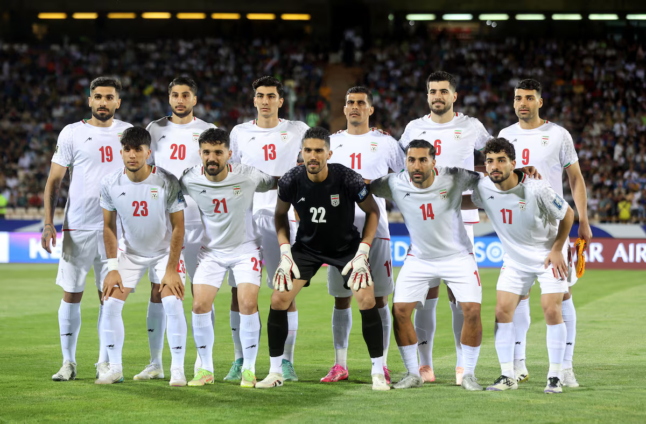
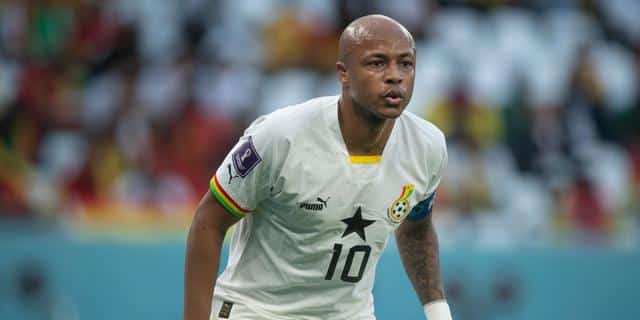
    “We don’t wait for anyone. We will not allow women’s football to be treated this way. If Morocco is not going to host it, South Africa is standing ready because, at the end of the day, we will embarrass the President of CAF.”

    The tournament is currently scheduled to run from March 17 to April 3, with qualified nations already preparing for the competition.

    In an unrelated development, the Confederation of African Football (CAF) condemned the conduct of some players, match officials and even coaches during the 2025 AFCON final between Senegal and Morocco yesterday, Sunday, January 18.

    In a statement dated January 19 and shared by the African Football governing body, it slammed the conduct of the players and all other parties involved in the chaos as “unacceptable”, stating that

    It said, “The Confédération Africaine de Football (“CAF”) condemns the unacceptable behaviour of some players and officials during the TotalEnergies CAF Africa Cup of Nations Morocco 2025 Final between Morocco and Senegal in Rabat last night.”

    It went on to register its displeasure about what it also labelled as inappropriate behaviour towards referees.

    “CAF strongly condemns any inappropriate behaviour which occurs during matches, especially those targeting the refereeing team or match organisers”, parts of the statement noted, adding that it will review all footage from the game to exact the right penalties against offenders.

    Events that happened during the gameThe final of the 2025 Africa Cup of Nations (AFCON) was nothing short of controversial, chaotic and tense; however, the side widely alleged to be at the centre of it all was Senegal.

    This followed Morocco being awarded a penalty after their player, Ayoub El Kaabi, tumbled in the box following contact with Senegal defender Abdou Diallo. The referee initially waved play on, but later intervened after a VAR review.

    Following the check, Morocco were awarded a penalty, which clearly upset Senegal’s players, who believed the contact was minimal and that El Kaabi had gone down too easily.

    Consequently, they staged a walk-off in protest on the pitch, but the intervention of their captain, former Liverpool forward Sadio Mané, persuaded them to continue the game. Their return, many believe, wasn’t just as a result of Mane’s intervention but also due to Morocco missing the penalty.

    Diaz missed the resulting penalty as he bizarrely clipped a Panenka effort down the middle and straight at Edouard Mendy.

    In an interesting turn of events, Pape Gueye notched a goal in stoppage time, giving Senegal a lead in the 94th-minute securing the team their second AFCON title.

    Sadio explains the motive behind his actionFollowing their victory over Morocco, Mane, during an interview with the media, explained that even though the referee’s decision might have been wrong, the most important thing is to respect the game and keep playing, hence his decision to call his teammates back o the pitch to play as football is widely love globally and it will have been unfair to the people watching to see the game called off over one disputed call.

    He said, “When they decided to go out and not play, I stayed and asked some people, ‘What do you think about this? Is it a good idea or not?’ Then I decided to go and bring everyone back to the pitch. I think it is the best thing to do.

    “Because this is just football, I think the referee sometimes can make mistakes. People around the world are watching. It could be a penalty or not, but that is not the most important thing. What matters is respecting the game. It is not fair to stop a match like this.”

  • ORAL: Assets worth GH¢1.5bn frozen so far – Kwakye Fosu

    ORAL: Assets worth GH¢1.5bn frozen so far – Kwakye Fosu

    The government has announced a new development in its anti-corruption fight, with assets worth about GH¢1.5 billion frozen as part of investigations under Operation Recover All Loot (ORAL).

    This was revealed by the Minister for Government Communications, Felix Kwakye Ofosu, on Tuesday, March 3, during the debate on the State of the Nation Address (SONA) in Parliament.

    He detailed that the government has discovered money and properties believed to have been acquired illegally; however, the persons involved currently cannot be thrown in jail without being prosecuted, and found guilty first.

    He explained that although the government has found and secured money and property believed to have been obtained illegally, they cannot permanently take the assets back yet. The people involved must first be taken to court and found guilty before the funds can be fully recovered.

    Mr Kwakye Ofosu made the remarks while contributing to the debate on the State of the Nation Address delivered by John Dramani Mahama on Tuesday, March 3. He dismissed claims that the Economic and Organised Crime Office (EOCO) had recovered only GH¢600 million under the ORAL initiative.

    According to him, the GH¢600 million figure being cited relates to recoveries made by EOCO through its routine anti-corruption and financial crime operations, and not funds specifically retrieved under ORAL.

    President Mahama officially launched ORAL on December 18, 2024, barely two-weeks after he won the 2024 elections. Ghanaians have received the Operation Recover All Loot (ORAL) initiative with a mix of optimism and scepticism. While many welcomed it as a bold anti‑corruption drive to reclaim billions in stolen assets, others criticised it as politicised, slow, and more of a performance than a genuine legal process. However, Dr Ayine clarified that his outfit, in collaboration with the Economic and Organised Crime Office (EOCO) and the National Intelligence Bureau (NIB) are working both locally and internationally to track and recover misappropriated state funds.

    He noted that, very soon, their coordinated efforts would produce tangible results and the anticipated results Ghanaians want to see, and in turn draw some money into state coffers, reinforcing the government’s commitment to accountability and the protection of public resources.

    “Extensive work is currently underway, both locally and internationally, to track and recover misappropriated state funds. On the local front, my office is working closely with the Economic and Organised Crime Office (EOCO) and the National Intelligence Bureau (NIB). In addition, there is a special clandestine investigations team that reports directly to me. I am confident that the coordinated efforts of local agencies and foreign partners will soon translate into tangible financial recoveries for the state, reinforcing our commitment to accountability and the protection of public resources.”

    Meanwhile, President John Dramani Mahama in June last year, stated that in due course, 33 former government appointees have been implicated in corruption-related cases in the Operation Recover All Loot (ORAL) Team report will face prosecution.

    President Mahama, while addressing the African Union Advisory Board Against Corruption at the Jubilee House on Tuesday, 3 June, noted that the Attorney General (A-G), Dr Dominic Ayine, is preparing the cases for judicial proceedings.

    “We set up the ORAL Committee, and they have identified 33 cases, which were handed over to the Attorney General. We have created special investigative teams to investigate each of them,” he said.

    “Some of them have found a lot of evidence of the procurement of properties with illicit wealth. Many of them are just at the point of beginning prosecution. Some have also started the prosecution, and others are being lined up.”

    Operation Recover All Loot (ORAL)is an initiative set up by the president to gather information on corruption to the appropriate government institutions for further investigation.

    The committee is chaired by Samuel Okudzeto Ablakwa, who also serves as the Member of Parliament (MP) for North Tongu.

    The other members include former Auditor-General Daniel Domelevo, retired Police Commissioner Nathaniel Kofi Boakye, legal practitioner Martin Kpebu, and investigative journalist Raymond Archer — all renowned for their integrity and strong stance against corruption.Currently, the hundreds of issues presented by the ORAL team to President John Mahama are being investigated by the Attorney-General and Minister for Justice, Dr. Dominic Ayine.

    Additionally, its work has increased public awareness about the importance of protecting state resources.

    The committee’s report has revealed that approximately $21.19 billion in p

  • “I am glad to report that so far no Ghanaian has been killed or injured” in Middle East tensions – Ablakwa

    “I am glad to report that so far no Ghanaian has been killed or injured” in Middle East tensions – Ablakwa

    The Middle East is in turmoil following the Israeli-US attack on Iran, sparking retaliatory attacks by neighbouring countries such as Lebanon and Yemen, as well as in Gaza.

    Amid these attacks, civilians are suffering the most. So far, about 50 deaths have been reported in Lebanon, with injuries and additional fatalities recorded in other countries.

    Governments worldwide, including that of Ghana, continue to intensify efforts to ensure the safety of their citizens. 

    In an update on the current state of Ghanaians in the Middle East, the Minister for Foreign Affairs, Samuel Okudzeto Ablakwa, has stated that no Ghanaian has been killed or injured amid the escalating tensions in the Gulf countries.

    He stated on Tuesday, March 3, in a formal statement, that the government had taken proactive steps to assess the situation and strengthen consular protection for citizens.

    “I convened a virtual meeting with our Ambassadors and Consuls General in the Middle East to assess the latest developments and explore additional consular interventions towards the protection of Ghanaians,” he stated.

    The meeting was attended by Heads of Mission in Israel, Saudi Arabia, Qatar, Kuwait, the United Arab Emirates, Iran, and Turkey.

    “I am glad to report that so far no Ghanaian has been killed or injured,” he added.

    Mr Ablakwa disclosed that a comprehensive database of Ghanaians in the affected countries had been compiled, including residents, short-term visitors, and those in transit.

    “We have put together a reliable database of all Ghanaians in these countries, including those who were on short visits and those who were transiting,” he noted.

    According to the Minister, all diplomatic missions have been instructed to identify citizens who may wish to be evacuated for urgent consideration by the government.

    He further revealed that Ghana’s missions are currently assisting several nationals to exit through strategic border crossings.

    “All missions have been tasked to identify Ghanaians within their jurisdictions who wish to be evacuated for the urgent consideration of the government,” he said, adding that “our diplomatic missions are currently assisting a considerable number of Ghanaians escape across certain strategic border crossings.”

    The North Tongu MP emphasised the government’s commitment to ensuring the safety of its citizens.

    “The safety and welfare of all Ghanaians remains our utmost priority,” he emphasised.

    The government has indicated that it will continue to monitor developments closely as tensions persist in the region.

    Meanwhile, Ghana has closed its embassy in Tehran indefinitely and evacuated all diplomatic staff in response to escalating tensions involving the United States, Israel, and Iran.

    Announcing the decision on social media on Monday, March 2, Foreign Affairs Minister Samuel Okudzeto Ablakwa confirmed that all Ghanaian embassy staff have been safely evacuated from Iran.

    “The safety, welfare, and protection of Ghanaians remains our utmost priority in these tempestuous times,” he stated. On Monday, March 2, the Ghanaian Embassy in Doha directed all Ghanaian nationals residing in Qatar to register with the mission as part of emergency preparedness measures amid escalating tensions in the Middle East.

    The Embassy in a statement explained that this forms part of ongoing efforts to ensure the safety of Ghanaian nationals. The Embassy of Ghana Doha, State of Qatar on Sunday, March 1, advised Ghanaians living in the area to exercise caution and remain vigilant during this period.

    A press statement from the Embassy of Ghana Doha, State of Qatar read, “Due to missle attack and its impact in Doha, please take shelter until further notice, obtain information from official sources. We urge everyone to stay from military states, remain indoors, avoid crowded areas for any exposure to danger and keep essentials supplies like medication and food”.

    “The Embassy of the Republic of Ghana in Doha hereby urges all Ghanaian nationals residing in the State of Qatar who have not registered to immediately do so, as part of ongoing emergency preparedness measures.

    “In view of the heightened tensions and unrest within the region, this registration will enable the Embassy to effectively communicate with, assist, and, if necessary, coordinate evacuation arrangements for Ghanaian citizens,” it noted.

     Foreign Affairs Ministry has advised prospective pilgrims to temporarily suspend their travel to Saudi Arabia for their Umrah due to the widespread instability and disrupted air travel restrictions in the Gulf States.

    The Ministry said, “The Ministry of Foreign Affairs wishes to advise prospective Umrah pilgrims in Ghana that travel arrangements for Umrah may be affected by the rapidly evolving security situation in parts of the Middle East.”

    It continued that “The Ministry therefore advises all prospective Umrah pilgrims who are currently in Ghana and yet to commence their journey to temporarily hold on with travel plans until the situation stabilises. The safety and well-being of Ghanaian nationals remain the Government’s utmost priority.”

    To ensure the safety of all Ghanaians who are currently in the Gulf, stay calm and keep in touch with the Consulate there.

    “Ghanaians who are already in the Kingdom of Saudi Arabia for Umrah are advised to remain calm, comply strictly with directives issued by local authorities, and maintain regular contact with their travel agents, the Embassy in Riyadh and the Consulate General in Jeddah.

    Prospective pilgrims and Ghanaian nationals requiring further information or emergency consular assistance may contact the Embassy in Saudi Arabia or Ghana,” the statement added.

  • Ayawaso East: This win is a fulfilment of my mother’s prophecy – Baba Jamal

    Ayawaso East: This win is a fulfilment of my mother’s prophecy – Baba Jamal

    Mimi, the mother of the newly elected Ayawaso East Member of Parliament, Baba Jamal Mohammed Ahmed, has taken the spotlight following her son’s victory in the just-ended by-elections. 

    The former High Commissioner to Nigeria won against five other contenders in the race for the Ayawaso East election yesterday, Monday, March 3, following the death of MP Naser Toure Mahama.

    Speaking during a post-election victory, the former Akwatia MP revealed that his 93-year-old mother had promised to ensure his return to Parliament, a promise that has now been fulfilled.

    “I want to thank the Almighty Allah for giving us this victory. Let me state that I dedicate this victory to my 93-year-old mother, Mimi, for promising to support me and ensuring that one day I would go back to Parliament,” he declared.

    He noted that for years, she carried the conviction that her son would return to the House. Tuesday’s result, he said, was more than a political comeback; it was the fulfilment of a promise.

    “Today, her vision and wish have come true. And I thank Allah for her life, and I dedicate this victory to her.”

    Although Madam Mimi stayed out of the spotlight during her son’s campaign ahead of the election, he insists that her resilience shaped his campaign. He then went on to remind his supporters that the win belonged to the constituency as much as to his family.

    “I want to state that this victory is not for me, Baba Jamal, alone; it’s for the good people of Ayawaso East. I want to thank all of them for having confidence in me and electing me as their parliamentary candidate-elect,” he added.

    More than 49,000 registered voters participated in the by-election conducted at 113 polling stations. Baba Jamal polled 10,884 votes to beat the New Patriotic Party’s (NPP) Yussif Baba Ali, who secured 4,009 votes.

    The three other contesters: the Liberal Party of Ghana’s (LPG) candidate, Ibrahim Iddrisu, polled 43 votes, Independent candidate Alhaji Mohammed Umaru Sanda secured 1,885 and another Independent candidate, David Kannor.

    Ahead of the by-election, a poll by Global InfoAnalytics predicted victory for Baba Jamal. The survey projected that the NDC candidate would secure about 75 per cent of the votes, ahead of his main contender, the NPP’s Baba Ali.

    The by-election was marked by low voter turnout. The NDC now has 189 seats in Parliament.

    “At the end of the voting exercise for the parliamentary by-election for the Ayawaso East constituency

    Five candidates contested in the polls, the first one is Baba Jamal Mohammed, and he polled 10,884 votes; the second candidate on the ballot, Ibrahim Iddrisu Mohammed, also polled 43 votes; Yusuf Ali Baba polled 4,009 votes.

    “The fourth candidate, Mohammed Umah Sunda, also polled 1,885 votes. The fifth candidate, Tanoh, also an independent candidate, polled 104 votes.

    “In all, we had 16,928 valid votes, 120 votes were rejected and in that case total votes cast amount to 17048. Looking at the just announced results, I, Samuel Anim Ofori, the retaining officer of the Ayawaso East constituency, hereby announce to you your new MP elect Baba Jamal Mohammed,” the retaining officer stated.

    For months, the constituency had been without representation following the death of its long-serving legislator, Alhaji Mahama Naser Toure. He was reported dead on January 4 after a short illness at the Korle Bu Teaching Hospital. In accordance with Islamic customs, he was buried within 24 hours of his passing.

    Naser Toure Mahama was widely regarded as a grassroots politician whose parliamentary work focused on urban renewal in Nima and youth empowerment within Zongo communities.

    Baba Ali was projected to trail with 21%, independent candidate Umaru Sanda Muhammed expected to poll 3% of the vote, with the other remaining candidates, Ibrahim Iddrisu and David, to garner less than 1%.


    Independent aspirant Umaru Sanda Muhammed, who recently severed ties with the NDC, was projected to secure about 3 per cent of the vote.

    The by-election attracted heightened attention in recent days amid internal developments within the NDC, including allegations of vote buying during its parliamentary primary.

    On February 7, Baba Jamal won the Ayawaso East Constituency primary following the party’s internal primary held.

    After the close of polls, provisional results showed that Baba Jamal polled 431 votes out of the total votes cast, followed by the widow of the late Ayawaso MP, Naser Toure Hajia Amina Adam who secured 399 votes.

    Mr Mohammed Ramne, the Ayawaso East NDC Constituency Chairman, placed third with 88 votes. Dr Yakubu Azindow obtained 45 votes, while Mr Najib Mohammed Sani recorded one vote.

    The closely contested primary attracted more than 1,100 accredited delegates from across the constituency, reflecting the high stakes involved in selecting a candidate for the by-election in a seat widely regarded as a stronghold of the governing NDC.

    Five aspirants contested the race: Hajia Amina Adam, Mr Baba Jamal, Dr Yakubu Azindow, who had previously contested the late MP in the 2023 primary, Mr. Mohammed Ramne, and Mr Mohammed Sani.
    Although the race was initially considered open, it later narrowed into a tight contest among Mr Jamal, Hajia Amina Adam and Dr Azindow.

    Even though the election was peaceful on Saturday, reports of vote buying emerged on the eve of the election and on election day, involving some candidates, including Baba Jamal, who at the time was Ghana’s High Commissioner to Nigeria and allegedly offered television sets and other items to delegates.

    Videos circulating on social media showed some delegates leaving polling centres carrying television sets and other items. Reacting to the vote-buying allegations, the NDC, in a statement signed by its Secretary, Fiifi Kwetey, announced that it would investigate the allegations.

    It noted that a three-member committee had been set up to probe the matter.
    In a statement issued on the same day, the NDC said its national executives had taken note of what it described as widespread incidents of inducement and vote buying allegedly perpetrated by some aspirants.

    The party condemned the acts, describing them as an affront to its values and principles, and announced that it had launched investigations into the matter.

  • Banks recorded GhS1.64bn as loan losses in 2025 – BoG

    Banks recorded GhS1.64bn as loan losses in 2025 – BoG

    Banks in Ghana are still grappling with customers not repaying loans on time, or in some cases defaulting altogether, with a recent report from the Bank of Ghana (BoG) affirming that the challenge persists.

    This was deduced after the central bank published its Domestic Money Banks (DMBs) Income Statement, i.e., the annual financial report that the BoG publishes to show how Ghana’s commercial banks performed over the year.


    According to the statement, Banks in Ghana wrote off GH¢1.64 billion in 2025, marking a reduction of 57.1% in 2024.

    Given the history of the banking sector’s  Non-Performing Loans (NPL), the banks made a provision of GH¢3.82 billion as bad debt in 2024. The total provision was made for loan losses, depreciation & others.

    According to the January 2026 Banking Developments Report, the asset quality risks of banks remained elevated in December 2025, although the industry’s Non-Performing Loans (NPL) ratio declined to 18.9% in December 2025, from 21.8% in December 2024.

    Similarly, the NPL ratio adjusted for the fully provisioned loan loss category declined from 8.5% to 5.0% during the same comparative period.

    The NPL stock, however, increased by 0.8% to GH¢21.0 billion in December 2025 compared with a growth of 31.4% recorded in December 2024.

    A decomposition of the NPLs showed that the private sector emerged as the leading contributor, due to its dominant share of total credit. The statement also noted that the proportion of NPLs attributable to the private sector increased to 97.5% in December 2025, from 96.2% in December 2024, marking a 1.35

    % while that of the public sector declined to 2.5%, from 3.8% a year earlier.

    Amid the private sector’s poor performance in paying back its loans, the Bank of Ghana (BoG), in its statement, indicated that there has been an improvement in the percentage of bad loans in the banking industry year-on-year. 

    Accordingly, the NPL ratios in the construction and agriculture, forestry and fishing sectors increased from 29.8% and 38.0% to 30.7% and 46.3%, respectively. All other sectors recorded improvements in asset quality during the review period.

    Meanwhile, in August 2025, the Bank of Ghana (BoG) announced a ‘name and shame’ approach to promote responsible borrowing among wilful loan defaulters in a new directive. The financial institution announced this in a formal directive issued to all regulated financial institutions on August 14.

    In the new directive, the Bank of Ghana instructed all regulated financial institutions to publish the names of individuals who deliberately refuse to repay loans (wilful loan defaulters), despite having the means, twice a year in national newspapers and on their websites.

    “All banks and other regulated lenders will be required to publish the names of such defaulters twice a year, on June 30 and December 31, in at least two national newspapers and on their official websites, using a format provided by the BoG.”

    These measures form part of BoG’s latest regulatory actions to curb rising non-performing loans (NPLs) and reduce risks to the profitability, liquidity, and solvency of the banking sector. The central bank has already notified all regulated financial institutions of the directives and published explanatory notes for the public.

    Also, not only will the names of the defaulters be published, but they will also be barred from getting any loans from any accredited financial institution for up to about half a decade.

    “People in Ghana who deliberately refuse to repay loans… could soon be banned from borrowing from any licensed bank or financial institution for up to five years.” Borrowers who default on more than two occasions will face a five-year credit ban.

    “Borrowers listed as wilful defaulters on two or more occasions within ten years will face a mandatory five-year ban, or longer if the calculated prohibition period exceeds that duration,” it added. The restrictions also target directors of companies found to have engaged in fund diversion, misrepresentation, falsified accounts, or fraudulent transactions.

    “Directors of companies that are wilful defaulters, where RFIs have identified siphoning/diversion of funds, misrepresentation, falsification of accounts, and fraudulent transactions with the directors’ consent or connivance, shall also be deemed wilful defaulters and prohibited from accessing credit for the same period as the defaulting company,” it said.

    Who is a wilful defaulter

    According to the Bank of Ghana, “A wilful defaulter is defined as a borrower who deliberately breaks loan agreements… or obtains it through fake documents or false collateral.”

    According to the new directive, the BoG outlined the conditions under which an action will be classified as wilful default. BoG explained that a wilful default would be deemed to have occurred if any of the following events were noted:

    i. The borrower has defaulted on their repayment obligations to the RFI even when they have the capacity to honour the said obligation;

    ii. The borrower has defaulted on their repayment obligations to the RFI and has siphoned or diverted the funds for other purposes;

    iii. The borrower has defaulted on their repayment obligations to the RFI and has provided falsified or misrepresented collateral or any other documentation in support of the loan application, thereby securing the facility through fraudulent means;

    iv. The borrower has defaulted on their repayment obligations to two (2) or more RFIs concurrently. However, the borrower may be exempted as a wilful defaulter if evidence is provided to the RFI that their inability to meet repayment obligations is due to loss of employment, force majeure, or disability.

    v. The borrower has defaulted on their repayment obligations and has relocated without the RFI’s knowledge of the new address; or

    vi. The borrower has defaulted on their repayment obligations to the RFI and has, without the RFI’s knowledge or consent, disposed of or removed the movable or immovable assets pledged as security for the facility.

  • Full text: Govt’s statement on the revocation of appointments made after December 7, 2024

    Full text: Govt’s statement on the revocation of appointments made after December 7, 2024

    The government has revoked the appointments of about 541 persons who were taken in by the erstwhile few months before it bowed out of office after the 2024 elections.

    The revocation sparked wide concerns and backlash, particularly from the Minority in Parliament. Their leader, Alexander Afenyo-Markin, described the move as unfair and politically motivated.

    Addressing the media in response to the misconception about the mass appointment revocation, he explained why the government decided to revoke the appointments of 541 persons who were appointed by the then outgoing Akufo-Addo administration.

    In a statement read during the Government Accountability Series on March 3, Mr Ofosu said the decision was taken after a thorough investigation by a committee set up by the Chief of Staff, Julius Debrah.

    Please read full statement below:

    STATEMENT ON THE REVOCATION OF APPOINTMENTS AND RECRUITMENTS MADE AFTER 7TH DECEMBER, 2024.

    Good afternoon, friends from the media, and thank you very much for honouring our invitation to this week’s instalment of the Government Accountability Series.

    It would be recalled, that at the very first meeting of the Joint Transition Team formed after the 2024 elections, on 17th December, 2024, the side of the incoming Government raised concern about reports of rushed and unlawful recruitments being made into public institutions in the immediate aftermath of the elections and substantial payments to contractors and other creditors.

    The incoming Government’s side of the Transition Team left the meeting under the clear impression that an agreement had been reached by both sides for all ongoing recruitments, promotions, significant statutory payments, and related activities to be submitted for the joint Team’s review.

    Following the total disregard of this agreement by the outgoing Government, I authored a statement on behalf of the incoming Government stating our intent to revoke all such appointments and subjecting same to thorough investigations.

    Sponsored Content

    On 10th February 2025, the Chief of Staff issued a letter directing that all appointments and recruitments made unlawfully after 7th December, 2024 should be revoked.

    Shortly after, reports filtered in that some persons who were lawfully employed before 7th December, 2025 or whose recruitment processes had commenced but had not been concluded before the elections also had their appointments revoked.

    To ensure fairness and prevent innocent persons from suffering unduly, the Chief of Staff, established a Committee to investigate all affected recruitments, appointments and promotions, assess their compliance with established public sector processes, and make recommendations. The members of the committee were: Nana Oye Bampoe Addo – Deputy Chief of Staff and Chairperson of the Committee; Dr. Prince Edward Darah – Commissioner, Public Service Commission; Ms Roda Gavor – Director HR, Ministry of Labour, Jobs and Employment; Mr. Bernard Adjei – Representative of Organized Labour; Mr. C.W. Ayiku – Secretary, Director, Finance and Administration, Office of The President.

    The Terms of Reference (ToR) for the Committee were as follows:

    Determine whether the prescribed procedures for recruitment and promotion were followed in the recruitments and promotions made after 7th
    Establish the dates on which the process leading to these recruitments and promotions commenced and ended.
    Identify and categorise recruitments and promotions that complied with the stipulated procedures and those that did not.
    Provide case-by-case recommendations for the Government’s consideration.
    Based on the ToR, the Committee developed a checklist of indicators to assess whether the cases under investigation complied with the prescribed processes for recruitment, appointments and promotion. The committee set the passmark for procedural compliance at 80%. The Committee also requested relevant documentation and interviewed appropriate officers in the Organisations concerned. The documents and information requested by the Committee included:

    Evidence of declaration of vacancy
    Copy of advertisement
    Copy of approved scheme of service
    Copy of technical clearance
    Copy of financial clearance
    Copy of interview report
    Copy of appointment letter
    Copy of acceptance letter
    Copy of payslip (where necessary)
    The Committee’s work spanned 21st March, 2025 to 30th April 2025. It received 43 reports from institutions and individual petitioners. Of the 43 institutions, 36 appeared before the Committee as follows:

    Remove ads
    Institutions that appeared before the committee
    Office of the Administrator-General
    Ghana-India Kofi Annan Centre of Excellence in ICT
    Ghana Post Company Limited
    Ghana Revenue Authority
    Ghana Ports and Harbours Authority
    Ghana Shippers’ Authority
    National Health Insurance Authority
    Office of the Head of Local Government Service
    Ministry of Gender, Children and Social Protection
    Ministry of Energy and Green Transition
    Ministry of Food and Agriculture
    Office of the Attorney-General and Ministry of Justice
    Petroleum Commission
    Public Procurement Authority
    National Communications Authority
    Ghana Meteorological Agency
    Northern Electricity Distribution Company
    National Pensions Regulatory Authority
    Tema Oil Refinery
    Ministry of Health
    Ghana National Gas Company
    Volta River Authority
    Bui Power Authority
    Ghana TVET Service
    Ghana Investments Promotion Centre
    Electoral Commission
    Gaming Commission of Ghana
    Aircraft Accident and Incident Investigation and Prevention Bureau
    Ghana Maritime Authority
    PSC Tema Shipyard Limited
    Ghana Civil Aviation Authority
    Metro Mass Transit Limited
    SD Dombo University of Business and Integrated Development Studies
    Minerals Income Investment Fund
    Social Security an National Insurance Trust
    University of Energy and Natural Resources

    Some affected Individuals submitted petitions about the revocation of their appointments to the following organisations;
    Forest Plantation Development Fund
    National Investment Bank (NIB)
    National Development Planning Commission
    Ghana Exim Bnak
    GCB Bank
    Volta Lake Transport Company Limited
    Ghana Investment Fund for Electronic Communications
    Collective Petition from the NDC Disability Desk.

    At the end of its work, the Committee made the following recommendations findings.
    Of the thirty-six (36) institutions that appeared before the committee, twenty-eight (28) had commenced the recruitment process before the 7th December directive.
    A total of nineteen (19) institutions REVOKED appointments made in response to the 7th of December 2024 revocation directive.
    Seventeen (17) institutions did not revoke their appointments but sought guidance from the President’s Office.
    Sixteen of the cases reported by the institutions were mainly payroll-related.
    In total, two thousand and eighty (2,080) recruitments, appointments and promotions were reported by the institutions when they appeared before the Committee.
    Of these 2,080 recruitments, appointments and promotions, 879 were revoked by the institutions themselves, while 1,201 appointments were not revoked.
    After the hearing, the Committee recommended that 1,539 of the recruitments, appointments and promotions be upheld, complied with the prescribed recruitment and promotion procedures and received appointments letters before 7th December, 2024. This implies that they achieved a pass mark of 80% or above.

    The Committee recommended that the recruitments, appointments and promotions of 541 persons be revoked because the recruitment processes ended after 7th December, 2024 and failed to meet the pass mark.

    Advertisement
    Also, the number of recruitments, appointments and promotions recommended for revocation by the committee (541) was lower than the number that the institutions themselves revoked (879). This is because the committee paid special attention to vulnerable groups, including Persons with Disabilities, particularly within the Ghana Education Service.

    Obviously, the recruitments, appointments and promotions revoked were made in clear breach of procedures and directives issued during the transition period and did not comply with the Regulatory Framework and Guidelines for Recruitments, Appointments and Promotions in the Public Service.

    Hence, the decision to revoke these appointments was not a witch-hunt and had no political motive beyond a desire to uphold due process and ensure compliance with the rules and proper procedures governing such recruitments and appointment. It was done without malice or ill-feeling towards anyone.

    It was a necessary step to uphold the rule of law and ensure accountability. The previous government was fully aware that basic requirements were not met in those cases and still went ahead to sanctions same. They completely disregarded the incoming administration when we requested to be consulted on same leaving us no choice but to carry out this review.

  • 2026 World Cup: Sports Minister hints at Andre Ayew’s possible return to Black Stars

    2026 World Cup: Sports Minister hints at Andre Ayew’s possible return to Black Stars

    The Minister of Sports and Recreation, Kofi Adams, has sparked speculation about the potential return of former Black Stars captain Andre Dede Ayew, who has been sidelined since the AFCON 2023, which was played in the Ivory Coast.

    Speaking during an appearance on Adom FM, the Buem Constituency Member of Parliament (MP) indicated that he won’t be surprised to see Andre Ayew included in Ghana’s squad for the 2026 FIFA World Cup.

    “Dede Ayew, too, is picking up, and as long as he has not retired, I won’t be surprised if he makes it into the [2026 World Cup] squad,” Adams said on Adom FM.

    Ayew has started the last three games for NAC Breda in the Eredivisie as he chases a first goal since joining the Dutch club.

    Ayew on retirement speculations

    Meanwhile, the former Black Stars captain Andre Ayew says speculation about his imminent retirement is unfounded, insisting he feels fit, healthy, and not ready to hang up his boots.

    Ayew is currently playing for Dutch Eredivisie outfit NAC Breda after parting ways with French side Le Havre AC at the end of last season. His deal with his current side is a short one, set to last till the end of this campaign.

    Ayew’s last game for Ghana was with the Black Stars at the 2023 Africa Cup of Nations in Côte d’Ivoire, and since then, he hasn’t received a call-up.

    Speaking during an interview with ESPN, the midfielder explained that he focuses on maintaining his fitness and improving each day, both on and off the pitch.

    “I never thought about it (retirement) because my body is good, I feel good. I live my life day to day, so I prepare myself every time to have a better tomorrow on the field and off the field,” he said.

    “I don’t think about that. When the moment comes, your body will tell you,” he added.

    Since joining NAC Breda, Ayew has made six league appearances, including one start, as he works toward regaining full match fitness.

    Ayew’s stance on retirement is similar to Al-Nassr’s Cristiano Ronaldo, who in 2025 noted that he could play for another 10 years with his ‘kind of body’.

    This was after he shared his excitement after learning about his physiological age.

    The Whoop platform, a wearable fitness and health tracking platform designed to help users monitor and improve their performance, recovery, and overall well-being, analysed Ronaldo and discovered that his physiological age is 28.9 years old.

    In reaction to the results from Whoop, the Al-Nassr forward expressed satisfaction, suggesting that he could play for the next decade.

    “I can’t believe it is so good. This means I will play for another ten years. When you’re young, you think you will live forever, that you will always be strong, that you’re unbreakable,” he told Whoop.

    He, however, acknowledged the effect ageing has on the body, particularly as a footballer.

    In order to keep his form and shape for optimal performance on the pitch, he shared how he “prioritizes recovery and sleep much more than before.

    .”…at 25, it is not the same as when you’re 30, especially in football. I still feel good.”

    Ronaldo stated that his ability to remain strong physically at 40 years old is a remarkable feat, and he hopes to continue in the same form to play football for a longer period than expected.

    The former Real Madrid legend is taunted for his fitness and form even at age 40 as Ronaldo continues to be one of the most prolific goal scorers for Al Nassr in the Saudi Pro League, having scored 24 goals in 29 appearances.