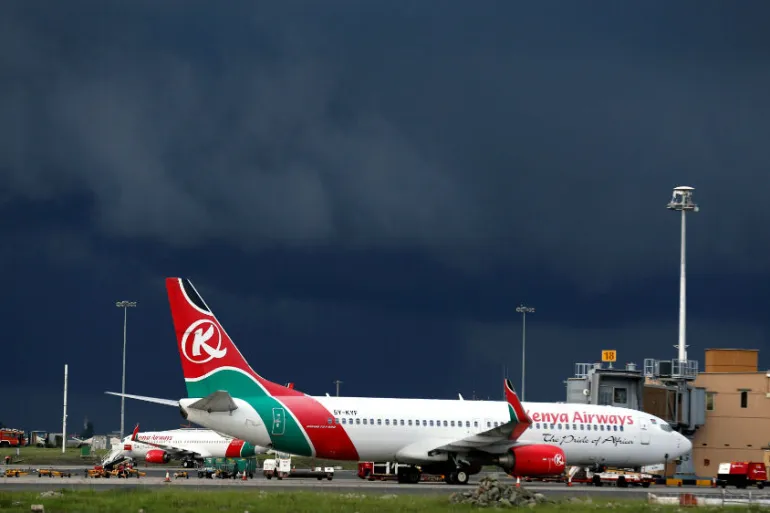
Reports indicate that, the man was intoxicated at the time of the alleged incident on the trip from New York to New Delhi and may spend up to three years in prison if found guilty of insulting the woman’s modesty.
After reportedly urinating on an elderly woman in the business class section of a plane, a “drunk” man was detained.
According to Indian authorities, the 34-year-old man was arrested in Bengaluru, in the country’s south, after the incident on the Air India aircraft from New York to New Delhi.
The man, who faces an allegation of outraging the modesty of the woman, was transported to the Indian capital on Saturday, where he was put in custody for 14 days while police investigate.
If convicted the man, who was fired from his job at a high-profile banking firm following the allegations, faces up to three years in prison.
The Times of India newspaper reported the suspect saying that he was drunk at the time of the alleged incident and that he could not believe what he had done.
One passenger on the flight told the newspaper that he saw the man consuming excessivealcohol at the time of the alleged incident and that he was talking incoherently.
Meanwhile, the man’s father, talking to the Hindustan Times, described the allegations as a “totally false case”.
He also claimed his son “had not slept for 30-35 hours” and fell asleep after having a drink.
The alleged incident is said to have taken place in November last year, though Air India only filed a police complaint this week.
The company said the crew did not summon police upon landing in New Delhi as they believed that the two people involved had sorted out the issue between them.
Meanwhile, Air India said it had issued written notices and grounded one pilot and four cabin crew in relation to the incident.
The company had faced criticism on social media over its decision to prevent the man from flying with them for 30 days – a ban which activists said was not long enough.
The airline’s CEO and managing director, Campbell Wilson, said in a statement: “Air India acknowledges that it could have handled these matters better, both in the air and on the ground and is committed to taking action.”
Anna Netrebko, an opera soprano from Vienna, is among the 118 people on the list.
According to a proclamation released by the president’s office, Ukraine has added dozens of Russian artists and other public personalities to a list of those subject to sanctions.
In light of the ongoing conflict in Ukraine, the announcement on Saturday features prominent figures from the opera, film, and pop music industries.
One of the most well-known names is that of Vienna-based opera singer Anna Netrebko, who has come under fire for being too close to the Kremlin and too uncritical of Russian President Vladimir Putin.
In February last year, Netrebko said she was “opposed” to the war.
“I am Russian and I love my country but I have many friends in Ukraine and the pain and suffering right now breaks my heart.”
She added that forcing artists and other public personalities to give their “political opinions in public and to denounce their homeland” was not right.
The sanctions list also includes Russian pop star Philipp Kirkorov and actor and director Nikita Mikhalkov, winner of awards from film festivals including Cannes and Venice.
Netrebko and 118 others, including three Ukrainians, will have any assets in Ukraine frozen. The sanctions will be in effect for 10 years, the TASS news agency reported.
Ukrainian media also reported that President Volodymyr Zelenskyy revoked the citizenship of 13 clergy members of the Ukrainian Orthodox Church at the end of December. It was not known who the individuals are.
Traditionally, the Ukrainian Orthodox Church has had close ties with Russia and only broke away completely from Moscow after the Russian invasion started last February.
The deaths of two males were found at the airport in Bogota, and authorities said they are looking into their nationalities and place of origin.
According to a statement released by Avianca on Saturday, “upon its arrival at the El Dorado airport in Bogota, staff from the airline discovered the bodies of two passengers who flew irregularly [stowaways] in the undercarriage of the plane.”
Avianca offered condolences to the two victims’ families and stated that, while it inspects aircraft before every flight, authorities are in charge of ensuring the security of airports and their restricted areas.
“The technical investigation body of the attorney general’s office is carrying out urgent actions to identify the nationality and origin of the bodies aged between 15 and 20, Afro-descendent, which were found inside the airplane,” the attorney general’s office said in a statement.
Not identified
Although no identification documents were found with the bodies, one was carrying currency from the Dominican Republic and a suitcase found with the men had paperwork from that country, suggesting the men may have been in that country.
Those discoveries “infer that the men could have been on the plane since January 3”, when it was last in the Dominican Republic, the office said.
The plane was last given regular maintenance on December 27, the attorney general’s office added, and has since travelled to Bogota, Guarulhos, near Sao Paulo, Brazil, and Santiago.
Thebodies had been frozen and were partially thawed, the statement added, and one had burns.
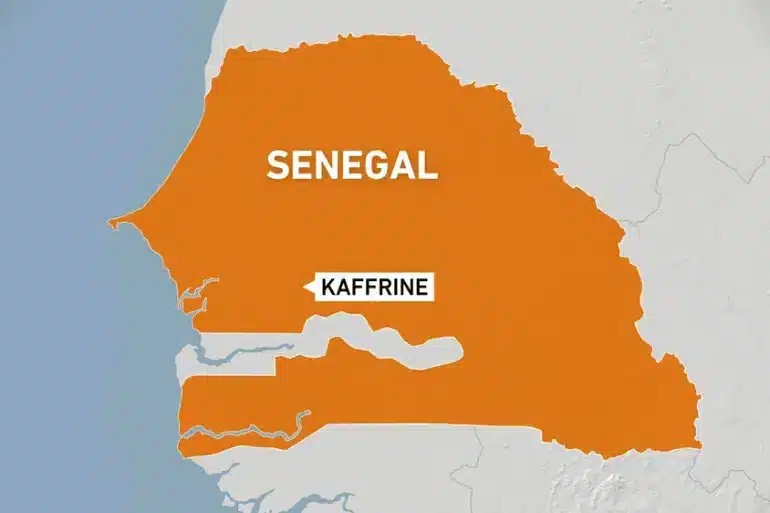
The accident took place near Kaffrine in central Senegal, emergency services said.
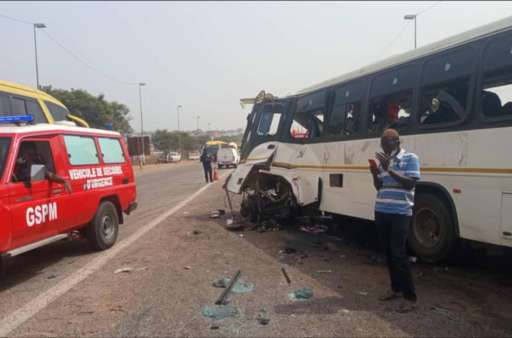
Two buses crashed in Kaffrine in central Senegal, resulting in at least 40 fatalities and 87 injuries.
At 3:15 a.m. on Sunday (03:15 GMT), the accident happened on the Number 1 national highway.
The “grave” disaster claimed the lives of 40 individuals, according to President Macky Sall, who also declared a three-day national mourning period.
The bus, with a 60-seat capacity, was heading to Rosso near the border with Mauritania, the fire brigade said, adding that the number of people onboard was unknown.
“It was a serious accident,” Colonel Cheikh Fall, head of operations at the National Fire Brigade, told AFP news agency, adding that 87 people were injured in the incident.
Victims were taken to a hospital and medical centre in Kaffrine, he said. The wreckage and demolished buses have since been cleared and normal traffic has resumed, said Fall.
Public prosecutor, Cheikh Dieng, said early investigations suggested that the accident happened when “a bus assigned to the public transport of passengers, following the bursting of a tyre, left its trajectory before colliding head-on with another bus coming in the opposite direction”.
Suite au grave accident de ce jour à Gniby ayant causé 40 morts, j’ai décidé d’un deuil national de 3 jours à compter du 9 janvier. Un conseil interministériel se tiendra à la même date pour la prise de mesures fermes sur la sécurité routière et le transport public des voyageurs.
“I am deeply saddened by the tragic road accident,” President Sall said on Twitter. “I extend my heartfelt condolences to the families of the victims and wish a speedy recovery to the injured,” he added.
This is one of the heaviest death tolls from a single incident in recent years in a country where road accidents are common largely because of a lack of driver discipline, poor roads and decrepit vehicles, according to experts.
In October 2020, at least 16 people were killed and 15 more injured when a bus collided with a refrigerated lorry in western Senegal. Local media said at the time that the lorry was hauling fish toDakar.
In the midst of various punitive measures by the new right-wing government, theIsraeli entrance permits for the Palestinian foreign minister and three Fatah officials have been revoked.
As part of a series of sanctions against the Palestinians that Israel’s new hardline government declared days ago, the Palestinian foreign minister claims that Israel has withdrawn his travel authorization.
According to a spokesperson for the Israeli defense ministry, the action is part of the implementation of a cabinet decision made on Friday to punish the Palestinians for pressuring the world body with the highest authority on justice to express its position on the Israeli occupation.
On Saturday, Israel said it had revoked entry permits for three senior officials fromPalestinian President Mahmoud Abbas’s Fatah party after they visited a Palestinian citizen of Israel recently released from prison.
Mahmud al-Alul, Azzam al-Ahmad and Rawhi Fattouh had visited Karim Younis in his home village of Ara in northern Israel following his release on Thursday after serving a 40-year sentence for killing an Israeli soldier.
“The three men took advantage of their status and entered Israel this morning [Saturday] to travel to the home of the terrorist Karim Younis,” the office of defence minister Yoav Galant said in a statement later on Saturday. Galant ordered their Israeli entry permits be revoked in response, it said.
The moves follow a decision on Friday by Israel’s security cabinet to withhold $39m in revenues from the Palestinian Authority and impose a moratorium on Palestinian construction projects in most of the Israeli-occupied West Bank.
The office of Prime Minister Benjamin Netanyahu said that decision was in response to the UN General Assembly’s recent vote to refer Israel’s occupation of the Palestinian territory to the International Court of Justice at the PA’s request.
Israel’s Security Cabinet also said it would further deduct revenue it typically transfers to the cash-strapped PA – a sum equal to the amount the authority paid last year to families of Palestinian prisoners and those killed in the conflict, including those implicated in attacks against Israelis.
The Palestinian leadership describes the payments as necessary social welfare, while Israel says the so-called Martyrs’ Fund incentivises violence. Israel’s withholding of the funds threatens to exacerbate the PA’s fiscal woes.
“Israeli blackmailing of our tax revenues will not stop us from continuing our political and diplomatic struggle,” said Palestinian Prime Minister Mohammad Shtayyeh. He added that the Israeli measures will deepen the Palestinian financial crisis and budget shortfall.
Netanyahu took office late last month at the head of a coalition with far-right and Jewish ultra-Orthodox parties that is regarded as the most right-wing in Israeli history.
Some of the satellite’s 2,450kg (5,400lb) mass is projected to survive re-entry but the majority will burn up in the atmosphere.
A defunct NASA satellite that has spent nearly 40 years in orbit is poised to hit the ground.
According to a statement released by NASA on Saturday, the likelihood of a risk to “anyone on Earth” from falling satellite debris is extremely low.
According to NASA, some components of the 2,450kg (5,400lb) satellite are anticipated to survive the re-entry but the most will burn up.
The United States space agency put the odds of injury from falling debris at about one-in-9,400. The science satellite is expected to come down on Sunday night at approximately 18:40 EST (23:40 GMT), give or take 17 hours, according to the US defence department.
The California-based Aerospace Corporation, however, has predicted Monday morning, US time, for the satellite’s re-entry, give or take 13 hours, along a track that passes over Africa, Asia the Middle East and the westernmost areas of North and South America.
The Earth Radiation Budget Satellite, known as ERBS, was launched in 1984 on board the space shuttle Challenger.
Although its expected working lifetime was two years, the satellite kept making ozone and other atmospheric measurements until its retirement in 2005. The satellite studied how Earth absorbed and radiated energy from the sun.
“ERBS far exceeded its expected two-year service life, operating until its retirement in 2005,” NASA said in a statement.
“Its observations helped researchers measure the effects of human activities on Earth’s radiation balance,” NASA said.
The satellite got a special send-off when it was launched from the Challenger 38 years ago.
The first woman in space, US astronaut Sally Ride, released the satellite into orbit using the shuttle’s robot arm.
That same mission also featured the first spacewalk by a US woman Kathryn Sullivan. It was the first time two female astronauts flew in space together.
The election is seen as a test of democracy because opposition candidates are allowed to run after a four-year absence.
Voters inBenin will go to the polls for a parliamentary election seen as a test of democracy, with opposition parties returning to the ballot after boycotting or being barred from the most recent presidential and legislative elections.
Benin’s image as a bastion of democracy and stability in West Africa has suffered under President Patrice Talon, who broke a pledge not to run for re-election and oversaw a crackdown on the opposition since taking office in 2016.
Seven parties are competing in the vote, including the Les Democrates party linked to Talon’s predecessor and rival Thomas Boni Yayi.
Boni Yayi’s supporters led protests in 2019 after opposition parties were blocked from the legislative vote for failing to meet strict new eligibility criteria.
“I will vote for this party [Les Democrates] for the rebalance of power,” civil society activist Isidore Odountan, 31, told Reuters news agency in the largest city Cotonou.
Preliminary results, which are expected on January 11, may also be an indicator of the strength of the various political forces jostling to succeed Talon. The next presidential election is due in 2026 when the next parliamentary vote will also be held.
Talon does not belong to any party but is supported by the two parties currently in power in parliament – the Bloc Republicain and Union Progressiste le Renouveau.
There is no immediate sign the vote will see protests like in 2019 or those that broke out in 2021 against Talon’s decision to seek re-election, said political analyst Expedit Ologou, head of Beninois think tank Civic Academy for Africa’s Future.
“The atmosphere seems calm, peaceful, friendly, fraternal in most areas of the country,” he told Reuters.
Under Talon, the political protests have been met with deadly police violence, while politicised prosecutions and other legal tactics have been used to stifle the opposition, US democracy watchdog Freedom House said in its 2022 report.
Talon has denied targeting political opponents or violating human rights.
With more parties on the ballot, turnout should return to normal levels of about 60 percent after slumping to just 27 percent in 2019, Ologou said.
Regional security may be higher up in voters’ concerns in this election as Benin, alongside neighbouring Togo and Ivory Coast, has seen increasing attacks from armed groups linked to al-Qaeda and ISIL (ISIS) as violence creeps south from the Sahel countries of Mali, Burkina Faso and Niger.
The insecurity and higher living costs linked to the war in Ukraine pose a threat to Benin’s recent economic gains, the International Monetary Fund warned last July.
Benin’s agriculture-dependent economy has rebounded since the coronavirus pandemic, growing more than 7 percent in 2021 and the first half of 2022. But the country of 12 million remains one of the poorest in the world with one-fifth of the population living on less than $1.90 per day, according to the World Bank.
Beyond the opposition’s drive to reclaim seats in parliament, Sunday’s election will affect the future of some of the other institutions in the small country, which sits between Nigeria and Togo.
The mandate of the Constitutional Court ends this year and, three years before the 2026 presidential ballot, the court’s composition is crucial as it oversees decisions on elections.
Four judges are appointed by lawmakers while the other three are chosen by the president.
Talon, a wealthy businessman, was elected in 2016 and re-elected in 2021.
The return of 46 soldiers signals resolution of a bitter diplomatic standoff between the Ivory Coast and Mali.
Forty-six Ivorian soldiers accused by Mali of being mercenaries have returned home after six months in captivity.
The troops arrived at Ivory Coast’s Abidjan airport late on Saturday, a day after receiving a pardon from Mali’s military ruler.
Their arrest in the Malian capital of Bamako in July of last year had triggered a bitter diplomatic fight between the neighbouring countries.
Mali accused them of being mercenaries, while Ivory Coast said they were flown in to provide routine backup security for the German contingent of a United Nations peacekeeping mission.
Emerging from their plane home on Saturday, each soldier held a small Ivorian flag and smiled as they shook hands with Ivorian President Alassane Ouattara, who was waiting to greet them at the airport.
“Now that this crisis is behind us, we can resume normal relations with the brother country of Mali,” Ouattara said once they were all on Ivorian soil.
A spokesperson for the soldiers thanked Ouattara, and “the Ivorian people for their support and active solidarity”.
“We are happy and relieved to return to the motherland,” he said.
Their release comes days after a court in Bamako sentenced them to 20 years in prison on charges of conspiring against the Malian government and seeking to undermine state security. Three women, who had been among the original 49 arrested at the airport and released earlier, received death sentences in absentia.
As part of a significant reorganization that would also hasten the development of new locations,McDonald‘s CEO has warned employees to expect job layoffs.
The company’s CEO, Chris Kempczinski, said that a “outdated and self-limiting” structure was harming the fast food juggernaut.
“We are trying to solve the same problems multiple times, aren’t always sharing ideas,” he said.
In a letter sent to employees globally, it said it would review corporate staffing levels by April.
“There will be difficult discussions and decisions ahead,” the memo said.
McDonald’s employs about 200,000 people in corporate roles and its owned restaurants, with 75% of them outside located outside of the US.
Its chief executive also announced that certain projects will be stopped altogether.
“This will help us move faster as an organization, while reducing our global costs and freeing up resources to invest in our growth,” he wrote in to the letter to staff, which was shared with investors.
The firm did not provide details about the scope of the job cuts being looked at, or say which projects might be affected.
But in an interview with the Wall Street Journal newspaper, Mr Kempczinski said he did not have a fixed goal for the number of cuts.
“Some jobs that are existing today are either going to get moved or those jobs may go away,” he said.
Pandemic boost
As part of the new strategy, Mr Kempczinski said the company wants to push to open more restaurants “to fully capture the increased demand we’ve driven over the past few years”.
Although dining generally suffered during the pandemic, McDonald’s has benefited from investments the firm made in online ordering and home deliveries.
In the first nine months of the year, McDonald’s saw sales rise 6%, helped by price increases to items like its cheeseburgers.
But its profits overseas have been hurt by the rise of the dollar and the exit fromUkraine.
During its most recent update to investors in October, the firm said rising prices were also posing challenges, noting that at many of its restaurants – which are operated by franchisees – there was “increasing uncertainty and unease about the economic environment”.
The Chicago-based company operates in more than 160 countries around the world.
It said earlier this week it would be pulling out of Kazakhstan, which borders Russia, pointing to supply chain issues sparked by the war in Ukraine.
McDonald’s pledged to leave Russia in May after setting up there 32 years ago – the latest change after several years of upheaval in the restaurant industry.
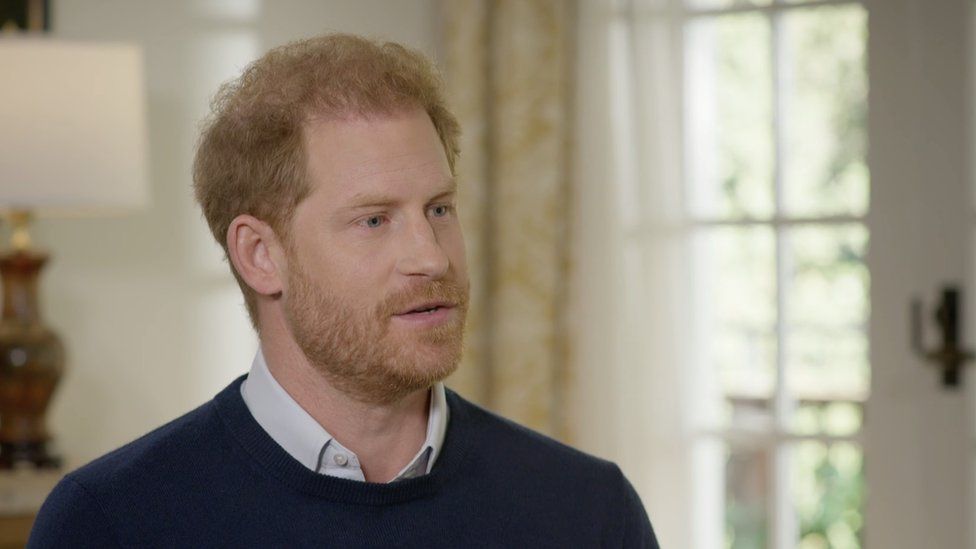
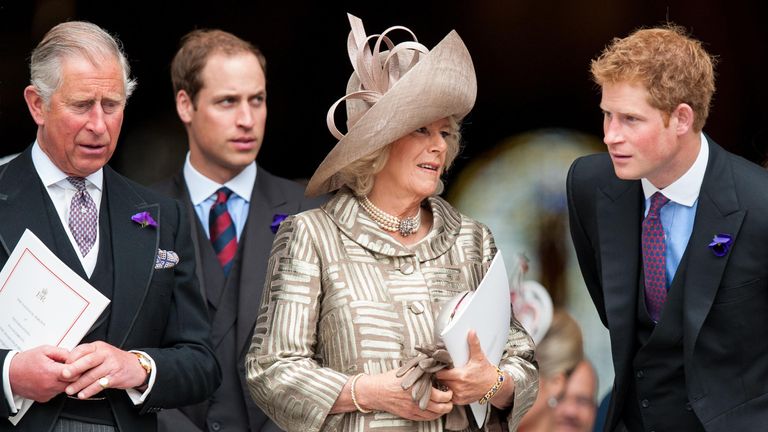
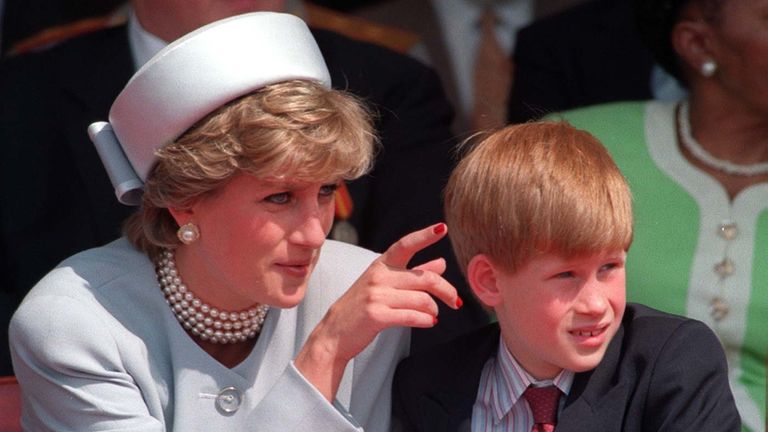
In response to the passing of his mother, Diana, the Princess of Wales, in 1997, Prince Harry has disclosed he cried just once.
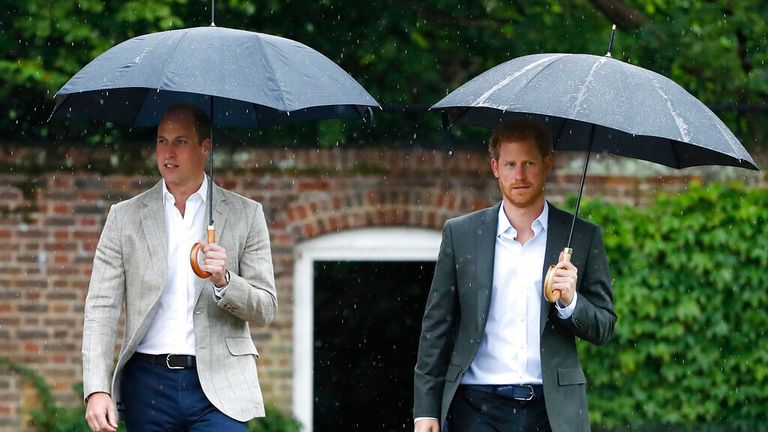
Prince Harry describes how he and Prince William were unable to express any emotion as they visited mourners in public in a new interview clip to promote the release of his autobiography Spare.
He admitted to crying during his mother’s funeral to Tom Bradby of ITV.
The Duke of Sussex said he had felt “some guilt” walking among crowds who left flowers outside Kensington Palace.
The book is not due to be published until 10 January, but extracts were leaked after some copies went on sale early in Spain. BBC News has obtained a copy and has been translating it.
In the ITV interview, due to be broadcast on Sunday evening, Prince Harry said “everyone knows where they were” when his mother died in a car crash in Paris in August 1997.He said he had looked back on the footage of him and his brother meeting mourners a few days later.
“I cried once, at the burial, and you know I go into detail [in Spare] about how strange it was and how actually there was some guilt that I felt, and I think William felt as well, by walking around the outside of Kensington Palace,” he said.
“There were 50,000 bouquets of flowers to our mother and there we were shaking people’s hands, smiling…
“And the wet hands that we were shaking, we couldn’t understand why their hands were wet, but it was all the tears that they were wiping away.”
Prince Harry adds: “Everyone thought and felt like they knew our mum, and the two closest people to her, the two most loved people by her, were unable to show any emotion in that moment.”
Spare includes details of Prince Harry’s walk behind his mother’s coffin at her funeral, where crowds reached out to him and how he felt unable to cry in public.
He also writes about getting a driver to take him through the road tunnel in Paris where his mother died, hoping for closure from a “decade of unrelenting pain”.
And he says his father did not hug him when he broke the news Princess Diana had died, sitting on his bed in Balmoral.
Image caption, A number of sensational claims from Prince Harry’s autobiography Spare have leaked out ahead of its publication
Prince Harry’s ITV interview will be the first of four broadcast appearances to be aired over the coming days to promote Spare. He also spoke to three US TV networks – Anderson Cooper for 60 Minutes on CBS News on Sunday night, Michael Strahan of Good Morning America on Monday and Stephen Colbert on the Late Show on CBS on Tuesday.
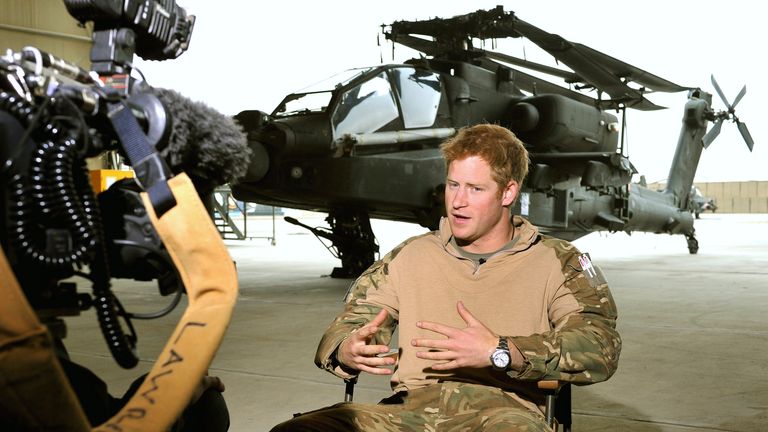
Among the other revelations in Spare are a claim by Prince Harry that he was physically attacked by his brother; information on how Harry lost his virginity; details about drug taking; and a claim he killed 25 Taliban fighters while serving in Afghanistan.
A number of high-profile military veterans have criticised his claim of killing Taliban fighters.
Ex-colonel Tim Collins, best known for delivering the Eve-of-Battle speech during the Iraq War in which he called on his officers to “show respect”, said Prince Harry had “badly let the side down” and “we don’t do notches on the rifle butt”.
Kensington Palace and Buckingham Palace have both said they will not comment on the contents of the book.
The Duke and Duchess of Sussex announced they would be stepping back from their senior royal duties in 2020, saying they intended to become financially independent.
In February last year, they spoke to Oprah Winfrey about their difficult relationship with other members of the royal family, and a Netflix documentary.
Economist, Dr. Patrick Asuming is of the view that businesses may delay in investing in the first quarter of the year to observe the conclusions of the International Monetary Fund (IMF) programme before increasing financial inflows.
This, he said could slow economic activities if government does not move quickly to boost investor confidence.
Speaking to Joy Business, Dr. Asuming stated that financial institutions may also react by tightening financing to the private sector.
He explained that the phenomenon should be expected as businesses always look at government projections to plan.
“I think overall, businesses will probably want to put on hold any major investment that requires financing from the banks because of the ongoing discussions about the Debt Exchange Pogramme”, he said.
He is of the view that the programme will change the strength and lending pattern of the banks.
Dr. Asuming stated that it will be normal to see banks tighten financing to the private sector until financial sector players assess the impact of the programme on their operations.
He cautioned that businesses that wish to overcome financial challenges must be moderate in their expansion drive to avert challenges.
“It is important for them to plan carefully and then maybe minimize their planned expansions and the business investment for the mean time”, he said.
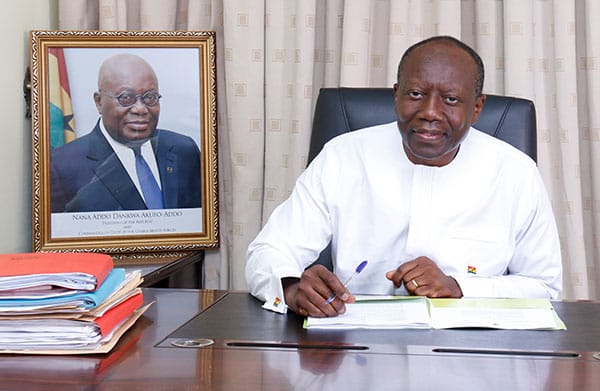
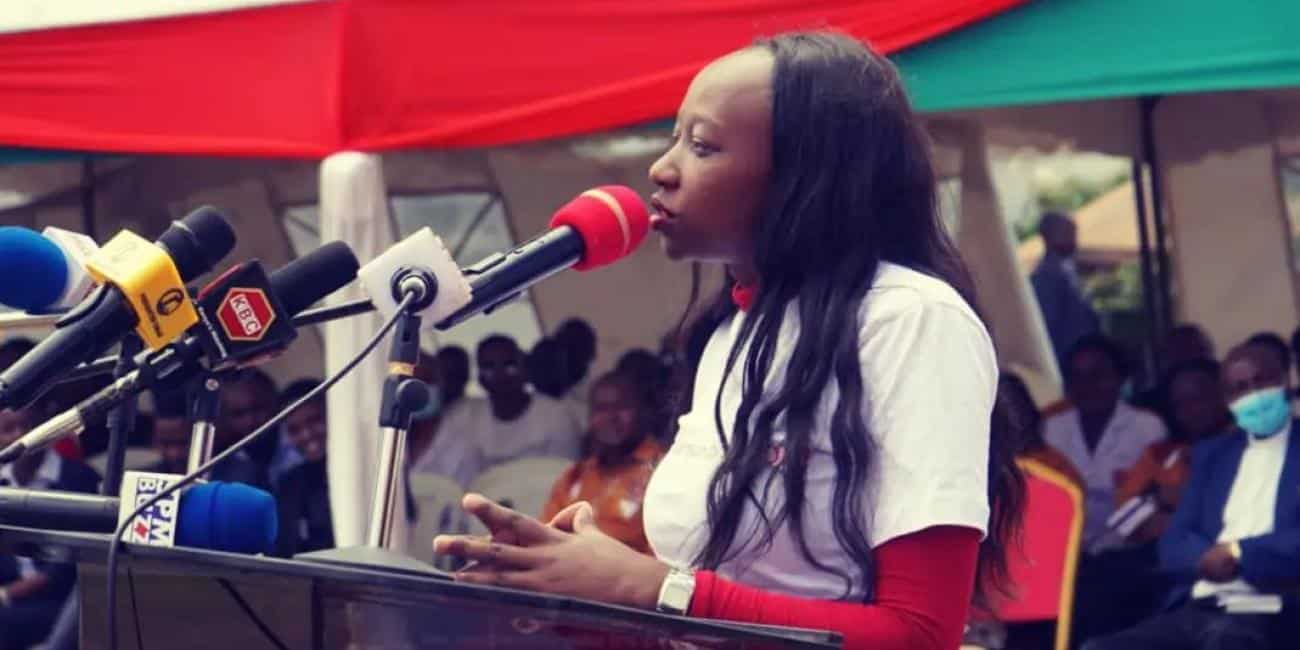
A Member of Parliament (MP) for the North Tongu Constituency has expressed concern about the appointment of the Finance Minister as caretaker.
Ken Ofori-Atta and his spouse are allegedly involved in some shady deals with the National Cathedral project, according to documents that the MP alleges to have in his possession.
“Fresh Cathedral documents in my possession reveal that Enterprise Insurance, a company Ken Ofori-Atta is intimately associated with & where his wife serves as a director was granted a sweetheart deal to insure the entire cathedral construction site,” he said.
This, the MP believes is a cause for worry.
Taking to his social media handle on Friday, Mr Ablakwa said with Ofori-Atta’s new appointment, only God can save the Trade Ministry.
“God save the Trade Ministry,” he said.
The North Tongu MP’s post comes hours after a statement from the office of the President announced that Mr Ofori-Atta will act as caretaker minister of the Ministry of Trade and Industry until a substantive replacement is made.
The Finance Minister’s caretaker appointment follows the resignation of the Trade Minister, Alan Kyerematen on Thursday.
The man popularly called ‘Alan Cash’ has long been rumoured to be nursing the ambition to contest the flagbearership slot of the New Patriotic Party (NPP) in the 2024 general election.
His resignation some have claimed, is to afford him time to pursue his presidential ambition.
Fifi Fiavi Kwetey, the general secretary of the National Democratic Congress (NDC), has refuted allegations that the party will hold its legislative and presidential primaries on a specific day.
Earlier reports noted that a schedule saying that the political party will hold its primaries on Saturday, May 6, 2023, was made available to the media.
Mr. Fiavi Kwetey, debunking the false date, said an official timetable for the election will be communicated at an appropriate time.
He urged the public to disregard the dates circulating in the media until official communication from his office has been projected.
“We will be coming out with a formal announcement in due time. Disregard everything until my office comes out with a formal announcement. So everything that you see, disregard until an official communication is out,” he said.
Meanwhile, some decisions reached at the NEC meeting included; preparation towards a ‘Thank You’ programme before the end of January and an agreement to hold both the presidential and parliamentary primaries concurrently.
Opening of nomination for Presidential and Parliamentary primaries according to NEC spans two days beginning on February 22nd to 24th, 2023.
On January 6, 2023, the NDC also disclosed amounts for filing and picking of nomination forms for aspirants.
Individuals interested in leading the party as presidential candidate ahead of the 2024 elections have been directed to pay a sum of Gh¢500,000.00 as filing fee and Gh¢30,000.00 as nomination fee.
Again, party members interested in assuming parliamentary duties have been directed to pay Gh¢5,000.00 as nomination fee and Gh¢40,000.00 as filing fee.
According to NEC, vetting of aspirants will be held between March 27 and March 29, 2023.
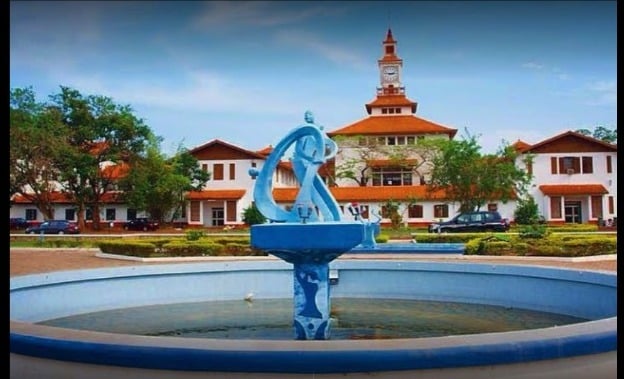
An Accra High Court has ordered the management of the University of Ghana to refrain from revoking the residential status of continuing students in both Commonwealth and Mensah Sarbah halls.
This comes after a group of disgruntled students filed an interlocutory injunction on January 6,2023.
The university’s administration issued an order intending to remove all continuing male students from the halls due to a violent altercation that had taken place between the two parties on August 15, 2022.
According to UG’s management, they chose to implement the directive as a disciplinary step after fights between certain students from the two halls resulted in the destruction of John Mensah Sarbah’s statue, which was located at the Mensah Sarbah hall.
Per the administration’s announcement to the members of the university, starting from the 2022/2023 academic year, “Level 100 and graduate students (Masters and PhD level) will be assigned to Mensah Sarbah and Commonwealth Halls.”
“All continuing students of Commonwealth hall and continuing male students of Mensah Sarbah hall will not return to these halls, or to any of the traditional halls.
They are to be randomly assigned to available rooms in any of the UGEL and private hostel,” the directive added.But in accordance with the court’s judgment from January 6, the current residential arrangement of students must be maintained as it was before UG’s directive on October 26, 2022.“It is hereby ordered that the Defendant herein is hereby restrained either by itself or its officers, assigns, privies, agents, workmen or anybody working under the Defendant’s instructions from going ahead to implement the decision of the Defendant, dated 26th October 2022 in respect of the residential policy decision affecting continuing students of Commonwealth Hall, University of Ghana,” the court ruled.
A political scientist with theUniversity of Ghana has lauded the resigned Trade and Industry Minister, Alan Kyeremanten’s decision to step down.
praised for his actions by a political scientist at the University of Ghana.
Dr. Asah Asante, who appeared on Joy FM’s Midday News on Friday, praised Mr. Kyerematen’s decision.
This, he believes, will allow the Minister to concentrate on his political ambitions.
“It is right for the Minister because he wants to first of all have political space to operate. And also, he wants to be faithful to his government by not undermining the work of government while he has his eyes on this position and still occupying office, his attention will be divided. So if he has taken this decision to hop out so a new person comes in to continue from where he is leaving off and that is a good one,” he told Blessed Sogah.
The Trade Minister, Mr Alan Kyerematen on Thursday, January 5, 2023, tendered his resignation letter to President Akufo-Addo.
Although there have been persistent rumors that the Minister intends to run as the New Patriotic Party’s (NPP) flagbearer, it is unclear if his resignation is to meet that purpose.
The political scientist further advised other ministers to also follow suit.
According to him, if they vacate their positions to concentrate on their political ambitions, it will pave way for others to fill the vacuum.
“Straight away because you don’t waste everybody’s time by being there, one would expect that you are working but here you are, you are doing other things – campaigning underground and all that,” he said.
Meanwhile, former Communications Minister, Dr Edward Omane Boamah has described the resignation of Trade Minister, Alan Kyerematen, as ‘too late’.
Reacting to the news of the Minister’s resignation, the formerNDC appointee said the move is behind time, given that Mr Kyerematen has already contributed to the deterioration of Ghana’s economy.
According to him, Alan and other members of the country’s Economic Management Team have collectively sunk the country, hence it is too late for him to exit the scene.
He, therefore, charged the Minister to rather stay at post and apologise to Ghanaians for the harm caused.
“Alan John Kwadwo Kyerematen it’s tooooooooooooooo laaaaaaaaaaattttte, just toooooooo laaaaaaaaaaattttte to resign from this sinking ship.
“This NPP government is in its 7th year, and you’ve been part of the “SOLID TEAM” that has mismanaged the economy.
“Embrace the responsibilities and apologise to Ghanaians for collectively failing us: as a government and as an Economic (mis)Management Team”, portions of his Facebook post on Friday read.
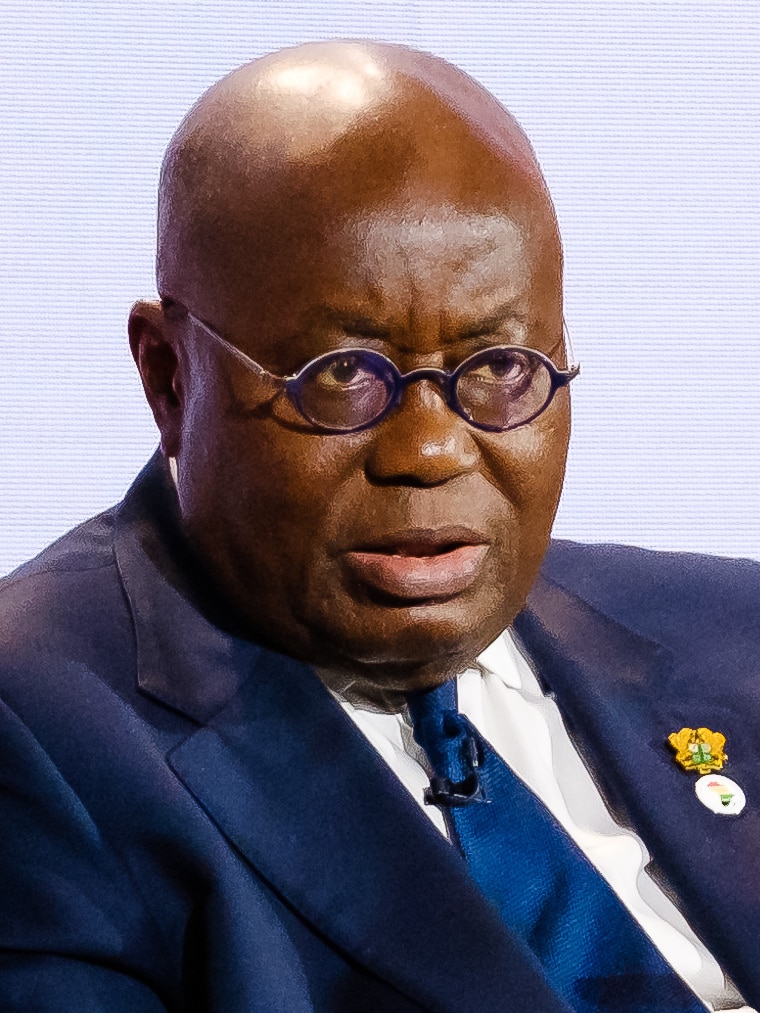
President Nana Addo Dankwa Akufo-Addo says that for the country to continue on its democratic path, it is critical to improve transparency and accountability in governance structures that can combat corruption and the misappropriation of public funds.
Furthermore, theElectoral Commission should work to ensure that all stakeholders in the electoral process – citizens, civil society organizations, and political parties – have no lingering doubts about the legitimacy of an election.
On the eve of Ghana’s 30th anniversary of the Fourth Republic, President Akufo-Addo made the remarks in a televised address in Accra on Friday.
January 7, 2023 marks exactly the 30th Anniversary of the nation’s return to constitutional regime after eight military takeovers.
“By all accounts, we have come a long way, and we should not take it for granted that everybody in Ghana has accepted democracy as the preferred mode of governance.
“There are those who would rather have authoritarian rule, because they claim our country is underdeveloped and democracy is cumbersome, and we need to get things done in a hurry.
“We still have some work to do to convince such people that we are all safer under democracies,” the President pointed out.
The President stated that without any form of equivocation his government had undertaken, arguably, the boldest initiatives since independence to reform and strengthen the capacity of governance institutions to tackle corruption in the public sector, including the financial empowerment of the anti-corruption bodies. He cited, for instance, the passage of the Right to Information Act and the establishment of the Office of the Special Prosecutor to investigate and prosecute acts of corruption.
“As President of the Republic, I assure you that, out of duty to our children and grandchildren, and to generations yet unborn, my government will not give up when it comes to deepening our democracy and guaranteeing the integrity of the electoral process,” he added.
President Akufo-Addo was of the belief that efficient management of the economy would lead to enhancement in the standards of living of the people and ensure prosperity for all.
“We must do everything within our means to safeguard our democracy,” he stated.
“Tomorrow’s milestone is to the great credit of you, the Ghanaian people, the ordinary men and women who make up the fabric of our nation. Thirty (30) years ago, all of us resolved to build, under God, a united nation, grounded in democratic values and the rule of law,” the President recalled.
“We have advanced a great deal in realising this vision, and I am confident that, with a spirit of fairness, hard work, integrity and reconciliation, the best days of Mother Ghana lie ahead of us,” the President assured.
He observed that although the nation was presently confronted with difficulties in her economic performance, but with collective efforts she would soon surmount the challenges, and back onto the path of progress and prosperity.
“Let us, therefore, continue to work to create the platform for the evolution of a new Ghanaian civilisation, which will give true meaning to the foundational values of freedom and justice on which our nation was birthed,” he stated.
Bernard Antwi Boasiako, alias Chairman Wontumi, the New Patriotic Party‘s regional chairman for Ashanti, has cleared himself of charges that he violated the party’s code of conduct.
A representative for the chairman claims that, in contrast to charges that he actively supported Vice President Dr. Dollar
Mahamudu Bawumia at a dinner party, he was merely making an implicit comment in favor of the head of the economic management.
Andy Owusu reportedly stated in an interview on Akoma FM that “the BMW Bawumia Must Win chant was meaning that Bawumia must win against the dollar but not what people were thinking,” according to a report by 3news.com spotted by GhanaWeb.
“We all know that Dr Bawumia is the one who declared war against the Dollar so when the Dollar started dropping, we believed it was Dr Bawumia who was winning so at the dinner party, all our chanting and prayers was that BMW meaning ‘Bawumia Must Win’ against the Dollar but not in effect the flagbearer position,” the spokesperson of the regional chairman said.
NPP last year issued a directive to its members and officers asking everyone to desist from engaging in open campaigning until nominations officially open for the party’s internal primaries.
According to the party, a myriad of sanctions exists for individuals who will breach the code which is aimed at promoting tolerance and unity.
But in a recent viral video, Chairman Wontumi was seen at a dinner party attended by Members of Parliament, Constituency chairpersons and party faithfuls of the NPP leading a chant.
The “BMW” chant which was led by the Ashanti Regional chairman of the NPP translates into “Bawumia Must Win” and is known as a parlance for supporters of the vice president’s flagbearership campaign.
Vice President Bawumia together with the Member of Parliament for Assin Central, Kennedy Ohene Agyapong and the now-resigned Minister for Trade and Industry, John Alan Kwadwo Kyerematen are tipped as the lead contenders for the upcoming contest.
‘Bawumia must win against the dollar’ – Wontumi clarifies controversial BMW chant.
Personal Assistant to Ghana’s National Chief Imam, Dr. Mohammed Marzuq Abubakar Azindoo, has urged Ghanaians to work on enhancing their maintenance culture.
He noted that historically, country residents have not invested a lot of their time or energy into making sure that the objects entrusted to their care, such buildings, are adequately maintained.
He continued by saying that if simply this facet of Ghanaian life could be adequately improved, it would significantly boost the nation’s production and progress.
Dr. Marzuq Azindoo spoke to GhanaWeb during the inauguration of the Hajia Safia Yakubu Masjid at Adenta.
“It is a very important project and it is important that we all help to maintain it. I believe that the struggle to give is next to the burden to maintain. As you know, in Ghana, we have a very poor maintenance culture and that is why I am not more interested in the construction, but I am rather more interested in the maintenance.
“This is such a pride to all Muslims and it should be a source of productivity for the entire society. Whether the members are Muslims or non-Muslims, this mosque should serve all of them and that is to say, this mosque is not just a mere symbol of religion; it must be a place of worship, an avenue of socialisation and a platform of national unification.
“If we are able to stand by all these values, then definitely, this mosque will be put in a situation that will be productive to the entirety of the Ghanaian population,” he said.
He also explained that it is the hope of the National Chief Imam, Shiekh Osmanu Nuhu Sharubutu, that more and more people contribute to projects of humanitarian nature that will benefit societies.
He also said that it is the hope of the National Chief Imam that mosques will serve more purposes to their societies than merely being places of worship.
“His Eminence the National Chief Imam is a man of humanitarian services and he believes that no matter where we are, we should try as much as possible, to have avenues of humanitarian services and therefore the National Chief Imam expects all Muslims, especially the wealthy ones, to construct any project that will be beneficial to the society.
“The mosque, within the context of religion, is one thing, but beyond religion, the mosque is still a place of productivity to the Muslim community. And that is why His Eminence the National Chief Imam is interested in coming out with any project – not just a mosque, that will be productive to society.
“A mosque, especially in modern societies, cannot be reduced to a mere symbol of worship. In modern societies, we are faced with so many challenges ranging from the cyber world, to the behavioural tendencies of society, and therefore it is up to all centers of worship to find solutions to all these multi-dimensional ills of contemporary societies,” he added.
The Hajia Safia Yakubu Masjid is estimated to have cost between GH¢500,000 to GH¢600,000 and was single-handedly built by Alhaji Saani Mohammed Yakubu, the Country Director of ActionAid, based in Congo DRC.
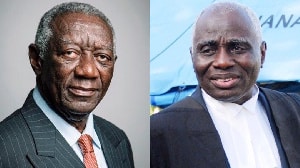
Tsatsu Tsikata, a former Chief Executive Officer (CEO) of the Ghana National Petroleum Corporation (GNPC), 14 years ago, wrote a letter to then President John Agyekum Kufuor on the former president’s last day in office.
The letter was written form Tsikata’s hospital bed at the Korle Bu Teaching Hospital and it contained a rejection of an offer for Tsikata to return home after treatment instead of returning to prison.
Tsikata’s two-paged letter dated January 6, 2009, rejected a presidential pardon Kufuor had offered him as part of his presidential prerogative of mercy.
The renowned lawyer’s reason for rejecting the offer was that he wanted to pursue justice in the court of law to be cleared from the charge of wilfully causing financial loss to the state.
“I have never sought, and I do not need your pretence of mercy. Justice is my quest and I will pursue this quest in accordance with the constitution and laws of Ghana,” parts of his letter read.
It explained how government had literally conspired through now President Nana Addo Dankwa Akufo-Addo as the Attorney General at the time the charges were initially brought against him, to convict him at all costs for political reasons.
“Your apparent exercise of the presidential prerogative of mercy in respect of a conviction and imprisonment which you were the prime mover of is the height of hypocrisy,” it added.
Read Tsatsu’s full letter rejecting the presidential pardon
Dear President Kufuor,
An official from the Prisons Headquarters came to the Korle Bu Hospital Cardiothoracic Centre earlier today to inform me that he had a warrant under your hand granting me a pardon.
I was not allowed a copy of your document. Your apparent exercise of the Presidential prerogative of mercy, in respect of a conviction and imprisonment which you were the prime mover of is the height of hypocrisy. I have never sought, and I do not need, your pretense of mercy.
Justice is my quest and I will pursue this quest in accordance with the Constitution and laws of Ghana.
The desecration of justice that was perpetrated against me in the Fast Track High Court on June 18th 2008 was at your instance, initiated in 2001 with your first Attorney General Nana Akufo-Addo.
Nothing can divert attention from the responsibilities of the Judges before whom my appeal and other legal processes are currently pending concerning my case. Indeed, your action in these final hours of your administration improperly interferes with these judicial processes and is clearly in bad faith.
Your participation, indeed your leading role, in desecrating justice, not only in relation to me but in many other cases, are part of your legacy as President of Ghana. But I am convinced that these bad examples will not endure as part of our country’s future.
Psalm 94 verse 15 says prophetically: “justice will again be found in the courts, and all righteous people will support it.”
Yours Sincerely, Tsatsu Tsikata.
H.E President J.A Kufuor Jubilee House Accra
Tsatsu acquitted and discharged by Court of Appeal
After eight years of legal battle, Tsatsu Tsikata was cleared of the charges and the conviction reversed unanimously by the Court of Appeal, which acquitted and discharged him.
Justice Dennis Adjei said there was a miscarriage of justice when an Accra Fast Track High Court on June 18, 2008, found him guilty on three counts of wilfully causing financial loss of GH¢230,000 to the state and another count of misapplying public property.
In a 2021 interview with KSM, he said of the saga: “I think I said it nicely. I wrote him a letter on my hospital [bed] and I said I will not accept his pardon; and I wouldn’t accept it.
“By then, I already had an appeal pending against the decision that had been taken. I wanted to be vindicated, not pardoned. When you are pardoned it means that your conviction still stands but the penalty has been wiped away.”
Expressing delight at the overturned verdict, Tsikata quoted Psalm 94:15 “Justice will again be found in the courts, and all righteous people will support it ” and emphasised that indeed “justice has been found in the courts”.
Ghana’s president Akufo-Addo has praised the country for adopting democracy as a system of government.
In a national address on Friday in honor of the 4th Republic’s 30th anniversary, the president declared that Ghana “is a beacon of democracy and stability in Africa.”
He stated that we have been able to oversee eight presidential elections in the Fourth Republic because we uphold the values of democratic accountability, human rights, and the rule of law.
He also said that democracy has helped in “five presidential transitions, and three peaceful transfers of power, through the ballot box, from one party to another.”
He further stated that “the celebration of the 30th anniversary of the 4th Republic should inspire us, even further, to hold on to this status.”
“Tomorrow, Saturday, 7th January 2023, will be exactly 30 years since the Constitution of the 4th Republic came into force, with the inauguration into office of the first President of the 4th Republic, His Excellency the late Jerry John Rawlings.
“It has inspired the longest period of stable constitutional governance in ourhistory, with a consensus emerging strongly that the democratic form of governance is preferable, and the benefits are showing. Hence the decision to celebrate 7th January as Constitution Day,” he added.
The Ukrainian leader says the war will end when Russian troops leave Ukraine or ‘we throw them out’.
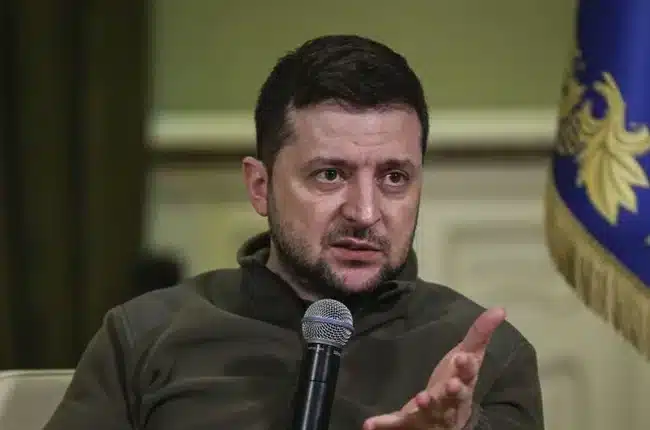
Ukrainian President Volodymyr Zelenskyy has rejected a Russian order for a ceasefire during the Orthodox Christmas season, calling it a ruse designed to halt Ukraine’s army’s progress in the eastern Donbas region and allow Moscow to send in more troops.
Following the call for a Christmas truce by the head of the Russian Orthodox Church, Patriarch Kirill of Moscow, Russian President Vladimir Putin ordered a 36-hour ceasefire, which will last from midday Friday (09:00 GMT) until the end of Saturday (21:00 GMT), the Kremlin said on Thursday.
“Taking into account the appeal of His Holiness Patriarch Kirill, I instruct the Minister of Defence of the Russian Federation to introduce a ceasefire regime along the entire line of contact of the parties in Ukraine…” the Kremlin said in a statement citing Putin.
The order did not specify whether the ceasefire would apply to both offensive and defensive operations by Russia, and it was not clear whether Russia would hit back if Ukraine kept fighting.
Speaking pointedly in Russian and addressing the Kremlin and Russians as a whole on Thursday night, Zelenskyy said Moscow had repeatedly ignored Kyiv’s peace plan.
“They now want to use Christmas as a cover, albeit briefly, to stop the advances of our boys in Donbas and bring equipment, ammunition and mobilised troops closer to our positions,” Zelenskyy said in his nightly video address.
“What will that give them? Only yet another increase in their total losses.”
“The whole world knows how the Kremlin uses interruptions in the war to continue the war with new strength,” Zelenskyy said.
The war would end, he said, when Russian troops left Ukraine or were thrown out.
Russia’s Orthodox Church observes Christmas on January 7. Ukraine’s main Orthodox Church has been recognised as independent and rejects any notion of allegiance to the Moscow patriarch. Many Ukrainian believers have also shifted their calendar to celebrate Christmas on December 25 as in the West.
Directing his address to Russian people, Zelenskyy said that ending the war meant “ending your country’s aggression … This continues every day that your soldiers are on our soil … And the war will end either when your soldiers leave or we throw them out”.
The Ukrainian leader also urged Russians to challenge Putin and his portrayal of the war as necessary to safeguard Moscow’s interests against the West.
“In order to end the war more quickly, we need something completely different. We need Russian citizens to find the courage in themselves, albeit for 36 hours, albeit during Christmas, to free themselves of the shameful fear of one man in the Kremlin.”
United States President Joe Biden was equally dismissive of Putin’s announcement.
“He was ready to bomb hospitals and nurseries and churches” on December 25 and on New Year’s Day, Biden said.
“I think he’s trying to find some oxygen,” he added.
The Institute for the Study of War said that Putin’s surprise ceasefire announcement was “an intentional information tactic” designed to portray Ukraine as the aggressor, and a pause in fighting now would primarily benefit Russian forces.
“The announcement of a ceasefire within 24 hours of when it is meant to enter into force suggests that it was announced with the intention of framing Ukrainian forces who continue to fight throughout the timeframe of the ceasefire as unwilling to work towards peace and wanting to fight at all costs,” the Institute said in a briefing paper on Thursday.
“Such a pause would disproportionately benefit Russian troops and begin to deprive Ukraine of the initiative,” the institute said.
Ukraine says that Moscow may use Belarus as a staging area for a northern offensive, thereby opening up a new front.
A train carrying Russian troops and equipment has arrived in Belarus, raising fears that Moscow will use the territory of its ally to launch an attack on Ukraine from the north.
Belarus’ defence ministry confirmed the contingent’s arrival on Friday, saying President Alexander Lukashenko had visited a military base where Russian troops were already stationed.
According to the report, Lukashenko and an unnamed representative from the Russian army discussed joint military drills between the two countries during the meeting.
Russian troops “are ready to carry out tasks as intended”, the representative said.
The developments came after Belarus, which has backed Russia over its war inUkraine, said on Thursday that it will receive more weapons and equipment from its neighbour as the two continue to boost military cooperation.
The Belarusian defence ministry said the goal of creating a joint force was “strengthening the protection and defence of the Union State [of Russia and Belarus]”.
“Personnel, weapons, military and special equipment of the armed forces of the Russian Federation will continue to arrive in the Republic of Belarus,” the statement said.
The two countries are preparing for joint air force exercises, the ministry said, without providing any further details.
The Belarusian government has repeatedly said the country will not join Russia’s war in Ukraine.
But Moscow deployed thousands of forces to Belarusian territory under the pretext of military drills before launching its offensive and then funnelled troops into Ukraine when its invasion began on February 24.
According to Kyiv, Russia continues to use Belarusian airspace for drone and missile attacks.
Any new attack on Ukraine from Belarus would open a major new front in the war, which has killed tens of thousands of people.
Lukashenko has blamed Western nations for the war, accusing them of seeking confrontation with Russia and provoking the ongoing bloodshed.
The 67-year-old says Ukraine has the power to end the conflict by accepting Moscow’s demands – namely the loss of partly-occupied regions in eastern and southern Ukraine.
On Monday, theUN Security Council will vote to extend permission for the delivery of aid from Turkey.
Humanitarian workers in the final pocket of Syria controlled by the opposition are concerned that if the UN is forced to halt aid deliveries from Turkey across the border, the cholera epidemic already ravaging the area will worsen.
The four million residents of the region, who endure appalling conditions, are heavily reliant on the food and medical supplies that are transported across the border thanks to a 2014 UN Security Council resolution that permitted such shipments despite the Syrian government’s objections.
The Security Council is due to vote on Monday, a day before the current authorisation expires, on renewing it for a further six months. Health workers in the zone, which comprises most of the province of Idlib and parts of Aleppo province in northwestern Syria, fear the consequences should Syria’s ally Russia veto it or place further restrictions on the programme.
“The capabilities of the health sector are already very weak, and we suffer from an acute shortage of medicines, medical supplies and serums,” said Zuhair al-Qurat, the head of Idlib’s health directorate.
“Stopping cross-border aid will have a multiplier effect on thecholera outbreak in the region,” he told Reuters.
Though diplomats say Russia has indicated it will allow the authorisation’s renewal, uncertainty remains.
Russia’s deputy UN ambassador Dmitry Polyanskiy told Reuters the implementation of the current resolution – adopted in July – was “far from our expectations” and a final decision would be made by Moscow on Monday.
Catastrophic consequences
Top UN officials, including aid chief Martin Griffiths, have warned that ending the operation would be “catastrophic”.
Idlib has recorded more than 14,000 suspected cholera cases and Aleppo more than 11,000 since the outbreak began in September, making them the second and fourth worst-hit provinces in Syria respectively.
They are particularly vulnerable because they rely on water from the Euphrates river to drink and irrigate crops, and because the health sector in opposition-held Syria has been battered by more than a decade of war.
The UN authorisation allows agencies to bring in hygiene kits, chlorine tablets to disinfect water and equipment for eight cholera treatment centres with more than 200 beds. Non-governmental groups also truck safe drinking water to homes.
Without it, international NGOs would not have international legal cover and could not keep up with the pace and quantities of aid needed, three aid workers told Reuters.
That is in part because large donor countries trust that aid brought in through the UN will not be politicised, unfairly distributed or seized by hardline armed groups.
The chlorine used to disinfect water presents a particular challenge. The chemical has been used in Syria as a weapon of war, prompting concerns among donors that would slow down its procurement for cholera treatment by humanitarian organisations other than the UN, the aid workers said.
“These centres and health facilities would be suspended. Supplies … transhipped specifically for the cholera pandemic in the northwest would be interrupted – fluid, serums, injections, oral medications,” said Mohammad Jassim, the International Rescue Committee’s northwest Syria coordinator.
Even if the resolution is renewed for another six months, health workers have already suffered from short-term renewals, leaving them unable to plan ahead, said Osama Abou el-Ezz, the head of the Syrian-American Medical Society (SAMS) in Aleppo.
Some district residents have filed lawsuits against Daniel Kwame Gariba, the chief executive of the Bulsa South District, for misappropriating GETFund projects.
According to the summons, the DCE diverted the building of two 2-unit kindergarten school blocks for the Doninga Primary School and the Weisi Primary School to the Naadema neighbourhood
Thomas Ananbiak and James Ababek, the plaintiffs, are asking the court to issue a permanent injunction preventing the defendants, their agents, workers, and other parties from diverting the construction of the two 2-unit kindergarten school blocks for the Doninga primary school and the Weisi primary school to any other neighbourhood.
The lawyer of the plaintiffs, Lamtiig Apanga also want the court to order the 2nd and 3rd defendants (Mohadams Karimus Company LTD and Big Harbis Enterprise) to comply with the terms and condition of the awards letters dated October 24, 2022 to construct the 2 two-unit kindergarten school blocks in Doninga Primary School and Weisi Primary school as contained in the award letter.
The plaintiffs, Thomas Ananbiak and James Ababek in a statement of claims avers that chiefs, opinion leaders and well-meaning members including the member of parliament for Builsa South Constituency had appealed to government and development agencies to assist the community by constructing educational facilities for their respective communities.
Based on the numerous request for the construction of educational facilities and the effort of the member of parliament, Dr Clement Apaak, to lobby for developmental projects for these communities, the Ghana Education Trust Fund (GETFund) per a letter dated June 14, 2022, addressed to the Defendant indicated to the defendant that it has allocated funds for the construction of two separate2- unit Kindergarten School Blocks ni Doninga D/A primary School and Weisi D/A Primary School.
Pursuant to the said letter from GETFund in respect of the construction of the Kindergarten School Blocks for these two communities, Defendant advertised in the Ghanaian Times Newspaper and invited bids from contractors in respect of this specific project among other projects.
Following a competitive bidding process, the defendant was selected and awarded the contract to construct the Unit Kindergarten School in Doninga PrimarySchool pursuant to which an award letter with reference numBbeSrDA/ETC/F/VOL3/22/02 dated 24th October, 2022 was issued by the first Defendant to the contractor for the construction of the said project at a cost of GHc538,497.03 to be completed within 6months.
A second award letter with reference number BSDA/ETC/F/VOL3/22/03 dated 24th October 2022 was issued to the 3rd Defendant awarding it the contract for the construction of the 2-unit Kindergarten School block in the Weisi Primary School at a cost of GHc538.423.13 to be completed within 6months.
The plaintiff indicated that based on these letters, the two contractors who won the bids have put themselves in readiness to commence work as soon as possible and the respective communities are highly expecting these projects to improve teaching and learning in their communities.
However, the District Chief Executive of the Defendant in his third sessional address of the third session of the Builsa South District Assembly held on 28th November, 2022 unliterary announced that the two 2-unit kindergarten schools blocks for Doninga primary school and Weisi primary school have been diverted to Naadema and Uwasi-Tuidema communities contrary to the procurement laws.
Plaintiffs aver that the decision of the District Chief Executive is a breach of the Public Procurement Act, 2003 (Act 663) as amended by Act 914 and should not be endorsed by this Honourable Court.
The Plaintiffs added that the District Chief Executive has disregarded all attempts to draw his attention to the unlawful decision that he took however, he has failed and ignored to comply with the procurement laws and has taken further steps to advance his illegal conduct by cutting sod for the construction of the kindergarten school blocks in Naadema and Uwasi-Tuidema contrary to the entire procurement process.
Based on this, the Plaintiffs have compelled the 1st and 2nd Defendants to move to different sites to construct the kindergarten school blocks contrary to the procurement process and the documentation.
The plaintiffs have also called on the court to let the 2 and 3rd defendants comply with the terms and conditions of the award letter.
Russia’s President Putin has instructed his defense minister to impose a 36-hour ceasefire on the front lines inUkraine.
The cease-fire, which begins at noon Moscow time (or 9:00 a.m. GMT), falls on the Russian Orthodox Christmas.
Mr. Putin requested that Ukraine do the same, but Kiev quickly rejected the demand.
President of Ukraine Volodymyr Zelensky claimed that the cease-fire was an effort to halt military advances made by his nation in the country’s east.
According to the Kremlin statement, President Putin ordered his troops to cease fire not because he was de-escalating the situation (Putin never does), but rather because he had heeded a plea from the leader of the Russian Orthodox Church.
Patriarch Kirill had, earlier in the day, called for a Christmas truce to allow believers to attend services for Orthodox Christmas.
Mr Putin’s order called on Ukraine to reciprocate so that the “large numbers of Orthodox believers [who] reside in areas where hostilities are taking place” could celebrate Christmas Eve on Friday and Christmas Day on Saturday.
But in his nightly video address, President Zelensky said that Russia wanted to use the truce as a cover to stop Ukrainian advances in the eastern Donbas region and bring in more men and equipment.
The Russian Orthodox Church – the largest of the Eastern Orthodox Churches – celebrates Christmas Day on 7 January, according to the Julian calendar.
Some people in Ukraine celebrate Christmas on 25 December, others on 7 January. Both days are public holidays in the country.
This year, for the first time, the Orthodox Church of Ukraine said it would allow its congregations to celebrate Christmas on 25 December, as do some other denominations in western Ukraine.
The Church split with the similarly named Ukrainian Orthodox Church (UOC) in 2018.
The UOC itself was tied to Moscow’s religious leadership until Russia’s invasion, and some of its top clergy have been accused of still covertly supporting Moscow.
Ukraine’s Foreign Minister, Dmytro Kuleba, said Moscow had repeatedly ignored President Zelensky’s propositions for peace. He pointed to Russia’s shelling of Kherson on 24 December and strikes on New Year’s Eve as evidence of Moscow’s inability to cease hostilities during religious holidays.
US President Joe Biden believes Mr Putin was simply “trying to find some oxygen”.
The Kremlin’s ceasefire fits in nicely with a common narrative in Moscow, one that is aimed primarily at the domestic audience. That is – that the Russians are the good guys, and it is Ukraine and the West that are threatening Russia.
The truce is also a handy tool that can be used to demonise Ukraine – as the Ukrainians have dismissed the proposal, Moscow will claim that Kyiv does not respect religious believers and has no desire for peace.
But it should not be forgotten that it was Russia who started this war by launching an unprovoked invasion of its neighbour.
The move also comes just a few days after a large number of Russian troops were killed in a Ukrainian strike on a temporary barracks in the occupied Ukrainian city of Makiivka.
The Russian defence ministry put the death toll at 89, making it the highest single loss of life admitted by Moscow since the war began.
Relatives of the dead, as well as some politicians and commentators, expressed anger over what happened in Makiivka and blamed incompetent military officials. The incident happened on New Year’s Eve – the most important holiday in the Russian calendar.
Watch: Ros Atkins on… How Ukraine’s deadly New Year attack unfolded
Political analyst Tatyana Stanovaya says that it is possible the Kremlin wants to ensure no more major loss of life occurs on another important Russian holiday.
“Putin really does not want a repetition of that on Orthodox Christmas Day,” she wrote.
A few hours after Russia’s ceasefire announcement, Germany said it would follow the US in providing a Patriot air defence missile system to Ukraine. Germany also announced, in a joint statement with the US, that both countries would send armoured vehicles.
France said on Wednesday that it would send armoured fighting vehicles.
Kyiv has repeatedly called for more aid from its international allies in the face of continuing Russian aggression.
Edwin Chiloba, a young fashion designer and LGBTQ activist, was found dead in a metal box by the side of the road not far from the town of Eldoret, and police in Kenya are now looking into his death.
According to a police spokesperson quoted in the Star newspaper, there is no indication as to why the victim was killed.
However, rights organisations are connecting it to his sexuality in Kenya, where gay sex is illegal.
According to one organisation, more than half of LGBTQ Kenyans have experienced assault.
“Words cannot even explain how we as a community are feeling right now. Another soul lost due to hate. You will be missed,” rights organisation galck+ posted on Twitter.
“Edwin’s death reminds us that queer bodies continue to be under attack all over the country,” the National Gay and Lesbian Human Rights Commission wrote on Instagram.
Tributes on social media describe Chiloba as “an amazing human” and an “iconic fashion designer”.
Last month Chiloba wrote on Instagram that he was “going to fight for all marginalised people”, saying that he himself had been marginalised.
He “spread love wherever he went, was bold about his existence as a queer man and encouraged many others to do the same,” Chris Makena, an activist and friend of Chiloba, told the BBC.
The 24-year-old had moved to Eldoret from the capital, Nairobi, in 2019 to study fashion and was beginning to make a name for himself in design, another friend said.
His body was discovered on Wednesday.
A witness is quoted as saying that someone in a vehicle without a number plate was seen leaving a metal box at the side of the road.
It was reported to the police, who went to open the box to find the corpse.
“We don’t know for now why he was killed that way. Experts are handling the matter,” police spokesperson Resila Onyango is quoted as saying.
Gay sex in Kenya is punishable by up to 14 years in prison. Though it is rarely enforced, members of the country’s LGBTQ community routinely face discrimination and stigma, and efforts to decriminalise gay sex have been thwarted.
Last year, the killing of non-binary lesbian Sheila Lumumba led to a social media campaign to get #JusticeForSheila.
There were similar campaigns in 2021 following the murders of trans-woman activist Erica Chandra and LGBTQ activist Joash Mosoti.
Edwin Chiloba was an amazing human. He was bold, passionate, his energy was immaculate. He embodied fashion. Someone murdered him cruelly, put his body in a box & dumped his body.
Edwin we speak your name. May yr blood not spill for nothing. Stop killing queer people. pic.twitter.com/aSgwyTSqnM
The removal of cigarette butts from Spain’s streets and beaches will now be the responsibility of the tobacco industry, per new environmental regulations.
Each year, millions of butts are discarded, releasing toxic plastic waste that can take decades to decompose.
A fifth of adult Spaniards, according to data from 2020, smoke every day.
Although the regulations took effect on Friday, it is still unknown how they will be put into practice and whether they will likely be passed on to consumers.
A report by the Catalan Rezero Foundation estimated that local authorities in Catalonia were paying between €12 and €21 (£11 and $13-22) per inhabitant per year on road cleaning of cigarettes, with higher rates in coastal areas.
The report called cigarette waste the “most abundant waste” on the beaches of the western Mediterranean, adding that existing measures to tackle it – such as awareness campaigns and portable beach ashtrays – had been insufficient.
The new rules make manufacturers responsible for collecting discarded butts as well as transporting them for waste treatment.
The Mesa del Tabaco industry association has said it is still waiting for details on how the rules will be implemented, local media say.
Most cigarette butts contain filters made of cellulose acetate fibre, a type of a bioplastic.
These can take years, if not decades, to break down, and microplastic pollution can hamper plant growth too, according to scientists.
The new rules are part of a law passed last year banning single-use plastics like cutlery and straws – drawn up to comply with a European Union directive.
Ireland introduced similar legislation on Thursday, requiring tobacco companies to contribute to the cost of cigarette litter.
Almost half of litter in Ireland is cigarette-related, according to the country’s National Litter Pollution Monitoring System.
Spain has introduced a host of sweeping measures to curb smoking in recent years. Last July, smoking was banned on all of Barcelona’s public beaches, with offenders fined €30 (£27; $32).
The final three months of 2022 are projected to see Samsung’s profits decline by 69% to their lowest level in eight years.
The largest manufacturer of memory chips, smartphones, and TVs in the world anticipated that its operating profit would drop to about 4.3tn won ($3.4bn; £2.8bn) for the time period.
It occurs as the slowdown in the world economy affects the cost of memory chips and the demand for electronic devices.
As consumers tighten their belts, global technology giants have recently taken a hit.
It was Samsung’s lowest quarterly profit since 2014 and missed investor expectations of around 5.9 trillion won.
TheSouth Korean company said it saw a bigger-than-expected fall in demand for computer chips as customers cut their stocks of the key components for digital devices.
“For the memory business, the decline in fourth-quarter demand was greater than expected as customers adjusted inventories in their effort to further tighten finances,” Samsung said in the statement.
“Smartphone sales and revenue decreased due to weak demand resulting from prolonged macro issues,” it added.
Samsung is scheduled to publish its full financial statement on 31 January.E
It is the latest major technology company to reveal how weakness in the global economy is impacting its business.
Sales have also slowed after demand boomed during the pandemic when customers at home spent a lot online.
Tens of thousands of jobs are being shed across the global technology industry, amid slowing sales and growing concerns about an economic downturn.
This week Amazon said it planned to axe more than 18,000 jobs, the largest number in the firm’s history, as it cuts costs.
In November, Meta announced that it would cut 13% of its workforce.
The first mass lay-offs in the social media firm’s history will result in 11,000 employees, from a worldwide headcount of 87,000, losing their jobs.
Meta chief executive Mark Zuckerberg said the cuts were “the most difficult changes we’ve made in Meta’s history”.
The news followed major layoffs at Twitter, which cut about half its staff after multi-billionaireElon Musk took control of the firm in October.
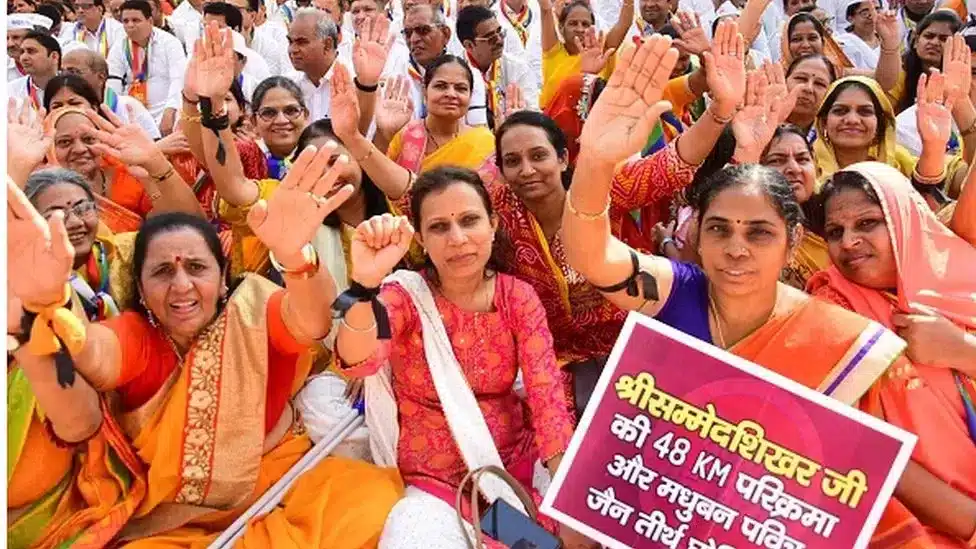
An important Jain pilgrimage site has been closed totourism by the Indian government.
On top of the tallest mountain in Jharkhand state, Sammed Shikharji is situated in an area that is sensitive to the environment.
Alcohol consumption and the consumption of non-vegetarian food are examples of “defiling the site” activities that the government has asked the state to outlaw.
There are about 4.5 million members of the religious minority known as the Jain community.
Devout Jains follow the tenets of their religion under the spiritual guidance of monks. These include detailed prescriptions for daily life, especially what to eat, what not to eat and when to eat.
The community fears that tourism to the pilgrimage site in Jharkhand will harm the sanctity of the area.
Members have been protesting against the state government’s move to turn the site into a tourist spot for some weeks.
In 2019, the environment ministry had approved tourism activities at Parasnath Hill – where the site is located – following the state government’s proposal.
On Thursday, it sent a letter to the state government stating that the site was important not just for the community but the entire nation.
It asked the state to immediately stop all “tourism and eco-tourism” activities at the site and to enforce all rules applicable to eco-sensitive zones.
This includes banning “loud music, the sale and consumption of intoxicants, defiling sites of religious and cultural significance” and activities that can harm the ecology of the area.
Environment Minister Bhupendra Yadav tweeted that the federal government was committed to “preserving and protecting the rights of the Jain community over all their religious sites, including Sammed Shikhar”.
On Thursday, a US warship crossed the Taiwan Strait, which separates Taiwan from the Chinese mainland, drawing ire from Beijing.
According to the US military, the USS Chung-passage Hoon’s demonstrated US support for a “free and open Indo-Pacific”.
However, a spokesman for the Chinese embassy in Washington claimed the trip was made to “flex muscles” and charged that the US was “undermining peace and stability.”
Last year, tensions in the Taiwan Strait rose sharply.
After former US House Speaker Nancy Pelosi‘s visit to the island in August, China conducted its largest military drills ever there.
China claims Taiwan as part of its territory and has vowed to unify it, by force if necessary. Self-ruled Taiwan sees itself as distinct from the mainland.
The Chinese military said it had monitored the USS Chung-Hoon’s transit. Its embassy spokesman added the country would “safeguard its national sovereignty and territorial integrity.”
The vessel is named after Rear Admiral Gordon Pai’ea Chung-Hoon, who served in the US navy during the Second World War.
Tensions between Washington and Beijing have risen in recent years and Taiwan is a flashpoint in the relationship, with the US walking a diplomatic tightrope on the issue.
The US abides by the “One China” policy – a cornerstone of the two countries’ diplomatic relationship which recognises only one Chinese government – and has formal ties with Beijing and not Taiwan.
But it also maintains a “robust unofficial” relationship with the island. That includes selling weapons for Taiwan to defend itself.
Last month, the US accused a Chinese air force jet of carrying out an unsafe manoeuvre after it flew within 20 feet of a US air force plane over the South China Sea.
China subsequently accused the US plane of carrying out an unsafe action.
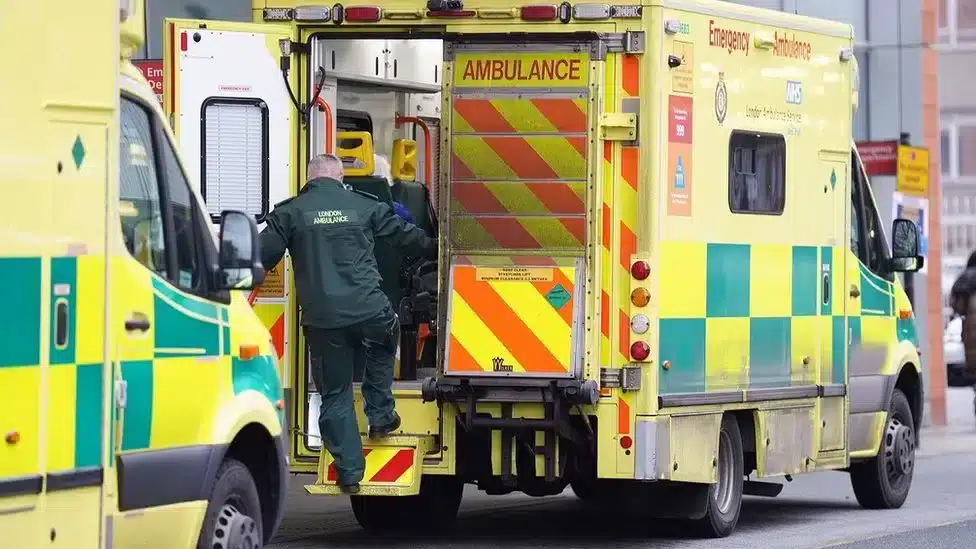
With new NHS data showing a record number of ambulances were delayed dropping off patients at A&E in England, the extent of the gridlock in hospitals over Christmas has been made public.
In the week leading up to New Year’s Day, more than 40% of crews were required to wait longer than 30 minutes to deliver their patients to hospital staff.
It is the highest recorded value.
However, with the flu and Covid admissions declining last week, there is hope that pressures may soon start to ease.
Both had been rising sharply in previous weeks, with one in seven beds occupied by patients with these infections by the start of the year.
The rate of flu admissions fell the most, dropping by more than 40%.
But the UK Health Security Agency is warning it is too early to say whether the flu season – the worst in a decade – has peaked as reporting lags over the festive period may have had an impact on the data.
The high levels of flu coupled with rising rates of Covid are thought to be one of the factors in the high number of deaths being reported.
In the lead up to Christmas, deaths were a fifth higher than normal, data from the Office for National Statistics shows.
NHS national medical director Professor Sir Stephen Powis said: “We knew this winter would be one of the most difficult in the history of the NHS and I want to thank staff for all their hard work in caring for and treating so many patients while dealing with record demand on services, including the enormous pressure from flu and Covid.”
The recent resignation of anchor and Modi critic Ravish Kumar underlines how monopolization is threatening Indian media.
When popular Indian television journalist Ravish Kumar announced his resignation from New Delhi Television Ltd (NDTV) — the country’s oldest private broadcaster — at the end of November, it was a grim reminder of the vanishing independent news media landscape in the world’s largest democracy.
It was no ordinary departure. Kumar had been a popular voice on NDTV for a quarter of a century and is known for his fearless, hard-hitting reporting and willingness to take on those in power. Of late he has criticised other news outlets for taking a stance explicitly in favour of Prime Minister Narendra Modi’s government and for stoking communal discord between Hindus and Muslims.
Yet Kumar felt compelled to quit after the world’s third-richest man, Gautam Adani, became the majority shareholder of NDTV. Adani is considered close to Modi, who used the tycoon’s aircraft for campaigning ahead of the 2014 national election. Since 2014, when Modi came to power, Adani’s wealth has jumped from $7bn to $110bn.
Adani has insisted that NDTV under his ownership will retain its independence to call out the government when it has “done something wrong”. But the worries about his takeover of one of the few Indian TV channels seen as brave enough to challenge the Modi government reflect broader fears centred on a question that journalism around the world has been grappling with: what happens when the ownership of platforms meant to protect free speech is concentrated in the hands of a few elite businesspeople?
Or as Kumar said: “How can a channel, bought by a corporat[ion] whose success is seen to be linked to contracts granted by the government, now criticise the government? It was clear to me I had to quit.”
A global problem
To be sure, this isn’t a problem unique to India.
Corporate monopolisation of media has increasingly been under scrutiny in the United States. In 2017, Bernie Sanders wrote of how Comcast, News Corp, Disney, Viacom, Time Warner and CBS — just six companies — owned 90 percent of the media in the country. Forbes wrote in 2016 that 15 billionaires owned all major national newspapers, including The New York Times, The Wall Street Journal and The Washington Post.
In the United Kingdom, the Media Reform Coalition has described “concentrated ownership” in the sector as a “significant problem for any modern democracy”. In 2015, 71 percent of the UK national newspaper market was dominated by three companies – News UK, Daily Mail Group and Reach. By 2019, their market share had grown to 83 percent, and by 2021, to 90 percent.
Some countries have regulatory measures in place to curb media monopolisation. In Germany, for instance, no single company can control “more than 30 percent of all TV audiences”.
But the landscape varies across Europe: In Italy, the holding company Fininvest, which is controlled by the family of former Prime Minister Silvio Berlusconi, owns all three of the country’s main TV channels as well as the nation’s largest publisher for newspapers and books.
Canary in the Indian media mine
India’s economic boom since the 1990s has spawned a fast-growing media industry, with a market size expected to grow from $21.5bn in 2021 to $54bn in 2026. This has resulted in a news media landscape that now boasts more than 100,000 newspapers and 380 news channels. Add the rapid growth of internet and social media usage, and a wide variety of news platforms ought to be available to the Indian consumer.
But like in the West, Indian media too is increasingly owned by a select few corporations. The first warning bells were sounded a decade ago when Reliance Industries – India’s largest company in terms of revenue – entered the media sector.
In 2011, the Indian parliament passed the Cable Television Networks (Regulation) Amendment Bill that made “digitisation of cable television across the country mandatory in three years”. But as Arvind Rajagopal, professor of media studies at New York University pointed out at the time, the bill also effectively paved the way for concentrated corporate control of media since “the largest cable service providers [were] already owned by broadcasting companies”.
In January 2012, Reliance — headed by Mukesh Ambani, the world’s eighth-richest man — invested in the heavily debt-ridden Network18 media group. The result was the creation of India’s largest media conglomerate which included a bouquet of general news and business channels in English, Hindi and several regional languages. Journalists and analysts raised concerns over how this would impact the media coverage of a company, Reliance, whose decisions influence the nation’s economy. In 2014 Reliance took complete control of Network18 in a hostile takeover. Rajdeep Sardesai, the editor-in-chief of the company’s flagship channel CNN-IBN, resigned. In his farewell email, he wrote : “Editorial independence and integrity have been articles of faith in 26 years in journalism and maybe I am too old now to change!”.
Today, the ties between big business, politics and Indian media extend beyond any one company. Zee Media Corporation, another influential TV network, is part of the conglomerate Essel Group, which is led by Subhash Chandra, a former member of the upper house of the Indian parliament. His candidature was supported by Modi’s Bharatiya Janata Party (BJP).
A 2019 report by Reporters Without Borders found many other similar examples. Odisha TV is owned by the family of Baijayant Panda, who is the BJP’s national vice president and spokesperson. News Live, one of the most popular TV channels in India’s northeast, is owned by Riniki Bhuyan Sarma, wife of the BJP chief minister of the northeastern state of Assam, Himanta Biswa Sarma.
‘Godi media’
Ravish Kumar coined a term that captures this unholy mix of news, money and politics: Godi media. “Godi” means lap. Godi media refers to the lapdog nature of the many pro-establishment mouthpieces that the Modi years have birthed. And looking at how the mainstream Indian media has celebrated events like the BJP-led demolitions of the homes of Muslim activists or criticised farmer protests in 2021, it’s hard to get away from a sense that Kumar is spot on.
Meanwhile, amid a spate of attacks onjournalists and government critics, India is slipping in the World Press Freedom Index, where it is now ranked 150 among 180 nations.
It’s important to cling to the hope that the tide will turn. Yes, good journalism needs money. But it also needs freedom. If media monopolisation cuts out critical voices like Kumar’s, it can never be healthy for Indian democracy.
DISCLAIMER: Independentghana.com will not be liable for any inaccuracies contained in this article. The views expressed in the article are solely those of the author’s, and do not reflect those of The Independent Ghana
Banned from working, a refugee family from Bangladesh tries to survive in one of the world’s most expensive cities.
Slouched against the lone, grime-covered, grated window of his tiny apartment in the working-class neighbourhood of Sham Shui Po in Hong Kong, there is a look of despair in 41-year-old Rana’s* brown eyes.
One of his feet, visibly swollen, is angled high up against the wall of peeling, off-white paint as the asylum seeker from Bangladesh recalls the recent accident that left him unable to walk for several days.
“I was on a construction site carrying some tools and a metal girder fell on my leg. It hurt so much. I am lucky it didn’t snap anything,” he says.
For decades, many of those like Rana seeking refuge in the former British colony have been forced to scrape by in extremely challenging conditions, from substandard housing to harsh limits on daily activities.
Most asylum seekers in Hong Kong are banned from having jobs, so he was technically breaking the law when he was injured. But he feels his family’s desperate financial situation left him with no choice.
“Sometimes I have to do work, even though I know it’s illegal,” he says, folding his arms with a grimace.
In lieu of paid work, each asylum seeker is given roughly 40 Hong Kong dollars ($5) a day for food by the government via e-cards. But that is only a little more than the 37.50 Hong Kong dollars ($4.82) hourly minimum wage for workers in the city.
The daily stipend is barely enough to get by, especially in what was until recently the most expensive city in the world.
‘What choice do we have?’
With the cost-of-living crunch bleaker than it has ever been and rocketing inflation that has seen everything from food to electricity and clothing become less affordable, the stipend asylum seekers receive has nevertheless remained frozen since 2014.
According to research by the Hong Kong-based non-profit Refugee Union, which is run by refugees and asylum seekers, prices for some food staples have doubled this year. A separate analysis by the NGO Justice Centre found that the average price per kilogramme of Chinese lettuce, a local staple, more than quadrupled from 5.70 Hong Kong dollars to 24.90 Hong Kong dollars ($0.73 to $3.20). In September, Hong Kong’s consumer inflation rate hit its highest level since 2015.
Akter sits with her child on their bed in the family’s small apartment [Peter Yeung/Al Jazeera]
“We ran out of food,” says Rana’s wife, Akter*, as she gazes at the frenetic traffic below.
The couple spends most of their time in their cramped, 200sq feet (18.6sq metres) apartment in a ramshackle tenement building in a neighbourhood infamous for its “coffin homes” – so named because of their tiny size. Their apartment on one of the upper floors can be reached only via a dimly-lit stairwell filled with rat droppings.
Down below, the streets are a cacophony of hawkers and traders selling black market goods. Impoverished elderly women offer up their possessions on mats spread across the ground; others gather rubbish to earn income from recycling.
“We had to sell things in the house,” says Akter, whose tone shifts from initial sadness to pure exasperation. “It’s too much expensive. Everything, everything. The government doesn’t give us enough money.”
After being pushed to extremes a few years ago, Rana began taking on illegal part-time work on a construction site to make ends meet for the family. Yet the risks are enormous. In 2018, he was sent to aHong Kong correctional facility for 13 months after he was caught working, separating him from Akter.
This November, Rana took up work again, before he was injured when the girder fell on his leg, leaving him temporarily unable to walk or work.
“I don’t want to be doing this. But what choice do we have?” he says, mulling the choice between breaking the law or leaving his family without food.
‘Food is so expensive’
For Akter, 32, the pressure of tending to a two-year-old and a six-month-old takes things to a whole new level. Yet she strides around the room with purpose – to clean, collect toys and deal with any number of issues the day throws up.
“My children are very small,” says Akter, who cooks just one batch of food in a large steel pot each day to feed the family of four. “I’m worried that they aren’t getting enough to eat. But food is so expensive. We can’t afford many vegetables.”
She usually cooks up large rice dishes, and on better days, stews chicken and eggs. The family has never eaten at a restaurant, the couple says.
The family lives in a small apartment in a neighbourhood known for its so-called ‘coffin homes’ [Peter Yeung/Al Jazeera]
Akter fled Bangladesh in 2017 after she was raped and her family disowned her. Hong Kong seemed to be a land of opportunity, where she could start anew, seek asylum and make a living for herself in a global megacity. But that new life took a while to adapt to. For the first two years, she says, she would walk the streets and simply cry; she barely ate.
Rana meanwhile is a political refugee who escaped Bangladesh when he faced threats due to his involvement in opposition politics. He ended up in Hong Kong in 2016. “I can’t go back home,” he says. “But I can’t live like this.”
The pair, who met and fell in love inHong Kong, made an effort to carve out a home, taping pictures of loved ones to the wall.
But conditions are grim: cockroaches scuttle all over the one-room apartment – which is just wide enough to fit their bed in lengthways – along the rims of pots and pans and between cracks in the floor. Laundry hangs to dry just above their heads because there is no other space.
“I don’t have friends who can help,” says Rana, with a tired shrug of his skinny shoulders and a blank expression on his face. “We are all in the same situation.”
The status of refugees
Despite its wealth, Hong Kong is one of the most unequal cities in the world. For asylum seekers – a vulnerable, marginalised underclass – there are fewer and fewer ways to survive.
Hong Kong has an estimated 14,000 refugees and asylum seekers, the vast majority of whom are barred from employment. While 143 countries and territories have agreed to the 1951 United Nations Convention Relating to the Status of Refugees and its 1967 protocol, Hong Kong is not a signatory of either, instead adopting its own “Unified Screening Mechanism” to determine asylum claims.
That means only when asylum seekers’ non-refoulement claims are accepted can they apply for a six-month work permit. But such instances are extremely rare: just 291 have had their non-refoulement claims accepted since late 2009, according to the latest figures from the Immigration Department, and the process can take years.
Until recently, Hong Kong was the most expensive city in the world [Peter Yeung/Al Jazeera]
According to official data, less than 1 percent of asylum claims have been substantiated since 2014. And 65 percent of those happen on appeal, suggesting there are issues with the initial process.
The result is that Hong Kong’s refugees are trapped in desperate poverty.
The stark divide is highlighted by the fact that the city of 7.4 million simultaneously has more than 125,000 millionaires and 1.65 million people living in poverty.
While the city’s central business district is lined with shimmering skyscrapers, Michelin-starred restaurants and high-end fashion stores, on the pavement below, poor domestic workers, with nowhere else to go, spend their time off relaxing on the torn shreds of cardboard boxes.
A more ‘caring’ society
Mounting pressures nearly culminated in disaster earlier this year amid panic buying as the city’s strict pandemic policies led to food shortages at ParknShop, the only supermarket chain where refugees and asylum seekers in Hong Kong are allowed to spend their food subsidy, provided by the Social Welfare Department. ParknShop does not sell halal meat, further excluding already marginalised Muslim asylum seekers like Rana and Akter.
A survey released by Refugee Concern Network earlier this year found that 73 percent of asylum seekers were struggling to buy food and about 60 percent were unable to buy other necessities, such as toiletries. The government subsidy for asylum seekers only allows for food items, therefore non-food necessities such as diapers cannot be bought, leaving many reliant on donations from local charities.
In a rare touch of solace, Rana and Akter have been receiving milk powder and diapers from a local charity since the pandemic struck.
Dwindling food supplies in the family’s small kitchen [Peter Yeung/Al Jazeera]
Beyond the bare necessities of food, other equally serious pressures are cranking up. The effects of climate change and extreme heat have become ever-more tangible in the family’s ageing apartment as record heat struck Hong Kong this year – including some of the hottest days since records began in 1884. In turn, the rising cost of energy has meant that the use of air conditioning is even more costly.
After electricity bills rocketed this summer, in part due to Russia’s invasion of Ukraine and in part due to warmer temperatures, the family was forced out of the house during the peak daylight hours to cool down in public libraries and malls, where they cannot afford to buy anything. “The AC became too much for us to pay,” says Rana. “It was too uncomfortable to stay at home, even if we were doing nothing.”
This perfect storm of worsening conditions means asylum seekers like Akter and Rana risk becoming a forgotten population in the global cost-of-living crisis.
For some, hopes rose when Hong Kong’s new chief executive, John Lee – who pledged in his election manifesto to forge a “more caring society” – was sworn in in July.
But any improvement has yet to materialise for Akter, Rana and their young family as they struggle to stay afloat. Instead, they dream about being given the opportunity to earn a basic living for themselves.
“I would like a future, I want a future,” says Rana, his deep-set eyes beginning to well up as he speaks. “Because now I don’t have one.”
Over 70 people were injured and taken to hospitals, and among the victims who died were nine men and five women.
The Ivorian press agency reported that one of the buses was transporting mourners, including foreigners, to a funeral for a woman who had died in Europe.
The precise cause of the accident is still unknown.
In a statement posted on Facebook, the Ivorian transport minister expressed condolences to the families of the deceased.
The ministry also called on motorists and road users to be more vigilant to avoid such accidents.
Deadly road accidents are common in theWest African country amid poorly maintained roads and vehicles. Driver errors also often contribute to the accidents.
Extreme weather events have become more frequent and intense in southern Africa, which the UN has linked to the continent’s current climate crisis.
According to the Mozambique Meteorological Institute, heavy winds and up to 50 millimetre per hour rain are predicted.
According to Leonardo Duma from the institute, thestorm may have an impact on both the province’s coastal and northern regions.
“If you have a house that is not in good condition try to fix it well in order to be able to resist these strong winds that we are predicting,” he said on state radio.
The first ever honey bee vaccine has been given the green light for use in the US.
It was developed to stop American foulbrood disease, a bacterial infection that is known to weaken colonies by attacking bee larvae, from killing people.
According to the biotech company responsible for its development, the US Department of Agriculture (USDA) approved a conditional licence for the vaccine this week.
Bees are important pollinators and are involved in many ecosystem processes.
The vaccine could serve as a “breakthrough in protecting honey bees”, Dalan Animal Health CEO Annette Kleiser said in a statement.
It works by introducing an inactive version of the bacteria into the royal jelly fed to the queen, whose larvae then gain immunity.
The US has seen annual reductions in honey bee colonies since 2006, according to the USDA.
The USDA says many, sometimes overlapping, factors threaten honey bee health, including parasites, pests and disease, as well as a phenomenon called Colony Collapse Disorder, which occurs when worker bees abandon a hive and leave behind the queen.
Pollinators such as bees, birds, and bats are responsible for about a third of the world’s crop production, according to the United Nation’s Food and Agricultural Organization.
American foulbrood disease poses a challenge for beekeepers as it is highly contagious and has no cure. The only treatment method requires burning the colony of infected bees along with the hives and equipment and treating nearby colonies with antibiotics.
The new vaccine contains an inactive version of the bacteria that causes American foulbrood disease, Paenibacillus larvae, according to Dalan Animal health.
According to the biotech company, which specializes in insect health and immunology, the bacteria are incorporated into the royal jelly feed given by worker bees to the queen bee, who then ingests the feed and retains some of the vaccine in her ovaries.
It says this gives bee larvae immunity to the disease as they hatch and reduces death from the illness.
The new vaccine could mark an “exciting step forward for beekeepers,” California State Beekeepers Association board member Trevor Tauzer said in a statement.
“If we can prevent an infection in our hives, we can avoid costly treatments and focus our energy on other important elements of keeping our bees healthy,” he said.
Dalan plans to distribute the vaccine “on a limited basis” to commercial beekeepers and said the product would probably be available for purchase in the US this year.
Following a significant Pacific storm, the state experienced torrential rains, strong winds, and significant snowfall for a second day, endangering much of the region with flash flooding and mudslides.
In California, a third “atmospheric river” storm has killed at least two people and cut power to tens of thousands of homes.
Following a powerful Pacific storm, the state experienced torrential rains, high winds, and heavy snow for a second day, endangering much of the region with flash floods and mudslides.
The storm was powered by two phenomena: an immense airborne stream of dense moisture from the ocean called an atmospheric river – and a sprawling hurricane, low-pressure system known as a bomb cyclone.
Image:A fallen tree is pictured in the storm’s aftermath in Santa Rosa
The latest blast of extreme winter weather marked the third and strongest atmospheric river to strike California since early last week.
Since 4 January at least two fatalities have been reported. Overnight, a tree crashed into a home killing a one-year-old boy, and a 19-year-old woman died when her car skidded off a partially flooded road and hit a utility pole.
At least two more back-to-back storms are forecast over the next several days.
On Friday morning the NWS warned that the next “in a parade of atmospheric rivers” will arrive later today, while “additional flooding and heavy mountain snow is expected in the Sierras”.
Heavy snow will continue to fall over the mountains of Utah into Friday. The next in a parade of Atmospheric Rivers is expected to arrive late Friday into California. Heavy rainfall will lead to additional flooding and heavy mountain snow is expected in the Sierras. pic.twitter.com/TCZT2QrlRt
Areas such as San Francisco Bay and the state capital of Sacramento are still recovering from flood damage. Along the Consumnes River levees were breached.
The National Weather Service (NWS) predicted one inch (2.5cm) of rainfall per hour, with snow falling at a rate of three inches (7.6cm) per hour in Southern California’s coastal ranges and the Sierra Nevada mountains.
High-wind advisories and gale warnings have been put in place up and down the state, which is home to more than 39 million people.
Uprooted trees, already weakened by drought and rain-soaked soil, knocked down power lines and blocked roads, while three-storey waves crashed on the shoreline of northernmost coastal counties – Mendocino, Humboldt and Del Norte.
According to Poweroutage.us, as many as 18,000 homes were left without power early on Thursday.
Image:Storm damage in Capitola. Pic: AP
Megan McFarland, a spokesperson from the region’s main utility company, Pacific Gas and Electric Company, said it was “one of the most powerful winter storms to hit our region in years”.
Four other deaths have been attributed to the New Year’s weekend storm that swept northern California – three flood victims were found in or near their cars and an elderly man was found dead under a fallen tree.
Mandatory evacuation orders were put into effect for several cities in Northern California, including Richmond in the Bay Area and Watsonville in Santa Cruz County.
After security forces apprehended Ovidio Guzman, one of Joaquin “El Chapo” Guzman’s sons, social media footage appeared to show heavy fighting across the city of Culiacan. An attempt to arrest him three years ago resulted in humiliation for Mexico’s president.
Gunfights erupted in Mexico’s Sinaloa state capital after security forces apprehended one of Joaquin “El Chapo” Guzman’s sons, who is wanted by the US on drug trafficking charges.
Army and National Guard personnel captured 32-year-old Ovidio Guzman in a pre-dawn operation in Culiacan, according to Defense Secretary Luis Cresencio Sandoval.
Three years ago, an attempt to arrest Ovidio ended in humiliation for the government when President Andrew Manuel Lopez Obrador ordered the military to let him go after gunmen shot up the city with high-powered weapons.
Image:Ovidio Guzman during his failed arrest in 2019. Pic: AP
This time local and state officials in Sinaloa warned residents to stay inside, suspended local government activities and closed schools, while the Mexican military closed Culiacan’s airport amid gunfire.
Mexican airline Aeromexico said one of its planes had been hit by gunfire ahead of a scheduled flight to Mexico City, though no one was hurt.
Passenger videos posted online showed people cowering on the floor of the plane as shooting could be heard in the background.
David Tellez, a passenger who captured video of people crouching on the plane after hearing gunshots, was travelling with his wife and three children after visiting his in-laws.
Mr Tellez, whose daughter can be heard crying in the video he captured, told Sky News: “While on the plane ready to take off I saw planes from the army land and then five seconds before take-off I heard gunshots and everybody got to the ground and the pilot returned the plane to the terminal.
“Then I found out the plane had been shot. We are scared to leave the airport because the city is on fire and many roads are blocked so we plan to sleep here.”
Mr Tellez said when he was checking in he was told by airport staff to take shelter in a toilet but then they were told it was okay to fly.
Other clips appear to show heavy fighting across the city as the sky was lit up by helicopter gunfire.
Image:David Tellez and his wife Tricia
Ovidio’s capture comes ahead of Mr Lopez Obrador hosting a North American leaders’ summit in Mexico City next week, in which US President Joe Biden is expected to want to discuss drug trafficking.
“This is a significant blow to the Sinaloa cartel and major victory for the rule of law,” said Mike Vigil, the DEA’s former chief of international operations.
“It will not, however, impede the flow of drugs into the US. Hopefully, Mexico will extradite him to the US.”
Six months of surveillance in cartel territory
Ovidio’s capture was the result of six months of reconnaissance and surveillance in cartel territory, Mr Sandoval said.
National Guard troops spotted SUVs, some with homemade armour, and immediately coordinated with the army as they established a perimeter around the suspicious vehicles and forced the occupants out in order to search them.
The security forces then came under fire but were able to gain control of the situation and identify Ovidio among those present and in possession of firearms, Mr Sandoval said.
Cartel members set up 19 roadblocks covering all point of access to the city of Culiacan, including Culiacan’s airport and outside the local army base.
Image:Vehicles and buses were set on fire by members of a drugs gang
A leader of ‘the juniors’ faction
Mr Sandoval said Ovidio was a leader of a Sinaloa faction he called “los menores” or “the juniors”, who are also known as “los Chapitos” or “the little Chapos”.
The other “little Chapos” are two of his brothers, Ivan Archivaldo Guzman and Jesus Alfredo Guzman, who are believed to have been running cartel operations with Ismael “El Mayo” Zambada.
Mr Vigil said the Chapitos have been taking greater control of the cartel because Zambada was in poor health and isolated in the mountains.
“The Chapitos know that if El Mayo dies, (the cartel) is going to break apart if they don’t have control,” he said.
“It’s going to be very important that the US requests Ovidio’s extradition quickly and that Mexico does it.”
Image:A soldier keeps watch near the wreckage of a burnt vehicle set on fire by members of a drugs gang as a barricade
US offered $5m reward
A 2018 federal indictment in Washington DC accused Ovidio of conspiring to distribute cocaine, methamphetamine and cannabis in the US.
The US has offered a $5m (£4m) reward for information leading to the arrest or conviction of Ovidio, who has become a key figure in the cartel since his father’s arrest.
It is unclear whether Ovidio will be extradited to the US like his father, who is serving a life sentence at Colorado’s Supermax prison.
Prince Harry has written about the moment he learned his mother, Princess Diana, had been killed in a car accident.
Spare, details a series of revelations in which Harry admits to using cocaine and discusses how he lost his virginity.
When his mother died, he was woken up by his father, who “sat on the edge of the bed and put his hand on my knee,” he wrote.
“My dear son, mum has had a car accident,” he says Charles said.
“There have been complications. Mum has been seriously injured and has been taken to hospital, my dear son.”
The book added: “He would always call me ‘dear son’, but he was repeating it a lot.
“He spoke quietly. It gave me the impression he was in shock.”
Diana died in 1997 following a car crash in Paris.
The book Spare was mistakenly put on shelves in Spain, five days ahead of the official release date – but Sky News has obtained a copy.
Image:From left: The then Prince Charles, William, the then Duchess of Cornwall and Harry
‘Don’t remarry’
Prince Harry also says in his new book that he asked his father not to marry Camilla.
The Duke of Sussex also talks about the moment he was told his mother had a car accident, amongst a number of other revelations.
Speaking about his father marrying Camilla, the prince writes: “That’s why when the question came, Willy and I promised our father that we would welcome Camilla to the family. The only thing we asked for in return was that he didn’t marry her. ‘You don’t need to get married again’ we asked him.”
Image:Harry in Afghanistan in 2012
Harry killed 25 people in Afghanistan
In Spare, the duke also said that he killed 25 people while serving inAfghanistan.
Writing about his two tours of duty, the Prince, who spent 10 years in the Army, said: “So my number: twenty-five. It was not something that filled me with satisfaction, but I was not ashamed either. Naturally, I would have preferred not to have that figure on my military resume, or in my head, but I would also have preferred to live in a world without the Taliban, a world without war.”
Prince claims he was dissuaded from asking for Diana investigation
Harry also claims in his memoir that he and his brother William were dissuaded from jointly asking for an investigation into their mother’s death.
He wrote: “Especially the summary conclusion, that our mother’s driver was drunk and, as a result, that was the only cause of the accident. It was simplistic and absurd. Even if the man had been drinking, even if he had been drunk, he wouldn’t have had any problem driving through such a short tunnel.
“Unless paparazzi were following him and dazzled him. Why had those paparazzi got off lightly? Why weren’t they in prison? Who had sent them? And why weren’t those people in jail either? What other reason could there be apart from corruption and cover-ups being the order of the day? We agreed on all those questions, and also what we should do next. We would issue a statement, asking jointly for the investigation to be reopened. We might call a press conference. Those who decided dissuaded us.”
Harry admits he took cocaine
In the book, he also admitted that he took cocaine, spoke about how he lost his virginity and claimed his brother physically attacked him during a row over his marriage to Meghan Markle.
Speaking about using cocaine,Prince Harry said “it wasn’t very fun, and it didn’t make me feel especially happy”.
Harry described losing his virginity as “a humiliating episode with an older lady”.
He said it was “with an older lady, who loved horses very much and treated me like a young stallion”.
The excerpt read: “‘I mounted her quickly, after which she spanked my ass and held me back… one of my mistakes was letting it happen in a field, just behind a busy pub. No doubt someone had seen us’.”
Kenya’sPresident William Ruto has denied the existence of the “Office of the First Daughter,” a title under which his daughter Charlene has held several high-profile events and meetings.
In Kenyan law, no such office exists.
On Wednesday, President Ruto denied the existence of such an office, according to BBC News.
“Leave my daughter Charlene alone, you know these are kids, they’re just being children, you know very well that there is no such office…. she is just being the daughter of William Ruto and sometimes she doesn’t know the divide between the president and the father,” Mr Ruto told journalists at State House, Nairobi.
The activities of the president’s daughter had prompted questions over whether she was spending taxpayers’ money.
In December 2022, she denied that taxpayers’ money was being spent by the so-called office.
Charlene has faced a backlash on Twitter for laying claim to such an office. The criticism was heightened when she introduced her delegation to Tanzania as members of staff at the Office of the First Daughter.
In a press statement issued in December 2022, Charlene said she referred to the entity handling her diary as Office of the First Daughter in a private capacity, adding that it is neither constitutional nor funded by the public.
“The Office of the First Daughter is a private entity. It is neither a constitutional office nor is it being funded by Kenyan taxpayers. It runs to purely facilitate the activities and any programs by Ms. Charlene Ruto,” she said.
“The Office of the First Daughter has at all times acted in good faith to ensure that theKenyan youth have a voice and get access to opportunities to enable sustainable livelihoods.”
“Through its independent structure and facilitators, the office has engaged various players across Kenya and beyond in line with some of its objectives of championing youth-based agendas and climate change advocacy,” Charlene added.
College of Education Teachers’ Association of Ghana (CETAG) has announced that it will resume its strike on January 6, 2023.
In a release dated January 5, 2023, CETAG explained that the resumption of the strike is imminent as the stakeholders have not attached the needed seriousness to their concerns regarding the conditions of service for over two years now.
“Following a meeting held between the Government Team and CETAG on January 4, 2023, over the outstanding issues of CETAG, the National Council of CETAG met to evaluate what transpired and concluded that the strike action, which was suspended on December 17, 2022, shall resume on Friday, January 6, 2023, if the two-day grace period given to the Minister expires without a resolution of the outstanding issues,” portions of the statement read.
According to them, “all the outstanding issues contained in the communiqué signed on December 16, 2022, which the Minister promised to resolve within two weeks after the suspension of the strike, remain unresolved to date.”
CETAG also stated that the Fair Wages and Salaries Commission (FWSC) never took any steps to seek a financial mandate from the Finance Ministry for the three outstanding generic allowances, as promised.
It further rejected the January 2023 effective date for CETAG’s 2021 Conditions of Service, which the parties settled on at the beginning of the negotiations in August 2021.
“The effective date of January 2023 that government team wants to unilaterally impose on CETAG instead of the mutually agreed effective date of January 2022 is totally unacceptable,” they added.
According to CETAG, they can no longer trust the assurances given by the stakeholders to seek a further financial mandate for the three outstanding generic allowances since all previous assurances were never fulfilled.
They added that “GTEC has failed to disclose to CETAG the amount it has proposed to be paid as all-year-round work compensation as well as the time the payment shall be made.”
It will be recalled that on December 17, 2022, CETAG called off its five-week industrial action over their conditions of service.
This follows a majority vote by the Association’s local branches to call off their strike in exchange for an assurance from theEducation Minister that their concerns would be addressed within two weeks of suspension.
Out of the 35 colleges that voted online, 19 of them, forming the majority, agreed to suspend the strike but would resume if their outstanding issues were not resolved as promised.
TheGlorious Word Power Ministries International has decried that its founder and leader, Reverend Owusu Bempah, has said the National Chief Imam visits him for spiritual protection and guidance.
According to the church, such reporting is untrue and borne out of malice.
In a press statement issued on Thursday, January 5, it said the publication is calculated to temper the cordial relationship between Sheikh Ousman Nuhu Sharubutu and Reverend Owusu Bempah.
“We wish to state emphatically that Apostle Dr Isaac Owusu Bempah has not at any time claimed that the Chief Imam visits it consults him to look into his destiny.
“The publication was clearly actuated by malice, a desire for profit, sensationalism and calculated to disrupt the peaceful and cordial relationship between the Chief Imam and Apostle Dr Isaac Owusu Bempah,” the church said.
Already, the office of the National Chief Imam has reacted to the issue.
In a press release, the office of the Islamic leader said theNational Chief Imam does not seek spiritual protection from “charlatans on the pulpit.”
It has thus asked the Inspector-General of Police (IGP) and the Christian community to advise Reverend Owusu Bempah from making further controversial and false prophecies about Shiekh Osman Nuhu Sharabutu.
“We wish to state that all the claims of Rev. Isaac Owusu Bempah contain no iota of truth, but represent the figment of his own imagination.
“Undoubtedly, Shiekh Osman Nuhu Sharabutu is a champion of interfaith harmony and peaceful co-existence. But he does not seek protection and prosperity from charlatans on the pulpit.”
“Conclusively, we stand – at all times – for interfaith solidarity and national unity, as we contribute our quota to the building of a prosperous democratic state of diverse religious communities.
Rev Owusu Bempah is alleged to have claimed that the National Chief Imam seeks spiritual protection from him.
The said allegation was said to have been made on Saturday, December 31, 2022, during his church’s watch night service.
Earlier disagreements
In January 2019, the self-styled pastor thanked the National Chief Imam for his swift action to forestall peace when his church was vandalised recently by some Zongo youths.
Rev. Isaac Owusu Bempah said he considers Sheik Usman Nuru Sharubutu as his father for the love shown him after a prophecy during his December 31, 2018, church service suggesting the respected Islamic leader will die in 2019.
Irate youth, armed with machetes, stormed Rev. Owusu Bempah’s property after he prophesied that some key leaders in Ghana, including the National Chief Imam, would die in 2019.
Speaking at a meeting at the Chief Imam’s Fadama residence in Accra, he said that but for the centenarian’s timely intervention, the issue would have taken another twist, which could lead to harm and destruction.
She’s up an hour before her two sisters and two brothers so that she can scrape some bright red gloss off her fingernails.
Today is her first day back at school and she wants to be spotless.
But her siblings must stay at home – her family can only afford to send her.
Six months ago, Sri Lanka was in the eye of the storm for its worst economic crisis since independence.
While calm has largely returned to the island nation, the full impact of mass unemployment and dramatic price rises is now visible among many families.
Every parent’s nightmare
Malki’s mother Priyanthika has had to pause her children’s schooling so they can earn money by selling fireworks.
Food prices in Sri Lanka reached record levels when inflation hit an all-time high of almost 95%.
Some days, no-one in Malki’s family eats.
While school is free in Sri Lanka, meals are not provided. When you add in the cost of uniforms and transport, education is a luxury Priyanthika can no longer afford.
Priyanthika had to pause schooling for all her children except Malki
She says she needs about 400 rupees per day ($1.09, 90p) for each child if they are to return to school.
Sitting in her one-bedroom home on the bed everyone shares, she wipes the tears from her face.
“All these kids used to go to school every day. I don’t have the money to send them now,” she says.
Malki can goto school because her shoes and uniform still fit.
But her younger sister Dulanjalee lies in bed crying, upset that today is not her turn.
“My darling, don’t cry,” says Priyanthika. “I’ll try and take you tomorrow.”
A shattered education
As the sun rises, children who are going to class hurry along dirt roads in white cotton uniforms, jumping on the back of motorcycles or piling into tuk-tuks.
Across town, Prakrama Weerasinghe sighs wearily.
He is the principal of Colombo’s Kotahena Central Secondary College and sees the economic distress every day.
Image caption,Parents are unable to send their children to school every day due to the economic crisis
“When the school day begins, when we have the morning assembly, children tend to faint from hunger,” he says.
The government says they have started distributing rice to schools but several schools contacted by the BBC say they have received no help.
Mr Weerasinghe says student attendance fell as low as 40% before he was forced to ask teachers to bring in extra food to keep students returning to class.
Joseph Stalin is General Secretary of the Ceylon Teachers Union.
He believes the government is wilfully unaware of the increasing numbers of families giving up on education because of the cost.
Image caption,Education is in short supply for hungry children
“Our teachers are the ones who see the empty lunch boxes,” he says. “The real victims of this economic crisis are the children.”
“[The government] are not looking for an answer to this issue. It’s been seen and identified by UNICEF and others, rather than the Sri Lankan government.”
UNICEF say it will get harder for people to feed themselves in the months ahead, with inflation in the cost of basic goods like rice continuing to cripple families.
It’s expected more children across the country will be forced to stop attending class.
The last hope?
With the government seemingly unable to manage the situation, charities have had to step in.
Samata Sarana is a Christian charity which has been helping Colombo’s poorest for three decades.
Today, its food hall is packed with hungry students from schools across the capital.
Image caption,Charities are trying to keep as many children at school as possible
While the charity can help around 200 children daily, it is clear it’s struggling to meet demand.
“They give us food, buses to go home, they give us everything so now we can study,” says five-year-old Manoj as he waits in line for lunch with a group of friends.
When Malki returns home from her first day back at school, she tells her mother how much she enjoyed seeing her friends again.
But she also tells her mother she needs a new workbook and says her teachers are asking for extra money to buy materials for a school project.
Amazon intends to cut more than 18,000 jobs, the most in the company’s history, in a bid to cut costs.
The online retailer, which employs 1.5 million people worldwide, did not specify which countries would be affected, but noted that Europe would not be left out.
The majority of the job losses will be in its consumer retail and human resources divisions.
Andy Jassy, the company’s CEO, blamed the layoffs on the “uncertain economy,” saying the company had “hired rapidly over several years.”
“We don’t take these decisions lightly or underestimate how much they might affect the lives of those who are impacted,” he said in a memo to staff.
He said the announcement had been brought forward due to one of the firm’s employees leaking the cuts externally.
“Companies that last a long time go through different phases. They’re not in heavy people expansion mode every year,” he added.
Amazon’s sales have slowed after a surge during the pandemic, when customers bored at home spent a lot of time online.
A potent combination of a downturn in advertising revenues due to businesses seeking to save cash and consumers spending less as the cost of living crisis bites is hitting tech firms hard.
Other major tech companies, such as Meta, which owns Facebook, Instagram, and WhatsApp, and cloud-based business software firm Salesforce, have recently announced significant layoffs.
Amazon has already announced that it’s cutting back on projects like the Echo (better known as Alexa) and delivery robots – which were nice-to-haves but not actually making money.
Anecdotally, there’s a tendency in Silicon Valley for firms to hire and retain talented workers on attractive salaries, even if they’re not immediately needed, primarily in order to stop them working for rivals. This culture is a luxury that big tech can no longer afford to maintain.
Amazon employees affected by the cuts are expected to be informed by January 18.
The move comes after the technology giant said last year that it would reduce its headcount without saying how many jobs would be cut.
A potent combination of a downturn in advertising revenues due to businesses seeking to save cash, and consumers spending less as the cost of living crisis bites, is hitting tech firms hard.
‘More pain ahead’
The company had already stopped hiring new staff and stopped some of its warehouse expansions, warning it had over-hired during the pandemic.
It has also taken steps to shut some parts of its business, cancelling projects such as a personal delivery robot.
“Prior to the pandemic, tech companies would often remove only the bottom 1% to 3% of their workforce,” Ray Wang from the Silicon Valley-based consultancy Constellation Research told the BBC.
Dan Ives from investment firm Wedbush Securities said he believes Amazon will face “more pain ahead” as customers tighten their belts.
Industry-wide cuts
Tens of thousands of jobs are being shed across the global technology industry, amid slowing sales and growing concerns about an economic downturn.
In November,
Facebook owner Meta announced that it would cut 13% of its workforce.
The first mass lay-offs in the social media firm’s history will result in 11,000 employees, from a worldwide headcount of 87,000, losing their jobs.
Meta chief executive Mark Zuckerberg said the cuts were “the most difficult changes we’ve made in Meta’s history”.
The news followed major layoffs at Twitter, which cut about half its staff after multi-billionaire Elon Musk bought the firm in October.
Amazon started laying off staff as early as November, according toLinkedIn posts by workers who said they had been impacted by job cuts.
Posts seen by the BBC included those from employees in Amazon’s Alexa virtual assistant business, Luna cloud gaming platform division, and Lab – the operation behind the Kindle e-reader.
Pope Francis has joined pilgrims in St. Peter’s Square to preside over the funeral of his predecessor, Pope Benedict XVI, who resigned as Pope in 2013.
As the cypress-wood coffin containing Pope Benedict XVI’s body was brought out and placed on the steps of St Peter’s Basilica in the Vatican, the dome was shrouded in mist.
The congregation that had gathered for the funeral applauded.
Benedict was then buried beneath the basilica in a tomb.
Clergy from around the world had come—cardinals in red vestments, nuns, and monks in their dark robes.
Pope Francis was brought out onto the dais in a wheelchair.
Latin chants sung by the Sistine Chapel choir echoed across the square. The mood was solemn and subdued.
Daniele, a teacher who had met the former pontiff at a church in Rome, told me the weather matched the occasion. “The fog represents the mystery of Pope Benedict, the mystery of death and life. I feel very happy and emotional to be in St. Peter’s Square.”
The pope was “an important voice in the church”, Daniele said.
During the Mass, concelebrated by cardinals, bishops, and priests, Pope Francis spoke of “wisdom, tenderness, and devotion that he has bestowed upon us over the years”.
“Benedict, faithful friend of the Bridegroom,” he said referring to Jesus, “may your joy be complete as you hear his voice, now and forever.”
Some 50,000 mourners came to the funeral, according to police. Official delegations were there from Italy and from former Pope Benedict’s home country of Germany. Other leaders, including the king and queen of Belgium attended in a private capacity.
Benedict’s death brings to an end the era of a pope and a former pope living side by side in the Vatican – an unprecedented situation brought about by Benedict’s resignation almost a decade ago.
In February 2013, I stood watching in St Peter’s Square as he flew away from the Vatican in a helicopter, at the end of his pontificate.
The ceremonies surrounding his death have been simpler than those for a sitting pope.
Over the past few days, some 200,000 people came to the Vatican to pay their respects to the former pontiff, as he lay in state in front of the main altar in St Peter’s Basilica.
On the day before the funeral, I joined the long line of visitors and mourners queuing to view his body. Dressed in red and gold vestments, he had a rosary clasped in his white, waxy hands.
There was no display of usual papal regalia like the silver staff, a sign that he was no longer Pope when he died.
But in line with tradition, a lead tube containing an account of Benedict’s papacy, as well as other items, including Vatican coins minted during his reign, were placed in the coffin.
At the end of the service, the choir sang, “May the angels lead you into paradise.” Pope Francis placed his hand on the wooden coffin in a final prayer, before it was carried away, to be sealed and placed in another coffin made of zinc with an outer one of wood.
It was buried in the crypt under St Peter’s Basilica, where Pope John Paul II was originally interred in 2005 before his body was moved up to a chapel, after his beatification.
While many leading figures have praised Benedict since his death – paying tribute to his theological studies – there has also been criticism, particularly by victims of sexual abuse by Catholic clergy.
The Snap Survivors network said the former pope “virtually ignored the burning problem of clergy sexual abuse during his tenure in office”.
“In his more than 25 years as the world’s most influential religious figure,Pope Benedict XVI fell short in protecting children and adults around the world.”
In St Peter’s Square, feelings about the former pope were mixed. Gaia from Sardinia said that while Benedict had been “a very good pope, I prefer Pope Francis. I think that he’s closer to people in 2023”.
Simona from Monza in northern Italy told me she was concerned that Francis might follow Benedict’s example and retire.
“I’m worried that he is sick,” she said. “And I really do hope that he still has the strength to keep the Church united and to go on and give hope to this world.”
Christopher Lamb, Vatican correspondent of the Catholic magazine The Tablet, said Francis now faced a new moment in his pontificate, but he expected him to continue his pace of reform within the Church.
“The death of Benedict does leave it open for Francis to step down if he wishes, but I wouldn’t bet on it because this Pope really has a lot to accomplish in terms of reforms.”
Whether Prince Harry will be present at his father’s coronation in May is not made clear in the most recent trailer for an upcoming TV interview. When asked if he will play a role in the monarchy’s future, he says he still believes in it but says, “I don’t know.”
The “door is always open” to his family for reconciliation, according to Prince Harry, but “the ball is in their court.”
In the most recent ITV clip, when asked if he would be at his father’s coronation in May, the young man responds, “There’s a lot that can happen between now and then.”
“But you know, the door is always open. The ball is in their court.
“There is a lot to be discussed and I really hope that they are willing to sit down and talk about it.”
Harry says: “I don’t know how staying silent is ever going to make things better.”
Put to him that some people would say he has railed against invasions of his privacy all his life – and now he is invading the privacy of his nearest and dearest without permission – Harry replies: “That would be the accusation… from the people that don’t understand, or don’t want to believe, that my family have been briefing the press.”
Asked if he believes in the monarchy, the prince says, “yes”, but when further pressed if he will play a part in its future, he replies: “I don’t know.”
It comes after a leaked extract of his highly anticipated autobiography, Spare, to The Guardian newspaper, reportedly claims he was physically attacked by his brother over the younger prince’s marriage to Meghan.
‘I landed on the dog’s bowl… the pieces cutting into me’
The incident allegedly took place at Nottingham Cottage in 2019 when Harry was living there and started when William arrived and complained about the American actress.
He goes on to allege William had called Meghan “difficult”, “rude” and “abrasive”.
The Duke of Sussex claims the Prince of Wales was being irrational, leading to the siblings shouting over each other and exchanging insults.
“It all happened so fast. So very fast. He grabbed me by the collar, ripping my necklace, and he knocked me to the floor. I landed on the dog’s bowl, which cracked under my back, the pieces cutting into me,” Harry reportedly wrote in the book.
“I lay there for a moment, dazed, then got to my feet and told him to get out,” the excerpt continued.
‘Now you’ve given me an heir and a spare’
Harry alleges William urged him to hit back but he refused. Shortly afterwards though, the elder brother apologised, according to The Guardian’s copy.
William then told his brother not to tell Meghan about the confrontation. Harry said: “You mean that you attacked me?” – to which William replied: “I didn’t attack you, Harold.”
According to The Guardian, Harry also recounts in the book what his father said to his mother Diana on the day of his birth.
Harry claims the King told the then Princess of Wales: “Wonderful! Now you’ve given me an heir and a spare – my work is done.”
Sky News has approached Buckingham Palace and Kensington Palace, and both said they will not be commenting on the allegations.
The video you are trying to watch cannot be viewed from your current country or locationPrince Harry wants his father ‘back’
‘They’ve shown absolutely no willingness to reconcile’
In a trailer released earlier this week for the upcoming ITV interview by journalist Tom Bradby, Harry says: “I would like to get my father back. I would like to have my brother back”.
Filmed in California where the duke now lives, he says “I want a family, not an institution” and “they’ve shown absolutely no willingness to reconcile”.
“It never needed to be this way,” says the duke, and refers to “the leaking and the planting”.
The interview will be broadcast on Sunday – two days before Harry’s autobiography Spare is published on 10 January.
In a separate interview with CBS News, due to air the same day, Harry criticises Buckingham Palace over an alleged failure to defend him and his wife, the Duchess of Sussex, before they stepped down as senior royals.
Last month, the couple’s Netflix documentary series contained new allegations against the Royal Family, as the Sussexes also hit out at their treatment at the hands of the media.
A six-month truce set the tone for 2022, with Yemen’s warring parties largely avoiding direct conflict. With that deal falling apart, what will 2023 bring?
When 2022 began, and with war raging in his home country Yemen, Abdu felt that there was only one way for him to make money and help his family.
The 25-year-old packed his bags, left the Yemeni capital Sanaa, and headed north.
“Out of despair, I decided at the start of the year to travel to Saudi Arabia to find work,” Abdu said, with a deep sigh as he remembered his trip to the kingdom, Yemen’s richer neighbour, which had also spent several years conducting air attacks across Yemen in support of the government.
Abdu did not apply for a work visa because he could not afford it. Like many others, he instead turned to smugglers to reach his destination, the southern Saudi city of Khamis Mushait, 12 hours away.
“I arrived there in the second week of January [2022]. I found a job as a shepherd. And I started receiving 1,500 Saudi riyals ($399) monthly,” Abdu told Al Jazeera.
But only three months after Abdu’s arrival in Saudi Arabia, his own expectations for how the year would pan out for Yemen were upended.
In April, the Iran-allied Houthi rebels, who control Sanaa and other major population centres in Yemen’s north, and the Yemeni government agreed to a United Nations-sponsored truce. Saudi air attacks also stopped. The war largely receded, frozen and temporarily out of sight. Life, to a relative degree, improved.
The truce held for six months, despite repeated violations. Fuel ships arriving at the Houthi-controlled Hodeidah port quadrupled. Commercial flights to and from Sanaa International Airport resumed for the first time since 2016, enabling thousands of passengers, mainly patients and students, to fly abroad, or return home.
According to Save the Children, conflict-attributable child fatalities dropped by 34 percent and displacement was roughly halved.
It meant that Abdu was able to think of the previously unthinkable – the possibility that he might be able to prosper financially in Yemen.
“I called my father after I heard the news of the ceasefire, and he was glad that fuel ships were going to arrive and that air attacks would stop,” Abdu recalled, explaining that for his father, a bus driver, the prospect of lower fuel prices and a more plentiful supply meant the chance to finally make more money.
And so, with 12,000 Saudi Riyals ($3,191) from his work in Saudi Arabia in his back pocket, Abdu has returned to Yemen. His plan is to buy a minibus and stay in Sanaa, joining his father as a bus driver.
Truce falls through
So far, Abdu has no regrets. He feels the situation in Sanaa is better than when he left; the fighting remains largely stopped and fuel is available.
Nonetheless, he still worries about a possible renewed outbreak of violence or a new fuel crisis.
That possibility is not far-fetched.
In October, UN Special Envoy to Yemen Hans Grundberg failed to get the Houthis to agree to renew the truce, despite agreement from the Yemeni government, and there was no extension.
While there has not been a return to all-out war, the Houthis have conducted drone attacks on the al-Dhabba oil terminal in the government-controlled Hadramout governorate, raising alarm and drawing a rebuke from the UN.
Ultimately, according to the Yemeni political researcher and author Adel Dashela, long-term stability in Yemen remains unattainable.
As the new year begins, he predicts three scenarios for Yemen.
“The regional powers may unanimously push Yemen’s warring sides to negotiate a lasting peaceful solution. But such a scenario is far-fetched given the Houthi stubbornness and the southern separatists’ inflexibility,” Dashela said, referring to the Southern Transitional Council, which, while officially part of the Saudi-led coalition that backs the government, has fought against government forces in the past and is in de facto control of the port city of Aden.
The second scenario is the perpetuation of the status quo, with the Houthi group ruling the north while the government and the secessionists control the south. “This seems less violent,” Dashela said. “However, it will expand and tighten the influence of the militant groups in the country.”
The breakout of an all-out war is the third scenario. “This is the most dangerous direction and will further devastate Yemen,” believes Dashela. “All indicators show that peace will not be fulfilled easily given the conflict’s complexity and the regional players’ hegemony.”
It is a scenario that leaves the lives of millions of Yemenis hanging in the balance.
For now, Abdu still believes that he made the right decision to come back to Yemen.
“The warlords can keep negotiating for months or years,” he said. “I don’t mind, I would just hate to see a war or fuel crisis.”
“2022, the good year, is over,” he added. “We don’t know what 2023 holds.”
DISCLAIMER: Independentghana.com will not be liable for any inaccuracies contained in this article. The views expressed in the article are solely those of the author’s, and do not reflect those of The Independent Ghana
The court sentenced Arturo Murillo to 70 months in prison after finding him guilty of conspiring to commit money laundering.
According to a statement from the US Department of Justice, former interior minister of Bolivia Arturo Murillo has been given a sentence of nearly six years in prison for conspiring to commit money laundering.
Murillo admitted to receiving at least $532,000 in bribes from a Florida-based company in October in return for assisting it in obtaining a lucrative tear gas contract with Bolivia’s defence ministry. He pleaded guilty to the charges.
The department claimed that he had used the US financial system to launder the money.
Murillo was sentenced to 70 months in prison by the US District Court for the Southern District of Florida.
Another former Bolivian official and three Americans were sentenced in the US last June after they also pleaded guilty to roles in the same scheme, the department said.
A former senator, Murillo served as interior minister between 2019 and 2020 during the interim government of President Jeanine Anez, who took power following political turmoil that led to President Evo Morales resigning and leaving the country.
Murillo fled after Morales’s party retook power in 2020 and was arrested in Florida in May 2021.
Bolivia’s government has requested Murillo’s extradition to Bolivia, where he faces a host of criminal charges.
Bolivian Attorney General Wilfredo Chavez said in anews conference that Murillo’s sentencing would advance extradition proceedings and that the government would take legal action to be paid $532,000 “as a victim” of Murillo’s crime.
“Justice has spoken in the United States. We are satisfied with this judicial decision, and we are going to make efforts for judicial actions [of extradition],” said Chavez.
Murillo’s former boss Anez is serving a 10-year prison sentence for her role in what Bolivian authorities say was a coup that forced Morales out of office in 2019.
The raids come after a string of ISIL assaults, including a deadly bombing close to a checkpoint in Kabul.
According to a senior Taliban government spokesman, eight ISIL (ISIS) fighters have been killed and a number of others have been arrested in a series of raids targeting prominent figures in a wave of attacks in Kabul.
The raids in the capital city and western Nimroz province the day before were directed at ISIL members who were responsible for the recent attacks on Kabul’s Longan Hotel, Pakistan’s embassy, and the military airport, according to Taliban spokesman Zabihullah Mujahid on Thursday.
Eight ISIL fighters, including foreign nationals, were killed and seven others arrested in Kabul, while a separate operation in western Nimroz province resulted in two more ISIL arrests, Mujahid said.
“These members had a main role in the attack on the [Logan] hotel and paved the way for foreign [ISIL] members to come to Afghanistan,” the spokesperson said in a tweet.
ISIL claimed responsibility for a deadly bombing near a checkpoint at the Afghan capital’s military airport on Sunday. The group said that attack was carried out by someone that also took part in the Longan Hotel assault in mid-December.
ISIL had published a photo of the attacker, identifying him as Abdul Jabbar, saying he withdrew safely from the attack on the hotel after he ran out of ammunition. It added he detonated his explosives-laden vest targeting the soldiers gathered at the checkpoint.
Mujahid said light weapons, hand grenades, mines, vests and explosives were confiscated by the Taliban’s security forces during the raids on an ISIL hideout in the Shahdai Salehin neighbourhood of Kabul. Residents reported sounds of several explosions and an hours-long gun battle.
ISIL’s regional affiliate – known as the Islamic State in Khorasan Province (ISIS-K) – is a key rival of the Taliban and has increased its attacks in Afghanistan since the Taliban takeover in 2021. Targets have included Taliban patrols and members of Afghanistan’s Shia minority.
The Taliban swept across the country in August 2021, seizing power as United States and NATO forces were in the last weeks of their final withdrawal from Afghanistan after 20 years of war.
Thepresident asserts he wants to sell the government’s stake in the indebted airline, whose stocks have not been traded since 2020.
The local stock exchange reports that trading in Kenya Airways shares has been halted for another year as the troubled national airline struggles to turn a profit.
Since July 2020, when the COVID-19 pandemic devastated international air travel, the airline’s shares have been suspended.
“The extension of suspension seeks to enable the company [to] complete its operational and corporate restructure process,” the Nairobi Securities Exchange said in a statement on Wednesday.
Last month, Kenyan President William Ruto said the government was ready to sell its entire stake in the airline, which has been deep in debt for years.
The government owns a 48.9 percent stake in Kenya Airways while Air France-KLM has 7.8 percent. The rest is owned by private owners and banks.
“I’m willing to sell the whole of Kenya Airways,” Ruto told Bloomberg News during his first visit to the United States as Kenya’s president.
“I’m not in the business of running an airline that just has a Kenyan flag – that’s not my business,” said Ruto, who reportedly met executives from US carrier Delta Air Lines during the trip.
Kenya Airways’ woes worsened in November when pilots staged a days-long strike, which led to hundreds of flight cancellations and stranded thousands of passengers. It also defaulted on a $525 million loan from the US Export-Import Bank last year.
The shares were first suspended two and a half years ago as lawmakers were considering a plan – since dropped – for the state to take full ownership of the carrier.
The airline, whose slogan is “The Pride of Africa”, was founded in 1977 after the demise of East African Airways and now flies more than four million passengers to 42 destinations annually.
But it has not made a profit since 2012, and the government has pumped in millions of dollars to keep it afloat.
Last month, the International Monetary Fund called for progress on structural reforms in Kenya while announcing a $447 million loan for Kenya under a 38-month aid programme
The IMF said “addressing vulnerabilities” atKenya Airways as well as the majority state-owned utility Kenya Power was “urgent”.
In August, the airline reported an $81.5 million half-year loss, citing high fuel costs. It was a marked improvement on the $94.6 million loss in the period the year before.
Local media reports cited a letter from Treasury Cabinet Secretary Njuguna Ndung’u to the IMF at the end of December as saying Kenya Airways would get an additional state bailout of about $280 million soon.