The Italian actress Gina Lollobrigida passed away at the age of 95, according to the ANSA news agency.
She played opposite Hollywood stars like Humphrey Bogart, Rock Hudson, Burt Lancaster, Tony Curtis, and Frank Sinatra during the 1950s and the beginning of the 1960s, making her one of the most prominent European actresses of the era.
Lollobrigida left the movie industry and later worked as a photographer and sculptor.
The US Nimitz aircraft carrier group also conducted “maritime strike training” in the disputed waterway when the drills took place.
According to state media, theChinese navy has conducted a number of “confrontational drills” in the South China Sea since an American aircraft carrier group started to operate in the disputed waterway.
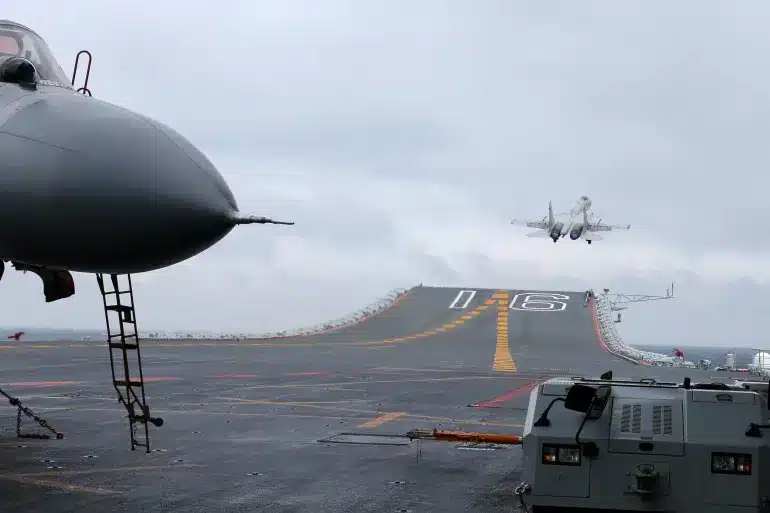
A statement from the People’s Liberation Army revealed that, the Shandong aircraft carrier group of the Chinese navy engaged in “realistic combat-oriented confrontational exercises” in the South China Sea on Sunday (PLA).
J-15 fighter jets took off from Shandong during the exercises, which mimicked attacks by hostile aircraft, according to a statement released by the PLA on Saturday, as reported by the Global Times.
During the drills, which simulated hostile aircraft attacks, J-15 fighter jets took off from the Shandong and carried out interception training, the PLA’s statement on Saturday said, according to the Global Times.
The carrier group also practised attack and defence on the surface, in the air and underwater, it added.
The report came after the US navy said on Friday that its Nimitz carrier strike group was carrying out exercises in the South China Sea as part of its “routine operations in the Indo-Pacific”.
Beijing claims almost the entirety of the strategic South China Sea and has established military outposts on artificial islands it has built there.
Taiwan, Vietnam, Malaysia, Brunei and the Philippines also have claims to the resource-rich waters.
Washington calls Beijing’s claims to the waterway “unlawful” and regularly sends warships through the area in what it calls “freedom of navigation” exercises.
In a statement on Friday, the US navy said the Nimitz carrier strike group — comprised of a nuclear-powered aircraft carrier, a guided-missile cruiser and three guided-missile destroyers — conducted “maritime strike training” as well as “anti-submarine operations” in the South China Sea.
The carrier strike group also carried out “integrated multi-domain and joint training between surface and air elements, and flight operations with fixed and rotary wing aircraft”, the navy said.
A US defence official meanwhile told the CNN broadcaster that two Chinese ships tailed the Nimitz aircraft carrier group.
The Chinese military will monitor “potentially provocative moves on China’s doorstep and the foreign forces would serve as practice partners that contribute to the PLA’s combat readiness,” the tabloid cited analysts as saying.
In December, the US military said a Chinese J-11 fighter jet intercepted one of its surveillance planes over the South China Sea, flying within six metres (20 feet) of the RC-135 aircraft and performing an “unsafe” manoeuvre. The Chinese defence ministry dismissed the US claims as “slander” and “hype”, saying it was the American pilot that had engaged in “dangerous” flying.
And in November, the Chinese navy said it drove away a US naval ship that “illegally intruded” into waters near the Spratly Islands in the South China Sea.
The encounter came days after US Vice President Kamala Harris visited the Philippines and called for freedom of navigation and overflight in the South China Sea, and pledged to launch an international campaign against “irresponsible behaviour” in the disputed waterway.
David Carrick, also known as “B*d Dave” to his workmates, appeared Monday at London’s Southwark Crown Court and entered guilty pleas. He worked for the parliamentary and diplomatic command of the Met Police.
A serving member of the Metropolitan Police has admitted guilt to a number of sexual offenses, including 24 counts of rape.
PC David Carrick, also known as “B*d Dave” to his coworkers, entered guilty pleas on Monday at London’s Southwark Crown Court.
The 48-year-old was accused of 49 offenses committed over an 18-year period against 12 women.
They included the rape of nine different women, but some of the charges are multiple incident counts, meaning they relate to more than 80 sexual offences, including at least 48 rapes.
Carrick served with the army before he joined the Met Police in August 2001 and worked with the force’s parliamentary and diplomatic command from 2009.
The armed officer’s role included policing parliamentary, government and diplomatic premises.
He was only suspended after a second rape complaint was made against him in October 2021.
Carrick met some of his victims through online dating sites, such as Tinder and Badoo, or on social occasions – and used his position as a police officer to gain their trust.
He admitted raping women on multiple occasions over months or years, with many of those attacks involving violence that would have left them physically injured.
Officer whipped and urinated on victims
Some victims were locked in a small cupboard under the stairs in his Hertfordshire home for hours without food or forced to clean his house naked.
Carrick whipped one woman with a belt, urinated on some of his victims, and told them when they could eat and sleep.
He called women “fat and lazy” or his “slave” as he controlled them financially, isolated them from friends and family, and forbade them from speaking with other men or even their own children.
Carrick denied a further count of rape relating to a 13th woman, whose allegation triggered the investigation, and the Crown Prosecution Service decided it was not in the public interest to proceed to trial on the charge.
The court heard that over drinks in a pub in September 2020, Carrick told her he was a firearms officer nicknamed “B*****d Dave”, showed her his warrant card and boasted of meeting famous people, including then-prime minister Boris Johnson, in the course of his work.
Victims ‘intimidated and humiliated’
Detective Chief Inspector Iain Moor, the senior investigating officer, said Carrick “thrived on humiliating his victims and cleverly used his professional position to intimate there was no point in them trying to seek help because they would never be believed”.
“The coercive nature of his offending undermined his victims in the most destructive way,” he added.
Mr Moor described the false imprisonment charges as “shocking”, adding: “Carrick forced his victim into a small under-stairs cupboard at his home address where they stayed intimidated and humiliated until he chose when they could come out. I have seen bigger dog crates.
“It is unbelievable to think these offences could have been committed by a serving police officer.
“The offending was absolutely abhorrent and I’m disgusted by it. I have a lot of pride and respect in the police service and I’m proud to be a policeman.”
Met Police knew of previous allegations
Following his guilty pleas, the Met Police confirmed Carrick “had come to the attention of the Met and other forces on nine occasions prior to October 2021” but had not been charged over those allegations against him.
They included allegations of rape, domestic violence, and harassment between 2000 and 2021.
Carrick, from Stevenage in Hertfordshire, was also the subject of five complaints from the public while serving with the Met Police, the force said.
The Met said Carrick was vetted in 2001 and again in 2017, and passed on both occasions.
Met Police ‘truly sorry’
Assistant Commissioner Barbara Gray, the Met’s lead for professionalism, said Carrick’s offending was “unprecedented in policing” and apologised to his victims for failing to remove him from the force.
“We should have spotted his pattern of abusive behaviour and because we didn’t, we missed opportunities to remove him from the organisation,” she said.
“We are truly sorry that being able to continue to use his role as a police officer may have prolonged the suffering of his victims.”
Prime Minister Mohammed Shia al-Sudani says foreign forces are still needed in a training capacity to combat ISIL(ISIL) in his first interview as an Iraqi leader.
Iraqi Prime Minister Mohammed Shia al-Sudani defended the presence of US troops in his country in his first interview since taking office in October, according to the Wall Street Journal.
The stance runs counter to that of several Iran-aligned groups that comprise the Shia-dominated Coordination Framework, the political bloc that nominated the prime minister last year. Al-Sudani was later appointed by President Abdul Latif Rashid, whose election ended a year-long political impasse fueled by scholar and political leader Muqtada al-Sadr.
In the interview published on Sunday, al-Sudani did not give a timeline for US and NATO forces – who are currently serving in a training capacity – to leave Iraq, despite calls from some political allies for a full withdrawal.
“We think that we need the foreign forces,” al-Sudani said. “Elimination of ISIS needs some more time.”
The US invaded Iraq in 2003 amid its global “war on terror”, with troop numbers reaching a peak of about 170,000 soldiers in 2007 before forces were withdrawn in 2011. They were redeployed to Iraq in 2014 in response to the rise of ISIL (ISIS), as the armed group overran a large swath of territory across Iraq and Syria.
However, combat operations largely fizzled in the wake of ISIL’s territorial defeat in 2019. Two years later, Washington officially ended the US-led combat mission in Iraq and transitioned to an advisory role assisting Iraqi forces. The US currently has about 2,000 troops stationed in the country, with NATO housing several hundred troops there, all in non-combat roles.
Meanwhile, rocket attacks launched by Iran-aligned armed groups on bases housing foreign troops and other foreign installations have remained relatively frequent.
In the interview published on Sunday, al-Sudani said there was no intention to resume foreign combat operations in the country, but noted foreign forces provide important logistical support in combatting ISIL pockets in Syria.
“Inside Iraq we do not need combat forces,” he told the newspaper. “If there is a threat for Iraq, it is the penetration of the [ISIL] cells through Syria,” he said.
His statements underlined the difficult tack the prime minister has sought in his dealings with the US and with Iran, which, beyond having substantial sway in domestic Iraqi politics, is also a key provider of natural gas and electricity to the country. The prime minister hailed Iran and Iraq’s close economic and security ties during a visit to Tehran in November.
He told the Wall Street Journal that he would like Iraq to have similar relations with Washington to those enjoyed by Saudi Arabia and other Persian Gulf oil and gas producers, adding that he planned to send a high-level delegation to Washington for talks with US officials next month in hopes of an eventual meeting with US President Joe Biden.
“I don’t see this as an impossible matter, to see Iraq have a good relationship with Iran and the US,” al-Sudani said.
Prominent human rights experts urge countries to take action against companies helping Myanmar’s military produce weapons used in abuses.
Companies in the United States, Europe and Asia have been helping Myanmar’s military manufacture weapons used in human rights abuses, according to three former United Nations experts.
Companies from 13 countries – including France, Germany, China, India, Russia, Singapore and the United States – have been providing supplies that are “critical” to the production of weapons in Myanmar, the Special Advisory Council on Myanmar (SAC-M) said in a report released on Monday.
This support includes licenses, raw materials, software, parts and components, the experts said.
As a result, the Myanmar military, which has launched a bloody crackdown on its opposition after seizing power in a coup in February 2021, has become largely self-sufficient in manufacturing a range of weapons, they said. Produced in factories known as KaPaSa and run by the military’s Directorate of Defence Industries (DDI), these weapons include guns, ammunition and landmines and are primarily being used to quash resistance to the coup, the SAC-M said.
“Foreign companies are enabling the Myanmar military – one of the world’s worst human rights abusers – to produce many of the weapons it uses to commit daily atrocities against the Myanmar people,” the SAC-M’s Yanghee Lee, a former UN Special Rapporteur on the situation of human rights in Myanmar, said in a statement.
“Foreign companies and their home states have moral and legal responsibilities to ensure their products are not facilitating human rights violations against civilians in Myanmar,” Lee said. “Failing to do so makes them complicit in the Myanmar military’s barbaric crimes.”
The report (PDF) drew on a range of sources, including interviews with people associated with the Myanmar military as well as leaked budget documents from the Ministry of Defence.
It found that high precision machines manufactured by companies based in Austria, Germany, Japan, Taiwan and the US are currently being used by the Myanmar military at its weapons factories. These automated tools have turning, milling and grinding functions and play a critical role in the manufacturing of weapons, the report said.
Software to operate these machines is being provided by companies based in France, Israel and Germany, it said.
Singapore, meanwhile, functions as a strategic transit point for potentially significant volumes of items, including certain raw materials, that feed the Myanmar military’s weapons production, and Taiwan is believed to serve as an important route for the military’s purchase of the high precision machines, the report said.
The military also regularly sends these machines from KaPaSa factories to Taiwan, where they are serviced by technicians associated with the European manufacturers of the machines, after which they are shipped back to Myanmar, it alleged.
Companies in China, such as the state-owned China North Industries Group Corporation Limited, are key to the import of raw materials used for arms production while firms in India are helping with the imports of parts and components such as optical sights fitted to small arms such as sniper rifles, the report found.
“States must investigate and, if necessary, initiate administrative or legal proceedings against companies whose products we have identified as enabling the DDI to produce weapons used by the Myanmar military in its indiscriminate attacks on civilians,” the SAC-M’s Chris Sidoti, a former member of the UN Independent international fact-finding mission on Myanmar, said.
“Foreign companies that profit from the suffering of the Myanmar people must be held accountable,” he said.
The report also detailed instances of the military’s use of locally made weapons against Myanmar’s people, such as crackdowns on peaceful protests against the coup, and warned that companies involved in the provision or supply of essential products to the DDI may be found complicit in these and other atrocities committed by the country’s security forces.
“The Myanmar military has built a robust arms manufacturing industry that makes it largely self-sufficient in its ability to produce the small arms, light weapons and ammunition it uses to brutally suppress the Myanmar people,” said Marzuki Darusman of the SAC-M.
“However, the DDI’s reliance on external supplies to sustain its weapon production means it is still vulnerable to external pressure,” Darusman, a former chair of the UN independent international fact-finding mission on Myanmar, said.
Matteo Messina Denaro, a Cosa Nostra mafia leader in Sicily, has been linked to a string of murders.
The country’s most wanted mafia boss, who had been on the run for 30 years, has been apprehended by Italian police.
Prosecutors claim Matteo Messina Denaro is a Cosa Nostra mafia boss in Sicily.
Police made the arrest on Monday morning at a private hospital in the Sicilian capital Palermo, where the 60-year-old was receiving treatment for an undisclosed medical condition.
Messina Denaro has been sentenced in absentia to a life term for his role in the 1992 murders of anti-mafia prosecutors Giovanni Falcone and Paolo Borsellino.
He also faces a life sentence for his involvement in bomb attacks in Florence, Rome and Milan the following year, which killed 10 people.
Messina Denaro, who comes from the small southern town of Castelvetrano near Trapani, is accused by prosecutors of being solely or jointly responsible for several other murders in the 1990s.
In 1993, he helped organise the kidnapping of a 12-year-old boy, Giuseppe Di Matteo, in an attempt to dissuade his father from giving evidence against the mafia, prosecutors say. The boy was held in captivity for two years before he was strangled and his body dissolved in acid.
Police said in September last year that he was still able to issue commands relating to the way the mafia was run in the area around the western Sicilian city of Trapani, his regional stronghold, despite his long disappearance.
“The prevention [of] and fight against mafia crime … will continue to be an absolute priority of this government,” Meloni said in a post on Twitter.
The arrest Monday came 30 years and a day after the capture of convicted “boss of bosses” Salvatore “Toto” Riina, in a Palermo apartment after 23 years on the run.
As part of the nation’s war effort, the UK is expected to send Challenger 2 tanks to Ukraine, according toPrime Minister Rishi Sunak.
The equipment and additional artillery systems would be sent, he assured Ukrainian President Volodymyr Zelensky in a phone call on Saturday, according to No. 10.
According to Downing Street, the action demonstrates “the UK’s ambition to intensify support.”
14 tanks will be provided by the government to Ukraine.
Also anticipated is the delivery of about 30 AS90s, large self-propelled weapons.
President Zelensky has thanked the UK, saying that the decision to send the tanks “will not only strengthen us on the battlefield, but also send the right signal to other partners”.
He said the UK’s support was “always strong” and was “now impenetrable”.
No 10 said that during the call, Mr Sunak and Mr Zelensky also discussed also recent Ukrainian victories, as well as the “need to seize on this moment with an acceleration of global military and diplomatic support”.
The announcement came as a series of missile attacks were launched across Ukraine on Saturday, including in Kyiv, Kharkiv and Odesa.
At least 14 people were killed in a strike on an apartment block in the eastern city of Dnipro.
Mr Sunak said the Challengers, the British Army’s main battle tank, would help Kyiv’s forces “push Russian troops back”.
Built in the late 1990s, the Challenger tank is more than 20 years old, but it will be the most modern tank at Ukraine’s disposal. The tanks will provide Ukraine with better protection, and more accurate firepower.
The UK will begin training the Ukrainian Armed Forces to use the tanks and guns in the coming days.
While the donation alone is not considered a game-changer, it is hoped that the UK’s move will inspire other countries to donate more modern equipment to help Ukraine.
Chair of the Defence Select Committee Tobias Ellwood said he welcomed the UK “getting serious about the hardware it supplies Ukraine”, but that international assistance had been “far too slow”.
He told BBC Breakfast: “That’s exactly what Russia wants us to do – to remain hesitant.
“Unless we step forward and support Ukraine, Russia will not go away – and that will mean the bully has won.”
He stressed that he wanted to see an arms factory in Eastern Poland which would allow Ukraine to procure its own weapons for the long term.
As it stands, Poland has plans to send 14 of its German-made Leopard tanks.
But the tanks, which are in greater supply and used by a number of European armies, need approval from Germany to be exported to Ukraine.
Ukraine also has hopes that the US will supply some of its Abrams tanks, which use the same ammunition as the Leopard.
Earlier this month, Germany and the US agreed to join France in sending armoured fighting vehicles to Ukraine – a move seen as a significant boost to its military’s capability on the battlefield.
Shadow defence secretary John Healey said the government had “Labour’s fullest backing” for the decision to send the Challengers.
He said: “Modern tanks are crucial to Ukraine’s efforts to win its battle against Russian aggression.”
Responding to the news of the Challenger tanks, Russian Foreign Ministry spokeswoman Maria Zakharova said: “As we’ve said previously, weapons supplies are legitimate targets for Russian strikes.”
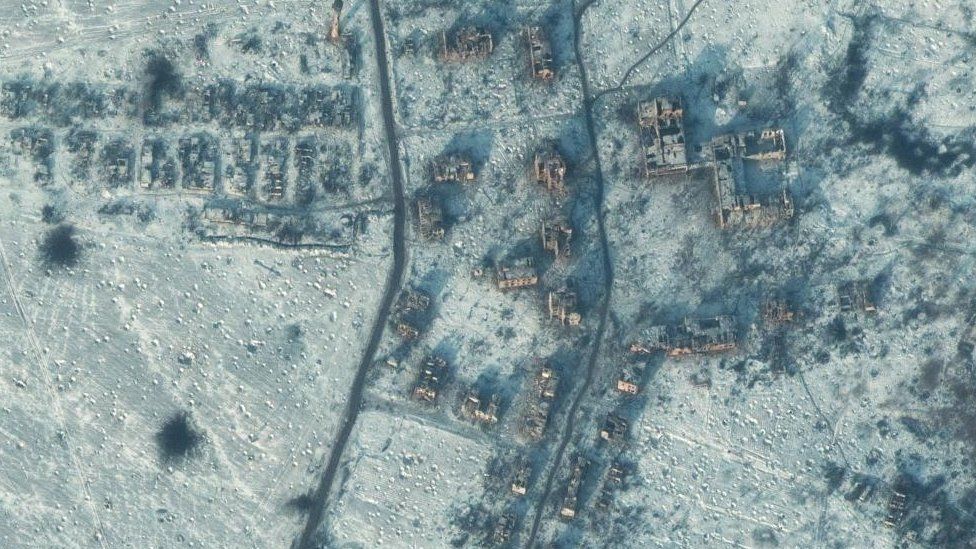
Image caption,Soledar has been devastated by Russia’s bombardment, as shown by this satellite image from Tuesday
Earlier on Saturday, Russia’s military announced it had captured the salt-mining town of Soledar after a long battle, calling it an “important” step for its offensive.
The victory would allow Russian troops to push on to the nearby city of Bakhmut, and cut off the Ukrainian forces there, a spokesman said.
Throughout his life, theBrazilian football star stood up to oppression, inspiring black people at home and abroad.
In the days after the death of football star Pelé, there was a global outpouring of grief and much reflection on his legacy. I, like millions of other fans across the world, was mourning. Although I had never met Pelé in person, it felt like I had lost an elder, who I was close to and deeply admired.
There was a lot of international media attention, a lot of obituaries, articles, interviews, reports acknowledging his iconic status and his sporting achievements. But there was one persistent line of commentary that irked me.
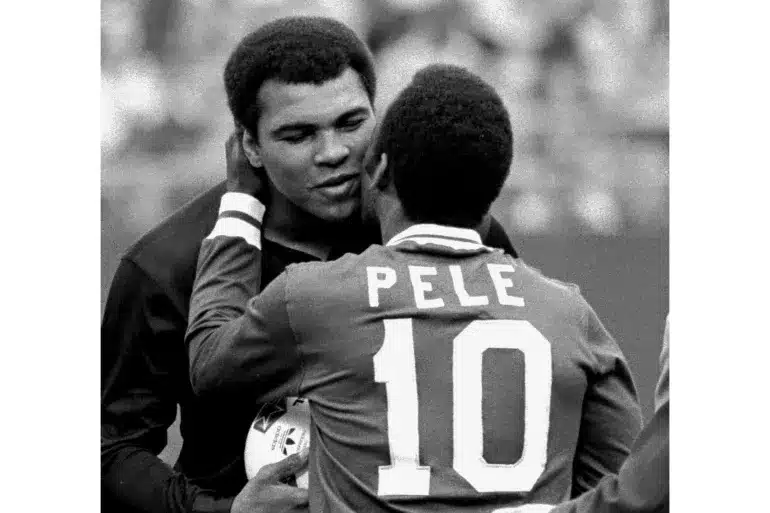
Sports observers and media outlets kept insisting that Pelé did not speak out against racism. Some would mention it in passing, others would dedicate whole segments to it, still others would bring up the inevitable comparison with American boxing star Muhammad Ali. This criticism was often levelled at Pelé while he was still alive, and he was not spared even in his death.
As an Afro-Brazilian, I feel this persistent scrutiny of what Pelé said or did not say is unfair, to say the least. The fact that he did not make certain statements does not mean he did not participate in the fight against racism.
Throughout his life and career, Pelé experienced racism and discrimination. He was keenly aware of racial inequalities and injustices, and he confronted them in a different way than some other Black sports stars who were his contemporaries.
Pelé was born just 52 years after Brazil abolished slavery in 1888, the last country in the Western hemisphere to do so. But growing up, he faced neither apartheid nor Jim Crow laws. Brazil at that time had made racism illegal and considered itself a “racial democracy”.
The idea that the country enjoyed racial harmony was put forward in the 1930s by Brazilian sociologist Gilberto Freyre. Himself a white wealthy man and a descendant of European colonisers, he claimed that Portuguese colonisation was somehow benign and that slavery was not as gruesome as in the United States and therefore, Brazil did not suffer from the same type of brutal structural racism.
This idea – or rather myth – was quite durable and even I was taught at school and university many decades later that Brazil somehow had exceptionally positive relations between the races thanks to supposed high rates of miscegenation.
That, of course, was and still is not the case. Brazil of the 1940s and 50s, when Pelé was growing up, was heavily racially divided. The elites were almost exclusively white, while the majority of the poor were Black, Indigenous, and mixed-race. Meanwhile, the government continued to encourage European immigration in order to boost the number of (the more “desirable”) whites in the country.
Brazilian football also suffered from racism. The sport had been brought into Brazil at the turn of the century by wealthy white men – like Oscar Cox and Charles Miller – who had studied in Europe. In the early days of Brazilian football, there were attempts to forbid Black people from playing in official matches and later, in the 1910s and 20s, some Afro-Brazilian players felt compelled to straighten their hair and put rice powder on their skin to hide their African features.
US politics, Canada’s multiculturalism, South America’s geopolitical rise—we bring you the stories that matter.
Despite this reality, the myth of “racial democracy” persisted and ended up weakening anti-racist activism. Although at that time, Brazil had a Black emancipation movement, it was not as strong as the civil rights movement in the US or the anti-apartheid struggle in South Africa.
The idea of “racial democracy” also instilled a culture of denial – that racism did not exist. This was reinforced by the media and the military dictatorship which came to power in Brazil in a 1964 coup.
Pelé was aware of these dynamics. He was playing a sport dominated by whites, faced media controlled by whites and a merciless dictatorship run by whites; he knew that being confrontational would not take him far. In fact, speaking out against those in power resulted in torture and death at that time.
As Brazilian historian Ynaê Lopes dos Santos has pointed out: “This stance that he took was very calculated, coming from a Black man who knew how to play the game of racism in Brazil. In this sense and many others, he is a winner. A Black man that became a Brazilian symbol, a country that in many moments projected itself as white. This is based on a very sophisticated assessment that he made on how Brazil works.”
Throughout his career, Pelé persistently experienced racism. He had a number of racist nicknames that football fans and the media would use and often heard monkey chants during matches.
But as he said in 2014 – in response to questions about racism in Brazilian football: “If I had to stop or shout every time I was racially abused since I started to play in Latin America, here in Brazil, in its interior, every game would have had to be stopped.”
And not being vocal did not mean he was not fighting or resisting. When he decided to end his career in the national team in 1971, he was punished for it, with two events meant to celebrate his successful career cancelled. When the Brazilian authorities tried to force him to come back and compete in the 1974 World Cup, he refused, despite the persistent pressure and threats.
So, Pelé fought racism and oppression through achievement, opening the door for other Black boys and girls to follow and inspiring Black Brazilians to dream big and defy discrimination.
It is not an easy choice to stay silent when you are racially abused. I know that all too well.
When I was in journalism school, a few professors picked me for an internship programme. They kept calling me “our project” as if I was a test subject and the reason they had picked me was to show that in our elite school, even young Black people could make it.
Later as an intern at a São Paulo public TV station, I had to endure in silence a supervisor making racist jokes, an anchor telling me that without my braids I looked like a “real human being” and a producer making monkey noises on my last day there.
I knew that if I had openly confronted all these racist individuals, my career would be jeopardised and the efforts of my family to support my education would be wasted.
Later in life, I would also be criticised for not being more vocal by white liberals who never experienced racism. But I knew that their demands for me to take a more activist position were really a way to weaponise my pain and tokenise me.
Still, my experiences of racism are probably just a fraction of what Pelé had to overcome in his life and career.
The fact that he did served as a major inspiration for my grandparents’ generation. His achievements also transcended the field of sports. After he retired from football, he became a successful businessman, acted in a Hollywood movie, was appointed a UNESCO goodwill ambassador, took the post of a minister of sport and was even knighted by British Queen Elizabeth II.
He demonstrated that anything was possible for a Black Brazilian man and that is why people called him “Rei Pelé” – King Pelé. I remember how when my grandparents would talk about him, the tone of their voices would change as if they were talking about their royalty, their Black king.
By the time I was growing up in the late 1980s and early 90s, more Black people had made it to positions of prominence, including people in my extended family. But racism, of course, persisted. Afro-Brazilians were still a rare sight in Brazilian media, most often appearing in slavery-themed soap operas or as minor characters, often mocked, in TV shows. So I would regularly switch to American shows and films, where Black actors like Philip Michael Thomas and Danny Glover had become my idols.
Pelé, nevertheless, remained a permanent fixture on Brazilian TV. He was one of the few Afro-Brazilians that I saw being respected when appearing or being mentioned. He motivated me to fight for my place in the media, a sphere which continues to be heavily dominated by white people.
Now after his death, the global mourning has made me realise how much Pelé also meant to other Black people across the world. “Africa has lost a great son,” Ivory Coast Consul Tibe bi Gole Blaise said while attending Pelé’s wake at Santos stadium.
Thus, I think the criticism thrown at Pelé and comparisons between him and Muhammad Ali are unfair. They degrade his contribution to the anti-racism struggle in Brazil and the world while presenting him as someone who neglected his race.
That is really not the case. Pelé fought racism and carried the weight of the struggle so the generations of Black people that came after him would find more doors open. His way of fighting racism should be respected, just as Muhammad Ali’s has been.
I am grateful to Pelé for what he did: donning the Brazilian football jersey and leading Brazil to the status of world power in football, breaking the glass ceiling, ripping the whitewashed image of Brazilian identity and paving the way for Afro-Brazilians to claim equality and respect in Brazilian sport and society at large. He truly played his “beautiful game” on and off the pitch.
DISCLAIMER: Independentghana.com will not be liable for any inaccuracies contained in this article. The views expressed in the article are solely those of the author’s, and do not reflect those of The Independent Ghana
The changes would, among other things, make it simpler for the parliament to overturn Supreme Court judgements.
The proposed changes by Prime Minister Benjamin Netanyahu were branded an assault on democracy by protesters.
It comes after the installation of the most pious and rigidly conservative government in Israeli history.
Local media reported that protests were also held in front of the prime minister’s home in Jerusalem and the northern city of Haifa.
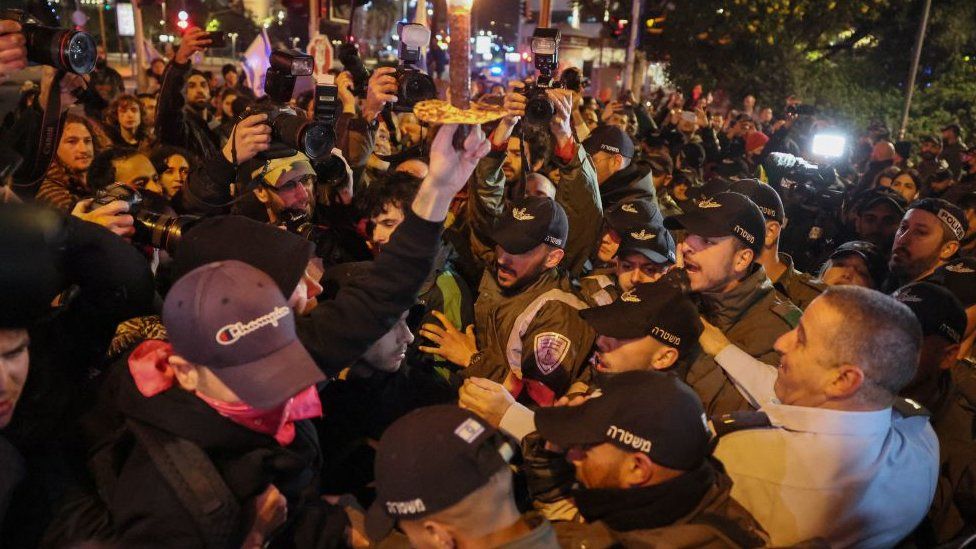
One group of protesters clashed with police while attempting to block a major road, Ayalon highway, in Tel Aviv.
Critics say the reforms would cripple judicial independence, foster corruption, set back minority rights and deprive Israel’s court system of credibility.
Banners referred to the new coalition led by Mr Netanyahu as a government of shame.
Image caption,Israeli security forces with left-wing protesters during the rallies in Tel Aviv
Among those opposed are Israel’s Supreme Court chief justice, Esther Hayat, and the country’s attorney-general.
The BBC’s Samantha Granville in Tel Aviv saw protesters draped in Israeli flags, carrying posters in Hebrew, and pictures of Mr Netanyahu with X’s over his mouth.
There was a group of young girls with red-painted hand prints over their mouths. They wanted to tell the government they won’t be quiet.
One woman, who asked not to use her name, said through her tears she was a second-generation Holocaust survivor.
“My parents immigrated from non-democratic regimes to live in a democracy,” she said. “They came from the totalitarian regime to live freely. So seeing that destroyed is heart-breaking.”
She and her friend said they expected Mr Netanyahu to try radical changes, but never thought they would come so fast.
These are the largest demonstrations since Mr Netanyahu’s new coalition government was sworn in, in December.
Opposition parties had called on Israelis to join the rallies to “save democracy” and in protest at the planned judicial overhaul.
Under the plans announced by Justice Minister Yariv Levin earlier this month, a simple majority in the Knesset (parliament) would have the power to effectively annul Supreme Court rulings. This could enable the government of the day to pass legislation without fear of it being struck down.
Critics fear the new government could use this to scrap Mr Netanyahu’s ongoing criminal trial, although the government has not said it would do that.
Mr Netanyahu is being tried on charges of bribery, fraud and breach of trust – something he strongly denies.
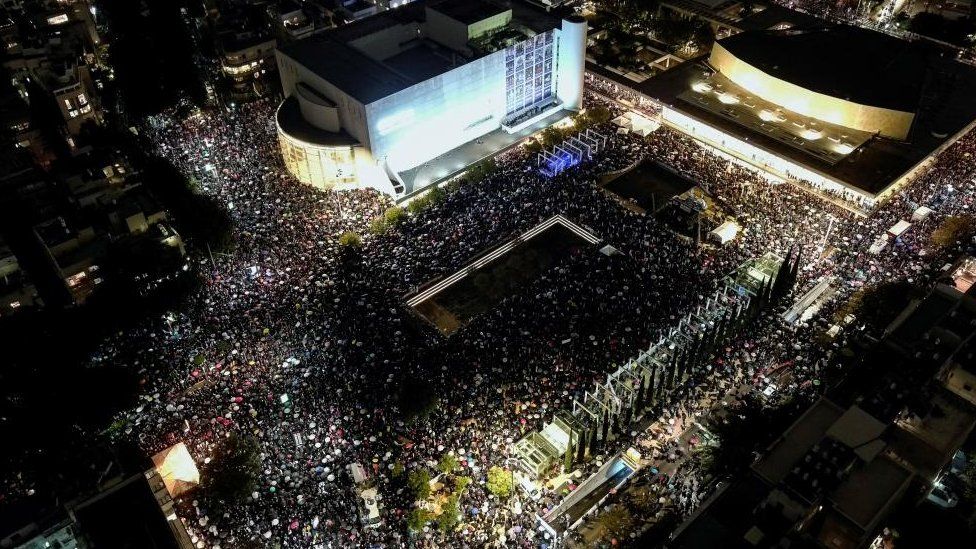
Image caption,A huge crowd gathered in Tel Aviv to protest at the judicial reforms to reduce Supreme Court powers
The reforms would also give politicians more influence over the appointment of judges, with most members of the selection committee coming from the ruling coalition.
If it passes into law, the plan could make it easier for the government to legislate in favour of Jewish settlements in the occupied West Bank without worrying about challenges in the Supreme Court.
Israel has previously highlighted the power of the court to rule against it, as a way of blunting international criticism of such moves.
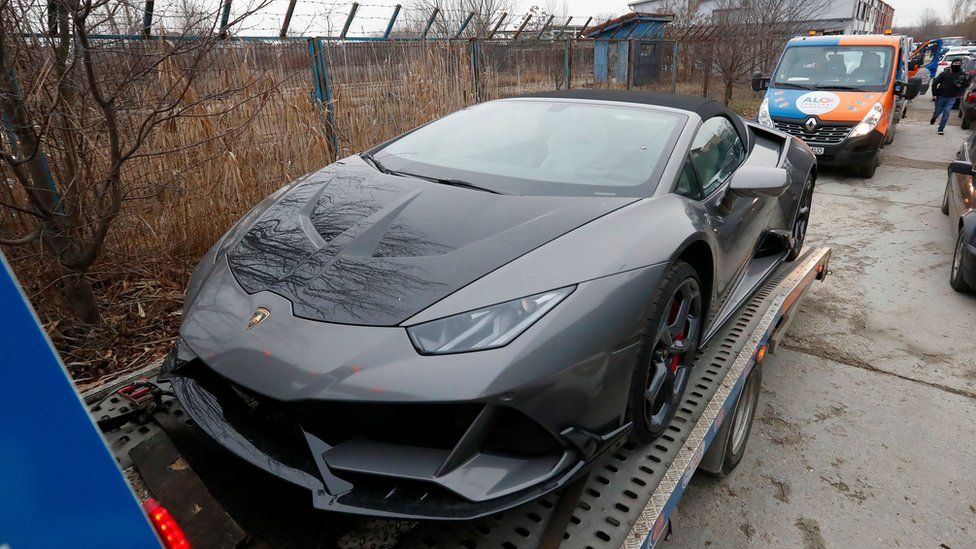
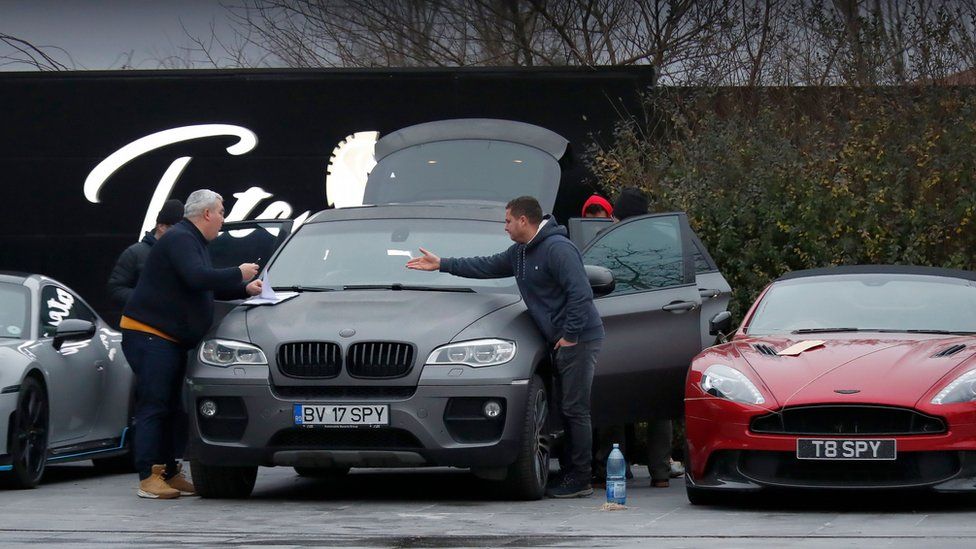
British-American Influencer, Andrew Tate, had several high-end vehicles seized from his Bucharest home.
Last month, Mr. Tate and his brother Tristan were taken into custody as part of a probe into allegations of rape and human trafficking, both of which they deny.
According to Reuters, vehicles including a Rolls-Royce, BMW, and Mercedes-Benz were taken from the property on Saturday.
The attorney for Mr. Tate was unavailable to comment right away.
On Tuesday, Mr Tate lost a bid to end his detention in Romania after a court rejected his appeal and said he should remain in custody.
Mr Tate was seen carrying what appeared to be a copy of the Quran as he walked into Bucharest Appeal Court handcuffed to his brother.
After the arrests on 29 December, police said they had identified six people who were allegedly “sexually exploited” by what it called an “organised criminal group”.
Police alleged the victims were “recruited” by the British citizens, who they said misrepresented their intention to enter into a relationship with the victims – which they called “the loverboy method”.
They were later forced to perform in pornographic content under threat of violence, a statement alleged.
The Tates’ lawyer, Eugen Vidineac, has said his clients rejected all the allegations.
Born in the US before moving to the UK, Mr Tate went on to have a successful career as a kickboxer.
In 2016, he was removed fromBritish TV show Big Brother over a video which appeared to show him attacking a woman. He then set up a “webcam business”, which he described as “adult entertainment”.
He went on to gain global notoriety, with Twitter banning him for saying women should “bear responsibility” for being sexually assaulted. He has since been reinstated.
Mexico has implemented one of the strictest anti-tobacco laws in the world by outlawing smoking entirely in public areas.
The action, which was initially authorized in 2021, also forbids tobacco advertising.
Legislation banning smoking in public places has also been adopted in a number of other Latin American nations.
But in the Americas, Mexico is thought to have the most comprehensive and robust legal system.
It amounts to one of the most stringent anti-smoking laws in the world. Mexico’s existing 2008 law – which created smoke-free spaces in bars, restaurants and workplaces – is now extended to an outright ban in all public spaces. That includes parks, beaches, hotels, offices and restaurants.
There will also be a total ban on the advertising, promotion and sponsorship of tobacco products, meaning that cigarettes cannot even be on show inside shops.
Vapes and e-cigarettes are also subject to tighter new restrictions, particularly indoors.
The Pan American Health Organisation has welcomed the step and applauded the Mexican government for implementing the ban.
The organisation says that tobacco use is the single most preventable cause of death in the world, responsible for nearly a million deaths in the Americas each year, either through direct consumption or exposure to second-hand smoke.
However, some smokers are dismayed at the draconian nature of the new law.
Others have raised questions about the practicalities of enforcing the law.
With police corruption so rampant in Mexico, many fear that rather than issuing real fines or punishments for smoking in public, some officers will use it as a pretext for taking bribes.
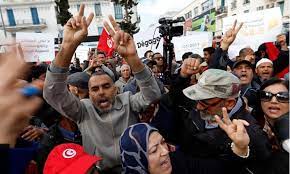
In protest of President Kais Saied, thousands of Tunisians have taken to the streets as the political and economic situation in the nation worsens. In order to demand the overthrow of his government, a crowd gathered in Tunis’s capital.
Since Mr. Saied took office in 2021, the Tunisians who backed him have grown increasingly disenchanted with the state of the economy.
The demonstrations coincide with the exile of former dictator Zine al-Abidine Ben Ali 12 years ago today.
Tunisia’s uprising is often held up as the sole success of the Arab Spring revolts across the region – but it has not led to stability, either economically or politically.
With debts piling up, the country has struggled to import basic goods, including staples such as coffee, milk and sugar.
The government has so far unable to secure an international bailout leading one protester to tell the AFP news agency “the coup has brought us famine and poverty”.
In Tunis’ central Habib Bourguiba Avenue, a traditional site for demonstrations, Said Anouar Ali, 34, said: “Tunisia is going through the most dangerous time in its history.
“Saied took control of all authorityand struck at democracy. The economy is collapsing. We will not be silent,” he added.
The protests in the capital were organised by two different opposition groups with a heavy police presence outside the Interior Ministry to prevent scuffles.
Separately, protesters also marched against Mr Saied’s seizure of near total power.
In 2021, the president sacked the prime minister, suspended parliament and pushed through a constitution enshrining his one-man rule.
The new constitution replaced one drafted soon after the Arab Spring in 2011, which saw Tunisia overthrow late dictator Zine al-Abidine Ben Ali. It gave the head of state full executive control and supreme command of the army.
Mr Saied has justified his actions by saying he needed new powers to break a cycle of political paralysis and economic decay.
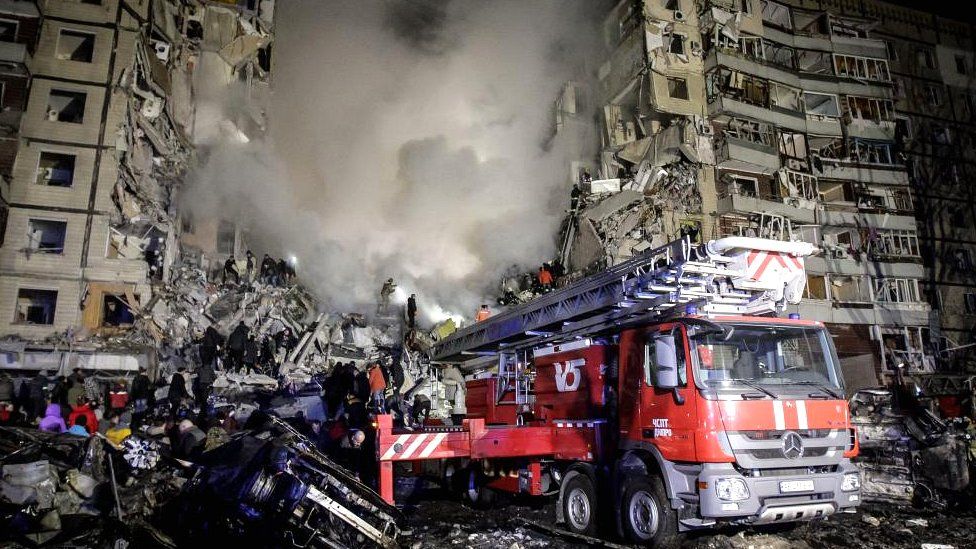
On Saturday, Russia launched a new wave of missile attacks across Ukraine, killing at least 20 people in a strike on an apartment building in the eastern city of Dnipro.
A number of other cities were also hit, including Kyiv, Kharkiv, and Odesa.
After missiles struck power infrastructure in several cities, much of Ukraine is now in emergency mode.
Earlier, the UK announced that it would send Challenger 2 tanks to Ukraine to assist with defence.
The Challengers, the British army’s main battle tank, will help Kyiv’s forces “push Russian troops back,” according toUK Prime Minister Rishi Sunak.
Russia responded by saying that providing more weapons to Ukraine would lead to intensified Russian operations and more civilian casualties.
Later on Saturday – a day when Ukrainians celebrate the Old (or Orthodox) New Year – Ukrainian President Volodymyr Zelensky said Russian attacks on civilian targets could be stopped only if Ukraine’s Western partners supplied necessary weapons.
“What is needed for this? Those weapons which are in the depots of our partners and which our soldiers are waiting for so much,” he said in his nightly video address, adding that his forces shot down more than 20 out of 30 Russian missiles fired at Ukraine.
Image caption,Rescue teams work in the rubble of the damaged residential building hit by shelling in Dnipro
The devastating strike in Dnipro hit the entrance of a nine-storey building, turning several floors into smouldering rubble, and leaving 73 injured, including 14 children, Ukrainian officials said, in what is likely to be the worst attack in months.
A sizeable crowd gathered to watch the rescue effort at the site of the strike, while others joined rescue workers in a desperate search for survivors. There were urgent calls, human chains of volunteers clearing rubble and torch beams piercing thick clouds of dust and smoke.
In his address, Mr Zelensky said debris clearance in Dnipro would continue all night: “We are fighting for every person, every life.” So far, 38 people have been rescued from the building, including six children, officials say.
There is no information yet on why the apartment block was the object of such devastation, as it is some distance from the nearest power facility.
On a day when Russia seemed intent, once again, on targeting Ukraine’s energy grid, this could have been one of the less accurate missiles in Russia’s arsenal, or something brought down by Ukraine’s air defences – although on the face of it, this seems a less likely explanation.
It has been two weeks since the last wave ofRussian attacks on Ukraine’s power grid. Mr Zelensky said that of the energy infrastructure facilities hit on Saturday that the most difficult situation was in the Kharkiv and Kyiv regions.
Ukrainian state energy company Ukrenergo earlier said round-the-clock consumption limits had been set for all regions until midnight local time.
Officials, in the West and in Ukraine, had begun to wonder if Russia’s “energy war” might be coming to an end, due to a possible shortage of suitable missiles and the evident fact the strategy has yet to break Ukraine’s spirit.
Saturday’s attacks suggest Moscow still thinks it is a tactic worth pursuing.
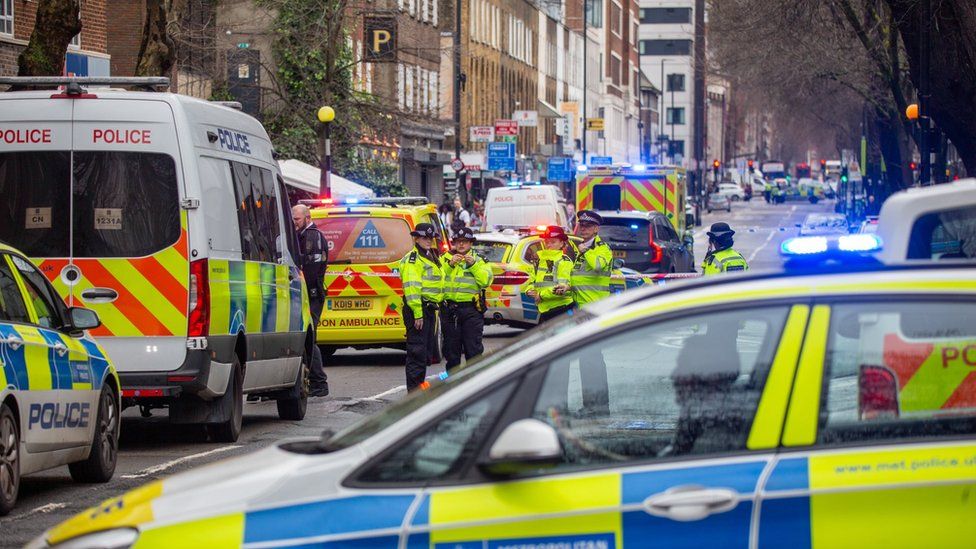
A drive-by shooting outside a church in theheart of London left a seven-year-old girl with potentially fatal wounds.
On Saturday afternoon, it was said that shots were fired from a moving vehicle at St. Aloysius Church in Euston while a memorial service was taking place there.
A 12-year-old girl and four women, ages 21, 41, 48, and 54, were also hurt, according to the Met Police.
According to the police, the 48-year-old may have permanent injuries.
The three other women’s injuries are not life-threatening and the 12-year-old girl has been treated for a minor leg injury, said the force.
The seven-year-old, who was taken to a central London hospital at about 14:05 GMT, “remains in hospital in a life-threatening condition.”
In a statement, the Met said an urgent investigation was under way and details of the incident were still emerging.
“At this early stage, there have been no arrests,” it said.
Supt Ed Wells said any shooting incident was “unacceptable, but for multiple people, including two children, to be injured in a shooting in the middle of a Saturday afternoon is shocking”.
Image caption,The shooting happened close to a church while a funeral was taking place, police say
“Our thoughts are with all the victims, but in particular with the seven-year-old girl. An investigation into this dreadful attack is already well under way,” he said.
“I can assure the communities of Camden and beyond that we will do everything we possibly can to identify and bring to justice those who were responsible.”
He added that there would be “an increased visible police presence in the area through the weekend and into the days ahead”.
Detectives have urged anyone with video footage or CCTV to contact the force.
Road closures were put in place and buses were diverted to allow investigation work to take place.
He confirmed the service was held for Sara Sanchez, 20, who had died from leukaemia, and her mother. They had died within a month of each other in November.
Father Trood said: “I was inside the church. I heard the bang and people ran back into the church. They knew something had happened outside.
“They were very scared, people sheltered in the church until the police said they can leave but some of them were so scared they had to wait a while to get their confidence back up to go outside.”
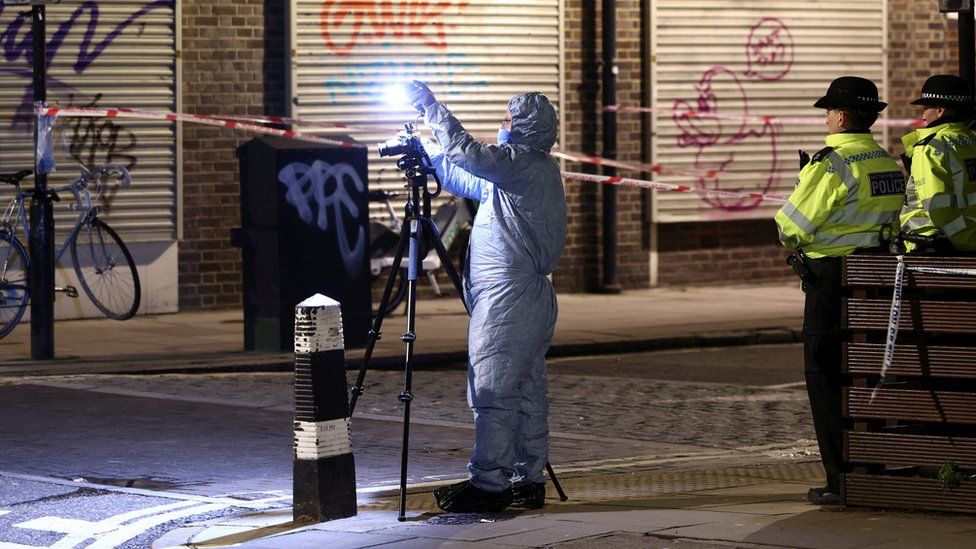
Image caption,A forensics officer works at the scene of the shooting
A resident on an estate near the church, who did not want to give her name, said: “I heard the gunshots.
“I was having a quiet day on my balcony and I heard this almighty bang and I thought this was not normal, and the next minute everyone was screaming and shouting.
“Neighbours came in and said there has been a shooting. What a terrible thing.”
Photographer Simon Lamrock said when he first arrived at the church, people had been evacuated through a side entrance.
“It’s a very busy area. All the local residents had come out to find out what was going on,” Mr Lamrock said.
“There was shock and surprise. That was the mood of people trying to work out what had happened.”
Mayor of London Sadiq Khan described the shooting as “deeply distressing” and said he was in close contact with the Met Police.
Brazil’s Supreme Court has agreed to open an investigation into former President Jair Bolsonaro for allegedly encouraging anti-democratic protests that ended in the storming of government buildings by his supporters in the capital Brasilia.
Prosecutors will investigate Bolsonaro, who is in the United States, for possible “instigation and intellectual authorship of the anti-democratic acts that resulted in vandalism and violence in Brasilia last Sunday,” the top public prosecutor’s office said in a statement on Friday.
“Public figures who continue to cowardly conspire against democracy trying to establish a state of exception will be held accountable,” said Justice Alexandre de Moraes, who agreed on Friday to the request by federal prosecutors to launch the probe.
The Supreme Court had already ordered the arrest of Bolsonaro’s former justice minister, Anderson Torres, for allowing the protests to take place in the Brazilian capital after he assumed responsibility for Brasilia’s public security.
The federal district’s former governor and former military police chief are also targets of the Supreme Court investigation made public on Friday.
Both were removed from their positions when thousands of Bolsonaro supporters vandalised theSupreme Court, Congress and presidential palace last weekend, seeking to provoke chaos and a military coup that would remove President Luiz Inacio Lula da Silva and restore the far-right Bolsonaro to power.
Having lost Brazil’s October election to Lula, Bolsonaro left Brazil for the US on the eve of the end of his term, avoiding passing the presidential sash to his leftist rival at his inauguration.
Torres, who like Bolsonaro is in Florida, has said he plans to return to Brazil to turn himself in. Bolsonaro said on social media he will move forward his return to Brazil.
Justice Minister Flavio Dino told a news conference he would wait until next week to re-evaluate Torres’s case, indicating a possible request for his extradition if the former minister does not turn himself in.
The arrest warrant against Torres was issued by de Moraes, who also removed Brasilia’s security chief from his post just hours after the rampage.
On Thursday, police found a draft decree in Torres’s house that appeared to be a proposal to interfere in the result of the election. Torres claimed the document was among others in a stack that was being thrown out. He said they were “leaked” to the Folha de S.Paulo newspaper in his absence to create a “false narrative”.
Dino said he has made no requests to the US regarding Bolsonaro.
The political party to which Bolsonaro belongs, the right-wing Liberal Party (PL), decided to beef up its team of lawyers in preparation for the defence of the former president, a party official told Reuters.
Also on Friday night, the popular social media accounts of several prominent right-wing figures were suspended in Brazil in response to a court order, which US journalist Glenn Greenwald obtained and detailed on a live social media broadcast.
The order, also issued by Justice de Moraes, was directed at six social media platforms and established a two-hour deadline to block the accounts or face fines.
The accounts belong to a digital influencer, a YouTuber recently elected federal legislator, a podcast host in the style of Joe Rogan and an evangelical pastor, among others.
Bolsonaro now faces several investigations for anti-democratic statements he made as president, including repeated claims the election system was open to fraud.
PL party leaders fear he will be held responsible for Sunday’s storming of government buildings. While they do not think he will face arrest, they fear he could be declared ineligible to run in the 2026 election, the party official said.
This weekend, a flood watch is in effect for about 25 million people in California as the latest in a string of deadly storms drenches the state.
At least 19 people have died as a result of flooding in several waterways, and thousands of people have been ordered to leave their homes.
Locals in the town of Montecito, which is 135 miles (84 km) northwest of Los Angeles, claim that the rain makes their trauma worse.
Many are concerned that a mudslide that killed 23 people here in 2018 could happen again.
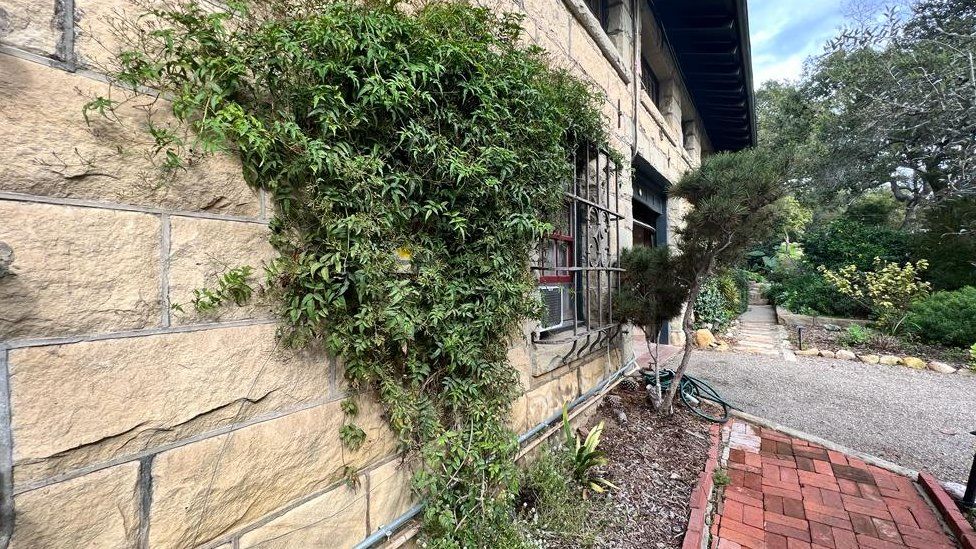
Rita Bourbon credits Italian stone masons with saving her life. The craftsmen built her home more than a century ago and she says it’s like a fortress.
She survived the storm five years ago, crying inside with her daughter and some friends as they listened to the sound of boulders and other houses ripped from their foundations crashing into her home.
The next day, the neighbourhood up the coast from Los Angeles was wrecked and almost two dozen were dead, including her neighbour whom she found in her garden in the mud.
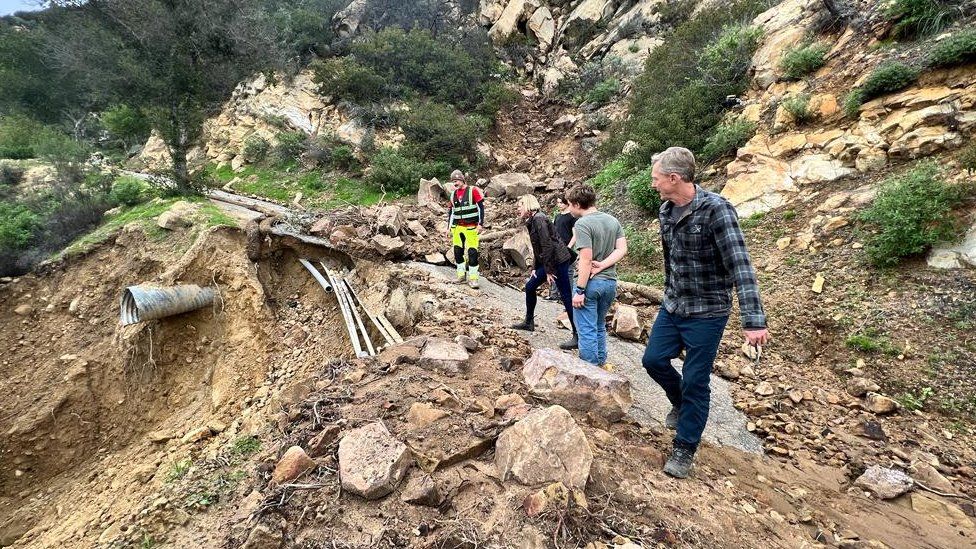
Image caption,Landslides triggered by the storms have damaged roads
“It’s a sound I used to love,” she says of the creek burbling in her garden, which is now bursting with ripe citrus and persimmon trees, as a blue heron drinks from her muddy pool.
“Now I know what it can do. We all have a bit of PTSD.”
Montecito creek became a violent, raging flow again this past week, prompting fire officials to issue a “Leave Now!” warning to the entire community, which includes some of California’s most famous residents such as Oprah Winfrey,Prince Harry and Meghan Markle.
The evacuation order in Montecito has been lifted, but residents remain on edge. And with so much of the land already saturated, the risk of flooding and landslides is very real.
Abe Powell is the co-founder of the Santa Barbara Bucket Brigade, formed in 2018 to mobilise volunteers to clean up after the deadly mudslide.
This week, Powell led volunteers around the community, filling sandbags and digging trenches. He took us on a perilous drive up a narrow mountain road where giant boulders and mud blocked access to some homes.
“We don’t want to hang around here,” he said, looking at the fresh boulders.
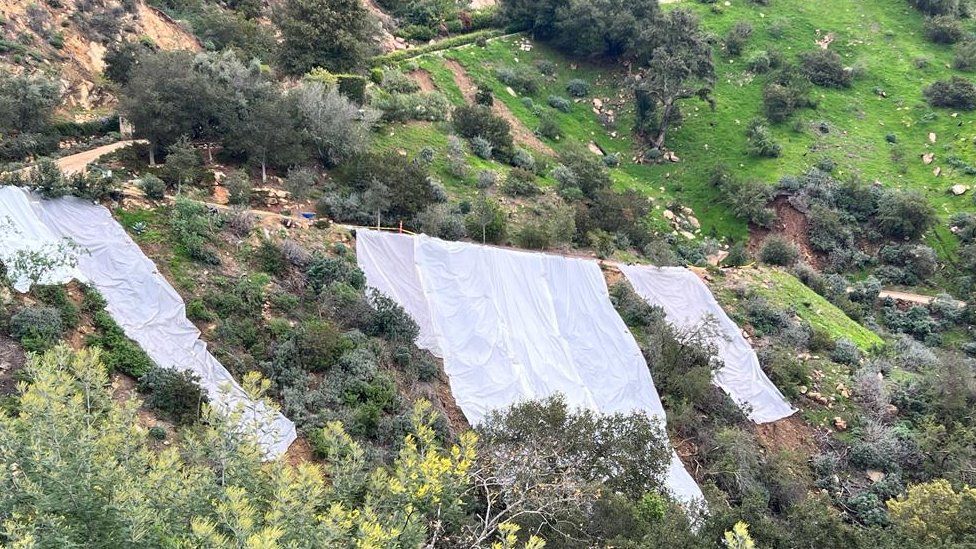
Image caption,Plastic sheets were placed on a hillside which slid away for the first time this week
Film producer Steve McGlothen is one of the volunteers. He has lived in the area for half a century and in his cliff top home for 27 years.
Helping others, he said, takes his mind off the problems at his own property and the despair he feels as the rain keeps falling. Plastic sheets cover the hillside, which slid away for the first time this week – an attempt to stop this latest deluge from making the slide worse.
“We’re looking at earth that has never moved,” he said. “Close to 50 years – this has never moved. It’s never been a problem before.”
The Governor of California, Gavin Newsom, joined the volunteers filling sandbags in Santa Barbara. He says the area is a “hot spot” he’s concerned about in the coming days.
“We’ve experienced some 24 trillion gallons of water falling on this state in the last 16 days in the middle of a mega drought,” Governor Newsom told the BBC. He says California needs to reimagine the way it manages water, because the infrastructure here was built for a time which no longer exists.
Watch: From droughts and wildfires to flooded streets – is California’s extreme weather the new norm?
Californians are used to extreme weather – wildfires, drought and the threat of earthquakes, with many awaiting the “Big One” that so many experts predict. But the “storm parade” pummelling California is new.
At least 19 people have died in these storms, which began in late December. A five-year-old boy is still missing after he was ripped from his mother’s arms in fast-moving flood water in central California, when they got trapped while driving to school.
In Northern California, vineyards are under water. In Capitola, the historic wharf has been destroyed and the beach town battered. In the storied Salinas Valley, the river is rising and threatening California’s famed agricultural heartland.
US President Joe Biden has now ordered federal aid for Sacramento, Merced and Santa Cruz counties.
Nasa climate scientist Kimberley Rain Miner says the challenge with having this many huge storms, back to back, is that the ground is already saturated and can’t absorb the amount of water falling quickly.
Image caption,Italian stone masons built Rita Bourbon’s home more than a century ago and she describes it as a fortress
“If we are unable to slow the warming of the atmosphere, we can expect to see more and more extreme events happening more and more frequently,” Miner told the BBC, while surveying storm damage on a beach in Ventura. “And that’s global. That’s not just in California.”
In California everyone is watching their phones, waiting to hear if they should evacuate and wondering where it might be safe to go if they do need to leave town.
For Rita Bourbon, she decided not to wait. Even though she’s confident her house will survive, she doesn’t want to relive the trauma of another landslide. She opted to visit friends in Los Angeles this weekend.
“I just don’t want to go through another mudslide,” she said, adding that she would be a “nervous wreck” if she stayed. “Just hearing the creek and the cracking together of boulders. It’s better for everyone if I just go.”
A standoff between the US state of Michigan and Canada is the result of an aging pipeline that crosses a portion of the Great Lakes.
Many will look at the outcome of the fight over Line 5, which supplies energy to central Canada and the US Midwest, as a sign of how North America will balance its future energy needs with its environmental obligations.
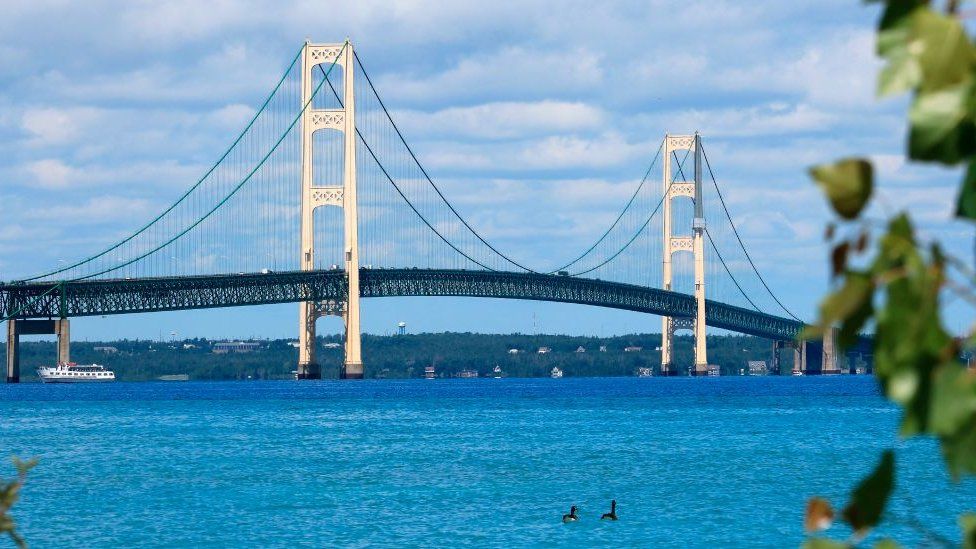
The most controversial section of the Line 5 pipeline, which connects Superior, Wisconsin, with Sarnia, Canada, via Michigan, is located on the floor of the Straits of Mackinac. Two of the biggest lakes in the world, Lake Michigan and Lake Huron, are connected by the narrow waterway.
In 2018, an anchor from a shipping freighter passing through the Straits struck and damaged the pipe, bringing to the fore longstanding concerns from environmental campaigners and others over possible spills.
Then-Michigan Governor Rick Snyder made an agreement with Canadian pipeline operator Enbridge to protect the pipeline from further damage and keep it operational. Enbridge, one of the world’s largest pipeline firms, would build a $500m (£411m) tunnel bored through rock below the lakebed in the Straits, to enclose Line 5.
The agreement was meant to end uncertainty about the controversial 69-year-old oil and natural gas pipeline’s safety.
Will Line 5 be shut down?
But two years later, Governor Gretchen Whitmer, Mr Snyder’s Democratic successor and a long-time opponent of Line 5, ordered the company to cease operations in the Straits, effectively shutting Line 5 down. She called it an “unreasonable risk” to the Great Lakes, one of the largest sources of fresh water in the world and an economic engine for the region.
Now, there is no end in sight for the ongoing battle over the fate of the project, the pipeline and the need to protect the Great Lakes.
Permits and a safety and environmental impact assessment for the project – which would take years to complete – are still pending. And Enbridge has ignored Gov Whitmer’s order to halt, setting things up for a lengthy and contentious court battle.
Enbridge says the pipeline, which earns it an estimated $1.6-$2m daily, has been operating safely and reliably in the Straits for decades.
In turn, Michigan has sued the company to enforce the Line 5 shutdown. The case is currently before a US federal court.
Calgary-based Enbridge has Canada in its corner.
Line 5 is part of the Lakehead System, a network of pipelines that brings oil and natural gas from western Canada to homes and refineries in Michigan, Ohio, Pennsylvania, Ontario and Quebec.
It provides the majority of the Canadian provinces of Ontario and Quebec’s crude oil and, fearing its closure, Ottawa – which has warned a shutdown would have a profound impact on both sides of the border, including on jobs and supply chains – backed Enbridge’s legal case. It invoked the 1977 Transit Pipelines Treaty between the two countries.
The treaty ensures that crude oil will flow between theUS and Canada so long as the pipelines involved are compliant with various rules and regulations. It forces an arbitration process in the event of a dispute.
But Michigan has the support of 12 federally recognised Anishinaabe tribes in the state, who say Line 5 poses too high a risk to the Great Lakes.
Line 5 ‘ticking time bomb’ fears
The waters are also of spiritual importance for the tribes, who argue they are protected by their constitutional treaty rights.
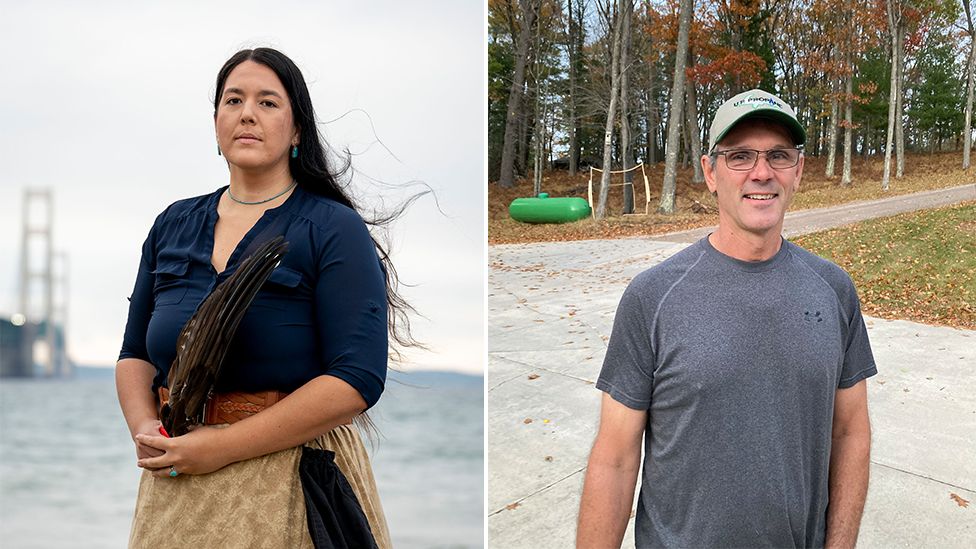
“The Straits of Mackinac are the centre of our creation story,” explains the President of the Bay Mills Indian Community, Whitney Gravelle.
She said they have a right to hunt, fish and gather in the territory “in perpetuity – and Line 5 is a ticking time bomb that could destroy our culture and lifeways”.
For many Michiganders it is a vital fuel supply – their main source of heating, delivering 55% of the state’s propane needs, according to Enbridge.
Dan Harrington is the owner of UP Propane, a major supplier of propane used for heating in Michigan’s Upper Peninsula, north of the Straits of Mackinac.
Over concerns the pipeline would be shut down, he arranged an alternative supply route so as not to let down his 17,000 customers.
“We actually put in a rail terminal where we aren’t getting any, or very little, of our propane from Line 5,” says Harrington.
But if it were shut down, “the Midwest would be in a world of hurt”, he said.
Image caption,Whitney Gravelle is president of the Bay Mills Indian Community and Dan Harrington is a Michigan businessman
While Enbridge says the Great Lakes tunnel project would “virtually eliminate” the chance of a spill, others disagree.
An independent pipeline safety expert hired by the Bay Mills Indian Community, Richard Kuprewicz, says that transporting oil and gas “through an enclosed tunnel enhances the risk of a catastrophic explosion” – a risk he called low but not “negligible”.
If there was a pipeline break, even in the best-case scenario the outcome would be disastrous, according to Great Lakes oceanographer Dave Schwab.
Line 5 carries almost half-a-million gallons of oil and natural gas daily.
“So even if the oil flow was stopped instantly, which is impossible, the pipe would still contain a minimum of 5,000 barrels of oil,” he said.
A “best-case scenario” could see 700km (435 miles) of shoreline along Lake Huron and Lake Michigan affected, he said, and “in the worst case of a 25,000 barrel spill, over 1,000km of shoreline in both Canada and America would be affected”.
According to an independent risk analysis commissioned by Michigan, an oil spill could cost almost $2bn in damages. Given the diversity of habitats in and around the Straits – home to many insects, fish and migratory birds – it may “represent a point of no return for species loss”.
Michigan has been looking at options to replace Line 5 that include adding pumping stations to increase the flow of other Enbridge pipelines, or transporting the product via trucks and railroads. Those options, Canada’s Minister for Natural Resources Jonathan Wilkinson told the BBC, were “less safe, less efficient, and higher emitting”.
Pipelines are generally regarded as a safe way to transport fuel and a better alternative to tanker trucks or freight trains.
Eyes on Biden as energy prices rise
Supporters argue Line 5 is critical to the state for the millions of dollars Enbridge pays in property, corporate and other tax revenues annually, and is vital to its energy needs.
Enbridge says there’s no viable alternative to the tunnel project and that they intend to continue operating Line 5 at the Straits until the tunnel’s completion.
“The tunnel makes what has always been a safe pipeline even safer, ensuring energy access and reliability, and supporting jobs and the economy throughout the Great Lakes Region,” it told the BBC in an emailed statement.
They said they had also taken additional measures to regularly monitor its integrity and prevent future anchor strikes.
Although Line 5 has spilled over one million gallons at other stretches of the pipeline over its lifetime, Enbridge states that the portion crossing Mackinac “remains in excellent condition and has never experienced a leak”.
So far, the Biden administration has kept at arm’s length from the dispute, saying it will allow current environmental reviews of the tunnel project to play out.
Image caption,The Straits of Mackinac is an economically and environmentally vital part of the Great Lakes
But Heather Exner-Pirot, a Senior Fellow at the Macdonald-Laurier Institute, a Canadian think-tank, believes Mr Biden is unlikely to allow Line 5 to close, especially in the wake of Russia’s invasion of Ukraine, which has had a significant impact on global energy supply and markets.
“The energy crisis has caused the political tides to turn on this,” said Ms Pirot.
This will dismay both environmentalists and tribes, who assert that Line 5 is contrary to the Biden administration’s green energy commitments.
“Enbridge is speaking the universal language of economics,” says Liz Kirkwood of FLOW, a non-profit conservation group, referring to the firm’s warnings that a shutdown would have immediate consequences on the economies in the region.
“What we’re talking about is 20% of the planet’s fresh surface water and the identity of an entire region. This is our home.”
Editor’s note: Leana Hosea was arrested in 2017 while working as a journalist covering a protest against Enbridge’s Line 3 pipeline in Wisconsin. All criminal charges were dropped.
In less than a month, China has reported 60,000 COVID-related fatalities, the first significant death toll since the country abandoned its zero-COVID policy.
China reported 59,938 COVID-related deaths between December 8 and January 12, according to officials.
Despite there being evidence of hospitals and crematoriums being overrun, China has frequently been accused of underreporting coronavirus deaths.
Most of those who passed away were older than 80 and had underlying medical conditions.
The figures, include 5,503 deaths caused by respiratory failure directly due to the virus, and 54,435 caused by underlying conditions combined with the virus.
The real total is likely to be higher because which the figures refer only to deaths recorded at medical facilities.
Last month, Beijing changed the way it categorises Covid deaths, only counting towards its total those who died of respiratory failure directly induced by the virus.
The World Health Organisation criticised the definition, describing it as “too narrow”.
Beijing has always contended that its figures are accurate, calling on the WHO to “uphold a scientific, objective and just position”.
Officials said that the peak of patients hospitalised with severe Covid was in early January, although the number subsequently remained high.
They said that they would continue to monitor the situation in rural areas, focusing on early detection and prioritising treatment of the most vulnerable.
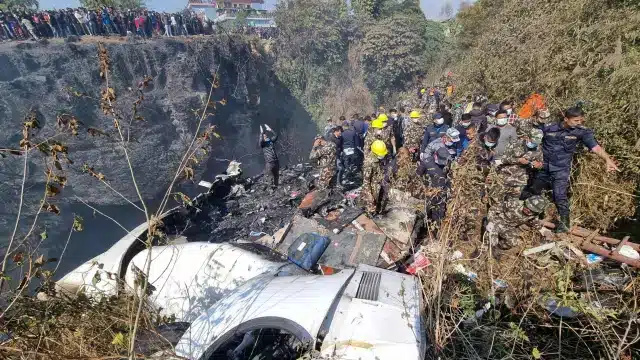
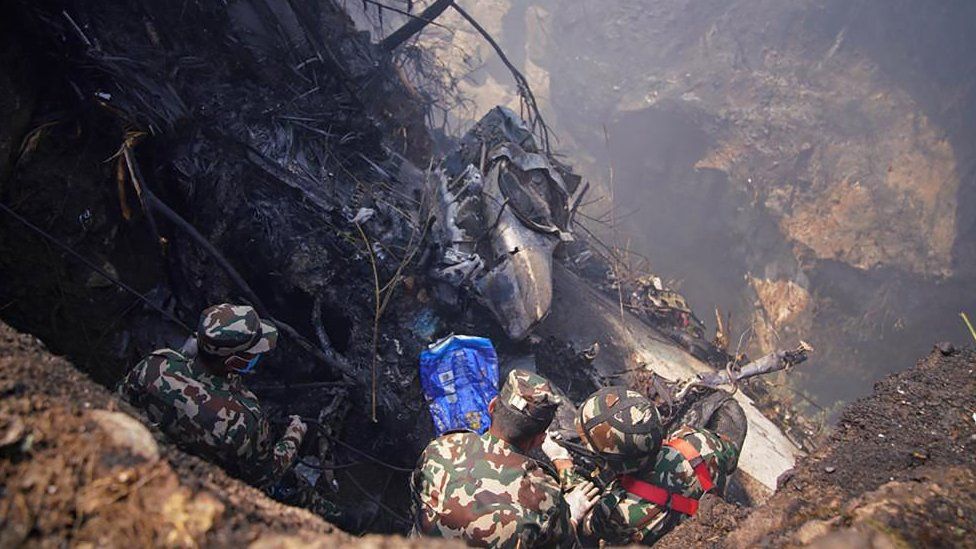
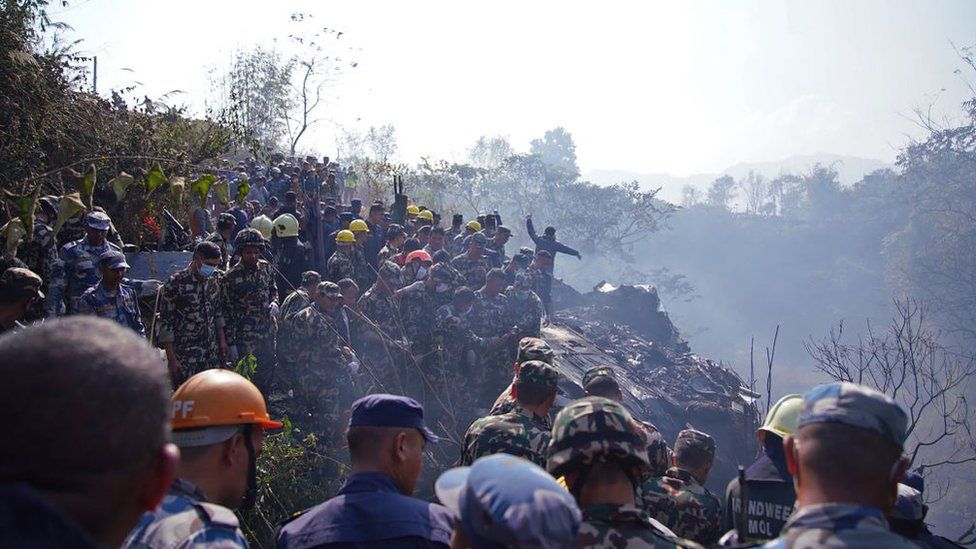
A Yeti Airlines flight from Kathmandu to the popular tourist destination of Pokhara crashed and caught fire as it touched down.
Social media videos show an aircraft passing closely above a populated area before abruptly spinning.
On board were four crew members and 68 passengers, at least 15 of whom were foreigners.
Hundreds of Nepalese soldiers are involved in the operation at the crash site in the gorge of the Seti River, just one and a half kilometres from the airport.
Video taken where the plane came down shows thick billowing black smoke and burning debris.
“We expect to recover more bodies,” an army spokesman told Reuters, saying the plane “has broken into pieces”.
Prime Minister Pushpa Kamal Dahal called an emergency meeting of his cabinet and urged state agencies to work on rescue operations.
Of the passengers, 53 are said to be Nepalese. There were five Indian, four Russians and two Koreans on the plane. There was also one passenger each from Ireland, Australia, Argentina and France among others.
Aviation accidents are not uncommon in Nepal, often due to its remote runways and sudden weather changes that can make for hazardous conditions.
A Tara Air plane crashed in May 2022 in the northern Nepalese district of Mustang, killing 22 people.
Since Castillo was removed from office and detained in December, there have been demonstrations against President Boluarte.
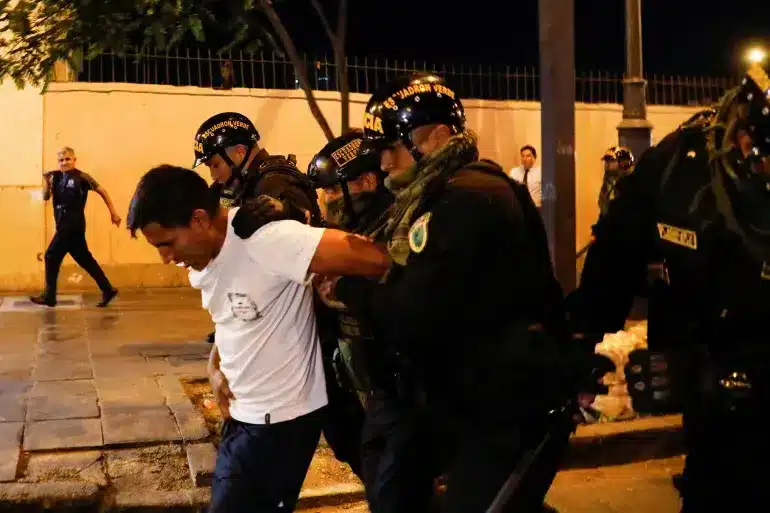
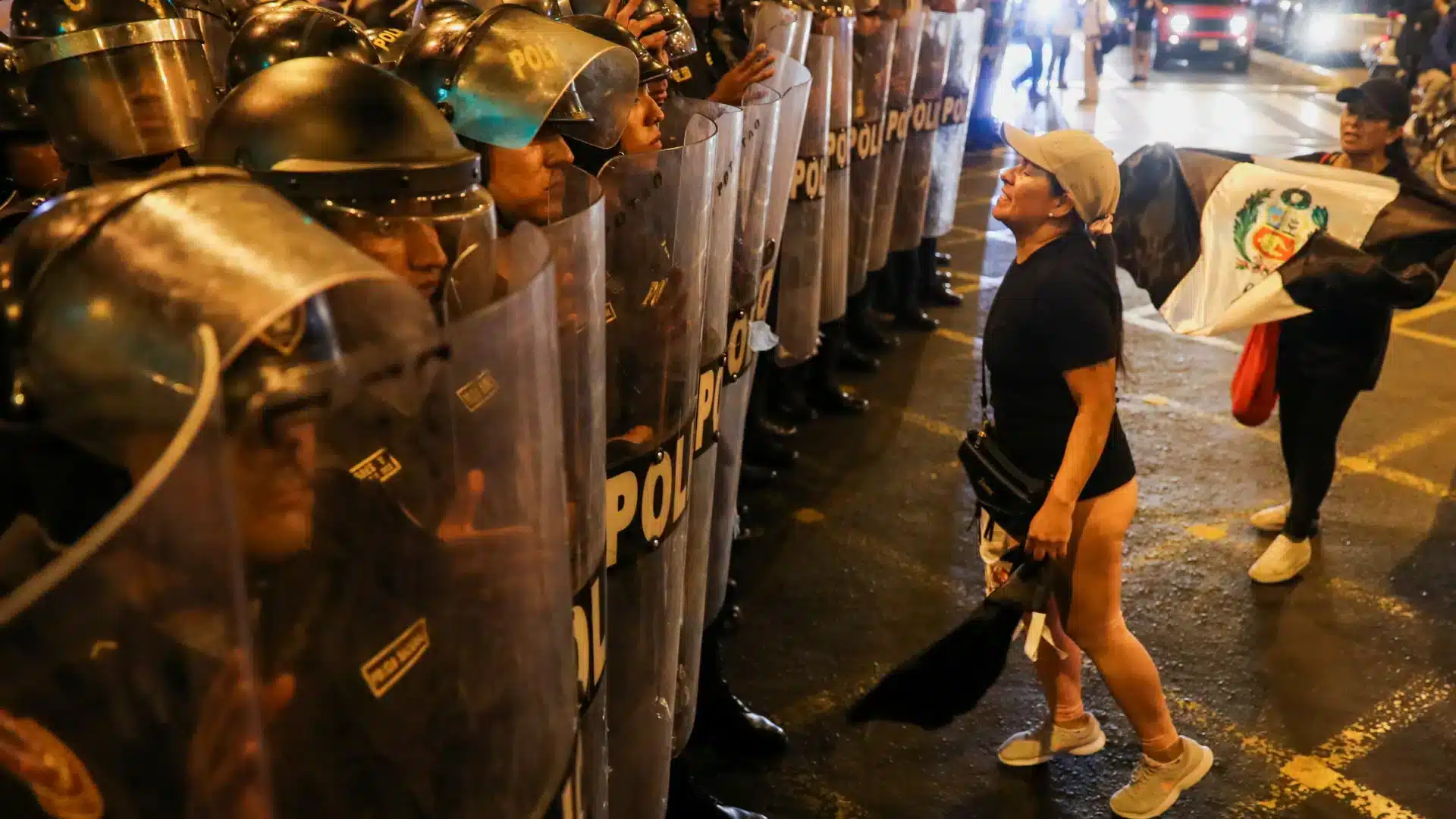
Following protests that have claimed at least 42 lives in recent weeks, the government of Peru has proclaimed a state of emergency in the capital Lima and three other regions.
The late-Saturday announcement of the measure, which will be in effect for 30 days, gives the army permission to step in to keep the peace while suspending several constitutional rights like the right to free speech and the right to assemble.
Since leftist former president Pedro Castillo was ousted from office and detained in December for attempting to illegally dissolve Congress, protests against President Dina Boluarte have swept the South American country.
He was replaced in the president’s position by Boluarte, who was vice president.
Castillo supporters have marched and barricaded streets around the country for weeks, demanding that new elections be held and for Boluarte to step down.
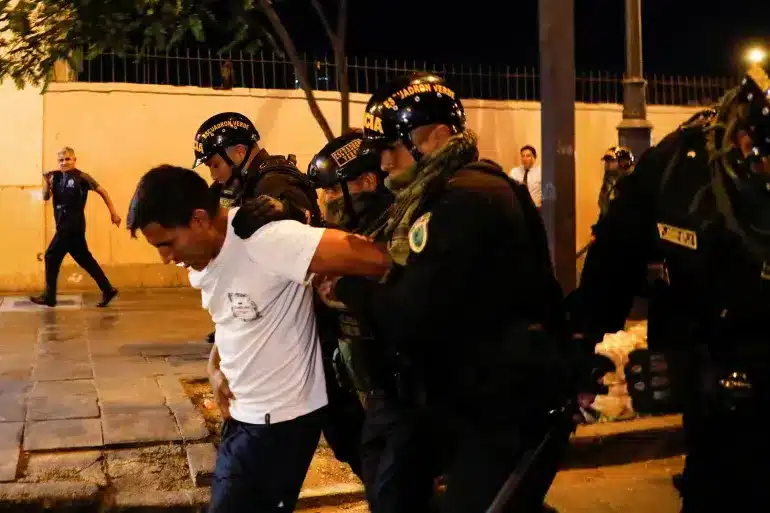
Demonstrators assist a man injured during protests near the Juliaca airport in Peru [Hugo Courotto/Reuters]
On Thursday, authorities closed air and rail links to Peru’s famed Machu Picchu tourist site as protests flared up, leading to clashes between police and protesters.
While Boluarte has apologised for the violence, on Friday the 60-year-old insisted she would not resign amid the turmoil, and rejected the possibility of calling a constitutional assembly as demanded by protesters – pointing to the difficulties Peru’s neighbour Chile has had in drafting and approving a new constitution.
Castillo, who was being investigated in several fraud cases during his tenure, has been remanded in custody for 18 months, charged with rebellion.
Peru has been riddled with political instability in recent years. Boluarte, 60, is the sixth person to hold the presidency in five years.
Rabat is upset by the grandson of Nelson Mandela’s comments calling for the “liberation” of Western Sahara.
The ongoing political crisis between the two North African neighbors was exacerbated when Morocco denounced “provocative” behavior and “transgressions” prior to the start of a regional soccer competition in Algeria.
The bitter conflict between Rabat and Algiers is partly fueled by theWestern Sahara, a region that is claimed by both countries and where the Polisario movement, which is backed by Algeria, wants to hold an independence vote.
The Moroccan football association criticised the grandson of Nelson Mandela for making a “provocative and surreal speech” at the African Nations Championship (CHAN) opening ceremony on Friday, calling for the “liberation” of the disputed territory.
Rabat sees Western Sahara as an integral part of the kingdom and a highly sensitive issue of security and national pride.
“Let us fight to free Western Sahara from oppression,” Mandla Mandela told the crowd at the stadium named in honour of his grandfather, South Africa’s first democratically elected president after the fall of apartheid, in the Algerian city of Constantine.
“Don’t forget the last colony of Africa, Western Sahara,” he added.
The desert territory boasts rich Atlantic fisheries, phosphate resources and a land route to markets in West Africa.
The Moroccan football federation said the speech “flouted the rules governing the organisation of football events under the auspices of the Confederation of African Football (CAF)”.
The Moroccan federation also decried “racist” anti-Moroccan remarks at the opening ceremony, as videos circulated on social media appearing to show Algeria supporters chanting derogatory slogans against Moroccans.
The federation said it had written to the CAF to ask it to uphold “all its responsibilities in the face of these flagrant transgressions that have no relation to the principles and values” of football.
The United States in 2020 recognised Moroccan sovereignty over Western Sahara in a quid pro quo for re-establishing ties with Israel, to the chagrin of Algiers – which for decades has seen itself as North Africa’s main champion of the Palestinian cause.
“We stand together to fight for the liberation of Palestine,” Mandla Mandela also said in his speech.
On Thursday, Morocco said it was pulling out of the tournament after Algeria refused to authorise a direct flight from Rabat.
On Friday, the Moroccan under-23 team to the CHAN tournament arrived at Rabat airport as last-minute negotiations over travel to the tournament took place. However, the Moroccan football federation said the team did not travel as the flight to Constantine remained unauthorised.
Algeria’s airspace has been closed to Moroccan flights since Algiers broke off diplomatic ties with Rabat in August 2021 over what it called “hostile actions”.
CHAN organisers said the team could have taken an indirect flight.
Morocco made history in December by becoming the first African or Arab team ever to reach the semi-finals of a World Cup. Morocco’s Atlas Lions’ under-23 team won the last two CHAN tournaments.
According to Indonesia’s navy chief, a warship has been deployed to the North Natuna Sea to monitor a Chinese coast guard vessel that has been active in a resource-rich maritime area claimed by both countries.
Laksamana Madya Muhammad Ali, the chief of the Indonesian navy, told Reuters on Saturday that a warship, maritime patrol plane, and drone had been deployed to monitor the Chinese vessel.
“The Chinese vessel has not conducted any suspicious activities. However, we need to monitor it as it has been in Indonesia’s exclusive economic zone (EEZ) for some time,” he said.
Ship tracking data shows the Chinese vessel, CCG 5901, has been sailing in the Natuna Sea and particularly near to Indonesia’s Tuna Block gas field and Vietnam’s Chim Sao oil and gas field since December 30, the Indonesian Ocean Justice Initiative told Reuters.
China’s CCG 5901 is the world’s largest coast guard vessel and is nicknamed the “the monster” due to its size. The United Nations Convention on the Law of the Sea (UNCLOS) gives vessels navigation rights through an EEZ.
But the presence of the well-known Chinese vessel may signal increasing Chinese assertiveness and comes after Vietnam and Indonesia concluded an agreement on the boundaries of their EEZs in the area. Indonesia also recently approved a development plan for the Tuna gas field, involving an estimated investment of more than $3bn to commence production.
In 2017, Indonesia renamed the northern reaches of its exclusive economic zone as the North Natuna Sea. This was part of a push back against China’s maritime territorial ambitions and claims in the South China Sea. Indonesia maintains that under UNCLOS, the southern end of the South China Sea – since renamed North Natuna Sea – is its exclusive economic zone.
Vessels from Indonesia and China shadowed each other for months in 2021, near a submersible oil rig that had been performing tests in Indonesia’s gas-field development area. At the time, China urged Indonesia to stop the test drilling, claiming the activities were taking place in its territory.
China claims the Indonesian maritime area is within its expansive territorial claim in the South China Sea, which is marked by a U-shaped “nine-dash line”. That Permanent Court of Arbitration in the Hague found the nine-dash line to have no legal basis in 2016.
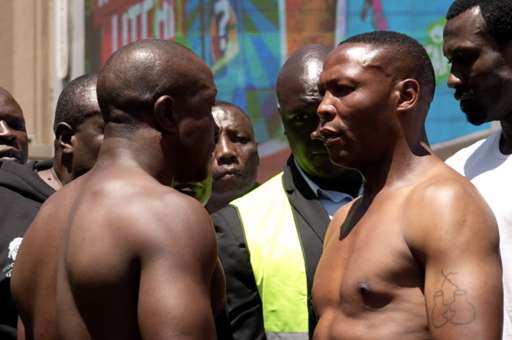
In East Africa, Karim Madonga is well-known for his extravagant boasts about his boxing prowess and goes by the moniker “mtu kazi,” which translates to “a fighter” in street Kiswahili.
He referred to his punch as a “heat-seeking missile” in his most recent fight. Prior to their fight on Saturday, he likened his punch to a “Ukrainian missile.”
The 43-year-old has drawn one fight, lost three, and won three fights.
He drew crowds as he walked around the Kenyan capital, Nairobi.
“I have been received well in Kenya. I started boxing in 2002, and boxing has made me a brand. Boxing took me to the city. I am the only boxer who became a star after losing a fight. And when I am beaten, I talk about it, when I win, I talk more about it. In boxing, you have to know how to talk and fight. I know both. Wanyonyi will be beaten,” Mandonga told BBC Sport Africa.
His opponent, 39-year-old Daniel Wanyonyi, says Mandonga’s personality is good for the sport.
“His talk makes him popular. We love such boxers. I am good at boxing, he is good at talking. I am ready for the fight tomorrow, it will be 10 rounds. There is pressure because we are at home and everyone is expecting me to win… However, I am telling Kenyans to leave that to me, victory will remain at home,” Daniel said .
Their fight will serve as a curtain raiser for the main fight between Kenyan boxer Rayton Okwiri and Tanzanian boxer Ally Ndaro.
A total of 11 fights will take place at the Kenyatta International Conference Centre (KICC). Organizers are hoping that the event will raise the profile of the sport, which has waned over the years.
Alireza Akbari, a dual citizen of the United Kingdom and Iran, was executed after receiving an Iranian death sentence.
On Wednesday, Mr. Akbari’s family was requested to pay him a “final visit” at the prison, and according to his wife, he had been transferred to solitary confinement.
The former Iranian deputy defence minister was detained in 2019 and found guilty of spying for theUK despite his denials.
The execution, according to UK Prime Minister Rishi Sunak, was “a callous and cowardly act, carried out by a barbaric regime.”
Iran’s rulers had “no respect for the human rights of their own people” Mr Sunak said, adding that his thoughts were “with Alireza’s friends and family”.
UK Foreign Secretary James Cleverly said the execution would “not stand unchallenged”.
The Iranian judiciary’s official news outlet Mizan reported on Saturday that Alireza Akbari had been hanged, without specifying the date when the execution took place.
The news came after Iran posted a video of Mr Akbari earlier this week showing what appeared to be forced confessions, and after the country’s intelligence ministry had described the British-Iranian as “one of the most important agents of the British intelligence service in Iran”.
However BBC Persian broadcast an audio message on Wednesday from Mr Akbari in which he said he had been tortured and forced to confess on camera to crimes he did not commit.
The United States had also joined calls for Iran not to execute Mr Akbari. US diplomat Vedant Patel said “his execution would be unconscionable” and condemned the charges against him as “politically motivated”.
The UK Foreign Office has ben supporting Mr Akbari’s family and had repeatedly raised his case with Iranian authorities. It had requested urgent consular access, but Iran’s government does not recognise dual nationality for Iranians.
‘Tortured for 3,500 hours’
In Mr Akbari’s audio message he said that he was living abroad a few years ago when he was invited to visit Iran at the request of a top Iranian diplomat who was involved in nuclear talks with world powers.
Once there, he adds, he was accused of obtaining top secret intelligence from the secretary of Iran’s Supreme National Security Council, Ali Shamkhani, “in exchange for a bottle of perfume and a shirt”.
Mr Akbari alleged that he was “interrogated and tortured” by intelligence agents “for more than 3,500 hours”.
“By using physiological and psychological methods, they broke my will, drove me to madness and forced me to do whatever they wanted,” he said. “By the force of gun and death threats they made me confess to false and corrupt claims.”
He also accused Iran of seeking “to take revenge on the UK by executing me”.
Hours after the audio message was broadcast, the Mizan news agency confirmed for the first time that Mr Akbari had been found guilty of espionage, and that the Supreme Court had rejected his appeal.
Ties between the UK and Iran have deteriorated in recent months since the UK imposed sanctions on Iran’s morality police and other top security figures, in response to the country’s violent crackdown on anti-government protesters.
Iran has arrested dozens of Iranians with dual nationality or foreign permanent residency in recent years, mostly on spying and national security charges.
British-Iranian citizens Nazanin Zaghari-Ratcliffe and Anoosheh Ashoori were released and allowed to leave Iran last year after the UK settled a longstanding debt owed to Iran.
However, at least two other British-Iranians remain in detention, including Morad Tahbaz, who also holds US citizenship.
Prince Harry has called on his family to apologize to Meghan.
This week’s release of Spare has made history for the UK’s fastest-selling non-fiction book.
Among the claims made in the book, Prince Harry said his brother described Meghan as “difficult”, “rude” and “abrasive”. Prince Harry also accused his brother of physically attacking him.
“But the way I see it is, I’m willing to forgive you for everything you’ve done, and I wish you’d actually sat down with me, properly, and instead of saying I’m delusional and paranoid, actually sit down and have a proper conversation about this, because what I’d really like is some accountability, and an apology to my wife.”
Kensington Palace and Buckingham Palace have both said they will not comment on its contents.
In an interview with the Telegraph’s Bryony Gordon – who travelled to California to speak to him – the Duke of Sussex said he was not “trying to collapse the monarchy”, but “trying to save them from themselves”.
Prince Harry said he left out some details because he knew his father and brother would never forgive him. He claims he had enough material for “two books.” “I just don’t want the world to know” about some things, he told the Daily Telegraph.
He added that said there was information he revealed to his ghostwriter JP Moehringer “for context” but there was “absolutely no way” it could be included in the book.
“It could have been two books, put it that way,” he said, adding that the first draft was 800 pages, double the final 400-page manuscript.
“And there were other bits that I shared with JR, that I said: ‘Look, I’m telling you this for context but there’s absolutely no way I’m putting it in there.’”
He said it was impossible to tell his story without his family members in it, “because they play such a crucial part in it, and also because you need to understand the characters and personalities of everyone within the book”.
“But there are some things that have happened, especially between me and my brother, and to some extent between me and my father, that I just don’t want the world to know. Because I don’t think they would ever forgive me,” he said.
“Now you could argue that some of the stuff I’ve put in there, well, they will never forgive me anyway.
He told the Telegraph that “no institution is immune to criticism and scrutiny”, claiming that if only 10% of the scrutiny put on him and his wife had been applied to the Royal Family “we wouldn’t be in this mess right now”.
He also spoke about therapy, describing it being “like clearing the windscreen, clearing away all the Instagram filters, all of life’s filters”.
And he said he feels a responsibility towards William’s children, “knowing that out of those three children,at least one will end up like me, the spare. And that hurts, that worries me”.
The handling of classified documents byDonald Trump and Joe Biden is being investigated by special counsels.
As 2022 got begun, things were looking good for US President Joe Biden.
His popularity was increasing.
Slowing down was inflation. Republicans were at war with themselves after a disappointing midterm season, while Democrats banded together behind Biden’s likely reelection campaign.
However, on Thursday, Attorney General Merrick Garland named a special counsel to look into how the Democratic president handled secret documents, casting further doubt on Biden’s political future.
NBC News then reported on Wednesday that a second batch of classified documents had been found. Biden’s lawyers and the White House disclosed on Thursday that documents had been found in December in Biden’s home in Wilmington, Delaware. A search of his second home did not turn up any documents.
Democrats publicly and privately conceded that the stunning information and appointment of a special counsel was at best an unwelcome distraction at an inopportune time that muddies the case against Donald Trump. The Republican former president is facing a special counsel of his own and is under federal criminal investigation for his handling of classified documents and other potential transgressions.
There are major differences between the two cases. Most notably, there is no suggestion that Biden purposefully tried to prevent the documents discovered at his home or office from being turned over or that he was even aware of their presence. Trump, who is being probed for potentially obstructing investigators, also had far more classified documents in his possession.
But Thursday’s appointment of a special counsel nonetheless thrusts legal uncertainty over the sitting president and could revive debate among Democrats about the wisdom of his seeking a second term.
“No one’s going to say this is helpful,” veteran Democratic strategist James Carville said. “It’s pretty evident that’s not the case.”
As Democrats recoiled into a defensive posture, Trump’s would-be Republican rivals in 2024 acknowledged that the contours of the upcoming race had shifted.
Trump “is the luckiest man in American politics”, said John Bolton, who served as national security adviser under Trump and is considering a Republican White House bid. “This ought to be disqualifying to both of them.”
Thus begins a messy election season in which the current and former presidents of the United States are both under investigation by special counsels as they gear up for a potential rematch in 2024. Many voters in both parties were already calling for a new generation of leadership to emerge in the nascent presidential contest. Such calls are now growing louder.
White House press secretary Karine Jean-Pierre fielded multiple questions regarding the documents dodging questions about why the White House had not revealed their existence sooner [Jonathan Ernst/Reuters]
“On many political fronts, Biden’s touted 2024 campaign is potentially vulnerable,” said Norman Soloman, a progressive Democrat who leads the so-called “Don’t Run Joe” campaign, which is already running television ads against Biden in key states. “Democrats and the country as a whole would be much better off this year and next if he’s not running for president.”
The 80-year-old president has already indicated he plans to seek a second term, but he has yet to make a final decision. His allies believe he is likely to make a formal announcement after the end of March.
So far, at least, no high-profile Democrats appear willing to challenge Biden in a prospective presidential primary contest. Privately, however, some Democratic officials believe the new federal probe may help motivate an outside candidate.
Garland said Biden’s lawyers had informed the Department of Justice on Thursday morning of the discovery of a classified document at Biden’s home, after FBI agents first retrieved other documents from the garage in December.
Speaking to reporters Thursday, Biden said he was cooperating “fully and completely with the justice department’s review”.
“People know I take classified documents and classified material seriously,” Biden said. He added, “My Corvette’s in a locked garage.”
There are stark differences between the Trump and Biden document cases, including the volume of documents discovered and the gravity of the continuing grand jury investigation into the matter at Mar-a-Lago, Trump’s Palm Beach, Florida, home.
Roughly 300 records with classification markings were recovered from Mar-a-Lago, a private club that hosts constant events. The search of Trump’s property was the culmination of months of back-and-forth between the government and Trump’s representatives, who repeatedly resisted efforts to return the missing documents. And the Department of Justice has said classified documents were “likely concealed and removed” from a storage room as part of what they allege was an effort to obstruct the federal investigation.
A warrant for the search showed the FBI was investigating crimes including the willful retention of national defence information and efforts to obstruct the federal probe.
Trump has nonetheless seized on the news, seeking to use it to undermine the investigation into his actions.
“It’s over,“ Trump said in an interview with conservative talk radio host Mark Levin on Thursday evening. ”When all of these documents started coming out and Biden had them, it really changed the complexion and the intensity that they were showing to me because, you know, what they did is – I don’t say far worse, I did nothing wrong — what they did is not good. What they did is bad.”
Some Democrats were hopeful, but not certain, that voters might distinguish between Biden’s cooperative approach involving a small trove of documents he apparently possessed by mistake and what federal prosecutors described as Trump’s willful obstruction of hundreds of government secrets.
“It’s all the difference in the world between having something you don’t know you have and having something you know you have and aren’t supposed to have,” Carville said. “Is that going to get lost among a third of the country? Probably so.”
Bolton, a fierce Trump critic, predicted that the significant legal differences between the two cases would “get lost in the fog”. Now, he finds it hard to believe that Trump can be prosecuted for the Mar-a-Lago documents, regardless of the circumstances.
“I don’t see how a criminal case goes forward at this point,” Bolton said. “I just think it’s such a cloud over the prosecution.”
While the ground may have shifted, Trump’s legal challenges are not going to disappear.
Two months ago, Garland appointed former Department of Justice public corruption prosecutor Jack Smith to lead investigations into the classified documents discovered at Mar-a-Lago as well as key aspects of a separate probe involving the January 6, 2021, insurrection and efforts to undo the 2020 election.
Federal prosecutors have been especially focused on a scheme by Trump allies to elevate fake electors in key battleground states won by Biden as a way to subvert the vote. They issued subpoenas to multiple state Republican Party chairmen.
Democratic strategist Josh Schwerin described the latest development as “certainly not ideal”.
“I think everyone would wish this hadn’t happened, including the president,” he said. “But it’s important to keep all of this in context: Everyone views President Biden as a far more responsible figure than Donald Trump. And that cannot be forgotten.”
After years of tension, the Iranian foreign minister expresses optimism that diplomatic ties with Saudi Arabia can be repaired through dialogue.
Iranian Foreign Minister Hossein Amir-Abdollahian expressed optimism that talks between the two regional rivals could lead to the restoration of diplomatic ties between Riyadh and Tehran.
In response to protesters attacking the Saudi embassy in Tehran after Riyadh executed Shia leader Nimr al-Nimr, Saudi Arabia severed ties with Iran in January 2016.
Amir-Abdollahian expressed his optimism that “diplomatic missions or embassies in Tehran and Riyadh will reopen within the framework of dialogue that should continue between the two countries” at a news conference in the Lebanese capital of Beirut on Friday.
Amir-Abdollahian told a news conference in the Lebanese capital, Beirut, on Friday that he hoped “diplomatic missions or embassies in Tehran and Riyadh will reopen within the framework of dialogue that should continue between the two countries”.
Iran and Saudi Arabia back opposing sides in several conflicts in the Middle East region, including in Syria and Yemen, where Tehran has supported the Houthi rebels.
Since April 2021, Iraq has hosted five rounds of fence-mending meetings between the two sides, but the talks have stalled in recent months, and no meetings have been publicly announced since April 2022.
Iran wields influence in political life in Lebanon and Iraq, where it also supports armed groups.
On Friday, Amir-Abdollahian met with officials including his counterpart Abdallah Bou Habib and caretaker Prime Minister Najib Mikati.
In a meeting with Hezbollah chief Hassan Nasrallah, the pair discussed “possible threats arising from the formation of a government of corrupt people and extremists” in Israel, according to a statement from the Tehran-backed group.
Israel in late December inaugurated the most right-wing government in its history, led by Prime Minister Benjamin Netanyahu.
The move has sparked fears of heightened tensions between Israel and the Palestinians, and of a potential military escalation in the occupied West Bank, where daily raids and violence by the Israeli army are a common occurrence.
‘Dialogue’
Abdollahian also hailed a potential rapprochement between Iranian ally Syria and Turkey, after their defence ministers met last month.
Syria’s pro-government Al-Watan newspaper said Amir-Abdollahian would visit Damascus on Saturday.
“We are happy with this dialogue that is taking place between Syria and Turkey,” Amir-Abdollahian said.
“We believe that this dialogue should have positive repercussions benefitting these two countries.”
Ankara had long backed rebels opposed to Syrian President Bashar al-Assad.
But after more than a decade of war that has seen Damascus claw back territory with Russian and Iranian support, ties between Syria and Turkey have begun to thaw.
In late December, Syrian and Turkish defence ministers held landmark negotiations in Moscow – the first such meeting since 2011.
Assad had said on Thursday that a Moscow-brokered rapprochement with Turkey should aim for “the end of occupation” by Ankara of parts of Syria.
The defence ministers’ meeting is to be followed by talks between the three countries’ top diplomats, Turkish foreign minister Mevlut Cavusoglu said on Thursday.
The mooted reconciliation has alarmed Syrian opposition leaders and supporters who reside mostly in the northern parts of the war-torn country under Ankara’s indirect control.
For being found guilty of 17 criminal charges, the judge could impose the maximum penalty on the business.
A New York judge has ordered that the real estate firm bearing former US President Donald Trump’s name pay a $1.6 million criminal fine after it was found guilty of 15 years of tax fraud scheme.
After twoTrump Organizationaffiliates were found guilty of 17 criminal charges, including conspiracy and falsifying business records, by a jury last month, Justice Juan Merchan of the Manhattan criminal court handed down the sentence on Friday.
The penalty was the maximum the judge could impose for a scheme in which the former president’s top executives dodged personal income taxes on lavish job perks, a symbolic and hardly crippling blow for an enterprise boasting billions of dollars in assets.
Trump himself was not on trial and denied any knowledge of his executives evading taxes.
While the fine – less than the cost of a Trump Tower apartment – isn’t big enough to impact the company’s operations or future, the conviction is a black mark on the Republican’s reputation as a savvy businessman as he mounts a campaign to regain the White House.
Neither the former president nor his children, who have helped run and promote the Trump Organization, were in the courtroom for the sentencing.
Prosecutor Joshua Steinglass said the fine constitutes “a fraction of the revenue” of the Trump Organization and that the scheme was “far-reaching and brazen”.
“All of these corrupt practices were part of the Trump Organization executive compensation package, and it was certainly cheaper than paying higher salaries to those executives,” he said.
Because the Trump Organization is a corporation and not a person, a fine is the only way a judge may punish the company. The maximum penalty that Merchan was able to impose was double the taxes a small group of executives avoided paying on benefits that included rent-free apartments in Trump buildings, luxury cars and private school tuition.
Besides the company, only one executive was charged in the case: former Trump Organization Chief Financial Officer Allen Weisselberg, who pleaded guilty in August to evading taxes on $1.7m in compensation. He was sentenced Tuesday to five months in jail.
Trump has said the case against his company was part of a politically motivated “witch hunt” waged against him by vindictive Democrats. The company’s lawyers have promised to appeal the verdict.
Over his years as the company’s chief moneyman, Weisselberg had received a rent-free apartment in a Trump-branded building in Manhattan with a view of the Hudson River. He and his wife drove Mercedes-Benz cars leased by the company, and when his grandchildren went to an exclusive private school, Trump paid their tuition.
Former Trump Organization Chief Financial Officer Allen Weisselberg, who pleaded guilty to tax fraud and was sentenced to five months in jail, testified at the trial that the tax fraud was his idea and the Trump family did not know what he was doing [File: Carlo Allegri/Reuters]
A handful of other executives received similar perks.
When called to testify against the Trump Organization, Weisselberg said he didn’t pay taxes on that compensation and he and a company vice president conspired to hide the perks by having the company issue falsified tax forms.
Weisselberg also tried to take responsibility on the witness stand, saying nobody in the Trump family knew what he was doing. He choked up as he told jurors, “It was my own personal greed that led to this.”
Trump Organization lawyers repeated the mantra, “Weisselberg did it for Weisselberg,” contending that he had gone rogue and betrayed the company’s trust.
Assistant District Attorney Joshua Steinglass contested that claim in his closing argument, showing jurors a lease Trump signed himself for Weisselberg’s apartment.
“Mr. Trump is explicitly sanctioning tax fraud,” Steinglass argued.
A jury convicted the company of tax fraud on December 6.
The company’s fine will be barely a dent in the bottom line for an enterprise with a global portfolio of golf courses, hotels and development deals. It could face more trouble outside of court due to the reputational damage, such as difficulty finding new deals and business partners.
The Trump Organization’s conviction and sentencing don’t end Trump’s battle with Manhattan District Attorney Alvin Bragg, a Democrat who took office a year ago. Bragg has said that a related investigation of Trump that began under his predecessor Cyrus Vance Jr is “active and ongoing” with a newly hired prosecutor leading the charge.
At the same time, New York Attorney General Letitia James is suing Trump and the Trump Organization, alleging they misled banks and others about the value of their many assets, a practice she called the “art of the steal”, a reference to Trump’s book The Art of the Deal.
James, a Democrat, is asking a court to ban Trump and his three eldest children from running any New York-based company and is seeking to fine them at least $250m. A judge has set an October trial date. As a preliminary measure, he appointed a monitor for the company while the case is pending.
Trump faces several other legal challenges as he looks to win the 2024 presidential election.
A special grand jury in Atlanta has investigated whether Trump and his allies committed any crimes while trying to overturn his 2020 election loss in Georgia.
Last month, a House committee voted to make a criminal referral to the Department of Justice over Trump’s role in sparking a violent insurrection at the US Capitol on January 6, 2021. The FBI is also investigating Trump’s storage of classified documents.
William Burns makes a rare trip to Libya, where he meets Haftar, the military strongman based in the east, andinterim Prime Minister Dbeibah.
William Burns, the director of the Central Intelligence Agency, has made a rare trip to Libya where he met with the interim prime minister a few weeks after the country’s authorities gave the United States a suspect in the 1988 Lockerbie bombing, according to the Tripoli-based government.
The CIA director’s Thursday meeting in Tripoli, which was also covered by Libyan media, was part of his first trip to the country since the 2012 attack on a US mission in Benghazi, which left the ambassador and three other people dead.
The visit and the meeting with Prime Minister Abdulhamid Dbeibah were announced by his Government of National Unity on its Facebook page, where a picture of Burns and Dbeibah together was posted.
“Prime Minister Abdelhamid Dbeibeh hosted the director of the Central Intelligence Agency, William Burns” at the cabinet office in Tripoli, along with Foreign Minister Najla al-Mangoush and Libyan intelligence chief Hussein al-Ayeb, Dbeibah’s government said in the post.
Burns “underlined the need to develop economic and security cooperation between the two countries”, it said.
Libyan media reported that Burns also met Khalifa Haftar, the eastern Libya-based military strongman who has attempted to march on Tripoli and overthrow the Government of National Unity in the past.
The meeting took place at Haftar’s headquarters in Benghazi.
The CIA, which does not regularly announce such visits, declined to comment.
The country has been de facto divided since 2014 between warring factions based in the west and east of the country.
Dbeibah’s government was installed through a United Nations-backed process in 2021 as part of a peace plan, but his administration is no longer recognised by the main political factions in the east.
Burns, CIA chief since March 2021, visited Libya in 2014 as undersecretary of state for the Middle East.
He was the first US official to visit the country when Washington was mending ties with the Gaddafi regime.
Last month, a Libyan man accused of making the bomb that took down a Pan Am flight over Scotland in 1988, appeared in a US court after being extradited by Dbeibah’s government.
Alleged former intelligence officer Abu Agila Mohammad Masud Kheir al-Marimi could face life in prison if convicted of “destruction of an aircraft resulting in death” and two other related charges over the attack, which killed 270 people and was the deadliest-ever terror attack in Britain.
The move sparked a public backlash against the Tripoli-based government, with Dbeibah facing bitter criticism from political rivals, rights groups and relatives of Libyan detainees who fear being handed over themselves. Libya has no extradition treaty with Washington.
The army says, forces from Ethiopia’s Amhara region that fought in support of federal troops during the two-year civil war in neighbouring Tigray have left in accordance with a ceasefire backed by the African Union.
In a statement released late on Thursday, the Ethiopian National Defence Force stated that “the Amhara regional special force, which was in a national mission alongside the ENDF, has withdrawn from the area, as per the deal.”
The withdrawal is an important step in carrying out the agreement reached on November 2. The disarmament of Tigrayan forces, who started handing over their heavy weapons on Wednesday, is another crucial element.
The agreement was signed by Ethiopia’s federal government and the Tigray People’s Liberation Front, a party that dominates the region.
The conflict broke out in November 2020 over disagreements between the federal government in Addis Ababa and Tigrayan authorities. It has created famine-like conditions for hundreds of thousands of people and killed tens of thousands.
According to the United Nations, the war has displaced more than two million Ethiopians and left more than 13.6 million people in the north dependent on humanitarian aid.
The restoration of basic services in Tigray, resumption of humanitarian aid and withdrawal of troops from neighbouring Eritrea, who fought alongside Ethiopia’s army, are central to the deal.
Eritrean soldiers began to pull out of several important towns inTigray late last month. However, they have not left those towns entirely, residents say, and it is not clear whether they intend to leave.
Eritrea, which was not a party to the truce, has declined to comment on whether its troops will leave Tigray.
Tigrayan rebels this week began handing in their heavy weapons in the town of Agulae, about 30 kilometers (18 miles) northeast of the regional capital Mekelle, in a move overseen by a monitoring team made up of members of the two sides and a regional body, the Intergovernmental Authority on Development.
Besides disarming rebel forces, the terms of the agreement also include restoring federal authority in Tigray and reopening access and communications to the region, which has been cut off since mid-2021.
Local media outlets have reported that after it was determined that the man suspected of killing former prime minister Shinzo Abe was competent to stand trial, Japanese prosecutors filed an indictment against him.
Tetsuya Yamagami, 42, was charged with murder and gun violations by the Public Prosecutors Office in Nara District after a psychiatric evaluation, according to reports in the Yomiuri newspaper and Kyodo News agency on Friday.
If found guilty, Yamagami might receive the death penalty.
The 42-year-old suspect had spent months undergoing a psychiatric evaluation, which ended earlier this week with his transfer to a police station in Nara city where Abe was fatally attacked in July 2022.
Following the crime that shocked the world, Yamagami had been arrested on the spot on July 8 after he allegedly shot Abe with a handmade gun while the former premier was giving a speech at an election campaign in the western city.
The suspect reportedly held a grudge against the Unification Church and he blamed Abe for promoting the religious organisation, which he said had impoverished his family, claiming the church had persuaded his mother to donate about 100 million yen ($776,000) to its cause.
Abe was Japan’s prime minister from 2006 to 2007 and again from 2012 to 2020. He stepped down from the position due to health issues, according to Kyodo News.
The killing shed light on evidence to reveal deep and longstanding relations between the church and Japan’s governing Liberal Democratic Party (LDP) legislators. The LDP has denied any organisational link to the church but has acknowledged that many legislators have ties to the religious group.
The approval rate for Prime Minister Fumio Kishida’s government had fallen to record lows amid revelations about connections between the church and many LDP legislators.
Details also emerged about Yamagami’s childhood, including his mother’s alleged neglect of her children to carry out church activities, which built anger against the organisation and spurred sympathy for the murder suspect among some members of the Japanese public.
Donations of cash, clothing, food and books flooded into the Osaka detention centre where he was held during his psychiatric evaluation. An estimated 15,000 people also signed a petition calling for prosecutors to go easy on Yamagami, according to local media.
One of Yamagami’s lawyers, Masaaki Furukawa, told The Associated Press news agency on Thursday that his client was in good health during his psychiatric evaluation in Osaka when he was allowed to see only his sister and three lawyers.
Furukawa said the trial would involve a jury panel of citizens. Due to the complexity of the case, it would take at least several months before the hearing begins, he said.
Authorities have shut down Cusco International Airport, a busy entry point to the mountaintop Incan citadel of Machu Picchu, one of the most popular tourist destinations in the world, as anti-government demonstrations spread across the country.
Numerous airports in Peru have been the target of weeks of protests that have claimed dozens of lives nationwide.
The Alejandro Velasco Astete International Airport in Cusco was preemptively closed due to safety concerns, according to the transport ministry of Peru on Thursday.
“This action is being taken to safeguard peoples’ wellbeing and the safety of aeronautical operations,” the ministry said in a statement.
Clashes in Cusco – an arrival point for people visiting the country’s tourism crown jewel of Machu Picchu – broke out on Wednesday with protesters attempting to enter the airport, while others torched a bus station, attacked shops and blocked train tracks with large rocks.
Peru’s rights ombudsman said one person died in Cusco and more than 50 people, including 19 police officers, were injured in the turmoil, while police said they had arrested 11 people.
Protests continue to escalate across Peru since first erupting in early December after the removal of former President Pedro Castillo, who was thrown out of office for attempting to dissolve Congress and rule by decree in a failed bid to prevent an impeachment vote against him.
Supporters of Castillo have marched for weeks demanding new elections and the removal of current leader Dina Boluarte, who replaced Castillo as president. Boluarte, 60, was Castillo’s vice president but took over once he was removed on December 7.
Castillo, who was being investigated in several fraud cases during his tenure, has been remanded in custody for 18 months, charged with rebellion.
Clashes between protesters and security forces have left at least 42 people dead, including a police officer who was burned alive in a vehicle, while hundreds more have been injured.
Almost half of the victims died in clashes on Monday night alone in the southern Puno region, where 17 people were due to be buried on Thursday. Gathered in a circle around a coffin, relatives of one of the victims held posters reading: “Dina corrupt murderer” and “we are not terrorists but citizens who demand justice”.
Also on Thursday, trade unions, left-wing parties and social collectives marched through Lima, the capital which has largely been spared of violence thus far, to denounce a “racist and classist… dictatorship”.
The social unrest has laid bare the deep divisions between residents of the affluent capital and populations in Peru’s long-neglected countryside. Castillo was a political novice who lived in a two-story adobe home in the Andean highlands before moving to the presidential palace after winning a narrow victory in elections in 2021. The result rocked Peru’s political establishment.
Al Jazeera’s Mariana Sanchez, reporting from Lima, said the atmosphere was tense at the marches in the capital following days of clashes between protesters and police in different parts of the country which had seen demonstrators killed by the gunfire of security forces.
“People have been marching around the centre of the capital demanding the resignation of President Dina Boluarte. They are calling her an assassin and saying that she is responsible for the deaths,” Sanchez said.
“Prime Minister Alberto Otárola has said that Dina Boluarte will not resign, that she is solidly conducting the country and that her resignation would be like opening the door to anarchy,” she said.
The prime minister weighed in on behalf of Boluarte in “response to a statement put out by governors in different parts of the country saying that, and urging her, that she must resign because that’s the only way to resolving the crisis”, she added.
According to the report, the virus is present in 64% of the nation’s population.
The provinces with the highest infection rates are Gansu (91%), Yunnan (84%), and Qinghai (80%), in that order.
A leading Chinese epidemiologist has also issued a warning that cases will rise during the lunar new year in rural China.
The peak of China’s Covid wave is expected to last two to three months, added Zeng Guang, ex-head of the Chinese Center for Disease Control.
Hundreds of millions of Chinese are travelling to their hometowns – many for the first time since the pandemic began – ahead of the lunar new year on 23 January.
China has stopped providing daily Covid statistics since abandoning zero-Covid.
But hospitals in big cities – where healthcare facilities are better and more easily accessible – have become crowded with Covid patients as the virus has spread through the country.
Speaking at an event earlier this month, Mr Zeng said it was “time to focus on the rural areas”, in remarks reported in the Caixin news outlet.
Many elderly, sick and disabled in the countryside were already being left behind in terms of Covid treatment, he added.
China’s central Henan province is the only province to have given details of infection rates – earlier this month a health official there said nearly 90% of the population had had Covid, with similar rates seen in urban and rural areas.
However government officials say many provinces and cities have passed the peak of infections.
Some two billion trips are expected to be made in total, and tens of millions of people have already traveled.
Last month, China abruptly abandoned its zero Covid policies. It also reopened its borders on Sunday.
Official data shows five or fewer deaths a day over the past month, numbers which are inconsistent with the long queues seen at funeral homes and reports of deaths on social media.
In December Chinese officials said they planned to issue monthly rather than daily updates on the Covid situation in the country.
The World Health Organisation (WHO) said China, which stopped reporting COVID fatalities on Tuesday, was heavily underreporting Covid deaths.
In response, Foreign Ministry spokesman Wang Wenbin stressed again at a regular press briefing on Thursday that Beijing has been sharing Covid data in “a timely, open and transparent manner in accordance with the law”, having held technical exchanges with the WHO over the past month.
International health experts have predicted at least a million COVID-related deaths in China this year. Beijing has officially reported just over 5,000 deaths since the pandemic began, one of the lowest death rates in the world.
Marsel Kandarov was sentenced to five years in prison by a Russian court for refusing to participate in the “special military operation.”
According to officials, a Russian court sentenced a 24-year-old professional soldier to five years in prison for refusing to fight in Ukraine.
The soldier did not report for duty in May 2022 because he “did not want to take part in a special military operation,” according to the press service for courts in the Bashkortostan region of the southern Urals on Thursday.
Law enforcement located the man, Marsel Kandarov, in September, the statement added.
Separately, a military tribunal said it sentenced Kandarov to five years behind bars for evading military service during mobilisation for more than a month.
Russia announced the mobilisation of 300,000 men in late September after suffering battlefield defeats at the hands of Ukrainian forces.
The announcement triggered an exodus of men from Russia, with many fleeing to neighbouring countries including Armenia, Georgia and Kazakhstan.
Russians across the country rallied against the order but police have attempted to disperse anti-war protests as they detained hundreds, including some children.
Critics have said many mobilised men hardly had any battlefield experience and have received little training before being sent to the front.
Separately, a military tribunal in Moscow sentenced a soldier to five years and six months in a penal colony for “beating” an officer during an argument, Russian state news agency TASS reported on Wednesday.
TASS said the soldier expressed “his dissatisfaction” with the training of mobilised servicemen outside Moscow.
While speaking, he blew cigarette smoke into an officer’s face, who responded by pushing him away. The private then pushed the officer in the chest.
Lisa Marie Presley has died at 54. Here is a look at the only child of Elvis and Priscilla Presley’s life in pictures.
Lisa Marie Presley and musician Michael Lockwood divorced 10 years after tying the knot in 2016. The ex-couple shared two daughters together.
VALERIE MACON/AFP via Getty Images / Getty Images
Washington says that it is impossible for citizens to return safely due to the armed conflict and humanitarian crisis in Somalia.
According to President Joe Biden’s administration, the humanitarian crisis and armed conflict in the African nation have created a situation that is too dangerous for them to return home, so the United States has temporarily lifted its ban on deporting Somali nationals living in the country.
The US Department of Homeland Security announced on Thursday that Somalia’s Temporary Protected Status (TPS) would be extended for another 18 months.
As a result of the change, the TPS status of about 430 Somali nationals will remain in effect until September 17, 2024, according to the department. Another 2,200 people who have lived in the US continuously since January 11 of this year are also qualified.
“Through the extension and redesignation of Somalia for Temporary Protected Status, the United States will be able to offer safety and protection to Somalis who may not be able to return to their country, due to ongoing conflict and the continuing humanitarian crisis,” Secretary of Homeland Security Alejandro Mayorkas said in the statement.
Washington grants TPS to nationals of countries where conditions temporarily make it too dangerous for them to return – such as in cases of armed conflict or environmental disasters, including earthquakes and hurricanes.
The US has extended TPS to people from Afghanistan, Yemen, Haiti, Cameroon and Ukraine, among other nations.
In December, a group of legislators from Biden’s Democratic Party urged the administration to extend and re-designate TPS for Somalia because the country is facing “a humanitarian crisis exacerbated by protracted armed conflict”.
“The security situation in Somalia remains extremely fraught, as [the armed group] al-Shabab continues to threaten the stability and safety of Somalia. Violence is rampant, with the highest number of recorded civilian casualties since 2017 according to the UN,” the legislators, who included Somali-American Congresswoman Ilhan Omar, said in a letter.
The United Nations said in December that, while famine had been narrowly averted in Somalia, the situation remained “catastrophic” amid widespread and severe food insecurity.
A report by UN officials and other experts, released last month, said more than 8 million people face “an unprecedented level of need” after five consecutive failed rainy seasons and “exceptionally high” food prices.
Meanwhile, al-Shabab has intensified its attacks in recent months as it fights government forces.
The al-Qaeda-affiliated group’s fighters were driven out of thecapital Mogadishu by African Union peacekeeping forces in 2011 but they still control parts of Somalia’s countryside.
President Hassan Sheikh Mohamud, who took office in May of last year, had pledged an “all-out war” against the group. Government troops and allied militias have made some battlefield gains against al-Shabab, recapturing territory long held by its fighters.
Last week, al-Shabab claimed responsibility for two car bomb blasts that killed at least 15 people in central Somalia’s Hiraan region.
The government needs to reevaluate its priorities and shift its focus from finding quick fixes to more lasting reforms, according to experts who paint a bleak picture. After paying off some of Pakistan’s external debt payments, the central bank of the nation revealed that the country’s foreign exchange reserves had decreased to $4.3 billion, their lowest level since February 2014.
The sum, which includes $5.8 billion held by commercial banks and was disclosed by the State Bank of Pakistan (SBP) in a release on Thursday, comes to just under $10 billion.
Pakistan is hoping to end the deadlock as the International Monetary Fund (IMF) is expected to release a $1.1bn loan, which is part of the $7bn loan programme the country entered in 2019. It is also seeking immediate financial assistance from its close bilateral partners amid the economic crisis.
Thursday’s announcement comes at the back of Prime Minister Shehbaz Sharif’s visit to the United Arab Emirates where it was disclosed that the Gulf state pledged to roll over $2bn of existing loans while providing an additional loan of $1bn.
In August last year, the IMF released a tranche of $1.17bn, but the next round of funding has been in the doldrums as Pakistan has so far not agreed to the lender’s various conditions such as increasing energy prices and expanding the tax base.
Pakistan also suffered from catastrophic floods last year which resulted in the death of more than 1,700 people, affected 33 million people, and caused a loss of more than $30bn to the country.
Earlier this week, Pakistan hosted an international donors’ conference in Geneva with the United Nations, in which the global community pledged more than $10bn over the next three years.
Experts, however, have painted a gloomy picture saying the government must reconsider its priorities from finding short-term solutions to more sustainable reforms.
Sakib Sherani, an Islamabad-based economist, said Pakistan has more than $20bn debt repayment obligation annually for the next two years.
“Our annual debt repayment in 2017 was close to $7bn. This year and the next, we are looking at over $20bn. We cannot help but continue borrowing and while it may be a short- to medium-term solution, it is just unsustainable,” Sherani told Al Jazeera.
He said Pakistan must restructure its debt repayments and the government should draw a clearer roadmap for its economic strategy.
“What appears to me is that they are looking at this economic problem from a political lens, and they are trying not to get the country out of default but just to defer this situation till June or July this year, after which they can handover to caretaker government to take harsh decisions,” he added.
Pakistan is scheduled to go to the polls later this year. The current parliament finishes its tenure in August before an interim set-up takes over for three months.
Sajid Amin, a senior official at theSustainable Development Policy Institute, a research institute in Islamabad, said getting short-term refinancing and rollovers from friendly countries is not a sustainable solution to the country’s economic woes.
“We are in a stressful situation where every dollar counts. While these rollover announcements provide some temporary relief, we have no choice but to consider long-term planning on restructuring our overall debt obligations,” he told Al Jazeera.
Due to the country’s precarious economic situation, the World Bank also revised its growth projection downwards from 4 percent in June last year to 2 percent for the current fiscal year in its latest global economic prospects report.
“Pakistan faces challenging economic conditions, including the repercussions of the recent flooding and continued policy and political uncertainty. As the country implements policy measures to stabilize macroeconomic conditions, inflationary pressures dissipate, and rebuilding begins following the floods, growth is expected to pick up to 3.2 percent in FY2023/24, still below previous projections,” the bank’s report said.
Following a clash in Thailand’s north near the infamous “Golden Triangle” region, the Thai military has killed five suspected drug traffickers and found nearly 500,000 methamphetamine pills.
In the early hours of Thursday, a military patrol in Chiang Rai province, close to the Golden Triangle, which is the area where the jungle borders of Thailand, Laos, and Myanmar meet, came across suspected smugglers carrying backpacks. The Golden Triangle has long been a lucrative hub for the illicit drug trade.
The group of five opened fire after being refused a search and an armed confrontation that lasted about five minutes, according to a statement released by the Thai military’s Pha Muang Task Force.
The five suspects were killed and no Thai soldiers were injured, the task force said, noting that close to half a million methamphetamine pills and a gun were found in the group’s possession.
“Narcotics have been very prevalent [at the border] but recently there has been an order from the commander to step up law enforcement efforts,” Premchai Premkamol, an officer with Pha Muang Task Force, told AFP news agency.
The latest clash follows two similar incidents – the killing of six alleged drug smugglers earlier this week in nearby Chiang Mai province and an altercation in December involving 15 deaths.
According to anti-narcotics experts, the drug trade in the Golden Triangle region has surged since a military coup in Myanmar in February 2021 with reports that the production and trafficking of methamphetamine and opium has boomed since the military takeover.
Thailand’s local Chiang Mai News outlet reported on Tuesday that six suspects were killed and 19 backpacks containing hundreds of kilogrammes of ketamine were recovered following a clash with suspected traffickers in Chiang Mai province.
The United Nations Office on Drugs and Crime (UNODC) is poised to release a new report on opium cultivation in Myanmar, which the UN said had seen close to a decade of decline until production increased slightly in 2021.
The increase in cultivation continued last year. Now, after the first full opium cultivation season “following the February 2021 military takeover – and it is clear the country is experiencing a profound change in the opium economy”, the UNODC said in a short statement on Thursday.
An Iranian-British national was executed by Iran’s Supreme Court after being accused of spying for the British government.
According to Iran’s judicial news agency, Mizan Online, Alireza Akbari received the death penalty for “corruption on earth and for endangering the country’s internal and external security by passing on intelligence.”
Iran’s intelligence ministry referred to the former defence ministry official as “one of the most significant infiltrators of the country’s sensitive and strategic centres.”
According to Mizan, who cited a statement from the intelligence ministry, Akbari was made a “key spy” for MI6 by virtue of “the importance of his position” in the UK.
On February 2, 2019, the official government newspaper Iran published an interview with Akbari, whom it identified as a “former deputy defence minister in the reformist government” of Mohammad Khatami, who served as Iranian president from 1997 to 2005.
‘Barbaric regime’
The UK’s foreign minister, James Cleverly, called the planned execution “politically motivated” and demanded Akbari’s immediate release.
“This is a politically motivated act by a barbaric regime that has total disregard for human life,” Cleverly wrote on Twitter.
Iran must halt the execution of British-Iranian national Alireza Akbari and immediately release him.
This is a politically motivated act by a barbaric regime that has total disregard for human life.
“We are supporting the family of Mr Akbari and have repeatedly raised his case with the Iranian authorities,” a British foreign office spokesperson said in a statement. “Our priority is securing his immediate release and we have reiterated our request for urgent consular access.”
Iran has been rocked by protests triggered by the September 16 death of Mahsa Amini, a 22-year-old Iranian Kurd, after she was arrested for violating Iran’s dress code for women.
Eighteen people so far have reportedly been sentenced to death in connection with the protests. Of them, four were executed, setting off an international outcry, following expedited trials that the UN Human Rights Office (OHCHR) said did not meet the minimum guarantees of a fair trial.
‘State-sanctioned killing’
Iran is “weaponising” the death penalty, attempting to crush dissent by frightening the public with the execution of protesters, the UN said on Tuesday.
“Criminal proceedings and the death penalty are being weaponised by the Iranian government to punish individuals participating in protests, and to strike fear into the population so as to stamp out dissent, in violation of international human rights law,” OHCHR said.
“The weaponisation of criminal procedures to punish people for exercising their basic rights – such as those participating in or organising demonstrations – amounts to state-sanctioned killing,” Volker Turk, the UN High Commissioner for Human Rights, said in a statement.
“However, in these instances, what we have seen is a lack of due process; charges that are completely spurious and don’t make sense,” she told a news briefing.
“These are charges of corruption on Earth and waging war against God, which are very vaguely worded.”
She said there were also serious allegations of torture, mistreatment and humiliating treatment before the executions.
“In such circumstances, these executions amount to an arbitrary deprivation of life,” Shamdasani said.
Houthi authorities in Sanaa have detained three of Yemen’s most well-knownYouTube stars in recent weeks after the rebel group’s criticism of their posts.
Ahmed Hajar’s YouTube channel, which has nearly 250,000 subscribers and millions of views, last uploaded something on December 22.
Hajar was forced into a bus that same day in Sanaa, the capital of Yemen, in broad daylight on a busy street. According to witnesses, he was kidnapped by armed individuals who are thought to be Houthi rebels in charge of the city.
A 10-minute video titled “The Sanaa Government loots the wealth of Yemen and Yemenis” that criticised corruption in the Houthi-controlled regions of northern Yemen may help to explain why Hajar was abducted.
The number of independent media outlets has shrunk in Yemen as a result of the country’s war, which began in 2014. That is particularly the case in Houthi-controlled parts of the country.
YouTube has become a rare space for independent voices who, while careful not to cross any red lines, had expressed dissent towards some Houthi officials, and criticised corruption.
Despite these YouTubers making efforts to criticise the Saudi-led coalition, which backs the Yemeni government warring with the Houthis, the Iran-backed rebel group appears to have decided to further crack down on freedom of expression.
Hajar was not the only one caught in the latest wave of arrests. Mustafa al-Mawmari and Ahmed Allaw, two other prominent Yemeni YouTubers, were also arrested after they posted videos expressing solidarity with Hajar.
Local media outlets reported on Tuesday that all three of the men had their cases referred to a court in Sanaa for investigation.
Khalil al-Omari, the editor-in-chief of Rai al-Yemen news website, told Al Jazeera that the arrests were a continuation of the Houthis’ zero-tolerance approach to opposition voices.
“They want you to speak or write in a specific way that does not oppose them, dispute their rule or control,” said al-Omari. “So, the recent detention of YouTubers is a cruel message to anyone who thinks of crossing the lines drawn by them.”
“They simply talked about high prices, exorbitant taxes, widespread poverty, unpaid salaries, and they called for peace. For the Houthis, talking about these issues is a red line and should not be crossed.”
The Houthis have not commented publicly on the arrests, but have repeatedly argued that they are defending Yemen against attacks from the Saudi-led coalition.
One pro-Houthi voice, Sanaa-based lawyer Abdulwahab Alkhail, argued that the content shared by the YouTubers had been used to justify the Saudi-led coalition’s involvement in the war in Yemen.
“The three YouTubers intentionally presented inaccurate media content that distorts the image of the Sanaa government,” Alkhail said in a tweet shared on January 2.
Independent media retreat
The Houthi takeover of much of northern Yemen in 2014, including the most populous parts of the country, followed by a devastating war, has ushered in a bleak era for independent media outlets in the country, after a brief period where freedom of speech had expanded following Yemen’s 2011 uprising.
Between 2014 and 2022, parties to the conflict in Yemen, including the Houthis and the Saudi-led coalition, killed 45 Yemeni journalists, according to the Yemeni Journalists’ Syndicate (YJS).
Human rights groups have also criticised all sides in the conflict for the continued harassment and prosecution of journalists.
“An independent journalist in Sanaa or any other Yemeni province is constantly at risk,” said Mohammed, a journalist in Sanaa, who did not want to have his full name published for security reasons. “Gone are the days when I used to take pride in my profession and introduce myself as a reporter without fear.”
Mohammed contributes to several news websites in Yemen and tries not to cover issues that anger the Houthis.
Mohammed says a 2020 court case in which four Yemeni journalists were sentenced to death by a Houthi-run court in Sanaa is always in the back of his mind whenever he writes.
“Neither I nor any other media professional dare to speak frankly about the Houthis in a way similar to what Hajar did,” Mohammed told Al Jazeera. “We understand the consequences: detention, incarceration, or death.”
It was as a result of that fear from the traditional media, both in Houthi and government-controlled parts of Yemen, that space opened up for YouTubers to attract followers.
Some, like al-Mawmari, have proven to be immensely popular. He has more than two million subscribers on YouTube, and large crowds attended his wedding in Sanaa after he issued an open invite to his fans.
“The YouTubers have been focusing on social issues, but are different to the traditional media,” said al-Omari. “Their distinct characteristic is their simple language, spontaneous speech and down-to-earth approach that sympathises with the suffering of civilians.”
Slam the Houthis and the Saudis
The arrest of the YouTubers may yet backfire on the Houthis, with many Yemenis in Houthi-controlled areas angry at the mounting crackdown on one of the few, albeit limited, spaces for freedom of expression.
Izadeen Abdu, a 24-year-old university student in Sanaa, is a subscriber of Hajar’s social media accounts. He says Hajar and his fellow YouTubers have been arrested because their words are “bullets to the ears of the warlords in Yemen”.
“They [YouTube influencers] have slammed the Houthi group and the Saudi-led coalition alike,” said Abdu. “The two warring sides are responsible for taking Yemen to where it is today. That is why we appreciate their videos and follow their accounts. They are bold speakers, not a**-lickers,” said Abdu.
While the parties to the conflict in Yemen have displayed hostility to independent media outlets, they have simultaneously established dozens of news websites over the years of the war and hired journalists.
From September 2014 to April 2021, 143 Yemeni news websites were launched, according to a report by Khuyut, an independent news outlet in Yemen. About 90 percent of the content published on those websites is biased, one-sided, politically motivated, and does not meet professional standards, according to Khuyut.
“The Houthis havehired journalists and launched news websites. But they cannot attract all the social media activists and YouTubers,” said al-Omari. “When they cannot tempt their critics, they punish them.”
Since the conflict began in 2017, 4,500 people have died and nearly a million have been driven from their homes.
According toAmnesty International, a video showing soldiers tossing a corpse onto a pile of burning rubble in northern Mozambique “gives a glimpse” of what is going on in a “forgotten war.”
The video, which is thought to have been taken in November, shows a soldier dousing a corpse with liquid as bystanders, including one dressed in a South African uniform, observe and record the action on their cell phones.
“Human rights violations and violations of international humanitarian law are still occurring,” the rights watchdog said in a statement on Thursday.
An investigation has been opened by regional forces on the possible “involvement of its members in this despicable act”, the South African army announced on Tuesday.
The video “is another horrific event that gives a glimpse of what is going on away from the attention of international media in this forgotten war,” said Amnesty’s east and southern Africa director, Tigere Chagutah.
The crisis began in Cabo Delgado province in 2017, prompting the deployment of troops from Rwanda and neighbouring countries in mid-2021 to help Mozambique’s embattled army.
The conflict has led to the death of more than 4,500 people, while nearly a million have fled their homes, according to NGOs and the United Nations.
The government has regained control over much of the region since thousands of African troops were deployed in 2021.
But “security in Cabo Delgado must not come at the cost of human rights violations”, Chagutah warned.
The US and Japan announced a significant strengthening of their military relationship and upgrade of the US military’s force posture in the country on Wednesday, including the stationing of a newly redesignated Marine unit with advanced intelligence, surveillance capabilities and the ability to fire anti-ship missiles, according to two US officials briefed on the matter.
During a press conference with Secretary of State Antony Blinken, Japanese Foreign Minister Hayashi Yoshimasa, and Japanese Defense Minister Hamada Yasukazu, US Defense Secretary Lloyd Austin announced that the 12th Marine Regiment, an artillery regiment, would be renamed the 12th Marine Littoral Regiment.
“We’re replacing an artillery regiment with an outfit that’s, that’s more lethal, more agile, more capable,” he said, adding that the move would “bolster deterrence in the region and allow us to defend Japan and its people more effectively.”
The announcement sends a strong signal to China and came as part of a series of initiatives designed to underscore a rapid acceleration of security and intelligence ties between the countries.
The officials met on Wednesday as part of the annual US-Japan Security Consultative Committee meeting, days before President Joe Biden plans to meet with Japanese Prime Minister Fumio Kishida at the White House.
The newly revamped Marine unit will be based on Okinawa and is intended to provide a stand-in force that is able to defend Japan and quickly respond to contingencies, US officials said Wednesday. Okinawa is viewed as key to the US military’s operations in the Pacific – in part because of its close proximity to Taiwan. It houses more than 25,000 US military personnel and more than two dozen military installations. Roughly 70% of the US military bases in Japan are on Okinawa; one island within the Okinawa Prefecture, Yonaguni, sits less than 70 miles from Taiwan, according to the Council on Foreign Relations.
One official described it as “one of the most significant adjustments to US military force posture in the region in years,” emphasizing the Pentagon’s desire to shift from past wars in the Middle East to future wars in the Indo-Pacific. The change comes as simulated war games from a prominent Washington think tank found that Japan, and Okinawa in particular, would play a critical role in a military conflict with China, providing the United States with forward deployment and basing options.
“I think it is fair to say that, in my view, 2023 is likely to stand as the most transformative year in US force posture in the region in a generation,” said Ely Ratner, the Assistant Secretary of Defense for Indo-Pacific Security Affairs, at the American Enterprise Institute last month.
The news follows the stand-up of the first Marine Littoral Regiment in Hawaii last year, in which the 3rd Marine Regiment in Hawaii became the 3rd Marine Littoral Regiment—a key part of the Marine Corps’ modernization effort outlined in the 2030 Force Design report from Gen. David Berger.
As the service has described them, the Marine Littoral Regiments are a “mobile, low-signature” unit able to conduct strikes, coordinate air and missile defense, and support surface warfare.
The Washington Post was the first to report the soon-to-be-announced changes.
Widespread public outrage over the incident has led many to accuse the man of deliberately picking on people.
Soon after the collision, the driver is seen in videos posted online getting out of the vehicle and flinging bills into the air.
The 22-year-old man is being held by police, who have also opened an investigation.
In the southern city of 19 million people, the accident happened on Wednesday during the evening rush hour at a busy intersection.
“He deliberately drove into the people who were waiting for the traffic light. He rammed the car into them maliciously. After that, he made a U-turn and hit people again,” an eyewitness told local outlet Hongxin News.
“He wasn’t driving too quickly, but some people couldn’t run away in time because they wouldn’t have known he was hitting people deliberately.”
The man also reportedly drove into a traffic police officer and his motorcycle, but the officer managed to escape.
One widely circulated clip shows a young girl lying on the ground at the scene of the incident, while a woman said to be her mother is seen by her side wailing.
Another eyewitness described the chaos of the aftermath on Weibo, the Chinese version of Twitter. The person said that an hour after the incident, the site was still filled with ambulances and traffic police “and they had not moved all the injured and the bodies from the scene”.
“The scene was too tragic and I couldn’t bear seeing it. I felt so sad that I wanted to throw up whenever I heard the siren of the ambulance,” the person said.
The incident has sparked public anger, with many expressing sorrow that it happened in the lead-up to Chinese New Year, a time for family reunions.
“The victims could be a girl who dressed up meticulously to go on a date… It could be a food deliveryman who earned five yuan after rushing an order. It could be a father who wanted to go home and have dinner with children. It could be a child who was happily shopping,” one Weibo user wrote.
Many noted that the man drove a luxury car and had thrown money into the air, and asked if he came from a rich and powerful family.
The incident quickly became a trending topic on Weibo on Wednesday, but it later disappeared from the “hot searches” list, leading users to accuse the platform of censorship.
There have been similar recent incidents. In February 2022, a driver ploughed a mini truck into people in the southern province of Fujian, killing three and injuring nine.
Earlier this week, a hotel guest in Shanghai deliberately drove his car into the lobby following an argument with staff. Nobody was injured in that incident.
The Foreign Office said it was helping the two men’s families, though it has not confirmed the claim.
Intense fighting has been going on recently in the town of Soledar, and Andrew Bagshaw, 48, and Chris Parry, 28, were last seen leaving on Friday.
Without identifying him, the Wagner group reported on Wednesday that a body had been discovered.
The BBC has not independently verified the assertion.
The group shared images of allegedly missing men’s-related documents on social media.
The statement posted on messaging platform Telegram from the press office of the head of the pro-Kremlin Wagner group claimed the body was found in eastern Ukraine.
The Foreign Office said it was aware of recent reports and was in touch with the Ukrainian authorities.
Mr Parry and Mr Bagshaw had been in the Donetsk region of eastern Ukraine doing voluntary work, helping to evacuate people from the front line.
Earlier this week, the family of Mr Parry, originally from Truro in Cornwall but now living in Cheltenham, said they were “very worried” about his health and whereabouts.
He “would not be dissuaded from his work in Ukraine liberating elderly and disabled people, which we are very proud of”, they said.
The parents of Mr. Bagshaw, who lives inNew Zealand, said they “love him dearly” and were immensely proud of all his work helping Ukrainians.
They said he had been delivering food and medicines and helping the elderly.
The Foreign Office is warning against all travel to Ukraine, saying there is “a real risk to life.”
It adds that British nationals still in Ukraine should leave immediately if it is safe to do so.
After three days, a strike involving more than 7,000 nurses at two hospitals in New York City was called off after tentative agreements over staffing levels were reached, according to the union representing the nurses.
Nurses at Montefiore Medical Center in the Bronx and Mount Sinai Hospital in Manhattan headed back to work on Thursday morning after reaching an agreement for “enforceable safe staffing ratios”, the New York State Nurses Association (NYSNA) said in a statement.
The tentative deals also include raises totalling 19 percent over three years. New York Governor Kathy Hochul greeted returning nurses at Mount Sinai just before dawn on Thursday.
The nurses had walked out early on Monday after negotiations with management ran aground. Each hospital has more than 1,000 beds and 3,500 or more union nurses.
“Through our unity and by putting it all on the line, we won enforceable safe staffing ratios at both Montefiore and Mount Sinai where nurses went on strike for patient care,” union President Nancy Hagans said in a statement.
Montefiore also agreed to new language and financial penalties for failing to comply with safe staffing levels, community health improvements and nurse-student partnerships to recruit local Bronx nurses to work as union members at Montefiore for the long run, the union said.
The nurses went on strike after contract negotiations stalled over pay and staffing levels. The walkout forced Montefiore to reschedule all elective surgeries and procedures and postpone appointments at ambulatory locations.
The nurses went on strike because of disputes over pay and staffing levels [Andrew Kelly/Reuters]
“Today, we can return to work with our heads held high, knowing that our victory means safer care for our patients and more sustainable jobs for our profession,” Hagens said.
Union officials said they planned to provide details of the proposed contract agreement and the ratification timeline at a briefing later on Thursday.
The hospitals say they have been grappling with a widespread nursing shortage that the pandemic worsened.
“Our bargaining team has been working around the clock with NYSNA’s leadership to come to an agreement,” Montefiore said in a statement. “From the outset, we came to the table committed to bargaining in good faith and addressing the issues that were priorities for our nursing staff.”
Hochul, in remarks after the agreement was announced, praised the deal “to get thousands of nurses back on the job where they want to be”.
Hochul said the three-year contract could also help the state address its healthcare workforce shortage with better wages and conditions that could draw more workers, adding: “Know you are respected. Know you are appreciated.”
Union officials and members also praised the settlement in remarks along with the governor, calling it a “historic contract” that recognized nurses’ work, especially in the wake of theCOVID-19 pandemic.
“This is a big win for the patients,” the Reuters news agency quoted one Mount Sinai Hospital nurse as saying.
According to the Canadian Foreign Ministry, Canada has delivered armoured vehicles to Haiti to aid in the fight against criminal gangs as the Caribbean country faces a humanitarian crisis.
According to the report, the Canadian military aircraft were delivered to the Haitian National Police in the capital city of Port-au-Prince on Wednesday.
Since the assassination of President Jovenel Moise in 2021, Haitian gangs have taken control of much of the country, resulting in routine gun battles with police.
Hundreds died in turf battles last year and, in September, Haitian gangs blocked a fuel terminal for nearly six weeks, halting most economic activity.
Canada and the United States provided tactical and armoured vehicles, as well as other supplies, in October after Haiti urged the international community to send in a “specialised armed force”. Ottawa has also sanctioned Haitians accused of gang ties, including a former president, two ex-prime ministers and three high-profile entrepreneurs.
“We’re all very aware that things could get worse in Haiti and that’s why Canada and partners, including the United States, are preparing various scenarios if it does start to get worse,” he said.
Canada will continue to provide support, Trudeau said, but he emphasised the Haitian crisis must be resolved domestically. Trudeau’s comments came as he attended the North American Leaders’ Summit along with US President Joe Biden and Mexican President Andres Manuel Lopez Obrador.
“What is particularly important in this situation is that the Haitian people themselves be at the centre of the support, the building of stability and the resolution of the crisis in Haiti right now,” Trudeau said.
A major US investment bank is embarking on a massive cost-cutting drive that will result in the loss of thousands of jobs.
Goldman Sachs employees are waiting to hear whether they will keep their jobs as the US investment bank embarks on a massive cost-cutting drive that could result in thousands of layoffs from its 49,000-strong global workforce.
The long-anticipated job cuts at the Wall Street titan are expected to be the largest since the financial crisis, affecting most of the bank’s major divisions, with its under-fire investment banking arm facing the deepest cuts, a source told Reuters this month.
A little more than 3,000 employees will be let go on January 9, according to an unnamed source.
The cuts began in Asia on Wednesday, where Goldman completed cutting back its private wealth management unit and let go of 11 private bank staff in its Hong Kong and Singapore offices, a source with knowledge of the matter said.
About eight staff were also laid off in Goldman’s research department in Hong Kong, the source added, with layoffs ongoing in the investment bank and other divisions.
Goldman’s redundancy plans will be followed by a broader spending review taking in corporate travel and expenses, the Financial Times reported on Wednesday, as it counts the costs of a huge slowdown in corporate dealmaking and a slump in capital markets activity since the war in Ukraine.
Goldman Sachs declined to comment.
Goldman had 49,100 employees at the end of the third quarter in 2022, after adding significant numbers of staff during the coronavirus pandemic.
The lender is also slashing its annual bonus payments this year to reflect the depressed market conditions, with payouts expected to fall by about 40 percent.
Global investment banking fees nearly halved in 2022, with$77bn earned by the banks, down from $132.3bn one year earlier, Dealogic data showed.
Banks struck $517bn worth of equity capital markets (ECM) transactions by late December 2022, the lowest level since the early 2000s and a 66 percent drop from 2021’s bonanza, according to Dealogic.
A cryptocurrency exchange has gone bankrupt. According to an attorney for the firm, FTX has located assets worth more than $5 billion (£4.1 billion).
However, a US bankruptcy court was informed on Wednesday that the extent of customer losses is still unknown.
Prosecutors have charged FTX’s former CEO Sam Bankman-Fried with masterminding a “epic” fraud that could have cost investors, customers, and lenders billions of dollars.
Mr Bankman-Fried has pleaded not guilty to charges of defrauding investors.
“We have located over 5 billion dollars of cash, liquid cryptocurrency, and liquid investment securities,” Andy Dietderich, an attorney for FTX, told US Bankruptcy Judge John Dorsey in Delaware.
Mr Dietderich said that the recovered funds do not include assets seized by the Securities Commission of the Bahamas, where FTX was based and where Mr Bankman-Fried was living at the time of his arrest.
Most of FTX’s customers and investors who are facing losses have not been named in the hearings.
However, American football star Tom Brady, his former wife Giselle Bündchen and New England Patriots owner Robert Kraft were mentioned in court filings.
In December the 30-year-old was arrested in the Bahamas and extradited to the US. He has been accused of committing “one of the biggest financial frauds in US history.”
FTX, which a year ago was valued at $32 billion, filed for bankruptcy protection on November 11. It has been estimated that $8 billion of customer funds were missing.
US federal prosecutors have accused Mr. Bankman-Fried of misappropriating FTX customers’ funds to pay debts at his cryptocurrency trading firm Alameda Research and to make other investments.
In December prosecutors announced eight criminal charges, including wire fraud, money laundering and campaign finance violations. Financial regulators have also brought claims against Mr Bankman-Fried.
FTX co-founder Gary Wang and Caroline Ellison, the former head of Alameda, have also been charged over their alleged roles in the company’s collapse. Authorities said they were both cooperating with the investigation.
In late December, Mr Bankman-Fried was released from detention on a $250 million bail on the condition that he not leave his parents’ home in California.
In an interview with BBC News before his arrest, he said: “I didn’t knowingly commit fraud.” I don’t think I committed fraud. I didn’t want any of this to happen. I was certainly not nearly as competent as I thought I was.”
Following additional Taliban restrictions on the rights of women and girls, Australia’s men’s team has withdrawn from their March One-Day International (ODI) series against Afghanistan, according to Cricket Australia (CA).
Three One-Day internationals between Australia and Afghanistan were set to take place in the United Arab Emirates, but CA decided against it after “extensive consultation” with all relevant parties, including the Australian government.
“This decision follows the recent announcement by the Taliban of further restrictions on women’s and girls’ education and employment opportunities and their ability to access parks and gyms,” CA said in a statement on Thursday.
“CA is committed to supporting growing the game for women and men around the world, including in Afghanistan, and will continue to engage with the Afghanistan Cricket Board in anticipation of improved conditions for women and girls in the country.
“We thank the Australian government for its support on this matter.”
The series formed part of the International Cricket Council’s (ICC) Super League, where the top eight teams automatically qualify for the 2023 World Cup. Australia have already qualified for the tournament.
Australia were scheduled to play a Test match against Afghanistan in November 2021 but the fixture was postponed after the Taliban seized power in August of that year.
Afghanistan remain the only ICC full-member nation without a women’s team. They have continued to appear at ICC events since the Taliban takeover, however, and faced Australia during last year’s Twenty20 World Cup.
ICC Chief Executive Geoff Allardice has said Afghanistan’s lack of commitment to women’s cricket is a concern for the sport’s global governing body and that the matter will be discussed at its next board meeting.
“Our board has been monitoring progress since the change of regime,” Allardice said. “It is a concern that progress is not being made in Afghanistan and it’s something our board will consider at its next meeting in March. As far as we are aware, there isn’t activity at the moment.”
Australia will forfeit 30 competition points for the series, which go towards World Cup qualification. But they have already secured automatic qualification to the 50-over tournament in India in October.
The Taliban regained Kabul’s control in mid-2021 and immediately placed restrictions on female participation in sports.
The new rulers also barred teenage girls from secondary schools and last month banned women from attending universities, prompting global outrage. Women have also been excluded from parks and gyms.
More recently, women were told they could no longer work in Afghanistan’s aid sector.