Elon Musk, the inventor of Tesla, has become increasingly significant in discussions about the Ukraine conflict, amid new accusations that he has communicated with Vladimir Putin.
He drew severe criticism after proposing a peace plan in which Ukraine ceded Crimea to Russia.
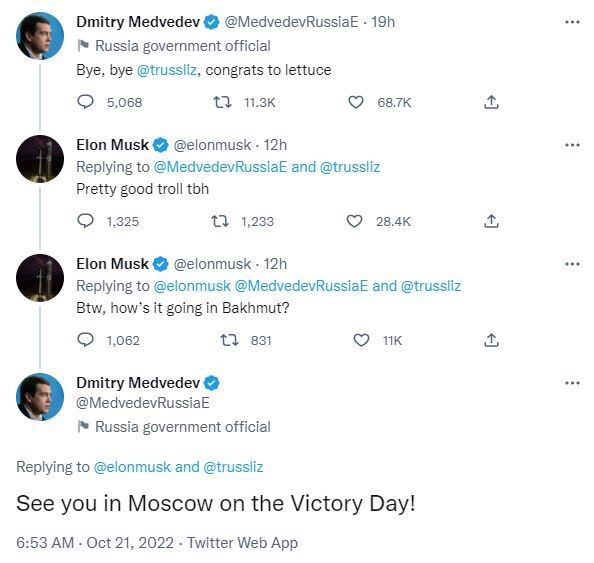
His latest intervention involves a somewhat bizarre Twitter exchange with former Russian prime minister, senior Kremlin official, and prominent Putin ally Dmitry Medvedev.
Musk had complimented Mr Medvedev on a “pretty good troll” after he ridiculed outgoing prime minister Liz Truss.
He then asked the deputy chairman of the Security Council of Russia about it the current situation in Bakhmut, which has faced intense Russian shelling over recent days.
Mr Medvedev concluded (for now at least) the seemingly friendly discussion by suggesting he would see Musk “in Moscow on the Victory Day”.
Surging inflation means the cost of servicing government debt hit a record level last month, according to figures from the ONS, which also reported that consumers were now back buying less than they were before the COVID pandemic.
The latest official data on the state of the public finances and consumer spending makes for grim reading as the country awaits its next leader.
The report pointed to a record debt interest payment total of £7.7bn for the month of September – much of which could be attributed to rising inflation as a quarter of payments on the £2.4trn debt mountain are linked to the RPI measure.
Government spending increased by £5.8bn to £79.3bn as a result of the jump in interest, the ONS said.
It separately revealed that retail sales volumes fell 1.4% on the previous month, meaning that “consumers were now buying less than before the pandemic”.
The declines was far worse than the 0.5% decline that economists had forecast.
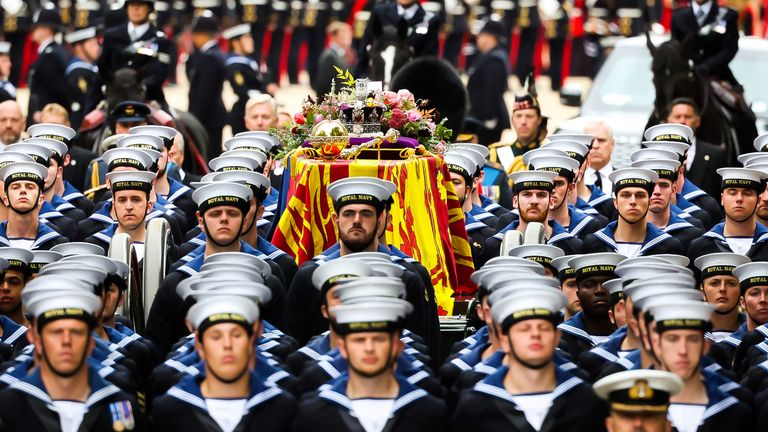
It was likely to reflect not only the deteriorating cost of living crisis that has squeezed consumer budgets this year but also the impact of store closures for the funeral of the Queen.
Image: Many retailers closed their stores out of respect for the Queen on the day of her state funeral on 19 September
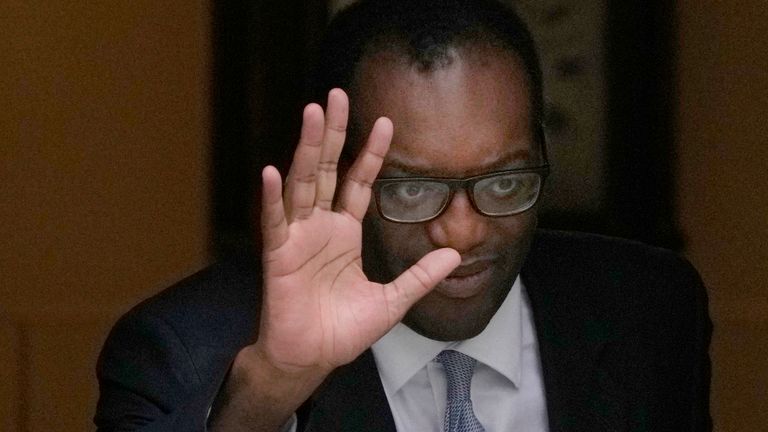
The borrowing figures cover the start of Kwasi Kwarteng’s short and turbulent tenure as chancellor.
He was appointed on 6 September before being fired weeks later following the market chaos that followed the tax giveaway mini-budget on 23 September.
While the contentious measures have now been largely overturned by the new Chancellor Jeremy Hunt, the backlash temporarily raised the interest rate demanded by investors to hold UK government debt.
That has fed into fixed-rate mortgage costs.
Image: Much of the borrowing – the second-highest September total on record – came while Kwasi Kwarteng was chancellor
It also led to the pound falling to a record low against the US dollar– with continued sterling weakness adding to the country’s import costs and therefore inflation.
The chancellor’s medium-term fiscal plan, due on Halloween, will aim to restore market confidence in the UK’s public finances.
But it will now fall under the oversight of a new PM following the resignation of the ill-fated mini-budget’s architect, Liz Truss.
The Tories expect their new leader to be in place in a week’s time – days before Mr Hunt is due to outline how he plans to balance the books while also maintaining a measure of support for struggling households and businesses.
A survey by the City watchdog found that almost 32 million people, or 60% of adults, were already finding it a heavy burden or somewhat of a burden to pay their bills because of the growing cost of living crisis.
The Financial Conduct Authority’s financial lives survey, which was taken between February and June, said the total was up six million from 2020 when the economy went into lockdown to fight the COVID-19 pandemic.
Another closely watched survey, compiled by GfK, found that confidence among British consumers remained close to the lowest level on record last month.
The chancellor said in the wake of the ONS data: “Strong public finances are the foundation of a strong economy.
“To stabilise markets, I’ve been clear that protecting our public finances means difficult decisions lie ahead.
“We will do whatever is necessary to get drive down debt in the medium term and to ensure that taxpayers’ money is well spent, putting the public finances on a sustainable path as we grow the economy.”
In a unanimous ruling, Pakistan’s electoral commission ruled former Prime Minister Imran Khan guilty of “corrupt practises” and barred him from running for office.
Khan’s Pakistan Tehreek-e-Insaf (PTI) party immediately rejected Friday’s verdict. It said it would file an appeal to the Islamabad High Court to challenge the ruling and called on supporters to take to the streets.
The case against Khan was filed in August by a member of the Pakistan Muslim League Nawaz, contending that the former prime minister had bought gifts given by foreign dignitaries from the state gift depository (also called Toshakhana) but did not disclose the assets in the declarations submitted to the commission.
A Labour MP and leading critic of Boris Johnson has given seven reasons why he opposes the former Prime Minister’s return.
Chris Bryant is the chair of the Standards Committee, which is investigating whether Mr Johnson misled parliament with his comments on partygate – however, Mr Bryant recused himself so that he could continue his criticism.
But the Rhondda MP mentioned this as his number one reason for opposing Mr Johnson getting a second term.
If things go against Mr Johnson, he could end up being suspended as an MP and facing a by-election.
Mr Bryant’s other problems with Mr Johnson were listed in a tweet – including the fact that “he lies and can’t help it” and that his government collapsed due to ministers resigning.
Problems with Johnson.
1. Privileges investigation
2. His poll ratings with public rather than Tories
3. Ministers who resigned can hardly support him
4. Pincher
5. Adviser on ministerial code
6. He makes unforced errors time and again
7. He lies and can’t help it
The Palestinian health ministry says, Salah al-Braiki, 19, was murdered during violent clashes and confrontations following an Israeli army attack on Jenin.
Ramallah occupied West Bank-Sources indicate that Israeli forces killed a Palestinian teenager during a military operation on the northern occupied West Bank city of Jenin.
Salah al-Braiki, 19, was shot in the neck and died shortly afterward at the Jenin public hospital, the Palestinian health ministryreported to Al Jazeera on Friday.
Al-Braiki was pronounced dead at 1:45 am (22:45 GMT on Thursday), less than an hour after the Israeli army and special forces raided the city of Jenin and its refugee camp, during which confrontations with unarmed youth and intense armed clashes with Palestinian fighters broke out.
At least three other Palestinians were wounded by Israeli live ammunition, the ministry said.
Israeli forces also arrested Baraa Alawneh, the cousin of 26-year-old fighter Ahmad Alawneh who was killed by the army during a large raid on Jenin on September 28.
Tensions in the occupied West Bank have been boiling up since last year, as Palestinian shootings at Israeli military checkpoints and soldiers, particularly in the northern cities of Jenin and Nablus, increased.
At least three Israeli soldiers have been killed since September 14 – one during a raid on Jenin, and two in separate shootings on military checkpoints last week in Nablus and occupied East Jerusalem.
As part of a military operation, it calls “Breaking the Wave”, Israel has intensified raids, arrests, and killings in Jenin and Nablus, as Palestinian armed resistance becomes more organised.
According to local media, the Salem checkpoint north of Jenin has been targeted with at least five shootings by Palestinian fighters since the start of October.
Israel has imposed a blockade on Nablus and its villages for more than 10 days, affecting the movement of about 420,000 Palestinians as it searches for suspects of a shooting at a nearby illegal settlement of Shavei Shomron in which one soldier was killed.
Residents, political groups, andcivil society institutions are demanding the lifting of the siege as it begins to have a serious effect on the economy and life in the area.
According to the health ministry, Israeli forces have killed 175 Palestinians since the start of the year, including 124 people in the West Bank, and 51 in the besieged Gaza Strip. Approximately half of those killed in the West Bank was from Jenin and its villages.
The total death toll also includes 41 children, 17 of whom were killed during Israel’s three-day assault on Gaza in August.
The United Nations has said that 2022 “is the highest year for Palestinian fatalities in the West Bank, compared to the same period in the previous 16 years”.
Ukraine’s foreign minister says he has spoken with Israeli Prime Minister Binyamin Netanyahu about the harm inflicted by “Russian missiles and Iranian-made drones.”
Ukrainian and Israeli officials met to discuss Kyiv’s request for Israeli air defence support, just days after Russia purportedly used Iranian “kamikaze” drones in a new wave of air strikes on war-torn Ukraine.
Ukrainian foreign minister Dmytro Kulebasaid on Thursday he had spoken on the phone to Israeli Prime Minister Yair Lapid and “discussed in detail” the provision of air and missile defense systems and technology.
“I informed him [about the] unspeakable suffering, loss of life, and destruction caused by Russian missiles and Iranian-made drones,” he tweeted.
I spoke to Israeli Prime Minister @YairLapid and informed him on unspeakable suffering, loss of life, and destruction caused by Russian missiles and Iranian-made drones. We discussed in detail Ukraine’s request for Israel to provide air and missile defense systems and technology.
Lapid’s office said in a statement on Thursday that the Israeli prime minister had expressed “deep concern” over the military ties between Russia and arch-foe Iran.
Ukraine this week accused Russia of using four Iranian-made drones to bomb Kyiv and said its air defences have shot down 223 Iranian drones since mid-September.
The Kremlin said it had no knowledge of its army using Iranian drones in Ukraine and Tehran said the claims that it is providing Russia with weapons are “baseless”.
European Union countries, however, said they had found evidence supporting Kyiv’s claim and on Thursday adopted sanctions on Iran over its provision of drones to Russia.
The phone call between Kuleba and Lapid came two days after Ukraine stepped up appeals for Israeli help with air defence systems to intercept Iranian drones and ballistic missiles.
In the request, Ukraine also demanded that Israel train its forces in operating the systems, Axios reported.
Israel has walked a delicate diplomatic line since the start of the Russian invasion in late February, seeking to preserve ties with Moscow.
While condemning Russia’s move, it has limited its assistance to humanitarian relief, citing a desire to ensure the well-being of Russia’s Jews and to continue cooperation with Moscow over war-ravaged neighbour Syria.
On Wednesday, Israeli defence minister Benny Gantz reiterated Tel Aviv’s position that it would not sell weapon systems to Ukraine.
According to a statement by his office, however, Gantz had asked Ukraine “to share information about their needs for air defence alerts”.
Israel would be able to “assist in the development of a life-saving civilian early-warning system”, the statement said. Ukraine’s ambassador had asked for systems that would shoot down the drones instead.
Russia warned on Monday that an Israeli move to bolster Kyiv’s forces wouldseverely damage relations between Moscow and Tel Aviv.
The Indian government fined Google 13 billion rupees ($161 million; £144 million) for dominating the market with its Android platform.
The country’s competition regulator has accused Google of entering into “one-sided agreements” with smartphone manufacturers in order to keep the dominance of its apps.
It has ordered Google to “cease and desist” from such behaviour.
Google has not responded to the fine or the accusations yet.
The Competition Commission of India (CCI) said in a statement on Thursday that Google was “abusing” the licensing of its Android operating system for a range of smartphones, web searches, browsing, and video hosting services.
It said that Google was entering into forced agreements with players in the space to ensure that its bouquet of apps – such as Google Chrome, YouTube, Google Maps and others – were used.
The statement added that this practice was stifling competition and gave Google continuous access to consumer data and lucrative advertising opportunities.
The CCI has also asked Google to not force device manufacturers to pre-install its apps and that it must allow manufacturers and users to install apps of their choice during the initial device setup.
“Markets should be allowed to compete on merits and the onus is on the dominant players (in the present case, Google) that its conduct does not impinge this competition on merits,” the statement said.
Google is facing a series of anti-trust cases in India and authorities are also probing Google’s conduct in the smart TVmarket and its in-app payments system.
The Android-related inquiry was started in 2019, following complaints by consumers of Android smartphones.
The case is similar to the one Google faced in Europe, where regulators imposed a $5bn fine on the company for using its Android operating system to gain an unfair advantage in the market.
Leading pollster Professor Sir John Curtice said whoever leads the Conservative party next should “enjoy the next 18 months to two years, because that will probably be their tenure”.
“Parties and governments who preside over a fiscal crisis have nearly always struggled at the ballot box at the next election,” Sir John said.
An Opinium poll this week projected a 1997-style landslide for Labour, with the party winning 411 seats.
The same poll, conducted for the TUC interviewing more than 10,000 adults, predicted the Conservatives would be reduced from 356 MPs to 137.
IMAGE SOURCE, GETTY IMAGES
Sir Keir said: “This is not just a soap opera at the top of the Tory party – it’s doing huge damage to the reputation of our country.
“We need a general election so the public can have their say on this utter chaos.
“There’s a manifesto that is going to be ready whenever an election is called,” Sir Keir told the BBC’s Newscast podcast.
“I’ve had a team working on that. I’ve had a team working on general election preparedness. We’ve moved our teams onto a general election footing.
“We’re very, very prepared should there be a general election.”
In his speech to the TUC conference on Thursday, Sir Keir said Labour had a long-term plan to “deliver cheaper bills and higher living standards for working people, growth and jobs in every part of our country”.
He outlined some of the policies he announced at Labour’s annual conference last month, including those in its “green prosperity plan”
The plan includes pledges to create a publicly-owned renewable energy firm, achieve carbon-free electricity by 2030, and insulate 19 million homes.
The grandmaster is suing world champion Magnus Carlsen, as well as the online portal Chess.com.
Hans Niemann, the 19-year-old American grandmaster at the centre of an alleged cheating controversy, has filed a slander and libel suit against world champion Magnus Carlsen, internet platform Chess.com, and others, seeking at least $100 million in damages.
The lawsuit, filed at a US District Court in Missouri on Thursday, also listed Carlsen’s online chess platform Play Magnus, Chess.com executive Danny Rensch, and US grandmaster Hikaru Nakamura as defendants.
Niemann claimed that the defendants are “colluding to blacklist” him from the professional chess worldand that he has been shunned by tournament organisers since five-time world champion Carlsen publicly accused him of cheating.
Niemann had previously been banned from Chess.com for cheating online, having admitted he had not played fairly in non-competitive games on the website in his youth but denied any wrongdoing while contesting over-the-board games.
Carlsen’s surprise defeat to Niemann and his subsequent withdrawal from the Sinquefield Cup in St Louis, Missouri in September sparked a furore of comments and allegations, including from Nakamura, that Niemann had cheated.
Weeks after the Sinquefield Cup, Carlsen resigned after just one move against Niemann in an online tournament and said later in September he believed Niemann had “cheated more – and more recently – than he has publicly admitted”.
In a statement on Thursday, lawyers for Chess.com said there was no merit to Niemann’s allegations and that the company was saddened by his decision to take legal action.
“Hans confessed publicly to cheating online in the wake of the Sinquefield Cup, and the resulting fallout is of his own making,” the statement read.
“Chess.com looks forward to setting the record straight on behalf of its team and all honest chess players.”
Chess.com banned Niemann after the first match against Carlsen and published a report earlier this month that said he had likely cheated more than 100 times in online games.
Niemann’s lawsuit said that Chess.com banned him “from its website and all of its future events to lend credence to Carlsen’s unsubstantiated and defamatory accusations of cheating”.
“Carlsen, having solidified his position as the ‘King of Chess,’ believes that when it comes to chess, he can do whatever he wants and get away with it,” the complaint added.
The lawsuit further accused Nakamura, a streaming partner of Chess.com, of publishing “hours of video content amplifying and attempting to bolster Carlsen’s false cheating allegations”.
The International Chess Federation (FIDE) said it would open an investigation into the allegations of cheating last month.
A Pulitzer Prize-winning photojournalistfrom Indian-administered Kashmir has alleged that immigration officials at Delhi airport prevented her from travelling to the United States.
Sanna Irshad Mattoo received a Pulitzer Prize for her coverage of the Covid-19 outbreak and was on her way to the award ceremony.
Ms Mattoo said she was stopped “despite having a valid visa and ticket”.
The Indian government has not made a statement yet on why she was stopped.
News agency PTI quoted Jammu and Kashmir police officials as saying that she had been placed on a no-fly list.
Ms Mattoo said this was the second such incident in four months. The journalist toldthe BBC she asked officials why she hadn’t been allowed to travel but was not given a reason.
I was on my way to receive the Pulitzer award ( @Pulitzerprizes) in New York but I was stopped at immigration at Delhi airport and barred from traveling internationally despite holding a valid US visa and ticket. pic.twitter.com/btGPiLlasK
She said she was “heartbroken” at not getting the chance to attend the ceremony, describing the Pulitzer as a “dream for every journalist”.
Several activists and journalists have been stopped from leaving or entering the country this year.
In March, journalist Rana Ayyub – who writes for the Washington Post – was stopped at Mumbai airport when she was about to board a flight to the UK to deliver a speech at the International Centre for Journalists.
Ms Ayyub was allowed to travel a few days later after she won an appeal against the decision in the Delhi High Court and got permission.
In April, former Amnesty India chief Aakar Patel was stopped twice from boarding a flight to the US at Bangalore airport.
This followed a federal investigation into Amnesty allegedly breaking India’s foreign currency exchange laws during Mr Patel’s tenure as its chief. The agency called him a “flight risk”. He was later asked by a court not to leave the country without its permission.
In August, Angad Singh, an Emmy-nominated American journalist of Indian origin, was reportedly deported to New York soon after he landed in Delhi.
While the Indian government did not comment on the incident, Mr Singh’s family said his passport was confiscated at the airport before he was deported. His mother alleged his treatment was a response to the documentaries the journalist had made on India’s Covid crisis and farmers’ protests for Vice News.
Earlier this year, the federal government deported Professor Filippo Osella, an anthropologist at the University of Sussex, who had been visiting India for more than 30 years.
Prof Osella challenged his deportation in the Delhi High Court,calling it arbitrary and unconstitutional. He also said he was treated like “a hardened criminal” by Indian authorities without being given a reason for his deportation.
Last week, the Indian government defended its decision in court, saying that the academician had been placed in the “highest category of blacklisting” based on “sufficient material” against him.
Serum Institute of India (SII), an Indian vaccine manufacturer, stated it had to dispose of 100 million doses of its Covid-19 vaccine after they expired.
According to CEO Adar Poonawalla, the company ceased making Covishield in December of last year due to low demand.
SII, the world’s largest vaccine manufacturer, has been producing the local version of AstraZeneca’s Vaxzevria jab.suit for several years.
Covishield accounts for over 90% of the doses given in India.
India has administered over two billion doses of Covid-19 vaccines.More than 70% of the Indian population has taken at least two doses, according to the federal health ministry.
In January 2022, India began giving boosters to healthcare and frontline workers, and those above 60 years with comorbidities. It was later expanded to all adults.
In July, free booster doses – or precaution doses as the government calls them – were provided to all adults for 75 days to mark 75 years of India’s independence.
But so far, India has administered just 298 million booster doses, according to the health ministry.
“The booster vaccines have no demand as people now seem fed up with Covid,” Mr Poonawala told reporters on Thursday. “Honestly, I’m also fed up. We all are.”
According to Mr Poonawala, the SII had around 100 million doses of Covishield in stock. The vaccines – which have a shelf life of nine months – expired in September this year.
“Going forward, when people take a flu shot every year, they may take a Covid vaccine along with it,” Mr Poonawala said. “But in India, there is no culture of taking a flu shot every year, like in the West.”
Meanwhile, Mr Poonawala said the SII had completed trials for the Covid vaccine Covovax as a booster dose. The company expects the vaccine to get approval within the next two weeks.
It has also partnered with the US biotech company Novavax for an Omicron-specific booster, he said.
A sexual assault complaint filed against actor Kevin Spacey has been dismissed by a New York judge.
Anthony Rapp filed the lawsuit, alleging that the actor illegally assaulted him when he was 14 years old at a party in 1986.
Mr Rapp, now 50 and also an actor, filed the lawsuit in September 2020, asking for approximately $40 million (£36 million) in damages.
Mr Spacey, an Oscar winner, has denied the accusations against him.
He is separately facing five charges in the UK of sexual assault, to which he has pleaded not guilty. That trial is due to begin in June 2023.
On Thursday, following a three-week civil trial in a Manhattan federal court, a jury found that Mr Rapp had not proved his claim that Mr Spacey had made an unwanted sexual advance.
Deliberations lasted for more than an hour and, after the verdict was read out by the judge, Mr Spacey reportedly hugged his lawyers before leaving the courtroom.
Mr Rapp says that Mr Spacey was around 26 or 27 years old when he met him at a party at his Manhattan apartment.
In a Buzzfeed article from October 2017, Mr Rapp said that Mr Spacey had picked him up, placed him on a bed, and lain down partially on top of him. “I was aware that he was trying to get with me sexually,” he wrote.
Taking the stand in his own defence in the third week of his trial, Mr Spacey said he had been shocked when Mr Rapp went public with his allegations five years ago.
“I didn’t know how this could possibly be true,” the 63-year-old said, adding he would not have been sexually interested in Mr Rapp as he was underage.
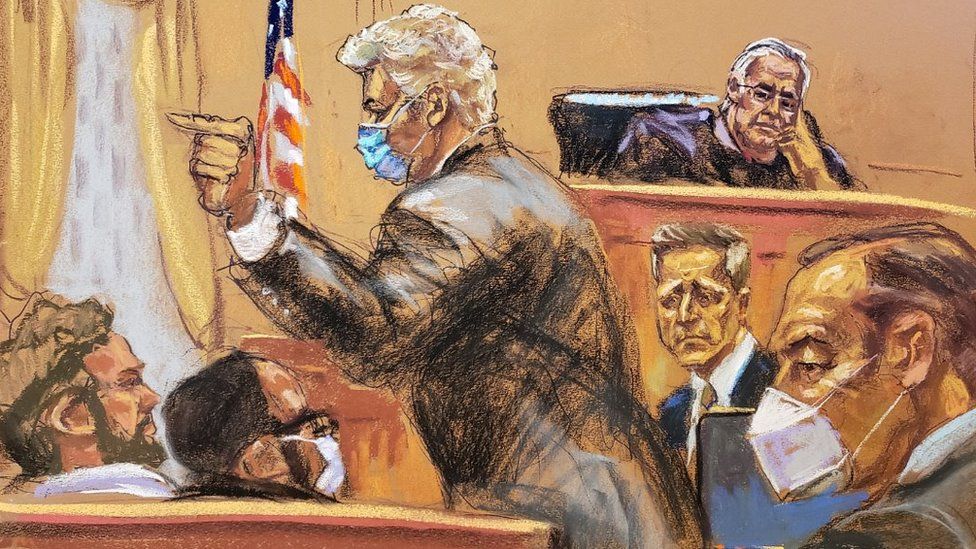
IMAGE SOURCE,REUTERS Image caption, A sketch in court shows Mr Spacey (R) and Mr Rapp’s lawyer Richard Steigman (C)
Mr Rapp’s lawyer Richard Steigman argued there were gaps in Mr Spacey’s memory and changes in his recollection.
Mr Spacey’s lawyer Jennifer Keller countered that Mr Rapp’s story was a fabrication, and she said he was “getting more attention in this trial than he has in his entire acting life”.
Career derailed
Multiple allegations of sexual misconduct derailed the Hollywood star’s stage career. Netflix dropped him from its political drama series House of Cards and Christopher Plummer replaced him in the role of J. Paul Getty in All the Money in the World.
In August, a judge ruled that Mr Spacey must pay $31m to the producers of House of Cards for the costs they incurred after firing him from the show.
Mr Spacey won Oscars for his performances in American Beauty and The Usual Suspects.
In July, he entered a not-guilty plea in London to criminal charges of sexually assaulting three men over a decade ago.
During the New York trial, he was asked about a suggestion by Mr Rapp that he was a “fraud” for not coming out as gay sooner. Mr Spacey said he had always been private about his personal life, including his childhood because his father had held racist and homophobic views.
Enock K. Gyetuah, National Executive Director of the Ghana National Council of Private Schools (GNACOPS), has expressed the Council’s concern over President Akufo-Addo’s choice for the position of Director-General of the Ghana Education Service.
President Akufo-Addo has nominated Dr. Eric Nkansah as the new Director-General of the Ghana Education Service (GES).
His appointment was contained in a letter issued on Wednesday,October 19 by the Presidency and signed by Nana Bediatuo Asante, Secretary to the President.
Reacting to the appointment, the GNACOPS Director stated that it was a “violation of our professional education standards.”
“It is a total contravention of the Teacher Professionalism as far as the Education Regulatory Bodies Act, 2020 ( Act 1023) is concerned.
“The appointment is in breach of sections 67(1), 68(1,&1a), and 79 (1) of the Education Regulatory Bodies Act, 2020 Act 1023.
“The Ghana National Council of Private Schools (GNACOPS), as an upholder of good standards in education, does not support this appointment,” he said.
According to him, Dr. Eric Nkansah is not an educationist and has not served, nor risen through the rank and file of the Ghana Education Service to be bestowed such an honour.
The Council is thus calling on the President to rescind his appointment and select someone from the GES to fill the vacant position.
“It is no secret that there are ranks or levels in every sector, through which employees should pass, before being promoted to managerial positions.
“Why should Educationists spend their lives in service to GES, go through promotions and ranks, if a banker could overnight become their Director General?” he said.
“GNACOPS strongly proposes that the appointment system of the Director General of GES, should be looked at carefully from the service viewpoint, and be restricted to only Professional within the Education sector.
“It should be based on projectory experience, qualification, and skills, with rank and longevity in the service, being made the heart of the appointment, similar to what is done in the Police Service, in the appointment of IGP,” he added.
Meanwhile, Dr. Eric Nkansah has 14 days to either accept or reject his appointment as the new GES Director-General.
Ethiopian Prime Minister Abiy Ahmed has stated that the conflict in northern Tigray “will end and peace will prevail.”
He made the remarks during the inauguration of a talent development centre in the Oromia regional state on Thursday.
“The situation in northern Ethiopia will come to an end, peace will prevail. We will not continue fighting forever. I believe that in a short period of time, we will stand with our Tigrayan brothers for peace and development,” Mr Abiy said.
He urged Ethiopians to work together for the country’s prosperity and not to be divided along ethnic and religious lines.
On Thursday, the Ethiopian government accepted an invitation by the African Unionto participate in peace talks to be held on 24 October in South Africa to end the war that has killed an unspecified number of people and displaced millions.
It came on the same day Tigrayan rebels accused Ethiopian and Eritrean forces of killing seven youths in a town that was captured by the federal army on Tuesday.
The former prime minister has pleaded with her party to provide an “orderly transition”, amid fears the upcoming leadership contest could become messy.
The Prime Minister is right to provide a roadmap for an orderly transition.
MPs must now be prepared to compromise. It is our duty to provide sensible, competent government at this critical moment for our country.
Other Conservative MPs have shared similar thoughts this afternoon – including Justin Tomlinson, who said this was the “last-chance saloon” for the party to maintain credibility.
A vicious leadership contest would further divide an already split party that is about to see its third prime minister in the space of a few months.
While some Conservative MPs are asking for Boris Johnson’s comeback, others are cautioning against it.
Sir Roger Gale reminded people that the ex-prime minister was still being investigated by the Privileges Committee for potentially misleading the House.
He added: “Until that investigation is complete and he is found guilty or cleared, there should be no possibility of him returning to government.”
We need to remember that Mr Johnson is still under investigation by the Privileges Committee for potentially misleading the House.
Until that investigation is complete and he is found guilty or cleared, there should be no possibility of him returning to Government.
One Tory MP believes previous leadership challenger and ex-chancellor Rishi Sunak will run to replace Liz Truss.
“I am pretty sure he will, I hope so,” Richard Holden tells Sky News.
The MP says that in the difficult economic times, the party and the country need a PM “who has got the economic experience to deliver real stability over the next few years and get the ship of state back on an even keel” – and that person is Sunak.
He adds: “What we need is competence right at the core of this at the moment… and the economy front and center.
“We have had a really tough time over the past few weeks. Even though I didn’t support Liz [in the leadership contest] I didn’t want it to go the way things have gone.
“What we need to see now is competence at the heart of government and particularly the economic vision.”
But while Holden wants Sunak in Number 10, he also promises he will “unite behind anybody”.
He adds: “The truth is that the Conservative Partyhas got to unite behind whoever is elected to win the next election.”
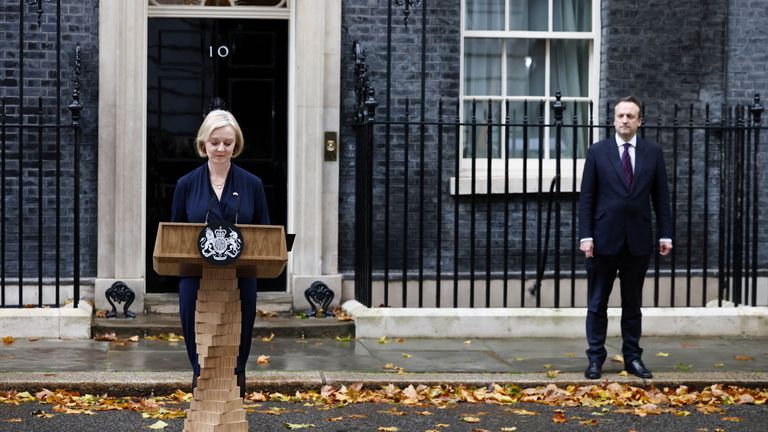
Liz Truss resigned as Prime Minister just 44 days after succeeding Boris Johnson.
She will be the prime minister with the shortest tenure in modern British political history.
In a statement read outside Downing Street, Ms Truss said: “I came into office at a time of great economic and international instability.
“Families and businesses were worried about how to pay their bills.”
She said she was elected “with a mandate to change this”, adding: “We delivered on energy bills.”
” I recognise, though, given the situation, I cannot deliver the mandate on which I was elected by the Conservative Party,” she said.
“I have therefore spoken to His Majesty the King to notify him that I am resigning as leader of the Conservative Party.
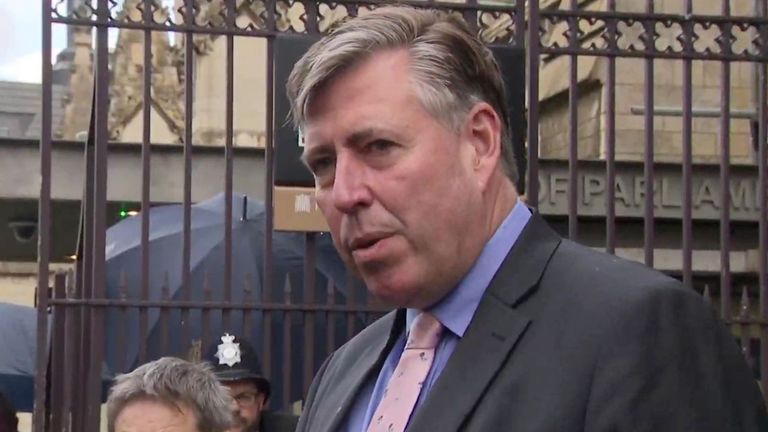
“This morning, I met the chairman of the 1922 committee, Sir Graham Brady. We’ve agreed that there will be a leadership election to be completed within the next week.”
He added: “The Tories cannot respond to their latest shambles by yet again simply clicking their fingers and shuffling the people at the top without the consent of the British people.
“They do not have the mandate to put the country through yet another experiment; Britain is not their personal fiefdom to run how they wish.”
The start of Truss’ downfall
Ms Truss’ downfall started when her former chancellor Kwasi Kwarteng announced his mini-budget a month ago, which prompted weeks of economic turmoil and eventually led to him being sacked last Friday.
Mr Hunt, who voted for Rishi Sunak during the leadership campaign, then took over as chancellor and U-turned on the majority of the unfunded mini-budget tax cuts on Monday – further undercutting Ms Truss’ authority.
On Wednesday afternoon, her home secretary, Suella Braverman then quit after saying she had breached security rules by sending a policy message to a colleague over her personal email by mistake.
It only got worse on Wednesday evening after confusion over whether Labour’s opposition day vote was actually a confidence vote in the government or not – which resulted in allegations of “manhandling” of Tory MPs bycolleagues.
Some Tory MPs had publicly called for Ms Truss’ resignation before that but in the hours before she quit, a flurry of Tory MPs revealed they wanted her to go.
Conservative Party rules prevent a leader from a confidence vote in the first 12 months of their tenure but it is understood after a significant number of MPs wrote to Sir Graham Brady, chair of the 1922 Committee of backbench Tory MPs, calling for her to go, a decision was made that she could not stay.
Lafarge, a French cement company, has pled guilty in the United States to aid the Islamic State and other terrorist organisations.
The company agreed to pay a $777.8 million (£687.2 million) penalty for payments made to keep a factory operational in Syria after the crisis broke out in 2011.
Prosecutors said it was the first time a firm in the United States pled guilty to aiding terrorists.
Lafarge said it “deeply regretted” the events and “accepted responsibility for the individual executives involved”.
The cement manufacturer, which was bought by Switzerland’s Holcim in 2015, said their behaviour had been in “flagrant violation” of Lafarge’s code of conduct.
The firm opened its plant in Jalabiya near the Turkish border in 2010 following a $680m investment.
US prosecutors said that Lafarge’s Syrian subsidiary had paid Islamic State and another terror group, al Nusra Front, the equivalent of $5.92m to protect staff at the plant as the country’s civil war intensified. Executives likened the arrangements to pay “taxes”, they said.
Lafarge eventually evacuated the plant in September 2014, when Islamic State took control of the town and the factory. But before its departure, the deals helped the company do $70.3m in sales, prosecutors said.
Lafarge had previously admitted bribes were paid after an internal investigation. But US Deputy Attorney General Lisa Monaco said on Tuesday that the company’s actions “reflect corporate crime that has reached a new low and a very dark place.”
“Business with terrorists cannot be business as usual,” she added.
In a statement, Lafarge’s new owner Holcim said none of the conduct involved Holcim, “which has never operated in Syria”.
It added that former Lafarge executives involved in the bribery had concealed it from Holcim, as well as external auditors.
Eric Olsen, who ran Lafarge and Holcim until 2017, stepped down from his role following an investigation into Lafarge’s activities in Syria.
At the time, Mr Olsen said he had not been involved in any wrongdoing and was standing down to bring “serenity” to the company.
The Department of Justice said that senior executives at Lafarge were involved in the arrangements and aware they risked running afoul of authorities.
IMAGE SOURCE, AFP Image caption, The dealings with armed groups took place before Lafarge merged with Holcim
Executives had attempted to require Islamic State not to include the name “Lafarge” on documents memorializing and implementing their agreements and many involved in the scheme also used personal email addresses, rather than their corporate email addresses, to carry out the conspiracy, the Department said.
Lafarge executives also backdated the termination agreement to Aug. 18, 2014, a date shortly after the United Nations Security Council had issued a resolution calling on member states to prohibit doing business with Islamic State, to falsely suggest that negotiations with Islamic State had not occurred after the UN resolution, the Department said.
The dealings by Lafarge were eventually made public in 2016 on a website run by a Syrian opposition group.
Breon Peace, US Attorney for the Eastern District of New York – where the case was brought – said the conduct “by a Western corporation was appalling and has no precedent or justification”.
“The defendants paid millions of dollars [to Islamic State], a terrorist group that otherwise operated on a shoestring budget, millions of dollars that [Islamic State] could use to recruit members, wage war against governments, and conduct brutal terrorist attacks worldwide, including against U.S. citizens,” he said at a press conference announcing the guilty plea.
Lafarge also faces charges of complicity in crimes against humanity in France over its activities in Syria, but the company denies the claims.
A man working to protect Japan’s cultural heritage accidentally crashed his automobile into the country’s oldest toilet at a centuries-old Buddhist temple.
The communal latrine at Tofukuji in Kyoto dates from the 15th century and has been listed as an important cultural asset.
Its ancient door was ruined after the employee hit the gas without realizing the car was in reverse, police said.
No one was injured and the actual latrines inside remained intact.
The unnamed man, who works at the Kyoto Heritage Preservation called the police soon after the crash, telling them he had crashed into the temple. He was said to be visiting the temple on business, according to the Sankei Shimbun newspaper.
A photo in the newspaper showed what appeared to be the car after it drove into the toilet’s 700-year-old wooden door and pillars.
Toshio Ishikawa, director of the Tofukuji Research Institute, was “stunned” by the scale of the accident.
Another official said that although the damage is repairable, restoring the outhouse to its original state would require “lots of work”.
The unused communal toilet – known as tōsu – was built in the first half of the Muromachi period (1336-1573) and is located inside Tofukuji temple.
It’s nicknamed the “hyakusecchin”, which means 100-person toilet, as it was used by more than 100 trainee monks at the temple practicing religious self-discipline, the newspaper Asahi Shimbun reported.
The paper describes it as a structure containing a stone row holding around 20 circular holes.
Estonia’s foreign minister says that sanctions against Russiastill haven’t gone far enough.
Urmas Reinsalu said that the point of sanctions is to raise pressure to end the war and the only person who can end the war is President Vladimir Putin.
He argued that “as we have not reached that decision point, it means the sanctions have not reached the needed altitude”.
Hedidn’t specify what further sanctions should be imposed.
Estonian lawmakers blasted Moscow’s illegal acquisition of Ukrainian territory and labeled Russia a “terrorist regime.”
The statement received 88 votes from the 101-member legislature, with 10 MPs missing and three abstaining.
The statement said the Estonian parliament “declares Russia a terrorist regime and the Russian Federation a country that supports terrorism.
“(President Vladimir) Putin’s regime, with its threats of a nuclear attack, has turned Russia into the biggest danger to peace both in Europe and in the whole world,” it said.
Mohammed Vall of Al Jazeera, reporting from Moscow, says the absence of Russian involvement in the Nord Stream investigation is fueling Russians’ perception that the West is to blame for the damage to the two gas pipelines in the Baltic Sea.
“Russia has been blaming, and it is still blaming the West, of being behind the sabotage because, they say, the main damage there is against Russian interests,” Vall said of the explosions last month that damaged the pipelines that carry Russian gas to Europe.
“Russia is still demanding a role in this investigation, and without that, the doubts Russia has over the whole thing will remain, and any investigation results will not be accepted here in Moscow,” Vall said.
A UN investigation determined that Russian forces were responsible for the “vast majority” of human rights breaches in Ukraine during the early weeks of the conflict, including potential war crimes against civilians.
The Independent International Commission of Inquiry on Ukraine found that Russian forces had indiscriminately shelled areas they were trying to capture and “attacked civilians trying to flee”.
It also found abuses committed by Ukraine, including two cases of people who were out of action who were shot, wounded, or tortured.
“Russian armed forces are responsible for the vast majority of the violations identified, including war crimes,” the Council said in the report.
“Ukrainian forces have also committed international humanitarian law violations in some cases, including two incidents that qualify as war crimes.”
Iran has agreed to supply Russia with surface-to-surface missiles and additional drones, according to two senior Iranian officials and two Iranian diplomats.
On October 6, Iran’s First Vice President Mohammad Mokhber, two senior Revolutionary Guard officials, and an official from theSupreme National Security Councilarrived in Moscow for talks with Russia about the delivery of the weaponry.
“The Russians had asked for more drones and those Iranian ballistic missiles with improved accuracy, particularly the Fateh and Zolfaghar missiles family,” said one of the Iranian diplomats, who was briefed about the trip.
“Where they are being used is not the seller’s issue. We do not take sides in the Ukraine crisis like the West. We want an end to the crisis through diplomatic means,” the diplomat said.
Five children’s bodies were recovered from a mass grave in a town formerly controlled by Russian soldiers.
According to investigators, four of the children were buried in a mass burial at a cemetery in Lyman, while another was exhumed from a makeshift grave dug by his mother in their yard.
It has been preliminarily established they all died from shrapnel wounds as a result of Russian shelling, the National Police of Ukraine said in a statement posted to Telegram.
After the forensic examination, the children will be reburied.
“Investigative actions have been ongoing for two weeks in Lyman — at the site of the largest mass burial in the de-occupied part of Donetsk region. Investigative teams work continuously, searching for and interviewing relatives, establishing the history of all the dead,” the statement said.
As of the morning of this morning, 35 military personneland 131 civilians were exhumed in the Kramatorsk district.
Among the civilians were 67 men, 56 women, and five children. The gender of six people is unknown.
Since early last week, Russian attacks have destroyed more than 400 infrastructure targets across Ukraine, according to a top Ukrainian official.
Ukraine’s Minister for Communities and Territories Development, Oleksii Chernyshov, stated that Russian missiles and Iranian-made drones had hit 408 Ukrainian sites since October 10.
The targets included 45 energy facilities and more than 180 civilian buildings.
Chernyshov insisted that Ukrainians would not be cowed by Moscow’s onslaught.
He said that “such terrorist actions of the aggressor mobilize and harden us even more”.
Brittney Griner, the American WNBA basketball star whose appeal against a Russian prison sentence is set to be heard next week, thanked her supporters on her 32nd birthday.
“All the support and love are definitely helping me,” Griner was quoted as saying by her lawyers Maria Blagovolina and Alexander Boykov, who spent several hours with her in the Moscow pre-trial detention center where she is being held.
“Today is of course a difficult day for Brittney,” said Blagovolina, who is representing Griner in court.
“Not only is this her birthday in jail away from her family, teammates, and friends, but she is very stressed in anticipation of the appeal hearing on October 25.”
A news blackout in southern Ukraine means “something big is going on”, military expert Professor Michael Clarke has told Sky News.
Professor Clarke, former director-general of the Royal United Services Institute (RUSI), said: “The Ukrainians have conducted a complete news blackout on what is happening in the Kherson oblast because the Russians are holding a line between Snihurivka and My love, and that line they have been holding onto for over a week now as Ukraine moves south.
“When the Ukrainians have a news blackout it means something is going on. They have always done this before when there is a big offensive push on.
“Now for sure, something big is happening. It might fail, and it may not work, but in the past, it has worked.
“Standby for some more interesting information – I am guessing on this frontline between Mylove and Snihurivka.”
Meanwhile, around 100 women – all from the Azovstal steelworks – have also been released in a prisoner exchange.
Showing footage of their release, Professor Clarke said: “These women are all coming out, some of them are in combats, they might have been given those combats, but they are walking in line – they are coming out they are almost marching.
“They are coming out in order, they are making a point. We are the women from Azovstal steelworks.
“Civilians got mixed in with the troops towards the end, it was all pretty awful.
“But here they are, they are holding their head up, they are coming out with pride and that is making a point to the Russians and the rest of the world. ”
DISCLAIMER: Independentghana.com will not be liable for any inaccuracies contained in this article. The views expressed in the article are solely those of the author and do not reflect those of The Independent Ghana
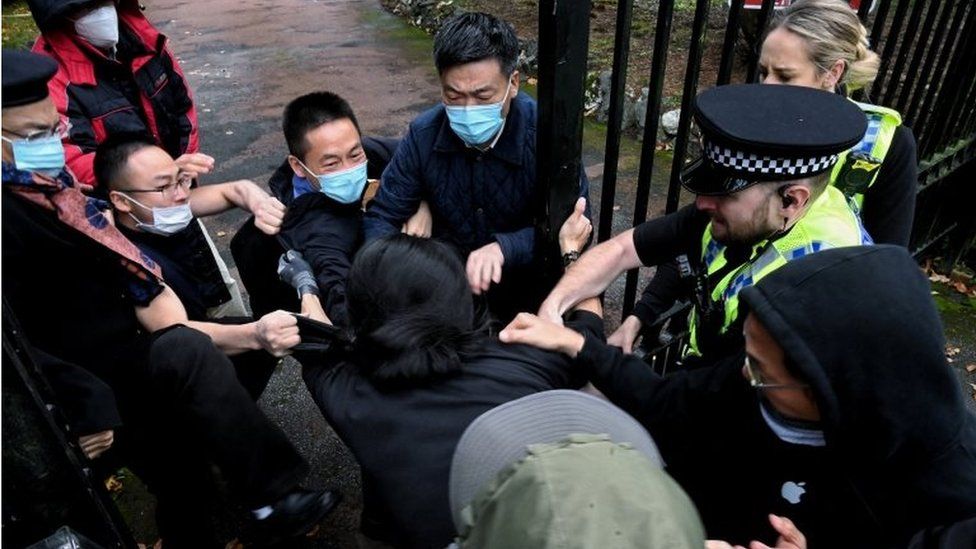
A British MP says that one of China’s most senior UK ambassadorswas involved in violence towards demonstrators at the Manchester consulate on Sunday.
MPs in Parliament have privilege, allowing them to speak freely without fear of legal action.
China has not commented on Zheng Xiyuan’s alleged involvement.
But the foreign ministry in Beijing defended the actions of consulate staff.
IMAGE SOURCE, REUTERS Image caption, A protester is pulled at the gate of the consulate on Sunday – the consul-general is alleged to be in a mask and hat (far left)
Spokesman Wang Wenbin said people had “illegally entered” the grounds and any country’s diplomats would have taken “necessary measures” to protect their premises.
But the official Chinese version is at odds with video footage and statements from police. Officers had to drag back a protester from inside the consulate gate as he was being attacked.
After Consul-General Zheng Xiyuan ripped down the placards, Ms Kearns told MPs, there was “grievous bodily harm against a Hongkonger, one of whom was hospitalised for taking part in a peaceful protest.
“Some were then dragged onto consulate territory for a further beating by officials who have been recognised to be members of the Chinese Communist Party (CCP).
“We cannot allow the CCP to import their beating of protesters, their silencing of free speech, and their failure to allow time and time again protests on British soil. This is a chilling escalation.”
According to a statement by the Greater Manchester Police, around 30 to 40 people had gathered outside the consulate to protest.
“Shortly before 4 pm a small group of men came out of the building and a man was dragged into the consulate grounds and assaulted,” the statement said.
“Due to our fears for the safety of the man, officers intervened and removed the victim from the consulate grounds.”
The consulate is UK territory, but cannot be entered without consent.
Another MP, Labour’s Afzal Khan – who represents the constituency where the consulate is, Manchester Gorton – told the House of Commons he was “sickened” by the scenes.
“The UK stands for freedom, the rule of law, and democracy,” said the Labour MP. “The quashing of peaceful protests will never be tolerated on British soil.”
Mr Khan and other MPs called for the consul-general to be declared a “persona non grata” – meaning a person who is unwelcome in the country.
As a diplomat, the consul-general has diplomatic immunity, meaning he is theoretically protected from prosecution. Declaring someone “persona non grata” can remove diplomatic status and potentially result in expulsion.
Conservative MP Sir Iain Duncan Smith asked if the government would “be prepared to expel the consul-general and any of those that are found to have been part of that punishment beating and the vandalism?”
Foreign Office minister Jesse Norman said, “we will take action once we have a full understanding of the facts”. He added the government had issued a summons to the Chinese charge d’affaires in London – the Chinese ambassador’s deputy – for an explanation.
Mr Norman told the House of Commons: “We’ve already outlined a process of raising this formally with the Chinese embassy… and we will see where these procedures, these legal and prosecutorial procedures, may lead to, and at that point, we will take further action.”
Some MPs called for the Foreign Office to go further, including Labour’s Andrew Gwynne who said: “Had these incidents happened on the streets of Hong Kong, there would have been outrage from the British government, rightly so.
“They happened on the streets of Manchester and yet we have this situationwhere the minister is basically sending a memo to the Chinese embassy, an offer of a cup of tea and a chat with the ambassador.”
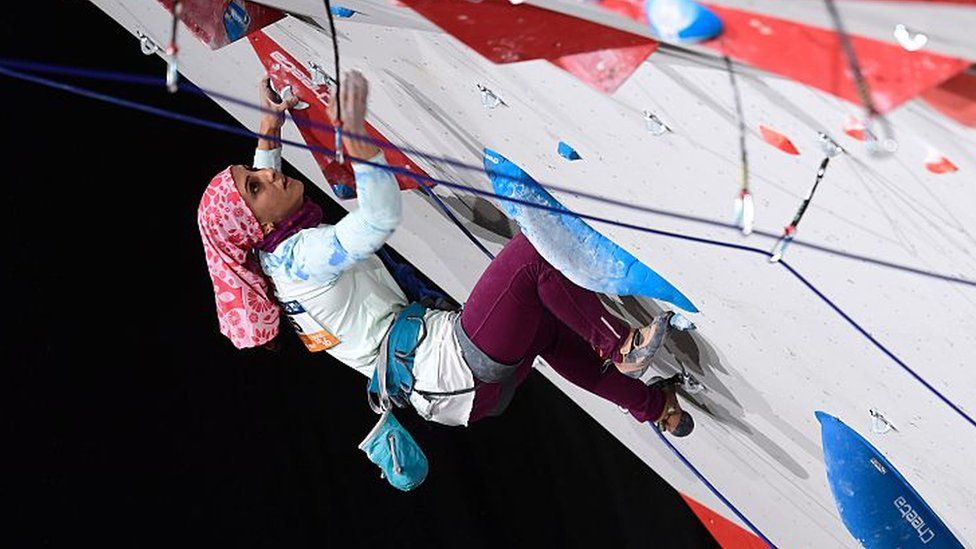
“Due to bad timing, and the unanticipated call for me to climb the wall, my head covering inadvertently came off,” it explained.
The post added that she was on her way back to Iran “alongside the team based on the pre-arranged schedule”.
BBC Persian’s Rana Rahimpour says that too many people the language used in this post looks like it has been written under duress.
Other Iranian women who have competed abroad without wearing a headscarf in the past have said they came under pressure from Iranian authorities to issue similar apologies, she adds. Some of them decided not to go back to Iran.
Women in the country are required to cover their hair with a hijab and their arms and legs with loose clothing. Female athletes must also abide by the dress code when they are officially representing Iran in competitions abroad.
IMAGE SOURCE, AFP Image caption, Elnaz Rekabi wore a hijab at the indoor world championships in Paris in 2016
Earlier, the Iranian embassy in South Korea said Ms Rekabi had left Seoul for Iran on Tuesday morning. It also strongly denied what it called “all fake news, lies and false information” about her.
“It is important to stress that athletes’ safety is paramount for us and we support any efforts to keep a valued member of our community safe in this situation,” it added. “The IFSC fully supports the rights of athletes, their choices, and expression of free speech.”
A source told BBC Persian on Monday that Ms Rekabi’s passport and mobile phone were confiscated, and that she left her hotel in Seoul two days before her scheduled departure date. Her family and friends lost contact with her after she said she was with an Iranian official.
Two years ago, an Iranian international chess referee said she had received death threats after a photo circulated that appeared to show her without a hijab at the Women’s World Chess Championship in Shanghai.
Shohreh Bayat insisted that she had been wearing a headscarf loosely over her hair at the time, but she subsequently stopped covering her hair and claimed asylum in the UK after being warned that she could face arrest in Iran.
“I had to choose my side because I was asked to write an apology on Instagram and to apologise publicly,” Ms Bayat told BBC World News on Tuesday.
“I was given a list of things to do. I knew that if I just followed those things that I did not believe in if I apologised for not wearing a headscarf, then I could not forgive myself.”
Asked what she thought about Elnaz Rekabi’s Instagram post, she said: “I think actions speak louder than words. And she made a very powerful statement in not wearing a headscarf.”
Ms Bayat has called on the international community to act over the violent crackdown by Iranian authorities in response to nationwide protests against the compulsory hijab laws and the clerical establishment.
The protests were sparked by the death in custody of Mahsa Amini, a 22-year-old woman arrested by morality police in Tehran on 13 September for allegedly wearing her headscarf too loosely.
The police denied reports that she was beaten on the head with a baton and said she suffered a heart attack.
On Tuesday, the UN Human Rights Officesaid it was deeply worried by the “unabated violent response by security forces against protesters, and reports of arbitrary arrests and the killing and detention of children”.
“Some sources suggest that as many as 23 children have been killed and many others injured in at least seven provinces by live ammunition, metal pellets at close range, and fatal beatings,” spokeswoman Ravina Shamdasani said.
She added that a number of schools had also been raided and children arrested by security forces, while some principals had been arrested for not cooperating.
Norway-based Iran Human Rights has reported that 215 people have been killed by security forces. Authorities have denied killing peaceful demonstrators and instead blamed foreign-backed “rioters”.
The Rwandan parliament has rejected a bill to change a 2016 law to allow contraception to be supplied to females as young as 15 years old.
The plan was submitted by a group of MPs in order to reduce adolescent pregnancies, which have increased by 21% – from more than 19,000 in 2020 to 23,000 last year, according to officials.
Only 18-year-olds and above are legally allowed to access sexual reproductive health services – but there has been debate among health activists, and cultural and religious leaders about lowering that limit.
The rejection of the bill stops “the anticipated changes” in the law that “has gaps”, Aflodis Kagaba, a Rwandan reproductive health activist, told the BBC.
“Unfortunately, this has overshadowed everything else including the opportunity to re-open these important conversations in parliament,” Mr Kagaba said.
More than 30 MPs who rejected the bill cited their faith, and social and cultural reasons, local media report.
But Mr Kagabasaid the current law “has gaps” and believes “it still needs to be revised”.
“Today if you are under 18 and need [sexual and reproductive] health services you are required to be accompanied by parents for their approval!”
Nigerian officials have urged Indian authorities to safeguard the safety of Nigerian students studying in the country.
Fighting broke out between Nigerian and Indian students at Delhi’s GD Goenka University last weekend, sparked by a football match dispute.
Footage of the clash has been shared on Twitter.
Nigerian students are being attacked in a University Campus near Delhi – 30,000 Nigerian students come to study in India paying money, 50,000 Indians live in Nigeria to make money. pic.twitter.com/K9u9Vn1PhM
The incident at the university’s Gurugram campus forced more than 80 Nigerians to flee and take refuge at the country’s embassy.
The chairwoman of the Nigerians in Diaspora Commission, Abike Dabiri-Erewa, said: “a few injuries” had been recorded during the violence.
But Mrs Dabiri added that “calm” had been restored and that the Nigerian students have since returned to the campus after a meeting between officials of the two nations.
In a tweet, the Nigerian representative also said the country’s embassy had got a “written commitment by the Indian authorities to protect” Nigerian students.
She also advised that any students who felt “threatened” should report to the diplomatic mission of Nigeria.
The Indian authorities said they are investigating the incident – including reviewing CCTV footage of the violence, according to local media.
Thousands of African students – many of them Nigerians – are studying at several Indian universities.
But there have often been tensions between the locals and Africans.
Local media report that last month some Indian students had protested against African students praying on a football pitch, insisting that they should instead do so inside their hostels.
Police in South Africa has initiated a manhunt for seven inmates who escaped from a jail in Grahamstown, a city in the Eastern Cape region.
According to a police statement, an officer who arrived at the Makhanda Correctional Facility at 04:00 local time saw some lights were on and discovered that the detainees had escaped through a window.
“Police are warning the community that these prisoners are dangerous and should not be approached instead police must be contacted,” the statement said.
The escapees include one person charged with murder and five Zimbabwean nationals either imprisoned for or facing rhino-poaching charges.
“The Daily Show”host on Monday delved into the former president’s latest scandal, which involves his beleaguered Truth Social platform. The co-founder of the social media company, Will Wilkerson, came out as a whistleblower, alleging the firm had violated federal securities laws and that Trump had pressured executives to hand over shares to his wife, Melania Trump.
Wilkerson was fired from his role as an executive of Trump Media and Technology Group last week after coming forward.
Noah was unsympathetic.
“I am totally on Trump’s side in this story,” Noah said. “Yeah, it’s the year 2022. If you go into business with Donald Trump, and you’re surprised that you got scammed, that’s on you. What were you thinking? ‘Well, I know the last guy that Trump worked with almost got hanged by an angry mob, but I think I’m going to turn out fine. I don’t know what could go wrong.’”
The former pastor of a McDonald County fringe church at the centre of a sexual abuse scandal 16 years ago is facing a fresh accusation of raping an underage girl.
Raymond L. Lambert II, 67, of rural Washburn, was arrested and charged last week with first-degree rape in the summer of 2013. The arrest was made by the Missouri State Highway Patrol following an investigation into information that arose in August.
A probable-cause affidavit states that the victim, who is now an adult, told a state patrol investigator Lambert sexually assaulted her nine years ago when she was visiting a relative in McDonald County.
She told authorities, the affidavit states, that Lambert had raped her in a dark shed. She said that shortlyafter he began sexually assaulting her, the sound of car tires on the road outside sent him into a panic and he stopped, warning her not to tell anyone.
The affidavit states that she did not tell anyone what happened at the time. But her mother was able to confirm that the girl had visited a relative that summer.
Lambert, his wife, two brothers who served as deacons in Grand Valley Independent Baptist Church, and George Johnston, the suspect’s uncle and pastor of Grand Valley Baptist Church North in Newton County, were charged in 2006 with various sex offenses when a few women left the churches and told authorities that they had been sexually abused over the years, dating back as far as the 1970s.
No one was convicted in the scandal as the McDonald and Newton county prosecutors’ cases fell apart with the victims ultimately backing out of testifying at trial.
Nsor Catherine, a 37-year-old lady who was wrongly accused of stealing GH12,000 from a businesswoman in Tamale, is demanding justice.
She claims that the beatings and torture she endured have left her bedridden since the occurrence.
Nsor Catherine until that faithful day of the assault was residing in Damongo.
She narrates how she suffered her unfortunate attack after a woman accused her of stealing her money.
“I was walking in the market and all of a sudden a strange woman held me, pulled me to a shop at the Aboabo market, and accused me of stealing GH¢12,000.
“They did not allow me to talk but rather called some men who came there and started beating me. They stripped me naked and beat me till I couldn’t breathe again.
“As if that was not enough, they took me to their house, locked me in a room, whipped me with a cable, and also plugged an electric iron and used it on my back and my legs all for me to confess for a crime I didn’t commit.”
According to her, her assailants also arranged lorry tyres with petrol to burn her.
“When they wanted to burn me, one of them asked me to call someone I know to tell the person I was going to be burnt alive so I called my sister and she came with the police to rescue me.
“I spent all my life savings treating myself and I don’t have anything again. I have been relying on local treatment for the past two months and I need support to go back to the hospital.
Her younger sister, who went to her rescue with the police, told 3news.com that life has not been easy for the family since the incident.
“After the incident, the people came to the police station to beg, they came to our house to beg my sister to forgive them and promised to compensate her. We gave them an amount to pay with the police and the court as witnesses but since then they haven’t said anything and my sister’s health keeps getting worse.
“She is mentally unstable and behaves weirdly since the incident.
Mob justice is also known as instant justice in Ghana serves as an indictment on the 1992 Constitution.
It creates a heightened sense of fear among citizens that they could become victims and also undermines the legitimacy of the police and legal authorities.
Like Nsor Catherine, several other women have suffered certain forms of mob action.
Bill Gates almost never gives up in a fight. “Several significant worldwide setbacks over the past few years have left many people disillusioned and wondering whether the world is doomed to get worse,” the billionaire philanthropist bemoaned on Twitter on July 13 after what he dubbed “setbacks.”
The pandemic is one of the biggest setbacks in history. The war in Ukraineis a gigantic tragedy for the entire world. The damage from climate change is already worse than most models predicted. The U.S. has taken a huge step backward for gender equality and women’s health.”
He later appeared somewhat optimistic, as if he’d been trying to persuade himself that he saw light at the end of the tunnel.
“But I’m still optimistic. These setbacks are happening in the context of two decades’ worth of historic progress and I believe it is possible to mitigate the damage and get back to the progress the world was making,” the entrepreneur said.
$1.2 Billion to Fight Polio
A few months later, the philanthropist seems to have regained his energy and his will to win his humanitarian battles.
He has thus just promised $1.2 billion more to eradicate polio. The announcement was made on Sunday in Berlin by the Bill and Melinda Gates Foundation, which made the pledge to the Global Polio Eradication Initiative.
“By coming together and funding efforts like the Global Polio Eradication Initiative, we can #EndPolio and build a healthier world, ” Gates tweeted on Oct. 15.
“We’re very committed,” Gates told Bloomberg in an interview. “I can’t say forever, but giving up would mean hundreds of thousands of kids being paralyzed.”
The new fund will help redouble and speed efforts to fight this disease, which has reappeared in recent months in regions where it was thought to have disappeared. A resurgence would jeopardize billions of dollars of investment over decades.
Polio Reappears in New York
A case of polio had been identified last summer in Rockland County, N.Y., half an hour north of Midtown Manhattan. Traces of the virus had also been detected in sewage in the U.K. and Israel, which had suggested that the disease, which had been almost eradicated worldwide, had resurged.
“The individual experienced severe symptoms, including paralysis, and was hospitalized,” New York State and County health officials said. “New Yorkers should know that paralysis from polio is typically permanent, resulting in life-long disability.”
The last known case of polio in the U.S. was in 2013, according to the Centers for Disease Control and Prevention. A 7-month-old child who had just moved from India to the U.S. was diagnosed in San Antonio.
The World Health Organization in June warned that a type of poliovirus derived from the oral polio vaccine – which, in rare cases, can cause infection in others but not in the person vaccinated – had been detected in London sewage samples. It can cause severe illness and paralysis in unvaccinated people.
Polio, which largelyaffects children under age 5, has been virtually eradicated worldwide, according to Unicef. Cases have fallen by 99% since 1988 when polio was still endemic in 125 countries and 350,000 cases were recorded. Polio remains endemic in two countries – Afghanistan and Pakistan.
Infections declined sharply in the late 1950s and early 1960s in the U.S., with the development of a vaccine. The last natural infection to have occurred in the U.S. dates from 1979.
The Gateses, through their foundation, have already donated nearly $5 billion directly to the fight against polio.
For 2019-2023 some $4.2 billion is needed to eradicate polio through vaccination and other health services, according to the Global Polio Eradication Initiative. The program had $2.2 billion before Gates’ pledge. After the commitment, the funding shortfall is around $1.4 billion. Germany will co-host a pledge event at the World Health Summit on Oct. 18 in Berlin.
“India’s success against poliovirus showed the world that to #EndPolio, perseverance and collaboration are vital. @naveenthacker and over 1,300 leading global experts have urged the world to recommit to ending polio,” Gates posted on Oct. 15.
Chelsea defender Jess Carter has signed a contract extension that will keep her at the club until 2025.
Since joining Chelsea in 2018, the 24-year-old has won the Women’s Super League three times.
Carter has also helped Emma Hayes’ side to win the FA Cup, Continental Cup, and Community Shield.
“I’m looking forward to continuing my development with the team, helping them to become even more successful,” the England international said.
The player is closing in on 100 appearances for Chelsea and was a part of the Lionesses squad which won the European Championship this summer.
General manager Paul Green added: “She had an outstanding 2021-22 season for both club and country and we want to reward her for those achievements.
“We’re really happy with the way she’s been developing over the last couple of seasons and look forward to seeing that continue in the upcoming years.”
A woman has said after giving birth to two children, poverty forced her to marry two men.
Sharing her story to the popular YouTube channel Afrimax, the woman said she gave birth to two children for her first husband throughout their marriage, and their home was affected by poverty.
In the course of moving to a new city in search of a better life, the husband failed to establish contact with her for three good years.
She married another man after falling in love with him and believing that her husband had left her for good.
Polyandry is a type of polygamy in which a woman simultaneously marries two or more men. Contrasted with polygyny, which involves one male and two or more females, is polyandry.
Polygamy, group marriage, or conjoint marriage are all terms used to describe marriages in which there are multiple “husbands and wives” participants of each gender.
Polyandry is a term that broadly refers to having intercourse with numerous men, either within or outside of marriage.
The 1980 Ethnographic Atlasreported 1,231 cultures, of which 186 were judged to be monogamous, 453 occasionally practice polygyny, 588 frequently practiced polygyny, and 4 to practice polyandry.
A few smiles at cabinet this morning, as the chancellor was set to deliver a tough message-spending cut are on the way, and every department will have to make them.
It’s the prime minister’s first formal meeting with her cabinet – although she held a reception with them last night – since firing her former chancellor and allowing her new one to tear up her economic strategy as she sat silently beside him.
Jeremy Hunt yesterday reversed almost all of the tax cuts which have not yet been enacted and went further on income tax by saying even Rishi Sunak’s plan to cut it in two years was no longer affordable.
Today he was poised to tell cabinet ministers that all spending is under review, from the health service – where seven million people are waiting for treatment – to defence spending, pensions, and schools, as he finalises his fiscal plan.
The prime minister, who cabinet ministers concede, was forced into a U-turn by the government’s creditors, is being described in normally friendly newspapers as a “lame duck” and a mourner at the funeral of her own policies, only just falling short of calling for her resignation.
As she enters a critical week in which Conservative MPs must decide whether she has the authority to continue even in the short-term, Ms Truss will meet groups of her MPs today.
She met the One Nation group of centrist Conservatives last night where I’m told she was relatively upbeat.
Tonight, she meets the European Research Group, most of whom backed her tax-cutting agenda and will be disappointed it’s no longer viable.
Her allies take heart from the fact that if MPs moved to oust her, the Tory factions would struggle to agree on a candidate who they could unite around.
With the polls looking increasingly dire, and unpopular decisions imminent, that can very soon change.
DISCLAIMER: Independentghana.com will not be liable for any inaccuracies contained in this article. The views expressed in the article are solely those of the author and do not reflect those of The Independent Ghana
More than 80% of Conservative Party members think Liz Truss is doing a bad job – with 55% saying she should stand down as leader.
Boris Johnson is the members’ favourite to take over – beating out Rishi Sunak and Ben Wallace.
New polling from YouGov surveyed 530 Tory members today and yesterday for their opinion, a comparatively smaller sample size than opinion polls of the public at large.
Some 83% of paid-up Conservative backers think Ms Truss is doing badly – with just 15% saying she is doing well. Only 2% don’t know.
When asked if Ms Truss should resign, 55% of all those asked said yes, 38% said no, and 7% did not know.
Almost 40% of members who voted for Ms Truss in the leadership race now want her to go, the poll found.
It follows similar bad numbers from JL Partners overnight (see 6.29 am post), which found that most Truss supporters in the Tory party regret their choice.
When asked by YouGov who they want to take over as PM should Ms Truss stand aside, 32% said Boris Johnson, 23% said Rishi Sunak, 10% Ben Wallace and 9% say Penny Mordaunt.
Going forward, most Tory members – around 31% – think they alone should choose Conservative Party leaders, with no input from MPs.
Only 25% think the current system should remain,with another 25% thinking MPs alone should choose the leader.
However, if Ms Truss does stand down, six in 10 members want MPs to agree on a unity candidate and there not to be another election at the current time.
Chancellor Jeremy Hunt’s emergency statement means there is “very little stability” for families on a low income, Rachelle Earwaker, senior economist at the Joseph Rowntree Foundation has said.
Ms Earwaker told Sky News this morning that Mr Hunt yesterday chose to make “immediate” measures to bring security and stability to the markets but “no security and stability” had come to families on low incomes.
“These are families who are trying desperately to get their essentials at the moment,” she said.
“Trying to get food on their table. There is now no certainty that benefits will be uprated in April with inflation and come April as well, which is looking like a financial cliff edge for families, we don’t yet know what the energy support will be like for families.
“So I would say there is very little stability there at the moment for lower-income families.”
Asked what Mr Hunt needed to do in his Halloween fiscal update, she added: “The chancellor says that he is committed to making sure he is protecting the most vulnerable, and we absolutely need to see that benefits will be uprated in April in line with inflation.
“If not, hundreds of pounds will be cut from the budgets of families, and theywill certainly not be able to afford essentials going forward.”
Ms Earwaker went on to say the government had a “range of tough decisions coming up” and needed to be careful that if public service cuts were to happen it would not affect the most vulnerable in society.
Earlier today, Armed Forces Minister James Heappey stated that the mini-budget was approved by the entire cabinet.
He stated that the full cabinet had agreed to it before it was submitted to the Commons, and he also continued to make the case for the Ministry of Defence to preserve its promised money, despite the fact that Chancellor Jeremy Hunt was expected to tell all government departments to find savings.
Now, Pat McFadden, Labour’s shadow chief secretary to the Treasury, has said the “frank admission” that ministers approved the disastrous mini-budget showed the Conservatives had “lost all economic credibility”.
“They couldn’t run a bath let alone a major G7 economy,” he said.
“They have put a Tory premium on people’s mortgages and reduced the UK to nervously watching its gilt yields day by day.
“Labour will match the financial stability the country needs with a proper plan for growth based on the efforts of the whole country, not tired and failed trickle-downeconomics.”
Prime Minister Liz Truss went into “waxworks mode” in the Commons Wednesday and her performance lacked “emotional intelligence”, according to body language expert Judi James.
Speaking to Sky News today, Ms James said the body language of the prime minister was “hard to fathom” and “bizarre”.
Analysing the scenes, she said: “I would imagine the best way to describe it would be a lack of intelligence.”
Ms James went on to say Commons leader Penny Mordauntlooked like “somebody on a sinking ship for over an hour armed with a teacup” before Ms Truss “bounced in” and “started laughing and chatting behind her”, which was “strange”.
“There was no bonding going on between the two women,” she said.
The body language expert said the Tory leader then fell into “waxworks mode” and did not join in, before adding that her facial expression became “frozen” and her eyes “looked like somebody who was fighting sleep”.
“You know if you go to see a bad play or go to the cinema and you can feel your eyes beginning to droop. It was that kind of blinking going on,” Ms James continued.
“And then the only other sign we got from her body language is what I call her ‘poker tell’.
“When she doesn’t like something her chin moves from side to side.
“But apart from that, very little endorsement signals going on. Normally we’d expect to see her looking at Hunt and nodding, but she just sat there looking glazed and looking at the opposition but without any real focus .”
Asked if Ms Truss’s body language gave a hint as to whether she was determined or defeated, Ms James added: “She is determined in the brain cells, but I think generally her body is telling her she is defeated.”
Facts available to GhanaWeb prove that the Agbogbomefia of the Asogli State, Togbe Afede XIV, attended more meetings as a Member of the Council of State than had been previously reported.
Good Evening Ghana show host, Paul Adom-Otchere, alleged in June this year that Togbe Afede XIV only attended 39 meetings out of the 242 meetings of the Council of State in the four years that he served, that is between 2017 and 2020.
According to him, the 39 meetings that Togbe Afede was present at constituted 16 percent of attendance.
“Of the 48 months, the Council of State held 242 meetings of which Togbe Afede XIV attended 39 [meeting]; it constituted 16 percent,” Adom-Otchere said while doing a touchscreen analysis of Togbe Afede’s letter explaining why he rejected ‘inappropriate’ ex-gratia paid into his account.
Adom-Otchere depended on records ostensibly from the Council of State through a Right To Information, RTI, request put in by Metro TV at the time.
GhanaWeb is, however, in possession of documents from the RTI Commission which give a different account of Afede’s attendance records.
In the new documents, Togbe Afede attended 57 meetings out of a total of 125 meetings, which figure represents 45.6 percent attendance.
A total of 18 meetings that Togbe Afede attended were not included in Paul Adom-Otchere’s narrative.
The breakdown of his attendance record is as follows:
a. 47 out of 114 plenary meetings
b. 10 out of 11 Committee-level meetings
Togbe Afede was head of the ‘Economy and Sustainable Development Initiatives Committee’ (ESDIC) held eleven meetings over the four-year period.
The price for a 50-kilogram bag of cement has been increased by manufacturers.
Checks by myinfogh revealed that all the major manufacturers have adjusted their prices upward.
Its Super Strong brand is however selling at ¢78 per bag, while the GHACEM Extra is going for GHC90.
Why the increase?
Some of the manufacturers say the increase has been influenced by a sudden rise in the cost of operations, from July 2022, due to the sharp depreciation of the cedi over the past months.
Officials at one of the manufacturing firms told Joy Business on condition of anonymity that, “when the factory price (wholesale price) of a 50 kilogramme was about ¢59.00, it was based on an exchange rate of about ¢7.60 in June 2022.
Some of the manufacturers also said customers should expect about ¢8 to ¢15 increase per bag on the market.
This will, however, be influenced by the location as Accra may have a different price from the other regional capitals due to transportation.
The rising cost of operations
“Based on the fact that most of the manufacturers have to import some of the raw materials at a dollar rate of more than ¢9, someone has to take care of this sudden increase in cost”, a manufacturer said.
Some of the manufacturers also told Joy Businessthat t it has been very difficult to absorb all the rising costs of operations, and therefore there is a need to share some of the burdens with consumers.
This might be the second time in less than three months that the price of the product has gone up due to what the manufacturers described as the rising cost of production
Impact on the housing industry
The development may impact the prices of houses in the short term and the personal budget of many individuals who are currently putting up houses in the country.
It could also affect the cost of ongoing construction projects.
Reducing cement prices
Manufacturers had in recent times pushed for the government to take a second look at the taxes on the inputs and charges at Ghana’s Ports.
They had hoped the government will take an action to help reduce the price of cement.
It is the hope that these manufacturers will see review taxes/levies at the ports, a move that could help slow down the hikes in the price of cement recorded in recent times.
The ongoing prosecution of former and current government officials has “vindicated” President Nana Akufo-commitment Addo to fighting corruption.
According to him, legislation to enhance the legal framework for dealing with corrupt activities, such as the CHRAJ, EOCO, and the Judiciary, is a strong sign of the government’s and his own desire to combat corruption.
President Nana Akufo-Addo made these statements in an interview on Otec FM’s morning show “Nyansapo” hosted by Captain Koda, in Kumasi, on Monday, October 17, 2022.
He stated that he has not hesitated to back the Attorney-General to prosecute any person where there is evidence like in the case of the former head of the Public Procurement Authority (PPA), Adjenim Boateng.
“There are a whole lot of prosecutions going on of people of the past government and even of this government. The former head of the Public Procurement Authority is on trial today for acts of corruption in my time,” the president noted.
“There is also a whole lot of legislation to strengthen the legal framework for dealingwith the acts of corruption. All the corruption institutions like the police, the CHRAJ, the EOCO, and the Judiciary among others have been strengthened,” he added.
He mentioned that the creation and works of the Office of the Special Prosecutor (OSP) have also given him hope in the quest to reduce corruption in the country.
“Kissi Agyebeng is doing very in that office. He is not a direct government or party member but somebody who has the courage to strike where he has to strike, irrespective of the person’s party affiliation,” he eugolized.