Rwandan troops deployed to help fight insurgents in northern Mozambique say they have discovered a stockpile of weapons and ammunition hidden by jihadists.
The Rwanda Defence Force (RDF) posted a tweet with pictures of weapons and ammunition which it said jihadists had hidden in Mbau in Mocimboa da Praia district.
The stockpile includes hundreds of weapons ranging from small arms and rockets as well as ammunition and shells.
They are said to have been hidden by the Islamist Insurgents as the RDF pursued and dislodged them from their strongholds in the area.
Cabo Delgado province has experienced jihadist attacks since 2017, which have so far displaced about a million people and caused the deaths of around 4,000 others.
Kenyan PresidentWilliam Ruto has disbanded an elite police unit accused of extrajudicial executions in the country in recent years.
The president, who took office in September, stated that the decision was part of attempts to modernise the country’s security forces.
He told a church congregation on Sunday:
Quote Message: I am the one who ordered that the Special Service Unit that was conducting extrajudicial killings be disbanded. We have a plan on how to secure this country so that we avoid the shame of Kenyans killed [elsewhere and bodies dumped] in Yala River and others. We are going to change this country for the better.”
I am the one who ordered that the Special Service Unit that was conducting extrajudicial killings be disbanded. We have a plan on how to secure this country so that we avoid the shame of Kenyans killed [elsewhere and bodies dumped] in Yala River and others. We are going to change this country for the better.”
Kenya’s Daily Nation newspaper said, “an investigation report on the disappearance of two Indian nationals and their local taxi driver precipitated the disbandment” of the unit.
The two Indians arrived in Kenya in April to join Mr Ruto’s campaign team ahead of the August general election but went missing three months later with their Kenyan taxi driver, the paper said.
In January, it emerged that at least 19 unclaimed bodies had been retrieved over the past two years from the Yala river in different stages of decomposition.
There is no evidence that the security forces had anything to do with any of the Yala bodies.
But human rights organisations have documented many cases of killings directly attributed to police officers.
On Monday,the pound gained and government borrowing costs fell as investors welcomed the news that Chancellor Jeremy Hunt is speeding up tax and spending cuts.
In morning trading, sterling gained 1% against the dollar, trading around $1.13.
The interest rate – or yield – on UK government bonds fell as a result of the announcement.
The drop in yields suggests financial markets are welcoming the prospect of changes to economic plans.
Monday is the first time the UK government bond market has reopened since the Bank of England’s emergency support programme ended on Friday.
On Friday, Prime Minister Liz Truss sacked Kwasi Kwarteng as Chancellor and said the mini-budget “went further and faster than markets were expecting”.
The mini-budget was blamed for causing turmoil in the financial markets. The aftermath of Mr Kwarteng’s announcements on 23 September saw the pound slumped to a record low of $1.03 and the cost of government borrowing rise sharply.
“The chancellor will make a statement later today, bringing forward measures from the Medium-Term Fiscal Plan that will support fiscal sustainability,” a Treasury spokesman said.
Mr Hunt is expected to fast-track many billions of pounds worth of tax and spending measures from his debt plan, announcing them a fortnight earlier than expected.
It is the latest of a series of U-turns on policies announced in the mini-budget.
The announcement of the £18bn U-turn on corporation tax on Friday and the firing of Mr Kwarteng did not appear to reassure investors, with UK government borrowing costs climbing on Friday afternoon.
Investors warned that whatever Mr Hunt announces will need to “add up”.
“I think you’ll see a positive reaction to the statement, assuming that the math adds up a bit more than it did before,” Shanti Kelemen, chief investment officer at M&G Wealth, told the BBC.
“What we saw on Friday, as we had markets rise in the lead up to the news that Kwarteng was resigning, but then as soon as it happened, we had a sell-off afterwards.
“So I think it’ll be important that the actual content of what’s being delivered adds up and has some more meat and numbers behind it than what we’ve seen previously.”
The Bank of England stepped in to stabilize the financial markets following the mini-budget, announcing an emergency bond-buying scheme.
Ms Kelemen said that the latest moves from the chancellor showed he acknowledged the government’s role in reassuring the markets.
“They’ve recognized that the uncertainty is damaging the economy,” she said.
“You also see the Bank of England won’t be supporting markets this week. So I think it shows the government is taking a bit more responsibility rather than relying on the Bank of England to buy all the debt.”
The shift in the government’s economic policies and market turmoil in recent weeks has led to Goldman Sachs downgrading its forecasts for UK economic growth.
The investment bank revised its 2023 UK economic output forecast from a 0.4% drop to a 1% contraction.
Goldman said it expected a “more significant recession in the UK” in part due to “significantly tighter financial conditions” and the planned higher corporation tax rate from next April.
Consultancy Pantheon Macroeconomics said the prime minister’s decision to appoint Mr Hunt as chancellorhad “done little to shrink the risk premium embedded in UK assets”.
“Households and businesses, therefore, are still facing a huge increase in their borrowing costs,” their analysts said.
They added the forthcoming real-term reduction in government spending looked “set to be bigger than in the 2010s”.
A shocking report has revealed that hundreds of Met Police officers have gotten away with breaching the law and engaging in misconduct.
Baroness Louise Casey discovered that numerous charges of sexual misconduct, misogyny, racism, and homophobia were handled inappropriately.
One serving officer got 11 misconduct complaints for assault, sexual harassment, and fraud claims.
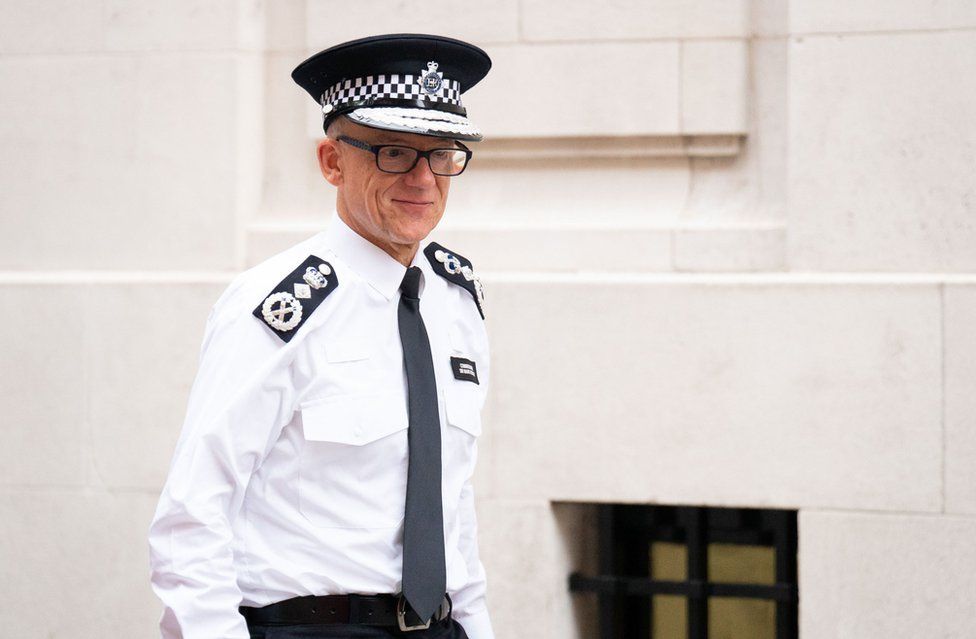
Met Police Commissioner Sir MarkRowley said the findings showed hundreds of his officers should have been sacked.
The Met is investigating more than 600 domestic and sexual abuse allegations against its officers, the BBC has been told.
The interim report on misconduct procedures and the culture in the Met also found misogyny and racial disparity across the force’s internal disciplinary system, with a “systemic bias” against black and Asian officers.
Author Baroness Casey said: “We have heard repeatedly from colleagues that they feel and believe, and actually have given us case examples of where people are getting away both with misconduct but also criminal behaviour.”
According to the report, some 1,809 officers – or 20% of all those facing allegations – had more than one complaint raised against them, with 500 of those facing between three to five separate misconduct cases since 2013.
And yet Baroness Casey’s team said that less than 1% of officers facing multiple allegations had been dismissed from the force, with one continuing to serve despite facing multiple serious allegations – including corruption, traffic offenses, and “failure to safeguard while off duty”.
IMAGE SOURCE, PA MEDIA Image caption, Sir Mark said he was “appalled by the extent of the findings”
Sir Mark admitted it had been hard not to shed a tear at how people had been treated when they had complained about the conduct of fellow officers and nothing had happened.
Asked how many officers or staff should have been sacked for their behaviour, he admitted only between 30 and 50 people are sacked a year and that was not enough.
He said: “There must be hundreds of people who shouldn’t be here who should have been thrown out.”
In a written reply to Baroness Casey, the commissioner said he was “appalled by the extent of the findings you expose”.
He added: “I am sorry to those we have let down: both the public and our honest and dedicated officers.”
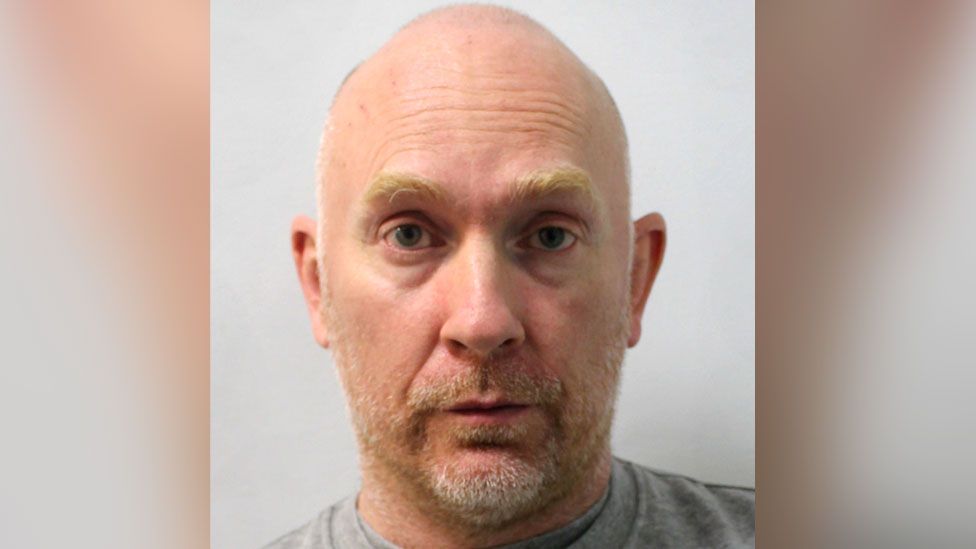
The report was commissioned in the aftermath of the rape, kidnap, and murder of Sarah Everard by serving Met PC Wayne Couzens.
IMAGE SOURCE,MET POLICE Image caption, Former Met officer Wayne Couzens is serving a whole-life term for the murder of Sarah Everard last year
Baroness Casey described the current system as “not fit for purpose” and said “this has to be a line in the sand moment”.
She added there was such a great level of systemic bias and racism that it might be called an example of institutional racism, although that was not the same as saying the Met was institutionally racist.
In a letter to Sir Mark, Baroness Casey laid out eight key issues, including the length of time taken to resolve misconduct cases, currently an average of about a year.
She wrote: “Cases are taking too long to resolve, allegations are more likely to be dismissed than acted upon, the burden on those raising concerns is too heavy, and there is racial disparity across the system, with white officers dealt with less harshly than black or Asian officers.”
Last month, the Met’s performance was found to be “failing” in several areas by the police inspectorate which said there were “serious failings” in the way it operates.
This latest report outlined examples of “how the misconduct process does not find and discipline officers with repeated, or patterns of, unacceptable behaviour”.
There was one serving officer who had received 11 misconduct notices for cases involving abuse, sexual harassment, assault, fraud, improper disclosure of information, and distribution of an explicit image of himself.
By the time a decision on the first misconduct matter had been made, which was to sanction rather than dismiss for harassment and assault, he had received six more notices against him.
Analysis
By Lucy Manning, Special Correspondent
IMAGE SOURCE,GETTY IMAGES
A police officer kidnaped, raped, and murdered Sarah Everard using his warrant card and handcuffs.
Two police officers took photos with the dead bodies of murdered sisters Nicole Smallman and Bibaa Henry then shared them with colleagues.
Messages between a group of officers mainly based at Charing Cross Police Station that joked about rape, domestic violence, and racism.
It’s not hard to see why the conclusion is that the Metropolitan Police has failed to police its own officers.
What is stark from the report is the phrase “these issues are not new”. What Baroness Casey found was “systemic” and “institutionalized”.
Basically, the leadership of the Met has for years ignored the need to get rid of the bad, corrupt, dangerous officers and that has put their families, their fellow officers, and the people they serve – the public – all at risk.
And this isn’t her last word. She has much more to expose about the Met, its officers, and its way of working when she delivers her final report.
Baroness Casey laid out a number of areas where improvement action should be taken, including:
To reduce the time taken for cases to be resolved
To investigate and remove more repeat offenders
To bring more offenses, particularly relating to discrimination and sexual misconduct, within the remit of gross misconduct and dismissal
To bring in more human resource expertise to support the misconduct process
There was also a racial disparity throughout the Met’s misconduct system, the report found.
“This included the concern that raising issues relating to racism, or other discrimination and wrongdoing often led to being labelled a troublemaker, which then led to unfair disciplinary action,” the report stated.
“We also heard that the misconduct system is not sufficiently robust with white officers who breach professional standards, but there is a lower threshold for black, Asian, and mixed ethnicity officers and staff.”
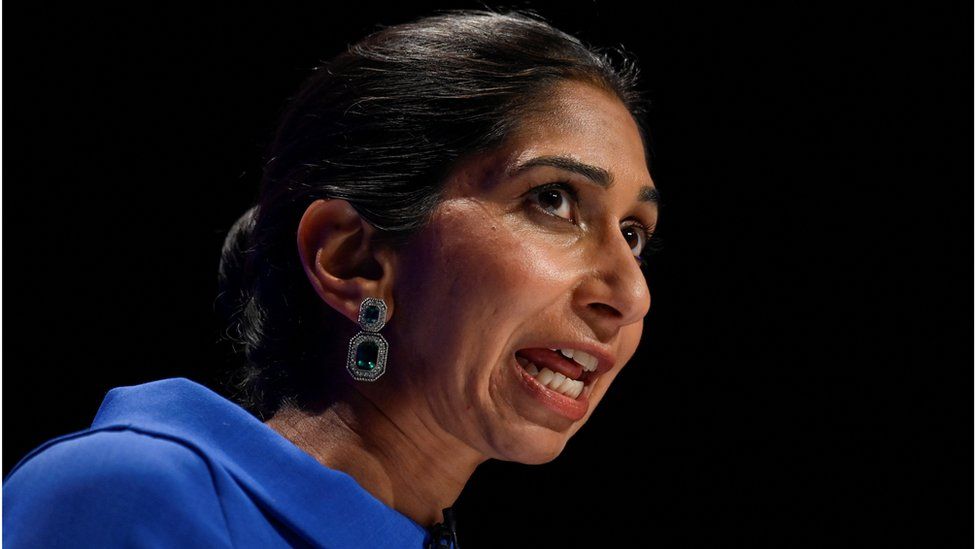
IMAGE SOURCE, REUTERS Image caption, Home Secretary Suella Braverman said standards must improve in the police
Home Secretary Suella Braverman said the public “rightly expects the highest standards of behavior from police officers and the vast majority meet this expectation”, but recently incidents “have damaged trust”.
She added: “Culture and standards in the police must improve. And where an officer has fallen seriously short of these expectations, demonstrable, public action must be taken.”
Chief Constable Andy Marsh, from the professional standards body the College of Policing, added: “Baroness Casey’s review puts a shameful light on behavior which has eroded the foundation of our model to police by consent.
“What has been found has no place in society, let alone in a police service where we should be dedicated to helping the vulnerable.”
Mayor of London Sadiq Khan said the situation at the Met was worse than he had feared.
“It’s clear the Met’s misconduct system is simply not fit for purpose,” he said.
“I now expect nothing less than every single recommendation of this review to be implemented in full, and quickly.
“All misconduct allegations must be acted upon, cases must be resolved much faster, and the disproportionality in the way allegations are dealt with must be eliminated.”
On Sunday, a pro-democracy activist from Hong Kong was dragged into the grounds of the Chinese consulate in Manchester and beaten.
Unidentified men stormed the consulate and forced a man inside the compound before he was able to flee with the assistance of police and other demonstrators.
The protester told the BBC: “They dragged me inside, they beat me up”.
A consulate spokesperson said protesters had displayed an insulting portrait of China’s president.
The Foreign Office said it was urgently seeking clarity on the incident. Greater Manchester Police has launched an investigation.
Speaking after the incident, the protester, called Bob, told BBC Chinese that “mainlanders” – people from mainland China, as opposed to Hong Kong – came out of the consulate and destroyed their posters.
“As we tried to stop them, they dragged me inside, they beat me up,” he said, adding that he was then pulled out by the UK police.
“It’s ridiculous. They [the attackers] shouldn’t have done that. We are supposed to have the freedom to say whatever we want here [in the UK].”
After the incident, the crowd remained angry. Protesters shouted at the men from the consulate and the British police, arguing they could have done more.
Consulate staff had previously asked the protesters to move to the opposite side of the street.
There were two police officers at the protest, but several more appeared within minutes of the altercation beginning.
They gathered at the gates of the compound trying to break up the fighting and move protesters back.
One police officer entered the consulate grounds and pulled the man who had been dragged inside back out.
At least eight men – some of whom were wearing helmets and protective vests – then returned to the consulate building.
The consulate is on UK soil, but cannot be entered without consent. Any offense committed on diplomatic premises is subject to UK law, but employees may hold diplomatic immunity.
Reacting on Twitter, former Conservative leader Iain Duncan Smith said the UK government should demand a full apology from the Chinese ambassador, and that those involved should be sent back to China.
The demonstrators were protesting as the Communist Party congress began in Beijing.
President Xi Jinping, who is set to secure a third term in power, said he had turned the situation in Hong Kong from “chaos to governance”, referring to China’s suppression of pro-democracy protests there.
A spokesperson for the consulate said the protesters had “hung an insulting portrait of the Chinese president at the main entrance”.
“This would be intolerable and unacceptable for any diplomatic and consular missions of any country. Therefore, we condemn this deplorable act with strong indignation and firm opposition,” the spokesperson added.
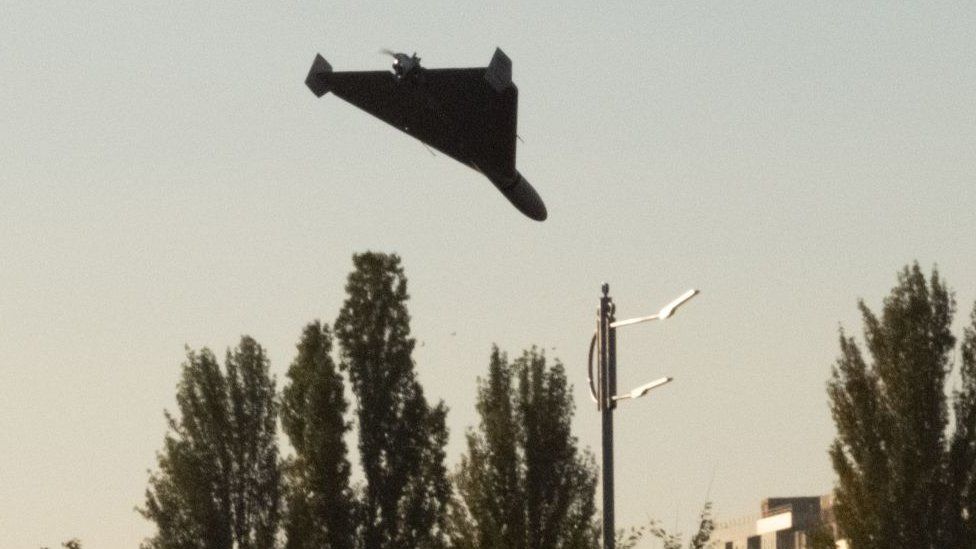
At least four explosions have occurred in the Ukrainian capital of Kyiv, with a presidential adviser accusing “kamikaze drones” launched by Russia.
“It shows their desperation,” said Andriy Yermak,head of Ukrainian President Zelensky’s staff.
Mayor Vitalii Klitschko said residential buildings in the central Shevchenkivskiy area had been damaged.
A week ago, the capital was hit by Russian missiles at rush hour, part of nationwide attacks which left 19 dead.
This morning’s attacks were from drones – the low buzzing of these slow-moving weapons is becoming familiar across the country.
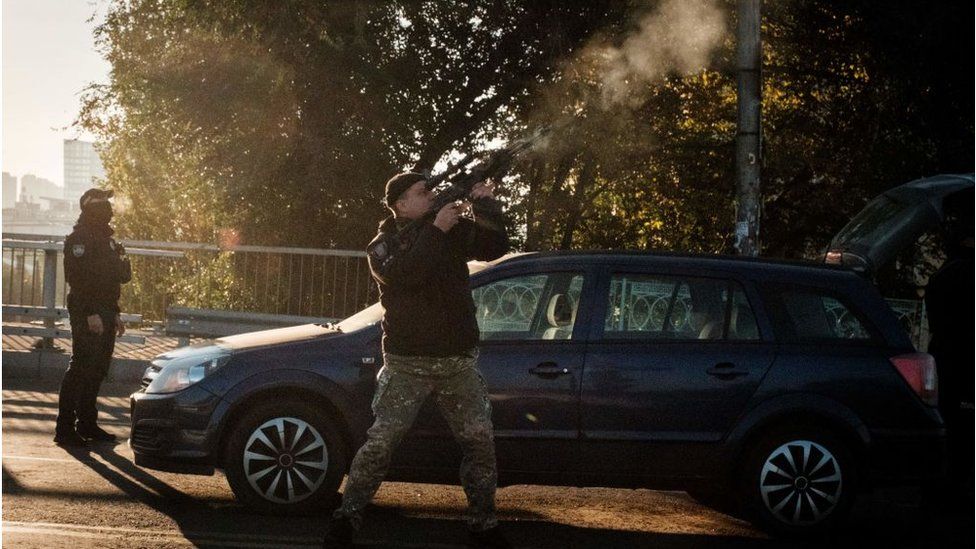
Kyiv reverberated to the rattle of gunfire as anti-aircraft batteries frantically tried to shoot them down. Video on social media appeared to show one interception.
The explosions on Monday began at around 06:30 local time (03:30 GMT), and there were at least five in total. The most recent was at around 08:10 local time.
Two were close to the city centre, with sirens and car alarms heard across the area.
What’s being targeted is hard to determine. The mayor’s office says residential and non-residential buildings have been hit. Railway officials say explosions were seen close to Kyiv’s main station.
Recent attacks have targeted Ukraine’s energy infrastructure. It will be surprised if that’s not the case today.
Writing on the Telegram social media site, Mr Klitschko said there were four strikes in Kyiv, although residents heard five or six explosions. He also told people to stay in air raid shelters.
But despite the warnings, the streets are far from deserted. Between the first and second set of strikes, plenty of people seemed to be going about their Monday morning business.
Mr Yermak described the kamikaze attacks as Russia’s “death throes”, and that Ukraine needed more air defence systems “as soon as possible”.
What are kamikaze drones?
Small aerial weapons, also known as loitering munitions, that are destroyed after striking the target
Unlike other drones – which are supposed to return home after dropping missiles – kamikaze drones are disposable
The name derives from the Japanese pilots who volunteered to crash their planes in suicide missions in World War Two
President Zelensky has previously accused Russia of using Iranian-made drones – Iran denies supplying them while Russia has not commented
Russian President Vladimir Putin said last week’s strikes were in retaliation for the bombing of a key bridge linking Russia to occupied Crimea, which he blamed on Ukraine.
It was the first time during the war that the centre of Kyiv had been directly targeted.
Earlier this week, Mr Putin said there was no need for more large-scale strikes on Ukraine. Most designated targets had been hit, he said, adding that it was not his aim to destroy the country.
IMAGE SOURCE,YASUYOSHI CHIBA Image caption, A drone seen in Kyiv on Monday
IMAGE SOURCE,YASUYOSHI CHIBA Image caption, A Ukrainian in Kyiv fires at a drone
The UN refugeeagency has expressed great worry over the finding of around 100 naked males at the Greek-Turkish border.
Two countries have laid blame for the fate of the 92 migrants.
Greece criticised Turkey for its “behaviour,” calling it a “shame for civilization.”
Turkey branded its neighbour’s claims as “fake news” and accused it of “cruelty”.
As both sides blamed each other, the United Nation’s refugee agency called for an investigation and said it was “deeply distressed by the shocking reports and images”.
Greek police said they rescued the 92 men who were discovered naked, and some with injuries, close to its northern border with Turkey on Friday.
They said an investigation by them and officials from the EU border agency Frontex, found evidence that the migrants crossed the Evros river into Greek territory in rubber dinghies from Turkey.
“Border policemen… discovered 92 illegal migrants without clothes, some of whom had injuries on their bodies,” the statement said.
Greek authorities said the men were immediately given clothing, food and first aid.
It was not clear how and why the men had lost their clothes.
Frontex said the men were mainly from Afghanistan and Syria, and that the organisation’s fundamental rights officer had been informed of a potential rights violation.
Greek minister for civil protection, Takis Theodorikakos, accused Turkey of “instrumentalising illegal immigration” in the latest in a row over migration between the neighbours.
Speaking on Greek television he claimed that many of the migrants had told Frontex that “three Turkish army vehicles had transferred them” to the river which acts as a border between the two countries. The BBC has not been able to independently verify this claim.
“One would expect a working explanation from the Turkish government’s side,” Mr Theodorikakos said.
A day earlier, Greek Migration Minister Notis Mitarachi said in a tweet that Turkey’s treatment of the migrants was a “shame for civilisation”. He said Athens expected Ankara to investigate the incident and “protect… its border with the EU”.
The dispute has reached the highest level of government in Turkey, with tweets on behalf of the president denying any responsibility for what had happened and blaming Greece for the “inhuman” situation.
“The Greek machine of fake news is back at work,” President Recep Tayyip Erdogan’s top press aide Fahrettin Altun wrote on the social media site.
He described the allegations as “futile and ridiculous”, accusing Greece of not respecting the refugees by posting their pictures.
In response, the UNHCR said it is “deeply distressed by the shocking reports and images”, but said it had not been able to speak to the group directly yet – something which it hoped would happen in the coming days.
“We condemn any cruel and degrading treatment and call for a full investigation,” the UNHCR told the BBC.
The discovery of the men comes days after a leaked report by an EU agency criticized some senior staff at Frontex for covering up illegal pushbacks of migrants by Greece to Turkey, something Athens denies. Frontex says such practices by its staff are a thing of the past.
Last month, Turkish President Recep Tayyip Erdogan used a UN address to accuse Greece of transforming the Aegean Sea into a “cemetery” and said it had “oppressive policies” on immigration.
Greece was on the frontline of a European migration crisis in 2015 and 2016, when around a million refugees fleeing war and poverty in Syria, Iraq, and Afghanistan arrived in the country, mainly via Turkey.
The number of arrivals has fallen since then, but Greek authorities said they had recently seen an increase in attempted arrivals through the Turkish land border and the Greek islands.
Greece has urged Turkey to respect a 2016 deal with the European Union in which Ankara agreed to contain the flow of migrants to Europe in exchange for billions of euros in aid.
Athens will soon extend a 25-mile (40-kilometer) fence along its northern border with Turkey to prevent migrants from entering the country, Mr Theodorikakos said.
The Palestinian Wafa news agency, quoting medical sources, identified the slain man as 31-year-old Mujahed Ahmad Daoud.
The Palestinian Ministry of Health says a Palestinian man who was shot by Israeli forces in the occupied WestBankon Saturday night has died as a result of his injuries.
According to ministry authorities, three people were injured in the Israeli fire on Sunday.
Palestinian Wafa news agency, quoting medical sources, identified the slain man as Mujahed Ahmad Daoud, a 31-year-old Palestinian from the town of Qarawet Bani Hassan.
Daoud was rushed to Istishari Hospital in Ramallahwhere efforts to save his life failed.
The Israeli military said Palestinians had started “a violent riot” near Qarawet Bani Hassan on Saturday and soldiers who had been operating there opened fire.
Tensions high
The incident follows months of tensions that have deepened since Israel began a crackdown in the West Bank in March in response to a series of attacks by Palestinians in Israel.
Israeli forces have been carrying out near-daily raids in recent months, largely focused on the towns of Jenin and Nablus in the West Bank, where a new wave of Palestinian armed resistance is emerging.
Since the beginning of the year, at least 160 Palestinians have been killed by Israeli forces in the West Bank and Gaza Strip, including 51 Palestinians during Israel’s three-day assault on Gaza in August, according to the Ministry of Health.
Tensions have also been high in occupied East Jerusalemafter Israeli police locked down the Shuafat camp last week on the pretext of searching for a Palestinian suspected of killing a female Israeli soldier.
According to the country’s judiciary,at least four prisoners were killed and 61 others were injured after a fire broke out overnight at Tehran’s Evin prison following a dispute between convicts, according to the official state news agency IRNA.IRNA reported smoke inhalation was the cause of the deaths, with 10 convicts hospitalized and four in “critical condition.”
The facility mostly holds political prisoners, including Iranians with dual nationality. Families of about two dozen political prisoners have called to say they are unharmed, according to their accounts on social media.
The prison has long been criticized by Western rights groups and was blacklisted by the United States government in 2018 for “serious human rights abuses”.
The incident took place as nationwide protests over the death in detention of Mahsa Amini, a 22-year-old Iranian woman, entered the fifth week.
The protests have posed one of the most serious challenges to the Iranian government since the 1979 revolution, with demonstrations spreading across the country and some people chanting slogans against Supreme Leader Ayatollah Ali Khamenei.
State TV on Sunday aired footage of the fire’s aftermath, showing scorched walls and ceilings in a room it said was the upper floor of a sewing workshop at the prison. Tehran prosecutor Ali Salehi said the prison unrest was not related to the nationwide protests and the situation was peaceful after the incident.
The fire started at about 10 pm (6.30 pm GMT), Al Jazeera’s Resul Sardar said, adding that it involved different units of the prison.
Damage caused by a fire inside the building of the Evin prison [IRNA via AFP]
“Officials here say there were clashes between prisoners and that some of those prisoners have set the fire in the warehouse, in the sewing workshop of the prison,” Sardar said, referring to a statement made earlier by Tehran Governor Mohsen Mansouri.
“However some witnesses are saying that some Molotov cocktails were thrown into the prison and that they started the fire. Right after that, we have seen security forces firing and also using tear gas to disperse people,” he added.
A witness contacted by the Reuters news agency said roads leading to Evin prison have been closed to traffic. “There are lots of ambulances here,” he said. Another witness said families of inmates gathered in front of the main prison entrance. “I can see fire and smoke. Lots of special forces,” the witness said.
A security official said calm had been restored at the prison, while IRNA reported that “the situation is currently completely under control”. But the first witness told Reuters that ambulance sirens could be heard and smoke still rose over the prison.
Early on Sunday, IRNA carried a video it said showed parts of the prison damaged by fire. Firefighters were seen dousing the debris with water, apparently to prevent the blaze from reigniting.
‘Numb with worry’
The detainees include French-Iranian academic Fariba Adelkhah and US citizen Siamak Namazi, whose family said he was taken back into custody this week after a temporary release.
Reacting to reports of the fire, Namazi’s family said in a statement to the AFP news agency sharedby their lawyer that they were “deeply concerned” and had not heard from him.
They urged Iran’s authorities to grant him “immediate” means to contact his family and to give him a furlough “as he clearly isn’t safe in Evin Prison”.
The sister of another US citizen held at Evin, businessman Emad Shargi, said in a Twitter post his family was “numb with worry”.
An unnamed Iranian official told the Tasnim news agency that none of the political prisoners was involved in Saturday’s unrest.
“No security prisoner was involved in today’s clash between prisoners, and basically the ward for security prisoners is separate and far from the wards for thieves and those convicted of financial crimes,” the official was quoted as saying.
Protests reported near #Evin Prison in Tehran after the prison became enflamed with sounds of gunshots and explosions. #Mahsa_Amini
Asked about the prison fire, US President Joe Biden told reporters during a campaign trip to Portland, Oregon: “The Iranian government is so oppressive.”
He said he was surprised by “the courage of people and women taking [to] the street” in the recent protests and had enormous respect for them. “It’s been really amazing,” he added. “They’re not a good group, in the government.”
US Department of State spokesman Ned Price tweeted, “We are following reports from Evin Prison with urgency. We are in contact with the Swiss as our protecting power. Iran is fully responsible for the safety of our wrongfully detained citizens, who should be released immediately.”
Human Rights Watch has accused the prison authorities of using threats of torture and indefinite imprisonment, as well as lengthy interrogations and denial of medical care for detainees.
Protests erupted after the September 16 death of Amini, who was arrested by Iran’s morality police for wearing an improper hijab. She died in custody. A coroner’s report said she did not suffer blows to the head or vital organs.
Amini’s family has refuted the official accounts that attributed the 22-year-old’s death to conditions arising after a brain tumour surgery at age eight.
Although the unrest does not appear close to toppling the government, the protests have widened into strikes that have closed shops and businesses, touched the vital energy sector, and inspired brazen acts of dissent against Iran’s religious rule.
On Saturday, protesters across Iran chanted in the streets and in universities against the country’s religious leaders.
A video posted by the Norway-based organisation Iran Human Rights purported to show protests in the northeastern city of Mashhad, Iran’s second-most populous city, with demonstrators chanting “Clerics, get lost”, and drivers honking their horns.
Videos posted by the group showed a strike by shopkeepers in the northwestern Kurdish city of Saqez – Amini’s hometown. Another video on social media showed female high school students chanting “Woman, Life, Freedom” on the streets of Sanandaj, the capital of Kurdistan province.
The authenticity of the videos could not be verified immediately.
The Iranian activist news agency HRANA said online that 240 protesters had been killed in the unrest, including 32 minors. It said 26 members of the security forces were killed, and nearly 8,000 people had been arrested in protests in 111 cities and towns and some 73 universities.
But the official death toll is much lower than estimated by rights groups and protesters.
Among the casualties have been teenage girls whose deaths have become a rallying cry for more demonstrations demanding the downfall of Iran’s government.
Protesters called on Saturday for demonstrations in the northwestern city of Ardabil over the death of Asra Panahi, a teenager from the Azeri ethnic minority who, activists alleged, was beaten to death by security forces.
Officials denied the report and news agencies close to the Islamic Revolutionary Guard Corps quoted her uncle as saying the high school student had died of a heart problem.
Sir John Major has slammed The Crown’s reported depiction of Charles attempting to force the Queen’s abdication during his presidency as “damaging, malicious fiction.”
The next season of the Netflix show is expected to include footage of the then-Prince of Wales, Dominic West, briefing Sir John (Jonny Lee Miller) against the Queen in an attempt to depose her.
According to The Mail on Sunday the writers suggest that in 1991, Charles believed his mother, who was 65 at the time, was making the same mistake as Queen Victoria by not letting her younger heir take over.
A spokesperson for Sir John told the paper: “Sir John has not co-operated in any way with The Crown. Nor has he ever been approached by them to fact-check any scripted material in this or any other series.
“There was never any discussion between Sir John and the then Prince of Wales about any possible abdication of the late Queen Elizabeth II.”
The spokesperson said that if such scenes are broadcast, “they should be seen as nothing other than damaging and malicious fiction. A barrel-load of nonsense peddled for no other reason than to provide maximum – and entirely false – dramatic impact”.
Sir Keir Starmer made fun of the Conservative Party this morning, pointing out that they had had four chancellors since Labour unveiled its economic blueprint.
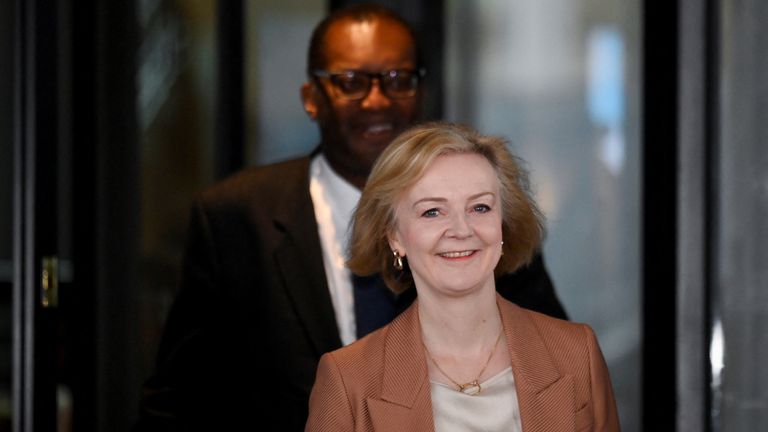
Liz Truss was named the fourth on Friday, thus Rishi Sunak, Nadhim Zahawi, Kwasi Kwarteng, and Jeremy Hunt have all held the position since July.
Sir Keir said: “Since I set out our plans to grow the economy, the Tories have got through four chancellors.
” Our Green Prosperity Plan will create a million good jobs. And we’ll deliver GB energy, a home-grown energy company.
” Labour will build the future Britain deserves.”
Since I set out our plans to grow the economy, the Tories have got through 4 Chancellors.
Our Green Prosperity Plan will create a million good jobs. And we’ll deliver GB energy, a home-grown energy company.
Defence spending had been set to rise to 3% of GDP by 2030-but Chancellor Jeremy Hunt refuses to make that commitment.
The UK’s new chancellor has raised the possibility of ditching a key pledge by Liz Truss to boost defence spending – a move that would likely be a resigning matter for her defence secretary, Ben Wallace.
Jeremy Hunt on Saturday refused to commit to lifting the amount of money spent on the armed forces to 3% of national income by 2030, as promised by the prime minister.
He also said the Ministry of Defence, like all other departments, would have to make additional savings.
Mr Wallace, one of the most experienced and well-regarded members of the embattled prime minister’s cabinet, has fought hard over the past three years to secure much-needed increases in defence spending at a time of growing security threats.
Asked whether any backtracking on defence spending goals would be a resigning issue, a defence source said Mr Wallace would hold the prime minister to the pledges made.
This includes a commitment to increase defence spending to 2.5% of gross domestic product (GDP) by 2026 from around 2% at present and then to 3% of GDP by 2030 in what would equate to around an extra £157billion over eight years.
But speaking about tough times ahead, Mr Hunt told Sky News: “I’m going to ask all departments to find more efficiencies than they were planning to find.”
He repeated this on Radio 4’s Today programme and was asked specifically if a “difficult tough decision” would be taken over the defence budget.
Mr Hunt replied: “We do need to increase defence spending, but I can’t make a promise to you here and now about the timings of that.”
He continued: “The long-term ability to fund an increase in defence spending will depend on stability in the economic situation and a healthily growing economy.”
Pressed on how he was leaving open the possibility of the 3% defence spending pledge not being delivered by 2030, Mr Hunt said: “I am leaving open all possibilities this morning. I wish I could give you more detail, but I will be presenting to parliament in a fortnight on Monday exactly what is going to happen and the answer to all those questions.”
He was referring to 31 October when the chancellor is due to issue a fiscal statement.
As well as a failure to commit to defence spending, Mr Hunt also made a flawed assessment that long-term defence spending can only be secured if there is economic stability.
In reality, there can be no economic stability without security.
The energy price rise – as the prime minister keeps saying – is caused by Vladimir Putin using energy as a weapon, reducing the flow of Russian oil and gas to pressure Western nations to stop their crucial support to Ukraine, which has helped thwart his invasion so far.
Had the Conservatives – and Labour before them – genuinely demonstrated the mantra that national security is their first priority the UK would not have seen successive governments slash defence spending and military capability over the past three decades.
NATO allies are less likely to invest in defense if the UK doesn’t
Hollowed-out defences – and this is a simplification of a time that also included the disastrous Iraq and Afghanistanwars – have left the UK and fellow European NATO allies less able to deter the existential threats posed by authoritarian regimes like Russia’s.
So, it makes no sense to use the economic crisis, triggered in part by Russia’s war in Ukraine, as a reason to backtrack on a vital need to rebuild the UK’s armed forces.
Russia’s Vladimir Putin, Xi Jinping of China, North Korea’s Kim Jong-un, and all other leaders who prefer authoritarian rule over the values of democratic governments – human rights, rule of law, and other freedoms – will be laughing.
Britain is one of the strongest voices in NATO, urging increased defence spending among all 30 allies – it is a live debate right now, with hopes to lift a minimal expenditure target to 2.5% of GDP from 2%.
If the UK were to lead by example and reduce ambitions to grow defence spending, it would make it far less likely other European allies will feel under pressure to boost their budgets.
The MoD has a largely poor track record of procurement, with programmes to build warships, aircraft, and tanks too often running billions of pounds over budget and delivered late or not at all. That is inexcusable and also needs to change.
But ordering more efficiencies is going to make a bad situation even worse.
Many people have tried and failed to make the MoD and the armed forces more efficient.
The thing is, the UK’s military, security and intelligence services are too vital to fail and too important not to fund adequately, especially at a time of war in Europe, and the very real threat of escalation with Russia and China.
Conservative MP Alicia Kearns called the decision to keep Liz Truss as Prime Minister “incredibly difficult.”
When asked on Times Radio if Ms Truss could or should stay at Number 10, Ms Kearns, the new chairperson of the Commons Foreign Affairs Committee, said: “Ultimately, it is a very difficult one because, as you know, we’ve had questions around our moral competency.”
“We’ve now got questions around our fiscal competency.”
She added: “I don’t want further questions around even our ability to continue to govern as a party and our ability to stay united. It’s an incredibly difficult one, and ultimately I need to listen to colleagues and speak to colleagues over the coming days.
“But do we need a fundamental reset? Without question.”
Ms Kearns said the government’s problems are linked to policy and not just communication, warning that “dogmatism scares people”.
Asked whether the government’s main problem is how it has communicated, the senior Tory said: “Do I think the government has a fundamental communications problem? Yes, I do.
“But I think it comes ultimately from the policy decisions they make. In a time of crisis, the public wants to see pragmatism.
“They want to see fiscal responsibility, and they want to see compassion.”
Andrew Griffith told Sky News that Liz Trussstill has the support of her government despite troubling economic turmoil.
The Financial Secretary to the Treasury said: “Liz Truss has got the support of the Government – it’s really important at this time that we have stability.”
On whether they had got decisions wrong, Mr Griffith said: “Yeah for sure there’s things that everybody in government would regret last week, and that’s why the government has made changes.”
He then argued that the government had got it right on the energy price guarantee and the focus on economic growth.
But pressed on exactly what ministers got wrong, he said: “The rate at which you could proceed and as the chancellor said yesterday, not involving the OBR (Office for Budget Responsibility) in those conversations.
“I think it was well meant to act as quickly as possible but obviouslythat has caused some of the turbulence.”
Mr Griffith was then asked why Kwasi Kwarteng was sacked as chancellor.
“The prime minister concluded that the right thing to do was to make a change. [Liz Truss] has exercised that judgment, she’s brought in a new and really experienced chancellor.
“Now we need a little bit of time to do that work… nobody wants those decisions to be rushed… we want them to be right.”
He said what the public and the economy need is “calm” and “stability” – and the last thing they want is politicians talking about themselves.
Earlier, Andrew Griffith told Sky News that Liz Trussstill has the support of her government despite troubling economic turmoil.
The Financial Secretary to the Treasury said: “Liz Truss has got the support of the government – it’s really important at this time that we have stability.”
Now, in an interview with Times Radio, he was pressed on whether Ms Truss will still be in Number 10 Downing Street at Christmas.
He dodged the question, instead reiterating his previous point.
“I think Liz enjoys the confidence of the government,” he said.
“She’s the prime minister and the last thing that I think anybody wants is to see more instability.
“I personally found the leadership election damaging. It was us talking about ourselves rather than the country.
“The quicker we can get back, and that work starts now, to good confidence in the markets, controlling what we can control, which is putting together sensible plans and bringing forward measures as we have with the energy price guarantee.”
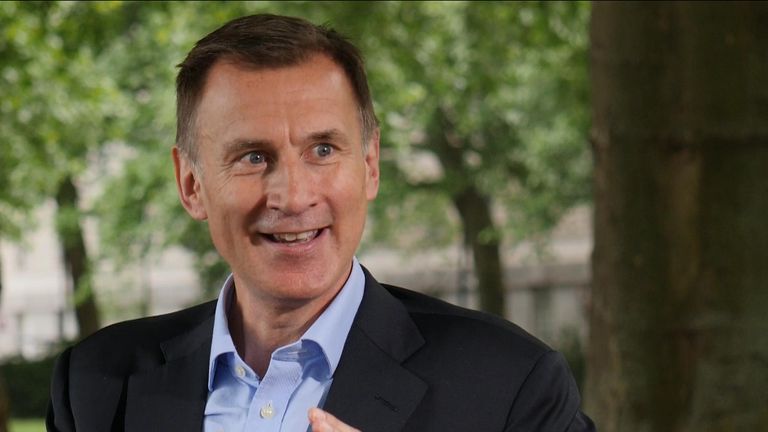
Meanwhile, new Chancellor Jeremy Hunthas been speaking to the BBC on his second day on the job.
He said “actions speak louder than words” as he promised to reassure the markets with effectively a new budget in two weeks’ time.
Mr Hunt added he wants to keep as many of Liz Truss’s tax cuts as he can – while insisting: “The prime minister is in charge.”
He said: “I’m not taking anything off the table. I want to keep as many of those tax cuts as I possibly can because our long-term health depends on being a low-tax economy. And I very strongly believe that.”
He also said no government department would be immune from “efficiency savings”, as he signalled spending cuts to come.
“I’m going to be asking every government department to find further efficiency savings,” he said.
He said he hopes his fiscal statement can stabilise the markets.
“The prime minister has changed her chancellor. We are going to have a very big fiscal statement a bit like a budget in which we set out the tax and spending plans for several years ahead, and that’s going to be independently verified by the Office for Budget Responsibility.”
He appeared to rule out any future tilt at the Tory leadership.
Mr Hunt said a desire to lead the party had been “clinically excised” thanks to his previous failed attempts.
“I think having run two leadership campaigns, and by the way failed in both of them, the desire to be a leader has been clinically excised from me.
“I want to be a good chancellor. It’s going to be very, very difficult. But that’s what I’m focusing on.”
Prime Minister Liz Trusshas released a comment piece she wrote for The Sun on Sunday, in which she calls it a “wrench” that “my buddy Kwasi Kwarteng has left government.”
She stressed on Twitter that she will always “act in the national interest, assisting people and businesses across our country.”
Ms Truss added: “We are going to do things differently, charting a new course for growth – it remains the core mission of this government.”
I will always act in the national interest, supporting families and businesses across our country.
We are going to do things differently, charting a new course for growth – it remains the core mission of this government👇https://t.co/CYWRRz27dn
Prior to the arrest, police released CCTV footage of a suspect in the killing spree, and said the crimes could be the work of a serial killer “on a mission”.
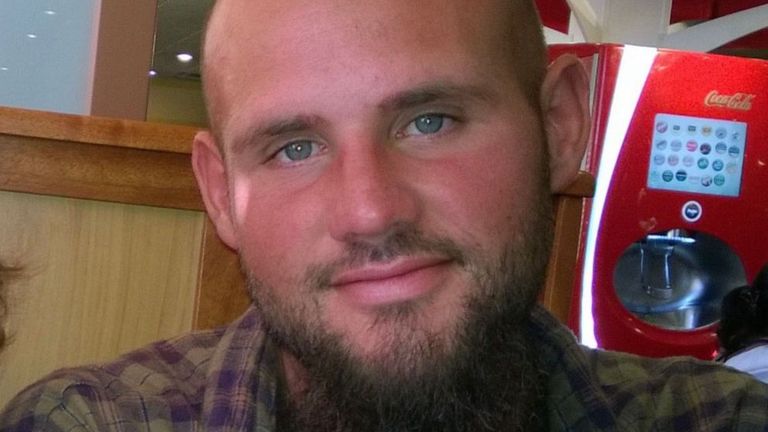
A man suspected of killing six people in a string of murders in California has been arrested by police while “out hunting” for his next victim.
Wesley Brownlee was driving in the city of Stockton, where five of the murders took place, and was armed with a handgun when he was stopped by police officers in the early hours of Sunday morning.
Investigators had been tracking the 43-year-old after receiving tips from members of the public.
“Based on tips coming into the department and Stockton Crime Stoppers, we were able to zero in on a possible suspect,” Police Chief Stanley McFadden said.
“Our surveillance team followed this person while he was driving. We watched his patterns and determined, early this morning, he was on a mission to kill.”
Mr McFadden added that Brownlee was detained after engaging in what appeared to be threatening behaviour, including going to parks and dark places, stopping and looking around before driving on.
He was dressed in black, had a mask around his neck, had a gun, and “was out hunting”, the police chief said.
A police photo showed the weapon allegedly carried by the suspect, which appeared to be a semi-automatic handgun containing some non-metallic materials.
Brownlee is accused of shooting dead six men and wounding a womanin an 18-month killing spree in the Stockton and Oakland areas.
Image:Stockton Police Chief Stanley McFadden speaks during a news conference
Who were the victims?
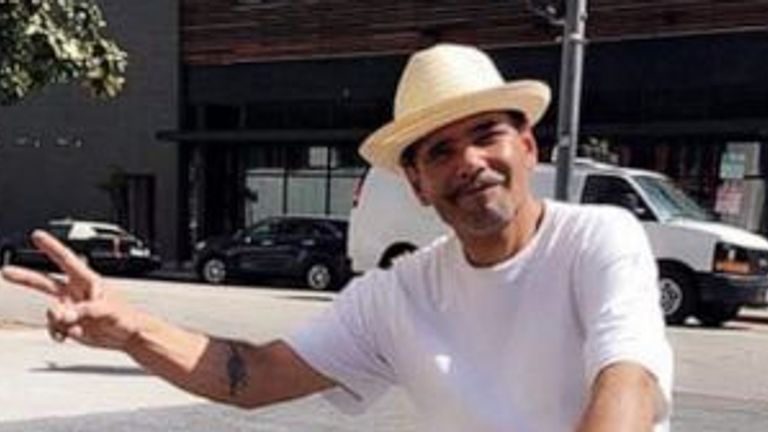
Juan Vasquez Serrano, 39, was the first victim to be killed in Oakland on 10 April 2021.
Just six days later, 46-year-old Natasha LaTour was shot in Stockton but managed to survive after scaring off her attacker by walking toward them.
More than a year later, the killer struck again, shooting dead Paul Yaw, 35, on 8 July, then Salvador Debudey on 11 August, followed by 21-year-old Jonathan Hernandez Rodriguez on 30 August and 52-year-old Juan Cruz on 21 September.
Image:Paul Yaw was the first of the Stockton victims to die. Pic: Greta Bogrow the most recent victim was 54-year-old Lawrence Lopez, who died on 27 September.
Police believe the same person was responsible for all the shootings, with ballistics tests and video evidence linking the crimes together.
There was a $125,000 (£109,000) reward available for information leading to an arrest.
Image:Lorenzo Lopez, the most recent victim, died on 27 September Pic: Jerry Lopez Family
Police said Brownlee has a criminal history and is believed to have also lived in several cities near Stockton, but they did not give further details.
Investigators have been trying to identify a motive for the attacks, with none of the victims appearing to have little in common.
Some of the victims were homeless, but not all. None were beaten or robbed, and the woman who survived said her attacker didn’t say anything.
The Queen Consort is shown holding toy bears left outside Buckingham Palace by members of the public after the Queen’s death.
A new image shows the Queen Consort surrounded by teddies to commemorate the contribution of over 1,000 toy bears to Barnardo’s children’s charity.
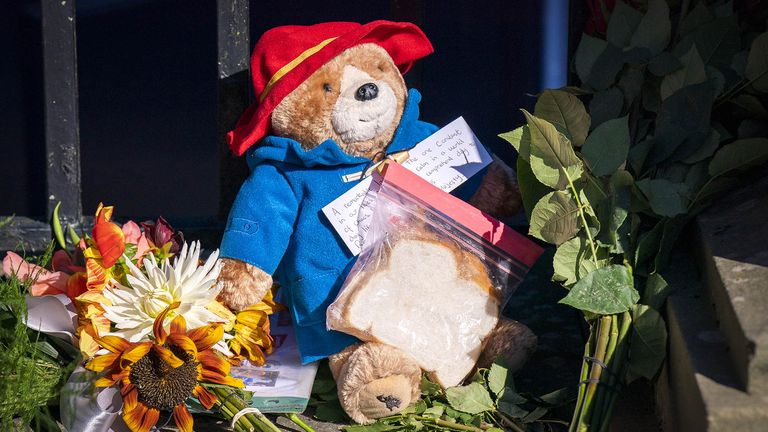
Mourners paying their respects to the Queen after her death last month left the cuddly toys outside Buckingham Palace, including many Paddington Bears.
The Palace said the teddies had been collected and professionally cleaned before they are delivered to Barnardo’s children’s services in the coming weeks.
In the picture, Camilla sits on a low sofa in the Morning Room at Clarence House wearing a navy blue dress with white stitching, surrounded by toy bears.
It was taken on Thursday – the 64th anniversary of the publication of the first Paddington Bear book.
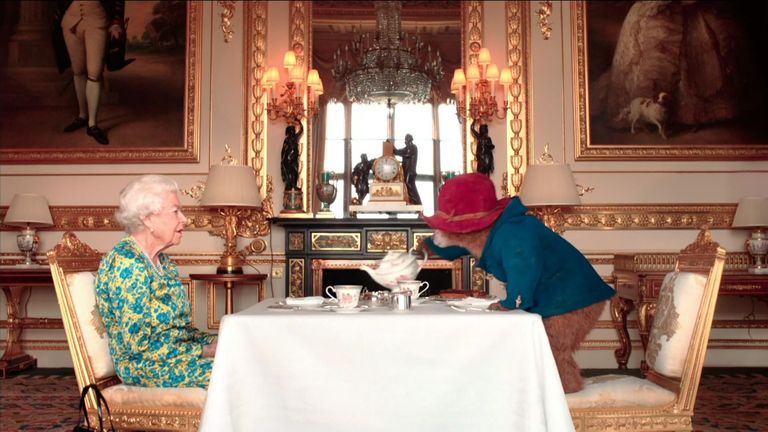
In a much-loved TV sketch during the Queen’s Platinum Jubilee celebrations in June, Elizabeth II had tea at Buckingham Palace with the popular children’s character where she dug out a marmalade sandwich from her famous handbag.
It prompted members of the public to leave teddy bears, and quite a few marmalade sandwiches, among the floral tributes which amassed outside royal residences following her death in September.
The Queen passed the patronage of Barnardo to Camilla in 2016, who was then the Duchess of Cornwall.
Barnardo’s chief executive Lynn Perry said: “Her Majesty Queen Elizabeth II was Barnardo’s patron for over 30 years, and we are honoured to be able to give homes to the teddies that people left in her memory.
“We promise to look after these bears who will be well-loved and bring joy to the children we support.
“We are incredibly grateful to Her Majesty The Queen Consortfor her support in helping us to raise awareness of the needs of vulnerable children and young people in the UK so that we can continue to support them through our vital services.”
Image:A Paddington Bear toy and marmalade sandwich among floral tributes outside the Palace of Holyroodhouse, Edinburgh
Tom Jarvis, director of parks at the Royal Parks charity, said: “Over the last few weeks, we have been looking for a fitting and appropriate use for the hundreds of teddy bears that were left in Green Park and Hyde Park to honour the Queen.
“We are delighted that the teddy bears will now bring joy and comfort to hundreds of children supported by Barnardo’s.”
The bears were being “well looked after” at the Palace, Clarence House, and in the Royal Parks nursery in Hyde Park,Buckingham Palace said.
With the help of shire horses and almost 200 volunteers, the charity began gathering tributes from Green Park and Hyde Park late last month after the national period of mourning – with the toys collected then also set to be cleaned and donated to Barnardo’s.
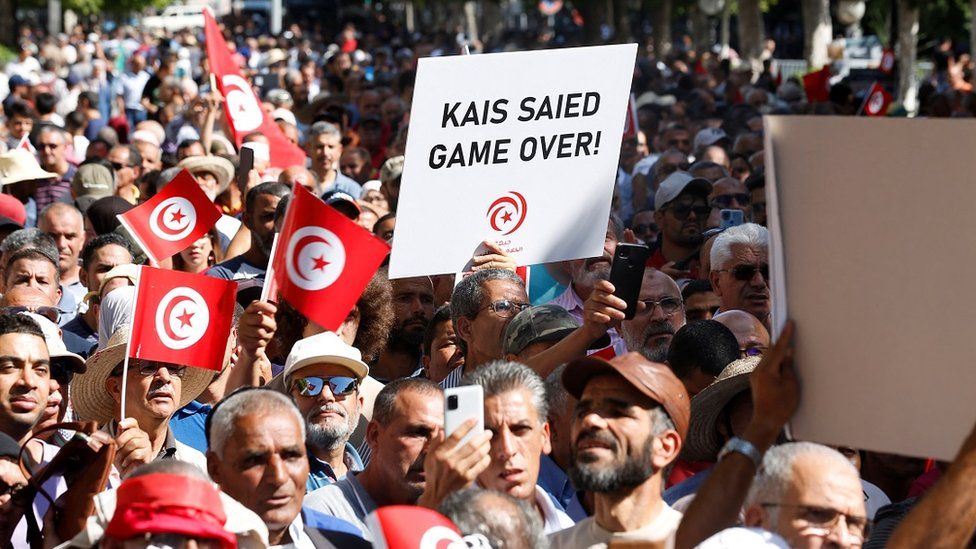
Thousands of demonstrators have marched to the streets of Tunisia’s capital to protest the president.
Parallel demonstrations by diametrically different political movements were organized in Tunis.
Both organisations condemned Kais Saied as an autocrat who is undoing the democratic gains gained since the 2011 revolt.
They also demanded accountability for the country’s economic crisis which has seen food and fuel shortages.
Critics of Mr Saied accuse him of staging a coup and attempting to turn Tunisia back into an autocracy – a system of government run by one person with absolute power.
After sacking the prime minister and suspending parliament in July 2021, a year later Mr Saied pushed through a constitution enshrining his one-man rule after a vote boycotted by the main opposition parties.
The new constitution replaced one drafted three years after the Arab Spring in 2011 which saw Tunisia overthrow late dictator Zine al-Abidine Ben Ali.
It gave the head of state full executive control, the supreme command of the army, and the ability to appoint a government without parliamentary approval.
Mr Saied has said it was needed to break a cycle of political paralysis and economic decay.
He said his reforms were being done in the spirit of the 2011 revolution and would ensure a better future.
His supporters welcomed his actions, saying the country needed a strong leader to tackle what they see as a fractious and corrupt system.
On Saturday, protesters in central Tunis chanted, “down, down”, “revolution against dictator Kais” and “the coup will fall”.
One of the marches was organised by the National Salvation Front, a coalition of opposition parties including the Islamist-inspired Ennahda that had dominated Tunisia’s parliament before its dissolution by Mr Saied.
Ali Laarayedh, Tunisia’s former prime minister and a senior Ennahda official, told AFP news agency that the protest was an expression of “anger at the state of affairs under Kais Saied”.
“We are telling him to leave.”
IMAGE SOURCE, REUTERS Image caption, Protesters call for President Kais Saied to go.
He added that if Mr Saied remains in power, “Tunisia will have no future”, citing growing despair, poverty, and unemployment.
The National Salvation Front has announced it will boycott a December vote to elect a new parliament with limited powers.
Ennahda’s deep ideological rival, the secular Free Destourian Party, also organized a protest in the capital on Saturday.
Some of its protesters carried empty containers to symbolise the rising cost of water due to inflation, which hit 9.1% in September.
Mr Saied “is doing nothing, and things are only getting worse”, said Souad, a pensioner in her 60s.
Around 1,500 people joined the Ennahda-led demonstration, while nearly 1,000 attended the PDL protest, the interior ministry told AFP.
Tunisia’s revolution in 2011 is often held up as the sole success of the Arab Spring revolts across the region – but it has not led to stability, either economically or politically.
The cash-strapped country reached a preliminary agreement with the International Monetary Fund on Saturday for a rescue package loan of $1.9bn (£1.7bn) to help it restore economic stability and strengthen social safety nets.
On Saturday, gunmen killed 11 people at a Russian militarytraining facility.
Two individuals opened fire on a group of volunteers who had enlisted to fight in Ukraine during a firearms training session, according to state-owned news agency Ria.
The attackers were from a former Soviet republic, the Russian defence ministry said, but did not give further details.
They were also shot dead during the incident in the Belgorod region of Russia, which borders Ukraine.
A further 15 people were wounded.
“During a firearms training session with individuals who voluntarily expressed a desire to participate in the special military operation [against Ukraine], the terrorists opened fire with small arms on the personnel of the unit,” Ria cited a defence ministry statement as saying.
“As a result of the shooting, 11 people were fatally wounded. Another 15 people with wounds of varying severity were taken to a medical facility,” it said.
The local governor said no residents of the Belgorod region had been killed or injured.
Last month Russian President Vladimir Putin ordered a mobilisation of 300,000 Russians who had previously done compulsory military service.
The order sparked protests across Russia and a surge of people attempting to leave the country.
Soon after the mobilisation was announced, a military recruiter was shot at an enlistment office in Siberia.
Last week, Putin announced that over 200,000 people had already beenmobilized, and he saw no need for additional mobilization.
The war in Ukraine is still ongoing after nearly eight months. Ukrainian counter-offensives continue to make progress, while Russian forces continue to press elsewhere.
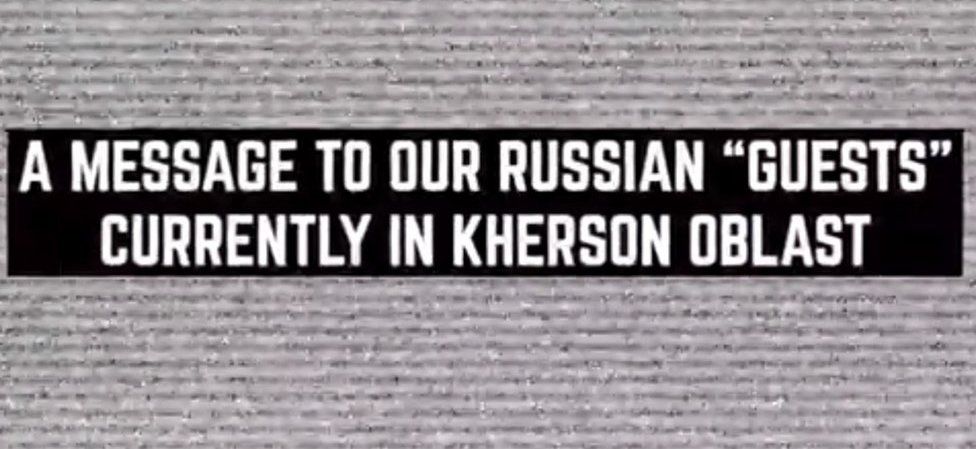
However, it is a one-sided affair on the internet.
“This is a meme nation,” says Olena, a Kyiv entrepreneur who manages teams of social media volunteers.
“If this was a war of memes, we would be winning.”
Olena is not her real name. Due to the sensitive nature of the work she and her teams carry out on behalf of Ukraine’s defence ministry, she has asked to remain anonymous.
Her teams work round-the-clock, reacting within hours to news from around the country, producing punchy videos, often set to music, for the ministry’s audiences at home and abroad.
Just as Ukraine’s President Volodymyr Zelensky tailors speeches to foreign parliaments to take account of local history, culture, and sensibility, so Olena’s five-strong international team targets their messages.
A June video thanking Britain for its military assistance featured the music of Gustav Holst and The Clash, with glimpses of Shakespeare, David Bowie, Lewis Hamilton, and a montage of British-supplied anti-tank weapons in action.
More recently, French President Emmanuel Macron’s decision to supply Caesar with self-propelled guns was greeted with a video that declared: “Romantic gestures take many forms”.
Images of red roses, chocolates, and the Paris skyline, followed by the guns in action, were set – perhaps inevitably – to the sound of Serge Gainsbourg and Jane Birkin’s breathless Je T’aime Moi Non-Plus.
With nods to a Macron-Zelensky bromance, it was suggestive and thoroughly tongue-in-cheek.
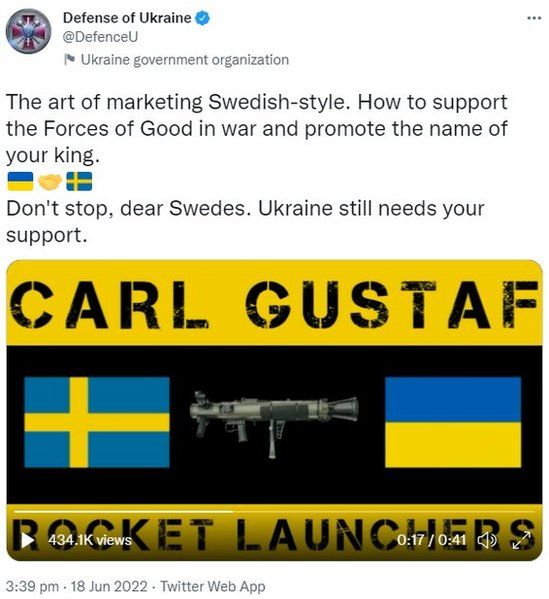
Olena says one of her favourite “thank you” videos praised Sweden for its value-for-money investment in Ukraine: $20,000 (£17,900) Carl Gustav rocket launchers, capable of knocking out Russian T-90 tanks worth $4.5m.
The tune? You guessed it: Abba’s Money, Money, Money.
IMAGE SOURCE, DEFENSE OF UKRAINE
Thanks to the team’s efforts, the defence ministry’s Twitter feednow has 1.5m followers around the world. Some of the videos have been viewed more than a million times.
Their most successful video, released in August after several mysterious attacks on Russian targets in annexed Crimea, has racked up 2.2m views. It mocked Russians for going on holiday on the peninsula and was set to the Bananarama song Cruel Summer.
“The main idea is to speak to the international audience and show that Ukraine is actually capable of winning,” she says. “Because nobody wants to invest in losers.”
But another of Olena’s teams carries out more subversive work, designed to highlight Russian losses and demoralise Ukraine’s invaders.
Targeting Russian audience
With a wealth of videos depicting Russian military setbacks being posted on social media platforms, the team is not short of material. But they’ve learned through trial and error what works and what doesn’t.
“We started displaying dead Russian bodies,” Olena says. “And then we realised that it actually didn’t work. It only united them against us.”
The team then tried to appeal to the consciences of Russian soldiers by showing images of dead Ukrainian civilians. Again, it seemed to fall on deaf ears.
“We realized they were actually proud of it. They were not condemning this at all,” she says. “We realised that we have to do this in a much more sophisticated way.”
IMAGE SOURCE, DEFENCE OF UKRAINE Image caption, Ukrainian videos warn Russians that they will suffer more big losses
Now the volunteers scrutinise Russian social media platforms, looking to press buttons and probe weaknesses in specific parts of the country.
“If you do it in Saratov you have to know what’s going on in Saratov,” Olena says. “If you do it in Nizhny Novgorod, you have to know what’s going on in Nizhny Novgorod.”
It’s extremely hard to gauge the impact this work is having, but Vladimir Putin’s recent partial mobilisation has given the volunteers lots of material to work with.
“We were waiting for the mobilisation,” Olena says. “We knew that it would be very demoralising for them.”
The single richest seam of material is to be found on the messaging service Telegram. Olena calls it “the Wild Wild West”.
The volunteers providing material for the defence ministry are just a small part of a vast, vibrant, fiercely patriotic, and wildly irreverent community reacting to events on the ground, sometimes with amazing speed.
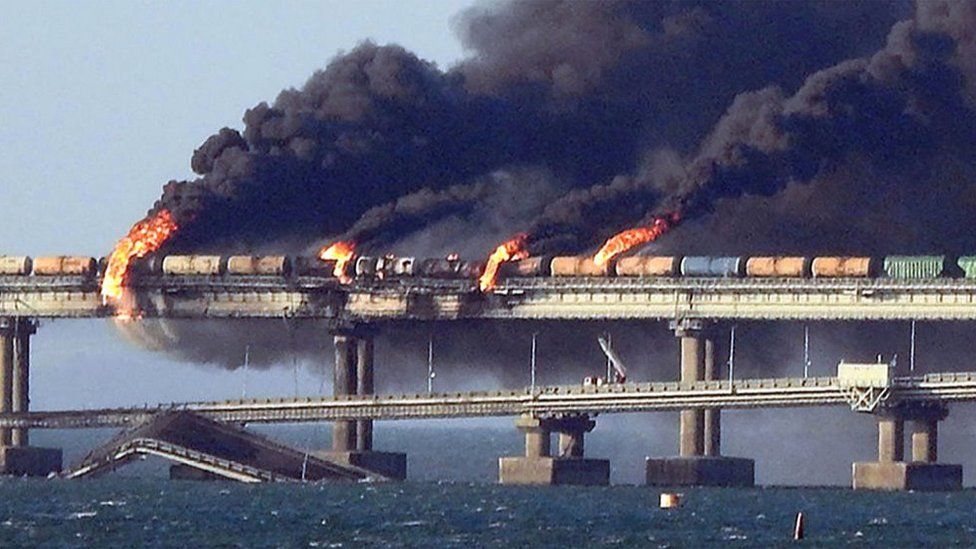
IMAGE SOURCE, AFP Image caption, Ukrainians quickly exploited the dramatic attack on Russia’s Kerch Bridge in the information war
Scores of Telegram channels attract huge numbers of followers.
One, called “Ukrainian Offensive”, has 96,485 followers. Its slogan is “fighting on the civil-meme frontlines of the information war since 2014.”
It provides a diet of military updates, out-and-out trolling of Moscow, and occasional digs at Western media coverage (including the BBC).
Like most other channels, it doesn’t shy away from showing suffering, including footage of dead or dying Russian soldiers.
The recent explosion on Russia’s Kerch Bridge, linking Russia with occupied Crimea, triggered a tidal wave of videos, jokes, and memes as Ukraine’s internet army celebrated wildly.
But the country didn’t turn into a nation of digital ninjas overnight. Eight years of war in the eastern Donbas region has given people lots of time to hone their skills, from countering disinformation to circulating humorous content designed to boost morale.
The current social media environment, says Ihor Solovey, head of Ukraine’s Centre for Strategic Communication and Information Security, reflects a rare convergence of official and popular sentiment.
“We’re witnessing perhaps the first time in history when civil society trusts the state and is helping it,” he told me.
“The armed forces do their own thing, while society is creating content, memes, creative works on their own. Because everyone feels responsible for their own future.”
What, if anything, is Russia throwing back at Ukraine?
Strangely, given Russia’s reputation for troll farms and shady scammers with alleged links to the Kremlin, the answer seems to be: not much.
Earlier this month, two well-known Russian pranksters did manage to con Ukraine’s Foreign Minister Dmytro Kuleba into thinking he was talking to a former US ambassador to Moscow, Michael McFaul.
Excerpts were broadcast on Russian state media, in which Mr Kuleba appeared to admit that Ukraine was responsible for recent attacks in Crimea and Russia – although the prank was conducted before the 8 October Kerch Bridge explosion.
But if Russia does have a similarly inventive internet army, Olena says she has seen little sign of it.
“Russians haven’t managed to come up with anything interesting,” she says. “No humour, no beauty. Not even pain. No compassion.”
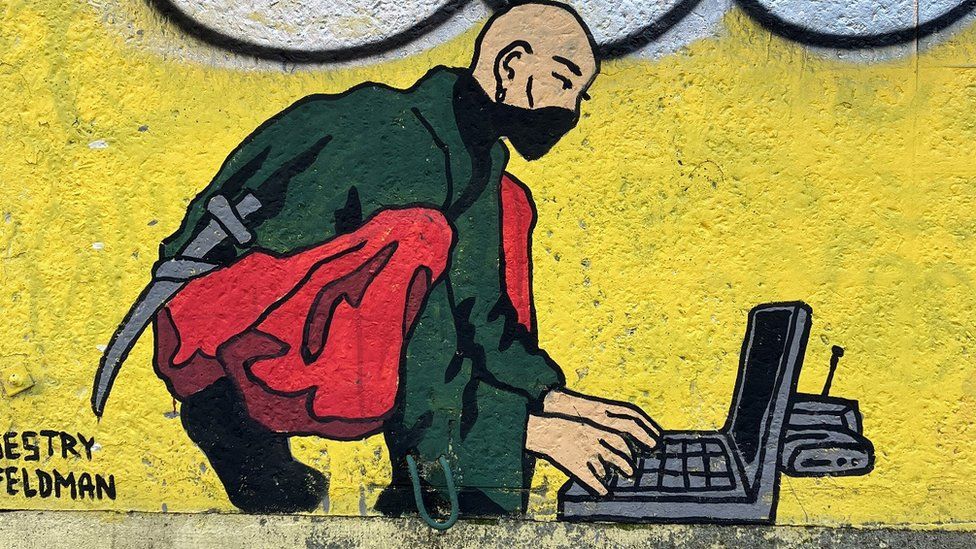
Image caption, A mural of a hacker has appeared on the streets of Kyiv
As the government faces an Ebola outbreak, two areas in Uganda have been placed under lockdown for three weeks.
Bars, nightclubs, houses of worship, and entertainment venues in Mubende and neighbouring Kassanda will be closed, and a curfew will be imposed.
The move is a U-turn for Uganda’s President Yoweri Museveni, who previously said there was no need for such measures.
This latest outbreak has killed 19 people among 58 recorded cases.
However, the real number of deaths and cases may be higher.
The outbreak began in early September in Mubende, about 80km (50 miles) from the capital Kampala, and has remained the epicentre.
President Museveni had previously ruled out lockdowns, saying Ebola was not an airborne virus so did not require the same measures as Covid-19.
But on Saturday he halted all movement in and out of Mubende and Kassanda districts for 21 days.
Cargo trucks will still be allowed to enter and leave the areas, he said, but all other transport will be stopped.
“These are temporary measures to control the spread of Ebola,” he said in a televised address.
“We should all cooperate with authorities so we bring this outbreak to an end in the shortest possible time.”
The president had already ordered police to arrest anyone suspected of having the virus who refused to isolate.
And he has forbidden traditional healers from trying to handle cases. In previous outbreaks, healers have been associated with hotspots for the spread of the virus.
The first recorded death in this outbreak was a 24-year-old man in Mubende. Six members of his family also died.
It later reached the capital Kampala, with one death recorded in October. But health officials said the city remained virus-free, as the man who died had travelled from Mubende.
This latest outbreak is of the Sudan strain of the virus, for which there is no approved vaccine. The Zaire strain, which killed 11,000 people in an outbreak across West Africa from 2013-2016, can be vaccinated against.
Ebola spreads through direct contact with bodily fluids or contaminated material.
Symptoms include vomiting, diarrhoea, and in some cases internal or external bleeding.
The incubation period can last from two days to three weeks, and the virus can be associated with other illnesses, such as malaria and typhoid.
Religious intolerance is one of the problems dominating discourse ahead of next year’s elections in one of the most religious countries in Africa, if not the globe.
In a country that is basically divided into a Muslim north and a Christian south, it is rare to meet a Nigerian who is not religious.
The constitution guarantees religious freedom – the country has no official religion and none of its 36 states is allowed to adopt one. It also prohibits religious discrimination.
Yet many who live in areas where they are in a religious minority do feel discriminated against and live in fear – and with good reason given the history of religious-based violence.
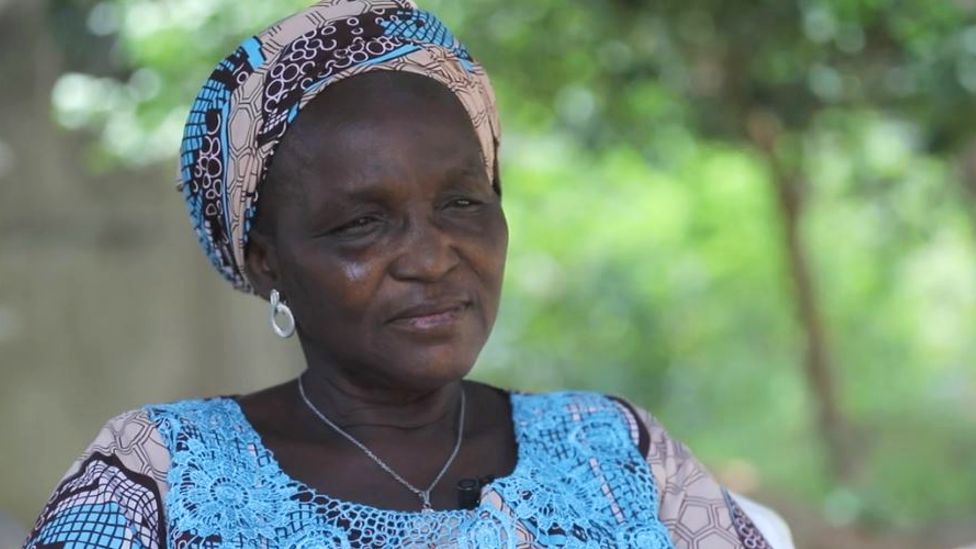
“We don’t have the freedom to worship. If you dress like a Muslim, you are in trouble. We are just hiding our religion in fear of not being attacked,” Ibrahim Bello, a Muslim living in south-eastern Nigeria, told the BBC.
Obinna Nnadi, a Christian who once lived in northern Kaduna statefelt similarly fearful: “I felt it was not safe to practice my religion there. I had to pack my family and leave.”
IMAGE SOURCE, GETTY IMAGES Image caption, Islamic law is in place in much of northern Nigeria, while the south is mostly Christian
Neither has much confidence in the authorities to clamp down on intolerance – and Mr Bello says attacks do not always make the news, except those involving the Islamist insurgency in the north-east in which both Muslims and Christians are attacked by militants.
This lack of faith in the political class to deal with such discrimination has become more heated as the governing All Progressive Congress (APC) has upset a cross-party tradition – in practice since the return to democracy in 1999 – of having both a Christian and a Muslim on the presidential ticket.
The incumbent president is Muhammadu Buhari, a northern Muslim, while his deputy is Yemi Osinbajo, a southern Christian.
But the APC ticket for 2023 has Bola Tinubu, a southern Muslim, with Kashim Shettima, a northern Muslim, as his running mate.
Some feel this could inflame tensions. The Armed Conflict Location and Event Data Project (Acled) has recorded that the average number of monthly incidents of violence targeting Christians has risen by more than 25% in the last year.
While Acled has not separately captured religion-linked attacks on Muslims – except for attacks by militant groups like Boko Haram – some told the BBC of their experiences, especially in the south-east, an area largely inhabited by members of the Igbo ethnic group.
Aisha Obi is an Igbo Muslim – a growing community. Some are converts, although the majority were born into the faith in the predominantly Christian region.
BBC
They see you as a saboteur”
She said women were the prime targets because of their Islamic dress and were subject to a hostility born of the civil war that started in 1967 when Igbo leaders declared independence.
The secessionist rebellion ended in defeat but some wounds are yet to heal with resentment felt towards the Muslim Hausa-Fulani community from the north, which then dominated the government.
“They see you as a saboteur,” Ms Obi told the BBC.
“Even inside a vehicle or on a motorcycle, they call you: ‘Hausa person, who knows what they are carrying. It could be a bomb.’ They feel Igbos are not supposed to be Muslims,” she said.
There are frequent attacks on individuals and mosques in the region which the authorities do not take seriously, she says.
“They don’t believe us. When we tell them, they accuse us of us wanting to cause religious war.”
Rev Caleb Ahima, vice-president of the Christian Association of Nigeria (CAN), acknowledges that religious discrimination is a consequence of location.
“In some states like [north-eastern] Borno, Christian religious knowledge is not allowed to be taught. Christians are not given plots of land to build their churches,” he said.
Segregation
Rifkatu Aniya, from Kaduna state which has large Christian and Muslim communities, said she had never felt safe since her Christian husband, a pastor, was killed in religious violence that erupted in 2000.
Image caption, Rifkatu Aniya, whose husband died in religious violence 22 years ago, said she didn’t feel safe as a Christian in Kaduna city
The state’s main city, also called Kaduna, has since been divided into Christian and Muslim areas, explains resident Emeka Okeiyi, which impacts on their religious freedom.
“I can’t say I have any restriction to practising my faith in the southern part of the city,” he said – but he knows of Christians in the Muslim northern suburbs who would not dare set up a church.
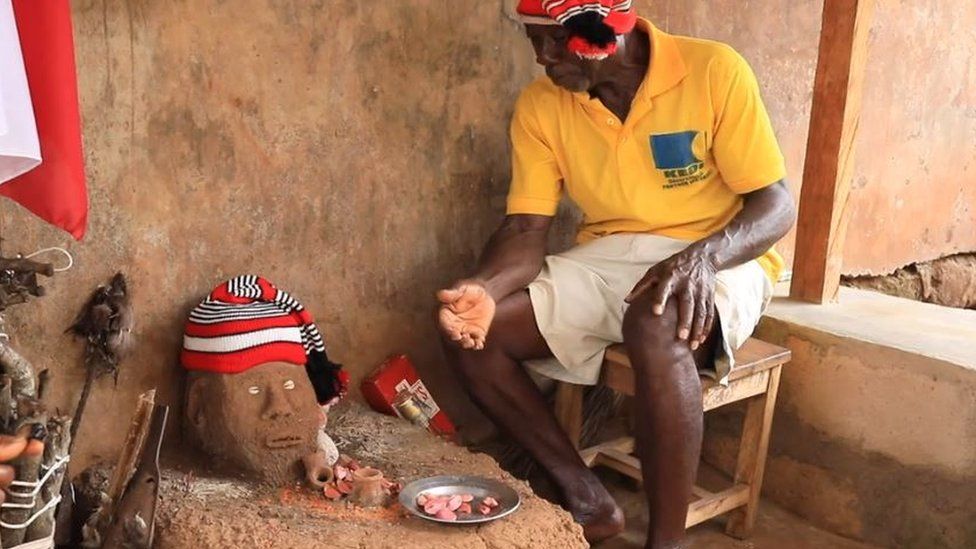
There are followers of African traditional religions who also say they face intolerance – especially from those who follow the dominant faiths.
Odinani, or Odinala, was the religion of the vast majority of people in eastern Nigeria before the introduction of Christianity – and is making a comeback with younger people.
Odinani follower Cletus Chukwuemeka Ogbodo says the idea of religious harmony as enshrined in Nigeria’s constitution is in stark contrast to how people are treated.
Image caption, Shrines from the traditional Odinani religion are sometimes targeted – with the authorities doing little to stop the attacks
“Pastors burn down shrines. Pastors burn people’s ancestral heritages down during ‘crusades’,” he says about Christian attacks on traditional places of worship.
If the government adhered to the constitutional provisions, it would come to the aid of the people and prosecute the perpetrators, he said.
Inter-faith future?
There has been a long legal battle in Nigeria’s biggest city, Lagos, which has seen fierce arguments over religious freedom vs secular rights.
It ended this year when Nigeria’s Supreme Court upheld a ruling that female Muslim students had the right to wear a head scarf to school.
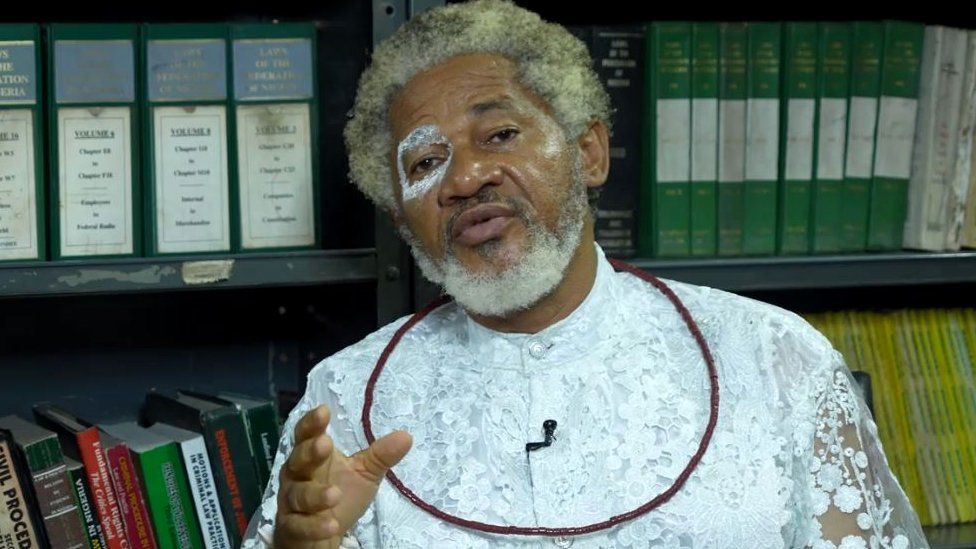
Image caption, Lawyer Malcolm Omirhobo maintains if secularism is not the norm, he should be able to turn up to work in court dressed in traditional attire
For Ishaq Akintola, director of Muslim Rights Concern (Muric), it was a victory for Muslims in the south who regularly feel they are not treated fairly.
But for others like lawyer Malcolm Omirhobo, it went against the secular spirit of the constitution.
To make a point he attended court in a traditional outfit – including a beaded gourd necklace and had a white circle drawn in chalk around his right eye like a priest of African religions.
“My fight is for secularity to be the norm,” he told the BBC.
When the authorities do intervene tangibly in religious affairs it can also lead to resentment.
To stop religious incitement in Kaduna state, a ban was imposedon preaching last year – limiting it to those who are licensed by a council made up of members of both faiths.
This infuriated some Christian religious leaders, who suggested it was an example of government overreach – in particular Pastor Johnson Suleman of the Omega Fire Ministry, who accused the governor when it was first proposed of wanting to “Islamise Kaduna” in a sermon that went viral.
But the inter-faith council may be a way to foster local understanding – and could be a blueprint for other states.
Some Muslim and traditional leaders in Kaduna are now joining evangelical worshippers on Sundays – as part of efforts to ease tensions before the polls.
Residents of Kyiv have been asked to reduce their evening electricity use after a Russian missile strike knocked out a power plant near the capital.
Power was restored earlier in Ukraine, according to officials, after Russian missiles struck the electricity infrastructure.
But Ukraine’s state energy operator Ukrenergo has still called for the reduction between 17:00 and 23:00 (15:00 – 21:00 GMT), warning of possible power cuts.
The request was not confined to Kyiv.
The deputy head of Ukraine’s presidential administration, Kyrylo Tymoshenko, said the populations of Zhytomyr, Cherkasy, and Chernihiv should also save electricity.
“If this advice is ignored, we will have difficulties and it will be necessary to take out the candles,” he warned on Telegram.
Ukrenergo has urged residents to save electricity in the evening by not using energy-guzzling appliances, switching off unnecessary lighting, and doing their washing at night.
However, the BBC’s Paul Adams reports that Kyiv streets are already darker than usual at night, but “life very much goes on”.
The energy warning comes as more heavy fighting is reported north of Russian-held Kherson.
Kirill Stremousov, a Russian-appointed leader in the southern region, said Ukrainian shelling was coming from the Dudchany area, on the west bank of the Dnieper river (called Dnipro by Ukrainians).
Advancing Ukrainian forces have repeatedly bombarded bridgesover the river, aiming to cut off Russian troops in Kherson city.
Russian-installed officials in the city have urged Moscow to help transfer Kherson families to Russian cities as Ukrainian shelling intensifies.
President Vladimir Putin has declared Kherson and three other Ukrainian regions to be part of Russia – a move condemned internationally, after hastily-organized so-called referendums in the regions.
Meanwhile, Ukrainian prosecutors have accused Russian soldiers of shooting and killing the chief conductor of the Kherson Music and Drama Theatre, Yuri Kerpatenko, in his home. It is widely reported in Ukrainian media, but there are few details. He is said to have refused to cooperate with the occupation authorities.
Russian oil depot fire
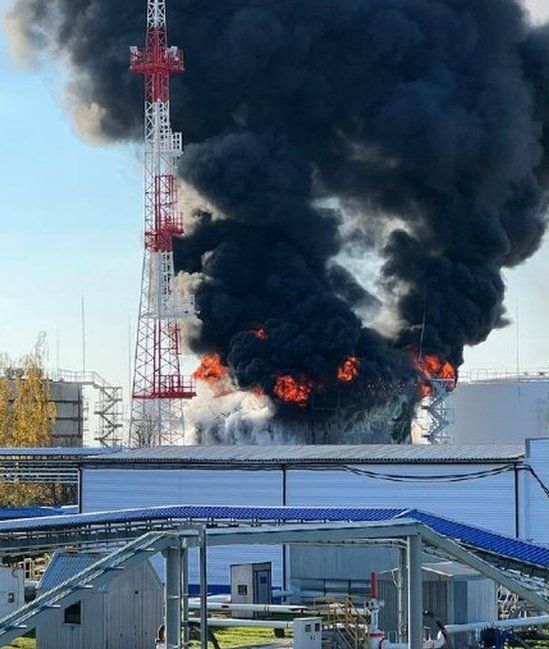
For two days running the governor of Belgorod, a Russian city 40km (25 miles) north of Ukraine, has reported Ukrainian cross-border shelling. One shell caused a major fire at an oil depot near the city on Saturday, Vyacheslav Gladkov said, adding later that firefighters had extinguished it.
Ukrainian shelling set fire to an electricity substation in Belgorod on Friday, he reported on Telegram. In that case, too the fire was contained. Kyiv has not commented on the Russian claims, but there have been explosions in the Belgorod region previously, which Russia blamed on Ukrainian shelling.
IMAGE SOURCE,VVGLADKOV/TELEGRAM Image caption, Oil depot fire near Belgorod – pic from Governor Gladkov (Telegram)
On Friday President Putin said he saw no need for further massive missile strikes against Ukraine “for now”, on the scale of last Monday’s, which hit Kyiv and other cities, killing at least 20 civilians. Mr Putin said those strikes were retaliation for the attack that damaged Russia’s huge Kerch bridge – a key strategic link to annexed Crimea.
Another focus of fighting in the south is Zaporizhzhia – Ukrainian officials in the city say it was hit by more Russian missiles and Iranian-made Shahed “kamikaze” drones overnight. There was damage to energy facilities and industrial infrastructure there.
The Zaporizhzhia nuclear power plant – Europe’s largest – lies just south of the city, under Russian control, and repeated shelling in the area has raised fears of a nuclear disaster.
The US has announced $725m (£649m) of further military aid for Ukraine, including ammunition for Himars rocket systems, artillery rounds, anti-tank weapons and Humvee armoured vehicles. The US has provided more than $17bn of military aid since Russia’s 24 February invasion – by far the largest contribution among Ukraine’s Western allies.
On Ukraine’s northern border, Belarus says a new Russian militarycontingent has arrived – part of what it describes as a regional border protection force. Belarus has hosted Russian forces involved in the war in Ukraine, including those who launched an abortive assault on Kyiv. But so far it has not sent its own troops across the border.
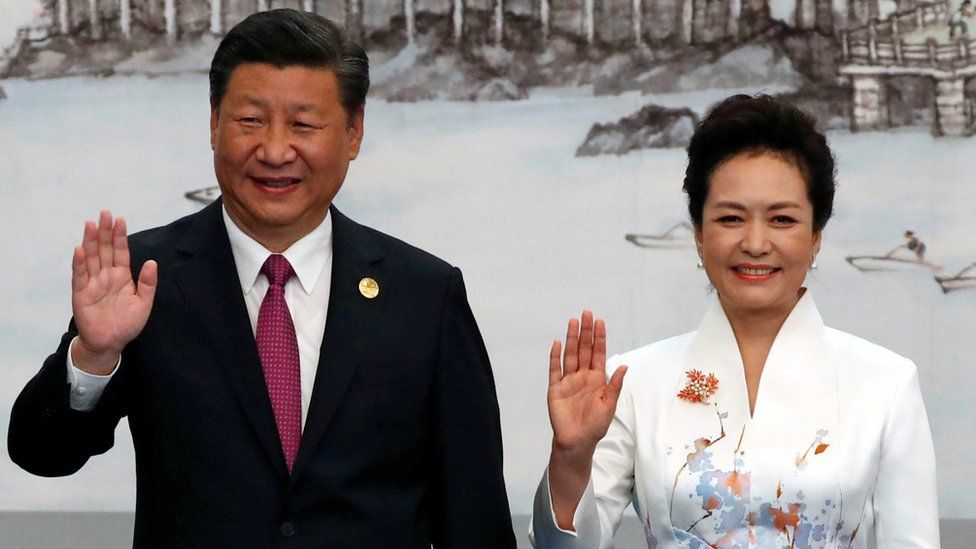
At the 20thCommunist Party Congresslater this month, Xi Jinping will begin a historic third term.
Given that China’s leaders opted in 2018 to remove the two-term limit in place since the 1990s, Mr. Xi will basically be able to stay in power indefinitely.
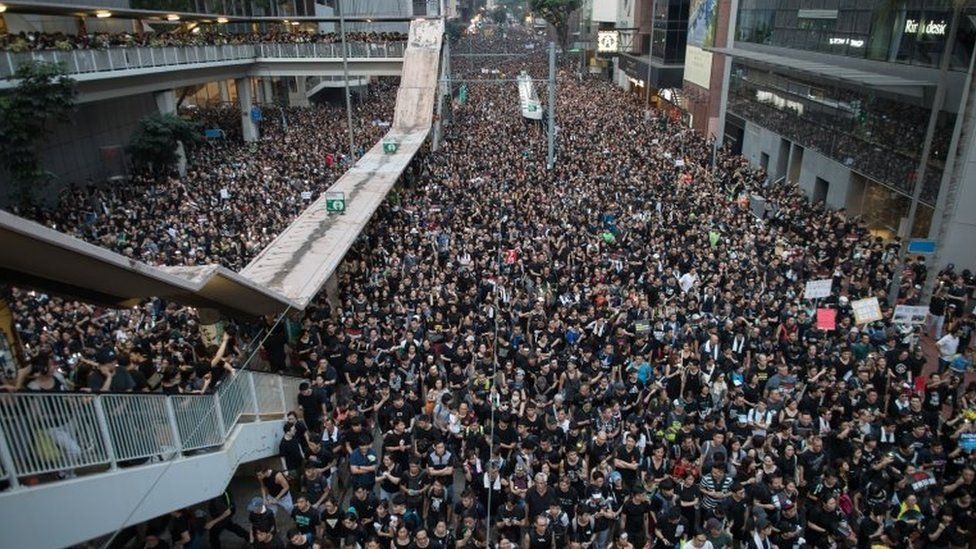
Under Mr Xi’s rule since 2012, China has become more authoritarian at home, cracking down on dissent, critics, and even influential billionaires and businesses. Some have described him as “the most authoritarian leader since Chairman Mao”.
Under his rule, China has established “re-education” camps in Xinjiang that have been accused of human rights abuses against Uyghurs and other minority ethnic groups. It has tightened its grip on Hong Kong and vowed to “reunite” with Taiwan, by force if necessary.
In a clear sign of his influence, the Communist Party voted in 2017 to write his philosophy – called “Xi Jinping Thought on Socialism with Chinese Characteristics for the New Era” – into its constitution. Only party founders Mao Zedong and Deng Xiaoping, the leader who introduced economic reforms in the 1980s, have made it into the all-important fundamental law of the land.
Princeling, peasant, president
Born in Beijing in 1953, Xi Jinping is the son of revolutionary veteran Xi Zhongxun, one of the Communist Party’s founding fathers and a former vice-premier.
Because of his illustrious roots, Mr Xi is considered a “princeling” – a child of elite senior officials who have risen up the ranks.
But his family’s fortunes took a dramatic turn when his father was imprisoned in 1962. A deeply suspicious Mao, fearing a rebellion in party ranks, ordered a purge of potential rivals. Then in 1966 came the so-called Cultural Revolution when millions were branded as enemies of Chinese culture, sparking violent attacks across the country.
Mr Xi’s family suffered too. His half-sister – his father’s first daughter through an earlier marriage – was persecuted to death, according to official accounts, though a historian familiar with the party elite said she had probably taken her own life under duress, according to a New York Times report.
A young Xi was pulled out of a school attended by children of the political elite. Eventually, at 15, he left Beijing and was sent to the countryside for “re-education” and hard labour in the remote and poor north-eastern village of Liangjiahe for seven years.
But far from turning against the Communist Party, Mr Xi embraced it. He tried to join several times but was rebuffed because of his father’s standing.
He was finally accepted in 1974, starting out in Hebei province, then occupying ever more senior roles as he slowly made his way to the top.
In 1989, at the age of 35, he was party chief in the city of Ningde in southern Fujian province when protests demanding greater political freedom began in Beijing’s Tiananmen Square.
The province was far from the capital but Mr Xi, along with other party officials, reportedly scrambled to contain local offshoots of the massive demonstrations underway in Beijing.
The protests – an echo of a rift within Communist Party ranks – and the bloody crackdown that ended them have effectively now been scrubbed from the country’s history books and public record. China even lost the bid to host the 2000 Olympics because of the abuses in Tiananmen Square. Estimates of the number killed range from hundreds to many thousands.
Almost two decades later, however, Mr Xi was put in charge of the 2008 Summer Olympicsin Beijing. China was keen to show it had moved on and was a worthy host – and it appeared to be working, with the Games symbolising China’s rise as a growing power.
As for Mr Xi, his increasing profile in the party propelled him to its top decision-making body, the Politburo Standing Committee, and in 2012 he was picked as China’s president.
IMAGE SOURCE, REUTERS Image caption, Mr Xi’s wife, Peng Liyuan (right), is a famous folk singer in China
Mr Xi and his wife, Peng Liyuan, a famous singer, have been heavily featured in state media as China’s First Couple.
This is a contrast from previous presidential couples, where the first lady has traditionally kept a lower profile.
The couple has a daughter, Xi Mingze, but not much is known about her apart from the fact that she studied at Harvard University.
Other family members and their overseas business dealings have been the subject of scrutiny in the international press.
China Dream
Mr Xi has vigorously pursued what he has called a “great rejuvenation of the Chinese nation” with his China Dream vision.
Under him, the world’s second-largest economy has enacted reform to combat slowing growth, such as cutting down bloated state-owned industries and reducing pollution, as well as the multi-billion dollar One Belt One Road infrastructure project aimed at expanding China’s global trade links.
The country has become more assertive on the global stage, from its growing forcefulness in the South China Sea to its exercise of soft power by pumping billions of dollars into Asian and African investments.
Some of this economic growth, however, which in past decades has increased meteorically – has now slowed substantially, worsened by the Chinese leader’s uncompromising “zero-Covid” strategy that has locked out the rest of the world since the pandemic.
The country’s once-booming property market is in a deep slump and the outlook for the global economy has weakened sharply in recent months.
A bitter and damaging trade war with the US shows no sign of ending.
‘Most authoritarian leader since Mao’
Since reaching top office, Mr Xi has overseen a wide-reaching corruption crackdown extending to the highest echelons of the party. Critics have portrayed it as a political purge.
Under his rule, China has also seen increasing clampdowns on freedoms.
In Xinjiang province, human rights groups believe the government has detained more than a million Muslim Uyghurs over the past few years in what the state defines as “re-education” camps. China denies accusations from the US and others that it is committing genocide there.
Beijing’s grip over Hong Kong, too, has grown under Mr Xi.
IMAGE SOURCE, EPA Image caption, Thousands turned out in Hong Kong to take part in protests against a planned extradition law
Mr Xi put an end to pro-democracy protests in 2020 by signing the National Security Law, a sweeping edict that gives Beijing powers to reshape life in the former British colony, criminalizing what it calls secession, subversion, and collusion with foreign forces, with the maximum sentence of life in prison.
The law has led to mass arrests of prominent pro-democracy activists and politicians, as well as the closure of prominent news outlets including Apple Daily and Stand News.
Under Mr Xi’s leadership, China has also intensified its focus on the self-ruled island of Taiwan, vowing “reunification” and threatening to use military force to prevent any move towards formal independence there.
Given China’s power and influence, the world will be watching Mr Xi as he embarks on his third term as president. With no heir apparent, the 69-year-old is arguably the most powerful leader China has had since the death of Mao Zedong in the 1970s.
Prime Minister Liz Truss and Chancellor Jeremy Hunt will meet at Chequers today in an effort to restore the government’s economic confidence.
Mr Hunt, who took over for Kwasi Kwarteng, stated in a statement that his priority was growth “underpinned by stability.”
He warned of possible tax rises and savings in public spending, saying the mini-budget went “too far, too fast”.
Pressure is growing on Ms Truss, with reports that a group of Conservative MPs is seeking to remove her as PM.
According to former Home Office special adviser Mo Hussein, there are “definitely moves afoot behind the scenes”.
“People have been organised, some of the bigger names are getting their supporters in line,” he told BBC Breakfast, adding that the next few days would be tumultuous.
Talks of plans to oust Ms Truss come amid a series of interviews with her new right-hand man on Saturday.
Mr Hunt signalled a shift away from Ms Truss’s tax-cutting agenda and indicated he would reverse some of the key pledges made by his predecessor Mr Kwarteng, who was sacked on Friday.
He said this was necessary to ensure stability in the financial markets.
“Taxes are not going to come down by as much as people hoped, and some taxes will have to go up,” the chancellor told BBC Radio 4’s Today programme. “I’m asking all government departments to find additional efficiency savings.”
It comes as the Times reported that Mr Hunt planned to delay by a year a 1p cut to the basic income tax rate – a flagship part of the 23 September mini-budget.
However, the Treasury has so far refused to confirm the report, with a spokesman saying: “We cannot speculate on any tax changes outside of a fiscal event.”
IMAGE SOURCE, REUTERS Image caption, Truss and Hunt are meeting at Chequers, the official country residence of the prime minister
Mr Hunt is due to outline the government’s refreshed economic plan in a statement on 31 October, a task his predecessor was building up to following the aftermath of his mini-budget.
In his latest statement, released on Saturday night, Mr Hunt said: “My focus is on growth underpinned by stability. The drive on growing the economy is right – it means more people can get good jobs, new businesses can thrive and we can secure world-class public services. But we went too far, too fast.
He also said he intended to be “honest with people” about the “very difficult decisions” that had to be made “both on spending and on tax to get debt falling”.
“I will set out clear and robust plans to make sure government spending is as efficient as possible, ensure taxpayer money is well spent and that we have rigorous control over our public finances,” Mr Hunt added.
Meanwhile, the PM’s authority has come under increasing pressure – with some Tory MPs telling the BBC’s Laura Kuenssberg Mr Hunt’s appointment means Ms Truss is “in office, but not really in power”.
The prime minister’s hopes of survival could hinge on what she and her chancellor decide over the next two weeks.
There will be a budget at the end of the month that needs to convince financial markets and prove politically palatable to a fuming, mutinous Tory party.
Today’s meeting at the prime minister’s country residence is their first chance to have detailed discussions about the government’s new fiscal plan – which is expected to junk the tax-cutting agenda Liz Truss promised during the Tory leadership contest.
Jeremy Hunt has been clear that nothing is off the table and that tax rises and spending cuts will be needed. But many Conservative MPs are furious Liz Truss has led the government into this chaos and are talking privately about trying to turf her out.
One former minister predicted Ms Truss would be gone within weeks – but for now, she limps on, hoping the current turmoil subsides.
The imminent talks come as Andrew Bailey, the governor of the Bank of England, warned that interest rates may need to be raised higher than previously expected in order to keep UK inflation under control.
“As things stand today, my best guess is that inflationary pressures will require a stronger response than we perhaps thought in August,” Mr Bailey said in Washington, less than three weeks before the Bank’s monetary policy committee is due to meet.
Turning to his initial conversations with the new chancellor, Mr Bailey described an “immediate meeting of minds on the importance of stability and sustainability”.
Elsewhere in the US, President Joe Biden weighed in on the political situation in the UK, saying he “wasn’t the only one that thought it was a mistake” when asked about Ms Truss’s original economic plan.
He called the outcome “predictable” but said, while he disagreed with the prime minister’s policies, it was up to the British people.
Mr Biden also dismissed concerns about the strength of the dollar. “The problem is the lack of economic growth and sound policy in other countries,” he told a White House pool reporter.
Following the mini-budget, the pound plummeted to a record low against the dollar and the cost of government borrowing climbed as markets reacted to the package – which was not accompanied by an official assessment of how the UK economy would perform.
Mortgages are one of the many areas that have been thrown into disarray as a result of the government’s mini-budget at the end of September.
A renowned think tank has now warned that annual mortgage payments for five million homeowners could climb by an average of £5,100 between now and the end of 2024.
In total, mortgage payments are set to rise annually by £26bn over the next two years, according to the Resolution Foundation.
Affected households in London will see the biggest increase, with average payments projected to rise by £8,000 over this period – more than twice the level of the £3,400 increase experienced by households in Wales.
The impact in London will be concentrated, however, as less than a fifth (19%) of households, there has a mortgage.
“Households across Britain are currently living through an inflation-driven cost-of-living crisis as pay packets shrink and energy bills rise,” said Lindsay Judge, research director at the Resolution Foundation.
“With almost half of all mortgagorhouseholds on course to see their family budgets fall by at least 5% from higher payments, the living standards pain from rising interest rates will be widespread.”
In an excruciating news conference– so short the gathered political press pack was left open-mouthed as she departed – Liz Truss made her already perilous political position even worse.
Be in absolutely no doubt, the prime minister is in deep trouble.
She has sacked her chancellor, committed a second major U-turn on her mini-budget, and junked the core of her economic policy.
And she did so, awkwardly and uncomfortably, in no more than eight minutes.
In an excruciating news conference – so short the gathered political press pack were left open-mouthed as she departed – Liz Truss made her already perilous political position even worse.
The aim of this breakneck change in direction was to attempt to calm markets and her Conservative colleagues, but instead, she left huge questions unanswered.
It’s worth underlining the significance of what the prime minister just announced.
First, on policy, she has buckled and reversed her position on corporation tax. She will now go ahead with the increase proposed by her leadership rival, Rishi Sunak.
During the contest to replace Boris Johnson as Tory leader, Ms Truss had said increasing the rate from 19% to 25% next April would “put off people who want to invest in Britain” and amount to “cutting off our nose to spite our face”.
It was a significant part of the platform on which she was elected Tory leader, nowhumiliatingly discarded in order to bring in around £18bn to fill the black hole left by last month’s mini-budget.
She said it was a “down payment” on the medium-term fiscal plan due to be set out on 31 October – a signal to the markets that she’s prepared to make more reversals if necessary.
Does she still believe it will put people off investing? We don’t know because she didn’t stick around at the news conference long enough to be asked.
On the sacking of Kwasi Kwarteng as chancellor, she expressed her sorrow – but again, did not answer the obvious question about how she can possibly justify his departure without her own.
she can possibly justify his departure without her own.
Image:Liz Truss and her former chancellor Kwasi Kwarteng
The chancellor, who was supposed to be one of her closest political friends, was also humiliatingly discarded – along with the government’s radical economic mission for which she had asked him to lead the charge.
The way in which the prime minister delivered this news really matters. Not just because of the lack of scrutiny that came from only taking four questions and barely engaging with them in the answers – but because her party, and indeed the markets, will have been watching to see how she handled the situation.
That news conference was not just about communicating with the public. The messages I received from Conservative MPsahead of the news conference made clear that she needed to put in a really strong, reassuring performance.
Their fears are that she is out of her depth. They want to see that she can handle being prime minister. And the early signs are that her performance today failed on both fronts.
One MP has messaged me saying it was “shockingly bad”, even by Liz Truss’s standards.
Image:Jeremy Hunt has replaced Kwasi Kwarteng as chancellor
Jeremy Hunt’s installation as the new chancellor may be intended to show the ship is being steadied – that someone with deep experience in government is at the helm of the economy and that markets do not need to fear further surprises.
But power flows from Number 10. The prime minister is the head of government. The prime minister is the person who must command the confidence of the Commons if they are to remain in post.
This prime minister looks out of her depth. “It’s not going to last,” is how one cabinet minister put it to me.
DISCLAIMER: Independentghana.com will not be liable for any inaccuracies contained in this article. The views expressed in the article are solely those of the author’s and do not reflect those of The Independent Ghana
After Kwasi Kwarteng was ousted as chancellor on Friday, the SNP’s Westminster leader Ian Blackford stated Tory prime leaders since 2010 have “collectively got us into this mess.”
Mr Blackford branded the situation a “shambles” and called for a general election after Liz Truss sacked Mr Kwarteng and parachuted former foreign secretary Jeremy Hunt into Number 11 in his place.
“We’ve really seen the credibility for financial competence, for the financial management of this government really put to bed,” he told the BBC.
“Over the last few years, we’ve gone from Cameron, we’ve had Theresa May, we’ve had Boris Johnson, we’ve now had the shambles of Liz Truss.
“None of these prime ministers have acted in the interests of the people of Scotland and collectively they have got us into this mess. It’s not another Tory prime minister that we need. We need away from Westminster, we need independence.”
Mr Blackford joined Labour leader Sir Keir Starmer’s calls for a general election, saying there had been a “whole series” of “shambolic” Tory governments.
Former defence minister Tobias Ellwood has hailed Jeremy Hunt’s appointment as chancellor as a “wise inclusion.”
The influential Tory MP appears to have regained his Conservative whip, tweeting that he’s “off the… naughty step & back in Pty.”
Ellwood had the whip withdrawn – basically meaning he was kicked out of the parliamentary party while keeping his seat – after missing a vote of confidence in Boris Johnson’s government in July.
At the time, he said he’d been unable to return from a meeting overseas.
Ukraine’s President Zelenskyy has thanked the United States for its latest $725 million aid package. He said he was very pleased with the rounds for the HIMARS truck-mounted rocket system.
America has now donated more than $17.5bn (£15.6m) in aid since the war started in February.
Separately, Ukraine also expects the US and Germany to deliver anti-aircraft systems this month to help it counter Russian missile and drone attacks, defence minister Oleksiy Reznikov said on Friday.
Sincerely grateful to @POTUS, the 🇺🇸 people for providing another $725 mln security aid package. We will receive, in particular, much-needed rounds for HIMARS and artillery. A wonderful gift for 🇺🇦 Defenders’ Day! The Russian aggressor will be defeated, 🇺🇦 will be free!
Six persons, including two army colonels, were sentenced to death in connection with the march killing, while four others were imprisoned for ten years.
A military court in the Democratic Republic of the Congo has sentenced six persons to death, including two army colonels, in connection with the March murder of two Chinese mine employees.
Four other military personnel were sentenced to 10 years in prison by the Ituri Military Court on Friday.
All but one of those receiving the death sentence was a member of the military.
The two colonels are accused of planning an attack on a convoy in March, with the aim of stealing four gold bars and $6,000 in cash being transported by the victims, who were returning from a gold mine.
Verdict ‘serves as an example’
In the DRC, death penalties are regularly handed down but systematically commuted to life imprisonment.
“This must serve as an example for the black sheep in the armed forces,” Lieutenant Jules Ngongo, spokesman for military operations in the gold-rich Ituri province, told the AFP news agency.
Attacks on Chinese-managed mines and Chinese workers are not uncommon in resource-rich eastern DRC, which has been ravaged by militia violence for decades.
Last year, the DRC government placed security officials in charge of the administration of Ituri and neighboring North Kivu province in a bid to curb violence. However, the measure has failed to stop attacks.
Just three weeks after the phrase was coined, so-called Trussonomics is no more.
Liz Truss’s ambitious plan for a high-growth, high-wage, low-tax economy didn’t even get off the launch pad. The new Chancellor Jeremy Hunt concedes that mistakes were made in how it was delivered.
In a remarkably frank interview with BBC Radio 4’s Today programme this morning, he admitted there would be difficult decisions ahead.
Some taxes would now go up, he said, and others may not come down as quickly as people want.
Spending will not rise as fast as previously planned. Hunt will now ask all government departments to look for efficiency savings – and said even health and defence are not immune.
He also admitted that “flying blind” was another big error. That was a reference to the failure of his predecessor to submit his plan to be stress-tested by the independent Office for Budget Responsibility (OBR) to make sure the sums added up.
The reaction from the business world has been mixed. One investment fund manager described the reversal in policy as a turning point and described Jeremy Hunt as someone the markets could trust.
But the chairman of supermarket giant Asda, Lord Stuart Rose, described Liz Truss as a “busted flush”, who in his view cannot bring stability to the economy.
The judgment from the markets will come when they re-open at 08:00 on Monday. It will be the first working day since the Bank of England stopped buying government bonds to try and stabilise the pension market. The price of government borrowing was already creeping up again at close-of-play on Friday.
Jeremy Hunt said he had been given a clean slate to re-work the mini-budget. He now has two weeks to make the figures work before delivering his economic plan on 31 October.
DISCLAIMER: Independentghana.com will not be liable for any inaccuracies contained in this article. The views expressed in the article are solely those of the author and do not reflect those of The Independent Ghana
The chief saysthe initiative will bring healthcare delivery to the doorstep of the citizenry.
The paramount chief of the Paga Traditional Area in the Kassena-Nankana West District of the Upper East Region, Pe Awiah Awumpaga II has lauded the government for its Agenda 111 project.
He said that the initiative will bring healthcare delivery to the doorstep of the citizenry, which has been one of the major challenges faced by the nation.
The chief was particularly happy that his traditional area is a beneficiary of the innovative initiative, underscoring its significance in saving lives and improving the health needs of residents in the area.
The Paga Pio Pe Awiah Awumpaga II with Dr Mahamudu Bawumia
He was speaking during a courtesy call on him by Vice-President Mahamudu Bawumia.
“I wish to commend the Akufo-Addo government for its vision of bringing healthcare to the doorstep of the citizenry with Agenda 111,” Awumpaga II said.
“There would not have been a better place to site this project than my area. I am convinced that upon completion, my subjects and I will benefit from it. It would also save us the struggle of travelling to Navrongo and Bolga for certain services once they would be available here for us,” he added.
Dr Mahamudu Bawumia inspecting one of the Agenda 111 sites in the Upper East Region
The Agenda 111 project includes 101 district hospitals, six regional hospitals in the newly created regions, two specialized hospitals in the middle and northern belts, as well as a regional hospital in the Western Region and renovation of the Effia-Nkwanta Regional Hospital.
The objective of the project is to significantly deepen the delivery of quality healthcare at the district level, and boost access to healthcare services for all citizens towards ensuring the attainment of the United Nations’ Sustainable Development Goal Three.
The regional director of NADMO, Kwame Appiah Koduah, said officials have intensified their efforts to find the missing persons.
According to him, 19 out of the 33 municipal and district assemblies were affected by the rains, which displaced several others.
“Six persons are still missing,” Koduah said at the International Day For Disaster Risk Reduction summit in Suhum on Thursday. “It is quite unclear and so we have commissioned people to look into the river and look for the dead bodies.”
“Now that we are celebrating world disaster reduction day here in Suhum we are taking account of what has happened to us as a region.”
At least five people were confirmed dead early this month in the Eastern Region after torrential rains.
River Densu breaks its banks
Meanwhile, close to 2,000 residents of Nsawam, also in the Eastern Region, have been made homeless after floods swept away their homes.
The River Densu overflowed its banks after the downpour, forcing residents of the area to abandon their houses, livestock, and other property.
The zongo community was worst affected, including areas such as Gyankrom, Lanteh, Adoagyiri, and the main Nsawam lorry station.
Today marks the first anniversaryof Sir David Amess’s murder, which occurred during a constituency surgery at Belfairs Methodist Church in Leigh-on-Sea, Essex.
Liz Truss and Sir Keir Starmer led the tributes to Sir David, who served as an MP in Basildon and later Southend West for nearly 40 years.
On the anniversary of Sir David Amess’ death, we cherish his memory and remember his enormous contribution to politics, to the people of Southend and to the country.
My thoughts today are with his wife Julia, the Amess family and to all those who knew and loved him. pic.twitter.com/Tt44GQeHjG
The PM shared a statement along with Sir David’s parliamentary portraiton Saturday morning.
She said: “On the anniversary of Sir David Amess’ death, we cherish his memory and remember his enormous contribution to politics, to the people of Southend, and to the country.
“My thoughts today are with his wife Julia, the Amess family, and all those who knew and loved him.”
Remembering our friend & colleague David Amess, on the 1st anniversary of his senseless death.
David’s commitment to public service, carried out with inherent, consistent kindness, will forever be admired.
Thinking of his wife & children, hoping memories of him bring comfort.
Last night, after news emerged that Kwasi Kwarteng had been sacked as chancellor, several cabinet members spoke up in support of the prime minister.
Business Secretary Jacob Rees-Mogg
The prime minister has acted decisively to provide the economic stability our country needs.
As a government, we must now get on and deliver the pro-growth reforms that will lay the foundations for our future prosperity.
Chancellor of the Duchy of Lancaster Nadhim Zahawi
It’s time to get Britain moving. We are determined to grow the economy, eliminate the COVID backlog and protect people from Putin’s energy warfare. With Liz Truss, Jeremy Hunt and the rest of the team, we will do all of that and more.
Health Secretary Therese Coffey
The PM is right to act now to ensure our country’s economic stability – key for families and businesses – and reassure the markets of our fiscal discipline, especially in light of the worsening global economic conditions with Putin’s illegal invasion of Ukraine.
International Trade Secretary Kemi Badenoch
To say it’s been a difficult day would be an understatement. We knew the scale of the challenge this autumn given multiple global headwinds would be unprecedented. Our prime minister is working flat out to get the country through these turbulent times. She has my full support.
Labour leader Sir Keir Starmerhas hit out at what he called the “grotesque chaos” of chancellor Kwasi Kwarteng’s sacking, as he accused Liz Truss of putting “party first and country second”.
It comes as the turmoil continued within the Conservative party this morning, as new chancellor Jeremy Hunt rowed back on Liz Truss’s promises on tax cuts and public spending.
Mr Hunt told Sky News there were “mistakes” in the mini-budgetand warned of tough times ahead.
Hunt warns of ‘difficult decisions’; follow politics’ latest
“We won’t have the speed of tax cuts we were hoping for, and some taxes will go up”, he said.
He also said that all government departments would have to “find more efficiencies than they were planning to find”.
Mr Hunt was appointed chancellor on Friday, an hour after his predecessor Kwasi Kwartengwas sacked after just 38 days on the job.
Thousands of people attended a vigil in Slovakia on Friday to remember two persons who were assassinated outside a gay bar.
On Wednesday, the men were shot dead in the city of Bratislava in what appears to be a hate crime.
According to organisers, 20,000 people attended the vigil to mourn the men’s deaths and demand action on LGBT rights.
Slovak President Zuzana Caputova, who has raised the rainbow flag over her office, spoke at the event.
“I’m sorry that our society was not able to protect your loved ones,” she said.
“You belong here, you are valuable to our society.”
Prime Minister Eduard Heger was also at the vigil, organised by the Inakosť (Otherness) Institute, an LGBT advocacy group.
Slovakia’s National Crime Agency has classified the shootings as premeditated murder, motivated by hatred of a sexual minority.
It has sparked calls for more protection of LGBT people inSlovakia, a relatively conservative EU country where same-sex marriage is not legal.
The BBC’s Rob Cameron, in neighbouring Czech Republic, said some Slovakians were angry at what they see as hypocrisy from politicians.
While the prime minister held a rainbow flag at the rally, in June an MP from his party called – unsuccessfully – for a ban of the flag on public buildings.
European Parliament Vice-President Michal Simecka, who was also at Friday’s event, said he wanted the European legislature to discuss the murders at a session next week.
“To express our sympathy, but also to call on the Slovak authorities to take clear steps to put an end to the language of hatred towards LGBTI people,” he said.
The two men were killed outside Bratislava’s Teplaren bar close to the city center on Wednesday evening. Another woman was injured and is now in stable condition in the hospital.
After a brief manhunt, police found the body of the 19-year-old gunman, who is believed to have shot himself, on Thursday morning.
He was identified as Juraj Krajcik, the son of a former far-right politician.
Just before the killings, he had posted an anti-LGBT and anti-Semitic manifesto on Twitter,warning that he would carry them out. He later also claimed responsibility.
The suspect eluded police officers for several hours before being arrested in a house.
According to US officials, a 15-year-old boy has been arrested on suspicion of killing five people in North Carolina and is in critical condition in a hospital.
The unidentified teenager is accused of fatally shooting two individuals in the state capital of Raleigh before opening fire on a walking route, killing three more people and injuring two others.
Among those killed in the Thursday night attack were a 16-year-old boy named James Roger Thompson, and a 29-year-old off-duty police officer called Gabriel Torres.
The other victims killed in the shooting were 52-year-old Nicole Connors, 34-year-old Mary Marshall, and 49-year-old Susan Karnatz.
Marcille Lynn Gardner, 59, was wounded in the attack and remains in critical conditionin the hospital, while a second police officer, Casey Joseph Clark, was also injured but has been released.
Raleigh police chief Estella Patterson said those killed were a racially diverse group, and authorities have not yet determined a motive for the shooting.
The incident set off a massive police response across the city, with officers searching for the suspect for several hours before cornering him inside a house and arresting him.
Officers from numerous law enforcement agencies swarmed the Hedingham neighbourhood, a residential area northeast of Raleigh city centre, closing roads and warning residents to stay inside while they searched for the shooter.
Image:Residents talk with a police officer in front of the house where the suspected shooter lived
Image:Law enforcement officers work a crime scene in the Hedingham neighbourhood
‘No one should feel this fear’ Governor Roy Cooper called the attack an “infuriating and tragic act of gun violence”.”Today we’re sad, we’re angry and we want to know the answers to all the questions,” he said.
“I think we all know the core truth – no neighbour, no parent, no child, no grandparent, no one should feel this fear in these communities – no one.”
In a statement, President Joe Biden said he and first lady Jill Biden are grieving with victims’ families, and his administration is working with Mr Cooper to help local authorities with their investigation.
“Enough. We’ve grieved and prayed with too many families who have had to bear the terrible burden of these mass shootings,” he said.
Image:The teenage suspect was taken to hospital
Image:A huge police response ensued after the shooting
The incident in Raleigh is just the latest in a violent week across America, with another five people killed in a shooting in South Carolina on Sunday.
On Wednesday night, two police officers were fatally shot in Connecticut after apparently being drawn into an ambush by an emergency call about possible domestic violence.
Police officers have been shot this week in Greenville, Mississippi; Decatur, Illinois; Philadelphia, Las Vegas, and central Florida.
Two of those officers, one in Greenville and one in Las Vegas, were killed.
Thursday’s violence was the 25th mass killing in 2022 in which the victims were fatally shot, according to the Northeastern University Mass Killings database.
A mass killing is defined as when four or more people are killed, excluding the perpetrator.
Russian President Vladimir Putin has stated that there is no need for any big strikes on Ukraine, just days after the country was bombarded with the worst bombing since the war began.
He stated that the majority of the planned targets of the strikes had been hit, but that it was not his intention to destroy Ukraine.
He predicted that Moscow‘s goal of mobilising 300,000 men would be met in two weeks.
It comes as Russian forces are mostly in retreat and Ukraine advances, almost eight months since the invasion.
Speaking to journalists after a summit with regional leaders in Kazakhstan’s capital Astana, the Russian leader said that the recent strikes had destroyed 22 out of the 29 targets in Ukraine set by the military and that “they are getting” the remaining seven.
“There’s no need for massive strikes. We now have other tasks,” he said.
From Monday onwards, Russia unleashed a wave of strikes on cities across Ukraine, in what Mr Putin said was retaliation for a blast that damaged a key bridge between Russia and annexed Crimea.
Dozens of people were killed and injured in the strikes, which also damaged infrastructure. Central areas of Kyiv were targeted for the first time since the invasion.
But Mr Putin said it was not Russia’s intention to destroy Ukraine, but he did not regret the invasion.
“What is happening today is not pleasant, to put things mildly,” he said. “But all the same, [if Russia hadn’t attacked] we would have been in the same situation, only the conditions would have been worse for us. So we’re doing everything correctly and at the right time.”
President Putin said 220,000 men had been mobilised, of whom 16,000 were already in combat. He saw no need for additional mobilisation, he added.
However, the call-up has caused widespread discontent in Russia, with tens of thousands of men fleeing to neighbouring countries. The BBC has also found evidence of the poor level of training such conscripts or recruits receives before being sent to the front.
Meanwhile, the BBC Russian service says it has identified more than 7,500 Russian service personnel who have died in the Ukraine war. The actual level of casualties is believed to be much higher, and there are reports that some recently mobilised troops have been killed.
Addressing relations with other former Soviet countries, Mr Putin insisted that the war had not affected their “character and depth”.
He said it was natural for some countries to be concerned but he was keeping them informed in detail.
But analysts say Russia’s influence in the region is declining, with leaderslike Kazakhstan’s Kassym-Jomart Tokayev trying to distance themselves from Mr Putin over the war.
A five-year-old girl and her father are to be buried after being killed in an explosion in Creeslough, County Donegal, a week ago.
Among the ten personskilled were Robert Garwe, 50, and his daughter Shauna Flanagan-Garwe.
Their funeral will be the last to be held for the victims of the blast at a petrol station on 7 October.
Like many of the other victims, their funeral Mass will be held in St Michael’s Church, Creeslough.
The explosion happened at the Applegreen service station at about 15:20 in an incident being treated by the Garda (Irish police) as a “tragic accident”.
Shauna was the youngest of those killed and was with her father at the time of the tragedy.
Earlier this week, Creeslough pharmacist Fergus Brennan paid tribute to Shauna, describing her as a “playful, energetic little girl”.
“A beautiful little girl… her dad doted on her,” he said.
Image caption, St Michael’s Church in Creeslough has been the scene of many funerals of the victims of the explosion
Robert, known in the village as Bob, had taken his daughter to the shop to buy a birthday cake and treats.
Throughout the week, eight other funerals have been held, either in the small village itself or the surrounding areas.
On Friday, mourners at the funeral for the oldest victim, Hugh Kelly, 59, were told that “nobody did it like Hughie”.
Fr John Joe Duffy told mourners that “Hughie could always be relied upon for turning his hand to many a job”.
Reflecting on when he arrived in Creeslough following the explosion, the Bishop of Raphoe Alan McGuckian told BBC News NI’s Good Morning Ulster programme: “I don’t think I’ve seen anything sadder.”
Bishop McGuckian said there had been a “tsunami of prayer” from the community of Creeslough and beyond in the past week.
Gardaí is continuing to investigate the cause of the blast in a building complex that included a service station, convenience store, and apartments.
The store, which had a post office, was the main shop serving the 400-strong village.
On Thursday, the funerals of Leona Harper and Martina Martin were held.
James O’Flaherty, Catherine O’Donnell, and her 13-year-old son James Monaghan were buried on Wednesday.
On Tuesday, funeral services were held at St Michael’s Church in the village for Jessica Gallagher, 24, and 49-year-old Martin McGill.
A Dutchman was condemned to 13 years in prison for sexually extorting a teenage Canadian girl who later committed suicide.
Prosecutors in British Columbia said that Aydin Coban, 44, will serve his sentence in the Netherlands.
In August, he was found guilty of child luring, child pornography, extortion, and harassment of Amanda Todd.
Amanda, who was 15 at the time, produced a video in 2012 documenting her ordeal with the cyber-stalker.
Warning: This article contains details that some readers may find upsetting.
The YouTube video was watched millions of times and sparked a national debate about online bullying.
Coban was sentenced to 11 years in prison by a Dutch court in 2017 for blackmailing and harassing dozens of young women on the internet, some as far away as Britain, Canada, and the United States.
He was later extradited to Canada where he faced additional charges. He was not, however, charged with Amanda’s death.
The 13-year sentence handed down on Friday will begin after the term imposed by the Dutch court has expired, said the British Columbia Prosecution Service.
Coban showed no remorse in court in New Westminster as he learned his fate.
Amanda killed herself five weeks after uploading her widely watched YouTube video, and after explicit photos of her were leaked online.
Coban harassed the girl for nearly three years online using 22 separate fake social media accounts.
He sent messages to her between 2009, starting when she was 13 and 2012. In some, he threatened to send explicit images of her to her friends, family, and school staff if she didn’t agree to give him a webcam “show”.
Cobanhid his IP address, so police were not able to trace the messages back to him at the time.
During Coban’s sentencing hearing this week, prosecutors argued for a 12-year prison term to protect other young people from his “repugnant” abuse. They said they believed Coban was at high risk of offending again.
Coban’s defence lawyers had pushed for a two-year sentence, arguing a longer punishment would be “disproportionate” to the crimes he committed.
British Columbia Supreme Court Justice Martha Devlin read the sentence in court on Friday.
She said that although Coban’s behaviour was not the “dominating factor” in the girl’s suicide, she did find that the “profound harm” he caused her aggravated mental health and substance abuse issues, according to CBC News.
“Ruining Amanda’s life was Mr Coban’s expressly stated goal and was, sadly, one that he achieved,” she said.
His sentencing hearing in Canada began shortly after the 10th anniversary of Amanda’s death. Her mother, Carol, has since become an outspoken advocate against online bullying and sex extortion.
“We need to talk about it,” she said. “We need to make sure there is justicefor Amanda.”
Robbie Coltrane, who played Hagrid in the Harry Potter films, died at the age of 72.
In addition to the ITV detective drama Cracker, he appeared in the James Bond flicks Goldeneye and The World Is Not Enough.
His agent, Belinda Wright, confirmed the actor’s death in a hospital near Falkirk, Scotland, in a statement.
She described Coltrane as a “unique talent”, adding his role as Hagrid “brought joy to children and adults alike all over the world”.
“For me personally I shall remember him as an abidingly loyal client. As well as being a wonderful actor, he was forensically intelligent and brilliantly witty, and after 40 years of being proud to be called his agent, I shall miss him.
“He is survived by his sister Annie Rae, his children Spencer and Alice, and their mother Rhona Gemmell.They would like to thank the medical staff at Forth Valley Royal Hospital in Larbert for their care and diplomacy.
“Please respect Robbie’s family’s privacy at this distressing time.”
IMAGE SOURCE, WARNER BROS Image caption, Robbie Coltrane was well known for playing Hagrid in the Harry Potter films
Coltrane was made an OBE in the 2006 New Year’s honours list for his services to drama and he was awarded the Bafta Scotland Award for outstanding contribution to film in 2011.
Harry Potter star Daniel Radcliffe paid tribute to Coltrane in a statement, saying: “Robbie was one of the funniest people I’ve met and used to keep us laughing constantly as kids on that set.
“I’ve especially fond memories of him keeping our spirits up on Prisoner of Azkaban when we were all hiding from the torrential rain for hours in Hagrid’s hut and he was telling stories and cracking jokes to keep morale up.
“I feel incredibly lucky that I got to meet and work with him and very sad that he’s passed. He was an incredible actor and a lovely man.”
Fellow Harry Potter star Emma Watson said: “Robbie if I ever get to be so kind as you were to me on a film set I promise I’ll do it in your name and memory.”
She paid tribute to Coltrane on Instagram saying there was “no better Hagrid” and he “made it a joy to be Hermione”.
“I’ll really miss your sweetness, your nicknames, your warmth, your laughs, and your hugs.”
Writing on Twitter, Harry Potter author JK Rowling described Coltrane as an “incredible talent” and “a complete one-off”.
I’ll never know anyone remotely like Robbie again. He was an incredible talent, a complete one off, and I was beyond fortunate to know him, work with him and laugh my head off with him. I send my love and deepest condolences to his family, above all his children. pic.twitter.com/tzpln8hD9z
Fellow Alfesco actor Hugh Laurie, who also starred alongside Coltrane in Blackadder, recalled their time spent sharing car rides between Manchester and London. “I don’t think I’ve ever laughed or learned so much in my life”, he tweeted.
And Blackadder star Tony Robinson described Coltrane as “such a sweet man… so talented as a comic and as a straight actor”. Posting on Twitter about his favourite episode from the period sitcom, he said: “It was all down to you mate.”
Scotland’s First Minister Nicola Sturgeon described Coltrane’s death as “very sad news”.
“He had such range and depth as an actor, from brilliant comedy to hard-edged drama. I think my favourite of all his roles was Fitz in Cracker,” she said. “Robbie Coltrane, Scottish entertainment legend – you will be hugely missed. RIP.”
The official James Bond Twitter account called him an “exceptional actor whose talent knew no bounds”.
Broadcaster Richard Coles added: “Very sorry to hear Robbie Coltrane has died. We shared a dressing room once and he had the biggest pants I have ever seen, which he wore with tremendous flair. We were friends from then on.”
The Scottish star, whose real name is Anthony Robert McMillan, was born in Rutherglen, South Lanarkshire, in 1950.
Coltrane was the son of teacher and pianist Jean Ross and GP Ian Baxter McMillan and was educated at the independent school Glenalmond College in Perth and Kinross.
The actor’s career began in 1979 in the TV series Play for Today, but he came to prominence in A Kick Up the Eighties, a BBC TV comedy series which also starred Tracey Ullman, Miriam Margolyes, and Rik Mayall.
He also appeared in the 1983 ITV comedy Alfresco, with Fry, Emma Thompson, Siobhan Redmond, and Hugh Laurie.
By 1987 he had a leading role in Tutti Frutti, about Scottish rock and roll band The Majestics, which also starred Emma Thompson and Richard Wilson. The year before he was in the British crime film Mona Lisa, starring Bob Hoskins.
Coltrane gained further fame starring as criminal psychologist Dr Eddie “Fitz” Fitzgerald in the ITV series Cracker from 1993 to 1995 and in a special return episode in 2006.
The role secured him the Bafta award for best actor for three consecutive years from 1994 to 1996.
Arguably his best-known role came in the Harry Potter film series as he starred in all eight movies as Rubeus Hagrid alongside Daniel Radcliffe, Rupert Grint, and Emma Watson.
In 2016, he starred in the Bafta-winning Channel 4 drama National Treasure, with Dame Julie Walters, about a comic and TV hostaccused of sexual abuse of women.
Late last year he appeared in the Harry Potter reunion TV special, which reunited the cast, although JK Rowling was absent and featured only in archive video clips.
Coltrane appeared alongside Radcliffe, Emma Watson, and Rupert Grint, along with Helena Bonham Carter, Jason Isaacs, Gary Oldman, and Ralph Fiennes.
An explosion in a coal mine in northern Turkey‘s Bartin province killed at least 28 people and trapped scores more.
At the time of the incident on Friday, around 110 people were in the mine, nearly half of whom were more than 300 metres underground.
Fahrettin Koca, Turkey’s health minister, said 11 people had been rescued and were being treated.
Emergency crews worked through the night, digging through rocks to try to reach more survivors.
Video footage shows miners emerging blackened and bleary-eyed accompanied by rescuers at the facility in Amasra, on the Black Sea coast.
The family and friends of the missing could also be seen at the mine, anxiously awaiting news of their loved ones.
The explosion is believed to have occurred at around 300m deep. Some 49 people were working in the “risky” zone between 300 and 350m (985 to 1,150ft) underground, Interior Minister Suleyman Soylu said.
“There are those whom we were not able to evacuate from that area,” Mr Soylu told reporters at the scene.
The cause of the blast is not yet known, and the local prosecutor’s office has begun an investigation.
Turkey’s energy minister said there were initial indications that the blast was caused by firedamp, which is methane forming an explosive mixture in coal mines.
“We are facing a truly regretful situation”, he said.
There were partial collapses inside the mine, he said, adding that there were no ongoing fires, and that ventilation was working properly.
Turkish President Recep Tayyip Erdogan is expected to visit the site on Saturday.
Amasra’s mayor Recai Cakir said many of those who survived had suffered “serious injuries”.
One worker who managed to escape on his own said: “There was dust and smoke and we don’t know exactly what happened.”
A video showing Iranian anti-riot forces sexually assaulting a female demonstrator while attempting to arrest her has sparked outrage on social media.
Users expressed their fury, with many demanding “justice” and the resignation of the police chief. Some pro-government users condemned the perpetrators as well.
Despite blockson some social media tools, Iranians are still managing to share powerful images of the protests.
The country has been rocked by the most intense unrest in decades.
The protests erupted last month when anger over the death in police custody of 22-year-old Kurdish Iranian Mahsa Amini boiled over. Officials say she died from an underlying health condition, but her family says she died after being beaten by the morality police.
Numerous videos of the protest have gone viral both inside and outside of Iran. This latest video, which happened in Tehran’s Argentina Square on Wednesday, shows a group of officers in protective gear and helmets surrounding a woman on the main road.
One of them grabs her by the neck and leads her into a crowd of about two dozen police, many of whom are on motorcycles.
While the woman is being forced towards one of the bikes, another officer approaches her from behind and puts his left hand on her bottom.
The woman then crouches on the ground as more officers surround her. A female voice behind the camera is heard saying: “They are pulling her hair.”
Drivers in vehicles next to where it is happening start sounding their horns, a form of protest in similar situations seen in the past few days across the country.
The woman, who appears to have no hijab or headscarf, is then seen standing up and running away from the scene.
At this point, the same voice on the clip is heard saying: “Look at him [the security force officer], he is laughing”.
دیروز بیبیسی فارسی، ویدیوهایی از تعرض نیروهای امنیتی به دختران معترض منتشر کرد که واکنشهای گستردهای با هشتگ #تعرض برانگیخته است؛ از بغض و استیصال و نفرت و خشم تا یادآوری داعش و خرمشهر و «وعده حضور مصممتر در خیابان و انتقام خشونت علیه معترضان.»
بیشتر:https://t.co/5XCSTSYJ0Xpic.twitter.com/4Pay8TySCu
The footage has been verified by the BBC’s Persian service.
Tehran’s Police Public Relations office has said the incident is being investigated, state news agency Irna reported.
The police statement does not give details of what happened, but says that “enemies using psychological warfare tried to cause public anxiety and incite violence”.
The fact that the incident happened in public has led human rights activists to question what security forces might also be doing behind closed doors.
“Have you brought out the harassment of the girls of this land from [your] prisons into the open streets with the aim to shout out [at us] in public your obscenity, lechery and filth?” posted a social media user by the name of Atefeh.
Mistreatment, including sexual and psychological abuse, has been reported by many inmates, especially political prisoners, for years.
Many Iranians commented on social media that the video from Tehran had made them more determined to go out on the streets to protest, with one person saying they intended “to put their anger and fury into action”.
The Russian leader also chided Germany for canceling the Nord Stream 2 gas project following Russia’s invasion of Ukraine, about which he said he had “no” regrets.
Putin’s comments on Friday focused on Germany were thinly veiled admonishments of disapproval
Russian President Vladimir Putin said at a press conference in the Kazakh capital of Astana Friday that Germany had made a “mistake” in siding with NATO in the war in Ukraine.
He claimed that the decision to cancel the Nord Stream 2 pipeline was a German one and that it was an error to prioritize NATOand European security over what Moscow believes to be Germany’s national interest.
“German citizens, businesses, and its economy are paying for this mistake because it has negative economic consequences for the eurozone as a whole, and in Germany,” he said, in reference to Nord Stream 2.
By contrast, Putin believes Russia “is doing everything right” in its stalled effort to conquer Ukraine, which has led Russia to be accused of frequent rights abuses, war crimes and violations of international law.
What else did Putin say about NATO?
Any direct confrontation between NATO forces and Russian troops would be a “global catastrophe,” he said.
Putin relayed that he had no regrets about his decision to invade Ukraine despite the hugely unpopular mobilization and Russia’s minimal battlefield gains in the months since the war began.
He added he would want the humanitarian corridors for Ukrainian grain closed should it emerge they are being used for what he termed “acts of terror.” Turkey, a NATO member state, and the UN brokered a deal to bring Ukrainian grain to world markets in July.
Earlier this month, the Kerch Bridge connecting Russia to Crimea, which Moscow illegallyannexed in 2014, was targeted by a truck bomb Russia has since blamed on Ukraine.
While Kyiv residents and government officials celebrated the act of sabotage and the Ukrainian postal service ordered up commemorative stamps, Ukraine did not formally claim its forces were behind the attack. Russia has blamed Ukraine’s military intelligence.
What else did Putin say about Ukraine?
At the news conference following the summit of the Collective Security Treaty Organization (CSTO), Putin claimed that the partial mobilization he ordered would be over in two weeks.
He added that there are no future plans at present for further call-ups. Sixteen thousand reservists are currently engaged in military activities, he noted.
“Nothing additional is planned. No proposals have been received from the defense ministry and I don’t see any additional need in the foreseeable future,” he said.
Though Putin once said the invasion and capture of Ukraine would be over swiftly, he ordered 300,000 reservists be called up to fight in Ukraine last month. Nearly as many men of military age left the country than to avoid mobilizing.
Mobilized Russian soldiers lack equipment, food
And he said there was no need for massive strikes on Ukraine “for now,” following a week of missile barrages on Ukrainian towns and cities.
“Our aim is not to destroy Ukraine,” Putin said.
What does Putin say about other countries’ perceptions of Russia’s war on Ukraine?
Putin noted that China and India favor a “peaceful dialogue” over Ukraine after their leaders clashed with him at a different summit in Uzbekistan last month.
While some countries once occupied by the Soviet Union are “worried,” Putin said he believes there has been no change in “the character and depth of the Russian Federation’s relations with these countries.”
The Collective Security Treaty Organizationconsists of Russia and five other countries that were once considered part of the Soviet Union: Armenia, Belarus, Kazakhstan, Kyrgyzstan, and Tajikistan.
As with the Warsaw Pact that once existed in satellite countries under Russian tutelage during the Cold War, members of the organization have only seen Russian forces be used to suppress civil disturbances in their countries.
The Russian leader also said he finds “no need” for future talks with US President Joe Biden, who earlier in the week dismissed the idea of dialogue with Putin.
Putin said he has not made a decision yet on whether to attend the G20 summit in Bali next month, which would be his first encounter with leaders who stand vehemently opposed to his war against Ukraine.