A Deputy National Communications Director of the ruling NPP,George Krobea Asante, has admonished the opposition NDC for claiming superiority in the management of the economy.
Speaking on Peace 104.3 FM’s evening show, the Platform with Nana Yaw Kesse as the host, George Krobea Asante pointed out that “today, even in the UK, the Pounds Sterling is struggling against the US Dollar”. He further stated that “in the midst of the economic difficulties being experienced by Ghanaians, we have a stable power.”
He said that under the NDC, apart from the challenging economic situation, erratic power generation became the order of the day.
“Even in the midst of crisis, the worst form of NPP’s government is better than NDC’s best government,” he stressed.
He also touched on the fight against illegal mining activities emphasizing that while there is a national discourse on the matter, the NDC is rather thinking about the next elections whether by foul or fair means.
He pointed out to the opposition party that the fight against galamsey is a very serious national issue that must be given attention by all political parties, but the NDC, which is only concerned about winning power, is looking the other way.
All the NDC excels in, Mr. George Krobea Asante said, is the engagement of propagandaby members of the opposition party. He called on all well-meaning Ghanaians to make the fight against galamsey a topmost priority.
A 46-year-old man, Kwabena Mawuli, has been arrested for allegedly raping and killing his former wife at Suminakese in the Kwahu District of the Eastern Region.
The victim, Yaa Kesewaa, and the suspect were married for five years without a child and have been divorced for the last five years.
According to a report by Onuaonline.com, a nephew of the deceased, Kwasi Ofori, said Kwabena Mawuli, on Friday, October 14, 2022, went to his farm where he shares a boundary with his ex-wife.
The suspect waited for Kesewaa to arrive and pounced on her, and forcibly had sex with her. The suspect, fearing that his victim would file a complaint, subsequently slashed the back of her neck with a cutlass.
Mawuli then sneaked back home but was spotted by some residents who were sceptical about his unusual early return from the farm.
The suspect, however, confessed to committing the crime after being picked up and interrogated over the death of his former wife.
The Acting President of the Okuapeman Traditional Council, Akuapem Adonten Hene, and Akuapem Aburihene, Otoobuor Gyan Kwasi, has stated that he is willing to hand over over power and position to the Okuapehene, Oseadeeyo Kwasi Akuffo III, as customs requires.
According to Otoobour Gyan Kwasi, this is essential due to the National House of Chiefs’ gazette of Okuapehene on October 5, 2022.
The Aburihene became acting President of the traditional council following a petition filed by Queen-mother of Okuapeman Nana Obuor Nketiaa II challenging the legitimacy of the Abrewatia of Sakyiabea royal house Lily Agyemang in selecting Odehye Kwadwo Kesse Antwi to be enstooled as Okuapehene.
Speaking to journalists after a get-together organized by the Management of Papaye to the Adonteng Chiefs for a successful and incident-free Odwira festival this year, Aburihene, Otoobour Gyan Kwasi, revealed that due to chieftaincy issues in Akuapeman, the traditional council muted or banned all gatherings in Akuapem before the annual Odwira festival celebration.
But he’s happy that, after all, calm and peace have prevailed in Akuapeman and they’ve had a successful Odwira festival.
Otoobour Gyan Kwasi added that “Now, the National House of Chiefshas gazetted our chief Odehye Kwadwo Kesse Antwi, the traditional council will meet on Tuesday 18/10/22 to outdoor him and hand over his position to him, after which we will present him, Odehye Kwadwo Kesse Antwi, to Koforidua Regional House of Chiefs on Thursday, October 20, 2022.
“These are all indications of peace and unity and also a win for the entire Akuapeman. Again, I want to emphasize that Okuapeman must move forward.”
Otoobuor Gyan Kwasi called for calm and peace moving forward.
“We must all remain calm. We are one people, and peace is what we want. Anybody who wishes to help Okuapeman must do that in earnest and with honesty so that Okuapeman becomes successful,” he said.
Background
Three Royal Houses, namely: Nketia House, Ama Ogyaa House, and Sakyiabea House, ascend the Ofori Kuma stool and that has been codified under the declaration of the customary law (Akuapem State) order, 1960, L.I. 32.
The L.I. further provides that these three houses ascend on a rotational basis, and when it is a house’s turn, it is that house that nominates.
Oseadeeyo Addo Dankwa III passed away in 2015 after reigning for 35 years, which is the longest reigning period since the formation of the Akuapem State.
Lilly Agyemang Abrewatia of Sakyiabea royal house whose turn it was to nominate a candidate, settled on Odehye Kwadwo Kesse Antwi and presented him to the Asonahene to be given to the Queen-mother to present to the Kingmakers.
Surprisingly, the Queen-mother Nana Obuo Nketiaa II added another name Odehye Kwasi Akuffo who is the nephew of Odehye Kwadwo Kesse Antwi which allegedly created confusion which stalled the process even though eight(8) out of the eleven(11) Kingmakers backed Odehye Kwadwo Kesse Antwi.
The two candidates were all separately enstooled by the two factions deepening dispute on the enstoolment process.
This compelled the Abrewatia Lilly Agyemang to initiate a suit at the judicial committee of the Eastern Regional House of Chiefs in 2019 to set the record straight that under L.I. 32 and the customs of Okuapeman, it is not the Queen-mother’s exclusive right to nominate the Okuapehene, which the Judicial Committee upheld and entered a judgment in her favor on April 30, 2020, and restrained Odehye Kwasi Akuffo from carrying himself as Okuapeman’s chief.
On May 1, 2020, Odehye Kwadwo Kesse Antwi was presented to the Kingmakers and all due processes were followed for his enstoolment as Okuapehene as the consequential orders of the judicial committee of the Eastern Regional House of Chiefs directed
On May 3, 2020, Odehye Kwadwo Kesse Antwi was sworn in with the stool name His Royal Majesty Oseadeeyo Kwasi Akuffo III to become the 26th occupant of the Ofori Kuma stool.
All five divisional chiefs also swore an oath of allegiance to the Okuapehene that same day.
However, dissatisfied with the judgment of the Eastern regional house of chiefs and subsequent events thereafter, the Queen-mother, Nana Obuo Nketiaa II, and three others appealed against the judgment at the Judicial Committee of the Eastern Regional House of Chiefs at the National House of Chiefs.
In the case of a catastrophic strike by Best Food Logistics workers, fast food restaurants may be forced to hurry to source alternative supplies through no fault of their own.
It claimed that 93% of employees had rejected a 6% pay increase since it was much lower than the rate of inflation and amounted to a real-terms pay loss this year and next.
Nadine Houghton,GMB National Officer, said: “These workers bust a gut to deliver fresh, just-in-time food to some of the biggest names in the business.
“Best Food’s parent companies Booker and Tesco are making incredibly healthy profits and paying large dividends while leaving these workers crushed by the cost of living.
“Now some of their biggest clients may well be left short this Christmas because they won’t meet GMB’s reasonable request for a pay deal that protects our members through this year and into next with a genuine cost of living increase.”
The prospect of disruption to supplies for chains builds on a year of intensifying union action across the economy that has seen railway workers, Royal Mail,and Post Office staff-to-Felixstowe dock workers walk out in a fight for better pay.
The outgoing leader of the trade union body the TUC has warned key healthcare workers could be next on the picket lines this winter.
Frances O’Grady was due to tell its annual congress they were already struggling with rising bills and claim that members of unions were facing the “longest squeeze on real wages since Napoleonic times”.
‘So it looks like we have nurses strike on our hands?’
“If ministers and employers keep hammering pay packets at the same rate, UK workers are on course to suffer two decades of lost living standards”, she said.
“We have got to stop the rot”.
The prospect of a pay fight between the government and unions representing health workerscould not come at a more difficult time given winter pressure on the NHS and the clear signal from the new chancellor Jeremy Hunt that he will be keeping a tight hold of the public purse strings in the wake of the disastrous mini-budget outlined by his predecessor.
The US has blacklisted eight Somalis accused of providing financial and other material support to the Islamist al-Shabab group.
According to Washington, they are part of a network that has smuggled weaponry from both domestic and foreign sources.
This comes a day after the Somali authorities warned businesses in the capital, Mogadishu, against paying taxes to the al-Qaeda affiliate.
Al-Shabab frequently extorts businesses in Mogadishu raising tens of millions of dollars for their militant activities in Somalia and neighbouring countries.
President Hassan Sheikh Mohamud has declared an all-out war against al Shabab and sought international support to defeat the militants.
Last week, the information ministry suspended dozens of social media accounts and websites for allegedly publishing al-Shabab propaganda.
South African President Cyril Ramaphosa has removed controversial benefits for cabinet ministers and their deputies, including free energy and water.
The incentives sparked popular outrage because they were deemed callous at a time when South Africans are dealing with daily power outages and increased living costs.
In a press briefing on Monday evening, a spokesman said the president “acknowledges and appreciates the public sentiments on the matter”.
The ministerial handbook, which outlines ministerial benefits, will be “aligned to the realities that many South Africans face”, presidential spokesman Vincent Magwenya said.
He said the intention behind the perks was “not a nefarious one”.
“The intention was to try and find some form of balance between what ministers could afford versus some of the costs that they have,” he is quoted as saying the by the state news agency.
Uganda’s President Yoweri Museveni says he plans to invite French President Emmanuel Macron for talks on how to resolve the conflict in neighbouring Democratic Republic of Congo.
“I’m going to write to [Mr] Macron and invite him here to discuss African and world issues, including Europe,” President Museveni told the outgoing French ambassador during a meeting on Monday evening.
He added: ““I would like really to sit down with Mr Macron and we talk strategically. Europe has nothing to lose if they work well with Africa.”
I met the outgoing ambassador of France to Uganda H.E Jules-Armand Aniambossou, who briefed me on various issues the French government is involved in, including efforts to bring lasting peace to Eastern DRC. pic.twitter.com/N2eR67upml
DR Congo is battling rebel activity in large swathes of its eastern region. One of the main armed groups there, the M23, has recently made gains against the army to occupy a strategic border town and areas around it in North Kivu province.
President Macron last month met the leaders of Rwanda and DR Congo on the sidelines of the UN General Assembly in New York.
They discussed how to put an end to the activities of armed groups in DR Congo.
Forces in the embattled northern Ethiopian region of Tigray say government forces and their allies have reached Shire, one of the country’s largest cities, and that they are still engaged in a “life and death struggle.”
On Monday, the Ethiopian government said it intended to control airports in Tigray.
“During war movement out of areas is natural,” a statement by the Tigrayan rebel forces says.
It called the entering into the Shire by the government “temporary”.
Fighting broke out in August after five months of relative peace and there are growing concerns that the humanitarian crisis is worsening with transportation of aid into the region suspended because of the renewed clashes.
Hundreds of thousands have fled their homes fearing the violence in the region, the Tigrayan force’s statement says.
Tigrayan forces have called on the international community to “fulfill its duty and stop the hostilities”.
They also called on Tigrayans to continue fighting “in this crucial phase of the conflict”.
UN Secretary-General Antonio Guterres on Monday said that the situation in Tigray was “spiralling out of control” and hostilities must end immediately.
The Nigerian anti-drug agencyhas apologised to a man in the central state of Plateau after its officers accidentally searched his home while looking for a suspected drug dealer.
Armed operatives of the National Drug Law Enforcement Agency (NDLEA) arrested Alyasa’u Idris after breaking into his home in a predawn raid on Thursday.
But it turned out to be the wrong target.
Mr Idris, 42, said he initially thought his house was being attacked by kidnappers because kidnappings for ransom are rampant in the country. He then hid inside the ceiling but was pulled out by the officers who broke into the ceiling, he said.
The incident happened in the town of Yelwan-Shendam.
The officers interrogated the man after taking him away – but they then realised he was not the person they were looking for.
He said upon returning home after being released, he found his 500,000 Naira ($1,145; £1,010) was missing.
Mr Idris, a mattress dealer, told the BBC that his entire family was traumatised by the experience and that all his four wives were taken to hospital because of the psychological impact.
A spokesperson for the anti-drug agency Femi Babafemitold the BBC that its officers had immediately apologized to the man after realizing it was a case of mistaken identity.
Mr Babafemi said the victim should write a formal complaint to the agency for investigation on the claims of missing money and demand for compensation.
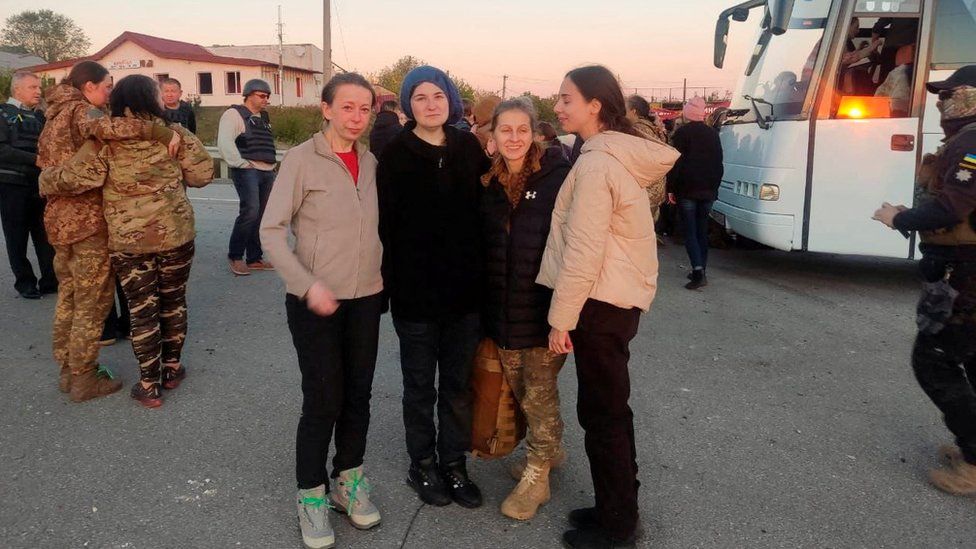
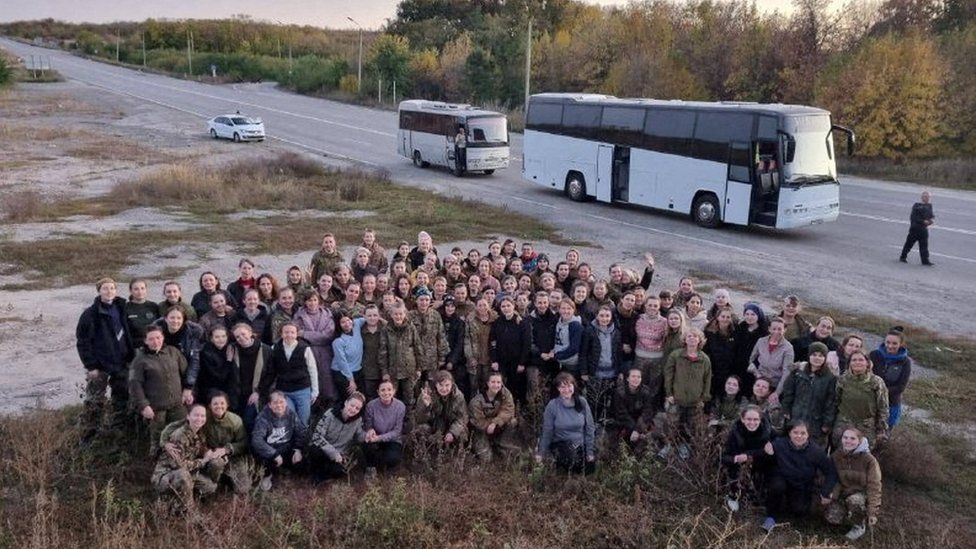
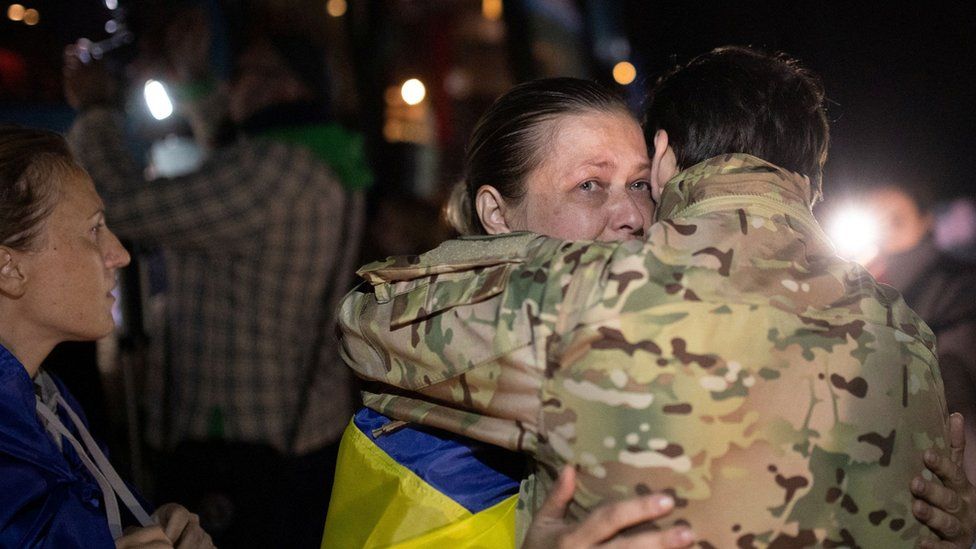
Russia has swapped 108 Ukrainianwomen detained as prisoners of war for 110 Russian hostages held by Ukraine according to officials on both sides,
As per reports, 37 of the women were caught after surrendering during the siege of the Azovstal steel factory in Mariupol, which ended in May.
Most of the Russians freed are sailors from merchant ships held in Ukraine.
They also include members of pro-Russian separatist military units from the Donbas in eastern Ukraine.
Daylight photos were released of the Ukrainian women boarding coaches in an unspecified area and later of them arriving after dark in government-held territory in the southern region of Zaporizhzhia.
IMAGE SOURCE, REUTERS Image caption, The freed Ukrainians were taken to safety in coaches
IMAGE SOURCE, REUTERS
IMAGE SOURCE, REUTERS
The Ukrainian presidency’s chief of staff, Andriy Yermak,confirmed on social media that 108 women had been released in the “first all-female exchange”.
He said they included mothers and daughters who had been held captive together. All but 12 of them are servicewomen, he said.
Denis Pushilin, the top Russian-backed official in the breakaway part of Ukraine’s Donetsk region, confirmed the swap but said two detainees had decided to remain in Russia. Kyiv has not commented on this.
According to Mr Pushilin, the prisoners freed by Ukraine are 80 sailorsand 30 service personnel.
Former British military pilots are allegedly being recruited to China with substantial sums of money in order to pass on their experience to the Chinese military.
Up to 30 former British military pilots are said to have gone to China to teach members of the People’s Liberation Army.
The United Kingdom has issued an intelligence notice warning former military pilots not to serve in the Chinese military.
Attempts to headhunt pilots are ongoing and had been ramping up recently, western officials say.
A spokesperson from the Ministry of Defence said the training and the recruiting of pilots do not breach any current UK law but officials in the UKand other countries are trying to deter the activity.
“It is a lucrative package that is being offered to people,” said one western official. “Money is a strong motivator.” Some of the packages are thought to be as much as £237,911 ($270,000).
The retired British pilots are being used to help understand the way in which Western planes and pilots operate, information that could be vital in the event of any conflict, such as over Taiwan.
“They are a very attractive body of people to then pass on that knowledge,” a Western official said. “It’s taking Western pilots of great experience to help develop Chinese military air force tactics and capabilities.”
The UK first became aware of a small number of cases of former military pilots being recruited in 2019 which were dealt with on a case-by-case basis. The Covid-19 pandemic slowed attempts down when travel to China was almost impossible but the attempts have now increased, leading to this alert.
“We’ve seen it ramp up significantly,” a western official said in a briefing to journalists. “It is an ongoing issue.” Current serving personnel is being targeted but none are thought to have accepted.
The pilots have experience on fast jets and helicopters and come from across the military and not just the Royal Air Force. They have flown Typhoons, Jaguars, Harriers, and Tornados.
F-35 pilots are not thought to be involved although China is thought to be interested in them. Some of the pilots are in their late 50s and left the military some time ago. Pilots of other allied nations have also been targeted.
Officials said they are being recruited through intermediary head-hunters and cited a particular flying academy based in South Africa as being involved.
There is no evidence that any pilots have broken the Official Secrets Act or that they have committed any crime. The aim of the alert is to try and deter activity and inform current staff and industry partners and also remind personnel of their obligations to protect sensitive information.
“We are taking decisive steps to stop Chinese recruitment schemes attempting to headhunt serving and former UK Armed Forces pilots to train People’s Liberation Army personnel in the People’s Republic of China,” an MoD spokesperson said.
“All serving and former personnel are already subject to the Official Secrets Act,and we are reviewing the use of confidentiality contracts and non-disclosure agreements across Defence, while the new National Security Bill will create additional tools to tackle contemporary security challenges – including this one.”
Liz Truss has insisted that she will lead the Conservatives into the next general election, despite U-turns that have left her fighting for her authority.
The Prime Minister apologized for making mistakes after new chancellor Jeremy Hunt scrapped almost all of her tax-cutting proposals to calm market turbulence.
She went on to say that her month-old premiership “hasn’t been perfect,” but that she had “corrected” flaws.
And she said it would have been “irresponsible” not to change course.
In an interview with the BBC, she said she was still committed to boosting UK economic growth,but acknowledged it would now take longer to achieve.
“I remain committed to the vision, but we will have to deliver that in a different way,” she said.
It comes after a dramatic day at Westminster after Mr Hunt announced that nearly all the tax cuts announced at last month’s mini-budget would be scrapped.
The decision has been welcomed by investors but has left Ms Truss’s economic agenda in tatters only weeks into her time in No 10.
Liz Truss told the BBC’s Chris Mason she was “sorry for the mistakes that have been made”.
In her interview, Ms Truss said she accepted responsibility for going “too far, too fast” – and she wanted to “say sorry for the mistakes that have been made”.
She added that she remained committed to a “low tax, high growth economy” – but preserving economic stability was now the “priority”.
“I do think it is the mark of an honest politician who does say ‘yes, I’ve made a mistake. I’ve addressed that mistake. And now we need to deliver for people.
“It would have been completely irresponsible for me not to act in the national interest in the way I have.”
Shadow Treasury minister James Murray said the PM’s apology “after weeks of blaming everyone else” would not “undo the damage” caused by her mini-budget.
“No sorry can change the fact that this crisis was made in Downing Street but is being paid for by working people,” he added.
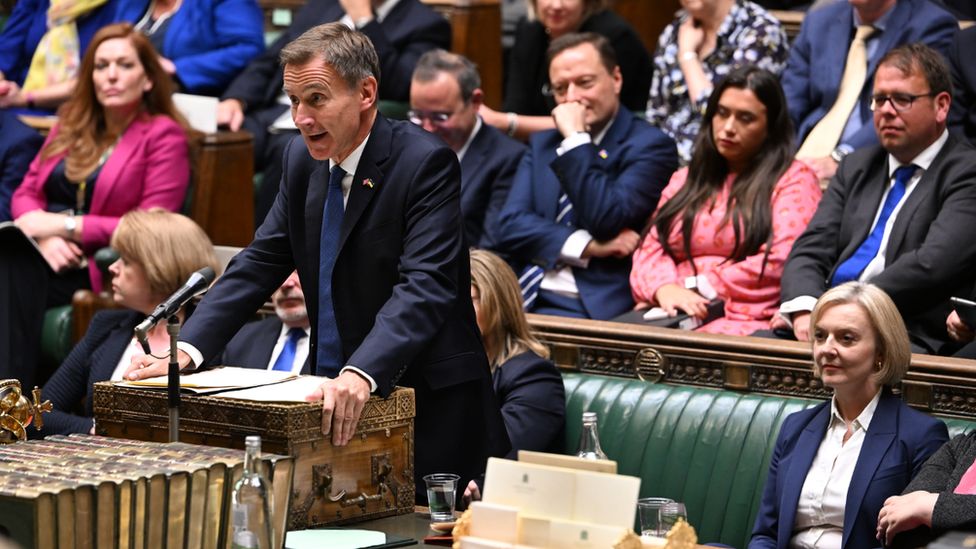
IMAGE SOURCE, JESSICA TAYLOR/UK PARLIAMENT Image caption, Liz Truss sat in the Commons for half an hour as Mr Hunt outlined the U-turns to MPs
Ms Truss watched on silently as Mr Hunt delivered a Commons statement to explain to MPs why the economic strategy, outlined last month by Kwasi Kwarteng, was being torn up.
The chancellor warned that “decisions of eye-watering difficulty” on tax and spending remain ahead of an economic statement on 31 October, when he will give further details of a plan to reduce the UK’s debt burden.
He said further windfall taxes on energy companies – a policy repeatedly rubbished by Ms Truss during her Tory leadership campaign – could not be ruled out, along with changes to the pension triple lock.
Ms Truss refused a Labour request to explain the U-turns to MPs herself before Mr Hunt’s statement, with Commons leader Penny Mordauntsaying the PM had been “detained on urgent business”. The prime minister later arrived in the Commons taking her seat beside Mr Hunt before he began his statement.
Labour leader Sir Keir Starmer accused the PM of leaving an “utter vacuum” in government, while one of his MPs jibed she had been “cowering under a desk”.
In total, £32bn of the £45bn in tax cuts announced at last month’s mini-budget have now been ditched, including plans to cut the basic rate of income tax from 20p to 19p from April.
Cuts to dividend taxes and VAT-free shopping for international tourists have also been scrapped, along with a freeze on alcohol duty rates.
Leadership threats
The government’s energy support package, a policy repeatedly championed by Ms Truss in defence of her premiership, will also be scaled back after six months.
The reversals have prompted some Tory MPs to talk privately about how Ms Truss could be ejected from office, despite party rules preventing a formal leadership challenge for a year.
Tactics reportedly under consideration include submitting no-confidence letters in a bid to force party bosses into a rule change or changing the rules to allow MPs to bypass party members and pick a new leader themselves.
Liberal Democrats leader Ed Davey called for a general election, telling the BBC “the damage has already been done” by the mini-budget.
Shadow Chancellor Rachel Reeves echoed calls for Ms Truss’s removal, telling BBC Breakfast the “only thing left from the Prime Minister’s plan is higher mortgage rates and higher bonuses for bankers”.
Ms Reeves said Labour would fund a longer-running energy bill support package by scrapping non-dom status.
However, there is little agreement over who should take over from Ms Truss if she is removed.
Defence Secretary Ben Wallace has quashed rumours that he could replace Ms Truss should she resign.
Speaking to the Times, he said he will be holding on to his current job and accused Tory MPs of playing “political parlour games”.
Five of the PM’s own MPs have called publicly for her to resign, with others briefing journalists that they think her time in office is up.
As a result of the energy crisis caused by Russia’s invasion of Ukraine, German Chancellor Olaf Scholz has ordered the country’s three remaining nuclear power plants to remain operational until mid-April.
Germany had originally planned to phase out all three by the end of this year.
Mr Scholz’s order overruled the Greens in his coalition, who wanted two plants kept on standby, to be used if needed.
Nuclear power provides 6% of Germany’s electricity.
But gas prices have soared since Russia’s invasion of Ukraine in February, which disrupted Russia’s huge oil and gas exports to the EU. In August Russia turned off the gas flowing to Germany via the Nord Stream 1 undersea pipeline.
After relying so heavily on Russian gas Germany is now scrambling to maintain sufficient reserves for the winter. The crisis has also prompted it to restart mothballed coal-fired power stations, though the plan is to phase out coal in the drive for green energy.
Last year Germany got 55% of its gas from Russia, but in the summer that dropped to 35% and it is declining further.
Chancellor Scholz’s third coalition partner, the liberal Free Democrats (FDP), welcomed his move to keep nuclear power as part of the mix. The three remaining nuclear plants are Isar 2, Neckarwestheim 2, and Emsland.
The Social Democrat (SPD) chancellor also called for ministries to present an “ambitious” law to boost energy efficiency and to put into law a phase-out of coal by 2030.
Last week climate activist Greta Thunberg said it was a “mistake” for Germany to press on with nuclear decommissioning while resorting to coal again.
Conservative MP Sir Charles Walkerhas been talking to our political editor Beth Rigby and has not held back on his feelings towards the prime minister.
“I think her position is untenable,” he said.
“She has put colleagues, the country, through a huge amount of unnecessary pain and upset and worry.
“We don’t need a disruptor in No 10. We need an uniter.
“I just think… it is just a situation that is… it can only be remedied I think, with a new prime minister.”
Asked about Ms Truss staying in her position, Mr Walker says: “Look the prime minister has had a very torrid six weeks.
“Personally, I don’t think her position is recoverable. She would obviously take a different view.
“But if you read the mood of the parliamentary party, she has lost authority and you can’t lead a party if you don’t have some authority. She doesn’t have much of that.”
Pressed on whether he is calling for Ms Truss to go, Mr Walker replied: “I think it’s her decision right now. I think if she doesn’t go right now, it will not be her decision. That agency will be taken away from her.”
Asked how long he thinks it will be before that decision gets taken one way or the other, Mr Walker says: “A week or two.”
The MP for Broxbourne, who is standing down at the next election,continued: “I’m just so cross. I’ve just had enough. And I think quite a few of my colleagues have had enough and I’ll be dismissed as being tired and emotional.
“And yes, I am tired, and I am emotional, and I am angry. And I’m in the same place as many of my friends, many of my family, and many of my constituents.”
Humanoid robot artist Ai-Da has told a Lords committee “although not alive, I can still create art”.
A little while after making the comments, the robot needed to be reset, with sunglasses put on her face as “when we reset her, she can sometimes pull quite interesting faces”.
Ai-Da was appearing at the evidence session for the House of Lords Communications and Digital Committee, alongside her creator, Aidan Meller.
Liz Truss has departed the chamber after only being there for about a half hour.
Before leaving, the Prime Minister, who was nowhere to be found in the Commons duringan urgent question from Labour on the economy earlier this afternoon, heard her new chancellor, Jeremy Hunt, defend the government’s new economic plan.
Earlier today, the government scrapped almost all of its tax-cutting measures in the mini-budget from just over three weeks ago.
This must bethe most humbling of humble moments for Liz Truss.
Six weeks after becoming prime minister she is being forced to sit in silence as a man who backed her rival in the leadership campaign rips apart her whole plan for the country and turns it into something resembling Rishi Sunak’s prospectus for the government.
Next to the chancellor, two seats away Penny Mordaunt – the woman Ms Truss beat into the Tory leadership runoff.
She has just been fielding questions in the prime minister’s place, at one point assuring MPs that the prime minister was not hiding “under a desk.”
It’s hard to see how Liz Truss comes back from this politically with her vision for the country in tatters and one-time rivals now holding the power in government.
The problem for the prime minister is this isn’t just humbling, it’s humiliating.
DISCLAIMER: Independentghana.com will not be liable for any inaccuracies contained in this article. The views expressed in the article are solely those of the author and do not reflect those of The Independent Ghana
Bolsonaro has gained seats in Congress amid a broader rightward shift that will keep him influential even if Lula wins.
Three days after the first round of voting in Brazil’s election on October 1, David Nemer, assistant professor of media studies at the University of Virginia, noted that “Twitter is not Brazil. Brazil is not on Twitter.”
He was echoing the views of many experts who have cautioned that many on both the left and the right had been predicting the outcome of the vote based too much on Twitter trends and hashtags.
As it turned out, incumbent President Jair Bolsonaro proved pollsters wrong. While he did come second behind former President Luiz Inacio Lula da Silva of the Workers’ Party as expected, the five-percentage point gap between them was much smaller than the double-digit gulf that had been predicted. Bolsonaro managed to force an October 30 runoff that would not have been necessary if Lula had secured more than half of the vote.
Perhaps even more importantly, Bolsonaro’s Liberal Party gave Brazil’s far-right its best-ever election night outcome since the country’s return to democracy nearly four decades ago. It won 99 seats in the lower house of Brazil’s Congress, 23 more than in 2017. It is the single-largest party in the lower house, and with allies, effectively controls almost half of the legislative chamber.
The verdict is clear: Bolsonarism – the president’s far-right movement backed by political and social conservatives and evangelicals – has already won, irrespective of what happens in the runoff.
If Bolsonaro defeats Lula, experts fear he might use his numbers in Congress to impeach Supreme Court justices. He could even increase the number of seats on the Supreme Court to appoint ideologically aligned judges – similar to what the military dictatorship did many years ago. The Supreme Court has served as an important counterweight to the government, including investigating a fake news network controlled from the government’s headquarters. Bolsonaro, in addition to attacks against judges of the court, has already said that he might tweak the makeup of the judiciary if he returns to power.
But even if he loses on October 30, Bolsonaro’s supporters in Congresswill have the clout to make governance very difficult for a Lula administration, including by blocking any progressive initiatives.
“The country that Lula da Silva governed just 20 years ago basically does not exist anymore,” Felippe Ramos, a political analyst and doctoral candidate in sociology at the New School for Social Research told me.
Brazil has changed
That’s not to say that Brazilian society under the center-left Lula – who was president from 2003 to 2010 – was progressive. However, the country has witnessed a dramatic political, economic and demographic shift that is underpinning the support for Bolsonarism. “The drivers are much deeper than politics,” Ramos said.
As Ramos explained, Brazil has undergone a process of deindustrialization in recent years, with agribusinesses increasingly the engine of the economy. That has led to a growth in the economic influence of traditionally conservative states – a change reflected culturally too, with Sertanejo, Brazilian country music, going mainstream.
Meanwhile, Brazil’s evangelicals – a solid support base for Bolsonaro – have shot up from five percent to over 30 percent of the population in less than three decades, signalling a broader conservative shift. This has given them significant influence in national politics and on how the overall population views moral issues.
Evangelical denominations have even been accused of spreading fake news that, for instance, Lula might shut down churches if he returns to power or that the former president is a Satanist.
Tech, too, has played a role, though not Twitter. It is, in fact, WhatsApp that is the main tool that Bolsonaro and his allies use to spread propaganda and disinformation among poorer and more remote communities.
Rise of Bolsonarism
Still, the nature of Brazil’s rightward shift, too, has evolved.
For years, it was an imperfect fit between various far-right forces that managed to coalesce around Bolsonaro. Today there is greater ideological uniformity, with a central tenet at its heart: hard-core Bolsonarism, or extreme loyalty to the leader.
Bolsonaro has cannibalised the traditional right and centrist poles of Brazilian politics while creating a movement that also overshadows other traditional strains of right-wing extremism.
For evidence, look no further than the fate of former allies who turned critics and have performed poorly in the election — such as Joice Hasselmann, a former journalist who was elected to Congress in 2018 from Bolsonaro’s party after winning more than a million votes, the most by a female candidate. She subsequently fell out with Bolsonaro. This time, she couldn’t win even 14,000 votes.
Ironically, Bolsonarism is also helped by the fact that its progressive opponents appear incapable of engaging with ideas outside their bubble even as they have abandoned the trade union struggle.
A divided nation
In effect, Brazilian politics today orbit around “two poles that are represented by Bolsonaro on the one hand, and by Lula and the Workers’ Party on the other,” Pablo Ortellado, professor of public policy management at the University of São Paulo, told me.
The tension between them ends up exploding in the form of political violence. Supporters of the current president have killed several Workers’ Party voters, while in rare cases, Lula supporters, too, have engaged in violence against their counterparts in Bolsonaro’s camp.
A Bolsonaro victory could mean the deepening of fascism in Brazil. It would facilitate the further growth of evangelical fundamentalism and lead to the increased devastation of the Amazon. It would portend more violence against Indigenous and left-wing activists and herald greater international isolation for Brazil. Whether the country’s democratic institutions would survive intact is doubtful. It’s hard to know whether Brazilian democracy itself would continue to breathe.
A win for Lula, however, would still leave him facing a strong pro-Bolsonaro parliamentary opposition capable of stalling his plans, in a polarised and increasingly conservative society.
While Bolsonaro has repeatedly threatened to not respect the outcome of the elections if he loses, he won’t need a coup to retain significant influence. His faithful and strong base of supporters in Congress will ensure that — even if not as president — Bolsonarowill continue to cast a shadow over Brazilian politics.
DISCLAIMER: Independentghana.com will not be liable for any inaccuracies contained in this article. The views expressed in the article are solely those of the author and do not reflect those of The Independent Ghana
President Raisi has joined Supreme Leader Khamenei in condemning the United States for inciting fatal protests over the death of a woman in government custody.
Iranian President Ebrahim Raisi accused US President Joe Bidenof “inciting disorder” after expressing sympathy for protests against the murder of Mahsa Amini, who died in Iranian government custody nearly a month ago.
The protests started in mid-September after Amini, 22, died following three days in the custody of Iran’s “morality police” for allegedly violating the strict dress code for women.
“The remarks of the American president – who is inciting chaos, terror, and the destruction of another country – serve as a reminder of the eternal words of the founder of the Islamic Republic who called America the Great Satan,” Raisi said, referring to the late Ayatollah Ruhollah Khomenei.
“The enemy’s plot must be countered by effective measures to resolve people’s problems,” Raisi said, according to a statement from the president’s office.
Dozens of people have died in the protests. Most have been protesters, but members of the security forces have also died. Hundreds of demonstrators have been arrested.
On Friday, Biden said, “We stand with the citizens, the brave women of Iran.”
“It stunned me what it awakened in Iran,” the US president said. “It awakened something that I don’t think will be quieted for a long, long time.”
Iranian foreign affairs spokesman Nasser Kanani said on Sunday, “Iran is too strong for its will to be swayed by the interference … of a politician tired of years of failure.”
“We will together defend the independence of Iran,” Kanani wrote on Instagram.
The US issued new sanctions against Iranian officials on October 6 over what it called the “violent suppression of protests”.
Raisi accused the United States of starting unrest in the past, saying because of “the failure of America in militarisation and sanctions, Washington and its allies have resorted to the failed policy of destabilisation”.
This month, Supreme Leader Ayatollah Ali Khamenei blamed the US and Israel for instigating the protests, accusing them of trying to stop Iran’s “progress”.
Iraqi Environment Minister Jassem al-Falahi has admitted that pollution from oil production is the primary cause of rising cancer rates in the country.
His remarks came after a BBC Arabic investigation discovered that communities near oil fields near Basra are at an increased risk of leukaemia.
These communities believe gas flaring is to blame, which is the “wasteful” burning of gas released during oil drilling.
Flaring produces cancer-linked pollutants like benzene.
The environment minister’s comments, made to the BBC’s HARDtalk programme, come despite a confidential order issued by the Iraqi prime minister – and seen by BBC Arabic – banning its employees from speaking about health damage caused by pollution.
They also directly contradict previous comments made to BBC Arabic, by the Minister of Oil, Ihsan Abdul-Jabbar Ismail, in which he denied all links between the cancer rates and air pollution from oil.
Communities living near oil fields in Basra have long suspected that their high rates of leukaemia are due to gases being flared on the oil fields.
Flared gases from these sites are dangerous because they emit a potent mix of carbon dioxide, methane, and black soot which is highly polluting.
As part of the original investigation, the BBC undertook the first pollution monitoring testing amongst the exposed communities. The results indicated high levels of exposure to cancer-causing chemicals.
During his interview with HARDtalk Arabic, Al-Falahi also revealed that the oil ministry had previously prevented his staff from carrying out pollution monitoring checks at the largest oil field, Rumaila.
Rumaila flares more gas than any other oil field in the world and is owned by the Iraqi government.
The BBC Arabic team was similarly denied entry permits to film at Rumaila during their investigation. Ali Hussein Julood, a 19-year-old childhood leukaemia survivor, from North Rumaila, said: “Here in Rumaila, nobody speaks out. They say they’re scared to speak in case they get removed.”
IMAGE SOURCE, JESS KELLY/BBC Image caption, Ali Hussein sought compensation on four separate occasions between 2020 and 2021 for the oil pollution
But Al-Falahi added that the situation has improved, and there is now greater cooperation between the ministries.
He said that the departments would work together to issue fines or commence lawsuits against any company, whether local or international if they had caused environmental damage.
None of the families that BBC Arabic spoke to during the investigation had received compensation for the health issues they suffered, despite multiple requests made to the oil companies who work at the sites.
Under Poisoned Skies
The deadly impact of the oil giants’ toxic air pollution on children and the planet is revealed in this BBC News Arabic investigation from the front line of climate change in Iraq.
Germany will discontinue a programme to assist refugees in converting their Ukrainian hryvnia into cash into euros on October 30, according to a joint statement from the finance ministry and the central bank.
The move was agreed upon with Ukraine’s central bank on Monday.
The move came after demand diminished considerably, and few transactions have been carried out recently, said the statement.
At least three persons have died in Russian droneassaults in eastern Ukraine’s Sumy area the governor reports.
“At 5:20 (0220 GMT) in the morning, three Russian rockets hit a civil infrastructure facility,” Dmytro Zhyvytsky said on Telegram. “At least three people died. Nine are injured. There are still people under the rubble.”
Zhyvytsky added that residents should reduce electricity consumption during busy hours after more than 1,000 people were disconnected from electricity after the attack.
Sir Peter Bottomley, the Father of the House of Commons, has accused Keir Starmer of having a “short memory”.
“It’s only nine months ago when some of his senior colleagues were searching to see whether there could be a better leader of the opposition than him.”
He added: “When circumstances change, it is right for policy to change.
“And if what’s announced today leads to lesser inflation and the cost of borrowing and a greater chance this country can get back to prosperity, it’s worth doing well.”
Penny Mordaunt responded by saying she agreed with Sir Peter.
“The right honourable gentleman opposite [Sir Keir] has reversed his position on economic justice, social justice, climate change, promoting peace and human rights, common ownership, defending migrants rights, strengthening the rights of workers and trading, radical devolution of power, wealth and opportunity, equality and effective opposition to the Tories.”
When EU foreign ministers gather in Luxembourg next month, they are expected to agree on a mission to train 15,000 Ukrainian soldiers as well as an additional 500 million euros ($48.7 million) in funding for military transfers to Kyiv.
Two senior EU officials said the military training would start in mid-Novemberand take place on EU territory at one hub in Poland and another in Germany.
Previously, several EU countries have already been instructing Ukrainian troops on how to use specific weapons, which will continue.
The ministers are also expected to add a further 500 million euros to a fund that reimburses EU member states for arms delivered to Ukraine, bringing the total amount earmarked for arms for Kyiv to more than 3 billion euros.
Labour had tried to drag Liz Truss into the Commons to answer this urgent question.
However, the government can decide who to send, and – perhaps unsurprisingly – the prime minister will not be responding.
In her place is Commons Leader Penny Mordaunt.
It’s an interesting choice given she is being pushed by some as a potential successor to the beleaguered PM.
Ms Mordaunt is one of the better Commons operators though and may earn a few brownie points with backbenchers by heading out to bat at this tricky moment.
Liz Truss’s lack of appearance will fuel discontent among some MPs though.
“She needs to own it, and is now back in hiding again,” said one.
The vanishing act won’t last forever either.
The prime minister will likely be in the Commons for Jeremy Hunt’s statement today and is set to face Sir Keir Starmer at PMQs on Wednesday.
Former Russian President Dmitry Medvedevhas warned Israel against selling arms to Ukraine, warning any effort to beef up Kyiv’s army will jeopardise bilateral relations.
“Israel appears to be getting ready to supply weapons to the Kyivregime. A very reckless move. It would destroy all bilateral relations between our countries,” Medvedev said on Telegram.
So far, Israel has sent humanitarian aid, including helmets, to Ukraine, but it has not sent any weapons.
A spokeswoman for Israeli Prime Minister Yair Lapid, who also holds the foreign affairs portfolio, told AFP his office would not be commenting on Medvedev’s remarks.
Ukraine’s military says to have destroyed 37 Russian drones since Sunday evening, accounting for around 85 percent of aircraft participating in the strikes.
Russian drone strikes killed at least three civilians in central Kyiv early Monday.
The airstrikes came exactly one week after Russia unleashed its heaviest aerial bombardment on Kyiv and other Ukrainian cities since the start of the war.
Several explosions rocked the central Shevchenkivskyi district of Ukraine’s capital on Monday, according to Kyiv Mayor Vitali Klitschko, damaging a number of residential buildings.
Market estimatesfor the Bank of England’s bank rate are at their lowest since the mini-budget, which is excellent news for individuals with mortgages.
Market forecasts peaked soon after the mini-budget at 6.1%, but have since dropped to just over 5%.
It was just three weeks ago the then-Chancellor Kwasi Kwarteng unveiled his tax-cutting mini-budget to MPs, which caused economic turmoil in the UK,as the value of the pound plummeted.
Today, Mr Hunt said there “were mistakes” in last month’s announcement, and pointed out some taxes may have to rise and others might not fall as much as planned.
The BoE is due to announce its next decision on interest rates, which will impact household mortgages, on 3 November and many investors think it will either raise them from their current level of 2.25% to 3% or possibly 3.25%, both of which would be much bigger moves than usual.
“Ovsyannikova and her daughter left Russia a few hours after departing from the address where she was under house arrest,” Dmitry Zakhvatov was quoted as saying. “They are in Europe now.”
“They are fine. They are waiting until they can talk publicly, but for now, it is not safe,” he said.
Two weeks ago, reports emerged that Ovsyannikova had fled house arrest. She had been held at her home for two months and faced a 10-year sentence for allegedly spreading fake news.
Talibansources, US officials assured them during a conference in Doha.
According to Taliban sources, the US has informed Afghanistan’s Taliban authorities that it will not sponsor any armed organisations or non-state actors in the nation.
The assurances were welcomed by the Taliban as Tajik armed groups, which have been backed by the West in the past, continue to challenge the group’s leadership – even as it has managed to contain the Tajik-dominated National Resistance Front and other groups aligned with the former Western-backed government since it returned to power in August last year.
The assurances were given during a meeting between US Department of State officials and Taliban representatives in Doha earlier this month.
While few details about the meeting in the Qatari capital are available, Taliban sources told Al Jazeera its members met with members of a high-level US delegation, including the CIA deputy director.
This meeting was the first since July when the US said it killed al-Qaeda leader Ayman al-Zawahiri in a drone attack on his hiding place in Afghanistan’s capital, Kabul.
Al-Zawahiri’s presence in Afghanistan led the West to accuse the Taliban of violating the 2020 Doha Agreement, in which the Afghan group agreed not to provide safe haven to al-Qaeda and other armed groups.
The Taliban swept into power last year in a lightning offensive but violence by armed groups such as ISIL affiliate ISKP has surged in recent months, posing a security challenge to the group.
Taliban reject US plan for Afghan assets
In the meeting, the Taliban also conveyed its rejection of the US announcement that it would transfer $3.5bn in frozen Afghan central bank assets into a Swiss-based trust, according to the Taliban sources, who have knowledge about the meetings.
Last month, the Taliban said the US decision to put part of nearly $10bn in Afghan assets – which it froze last August in an attempt to keep the Taliban from accessing it – into trust was “unacceptable and a violation of international norms”.
The US announcement had said the fund will be managed by an international board of trustees and used for debt payments, electricity, food, printing new currency and other essential needs and services.
The Afghan group has repeatedly called for the lifting of sanctions and the release of frozen funds, including international aid that was suspended after the Taliban takeover, to help its dying economy. Sanctions that had been placed on the Taliban during their first period of rule that ended in 2001 came back into force with them taking power last year.
The Taliban’s isolation
More than half of Afghanistan’s 39 million people need humanitarian help and six million are at risk of famine, the United Nations said in August.
No country has recognized the Taliban’s self-styled Islamic Emirate of Afghanistan, and its diplomatic and financial isolation has exacerbated the humanitarian crisis in the country, which has suffered from decades of war, including the last 20 years under US occupation.
The international community has urged the Taliban to respect human rights, including allowing girls access to schools and workplaces. But the group has put in place increasing curbs on human rights, further angering the international community and dashing any hopes of recognition.
However, the revelations about the Doha meeting show the US continues to engage with the Taliban despite the rift.
A state department spokesperson confirmed the Doha meetings to Al Jazeera.
“As we’ve made clear, we’ll continue to engage the Taliban pragmatically regarding American interests,” she told Al Jazeera.
Liz Trusswill not be replying to Labour’s urgent question in the Commons this afternoon.
We reported earlier (12.59 pm) that the opposition had been granted the chance to ask an urgent question of the prime minister about the sacking of the chancellor.
But Penny Mordaunt, the leader of the House of Commons, will instead answer the question at the despatch box.
Although it is not uncommon for prime ministers to send lower-ranking ministers to answer urgent questions (Boris Johnsonwould often send then-minister Michael Ellis to answer questions on his behalf), Labour will make hay with the move.
The opposition is already suggesting the prime minister is “in hiding.”
Ms Mordaunt was a leadership hopeful earlier this year, getting through to the final three.
The prime minister’s official spokesman earlier said Ms Truss would be in the Commons for Chancellor Jeremy Hunt’s statement, which is taking place after the urgent question, but it is not clear if that remains the case.
A Labour Party spokesman said the prime minister was “frit” – a word which means frightened and was famously used by Margaret Thatcher.
Liz Truss is to meet the One Nation group of Conservative MPs tonight.
The prime minister’s official spokesman confirmed the gathering would be taking place around 6 pm.
The One Nation group has not typically been enthusiastic in its support of Ms Truss.
One member, Victoria Atkins, told the BBC this morning that Ms Truss was PM “for the moment” and she needed to return to their values of “compassionate Conservatism”.
Damian Green was more conciliatory, saying the appointment of Jeremy Hunt offered an opportunity for a fresh start.
After the meeting with the large group of backbenchers, Ms Truss will then host a cabinet reception just before 8 pm.
The prime minister’s official spokesman said she wants to “engage” with cabinet colleagues.
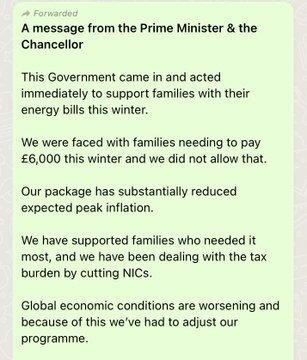
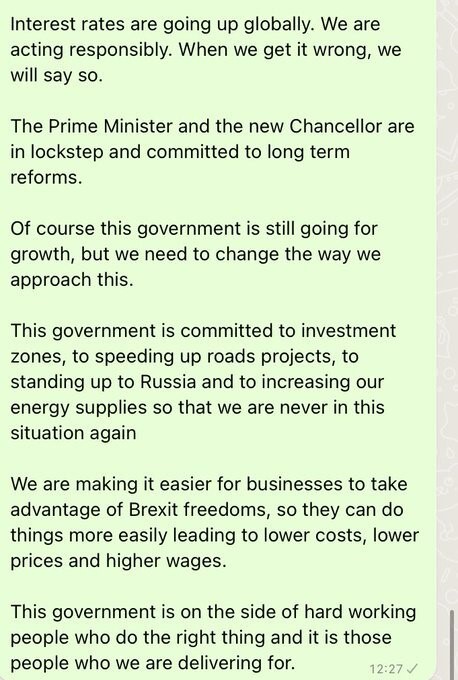
Following this morning’s announcement from new Chancellor Jeremy Hunt that “almost all” tax cuts announced in the mini-budget have been scrapped, he and the PM have sent a message to all Conservative MPs.
“The prime minister and the new chancellor are in lockstep and committed to long-term reforms,” the message says.
It adds that the government is “still going for growth” – despite the mass of mini-budget U-turns – and suggests that global factors are to blame for the economic turmoil.
“When we get it wrong, we will say no,” it continues.
It comes as Prime Minister Liz Truss seeks to hold onto her premiership following a tumultuous first few weeks in office.
A total of four Conservative MPs are now publicly calling for Ms Truss to go.
As she laid out her plans for an independent Scotland today,Nicola Sturgeon claimed Prime Minister Liz Truss’ decision not to tender her resignation demonstrates how “badly broken” UK politics is.
Following the chancellor’s emergency statement today, the first minister said that if she had given in to demands made by Tories and commentators on the day of the mini budget to match the UK government’s tax plans she too “would be dealing with something of a financial disaster.”
She said: “It will also be galling, I think, that the one measure that the prime minister has repeatedly cited to effectively justify the market turmoil of recent weeks, the energy price cap has also been curtailed, leaving many people and possibly many businesses without the support with energy bills that they were expecting.”
Launching her economic prospectus paper on Scottish independence, Ms Sturgeon said a “fairer, more sustainable economy was more possible for Scotland with independence than it ever will be with continued Westminster control”.
She said: “In 2014, the choice before the Scottish people was framed by Westminster parties as the strength and stability of the UK on the one hand and the uncertainty of independence on the other. The reality in the years since has been very different.
“It is glaringly obvious now that the UK does not offer economic strength and stability or financial security.”
Setting out some of her plans, Ms Sturgeon said she would create an independent Scottish central bankand confirmed that the policy of the Scottish government was to establish a Scottish pound.
“We would seek to do this as soon as practicable. The precise timing would be determined not by a fixed timetable, but by a set of objective requirements and criteria guided by advice from the central bank and subject to a decision by parliament in the overall interests of the country.”
The prime minister has tweeted to align herself with the announcements made by chancellor Jeremy Hunt (who some Tory MPs are referring to as “de-facto PM) this morning…
The British people rightly want stability, which is why we are addressing the serious challenges we face in worsening economic conditions.
We have taken action to chart a new course for growth that supports and delivers for people across the United Kingdom. https://t.co/P3yglx6efZ
Liz Truss agreed to Jeremy Hunttearing up her mini-budget during a meeting over the weekend.
The prime minister’s official spokesman said: “The chancellor and prime minister discussed these measures and agreed on them over the weekend.”
In a briefing with journalists, the spokesman was asked if Ms Truss would rule out resigning, to which he responded that the PM was working very closely with the chancellor.
The spokesman repeated the admission that the mini-budget “went too far, too fast”.
Ms Truss will be in the House of Commons for Jeremy Hunt’s statement there later today, and will also be meeting with Conservative MPs.
“The prime minister wants to continue to engage with her cabinet colleagues as part of a series of engagements carried out both with cabinet and with Parliament more broadly,” the spokesman said.
Asked whether the government’s commitment to increase defence spending remained, the spokesman said the prime minister and chancellor “remain committed” to increasing defence spending, but added, “the long-term ability to fund increased defence spending will depend on the economic stability and on a healthy growing economy.”
Major cuts to public spending might not now be needed – at least not on the scale predicted a week ago, the Institute of Fiscal Studies has said.
IFS deputy director Carl Emmerson told Sky News that what we just heard was a “very big tax rising announcement”.
“A week ago it looked very difficult. We were talking abouthow would you do this [implement her economic policy, including the energy price guarantee] without any tax rises,” he said.
“And it looked like you’d have to make some incredibly difficult decisions around working age, welfare, capital spending, and around day-to-day spending on public services.
“Now, there may well still be a need to squeeze spending, given the chancellor’s tax announcement today… but it might be the kind of more credible, more deliverable end of the scale rather than what we were looking at just a few days earlier.”
Jeremy Hunt’s announcement that the energy price guarantee will be reviewed in April rather than remaining in place for two years is “incredibly welcome”, Mr Emmerson said.
When the government first announced the energy price guarantee, he was “sympathetic” to the idea that the policy might be needed for this winter, but “it always looked rather odd” that the country was committing to it for two years.
Mr Emmerson went on: “I’m very pleased to see that the government is now taking an approach saying, well, yes, this big scheme will be in place this winter. We can’t do better than that in the short run.
“But it’s now reopening the idea that we can design somethingthat will be cheaper for the taxpayer, hopefully, targeted towards those who really need it, but also preserves incentives that people have to cut back on their energy use for the following winter.”
Shadow chancellor Rachel Reeves says “the damage has been done” by the mini-budget.
Responding to Jeremy Hunt’s statement today, Ms Reeves said the “Conservatives have lost all credibility”, and that they cannot provide the “confidence and stability” the chancellor said was needed.
Ms Reeves said: “There will continue to be a huge cost to families because of the actions of this Tory government.
“We are still flying blind with no OBR forecastsand no clarity of the impact of their mistakes.
“The humiliating climb-down on their energy plan begs the question yet again – why won’t they bring in a windfall tax on energy producers to help foot the bill?
“Only Labour offers the leadership and ideas Britain needs to fix the economy and get out of this mess.”
The decision by Jeremy Hunt not to amend the energy price guarantee between now and April next year is incredibly welcome” according to Carl Emmerson, deputy director of the Institute of Fiscal Studies (IFS).
Speaking to Sky News, Mr Emmerson said when the government first announced the energy price guarantee he was “sympathetic” to the idea that the policy might be needed for this winter, but “it always looked rather odd” that the country was committing to it for two years.
Mr Emmerson said: “I’m very pleased to see that the government is now taking an approach saying, well, yes, this big scheme will be in place this winter. We can’t do better than that in the short run.
“But it’s now reopening the idea that we can design something that will be cheaper for the taxpayer, hopefully, targeted towards those who really need it, but also preserves incentives that people have to cut back on their energy use for the following winter.”
Mr Emmerson went on to say the chancellor’s medium-term fiscal plan was a “very big tax rising announcement”.
“A week ago it looked very difficult. We were talking about how would you do this without any tax rises because that was clearly a steer from Liz Truss and the then chancellor,” he said.
“And it looked like you’d have to make some incredibly difficult decisions around working age, welfare, capital spending, and around day-to-day spending on public services.
“Now, there may well still be a need to squeeze spending, given the chancellor’s tax announcement today.
“We’re not necessarily going to be not paying for public services going forward, but it might be the kind of more credible, more deliverable end of the scale rather than what we were looking at just a few days earlier.”
The Ethiopian government says it intends to seize control of airports and other federal facilities in the Tigray area “to protect Ethiopia’s sovereignty and territorial integrity.”
In a statement, it stated that this was necessary to preserve its airspace, which had been “violated by hostile foreign actors supporting the TPLF [rebel fighters].”
It said the government would also be able to expedite humanitarian aid to the people in the region affected by the ongoing war.
The statement signals fighting could go on despite calls for de-escalation – even as it expressed commitment to resolve the crisis through an African Union-led process.
“We believe that there is a need for a comprehensive andnegotiated settlement that would bring about durable peace,” the statement added.
The government’s remarks follow a call by the AU for the warring parties to recommit to peace talks.
Tigrayan forces said on Sunday in response to the AU call that they were “ready to abide by an immediate cessation of hostilities”.
They also called on the global community “to compel the Eritrean army to withdraw from Tigray”. Eritrea, an ally of the Ethiopian government, has been aiding its neighbour in the fight against the Tigray forces.
On Monday, the Ethiopian government pledged to avoid urban combats and provide humanitarian access in areas that the government controls.
However, several international voices have sounded alarm bells that cities like the Shire have been bombarded and civilians killed, including at least one humanitarian worker.
Liz Truss has only been in Number 10 for a few weeks, but the possibility of her leaving in the coming months is being seriously considered.
The chancellor has been fired, which is the last resort for any Prime Minister.
Tory MPs including ministers tell me, Liz Truss, herself – prime minister for just five weeks – cannot survive and there is a discussion about how to remove her.
But removing a sitting prime minister who doesn’t want to leave office isn’t always easy. Here are some of the options.
She could resign
No prime minister wants to be hounded out of Downing Street but it could be that Ms Truss, fuelled by cabinet resignations, sees the writing on the wall and announces a Conservative leadership contest.
This is what the last two prime ministers, Boris Johnson and Theresa May, ended up doing after both won no-confidence votes of their MPs but their positions became untenable.
Both of them were in office for three years, though, not just a matter of weeks.
Vote of no confidence
Not so easy. The last Conservative leader to be ousted by their peers in parliament was Iain Duncan Smith in 2003.
Like Ms Truss, he was the choice of the party members, but not his MP colleagues (who favoured Ken Clarke); like Ms Truss, he was also accused of making things worse by not reaching out across the party when appointing his shadow cabinet, and he struggled to maintain authority.
But – thanks to a little-known rule of the backbench 1922 Committee – this is not currently an option.
When Mr Johnson became prime minister in the summer of 2019, the powerful committee decided that a new leader would get a “grace period” of a year before they could be challenged.
Some letters have gone in already, I’m told by MPs.
As one source on the 1922 Committee put it to me, committee chairman Sir Graham Brady “would have to act if we found ourselves in that situation”.
Image: Former chancellor Kwasi Kwarteng was sacked on Friday
A coronation
The problem is that many Conservative MPs feel it was the membership who chose Ms Truss – based on an unachievable prospectus – and they would rather not allow them to choose her successor.
This is much trickier, as the principle that the leader is “elected by the membership” is enshrined in Schedule 2 of the Conservative Party‘s written constitution, and overturning that would require a two-thirds majority in a vote of the National Conservative Convention, which has 800 members comprising the party’s senior officials including grassroots association chairs.
There is no guarantee of how that might go, and there would be accusations that it was shutting down party democracy.
One option would be for MPs to shortlist two candidates in a leadership contest, and for one of them to drop out – as Andrea Leadsom did in her contest with Mrs May in 2016.
The last candidate standing would become a leader “by acclamation” and that could happen quite quickly.
Image: Former chancellor Rishi Sunak
Or, as ConservativeHome’s Paul Goodman has suggested, MPs could set a higher bar of say 100 MPs supporting each candidate so there is only one possible winner.
But it’s not clear there is a unifying figure to undertake that role.
Rishi Sunak supporters believe he has been vindicated for predicting market turmoil, but it’s far from clear he would be accepted more widely.
An election
Ms Truss could make the extremely bold decision, given her party is now 30 points behind in the polls, to go for an election.
The Fixed Term Parliaments Act has been repealed so she would not need a vote in parliament to do this – to which you would imagine only Conservatives would be opposed.
Authorities in Kenya plan to exhume the body of a British tourist who died at the home of a controversial cult leader two years ago.
Luftunisa Kwandwalla was buried at a Mombasa cemetery in August 2020after reportedly dying of natural causes.
She arrived in Kenya as a tourist in August 2019 but her return to the UK was delayed due to lockdowns imposed in Kenya and Britain during the Covid pandemic.
Her family says she then joined a controversial cult in Mombasa.
The family alleges the 44-year-old was murdered and her body buried quickly to hide evidence.
Last week it obtained court orders for the exhumation to allow for a post-mortem examination to ascertain the cause of death.
The family told the BBC that the autopsy would be the first step in bringing closure to her death.
No one has been arrested in connection with the death and policerecords show that there are currently no active investigations.
Tanzanian President Samia Suluhu Hassan has voiced concern over the country’s high birth rate and asked citizens to practise birth control.
It is a significant shift from her predecessor, the late John Magufuli, who openly pushed women not to use contraception.
President Samia confronted the country’s baby boom over the weekend while visiting the western region of Geita.
”Yesterday I was told in Buselesele ward in Geita region, one (health) centre produces 1,000 children a month
“Now how many classes will be needed after three years? What of health centres – how many will be needed to serve all these children? How many tonnes of food will be needed? Let’s reduce the speed and have control of this,” urged the president.
In 2018, while at a rally in the west of Tanzania, former President Magufuli described those who use contraceptives as lazy.
And in 2016, after the launch of free primary and secondary education in the country, he said: “Women can throw away their contraceptives. Education is now free.”
The World Bank estimates Tanzania’s fertility rate at 4.8 births per woman as at 2020. The high birth rate was attributed to early marriages and low contraceptive use.
Tanzania has a population of around 60 million people, with 49% of them living on less than $2 (£1.50) a day.
Cold homes, according to health activists, might aggravate lung and breathing problems, while one poverty action group claims the country is on poverty’s “cliff edge”.
Campaigners have warned that unless a fresh £14 billion package of emergency relief is provided, about seven million homes in the UK will face catastrophic fuel poverty.
The Warm This Winter pressure group says despite the Energy Price Guarantee, the £400 energy bills payment, and other support already announced, much more help will be needed to prevent the “severe health impacts of living in cold, damp homes crippling the NHS and causing excess winter deaths”.
The group is calling for urgent additional assistance for the most vulnerable.
Financially, it is urging for a third cost of living payment of £325 for those on income-linked benefits to be paid on 1 December.
And chief among the non-financial asks is an immediate suspension of all forced transfers of households onto more expensive pre-payment meters, whether by court warrant or remotely via smart meters.
Warm This Winter is also asking for a further £150 to be given in disability benefits, the restoration of the £20 Universal Credit uplift, increasing the energy bill support payments for people who do not have a mains gas connection, and ensuring all households who received the Warm Homes Discount last winter can access a £150 rebate this winter.
Even including the Energy Price Guarantee, the End Fuel Poverty Coalition calculates the unit cost of gas has increased by between 153% and 165% since winter 2021, while the unit cost of electricity has increased by 63-68%.
‘Extremely concerned’
Sarah Woolnough, CEO of research and campaigning charity Asthma + Lung UK, said with millions of homes on the verge of fuel poverty, they were “extremely concerned the nation’s lung health will rapidly deteriorate”.
“If people cannot afford to heat their homes, they may be forced to live in freezing homes where cold and flu viruses can thrive,” she said.
“We know people with lung conditions are already struggling with price hikes – one in five we surveyed said they’d had an asthma attack because of changes they’d made to their lives in response to the cost of living crisis, such as skipping meals, not picking up prescriptions, and using mains-powered medical machinery less.
“Things will only get worse when temperatures plummet and colds and viruses ramp up.”
The government introduced the energy price guarantee to help. It limits the amount a household can be charged per unit of gas or electricity to help ease the damage to family finances caused by the wider cost of living crisis.
It means the taxpayer will pay the difference between the set unit cost and any higher unit cost.
It also introduced the £400 Energy Bills Support Scheme, administered by energy suppliers, and paid over the course of six months starting in October, to ensure consumers receive financial support throughout the winter months.
All households in England, Scotland, and Wales are eligible.
But Simon Francis, co-ordinator of the End Fuel Poverty Coalition, said the support now would only createa “cliff edge in April 2023” when the payouts stopped.
“This will result in the number of households in fuel poverty rising to almost eight million. The situation will be made worse if benefits are not uprated by inflation and if prescription charges increase,” he warned.
It comes after the National Grid’s Electricity System Operator said last week the UK could face power cuts in the “unlikely” event supplies of gas fall short of demand.
Free boiler repairs
Warm this Winter is a new campaign demanding the government act now to help tackle rising energy bills this winter and to ensure energy is affordable for everyone in the future.
It is supported by leading anti-poverty and environmental organisations, including Save the Children, WWF, and the End Fuel Poverty Coalition.
Other measures it has suggested the government could consider for supporting households to stay warm this winter, include introducing a public information campaign, giving guidance to local authorities on best practices in using the Household Support Fund to deliver free boiler repairs, and working with charities and councils to increase the provision of energy advice.
Working with landlords, the government could also, it says, support tenants in fuel poverty by introducing a social rent cap and a private sector rent freeze.
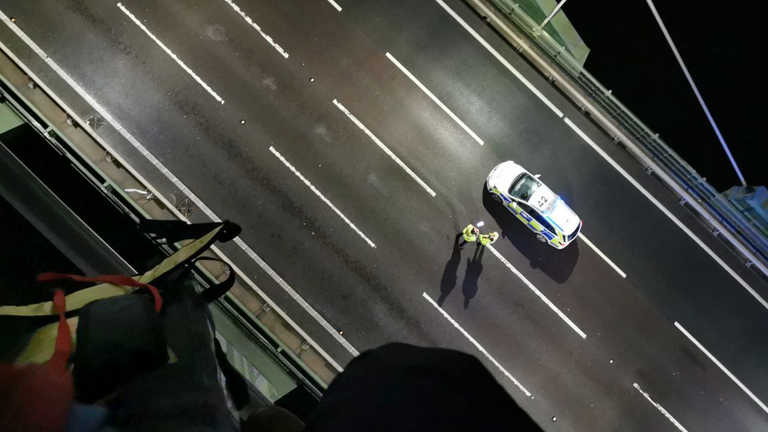
Long queues have arisen following the closure of the Dartford Crossing bridge due to a protest by two oil protesters who climbed the structure.
At 8.40 a.m., National Highways reported two-hour delays in both directions and seven to eight kilometres of congestion.
Just Stop Oil said two of its supporters had scaled the 84m-high masts on the north side of the QE2 bridge “to demand that the government halts all new oil and gas licences and consents”.
It’s the latest protest by the group’s activists, who on Sunday sprayed an Aston Martin showroom with orange paint and a few days earlier threw tomato soup over Van Gogh’s Sunflowers.
“The bridge has been closed while we resolve the incident which we will do as quickly and as safe for all involved,” Essex Policesaid.
“It does mean that we have had to close the bridge to traffic, but a diversion is going to be put in place through the tunnel.
“This is likely to cause delays throughout this morning and this incident may take some time to resolve due to the complexities of safely getting people down from a height.”
The bridge, which links Essex and Kent, was shut after the report of climbers was received just before 3.50 am. As daylight broke they were pictured dangling from its steel cables.
The Dartford Crossing also includes two tunnels and is notoriously busy, being the only way to cross the Thames east of London by road.
Image:The protesters climbed the QE2 bridge’s masts
Engineer and protester Morgan Trowland, 39, released a statement through Just Stop Oil.
“I can’t challenge this madness in my desk job, designing bridges, so I’m taking direct action, occupying the QE2 bridge until the government stops all new oil,” said Mr Trowland.
Another protester, identified only as Marcus, 33, a teacher, said: “Only direct action will now help to reach the social tipping point we so urgently need.”
Tigray’s rebel forces in northern Ethiopia have asked the world community to impose an immediate truce between them and the Ethiopian government or to assist them in defending themselves, according to a statement on Twitter.
The Tigray People’s Liberation Front (TPLF) called on the international community to “compel the Eritrean army to withdraw from Tigray” and “press the Ethiopian government to come to the negotiating table”.
Eritrea, an ally of the Ethiopian government, has been aiding its neighbour in the fight against the rebel forces.
The TPLF said it would be forced to fight on if nothing was done.
It said it was ready to respect “an immediate cessation of hostilities” if the Ethiopian government was compelled to negotiate for peace.
Earlier, the African Union (AU) called for an immediate and unconditional ceasefire between the group and Ethiopian forces amid renewed fighting in the north.
There has been no comment from the Ethiopian government on either the AU or the TPLF statements as heavy fighting continues in the Tigray region.
Ahmed Ogwell Ouma, the acting head of the African Centres for Disease Control (CDC), has returned to Kenya after allegedly being mistreated by immigration officials at Frankfurt Airport in Germany over the weekend.
He said the immigration officials “imagine I want to stay back illegally”.
Dr Ogwell was due to attend the World Health Summit in the German capital, Berlin, which began on Sunday and finishes on Tuesday.
Following the incident, he said his “attendance was in doubt” despite having a visa and an invitation to the summit.
On Monday he tweeted: “I’m safely back in Africa home to the most resilient human beings I know.”
He also shared some lessons:
“A visa often means little when you are carrying an African passport – regular or diplomatic”
“Don’t reduce your dignity to fit someone else’s prejudices – you’ll be feeding a wolf that will one day devour you”
“Very many decent people are mistreated every day and don’t have the microphone to let the world know – I empathize with ALL of you”
“Home is best – Mama Afrika remains my refuge (and 1.5 billion others!) so I must take care of her. And so should you.”
Frankfurt airport apologised for the Saturday incident.
“As an international airport, we welcome all passengers and do not tolerate any form of discrimination or racism.We would like to have more information about this incident,” it tweeted after Dr Ogwell had shared his ordeal at the airport.
A Catholic bishop was detained by Eritrean security officials at Asmara International Airport on Saturday morning after arriving from Europe, according to sources inside and outside the country.
The government has made no remark on Bishop Abune Fikremariam Hagos’ arrest, despite the fact that he was ordained as the first bishop of Segheneity in southern Eritrea in 2012.
The Catholic Church has asked the relevant government authorities for the bishop’s whereabouts. The authorities are said to have informed the church that it was “holding” the prelate but did not disclose where or why he was detained.
Eritrean forces had earlier arrested Abba Mihretab Stefanos, the parish priest of St Michael’s church in Segheneity last Tuesday, sources said.
Another priest, Abba Abraham from the Capuchin Society, was reportedly also detained in Teseney town.
The reasons behind the detention of the bishop and the two priests are unknown.
It comes amid recent intensified military mobilisation by the government, which is hunting draft dodgers to join the war in neighbouring Ethiopia. The Eritrean government has sent troops to help Ethiopia against forces from its northern Tigray region bordering Eritrea.
Recently, there has been growing public discontent over Eritrea’s involvement in the conflict.
The Catholic bishops have repeatedly called on the Eritrean government to nurture an inclusive democracy and end authoritarian behaviour. The government has been unhappy with the Catholic Church’s calls for political reform.
In 2019, the authorities shut Catholic-run schools and hospitals, saying they were imposing regulations that stipulate that religious bodies cannot run such institutions.
Catholics make up about 4% of Eritrea’s population. The church is one of only four religious groups allowed to operate in Eritrea, along with the Eritrean Orthodox, Evangelical Lutheran, and Sunni Islam groups.
The country, led by President Isaias Afwerki for the past 30 years, does not have any functioning constitution and has never held a national election.