The International Monetary Fund (IMF) will provide support to African countries hit by food price rises, the institution’s Africa head Abebe Aemro Selassie has said.
“The surge in food prices has meant that there are a lot of people that have become food insecure.
“Global economic issues have also become difficult. Access to financing has dried up,” he told Focus on Africa, the BBC’s flagship radio programme for the continent.
“Countries have been hit much worse than we expected.”
Responding to criticism from listeners that the IMF imposes programmes seeking its help, Mr Abebe defended the IMF’s record.
“This is not your grandfather’s IMF,” he said adding that solutions are not brought in from outside and African ministers know they now have agency when dealing with the IMF.
Whitehall officials are negotiating with companies including Cheniere and Venture Global amid intense pressure on Liz Truss’s administration to bolster Britain’s energy security, Sky News learns.
Ministers are in talks with major US-based producers of liquefied natural gas (LNG) in a bid to bolster Britain’s energy security.
Sky News has learned that the government is discussing substantial purchase agreements with companies including Cheniere and Venture Global.
Sources said the talks were at a detailed stage although it was possible that they would not result in an agreement.
Any deal with Cheniere and Venture Global would be worth, at a minimum, hundreds of millions of pounds, and would be likely to last for two years or more, according to one insider.
Liz Truss, whose grip on power looked precarious on Friday after sacking her chancellor and reversing further key tenets of the government’s recent mini-Budget, has made energy security a central plank of her leadership.
Unveiling her vast energy bills subsidy package last month, the prime minister said the government had established the Energy Supply Taskforce under the leadership of Maddy McTernan, who also led the COVID Vaccine Taskforce.
The new unit, Ms Truss said, was “already negotiating new long-term energy contracts with domestic and international gas suppliers to immediately bring down the cost of this intervention [to reduce household energy bills]”.
British imports of LNG accounted for 17% of the gas supplied to the UK through production and imports last year, according to data published by the Department for Business, Energy and Industrial Strategy.
The government has also acknowledged that it is seeking long-term deals with foreign states understood to include Norway and Qatar – sparking concerns that Britain will pay a ‘security premium’ in exchange for guaranteed supplies.
Responding to an inquiry from Sky News, a government spokesman said: “As the Prime Minister has previously said, the new Energy Supply Taskforce has begun negotiations with domestic and international suppliers regarding long-term contracts to increase the UK’s energy resilience.”
The man who led the latest coup in Burkina Faso has been named interim president until elections in July 2024.
A national forum declared that Capt Ibrahim Traoré would not be allowed to stand in the polls.
He seized power two weeks ago from Lt-Gen Paul-Henri Damiba, who staged a coup in January accusing the authorities of failing to deal with Islamist militants.
The insurgency intensified after the general’s takeover, prompting Capt Traoré to remove him by force.
Kyiv will find a solution to keep the Starlink internet service operational in Ukraine, according to presidential adviser Mykhailo Podolyak.
Elon Musk previously stated that his rocket firm, SpaceX,could not continue to sponsor Starlink in Ukraine indefinitely.
“Let’s be honest. Like it or not, @elonmusk helped us survive the most critical moments of war. The business has the right to its own strategies.
“Ukraine will find a solution to keep #Starlink working. We expect that the company will provide stable connection till the end of negotiations,” Podolyak wrote on Twitter.
Let’s be honest. Like it or not, @elonmusk helped us survive the most critical moments of war. Business has the right to its own strategies. 🇺🇦 will find a solution to keep #Starlink working. We expect that the company will provide stable connection till the end of negotiations.
Ghanaian rapper, singer, and songwriter Black Sherif is one of the fastest-rising stars in African music.
At the age of just 20, he already has several awards under his belt. He’s just released his debut album The Villain I Never Was.
Born Mohammed Ismail Sharrif in Konongo in the Ashanti region, he started making music in high school putting out freestyles recorded on his friend’s smartphone.
Quote Message: When I realised I wanted to go with music, I needed a stage name, and something heavy. But I didn’t want to switch my whole name, so I needed the Sherif, because Sharrif is my name.”
When I realised I wanted to go with music, I needed a stage name, and something heavy. But I didn’t want to switch my whole name, so I needed the Sherif, because Sharrif is my name.”
He explains that the name means noble and that black is his identity – so together Black Sherif means a noble African.
He got people’s attention with the first of his “Sermon” freestyles.
When he followed First Sermon up with the street anthem Second Sermon, he went mainstream and then remixed it featuring Nigerian star Burna Boy.
Earlier this year, his single Kwaku the Traveller reached number one on the Ghanaian and Nigerian Apple Music charts. By August it was the most Shazamed song in the world across genres.
His latest single is Soja.
“I am soldier, you are soldier,” he explains. “Everyone is a soldier in this world because we all have different battles we are fighting. I sacrifice, you sacrifice, everyone sacrifices.”
In the song he talks about his fears and insecurities in a very open way.
Quote Message: If we hop on the streets you will see the kids that are running to me right now. There are kids listening to me, and I don’t want them to know I’m perfect. I’m not perfect. I have fears. I have anxiety. I want them to know that I’m a person.”
If we hop on the streets you will see the kids that are running to me right now. There are kids listening to me, and I don’t want them to know I’m perfect. I’m not perfect. I have fears. I have anxiety. I want them to know that I’m a person.”
When asked about his main source of inspiration his answer is surprising:
Quote Message: It’s my pain. I have lots of pains in my heart, mostly from things I’ve seen. There’s pain on the streets. There’s pain in the air. I do have doubts in so many things about what I do. Life has happened to me. People have disappointed me. Music is my safe haven.”
It’s my pain. I have lots of pains in my heart, mostly from things I’ve seen. There’s pain on the streets. There’s pain in the air. I do have doubts in so many things about what I do. Life has happened to me. People have disappointed me. Music is my safe haven.”
Black Sherif says his main musical influences come from the Highlife music his mother used to play. Then at the age of eight, his father turned him on to reggae.
“That was the first time living with my Dad. When I was growing up my Dad was living in Greece. I love reggae so much because you know what elements come with reggae; consciousness, it’s raw, it’s real. And Highlife is melodious and soulful. That’s my main sound inspiration.”
He says he loves all his songs on the album, but he singles out O Paradise, a moving track inspired by his first girlfriend who sadly passed away. He’s certainly not afraid to wear his heart on his sleeve.
He says the main message on the album is one of perseverance.
“It’s inspirational, motivational. It’s about self-realisation. Listen. It will speak to you.”
Ghanaian rapper, singer and songwriter Black Sherif is one of the fastest-rising stars in African music.
At the age of just 20, he already has several awards under his belt. He’s just released his debut album The Villain I Never Was.
Born Mohammed Ismail Sharrif in Konongo in the Ashanti region, he started making music in high school putting out freestyles recorded on his friend’s smartphone.
Quote Message: When I realised I wanted to go with music, I needed a stage name, and something heavy. But I didn’t want to switch my whole name, so I needed the Sherif, because Sharrif is my name.”
When I realised I wanted to go with music, I needed a stage name, and something heavy. But I didn’t want to switch my whole name, so I needed the Sherif, because Sharrif is my name.”
He explains that the name means noble and that black is his identity – so together Black Sherif means a noble African.
He got people’s attention with the first of his “Sermon” freestyles.
When he followed First Sermon up with the street anthem Second Sermon, he went mainstream and then remixed it featuring Nigerian star Burna Boy.
Earlier this year, his single Kwaku the Traveller reached number one on the Ghanaian and Nigerian Apple Music charts. By August it was the most Shazamed song in the world across genres.
His latest single is Soja.
“I am soldier, you are soldier,” he explains. “Everyone is a soldier in this world because we all have different battles we are fighting. I sacrifice, you sacrifice, everyone sacrifices.”
In the song, he talks about his fears and insecurities in a very open way.
Quote Message: If we hop on the streets you will see the kids that are running to me right now. There are kids listening to me, and I don’t want them to know I’m perfect. I’m not perfect. I have fears. I have anxiety. I want them to know that I’m a person.”
If we hop on the streets you will see the kids that are running to me right now. There are kids listening to me, and I don’t want them to know I’m perfect. I’m not perfect. I have fears. I have anxiety. I want them to know that I’m a person.”
When asked about his main source of inspiration his answer is surprising:
Quote Message: It’s my pain. I have lots of pains in my heart, mostly from things I’ve seen. There’s pain on the streets. There’s a pain in the air. I do have doubts about so many things about what I do. Life has happened to me. People have disappointed me. Music is my safe haven.”
It’s my pain. I have lots of pains in my heart, mostly from things I’ve seen. There’s pain on the streets. There’s a pain in the air. I do have doubts about so many things about what I do. Life has happened to me. People have disappointed me. Music is my safe haven.”
Black Sherif says his main musical influences come from the Highlife music his mother used to play. Then at the age of eight, his father turned him on to reggae.
“That was the first time living with my Dad. When I was growing up my Dad was living in Greece. I love reggae so much because you know what elements come with reggae; consciousness, it’s raw, it’s real. And Highlife is melodious and soulful. That’s my main sound inspiration.”
He says he loves all his songs on the album, but he singles out O Paradise, a moving track inspired by his first girlfriend who sadly passed away. He’s certainly not afraid to wear his heart on his sleeve.
He says the main message on the album is one of perseverance.
“It’s inspirational, motivational. It’s about self-realisation. Listen. It will speak to you.”
The United Nations has issued a warning that hunger has reached catastrophic levels in one of Haiti’s largest slums, as gang violence and economic crises push the country to the “breaking point.”
According to the UN, about 20,000 people in the capital’s poor Cité Soleil neighbourhood have severely limited access to food and may face hunger.
Across Haiti, almost five million are struggling with malnutrition.
“Haiti is facing a humanitarian catastrophe,” a top UN official said.
“The severity and the extent of food insecurity in Haiti are getting worse,” Jean-Martin Bauer, the Haiti country director for the UN’s World Food Programme added.
The poorest nation in the Americas is suffering acute political, economic, health and security crises which have fuelled a rise in violence and paralyzed the country.
Powerful gangs have blocked Haiti’s main fuel terminal, crippling its basic water and food supplies.
In the Cité Soleil neighbourhood, the UN said levels of food insecurity had reached the highest level on its classification system – Phase 5 – meaning residents have dangerously little access to food and could be facing starvation.
Mr Bauer said Haitians “have gone through the gauntlet”.
Anger at the government’s handling of the country’s multiple crises has boiled over into anti-government protests. These have escalated to looting with at least one woman reportedly killed in clashes.
On Tuesday, the World Health Organisation said there had been 16 cholera deaths and 32 confirmed cases, three years after an epidemic of the water-borne disease killed 100,000 people.
Another UN official said 100,000 children under the age of five were severely malnourished and are especially vulnerable to cholera.
Prime Minister Ariel Henry has asked for foreign military help, but the call has been criticised by some Haitians who see it as foreign interference.
The UN has since called for the immediate deployment of a special international armed force to Haiti, but it is not yet clear which countries would provide the members of such a force and what its task would be.
Gangs have taken control of key highways and Varreux, Haiti’s largest fuel terminal. With food and fuel deliveries suspended as a result, more and more Haitians are going hungry.
Several warehouses run by aid organisations have also been looted, resulting in the most vulnerable going without food and drinking water.
Haiti is one of the poorest countries in the world and has suffered a number of recent crises, most notably the assassination of its president, Jovenel Moïse, in July 2021 and a massive earthquake that left more than 2,200 people dead just a month later.
European Union foreign ministers meeting in Luxembourg on Monday would not take any decisions on additional Iran sanctions after reports of drones delivered from Tehran to Moscow, Reuters has reported, citing an unnamed senior EU official.
The official added that the 27-nation bloc is still trying to find independent evidence for the alleged use of Iranian drones by Russia in Ukraine.
Iran, which blames NATO as the root of the Ukraine conflict, has denied supplying Russia with arms.
“The Islamic Republic of Iran has by no means supplied any side with arms to be used in the war in Ukraine, and its policy is to oppose arming either side with the aim of ending the war,” Hossein Amirabdollahian, Iran’s foreign minister, told his Polish counterpart on Sunday.
Putin says Germany is unlikely to take Russian gas via the Nord Stream 2 pipeline’s one remaining undamaged line, two days after Berlin rejected his initial offer.
“A decision has not been made, and it’s unlikely to be made, but that’s no longer our business; it’s the business of our partners,” Putin said.
The Nord Stream pipelines, intended to carry gas from Russia to Germany under the Baltic Sea, suffered unexplained damage, which European countries have called sabotage.
But while Putin said on Wednesday that Russian gas could still be supplied to Europe through the one remaining intact line of the uncommissioned Nord Stream 2 pipeline, a German government spokesman ruled this out.
“They have to decide what is more important for them: fulfilling some kind of alliance commitment, as they see it, or safeguarding their national interests,” Putin said.
A study suggests that January 2021 was nine to ten months after Covid-related lockdowns were imposed
Longer lockdowns resulted in fewer pregnancies according to the study
The decline was more common in countries where health systems struggled.
Lithuania and Romania saw the biggest drops – at 28% and 23% respectively – while Sweden, which had no lockdown, saw normal birth rates, according to findings published in the journal Human Reproduction.
Researchers say the findings may lead to “long-term consequences on demographics, particularly in western Europe where there are aging populations”.
“The longer the lockdowns the fewer pregnancies occurred in this period, even in countries not severely affected by the pandemic,” said Dr Leo Pomar, a midwifesonographer at Lausanne University Hospital, who wrote the study.
“We think that couples’ fears of a health and social crisis at the time of the first wave of Covid-19 contributed to the decrease in live births nine months later.”
Social distancing measures fears related to the virus, and the social and economic crisis caused as a result may be “indirect factors that played a role in the decision of couples to postpone pregnancies”, the report states.
England and Wales saw a 13% drop in January 2021, compared with January 2018 and 2019 – while the number of babies born in Scotland decreased by 14%.
France and Spain saw a 14% and 23% drop respectively.
In March 2021, births returned to a similar rate to the pre-pandemic level, corresponding to a rebound nine to 10 months after the end of lockdowns, the study says.
But researchers say that this rebound does not appear to havecompensated for the drop in birth rates two months before.
“The fact that the rebound in births does not seem to compensate for the decrease in January 2021 could have long-term consequences on demographics, particularly in western Europe where there are aging populations,” Dr Pomar said.
Netflix will introduce a new streaming alternative with advertisements in November, introducing a less expensive service as it battles to retain subscribers.
The plan will be offered in 12 countries, including the United Kingdom, the United States, Canada, Mexico, and Australia.
The service will cost £4.99 per month in the UK and $6.99 in the US, according to the company.
Netflix has been losing customers as competition and cost of living pressures mount.
The company lost more than 1 million subscribers in the first half of this year. It is due to provide an update of that figure to investors next week.
‘Price for every fan’
Netflix’s move into advertising is a big change for the company, which pioneered the idea of subscription-based streaming.
But as more entertainment companies roll out online streaming platforms, it has had a harder time retaining subscribers, especially as households concerned about the rising cost-of-living look for ways to cut back.
In the UK, the least expensive plan without commercials starts at £6.99 a month.
“We’re confident that … we now have a price and plan for every fan,” the company said in a press release.
“While it’s still very early days, we’re pleased with the interest from both consumers and the advertising community and couldn’t be more excited about what’s ahead.”
Subscribers to the new offering should expect to see an average of four to five minutes of adverts per hour, the company said.
Some films and TV series also will not be available due to licensing restrictions.
The company said it planned to expand the offering to more countries over time.
Many of Netflix’s competitors already combine streaming with adverts or have plans to.
Disney, for example, is due to roll out an advert-supported service in December in the US. That plan will start at $7.99 a month.
Jeremi Gorman, Netflix’s president of worldwide advertising, said it had nearly sold out all the available ad time for the launch, a sign of the interest from advertisers in reaching younger audiences that are increasingly turning away from traditional television.
Netflixis asking people who sign up for the ad service for gender and birth date information as part of efforts to target ads.
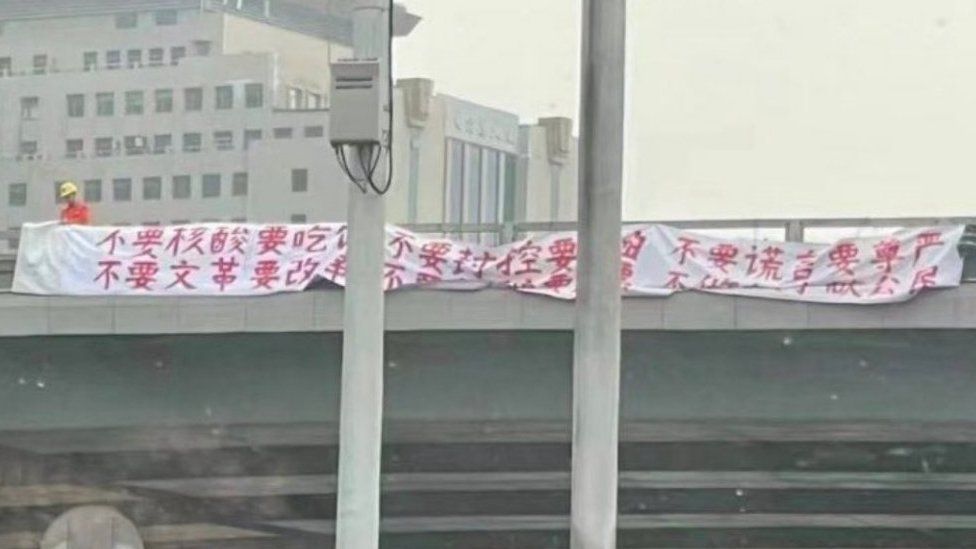
A rare and dramatic protest against President Xi Jinpingin Beijing has spurred an internet search for the mystery protester’s identity, as well as appreciation for the action.
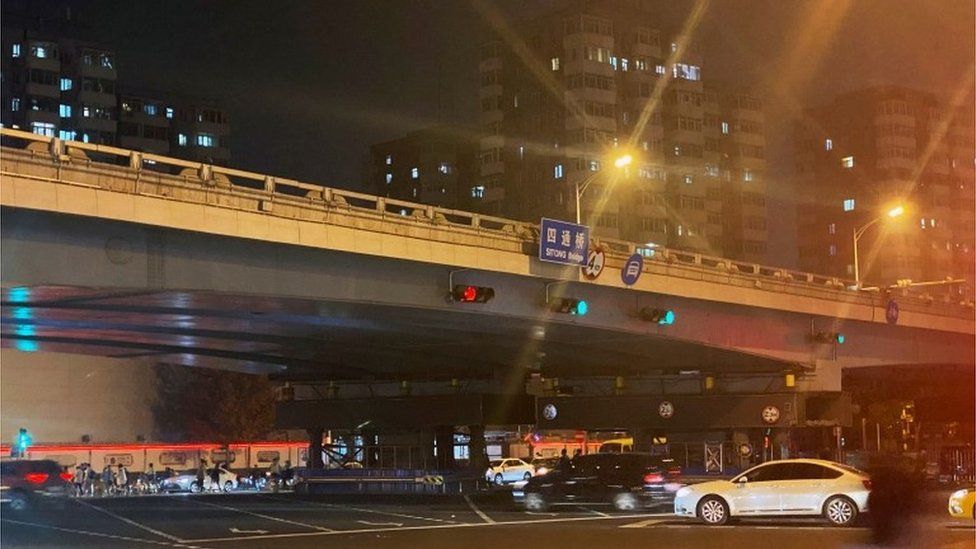
The protester had climbed the Sitong bridge in Beijing’s Haidian area and draped two enormous banners asking for an end to China’s draconian zero-Covid policy and Mr Xi’s removal.
While state media have remained silent, photos and videos of Thursday’s event have circulated widely online, prompting a swift crackdown by censors on social media platforms and the WeChat app used by most Chinese.
Thursday’s protest took place on the eve of a historic Communist Party congress, where Mr Xi is due to be handed a third term as party chief, cementing his hold on power.
The person also set what appeared to be car tyres on fire, and could be heard chanting slogans into a loudhailer.
Reports say one person has been arrested in connection to the protest. Pictures of the incident showed police officers surrounding the person, who wore a yellow hard hat and orange clothing.
The BBC has asked local police for comment.
Many have praised the lone protester’s actions, calling them a “hero” and referring to them as the “new Tank Man” – a reference to the unknown Chinese man who stood in front of tanks during the 1989 Tiananmen protests.
IMAGE SOURCE,TWITTER Image caption, The protester is believed to be the man dressed in an orange worksuit
Online sleuths have attempted to track the person down, focusing on a Chinese researcher and physicist hailing from a village in the northern province of Heilongjiang. A BBC check with village officials confirmed that a man with that name used to live there.
He had posted what appeared to be a manifesto on the popular research site ResearchGate. This was later taken down, though others have since uploaded copies of it.
In the 23-page document, he called for a strike and acts of civil disobedience – such as smashing Covid testing stations – on Sunday. This was to stop “the dictator Xi Jinping from illegally continuing in office, so that China can embark on the road to democracy and freedom”.
Some Chinese have congregated on the man’s two Twitter accounts, posting what they claimed were his pictures and writing hundreds of grateful messages.
“You’re a hero and you have my respect,” wrote one person, while another said: “Salute to the hero of the people! Hope you can safely return!”
The man’s name is among the material related to the protestthat has been censored online. No references to the incident could be found on Chinese social media site Weibo as on Friday morning.
Footage and pictures of the protest and related keywords including “Haidian”, “Beijing protester” and “Sitong bridge” were quickly scrubbed. Phrases tangentially related to the protest, including “bridge” and “hero”, also returned limited results.
IMAGE SOURCE,REUTERS Image caption, By Thursday evening all traces of the protester’s actions had been removed
Although Chinese media have not reported on the incident, former Global Times editor Hu Xijin appeared to refer to it when he tweeted on Thursday evening that the “vast majority” of Chinese people supported Communist Party rule and were “hoping for stability and opposing upheaval”.
Many Chinese have reported that their accounts on social media platformsor WeChat – China’s biggest messaging app – had been temporarily banned after they shared pictures of the protest or posted messages alluding to the protest.
The BBC has reached out to Tencent, WeChat’s parent company, for confirmation.
Such dramatic protest – and public criticism of the government – is rare in China, though China’s tough “zero Covid” policy has fuelled growing public frustration.
In 2018 a woman who defaced a poster of Mr Xi, saying she opposed his “tyranny”, was later admitted to a psychiatric hospital.
The Beijing protester’s actions come at an especially politically sensitive time, with thousands of police officers expected to be mobilised across the capital ahead of the week-long party congress.
The group’s activists have been blocking roadsaround parliament and elsewhere in London in the last few days.
Last Sunday, police said that more than 100 people had been arrested after a weekend of protest-related activity by
environmental groups.
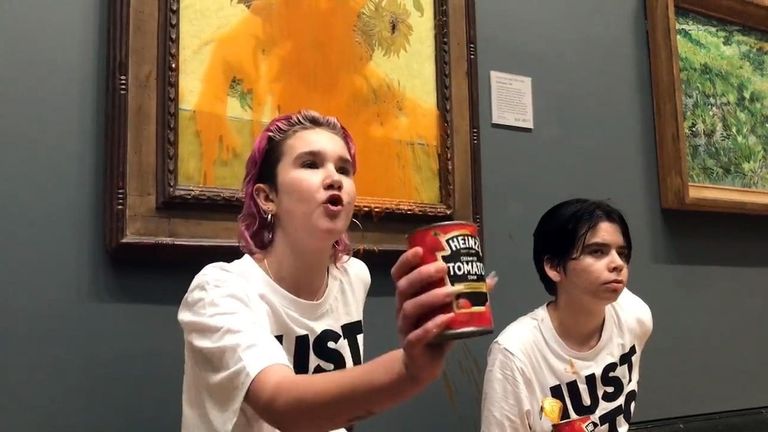
During the protest at the National Gallery, Ms Plummer said: “Are you more concerned about the protection of a painting? Or the protection of our planet and people?
“The cost of living crisis is part of the cost of oil crisis.
“Fuel is unaffordable to millions of cold hungry families. They can’t even afford to heat a tin of soup,” she added, brandishing a tin.
Image:Pic: Just Stop Oil
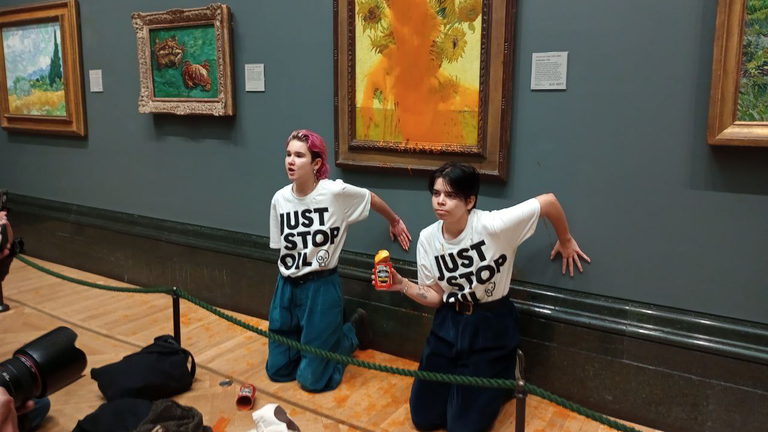
Gasps and exclamations of “oh my gosh!” and “security” rang out from onlookers as the soup hit the painting. Visitors were quickly escorted out by security, who then shut the doors to room 43 of the gallery where the painting hangs.
Police have arrested two people for criminal damage. In a tweet from the Metropolitan Police Events account, the force said: “Officers were rapidly on scene at the National Gallery this morning after two Just Stop Oil protesters threw a substance over a painting and then glued themselves to a wall.
“Both have been arrested for criminal damage & aggravated trespass. Officers are nowde-bonding them.”
The Bank of England‘s help with the markets has finished today (see 4.04 pm post).
But what have today’s events done to the markets?
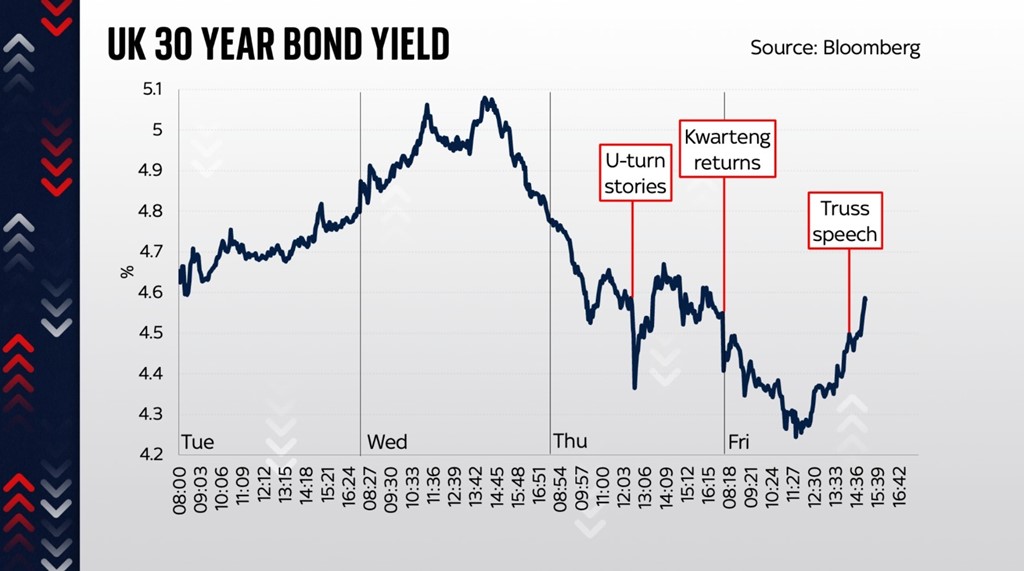
As Sky News business presenter Ian King explained: “30-year-gilts spiked earlier this week – hitting 5.1%, the highest level since 2002.
“That was on the back of comments made by Andrew Bailey, the governor of the Bank of England overnight on Tuesday that said pension funds only had three days in which to sort this issue out with today being the final deadline.
“The Bank started buying gilts more heavily on Wednesday and Thursday.
“You can see there on the chart the rumours in the middle of yesterday that the government was going to have to U-turn further on its mini-budget.
“And then we had rumours Kwasi Kwarteng was going to go – so you saw yields fall very, very sharply.
“They fell to as low as 4.1% this morning – a colossal move in terms of the scope of these things from 5.1% on Wednesday.
“Then we had confirmation that Mr Kwarteng had resigned – or been sacked – and you saw Liz Truss speak.
The higher the bond yield is, the more the government is going to have to pay for borrowing money.
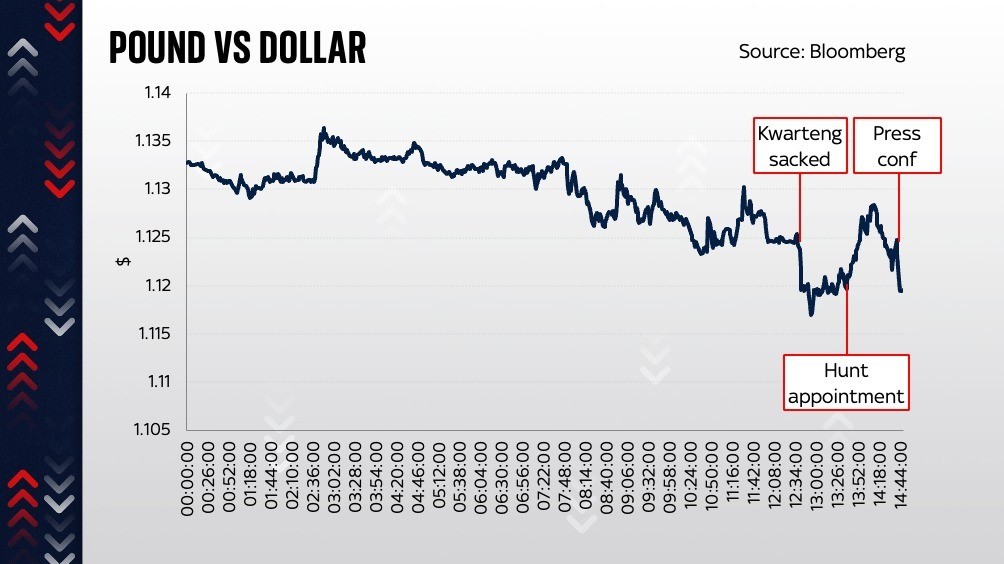
The pound has also been tumultuous today – falling with Mr Kwarteng’s sacking, rising on Mr Hunt’s appointment, and falling on Ms Truss’s press conference.
She has sacked her chancellor, committed a second major U-turn on her mini-budget, and junked the core of her economic policy.
And she did so, awkwardly and uncomfortably, in no more than 8 minutes.
In an excruciating new conference – so short that the gathered political press pack were left open-mouthed as she departed – Liz Truss made her already perilous political position even worse.
The aim of this breakneck change in direction was to attempt to calm markets and her Conservative colleagues, but instead, she left huge questions unanswered.
It’s worth underlining the significance of what the prime minister just announced.
First, on policy, she has buckled and reversed her position on corporation tax. She will now go ahead with the increase proposed by her leadership rival, Rishi Sunak.
During the contest to replace Boris Johnson as Tory leader, Ms Truss had said increasing the rate from 19% to 25% next April would “put off people who want to invest in Britain” and amount to “cutting off our nose to spite our face.”
It was a significant part of the platform on which she was elected Tory leader, now humiliatingly discarded in order to bring in around £18 billion to fill the black hole left by last month’s mini-budget.
She said it was a “down payment” on the medium-term fiscal plan due to be set out on 31 October – a signal to the markets that she’s prepared to make more reversals if necessary.
Does she still believe it will put people off investing? We don’t know because she didn’t stick around at the news conference long enough to be asked.
On the sacking of Kwasi Kwarteng as chancellor, she expressed her sorrow – but again, did not answer the obvious question about how she can possibly justify his departure without her own.
The chancellor, who was supposed to be one of her closest political friends, was also humiliatingly discarded – along with the government’s radical economic mission for which she had asked him to lead the charge.
The way in which the prime minister delivered this news really matters. Not just because of the lack of scrutiny that came from only taking four questions and barely engaging with them in the answers – but because her party, and indeed the markets, will have been watching to see how she handled the situation.
That news conference was not just about communicating with the public. The messages I received from Conservative MPs ahead of the news conference made clear that she needed to put in a really strong, reassuring performance.
Their fears are that she is out of her depth. They want to see that she can handle being prime minister. And the early signs are that her performance today failed on both fronts.
One MP has messaged me saying that it was “shockingly bad”, even by Liz Truss’s standards.
Jeremy Hunt’s installation as the new chancellor may be intended to show the ship is being steadied – that someone with deep experience in government is at the helm of the economy and that markets do not need to fear further surprises.
But power flows from Number 10. The prime minister is the head of government.
The prime minister is the person who must command the confidence of the Commons if they are to remain in post.
This prime minister looks out of her depth. “It’s not going to last,” is how one cabinet ministerput it to me.
DISCLAIMER: Independentghana.com will not be liable for any inaccuracies contained in this article. The views expressed in the article are solely those of the author’s, and do not reflect those of The Independent Ghana
The governmentof Zanzibar is probing why hundreds of dead swimming crabs have washed up on the beaches of Tanzania’s islands.
There have been reports of dead crabs washing ashore at Mtoni, Mizingani, and Forodhani public beaches since September 28.
The government is urging people not to worry it might be caused by pollution.
Reports indicate climate change leading to an abrupt change in the temperature of the sea might be to blame.
“Some living things like the swimming crabs cannot resist sudden changes in the sea, and they die and wash ashore,” Dr Salum Soud, a marine biologist and Zanzibar’s director of development and fisheries, told the BBC.
“Ocean waters have layers of temperatures and so the waves force water underneath to go up, thus may cause low oxygen hence the crabs are likely to face death,” he added.
The mass deaths of the crabs is not an isolated incident, according to Sheha Mjaja Juma, Director General of the Zanzibar Environment Management Authority (Zema), who told Tanzania’s The Citizen paper it had also happened in Seychelles.
The British diplomatic service copes well with fast-changing plans… and for the staff of the British Embassy in Washington, from the ambassador to the chefs, Thursday evening was one to remember.
The (now ex) chancellor was in town for the IMF annual gathering. He’d already missed key meetings throughout the day.
I’d watched an aide, red government folder in hand, dash across the IMF atrium to tell organisers that Kwasi Kwarteng’s deputy would take his seat. Something was afoot.
By early evening the intrigue shifted to the British Embassy.
I joined a couple of hundred guests for a drinks reception hosted by theambassador and the Institute of International Finance. The chancellor was the guest speaker.
He came, he spoke, he was confident, he was relaxed. But the dinner organised for later at the ambassador’s residence was off. The staff had been told to prepare drinks and canapés instead.
We journalists were encouraged to leave the reception and head to the residence. The chancellor had something to tell us.
And so, after a scuttle through the Washington rain from embassy to residence, I found myself listening to a chancellor – white wine in hand – reveal that he would be leaving the IMF on the red-eye flight to London.
Important talks on the fiscal plan, we were told.
Within 10 hours he’d been fired.
DISCLAIMER: Independentghana.com will not be liable for any inaccuracies contained in this article. The views expressed in the article are solely those of the author’s, and do not reflect those of The Independent Ghana
Source: SkynewsBy Mark Stone, US correspondent in Washington DC
Jeremy Hunt, one of the faces of the One Nation Conservative camp within the Tory party, is the new chancellor under a Liz Truss government.
Ideologically they may see eye to eye on keeping corporation tax low – Hunt told Sky’s Sophy Ridge in July he not only wanted the tax not to rise but he wanted it slashed further – but Hunt is by no means seen as an obvious bedfellow for the prime minister.
For example, health secretary, Hunt was in favour of banning junk food adverts before 9 pm as part of a push to reduce childhood obesity. This policy was never implemented, however, as it was seen as a ‘nanny-state’ policy. This is just one example to suggest that these two heavy hitters could end up falling out.
Will Liz Truss’s libertarian instincts put her at loggerheads with her new chancellor? Or will the ideological differences between them make for a more balanced dialogue around the cabinet table?
Strategically, Truss will be hoping that appointing Hunt will assuage Tory anger and bring back the One Nation MPs out for blood. But Hunt inspires a lukewarm reaction (at best), even among sympathetic MPs.
Firstly, he was not even able to gain enough support from fellow MPs in the latest leadership race to make it past the first round of voting.
Secondly, one former cabinet minister told me: “He brings no one with him” and is “yesterday’s man”. Another former minister pleased with the hire said they were happy but not excited, and that it made little difference to Truss’s life expectancy as prime minister: “She cannot reassert her authority after this. It’s over.”
Although sacking Kwasi Kwartengmay look like a sign of strength from Truss, she has now amputated her own political right arm, making her life ten times harder.
Kwarteng and Truss were seen as ideological soulmates, something mirrored in Truss’s letter to her former chancellor where she said: “We share the same vision for our country”.
And now rebellious Tory backbenchers know the lady is for turning, she will be pulled in every which way by the increasingly divided factions of her chaotic party until she is ripped apart beyond repair.
DISCLAIMER: Independentghana.com will not be liable for any inaccuracies contained in this article. The views expressed in the article are solely those of the author’s, and do not reflect those of The Independent Ghana
Russia’s Geneva U.N. envoy told Reuters on Thursday that Moscow has expressed reservations to the UN about a pact on Black Sea grain exports and is prepared to reject renewing the accord next month unless its demands are met.
The July accord, mediated by the UN and Turkey, allowed Ukraine to resume grain exports from Black Sea ports that had been closed since Russia’s invasion. Moscow obtained assurances for its own grain and fertiliser exports.
The agreement helped stave off a global food crisis: Russia and Ukraine are two of the world’s biggest grain exporters and Russia is the number one fertiliser exporter. But Moscow has repeatedly complained about its implementation, arguing it still faces difficulty selling fertilizer and food.
In an interview with Reuters, Gennady Gatilov, Russia’s ambassador to the United Nations in Geneva, said Moscow had delivered a letter to U.N. Secretary-General Antonio Guterres on Wednesday setting out a list of complaints. U.N. officials are due in Moscow on Sunday to discuss the renewal of the agreement.
“If we see nothing is happening on the Russian side of the deal – export of Russian grains and fertilisers – then excuse us, we will have to look at it in a different way,” he said.
He declined to make a copy of the letter available. A spokesperson for the United Nations did not immediately respond to a request for comment.
\Asked if Russia might withhold support for the grains deal’s renewal over the concerns, he said: “There is a possibility…We are not against deliveries of grains but this deal should be equal, it should be fair and fairly implemented by all sides.”
Gatilov, a career diplomat who was deputy minister of foreign affairs before taking up the Geneva post, said that he saw fading prospects for a negotiated settlement to the nearly eight-month war in Ukraine. He cited what he called “terrorist acts” such as an explosion on a bridge to Crimea.
“All this makes it more difficult to reach a political solution,” he said.
Washington has said that Russian claims to be open to talks on the war’s future amount to “posturing” as it continues to strike Ukrainian cities.
Asked about the prospect of a meeting between President Vladimir Putin and U.S. President Joe Biden, Gatilov said it was not feasible given the levels of U.S. military support for Ukraine. “It makes the U.S. a part of the conflict,” he said.
However, he was more upbeat on other negotiated outcomes such as on aid access and a further prisoner swap, calling these “a possibility”.
Labour leader Sir Keir Starmer has said Kwasi Kwarteng’s sacking does not “undo the damage” already inflicted by Liz Truss’s government through the mini-budget.
“Changing the chancellor doesn’t undo the damage made in Downing Street,” he posted on Twitter.
Changing the Chancellor doesn’t undo the damage made in Downing Street.
Liz Truss’ reckless approach has crashed the economy, causing mortgages to skyrocket, and has undermined Britain’s standing on the world stage. 1/2
Finally, Truss is asked about comments from former Chancellor Philip Hammondwho told the BBC earlier that she has “trashed” the Tory Party’s reputation.
She is asked by ITV’S Robert Peston if she will apologise to her party.
Truss responds that she is determined to deliver on what she set out when she campaigned to be party leader.
She says the UK needs to have a high-growth economy but recognises the “difficult issues” facing the country.
It was right in the national interest to make the decisions she has announced today, she adds.
And with thatshe ends the conference, saying “thank you very much”.
Prime Minister Liz Trusssays what she has done today is make sure “we have economic stability in this country”.
She says: “Jeremy Hunt as chancellor is somebody who shares my desire for high growth, low tax economy.
“But we recognise because of current market issues, we have to deliver the mission in a different way.
“And that’s where we are absolutely committed to achieving that stability.”
Asked if she will apologise after the former Tory chancellor, Philip Hammond, said that she had trashed the party’s winning reputation for economic competence, she adds: “Well, I am determined to deliver on what I set out when I campaigned to be party leader.
“We need to have a high growth economy, but we have to recognise that we are facing very difficult issues as a country.”
The prime minister then walks off stage having only taken four questions from the press during a news conference that was less than 10 minutes.
Liz Trusssays she “acted decisively” as her first consideration is what is in the national interest.
Asked why she should stay as prime minister now her economic plan has been dismantled, the PM says: “I am determined to see through what I’ve promised – deliver higher growth, a more prosperous the United Kingdom.”
Ms Truss says her priority is “delivering the economic stability this country needs”.
She repeats: “I have to act in the national interest as prime minister.”
PM Liz Trusssays she met the “former chancellor” Kwasi Kwateng today.
“I was incredibly sorry to lose him,” she says.
“He is a great friend and he shares my vision to set this country on the path to growth. Today, I have asked Jeremy Hunt to become the new chancellor. He’s one of the most experienced and widely respected government ministers and parliamentarians, and he shares my convictions and ambitions for our country.
“He will deliver the medium-term fiscal plan at the end of this month. He will see through the support we are providing to help families and businesses, including our energy price guarantee.
“That’s protecting people from higher energy bills this winter. And he will drive our mission to go for growth, including taking forward the supply-side reforms that our country needs. We owe it to the next generation to improve our economic performance, to deliver higher wages, new jobs, and better public services, and to ease the burden of debt.
“I have acted decisively today because my priority is ensuring our country’s economic stability as prime minister.”
Liz Trussis now giving a press conference in Downing Street.
She has confirmed that the corporation will rise to 25% from 19% in a major policy U-turn.
It is the second reversal of a mini-budget policy after the government decided not to scrap the 45p highest income tax threshold.
“It is clear that parts of our mini-budget went further and faster than markets were expecting, so the way we are delivering our mission now has to change,” she said
Justice Secretary Brandon Lewis is the first cabinet minister out of the blocks to congratulate Jeremy Hunton his appointment as chancellor this afternoon.
“Congratulations Jeremy Hunt and look forward to working together to drive growth for everyone in the UK,” he posted on social media.
“Legal services are a huge part of the UK economy delivering jobs in all parts of the country.”
Congratulations @Jeremy_Hunt and look forward to working together to drive growth for everyone in the UK, legal services are a huge part of the UK economy delivering jobs in all parts of the country. https://t.co/ZzZcxZQuFq
Labour and Lib Dem MPs are weighing in with their opinions on the recent sacking of Kwasi Kwartengas chancellor.
Jeremy Hunt was announced as his replacement shortly after.
MPfor Wolverhampton South East Pat McFadden says changing the chancellor “will not get the PM off the hook” and that she is a 100% co-owner of the mini-budget”, while others call for a general election.
The news that Prime Minister Liz Truss will hold a press conference on the economy later today sent UK government bonds climbing.
The bonds are issued by the government to raise money and in return, it pays interest on them. The higher the price of the bonds, the lower the interest rate it pays, known as the yield.
The bond price fell after September’s mini-budget, causing yields to climb to their higher level since the financial crash in 2008, as investors demanded higher returns to lend to the UK.
Yields on 30-year UK bonds hit 5.17% on 28 September in the aftermath of the mini-budget. Today’s news sent them tumbling to as low as 4.22%.
However, that’s still some way above the level they were at the day before the mini-budget on 23 September – then they stood at 3.59%.
DISCLAIMER: Independentghana.com will not be liable for any inaccuracies contained in this article. The views expressed in the article are solely those of the author’s and do not reflect those of The Independent Ghana
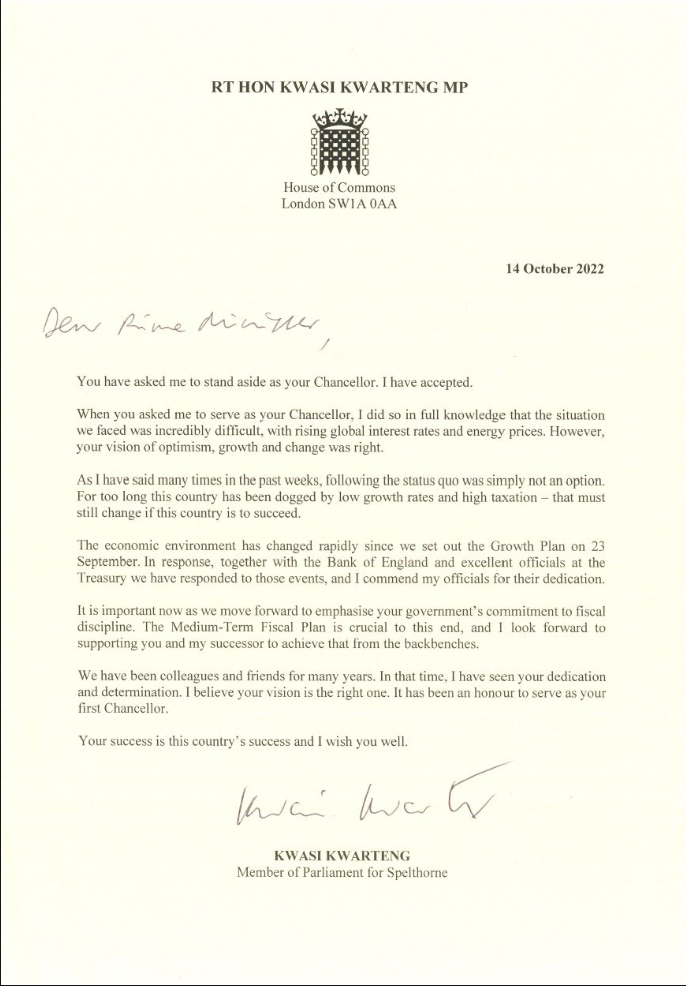
Kwasi Kwartenghas confirmed he has today been sacked as chancellor after just 38 days in the role.
Publishing a letter he has written to Prime Minister Liz Truss on Twitter, Mr Kwarteng said it had been “an honour” to serve as her first chancellor.
Describing the “incredibly difficult” situation Ms Truss’s government inherited, Mr Kwarteng’s letter adds: “However, your vision of optimism, growth and change was right.
“As I have said many times in the past weeks, following the status quo was simply not an option.
“For too long this country has been dogged by low growth rates and high taxation – that must still change if this country is to succeed.”
Despite growing calls for further U-turns over the government’s controversial mini-budget, Mr Kwarteng describes his Medium-Term Fiscal Plan – due to be unveiled on 31 October – as “crucial”.
He says he believes the PM’s “vision is the right one”, adding that he looks forward “to supporting you and my successor” from the back benches.
Mr Kwarteng’s letter concludes: “Your success is this country’s success and I wish you well.”
Discussion is happening at all levels in the Conservative partyabout whether the prime minister can survive – even if she replaces her chancellor.
As one senior minister in her government put it to me this morning before reports that Kwarteng would be sacked: “I honestly don’t think either of them, Liz or Kwasi have a clue, I don’t think they know what they’re doing.”
“They’ve got one shot to satisfy the markets,” the minister said – with a full U-turn on the corporation tax freeze and perhaps more: “The worst possible thing, now the markets have priced in a U-turn on corporation tax would be mealy-mouthed partial U-turn.”
“But my instinct is she won’t survive. She’s introduced herself to the country in the worst way imaginable, and people’s views of her are quite settled now.
“Even if she stays, you can’t have a chancellor who has lost the confidence of the markets, that’s never happened before that I can remember”. The minister said the prime minister might need a complete reboot of the Treasury team to restore confidence, but having jettisoned key parts of her economic programme, “she is a husk.”
This minister and others point out that her controversial supply-side reforms are likely to be opposed in parliament – as are spending cuts on the scale that may be needed to pay for her measures.
Other MPs also say she will need a humiliating change of direction to survive. One long-serving MPsaid: “It’s unfair for Kwasi to go in the sense that it was all her idea, but politics isn’t fair. It’s a matter of survival for her now, there are discussions going on but it’s not organized yet.”
DISCLAIMER: Independentghana.com will not be liable for any inaccuracies contained in this article. The views expressed in the article are solely those of the author’s and do not reflect those of The Independent Ghana
After Russia’s invasion of Ukraine, the International Committee of the Red Cross (ICRC) has asked for immediate access to all prisoners of war.
In an apparent response to comments made by Ukrainian President Volodymyr Zelenksyy, the committee also stated that it has been “ready for months” to visit the Olenivka penal facility.
Speaking in his nightly video address on Thursday, Mr Zelenskyy accused the ICRC of inaction in upholding the rights of Ukrainian prisoners of war.
In the latest in a series of Ukrainian criticisms of the ICRC, Mr Zelenskyy also said no one had yet visited Olenivka – a notorious camp in eastern Ukraine where dozens of Ukrainian POWs died in an explosion and fire in July.
The ICRC should be granted the right to visit prisoners wherever they are held under the Third Geneva Convention.
“We share the frustration regarding our lack of access to all prisoners of war (POWs) held in the international armed conflict between Russia and Ukraine,” the ICRC said in a statement.
“We have been working since February to obtain access to check on the conditions and treatment of POWs and keep their families informed about their loved ones.
“We have been able to visit hundreds of POWs but there are thousands more who we have not been able to see.
“We want to stress that our teams are ready on the ground—and have been ready for months—to visit the Olenivka penal facility and any other locationwhere POWs are held. Which Zelenksyy called for overnight.
“However, beyond being granted access by high levels of authority, this requires practical arrangements to materialize on the ground.
“We cannot access by force a place of detention or internment where we have not been admitted.”
Belarusian President Alexander Lukashenko said his country is on high alert for terrorism due to tensions on its borders.
Mr. Lukashenko linked the decision to his declaration on Monday that he had ordered Belarusian troops to deploy along Belarus’s southern border with Ukraine alongside Russian forces.
“In connection with the escalation of tension, a regime of heightened terrorist danger has been introduced,” Mr Lukashenko said in a Russian TV interview.
“Therefore we began a procedure with the Union group of forces, the basis of which, as I already said, is the Belarusian army, which will be supplemented by units from the Russian Federation. Everything is going according to plan.”
Belarus is allied with Moscow but wedged between Russia, Ukraine, and three NATO countries.
Belarus allowed Russia to use its territory as one of the launchpads for its 24 February invasion.
Its latest troop movements have raised concern in Kyiv and the West that Mr Lukashenko may be about to commit his army to support Russia’s faltering war effort.
Political analysts say that is an unappealing option for him but that he may not be in a position to refuse if Russian President Vladimir Putin demands it.
Belarus depends on Russia politically and economically, and Mr Putin’s support helped Mr Lukashenko survive mass pro-democracy protests in 2020.
Mr Lukashenko crushed the demonstrations and all leading opposition figures have been jailed or forced to flee abroad.
The three judges in the Nigerian appeal court agreed unanimously to dismiss the allegations.
The Court of Appeal in Nigeria has dismissed the government’s terrorist charges against separatist leader Nnamdi Kanu, in a unanimous judgment by all three judges hearing the case.
On Thursday, the lead judge dismissed a seven-count charge of terrorism against Kanu and discharged him, saying a lower court had no jurisdiction to try the case and that Kanu was abducted and extraordinarily extradited to Nigeria.
“In view of the fact that the trial court lacks jurisdiction to hear this case because the process of extradition of the appellant from Kenya to Nigeria was unlawful since the due process was not followed, this appeal succeeds,” the lead judge, Justice Oludotun Adefope Okojie, said.
“Consequently, the appellant is therefore discharged,” she said.
In April, Nigeria’s High Court ruled that Kanu should stand trial.
He leads the Indigenous People of Biafra (IPOB), which campaigns for the secession of southeastern Nigeria where the majority are of Igbo ethnicity.
Nigerian authorities have labelled IPOB a ‘terrorist’ organisation.
A spokesperson for Nigeria’s attorney general said the government was considering its legal options following Thursday’s ruling but said the charges Kanu faced before he disappeared while on bail in April 2017 “remain valid issues for judicial determination”.
Kanu denied the charges of terrorism and knowingly broadcasting falsehoods, which are linked to social media posts he issued between 2018 and last year.
His lawyers argued that he could not receive a fair trial because he was forcefully extradited from Kenya to Nigeria. Kenya has declined to say if it played a role in Kanu’s return.
An attempt by Igbo separatists to secede as the Republic of Biafra in 1967 — the year that Kanu was born — triggered a three-year civil war that killed more than one million people.
Since Kanu’s trials began in Abuja, IPOB has ordered residents of the southeast to “sit at home”, a form of civil disobedience to show solidarity with Kanu.
The IPOB campaign has crippled small businesses and routinely disrupted other economic activity in the five states of the region.
At least 11 people were killed and 53 injured when a bus hit an explosive device in central Malion Thursday, according to a hospital source.
The explosion occurred on the road between Bandiagara and Goundaka in the Mopti area on Thursday afternoon, a security source said. The region is known as a hotbed for violence by roaming armed groups.
“We have just transferred nine bodies to the clinic. And it’s not over yet,” said Moussa Housseyni of the local Bandiagara Youth Association, adding that they were all civilians.
Earlier, police and local sources gave a provisional toll of 10 dead and many seriously injured.
For more than a decade, Mali has struggled to contain activity by armed rebel groups that has killed thousands of people and forced hundreds of thousands from their homes.
A report by MINUSMA, the United Nations mission in Mali, found that mines and IEDs had killed 72 people in 2022 as of August 31. Most of the victims were soldiers – but more than a quarter were civilians, the report said.
Last year, 103 people were killed and 297 injured by IEDs and mines.
Authorities have increased arrests of dissidents ahead of the elections next month.
Equatorial Guinea has detained a human rights activist for 18 days after he aided opposition activists during a police siege of their party offices, his lawyer and wife told AFP on Thursday.
The justice ministry refused to comment on the report when contacted by AFP.
Anacleto Micha Nlang, co-founder of the bannedrights group “Guinea is also ours” was arrested on September 25 after returning from the offices of the Citizens for Innovation (CI) party. He had delivered food to families – including women and children – under siege there, his wife Montserrat Mikue and lawyer Evaristo Nguema Elo confirmed to AFP.
The small, Spanish-speaking central African country is one of the most closed and authoritarian in the world. It is led by Teodoro Obiang Nguema Mbasogo, the world’s longest-serving incumbent president, who has been in power since 1979.
In 2021, Reporters Without Borders ranked Equatorial Guinea at 164 among 180 countries in its press freedom index.
With presidential, legislative, and municipal elections just over a month away, authorities have stepped up arrests in recent weeks.
State media has justified the crackdown as a bid to counter a “foiled plot” by the opposition to carry out attacks on embassies, petrol stations and the homes of ministers.
On September 30, after a siege lasting more than a week, security forces stormed the home of CI leader Gabriel Nse Obiang Obono, whose house had also served as an office for the banned party since 2018.
The assault left five dead – four activists and a policeman, according to authorities.
Dozens were injured and more than 150 people were arrested from among the 200 who had camped out there, including Obono.
The authorities said they stormed the building to detain the CI chief who refused to surrender to a court warrant as part of the investigation into the alleged plot.
Nlang was detained at Malabo’s central police station before being transferred on October 11 to Black Beach prison, also in the capital, his lawyer and the Somos+ Sociedad Civil rights group told AFP.
“He has been transferred to the world’s worst prison, Black Beach,” the group said in a statement, alleging a “policy of terror.”
The decision came after intense negotiations between ASUU and government representatives at a meeting mediated by members of the House of Representatives in Abuja, local media reported.
“Let all of us working together and the members of the House of Representatives working together put a beautiful end to this thing we have started so that every Nigerian will be proud that we have the universities we can be proud of,” ASUU president Emmanuel Osodeke was quoted as saying by local media.
“We also extend our appreciation to the president for intervening in the ASUU strike. And I want to appeal that in future we should not allow the strike to linger. The strike should not go beyond two days,” Osodeke added.
He is also expected to announce in the coming days when academic activities will resume in universities.
Millions of students nationwide have been at home since February 14 as part of the latest of a long wave of strikes, which are common in Nigeria.
Nigeria has more than 100 public universities and an estimated 2.5 million students, according to the country’s National Universities Commission. At least 15 recorded strikes have taken place in the universities since 2000.
The striking lecturers were demanding a review of their conditions of service including the platform the government uses to pay their earnings, improved funding for the universities, and payment of their salaries withheld since the strike started.
Former US ambassador to Russia Michael McFaul has been analysing the implications of Vladimir Putin’s latest escalation of his war on Ukraine.
In a Washington Post op-ed, he calls the president’s actions concerning but ultimately self-defeating.
He claims that the leader’s decision to illegally seize Ukrainian territory made reaching a peace agreement substantially more difficult.
In an op-ed in the Washington Post, he decries the president’s actions as worrying but also ultimately self-defeating.
He says the leader’s decision to illegally annex Ukrainian territory made a peace deal significantly harder
“With great difficulty, Ukrainian President Volodymyr Zelenskyy might have been able to fudge some sort of formula tacitly accepting Russian control over Crimea and Donbas, but it will be impossible for him to agree to comparable concessions on Kherson and Zaporizhzhia,” he writes.
Saying Mr Putin “has pushed himself into a corner”, he suggests “the only way to end this war might involve putting someone else in power in Moscow”.
“If the war continues to go badly, the voices quietly supporting suing for peace will grow,” he says.
“Tensions between the Russian military and intelligence services are already spilling into the open. These tensions will only grow if Russia’s soldiers continue to die and retreat in Ukraine.”
On the Russian leader’s threat’s around nuclear weapons, Mr McFaul says: “If Putin were to use a nuclear weapon (God forbid), that might also very likely deliver the final blow to his hold on power in Russia.
“No world leader would support him. The democratic world would be compelled to respond, both with more sophisticated weapons for Ukraine…
“After a nuclear attack, no Ukrainian leader would call for surrender. Instead, Zelensky would have every reason to bring the war to Russia, including attacks on targets in Moscow and other major cities. (Who doubts that Ukraine has sleeper cells in Moscow?) At the same time, it is hard to believe a majority of Russians would welcome the use of nuclear weapons against their Slavic neighbours.
“Putin would likely end up looking alone in his own country, a madman who must be stopped.
“The best way for Putin to hold on to power is to end his invasion today. He could declare victory regarding the defence of Donbas and then order his diplomats to settle into a long negotiation about the borders and political rights of those living in Donbas.
In Kazakhstan’s capital, Astana, Russian President Vladimir Putin visited Qatar’s Emir, Sheikh Tamim bin Hamad Al Thani.
Kremlin aide Yuri Ushakov said politics and trade were the focus of the discussions at Thursday’s meeting.
“I would single out cooperation in the energy market, cooperation between Russia and Qatar within the framework of the Gas Exporting Countries Forum,” he told reporters.
The meeting was an attempt to diffuse tensions between Russia and Qatar, which have grown since the Ukraine crisis broke out earlier this year, according to a source familiar with the talks.
Major gas-exporter Qatar has sought a largely neutral stance on the conflict but several moves by the Gulf Arab state have recently irked Moscow, the source told Reuters news agency.
Sheikh Tamim called Ukrainian President VolodymyrZelenskyy on Monday hours after explosions rocked several Ukrainian cities, including the capital Kyiv. Qatar has criticised Russia’s annexation of Ukrainian territory and was one of eight non-NATO countries to join a NATO meeting earlier this year, the source said.
Russia had shown its displeasure by interfering in key Qatar dossiers, the source said, citing as examples its delivery of humanitarian aid in Syria and its role in facilitating talks between world powers on Tehran’s nuclear programme.
Qatar “needs cordial relations with Russia and others in the region”, in order to continue to play a role as a conflict mediator, the source said.
Russia is intensifying its targeted attacks on crucial infrastructure in Ukraine for the seventh day in a row.
Multiple Russian missile attacks jolted the Zaporizhzhia region’s capital overnight, as the city remained a target for Russian assault.
Zaporizhzhia regional Governor Oleksandr Starukh said Friday morning several explosions were reported in the city overnight at infrastructure facilities, causing fires.
Preliminary reports mentioned no victims.
Russian forces have struck the regional capital and the surrounding area continuously in recent days and weeks, creating concerns about the safety of the nearby nuclear power plant.
The regional capital is about 100 miles (160 kilometers) from the plant, which is the largest nuclear power facility in Europe.
The heavier Russian barrage began last Monday and comes as Ukraine pushes its military counteroffensive on the southern front.
Volunteers clear debris after an attack on Zaporizhzhia earlier this week.
UN Security Council resolution drafted by the United States and Mexico names ‘Barbecue’ as one of Haiti’s most powerful gang bosses.
According to a draught resolution obtained by various news outlets, the United Nations Security Council is considering imposing asset freezes, travel bans, and arms embargoes on anybody who threatens Haiti’s peace, security, or stability.
The first person to be sanctioned would be Jimmy Cherizier, who goes by the nickname “Barbecue” and is described in the United States and Mexico-drafted resolution as one of Haiti’s most influential gang leaders.
“Cherizier and his G9 gang confederation are actively blocking the free movement of fuel from the Varreux fuel terminal,” the text says. “His actions have directly contributed to the economic paralysis and humanitarian crisis in Haiti.”
Gangs last month blocked the entrance to Varreux to protest against a government announcement of a cut in fuel subsidies. Fuel supplies dried up and Haitians also face a shortage of drinking water amid a deadly outbreak of cholera.
“One of the challenges in effectively dealing with insecurity is the nexus between the gangs and some of the elites in Haiti and outside of Haiti who is supporting them and directing them for their own purposes,” US Secretary of State Antony Blinken said in Washington on Thursday.
“So we’ve been working together at the United Nations … to impose sanctions on those who are actually taking actions that support violence and support gangs,” he said at a joint news conference with visiting Mexican officials.
UN Secretary-General Antonio Guterres has proposed that one or several countries send “a rapid action force” to help Haiti’s police remove a threat posed by armed gangs, according to a letter to the Security Council, seen by Reuters news agency on Sunday.
In July, the council threatened targeted sanctions against criminal gangs and human rights abusers in Haiti and called on countries to stop the flow of guns to the Caribbean country.
The US State Department this week announced visa sanctions against those who support Haitian gangs,responding to the humanitarian crisis created by the gang blockade.
US Assistant Secretary of State Brian Nichols, who is leading a delegation of officials to the Caribbean nations, said in an interview with a local television station that Barbecue and the G9 gangs are directly contributing to the deaths of Haitians.
“Yesterday, the United States designated 11 individuals for visa sanctions,” Nichols said, adding that he could not name the individuals per US policy.
He said 1.2 million people in Haiti are at risk for cholera. Health experts say the gang blockade is making it more difficult to control the outbreak, which was announced this month.
The 15-member Security Council could vote as early as Monday on the draft sanctions resolution, diplomats said. To be adopted a resolution needs nine votes in favour and no vetoes by Russia, China, the US, France, or Britain.
China has been pushing for the Security Council to impose an arms embargo on criminal gangs in Haiti.
A UN mission in Haiti works with the government to strengthen political stability and good governance, rights protection, and justice reform and to help with organising free and fair elections.
UN peacekeepers were deployed to Haiti in 2004 after a rebellion led to the removal andexile of then-President Jean-Bertrand Aristide. Peacekeeping troops left in 2017 and were replaced by UN police, who left in 2019.
Elon Musk, the controversial tech billionaire, has stated that his SpaceX company will no longer provide essential satellite services to Ukraine unless the US military contributes tens of millions of dollars every month, according to CNN.
SpaceX requested that the Pentagon, the headquarters of the United States Department of Defense, take over funding for Ukraine’s government and military usage of Starlink.
SpaceX claims this would cost more than $120m (£106m) for the rest of the year and could cost close to $400m (£355m) for the next 12 months.
“We are not in a position to further donate terminals to Ukraine, or fund the existing terminals for an indefinite period of time,” SpaceX’s director of government sales wrote in the letter.
SpaceX has so far donated 20,000 Starlink satellite units to Ukraine since February.
The satellites have been a vital source of communication for Ukraine’s military since they arrived.
They allow Ukraine to fight and stay connected even as mobile phone and internet networks have been destroyed in its war with Russia.
Reports of the letter come a day after Mr Musk denied reports he has spoken to Russian President Vladimir Putin.
The denial follows a Twitter poll he shared earlier this month where he invited his 107.7 million followers to vote on a suggested “Ukraine-Russia Peace plan”, which included permanently ceding Crimea to Russia.
He said new referendums could be held under UN supervision to determine the fate of Russian-controlled territory, and that Ukraine agree to neutrality.
This drew sharp criticism from Ukrainian President Volodymyr Zelenskyy, who proposed his own Twitter poll: “Which @elonmusk do you like more? One who supports Ukraine (or) one who supports Russia.”
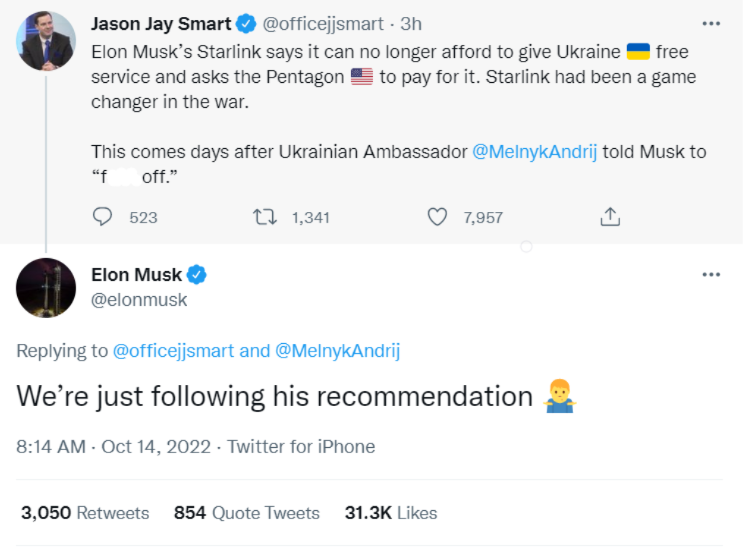
Following reports of SpaceX’s letter to the Pentagon, Kyiv Post correspondent Jason Jay Smartpointed out that it comes days after Ukrainian diplomat Andrij Melynk had tweeted Mr Musk telling him to “f*** off” in response to his Twitter poll.
Mr Musk replied to Mr Smart’s tweet: “We’re just following his recommendation.”
Ukraine-Russia Peace:
– Redo elections of annexed regions under UN supervision. Russia leaves if that is will of the people.
– Crimea formally part of Russia, as it has been since 1783 (until Khrushchev’s mistake).
He said new referendums could be held under UN supervision to determine the fate of Russian-controlled territory, and that Ukraine agree to neutrality.
This drew sharp criticism from Ukrainian President Volodymyr Zelenskyy, who proposed his own Twitter poll: “Which @elonmusk do you like more? One who supports Ukraine (or) one who supports Russia.”
Following reports of SpaceX’s letter to the Pentagon, Kyiv Post correspondent Jason Jay Smart pointed out that it comes days after Ukrainian diplomat Andrij Melynk had tweeted Mr Musk telling him to “f*** off” in response to his Twitter poll.
Mr Musk replied to Mr Smart’s tweet: “We’re just following his recommendation.”
In a sign that Russia is losing control of the territory it purports to have annexed, the government agrees to evacuate the Kherson people in response to a request from the Moscow-installed governor.
People from Ukraine’s southern Kherson region are anticipated to start arriving in Russia after a Moscow-installed administrator in the partially controlled region urged inhabitants to evacuate for their own safety.
In a sign of Moscow’s weakening hold on territory it claims to have annexed, Moscow said it would help residents evacuate amid an advancing Ukrainian counteroffensive.
“The government took the decision to organise assistance for the departure of residents of the [Kherson] region,” Russian Deputy Prime Minister Marat Khusnullin said on Thursday.
The Russian-installed governor of Ukraine’s southern Kherson region earlier told residents to take their children and flee, after Kyiv said it had retaken five settlements in the southern region.
In a video statement on Telegram, Vladimir Saldo had publicly asked for Moscow’s help transporting civilians to safer areas.
“Every day, the cities of Kherson region are subjected to missile attacks,” Saldo said. “As such, the leadership of the Kherson administration has decided to provide Kherson families with the option to travel to other regions of the Russian Federation to rest and study.”
“We suggested that all residents of the Kherson region, if they wish, to protect themselves from the consequences of missile strikes … go to other regions,” he said, advising people to “leave with their children”.
Residents on the west bank of the Dnieper River had priority, he said. That includes the regional capital, the only major Ukrainian city Russia has captured intact since its February 24 invasion.
Russia’s TASS news agency reported the first group of civilians fleeing from Kherson was expected to arrive in Russia’s Rostov region as soon as Friday. Others are expected to head to Crimea, which Moscow annexed in 2014.
Kherson is one of four partially occupied Ukrainian provinces that Russia this month announced it had annexed, and arguably the most strategically important. It controls both the only land route to the Crimean peninsula and the mouth of the Dnieper, the giant river that bisects Ukraine.
Since the start of October, Ukrainian forces have burst through Russia’s front lines there in their biggest advance in the south since the war began.
They have since moved rapidly along the river’s western bank, aiming to cut off thousands of Russian troops from supply lines and potential routes of retreat.
Kyiv says it has recaptured more than 400 square kilometres (155 miles) in the Kherson region in less than a week, with its forces bearing down towards the three-kilometer-long (two-mile-long) Nova Kakhovka dam that provides one of the last river crossings.
Mykolaiv, the nearest big Ukrainian-held city to Kherson, came under massive Russian bombardment on Thursday, with civilian facilities hit, local officials said.
Regional governor Vitaly Kim said the top two floors of a five-storey residential building were destroyed and the rest was under rubble. Video footage provided by state emergency services showed rescuers pulling out an 11-year-old boy who Kim said had spent six hours trapped under the destroyed building.
In the east, three Russian missiles exploded on Thursday morning near the central market in Kupiansk, a major railway junction city that Ukrainian forces recaptured during their big advance there in September.
The missiles destroyed shops, carpeting surrounding streets with glass shards, rubble, and twisted metal sheets.
‘Dangerous times’
On Thursday, NATO allies meeting in Brussels unveiled plans to jointly beef up Europe’s air defences with Patriot and other missile systems.
“We are living in threatening, dangerous times,” said German Minister of Defence Christine Lambrecht at a signing ceremony where Germany and more than a dozen European NATO members committed to jointly procuring weapons for a “European Sky Shield”.
Moscow said more military aid for Kyiv made members of the US-led military alliance “a direct party to the conflict” and said admitting Ukraine to NATO would trigger a global conflict.
Meanwhile, EU foreign policy chief Josep Borrell sent a strong message to the Kremlin after Russian President Vladimir Putin’s veiled threats of resorting to nuclear weapons to stem growing battlefield losses.
“Putin is saying he is not bluffing. Well, he cannot afford bluffing, and it has to be clear that the people supporting Ukraine and the European Union and the Member States, and the United States and NATO are not bluffing either,” Borrell said.
“Any nuclear attack against Ukraine will create an answer, not a nuclear answer but such a powerful answer from the military side that the Russian Armywill be annihilated.”
As the Russia-Ukraine war enters its 233rd day, we take a look at the main developments.
Civilians in the southern Kherson region have started to flee to Russia amid Ukrainian advances, and evacuees were expected to begin arriving there on Friday. A Russian-installed official suggested residents should leave for safety, a sign of Moscow’s weakening hold on territory it claims to have annexed.
A Russian region adjoining Ukraine said it was preparing to receive refugees from the Russian-held part of Kherson.
Ukraine’s armed forces have retaken more than 600 settlements in the past month, including 75 in the strategic Kherson region, the government said.
The governor of a Russian border region accused Ukraine of shelling an apartment block, but a Kyiv official said a stray Russian missile was to blame – one of a series of apparent attacks on Russian towns.
Russian missiles hit the Ukrainian port of Mykolaiv. A five-storey residential building was hit, the two upper floors completely destroyed, the mayor said.
Three drones attacked the small town of Makariv, west of the capital Kyiv, with officials saying critical infrastructure facilities were hit by Iran-made drones.
NATO said it will closely monitor an expected Russian nuclear exercise but will not be cowed into dropping support for Ukraine.
Zelenskyy accused the International Committee of the Red Cross of inaction in upholding the rights of Ukrainian prisoners of war and urged it to undertake a mission to Olenivka – a notorious camp in eastern Ukraine.
Kremlin spokesman Dmitry Peskov was quoted as saying in Izvestia newspaper that the goals of Russia’s “special military operation” could be achieved through negotiations.
The leaders of Commonwealth of Independent States (CIS) countries, including Russian President Vladimir Putin, are meeting for the CIS summit in Astana.
Putin is scheduledto take part in the first Russia-Central Asia summit later on Friday.
Economy
Russia has submitted concerns to the United Nations about an agreement on Black Sea grain exports and is prepared to reject renewing a deal next month unless its demands are addressed, Russia’s UN ambassador in Geneva told Reuters.
Putin courted Turkish President Recep Tayyip Erdogan with a plan to pump more Russian gas via Turkey, turning it into a new supply “hub”, bidding to preserve Russia’s energy leverage over Europe.
He was shot with a bullet to the head, ministry spokesperson Mohammad Awawdeh said.
The killing took place shortly after dozens of Israeli armoured vehicles raided Jenin on Friday at 8 am (05:00 GMT), during which confrontations broke out with Palestinian youths.
A physician in his 40s, Abdullah al-Ahmad, was also seriously wounded by a bullet to the head and is currently in critical condition in Jenin’s public hospital, Awawdeh said.
Videos shared by local journalists appeared to show Israeli forces shooting at ambulance crews.
At least five others have been wounded with live ammunition on Friday morning in Jenin, according to the health ministry.
Earlier on Friday, the state news agency Wafa announced that a Palestinian teenager had succumbed to wounds he sustained during his arrest by Israeli forces last month.
Wafa, as well as the Palestinian Authority’s Detainees Commission, identified him as 17-year-old Mohammad Maher Ghawadreh.
Ghawadreh, from the Jenin refugee camp, died while being treated at the Tel Hashomerhospital in Israel. He was arrested after he allegedly carried out a shooting attack on a bus full of Israeli soldiers in the occupied Jordan Valley, wounding seven, on September 5.
At least 160 Palestinians have been killed by Israeli forces in the illegally occupied West Bank and Gaza Strip since the beginning of the year, including 51 Palestinians during Israel’s three-day assault on Gaza in August, according to the health ministry.
Israel has been carrying out near-daily raids in the West Bank, largely focused on the towns of Jenin and Nablus, where Palestinian armed resistance is becoming more organised.
Local and international rights groups have condemned what they call Israel’s excessive use of force and “shoot-to-kill policy” against Palestinians, including suspected assailants, in the West Bank and Gaza Strip, which Israel occupied in 1967.
Senior Israeli politicians have encouraged “Israeli soldiers and police to kill Palestinians they suspectof attacking Israelis even when they are no longer a threat”, according to Human Rights Watch.
The Office of the United Nations High Commissioner for Human Rights has noted in reports that Israeli forces “often use firearms against Palestinians on mere suspicion or as a precautionary measure, in violation of international standards”.
The pound has gained as speculation about a possible U-turn on the mini-budgethas increased.
On Friday morning, sterling was trading above $1.13 versus the dollar as the chancellor returned home early from the United States for urgent discussions in Downing Street.
In September, the currency touched a record low of $1.03 as markets responded negatively to Kwasi Kwarteng’s mini-budget.
In it he promised billions of pounds of tax cuts but did not explain how he would fund them.
Government borrowing costs have also fallen, after surging to worrying levels in the days after the mini-budget.
The Bank of Englandhas been buying government bonds – known as gilts – to try to stabilise their price and prevent a sell-off that could put some pension funds at risk of collapse.
However, that support is due to come to an end on Friday.
There has been speculation it may be extended, although this was dismissed by the Bank’s governor, Andrew Bailey, earlier this week.
The government has already U-turned on its plan to scrap the top rate of income tax, but many Conservative MPs think a further change of plan is imminent.
Russ Mould, investment director at AJ Bell, said the financial markets were already pricing in a government U-turn.
“They started to [price it in] yesterday,” he told the BBC’s Today programme.
Mr Mould pointed to the fact that the yields – or the effective interest rate – on UK government bonds have been falling back in anticipation of a reversal to the tax-cutting plans. On Friday morning, the yield on bonds that borrow money over 30 years fell to 4.47%.
“Gilt yields came down… and sterling rose against the dollar to $1.13 and against the euro to €1.16, so I think they are starting to either expect, demand, sniff out that there will be some degree of U-turn possibly on corporation tax, dividend tax, other areas,” Mr Mould said.
Asked what would happen if there is no U-turn, Mr Mould said: “You would expect the gains that we’ve started to see, to unwind.”
Bank of England support
The government raises the money it needs for spending by selling bonds – a form of debt that is paid back plus interest in anywhere between five and 30 years.
Pension funds invest in bonds because they provide a low but usually reliable return over a long period of time.
However, the sharp fall in their value after the mini-budget forced pension funds to sell bonds, threatening to create a “downward spiral” in their prices as more were offloaded, which left some funds close to collapse.
This sparked an emergency intervention by the Bank of England,which stepped in to buy bonds and prevent their price falling further.
There has been strong speculation that the Bank will extend the scheme, which is due to end on Friday.
But on Tuesday, Mr Bailey dashed those hopes, telling pension funds: “You’ve got three days left now and you’ve got to sort it out.”
Bethany Payne, global bonds fund manager at Janus Henderson, told the BBC it was not clear whether pension funds have done enough to strengthen their finances.
“The risk is that we don’t know how pension funds have used this window of time and whether they have used it effectively by raising cash and doing everything they need to,” she said.
“So the true test of the market will be this afternoon and Monday morning to see whether they have done enough.”
Nothing is inevitable in politics, but if the markets are expecting a U-turnand there isn’t one, then the situation could get worse both politically and economically for the prime minister.
I don’t think we’re going to see a complete unpicking of the mini-budget from last month but, as we’ve been hearing, one of the possible U-turns would be over corporation tax.
Rishi Sunak wanted to put corporation tax up from 19% to 25% from next year, and it was a central plank of Liz Truss’s campaign during the summer to become Conservative leader to ditch that tax rise.
There is speculation she will put it up a little bit – perhaps not the full amount that Sunak was suggesting. If there is a U-turn at all, certainly that may help steady nerves in the market but politically it could be very damaging.
There are now questions about who will be in charge of economic policy. Is it Chancellor Kwasi Kwarteng, who is returning early from the IMF meeting in Washington, or is it No 10?
The decisions to be taken on the economy – and the reaction to them – could determine whether Truss’s policies and her premiership, can survive until the next election.
DISCLAIMER: Independentghana.com will not be liable for any inaccuracies contained in this article. The views expressed in the article are solely those of the author and do not reflect those of The Independent Ghana
More from Trade Minister Greg Hands, who says the rally in UK financialmarkets yesterday and this morning could be due to “a variety of different factors.”
The pound has climbed against the dollar, and yields on government bonds, known as gilts, have fallen, lowering the cost of borrowing for the government.
When asked if former Bank of England governor Mark Carney is wrong to imply they are reacting to the idea that the government will reverse its decision on the mini-budget soon, the minister refused to answer.
Hands cite the Japanese Yen hitting a 30-year low against the US dollar and the euro performing as poorly as the pound as other reasons that could have caused the rally.
He cites his own experience working in financial services and argues they “behave the way they do based on information that comes into them from a multitude of different sources”.
“It’s not a UK-only thing,” Hands tells the Today programme.
Pushed on whether the country would be better off if his preferred candidate Rishi Sunak had become prime minister, Hands says “no” and calls on the Conservative Party to “unite behind” Liz Truss.
At a time when the UK’s international financial credibility is on the line, the chancellor concluded it was a better option to bail out early of a gathering of finance ministers, at the world’s financial institutions in Washington, than stay put.
Why? Because 3,600 miles away, the prime minister was in discussions with Conservative MPs and others – their entire joint programme for government hovering above the shredder.
I’m told Liz Truss and Kwasi Kwarteng were in touch yesterday and it was his decision to make a dash for it to come home early.
He does so knowing that the centerpiece of his few short days as chancellor sits on the rim of the bin, as does his reputation and his career.
Tory MPs at every level of the party are suggesting he could be out of his job soon too.
But earlier, a Downing Street source told me that “the chancellor is doing an excellent job and they [the PM and chancellor] are in lockstep”.
So does Truss want him to continue in the job in the coming months? “Yes”, is the answer.
It is going to be a very interesting day in Westminster. It would not be a surprise if an almighty U-turn happens and happens today.
The Bank of England is set to stop its government bond-buying scheme today after attempting to reassure the UK’s financial markets.
The Bank launched the unprecedented intervention after the chancellor’s mini-budget caused chaos within the markets, as well as a potential pension pots crisis.
It promised to buy up to £65bn in government bonds – which are known as gilts – from those who wanted to sell them.
The government issues bonds to raise money for public spending, often used to service pension funds and the life insurance market.
Banks and big financial institutions that buy the gilts from the government at auction can sell them on to smaller financial institutions, traders or investors on the open market.
The price – or rate – at which they are bought and sold will be higher if investors think the government is able to repay the debt when the bond matures.
But when confidence in the UK economy falls, so does the bond price.
This increases the yield, the rate of interest, or the cost of borrowing, as investors seek to protect their money.
How much did the BoE spend on bonds?
The scheme launched by the Bank of England was designed to restore confidence in the government’s finances – increasing bond prices and decreasing the yields it has to pay on them.
Initially, the Bank’s intervention seemed to push down yields on these gilts.
But on Wednesday, yields had surged as high as 5.1%, the same level they reached before the Bank’s initial intervention.
As part of the programme, the Bank bought around £4.35bn of bonds on Wednesday and £4.7bn on Thursday in an increased effort to help soothe the markets.
It brings the total bond buying to £17.8bn.
Ultimately, it has helped to prop up pension funds at a time when they were already under a lot of strain from global financial pressures.
Another U-turn expected
Chancellor Kwasi Kwarteng and Prime Minister Liz Truss are now under pressure to reinstate a planned increase in corporation tax from April.
On Thursday night, the chancellor announced he would be returning to the UK from the US earlier than planned, amid growing expectations of a government U-turn on corporation tax.
The widely anticipated move appeared to reassure the finance industry after Bank of England Governor Andrew Bailey spooked the markets by insisting that the emergency support would not be extended.
Mr Kwarteng has also that there would be “no real cuts to public spending”, appearing to double down on comments made in the House of Commons by the PM on Wednesday.
The government’s plans revolve around securing an increase in economic growth – with a target of an annual rise of around 2.5% in gross domestic product.
The crucial date will be 31 October, when the forecasts presented by the Office for Budget Responsibility alongside the chancellor’s statement will give an assessmentof whether such a plan is realistic.